Battles of the Britons: Seawolves, Settlements & Saints, circa 415-615.

The Disintegration of Roman Britain:

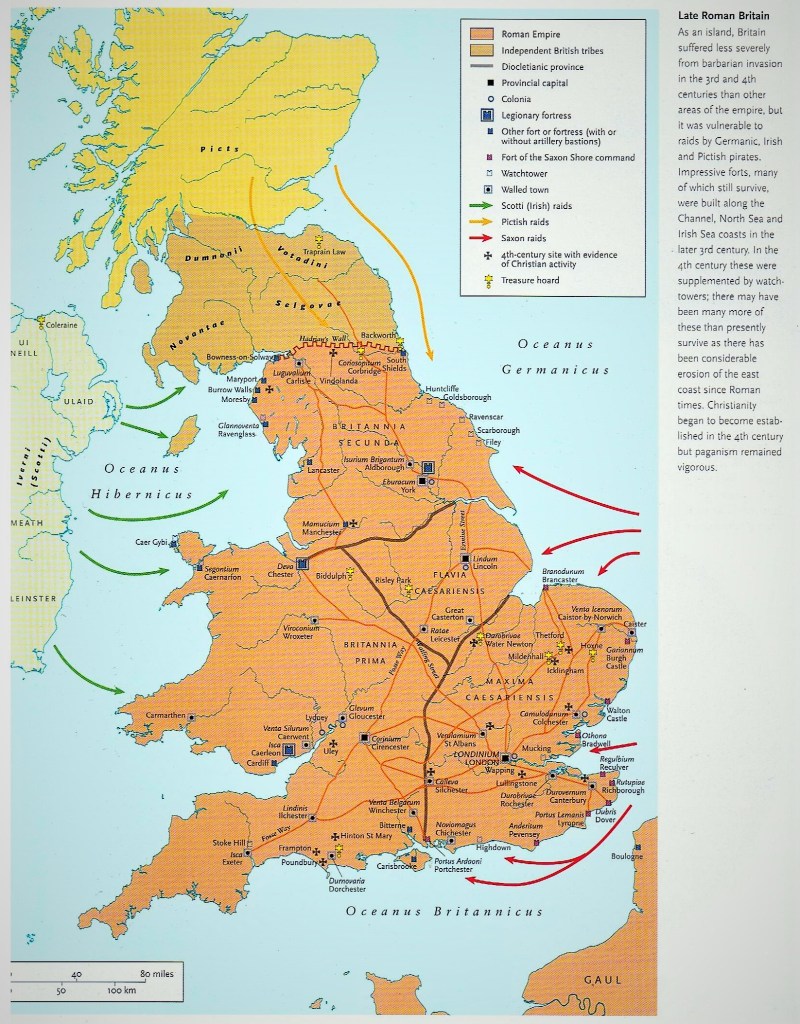
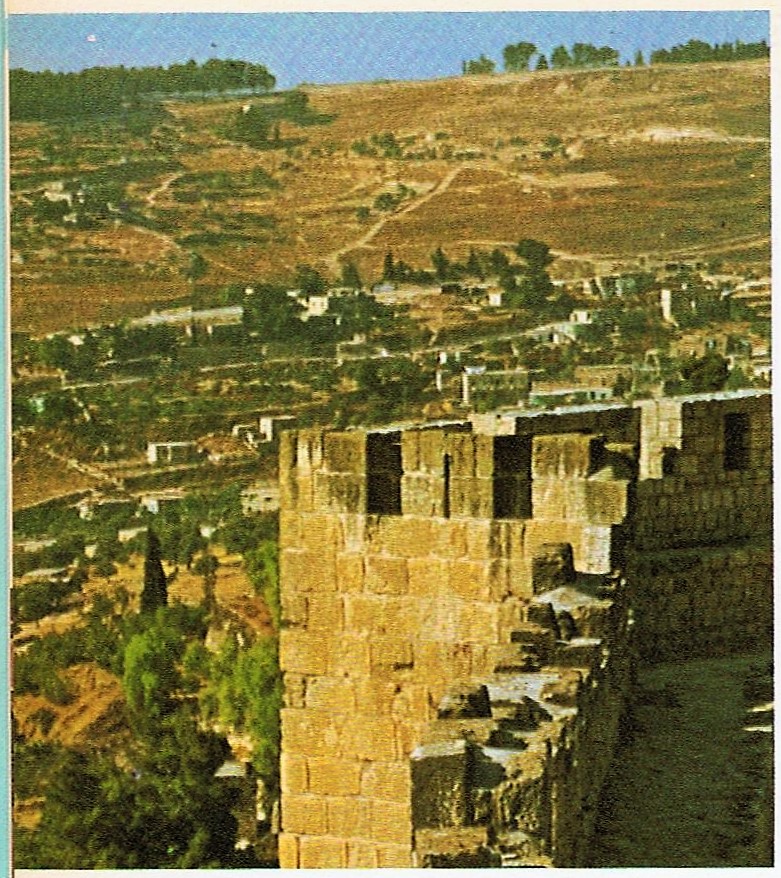
Richborough Fort, Kent. The remains of the walls of one of the several forts built by the Romans on Britain’s south and east coasts in response to raids.

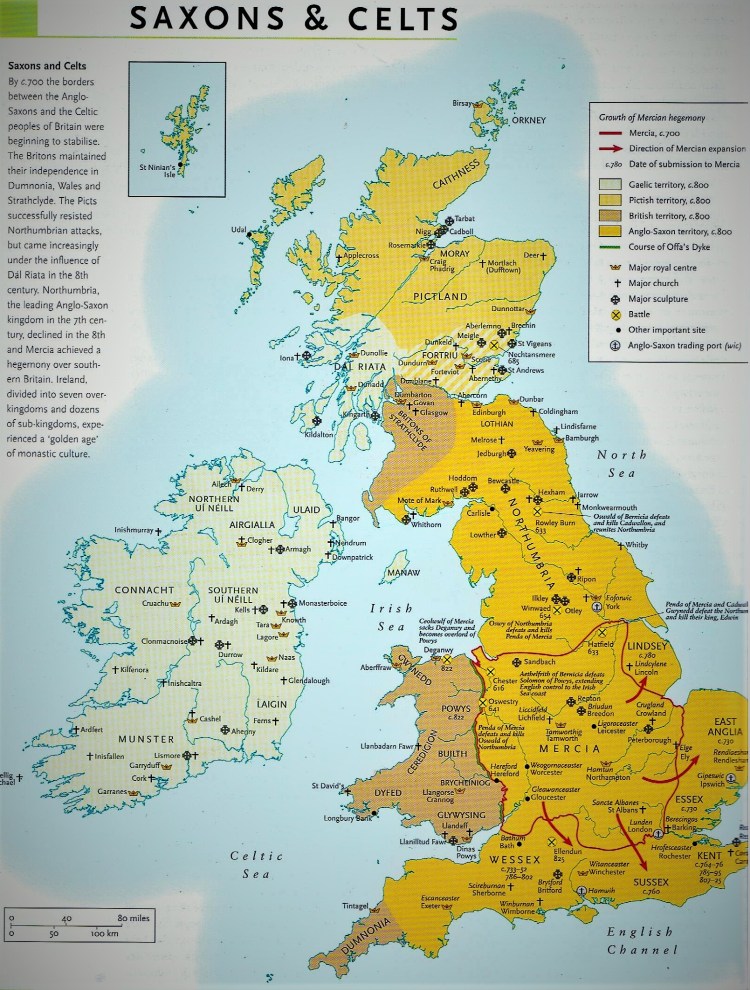
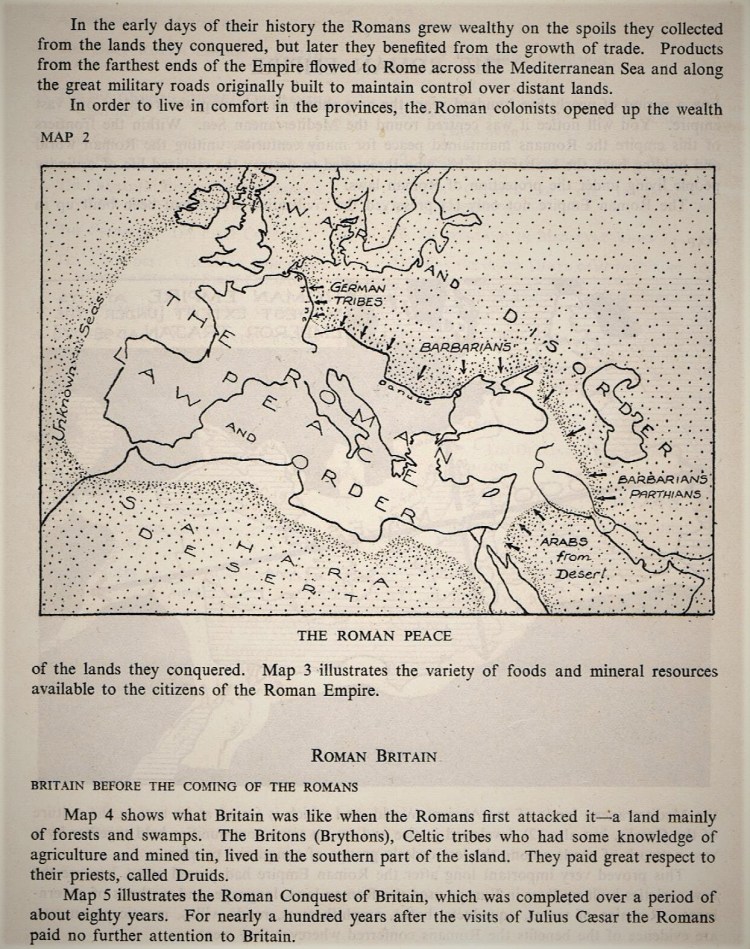
With the removal of Rome’s military support by around 411 the centralised adminisration of occupied Britain disintegrated, although the form and values of Roman life were not instantly overthrown. It was still hoped that Britain would become a Roman province again and an appeal for military aid was made to a Roman army campaigning in Gaul as late as 446. Once the Roman legions had withdrawn and imperial power within the British Isles had evaporated in the early fifth century, an older political pattern reasserted itself. Both in Britain and in Ireland the fundamental units of authority were the petty kingdoms, based upon the force of warrior bands sustained by booty and tribute. The Christian Church became a part of these societies only gradually. Already well-established in Roman Britain, Christianity in Cambria (or ‘Waleas’, ‘land of foreigners’ as the Anglo-Saxons called it), Cornwall (West Wales) and Cumbria, areas where the there was no sharp break with the Roman past. In Ireland, Strathclyde, and other kingdoms and territories north of Hadrian’s Wall, areas which were not continuously part of the Roman Empire, ‘Celtic’ missionaries introduced Christianity in the fifth, sixth and early seventh centuries, and went on to spread the faith among the Northumbrians and the Angles who had settled along the North Sea coasts during the fifth and sixth centuries. But from the time of their arrival until the beginning of the seventh century, the Angles, Saxons and Jutes remained largely impervious to Christianity. They remained true to their gods, Woden and the other deities in the Northern pantheon. The Romano-British Church was more interested in converting the remaining Celtic pagans on a line stretching from Dorset up to Strathclyde. Although a Roman mission under Augustine converted the Jutish kingdom of Kent in 597, it took a further generation for it to become properly established, and a further century for the whole of the British Isles to become part of ‘Christendom’.

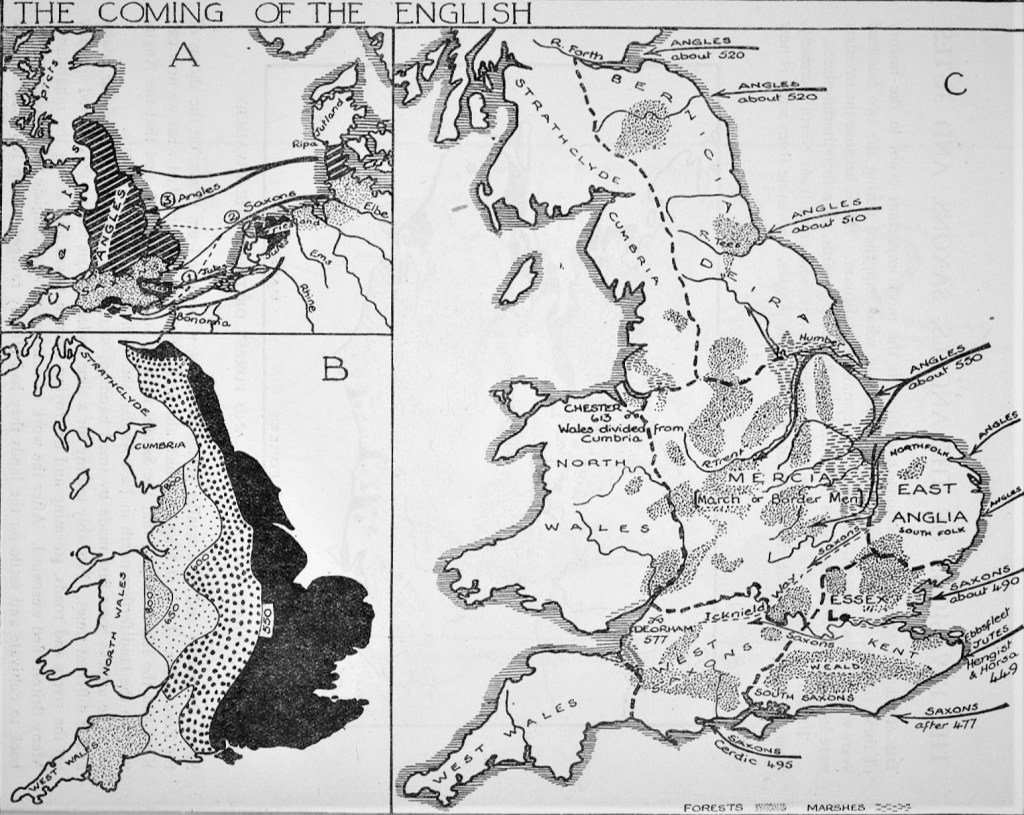
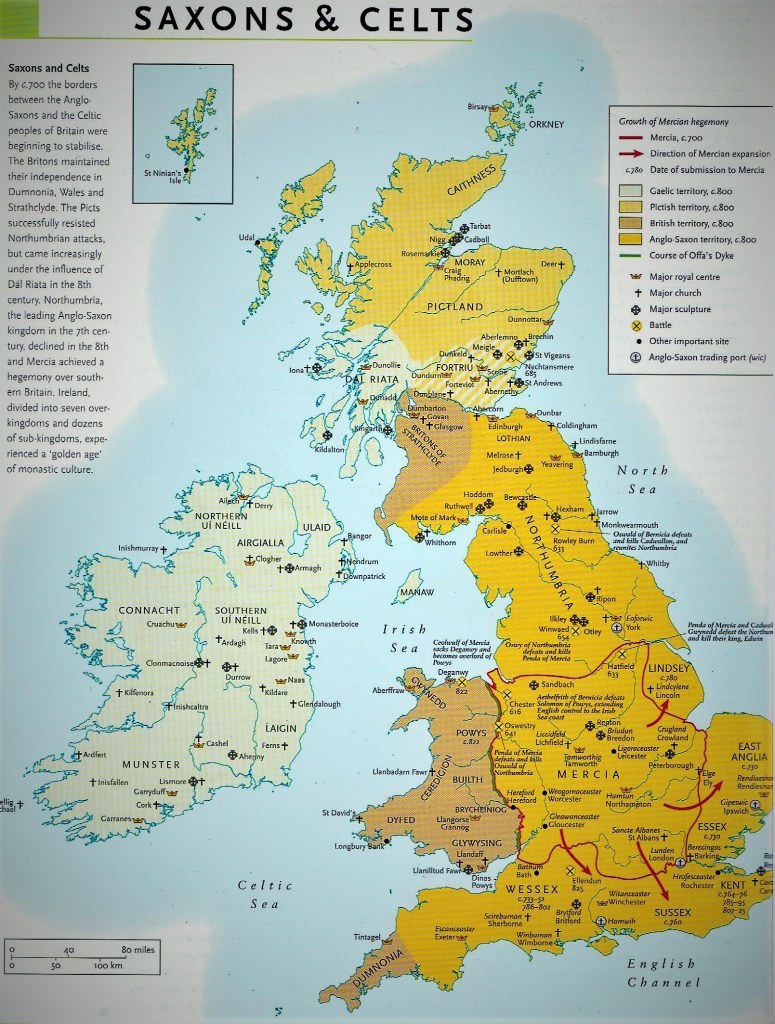
The collapse of the Roman province of Britannia created a vortex that drew Germanic migrants from across the Channel and propelled native peoples around the British Isles. Although in many respects the social and political consequences of that two hundred year period of immigration were felt most strongly in southern and eastern Britain, where Roman culture had become most entrenched, the upheaval affected all parts of the islands. The coming of the Angles, Saxons, and Jutes is the most important event in the history of those islands. But we have only a vague idea of what actually happened during the two hundred years of the incursions and settlements. The Saxons themselves left no contemporary written records, though their burial-places have provided rich sources of archaeological evidence. Britain was at first raided and then settled by the Saxons from North Germany, from the land between the rivers Ems and Elbe; by the Angles from what is now Southern Denmark; and by a smaller group, the Jutes, who came from Frisia, on the shores the Zuider Zee. The map above shows that the Jutes attacked Kent and the Isle of Wight, that the Saxons went to Southern England, and the Angles went to land further north in what became known as East Anglia, Mercia and Northumbria. The attacks were first made by small bands of warriors, at different parts of the coasts and at different times. There was no co-ordinated full-scale invasion. Possibly uniting for a time under a single leader, they moved speedily up the rivers in their long-boats, storming and destroying Roman towns and killing remaining inhabitants. Many Britons had already fled westward. After they had completed their work of destruction, the raiders turned back to settle and cultivate the lands they had ravaged. The map below illustrates the progress made in the settlement of the country between the fifth and seventh centuries.

Anglo-Saxon Incursions, Migration and Settlement:

A drawing from a UK school textbook.

The arrival of the Anglo-Saxons coincided with a drastic decline in towns and a reorganisation of the landscape, partly as a result of large-scale population movement. London was probably the only place where some semblance of urban life continued, and even there the centre shifted to the west, to an area outside the Roman walls. Elsewhere, towns were largely abandoned, some never to be reoccupied, others, like Winchester and Canterbury, eventually to be reborn as royal centres. A handful of new trading points were established, as at Hamwith (Southampton) and Ipswich. In the North and the West some Roman fortresses became local political centres, notably at York and Carlisle, but most were ignored. The arrival of the ‘Anglo-Saxons’ as they became known by later historians, initiated a period of struggle and decline, which saw the mass migration both across the North Sea and the Irish Sea, as well as the creation of a new political order out of the warfare and chaos which was endemic in post-Roman Britain.

Battle of Badon - Wikipedia
Arthur leading cavalry charge at Mount Badon in an 1898 illustration for Idylls of the King

From the perspective of the Celtic- and Brythonic-speaking peoples, this provided the context for the heroic, though largely legendary, efforts of ‘King Arthur’ or ‘Artorius’ in resisting the Anglo-Saxon expansion into western Britain. From this period of incursion and settlement, traditionally referred to as ‘the Dark Ages’, emerged a pattern of of ethnic, cultural and linguistic development which calls into question this epithet. Nonetheless, it does hold a substantial element of truth when applied to the sources available to the historian. Written evidence in the form of manuscripts such as the Anglo-Saxon Chronicle, the De Exidio de Conquestu Britanniae of the monk Gildas, Bede’s Ecclesiastical History of the English Nation and the tenth-century compilation of known as Nennius’ History of the Britons, allow the outline of events to be constructed, but the interpretation placed upon them by these sources is at best ambiguous, and at worst totally misleading.

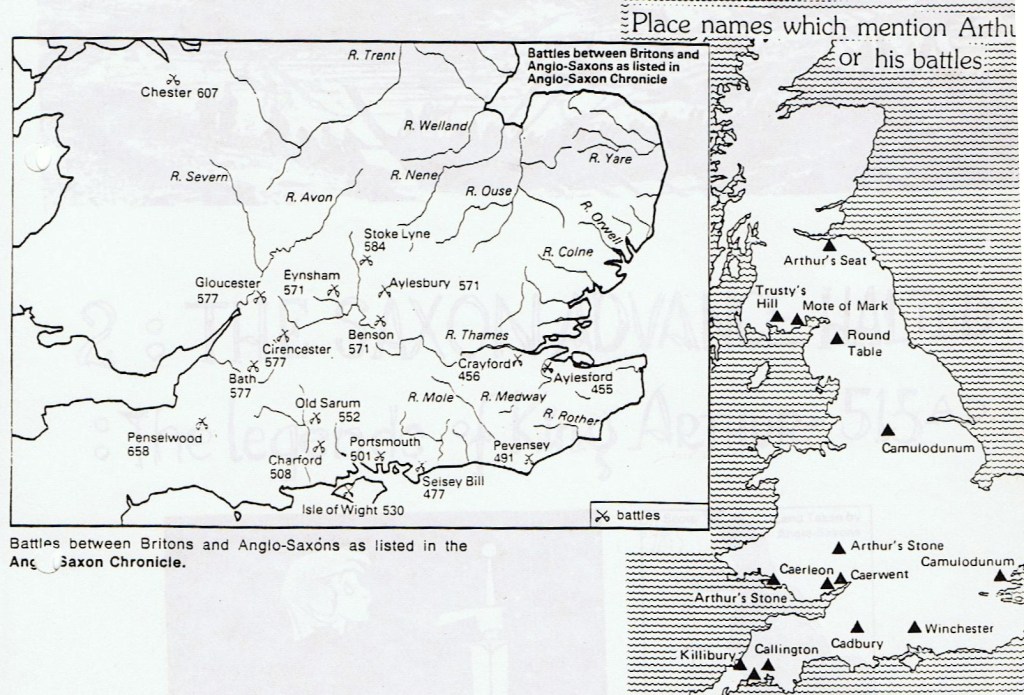
Early British Battlefields, from c AD 490.

Fortuitously, additional sources in the form of charters and statutes, archaeological evidence and the study of place names, can be used to qualify and amplify the narrative. The major themes that emerge are the transition of the ‘English’ peoples from groupings of small kingdoms into a single monarchy; the assimilation of the Anglo-Saxons, and the conversion of the English to Christianity. The outcome of battle was fundamental to the development of the first two, and war, on occasion, was the precursor to the advance of Christianity over paganism. We will never know the full extent of the fighting between Briton and Anglo-Saxon but The Anglo-Saxon Chronicle does throw some light on the nature of warfare at the time. The desire to annexe and settle enemy territory was one of the prime reasons for war, but there were other motives. Battles could result from feuding between rival claimants to the throne, from the harbouring of domestic exiles, from the attacks of marauding war-bands, and from raids aimed at seizing livestock, especially valuable cattle. Warfare took a number of different forms, including attempts to repel seaborne landings, and to capture strongholds such as Roman fortifications or pre-Roman hill-forts and river crossings. River lines formed a natural defensive position and battles often centred on fords or other crossing points.

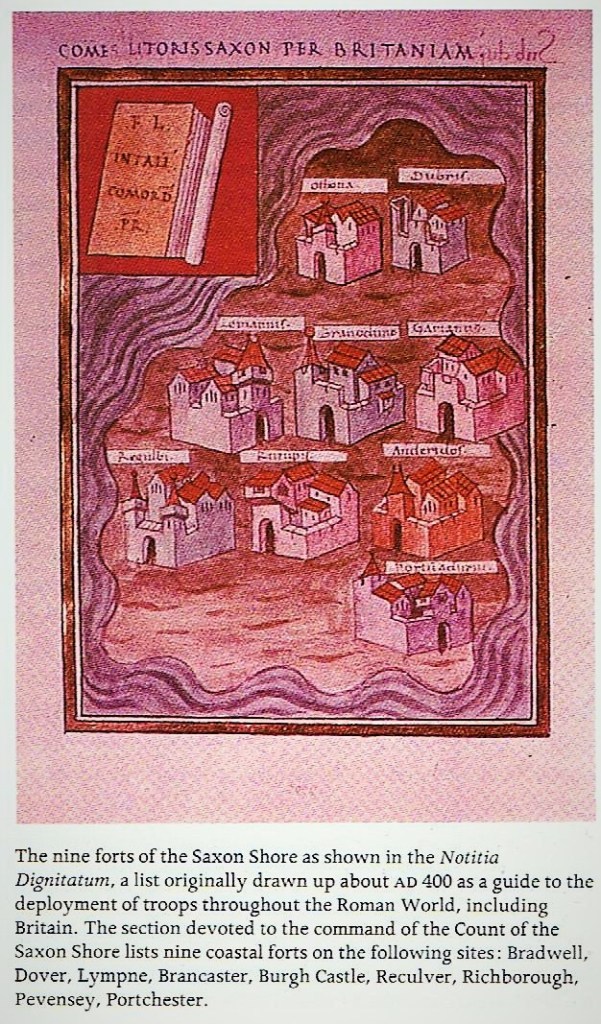
The Roman legions had come to Britain as professional soldiers under orders to conquer an island whose possession might further the interests of Rome. But long before they left, a new force had appeared on the scene. They had first appeared in the Channel as early as the second century. The Angles, Saxons and Jutes came as peoples hungry for land and loot. Finding that Britain could satisfy their desires, settlement and eventually folk-migration followed. The initial incursions were resisted by the native Britons, but their dynasties and armies were gradually pushed westwards over the course of the two centuries that followed. The Anglo-Saxons, as the different tribes became collectively known, were great fighters and seafarers and, when they settled, skilful farmers. The Romans had held a healthy respect for them and even admired them, having first encountered them on the northern borders of their continental empire, but they had also created a special command to deal with their marauding ways around the eastern coastline of Britain. This had come under the ‘Count of the Saxon Shore’ who had a chain of forts and a fleet of warships to help in the task of defending the island from attack across the North Sea. The Romans have traditionally seen as land-based people, moving their armies swiftly along their magnificent straight roads to confront their enemies in set-piece battles. In fact, they were extremely flexible in their military strategies, and adaptable in their use of seaforts and navies to keep the ‘sea-wolves’ at bay. The Romans had done everything they could to integrate themselves into British life over their four centuries of occupation, but the fact that they were still seen by many natives as occupiers is perhaps borne out by their failure to train and equip the Britons to defend themselves against external attacks.

The Defence of Britannia’s Shores:

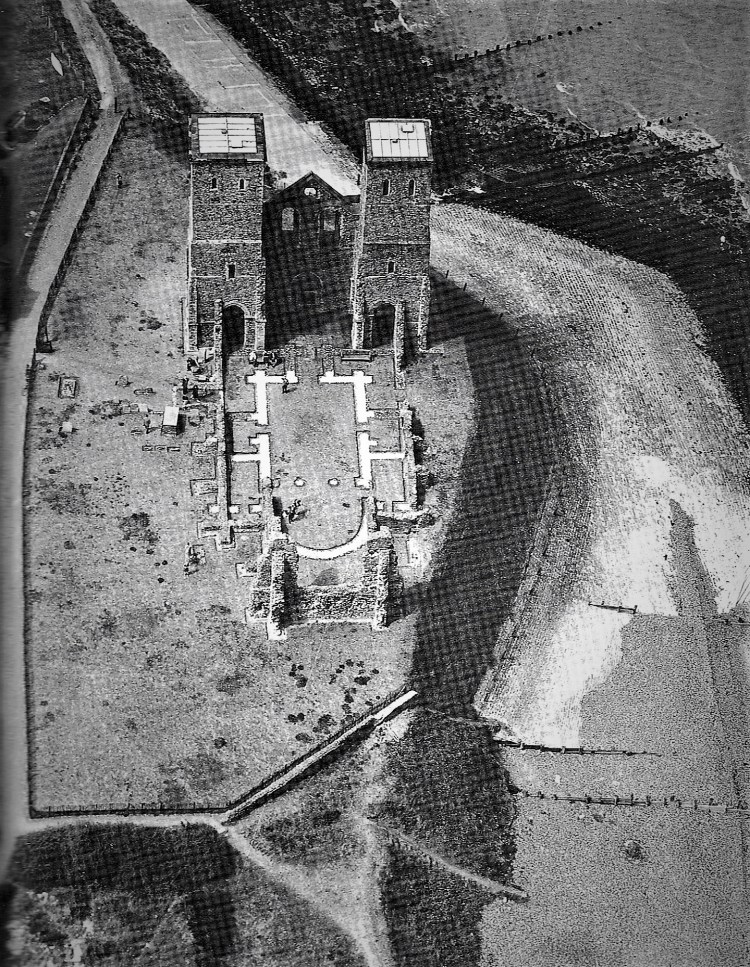
Reculver Church, Kent, from the air, showing the surviving west end with the foundations of the rest of the building marked out on the ground. The Romans built a small fort there at the time of their conquest of Britain in 43 AD, and, starting late in the 2nd century, they built a larger fort, or castrum, called Regulbium, which later became one of the chain of Saxon Shore forts. Following the withdrawal of the Western Roman Empire in the early C4th, the Britons again took control of the lands until Anglo-Saxon invasions shortly afterward.
By the 7th century Reculver had become a landed estate of the Anglo-Saxon kings of Kent. The site of the Roman fort was given over for the establishment of a monastery dedicated to St Mary in 669 AD. 

It is perhaps not entirely fair, therefore, to blame the subsequent successful incursions by the Angles, Jutes and Saxons on the lack of military experience and preparadeness of the Britons themselves. Many Britons had served with some distinction in the Roman legions, as I detailed in my previous article, and had fought their way across Gaul as far as the western imperial capital itself. They were as skilled and brave as their fellows in arms from anywhere else in the empire. The tales of Macsen Wledig in the Welsh Mabinogion are testimony to this. But the Britons did not seem to appreciate early or widely enough the new form of coastal warfare that they needed to employ against the incursions which followed Rome’s withdrawal. For one thing, the seaforts built by the Romans needed contant reinforcement and garrisoning against forces that were more numerous and more experienced in this form of warfare. But on at least one occasion the Britons did use exactly the right tactics against their opponents, and that was at Mount Badon. The Jutes had arrived first, by invitation, and were the first to settle and establish themselves in Kent. Having quarrelled with and driven out their hosts, they demanded a large slice of the south-east. There were still Romans in Britain at that stage, but they were without any military power. In the Anglo-Saxon Chronicle for 443, we read:

In this year the Britons sent across the sea to Rome and begged for help against the Picts, but they got none there, for the Romans were engaged in a campaign against Attila, King of the Huns. And then they sent to the Angles, … and made the same request of the chieftains of the English.

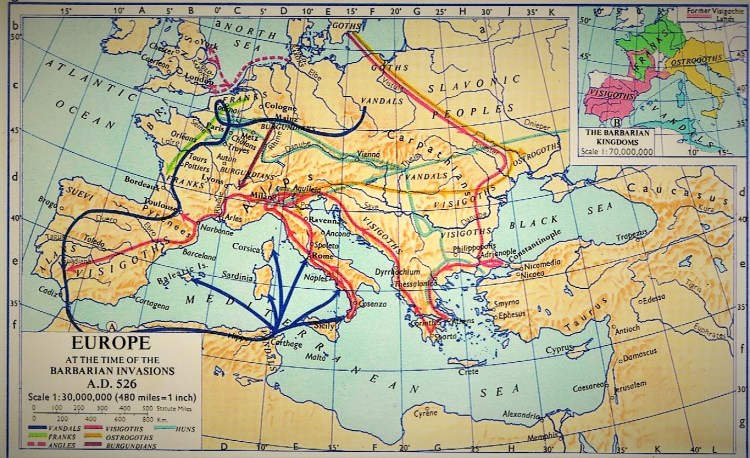
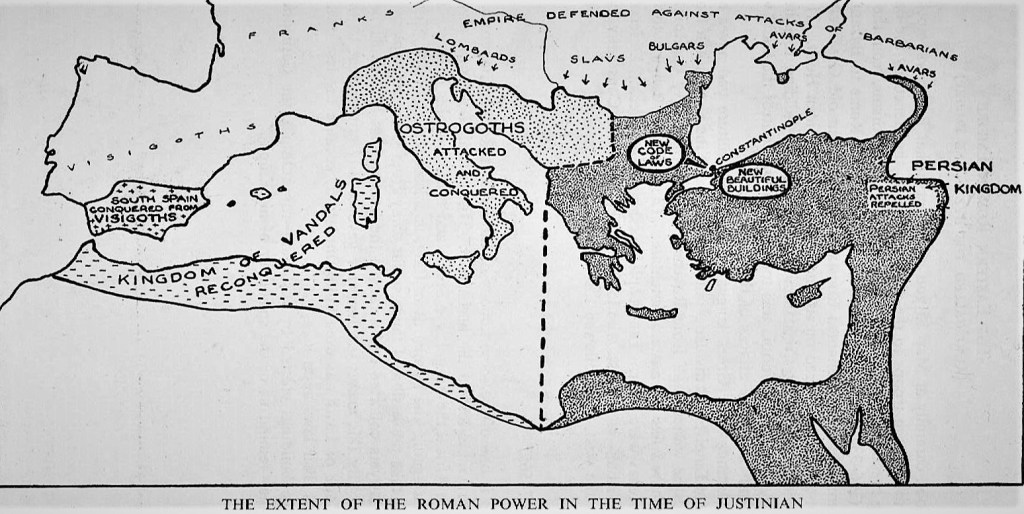
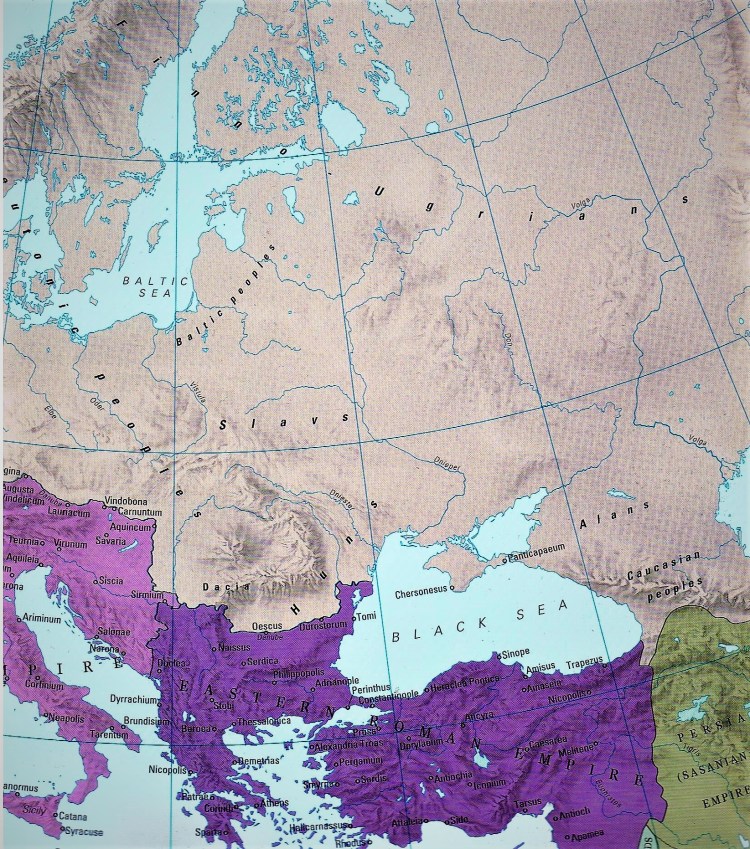
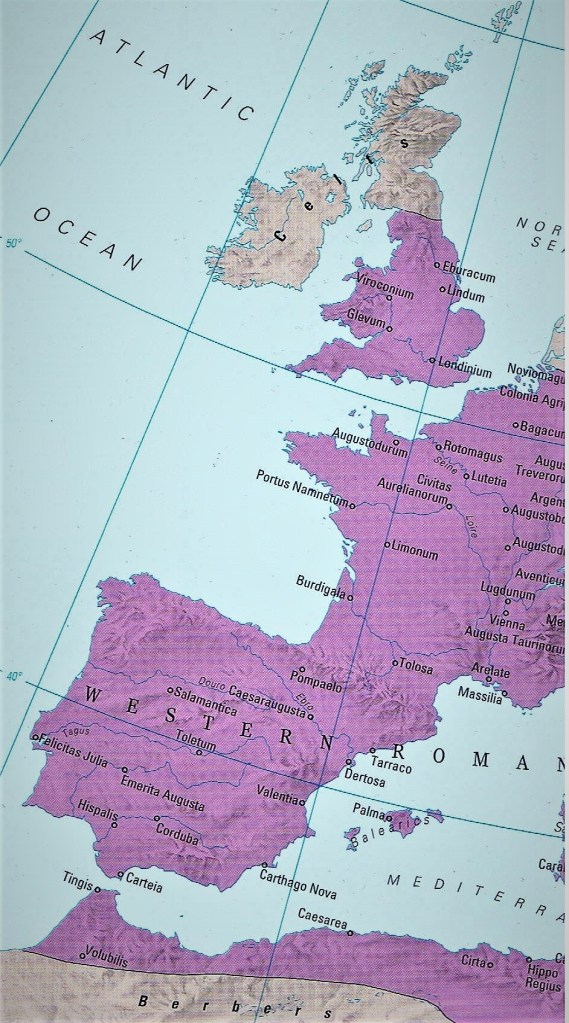
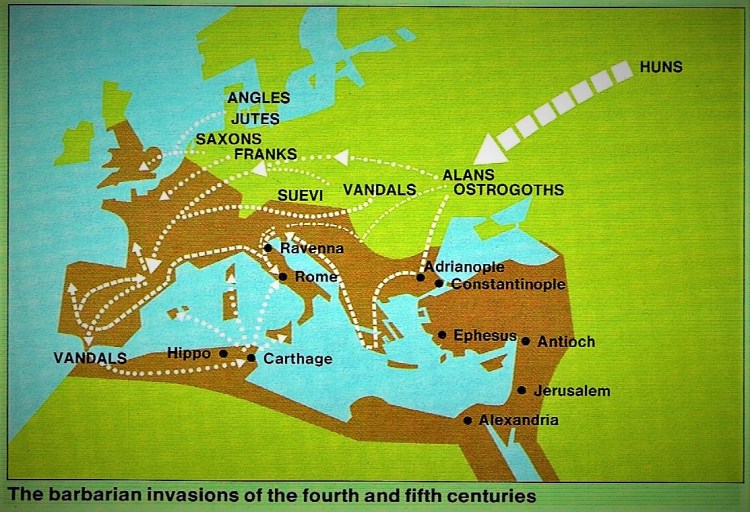
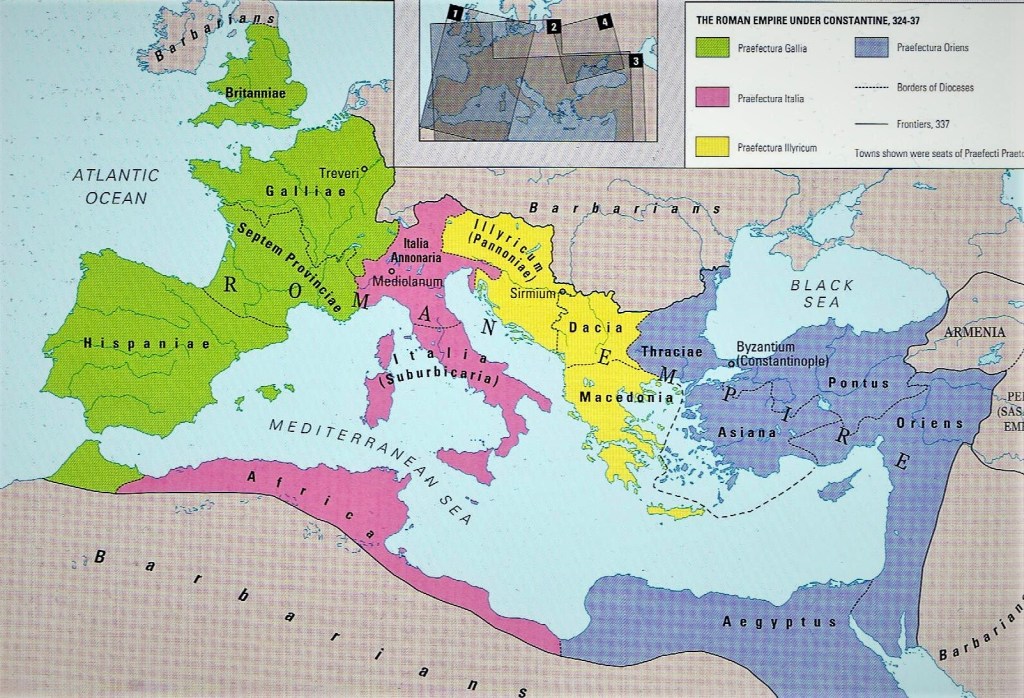
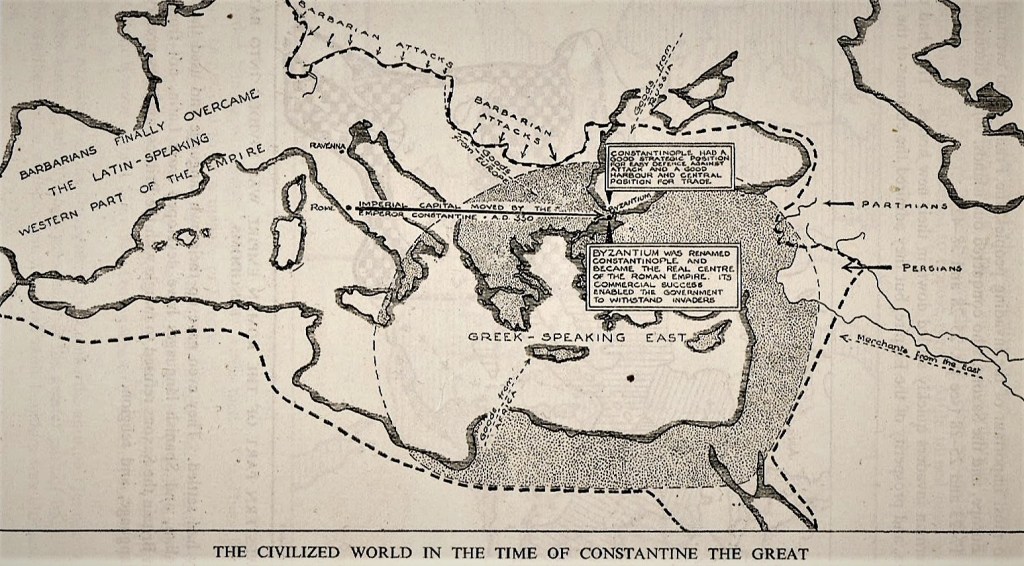
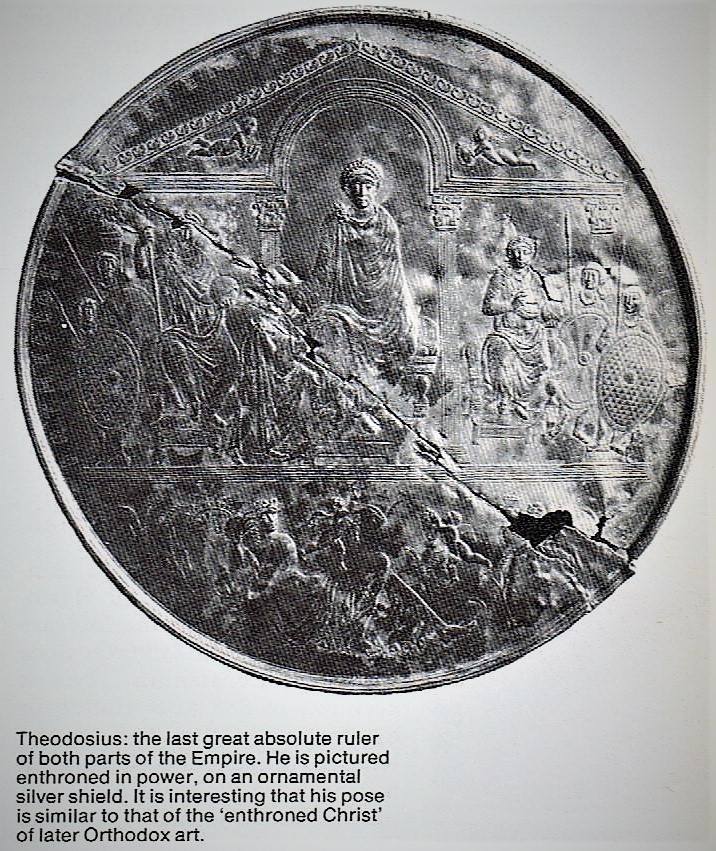
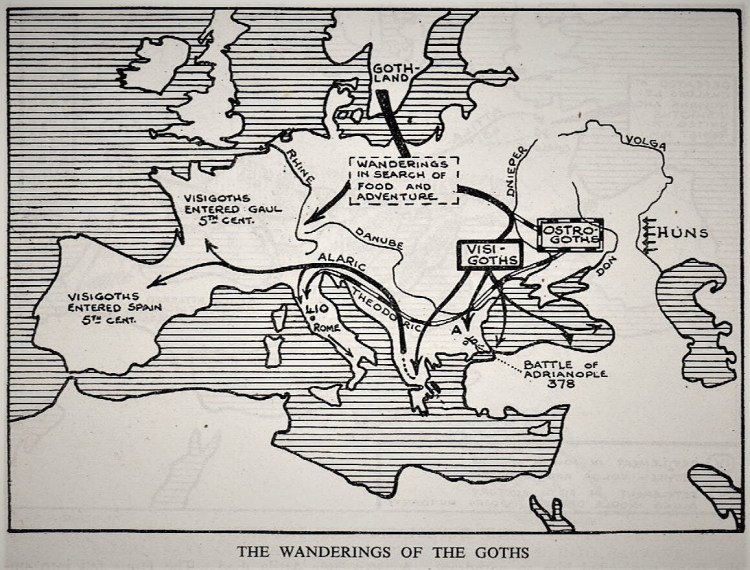
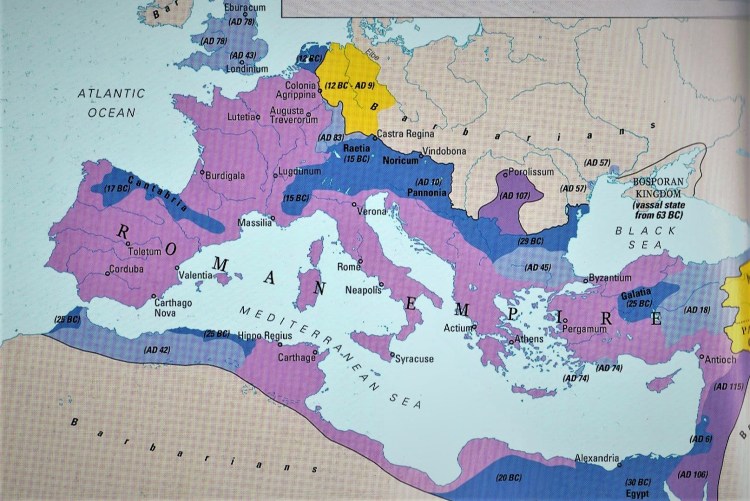
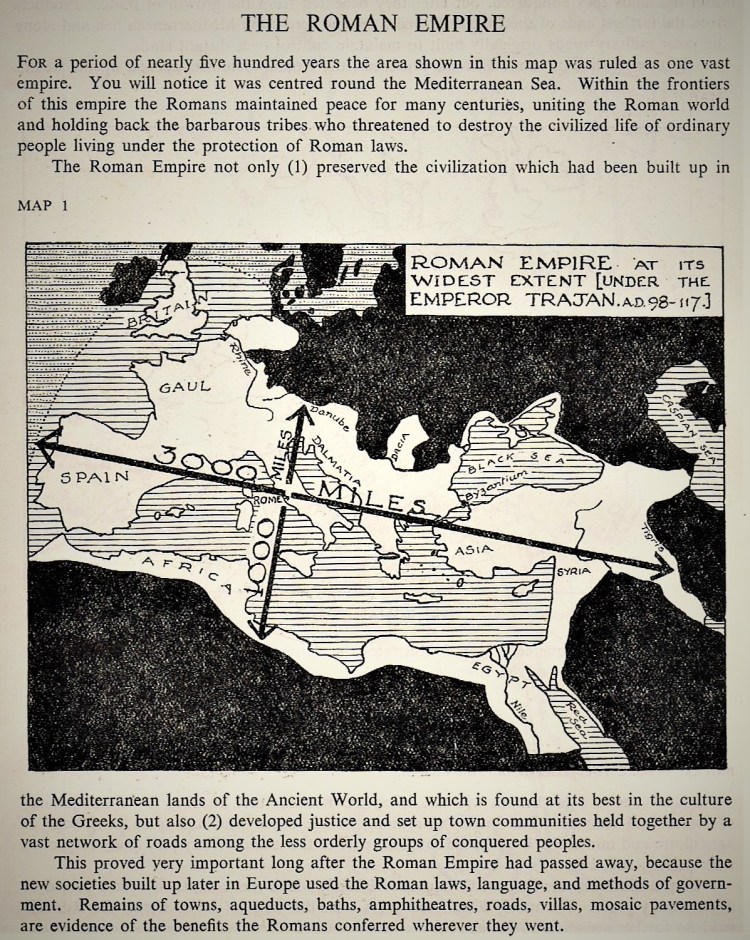
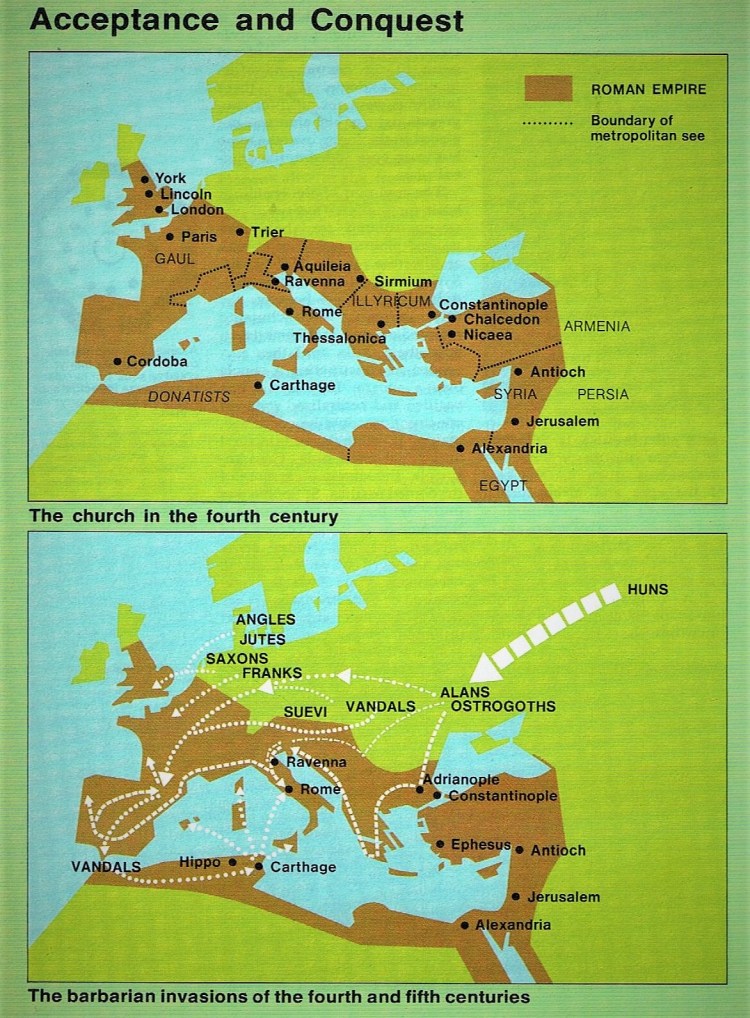
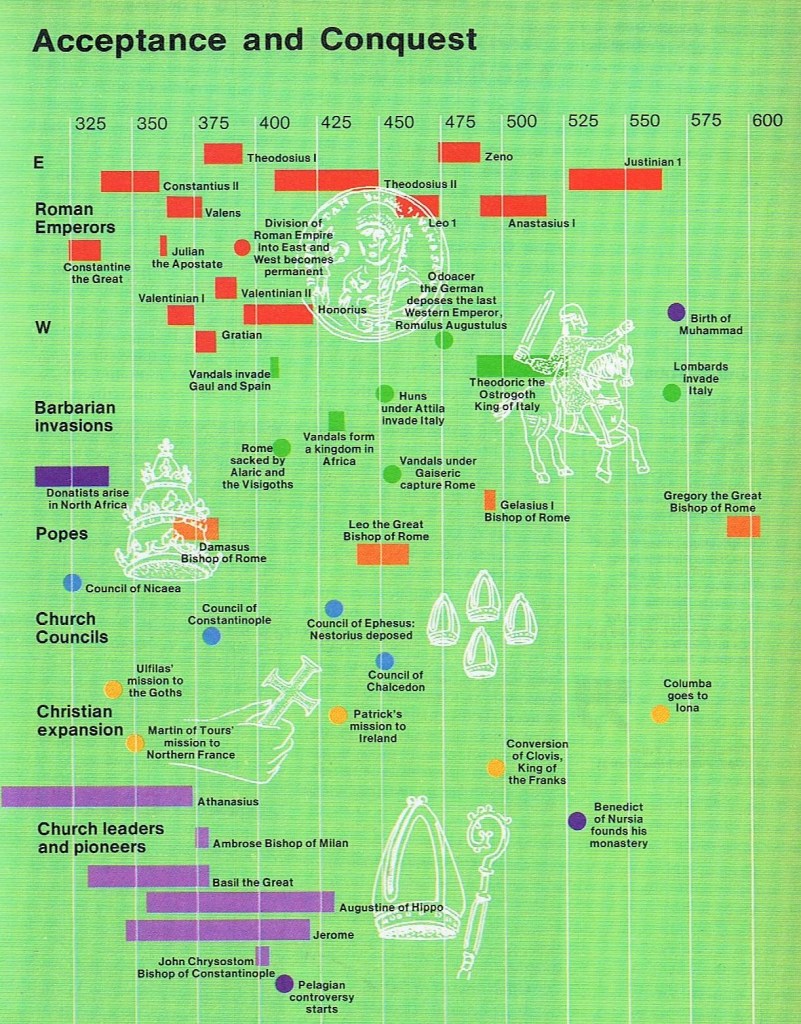
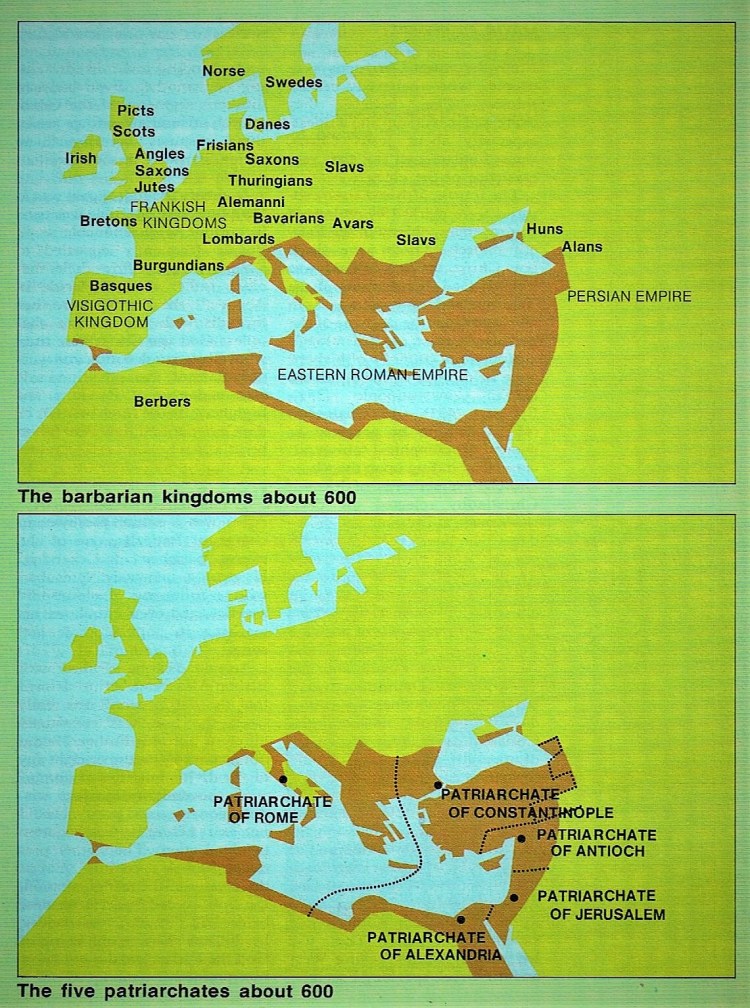
At this time the Vandals marched through Gaul and into Spain, plundering as they went (see the map below). After crossing the strait of Gibraltar, they easily took control of North Africa before re-crossing the Mediterranean to attack Rome in 455. Meanwhile the Huns, continuing their destructive march, had also entered the Roman Empire. Led by Attila, they ravaged the land as far as Constantinople. They then moved westward towards Gaul where at Chalons, near Troyes, in 451, the Visigoths and Romans united to oppose them. Attila turned back towards Italy, but the Pope persuaded him to withdraw across the Danube. The next year Attila died and the Huns fell into disorganised groups, ceasing to be a threat to the Empire. However, the Barbarian invasions of the Empire continued into the sixth century, most notably by the Franks, as shown on the map above, at the same time as the incursions into Britannia continued unabated. The Emperor Justinian (527-565) attempted to recover the provinces lost to the barbarians, and his general had some success in this in Africa, Spain and Italy. But these provinces were soon easily lost again, to the Moors and the Lombards, because they were too far away from Constantinople.

Unfortunately for the Britons, they soon discovered that their hoped-for saviours proved to be the next aggressors themselves. Two military strategies appear to have been put forward to deal with the barbarian threat after the break with Rome. Each policy was supported by rival adherents whose partisanship developed into mutual hostility and war. The rival leaders may have been Vortigern and Ambrosius Arelianus; it appears that the former, whom Gildas describes as superbus tyrannus, was the principal military leader of the Britons in the fifth century. The name ‘Vortigern’ can be translated as ‘high king’ although the exact status of this figure remains uncertain. What is widely accepted is that he was responsible for bringing Saxon mercenaries to Britain to provide a defence against attack by Picts and Scots. It is possible, however, that the real significance of this strategem was to repel a Roman landing from Gaul in support of Ambrosius. Thus Vortigern’s decision to base the mercenaries along the North Sea Coast and to surrender Kent as an area for further settlement can be explained by the need to create a ‘buffer zone’ against an attack from across the Channel.

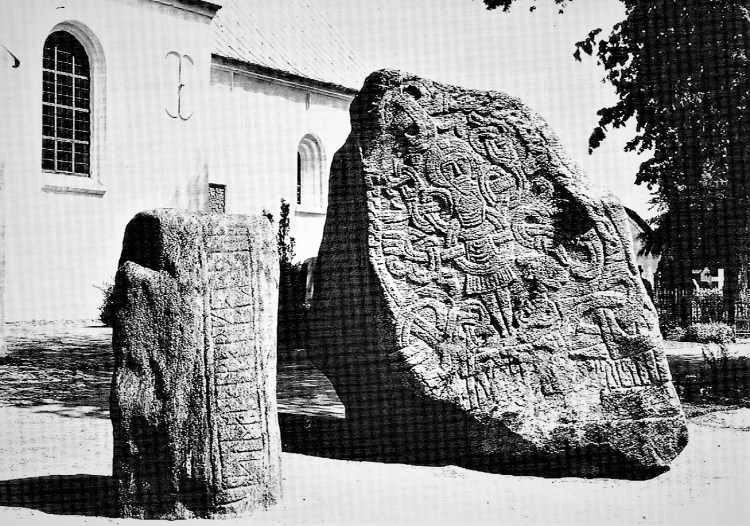
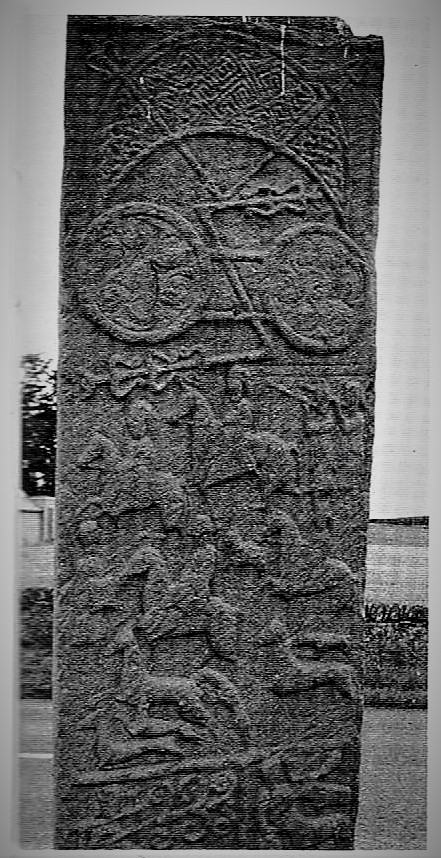
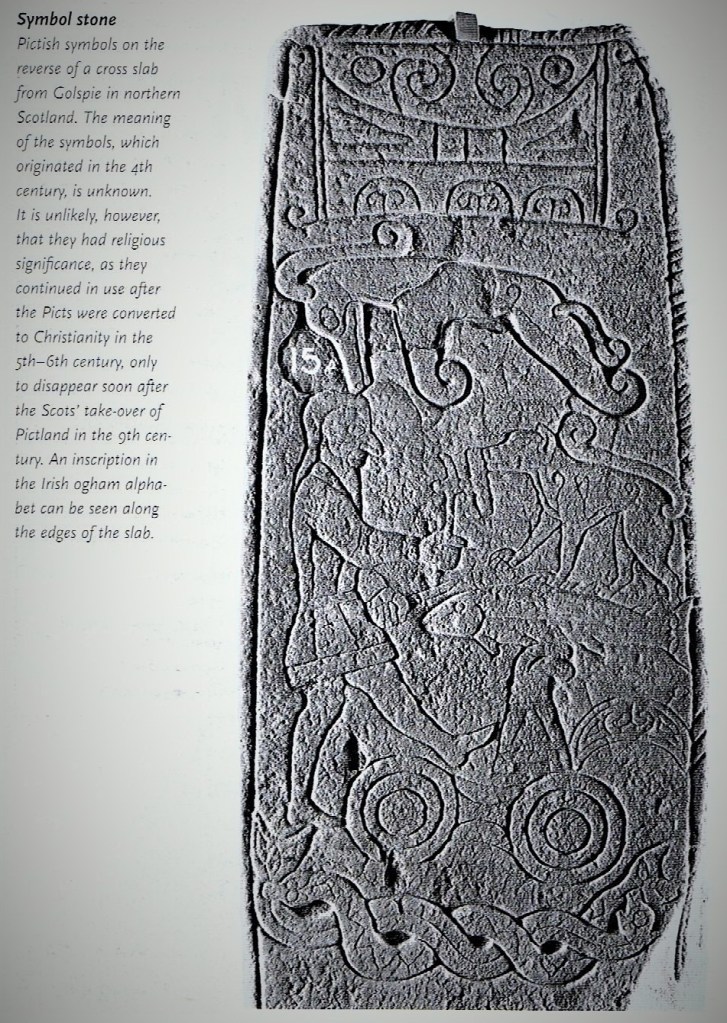
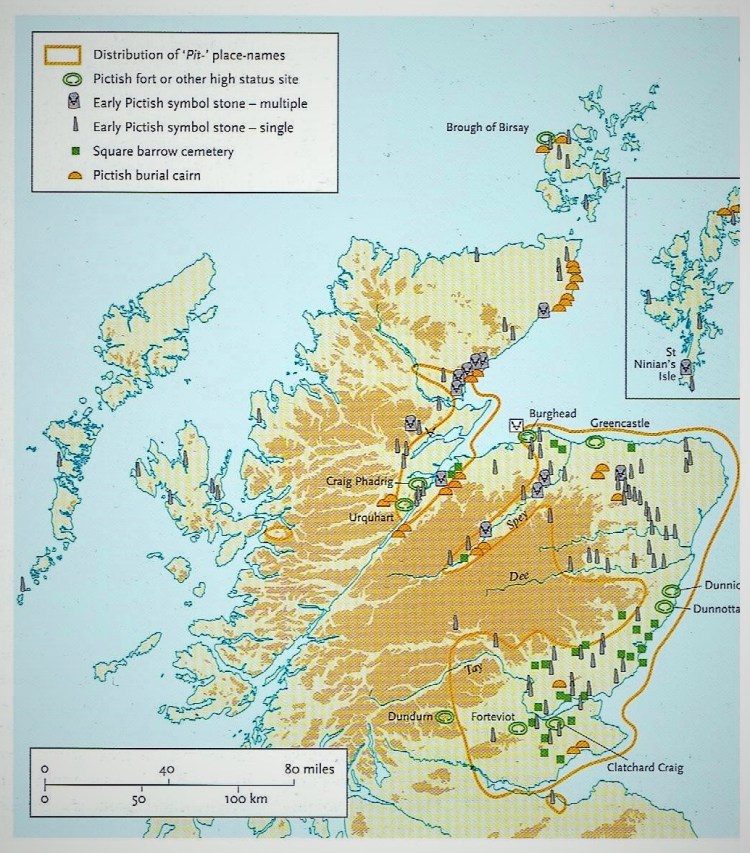
A Pictish stone standing by the roadside in Tayside. Ornamented with a hunting scene and striking, but incomprehensible symbols. The other side is carved with a great cross.

Vortigern’s employment of barbarian allies was by no means original and it is probable that Germanic settlers co-operated in the defence of forts and towns even before the Romans withdrew. Whatever the precedents, Vortigern’s policy was a catastrophe for the Britons. The mercenaries comprised Angles, Saxons and Jutes and it seems certain that their role as allies started earlier and developed more gradually than is suggested by Bede’s later account of a single mass descent led by Hengest and Horsa around 450. At first the visits of the Saxon warriors were no real threat, as they accepted land and money in return for their military service, but as reinforcements arrived from their homelands across the North Sea and their strength increased they were encouraged to rebel by the apparent weakness of their hosts. Consolidating their hold on the eastern coastal areas, they launched savage raids to the north and the west. Vortigern’s allies turned on him and swarmed all over southern and eastern Britain, carving out independent estates and kingdoms for themselves. Hengist and Horsa fought Vortigern at a site called Aegelsthrep where Horsa was killed, and then Hengist and his son Aese won a decisive victory against the Britons at Creacanford, a site which cannot easily be identified. Now the floodgates were opened and a succession of warlords crossed the North Sea in their long shallow-draught boats to probe the coast, rivers and inlets of East Anglia in search of land which was vacant or could easily be made vacant.

Who were the Invaders?

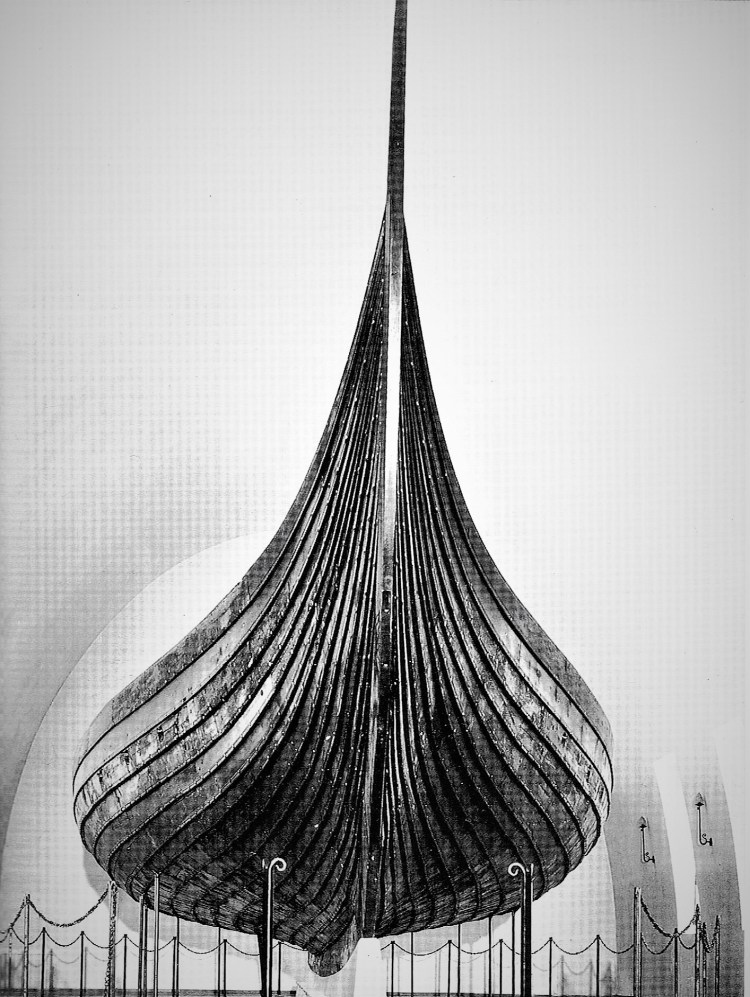
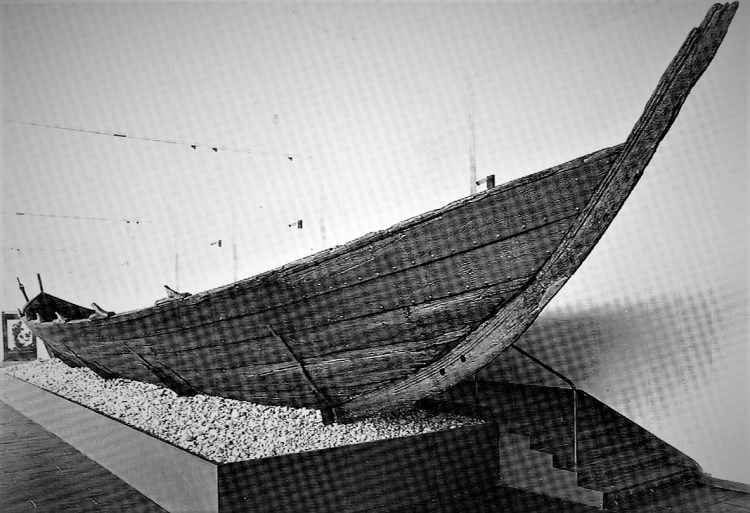
The Nydam boat at Schleswig Holstein, Western Germany, built around 400.

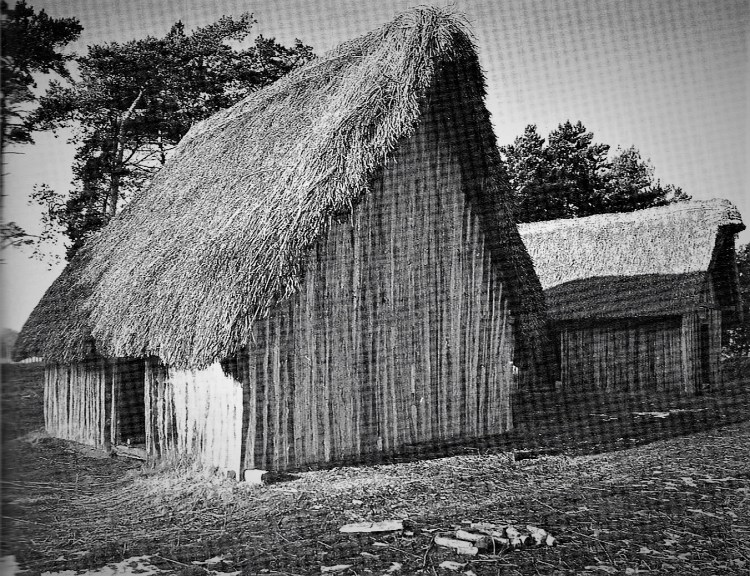
Who were these Anglo-Saxons from whom the greater part of our present population is descended? They were fishermen-farmers from Schleswig-Holstein, North Germany, the North Frisian Islands and, perhaps, from Denmark. Pottery finds suggest that we are here dealing with quite a large number of distinct communities who came severally and over a long period of years in their seventy-foot-long, oar-propelled boats. This was no concerted invasion, but a piecemeal settlement similar to that of the Celts which had taken place over the millenia ‘before the Romans came from Rye’. They rowed up the rivers, first advancing from the Wash and penetrating the Breckland. Later raiders pushed up the Deben, the Gripping and the Orwell to establish settlements on the Sandlings. The new culture established itself rapidly and completely. All Latin traces quickly vanished as Romano-British landowners fled westwards or established a modus vivendi with the strangers. The peasantry found it easier simply to adopt the language and customs of their new masters. Old names were soon lost without trace, and new ones appeared, like Gipeswic (‘the settlement by the estuary’ – Ipswich), Sudbyrig (‘the southern fort’ – Sudbury). ‘Ham’,’Wic’, ‘Tun’, ‘Weorde’ are all words, suffixes which indicated small settlements, fortified homesteads where single families lived with their servants. Notably, the newcomers had no word for town since the concept of urban life and the complex social interrelationships it implied was alien to them. The Saxons, like most Britons, lived in small self-sufficient units, in round houses of timber and thatch within stockades which provided shelter for man and beast. The communal fire was the centre of every homestead, while the ‘thegns’ lived in more imposing timber halls where they feasted their warriors, discussed forthcoming campaigns and listened to songs and sagas of ancient valour.

Reconstructed Anglo-Saxon houses at West Stow, Suffolk. The one in the foreground has probably been built with a slightly over-tall roof, when compared to the source below.
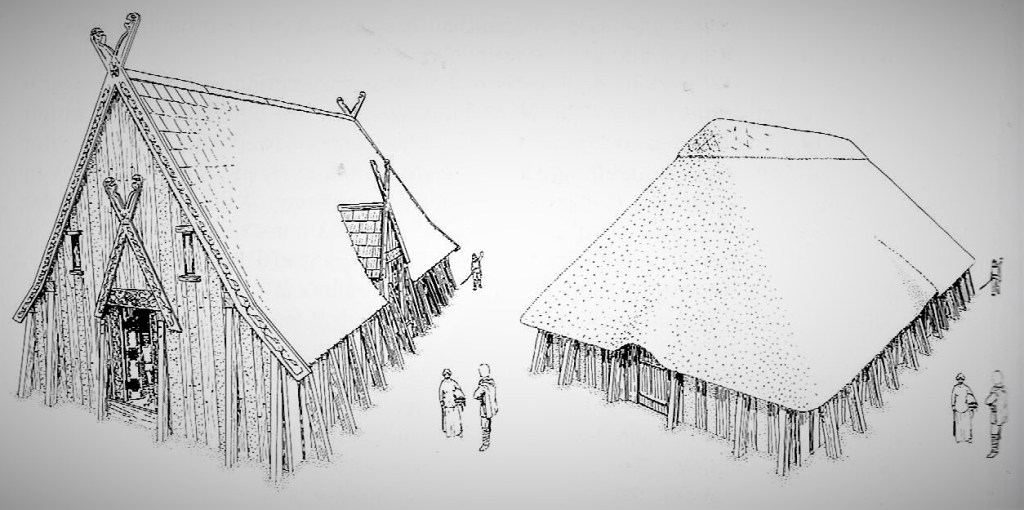
Different reconstructions of an Anglo-Saxon building based on the same excavated evidence from an Anglo-Saxon settlement at Cowdery’s Down , near Basingstoke, Hampshire, excavated by Martin Millett.

Vortigern disappears from the historical record by 460 and thereafter British resistance to attacks centred on the leadership of two men with Latin names, Ambrosius Aurelianus and Artorius (Arthur). In 477, the formidable Aelle arrived with his three sons and killed many Britons and drove some into flight. Aelle was clearly a warrior king whose principal pastime was making himself an intolerable nuisance to his neighbours both in his homeland and across the North Sea. He found Britain a tempting target with people to be plundered and occupied. One of the his sons, Wlencing, gave his name to Lancing near Shoreham, and another, Cissa, to Chichester. The Britons made the fatal mistake of trying to hold him off from fixed defences with no sally-ports, resulting in them becoming besieged in old Roman forts, as at Pevensey. Aelle and Cissa captured the fort and killed every man, woman and child within its walls. After this massacre, Aelle founded the Kingdom of the South Saxons, later becoming the County of Sussex. From its founding, the Saxons arrived in increasing numbers. Some landed further west, and founded the Kingdom of the West Saxons or Wessex; others founded the Kingdom of the East Saxons, the County of Essex. Angles, Saxons and Jutes all came from contiguous areas on the continent, and it is surprising that the early chroniclers were expert enough to be able to distinguish between them. All were formidable in war, but none more than the Saxons whose achievements were only too well known on the Continent. One of sources is the sixth-century monk, Gildas, who described their effect on Britain:

… famine dire and most famous sticks to the wandering and staggering people, priests and … swords on every side gleaming and flames crackling were together mown to the ground … fragments of bodies covered with clots as if congealing of purple-coloured blood, mixed in a sort of fearful winepress, and burial of any kind was there none except the ruins of houses, the bellies of beasts and birds in the open …

This image has an empty alt attribute; its file name is 004-6.jpg

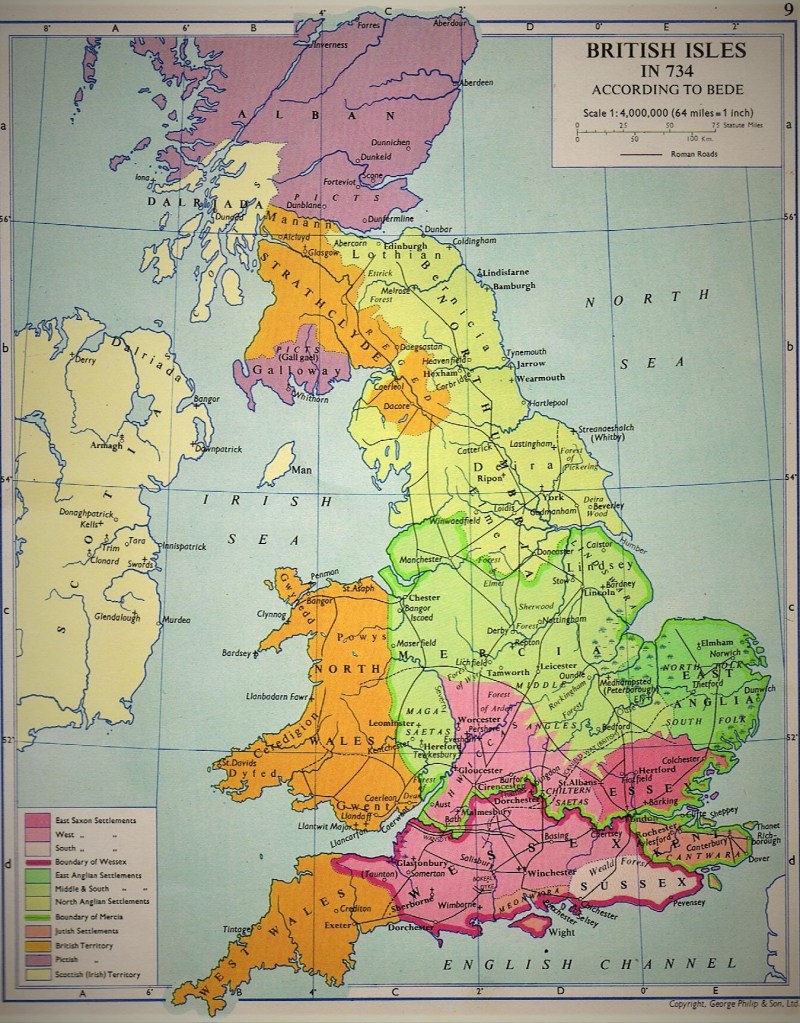
Archaeology has begun to shed some light on the ‘Dark Ages’, where documentary evidence is lacking. The distribution of pagan fifth-century Anglo-Saxon burials indicates the probable areas of earliest Anglo-Saxon settlement in Britain. As the map above shows, the ‘English’ advance continued throughout the period – though both English and British kingdoms fought as often among themselves as against each other. Inscriptions in the Irish ogham alphabet, also adopted by the Picts, point to each area of Irish settlement in the southwest, west Wales and soutwest Scotland; Latin memorial stones reflect successful British campaigns to drive the Irish out. Meanwhile, British and then Irish missionaries spread Christianity throughout Ireland and Picts; by the end of the period Irish, continental and native British missionaries had also begun the conversion of the Anglo-Saxons.

Map A above shows how the Jutes, who came from Frisia, attacked Kent and the Isle of Wight, while the Angles went further north into East Anglia, the Midlands and Northumbria, while the Saxons settled mainly along the southern coasts. Map B illustrates the progress made in the settlement of the country between the mid-fifth century and the end of the sixth century.. Map C shows the lengthy nature of the struggle between the retreating Britons and the Anglo-Saxons. The two battles of Deorham in 577 and Chester in 613 are marked, since they separated the Britons into three regions.

At first the Britons could do little except flee or stand and be slaughtered. Many chose to take their chances in the woods, for there was no safe haven in the towns the Romans had left. The Saxons did not occupy the buildings they had not destroyed; this concept of the civilised life was beyond their grasp, but they did make use of the Roman roads to penetrate deep and wide into Britain. Out of their misery the Britons had to develop a new form of life and warfare. Like their ancestors of some five hundred years before they began to display the skills of guerilla fighting which had impressed the first Roman invaders. We know from Roman accounts that the Britons were highly mobile, could race around in chariots, alight, fight and leap back on to their horses and chariots. But these skills had long been forgotten, and were never completely revived. Instead the Britons evolved a more cautious form of warfare, with a technique of ambush. They were slow, however, to learn the strategy of avoiding pitched battle, as we can read in the Anglo-Saxon Chronicle:

495: In this year two chieftains, Cerdic and his son Cynric came with five ships to Britain at the place which is called Cerdicesora, and they fought against the Britons on the same day.

501: In this year Port and his two sons Bieda and Maegla came to Britain with two ships at the place … called Portsmouth and there they killed a young British man of very high rank.

508: In this year Cerdic and Cynric killed a British king whose name was Natanleod and five thousand men with him, and the land right up to Charford was called Netley after him.

514: in this year the West Saxons came with three ships at a place which is called Cerdicesora and Scuf and Wihtgah fought against the Britons and put them to flight.

These early battles or skirmishes were strenuous and bloody enough to impress the chroniclers but they were not decisive. The Saxon raiders would celebrate their victories with plunder and senseless destruction but at this stage they had few constructive ideas as to how to consolidate their gains. Had they been well led, the Britons could have ambushed these marauders on their return to the coasts and recaptured most of the spoils. But apart from certain isolated occasions, they seldom did so. The Saxons either set sail for their homeland or settled near the coast in this new territory. Many of the Britons had fled far beyond the farthest point of Saxon penetration, deep though that was in places, in order to gain the protection of the ancient hillforts. The Saxons referred to all the Britons as the ‘Waelisch’, which meant ‘foreigners’ or, perhaps more precisely, ‘outlanders’, which gave the name to the territories where some of the Britons settled and survived, and eventually to the nation which emerged from the Dark Age principalities and kingdoms of Powys, Gwynedd and Dyfed. Gildas’ account of the misfortunes of these ‘refugee’ Britons was substantiated by Bede, who wrote:

Consequently some of the miserable remnants, being taken in the mountains, were slain in heaps. Others, constrained by hunger coming forward, yielded hands to their foes to undergo for the sake of food perpetual slavery, if indeed they were not immediately killed. Others, sorrowing, sought countries over sea. Others, remaining in the fatherland, led a wretched life in mountains, woods, and steep crags, always with apprehensive mind.

Artorius, The Battle of Badon & The British Resistance:

But both Gildas and Bede were glossing their chronicles with their own tales of woe and narratives of defeat and misery to the situation, which was never as bad as they made it seem, if we take into account other sources of evidence, which testify to the determination of the royal dynasties of the Britons to resist and even defeat the ‘seawolves’ from the security of their own heartlands in the West. They therefore reverted to being leaders of guerilla ‘warbands’. Apart from the abandoned Roman towns and roads, and the Britons’ own trackways and upland forts, most of Britain was still covered with forest, thickets, moorland and marsh. Little of the land had been drained or cleared in Roman times and by 516 more than a century had passed since more peaceful times, during which drainage system had been neglected and thickets had been allowed to grow back. The Britons had no shortage of inaccessible hideouts; their problem was to find the leaders to organise their resistance, train their scattered bands, and mount an effective series of counter-attacks. But the Britons had such leaders, first in Ambrosius Aurelianus and then Artorius, known in legend and literature as Arthur.

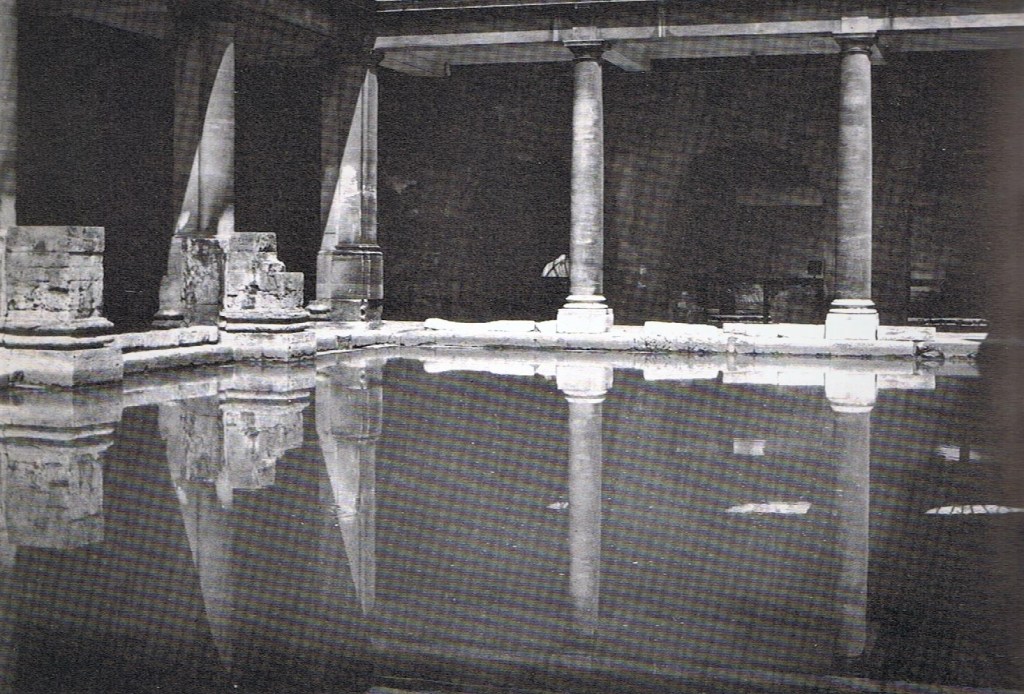
The truth is that the fortunes of war swung much more evenly between the Britons and the Anglo-Saxons after the initial coastal clashes and incursions, but after the loss of the fort at Pevensey in 477, Britons seem to have begun and ended a series of campaigns lasting nearly forty years with significant victories. The first was achieved under Ambrosius, but the concluding victory at Mount Badon was probably gained by a force under Artorius’s command. The Historia Brittonum lists twelve battles fought and won by Arthur of which only one, fought in the Caledonian Forest, can be identified to a particular site with any degree of confidence. Mont Badon, the last of the twelve, was probably fought at some point between 494 and 499, though some sources date it to 516, on a site in the south-west Midlands. Attempts to identify the precise site of the battle have centred, perhaps mistakenly, on the search for a suitable hill-fort. It has been suggested that the British name for the the site was ‘Din Badon’ meaning ‘Badon Fort’, and that the defeated Saxons translated this into ‘Baddanburg’ or ‘Badda’s Fort’, thereby implying a link with one of five modern Badburys between Dorset and Lincolnshire. Favoured sites have included Badbury Rings in Dorset and Badbury by Liddington Castle in Wiltshire. Archaeologists and military historians think that they have found the likely British stronghold at the latter, an Iron-Age fort on a nine-hundred-foot hill. It has a useful high bank and ditch, and on the hill slopes are traces of other works which made the path of the attacker hazardous. Here, it seems, the Saxons located the rest of the force which had inflicted such damage on them the previous day (see below). Perhaps there had been another brush at the crossroads and the Saxons had been led in pursuit to Liddington. Up till recent times Liddington was known as Badbury Castle, i.e. the ‘burgh’ at Bad(on). But, as noted below, we may not need to locate a hill-fort site. Welsh tradition identifies Badon with Bath and It is possible that the battle was fought on one of the hills surrounding the town.

This image has an empty alt attribute; its file name is 007-5.jpg

The Battle of Mount Badon or Mons Badonicus has been somewhat of a mystery for over fifteen hundred years. Records are scanty and there has been much speculation over its exact site. It was an enormously important battle, and its result delayed the subjugation of Britain for at least fifty years. It was undoubtedly a masterpiece of strategic and tactical planning. Perhaps much of the mystery stems from the fact that Badon was chronicled by scholars and monks who were far away in both place and time, and who did not know the area in which it was reputedly fought. Today, the obscurity of Badon seems a little less impenetrable, at least from a military strategist’s point of view.

Quoted in Philip Warner’s (1976) book, Famous Battles of the Midlands, one such strategist, Col. Burne accepts most of Geoffrey of Monmouth’s twelfth century account of the battle while acknowledging that on some matters, Geoffrey’s versions of events, not least concerning ‘King Arthur’, were somewhat imaginative. There has been much discussion and debate as to who Arthur may have been, but there now seems to be a consensus among historians that (if he is one and the same as the historical Artorius) he was not a ‘king’ but rather a ‘warlord’, the military leader of the forces of a number of small British kingdoms. Whether this general of the Britons was Ambrosius Aurelianus or Artorius, or both, can never be established. One theory is that ‘Arthur’ was one of the names by which Ambrosius was known to his men. Ambrosius has been identified as a Romano-British aristocrat whose parents had been mudered by Saxon pirates. He had narrowly missed being killed himself, and decided to set up a resistance force. Guerilla leaders seldom use their own names, of course (we need only think of ‘Robin’ Hood or ‘Che’ Guevara). Gildas describes him in the following terms:

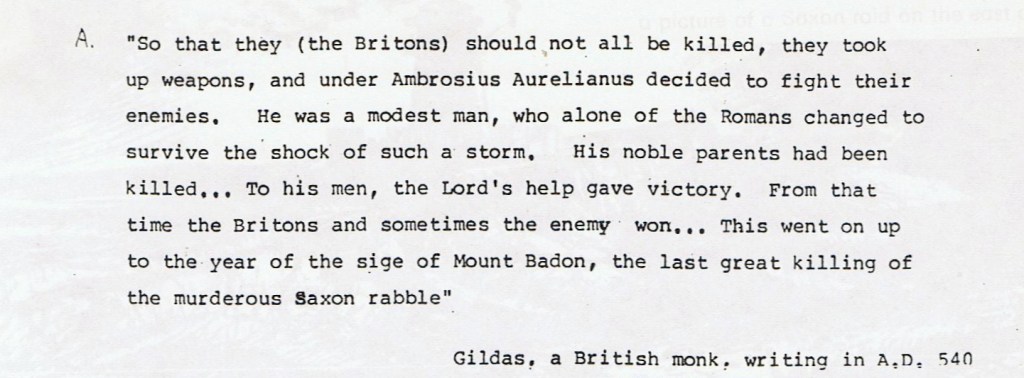
Ambrosius Aurelianus being leader, a modest man, who alone by chance of the Roman nation had survived in the collision of so great a storm, his parents doubtless clad in the purple, having been killed in the same, whose progeny now in our times having greatly degenerated from their ancestral excellence, to whom, the Lord assenting, victory fell.

Bede put it a little more coherently when he wrote later, based on Gildas:

But when the hostile army, having destroyed and dispersed the natives of the island returned home, the Britons by degrees to resume strength and spirit, emerging from their hiding places, wherein they had concealed themselves, and with one accord imploring celestial help lest they should be destroyed even to extermination. They had at that time for their leader Ambrosius Aurelianus, a modest man, … Under this leader therefore the Britons took heart, and challenging their victors to battle obtain the victory …

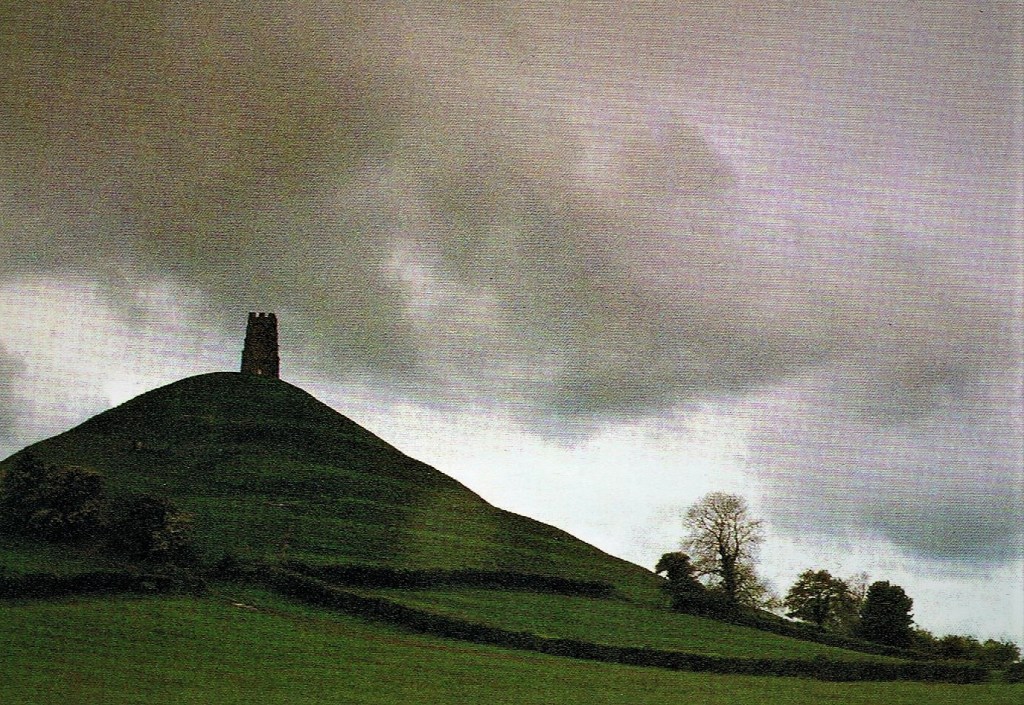
There is, according to Warner, no reason to believe that Arthur and Ambrosius were not different people, that the former had his headquarters in the West, perhaps at South Cadbury near Glastonbury and/or Tintagel in Cornwall (both pictured below), where he trained his forces and into which the Saxons were not able to penetrate, and that Ambrosius was was based in Gwynedd, where he became an expert in hill-fighting. But it was just possible that they were one and the same man, in keeping with elements of the folklore passed down through legend and literature. The Latin meaning of Ambrosius is ‘immortal’, and the name lives on in the Welsh name ‘Emrys’. Aurelianus means ‘golden’ and ‘Arthur’ is thought to derive from the Brythonic word for ‘bear’, a suitable nickname for a guerilla leader. Of the twelve battles supposedly fought by Arthur, seven were connected with rivers. It has been suggested that actions fought at river crossings gave the mounted Britons a natural superiority over Anglo-saxon infantry, but in fact the advantage of deploying cavalry probably lay in the speed and and mobility they offered in reaching the battlefield. Arthur’s horsemen were not the heavy cavalry suggested by the legendary tales of chivalric ‘knights’ and would not have been able to deliver effective shock action. They would not have ridden down opposing infantry with horse and lance but used the horse as a mobile platform from which to throw their spears before attacking with swords drawn. The emphasis of warfare still lay firmly with individual feats of arms rather than with the unity of action required in a disciplined cavalry charge.

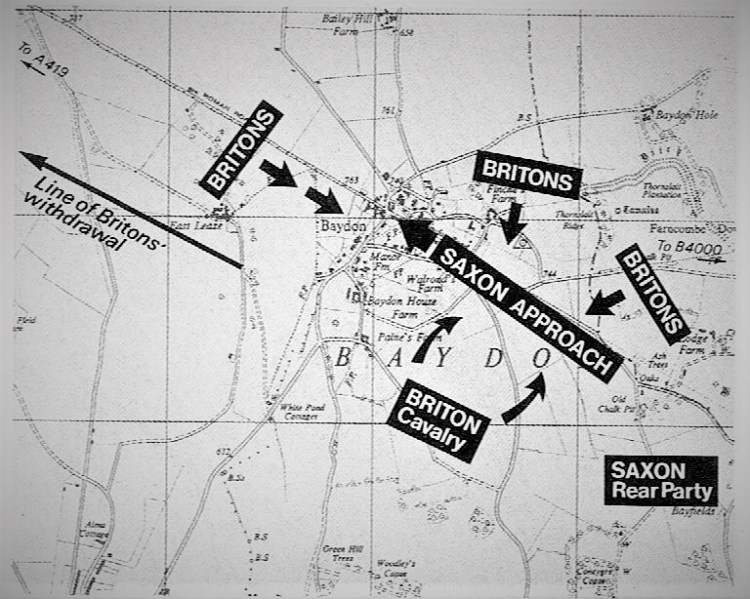
We see from the Anglo-Saxon Chronicle that the main Saxon raids were separated by several years. There would be a raid, a battle or two, and the return to the homeland or the shoreline, as referred to above. The early Saxon incursions had neither the administrative nor the necessary logistical support to mount a long campaign into areas of the hinterland where where the opposition was unknown and and food supplies would be precarious to say the least. But in 516, according to Gildas, a Saxon force of considerable strength was moving along the Ermine Way between Silchester and Swindon. Whether it was in 516 or twenty years ealier, as suggested above, makes little difference: It was a tough, resourceful fighting force which was moving north-west along the straight Roman road, but as the mile succeeded mile, with not a Briton in sight, it looked as if the Saxon warrior’s reputation had cleared the way before them. They saw no reason to use scouts or proceed cautiously. At the end of this stage, there was said to be another old Roman town, and after that the sea again. They were right. Swindon lay ahead, and after that the ‘Severn Sea’, known now as the Bristol Channel. But, unknown to them, Ambrosius and his Britons were marching in the same direction along the Severn and the Avon. As they approached Badon, or Bath, it looked no different from anywhere else along the route. They marched along the plateau, down the dip and up the slope into what is now Baydon village. When they were half-way up that slope, the trap was sprung. It is not difficult to reconstruct the probable sequence of events. Possibly two swift flank attacks took place from the cover close to the road, with another force directly in front including cavalry which would send the Saxons reeling back down the hill, and there was probably an attack around the rear over the route they had just covered; this would ensure that once they had tumbled to the bottom of the dip, the advanced Saxons would have stayed there, since It would have been an impossible position for the Saxons to fight their way out of.

This image has an empty alt attribute; its file name is 022.jpg
Battle of Badon, Map One from Warner (see Sources below): The First Phase (Day) of the Battle.

Nennius, a ninth-century historian, stated that Arthur was the victor of Badon, and that it was the last of twelve consecutive victories. He gives the Saxon casualties as 440, but there is no reason to consider the figure as anything more than a wild guess. The Saxon army was probably about three thousand-strong and was spread out along the road. Once the initial ambush had succeeded, with devastating effect, the Britons no doubt faded away into the ‘undergrowth’. The Saxon rear party came up and took stock at Baydon itself, but the next day they decided to press on, albeit cautiously. About five miles on from Baydon, the Ermine Way is crossed by the Ridgeway, one of the great strategic roadways of Britain. Form the west, it stretches through what are Wiltshire and Berkshire and then links up with even older Icknield Way, running right through to the Wash. It was an old road during Roman times, and to the Saxons who suddenly came across this important trackway crossing their own it showed why they had been ambushed at Baydon; this was the highway on which the Britons linked up. Where there was a crossroads the chances were that there would be a means of defending it.

This image has an empty alt attribute; its file name is 024.jpg
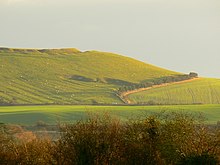
Warner: Phase Two of the Battle, on Liddington Hill (see below).
Battle of Badon - Wikipedia
Liddington Hill, with the earthworks of the ‘camp’ showing on the right-hand edge.. Wikipedia.org.

The second phase of the battle is somewhat confused by the fact that some writers, most notably Geoffrey of Monmouth, considered that the the Saxons occupied the hill fort and the Britons were attacking them. But it seems more likely that the Saxons, thinking that they had come to the last stronghold of the Britons in that area, were determined to destroy it and avenge the losses of the previous day.

But as they pressed to the assault they naturally found the tall and steep hill a tougher proposition than they had expected. But once committed there would be no thought of drawing back. And once more the cavalry for which both Ambrosius and Artorius were famous would come into action. Some think that much of the battle took place on open ground between Liddington and Badbury. Perhaps the last stages did, when the Saxons had been flung back from the hill slopes, retired to the hollow field below it on the north side, and then, tired and dispirited, were cut to pieces by the British cavalry coming from either side of the Ridgeway.

Writing several hundred years later, Geoffrey of Monmouth describes the slain Saxons as being ‘many thousands’. Whatever the actual number, the Saxons conceded that their invasion army, the strongest they had been able to muster, had been annihilated. It was clear that if that had been the fate of what had looked like an all-conquering army, central Britain was best left alone for the time being. No other battle compares with the achievement of Badon. There the pride of the Saxon army was outwitted, crushed and finally destroyed by a conglomerate force which behaved with superb discipline and was clearly expertly led. It is no wonder that accounts of it survive in Welsh epic poetry and European ‘Arthurian’ literature. One of the early legendary documents, The British Easter Annals, links Arthur specifically with the battle of Mount Badon:

… in which Arthur carried the cross of our lord Jesus Christ three days and three nights on his shoulders and the British were victorious.

Nennius gave a more detailed but more fanciful account in his ninth-century ‘history’:

This image has an empty alt attribute; its file name is 006-5-1.jpg

The detail of both these entries should not, of course, be interpreted literally. ‘Three days and three nights’ merely implies a lengthy battle, and Arthur would have borne the cross as his symbol in the form of an amulet. Gildas supports the contention that the battle was a series of attacks and repulses, which he describes as a ‘siege’, with the implication that either the Saxons or the Britons occupied and fortified a hill-top from which they were prepared to resist the attacks of the enemy. But it may simply have been the case that the Saxon army occupied an elevated position in order to reduce the effectiveness of Arthur’s cavalry. The Britons still managed to launch decisive attacks and a statement in the Historia Brittonum describes a single charge in which Arthur and his forces slew nine hundred and sixty of the enemy. It is difficult to accept the numerical accuracy of so precise a figure, but the victory gained by the Britons was undoubtedly comprehensive. While it is overstating the result of the battle to suggest that the Saxon threat was eradicated for half a century, Gildas does describe the far-reaching consequences of Badon, stressing the resulting peace and the cessation of foreign wars.

This image has an empty alt attribute; its file name is 002-10.jpg
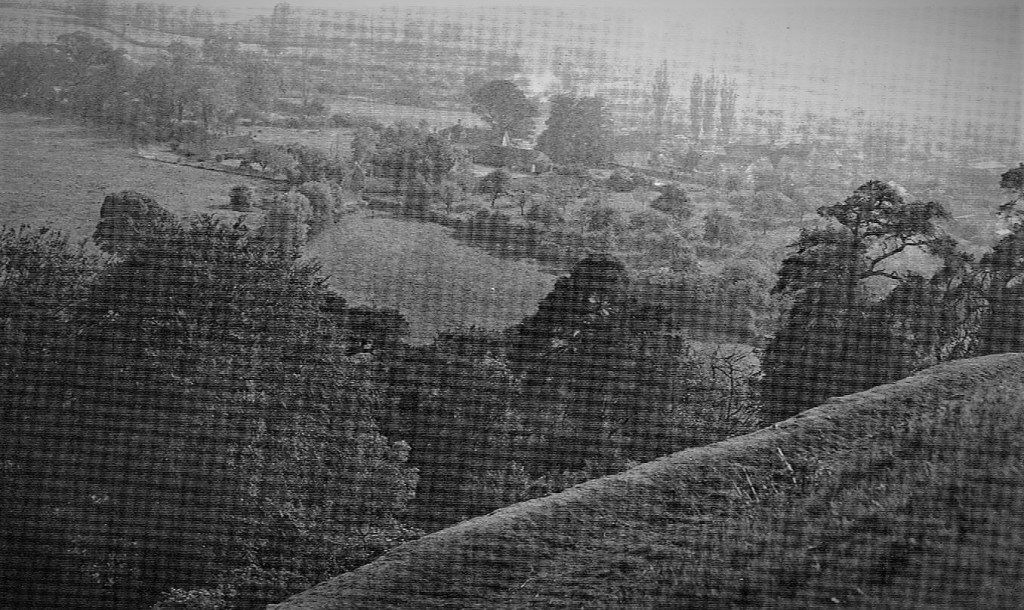
South Cadbury, Somerset. A view showing a rampart of the Iron Age hillfort, a site containing a Celtic temple with ritual pits. Traditionally the site of Arthur’s Camelot, South Cadbury was refortified in late Roman times and at the start of the Dark Ages.

An ‘Arthurian’ site further south-west, in Somerset, is the hillfort of South Cadbury, traditionally claimed to have been the site of King Arthur’s Camelot. This is an Iron Age hillfort reoccupied and fortified not only in the fifth-sixth century, but also in later Anglo-Saxon times. Geoffrey of Monmouth associated the site with Arthur’s last battle with Mordred, which followed his pursuit of Mordred as far as the river Camel, and ended with his death from wounds received during the battle. Of course, as the map above shows, the sites connected with Arthur range up and down Britain, from Tintagel in Cornwall where, according to legend, he was born, and which was known to have been an important monastery in the early Dark Ages, to Arthur’s Seat in Edinburgh. The Arthur we think of today is a figure symbolising the defence of Christian civilization and the establishment of earthly rule on a basis of justice and compassion: he and his legends surrounding his knights and his court on the one hand derive from the traditions and beliefs going back into the pagan Celtic era, and on the other hand areseen through the screen of a later medieval chivalric society. The Arthur of South Cadbury – ‘Camelot’ – who defeated the Saxons at the great battle of ‘Mons Badonicus’, whether at Liddington Castle near Swindon or in the South Cotswolds near Bath, or both, at some point between 494 and 516, must, by nature of the evidence, have been far more local and provincial in his outlook than the legends suggest. Nevertheless, he would seem to have done much to save Romano-British Christian culture at a time when it was threatened with extinction by the pagan Anglo-Saxon advance.

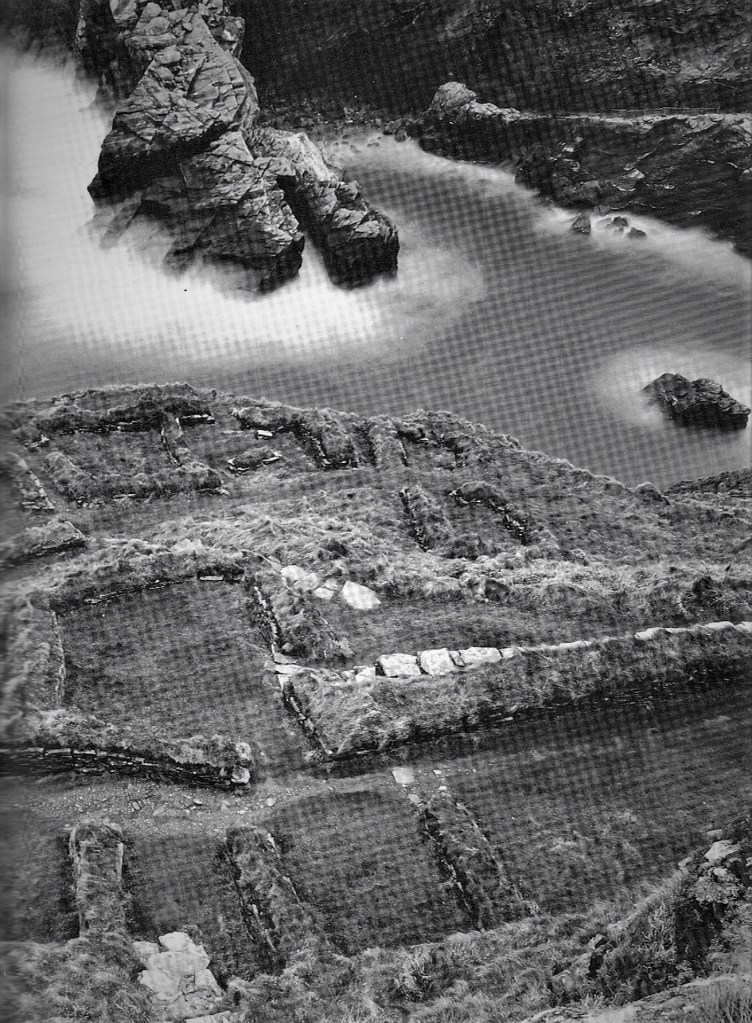
Part of the promontory at Tintagel, Cornwall. Most of the visible remains are of medieval buildings, but they overlie occupation layers of the fifth or sixth centuries.

The Saxon Advance Resumed – Salisbury & Dyrham:

The Britons had at least gained a breathing space in which to prepare to meet the renewal of Saxon pressure. It was forty years before the Anglo-Saxon Chronicle records Saxons in Wiltshire again. In 552, Cynric ‘fought against the Britons at a place called Salisbury’. It is not recorded as a Saxon battle victory, however, but only as a skirmish. In all probability it was an attempt by the Saxons to capture the ancient earthwork fortress of ‘Old Sarum’ near the city. In 556, Cynric again recorded as fighting against the Britons at Barbury, supported by Ceawlin. This was, in fact, the battle of Beranburgh, just north of Barbury Castle, another Iron-Age fort. It would have been an important nodal-pont where six roads meet, and there can be no question that plenty of battles and skirmishes must have been fought in the area. In spite of the setbacks of Badon, the Saxons continued to make steady progress over the following forty years, consolidating their gains elsewhere in Britain. Now they were coming as immigrants, to settle; now too they were beginning to have a better appreciation of the potential of the country they were attempting to conquer. By this time they had been in contact with the coasts of Britain for three hundred years. Some time in the sixth century, Saxons reoccupied the city of London, which became the the territory of the Middle Saxons, or Middlesex. So now we had a number of Saxon ‘kingdoms’ in the south, together with the Jutes of Kent, the Angles of East Anglia, the Kingdom of Northumbria (north of the Humber) – divided into Bernicia in the far north and Deira in the south, mainly modern-day Yorkshire. Combined forces from these areas had forced their way into the Midlands to create Mercia. But this was a ‘march’, a border territory, and it extended to what is now Staffordshire, with changing territorial control and borders until the ninth century. Beyond that the Britons were in force in the kingdom of Powys, and among their bases were Wroxeter and Chester, both significant Roman towns. They were now calling themselves the Cymry, meaning ‘comrades’ or ‘fellow countrymen’.

In effect, therefore, the Anglo-Saxons now held the eastern half of the country and some of the Midlands, and the Britons held the western parts of the island, from Cornwall in the extreme south-west to the northern kingdom of Strathclyde, including the areas corresponding with the modern-day Welsh border counties of Gloucestershire, Herefordshire and Shropshire. This temporary partition or stalemate was set to continue almost indefinitely unless the Saxon invaders could effect a strategic breakthrough. To achieve this, it was necessary to cut a line through the British areas to the sea, and then widen it. Clearly it would be extremely difficult to do this in the north-west, though that would also have to be done eventually. The obvious point for a drive forward was where the invading Saxon army had tried in the late fifth or early sixth century. New military leadership had emerged in Cynric and Ceawlin. The former put the Britons to flight at Salisbury in 552, and in 560 we read that Ceawlin succeeded to the Kingdom of Wessex and Aelle to Northumbria.

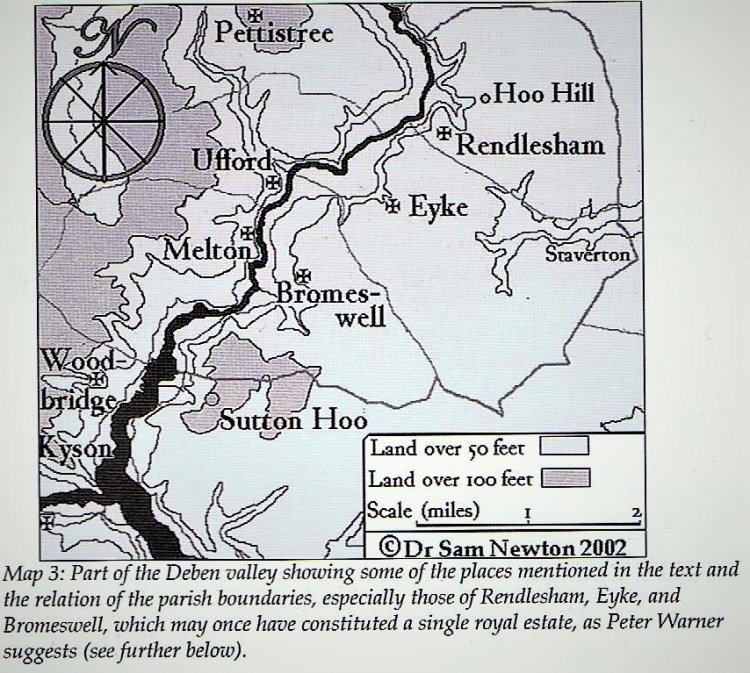
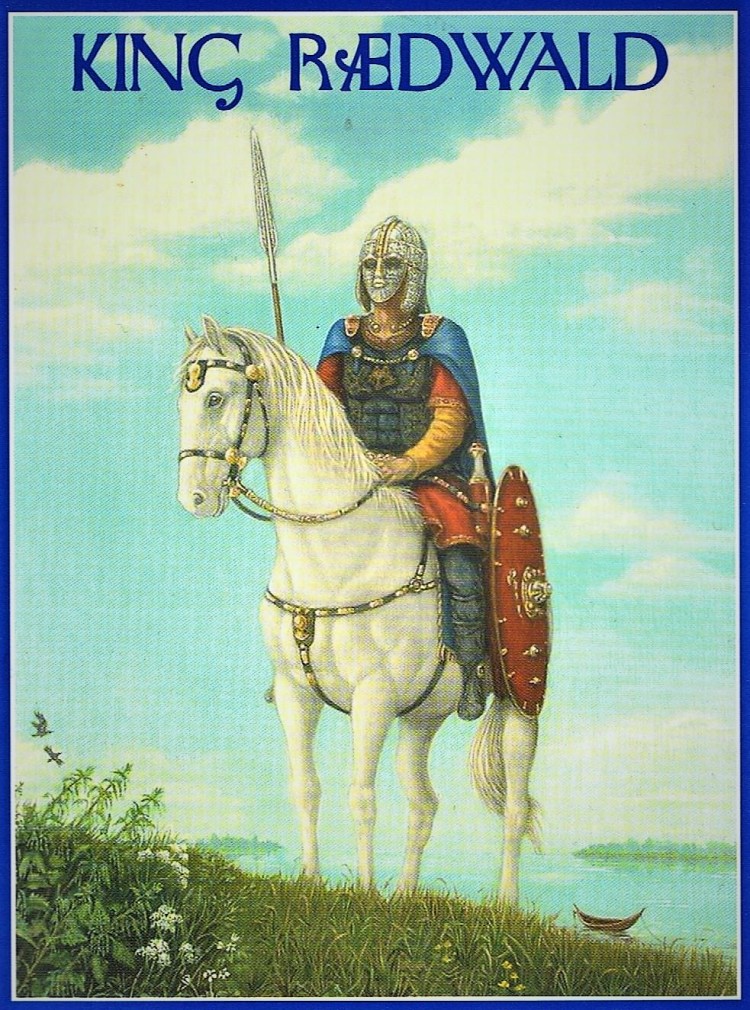
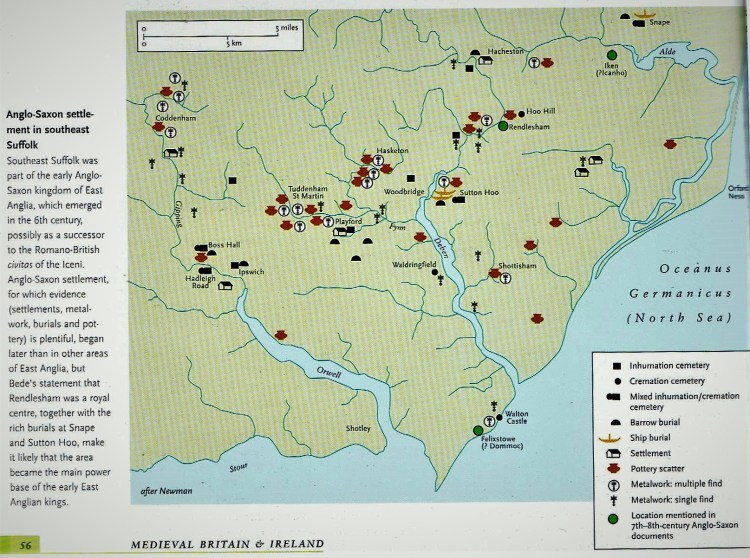
Some of these warrior kings traced their descent back to Woden, like the ‘Wuffings’ of East Anglia (see appendix one below). Early in the sixth century a group of settlers arrives in the Sandlings of Suffolk. They came from what is now Sweden and their leader’s name was Wehha. Whether they were simply better warriors than other bands or whether ovrercrowding forced them to become more aggressive and take the role of conquerors we cannot determine. What we do know is that Wehha’s family established the first kingdom of East Anglia. From their base at Rendlesham they ranged along the coasts and rivers forcing their will on all the settlements, demanding allegiance and payment of tribute. Within fifty years the Wuffings had brought most of East Anglia under their sway and the kingdom reached its zenith during the reign of Raedwald (c. 599-625), about whom I have written extensively in other recent articles published on my site.

The cover of Sam Newton’s book. http://www.red-bird.co.uk

Back in the west, meantime, Ceawlin had clearly become an outstanding warrior. He and his brother smetimes fought side by side, at other times went on separate campaigns. In 568, the Anglo-Saxon Chronicle tells us, ‘Ceawlin and Cutha fought against Aethelbert and drove him in flight into Kent’. Aethelbert was a powerful king, so this was no mean achievement. The quarrel had no doubt sprung from a border incident. Three years later, in 571, we hear of Cutha again in action, defeating the Britons at Biedcanford and capturing four towns: Limbury, Aylesbury, Bensington and Eynsham. This is an interesting campaign, since it looks as if he gathered a force (of Wuffing warriors?) in East Anglia and then drove west through Bedford and Aylesbury, reaching the Thames at Benson just north of Wallingford, and then travelling along the river to Eynsham, a Bronze Age settlement which grew up near the historically important ford of Swinford on the River Thames flood plain. Here he was on the edge of British-held territory, and the opposition would have no doubt been too strong for him to continue. The Chronicle also tells us that he died in this year: Perhaps he had been wounded by British swords, or the Thames Valley marshes proved even deadlier. But as one warrior fell and was laid ceremoniously to rest, there were, it seemed, as many as a dozen others ready to take his place. They often bore the same name or names remarkably similar to their immediate forbears, as the following entry for 577 in the Anglo-Saxon Chronicle:

In this year Cuthwine and Ceawlin fought against the Britons and killed three kings; Conmail, Condidan and Farinmail, at the place which is called Dyrham: and they captured three of their cities, Gloucester, Cirencester and Bath.

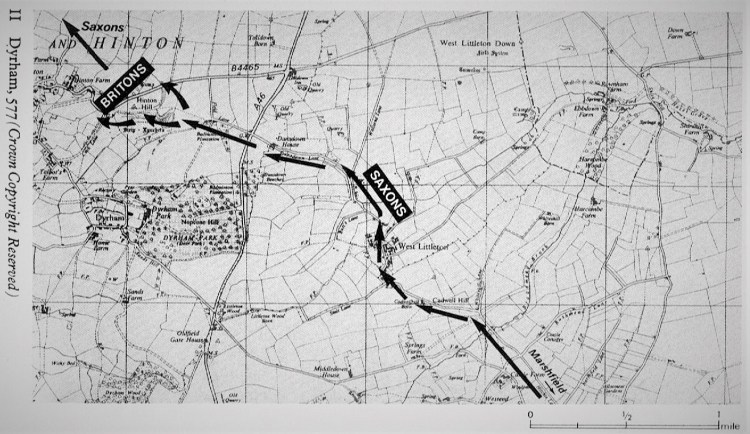
So, four years after Cutha’s great campaign, which nearly cut right across from east to west, an even more significant victory was achieved. Doubtless the Anglo-Saxons had by this time sailed around the coasts and gained a better idea of the strengths and weaknesses of the British positions. If Cuthwine’s thrust could have been sustained it would have struck at almost precisely the same point that Ceawlin reached. During the previous twenty years, as King of Wessex he had gradually been pushing back the north-west borders of his kingdom. Under normal conditions, the three kings of Bath, Cirencester and Gloucester would have been fighting each other, disputing some border territory, but they had held their strategic and tactical conferences. Although these essentially Roman towns were still populated, no longer possessed the political and economic importance they enjoyed under Rome. By a stroke of good fortune, Ceawlin’s invasion route led right through the centre of their territories so there could be no question of one of them fighting for his life while another stood idly by pondering when or where to intervene, if at all. A look at the map below shows that Ceawlin was planning to slip through the middle of their strongholds and break through on to the flood plains of the Severn Estuary at Berkeley. But the movements of his large army would doubtless have been faithfully reported by scouts and spies, and even though he had slipped past Bath there must been a huge force waiting to confront him elsewhere. As it happened, it was at Dyrham, but it was in a badly-chosen position. Nevertheless, even Ceawlin must have drawn breath when he came to Dyrham and wondered who would be standing victor on that field by nightfall.

Source: Warner (1977).

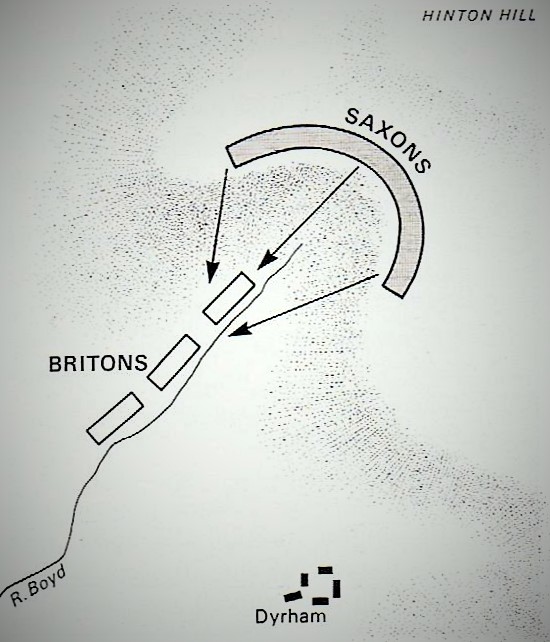
Another look at the map suggests that Ceawlin had brought his army through West Littleton. He may have thought that his three principal opponents were mainly intent upon guarding their own cities but, as it proved, they had concentrated their forces at the point he was almost certain to try to pass, Hinton Hill. Needless to say there have been a host of other theories about approach routes he might have chosen but they all lead to Hinton Hill. That this decisive battle took place near the modern village of Dyrham, seven miles north of Bath, is beyond doubt, and the precise location of Hinton Hill has been agreed on by many historians, one mile to the north of Dyrham (originally ‘Deorham’). This is the site of an Iron Age hill-fort, identified as ‘Dyrham Camp’. However, this name is of late-nineteenth-century origin, and in earlier centuries it was known as ‘Barhill’ an ‘Burrill’. It would therefore be wrong to accept uncritically that the fighting took place at the hill-fort, although this remains a possibility. A Saxon presence astride the commanding six-hundred-foot escarpment at Hinton was a challenge which the Britons could not ignore, and the forces of the three towns combined under their kings for a concerted attack upon the army of Cuthwine and Ceawlin. The battle may have taken the form of an attack by either side upon the fort on Hinton Hill but it could equally, and perhaps more probably, have been fought on the banks of the tributary of the River Boyd which flows below the south-west face of the escarpment.

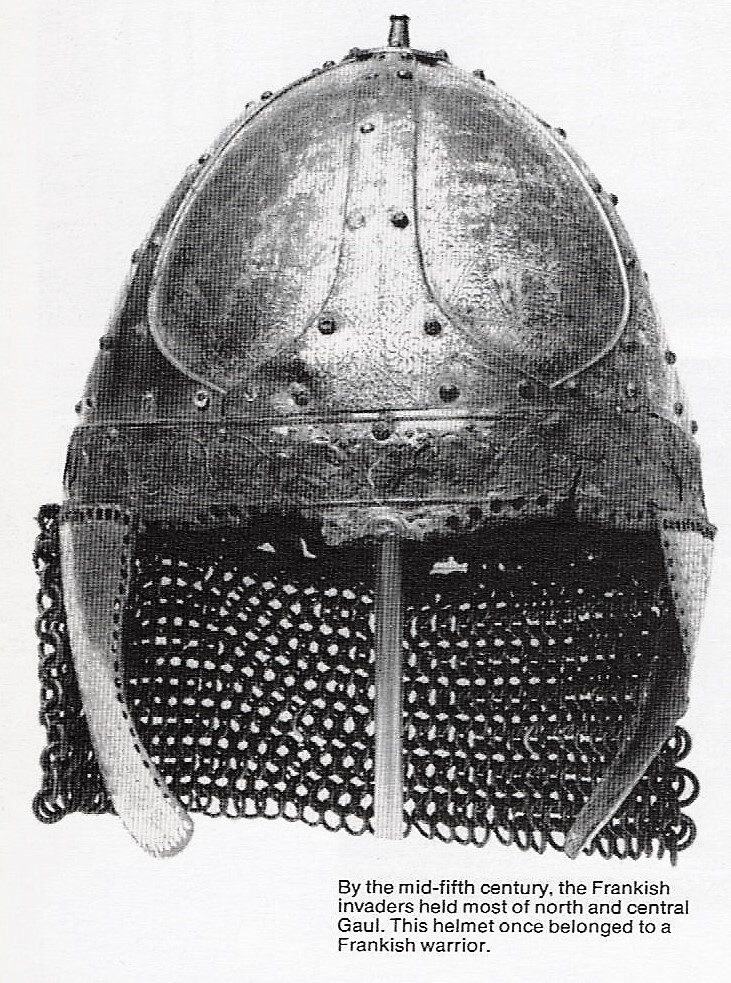
The Battle went decisively in favour of the Saxons, for all three British kings perished, suggesting that the Britons ended the battle surrounded and unable to escape. A Saxon attack launched at dawn from the escarpment, with the advantage and impetus of a downhill charge, may have swept through the British position before they could form to receive it. It looks as if Ceawlin’s warriors were first confronted about three hundred yards ahead of the camp position. The Britons would have had bows, but these were not as formidable as they were later to become. Such armour as they had was light, on the Roman model, but it is unlikely that many would have possessed it. The Saxon rank and file had no armour at all, but their leaders usually had a chain-mail shirt and an iron framework helmet. They had spears, bows and shields. The spears – on both sides – were simple seven-foot shafts with iron heads, which could be used for thrusting or thrown like a javelin. At this time, a spear was considered to be a more flexible and reliable weapon than a bow. After the first exchanges of spears and arrows at Dyrham it was undoubtedly close-quarter combat. Apart from these few facts about the place, the result and the names of the three kings, nothing else is known about the course of the battle, and, in the absence of any written contemporary accounts, the secondary accounts differ as to who was attacking and who defending, and from where. The Saxons seem to have possessed greater numbers, greater than the Britons had anticipated. The important outcome was that Ceawlin succeeded in breaking through to the Severn. He captured Gloucester, Cirencester and Bath with ease, for most of the usual defender of these towns were lying dead on the slopes of Hinton Hill. He had split the ‘Waelisch’ into those in the West, Cornwall and Brittany, and those in Wales and north-west Britain. But there were plenty of battles and skirmishes to follow. Seven years after Dyrham, the Anglo-Saxon Chronicle records:

584: In this year Ceawlin and Cutha fought against the Britons at the place which is called Ferthanleag and Cutha was killed there, and Ceawlin captured many villages and countless spoils and in his anger returned to his own land.

Ferthanleag was probably Fringford, a village four and a half miles north of Bicester (today’s Oxfordshire). In 593, a last significant entry in the Anglo-Saxon Chronicle tells us that Ceawlin ‘perished’, probably with sword-in-hand, and Aethelfrith succeeded to the Kingdom of Wessex. Four years later, we hear that the new king continually fought and contended against the English or the Britons or the Picts or the Scots.

The ‘Age of the Saints’ & The Consolidation of Christianity:

St Ninian’s Cave, Whithorn, Galloway, , used in the early fifth century as a cell by St. Ninian for his devotions.

Up to the time of their defeat at Dyrham in the mid-sixth century, the Britons’ missionaries converted the pagans of the more remote areas of western Britain and then converted Ireland and those parts northern Britain that the Romans had never reached. This brought the British Isles into what is sometimes referred to as ‘the Age of the Saints’. The process of conversion had begun, in fact, shortly before the Roman withdrawal, in northern Britain. In 397 St Ninian introduced Christianity to Galloway, outside the province itself, where he built a small stone church covered with white plaster at Whithorn. Remains of a building corresponding to this description have been uncovered in excavations. The remains are now housed in the thirteenth-century Premonstratension priory and include the Latinus Stone of 450, the earliest record of Christianity in Scotland. Three miles away on the coast can be seen St Ninian’s cave (above), which he used as an oratory. Inside the cave and on the rocks outside are carved votive crosses which are said to date from the eighth century. The complete conversion of Scotand to Christianity was carried out by Irish missionaries in the tenth century. Christians had first arrived in Ireland to escape the barbarian invasions on the continent. By 431 there were enough Christian converts for Rome to appoint a bishop for them. When the Angles, Saxons and Jutes settled in Britain, they continued to worship their own pagan gods, and they attacked the Christian religion which had continued to spread among the Britons, especially in Wales and Cornwall, where Christianity survived and thrived. However, the Britons made no attept to convert the ‘invaders’, preferring to send missionaries like Patrick to Ireland.

Whitesands Bay in Pembrokeshire, near St David’s, from where Patrick set sail to begin his mission to Ireland.

Patrick, a native of Cambria who had spent some time in Ireland after being captured as a slave by pirates, returned there on his great mission from 432 to 461. Not only did he teach the Christian message, but he also spread Roman civilzation there. Patrick’s conversion of the Irish kings had practical benefits for the success of his mission: on a wider scale, it led to a happy and fertile fusion between Christianity and Celtic traditions that flowered for hundreds of years in the manuscripts, metalwork, sculpture and architecture of Ireland. The country became a great centre of learning and art. In preaching the Trinity, he found the Irish people already prepared by the Celtic veneration of the number three. He died in 461, but though he had introduced episcopal administration of the Church, the path the Celtic Church followed in Ireland was heavily influenced by eastern monasticism, brought to Ireland via Tours. It integrated better with native Irish customs than did the Roman rites. Irish monks became famed for their missionary zeal. What these early monks would do to find freedom to pray and contemplate is shown at its most extreme at the island of Skellig Michael, eight miles off the south-west Irish coast. There the ‘beehive’ cells of the monastery testify to the heroic disregard of bodily sufferings or rather the inviting of them as the monks strove to dispossess their inner natures of personal desires and thoughts in their surrender to divine contemplations. A great number of early monastic sites survive, often in more kindly surroundings. In such monasteries, much of permanent value from the ancient world was preserved for Western civilization. The saints and monks loved learning and in their desire for knowledge and its transcendence, they changed themselves, returning to the European mainland with the gifts they had received, founding monasteries there and becoming bishops.

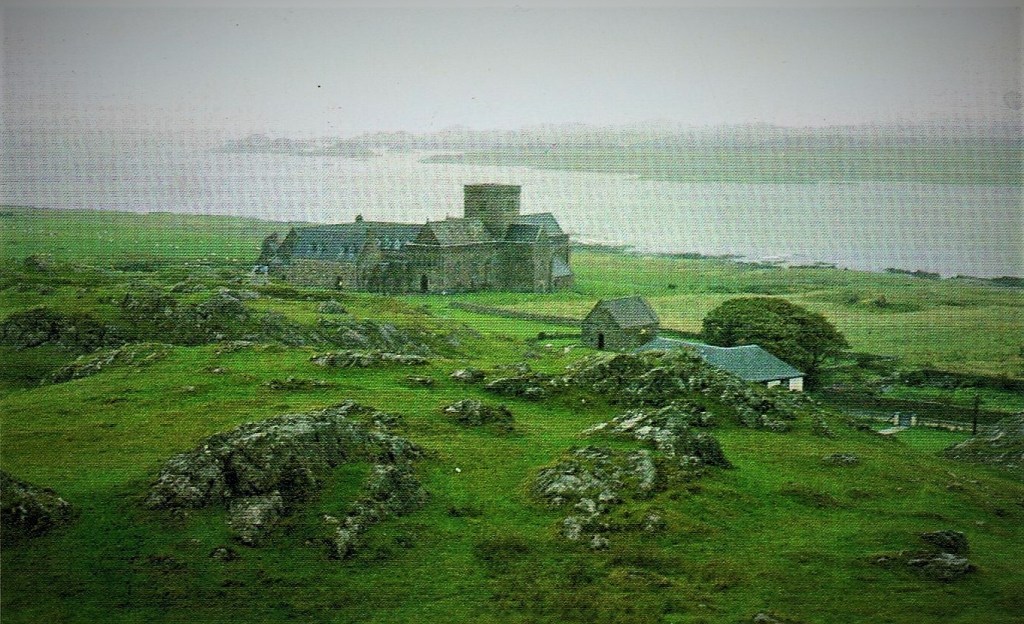
Iona, Inner Hebrides. The holy island of St Columba: a view of the cathedral looking across the sound to Mull.

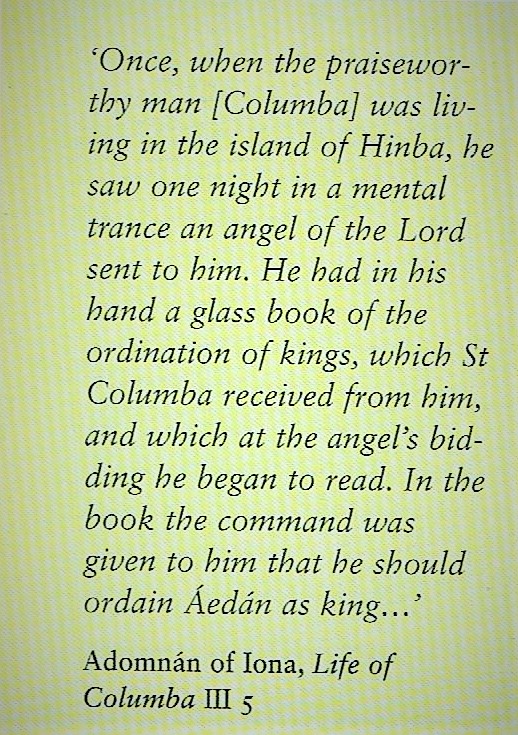
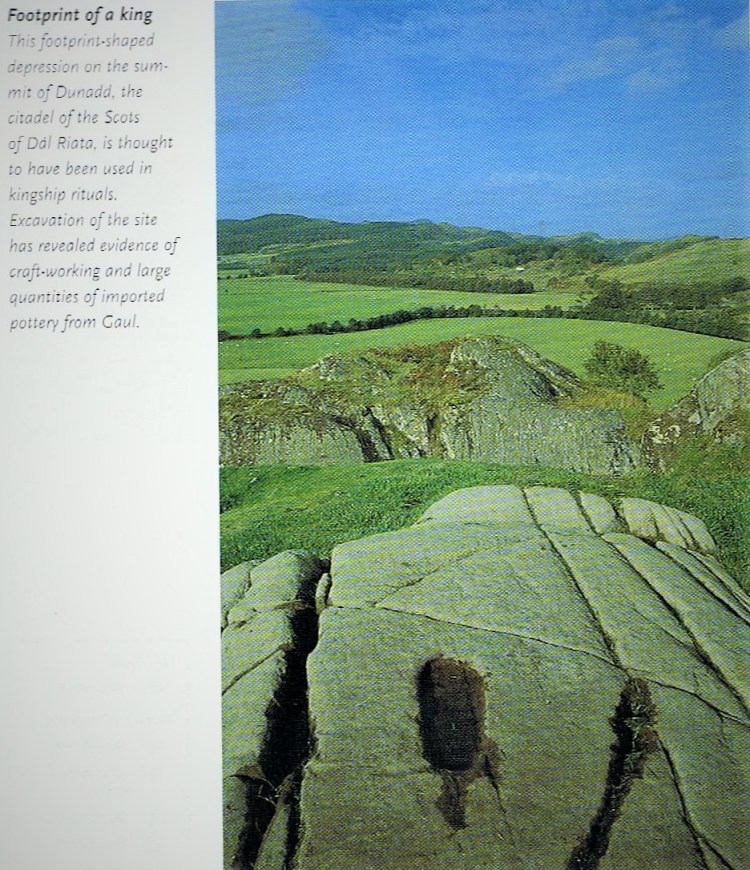
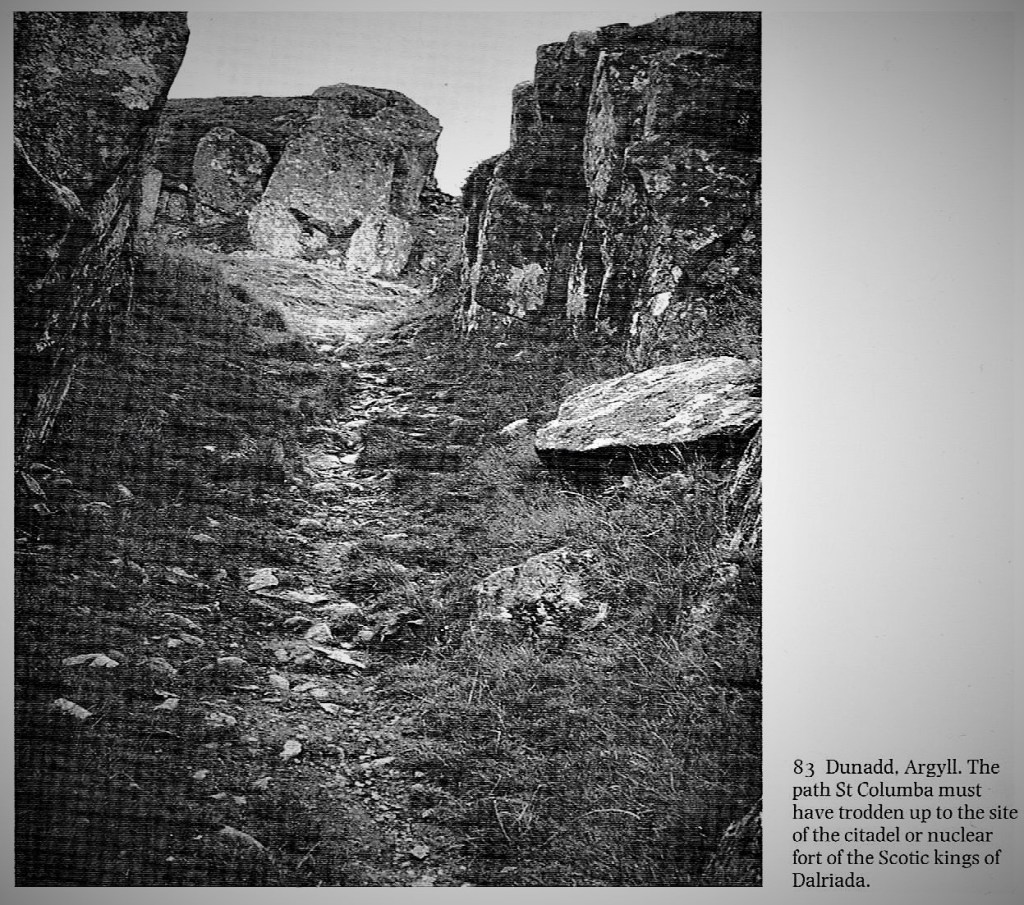
Some of the travelling saints journeyed unwillingly. Columba (or Columcille) left Ireland in 563 at the age of forty-one, as a penance for unwittingly causing a war by copying out a Vulgate belonging to his old tutor. He had already established two noted monasteries at Derry and Durrow. Accompanied by twelve ‘disciples’, he set sail northwards and came to the island of Iona in the Hebrides. On landing, he climbed a hill to make sure he could not see Ireland so that he would not ‘be tempted by the shadow of his homeland on the water’. He then founded a monastery from which for thirty-four years he worked for the conversion of Scotland. Known earlier as the island of the Druids, Iona possesses sacred wells which were probably the scenes of earlier pagan rites, as well as Sithean Mor, ‘the great mound of the fairies’ or rather ‘the Hill of Angels’ because there is a record stating that Columba was praying there when he was visited by a band of angels. But there are few remains of Columba’s own time, except his cell and his stone bed. The cathedral is largely of the sixteenth century, incorporating a twelfth-century nunnery and an ancient oratory which held the saint’s shrine. From Iona, Columba travelled across Scotland, meeting St Mungo who was buy at work converting the people of Strathclyde, visiting Dunadd, the seat of the Scotic kings of Dalriada, and founding Christian settlements on the mainland. He died on Iona in 597, the same year that the Augustine brought Roman Christianity to the Jutes of Kent.

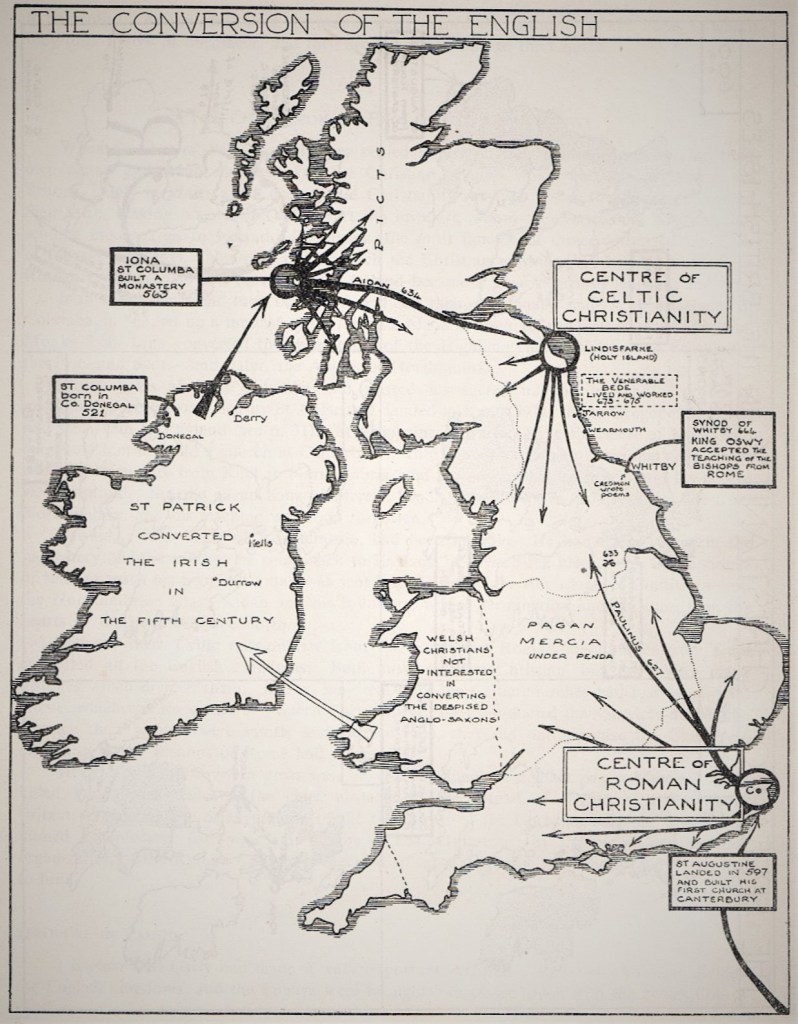
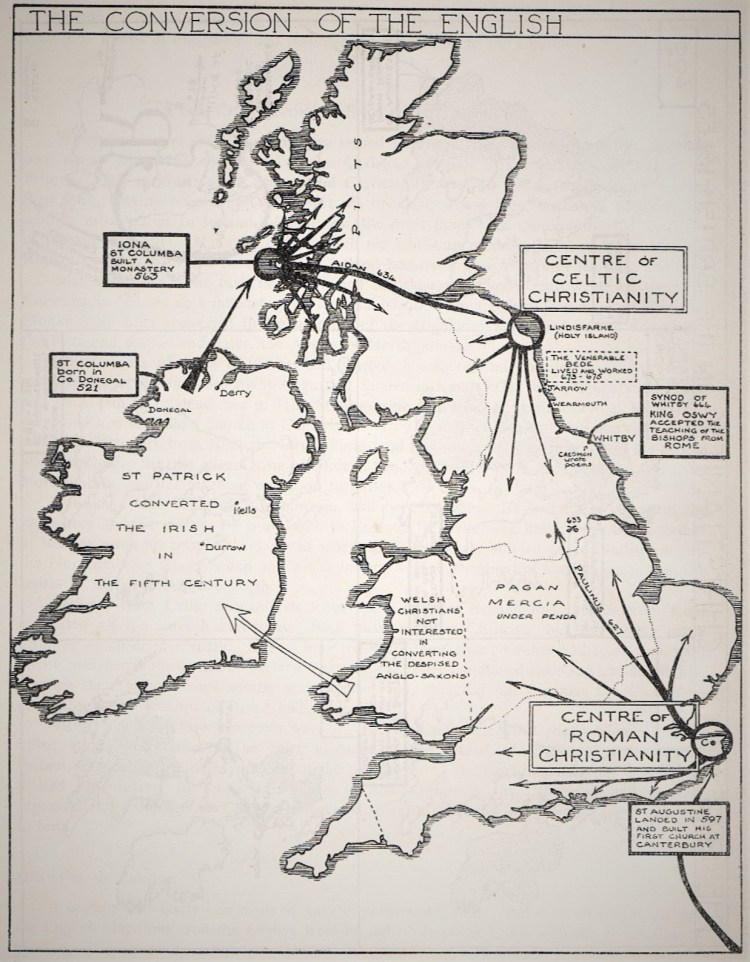
But if Christianity was not before the end of the Roman province, it was already becoming so by the end of the fifth century, by which time it was sufficiently vigorous to reach beyond the Roman frontiers. Patrick is only the most famous of several missionaries to Ireland and northern Britain who had a profound effect on the political as well as the religious landscape. Within a few generations, the Irish were bringing monastic Christianity back to Britain and the Continent. The most famous of the Irish foundations was undoubtedly Columba’s monastery on Iona, and during the sixth and seventh centuries Iona emerged as the greatest Christian centre in northern Britain, with strong political links that extended its influence into Bernicia through the monastery of Lindisfarne, the great Northumbrian monastery, was founded by a monk from Iona, Aidan, ‘the candle of the north’. This influence of Iona spread far, not just across Scotland, but also throughout the North of England. Monks from Iona converted the inhabitants of both the Highlands and Lowlands of Scotland – the Picts and the Scots – and later, the Angles of Northumbria. Only in this one of the Anglo-Saxon kingdoms is there significant evidence for cultural integration between incomers and natives. Here the level of Anglian settlement was lighter and a high degree of continuity can be seen in the landscape and social institutions of the kingdoms of Bernicia and Deira.

By contrast, there was a much greater degree of social integration among the different Celtic peoples of western Britain and Ireland. For a time, Dál Riata in western Britain spanned the North Channel; elsewhere, ogham inscriptions are a permanent record of a more ephemeral Irish presence. The Irish Sea served as the main conduit by which the Britons and Gaels maintained contact with the continental Christian heirs to Rome. Finds of pottery and glass provide evidence for a vigorous trade with the Mediterranean and western Gaul, in which wine was was probably the most important import. At the time, wine was the most prestigious alcoholic drink, but perhaps more importantly it was essential for the conduct of the Christian mass.

This image has an empty alt attribute; its file name is 005-3.jpg

Thirty years after St Columba had started his sacred mission in Iona, a group of missionaries from Rome, led by Augustine, landed in Kent (597). ‘Pope’ Gregory had sent them and they had some early success with the conversion and baptism of King Aethelbert of Kent, who was also recognised as the ‘Bretwalda’ or senior ruler in the Heptarchy, and King Raedwald of East Anglia, who was therefore ‘subject’ to Aethelbert. When the latter ordered the East Anglian king to be baptised, Raedwald complied. Officially, therefore, according to the Roman tradition, East Anglia became ‘Christian’ during the reign of Raedwald, probably circa 603. But his ‘conversion’ did not go very deep, and his queen’s strong adherence to the old faith ensured that her husband would only regard the Christian God as a recruit to the company of Woden, Thunor and Frig. But the two religions were were now locked in a combat which would prove fatal for one or the other. Aethelbert allowed Augustine to build a church at Canterbury, but his successor reverted to paganism, and Augustine was forced to abandon his mission.

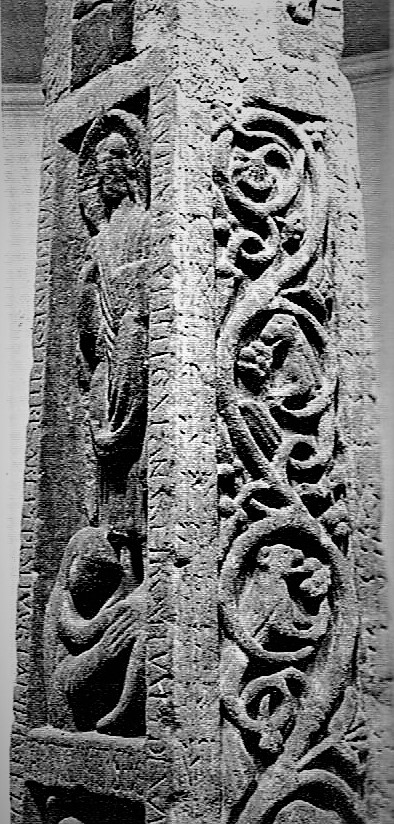
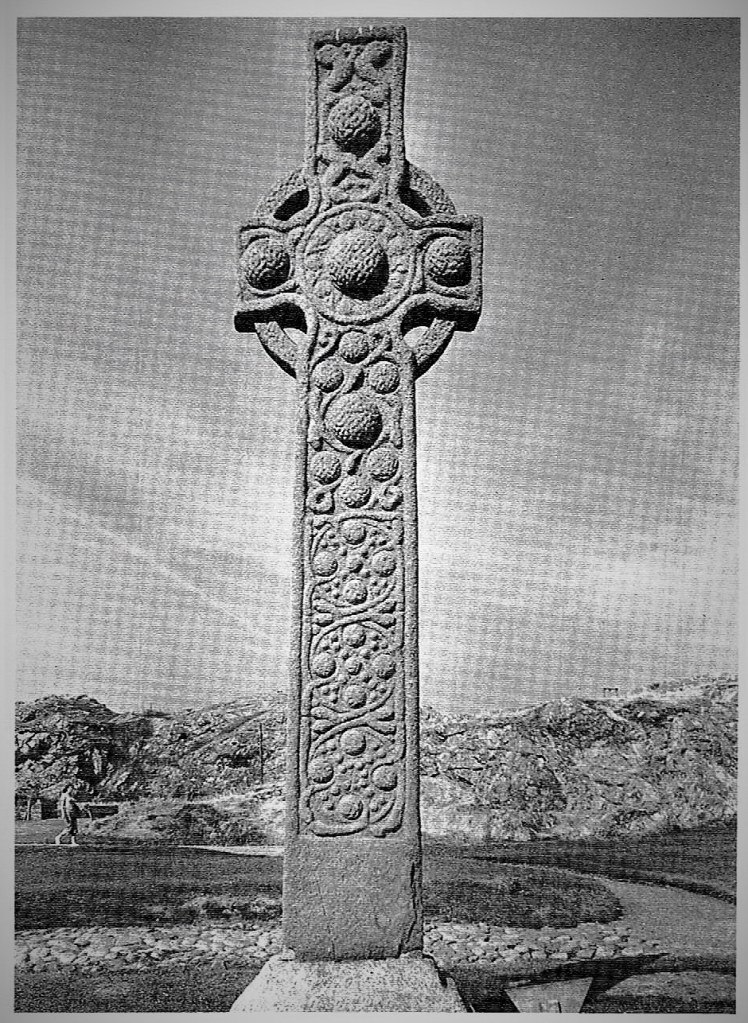
The tenthh-century cross of St Martin standing near the cathedral is one of the few surviving of 360 crosses that once stood on Iona.

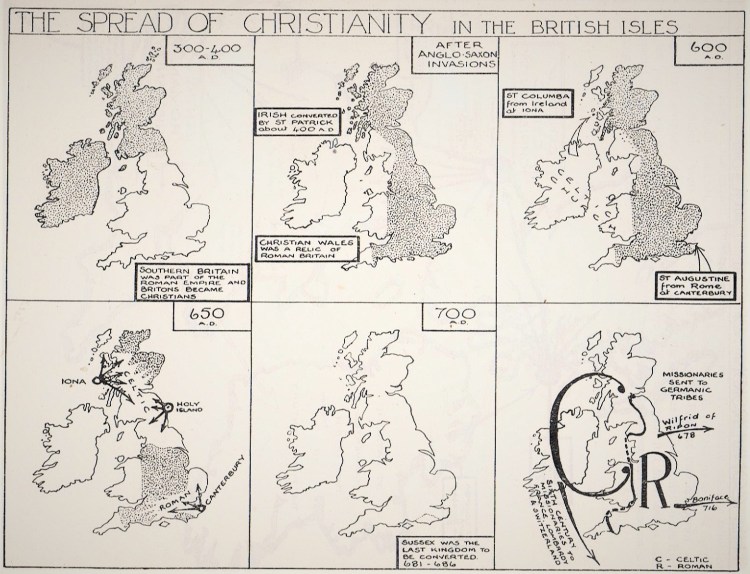
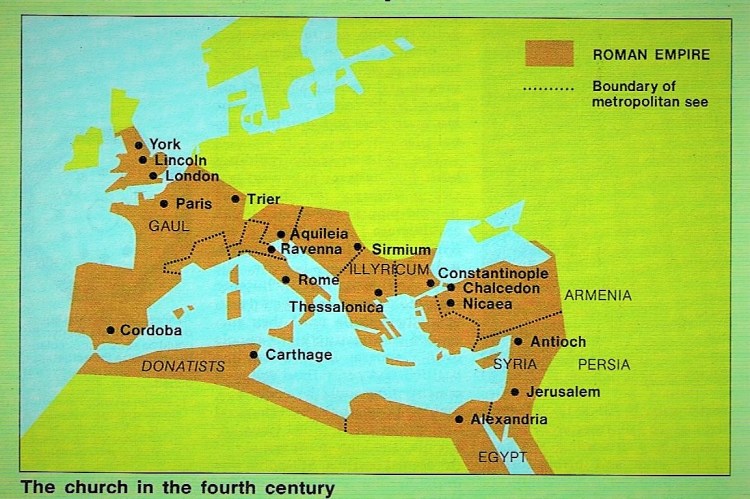
In Augustine’s absence, the Celtic missionaries from the north continued the work of coverting the English kingdoms, beginning with East Anglia, into the seventh century. The Celtic churches, monasteries and missions had lost touch with Rome over the previous two hundred years. They conducted their services differently and though their bishops organised their churches efficiently, the Bishops of Rome wanted a uniform and centralised church under their control. Gregory was the first of them to use the title ‘Pope’ and to be widely recognised as such, but this was by no means universal and the Irish bishops were keen to maintain their independence from Rome. This led to may disputes between the Irish and Roman missionaries later in the century (see the map above). The conversion of the Angles, Jutes and Saxons was enabled by the growing stability of their nascent kingdoms in the late sixth and early seventh centuries and, in turn, the growing influence on the lives of the people, making them less warlike and more willing to accept just laws and preparing the way for them to become more united in their allegiances to both church and state.

This image has an empty alt attribute; its file name is 004-4.jpg

The Formation of the Cultures & Kingdoms of the Isles:

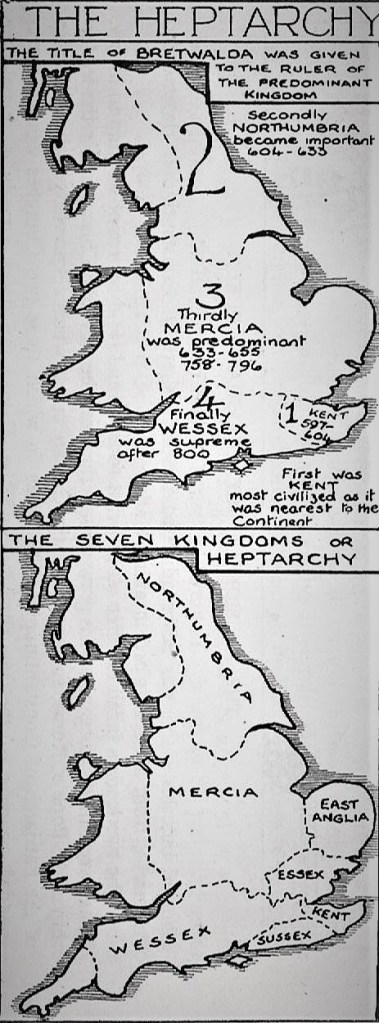
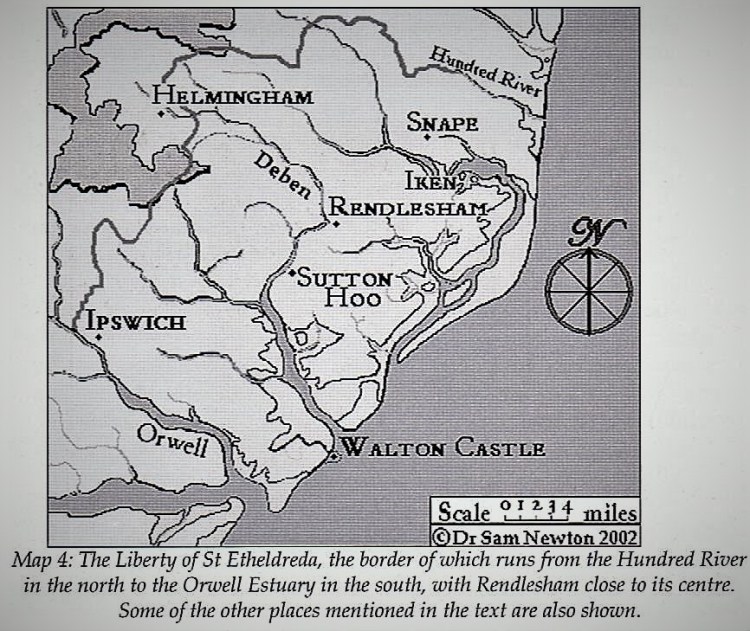
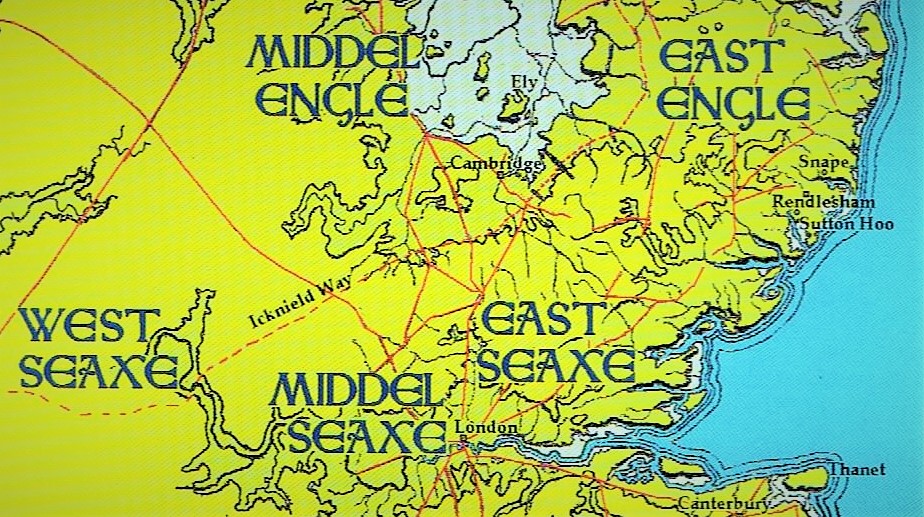
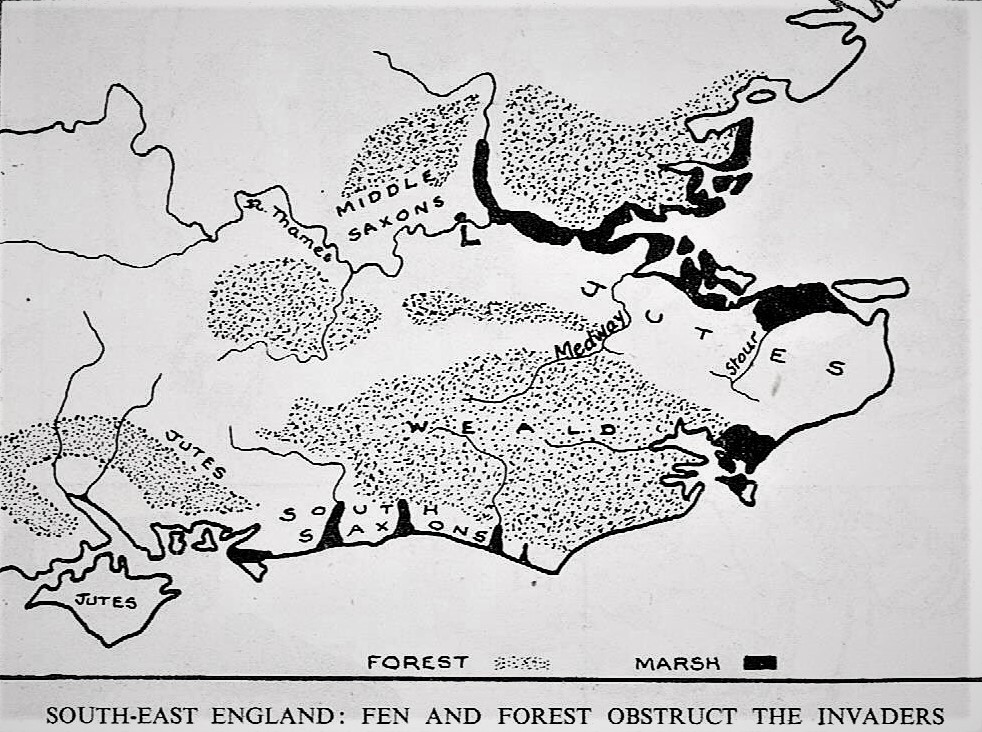
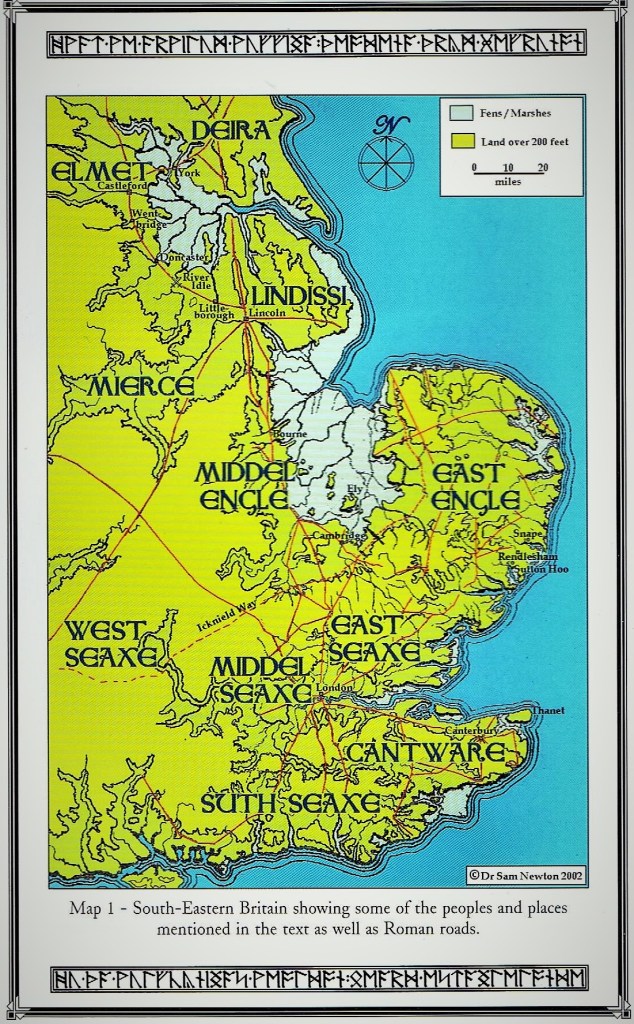
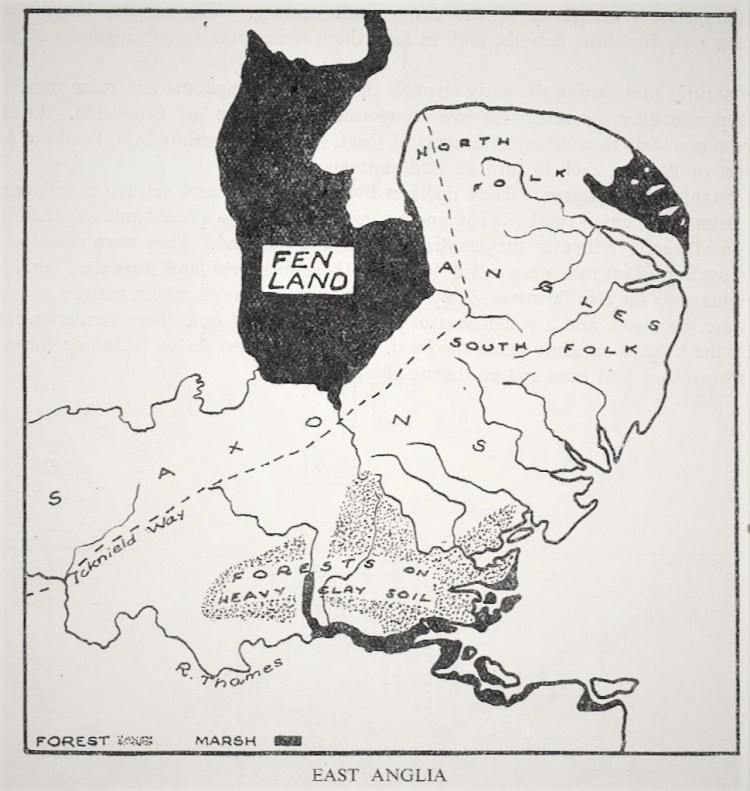
The maps above, of the south-east and below, of East Anglia, show how natural obstacles, such as marsh or forest, helped to keep separate the groups of settlers. The Jutes’ bridgehead in Kent was protected to the north by the marshes along the estuary of the Thames, while to the south spread the impassable forest of the Weald. The South Saxons were confined to the coastal plain between the Weald and the Channel coast. The Middle Saxons settled on the patches of well-drained gravels along the lower Thames, and were protected to the north by the thick forests covering heavy, uncultivable clays (e.g. Epping Forest). As the settlements became established, the political focus of the settlers became centred less on defeating the Britons in the North and West and more on the dynastic struggles of the kingdoms of the Heptarchy; Wessex, Mercia, Northumbria, East Anglia, Essex, Sussex and Kent. At the beginning of the seventh century Northumbria was divided into the two separate Anglian kingdoms of Bernecia and Deira, the former centred on Bamburgh, the latter upon the Yorkshire Wolds. The transformation of these isolated English settlements into the most powerful kingdom in northern Britain was begun by Aethelfrith, the last pagan king of Bernicia, who reigned c. 593 to 616. The expansion of Bernecia was achieved through Aethelfrith’s considerable military skill, and his first opponents were the Scots of Dalriada (Argyll). Under their king, Aeden Mac Gabran, the Scots pushed southwards into Bernecia but were defeated by Aethefrith at Degastan in 603. Aedan’s army was all but wiped out and this decisive victory secured Northumbria from attack from the north.

Aethelfrith next turned south-west, moving against the Britons of Powys. Whether he advanced southwards from Carlisle or westwards through the Kingdom of Elmet it must have been a difficult march, but such was his speed that the Britons were taken by surprise and forced to give battle before their full strength had been mustered. Only the followers of Selyf ap Cynan of Powys, supported by men from the province of Gwynedd, took the field against Aethelfrith at the Battle of Chester in c. 615. Nearly 1,200 monks from Bangor-on-Dee, from an abbey going back to the foundations of Christianity in Britain, also took to the battlefield, whether to offer prayer in support or to fight alongside the Britons is not entirely clear. Whatever their purpose, Aethelfith’s pagan troops were not troubled by any possible distinction between warriors and non-combatants and they slaughtered the monks as a preliminary to the main battle. The Britons were comletely defeated, and both their leaders, Selyf ap Cynan and Cadwal of Rhos were killed. It is difficult to say whether Aethelfrith launched the campaign the campaign as a raid or as a deliberate attempt to drive a final wedge between the Britons of Wales and those in Cumbria and Strathclyde, but if the latter was the case it is strange that the battle was not followed by Northumbrian settlement in the west.

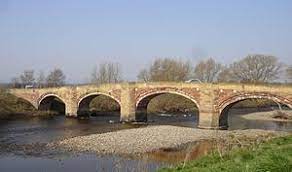
Bangor-on-Dee. The site of the original abbey is thought to be close to the medieval bridge.

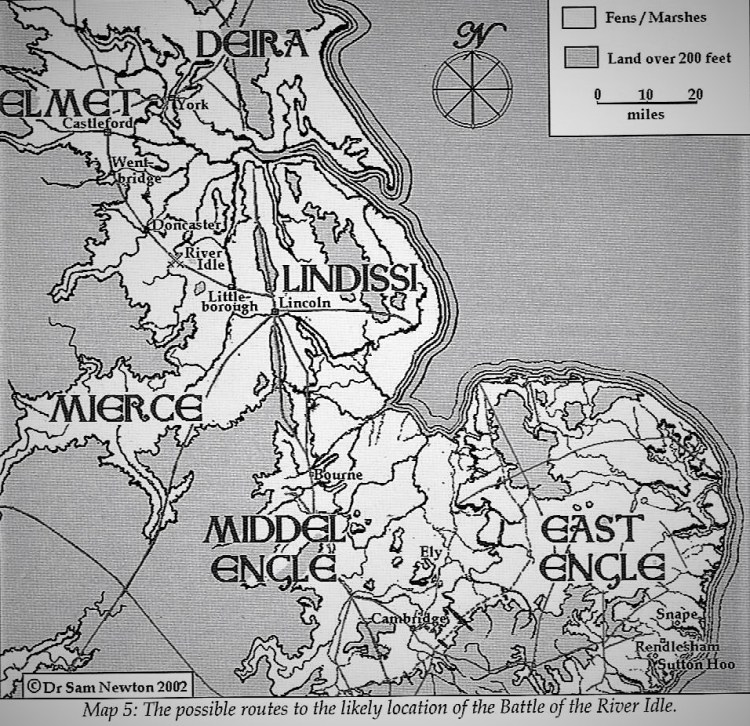
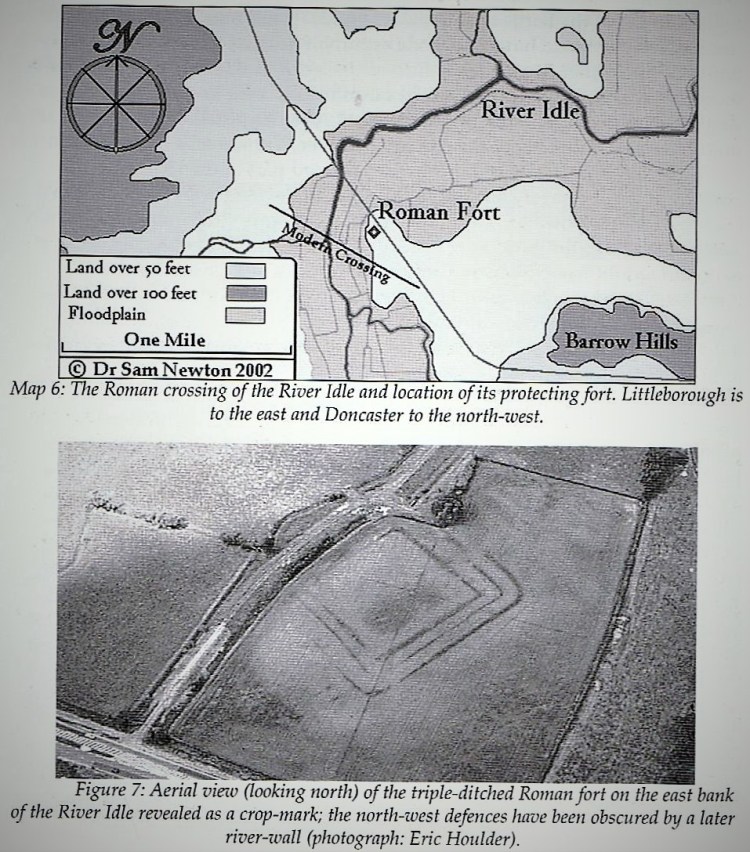
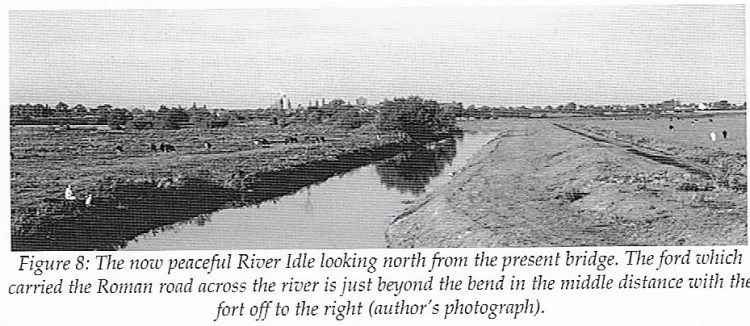
Nevertheless, this final battle between the Britons and the Saxons at Chester in c. 615 was significant in completing the separation of the Britons into four regions; West Wales (including Cornwall), North Wales (Wales), Cumbria and Strathclyde. These regions, with their many moors and mountains, were not attractive to the largely ‘lowland-bred’ Anglo-Saxons.The absence of any significant immediate or lasting result from the battle may perhaps be explained by the death of Aethelfrith one year later at the hands of Raedwald of East Anglia at the battle of the River Idle the following year, in which Britons are thought to have fought to avenge their losses at Chester. The Welsh Trioedd Ynys Prydein (‘Triads of the of the Island of Britain’), dating from the thirteenth century, refer indirectly to the Battle of the River Idle. Triads ten and thirty-two describe the “Three Chieftains of Deira and Bernicia” who had performed “three fortunate slayings”. One of these chieftains was ‘Sgafnell the son of Dissyndawd’, who is remembered for his “fortunate slaying” of ‘Edelfled’ (Aethelfrith). It has been argued that these references imply that British warriors with grievances against Aethelfrith fought as Raewald’s allies at the Battle. The new political order of the Heptarchy was later identified by the Anglo-Saxon chroniclers as providing the origins of the English nation.

This image has an empty alt attribute; its file name is 002-5.jpg

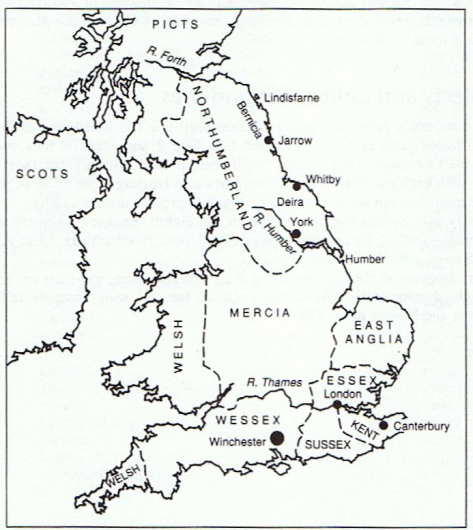
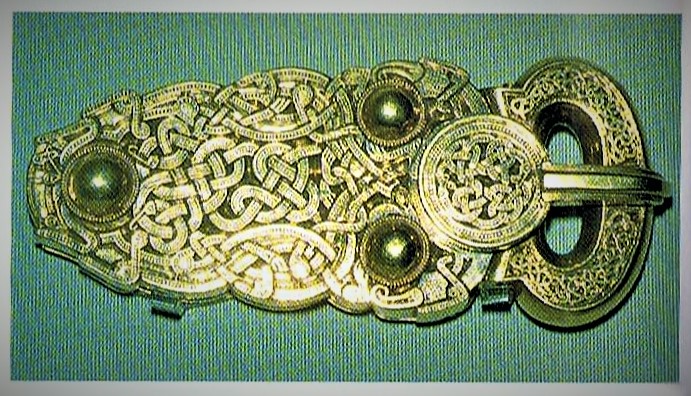
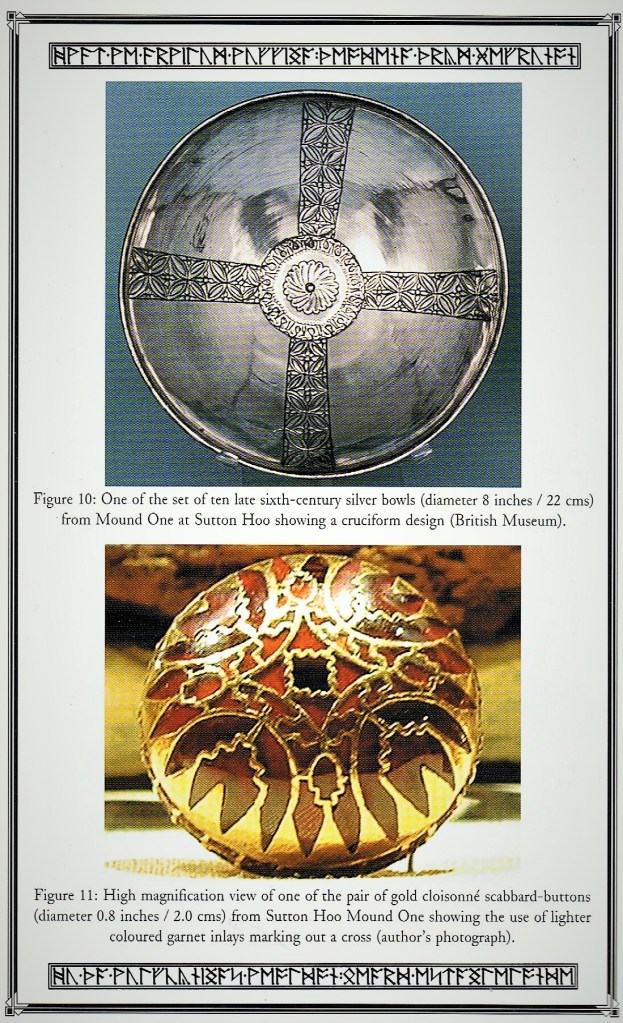
The Angles who settled in the land between the Wash and the Thames estuary were confined by the marshes of Fenland to the west and the dense forests on heavy clay soil to the south. In this compact area the kingdom of East Anglia developed, the estuary of the Yare and the Wensum dividing the North Folk (Norfolk) and the South Folk (Suffolk). In the north and in the Midlands the boundaries of settlement were not so clearly defined by geographical obstacles, and, with rulers who were always fighting each other and frontiers that were ill-defined and always changing. Although we continue to refer to a ‘Heptarchy’, as shown with their ninth-century boundaries on the map below, in fact, the smaller kingdoms were independent only for short periods, and there were never seven kingdoms at any one time. It is natural that, during the early struggles between the kingdoms, one ruler should try to make himself supreme over the rest. He was recognised as ‘Bretwalda’, meaning ‘overlord’ or ‘high king’. In the period to 616, the title passed from Aethelbert of Kent to Raedwald of East Anglia and on to Edwin of Northumbria. When Raedwald’s ship burial at Sutton Hoo was uncovered in 1939, many objects of Celtic and British design were among the treasures discovered. In addition, a mixture of pagan and Christian symobols was found on these goods.

A magnificent gold belt-buckle, decorated with intricate animal interlace patterns, from the early seventh century Sutton Hoo ship burial. Suffolk Anglo-Saxon metalwork was strongly influenced by Celtic craftmanship.

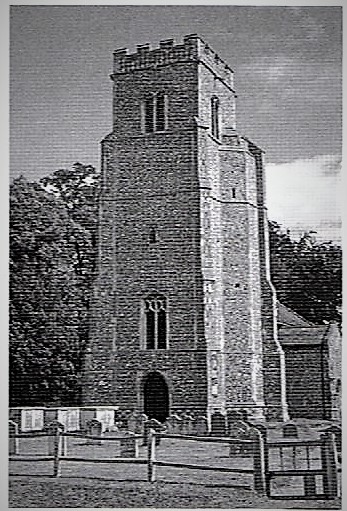
The Church at Rendlesham, thought to have been built on the site of Raedwald’s shrine.

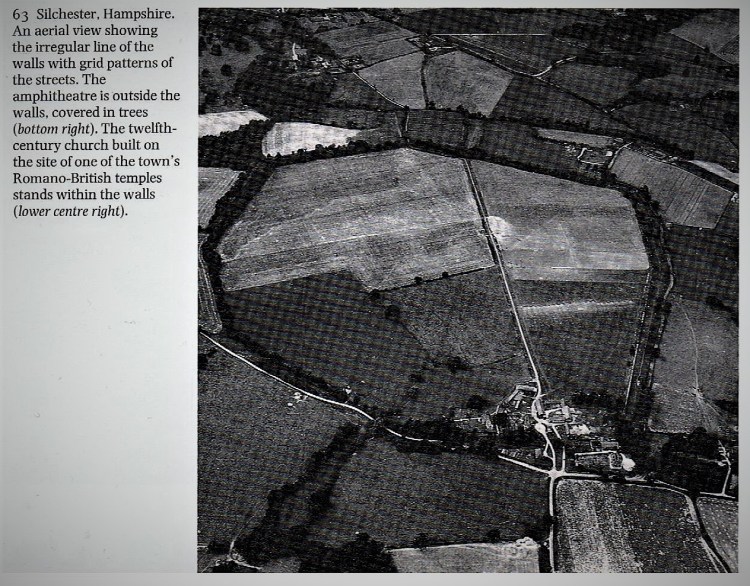
At the local level, the Anglo-Saxons disliked living in towns and their arrival coincided with a drastic decline in urban life and a reorganisation of the landscape, partly as a result of large-scale population movement. London was probably the only place where urban life continued on any significant scale. Many Roman towns were ‘robbed out’ and left abandoned, like Silchester, where Arthur was said to have been made ‘Bretwalda’ of the Britons. The newcomers settled in villages at some distance from the Roman roads, the suffixes ‘-ham’ or ‘-ton’ in a place-names denoting the site of a Saxon village. Wherever they settled they farmed the land. Ruled by kings, their most important landlords were called Thegns, holding land granted by the king and having certain rights over the ‘free men’, small-holding farmers.

The ‘Thegns’ presided over the ‘moots’, where matters of common interest were discussed, and a rough sort of justice was carried out. Freemen could be summoned by the king to serve in an army called ‘the Fyrd’. There were also slaves, including some of the Britons whose lives had been spared during the raids. Aerial photography has also revealed the survival of Celtic field patterns into the Saxon period, suggesting that many British farmers stayed on their lands after their warlords had moved westward.

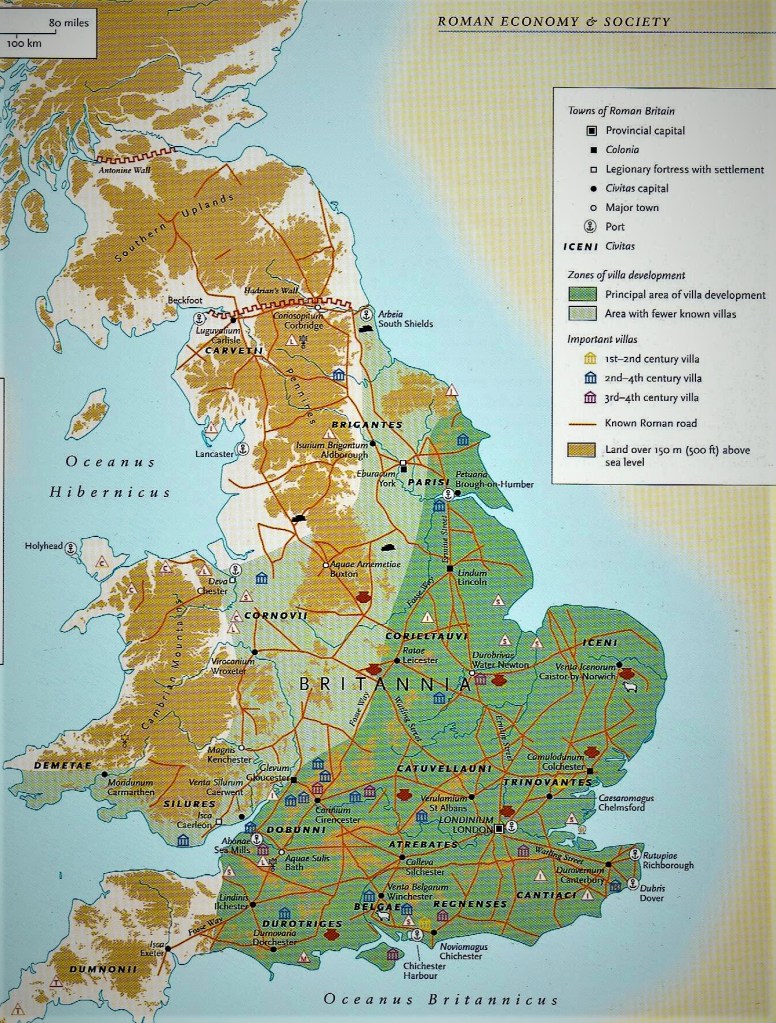
There can be little doubt that the long period of conflict that followed the Roman withdrawal from Britain heightened ethnic tensions and refined the competing identities. A new political landscape, consisting of small kingdoms that owed little to the Roman provincial structures, emerged, largely on ethnic-linguistic lines. In many respects both Celtic and Anglo-Saxon social organisation was similar, but there were profound linguistic and religious differences. By the time of the collapse of the Roman province, Christianity had a significant number of adherents in Britain, while the Saxon homelands remained resolutely pagan. The Anglo-Saxon population in Britain remained pagan until well into the seventh century, regardless of dynastic decisions. Following the English settlement, there were three broad cultural ‘zones’: Britain was divided between the ‘English-speaking’ east and the ‘Celtic-speaking’ north and west where the Brythonic language, ancestral to Welsh, and Pictish languages persisted, while in Ireland and in enclaves in the western highlands and islands, different Gaelic languages were spoken. These zones to some extent reinforced cultural distinctions establihed in the Roman period, and the most Romanised part of Britannia, where there had been towns and villas, broadly corresponds to the area occupied by the early Anglo-Saxon kingdoms. These zones, while not static, can be mapped through early medieval place-names.

Within the ‘British zone’, there is a far greater degree of continuity in the settlement record, particularly regarding centres of power. Edinburgh Castle stands on a hill that was first occupied in the Bronze Age and typifies a preference for prominent, defended strongholds. Some Dark Age hillforts, like South Cadbury, were reused Iron Age hill-forts; others, like Dumbarton or Bamburgh, were newly built on strategic landmarks. In instances where the local setting can be reconstructed, the prehistoric ritual landscape seems to have played a part in the selection of the site. Despite this cultural continuity, British kingdoms started to appear at the same time as the earliest Anglo-Saxon ones. In Ireland, too, this was an era of political reorganisation. Large provincial divisions came to overlie a network of smaller kingdoms, whose ruling élites began to appear in the sixth century. The preferred settlements of the Irish nobility were either elaborately defended homesteads (ring-forts) or artificial islands (crannogs). Links to the past remained strong, and some of the pre-eminent prehistoric religious complex, notably Tara and Emain Macha, which were believed to have been the seats of mythological kings, as a result retained a great symbolic significance. Different communities of religious belief are apparent from the range of material culture left behind. From an archaeological perspective, the most pronounced differences relate to funerary practice. The British and Irish erected inscribed memorial stones, but their burials were neither clothed nor furnished. The British inscriptions, written in Latin, are unmistakenly Christian. The Irish examples, written in Gaelic using an indigenous ogham alphabet, are more ambiguous, but may be Christian. The so-called ‘symbol stones’ of Pictland represent a related tradition, though employing a pictorial rather than an alphabetic system.

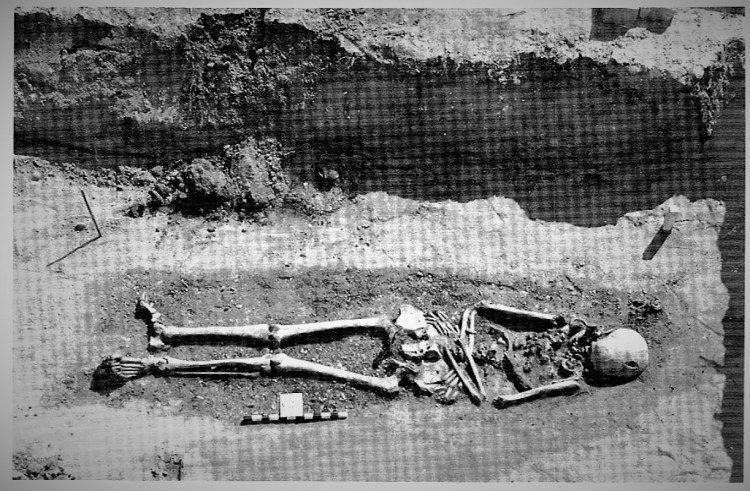
Here, the contrast with the Anglo-Saxon world is profound. Here there are no inscribed memorial stones, and burial practice followed the traditions of their continental homelands. The scale of Anglo-Saxon settlement can be gauged from the widespread distribution of fifth-century Anglo-Saxon cemeteries. The earliest hint of Anglo-Saxon presence is seen in graves from late Roman cemetaries that contain belt-fittings and other metalwork regarded as stylistically Germanic. During the fifth and sixth centuries a wide range of burial rites developed, which included the elaborate use of clothing and equipment to signal social position and to mark out special individuals at burial or cremation. Important graves might be further dignified by the construction of a mound or barrow. Traditionally, such burials were have been taken as reflecting pagan religious belief, but arguably they were to reinforce the social order or to express political aspiration. The patterns of burial rites within individual Anglo-Saxon cemeteries tends to be the same, but there is a huge range of minute ritual variation between cemeteries.This can be interpreted as the means by which neighbouring settlements sought to strengthen group identity. The artefacts recovered from cemetery excavations reveal the technical accomplishments and rich material culture of the early English peoples, but they also offer insghts into the beliefs and values of a society dominated by its warrior aristocracy. The prominence of weaponry in male graves leaves little doubt as to the role of arms and warfare in defining social status. Clothing, jewellery and domestic objects formed the vocabulary of the female burial rite.

Skeleton of an Anglo-Saxon woman from Sowerby, Humberside, buried with a bead necklace and bronze brooches.

Zones of Transition & Questions of Identity:

The precise nature of the transition from Roman Britain to an island divided between ‘zones’ of Anglo-Saxons and Post-Roman Celts is not as clear as we might think. At first sight, the traditional picture of a violent replacement of one people by another seems to be borne out. But closer examination raises a number of questions, which may be resolved by work still in progress. A lot more of Roman Britain could have survived, even in the east, than used to be suspected. And there is no reason why the same course of events in one region should have been repeated across others. In some areas of Norfolk, for example, there may have been wholesale replacement of the original population by another, while elsewhere settlers may have been a subordinate minority, there on sufferance. Or in other areas, the newcomers may have come to an agreement with the natives. In Northumbria, there was a new ruling élite, but the population seem to have remained largely British. When, in later centuries the peoples of south and eastern Britain called themselves Angles or Saxons, we have to allow for the possibility that this may not have reflected a straightforward ethnic fact. Writing in the eighth century, Bede was sure of his own ‘Englishness’ and unenthusiastic about the Britons. Yet there is little evidence for mass immigration of Anglo-Saxons north of York. Bede was writing at Jarrow in Northumbria, where the ruling dynasty, and their immediate retinue, may well have been Anglian. But the rest of the population was of British descent, who, however, identified with their rulers, either willingly or because it was prudent to do so. The sense of belonging to a particular area, East Anglia or Sussex, Northumbria or Kent, would have increased as time went by. But many areas we now think of as ‘English’, like Somerset (‘England’s pastures green’ according to Blake’s ‘misnoma’) and the West Midlands, were not even nominally Anglo-Saxon until long after the first migrations.

This image has an empty alt attribute; its file name is 002-6.jpg
Glastonbury Tor, Somerset.

Sources:

William Anderson & Clive Hicks (1983), Holy Places of the British Isles: A guide to the legendary and sacred sites. London: Ebury Press.

Sam Newton (2003), The Reckoning of King Raedwald. Colchester: Red Bird Press.

Philip Warner (1976), Famous Battles of the Midlands. Glasgow: Fontana.

Stephen Driscoll (et. al.) (2001), The Penguin Atlas of British & Irish History. London: Penguin Books.

Derek Wilson (1977), A Short History of Suffolk. London: Batsford.
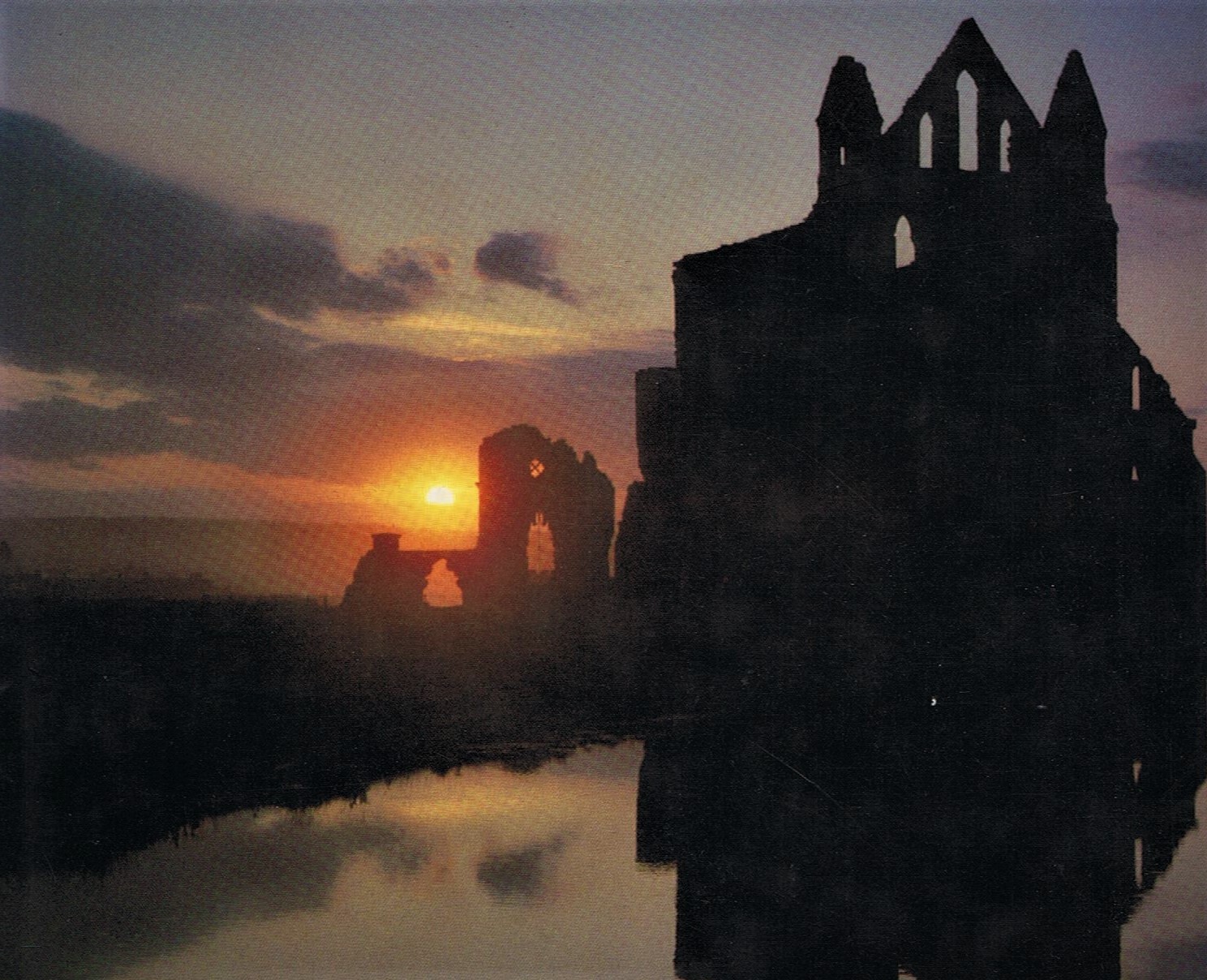
Catherine Hills (1986), Blood of the British: From Ice Age to Norman Conquest. London: Guild Publishing.

David Smurthwaite (1984), The Ordnance Survey Complete Guide to the Battlefields of Britain. Exeter: Webb & Bower.

Appendix One: Sam Newton’s Genealogy of the ‘Wuffings’.

This image has an empty alt attribute; its file name is 001-5.jpg

Appendix Two: Matthew Paris’s Map of the Anglo-Saxon Heptarchy.

Source: Philip Parker (2017), History of Britain in Maps. Glasgow: HarperCollins.

No maps of Britain have survived from the period of the fifth to the eleventh centuries, a crucial time in the nation’s development which saw the collapse of the Roman province of Britannia, waves of invasions by Germanic barbarians and, ultimately, the emergence of unitary kingdoms in England and Scotland. Yet cartographic representations of this formative period do survive from a little later, for example in the form of a schematic map showing the Anglo-Saxon kingdoms by Matthew Paris, a thirteenth-century Benedictine based at the Abbey of St Albans. Paris gives then numbers, establishing the primacy of Kent as the earliest kingdom, and Essex as the most recent. Although elsewhere he repeats the traditional mythology that all these kingdoms emerged within a single generation, Paris confesses that with the passing of time it was difficult, in his time, to elucidate the dimensions, frontiers and even the chronological ordering of these kingdoms. His scheme was an oversimplication. The Angles, Saxons and Jutes who crossed the North Sea in the decades following the collapse of Roman authority did not establish neat territory kingdoms. As the invasders pushed further north and westwards, the war-bands and the authority of local chieftains coalesced into larger units, which became the seven kingdoms. But even in the eighth century, their were less powerful territories, particularly in the West Midlands, which remained independent, though usually shown in more recent maps as part of Mercia.

C. S. Lewis’s Tales of Narnia, from Genesis to ‘Shadowlands’ – Stealing Past Dragons.

A Life Between Faith and Literature:

Monochrome head-and-left-shoulder photo portrait of 50-year-old Lewis
Lewis, age 48
Died
22 November 1963 (aged 64)
Oxford, England

Clive Staples Lewis became the most popular defender of orthodox Christianity in the English-speaking world in the mid-twentieth century. Born in Belfast in 1898, he was brought up an Anglican and educated at Malvern College. As a young man, C. S. Lewis had served in the trenches of World War One and, by the time he went up to Oxford in 1917, he had become an atheist. After a long intellectual battle, he became a Christian in 1931. Gifted with an extraordinary intellect and a reasoning mind, his conversion triggered off a rich variety of creativity. His international best-seller, The Screwtape Letters (1942) won him the reputation of being able to ‘make righteousness readable’.

He wrote many other works of theology and fantasy with theological dimensions but remained a Professor of English Literature, first at Magdalen College, Oxford, until 1954, and then at Cambridge.

Magdalen College, Oxford

Over the years, he also wrote many works of literary criticism, the best known being The Allegory of Love. Lewis achieved further fame as a preacher, debater, and a brilliantly effective ‘apostle to the sceptics’. Believing, as he said, that all that is not eternal is eternally out of date, he was completely orthodox and therefore admired by Christians from all branches of the church.

A jovial and ‘saintly’ man, he was a prolific author and could have amassed a fortune, but following his conversion, he gave away most of his earnings to charities. His autobiography, Surprised by Joy, traces the story of his conversion.

In 1940, when the bombing of Britain began, he took up duties as an air raid warden. He also began giving talks to men in the Royal Air Force, who knew that after just thirteen bombing missions, most of them would be declared dead or missing. Their situation prompted Lewis to speak about the problems of suffering, pain and evil, work that resulted in him being asked by the BBC to give a series of wartime broadcasts on the Christian faith. By 1940, Lewis, known as ‘Jack’ to family and friends, was already an established writer of serious books on literature and religion, but, as a bachelor who did not know many children, he had never thought of writing a book for young readers. The nature of the Second World War changed that because it was ordinary citizens, including children, who suffered most, as their small island home was bombarded by four hundred planes a night in the infamous “Blitz” that changed the face of war, turning civilians and their cities into the front lines.

This image has an empty alt attribute; its file name is 005-2.jpg

Delivered over the air from 1942 to 1944, his speeches were gathered into the book Mere Christianity (1944, 1952; 2016 issue cover picture above) in which he set out his straightforward view of his faith, as demonstrated in the following quotation, dealing with a popular view of Jesus:

I’m ready to accept Jesus as a great moral teacher, but I don’t accept his claim to be God.’ That is the one thing we must not say. A man who was merely a man and said the sort of things Jesus said would not be a great moral teacher. He would either be a lunatic – on a level with a man who says he is a poached egg – or else he would be the Devil of Hell. You must make your choice. Either this man was, and is, the Son of God, or else a madman or something worse. You can shut him up for a fool, you can spit at him and kill him as a demon, or you can fall at his feet and call him Lord and God. But let us not come with any patronising nonsense about his being a great human teacher. He has not left that open to us. He did not intend to.

It was also during the Second World War when children from London were being evacuated to the country, four youngsters were billeted at Jack’s home, The Kilns, near Oxford. Surprised to find how few imaginative stories his young guests knew, he decided to write one for them and scribbled down the opening sentences of a story about four children who were sent away from London because of the air raids and went to stay with an old professor in the country. That is all he wrote at the time, but several years later, he returned to the story. The children (now named Peter, Susan, Edmund and Lucy) found their way into another world, a world that he eventually named ‘Narnia’. More pictures came into his mind: a ‘queen on a sledge’ and ‘a magnificent lion’. For a long time, he did not know what these meant nor what the story was about. As he put it later:
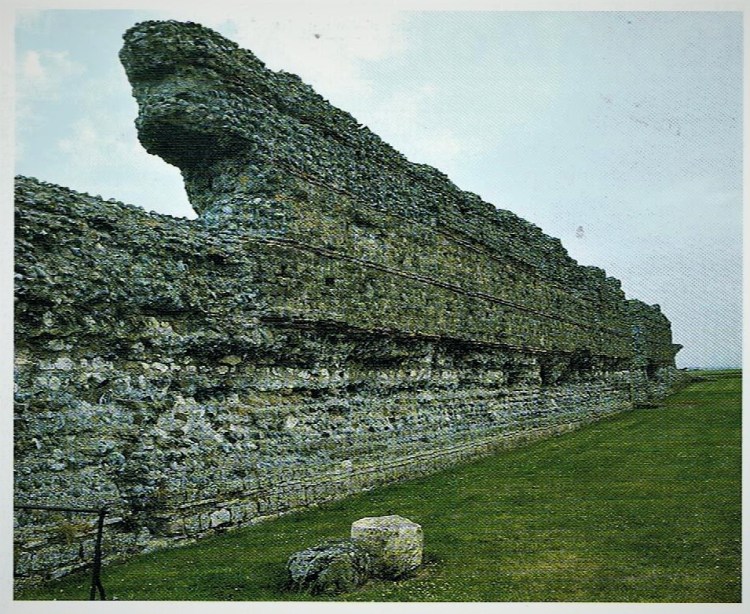
But then, suddenly Aslan came bounding in… I don’t know where the Lion came from or why he came. But once he was there, he pulled the whole story together.

The Mountains of Mourne in Ireland inspired Lewis to write about the landscape in The Chronicles of Narnia. Lewis wrote, “I have seen landscapes … which, under a particular light, make me feel that at any moment a giant might raise his head over the next ridge.”
Photo by Marksie531 – Own work, CC BY-SA 3.0, https://commons.wikimedia.org/w/index.php?curid=1088242

After that, all kinds of elements went into the making of Narnia. There was the intriguing question of the youngest evacuee as to what was behind the big old wardrobe which stood in The Kilns. And there were his own childhood memories: how he and his brother, Warnie, used to climb into that very wardrobe, made by their grandfather, and tell each other stories in the dark. Some of Jack’s inspiration came from the books he had loved as a child: the talking animals in the tales of Beatrix Potter; the magical adventures that happened in the stories of E. Nesbit, such as The Railway Children (1906)the wicked queen from a Hans Andersen fairy tale; the dwarves from the old German myths; Irish folk tales, myths and legends, and mythological creatures from the legends of Ancient Greece. But these were just some of the ingredients for what Jack mixed into an entirely original confection of the oldest stories ever told, those of the Hebrew Bible and the Christian New Testament.

The stories in these seven books began as a series of pictures in the author’s head. When he was forty, he decided to try to make a story out of it. He once said, “People won’t write the books I want, so I have to do it for myself.” In doing so, he wrote books that millions of others also wanted to read. The ‘first’ book, The Lion, the Witch and the Wardrobe, was published in 1950 with illustrations by Pauline Baynes, a young artist who perfectly captured, in line drawings, the pictures that ‘Jack’ Lewis had imagined. It began with the image of a snowy wood with a little goat-footed faun scurrying along carrying an umbrella and a pile of parcels. He later recalled that this picture had been in his mind since he was about sixteen.

This image has an empty alt attribute; its file name is 004-5.jpg

Excellent as Lewis’s descriptions are, the books are so enhanced by the illustrations of Pauline Baynes that it would be a serious omission not to refer right from the start to her part in the success of ‘The Chronicles of Narnia’ as the books became known eventually. The combination of stories and illustrations is one of the happiest in children’s literature for recalling in 1978 her meetings with the author, she told a documentary film-maker:

C. S. Lewis told me that he had actually gone into a bookshop and asked the assistant there if she could recommend someone who could draw children and animals. I don’t know if he was just being kind to me and making me feel that I was more important than I was or whether he’d simply heard about me from his friend Tolkien.

Lewis had indeed admired Pauline Baynes’ illustrations of Tolkien’s Farmer Giles of Ham (1949), and he wrote to Walter Hooper that he had endless admiration for her illustrations of his Narnian books, particularly her drawings of his animal characters. Hooper wrote that of all those who had drawn anthropomorphic beasts and fantasy creatures, she was very near the top of the list. Walter Hooper was born in 1931 in North Carolina and began corresponding with C. S. Lewis in 1954 while serving in the US Army. After ending his service, he read theology and then lectured on Medieval and Renaissance English at the University of Kentucky. He was later to become Lewis’s secretary (see below) and Trustee of his estate.

This image has an empty alt attribute; its file name is 001-4.jpg


The seventh and last book for children in C. S. Lewis’ Tales of Narnia is The Last Battle, first published in 1956. This was just a year after the ‘first’ book in the Narnian chronology, The Magician’s Nephew, was published in 1955, though it was actually the sixth book Lewis wrote. It told of how the journeying between the two parallel worlds, ours and Narnia, began, as well as explaining various mysteries, such as how the wardrobe came to be a door into Narnia, and why there was a lamp-post in the middle of a wood. This final book, The Last Battle, as the cover of its 1961 reprint (above) shows, won the Carnegie Award for the best children’s book of 1956, the highest mark of excellence in children’s literature.

This image has an empty alt attribute; its file name is 002-3.jpg

Seeking Joy Within – ‘Hwyl’ & ‘Hiraeth’:

In Lewis’ autobiography (1955), Surprised by Joy, we get the impression of two lives, the ‘outer’ and the ‘inner’, the life of the intellect and the life of the imagination – being lived over against each other, albeit at the same time. The ‘outer’ life is chiefly concerned with those things that he spoke and wrote about openly: namely the ‘Animal-Land’ of his childhood which gradually metamorphosed into ‘Narnia’. Yet grown-up matters, which were all-in-all to Lewis when he wrote about Animal-Land, find no mention whatsoever in The Chronicles of Narnia. The ‘inner’ life – and this is what Surprised by Joy is mainly about – is essentially the story of Joy (i.e., intense longing) working on his imagination. Narnia would never have come into existence had Lewis not come to understand the meaning and purpose of deep-felt ‘Joy’, what, in my understanding, the Welsh refer to as ‘hwyl’, though, in Lewis’ definition, it is closer to the Welsh word ‘hiraeth’ which is used for a sense of heartfelt longing, akin to aching homesickness. These ancient ‘Cymric’ words have no one-word equivalent in modern English to capture the intensity of the feelings they express.

In his autobiography, Lewis defines Joy by first recording three experiences from his early childhood. While standing by a flowering currant bush on a summer day, there arose in him the memory of a yet earlier morning in which his brother had brought into the nursery a toy garden. This memory within a memory caused a sensation of desire to break over him. Before he could know what he desired, the desire itself was gone, and he was left with a longing for the longing that had just ceased. His second ‘glimpse of Joy’ came through Beatrix Potter’s Squirrel Nutkin. This little book troubled him with the idea of Autumn, and he was plunged once more into the experience of intense desire. The third came to him while reading Longfellow’s poem Tegner’s Drapa. When he read,

I heard a voice that cried,

Balder the beautiful

Is dead, is dead …

… his mind was uplifted into huge regions of the northern sky. At the very moment he was stabbed by desire, he left himself falling out of that desire and wishing he were back in it. Lewis tells us that Joy, the quality common to these three experiences, is an unsatisfied longing which is itself more desirable than any other satisfaction. It was when he went to boarding school in Malvern, Worcestershire, that his eyes fell on one of Arthur Rackham’s illustrations for Siegfried and the Twilight of the Gods, that his sense of joyful longing returned. In an instant, he was plunged back into the past of Balder and sunward sailing cranes and felt the old inconsolable longing. The memory of his own past Joy and the ‘Twilight of the Gods’ flowed together, he said, into a single, unendurable sense of desire and loss, which … had eluded me at the very moment when I could first say “It is”.

The young Lewis made many mistakes in his pursuit of Joy. As the old thrill became less and less frequent, he attempted most desperately to ‘have it again’. He turned from one medium of Joy to another, hoping always to find permanent satisfaction. He shifted to erotic pleasure, only to find that Joy is not a substitute for sex, sex is very often a substitute for Joy. Lewis lost his virginity while at Malvern, but it was the ‘potent, ubiquitous and unabashed’ eroticism of William Morris’s romances which chiefly persuaded him that sex might be the substance of Joy. When he went up to Oxford after serving in the trenches during World War One, Lewis was determined that there were to be no flirtations with the idea of the supernatural. All the images he associated with Joy were, he concluded, sheer fantasies. He had at last seen through them, and the important thing was to get ahead with the ‘good life’ without Christian ‘mythology’.

It is therefore surprising how, one by one, all of Lewis’s reservations about the Christian faith were swept away, as described in Surprised by Joy. After long searching and with much reluctance, he was brought to his knees in the summer of 1929 and forced to admit that God was God. As Walter Hooper remarked, He who is the Joy of all men’s desiring came upon him and compelled him by divine mercy to surrender a long-besieged fortress. His surrender, however, was to become a Theist. The second stage of his conversion came two years later while riding to Whipsnade Zoo in his brother’s motorcycle sidecar. When they left Oxford, he did not believe in Jesus Christ as the Son of God; when they reached the zoo, he did. After that, the old ‘bittersweet stabs of Joy’ continued as before. But now he knew to what, or rather to whom they pointed.

Fairy Tales for Children & Adults – Faith & Heaven:

Ernest H. Shepherd’s 1959 colour illustration for Kenneth Grahame’s (1908) book, The Wind in the Willows. London: Methuen. Chapter II: The Open Road: ‘Sitting by the side of the cart, Toad talked about all he was going to do.’

There was, however, a good stretch of time between his conversion on the way to Whipsnade and his writing of the Tales of Narnia. Throughout this time, Lewis remained open to those physical similarities that men and beasts have in common. This is why he felt that Kenneth Grahame, in The Wind in the Willows, made exactly the right choice in giving his principal character the form of a toad. The toad’s face, with its fixed ‘grin’, bears such a striking resemblance to a certain type of human face that no other animal would have suited the part so well. Lewis saw these physical similarities as extending still further: some animals can be most interestingly used in pictures and literature as representing the actual archetypes of some human and animal characteristics. He had an uncanny eye for their specific traits, as exemplified in his poem Impenitence:

… cool primness of cats, or coney’s

Half indignant stare of amazement, mouse’s

Twinkling adroitness,

Tipsy bear’s rotundity, toad’s complacence …

… cry out to be used as symbols,

Masks for Man, cartoons, parodies by Nature

Formed to reveal us.

There is no credit for this illustration showing a scene from The Voyage of the ‘Dawn Treader’.

In his 1980 Fount paperback, Past Watchful Dragons: A Guide to the Chronicles of Narnia, Walter Hooper argued that there was also an important connection between Lewis’s personal experience of intense longing and the Narnian Chronicles. Surprised by Joy is the story of how this longing led to Lewis’s conversion. But one of his reasons for writing the book was that he felt it to be a common experience, easily misunderstood, difficult to bring to the forefront of consciousness, and of immense importance. The Pilgrim’s Regress, which is partly autobiographical, is the story of the Pilgrim’s quest for a far-off island, the vision of which has stung him with ‘sweet desire’. When Lewis realised that the word Romanticism in the subtitle was misunderstood, he wrote a preface to the third edition (1943) explaining the meaning he gave the word. For him, it meant ‘Joy’, the same Joy, or longing, that we can feel for our own far-off country, as in the Cymric hiraeth: the secret we cannot hide and cannot tell, as he wrote in The Weights of Glory in 1965. A longing which, although painful, is felt somehow to be a delight. A hunger more satisfying than fullness; poverty better than any wealth. A desire that is itself the object of desire, so much so that the new desire becomes an instance of the original one. We feel we know what the object of our desire is, but in the final achievement of that desire, we know that the real object of our desire is somewhere else entirely …
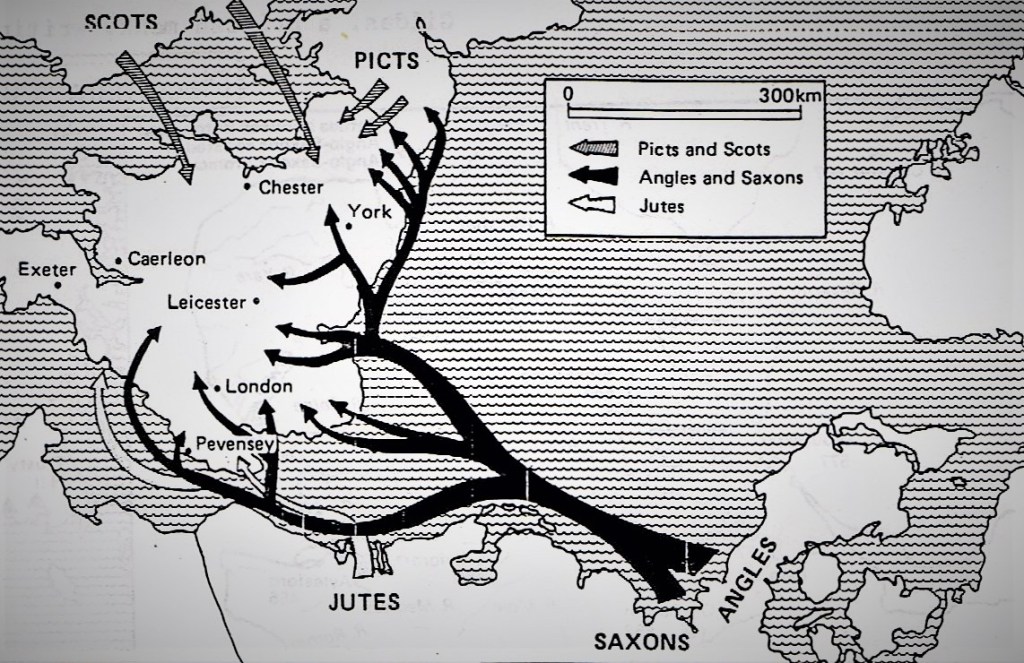
eluding us like the cuckoo’s voice or the rainbow’s end. “All I want”, someone will say, is a university degree, or a happy marriage, or a steady job … But when he is married or settled into the right job, or gets whatever it was he wants, it proves itself to be a cheat. It is not enough. It is not what he is actually looking for.

Lewis reasoned that if we find in ourselves a desire that no experience in this world can satisfy, the most probable explanation is that we were made for a different world. A happy marriage or a successful career was never intended to satisfy our desire for the far-off country; more likely, they were meant to arouse it, to suggest the real thing. The far-off country is, of course, Heaven and nothing other than God can be our ultimate bliss. There is a connection between our longing for Heaven and fairy tales such as those Lewis wrote, although almost every aspect of modern life fixes our minds on this world, and to bring up the subjects of Heaven and fairy tales in some quarters was to be howled down as nostalgic, romantic, sentimental, or adolescent. Many literary critics writing in the 1950s and early 1960s erroneously equated ‘fantastic’ literature with ‘escapism’ and wishful thinking.

Lewis said that ‘marvellous’ literature evoked his desire for Heaven; at the same time, he believed that there is no literature less likely to give a person a false impression of the world than fairy tales. His thoughts on the subject are clearly revealed in his essay, On Three Ways of Writing for Children. In it, he first of all draws our attention to a fundamental point made by his friend J. R. R. Tolkien that fairy tales were not originally written for children but gravitated to the nursery when they became unfashionable in literary circles. Jonathan Swift’s Gulliver’s Travels, for example, was written and published as a two-volume satirical work in 1726 and was only re-published by J. M. Dent in a collection of Tales for Children from Many lands, edited by F. C. Tilney in circa 1910, and illustrated in colour by Arthur Rackham. Tilney wrote that, in preparing the first edition for children,

… one should think of that immortal work more as a fairy tale than as a contribution to literature of the ‘Utopia’ order; for it is a great punishment to the youthful mind to have its breathless rapture stayed whilst the understanding labours over arid tracts of social and political import never intended for it.

Some children and some adults like fairy stories, some do not. So-called ‘realistic’ stories, Lewis maintained, are far more likely to deceive than are fairy tales because, though the adventures and successes in them are possible, they are almost infinitely improbable. While it is possible to become a duke with a palace or a millionaire with a yacht, it is improbable that this will happen to all but a very few of us. On the other hand, no one expects the real world to be like that of fairy tales. The longing for fairyland is a different sort of longing, for it cannot be supposed that the boy who longs for fairyland really longs for the dangers and discomforts of a fairy tale. Lewis wrote further on this theme in his essay:

It would be much truer to say that fairyland arouses a longing for he knows not what. It stirs and troubles him (to his life-long enrichment) with the dim sense of something beyond his reach and, far from dulling or emptying the actual world, gives it a new dimension in depth. He does not despise real woods because he has read of enchanted woods: the reading makes all real woods a little enchanted. This is a special kind of longing.

C. S. Lewis, On Three Ways of Writing for Children

Many professional educators of the 1950s and ‘60s claimed that the Narnian battles and wicked characters frightened children and gave them nightmares. While Lewis agreed with them that nothing should be done likely to give the child those haunting, disabling pathological fears against which ordinary courage is helpless, he was strongly opposed to the notion that we must keep out of the child’s mind the knowledge that he is born into a world of death, violence, wounds, adventure, heroism and cowardice, good and evil. In this matter, he declared himself to be on the side of ‘the human race against ‘the modern reformer’:

Let there be wicked kings and beheadings, battles and dungeons, giants and dragons, and let villains be soundly killed at the end of the book. Nothing will persuade me that this causes an ordinary child any kind or degree of fear beyond what it wants, and needs, to feel. For, of course, it wants to be a little frightened.

In 1963, Walter Hooper travelled to Oxford simply to have afternoon tea with C. S. Lewis, and within a week, the Professor asked him to become his companion-secretary, a post he fulfilled for the remaining months of the Professor’s life, Lewis calling him “the son I should have had.” Besides being the joint author of a biography of Lewis, he edited ten volumes of Lewis’s works and also continued to deal with a lot of the Professor’s ‘fan-mail’, much of it from children. Hooper claimed that while he had met some adults who consider Lewis’s fairy tales too violent for children, he had never met a child who did not love the Narnian tales intensely. During his lifetime Lewis received thousands of letters from children, and seventeen years after his death, it was still Hooper’s responsibility to answer these letters, which children from all over the world continued to address to the author.

It would, perhaps, have been an intelligent guess to assume that Lewis began with the things he wanted to say about Christianity and other interests and then fixed on the fairy tale as a way of saying them. But that is not what happened. Lewis said he could not and would not write in that way; that he never actually ‘made’ a story. It all began with seeing ‘pictures’; a faun carrying an umbrella, a queen on a sledge, a magnificent lion. It was, he remembered, more like ‘bird-watching’ than talking or building. Sometimes a whole set of images would join themselves together, but it was necessary to do some ‘deliberate inventing’, contriving reasons as to why characters should in various places be doing various things.

‘As she stood looking at it, wondering why there was a lamp-post in the middle of a wood and wondering what to do next, she heard the pitter-patter of feet coming towards her. And soon after that, a very strange person stepped out from among the trees into the light of the lamppost.’
Chapter One, The Lion, the Witch and the Wardrobe.

Biblical, Theological and Literary Parallels:

This image has an empty alt attribute; its file name is 012-1.jpg

These books also represent his most delightful approach to the Word of God and are probably his most loved works, even for those adults who have also read some of his other literary and theological works. Lewis believed that there are three elements in all developed religions, and in Christianity, one more. The first is the experience of the Numinous. If you were made aware of a mighty spirit in the room with you, you would feel, simultaneously, a sense of wonder and a sense of inadequacy. The shrinking feeling that the numinous object excites in you is awe. A good biblical example of this is Jacob’s vision of a ladder reaching from earth to Heaven upon which ascend and descend the angels of God:

On this journey, Jacob lay down to sleep with his head on a stone and had a vivid dream. He saw a vision of a gigantic stairway, with its bottom on earth and its top reaching all the way up and down it. Angels were climbing up and down it.

At the top was God. He spoke to Jacob and promised, “I will give this land to you and your many descendants. When Jacob awoke, he felt amazed that God had spoken to him and exclaimed, ‘Surely the Lord is in this place, and I knew it not.’ And he was afraid and said, ‘How dreadful is this place!’

Genesis 28: 16f

The second element in religion is the consciousness of moral law, and the third appears when we realise that the numinous power is the guardian of the morality to which we feel an obligation. The fourth is unique to Christianity: the historical event through which we recognise that the incarnate Son of God is the ‘awful haunter of nature and the giver of the moral law’. In each of the Narnian stories, all these elements are vested in the person of the great, golden Lion of Narnia, but it is the Numinous, the dreadful presence, that first strikes us so directly. When, in The Lion, the Witch and the Wardrobe, the Pevensie children first hear the name of Aslan, something jumps in their insides. When they see him, they know that they are face to face with one who is both great and terrible. The sight of his great royal, solemn, overwhelming eyes causes them to go ‘all trembly’ (chapter twelve). He is a figure of immense power and beauty.  When, after his ‘resurrection’,

‘he opened his mouth to roar, his face became so terrible that they did not dare look at it. And they saw all the trees in front of him bent before the blast of his roaring as grass bends in a meadow before the wind.’

The Lion, the Witch and the Wardrobe, chapter fifteen.

Walter Hooper commented:

There is never any doubt in anyone’s mind that Aslan is the Lord of that world. Even his enemies believe this (‘the devils also believe, and tremble’, James 2: 19). If I had not read the Narnian Chronicles, I could not have believed an author could concentrate so much good into one being – none of the soulful, over-nice qualities we sometimes find in people we feel we ought to like but cannot. Here, in this magnificent Lion is absolute, thrilling goodness beyond anything we could imagine. Qualities we think of as opposites meet in him and blend.

This image has an empty alt attribute; its file name is 001-8.jpg
From Chapter Nine of ‘The Magician’s Nephew’: ‘The Lion was pacing to and fro about that empty land and singing his new song. It was softer and more lifting than the song by which he had called up the stars and the sun; gentle, rippling music. And as he walked and sang, the valley grew green with grass. It spread out from the Lion like a pool. It ran up the sides of the little hills like a wave.

Nowhere in the Narnian books is the large, embracing the love of Aslan for every creature in all worlds so poignantly felt as when Digory, in chapter twelve of The Magician’s Nephew, is anxious to draw the Lion’s attention to the fact that his mother lies dying and blurts out:

‘But please, please – won’t you, can’t you give me something that will cure Mother?’ Up till then he had been looking at the Lion’s great front feet and the huge claws on them; now, in his despair, he looked up at his face. What he saw surprised him as much as anything in his whole life. For the tawny face was bent down near his own and (wonder of wonders) great shining tears shone in the Lion’s eyes. They were such big, bright tears compared with Digory’s own that for a moment he felt as if the Lion must really be sorrier about his Mother than he was himself.

This image has an empty alt attribute; its file name is 004-3.jpg

‘My son, my son’, said Aslan. ‘I know. Grief is great. Only you and I in this land know that yet. Let us be good to one another.’

But later, when he has given up all hope of a magical cure, Aslan sends Digory into a dream and allows him to pluck an apple from a tree, the ‘Apple of Youth’ and to take it home to his mother to eat and miraculously recover.


There are others whom Aslan is unable to help. In The Last Battle, there are the Dwarfs who are so determined not to be taken in that they stop their ears and close their eyes against anything that can do them good. When, for instance, a glorious feast is spread before them, pictured above, they see and taste only such fare as they would expect to find in a stable. ‘The Dwarfs are for the Dwarfs’, they constantly reiterate their spurious comfort and their eternal undoing. Aslan says of them,

“They have chosen cunning instead of belief. Their prison is there only in their own minds, yet they are in that prison; and so afraid of being taken in that they cannot be taken out.”

The Last Battle, chapter thirteen.

And when, again in The Magician’s Nephew, the self-imposed blindness of Uncle Andrew, the ‘magician’, erects a barrier between himself and the comfort that Aslan longs to give him, the Lion says,

“Oh, Adam’s sons, how cleverly you defend yourselves against all that might do you good!”

The Magician’s Nephew, chapter fourteen.

This is reminiscent of Jesus’ lament over Jerusalem, reported by Matthew (23: 37). But Lewis maintained that at first, there was nothing specifically Christian about the pictures he was seeing in his mind, but that that element, as with Aslan, pushed its way in of its own accord. In another of his essays in Of Other Worlds; Sometimes Fairy Stories May Say Best What’s to be Said, touching directly on the Narnian stories, Lewis wrote that he chose the fairy tale as the form for his stories because of its brevity, its severe restraints upon description, its flexible traditionalism, its inflexible hostility to all analysis, digression, reflections and ‘gas’.
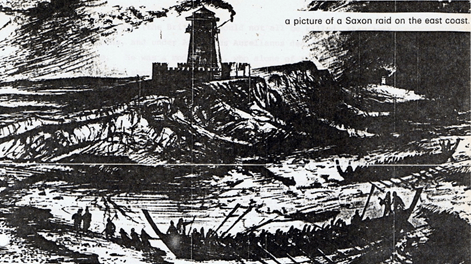
“Do not fly too high,” said Aslan. “Do not try to go over the tops of the great ice mountains. Look out for the valleys, and the green places, and fly through them. There will always be a way through. And now be gone with my blessing.” “Oh, Fledge!” said Digory, leaning forward to pat the Horse’s glossy neck. “This is fun. Hold on to me tight, Polly.” The Magicians Nephew, chapter twelve.

It was a form he had long been in love with, and when the time came, he felt he would burst if he did not write one. Choosing the form, he said, was allowing the author in him to have its say. But then the man in him began to have his turn. He also saw how stories such as he had in mind could ‘steal past’ certain inhibitions that he had had in childhood. He believed that the reason we find it so hard to feel as we ought to about God and the sufferings of Christ is that an obligation to do so freezes feelings. He found that:

The whole subject was associated with lowered voices; almost as if it were something medical. But supposing that by casting all of these things into an imaginary world, stripping them of their stained-glass and Sunday School associations, one could make them for the first time appear in their real potency? Could one not thus steal past those watchful dragons? I thought one could.

So, yes, in reading the stories, we come to understand that Aslan represents Christ, but we do not want to spoil Lewis’ attempt to get past those ‘watchful dragons’ by explaining who Aslan is in advance. An ‘explanation’ on our part is, says Hooper, unwise, as it would be likely to frustrate Lewis’ purpose and blunt the effectiveness of the books. It is often, precisely because many readers, both children and adults, do not know who Aslan is before they start reading that the Narnian tales have been so effective in ‘getting into the bloodstream of the secular world.’ The stories were not written to be deciphered but to give pleasure as an unconscious preparation of the imagination. Hooper argues that if the fairy tales succeed in breaking down the partition of prejudices that prevent non-believers from even thinking about the Christian tenets, then our efforts will be very much in demand.

As Walter Hooper is at pains to point out, we will not find an exact, geometrically perfect equivalent of Christ’s Incarnation, Passion, Crucifixion, and Ascension in the Narnian stories. We are not meant to. This is why we should not press the analogies too closely or expect to find in the tales the same logic we find in the Christian story. For example, Lewis uses the term ‘incarnate’ rather loosely here, for Aslan is never incarnate as Lion in the same way that Christ was Man. Quite apart from the biblical parallels with ‘the Lion of Judah’ (Genesis 49: 9), Narnia is, after all, predominantly a world of animals, and the Lion, the traditional King of Beasts, seems the most natural and appropriate choice for Lewis to have made for his ‘hero’. Nevertheless, in The Lion, the Witch and the Wardrobe, we see the Lion undergoing something genuinely like the passion of Christ:

But how slowly he walked! And his great, royal head drooped so that his nose nearly touched the grass. Presently he stumbled and gave a low moan.

The Lion, the Witch and the Wardrobe, chapter 14.
“Stop!” said the Witch. “Let him first be shaved.”

But the most reliable hints about the new, resurrected nature are found, not in this first told tale, but in the final chapter of The Last Battle, which will be discussed last below. For now, it is important to accept Lewis’ own advice on reading mythological literature. Writing about the medieval books of Malory’s Arthur and Chrestien’s Lancelot, he argued that:

Within a given story, an object, person, or place is neither more nor less nor other than what that story effectively shows it to be. The ingredients of one story cannot ‘be’ anything in another story, for they are not in it at all.

Even those most integrally involved in the Chronicles did not immediately make the connections between the Gospel stories and the Narnian tales. Pauline Baynes told Hooper that, while she was deeply moved by the story of the self-sacrifice made by Aslan, it was only after she had finished illustrating The Lion, the Witch and the Wardrobe that it broke on her who he was meant to ‘represent’. Even those likenesses which seem to bear the closest resemblance to historical events in this world can be so similar without being the same. These similarities did not need a mature theological analysis for their perception; indeed, children, whom Lewis regarded as the most aware of his readers, were the first to respond to the ultimate likeness. Lewis replied to one little girl:

All your points are in a sense right. But I’m not exactly ‘representing the real (Christian) story in symbols. I’m more saying, ‘suppose there were a world like Narnia, and it needed restoring and the Son of God (or the Great Emperor-Over-Sea) went to redeem it, as He came to redeem ours, what might it, in that world, all have been like?’

Lewis then set out in his letter seven points of similarity, which were also the same thing as you thought but not quite. For example, the Ape and Puzzle, just before the Last Judgement (in the Last Battle), are like the coming of the Antichrist. But Hooper argues that such parallels, variously transfigured as they are in Narnia, are not what the books are about. It is not the identifiably biblical elements which make us think of the Narnian stories as Christian. Almost every page of every book is suffused throughout with moral substance of quality that no one, whatever their confessional beliefs, could object to. The tales are not based around premeditated moral themes, however, but these themes grew out of the telling and are as much a part of the narrative as scent is to a flower.

The Chronology of Narnia:                         

Lewis had not drawn out a scheme for the whole Narnian series before writing The Lion, the Witch and the Wardrobe, although he wrote ‘An Outline of Narnian history so far as it is known’ after all the books had been written. He gave the Outline to Walter Hooper, who re-produced and published it as it appears below. All told, there are 2,555 Narnian years between its Creation and its End: only fifty-two Earthly years pass during those Narnian ones, however. Lewis had long entertained the thought that other worlds might measure qualities in different ways. The ‘thickness’ of Narnian time not only provided the children with more interesting and varied adventures than they might otherwise have had, but Lewis seems to have found in it a means of demonstrating a great truth. That is that, as we do not know what stage of the world we are living in at any given moment or period, we cannot possibly understand the meaning of the whole of history until it is over. To use Lewis’s favourite analogy:

We do not know the play. We do not even know whether we are in Act I or Act V. We do not know who are the major and who are the minor characters. The Author knows.

In examining the table below, however, we need to remember that while Lewis had entertained various notions of time before writing any of the Chronicles, he had not worked out anything like a ‘scheme’ of Narnia/ Earth equivalence. Having finished all the books in the sequence, he then devised the following chronology, then passing it to Walter Hooper, who added his personal comments about why Lewis decided to leave the Tales as they are today:

Because there was no definite scheme from the beginning, there are a few inconsistencies in the stories. Initially, most children, and adults, read them in the order they could buy them in the bookshops as they were published. Now, it is probably better to read them in their proper chronological sequence, although experience suggests that, with the possible exception of The Last Battle, they can be enjoyed in any order. The correct order, as Lewis asked Hooper to copy it down, was: The Magician’s Nephew; The Lion, the Witch and the Wardrobe, The Horse and His Boy, Prince Caspian, The Voyage of the ‘Dawn Treader’, The Silver Chair, and The Last Battle. All were published between 1950 and 1956. However, on the back of another book Lewis was writing in 1939 or 1940, Walter Hooper later found what he believed to be the germinal passage of what ten years later became his first story:

This book is about four children whose names were Ann, Martin, Rose and Peter. But it is mostly about Peter who was the youngest. They all had to go away from London suddenly because of the Air Raids, and because Father, who was in the army, had gone off to the war and Mother was doing some kind of war work. They were sent to stay with a very old Professor who lived by himself in the country.

Ross Wilson’s statue of Professor Kirke (Digory) in front of the wardrobe from The Lion, the Witch and the Wardrobe in East Belfast
By “Genvessel” – https://www.flickr.com/photos/genvessel

This ‘beginning’ of this story has been seen as something of a ‘mirror image’ of how Lewis himself had entertained four real schoolgirl evacuees soon after the outbreak of war. However, if his characters were based on particular real personalities, these could have been drawn from any combination of the dozen evacuees that stayed with him during the first year of the war, especially given the balance between boys and girls among his characters. It is unclear how much of the story Lewis wrote down over the next decade, but these characters had evolved by 1950 into Peter, Susan, Edmund and Lucy, with Peter becoming the eldest sibling. The youngest, Lucy, hides in the wardrobe in the spare room and discovers it to be an entrance into the world of Narnia. She meets a faun there, Mr Tumnus, from whom she learns that Narnia is ruled by the White Witch, who has cast the country into perpetual winter. …                      

And so Lucy found herself walking through the wood arm in arm with this strange creature as if they had known one another all their lives.’
Chapter Two, The Lion, the Witch and the Wardrobe.

While we know that Lewis occasionally wavered in ordering some of the events in the first six Chronicles of Narnia and that he had to do a little ’deliberate inventing’ here and there, no one can say that he gave no inklings of the ’twist’ he was to put in The Last Battle.

A Doorway to Heaven and a Re-birth of Images:

By the time C. S. Lewis became a Christian, he had already come a long way towards seeing that ‘Joy’, the deepest of longings of all men, is, at the bottom, a desire for Heaven. In this context, from the last book that C. S. Lewis was to write, Letters to Malcolm, the final paragraphs have become possibly the most famous he was ever to pen:

I do not think that the life of Heaven bears any analogy to play or dance in respect of frivolity, I do think that while we are in this ’valley of tears’, cursed with labour, hemmed round with necessities, tripped up with frustrations, doomed to perpetual plannings, puzzlings, and anxieties, certain qualities that must belong to the celestial  condition have no chance to get through, can project no image of themselves, except in activities which, for us here and now, are frivolous.

For surely we must suppose the life of the blessed to be an end in itself, indeed The End: to be utterly spontaneous; to be the complete reconciliation of boundless freedom with order – with the most delicately adjusted, supple, intricate and beautiful order?  How can you find any image of this in in the ’serious’ activities  either of our natural or of our (present) spiritual life? – either in our precarious and heart-broken affections or in the Way which is always, in some ways, a ’via crucis’…

… It is only in our ‘hours-off’, only in our moments of permitted festivity, that we find an analogy. … But in this world everything is upside down. That which, if it could be prolonged here, would be a truancy, is likest that which in a better country is the End of ends. Joy is the serious business of Heaven.

In the first six stories of Narnia, hint after hint is thrown out in all the other stories that no one may ‘camp’ indefinitely in Narnia, just as no one may live forever in this world. But it would not be fair to suggest that anything remotely like despair is what Lewis was after. Every hint of impending separation from the old Narnia is underpinned by persistent intimations of how great a loss it would be to lose the royal and all-loving Aslan and how complete our happiness would be to enjoy him forever. The English children in the tales are, from a Narnian point of view, ‘Gentiles’ from an unknown world who become Narnians by adoption. There are, however, native Narnians who, when they see the Lion for the first time, feel a natural and spontaneous devotion to the person of the divine Aslan. Aslan, the “magnificent lion”, plays an important role in every story: in The Magician’s Nephew (1955), he gives life to Narnia in a ‘Genesis’ saga; in the final volume of what is now known as “The Chronicles of Narnia”, The Last Battle (1956)Aslan concludes the story by leading its faithful friends into a new world.

This image has an empty alt attribute; its file name is 003-4.jpg
… the whole thing was rather like a theatre. The crowd of Narnians were like the people in the seats; the little grassy place just in front of the stable, where the bonfire burned and the Ape and the Captain stood to talk to the crowd, was like the stage; the stable itself was like the scenery at the back of the stage; and Tirian and his friends were like people peering round from behind the scenery. … Rishda Tarkaan dragged the Ape up close to the fire. … “Now monkey” said Rishda Tarkaan in a low voice. “Say the words that wiser heads have put in your mouth.” “Do leave me alone,” muttered Shift. But he sat up straighter and began, in a louder voice – “At this very moment, when the Terrible One himself is among us – there in the stable just behind me – one wicked Beast has … dressed itself up in a lion skin and is wandering about in these woods pretending to be Aslan.
(From chapter XI, The Great Meeting on Stable Hill).

But from here, we must move on to the culmination of the triumphant theme of Joy as the serious business of Heaven. In the opinion of Walter Hooper, The Last Battle is the best written and the most sublime of all the tales of Narnia, ‘the crowning glory of the whole Narnian creation’. Everything else in all the other six stories finds its ultimate meaning in relation to this seventh and final book. It must be read last of all because, as Lewis would say, you have to understand the ‘play’ by seeing it through to its end. In it, Lewis takes us to the end of Narnia and beyond. The story recounts the end of Narnia, many centuries after Aslan was last seen moving visibly through the world. Shift the Ape dresses the simple ass, Puzzle, in the skin of a lion and deceives the Talking Beasts and the dwarfs into thinking that it is Aslan himself. Lewis’s didactic purpose ought to be clear to those who are conversant with orthodox Christianity. He uses his own invented world to illustrate what the Church has been teaching since its beginning, but which is becoming more and more neglected or forgotten. Namely, that this world will come to an end; it was never meant to be our real home – that lies elsewhere; we do not know, nor can we, when the end will come, but we know that it will come from without, not from within. Most of the events in The Last Battle are based on the apocalyptic prophecies recorded in Matthew 24, Mark 13, and Luke 21. The treachery of Shift the Ape is clearly suggested in the words of Jesus:

“If any man shall say unto you, Lo, here is Christ, or there; believe it not. For there shall arise false Christs, and false prophets, and shall shew great signs and wonders; insomuch that, if it were possible, they shall deceive the very elect.”

Matthew 24: 23f
This image has an empty alt attribute; its file name is 007-2.jpg

By that deception the Calormenes who worship the devil Tash are enabled to overrun the country. Tirian, the last king of Narnia, prays to Aslan for help and is rescued from the Calormenes by Eustace and Jill, who have been mysteriously pulled into Narnia from a moving train. They then steal Puzzle from the stable. At this point, the story also becomes painful to read because we begin to sense that almost everything we have come to love in the all the old, familiar Narnia, is about to be taken from us. Our sense of loss is made more excruciating because we are allowed, even encouraged, to believe that things will eventually get back to ‘normal’. We feel certain that the King, at least, will not be deceived by Shift the Ape’s trickery: but he is. When Eustace and Jill arrive, we feel reassured that it will only be a matter of time until all is put right. Yet, despite their willingness to help, there is so little they can do without Aslan. Shift the Ape almost succeeds in deceiving even the most faithful followers of Aslan, first through trickery and, later, through the deliberate confusion of Aslan with the devil Tash as ‘Tashlan’. As the ape is a parody of a man, so his ‘new theology’ is a parody of the truth. We are prepared for ordinary wickedness in an adventure story, but we are now moved into a new and dreadful dimension where ordinary courage seems helpless in the face of sheer evil. Nevertheless, our hearts warm as Jewel the Unicorn recounts the centuries of past happiness in which every week and day in Narnia had seemed better than the last:

As he went on, the picture of all those happy years, all the thousands of them, piled up in Jill’s mind till it was rather like looking down from a high hill on to a rich, lovely plain full of woods and waters and corn-fields, which spread away and away till it got thin and misty from distance. And she said:

“Oh, I do hope we can soon settle the Ape and get back to those good, ordinary times. And then I hope they’ll go on for ever and ever and ever. Our world is going to have an end someday. Perhaps this one won’t. Oh Jewel – wouldn’t it be lovely if Narnia just went on and on – like what you said it has been?”

“Nay, sister,” answered Jewel, “all worlds draw to an end; except Aslan’s own country.”

“Well, at least” said Jill, “I hope the end of this one is millions of millions of millions of years away.”

The Last Battle, chapter eight.

But moments later the party came to a sudden halt. …

The King and Eustace and the Dwarf were all staring up at the sky. Jill shuddered, remembering what horrors they had seen already. … “I dare say,” said the Unicorn, “from its flight, that it is a talking bird.”… If one had known what was to happen next it would have been a great treat to watch the grace and ease with which the huge bird glided down. He alighted on a rocky crag a few feet from Tirian, bowed his crested head and said in his strange eagle’s-voice, “Hail King … when you have heard my news you will be sorrier of my coming than of the greatest woe that ever befell you.”

Farsight the Eagle (above) brings word that Cair Paravel, the high seat of all the Kings of Narnia, has been captured by the Calormenes. And, as he lay dying, Roonwit the Centaur asked the King to remember that,

‘… all worlds draw to an end and that noble death is a treasure which no-one is too poor to buy.’

Last Battle, chapter eight.

From this point onwards, Lewis lets go of the full power of his imagination, and we are carried relentlessly forward into what is truly the last battle for Narnia in front of the stable.

Tirian and the remnant of the faithful Narnians are either slain in the Last Battle or make their way to the stable, which seems much bigger on the inside than the battlefield they have come from. Drawing out this brilliant piece of symbolism, Lewis has Jill say in a moment of selfless appreciation:

In our world too, a stable once had something inside it that was bigger than our whole world.”

Last Battle, chapter thirteen

Numbered among the blessed in the eternal Narnia is Emeth the Calormene, whom Aslan has redeemed. Lewis had already justified this departure from his stereotyping of the Calormenes as the forces of evil by asking, in his 1952 edition of Mere Christianity:  

Is it not frightfully unfair that this new life should be confined to people who have heard of Christ and been able to believe in him? But the truth is God has not told us what his arrangements about the other people are. We do know that no man can be saved except through Christ; we do not know that only those who know him can be saved through him.

Emeth sought Aslan with all his heart, even when circumstances make it all but impossible to find him. And though he did not know Aslan until he went through the Stable door, it is Aslan, nevertheless, who becomes his Saviour there. The beautiful telling of Emeth’s meeting with Aslan echoes many Gospel utterances, especially…

“… and other sheep I have, which are not of this fold: them also I must bring, and they shall hear my voice; and there shall be one fold, and one shepherd.”

John 10: 16.

Lewis goes on to describe how the Stable is transformed into a magical door which appears in front of Peter, Tirian and the ‘children’, the reunited kings and queens:

Tirian looked and saw the queerest and most ridiculous thing you can imagine. Only a few yards away, clear to be seen in the sunlight, there stood up a rough wooden door, and round it, the framework of the doorway: nothing else, no doorway, no roof. He walked towards it, and the others followed, watching to see what he would do. He walked round to the other side of the door. But it looked just the same from the other side: he was still in the open air on a summer morning. The door was simply standing up by itself as if it had grown there like a tree. …

This image has an empty alt attribute; its file name is 003-3.jpg

Tirian put his eye to the hole. At first, he could see nothing but blackness. Then, as his eyes grew used to it, he saw the dull red glow of a bonfire that was nearly going out and, above that, in a black sky, stars. …

The Calormenes discover in that same stable the odious Tash (in whom they have lost faith) who carries off the Calormene leader and Shift the Ape.

This image has an empty alt attribute; its file name is 009-1.jpg
This image has an empty alt attribute; its file name is 001-5.jpg

He looked around again and could hardly believe his eyes. There was the blue sky overhead, and grassy country spreading as far as he could see in every direction, and all his new friends around him, laughing …The sweet air grew suddenly sweeter. A brightness flashed behind them. All turned. Tirian turned last because he was afraid. There stood his heart’s desire, huge and real, the golden Lion, Aslan himself, and already the others were kneeling in a circle round his forepaws and burying their hands and faces in his mane as he stooped his great head to touch them with his tongue. Then he fixed his eyes upon Tirian, and Tirian came near, trembling, and flung himself at the Lion’s feet and the Lion kissed him and said, “Well done, last of the Kings of Narnia who stood firm at the darkest hour.” …

He went to the Door, and they all followed him. He raised his head and roared, “Now it is time!” then louder “Time!”; then so loud that it could have shaken the stars, “TIME.” The Door flew open.

Aslan then passes through the door to his kingdom. As all the kings and queens of Narnia stand beside Aslan at the door, on his right, they see through the open doorway another black shape, this time the shape of a man, the hugest of all giants. He is standing on the high moorlands to the North. Jill and Eustace remember how once, in the deep caves beneath those moors, they had seen this great giant asleep and had been told that his name was Father Time and that he would wake at the end of the world. He now raises a horn to his mouth and makes a sound ‘high and terrible, yet of a strange, deadly beauty.’ With this terrible beauty that makes the heart ache, we are told of how Aslan goes to the Stable door and holds his Last Judgement. Those who are worthy pass in, the others turn away into darkness. Inside the doorway, the children witness the beginning of the end of the world of Narnia, with the stars falling from the sky and the arrival at the doorway of all kinds of creatures, men and mythical beings, by thousands and by millions, all running towards where Aslan stood:

The creatures came rushing on, their eyes brighter and brighter as they drew nearer to and nearer to the standing Stars. But as they came right up to Aslan one or other of two things happened to each of them. They all looked straight in his face; I don’t think they had any choice about that. And when some looked, the expression of their faces changed terribly – it was fear and hatred: except that, on the faces of Talking Beasts, the fear and hatred lasted only a for a fraction of a second. You could see that they suddenly ceased to be Talking Beasts. They were just ordinary animals. And all the creatures who looked at Aslan in that way swerved to the right, his left, and disappeared into his huge black shadow, which… streamed away to the left of the doorway. …

This image has an empty alt attribute; its file name is 004-2.jpg

But the others looked in the face of Aslan and loved him, though some of them were very frightened at the same time. And all these came in at the Door, in on Aslan’s right. There were some queer specimens among them. … Among the happy creatures who came crowding round Tirian, and his friends were all those whom they had thought were dead. There was Roonwit the Centaur and Jewel the Unicorn and the good Boar and the good Bear, and Farsight the Eagle, and the dear Dogs and Horses, and Poggin the Dwarf.

Farther in and higher up!

This dramatic retelling of Jesus’ last parable of ‘The Sheep and the Goats’ serves as a prelude to the drowning of Narnia by a great ‘tidal wave’ or ‘tsunami’.

This image has an empty alt attribute; its file name is 004-3.jpg

“Farther in and higher up!” cried Roonwit and thundered away in a gallop to the West. And though they did not understand him, the words somehow set them tingling all over.

The water came swirling up to the very threshold of the Doorway (but never passed it) so that the foam splashed around Aslan’s forefeet:

Then Aslan said, “Now make an end.”

The giant threw his horn into the sea … Then he stretched out one arm… across the sky till his hand reached the Sun. He… squeezed it in his hand as you would squeeze an orange. And instantly there was total darkness.

Everyone except Aslan jumped back from the ice-cold air which now blew through the Doorway. Its edges were already covered with icicles.

“Peter, High King of Narnia,” said Aslan, “Shut the door”.

Peter, shivering with cold, leaned out into the darkness and pulled the Door to. It scraped over ice as he pulled it. Then, rather clumsily… he took out a golden key and locked it. They had seen strange things enough through that Doorway. But it was stranger than any of them to look round and find themselves in warm daylight, the blue sky above them, flowers at their feet, and laughter in Aslan’s eyes. He turned swiftly around, crouched lower, lashed himself with his tail and shot away like a golden arrow.

“Come farther in! Come farther up!” he shouted over his shoulder. But who could keep up with him at that pace? They set out walking westward to follow him.

As Night Falls on Narnia, the children and their friends are led into a land, Farther Up and Farther In, where they must say Farewell to Shadowlands (the titles of the last three chapters). After this dazzling feat of the imagination, one might reasonably expect that Lewis could not help but let us down in ‘unwinding’ his story. He knew that the merest slip of the pen could have cast a shadow of incredulity over all that went before, and he proceeded very cautiously in opening the children’s eyes to where they are. The question was how to portray Heaven. How to make it heavenly? How to ‘unwind’ upwards? The answer lay in finding, and then trying to describe the differences between the earthly and the eternal worlds. In order to stride the pitfalls involved in this, it is necessary to avoid calling this an ‘allegory’. Lewis claimed that none of his Narnian stories were ‘allegories’ in the traditional sense of the term: by allegory he meant the use of something real and tangible to stand for something real but intangible. Anything immaterial can be allegorised and represented by physical objects, but Aslan, for example, is already a physical object. To try to represent what Christ would be like in Narnia is to turn one physical being into another, and that does not fall within Lewis’s definition of what constitutes an allegory. On the other hand, there is much in the tales, and especially in The Last Battle, which would fit Lewis’s own description of symbolism, that we are the ‘frigid personifications’; the heavens above us are the ‘shadowy abstractions’. He believed that Heaven is the real thing, of which earth is an imperfect copy.

Therefore, after some time, the children begin to recognise the landscapes around them as ‘Narnian’; that is, they recognise significant features of the world they have left behind them which they had watched being destroyed. Yet they appear curiously different, changed for the better.

This image has an empty alt attribute; its file name is 005-1.jpg

Suddenly Farsight the Eagle spread his wings, soared thirty or forty feet up into the air, circled round and then alighted on the ground.

“Kings and Queens,” he cried, “we have all been blind. We are only beginning to see where we are. From up there I have seen it all – Ettinsmuir, Beaverdam, the Great River, and Cair Paravel still shining on the edge of the Northern Sea. Narnia is not dead. This is Narnia.”

As they rejoice in this discovery, Lord Digory, whom we first meet as Professor Kirke in The Lion, the Witch and the Wardrobe, explains the difference between the two: the Narnia that was destroyed was not the ‘real Narnia’, but only a temporary shadow of the real Narnia which was always there and always would be there. All of the ‘old Narnia’ that mattered, including all the “dear creatures”, had been drawn into the real Narnia through the Door. Of course, this ‘new Narnia’ was as different “as a real thing is from its shadow or as waking life is from a dream.”

One especially important detail which can be easily overlooked is the manner in which the children’s resurrected bodies differ from their earthly ones. They discover that they can scale waterfalls and run faster than an arrow flies. This is meant to be a parable to the gospel accounts of Christ’s risen body: though still corporeal, He is able to move through locked doors (Jn. 20: 19) and ascend bodily into Heaven (Mark 16: 9). But whereas Christ had been the ‘first fruits’ of the Resurrection, all now share in this mighty and glorious immortality as prefigured by Paul when he wrote:

We shall not all sleep, but we shall all be changed, in a moment, in the twinkling of an eye, at the last trump: for the trumpet shall sound, and the dead shall be raised incorruptible, and we shall be changed.

I Corinthians 15: 51f.

The children now went ‘farther up’ into ‘the Western Wild’, which they had never seen, but the Lord Digory and Lady Polly had journeyed there on the very day the world was made. They all ran faster and faster until they found themselves at the bottom of a smooth green hill. Its sides were as steep as the sides of a pyramid and round the very top of it ran a green wall: above the wall rose the branches of trees whose leaves looked like silver and their fruit like gold’. Reaching the top, they found themselves facing great golden gates. A horn sounded from inside, and out came a little, sleek, bright-eyed Talking Mouse with a red feather stuck in its left paw resting on a long sword. It was, as they all cried out, “Reepicheep!”

This image has an empty alt attribute; its file name is 004-4.jpg

He urged them all to come inside the golden gates into the garden inside, which had a delicious smell and a ‘cool mixture of sunlight and shadow’ under the trees and a springy turf… dotted with white flowers. The very first thing that struck everyone about the garden was that it was far larger than it had seemed from the outside. There they met everyone else they had journeyed and sojourned with on the adventures in Narnia; Puddlegum the Marsh-wiggle (see the BBC photo below) and all the other heroes, and a host of friends from the first six books. Looking around the garden and talking with her old friend Mr Tumnus, the Faun, Lucy realised that the garden was not really a garden but another whole world, with its own rivers and woods and seas and mountains, which she already knew. She observed that:

“This is still Narnia, and, more real and more beautiful than the one below. … I see … world within world, Narnia within Narnia …”

The Last Battle, chapter sixteen.

This image has an empty alt attribute; its file name is 001-6.jpg

The children are shown that no good thing is destroyed and that all the countries that were worth saving have become parts of the whole – spurs jutting out from the great mountains of Aslan. Uneasy, however, that their Joy may yet be snatched away from them and that they may be sent back to earth, they turn to Aslan, who answers the question in their minds:

“Have you not guessed? The term is over: the holidays have begun. The dream is ended: this is the morning.”

And as he spoke, he no longer looked to them like a lion; but the things that began to happen after that were so great and beautiful that I cannot write them. And for us this is the end of all the stories, and we can most truly say that they all lived happily ever after. But for them it was only the beginning of the real story. All their life in this world and all their adventures in Narnia had only been the cover and title of the page; now at last they were beginning Chapter One of the Great Story which no-one on earth has read: which goes on for ever: in which every chapter is better than the one before.

The Last Battle, chapter 16

Returning to the Shadowlands – A Tailpiece:

This image has an empty alt attribute; its file name is 001-7.jpg
This image has an empty alt attribute; its file name is 002-5.jpg

Brian Sibley’s 1985 book, Through the Shadowlands, was given the prestigious Gold Medallion Book Award. It was later re-published as The True Story of C. S. Lewis and Joy Davidman. He was also a distinguished broadcaster and authority on the Narnia Tales, serialising them for BBC radio, and was asked to be a consultant to the BBC Film of his book, the screenplay Shadowlands, having been written by William Nicholson in 1985. It was aired on British television and starred Joss Acland and Claire Bloom. It was also staged as a theatre play with Nigel Hawthorne in 1989. It was then made into the phenomenally successful 1993 feature film of the same name starring Anthony Hopkins and Debra Winger (pictured above and below). Live-action film adaptations have been made of three of The Chronicles of Narnia: The Lion, the Witch, and the Wardrobe (2005), Prince Caspian (2008) and The Voyage of the Dawn Treader (2010).

The Cover of the BBC DVD of the TV series of The Siver Chair, starring Tom Baker as the Marsh-wiggle, Puddlegum, together with Jill and Eustace, the child characters who also feature prominently in ‘The Last Battle’.

These followed on from an earlier BBC television series broadcast in the 1990s, which brought four of the books to the small screen, ending with The Silver Chair in 1996 (above). In 1998, for the centenary of Lewis’s birth, Brian Sibley also wrote a special introduction for the book, The Complete Chronicles of Narnia, a compendium of all seven stories, with original drawings by Pauline Baynes coloured by the artist herself, as shown in the text above. Her work on the Chronicles, therefore, had spanned five decades.

This image has an empty alt attribute; its file name is 002-4.jpg

Sources:

https://en.wikipedia.org/wiki/C._S._Lewis

Walter Hooper (1980), Past Watchful Dragons: A Guide to C. S. Lewis’s Chronicles of Narnia. London: Fount Paperbacks (Collins).

Tim Dowley (ed.) (1977), The History of Christianity. Berkhamsted: Lion Publishing.

Martin Manser (2000), Bible Stories. Bath: Parragon

C. S. Lewis (1956, 1961), The Last Battle: A Story for Children. London: The Bodley Head.

C. S. Lewis (1998), The Chronicles of Narnia. London: Harper Collins.

C. S. Lewis (1944, 1952), Mere Christianity. London: William Collins (HarperCollins).

The Establishment of Constantinian ‘Christendom’ in Europe & Decline of the Roman Empire in Britain, c. AD 210-410:

The Growth of Christianity under Persecution, c. 180-260:

Italy, Dalmacia, Pannonia & The Eastern Roman Empire, showing the ‘barbarian’ threat, in the third & fourth centuries.

The Roman Empire bequeathed by Marcus Aurelius in AD 180 was recognisably the same state as that created by Augustus in the previous century. After two more centuries, however, it had been transformed by the triumph of barbarism and Christianity. The key changes had been the extension of Roman citizenship to all inhabitants of the Empire in 212 and the entry of Christians into the highest ranks of the ruling classes – including, after the conversion of the Emperor Constantine, traditionally dated to 312, the Imperial throne itself. Between those two dates, however, the experience of Christians throughout the empire was one of almost perpetual persecution. In AD 250 the most violent persecution the church had faced was instigated by the Emperor Decius (249-51). Imperial edicts commanded all citizens of the Empire to sacrifice to the traditional Roman gods. Those who did so were given certificates, known as libelli, as evidence that they had obeyed the order. Those who refused and were unwilling to obtain false libelli from sympathetic or corrupt officials were executed. Many Christians complied to save their lives, and others were able to acquire false certificates, but an unknown number were imprisoned or executed, among them the bishops of Rome, Antioch and Jerusalem. Within two years, Decius was killed in battle by the Goths and although his successor, Emperor Gallus (251-53) continued the persecution, it was not as widespread as under Decius. A few years later, persecution was renewed with a fresh ferocity, towards the end of the reign of the Emperor Valerian (253-260). On this occasion the church leaders were given an order to worship the old gods, under the threat of exile and imprisonment. They were forbidden to hold church meetings and members of their congregations were prevented from visiting Christian cemeteries on pain of death. A further edict then prescribed death for church leaders and the confiscation of property, slavery and even death for other Christians who would not desert the faith. Again, only war with foreign invaders, this time the Persians, put an end to the ordeal.

By the middle of the third century, the Romans in Britain had new enemies to contend with: raiding from Europe gathered momentum, and people of Germanic stock – later named Anglo-Saxons – may have been allowed to settle, especially in the east of Britain; it has been argued by some that they may have been granted land in exchange for their labour in building town walls. By the latter part of the third century, however, the east coast was witnessing new fortifications in the form of the ‘castle-like’ forts of the ‘Saxon Shore’, stretching from the Wash to Southampton Water. There is little indication as to how such forts were manned, but their military personnel may have been few, defending their forts with pieces of heavy artillery mounted on bastions. These large forts may also have offered shelter to elements of the civilian population. Such forts, however, must have operated less like police stations and more like defended strong points. Their chief characteristics, apart from the bastions, were the height and thickness of the walls and the small number of access-points.  

The Western Roman Empire, c. 180-395.

The ‘End of Roman Britain’ is a concept that has been much misunderstood in the past; we now see a Roman disengagement from Britain as a gradual process rather than as an event, and we appreciate better the degree to which many Britons regarded Roman culture as their own, and as something to be defended. The third and fourth centuries do not represent a period of uniform decline; indeed, although it cannot be denied that generally three periods were more fraught – militarily, politically and economically – some parts clearly prospered, at least in the first part of the third century. In general, Britain appears to have been less accutely troubled by ‘barbarian’ incursions than other parts of the empire. Militarily, the northern frontier appears, as a result of the campaigns of Septimus Severus, to have been relatively free of disturbance until the later years of the century when the threats from the Picts from beyond Hadrian’s Wall, and the Scots, from Ireland, are first mentioned in the classical sources. The Picts – their Roman nick-name meaning ‘painted’ or ‘tattooed’ people – were the same people as the Iron Age groups previously known to the Romans as ‘Caledones’ (Caledonians); their principal homelands were in the Moray Firth and Strathmore. The most celebrated of their artefacts were the decorated with symbols and the years of the Picts re-emergence saw the reconstruction of the Roman forts along Hadrian’s Wall, although the wall itself as a linear feature appears to have had a diminishing role in a developing strategy of defence in depth.

The Period of Invasion & Anarchy, c. 260-290:

On the continental borders of the empire – especially those with Germanic peoples – the pressure from barbarians for admittance, not just as mercenaries but as permanent settlers grew ever more intense. The vast extent of the frontiers could not be policed effectively and the trickle of immigrant communities could not be completely staunched. Raids en masse were almost as hard to cope with for the over-stretched imperial authorities. Those of the mid-third century, which devastated so much of Gaul and penetrated Italy, coincided with internal political crisis and almost dissolved the empire.  In 260 Valerian was captured and humiliated by the Persians. His son, Gallienus, was confronted by a near-fatal combination: mutinous armies and invading barbarians. ‘Thirty tyrants’ – in reality, eighteen contenders for the purple – competed to usurp his throne.  Empire-wide authority was effectively unenforceable, and the state seemed about to dissolve into defensible regional networks of self-help. The most promising of these was the ’Gallic empire’ which lasted for nearly twenty years after the election after the election of the general Posthumus on the Rhine frontier in 259 in a typical proclamation of the time, following a dispute over booty. He defeated Frankish and Alemannic raiders in Gaul and called himself ’the saviour of the provinces’ (see the map below). He was killed in a mutiny in 268, and his territories were reconquered from his successors by Aurelian in the 270s. Yet his experiment seemed to offer a glimpse of a workable future: the adherence of neighbouring provinces briefly pre-figured future administrative divisions; and his capital at Augusta Teverorum (Trier) became one of the centres of autonomous government under the devolved system established by Diocletian.

The anarchy and invasions of the third quarter of the third century were checked by the energy and generalship of Aurelian (270-75), but the next six emperors all ruled briefly and died violently. Not until the fourth quarter, however, did the struggle to exclude mass migrations of barbarians become hopeless. The Visigoths were the first people to be admitted en bloc. In about 275, when the Romans abandoned trans-Danubian Dacia, the Visigoths were settled in the vacated territory. Britain did not escape the political and economic problems that divided the empire in this period: the virtual collapse of the coinage and the miltary and political anarchy both manifested themselves in Britain. On two occasions, Britain became ‘separated’ from the empire – in the ‘Independent Empire of the Gauls’ (259-73), and again in the ‘British’ rebellion, which was headed by Carausius and Allectus (286-96). Carausias, then the Admiral of the Roman fleet, landed in northern Britain in AD 267, marching to York, where he had himself declared Emperor. He ruled his ’empire’ in Britain for seven years, before being assassinated by his minister, Allectus, in 274. The assassin ruled for two more years until he was then killed in battle against the forces of Constantius Chlorus, who then succeeded as emperor and ruled from York for a further ten years. With him began one of the most violent, socially and culturally disruptive periods in Christian history, beginning in a maelstrom of persecution and slaughter exceeding the brutal destruction of the Druids by Suetonius Paulinus and the atrocities in the wake of Boudicca’s rebellion in AD 60 to 62. Prior to the ascent of Constantius to the throne of the Roman Empire, tragic storm-clouds had gathered over Rome, where revolution and assassination had been disposing of one emperor after another and there was a confusing medley of predatory Roman military figures who raised armies and layed claim to the imperial throne.

Britain & the Diocletian Persecutions, c. 290-310.

In the pre-Christian era, as Caer Efroc, York had been one of the Druidic centres, continuing so until King Lucius nominated London, York and Caerleon on Usk as the three great archbishoprics of Britain. Before Constantius Chlorus defeated Allectus at York in 296 AD he had already become the recognised emperor of Britain, Spain and Gaul. By that time the boundaries of Gaul extended far into the European continent, incorporating the modern-day territories of Belgium, Holland and part of Germany. Tréves (Trier) had long been the capital of Belgic Gaul. The Constantinian narrative therefore begins with the proclamation of Constantius at York as Emperor of Rome. He was the first Emperor to be recognised as such by the whole populace of the fourfold domain. Only he and his son, Constantine the Great, were able to acquire imperial sway over this vast territory. Six years before he became Emperor, he had renewed and enlarged the Archbishopric of York in AD 290 at the request of his British-born Christian wife. After that York became an outstanding royal and religious city in Britain. Besides the debilitating effects of the civil war in the empire, Britain also experienced the effects of the major administrative changes brought in by Diocletian from 294; the province, which had already been split into two by Severus – Britannia Superior (south) and Britannia Inferior (north) – was divided into four. Diocletian, proclaimed emperor at Nicomedia in 284, was able to exploit reactions against instability. During the first ten years of his reign he devised a new system for governing the Empire as the union of four effectively autonomous imperial territories. In theory, the four emperors formed a college under Diocletian’s presidency, but in practice each ruled his own territory. In the west, Maximium’s title of Augustus gave him direct rule over Italy and Spain; his subordinate ’Caesar’, Constantius Chlorus, ruled Britain and Gaul. He was represented in London by a new officer, a vicarius. Further, military and administrative authority were separated for the first time, as Diocletian tried to secure his own position by fragmenting the power bases of potential rivals.

Diocletian was pre-eminent in the rest of the Empire, and his ’Caesar’, Galerius, shunted between marchland-areas of special responsibility in Illycum and on the Persian frontier. Their capitals were close to theatres of frontier warfare but consciously rivalled Rome. By the force of Diocletian’s personality and of their common interest in preventing rebellion, the four emperors remained loyal colleagues. As a result of his reforms, a few decades of relative peace had followed the advent of Diocletian to the imperial throne. But once the frontiers had been secured, he turned his attention to potential threats within the empire and in 303, he began the most severe persecution of the Christians to date. In many ways, this was surprising, since by this time the ‘new’ faith had reached the immediate imperial family and household. Many of his slaves and servants were, as well as his wife and daughter, were believers, together with many others in high places around him who were either Christians themselves or favourably disposed to the faith. On Diocletian’s orders began what is often described as the worst persecution of Christians ever. In his Edict, he ordered churches to be pulled down, the sacred scriptures to be gathered together and burnt, along with other Christian literature on which they could lay their hands. Libraries, schools of learning and the private homes of Christians were all destroyed. Those Christians who were not killed in cold blood were imprisoned from where they were often ‘throw to the lions’ in the Colisseum. None were spared, regardless of age or sex: even babes were cruelly killed in their parents’ arms.

Diocletian’s action may have been intended to gain more enthusiastic support from the army, which tended to be strongly anti-Christian, especially since many of the churches were against military service by their members. The Roman emperor struck with sudden apalling savagery at the Christians. He blamed them for the series of disasters over the years that had decimated the Roman arms to such an extent that they were no longer able to defend their own frontiers successfully. His action may have been intended to gain more enthusiastic support from the army, which tended to be strongly anti-Christian, especially since many of the churches were against military service by their members. Rome was beginning its long decline, and Diocletian sought to avert imperial disaster by exterminating the Christians, their churches and other possessions. The bestial cruelty lasted for fifteen years.  Diocletian issued four edicts against Christianity which were enforced with varying degrees of severity. The orders of 303 ordered the destruction of all church buildings, the confiscation of Christian books, the dismissal of Christians from government and army, and the imprisonment of the clergy. A further edict in 304, ordered all Christians to offer sacrifices to the pagan gods. In Asia Minor an entire town and its inhanitants, who were predominantly Christian, were destroyed. In Rome church property was confiscated and many Christians were martyred. Christians in Palestine, Syria and Egypt suffered particular violence.

The clear-storey windows of a basilica are plainly visible in this picture of the fourth-century cathedral of Aquileia in Veneto, Italy.

The persecution flamed across Europe for several years before it struck the shores of Britain with full force. There, the Romans were frustrated by the zeal of the martyrs. The infuriated Diocletian was aided by Maximian, who is recorded by the Roman historians as being even more brutal. His atrocities are claimed to be beyond description. He caused his finest Legions, exclusively composed of Gauls, to be butchered to the last man because they were Christian. He was blind with maniacal hate. The Roman Emperor poured a huge army into Britain, while Maximian carried on his destructive course on the continent. The British kingdoms were more united as they responded to the battle call of Constantius. Within a year, they had terminated the Diocletian persecution in Britain, inflicting a series of defeats on the Roman Army, driving it back to the continent. But before the British Army secured its overall victory, the Romans had inflicted great destruction, levelling churches, universities and libraries, and sacking towns. The slaughter was terrific, totalling a list of British martyrs that far exceeded the loss of British martyrs in all the persecutions of the previous century, going back to St Alban. According to Gildas, the martyrs included several leading prelates; the bishops of Llandaff, Chester, York, London, Penrhyn (Glasgow), Carlisle, in addition to ten thousand communicants of different grades in society.  It has been too easily assumed however that, following the Diocletian destruction, everything in fourth-century Britain manifested decline: although the walling of towns had undoubtedly imposed crippling financial burdens on civitas administrators, thus reducing their ability to engage in general refurbishment programmes, many towns at least offered safety, and some positively flourished – for example, Cirencester. The continued success of such towns is to be explained by the fact that in some areas, at least, agriculture remained vibrant. For some villas, the first half of the fourth century represented a heyday, with large estates centred on sites such as Chedworth, Turkdean, Woodchester (all in Gloucestershire), Bignor (Sussex) and Lullingstone.  

Constantinian Conquest & Consolidation, c. 310-360:

At the height of the most severe of the persecutions directed against the Christians in 305, Diocletian and Maximian were were able to take the unprecedented step of ’retiring’ from imperial office; for Diocletian this meant becoming a gentleman-farmer on his estate  on the coast of Dalmatia. Behind them, they left a trail of destruction across Europe, so that the outcome of their retirement was not entirely peaceful. Diocletian had continued and accelerated the tradition of ’slicing’ provinces into ever-smaller units: there were perhaps about fifty at the start of his reign and he seems roughly to have doubled their number. This made taxation, administration and jurisdiction more thorough but multiplied bureaucracy – especially when a layer of supervision was added to the provincial structure in the form of thirteen ‘dioceses’, groups of governorships overseen by imperial ‘vicars’. Perhaps the most far-reaching aspect of his reform was in personnel: the traditional senatorial élite was passed over in favour of a new ‘aristocracy of service’, intended to be directly dependent on imperial patronage. Diocletian had succeeded in settling the administrative pattern of a divided Empire for its final centuries.

During the process of the rehabilitation of the British churches undertaken by Constantius and his Christian wife, the chief ruler of the western Empire died at York in AD 306. Immediately, his son Constantine declared himself Emperor of the Roman Empire, taking command of the armies of Britain and Gaul. He demanded recognition from Galerius, the pre-eminent Emperor in the East, who granted him only junior status. Soon Maxentius, son of Constantius’ predecessor in the West, murdered the senior Western emperor and usurped his position. Constantine massed a powerful army in Britain and sailed to Gaul (modern-day Germany), from where he marched upon Rome. His rival, Maxentius, foolishly sallied forth to meet him and the two armies clashed on the banks of the Tiber where Constantine won an overwhelming victory at the famous battle of Milvian Bridge in 312. In this way Constantine, later called the Great, became the sole emperor in the West. After a further tussle with Licinius, successor to Galerius in the East, Constantine emerged as the supreme overlord of the Roman Empire. Two years later, he called the first Christian church council since the one reported in the Acts of the Apostles. This took place in Arles in AD 314. The map below of Constantine the Great’s empire shows how, as its capital, Rome was not in a good position from which to dispatch troops to the distant frontiers threatened by the barbarians. To face their growing pressure and that of the Persians and the Parthians from the east, the Emperor Constantine (AD 306 – AD 337) removed the Imperial capital from Rome to Byzantium, which was renamed Constantinople. Between 324 and ‘37, Constantine formalised the division of the Empire into eastern and western halves by founding a ‘second Rome’ at Constantinople, where he resided, and devolving western government to his sons.

It had been an old Greek city which was easy to fortify and much of its trade centred on its fine harbour, the Golden Horn. Through centuries of disturbance, its emperors had succeeded in holding together the eastern half of the Empire, but Constantinople was too distant from the western provinces, which were falling before the savage attacks of the barbarians, for them to be controlled from the new capital. Although Constantine briefly reintroduced a unified control over the whole empire, fragmentation of imperial rule dominated the politics of the fourth century, against a background of increasing pressure on the frontiers. From his time onward, not only was the seat of the emperor transferred to the east, but the centre of gravity of the empire as a whole began to shift in the same direction. The last great imperial monument of Rome – the basilica of Maximian in the Forum – dates from just before his time; the Arch of Constantine, though impressive, is a second-rate construction, employing a lot of recycled reliefs.

The Roman Empire under Constantine, 324-37.

Eventually, the Emperor Constantine decided to tolerate a religion that could not be overthrown. This decision was reached after a victory at the battle of Milvian Bridge, which he had fought ’under the sign of the Cross’. It was useful for him to be able to bind together an organisation which comprised so many different sorts of people. He strengthened his empire by recognising the bond which united its citizens. Thus, the persecution came to an end, and some years later Christianity was recognised by the emperors as the official religion of the Empire. The chief bishops of the early Christian Church resided at Rome, Alexandria, Constantinople, Antioch and Jerusalem. Nicaea is noted as being the scene of a very important meeting of bishops in AD 325. They condemned the teaching of Arius, who had converted some of the German tribes, but who denied that Christ was fully God. Although Constantine did not establish Christianity as the religion of the empire, his patronage ensured its irreversable ascent.

Constantine also continued the the diocesan structure, splitting Moesia into two: Dacia, on the northern bank of the Danube, and Macedonia. In effect, by the 330s, Constantine’s system resembled that  devised by Diocletian, with one ’Caesar’ ruling the ’Prefecture’ of Gaul, another Italy and two others commanding on the eastern fronts. The third great council of the Church was held at Byzantium in AD 337. Although the Bishop of Rome was present, it is interesting to note that it was the Bishop of Constantinople who presided. For twenty years Constantine laboured to extend the system of ‘constitutional Christianity’. For him, the Christian Faith stemmed not from Rome, but from Jerusalem. For this reason, he set up his government in Constantinople and there transferred the Imperial throne. The Roman Emperor, as head of the state religion, had always been responsible for maintaining good relations between the people and their gods. Constantine naturally saw himself in a similar role as Christian Emperor. Strife in the Church, such as the Donatist and Arian controversies, was likely to bring down the wrath of the Christian God on himself and the people entrusted to his care. It is difficult to understand why the church readily accepted, indeed asked for, the intervention of the Emperor in affairs so clearly outside his expert knowledge. The only Christian precedent for the role of a Christian emperor was that of the Old Testament kings of Israel, who had a great deal to do with maintaining peace and purity of religion in their kingdoms.

In the Byzantine East, once the doctrine that the Emperor was above the church had been established, it was never effectively challenged. Constantine’s handling of the Arian controversy was astute and the Council of Nicaea, where the controversy should have ended, was his great triumph. Constantine died in 337, tolerant towards Arian sympathisers. He thus failed to achieve his goal of unity in the church. Against this must be balanced his successes. He had begun to Christianise the Empire, and his founding of Constantinople shifted the focus of the Empire eastward, contributing both to the decline of the West and the independence of the Western church. The effect of Nicaea and its Creed far outlived his own failure to solve the Arian controversy. Finally, he established, permanently in the East and for a time in the West, his own answer to Bishop Donatus’ question,

What has the Emperor to do with the church?

The three sons of Constantine, Constantine II, Constantius and Constans, divided up the Empire on his death in 337, though the matter was not finally settled until all rivals were eliminated several months later. Constantine’s sons preserved his Christian principles as founders of the Byzantine Empire: Constantius received the East and therefore backed the reaction against Nicaea, which was still strong there. The other two brothers, in the pro-Nicene West, soon fell out and in the war which resulted Constantine II was killed in 340. Ten years later, Constans was murdered by a usurper, Magnentius, who was in turn defeated two years after that, by Constantius (353). The sons of Constantine were bolder than their father in the attack on paganism. Constantine had had to proceed slowly since most of his subjects were still pagan, especially in the Army, and in the nobility, from whom he drew his officials. His ‘Edict’ of Milan (313) proclaimed toleration for both Christian and pagan subjects. He had closed a few temples that were particularly offensive to Christians, such as those dedicated to ritual prostitution, and also banned private sacrifices and divining and later public sacrifices as well. His sons were able to proceed more vigorously. A law of 341 suppressed pagan cults and in 356 Constantius closed the temples and prohibited sacrifice on pain of death. The law seems not to have been rigorously enforced, however, since priesthoods and rituals continued at Rome and elsewhere. In 357, on a visit to Rome, Constantius removed from the Senate House the altar of Victory on which incense had been offered since the time of the Emperor Augustus. 

The Empire was now united under Constantius, who was increasingly inclined towards Arianism. His efforts to unite the church under an anti-Nicene banner are seen in a series of councils held in various parts of the Empire from 354 to 360. Through these he finally succeeded in forcing an anti-Nicene creed on reluctant bishops, and secured the condemnation of Athanasius, leader of the Nicene party. The climax of imperial intervention came at Milan in 355, if Athanasius’ own account is to be believed. Certain bishops were summoned before Constantius at his palace and ordered to condemn Athanasius. When they dared to appeal to the church canons (laws), the Emperor replied: Whatever I will, shall be regarded as a canon … Either obey or go into exile. Athanasius eventally chose the latter, but at first neither he nor the pro-Nicene bishops at first questioned the Emperor’s authority, despite the fact that Christianity, though the favoured religion, was not yet the official religion of the Empire. They held that he was simply wrong, deceived by his advisers. By 358, however, Athanasius’ views had changed:

When did a judgement of the church receive its validity from the Emperor? … There have been many councils held until the present and many judgements passed by the church; but the church leaders never sought the consent of the Emperor for them nor did the Emperor busy himself with the affairs of the church …

Even Ossius of Córdoba, who had helped shape Constantine’s policy towards the church, now quoted the words of Jesus against imperial interference:

Do not intrude yourself into church matters, nor give commands to us concerning them … God has put into your hands the kingdom; to us he has entrusted the affairs of his church … It is written,

“Render unto Caesar the things that are Caesar’s and unto God the things that are God’s.”

Constantius was, however, acting in the spirit of Constantine to bring about unity in the Empire. He believed that the church was on his side since he had the support of a large number of Eastern bishops, where Christianity was stronger. But his reign does show how truth and liberty may suffer when unity is made the ultimate goal.   

Security, Independence & Toleration, c. 360-410:

Britain had become embroiled in the rivalry between Constantine’s sons in the 340s, and again in the rebellions of Magmentius in the early 350s and of Magnus Maximus in the 380s. Both the Roman authorities and the Romano-British felt a continuing  need to maintain Britain’s place in the empire; this was probably due to the fact that its island status gave it relative security as a source of supplies and raw materials for the armies trying to defend provinces on the Continent. This was dramatically demonstrated by the decision of Julian (in 359), following a disaster on the Rhine, to send six hundred transport ships to Britain to requisition supplies with which to effect recovery. While there is certainly evidence of the faith in Britain – for example in the fine mosaics and wall-paintings from the villas at Hinton St Mary (Dorset) and Lullingstone (Kent) – its spread is poorly understood because of the paucity of written evidence and the often contradictory nature of the surviving structural and artefactual evidence.

Europa and the bull: A floor mosaic laid c. 350, from Lullingstone villa in Kent, depicts the myth of Europa’s abduction by Zeus disguised as a bull. The early fourth century was a ‘golden age’ for British villas but almost all had been abandoned by the end of the century.

Recently, late buildings of of a basilican type have been recognised at forts, such as Vindolanda and Birdoswold, and are thought by some to have been churches. While some ‘Christian objects’ are very mundane in character, others suggest considerable wealth, such as the collection of ‘plate’ found at Water Newton, and now in the British Museum. At the same time, however, the continuing strength of pagan cults suggests that Christianity may not immediately have appealed to the wealthier administrative classes. This is demonstrated by the extensive temple complex of the god Nodens at Lydney in Gloucestershire, none of which was constructed before the 360s. By then, those classes, especially in the north, were concerned with the new threat from the Picts:

But in Britain in the tenth consulship of Constantius (AD 360) … raids of the savage tribes of the Scots and the Picts, who had broken the negotiated peace, were laying waste the border regions, so that fear seized the provincials.

Ammianus Marcellinus, History (mid-380s).

As can be seen on the map above, the Picts dominated Britain north of the Forth-Clyde Isthmus, both during the late Roman period and into the ‘Dark Ages’. However, the distribution of the most distinctive Pictish monuments, such as square barrow cemeteries, symbol stones and power centres – usually forts on steep craggy hills or coastal promontories, show that their heartlands were east of the Highlands.

In 361, Julian, a nephew of Constantine who had escaped the blood-bath that had followed his uncle’s death, became emperor. He revealed that he had been a secret pagan for some years, following his unhappy childhood spent at the Christian court of Constantius. In his education, he had felt closest to Plato and the other great philosophers of ancient Greece. He therefore attempted to convert the empire to a syncretic religion, akin to that of the younger Constantine, that he called ‘Hellenism’, based on the worship of Plato’s ‘Supreme Being’ and his chief representative, the life-giving Sun. Julian paid tribute to the Christian church by incorporating some of what he regarded as the more successful features of Christianity into his ‘Hellenism’. He tried to set up a hierarchy, like that of the Church, with metropolitans of provinces set over the local priesthoods and answerable to the emperor as Pontifex Maximus.

Julian was most concerned that the ‘Hellenists’ should be equal in holiness and charity with the ‘Galileans’, as he called the Christians, and that the lives of his priests should be worthy of their high calling. Although Julian restored pagan worship all over the empire, taking away the special privileges enjoyed by Christian clergy, there was no return to persecution by the state. In fact, toleration was decreed for all religions. Pagans were particularly favoured in the civil service, and imperial justice was not even-handed when settling the violent disputes that arose in some cities over the religious changes. But Julian raised the strongest protest by prohibiting Christians from teaching literature in the schools. He knew that the Christian aristocracy would continue to send their children to ordinary public schools, even if their teachers were pagan; they would thus be exposed to pagan propaganda. On hearing that Julian had ordered him into exile, Athanasius told his weeping congregation:

Be of good courage; it is but a cloud which will quickly pass away.

He was right, for the zeal had soon gone out of Julian’s ‘Hellenism’. Its failure was apparent even before his death in 363.The emperors who followed were Christians. Both Jovian and his son, Valentinian I (364-75). Following a bloody battle between supporters of two rival candidates to be bishop of Rome in the reign of Valentinian, which left one hundred and thirty-seven dead in a Roman basilica, Ammianus (a pagan historian) concluded that the Roman bishopric had become a prize worth fighting for, and went on to describe the opulence of the clergy in the city, …

enriched by offerings from women, riding in carriages, dressing splendidly, and feasting luxuriously, so that their entertainments surpass even royal banquets.

Not all lived luxuriously, however, and many, like bishops Ambrose and Augustine, lived frugal, even austere lives, and recommended their congregations to follow their example. Ammianus praised Valentinian because …

he kept a middle course between the different sects of religion; and never troubled anyone, nor issued any orders in favour of one kind of worship or another …

Valens (364-78), the younger brother of Valentinian, who had been chosen by him to rule in the East, was less tolerant. He did not attack paganism, but did proceed against the Nicene party, and exiled some of the bishops. Valens was killed at the battle of Adrianople in 378, however, and subsequent emperors, both East and West, were more orthodox in doctrine.

In the meantime, Britannia with its great city of Londinium – Caer Lludd – had become a diocese of four or five provinces, incorporated into a prefecture of the Gauls along with Gaul and Hispania, which was run from Trier in the Rhineland and provided an arena for ambitious generals. Unlike the Gallo-Romans, its notables tended to shun the imperial service, and many had adhered to the Christian heresy of Pelagius, a British cleric who stressed the idea of grace and whose creed seems to have become the ideology of those discontented with imperial administration. The cycle of terminal crises hit Britain in 367, when a turning-point came with the widespread attack in by most of the enemies of Roman Britain, known as the conspiracy of the Barbarians; it was probably a climax rather than a sudden event. The barbarian forces attacked from the Highlands, Ireland and Gaul. Britain was overrun by Picts and Scots, serfs and slaves rebelled, and an entire province seceded from the Empire. General Theodosius had to fight his way across the island to restore order. The two principal commanders of Britain’s defences were the Duke of Britain and the Count of the Saxon Shore. The former was captured and the latter was killed. But by 370 Count Theodosius had restored order. He rebuilt the damaged portions of Hadrian’s Wall, withdrew the outlying garrisons and relied on treaty relationships with neighbouring tribes to provide a buffer zone to the north of the province. Considerable damage had been done, although much of it was quickly repaired, and measures were taken to prevent a considerable recurrence: a new system of watchtowers were was put in place on the coast of the north-east and western coasts, with some new forts being built at Cardiff, Caergybi and Lancaster. Theodosius undertook a major programme of reconstruction which seems to have opened up a new period of unprecedented prosperity for the British aristocracy and merchant classes.

Richborough Fort, Kent:
The walls of the Saxon Shore fort in, one of the several built by the Romans on Britain’s south and east coasts in response to raids by Germanic pirates.

Gratian (378-83) who had succeeded his father Valentinian in the West, also became ruler of the East on the death of Valens. Wisely recognising that he could not govern the whole empire alone, however, he chose the experienced soldier, Theodosius, to rule the East. Gratian was a Christian, well-educated and cultured and an accomplished sportsman. The reigns of Gratian and Theodosius I (379-95) finally determined the fate of paganism. Both were in the orthodox tradition of Valentinian and Valens, but the imperial policy of outlawing heresy and paganism during these years was largely the work of the great bishop Ambrose who was elected to the see of Milan in 374 at the young age of thirty-four. He held the position for twenty-three years and became influential in imperial matters because Milan, rather than Rome, was the Emperor’s western residence at the time. The Western Emperors Gratian and Valentinian II (383-92), also came under Ambrose’s direct influence, as did Theodosius when in the West. Under Ambrose’s influence, Gracian began to suppress both pagans and heretics. He confiscated the revenues of the Vestal Virgins and other Roman priesthoods and refused the title of Pontifex Maximus (High Priest), which previous Christian emperors had taken. He was unsuited for government, however, both by temperament and training, and his inability to win the loyalty of the armies resulted in his death during the rebellion led by the Iberian-Celtic officer, Magnus Maximus, in 383. By this time, many in the legions were thoroughly disenchanted by the constant shifts in Rome’s religious policy, and they reacted when another wave of troubles were precipitated by the Emperor Gratian’s onslaught on paganism. The classical cults provoked yet another army coup in Britain, and in 383 Magnus Maximus was ‘raised up’ by Theodosius and the army of the West and, though Christian himself, struck back for the Empire aginst its Emperor.

Illustration from a 14th-century Welsh manuscript thought to intend to depict Magnus Maximus. Llanbedlig Hours.

Maximus (c. 335–28 August 388) became known in the early Welsh narratives as Macsen Wledig (‘Wledig’ = ‘Prince’, ‘ruler’ or ‘emperor’) [ˈmaksɛn ˈwlɛdɪɡ]; he was Roman emperor in the western portion of the Empire from 383 to 388 after he invaded Gaul and usurped the throne from emperor Gratian in 383, through agreement with Roman emperor Theodosius I. Maximus was born c. 335 in Galicia, in Northern ‘Hispania’, on the estates of Count Theodosius (the Elder), to whom he claimed to be related. Maximus was, in fact, the son of the general Flavius Julius Eucherius. According to Hewin’s Royal Saints of Britain, he was a ‘Roman-Spaniard’ related both to Theodosius and the family of Constantine the Great, and of royal British descent on his mother’s side. Near contemporaries described him as being offended when lesser men were promoted to high positions.

Since he came from Celtic Galicia, it is possible that that he spoke a kindred language to that of the Britons that they could understand, which would explain his popularity among the British legions. He was made emperor in Britannia and Gaul while Gratian’s brother Valentinian II retained Italy, Pannonia, Hispania, and Africa. Maximus was a distinguished general; he had probably been a junior officer in Britain in 368, during the quelling of the Great Conspiracy with Theodosius, with whom he had also served in Africa in 373. Assigned to Britain in 380, he defeated an incursion by the Picts and Scots in 381. In 387, however, Maximus’s imperial ambitions led him to invade Italy, resulting in his defeat by Theodosius I at, or after the Battle of Poetovio in 388. In the view of some historians, his death marked the end of direct imperial presence in Northern Gaul and Britain. For the purpose of legend, at least, this man had the makings of a hero of the Britons. He was certainly to be a hero to the Bretons in later years, since one of the legends suggests that he began a colony of Britons there, which later became Brittany or ‘Llydaw’ in Welsh (see the appendix below).

Solidus of Magnus Maximus, The ‘Emperor in the West’, ‘Macsen Wledig’ in early Welsh legend.

In 381 and 385, Theodosius prohibited sacrifices for divination, which seems to have stopped all sacrifice. Petitions to destroy individual temples, or convert them into Christian churches, were received, and many were destroyed. Theodosius ordered all the temples of Alexandria to be demolished following pagan-Christian unrest. Finally, in 391, he prohibited all sacrifices and closed all temples. The next year private pagan worship was forbidden too. Paganism had one last chance in the West during the brief reign of the usurper Eugenius. His chief supporters were zealous pagans who restored the ancient worship in Rome, but the final triumph of Theodosius in 394 put an end to his uprising. Nevertheless, the laws against paganism were not rigidly enforced, and pagan worship continued openly in some places for several generations and in secret for much longer. Across much of the empire the countryside remained pagan for several centuries and pagan believers still managed to attain high positions in the empire, while it lasted.

Theodosius had also begun to act against heretics early on in his reign. In 380 he ordered all his subjects to subscribe to the faith brought to Rome by Peter, and in the following year he summoned the Council of Constantinople which drew up a fresh definition of the faith based on the Nicene model. But Arianism was no longer a significant movement within the empire, although it still held sway among the Gothic tribes, still largely beyond its frontiers. The most significant among these were the Visigoths. After border trouble in the 320s, those in Dacia had been granted federate (allied) status, but by the late 360s relations had greatly deteriorated. Even so, long experience of the Romans as neighbourshad profoundly influenced Visigothic culture. They had been converted to Christianity, although to Arianism. In 376, a Hun invasion obliged the Dacian Visigoths to beg the Romans for refuge, and an allowed 200,000 were allowed over the Danube. But they were then left to starve, provoking a terrible revenge which culminated in the Visigoths’ victory over the Romans at Adrianople in 378, thereby destroying the Roman reputation for invincibility. They forced the emperor to grant them lands in Thrace, but were soon dissatisfied with these barren lands and, under their leader Alaric, ravaged Greece and invaded Italy, eventually capturing Rome in AD 410.

Although Constantine had been the first Christian emperor, Christianity was not definitively established as the official religion of the western Roman empire until 395 AD. In that year, the rise of the Church from persecution to predominance was completed when the Emperor Theodosius proclaimed Christianity the official religion of the empire and reduced pagan traditions to the underprivileged status formerly imposed on Christians. The imperial élite was becoming more diversified: Christian bishops became servants of the state; the old ruling class was displaced by a new meritocracy; barbarian technicians were increasingly appointed to military commands, and the senatorial aistocracy began, especially in Italy, Gaul and Asia Minor, to withdraw from civic life and political responsibility, retiring to the management of their estates. After Theodosius’ death in 395, the Empire was divided between his sons Honorius (west) and Arcadius (east), so that the Roman territories were never again ruled by a single emperor. One emperor ruled the eastern half from Constantinople, the other ruling the western half from Ravenna. In the city of Constantinople, the Greek language and culture had never been forgotten.The emperor there gave up Roman ways for Greek ways, and behaved like an eastern potentate. The Christian religion thrived there, and beautiful churches were built, where the people worshipped in Greek. Differences arose between the Greek Christians in the east, who looked to the Bishop of Constantinople, and the Roman Christians in the west, who followed the Bishop of Rome.

The carvings on this fourth-century sarcophagus portray biblical incidents including Peter hearing the cock crow and Jesus’ arrest in the garden.

Henceforth, however, the empire could not guarantee to manage the barbarian war-bands whom it was forced to admit in increasing numbers. In Roman relations with other barbarian groups too, there were periods of tense collaboration; but from 395 to 418 the Visigoths undertook a destructive migration across the empire, terrorising the areas they traversed. Yet the Visigoths and other Germanic peoples did not come simply to destroy; they wished to share in the wealth and security of Rome. As the Roman armies came increasingly to depend on Germanic recruits and commanders, the difference between Roman and non-Roman diminished, especially in the west. In the decades which followed, the western provinces fell progressively under German control, but this did not denote a sudden ‘Fall of the Roman Empire’. The end of the empire was no sudden event. The power of the emperors gradually declined, for they could not for ever stand the strain of providing men and money for the great armies defending the long frontiers from the attacks of the barbarian tribes, chiefly the the Germanic tribes; Vandals, Franks, Saxons, Lombards, living on the shores of the Baltic, and the Goths who had wandered south to the shores of the Black Sea. For a time the the Romans had welcomed German barbarians into their armies. These mercenaries had become skilled in Roman methods of fighting and influenced by Roman ways of life. From central Asia the Huns, fiercest and most destructive of all the barbarian tribes, moved westwards in search of fresh pastures for their cattle. Terrified by the pressure from the Huns, the Germans plunged into the Roman Empire, with the Visigoths being just the first to enter.

Perhaps the most damaging development was a loosening of the communications system and the command hierarchy that had been so characteristic of the Romanised province of Britain; as a result, many sites – forts and towns, especially, may have become isolated strong points, in which local militias, perhaps made up in part of the remnants of the Roman Army, defended and supported their homes and families. Recent archaeological work at Birdoswold and other forts on Hadrian’s Wall, has lent some support to this notion; to some degree, this changing picture may  account for the new style of building in forts, which saw the so-called ‘chalet-barracks’ replace the orderly structures characteristic of the early Roman period, possibly as part of fortified Romano-British villages. The somewhat confused source material relating to the later fourth and early fifth centuries (Zosimus, for example), has been taken to indicate that, while Rome tried to keep the British within the empire, the British themselves wanted their independence, and that there were pro- and anti-Rome parties in Britain. Such evidence needs to be treated with caution, however, as it is evidently the case that elements within the field armies were being sent to Britain towards the end of the fourth century. It is not clear what they were trying to achieve, however. Barbarian raids continued but despite rebellions by the Roman commanders of Britain and the withdrawal of troops from the garrison no large scale campaigns were needed against the Picts, Scots and Saxons until those launched by Stilicho in 396 to 398. Until the final Roman withdrawal, a major responsibility for defence appears to have rested with the mobile field army of infantry and cavalry commanded by the Count of the Britains (Comes Britanniarum). In AD 409, Britain finally broke free from the Roman Empire. For nearly the following entire four hundred years it fought for its life.

How Roman & how Christian were the Britons by 410?

Inside Britain, however, it is now thought that that different approaches were emerging regarding the most efficacious means of achieving what was evidently a common goal – that of retaining a Romanised culture in the face of the new invasive cultures that threatened it. Some, probably the remnants of the civitas leaderships, wanted to work for an institutional re-engagement with Rome – an aim that was maintained into the mid-fifth century. Others, on the other hand, local warlords like ‘King’ Vortigern or the mythical Artorius, were more realistic and independently-minded, preferring to take their salvation into their own hands. It has been suggested that such leaders may have been influenced by the the contemporary Christian heresy of Pelagianism, which originated in Britain. Pelagius is the only Romano-British scholar we know by name, we might call him the first British nonconformist, who established the ‘heresy’ in the fourth century. But there seems no reason to doubt that many of the better-off had begun to think of themselves as Roman by that time. By the fourth century, villas in Britain , especially those in the southwest, had reached high standards of comfort. The many clustered around Bath may refelect the attractions of that city and it seems to have been a good idea to live near a town, but outside it. Of course, many villas were simply working farms which depended on urban markets, but even the luxurious country houses.

Hinton St Mary Mosaic | Archaeology Travel
The Hinton St Mary Mosaic.

At Bignor in West Sussex the sequence of building follows a pattern seen elsewhere – a timber building of not very elaborate design was constructed in the second century, then succeeded by a plain rectangular stone building which was gradually enlarged during the third century, and then replaced by a much larger and grander country house in the fourth century. Some of the mosaics in these late villas suggest well-educated owners, well versed in the classics. At Bignor there is one of Venus with cupids dressed as gladiators, which has been described as ‘probably technically the best mosaic in Britain’, and there are others which show episodes in the life of Ganymede. At Woodchester in Gloucestershire there is a mosaic with a wonderful frieze of animals – including a leopard, a lion, and a tigress, though the elephant has been largely destroyed. This, like several other examples, relates to the story of Orpheus, whose cult seems to be celebrated in a number of mosaics. There is also a magnificent early Christian mosaic at Hinton St Mary in Dorset. It is this sort of milieu which produced Pelagius, whose ‘heresy’ required two visits from St Germanus in the fifth century to combat. But in other mosaics and other forms of art, a native reluctance (or simply a lack of skill) for naturalistic expression can be seen through ostensibly classical forms. Some of the sculpted stone heads of gods look more like the grim stylised heads of Celtic cults.

The Mildenhall treasure:
A fourth-century silver dish from the treasure hoard found at Mildenhall, Suffolk. The treasure was buried for safe keeping but its owners were never able to recover it – a sign of insecure times.

From some points of view, Romanitas descended like a blanket over Britain for four centuries, and from archaeological evidence alone one might be justified in imagining there was a huge invasion followed by a folk migration. Yet we know that there was no mass immigration and that much of the native population survived. On the one hand the Roman conquest is a model for the successful integration of a new way of life through effective government supported by a well-organised army. It shows how a minority can dramatically affect the majority, even down to the language spoken, in some levels of society, and the shape of cooking pots. On the other hand, at the end of the four centuries, much of Roman culture seems to have simply melted away with remarkable speed and completeness. From other points of view therefore, nothing was left but a taste for Mediterranean wine, which many prehistoric chiefs had already acquired anyway, while ways of organising society, economy and art in the post-Roman centuries seem to have been remarkably similar to those existing in the pre-Roman period, to the extent that it can be difficult to distinguish between the two on excavated sites. So, was the Conquest really as complete as the Roman historians would have us believe and as certain great works might make it look?

Fourth-century Roman silverware found at Traprain Law, a fort near Edinburgh in Scotland which had been within the Roman sphere of influence, and for a time also within the province.

Here, we need to revisit the reasons for the Roman ‘invasion’. The main stimulus appears to be both economic and political. There was a need to protect Gaul from a potentially hostile Britain, or from tribal raiding parties and ‘pirates’. Added to this, the legions needed to be kept occupied in the days when the Empire was still expanding across the continent. Thirdly, the island’s grain and mineral supplies were attractive, especially for maintaining the army. But the political ambitions of generals and the need for emperors to continue to acquire foreign conquests to bolster their position at home, was perhaps the most crucial factor. As we have seen, the history of the initial conquest and the subsequent subjugation of the province were bound up with the favours and fortunes of successive Roman leaders. It was important for Claudius to appear to be leading the army across the channel, the Thames and into Colchester, thus consolidating his position by conquering a land beyond the end of the known world. The Romans did not conquer Britain out of zeal to civilise barbarians, but for their own purposes, which were the result of policies with far wider implications across their extensive Empire.

The stretch of road known as Wade’s Causeway on Wheeldale Moor, North Yorkshire.

The implantation of so large an army, originally entirely foreign, was bound to have a dramatic impact on the local population, the remains of which are still visible on the landscapes and townscapes throughout the island. There are the roads, miles upon Roman miles of them, some buried under modern roads that follow the same direct routes and contours; others only visible from the air, where they can be seen cutting straight across fields, or preserved as boundaries and trackways. Some of these, as Matthew Paris’ map of pre-Roman roads reveals (see my previous article on the Roman Conquest), had already been there for Julius Caesar’s legions to follow northwards as far as St Albans, and were long-established Iron Age trading routes, reaching as far as modern-day Shropshire (including metalled sections) and Norfolk. Some original stretches of Roman road are still visible today, such as Wade’s Causeway on Wheeldale Moor in North Yorkshire (pictured above). The gravelled surface has long since gone, but the stone foundation slabs are still there.

This image has an empty alt attribute; its file name is 023-2.jpg
A stretch of Hadrian’s Wall, one of the most dramatic monuments of Roman Britain.

Yet within the Empire, as for many centuries after its end, water transport was far more useful for trading purposes. Even for moving stock a metalled road was probably not that useful, especially if it was in regular use by the legions and mounted messengers. Both prehistoric and medieval routes were tracks, some – like the drovers’ roads of Wales, quite wide and robust – rather than metalled roads. Roman roads were vital for marching soldiers and high-class horseback traffic, but they would not have been much help to farmers. Wade’s Causeway is so-called because it was used effectively by General Wade’s British redcoats marching against the 1745 Scottish Jacobite Rising. Forts could be of many sizes, but most were of one shape, rectangular. Early forts, like the reconstructed Lunt Fort near Coventry, originally built after Boudicca’s revolt in the AD 60’s, were built of earth and timber. In Carlisle, a sequence of later fort structures has been found from around AD 78, apparently built to bolster Agricola’s Caledonian campaigns. In the second century, the stone forts built along Hadrian’s Wall, have yielded much information, of course, as referred to in the previous article in this series, but Hadrian may also have had something to do with a quite different project, which, although apparently civilian, had a certain military ‘flavour’ to it.

Reconstruction of the tower at Stonea in the Cambridgeshire Fens, based partly upon a surviving tower at Anguillara, near Rome.

This was the construction of a new town in east, at Stonea, near March in present-day fenlands of Cambridgeshire. Earthworks of very many Roman villages existed in this area, until they fell victim to ploughing. The Romans carried out massive drainage operations and the Car Dyke, which they constructed, was once thought to have been a canal, but now looks like a series of discontinuous ditches, useful for drainage but not for transport. The site at Stonea may have been planned as the administrative centre of imperial estates in this newly occupied region, and it may have been another of Hadrian’s ‘bright ideas’, as it was founded during his reign, in the early second century. The most dramatic archaeological find was the massive foundations of a great stone tower. A reconstruction of this, based on a surviving tower in Anguillara in Italy, north of Rome, is shown in the picture above. A tower such as this, arising out of the flat fenland must have dominated the landscape, much as Ely Cathedral has since. After about eighty years, at the end of the second or beginning of the third century, the whole place was abandoned, ad stores were dumped in the ditches, leaving nearly complete pots and glass vessels to be excavated, as shown below, suggesting that the inhabitants were quite prosperous.

A Collection of nearly complete pots from Stonea.

Other towns were founded from the start as native centres, partly to replace the old hillforts and to encourage the cultivation of Roman virtues. At Silchester, referred to in my previous article, the whole circuit of the wall survives, because it has never since been built over. It sits in an enclave of Hampshire, where the county boundary takes a loop into Berkshire, perhaps preserving the limit of the territory of the Roman town. The basilica, shown below, was probably something like a town hall and law court, although, like many other terms used in relation to Roman Britain, the meaning of the word in this context is not entirely clear. The basilica was built in the early second century, when the local civic authorities constructed a magnificent building to replace an earlier timber structure. The marble they used for the columns came not only from Purbeck but also from the Mediterranean. Yet before the middle of the third century, this imposing structure had been converted into a row of workshops for ironworking.

This image has an empty alt attribute; its file name is 001-2.jpg
The basilica at Silchester viewed from the north. The north range with traces of an early apse can be seen at the bottom of the photo. The pitted floor of the basilca is caused by metalworking activity and Victorian excavation.

Silchester (above) could hardly have been further away from a dangerous frontier, so if it looked at best run down during the last two centuries of Roman rule, what state were the other towns in? Some, like Stonea, had failed altogether, of course. At Wroxeter (below), the sequence of decline seems to be that the large basilica at one side of the baths was demolished early in the fourth century, except for the dramatic bit of wall known as ‘The Old Work’. A series of small wooden buildings was built, and then swept away before the whole area was covered with fine rubble consisting of the ground-up remains of buildings, and whoever the builders were, they could mobilise a significant amount of labour to match their grandiose ideas. A large and imposing timber house was constructed, with two storeys and classical porticoes. Clearly, there was still some idea of maintaining a Roman lifestyle, but we do not know whether the porticoed house was the focus of a small, settled nucleus within the old walls, like a chief’s palace or fort, or whether we should think of it in terms of similar late occupation over other parts of the town.

This image has an empty alt attribute; its file name is 003-4.jpg

There is therefore a question-mark over the end of Roman towns. Some evidence points to early abandonment and to the fact that urbanism did not develop a solid base among the native population, whilst at Wroxeter we have a suggestion that life in that town may have gone on far longer than might have been expected. On the Continent, the picture is sometimes clearer than in Britain, since in some places more substantial remains have been preserved. But even then, the story is not always straightforward. For example, Trier, on the Rhine frontier of the Empire, by a crossing of the Moselle and was an imperial capital in the fourth century. Constantine the Great was responsible for some of the buildings which can be seen today. The survival of masonry from the Roman period is considerable: parts of the city walls were incorporated into the medieval circuit, the piers of the bridge are Roman, there are parts of two bath complexes, one so large you can get lost in the maze of drains which are high enough for people to be able to walk along them upright, and almost the whole of the north gate, preserved by its conversion into a medieval church (pictured below). There is also an amphitheatre, and a large building called the basilica, and part of the Cathedral is Roman in origin, incorporating part of an enormous church built by Constantine. At first look, there is a clear continuity from Roman to medieval. But if we look at the modern street plan, which partly preserves the medieval pattern, we see a network of lanes which bear no relationship to the underlying Roman grid. Much of the city must have collapsed in ruin for such completely different street alignments to emerge.

The ‘Porta Nigra’ at Trier, on the banks of the Moselle in western Germany. The Roman gate was preserved by its conversion into a medieval church.

From the early fifth century, when the Roman army exited Britain, hillfort sites such as South Cadbury in Somerset, Glastonbury Tor and Tintagel, an early cliff-top castle which had clearly been exploited as a defensive site before the fifth century. They also became safe havens for craftsmen, like the metalworkers of Glastonbury Tor. It was probably in such places that the La Téne art styles revived and where such things as the bronze enamelled escutcheons of hanging bowls were made, or the penannular brooches, named from their broken ring-shape. The masterpieces of metalwork and manuscript illumination which were to be made in early Christian Britain emerged from this tradition, which had somehow reappeared after four centuries of Roman rule. The towns, villas, mosaics, and statues tell us about the emperors, the army, and the native aristocracy, and by the fourth century it is probably fair to see the upper classes as ‘Roman’ in lifestyle, aspiration, and attitude. It is always much more difficult to find out about the mass of the population. But the evidence shows that even the ‘peasants’ were to some extent Romanised. They used wheel-thrown pottery in quantities, and left it lying about their houses and even in the fields. They seem to have used money, since small change is found on quite ordinary settlement sites. Graffiti scratched on odd bits of writing tablets also show that quite ordinary people had at least a little Latin. After a few generations, peasant houses became rectangular instead of round and eventually timber farmhouses were replaced in stone.

This image has an empty alt attribute; its file name is 002-6.jpg
Glastonbury Tor, which a site for metalworking in Late Roman times.

The internal peace of Britain, until barbarian raids became too serious, should have meant that fewer people and animals were killed in fighting, and that fewer buildings and crops were burnt by internal raiding. As a result, the population and living standards must have risen. Yet there was no major technological change and farming methods had changed little from pre-Roman times. A large proportion of crops would have gone in tax, which would have depressed any general rise in prosperity. In some regions, there was extraordinarily little visible change, and even the round huts continued in use well into the post-Roman period, especially in the remoter upland parts of the island. The lives of the inhabitants of these places would not have changed simply because they had officially become part of the Roman Empire. Nor would they have changed again when that ceased to be the case. It is probably the fact that the peasantry did not undergo a complete and permanent change in their lifestyle that explains why Britain, perhaps surprisingly, reverted to a prehistoric way of life within a generation or two of the severance of central control, when Rome could no longer protect itself, never mind its offshore islands.   

In the west of Britain it is possible to argue for a view of Roman Britain as a transient, passing phase, which left people much the same afterwards as they were before. It is also clear that there were people there in the post-Roman centuries, people who were descended from the previous inhabitants with a few traces of Romanitas grafted onto their prehistoric lifestyle. In the east of Britain, it has been thought that there was a much more dramatic change, and an extinction of much that had gone before, with the arrival of the Anglo-Saxons. In the final analysis of the end of Roman Britain, the effect of the ’barbarian’ incursions was to disturb the Romanised ruling classes beyond the point of recovery; it was, in other words, a lack of ability rather than a lack of will that determined the end of Britannia – a gradual and uneven process, however, in which, once again, the British ‘became different without knowing it’ as they had done four centuries earlier.

A contemporary cartoon, showing the popular view that the Britons suddenly became Romans after a good wash, shave and brush-up!

Appendix – Legends of the Fall of Rome:

In their introduction to their (1974) translation of The Mabinogion, the Medieval Welsh tales, Gwyn Jones and Thomas Jones wrote about the shorter piece The Dream of Macsen Wledig, a legendary version of Maximus’s career, confirming the details above, adding that after Gratian’s assassination and the flight of Valentinian, Maximus became the ‘master of Italy’, but was himself put to death by Theodosius at Aquiela in 388. The importance of the story is that it shows a strong and nostalgic interest in the old Roman grandeur, and the (exaggerated) contribution to it of British soldiers. According to G Jones and T Jones, although flawed in construction,

‘Macsen’ is a joy, with its firm outlines, good proportions and delicate yet glowing workmanship.  

Prys Morgan (1986) compared the legends to other myths of origin or emergence. For the Welsh, the departure of the Roman legions symbolised the end of Roman rule in Britain and the beginning of a separate existence for the British or Welsh in the islands. In the Welsh legends of Macsen, he was connected with ‘Cambria’ through his wife Elen, supposedly from Segontium or Caernarfon, after whom stretches of straight road were called Elen’s Causeways (‘Sarn Elen’), and from whom were descended not only Vortigern but also many of the early princes and rulers of Wales. The legendary ‘Elen’ was also mixed up with ‘Helena’, the mother of the Emperor Constantine, because the myths of origin were not only Romano-British in character, but also strongly Christian. He comments further about the Medieval mythology:

The retreating, ever more constricted, Welsh people were sustained by telling themselves that they were the primary people of the British isles, their power had been diminished by foul, not fair, means, that the origin of their government and ruling families was Roman and Imperial, … and that they had been Christians for centuries, Perhaps since the visit of Joseph of Arimathea to Britain, and that they were utterly different from pagan Anglo-Saxons with their recent veneer of Christianity.

In the early twelfth century, Geoffrey of Monmouth, the Breton who bridged the gap between Norman and Welsh civilisation, gave a new lease of life to the myths and legends described, adding to them many historical legends of the kings of Britain. According to Geoffrey of Monmouth’s fictional Historia Regum Britanniae (c. 1136), the basis for many English and Welsh legends, Maximianus, as he calls him, was a Roman senator, a nephew of Coel Hen through Coel’s brother Ioelinus, and king of the Britons following the death of Octavius (Eudaf Hen). Geoffrey writes that this came about because Octavius wanted to wed his daughter to just such a powerful half-Roman-half-Briton and to give the kingship of Britain, as a dowry, to that husband, so he sent a message to Rome offering his daughter to Maximian. Although the Mabinogion tale The Dream of Macsen Wledig is written in later manuscripts than Geoffrey’s version, the two accounts are so different that scholars agree the Dream cannot be based purely on Geoffrey’s version. The Dream’s account also seems to accord better with details in the Triads, so it perhaps reflects an earlier tradition.

Macsen Wledig, the Emperor of Rome, dreams one night of a lovely maiden in a wonderful, far-off land. Awakening, he sends his men all over the earth in search of her. With much difficulty they find her in a rich castle in Wales, daughter of a chieftain based at Segontium (Carenarfon), and they lead the Emperor to her. Everything he finds is exactly as in his dream. The maiden, whose name is Elen, accepts and loves him. Macsen gives her father sovereignty over the island of Britain and orders three castles built for his bride:

The maiden he had seen in his sleep he saw sitting in the chair of red gold. “Empress of Rome,” said he, “all hail!” And the emperor threw his arms around her neck. And that night he slept with her.

And on the morrow the maiden asked for her maiden fee, because she had been found a maid; and he asked her to name her maiden fee. And she named for her father the Island of Britain from the North Sea to the Irish Sea, and the three adjacent islands, to be held under the empress of Rome, and that three chief strongholds be made for her in the three chief places she might choose in the Island of Britain. And then she chose that the most exalted stronghold should be made for her in Arfon, and soil from Rome was brought there so that it might be healthier for the emperor to sleep and sit and move about. Later, the other two strongholds were made for her, none other than Caer Llion (Caerleon) and Caer Fyrddin (‘Maridunum’, modern Carmarthen).

In Macsen’s seven-year absence, a new emperor seizes power and warns him not to return. With the help of men from Britain led by Elen’s brother Conanus (Welsh: Cynan Meriadoc, Breton: Conan Meriadeg), Macsen marches across Gaul and Italy and recaptures Rome. In gratitude to his British allies, Macsen rewards them with a portion of Gaul that becomes known as Brittany, or Llydaw in Welsh, the Britons whom Cynan settled there became known as ‘Brytanieid’. This supplied the myth for the origin of the Breton language.

According to the historian, Gwyn A Williams, what is remarkable about the legend of Macsen Wledig is that he was to become absolutely central to the Welsh historical tradition after they entered the annals hundreds of years later. Gildas, writing in the sixth century, dated the fall of Roman Britain from ‘the withdrawal of the legions’ by Maximus. Welsh tradition was to assert that he had done something wonderful for the Welsh people. He certainly took soldiers from Caernarfon with him, and he was said to have transferred government to British notables. The origin-legends of the dynasty of Gwynedd in the north-west had Maximus transfer their legendary founder Cunedda from Scotland to Anglesey and the dynasty was to be central to the history of the Welsh; the Welsh princes derived from them. The early poetry and traditions of the Welsh are steeped in the heroic legends of North Britain and suffused with memories of Maximus. Nearly every dynasty which was to claw its way to power in Wales took pains to construct its genealogy with links to Maximus. Gwyn Williams concluded:      

In a very real sense, Wales can be said to begin with the British hero Maximus. Wales is born in AD 383 with Macsen Wledig.

However, this is a Wales of the mind, created much later. There was almost certainly a strong oral tradition, but the Macsen of history was manufactured in the ninth century, by royal genealogists of the second dynasty of Gwynedd which had just come to power. To those ninth-century minds, what had become their country, Wales, began with Macsen the British Roman Emperor. It had taken five hundred years for that Wales to appear on the ground. It emerged then out of the ruins of the independent British state which Romano-Britons created and of whose creation Macsen Wledig had been a herald.

The Welsh, like most of the peoples and nations of Western Europe, struggled painfully to birth as bastard children of the late Roman Empire.    

Sources:

Catherine Hills (1986), Blood of the British: From Ice Age to Norman Conquest. London: Guild Publishing.

David Shotter, et. al. (2001), The Penguin Atlas of British & Irish History. London: Penguin Books.

András Bereznay, Jeremy Black, et. al. (2002), The Times History of Europe. London: Times Books.

Tim Dowley, et. al. (1977), The History of Christianity. Berkhamsted: Lion Publishing.

George F. Jowett (1961), The Drama of the Lost Disciples. London: Covenant Publishing.

Prys Morgan (1986), ‘Keeping the Legends Alive’, in Tony Curtis (ed.), Wales: The Imagined Nation. Bridgend: Poetry Wales Press.

Gwyn A. Williams (1985), When Was Wales? A History of the Welsh. Harmondsworth: Penguin Books.

Gwyn Jones & Thomas Jones (1974), The Mabinogion. London: Dent (Everyman’s Diary).

Good King Lucius & The Establishment of Christianity in Britain: War, Economy & Religion, c. AD 60 – c. AD 210

The Christian Faith, Native Religious Traditions & Society:

In the first and second centuries AD, the Christian faith spread very widely among the the poor and the slaves, to whom Christ’s teaching offered new hope and comfort. Excellent new communications by land and sea, and the movement of Roman troops, assisted the spread of the faith across all parts of the vast empire. Churches were organised and supervised by bishops, or ’elders’. Christians were, however, persecuted by successive Roman emperors because they refused to put their duty to the State before their devotion to the ’One God’. Since they were so loyal to their beliefs and showed such courage under persecution, these early Christians gained respect for their faith and their numbers grew. By the year AD 140, all the original disciples, apostles, and all those who had been associated with them were long-since deceased; the last of them probably being the children of Pudens and Claudia, whom Paul referred to at the end of II Timothy (4 v. 20).

This image has an empty alt attribute; its file name is 001-18.jpg
The ancient church in Rome, associated with St Pudens (for more information, see my previous article). The Basilica of Santa Pudenziana is recognized as the oldest place of Christian worship in Rome. It was erected over a 2nd-century house, probably during the pontificate of Pius I in AD 140–55, re-using part of a Roman bath facility, still visible in the structure of the apse. 

A few of them, perhaps including Paul, had fulfilled the command to go to all corners of the known world, both east and west, preaching the Gospel. It is difficult to believe that this handful of men and perhaps women could have achieved such a formidable missionary enterprise within little more than thirty years of Jesus’ death, but there is sufficient evidence in the New Testament, apocryphal and early church sources to believe that they did, leaving aside the more obvious myths and legends. For the second and third generations of Christians, the task of spreading their faith to the various native populations of the Roman empire was still fraught with danger. This was especially the case in Britain, where, after the initial conquest carried out by AD 83, the missionaries lacked either the protection of friendly tribes or that of sympathetic governors against tribes who were still hostile to both armies and missionaries from Rome and determined to continue worshipping their own gods rather than the Christian one. For another century and a half, until the time of Constantine, Christianity remained a minority, often persecuted religion in the province, as in the empire as a whole.

Bath, Somerset. The Great Bath sacred to the Celtic goddess Minerva and once associated with a temple dedicated to her.
This image has an empty alt attribute; its file name is 002-9.jpg

In fact, the conquerors were far more tolerant of the native religion of the Celts once they had destroyed the power of the Druids. As long as the due rites had been paid to the gods of the state, including tribute to the god-emperor, the Romans had a remarkably ecumenical attitude to religion. The toleration of native cults eventually led to a fusion of beliefs which appears in the style and flavour of the best Romano-British art, most notably at Bath. The hot springs of Bath had been under the care of a Celtic goddess, Sul. The Romans, from an early stage of their occupation, used Bath, or Aquae Sulis as they called it, as a convalescent centre for sick legionaries. Around the sacred spring of Sul, now beneath the later King’s bath, grew up a resplendent series of buildings connected either with worship or with healing or with both. They identified Sul with Minerva and built a magnificent classical temple to this composite goddess.

The resilience of the native religious traditions is shown not only at Bath but right throughout Britain in the whole period of Roman occupation. At Lydney in Gloucestershire in the latter years of the fourth century a temple complex was built to the Celtic god Nodens, a god of hunting and the sea who was also regarded as a powerful healer. The temple was set beside a guest-house and a building where the patients and suppliants probably spent the night in the hope of a dream or a visitation from the Greek god of healing, Aescapulius. Egyptian practices in which sleep and dreams were considered of the greatest therapeutic nature, part of a multi-cultural pagan religious mix.

Unlike Bath, most Romano-British towns have survived or been resettled so successfully that it is difficult to capture their original sacred nature. It suited Rome to rely on local leaders for local administration; as in Rome itself, such responsibility fell to the wealthy, as they were expected to contribute personal wealth as well as effort. The pre-Roman tribal leaders and their descendants became the core of the new administrative system. The Romanised tribes (civitates) did not necessarily correspond precisely in territorial terms with their predecessors, but they provided an important element of continuity. Within these territories, sites were chosen for towns to act as the administrative centre. These were the successors of tribal meeting-places, though they did not usually occupy the same sites. They were more likely to be built on lower ground, and often developed from vici that had appeared early in the Roman occupation – and so were closely integrated into the system of communications. Corinium (Cirencester), for example, established on the site of an early fort, succeeded in the tribal centre of Bagendon as the administrative centre of the Romanised Dobunni, and became one of the most thriving towns of Roman Britain. Interestingly, Corinium generated a greater level of social and commercial activity than nearby Glevum (Gloucester), one of a number of colonia or settlements created for legionary veterans. Corinium’s success is a measure of the opportunities – commercial, agricultural and industrial – available to Romanised Britons.

This image has an empty alt attribute; its file name is 015-3.jpg

The social and political rewards available to those who took on administrative responsibilities must have been considerable, for the financial burden was substantial: they had to pay for building and repair work in the towns, for local religious and secular ceremonials, and even for shortfalls in local tax payments – or be prepared to raise loans to cover these. A particularly heavy expense in the later years of Roman Britain arose from the walling of towns. The towns of Roman Britain may not have enjoyed the magnificence of those in other parts of the empire, but they certainly had similar facilities: a forum (public square), baths, temples and places of entertainment. They were also places of work, and much industrial raw material and agricultural produce was taken into towns to be processed into saleable items. Such towns, both large and small, were places of noise and bustle. The links between urban and rural life were strong, especially since many of those who administered the civitates made their money from industries whose raw materials came from the local countryside, or from local agriculture; records on writing tablets from Vindolanda on Hadrian’s Wall provide evidence of this. The small scale of the abandoned town of Silchester, revealed in the aerial photograph below, shows that although the south-east became the most urbanised area of Britain, British towns remained small compared to those on the Continent.

This image has an empty alt attribute; its file name is 016-3.jpg

Silchester is one of the few Romano-British towns that never regained their status after the Dark Ages. It was the tribal centre of the Atrobates and the Romans called it Calleva Atrebatum. Although there have been several excavations there and many important discoveries, both of buildings and of artefacts, have been made on the site, nothing remains above ground except long expanses of the walls and an amphitheatre outside the town. The stone facing has long been ripped away from the walls so what one walks beside is a long, rugged cliff of large flints embedded in mortar, strengthened with courses of flat sandstone. The isolation of the place, in the north Hampshire countryside, and the lack of any buildings except a farm and an old church built on or close to the site of one of the Romano-British temples at the edge of the walls concentrate the mind upon the significance of the changes brought about by the Roman invasion. Aerial photographs show clearly, together with other reconstructions in the Silchester museum, the grid system on which the first Romano-British towns were laid out, following the Etruscan pattern. The temples suggest a fusion of Celtic and Roman beliefs. Also beneath the soil lie the remains of an early Christian church, said to be the earliest north of the Alps. Silchester also appears in the later Arthurian legends as the town where Arthur was crowned, according to Geoffrey of Monmouth.

This image has an empty alt attribute; its file name is 024-2.jpg

As the map above shows, Roman Britain was divided into two broad social and economic zones. In the fertile lowlands of the south and east a prosperous agricultural economy developed based on villas. Culturally, this area became the most Romanised area of the province. Rural settlement patterns varied between the lowland and highland areas of Roman Britain. In the lowland areas south and east of a line from the Humber to the Severn, villas were a major feature of the landscape. These ranged from small, rectangular cottages to large country houses, according to the resources of their owners. Most were built on the profits of arable estates or stock-rearing. To the north and west of this line, there were few villa estates, so that these areas were valued as much for their mineral resources as for their agriculture. Both farming and settlement here showed greater continuity with Celtic pre-Roman practices.

Circular and rectilinear huts were more frequent in the upland areas of the West Country, while in northern ‘Cambria’, the Pennines and the Southern Uplands of Caledonia no remains of villas have been found at all. There, rural settlements consisted entirely of native people and retired soldiers. Unprepossessing as their huts and farm buildings may seem, the economic opportunities they offered were no less significant than those of their richer counterparts in the south and east. Some civitates in northern Britain – for example, the Brigantes and the Carvetii – grew considerably under Roman rule.

This image has an empty alt attribute; its file name is 006-8.jpg
Fishbourne Palace and its surroundings. This south coast area (West Sussex today) was part of the territory of the pro-Roman Atrebates, and one of the first areas of Britain to become Romanised. The old tribal centre at Selsey was abandoned in favour of a new town, with typical Roman amenities such as an amphitheatre. Many villas developed in the surrounding countryside, including one of palatial proportions at Fishbourne.

Although the Romans rated military glory highly, conquest had never been an end in itself. If a province was to be fully integrated into the empire, the willing cooperation of its people had to be guaranteed through a process of Romanisation. In Britain as elsewhere, conquest created the conditions in which this transformation could be achieved. This process has been demonstrated by archaeological evidence from chance discoveries around the city of Noviomagus Regnensium (Chichester), the tribal capital of the Atrebates (Regnenses) which have not only revealed a major palace site at Fishbourne but have also provided an insight into Rome’s policies towards the British ruling classes in the earliest days of the invasion. The Artebates had a long history of good relations with Rome and readiness to trade with the Roman empire: the tribal leader, Verica, was a client of Rome whose discomfiture at the hands of Caractacus had provided one of the reasons for the Roman invasion. The attitude of the Atrebatic leaders explains why their territory provided a secure base for the Roman army; pro-Roman sentiment is also hinted at in dedication to the Roman gods Neptune and Minerva made by the obviously privileged local leader, Cogidubnus. His pre-Roman centre was at nearby Selsey, and he appears to have been left in charge of a semi-independent portion of the Atrebates with the descriptive name Regnensis (‘people of the kingdom’ – that is, self-governing, rather than under direct Roman rule). In Nero’s reign (54-68), the military buildings at Fishbourne were updated to what has been called a proto-palace. In about 75, this was in its turn replaced by a palatial villa constructed around a garden courtyard, and well-appointed internally with mosaics, wall paintings and statuary of Mediterranean origin. The villa retained its high status well into the second century, probably belonging to the local client king or a senior Roman official.

This image has an empty alt attribute; its file name is 022-1.jpg
The Fishbourne Mosaic: This floor was part of the palatial villa built about AD 75. The villa may have been built for the British client-king Cogidubnus rather than for a Roman, showing that, from an early date, the spread of Roman tastes in art and building was an important part of Romanisation.

The Romano-British, the Roman Army & the Frontier:

The traditional view of the Britons as sullen opponents of Rome over four centuries has to be abandoned, therefore. The Romano-British benefited from a range of economic and social opportunities offered by the Roman occupation. This was made possible by the treaties secured first by Agricola and then by Hadrian. Tacitus states that from AD 43 to AD 86, sixty major battles were fought on British soil, but the following thirty years saw a period of relative peace in which the only fighting was on the Caledonian frontiers.

A Bronze Roman Shield (in the British Museum)

The original intention of the Roman commanders had been to delay the conquest of the North until the Midland tribes were subdued; the treaty with Cartimandua had been intended to make this possible. After Caractacus’s capture, however, her position among the Brigantes proved less than secure, not least because of anti-Roman sentiment stirred up by her own husband, Venutius. The rivalry between them forced Rome’s hand: Roman military and naval forces began to intervene in the North in the fifties and sixties, operating from bases such as Viroconium (Wroxeter) and Deva (Chester). Rome’s difficulties in the North came to a head in 69, when Venutius took control of the Brigantes; Roman forces had to rescue Cartimandua from her stronghold, a hill-fort at modern Barwick-in-Elmet. The Roman response to Venutius’ coup was severely hampered by the upheavals of the ‘Year of the Five Emperors (68-9), an empire-wide political and military struggle between the rival successors to Nero in which the British legions were involved. The eventual victor was Vespasian, who established the Flavian dynasty, which ruled from 69 to 96 AD. Vespasian was determined to renew the programme of conquest in Britain, evidently intending to bring the whole of mainland Britain into the Roman province. Venutius was dealt with by the governor, Marcus Vettius Bolanus, who thereby laid the foundations for substantial territorial gains under Quintius Petillius Cerialis (71-74) who, in the north, advanced into the territory of the Brigantes. Under Julius Frontinus (74-8) the scene of military activity then moved to Cambria where his defeat of the Silures and the Ordovices was later consolidated by Agricola in a swift campaign which ended in the capture of Anglesey.

This image has an empty alt attribute; its file name is 003-3.jpg
The Roman Conquest & Pacification of Britain in the First Century AD

As governor, Agricola (77-83) then turned to the north where he planned to build upon the defeat of the Brigantes by the expansion of Roman control to Chester in the West and York in the East. Cerialis probably secured most of the territory up to Luguvalium (Carlisle) and Coriosopitum (Corbridge), establishing a legionary fortress at Eburacum (York). In Caledonia, Cerialis cultivated the Votadini, whose grain was of value to Rome, as a Roman client. He also separated the Venicones of Fifeshire from the Caledonian hillspeople by a line of forts and watchtowers now known as the Gask Ridge limites. Between 79 and 81, Agricola pushed forwards with legionary columns from Chester and York. He reached the line of the Forth-Clyde isthmus and then pushed on to the Tay estuary, establishing forts to consolidate the ground won. Agricola’s governorship is well recorded, thanks to a biography written by Tacitus, his son-in-law. However, the chief author of policy in any province was the emperor; during Agricola’s governorship, three different men held this position: Vespasian (until mid-79), Titus (until late 83) and Domitian (83-96). Vespasian favoured total conquest, while Titus was more circumspect, perhaps preoccupied with unfolding problems on the Danube which led to the removal of legionary troops from Britain in AD 80.

Until the early 80s AD, total conquest was the Roman goal in Britain. The frontiers (limites) were merely zones around fortified roads that temporarily seperated friendly tribes from enemies. In the summer of 83, Agricola planned to bring the Caledonian tribes to battle, even though his own command had been reduced by the transfer of both legionaries and auxiliaries to the defence of the Rhine frontier. Domitian permitted a resumption of the colonial advance, but perhaps with the limited objective of reducing the fighting power of the Caledonians, in case further troop withdrawals should prove necessary. Agricola advanced with his troops in an attempt to encircle the Highland massif, building forts to block the exits provided by the glens. His campaign camps suggest that he provoked the battle by denying the Caledonians access to the coastal lowlands to their east and northeast, just as the Gask Ridge forts had blocked the glens through which they could reach the lowlands to their southeast. A serious reverse befell the IXth Legion when a Caledonian force broke into the legion’s camp during a night attack. The situation was only restored by the arrival of Agricola with reinforcements.

Agricola may have had personal misgivings about Domitian’s policy, but did his duty: at the battle of Mons Graupius in 83, he effectively committed genocide on the Caledonians. Determined to restore the security of their Highland refuge, the Caledonian tribes assembled their greatest strength and confidently awaited Agricola’s approach at Mons Graupius. A tribal army of thirty thousand under its leader Calgacus confronted a Roman force of roughly equal strength. Agricola kept the IXth and XXth legions in reserve, forming his main battle line from eight thousand auxiliary infantry and five thousand auxiliary cavalry. Since the Caledonians occupied the high ground and their position was screened by a line of chariots, Agricola launched his cavalry against the charioteers while his infantry engaged in an exchange of missiles with the enemy. When the charioteers began to give ground, Agricola advanced with his Batavian and Tungrian infantry to bring the tribesmen to hand-to-hand conflict.

As the auxiliaries drove into the Caledonian line, the mass of tribesmen to the rear began to move forward, down the slope, overlapping the Roman flank. Agricola halted this threat with a charge by auxiliary cavalry which broke through the opposing line and wheeled round to take the enemy infantry in the rear. As the cavalry broke into their ranks, the tribesmen turned and fled, leaving ten thousand dead on the battlefield. According to Tacitus, the Roman loss was 360 auxiliaries. It was a remarkable outcome, particularly as it had been achieved solely by auxiliaries, but it was not the victory for which Agricola had hoped. Over two-thirds of the Caledonian army had escaped leaving the tribes with sufficient strength to threaten the northern border of the province. The site of Mons Graupius has still not been conclusively identified but the location of a large Roman camp near Inverurie to the north-west of Aberdeen suggests that the mountain known today as Bennachie, 1733 feet (528 metres) could be Mons Graupius. It appears that Agricola continued his advance to the shores of Moray, and even to modern Inverness: recent excavations have revealed camps at Thomshill and Cawdor.

Agricola had seen his victory at Mons Graupius as an opportunity to complete the conquest, but the emperor Domitian, with responsibility for the whole empire, had to reflect more circumspectly. Recognising the futility of the strife and the decimation of its legions from the forty-year war, Rome had found her military defence so weakened that she was hard put to defend her own frontiers elsewhere. Agricola, who had experienced the mettle of the British on many a battlefield, was more broadminded than any of his predecessors. He was convinced that the Britons were oblivious to persecution and war. Like Julius Caesar, he realised that neither defeat nor privation would discourage their warriors. He effected a more humane policy by inaugurating a treaty that incorporated the tribes as allies in the empire, recognising all their native freedoms and kingly prerogatives. He was recalled to Rome in AD 83; despite the suggestions of Tacitus, there appears to be nothing sinister in this, as his tenure had already been extended to twice the norm. His departure did not coincide with a Roman plan to abandon Caledonia. Indeed, it is likely that the building of a new legionary fortress at Inchtuthil is attributable to his unknown successor as governor. Such a commitment implies an intention to remain in the area for some time.

After Agricola, the Romans withdrew to the Cheviots and Hadrian’s Wall. They briefly reoccupied the lowlands and southern uplands, building the Antonine Wall, but only Severus’ campaigns finally brought security in the Hadrianic frontier zone until the end of the fourth century.

The Roman Advance Halted – Two Treaties & Two Walls:

By neutralising the last remaining enemy tribes in the British Isles, Agricola’s victory at Mons Grapius made it possible for Rome to halt its territorial expansion within Britain at a time when frontier problems in Europe were mounting. Britain could no longer take priority over these problems. The period of the conquest was over; that of occupation and consolidation took over. With the empire under pressure on the Danube, Domitian began to withdraw troops from Britain. By 87 the building of the new fortress had been abandoned, and one of the four British legions in Britain, Legio II Adiutrix, was in the process of transferring to the Continent.

By the end of the first century AD, Roman expansion in Britain had come to a halt. The territory won by Agricola beyond the Forth-Clyde line was therefore abandoned. The essential pattern of the Roman Conquest in Britain had been set, and thereafter the central, south-eastern and the south-western areas of the province enjoyed two hundred years of comparitive tranquility. The north and to a great extent the west remained militarised zones, constantly garrisoned and patrolled. Normally the garrison of Britannia was a strong one, comprising in the region of fifty thousand men, but at times of crisis in the empire its strength would be depleted by the transfer of troops to deal with whatever emergencies had arisen. The inevitable consequence was a resurgence of conflict on the under-guarded northern and north-western frontiers. Raiders, whether Picts, Scots or Saxons, could wreak considerable havoc, attacking forts and looting settlements. Once the wider emergency had been settled to Rome’s satisfaction, retribution followed, often in the form of an imperial task force which restored order by burning tribal strongholds, destroying livestock and crops, and building yet more forts. It was when Rome could no longer deliver such retribution that imperial rule in Britain began to falter.

The last forts north of the Forth-Clyde line were evacuated around 103, as the legions formed a new frontier zone around the road now known as Stanegate. Over the next twenty years, the Roman legions in the north progressively withdrew from the southern uplands, occupying a zone between the Cheviot Hills and the Tyne-Solway line (as shown on the map above). To deter raids from the north the forts along this military road were refurbished and additional posts built. This frontier eventually ran from Arbeia (South Shields) to Kirkbride, and consisted of the road itself, strengthened by a palisade and ditch, and forts, such as Vindolanda, fortlets and watchtowers. Our knowledge of this period is limited, but it seems that on the accession of emperor Hadrian in 117, the western end of the Stanegate was under threat from the tribes to its north. Serious fighting occurred broke out in 118, but by 119, stability on the northern frontier had been restored, and it was probably then that the Romans began work on a turf wall from the Ituna (Irthing) to Maia (Bowness).

The highest section of Hadrian’s Wall, at Cuddy’s Crags near Housesteads, looking east. This part of the wall follows the Whin Sill escapment.

In AD 120, Hadrian developed the terms of Agricola’s treaty, which had merely permitted the Romans to hold certain military bases in Britain. The two treaties taken together eventually helped to create the long peace between Rome and Britain that lasted up until the Diocletian persecution of circa AD 300. In 122, following a renewal of fighting, however, Hadrian himself visited Britain with a new plan: to construct a stone wall from Pons Aelii (Newcastle) to join the turf wall at Willowford. During his visit, he decided that his policy of replacing his predecessor, Trajan’s stance of imperial expansion with one of retrenchment would be extended to Rome’s northernmost frontier. Trajan’s policy is best demonstrated in his ‘Column’, sections of which are shown below.

This stone wall, which occupied the ridge to the north of the Stanegate, was intended to enhance the former frontier but actually superseded it, eventually becoming a much more elaborate military complex. In its final form, it consisted of a ditch to the north, the wall itself with forts, mile-castles and watchtowers along it, and a military road with a vallum (embanked ditch) to the south. Territory to the north was supervised, creating a substantial frontier zone. By the time of Hadrian’s death in 138, the turf wall had been rebuilt in stone, and the fortifications extended along the coast to Alauna (Maryport). The purpose of these structures was given at the time as ‘to separate the barbarians from the Romans’. They were certainly intended to facilitate the supervision of movement across the frontier and the collection of taxes from the crossing. Additionally, they allowed patrolling and other forms of intelligence gathering. The wall’s construction in stone also suggests that it was intended to provide a demonstration of Roman organisation and technology, and to serve as a monument to an emperor who well understood the connection between buildings and political power.

The new emperor, Antonius Pius, following his accession in 138, decided to abandon Hadrian’s Wall and to reoccupy lowland Caledonia, territory up to a line from the river Clota estuary to the Bodotria estuary (the Forth-Clyde isthmus) and around 140 he commissioned the construction there of a new wall, a hundred miles to the north of Hadrian’s Wall. This was built throughout of turf, though there are signs that a stone construction was originally anticipated and it was probably intended to resemble Hadrian’s Wall in form. The Antonine Wall, as it became known, was thirty-seven miles long, subsequently modified in favour of a design with forts of varying size at much shorter intervals. Little is known of what precipitated the advance, although the fact that disturbances continued intermittently through the second century among some of the tribes between the walls suggests that the objective may have been closer policing of these tribes. It acted as the frontier for some twenty years before Hadrian’s Wall was recommissioned. Similarly uncertain is the explanation for the apparent break in the reoccupation of the southern uplands in the mid-150s, but the emperor Marcus Aurelius decided in 163 to permanently abandon the Antonine frontier zone and reoccuppy Hadrian’s Wall.

This image has an empty alt attribute; its file name is 005-7.jpg

The ‘Rudge Cup’ dates from the early 130s,T: It is a small bronze, enamelled bowl found in 1725 down a well in Wiltshire and bears one of the few cartographic images from the Roman villa at Rudge. It is adorned with a series of rectangular grids and crenallations, above which is a brief inscription. These have been interpreted as representing Hadrian’s Wall, with the writing referring to the names of five forts at the westwern end of the Wall; the Latin name of Castlesteads fort, Camboglans, is visible in the photograph (see the map below). Two other metal vessels have subsequently been found in Staffordshire and in Amiens in France, suggesting a possible ancient trade in momentoes or souvenirs for soldiers who had served as part of the Hadrianic garrisons (shown below).

After 163, therefore, the permanent frontier line ran from the Segedunum (Wallsend) on the Tyne in the east to Bowness-on-Solway in the west, providing along the Wall’s eighty (Roman) mile course. This was now a stone construction along its entire length, with a series of forts built alongside it to house the fortification’s garrison. The five listed on the Rudge Cup – Mais (Bowness-on-Solway); Aballsva (Burgh-by-Sands); Uxelodunum (Stanwix); Camboglans (Castlesteads); Banna (Birdoswald) – held units of auxiliaries, non-citizen soldiers, of whom some thirty to thirty-five thousand supplemented the fifteen thousand men of the three legions based at York, Chester and Caerleon.

The forts along Hadrian’s Wall were punctuated by milecastles and turrets, smaller fortifications which held detachments from the main units. The role of this garrison was probably a deterrent and supervisory one, monitoring movements among the tribes to the north of the Wall, controlling passage south and in the main area of Roman Britain and , exacting tolls from those who passed through its gates and handling any small-scale incursions. Any larger breaches or invasions would be dealt with by pulling troops back from the Wall and by II Augusta Legion based in York. Periodically emperors embarked on punitive expeditions to the north, such as Septimus Severus who arrived in Britain in 208 to restore order to the frontier. Up to that point, continuing tensions in the frontier zone had been handled with a combination of military force, diplomacy and subsidies. In that year, Septimus Severus, from bases at Coriosopitum (Corbridge) and Arbeia (South Shields), led a new and well-organised combined military and naval advance into northern Caledonia, perhaps with genocide as his aim. But he was to die at York. A successful campaign, though apparently without pitched battles, followed up by intense diplomacy, finally brought a stability to the northern frontier which was to hold for more than a century.

Thereafter, Hadrian’s Wall remained the principal fortified line for another two hundred years until its abandonment in 409. The northern tribes are recorded as having breached it on several occasions, most notably in 367 when a ‘barbarian conspiracy’ of Picts, Scots and Irish almost overran the province before being thrown back by Count Theodosius, a special military envoy dispatched by the Emperor Valentinian. In the west and the east the province came under attack by seaborne raiders. From Ireland, which the Romans had never attempted to conquer, raids were launched against the west coast of Britain, and coastal forts such as Cardiff (Caerdydd) and Lancaster were enlarged or reconstructed in such a way as to give protection from the sea. By the end of the second century, Saxons were already raiding the south-east coast and the erection of forts at Brancaster and Reculver in the early third century was the beginning of a major coastal defence system. The series of fortifications from the Wash to Southampton Water which became known as the Saxon Shore, denied the raiders entry to the river estuaries which could carry them inland. The forts served as as a base from which garrisons could contest Saxon landings, and ships of the Classis Britannia could attempt to meet the enemy at sea.

Lleurug Mawr (Lucius)/ The ‘Great Luminary’ of the Britons:

King Lucius and two other Kings, East Window, York Minster.jpg
King Lucius (middle) from the East Window in York Minster

The first mission to Britain for which we have any detailed evidence was, apparently, one sent by ‘Pope’ Eleutherius (died 24 May 189), also known as Eleutherus, who was the thirteenth bishop of the Roman Church from c. 174 to his death (The Vatican cites 171 or 177 to 185 or 193.) He is linked to several legends, one of which credited him with receiving a letter from “Lucius, King of Britain” or “King of the Britons”, declaring an intention to convert to Christianity. No earlier accounts of this mission have been found and the account of the letter is now generally considered to be a pious forgery, although there remains disagreement over its original purpose. Haddan, Stubbs, and Wilkins considered the passage manifestly written in the time and tone of Prosper of Aquitaine, secretary to Pope Leo the Great in the mid-5th century, who was supportive of the missions of Germanus of Auxerre and Palladius. Duchesne dated the entry a little later, Boniface II’s pontificate around 530, and Mommsen to the early 7th century. Only the latter would support the conjecture that it aimed to support the Gregorian mission to the Anglo-Saxons led by Augustine of Canterbury, who encountered great difficulty with the native British Christians, as at the Synod of Chester. Indeed, the Celtic Christians invoked the antiquity of their church generally to avoid submission to Canterbury until the Norman conquest, and more recently, since the English Reformation and the reign of Elizabeth I, it has been used to legitimate the Church of England as contrasted with the rule of Rome (there are references to the first-century kings of Britain in the coronation liturgy and the royal genealogy). From the eighth to the eleventh centuries, no arguments invoking the mission to Lucius appear to have been made by either side during the synods between the Welsh and Saxon bishops.

Lucius is first mentioned in a 6th-century version of the Liber Pontificalis, which says that he sent a letter to Pope Eleutherius asking to be made a Christian. The story became widespread after it was repeated in the 8th century by Bede, who added the detail that after Eleutherius granted Lucius’ request, the Britons followed their king in conversion and maintained the Christian faith until the Diocletianic Persecution of 303. Bede was the first authentic British source to make mention of this story and he seems to have taken it, not from native texts or traditions, but from The Book of the Popes. Subsequently, it appeared in the 9th-century History of the Britons traditionally credited to Nennius: The account relates that a mission from the pope baptised Lucius, the Britannic king, with all the petty kings of the whole Britannic people. ‘Petty’ is not a slur here, but an indication of the supremacy of Lucius as ‘Braetwalda’ or ‘High King’ of the Britons. In the twelfth century, more details began to be added to the story. Geoffrey of Monmouth’s mid-twelfth-century pseudohistorical History of the Kings of Britain goes into great detail concerning Lucius. Geoffrey of Monmouth was born in the early years of the century, studied at Oxford, and was probably a Benedictine monk. Archdeacon of Llandaff, circa 1140, and Bishop of St Asaph in 1152-54, when he died. In his History, Geoffrey names the pope’s envoys to him as Fagan and Dyfan:

… being minded that his ending should surpass his beginning, he dispatched his letters unto Pope Elutherius, beseeching that from him he might receive Christianity. For the miracles that were wrought by the young recruits of Christ’s army in divers lands had lifted all clouds from his mind, and panting with love of the true faith, his pious petition was allowed to take effect, forasmuch as the blessed Pontiff, finding that his devotion was such, sent unto him two most religious doctors, Pagan and Duvian who, preaching unto him the Incarnation of the Word of God, did wash him in holy baptism and converted him unto Christ.

George F. Jowett, in his 1961 book, The Drama of the Lost Disciples, claimed that St. Timotheus journeyed from Rome to Winchester to baptise Lucius, at the same time consecrating him as Defender of the Faith, in AD 137. According to his genealogy, Lucius was the son of Coel (of ‘Old King Coal’ fame), as also stated by Geoffrey, and could trace his ancestry back to Llyr (‘Lear’). Welsh sources variously give his birthplace as Llanilid in present-day Glamorgan or Ewys in Monmouthshire. Others refer to Colchester. His native name was apparently Lleurug Mawr, meaning ‘Great Light’. The Romans Latinised his name as ‘Lucius’, from the Latin ‘Lux’, carrying the same implication as the Celtic to the Romans, ‘the Great Luminary’.

Jowett claims that Lucius made his royal seat at Caer Winton, romanised to Winchester. The city was founded by the British ‘king’, Dunwal Molmutius, one of the legendary ‘three wise British kings’, who made Winchester his royal capital in circa 500 BC, instead of the older capital of London (‘Llundain’ in Welsh). It was also known as the ‘White City’, due to the chalk walls with which he surrounded the city. Even when London was re-established as the royal capital of Britain, Winchester continued to be known as ‘the Royal City’ and, in the time of the Anglo-Saxon Heptarchy, it was the royal capital of Wessex. William the Conqueror refused to consider his coronation at Westminster valid until he had been crowned a second time at Winchester, no doubt as a cover for his usurpation of the Royal House of Wessex, which Edward the Confessor had named as his successors so that William could justify his rightful claim to the British throne, where all true British Kings had been crowned. Geoffrey of Monmouth claimed that Lucius’ baptism had a major effect on his subjects and man others among the Britons leading to mass conversion to the Christian faith and its establishment as a national faith:

Straightway the peoples of all the nations around came running together to follow the King’s example, and cleansed in the same holy laver, were made partakers of the kingdom of Heaven. The blessed doctors, therefore, when they had purged away the paganism of well-nigh the whole island, dedicated the temples that had been founded in honour of very many gods unto the One God and unto His saints, and filled them with divers companies of ordained religious. … there did they set up bishops and archbishops … in the three noblest cities, in London, … in York and in Caerleon … from these three was superstition purged away, and the eight-and-twenty bishops, with their several dioceses, were subordinated unto them.

At last, when everything had been thus ordained new, the prelates returned to Rome and besought the most blessed Pope to confirm the ordinances they had made. And when the confirmation had been duly granted, they returned into Britain with a passing great company of others, by the teaching of whom the nation of the British was in a brief space established in the Christian faith. …

Meanwhile King Lucius the Glorious, when he saw how the worship of the true faith had been magnified in his kingdom, did rejoice with exceeding great joy, and converting the revenues and lands which formerly did belong unto the temples of idols unto a better use, did by grant allow them to be still held by the churches of the faithful. And for that it seemed him he ought to show them yet greater honour, he did increase them with broader fields and fair dwelling-houses and confirmed their liberties by privileges of all kinds.

Besides Geoffrey of Monmouth, there is a wealth of material extolling the exemplary life of Good King Lucius, among which are the writings of Bede, Nennius, Elfan, Cressy, William of Malmesbury, Ussher (who states that he had consulted twenty-three works on Lucius: Rees, Baronius, the Welsh Triads, The Mabinogion, Achai Sant Prydain, and many other reliable works, all of which pay tribute to the Christian monarch). Another twelfth-century Welsh source, The Book of Llandaff by Alford placed the court of Lucius in southern Wales and names his emissaries to the pope as Elfan and Medwy. According to Geoffrey, Lucius died in AD 156, and was buried in ‘the church of the first see’. However, earlier sources suggest that this date must have been later, towards the end of the second century, if this mission occured during the pontificate of Eleutherius. In A Guide to the Cathedral, compiled at Gloucester in 1867, the Rev. H. Haines wrote:

King Lucius was baptised on May 28, A.D. 137 and died on December 3, 201. His feast has been kept on both these days, but the latter is now universal.

Many researchers and writers seem to have confused the date of his baptism with his date of birth. Some sources suggest that this was around AD 120, possibly as early as 117. He was clearly an adult at the time of his baptism, which took place after his conversion to Christianity. There is also a great deal of variance concerning the date of his death, but more than one source has 181 or 201, so we have no reason to doubt Rev. Haines’ account. Geoffrey of Monmouth’s account is clearly wrong. In fact, Jowett refers to the year 156 as marking the date when, at the ‘National Council’ at Winchester, Lucius ‘established Christianity as the National Faith of Britain’. Jowett quotes the British Triads in support of this assertion:

King Lucius was the first in the Isle of Britain who bestowed the privilege of country and nation and judgement and validity of oath upon those who should be of the faith of Christ.

This image has an empty alt attribute; its file name is 003-9.jpg
A second century statue of Mercury, the god of commerce, holding a money bag. The statue was found in the Walbrook Temple of the god Mithras, whose cult was popular with merchants.

However, his suggestion that this somehow the establishment of Christianity by Act of Parliament is anachronistic and without foundation in the source material. Neither is it likely that the emissaries of the ‘Pope’ had purged away the paganism of well-nigh the whole island as Geoffrey of Monmouth suggested. As the relics in villas and temples tell us, like the ones pictured here, pagan beliefs and practices were alive and well, and widespread, long into the fourth century. It is difficult to believe that this was due solely to the restoration of pagan icons following the persecution of Christianity under Diocletian. Second and third century finds near the site of the Temple of Mithras at Walbrook in London, which are of Italian origin, suggest that both pagan religion and commercial life in London remained vibrant and wealthy, with the local demand for expensive works depicting pagan deities increasing.

This evidence belies the statement that ‘superstition’ was ‘purged away’ by Christian missionaries. The more inward spiritual needs of people were met by the mystery religions of the classical world, the most notable of which were those of Cybele, Isis and Mithras. It would seem that there was a temple of the Egyptian goddess Isis in London and a triangular temple at Verulamium, from the furnishings found during excavations, has been identified as a shrine of the mother goddess Cybele, the object of wild and ecstatic rites. Her priests would castrate themselves in her honour. We have much fuller evidence of the worship of Mithras, partly because his cult was particularly popular among Roman soldiers. Mithraism, which had its origins among the Persian religion of Zoroastrianism, was a Sun religion imported into the empire in the first century BC. Depicted as a beautiful young man wearing a Phrygian cap, Mithras was a god of the Zoroastrian pantheon and was frequently addressed as Sol Invictus, the unconquered Sun. He was supposed to have been born from a rock and in the course of his adventures he seized and sacrificed a huge bull by which he won salvation for mankind. This bull sacrifice is frequently depicted in art, notably in the sculptures found associated with the Temple of Mithras, the Mithraeum, discovered in London in 1954 and moved to a nearby site in the open air to enable it to be reconstructed and preserved.

Roman London in the second-third century AD, seen from the south-east. The entire city occupied roughly the area of the modern City of London, from the Fleet river in the far west to the site of the later Tower in the east. The Walbrook Temple of Mithras is located in the centre of the City, behind the governor’s residence. A major temple of the imperial cult was located closer to the Thames bridge.

Once the Mithraeum stood close to the Walbrook, a stream held sacred spring held sacred by the Celts who would fling sacrificial heads into its waters. Now its mysteries are bared to the vulgar and the curious where once masked devotees wearing the heads of birds and beasts would strike awe into the hearts of initiates. Another Mithraeum exists at Carrawburgh on Hadrian’s Wall, close to the sacred spring of the Celtic nymph Coventina. This Mithraeum was founded soon after AD 205 and it was probably desecrated by Christians in the early fourth century after the proclamation by the British-born Emperor Constantine of Christianity as the state religion of the Empire. The stern demands of the cult in terms of physical and moral courage and its stages of initiation through seven grades won by ordeals and tests would have won the adherence of many soldiers. The ordeal pit in which devotees were subjected to extremes of heat and cold may still be seen at Carrawburgh. Mithraism was a cult for men alone. It was looked on with favour during the later years of empire because its adherents never refused the sacrifices and oaths of the official state religion. This was what the Christians insisted on doing, inviting martyrdom and terrible sufferings by their recusancy.

Coventina - Wikipedia

For centuries the legend of Lucius, this “first Christian king” was widely believed, especially in Britain, where it was considered an accurate account of Christianity among the early Britons. During the English Reformation, the Lucius story was used in polemics by both Catholics and Protestants; Catholics considered it evidence of papal supremacy from a very early date, while Protestants used it to bolster claims of the primacy of a British national church founded by the crown. Certainly, Lucius’ declaration was well-received by Christians in other lands. Sabellius, writing in AD 250, shows how it was acknowledged elsewhere beyond the shores of Britain:

Christianity was privately confessed elsewhere, but the first nation that proclaimed it as their religion, and called itself Christian, after the name of Christ, was Britain.

Gilbert Génébrard was a sixteenth-century French Benedictine exegete and Orientalist. He declared:

This image has an empty alt attribute; its file name is 220px-Gilbert_G%C3%A9n%C3%A9brard.JPG
Gilbert Génébrard (12 December 1535, Riom, Puy-de-Dôme – 16 February 1597, Semur, Côte-d’Or)

The glory of Britain consists not only in this, that she was the first country which in a national capacity publicly professed herself Christian, but that she made this confession when the Roman Empire itself was pagan and a cruel persecutor of Christianity.

This statement is important, proving the invalidity of the claim by the Roman Catholic Church, centuries later, that the founding of a ‘national’ church in Britain was brought around by ‘Pope’ Eleutherius of Rome. The fact is that no allusion was made to this claim by the church at Rome until the Augustinian Mission in 597, over four hundred years after Lucius’ declaration. Then, Augustine was angered by the British bishops telling him:

We have nothing to do with Rome. We know nothing of the Bishop of Rome in his new character of the Pope. We are the British Church, the Archbishop of which is accountable to God alone, having no superior on earth.

Writing almost a millenium later, the Elizabethan Francis Bacon used this rejection of Augustine’s authority to justify the English Reformation, writing in his Government of England:

The Britons told Augustine they would not be subject to him, nor let him pervent the ancient laws of their Church. This was their resolution, and they were as good as their word, for they maintained the liberty of their Church five hundred years after this time, and were the last of all the churches of Europe that gave up their power to the Roman Beast, and in the person of Henry VIII, that came of their blood by Owen Tudor, the first that took that power away again.

In this way, the old British legend of Lucius became one of the popular myths of the Tudor state and part of its Protestant propaganda during and following the break with Rome. On the other hand, it did have certain facts to support it. Gregory I was not appointed Pope. That title, equivalent to ‘Universal Bishop’, was first given by Emperor Phocas in AD 610 to Boniface III, as a result of the division of the Empire and the Church into Eastern, based on Constantinople, and Western, on Rome. During the alliance with the Empire, however, the heads of the British church were never anything but bishops, and they inherited their apostolic succession from the original apostles of Christ. Yet in later years, it became a habit of many Roman church writers to refer retrospectively to all the former ‘bishops of Rome’ as ‘Popes’, including Peter, Paul and Linus. By making the spurious claim that Lucius had pleaded with the Bishop of Rome, ‘Pope’ Eleutherius, to send his representatives to Britain to convert him and proclaim Britain Christian, the Roman church was able to claim the British church as its own.

In AD 170, Lucius founded his church at Winchester, which later became Winchester Cathedral. In AD 183, he sent his two emissaries, Medwy and Elfan, to Rome to obtain the permission of Bishop Eleutheris for the return to Britain of some of the British missionaries aiding him in his evangelising role within other parts of the Roman Empire in order that he, Lucius, could better carry out his evangelisation in Britain. In the same year, the missionaries returned to Britain. In his letter to King Lucius, Bishop Eleutherus plainly shows that he is aware that Lucius possessed all the necessary knowledge of the Christian teaching beforehand and needed no advice from him and that he had no part in evangelising the whole of Britain. As Geoffrey of Monmouth testified, Lucius also established the three famous Archbishoprics of London, York and Caerleon on Usk. In AD 179 he is also reputed to have built St Peter’s on Cornhill. The church is often referred to as the finest Christian Church ever erected in London. During the ensuing centuries, this church was enlarged but was destroyed in the Great Fire of London in 1666, which almost completely levelled the ancient city. The tablet telling the history of this great church, embedded in the original walls, survived the Great Fire and has since been preserved in the vestry. It bears the following inscription:

Bee it knowne to all men that the yeare of our Lord God 179, Lucius, the first Christian King of the land, then called Britaine, founded the first church in London, that is to say, the church of St Peter upon Cornhill. And hee founded there an Archbishops See and made the church the metropolitaine andchief church of the kingdome; and so indured the space of four hundred years unto the coming of St Austin the Apostle of England, the which was sent into the land by St. Gregoire, the doctor of the church in the time of King Ethelbert. … And in the yeare of our Lord God 124, Lucius was crowned king and the yeares of his reign were seventy-seven yeares.

Among other churches founded by Lucius were those at Llandaff and St. Mellons in Cardiff, still referred to as Lucius’ church. He is also said to have founded the church of St. Mary de Lode in the city of Gloucester, where he was interred. Lucius was also the first British monarch to mint his coins displaying the sign of the Cross on one side and on the other side his name, ‘Luc’: In the coin collection held by the British Museum there are two coins which bearing these motifs. From Claudius to the reign of the Emperor Hadrian, no coins with the Roman emperors’ motifs have been found in Britain. But from Hadrian onwards, complete sets of Roman coins are found. This indicates the shift from hostility to compromise in the attitudes of Britons towards the Roman ‘occupation’ which had taken place by the 140s. The coins of the British kings were all minted at Colchester, confirming its continuing importance as a centre for British royalty well into the second century, certainly more important than London at this time.

King Lucius was first buried where he died, in Gloucester, but was later reinterred at St. Peter’s on Cornhill. Much later, his remains were again moved to Gloucester, where they were placed in the choir of the Franciscan church by the Earls of Berkley and Clifford, founded by the two families. Bede, writing in AD 740, sums up the picture of Lucius in a few brief words, but with his characteristic eloquence:

The Britons preserved the faith which they had nationally received under King Lucius uncorrupted and entire, and continued in peace and tranquility until the time of the Emperor Diocletian.

Bede: Book I, chapter 4.

We must conclude, therefore, that the earliest sign of Christianity coming to Britain is this record by Bede. The earliest archaeological evidence comes from Manchester, dated to later in the second century. The savage Diocletian persecution, which came to Britain at the very end of the following century, broke the peace and produced the conquering Constantine. The great peace which had settled over the Island, beginning with Agricola’s treaty in AD 86, continued for a period of two hundred years. There is no mention of any major British-Roman military conflict during the second and third centuries until the year 287, which I shall return to in my next article in this series.

The Legends of the ‘Proto-Martyr’, St Alban of Verulamium:

Saint Alban (cropped).jpg
Saint Alban (Source: Wikipedia)

The Diocletian persecution is described as the tenth Christian persecution, beginning with the Claudian Edict of AD 42. Until recently, it was generally thought that St Alban suffered under this persecution and was martyred in 303, but it is now thought that his martyrdom took place during the reign of Emperor Septimus Severus on 22 June 209. St Alban (Latin: Albanus) is venerated as the first recorded British Christian martyr, for which reason he is considered to be the British protomartyr. Along with fellow Saints Julius and Aaron, Alban is one of three named martyrs recorded at an early date from Roman Britain (“Amphibalus” was the name given much later to the priest he was said to have been protecting).

Alban is traditionally believed to have been beheaded in the Verulamium (St Alban’s) sometime during the 3rd or 4th century, and his cult has been celebrated there since ancient times. But little is known about his religious affiliations, socioeconomic status, or citizenship. According to the most elaborate version of the tale found in Bede’s Ecclesiastical History of the English People, in the 3rd or 4th century, Christians began to suffer “cruel persecution”, and Alban was living as a citizen in the important municipium of Verulamium. However, Gildas says he crossed the Thames before his martyrdom, so some authors place his residence and the site of his martyrdom in or near London. The Anglo-Saxon Chronicle lists the year of this as 283, but Bede places it in 305, … when the cruel Emperors first published their edicts against the Christians. In other words, it was sometime after the publication of the edicts by Eastern Roman Emperor Diocletian in 303 and before the proclamation of toleration in the Edict of Milan by co-ruling Roman Emperors Constantine I and Licinius, in 313. In stating this, Bede was probably following Gildas.

Stained glass in St Albans Cathedral in England, showing the death of Saint Alban

There is little differentiation in the story of his martyrdom, however. According to the version told by Bede, Alban was a pagan who sheltered a Christian priest from persecution. He was converted by the priest and when soldiers came to seize the priest, Alban, wearing the priest’s cloak, gave himself up instead of his guest. Led before the magistrate, he was asked to make the customary sacrifices and refused. “What is your family and your race?” demanded the judge. “How does my family concern you?” replied Alban: “if you wish to know the truth about my religion, know that I am a Christian, and am bound by the laws of Christ.” “I demand to know your name”, insisted the judge, “tell me at once”. “My parents named me Alban”, he answered., “and I worship and adore the living and true God, who created all things.” The infuriated magistrate ordered him to be flogged and then, because Alban still resisted, beheaded. Led to execution outside the to the hill where his abbey now stands, Alban came to the river Ver and which could not be crossed because of the crowd gathered on the bridge. At his prayer, the waters of the Ver parted and Alban and the soldiers crossed over and up the hill. The soldier appointed to execute him threw away his sword and begged to join him in martyrdom. At the summit of the hill, Alban prayed for water and a spring bubbled up. Then he was beheaded and the soldier who had refused to execute him was beheaded as well. As for the substitute executioner, his eyes dropped out of his head onto the ground. In later legends, Alban’s head rolled downhill after his execution, and a well sprang up where it stopped. Bede writes that the magistrate was so astounded by these miracles that he called a halt to the persecutions and was himself converted.

A View between a gap in the Roman walls of Verulamium, looking towards a lake formed by the waters of the river Ver, showing the tower and nave roof of St Alban’s Abbey, the site of the martyrdom. The Norman tower was built of Roman bricks from Verulamium.

British historian John Morris suggested the earlier date for Alban’s martyrdom on the basis of claims in the Turin version of the Passio Albani, unknown to Bede, which states,

Alban received a fugitive cleric and put on his garment and his cloak (habitu et Caracalla) that he was wearing and delivered himself up to be killed instead of the priest… and was delivered immediately to the evil Caesar Severus.

According to Morris, Gildas knew the source but mistranslated the name “Severus” as an adjective, wrongly identifying the emperor as Diocletian. Bede accepted the identification as fact and dates St Alban’s martyrdom to this later period. As Morris points out, Diocletian reigned only in the East and would not have been involved in British affairs in 304; Emperor Severus, however, was in Britain from 208 to 211. Morris thus dates Alban’s death to 209. However, the mention of Severus in the Turin version has been shown to be an interpolation into an original text, which mentioned only a iudex or ‘judge’.

Alban’s fame spread abroad and lasted into the Dark Ages. His body was rediscovered in the eighth century by the Saxon King Offa who richly endowed the abbey. The present great church, the second-longest in England, was built by the first Norman abbot, Paul of Caen, using Roman bricks from the ruins of Verulamium. The site of Alban’s shrine behind the high altar is one of the most charged of all the holy places of early British Christianity. As William Anderson remarks,

The air sings with the words of Christ; “Greater love hath no man than this, that he lay down his life for his friends”, and about you rises the the evidence of the civilizing force that derives from true sacrifice and fructifies throughout the succeeding centuries the resources of art.

Sources:

David Shotter, et.al. (2001), The Penguin Atlas of British & Irish History. London: Penguin Books.

Philip Parker (2017), History of Britain in Maps. Glasgow: HarperCollins.

David Smurthwaite (1984), The Ordnance Survey Complete Guide to the Battlefields of Britain. Exeter: Webb & Bower.

William Anderson, Clive Hicks (1983), Holy Places of the British Isles: A guide to the legendary and sacred sites. London: Ebury Press.

George F. Jowett (1961), The Drama of the Lost Disciples. London: Covenant Publishing.

Ernest Rhys (ed.) (1912), Histories of the Kings Of Britain by Geoffrey of Monmouth (translated by Sebastian Evans). London: Dent & Sons.

https://en.wikipedia.org/wiki/Lucius_of_Britain

https://en.wikipedia.org/wiki/Saint_Alban

Paul’s Mission to ‘The Farthest Limits of the West’ – Did the Apostle Visit Britain? The Roman Conquest & Religion, AD 43-63

19217371. sx318

‘And did those feet …?’ – Glastonbury Myths:

When I moved out of my grandparents’ house (which I bought from my mother) in Coventry in 1991, I discovered a copy of George F. Jowett’s popular book on her old rotating bookshelf, where it had sat for thirty years. The Arthurian legends had always fascinated me, especially since my time in Wales and teaching about the ‘Dark Ages’ in Lancashire in the late seventies and eighties, so I kept the book following my mother’s death a few years later. Moving to Somerset in 1996, I became further fascinated by the Glastonbury myths my father had first told me on a childhood holiday walk to St Just-in-Roseland in Cornwall, to visit the grave of William Blake, who wrote the words of the famous hymn ‘Jerusalem’. I knew that my father had been interested in the ‘British Israel’ movement in the 1960s, but knew little about the movement until I became interested in Christian Socialism in the mid-nineties as an antidote to the collapsing edifice of Marxism I had witnessed in central Europe. So I approached the book with some interest, not knowing how or why my grandmother chose to acquire a copy, though aware that she, too, had been a lifelong Christian Socialist as well as being a Deacon in the local Baptist Church (as a proud seventh-generation Baptist), where my father was a minister in the early 1950s (and where he met my mother).

Glastonbury Tor, Somerset. A natural mound carved with a spiral path of ascent which some have said was a Bronze Age ritual path of initiation.

The book purports to trace several of Christ’s disciples and other associates, including Joseph of Arimathea, Paul, Simon, and even his mother Mary, to Britain, where they founded a Christian church which predates, and therefore has precedence over, the Roman Catholic Church. The book also espouses British Israelism, arguing that the Welsh and English are descended from the so-called “Lost tribes of Israel”, and claiming that they preserved their genetic and religious purity more assiduously than the Jews. Theories based on Jowett’s work are currently popular on the internet, among more recent British adherents of the Christian Identity movement. He cites classical historians, early church fathers, medieval and early modern writers, and also quotes the Sonnini Manuscript as evidence of St. Paul in Britain (p. 197). I shall return to this false or missing evidence later in this article, but it is worth pointing out here that the renowned Pauline scholar, Tom Wright, has recently given credence to the idea that such a visit could have been incorporated into a planned ‘western’ mission by Paul in the early to mid-sixties AD. If so, this would have taken place between his release from house arrest late in 61 or early in 62 AD and his possible martyrdom in Rome during Nero’s persecution of the Christians which followed the fire of 64 AD, and for which they were ‘scapegoated’ (see Wright’s chronology in the appendix below).

This image has an empty alt attribute; its file name is 006-5.jpg

The key component of British Israelism is its representation of the migrations of the Lost Tribes of Israel. Adherents suggested that the Scythians, Cimmerians and Goths were representatives of these lost tribes, and the progenitors of the later invaders of Britain. These assertions stem from the belief that the Twelve Tribes of Israel are the twelve sons of the patriarch Jacob (who was later named Israel) who elevated the descendants of Ephraim and Manasseh (the two sons of Joseph) to the status of full tribes in their own right, replacing the tribe of Joseph. We know from the Old Testament that a division occurred among the twelve tribes in the days of Jeroboam and Rehoboam, with the three tribes of Judah, Benjamin, and partially Levi, forming the Kingdom of Judah, and the remaining ten tribes forming the Kingdom of Israel (Samaria). Thus, the argument goes, “the great bulk of Israelites are not the Jews”. W. E. Filmer, writing in 1964, suggested that the fact that some Jews continue to search for the ten lost tribes implies that their representatives are not found among modern-day, multi-ethnic Jews. Several British-Israelites quote Josephus to support their claim that the lost tribes of Israel are not Jews:

“the entire body of the people of Israel remained in that country; wherefore there are but two tribes in Asia and Europe subject to the Romans, while the ten tribes are beyond the Euphrates till now, and are an immense multitude.”

Other Celtic ‘invaders’ would be given an analogous descent. In the Welsh (Cymry) the British Israelites would see a direct connection through the Cimbri to the Cimmerians, the Gimirri of Assyrian annals, a name sometimes also given by the ancient Babylonians to the Scythians and Saka. The perceived similarity between this and the name by which the Assyrian annals referred to Israel, B’rith Khumri, would lead the British Israelites to claim that the Welsh too were members of the Lost Tribes.

Milton preface.jpg
The preface to Milton, as it appeared in Blake’s own illuminated version.

It would be wrong to dismiss British Israelism as ‘supremacist’ or anti-Semitic in origin, however. On the contrary, early British Israelites such as Edward Hine and John Wilson were ‘Philo-Semites’. British Israelism had several Jewish adherents and it also received support from rabbis throughout the nineteenth century. Within British politics, the movement supported Benjamin Disraeli, who was descended from Sephardi Jews. The radicals poet, artist and printer William Blake (1757-1827) also promoted its ideas, most notably in the poem And did those feet in ancient time…?”, from the preface to his epic Milton: A Poem in Two Books, one of a collection of writings known as the Prophetic Books (see the plate above). The date of 1804 on the title page is probably when the plates were begun, but the poem was printed c. 1808. The poem was supposedly inspired by the apocryphal story preserved among Cornish and Somerset miners that a young Jesus, accompanied by Joseph of Arimathea, a tin merchant, travelled to what is now England and visited Glastonbury during his unknown years. In suggesting that Jesus may have set foot in England (even though it did not exist before the tenth century as a unified country), Blake was resurrecting the old Glastonbury legend, invented in the fifteenth century, which told of Christ’s wanderings as a young man with Joseph of Arimathea. Most scholars reject the historical authenticity of this story out of hand, and according to British folklore scholar A. W. Smith, …

“there was little reason to believe that an oral tradition concerning a visit made by Jesus to Britain existed before the early part of the twentieth century”.

William Anderson (1983), however, claimed that while the ‘Glastonbury legend’ received its first full written record in the twelfth century, it drew on oral traditions of far greater antiquity. According to the legend, Joseph of Arimathea, with a band of missionaries, sent by the apostle Philip, brought the Christian faith to Britain in circa AD 37. He carried with him the Holy Grail, the cup used at the Last Supper in which he had caught drops of Christ’s blood at the crucifixion. Landing in Cornwall, they travelled towards Glastonbury. When nearly there, on the hill called ‘Wearyall’, Joseph thrust his hawthorn staff into the ground and it immediately burst into blossom. He settled on the present site of the abbey ruins at Glastonbury and built there the first Christian ‘shrine’ in Britain, made of wattle and daub (see the book cover below).

This image has an empty alt attribute; its file name is 41MWJbvcgcL.jpg
The Drama of the Lost Disciples has gone through 16 editions (printed up to 2009 by Covenant Publishing) selling 55,000 copies. It was first published in 1961 (I have my grandmother’s first edition, without the cover). 

This vetusta ecclesia or ancient church was said to have existed up to the fire of 1184. Joseph was said to have buried the Grail in an unknown place near Glastonbury, thus connecting one myth with another, that of King Arthur and his Knights. Glastonbury, therefore, became forever identified with Avalon, ‘the island of apples’, Ynys Afallon in Welsh, to which Arthur was borne by the three black-robed queens after his fatal battle Mordred. Originally surrounded by marsh and water before the draining of the surrounding ‘Somerset levels’, the four-hundred-foot ‘Tor’, Chalice Hill, the site of the abbey and the town to the west all formed an island and still give the impression of insularity when viewed from a distance, especially from the nearby hills. Not far away were the villages of Celts of the La Téne culture. It is thought that that the Celtic monks who first founded a settlement here were inspired to make this a hallowed site of the new faith, though somewhat later than the first century.

Glastonbury. The ruins of the thirteenth-century crossing of the Abbey Church with, on the left, part of the nave.

The theme of Blake’s poem is linked to the Book of Revelation (3: 12 and 21: 2) describing a Second Coming, wherein Jesus establishes a New Jerusalem. Churches in general, and the Church of England in particular, have therefore long used Jerusalem as a metaphor for Heaven, a place of universal love and peace. In the most common interpretation of the poem, Blake implies that a visit by Jesus would briefly have created heaven in England, in contrast to the “dark Satanic Mills” of the Industrial Revolution. Blake’s poem asks four questions rather than asserting the historical truth of Jesus’s visit. Thus the poem merely wonders if there had been a divine visit when there was briefly heaven in England. The second verse is interpreted as an exhortation to create an ideal society in England, whether or not there was a divine visit. ‘Jerusalem’ later became a patriotic anthem, even a second national anthem, set to music by Sir Hubert Parry during the First World War. The hymn was first associated with meetings of a crusading movement, ‘Fight for the Right’, set up to build a better Britain for the millions of soldiers who would return home after the war. It was also sung at a meeting held in March 1918 at the Royal Albert Hall to celebrate the granting of votes to women. Millicent Fawcett, the leading Suffragist, agreed with Parry that it would be made the ‘Women Voters’ Hymn’.

The imagery of these verses is complex. Some of it is borrowed from the Bible, for instance, the ‘chariots of fire’ which are from II Kings 2: 11. But much of it is Blake’s own invention. There are two very different interpretations as to the main message in Blake’s poem. One school of thought regards it as a plea for intuition and imagination in the face of scientific rationalism. Developing this interpretation, the ‘dark, satanic mills’ represent the cold, logical approach of philosophers such as Locke and Bacon that Blake so much deplored, while Jerusalem represents the ideal life of freedom. The other, more common, way of interpreting the poem is as a call for those values of social justice and freedom which will build a new Jerusalem in Britain.

In 1919 the British-Israel World Federation (BIWF) was founded in London, and Covenant Publishing, which forty years later published The Drama of the Lost Disciples, was founded in 1922. William Pascoe Goard was the first director of the publishing house. During this time, several prominent figures patronized the BIWF organization and its publisher; Princess Alice, Countess of Athlone was Patron-in-chief before World War II. One of its highest-profile members was William Massey, then Prime Minister of New Zealand. Due to the expansive nature of the British Empire, believers in British Israelism spread worldwide and the BIWF expanded its organization to the Commonwealth. In twentieth-century America, however, the movement developed in a white supremacist and anti-Semitic direction. Howard Rand promoted the teaching and became National Commissioner of the Anglo-Saxon Federation of America in 1928. He published The Bulletin, later renamed The Messenger of the Covenant. More recently, it has been renamed, Destiny.

A gold model of a sailing ship from Broighter, late first century BC. The sea linked rather than divided the Iron Age communities of the Atlantic coasts.
Is this how the first Christian apostles, including Paul, arrived in Britain in the following century, from Celtic Iberia (northern Spain) or Gaul?

Critics of British Israelism note that the arguments which are presented by promoters of the teaching are based on unsubstantiated and highly speculative, amateur research. Tudor Parfitt, author of The Lost Tribes: The History of a Myth, states that the proof cited by adherents of British Israelism is “of a feeble composition even by the low standards of the genre.” Modern scholarly linguistic analysis conclusively shows that the languages of the British Isles (English, Welsh, and Gaelic) belong in the Indo-European language family, while Hebrew belongs in the Semitic branch of the Afro-Asiatic language family. In 1906, T. R. Lounsbury stated that “no trace of the slightest real connection can be discovered” between English and ancient Hebrew, while in 1993 Michael Friedman refuted claims that Hebrew was closely related to Celtic and Anglo-Saxon when he wrote that “the actual evidence could hardly be any weaker”. Parfitt suggests that the idea of British Israelism was inspired by numerous ideological factors, such as the desire of ordinary people to have a glorious ancestral past, pride in the British Empire, and the belief in the “racial superiority of white Anglo-Saxon Protestants.”

Its role in fostering anti-semitism in conservative Protestant Christianity has been highlighted, along with its role in fostering a feeling of “racial chauvinism” which is “not always covert”. Separately, the mythology of British Israelism has been blamed for fostering “nationalistic bellicosity”. To some adherents, British Israelism served as a justification for British colonialism and imperialism, and perhaps, it even served as a justification for genocide, and the American belief in ‘Manifest Destiny’.

The lost, last Acts of the Apostles:

However, the more fanciful assertions in Jowett’s book and the more extreme ideological uses of the myth should not blind us to the existence of supporting evidence for some of its claims, especially about the Pauline missions, since we have limited sources from Acts and the Epistles about the first generations of the Church. Indeed, Luke’s account of the spreading of the Gospel ends abruptly, unlike his Gospel, without an explanation of Paul’s last years. The references we do have, both from Paul’s own letters and the writings of contemporaneous church fathers deserve more than a sceptical glance.

This image has an empty alt attribute; its file name is 011-1.jpg
Paul’s return journey to Rome, circa 58-60 AD.

Tom Wright has recently pointed out that, in fact, we know very little about the last years of Paul’s life, but can surmise that, having arrived some time in 60 AD, he was held in house arrest for two years, which takes us to 62 AD. If, as Wright believes is most obvious, Paul was beheaded (as a Roman citizen) in the persecution of Christians that followed the great fire of Rome in AD 64, that leaves two more years to be accounted for after the two that Luke mentions. That would certainly have left enough time for a visit to Spain, or even to Britain. There was regular traffic between Rome and Tarraco, quite enough to justify, if not finally to vindicate, the enthusiastic advocacy of some today of the historic town of Tarragona as a place of sojourn for Paul. ‘Tarraco’ was the capital of Hispania Tarroconensis, which in the time of Augustus and after, had stretched right across the north of the Iberian Peninsula (Cantabria) to the Atlantic coast. The original temple of Augustus had been replaced in Paul’s day with a dramatic terraced complex to the imperial cult, in which the main temple was visible from several miles out to sea, as is the present cathedral on the same site. Wright has also written that, after all his research into Paul’s world and his missions, he is now more inclined to give more weight than he once did to the testimony of Clement, an early ‘bishop’ (or ‘elder’) of Rome. Writing about Paul in the late first century, before much of the NT had been written, he recorded the following:

“After he had been seven times in chains, had been driven into exile, had been stoned, and had preached in the east and in the west, he won the genuine glory for his faith, having taught righteousness to the whole world and having reached the farthest limits of the west. Finally, when he had given his testimony before the rulers, he thus departed from the world and went to the holy place, having become an outstanding example of patient endurance.”

1 Clement 5: 6-7.

The Expansion of the Roman Empire , 31 BC – AD 180. Dark blue areas were added by AD 14, light blue areas by AD 98.

“The farthest limits of the west” could of course refer to Spain, but it could just as easily refer to Britain. In his book, George Jowett renders Clement’s ‘farthest limits’ as’ Extremity of the West’ and claims that this was a more specific term used to indicate Britain. His translation also refers to Paul as the herald of the Gospel in the West as well as in the East. Clement could, however, have been simply extrapolating from Romans 15, in which the Apostle wrote, in AD 57, of his forthcoming visit to Jerusalem and his future plans for mission:

I would like to see you on my way to Spain, and be helped by you to go there after I have enjoyed visiting you for a while … When I have finished this task and have turned over to them all the money that has been raised for them, I shall leave for Spain and visit you on my way there.

Verses 26, 28.

He wrote this just before his planned visit to Jerusalem with the gifts for the poor in that city from the churches of Macedonia and Achaia. On his arrival there, he was seized by a Jewish mob from the diaspora who opposed his mission to the gentiles, and almost lynched, until the Roman garrison intervened. He was kept in protective custody in Caesaria by the Roman governor Felix, whose successor Festus, suggested he be tried in Jerusalem. But Paul refused and appealed to the emperor as a Roman citizen. He was taken under escort to Rome, surviving a shipwreck at Malta. After two years under house arrest in Rome (at which point the account in Acts ends) Paul was probably released in late 61 or 62 AD and spent further time in missionary work. Clement, writing at most thirty years after Paul’s death, just as Paul was writing nearly thirty years after the death and resurrection of Jesus, is far more likely to have been more familiar with more solid and reliable eye-witness accounts of Paul than we can invent in our own day. In Romans 15: 23, Paul had also declared that he had finished his work in the Eastern Mediterranean, Aegean and Asia Minor, though he also repeatedly made it clear that all his plans were subject to God’s leading of the moment and most carried the word ‘perhaps’ about them. But his plans to visit Spain, stated twice in this chapter, seem to have been far from speculative when he first wrote to the Church in Rome prior to his visit to Jerusalem. Of course, he may have changed his mind during his detention in Caesaria, his eventful voyage and two-year house-arrest in Rome, but we have no evidence of this, or of any motivations for returning East. Capellas, in his History of the Apostles, wrote:

I know of scarcely one author from the time of the Fathers downward who does not maintain that St Paul, after his liberation, preached in every country of the West, in Europe, Britain included.

If Paul did make it to Spain, and to its Atlantic coast, Tom Wright believes that he might also have gone north, possibly by ship, the quickest and safest route to Britain for a lone traveller. Theodoret, writing in the fourth century, wrote that ‘St Paul brought salvation to the Isles in the ocean’ and Ventanius, the sixth century Patriarch of Jerusalem, spoke very definitely of St Paul’s work in Britain, as did many other Roman chroniclers of early church history, including Irenaeus, Tertullian and Origen in the second and early third centuries. Jowett claims that the records of the Eastern, Gallic and Spanish churches all attest to the fact that Paul evangelised in Gaul and in Britain.

Paul’s travel plans to visit the West fit with the so-called ‘Pastoral Letters’. In addition, most scholars now agree there is little to no evidence that the Letter to the Hebrews was, even partly, the work of Paul. They also believe it to be unlikely that the letters called I Timothy and Titus were written by him. This belief stems partly from the great difficulty we have in linking what we know of Paul’s life; in several ways, their content indicates a different situation, later than that of the apostles’ day. The letters may have fragments of Paul’s own words in them, but (if they do) these have little bearing on their general content. I Timothy and Titus have a good deal about the ordering of the Church, but in II Timothy the subject is ‘false teaching’ which is vigorously attacked and the letter is therefore thought more likely to have been written by Paul. Its personal references are also of historical significance.

The ‘Pastorals’ come from a church that has to cope with the problems of living everyday life in the world; they present a Christianity for the ordinary believers when the first excitement had worn off. This suggests that these letters were authored and/or gathered together at the beginning of the second century. Second Timothy, however, is claimed to have been written (at least in part) from Rome during the two-year period of Paul’s house arrest, between his two legal hearings (Acts 28: 30-31). In this time, Paul had been lonely and bereft, though Onesiphorus, a friend from Ephesus, had sought for him and found him in Rome. In the ‘Personal Words’ (NEB) of the fourth chapter (obviously written by the apostle himself), Onesiphorus contrasts sharply and sadly with “all who are in Asia,” who Paul claimed had turned away from his more recent pastoral advice to something more like his earlier message to the Galatians in the late forties. The possible whereabouts of both Paul and Timothy at the time of the earliest words of II Timothy remains a mystery, and the letter implies that at this time, Paul really does believe he is facing death at last:

I am already being poured out as a drink-offering; my departure time has arrived. I have fought the good fight; I have completed the course; I have kept the faith. What do I still have to look for? The crown of righteousness! The Lord, the righteous judge, will give it to me as my reward on that day – and not only to me but also to all who have loved His appearing.

II Timothy 4: 6-8.

This image has an empty alt attribute; its file name is 001-18.jpg
Santa Pudenziana is a church of Rome, a basilica built in the 4th century and dedicated to Saint Pudentiana, sister of Saint Praxedes and daughter of Saint Pudens (mentioned by Saint Paul in 2 Timothy, 4: 21). It is one of the national churches in Rome and is recognized as the oldest above-ground place of public Christian worship in Rome. It was erected over a 2nd-century house, probably during the pontificate of Pius I in AD 140–55.

In the passage which follows (4: 9-10), he comes across as tired, anxious and disappointed with people who had let him down. But the letter also reveals a complex journey and a return to Rome, of which we know nothing else. This could either have been a further journey to the east, perhaps to Ephesus, or a journey west, as previously planned. These two alternative destinations might seem to cancel each other out. If Paul was back in Rome by the time of Nero’s persecution, facing additional hearings in difficult circumstances, two years would hardly have been enough for the relevant trips, both west and east. But perhaps the persecution of the apostle would not have needed an extensive legal process. The emperor has already laid the blame for the fire on the Christians. Paul might have returned to Rome at some point during or after the fire and persecution of 64 to find that it was all over, but that the social mood had changed and that, citizen or not, appealing to Caesar would no longer save him, and that he was now on trial simply as an indicted seditious troublemaker. Since most of the Christians in Rome lived on the impoverished southwest bank of the river, and since the fire was confined to the wealthier northeast side, they were an easy target. Like the Jews, they didn’t pay tribute to the Gods, which now included the self-proclaimed God, Nero, so they could be held responsible for such disasters. It is perfectly possible that Paul and perhaps Peter were among the leaders rounded up and made to suffer the penalty for a disaster whose actual origins remain unknown to this day. But, as Wright suggests, the chronicle of Paul’s life is likely to remain incomplete on the basis of currently available evidence:

We are left looking at small fragments of a jigsaw puzzle for which we have far too few pieces and no guiding picture to show us what might belong where.

Perhaps Wright exaggerates when he says that we have no guiding picture, however. The ‘bigger picture’ of Paul’s world and his challenge was, as Wright himself points out, the building of a new kind of community, koinonia (fellowship) a new kind of ‘politics’, or polis, a new way of running the city and, by extension, the city-states and provinces of the empire. Sophisticated theories had been advanced by theoreticians such as Cicero and Seneca, who were also hands-on members of the ruling élite. The main feature of Paul’s political landscape was, of course, Rome. Its empire had united the world, or so it claimed, but it was a top-down unity based on uniformity, in which diversity was only tolerated so long as it didn’t threaten the absolute sovereignty of Caesar. As such, it was always dictatorial and hierarchical and, in the case of Nero’s rule, maniacal. The Roman concept of diversity was not about ‘democracy’, but placed men over women, free over slaves, Romans over everyone else. Rebels were ruthlessly suppressed. One Caledonian chieftain commented, no doubt with a sigh:

“They make a wilderness and they call it ‘peace’.”

Tacitus, Agricola 30: 6.

It is not difficult to see, against this political and imperial backcloth, why Paul would feel strongly motivated to extend his mission for a different kind of Kyrios to the western provinces of the Empire. Paul’s messianic communities were not simply freestanding innovations, but part of a polis dating back nearly a thousand years; Augustus had been careful to have his court poets and historians explain that his innovatory rule was the climax to Rome’s long narrative of noble institutions and traditions. In his writings and actions, Paul had shown himself to be a proud inheritor of that narrative and those traditions, just as he was also proud of his Judaistic heritage. There is little else to illuminate more general Roman-Christian relations ‘after the fire’ except that both Acts and the Pauline tradition are concerned to be on as good terms as possible with the polis in Rome. First Peter and Revelation, on the other hand, show signs of persecution.

The Book of Revelation, especially, is full of bitter hatred and is thought to have been written in the reign of Domitian, on the Greek island of Patmos. The author of the book, thought by many to be ‘John the Divine’, had been banished to the island and makes one reference to a past martyrdom (2: 13), though more recent persecution seems to have been more limited and local; John’s fears are for the future. Imminent persecution by Rome is expected; Revelation is written to strengthen and advise those who face it and its message is given symbolically. It should be read as apocalyptic poetry, a continuous meditation on the similar literature of the Old Testament, with reading, interpretation and vision inextricably combined. Understood in its own terms and in the context of the times in which it was written, it is a picture of the situation of the early Christian Church in a hostile world in which the Spirit of Christ was still at work. As such, it has much to tell us about what it was like to be a Christian at the end of the first century and the turn of the second.

It was also at this time that Clement of Rome (d. circa AD 100) was formalising worship in the church, including a great prayer of intercession, drawn from the Church’s liturgy and appearing in his letter, I Clement, quoted above about Paul’s ‘visit to Britain’. The main purpose of his letter was to urge the Christians at Corinth to preserve the arrangements made by the apostles for controlling the congregation’s affairs. This was simply the kind of provision that Paul himself, and other subsequent pioneer missionaries helped to organise for a new church. Clement also insisted that ‘worthy celebration of the Lord’s Supper’ was only possible when conducted by church leaders, called ‘bishops’ or ‘presbyters’ (see the inset below). But Clement did not imply, at least in his letter, that the church in Rome had any superior authority. The association of the Roman church with the martyrdom of the apostles Peter and Paul had undoubtedly strengthened its role, as did the Fall of Jerusalem in AD 70 since it became almost impossible to evangelise the settlements of the Jewish diaspora in the province of Parthia to the east. Christianity’s centre of gravity shifted to the west, where Rome was well suited to play a central role.

Rome acquired a leading position among the churches, for whom all roads did indeed lead there. A remarkable number of prominent Christians made their way to Rome: Ignatius, Polycarp, Marcion, Valentinus, Tatian, Justin, Hegesipus, Irenaeus, Tertullian, Praxeas and Origen – as well as Peter and Paul. By the mid-second century, memorial shrines to Paul and Peter had been erected in Rome, on the Appian Way and the Vatican Hill respectively. Remains of the latter have been uncovered in modern excavations, but (as Tom Wright comments) there is no convincing evidence as to where Paul’s body was buried or entombed.

It needs to be emphasised that the apostles had not appointed bishops or presbyters in every church and that the ‘apostolic succession’ was not established as an accepted doctrine of the western church until the mid-second century, mainly as a response to the heresy of ‘Gnosticism’. It was only thereafter that bishops and presbyters became known as ‘apostles’, and the original apostles, including Simon Peter, were posthumously referred to as ‘bishops’. By contrast with the institutionalised, powerful Bishops of later centuries, the disciples and apostles who first stood for their Messiah were, in George F. Jowett’s turn of phrase:

Penniless, suffering poverty, incarcerated, tortured, exiled, and without a weapon in their hands; each stood alone in the midst of imperial hostility as they conquered the world for Christ, a conquest that has endured and thrived for two thousand years. …

Conquering Britain for Caesar or Christ?:

This image has an empty alt attribute; its file name is 008-3.jpg

Conquering Britain for Christ was by no means a simple proposition, however, as it would entail ‘going beyond’ the established boundaries of the Roman Empire to a virtually unknown western island, which had not yet been fully occupied and ‘pacified’ as a new province of the Empire. To begin with, there were very few ‘road maps’ of the western European provinces, let alone of Britain, and despite their long traditions of surveying, both civil and military, very few traces of Roman maps have come down to us. The 450 years of Roman involvement in Britain have left even less by way of cartography, with antiquarian reconstructions being one of the few routes into the world of Roman maps. There were clearly large-scale Roman maps. The emperor Augustus (27 BC-AD 14) is said to have commissioned one of the entire known world – but of these only fragments and later reconstructions of itineraries survived the empire’s collapse. What significant Roman remains there are in Britain date from the rea following the invasion of Claudius in AD 43, which had, within forty years, subdued all of Britain south of the Caledonian Highlands. Legionary marching camps, and more permanent stone forts, studded the landscape. Before AD 43, no maps of Britain survive (if they ever existed). However, the work of Matthew Paris, a thirteenth-century monk from St Alban’s, pictured below, shows what he imagined to be the pre-Roman network.

This image has an empty alt attribute; its file name is 001-16.jpg
Matthew Paris, thirteenth-century monk’s map of what he imaginedto be the pre-Roman network of roads, c. 100 BC.

Paris lays out the four routes which were traditionally believed to represent a system more ancient than even the Roman road network. He gives Fosse Way, Icknield Way, Watling Street and Ermine Street their Latin names and has them incongruously intersecting at Dunstable. He links them to the tradition begun in the 1230s by Geoffrey of Monmouth in his History of the Kings of Britain that the roads of very ancient construction, had been renovated by Belinus, king of southern Britain. Although fanciful in many ways, there was some basis for Paris’s map, as Roman roads such as the Icknield Way (from Norfolk to Wiltshire) and Watling Street (from Dover to St Alban’s) were built along the lines of ancient pathways which dated back at least to the beginning of the Iron Age in about 800 BC. By the beginning of the first century BC, some of the hillforts had grown to become almost proto-urban settlements (known as oppida) which acted as royal centres for tribal grouping such as the Catevellauni (north of the Thames), the Atrebates (to the south) and the Iceni in the east. Coinage, and with it a coin-using economy, spread to much of south-eastern Britain, and new market settlements or oppida developed at important route nodes. Some of these, like Calleva (Silchester), Verulamium (St Albans) and Camulodunum (Colchester) became the capitals of local kingdoms and were sufficiently well-established as economic centres to become towns under the new Roman administration.

This image has an empty alt attribute; its file name is 002-10.jpg
Map 3
A bronze-covered wooden bucket, probably used for mixing wine, from Aylesford, Kent, late first century BC. Wine was a luxury for the rich and such buckets were often placed in high-status burials of the Aylesford-Swarling culture, along with other prestige goods.

The first century BC was a time of renewed contacts in trade for the British Isles. Close relationships were growing between the Celtic communities on both sides of the Thames estuary and their neighbours in northern Gaul. Gallo-Belgic coinage was being introduced to Britain and was widely copied under the authority of the local élite, who also adopted some of the burial rites and pottery styles of their neighbours. It was also at this time that a migrant group from Belgic Gaul arrived in Britain, probably landing in the Solent area, and settled in what are today Hampshire, West Sussex and Berkshire. High-value goods from the Mediterranean, including wine and olive oil, were imported to capitals such as Verulamium (St Albans) – the main settlement of the Catevellauni – being landed in various ports and then transported overland. The economic links between the British kingdoms and their counterparts in Gaul grew stronger, but these ties and the roads which developed from them also made the British élites more vulnerable to Roman incursion and eventual conquest.

In the midst of all this economic activity, Julius Caesar made his twin exploratory expeditions to Britain in 55 and 54 BC, establishing true relationships with certain tribes in the south-east and introducing the Britons for the first time to the reality of Roman power. But his intentions remained those of keeping the tribal leaders of the south-east from interfering in Gaul, rather than acquiring territory in Britain. His achievements appear to have largely diplomatic.

This image has an empty alt attribute; its file name is 003-5.jpg
Caesar’s Camp at the Brill (54 BC), by William Stukely, an Anglican clergyman from Lincolnshire, who embarked on a series of wide-ranging tours of Britain between 1710 and 1725. At Brill, on the banks of London’s ancient Fleet River, he identified a Roman legionary marching camp, which he represented in the coloured plan showing the division of the camp into a neatly ordered grid with areas for the various categories of troops. Legionary marching camps, and more permanent stone forts, studded the landscape as far north as Inchtuthil in Perthshire. Their basic structure (of a grid of tents or barracks, divided by roads and with set positions for the senior officers’ quarters) reflect the layout which Stukely had given his imagined reconstruction. Whilst not a Roman map, it is certainly a precious insight into the heritage of early Roman Britain.

The ninety years between the expeditions of Caesar and the conquest of Claudius, beginning in AD 43, saw rapid social and economic change in Britain. But while the southeast developed rapidly, much of the rest of Britain and the whole of Ireland, remained largely unaffected by the Roman presence. There, traditional ways of life continued, and settlements established many centuries earlier remained in uninterrupted use. Nearly a century passed before the Roman ‘takeover’ was undertaken militarily. The delay suggests that the treaties between Rome and British chieftains had successfully reduced British British involvement in Gaul; Rome had established valuable trading links with Britain. Claudius’s decision to invade in AD 43 stemmed mainly from his need to create a favourable public image for himself at home in Rome. Nonetheless, by 43 AD, the tribes of southern Britain were beginning once more to pose problems: as the established leaders grew older, they may have found themselves overtaken by a ‘new nationalism’ promoted by a younger generation. Religion undoubtedly played a major role in this. According to contemporary Roman observers, these new leaders were influenced by Druidic priests, who had become more of a political force in Britain since they were outlawed in Gaul in the twenties. Typical of such leaders was Caractacus, who began to engage in aggressive expansionism in southern Britain. Caligula’s military activities on the Gallic coast in AD 40 were probably designed to encourage Rome’s friends in Britain and to intimidate Caractacus and his fellow anti-Roman leaders. Soon the trading trackways were to become roads binding the island close to the new imperial masters.

This image has an empty alt attribute; its file name is 003-6.jpg
Map 4

Three years later, Claudius initiated far more purposeful moves. His invasion force, which numbered approximately fifty thousand men, landed at the site of modern Richborough in the kingdom of the Cantiaci (Kent) and probably at other points on the south coast, such as Chichester harbour. The importance of the expedition is demonstrated by the fact that, after the initial military defeat of Caractacus and his brother at the Medway, Claudius himself came to Britain to Britain to participate in the victory parade at Camulodunum (Colchester), having seized the capital of his chief opponents, the Trinovantes, at Camulodunum, the fortress of the war god Camulus. He remained in Britain for sixteen days, long enough for the triumphal entry, with elephants, and to accept the submission of the increasing number of British tribes seeking surrender terms. He created his first legionary fortress there. Yet there was still room for diplomacy over the initial arrangements for the occupation. The ‘friendly’ British leaders – Cogidubnus of the Artrebates, Prasutagus of the Iceni and Cartimundua of the Brigantes were left with some control over their former territories. The Roman army ranged rather more widely across the countryside than surviving military maps sometimes suggest. A number of military sites large enough for substantial legionary detachments have been located, indicating that legionary troops must have been flexibly used. However, three lines of Roman advance stand out: north from London to Lincoln, later becoming Ermine Street, northwestward to Wroxeter and Caernarfon (Watling Street) and southwestward to Exeter (Stane Street).

Map 5: A very basic view of the main events of the Conquest. Since this was drawn in the 1930s, detailed research has produces maps like that below.

Archaeological evidence warns us to be wary of characterising the British tribes as primitive before the conquest. Some had well-developed oligarchic systems of government, and Rome related well to these oligarchies. In a few cases, existing British leaders were sufficiently highly regarded to be left in charge of their territories after the initial campaign – temporarily, at least. This implies a degree of political sophistication and wealth among these tribes, acquired through more than a century of contact with the Roman world. The Greek geographer Strabo, writing in about AD 14, records that the southern British tribes produced an exportable grain surplus and imported a variety of goods from the empire. Even in the north, deforestation was further advanced than modern observers once thought, and many Roman forts have been found to have been built on ploughed land. The rapid growth outside Roman forts of small towns shows that the army’s need for support services provided wealth-generating opportunities that the local people were willing and able to take. In the countryside too, the Roman need for food led to arrangements with tribes both inside and outside the province for the supply of grain. For many, therefore, the ‘peace that was a desolation’, prophesied by the Caledonian chieftain Calgacus, was a far cry from reality.

While Claudius was savouring the defeat of the tribes in the south-east, Vespasian began an advance into the south-west. This was the best-documented advance, the principal target of which was Caractacus himself. It took thirty battles against the two warlike tribes, the Durotriges of present-day Dorset and Somerset and the Dumnonii of present-day Devon and Cornwall, to subdue the West. Vespasian’s progress was marked by a series of violent if brief struggles for the possession of hillforts. Substantial gains were made, including the surrender of twenty hillforts, one of them being Maiden Camp (pictured above), where a hastily dug war cemetery provides an insight into the ferocity of the fighting. But Caractacus remained elusive, evidently escaping into Cambria. It is probable that Vespasian reached Exeter and his campaign may have extended into what later became Cornwall. There is no literary evidence for the activities of the remaining legions in Britain, but the archaeological evidence suggests that the XXth remained at Verulamium (Colchester) to establish a firm base and act as a strategic reserve. The Roman road known as the ‘Fosse Way’, running from Topsham near Exeter through Leicester to Lincoln provided an effective line of communication through a broad frontier zone stretching from the River Severn to the Humber. Thus, in AD 47, Publius Ostorius Scapula inherited a considerable military and administrative achievement as the new governor of Britain. A substantial part of the island had been occupied as a province of Rome and for the moment at least the occupation appeared reasonably secure.

But no sooner had Scapula arrived than he was faced by a new crisis in the west, precipitated by a potent combined resistance among the tribes outside the conquest who refused to accept the frontier, led by Caractacus and the Silures, and supported by the politically powerful Druids. They exercised considerable authority from their base at Mona (Anglesey) and their hatred of Rome was implacable. It seems probable that they helped Caractacus (Caradoc) become a supra-tribal leader in Cambria (Wales). They may also have furthered his attempts to enlist the support of the Brigantes in the north and the Iceni in the East. As Ostorius Scapula began his tenure as governor the Silures launched an attack across the Severn, deep into his new province. Scapula responded rapidly, marching with a force of auxiliaries to disperse the incursion and drive them back into their mountain strongholds. Despite the ease of his initial victory, Scapula realised that he would only be able to deal personally with Caractacus if the frontier was pushed westwards. To reduce the risk of a rebellion during his absence in Cambria, Scapula decreed that any tribes of doubtful loyalty must disarm or be disarmed. This led to a rebellion among the Iceni which Scapula had to crush before he could move against Caractacus, an act that led to a legacy of vitriolic hatred towards Rome which dominated relations over the next two decades.

The Roman Conquest of Britain took over forty years and ultimately remained incomplete. The politically and economically advanced Southeast, which had been open to Romanising influences for more than a century, was conquered quickly, though there were later rebellions and a temporary western frontier was established along the line of the Fosse Way. This success was due to diplomacy as well as arms, the Romans benefiting from alliances with sympathetic native rulers who were given favoured client status. The West and North proved much harder to subdue. Three main lines of the advance can be identified from the distribution of Roman forts and marching camps: north towards York and beyond; northwest towards Chester and Northern Cambria (Wales), and west towards Exeter.

Scapula began his campaign against Caractacus early in AD 48 with great caution, involving thorough preparation in the deployment of the legions and the construction of forts and supply bases. The Silures in southern Cambria and the Decangli in the north, waged an effective counter-campaign of guerilla actions and their territory proved difficult and costly to penetrate. The attack on Cambria was two-pronged: from the south via Gloucester and Usk, and from the Midlands via Wroxeter. By the late forties, the new Roman province consisted of all the land to the east of the Fosse Way, though this road was a line of lateral communication rather than a frontier, for it was not intended that the conquest would stop there. During the summer of AD 50, Caractacus eluded probing attacks from both north and south but only at the cost of devastating tribal lands. Moving north-west to the territory of the Ordovices, he resolved to give battle the next year. Tacitus described his chosen battlefield of AD 51 as …

one where numerous factors – notably approaches and escape routes – helped him and impeded us. On one side there were steep hills. Wherever the gradient was gentler, stones were piled into a kind of rampart. And at his front was a river without easy crossings.

Llanymynech from Llanymynech Hill - geograph.org.uk - 526878.jpg
Llanymynych Village viewed from Llanymynych HillL lanymynech Hill is one of Wales’ earliest mining sites. Evidence suggests that copper was mined and smelted here in the late Bronze Age and that ores were used to make bronze weapons and other implements. The hill above Llanymynech is crowned with an extensive Iron Age hillfort, which extends over 57 hectares, and surrounds a cave opening known as the Ogof. The size of this hillfort is probably explained by the presence of the copper mines. The hillfort would have served as protection for the mine and housed the labourers employed in the extraction of copper.

There has been considerable speculation about the site of the battlefield on which Caractacus chose to challenge the legions. All that can be said is that with any certainty is that the site must have been in central Wales amongst a group of hills with an extensive plateau, with a sizeable river at their base. This would suggest somewhere close to the Pumlumon range on the River Severn. Cefn Carnedd, between Caersws and Llanidloes, on the western bank of the Severn, has been thought of as the most convincing site because the iron age fort may have been a stronghold of the Ordovices. Archaeological evidence lends support to this, but the landscape features described by Tacitus match Llanymynech Mountain (or ‘Hill’) further down the Severn on its tributary, the Vyrnwy, on the present border with Shropshire.

A tribal army, possibly as large as ten thousand strong, was positioned on the hills behind ramparts. Mainly Cambrian, it was also composed of Belgic and Brigantian warriors, but the Roman force probably outnumbered them by at least two thousand men. Both sides realised the importance of the forthcoming battle and Caractacus and his chieftains moved amongst the tribes encouraging them to fight as their ancestors had done against Caesar. Dismayed by the apparent strength of the British position and by the ferocious shouts and war cries of the tribesmen, Scapula ‘blinked’ and decided to retreat, but the legions’ eagerness for battle changed his mind. The Romans forded the river with little difficulty but suffered on the lower slopes as a storm of missiles rained down on them. Locking their shields over their heads in the testudo (tortoise) formation, the legionaries swarmed over the ramparts driving the Celts before them to the summit. Here their superior weapons and tactics of the legions took a heavy toll on the lightly equipped tribesmen and the resistance collapsed. The terrain precluded the use of either Roman cavalry or British chariots and there was no general pursuit. Although his wife, daughter and brother were captured, Caractacus evaded the legions and made his way to the territory of the Brigantes from where no doubt he hoped to renew the war. He appealed to Queen Cartimandua for sanctuary, but Brigantia was still, however, a client kingdom, and in accordance with her treaty with the Romans, she refused his request. There was little room for manoeuvre, and Caractacus handed himself over and was dispatched, together with his family, to Rome, where he was pardoned and paroled.

This image has an empty alt attribute; its file name is 001-13.jpg

Conquering Britain for Christ also entailed taking the spiritual ‘battle’ to both conquered and conquerors. The chief gods of the Roman state religion were Jupiter, Juno and Minerva and these were often associated with the cult of the Emperor and his dead deified predecessors. The worship of these and other gods and goddesses of the Mediterranean world was brought to Britain and soon spread among the native population, with interesting assimilations to local cults. These customs and beliefs originating in Etruscan and early Roman townships had become the basis of the state religion largely through the efforts of Emperor Augustus to found a cult that would assist in stabilising Roman society after the civil wars and that would enhance imperial authority with the glimmer of divinity. The founding of first-century towns by the Romans in Britain would have been accompanied by rites the Romans had absorbed from the Etruscans, the invocation of the gods for a favourable site, the consultation of omens, the marking out by plough of the perimeter where the walls were to stand, and the special rite associated with the naming of the town. Similar rites attended the founding of temples and shrines. The walls of a town were considered especially sacred.

The Mission of Aristobulus to Britannia:

Jowett claims that the Roman Christian, Aristobulus, was ostensibly Paul’s forerunner in Britain, sent by the Apostle from Rome to the Gentiles to prepare the way for his own particular mission, which was to follow later. Jowett himself acknowledges that this cannot be linked to the ‘earlier’ mythical mission associated with Joseph of Arimathea and that Aristobulus ‘laboured in the part of Britain now known as Wales’. His evidence for this is based on rather dubious and unsubstantiated links to Caractacus and Llyr (King Lear of Shakespearean fame and fiction) and the strange idea of early syncretism of ‘the Druidic with the Christian faith’. Interesting as all this may be, it cannot be taken any more seriously, as potential ‘history’, than other early British legends. Much of it is, at best pseudo-history. In any case, it needs to be remembered that, until after the fall of Jerusalem in AD 70, and probably not until well into the second century, can Christianity itself be regarded as a religion distinct from Judaism. That said, there is some evidence of a ‘Pauline’ mission to the Silurian kingdom, beginning at some point in the late forties or early fifties AD and led by Aristobulus.

St. Aristobulus of Britain.jpg
Saint Aristobulus of Britannia: First ‘Bishop’ of Britain

Aristobulus of Britannia is a Christian saint named by Hippolytus of Rome (170-235) and Dorotheus of Gaza (505-565) as one of the seventy-two disciples mentioned in Luke 10: 1–24 and as ‘the first bishop in Roman Britain’. Aristobulus may be mentioned in the New Testament in Paul’s Epistle to the Romans:

“…Salute them which are of Aristobulus’ household” (or “Greetings to those who belong to the family of Aristobulus” – New English Bible/ ‘Good News for Modern Man’).

Romans 16:10

According to Lionel Smithett Lewis, the writings of St Dorotheus, Bishop of Tyre AD 303, assert that he is the one saluted by Paul in the Epistle to the Romans. Orthodox tradition says Aristobulus was the brother of the Apostle Barnabas, of Jewish Cypriot origin. Like Barnabas, he accompanied Paul on his journeys. He was also one of the assistants of Saint Andrew and of other Roman missionaries (all of whose names are mentioned together by Paul in Romans 16). On his missionary journey to Britain, he stopped to preach to the Celtiberians of northern Hispania, which was probably the area of Spain that Paul himself twice refers to as his intended destination in Romans 15. Catholic tradition identifies Aristobulus with Zebedee, father of James and John in the Gospels. Aristobulus preached and died in early Roman Britain. While some Orthodox traditions say he “died in peace”, Catholic traditions say he was martyred in ‘Cambria’. Cardinal Michael Alford, author of Fides Regia Britannica Sive Annales Ecclesiae Britannicae and an authoritative Vatican historian, one of just a handful of British ecclesiastics to obtain high office there, gave Aristobulus’ death as occurring during Nero’s reign and asserts that:

“It is perfectly certain that, before St Paul had come to Rome, Aristobulus was away in Britain”.

This chronology would fit perfectly with that of the last decade of Paul’s life since the earliest Paul could have arrived in Britain was following his release from house arrest in Rome in 62 AD, after arriving in Rome two years earlier. This is also in accord with the date given by Gildas (c. 500–570 AD) that the “Light of Christ” shone in Britain in the last year of Emperor Tiberius. However, George Smith points out that this a misinterpretation of Gildas, and asserts that the Gospel was not preached in Britain before the reign of Claudius, whose full name was Tiberius Claudius Caesar Augustus Germanicus. From these traditions, it seems possible that Aristobulus was ‘the founder’ of the first British Christian church. However, as we have established above, there is no evidence for any connection with Glastonbury and John Scott shows in An Early History of Glastonbury that the legend purporting that Joseph of Arimathea founded the Abbey there is of twelfth or thirteenth-century origin and has no basis in fact. Rather, the early writings frequently centre on Aristobulus. There is no mention of Joseph before the Conquest. For this and other reasons, Smith also considers the account of Joseph of Arimathea a “superstitious fable of comparatively modern invention”.

Glastonbury Abbey ruins

Aristobulus has been associated with Arwystli Hen, a “man of Italy”, and one of four missionaries believed to have brought Christianity to the British Isles. There is a tradition linking him to one of the medieval Welsh saints Arwystyl ap Cunedda, but it is also thought that the title Arwystli Hen may have originated through a later British tradition. When Paul sent his greetings to ‘the family’ or ‘household’ of Aristobulus in his letter to the Romans, the implication is that the man himself was away from home, which has led some scholars to speculate that he was already in Britain before St Paul wrote his epistle. However, since Paul does not mention Britain, but does refer to Spain, it is perhaps more likely that Aristobulus was in Spain and went to Britain from there. There is, of course, no specific reference to a mission to Britain in Acts or the Epistles. Jowett dates Paul’s arrival in Rome to A.D. 56, four years earlier than the more careful dating provided more recently by Tom Wright. If a group of British missionaries still existed in Rome, Paul could only have planned the further evangelisation of Britain with them during his period of house arrest from AD 60-62, by which time Aristobulus, according to the sources quoted here, had been martyred in Britain.

St Ilid & St Curig - Llanilid Wales 1.JPG
The church of St Ilid & St Curig, within Rhondda Cynon-Taf. The origin of the church is unknown, but the lower foundation stones are ancient in origin, believed to be pre-Norman Conquest.

It is more likely that the mission would therefore have arrived in Glamorgan at some point in AD 57, after Paul was prevented from realising his intention of joining them, as set out in his letter to the Roman church, by his detention in Jerusalem Caesaria and Rome. Apparently, the proto-missionaries then immediately began to erect a memorial church at Llanilid. According to Thomas Morgan, Llanilid follows the tradition of Welsh place names attached to a parish in taking its title from the dedicated saint of the local church. In Llanilid the local church is St. Ilid & St Curig’s Church, and Morgan states that this relates to Ilid, a person who introduced Christianity to the Silures in the first century.

However, this research seems to be connected to the assertions of famed literary forger Iolo Morganwg, who produced elaborate tales of Ilid. Jowett contested in his book that Aristobulus, Arwystli-Hén in Brythonic (the suffix meaning ‘aged’ or perhaps ‘elder’), was installed as the first ‘bishop’ of Llanilid. Somewhat more accurately, perhaps, he also wrote of how in the middle of the first century, there was a general inveterate hatred among the British for Rome, and anything associated with it, which persisted with unrelenting detestation well into the second half of the century. We have already seen that, from the beginning of the conquest, this was not so much the case among the southeastern tribes. Nevertheless, among the tribes north of the Thames in the forties and fifties, anything tinged with a Roman stigma was a cause for grave suspicion.

The missionaries were hard put to persuade the more northerly and western British tribes that not everyone who came from the imperial capital was out to steal from them and enslave them. According to Jowett, it was only their devout love for the home-grown Eurgain, the first female convert in Britain who also became the first female British saint, and their loyalty to Caractacus, still exiled in Rome if still alive, that made them willing to meet the Roman Christian missionaries. Aristobulus was well respected by the Silures since he was not a typical Roman by background or appearance, but in his preaching zeal, Aristobulus journeyed far beyond the territory of the Silurian shield into the lands of the British Ordovices, whose hatred for the Romans was even more bitter and black than that of his hosts. This blinded them to the facts about Aristobulus, who was unknown to them. Aware of the many ruses the Romans had instigated against the Britons to trick them into submission, they allied the presence of the aged elder brother of Barnabas to yet another act of political treachery, in which, as they saw it, Roman religion played a significant part in the plot to undermine the power of the Druids. They did not, evidently, identify the Christian faith as distinct from the Roman state religion. Christ must have seemed to them as just another Roman god, worshipped by this strange new sect, even if they had encountered it before meeting Aristobulus, which seems unlikely.

St Albans, Hertfordshire. A view between a gap in the Roman walls of Verulamium, looking towards a lake formed by the waters of the River Ver, showing the tower and nave roof of St Alban’s Abbey, the site of the protomartyr’s execution. The Norman tower was built of Roman bricks taken from Verulamium, the site of the mistaken killing of Aristobulus by the Ordovices.

According to Alford, writing in Regis Fides, in rising against the military occupation, they mistakenly slew Aristobulus at Verulamium (St Albans) in circa A.D. 59. The Genealogies of the Saints in Britain name Aristobulus as the first of the Lord’s disciples to be martyred in Britain (Simon Zealotes being named as the second shortly afterwards). The first church erected at the place of his martyrdom was built to his memory by the Ordovices when they realised their mistake, but following the martyrdom of the Roman soldier, Alban, two-and-a-half centuries later, the old church was reconstructed and renamed St Alban’s, becoming an Abbey. Of the ‘aged’ apostle there nevertheless exists an abundance of authentic records:

“Aristolobus was one of the seventy disciples and a follower of St Paul the Apostle, along with whom he preached the Gospel to the whole world, and ministered to them. He was chosen by St. Paul to be the missionary bishop to the land of Britain. He was there martyred after he had built churches and ordained deacons and priests on the island.”

Martyrologies of the Greek Church.

“Aristobulus, who is mentioned by the Apostle in his Epistle to the Romans, was made Bishop in Britain.”

Dorotheus, Bishop of Tyre, A. D. 303.

“The memory of many martyrs is celebrated by the Britons, especially that of St. Aristobulus, one of the seventy disciples.”

Haleca, Bishop of Augusta.

“March 15. Natal day of Aristolubus, Bishop of Britain, brother of Barnabas the Apostle, by whom he was ordained Bishop. He was sent to Britain where, after preaching the truth of Christ and forming a church, he received martyrdom.”

Adonis Martyrologia

The reference in the last of these to the ordination by Barnabas suggests that following this ordination (in Paul’s absence), he made his preliminary visit to Britain, possibly with Barnabas, as an exploratory agent of St Paul. Since Paul did not reach Rome until 60 A.D. at the earliest, the title, ‘bishop of Britain’ probably equated to ‘elder’ in the British mission, since he had already been ordained bishop, and the formal title of ‘Bishop of Britain’ was never conferred on any following apostle. ‘Britannia’ was, after all, a Roman nomenclature applied to their new ‘province’, and the concept of a ‘Braetwalda’, a ‘High King of All Britain’ was post-Roman. The ‘ancient Britons’ were fiercely loyal to their own tribe, and would not have identified themselves as ‘Britons’. On the question of his arrival in Britain, the British Achau, or Genealogies of the Saints, has this to say:

There came with Bran the Blessed from Rome to Britain, Arwystli Hén, Ilid, Cyndaw, men of Israel, and Maw, or Manaw, son of Arwystli.

Map of the Welsh ‘cantrefs’ (‘hundreds’)

The term ‘men of Israel’ would have referred to their Judao-Christian beliefs, not to their ethnic origins. We know that Aristobulus, though a Jew, was from Cyprus. A district, or ‘cantref’ on the headwaters of the River Severn, in Montgomeryshire, perpetuated the presence and name of Aristobulus in the original Cymric vernacular, Arwystli (see the map on the right). During the Roman era, Arwystli formed part of the territory of the Ordovices, the Celtic tribe responsible for Aristobulus’ martyrdom, that controlled much of northern Wales.

It is unclear when, if at all, the missionary group formed as a distinct ‘church’, but the name itself derives from the personal name Arwystl (according to Arthur Wade-Evans, a Welsh clergyman, writing in 1910 in ‘Parochiale Wallicanum’ – Y Cymmrodor, 22: Retrieved 2009). Following his death, Princess Eurgain became the chief influence in the Pauline Mission, according to Jowett. Her life is also chronicled in the Genealogy of the Saints in Britain. Ilid took charge of the Pauline Mission until Paul himself arrived. Little is known of him before his membership of the Mission except that he was a Judean convert out of Rome. According to the ‘Cymric Triads’, he was a very capable, energetic leader, whose devout, efficient administration endeared him to the Silures. He spent many years of his life in ‘Cambria’, espousing the original plan for the Mission that Paul had conceived with Aristobulus and the other Roman missionaries referred to in his letter to the church in Rome. The Greek Menology also gives 15th March as the day of the martyrdom of Aristobulus. The loss of his old friend must have been a grievous blow to Paul.

Remains of Roman wall at St Albans

Aristobulus may therefore have become the first British Christian martyr and the only one martyred by the British themselves, resulting from a misunderstanding of the genuine purpose of the bishop’s mission. When the Ordovices realised their mistake, they built erected a beautiful church in his memory on the spot where he was slain, now known as St Alban’s, named after the third-century martyr.

StAlbansCathedral-PS02.JPG
View of the west front of St Albans Cathedral

Verulamium was founded in AD 49-50, and grew quickly into a significant municipium, and as such received the attentions of Boudicca of the Iceni in AD 61 when it was sacked and burnt on her orders. Excavations preceding the museum’s new entrance done in 1996–97 within the centre of the Roman town gave archaeologists the chance to date a black ash layer to 60–65 AD, thus confirming the Roman written record. 

Warriors, Legionaries and Priests:

By AD 49-50, Camulodunum (Colchester) had become a ‘colonia’ or town settled by ex-soldiers on the conquered territory and the authorities built a vast temple there dedicated to the Emperor. Tacitus described it as the ‘stronghold of everlasting domination’; its size and splendour brought remark even at Rome and its presence as the centre of the Roman state religion centred on the numen or divine spirit of the Emperor was one of the many resentments that caused the rebellion led by Boudicca, queen of the Iceni, in AD 60. Although they adopted much of the Roman lifestyle and substance, many of the tribes who surrendered at the conquest and after Caractacus’s campaign of AD 51 still looked to the day when their freedom would be restored. At the very least they expected Rome, in return for their allegiance, to preserve their territories and respect the dignity of their tribal rulers and the Druidic religion. In their dealings with the Iceni and the Trinovantes of Eastern Britain, the Roman administration fell disastrously short of these expectations. When Presatagus, ‘king’ of the Iceni died, probably in 59 AD, the terms of his will made the emperor Nero co-heir with the king’s two daughters. To assess the extent of the estate due to the emperor, an inventory of Prasutagus’s possessions and land should have been taken. Instead, the local Roman governors began to plunder the whole territory of the Iceni. When the royal family resisted this pillage, the king’s widow, Boudicca, was flogged and her daughters raped.

The Trinovantes, still resentful about the confiscation of their lands for settlement by veteran legionaries, joined the Iceni in rebellion in 60 AD. The removal of Caractacus had allowed the Roman fortifications in Cambria to advance and the Roman legions under governor Gaius Suetonius Paulinus were moving towards the demolition of Druidic centres on the Isle of Mona (Anglesey/ Ynys Món) when the province was rocked by the rebellion among the Iceni and the Trinovantes. The Roman historian Tacitus (in Annals XIV) describes the portents before Boudicca’s descent on Colchester. The statue of Victory fell down, her back turned as though retreating. Women in frenzy chanted of approaching destruction and said the cries of the barbarian had been heard in the council chamber, that the theatre had resounded with shrieks, and that a reflection of the ‘colonia’ overthrown had been seen in the estuary of the Thames. The sea appeared blood-red, and spectres of human corpses were left behind as the tide receded.

In 61 AD the tribal warriors, led by Boudicca, descended upon the Colonia at Camulodunum (Colchester), massacring the veterans and their families. Boudicca’s forces besieged the soldiers for two days in the temple and slaughtered the inhabitants. A detachment of the IXth Legion hurrying to their aid was ambushed and destroyed. These events put Rome’s whole investment in Britain at stake and it is possible that, had it not been for the swift action of Suetonius, the entire province might have been lost. The Roman governor Suetonius Paulinus returned to Londinium from Mona with great speed, but without the majority of his troops. As the tribes swept towards London, Suetonius retreated northwards to meet his approaching legions and the city was left to its fate, that of utter destruction. Following Suetonius, the tribes then paused to destroy Verulamium (St Albans).

The governor rejoined his main body of troops, comprising the XIVth Legion, part of the XXth, and auxiliaries summoned from local garrisons. It was fortunate for Suetonius that with only ten thousand men he was able to give battle on ground of his own choosing, somewhere in the Midlands, possibly at Mancetter, to the southwest of Atherstone, close to Watling Street. The Roman battle line, with the legions flanked by auxiliaries in the centre and cavalry on the wings, was drawn up with forest to the rear and an open plain in front. The tribal warriors, by contrast, fought in open order and this placed them at a tactical disadvantage when attacking the close order formation of the legion. The weapon of the British warrior emphasised his individuality in battle since the long Celtic sword could only be used effectively when there was sufficient space to wield it with an extensive swing. Protected by only a small shield, the warrior painted his body with blue woad to gain the defence of ritual symbolism to strike terror into his foe.

Boudicca was born into a wealthy warrior family and trained as a warrior herself. What tends to be forgotten, however, is that both she and her husband, Prasutagus, were initially friends of Rome, the Iceni being treated as an important ally, being encouraged by payments of silver to remain loyal. In AD 60, following the death of Prasutagus, agents of the new emperor Nero stripped the Iceni of their lands and decided to rule them directly. Boudicca did not survive the rebellion and her tribe were almost wiped out in the punitive action which resulted from it. It is unsure how or where Boudicca died, though some have suggested that she poisoned herself rather than being taken as a prisoner to Rome.

Boudicca’s host, estimated to number as many as 230,000, paused to form a loose battle array and then charged up the slope towards the enemy position. The Romans halted the charge with a storm of javelins and then counter-attacked in a wedge formation. The tribal warriors were pushed back and trapped against the wagons bearing their women and children. Following the massacre of warriors and non-combatants alike, Tacitus put the final tally of deaths at forty thousand Britons and four hundred Romans. Boudicca escaped, later to commit suicide, while Suetonius, reinforced by legionaries and Gallic auxiliaries from the Rhineland, laid waste to the territories of the ‘rebellious’ tribes. Although the Roman forces eventually prevailed, Boudicca’s troops won at least one major engagement and caused widespread damage to Roman settlements and interests.

The extent of the destruction carried out by Boudicca’s warriors helps us to understand the depth of hatred and mistrust which existed towards the Romans when Aristobulus was killed two years earlier. At Camulodunum (Colchester), the Temple was restored and important Trinovantes were required to serve every year as its priests, paying for the rites and sacrifices associated with the imperial cult. A model of it (pictured above) stands in the Museum in the Norman keep of the castle on part of the podium of the temple. In front of it stood the altar flanked by statues within an impressive courtyard surrounding the precinct, which covered five acres. The importation of this state religion was a most important event in the religious and social consciousness of the inhabitants of the British Isles since the Neolithic period. First of all, because it was a deliberately supranational religion, including all the tribes and nations of the Empire from Parthia to the ‘client kingdoms’ of the Picts in north-eastern Britain. Secondly, because it introduced the concept of the ‘polis’, the city into the islands as provincial reflectors of the great imperial capital itself. Every township with its forum and temples became the centre of religious and administrative activity and the focus of ‘civilization’. The change of emphasis remains in the international Latinate words ‘civilization’ and ‘paganism’ referring to the culture of the civitas and the pagus, the countryside, with its narrower beliefs and superstitions. Verulamium (St. Alban’s) was soon rebuilt and enlarged, acquiring a forum and basilica, temples and a theatre.

This image has an empty alt attribute; its file name is 011-3.jpg

It was during this intervening dangerous period from the Boudicca rebellion to the conquest of the northern uplands by AD 63, that the Romans began to extend and consolidate their rule across Britain. It was clear that greater care would be necessary in handling British tribal sensibilities in future. In any case, such events had served to further exacerbate pro- and anti-Roman divisions among the Brigantes. The neutrality of that tribe, which had ‘handed over’ Caractacus to the Romans, was now under increasing internecine strain. It was against this tense political atmosphere that Suetonius Paulinus then decided to redirect his campaign back towards the shared religion of the Celtic tribes, that of Druidism on Mona. Celtic society was threefold, divided into the druids (priests, poets and prophets), the warriors and the farming peasantry. Julius Caesar had said the druids were under the rule of an arch-druid and that they officiated at the worship of the gods, ruled on religious questions, educated the young and judged pursuits. He particularly stressed their belief in immortality:

A lesson they take particular pains to inculcate is that the soul does not perish, but after death passes from one body to another; they think this the best incentive to bravery because it teaches men to disregard the terrors of death.

He also speaks of the range of their cosmological reflections and their belief in one supreme god, Dis Pater. The fascination with boundaries, with the places of the meeting, such as rivers and riverbanks, standing stones and trees, appearing to be offering ports of entry from and to other worlds, are characteristic of Celtic thought and mythology. The reverence for rivers felt by the Celts was so great that they would have the most elaborate offerings made, such as the famous shield now in the British Museum, solely for the purpose of throwing them into the water. The shield was thrown into the Thames at Battersea (pictured below). The site of the Llyn Cerrig Bach on ‘Mona’ (Anglesey) has revealed an astonishing number of artefacts offered in this way. It is significant that many rivers in England retain their Celtic names; such was the power attaching to them that the Anglo-Saxons could not supersede them with appellations of their own. As William Anderson has written (1983),

One only has to go to a great river such as the Thames, the Severn … and watch the eddies making their spiral patterns like the triskele forms on Celtic bronze work to experience the mood and atmosphere that these forebears of ours especially felt there.

Votive offering: This superbly crafted first or second-century BC shield was found in the river Thames at Battersea, where it had probably been deliberately deposited as a votive offering for the gods. It was probably made for show, as it was too cumbersome for use in battle.

The other great centres of holiness for druids were their groves and clearings in forests. Many of the classical authors, writing about them, refer to the awe in which such places were held. Meanings and symbolic associations attached to all trees (e.g. Cofa’s tree = Coventry) most especially to the oak. When the oak bore mistletoe, the druids would cut down the mistletoe with golden sickles, after which two white bulls would be sacrificed. The most important centre of these groves was across the Menai Straits on Mona (Anglesey). It was to destroy this nest of druid power that the Roman general Suetonius Paulinus in AD 61 conducted a swift and brilliant campaign across northern Cambria. His attack across the Menai Straits was completely successful. Tacitus described the scene:

The enemy lined the shore in a dense armed mass. Among them were black-robed women with dishevelled hair like Furies, brandishing torches. Close by stood Druids, raising their hands to heaven and screaming dreadful curses. This weird spectacle awed the Roman soldiers into a sort of paralysis. They stood still – and presented themselves as a target. But then they urged each other (and were urged by the general) not to fear a horde of fanatical women. Onward pressed their standards and they bore down their opponents, enveloping them in the flames of their own torches.

Tacitus, Annals XIV, tr. Grant (1977).

The savagery with which the Romans put down druidism owes more to their fear of it as a political force (and to their dislike of human sacrifice) than to any dogmatic or religious grounds. One of the most important uses of the Roman state religion was as an aid to military morale and discipline and as a means of uniting an army of legions drawn from hundreds of different tribes and races. The most important festival was that of Jupiter on 1st January when the new altars were dedicated to the god on all the parade grounds of the Empire. The tribal religion of the druids posed a real threat to this, and its extirpation was one of the major motivations for the invasion of Britain. Mona was not just the centre of British druidism, but of the religion throughout the Celtic peoples of the west.

Paul’s Missions among the Celts – last & first:

Édouard de Bazelaire (1819-1853), who was a writer, a member of the Académie de Stanislas, a chevalier of the order of Saint-Grégoire-le-Grand, and author of Promenades dans les Vosges (1838), traced the path of Paul’s journey, circa AD 62, along the Aurelian Way from Rome to Arles, in Gaul. With him went Trophimus and Crescens, who founded a church at Mayence in Vienne. Paul himself referred to the sickness of one of his disciples whom he was obliged to leave in Gaul. It is claimed by Jowett that Paul landed in Portsmouth in an area still known as ‘Paul’s Grove’. This ‘westerly’ landing point on the Solent would, of course, make sense in geographical terms if he had sailed from Iberia or southern Gaul along the Gallic coast. However, Jowett mistakenly claims that Paul made two visits, one earlier. If we take de Bazerlaire’s itinerary as accurate, we can assume that Jowett’s account should correctly be applied to this later date. From Portsmouth, then, he evidently made his way into ‘Cambria’, where he is said to have founded an abbey at Bangor-on-Dee (before that founded by St Dunod in 560 and destroyed in about 613 by the Anglo-Saxon king Æthelfrith of Northumbria after he defeated the British armies at the Battle of Chester). The doctrine and administration of the Abbey were known as ‘Pauli Regula’. Over each of its four gates was inscribed his motto, If a man will not work, neither let him eat. The Rev R. W. Morgan, in his book St Paul in Britain, claimed that all the Abbots that followed considered themselves as the direct successors of the Apostle and each was specially elected. It later developed into a monastery and is named by St Hilary and St Benedict as the ‘Mother of Monasteries’. Its educational curriculum was of the highest order, attracting thousands of scholars. Its membership is stated by Bede to have risen to over two thousand. Its twentieth Abbot was the famous Pelagius who fought so strenuously against the novel papal teachings that his defence of the ancient British church traditions was described as ‘the Pelagian Heresy’.

The River Dee

Paul’s Abbey, if it existed, was probably not completed during his brief visit, if it took place. No trace of the early monastery remains – some authorities believe that it lies under the present course of the River Dee (above). The apostle would have known that his time there was short, shared with helping to found churches in Gaul and Spain, before returning to a turbulent Rome in circa 64 AD. In reality, he would have been in Britain for no more than a year. Jowett speculates that he spent some of this time while resting, writing ‘The Triads of Paul the Apostle’. These were rules for Godly Christian life, recorded in Ancient British Triads. The term ‘triad’ is not used outside Britain, though Paul himself had used the form in the conclusion to his great ‘Hymn to Love’ in I Corinthians 13:

But now abideth faith, hope, love, these three; and the greatest of these is love.

I Cor 13: 13. (RSV)

The following triad might be considered comparable with Paul’s poetry in his Epistles:

There are three marks of the children of God: Gentle deportment; a pure conscience; patient suffering of injuries.

Many of the others are not so comparable in style, which may make us pause to consider whether these are really from the apostle’s own hand. The preservation of these ‘Triads of Paul’ was the work of Ilid, the ‘man of Israel’, chief architect and High Priest of the Cambrian mission. Merton College, Oxford also has an ancient manuscript, which purports to contain several letters between Paul and Seneca. In them are several allusions to Paul’s residence in Siluria. It is known as the Paulian MS. So perhaps we can conclude, with Bishop Burgess, that of Paul’s journey to Britain we have as satisfactory proof as any historical question can demand. A casual study of the life and works of Paul, after his arrival in Rome, shows blank periods which Scripture alone does not explain. Jowett claimed that these totalled six years, but Tom Wright’s more detailed studies over many years, published in many books, both scholarly and popular, have reduced these periods to three years at most, depending on conclusions about where, how and when Paul died.

Before Wright’s publications, the general opinion, supported by the secular sources, is that most of that time was spent in Gaul and northern Iberia. We now know that having arrived in Rome from the Eastern Mediterranean in 60 AD, Paul could not have left Rome before 62 AD, following Wright’s timeline. He could not, therefore, have reached Britain, on a first personal visit, until that year. The Rev. R.W. Morgan wrote:

There are six years of St. Paul’s life to be accounted for, between his liberation from his first imprisonment and his martyrdom at Aquae Salviae in the Ostian Road, near Rome. Part certainly, the greater part, of this period, was spent in Britain, in Siluria or Cambria, beyond the bounds of the Roman Empire; and hence the silence of the Greek and Latin writers upon it.

The ‘East End’ of Roman London, showing Lud’s Gate, where Paul is alleged to have preached. On the right is a second-century statue of Mercury, the god of commerce, holding a money bag. The statue was found in the Walbeck temple of the god Mithras.

In Britain, as in Gaul, the memory of Paul’s work was almost entirely lost if, of course, it had ever really existed. The only enduring memorials to Paul’s presence in Britain, of note, are to be found in ‘England’. Ludgate is mentioned in Geoffrey of Monmouth’s Historia Regum Britanniae, written around 1136. According to the pseudohistorical work the name comes from the mythic Welsh King Lud son of Heli who he claims also gave his name to London. There is a tradition that Paul preached in London, from the summit of Ludgate Hill. St. Paul’s Cathedral is erected on the site and the ancient St. Paul’s Cross is thought to mark where Paul stood as he preached. There is a reference to this in The Lost Chapter of the Acts of the Apostles, also dubbed the Sonnini manuscript, which was allegedly found by Charles-Nicolas-Sigisbert Sonnini de Manoncourt (1 February 1751 – 9 May 1812), a French naturalist. Between 1799 and 1808, Sonnini de Manoncourt wrote 127 volumes of the Histoire Naturelle. The ‘Lost Chapter’ appeared in his publication Voyage en Grèce et en Turquie and was translated and published into English sometime not earlier than 1801. The work, which first appeared in London in 1871, received mixed opinions, with most Christian scholars rejecting it as a modern pseudepigraph.

The ‘Old’ Cathedral of St Paul’s, destroyed in the Great Fire of London, 1666. There is evidence for Christianity in London during the Roman period, but no firm evidence for the location of churches or a cathedral. The location of Londinium’s original cathedral is unknown. St Paul is an unusual attribution for a cathedral and suggests there was another one in the Roman period. Legends of St Lucius link St Peter upon Cornhill as the centre of the Roman Londinium Christian community. It stands upon the highest point in the area of old Londinium, and it was given pre-eminence in medieval procession on account of the legends. There is, however, no other reliable evidence and the location of the site on the Forum makes it difficult for it to fit the legendary stories. The fourth St Paul’s, generally referred to as Old St Paul’s, was begun by the Normans after the 1087 fire. In the 1630s a west front was added to the building by England’s first classical architect, Inigo Jones (shown above).

It is unlikely that Paul would have preached in Latin since the Vulgate version of the Scriptures was not produced until the late fourth century and earlier ‘Old Latin’ (Vetus Latina) translations can only be dated back as far as the middle of the fourth century. He wrote all his epistles in Greek, and for a long time after the apostolic age, Greek was the language of the Church in Rome. Even the Letter to the Hebrews, probably written in Rome, adopted Greek as its language; early Christian worship was conducted in Greek even in Rome, bequeathing to the modern Church the occasional Greek expression such as Kyrie Eleison (‘Lord have mercy’). We know that some among the ancient British were familiar with Greek as a common international language, but John Barton has recently concluded (2019) that Latin did not play a major role in the early transmission of the Christian message, despite the fact that all this happened in the Roman Empire. Latin did not become an international language so early. Romans used it to communicate with each other, but their subject peoples did so in Greek, and all educated Romans had some level of competence in Greek. Some Latin words, written in Greek letters, appear in the New Testament, but mostly in technical terms that would have been known through the ubiquity of the Roman army, e.g. praetorium, centurion, speculator (executioner), denarius, and the names of other coins.

From about the late first century CE onwards, especially in North Africa, Christian translations into Old Latin began to be produced, but it was not until much later in western Europe that Latin began to replace Greek as the language of high and low alike. Besides, although Paul would have been able to use the Greek version of the Old Testament, there were no Gospels or Act of the Apostles for him to refer to. Contrary to Jowett’s view that ‘the great similarity of the ancient Celtic language with ancient Hebrew’, the Celtic and Semitic language groups are quite distinct. Since Paul was only in Britain for a short time, it is also quite unlikely that he could have preached in the vernacular, expert linguist and polyglot though he seems to have been. For ordinary Celtic tribesmen to be able to hear his message, he would have needed the skills of a gifted native British interpreter. According to the canon he himself had laid down for the church at Corinth, Paul considered that preaching and praying in ‘unknown tongues’ was forbidden:

If I know not the meaning of the voice, I shall be unto him that speaketh a barbarian, and he that shall be a barbarian unto me. … I had rather in the church speak five words with my understanding … than ten thousand words in an unknown tongue.

I Corinthians 14: 9-11.

It was through country such as this that Paul and Barnabus travelled in Galatia (modern Turkey) on their arduous and dangerous first mission.

When an ‘unknown’ tongue was used, a translation into the common tongue of worship was required, according to Paul. It was not until the late Roman period in Britain that Latin words began to penetrate the Celtic languages in significant enough number to produce a ‘Romano-British’ or Brythonic tongue, the antecedent of Old Welsh. Paul’s time in Britain, if it happened at all, was in the period of military occupation and mutual animosity between the Romans and the Celtic tribes, so any attempt on his part to use Latin would no doubt have met with a mixture of incomprehension and contempt. Paul may have acquired ‘five words’ in the native language, and he had certainly encountered Celtic or ‘Gaulish’ peoples in Galatia in 47-48 AD, during his first missionary journey with Barnabus. There he found himself facing people in the highlands with their strange language and religion. Though many there could speak Greek, their everyday language was Celtic in origin, which Paul and Barnabus couldn’t understand, as Luke tells us. Paul and Barnabus had been greeted as gods or angels at Lystra, which had become part of the new province of Galatia in 25 BC. Some of the Jewish community there even hailed Paul as the Messiah himself. But a group of more devout Jews accused him of idolatry and of compromising with paganism. Paul and Barnabus rushed into the crowd, and, disrupting the careful liturgical procession and interrupting the music, they did their best to explain that this was exactly what their message was not about:

“Sirs!” they shouted. “What’s all this for? We are just ordinary men like you, and all we’re doing is bringing you good news. Stop all this nonsense and learn what God is really like… He’s the living God; he made the whole world. Until now he God let people everywhere do what they thought best. Yet even then he showed you what he was like. … All your happiness comes from him.” Even words like this hardly stopped the crowd from going on with their sacrifice.

Then Jews from the towns where Paul and Barnabus had already been came along and told the crowd what they thought about them. They turned the crowd against them, and they started throwing stones at Paul. They thought they had killed him, and dragged him outside the town.

Acts 14: 8-20 (Alan T Dale’s vesion).

Paul survives stoning in Lystra in the highlands of Anatolia, Galatia. Illustration by Trevor Stubley.

Paul recovered from this stoning, but it was an experience that left him battered and bruised both physically and spiritually, as his letter to the Galatians reveals. Clearly, Paul and Barnabus had faced problems in Galatia which, today, we would characterise not just as linguistic, but also inter-cultural. They could explain God’s message to Greek and Roman pagans, but Celtic peoples represented a different challenge in first century Europe. Possessing a strong cultural identity, it was not until the second century AD that the Galatians had become absorbed into the Hellenistic civilization of Anatolia. Even if Paul and Barnabus had learnt from this experience and picked up a little local knowledge in the process, the Celtic tribes of Britain would have spoken in very different tongues. There is no real evidence to suggest that Celtic migrant groups spread westwards to Britain, Ireland and Iberia as once thought. However, by the time of the migrations of the fifth and fourth centuries BC, much of western Europe, including Britain and Ireland, was using dialects of a language group which, since the seventh century, has come to be known, somewhat confusingly, as ‘Celtic’. Many would now argue that the ‘Celtic’ language group probably developed in Atlantic Europe some time towards the end of the second millennium BC and was already ‘ancient’ by the time the ‘La Téne’ chieftains had begun to wield their power.

In other words, there is no direct relationship between the extent of the Celtic languages and the middle and southern European migrants who spread as far as Galatia in the third century BC and became known to Paul and Barnabus on their first mission. While modern Welsh, Breton and Cornish have great similarities among them in vocabulary and structure, the Galatian language would undoubtedly have been very ‘foreign’ to the Celts of Britain. The Galatians were still speaking the Galatian language in the time of St. Jerome (347–420 AD), who wrote that the Galatians of Ancyra and the Treveri of Trier (in what is now the Rhineland) spoke the same language (Comentarii in Epistolam ad Galatos, 2.3, composed c. 387). For Paul, the linguistic and cultural ‘gap’ he needed to bridge would also have been just as difficult as it was in Galatia. More so, perhaps, since only the aristocratic and merchant classes among the Celts, together with the Romans, would have understood his Greek. Barnabus’ ‘brother’, Aristobulus had suffered martyrdom at the hands of Celtic tribesmen, and the early Christian mission to Britain seems to have only very limited success beyond its influence among the Silures. Even there, the evidence is scant, and there is no evidence for Jowett’s claim that Caractacus was converted to the ‘true faith’ before being sent to Rome, or that he ever returned to Britain having converted to the Christian faith.

It seems far more likely, then, that Paul would have done more of his preaching in Gaul and Spain, where he would have been more easily understood in Latin by the mass of the already conquered populations. His visit to the ‘Cambrian Mission’ would undoubtedly have been more pastoral than evangelical, and he would have left the preaching to those of its members more fluent in the native Celtic tongues. Anyone familiar with the tedious experience of receiving ‘the Word’ second-hand, even through a gifted ‘simultaneous’ translator, will realise how ineffective it can be for the audience, as Paul himself points out in the remainder of I Corinthians 14 (13-33). It was not until the reign of Charlemagne that Latin became the language of church services and it only became the language of worship and prayer in Britain during the Gregorian missions to Kent after 597 and the missions of the ‘Welsh’ and Irish saints to Northumbria and East Anglia. Even then, the native British church opposed the Augustinian imposition of this practice and demanded its abolition. We know from the early Anglo-Saxon chronicles that the missionaries from Lindisfarne and Iona continued to preach the Gospel both in their own tongues and in those of the Angles and Saxons, becoming skilled multi-linguists, with greater success in proselytising, before the Synod of Whitby established Roman supremacy. Towards the end of his life in (circa) 1654, Archbishop James Ussher wrote:

Archbishop James Ussher (1581–1656)

No two causes contributed so much to the declension of Christianity … as the suppression by the Church of Rome of the vernacular scriptures, and her adoption of image worship.

Many native British converts to Christianity could or would not accept that which came from Rome in the centuries after these initial missions and Rome’s conquest of Britain. It was identified as a Roman religion long before it became Roman Catholic.

According to Tom Wright, all we can really conclude about Paul’s whereabouts in the years between his release from house arrest in Rome and his return there at some point during Nero’s persecution of the Christians is that he was either in the East or the West and that perhaps both trips were feasible. We know that, for some time, his intention had been to lead a mission to Spain and ‘the West’. Wright adds, and leaves us with the following light-hearted questions and notes:

Might we not have had the chance of a Pauline version of Blake’s famous poem ‘Jerusalem’ (‘And did those feet in ancient time/ Walk upon England’s mountains green?’)? Perhaps on reflection, it is as well that we do not.

As well as being sung as the anthem of several women’s organisations, Jerusalem has also been heard at Labour Party conferences in Britain, referring us back to its origins of my grandparents’ time when the party’s mission was to build a better Britain. One of its greatest contemporary fans is the avowedly socialist singer Billy Bragg who told the BBC in 2004 that for him it asks the questions about what Jesus would find if he came to modern Britain and how far we have built the kind of British society based on the principles of social justice that he championed. Given that the Arimathean Mission is clearly a myth, while Paul’s visit to early Roman Britain is a legend, we might also ask how far the Pauline principles of liberty, equality and diversity in unity are reflected in church and society in Britain today.

This image has an empty alt attribute; its file name is 013-3.jpg

Appendix One: From Paul, A Biography by Tom Wright.

Appendix Two – Further Notes on ‘Gaul’ and the ’Galatians’:

George F. Jowett argued that Paul’s Epistle to the Galatians may not have been written to the small colony of Gauls who migrated into Asia Minor, but to the Celtic inhabitants of Gaul, who occupied most of modern-day France in the first century AD. This evidence is quite important to consider, substantiating the great Christian evangelisation in Gaul and the mass of evidence associating the Celtic tribes of Britannia with those on the mainland whom the Romans referred to as ‘Gauls’ at this time. Cesare Baronio (also known as Caesar Baronius; 30 August 1538 – 30 June 1607) was an Italian cardinal and ecclesiastical historian of the Roman Catholic Church. He wrote:

We have said in our notes to the Roman Martyrology that, “to the Galatians” must be corrected in the place of “to the Gauls”.

Much earlier, St Epiphanius, AD 315-407 wrote:

The ministry of the divine word having been entrusted St Luke, he exercised it by passing into Dalmatia, into Gaul, into Italy, into Macedonia, but principally into Gaul, so that St. Paul assures him in his epistles about some of his disciples – “Crescens”, said he “is in Gaul.” In(to) it must not be read ‘in Galatia’ as some have falsely thought, but in Gaul.

Despite the awareness of this ‘mistake’ from the fourth to the sixteenth century, the early modern and modern translations of the epistles have not corrected it: In English, the ‘Authorised Version’ (1611), the ‘Revised Standard Version’ (1884), and ‘The New English Bible’ (1966) all kept the mistranslation. In the fourth century Eastern Church however, Theodoret, Bishop of Cyrrhus, an influential theologian of the School of Antioch, did not fail to read ‘Gaul’ for ‘Galatia’ because the Greeks had already given this name to Gaul, and the ‘Galatians’ of Asia Minor were only named this way because they were seen as a ‘colony’ of the Gauls. Edouard de Bazelaire supported this view that Crescens was in fact in Gaul and not in Galatia. He traced the possible route of Paul in about the year 63 along the Aurelian Way from Rome to Arles in France and names his three companions as Luke, who had just finished his Acts of the Apostles, Trophimus whom he left at Arles and Crescens whom he had sent to Vienne. Edouard de Bazelaire also went on to report on Paul’s return journey:

On his return he retook Trophimus with him and was not able to keep him as far as far as Rome, for he wrote from there to Timothy, “Hasten and come and join me as soon as possible. Crescens is in the Gauls. I have left Trophimus sick at Millet (Miletus).” (II Timothy 4: 10)

The Abbé Maxime Latou, referring to Trophimus being in Gaul says:

In 417 the Pope Zozimus recognised in the Church of Arles the right of being Metropolitan over all the district of Narbonne because Trophimus its first Bishop had been for the Gauls the source of life whence flowed the streams of faith.

Edouard de Bazelaire quotes sources which told him that Peter sent missionaries into Italy, in the Gauls, and on the coast of Africa. The Churches of Vienne and Mayence in Gaul claim Crescens as their founder. Rev. Smithett Lewis, former Vicar of Glastonbury, also stated, all this goes to prove to corroborate that Galatia in II Tomothy iv, 10, meant Gaul, and (according to Isidore, Archbishop of Seville, 600-636) that Philip preached to the Gauls and not the Galatians of Asia Minor. St. Philip is referred to in the early Gallic church as the Apostle of Gaul, though he is said to have been martyred, aged eighty-seven, in Hierapolis, a city in Phrygia. Isidore wrote that Philip imbued the Gauls with the Christian faith. Finally, to substantiate Philip’s mission to the Gauls, Jowett quoted Freculphus, the Bishop of Lisieux, writing in AD 821-851:

Philip of the City of Bethsaida whence also came Peter, of whom in the Gospels and Acts of the Apostles praiseworthy mention is often made, whose daughters also were outstanding prophetesses, and of wonderful sanctity and perpetual virginity, as ecclesiastical history narrates, preached Christ to the Gauls.    

Sources:

John Barton (2019), A History of the Bible: The Book and its Faiths. London: Allen Lane.

Tom Wright (2018), Paul: A Biography. London: SPCK.

David Shotter, et.al. (2001), The Penguin Atlas of British & Irish History. London: Penguin Books.

David Smurthwaite (1984), The Ordnance Survey Complete Guide to the Battlefields of Britain. Exeter: Webb & Bower.

Philip Parker (2017), History of Britain in Maps. Glasgow: Collins.

Ian Bradley (2005), The Daily Telegraph Book of Hymns. London: Continuum.

Robert C Walton (ed.)(1970), A Source Book of the Bible for Teachers. London: SCM Press.

Alan T Dale (1979), Portrait of Jesus. Oxford: OUP.

Tim Dowley (ed.)(1977), The History of Christianity. Berkhamsted: Lion Publishing.

William Anderson & Clive Hicks (1983), Holy Places of the British Isles. London: Ebury Press.

George F. Jowett (1961), The Drama of the Lost Disciples. London: Covenant Publishing.

The Radical Messiah and The Politics of Love in the Bible: Part 2 – Christianity, Church and Society over two Millennia.

‘The Farthest Limits of the West’:

I will always remember my first visit to Bangor, North Wales (originally the furthest western outpost of the Roman Empire), to attend an interview for a university place in Biblical Studies and History. It was a long journey by train from Birmingham, where I grew up as the son of a Baptist minister, so I arrived in the January darkness and stayed overnight at the theological college in Upper Bangor, along the A5 (Watling Street) towards ‘Ynys Món’ (Anglesey). I had my first lesson in NT Welsh, not NT Greek when I opened the curtains the next warning. On the wall opposite, in large capitals, was the slogan ‘Cariad yw Duw‘ (1 Ioan 4: 8). From my knowledge of the KJV (1 Cor: 13) and what little schoolboy Latin I had learnt several years earlier, I recognised the similarity of ‘cariad’ to Caritas or charity, meaning love: Literally, “Love is God”, with the Welsh ‘inversion’ – I checked it with my hosts. At the end of my first year, I decided I would be better off learning Welsh than Greek, switched to ‘Single Honours’ and by the time I graduated with a certificate in Latin (below), I had little Greek but was making speeches in Welsh, albeit rather broken and anglicised! A favourite hymn that I first learnt in its Welsh version, is the one written by a young Welsh woman in the ‘Great Revival’ of 1904-5, Dyma’r Gariad: Here is Love, vast as the ocean, loving-kindness at the flood …

The Graeco-Roman World of The First Century C.E:

The Greek cities and the Roman colonies had alike had a democratic element written into their constitutions. In the NT period the popular assembly, or town meeting, still had an active, even if a restricted, part to play. But democracy was not flourishing in the first-century empire. Municipal communities tended more and more to reproduce the rigidly stratified structure of imperial society as a whole. At its head was the Roman patrician class, wealthy and amply privileged, with exclusive access to the highest offices of state. At its base was the slave class, upon whose labour the economic structure ultimately rested. Domestic slavery had its alleviations as some masters were considerate, and treated their slaves as subordinate members of their own families. A slave who was well educated, as many were, or demonstrated a skill for some specialist employment, was far too valuable to be treated recklessly. It was possible for a slave to be to earn and save enough to purchase his/her freedom, or s/he might hope for emancipation by testament on their master’s death. A steady stream of emancipated slaves passed into wider society and many who became employed in the imperial civil service were ‘rising men’.

Among the humbler orders of ‘free’ society, with little access to civic privileges, there were voluntary associations or collegia. Such voluntary associations, or clubs, had abounded among all classes in Graeco-Roman society, but the emperors looked on them with suspicion and disallowed them except in so far as their activities could be directed into obviously harmless channels. Associations of tradesmen were permitted, under supervision, and poor men’s ‘friendly societies’ were treated indulgently. They functioned as burial societies and could assure other benefits to their members. More widely, they enabled social intercourse, especially on occasions like the festivals of the deities which a club might have adopted as patrons. These ‘friendly societies’ included in their membership both slaves and free men of the poorest sort and helped to humanise the lot of the rootless proletariat. They seem to have provided a model on which the earliest Christian communities were founded. Their open membership, their regularly appointed officials, the common fund maintained by members’ contributions, and their social meals with a religious complexion, are all features that reappear in adapted forms.

This image has an empty alt attribute; its file name is 023.jpg

Paul’s Mission & Final Journey – From Caesaria to Rome:

Paul is thought to have arrived in Rome some time in AD 60, spending two years under house arrest, during which time Luke is thought to have completed his ‘Acts of the Apostles’ for its use in Paul’s trial before Nero. There are traditions that Paul was martyred in Rome, but others suggest that he was killed in the persecutions that followed the great fire of Rome in AD 64. Tom Wright suggests that he was beheaded on his return from Spain and “the farthest limits of the west”.

In the New Testament period, the imperial cities could still feel justified pride in their civil liberties. In most cities, there were colonies of Jews whom the Hellenistic monarchs had encouraged to settle, and the emperors continued to accord them favourable treatment. Among the populace in general, however, there was a continual undercurrent of anti-Semitism, sometimes breaking out into violence. On the other hand, there was widespread interest in certain aspects of Jewish thought, and its influence on Greek philosophy was by no means negligible. In the historical context of Paul’s ministry, while questions of individual sin and salvation are vital, but they function in a worldview different from the one Western Christians have normally assumed. As for all devout Jews, Paul’s major problem was with the idolatry of his contemporary world. Humans worshipped idols and therefore behaved in ways that were less than fully human. That was a core Jewish belief, and Paul shared it. What he did not share, as he thought through this tradition in the light of Jesus and the Holy Spirit, was the idea that the people of Israel, as they stood, constituted the answer to the problem, as if all that righteous gentiles had to do was to become Jewish and try to keep the ‘Torah’, and all would be well not only with Israel but with the world. Paul understood that view, having once firmly believed it, but he now firmly rejected it.

This image has an empty alt attribute; its file name is 011-2.jpg

What Paul had been doing was undoubtedly ‘political’ in the sense that he was founding and maintaining an interrelated network of communities in contact with the synagogue communities on the one hand and the Roman army and civil service on the other. But Paul’s communities were very different from either. The synagogue told the longer of the two stories that went back to Abraham, Isaac, and Jacob, to Moses and Joshua, to David and Solomon. Paul told the same story and regularly explained to the communities that they had been grafted into that great tradition. He was teaching them to claim that they too were a part of Abraham’s family. This, in Paul’s mission, was as much a social and communal strength as it was a theological one. Acceptance of Jesus’ message did not entail giving up an ‘old’ religion in favour of a new one, nor taking on a new philosophy taught by Paul. Rather, people who were used to one type of political reality, with its own peculiar history, were glimpsing a vision of a larger united and more diverse world, and when they looked around them, they discovered at the same time that Rome, after all, could not really deliver on its promises. But Paul was not just synthesizing the world of Israel, Greece and Rome; his was a firmly Jewish picture, rooted in Israel’s ancient story, with Israel’s Messiah firmly in the centre and the nations of the world and their best ideas brought into new coherence around him. Nor was he simply teaching a ‘religion’ or a ‘theology’; if we were to do Paul justice today, as Tom Wright writes, we ought to teach him in departments of politics, ancient history, philosophy and economics, just as much as in divinity schools and departments of religion. In the political world of ancient Rome, Wright points out, there appeared, …

through the energetic work of this strange man, a vision of a different kind of community owing allegiance to a different kind of Kyrios, offering a different kind of unity, and within it, a different kind of diversity.

The New Commonwealth – Medicine, Education & Poverty:

When the new communities spoke of a different Kyrios, one whose sovereignty was gained through humility and suffering rather than wealth and conquest, many must have found that attractive, not simply for what we would call ‘religious’ reasons, but also for what we would call ‘political’ ones. This looked like something real rather than the smoke and mirrors of imperial rhetoric. But Paul had not articulated a political theory or philosophy to match that of Aristotle and his successors. Rather, this was a kind of social experiment, developing a new way of living together, that the ‘ecclesia’ of the second and third centuries consolidated. Paul seemed to have realised that the power to generate an alternative social and cultural reality, to announce to the watching world that Jesus was Lord and Caesar wasn’t. What Paul first articulated in his letters was reused to encourage Jesus-followers to practice a refreshingly new kind of human society. This included the centrality of the concept of ‘holiness’, counterintuitive for modern Westerners, who have traditionally been ‘turned off’ by the fussy moralism of home, school and church. In the ancient world, however, this was good news for many, especially those who were most vulnerable to patterns of pagan promiscuity – women, the poor, ethnic minorities and children. In his only mention of the Christian movement, the important second-secondary doctor Galen commented on two key points: their belief in the resurrection of the body and the observation that they did not ‘sleep around’ (Galen’s ‘Summary of Plato’s Republic’ in Mary Beard, et.al. (1998), Religions of Rome). Among Christians, the human body was attaining a new dignity, a new value and way of living that few had imagined, which they were modelling. Luke, widely recognised as the author of both the Gospel of Luke and the Acts of the Apostles, and Paul’s companion on his early missions, showed great interest in his accounts in matters of health and healing, especially with regard to women.

In particular, those who have studied the life of embryonic Church in the second, third and fourth centuries have emphasised that, against both contemporary and modern-day norms, the Christian message provided a much better prospect for women than a pagan world could. Pagans routinely practised infanticide for unwanted children in general and girls in particular, but Christians followed the Jews in denouncing such behaviour. The consequent shortage of marriageable girls among pagans and the surplus of them among Christians resulted in many marriages between Christian women and pagan men, who would then convert or at least give consent for the children to be brought up as Christians. The fresh evaluation of the role of women, though it came from Jesus himself, was mediated through Paul, who listed several women among his fellow workers, including one ‘apostle’. He saw early on that in the Messiah’s family there was ultimately neither “male nor female,” and entrusted Phoebe with the responsibility of delivering and expounding the letter to the Romans. Paul’s communities were essentially outward-looking and the face they turned outward was the face of active care. For example, Medicine in the ancient world was almost entirely reserved for those who could afford it: within a few generations, Christians were setting up hospitals and caring for all within reach. When a plague struck a town or village and the rich and respectable retreated to their country houses away from the risk of infection, the Christians would stay and nurse the sick, often at risk to their own lives. Nobody had ever envisaged living like that before. Paul didn’t mention this social imperative, but it belongs with the work of healing, which characterised his own ministry at times, and which flowed directly from the things he says about the life of a ‘commonwealth’ whose citizens were commanded to be shining lights in a dark world.

In a similar way, education in the ancient world was almost entirely for the élite. However, because Jewish boys were taught to read and write so that they could study the ‘Torah’, the early Christians were also enthusiastic about reading in a society in which the great majority of pagans were either functionally illiterate or able to read only what was necessary to perform their everyday tasks. Some estimates have put literacy levels at between twenty and thirty per cent. Some Greek cities and islands had rates in excess of this due to traditions of elementary education, but women and slaves were excluded from this. When Paul alludes to “teachers” in his communities, he was no doubt referring to those who taught reading to converts who needed to learn the scriptures of ancient Israel, involving basic skills that many of them had hitherto lacked. We know that the early Christians developed the codex, the ancestor of the modern bound book, which they would only have done to enable more of their fellows to read the texts the community was producing. This insistence on widespread reading and education can be traced directly back to Paul, who tells the churches in his letters to be “grown-up” in their thinking and to be transformed by renewing their minds. He wanted the followers of Jesus not only to think the right things but to think in the right way. As far as we know, they did not found distinct schools at first, but when these did come about, they owed their origins to Paul’s impetus to education.

This image has an empty alt attribute; its file name is 014-1.jpg
This image has an empty alt attribute; its file name is 020-1.jpg
A view from the walls of Jerusalem.

“Remember the poor,” the Jerusalem apostles had urged Paul. “Yes, ” he replied, “that is precisely what I am most eager to do.” For Paul, this eventually took the form of the collection for Jerusalem, but all the signs are that each local Jesus community had the same priority, primarily due to the teaching and examples of Jesus himself. Paul congratulated the Thessalonians on their practical “love,” agapé, and urged them to continue with it. “Do good to everyone,” he wrote to the Galatians, “and particularly to the household of the faith.” The Gospel itself was designed to create a new kind of people, a people “who would be eager for good works”; in fact, the new kind of humanity that was brought to birth through the Gospel was created for the specific purpose of “good works.” (Gal. 2: 10, 6: 10; 1 Thess. 4: 9-10). People have often misinterpreted the phrase “good works” as simply meaning “the performance of moral rules,” especially when that has been played off against “justification by faith alone.” Morals matter, faith does also, but Paul’s emphasis here is all about communities through whose regular practice the surrounding world is made a better place. The early Christians of the second and third century were clearly doing things that really did transform the wider society they lived in. Their vision was of a society in which each worked for all, and all for each. The possibility they presented was that of escaping the older paganism and its social, cultural, and political practices and finding instead a new kind of community, a koinonia, a “fellowship”.

Although poverty was widespread, some Christians possessed extravagent objects.
This ivory casket is covered with scenes drawn from both Old and New Testaments

These communities were demonstrating, on the street, in the home, in the marketplace, what it meant to follow a different Lord, to worship the One God. It was Paul who also provided much of the major intellectual infrastructure for this community. This was not because the other major intellectual constructs of the ancient world had run out of steam. The Stoics, the Epicureans and Platonists all had serious and articulate spokespeople. With hindsight, however, Paul’s vision of The One God, creator of all, and his son Jesus Christ, was able to supplant these philosophies. They were all, in the final analysis, ways of understanding the world and of finding a coherent and meaningful path for humans through it. When later generations wanted to articulate the Christian way, it was to Paul that they looked to for help. It was his robust engagements with the worlds of Israel, Greece and Rome and his translation of them all into the shape of Jesus and the Spirit that offered a platform for the great Christian thinkers of subsequent generations.

This image has an empty alt attribute; its file name is 001-9.jpg

But the thinkers were seldom the people who made the Gospel spread: it was the local communities that did this, living out the gospel imperatives, often under waves of persecution. But the Church would not have thrived without their work and its flourishing in subsequent centuries owes much to Paul’s teaching of his followers not only what to think, but how to think. He knew only too well what that would cost, but believed that it was the genuinely human way, a way that would establish itself precisely because of that genuine humanity. Paul’s vision of a united and holy community, prayerful, rooted in the scriptural story of ancient Israel, facing social and political hostility but insisting on doing good to all people, especially the poor, would always be central. His theological vision of the One God reshaped around Jesus and the Spirit and taking on the wider world of philosophy, would provide the robust framework for it all. Tom Wright concludes:

Paul’s work, so contested, so agonising, so demanding, so inevitably open to misunderstanding, would not go to waste, but would grow, would produce not just “a religion” but a new kind of community, a new world. A new polis. A new kind of love.

Injunctions to Loving-kindness & Evangelical Power:

The subsequent history of the Church demonstrates that when it abandons that theological task, we should not be surprised if unity, holiness and care for the poor are sidelined as well. This is why John insists that love of God is shown in the love of the brother (1 Jn.4: 20-21). So we pass from the love of God, Agapé, and through Philos, the love of fellow men and women. We find that the New Testament identifies three relationships in which love is shown. The first is within the church. Many of the injunctions to love in the epistles are primarily within the context of the church (e.g. Rom. 12: 10). To us today, this seems at first sight surprising, turning the church into a mutual admiration society, but this is because modern Christianity is tainted by the heresy of individualism. But very much of the Bible, and very much of life, is about corporate action, about community and about fellowship. Those of us who have experienced Christian fellowship know that it is perhaps the most joyful experience life has to offer. Conversely, when we are deprived of that fellowship, we know how isolating and alienating that can be. We know the evangelical power of koinonia and how people hungry for love have cried, How these Christians love one another! We know that a congregation that merely looks inwards is not a fellowship at all, and ceases to be attractive even to its members.

The second relationship of love is towards our neighbour (Luke 10: 27). For us today, there should be no question as to who the neighbour is. S/He is ‘Everyman’, everyone we encounter, the person we rub up against in life, the person in the next house, at the next desk in the office, next to us in the shopping queue or on the bus. Love has to be comprehensive: it excludes no one. The New Testament message is not Wouldn’t it be nice if we all loved one another! This is to misconstrue completely the nature of love, which does not depend on the character of those towards whom it is directed. Love is not enjoined upon us in Utopia. We do not turn the other cheek only when there is no one to strike the first blow or go the second mile only in a world in which there are no armies of occupation. This is the way in which the Christian is to meet the hoods and thugs and militarists of this world. Love is not sentimental: It does not pretend that evil people do not exist but offers a way to deal with them. Love is concerned with groups as well as with individuals, as noted that we are wrong to read back our largely post-Renaissance preoccupation with individual identity into Biblical times in which individual names were used to represent the collective identities of the Hebrew nations. For example, Love has to do with the corporate being of Jerusalem, over which Jesus shed tears. Love has to do with the Israel of which the prophets spoke and of whose vocation as a martyr-nation, the greatest of them, he was not afraid to speak, and with the new Israel which is the Church. In the New Testament, Love has to do with the relationship between the Jewish people and the Romans, and that between Judaea and Rome.

Throughout the New Testament, it is constantly asserted that love suffers. The suffering of Jesus is the supreme example of love which refuses to meet evil with evil, violence with violence, hate with hate. The author of the letter to the Hebrews writes that It was clearly fitting that God for whom and through whom all things exist should, in bringing many sons to glory, makes the leader who delivers them, perfect through sufferings. It is also continually suggested throughout the NT that the Christian who accepts for his own life Christ’s way of love will expect to suffer. The great fact about the Cross, wrote John Ferguson, is that it is an act of God: God was in Christ Jesus reconciling the world to himself (II Cor. 5: 19). The Cross reveals God: It reveals the truth about the world and The Way to live through it. This is why Jesus says, “Anyone who wishes to be a follower of mine must leave self behind; he must take up his cross and come with me” (Mk. 8: 34; Mt. 16: 24; Lk 9: 23). “There must be no limit to your goodness, as your heavenly father’s goodness knows no bounds” (Mt. 5: 48). Jesus did not simply go to the Cross himself, but also left it open for his disciples to go with him (Mk. 10: 38). In rejecting the Cross as ‘folly’, the worldly-wise are rejecting Christ. That is why Mohandas K. Gandhi said, “If you Christians rely on soldiers for your safety, you are denying your own doctrine of the Cross.” This is not a doctrine for a few religious eccentrics or ‘saints’, however, but one which is laid upon anyone who wishes to be a follower of Jesus, and upon the whole church. So Paul can tell the Corinthians, “Follow my example as I follow Christ’s” (I Cor. 11: 1).

‘Caritas’/ ‘Agapé’ – The Way of Love in the New Testament:

Taking a more comprehensive view of the New Testament, then, we can sum up the ‘Way’ of Christ proclaimed within it with one word, “love” or “loving-kindness”, Caritas in Latin (giving us the word charity in English) and Agapé in the original Greek of the Testament. The noun was to all intents and purposes, in the words of J. H. Moulton and George Milligan, born within the bosom of revealed religion. The verb also existed, within a strong tendency to mean “put up patiently with”. Even in the NT, ‘love’ as a verb is far more frequently found than the noun. Christian love is not an abstraction, it is an activity with an object. But it is first and foremost the very nature of God. “God is love” (1 Jn. 4: 8) is the great Christian affirmation. A man, therefore, who using the verb agapan, said “I love my wife” meant “I put up patiently with my wife”. “To love”, in this sense, does not mean just to be sexually and emotionally involved with a partner, but rather “to accept” in the fullest sense of that word, “to seek the well-being of”, no matter what the other person does or how s/he behaves. It is a word of the will and not of the heart. Anders Nygren, in his great study Agape and Eros, has shown that ‘eros’ is the love that seeks to possess, but ‘agape’ is the love that seeks to give. The noun is found in the Septuagint, the Greek version of the Old Testament, where it is used for sexual love. But there it is also used of Love shown towards God and towards that Wisdom which God ‘pours out’ (Wisd. 3: 9; 6: 18).

These uses apart, however, there are very few occurrences of Agapé before the New Testament. It makes only three appearances in the secular Greek of the contemporary period, and in all the reading is highly suspect. It was no doubt the rendering in Wisdom that suggested the Christian usage, but the latter went far beyond the Septuagint. Paul links this ‘love’, which is in God and which is God, with peace, and calls him the God of love and peace, in the very moment when he is urging his correspondents to live in love and peace; their behaviour is to take its well-spring in the very nature and being of God (2 Cor. 13: 11). One thing that the new theology of the 1970s has done is to bring God close, to get rid of the three-storeyed universe with heaven as the upper storey, earth as the ground floor and hell as the basement, and to seek for God not outside but within. If God is in very truth the depth of our being, of all being, as Paul Tillich and John Robinson insisted, we shall find our true way of life in the very nature of God. John Ferguson identified three important corollaries of the fundamental assertion that God is love. First, that:

love cannot be defined, since to define it is to place limits upon it, and it is impossible to place limits upon God. Love can be apprehended but not comprehended. It can be exemplified but not exhausted.

Secondly, because love is primarily the very being of God and only secondarily seen in his relations with human beings, it is impossible for love to degenerate into any kind of legalism without ceasing to be love. The witness of both the gospels and the epistles in this is consistent. In the gospels, Jesus replaces the Covenant of Moses with the new covenant foreshadowed by Jeremiah (31: 31-33). In the epistles, Paul who had struggled himself to find fulfilment in obedience to the Law, writes of how he had found it in the free response of love to love. Thirdly, because love is God, because it is God’s nature to love, love is not called out by any merit in the recipient. It was not the merit in the lost sheep which sent the Good Shepherd out to find it:

Christ died for us while we were yet sinners, and that is God’s own proof of his love towards us”

Romans 5: 8.

When we come to the human response we find identified the directions in which love is expected to flow. First towards God. This is the first commandment (Mt. 22: 37; Lk. 10: 27). The Gospels do not say very much about the practical forms this should take, though John stresses our love for Jesus (Jn. 14: 15; 21: 15-17). Paul speaks naturally of loving God, as do James and the writer of the epistles of John (Rom 8: 28; 1. Cor. 2: 9; 8: 3; James 2: 5; 1 John 4: 20-21). The reason why there is not more stress upon this is partly that it is taken for granted of man as God’s creation, and partly that people cannot really be commanded to love God; it is either a natural impulse or nothing at all (1 Jn. 4: 19). It might seem nonsensical to speak of loving God or seeking his well-being. But as his ‘creatures’, God not only needs us, but he also needs us to love him. There is a mutual relationship, though not an ‘equal’ one, between the divine and the human. But God also needs us to act in loving him. That is what Jesus means in saying, if you love me you will obey my commands (Jn. 14: 15).

This image has an empty alt attribute; its file name is 010-2.jpg

This is why John insists that our love of God is shown in our love of our fellows (1 John 4: 20-21). That shifts us from our love of God to our love for mankind. As we have already noted, the NT identifies three relationships in which love is shown. The first is within the church. The New Commandment which Jesus gave in the Upper Room to the first disciples is that they are to love one another (Jn. 15: 12), and many of the injunctions to love in the epistles are primarily within the context of the church (e.g. Rom. 12: 10). This seems surprising at first sight, but very much of the Bible, like much of life, is about corporate action, community and fellowship. The second relationship is towards the neighbour (Lk. 10:27). Jesus sharpens the point by giving an illustration in which the act of neighbourly love cuts across the boundaries of racial and tribal prejudice and depicting a member of a despised group, the Samaritans, giving practical help to a member of a privileged ‘caste’. The point is further sharpened by the third relationship in which love is specified. This is towards ‘enemies’, a word embracing both personal and political enemies (Mt. 5: 44).

This image has an empty alt attribute; its file name is 022.jpg

The Early Church – War and Peace in the Roman State:

The rapid ‘coral’ growth and consolidation of the Christian Church in the second and third centuries, shown above, was therefore an important factor in moderating the worst excesses of the Roman State. Love is God’s means of meeting and winning over war criminals, imperialists and aggressors.

This image has an empty alt attribute; its file name is 002-5.jpg

The New Testament is itself, as I noted in my previous article, a document of the second-century Christian Church, although some of the epistles and gospels were written towards the end of the first century. It was therefore a record not merely of the life and teaching of Jesus but of the beliefs and practices of Christians fifty years later. The simple fact is that for something like a century and a half after the ministry of Jesus, Christians would not do military service, and for more than another century, the predominant sense continued that Christianity and war were incompatible. Christians were therefore charged with undermining the Roman Empire by refusing military service and public office: they answered that human life was sacred to them, that they were given over to peace, that God prohibits killing even in a just cause, without exception, that the weapons of the Christian were prayer, justice and suffering. Even in the fifth century C.E., after the weight of a nominally Christian state authority had been placed in the balance against pacifism for nearly a century, one of Augustine’s correspondents was still complaining that Christian refusal of military service was endangering the empire.

Two factors exercised a pull in the opposite direction. First, from about 173 C.E. we can trace a certain number of Christians in the army. They were always a small proportion until well into the fourth century: only at the end of that century could Theodosius purge the army of pagans.

This image has an empty alt attribute; its file name is 028.jpg

We can be fairly certain that Christians in the army were soldiers converted to Christianity during their period of service. Church orders from a later period, but incorporating earlier traditions, show that no catechumen (a person under instruction in the Christian faith) or believer might join the army, that soldier-converts were required to refuse to kill, even if commanded to do so, and that serving soldiers could not become full Church members until they had left the army. In the early fourth century, Martin of Tours (born in Szombathély, then part of the Roman province of ‘Pannonia’) converted while still a soldier, stayed in his normal duties till the battle was joined, then said:

“I am a soldier of Christ; I cannot fight”.

St Martin leaves the life of chivalry and renounces the army (fresco by Simone Martini)

Martin was charged with cowardice and jailed, but in response to the charge, offered to show his sincerity by going out into the front line armed only with a cross. His superiors planned to take him up on the offer, but before they could, the invaders sued for peace, the battle never occurred, and Martin was released from military service. We must remember, of course, that this was the period of the immeasurable majesty of the Roman Peace, and many soldiers would never see battle but were engaged in construction projects.

This image has an empty alt attribute; its file name is 007-2.jpg

The second factor was the exploration of the concept of the just war by the Roman thinker, Cicero in the first century B.C. This was based on three principles: that there must be a just cause, that there must be a formal declaration of war by the constituted authority, and that the war must be conducted justly. A version of this doctrine was taken up by the Christian apologists, Tertullian and Origen. But it was not accepted as having any validity for Christians themselves. Both were determined in their belief that Christians must not be associated with the taking of life ‘even justly’. But both of them allow a relative justification of violent actions for good motives in pre-Christian lives or among non-Christians. What they were saying to their pagan critics was:

The standard laid upon us as Christians is to take no part in war: this we fulfil. The standard laid upon you as pagans is to take no part in any save just wars; you had best be careful that you fulfil this.

But they opened the door for Ambrose and Augustine to apply this standard to the nominally Christian empire of their own day.

This image has an empty alt attribute; its file name is 025.jpg

The turning point was the ‘conversion’ of Constantine, whose family were worshippers of the Unconquered Sun, at some point following his victory in battle at Milvian Bridge in 312 (though he was not baptised until towards the end of his life). He was himself born to the purple and called to it by the will of his father’s soldiers. When he was marching to secure the supreme power for himself he saw a cross in the sky superimposed on the sun, a rare but attested version of the halo-phenomenon, and the words came to him, ‘triumph in this’.

He put the ‘chi-rho’, a pattern of cross and circle spelling the first two letters of the name of Christ in Greek on his soldiers’ shields, and he did indeed triumph.

Constantine’s momentous victory at the Milvian Bridge was commemorated by the construction of a triumphal arch in Rome.

This was the first form of syncretism, with a Christian symbol coming from the sun. His family had shown tolerance towards Christianity, and Constantine now brought in official policies of toleration. The Christians, now able to trade freely, began to taste worldly power and wealth. In the meantime, Constantine did not reject his past. Pagan gods were still officially honoured and pagan symbols appeared on his coins. Even when he established the new capital of Constantinople, the ‘Fortune’ of the City was still honoured and Constantine’s own statue was set up with the rayed crown of the Sun god formed, as he believed, from the nails with which Christ was crucified. Syncretism was limited. Constantine was baptised on his deathbed and though he had not been wholly insincere, he was ruthless in his pursuit of power. His understanding of Christianity was therefore also limited, since his god was always a god of power, never a god of love.

The fortunes of the Church were now tied up with those of the state. Yet the pacifism of Christ’s teaching remained. So Eusebius (see the inset below), writing in the reign of Constantine, advanced a new theory which, in fact, separated full Christian obedience from the political realm. According to this, there were two levels of Christian vocation. The clergy were to be totally dedicated to God and to live in accordance with the fullness of life shown in the New Covenant; the laity was to exercise the normal obligations of citizenship. The implications of this are first worked out by Ambrose and Augustine. Ambrose, bishop of Milan, prayed for the victory of the Roman armies, identifying the invading Goths with evil. The Old Testament is never far from his thoughts. The Church and the Empire were interdependent: the defence of the empire was a kind of holy war. But Ambrose, though less scrupulous than his more refined theories in dealing with heretical barbarians, applied Cicero’s just war doctrines, buttressed by the Old Testament, to form a Christian philosophy of war.

Ambrose’s philosophy was taken up and codified by Augustine, bishop of Hippo Regius in Africa. Based on his interpretation of the Old Testament, he claimed that war was the instrument of divine judgement for wickedness, and tried to reconcile this with the obviously divergent teachings of the New Testament by interpreting it in an inward and spiritual sense, insisting on absolute pacifism in personal relations, but laying much stress upon the natural order. Augustine further enlarged Cicero’s doctrine of the just war by turning it into a kind of penal sanction. So righteousness became justice, and justice was interpreted in terms of law; love was left as an inner disposition that might be a proper motive for punishing a sinner. Augustine, though sceptical of power politics, dissuaded General Boniface from becoming a monk: there was a soldier’s work to do first, telling him that the object of war was peace.

The ‘Dark Ages’ and Middle Ages in Europe:

During the centuries known as ‘the Dark Ages’ which followed the end of the empire, it is not easy to discern that the New Testament made much difference to the public behaviour of lay Christians, despite the rather unjustified reputation of the period for killing and destruction. In this respect, it was no ‘darker’ than many other periods, except in the sense that we have fewer written records than exist for the Graeco-Roman era.

This image has an empty alt attribute; its file name is 029.jpg

A famous story of Clovis, military hero of the Franks (see the timeline above), tells how he learned of the crucifixion and remarked, If I and my Franks had been there, it would never have happened.

This image has an empty alt attribute; its file name is 032.jpg
This image has an empty alt attribute; its file name is 031.jpg

Clovis and his army went on their way after his conversion to Catholic Christianity. The oldest surviving German poem actually exalts Simon Peter for drawing his sword in Gethsemane. Charlemagne fought against pagans and infidels with the papal blessing: military force compelled the conversion of the Saxons in these wars, in which even the clergy fought, whereas they did not, as a rule, take part in war. The Synod of Ratisbon in 742 had pronounced:

We absolutely and in all circumstances forbid all God’s servants to carry arms, to fight, and to march against an army or against an enemy.

The Church Council of Meaux in 845 declared:

Those who are members of the clergy are not to take up or carry arms … for they cannot be at the same time soldiers of the world and soldiers of God.

Pope Nicholas I (858-67) wrote:

The soldiers of the world are distinct from the soldiers of the Church. Hence it is unfitting to the soldiers of the Church to fight for the affairs of the world, which involves them inevitably in the shedding of blood.

Pope John VIII (872-82) wrote:

It is absolutely opposed to the service of bishops and priests and to the dignity of their character to engage in warfare.

Most ‘penitentials’ prescribed a forty-day penance for those who killed a man even in open battle under superior orders. The Arundel Penitential actually prescribes a one-year penance for the taking of life in a just war. Attitudes remained ambivalent, however, and those who died faithfully in war were widely considered to have ‘merited’ prayers, offerings and masses. Pope Leo IV, in the turbulent ninth century, supported the Frankish armies and expressed the hope that those who died in defence of the faith would merit eternal life. Later in the same century, Pope John VIII promised indulgences to those who died fighting infidels and pagans.

During the Dark Ages, Western Europe was in fact racked with wars both internal and external, from major international wars to petty private feuds between neighbouring city-states. In the tenth century, the Archbishop of Bordeaux attempted to control the devastation by initiating the ‘Peace of God’, to exempt from violence certain noncombatants, such as clergy, women, unarmed peasants and merchants. In the following century, the ‘Truce of God’ was an attempt to put an end to the unbroken hostilities by limiting them to certain days and months according to the Church calendar, but it is not clear how successful this was. Furthermore, there was sometimes a curious literalism that enabled the clergy to take part in battle. In 1182, the Archbishop of Mainz fought in battle with a mace, killing nine men, thus avoiding the stain of bloodshed through the use of a sword. But even among the laity, there was a continuing sense that the shedding of blood was incompatible with the New Testament and required expiation and penitentials, such as that of Egbert (c. 750).
This image has an empty alt attribute; its file name is 016-2.jpg
This image has an empty alt attribute; its file name is 015-2.jpg

From the end of the eleventh century, another ‘solution’ was sought through the Crusades. These were an attempt to discourage internecine strife by concentrating military energy on a single external enemy under the guidance and blessing of the papacy. This can be seen in the policies of Gregory VII (1073-85). In 1093 Urban II promulgated the Truce of God, and at Clermont two years later pronounced it a law of the Church, at the same time initiating the First Crusade, ‘the righteous war against the infidel’, promising those participating blessings in heaven and treasures of earth in the form of ‘booty’. This was not Augustine’s just war; it was more akin to Augustine’s use of ‘the secular arm’ to suppress heresy. But it was a course of action that enabled a man as spiritually sensitive and profound as Bernard of Clairvaux to divert the pacifistic message to the cause of war and make bellicose statements in its place. Monastic pacifism was confined to the abbeys, and the monastic military orders of the Templars, Hospitallers and Knights of St John emerged. The Crusades had behind them a strong element of high idealism. Probably no religion, not even Islam, has ever launched quite such an intensive succession of holy wars. But their motives were complex; they have been seen, for example, as a continuation in the movement of the Teutonic peoples of central Europe, and as an anticipation of the later expansiveness of western Europe. Nevertheless, the Crusades attracted people from all the countries of Europe, and they were a striking example of both the unity and the religious zeal of medieval Europe.
The crusading Knights set out with high ideals: They saw their task as a holy mission. The imaginations of many who later romanticised medieval Europe have conjured a picture of the crusaders as great, armour-clad warriors who rode forth on huge steeds. In reality, the average knight stood five feet three inches tall and wore a hauberk and a leather coat protected by chain mail.

The Second Crusade actually became an attack on Christian Constantinople and had the effect of weakening the defences of Christendom against Islam. It was encouraged by the preaching of Bernard of Clairvaux, and was led by Louis VII of France and the ‘Holy Roman Emperor’. The expedition was marked by a series of disasters which culminated in the defeat of the Siege of Damascus. This astounded and angered its leaders and supporters, who began to blame the Greeks for their ‘treachery’. Consequently, Bernard began to preach that a campaign be mounted against Constantinople. In 1204 the Doge of Venice persuaded an expedition of knights (the fourth Crusade) to besiege and conquer the city. The ‘Rape of Constantinople’ made an indelible impression on the Orthodox people and whatever ties that still existed between them and Rome were severed. A Latin Empire in Byzantium was set up which lasted until 1261, with the lands of the Empire divided into feudal holdings and presented to the crusaders. A Latin patriarch was appointed, but the Roman Church made little impression on the Greek population. In general, the Crusades also left Muslims with the picture of Christians as militaristic imperialists, and the Crusaders’ camps did much to increase their contempt for Christian moral indiscipline.

Some contemporary Christian thinkers and writers were also among those who held the Crusades to be both cruel and useless; they believed that infidels should be converted, not attacked, and that they would be more likely to convert if the Christians were less aggressive and rapacious. In about 1140 a monk named Gratian compiled a volume entitled Concordia Discordantium Canonum, but generally known as Decretum. This is a major document in the history of Christian thinking about the Just War. Gratian borrows from Augustine and Roman law. According to him military service is not inherently sinful: its proper purposes are to repel injuries and to inflict punishment. A war is just if undertaken to repel enemy aggression or to recover stolen property; to avenge injuries through an authoritative edict; to assert a legal right. It requires authority, obedience, and a just cause. But Gratian is imprecise in defining legal authority, and still more imprecise in his remarks upon just means, though he declares immunity for clergy, women, pilgrims, monks and the unarmed poor. Gratian introduced the concept of the Just War into modern international jurisprudence. His views were taken up by Rufinus in 1157, who tried to sharpen Gratian’s definition: a war was made just in terms of three groups; the ‘person’ (those) declaring it, the soldiers fighting it and the enemies it was being fought against. It must be declared by a properly constituted authority, fought with worthy zeal and directed against a guilty party. Other followers of Gratian sharpened other parts of his definition.

There were a great many arguments and refinements produced throughout the Middle Ages as the technology of warfare, especially siege warfare developed with attempts to control these new means of war, but much of this seems to have been due to the fact that these technologies did not discriminate between the nobles and ‘the commoners’ as targets. Added to this, in the thirteenth century criticism arose of the crusading principle; men such as Raymond Lull argued for peaceful missions to convert the Muslims, rather than armed expeditions to subdue them. The Franciscans, who developed from the teaching of Francis of Assisi (1182-1226) show the ambiguities of the period clearly. They were among the foremost exponents of the view that the Crusades were not the right way to spread the Christian Gospel among Muslims; they were among the most dynamic missionaries of the age, however. The whole tenor of Francis’s approach to life was pacifistic, yet it was the Franciscan theologians who were most concerned with the precise formulation of the Just War doctrine. They analysed the requirements into five: person, circumstances, cause, intention and authority. If any one of these criteria was deemed deficient by the Church, the war could be declared unjust.

During the twelfth and thirteenth centuries, Western Europe itself was more settled and the security of the cloistered monarchy was less necessary. Many clergymen recognised the need to bring a new form of spirituality to the people and found a method that would enable them to work in the world but at the same time live under a spiritual rule. Among the orders that operated in this fashion were the Premonstratensians, who had a rule resembling that of the Cistercians, and the Augustinians, who used the rule of Augustine. They followed as much of the monastic life as was possible, while carrying out their duties of preaching and teaching in the world. At the beginning of the thirteenth century new groups of preaching monks, the friars, arose.They won respect in society, preaching in the parishes and town squares, and teaching in schools and universities, while remaining ascetic in lifestyle. Besides the Franciscans, the Dominicans were founded by Dominic de Guzman (1170-1221) and their black cloaks, as shown in the central picture above, gave them the name ‘Black Friars’. They produced leading medieval theologians, including Thomas Aquinas.

The other ‘habits’ pictured (from left to right) are those of the Cistercians, Premonstratensians, Augustinians and Carmelites.

The monumental genius of Thomas Aquinas (c. 1225-1274) brought the whole doctrine of the Just War into a clearer and more systematic form, expressed in Aristotelian concepts which in his day were revolutionary. Aquinas began by countering the pacifist interpretation of the New Testament. To the statement that all who take the sword shall perish by the sword he asserted that this did not apply to those in public authority. To the words ‘Resist not evil’, he gave an inward and spiritual interpretation, and claimed primacy of the common good. To the exaltation of peace he answered that just wars are undertaken for the sake of peace. A just war requires authority, and primarily the mandate of a prince charged with the common good; a just cause, primarily a guilty enemy; and a just intention, to promote good or to avoid evil. This last extended the application of the criteria from ends to means. Aquinas’s achievement was to bring together Augustine’s concept of war as a punishment for sin and the Aristotelian emphasis on the common good. It formed a bridge between the knightly warrior and the standing army. There were other crusades, some pathetic, like the Children’s Crusade, others militarily effective, such as the one Frederick II embarked upon when he was excommunicated. But with the fall of the crusader states in 1291 the movement lost its impetus. As well as alienating the Eastern Christians, two centuries of contact with the East caused cultural changes which in turn had a lasting effect on life in the West.

Renaissance & Reformation:

When we come to the period of the Renaissance and Reformation, the story becomes inordinately complex. In the later middle ages, there were a number of pacifist groups, mostly among the unorthodox sectaries. These are dealt with by Norman Cohn in his ground-breaking (1957) book, The Pursuit of the Millennium, which I have written about in greater detail elsewhere on my website (see below). One early group were the Waldensians, based in central Europe (especially Bohemia), some of whom were persuaded to return to the Church and were granted exemption from military service. Another, the Cathari, who refused to take animal life, believing in transmigration, though some of them defended themselves with violence when attacked. One of these was Nicholas of Hereford, who declared: Jesus Christ, duke of oure batel, taught us laws of pacience and not to fight bodily. In 1395 the Lollards presented to Parliament their ‘Twelve Conclusions’. The tenth condemns war:

The tende conclusion is, that manslaute be batayle … with outen special revelaciun is expres contrarious to the newe testament, the qwiche is a lawe of grace and ful of mercy. This conclusion is opinly procud be example of Cristis preching here in erthe, the qwiche most taute for to love and to have mercy on his enemys and nout for to slen them … The lawe of mercy, that is the new testament, forbad al mannislaute … be mekenesse and suffraunce our beleve was multiplied, and fytheres and mansleeris Iehsu Crist hatith …

This image has an empty alt attribute; its file name is 042.jpg

Thomas à Kempis (c. 1380 – 25 July 1471) wrote that for nothing in the world, neither for love of any creature is evil to be done. Love cannot use evil means to encompass a good end. “The end justifies the means” has been the usual cry of ‘Machiavellian’ politicians down the centuries since then, but it is antithetical to Christian teaching. If the means used are inherently ‘evil’, i.e. corrupt and immoral, the ends, however justified, will always be flawed, doomed to eventual failure. The formulation of the Just War theory was finalised by three great Catholic theologians of the sixteenth century: Vitoria, Bellarmine and Suarez. There were four basic criteria:

(i) it must be proclaimed by lawful authority;

(ii) the cause must be just;

(iii) the belligerents should have a rightful intention, to advance good or avoid evil;

(iv) the war must be fought by proper means.

It is hard not to see in the doctrine of the Just War a conformity of the Church to the unredeemed standards of the world. It was an attempt, accepting the fact of war, to keep it under control and enabled those in power to claim that any violence against them was automatically unjust; it was a consolidation of the authority of the pope, emperor and kings, who were granted a monopoly of violence. But it was subject to two major disadvantages. First, there was no objective tribunal to declare a cause just. The authority declaring the ‘just’ war is the advocate, judge, jury and executioner. If, as the biographer of Luther, Roland Bainton put it, all war is ‘self-vindication without due process of law’, then the doctrine of the Just War gives a veneer of self-justification but not an atom of legality. Second, it seems to have very little to do with the Christian faith. The arguments of Augustine or Aquinas are a substitution of the teaching of the New Testament by Greek philosophy or Roman law. There is nothing, literally nothing, distinctively Christian about the result. Yet these are the considerations that have dominated the thinking of the majority of Christians for most of the history of the Church to the present day, as the recent wars in Iraq, Afghanistan and Yemen have reminded us in this millennium.

This image has an empty alt attribute; its file name is 043.jpg

The Hussites of Bohemia and Moravia owed a debt to John Wycliffe, especially for his translation of the Latin Vulgate Bible. They developed a pacifist wing through the leadership of Peter Czelcicky (c. 1390-1460). These brethren of the Law of Christ resolved that they would not defend themselves by the use of armed violence. New peace groups emerged in the sixteenth and seventeenth centuries. They were very various; some were humanist. Christian humanism was not incompatible with nationalistic militarism, as we can see in Zwingli or Ulrich von Hutten. But, on the whole, humanism leant towards pacifism.

Erasmus of Rotterdam was the foremost exponent of humanistic pacifism. In theory, as a loyal Catholic he subscribed to the doctrine of the just war; in practice, he did not accept that any of the wars of his time were just.

His celebrated tract The Complaint of Peace is a blend of classical humanism and New Testament Christianity, a passionate deprecation of the horrors of war and plea for commitment to the Christ who is Prince of Peace.

Erasmus did not stand alone. Agrippa of Nettesheim listed the horrors of war, whose …

whole art studies nothing else but the subversion of mankind, transforming men into beasts and monsters so that War is nothing but a general Homicide and Robbery by mutual Consent. He attacked ‘the many Orders of Holy Soldiers, all whose religion consists in Blood, Slaughter, Rapine and Pyracy, under pretence of defending and enlarging the Christian faith; Christ and the Apostles teach quite another doctrine.

Of more ultimate importance in the history of Christianity, however, was the emergence of the historic peace churches, the Anabaptists (developing into the Mennonites and Hutterites), the Brethren and the Quakers. They are often grouped together, and with all of them, the refusal to participate in war is based on their interpretations of the New Testament and the teachings and examples of Jesus. In 1539, the itinerant former priest, Menno Simons (1496-1561) wrote:

The regenerated do not go to war, nor engage in strife. They are the children of peace who have beaten their swords into ploughshares and their spears into pruning hooks, and know of no war … Since we are to be conformed to the image of Christ, how can we then fight our enemies with the sword? … Spears and swords of iron we leave to those who, alas, consider human blood and swine’s blood of well-nigh equal value …

Anabaptists also spread in large numbers eastwards to the Tyrol and Moravia. When the Tyrolean Catholic authorities began to persecute them intensely, many of them found refuge on the lands of the tolerant princes of Moravia. There they founded a very long-lasting form of economic community called the Bruderhof. In part, they aimed to follow the pattern of the early apostolic community as well as a means of group survival under persecution. Their communities attempted to show that brotherhood comes before self in the kingdom of God. Consolidated under the leadership of Jakob Hutter (d. 1536), these were the groups who became to be known as ‘Hutterites’. Three groups survived beyond the mid-sixteenth century; the Mennonites in the Netherlands and northern Germany; the ‘brethren’ in Switzerland and southern Germany; and the Hutterites in Moravia.

This image has an empty alt attribute; its file name is 048.jpg

The pacifism of the radical Protestant sects has taken very different forms. The Anabaptists have tended to remain aloof from political activity and have been termed ‘apolitical’. John C. Bennett, a noted non-pacifist, saw the Mennonites as the outstanding example of the ‘strategy of withdrawal’. Over the centuries, the descendants of the early Anabaptists lost many of their distinct characteristics. Seeking purity, they became legalistic. In the interests of sheer survival, they lost evangelical fervour, but instead became known as excellent farmers, good people, and the ‘Quiet in the Land’. Not until the late nineteenth century did they experience revival. By then, many had resettled in North America, especially what by then had become the Dominion of Canada. A century later, in the 1970s they were experiencing rapid growth; between 1950 and 1975 their worldwide membership more than doubled to a total of 580,000. The Mennonites’ radical discipleship made them unique actors in the drama of the Reformation. George Fox and the Quakers also withdrew from military and political activity in the wake of the Civil Wars in Britain. Fox’s refusal to fight for Cromwell was expressed in classic words: I live in the virtue of that life and power that takes away the occasion of all wars.

William Dewsbury, like many other Quakers in Cromwell’s army up to 1652, had seen the war against the King as a crusade, but then heard the word of the Lord say to him, ‘put up thy sword into thy scabbard’, and came to realise that he must use only spiritual weapons. So, too, Isaac Pennington wrote that fighting is not suitable to a gospel spirit, but to the spirit of the world and the children thereof. So the ‘Friends’ disowned what Fox called ‘carnal weapons’. People who believe in conscientious decisions are never good at blind obedience, and people who believe in social equality or ‘levelling’ disrupt the distinction between officer and private soldier, and people who respect the conscience of others find it hard to see the issues of war and peace in ‘black and white’ terms. At the same time, this very fact gave Friends respect for the conscience of the soldier, not least because many of them, like James Naylor (below), had served in the parliamentarian army and fought in the Battle of Dunbar (above) in 1651.

In their peace testimony of 1660, the Quakers were seeking to reassure the restored King that they would not return to arms against him. This was a promise of ‘passivism’ (or ‘Quietism’, especially after the Naylor incident) rather than the active ‘pacifism’ for which they were later renowned. This showed that there were other factors in play in this, as General Monck, Parliamentarian turned Coldstream Guard ‘restorer’ of Charles II (pictured right) ruefully observed. Later in the century they became more active in politics and William Penn, a former soldier, is an obvious example of this in the context of the New World. He was the founder of Philadelphia, the city of ‘brotherly love’, the concept based on the innate goodness of individual citizens:

Governments rather depend upon men than men upon governments. Let men be good, and government cannot be bad. If it be ill, they will cure it. But if men be bad, let government be ever so good, they will endeavour to to warp and spoil it to their tune.

Puritan Reformers & Radicals:

Traditionally, therefore, Quakers have started from an evangelical belief in personal testimony; among their ‘Advices and Queries’ is:

Are you faithful in maintaining our testimony against all war as inconsistent with the spirit and teaching of Christ? Do you live in the life and power that takes away the occasion of all wars?

The consequences of this for William Penn was that he went unarmed to meet the American Indians and to sign a treaty with them. But among the ‘Friends’, there remained a firm and dominant belief about the political consequences of their personal commitment. As George Fox testified:

We love all men and women, simply as they are men and women and as they are God’s workmanship, and so as brethren.

In many ways, however, the most profound of the early Protestant pacifists was the leader of the Swiss Brethren, Conrad Grebel, whose attitude was rooted in his understanding of the New Testament. He stood by a witness to absolute, non-resisting love, rejecting all forms of war and violence, personal and political. His interpretation was not simply based on selected texts, but upon a holistic view of scripture and in particular upon the concept of the suffering Church. So Grebel and his associates wrote to the militant Thomas Münzer, who was advocating the use of revolutionary violence to bring about the ‘End Days’:

The Gospel and those who accept it are not to be protected by the sword, nor are they thus to protect themselves. … Truly believing Christians are sheep among wolves, sheep for the slaughter; anguish and affliction, tribulation, persecution, suffering and death must be baptism; they must be tried with fire, and must reach the fatherland of eternal rest, not by killing them bodily, but by mortifying their spiritual enemies. Neither do they use worldly sword or war, since by them killing is entirely abrogated. … If you are willing to defend war, then I admonish you not to do so. … And if you must suffer for it, know well that it cannot be otherwise. Christ must yet more suffer in His members. But He will strengthen and keep them steadfast to the end.

These were all small minority groups, as were all the various sects of the radical reformation, whether violent or non-violent in their methods and social attitudes. The mainstream Protestant Reformers, on the whole, began from the Just War doctrine. Martin Luther offered a sharp dichotomy between the state and the Church, both ordained by God, the minister of the state, or ‘magistrate’ being armed with the sword and the minister of the Church with the Word. Luther believed that both were instruments of Christian love, which operated differently in different spheres: he would not have the gospel defended by violence and murder, but regarded the pacifism of Jesus as no more binding on his followers than his celibacy. The Christian might not fight the Turk for religious reasons, but the Emperor might do so for legitimate political ones. Further, the rejection of the monastic calling gave a stronger sense of divine vocation to lay occupations, including that of the soldier. Luther recognised three broad areas of vocation; agriculture (food and medicine), education (including the ministry) and government (including the military). But Luther was strongly opposed to the idea of ‘crusades’, and equally strongly opposed to Thomas Müntzer‘s revolutionary violence in the Peasants’ War of 1525. Luther bitterly opposed the uprising, which was supported by many and led by Münzer, who was himself able and and learned. During its course a hundred thousand perished, and indescribable misery followed the destruction of farms, agricultural implements and cattle.

This image has an empty alt attribute; its file name is 045.jpg
Conflict in the Sixteenth Century: A woodcut by Albrecht Dürer.

Luther always attempted to work with a ‘godly prince’. He made a clear-cut division between the concerns and responsibilities of church and state. Inevitably, this brought him into conflict with the radical reformers who often expressed their theology in terms of the revolutionary and millennarian hopes of the age. The radicals, sometimes called ‘enthusiasts’, also wanted to carry out a complete spiritual reformation of the church, and expected Christians to live by the standards and teaching of Scripture. Their reform programme was more far-reaching than most people would accept. Zwingli and Jean Calvin, more theocratic in their belief in making the city a corpus Christianum, held to both the ‘Just War’ and the ‘Holy War’. Zwingli had once been close to Grebel, but moved far away from his theology of suffering love, advocated war in defence of the New Israel, and himself died fighting: Luther saw his death as a judgement for taking up the sword as a minister of the Gospel. Calvin was still more militantly theocratic, seeing the state as a positive instrument in support of true religion. His associate Theodore Beza justified violent rebellion; society is a covenant between God, the ruler and the people, and if the ruler violates that triangular relationship, the people under God may use violence to vindicate it.

The Anabaptists of Münster under siege. In 1534, a group of Anabaptists who expected the millennium came to power in Münster, an episcopal city in Westphalia. When the bishop massed his troops to besiege the city, the Anabaptists defended themselves by arms. As the siege progressed, even more extreme leaders gained control. They even crowned a new ‘King David’. The combined forces of the Catholics and Lutherans were intent on destroying the Anabaptists’ threat to the established order. The city fell in June 1535 and the defenders were butchered after the final assault, their leaders being cruelly tortured to death.

The Anabaptists came to elaborate upon the ‘congregational’ view of Church government and authority, to which Luther and Zwingli had inclined in their earlier reforming years. In this view, all members were to be voluntarily baptised believers, having made a confession of faith. Decision-making was to be by the entire membership, based not on dogmatic tradition or an individual priesthood, but by the consensus of the local gathering. The members were therefore expected to act corporately, by assisting each other to live out their commitments faithfully. Together, they were committed to restoring the church to the vigour and faithfulness of its earliest centuries. In reading and interpreting the Scriptures, they believed that the early Christian congregations were not wealthy and powerful in worldly terms, but a brotherhood of love and a family of faith. That faith was viewed as a ‘free gift of God’ and that the civil authorities exceed their competence when they ‘champion the Word of God with a fist’. They also believed that the church was meant to be separate from society, even if that society claimed to be Christian. Christ’s true people are ‘a pilgrim people’. Following the events in Münster of 1534-35, ‘Anabaptism’ became a by-word for fanaticism and violence, but many of the principles of the Münsterites, especially the linking of Church and State, subsequently became more typical of the ‘established’ Reformed churches.

The results of these views were the wars of religion, fought with great bitterness and many atrocities, over the course of the best part of the following century and over most of Europe. Fairfax and Cromwell’s New Model Army is the great seventeenth-century example of Christianity in arms. The Puritans had clearly wrestled with the doctrine of the Just War, but that allowed no justification for rebellion against the ‘prince’. Following Calvin’s teaching, the religious and political ‘Independents’ in the Army and in Parliament ended the wars by arguing that a King who behaved tyrannically ceased to hold legitimate authority. Again, I have written extensively about the historical details surrounding these issues elsewhere on my sites (see ‘sources’ below).

Cromwell’s ‘battlefield’ Bible

World-wide Warfare in Modern Times:

In the eighteenth century, war became colonial, transcontinental and inter-continental, but was no longer justified on mainly religious grounds. After 1815, Europe enjoyed a century of relative peace, even though war continued to be exported to the rest of the world, developing ever-more industrialised methods of mass killing. The churches, apart from the traditional peace churches and a small but vociferous minority among Baptists and Methodists in Britain, held to the doctrine of the just war. For most Christians, it was unthinkable that nationalism and Christianity should pull in opposite directions, but if they did – in a time of declining church attendances – it was inevitable that nationalism would win out.

Napoleon leads the forces of the French nation: a painting by Meissonier. The French Revolution and Napoleon had a lasting effect on Europe in the nineteenth century, especially in the development of the ideas of liberalism, nationalism and republicanism. Despite the initial persecution of the Church and the emphasis of Secular Rationalism and Atheism, however, Europe remained a largely Christian continent, at least nominally, though wars could not be so easily justified on purely religious grounds.

Street-fighting again broke out in the Saint-Antoine quarter of Paris in 1830, when the restored Bourbon monarchy was overthrown. 1848 saw the outbreak of violent revolutions in France, Bavaria (Frankfurt), Prussia (Berlin), Italy and the Austro-Hungarian Empire. In December, the Frankfurt Assembly produced a ‘Declaration of Rights of the German People’ which included a guarantee of religious freedom for dissenters.

During the First World War, George V wore his military uniform all day every day.

When a new and unprecedentedly devastating war shattered Europe in 1914, jingoistic ministers on both sides gave it their support as if it were a holy war. In December 1914, an English Quaker, Henry Hodkin, with the Presbyterian Richard Roberts and about 130 others, met in Cambridge and formed the Fellowship of Reconciliation, which later became international, and remains the principal ecumenical Christian pacifist movement. The basis of it was expressed in five points, the first two of which are:

That Love, as revealed and interpreted in the life and death of Jesus Christ, involves more than we have yet seen, that it is the only power by which evil can be overcome, and the only sufficient basis of human society.

That, in order to establish a world order based on Love, it is incumbent upon those who believe in this principle to accept it fully, both for themselves and in relation to others, and to take the risks involved in doing so in a world which does not as yet accept it.

Founding statement of the Fellowship of Reconciliation.

The Grande Place, Ypres, Belgium, in 1916, with the remains of the Cloth Hall and the Cathedral destroyed during the fighting on the Western Front. Western Europe was shattered by the impact of World War One.

This image has an empty alt attribute; its file name is 058.jpg

Between the wars, this pacifist understanding of Christianity became more widespread, though it did not touch more than a tiny fraction of the main branches of the faith – Catholic, Orthodox, Lutheran and Reformed. It was strongest in the English-speaking countries, and among the Nonconformist churches. Nazism led many Christians to oppose Hitler’s ambitions by violence, if necessary, and to shield and assist the Jews of Europe in whatever ways they could. Many theologians, churchmen and congregations saw opposition to German aggression as clearly falling within the scope of the just war, and as a kind of crusade for democracy and peace.

A Jew in Nuremberg, Germany, in the mid-1930s, forced to parade with an accusing placard. The Nazis had a sustained policy of anti-Semitism.

But many other Christian pacifists, like Canon Dick Sheppard (above), opposed any return to war in absolute terms, establishing the Peace Pledge Union in the mid-thirties in Britain. It became associated, perhaps unfairly, with the National Government’s policy of ‘Appeasement’.

Sheppard became depressed by the lack of support from his fellow Anglicans. Appealing on the radio for aid to the Abyssinian refugees, he let his feelings get the better of him:

“I cannot understand why professing Christians lack an overwhelming sense of mission – unless they do not believe in their religion.”

Such outbursts drew criticism from fellow churchmen and the BBC insisted that he did not preach pacifism on the airways. Many regarded his absolutist position as simplistic. He held that any resort to arms was contrary to the teaching of Jesus. Although his own pacifism sprang from faith, the PPU was open to all, whether believers or atheists. Few of its prominent pacifist supporters were Christians, which alienated potential members who were even more, especially when the writer Aldous Huxley rejected Christian belief in an ‘exclusive deity’ as leading inevitably to war.

After the former Labour leader, George Lansbury, visited Hitler in early 1936, Sheppard became increasingly depressed about the popular press portrayal of the pacifist movement as ‘cranky’. The celebrated Methodist orator Donald Soper helped to restore support among Christian support for it, as did Vera Brittain, who wrote:

What Dick Sheppard and his friends offered to their fellows was not … a policy but a principle – the revolutionary principle put forward and still rejected by the majority of mankind, in the Sermon on the Mount.

Vera Brittain, Testimony of Experience, p. 170.

Many others were abandoning the absolutist pacifist view in the face of international events which shook any remaining ‘optimists’ out of their complacency. For Sheppard and the PPU the Spanish Civil War was just another sign of the pacifists’ impotence in the face of the shifting and clashing tectonic plates of history. Despondent, he died the following year, aged fifty-seven, alone in his garret in the narrow alleyway by St. Paul’s. Three years later, the great Cathedral was one of the few buildings in the neighbourhood to survive the Blitz on the City (see below). Meanwhile, in the USA, the theologian Reinhold Niebuhr, revolted by a convenient and sentimental pacifist mood not rooted in theology, was particularly influential in putting the alternative ‘pessimistic’ view that Christians live in an imperfect world, are imperfect themselves and cannot hope to live out the perfect way of Jesus against that background. The Lutheran pastor and theologian, Dietrich Bonhoeffer (above left) paid with his life for taking part in the plot to assassinate Hitler.

But following the Second World War, Christians have been increasingly uneasy with the extended use of just war theories to justify a series of proxy wars by rival superpowers and the escalation of nuclear weapons. Among the Catholic hierarchy, for example, Bishop Butler spoke at Vatican II:

Let us indeed show all sympathy for statesmen in their immense difficulties; let us gratefully acknowledge their good intentions. But let us add a word of reminder that good ends do not justify immoral means; nor do they justify even a conditional intention of meeting immoral attack with immoral defence. “Our help is in the name of the Lord, who made heaven and earth.”

In the second half of the twentieth century, the phrases ‘ethical existentialism’, ‘situation ethics’ and ‘the new morality’ were all phrases coined or adapted by Pope Pius XII in the 1950s. He condemned the new morality insofar as it involved a tendency to subordinate the objective moral law to some kind of subjective judgement which the individual claims to be immediate and decisive, but not insofar as it involved the exercise of proper prudence to the application of Natural Law to particular cases. Cardinal Ottaviani pronounced bellum omnino interdicendum; ‘War is to be completely outlawed’. In his message of October 1975, Pope Paul VI spoke on the ‘implacable theme of peace’, and declared that arms and wars are to be excluded from civilization’s programmes, and that the teaching of the Sermon on the Mount is no longer a simple, ingenuous and dangerous utopia, but the new Law of Mankind. Modern ‘situation ethics’ and ‘moral relativism’ made their impact on the relationships between Christianity and the State in democratic countries in the second half of the twentieth century. Nevertheless, these have tended to underestimate the abiding strength of the factor of commitment, to faith in action, as set out so often in the NT (e.g. Lk. 9: 62).

Pacifism & the ‘Just War’ in an Age of Mass Warfare:

The doctrine of the Just War largely broke down in the face of the immensely destructive weapons available and incompatible with the limitations traditionally imposed by that doctrine. Probably the majority of ordinary Christians, however, thought of war not as just but as justified. They do not see how the Nazis could have been checked except by war and saw the war against them as justified because it ended the threat of a world dominated by totalitarian and fascist régimes. For the majority of the Christian laity at all times, the claims of their nation have been paramount, even when called to fight against their fellow Christians; often they have gone to war because they could see no realistic alternative. The historic association of the Christian faith with nations of commercial enterprise, imperialistic expansion and technological advancement has meant that Christian peoples, although their faith is one of the most pacifistic in its origins, have records of military service or activity (depending on our points of view) that are second to none.

The uneasiness which nuclear arms proliferation produced was evident in the World Council of Churches document Violence, Nonviolence and the Struggle for Social Justice in 1973, in which there were three major assertions. First, that non-violence is the only Christian method. Second, that violence is permitted only in extreme circumstances in which there must be a just cause, the exhaustion of other possibilities, a reasonable expectation of realising the attainment of the desired ends, just methods and a positive concept of the ensuing order. Third, that those in situations of violence cannot help but react with violence; non-violence means opting out; the Christian must stay in, humanise the means of conflict and build just structures for peace. Some types of violence were ruled out altogether: conquest, the oppression of class or ‘race’, torture, the taking of hostages and the killing of non-combatants. This was more concerned with revolutionary situations and civil wars, especially in the ‘liberation theology’ of Latin America at that time, which I have dealt with in a previous article in this series. Despite these limitations as a document, which Ferguson accepts, in its reappraisal of these issues, it was a great leap forward from the unthinking acceptance of the violence by most church leaders in 1914 or even 1939.

In this sea change, there were three major factors. First, the development of nuclear arms and other weapons of indiscriminate mass destruction has made it clear that no future international war could ever conform to the principles of the just war laid down by generations of church leaders to regulate ‘conventional’ battlefield warfare. Secondly, the work of concerned and committed scholars established, beyond many challenges, that the way of Jesus and the New Testament is pacifist, though it remains an open question as to how we are called to follow this in practice into the third millennium. Thirdly, the practical experience of a number of exponents of religion in politics, such as Mohandas K. Gandhi, much influenced by Christianity in South Africa and in India, Helder Camara in Brazil, and Martin Luther King in the USA (see inset above), showed in the last century that there are alternative methods which seem closer to the way of Jesus in effectively resisting violence and challenging tyranny without recourse to violence. Ultimately that way of love and nonviolence is identical with the Christian way of life, and non-Christians who take love seriously might also identify with these words of John Ferguson, concluding his exploration of the Politics of Love:

Christ showed us a new way, a way of life, a way of changing the world. It was politically relevant. It was in its own way revolutionary. …

Sources:

Norman Cohn (1957, 1970), The Pursuit of the Millennium: Revolutionary Millenarians and Mystical Anarchists of the Middle Ages. St Albans: Granada Publishing.

Robert C. Walton (ed.) (1970), A Source Book of the Bible for Teachers. London: SCM Press.

John Ferguson (1973), The Politics of Love: The New Testament and Non-Violent Revolution. Cambridge: James Clarke (in association with The Fellowship of Reconciliation).

John Ferguson (1977), War and Peace in the World’s Religions. London: Sheldon Press.

Tim Dowley; Briggs, Linder & Wright (eds.) (1977), The History of Christianity, A Lion Handbook. Berkhamsted: Lion Publishing.

Tom Wight (2018), Paul: A Biography. London: Society for Promoting Christian Knowledge.

John Barton (2019), A History of the Bible: The Book and Its Faiths. London: Allen Lane.

Denys Blakeway (2011), The Last Dance: 1936 – The Year Our Lives Changed. London: John Murray.

See also my ‘archive’ of articles at chandlerozconsultants.wordpress.com:

https://chandlerozconsultants.wordpress.com/

The Radical Messiah and the Politics of Love in the Bible: Part 1 – from Kings to Apostles.

Revisiting the Story of Israel – “the Children of Abraham”:

The Bible is about the story of Israel, and of the new Israel which is the Christian Church. Christianity was nurtured in the cradle of Judaism, and the ministry of Jesus cannot be properly understood apart from the political situation of the first century A.D. (C.E.) and the messianic expectations of the time. In my second examination of the theology of the last fifty years on this theme, I am revisiting and reviewing the work of John Ferguson, a major influence on many of us who were engaged in our own ‘ministries of reconciliation’ in the mid-to-late 1970s. In his 1973 publication for the Fellowship of Reconciliation, The Politics of Love, Ferguson pointed out that it was true of most societies, until comparatively recent times, that the basic unit was not the individual but the group, the ‘extended’ family of the tribe, the neighbourhood, the local community and the nation, deriving from common ancestors. It was the proud boast of the Jewish people that they were “the children of Abraham” (Mt. 3: 9). This sense of ‘corporate personality’ or ‘collective identity’ is important since religion and morality are both matters for the whole community. There is individualism in both the Old and New Testaments, but it is always seen against the background of collective action in the interests of the group. This can be seen in the books of Jeremiah and Ezekiel, and in earlier books too, in which Yahweh is primarily the God of Israel and only secondarily the God of individual Israelites. The complex interrelations between the individual and the group is seen in the practice of representing groups under the guise of individuals, as the tribes of Israel. In the ‘Servant-songs’ of Isaiah, the ‘servant’ is explicitly identified with Israel:

He said to me, “You are my servant,

Israel through whom I shall win glory.

Isaiah 49: 3.
This image has an empty alt attribute; its file name is 017-2.jpg

Paul’s letters are the oldest surviving document of Christendom, older than the four Gospels. Paul was aware of God’s grace to individuals in his grateful awareness of that grace in his own life. He does not forget individual men and women; the personal greetings at the end of his letters are one of the warmest parts of them. But his thinking emphasises the importance of their belonging to groups, to the nascent ecclesiastical fellowships. His letters are addressed to the congregation of God’s people at Corinth (1 Cor. 1: 2), to the Christian congregations of Galatia (Gal. 1: 2), and to the congregation of Thessalonians (1 Thess. 1: 1). By itself, this is little enough to prove the point, but he clearly thinks of them as being one united community: There is one body and one Spirit, as there is also one hope held out in God’s call to you; one Lord, one faith, one baptism; one God and father of all, who is over all and through all and in all (Eph. 4: 4-6), and again, You are all one person in Christ Jesus (Gal 3: 28). Where that corporate unity has been broken the church has ceased to be the church: Is Christ Divided, he asks (1 Cor 1: 13 AV). When Paul speaks continually of the Church as the body of Christ (1 Cor 12: 12-27; Eph. 4: 4-46; Col 1: 18), he is following the traditional practice of representing the group as an individual, and he carries on the metaphor to show how each individual can only find their identity within the group, as a limb of the body.

When Paul views the great sweep of Hebrew history, he thinks of the calling of the group, the nation. The Jewish people have their peculiar vocation; the Gentiles, or Greeks, are invited to share in that vocation. Paul’s language continues the personal metaphor, calling the two groups the natural-born son and the adopted child (Gal. 3: 29). The Jews were entrusted with the oracles of God (Rom. 3: 2). The Gentiles were strangers to the community of Israel (Eph. 2: 16), but the Christ Jesus has reconciled the two into a single body to God through the cross (Eph. 2: 16), and the Gentiles have become fellow-citizens with God’s people (Eph. 2: 19). Paul’s language is couched in corporate terms because in his thinking God is concerned with both “the Jews” and “the Greeks”, and not simply with individuals who happen to be Jews or Greeks. In fact, Paul was, in the words of C. H. Dodd, in quest of the Divine Commonwealth. The keyword here is ‘koinonia’, which is variously translated as ‘fellowship’, ‘communion’, ‘contribution’, ‘distribution’, ‘partnership’ and ‘sharing’. The word is found in Acts, referring to the common life of the Church (2: 42), and of the ‘sharing’ of material resources (4: 32). Both passages are to be seen in the light of the immediately preceding gift of the Holy Spirit. Indeed, the common life of the Church is to be seen as a sharing of the Spirit (Phil. 2: 1), a ‘fellowship’ in the Holy Spirit (2 Cor. 13-14), and also a ‘fellowship’ created by the Holy Spirit. This ‘community’ finds its being in sharing the life of Christ in the communion service (1 Cor 10: 16-17).

The ‘ecclesia’ also finds its expression and outcome in contributing to the needs of God’s people (Rom. 12, 13), in a common fund (Rom. 15: 26) in being ready to share (1 Tim. 6: 19). Above all, it also meant shared suffering (Rom. 8: 17; 2 Cor. 1: 7; Phil. 3: 10), shared with Christ, but shared also with one another. In summation, Paul can count Philemon as his partner in faith, one in fellowship with him. The corporate unity of the Church is a valid part of Paul’s witness. The context of Paul’s writing on the Eucharist makes it clear that he is thinking of the Church as the new and true Israel (1 Cor. 12: 12; Eph. 4: 13). The word ‘ecclesia’ means a public assembly of citizens summoned by a herald and was used in the Greek version of the Old Testament for the commonwealth of Israel. For Paul, there was no question about the starting point for this new commonwealth. It was always Jesus, as Tom Wright attests, …

Jesus as the shocking fulfilment of Israel’s hopes; Jesus as the genuinely human being, the true ‘image’; Jesus the embodiment of Israel’s God. … Jesus, above all, who had come to his kingdom, the true lordship of the world, … by dying under the weight of the world’s sin in order to break the power of the dark forces that had enslaved all humans, Israel included.

Jesus, who had thereby fulfilled the ancient promise, being “handed over because of our trespasses and raised because of our justification.” Jesus, who had been bodily raised from the dead on the third day and thereby announced to the world as the true Messiah, the “son of God” in all its senses (Messiah, Israel’s representative, embodiment of Israel’s God). Jesus, therefore, as the one in whom “all God’s promises find their yes,” the “goal of the law,” the true seed of Abraham, the ultimate “root of Jesse.”… the one whom to know, Paul declared, was worth more than all the privileges that the world, including the ancient biblical world, has to offer. Jesus was the starting point. And the goal.

The Political Testimony of the Old Testament:

John Ferguson maintains, therefore, that The Old Testament is a political book. In Exodus 21-23, we have a code of laws, sometimes called “The Book of the Covenant”. They are laws for a people, and the end of the last chapter makes it clear that the ‘you’ addressed is the whole Hebrew people. But if this is true of the Book of Covenant it is true also of the ten commandments. We are used to thinking of these as ethical injunctions to individuals, but they are the summary of a code of behaviour for a nation and for the Jewish people to do right, which uses the Deuteronomic introduction; Hear, O Israel (Deut. 6: 4). The code of Deuteronomy, whatever its date, does seem to be an expanded and humanised edition of the Book of the Covenant; it too is a code for a nation. Throughout the historical books, religion and politics are inextricably interwoven. Individuals may, of course, show righteousness and unrighteousness, but their offences are seen as corporate. Personal offences lead to political disaster and are requited upon the family group. Even when the principle is affirmed in Deuteronomy (24: 16), Jeremiah (31: 29-30) and Ezekiel (18: 2) that the individual stands responsible for his own sin, we cannot escape the corporate and political element. Deuteronomy, Jeremiah and Ezekiel are all concerned with the regeneration of Israel, and Jeremiah is intimately concerned with what we should today we would today call his government’s foreign policy.

The prophets are concerned with social and economic righteousness, as I have shown in my previous article on these themes. Amos rails against the fraudulent exploiters of the poor who are only interested in the price of corn and selling their wheat, giving short measure … and taking overweight in silver, tilting the scales fraudulently and selling the dust of the wheat. They buy the poor for silver and the destitute for a pair of shoes (8: 4-6). Amos is a particularly strong mouthpiece for social justice, but he stands squarely in the central prophetic tradition dominated by Isaiah and Jeremiah (see 3: 12 and 5: 1 respectively, plus the last chapters of Isaiah (58: 6)). As I have noted, the authors and editors of The Radical Bible (1972) had no difficulty in identifying suitable passages to include in their volume. We should not try to turn the Bible into a Marxist tract: it is not a work of political economy, but it is more radical than many Marxists and Christians care to admit. It is not merely concerned with the inner self of the individual; it is concerned with the overall health and wholeness of society. It was impossible for anyone living in a tribal society to conceive of a purely individualistic ethic and not to think collectively. Even by the time of Jesus, it would have also been impossible for a Jewish Rabbi to divorce the personal from the political. Even if we were to exempt Jesus himself from these limitations, his words could not have been heard and understood by his listeners as isolating the personal from the social, corporate and political. They would have heard his words through their contemporary ‘filter’ created by the climate of thought, their ‘tribal’ presuppositions and their framework of speech.

Christianity was therefore nurtured in the cradle of Judaism, and the Christian approach to politics cannot be understood apart from the political situation of the first century C. E. and the messianic expectations of that time. In order to understand these expectations, we need to go back into the Hebrew scriptures to trace the origins of the messianic traditions. Israel of old had been a theocracy, a single political and religious community, with no separation of the sacred and the secular. David (c. 1000 – 961) established a monarchical system after the ad hoc rule of Saul and established an Israelite Empire stretching from the border of Egypt to the Euphrates. As a powerful political state, Israel rapidly developed institutions which in many ways resembled those of its neighbours. These were politically necessary but entirely new to the Israelites since, only a few years previously, ‘Israel’ had consisted of a few loosely organised tribes under foreign domination. Efficient government required a professional civil service. David recruited this partly from native (Israelite and Canaanite) sources; but he also found it necessary to employ skilled scribes from other countries who had greater experience of administration, especially from Egypt. This central government at Jerusalem provided the king with advice on political problems, in the wisdom tradition of the Near East; it also administered justice under the king as chief judge, collected taxes and dues, organised a state labour force, kept administrative records and archives, and dealt with diplomatic affairs, maintaining correspondence with foreign powers and negotiating international treaties.

Deuteronomy 32

These developments had far-reaching consequences. In particular, they facilitated the stratification of Israelite society. The Canaanite cities were already accustomed to a highly stratified social structure, but this was the first time that freeborn Israelites had experienced rule by a wealthy, urban élite whose interests were far from identical with their own. In the reigns of David and Solomon, Jerusalem became a wealthy, cosmopolitan city in which this oligarchy enjoyed a standard of living far beyond anything which could have been dreamed of; but, apart from now being free from foreign oppression, the ordinary Israelite population, still consisting mainly of farmers, hardly felt the benefits of Israel’s new imperial wealth and status. Supreme above the new upper class stood the king. Whatever the divine sanctions by which he claimed to rule, and however much he might rely on the loyalty of the ordinary Israelite, one of the main sources of his power was his professional army, which owed him a purely personal loyalty. Many of its members were foreigners who had no reason for loyalty to Israel or to its God (II Sam. 8: 18; 11; 15: 18-22; 20: 7, 23). It was these ‘servants of David’ who, during Absalom’s rebellion, defeated the rebels – ‘the men of Israel’ – and restored David to the throne (II Sam. 18: 7). With his position secured by his personal army, David was able to play the part of an oriental monarch, gathering around him a court that imitated the splendour and ceremonial of foreign courts and tending to become isolated from the common people (II Sam. 15: 3f.). He was, however, too shrewd to succumb to the temptation of claiming for himself the semi-divine character that was claimed by other monarchies at the time. He knew that ultimately he could not retain the loyalty and affection of his people, and also that too great a departure from the old social and religious traditions of the Israelite people would put his throne in danger.

Solomon’s most enduring achievement was the building of the temple at Jerusalem. But he certainly can have had no inkling of the importance which this was to have in later times. He is also praised in several biblical passages for his wisdom (I Kings 3: 9-14), 16-28; 4: 29-34; 10: 1-10). But in only one of these passages does ‘wisdom’ mean statesmanship. Solomon may have been wise in other respects, but statesmanship was certainly not one of them. The early promise of political greatness for Israel was not fulfilled. Nevertheless, Israel during the reigns of David and Solomon had undergone fundamental changes which would never be reversed. It had been brought into the world of international politics, but also of international culture. The new confident, national spirit inspired by David’s achievements had given the people of Israel a new pride, but after the death of Solomon, the Kingdom was divided in two.

The Messianic Hope:

What, then, was the Messianic hope? The Israel of David and Solomon had been a theocracy, a single political and religious community. The disasters of 721 B.C. and 586 B.C., resulting in the destruction of Jerusalem and the deportation of the inhabitants further broke the unity. The exiles in Babylon had to learn to live a life dedicated to God in an alien political environment, and Jeremiah more than any other had shown the way towards this. But the comprehensive nature of the Hebrew religion made it impossible to divorce the sacred from the secular. Fifty years after the deportation to Babylon, the empire fell to Persia and the captive exiles were allowed to return home to Judah. They continued subject to Persia for two centuries, then after the coming of Alexander the Great, were subject to Greek dynasties, the Seleucids of Antioch and the Ptolemies of Egypt. The extreme hellenising policy of Antiochus Epiphanes led to revolt, and the accidents of history produced nearly a century of quasi-independence under the Hasmoneans, arousing a continuing desire for full independence which seemed always improbable but never impossible. The arrival of Pompey in 63 B.C. was the effective end of Israel’s claims to independence, though they dragged on among extremists for a quarter of a century which saw violent uprisings, by Alexander in 57, Aristobulus and Antigonus in 56, Alexander again in 55, Pitholaus in 52, and Antigonus in 41. In the end, Herod the Idumaean, a hated foreigner, prevailed. It was Herod’s death in 4 B.C. which brought about a troubled three-quarters of a century, with Rome never completely or consistently in charge. During this period, a shared apocalyptic vision developed in which the Messiah, the Anointed, was to be the deliver, the liberator, God’s ‘vicegerent’ of the restored kingdom. As T. W. Manson put it,

The religious soul of Israel must find a body. Hence the Messianic hope, the hope of restoring on a higher level the unity of national life that had been broken at the Exile.

This image has an empty alt attribute; its file name is 018-3.jpg

There was a strong tradition that the Messiah would be a military leader. This tradition appears in Psalm 2: 9, in which the Messiah was foretold to break the nations with a rod of iron, and in Isaiah 9: 4-5, in which he was imagined as shattering the yoke which fetters Israel. The idea of a military Messiah was also especially strong in the apocryphal and historical literature of the pre-Christian epoch. For example, in the ‘tremendous seventeenth’ of The Psalms of Solomon, one of the most important of the Messianic visions, the Messiah would reduce the Gentiles under his yoke and in 2 Esdras 12: 31-33, the Messiah is revealed as the lion who is to destroy the Roman Empire. The most extreme account of the military Messiah is in Ezra 4, where the Messiah is depicted as the merciless conqueror of the Gentiles. So too in the writings of Philo, the foreigners would be repelled by the arms of the righteous under the leadership of a military hero. The general sense of the apocalyptic literature of the period is that, although the Messianic kingdom would be a peaceable kingdom, it would be imposed by force. The major passage to the contrary is the familiar one from Zechariah (9: 9-10). It is therefore significant that Jesus chose to fulfil that strand of prophecy. The second major aspect of the Messianic hope is that the scattered tribes of Israel would be reunited in a restored Jerusalem. The thought dates back to the earlier periods of exile. Isaiah announced that…

On that day, the Lord will make his power more glorious by recovering the remnant of his people, those who are still left, from Assyria and Egypt, from Pathros, from Cush and Elam, from Shinar, Mamath and the islands of the sea … On that day, a blast shall be blown on a great trumpet, … and those dispersed … will come in and worship the Lord on the holy mountain, in Jerusalem.

Isaiah 11: 11; 27: 13.

This image has an empty alt attribute; its file name is 018.jpg

In the Psalms of Solomon, it is the Messiah himself who will restore Jerusalem (17: 33). Philo too writes of the ‘restoration of the exiles’; he was a traditionalist and this was part of the tradition. That tradition varied as to the role of the Gentiles and Isaiah’s vision of the extension of it was largely forgotten:

… it is too slight a task for you, as my servant,

to restore the tribes of Jacob,

to bring back the descendants of Israel:

I will make you a light to the nations,

to be my salvation to earth’s fathest bounds.

Isaiah 48: 6

The Political Context of Jesus’ Ministry:

The apocryphal first book of Enoch, a composite book, though including the work of a highly original writer, preserves the vision of the Messiah as the ‘Light of the Gentiles’ (48: 4). It was this vision that Jesus uses in his view of his Messiahship, with his explicit identification of himself with the Servant. The gospel-writer, in recording the song of Simeon, saw the coming of Jesus as “a light that will be a revelation to the heathen” (Luke 2: 32). Philo, though strongly Hellenised, looked forward to the eventual submission of the nations, whether freely or from fear. In general, the Messianic hope was for a returned Israel, however. The Gentiles would be conquered and driven away. There was no thought that they might be redeemed. John Ferguson goes on to argue that attempting to eliminate politics from the New Testament is to seek to eliminate historical texture from it and thereby to eliminate its contextual reality. In the New Testament, the idea of a military Messiah is never taken up, except for one passage in Revelation (19: 11-21), and even in that, the warfare is metaphorical or spiritual. Indeed, the most significant writers of the New Testament, such as Luke, make clear the contrast of Jesus’ Messiahship with the number of messianic pretenders who raised the flag of violent revolt (Acts 5: 35-39).

When Rome first came on the Palestinian scene, it had appeared as just one more competitor in the scramble for power, though a brutal and ruthless one at that. It succeeded in imposing peace and good order on the Hellenistic world, and adding to its cultural unity a political cohesion which it had lacked. It becomes appropriate to talk of the Graeco-Roman world in the first century B.C. The transformation of a predatory and aggressive power into the presiding genius of a highly-civilised international society was in large measure the work of the emperor Augustus, whose reign covers the transition from B.C. to A.D. (C.E.). The imperial rule was accepted willingly enough by most its eastern subjects. No doubt there were pockets of discontent of which Palestine was one, but with inherited memories of prolonged anarchy and misrule to which the strong arm of Rome had put an end, most of them knew when they were well off. Augustus had emerged from the civil wars as undisputed master of the whole Hellenistic world as far east as the Euphrates. Within the imperial frontier a few puppet principalities were allowed to survive, as a useful ‘buffer’ or an administrative convenience, but the greater part of the annexed territories was given a provincial organisation which amounted to to a business-like and efficient bureaucracy. Frontier provinces were placed under military governors in command of legionary troops, with troops, with the title ‘legate’. They were appointed directly by the emperor and were under his personal supervision. Peaceful provinces away from the frontiers had civilian governors with the title ‘proconsul’. They were nominally appointed by the Roman Senate, but the emperor had them well in hand. Minor provinces like Judaea might be administered by governors of inferior rank appointed by the emperor, with the title ‘prefect’ or ‘procurator’.

Within his province, the governor was invested with all the authority of the empire, subject only to the remote control of the emperor in Rome. He was responsible for every aspect of administration, but most particularly for the administration of justice, which he exercised by holding regular assizes in the principal cities of his province in turn. Roman rule, however, was not so severely centralised as to leave no room for a measure of local government. Throughout the eastern provinces, there were numerous partly self-governing cities. They might be ancient Greek city-states, like Athens or Ephesus, or cities founded after their pattern by Hellenistic monarchs, like Antioch-on-the-Orontes, the capital of the province of Syria. Or they might be Roman colonies, like Philippi in Macedonia. The original colonists had been former legionaries, who were given grants of land in the conquered territories by way of pension. Their institutions were closely modelled on those of the mother-city, and they took pride in their Roman citizenship. All these cities continued to be administered by their own magistrates and senates, who were allowed to exercise a certain degree of autonomy. It was no more than a shadow of the sovereign independence of the Greek cities in their prime, and it shrank with the years.

In Jewish Palestine, following Herod’s death, there followed first a period of divided authority between his three sons. There was an open revolt connected with the census of 6 C.E. when the Romans took over the direct administration of Judaea and Samaria. The census was associated with the takeover; it was to form the basis for the economic administration. The case against the publicani, the tax-collectors, was that they collaborated in the colonial economic rule; it should be noticed that Jesus, in associating the tax-collectors with ‘sinners’ and prostitutes was making a highly charged political comment (Mt. 9: 10; 18: 17; 21: 31). The Jewish patriots were aroused by the census, and an independence movement pledged to violent resistance formed under the leadership of Judas of Galilee, who is described by the Jewish historian Josephus as a “dangerous professor”. Josephus calls the rebels, “brigands” or Sicarii (‘dagger men’). Judas ben Hezekiah got a small army together and raided an arms store (a royal depot) at Sepphoris, storming the town. Every rebel got a weapon, but his revolt was crushed by the Roman legions, the town was burnt to the ground and its people were sold into slavery. Two thousand of his revolutionaries were crucified outside the town along the road and since Nazareth was not far away, the ten-year-old Jesus may well have seen the crosses in the distance. He may even, as a boy, have helped his father in the rebuilding of Sepphoris. By the time Jesus began his ministry, the very name ‘Galilean’ therefore came to mean ‘rebel’, synonymous with ‘Zealot’ or ‘freedom fighter’, and the Galileans were seen as born fighters. Although they were fighting, as they saw it, for God’s law and His rule, the people in the south regarded them as dangerous fanatics and anarchists, as Jesus had already discovered on a family visit to Jerusalem at Passover time, aged twelve.

At that time, there were still those who could remember Palestine before Pompey and many more who could remember it before Herod. There were also almost as many points of view among them as ‘learnéd’ men arguing about them. But all would agree that their people, the Jewish people, were a special people called by the One God to take a special part in the history of the world. Jesus would have no quarrel with that. But everything turned on what was meant by the words, ‘God’s People’. It was not enough just to use the words, as though it was quite plain what they meant and as though everybody agreed about that. It wasn’t plain and they didn’t agree. This was what the great debate was about, as Jesus no doubt found out for himself when he visited the temple in Jerusalem at the age of twelve and found himself having to prolong his participation in it. The scribes and Chief Priests were using the same words as he was but making them mean very different things. Everybody knew, however, that things could not go on the way they were, because the situation in which the Jewish people found themselves as the subjects of a foreign empire, was really intolerable. The only people who thought it wasn’t were the members of the aristocratic government in Jerusalem, who owed their being to their Roman overlords. In Judaea, the immediate period following the uprising of the two Judases seems to have been peaceable: Quirinius deposed the high priest Joazar, a reminder that Rome controlled even the highpriesthood, including a High Priest who had appeased them. Valerius Gratius, the procurator for the decade from A.D. 15 to 26, actually deposed and appointed four high priests; his last appointment was Caiaphas.

The natural effect of this was to alienate the patriotic extremists from the highpriesthood. The common people and their leaders longed for a great change. They felt that the root of the trouble was that they were an occupied country; if only they were free and ‘independent’, the ‘good time’ they all longed for would come. It was the presence of unbelieving foreigners – Roman soldiers, Greek citizens, foreign landlords – that made living as ‘God’s people’ impossible. Most people believed in some kind of what we would now call ‘segregation’, keeping themselves ‘separate’, having nothing to do as far as possible with foreigners. Lots of ordinary people, of course, simply could not avoid meeting foreigners and having to deal with them; using their money with its hated image of the emperor on it, carrying army baggage, working on foreign estates, selling market produce in Greek cities. ‘Religious’ people, like Pharisees and Zealots, had as little to do with foreigners and they certainly would not have a meal with him. The word ‘Pharisee’ itself meant ‘separatist’. Foreigners were not the only trouble for them, however, since living as ‘God’s People’ meant, for them, keeping God’s laws. Those laws were written down in the ‘Torah’ and were kept up to date by Bible scholars. For example, the scholars worked out the rules of what ‘working on the Sabbath’ meant in the first century, a very different era from when the ancient Hebrews were nomadic tribes and herdsmen. Many people believed that it was because they had not kept God’s laws that He had allowed the Romans to occupy their country.

The Zealots wanted to go much further, believing that matters could only be set straight by a Holy War, the violent overthrow of Roman rule. They could point to many stories and passages in the Bible to prove it. This was the debate in the Sanhedrin and the Temple in Jerusalem, but it was also the debate in the marketplaces in the villages. Just as he was drawn into the debate in the temple, so too Jesus was drawn into it during the fifteen or so subsequent years when he was living and working in Nazareth and the Galilean countryside. He listened and argued, reading the Bible scrolls carefully in the small village synagogue in Nazareth or the larger one in Capernaum, where he settled during his ministry. These were rarely quiet places, but more like local village halls, housing a school, a law court and a place of worship, with its library of ‘Torah’ scrolls behind the central ‘Bimah’. But there he could do his own thinking as well as listening to both Pharisees and Zealots, before making up his own mind. The issues had slowly become clear to him when, at about the age of thirty, he began his ministry after visiting his cousin John on the banks of the southern Jordan River.

Somebody had to take a stand. The leadership of the Jewish people was at stake at a crucial moment in their history, and Jesus knew where he stood. Yet the sound of the villagers singing a psalm still rang in his ears, a psalm that had been written not long before, in the time when Pompey had first taken over the country, in which the worshippers ask God to give them their own king again, one like David:

a king strong enough to shatter the pagan rulers,

and to rid Jerusalem of the foreigners

who are trampling her streets

and destroying her.

Psalm 83.

This image has an empty alt attribute; its file name is 004-1.jpg
Pontius Pilate, Roman Procurator of Judaea and Samaria. From Alan T Dale (1979) – see ‘Sources’ below.

Making relations between the Romans and the Jews even worse, the tactless anti-Semitism of Pontius Pilate, procurator of Judaea and Samaria between 26 and 36 C.E., led to several disturbances, eventually culminating in all-out war in 66 and the sack of Jerusalem in 70 C.E. Philo describes him as “naturally inflexible and relentlessly obdurate”; he charges him with “acts of corruption, insults, rapine, outrages upon the people, arrogance, repeated murders of innocent victims and constant and most galling savagery.” Pilate was a protégé of Sejanus, a virulent anti-Semite, who was, for a period before his fall, all-powerful at Rome. Pilate, probably early in his period in office, marched his army up to Jerusalem and quartered them there for the winter, standards and all. To carry the imperial insignia into the Holy City was a grave and seemingly deliberate offence to the Jews, and the previous procurators had avoided causing this. The episode as told by Josephus is both fascinating and frustrating. Pilate returned to Caesarea. Josephus records no violence in Jerusalem, but a massive nonviolent protest from Jerusalem to Caesaria, sixty miles away, and an orderly demonstration there for six days, not giving way to threats of violence, constant till Pilate withdrew the standards. These events must have taken place no more than two years before the beginning of Jesus’ ministry.

Great Expectations & the ‘Suffering Servant’ in the Gospels:

This image has an empty alt attribute; its file name is 008-1.jpg

The expectation that Jesus might be the Messiah runs through the Gospel story, most strongly in the Fourth Gospel (John). John the Baptist refused the title for himself: another is the true Messiah. Andrew, initially one of John’s disciples, goes to Peter with the words “We have found the Messiah”. A woman from Samaria asks, “Can this be the Messiah?” The people try to proclaim him king: they are talking about him as the Messiah. In the other Gospels his leading follower, Simon Peter, openly calls him the Messiah and is praised for his inspiration. Jesus’ entry into Jerusalem is a messianic entry, according to Zechariah’s prophecy, though not in the military-style expected. He was executed on Pilate’s orders as ‘King of the Jews’, to the extreme annoyance of the Sanhedrin, and taunted with being Messiah. No doubt some of his disciples joined him with that expectation in mind and heart. Simon the Zealot, a name which identified him as a ‘freedom fighter’, perhaps Judas Iscariot, a name which identified him with a southern Zealot centre, Kerioth, and/or the Latin word Sicarius meaning ‘dagger-man’ and even Simon Peter himself, who bore the contemporary Accadian nickname of a revolutionary, Bar-Jonah (Mt. 16: 17). We know that he carried a sword (Jn. 18: 10), which he used during the arrest of Jesus, cutting off the ear of the High Priest’s servant. James and John, known as sons of thunder, may also have been men of violence (Mk. 10: 37; Lk. 9: 54). But Jesus did not behave like a military Messiah. In the wilderness, he was tempted to possess the kingdoms of the world, to gain political power by military means, a temptation which Jesus resisted. The kingdom which he proclaimed was not a new political state but the omnipresent sovereignty of God. He rejected the violent policies of the liberation movement and, if he drew some of them to him in the hope of him leading a national uprising, he also drew at least one hated collaborator, a tax collector.

Matthew 9: 9-13 from Good News for Modern Man, bilingual (English-Hungarian) edition. Budapest, 1991: Magyat Bibliatanács.

No Zealot would have have numbered a known collaborator among his followers, nor would he have healed a Roman soldier (Mk. 2: 15; Mt. 9: 9-13; 10: 3; . No Zealot would have laid hands upon a Roman soldier or commended his faith (Mt. 8: 5-13) or told his followers to ‘love your enemies’, specifically referring to the Roman Army (Mt. 5: 38-48). And no Zealot would admit that anything was due to Caesar. Jesus took five thousand men into the countryside; it looked like the beginning of a military operation, but he gave them a lesson in practical community. Writing in the early 1960s, Hugh Montefiore suggested that the ‘feeding of the five thousand’ was a meeting at which the Zealots wanted “to initiate a revolt” with Jesus as their symbolic leader. To him, the arrangement of the men into rows of fifty suggested: “not so much catering convenience as a military operation”. It in association with this event that John records the attempt to make Jesus a king. Jesus evaded this and dismissed the people, thus resisting “a deliberate attempt to make him into a political and military Messiah”. Ferguson argued, however, that Jesus was ‘demonstrating a politics based on peace not war, a politics of sharing and mutual concern.’ His possible Messiahship naturally raised expectations among the Zealots, whose movement was one of military resistance.

When Peter proclaimed him as the Messiah, Jesus taught that he would suffer, and when Peter protested, Jesus called him Satan. Jesus seems to have been the first person to identify himself with the servant who suffers, depicted in Isaiah. His prophecies of the fall of Jerusalem and the destruction of the Temple were deeply shocking. He could see that the violent uprising on which his people were set would only lead to still more violent suppression. At the same time, he proclaimed a messianic hope which was not centred on Jerusalem and the Temple. In Gethsemane, when arrested, he refused armed support and declared, “All those who take the sword shall perish by the sword”. Jesus allowed himself to be executed and conquered death through his suffering and resurrection. It is clear that he was executed for a political offence. In John’s Gospel, the initial arrest is undertaken by a Roman Guard (Jn. 18: 23). Crucifixion was a Roman punishment; the Jewish equivalent was stoning (Acts 7: 57). In laying the cross upon his followers (Mk. 8: 34), Jesus was foreseeing that the way he was electing to tread was a way which the Roman authorities might regard as rebellious. T. W. Manson observes that Jesus is aware of an irreconcilable hostility between the kingdom for which he stands and the Empire represented by Pontius Pilate. This makes further nonsense of the suggestion that Jesus was apolitical.

Jesus was profoundly and relevantly political. He was executed as ‘King of the Jews’ (Mk. 15: 2; 15: 18; 15: 26) and not for ‘blasphemy’ under Jewish Law, for which he would have been stoned. Gamaliel put him in the same category as Judas and Theudas (Acts 5: 36-37). The curious story of Barabbas raises historical problems, since there is no other record of the unlikely practice of releasing a prisoner at the festival, but the sub-plot does reinforce the the element of choice. Barabbas was a violent insurrectionist (Mk. 15: 7; Jn. 18: 40). It is the contrast between the man of violence and the man of nonviolent love, both arrested for political activity subversive to the status quo, which fits into the overall narrative. It is clear from the Gospel and the letters of Paul that Christian love is not an ideal aspiration but a practical path through a world of violence and evil; that its ultimate ‘weapon’ is suffering; and that it has to do with political and communal relationships and not just with personal encounters. In telling his followers to “love your enemies”, Jesus is speaking not of the Jewish dispensation to hate a personal enemy, but of their relationship with the Roman occupiers. This did not mean that Jesus did not view himself as a ‘liberator’ however, in the mainstream Messianic tradition. That was the characteristic of the Messiah that he expounded on the walk to Emmaus when he ultimately revealed himself to be “the man to liberate Israel” (Luke 24: 21; 24: 26).

Jesus’ Five Calls to Community & Commonwealth:

Jesus’ Messiahship is different; it is a call to the people. Ferguson picks out five ‘calls’ that he makes upon his followers. First, he calls them as a people to national repentance, to choose another way (Mk. 1: 15). Second, he calls for social justice, for community and commonwealth, for mutual concern and sharing. Thirdly, the path of his Messiahship is one of peace, not war. Peace is both a means and an end. This is most evident in his first entry into Jerusalem, fulfilling not the military prophecies but the peaceable prophecy of Zechariah. In Luke, the crowds actually raise the cry of peace (19: 38). In John, the contrast between the way of Jesus and the way of the Zealots, when he quotes: “These were all thieves and robbers”, referring not to prophets but to the Zealots, who led their deluded followers ‘like sheep to the slaughter’. Jesus, however, was the true shepherd who lays down his life for his sheep (Jn. 10: 8; 10: 11). This was the issue between ‘Jesus called Messiah’ and ‘Jesus called Bar-Abbas’ (Mt. 27: 16-17). Fourth, Jesus associates the Messiah with the Suffering and issues a summons to suffering. He invites his disciples to be a suffering community; I do not doubt that he would have wished Israel to be that suffering community but saw that neither the appeasers nor the Zealots would take that path. Finally, there is some indication that Jesus’s answer to the nationalist rejection of Rome and the Romans was an extension of the Gospel to Rome and the Romans, the Greeks, and other ‘gentiles’. Immediately after his temptation, Jesus heard of John’s arrest and went home to Galilee, according to Matthew:

… leaving Nazareth, he went and settled at Capernaum on the Sea of Galilee, in the district of Zebulun and Naphtali. This was to fulfil the passage in the prophet Isaiah which tells of … ‘the way of the Sea, the land beyond Jordan, heathen Galilee’, and says:

“The people that lived in darkness saw a great light; light dawned on the dwellers of the land of death’s dark shadow.

From that day Jesus began to proclaim the message: ‘The kingdom of Heaven is upon you.’

Mt. 4: 12-17.

According to this version, therefore, his first preaching was in the Greek area and to Gentile Galilee, not just to the Jews. In this context, we may also consider his contact with many different Gentiles, Canaanites and Samaritans, and his contact with Philip’s Greek friends in Jerusalem, when he told them:

In truth, in very truth I tell you, a grain of wheat remains a solitary grain unless it falls into the ground and dies; but if it dies, it bears a rich harvest.

Jn. 12: 20-33

This implies the spread of the kingdom among the Gentiles through the power released by his death. At the crucifixion, it was a man from Africa who carried the cross and who evidently became a Christian as a result since his sons were well-known in the church (Mk. 15: 21) and that a Roman centurion at the moment of Jesus’s death saw through his bodily frailty to his divine power (Mk. 15: 39). In other words, Jesus offered an alternative policy to that of the Zealots. Part of this lay in his certainty that love is the channel of God’s redemptive power. With hindsight, this was what led to the conversion of the Romans and the defeat of the Roman Empire from within. Jesus did not acquiesce to Roman rule in Palestine, or he would not have been crucified.

According to another story about Pilate in Philo’s writings, which sheds light on his motivation for convicting and sentencing Jesus, Pilate set up some golden shield in Herod’s old palace in Jerusalem. These bore no offensive portraits or emblems, but they were inscribed with a dedication to the emperor. A delegation of Jews, presumably from the Sanhedrin, asked Pilate to remove them. When he refused to do so, they pleaded with him not to cause a revolt or breach of the peace. They threatened to appeal to the emperor which greatly upset Pilate and when they went ahead with it, the emperor wrote to Pilate ordering him to change policy. These events must have taken place after the fall of Sejanus when Tiberius was again concerning himself personally with government. At this time, Sejanus’ appointees were subject to a purge in Rome since Sejanus himself had been condemned for high treason and they were therefore all under suspicion. If these events were before the crucifixion, the threat to Pilate from the Sanhedrin was repeated in the words, “if you let this man go, you are no friend of Caesar” (John 19: 12). The first charge by them against Pilate had been answered by a severe rebuke; a second could be fatal. A third clash concerned the building of an aqueduct for Jerusalem. This was, of course, an important benefit of ‘Roman Civilisation’, but controversy developed around Pilate’s proposal to pay for it from the Temple treasury. The reaction was violent and there was sabotage of the work and offensive behaviour shown to Pilate himself. He avoided a head-on confrontation with his troops but had armed agents in disguise moving among the protesting crowds, and on a signal using clubs to beat them up and disperse them.

Other disturbances form a shadowy background to the Gospels. There were Galileans ‘whose blood Pilate had mixed with their sacrifices’ (Luke 13: 1). We have no other evidence about this event or events, but the term ‘Galilean’, as noted, seems to have been synonymous for some with ‘Zealot’. It seems likely that Pilate’s action was a requital of violence with violence, and it also seems that Jesus answered by repudiating the approach of the Zealots: When he used the word ‘repent’ he meant ‘find a better policy’. There was an attempted uprising in Judaea at some point in the period before the crucifixion (Mk. 15: 7) in which Barabbas was captured, together with the ‘lesser’ brigands who were crucified with Jesus (Mk. 15: 27), which reveals something of the atmosphere into which Jesus chose to come, when he entered into Jerusalem at Passover. It was impossible for him to be apolitical. This was an atmosphere in which “He who is not for me is against me” (Mt. 12: 30), and “he who is not against us is on our side” (Mk. 9: 40). Neutrality was not an option. In his account of Jesus’ second entry into Jerusalem, for the Passover festival (the first is now believed to have taken place during ‘the feast of Tabernacles’ the previous autumn), Luke relates some important words of Jesus:

When he came in sight of the city, he wept over it and said,

“If only you had known, on this great day, the way that leads to peace! But no; it is hidden from your sight. For a time will come upon you, when your enemies will set up siegeworks against you; they will encircle you and and hem you in at every point; they will bring you to the ground, you and your children within your walls, and not leave you one stone upon another, because you did not recognise God’s moment when it came.”

Luke 19: 41-44

It needed a brave man to be as outspoken as Jesus, if he was to be true to himself and his convictions. It took som courage to talk like this in an occupied country: “If a Roman soldier forces you to carry his baggage for a mile along the road, go two miles along the road with him.”

Many scholars think that this passage ‘foreseeing’ the destruction of Jerusalem is coloured by the Gospel writer’s knowledge of the siege of Jerusalem by Titus in A.D. 70, and was therefore written with the benefit of hindsight. But Ferguson points out that the language is very general, and that anyone writing with hindsight would have included far more graphic detail in Jesus’ prophecy. Cool political realism without any supernatural insight could have made the judgement of the outcome of the Zealot’s policies. Matthew too records Jesus agonising over the fate of Jerusalem (Mt. 23: 37). The apocalyptic discourse in Matthew also foretells the overthrow of the Temple, borrowing from Mark (13: 1-2), and few would now claim that Mark was written after A.D. 70. Either way, Jesus’ message, one which was reiterated by the late-first-century ‘church’ was clearly that there was a clear choice to be made between Jesus’ way of peace, and the violent resistance of the Zealots, the way of destruction. In the light of all this, Jesus’ prophecies of the fall of Jerusalem must have been deeply shocking for his Jewish followers to hear. They were completely alien to the Messianic role as conceived by most of his contemporaries, including many of his own disciples. They were tantamount to saying that the Messianic kingdom would not be centred on Jerusalem.

Jesus had a wider hope, and it is just at this point that the story of the Canaanite (Syro-Phoenician) woman who came to Jesus as he travelled along the coast is so important (Mark 15: 21-28). She addresses him by the Messianic title, “Son of David” and asks him to heal her daughter. The disciples try to send her away. If the words that Jesus uttered next were meant to be taken at face value, he would never have spoken them; he would simply have allowed his followers to hustle her off. He says, “I was sent to the lost sheep of the house of Israel, and to them alone.” This is the traditional Messianic function. The woman makes a quick and witty reply, and Jesus commends her faith and heals her daughter. It is the final outcome that matters. We might assume that either Jesus is revealing his human limitations, having had a limited view of the Messiahship, and this was a moment of illumination for him, or that all along he had held a wider view and was testing the woman. His silence is significant: he keeps a similar silence when confronted with the woman taken in adultery (John 8: 6); it suggests a sympathy with the woman and a rebuke to her opponents. John Ferguson suggests that Jesus saw, or came to see, the Messianic kingdom as the establishment of a new Israel which knows no national boundaries and not as a restoration of a physical Israel centred on Jerusalem. The third aspect of the Messianic kingdom is that it offered social justice, sustained with peace and righteousness, as Isaiah had attested (9: 7; 11: 4). Psalm 72 also speaks to this:

O God, endow the king with thy own justice,

and give thy righteousness to a king’s own son,

that he may judge the people rightly

and deal out justice to the poor and suffering.

72: 1-2.

May he have pity on the needy and the poor,

deliver the poor from death;

may he redeem them from oppression and violence

and may their blood be precious in his eyes.

72: 13-14.

In the seventeenth of The Psalms of Solomon, the keynotes of the Messiah’s reign are wisdom, righteousness and equity. Philo also looks forward to material prosperity, long life, large families, physical health, peace, and security from wild animals. Here too was something which Jesus saw as central to his own ministry. This is why he went to the synagogue at Nazareth and read the passage from Isaiah (61: 1-2) referring to the year of the Lord’s favour. This refers to the ‘Year of Jubilee’ when the land was supposed to be redistributed equitably (Lev. 25: 8 ff). In this, we see that the Messianic hope was political and that Jesus accepted that challenge when he said “Today in your very hearing this text has become true” (Luke 4: 21). Jesus was concerned with creating a new community, and when that began to appear one of their early concerns was economic sharing, for koinonia, for ‘community’ (Acts 4: 31-32). The new communities which sprang up after his death and resurrection were therefore the practical, collective fulfillment of the Jubilee promise of the Old Testament. In them, ‘sharing’ was not an individual choice or attitude, but a matter of communal obligation. This was, and still is, what makes the Messiah’s message so radical and controversial, if read correctly, and why it cannot be divorced from politics.

The Biography of the Holy Spirit & Birthday of the Church:

The Acts of the Apostles has been called without extravagance the biography of the Holy Spirit. From Pentecost, often referred to as ‘the birthday of the church’, its actions dominate every page. It seizes dramatically all those who receive it, and even the buildings are shaken by its power (Act 4: 31). The people cry out in ecstasy and speak in strange tongues (Acts 2: 4). Peter speaks of Jesus as receiving the Holy Spirit from the Father and making the gift of it to all who turn to him (Acts 2: 33-39). The Spirit gives courage (Acts 4: 31) and manifests itself in the quality of life of individuals (Acts 11: 23). From the Spirit comes the disciples’ power to speak and their healing power (Acts 4: 31; Acts 3; 1-10). It enables Stephen to see the glory of God (Acts 7: 55) and directs Philip to the Ethiopian eunuch (Acts 8: 29). Later, it guides the counsels and corporate decisions of the churches (Acts 15: 28). This is therefore no ‘ghost’, haunting an individual body, but a power or force which acts in the whole life of the nascent and disparate communities and their members. The same pattern runs through Paul’s letters. The Holy Spirit dwells in the Christian (Rom. 8: 9; I Cor. 6: 19; Eph. 2: 28). It shows us hidden truths, guides our understanding, tells us what to say (I Cor. 2: 6-16); it overcomes our lower nature and guides our conduct (Rom. 8: 4). The ‘fruits’ of the Spirit are “love, joy, peace, patience, kindness, goodness, faithfulness, gentleness and self-control” (Gal. 5: 22). The Spirit is spoken of variously but indifferently as the Spirit of God, the Spirit of Christ, the Spirit of Jesus and the Spirit of the Lord (Acts 16: 8, Phil. 1: 19, II Cor. 3: 17). Again, it can work through bot individuals and communities:

In the same way, only the Spirit of God knows what God is. This is the Spirit that we have received from God … A man gifted with the Spirit can judge the worth of everything … We … possess the mind of Christ.

I Cor. 2: 11-16.

Paul was nearly stoned to death by the crowds at Lystra in Anatolia, led by some of the Jewish community there.

The first-century followers of ‘The Way’ went out to make all nations disciples of Jesus (Mt. 28: 19). Paul was a great missionary to the Gentiles, but he was not the only one. Peter began (Acts 10), then drew back (Gal. 2: 12), but was eventually crucified in Rome. Philip reached out to the Ethiopian ‘eunuch’ (Acts 8: 26-31). Tradition has it that Thomas went to India. The missionaries within the Roman empire were not interested in fomenting a military revolt against Rome; they aimed to transform Rome from within. But their commitment to Jesus’s radical agenda and ‘Way’ led them into conflict with the authorities in which the latter responded with customary violence. The followers of ‘the Way’, one of the earliest names for the Christian movement or ‘church’, met this with unflinching courage, and the blood of these early ‘Christians’ became the seed of the Church. But for now, they continued to act as a branch of Judaism, albeit a fresh offshoot, and were treated as such by the Romans. There is some evidence that they were mistakenly associated with the Zealots and other revolutionary Judaistic sects which were partly responsible for the indiscriminate persecution of the Judaeo-Christian communities. God’s plan had always been to unite all things in heaven and on earth in Jesus, which meant, from the Jewish point of view, that Jesus was the ultimate Temple, the ‘heaven-and-earth place’. This, already accomplished in his person, was now being implemented through his Spirit.

Paul always believed that God’s new creation was coming, perhaps soon, and that the corrupt and decaying world in which he lived would one day be rescued from this state of ‘slavery’ and death and emerge into new life under the glorious rule of God’s people, God’s new humanity – this he never doubted. Paul was therefore determined to establish and maintain ‘Jew-plus-Gentile’ communities and insisted on the unity of the church across all traditional boundaries. This was not about the establishment of a new “religion” and neither did it have anything to do with Paul being a “self-hating Jew”, a slur that is still repeated by anti-Semites today. Paul affirmed what he took to be the central principles of ‘the Jewish hope: One God, Israel’s Messiah, and resurrection itself. For him, what mattered was messianic eschatology and the community that embodied it. The One God had fulfilled not only a set of individual promises but the entire narrative of the ancient people of God. It was because of that fulfilment that the Gentiles were now being brought into the single-family. The Roman commander who arrested Paul outside the Temple in Jerusalem during his visit to perform the ceremony of purification, expected him to be a Zealot (Acts 21: 38). The commander allowed him to speak to the crowd who were angry with him for taking, as they assumed, a Gentile from Ephesus into the Temple. They had been stirred up by some Jews from Asia Minor who claimed that Paul had been going everywhere teaching everyone against the people of Israel, the Law of Moses, and the Temple. Paul addressed them in Hebrew from the steps of the Temple:

“I am a Jew, born in Tarsus of Cilicia, but brought up here in Jerusalem as a student of Gamaliel. I received strict instruction in the Law of our ancestors and was just as dedicated to God as you who are here today. I persecuted to death the people who followed this Way. I arrested men and women and threw them into prison. The High Priest and the whole Council can prove that I am telling the truth. …”

Acts 22: 1-5

Paul’s mission to the gentiles was not different from the idea of ‘forgiveness of sins’, but he was powerfully motivated by the belief that the old barriers between Jew and Gentile were abolished through the Messiah, in whom the promises of Psalm two had come true, that God would set his anointed king over the rulers of the nations, thus extending into every corner of the world the promises made to Abraham about his ‘inheritance’ – that Paul could summon every kind of background to “believing obedience.” That is why Paul’s work must be regarded just as much ‘social’ or ‘political’ as it is ‘theological’ or ‘religious.’ Every time he expounded ‘justification,’ it formed part of Paul’s argument that in the Messiah there was a single-family composed of believing Jews and Gentiles. This was a family that demonstrated to the world that there was a new way of being human. Paul saw himself as a working model of exactly this: Through the law, I died to the law, so that I might live to God. Paul took the stance he now did neither because he was some kind of ‘liberal’ Jew, nor because he was making pragmatic compromises to try to lure Gentiles into his communities, nor because he secretly hated his own culture and identity. He took his stance because of the Messiah who had radically transcended and transformed his life:

I have been crucified with the Messiah. I am, however, alive – but it isn’t me any longer; it’s the Messiah who lives in me.

Gal. 2: 19-20

(to be continued…)

Sources:

This image has an empty alt attribute; its file name is 015-1.jpg

John Ferguson (1973), The Politics of Love: The New Testament and Non-Violent Revolution. Cambridge: James Clarke (in association with The Fellowship of Reconciliation).

John Ferguson (1977), War and Peace in the World’s Religions. London: Sheldon Press.

Robert C. Walton (ed.) (1970), A Source Book of the Bible for Teachers. London: SCM Press.

Alan T. Dale ( 1979), Portrait of Jesus. Oxford: Oxford University Press.

Tom Wight (2018), Paul: A Biography. London: Society for Promoting Christian Knowledge.

John Barton (2019), A History of the Bible: The Book and Its Faiths. London: Allen Lane.

The Bible as Action Manual: Radical Reflections on Siding with the Poor.

Liberation Stories:

The focus of The Radical Bible, published in 1972, was social justice and ‘The Third World’ as it was then known, meaning the poor and powerless peoples of the earth, most of whom live in Asia, Africa and Latin America. This is not to say that justice is all the Bible is concerned with, nor that it speaks only of the powerful rich and their frequent and continued oppression of the powerless poor, nor that the Scriptural passages below provide neat formulas for dealing with specific contemporary issues. The intention of the compilers of ‘The Radical Bible’ was that God’s Word should jolt us, for “the voice of the Lord breaks down cedars” and “flashes forth flames of fire” (Ps. 29). God brings about radical transformations and rearrangements, pulling down the mighty from their thrones and exalting those those of low degree. In the following ‘poem’, Jesus reveals his ‘bias to the poor’, to borrow a phrase coined by the former Bishop of Liverpool, the late David Sheppard:

Who are the happy people?

You poor people,

you belong to God;

you who are hungry now,

you shall have food;

you who are worried now,

you shall laugh.

Who are the unhappy people?

you rich people,

you who have had a good time;

you who have plenty to eat now,

you shall be hungry;

you who are laughing now,

you shall be worried and sad.

Luke 6: 20-21, 24-25 (Alan T Dale’s paraphrase).

Many sayings of Jesus were remembered and repeated, which is probably how we end up with similar versions of the ‘Beatitudes’ in both Matthew’s and Luke’s Gospels. Most of them give no hint of when or where Jesus said them. By the time they were recorded in the Gospels, the original occasion had been quite forgotten. All Mark, Matthew and Luke could do with them, when they came to write their accounts, was to put them in where they seemed to fit best. Matthew arranged most of them in five groups, the ‘Sermon on the Mount’, which begins with the ‘Beatitudes’, being the most famous of these (Mt. 5: 1-48). Luke had come to the end of his account of what happened in Galilee and still had many sayings and parables to record, so he used Jesus’ journey to Jerusalem and his ‘southern’ ministry as the most convenient way of getting them into his Gospel. Here is another remembered saying about ‘the poor’ in which he points to the problems of social division and segregation for poor and rich alike:

“When you have a party, don’t always invite friends, cousins, relatives, and well-to-do neighbours; they will invite you back to their party, and all of you will be just having a good time together. When you have a party, give it freely; invite poor people, cripples, lame people, blind people; they can’t invite you back. That’s the way you’ll find happiness. That’s what heaven is like.”

No one is forced to attend God’s feasts, however, as Jesus illustrated in the following story:

Once upon a time a rich man was giving a great feast, and he invited many guests.

When the feast was almost ready, he sent his slave to all who were invited: “Come along, it’s all ready”.

They all alike made excuses.

“I’ve bought some land,” said the first. “I must go out and look at it. Please excuse me.”

“I’ve bought ten animals,” said another, “and I’m going to test them. Please excuse me.”

“I’ve just got married,” said another, “I can’t come.”

The slave went back and told his master what they said. The master was angry.

“Go out into the town at once,” he told his slave. “Bring in the beggars and the cripples and the blind people and the lame people from the streets and alleyways.”

The real background and commentary on Jesus’ stories, poems and sayings is the way Jesus lived and what he did, in other words, the stories about him. Most of the stories we have about Jesus himself come from his friends. One of them was about the manager of the Tax Office in Jericho:

Jesus came along the road and looked up at Zaccheus in the tree. “Zaccheus,” he said, “you’d better be quick and get down – I must stay with you today.” From Alan T Dale’s Portrait of Jesus, based on Luke 19: 1-10.

It was not just that Jesus was a kind man that enabled him to capture the imaginations of ordinary people. He certainly was kind, but his love of men and women went much deeper than good manners and warm approaches. It sprang from his convictions about God caring for everybody, which meant that he too must care for everybody. It was in his caring for people, whoever they were and whatever their need, that Jesus made God’s care real. Nobody, for him, was left out of God’s family or out of the range of his care. The tax collector understood that the salvation Jesus brings is not a private affair. With his giving and reparation, he proved that he realised that he was once again part of the people called by God to kinship. Jesus believed that God was still making his world. It wasn’t something he made long ago and then left to itself. He was not an ‘absentee’ deity; he was still working. Jesus was reported to have said, God is at work and so I’m also at work. God cares for everybody everywhere – bad people and good people, honest people and dishonest people, taxpayers and tax collectors, rich and poor. Jesus makes it clear that for him the whole ‘universe’ is a living entity, neither meaningless nor haphazard. It is not fixed so that nothing can really happen because everything is rigidly determined. It is his Father’s world, full of untold possibilities and promise. It is God’s family in the making.

A Messianic Manifesto:

From early in his ministry, Jesus signalled his radical view of its purpose. He had no quarrel with his people’s devotion to God and their desire to live in God’s way, but he had come to think of ‘God’s Way’ very differently from the way in which they thought about it. When in a Meeting House he was to speak out plainly, there would be trouble – as this story, which Luke puts at the beginning of his account of Jesus, makes very clear. It happened, Luke tells us, in Jesus’ own village of Nazareth, one Saturday morning:

Jesus went along to the Service of Worship in the Meeting House, and the leader of the Meeting House asked him to read the Bible to the people. The reading was from the book of Isaiah, one of God’s great men of old. He stood up, opened the book and found these words

God’s Spirit is in my heart;

he has called me to my great work.

This is what I have to do –

give the Good News to the poor;

tell prisoners that they are prisoners no longer,

and blind people that they can see;

set conquered people free,

and tell everybody:

God’s Great Day has come.

He closed the book, gave it back to the leader of the Meeting House and sat down. Everybody was staring at him. “You have been listening to the words of the Bible,’ said Jesus. “Today what God said would happen has happened.” … The people in the Meeting House were very angry when they heard him talk like this. They got up and took him outside the village to the edge of the cliff to throw him over it. But Jesus walked through the village crowd and went on his way.

Luke 4: 19-30.

Jesus had effectively turned the Book of Isaiah into his own, radical manifesto for the poor. He had then followed this up with references to how widows had been allowed to starve ‘in town and village’ during the time of Elijah and lepers were left to die during Elisha’s time. In other words, he was issuing a call to action, not a call to piety. That, no doubt, was what angered his compatriots. Jesus meant business. He did not just come to talk or preach. He also came to heal, and he was soon in even more trouble with officers in charge of the Meeting Houses for doing this on Sabbath days. He intended to change human society, to awaken men and women to the truth about the world in which they were living. His own work, he believed, was to take a decisive part in God’s remaking of the world. God was actually changing the whole structure of human society through the work Jesus was doing. All he had was the conviction that God had given him this work to do and that he must use the authority that had been given to him to raise up the poor, the outcast and the helpless. In his personal epilogue to his book, Portrait of Jesus, Alan T Dale testified to the impact on his life of what Jesus did:

He made clear to me that the growing point of genuinely human society … is what we do for the fellow who is left out of the picture, whom nobody bothers with, who doesn’t seem to belong, who is ‘out of it’. There can be no genuine human society if anybody is left out; if we leave anybody out we corrupt human society and destroy it. All this threw a new light for me on what, wherever I was, I ought to be concerned with; how I ought to look at whatever job I’d got … and what I ought to press for, in every way I knew how, in the public life of the world.

The growing points of my world were to be where people were ignored, forgotten or in need – people in prison for the sake of conscience, people who were the victims of starvation and the injustices of a world divided up into the ‘haves’ and ‘the have-nots’. It came home to me that what Jesus was talking about was not just about ‘being kind’ and ‘generous’, but about how a world can ever be a world in any worthwhile sense of that word. … To talk about the world as ‘God’s Family’ is not to dream of some distant future – it is to acknowledge the truth about the world where, here and now, I have got to live. We can have a world in no other way.

The Radical Response Required:

This image has an empty alt attribute; its file name is 007-2.jpg
The cover of the book originally published in German as Bibel Provakativ (Stuttgart, 1969) edited by Hellmut Haug & Jürgen Rump.

For centuries, it was taken for granted that the only Christian theology ever possible was that written in the context of Christendom around the Mediterranean and on both sides of the North Atlantic. It was also assumed that this theology made in the West (primarily in England, Scotland, Holland, Germany, Switzerland, Italy, France and the United States) was truly universal and should therefore be transplanted (often with no adaptations) to the non-Western world. All that was necessary was for theologians of that world to merely repeat and, at best, to imitate the theology imported from the West. From the mid-1960s, the weakness of this position became clear. A number of thinkers in the ‘Third World’, especially in Latin America, had pointed to the failure of Western churchmen, and theologians in universities and seminaries, to cope with the growing problems of population growth, poverty, social injustice, racial segregation and discrimination, institutionalised violence and economic dependence. This critique was voiced mainly by Roman Catholics to begin with, in what became known as ‘liberation theology’, but also by some evangelical thinkers, especially Baptists and Methodists. In their Radical Bible (1972), John Eagleson and Philip Scharper included a number of quotations from world leaders alongside key quotations from the Bible concerning the treatment of ‘the poor’:

Deliverance from oppression (Exodus 3: 7-10):

From Pierre Trudeau, Prime Minister of Canada, in CERES (UN Food and Agricultural Organisation Review), September-October 1968:

Never before in history has the disparity between the rich and the poor, the comfortable and the starving, been so extreme; never before have mass communications so vividly informed the sufferers of the extent of their misery; never before have the privileged societies possessed weapons so powerful that their employment in the defense of privilege would destroy the haves and the have-nots indiscriminately. We are faced with an overwhelming challenge.

The Second Vatican Ecumenical Council opens in the St Peter’s Rome in 1962. The Pope presided over this vast gathering of Rman Catholic clergy.

Also at this time, a Letter of the Peoples of the Third World, signed by 18 Third World Catholic Bishops, was published in Between Honesty and Hope:

No, it is not God’s will that a few rich people enjoy the goods of this world and exploit the poor. No, it is not God’s will that some people remain poor and abject forever. No, religion is not the opiate of the people; it is a force that exalts the lowly and casts down the proud, that feeds the hungry and sends the sated away empty.

Called to Brotherhood (Leviticus 19: 9-11; 13-15):

When you reap the harvest of your land, you shall not reap your field to the very border, neither shall you gather the gleanings after your harvest. And you shall not strip your vineyard bare, neither shall you gather the fallen grapes of your vineyard; you shall leave them for the poor and the sojourner. … you shall not be partial to the poor or defer to the great, but in righteousness shall you judge your neighbour. …

Revised Standard Version.

In the light of the New Testament, we understand that God’s people of the Old Testament were a model: Israel was not chosen from all the other peoples for its own sake, but for the salvation of the world. Being chosen means receiving, and expecting, one’s life solely from God. It is not meant for the individual, but for the community – for the individual only as a member of the community. The right to life which God bestows on his people is meant for all without distinction.

African boys play football among the poor dwellings of a township in south-west Transvaal. Many independent churches sprng up in Southern Africa in the 1960s and ’70s.

Ears that don’t hear (Proverbs 21: 13):

He who closes his ear to the cry of the poor will himself cry out and not be heard.

RSV

Albert van den Heuvel, Director of the Youth Department of the World Council of Churches, wrote a parable of his own in Risk, nos 1-2:

There was once a man who had a rich property. He gave it to his children to care for. Because the father loved his children, he left on a long journey and gave them real freedom to organise his property their own way. Now part of that property was cultivated and another part was not. The sons who lived on the richer part built fences to defend their section from the others who lived on the wild parts. They led a good life themselves, and once in a while threw some food over the fence so that the children on the other side at least knew good life could be. Then the children on the other side of the fence sent a delegation to their brothers and said,

” Teach us how to cultivate our soil, and while we learn, share your riches with us so that we do not die.” But their brothers said, “Go away: there is not enough for all of us. Learn to till the soil yourselves.” The others said, “We will do that, but we have no tools to till the soil. Help us with your tools.” But their brothers responded, “We cannot do that because we need all we have if we want to keep up our standard of living. We’ll give you a few tools, and with them, you can make your own.” The others said, “In order to make tools we need money. Buy what we have reaped on our land and we shall buy our own tools from you.” Their brothers replied, “But we don’t need products. If you sell them to us our economy will be disrupted.” The others said, “But then what shall we do; our wives and our children are dying.” Their brothers, “It will take time.”

The others, seeing that their brothers did not really want to help them, stormed the fence, broke it down, took the food they needed and killed all the brothers who resisted them. Then the owner of the property returned and was both angry and sad. To the surprise of the children who had lived behind their fences, he put the others in charge of the whole property and forgave them their violence.

Breaking through the vicious circle (Leviticus 25: 8-10):

And you shall hallow the fiftieth year, and proclaim liberty throughout the land to all its inhabitants; it shall be a jubilee for you when each of you shall return to his property and each of you shall return to his family.

Revised Standard Version

Behind the law concerning the jubilee year lies the conviction that God has bestowed the land and its riches on all the people. Each family had received a just portion in the partitioning of the land. But the original equality did not prevent in time the rise of inequality due to debt or reverses. The jubilee year was meant to re-establish equality of opportunity and to make a new beginning possible for all. It doesn’t matter whether this law was actually enforced. It follows logically, as a demand, from the call to brotherhood. Today, we have to think not only of the poor of our own nation but also of the poor of other nations. The vicious circle must be broken. It can be depicted in various ways:

  • Low output causes low income causes little demand and small savings causes few investments causes low output;
  • Undernourishment causes ill health causes insufficient energy to work causes little income causes undernourishment;
  • Deficient training causes joblessness causes no funds for tuition causes deficient training.

This complex multi-causality of underdevelopment can be summarised in the often-used phrase ‘vicious circles.’ It is not just the lack of capital, backward ways, population problems or even political problems, which weighs upon the poorer nations. As the economic historian, Robert L Heilbroner wrote in The Great Ascent,

It is a combination of all of these, each aggravating the other. The troubles of underdevelopment feed upon themselves; one cannot easily attack one of the shackles of underdevelopment without contending with them all.

Disastrous free trade (Leviticus 25: 35-38):

And if your brother becomes poor, and cannot maintain himself with you, you shall maintain him; as a stranger and a sojourner, he shall live with you. … You shall not lend him your money at interest, nor give him your food for profit.

RSV
From A History of Christianity (see sources below).

One of the Documents of Vatican II is Pope Paul VI’s ‘Encyclical Letter’, This is Progress (1968), in which he wrote:

The efforts being made to help the needy countries to develop are being undone when trade between these countries and the rich is unbalanced. All foreign aid is met with justified suspicion when one hand takes away what the other hand has given. The nations that are industrialised export mostly manufactured goods. Emerging nations normally sell food, fibres and other raw materials. The trouble now is this: the market price of manufactured goods keeps going up. The market price of food and raw materials goes up and down, quite wildly. A sudden fall in prices can wipe out all the gains made by a developing nation. A country that must export to pay for what it needs can be crippled in this way. Here is one reason then why the poor stay poor yet see the rich grow richer.

Free trade is not enough to regulate world markets. Free trade can work quite well between two equal partners. Free trade between unequal states can be disastrous.

Robbing the poor (Proverbs 22: 22):

Do not rob the poor, because he is poor, or crush the afflicted at the gate.

RSV

Barbara Ward, a British economist at the Catholic Bishops’ Synod in Rome in October 1971, remarked that:

We have seen the developed world’s financial leaders discuss the future of the whole régime of international trade with barely a mention of the two-thirds of humanity in developing lands who depend on it for any hope of further advance.

Justice for the afflicted (Psalm 82: 3-4):

Give justice to the weak and fatherless;

maintain the right of the afflicted and the destitute;

Rescue the weak and the needy;

deliver them from the hand of the wicked.

RSV

Once every four years the politicians change without solving the problem of hunger that has its headquarters in the ‘favela’ (slum quarter) and its branch offices in the workers’ homes. …

I found a sweet potato and a carrot in the garbage. When I got back to the favela my boys were gnawing on a piece of hard bread. I thought, “for them to eat this bread, they need electric teeth.”

Child of the Dark (1962), the Diary of Carolina de Jesus, a Brazilian slum dweller.
Speaking truth to power (Proverbs 31: 8-9):

Open your mouth for the dumb,

for the rights of all who are left desolate.

Open your mouth, judge righteously,

maintain the rights of the poor and needy.

Again I saw all the oppressions that are practised under the sun. And behold, the tears of the oppressed, and they had no one to comfort them! On the side of their oppressors, there was power, and there was no one to comfort them.

Ecclesiastes 4: 1-2.

In 1971, Julius K Nyerere, President of Tanzania, wrote that:

The significance of this division between rich and poor is not simply that one man has more food than he can eat, more clothes than he can wear and more houses than he can live in, while others are hungry, unclad, or homeless. The significant thing about the division between rich and poor nations is not simply that one has the resources to provide comfort for all its citizens and the other cannot provide basic services.

The reality and the depth of the problem arise because the man who is rich has power over the lives of those who are poor. And the rich nation has power over the policies of those who are not rich. And even more important is that a social and economic system, nationally and internationally, supports those divisions and constantly increases them so that the rich get ever richer and more powerful, while the poor get relatively ever poorer and less able to control their own future.

Maryknoll magazine, June 1971.
A Bible study group in Southern Thailand.

At the Fourth Assembly of the World Council of Churches in Uppsala, Sweden in 1968, S. L. Palmer, from the United Church of Northern India, spoke of how:

In economic history one has to search rather diligently to find instances where the ‘haves’ of the possessing classes have willingly given up any of their privileges. The ‘have-nots’ had almost invariably to wrest their rights through agrarian movements, workers’ movements, trade-union activity and so on.

Uppsala Speaks (1968), Geneva: World Council of Churches & New York: Firiendship Press.

The World Council of Churches assumed a growing political role in the last decades of the twentieth century. This was increased by the addition of non-European members. One particular cause of tension was the special fund connected with the ‘Programme to Combat Racism’ which supported ‘freedom fighters’ and guerilla movements in Southern Africa, though without supplying arms. The emergence of the Church of Rome as a partner in ecumenical discussions, and the impact of the charismatic movement, completely transformed ecumenical relationships.

Devouring the vineyard (Isaiah 3: 13-15):

The Lord has taken his place to contend,

he stands to judge his people.

The Lord enters into judgment with the

elders and princes of his people:

“It is you who have devoured the vineyard,

the spoil of the poor is in your houses.

What do you mean by crushing my people,

by grinding the face of the poor?”

says the Lord of hosts.

Revised Standard Version

The history of foreign corporations operating in weak nations is replete with injustice; efficiency, profits and loyalty to their own country taking priority over the needs and aspirations of local people; taking too much and leaving too little; crushing local competition and gaining monopolistic power; making poor countries dependent on foreign sources for modern technology and even national defence; being instruments of their own country’s foreign policy; and creating desires that cannot be satisfied by the poor country.

Trampling upon the poor (Amos 8: 4-7):

Hear this, you who trample upon the needy,

and bring the poor of the land to an end saying,

“When will the new moon be over,

that we may sell grain?”

And the sabbath,

that we may offer wheat for sale,

that we may make the ephah small

and the shekel great,

and deal deceitfully with false balances,

that we may buy the poor for silver

and the needy for a pair of sandals,

and sell the refuse of the wheat?”

The Lord has sworn by the pride of Jacob;

“Surely I will never forget any of their deeds. …”

Revised Standard Version

The consecration of the first African Catholic bishop did not take place until 1939, but in the following years, a rapid multiplication of bishops, archbishops and even Cardinals occurred in the Third World. President Nyerere of Tanzania wrote in 1971 that…

just as water from the driest regions of the earth ultimately flows into the ocean where already there is plenty, so wealth flows from the poorest nations and the poorest individuals into the hands of those nations and those individuals who are already too wealthy. … the poor nation which sells its primary commodities on the world market in order to buy machines for development finds that the prices it has to pay are both determined by the forces of the free market in which it is a pygmy fighting against giants. For he that hath to him shall be given, and he who hath not that also which he hath shall be taken away from him.

Maryknoll magazine, June 1971.

Against this background, there was also an increasingly negative attitude towards foreign missionaries which was expressed by the AMECEA (Association of the Members of the Episcopal Conferences of Eastern Africa) in its 1973 meeting in Nairobi. Foreign missionaries were needed to support and to train national leaders, and their presence showed the universality of the church. But, for its part, the All-Africa Conference of Churches, which also met in Nairobi at the end of that same year, added heat to this debate by adopting the proposed ‘moratorium’ . It added: should the moratorium cause missionary agencies to crumble, the African church could have performed a service in redeeming God’s people in the Northern Hemisphere from a distorted view of the mission of the church in the world. The movement from missionary paternalism to partnership in mission was painfully slow; but by the mid-1970s it had become clear that the process was irreversible.

Those who oppress with violence (Micah 2: 1-2; 6: 9-13):

“Woe to those who devise wickedness

and work evil upon their beds!

When the morning dawns, they perform it,

because it is in the power of their hand.

They covet fields, and seize them;

and houses, and take them away;

they oppress a man and his house,

a man and his inheritance.”

“Shall I acquit the man with wicked scales

and with a bag of deceitful weights?

Your rich men are full of violence;

your inhabitants speak lies,

and their tongue is deceitful in their mouth.

Therefore I have begun to smite you,

making you desolate because of your sins. …”

Revised Standard Version

Underdevelopment is a chronic state of structural violence. This is the reason why the adoption of a gradualist path to social improvement may entail continuing complicity with such violence. This form of violence is expressed in inhumanly high birth and death rates, degrading poverty, ignorance, and non-participation in significant decisions affecting the lives of countless people. Those people, mostly living in underdeveloped countries, pay a high price to remain underdeveloped. Just as Christians believe in the productiveness of peace in order to achieve justice, so they also believe that justice is a prerequisite for peace. The Latin American bishops in the late sixties claimed that the continent found itself faced with a situation of injustice that could be called institutionalised violence, when whole towns lacked necessities, lived in such dependence as hindered all initiative and responsibility as well as every possibility for participation in social and political life, thus violating fundamental rights. We should not be surprised, therefore, that the ‘temptation to violence’ led to the instability of southern and central America over the past half-century. The longing for a more just society caused revolutions all over the world, not all of them violent. Many Christians were, and still are, primarily concerned to uphold ‘properly constituted authority’ in maintaining law and order. But where the maintenance of order became an obstacle to the achievement of a just society, some decided to side with revolutionary action in order to overcome that obstacle and achieve that society.

Everyone … is entitled to realisation … of the economic, social and cultural rights indispensible for his dignity and the free development of his personality.

United Nations Universal Declaration of Human Rights, Article 22.

Paying lip service (Amos 5: 21, 23-24):

“I hate, I despise your feasts,

and I take no delight in your solemn assemblies. …

Take away from me the noise of your songs;

to the melody of your harps, I will not listen,

But let justice roll down like waters

and righteousness like an overflowing stream. …

Revised Standard Version.

Pupils from the Catholic school at Cochin, Kerala, India. From an early stage, education has formed an important part of missionary work.

The prophets of the Old Testament called for the enforcement of justice in the world. The New Testament community awaits justice from the new world that God will create. But does one who waits for such a promise to be delivered in the future have any obligation or reason to fight for the humanisation of conditions in this world, here and now? The awaited future is still to come. The majority of Christians have been able to reconcile themselves to the continuation of this imperfect world and have not seriously quarrelled with it. Is it sufficient to settle down in this world and await the solution on Judgment Day? Whoever thinks that way is turning Christian hope into a shabby ‘dummy’ and God into a makeshift excuse for his own failure. What did Paul mean when he wrote to the early Christians in Rome, I consider that all the sufferings of this present time are not worth comparing with the glory that is to be revealed for us (Rom. 8: 18). The New Testament contains dynamite – a message with a revolutionary explosive power. The new world began with Christ, in the midst of this world. We must join the world-renewing movement proceeding from Christ. The message of the Kingdom of God should activate not only our hope, but all our energies as well; we must build on the world towards the awaited future, towards the promised final condition. Yet Christians in general, and Catholics in particular, according to the Columbian revolutionary and laicised Catholic priest Camilo Torres, seemed to be…

stoic spectators of the fall of the world, the world which they abhor. They do not join the struggle. They believe that in the words “my kingdom of this world”, ‘world’ means ‘present life’ and not ‘sinful life’, as it really does. They forget the prayer of Christ to the Father: “I do not ask that you remove from the world but that you remove them from the world but that you preserve them from evil.” Often we become detached from the world but do not preserve ourselves from evil.

Revolutionary Writings (1968). New York: Friendship Press.

Prophets of Liberation:

The theology of liberation that developed in Latin America from the late 1960s was greatly influenced by Marxism, seeing salvation in terms of political and economic liberation. Its leading exponents included Gustavo Gutiérrez of Lima; Juan Luis Segundo of Montevideo; José Miguez Bonino of Buenos Aires; and José Portfirio Miranda of Mexico. In the 1950s, Latin America’s hopes for combatting widespread poverty and hunger rested on what could be achieved through economic aid. But by the mid-sixties, many came to believe that gaps between rich and poor nations could never be closed under the capitalist structures, but that China, and especially Cuba, demonstrated that Marxism held the kex to the future for Latin America. The Marxists associated the church with the capitalist power structures and with European imperialism. Many Roman Catholic priests began to share this revolutionary perspective. Camilo Torres was among them, and was assassinated in 1966. He famously declared, The Catholic who is not a revolutionary is living in mortal sin. Gutérrez argued that we must not begin with theology or with the Bible, but with our own place in the world and our own attempts to change it. The Bible becomes relevant only if and when it speaks on these ‘questions derived from the world’. Gutiérrez found a point of contact with in the biblical accounts of the exodus, which he saw as an act of liberation. For him, salvation meant to struggle against misery and exploitation, involving all men and the whole man. José Miranda believed that the Old Testament prophets and the teaching of Jesus attack the principle of private property. Western Christians have failed to see this because they have come to the Bible with capitalist presuppositions, and read it theoretically rather than with practical questions.

Similarly, the contemporary theological commission of the Council of African Churches sent out A Message to the South African People affirming that:

Our task is to work for the expression of God’s reconciliation here and now. We are not required to wait for a distant “heaven” where all the problems have been solved. What Christ has done, he has done already. We can accept his work or reject it; we can hide from it or seek to live by it. But we cannot postpone it, for it is already achieved. And we cannot destroy it, for it is the work of the eternal God.

The two leading African theologians in the sixties and seventies were J. S. Mbiti of Kampala and H. Sawyerr of Sierra Leone. The Bible itself remained a closed book to many Africans, since literacy ranged between five and fifty per cent of the population, varying from country to country. African peoples therefore maintained their strong oral tradition and a great emphasis upon practical experience in religion. Sawyerr argued that Africans should build their own bridges between the Christian Gospel and African thought-forms. African theologians generally agreed that that the urgent task at that time was to provide a theology which was both true to the Gospel and yet free from western cultural additions. They therefore stressed the reality of the African spiritual experience and rejected an undue emphasis on individualism and abstract theory. Both the Gospel and African spiritual culture celebrate the great acts of God in story and song passed down from generation to generation.

Indian theologians were also concerned to express the Christian Gospel in ways of thinking that stem from their own culture. Raymond Pannikar argued that the concepts of Hinduism should be used to expound the doctrine of Christ to Indians. Many aspects of Hindu thought, he argued, are compatible with a Christian understanding of Christ, and Christian theologians should therefore try to draw on these, rather than attacking them. His approach did not, however, represent all Indian theologians. Sabapathy Kulandran, for example, compared the Christian and Hindu concepts of divine grace and concluded that they are incompatible; Hindu grace is not really grace at all, he claimed. Many Indian Christians regarded Pannikar’s approach as compromising the purity of the Gospel. The theology of liberation pinpoints a question which still remains a live issue for the twenty-first-century Church: is the starting-point in theology our own prent-day experience of life, or should we begin with the revealed, universal truth? Many, perhaps most Christians continue to hold to the latter view. On the other side of the debate, there have been an ever-increasing number of theologians and biblical scholars from the developing world. Others believe that these positions are not mutually exclusive alternatives, since we can hold to the universal truths of the Bible, while still hearing it speak to our own ‘condition’ in time and place.

With the end of the Cold War and the bi-polar ideological world, the relationship between Christianity and Marxism, or Socialism, is no longer as urgent as it appeared fifty years ago, but the conflict has created an ongoing debate about the relationship between theology and political and social action. Other theological questions also remain relevant, such as about the relationship between the claims of the Christian faith and the claims of other faiths in multi-cultural societies and the ‘shrinking’ world of mass communications. There is a distinction to be drawn between the Gospel, the ‘message’ of salvation centred on the person and work of Jesus Christ, and ‘theology’, the human discipline that seeks to understand the Gospel and its implications for practical, everyday life. If this difference is accepted on all sides, the way remains open to recognise the need for Christians to make and remake theology in their own times and places. The ‘ethnic’ theologian maintains that the the Gospel itself demands a constant endeavour to translate its central claims into a ever-widening variety of cultural contexts, in order to put Christ’s teaching into practice.

Some critics have objected that we do not need particular theologies, such as ‘Black theology’ or ‘Latin American theology’; one theology, namely biblical theology, is enough. But even among conservative theologians in the West, there are a wide variety of theologies, each claiming to be more biblical than any other. It has become widely recognised that all theology, regardless of the ethnicity or cultural background of the author, is biased in some way or other – in language, approach, values and emphasis.

A New Beginning – what, then, shall we do? (Luke 3: 2-11):

… The Word of God came to John the son of Zechariah in the wilderness and he went into all the region about the Jordan, preaching a baptism of repentance for the forgiveness of sins. … “Even now the ax is laid to the root of the trees; every trre that does not bear good fruit is cut down and thrown on the fire.” And the multitudes asked him, “What then shall we do?” And he answered them, “He who has two coats, let him share with him who has none; and he who has food, let him do likewise.”

RSV
A Brazilian Indian and a missionary work together to translate part of the Bible.

The Fourth Assembly of the World Council of Churches, held in Uppsala, Sweden, stated that:

The Word of God testified that Christ takes the side of the poor and oppressed. We Christians who have not always taken sides as he did, now see a world-wide struggle for economic justice. We should work to vindicate the right of the poor and oppressed to establish economic justice among the nations and within each state.

Uppsala Speaks.
Crumbs from the table (Luke 16: 19-31):

There once was a rich man who dressed in the most expensive clothes and lived in great luxury every day. There was also a poor man named Lazarus, covered with sores, who used to be brought to the rich man’s door, hoping to eat the bits of food that fell from the rich man’s table. Even the dogs would come and lick his sores.

The poor man died and was carried by the angels to sit beside Abraham at the feast in heaven. The rich man died and was buried, and in Hades, where he was in great pain, he he looked up and saw Abraham, far away, with Lazarus at his side. So he called out, “Father Abraham! Take pity on me, and send Lazarus to dip his finger in some water and and cool off my tongue, because I am in great pain in this fire!” But Abraham said, “Remember, my son, that in your lifetime you were given all the good things, while Lazarus got all the bad things. But now he is enjoying himself here, while you are in pain. Besides all that, there is a deep pit lying between us, so that those who want to cross over from here to you cannot do so, nor can anyone cross over to us from where you are.”

The rich man said, “Then I beg you, father Abraham, send Lazarus to my father’s house, where I have five brothers. Let him go and warn them so that they, at least, will not come to this place of pain.” Abraham said, “Yor brothers have Moses and the prophets to warn them; your brothers should listen to what they say.” The rich man answered, “That is not enough, father Abraham! But if someone were to rise from death and go to them, then they would turn from their sins.” Bur Abraham said, “If they will not listen to Moses and the prophets, they will not be convinced even if someone were to rise from death.”

NEB

Helmut Gollwitzer, a German theologian, published a commentary on this parable, The Rich Christians and Poor Lazarus in which he pointed out that although Jesus had risen from the dead, poor Lazarus, in his millions throughout the world, continued to hunger at their door. The point of the parable was not, Gollwitzer wrote, the consoling pipe-dream of heaven for poor Lazarus. Abraham’s words are addressed exclusively to the rich man. The story is not intended to console the poor with the hope of recompense beyond the grave, but to warn the rich of damnation and incite them to hear and act in this world. Yet the dominant ‘white’ nations, those with the longest and broadest Christian traditions, remain those most often identified with oppressing the poor. The majority of Christians live in the developed Northern hemisphere, profiting further from the unbalanced prosperity, and they must in conscience account for their stewardship. But the affluent societies of the world, choked with the fumes of their automobiles and dumping all manner of poisons and waste into their rivers and seas, causing an escalating climate crisis, cannot be a model for development. The objective cannot simply to make everybody richer and richer.

Painless Sacrifices & Pennies of the Poor (Mark 12: 41-44):

Yet, over the past half-century, a number of the richest countries appeared steadily less committed, less concerned and less inventive in their approaches to world development, though we are now witnessing the climate emergency beginning to change that trend. Neverthelss, it is often the smaller and poorer countries who are contributing most relative to their wealth. This may remind us of Jesus’ comment about the ‘widow’s mite’ as contrasted with the ‘painless sacrifices’ of the multitudes paying into the Temple Treasury:

And he sat down opposite the treasury, and watched the multitude putting money into the treasury. Many rich people put in large sums. And a poor widow came, and put in two copper coins, which make a penny. And he called his disciples to him, and said to them, “Truly, I say to you, this poor widow has put in more than all those who are contributing to the treasury. For they all contributed out of their abundance; but she out of her poverty has put in everything she had, her whole living.”

Hard Sayings (Matthew 6: 24; 19: 24):

“No one can serve two masters; for either he will hate one and love the other, or he will be devoted to the one and despise the other. You cannot serve God and mammon. …”

“… Again I tell you, it is easier for a camel to go through the eye of a needle than for a rich man to enter the kingdom of God.”

RSV

We cannot simply neutralise these words by simply saying that ‘it depends on the intention’. A rich man can be spiritually free of his possessions and a poor man may be spiritually bound by envy of another’s goods. But action must be the proof of this ‘spiritual freedom’. Yet we would be ‘in error’ if we simply gave away all our riches. What is required is the willingness to carry out structural changes at home in the interest of ‘under-developed’ nations, changes that may touch our own assets. It could mean the imposition of higher taxes to support effective foreign aid or the revision of agricultural policy in favour of poorer or the opening of markets for finished products from the developing countries.

Although no informed person would question the need for such measures, the probability that they will be enacted is slight in the face of overpowering self-interests. For example, the experts tell us that a number of developing nations, dependent on the export of certain agricultural products, can be helped only if we are ready for encroachments upon our own agriculture. But they also emphasise that whoever touches this ticklish matter is in danger of committing ‘political suicide’. Christians in our twenty-first century society continue to contribute to the establishment of a climate of public opinion that will make possible the carrying out of necessary but unpopular decisions in an atmosphere in which political ‘populism’ holds sway. The economic historian, Robert L. Heilbroner, wrote of this challenge fifty years ago:

It may be that the challenge will be too great. It may be deemed political suicide to speak of problems of development in blunt terms, to force a consideration of unpleasant alternatives and moral dilemmas, to encourage governments whose political and economic structures are alien and even antipathetic to ours. It may appear impractical to urge an internationalisation of foreign aid… In other words, the actions which are open to us may be open only in theory, in the abstract, and not in hard fact.

The Great Ascent, op. cit., p. 182.

Fifty years on, it is unclear whether any significant progress has been made towards these goals. In fact, some governments have recently been renaging on their commitments both to domestic reform and international co-operation in terms of development concerns. In developing countries themselves, radical Christians like Camilo Torres wrote in the late sixties of how he realised the need for…

… a revolution that would give food to the hungry, drink to the thirsty, clothing to the naked, and bring about the well-being of the majorities in our country. I feel that the revolutionary struggle is a Christian and priestly struggle. Only through this, given the concrete circumstances of our country, can we fulfill the love that men should have for their neighbours.

Revolutionary Writings, p. 163.
The Church as the Light of the World? (Matthew 5: 14-16):

You are the light of the world. A city set on a hill cannot be hidden. Nor do men light a lamp and put it under a bushel, but on a stand, and it gives light to all in the house. Let your light so shine before men, that they may see your good works and give glory to your father who is in heaven.

This text reads more like a poem, one in which Jesus’ sense of fun and his humour is apparent as well as his power of putting thoughts in very simple language. The lamp he is describing is the lamp used in a small, windowless Palestinian one-roomed house, the home of a poor family. What would the words ‘all in the house’ suggest to people who, like Jesus’s friends, had listened to his stories, heard him talk and argued with him? Suddenly, this apparently simple poem is opening up deep and far-reaching questions, the questions his stories provoked and illuminated. In the later twentieth century, many people, including many Church leaders, theologians and ordinary Christians doubted whether the Church could still be viewed as ‘the light of the World’. By the late 1960s, in many developing countries around the world, Christianity had become so identified with the ‘Western powers’ that many non-Christians, especially in Asia and Africa, regarded the Church as a ‘tool’ of Western Imperialism. A publication from 1969 by the World Council of Churces set out its imperative:

The Church cannot stand apart. Our common manhood under God involves responsible and just stewardship of the world’s resources just as much as caring for our neighbour. The vision that beckons the churches forward in the concern for development is the vision of the one human family, in which all members will have the opportunity to live truly human lives and so, as men, respond to the purposes of God.

The Crucial Years; a statement on the Second Development Decade and the Task of the Churches, by the Commission on the Churches’ Participation in Development.

Putting it even more plainly, a ‘Statement of Eighty Bolivian Catholic priests’ criticised its own Church for joining with the municipality of La Paz in constructing steeples when the problems of local underdevelopment were so serious. This would be a perfect opportunity, they asserted, to get people thinking about the illegitimacy of building churches …

with money robbed from the exploited worker. Instead of talking about the Church of the poor, we must be a poor church.

Between Honesty and Hope (1970). Documents from and about the Church in Latin America; issued at Lima by the Peruvian Bishops’ Commission for Social Action. Maryknoll, New York: Maryknoll Publications.

The churches were continually called upon to support the liberation struggle at that time, to demand social justice and relief from oppression. Those in Asia had in large measure been irrelevant to the changes which had taken places over the previous twenty-five years. They had generally disregarded socio-economic analysis and been indifferent to political and economic exploitation. They admitted that they had been on the side of the status quo, at least by their silence. They had tended to accept the values of capitalist society, fitting themselves into its framework. When Kenneth Kaunda, President of Zambia, addressed the World Council of Churches in Sweden in 1968, he argued that:

All the political goodwill and all the instruments of social and economic development at the disposal of the rich and poor countries must be combined and be harnessed with a new spirit of dedication, sacrifice, wisdom and foresight to meet our common obligation to the whole of humanity. This calls for a new and global vision of man and the human race…

The challenge is not just simply the elimination of poverty, ignorance and disease. It is first and foremost a question of building a world in which every man, woman, and child, without distinction, will have and exercise the right to live a fully human life worthy of his or her person, free from servitude, oppression, and exploitation imposed on him or her by other fellow human beings; a world in which freedom, peace and security will have practical meaning to each and every member of the human race.

Uppsala Speaks. Section Report of the Fourth Assembly of the World Council of Churches, Uppsala, 1968. Geneva: World Council of Churches & New York: Friendship Press.

Loving our neighbours today:

You must love your brothers. That is an absolute requirement of our religion. “Master, which is the greatest commandment of the Law?” … “You must love the Lord your God with all your heart, with all your soul, and with all your mind. This is the greatest and the first commandment. The second resembles it: You must love your neigbour as yourself.”

Matt. 22: 36-40

In 1973, Michel Quoist, a French Catholic priest, published his book, Meet Christ and Live! Quoist was born in 1918 and was ordained a priest in 1947. For many years he worked as a pastor in Le Havre and became the Secretary General of the of the French Episcopal Committee for aid to Latin America. He was author of Prayers of Life, The Christian Response and Christ is Alive! These books sold a million and a half copies in English alone. In Meet Christ and Live, Quoist explored a number of themes, including Loving one’s brother today, based on Matt. 22: 36-40: You must Love your neighbour as yourself. He pointed out that here, Jesus was not giving advice, but talking about a commandment. The love of our brothers and sisters is an infallible test of our love of God:

Anyone who says, “I love God,” and hates his brother is a liar, since a man who does not love the brother that he can see cannot love God, whom he has never seen.

1 John 4: 20.

To love our brothers and sisters does not mean that we must love them with our emotions, or that we must be ‘sentimental’ about them, for Jesus commands us to love even our enemies (Matt 5: 44). To love our fellows means that we must wish for their true good, and we must do all that we can with them to obtain that good. This requires an effort which presupposes total self-forgetfulness, Quoist claims, quoting John’s letter again:

This has taught us love – that he gave up his life for us; and we, too, ought to give up our lives for our brothers… My children, our love is not to be just words or mere talk, but something real and active; only by this can we be certain that we are children of the truth.

1 John 3: 16-19

Quoist goes on to assert that to love our fellows does not necessarily meanto please them. Far from it. Nor does it mean that we must make a systematic effort to have them love us. On the contrary, it means that we must be capable, if necessary, of making them suffer for their own good, what – as teachers – we often referred to as ‘tough love’, in dealing with ‘difficult’ issues with pupils and students. Therefore, we must sometimes be willing to confront difficult issues or behaviour with our fellows, and not just with children among them; to ‘struggle’ with them, both individually and collectively:

It is on the basis of this concrete love, expressed in our actions, on the basis of this gift to others, even at the risk of misunderstandings and persecutions, that we will be judged.

This reminds us of how Jesus himself described the Last Judgement in Matthew’s Gospel, “I was hungry and… I was thirsty… I was a stranger… ” (Mt. 25: 35-40). I have explored the re-telling of this parable in literature in a previous article on this site. What, then, does it mean today, to feed the hungry? Does it mean to invite the old lady next door to supper, or to collect food for underdeveloped countries? Yes, it means those actions, but it also means working with every agency to which we have access; trade unions, political parties and all the innumerable social groups to which we belong. We need to work together for a decent living-wage for all, for fair prices, job opportunities, unemployment compensation, pension plans, job-training and apprenticeships. We also know that the spirit can also be hungry. To feed the hungry spirit today means to work for equal education for all, equal opportunities, decent schools and effective curricula.

To make strangers welcome means, as it always has, to open one’s home to others; but it also means above all to fight for decent housing for the poor, and for housing allowances. It means to participate in tenant organisations, to organise recreation for young people in housing developments. Visiting the sick means exactly that, but it also means campaigning for increased benefits for the sick, fighting for the improvement of medical facilities and supporting medical research. Visiting the inmates of a prison means is a work of mercy; but it is a greater work of mercy to work for a penal system which will reform and educate prisoners, and for organisations which help freed convicts; to encourage programmes of education and re-education in the cities and throughout the country; to participate in crime-prevention and job-seeking projects; to take an active interest in the formation of of specialist educators and in the organisation of their unions. It is fighting against anything which imprisons man – that is, fighting on behalf of and alongside all those who are deprived of their freedom, from individuals who are the victims of their own fears to the underprivileged who are the collective prisoners of unjust economic, social and political structures.

Quoist suggested that, given the increasing dependance of our modern lives on these structures, it has become almost impossible to claim that we truly love our fellows unless we are willing to participate in the creation of new structures, or in the reform and transformation of existing structures so as to obtain their greatest possible good. An emphasis on ‘charity’ and ‘charitable acts’ can be misleading, because it can allow us to believe that we are charitable by nature and thereby limit our ‘activism’ as Christians. Although the word derives form the Latin word ‘caritas’, meaning ‘love’, we need to show willingness to take love seriously enough to make an effective commitment to the radical transformation of society. Otherwise, we risk falling under the judgement of God: Go away from me, with your curse upon you… for I was hungry and you never gave me food; etc… Salvation cannot simply be secured by maintaining sexual morality and following the laws of the Church. Neither can it be obtained through helping the parish priest by participating in parish activities or by being an active member of a Christian movement. These things represent a good start, but we must go further, since such activities do not dispense a man from serving his brothers in the world, for we have been placed in this world by God’s providence; and it is in this world, not the next, that Christ awaits us. That is the whole point of the parable of the Last Judgement: I tell you solemnly, in so far as you did this to one of the least of these brothers of mine, you did it to me.

To choose the form that our commitment will take means to take into account both our own talents and the needs of both our brothers and sisters in Christ, and of our fellows in society, and then go out to meet our Father halfway, in the midst of that society and those structures in which we spend our lives. The choice of commitments must be a reasonable one. We cannot do everything, but we must do whatever we can; and we must do it in a spirit of faith. Of course, many non-Christians are commited to parent-teacher associations, unions and political parties, just as fully as we may be, but it is also true that Christians are required to make a ‘temporal’ commitment to feed the hungry and clothe the naked, to visit the sick and the prisoners, and these are commitments which Jesus ‘solemnly’ stated were the express condition of our salvation. The commitment of a Christian differs essentially from that of a non-Christian because of the faith which a Christian brings to bear on the end to be reached and by the means which s/he adopts to reach that end, which is Jesus himself, whom they love and serve by loving and serving their fellows. S/he declares by their actions that I love my neighbour as myself for the love of Jesus. The means therefore take on a special significance for the Christian because s/he never forgets that, beyond and through the the structures with which s/he deals, there are persons who must be liberated individually and collectively.

The Christian does not seek to manipulate or patronise these persons, but rather acts with them and alongside them, fighting out of love, not in the hope of any personal, material gain or reward for their efforts. Neither does s/he act out of any spirit of rebelliousness, resentment or hate. We need to remember that those who work alongside us at the worldly level may also truly love those they work among, and in doing so, loves God without knowing it, even though they may never have met Christ. Christians should never claim, or appear to claim, a superior calling or motivation when among non-believers, and neither should we try to claim a non-believer as one of our own, but thank God for the love shown and for His work through them. Because Christians know what is involved in the working of God’s grace, we are privileged creatures and therefore bear a dual responsibility. We choose to ‘institutionalise’ our charity by participating in the work of agencies and movements working for ‘the common good’ because Jesus Christ commands us to love our fellows and because loving them as persons very often means creating and implementing new structures at every level which will enable them to grow in justice and in love. We are obliged to go to the very end in loving our fellows, but with the hearts and minds of souls saved by grace and living in Christ.

Dying Faith or Living Light?:

After having commanded us to love one another, Jesus said:

If anyone loves me, he will keep my word, and my Father will love him, and we shall come to him and make our home with him.

John 14: 21.

Whenever and wherever we are gathered together with our brothers and sisters in Christ, even in twos and threes, we are in ‘Church’ and Jesus is also among us, not only when we pray but also when we discuss God’s work in the world and our part in it, in the service of mankind. When we try to practice brotherly love, philos, in our lives, Jesus and the Father are in us. We know these things because Jesus has told us so himself. Speaking of the Last Judgement, Jesus told us that he had been hungry, thirsty, homeless, naked, ill, in prison. He identified himself with the poor, with those who are poor in worldly goods, in health in freedom – in other words, with all those who are deprived. Quoist says that whenever he meets someone who is poor, in any sense of the word, he meets Christ. Jesus has told him so. By the same token, he says that when he sees…

a bit of love, of unity, of justice or of freedom in other people, … in events or structures, (he) knows that Jesus is there, present by his action among men. … Jesus signals to me through human events. Thus my own action is joined humbly to his.

Of course, he said, he could have misinterpreted Jesus’ signals, but there are two ways in which he could learn to read them more accurately. One is to discern, from the Gospels, what Jesus’ ways of doing things and of behaving were. The other is to search for these ways with others, as a team, in the Church. Only Jesus himself can reveal himself, but it is the role of the Church to witness to him by speaking of him. The Church must prepare the way for the Lord, and become the light on the road by which he will come. He prayed:

For you have risen, Lord,

and your Holy Spirit is at work in human history

to increase your whole Body,

to build the Kingdom of the Father,

to construct your Church.

Quoist wrote that it seldom occurred to him to think of the power that one single act of selfishness might have on humanity, a single act which would spread throughout mankind and do its work of devitalising the whole body Body of Christ, the Church. And it seldom occurred to him to think of the power of a small act of pure love, a single act, which might open the road to new blood in that Body, and which might rebuild its tissues by carrying life to the Body’s most distant members. Rarely, too, he wrote, did he remember that his human actions, while they needed to be as well-thought-out as possible, as serious and as effective as possible, they also needed to be nourished by redeeming love. To many of Quoist’s contemporaries, the ‘Body of Christ’ was in desperate need of a ‘transfusion’ of that redeeming love if it was to survive much longer.

By 1971, it was estimated that there were eleven million Christians in South Africa, nine million in Zaire, six million in Nigeria, four million in Uganda and four million in Tanzania (Other more generous estimates claimed that by 1975 the number of African Christians would total one hundred million). And yet, writing in the same year, however, the President of Tanzania, Julius K. Nyerere, was certainly a radical critic of the churches internationally:

Unless the Church, its members, and its organisations express God’s love for man by involvement and leadership in constructive protest against the present conditions of man, then it will become identified with injustice and persecution. If this happens it will die and, humanly speaking, it deserves to die because it will then serve no purpose comprehensible to modern man.

Maryknoll Magazine, June 1971, p.37.
This image has an empty alt attribute; its file name is 004-7.jpg

Five years later, the Church in South Africa fell into this ‘trap’. In June 1976, ten thousand students took part in a peaceful demonstration held in Soweto, the segregated township of Johannesburg, against the decision of the educational authorities to impose Afrikaans as a language of instruction in in secondary schools, including in the township. In the resulting confrontation with the police, 176 people were killed and more than 1,100 wounded, many of them children and teenagers (see appendix below). The Soweto massacre threw into relief the explosive nature of apartheid. It vividly illustrated the kind of situation that Christians faced in the last quarter of the last century. Since it took place in a country that claimed to be Christian, it illustrated the tragic possibility that an individualistic Christianity allows a social sin, racism, to co-exist with adherence to the Christian faith. In fact, this was an evil system of racial segregation, apartheid, which was underpinned by what has since been admitted as a heretical theology within the South African Dutch Reformed Church. That it was allowed to determine public policy for fifty years is also testimony to what can happen when religion is limited to private life and becomes irrelevant to issues of public morality. Other ‘segregated’ white churches in South Africa kept a strict separation of the sacred from the secular in coming to terms with the apartheid state.

The greatest challenge confronting the Church ‘international’ in the last quarter of the twentieth century was to apply Christian beliefs and values to practical living in a world plagued by poverty, social injustice, racism and oppression. In the first quarter of the twenty-first century, this continues to be its greatest challenge. To enable this, our love for our neighbour must be effective. As Camilo Torres wrote, we will not be judged only by our good intentions, but mainly by our actions in favour of Christ represented in each one of our neighbours: “I was hungry and you did not give me to eat, I was thirsty and you did not give me to drink.” Torres pointed out:

Those who hold power constitute an economic minority which dominates political, cultural and military power, and, unfortunately, also ecclesiastical power in the countries in which the Church has temporal goods. … For this reason governmental decisions are not made to benefit the majorities. In order to give them food, drink and clothing, basic decisions are necessary … It is a sociological absurdity that a group would act against its own interests. The power must be taken for the majorities’ part so that structural, economic, social and political reforms benefiting these majorities may be realised. This is called revolution, and if necessary in order to fulfill love for one’s neighbour, then it is necessary for the Christian to be revolutionary.

Revolutionary Writings, p. 65.

In Latin America, by 1968 Protestant Christians were said to number over ten million, with nearly eight million of those in Brazil. Indeed, one writer from the continent, Emilio Castro, commented that it was the only area in the world where a Christian church was growing more rapidly than the population. In contrast with the Roman Catholic church, which depended heavily upon foreign personnel and finances, the Protestant churches (especially the Pentecostals) were quickly taking root locally and developing their own leadership and economic resources.

This numerical growth of the Church outside Europe in the late twentieth century provided grounds for much optimism about the future of Christianity. The great new fact of the century was an exploding world-wide Christian movement, advancing mainly among the masses of the world outside the West, and with growing concern to make disciples among all nations. Yet, there remained a sense of pessimism about the growing number of poor in the world, and the growing gulf between rich and poor world-wide. In their Declaration of Recife of March 1970, Ralph Abernathy and Dom Helder Camara (above) jointly expressed their sadness about this gulf, but also their hope for the realisation of a better world:

We are especially concerned with the widening gap between the poor of the world and the rich – not only in material goods … but the growing gap in understanding. The indifference of the well-to-do is perhaps the the major obstacle in the world today. … But we two – Baptist pastor and Catholic Bishop, US and Brazilian citizens – are not discouraged. There is hope, and there is a great dream of a world in which there will be no more misery, no more war, no more prejudice, and all men will be free. This was the dream of Jesus Christ, Mahatma Gandhi, and of Martin Luther King, Jr. This is our dream, too.

Adiaphora – Hope for the Future:

Jürgen Moltmann of Tübingen is perhaps best known for his (1965) book, Theology of Hope, in which he argued that hope still lies ahead and that the people of God are still the ‘pilgrim people’ – at one with the poor and the oppressed. Salvation, he argued, involves a faith that is socially relevant. In the cross, Moltmann argued, Jesus identified himself with those who were abandoned, and challenged the status quo. In Religion, Revolution and the Future (New York, 1969), he reminded us that it is the goal of the Church to represent that ‘new people of God’, that the barriers which men erect between each other to assert themselves and humiliate others are demolished in the community of Christ. The true identifying feature of the Church, he argued, was not that it composed of ‘equal and like-minded’ people, but of ‘dissimilar’ people, even of former enemies. That would make it heretical to establish churches based on nationality, ethnicity or other structures and beliefs other than those found set out in the Bible. The Bible is not only a book to read; it is also represents a way of life. If we attempt to live according to the Scriptures, we must realise that we are also being called into action. As the selections above show, the perspective of our action should be global, since we know that the consequences of our inaction are also global, whether in terms of development issues, health care or climate change. Hope for the future lies with movements in the Church that are searching for a more biblical understanding of Christian mission which involves the totality of human life in all its personal, social and public aspects.

Adiaphora, as John Barton has recently (2019) pointed out, are matters of faith on which resonable people, even when properly informed by the Bible, may reasonably disagree, yet on which some decision may be needed, and so must be taken in good faith, not knowing whether it is the right decision, or even if there is a single right decision. They do not belong to what C. S. Lewis famously called ‘mere Christianity’, the essentials. Somehow, an attribution of authority to the Bible needs to leave open the way to recognising that there are adiaphora in matters of religion. Otherwise, we fall into the trap of Protestant fundamentalism on the one hand or extreme Catholicism on the other, by claiming that the whole of life can be regulated by either Scripture or Tradition, respectively. Such hard-line theories find few adherents: most conservative evangelicals are not fundamentalists, and most Catholics are not rigid traditionalists. Yet a sizeable proportion of Christians do think that, though the essence of what was taught by Paul remains authoratative, its expression was conditioned by its time and should be reconsidered. This may be described as a liberal form of Christianity, but it ascribes a good deal more centrality to the Bible than liberalism has often done. Barton argues that we must do justice to the book that has nourished generations of Christians, without either turning it into paper dictator on the one hand, or on the other being obliged to accept that it means whatever the religious authorities decree.

If the present trends continue as they have done over the past half century, it is quite possible that Christianity will will again play an important role in bringing humanity into an experience of greater freedom, as it has done in the past. The attempt to turn, or steryotype it into the religion of the West will be defeated through the recognition that the Church is universal; the attempt to reduce Christianity to an individualistic religion will be overcome through a rediscovery of biblical revelation, which is being forced upon or embraced by Christians in this age of freedom. As Barton concludes, freedom of interpretation, yet commitment to religious faith, need to go hand in hand. This seems to him possible if we accept the Bible as a crucial but not infallible document of the Christian faith.

Sources:

John Barton (2019), A History of the Bible: The Book and its Faiths. London: Allen Lane (Penguin Books).

Tim Dowley (1977), The History of Christianity: A Lion Handbook. Berkhamsted: Lion Publishing.

John Eagleson & Philip Scharper (ed.) (1972), The Radical Bible. Maryknoll, N. Y. : Orbis Book.

Alan T Dale (1979), Portrait of Jesus. Oxford: Oxford University Press.

Michel Quoist (1973), Meet Christ and Live. Dublin: Gill and Macmillan.

Appendix: Soweto, 1976 – A Case Study.

This image has an empty alt attribute; its file name is 001-12.jpg
This image has an empty alt attribute; its file name is 002-8.jpg
A History of South Africa (1986), Selly Oak (Birmingham): Development Education Centre.

Development Education Centre.

“I was hungry and…?”: Pilgrims to ‘The World Beyond’ in Children’s Fiction – C. S. Lewis, Henry van Dyke & John Bunyan.

The Last Judgment:

This image has an empty alt attribute; its file name is 025-2.jpg

The Gospel of Matthew tells us that the last ‘parable’ Jesus told before his trials and crucifixion was that of ‘the Final Judgment’, depicted above. It really reads more like an allegory, because of its intense symbolism:

When the son of man comes in his glory … Before him will be gathered all the nations, and he will separate them one from another as a shepherd separates the sheep from the goats, and he will place the sheep at his right hand, but the goats at the left.

Then the King will say to those at his right hand, ‘Come, O blessed of my Father, inherit the kingdom prepared for you from the foundation of the world; for I was hungry and you gave me food, I was thirsty and you gave me drink, I was a stranger and you welcomed me, I was naked and you clothed me. I was sick and you visited me. I was in prison and you came to me.’ Then the righteous will answer him, ‘Lord, when did we see thee hungry and feed thee, or thirsty and give you thee drink? And when did we see thee a stranger and welcome thee, or naked and clothe thee? And when did we see thee sick or in prison and visit thee?’

And the King will answer them, ‘Truly, truly, I say unto you, as you did it to one of the least my brethren, you did it to me.’ Then he will say to those at his left hand, ‘Depart from me, you cursed into the eternal fire prepared for the devil and his angels; for I was hungry and you gave me no food, I was thirsty and you gave me no drink, I was a stranger and you did not welcome me, naked and you did not clothe me, sick and in prison and you did not visit me.’

Then they will also answer, ‘Lord, when did we see thee hungry or thirsty or a stranger or sick or in prison, and did not minister to thee?’ Then he will answer them, ‘Truly, I say to you, as you did it not to one of the least of these, you did it not to me. …’

Matthew 25: 31-45, RSV.

The parable has provided material for many poems, songs and stories in recent centuries, including the song, When I Needed a Neighbour and the stories for children related below, despite the difficulty of the concept of ‘final judgment’ and the ‘end times’ prophesied in both testaments. The eschatological passages of the scriptures are not easy for adults and children alike to come to terms with, but they cannot be ignored or brushed over, since they are essential to an overall understanding of the Biblical messages. More importantly, they contain some tentative answers to important questions about belief in the ‘hereafter’ which are the natural product of inquiring minds of all ages. Perhaps the most effective re-telling of these passages for children is found in C S Lewis’ Tales of Narnia, a series of books that were published throughout the 1950s.

This image has an empty alt attribute; its file name is 001-4.jpg

Tales of Narnia, from its genesis to ‘shadowlands’:

The seventh and last book for children in C. S. Lewis’ Tales of Narnia is The Last Battle, first published in 1956. This was just a year after the first book, The Magician’s Nephew was published in 1955 because that was actually the sixth book Lewis wrote. It told how the journeying between the two parallel worlds, ours and Narnia, began, as well as explaining various mysteries, such as how the wardrobe came to be a door into Narnia, and why there was a lamp-post in the middle of a wood. The stories in these seven books began as a series of pictures in the author’s head. The Lion, the Witch and the Wardrobe was published in 1950 with illustrations by Pauline Baynes, a young artist who perfectly captured, in line drawings, the pictures that ‘Jack’ Lewis had imagined. It began with the image of a snowy wood with a little goat-footed faun scurrying along carrying an umbrella and a pile of parcels. He later recalled that this picture had been in his mind since he was about sixteen. When he was forty, he decided to try to make a story out of it. He once said, “People won’t write the books I want, so I have to do it for myself.” In doing so, he wrote books that millions of others also wanted to read. By 1940, Lewis, known as ‘Jack’ to family and friends, was already an established writer of serious books on literature and religion but, as a bachelor who didn’t know many children, he had never thought of writing a book for young readers. The nature of the Second World War changed that, because it was ordinary citizens, including children, who suffered most, as their small island home was bombarded by four hundred planes a night in the infamous “Blitz” that changed the face of war, turning civilians and their cities into the front lines.

Clive Staples Lewis became the most popular defender of orthodox Christianity in the English-speaking world in the mid-twentieth century. Born in Belfast in 1898, he was brought up an anglican and educated at Malvern College. As a young man, C. S. Lewis had served in the trenches of World War One and, by the time he went up to Oxford in 1917, he had become an atheist. After a long intellectual battle, he became a Christian in 1931. Gifted with an extraordinary intellect and a reasoning mind, his conversion triggered off a rich variety of creativity. His international best-seller, The Screwtape Letters (1942) won him the reputation of being able to ‘make righteousness readable’. He wrote many other works of theology and fantasy with theological dimensions, but remained a Professor of English Literature, first at Magdalen College, Oxford, where he remained until 1954, and then at Cambridge. Over the years he also wrote many works of literary criticism, the best known being The Allegory of Love. Lewis achieved further fame as a preacher, debater, and a brilliantly effective ‘apostle to the sceptics’. Believing, as he said, that all that is not eternal is eternally out of date, he was completely orthodox and therefore admired by Christians from all branches of the church. A jovial and ‘saintly’ man, he could have amassed a fortune, but following his conversion he gave away most of his earnings to charities. His autobiography, Surprised by Joy, traces the story of his conversion.

In 1940, when the bombing of Britain began, he took up duties as an air raid warden. He also began giving talks to men in the Royal Air Force, who knew that after just thirteen bombing missions, most of them would be declared dead or missing. Their situation prompted Lewis to speak about the problems of suffering, pain and evil, work that resulted in him being asked by the BBC to give a series of wartime broadcasts on the Christian faith. Delivered over the air from 1942 to 1944, these speeches were gathered into the book Mere Christianity (pictured below) in which he set out his straightforward view of his faith, as demonstrated in the following quotation, dealing with a popular view of Jesus:

‘I’m ready to accept Jesus as a great moral teacher, but I don’t accept his claim to be God.’ That is the one thing we must not say. A man who was merely a man and said the sort of things Jesus said would not be a great moral teacher. He would either be a lunatic – on a level with a man who says he is a poached egg – or else he would be the Devil of Hell. You must make your choice. Either this man was, and is, the Son of God, or else a madman or something worse. You can shut him up for a fool, you can spit at him and kill him as a demon, or you can fall at his feet and call him Lord and God. But let us not come with any patronising nonsense about his being a great human teacher. He has not left that open to us. He did not intend to.

Mere Christianity.

It was also during the Second World War, when children from London were being evacuated to the country, four youngsters were billeted at Jack’s home, The Kilns, near Oxford. Surprised to find how few imaginative stories his young guests knew, he decided to write one for them and scribbled down the opening sentences of a story about four children who were sent away from London because of the air raids, and went to stay with a very old professor in the country. That’s all he wrote at the time, but several years later he returned to the story. The children (now named Peter, Susan, Edmund and Lucy) found their way into another world, a world that he eventually named ‘Narnia’. More pictures came into his mind: ‘a queen on a sledge’ and ‘a magnificent lion’. For a long time, he didn’t know what these meant, nor what the story was about. As he put it later:

But then, suddenly Aslan came bounding in… I don’t know where the Lion came from or why he came. But once he was there, he pulled the whole story together.

After that, all kinds of elements went into the making of Narnia. There was the intriguing question of the youngest evacuee as to what was behind the big old wardrobe of which stood in The Kilns. And there were his own childhood memories: how he and his brother, Warnie, used to climb into that very wardrobe, made by their grandfather, and tell each other stories in the dark. Some of Jack’s inspiration came from the books he had loved as a child: the talking animals in the tales of Beatrix Potter; the magical adventures that happened in the stories of E. Nesbit, such as The Railway Children; the wicked queen from a Hans Andersen fairy tale; the dwarves from the old German myths; Irish folk tales, myths and legends and mythological creatures from the legends of Ancient Greece. But these were just some of the ingredients for what Jack mixed into an entirely original confecture of the oldest stories ever told, those of the Hebrew Bible and the Christian New Testament. Between 1950 and 1956, Lewis published seven ‘fairy tales’ about his invented world, beginning with The Lion, the Witch and the Wardrobe in 1950. In Prince Caspian (1951) and The Voyage of the Dawn Treader (1952), Lewis experimented with the differences in time between our world and Narnia, a device that meant there was always something unusual and unexpected about each new story. He had thought that The Voyage would be his last volume but soon found himself writing The Silver Chair (1953) and The Horse and His Boy (1954). Each book introduced memorable new Narnian characters such as Reepicheep the Mouse, Trumpkin the Dwarf and Puddlegum the Marsh-wiggle and, from this world, the plucky Jill Pole and the initially unpleasant Eustace Stubb, who gets turned into a dragon.

This image has an empty alt attribute; its file name is 002-3.jpg
From Chapter Nine of ‘The Magician’s Nephew’: ‘The Lion was pacing to and fro about that empty land and singing his new song. It was softer and more lifting than the song by which he had called up the stars and the sun; a gentle, ripping music. And as he walked and sang, the valley grew green with grass. It spread out from the Lion like a pool. It ran up the sides of the little hills like a wave.

Aslan, the “magnificent lion”, plays an important role in every story: in The Magician’s Nephew (1955), he gives life to Narnia in a ‘Genesis’ saga; in the final volume of what is now known as “The Chronicles of Narnia”, The Last Battle (1956), Aslan concludes the story by leading its faithful friends into a new world as Night Falls on Narnia, a land Farther Up and Farther In, where they must say Farewell to Shadowlands (the titles of the last three chapters). These are summarised below, with extracts from the text. This final book, as the cover of its 1961 reprint (above) shows, won the Carnegie Award, the highest mark of excellence in children’s literature. These books also represent his most delightful approach to the Word of God, and are probably his most loved works, even for those adults who have also read some of his other literary and theological works.

This image has an empty alt attribute; its file name is 001-7.jpg

Brian Sibley’s book, Shadowlands: The Story of C. S. Lewis and Joy Davidman, was given the prestigious Gold Medallion Book Award. He was also a distinguished broadcaster and authority on the Narnia Tales, serialising them for BBC radio. He was then asked to be a consultant to the BBC Film of his book in 1985, the screenplay Shadowlands being written by William Nicholson. It was aired on British television starring Joss Ackland and Claire Bloom. This was also staged as a theatre play starring Nigel Hawthorne in 1989 and made into the 1993 feature film Shadowlands starring Anthony Hopkins and Debra Winger.

This image has an empty alt attribute; its file name is 002-5.jpg

In 1998, for the centenary of Lewis’s birth, Sibley also wrote a special introduction for The Complete Chronicles of Narnia, with all seven stories bound together for the first time. The original drawings by Pauline Baynes were coloured by the artist herself, as shown below. Her work on the Chronicles, therefore, spanned five decades.

… the whole thing was rather like a theatre. The crowd of Narnians were like the people in the seats; the little grassy place just in front of the stable, where the bonfire burned and the Ape and the Captain stood to talk to the crowd, was like the stage; the stable itself was like the scenery at the back of the stage; and Tirian and his friends were like people peering round from behind the scenery. … Rishda Tarkaan dragged the Ape up close to the fire. … “Now monkey” said Rishda Tarkaan in a low voice. “Say the words that wiser heads have put in your mouth.” “Do leave me alone,” muttered Shift. But he sat up straighter and began, in a louder voice – “At this very moment, when the Terrible One himself is among us – there in the stable just behind me – one wicked Beast has … dressed itself up in a lion skin and is wandering about in these woods pretending to be Aslan.
(From chapter XI, The Great Meeting on Stable Hill).

A Doorway to Heaven:

The final three chapters of The Last Battle (XIV-XVI) describe how, after the battle, a magical door appeared in Narnia in front of Peter, Tirian and the ‘children’, the reunited kings and queens:

Tirian looked and saw the queerest and most ridiculous thing you can imagine. Only a few yards away, clear to be seen in the sunlight, there stood up a rough wooden door, and round it, the framework of the doorway: nothing else, no doorway, no roof. He walked towards it, and the others followed, watching to see what he would do. He walked round to the other side of the door. But it looked just the same from the other side: he was still in the open air, on a summer morning. The door was simply standing up by itself as if it had grown there like a tree. …

This image has an empty alt attribute; its file name is 001-5.jpg
And Tirian turned to see who had spoken. And what he saw then set his heart beating as it had never beaten in any fight. Seven Kings and Queens stood before him, all with crowns on their heads and all in glittering clothes, but the Kings wore fine mail as well and had their swords drawn in their hands.

Tirian put his eye to the hole. At first, he could see nothing but blackness. Then, as his eyes grew used to it, he saw the dull red glow of a bonfire that was nearly going out and, above that, in a black sky, stars. …

This image has an empty alt attribute; its file name is 003-3.jpg

He looked around again and could hardly believe his eyes. There was the blue sky overhead, and grassy country spreading as far as he could see in every direction, and all his new friends around him, laughing. …

The sweet air grew suddenly sweeter. A brightness flashed behind them. All turned. Tirian turned last because he was afraid. There stood his heart’s desire, huge and real, the golden Lion, Aslan himself, and already the others were kneeling in a circle round his forepaws and burying their hands and faces in his mane as he stooped his great head to touch them with his tongue. Then he fixed his eyes upon Tirian, and Tirian came near, trembling, and flung himself at the Lion’s feet and the Lion kissed him and said, “Well done, last of the Kings of Narnia who stood firm at the darkest hour.”…

He went to the Door and they all followed him. He raised his head and roared, “Now it is time!” then louder “Time!”; then so loud that it could have shaken the stars, “TIME.” The Door flew open.

As all the kings and queens of Narnia stood beside Aslan at the door, on his right, they saw through the open doorway they saw another black shape, this time the shape of a man, the hugest of all giants. He was standing on the high moorlands to the North. Jill and Eustace remembered how once, in the deep caves beneath those moors, they had seen this great giant asleep and had been told that his name was Father Time and that he would wake at the end of the world. He now raised a horn to his mouth and made a sound ‘high and terrible, yet of a strange, deadly beauty.’ Chapter XIV continues with a graphic account of the beginning of the end of the world, with the stars falling from the sky and the arrival at the doorway of all kinds of creatures, men and mythical beings, ‘by thousands and by millions’, all running towards where Aslan stood:

The creatures came rushing on, their eyes brighter and brighter as they drew nearer to and neare to the standing Stars. But as they came right up to Aslan one or other of two things happened to each of them. They all looked straight in his face; I don’t think they had any choice about that. And when some looked, the expression of their faces changed terribly – it was fear and hatred: except that, on the faces of Talking Beasts, the fear and hatred lasted only a for a fraction of a second. You could see that they suddenly ceased to be Talking Beasts. They were just ordinary animals. And all the creatures who looked at Aslan in that way swerved to the right, his left, and disappeared into his huge black shadow, which… streamed away to the left of the doorway. …

But the others looked in the face of Aslan and loved him, though some of them were very frightened at the same time. And all these came in at the Door, in on Aslan’s right. There were some queer specimens among them. … Among the happy creatures who came crowding round Tirian and his friends were all those whom they had thought were dead. There was Roonwit the Centaur and Jewel the Unicorn and the good Boar and the good Bear, and Farsight the Eagle, and the dear Dogs and Horses, and Poggin the Dwarf.

Farther in and higher up!:

“Farther in and higher up!” cried Roonwit and thundered away in a gallop to the West. And though they did not understand him, the words somehow set them tingling all over.

This ‘picturesque’ re-telling of Jesus’ last parable of ‘The Sheep and the Goats’ serves as a prelude to the drowning of Narnia by a great ‘tidal wave’ or ‘tsunami’. The water came swirling up to the very threshold of the Doorway (but never passed it) so that the foam splased around Aslan’s fore-feet:

Then Aslan said, “Now make an end.”

The giant threw his horn into the sea … Then he stretched out one arm… across the sky till his hand reached the Sun. He… squeezed it in his hand as you would squeeze an orange. And instantly there was total darkness.

Everyone except Aslan jumped back from the ice-cold air which now blew through the Doorway. Its edges were already covered with icycles.

“Peter, High King of Narnia,” said Aslan, “Shut the door”.

Peter, shivering with cold, leaned out into the darkness and pulled the Door to. It scraped over ice as he pulled it. Then, rather clumsily… he took out a golden key and locked it. They had seen strange things enough through that Doorway. But it was stranger than any of them to look round and find themselves in warm daylight, the blue sky above them, flowers at their feet, and laughter in Aslan’s eyes. He turned swiftly around, crouched lower, lashed himself with his tail and shot away like a golden arrow.

“Come farther in! Come farther up!” he shouted over his shoulder. But who could keep up with him at that pace? They set out walking westward to follow him.

Finally, the children begin to recognise the landscapes around them as ‘Narnian’; that is, they recognise significant features of the world they have left behind them which they had watched being destroyed. Yet they appear curiously different, changed for the better:

Suddenly Farsight the Eagle spread his wings, soared thirty or forty feet up into the air, circled round and then alighted on the ground.

“Kings and Queens,” he cried, “we have all been blind. We are only beginning to see where we are. From up there I have seen it all – Ettinsmuir, Beaversdam, the Great River, and Cair Paravel still shining on the edge of the Northern Sea. Narnia is not dead. This is Narnia.”

Lord Digory explains to them that the Narnia that was destroyed was not the ‘real Narnia’, but only a temporary shadow of the real Narnia which was always there and always would be there. All of the ‘old Narnia’ that mattered, including all the “dear creatures” had been drawn into the real Narnia through the Door. Of course, this ‘new Narnia’ was as different “as a real thing is from its shadow or as waking life is from a dream.” They now went ‘farther up’ into ‘the Western Wild’, which the children had never seen, but the Lord Digory and Lady Polly had journeyed there on the very day the world was made. They all ran faster and faster until they found themselves at the bottom of a smooth green hill. It sides were as steep as the sides of a pyramid and round the very top of it ran a green wall: above the wall rose the branches of trees whose leaves looked like silver and their fruit like gold’.

Reaching the top they found themselves facing great golden gates. A horn sounded from inside and out came a little, sleek, bright-eyed Talking Mouse with a red feather stuck in its left paw resting on a long sword. It was, as they all cried out “Reepicheep!”

This image has an empty alt attribute; its file name is 004-4.jpg

He urged them all to come inside the golden gates into the garden inside, which had a delicious smell and a ‘cool mixture of sunlight and shadow’ under the trees and a springy turf… dotted with white flowers. The very first thing that struck everyone about the garden was that it was far larger than it had seemed from the outside. There they met everyone else they had journeyed and sojourned with on the adventures in Narnia. Looking at the garden, and talking with her old friend Mr Tumnus, the Faun, Lucy realised that the garden was not really a garden but another whole world, with its own rivers and woods and seas and mountains, which she already knew. She observed that:

“This is still Narnia, and, more real and more beautiful than the one below. … I see … world within world, Narnia within Narnia …”

The Greatest Gift’ – The Story of the Fourth Wise Man:

The second story based on Jesus’ parable in Matthew’s Gospel focuses more on the words of the ‘Son of Man’ or the King at the Final Judgment. Perhaps mistakenly, therefore, it is more associated with the Nativity stories than those of Holy Week, when it comes to its ‘denouement’. It begins with the ‘Epiphany’ story of the three travellers, or wise men, who made, in T. S. Eliot’s words, such a long journey at the worst time of the year. The story is not as well known as C. S. Lewis’s Chronicles of Narnia, but it is ingenious in having us believe that four travellers set out to find the newborn ‘king of the Jews’. After all, Matthew only mentions three gifts being delivered to the infant Jesus, which is why the tradition assumes that there were three ‘kings’ following the star. But also according to tradition, these ‘Magi’ came from a civilisation that had a deep understanding of astrology. Matthew tells us that after they have presented their gifts to the Holy Family, they are warned in a dream to return to their homeland in Persia by a different route, and this is the last we hear of them in the Gospels. But many writers have been inspired by the notion of a fourth wise man who also saw the star heralding the birth of Jesus but did not arrive at Bethlehem in time to worship him. One of the most popular accounts in English of the adventures of a fourth wise month was written down by Henry van Dyke, an American author, in the late nineteenth century, although he admitted hearing it in an oral tradition which he couldn’t identify. He published it as The Story of the Other Wise man. In 1997, a children’s picture book, The Greatest Gift, was published, based on van Dyke’s text, following the adventures of a Zoroastrian devotee called Artaban.

Artaban, like the other three magi, had read the prophecies and studied the heavens and he too set out to find the Saviour. He took with him three precious gifts, an emerald, a ruby and a pearl, all to be given to this son of David. As it happened, his way towards Bethlehem lay across a river and as he embarked on a boat to be taken to the far side, he saw a man lying by the wayside. The poor man was evidently very ill and Artaban turned from the boat, which left without him and went up to the man in need of help. Artaban realised that he needed food and shelter, so he hired a mule to carry the man and went out of his way to get him to an inn where the landlord would look after him. To pay for his care, Artaban gave the innkeeper the emerald intended for the infant king. Artaban hurried back to the river but was now only just able to see the star far ahead. He had lost many valuable days on his journey. As he approached Bethlehem, he had to crouch down in a ditch by the wayside as a troop of soldiers came galloping along with swords drawn. He followed and was startled by the cries of the children and their parents, moaning and shrieking in pain and trauma. The soldiers were everywhere, breaking down doors and dragging all the infants, aged two and under, from their mothers’ arms. Artaban sheltered in a doorway and could hear the sound of crying from inside the house. He pushed his way inside and saw the frightened mother screening her child with her body, afraid that the soldiers would return. She was also dismayed at the damage they had done to her home, so Artaban tried to help her, giving her the ruby that was to have been a gift for the child Jesus. With this, she would have money to repair her home and make a better life for her son.

Artaban heard a rumour in the little town that the ‘royal’ family had escaped to Egypt, so he too travelled there but could find no trace of them. By now, the star had disappeared from the night sky, and he had no idea where to continue his search. At this point, Susan Summers’ re-telling introduces the character of ‘a wise old Hebrew rabbi’ from whom Artaban seeks advice:

“My son”, said the Rabbi, “our scriptures foretold that the King of Kings would be despised and rejected by men. He will not be found in a palace, nor among the rich and powerful. If you seek him, look among the poor and the lowly, the sorrowful and the sick.”

Illustration by Jackie Morris.

Artaban’s quest to find the King of Kings continued for the next thirty years, but Artaban heard little about him. He passed through towns where people were crying with hunger and cities where people were dying of plague. But Artaban always hoped that one day he would see him and present him with the pearl. Though he found no king to worship, he found many people to help. Wherever he went, he fed the hungry and clothed the naked; he healed the sick and visited those in prison; and his years went by more swiftly than a weaver’s shuttle that darts back and forth through the loom, while the web grows and the invisible pattern is completed.

This image has an empty alt attribute; its file name is 017.jpg

Thirty-three years passed since he had first seen the star in the sky and set out on his journey. Now, worn and weary, he travelled to Jerusalem to make one final search. It was there that he heard that a man called Jesus of Nazareth had been tried and condemned to death because he called himself the Son of God. Artaban knew that this must be the King of Kings he had been searching for. Could he get to see him just once, perhaps even help, with the aid of his precious pearl? On a Friday just before the Passover Festival was about to commence, he pushed his way through the crowds towards the place where Jesus was to pass on the way to Calvary. Artaban passed through a crowded square where, to his horror, he found young children being sold as slaves. Susan Summers again takes up the story:

… a troop of soldiers came down the street dragging a young girl with a torn dress and dishevelled hair. As Artaban paused to look at her, she broke away from the hands of her tormentors and threw herself at his feet.

“Have pity on me!” she cried, “Save me! My father was a follower of Zoroaster, and I see from your dress that you are of the same faith. Now my father is dead, and I am to be sold as a slave to pay for his debts. Help me, please!”

This image has an empty alt attribute; its file name is 024.jpg
This image has an empty alt attribute; its file name is 023-1.jpg
This image has an empty alt attribute; its file name is 026.jpg
This image has an empty alt attribute; its file name is 025.jpg

The Zoroastrian faith flourished in the Middle East at the time of the birth of Christ, and astrology was an important part of the religious tradition. A central aspect of the story of the Magi, and of the later stories about the fourth wise man, is the emphasis placed on the Messiah as the teacher whose message would not only be important to the Jewish community into which he was born but to other traditions as well. For each of the wise men who saw the star understood that it signified the birth of a leader with a universal message. Henry van Dyke’s story emphasises this theme, for Artaban actually lives and practices the message of Jesus, dedicating himself to a life of service as he searches for the King of Kings, not discriminating against people belonging to different races or holding different belief systems from his own. In the spirit of the Henry van Dyke story, Susan Summers’ picture book, The Greatest Gift echoes this message, at the same time showing how we can turn disappointment to good account, how the power of faith can transform our lives, and how our outer journey through life is mirrored by the inner journey of the soul.

A Pilgrim’s Progress – from this world to that which is to come:

The Pilgrim’s Progress by John Bunyan, first published in 1678, has been printed, read and translated more often than any other book than the Bible. Indeed, in many homes before the twentieth century, it was the only other book on the shelf. Over the centuries, people of all ages have found delight in the simple, earnest story of Christian, the pilgrim. The events seem lifelike, following each other rapidly and consistently. Bunyan was born in 1628, in Elstow, Bedfordshire, into very humble origins: his parents were poor cottagers. Although of the lowly occupation of a brazier (brass-worker) or ‘tinker’, his father sent him to school to learn to read and write; but he was an idle boy, and for cursing, swearing, lying and blaspheming, had few equals of his own age. He suffered from nightmares in which he conceived apparitions of evil spirits seeking to drag him away with them. He would sometimes imagine that the day of judgment had come, with all its terrible realities. John also became a tinker, like his father, but when the Civil War broke out, he joined Parliament’s army and was at the Siege of Leicester in 1645. A close comrade in arms, standing sentry near Bunyan’s quarters, was shot through the head and died.

In 1649, home from the war, Bunyan married an orphan girl who was as poor as he was, a ‘praying Christian’ whose dowry consisted of two books given to her by her father, a godly man: The Plain Man’s Pathway to Heaven and Practice for Piety. She would often read these books out loud with her husband, trying to reform his way of life, and would also relate what a holy life her father led. As a consequence, an earnest desire for reformation seized upon him, but it was only an external obligation at this stage, though he came into contact with an independent congregational meeting in Bedford in 1651. His heart was unchanged, and he continued in a ‘sinful’ course of life. But he was much affected by a sermon on the sin of Sabbath-breaking and when he was engaged in a pastime on a Sunday afternoon, thoughts of a coming judgment crowded in on his awakened mind. He became terrified and imagined he heard a voice from heaven saying, Wilt thou leave thy sins and go to heaven, or have thy sins and go to hell? He despaired over his spiritual state for several years. The conviction that he had been a grievous transgressor flashed across his mind, but he concluded that it was too late for pardon or for heaven, and he returned desperately to his sports again. After a conversation with a poor Christian man, whose piety touched his heart, Bunyan began to read the Bible. Again, he commenced an outward reformation in word and life, but entirely in his own strength, ignorant of the love and grace of Jesus Christ. It was an overheard conversation of three pious women sitting at a door in a Bedford street, concerning God’s work in their hearts, and of inner peace and reconciliation, that he saw that there was something in their real religion which he had not yet known or felt. From that time onwards, he sought the society of those who at least had a reputation for piety.

John Bunyan, from an eighteenth-century engraving. He is dreaming of the beginning of Pilgrim’s Progress, with Christian fleeing the City of Destruction.

Bunyan’s life was at last transformed, and he had at last set off on his own allegorical way from the City of Destruction. But for a long time, he felt like a caged man, shut out from the promises and looking forward to certain judgment. But then there came, as he was to describe it in Pilgrim’s Progress, a hand with some of the leaves of the tree of life, which Christian took and applied to some of the wounds he had received in battle and was healed immediately. He was ‘led by faith to the cross of Christ, and became more than conqueror through Him that loved him’. Shortly after this time, he made an open profession of religion and experienced assurance of God’s saving work in him. He was baptised into a local nonconformist fellowship in Bedford and began to make known to others the Saviour whom he had found, finding great success as a lay preacher for them from 1653. His first writings were against George Fox and the Quakers; his theology developed in controversy with them, as well as with the ‘Ranters’. Nevertheless, he shared many of the social and political values of the radicals; in 1654 and many times later, he denounced kingly oppressors. Between the years 1655 and 1660 he often preached in the neighbourhood of Bedford, but in 1660 he was put into Bedford County Gaol for preaching without a license; ‘lay preaching’, by people other than ‘ordained’ clergymen was made illegal after the Restoration of Charles II in 1660. One object of that restoration had been to put tinkers back into their callings. But Bunyan remembered a lot from the revolutionary decades. In 1658 he had written that:

More servants than masters, more tenants than landlords, will inherit the kingdom of heaven. God’s own are most commonly of the poorer sort. … they cannot, with Pontius Pilate, speak Hebrew, Greek and Latin.

The Five Mile Act of 1665 prohibited any ejected minister from living within five miles of a corporate town or any place where he had formerly served. But in those days people who were without means of livelihood could only claim help from the place which was their long-established home. So this Act meant that ejected ministers could get no help in order to live. Some hid near their old homes and visited their poor wives and children secretly, under cover of night. Many other ministers thought it was better to go on preaching and teaching openly even if they were sent to prison than to starve, or worse still, see their children starve. They took care of their congregations, who loved them. They could not all be sent to prison, since there was not enough room for them! The prisons were already full of Quakers and lay preachers like John Bunyan. The numbers of ‘prisoners of conscience’ were unprecedented in England and Wales.

In 1661, Bunyan’s wife described her husband as ‘a tinker and a poor man, therefore he is despised and cannot have justice’. He spent twelve years in prison, with one brief interval of a few weeks, using the time to write several books, including the story of his own life and religious journey in Grace Abounding to the Chief of Sinners (1666). In it, he described God’s working and speaking to him in every aspect of life. His Dives described Lazarus as ‘a scabbed creep-hedge’, revealing his growing contempt for the rich and powerful. Though the King’s ‘Declaration of Indulgence’ of 1672 brought him his release, religious tolerance was short-lived and the Indulgence was cancelled. Though Bunyan had time to become licensed and was appointed pastor of his church, he was rearrested in 1676 and imprisoned in the old town jail on Bedford Bridge. This time his sentence was only six months, and it was during this time that he wrote the first draft of the first part of what became The Pilgrim’s Progress, an allegory based on Bunyan’s own spiritual life. It was first published in the early months of 1678. In prison Bunyan also learned the art of making long-tagged thread laces, thereby contributing to the support of his family.

After his release, he preached in many parts of the country and was not further troubled by official persecution. He became pastor of Bunyan meeting in Bedford, living a useful life as a preacher and writer and lived to see his books being widely read. Bunyan was the author of another allegory, the Holy War, published in 1682. It uses images of warfare to construct this allegory, and is very complex, mixing personal and cosmic events. In The Holy War, Bunyan gives us a long list of ‘Diabolian’ lords and gentlemen. Mr Lustings is ‘a man of high birth’. The devils are clearly very well-bred: they bow and scrape to one another. Mr Badman was a person of quality; ‘Cain’s brood’ were ‘lords and rulers’. Even Giant Pope is armigerous: his escutcheon was the stake, the flame and the good man in it. But it was the Pilgrim’s Progress that soon established itself as a perennial classic. The historian Christopher Hill described it as the greatest literary product of this social group, the epic of the itinerant. It began with the words of its narrator, As I walked through the wilderness of this world. Bunyan laid himself down to sleep in a den he ‘lighted on’, like George Fox and so many other itinerants did: Pilgrim’s Progress was the dream he then dreamed. The burden on his pilgrim’s back was the symbol of the lowest grade of ‘masterless man’, but he also had the freedom of the masterless. He is not tied to the soil, can leave home when he wishes and can go where he wishes: his wife can follow him if she wants to. It is the widest democratisation of potential salvation, not merely to the static humble poor, but dependent on their superiors, but to men and women who can take their lives into their own hands, and help themselves in the confidence that if they do God will help them.

The main source of Bunyan’s inspiration was the Bible. He also worked within the Puritan tradition of self-examination and argument and the allegorising tradition of the village sermon. His beliefs come straight from the pages of his Bible and are shaped by his own Calvinist, independent position. We call Bunyan a Calvinist, but his is a Calvinism with a difference. The depth of his experience and the breadth of his imagination makes him more than a mere sectarian writer among many from this period. He shares the activism of the Quakers’ George Fox and James Nayler, and of Gerrard Winstanley, the Digger theorist: Were you doers or talkers only? God will ask on the Day of Judgment. Heaven has to be striven for according to Bunyan. His Calvinism is the outlook of small, itinerant, hard-working craftsmen. Society had been loosened up; endeavour and endurance crept into all the theology of the late seventeenth-century puritanism, even that which we call Calvinist. As Christian declares, the soul of religion is the practical part. Bunyan stands in the mainstream of the puritan tradition by insisting that faith shall issue in works. His subversiveness is both in his matter-of-fact, down-to-earth narrative and in his themes. The hero of Pilgrim’s Progress is one of the people: the law and its courts, he knows, will not give him justice. The spiritual autobiography itself becomes subversive when its hero is a lower-class itinerant and the villain is the petty-bourgeois Mr Badman, who nonetheless is often much livelier than the virtuous characters.

From the literary point of view, The Pilgrim’s Progress, besides being an allegory, is also a dream-vision, like many medieval texts. It begins as a dream of Bunyan’s in his prison cell, not so big as to fill one night; large enough to fill the rest of my life. The allegory takes the form of a dream in which the narrator tells of the pilgrim, Christian’s progress from this World to that which is to come. Christian flees from the City of Destruction (having failed to persuade his wife and children to accompany him) and sets out on a pilgrimage on which he meets such (now) well-known characters as Evangelist, Faithful and Pliable. They are personifications of abstract qualities. Bunyan’s writing is beautiful and simple and contains vivid, humorous characterisations. The pilgrim, Christian, is described on his journey through this life towards the world which is to come. He faces all sorts of obstacles from ‘Giant Despair’ and ‘the Slough of Despond’ (the depths of depression) to ‘Vanity Fair’ (vanity here meaning something empty or worthless, like the cheap goods often sold at fairs). All these scenes question the false values of the world, contrasted with the true values of the Christian faith. In the following extract Christian, joined by his fellow pilgrim called Faithful, comes to ‘Vanity Fair’:

Then I saw in my dream that when they were got out of the wilderness, they presently saw a town before them, and the name of the town is Vanity; and at the town, there is a fair kept … It is kept all the year-long … all that is there sold or that cometh thither is Vanity. As is the saying of the wise, ‘All that cometh is vanity.’ This fair is no new erected business, but a thing of ancient standing …

Therefore at this fair are all such merchandise sold as houses, lands, trades, places, honours, preferments, titles, countries, kingdoms, lusts, pleasures, and delights of all sorts, as whores, bawds, wives, husbands, children, masters, servants, lives, blood, bodies, souls, silver, gold, pearls, precious stones, and whatnot. … Here are to be seen, too, and that for nothing, thefts, murders, adulteries, false swearers, and that of a blood-red colour. …

Now, as I said, the way to the Celestial City lies just through this town, where this lusty fair is kept, and he that will go to the city, and yet not go through this town, must needs go out of the world. …

… At last things came to an hubbub, and great stir in the fair, that all order was confounded. Now was word presently brought to the great one of the fair, who quickly came down and deputed some of his most trusted friends to take these men into examination, about whom the fair was almost overturned. …

The second text, reproduced in facsimile, is from the first edition of the book, published in 1678. Christian’s religious doubts have caused him to lose hope and fall into despair. He and his companion Hopeful have been caught by Giant Despair, and thrown into the dungeon of Doubting Castle:

This image has an empty alt attribute; its file name is 012-2.jpg

Bunyan’s Dialect & Discourse:

Bunyan’s use of the language was influenced by his reading of the King James Version of the Bible of 1611, but at the same time, it reflects popular everyday usage. We can therefore use The Pilgrim’s Progress with reasonable confidence as evidence of ordinary language use in the 1670s. Its homespun phrases bring us close to hearing the colloquial, everyday speech of that period, the language of artisans, countrymen and merchants commended by Thomas Sprat, not that of ‘wits and scholars’. Bunyan was not a scholar of universities in Latin and Greek like his contemporary, John Milton. If Milton had affinities with the radicals, he was separated from them by his patrician assumptions, whereas Bunyan shared their colloquial discourse as well as many of their social and political attitudes. In his doggerel poem which prefaces the earlier editions of the work, The Author’s Apology, Bunyan himself made a comment on his use of dialect in The Pilgrim’s Progress:

This book is writ in such a dialect,

As may the minds of listless men affect:

It seems a novelty, and yet contains

Nothing but sound and honest gospel strains.

A later, second volume told the story of Christian’s wife Christiana who, moved by a vision, follows with her children on the same pilgrimage. This second part was first published in 1685 and was combined with the first part in the second edition, published in 1686. This was the last edition published during Bunyan’s lifetime, since the third edition was published two years after his death, in 1690, though it doubtless contained his own latest corrections. The 1916 edition contained an entirely new set of beautiful, some as coloured plates, as featured above. The book as we have it now is equally a favourite in the nursery and the study and has received the commendation of men of the highest order of intellect. It has been translated into numerous languages, some of which were unknown to Europeans in the days of the author. By 1903, the Religious Tract Society had aided in printing editions of this work in one hundred and one languages. Missionaries have carried this book with them to every part of the earth.

The particular poignancy of The Pilgrim’s Progress springs from the tension between the vision and the reality, the upside-down world and the all-too-real world. He reflected on the sad condition of those that are for the most part rich men. His characterisations were full of them: Worldly Wiseman, Formalist, Hypocrisy and Antichrist were all gentlemen; Madam Bubble, ‘the Mistress of the world’ as a gentlewoman and Mrs Wanton was ‘admirably well-bred’. Mr By-ends was ‘a gentleman of good quality, related to lords, parsons and the rich. The Pilgrims, on the other hand, were ‘of base and low estate’, and uneducated. Faithful was brought before Lord Hate-Good for slandering several of the nobility and ‘most of the gentry of our town’. Bunyan knew far more about the heaviness of the burden of Mr Badman’s free market and petty commercial morality than Milton ever did, living without labour on the income he had inherited through his father’s usury. But each of them, starting from the conviction of mankind’s original sin and fallen nature, write about the divinity in man slowly winning its way back, in Milton’s case to ‘a Paradise within thee, happier far’ and in Bunyan’s to the confidence that triumphed over all the torments and the early death which were the usual fate of the itinerant.

Bunyan’s Christian got rid of his burden only after he had turned away from the world and its works through the ‘strait gate’, and had accepted the cross. Then the burden rolled off his back, no thanks to any effort of his. If natural man could cast off the burden by his own exertions, he would also cast off God. Salvation must be the arbitrary gift of God’s grace from outside because the essence of the Fall had been a breach of God’s prohibition. Some of Bunyan’s colloquial words from his original text are still sung in the popular hymn in English-medium churches:

He who would valiant be ‘gainst all disaster,

let him in constancy follow the Master!

There’s no discouragement,

Shall make him once relent,

His first avowed intent,

To be a pilgrim!

A Retelling for Children:

In her remarkable retelling of Bunyan’s allegory, Geraldine McCaghrean brings the tale to life for children today. with the help of Jason Cockcroft’s brilliant illustrations. On his journey to the City of Gold, Christian meets an extraordinary cast of characters from the terrible Giant Despair to the monster Apollyon. Together with Hopeful, his steadfast companion, he survives snipers and mantraps, the Great Bog, Vanity Fair, Lucre Hill and Doubting Castle. As they get nearer to the City of Gold, the pilgrims enter poppy fields which cause them to feel drowsy:

They thought at first that it was heat haze rising off the poppy fields – or hordes of tiny flies. But it was sleep – a stupefaction of sleepiness, an intoxication of drowsiness, an enchantment.

“Let’s just lie down here and rest,’ said Hopeful. “I can’t go another step.”

“No. No. We mustn’t sleep. I made that mistake once before, and it lost me my scroll. Keep awake! We must keep awake! Step out lively now. There’s something sinister about this place. I smell magic.”

But Hopeful was swaying, dizzy with the effects of the poppies, and Christian had to put one arm around her, or she would have swooned, then and there, among the flowers. Clouds of pollen burst upwards in their faces as her skirts sept the papery petals loose from their stems. He himself longed to fall headlong among the fallen petals, and surrender to sleep.

“Sing, Hopeful! Come on now, sing! That will keep us awake!”

So they sangAnyone watching would have mistaken them for revellers reeling home from an inn:

“Who so beset him round with dismal stories

do but themselves confound; his strength the more is!

No foes shall stay his might,

Though he with giants fight:

he will make good the right

to be a pilgrim!

… But Hopeful’s head lolled forward on to her chest, and her breathing became heavy. “Hopeful, wake up!” …

“Let’s have a quiz!” said Christian, himself swerving with dizziness, as the poppies blew around his knees. “How do you recognise a Christian?”

“Is this a riddle?” asked Hopeful.

“No. Pay attention. It’s a quiz. How do you know a Christian?”

Hopeful screwed up her face in concentration. ” ‘By his works ye shall know him’,” she said, quoting from the guidebook. “My turn. How do you recognise a friend?”

“I’ll tell you,” offered Hopeful. “He’s the one who keeps you awake on enchanted ground.” She gave a wry smile, and together they steered a wavering course for the edge of the field. “I hope no one sees us,” said Hopeful ruefully. “They’ll think we’ve been drinking strong liquor, and I’ve never held with that.”… They… went on their way, singing just for the pleasure of it:

“… Then fancies flee away!

I’ll fear not what men say,

I’ll labour night and day

to be a pilgrim!”

Christian and Hopeful passed the sweetest days of their pilgrimage walking through the Land of Beulah, their happiness increasing daily until their hearts ached with it – ached, too, with the wistfulness at the fleeting nature of life and of summer days. More and more often, Christian laid his hand on his chest and stopped walking, to recover his breath, oppressed by happiness.

“Are you well, Christian?” Hopeful would ask, and he would nod. Nor was he so distracted by his own feelings that he did not see the changes in Hopeful – the greying of her hair, the deepening of lines in her face. They did not hurry onwards out of the Land of Beulah. They seemed to have all the time in the world to dawdle on their way.

And then one day they looked around, and everything had changed. Bare granite hills swelled like tumours out of the ground, enclosing them in a fearful glen. Down this vale funnelled icy, whistling winds which bled the colour out of the landscape without ever dispersing the cloud overhead. For where there should have been sky, whole generations of bleak black clouds had piled up, excluding all possibility of sun. The only light which ever shone in the Valley of the Shadow was the fitful flash of lightning and the flare of raging fires. Though there was no vegetation to burn, these fires crawled inexorably about the granite slopes, adding their own hollow roar to the noise of the wind. But the worst noise in the Valley of the Shadow was of crying.

What at first sight had seemed to Christian and Hopeful an empty, inert void, was in fact as swarming with people as an anthill is aswarm with ants. Some were simply old; others were sick – delirious with fever or doubled up with pain; some diseased, some insane. Soldiers and civilians, casualties of war, lay about calling for someone to tend their wounds. The drowning called out from beneath frozen sheets of water. The starving held out empty bowls, pleading with empty eyes. There were even children. Hopeful’s first thought was to go to them – to help. But Christian restrained her in the nick of time. She had not seen what he had – that to either side of the Pilgrim’s Way was a deep, deep trench. There was no leaving the path; indeed, it was so narrow that they could not so much as turn round to go back. …

… Nothing remained but to pray. Christian and Hopeful prayed – not for anything, but just prayed. They did it instinctively, blindly, like children going through the motions, repeating words they had recited all their lives. In this terrible place, there was nothing left to do but pray:

‘Yea, though I walk through the Valley of the Shadow of Death, I will fear no evil; for thou art with me; thy rod and thy staff they comfort me. Surely goodness and mercy shall follow me all the days of my life, and I will dwell in the House of the Lord for ever.’

And praying brought them through. The glen opened up on to rich, cultivated countryside: a colourful patchwork of fields seemingly stitched together with twining vines. A fine mist lay over everything, such as hangs over the world before full sunrise burns it away. … Christian shook his head, but the noise in his ears … only grew louder. He realised that he was listening to the sound of a rushing river.

Suddenly Hopeful was tugging on his sleeve, pointing, gasping. “Christian! There it is! The City! We’ve arrived!” What they had mistaken for morning light was not coming from the sun but from the shining walls of the City of Gold. It stood almost directly in front of them – not above three miles away. Its outline was clearly visible!

Christian began to run. Hopeful ran, too, still clutching her friend’s sleeve. They would be there in an hour or so! Nothing could keep them from reaching it now! The noise of rushing water grew louder. Spray began to wet their faces with tiny droplets of cold – like a clammy sweat. Their run came to an abrupt halt as the Pilgrim’s Way reached its end. This straight and narrow pathway, trodden white by the traffic of a million feet, brought them at last to a riverbank. And there is no bridge across the Final River.

This image has an empty alt attribute; its file name is 011-2.jpg

Will Christian and Hopeful find the courage to cross the final river to the City of Gold and their salvation? The thirteenth chapter in McCaughrean’s adaptation has the answer…

Grace & Salvation from Bunyan to Lewis:

Besides his great allegorical works, Bunyan wrote many valuable treatises on the themes of God’s Grace and Salvation when he wasn’t on a preaching tour. On the night of 31 August 1688, after a seventy-mile ride home from one such engagement, through torrential rain, he was taken ill and died at Mr Strudwick’s, a grocer. He was buried at Bunhill Fields, the last resting place of perhaps the best of early English nonconformists. His legacy, The Pilgrim’s Progress is one of the most important texts in English literature because it fixed the values of British society as those of Christianity, faith and stability, values which were to remain important for the next three hundred years, finding their expression afresh in the works of C. S. Lewis among other Christian authors. It is the one text which is considered to be close to the Bible and almost a biblical text in itself. Many of its images and phrases have entered the language, just as the words from the 1611 Authorised Version of the Bible or the 1662 Book of Common Prayer laid the foundations of modern written English.

Sources:

Tim Dowley (ed.) (1977), The History of Christianity. Berkhamsted: Lion Publishing.

Martin Manser (2000), Bible Stories. Bath: Parragon

C. S. Lewis (1956, 1961), The Last Battle: A Story for Children. London: The Bodley Head.

C. S. Lewis (1998), The Chronicles of Narnia. London: Harper Collins.

Victor J. Green (1983), Festivals and Saints Days: A Calendar of Festivals for School and Home. Poole (Dorset): Blandford Press.

Susan Summers (1997), The Greatest Gift: The Story of the Other Wise Man. Bristol: Barefoot Books.

Christopher Hill (1975), The World Turned Upside Down: Radical Ideas During the English Revolution. Harmondsworth: Penguin Books.

John Bunyan (1916), The Pilgrim’s Progress from this world to that which is to come delivered under the similitude of a dream. London: The Religious Tract Society.

Geraldine McCaughrean (1999), John Bunyan’s A Pilgrim Progress (Retold). London: Hodder Children’s Books.

Ronald Carter & John McRae (1996), The Penguin Guide to English Literature: Britain & Ireland.

Dennis Freeborn (1992), From Old English to Standard English: A Course Book in Language Variation Across Time. Basingstoke: The MacMillan Press.

Roger Gower (1990), Past Into Present: An Anthology of British and American Literature. Harlow (Essex): Longman Group.

Appendix:

A list of selected quotations from The Pilgrim’s Progress from Freeborn (see ‘sources’ above), illustrating the many superficial features, part of the idiom and usage of the late seventeenth century:

Mythical Hymns of Creation: The Radical Story of Genesis and the Covenants of the Bible.

The Very Root and Origin of All Creation:

The ‘Authorised Version’ or ‘King James’ Bible

According to dictionary definitions of ‘radical’, from the Latin radicalis, for ‘having roots’ or ‘proceeding from the root’ and meaning ‘fundamental; reaching to the centre or ultimate source’. The twentieth-century philosopher Raymond Williams wrote, in his 1976 publication Keywords, that ‘radical’ had been used as an adjective in English from the fourteenth century, its early uses being mostly physical, to express an inherent and fundamental quality, and this was extended to more general descriptions from the sixteenth century and radical religious ideas became popular among ‘Independent’ puritans in seventeenth-century England and Wales. It did not acquire its modern-day political associations until the late eighteenth century, with the formation of radical groups and parties across Europe and in America in a ‘revolutionary’ period which lasted throughout most of the hundred years into the 1870s on the ‘old’ continent. The Bible, translated into many languages during the Protestant Reformation and providing the impetus for social and intellectual change, qualifies as radical from several different perspectives. The ‘Word of God’ deals with the very root and origin of all creation. It contains a fundamental message about life, life’s centre and its ultimate source. Christians believe that this collection of writings from the ancient world still have a powerful message for the world of the twenty-first century. The continued confrontation of God’s Word with the expressions of the problems and aspirations of peoples in the last half-century have been provocative, and indeed God’s Word should jolt us, for the voice of the Lord breaks down cedars and flashes forth frames of fire (Psalm 29). The God of Abraham, Moses and Jesus Christ is a God of radical transformation and reconciliation, a God who puts down the mighty from their thrones and exalts those of low degree (Luke 1).

It was out in the world beyond first-century Palestine that what Jesus represented – why he lived as he did, how he died and how he was raised to life – became clearer. It meant nothing less than the vision of a new world, God’s world, and a call to be God’s ‘fellow-workers in its making. Nothing could have made this vision sharper than the sight of men and women, from different ‘races’, classes and nations, becoming Christians. Their old fears vanished; a new joy marked their lives. When Paul tried to explain what a difference Jesus had made to his life, he went back to the book of Genesis and the story of the making of the world as the only kind of language he could use:

God, who made this bright world, filled my heart with light, the light which shines when we know him as he is, the light shining from the face of Jesus.

II Corinthians 4: 6

From Martin Manser’s (1999) Bible Stories. Bath: Parragon

The Hymn of Creation (Genesis 1-2.4a) is ‘priestly’ teaching in Israel at its finest. It is hymn-like, carefully structured, making effective use of recurring words and phrases, e.g. ‘God said … and it was so’, ‘So evening and morning came …’ Its purpose is neither historical nor scientific. It is written by faith, for faith. A good deal of myth and ritual is concerned with the natural forces that shape man’s life. In myth, however, such forces are never regarded as objects; they are always personalised as gods and goddesses. In Canaanite mythology, the interplay of fertility and drought is the conflict between Baal, the god of the fertilising rain and his enemy Mot (Death). In the Babylonian Enuma Elish, the struggle is between Tiamat, primaeval chaos, and Marduk, the champion of the gods. Just as there are many different and conflicting phenomena surrounding man, so there is an inevitable polytheism in such myths. By contrast, Gen. 1 is uncompromisingly monotheistic. The Hebrew word for ‘the deep’ (tehöm) in 1: 2 is sometimes claimed to be a reflection of Babylonian Tiamat. At best it is a literary echo. The entire theme of creation coming by way of conflict between rival gods has been excised. Here there is but one God who speaks, and his word is effective to create. The same point is made in 1: 14-19. Instead of speaking about the sun and the moon, the hymn refers to ‘the greater light’ and ‘the lesser light’. Sun and moon were common objects of worship in the ancient Near East. It is as if the hymn is deliberately demythologising them. It refuses to name them directly and insists that they share in the finitude of all created things.

The word ‘create’ used throughout this chapter is only used in the Old Testament of God and his activity. Nothing in the world may be equated with the divine. But neither is the world in any sense the enemy of God. All are part of his good creation, including man, the apex of the pyramid of creation. When the hymn comes to the making of mankind (1: 26), the form of expression changes. It becomes more personal: ‘Let us’ instead of ‘Let there be’. The plural ‘us’ here probably derives from the mythology of the divine council which the supreme god consults when important decisions are to be taken. But that, in the hymn, is no more than a literary allusion; the plural ‘Let us’ switches immediately to the singular in 1: 27. The prose is slightly mesmerising as it takes its slow and stately course, and it altogether lacks the freshness of the ‘saga’ style of much of the Hebrew narrative of the Pentateuch. The priestly writers seldom tell a story with varied characters and interesting incidents, but rather rehearse set pieces of ritualised events. The dignity and the power of the writing are undeniable, as is the departure in style both from that of ‘saga’ and from the work of the Deuteronomist school. The priestly style derives from those who controlled the Second Temple, or perhaps from their predecessors who, during the exile, worked to classify and elaborate the rules for Temple worship. The book of Ezekiel, who was a priest as well as a prophet and who worked among the exiles, has passages in a similar style, particularly in the regulations about life in the restored Promised Land in Ezekiel 40-48. We might expect to find whole books written in one or another of these styles, but this is not what we encounter in the Hebrew Bible. Here is the climax of the priestly Hymn of Creation:

The poet and printer, William Blake’s illustration of ‘the Creation’

Then God said, “Let us make man in our image, after our likeness; and let them have dominion over the fish of the sea, and over the birds of the air, and over the cattle, and over all the earth, and over every creeping thing that creeps upon the earth.”

So God created man in his own image, in the image of God he created him; male and female he created them. And God blessed them, and God said to them,

“Be fruitful and multiply, and fill the earth and subdue it, and have dominion over the fish of the sea and over the birds of the air and over every living thing that moves upon the earth.”

And God said, “Behold, I have given you every plant yielding seed which is upon the face of all the earth, and every tree with seed in its fruit; you shall have them for food. …”

First chapter of Genesis, verses 26-29: Revised Standard Version.

The keyword in verse 26 is ‘image’, ‘likeness’ being a more general term that merely emphasises the concept of ‘the image of God’. But what does that phrase mean? Every age has attempted to read into this phrase its own highest ideal of man, whether that is thought of in terms of the immortality of the soul or the possession of reason. In the context of Genesis 1, the phrase seems to be defined by the words that follow. Just as God is Lord over all creation, so man exercises under God a secondary lordship over the rest of creation (cf. Ps 8). Inherent in such delegated lordship, however, is the thought that man is responsible to God for how he exercises his lordship. John Barton (2019) concludes this passage in a more modern version which is repetitive of the previous stanza: And to every beast of the earth, and to every bird of the air, and to everything that creeps on the earth, everything that has the breath of life, I have given every green plant for food. This basic right of the whole of mankind to an adequate supply of food is something which was re-emphasised in the Vatican Council II cyclical, The Church in the Modern World, no. 69:

God intended that the earth and all that it contains for the use of every human being and people. Thus, as all men follow justice and unite in charity, created goods should abound for them on a reasonable basis. … A man should regard his lawful possessions not merely as his own but also as common property in the sense that they should accrue to the benefit not only himself but of others. … The right to have a share of earthly goods sufficient for oneself and one’s family belongs to everyone. … If a person is in extreme necessity, he has the right to take from the riches of others what he himself needs.

The styles, themes and ‘sagas’ of the Creation narratives:

The modern church statement above echoes the language of the first chapter of Genesis which, together with the early verses of chapter two, is a classic example of the priestly style which we encounter most in the Pentateuch, the first five books of the Old Testament. Much material in this style consists of legal prescriptions, often about the details of Israel’s worship: in fact, the central section of the Pentateuch, from the middle of Exodus, through the whole of Leviticus and into the middle of Numbers, seems to have a priestly origin. In addition, there is priestly writing interwoven with older stories in a ‘saga’ style throughout Genesis and the first half of Exodus, where some of the well-known stories about the patriarchs and Moses exist in two versions, one in saga style and one in priestly.

Increasing knowledge of the religions and literature of the ancient Near East makes it clear that the authors of Gen. 1-11 are handling the themes and myths of ‘the Creation’ in a common currency, particularly in Mesopotamia. The earliest literary strand in the Pentateuch is known by scholars as the ‘J’ document, written during the period of the kings David and Solomon. It reflects a spirit of confidence and fulfilment which can be fully understood against a background of national ascendancy achieved under the two kings, rather than against the background of the period after the disruption of the state in 922 BC. This would date the composition of the ‘J’ document to about 950 BC. In composing his work, the author of ‘J’ was dependent on an earlier Israelite national epic (‘G’) which already contained the main themes of the salvation-history from the call of the patriarchs to the entry to the land of Canaan, together with much old material which had been assembled during the period of the judges and fitted into the framework of that epic. The ‘Yahwist’ author of ‘J’ expanded this framework by including the primaeval history and at the same time employed the material which it and other sources placed at his disposal in such a manner as to set forth his own theological interpretation of the salvation-history. The Yahwist’s narrative of the primaeval history begins with creation (Gen. 2: 4b-25) and the fall of man (Gen. 3). Here the ‘J’ source takes us into the world of story myth. When such stories provide explanations of curious phenomena in the world, they are called aetiological myths (from the Greek, aition, for ‘explanation’ or ’cause’). Many explanations of different depth and interest may be offered within the one story.

This section of Genesis has some curiously rough edges, which may reflect once independent stories – two accounts of a man placed in the garden (2: 8, 15), two accounts of the clothing of man (3: 7, 21), and two trees. However, the passage must be read as a whole. Genesis 2: 4-25 preserves a saga-style version of the creation of the human race, which is different from Genesis 1 not only in details (man is created before woman, not at the same time, with the creation of the animals occurring between the two) but also in style: it is much more obviously a story than the priestly version. God talks to the man and gives him his orders to avoid eating from the tree of the knowledge of good and evil, and then experiments with creating the animals to be his companions; and when that fails to work, he creates the woman. God is much more of a character in the story than the all-powerful figure in the priestly version of the creation. There are no repetitions or formulaic language in this second account. There are, however, attempted answers to many questions – why the serpent is such an odd creature and why there exists an instinctive antipathy between it and mankind (3: 14-15); why there is so much pain in childbirth (3: 16); why the farmer’s work is so hard (3: 17-19); why marriage exists as an institution and why there are different sexes (2: 20-25). All these ‘whys’, however, are peripheral to the central thrust of the story.

The barren desert (2: 4b-7), fertilised by supernatural water (the ‘mist’, 2: 6), is a very different picture from the primaeval watery chaos of Gen. 1. It is merely the setting for man, the ‘earthling’ formed from ‘the earth’ (Hebrew: adämäh). Shaped by a divine potter, this man became a living being or creature (not ‘soul’), when God breathes into him the breath of life (2: 7). This man is placed in a position of responsibility in the garden of Eden, almost certainly a mythical garden paradise, since all attempts to locate it from the geographical clues in 2: 10-14 have come to ‘a dead end’. The tree of the knowledge of good and evil in this garden has provoked endless discussion. ‘Good and evil’ are perhaps best interpreted in this context to mean ‘everything’, just as ‘hot and cold’ are used to describe a range of temperatures. The temptation which dangles before man is that of grasping at a totality of knowledge which is the prerogative of God. Once possessing all knowledge, he would know the whereabouts of the tree of life and thus be in danger of trespassing upon another divine prerogative, immortality. When temptation conquers, all goes wrong. The garden of delight becomes the garden of disenchantment. Childlike trust is replaced by a guilty conscience. Harmony turns to friction. The life of rewarding endeavour becomes an irksome struggle for existence. Death enters the scene.

This image has an empty alt attribute; its file name is 002.jpg
Abraham was supposedly from the ancient city of ‘Ur of the Kaldes’ on the Euphrates (see above).

In these ways, the psychological insights in the story are profound. There is the subtlety of the temptation (3: 1-6), the ‘passing of the buck’ mentality (3: 12-14). But the heart of the story is theological, that the elemental sin in man’s nature mars his world. He is a creature in rebellion against his Creator. He refuses to accept that he himself is not omniscient or the centre of the universe. Like Gen. 1, this section in chapters 2-3 speaks of the potential greatness in human nature. Man’s ‘lordship’ is indicated by the way in which Adam gives names to the other creatures (2: 19f.). But this lordship, as Israel had every reason to know, is a flawed and marred hegemony. In prefacing his epic of Israel’s salvation-history with the primaeval history the Yahwist sought to achieve several theological objectives. In the first place, he affirmed that Yahweh was not only the God of Israel but the Creator of the world and Lord of all the peoples of the earth. He also placed the history of his own people within the context of world history in general from the beginning and, more important still, asserted that Israel’s election and redemption by God were not merely of national significance but of universal significance since it was through Abraham and his descendants that God wished to bring salvation ‘to all the families of the earth’ (cf. Gen. 12: 3).

Throughout his narrative of the primaeval history, the Yahwist describes in bold colours man’s sinfulness and persistent and increasing rebellion against God. At the same time, while at every stage God’s judgement upon man is fully narrated, the Yahwist stresses throughout God’s tender care for his creature and his will to save: Yahweh perceives man’s loneliness and creates woman as a helper fit for him (Gen. 2: 18); then, having pronounced judgement upon Adam and Eve for their rebellion against him, he makes them garments to conceal their nakedness (Gen. 3: 21). The stories of Genesis as a whole provide adequate testimony to the breadth of vision and dimension of the Yahwist’s theology. Two aspects of the history of salvation which he wrote are particularly worthy of emphasis. In the first place, he transcended the older and narrower presentation of the salvation-history by seeing it and describing it as having been orientated not merely towards Israel but as being part of God’s universal plan to bring salvation to all the peoples of the world. Israel was indeed Yahweh’s peculiar people, but as such the agent through which he purposed to gather all men to himself. By composing the primaeval history, the Yahwist succeeded in adding this dimension to the salvation-history and, from the beginning to the end, the Yahwist’s epic asserts that no matter what obstacles human weakness and sinfulness may create, God’s will to save emerges triumphantly. Despite the persistent attempts of men and nations to frustrate his purposes, Yahweh’s word is established.

This image has an empty alt attribute; its file name is 004.jpg

The Yahwist’s achievement is further illuminated when the period in which he composed his epic is recalled. He wrote at a time when the old tribal system of early Israel had all but disappeared and Israel was being established as a nation-state under David and Solomon to play a role in the international affairs of the known world. Israel was being exposed to ideas and cultural influences from far beyond the borders of the little land in which it had settled, and the international sphere in which Israel now found itself, especially during the reign of Solomon, must have threatened to render the old faith inadequate if not altogether irrelevant. It was the noblest achievement of the Yahwist that he presented an interpretation of Israel’s history and its divine election so as to make them relevant to the new situation in which it found itself. There was now a larger world around Israel, and that, as the Yahwist saw it, was itself all part of the unfolding drama of salvation. This meant that the Yahwist was not just narrating what was long past; he was not merely looking backwards. Rather, his work was pointing forward. God had called the fathers and given them the land, and there was fulfilment in that. But the process of salvation continued so that the element of promise and expectation was still there. The Yahwist’s epic, therefore, pointed forward to the full realisation of God’s blessing upon the world.

This image has an empty alt attribute; its file name is 011-1.jpg

How, then, can narrative books be religiously important, and how were they important for religious thought in ancient Israel? Certainly not, according to John Barton, as ‘teaching’, though possibly as providing fables to illustrate how (and how not) to live. But for this purpose, the OT narratives are often too complex to be of much direct use. They may well have served as means to draw people in and engage them in a narrative world that leads to no definite conclusions but illuminates the human condition obliquely. If so, this is very far from how they have been read in some strands of later Judaism and Christianity, where they have often been reduced to sources for ethical guidance and instruction. Modern biblical scholarship has rediscovered the ‘story’ element in the ‘history books, as they are traditionally known. It has recognised that we cannot simply produce a simple chronicle from them, but that we need to establish from them the identity of the people of Israel. Rather than being archival material, they are national literature, contributing to our understanding of the history of the nation through the insights they give us into how events and social movements were understood in the time in which they were written, rather than by providing reliable information about the history of the time they purport to describe.

This realisation arrived early in the case of Chronicles, which scholars have, for a long time, considered mainly as evidence for religious attitudes in the Persian age, rather than as telling us much that is reliable about the sweep of history that it surveys. The idea that primary source evidence about Israelite thought from the eighth to the sixth or fifth century B.C. could be derived from books purporting to provide an account of the ancestors of Israel and their kings from the second millennium onwards, arrived much later, but it now one which is widely shared. It is still sometimes shocking to devout Jews and Christians, who see it as reductive to the status and authority of the Bible. But most believers long ago accepted that Genesis 1, for example, is not true in the sense of being an accurate, scientific account of the creation of the world, so that scepticism about the details of the narrative books can also now coexist with continuing to respect the texts as religiously inspiring and informative. We can follow a critical path while at the same time retaining our connection with the traditional use of the Bible by understanding the value of its profound narratives.

Radical Truth, ‘Fundamentalism’ and Rational Reality:

The Geology of the ‘Old Testament’ lands

We must, however, take note of one of the issues encountered by students of the Bible since the nineteenth century: its apparent conflict with science. On the surface of the texts, the Hebrew Bible implies that the world was created in the fifth millennium BC: Archbishop James Ussher (1581-1656) calculated, using the figures in various books of the Bible, that the creation occurred on 23 October 4004 BC. This is still believed by so-called young-earth creationists, but in the nineteenth century, a scientific evaluation of the age of the universe became entirely obvious in the light of scientific discoveries. The same century saw the assertion that in Genesis 1 God is shown to have created each species of plant and animal separately challenged by evolutionary science, through the work of Charles Darwin (1809-82). As Owen Chadwick put it:

The Christian church taught what was not true. It taught the world to be six thousand years old, a universal flood, and stories in the Old Testament like the speaking ass or the swallowing of Jonah by a whale which ordinary men (once they were asked to consider the question of truth or falsehood) instantly put into the category of legends.

Owen Chadwick (1972), The Victorian Church, Part Two: 1860-1901. London: SCM Press, p. 2.

More recently, Philip Kennedy has commented:

The consequences of Darwin’s work are very far from being appropriated by officially sanctioned Christian doctrines. For example, the current ‘Catechism of the Catholic Church’ solemnly teaches that the biblical story of Adam and Eve, or rather the third chapter of the Book of Genesis, ‘affirms a primaeval event, a deed that took place at the beginning of the history.’ This teaching is solemnly declared. It is also false. Chapter 3 of Genesis is a myth. It does not provide any reliable information about the historical genesis of a human species. What it does say about human origins is false. To regard it as factually true is to violate its literary form as a myth.

Philip Kennedy (2006), A Modern Introduction to Theology: New Questions for Old Beliefs. London & New York: I. B. Tauris, p. 235.

The last sentence in this quote points to the practical effect of scientific knowledge on Biblical Studies: it made scholars and readers alike see that the Bible contained myths and legends, which might be full of wisdom and insight of many kinds but which did not provide any scientific information or historical account of human origins. The effect was not limited to claims made in the Old Testament. When Paul affirms that death entered the world because of sin (the sin of Adam: Romans 5: 12), this too is rendered clearly untrue through the observation that human beings, and their hominid predecessors, have always been mortal, as are all other organisms. This is important because it challenges a major element in the Christian story of the fall of man and his redemption, which Barton calls ‘God’s rescue mission’, in which Adam’s sin plays a central role. This too, and not just Genesis, has to be understood in a non-literal way or relinquished as a complete fabrication, or ‘fairy tale’. On the whole, by the end of the nineteenth century, biblical scholars had made this transition, with varying degrees of enthusiasm; but ecclesiastical authorities, and Christians of a conservative disposition, have in many cases still not made it today. Biblical literalists continue to defend the historicity of Adam and Eve, Jonah’s big fish and Balaam’s talking donkey, to the delight of atheist critics of Christianity.

Neither the Old Testament nor the New Testament books themselves contain any claim by their authors to have been dictated or even directly inspired, by God. The chief passage relevant to the inspiration of texts (as opposed to people) is II Timothy 3: 16-17:

All scripture is inspired by God and is useful for teaching, for reproof, for correction, and for training in righteousness, so that everyone who belongs to God may be proficient, equipped for every good work.

In this passage, ‘Scripture’ must surely refer to the OT, though by the time II Timothy was written some of Paul’s letters seem already to have been regarded as such, as in II Peter 3: 16. Both these letters, however, were unlikely to have been written by Paul, and both seem to be among the last-written books of the Bible (see below). It also seems unlikely, had Paul had a hand in these letters, that he would have claimed that ‘hand’ to have been directly ‘inspired’ or dictated to by God. ‘Inspired’ literally meant ‘God-breathed’ in the Greek of that time, which would imply that God was the author of the biblical books in a way not otherwise asserted within the books themselves. In Judaism, it has been customary to see the books of the Hebrew Bible as given by the spirit of God, though the exact mechanism is not much discussed. Despite the paucity of references within the Bible itself, Christians have often quoted II Timothy and described the Bible as the product of divine inspiration. Dictation theories are unusual today: even very conservative Christians allow that the biblical authors contributed much from their own minds. But accepting this makes it difficult to exclude the possibility of human error, inaccuracy or interpretation in the writing of the biblical texts, which conservatives are concerned at all costs to avoid admitting.

Some ‘conservative’ Christians do indeed hold that since Genesis 1-2 says that the world was created in six days, it must have been so created – a literal interpretation. Others are more concerned with the Bible’s infallibility than with reading all of it literally, and will sometimes accept metaphorical readings if that will preserve the fundamental truth of the texts. Some will maintain that ‘day’ does not literally mean a period of twenty-four hours, but a vastly longer ‘period’. Since God inspired the writers, they cannot have been in error; and since we know that the world formed and life evolved over billions of years, that must be what Genesis really means. Along with John Barton, I have often heard Christians insist that there must have been six periods in the creation of the earth, and even that this is supported by science in an effort to avoid accepting that – scientifically and historically – Genesis is simply wrong. On the other hand, a purely historical-critical style of reading the Bible would see the stories as reports of alleged actual events, but then go on simply to deny that such events actually happened. Arguably, the same is true of the assertion that the story of creation in Genesis was never meant to be taken literally, a commonplace in modern discussions of religion and science, and is picked up by the Catholic Pontifical Biblical Commission in their short book entitled The Inspiration and Truth of Sacred Scripture: The Word that Comes from God and Speaks of God for the Salvation of the World:

The first creation account (Gen. 1: 1 – 2: 4a), through its well-organised structure, describes not how the world came into being but why and for what purpose it is as it is. In poetic style, using the imagery of his era, the author of Gen. 1 … shows that God is the origin of the cosmos and of humankind.

Inspiration and Truth, p.74.

It seems to John Barton (and to me) highly likely, however, that the original author was trying to describe how the world came into being, in other words, that the text is, or was, meant to be taken literally. The problem with this way of understanding it is that, unless you are a ‘fundamentalist’, you have to go on to admit that the author was mistaken, and this comes very hard to many conservative Christians, especially when they are dealing with what became ecclesiastical documents. The metaphorical reading of the creation story is a ‘forced’ or ‘strained’ reading, designed to ensure that the narrative can continue to be seen as true in some sense. And perhaps it is true in that sense – but it foists on the authors what some readers believe is the best way we have of extracting benefit from the passages. Such readings are not a modern undertaking, but reveal a dependence on the view that, because the text is ‘inspired’ it must be ‘true’ according to our understanding of how the world is and how it came to be. Nonetheless, there is an alternative, which is to read it at face value, and then recognise that it is not true. If we do that, then the idea that the text is inspired becomes harder to hold on to. Perhaps, as John Barton suggests, it is better not to make the high claim that it is inspired or, at least, to understand ‘inspiration’ differently. Perhaps, also, the use of the word ‘fundamentalist’ to describe ‘conservative Christians’ who read the Bible literally, is not an appropriate usage. A Christian must be able to hold to the ‘radical truth’ of the Creation myths and sagas without accepting them as historically or scientifically factual.

The Story of Israel, God’s ‘Chosen People’:

This image has an empty alt attribute; its file name is 003.jpg

The story that Christians are still living today began as the story of Israel as the children of Abraham, Israel as God’s chosen people, chosen from the world: Israel as the light to the Gentiles, the people through whom all nations would be blessed; Israel as the Passover people, the rescued-from-slavery people, the people with whom the One God had entered into a covenant, a unique bond. There are signs all over the Jewish writings of the last two centuries before the days of Jesus and Paul and the first two centuries afterwards, that a great many Jews from widely different backgrounds saw their Bible not primarily as a compendium of rules and dogmas, but as a single great story rooted in Genesis and Exodus, in Abraham and Moses. Paul’s Bible, especially as the young Saul of Tarsus and student of Gamaliel in Jerusalem, was not primarily a set of fragments or a catalogue of books of wisdom, but a narrative rooted in creation and covenant, stretching forward into the dark unknown. Whether people read Isaiah, Jeremiah and Ezekiel, whether they followed the line of thought through the books of Kings and Chronicles, or whether they simply read the five books of Moses, the ‘Torah’, from Genesis to Deuteronomy, the message was the same: Israel was called to be different, summoned to worship the One God, but Israel had failed fundamentally and had been exiled to Babylon as a result. A covenantal separation had therefore taken place. Prophet after prophet had said so. The One God had abandoned the Jerusalem Temple to its fate at the hands of foreigners.

Wherever you look in Israel’s scriptures, the story is the same. Any Jew from the Babylonian exile onward who read the first three chapters of Genesis would see at a glance the essential Jewish story: humans were placed in a garden; they disobeyed instructions and were thrown out. And any Jew who read the last ten chapters of Deuteronomy would see it spelt out graphically: worship the One God and do what he says, and the promised garden is yours; worship other Gods and you face exile.

A great many Jews around the time of Paul read the texts that way too; they believed that the exile was not yet over. Deuteronomy spoke to them of the coming of a great restoration (Deut. 30). The third chapter of Paul’s letter to the Galatians outflanked the eager Torah loyalism of the Jerusalem zealots and their cousins in the diaspora. At the end of Deuteronomy, Moses himself leaves Israel with the warning of a curse, culminating in exile, just as it had for Adam and Eve in Genesis 3. Moses’s Torah was, according to Paul, given by God for a vital purpose, but that purpose was temporary, to cover the period before the fulfilment of the promise to Abraham. Since this had already happened, the Torah had no more to say on the subject. All those who belong to the Messiah, Paul now claimed, are the true ‘seed’ of Abraham, guaranteed to inherit the promise of the kingdom, of new creation. Abraham believed God and, as Genesis records, it was counted to him for righteousness (15: 6, as quoted in Galatians 3: 6). God had fulfilled his promises to Abraham, but this did not drive a wedge between ‘holy Jews’ and ‘wicked Gentiles’, as far as Paul was concerned. Instead, God was establishing a family of faith of both Jews and Gentiles, as he had always intended.

Abraham’s faith, trust and loyalty was his ‘covenant badge’. A covenant, Paul attested, to which the One God had been faithful in the events of Jesus’ crucifixion and resurrection, in which all who believed in “the one who raised from the dead Jesus our Lord” were now full members. Now, therefore, the loyal faith by which a Jew or Gentile reaches out to grasp the promise, believing “in the God who raises the dead,” would be the one and only badge of membership in Abraham’s family. Membership could not be bestowed by circumcision or by following the law, both of which post-dated the Abrahamic covenant by centuries anyway, but only by a fresh act of God’s grace, received by faith. The early chapters of Romans were written to highlight the grace and faithfulness of God, not to explain how sinful humans might be saved, and the Lutheran doctrine of ‘justification by faith alone’ needs to be understood in the context of the challenges facing the people of the new covenant in general and the first-century Roman church in particular. As Paul expounded to both Jews and Greeks across Greece and Asia Minor, the point of being part of Abraham’s family was that the call of Abraham was the divine response to the sin of Adam. The covenant with Abraham is God’s promise that he will deal once and for all with that sin and the death that it brings in its wake. That is what Paul sets out in the first four chapters of Romans, enabling a natural transition in the next four chapters to his teaching about the challenges facing the church at the time of writing to it, with chapter 8 providing the response to the problem of human sin, which could not be mitigated simply by adherence to the Law.

But if the Messiah had been crucified and raised, then the question of what being a ‘loyal Jew’ actually meant had been radically redrawn. It now meant following the pattern of crucifixion and resurrection, reflecting the pattern of Israel’s scriptures. It meant discovering the deep truth of baptism “in the Messiah”, as a member of his extended and multicultural family, and that what was true of the Messiah, crucifixion and resurrection, was true of oneself: calculate yourselves as being dead to sin, he says to those in the churches, and alive to God in the Messiah, Jesus (Rom. 6:11). What was true of them, was now true of them, and they must live accordingly. They have already been raised to life “in him”; they will one day be raised bodily by his spirit; therefore, their entire life must be lived in this light. This takes faith, in all its usual senses, and when that faith is present, it is, in fact, indistinguishable from loyalty to the Messiah, loyalty to the One God through him. By the end of the second century, these Jesus-followers were doing things that really did transform the wider society. Paul had planted these seeds, and though he died long before most of them began to sprout, but when they did, a community came into being that that challenged the ancient world with a fresh vision and possibility. The vision was of a society in which each worked for all and all worked for each. The possibility was that of escaping the crushing entrail of the older paganism and its social, cultural and political practises and finding instead a new kind of community, a koinőnia, a “fellowship” or ‘family’. According to the definition of ‘radical’ we looked at the top of this article, the word ‘fundamentalist’ should be a synonym of the word ‘radical’, since those who take a radical view of the Bible surely believe in its fundamental truth, once its layers of mythology have been understood, penetrated and peeled away. The light of the Creator God of Genesis is the same light as Paul experiences as ‘shining from the face of Jesus’.

As he constantly wrote in his letters, for the ‘apostle’ this was an experience in which everybody everywhere could share, from the highlands of Anatolia (Galatia) across Asia Minor to the Aegean ports (like Ephesus) and on to Greece. When he was describing this new experience, he always went back to the stories of Jesus, remembering how he lived and how he died. For Paul, it was the way Jesus died which made real what God’s love was like, a love which, in his own words, was ‘broad and long and high and deep’; it was the way God had raised him from the dead that shows us how great the power of God’s love is. The very word ‘cross’ sounded differently. To any Roman citizen, it could only sound a savage word – like our ‘gallows’ or ‘firing-squad’. It was the way Romans executed foreign criminals or rebels or slaves. But now it was the symbol of God’s ‘amazing love’ and he even wrote that he would ‘boast’ about it. It was also the means by which Jesus ends our hostility:

Remember that you were at that time separated from Christ, alienated from the commonwealth of Israel, and strangers to the covenants of promise, having no hope and without God in the world. But now in Jesus Christ, you who were once far off have been brought near in the blood of Christ.

For he is our peace, who has made us both one, and has broken down the dividing wall of hostility, by abolishing in his flesh the law of commandments and ordinances, that he might create in himself one new man in place of the two, so making peace, and might reconcile us both to God in one body through the cross, thereby bringing the hostility to an end.

And he came and preached peace to you who were far off and peace to those who were near, for through him we both have access in one Spirit to the Father.

Ephesians 2: 12-18.

From The Greatest Gift, the Story of the Other Wise Man, retold by Susan Summers & illustrated by Jackie Morris: ‘… the sky grew black and tremors ran through the street. Houses rocked; stones fell and crashed into the street; dust clouds filled the air. The soldiers fled in terror, reeling like drunken men…

A New Covenant – Redemption, Reconciliation and Resurrection:

In chapter 27 (v 51) of Matthew’s Gospel, we are told that, when Jesus had ‘breathed his last’, the curtain hanging in the Temple was torn in two from top to bottom, meaning that there was no longer to be any division in the salvation narrative between the priesthood and the people of God and, as Paul tells us, between Jews and Gentiles, slaves and free men, men and women. The old Covenant had been replaced by a new one. Paul told the Galatians that if you all belong to Christ, then you are the descendants of Abraham and will receive what God has promised. In today’s language, that should also have a radical impact on Christians. Living in God’s way means that we can’t talk about one another as being ‘white’, ‘black’ or ‘coloured’, ‘working-class’ or ‘upper-class’, or of men being superior to women, as though these labels are all that matters. What really matters is that we are all grown-up members of God’s Family, as God promised to make us. And, as sons and daughters inherit their father’s wealth, so all the wealth of God, our Father, is ours to share.

What Jesus had made plain for Paul was that God was someone we could trust and to whom we could pray as ‘Father’. Here Paul used the very word that Jesus used in his own prayers – ‘Abba’. There is nothing we need to fear, not even death itself, for death ‘has been totally defeated’. The whole world and whatever may lie beyond it is the world of God our Father. Therefore, because we are made in His image, we should not act from our own selfish interests, but in humility and in the interests of others. In his letter to the Philippians, Paul points to the need for Christians to follow the example of Jesus in this respect:

Have this mind among yourselves, which you have in Christ Jesus, who, though he was in the form of God, did not count equality with God a thing to be grasped, but emptied himself, taking the form of a servant, being born in the likeness of men. And being found in human form he humbled himself and became obedient to unto death, even death on a cross. Therefore God has highly exalted him and bestowed on him the name which is above every name, that at the name of Jesus every knee should bow, in heaven and on earth, and under the earth, and every tongue confess that Jesus Christ is Lord, to the glory of God the Father.

Philippians 2: 3-11 (RSV)

Paul was familiar with the elaborate ritual of sacrifice laid down in the Law of Moses, and in his time still practised in the Temple in Jerusalem, as well as in the pagan rituals of the Greek states. This is the background of what he says about the work of Christ: God designed him to be the means of expiating sin by his sacrificial death (Rom. 3: 25). When Paul speaks of the blood of Christ, he is using it as a metaphor for the idea of sacrifice, but he makes no suggestion, either here or elsewhere, that Christ offered himself as a sacrifice to ‘propitiate’ an offended deity. In using the metaphor Paul is declaring that the self-sacrifice of Christ meant the release of moral power which penetrates the deepest recesses of the human spirit, purifying our souls. In the following passage which is perhaps the clearest and most succinct statement of his teaching on justification, redemption and sacrifice, Paul writes:

From first to last this is the work of God. He has reconciled mankind to himself through Christ … What I mean is that God was in Christ reconciling the world to himself, no longer holding their misdeeds against them.

II Corinthians 5: 18f.

In the concept of ‘reconciliation’, Paul’s thought has passed out of the realm of mere metaphor and adopted the language of actual human relations. All people know something of what it means to be ‘alienated’ or ‘estranged’ – from their environment, from their fellows from the mores and values of their societies, and sometimes, from themselves. The deepest form of alienation is from our Creator, out of which comes the distortion of all our relationships. Paul tells us that God has acted in Jesus to reconcile us to himself. We need no longer be strangers to him since his attitude towards all his creatures remains, as it always has been, one of unqualified goodwill, out of which he has provided the means to reconciliation. Of outstanding significance in all this are the facts of Jesus’ death and resurrection; that he gave his life willingly for the sake of others, and that he died under the ‘curse’ of the Law on a Roman gibbet (Gal. 3: 13). All that meant a clean break with the old order, both religious and secular. Everything that followed was to be something new and largely unexpected. Christ died, but rose again and inaugurated a new order of life, a new way of living for his followers. They were surprised by his resurrection, but it was entirely in harmony with the prophetic valuation of history as the field of the ‘mighty acts’ of God that Paul should see this as one more of those acts, the ‘fulfilment’ of all that God had purposed and promised in the entire history of Israel. That had come in the person of Jesus the Messiah, but what Paul now meant by ‘Messiah’ was something very different from any of the varied ideas extant among the Jewish messianic expectations.

One invariable trait of the Messiah in Jewish tradition was that he would be the agent of God’s final victory over his enemies, usually understood to be the pagan empires that had oppressed his chosen people. The resurrection of Jesus was the pledge of victory over all enemies of the human spirit, a victory over death which Paul personifies as ‘the last enemy.’ (1 Cor. 15: 26). We now live in a world where victory has been won in one single, decisive engagement. As Paul exclaims, ‘He gives us the victory through our Lord Jesus Christ.’ (1 Cor. 15: 27). It was, and is, a victory won on the battlefield of human history, but that does not mean that Jesus was just one more ‘great man’ thrown up by historical processes. On the contrary, his coming into the world to live a truly human life, ‘born of a woman, born under the Law’, was at the same time a fresh incursion of the Creator into his creation. God, who at the beginning said, ‘Let there be Light’, has now given the light of the revelation of the glory of God in the face of Jesus (II Cor. 4: 6). Paul says that the ‘Wisdom of God’, active and visible in creation, is also manifest among men as the flawless mirror of the active power of God and the image of his goodness (Wisdom of Solomon 7: 26). So Christ himself, says Paul, is ‘the image of the invisible God.’ (Col. 1: 15).

Yet, for many people today the word ‘resurrection’ is meaningless. They find the very idea of resurrection not only difficult but incredible. We need to remember that it was never easy or credible; that’s why Jesus’s friends were taken by surprise. For Jewish people the whole story of an executed criminal who was raised by God to life was a ‘stumbling block’, an obstacle that prevented them from taking the story of Jesus seriously. For educated people in the world outside Palestine and the eastern Mediterranean, it was just ‘rubbish’. Even there, some Christians couldn’t fully understand what it meant, so those in Corinth and Rome found it even more difficult to fathom the concept. In his letters (1 Cor. 15: 32; II Cor. 1: 8), Paul reveals that he was driven almost to distraction by disorders in the Corinthian church. He sent members of his staff to deal with them (II Cor. 12: 17f.), but he found it necessary to interrupt his work and cross the Aegean himself (II Cor. 12: 14). His two letters to the Corinthians contain clear indications that the correspondence they represent was more extensive. They indicate vividly the problems that arose when people of widely differing national origin, religious background, education, and social position were being welded into a community by the power of a common faith, while at the same time they to come to terms with the secular society to which they also owed allegiance. These problems were threatening to split the new church into fragments, and not just in Corinth and Rome. It may also have been about the same time that the very serious trouble broke out which prompted Paul to write his fiercely controversial and eloquent letter to the Galatians. That is why the final theological chapter (15) of his first letter to Corinthians comes where it does. It is not a detached discussion tacked onto the end of the letter dealing with a difficult, distinct topic unrelated to what had gone before. It is the centre of everything. “If the Messiah wasn’t raised” he declares, “your faith is pointless, and you are still in your sins.” Unless this is at the heart of who they are, he says, their faith is in vain, “for nothing.” He goes on to explain it to them like this:

The heart of the Good News is that Jesus is not dead but alive. How then, can some people say, ‘There’s no such thing as being raised from death’? If that is so, Jesus never conquered death, there is no Good News to tell, and we’ve been living in a fool’s paradise. We’ve been telling lies about God when we said he raised Jesus from death; for he didn’t – if there’s ‘no such thing as being raised from death.’ … Jesus is just -dead. If Jesus is dead and has not been raised to life again, all we’ve lived for as friends of Jesus is just an empty dream, and we’re just where we were, helpless to do anything about the evil in our hearts and in the world. And those who have died as friends of Jesus have now found out the bitter truth. If all we’ve got is a story about Jesus inspiring us just to live this life better, we of all men are most to be pitied.

I Corinthians 15: 12-56 (Dale’s paraphrase).

But the resurrection of Jesus means that a new world has opened up, so that “in the Lord … the work you’re doing will not be worthless.” The resurrection is the ultimate answer to the nagging question of whether one’s life and work have been ‘in vain’. He goes on to explain how resurrection is not a strange, supernatural event, but part of God’s plan for his entire creation:

Take the seed the farmers sows – it must die before it can grow. The seed he sows is only bare grain; it is nothing like the plant he’ll see at harvest-time. This is the way God has created the world of nature; every kind of seed grows grows up into its own kind of plant – its new body. This is true of the world of animals, too, where there is a great variety of life; humans, animals, birds, fish – all different from one another.

This shows us how to think about this matter of ‘being raised from death’. There’s the life humans live on earth – that has its own splendour; and there’s the life humans live when they are ‘raised from death’ and live (as we say) ‘in heaven’ – and this world beyond our earthly world has its own different splendour. The splendour of the sun and the splendour of the moon and the splendour of the stars differ from one another -even the stars differ in splendour.

So it is when humans are ‘raised from death.’ Here the body is a ‘physical’ body; there it is raised a ‘spiritual’ body. Here everything grows old and decays; there it is raised in a form which neither grows old nor decays. Here the human body can suffer shame and shock; there it is raised in splendour. Here it is weak; there it is full of vigour. This is the meaning of the words in the Bible, ‘Death has been totally defeated.’ For the fact is Jesus was raised to life. God be thanked, we can now live victoriously because of what he has done.

I Corinthians 15: 12-56 (Dale’s paraphrase).

Paul & The New Creation:

So, for Paul and for the early Christian fellowships, this is God the Father’s world in spite of all that could happen in it, which Paul listed as suffering, hardship, cruelty, hunger, homelessness, danger, war. In a real sense, it was a new world in the making, and what Jesus had made clear is that they were called to be God’s fellow workers in its making. With this teaching, we uncover the ‘roots’ of Paul’s entire public career. The chapter on the resurrection is not simply the underlying reasoning behind the whole letter. It is fundamental to everything that Paul believed. It is the reason that he became an apostle in the first place. The Messiah’s resurrection has constituted him as the world’s true Lord, its rightful ruler, and he has to go on ruling until ‘he has put all his enemies under his feet.’ Victory has already been won over the dark powers of sin and death that have crippled the world and, with it, the humans who were supposed to be God’s image-bearers in the world. This victory will, at last, be completed when death itself is destroyed. For Paul, learning to be a follower of Jesus the Messiah, to live within the great biblical story now culminating in Jesus and the spirit, was all about having the mind and heart, the imagination and understanding transformed, so that it made sense to live in this ‘already but not yet’ world: The Messiah has already been raised; all the Messiah’s people will be raised at his “royal arrival”. Christian living, loving, praying, celebrating, suffering, and not least ministry, all make sense within this eschatological framework. That was the main message Paul wished to impart to the Corinthians. He sent much the same message to the church at Colossae:

Realise who you really are. The Messiah died and was raised; you are in him therefore, you have died and have been raised, and you must learn to live accordingly. The day is coming when the new creation, at present hidden, will be unveiled, and the king, the Messiah, will be revealed in glory. When that happens, the person you are in him will be revealed as well. Believe it, and live accordingly.

Colossians 3: 1-4 (Tom Wright, The New Testament for Everyone, 2011)

The pastoral guidance that follows, emphasising sexual purity; wise, kind and truthful speech; unity across cultural boundaries, is similar to that given to the Romans. In his Epistle to them, Paul emphasised how their baptism symbolised their own bodies being buried and raised from death:

Do you not know that all of us who have been baptised into Christ Jesus were baptised into his death? We were buried therefore with him by baptism into death so that as Christ was raised from the dead by the glory of the Father, we too might walk in newness of life. …

Let not sin therefore reign in your mortal bodies, to make you obey their passions. … yield yourselves to God as men who have been brought from death to life, …

Romans 6: 3-4, 12-13 (RSV).

When he wrote his first letter to Corinth, Paul still expected the return of Jesus within his lifetime, and with it the resurrection of the dead. But by the time of his second letter to the Corinthians, he is now facing the prospect that he may die before all this happens. This was anticipated in his letter to the Philippians, and it is now built into his thinking, no doubt because he had “received the death sentence” in Ephesus. But his view of the future for the Christian communities had not changed; what had shifted was his view of where he might fit into that future. The coming resurrection, however, with all that it would entail, is the platform on which Paul places one of his most characteristic statements his ministry:

We must all appear before the judgement seat of the Messiah, so that each may receive what has been done through the body, whether good or bad. So we know the fear of the Lord and that’s why we are persuading people … For the Messiah’s love makes us press on. We have come to the conviction that one died for all, and therefore all died. And he died for all in order that those who live should no longer live for themselves, but for him who died and was raised on their behalf. … thus, if anyone is in the Messiah, there is a new creation! Old things have gone, and look – everything is has become new! It all comes from God. He reconciled us to himself through the Messiah, and he gave us the ministry of reconciliation.

2 Corinthians 5: 11-18 (Wright).

If we accept the story of Jesus, we suddenly become aware of what our job is as believers. We are ministers of reconciliation. We take our place in the world’s work with everybody else – as engineers, teachers, shopkeepers, shorthand typists, farmers, nurses, doctors, managers, shop-stewards. But we are also members of God’s Family and God’s fellow workers. We look with new eyes at the world around us – the village or town or city where we live and our place in it – and at the world, we read or hear about in the media. And it is not just what happens in this world that matters, since it is, for Christians, just an exciting beginning. But it is not enough for them to simply wait for new heavens and a new earth in which righteousness dwells (II Peter 3: 13). Paul’s letters give clear pastoral guidance to individual Christians, largely quoting from or echoing Jesus’ teaching as to how to behave towards others, both fellow-believers and non-believers, paraphrased as follows: be sincere and straightforward; give your heart to everything that is good; look forward to God’s new world with gladness; never forget to pray; bless those who treat you badly, don’t curse them; share other people’s happiness and their sadness; respect everyone; mix with ordinary people; don’t talk as if you know all the answers; don’t injure anybody just because they have injured you; as far as you can, be friends with everybody; never try to get your own back, leave that in God’s hands; if your enemy is hungry, give him food, if he is thirsty, give him drink (by doing this, you will make him ashamed of himself); don’t be beaten by evil, beat evil by doing good (Romans 12: 9-21). In Colossians, Paul gives more guidance as to how the fellowship as a whole should follow God’s Way:

Care for people. Be kind and gentle and never think about yourself. Stand up to everything. Put up with people’s wounding ways; when you have real cause to complain, don’t – forgive them. … God’s forgiveness of you is the measure of the forgiveness you must show to others.

It is love like the love of Jesus that makes all these things possible, holding everything in the grip and never stopping halfway. Master every situation with the quietness of heart that Jesus gives us. This is how you were meant to live; not each by himself, but together in company with all the friends of Jesus. … Here is real wisdom, in the light of which you can help one another, deepening one another’s understanding and warning one another, if need be.

How full of songs your hearts will be, full of songs of joy and praise and love, songs to God himself! In this spirit you can take everything in your stride, matching word and deed, as the friends of the Lord Jesus. Make him the centre of your life, and with his help let your hearts be filled with thankfulness to God – your Father.

Colossians 3: 12-17 (RSV).

Here, Paul emphasises that we can only achieve his kingdom on earth if we act together, in company with all the friends of Jesus, the local and worldwide Church. Above all we must match our words with deeds, putting individual faith into the collective action of the Church. As the letter of James reminds us, ‘faith without works is dead.’ Paul had first encountered the risen Christ in the community of his followers. The voice he heard on the road to Damascus had announced the identity of Jesus in the context of the persecuted church (Acts 9: 5; 22: 8; 26: 14). It is not surprising, therefore, that he was led to understand the work of Christ and his own mission to the Gentiles, in terms of ‘church planting and nurturing the communities that had arisen out of that work. This was a new historical phenomenon that needed to be brought into a relationship with the history of Israel as the field in which the purpose of God was working itself out. This meant that, from its origins, life ‘in Christ’ could not simply be an inward and personal experience.

Paul also drew from it principles of fruitful application to the church as a society living in the world. The period during which he wrote his letters saw an immense ‘coral growth’ of the Christian communities. Largely through his own enterprise and that of the ‘team’ of missionaries who accompanied him on his journeys, or under his ‘direction’, the ‘network’ spread over a huge geographical area and at a surprisingly rapid pace. Almost inevitably, so rapid an expansion brought with it many problems. Apart from the tendency to factiousness endemic in Greek society, there were two distinct problems within the church itself. The first resulted from the enduring legacies of beliefs and attitudes which both Jews and pagans brought with them from their recently disavowed religious traditions. The other was that the community as a whole, spread over half a continent, naturally took time to develop an agreed body of beliefs and doctrines beyond a few very simple, fundamental convictions. In itself, it was healthy enough, especially in a Greek context, for a Christian philosophy to be hammered out through discussion and debate over the years. Paul’s intellect was as adventurous as anybody’s. But for less mature Christians, extravagance and eccentricity were not always constructive to faith-building.

Some of the practical divergences Paul attacked forcefully and in detail in his letters. These were often concerned with the continued observance of Jewish holy days and food regulations (Rom. 14) and about the extent to which they might join in the social life and festivities of their pagan neighbours without compromising the principles of their new faith (1 Cor. 8: 1-13; 10: 18-33). There was a sharp point in Paul’s cri de cour in his second letter to the Corinthians: There is the responsibility that weighs on me every day, my anxious concern for all our congregations. The difficulties at Corinth were eventually resolved and Paul, having wound up his work at Ephesus, was able to re-visit a church now fully reconciled. In the church more broadly, Paul saw people actually being drawn into unity across the barriers erected by differences of ethnicity or national tradition, language, culture, or social status. He was most powerfully impressed by the reconciliation of Jew and Gentile in the fellowship of the church (Eph. 2: 11-22). In this, as his horizons widened, he saw the promise of a larger unity, embracing all mankind (Rom. 11: 25-32). In this unity of mankind, moreover, he finds the sign and pledge of God’s purpose for his whole creation.

The Hymns of Creation of John & Paul:

The most significant attempt to describe all that Jesus means are the words in a poem that prefaces the fourth Gospel (of John). A well-known Greek word for ‘word’ or ‘reason’ or ‘wisdom’ is used to describe Jesus; he is God’s ‘Word’ to the world, God’s ‘reason’, God’s ‘wisdom’. The poem begins with words that, significantly, echo the opening of the book of Genesis, the same words that Paul used to describe his new experience of ‘God in Christ’:

At the beginning of all things – the Word.

God and the Word, God himself.

At the beginning of all things,

the Word and God.

All things became what they are

through the Word;

without the Word

nothing ever became anything.

It was the word that made everything alive;

and it was this ‘being alive’

that has been the Light by which

men have found their way.

The Light is still shining in the Darkness;

The Darkness has never put it out.

The real Light

shining on every man alive was dawning.

It was dawning on the world of men,

it was what made the world a real world,

but nobody recognised it.

The whole world was its true home,

yet men, the crown of creation, turned their backs on it.

But to those who walked by this Light,

to those who trusted it,

it gave the right to become

members of God’s Family.

These became what they were –

not because ‘they were born like that,’

not because ‘it’s human nature to live like that,’

not because men ‘chose to live like that’ –

but because God himself gave them their new life.

The Word became human

and lived a human life like ours.

We saw his splendour,

love’s splendour, real splendour.

From the richness of his life,

all of us have received endless kindness:

God showed us what his service meant through Moses;

he made his love real to us through Jesus.

Nobody has ever seen God himself;

the beloved Son,

who knows his Father’s secret thoughts,

has made him plain.

John 1: 1-18 (Dale’s paraphrase).

Genesis begins with the words ‘In the beginning’, in Hebrew a single word, bereshith. The prefix be, as a preposition, can mean ‘in’ or ‘through’ or ‘for’; the noun reshith can also mean ‘head’, ‘totality’ or ‘first fruits’. The Hymn of Creation in Genesis 1 reaches its climax with the creation of humans in the image of God. Creation as a whole is a Temple, the ‘heaven-and-earth reality’ in which God wants to dwell, and the mode of his presence in that Temple (as anyone in the ancient world would have known perfectly well) was the ‘image’, the cult object that would represent the creator to the world and vice versa, a complex concept, like creation itself or like a human being. In his epistle from Ephesus to the church in Colossae, Paul finds fresh insight from his missions into the way in which, as the focal point of creation, of wisdom and mystery, and of what it means to be human, Jesus is enthroned as Lord over all possible powers. In a moment of crisis or despair, Paul composes his own ‘Hymn of Creation’ about what it might mean to trust the God who raises the dead:

He is the image of God, the invisible one,

The firstborn of all creation.

For in him all things were created,

In the heavens and here on the earth.

Things we can see and things we cannot –

Thrones and lordships and rulers and powers –

All things were created both through him and for him.

And he is ahead, prior to all else

And in him all things hold together;

And he is supreme, the head

Over the body, the church.

He is the start of it all,

Firstborn from the realms of the dead;

So in all things he might be the chief,

For in him all the Fullness was glad to dwell,

And through him to reconcile all to himself,

Making peace through the blood of his cross,

Through him – yes, things on the earth,

And also things in the heavens.

Colossians 1: 15-20.

In this elegant poem, Paul is invoking and celebrating a world in which Jesus, the one through whom all things were made, is now the one through whom, by means of his crucifixion, all things are reconciled. This is not, of course, the world that he and his friends can see with the naked eye. They see local officials giving allegiance to Caesar. They see bullying magistrates, threatening officers. They see stonings and persecutions, prison and torture. But they also see the world, and the world beyond, with the eye of faith. Through that eye, they also see Jesus, the Messiah, the true son of David, the true Temple in which the full divinity of the One God was ‘glad to dwell’. The poem offers the highest view of Jesus one could have, up there with John’s simple but profound statement, quoted above: The Word became flesh, and lived among us. He is the one whose shameful death on the cross has reconciled the whole created order to its Creator. In a passage that has much of the visionary quality of poetry or prophecy, Paul pictures the whole universe waiting in eager expectation for the day when it shall ‘enter upon the liberty and splendour of the children of God.’ (Rom. 8: 19-21). In the church, therefore, should be discerned God’s ultimate design ‘to reconcile the all things, whether on earth or in heaven, through Christ alone.’ (Col. 1: 20, cf. Eph. 1: 10). Such is the vision that Paul bequeathed to the church for its inspiration.

This image has an empty alt attribute; its file name is 001-3.jpg
Paul being stoned at Lystra in the highlands of Anatolia. By Trevor Stubley.

A Call to Global Action for the Community of Christ:

But what has happened to Paul’s vision and inspiration in the modern world? Fifty years ago, the German theologian Jűrgen Moltmann wrote of the implications of Paul’s teaching for the modern-day Church:

It is, in fact, the goal of the Church to represent that “new people of God” of whom one can say “There is …, if we may proceed with modern relevance, neither black nor white, neither Communist nor anti-Communist … for all are one in Christ Jesus.” The barriers which men erect between each other to assert themselves and humiliate others are demolished in the community of Christ since men are there affirmed in a new way: they are ‘children of freedom’. By undermining and abolishing all barriers – whether, in religion, race, education, or class – the community of Christians proves that it is the community of Christ. This could indeed become the new identifying mark of the Church in our world, that is composed, not of equal and like-minded men, but of dissimilar men, indeed even of former enemies. This would mean, on the other hand, that national churches, class churches and race churches are false churches of Christ and already heretical…

Jűrgen Moltmann (1969), Religion, Revolution, and the Future. New York: Charles Scribner’s Sons.

If we attempt to live according to the Scriptures, we must realise that we are being called into action. As the above extract from the Radical Bible indicates, half a century since its publication, the perspective and application of that action needs, more than ever, to be global. Most of us can do little by ourselves so that our first step of any modern-day ‘evangelist’ should be to make contact with others, people of all faiths and traditions, who are already involved in the worldwide struggle for justice and peace. The simple and beautiful stories of Jesus’s birth, ministry, death and resurrection, using the myths, legends, sagas and poems from the OT hymn-writers and prophets celebrate the conviction that Jesus fulfilled the hopes of both Jews and Gentiles, and that God, through Jesus, was speaking to the whole world.

Sources:

John Eagleton & Philip Scarper (ed.) (1972), The Radical Bible. New York: Spectrum Publications.

Robert C Walton (ed.) (1970, ’82), A Source Book of the Bible for Teachers. London: SCM Press.

Alan T Dale (1979), Portrait of Jesus. Oxford: Oxford University Press.

Tom Wright (2018), Paul: A Biography. London: Society for Promoting Christian Knowledge.

John Barton (2019), A History of the Bible: The Book and Its Faiths. London: Allen Lane (Penguin Books)

Gallery: