The Bible as Action Manual: Radical Reflections on Siding with the Poor.

Liberation Stories:

The focus of The Radical Bible, published in 1972, was social justice and ‘The Third World’ as it was then known, meaning the poor and powerless peoples of the earth, most of whom live in Asia, Africa and Latin America. This is not to say that justice is all the Bible is concerned with, nor that it speaks only of the powerful rich and their frequent and continued oppression of the powerless poor, nor that the Scriptural passages below provide neat formulas for dealing with specific contemporary issues. The intention of the compilers of ‘The Radical Bible’ was that God’s Word should jolt us, for “the voice of the Lord breaks down cedars” and “flashes forth flames of fire” (Ps. 29). God brings about radical transformations and rearrangements, pulling down the mighty from their thrones and exalting those those of low degree. In the following ‘poem’, Jesus reveals his ‘bias to the poor’, to borrow a phrase coined by the former Bishop of Liverpool, the late David Sheppard:

Who are the happy people?

You poor people,

you belong to God;

you who are hungry now,

you shall have food;

you who are worried now,

you shall laugh.

Who are the unhappy people?

you rich people,

you who have had a good time;

you who have plenty to eat now,

you shall be hungry;

you who are laughing now,

you shall be worried and sad.

Luke 6: 20-21, 24-25 (Alan T Dale’s paraphrase).

Many sayings of Jesus were remembered and repeated, which is probably how we end up with similar versions of the ‘Beatitudes’ in both Matthew’s and Luke’s Gospels. Most of them give no hint of when or where Jesus said them. By the time they were recorded in the Gospels, the original occasion had been quite forgotten. All Mark, Matthew and Luke could do with them, when they came to write their accounts, was to put them in where they seemed to fit best. Matthew arranged most of them in five groups, the ‘Sermon on the Mount’, which begins with the ‘Beatitudes’, being the most famous of these (Mt. 5: 1-48). Luke had come to the end of his account of what happened in Galilee and still had many sayings and parables to record, so he used Jesus’ journey to Jerusalem and his ‘southern’ ministry as the most convenient way of getting them into his Gospel. Here is another remembered saying about ‘the poor’ in which he points to the problems of social division and segregation for poor and rich alike:

“When you have a party, don’t always invite friends, cousins, relatives, and well-to-do neighbours; they will invite you back to their party, and all of you will be just having a good time together. When you have a party, give it freely; invite poor people, cripples, lame people, blind people; they can’t invite you back. That’s the way you’ll find happiness. That’s what heaven is like.”

No one is forced to attend God’s feasts, however, as Jesus illustrated in the following story:

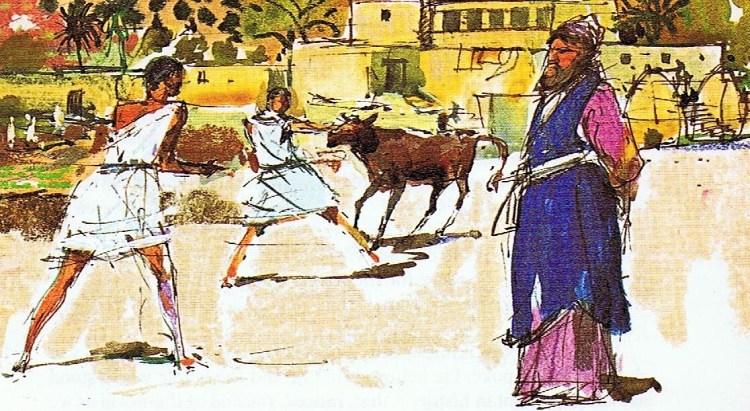
Once upon a time a rich man was giving a great feast, and he invited many guests.

When the feast was almost ready, he sent his slave to all who were invited: “Come along, it’s all ready”.

They all alike made excuses.

“I’ve bought some land,” said the first. “I must go out and look at it. Please excuse me.”

“I’ve bought ten animals,” said another, “and I’m going to test them. Please excuse me.”

“I’ve just got married,” said another, “I can’t come.”

The slave went back and told his master what they said. The master was angry.

“Go out into the town at once,” he told his slave. “Bring in the beggars and the cripples and the blind people and the lame people from the streets and alleyways.”

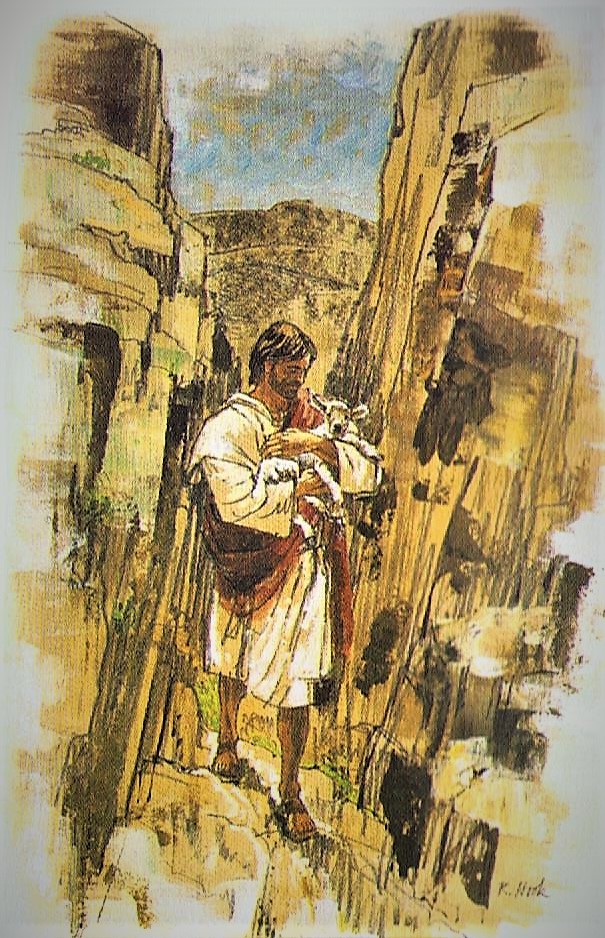
The real background and commentary on Jesus’ stories, poems and sayings is the way Jesus lived and what he did, in other words, the stories about him. Most of the stories we have about Jesus himself come from his friends. One of them was about the manager of the Tax Office in Jericho:
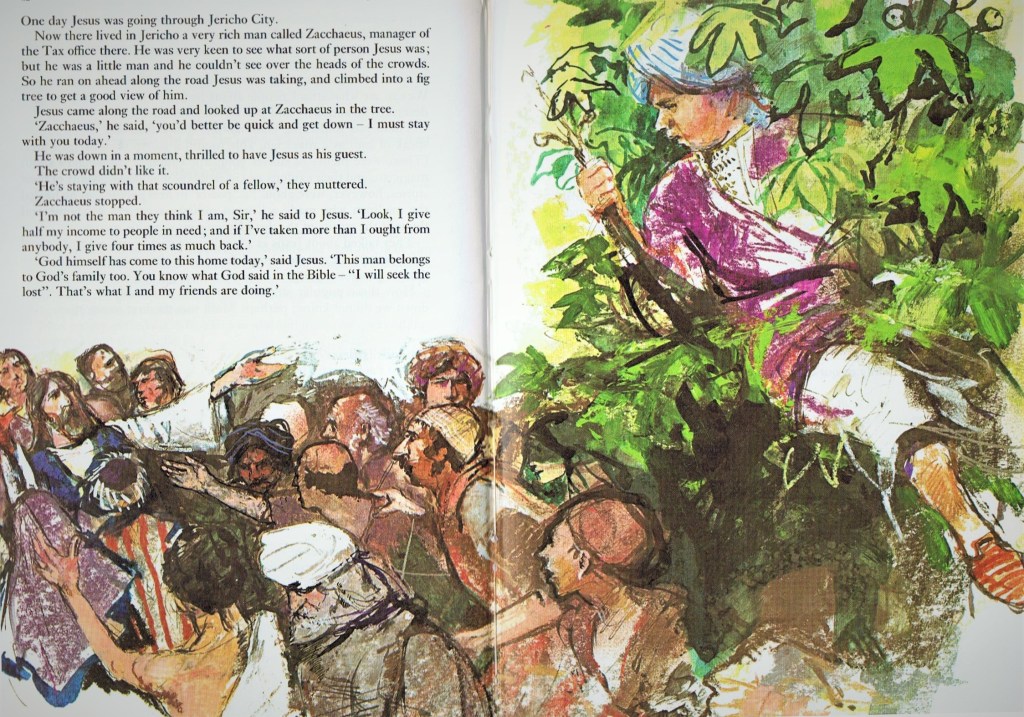
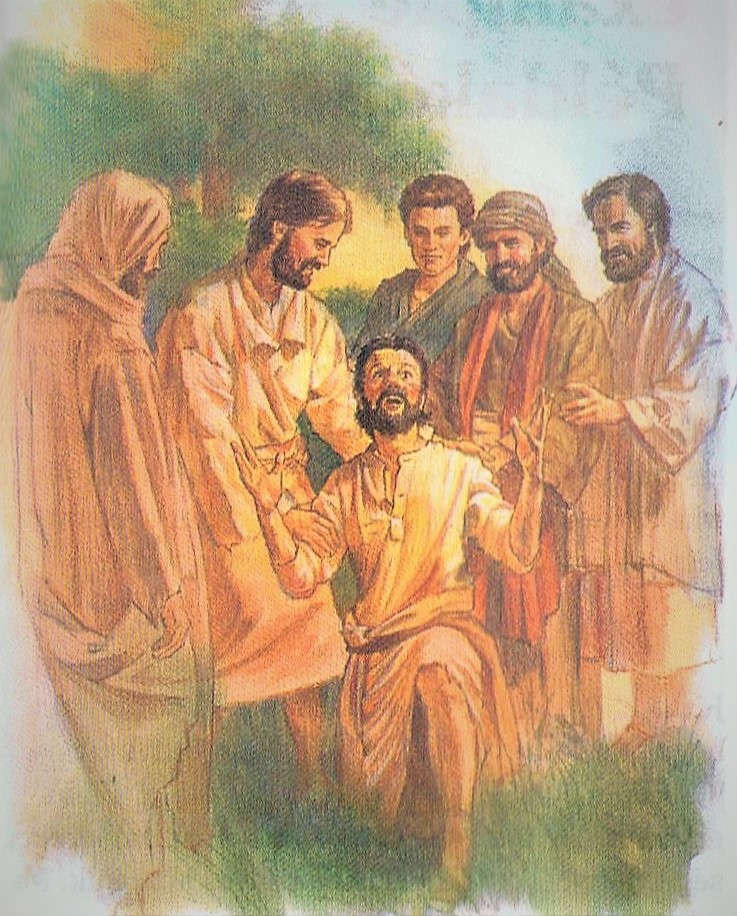
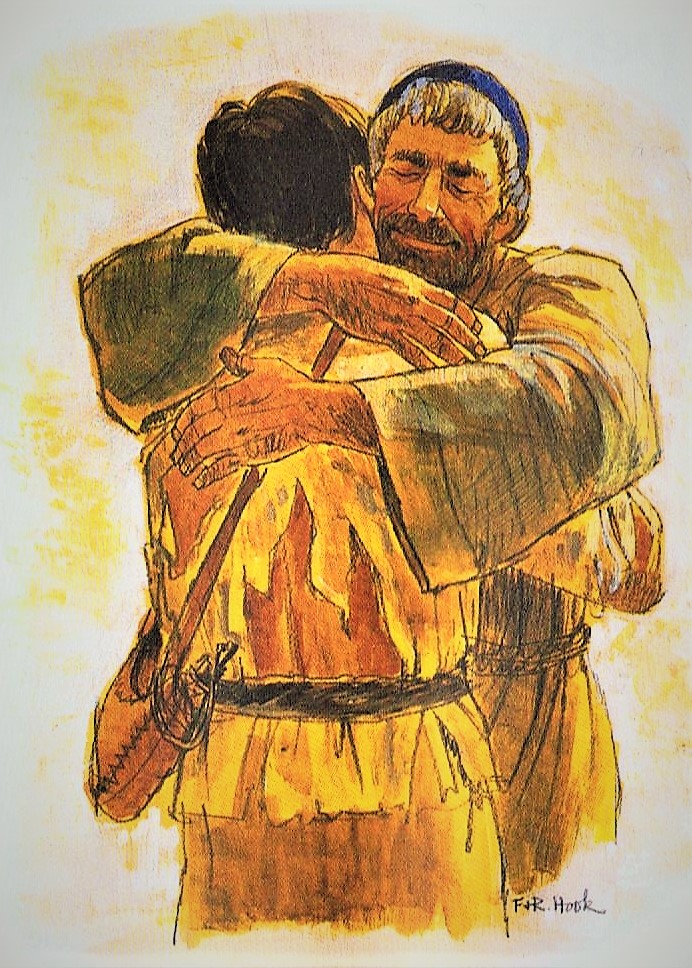
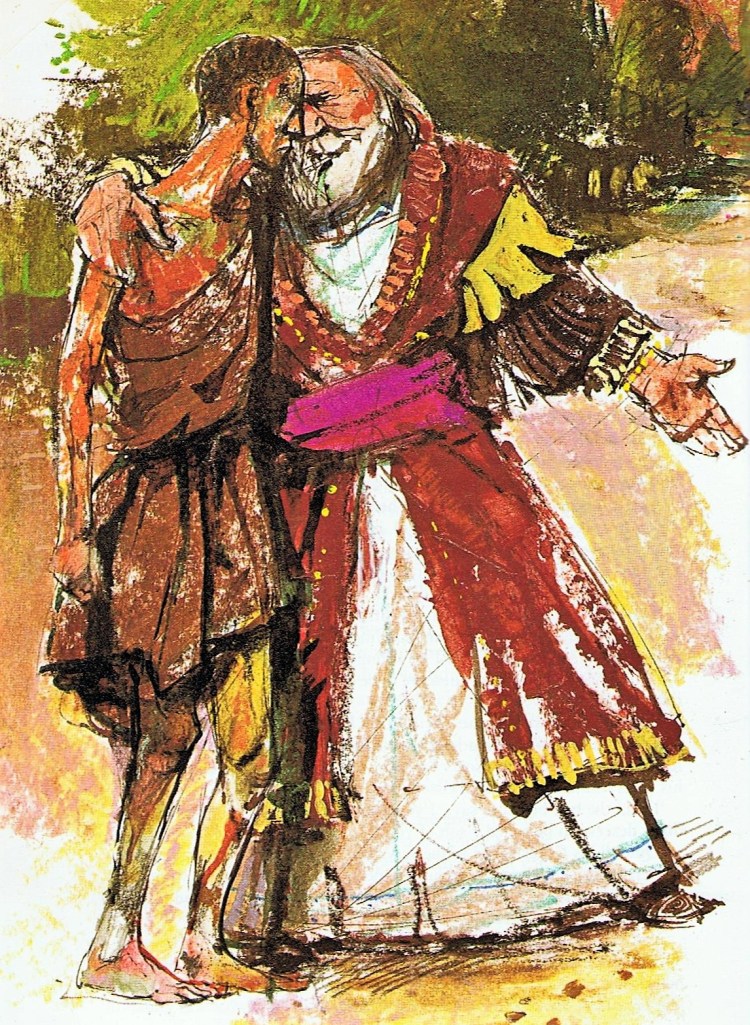
Jesus came along the road and looked up at Zaccheus in the tree. “Zaccheus,” he said, “you’d better be quick and get down – I must stay with you today.” From Alan T Dale’s Portrait of Jesus, based on Luke 19: 1-10.

It was not just that Jesus was a kind man that enabled him to capture the imaginations of ordinary people. He certainly was kind, but his love of men and women went much deeper than good manners and warm approaches. It sprang from his convictions about God caring for everybody, which meant that he too must care for everybody. It was in his caring for people, whoever they were and whatever their need, that Jesus made God’s care real. Nobody, for him, was left out of God’s family or out of the range of his care. The tax collector understood that the salvation Jesus brings is not a private affair. With his giving and reparation, he proved that he realised that he was once again part of the people called by God to kinship. Jesus believed that God was still making his world. It wasn’t something he made long ago and then left to itself. He was not an ‘absentee’ deity; he was still working. Jesus was reported to have said, God is at work and so I’m also at work. God cares for everybody everywhere – bad people and good people, honest people and dishonest people, taxpayers and tax collectors, rich and poor. Jesus makes it clear that for him the whole ‘universe’ is a living entity, neither meaningless nor haphazard. It is not fixed so that nothing can really happen because everything is rigidly determined. It is his Father’s world, full of untold possibilities and promise. It is God’s family in the making.

A Messianic Manifesto:

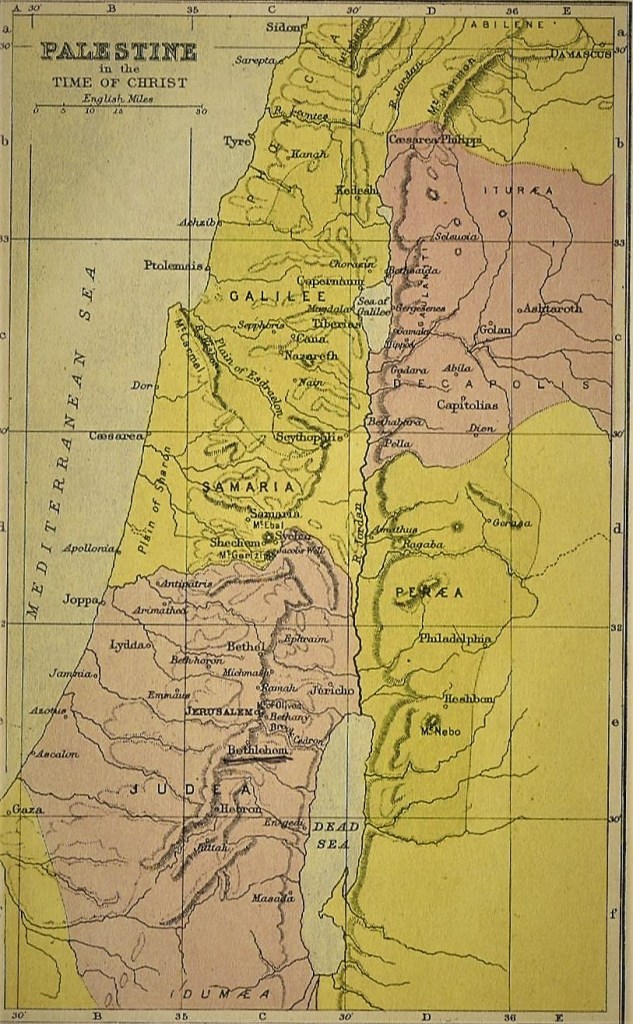
From early in his ministry, Jesus signalled his radical view of its purpose. He had no quarrel with his people’s devotion to God and their desire to live in God’s way, but he had come to think of ‘God’s Way’ very differently from the way in which they thought about it. When in a Meeting House he was to speak out plainly, there would be trouble – as this story, which Luke puts at the beginning of his account of Jesus, makes very clear. It happened, Luke tells us, in Jesus’ own village of Nazareth, one Saturday morning:

Jesus went along to the Service of Worship in the Meeting House, and the leader of the Meeting House asked him to read the Bible to the people. The reading was from the book of Isaiah, one of God’s great men of old. He stood up, opened the book and found these words

God’s Spirit is in my heart;

he has called me to my great work.

This is what I have to do –

give the Good News to the poor;

tell prisoners that they are prisoners no longer,

and blind people that they can see;

set conquered people free,

and tell everybody:

God’s Great Day has come.

He closed the book, gave it back to the leader of the Meeting House and sat down. Everybody was staring at him. “You have been listening to the words of the Bible,’ said Jesus. “Today what God said would happen has happened.” … The people in the Meeting House were very angry when they heard him talk like this. They got up and took him outside the village to the edge of the cliff to throw him over it. But Jesus walked through the village crowd and went on his way.

Luke 4: 19-30.

Jesus had effectively turned the Book of Isaiah into his own, radical manifesto for the poor. He had then followed this up with references to how widows had been allowed to starve ‘in town and village’ during the time of Elijah and lepers were left to die during Elisha’s time. In other words, he was issuing a call to action, not a call to piety. That, no doubt, was what angered his compatriots. Jesus meant business. He did not just come to talk or preach. He also came to heal, and he was soon in even more trouble with officers in charge of the Meeting Houses for doing this on Sabbath days. He intended to change human society, to awaken men and women to the truth about the world in which they were living. His own work, he believed, was to take a decisive part in God’s remaking of the world. God was actually changing the whole structure of human society through the work Jesus was doing. All he had was the conviction that God had given him this work to do and that he must use the authority that had been given to him to raise up the poor, the outcast and the helpless. In his personal epilogue to his book, Portrait of Jesus, Alan T Dale testified to the impact on his life of what Jesus did:

He made clear to me that the growing point of genuinely human society … is what we do for the fellow who is left out of the picture, whom nobody bothers with, who doesn’t seem to belong, who is ‘out of it’. There can be no genuine human society if anybody is left out; if we leave anybody out we corrupt human society and destroy it. All this threw a new light for me on what, wherever I was, I ought to be concerned with; how I ought to look at whatever job I’d got … and what I ought to press for, in every way I knew how, in the public life of the world.

The growing points of my world were to be where people were ignored, forgotten or in need – people in prison for the sake of conscience, people who were the victims of starvation and the injustices of a world divided up into the ‘haves’ and ‘the have-nots’. It came home to me that what Jesus was talking about was not just about ‘being kind’ and ‘generous’, but about how a world can ever be a world in any worthwhile sense of that word. … To talk about the world as ‘God’s Family’ is not to dream of some distant future – it is to acknowledge the truth about the world where, here and now, I have got to live. We can have a world in no other way.

The Radical Response Required:

This image has an empty alt attribute; its file name is 007-2.jpg
The cover of the book originally published in German as Bibel Provakativ (Stuttgart, 1969) edited by Hellmut Haug & Jürgen Rump.

For centuries, it was taken for granted that the only Christian theology ever possible was that written in the context of Christendom around the Mediterranean and on both sides of the North Atlantic. It was also assumed that this theology made in the West (primarily in England, Scotland, Holland, Germany, Switzerland, Italy, France and the United States) was truly universal and should therefore be transplanted (often with no adaptations) to the non-Western world. All that was necessary was for theologians of that world to merely repeat and, at best, to imitate the theology imported from the West. From the mid-1960s, the weakness of this position became clear. A number of thinkers in the ‘Third World’, especially in Latin America, had pointed to the failure of Western churchmen, and theologians in universities and seminaries, to cope with the growing problems of population growth, poverty, social injustice, racial segregation and discrimination, institutionalised violence and economic dependence. This critique was voiced mainly by Roman Catholics to begin with, in what became known as ‘liberation theology’, but also by some evangelical thinkers, especially Baptists and Methodists. In their Radical Bible (1972), John Eagleson and Philip Scharper included a number of quotations from world leaders alongside key quotations from the Bible concerning the treatment of ‘the poor’:

Deliverance from oppression (Exodus 3: 7-10):

From Pierre Trudeau, Prime Minister of Canada, in CERES (UN Food and Agricultural Organisation Review), September-October 1968:

Never before in history has the disparity between the rich and the poor, the comfortable and the starving, been so extreme; never before have mass communications so vividly informed the sufferers of the extent of their misery; never before have the privileged societies possessed weapons so powerful that their employment in the defense of privilege would destroy the haves and the have-nots indiscriminately. We are faced with an overwhelming challenge.
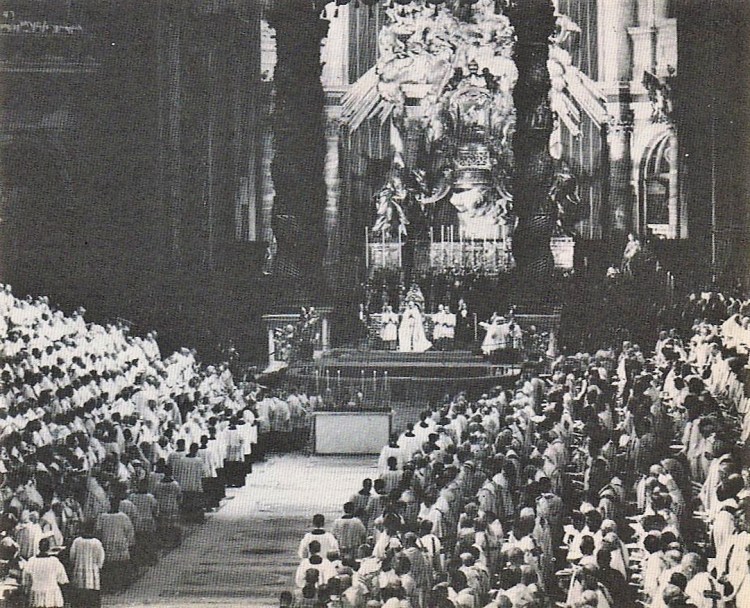
The Second Vatican Ecumenical Council opens in the St Peter’s Rome in 1962. The Pope presided over this vast gathering of Rman Catholic clergy.

Also at this time, a Letter of the Peoples of the Third World, signed by 18 Third World Catholic Bishops, was published in Between Honesty and Hope:

No, it is not God’s will that a few rich people enjoy the goods of this world and exploit the poor. No, it is not God’s will that some people remain poor and abject forever. No, religion is not the opiate of the people; it is a force that exalts the lowly and casts down the proud, that feeds the hungry and sends the sated away empty.

Called to Brotherhood (Leviticus 19: 9-11; 13-15):

When you reap the harvest of your land, you shall not reap your field to the very border, neither shall you gather the gleanings after your harvest. And you shall not strip your vineyard bare, neither shall you gather the fallen grapes of your vineyard; you shall leave them for the poor and the sojourner. … you shall not be partial to the poor or defer to the great, but in righteousness shall you judge your neighbour. …

Revised Standard Version.

In the light of the New Testament, we understand that God’s people of the Old Testament were a model: Israel was not chosen from all the other peoples for its own sake, but for the salvation of the world. Being chosen means receiving, and expecting, one’s life solely from God. It is not meant for the individual, but for the community – for the individual only as a member of the community. The right to life which God bestows on his people is meant for all without distinction.
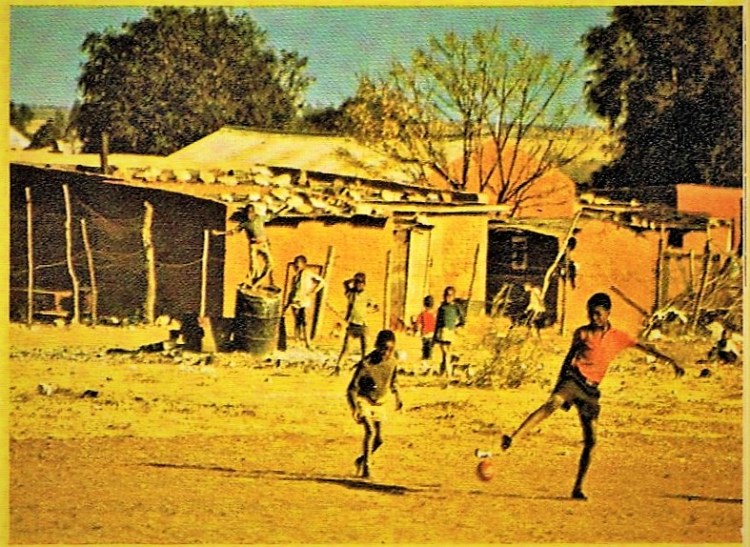
African boys play football among the poor dwellings of a township in south-west Transvaal. Many independent churches sprng up in Southern Africa in the 1960s and ’70s.

Ears that don’t hear (Proverbs 21: 13):

He who closes his ear to the cry of the poor will himself cry out and not be heard.

RSV

Albert van den Heuvel, Director of the Youth Department of the World Council of Churches, wrote a parable of his own in Risk, nos 1-2:

There was once a man who had a rich property. He gave it to his children to care for. Because the father loved his children, he left on a long journey and gave them real freedom to organise his property their own way. Now part of that property was cultivated and another part was not. The sons who lived on the richer part built fences to defend their section from the others who lived on the wild parts. They led a good life themselves, and once in a while threw some food over the fence so that the children on the other side at least knew good life could be. Then the children on the other side of the fence sent a delegation to their brothers and said,

” Teach us how to cultivate our soil, and while we learn, share your riches with us so that we do not die.” But their brothers said, “Go away: there is not enough for all of us. Learn to till the soil yourselves.” The others said, “We will do that, but we have no tools to till the soil. Help us with your tools.” But their brothers responded, “We cannot do that because we need all we have if we want to keep up our standard of living. We’ll give you a few tools, and with them, you can make your own.” The others said, “In order to make tools we need money. Buy what we have reaped on our land and we shall buy our own tools from you.” Their brothers replied, “But we don’t need products. If you sell them to us our economy will be disrupted.” The others said, “But then what shall we do; our wives and our children are dying.” Their brothers, “It will take time.”

The others, seeing that their brothers did not really want to help them, stormed the fence, broke it down, took the food they needed and killed all the brothers who resisted them. Then the owner of the property returned and was both angry and sad. To the surprise of the children who had lived behind their fences, he put the others in charge of the whole property and forgave them their violence.

Breaking through the vicious circle (Leviticus 25: 8-10):

And you shall hallow the fiftieth year, and proclaim liberty throughout the land to all its inhabitants; it shall be a jubilee for you when each of you shall return to his property and each of you shall return to his family.

Revised Standard Version

Behind the law concerning the jubilee year lies the conviction that God has bestowed the land and its riches on all the people. Each family had received a just portion in the partitioning of the land. But the original equality did not prevent in time the rise of inequality due to debt or reverses. The jubilee year was meant to re-establish equality of opportunity and to make a new beginning possible for all. It doesn’t matter whether this law was actually enforced. It follows logically, as a demand, from the call to brotherhood. Today, we have to think not only of the poor of our own nation but also of the poor of other nations. The vicious circle must be broken. It can be depicted in various ways:

  • Low output causes low income causes little demand and small savings causes few investments causes low output;
  • Undernourishment causes ill health causes insufficient energy to work causes little income causes undernourishment;
  • Deficient training causes joblessness causes no funds for tuition causes deficient training.

This complex multi-causality of underdevelopment can be summarised in the often-used phrase ‘vicious circles.’ It is not just the lack of capital, backward ways, population problems or even political problems, which weighs upon the poorer nations. As the economic historian, Robert L Heilbroner wrote in The Great Ascent,

It is a combination of all of these, each aggravating the other. The troubles of underdevelopment feed upon themselves; one cannot easily attack one of the shackles of underdevelopment without contending with them all.

Disastrous free trade (Leviticus 25: 35-38):

And if your brother becomes poor, and cannot maintain himself with you, you shall maintain him; as a stranger and a sojourner, he shall live with you. … You shall not lend him your money at interest, nor give him your food for profit.

RSV
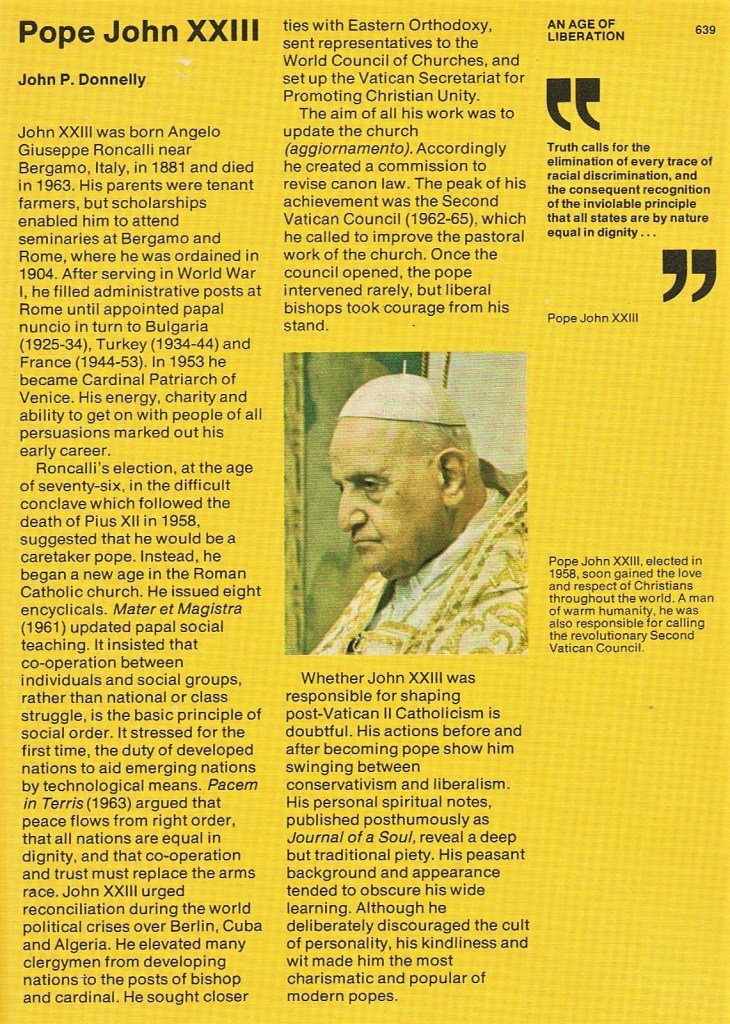
From A History of Christianity (see sources below).

One of the Documents of Vatican II is Pope Paul VI’s ‘Encyclical Letter’, This is Progress (1968), in which he wrote:

The efforts being made to help the needy countries to develop are being undone when trade between these countries and the rich is unbalanced. All foreign aid is met with justified suspicion when one hand takes away what the other hand has given. The nations that are industrialised export mostly manufactured goods. Emerging nations normally sell food, fibres and other raw materials. The trouble now is this: the market price of manufactured goods keeps going up. The market price of food and raw materials goes up and down, quite wildly. A sudden fall in prices can wipe out all the gains made by a developing nation. A country that must export to pay for what it needs can be crippled in this way. Here is one reason then why the poor stay poor yet see the rich grow richer.

Free trade is not enough to regulate world markets. Free trade can work quite well between two equal partners. Free trade between unequal states can be disastrous.

Robbing the poor (Proverbs 22: 22):

Do not rob the poor, because he is poor, or crush the afflicted at the gate.

RSV

Barbara Ward, a British economist at the Catholic Bishops’ Synod in Rome in October 1971, remarked that:

We have seen the developed world’s financial leaders discuss the future of the whole régime of international trade with barely a mention of the two-thirds of humanity in developing lands who depend on it for any hope of further advance.

Justice for the afflicted (Psalm 82: 3-4):

Give justice to the weak and fatherless;

maintain the right of the afflicted and the destitute;

Rescue the weak and the needy;

deliver them from the hand of the wicked.

RSV

Once every four years the politicians change without solving the problem of hunger that has its headquarters in the ‘favela’ (slum quarter) and its branch offices in the workers’ homes. …

I found a sweet potato and a carrot in the garbage. When I got back to the favela my boys were gnawing on a piece of hard bread. I thought, “for them to eat this bread, they need electric teeth.”

Child of the Dark (1962), the Diary of Carolina de Jesus, a Brazilian slum dweller.
Speaking truth to power (Proverbs 31: 8-9):

Open your mouth for the dumb,

for the rights of all who are left desolate.

Open your mouth, judge righteously,

maintain the rights of the poor and needy.

Again I saw all the oppressions that are practised under the sun. And behold, the tears of the oppressed, and they had no one to comfort them! On the side of their oppressors, there was power, and there was no one to comfort them.

Ecclesiastes 4: 1-2.

In 1971, Julius K Nyerere, President of Tanzania, wrote that:

The significance of this division between rich and poor is not simply that one man has more food than he can eat, more clothes than he can wear and more houses than he can live in, while others are hungry, unclad, or homeless. The significant thing about the division between rich and poor nations is not simply that one has the resources to provide comfort for all its citizens and the other cannot provide basic services.

The reality and the depth of the problem arise because the man who is rich has power over the lives of those who are poor. And the rich nation has power over the policies of those who are not rich. And even more important is that a social and economic system, nationally and internationally, supports those divisions and constantly increases them so that the rich get ever richer and more powerful, while the poor get relatively ever poorer and less able to control their own future.

Maryknoll magazine, June 1971.
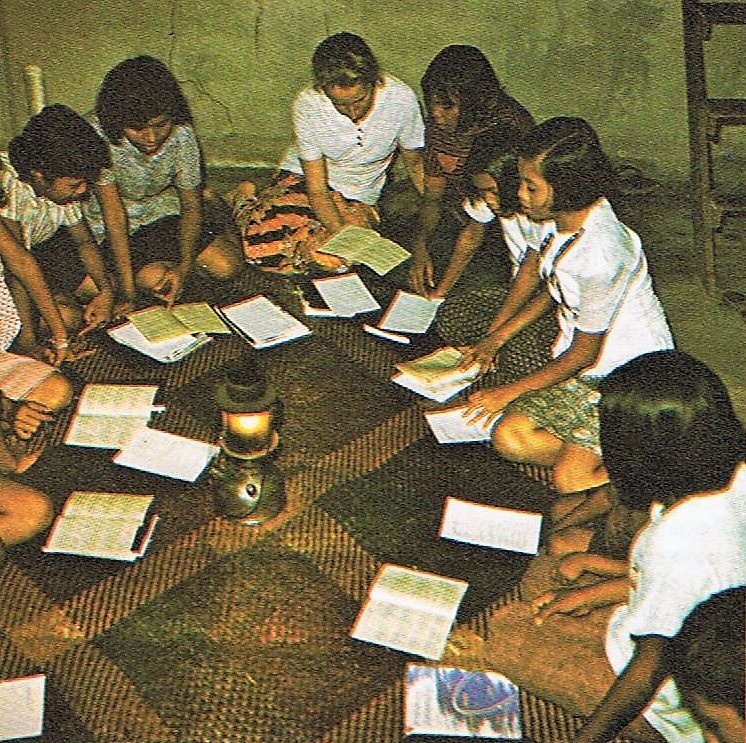
A Bible study group in Southern Thailand.

At the Fourth Assembly of the World Council of Churches in Uppsala, Sweden in 1968, S. L. Palmer, from the United Church of Northern India, spoke of how:

In economic history one has to search rather diligently to find instances where the ‘haves’ of the possessing classes have willingly given up any of their privileges. The ‘have-nots’ had almost invariably to wrest their rights through agrarian movements, workers’ movements, trade-union activity and so on.

Uppsala Speaks (1968), Geneva: World Council of Churches & New York: Firiendship Press.

The World Council of Churches assumed a growing political role in the last decades of the twentieth century. This was increased by the addition of non-European members. One particular cause of tension was the special fund connected with the ‘Programme to Combat Racism’ which supported ‘freedom fighters’ and guerilla movements in Southern Africa, though without supplying arms. The emergence of the Church of Rome as a partner in ecumenical discussions, and the impact of the charismatic movement, completely transformed ecumenical relationships.

Devouring the vineyard (Isaiah 3: 13-15):

The Lord has taken his place to contend,

he stands to judge his people.

The Lord enters into judgment with the

elders and princes of his people:

“It is you who have devoured the vineyard,

the spoil of the poor is in your houses.

What do you mean by crushing my people,

by grinding the face of the poor?”

says the Lord of hosts.

Revised Standard Version

The history of foreign corporations operating in weak nations is replete with injustice; efficiency, profits and loyalty to their own country taking priority over the needs and aspirations of local people; taking too much and leaving too little; crushing local competition and gaining monopolistic power; making poor countries dependent on foreign sources for modern technology and even national defence; being instruments of their own country’s foreign policy; and creating desires that cannot be satisfied by the poor country.

Trampling upon the poor (Amos 8: 4-7):

Hear this, you who trample upon the needy,

and bring the poor of the land to an end saying,

“When will the new moon be over,

that we may sell grain?”

And the sabbath,

that we may offer wheat for sale,

that we may make the ephah small

and the shekel great,

and deal deceitfully with false balances,

that we may buy the poor for silver

and the needy for a pair of sandals,

and sell the refuse of the wheat?”

The Lord has sworn by the pride of Jacob;

“Surely I will never forget any of their deeds. …”

Revised Standard Version

The consecration of the first African Catholic bishop did not take place until 1939, but in the following years, a rapid multiplication of bishops, archbishops and even Cardinals occurred in the Third World. President Nyerere of Tanzania wrote in 1971 that…

just as water from the driest regions of the earth ultimately flows into the ocean where already there is plenty, so wealth flows from the poorest nations and the poorest individuals into the hands of those nations and those individuals who are already too wealthy. … the poor nation which sells its primary commodities on the world market in order to buy machines for development finds that the prices it has to pay are both determined by the forces of the free market in which it is a pygmy fighting against giants. For he that hath to him shall be given, and he who hath not that also which he hath shall be taken away from him.

Maryknoll magazine, June 1971.

Against this background, there was also an increasingly negative attitude towards foreign missionaries which was expressed by the AMECEA (Association of the Members of the Episcopal Conferences of Eastern Africa) in its 1973 meeting in Nairobi. Foreign missionaries were needed to support and to train national leaders, and their presence showed the universality of the church. But, for its part, the All-Africa Conference of Churches, which also met in Nairobi at the end of that same year, added heat to this debate by adopting the proposed ‘moratorium’ . It added: should the moratorium cause missionary agencies to crumble, the African church could have performed a service in redeeming God’s people in the Northern Hemisphere from a distorted view of the mission of the church in the world. The movement from missionary paternalism to partnership in mission was painfully slow; but by the mid-1970s it had become clear that the process was irreversible.

Those who oppress with violence (Micah 2: 1-2; 6: 9-13):

“Woe to those who devise wickedness

and work evil upon their beds!

When the morning dawns, they perform it,

because it is in the power of their hand.

They covet fields, and seize them;

and houses, and take them away;

they oppress a man and his house,

a man and his inheritance.”

“Shall I acquit the man with wicked scales

and with a bag of deceitful weights?

Your rich men are full of violence;

your inhabitants speak lies,

and their tongue is deceitful in their mouth.

Therefore I have begun to smite you,

making you desolate because of your sins. …”

Revised Standard Version
Underdevelopment is a chronic state of structural violence. This is the reason why the adoption of a gradualist path to social improvement may entail continuing complicity with such violence. This form of violence is expressed in inhumanly high birth and death rates, degrading poverty, ignorance, and non-participation in significant decisions affecting the lives of countless people. Those people, mostly living in underdeveloped countries, pay a high price to remain underdeveloped. Just as Christians believe in the productiveness of peace in order to achieve justice, so they also believe that justice is a prerequisite for peace. The Latin American bishops in the late sixties claimed that the continent found itself faced with a situation of injustice that could be called institutionalised violence, when whole towns lacked necessities, lived in such dependence as hindered all initiative and responsibility as well as every possibility for participation in social and political life, thus violating fundamental rights. We should not be surprised, therefore, that the ‘temptation to violence’ led to the instability of southern and central America over the past half-century. The longing for a more just society caused revolutions all over the world, not all of them violent. Many Christians were, and still are, primarily concerned to uphold ‘properly constituted authority’ in maintaining law and order. But where the maintenance of order became an obstacle to the achievement of a just society, some decided to side with revolutionary action in order to overcome that obstacle and achieve that society.

Everyone … is entitled to realisation … of the economic, social and cultural rights indispensible for his dignity and the free development of his personality.

United Nations Universal Declaration of Human Rights, Article 22.

Paying lip service (Amos 5: 21, 23-24):

“I hate, I despise your feasts,

and I take no delight in your solemn assemblies. …

Take away from me the noise of your songs;

to the melody of your harps, I will not listen,

But let justice roll down like waters

and righteousness like an overflowing stream. …

Revised Standard Version.

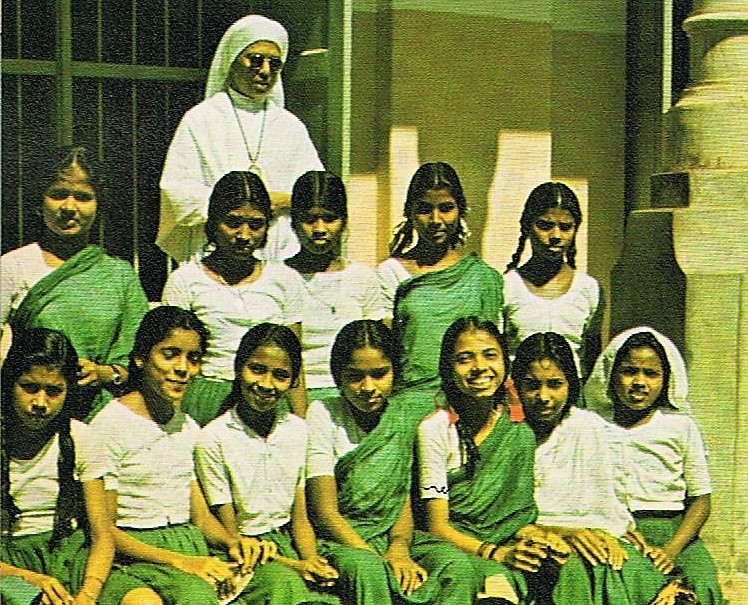
Pupils from the Catholic school at Cochin, Kerala, India. From an early stage, education has formed an important part of missionary work.

The prophets of the Old Testament called for the enforcement of justice in the world. The New Testament community awaits justice from the new world that God will create. But does one who waits for such a promise to be delivered in the future have any obligation or reason to fight for the humanisation of conditions in this world, here and now? The awaited future is still to come. The majority of Christians have been able to reconcile themselves to the continuation of this imperfect world and have not seriously quarrelled with it. Is it sufficient to settle down in this world and await the solution on Judgment Day? Whoever thinks that way is turning Christian hope into a shabby ‘dummy’ and God into a makeshift excuse for his own failure. What did Paul mean when he wrote to the early Christians in Rome, I consider that all the sufferings of this present time are not worth comparing with the glory that is to be revealed for us (Rom. 8: 18). The New Testament contains dynamite – a message with a revolutionary explosive power. The new world began with Christ, in the midst of this world. We must join the world-renewing movement proceeding from Christ. The message of the Kingdom of God should activate not only our hope, but all our energies as well; we must build on the world towards the awaited future, towards the promised final condition. Yet Christians in general, and Catholics in particular, according to the Columbian revolutionary and laicised Catholic priest Camilo Torres, seemed to be…

stoic spectators of the fall of the world, the world which they abhor. They do not join the struggle. They believe that in the words “my kingdom of this world”, ‘world’ means ‘present life’ and not ‘sinful life’, as it really does. They forget the prayer of Christ to the Father: “I do not ask that you remove from the world but that you remove them from the world but that you preserve them from evil.” Often we become detached from the world but do not preserve ourselves from evil.

Revolutionary Writings (1968). New York: Friendship Press.

Prophets of Liberation:

The theology of liberation that developed in Latin America from the late 1960s was greatly influenced by Marxism, seeing salvation in terms of political and economic liberation. Its leading exponents included Gustavo Gutiérrez of Lima; Juan Luis Segundo of Montevideo; José Miguez Bonino of Buenos Aires; and José Portfirio Miranda of Mexico. In the 1950s, Latin America’s hopes for combatting widespread poverty and hunger rested on what could be achieved through economic aid. But by the mid-sixties, many came to believe that gaps between rich and poor nations could never be closed under the capitalist structures, but that China, and especially Cuba, demonstrated that Marxism held the kex to the future for Latin America. The Marxists associated the church with the capitalist power structures and with European imperialism. Many Roman Catholic priests began to share this revolutionary perspective. Camilo Torres was among them, and was assassinated in 1966. He famously declared, The Catholic who is not a revolutionary is living in mortal sin. Gutérrez argued that we must not begin with theology or with the Bible, but with our own place in the world and our own attempts to change it. The Bible becomes relevant only if and when it speaks on these ‘questions derived from the world’. Gutiérrez found a point of contact with in the biblical accounts of the exodus, which he saw as an act of liberation. For him, salvation meant to struggle against misery and exploitation, involving all men and the whole man. José Miranda believed that the Old Testament prophets and the teaching of Jesus attack the principle of private property. Western Christians have failed to see this because they have come to the Bible with capitalist presuppositions, and read it theoretically rather than with practical questions.

Similarly, the contemporary theological commission of the Council of African Churches sent out A Message to the South African People affirming that:

Our task is to work for the expression of God’s reconciliation here and now. We are not required to wait for a distant “heaven” where all the problems have been solved. What Christ has done, he has done already. We can accept his work or reject it; we can hide from it or seek to live by it. But we cannot postpone it, for it is already achieved. And we cannot destroy it, for it is the work of the eternal God.

The two leading African theologians in the sixties and seventies were J. S. Mbiti of Kampala and H. Sawyerr of Sierra Leone. The Bible itself remained a closed book to many Africans, since literacy ranged between five and fifty per cent of the population, varying from country to country. African peoples therefore maintained their strong oral tradition and a great emphasis upon practical experience in religion. Sawyerr argued that Africans should build their own bridges between the Christian Gospel and African thought-forms. African theologians generally agreed that that the urgent task at that time was to provide a theology which was both true to the Gospel and yet free from western cultural additions. They therefore stressed the reality of the African spiritual experience and rejected an undue emphasis on individualism and abstract theory. Both the Gospel and African spiritual culture celebrate the great acts of God in story and song passed down from generation to generation.

Indian theologians were also concerned to express the Christian Gospel in ways of thinking that stem from their own culture. Raymond Pannikar argued that the concepts of Hinduism should be used to expound the doctrine of Christ to Indians. Many aspects of Hindu thought, he argued, are compatible with a Christian understanding of Christ, and Christian theologians should therefore try to draw on these, rather than attacking them. His approach did not, however, represent all Indian theologians. Sabapathy Kulandran, for example, compared the Christian and Hindu concepts of divine grace and concluded that they are incompatible; Hindu grace is not really grace at all, he claimed. Many Indian Christians regarded Pannikar’s approach as compromising the purity of the Gospel. The theology of liberation pinpoints a question which still remains a live issue for the twenty-first-century Church: is the starting-point in theology our own prent-day experience of life, or should we begin with the revealed, universal truth? Many, perhaps most Christians continue to hold to the latter view. On the other side of the debate, there have been an ever-increasing number of theologians and biblical scholars from the developing world. Others believe that these positions are not mutually exclusive alternatives, since we can hold to the universal truths of the Bible, while still hearing it speak to our own ‘condition’ in time and place.

With the end of the Cold War and the bi-polar ideological world, the relationship between Christianity and Marxism, or Socialism, is no longer as urgent as it appeared fifty years ago, but the conflict has created an ongoing debate about the relationship between theology and political and social action. Other theological questions also remain relevant, such as about the relationship between the claims of the Christian faith and the claims of other faiths in multi-cultural societies and the ‘shrinking’ world of mass communications. There is a distinction to be drawn between the Gospel, the ‘message’ of salvation centred on the person and work of Jesus Christ, and ‘theology’, the human discipline that seeks to understand the Gospel and its implications for practical, everyday life. If this difference is accepted on all sides, the way remains open to recognise the need for Christians to make and remake theology in their own times and places. The ‘ethnic’ theologian maintains that the the Gospel itself demands a constant endeavour to translate its central claims into a ever-widening variety of cultural contexts, in order to put Christ’s teaching into practice.

Some critics have objected that we do not need particular theologies, such as ‘Black theology’ or ‘Latin American theology’; one theology, namely biblical theology, is enough. But even among conservative theologians in the West, there are a wide variety of theologies, each claiming to be more biblical than any other. It has become widely recognised that all theology, regardless of the ethnicity or cultural background of the author, is biased in some way or other – in language, approach, values and emphasis.

A New Beginning – what, then, shall we do? (Luke 3: 2-11):

… The Word of God came to John the son of Zechariah in the wilderness and he went into all the region about the Jordan, preaching a baptism of repentance for the forgiveness of sins. … “Even now the ax is laid to the root of the trees; every trre that does not bear good fruit is cut down and thrown on the fire.” And the multitudes asked him, “What then shall we do?” And he answered them, “He who has two coats, let him share with him who has none; and he who has food, let him do likewise.”

RSV
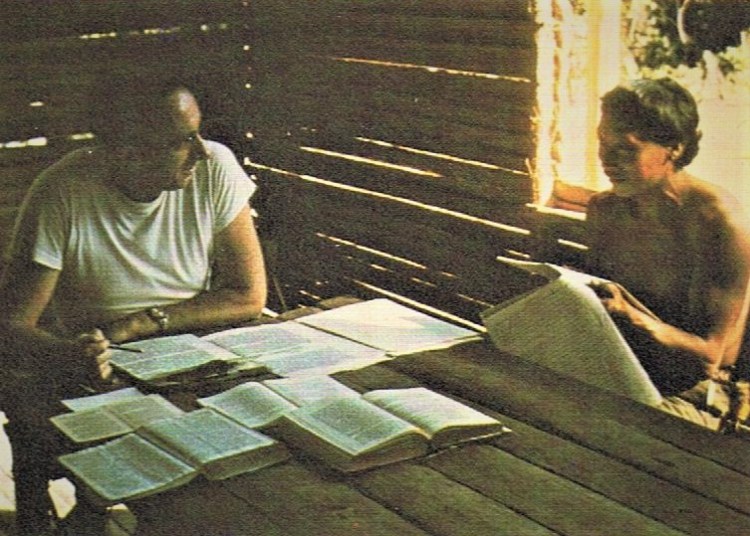
A Brazilian Indian and a missionary work together to translate part of the Bible.

The Fourth Assembly of the World Council of Churches, held in Uppsala, Sweden, stated that:

The Word of God testified that Christ takes the side of the poor and oppressed. We Christians who have not always taken sides as he did, now see a world-wide struggle for economic justice. We should work to vindicate the right of the poor and oppressed to establish economic justice among the nations and within each state.

Uppsala Speaks.
Crumbs from the table (Luke 16: 19-31):

There once was a rich man who dressed in the most expensive clothes and lived in great luxury every day. There was also a poor man named Lazarus, covered with sores, who used to be brought to the rich man’s door, hoping to eat the bits of food that fell from the rich man’s table. Even the dogs would come and lick his sores.

The poor man died and was carried by the angels to sit beside Abraham at the feast in heaven. The rich man died and was buried, and in Hades, where he was in great pain, he he looked up and saw Abraham, far away, with Lazarus at his side. So he called out, “Father Abraham! Take pity on me, and send Lazarus to dip his finger in some water and and cool off my tongue, because I am in great pain in this fire!” But Abraham said, “Remember, my son, that in your lifetime you were given all the good things, while Lazarus got all the bad things. But now he is enjoying himself here, while you are in pain. Besides all that, there is a deep pit lying between us, so that those who want to cross over from here to you cannot do so, nor can anyone cross over to us from where you are.”

The rich man said, “Then I beg you, father Abraham, send Lazarus to my father’s house, where I have five brothers. Let him go and warn them so that they, at least, will not come to this place of pain.” Abraham said, “Yor brothers have Moses and the prophets to warn them; your brothers should listen to what they say.” The rich man answered, “That is not enough, father Abraham! But if someone were to rise from death and go to them, then they would turn from their sins.” Bur Abraham said, “If they will not listen to Moses and the prophets, they will not be convinced even if someone were to rise from death.”

NEB

Helmut Gollwitzer, a German theologian, published a commentary on this parable, The Rich Christians and Poor Lazarus in which he pointed out that although Jesus had risen from the dead, poor Lazarus, in his millions throughout the world, continued to hunger at their door. The point of the parable was not, Gollwitzer wrote, the consoling pipe-dream of heaven for poor Lazarus. Abraham’s words are addressed exclusively to the rich man. The story is not intended to console the poor with the hope of recompense beyond the grave, but to warn the rich of damnation and incite them to hear and act in this world. Yet the dominant ‘white’ nations, those with the longest and broadest Christian traditions, remain those most often identified with oppressing the poor. The majority of Christians live in the developed Northern hemisphere, profiting further from the unbalanced prosperity, and they must in conscience account for their stewardship. But the affluent societies of the world, choked with the fumes of their automobiles and dumping all manner of poisons and waste into their rivers and seas, causing an escalating climate crisis, cannot be a model for development. The objective cannot simply to make everybody richer and richer.

Painless Sacrifices & Pennies of the Poor (Mark 12: 41-44):

Yet, over the past half-century, a number of the richest countries appeared steadily less committed, less concerned and less inventive in their approaches to world development, though we are now witnessing the climate emergency beginning to change that trend. Neverthelss, it is often the smaller and poorer countries who are contributing most relative to their wealth. This may remind us of Jesus’ comment about the ‘widow’s mite’ as contrasted with the ‘painless sacrifices’ of the multitudes paying into the Temple Treasury:

And he sat down opposite the treasury, and watched the multitude putting money into the treasury. Many rich people put in large sums. And a poor widow came, and put in two copper coins, which make a penny. And he called his disciples to him, and said to them, “Truly, I say to you, this poor widow has put in more than all those who are contributing to the treasury. For they all contributed out of their abundance; but she out of her poverty has put in everything she had, her whole living.”

Hard Sayings (Matthew 6: 24; 19: 24):

“No one can serve two masters; for either he will hate one and love the other, or he will be devoted to the one and despise the other. You cannot serve God and mammon. …”

“… Again I tell you, it is easier for a camel to go through the eye of a needle than for a rich man to enter the kingdom of God.”

RSV

We cannot simply neutralise these words by simply saying that ‘it depends on the intention’. A rich man can be spiritually free of his possessions and a poor man may be spiritually bound by envy of another’s goods. But action must be the proof of this ‘spiritual freedom’. Yet we would be ‘in error’ if we simply gave away all our riches. What is required is the willingness to carry out structural changes at home in the interest of ‘under-developed’ nations, changes that may touch our own assets. It could mean the imposition of higher taxes to support effective foreign aid or the revision of agricultural policy in favour of poorer or the opening of markets for finished products from the developing countries.

Although no informed person would question the need for such measures, the probability that they will be enacted is slight in the face of overpowering self-interests. For example, the experts tell us that a number of developing nations, dependent on the export of certain agricultural products, can be helped only if we are ready for encroachments upon our own agriculture. But they also emphasise that whoever touches this ticklish matter is in danger of committing ‘political suicide’. Christians in our twenty-first century society continue to contribute to the establishment of a climate of public opinion that will make possible the carrying out of necessary but unpopular decisions in an atmosphere in which political ‘populism’ holds sway. The economic historian, Robert L. Heilbroner, wrote of this challenge fifty years ago:

It may be that the challenge will be too great. It may be deemed political suicide to speak of problems of development in blunt terms, to force a consideration of unpleasant alternatives and moral dilemmas, to encourage governments whose political and economic structures are alien and even antipathetic to ours. It may appear impractical to urge an internationalisation of foreign aid… In other words, the actions which are open to us may be open only in theory, in the abstract, and not in hard fact.

The Great Ascent, op. cit., p. 182.

Fifty years on, it is unclear whether any significant progress has been made towards these goals. In fact, some governments have recently been renaging on their commitments both to domestic reform and international co-operation in terms of development concerns. In developing countries themselves, radical Christians like Camilo Torres wrote in the late sixties of how he realised the need for…

… a revolution that would give food to the hungry, drink to the thirsty, clothing to the naked, and bring about the well-being of the majorities in our country. I feel that the revolutionary struggle is a Christian and priestly struggle. Only through this, given the concrete circumstances of our country, can we fulfill the love that men should have for their neighbours.

Revolutionary Writings, p. 163.
The Church as the Light of the World? (Matthew 5: 14-16):

You are the light of the world. A city set on a hill cannot be hidden. Nor do men light a lamp and put it under a bushel, but on a stand, and it gives light to all in the house. Let your light so shine before men, that they may see your good works and give glory to your father who is in heaven.

This text reads more like a poem, one in which Jesus’ sense of fun and his humour is apparent as well as his power of putting thoughts in very simple language. The lamp he is describing is the lamp used in a small, windowless Palestinian one-roomed house, the home of a poor family. What would the words ‘all in the house’ suggest to people who, like Jesus’s friends, had listened to his stories, heard him talk and argued with him? Suddenly, this apparently simple poem is opening up deep and far-reaching questions, the questions his stories provoked and illuminated. In the later twentieth century, many people, including many Church leaders, theologians and ordinary Christians doubted whether the Church could still be viewed as ‘the light of the World’. By the late 1960s, in many developing countries around the world, Christianity had become so identified with the ‘Western powers’ that many non-Christians, especially in Asia and Africa, regarded the Church as a ‘tool’ of Western Imperialism. A publication from 1969 by the World Council of Churces set out its imperative:

The Church cannot stand apart. Our common manhood under God involves responsible and just stewardship of the world’s resources just as much as caring for our neighbour. The vision that beckons the churches forward in the concern for development is the vision of the one human family, in which all members will have the opportunity to live truly human lives and so, as men, respond to the purposes of God.

The Crucial Years; a statement on the Second Development Decade and the Task of the Churches, by the Commission on the Churches’ Participation in Development.

Putting it even more plainly, a ‘Statement of Eighty Bolivian Catholic priests’ criticised its own Church for joining with the municipality of La Paz in constructing steeples when the problems of local underdevelopment were so serious. This would be a perfect opportunity, they asserted, to get people thinking about the illegitimacy of building churches …

with money robbed from the exploited worker. Instead of talking about the Church of the poor, we must be a poor church.

Between Honesty and Hope (1970). Documents from and about the Church in Latin America; issued at Lima by the Peruvian Bishops’ Commission for Social Action. Maryknoll, New York: Maryknoll Publications.

The churches were continually called upon to support the liberation struggle at that time, to demand social justice and relief from oppression. Those in Asia had in large measure been irrelevant to the changes which had taken places over the previous twenty-five years. They had generally disregarded socio-economic analysis and been indifferent to political and economic exploitation. They admitted that they had been on the side of the status quo, at least by their silence. They had tended to accept the values of capitalist society, fitting themselves into its framework. When Kenneth Kaunda, President of Zambia, addressed the World Council of Churches in Sweden in 1968, he argued that:

All the political goodwill and all the instruments of social and economic development at the disposal of the rich and poor countries must be combined and be harnessed with a new spirit of dedication, sacrifice, wisdom and foresight to meet our common obligation to the whole of humanity. This calls for a new and global vision of man and the human race…

The challenge is not just simply the elimination of poverty, ignorance and disease. It is first and foremost a question of building a world in which every man, woman, and child, without distinction, will have and exercise the right to live a fully human life worthy of his or her person, free from servitude, oppression, and exploitation imposed on him or her by other fellow human beings; a world in which freedom, peace and security will have practical meaning to each and every member of the human race.

Uppsala Speaks. Section Report of the Fourth Assembly of the World Council of Churches, Uppsala, 1968. Geneva: World Council of Churches & New York: Friendship Press.

Loving our neighbours today:

You must love your brothers. That is an absolute requirement of our religion. “Master, which is the greatest commandment of the Law?” … “You must love the Lord your God with all your heart, with all your soul, and with all your mind. This is the greatest and the first commandment. The second resembles it: You must love your neigbour as yourself.”

Matt. 22: 36-40

In 1973, Michel Quoist, a French Catholic priest, published his book, Meet Christ and Live! Quoist was born in 1918 and was ordained a priest in 1947. For many years he worked as a pastor in Le Havre and became the Secretary General of the of the French Episcopal Committee for aid to Latin America. He was author of Prayers of Life, The Christian Response and Christ is Alive! These books sold a million and a half copies in English alone. In Meet Christ and Live, Quoist explored a number of themes, including Loving one’s brother today, based on Matt. 22: 36-40: You must Love your neighbour as yourself. He pointed out that here, Jesus was not giving advice, but talking about a commandment. The love of our brothers and sisters is an infallible test of our love of God:

Anyone who says, “I love God,” and hates his brother is a liar, since a man who does not love the brother that he can see cannot love God, whom he has never seen.

1 John 4: 20.

To love our brothers and sisters does not mean that we must love them with our emotions, or that we must be ‘sentimental’ about them, for Jesus commands us to love even our enemies (Matt 5: 44). To love our fellows means that we must wish for their true good, and we must do all that we can with them to obtain that good. This requires an effort which presupposes total self-forgetfulness, Quoist claims, quoting John’s letter again:

This has taught us love – that he gave up his life for us; and we, too, ought to give up our lives for our brothers… My children, our love is not to be just words or mere talk, but something real and active; only by this can we be certain that we are children of the truth.

1 John 3: 16-19

Quoist goes on to assert that to love our fellows does not necessarily meanto please them. Far from it. Nor does it mean that we must make a systematic effort to have them love us. On the contrary, it means that we must be capable, if necessary, of making them suffer for their own good, what – as teachers – we often referred to as ‘tough love’, in dealing with ‘difficult’ issues with pupils and students. Therefore, we must sometimes be willing to confront difficult issues or behaviour with our fellows, and not just with children among them; to ‘struggle’ with them, both individually and collectively:

It is on the basis of this concrete love, expressed in our actions, on the basis of this gift to others, even at the risk of misunderstandings and persecutions, that we will be judged.

This reminds us of how Jesus himself described the Last Judgement in Matthew’s Gospel, “I was hungry and… I was thirsty… I was a stranger… ” (Mt. 25: 35-40). I have explored the re-telling of this parable in literature in a previous article on this site. What, then, does it mean today, to feed the hungry? Does it mean to invite the old lady next door to supper, or to collect food for underdeveloped countries? Yes, it means those actions, but it also means working with every agency to which we have access; trade unions, political parties and all the innumerable social groups to which we belong. We need to work together for a decent living-wage for all, for fair prices, job opportunities, unemployment compensation, pension plans, job-training and apprenticeships. We also know that the spirit can also be hungry. To feed the hungry spirit today means to work for equal education for all, equal opportunities, decent schools and effective curricula.

To make strangers welcome means, as it always has, to open one’s home to others; but it also means above all to fight for decent housing for the poor, and for housing allowances. It means to participate in tenant organisations, to organise recreation for young people in housing developments. Visiting the sick means exactly that, but it also means campaigning for increased benefits for the sick, fighting for the improvement of medical facilities and supporting medical research. Visiting the inmates of a prison means is a work of mercy; but it is a greater work of mercy to work for a penal system which will reform and educate prisoners, and for organisations which help freed convicts; to encourage programmes of education and re-education in the cities and throughout the country; to participate in crime-prevention and job-seeking projects; to take an active interest in the formation of of specialist educators and in the organisation of their unions. It is fighting against anything which imprisons man – that is, fighting on behalf of and alongside all those who are deprived of their freedom, from individuals who are the victims of their own fears to the underprivileged who are the collective prisoners of unjust economic, social and political structures.

Quoist suggested that, given the increasing dependance of our modern lives on these structures, it has become almost impossible to claim that we truly love our fellows unless we are willing to participate in the creation of new structures, or in the reform and transformation of existing structures so as to obtain their greatest possible good. An emphasis on ‘charity’ and ‘charitable acts’ can be misleading, because it can allow us to believe that we are charitable by nature and thereby limit our ‘activism’ as Christians. Although the word derives form the Latin word ‘caritas’, meaning ‘love’, we need to show willingness to take love seriously enough to make an effective commitment to the radical transformation of society. Otherwise, we risk falling under the judgement of God: Go away from me, with your curse upon you… for I was hungry and you never gave me food; etc… Salvation cannot simply be secured by maintaining sexual morality and following the laws of the Church. Neither can it be obtained through helping the parish priest by participating in parish activities or by being an active member of a Christian movement. These things represent a good start, but we must go further, since such activities do not dispense a man from serving his brothers in the world, for we have been placed in this world by God’s providence; and it is in this world, not the next, that Christ awaits us. That is the whole point of the parable of the Last Judgement: I tell you solemnly, in so far as you did this to one of the least of these brothers of mine, you did it to me.

To choose the form that our commitment will take means to take into account both our own talents and the needs of both our brothers and sisters in Christ, and of our fellows in society, and then go out to meet our Father halfway, in the midst of that society and those structures in which we spend our lives. The choice of commitments must be a reasonable one. We cannot do everything, but we must do whatever we can; and we must do it in a spirit of faith. Of course, many non-Christians are commited to parent-teacher associations, unions and political parties, just as fully as we may be, but it is also true that Christians are required to make a ‘temporal’ commitment to feed the hungry and clothe the naked, to visit the sick and the prisoners, and these are commitments which Jesus ‘solemnly’ stated were the express condition of our salvation. The commitment of a Christian differs essentially from that of a non-Christian because of the faith which a Christian brings to bear on the end to be reached and by the means which s/he adopts to reach that end, which is Jesus himself, whom they love and serve by loving and serving their fellows. S/he declares by their actions that I love my neighbour as myself for the love of Jesus. The means therefore take on a special significance for the Christian because s/he never forgets that, beyond and through the the structures with which s/he deals, there are persons who must be liberated individually and collectively.

The Christian does not seek to manipulate or patronise these persons, but rather acts with them and alongside them, fighting out of love, not in the hope of any personal, material gain or reward for their efforts. Neither does s/he act out of any spirit of rebelliousness, resentment or hate. We need to remember that those who work alongside us at the worldly level may also truly love those they work among, and in doing so, loves God without knowing it, even though they may never have met Christ. Christians should never claim, or appear to claim, a superior calling or motivation when among non-believers, and neither should we try to claim a non-believer as one of our own, but thank God for the love shown and for His work through them. Because Christians know what is involved in the working of God’s grace, we are privileged creatures and therefore bear a dual responsibility. We choose to ‘institutionalise’ our charity by participating in the work of agencies and movements working for ‘the common good’ because Jesus Christ commands us to love our fellows and because loving them as persons very often means creating and implementing new structures at every level which will enable them to grow in justice and in love. We are obliged to go to the very end in loving our fellows, but with the hearts and minds of souls saved by grace and living in Christ.

Dying Faith or Living Light?:

After having commanded us to love one another, Jesus said:

If anyone loves me, he will keep my word, and my Father will love him, and we shall come to him and make our home with him.

John 14: 21.

Whenever and wherever we are gathered together with our brothers and sisters in Christ, even in twos and threes, we are in ‘Church’ and Jesus is also among us, not only when we pray but also when we discuss God’s work in the world and our part in it, in the service of mankind. When we try to practice brotherly love, philos, in our lives, Jesus and the Father are in us. We know these things because Jesus has told us so himself. Speaking of the Last Judgement, Jesus told us that he had been hungry, thirsty, homeless, naked, ill, in prison. He identified himself with the poor, with those who are poor in worldly goods, in health in freedom – in other words, with all those who are deprived. Quoist says that whenever he meets someone who is poor, in any sense of the word, he meets Christ. Jesus has told him so. By the same token, he says that when he sees…

a bit of love, of unity, of justice or of freedom in other people, … in events or structures, (he) knows that Jesus is there, present by his action among men. … Jesus signals to me through human events. Thus my own action is joined humbly to his.

Of course, he said, he could have misinterpreted Jesus’ signals, but there are two ways in which he could learn to read them more accurately. One is to discern, from the Gospels, what Jesus’ ways of doing things and of behaving were. The other is to search for these ways with others, as a team, in the Church. Only Jesus himself can reveal himself, but it is the role of the Church to witness to him by speaking of him. The Church must prepare the way for the Lord, and become the light on the road by which he will come. He prayed:

For you have risen, Lord,

and your Holy Spirit is at work in human history

to increase your whole Body,

to build the Kingdom of the Father,

to construct your Church.

Quoist wrote that it seldom occurred to him to think of the power that one single act of selfishness might have on humanity, a single act which would spread throughout mankind and do its work of devitalising the whole body Body of Christ, the Church. And it seldom occurred to him to think of the power of a small act of pure love, a single act, which might open the road to new blood in that Body, and which might rebuild its tissues by carrying life to the Body’s most distant members. Rarely, too, he wrote, did he remember that his human actions, while they needed to be as well-thought-out as possible, as serious and as effective as possible, they also needed to be nourished by redeeming love. To many of Quoist’s contemporaries, the ‘Body of Christ’ was in desperate need of a ‘transfusion’ of that redeeming love if it was to survive much longer.

By 1971, it was estimated that there were eleven million Christians in South Africa, nine million in Zaire, six million in Nigeria, four million in Uganda and four million in Tanzania (Other more generous estimates claimed that by 1975 the number of African Christians would total one hundred million). And yet, writing in the same year, however, the President of Tanzania, Julius K. Nyerere, was certainly a radical critic of the churches internationally:

Unless the Church, its members, and its organisations express God’s love for man by involvement and leadership in constructive protest against the present conditions of man, then it will become identified with injustice and persecution. If this happens it will die and, humanly speaking, it deserves to die because it will then serve no purpose comprehensible to modern man.

Maryknoll Magazine, June 1971, p.37.
This image has an empty alt attribute; its file name is 004-7.jpg

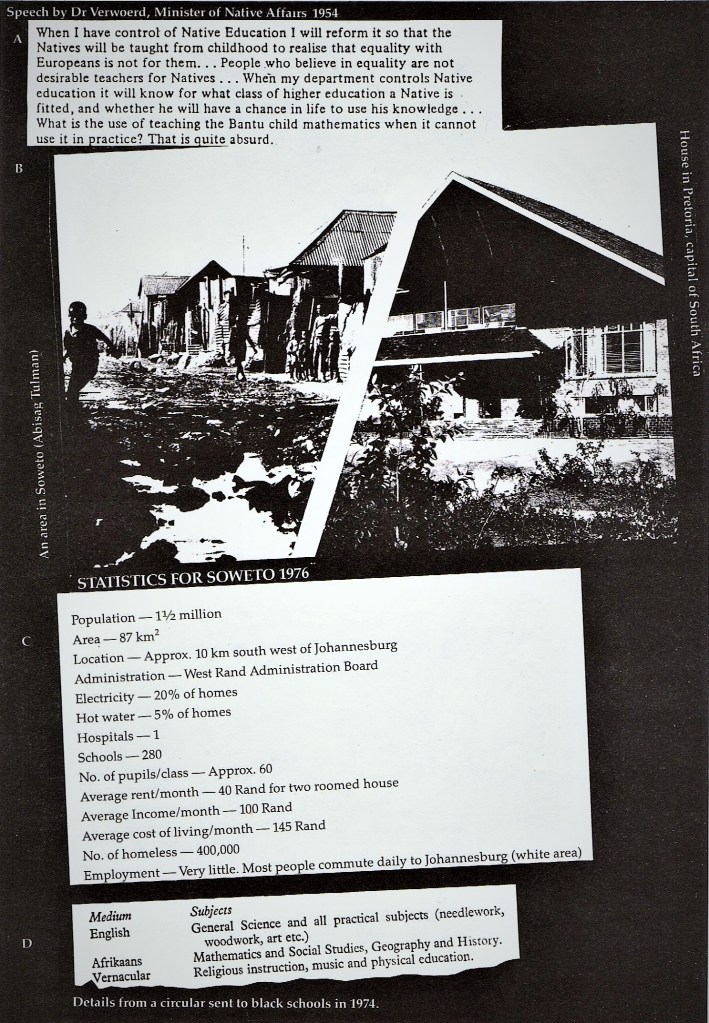
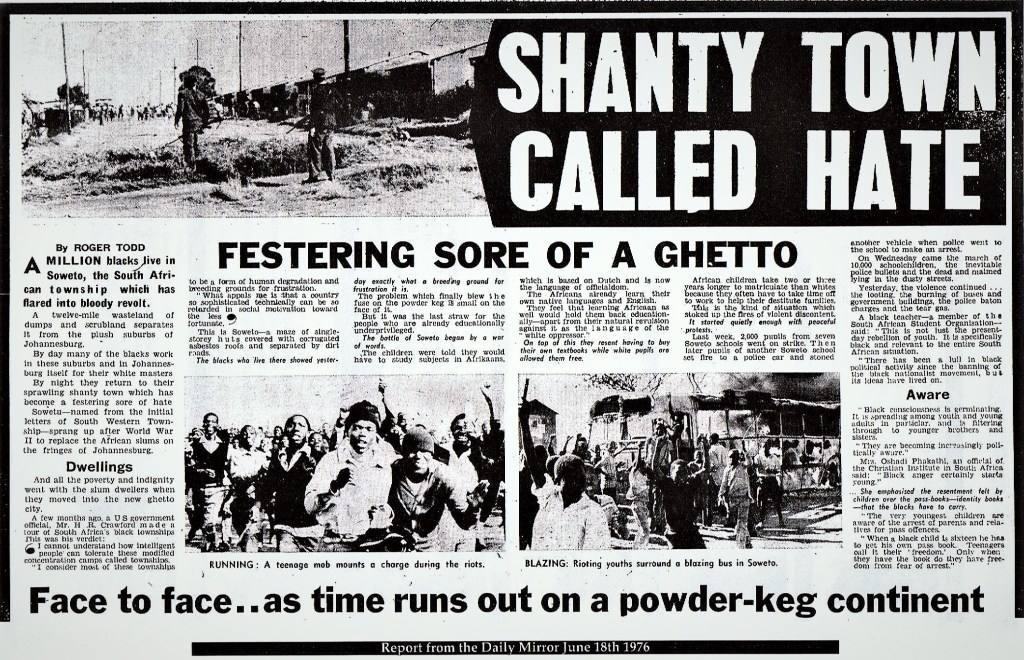
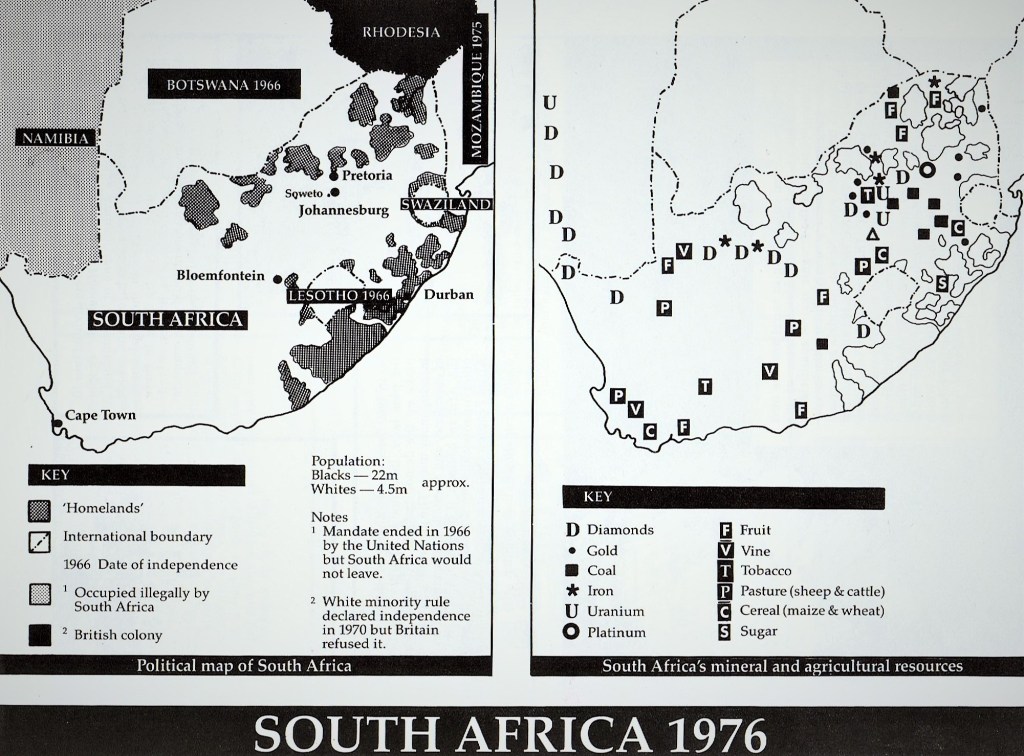
Five years later, the Church in South Africa fell into this ‘trap’. In June 1976, ten thousand students took part in a peaceful demonstration held in Soweto, the segregated township of Johannesburg, against the decision of the educational authorities to impose Afrikaans as a language of instruction in in secondary schools, including in the township. In the resulting confrontation with the police, 176 people were killed and more than 1,100 wounded, many of them children and teenagers (see appendix below). The Soweto massacre threw into relief the explosive nature of apartheid. It vividly illustrated the kind of situation that Christians faced in the last quarter of the last century. Since it took place in a country that claimed to be Christian, it illustrated the tragic possibility that an individualistic Christianity allows a social sin, racism, to co-exist with adherence to the Christian faith. In fact, this was an evil system of racial segregation, apartheid, which was underpinned by what has since been admitted as a heretical theology within the South African Dutch Reformed Church. That it was allowed to determine public policy for fifty years is also testimony to what can happen when religion is limited to private life and becomes irrelevant to issues of public morality. Other ‘segregated’ white churches in South Africa kept a strict separation of the sacred from the secular in coming to terms with the apartheid state.

The greatest challenge confronting the Church ‘international’ in the last quarter of the twentieth century was to apply Christian beliefs and values to practical living in a world plagued by poverty, social injustice, racism and oppression. In the first quarter of the twenty-first century, this continues to be its greatest challenge. To enable this, our love for our neighbour must be effective. As Camilo Torres wrote, we will not be judged only by our good intentions, but mainly by our actions in favour of Christ represented in each one of our neighbours: “I was hungry and you did not give me to eat, I was thirsty and you did not give me to drink.” Torres pointed out:

Those who hold power constitute an economic minority which dominates political, cultural and military power, and, unfortunately, also ecclesiastical power in the countries in which the Church has temporal goods. … For this reason governmental decisions are not made to benefit the majorities. In order to give them food, drink and clothing, basic decisions are necessary … It is a sociological absurdity that a group would act against its own interests. The power must be taken for the majorities’ part so that structural, economic, social and political reforms benefiting these majorities may be realised. This is called revolution, and if necessary in order to fulfill love for one’s neighbour, then it is necessary for the Christian to be revolutionary.

Revolutionary Writings, p. 65.

In Latin America, by 1968 Protestant Christians were said to number over ten million, with nearly eight million of those in Brazil. Indeed, one writer from the continent, Emilio Castro, commented that it was the only area in the world where a Christian church was growing more rapidly than the population. In contrast with the Roman Catholic church, which depended heavily upon foreign personnel and finances, the Protestant churches (especially the Pentecostals) were quickly taking root locally and developing their own leadership and economic resources.
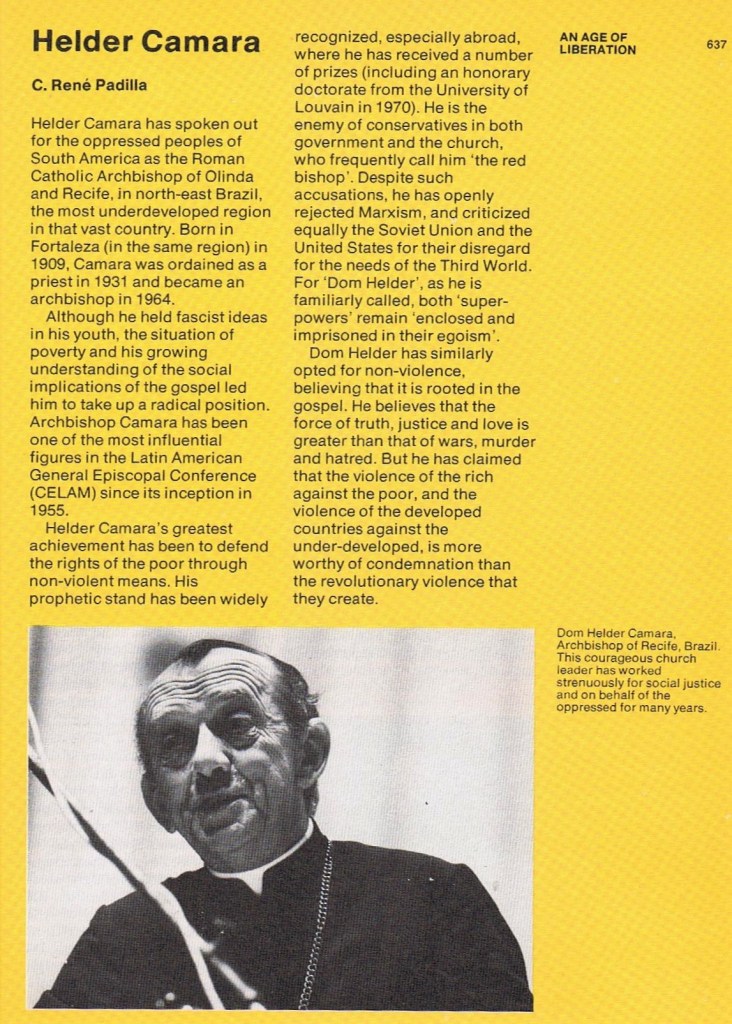
This numerical growth of the Church outside Europe in the late twentieth century provided grounds for much optimism about the future of Christianity. The great new fact of the century was an exploding world-wide Christian movement, advancing mainly among the masses of the world outside the West, and with growing concern to make disciples among all nations. Yet, there remained a sense of pessimism about the growing number of poor in the world, and the growing gulf between rich and poor world-wide. In their Declaration of Recife of March 1970, Ralph Abernathy and Dom Helder Camara (above) jointly expressed their sadness about this gulf, but also their hope for the realisation of a better world:

We are especially concerned with the widening gap between the poor of the world and the rich – not only in material goods … but the growing gap in understanding. The indifference of the well-to-do is perhaps the the major obstacle in the world today. … But we two – Baptist pastor and Catholic Bishop, US and Brazilian citizens – are not discouraged. There is hope, and there is a great dream of a world in which there will be no more misery, no more war, no more prejudice, and all men will be free. This was the dream of Jesus Christ, Mahatma Gandhi, and of Martin Luther King, Jr. This is our dream, too.

Adiaphora – Hope for the Future:

Jürgen Moltmann of Tübingen is perhaps best known for his (1965) book, Theology of Hope, in which he argued that hope still lies ahead and that the people of God are still the ‘pilgrim people’ – at one with the poor and the oppressed. Salvation, he argued, involves a faith that is socially relevant. In the cross, Moltmann argued, Jesus identified himself with those who were abandoned, and challenged the status quo. In Religion, Revolution and the Future (New York, 1969), he reminded us that it is the goal of the Church to represent that ‘new people of God’, that the barriers which men erect between each other to assert themselves and humiliate others are demolished in the community of Christ. The true identifying feature of the Church, he argued, was not that it composed of ‘equal and like-minded’ people, but of ‘dissimilar’ people, even of former enemies. That would make it heretical to establish churches based on nationality, ethnicity or other structures and beliefs other than those found set out in the Bible. The Bible is not only a book to read; it is also represents a way of life. If we attempt to live according to the Scriptures, we must realise that we are also being called into action. As the selections above show, the perspective of our action should be global, since we know that the consequences of our inaction are also global, whether in terms of development issues, health care or climate change. Hope for the future lies with movements in the Church that are searching for a more biblical understanding of Christian mission which involves the totality of human life in all its personal, social and public aspects.

Adiaphora, as John Barton has recently (2019) pointed out, are matters of faith on which resonable people, even when properly informed by the Bible, may reasonably disagree, yet on which some decision may be needed, and so must be taken in good faith, not knowing whether it is the right decision, or even if there is a single right decision. They do not belong to what C. S. Lewis famously called ‘mere Christianity’, the essentials. Somehow, an attribution of authority to the Bible needs to leave open the way to recognising that there are adiaphora in matters of religion. Otherwise, we fall into the trap of Protestant fundamentalism on the one hand or extreme Catholicism on the other, by claiming that the whole of life can be regulated by either Scripture or Tradition, respectively. Such hard-line theories find few adherents: most conservative evangelicals are not fundamentalists, and most Catholics are not rigid traditionalists. Yet a sizeable proportion of Christians do think that, though the essence of what was taught by Paul remains authoratative, its expression was conditioned by its time and should be reconsidered. This may be described as a liberal form of Christianity, but it ascribes a good deal more centrality to the Bible than liberalism has often done. Barton argues that we must do justice to the book that has nourished generations of Christians, without either turning it into paper dictator on the one hand, or on the other being obliged to accept that it means whatever the religious authorities decree.

If the present trends continue as they have done over the past half century, it is quite possible that Christianity will will again play an important role in bringing humanity into an experience of greater freedom, as it has done in the past. The attempt to turn, or steryotype it into the religion of the West will be defeated through the recognition that the Church is universal; the attempt to reduce Christianity to an individualistic religion will be overcome through a rediscovery of biblical revelation, which is being forced upon or embraced by Christians in this age of freedom. As Barton concludes, freedom of interpretation, yet commitment to religious faith, need to go hand in hand. This seems to him possible if we accept the Bible as a crucial but not infallible document of the Christian faith.

Sources:

John Barton (2019), A History of the Bible: The Book and its Faiths. London: Allen Lane (Penguin Books).

Tim Dowley (1977), The History of Christianity: A Lion Handbook. Berkhamsted: Lion Publishing.

John Eagleson & Philip Scharper (ed.) (1972), The Radical Bible. Maryknoll, N. Y. : Orbis Book.

Alan T Dale (1979), Portrait of Jesus. Oxford: Oxford University Press.

Michel Quoist (1973), Meet Christ and Live. Dublin: Gill and Macmillan.

Appendix: Soweto, 1976 – A Case Study.
This image has an empty alt attribute; its file name is 001-12.jpg
This image has an empty alt attribute; its file name is 002-8.jpg
A History of South Africa (1986), Selly Oak (Birmingham): Development Education Centre.

Development Education Centre.

“I was hungry and…?”: Pilgrims to ‘The World Beyond’ in Children’s Fiction – C. S. Lewis, Henry van Dyke & John Bunyan.

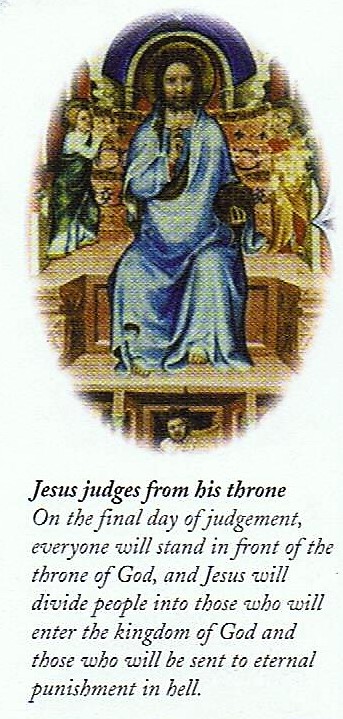
The Last Judgment:

This image has an empty alt attribute; its file name is 025-2.jpg

The Gospel of Matthew tells us that the last ‘parable’ Jesus told before his trials and crucifixion was that of ‘the Final Judgment’, depicted above. It really reads more like an allegory, because of its intense symbolism:

When the son of man comes in his glory … Before him will be gathered all the nations, and he will separate them one from another as a shepherd separates the sheep from the goats, and he will place the sheep at his right hand, but the goats at the left.

Then the King will say to those at his right hand, ‘Come, O blessed of my Father, inherit the kingdom prepared for you from the foundation of the world; for I was hungry and you gave me food, I was thirsty and you gave me drink, I was a stranger and you welcomed me, I was naked and you clothed me. I was sick and you visited me. I was in prison and you came to me.’ Then the righteous will answer him, ‘Lord, when did we see thee hungry and feed thee, or thirsty and give you thee drink? And when did we see thee a stranger and welcome thee, or naked and clothe thee? And when did we see thee sick or in prison and visit thee?’

And the King will answer them, ‘Truly, truly, I say unto you, as you did it to one of the least my brethren, you did it to me.’ Then he will say to those at his left hand, ‘Depart from me, you cursed into the eternal fire prepared for the devil and his angels; for I was hungry and you gave me no food, I was thirsty and you gave me no drink, I was a stranger and you did not welcome me, naked and you did not clothe me, sick and in prison and you did not visit me.’

Then they will also answer, ‘Lord, when did we see thee hungry or thirsty or a stranger or sick or in prison, and did not minister to thee?’ Then he will answer them, ‘Truly, I say to you, as you did it not to one of the least of these, you did it not to me. …’

Matthew 25: 31-45, RSV.

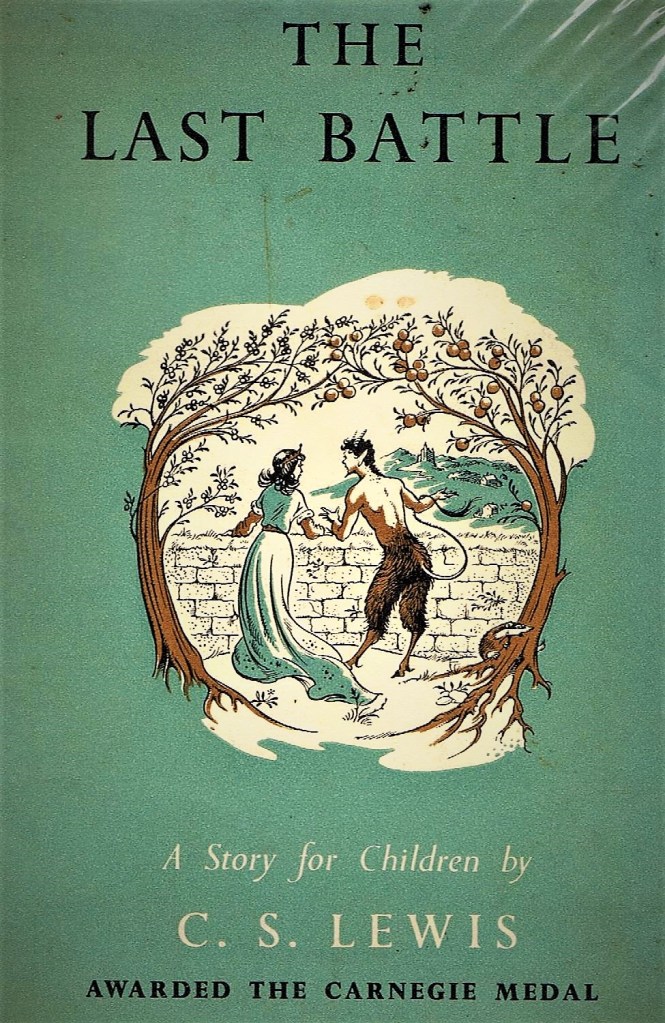
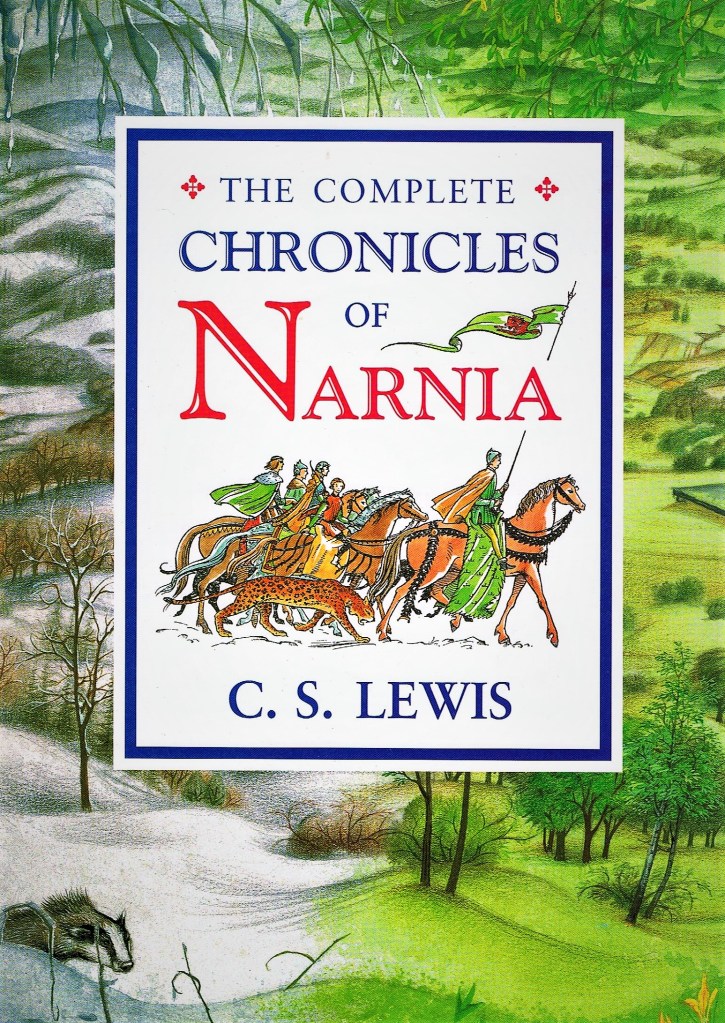
The parable has provided material for many poems, songs and stories in recent centuries, including the song, When I Needed a Neighbour and the stories for children related below, despite the difficulty of the concept of ‘final judgment’ and the ‘end times’ prophesied in both testaments. The eschatological passages of the scriptures are not easy for adults and children alike to come to terms with, but they cannot be ignored or brushed over, since they are essential to an overall understanding of the Biblical messages. More importantly, they contain some tentative answers to important questions about belief in the ‘hereafter’ which are the natural product of inquiring minds of all ages. Perhaps the most effective re-telling of these passages for children is found in C S Lewis’ Tales of Narnia, a series of books that were published throughout the 1950s.

This image has an empty alt attribute; its file name is 001-4.jpg

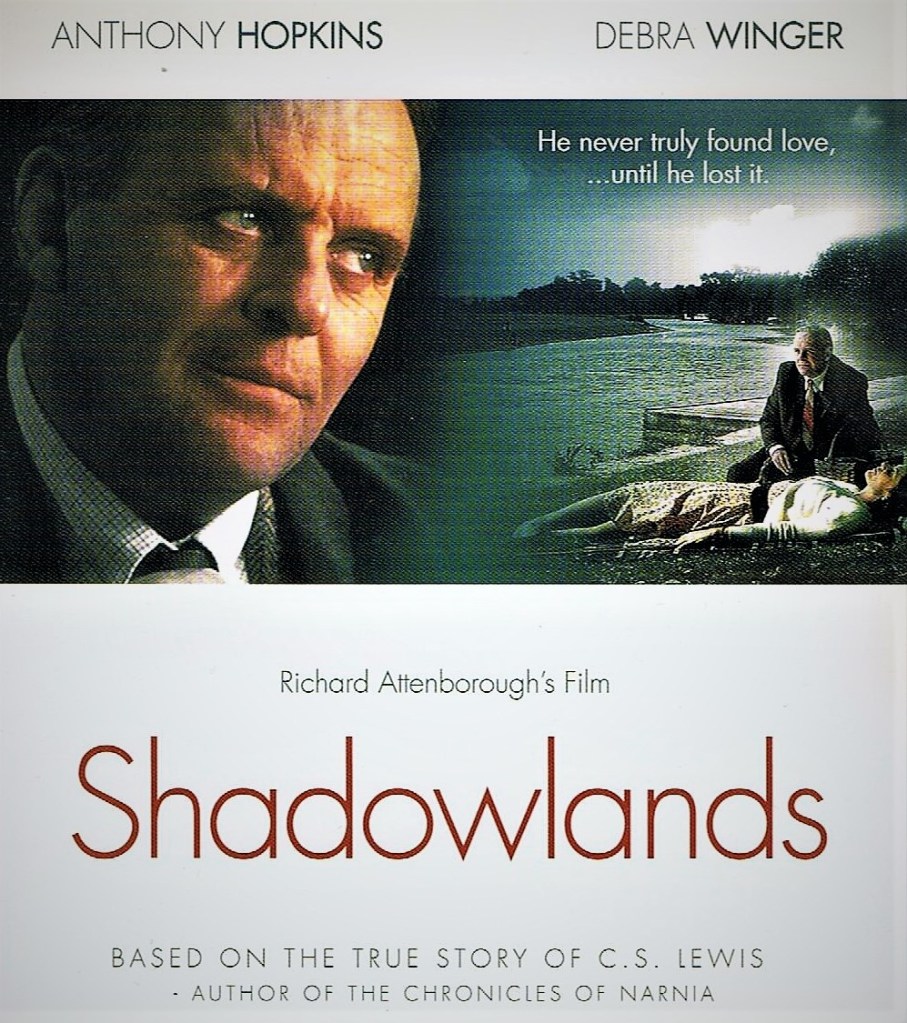
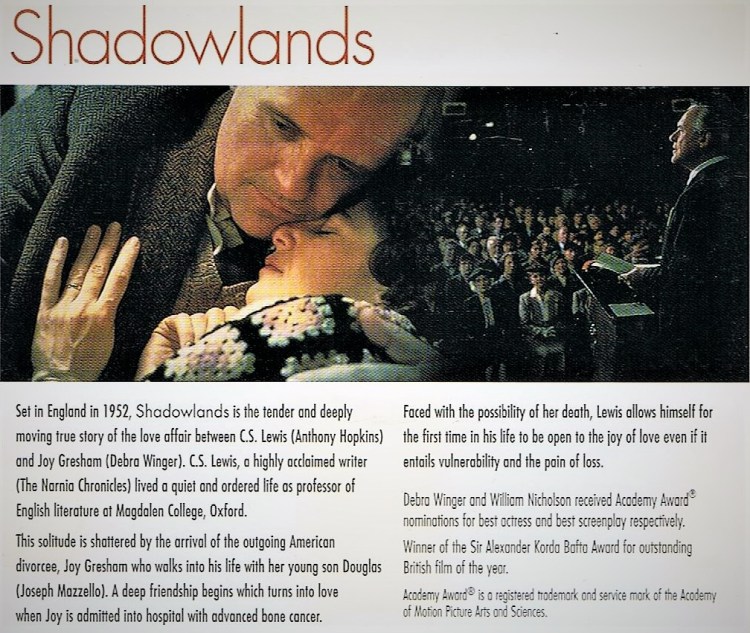
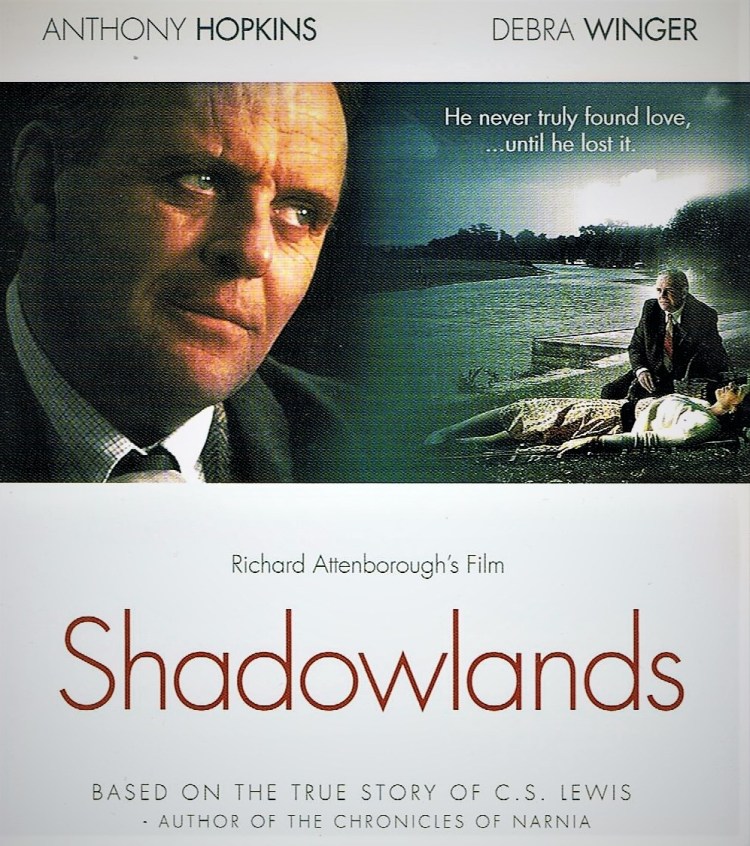
Tales of Narnia, from its genesis to ‘shadowlands’:

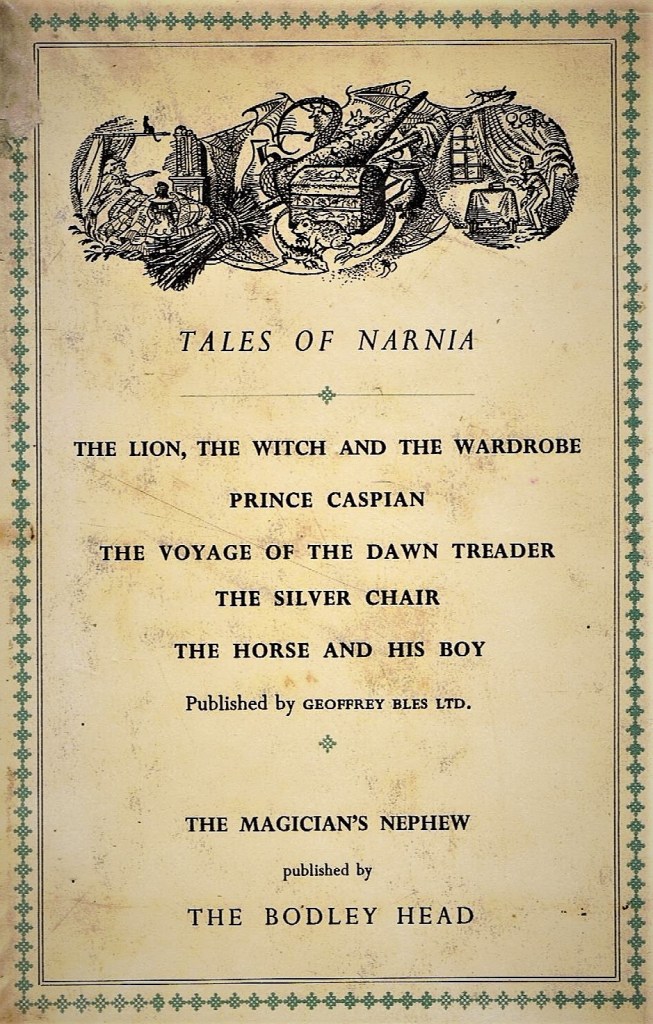
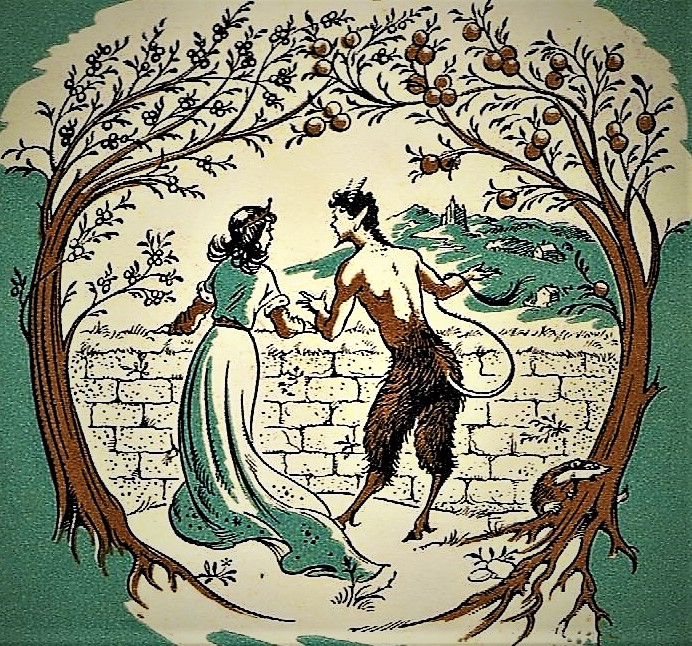
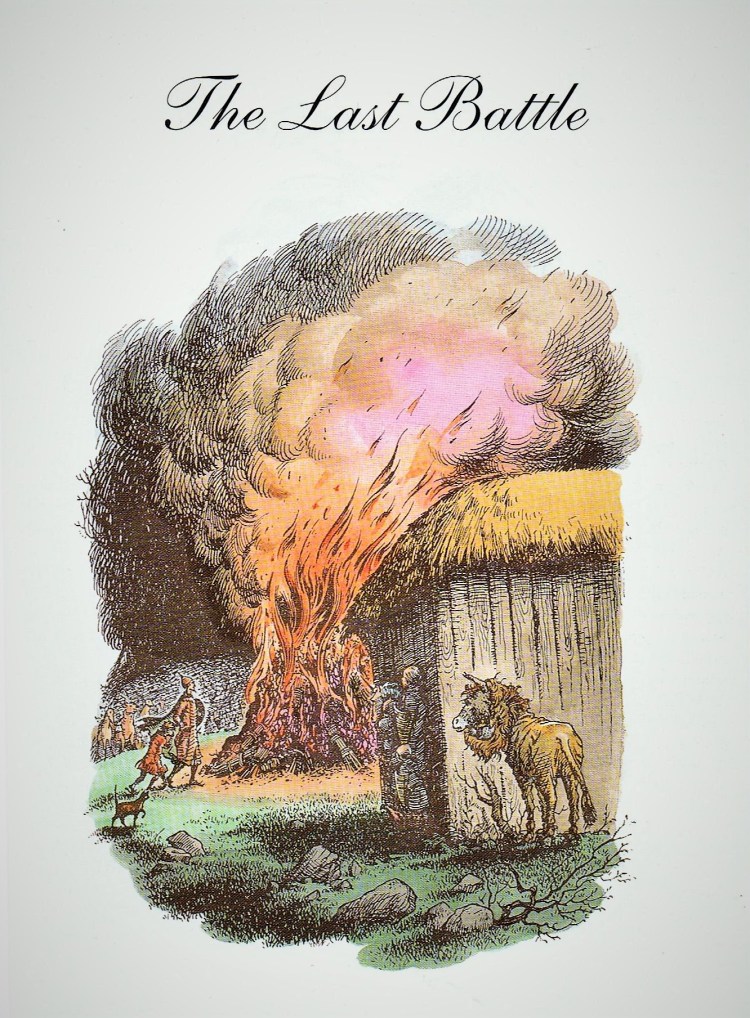
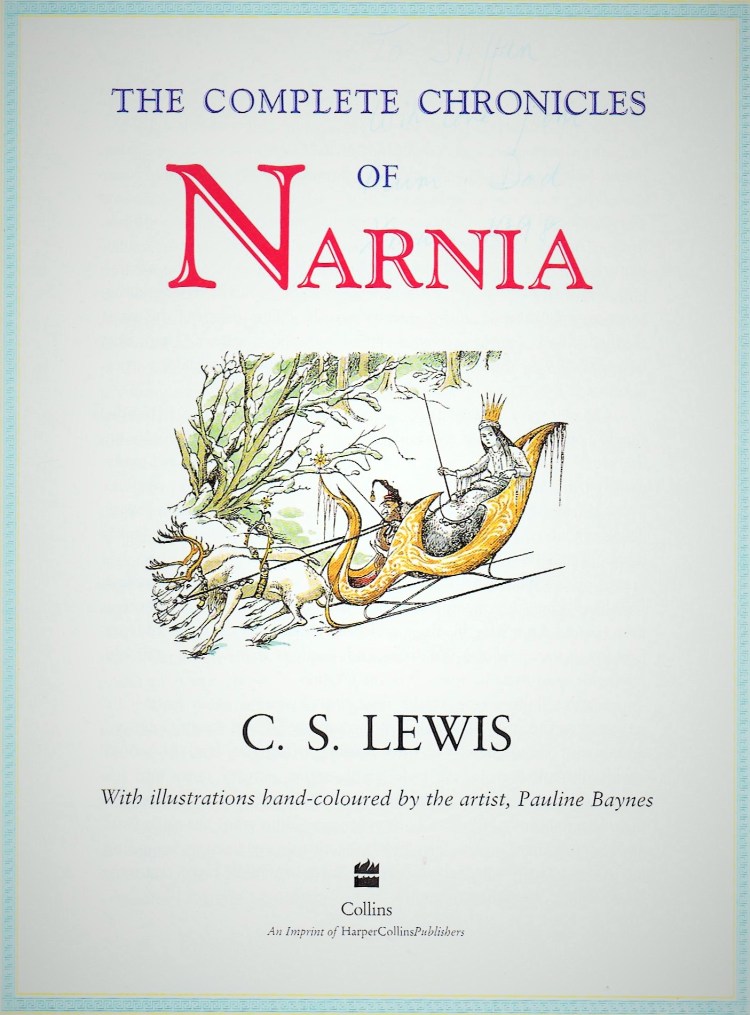
The seventh and last book for children in C. S. Lewis’ Tales of Narnia is The Last Battle, first published in 1956. This was just a year after the first book, The Magician’s Nephew was published in 1955 because that was actually the sixth book Lewis wrote. It told how the journeying between the two parallel worlds, ours and Narnia, began, as well as explaining various mysteries, such as how the wardrobe came to be a door into Narnia, and why there was a lamp-post in the middle of a wood. The stories in these seven books began as a series of pictures in the author’s head. The Lion, the Witch and the Wardrobe was published in 1950 with illustrations by Pauline Baynes, a young artist who perfectly captured, in line drawings, the pictures that ‘Jack’ Lewis had imagined. It began with the image of a snowy wood with a little goat-footed faun scurrying along carrying an umbrella and a pile of parcels. He later recalled that this picture had been in his mind since he was about sixteen. When he was forty, he decided to try to make a story out of it. He once said, “People won’t write the books I want, so I have to do it for myself.” In doing so, he wrote books that millions of others also wanted to read. By 1940, Lewis, known as ‘Jack’ to family and friends, was already an established writer of serious books on literature and religion but, as a bachelor who didn’t know many children, he had never thought of writing a book for young readers. The nature of the Second World War changed that, because it was ordinary citizens, including children, who suffered most, as their small island home was bombarded by four hundred planes a night in the infamous “Blitz” that changed the face of war, turning civilians and their cities into the front lines.

Clive Staples Lewis became the most popular defender of orthodox Christianity in the English-speaking world in the mid-twentieth century. Born in Belfast in 1898, he was brought up an anglican and educated at Malvern College. As a young man, C. S. Lewis had served in the trenches of World War One and, by the time he went up to Oxford in 1917, he had become an atheist. After a long intellectual battle, he became a Christian in 1931. Gifted with an extraordinary intellect and a reasoning mind, his conversion triggered off a rich variety of creativity. His international best-seller, The Screwtape Letters (1942) won him the reputation of being able to ‘make righteousness readable’. He wrote many other works of theology and fantasy with theological dimensions, but remained a Professor of English Literature, first at Magdalen College, Oxford, where he remained until 1954, and then at Cambridge. Over the years he also wrote many works of literary criticism, the best known being The Allegory of Love. Lewis achieved further fame as a preacher, debater, and a brilliantly effective ‘apostle to the sceptics’. Believing, as he said, that all that is not eternal is eternally out of date, he was completely orthodox and therefore admired by Christians from all branches of the church. A jovial and ‘saintly’ man, he could have amassed a fortune, but following his conversion he gave away most of his earnings to charities. His autobiography, Surprised by Joy, traces the story of his conversion.

In 1940, when the bombing of Britain began, he took up duties as an air raid warden. He also began giving talks to men in the Royal Air Force, who knew that after just thirteen bombing missions, most of them would be declared dead or missing. Their situation prompted Lewis to speak about the problems of suffering, pain and evil, work that resulted in him being asked by the BBC to give a series of wartime broadcasts on the Christian faith. Delivered over the air from 1942 to 1944, these speeches were gathered into the book Mere Christianity (pictured below) in which he set out his straightforward view of his faith, as demonstrated in the following quotation, dealing with a popular view of Jesus:

‘I’m ready to accept Jesus as a great moral teacher, but I don’t accept his claim to be God.’ That is the one thing we must not say. A man who was merely a man and said the sort of things Jesus said would not be a great moral teacher. He would either be a lunatic – on a level with a man who says he is a poached egg – or else he would be the Devil of Hell. You must make your choice. Either this man was, and is, the Son of God, or else a madman or something worse. You can shut him up for a fool, you can spit at him and kill him as a demon, or you can fall at his feet and call him Lord and God. But let us not come with any patronising nonsense about his being a great human teacher. He has not left that open to us. He did not intend to.

Mere Christianity.

It was also during the Second World War, when children from London were being evacuated to the country, four youngsters were billeted at Jack’s home, The Kilns, near Oxford. Surprised to find how few imaginative stories his young guests knew, he decided to write one for them and scribbled down the opening sentences of a story about four children who were sent away from London because of the air raids, and went to stay with a very old professor in the country. That’s all he wrote at the time, but several years later he returned to the story. The children (now named Peter, Susan, Edmund and Lucy) found their way into another world, a world that he eventually named ‘Narnia’. More pictures came into his mind: ‘a queen on a sledge’ and ‘a magnificent lion’. For a long time, he didn’t know what these meant, nor what the story was about. As he put it later:

But then, suddenly Aslan came bounding in… I don’t know where the Lion came from or why he came. But once he was there, he pulled the whole story together.

After that, all kinds of elements went into the making of Narnia. There was the intriguing question of the youngest evacuee as to what was behind the big old wardrobe of which stood in The Kilns. And there were his own childhood memories: how he and his brother, Warnie, used to climb into that very wardrobe, made by their grandfather, and tell each other stories in the dark. Some of Jack’s inspiration came from the books he had loved as a child: the talking animals in the tales of Beatrix Potter; the magical adventures that happened in the stories of E. Nesbit, such as The Railway Children; the wicked queen from a Hans Andersen fairy tale; the dwarves from the old German myths; Irish folk tales, myths and legends and mythological creatures from the legends of Ancient Greece. But these were just some of the ingredients for what Jack mixed into an entirely original confecture of the oldest stories ever told, those of the Hebrew Bible and the Christian New Testament. Between 1950 and 1956, Lewis published seven ‘fairy tales’ about his invented world, beginning with The Lion, the Witch and the Wardrobe in 1950. In Prince Caspian (1951) and The Voyage of the Dawn Treader (1952), Lewis experimented with the differences in time between our world and Narnia, a device that meant there was always something unusual and unexpected about each new story. He had thought that The Voyage would be his last volume but soon found himself writing The Silver Chair (1953) and The Horse and His Boy (1954). Each book introduced memorable new Narnian characters such as Reepicheep the Mouse, Trumpkin the Dwarf and Puddlegum the Marsh-wiggle and, from this world, the plucky Jill Pole and the initially unpleasant Eustace Stubb, who gets turned into a dragon.

This image has an empty alt attribute; its file name is 002-3.jpg
From Chapter Nine of ‘The Magician’s Nephew’: ‘The Lion was pacing to and fro about that empty land and singing his new song. It was softer and more lifting than the song by which he had called up the stars and the sun; a gentle, ripping music. And as he walked and sang, the valley grew green with grass. It spread out from the Lion like a pool. It ran up the sides of the little hills like a wave.

Aslan, the “magnificent lion”, plays an important role in every story: in The Magician’s Nephew (1955), he gives life to Narnia in a ‘Genesis’ saga; in the final volume of what is now known as “The Chronicles of Narnia”, The Last Battle (1956), Aslan concludes the story by leading its faithful friends into a new world as Night Falls on Narnia, a land Farther Up and Farther In, where they must say Farewell to Shadowlands (the titles of the last three chapters). These are summarised below, with extracts from the text. This final book, as the cover of its 1961 reprint (above) shows, won the Carnegie Award, the highest mark of excellence in children’s literature. These books also represent his most delightful approach to the Word of God, and are probably his most loved works, even for those adults who have also read some of his other literary and theological works.

This image has an empty alt attribute; its file name is 001-7.jpg

Brian Sibley’s book, Shadowlands: The Story of C. S. Lewis and Joy Davidman, was given the prestigious Gold Medallion Book Award. He was also a distinguished broadcaster and authority on the Narnia Tales, serialising them for BBC radio. He was then asked to be a consultant to the BBC Film of his book in 1985, the screenplay Shadowlands being written by William Nicholson. It was aired on British television starring Joss Ackland and Claire Bloom. This was also staged as a theatre play starring Nigel Hawthorne in 1989 and made into the 1993 feature film Shadowlands starring Anthony Hopkins and Debra Winger.

This image has an empty alt attribute; its file name is 002-5.jpg

In 1998, for the centenary of Lewis’s birth, Sibley also wrote a special introduction for The Complete Chronicles of Narnia, with all seven stories bound together for the first time. The original drawings by Pauline Baynes were coloured by the artist herself, as shown below. Her work on the Chronicles, therefore, spanned five decades.

… the whole thing was rather like a theatre. The crowd of Narnians were like the people in the seats; the little grassy place just in front of the stable, where the bonfire burned and the Ape and the Captain stood to talk to the crowd, was like the stage; the stable itself was like the scenery at the back of the stage; and Tirian and his friends were like people peering round from behind the scenery. … Rishda Tarkaan dragged the Ape up close to the fire. … “Now monkey” said Rishda Tarkaan in a low voice. “Say the words that wiser heads have put in your mouth.” “Do leave me alone,” muttered Shift. But he sat up straighter and began, in a louder voice – “At this very moment, when the Terrible One himself is among us – there in the stable just behind me – one wicked Beast has … dressed itself up in a lion skin and is wandering about in these woods pretending to be Aslan.
(From chapter XI, The Great Meeting on Stable Hill).

A Doorway to Heaven:

The final three chapters of The Last Battle (XIV-XVI) describe how, after the battle, a magical door appeared in Narnia in front of Peter, Tirian and the ‘children’, the reunited kings and queens:

Tirian looked and saw the queerest and most ridiculous thing you can imagine. Only a few yards away, clear to be seen in the sunlight, there stood up a rough wooden door, and round it, the framework of the doorway: nothing else, no doorway, no roof. He walked towards it, and the others followed, watching to see what he would do. He walked round to the other side of the door. But it looked just the same from the other side: he was still in the open air, on a summer morning. The door was simply standing up by itself as if it had grown there like a tree. …

This image has an empty alt attribute; its file name is 001-5.jpg
And Tirian turned to see who had spoken. And what he saw then set his heart beating as it had never beaten in any fight. Seven Kings and Queens stood before him, all with crowns on their heads and all in glittering clothes, but the Kings wore fine mail as well and had their swords drawn in their hands.

Tirian put his eye to the hole. At first, he could see nothing but blackness. Then, as his eyes grew used to it, he saw the dull red glow of a bonfire that was nearly going out and, above that, in a black sky, stars. …

This image has an empty alt attribute; its file name is 003-3.jpg

He looked around again and could hardly believe his eyes. There was the blue sky overhead, and grassy country spreading as far as he could see in every direction, and all his new friends around him, laughing. …

The sweet air grew suddenly sweeter. A brightness flashed behind them. All turned. Tirian turned last because he was afraid. There stood his heart’s desire, huge and real, the golden Lion, Aslan himself, and already the others were kneeling in a circle round his forepaws and burying their hands and faces in his mane as he stooped his great head to touch them with his tongue. Then he fixed his eyes upon Tirian, and Tirian came near, trembling, and flung himself at the Lion’s feet and the Lion kissed him and said, “Well done, last of the Kings of Narnia who stood firm at the darkest hour.”…

He went to the Door and they all followed him. He raised his head and roared, “Now it is time!” then louder “Time!”; then so loud that it could have shaken the stars, “TIME.” The Door flew open.

As all the kings and queens of Narnia stood beside Aslan at the door, on his right, they saw through the open doorway they saw another black shape, this time the shape of a man, the hugest of all giants. He was standing on the high moorlands to the North. Jill and Eustace remembered how once, in the deep caves beneath those moors, they had seen this great giant asleep and had been told that his name was Father Time and that he would wake at the end of the world. He now raised a horn to his mouth and made a sound ‘high and terrible, yet of a strange, deadly beauty.’ Chapter XIV continues with a graphic account of the beginning of the end of the world, with the stars falling from the sky and the arrival at the doorway of all kinds of creatures, men and mythical beings, ‘by thousands and by millions’, all running towards where Aslan stood:

The creatures came rushing on, their eyes brighter and brighter as they drew nearer to and neare to the standing Stars. But as they came right up to Aslan one or other of two things happened to each of them. They all looked straight in his face; I don’t think they had any choice about that. And when some looked, the expression of their faces changed terribly – it was fear and hatred: except that, on the faces of Talking Beasts, the fear and hatred lasted only a for a fraction of a second. You could see that they suddenly ceased to be Talking Beasts. They were just ordinary animals. And all the creatures who looked at Aslan in that way swerved to the right, his left, and disappeared into his huge black shadow, which… streamed away to the left of the doorway. …

But the others looked in the face of Aslan and loved him, though some of them were very frightened at the same time. And all these came in at the Door, in on Aslan’s right. There were some queer specimens among them. … Among the happy creatures who came crowding round Tirian and his friends were all those whom they had thought were dead. There was Roonwit the Centaur and Jewel the Unicorn and the good Boar and the good Bear, and Farsight the Eagle, and the dear Dogs and Horses, and Poggin the Dwarf.

Farther in and higher up!:

“Farther in and higher up!” cried Roonwit and thundered away in a gallop to the West. And though they did not understand him, the words somehow set them tingling all over.

This ‘picturesque’ re-telling of Jesus’ last parable of ‘The Sheep and the Goats’ serves as a prelude to the drowning of Narnia by a great ‘tidal wave’ or ‘tsunami’. The water came swirling up to the very threshold of the Doorway (but never passed it) so that the foam splased around Aslan’s fore-feet:

Then Aslan said, “Now make an end.”

The giant threw his horn into the sea … Then he stretched out one arm… across the sky till his hand reached the Sun. He… squeezed it in his hand as you would squeeze an orange. And instantly there was total darkness.

Everyone except Aslan jumped back from the ice-cold air which now blew through the Doorway. Its edges were already covered with icycles.

“Peter, High King of Narnia,” said Aslan, “Shut the door”.

Peter, shivering with cold, leaned out into the darkness and pulled the Door to. It scraped over ice as he pulled it. Then, rather clumsily… he took out a golden key and locked it. They had seen strange things enough through that Doorway. But it was stranger than any of them to look round and find themselves in warm daylight, the blue sky above them, flowers at their feet, and laughter in Aslan’s eyes. He turned swiftly around, crouched lower, lashed himself with his tail and shot away like a golden arrow.

“Come farther in! Come farther up!” he shouted over his shoulder. But who could keep up with him at that pace? They set out walking westward to follow him.

Finally, the children begin to recognise the landscapes around them as ‘Narnian’; that is, they recognise significant features of the world they have left behind them which they had watched being destroyed. Yet they appear curiously different, changed for the better:

Suddenly Farsight the Eagle spread his wings, soared thirty or forty feet up into the air, circled round and then alighted on the ground.

“Kings and Queens,” he cried, “we have all been blind. We are only beginning to see where we are. From up there I have seen it all – Ettinsmuir, Beaversdam, the Great River, and Cair Paravel still shining on the edge of the Northern Sea. Narnia is not dead. This is Narnia.”

Lord Digory explains to them that the Narnia that was destroyed was not the ‘real Narnia’, but only a temporary shadow of the real Narnia which was always there and always would be there. All of the ‘old Narnia’ that mattered, including all the “dear creatures” had been drawn into the real Narnia through the Door. Of course, this ‘new Narnia’ was as different “as a real thing is from its shadow or as waking life is from a dream.” They now went ‘farther up’ into ‘the Western Wild’, which the children had never seen, but the Lord Digory and Lady Polly had journeyed there on the very day the world was made. They all ran faster and faster until they found themselves at the bottom of a smooth green hill. It sides were as steep as the sides of a pyramid and round the very top of it ran a green wall: above the wall rose the branches of trees whose leaves looked like silver and their fruit like gold’.

Reaching the top they found themselves facing great golden gates. A horn sounded from inside and out came a little, sleek, bright-eyed Talking Mouse with a red feather stuck in its left paw resting on a long sword. It was, as they all cried out “Reepicheep!”

This image has an empty alt attribute; its file name is 004-4.jpg

He urged them all to come inside the golden gates into the garden inside, which had a delicious smell and a ‘cool mixture of sunlight and shadow’ under the trees and a springy turf… dotted with white flowers. The very first thing that struck everyone about the garden was that it was far larger than it had seemed from the outside. There they met everyone else they had journeyed and sojourned with on the adventures in Narnia. Looking at the garden, and talking with her old friend Mr Tumnus, the Faun, Lucy realised that the garden was not really a garden but another whole world, with its own rivers and woods and seas and mountains, which she already knew. She observed that:

“This is still Narnia, and, more real and more beautiful than the one below. … I see … world within world, Narnia within Narnia …”

The Greatest Gift’ – The Story of the Fourth Wise Man:

The second story based on Jesus’ parable in Matthew’s Gospel focuses more on the words of the ‘Son of Man’ or the King at the Final Judgment. Perhaps mistakenly, therefore, it is more associated with the Nativity stories than those of Holy Week, when it comes to its ‘denouement’. It begins with the ‘Epiphany’ story of the three travellers, or wise men, who made, in T. S. Eliot’s words, such a long journey at the worst time of the year. The story is not as well known as C. S. Lewis’s Chronicles of Narnia, but it is ingenious in having us believe that four travellers set out to find the newborn ‘king of the Jews’. After all, Matthew only mentions three gifts being delivered to the infant Jesus, which is why the tradition assumes that there were three ‘kings’ following the star. But also according to tradition, these ‘Magi’ came from a civilisation that had a deep understanding of astrology. Matthew tells us that after they have presented their gifts to the Holy Family, they are warned in a dream to return to their homeland in Persia by a different route, and this is the last we hear of them in the Gospels. But many writers have been inspired by the notion of a fourth wise man who also saw the star heralding the birth of Jesus but did not arrive at Bethlehem in time to worship him. One of the most popular accounts in English of the adventures of a fourth wise month was written down by Henry van Dyke, an American author, in the late nineteenth century, although he admitted hearing it in an oral tradition which he couldn’t identify. He published it as The Story of the Other Wise man. In 1997, a children’s picture book, The Greatest Gift, was published, based on van Dyke’s text, following the adventures of a Zoroastrian devotee called Artaban.

Artaban, like the other three magi, had read the prophecies and studied the heavens and he too set out to find the Saviour. He took with him three precious gifts, an emerald, a ruby and a pearl, all to be given to this son of David. As it happened, his way towards Bethlehem lay across a river and as he embarked on a boat to be taken to the far side, he saw a man lying by the wayside. The poor man was evidently very ill and Artaban turned from the boat, which left without him and went up to the man in need of help. Artaban realised that he needed food and shelter, so he hired a mule to carry the man and went out of his way to get him to an inn where the landlord would look after him. To pay for his care, Artaban gave the innkeeper the emerald intended for the infant king. Artaban hurried back to the river but was now only just able to see the star far ahead. He had lost many valuable days on his journey. As he approached Bethlehem, he had to crouch down in a ditch by the wayside as a troop of soldiers came galloping along with swords drawn. He followed and was startled by the cries of the children and their parents, moaning and shrieking in pain and trauma. The soldiers were everywhere, breaking down doors and dragging all the infants, aged two and under, from their mothers’ arms. Artaban sheltered in a doorway and could hear the sound of crying from inside the house. He pushed his way inside and saw the frightened mother screening her child with her body, afraid that the soldiers would return. She was also dismayed at the damage they had done to her home, so Artaban tried to help her, giving her the ruby that was to have been a gift for the child Jesus. With this, she would have money to repair her home and make a better life for her son.

Artaban heard a rumour in the little town that the ‘royal’ family had escaped to Egypt, so he too travelled there but could find no trace of them. By now, the star had disappeared from the night sky, and he had no idea where to continue his search. At this point, Susan Summers’ re-telling introduces the character of ‘a wise old Hebrew rabbi’ from whom Artaban seeks advice:

“My son”, said the Rabbi, “our scriptures foretold that the King of Kings would be despised and rejected by men. He will not be found in a palace, nor among the rich and powerful. If you seek him, look among the poor and the lowly, the sorrowful and the sick.”

Illustration by Jackie Morris.

Artaban’s quest to find the King of Kings continued for the next thirty years, but Artaban heard little about him. He passed through towns where people were crying with hunger and cities where people were dying of plague. But Artaban always hoped that one day he would see him and present him with the pearl. Though he found no king to worship, he found many people to help. Wherever he went, he fed the hungry and clothed the naked; he healed the sick and visited those in prison; and his years went by more swiftly than a weaver’s shuttle that darts back and forth through the loom, while the web grows and the invisible pattern is completed.

This image has an empty alt attribute; its file name is 017.jpg

Thirty-three years passed since he had first seen the star in the sky and set out on his journey. Now, worn and weary, he travelled to Jerusalem to make one final search. It was there that he heard that a man called Jesus of Nazareth had been tried and condemned to death because he called himself the Son of God. Artaban knew that this must be the King of Kings he had been searching for. Could he get to see him just once, perhaps even help, with the aid of his precious pearl? On a Friday just before the Passover Festival was about to commence, he pushed his way through the crowds towards the place where Jesus was to pass on the way to Calvary. Artaban passed through a crowded square where, to his horror, he found young children being sold as slaves. Susan Summers again takes up the story:

… a troop of soldiers came down the street dragging a young girl with a torn dress and dishevelled hair. As Artaban paused to look at her, she broke away from the hands of her tormentors and threw herself at his feet.

“Have pity on me!” she cried, “Save me! My father was a follower of Zoroaster, and I see from your dress that you are of the same faith. Now my father is dead, and I am to be sold as a slave to pay for his debts. Help me, please!”

This image has an empty alt attribute; its file name is 024.jpg
This image has an empty alt attribute; its file name is 023-1.jpg
This image has an empty alt attribute; its file name is 026.jpg
This image has an empty alt attribute; its file name is 025.jpg

The Zoroastrian faith flourished in the Middle East at the time of the birth of Christ, and astrology was an important part of the religious tradition. A central aspect of the story of the Magi, and of the later stories about the fourth wise man, is the emphasis placed on the Messiah as the teacher whose message would not only be important to the Jewish community into which he was born but to other traditions as well. For each of the wise men who saw the star understood that it signified the birth of a leader with a universal message. Henry van Dyke’s story emphasises this theme, for Artaban actually lives and practices the message of Jesus, dedicating himself to a life of service as he searches for the King of Kings, not discriminating against people belonging to different races or holding different belief systems from his own. In the spirit of the Henry van Dyke story, Susan Summers’ picture book, The Greatest Gift echoes this message, at the same time showing how we can turn disappointment to good account, how the power of faith can transform our lives, and how our outer journey through life is mirrored by the inner journey of the soul.

A Pilgrim’s Progress – from this world to that which is to come:

The Pilgrim’s Progress by John Bunyan, first published in 1678, has been printed, read and translated more often than any other book than the Bible. Indeed, in many homes before the twentieth century, it was the only other book on the shelf. Over the centuries, people of all ages have found delight in the simple, earnest story of Christian, the pilgrim. The events seem lifelike, following each other rapidly and consistently. Bunyan was born in 1628, in Elstow, Bedfordshire, into very humble origins: his parents were poor cottagers. Although of the lowly occupation of a brazier (brass-worker) or ‘tinker’, his father sent him to school to learn to read and write; but he was an idle boy, and for cursing, swearing, lying and blaspheming, had few equals of his own age. He suffered from nightmares in which he conceived apparitions of evil spirits seeking to drag him away with them. He would sometimes imagine that the day of judgment had come, with all its terrible realities. John also became a tinker, like his father, but when the Civil War broke out, he joined Parliament’s army and was at the Siege of Leicester in 1645. A close comrade in arms, standing sentry near Bunyan’s quarters, was shot through the head and died.

In 1649, home from the war, Bunyan married an orphan girl who was as poor as he was, a ‘praying Christian’ whose dowry consisted of two books given to her by her father, a godly man: The Plain Man’s Pathway to Heaven and Practice for Piety. She would often read these books out loud with her husband, trying to reform his way of life, and would also relate what a holy life her father led. As a consequence, an earnest desire for reformation seized upon him, but it was only an external obligation at this stage, though he came into contact with an independent congregational meeting in Bedford in 1651. His heart was unchanged, and he continued in a ‘sinful’ course of life. But he was much affected by a sermon on the sin of Sabbath-breaking and when he was engaged in a pastime on a Sunday afternoon, thoughts of a coming judgment crowded in on his awakened mind. He became terrified and imagined he heard a voice from heaven saying, Wilt thou leave thy sins and go to heaven, or have thy sins and go to hell? He despaired over his spiritual state for several years. The conviction that he had been a grievous transgressor flashed across his mind, but he concluded that it was too late for pardon or for heaven, and he returned desperately to his sports again. After a conversation with a poor Christian man, whose piety touched his heart, Bunyan began to read the Bible. Again, he commenced an outward reformation in word and life, but entirely in his own strength, ignorant of the love and grace of Jesus Christ. It was an overheard conversation of three pious women sitting at a door in a Bedford street, concerning God’s work in their hearts, and of inner peace and reconciliation, that he saw that there was something in their real religion which he had not yet known or felt. From that time onwards, he sought the society of those who at least had a reputation for piety.

John Bunyan, from an eighteenth-century engraving. He is dreaming of the beginning of Pilgrim’s Progress, with Christian fleeing the City of Destruction.

Bunyan’s life was at last transformed, and he had at last set off on his own allegorical way from the City of Destruction. But for a long time, he felt like a caged man, shut out from the promises and looking forward to certain judgment. But then there came, as he was to describe it in Pilgrim’s Progress, a hand with some of the leaves of the tree of life, which Christian took and applied to some of the wounds he had received in battle and was healed immediately. He was ‘led by faith to the cross of Christ, and became more than conqueror through Him that loved him’. Shortly after this time, he made an open profession of religion and experienced assurance of God’s saving work in him. He was baptised into a local nonconformist fellowship in Bedford and began to make known to others the Saviour whom he had found, finding great success as a lay preacher for them from 1653. His first writings were against George Fox and the Quakers; his theology developed in controversy with them, as well as with the ‘Ranters’. Nevertheless, he shared many of the social and political values of the radicals; in 1654 and many times later, he denounced kingly oppressors. Between the years 1655 and 1660 he often preached in the neighbourhood of Bedford, but in 1660 he was put into Bedford County Gaol for preaching without a license; ‘lay preaching’, by people other than ‘ordained’ clergymen was made illegal after the Restoration of Charles II in 1660. One object of that restoration had been to put tinkers back into their callings. But Bunyan remembered a lot from the revolutionary decades. In 1658 he had written that:

More servants than masters, more tenants than landlords, will inherit the kingdom of heaven. God’s own are most commonly of the poorer sort. … they cannot, with Pontius Pilate, speak Hebrew, Greek and Latin.

The Five Mile Act of 1665 prohibited any ejected minister from living within five miles of a corporate town or any place where he had formerly served. But in those days people who were without means of livelihood could only claim help from the place which was their long-established home. So this Act meant that ejected ministers could get no help in order to live. Some hid near their old homes and visited their poor wives and children secretly, under cover of night. Many other ministers thought it was better to go on preaching and teaching openly even if they were sent to prison than to starve, or worse still, see their children starve. They took care of their congregations, who loved them. They could not all be sent to prison, since there was not enough room for them! The prisons were already full of Quakers and lay preachers like John Bunyan. The numbers of ‘prisoners of conscience’ were unprecedented in England and Wales.

In 1661, Bunyan’s wife described her husband as ‘a tinker and a poor man, therefore he is despised and cannot have justice’. He spent twelve years in prison, with one brief interval of a few weeks, using the time to write several books, including the story of his own life and religious journey in Grace Abounding to the Chief of Sinners (1666). In it, he described God’s working and speaking to him in every aspect of life. His Dives described Lazarus as ‘a scabbed creep-hedge’, revealing his growing contempt for the rich and powerful. Though the King’s ‘Declaration of Indulgence’ of 1672 brought him his release, religious tolerance was short-lived and the Indulgence was cancelled. Though Bunyan had time to become licensed and was appointed pastor of his church, he was rearrested in 1676 and imprisoned in the old town jail on Bedford Bridge. This time his sentence was only six months, and it was during this time that he wrote the first draft of the first part of what became The Pilgrim’s Progress, an allegory based on Bunyan’s own spiritual life. It was first published in the early months of 1678. In prison Bunyan also learned the art of making long-tagged thread laces, thereby contributing to the support of his family.

After his release, he preached in many parts of the country and was not further troubled by official persecution. He became pastor of Bunyan meeting in Bedford, living a useful life as a preacher and writer and lived to see his books being widely read. Bunyan was the author of another allegory, the Holy War, published in 1682. It uses images of warfare to construct this allegory, and is very complex, mixing personal and cosmic events. In The Holy War, Bunyan gives us a long list of ‘Diabolian’ lords and gentlemen. Mr Lustings is ‘a man of high birth’. The devils are clearly very well-bred: they bow and scrape to one another. Mr Badman was a person of quality; ‘Cain’s brood’ were ‘lords and rulers’. Even Giant Pope is armigerous: his escutcheon was the stake, the flame and the good man in it. But it was the Pilgrim’s Progress that soon established itself as a perennial classic. The historian Christopher Hill described it as the greatest literary product of this social group, the epic of the itinerant. It began with the words of its narrator, As I walked through the wilderness of this world. Bunyan laid himself down to sleep in a den he ‘lighted on’, like George Fox and so many other itinerants did: Pilgrim’s Progress was the dream he then dreamed. The burden on his pilgrim’s back was the symbol of the lowest grade of ‘masterless man’, but he also had the freedom of the masterless. He is not tied to the soil, can leave home when he wishes and can go where he wishes: his wife can follow him if she wants to. It is the widest democratisation of potential salvation, not merely to the static humble poor, but dependent on their superiors, but to men and women who can take their lives into their own hands, and help themselves in the confidence that if they do God will help them.

The main source of Bunyan’s inspiration was the Bible. He also worked within the Puritan tradition of self-examination and argument and the allegorising tradition of the village sermon. His beliefs come straight from the pages of his Bible and are shaped by his own Calvinist, independent position. We call Bunyan a Calvinist, but his is a Calvinism with a difference. The depth of his experience and the breadth of his imagination makes him more than a mere sectarian writer among many from this period. He shares the activism of the Quakers’ George Fox and James Nayler, and of Gerrard Winstanley, the Digger theorist: Were you doers or talkers only? God will ask on the Day of Judgment. Heaven has to be striven for according to Bunyan. His Calvinism is the outlook of small, itinerant, hard-working craftsmen. Society had been loosened up; endeavour and endurance crept into all the theology of the late seventeenth-century puritanism, even that which we call Calvinist. As Christian declares, the soul of religion is the practical part. Bunyan stands in the mainstream of the puritan tradition by insisting that faith shall issue in works. His subversiveness is both in his matter-of-fact, down-to-earth narrative and in his themes. The hero of Pilgrim’s Progress is one of the people: the law and its courts, he knows, will not give him justice. The spiritual autobiography itself becomes subversive when its hero is a lower-class itinerant and the villain is the petty-bourgeois Mr Badman, who nonetheless is often much livelier than the virtuous characters.

From the literary point of view, The Pilgrim’s Progress, besides being an allegory, is also a dream-vision, like many medieval texts. It begins as a dream of Bunyan’s in his prison cell, not so big as to fill one night; large enough to fill the rest of my life. The allegory takes the form of a dream in which the narrator tells of the pilgrim, Christian’s progress from this World to that which is to come. Christian flees from the City of Destruction (having failed to persuade his wife and children to accompany him) and sets out on a pilgrimage on which he meets such (now) well-known characters as Evangelist, Faithful and Pliable. They are personifications of abstract qualities. Bunyan’s writing is beautiful and simple and contains vivid, humorous characterisations. The pilgrim, Christian, is described on his journey through this life towards the world which is to come. He faces all sorts of obstacles from ‘Giant Despair’ and ‘the Slough of Despond’ (the depths of depression) to ‘Vanity Fair’ (vanity here meaning something empty or worthless, like the cheap goods often sold at fairs). All these scenes question the false values of the world, contrasted with the true values of the Christian faith. In the following extract Christian, joined by his fellow pilgrim called Faithful, comes to ‘Vanity Fair’:

Then I saw in my dream that when they were got out of the wilderness, they presently saw a town before them, and the name of the town is Vanity; and at the town, there is a fair kept … It is kept all the year-long … all that is there sold or that cometh thither is Vanity. As is the saying of the wise, ‘All that cometh is vanity.’ This fair is no new erected business, but a thing of ancient standing …

Therefore at this fair are all such merchandise sold as houses, lands, trades, places, honours, preferments, titles, countries, kingdoms, lusts, pleasures, and delights of all sorts, as whores, bawds, wives, husbands, children, masters, servants, lives, blood, bodies, souls, silver, gold, pearls, precious stones, and whatnot. … Here are to be seen, too, and that for nothing, thefts, murders, adulteries, false swearers, and that of a blood-red colour. …

Now, as I said, the way to the Celestial City lies just through this town, where this lusty fair is kept, and he that will go to the city, and yet not go through this town, must needs go out of the world. …

… At last things came to an hubbub, and great stir in the fair, that all order was confounded. Now was word presently brought to the great one of the fair, who quickly came down and deputed some of his most trusted friends to take these men into examination, about whom the fair was almost overturned. …

The second text, reproduced in facsimile, is from the first edition of the book, published in 1678. Christian’s religious doubts have caused him to lose hope and fall into despair. He and his companion Hopeful have been caught by Giant Despair, and thrown into the dungeon of Doubting Castle:

This image has an empty alt attribute; its file name is 012-2.jpg

Bunyan’s Dialect & Discourse:

Bunyan’s use of the language was influenced by his reading of the King James Version of the Bible of 1611, but at the same time, it reflects popular everyday usage. We can therefore use The Pilgrim’s Progress with reasonable confidence as evidence of ordinary language use in the 1670s. Its homespun phrases bring us close to hearing the colloquial, everyday speech of that period, the language of artisans, countrymen and merchants commended by Thomas Sprat, not that of ‘wits and scholars’. Bunyan was not a scholar of universities in Latin and Greek like his contemporary, John Milton. If Milton had affinities with the radicals, he was separated from them by his patrician assumptions, whereas Bunyan shared their colloquial discourse as well as many of their social and political attitudes. In his doggerel poem which prefaces the earlier editions of the work, The Author’s Apology, Bunyan himself made a comment on his use of dialect in The Pilgrim’s Progress:

This book is writ in such a dialect,

As may the minds of listless men affect:

It seems a novelty, and yet contains

Nothing but sound and honest gospel strains.

A later, second volume told the story of Christian’s wife Christiana who, moved by a vision, follows with her children on the same pilgrimage. This second part was first published in 1685 and was combined with the first part in the second edition, published in 1686. This was the last edition published during Bunyan’s lifetime, since the third edition was published two years after his death, in 1690, though it doubtless contained his own latest corrections. The 1916 edition contained an entirely new set of beautiful, some as coloured plates, as featured above. The book as we have it now is equally a favourite in the nursery and the study and has received the commendation of men of the highest order of intellect. It has been translated into numerous languages, some of which were unknown to Europeans in the days of the author. By 1903, the Religious Tract Society had aided in printing editions of this work in one hundred and one languages. Missionaries have carried this book with them to every part of the earth.

The particular poignancy of The Pilgrim’s Progress springs from the tension between the vision and the reality, the upside-down world and the all-too-real world. He reflected on the sad condition of those that are for the most part rich men. His characterisations were full of them: Worldly Wiseman, Formalist, Hypocrisy and Antichrist were all gentlemen; Madam Bubble, ‘the Mistress of the world’ as a gentlewoman and Mrs Wanton was ‘admirably well-bred’. Mr By-ends was ‘a gentleman of good quality, related to lords, parsons and the rich. The Pilgrims, on the other hand, were ‘of base and low estate’, and uneducated. Faithful was brought before Lord Hate-Good for slandering several of the nobility and ‘most of the gentry of our town’. Bunyan knew far more about the heaviness of the burden of Mr Badman’s free market and petty commercial morality than Milton ever did, living without labour on the income he had inherited through his father’s usury. But each of them, starting from the conviction of mankind’s original sin and fallen nature, write about the divinity in man slowly winning its way back, in Milton’s case to ‘a Paradise within thee, happier far’ and in Bunyan’s to the confidence that triumphed over all the torments and the early death which were the usual fate of the itinerant.

Bunyan’s Christian got rid of his burden only after he had turned away from the world and its works through the ‘strait gate’, and had accepted the cross. Then the burden rolled off his back, no thanks to any effort of his. If natural man could cast off the burden by his own exertions, he would also cast off God. Salvation must be the arbitrary gift of God’s grace from outside because the essence of the Fall had been a breach of God’s prohibition. Some of Bunyan’s colloquial words from his original text are still sung in the popular hymn in English-medium churches:

He who would valiant be ‘gainst all disaster,

let him in constancy follow the Master!

There’s no discouragement,

Shall make him once relent,

His first avowed intent,

To be a pilgrim!

A Retelling for Children:

In her remarkable retelling of Bunyan’s allegory, Geraldine McCaghrean brings the tale to life for children today. with the help of Jason Cockcroft’s brilliant illustrations. On his journey to the City of Gold, Christian meets an extraordinary cast of characters from the terrible Giant Despair to the monster Apollyon. Together with Hopeful, his steadfast companion, he survives snipers and mantraps, the Great Bog, Vanity Fair, Lucre Hill and Doubting Castle. As they get nearer to the City of Gold, the pilgrims enter poppy fields which cause them to feel drowsy:

They thought at first that it was heat haze rising off the poppy fields – or hordes of tiny flies. But it was sleep – a stupefaction of sleepiness, an intoxication of drowsiness, an enchantment.

“Let’s just lie down here and rest,’ said Hopeful. “I can’t go another step.”

“No. No. We mustn’t sleep. I made that mistake once before, and it lost me my scroll. Keep awake! We must keep awake! Step out lively now. There’s something sinister about this place. I smell magic.”

But Hopeful was swaying, dizzy with the effects of the poppies, and Christian had to put one arm around her, or she would have swooned, then and there, among the flowers. Clouds of pollen burst upwards in their faces as her skirts sept the papery petals loose from their stems. He himself longed to fall headlong among the fallen petals, and surrender to sleep.

“Sing, Hopeful! Come on now, sing! That will keep us awake!”

So they sangAnyone watching would have mistaken them for revellers reeling home from an inn:

“Who so beset him round with dismal stories

do but themselves confound; his strength the more is!

No foes shall stay his might,

Though he with giants fight:

he will make good the right

to be a pilgrim!

… But Hopeful’s head lolled forward on to her chest, and her breathing became heavy. “Hopeful, wake up!” …

“Let’s have a quiz!” said Christian, himself swerving with dizziness, as the poppies blew around his knees. “How do you recognise a Christian?”

“Is this a riddle?” asked Hopeful.

“No. Pay attention. It’s a quiz. How do you know a Christian?”

Hopeful screwed up her face in concentration. ” ‘By his works ye shall know him’,” she said, quoting from the guidebook. “My turn. How do you recognise a friend?”

“I’ll tell you,” offered Hopeful. “He’s the one who keeps you awake on enchanted ground.” She gave a wry smile, and together they steered a wavering course for the edge of the field. “I hope no one sees us,” said Hopeful ruefully. “They’ll think we’ve been drinking strong liquor, and I’ve never held with that.”… They… went on their way, singing just for the pleasure of it:

“… Then fancies flee away!

I’ll fear not what men say,

I’ll labour night and day

to be a pilgrim!”

Christian and Hopeful passed the sweetest days of their pilgrimage walking through the Land of Beulah, their happiness increasing daily until their hearts ached with it – ached, too, with the wistfulness at the fleeting nature of life and of summer days. More and more often, Christian laid his hand on his chest and stopped walking, to recover his breath, oppressed by happiness.

“Are you well, Christian?” Hopeful would ask, and he would nod. Nor was he so distracted by his own feelings that he did not see the changes in Hopeful – the greying of her hair, the deepening of lines in her face. They did not hurry onwards out of the Land of Beulah. They seemed to have all the time in the world to dawdle on their way.

And then one day they looked around, and everything had changed. Bare granite hills swelled like tumours out of the ground, enclosing them in a fearful glen. Down this vale funnelled icy, whistling winds which bled the colour out of the landscape without ever dispersing the cloud overhead. For where there should have been sky, whole generations of bleak black clouds had piled up, excluding all possibility of sun. The only light which ever shone in the Valley of the Shadow was the fitful flash of lightning and the flare of raging fires. Though there was no vegetation to burn, these fires crawled inexorably about the granite slopes, adding their own hollow roar to the noise of the wind. But the worst noise in the Valley of the Shadow was of crying.

What at first sight had seemed to Christian and Hopeful an empty, inert void, was in fact as swarming with people as an anthill is aswarm with ants. Some were simply old; others were sick – delirious with fever or doubled up with pain; some diseased, some insane. Soldiers and civilians, casualties of war, lay about calling for someone to tend their wounds. The drowning called out from beneath frozen sheets of water. The starving held out empty bowls, pleading with empty eyes. There were even children. Hopeful’s first thought was to go to them – to help. But Christian restrained her in the nick of time. She had not seen what he had – that to either side of the Pilgrim’s Way was a deep, deep trench. There was no leaving the path; indeed, it was so narrow that they could not so much as turn round to go back. …

… Nothing remained but to pray. Christian and Hopeful prayed – not for anything, but just prayed. They did it instinctively, blindly, like children going through the motions, repeating words they had recited all their lives. In this terrible place, there was nothing left to do but pray:

‘Yea, though I walk through the Valley of the Shadow of Death, I will fear no evil; for thou art with me; thy rod and thy staff they comfort me. Surely goodness and mercy shall follow me all the days of my life, and I will dwell in the House of the Lord for ever.’

And praying brought them through. The glen opened up on to rich, cultivated countryside: a colourful patchwork of fields seemingly stitched together with twining vines. A fine mist lay over everything, such as hangs over the world before full sunrise burns it away. … Christian shook his head, but the noise in his ears … only grew louder. He realised that he was listening to the sound of a rushing river.

Suddenly Hopeful was tugging on his sleeve, pointing, gasping. “Christian! There it is! The City! We’ve arrived!” What they had mistaken for morning light was not coming from the sun but from the shining walls of the City of Gold. It stood almost directly in front of them – not above three miles away. Its outline was clearly visible!

Christian began to run. Hopeful ran, too, still clutching her friend’s sleeve. They would be there in an hour or so! Nothing could keep them from reaching it now! The noise of rushing water grew louder. Spray began to wet their faces with tiny droplets of cold – like a clammy sweat. Their run came to an abrupt halt as the Pilgrim’s Way reached its end. This straight and narrow pathway, trodden white by the traffic of a million feet, brought them at last to a riverbank. And there is no bridge across the Final River.

This image has an empty alt attribute; its file name is 011-2.jpg

Will Christian and Hopeful find the courage to cross the final river to the City of Gold and their salvation? The thirteenth chapter in McCaughrean’s adaptation has the answer…

Grace & Salvation from Bunyan to Lewis:

Besides his great allegorical works, Bunyan wrote many valuable treatises on the themes of God’s Grace and Salvation when he wasn’t on a preaching tour. On the night of 31 August 1688, after a seventy-mile ride home from one such engagement, through torrential rain, he was taken ill and died at Mr Strudwick’s, a grocer. He was buried at Bunhill Fields, the last resting place of perhaps the best of early English nonconformists. His legacy, The Pilgrim’s Progress is one of the most important texts in English literature because it fixed the values of British society as those of Christianity, faith and stability, values which were to remain important for the next three hundred years, finding their expression afresh in the works of C. S. Lewis among other Christian authors. It is the one text which is considered to be close to the Bible and almost a biblical text in itself. Many of its images and phrases have entered the language, just as the words from the 1611 Authorised Version of the Bible or the 1662 Book of Common Prayer laid the foundations of modern written English.

Sources:

Tim Dowley (ed.) (1977), The History of Christianity. Berkhamsted: Lion Publishing.

Martin Manser (2000), Bible Stories. Bath: Parragon

C. S. Lewis (1956, 1961), The Last Battle: A Story for Children. London: The Bodley Head.

C. S. Lewis (1998), The Chronicles of Narnia. London: Harper Collins.

Victor J. Green (1983), Festivals and Saints Days: A Calendar of Festivals for School and Home. Poole (Dorset): Blandford Press.

Susan Summers (1997), The Greatest Gift: The Story of the Other Wise Man. Bristol: Barefoot Books.

Christopher Hill (1975), The World Turned Upside Down: Radical Ideas During the English Revolution. Harmondsworth: Penguin Books.

John Bunyan (1916), The Pilgrim’s Progress from this world to that which is to come delivered under the similitude of a dream. London: The Religious Tract Society.

Geraldine McCaughrean (1999), John Bunyan’s A Pilgrim Progress (Retold). London: Hodder Children’s Books.

Ronald Carter & John McRae (1996), The Penguin Guide to English Literature: Britain & Ireland.

Dennis Freeborn (1992), From Old English to Standard English: A Course Book in Language Variation Across Time. Basingstoke: The MacMillan Press.

Roger Gower (1990), Past Into Present: An Anthology of British and American Literature. Harlow (Essex): Longman Group.

Appendix:

A list of selected quotations from The Pilgrim’s Progress from Freeborn (see ‘sources’ above), illustrating the many superficial features, part of the idiom and usage of the late seventeenth century:

Mythical Hymns of Creation: The Radical Story of Genesis and the Covenants of the Bible.

The Very Root and Origin of All Creation:

The ‘Authorised Version’ or ‘King James’ Bible

According to dictionary definitions of ‘radical’, from the Latin radicalis, for ‘having roots’ or ‘proceeding from the root’ and meaning ‘fundamental; reaching to the centre or ultimate source’. The twentieth-century philosopher Raymond Williams wrote, in his 1976 publication Keywords, that ‘radical’ had been used as an adjective in English from the fourteenth century, its early uses being mostly physical, to express an inherent and fundamental quality, and this was extended to more general descriptions from the sixteenth century and radical religious ideas became popular among ‘Independent’ puritans in seventeenth-century England and Wales. It did not acquire its modern-day political associations until the late eighteenth century, with the formation of radical groups and parties across Europe and in America in a ‘revolutionary’ period which lasted throughout most of the hundred years into the 1870s on the ‘old’ continent. The Bible, translated into many languages during the Protestant Reformation and providing the impetus for social and intellectual change, qualifies as radical from several different perspectives. The ‘Word of God’ deals with the very root and origin of all creation. It contains a fundamental message about life, life’s centre and its ultimate source. Christians believe that this collection of writings from the ancient world still have a powerful message for the world of the twenty-first century. The continued confrontation of God’s Word with the expressions of the problems and aspirations of peoples in the last half-century have been provocative, and indeed God’s Word should jolt us, for the voice of the Lord breaks down cedars and flashes forth frames of fire (Psalm 29). The God of Abraham, Moses and Jesus Christ is a God of radical transformation and reconciliation, a God who puts down the mighty from their thrones and exalts those of low degree (Luke 1).

It was out in the world beyond first-century Palestine that what Jesus represented – why he lived as he did, how he died and how he was raised to life – became clearer. It meant nothing less than the vision of a new world, God’s world, and a call to be God’s ‘fellow-workers in its making. Nothing could have made this vision sharper than the sight of men and women, from different ‘races’, classes and nations, becoming Christians. Their old fears vanished; a new joy marked their lives. When Paul tried to explain what a difference Jesus had made to his life, he went back to the book of Genesis and the story of the making of the world as the only kind of language he could use:

God, who made this bright world, filled my heart with light, the light which shines when we know him as he is, the light shining from the face of Jesus.

II Corinthians 4: 6

From Martin Manser’s (1999) Bible Stories. Bath: Parragon

The Hymn of Creation (Genesis 1-2.4a) is ‘priestly’ teaching in Israel at its finest. It is hymn-like, carefully structured, making effective use of recurring words and phrases, e.g. ‘God said … and it was so’, ‘So evening and morning came …’ Its purpose is neither historical nor scientific. It is written by faith, for faith. A good deal of myth and ritual is concerned with the natural forces that shape man’s life. In myth, however, such forces are never regarded as objects; they are always personalised as gods and goddesses. In Canaanite mythology, the interplay of fertility and drought is the conflict between Baal, the god of the fertilising rain and his enemy Mot (Death). In the Babylonian Enuma Elish, the struggle is between Tiamat, primaeval chaos, and Marduk, the champion of the gods. Just as there are many different and conflicting phenomena surrounding man, so there is an inevitable polytheism in such myths. By contrast, Gen. 1 is uncompromisingly monotheistic. The Hebrew word for ‘the deep’ (tehöm) in 1: 2 is sometimes claimed to be a reflection of Babylonian Tiamat. At best it is a literary echo. The entire theme of creation coming by way of conflict between rival gods has been excised. Here there is but one God who speaks, and his word is effective to create. The same point is made in 1: 14-19. Instead of speaking about the sun and the moon, the hymn refers to ‘the greater light’ and ‘the lesser light’. Sun and moon were common objects of worship in the ancient Near East. It is as if the hymn is deliberately demythologising them. It refuses to name them directly and insists that they share in the finitude of all created things.

The word ‘create’ used throughout this chapter is only used in the Old Testament of God and his activity. Nothing in the world may be equated with the divine. But neither is the world in any sense the enemy of God. All are part of his good creation, including man, the apex of the pyramid of creation. When the hymn comes to the making of mankind (1: 26), the form of expression changes. It becomes more personal: ‘Let us’ instead of ‘Let there be’. The plural ‘us’ here probably derives from the mythology of the divine council which the supreme god consults when important decisions are to be taken. But that, in the hymn, is no more than a literary allusion; the plural ‘Let us’ switches immediately to the singular in 1: 27. The prose is slightly mesmerising as it takes its slow and stately course, and it altogether lacks the freshness of the ‘saga’ style of much of the Hebrew narrative of the Pentateuch. The priestly writers seldom tell a story with varied characters and interesting incidents, but rather rehearse set pieces of ritualised events. The dignity and the power of the writing are undeniable, as is the departure in style both from that of ‘saga’ and from the work of the Deuteronomist school. The priestly style derives from those who controlled the Second Temple, or perhaps from their predecessors who, during the exile, worked to classify and elaborate the rules for Temple worship. The book of Ezekiel, who was a priest as well as a prophet and who worked among the exiles, has passages in a similar style, particularly in the regulations about life in the restored Promised Land in Ezekiel 40-48. We might expect to find whole books written in one or another of these styles, but this is not what we encounter in the Hebrew Bible. Here is the climax of the priestly Hymn of Creation:

The poet and printer, William Blake’s illustration of ‘the Creation’

Then God said, “Let us make man in our image, after our likeness; and let them have dominion over the fish of the sea, and over the birds of the air, and over the cattle, and over all the earth, and over every creeping thing that creeps upon the earth.”

So God created man in his own image, in the image of God he created him; male and female he created them. And God blessed them, and God said to them,

“Be fruitful and multiply, and fill the earth and subdue it, and have dominion over the fish of the sea and over the birds of the air and over every living thing that moves upon the earth.”

And God said, “Behold, I have given you every plant yielding seed which is upon the face of all the earth, and every tree with seed in its fruit; you shall have them for food. …”

First chapter of Genesis, verses 26-29: Revised Standard Version.

The keyword in verse 26 is ‘image’, ‘likeness’ being a more general term that merely emphasises the concept of ‘the image of God’. But what does that phrase mean? Every age has attempted to read into this phrase its own highest ideal of man, whether that is thought of in terms of the immortality of the soul or the possession of reason. In the context of Genesis 1, the phrase seems to be defined by the words that follow. Just as God is Lord over all creation, so man exercises under God a secondary lordship over the rest of creation (cf. Ps 8). Inherent in such delegated lordship, however, is the thought that man is responsible to God for how he exercises his lordship. John Barton (2019) concludes this passage in a more modern version which is repetitive of the previous stanza: And to every beast of the earth, and to every bird of the air, and to everything that creeps on the earth, everything that has the breath of life, I have given every green plant for food. This basic right of the whole of mankind to an adequate supply of food is something which was re-emphasised in the Vatican Council II cyclical, The Church in the Modern World, no. 69:

God intended that the earth and all that it contains for the use of every human being and people. Thus, as all men follow justice and unite in charity, created goods should abound for them on a reasonable basis. … A man should regard his lawful possessions not merely as his own but also as common property in the sense that they should accrue to the benefit not only himself but of others. … The right to have a share of earthly goods sufficient for oneself and one’s family belongs to everyone. … If a person is in extreme necessity, he has the right to take from the riches of others what he himself needs.

The styles, themes and ‘sagas’ of the Creation narratives:

The modern church statement above echoes the language of the first chapter of Genesis which, together with the early verses of chapter two, is a classic example of the priestly style which we encounter most in the Pentateuch, the first five books of the Old Testament. Much material in this style consists of legal prescriptions, often about the details of Israel’s worship: in fact, the central section of the Pentateuch, from the middle of Exodus, through the whole of Leviticus and into the middle of Numbers, seems to have a priestly origin. In addition, there is priestly writing interwoven with older stories in a ‘saga’ style throughout Genesis and the first half of Exodus, where some of the well-known stories about the patriarchs and Moses exist in two versions, one in saga style and one in priestly.

Increasing knowledge of the religions and literature of the ancient Near East makes it clear that the authors of Gen. 1-11 are handling the themes and myths of ‘the Creation’ in a common currency, particularly in Mesopotamia. The earliest literary strand in the Pentateuch is known by scholars as the ‘J’ document, written during the period of the kings David and Solomon. It reflects a spirit of confidence and fulfilment which can be fully understood against a background of national ascendancy achieved under the two kings, rather than against the background of the period after the disruption of the state in 922 BC. This would date the composition of the ‘J’ document to about 950 BC. In composing his work, the author of ‘J’ was dependent on an earlier Israelite national epic (‘G’) which already contained the main themes of the salvation-history from the call of the patriarchs to the entry to the land of Canaan, together with much old material which had been assembled during the period of the judges and fitted into the framework of that epic. The ‘Yahwist’ author of ‘J’ expanded this framework by including the primaeval history and at the same time employed the material which it and other sources placed at his disposal in such a manner as to set forth his own theological interpretation of the salvation-history. The Yahwist’s narrative of the primaeval history begins with creation (Gen. 2: 4b-25) and the fall of man (Gen. 3). Here the ‘J’ source takes us into the world of story myth. When such stories provide explanations of curious phenomena in the world, they are called aetiological myths (from the Greek, aition, for ‘explanation’ or ’cause’). Many explanations of different depth and interest may be offered within the one story.

This section of Genesis has some curiously rough edges, which may reflect once independent stories – two accounts of a man placed in the garden (2: 8, 15), two accounts of the clothing of man (3: 7, 21), and two trees. However, the passage must be read as a whole. Genesis 2: 4-25 preserves a saga-style version of the creation of the human race, which is different from Genesis 1 not only in details (man is created before woman, not at the same time, with the creation of the animals occurring between the two) but also in style: it is much more obviously a story than the priestly version. God talks to the man and gives him his orders to avoid eating from the tree of the knowledge of good and evil, and then experiments with creating the animals to be his companions; and when that fails to work, he creates the woman. God is much more of a character in the story than the all-powerful figure in the priestly version of the creation. There are no repetitions or formulaic language in this second account. There are, however, attempted answers to many questions – why the serpent is such an odd creature and why there exists an instinctive antipathy between it and mankind (3: 14-15); why there is so much pain in childbirth (3: 16); why the farmer’s work is so hard (3: 17-19); why marriage exists as an institution and why there are different sexes (2: 20-25). All these ‘whys’, however, are peripheral to the central thrust of the story.

The barren desert (2: 4b-7), fertilised by supernatural water (the ‘mist’, 2: 6), is a very different picture from the primaeval watery chaos of Gen. 1. It is merely the setting for man, the ‘earthling’ formed from ‘the earth’ (Hebrew: adämäh). Shaped by a divine potter, this man became a living being or creature (not ‘soul’), when God breathes into him the breath of life (2: 7). This man is placed in a position of responsibility in the garden of Eden, almost certainly a mythical garden paradise, since all attempts to locate it from the geographical clues in 2: 10-14 have come to ‘a dead end’. The tree of the knowledge of good and evil in this garden has provoked endless discussion. ‘Good and evil’ are perhaps best interpreted in this context to mean ‘everything’, just as ‘hot and cold’ are used to describe a range of temperatures. The temptation which dangles before man is that of grasping at a totality of knowledge which is the prerogative of God. Once possessing all knowledge, he would know the whereabouts of the tree of life and thus be in danger of trespassing upon another divine prerogative, immortality. When temptation conquers, all goes wrong. The garden of delight becomes the garden of disenchantment. Childlike trust is replaced by a guilty conscience. Harmony turns to friction. The life of rewarding endeavour becomes an irksome struggle for existence. Death enters the scene.

This image has an empty alt attribute; its file name is 002.jpg
Abraham was supposedly from the ancient city of ‘Ur of the Kaldes’ on the Euphrates (see above).

In these ways, the psychological insights in the story are profound. There is the subtlety of the temptation (3: 1-6), the ‘passing of the buck’ mentality (3: 12-14). But the heart of the story is theological, that the elemental sin in man’s nature mars his world. He is a creature in rebellion against his Creator. He refuses to accept that he himself is not omniscient or the centre of the universe. Like Gen. 1, this section in chapters 2-3 speaks of the potential greatness in human nature. Man’s ‘lordship’ is indicated by the way in which Adam gives names to the other creatures (2: 19f.). But this lordship, as Israel had every reason to know, is a flawed and marred hegemony. In prefacing his epic of Israel’s salvation-history with the primaeval history the Yahwist sought to achieve several theological objectives. In the first place, he affirmed that Yahweh was not only the God of Israel but the Creator of the world and Lord of all the peoples of the earth. He also placed the history of his own people within the context of world history in general from the beginning and, more important still, asserted that Israel’s election and redemption by God were not merely of national significance but of universal significance since it was through Abraham and his descendants that God wished to bring salvation ‘to all the families of the earth’ (cf. Gen. 12: 3).

Throughout his narrative of the primaeval history, the Yahwist describes in bold colours man’s sinfulness and persistent and increasing rebellion against God. At the same time, while at every stage God’s judgement upon man is fully narrated, the Yahwist stresses throughout God’s tender care for his creature and his will to save: Yahweh perceives man’s loneliness and creates woman as a helper fit for him (Gen. 2: 18); then, having pronounced judgement upon Adam and Eve for their rebellion against him, he makes them garments to conceal their nakedness (Gen. 3: 21). The stories of Genesis as a whole provide adequate testimony to the breadth of vision and dimension of the Yahwist’s theology. Two aspects of the history of salvation which he wrote are particularly worthy of emphasis. In the first place, he transcended the older and narrower presentation of the salvation-history by seeing it and describing it as having been orientated not merely towards Israel but as being part of God’s universal plan to bring salvation to all the peoples of the world. Israel was indeed Yahweh’s peculiar people, but as such the agent through which he purposed to gather all men to himself. By composing the primaeval history, the Yahwist succeeded in adding this dimension to the salvation-history and, from the beginning to the end, the Yahwist’s epic asserts that no matter what obstacles human weakness and sinfulness may create, God’s will to save emerges triumphantly. Despite the persistent attempts of men and nations to frustrate his purposes, Yahweh’s word is established.

This image has an empty alt attribute; its file name is 004.jpg

The Yahwist’s achievement is further illuminated when the period in which he composed his epic is recalled. He wrote at a time when the old tribal system of early Israel had all but disappeared and Israel was being established as a nation-state under David and Solomon to play a role in the international affairs of the known world. Israel was being exposed to ideas and cultural influences from far beyond the borders of the little land in which it had settled, and the international sphere in which Israel now found itself, especially during the reign of Solomon, must have threatened to render the old faith inadequate if not altogether irrelevant. It was the noblest achievement of the Yahwist that he presented an interpretation of Israel’s history and its divine election so as to make them relevant to the new situation in which it found itself. There was now a larger world around Israel, and that, as the Yahwist saw it, was itself all part of the unfolding drama of salvation. This meant that the Yahwist was not just narrating what was long past; he was not merely looking backwards. Rather, his work was pointing forward. God had called the fathers and given them the land, and there was fulfilment in that. But the process of salvation continued so that the element of promise and expectation was still there. The Yahwist’s epic, therefore, pointed forward to the full realisation of God’s blessing upon the world.

This image has an empty alt attribute; its file name is 011-1.jpg

How, then, can narrative books be religiously important, and how were they important for religious thought in ancient Israel? Certainly not, according to John Barton, as ‘teaching’, though possibly as providing fables to illustrate how (and how not) to live. But for this purpose, the OT narratives are often too complex to be of much direct use. They may well have served as means to draw people in and engage them in a narrative world that leads to no definite conclusions but illuminates the human condition obliquely. If so, this is very far from how they have been read in some strands of later Judaism and Christianity, where they have often been reduced to sources for ethical guidance and instruction. Modern biblical scholarship has rediscovered the ‘story’ element in the ‘history books, as they are traditionally known. It has recognised that we cannot simply produce a simple chronicle from them, but that we need to establish from them the identity of the people of Israel. Rather than being archival material, they are national literature, contributing to our understanding of the history of the nation through the insights they give us into how events and social movements were understood in the time in which they were written, rather than by providing reliable information about the history of the time they purport to describe.

This realisation arrived early in the case of Chronicles, which scholars have, for a long time, considered mainly as evidence for religious attitudes in the Persian age, rather than as telling us much that is reliable about the sweep of history that it surveys. The idea that primary source evidence about Israelite thought from the eighth to the sixth or fifth century B.C. could be derived from books purporting to provide an account of the ancestors of Israel and their kings from the second millennium onwards, arrived much later, but it now one which is widely shared. It is still sometimes shocking to devout Jews and Christians, who see it as reductive to the status and authority of the Bible. But most believers long ago accepted that Genesis 1, for example, is not true in the sense of being an accurate, scientific account of the creation of the world, so that scepticism about the details of the narrative books can also now coexist with continuing to respect the texts as religiously inspiring and informative. We can follow a critical path while at the same time retaining our connection with the traditional use of the Bible by understanding the value of its profound narratives.

Radical Truth, ‘Fundamentalism’ and Rational Reality:

The Geology of the ‘Old Testament’ lands

We must, however, take note of one of the issues encountered by students of the Bible since the nineteenth century: its apparent conflict with science. On the surface of the texts, the Hebrew Bible implies that the world was created in the fifth millennium BC: Archbishop James Ussher (1581-1656) calculated, using the figures in various books of the Bible, that the creation occurred on 23 October 4004 BC. This is still believed by so-called young-earth creationists, but in the nineteenth century, a scientific evaluation of the age of the universe became entirely obvious in the light of scientific discoveries. The same century saw the assertion that in Genesis 1 God is shown to have created each species of plant and animal separately challenged by evolutionary science, through the work of Charles Darwin (1809-82). As Owen Chadwick put it:

The Christian church taught what was not true. It taught the world to be six thousand years old, a universal flood, and stories in the Old Testament like the speaking ass or the swallowing of Jonah by a whale which ordinary men (once they were asked to consider the question of truth or falsehood) instantly put into the category of legends.

Owen Chadwick (1972), The Victorian Church, Part Two: 1860-1901. London: SCM Press, p. 2.

More recently, Philip Kennedy has commented:

The consequences of Darwin’s work are very far from being appropriated by officially sanctioned Christian doctrines. For example, the current ‘Catechism of the Catholic Church’ solemnly teaches that the biblical story of Adam and Eve, or rather the third chapter of the Book of Genesis, ‘affirms a primaeval event, a deed that took place at the beginning of the history.’ This teaching is solemnly declared. It is also false. Chapter 3 of Genesis is a myth. It does not provide any reliable information about the historical genesis of a human species. What it does say about human origins is false. To regard it as factually true is to violate its literary form as a myth.

Philip Kennedy (2006), A Modern Introduction to Theology: New Questions for Old Beliefs. London & New York: I. B. Tauris, p. 235.

The last sentence in this quote points to the practical effect of scientific knowledge on Biblical Studies: it made scholars and readers alike see that the Bible contained myths and legends, which might be full of wisdom and insight of many kinds but which did not provide any scientific information or historical account of human origins. The effect was not limited to claims made in the Old Testament. When Paul affirms that death entered the world because of sin (the sin of Adam: Romans 5: 12), this too is rendered clearly untrue through the observation that human beings, and their hominid predecessors, have always been mortal, as are all other organisms. This is important because it challenges a major element in the Christian story of the fall of man and his redemption, which Barton calls ‘God’s rescue mission’, in which Adam’s sin plays a central role. This too, and not just Genesis, has to be understood in a non-literal way or relinquished as a complete fabrication, or ‘fairy tale’. On the whole, by the end of the nineteenth century, biblical scholars had made this transition, with varying degrees of enthusiasm; but ecclesiastical authorities, and Christians of a conservative disposition, have in many cases still not made it today. Biblical literalists continue to defend the historicity of Adam and Eve, Jonah’s big fish and Balaam’s talking donkey, to the delight of atheist critics of Christianity.

Neither the Old Testament nor the New Testament books themselves contain any claim by their authors to have been dictated or even directly inspired, by God. The chief passage relevant to the inspiration of texts (as opposed to people) is II Timothy 3: 16-17:

All scripture is inspired by God and is useful for teaching, for reproof, for correction, and for training in righteousness, so that everyone who belongs to God may be proficient, equipped for every good work.

In this passage, ‘Scripture’ must surely refer to the OT, though by the time II Timothy was written some of Paul’s letters seem already to have been regarded as such, as in II Peter 3: 16. Both these letters, however, were unlikely to have been written by Paul, and both seem to be among the last-written books of the Bible (see below). It also seems unlikely, had Paul had a hand in these letters, that he would have claimed that ‘hand’ to have been directly ‘inspired’ or dictated to by God. ‘Inspired’ literally meant ‘God-breathed’ in the Greek of that time, which would imply that God was the author of the biblical books in a way not otherwise asserted within the books themselves. In Judaism, it has been customary to see the books of the Hebrew Bible as given by the spirit of God, though the exact mechanism is not much discussed. Despite the paucity of references within the Bible itself, Christians have often quoted II Timothy and described the Bible as the product of divine inspiration. Dictation theories are unusual today: even very conservative Christians allow that the biblical authors contributed much from their own minds. But accepting this makes it difficult to exclude the possibility of human error, inaccuracy or interpretation in the writing of the biblical texts, which conservatives are concerned at all costs to avoid admitting.

Some ‘conservative’ Christians do indeed hold that since Genesis 1-2 says that the world was created in six days, it must have been so created – a literal interpretation. Others are more concerned with the Bible’s infallibility than with reading all of it literally, and will sometimes accept metaphorical readings if that will preserve the fundamental truth of the texts. Some will maintain that ‘day’ does not literally mean a period of twenty-four hours, but a vastly longer ‘period’. Since God inspired the writers, they cannot have been in error; and since we know that the world formed and life evolved over billions of years, that must be what Genesis really means. Along with John Barton, I have often heard Christians insist that there must have been six periods in the creation of the earth, and even that this is supported by science in an effort to avoid accepting that – scientifically and historically – Genesis is simply wrong. On the other hand, a purely historical-critical style of reading the Bible would see the stories as reports of alleged actual events, but then go on simply to deny that such events actually happened. Arguably, the same is true of the assertion that the story of creation in Genesis was never meant to be taken literally, a commonplace in modern discussions of religion and science, and is picked up by the Catholic Pontifical Biblical Commission in their short book entitled The Inspiration and Truth of Sacred Scripture: The Word that Comes from God and Speaks of God for the Salvation of the World:

The first creation account (Gen. 1: 1 – 2: 4a), through its well-organised structure, describes not how the world came into being but why and for what purpose it is as it is. In poetic style, using the imagery of his era, the author of Gen. 1 … shows that God is the origin of the cosmos and of humankind.

Inspiration and Truth, p.74.

It seems to John Barton (and to me) highly likely, however, that the original author was trying to describe how the world came into being, in other words, that the text is, or was, meant to be taken literally. The problem with this way of understanding it is that, unless you are a ‘fundamentalist’, you have to go on to admit that the author was mistaken, and this comes very hard to many conservative Christians, especially when they are dealing with what became ecclesiastical documents. The metaphorical reading of the creation story is a ‘forced’ or ‘strained’ reading, designed to ensure that the narrative can continue to be seen as true in some sense. And perhaps it is true in that sense – but it foists on the authors what some readers believe is the best way we have of extracting benefit from the passages. Such readings are not a modern undertaking, but reveal a dependence on the view that, because the text is ‘inspired’ it must be ‘true’ according to our understanding of how the world is and how it came to be. Nonetheless, there is an alternative, which is to read it at face value, and then recognise that it is not true. If we do that, then the idea that the text is inspired becomes harder to hold on to. Perhaps, as John Barton suggests, it is better not to make the high claim that it is inspired or, at least, to understand ‘inspiration’ differently. Perhaps, also, the use of the word ‘fundamentalist’ to describe ‘conservative Christians’ who read the Bible literally, is not an appropriate usage. A Christian must be able to hold to the ‘radical truth’ of the Creation myths and sagas without accepting them as historically or scientifically factual.

The Story of Israel, God’s ‘Chosen People’:

This image has an empty alt attribute; its file name is 003.jpg

The story that Christians are still living today began as the story of Israel as the children of Abraham, Israel as God’s chosen people, chosen from the world: Israel as the light to the Gentiles, the people through whom all nations would be blessed; Israel as the Passover people, the rescued-from-slavery people, the people with whom the One God had entered into a covenant, a unique bond. There are signs all over the Jewish writings of the last two centuries before the days of Jesus and Paul and the first two centuries afterwards, that a great many Jews from widely different backgrounds saw their Bible not primarily as a compendium of rules and dogmas, but as a single great story rooted in Genesis and Exodus, in Abraham and Moses. Paul’s Bible, especially as the young Saul of Tarsus and student of Gamaliel in Jerusalem, was not primarily a set of fragments or a catalogue of books of wisdom, but a narrative rooted in creation and covenant, stretching forward into the dark unknown. Whether people read Isaiah, Jeremiah and Ezekiel, whether they followed the line of thought through the books of Kings and Chronicles, or whether they simply read the five books of Moses, the ‘Torah’, from Genesis to Deuteronomy, the message was the same: Israel was called to be different, summoned to worship the One God, but Israel had failed fundamentally and had been exiled to Babylon as a result. A covenantal separation had therefore taken place. Prophet after prophet had said so. The One God had abandoned the Jerusalem Temple to its fate at the hands of foreigners.

Wherever you look in Israel’s scriptures, the story is the same. Any Jew from the Babylonian exile onward who read the first three chapters of Genesis would see at a glance the essential Jewish story: humans were placed in a garden; they disobeyed instructions and were thrown out. And any Jew who read the last ten chapters of Deuteronomy would see it spelt out graphically: worship the One God and do what he says, and the promised garden is yours; worship other Gods and you face exile.

A great many Jews around the time of Paul read the texts that way too; they believed that the exile was not yet over. Deuteronomy spoke to them of the coming of a great restoration (Deut. 30). The third chapter of Paul’s letter to the Galatians outflanked the eager Torah loyalism of the Jerusalem zealots and their cousins in the diaspora. At the end of Deuteronomy, Moses himself leaves Israel with the warning of a curse, culminating in exile, just as it had for Adam and Eve in Genesis 3. Moses’s Torah was, according to Paul, given by God for a vital purpose, but that purpose was temporary, to cover the period before the fulfilment of the promise to Abraham. Since this had already happened, the Torah had no more to say on the subject. All those who belong to the Messiah, Paul now claimed, are the true ‘seed’ of Abraham, guaranteed to inherit the promise of the kingdom, of new creation. Abraham believed God and, as Genesis records, it was counted to him for righteousness (15: 6, as quoted in Galatians 3: 6). God had fulfilled his promises to Abraham, but this did not drive a wedge between ‘holy Jews’ and ‘wicked Gentiles’, as far as Paul was concerned. Instead, God was establishing a family of faith of both Jews and Gentiles, as he had always intended.

Abraham’s faith, trust and loyalty was his ‘covenant badge’. A covenant, Paul attested, to which the One God had been faithful in the events of Jesus’ crucifixion and resurrection, in which all who believed in “the one who raised from the dead Jesus our Lord” were now full members. Now, therefore, the loyal faith by which a Jew or Gentile reaches out to grasp the promise, believing “in the God who raises the dead,” would be the one and only badge of membership in Abraham’s family. Membership could not be bestowed by circumcision or by following the law, both of which post-dated the Abrahamic covenant by centuries anyway, but only by a fresh act of God’s grace, received by faith. The early chapters of Romans were written to highlight the grace and faithfulness of God, not to explain how sinful humans might be saved, and the Lutheran doctrine of ‘justification by faith alone’ needs to be understood in the context of the challenges facing the people of the new covenant in general and the first-century Roman church in particular. As Paul expounded to both Jews and Greeks across Greece and Asia Minor, the point of being part of Abraham’s family was that the call of Abraham was the divine response to the sin of Adam. The covenant with Abraham is God’s promise that he will deal once and for all with that sin and the death that it brings in its wake. That is what Paul sets out in the first four chapters of Romans, enabling a natural transition in the next four chapters to his teaching about the challenges facing the church at the time of writing to it, with chapter 8 providing the response to the problem of human sin, which could not be mitigated simply by adherence to the Law.

But if the Messiah had been crucified and raised, then the question of what being a ‘loyal Jew’ actually meant had been radically redrawn. It now meant following the pattern of crucifixion and resurrection, reflecting the pattern of Israel’s scriptures. It meant discovering the deep truth of baptism “in the Messiah”, as a member of his extended and multicultural family, and that what was true of the Messiah, crucifixion and resurrection, was true of oneself: calculate yourselves as being dead to sin, he says to those in the churches, and alive to God in the Messiah, Jesus (Rom. 6:11). What was true of them, was now true of them, and they must live accordingly. They have already been raised to life “in him”; they will one day be raised bodily by his spirit; therefore, their entire life must be lived in this light. This takes faith, in all its usual senses, and when that faith is present, it is, in fact, indistinguishable from loyalty to the Messiah, loyalty to the One God through him. By the end of the second century, these Jesus-followers were doing things that really did transform the wider society. Paul had planted these seeds, and though he died long before most of them began to sprout, but when they did, a community came into being that that challenged the ancient world with a fresh vision and possibility. The vision was of a society in which each worked for all and all worked for each. The possibility was that of escaping the crushing entrail of the older paganism and its social, cultural and political practises and finding instead a new kind of community, a koinőnia, a “fellowship” or ‘family’. According to the definition of ‘radical’ we looked at the top of this article, the word ‘fundamentalist’ should be a synonym of the word ‘radical’, since those who take a radical view of the Bible surely believe in its fundamental truth, once its layers of mythology have been understood, penetrated and peeled away. The light of the Creator God of Genesis is the same light as Paul experiences as ‘shining from the face of Jesus’.

As he constantly wrote in his letters, for the ‘apostle’ this was an experience in which everybody everywhere could share, from the highlands of Anatolia (Galatia) across Asia Minor to the Aegean ports (like Ephesus) and on to Greece. When he was describing this new experience, he always went back to the stories of Jesus, remembering how he lived and how he died. For Paul, it was the way Jesus died which made real what God’s love was like, a love which, in his own words, was ‘broad and long and high and deep’; it was the way God had raised him from the dead that shows us how great the power of God’s love is. The very word ‘cross’ sounded differently. To any Roman citizen, it could only sound a savage word – like our ‘gallows’ or ‘firing-squad’. It was the way Romans executed foreign criminals or rebels or slaves. But now it was the symbol of God’s ‘amazing love’ and he even wrote that he would ‘boast’ about it. It was also the means by which Jesus ends our hostility:

Remember that you were at that time separated from Christ, alienated from the commonwealth of Israel, and strangers to the covenants of promise, having no hope and without God in the world. But now in Jesus Christ, you who were once far off have been brought near in the blood of Christ.

For he is our peace, who has made us both one, and has broken down the dividing wall of hostility, by abolishing in his flesh the law of commandments and ordinances, that he might create in himself one new man in place of the two, so making peace, and might reconcile us both to God in one body through the cross, thereby bringing the hostility to an end.

And he came and preached peace to you who were far off and peace to those who were near, for through him we both have access in one Spirit to the Father.

Ephesians 2: 12-18.

From The Greatest Gift, the Story of the Other Wise Man, retold by Susan Summers & illustrated by Jackie Morris: ‘… the sky grew black and tremors ran through the street. Houses rocked; stones fell and crashed into the street; dust clouds filled the air. The soldiers fled in terror, reeling like drunken men…

A New Covenant – Redemption, Reconciliation and Resurrection:

In chapter 27 (v 51) of Matthew’s Gospel, we are told that, when Jesus had ‘breathed his last’, the curtain hanging in the Temple was torn in two from top to bottom, meaning that there was no longer to be any division in the salvation narrative between the priesthood and the people of God and, as Paul tells us, between Jews and Gentiles, slaves and free men, men and women. The old Covenant had been replaced by a new one. Paul told the Galatians that if you all belong to Christ, then you are the descendants of Abraham and will receive what God has promised. In today’s language, that should also have a radical impact on Christians. Living in God’s way means that we can’t talk about one another as being ‘white’, ‘black’ or ‘coloured’, ‘working-class’ or ‘upper-class’, or of men being superior to women, as though these labels are all that matters. What really matters is that we are all grown-up members of God’s Family, as God promised to make us. And, as sons and daughters inherit their father’s wealth, so all the wealth of God, our Father, is ours to share.

What Jesus had made plain for Paul was that God was someone we could trust and to whom we could pray as ‘Father’. Here Paul used the very word that Jesus used in his own prayers – ‘Abba’. There is nothing we need to fear, not even death itself, for death ‘has been totally defeated’. The whole world and whatever may lie beyond it is the world of God our Father. Therefore, because we are made in His image, we should not act from our own selfish interests, but in humility and in the interests of others. In his letter to the Philippians, Paul points to the need for Christians to follow the example of Jesus in this respect:

Have this mind among yourselves, which you have in Christ Jesus, who, though he was in the form of God, did not count equality with God a thing to be grasped, but emptied himself, taking the form of a servant, being born in the likeness of men. And being found in human form he humbled himself and became obedient to unto death, even death on a cross. Therefore God has highly exalted him and bestowed on him the name which is above every name, that at the name of Jesus every knee should bow, in heaven and on earth, and under the earth, and every tongue confess that Jesus Christ is Lord, to the glory of God the Father.

Philippians 2: 3-11 (RSV)

Paul was familiar with the elaborate ritual of sacrifice laid down in the Law of Moses, and in his time still practised in the Temple in Jerusalem, as well as in the pagan rituals of the Greek states. This is the background of what he says about the work of Christ: God designed him to be the means of expiating sin by his sacrificial death (Rom. 3: 25). When Paul speaks of the blood of Christ, he is using it as a metaphor for the idea of sacrifice, but he makes no suggestion, either here or elsewhere, that Christ offered himself as a sacrifice to ‘propitiate’ an offended deity. In using the metaphor Paul is declaring that the self-sacrifice of Christ meant the release of moral power which penetrates the deepest recesses of the human spirit, purifying our souls. In the following passage which is perhaps the clearest and most succinct statement of his teaching on justification, redemption and sacrifice, Paul writes:

From first to last this is the work of God. He has reconciled mankind to himself through Christ … What I mean is that God was in Christ reconciling the world to himself, no longer holding their misdeeds against them.

II Corinthians 5: 18f.

In the concept of ‘reconciliation’, Paul’s thought has passed out of the realm of mere metaphor and adopted the language of actual human relations. All people know something of what it means to be ‘alienated’ or ‘estranged’ – from their environment, from their fellows from the mores and values of their societies, and sometimes, from themselves. The deepest form of alienation is from our Creator, out of which comes the distortion of all our relationships. Paul tells us that God has acted in Jesus to reconcile us to himself. We need no longer be strangers to him since his attitude towards all his creatures remains, as it always has been, one of unqualified goodwill, out of which he has provided the means to reconciliation. Of outstanding significance in all this are the facts of Jesus’ death and resurrection; that he gave his life willingly for the sake of others, and that he died under the ‘curse’ of the Law on a Roman gibbet (Gal. 3: 13). All that meant a clean break with the old order, both religious and secular. Everything that followed was to be something new and largely unexpected. Christ died, but rose again and inaugurated a new order of life, a new way of living for his followers. They were surprised by his resurrection, but it was entirely in harmony with the prophetic valuation of history as the field of the ‘mighty acts’ of God that Paul should see this as one more of those acts, the ‘fulfilment’ of all that God had purposed and promised in the entire history of Israel. That had come in the person of Jesus the Messiah, but what Paul now meant by ‘Messiah’ was something very different from any of the varied ideas extant among the Jewish messianic expectations.

One invariable trait of the Messiah in Jewish tradition was that he would be the agent of God’s final victory over his enemies, usually understood to be the pagan empires that had oppressed his chosen people. The resurrection of Jesus was the pledge of victory over all enemies of the human spirit, a victory over death which Paul personifies as ‘the last enemy.’ (1 Cor. 15: 26). We now live in a world where victory has been won in one single, decisive engagement. As Paul exclaims, ‘He gives us the victory through our Lord Jesus Christ.’ (1 Cor. 15: 27). It was, and is, a victory won on the battlefield of human history, but that does not mean that Jesus was just one more ‘great man’ thrown up by historical processes. On the contrary, his coming into the world to live a truly human life, ‘born of a woman, born under the Law’, was at the same time a fresh incursion of the Creator into his creation. God, who at the beginning said, ‘Let there be Light’, has now given the light of the revelation of the glory of God in the face of Jesus (II Cor. 4: 6). Paul says that the ‘Wisdom of God’, active and visible in creation, is also manifest among men as the flawless mirror of the active power of God and the image of his goodness (Wisdom of Solomon 7: 26). So Christ himself, says Paul, is ‘the image of the invisible God.’ (Col. 1: 15).

Yet, for many people today the word ‘resurrection’ is meaningless. They find the very idea of resurrection not only difficult but incredible. We need to remember that it was never easy or credible; that’s why Jesus’s friends were taken by surprise. For Jewish people the whole story of an executed criminal who was raised by God to life was a ‘stumbling block’, an obstacle that prevented them from taking the story of Jesus seriously. For educated people in the world outside Palestine and the eastern Mediterranean, it was just ‘rubbish’. Even there, some Christians couldn’t fully understand what it meant, so those in Corinth and Rome found it even more difficult to fathom the concept. In his letters (1 Cor. 15: 32; II Cor. 1: 8), Paul reveals that he was driven almost to distraction by disorders in the Corinthian church. He sent members of his staff to deal with them (II Cor. 12: 17f.), but he found it necessary to interrupt his work and cross the Aegean himself (II Cor. 12: 14). His two letters to the Corinthians contain clear indications that the correspondence they represent was more extensive. They indicate vividly the problems that arose when people of widely differing national origin, religious background, education, and social position were being welded into a community by the power of a common faith, while at the same time they to come to terms with the secular society to which they also owed allegiance. These problems were threatening to split the new church into fragments, and not just in Corinth and Rome. It may also have been about the same time that the very serious trouble broke out which prompted Paul to write his fiercely controversial and eloquent letter to the Galatians. That is why the final theological chapter (15) of his first letter to Corinthians comes where it does. It is not a detached discussion tacked onto the end of the letter dealing with a difficult, distinct topic unrelated to what had gone before. It is the centre of everything. “If the Messiah wasn’t raised” he declares, “your faith is pointless, and you are still in your sins.” Unless this is at the heart of who they are, he says, their faith is in vain, “for nothing.” He goes on to explain it to them like this:

The heart of the Good News is that Jesus is not dead but alive. How then, can some people say, ‘There’s no such thing as being raised from death’? If that is so, Jesus never conquered death, there is no Good News to tell, and we’ve been living in a fool’s paradise. We’ve been telling lies about God when we said he raised Jesus from death; for he didn’t – if there’s ‘no such thing as being raised from death.’ … Jesus is just -dead. If Jesus is dead and has not been raised to life again, all we’ve lived for as friends of Jesus is just an empty dream, and we’re just where we were, helpless to do anything about the evil in our hearts and in the world. And those who have died as friends of Jesus have now found out the bitter truth. If all we’ve got is a story about Jesus inspiring us just to live this life better, we of all men are most to be pitied.

I Corinthians 15: 12-56 (Dale’s paraphrase).

But the resurrection of Jesus means that a new world has opened up, so that “in the Lord … the work you’re doing will not be worthless.” The resurrection is the ultimate answer to the nagging question of whether one’s life and work have been ‘in vain’. He goes on to explain how resurrection is not a strange, supernatural event, but part of God’s plan for his entire creation:

Take the seed the farmers sows – it must die before it can grow. The seed he sows is only bare grain; it is nothing like the plant he’ll see at harvest-time. This is the way God has created the world of nature; every kind of seed grows grows up into its own kind of plant – its new body. This is true of the world of animals, too, where there is a great variety of life; humans, animals, birds, fish – all different from one another.

This shows us how to think about this matter of ‘being raised from death’. There’s the life humans live on earth – that has its own splendour; and there’s the life humans live when they are ‘raised from death’ and live (as we say) ‘in heaven’ – and this world beyond our earthly world has its own different splendour. The splendour of the sun and the splendour of the moon and the splendour of the stars differ from one another -even the stars differ in splendour.

So it is when humans are ‘raised from death.’ Here the body is a ‘physical’ body; there it is raised a ‘spiritual’ body. Here everything grows old and decays; there it is raised in a form which neither grows old nor decays. Here the human body can suffer shame and shock; there it is raised in splendour. Here it is weak; there it is full of vigour. This is the meaning of the words in the Bible, ‘Death has been totally defeated.’ For the fact is Jesus was raised to life. God be thanked, we can now live victoriously because of what he has done.


I Corinthians 15: 12-56 (Dale’s paraphrase).

Paul & The New Creation:

So, for Paul and for the early Christian fellowships, this is God the Father’s world in spite of all that could happen in it, which Paul listed as suffering, hardship, cruelty, hunger, homelessness, danger, war. In a real sense, it was a new world in the making, and what Jesus had made clear is that they were called to be God’s fellow workers in its making. With this teaching, we uncover the ‘roots’ of Paul’s entire public career. The chapter on the resurrection is not simply the underlying reasoning behind the whole letter. It is fundamental to everything that Paul believed. It is the reason that he became an apostle in the first place. The Messiah’s resurrection has constituted him as the world’s true Lord, its rightful ruler, and he has to go on ruling until ‘he has put all his enemies under his feet.’ Victory has already been won over the dark powers of sin and death that have crippled the world and, with it, the humans who were supposed to be God’s image-bearers in the world. This victory will, at last, be completed when death itself is destroyed. For Paul, learning to be a follower of Jesus the Messiah, to live within the great biblical story now culminating in Jesus and the spirit, was all about having the mind and heart, the imagination and understanding transformed, so that it made sense to live in this ‘already but not yet’ world: The Messiah has already been raised; all the Messiah’s people will be raised at his “royal arrival”. Christian living, loving, praying, celebrating, suffering, and not least ministry, all make sense within this eschatological framework. That was the main message Paul wished to impart to the Corinthians. He sent much the same message to the church at Colossae:

Realise who you really are. The Messiah died and was raised; you are in him therefore, you have died and have been raised, and you must learn to live accordingly. The day is coming when the new creation, at present hidden, will be unveiled, and the king, the Messiah, will be revealed in glory. When that happens, the person you are in him will be revealed as well. Believe it, and live accordingly.

Colossians 3: 1-4 (Tom Wright, The New Testament for Everyone, 2011)

The pastoral guidance that follows, emphasising sexual purity; wise, kind and truthful speech; unity across cultural boundaries, is similar to that given to the Romans. In his Epistle to them, Paul emphasised how their baptism symbolised their own bodies being buried and raised from death:

Do you not know that all of us who have been baptised into Christ Jesus were baptised into his death? We were buried therefore with him by baptism into death so that as Christ was raised from the dead by the glory of the Father, we too might walk in newness of life. …

Let not sin therefore reign in your mortal bodies, to make you obey their passions. … yield yourselves to God as men who have been brought from death to life, …

Romans 6: 3-4, 12-13 (RSV).

When he wrote his first letter to Corinth, Paul still expected the return of Jesus within his lifetime, and with it the resurrection of the dead. But by the time of his second letter to the Corinthians, he is now facing the prospect that he may die before all this happens. This was anticipated in his letter to the Philippians, and it is now built into his thinking, no doubt because he had “received the death sentence” in Ephesus. But his view of the future for the Christian communities had not changed; what had shifted was his view of where he might fit into that future. The coming resurrection, however, with all that it would entail, is the platform on which Paul places one of his most characteristic statements his ministry:

We must all appear before the judgement seat of the Messiah, so that each may receive what has been done through the body, whether good or bad. So we know the fear of the Lord and that’s why we are persuading people … For the Messiah’s love makes us press on. We have come to the conviction that one died for all, and therefore all died. And he died for all in order that those who live should no longer live for themselves, but for him who died and was raised on their behalf. … thus, if anyone is in the Messiah, there is a new creation! Old things have gone, and look – everything is has become new! It all comes from God. He reconciled us to himself through the Messiah, and he gave us the ministry of reconciliation.

2 Corinthians 5: 11-18 (Wright).

If we accept the story of Jesus, we suddenly become aware of what our job is as believers. We are ministers of reconciliation. We take our place in the world’s work with everybody else – as engineers, teachers, shopkeepers, shorthand typists, farmers, nurses, doctors, managers, shop-stewards. But we are also members of God’s Family and God’s fellow workers. We look with new eyes at the world around us – the village or town or city where we live and our place in it – and at the world, we read or hear about in the media. And it is not just what happens in this world that matters, since it is, for Christians, just an exciting beginning. But it is not enough for them to simply wait for new heavens and a new earth in which righteousness dwells (II Peter 3: 13). Paul’s letters give clear pastoral guidance to individual Christians, largely quoting from or echoing Jesus’ teaching as to how to behave towards others, both fellow-believers and non-believers, paraphrased as follows: be sincere and straightforward; give your heart to everything that is good; look forward to God’s new world with gladness; never forget to pray; bless those who treat you badly, don’t curse them; share other people’s happiness and their sadness; respect everyone; mix with ordinary people; don’t talk as if you know all the answers; don’t injure anybody just because they have injured you; as far as you can, be friends with everybody; never try to get your own back, leave that in God’s hands; if your enemy is hungry, give him food, if he is thirsty, give him drink (by doing this, you will make him ashamed of himself); don’t be beaten by evil, beat evil by doing good (Romans 12: 9-21). In Colossians, Paul gives more guidance as to how the fellowship as a whole should follow God’s Way:

Care for people. Be kind and gentle and never think about yourself. Stand up to everything. Put up with people’s wounding ways; when you have real cause to complain, don’t – forgive them. … God’s forgiveness of you is the measure of the forgiveness you must show to others.

It is love like the love of Jesus that makes all these things possible, holding everything in the grip and never stopping halfway. Master every situation with the quietness of heart that Jesus gives us. This is how you were meant to live; not each by himself, but together in company with all the friends of Jesus. … Here is real wisdom, in the light of which you can help one another, deepening one another’s understanding and warning one another, if need be.

How full of songs your hearts will be, full of songs of joy and praise and love, songs to God himself! In this spirit you can take everything in your stride, matching word and deed, as the friends of the Lord Jesus. Make him the centre of your life, and with his help let your hearts be filled with thankfulness to God – your Father.

Colossians 3: 12-17 (RSV).

Here, Paul emphasises that we can only achieve his kingdom on earth if we act together, in company with all the friends of Jesus, the local and worldwide Church. Above all we must match our words with deeds, putting individual faith into the collective action of the Church. As the letter of James reminds us, ‘faith without works is dead.’ Paul had first encountered the risen Christ in the community of his followers. The voice he heard on the road to Damascus had announced the identity of Jesus in the context of the persecuted church (Acts 9: 5; 22: 8; 26: 14). It is not surprising, therefore, that he was led to understand the work of Christ and his own mission to the Gentiles, in terms of ‘church planting and nurturing the communities that had arisen out of that work. This was a new historical phenomenon that needed to be brought into a relationship with the history of Israel as the field in which the purpose of God was working itself out. This meant that, from its origins, life ‘in Christ’ could not simply be an inward and personal experience.

Paul also drew from it principles of fruitful application to the church as a society living in the world. The period during which he wrote his letters saw an immense ‘coral growth’ of the Christian communities. Largely through his own enterprise and that of the ‘team’ of missionaries who accompanied him on his journeys, or under his ‘direction’, the ‘network’ spread over a huge geographical area and at a surprisingly rapid pace. Almost inevitably, so rapid an expansion brought with it many problems. Apart from the tendency to factiousness endemic in Greek society, there were two distinct problems within the church itself. The first resulted from the enduring legacies of beliefs and attitudes which both Jews and pagans brought with them from their recently disavowed religious traditions. The other was that the community as a whole, spread over half a continent, naturally took time to develop an agreed body of beliefs and doctrines beyond a few very simple, fundamental convictions. In itself, it was healthy enough, especially in a Greek context, for a Christian philosophy to be hammered out through discussion and debate over the years. Paul’s intellect was as adventurous as anybody’s. But for less mature Christians, extravagance and eccentricity were not always constructive to faith-building.

Some of the practical divergences Paul attacked forcefully and in detail in his letters. These were often concerned with the continued observance of Jewish holy days and food regulations (Rom. 14) and about the extent to which they might join in the social life and festivities of their pagan neighbours without compromising the principles of their new faith (1 Cor. 8: 1-13; 10: 18-33). There was a sharp point in Paul’s cri de cour in his second letter to the Corinthians: There is the responsibility that weighs on me every day, my anxious concern for all our congregations. The difficulties at Corinth were eventually resolved and Paul, having wound up his work at Ephesus, was able to re-visit a church now fully reconciled. In the church more broadly, Paul saw people actually being drawn into unity across the barriers erected by differences of ethnicity or national tradition, language, culture, or social status. He was most powerfully impressed by the reconciliation of Jew and Gentile in the fellowship of the church (Eph. 2: 11-22). In this, as his horizons widened, he saw the promise of a larger unity, embracing all mankind (Rom. 11: 25-32). In this unity of mankind, moreover, he finds the sign and pledge of God’s purpose for his whole creation.

The Hymns of Creation of John & Paul:

The most significant attempt to describe all that Jesus means are the words in a poem that prefaces the fourth Gospel (of John). A well-known Greek word for ‘word’ or ‘reason’ or ‘wisdom’ is used to describe Jesus; he is God’s ‘Word’ to the world, God’s ‘reason’, God’s ‘wisdom’. The poem begins with words that, significantly, echo the opening of the book of Genesis, the same words that Paul used to describe his new experience of ‘God in Christ’:

At the beginning of all things – the Word.

God and the Word, God himself.

At the beginning of all things,

the Word and God.

All things became what they are

through the Word;

without the Word

nothing ever became anything.

It was the word that made everything alive;

and it was this ‘being alive’

that has been the Light by which

men have found their way.

The Light is still shining in the Darkness;

The Darkness has never put it out.

The real Light

shining on every man alive was dawning.

It was dawning on the world of men,

it was what made the world a real world,

but nobody recognised it.

The whole world was its true home,

yet men, the crown of creation, turned their backs on it.

But to those who walked by this Light,

to those who trusted it,

it gave the right to become

members of God’s Family.

These became what they were –

not because ‘they were born like that,’

not because ‘it’s human nature to live like that,’

not because men ‘chose to live like that’ –

but because God himself gave them their new life.

The Word became human

and lived a human life like ours.

We saw his splendour,

love’s splendour, real splendour.

From the richness of his life,

all of us have received endless kindness:

God showed us what his service meant through Moses;

he made his love real to us through Jesus.

Nobody has ever seen God himself;

the beloved Son,

who knows his Father’s secret thoughts,

has made him plain.

John 1: 1-18 (Dale’s paraphrase).

Genesis begins with the words ‘In the beginning’, in Hebrew a single word, bereshith. The prefix be, as a preposition, can mean ‘in’ or ‘through’ or ‘for’; the noun reshith can also mean ‘head’, ‘totality’ or ‘first fruits’. The Hymn of Creation in Genesis 1 reaches its climax with the creation of humans in the image of God. Creation as a whole is a Temple, the ‘heaven-and-earth reality’ in which God wants to dwell, and the mode of his presence in that Temple (as anyone in the ancient world would have known perfectly well) was the ‘image’, the cult object that would represent the creator to the world and vice versa, a complex concept, like creation itself or like a human being. In his epistle from Ephesus to the church in Colossae, Paul finds fresh insight from his missions into the way in which, as the focal point of creation, of wisdom and mystery, and of what it means to be human, Jesus is enthroned as Lord over all possible powers. In a moment of crisis or despair, Paul composes his own ‘Hymn of Creation’ about what it might mean to trust the God who raises the dead:

He is the image of God, the invisible one,

The firstborn of all creation.

For in him all things were created,

In the heavens and here on the earth.

Things we can see and things we cannot –

Thrones and lordships and rulers and powers –

All things were created both through him and for him.

And he is ahead, prior to all else

And in him all things hold together;

And he is supreme, the head

Over the body, the church.

He is the start of it all,

Firstborn from the realms of the dead;

So in all things he might be the chief,

For in him all the Fullness was glad to dwell,

And through him to reconcile all to himself,

Making peace through the blood of his cross,

Through him – yes, things on the earth,

And also things in the heavens.

Colossians 1: 15-20.

In this elegant poem, Paul is invoking and celebrating a world in which Jesus, the one through whom all things were made, is now the one through whom, by means of his crucifixion, all things are reconciled. This is not, of course, the world that he and his friends can see with the naked eye. They see local officials giving allegiance to Caesar. They see bullying magistrates, threatening officers. They see stonings and persecutions, prison and torture. But they also see the world, and the world beyond, with the eye of faith. Through that eye, they also see Jesus, the Messiah, the true son of David, the true Temple in which the full divinity of the One God was ‘glad to dwell’. The poem offers the highest view of Jesus one could have, up there with John’s simple but profound statement, quoted above: The Word became flesh, and lived among us. He is the one whose shameful death on the cross has reconciled the whole created order to its Creator. In a passage that has much of the visionary quality of poetry or prophecy, Paul pictures the whole universe waiting in eager expectation for the day when it shall ‘enter upon the liberty and splendour of the children of God.’ (Rom. 8: 19-21). In the church, therefore, should be discerned God’s ultimate design ‘to reconcile the all things, whether on earth or in heaven, through Christ alone.’ (Col. 1: 20, cf. Eph. 1: 10). Such is the vision that Paul bequeathed to the church for its inspiration.

This image has an empty alt attribute; its file name is 001-3.jpg
Paul being stoned at Lystra in the highlands of Anatolia. By Trevor Stubley.

A Call to Global Action for the Community of Christ:

But what has happened to Paul’s vision and inspiration in the modern world? Fifty years ago, the German theologian Jűrgen Moltmann wrote of the implications of Paul’s teaching for the modern-day Church:

It is, in fact, the goal of the Church to represent that “new people of God” of whom one can say “There is …, if we may proceed with modern relevance, neither black nor white, neither Communist nor anti-Communist … for all are one in Christ Jesus.” The barriers which men erect between each other to assert themselves and humiliate others are demolished in the community of Christ since men are there affirmed in a new way: they are ‘children of freedom’. By undermining and abolishing all barriers – whether, in religion, race, education, or class – the community of Christians proves that it is the community of Christ. This could indeed become the new identifying mark of the Church in our world, that is composed, not of equal and like-minded men, but of dissimilar men, indeed even of former enemies. This would mean, on the other hand, that national churches, class churches and race churches are false churches of Christ and already heretical…

Jűrgen Moltmann (1969), Religion, Revolution, and the Future. New York: Charles Scribner’s Sons.

If we attempt to live according to the Scriptures, we must realise that we are being called into action. As the above extract from the Radical Bible indicates, half a century since its publication, the perspective and application of that action needs, more than ever, to be global. Most of us can do little by ourselves so that our first step of any modern-day ‘evangelist’ should be to make contact with others, people of all faiths and traditions, who are already involved in the worldwide struggle for justice and peace. The simple and beautiful stories of Jesus’s birth, ministry, death and resurrection, using the myths, legends, sagas and poems from the OT hymn-writers and prophets celebrate the conviction that Jesus fulfilled the hopes of both Jews and Gentiles, and that God, through Jesus, was speaking to the whole world.

Sources:

John Eagleton & Philip Scarper (ed.) (1972), The Radical Bible. New York: Spectrum Publications.

Robert C Walton (ed.) (1970, ’82), A Source Book of the Bible for Teachers. London: SCM Press.

Alan T Dale (1979), Portrait of Jesus. Oxford: Oxford University Press.

Tom Wright (2018), Paul: A Biography. London: Society for Promoting Christian Knowledge.

John Barton (2019), A History of the Bible: The Book and Its Faiths. London: Allen Lane (Penguin Books)

Gallery:

‘Something About Jesus’ – The Judaean Ministry and His ‘Last Week’: Gospel Stories.

The Servant King:

Jesus’s close friends and followers from Galilee had great difficulty in getting out of their heads the widespread Jewish conviction that God’s chosen leader when he came would establish some kind of national kingdom, with a king and government. They had grown up with this idea, as Jesus himself had done, and took it for granted. The Zealots thought of God’s chosen leader or ‘Messiah’ as a military ruler, establishing his power by military conquest. Many others who were not Zealots thought much like this, though some believed that God himself would defeat the Romans. But Jesus would have nothing to do with such ideas. He had not come to be that kind of leader or to establish that kind of rule. His friends must have thought Jesus’s talk about suffering utterly impossible to believe – how could God’s chosen leader suffer in any way or die at a foreigner’s hands?! But Jesus had not called them not just to be his individual friends, but also to be a new form of community. Anyone could be a member of this, whatever his race, education or background. This new community would not be founded on force but would continue as a caring community whose members were willing to be servants of the people because they were God’s servants. Their job was to become a ‘servant community’, as Jesus himself was the servant of both God and his people. ‘I didn’t come to have servants looking after me’, Jesus told them, but ‘to be a servant myself and to give myself to make everybody free’.

Alan T Dale pointed out in his (1979) Portrait of Jesus, that to understand the kind of man Jesus was, we must first sort out the evidence about him. There are many different stories about him – popular stories, stories that go back to eyewitnesses, preachers’ stories. Stories always grow in the telling and we have to remember that the first friends of Jesus shared the common love of the miraculous which was very strong in the first century. So the stories need sorting out and weighing up. We must also remember that Jesus was often thought of in Jewish and pagan circles, both at the time and in later years, as a magician, and he himself did not emphasise his healings or call attention to them. He thought of his healings as showing God’s power at work, but not as magical events, or as proof of who he was. Neither is what Jesus did and said so different and strange that we cannot comprehend his message two thousand years later. His character shines through all the reports we have of him; the fact that he put what he had to say in stories and poems has given the power to speak across the centuries, and across the great changes in human thought and culture. There are aspects of Jesus which we shall perhaps never quite understand and words of his whose meaning will always escape us. But his central message and his integrity are not in doubt, what Paul described as the light which was shining from the face of Jesus. Alongside these first-century words, Dale juxtaposes the words of a twentieth-century scientist and latter-day disciple of Jesus:

Once one has really looked at the Jesus of the Gospels and really seen him and the role he is taking and what is regarded as having happened to him, he is an inescapable element … in all one’s future thinking about both the … reality of God and the nature of man.

A. R. Peacocke, Science and the Christian Experiment.

The turning point in Jesus’s public ministry seems to have been an incident in the Galilean hills when he met the men of the Jewish Resistance Movement, the ‘Zealots’. To the people of early first-century Judaea, the very name ‘Galilean’ meant something like ‘rebel’ or ‘anarchist’, even – in twenty-first-century language – ‘terrorist’. Galilee was seen as the home of these self-styled ‘freedom fighters’, and Galileans were viewed as ‘born fighters’. There were significant numbers in the crowd of men who went to meet Jesus at his base in the fishing village of Capernaum, which he had made his base with his fishermen friends. But he and his friends had ‘gone fishing’ and were just putting out into the lake. Their boat was making heavy weather, however, as a strong on-shore breeze blew up. As shown below in Trevor Stubley’s illustration of Dale’s text… The crowd – several thousand men – walking, pushing, running, made their way along the shore. The men in the boat saw what was happening; there would be no escape. They put the boat back to land.

As Jesus climbed out of the boat, he recognised many faces in the crowd: farmers from the hill villages as well as fishermen from the lakeside towns. He had grown up in Nazareth with some of them. But now, as grown men, while they were farmers and fishermen by day, they were also ‘freedom fighters’ whenever the chance came. As he looked at them he felt sorry for them, and some words from an old bible story came into his mind: like sheep without a shepherd to look after them. That was what they looked like to him; a leaderless mob, an army without a general. He went back up with them to the hills, to an isolated valley outside of sight and sound of the nearby Roman garrison. They asked him to be their ‘shepherd’, their leader, their ‘general’, but Jesus would have no part in their plans. The arguments went until late afternoon when he got them all to share a common meal together, during which he got them to affirm that they would live according to God’s will, not their own. The men, as if under command, sat down in companies of fifties and hundreds, rank by rank. After that, he sent his friends back to the boat, although they wanted to stay. Then he said goodbye to the companies of men, also sending them back to their villages. When they had left, he climbed the nearest hillside alone, to think things out in God’s presence. His road south, to Jerusalem, began there.

There must have been something strong and commanding about Jesus that made the Zealots think of him as their possible leader, the kind of man they thought could be their ‘king’ in Jerusalem. We can see how they came to think of him as they did. He had a note of authority and acted as though he believed he had been called to lead the Jewish people. His cause and motto were the same as theirs, ‘God’s Rule’ or the Kingdom of God. That day they spent with him in the hills brought matters to a head, however, as it became dramatically clear to both them and him that they were poles apart. He had no use for a ‘Holy War’ and all the bitter violence that it would bring. Jesus did not think of ‘foreigners’ as invaders and occupiers, as they did. When they realised this, most of them had no further use for him, except for two among the twelve who hoped he would change his mind when he arrived in Jerusalem and himself realised that he needed to call on armed support. But when it finally became obvious that he was resolute in following a different path, even his closest friends abandoned him. It seems as if he spent most of the last few months of his life almost alone. Even his fishermen friends, at the last dangerous moment in the orchard of Gethsemane, ran away. When he finally left Galilee on his way south, he did so at first alone, travelling incognito: He didn’t want anyone to recognise and accompany him, at least until he got near to Jerusalem.

The Journey South – Caesaria Philippi to Jordan & Jerusalem:

But first, he had to re-examine his Galilean ministry, which now seemed to even his most loyal disciples to have been a failure. A few weeks after, he met the Zealots in the hills around Lake Galilee, where he met up with his three closest friends in the north at Caesarea Philippi for a mountain climb. He came to the conclusion that there was no other way that his calling could be fulfilled. As he climbed with them to the snowline of Mount Hermon, they shared an exalted spiritual experience:

He took them into his confidence and opened his heart to them. He had lived in God’s way and called his fellow countrymen to live in God’s Way; that was all he could do, except to take up his work again in the only way he knew how. He, therefore, ‘set his face’ to go south to the Jewish capital to continue the same work he had been doing in Galilee. He knew the dangers he would face there, far greater than those posed by the outraged elders of the lakeside synagogues and the alienated Zealots of the hillside farms he was leaving behind. His journey south and his movements until that fateful last week in Jerusalem have been shrouded in mystery and obscurity since they occurred. T. W. Manson called our attention to the brief sentence in which Mark summarises it:

On leaving those parts (in the north), he came into the region of Judaea and Transjordan; and when a crowd gathered around him once again, he followed his usual practice and taught them.

Mark 10: 1, NEB.

Judaea and Transjordan, the countryside east of the river, became the area of his southern campaigns, and the quoted words seem to imply a wider ministry than the account that follows seems to allow for. Perhaps he moved south in the late spring, passing down the eastern bank of the Jordan from its source on Mount Hermon, and came to Jerusalem at the beginning of that ‘last week’, such being the impression that the records give us. But we must remember that the account of Holy Week as we have inherited it had been used in the worship of the church where all events of ‘the Passion’ were celebrated together, in one week of worship, as they still are today in many churches. Perhaps the journey took longer, and Jesus may have spent much longer on the east bank (see the map below), as Mark’s brief words seem to suggest, than a simple and ‘straightforward’ journey south would permit.

Transjordan was officially known as Peraea

It seems that Jesus had made up his mind to issue his challenge to the Jewish people as a whole during the Passover Festival when the temple would be crowded with Jewish pilgrims from all over Palestine and the then known world, but then he decided to arrive first in October during the Festival of Tabernacles (or ‘tents’) in order to teach in the Temple Courts, as was traditional for new teachers. Modern scholars suggest that it was then that Jesus entered Jerusalem on a donkey, dealt with the shopkeepers in the foreigners’ courts of the temple and engaged in open debate with the religious authorities. Following his telling of The Tenants of the Vineyard, we are told, they began to look for a way to arrest him, for they saw that the parable was aimed at them; but they were afraid of popular feeling, so they left him alone and went away (Mark 12: 1-12). During this autumn festival, the people lived in temporary tents, or ‘booths’ along the sides of the rocky, hilly road into the city from Jericho. It was a time for giving thanks for the harvest and a celebration of their long march to freedom through the desert from Egypt with Moses, a time for thinking about leadership and looking forward to the coming Messiah. 

The Festival of ‘Tabernacles’ & the ‘Acted’ Parables:

As part of this, Jesus planned to use a dramatic method by using what are called ‘acted parables’. They were intended to make apparent in action, as his stories had in words, exactly what he stood for. The first of these happened on the road into the city itself, when Jesus and his friends joined the worshipping pilgrims who had come up the steep road from Jericho, singing hymns as they approached the gates. As the pilgrims came in sight of the city they began to recite the words of a hymn:

This is our prayer, O God:

rescue us!

give us victory!

Happy is he who comes in God’s name!

We send you happiness from God’s house!

Hurrah!

Happy is he who comes in God’s name!

Happy is the kingdom of King David, our father!

A thousand times – Hurrah!

Psalm 118: 25-26

Jesus used the occasion to bring home to his friends, fellow pilgrims from Galilee, who still shared many of the nationalistic aims of the Zealots, that he came in peace and not for war. They would, no doubt, have heard of how, centuries before, his great ancestor King David had ridden into the city at the head of his victorious army on his warhorse, after a great battle (II Sam. 19: 15-20.2). As he got nearer to the Mount of Olives on the road from Jericho, he sent two of his friends into a small village called Bethpage. He told them: … just as you go in you’ll find a donkey. It’ll be tied up, and it hasn’t been broken in yet. Untie it and bring it; and if anyone asks why you are doing this, tell them “The master needs it, and he’ll send it straight back” (Mark 11: 1-11). The fact that the disciples were challenged, but allowed to take the donkey away, shows that this was a planned action on Jesus’ part. From the birth narratives, as well as from the stories of the Judaean ministry, we know that he had many relatives and friends in the villages outside Jerusalem. They brought the donkey to Jesus and threw their cloaks on its back so that Jesus could sit on the unbroken colt. People then spread leafy branches from the orchards on the road. They then shouted more lines from the old Bible hymn (above). Jesus chose to ride into the capital city not on a warhorse but on an ordinary farm animal, borrowed from a friend. This was a small but important act of witness for his Galilean friends and not, as later church traditions framed it, as a triumphal march. When both the Sanhedrin and the Roman Governor were looking for any evidence that might convict him as a dangerous revolutionary worthy of execution, no suggestion was made of his ride into the city the previous autumn. He had ridden into Jerusalem to claim his right as God’s chosen leader, not as a warrior king like David but following the words of Zechariah’s poem:

Lo, your King comes to you;

triumphant and victorious is he,

humble and riding on an ass,

on a colt the foal of an ass.

Zech. 9: 9.

This image has an empty alt attribute; its file name is 026.jpg

All he had said and done in his preceding ministry was symbolised in this act and, even if it was not the public claim to messiahship it was traditionally claimed by the Church, the significance of the ‘acted parable’ was quite clear to the friends and pilgrims accompanying him. The second ‘acted parable’, however, was a far less peaceful demonstration. It took place in the full glare of publicity in the Foreigners’ Court of the Temple. Both incidents are forms of proclamation that can be noticed in the stories of the prophets, especially Isaiah, Hosea and Jeremiah (Isa. 8: 1-4; Hos. 1: 2-9; Jer. 18: 1-12). In the church’s calendar of Holy Week, this second incident follows early in that week, but in Mark’s account, it also appears to take place during the autumn festival. This was one of several open courts, where sympathetic foreigners could share in Jewish worship. However, by Jesus’ time, it had become a marketplace and was used as a shortcut through the Temple – anything but a place of worship. It was as if nobody bothered whether people worshipped there or not. Jesus cleared the Court in an act of righteous indignation which took the stall-keepers and bankers by surprise. Foreigners, such as the Greeks he had met the previous day on the way into the city, had a place in God‘s worship; this was his message. Jesus made it plain that God’s care was for all peoples, Jews and Gentiles. He deliberately quoted some bitter words from two of the great Old Testament prophets:

Jesus walked into the city again and went into the Temple. In the great Foreigners’ Court, he drove out the shopkeepers who had their stalls there and the people who were buying. He upset the tables of the moneylenders and the chairs of the pigeon-sellers.

He wouldn’t let anybody take a short cut and carry goods through the Temple. ‘Doesn’t the Bible say,’ he said, ‘ “My House shall be called a House of Worship for all foreign people”? You have made it a bandits’ den.’ … The Jewish leaders made up their minds to arrest Jesus.

Mark 11: 15-19

Jesus continued to challenge the central convictions of the religious ‘authorities’ in his teaching. He was no longer an inquisitive twelve-year-old carpenter’s son who some of them may have remembered from his previous visit to Jerusalem. Both his actions and criticisms were ‘savage’. He was making radical claims about the Jewish way of life and the leadership of the Jewish people. The clash between them was now becoming visceral and unrelenting. Jesus sensed that they were laying plans for his arrest, but he kept out of their reach and, not intending to have his hand forced by them, spent the winter in the countryside east of the Jordan River where they had no authority. The Gospel for the Fifth Sunday in Lent, the last before Palm Sunday and Holy Week, is taken from John 8: 58-9: ‘Jesus said, “before Abraham was born, I am”. They picked up stones to throw at him, but Jesus hid himself and left the Temple.’

This seems to lend support to Mark’s account. Although the Church has traditionally associated this event with Palm Sunday, these words come at the end of a long ‘dispute’ with the Jewish authorities in the Temple during the Festival in October. As Jesus spoke in the Temple Courts, John also records that it was at this point that the Jewish leaders saw the threat he posed to all that they stood for and decided to get rid of him. The next day the chief priests challenged him to tell them by what authority he had cleared the courts; “Who do you think you are?” they demanded of him angrily, in a battle to show who had the purest genealogy. Jesus refused to trace his ancestors for them, but simply said “I Am Who I Am”, words which could be interpreted as blasphemous, being close to the Hebrew name of God, ‘Yahweh’. He followed this up with the claim to be greater than Abraham, which meant that he was claiming to be greater than Judaism itself, as Abraham was its founder. In Mark’s account, it was at this point that Jesus told the parable of the Vineyard Tenants (Mark 12: 1-9).

The Bethany Sojourn & The ‘Last Supper’:

Jesus’s ‘Cleansing of the Temple’ was a declaration of the universality of the Good News. It was now clear that the Jewish leaders were going to stand no more nonsense. When Jesus returned in the spring, their plans were laid. He came back to the city just before the Passover Festival, a few days before he was arrested. It has always seemed that the elaborate preparations that were made to secure his secret arrest away from popular interference, to suborn one of his friends and to come to some agreement about all this with Pilate, would take far more than a few days. If we accept the timetable suggested by recent scholars, rather than following the Church calendar, there would have been time enough to lay the trap. When he returned, the authorities were waiting for him and knew that he was staying with relatives at Bethany, outside the city. It would not be difficult to arrest him and his friends along the road home to the village before the festival began.

But they couldn’t find a way to seize him in the Temple courts, because the people crowded around him, not wanting to miss a single word of his teaching. The ‘Chief Priests’ tried to provoke him into speaking out against Roman rule and taxes. When all this failed, they met secretly in the palace of Caiaphas, the High Priest, scared of the riots which might result from arresting him during the Festival, now only two days away. Their opportunity came the following day, on the eve of the first day of the Festival, when Judas Iscariot offered to hand Jesus over to them in the olive orchards, probably in return for a generous donation to the funds he was redirecting to the cause of the freedom fighters in his own territory nearby.

An artist’s view of Jesus’ disciples: Left to Right: Peter, (Jesus), James, John, Andrew and (kneeling) Matthew?

‘The Twelve’ and ‘the Four’:

This image has an empty alt attribute; its file name is 032.jpg

Of Jesus’ twelve closest friends, or ‘disciples’, we know little about eight. Four come to life in the memories of those who contributed to the four gospels: James and John, whom he nicknamed ‘the Thunderers’; Judas Iscariot, ‘the man from Kerioth’ (a town either south of Hebron or in old Moabite country); and especially Peter, originally Simon ‘the Rock’ as Jesus nicknamed him when marking him out as the leader of the group. There are also ‘cameo’ appearances for Andrew, Philip and Thomas in John’s Gospel. All of the disciples were laymen, a significant fact in the light of the subsequent history of the Christian community. Four of them were fishermen and one was a customs officer. At least one of them was a member of the Resistance Movement, Simon the Zealot, and others may well have clear links, like Judas (in his case, to Judaean nationalist groups rather than the Galilean ‘freedom fighters’ whom Jesus had held talks with). This showed the risks that Jesus was willing to take, knowing that anything could happen in the close companionship of men of independent minds and diverse backgrounds. This dynamic yet risky strategy, in the light of Church history, is also startlingly significant. But it is Peter of Bethsaida (John 1: 44) whose rough but loyal heart speaks for the common man in whom Jesus, under God, put his trust for the future of humanity. In the stories told of Peter, he is painted as ‘warts and all’: his impulsiveness and dogged loyalty; his courage and its breaking; his qualities as a ‘Beloved Captain’ and his lack of imaginative insight (Gal. 2: 11-14); his slowness to understand (Mark 8: 27-33); his fearless quickness to act when the truth hit him (Acts 10: 1 – 11: 18); his enduring, tough, brotherly love for his Master (John 21: 15-19).

An impression of Jesus washing Peter’s feet. At first, Peter protested: “Never at any time will you wash my feet!” Jesus answered, “If I do not wash your feet, you will no longer be my disciple. Peter replied, “Lord do not only wash my feet then! Wash my hands and head too! ” (John 13: 8-9)

In Peter, we meet the kind of ‘apprentice’ Jesus wanted, and in Jesus’ handling of him, we see his greatness as a teacher, being prepared to commit the whole destiny of his work into Peter’s hands. But most of all, we see what love means when we come to the story of Jesus’ death. It was his love for men and women that brought him to that lonely hill – and his refusal to let any other way have any part of his decisions. It was precipitated by the treachery of one of his closest friends, but he stood his ground. The cross, for Christian and non-Christian alike, is the symbol of the supremacy and triumph of love. This is the heart of the story of Jesus and the point John makes when, at the very beginning of his book of the Passion (John 13: 1-9), the great conclusion of his dramatic presentation of the ministry of Jesus, he puts this story as the supremely characteristic story about Jesus:

The Great Feast of the Jewish people was near. Jesus was having supper with his friends. He got up from the table and took off his long robe. He picked up a towel and tied it round him like a belt. He poured water into a basin, and began to wash his friends’ feet. When he had washed their feet, he picked up his long robe, put it on and sat down again at table.

“I have shown you what you must do,” he said. “You must do what I have just done for you. Believe me –

‘A slave is not greater than his master, a messenger than the man who sent him.’

“I hope you understand all this. You will be happy men if you live as I have shown you.”

John’s divergence from the Synoptics is enormous, particularly in its accounts of the Judaean ministry and the Passion of Jesus. It begins with the raising of Lazarus at Bethany (John 11: 1-44). Where Synoptic miracles sometimes result in a chorus of approval from the crowd, John’s seven ‘signs’ characteristically lead into a long discourse by Jesus. One crucial event in the Synoptics, the ‘cleansing of the Temple’ as it is traditionally known and associated by the Church, as we have seen, with the early part of ‘Holy Week’, appears near the beginning of John’s Gospel. In addition, John’s passion narrative differs widely from the Synoptic accounts, beginning with ‘the Last Supper’ and continuing through the trials and execution of Jesus. There is no description of Jesus’s inauguration of the Eucharist; John’s Last Supper is focused on the foot-washing and makes no mention of the sharing of bread and wine, as all the Synoptics do, perhaps suggesting that in John’s church foot-washing was seen as more of a communal act than the Eucharist. John sees it as a sign of discipleship, as a reminder of the total cleansing of baptism (John 13: 10).

What happened in ‘the Upper Room’ on that ‘Thursday evening’ in the other accounts is best told in the words of the early Christian communities, used when week by week they remembered him in their worship. They used to meet ‘on the first day of the week’ (the day when Jesus was ‘raised from the dead’) and have supper together. At the end of the supper, they repeated what Jesus had done on the last night, the night when he was arrested: they passed the common cup round and shared the common loaf together. Our earliest account of what happened comes from Paul:

On the night when he was arrested, Jesus had supper with his friends. During supper, he picked up the loaf of bread, said Grace over it and broke it into pieces.

“This is my very self,” he said, “I am giving myself up for you. Do this to remember me by.”

When supper was over, he raised the cup in the same way.

“This cup,” he said, “means my death. I am dying to bring all men to God, as the Bible says, ‘from the least of them to the greatest.’ Whenever you drink it, remember me.”

1 Corinthians 11: 23-25.

At some moment in their meeting, the story of how Jesus died was told. To his friends, the death of Jesus came to mean not so much a great miscarriage of justice over which to brood, but the celebration of God’s love. This was the length of God’s Way and calling his people to live in that Way took him to his death. He could have simply walked away from Bethany, or even escaped from imprisonment in Jerusalem, but he didn’t try to. So, at end of supper, he did something that he had never done before at any of their common meals. It was his fourth ‘acted parable’ and the second that night, after his act of washing the disciples’ feet at the beginning of the meal. He passed the loaf and the cup around for his friends to share. As he did so he quoted the words of Jeremiah. Nothing, for Jesus, symbolised more clearly than a supper, the meal of the day when people relax, talk and share one another’s thoughts most freely. Nothing gave a clearer picture of God’s family in the making.

Mark’s account, based on what he heard in Christian communities around the Mediterranean, also described what happened that night:

This image has an empty alt attribute; its file name is 028.jpg

It happened two days before the Great Feast. The Jewish leaders were trying to find some way of getting hold of Jesus and killing him. They did not dare to do this openly, or when the Great Feast was on, for they were afraid of a riot.

They were delighted when they heard that one of the ‘Twelve’, Judas Iscariot, had come and offered to put Jesus into their hands. They promised to pay him, and Judas began to look out for the chance of doing it.

It was dark when Jesus and his friends came into the the city.

“I tell you,” said Jesus, when they were having supper together, “that one of you will betray me – one who is having supper with me now.”

This image has an empty alt attribute; its file name is 030-2.jpg

His friends were hurt at this. “It can’t be me?” they each said to him. “It’s one of the ‘Twelve,’ said Jesus. “He is sharing this very meal with me. … What is going to happen is just what the Bible said would happen. But it will be a terrible thing for the man who betrays me; it would have been better for him if he had never lived.”

In John’s Gospel, we are given a ‘close-up’ of the disciple ‘whom Jesus loved’, thought to be the gospel writer himself. Sitting next to Jesus and leaning into him, he asks him, at Peter’s prompting, to quietly identify the traitor. Jesus answers with another sign, dipping some bread into the sauce and offering it to Judas, then urging Judas to leave and do what he ‘must’ (John 13: 23-30).

Additionally, John’s Gospel reports that when Judas goes outside, ‘it was night’, the Greek form being no mere indicator of time, but a reflection on the spiritual darkness which had surrounded Jesus (John 13: 27-30). Mark goes on to describe what happened at the end of the meal:

This image has an empty alt attribute; its file name is 030-3.jpg

When supper was over, they sang a hymn; then they walked out to the Olive Hill outside the City, on the road to the village where he was staying. “You will all let me down,” said Jesus, as they walked along. “The Bible says: ‘I will strike the shepherd and the sheep will run away.’ But after I am ‘raised’, I will go to Galilee before you.”

“Everybody else may let you down,” said Peter, “but I won’t.”

“I tell you, Peter,” said Jesus, “that this very night, before dawn, you will say more than once that you’re no friend of mine.”

“Say I’m no friend of yours?” said Peter hotly, “I’ll die with you first!”

This image has an empty alt attribute; its file name is 030.jpg

Everybody else said the same. They got as far as the Olive Orchard. Suddenly, Judas came with a gang armed with swords and clubs. They had been sent by the Jewish leaders. Judas had arranged a secret signal so that there should be no mistake.

“The man I kiss, that’s Jesus,’ he told them. ‘Get hold of him, and take him away under guard.” He went straight up to Jesus. “Sir,” he said, and kissed him, as if he was just meeting him. The men grabbed Jesus, and put him under guard, and took him to the High Court.

There is a stylistic echo of John’s Gospel in Luke when Jesus tells those about to arrest him, ‘this is your hour, and the power of darkness’ (Luke 22: 53).

The Passion Narratives:

This image has an empty alt attribute; its file name is 005-1.jpg
This image has an empty alt attribute; its file name is 029-2.jpg

As we continue to read Mark’s account we need to remember that this was not a piece of historical writing. It is part of an act of worship. Early Christians, as they heard it, were thinking of the greatness of God’s love which Jesus’s death had made real for them. It was never intended to be a detailed chronicle of what actually happened.

Also, the context in which the account was written down was a time when there was much misunderstanding and bitterness between the Jewish and Christian communities in the Mediterranean. The account, as we now have it, emphasises the Jewish leadership’s part in Jesus’s death, and underestimates the role of the Roman governor, Pilate. There is little doubt that it was he who took the decision to scourge and crucify the Galilean ‘rebel’. He could not have done otherwise. Any suggestion that there was a threat to Roman peace, especially in the crowded days of the High Festival, would force a Roman governor to act and act quickly and decisively. It was most probably the fact that Jesus’s friends carried weapons on the night of his arrest that forced him into action. Jesus was executed by the Roman governor as ‘The King of the Jews’, the words fastened to the cross which refused to alter or remove. Nevertheless, Mark’s account does contain a thread of Roman culpability:

Early in the morning, the Jewish Council talked over what they should do with Jesus. They handcuffed him and took him off and handed him over to Pilate, the Roman Governor. They brought charge after charge against him.

“Haven’t you got anything to say?” asked Pilate. “See the charges they are making against you.”

But Jesus had nothing more to say. Pilate was very surprised. He wanted to put the mob in a good mood, so he set Barabbas free and had Jesus flogged. Then he handed him over to the soldiers to be put do death on a cross.

John’s Jesus is not silent before Pontius Pilate but engages in a dialogue with him (John 18: 33-38; 19: 8-12), and gives the impression of being in control of events as they unfolded: in the garden of Gethsemane (John 18: 33-38) the soldiers fall to the ground when he utters the words, ‘I am’, which were probably meant as his self-identification with God, whose name is ‘I am’ in Exodus 3: 14. There are a number of other sayings throughout the Gospel which begin with ‘I am’: ‘I am the true vine,’ ‘I am the bread of life,’ ‘I am the good shepherd’. The synoptic gospels continue with the story of the journey of Jesus to Golgotha, or Calvary, and his crucifixion and death:

Simon, whose home was in North Africa, was coming into the city from the country at the time. The soldiers made him carry the wooden cross and marched Jesus to Skull Hill. They offered him drugs to deaden the pain, but he didn’t take them. They nailed him to the cross and tossed up for his clothes and shared them out among themselves.

The charge against Jesus was fastened on the cross, THE JEWISH KING. Passers-by shook their heads and swore at Jesus.

“Aha! You’d pull the Temple down and rebuild it just like that? You’d better look after yourself and get down from the cross!” It was now three o’ clock in the afternoon.

“My God, my God, why have you abandoned me?” Jesus called out loudly. The words are the words of an old Bible hymn. Some of those standing near heard him call out, but they did not catch the words.

“See,” they said, “he’s calling for Elijah!” One of them ran and filled a sponge with sour wine and put it on the end of a cane and tried to make Jesus drink it. “Let’s see if Elijah comes to help him down!” they shouted to one another. Jesus gave a loud cry and died. The Roman officer in charge of the guard was standing facing Jesus and saw how he died. “This man was a real king!” he said.

Again, in John’s Gospel, we read an alternative account of these final scenes in which the dying Jesus does not utter the cry of despair that Mark records but the serene, ‘It is finished’ as his last words (John 19: 30). He also commends his mother to the care of the disciple ‘whom he loved’, traditionally identified as John, son of Zebedee, who is thought of as being the author of the fourth Gospel (vv 25-27).

Both Luke and John have Jesus appearing to the disciples in Jerusalem rather than in Galilee, as in Matthew, and both add the same details, like the ‘slave’ of the high priest losing his right ear in Gethsemane (Luke 22: 50, John 18: 10) or that the tomb of Joseph of Arimathea had not previously been used. It is possible therefore that Luke’s Gospel is later than John’s, which would put the former, together with Acts into the early second century, if we accept the usual date for John as circa A.D. 90. Mark’s Passion narrative concludes with a description of the removal of Jesus’ body from the cross at sunset, the beginning of the Jewish Sabbath:

It was now near sunset when the Holy Day of the Jews began, and all preparation of any kind of work had to be finished. There was a good man called Joseph, a well-known member of the Jewish Council, from the village of Arimathea. He was brave enough to go to Pilate and ask for the body of Jesus. Pilate was very surprised to hear that Jesus was was already dead. He ordered the Commanding Officer to bring him his report; when he heard the report from the officer, he gave the body to Joseph.

Joseph took the body of Jesus down from the cross and wrapped it in a linen sheet which he had brought. He put the body in a cave which had already been cut out of the rock and rolled a stone against the mouth.

V. Taylor, The Gospel according to St Mark, 660-62.

The Human Tragedy & Puzzle of Jesus:

This image has an empty alt attribute; its file name is 034.jpg

What an end! A slave’s death on a Roman cross, executed as a threat to the Roman peace! Or so it seemed. But the death of Jesus was not the end, but the beginning. Indeed, the stories we have been examining are not cold historical accounts – they were all written in the light of the amazing new experiences which followed his death. It is this that gives them their peculiar elusiveness: they are about events that really happened, but that had an original ‘strangeness’ that could not be expunged from any record of them if they were to be honestly reported; and more than that, events that were the prelude to the new shared experience which was at once awareness of God’s love shed abroad in their hearts and an inescapable sense of the risen Lord. Paul’s words give this experience its classic expression:

The life that I now live is not my life, but the life which Christ lives in me; and my present bodily life is lived by faith in the Son of God, who loved me and sacrificed himself for me.

Galatians 2: 20 (NEB).

The sudden and unexpected death of Jesus terrified his friends. They did not seem to have grasped the danger he was in, in spite of his own plain warnings; they seem to have been convinced that God would somehow come to his help. But they had been dreaming. The brutal and terrible reality now stared them in the face: Jesus was dead and God was silent. Two of his friends were reported to have said, He made us that he was the man to set our people free, but he wasn’t. That was how they felt. All the reports show how shaken and frightened they were. They deserted Jesus in the garden. Peter, when challenged by a girl in the court of the High Priest’s house, swore that he’d never set eyes on him. They either kept to themselves in the city with the door locked or went home. When the news was brought that the tomb had been found empty on Sunday morning, they didn’t believe a word of it. They thought it was a lot of humbug and nonsense. They were not cowards; they were bewildered people whose world had fallen in ruins about them and whose nerve had been broken.

We have been so often told of the story of Jesus as a story full of clear and obvious signs of what we call his ‘divinity’ that we forget how much of this way of talking about him only developed after the event. In his lifetime, as we have seen, all sorts of people, but especially his close friends, recognised that he was not just an ordinary sort of person. Exaggerated stories told about him were told in the villages and at the fairs. The leaders of the Resistance Movement in Galilee were so impressed by him that they wanted him to be their leader. When Jesus asked Peter what people were saying about him, Peter told him the common talk of the marketplace was that one of the great prophets – Elijah and John the Baptist were the names that came into their minds when they tried to sum him up. Peter and his friends believed he was the Chosen Leader, the ‘Messiah’ whom so many of his countrymen believed God would send to rescue them from foreign occupation and set them free. We also have a story about James and John who believed that he would establish his ‘kingdom’ and wanted to get him to promise them a place in his government. But, as Mark tells us plainly, Jesus would have none of this sort of talk.

There was something about Jesus that commanded the loyalty of his friends and their love, but he was a puzzle. From the bottom of their hearts, they did not know what to make of him. They thought of him in the conventional way they had been brought up to accept and even held on to this way of thinking of him to the end. Then it all collapsed. Judas may have been only an extreme example of how they all thought – some of them were carrying arms when Jesus was arrested in the orchard. He may have thought that Jesus, whatever he himself claimed or refused to claim, was indeed the national leader sent by God to deliver his people; that Judas only had to force his hand to make him act as he ought to act to free the Jewish people and overthrow Roman rule. God would give him the miraculous power to achieve this. So Judas betrayed him into the hands of the government, but nothing happened. Jesus accepted arrest, and when Judas realised what he had done, as the Gospel of Matthew tells us, he went out into the night and committed suicide. In his lifetime, there was nothing about the appearance of Jesus to demonstrate his authority, no outward signs to guarantee who he was. He had been passionately concerned with one thing only – what God was doing, summed up by him in the phrase, ‘God’s Way’ (‘the kingdom of God’).

In his Galilean ministry, Jesus had stood for something very different from the popular assumptions and the religious convictions of the rabbis and the sort of thing they preached in the meeting houses. In his Judaean ministry, Jesus went on to challenge some of the central convictions of the Jewish religion, and he challenged them in no uncertain manner. He faced down the religious leaders in public and finally in the central shrine of the national religion, the Temple in Jerusalem. The demands he was making on both religious leaders and people were radical and revolutionary. In their eyes, he was disloyal and irreligious. A clash between Jesus and the religious authorities was not to be avoided, and when it came the Sanhedrin made it clear what its issue would be. There was nothing to do but to get rid of him; he was a threat to all they stood for. Jesus stood, too, for something very different from the convictions his close friends seem to have held. At that last terrible moment when he died ‘with a loud cry and a gasp’, the world in which they had been living, with all its hopes and dreams became bleak and empty. There was nothing else to do but to go home to Galilee.

The Resurrection Narratives:

Then something happened that took the disciples quite by surprise. Hanging on a cross was the ultimate penalty for murderers, robbers, mischief-makers, and the typical punishment for disobedient slaves. Crucifixion was a horrible and cruel death, including flogging beforehand, following which the victim often carried the beam to the place of execution, where he was nailed to it with outstretched arms, raised up and seated on a wooden peg. Both slaves and ‘foreigners’ (non-citizens) in the Roman Empire knew that such a punishment, whether undertaken by the central authorities or by regional landholders, might one day be their fate. When Jesus spoke of being ready to ‘take up your cross,’ this was the fate he was thinking of. For Jewish people such a death had an added horror, a spiritual consequence about which the Jewish Law was unequivocal:

If a man has committed a crime punishable by death and he is put to death, and you hang him on a tree, his body shall not remain all night upon the tree, but you shall bury him the same day, for a hanged man is accursed by God; you shall not defile your land which the Lord your God gives you for an inheritance.

Deuteronomy 21: 23.

How, then, could such a death be other than final? But something had happened beyond anything Jesus’s followers could have imagined and outside anything they could have thought possible. It took their breath away, and they were filled with surprise, fear and joy. We have several reports of what happened, both in the Gospels and the letters of Paul, who was writing in AD 55. Paul was therefore the first to write what all the Gospel writers later wrote, that it was not just the memory of Jesus that had changed his first followers, but that he was a real presence with them. Paul wrote:

I handed on to you, as the central fact of our Christian faith, the account I was given. … ‘He died and was buried. On the third day he was raised to life. He was seen by Peter; then by “The Twelve”. After that, he was seen by more than five hundred at once; most of them are still living, but some have since died. He was then seen by James, his brother; then by all his close friends.’

1 Corinthians 15: 3-8.

This is our earliest evidence that something very unexpected had happened. Paul was writing to Christian friends who just twenty years after the execution of Jesus are finding it difficult to understand what was meant by his ‘resurrection from the dead.’ Whatever happened must always have been difficult to describe and explain. Moreover, Paul does not just write what he himself thought about the evidence, but that it was primary, first-hand evidence which was ‘handed on’ to him, probably at his baptism just two years after the events it described. This was therefore an authentic, authoritative account, given in an open, public manner, requiring further explanation. But Paul simply says himself, ‘On the third day, he was raised to life.’ To understand what actually happened, we have to refer to the various accounts that were circulating among the Christian communities of how on that morning the tomb was found empty. No description of the actual physical resurrection of Jesus was ever attempted; only his ‘appearances’ are described. The accounts differ among themselves on many matters; who was the first to ‘see’ Jesus, what the women did when they got to the tomb, where the first appearances of Jesus took place – in and around Jerusalem, or in Galilee. But all the witnesses agree that the tomb was found empty. Mark’s account runs like this:

When the Holy Day of the Jews was over, three women friends of Jesus – Mary of Magdala, Mary who was James’s mother, and Salome – brought sweet-smelling oils to anoint his body. They got to his grave very early on Sunday, just as the sun was rising.

Mark 16: 1-8.

“Who will roll the stone away from the cave’s mouth for us?” they said to one another. It was a very big stone. They looked up and saw that it had already been rolled away. They went into the cave and they were amazed to see a young man in white clothes sitting on the right-hand side.
“Don’t be frightened,” he said. “You are looking for Jesus of Nazareth who was put to death. He has risen. You won’t find him here; you can see where they put his body. Go and tell his friends that he will be in Galilee before you and you will see him there, as he told you. And don’t forget Peter.”

They ran out of the cave trembling with terror. They were so frightened that they didn’t say a word to anyone.

Mark 16: 1-8.

The account in the fourth Gospel is supposed by some scholars to be a criticism of too naive an understanding of what happened; it calls attention, as does Luke, to another fact – Peter and the ‘other disciple, whom Jesus loved’ were not deeply impressed by the women’s discovery. Many scholars identify the second disciple as John, who then also plays an important role in the resurrection stories, being the first of the disciples to arrive at the empty tomb after Mary Magdalene (John 20: 8). The Gospel tells us that, when they saw the graveclothes, this was the point at which they believed that Jesus had indeed risen. As yet, they did not know the scripture, that he must rise from the dead. Then they went back to their homes (John 20: 9f.). In Luke’s Gospel, The Story appeared to them to be nonsense (Luke 24: 11 NEB). It looks as if the first friends of Jesus had in their hands an early report which they did not know what to do with, but there was no reason to doubt that women friends of Jesus found the tomb empty and that they were certain that this was the tomb in which Jesus’ dead body had been put on the Friday evening. Additionally, if we read the subsequent reports of the resurrection in chronological order, an increasing emphasis on the materiality of the appearances emerges. But the most convincing evidence, as far as Paul was concerned, was the new experience of God that changed the whole way in which the first friends of Jesus lived and thought, and which made them new men and women.

We need to remember, however, that it was not the empty tomb that convinced his friends that Jesus had been ‘raised from death’ but the new experience of God that Jesus made possible. What they believed God had done was the ground of their conviction. It was not the reports of what had happened to a limited number of witnesses that changed people’s lives, but the event itself. The new experience of God was tied up with Jesus – his life and ministry in Galilee and Judaea, his dreadful death and what the storytellers called his appearances after his death. In this sense, the Gospel stories need to be read and understood as a whole, not as episodes. The Resurrection was the revealing climax that made complete sense of the entire story of Jesus, the reality that God raised him from death.

The encounter on the road to Emmaus (Luke 24: 13-24).

The debate among Christians as to what reportable resurrection events actually happened and what sort of events they were is obviously as old as our earliest records. It has, though, been an intense debate in recent centuries; the rise of scientific inquiry and the development of historical methods of research have brought it acutely before the minds of Christians and non-Christians alike. But we are dealing with an event which is not a purely historical event: It is closely involved in the reality of the Christian experience, not just another incident in an unfolding story. The evidence suggests that in the few weeks following the death of Jesus some of his friends had certain experiences of Jesus risen. Paul is careful to state that his own experience, which he lists at the end of his statement, fell outside the limited period of Jesus’ resurrected presence on earth.

The ‘special appearances’ ended with the ‘ascension’, traditionally forty days after ‘Easter Sunday’; the later experiences of the risen Christ, open to all who accepted him, were real but different. The Resurrection was a unique event, not like other reported ‘resurrections’ of people; this was the defeat of death itself. After the strictest historical scrutiny, the reports of Jesus’ resurrection do not strike us as fictitious accounts brought on by hallucinations or fashioned by human imaginations; they strike us as honest attempts to give some account of the real experiences that defied all efforts to give a coherent account of them. The early friends and followers of Jesus had no doubt about their authenticity. Their new experience of God, their new fellowship with one another, their new understanding of human life and history were not something they had struggled to achieve; they were ‘given’. After Pentecost, the Spirit of Jesus was with them; they were not just imitating him. Nor was ‘The Way’ a secretive sect: their new life and fellowship were always open to public scrutiny and sometimes to ridicule and persecution. It is a matter of dispute among scholars as to whether the small amount of material John has in common with the Synoptics is copied from them, and the question is probably unanswerable. There is a curious relationship with Luke in particular. Both have the story of the miraculous catch of fish, not found in Mark or Matthew, but in Luke, it occurs during the early Galilean ministry (Luke 5: 1-11), whereas in John it is one of the resurrection experiences (John 21: 1-14).

This image has an empty alt attribute; its file name is 038-e1616867985504.jpg

‘Christ, the Centre of Life’ – Teaching the Passion & Resurrection:

The story of Jesus needs to be understood as a whole: the witness of his remembered ministry, what he did and taught and how he died; the witness of his resurrection. The early Christian experience of God’s love rest upon this broad narrative of what Dietrich Bonhoeffer called Christ … the centre of life. No survey of the whole ministry of Jesus – his life, death and resurrection – can be reduced to a mere historical inquiry. But for twenty-first-century Christians, as for first-century followers of ‘The Way’, it is essential to be sure that what we claim happened really happened. But we are not simply asking historical questions, and Jesus answers our questions with his challenge to his close friends, ‘who do you say I am?’ The story of Jesus forces us back to ask what kind of the world we really want and how we expect to make it. Jesus’ own account of his work comes to us through the minds of his friends, often in their language and circumscribed by their horizons. But what he was and what he had to say has a freshness and originality which transcends both human language and vision. Perhaps it is the experimental note in word and deed that has enabled belief in him to survive the great changes in human society in the last two thousand years since he began his ministry in Galilee.

When we consider the Passion Narratives, those of us involved in Religious Education need to ask ourselves whether it is good for children to dwell on the suffering of Jesus on the cross. Of course, the fact that most schools are not in session during the Easter Festival itself means that many schools do not have to confront the issues involved in teaching about Holy Week. But it is natural for children to ask questions, and we cannot ignore the fact that Jesus was executed, or edit out or gloss over a key part of the story of Jesus, for the reasons already given here. However, we need not dwell on the physiological details of the crucifixion in dealing with his suffering. What is more important is to teach younger primary children (aged 6-10) that soon afterwards, he was known to be alive in a different kind of way: the witness of the people who knew this to be so is what the whole of the Gospels are about. The whole purpose of studying them is to grapple with these mysteries. There is always a danger in using Bible stories, especially with young children, of answering questions that children have not yet asked. A skilful teacher, using story-telling techniques, can draw out questions from children that are already in them, waiting to be asked, showing how the Bible has provided answers to some of the biggest questions ever asked by humans.

As we have seen, the resurrection of Jesus was central to early Christian belief. It came to be associated with narratives of an empty tomb and of resurrection appearances. Older primary/ middle school pupils (aged 10-14) may be willing and able to discuss whether these stories are myth or history, symbolic or factual, fake or trustworthy. Students should be helped to recognise, however, that belief in the resurrection does not entirely depend on the answers to these controversial questions. They can also be helped to understand that the real evidence for belief in the resurrection lies both in the authenticity of the accounts and in the experiences of the disciples, drawing attention to their changed attitudes and to the growth of the universal church within the Roman Empire. Older secondary school pupils (aged 14-18) can be helped to understand the real substance of the resurrection faith. The followers of Jesus had seen in him a love which was free from all self-concern. In his death, they recognised the perfect expression of that love. His cross became a symbol of love which accepts the full consequence of self-centred human action. The empty tomb symbolised the power of that love to renew human life and it held the promise of a life made perfect beyond death (Col. 3: 3f.).

My former Westhill College Principal, Gordon Benfield, suggested that Junior School pupils should gradually learn to handle the full text of the original translations of the Bible, and in addition to the NEB, there are some excellent modern paraphrases of the NT, like those by Alan T Dale quoted above. There are also attractive Junior Bibles, usually with illustrations. There are times when the story is more important than the actual wording of the Bible, and the teacher’s own words or a well-written story based on the NT is valuable. The appended stories are good examples of these stories which bring the characters into dramatic focus and provide vital background clues to the Gospel accounts. In all these decisions, both the general literacy skills and the specific literary and cultural heritages of the children need to be borne in mind, in addition to their stages of religious development. Also, where they are reading in English as a second or foreign language, the children may need to be provided with bilingual ‘parallel’ texts or glossaries. But, above all, children of all ages and cultural backgrounds enjoy the Bible stories. The task of the teacher in the primary years is to give depth to this enjoyment by carefully matching material to the children’s stages of thinking, understanding and feeling, as well as to their total experience.

Sources:

John Barton (2019), A History of the Bible: The Book and Its Faith. London: Allen Lane (Penguin/ Random House).

Robert C Walton (ed.), (1982), A Source Book of the Bible for Teachers. London: SCM Press.

Alan T Dale (1979), Portrait of Jesus. Oxford: Oxford University Press.

Martin Manser (1999), Bible Stories. Bath: Parragon.

Appendix – The Passion and Resurrection Re-imagined – two adaptations, for dramatic readings:

I. Malchus’ Story, from David Kossoff’s (1971, 1982) ‘The Book of Witnesses’, Glasgow: Collins (Fount Paperbacks).: … ‘of betrayal, and of arrest at night, and of cowardice foreseen, and of a healed ear’:

(Malchus is about forty-five, rather bald. A pale, bony face. Light hair and eyes. A sharp nose and a rather pursed mouth. A precise way of speech.)

“It would be as well, I would suggest, for you to understand that in the matter of the recent arrest and death of the Galilean I had no personal animosity toward him at all. None at all. And neither have my colleagues toward the ill-advised followers of Jesus, against whom they are at present drafting regulations. We carry out orders. We are servants of the Temple, with civil authority and influence. Civil servants, if you like. We are bedrock; foundation. The leaders, the spokesmen, the ministers, change; governments change. We do not. It was ever so; it will be always so.

“Nothing personal. When my master, Caiaphas, said some time ago that it would be better for Jesus to die than the whole nation should suffer and be destroyed, he was speaking good sense as he saw it. He has a difficult job as a high priest – even with our help. Jesus is dead; the thing is done. Soon he will be forgotten, but there was nothing personal. When Caiaphas made that statement, I don’t think he’d ever met or seen Jesus. But miracle-workers and faith-healers and raisers-from-the-dead can be very disruptive and troublesome – and the Romans are touchy enough on the subject of what my master calls matters religious. Pilate hates all religion, all priests – high priests in particular. An impossible man, Pilate.

“Certainly I have reason to be grateful to the late Jesus. He attended to a head injury of mine that could have been most disfiguring. I would have liked to have repaid him in some way, but it was far too late in the day. … And what a day, too. I would have liked to have spared him at least the flogging, but that was by order of Pilate. A Roman touch; crucify, but the scourge-whips first. I have on record the exact day that one of his closest friends, one of the so-called Twelve, came here to give him to us. I say ‘give’; to sell him to us. It’s always a money transaction; it’s allowed for. There’s a fund. Cash; unreceipted, in silver.

“We took Jesus in a garden, at night… a detail of the Temple Guard. Two officers, ten men, and the informer, to positively identify. We knew that he would be with others and we wanted no mistake. I went along really to see we got our money’s worth. Jesus, the leader. We were not interested in the Twelve. Our experience in such matters is that, once the ringleader is picked up, the ‘followers’ stop following and fade away. We were right. They are all in hiding.

“The big surprise was that one or two of them were armed. Most unexpected. It could have been fatal in my case. When the informer, Iscariot, had identified Jesus by touching, we went forward to make a formal arrest. At that moment one of the Twelve, a huge bearded man, stepped forward with a short sword and very nearly took my ear off. I was covered in blood. The blow had clubbed as well as cut me. I was dazed. I heard the guard rush forward and a lot of shouting, and then the Galilean’s voice, speaking quietly. Someone put a bandage around my head, almost holding the ear back in place. I remember thinking to myself, ‘Well, if you’re such a healer, do me.’

It was almost as though he heard me. He put his two hands up, over my two ears, and said, It will heal, there will be no pain.” … Well, anyway, one of the soldiers took me back home to the palace of Caiaphas and I went to my room and changed my clothes and washed away the blood. I was going to change the bandage too but didn’t. Our reports said that Jesus had positively cured people by the laying on of hands, and he’d touched me. And certainly, the pain had gone. I felt fine … The ear is as new. Perfect. No scar, nothing.

II. From Paul White & Clifford Warne (1980), The Drama of Jesus. London: Hodder & Stoughton. Chapter 18: Man Finds Faith.:

Heavy clouds made the night even darker. Shadowy figures cautiously climbed the outside stairs to the large room on the roof. When the door opened to admit them the merest glow of light showed and the door was immediately shut. Finally, it was barred with a heavy beam.

On one side of the room, two men were arguing. “I tell you, Peter, I don’t want to listen.”

“But Thomas, you must. The Lord is not dead. He’s alive. It’s a fact and you have to realise it.”

Aggressively, Thomas burst out, “If Jesus is alive why are we coming here furtively and hiding behind locked doors? Are we scared that the Jewish leaders are going to arrest us for body-snatching? If He’s alive why doesn’t He show Himself to the world?” Even in the feeble light of the small lamp, they could see his face going red. “Why doesn’t He show himself to the authorities before they break that door down and throw us all into prison? If He’s alive why doesn’t He go and see Caiaphas and the Council? That would prove his claims.”

“So far, He’s only appeared to people who love Him,” said John quietly.

“I loved Him and He hasn’t appeared to me …” Thomas turned away. There was a break in his voice. John moved across the room towards him. “It wasn’t Jesus’ fault you weren’t here last week when He first came among us.” Thomas broke in, “But…”

“Surely man, you remember He told us what was going to happen that day on the road from Caesaria Phillipi. Not only then but on at least two other occasions He made it very clear. He said He would be handed over to the Gentiles to be mocked, insulted, flogged and crucified.” John spoke with deliberation, “He said, ‘Three days later I will rise to life.’ “

Impulsively, Peter broke in, “John’s right. He said it again and again; we all heard Him.” “Heard him, maybe,” growled Thomas, “but did you believe him?” “Believe him?” Peter put his hands to his head. “I didn’t even know what he was talking about! That’s why I said, ‘God forbid, it must never happen to you, Lord.’ I’ll never forget the look on His face when He said to me, ‘Out of my way, Satan. You stand in my path, Peter, when you look at things from man’s point of view and not from God’s.’ To me He was the Lord of life. I saw him heal sick people and bring back the dead to life: it was incredible to me that He should die, let alone come back to life as He promised. But die He did. And Thomas, you must believe it. He has come back from death.” Peter’s voice shook with emotion.

Thomas started to walk away. Peter gripped his friend by the shoulder, swung him around, and said tensely, “Don’t you turn away from me when I speak to you. Do you think we’re all imagining this? Do you think we’re lying?” Andrew stepped between them. “Simon let him be. Were you in a hurry to believe when you first heard the news but hadn’t seen the Lord?”

“Anyway,” said Peter gruffly, “when Mary brought the news that His body was gone John and I ran all the way to the tomb. Right, John?” “Right,” said John smiling, “but I arrived there quite some distance ahead of you.”

Peter was beginning to relax. There was a hint of a smile in his voice, “But you weren’t game enough to go into the tomb till I arrived.”

“What happened was this”, John said. “I looked in and saw the grave clothes lying there. But the Lord wasn’t in them. It was uncanny, Thomas. The lengths of cloth which had been wound round His body were there in their original position as though still moulded around Him. Nothing was undone or trailing around on the floor.”

Peter interrupted, “It was as though He’d evaporated. His body couldn’t have been removed and all that cloth not be pulled about. I didn’t know what to think but John understood what was happening.”

John almost shouted, “Up to that moment I didn’t realise that I was seeing, before my own eyes, what the scriptures foretold. Now Thomas, get this straight! We’re not saying that He’s alive merely because the tomb was empty. We’ve seen him outside the tomb. We’ve heard Him and touched Him; we’ve seen him eat food here in this room. Mary saw Him first. She was in the garden, crying. She thought he was the gardener and asked him where they had put the body; she said she’d take it away to someplace for safekeeping. When He spoke her name, in a flash she recognised Him. She was overwhelmed. He had to tell her to stop holding on to Him. Then he gently ordered her to go and tell us the magnificent news. After that He appeared to Peter, Cleopas and his friend on the way to Emmaus saw Him, talked with Him, and ate with Him. Then he appeared a week ago to all of us here.”

“But not to me.” There was a hard note in Thomas’ voice. Peter was defiant. “You think we’re imagining all this? You’re saying we’re lying?” Thomas stepped back and lifted his voice so that everyone in the room could hear. “Think what you like. Say what you like. But unless I see the scars the nails made in His hands and unless I put my fingers where those nails were and my hand into His side I will never believe.” …

An embarrassed hush settled on the whole room. A deep silence.

“Peace be unto you.” The voice startled them.

They looked up and saw Jesus. In a moment, they were all on their feet, their faces glowing. No one spoke. Instinctively they turned towards Thomas who stood there like a stone unable to believe his eyes. He stammered, “Lord, Lord, is it really you?”

Jesus came close to him and held out his hands. His tone was warm and strong, “Thomas, my friend, put your finger here. See my hands. See the nail wounds. And my side; take your hand and put it where the spear entered. Stop doubting and believe!”

Thomas slowly went down on his knees, his hands touching the wounded feet, “My Lord … and my God.” “Is it because you have seen me that you believe?” Jesus asked him, “How happy are those who believe without seeing.” And as suddenly as he appeared, he vanished. The disciples stood there amazed. Thomas looked up, overwhelmed. The room was full of excitement and laughter of a sort that comes from profound relief and deep joy.

Gallery:

Jesus as Story-teller and Poet: The Authenticity and Urgency of His Message.

Narratives from Nazareth:

Jesus put what he had to say into stories. As Alan T Dale wrote in his Portrait of Jesus, he must always have have loved telling stories, even in his boyhood:

Evening meals in Nazareth must have been hilarious times, and people must often have dropped into the builder’s yard for more than wood! Jesus was a born story-teller; he used the story as his chief way of making clear to his fellow country-men his convictions about God and his vision of God’s world. … We mustn’t imagine that Jesus made these up on the spur of the moment to illustrate something he wanted to say. His stories were not illustrations – of anything. They were the way he himself thought and reached his conclusions. What he had to say is in the story – that was the only way he could say it.

Jesus didn’t just see a farmer out sowing a field or building a barn, and, there and then, use him as a picture or illustration of what he wanted to say. A farmer was, of course, a familiar sight; but Jesus’ stories about him were not just ‘thrown off’ in a moment. They went back to a day in his childhood or youth when, walking along a country road or looking down on fields of crops from a rooftop, the sight of a farmer striding over his fields, or building a new barn, seized his imagination, just as Robert Burns was inspired by the scenes he saw in rural Ayrshire, like the destruction of the habitat of a fieldmouse at harvest time, which prompted him to write about how the best laid plans of mice and men gang aft aglay. Jesus’ visions of the Palestinian countryside stayed with him over the years, perhaps even haunted his mind, until they became the stories he told and the gospel writers collected and recorded. Here are two of his stories about farmers, translated into contemporary English by Alan T Dale:

The farmlands of a rich father were bearing wonderful crops.

‘What on earth shall I do?’ the farmer kept thinking. ‘There’s no room in the old barn for these grand harvests. ‘I know,’ he went on, ‘I’ll tear down my old barns and build bigger ones, big enough to hold all my wheat and wealth. “You’ve wealth enough for many years. Take it easy mate,” I’ll say to myself. “Have a good time. Eat and drink as much as you want.” ‘

That night he died. What happened to his wheat and wealth?

(Luke 12: 16-20)

A farmer lived on a farm with his two sons.

‘Tom’, he said to the first boy, ‘give me a hand on the farm today.’

‘All right, Dad’ he said, but he didn’t go. The farmer said exactly the same to his second son, Bill.

‘Not I!’ said Bill. But later he changed his mind, and went to give his father a hand on the farm.

Did Tom, or Bill, do what his father wanted?

(Matthew 21: 28-31)
One of Edward Ardizzone’s illustration for a ‘Child’s Christmas of Wales’, showing Swansea

They became, as we still read and re-tell them today, not just simple tales of rural life, but profound narratives of God’s world in the making. That is why we call them ‘parables’ and read them again and again to ourselves and to each other, finding them fresh and new every time. As a young teacher, I took part in a school production of Stephen Schwartz’s ‘Godspell’, the words and music for which were largely, if loosely based on the parables in Matthew’s and Luke’s Gospels. Jesus was both a poet and a story-teller. Modern poets and writers have told us that the origins of their poems and stories lie far back in their memories of childhood. Dylan Thomas’ short stories are a good example of this, especially his well-known A Child’s Christmas in Wales, which begins:

One Christmas was so much like another, in those years around the sea-town corner now and out of all sound except the distant speaking voices I sometimes hear a moment before sleep, that I can never remember whether it snowed for six days and six nights when I was twelve or whether it snowed for twelve days and twelve nights when I was six. … It was always snowing at Christmas. December, in my memory, is white as Lapland, though there were no reindeers. But there were cats. Patient, cold and callous, our hands wrapped in socks, we waited to snowball the cats. Sleek and long as jaguars and horrible-whiskered, spitting and snarling, they would slink and sidle over the white back-garden walls, and the lynx-eyed hunters, Jim and I, fur-capped and moccasined trappers from Hudson Bay, off Mumbles Road, would hurl our deadly snowballs at the green of their eyes.

Just as Thomas’ stories (as well as many of his poems such as Fern Hill) are drawn from his childhood experiences in south Wales, Jesus’ stories seem, at first hearing, to be stories of everyday Galilean life, about the sorts of things that went on among ordinary country folk. Even in the context of modern urban life, we’ve all encountered the kind of people and events described in them. We all know about family rows and rivalries and quarrels between neighbours. In recent family history, if not in the present, we know that landlords and managers of estates could be idle, ruthless or untrustworthy. In the Galilee of Jesus’ day, bandits and bad weather could make travel very difficult. His ‘tales of Galilee’ paint a vivid picture of the people he knew and the scenes, everday events and places he described in them – its farms, its dangerous roads, the ‘slaves’ on the great estates, seed-time and harvest, moneylenders, travellers, bandits, thieves, farm-labourers, merchants and gatekeepers – the whole of human life was in reach for the gifted story-teller. Jesus also drew the subjects of his stories from incidents in the public life of his nation that were the burning topics of conversation in the villages. In addition, he quoted or echoed stories and poems from the Old Testament, from his people’s history, putting them to his own original use. In his story we normally refer to, mistakenly, as ‘The Prodigal Son’, for example, he seems to retell and recast the story of Cain, Abel and their father. Similarly, his story of ‘The Good Samaritan’ echoes an old story of an incident in a war between the Northern and Southern kingdoms from the days of the Hebrew kings.

Why, though, did Jesus begin his ministry in Galilee? Although, of course, it was home territory for him, it was a strange decision for anyone who claimed to stand in the prophetic tradition. We can understand the fascination for the Jordan Valley and the desert beyond, as chosen by John, with its symbolic harking-back to the desert traditions of the Hebrew people and the story of their founding father, Moses. To Jesus, with his forward-looking mind, Jerusalem, the heart of the the nation, would surely seem to be the one place where the ‘Good News’ should be proclaimed, and it was to the capital that he came at the age of twelve, lingering to have discourse with the chief priests, and where he came to make his final proclamation to his people. Why Galilee, then? It was the ‘foreign province’, suspect in the eyes of the more orthodox south, only recently (a hundred or so years before) reoccupied by the Jews: ‘Are you a Galilean, too?’ the Sanhedrin asked Nicodemus in rebuke of his support for Jesus, ‘study the scriptures and you will find that prophets do not come from Galilee’ (John 7: 52). The answer may well well lie in the freshness, originality and imagination with which Jesus had thought out the strategy of his ministry. Galilee was, of course, a countryside he knew well, understood and loved, his precise observations of them giving him the imagery for his parables and poems. It was the independence and vitality of the people there, their unorthodoxy and eccenticities, that made him feel that here was the opportunity, which the orthodox rigidity of Judaea forbade, of his really being listened to. He was a northener, and the north, which comes out so badly in the southern histories of the OT, had stubbornly held that there, rather than in the compromising south, the real religious traditions of the covenant had been maintained.

But if the subject material of Jesus’s stories seems to be derived mainly from the Galilee of his day, their theme or common ‘narrative’ is that of ‘God’s Way’, ‘God’s Kingdom’. Jesus often makes this plain by beginning with the words ‘the Kingdom of God is like this…’ or ‘God’s way is …’ in modern paraphrase. His stories don’t set out directly the nature of the Kingdom, or the Way; they talk of it in indirect terms, so that we have to think very carefully about them before their meanings begin to come home to us, as we have to with many stories and poems. They are told to make us think, not to lead us to jump to conclusions. All this ‘narrative’ sometimes so confused his friends that the gospel-writer tells us that once they actually asked him if he could explain his meaning in plain language! What they wanted him to do, in common with his ‘enemies’, was to give them simple, tidy answers to their questions which they could learn by rote and repeat without actually thinking them through for themselves. That method, the ‘rabbi’ knew, could not lead to a deep, heart-felt and genuine understanding what God is doing in the mixed-up world in which we are living. He quoted some lines from an Old Testament poem to emphasise this:

Listen, you foolish and thoughtless people:

You have eyes, but will not look;

You have ears, but will not listen.

Mk 8: 18

Jesus did sometimes give explanations of his stories, however. He told them exactly who and what the vineyards and the farms stood for in one of his stories, probably because these were more easily recognised as familiar ‘tropes’ by his Jewish listeners. They had been used by OT writers to describe the Hebrew people; his Galilean audience would know he was not just telling another interesting tale of Harvest time, but speaking about the time envisioned by the Hebrew poets and prophets when God would bring history to an end and judge all the peoples of the earth. Wild birds had also been used in the Hebrew Scriptures to refer to the foreign nations. The Jewish leaders soon began to realise that these stories, as they began to be re-told by village storytellers, were not as simple as they sounded. They realised that Jesus was discussing great matters of religion and politics, the controversial issues of the day, and the business of governance and state security. These ‘narratives’ were dangerous and subversive, and their source must be prevented from spreading them before they led to insurrection and the destruction of the Jewish state.

Jesus did not tell his stories to give answers to these questions, however, but to provoke them, to awaken people to new possibilities. He chose his close friends from those who reflected on his stories and came back to ask him what he was driving at. He didn’t want ‘yes-men’ as followers, or people who were not prepared to put in the hard thinking that was required to follow him. So neither should we ask too quickly, ‘what does this story mean?’ As Dale puts it, it may have many meanings, as a great painting or a good poem has. We must first let each and every story, not just the most well-known, capture our imaginations, and not immediately ask, ‘What does it illustrate?’ Rather than attempting to ‘de-cypher’ the elements and parts, as many of his contemporaries sought to do, we need to listen and comprehend the story as a whole. Looking at the stories of Jesus in these ways, we can begin to understand his method in throwing them into the supper-table conversations, or using them in the village market-places and among the hills. He wanted them to stick in people’s memories and to ‘bump against’ one another.

The Place of the Parables in the Gospels:

The pattern of Matthew’s Gospel is unlike that of Mark because although it uses Mark’s narrative, with some slight alterations in order, as an overall narrative framework, it intersperses collections of largely non-Marcan material in the form of discourses on themes. The ‘negative’ effect of this is that Matthew’s Gospel lacks the vigorous momentum of Mark’s, so that sometimes the narrative of Jesus’ ministry almost stands stationary, as in 8: 1- 9: 34, where most of the miracles are gathered together and strung out in succession, and in 13: 1-52, where the parables receive similar treatment. On the positive side, what stands out and gives this gospel its unique character are the five collections of teaching, each rounded off with the formula, ‘It came to pass when Jesus had finished… ‘ The overall effect is to make Matthew’s Gospel easier to analyse, as in general it has a clearer, more rigorous structure than that of Mark. There is very little of the latter which has not been carried over into Matthew, who adds a few incidents as well as a large amount of parable material. In the Galilean ministry (3: 1-20: 16), Mark provides the narrative framework as well some of the material. Matthew also uses various sources to expand the Marcan section of parables by adding a number of parables on the nature of the kingdom of heaven (11: 2 – 13-52). Matthew’s re-telling of Mark’s account of the entry into Jerusalem and the ‘last week’ of his ministry there leads to an expansion of Mark’s eschatological discourse (Mark 13) and to the addition of the parables of judgment (19: 1 – 25: 46).

The Gospel according to Luke is constructed to a considerable degree from the same or the same kind of material as Mark and Matthew, but the result is different from either. Luke is dependent upon Mark, but in a different way from Matthew. Some scholars hold that if all that he derives from Mark is taken out of Luke’s gospel, what is left still makes a continuous narrative of events from John the Baptist to the resurrection, and they conclude that this was Luke’s first version of his Gospel which he later filled out with blocks inserted from Mark, as a secondary source. Others have argued that Mark supplies the basic framework of the Galilean ministry and the passion narrative, but that Luke used it and edited it more freely. There is no clearly pronounced pattern is in Matthew, but the narrative is more flowing than in Mark. Luke tells Theophilus that he intends to write ‘in a orderly manner’ (1: 3), by which he appears to have meant the treatment of one theme or subject at a time. The fact that some of his special material, including the parables of ‘the Good Samaritan’, ‘Prodigal Son’, and ‘Dives and Lazarus’, have a highly graphic character, gives his gospel a special appeal. Luke’s account of the Galilean ministry is largely Marcan, but Jesus is depicted in Luke, more than in Mark, as one who is on a journey.

The task of separating the original message of Jesus from later additions and interpretations is difficult and often uncertain. Biblical scholars frequently disagree and an element of personal judgment is inevitable. In his recent book (2019), John Barton has written that while there are numerous places in the Gospel texts where Matthew and Luke were both appearing to following Mark, they both differ from Mark in the same way. For example, Mark 4: 30-32 has the parable of the mustard seed:

And he was saying, “How shall (we see) the kingdom of God, or in what parable shall we put it? Like a grain of mustard seed, which when it is sown upon the earth is the smallest of all seeds on the earth and when it is sown, it grows and becomes the greatest of all vegetables, and it produces great branches, so that the birds of heaven are able to rest under its shade.

Both Matthew and Luke reproduce this parable (Matthew 13: 31-32; Luke 13: 18-19), but both say ‘which a person having taken it sowed in his field/garden’; ‘it becomes a tree‘; and ‘in its branches‘ instead of ‘under its shade’. How is this to be explained, if Luke and Matthew were independent of each other? Perhaps, it has been suggested, both Matthew and Luke knew a version of Mark which was different from the one we now have, but that piles conjecture on conjecture, according to Barton. The simplest solution is that either Luke knew Matthew or Matthew knew Luke. This dispute shows how complicated Synoptic relationships are, and that all hypotheses are fragile. The widely-accepted theory that both Matthew and Luke copied material from Mark independently of each other, and also added material from an unknown second common source, known as ‘Q’, also leaves loose ends as far as the parables are concerned, since some material is only in Matthew (e.g. the parable of ‘the Labourers in the Vineyard’; Matthew 20: 1-16) or only in Luke (such as the parables of ‘the Prodigal Son’; 15: 11-32, and ‘the Good Samaritan’; 10: 29-37). Critics used to attribute these to ‘M’ and ‘L’ as two further sources, but for all we know, they could be free compositions by Matthew and Luke themselves.

For Barton, as well as for those using these parables as supposedly authentic stories told by Jesus, this raises an important point. Though there are good reasons for accepting ‘Q’ hypothesis, it may sometimes serve a conservative religious agenda. To say that Matthew and Luke derive their shared but non-Marcan material from an earlier source is an implicit denial that they made any of it up themselves. The ‘M’ and ‘L’ hypotheses work in the same way, reassuring us that the material we value in Matthew and Luke is genuinely older than these Gospels themselves, and hinting that it may go back to Jesus himself. We might wish to believe that, but Gospel criticism cannot prove it. Modern approaches have tended to increasingly to stress the typically ‘Matthaean’/’Lucan’ character of their versions of Jesus, and especially the passages that occur only in one of these two Gospels. This tends to reduce the case for thinking that they are real reminiscenses of Jesus himself. If Jesus says things that go against the drift of a Gospel, we may be more confident that they authentic, since the evangelist would not have made them up (the principle of ‘dissimilarity’, as it is known); but if they are typical of the evangelist’s interests and emphases, we have to remain undecided about whether or not they go back beyond the evangelist to the authentic Jesus. Luke’s parables are long and complex stories with complicated points to make. In the Prodigal Son (Luke 15: 11-32), there is not only the pardoning of the ‘bad’ son but also the rebuke, accompanied by the blessing, to the ‘good son’, very different from the much shorter and simpler parables in Mark and Matthew. Here is Alan T Dale’s rendering of Luke’s best-known parable:

A man and his two sons were farmers.The younger son came one day to his father. “Dad,” he said, “it’s time you handed over the farm to the two of us. Give me my share.

That’s what the father did. He divided up the farm between his two sons and handed it over. The younger son quickly packed his things and went abroad. There he threw his money away having ‘a good time’.

At last his pockets were empty. Then the harvest failed all over the land. There he was – no money and no food. He took a job with a farmer there, and the farmer sent him off to feed the pigs in the fields. He felt like swallowing the pigs’ food himself. Nobody lifted a hand to help him.

Then he knew what a fool he’d been: “How many of the labourers on my father’s farm have more food than they want?” he thought, “and here I am starving to death! I’m going home to my father. I’ve wronged God, and I’ve wronged my father. I’ll tell him so. And I’ll tell him, too, that I don’t deserve to be called a son of his; he can take me on as a labourer.”

He got up and went home. When he was still quite a long way from his father’s farm, his father saw him coming. He felt very sorry for him; and he ran out to meet him, threw his arms around his neck and kissed him.

This image has an empty alt attribute; its file name is 012.jpg

“Dad,” the boy began to say, “I’ve wronged God and I’ve wronged you. I don’t deserve to be called a son of yours …”

“Quick!” his father called to the servants, “go and get his best clothes out. Get a ring and sandals and dress him properly. And kill the calf we’ve fattened. We’ll have a feast and a grand time tonight. My boy was dead and lost; and here he is alive and back home again!”

Now the older son had been out on the farm. He was coming home and and had almost reached the house when he heard the sound of bagpipes and dancing. He called one of the farmhands out, and asked him what was going on.

“Your brother’s back,” said the man. “Your father’s killed the calf because he’s safe home again.” The older son was furious, and he wouldn’t even go inside the house. His father came out and begged him to come inside.

This image has an empty alt attribute; its file name is 003.jpg

“Look”, he answered back, “I’ve slaved for you all these years. I did everything you told me to do. But what do I get? Not even a kid to have a good time with my friends. This son of yours can throw his money away on girls, if he likes, and come home again – and you go and kill the calf for him!”

“My dear boy,” said his father. “We’re always together. All the farm is yours – you know that. We had to celebrate tonight. It’s your brother who was dead and lost; it’s your brother who’s alive and back home again!”

The story seems to go to the heart of what Jesus had to say, but its telling as we have it recorded in his Gospel, is so peculiar to Luke’s style, that we could well doubt whether it goes back beyond him to Jesus. The characters are not stylised but there is a depth of characterisation; more than one point is made, since the story concerns both the father’s forgiveness of the prodigal son and the elder brother’s resentment. Yet overall its message is that of Jesus, that God is still at work in his world, still bringing it to be the kind of world which is a real family, in which everyone who wants to be is included and nobody is left out. Men and women are born in God’s image, and are free to choose evil, and they are free to change their minds. They can be sorry for the wrong things they have done, and they can be forgiven by God their Father. True, the parable as it appears in Luke lacks the formulaic aspect of some of the parables in Mark and Matthew, so that we feel that the three characters are real people, not ciphers.

This image has an empty alt attribute; its file name is 009.jpg

By contrast, there many instances where it is quite easy to see the ‘evangelists’ using ‘the preacher’s technique’. They begin with an incident, a saying, a parable, and then expound it to meet the needs of their audience. This process can often be detected where a parable is told in more than one Gospel. For instance, the parable of the the parable of ‘the Good Shepherd’ in Luke 15: 3-7 ends by declaring that when one sinner repents there is a rejoicing in heaven. God is the Shepherd (a frequent OT metaphor) who searches out the lost sheep from his flock. In the Gospel of Matthew (18: 12-14), the same parable is told in slightly different language. Then at v. 15 the parable is used to a point out a Christian’s duty towards an offending, rather than simply wayward, fellow Christian. As the shepherd searches for the lost sheep, so ‘if your brother sins against you, go and tell him his fault, between you and him alone. If he listens to you, you have gained your brother …’ (vv 15-18). Another example is the parable of ‘the Empty House’ told by Luke and Matthew in almost identical language. Here is Luke’s version:

When the unclean spirit has gone out of a man, he passes through waterless places seeking rest; and finding none he says, ‘I will return from my house from which I came.’ And when he comes he finds it swept and put in order. Then he goes and brings seven other spirits more evil than himself, and they enter and dwell there; and the last state of that man becomes worse than the first.

Luke 11: 24-26.

Here the parable stands by itself, though it is preceded by the saying, ‘If it is by the finger of God that I cast out demons, then the kingdom of God has come upon you’ and by the parable of ‘the Captured Castle’. The New Testament scholar, Robert C. Walton in his article published in 1970, argued that, since the story is about ‘evil spirits’ we might say that it is an acute psychological analysis of the state of mind of people who, cured of mental hallucinations, slip back into their neurotic state because they can find nothing positive to live for. We could sharpen the interpretation by saying that Jesus himself must fill the house of life, if a man is to be creative and happy. The Gospel of Matthew adds its own interpretation: ‘… so shall it be also with this evil generation …’ (Matt. 12: 45). The opponents of Jesus, the Pharisees and lawyers, are the houses inhabited by eight evil spirits, seven of whom are worse than the original occupier. Walton concludes from these examples that our task is to try to see, however imperfectly, to understand the message of Jesus the teacher.

This image has an empty alt attribute; its file name is 005-1.jpg
The Scribes and Pharisees – ‘enemies of Jesus’

The Originality of Jesus:

In a previous article in Walton’s volume, Alan T Dale wrote that the parables of Jesus, about sixty in his estimation, in whole or in fragments, are ‘crowded with people’. What marks them out from being ‘pious moral homilies’ is the breadth of their sympathy – there are ‘villains’ as well as ‘heroes’ – and their profound insights into human nature. They are real people whom we meet in real situations. The stories are, Dale attests, are explorations of the meaning of love as the working principle of human action. Jesus expected ordinary men and women to see the point he was making as the only way in which human conflicts and situations could be resolved and transformed. He used stories to put his point in such a way that even hard-headed people could comprehend and be in no doubt what he was driving at. He was revealing the way in which things things actually work within ‘the Kingdom’ and human situations develop. His view of the people of his time was that they were like ‘children sitting in the market-place and shouting to one another’ (Luke 7:32), not grown-ups. Love, to him, was not simply a childish affection, it was a way of maturity. Some of the parables were told and recorded in poetic form, like the following translation by Dale of ‘the Two Builders’:

Everybody who listens to me

and then does something about it

is like a sensible builder.

He builds his house –

and he builds it on rock.

Then winter comes.

The rain pours down,

the mountain torrents come tumbling down the hillside,

the great winds blow

and batter the house.

But it stands up to it all –

underneath it is rock.

Everybody who listens to me

but doesn’t do anything about it

is like a stupid builder.

He builds his house –

but he builds it on earth.

Then winter comes.

The rain pours down,

the mountain torrents come tumbling down the hillside,

the great winds blow

and hurl themselves against his house.

Down it comes

with a tremendous crash!

Matt. 7: 24f.

To remember that Jesus was a poet with a poet’s inward vision and a gift for handling words, using vivid images from everyday life, not abstract arguments, helps us in various ways to get to the heart of the his teaching. For instance, it is often a clue to those passages of the Gospels where someone has added an explanation of the words of Jesus. The parable of ‘the Sower’ (Mark 4: 3-9, Matt. 13: 1-9) ends with the words, ‘He who has ears to hear, let him hear’, or as we might say, ‘Now work out the meaning for yourself.’ Then both Gospels follow on with a long and tedious explanation of the meaning of the parable (vv. 10-20 in Mark; 10-23 in Matthew). Scholars give their own reasons for saying that this is a later edition, but really this is a matter of common-sense. They read like the sort of thing Christian preachers said later to ‘explain’ the stories, rather than the sort of thing Jesus himself would have said. Poets do not explain their own poems. They offer us their vision and leave us to discover the meaning. Neither do poets create logical systems of thought in which each part fits into the whole. They speak or write about what catches their imaginations and stirs their soul. The message of Jesus has no tidy outward shape, but it does have an inner unity centred upon the proclamation of the Kingdom of God. He put what the stories were ‘really about’ into brief poems. These poems, like his stories, sound simple, but they are not as simple as they sound. Like other poets, before and since, he could breathe fresh life into what seem at first to be commonplace or trite phrases. The great OT prophets like Amos and Jeremiah, put their sayings into poems, and Jesus followed this pattern. His short parable-poem, ‘the Lamp’, shows his sense of humour as well as his ability to put powerful thoughts into very simple language:

What do you light a lamp for?

To put it out?

To put it under the bed?

Or to put it on a stand

to light the whole house

and all who live in it?

(Mk 4: 21; Mt. 5: 15)

The lamp he is describing is the lamp used in a small Palestinian one-roomed house. There were no windows and you could easily stumble in the half-darkness. The room itself was divided into two parts. One part, with beds, chests, cooking utensils, was raised above the rest of the floor (you had to step up on to it). The other part could be used for work – or even to house the animals! To do anything in such a house, you needed to light a lamp whatever the time of day or night. The subject of Jesus’ short poem was the three ways in which an ordinary lamp might be used in such a windowless house. At one level, it’s a simple poem conveying a simple message. The lamp should be put in a position to light the whole house so that people in its light can do whatever they are about. Light doesn’t tell you what to do; it simply enables you to see whatever it is that you are doing. But it was spoken, we remember, in an occupied country with an active resistance movement. In this context, there were some among his countrymen who wanted to put the light out almost as soon as it was lit, and there were others who wanted to keep the light in their own small corner, rather than sharing it with the rest of their ‘household’ (the world). What would the words ‘the whole house’ suggest to people who, like Jesus’ friends, had listened to his stories, heard him talk and argued with him? They would remember, too, how often, in their Bible, ‘light’ is a description of what God is like: ‘God is my light’ and ‘Let us walk in God’s light’. Suddenly, an apparently simple poem opens up deep and far-reaching questions, questions that his poems and stories provoked and illuminated. For Dale, the background of the poems in the stories; and the point of the stories is put in the poems. To be able to put things simply yet profoundly is one of the marks of Jesus, but there are depths to his sayings which the greatest modern minds find it hard to plumb.

The Origins of the Parables:

Nazareth, by E. M. Tattershall, from the cover of Walton’s ‘Source Book of the Bible for Teachers’.

In his 1970 article, Robert C Walton suggested that it is in the parables more than anywhere else in the Gospels that we realise the originality of Jesus. That did not mean, he added, that they were unique. The use of parables was a method used by Jewish Rabbis in general, and especially by the Pharisees of whom, of course, Paul (as Saul) was one, and he continued to use them, as is evidenced in his letters. But no other parables are comparable to those of Jesus in their terseness, wit, sharp observance of human behaviour and in their extraordinary power of conveying profound truth throughout a well-told story. The characters include farmers, fishermen, housewives and merchants; kings, landowners and judges; a woman searching for a lost silver piece; squabbling children, guests at a wedding and a family whose house had been burgled. Along with the parables are brief metaphors or similies which have no story line but which appeal, as ‘poems’, to our imaginations and our sense of humour: If one blind man guides another, they will both fall into a ditch (Matt. 15: 14, NEB); It is easier for a camel to pass through the eye of a needle than for a rich man to enter the kingdom of God (Mark 10: 25); Why do you look at the speck of sawdust in your brother’s eye, with never a thought for the great plank in your own? (Matt 7: 3)

It is sometimes possible to identify or at least to detect a specific local event or recent occurrence as the likely inspiration for of the parable. For instance, in the parable of ‘the burglar’ (Matt. 24: 43; Luke 12: 39), the use of past tenses in the Greek suggest some recent spate of burglaries in the villages of Galilee, which was a common topic of conversation: ‘If the householder had known at what time of night the burglar was coming, he would have kept awake and not have let his house be broken into.’ Another example of reference to ‘local news’ may be found in Luke’s version of ‘the parable of the Talents’ (19. 11-27) which unlike Matthew’s version (25: 14-30) has, it seems, a double plot. The main part of the story, as in Matthew, tells how three servants were entrusted with differing sums of money while their master went on a journey. The sub-plot begins at Luke 19: 12: “A nobleman went into a far country to receive kingly power and then return.” It reappears at v. 27: “But as for these enemies of mine, who did not want me to reign over them, bring them here and slay them before me.”

This sub-plot appears to be the beginning and ending of an entirely different story which became intermingled with that of ‘the Talents’ in the source used by Luke. It illustrates, however, how an event may have prompted a story, this time a national one. In the spring of 4 BC, Herod the Great died in Jericho. By his will his kingdom was split into three, each part ruled over by one of his three sons. Archelaus, the eldest and a young man of eighteen, was given Judaea and Samaria. However, Herod’s will had to be ratified in Rome by the Emperor Augustus, and Archelaus left Palestine for Rome taking with him all the necessary documents and his father’s signet ring. Hence the line, “a nobleman went into a far country… ” If Archelaus is the man of noble birth it would throw light upon the closing verse, since Archelaus proved himself to be a stupid, cruel vain-glorious ruler who in 6 AD achieved the unique and ‘dubious distinction’ of uniting Jews and Samaritans in a joint denunciation to Augustus. The outcome of this was that Archelaus once again found himself summoned to Rome, this time never to return.

For many centuries and even into modern times the church turned the parables into allegories in which every detail was given a moral or theological meaning. The beginnings of this process can be seen in the use made of them by the early church. The additions to the original parable of ‘the Sower’ in Mark 4: 10-20 show clearly how this happened. The seed sown by the farmer becomes ‘the word’; the birds that ate the seed falling on the foot-path become ‘Satan’; the young corn which had no proper roots is allegorised into those Christians who easily fall back from their faith, whereas the seed which yields the abundant harvest represents the faithful, stalwart Christians. Later interpretations carried this kind of interpretation to more extravagent lengths. For instance, in the parable of ‘the Labourers in the Vineyard’ (Matt. 20: 1-16 – see the text in the appendix below), the landowner at harvest time goes to the market place on five separate occasions in the course of one day to hire labourers. Christian theologians in the second and third centuries saw great significance in these five summonses to work. For one of them, Irenaeus, they symbolised the periods in the history of the redemption from Adam onwards. For Origen they held a different meaning. The five summonses to work represented the different stages of human life at which men become Christians. These fanciful interpretations are still heard in sermons but biblical scholars have long since been abandoned and they should never be used in the classroom.

One more modern meaning often imposed on the parable can also be swiftly dismissed. The story is not a blue-print for management in twentieth-century industry. Any employer of labour on a large scale who acted as the owner of the vineyard would quickly find himself in trouble with the trade unions. The parable is really about the generosity of God: God who “makes his sun to rise on the good and the bad alike and sends his rain upon the honest and the dishonest” (Matt. 5: 45 NEB); God who gives us not what we deserve, but what we need. The labourers who have hung around the market place from early morning to late afternoon need a full day’s wage (the Roman denairus – ‘a pound a day’) if they and their families are not to go hungry. The owner of the vineyard knows this and pays his men according to their need. The nearest earthly parallel to this action of God is the way loving parents treat their children justly, but with special consideration and generosity towards any member of the family in special need.

The parables, then, are vivid short stories rooted in everyday life. They are stories with meaning and many of the central themes of the message of Jesus are embodied in them. They are attractive material for telling to children of any culture and religious tradition, but often the parables chosen are a few firm favourites – ‘the Sower’, ‘the Good Shepherd’, ‘the Prodigal Son’, and ‘the Good Samaritan’. Over-repetition in primary schools can easily exhaust the interest of children, whatever the cultural or linguistic setting. In using the parables in the ‘top junior’ years, it is important to make clear that they were originally spoken by a poet, and that their background and immediate reference is first-century Palestine. Yet, like all great art and literature, they have a timeless, inter-cultural quality, and can be used to illustrate modern global issues. Dale quotes Vincent van Gogh’s statement that Jesus was ‘the greatest Artist of us all’, painting his pictures with words. With this in view, Walton made suggestions for the use of less well-known parables, with useful notes on each. I have included two others, making ten in all, in an appendix below.

The Urgency of Jesus’ Message:

There is a strong sense of urgency in the way in which Jesus spoke. He believed that he and the whole world stood at a turning point in history and that the end of the world as we know it was near when God would bring in a new age. For centuries, the Jews had been talking about two ages: the present age which is evil and corrupt; and the ‘age to come’ or ‘new age’, when the present evil age will have disappeared, and the ‘new age’ ruled over by God would appear. Jesus shared this way of talking but changed its meaning. His sense of urgency did not spring just from his belief that the existing order of things was near its end, but from his belief that God was present among men in the here and now, his here and now. If God is present in human history, every moment is of vast consequence and its possibilities are undreamed of, as he expressed in the shorter parables mentioned above: Trust in God – even though it as small as a mustard seed – can move mountains or pull up a mulberry bush with its long roots. The urgency of Jesus is heard both in his shorter sayings and in his longer stories, like that of ‘the Good Samaritan’ (Luke 10: 30-36), here rendered again in Alan T Dale’s modern translation:

“When shall we really see people living in God’s Way?” a Jewish Leader once asked Jesus.

… Jesus answered:

A man was going down the road from Jerusalem to Jericho, and fell into the hands of bandits. They tore of his clothes and beat him up. Then off they went, and left him lying half-dead on the road.

Quite by accident, a priest was going down the same road. He saw the man lying there, but he didn’t stop. He went on past him – on the other side of the road. It was just the same with the Temple caretaker. He, too, came to the spot and saw the man lying there; he, too, didn’t stop – he went on past him on the other side of the road.

Then a foreigner, who was on a journey across the country, came upon the man. He saw him lying there, and felt very sorry for him. He went across to him, put ointment on his wounds and bandaged them up. He lifted him up on to the horse he had been riding, and brought him to an inn and looked after him.

Next morning, he took a pound out of his purse and gave it to the innkeeper. “Look after him,” he said. “If it costs more than a pound, I’ll put it right with you on my way back!”

Jesus looked the world he lived in straight in the face and found it wanting. Living in the lively border province of Galilee, he knew what kind of world it was and had no illusions. The story of ‘the Good Samaritan’ was down-to-earth and realistic. It was others who were in worlds of their own and could not see the urgency of what was really happening. In telling his stories, he had the whole story of his people to draw upon and to guide him, what those who came before him had discovered about God. The prophets were inspired by the story of how God delivered a handful of tribesmen – the lowest of the low – from Egyptian slavery through Moses. Prophets like Amos and Jeremiah had the insight that God was not a remote god who took no notice, but a God who cared, not just for the Hebrews but for everybody everywhere. There were no boundaries to his love. Jesus took this insight and showed how it might transform people’s whole view of the world. For him, his people’s story was a guide to making sense of what God was doing. That was the point of the story of ‘the Good Samaritan’, told in answer to ‘a teacher of the Law’ who tried to trap him. By telling his story, he was pointing out that it was the hypocritical scribes and pharisees who stood outside the genuine Hebrew tradition. After his ‘acted parable’ of turning the traders and money-changers out of the Foreigners’ Court in the Temple, Jesus was met by members of the Jewish Council (the ‘Sanhedrin’) who also tried to trap him into ‘blaspheming’. Again, he answered their question by telling a story:

Once upon a time a man cleared the ground and made a farm. He let it out to farmers and went off abroad. At harvest-time he sent a slave for his share of the harvest, but the farmers beat the slave and sent him off with empty hands. He sent another slave, but the farmers hit him on the head and insulted him.

The landowner had an only son; he sent him to the farm. “They will respect my son”, he said. When the farmers saw him, they said to one another: “This is a the son himself. Come on, let’s kill him and the farm will be ours!”

They got hold of him, killed him, and threw his body outside the farm. What will the landowner do? He will come himself of course, and destroy those farmers and give the farm to others.

We are told that the Jewish leaders then made up their minds to get hold of Jesus, because they knew that the story was aimed at them. But they were frightened of the crowd; so they left Jesus and went away. On this occasion, he didn’t simply answer a question with a question, but told a story which they would recognise as coming from Isaiah, one of their greatest prophets. They would also recognise immediately what he was doing and also see that the farm was a picture of the Jewish people and that he was directly criticising them. The farmers in the story had wanted to take over the farm and exploit it for themselves; the Jewish leaders were now making the Temple their temple, not God’s. The weren’t asking what God really wanted them to do. No wonder that, there and then, they made up their minds that they weren’t having any more radical talk like that. It wasn’t only that they disagreed with him. They were frightened lest the common people took him seriously. If they did, then from their viewpoint, the whole Jewish way of life and hopes, could vanish, or be changed into something they would barely recognise. They saw more clearly than Jesus’ own friends what his intentions were.

A Scribe at work

Jesus’ friends were often slow to grasp what he was talking about and what he was trying to do. He didn’t expect them to grasp it all at once. He knew only too well how strong the popular ideas about ‘being God’s People’, and what a break with them his friends would have to make. He put it in these words:

You don’t sew a patch of new cloth on an old dress.

If you do, the new patch pulls at the old dress.

Then you’ve got a worse tear.

You don’t put new wine into old wine-skins.

If you do, the wine burst the skins

and the wine and skins are lost.

New wine-skins for new wine!

(Mark 2: 21-22; Mk. 10: 45)

As Alan T Dale pointed out, Jesus had called his friends not just to be his individual ‘companions’, to ‘break bread’ with him. He had called them to become a new kind of community, one which would not be founded on force but a caring community whose members were ready to be servants of men and women because they were God’s servants. In this, of course, Jesus led them by example, especially in his ‘acted parables’, like his washing of their feet at the ‘Last Supper’. Yet he possessed a ‘strange authority’ which came from the truth for which he stood, not any claim he made for himself, nor was he, as one scholar put it, in the least interested in his own security, unlike other contemporary leaders. It was the truth that ought to be plain to everybody, as plain as the changes in the weather. It was not ‘true’ because he said it – its truth was to be seen in the fruits of his work and the effect of what he was doing:

No healthy tree

grows rotten fruit;

no rotten tree

grows healthy fruit.

You can tell every tree by its fruit:

from a thorn-bush you don’t get figs;

from a bramble-bush you don’t get grapes.

The good man out of the richness of a good heart

grows goodness;

the evil man out of an evil heart

grows evil.

(Luke 6: 43-45)

In telling his stories and reciting his poems and sayings, Jesus was seeking to challenge the whole way in which his fellow countrymen thought about God, his ‘kingdom’ and the world humans occupy, to get them to think about what makes it ‘tick’ and who they really are, to take a fresh look at their identities with their own eyes and ears. But he was, of course, much more than just a gifted story-teller and teacher. What was most significant was what he did when somebody came back to him and asked, ‘What were you getting at in that story?’ That was the power of the story… in action. The best guide to what Jesus was ‘driving at’, what really mattered to him, was the way he lived and acted. For this, we need to look at the different kind of stories people told about him, from the popular stories told about him in the villages of Galilee to those his friends told to one another and used in their preaching in Palestine and throughout the Roman world. Most of the stories we have about Jesus come from his friends. How these stories came to be remembered and written down we do’nt exactly know; it is generally agreed among scholars that Mark was the first evangelist to use them. But these stories speak for themselves in showing how Jesus captured the imagination of the common people. It is to these stories about Jesus that I want to turn next in this series.

Appendix: Ten ‘Forgotten’ Parables

The Wheat and the Weeds (Matt. 13: 47-50):

“God’s Way is like this: One November, after the early rains, a farmer sowed his fields with corn; and he sowed good seed. A neighbour of his had a grudge against him. One night, when everybody was asleep, he and his men came over, and sowed weeds all over the newly sown fields; and off they went. Nobody noticed anything. The first green shoots of corn and weed all looked alike. But when the corn began to grow tall, everybody could see what had happened – everywhere weeds were growing among the corn.

‘Sir,’ said the farmer’s slaves, ‘the seed we sowed was good seed, wasn’t it? Where have all the weeds come from?’ ‘I think I know,’ said the farmer, ‘somebody has got a grudge against me; this is his work.’ ‘What do you want us to do then?’ they asked, ‘go out and pull all the weeds up?’ ‘No,’ he said, ‘we won’t do that. We might pull up the corn as well. I’ll tell the harvesters, and tie up the weeds in bundles; we’ll use them for the winter fires.’ “ (Dale)

The Drag-net (Matt. 13: 47-50):

“Also, the Kingdom of heaven is like this. Some fishermen throw their net out in the lake and catch all kinds of fish. When the net is full, they pull it to shore and sit down to divide the fish: the good ones go into the buckets, the worthless ones are thrown away. It will be like this at the end of the age: the angels will go out and gather up the evil from among the good and will throw them into the fiery furnace, where they will cry and gnash their teeth.” (NEB)

Notes: These two parables make the same point. Jesus says that at the time when he is speaking it is impossible to tell who is, and who is not, a member of God’s kingdom. The ‘weeds’ are ‘darnel’, a poisonous plant closely related to ‘bearded wheat’ which, in the early stages of growth is difficult to distinguish from it. It cannot be rooted up until harvest time. Fishing with a ‘seine’ or drag-net, usually slung between two boats, was normally done at night, and you cannot sort good fish from bad in the dark. It is only when the net has been dragged ashore at dawn that the catch can be sorted. There is a time when you cannot tell wheat from weeds; good fish from bad, and in the same way you cannot tell who is inside and who is outside God’s kingdom.

The Labourers in the Vineyard (Matt. 20: 1-15):

“God’s Way is like this: It was harvest time, and a farmer went out to the market square to hire workmen for his vineyard. He settled with them for the proper wage for the day – a pound – and sent them out to work. About nine o’ clock he went out again. Men were hanging about the square with nothing to do. ‘You too can go work in the vineyard,’ he said, ‘and I’ll pay you the proper wage.’ Off they went to work. At noon and at three o’ clock in the afternoon he went out to the market square again, and the same thing happened. About five o’ clock he went out again to the square. Men were still hanging about. ‘Why are you hanging about all day doing nothing?’ he asked. ‘Nobody has taken us on,’ they said. ‘You can go into the vineyard with the others’ he told them.

By now it was evening. The farmer spoke to the foreman. ‘Call the workmen in,’ he said, ‘and pay them their wages. And start with the last ones we took on.’ Those who started work at five o’ clock in the afternoon got a full day’s wage – a pound. Then those who had started work at six o’ clock in the morning came up, and they expected to get more than that. They, too, got a full day’s wage – a pound. They began to go for the farmer. ‘These fellows who started work last have have only done one hour’s work!’ ‘And you’re treating them like us… And we’ve had the scorching sun to put up with as well!’ The farmer tackled their leader. ‘My dear man!’ he said, ‘I’m not treating you badly. Didn’t you settle with me for a proper day’s wage? Take your money and get out! I’m going to give these fellows who started at five o’ clock the same wage I’m giving you. Can’t I use my own money as I want to? Does my generosity make you jealous?” (Dale)

(The commentary on this parable is in the text of the article.)

The Mustard Seed (Mark 4: 30-32):

“God’s way is like this: When a mustard seed is sown in the soil, it’s the smallest seed in the world. But it grows up and becomes the largest plant in the world. Its branches are so big that (you remember what the Bible says?):

” ‘In the shelter of the its branches the wild birds roost.’ “

The Yeast in the Bread (Matt. 13: 33):

“God’s way is like this: A woman took some yeast and mixed it into a lot of flour; and all the flour rose.”

Note:You cannot make a loaf of yeast, but you can’t make a loaf without it.To this image, Jesus also added ‘salt’ and ‘daylight’. in two other short parables or ‘sayings’. You cannot make a dinner out of salt, but salt makes food worth eating. Daylight doesn’t tell you which way to go; it enables you to walk without stumbling and to see where you are going.

The Sower (Mark 4: 3-9):

“Look! A Farmer went out sowing. As he sowed his seed, some fell on the path and the birds came and gobbled it up. Some fell on rocky ground where it had little soil; it grew up quickly because the soil was thin. When the sun was high up in the sky it was burned up; because it had no roots it withered away. Some seed fell among thorn bushes which grew up and choked it; it never ripened. Some seed fell into good soil and ripened and grew big. When harvest came, some seeds bore up to thirty seeds, some up to sixty seeds, some up to a hundred seeds.”

The Patient Farmer (Mark 4: 26-29):

“God’s way is like this: A farmer went out sowing. He scattered the seed on the earth, and then didn’t bother about it any more. Every day he got up and the seeds sprouted and grew tall. The farmer didn’t know how it had happened, but he knew what the soil itself could do: first there would be the green shoot, then the ear, then the ripe corn. But when the crop was ready (you remember what the Bible says?) – ‘He puts in the sickle – harvest time’s here.’ “

Notes: These four parables are all, in differing ways, ‘parables of assurance’ by teaching us to have confidence in God. In each of them the kingdom of God is compared to what happens at the end of the process; the full-grown mustard seed which grows to a height of eight to ten feet by the shores of Lake Galilee; the tiny pinch of yeast which makes the bread rise; the abundant harvest. For Galileans, the miracle of growth is that from a seemingly dead seed comes the harvest; from a pinch of yeast their daily bread. It is a miracle of resurrection; life springing out of death. From the same miraculous process of faith, a small band of disciples grows into the kingdom of God. In ‘the Patient Farmer’, Jesus is also dealing with his people’s story and the decision they must now make. What he had to say is clearer in…

The Parable of the Fig Tree (Luke 13: 6-9):

(In the OT, the ‘fig tree’ serves as a picture of the Jewish people):

” A farmer had planted a fig tree in his vineyard. One day he went to look for figs on it: there were none. One day he looked for the figs on it; there were none. ‘Look,’ he said to his gardener. ‘I’ve been coming home, looking for figs on this tree for three years; I haven’t found a single one. Why should it waste good ground? ‘Sir,’ said the gardener, ‘let it alone for another year. I’ll dig the earth around it and put manure on it. If there are figs on the tree next year, that will be fine. If not, you can cut it down.’ “

The Pearl Merchant (Matt. 13: 45):

“Also, the Kingdom of heaven is like this. A man is looking for fine pearls, and when he finds one which is unusually fine, he goes out and sells everything he has, and buys that pearl.” (NEB)

Notes: In this story, a merchant with a fine collection of pearls, his joy and delight, searches for one pearl of matchless beauty and, having found it, he sells all that he possesses to buy the one pearl of great price. The emphasis is on the great joy which the merchant experiences when he’s made his choice, sold all his possessions, finally committed himself and become the owner of the supremely lovely pearl. Such is the joy of the man who enters the kingdom of God. A similar parable is that of ‘The Hidden Treasure’, which precedes it.

The Unforgving Servant (Matt. 18: 23-35):

” … because the Kingdom of heaven is like this: Once there was a king who decided to check on his servants’ accounts. He had just begun to do so when one of them was brought in who owed him millions of dollars. The servant did not have enough to pay his debt, so the king ordered him to be sold as a slave, with his wife and children and all that he had, in order to pay the debt. The servant fell on his knees before the king. ‘Be patient wth me,’ he begged, ‘and I will pay you everything!’ The king felt sorry for him, so he forgave him the debt and let him go.

Then the man went out and met one of his fellow servants who owed him a few dollars. He grabbed him and started choking him. ‘Pay back what you owe me!’ he said. His fellow servant fell down before him and begged him, ‘Be patient with me and I will pay you back!’ But he refused; instead, he had him thrown into jail until he should pay the debt. ” When the other servants saw what had happened, they were very upset and went to the king and told him everything. So he called the servant in. ‘You worthless slave!’ he said, ‘I forgave you the whole amount you owed me, just because you asked me to. You should have had mercy on your fellow servant, just as I had mercy upon you.’ The king was very angry, and he sent the servant to jail and punished him for the whole amount.” (NEB)

Notes: The ‘lesson’ of this parable is apparent from its title, but there is much else of significance to ‘draw out’ from its elements and details, including Peter’s question and Jesus’ answer which prefaces it (vv. 21-22). The sum owed by the king’s servant is enormous; ten thousand talents is roughly equivalent to two and a half million pounds in 1970. Clearly the servant is not a simple bailiff on a private estate but the governor of a province; a pro-consul or procurator like Pontius Pilate. One of the main responsibilties of so important an official was tocollect the taxes and transmit them to the royal treasury. The pro-consul had evidently been feathering his own nest on a tremendous scale. Even so, the vast sum of the debt is probably exaggerated for effect. The Jewish historian Josephus records that in 4 BC the annual taxes imposed upon the districts of Galilee and Peraea amounted to only two hundred talents, a fiftieth of the sum owed by the pro-consul in the story. There are other details which show that Jesus gave a Gentile setting to this parable. Under Jewish law, the sale of a wife (v 25) was forbidden. And although torture was sometimes used upon a defaulting governor of a district or province to compel him to disclose where he had ‘hidden the money’, it was forbidden under Jewish law. The parable ends with the phrase, ‘forgive your brother from the heart’, since this is the only kind of human forgiveness which is genuine in the sight of God. To say, ‘I forgive you but I never want to see you again’ is forgiveness only with the lips.

Sources:

John Barton (2019), A History of the Bible: The Book and its Faiths. London: Allen Lane.

Alan T Dale (1979), Portrait of Jesus. Oxford: Oxford University Press.

Robert C Walton (1970, ’82), A Source Book of the Bible for Teachers. London: SCM Press.

Fact & Film: ‘Silly Suffolk’ – The Dialect of ‘The Dig’ at Sutton Hoo.

Above: the Sutton Hoo helmet discovered by Brown’s excavations

History lessons:

Soon after my son moved to Framlingham in Suffolk to take up his first teaching post at the local Thomas Mills’ High School, in 2014, I fulfilled one of my ‘bucket list’ ambitions, which was to visit Sutton Hoo, the archaeological site nearby which had been one of the first sources of the Schools’ History Project materials with which I had begun my own teaching career more than thirty years previously. Our family visit did not disappoint; the site was every bit as fascinating as I had been led to expect it would be, though the finds on display there were replicas of the originals which are now in the British Museum. I was therefore further fascinated by the prospect of watching a film recreating the 1939 discovery of the ‘Dark Age’ ship burial in February 2021.

The Film: The Dig

… is a 2021 British drama film directed by Simon Stone, based on the 2007 novel of the same name by John Preston, which reimagines the events of the 1939 excavation of Sutton Hoo. It stars Carey Mulligan, Ralph Fiennes, Lily James, Johnny Flynn, Ben Chaplin, Ken Stott, Archie Barnes, and Monica Dolan.

The Dig poster.jpg

The film had a limited release on 15 January 2021, followed by streaming on Netflix on 29 January 2021.

The plot follows what we know about the discovery of the ship burial. In 1939, Suffolk landowner Edith Pretty hires local self-taught archaeologist-excavator Basil Brown to tackle the large burial mounds at her rural estate in Sutton Hoo near Woodbridge. At first, she offers the same money he received from the Ipswich Museum, which was about the minimum agricultural wage but he says it is inadequate; so she ups her offer by 12% to £2 a week (approximately £120 in 2020), which he accepts.

His former employers try unsuccessfully to persuade Brown to work on a Roman villa they deem more important. They ignore Brown, who left school aged only 12, when he suggests the mounds could be Anglo-Saxon rather than the more common Viking era. Working with a few assistants from the estate, Brown slowly excavates the more promising of the mounds. One day the trench collapses on him, but he is dug out in time and revived. Meanwhile, he spends more time with Edith, a widow, and her young son, Robert, and ignores daily letters from his wife, May. Edith struggles with health issues and is warned by her doctor to avoid stress. Brown is astonished to uncover iron rivets from a ship, which could only make it the burial site of someone of tremendous distinction, such as a king. Prominent local archaeologist James Reid Moir attempts to join the dig but is rebuffed; Edith instead hires her cousin Rory Lomax to join the project. News of the discovery soon spreads, and Cambridge archaeologist Charles Phillips arrives, declares the site to be of national importance, and takes over the dig by order of the Office of Works.

As war approaches, Phillips brings in a large team, including Peggy Piggott, who uncovers the first distinctively Anglo-Saxon artefact. Brown is retained only to keep the site in order, but Edith intervenes and he resumes digging. Brown discovers a Merovingian Tremissis, a small gold coin of Late Antiquity, and Phillips declares the site to be of major historical significance. Phillips wants to send all the items to the British Museum, but Edith, concerned about the war raids in London, asserts her rights. An inquest confirms she is the owner of the ship and its priceless treasure trove of grave goods, but she despairs as her health continues to decline.

The True Story of the Finds:

Basil Brown was born in 1888 in Bucklesham, east of Ipswich, to George Brown (1863–1932) and Charlotte Wait (c.1854–1931), daughter of John Wait of Great Barrington, Gloucestershire. His father was a farmer, wheelwright and agent for the Royal Insurance Company. Soon after his birth, the Browns moved to Church Farm near Rickinghall, where his father began work as a tenant farmer. From the age of five Basil studied astronomical texts that he had inherited from his grandfather. He later attended Rickinghall School and also received some private tutoring. From an early age he could be found digging up fields. At 12 years old he left school to work on his father’s farm.

By attending evening classes, Brown earned a certificate in drawing in 1902. In 1907 he obtained diplomas with distinction for astronomy, geography and geology through studies with the Harmsworth Self-Educator correspondence college. Using text books and radio broadcasts Brown taught himself Latin and learnt to speak French fluently, while also acquiring some knowledge of Greek, German and Spanish. Although declared medically unfit for war service at the outbreak of World War I, Brown served as a volunteer in the Suffolk Royal Army Medical Corps from 16 October 1918 to 31 October 1919. On 27 June 1923 Brown married Dorothy May Oldfield (1897–1983), a domestic servant, and daughter of Robert Robin Oldfield, who worked as head carpenter on the Wramplingham estate. Basil and May lived and worked on his father’s farm even after George Brown had died, with May assuming responsibility for a dairy. They struggled to make a living, partly through Brown’s preoccupation with astronomy, and partly due to the small size of the farm.

By 1934 the smallholding had become so unviable that Brown gave it up. In August 1935 he and May rented a cottage named Cambria in The Street, Rickinghall, where they lived until their deaths, having purchased it in the 1950s. His investigations of Roman industrial potteries led in 1934 to the discovery, excavation and successful removal to Ipswich Museum in 1935 of a Roman kiln at Wattisfield. In this way Brown got to know Guy Maynard, curator of the Museum (1920 to 1952) and H. A. Harris, secretary of the Suffolk Institute of Archaeology. He applied to Maynard to work for the museum on a contractual basis. His first contract with the Museum and the Suffolk Institute was for thirteen weeks of work in 1935 at Stuston and at Stanton Chare at £2 per week. At the latter site Brown discovered a Roman villa, leading to excavations that extended to three seasons of about thirty weeks in 1936–38 (until 1939, according to Maynard). Archaeological work started to provide a semi-regular income for him, but at a lower wage of £1 10 shillings per week, less than the agricultural minimum wage, so that he had to continue working as an insurance agent and also joined the police as a special constable.

This image has an empty alt attribute; its file name is 006-1.jpg
Edith Pretty’s ‘Tranmer House’, from where decision to excavate came.

Meanwhile, landowner Edith May Pretty (1883–1942) was curious about the contents of about eighteen ancient mounds on her Sutton Hoo estate in southeast Suffolk. At a 1937 fete in nearby Woodbridge, Pretty discussed the possibility of opening them with Vincent B. Redstone, member of several historical and archaeological societies. Redstone invited the curator of the Ipswich Corporation Museum, Guy Maynard, to a meeting with Pretty in July 1937, and Maynard offered the services of Brown as excavator. Maynard released Brown from his employment by Ipswich Museum for June – August 1938, during which he was paid 30 shillings a week by Pretty. Arriving on 20 June, he was lodged for the duration with Pretty’s chauffeur, at Tranmer House, then called Sutton Hoo House. He brought along books spanning the Bronze Age to the Anglo-Saxon period and some excavation reports. In what was later known as Mound 2, Brown used the east – west compass-bearing of the excavated board found in Mound 3 to align a 6-foot wide trench. From outside the mound’s perimeter he began digging along the old ground surface towards the mound on 7 July 1938.

A ship’s rivet was discovered, along with Bronze Age pottery shards and a bead. On 11 July Brown found more ship’s rivets, and asked Ipswich Museum to forward material on the Snape ship burial which was excavated in 1862–63. Pretty wrote to make an appointment for Brown with the curator of Aldeburgh Museum, where artefacts from the Snape excavation were housed. Maynard forwarded a drawing which arrived on 15 July and showed the pattern of the Snape boat’s rivets. On 20 July Brown was driven to Aldeburgh by Pretty’s chauffeur, where he found the Sutton Hoo rivet to be very similar to those from Snape. Back at Sutton Hoo, the shape of a boat with only one pointed end was uncovered. It seemed to have been cut in half, with one half possibly used as a cover over the other half. Evidence suggested that the site had been looted, as the upper half was missing. Signs of a cremation were found, along with a gold-plated shield boss and glass fragments.

On 8 May 1939 he started to excavate Mound 1, the largest mound, assisted on Pretty’s instructions by gardener John Jacobs and gamekeeper William Spooner. As before, Brown used the compass bearing uncovered in the end mound to start a narrow pilot trench outside the mound. On 11 May he discovered iron rivets that were similar but bigger than those found in the 2nd mound, suggesting an even larger sailing vessel than the boat found earlier. Brown cycled to Ipswich to report the find to Maynard, who advised him to proceed with care in uncovering the impression of the ship and its rivets. Brown not only uncovered the impression left in the sandy soil by a 27-metre-long ship from the 7th century AD, but evidence of robbers who had stopped before they had reached the level of a burial deposit (pictured below). Based on knowledge of ship burials in Norway, Brown and Maynard surmised that a roof had covered the burial chamber. Realizing the potential grandeur of the find, Maynard recommended to Pretty that they involve the British Museum’s Department of British Antiquities. 

From a photographof the excavated ship looking east towards the prow. The acidic, sandy soil meant that the wooden timbers of the hull had completely rotted away, leaving only an impression of the ship, but an impressive shape.

By this time, Charles Phillips, Fellow of Selwyn College, Cambridge, had heard rumours about the dig during a visit to his university’s Museum of Archaeology and Anthropology in Downing Street, Cambridge, and of the inquiries made of the Manx Museum about Viking ship burials. He arranged to meet with Maynard and they drove to Sutton Hoo from Ipswich on 6 June to visit the site. Phillips suggested that the British Museum and the Ancient Monuments Department of the Ministry of Works should be telephoned and informed. A meeting convened at Sutton Hoo by representatives of the British Museum, the Office of Works, Cambridge University, Ipswich Museum, and the Suffolk Institute three days later, gave Phillips control over excavations, starting in July. Brown was allowed to continue, and uncovered the burial chamber on 14 June, followed later by the ship’s stern. In 1940 Thomas Kendrick (Keeper, Department of British and Medieval Antiquities in the British Museum) suggested that the burial site was that of Rædwald of East Anglia.

Having ensconced himself in the Bull Hotel at Woodbridge on 8 July, Phillips took charge of the excavations on 11 July. Employed by the Office of Works, he convened a team that included W. F. Grimes, O. G. S. Crawford, and Stuart and Peggy Piggot. On 21 July Peggy Piggot discovered the first signs of what later turned out to be 263 items. Phillips and Maynard had differences of opinion, leading Phillips to exclude the Ipswich Museum. The press had come to learn of the significance of the find by 28 July. Brown continued to work on the site in accordance with his contract with Pretty, although excluded from excavating the burial chamber that he had located.

As the note at the end of the film states, the treasure was hidden in the London Underground during the war and was first exhibited — without any mention of Basil Brown — nine years after Edith’s death. Brown’s contributions to archaeology were recognised in 2009 by a plaque in Rickinghall Inferior Church. Yet he continued to be largely unacknowledged for his work at Sutton Hoo. The plaque attests to his esteem among Suffolk archaeologists, historians, and local. Only very recently has Brown been given full credit for his contribution and his name is now displayed permanently alongside Pretty’s at the British Museum. After the release of this film, his name is now destined to become synonymous with the discoveries at Sutton Hoo.

Basil Brown (front) and Lt. Cmdr. J. K. D. Hutchison excavating the 7th century burial ship at Sutton Hoo in 1939. By Harold John Phillips – Screen capture of image from home movie, Public Domain, https://commons.wikimedia.org/w/index.php?curid=14677136

So why was he effectively sidelined in 1939, and why has his contribution been largely ignored until comparitively recently? Much of this has to do with the class basis of English society in the 1930s. There were many working-class autodidacts at that time, but they seemed to occupy a parallel universe to that of the London-Oxbridge triangle which controlled academic and scientific research both before and after the second world war. Of course, much of this was pure class snobbery, and this is explored extensively in the course of the film. To the Cambridge academics, Brown was regarded simply an ‘excavator’, and his archaeological experience was viewed by them as that of an ‘amateur’, unsupported by published articles in prestgious journals. Only they could authenticate the finds at Sutton Hoo, and Phillips was particularly concerned to have them displayed in the British Museum, rather than having them located locally at the Ipswich Museum. Of course, on reflection, this was probably the best decision in terms of the numbers who could see the finds, but at the time it was quite contentious. It was ultimately the decision of Edith May Pretty, herself an amateur archaeologist, whose visionary inspiration had led her to employ Brown. When she was confirmed as the owner of the hoard, she immediately gave it to the British Museum, where the items have been on display to millions over the eight decades since.

Ralph Fiennes 2018-ban
Ralph Fiennes in 2018

At that time, what the snobbish ‘academics’ also seemed to react against in Brown was his appearance as a local agricultural worker, which he still was, and his accent or dialect. Ralph Fiennes portrays this accurately in the film, no doubt drawing on his own Suffolk origins. He was born in Ipswich in 1962, the son of a farmer and a writer and has a foster-brother who is an archaeologist. He grew up on his father’s farm until moving with his family to Ireland aged eleven, where he attended a Quaker school in County Waterford before returning to England, where he finished his schooling in Salisbury. His surname is of Norman origin, and can be traced back through a leading aristocratic family of ‘Banburyshire’, prominent in its support for the Parliamentarians and Oliver Cromwell in the English Civil Wars and Interregnum. So, in many ways he was well-suited to playing the part of the Suffolk agriculltural labourer and archaeologist, Basil Brown in the 2021 British drama film The Dig alongside Carey Mulligan. The film received positive reviews with critics praising his performance in the film. Mark Kermode, critic of The Guardian described Fiennes portrayal as having an “admirable eloquence”. He was trained by expert Suffolk dialect coaches to sound ‘plausibly Suffolk’.

The Origins of the Suffolk Dialect:

Previous films and TV series featuring attempts at the dialect have tended instead to feature a West Country “burr”, very far removed from any form of East Anglian forms of English. In East Anglia, the ‘r’ consonant is unpronounced, as throughout most of the Midlands and the South-East of England. This applies especially to older generations, as does the absence of the ‘ny’, ‘dy’ and ‘by’ sounds in ‘new’, ‘duty’ and ‘beauty’ in favour of ‘noo’, ‘dooty’ and ‘booty’. Actors are aware of the differences between American accents of the ‘New England’ and ‘Southern’ variety, which are partly based on the different speech forms in East Anglia, where most of the New England settlers came from, and those from Walter Raleigh’s West Country, who settled in the colonies which became the southern states. In addition, of course, the Suffolk dialect has variations in grammar and vocabulary, which make it a dialect rather than simply an accent, and these have been influential on Australian speech from the nineteenth century onwards. The word ‘cobber’ (“cobbah”) in Australian slang is derived from the Suffolk verb ‘to cob’ which means ‘to take a liking to someone’.

In the Anglo-Saxon invasion and settlement of Britain, the Angles occupied the Midlands, the North of England and what is now southern or lowland Scotland. The general term ‘Anglian’ is used to describe their dialect of OE, but their northern and southern varieties call for two dialects to be recognised: Northumbrian (north of the Humber) and Mercian (south of the Humber). The writing system for the earliest English was based on the use of signs called ‘runes’, devised for carving in wood or stone. Few examples have survived in Britain, the most famous of which can be found on an eighteen-foot cross now in the church of Ruthwell, Dumfriesshire. On this cross, which probably dates from the eighth century, are some runic inscriptions in the Northumbrian dialect which are part of an OE poem called The Dream of the Rood:

Use the chart of runic symbols to decypher the extract above from the Ruthwell Cross. It appears at the top of the SW face of the Cross.

We call the language of the Anglo-Saxon and Norman periods up to circa 1150 ‘Old English’. Our knowledge of it is based on a number of manuscripts that have survived from these times, from which the grammar and vocabulary have been reconstructed by scholars, working from the sixteenth century onwards, but especially from the nineteenth century. The ‘English’ were not a politically unified nation until, at the earliest, late ‘OE’ times, and as they originally migrated from various parts of western Europe, they spoke in different ‘West Germanic’ dialects. They settled in different parts of England, but there was enough in common between their dialects for them to be able to communicate and trade with each other.

Written English as we know it had to wait for the establishment of the Church and the building of the monasteries, at which time the monks wrote manuscripts in Latin, the language of the Church. This did not begin to happen until the seventh century. In that century, much of the north of England was converted to Christianity by monks from Ireland, while Augustine had been sent by the Pope to convert the English to Roman Christianity, beginning in Kent. The Peterborough Anglo-Saxon Chronicle recorded these events of 595 and 601. The monks adapted the Roman alphabet to write English, with three additional letters for sounds which had no Latin equivalent (the short ‘a’ sound, written as ‘ae’ in OE, together with the two ‘th’ sounds, then written as separate symbols) which we are familiar with in ‘there’ and ‘thanks’) which means that the spelling of OE gives us a good idea of its pronunciation. This also provides the evidence for the different OE dialects, because different spellings for the same words indicate differences of pronunciation.

The earliest known poem in English, ‘Caedmon’s hymn’, was written in the seventh century, and appeared in two dialects in Bede’s History of the English Church and People, which was written in Latin and published in AD 731. The map above is based on the information contained in it. It wasn’t translated into English until the late ninth century, but the two ‘translations’ into the West Saxon and the Northumbrian dialects reveal a great deal of variance between the two. The country as it existed in the seventh century cannot really be referred to as ‘England’, but was a ‘heptarchy’, a ‘country’ of seven kingdoms: Northumbria, Mercia, East Anglia, Essex, Kent, Sussex and Wessex. Wars occurred frequently between the kingdoms, with four of the seven sharing ‘hegenomy’ over the period in the sixth to the tenth century. Following the death of Raedwald in 625, Wessex and Mercia fought each other for the ‘overlordship’ of the English kingdoms, as recorded in the Anglo-Saxon (Peterborough) Chronicle for 628.

It is usual to use the late West Saxon dialect of the tenth and eleventh centuries to describe OE, because West Saxon was, by then, used as the standard form for the written language, and most surviving manuscripts were written in West Saxon. The long-term effects of the Norse influence are still with us, in the present-day dialects and accents of East Anglia and the East Midlands, but, unlike the English, the Danes and Norwegians had not developed a system of writing other than runes, and therefore no evidence of the dialects of the Norse language spoken in the Danelaw is available. Norse must have been spoken throughout, but it was gradually assimilated with Anglian, in East Anglia, the East Midlands and the North East.

In the ME period, there was no single dialect or variety of English whose spelling, vocabulary and grammar were used for writing throughout the country. In other words, there was no standard English. After the Norman Conquest, the language of the Norman ruling class was Northern French and In the twelfth century, the language of the court was Parisian French, which conveyed more status than Anglo-Norman. Meanwhile, colloquial English in general and the Mercian (Midlands) dialect in particular developed in different ways. The East Midlands had been part of the Danelaw, but the West Midlands was not, so the language of the East Midlands had changed partly under the influence of the Danish Old Norse (ON) speakers who settled there. As a result, OE Mercian became two ME dialects: East Midlands and West Midlands. Speakers simplified their their own language when talking to the other, and OE dialects in the Danelaw in time became modified in ways which were different from the Kentish and Wessex dialects, so that present-day northern and East Anglian dialects show ON features, particularly in vocabulary. In time, the communities merged and Norse was no longer spoken, but the English dialects spoken in different parts of the Danelaw had been modified . in pronunciation, vocabulary and to some extent in grammar. In Middle English (ME), the evidence of the writings suggests that the four main dialectical areas continued, but that the Mercian Midlands of England showed enough differences between eastern and western parts for there to be two distinct dialects. So the five principal dialects of ME evolved as Southern, Kentish, East Midlands, West Midlands and Northern, forming the essential elements of the varieties that continue in modern ‘non-standard’ British English.

Suffolk Dialect in Modern Times:

The word ‘silly’ in ‘Silly Suffolk’ is derived from the Anglo-Saxon word “Saelig” meaning ‘blessed’, and it might well date from the time when the early Christians settled at Dunwich and the first bishopric was established there in circa 630. A.D. Beginning in the 1920s, A. O. D. Claxton collected the local dialect and phrases which he himself heard used, or which were reported to him by reliable sources. His resulting book, Suffolk Dialect (first edition 1954) therefore represents the state of the dialect between 1920 and 1954, and is essentially a record of current usage at that time, before the universal English of the modern media began to drive out dialect words. A comparison with earlier dialect dictionaries such as those of Moor (1823) and Forby (1830) showed that many words listed by them had become obsolete, and no example of their use was found by Claxton. In his introduction to the first edition, Claxton commented:

Education, broadcasting, cinemas, easier transport between country and town and the intermingling of the rural and urban populations during the two Great World Wars have all had their effect on the speech of the rural worker. The result is that the dialect of Suffolk, like that of many other counties, is rapidly becoming a thing of the past although there is much of it that deserves to be kept alive. Many of the old words have stood the wear and tear of centuries of utterance and many of them are of Mediaeval literature form.

Of the words contained in Edward Moor’s Suffolk Words (1823) and in the Rev. R. Forby’s Vocabulary of East Anglia (1830) a large number had been embodied in the English Language and included in the smaller standard dictionaries. Many others were no longer used by the early 1950s, only occasionally heard when spoken by the real ‘owd Hossman’ or seen in print by a writer who had made reference to the older dictionaries. Moreover, snobbish middle-class ‘Standard English’ attitudes towards the dialect had largely succeeded, after ninety years of universal elementary education, in eradicating the dialect from the speech of school pupils, as Claxton observed:

The frontispiece from the 1968 edition of Claxton’s book.

How often in the past has a teacher told a child to call a ‘spade’ a ‘spade’ and not a ‘scuppit’, ‘skavel’ or ‘didall’; that a horse’s bridle is not a ‘dutfin’; or that the proper name for a snail is not ‘dodman’ or ‘hodmadod’? Notwithstanding, it is within the past few years that an adolescent boy said he had found ‘a pudden-e-poke’s nest’ (the nest of the long-tailed tit).

The decline in the use of dialect words appeared to Claxton to be even more marked in the twentieth century than in his boyhood days of the 1890s, when he remembered many more dialect words being in common use which by the 1950s were practically unknown among younger generations than his own. The pronunciation and intonation still remained ‘more or less’ the same and, in particular, the variations in the generally accepted vowel sounds were in the main unchanged. But while there remained great interest in the Suffolk dialect among the county’s people, whether or not they were speakers of it, it’s clear that by the middle of the century the dialect was becoming more of a regional accent. A comparitively small number of the dialect words were peculiar to the county, and many were, and still are, common throughout East Anglia and others are in common use in other parts of the former Anglian areas in the North Midlands, the North of England and lowland Scotland. The main differences between the regional varieties were noted in terms of pronunciation, accent and intonation. Even members of the USA Air Force stationed at the air bases in East Anglia recognised dialect words and pronunciations which were also common in their home country. Claxton asked whether these words and speech features were taken over to New England by the Pilgrim Fathers. I have referred to some examples of this in Early American English above. It follows, as Claxton argues, that many of Suffolk’s dialect words are common to other counties, particularly those bordering along the East Coast.

Claxton himself was born in a Suffolk village and had the opportunity all his life to converse with people of all classes of all ages and classes in rural Suffolk and had, whenever possible, made a point of contacting the ‘oldest inhabitant’ in every village. In this way, he was able to make a collection of words used by Suffolk people in the course of oral or written communication. The ‘curious sing-song intonation’ of Suffolk speech could not, of course, be reproduced in writing, nor could he reproduce the pronunciation of various words using the scientific phonetc system which was, he claimed ‘incomprehensible to the majority of people’ for whom the book was primarily written. Nevertheless, he included a section of pronunciation in which he adopted the method of appending a rhyming word or of indicating the vowel sound, for example ‘hully’ rhymes with ‘fully’, ‘dow’ with ‘cow’ and ‘shoofs’ (‘oo’ as in ‘foot’). He pointed out that the Suffolker often pronounces the what should be the same vowel sounds in different ways in different words and the following is his attempt to set out such grouping as is possible of the widely variable ways in which they were used in the mid-twentieth century:

VARIATIONS FROM ‘RECEIVED PRONUNCIATION’:

VOWELS AND DIPTHONGS:

The long ‘a’ as in ‘mate’: This is generally broadened into almost the dipthong sound of ‘a-i’, e.g. ‘ga-it’ and ‘ca-ik’ for gate and cake. In some words, the vowel is shortened, as in ‘grut’ and ‘met’ for ‘great and ‘mate’.

The short ‘a’ as in ‘mat’: Sometimes sounded as the short ‘e’, e.g. ‘hev’ for ‘have’ and ‘ketch’ for ‘catch’; as the short ‘u’ in, e.g. ‘brumbles’ for ‘brambles’; as ‘aw’ in ‘tawsel’ for ‘tassel’ and ‘dawzle’ for ‘dazzle’; as the short ‘o’ in ‘throshing’ for ‘thrashing’ and ‘strop’ for ‘strap’.

The long ‘e’ as in ‘meet’: Frequently changed into the short ‘i’ as in ‘ship’ for ‘sheep’, ‘sid’ for ‘seed’ ‘bin’ for ‘been’ and ‘strit’ for ‘street’. If the long ‘e’ sound is followed by an ‘r’ as in ‘beer’, it is lengthened into the dipthong ‘i-a’ as in ‘bee-a’.

The short ‘e’ as in ‘met’: Changed into the short ‘i’ in ‘min’ for ‘men’, ‘kittle’ for ‘kettle’, ‘yit’ for ‘yet’, ‘git’ for ‘get’, ‘hin’ for ‘hen’ and ‘togither’ for ‘together’. In a few words the short ‘o’ is substituted, e.g. ‘shod’ for ‘shed’, ‘holp’ for ‘help’, and ‘throshing’ for ‘threshing’.

The long ‘i’ as in ‘mile’: Changed into the dipthong ‘oi’ as in ‘toime’ for ‘time’, ‘oi’ for ‘I’, ‘moi’ for ‘my’ and ‘loike’ for ‘like’; also into the long ‘e’ as in ‘meece’ for ‘mice’ and ‘leece’ for ‘lice’.

The short ‘i’ as in ‘sit’: Generally pronounced as in ‘Received Pronunciation’ (RP) except as in ‘set’ for ‘sit’.

The ‘oo’ as in ‘fool’: Sometimes pronounced as ‘e-ew’ as in ‘tew’ for ‘too’, ‘fule’ for ‘fool’, ‘schule’ for ‘school’, ‘sune’ for ‘soon’ and ‘mune’ for ‘moon’; ‘you’ often becomes ‘yow’, rhyming with ‘cow’. In the majority of other words it is sounded as in ‘foot’ in RP, in ‘root’, shoot’, ‘boot’, ‘spoon’, etc.

The long ‘o’ as in ‘mote’: This sound is rarely heard in the dialect, except in combination with ‘ld’, or ‘lt’ when it is pronounced ‘owd’ as in ‘cowd’ and ‘towd’ and in ‘cowt’ for ‘coat’. In other words, it follows the pattern of changing the vowel sound to the ‘oo’ of ‘foot’, as quoted above.

The short ‘o’ as in ‘not’: In a few words this becomes ‘aw’ as in ‘cawst’ for ‘cost’ and ‘lawst’ for ‘lost’

The long ‘u’ as in ‘mute’: Generally broadened to ‘e-ew’

The short ‘u’ as in ‘nut’: As in RP, but it becomes a short ‘e’ in ‘shet’ for ‘shut’ and ‘jest’ for ‘just’.

ai’ and ‘ay’: Broadened to ‘a-i’ as with the long ‘a’ above.

‘ea’: Changed into ‘ar’ and pronounced as the broadened ‘ah’ , e.g. ‘arth’ (earth), ‘arly’ (early), ‘larn’ (learn), ‘hard’ (heard), In ‘heard’ it sometimes becomes ‘haired’ or ‘hud’. When pronounced in words like ‘peas’, ‘beans’, ‘meat’ and ‘each’ it sometimes changes to the long ‘a’ or a-i dipthong as in ‘pays’, ‘bayns’, ‘mate’ and ‘ayche’. The word ‘heart’ changes to ‘hut’.

‘ei’: In ‘either’ and ‘neither’, it is changed to ‘ayther’ and ‘nayther’.

‘ie’: ‘Field’ and ‘friend’ are changed, using a short ‘i’ to ‘fild’ and ‘frind’.

‘ow’: Broadened into ‘e-ow’ in the dialect, so that ‘bowl’ rhymes with ‘howl’.

‘oi’: ‘Boil’ becomes ‘bile’, with a long ‘i’, poison ‘pizen’ and pint ‘point’.

‘aw’, ‘au’ and ‘ou’: All given the sound ‘ow’ as in ‘cow’, so that ‘shoulder’ becomes ‘she-ow-der’.

‘ur’, ‘ir’ ‘or’ and ‘er’: The ‘ur’ sound, as mentioned above, is changed to the short ‘u’ sound, as in ‘chuch’ (church), ‘nus’ (nurse), ‘bud’ (bird), ‘dut’ (dirt), ‘wuds’ (wirds), ‘fust’ (first), but in some it is pronounced as a broadened ‘ah’, as in ‘har’ (her), ‘sarmon’ (sermon), ‘marchant’ (merchant).

‘ar’: As detailed above, this sound is sometimes shortened to ‘u’ as in ‘puttna’ (partner).

If a Suffolk shepherd bumped his head when entering his hut he might say “My hut (heart), Oi hully hut (hurt) my hid (head) on moi hut.”

CONSONANTS:

‘l’: Nearly always turned into a ‘w’ when preceding a ‘d’ or ‘t’, e.g. ‘cowd’ for ‘cold’;

‘t’: Usually articulated and not ‘swallowed’ as in the Norfolk dialect where ‘butter’ is ‘bu-er’;

‘d’: Often takes the place of the ‘th’ sound as in ‘fudder’ for ‘further’.

‘s’: Prefixed to many words, e.g. ‘sparch’ for parch, ‘scrunch’ for crunch, ‘snotch’ for notch, etc.

‘h’: Usually silent between /s/ and /r/ in ‘srimp’ (shrimp), ‘srink’, and ‘sriek’.

VARIATIONS IN GRAMMAR:

There were many variations in grammar in use in the dialect in Claxton’s time, but he did not attempt to set down a ‘Grammar of the ‘Dialect’. Some of these can be found in the OE and ME dialects as they appear in the work of early English writers, but most “jest growed”. One of the most notable ‘peculiarities’ is the frequent omission of the definite article, especially where the article should precede the names of familiar or domestic objects such as house, barn, stable, cattle, kitchen, room, table, basket, yard etc. For example, “Drive cattle up road into midda” or “turn dog into yard”. However, if the noun begins with a vowel, the article is used in the abbreviated form of ‘th’ ot ‘t’, e.g. “Put bread into th’ oven,” or “Turn chickens into th’ orchard”. This trait of the Suffolk dialect is in common with other Anglian dialects, of course, as is the use of a noun in the singular form where it expresses measurement: “Four load o’ hay”, “Ten mile away”, “Four shilling a ounce”, “two ton o’ coal”, “three stone o’ flour”. In addition, the OE plural ending of ‘en’ still survived in the ending of some words: ‘houzen’, ‘neezen’ (nests), ‘meezen’ (mice). In the comparitive and superlative forms of adjectives a kind of ‘additional octave’ was used frequently added, as in ‘lesserer’, ‘lessest of all’, the leastest little thing’ ‘worser’, ‘worsest’ and ‘most worsest’. Also, the suffix ‘ified’ was sometimes added to to an adjective to indicate a kind of adjective, as in the frequent use of ‘stuntified’ for ‘as if stunted’. ‘This’ and ‘these’ are frequently followed by ‘here’ (‘ere’) and ‘that’ and ‘them’ are followed by ‘there’ (‘air’), dependent upon whether the object referred to to is close at hand or some distance away:

Look at this ‘ere new boike o’ moine.

Ken yow see these ‘ere pictures without yar glasses?

Oi a-goin’ t’ that air cottage over hinder.

Dew yow see them air cattle in th’ midda?

With reference to prepositions, ‘on’ was frequently used in place of ‘of’, e.g. “What’s that made on?” Conversely, ‘of’ was sometimes used in place of ‘on’ (“Oi’m allus out of a Wednesday”, and ‘to’ was used instead of ‘of’ (“Oi don’t think much toot”). Claxton refers to a number of other variations with adverbs, conjunctions, and pronouns, before coming to verb forms. A considerable number of verbs retained the old strong form in the past tense and in the past participle, the same form being generally used for each, e.g. show-shew, sow-sew, hoe-hew, mow-mew, weed-wed, wrap-wrop, ride-rid, save-seft; then he gave examples of the past tense which were also used as the past participle, e.g. wake-woke; in a number of cases the dialect retained the old weak form in the past tense and in the past participle, e.g. sell-selled; teach-teached; dig-digged; glean-glent. In addition, the Suffolker also extended the generally-accepted ‘don’t’ abbreviation to many other modal verbs as with ‘eent’ (is not), ‘heent’ (has not), ‘dint’ (did not), ‘marnt’ (may/must not), ‘coont’ (could not), ‘oont’ (will not), ‘woont’ (would not), ‘shoont’ (should not), ‘wawnt’ (were not), ‘dussent’ (dare not). Finally, the auxilliary verb ‘to do’ (pronounced ‘dew’) was frequently used in an imperative sense rather than in the interrogative, e.g. “Dew yow look after them hosses don’t yow’ll git inta a row.” Claxton also provided an extensive glossary of words used in the Suffolk dialect in the twentieth century. His book ends with a colourful collection of miscellaneous anecdotes, such as his recollection of a visit to a parents’ meeting at a small village school in rural Suffolk in the late 1920s with the Director of Education to discuss the Authority’s proposal to transfer the senior children to a neighbouring larger one:

During the discussion the Director stated that one of the … reasons for the proposed transfer was economy. This statement immediately brought forth from one of the mothers, “If they want t’ save money, tell ’em t’ git rid o’ some o’ them nab-nanny hunters.” I had to explain to the Director (a ‘furrina’) that ‘nab-nannies’ were lice and and that the mother referred to the School Nurses.

This was the world that Basil Brown was born into, grew up in, went to work in from the age of twelve, and understood. It was a world which ‘furrinas’ often found hard to comprehend, especially those from the London-Oxbridge triangle, parly due to class and education, but also because of the historical and geographic divisions of dialects. During the war all signposts in Suffolk were removed. Shortly after the war, they were still missing when one of Claxton’s colleagues who had recently joined his staff from ‘another part of England’ had to go to Chattisham. On driving along the narrow country lanes and arriving at Hintlesham she enquired of an elderly villager the way to Chattisham and received the reply, “Yow tarn t’ th’ left where th’ owd signpost used t’ stand.” Claxton commented that perhaps he was still suspicious of ‘furrinas’.

The ‘Ghost’ Ship and the Mystery of the Missing Body:

Aboard the ‘ghost ship’ discovered by Basil Brown was some of the richest treasure ever discovered on the island of Britain, and these discoveries in turn have raised many questions. The one which most frequently arises is: who was buried in this great ship in such glory? It was H. M. Chadwick who published the first scholarly paper on this question in 1940. He concluded that although nothing has yet been found which can provide a decisive identification of the person buried… there is no reason for doubting that he was a wealthy East Anglian king… All probability is in favour of the great and wealthy high-king Raedwald, who seems to have died about 624-5. Rupert Bruce-Mitford reached the same conclusion when he thoroughly reconsidered it in his report on the ship-burial. Since then, most historians have been willing to accept that Raedwald was the Wuffing king most likely to have been honoured at Sutton Hoo. This then begs a further question as to who Raedwald was. At the time, and until Sam Newton’s 2003 publication, there seems to have been no conveniently available history of him and the Wuffing kings. Newton sought to provide one by considering anew the historical sources we have about Raedwald. Whether or not the treasure laid out amidships beneat Mound One at Sutton Hoo was his, his story is worth telling in its own right. But to place it in proper historical context we need to go back a further two centuries to the end of Roman rule in the ‘province’ they named ‘Britannia’.

This image has an empty alt attribute; its file name is 010-1.jpg
Raedwald the High King by Stella Goodsir.

Since the discovery of the Sutton Hoo burial, archaeology has continued to shed light on the ‘Dark Ages’, where documentary evidence is lacking. The distribution of pagan fifth-century Anglo-Saxon burials indicates the probable areas of earliest English settlement in Britain. The English ‘advance’ continued throuhout the period – though both English and British kingdoms fought amongst themselves as often as they fought against each other. British and Irish missionaries spread Christianity throughout the islands, and were followed by continental and native English missionaries who also took part in the successful conversion of the pagan English in the later seventh century. In his 1977 book, A Short History of Suffolk, Derek Wilson wrote that ‘The Dark Ages’ was a term rightly frowned upon by historians. The implication that when the light of Roman civilization was extinguished Europe was plunged into four centuries of barbaric, heathen gloom could no longer be accepted. The Romans were conquerors; so were the Angles, the Saxons and the Jutes. Technically, the Romans had been more advanced, with a written language, in which they were able to record their disdain for the ‘barbarians’ without reply, but there the contrast ended. Therein, of course, lies the true meaning of the ‘dark ages’, since the historian is dependent for his ‘light’ on the chronicles left by scribes. But with the evidence unearthed by archaeologists, these centuries no longer remain ‘dark’.

As a result of the discoveries at Sutton Hoo and elsewhere, we now know that the newcomers had viable systems of commerce and agriculture and a vivid culture, expressed through the mouths of bards and the hands of craftsmen in wood, bronze, iron, gold and stone. As with the pre-Roman Celtic cultures, we rely upon archaeology, faintly illuminated by the Latin writings of a handful of monks to compose the narratives of this period of mass migration. Fortunately Suffolk is very rich in sites of this period and, while there is still much room for debate about the ‘Anglian’ kingdoms, there is now a large corpus of established fact.

The Roman shore forts were finally abandoned in AD 407. At that time the inhabitants of Suffolk were British free-holding farmers under a landowning class comprising both independent British and foedarati elements, the latter being bound by a treaty to come to the defence of Rome but who were neither colonists nor citizens. The two ethnic groups dwelt uneasily with each other but they had a common interest in protecting their land from seaborne invasion. There was now no prospect that the old Roman province of the Iceni could be ruled as part of one political unit in south-eastern Britain. In Kent, a local chieftain, Vortigern, tried to rally support for the defence of the whole territory but his efforts only hastened the process of political disintegration. In order to fend off the incursions of the Picts and the Scots from the north, he invited more of the foederati, rewarding them with land in East Anglia and around the Thames estuary. Inevitably, once the northern invaders had been thrown back, Vortigern’s allies turned on him and swarmed all over south-eastern Britain, carving out independent estates and fiefdoms for themselves. This opened the ‘floodgates’ and a succession of warlords crossed the North Sea (the Maris Germanicus) in their long, shallow-draught boats, which was well suited to exploring the coast, rivers, inlets and wetlands of East Anglia in search of land which was vacant or which was vacant or could easily be made vacant.

This image has an empty alt attribute; its file name is 007-2.jpg
The Germanic tribes – the Angles, Saxons and Jutes who invaded ‘England’ during the fifth century AD came from the shores of Northern Europe, from the territorie we know today as Holland, Germany and Denmark. !There is some dispute as to whether the Jutes came from what is now Jutland, or from Frisia.) The Saxons mainly in the South and West, along the ‘Saxon shore’, the Angles landed along the East Coast, around East Anglia and as far North as eastern Scotland, and the Jutes settled along the South-eastern coast, including Kent.

The Angles were fishermen-farmers from the areas of present-day Schleswig-Holstein in Northern Germany, the North Frisian islands and in Denmark. Pottery finds in Suffolk suggest that there were a number of distinct communities who migrated seperately over a long period of years in their seventy-foot-long, oar-propelled boats. It was not a concerted or particularly violent incursion or invasion, as populary believed until recent years (due to the accounts of Bede and other monastic chroniclers) but a piecemeal and largely peaceful settlement similar to that of the Celts which had taken place over the millenia before the Roman conquest (see maps A and B below, showing the initial incursions followed by the general and gradual settlement of the country between the fifth and seventh centuries).

The Angles rowed up the inlets and rivers from the Wash, penetrating the ‘Breckland’. Wilson claims that the new Germanic cultures established themselves completely and all Latin traces vanished, as many Britons migrated westwards, but it is clear that the struggles between the retreating Britons and the Angles was a long one. Two battles, shown on map C above, at Deorham in 577 and Chester in 613 are worth remembering, for by them the Britons (‘the Welsh’ or ‘the strangers’ to the Saxons) were isolated into four separate groups living in Cornwall, Wales, Cumbria and Strathclyde. These areas, with their moors and mountains, were not attractive to the Angles and Saxons, who were mostly from the lowlands of western Europe.

The map above illustrates how the natural obstacles, such as fens, marshes, rivers and forests, helped to separate the Angles, Saxons and Jutes who settled in the south-east of England. The Angles who settled in the land between the Wash and the Thames estuary were confined by the marshes of Fenland to the west and the dense forests of heavy clay soil to the south. Later ‘raiders’ pushed up the Deben, the Gripping and the Orwell to establish settlements on the salt-marshes known as ‘the Sandlings’. In this compact area the Kingdom of East Anglia developed, the estuary of the Yare and the Wansum dividing the North Folk (Norfolk) from the South Folk (Suffolk).

This image has an empty alt attribute; its file name is 007-1.jpg
Map showing the Migration Period in Britain, c. 400 – 600.

However, while many of the British landowners migrated westwards as shown on the map above, some, including the farmers and traders, established a new modus vivendi with the newcomers. They found it easier to simply adopt the languages and customs of their new ‘masters’. British placenames were soon lost without trace, to be replaced by new Germanic ones – Gipeswic (‘the settlement by the estuary’ – Ipswich), Wudebridge (‘the wooden bridge’ – Woodbridge), Sudybrig (‘the southern fort’ – Sudbury), Gyxeweorde (‘Gisca’s homestead’ – Ixworth). ‘Wic’, ‘Tun’, ‘weorde’ – they are all words indicating small settlements, fortified homesteads where single families lived with their servants. The newcomers had no word for ‘town’ since the concept of urban life and the complex social relationships it entailed was alien to them. They lived in small self-sufficient units, in round houses of timber and thatch within stockades providing shelter for man and beast. The communal fire was the centre of every homestead, and ‘hearth and home’ was very much an Anglo-Saxon concept. The chieftains lived in more imposing timber halls where they feasted their warriors and discussed forthcoming campaigns.

Wilson’s ‘modern-day’ map of Suffolk.

Early in the sixth century a group of settlers arrived in the Sandlings, along the Deben estuary, who were different from their predecessors. They came from Sweden and their leader’s name was Wehha. His family, the ‘Wuffings’ established the first ‘Kingdom’ of East Anglia. From their base at Rendlesham they ranged along the coast and rivers forcing their will on all the settlements, demanding allegiance and the payment of tribute. Within half a century the Wuffings had brought most of East Anglia under their control and the kingdom reached its zenith during the reign of Raedwald (c. 599-625). Their success in gaining the allegiance of the Angles was quite remarkable, and was probably not just due to their reputation as warriors, but also to their claim to be descendents of the God Woden, considered to be the founding father of all the legitimate Anglo-Saxon royal lines. When, in 1939, Brown opened the long barrow, he unearthed not only a magnificent collection of Anglo-Saxon treasures of enormous value in terms of historical significance; he also exposed a whole new series of historical problems.

A purse-lid with gold plaques inset with garnets and millefiori glass. The ground (restored) was probably made of bone or ivory. Length: 19.5 cm.

The Sutton Hoo ‘burial’ is, justifiably, the most famous of all British archaeological discoveries. Sometime in the early seventh century (between 625 and 670) a Wuffing king died. His people took an old longboat, eighty-six feet long, and dragged it on rollers to the royal burial ground overlooking the Deben, and lowered it into a specially dug trench. Then, into a cabin, erected amidships, they carried all their leader’s possessions – his axe, jewelled sword, knife and spears, magnificent helmet of iron and bronze, shield, stone sceptre tipped with a fine bronze stag, leather and linen parade dress with gold buckles and other accoutrements, a purse decorated with panels of gold and enamel (above), a six-stringed harp, drinking horns mounted in gilt, dishes and hanging bowls, wooden cups, combs, clothes, a large hoard of coins, even his pillow stuffed with goose down. The finds have reminded historians of the ship funeral event described in Beowulf’s poem, which may well have been part of the seventh-century standard repertoire of minstrels:

But there was one big difference between what is described in the poem above and what was discovered in the Sandlings. At the Sutton Hoo burial the fabulous treasures were not piled on the king’s breast because the one thing missing from it was a body, and therein lies the great mystery of Sutton Hoo. Were the king’s remains not available for burial, perhaps lost in a storm at sea? Historians developed an intriguing alternative theory, that the Sutton Hoo burial is really a ‘memorial’, representing a culture in transition between paganism and Christianity. There are significant religious questions raised by the Sutton Hoo ship-burial because though the funeral-rite here seems to be wholly pagan in character, there appear to be some very strong signs of Christian symbolism among the grave-goods. In particular, the nest of ten silver bowls decorated with cruciform designs, and the pair of silver spoons inscribed ‘Paulos’ and ‘Saulos’ have been plausibly explained as baptismal gifts for a king who had undergone adult conversion into the Roman church.

Of potential significance too are the cruciform patterns set out on the garnets of lighter hue on the pair of gold buttons which secured the scabbard to the king’s sword belt. These form part of a set of exquisite mounts, probably made in the royal workshop, showing close affinities with examples of early Christian gold cloisonné cruciform pendants. The discovery of two silver christening spoons in the ship suggest that the king had received Christian baptism. The missionaries admitted to his kingdom would have taught him that the soul had no need of earthly treasures after death. But the old traditions and customs died hard among the Angles and the king’s people might well have equipped a long ship with all the necessities for a journey to the next life. While obeying the new God of the missionary monks, they saw no need to turn their backs on the old ancestral gods, and doubtless feared to do so.

Silver spoons (probably christening spoons) bearing the names SAUL and PAUL in Greek.

In his 2003 book The Reckoning of King Raedwald, however, Sam Newton challenges this view that the body was given a Christian burial elsewhere, perhaps at the nearby Wuffing temple of Rendlesham. He claims that the rite of the ship funeral itself need not be seen as purely pagan as has often been assumed. What seems to be strongly to be implicit in the use of the ship as a funeral-vessel to bear its passenger to the next world is the belief that death is but a point of embarkation in a voyage across the waters that encircle the mortal world. In the Old English poetic sources this idea is well developed. The opening movement of Beowulf, for example, culminates in the magnificent account of a royal ship-funeral in which the metaphor of the vessel which ferries the soul in and out of the mortal world across the unchartable waters of gársecg is central. The ultimate destination of his fully laden funeral-ship is alluded to in the in the concluding lines of the Beowulf passage, paraphrased here:

No men can say in truth, whether hall-counsellors or heroes under the heavens, who that lading received.

These lines, widely accepted as having been composed in the eighth century, suggest that, for many of the king’s subjects, the Old English ‘Avalon’ was unknowable to even the wisest and strongest of living men because it lay beyond the horizon of mortal knowledge. The notion of heaven as a ‘haven’ over the horizon is one which both Christian and pagan might share, as in the Arthurian mythology. This was especially the case during a period of religious transition. In his discussion of the religious world of Beowulf, Professor Ted Irving concluded that the secret of the poem’s universe may … be located on the far shore of the Ocean… In this place the heroic world so magnificently exemplified by Beowulf intersects with the Christian world the poet inhabits.

So potent is the metaphor of the ship as the soul’s ferry that it is used as an elegant symbol in the more explicit Christian poetry of Cynewulf’s homily, Christ II. The suggestion is that it might be more accurate to view the royal rite of ship-burial in Mound One at Sutton Hoo as a ‘transitional’ burial. As such, it would come close to matching what we might expect of Wuffing funeral-rites given what we can discern of changing royal religious allegiances during this period. None of this amounts to a compelling case that Raedwald was buried at Sutton Hoo, especially since no human remains were found there in 1939. Nevertheless the ‘reckoning’ of Raedwald’s history which Newton presents serves to confirm the conclusions of Chadwick and Bruce-Mitford that, on the present evidence, King Raedwald is the most likely of the Wuffing lords to have lain in state in the great ship berthed beneath Mound One at Sutton Hoo.

Christianity had entered Suffolk during the reign of Raedwald from two directions, the first missionaries probably being the Irish monks from Lindisfarne in Northumbria. Almost simultaneously, in 597, Augustine and his monks had begun the evangelization of south-eastern Britain, achieving an early signal success in the baptism of King Aethelbert of Kent. At this time there were seven Anglo-Saxon kingdoms, ‘the Heptarchy’, and Aethelbert had been recognised as the ‘Bretwalda’, the senior ruler or ‘high king’. He was thus Raedwald’s overlord, and when he ordered the East Anglian king to be baptised, Raedwald duly and dutifully complied.

Raedwald’s ‘conversion’, however, did not run very deep and his queen’s devotion to the old ways, in which women played a more significant role, ensured that her husband would only regard the Christian God as a recruit to the company of Woden, Thunor and Frig. But Raedwald’s successor, Eopwald, embraced Christianity only to be murdered by a pagan usurper, Ricbert. Within three years the rightful heir, Sigebert, returned from exile among the Franks and regained the throne. The new king was an impressive and much-loved figure, possessing all the warrior skills of the Wuffingas allied to a devotion to the Christian learning he had encountered in exile. On his return to East Anglia, he set Christian missionaries to work converting and educating his people. These were Felix, a sophisticated Burgundian brought up in the Frankish schools and Fursey, an Irish monk, aflame with Celtic zeal and mysticism. It was at some time between the end of Raedwald’s reign and Sigebert’s reign that the burial took place, so the identity of the ‘missing king’ is still an open question, but he was certainly one who ruled as a Christian – at least nominally – over a still predominantly pagan kingdom.

Our main primary historical source for a biography of King Raedwald is the invaluable early eight century Historia Ecclesiastica Gentis Angolorum, ‘The Ecclesiastical History of the English People’, written by the Northumbrian scholar St Bede. From this we know that Raedwald was King of the Eastern Angles and overlord of Britain in the first quarter of the seventh century. Following Aethelbert of Kent’s example and command as the previous ‘high king’, as we have noted, he was one of the first English kings to be baptised by Augustine’s mission of 597. It was probably shortly after Aethelbert’s receipt of a letter from Pope Gregory in the middle of 601 urging him to ‘instil’ the Christian faith into ‘the kings and nations subject to you’ that Raedwald travelled by sea from the Deben estuary in Suffolk to the Stour estuary in Kent, a crossing of less than twelve hours as long as the tides were judged correctly. Bede refers retrospectively to the event in his later chapter on the coming of of Christianity to the East Anglian kingdom. This tells us of how circa 626-27, King Edwin of the Northern Angles (ruled c. 617-633) persuaded King Eorpwald of the Eastern Angles, Raedwald’s son and eventual successor, to accept baptism, at which point Bede referred back to Raedwald’s baptism in Kent some years before.

St Gregory’s, Church, Rendlesham (photo by Sam Newton)

Though his commitment to the Christian faith may have been nominal at first, Newton has argued that Raedwald subsequently played a more vital part in advancing the Christian cause in the Heptarchy, at least in dynastic terms, than Bede himself acknowledges. On his return from Kent, around 604, Raedwald established an altar to his new god alongside one to his old gods, perhaps in the royal home of the Wuffing kings at Rendlesham. Bede condemns him for this temple of two altars but Newton suggests, like Wilson, that this could be viewed more as an attempt to resolve the conflicting cultural demands of the day through a synthesis of the old and the new faiths. Newton argues that there was bound to have been a debate in the East Anglian kingdom on the king’s return from Kent, since the abandonment of the old gods and the adoption of Christianity were very serious matters both for the Wuffing dynasty and the Eastern Angles, as Bede himself tells us it was among the Northern Angles in the time of King Edwin. Bede also tells us that Raedwald’s queen, whose name he does not tell us, and certain elders of the kingdom were involved in the question, the implication being that they advised the king against rejecting or relegating the old faith. The royal bedmate clearly had some authority in religious matters as the representative of the female element in the pre-Christian fertility rituals for the land, as can be inferred from the evident tradition whereby a succeeding king would marry his predecessor’s royal widow.

Yet while Raedwald himself would have found it difficult to give up the beliefs that he, the Wuffings and all the Anglians had held for so long, he appears not to have been prepared to forsake his recently established allegiance to Christ, the new god of his overlord. This may have been largely for political reasons, but it is also possible that Raedwald felt some attraction to the Roman cause. For example, the Wuffingas may have felt an affinity with the Roman foundation legend of Romulus and Remus and the she-wolf because their own family origin legend may also have involved a totemic wolf, as is arguably implicit in their dynastic name. This might explain the unique presence of the name Caser or ‘Caesar’ (‘Kaiser’) in the upper reaches of their genealogy. Whatever the substance of the suggested debate in Raedwald’s hall in Rendlesham on the question of adopting Christianity, he resolved the question with great diplomatic skill in a way that reconciled both the old gods and the Christian god. For Bede, however, this was unacceptable, so he sought to condemn Raedwald with all the rhetoric he could muster:

… he seemed to be serving both Christ and the the gods whom he had previously served; in the same temple he had one altar for the Christian sacrifice and another small altar fon which to offer victims to devils. Ealdwulf, who was ruler of the kingdom up to our time, used to declare that the temple lasted until his time and that he saw it when he was a boy. Raedwald, who was noble by birth though ignoble in deeds, was the son of Tytil, whose father was Wuffa, from whom the kings of the East Angles are called Wuffings.

Yet this was clearly not a case of apostacy on Raedwald’s part, for he did not reject his new faith, despite the influence of his wife and the Wuffinga elders. Rather, Newton argues, he was able to find a pragmatic and diplomatic resolution to the conflicting cultural demands of his day through a synthesis of the old and the new faiths. In this way, although he remained loyal to his old gods, it seems likely that that he considered himself to be a practising Christian for the rest of his life. His royal altar to Christ, however much Bede might have disapproved of it, provided the only source of continuity for the Christian faith in southern Britain. After the death of Aethelbert of Kent in circa 616 and the consequent crisis of Christianity, Raedwald’s shrine appears to have been the only one still functioning in southern Britain until the re-establishment of the bishopric of Canterbury some years later. Moreover, Raedwald’s victory over the overlord of the north, Aethelfrith, at the River Idle (shown on the map below), gave him overlordship over the Heptarchy. Newton suggests that the Wuffing king’s success was a battle-test for a baptised English king, demonstrating the power of the new god to deliver the blessings of victory. It may therefore have been a significant factor in the re-establishment of Roman Christianity at Canterbury.

Bede reveals that the memory of Raedwald’s temple of two altars lasted for several generations before he put the story into writing, but the exact site is long forgotten. However, more recently, teams of archaeologists have been exploring a possible site at Rendlesham in Suffolk, located on the east bank of the River Deben some four miles upstream from Sutton Hoo. This place is named by Bede as ‘the house of Rendil’ and as a royal site in the reign of Raedwald’s nephew, Aethelwald, who ruled circa 655-664. There is a reference to this in Bede’s account of the return of Christianity to the kingdom of the East Saxons at around the same time. It refers to the baptism of Swithhelm, king of the East Saxons, by the Celtic monk Cedd at Rendlesham. Bede’s casual reference to Rendlesham as a royal hall is of great significance because it implies a complex of buildings including a great hall beside the royal church where Swithhelm was baptised. Archaeological and landscape evidence suggests that at least part of the royal site at Rendlesham was located in the vicinity of St Gregory’s church. Rupert Bruce-Mitford’s detailed survey of the parish shows how, about eight hundred yards to the north-east of the church, he located a sixth-century burial ground on a piece of ancient glebe land, known by the name of Hoo Hill, with a possible mound nearby. He showed how this revealed that the area was of importance within the Wuffing kingdom.

This has been much strengthened by the more recent fieldwork of John Newman, who reported that the ‘sheer size’ of the area of the finds here of the clearly defined pottery tradition of Middle Saxon Ipswich ware puts Rendlesham into a special category within the survey area. Archaeological excavation work at a location to the north of the church in 1982, where significant metalwork finds dated to the late sixth or early seventh-century were unearthed, reinforces the evidence of the pottery finds. Peter Warner’s recent reconsideration of the landscape context of Rendlesham builds on Bruce-Mitford’s work to include the neighbouring parishes to the south, especially Eyke. He provides a persuasive argument that these may have been formed from the division of a single seventh-century royal estate, with Sutton, the ‘southern manor’ to the south. He also strengthens the argument that this area, centred on Rendlesham, Sutton Hoo and the Deben valley represents the old heartland of the Wuffing kingdom. Warner describes this territory as both the cradle and resting-place of the early East Anglian kingdom. It was bestowed as a Liberty by King Edgar (959-975) which confirmed the re-establishment of St Etheldreda’s Abbey of Ely. In the year that Raedwald’s nephew, King Anna died in the Mercian massacre under the powerful pagan King Penda (654), Botolph built a monastery on the Alde estuary at Iken.

Etheldreda, or Aethelthryth (to give her name its proper spelling) was a Wuffing princess, being the saintly daughter of King Anna, and fell under the spell of holy Felix and his monks. Her only ambition was to lead a life of contemplation and prayer, but as aprincess, she was twice married off, apparently surviving both these ‘unions’ with her virginity intact. After twelve years of marriage to her second husband, Prince Egfrid of Northumbria, he gave her freedom to go and live as a nun, and she founded an Abbey on the Isle of Ely, doubling as a monastery for monks as well as nuns. As founding Abbess of Ely, she was enshrined as a saint after her death on 23 June 679. Following Edgar’s gift of the Five Hundreds of Wicklow, as the area came to be known, it remained a coherent territory until the late nineteenth century. All of this evidence adds weight to the argument that Raedwald’s temple of the two altars was within this territory and may have stood close to the royal hall site of the Wuffing kings at Rendlesham. The last Wuffing king died almost a hundred years after Anna and that century produced few events which the monastic scribes thought worthy of recording. It would appear, Wilson states, that the last generations of the Wuffing dynasty produced no men of stature to compare with the founders of the house. On the other hand the people of East Anglia seem to have been left in peace. Though owing allegiance to the kings of Mercia, they were far enough away from the main arena of political and military conflict to be left much to their own devices. We would be wrong to think of these early Saxon Christians as worshipping in impressive stone churches and minsters bearing any similarity to those built from the tenth and eleventh centuries.

The first Suffolk churches were for the most part very simple affairs of wood and thatch, remaining so even into the Norman period, as the photograph above shows. Stone was not a natural building material locally, and only where earlier edifices existed in the form of disused fortifications, like the Roman sea-fort at Burgh Castle, or pagan shrines, was the more permanent material used. It was often the simple Saxon peasantry who raised the first churches, more for reasons of personal comfort than for devotion. Originally, services were held in the open and the only permanent feature was the altar, often converted from an old pagan shrine. This may well also have been the nature of Raedwald’s ‘temple’ of two altars at Rendlesham. When regular attendance was required by parish priests appointed by bishops, and commanded by the kings and eorls, they decided to build themselves barn-like structures before the altar to protect themselves from the elements. Thus the first ‘naves’ were built, probably using disused longboats (the word ‘navy’ has the same origin as ‘nave’), and thus began the tradition of the nave of the church being the responsibility of the parishioners while the priests were responsible for the maintenance of the sanctuary. For these transitioning Anglians, the use of ships in religious matters may not simply have been symbolic.

This image has an empty alt attribute; its file name is 003-6.jpg

The maps above show how the Angles, Saxons and Jutes formed themselves into seven kingdoms, but they were sketched and published just after the world war, before the finds at Sutton Hoo were well known outside archaeological circles. Moreover, the frontiers shown are those of the early ninth century, as the inclusion of Offa’s Dyke reveals. The smaller kingdoms, such as East Anglia, were truly independent only for short periods, but one of these was the period of the reign of Raedwald, who became Bretwalda in 617, as confirmed by the twelfth-century Anglo-Norman poet Geffrei Gaimar, probably drawing on a lost version of the Anglo-Saxon Chronicle. When the previousHigh King’, Aethelbert of Kent died on 24th February 616, he was succeeded as king of Kent by his unbaptised son Eabald who, according to Bede, lived by heathen customs, so that he had his father’s widow as wife. This refers to the pre-Christian royal custom that required a new king to marry his predecessor’s widow in order to maintain the queen’s sacred responsibility for the fertility of the land, ensuring the success of the harvest. To the church, however, this meant that Eabald was marrying his step-mother, a union which had been declared incestuous by Pope Gregory before Eabald entered into it.

At about the same time, another crisis arose for the Roman church in the kingdom of the East Saxons where Bishop Mellitus had been installed at St Paul’s in London under the auspices of the East Saxon king Saebert in circa 604. Saebert seems to have died around the same time as his uncle and overlord, to be succeeded by his three unbaptised sons. They refused baptism and drove Mellitus out of his ‘seat’ beginning a pagan period in the kingdom which lasted for several decades. Mellitus sought refuge in Kent, but the bishops there, including Laurence of Canterbury and Justus of Rochester, decided to abandon their mission due to the reassertion of the old faith and to leave the Anglo-Saxon kingdoms altogether. It is not clear why Eadbald changed his mind, or how long it took him to do so, but Archbishop Laurence eventually persuaded him to allow him to re-establish the Roman church in Kent and to accept baptism himself. It is entirely possible that he was following Raedwald’s example in retaining his Christian faith, which seems to have been blessed in the latter’s battles as ‘High King’. His temple of two altars, although later condemned by Bede, was at the time the only royal Christian shrine still standing in southern Britain and it seemed that Raedwald was the last hope of the Gregorian mission, as well as providing an important link to the Irish missionaries.

The fact that Raedwald was able to organise and lead a long-distance military expedition in circa 1616-17 suggests that he was, by then, an experienced commander and a fine warrior in his own right, lending further credence to the association of the Sutton Hoo hoard with him. If all the peoples of Britain had been united under the protection of one great king, this period may have been regarded as something of a golden age. In his 1994 article, The Death of Aethelfrith of Lloegr (England), Craig Cessford has drawn on the Welsh Triads to show that British warriors with grievances of their own against the northern overlord (the slaying of 12,000 Celtic monks at the Battle of Chester), fought on Raedwald’s side at the Battle and that one of them was responsible for the fortunate slaying of Edelfled. Raedwald would have received more tribute from further afield than any ‘high king’ before him, including perhaps some of the Celtic items found in the burial. The Battle of the Idle may be regarded as the first successful ‘trial by combat’ for a Christian Anglo-Saxon king. Raedwald’s triumph there might well have been seen to demonstrate the power of the new God to deliver the blessings of victory, and it may well have been a significant factor in the decision of Eadbald of Kent to accept baptism, enabling the re-establishment of Roman Christianity at Canterbury.

The magnificent gold belt buckle, decorated with intricate animal interlace patterns. Suffolk Anglo-Saxon metalwork had a strong influence on Celtic craftsmanship, producing a fusion of the two.

There is therefore a strong case for recognising Raedwald as a great king whose political and military leadership helped to further the Christian cause in the ‘English’ kingdoms more than Bede, with his Northumbrian bias, allows. Far from being ‘ignoble in deeds’ as Bede would have us believe, in giving refuge to Edwin and fighting a war to defend their friendship, as his pagan wife had urged him to do, he provides an admirable kingly example of success with honour and, in this sense, he may have been regarded and remembered as a good king as well as a great one. Bede tells us nothing about the last years of Raedwald’s life, but there is no reason to doubt that he retained his prestige and power, becoming the most powerful Anglo-Saxon ruler south of the Humber and, after his defeat of Aethelfrith, the overlord of northern Britain at the River Idle, arguably the High King of all the English, if not the British. Neither does Bede record the death of Raedwald, but it may be inferred from the dating of circumstantial events that he had passed away by about 624-25. The state funeral of so successful and wealthy a king as Raedwald would no doubt have been a splendid and memorable event, talked about for a long time after, like those recorded in Norse sagas.

A gilt bronze winged dragon, originally forming part of a shield.

The only potential reference to his funeral in any documentary source might be contained in the Anglo-Norman L’ Estoire des Engles by the poet Geffrei Gaimar. He records a list of the seven overlords of Britain and his verse about Raedwald, the fourth overlord mentioned, ends with: a right wise man, and well he ended. This might be an echo of a bardic memory of Raedwald’s funeral from five centuries earlier. However, although there was no definitive evidence unearthed that Raedwald was the king honoured in the ship burial at Sutton Hoo, the historical record of him does tend to reinforce the view of Chadwick and Bruce-Mitford that it is not at all improbable. There is no surviving source referring to Raedwald’s burial-place, yet he, like the other Wuffing kings, may have regarded south-eastern Suffolk as his homeland. This identification has been reinforced by William Filmer-Sankey in his recently-published discussion (2001) of the formation of the kingdom of the Eastern Angles, in which he argues convincingly that the ship-burial sites at Snape and Sutton Hoo should be regarded as Wuffing ‘folk-cemeteries’. So it would certainly seem possible that the Raedwald could have been buried in one of the high-status Wuffing ship-burials at Snape or Sutton Hoo, and that dating indication suggests the latter since the documentary evidence for this seems to correspond with the date of the treasure-laden ship at Sutton Hoo. The coinage evidence suggests a date for the Mound One ship-burial at some point between 613 and 630.

Few places in Britain reveal as much about the nature of early medieval political power as Sutton Hoo. The site is a cemetery containing at least seventeen barrows, the greatest concentration in England, and numerous flat graves and cremations. The largest barrow, Mound 1, excavated by Basil Brown in 1939, has proved to be by far the richest Anglo-Saxon burial ever found in England. It contained a huge collection of precious objects gathered from across Europe, some of which signal the burial’s royal status. These finds include objects needed for a lavish feast (drinking vessels of glass and horn, Byzantine silver plate, bronze hanging bowls and decorated with enamel, a lyre) and splendid jewellery, armour, clothing and other accoutrements fit for a king. As was typical with high-status pagan Anglo-Saxon burials, objects symbolising warrior status were given greater emphasis. The sword, shield and helmet are all richly decorated, to complement the even more spectacular golden jewellery. In the purse a large collection of coins was found, from throughout France, probably all minted before 625. On the basis of this date, the burial is widely regarded as that of Raedwald, and the cemetery as a royal burial ground of his dynasty. The cemetery was also convenienty situated for the royal residence and estate around Rendlesham.

It was shortly after the Battle of the River Idle, in 617, that Raedwald succeeded as Bretwalda and he in turn was followed by Edwin of Northumbria, whom Raedwald had restored to his throne. Penda of pagan Mercia slew Edwin in 633, but when King Oswy of Northumbria in turn killed Penda, removing the chief obstacle to the spread of Christianity, Egbert of Wessex secured supremacy. Then in 664, Oswy, realising the disadvantages of having competing forms of Christianity, summoned a synod at Whitby. Impressed by the power and superior organisation of the Roman Church, he decided to expel the Celtic missionaries, who returned to Iona in the western Hebrides. This prepared the way for the Anglo-Saxons to be united under one king as they had become united in one Church. Sutton Hoo also offers a a unique insight into Anglo-Saxon ceremonial rites, as an élite sought to create a kingdom and secure their rights to it. Burial there probably began early in the seventh century. As time passed the kingdom grew in power and the graves increased in prestige. By the end of the century, Christianity posed a serious challenge to traditional pagan belief. Could it be that, far from representing acceptance of a transition to Christianity, the lavish burial in Mound 1 was intended to send a conspicuous statement of pagan belief in the face of a crusading Roman Christianity, showing a preference for the Celtic variety of the new faith?

Appendix: Gallery

Sources:

Published:

A. O. D. Claxton (1954, reprinted 1981), The Suffolk Dialect of the Twentieth Century. Woodbridge: The Boydell Press. (The third edition of 1968 contains an insightful note by Claxton’s daughter, Madge, on changing attitudes to dialect in the second half of the twentieth century, particularly among linguists).

Derek Wilson (1977), A Short History of Suffolk. London: Batsford.

Sam Newton (2003), The Reckoning of King Raedwald: The Story of the King linked to the Sutton Hoo Ship-Burial. Colchester: Red Bird Press.

Dennis Freeborn (1992), From Old English to Standard English: A Course Book in Language Variation Across Time. Basingstoke: Macmillan Press.

McCrum, Cran & MacNeil (1986), The Story of English. Harmondsworth: Penguin Books.

Stehen Driscoll, et. al. (2001), The Penguin Atlas of British & Irish History. London: Penguin Books.

Internet:

http://www.wuffings.co.uk

https://en.wikipedia.org/wiki/Basil_Brown

https://en.wikipedia.org/wiki/The_Dig_(2021_film)

https://en.wikipedia.org/wiki/Ralph_Fiennes

Advent to Candlemas: The History of the Gospel Narratives of the Incarnation, Nativity and Epiphany.

Have put up your Christmas tree yet? For many people, especially in Britain, the beginning of Advent, or even earlier, is the time to put up the Christmas decorations. In Central Europe and in parts of the USA, it is more traditional to wait until Christmas Eve, 24th December. The ‘Twelfth Night’ of Christmas, the Eve of Epiphany, is the traditional time to remove the decorations, but these are perhaps seen more as Nordic pagan customs of ‘bringing in the evergreens’ rather than traditions that have their origins in the Christian faith.

From ‘The History of Christianity’, A Lion Handbook, 1977.

The ‘Christmas Season’:

Traditionally, the ‘Christmas Season’ in the Church year occupies two months of it, from Advent Sunday and St Nicholas’ Day on 6th December to Candlemas at the beginning of February. Within that season, Christmas, the festival supposedly celebrating the birthday of Christ, always falls or begins on 25th December in the ‘western’ Christian calendar, a date which was not agreed until some time in the third century A.D. Before that, various dates had been used, but since it had not been possible to determine the date precisely, the Roman Catholic Church decided to accept a date close to the time of year when former pagan festivals had occurred. They overlaid these with the Christian stories of the birth of Jesus, thereby helping converts to move away from their former beliefs with less difficulty; men and women have always needed a holiday in mid-winter when the countryman’s working day was at its shortest. The Romans celebrated Saturnalia with fire, food and light, followed by the New Year celebration of the ‘Kalends’, with a day identified with the 25th, which we can now identify with the ‘Birthday on the Unconquered Sun’, Dies Natalis Invicti Solis. The festival included good food and wine, singing and charades, while homes were decorated with coloured lamps and evergreens. When the pagan symbols eventually disappeared, the Unconquered Sun was the last to go and is still present in the calendar as ‘Sunday’, the first day of the week, instigated by Constantine in 321. He identified the sun with the Christian God, encouraging the tendency of Christian writers and artists to use sun imagery in portraying Christ. For Roman Christians, Christ was the source of light and salvation, and a ceiling mosaic from an early fourth-century tomb found under St Peter’s in Rome even shows him as the sun god mounting the heavens in his chariot.

Christ as the sun-god: the early fourth-century Roman mosaic ceiling under St Peter’s in Rome.

Saturnalia, the Roman winter festival of December, provided the merriment, gift-giving and candles typical of later Christmas holidays. Sun worship hung on in Roman Christianity and Pope Leo I, in the middle of the fifth century, rebuked worshippers who turned round to bow to the sun before entering St Paul’s basilica. Some pagan customs which were later Christianised, for example, the use of candles, incense and garlands, were at first avoided by the church because of their origins. The Norsemen and the Druids also held celebrations on the shortest day of the year, near to the 25th, when they feasted and lit fires to celebrate ‘Yule’ and ‘Nolagh’ (‘Nadolig’ in Welsh) respectively in a similar fashion. The twelve days and nights of Christmas in the Church’s calendar are followed by ‘Epiphany’, meaning the ‘appearance’ or ‘manifestation’, celebrated on 6th January, marking for the Christian the showing of Christ to the people other than the Jews. Traditionally, this was the presentation of the Christ-child to the ‘Magi’ or ‘wise men’ who came to worship him by presenting their three significant gifts, as described in Matthew’s Gospel.

The Wise Men from the East, by a late fifteenth-century French artist.

Epiphany continues throughout January and is followed by Candlemas, also known as the Feast of the Presentation of Jesus Christ, is a Christian Holy Day commemorating the presentation of Jesus at the Temple. It is based upon the account of the presentation of Jesus in Luke 2: 22-40. It is also known in the Roman Catholic Church as the Feast of the Purification of the Blessed Virgin Mary. In accordance with Leviticus 12, a woman was to be ‘purified’ by presenting a lamb as a burnt offering, and either a young pigeon or dove as a sin offering, thirty-three days after a boy’s circumcision. It falls on February 2, which is traditionally the fortieth day of and the conclusion of the Christmas-Epiphany season. The Feast of the Presentation is one of the oldest feasts of the Christian church, celebrated since the 4th century AD in Jerusalem. There are sermons on the Feast by a succession of fourth-century bishops and it is also mentioned in the Pilgrimage of Egeria (381-384), in which she confirmed that the celebrations took place in honour of the presentation of Jesus at the Temple. While it is customary for Christians in some countries to remove their Christmas decorations on Twelfth Night (Epiphany Eve), those in other Christian countries historically remove them at Candlemas. Many Christians of various denominations also bring their candles to their local church, where they are blessed and then used for the rest of the year; these blessed candles serve as symbols of Jesus Christ, who referred to Himself as the Light of the World.

The Historical Jesus & the Gospels:

The date of Jesus’ birth was reckoned to have been 753 years after the foundation of the City of Rome. However, the birth was also recorded as preceding the death of Herod the Great, which was in the year 750 after Rome’s foundation at the latest. Therefore, Jesus’ birth is usually put at between 6 B.C. and 4 B.C. The actual birthday of Jesus is also unknown. In the early centuries of Christianity, the birth and baptism of Jesus were celebrated in the eastern part of the Roman Empire on 6th January, as they still are in the Orthodox churches today. It was only at the beginning of the fourth century that the western Roman Church combined the commemoration of the birth of Christ with the winter solstice and the Roman festival of the unconquered sun. The birth must have taken place around 4 B.C. if his birth took place during the lifetime of Herod the Great as Matthew 2: 1 asserts, and by most reckonings, his crucifixion took place in the early 30s A.D. The Gospels in the New Testament constitute almost all our evidence for him, though he is mentioned, as ‘Christus’, by the Roman historian Tacitus. The literature of the early Christian movement was written against the backdrop of persecution and constituted the writings of a small, oppressed group that nevertheless thought of itself as destined to triumph in God’s good time. The assertion that in Jesus something profoundly new had happened, which broke the bonds of existing Scripture, was fundamental to early Christian writers, and it meant that the two Testaments could not simply be seen as continuous with each other.

This image has an empty alt attribute; its file name is 010.jpg
From John Barton (2019), A History of the Bible.
From ‘The History of Christianity’, A Lion Handbook, 1977.

Mark’s Gospel, now almost universally agreed to be the earliest of the four, as it is the shortest of the synoptic gospels, lacks any nativity story at the beginning; while Matthew and Luke each have one, but they are incompatible with each other in factual terms. Popular expressions of Christianity such as carol services and nativity plays mix them up so that the baby Jesus is adored both by shepherds (only in Luke 2: 8-30) and by wise men from the East (only in Matthew 2: 1-12). The nativity story in Luke’s gospel is a joyous one, whether read in the Authorised Version with phrases like and there were shepherds abiding in the fields or more modern (and perhaps more accurate) translations which prefer to refer to the countryside nearby where there were shepherds who lived in the fields. Either way, it’s unlikely that they were actually out in the fields with their sheep in mid-winter, another reason why the birth date of Jesus has been called into question.

From ‘The History of Christianity’, A Lion Handbook, 1977.

The narratives of Jesus’ nativity, with which Matthew and Luke began their accounts of him, are set out as great prefaces to his life story, which tells of the convictions that his first friends held about him. As we now have them, they are a mixture of history, metaphor and poetry. We really know little that is historical about Jesus’ birth and early life. Luke mentions his boyhood but gives us only one story – the story of his first visit to Jerusalem as an adolescent. The first recorded stories about the life of Jesus of Nazareth were probably those written by the Jewish-Roman historian, Josephus, who lived from A.D. 37 to approximately 100. We do know that Jesus was born in Bethlehem, probably in late winter or early spring, during the reign of Emperor Augustus. Herod, son of Antipater, was King of Judea. A very shrewd statesman in his younger days, but now in failing health, he avoided difficult situations and decisions, trying to please his Roman overlords. We can therefore understand his dismay on learning that a rival ‘King of the Jews’ had been born, and not one at all related to his own family.

From ‘The History of Christianity’, A Lion Handbook, 1977.

The Mystery of the Incarnation:

The most important attempt to explain the meaning of the ‘incarnation’ mystery is the poem which opens the latest-written account of Jesus in the New Testament, The Gospel of John (1: 1-18). It is read as a lesson in the annual carol service on Christmas Eve at Trinity College, Cambridge. A well-known Greek word, logos, meaning ‘word’ or ‘reason’ or ‘wisdom’. The poem begins with words that echo the opening words of the book of Genesis:

At the beginning of all things –

the Word,

God and the Word,

God himself.

All things became what they are

through the Word;

without the Word

nothing ever became anything.

It was the Word

that made everything alive;

and it was this ‘being alive’

that has been the Light by which

men have found their way.

The Light is shining in the Darkness;

The Darkness has never put it out. …

From the richness of his life,

all of us have received endless kindness:

God showed us what his service meant through Moses;

he made his love real to us through Jesus.

Nobody has ever seen God himself;

the beloved son,

who knows his Father’s secret thoughts,

has made him plain.

While the key title, the ‘Logos’ does not recur outside the prologue, the predicates of the Logos in it – life, light, flesh, glory, only-begotten (Son) – provide principal terms for the portrayal of Jesus in the rest of the Gospel. The two divisions of the Gospel, at ch’s 2-12 and ch’s 13-17, may be said to be explications of two statements in the prologue, He came to his own home, and his own people received him not and But to all who received him, who believed in his name, he gave power to become the children of God (1: 11-12). In this way, the prologue has to be seen as an ‘overture’, which in ‘pregnant’ language places the works and words of Jesus in their widest cosmic setting as the revelation in action of the eternal relationship between the Father and the Son, between God and the creative Word. The Russian writer Leo Tolstoy (1828-1910) produced a ‘harmonised’ version of the Gospels which emphasised this in his version of verses 13-14:

Those who believed that life lies in the understanding became no longer sons of the flesh, but sons of understanding.

And the understanding of life, in the person of Jesus Christ, manifested itself in the flesh, and we understood his meaning to be that son of understanding, man in the flesh, of one nature with the Father the source of life, is such as the Father, the source of life.”

This image has an empty alt attribute; its file name is 004.jpg
From ‘The History of Christianity’, A Lion Handbook, 1977.

Tolstoy’s summary of the nativity stories in the Gospel of Matthew (1: 18-25) is, by contrast, brief and to the point:

The birth of Jesus Christ was thus:

His mother Mary was engaged to Joseph. But before they began to live as man and wife it appeared that Mary was pregnant. Joseph however was a good man and did not wish to shame her: he took her as his wife and had no relations with her till she had given birth to her first son and had named him Jesus.”

Above: The Annunciation, a painting by the medieval artist Duccio, from ‘The History of Christianity’, A Lion Handbook, 1977. In depicting the annunciation, Medieval artists would usually try to capture the whole mystery of mortal flesh being hailed by God’s splendour. He would depict the Virgin (our flesh) crowned with gold, sitting under gilded arches, being approached by a shining winged creature. This was the visual expression of a theological concept of the three-decker universe which was widespread throughout the early Middle Ages. In the later centuries, however, artists like Duccio wanted to suggest the apparently unfavourable way in which the drama of the gospel was played out on the stage of history. In this case, he shows the Virgin as a very ordinary young woman in ordinary surroundings.

Tolstoy makes no further reference to the nativity stories. He was mainly concerned, in his interpretation of the gospels, to lay emphasis on the teachings of Jesus, which are set out in the discursive form of John’s Gospel. It is perhaps surprising, however, given his radical view of Jesus’ mission and teaching in his 1882 Gospel in Brief: Announcement of Welfare by Jesus Christ the Son of God, that he also omitted Mary’s Song of Praise from Luke’s Gospel (1: 46-56), given during her three-month stay with her cousin Elizabeth in the foothills of Judaea:

He has stretched out his mighty arm,

and scattered the proud with all their plans.

He has brought down mighty

kings from their thrones,

and lifted up the lowly.

He has filled the hungry with good things,

and sent the rich away with empty hands.

The ‘Synoptic’ Evangelists – Biographers of Jesus?:

Virtually all the material in the first three ‘synoptic’ gospels reached the writers or their sources in the form of short, separate, self-contained stories or pericopes. In reading the Gospels we must always be aware of the different practical aims which controlled the writers’ choice and arrangement of their material. This is why the gospel writers need to be regarded as evangelists, not as chroniclers or historians. Those who were concerned to preserve the ‘pericopes’ in the early church were not interested in purely picturesque, personal detail. What is absent from them must also be absent from the completed Gospels, and that means that the Gospels offered no basis for a ‘Life of Jesus’ in the sense of an accurate, ordered biography, and a tracing of the spiritual pilgrimage which accompanied and controlled the events they described.

1423-39 COD.LAT, 359, György Pálóczi.

Matthew’s Gospel begins with a theological genealogy, tracing the descent of Jesus from the father of the Jewish people, Abraham, in three periods of fourteen generations. The birth stories are written in five episodes, each of them built around the fulfilment of an Old Testament prophecy. It has been suggested that the Gospel was written for reading out loud in ‘church’ and it certainly became the most popular Gospel. The fact that so much of Matthew’s own source material is Jewish in tone and is concerned with Jewish matters, and that the author appeals so much to the Old Testament to prove his point, may well indicate that his own church had lived close to traditional Jewish communities. It may be that his message had been hammered out in the teeth of Jewish opponents who fiercely denied the early Christian claims that Jesus was the Jewish Messiah, that his people were the true people of God, and that the Old Testament and the Law when interpreted by Christ, belonged to the Christians as well as to the Jews more widely. The Gospel’s dependence on Mark’s account makes it unlikely that Matthew was an apostle. Its reference to the fall of Jerusalem in 22: 7 suggests that it was written shortly after that event, which took place in A.D. 70, and there is evidence that it was known to Ignatius, the bishop of Antioch in the early years of the second century, indicating that it was written in Syria.

From ‘The History of Christianity’, A Lion Handbook, 1977

In Matthew’s Gospel, the impression is given that Mary and Joseph lived in Bethlehem, where they had a house, and that it is only later that they moved to Nazareth. The fourth day of the twelve days which traditionally make up the Christmas festival, ‘Holy Innocents’, results from one of Matthew’s ‘exclusive’ stories, told in Matt. 2: 16 f., that of the fury of Herod the Great upon hearing of the wise men had not returned to his court to report on their search for the child, born in the ‘City of David’. According to the Gospel story, Herod ordered his troops to go into Bethlehem and kill all the boy children of two years and under. Joseph and Mary, warned of this danger in a dream, hurried away across the frontier into the safe refuge of Egypt and only when they felt that the danger had passed did they return to settle in Nazareth. In Matt. 2: 22-23, we are told that it was Joseph’s intention, after their sojourn in Egypt, to return to Judaea, but he was diverted to Galilee.

Illustration depicting ‘the Massacre of the Innocents’ by Jackie Morris for Susan Summers’ (1997), The Greatest Gift: The Story of the Other Wise Man. Bristol: Barefoot Books.

Yet Biblical scholars have had difficulty in reconciling the tyrannical depiction of Herod in this story with the capable ruler described by Josephus and other Roman chroniclers. The story is not recorded anywhere apart from the Gospel of Matthew, but we know that Herod was under severe pressure resulting from his chaotic family situation. He married ten wives and had fourteen children, nine of them male, the struggle for the succession centring at first on the sons born to the first two wives. The rivalry continued throughout Herod’s reign until Antipater, one of these sons, was discovered plotting against his father and half-brothers, Archelaus and Philip. In 5 B.C., he was accused in private before Varus, the governor of Syria, and was condemned and imprisoned. By now Herod was seriously ill, both physically and mentally, suffering from severe mood swings and paranoia. It was at this time that the ‘Slaughter of the Innocents’ is thought to have taken place, at roughly the same time as the dying Herod ordered a massacre of a number of Jewish nobles.

From ‘The History of Christianity’, A Lion Handbook, 1977: ‘The Holy Family’, painted by Titian (1477-1576). This artist painted many biblical subjects, as altarpieces and church decorations. He was renowned for his artistic versatility. Christian art from the early centuries up to the Renaissance tended to paint ‘religious’ subjects like the annunciation or the nativity without celebrating ordinary human life. However, many artists brought the whole of everyday life into service, celebrating plain domestic, community and professional life, especially with the theological and cultural shifts of the fifteenth and sixteenth centuries.

The Gospel of Luke is constructed to a considerable extent from the same or similar kind of material as Mark and Matthew, but the result is quite different to either of them. This is partly because, unlike them, it is not a complete work in itself, but the first of a two-volume work, Luke-Acts, which was separated from its sequel in order to be brought into the Gospel section of the New Testament. Luke was the only one of the four evangelists to think and plan in this way, or to set out the origin and purpose of his work, as he does when he addresses its initial recipient, Theophilus in a preface (1: 1-4) written in the conventional literary language. As generally translated, 1: 4 gives the impression that Luke is writing to give Theophilus further instruction in his Christian faith. However, the NEB translation so as to give you authentic knowledge about the matters of which you have been informed could be taken to mean that Theophilus was not (or not yet) a Christian at the time of his initial reading of the text and that the whole two-volume work was being written to give an account of the origins of Christianity so as to commend it to the whole Greek-speaking Mediterranean world, and to defend the new faith against the charge of being treasonable to the state, a theme which is most apparent in Luke’s account of the Passion and in the second part of Acts. In any case, the style of the preface shows that Luke thought of himself as a literary person, perhaps even a Greek historian. In subsequent tradition, Luke was taken to be ‘the beloved physician’ of Colossians 4: 14; but even if this is true, he would have been anything like an eyewitness of the events he recorded. In his preface, Luke himself acknowledged this by pointing out how he had consulted widely to find out the truth about Jesus:

Since many have undertaken to set down an orderly account of the events that have been fulfilled among us, just as they were handed on to us by those who from the beginning were eyewitnesses and servants of the word, I too decided, after investigating everything carefully from the very first, to write an orderly account for you … so that you may know the truth concerning the things about which you have been instructed.

COD.LAT 113. An illustration from the opening page of Luke’s Gospel, circa 1511-16. Tiny, fascinating scenes decorated the borders of devotional books and, in cathedrals and churches, wooden carvings of craftsmen at work.

This implies not only that he belonged to a later generation than the apostles themselves, but also that by his day a number of different written accounts were already circulating. Luke stated clearly that he intended to write ‘in an orderly manner’ (1: 3), by which he seems to imply that many of the earlier testimonies were not recorded in an orderly fashion and that, in his account, he intended the treatment of one subject at a time, with smoother transitions from one section to another, making the whole more intelligible. He wrote vividly in more than one Greek style, including that of the Greek Old Testament. This versatility, in addition to his authentic stories, written in a highly graphic character and vivid style, gives his Gospel as a whole a special appeal. In this context, the birth stories are quite different from Matthew’s. They trace the parallel births of John and Jesus; they are not written around Old Testament texts as the fulfilment of past prophecies, but in Old Testament style and to revive the prophecies themselves (the Canticles 1: 14-17, 32-34, 46-55, 68-79; 2: 29-35). There are some threads that run through the two volumes of Luke’s work and therefore affect the choice of material for the first volume and the way in which it is presented. One is the theme of the Spirit, through whose agency Jesus is conceived, which he receives at his baptism and which controls him in his temptations. The same Spirit is his gift from the Father to the disciples (24: 49; Acts 1: 8) and directs the church throughout Acts. According to tradition, Luke was Paul’s travelling companion. Among the ‘we’ mentioned in the Acts was Luke the physician, referred to in Col. 4: 14; Philemon 23 f.; II Tim. 4: 9-12. The Gospel was written, like Matthew’s Gospel, at some point after the fall of Jerusalem in A.D. 70, reflected in 21: 20, but we have few clues as to where.

This image has an empty alt attribute; its file name is 001-1.jpg
An illustration by Trevor Stubley for Alan T Dale’s (1979) Portrait of Jesus. Oxford: OUP. ‘It was quiet among the hills in the small hamlet of Nazareth where Jesus grew up … Nazareth itself, high in a bowl of the hills and off the great roads, gave a boy time to stand and stare…’

In contrast to Matthew’s nativity story, Luke has Mary and Joseph beginning married life in Nazareth, from where they travel to Bethlehem for the Roman census (Lk. 2: 4-5). There is no reference to the exile in Egypt in Luke, the assumption being that the family return to Nazareth directly after the birth and the census. But Luke’s Gospel may itself have gone through more than one revision. Luke 3: 1-2 reads very much as though it was originally the beginning of the Gospel:

In the fifteenth year of the reign of the Emperor Tiberius, when Pontius Pilate was governor of Judaea, and Herod was ruler of Galilee, and his brother Philip ruler of the region of Ituraea and Trachonitis, … during the high-priesthood of Annas and Caiaphas, the word of God came to John son of Zechariah in the wilderness.

Wise Men or Shepherds?

Like Mark, this would then have been a Gospel opening with the work of John the Baptist and with nothing about the birth and childhood of Jesus. The birth narratives and stories of Jesus’ and John’s childhood in chapters 1-2 would then be a later addition. This may explain why, if (as many scholars now think) Luke drew directly on Matthew, his nativity stories show no points of contact with Matthew’s infancy narratives, and they are written in a quite distinct style, mimicking that of the Greek translation of the Old Testament. On this basis, some have concluded that there was a ‘proto-Luke’ that contained some stories not now in the Gospel but also omitted the birth stories, which were then added by a later revision, possibly made by a different editor or author. As Luke’s birth narratives are not referred to anywhere else in the New Testament, there is no way of knowing where or when this reviser might have worked. This critical approach has stressed that editors, or ‘redactors’ as they are often called, did not simply collect or transcribe material from the past, but actively shaped and rewrote it in the interests of their own guiding ideas. As John Barton has concluded, once we look at the Gospels in this way, we can see them as looking more like ancient biographies rather than simply assemblages of older material. For example, Luke highlights certain themes, such as Jesus’ interest in the poor and outcast and his concern for women. In the infancy narratives, it is not exotic wise men, as in Matthew 2: 1-12, but poor shepherds who are the first outside Jesus’ family to learn of his birth (Lk. 2: 8-20). Yet most Christians would not omit one in favour of the other in the Christmas stories, any more than they would omit either the shepherds or the wise men from the crib scene in their church. In the same way, Francis Watson has argued, Christians must be willing to embrace all four gospels in their canon of Jesus stories:

Faced with this dissonant plurality, there are just two possibilities: either to select one of the gospels as a historically reliable guide and to disregard the others or to accept that the truth of the four is not to be found at the literal-historical level. … Thus the fourfold gospel marks the end of all attempts to reconstruct the life of the historical Jesus.

Christmas may be a distinct mid-winter festival for many Christians and peoples of other faiths and none, but – in Biblical terms at least – it needs to be observed in the context of the entire season from Advent to Epiphany and on to Candlemas. Only when we arrived at Candlemas and heard from old Simeon (Lk. 2: 22-35) do we get the complete affirmation before God in the Temple of Jesus as both a light to reveal your will to the Gentiles and to bring glory to your people Israel. He told Mary that her child was chosen by God for the destruction and the salvation of many. Luke gives us yet another declaration of God breaking into human history through his Messiah. Half a century ago, the editor of The Christian Century wrote that the Incarnation broke the wall between time and eternity, temple and market, church and shop, sacred and secular. It allows no division of the Gospel into personal and social, permitting no escape for public injustice from the Gospel’s judgment. The God who assumed human flesh sought the redemption of the whole man in all his circumstances and conditions. In forgetting this, the Church ceases to be the Church of the Incarnated Christ.

Sources:

John Barton (2019), A History of the Bible: The Book and its Faiths. London: Penguin (Random House).

John H. Y. Briggs, Robert D. Linder, David F. Wright (eds.) (1977), The History of Christianity: A Lion Handbook. Berkhamsted: Lion Publishing.

Robert C Walton (ed.) (1970), A Source Book of the Bible for Teachers. London: SCM.

Alan T Dale (1979), Portrait of Jesus. London: Oxford University Press.

Victor J Green (1983), Festivals and Saints Days: A Calendar of Festivals for the School and Home. Poole: Blandford Press.

Leo Tolstoy (1888; transl. Aylmer Maude, 1921), A Confession, The Gospel in Brief and What I believe. London: Oxford University Press.

https://en.wikipedia.org/wiki/Candlemas

The Civil Wars and Local Communities in England, 1642-47: Documents, Debates and Case Studies from Somerset, Gloucestershire, Herefordshire and Wiltshire.

National, Regional & Local Narratives:

After the Battle of Edgehill, the king was beaten back from London, returning to Oxford. In the ‘Second’ Campaign of 1643, Charles planned a combined advance on London by his three armies. Each army was formed of local men unwilling to leave their districts until local Parliamentarian garrisons had suurendered. Hopton’s west country army wanted to seize Plymouth before advancing, while Charles himself besieged Gloucester in order to gain full control of the Severn valley and estuary. The resistance of these cities ruined Charles’s plan: During the winter both sides sought allies. The Somerset MP John Pym, one of the five whom Charles had tried to arrest, negotiated the Solemn League and Covenant with the Scots.

Local history has provided one of the most fruitful areas of study for historians researching the English Civil Wars in recent decades. Whereas earlier historians had tended to concentrate on presenting a chronological narrative of military events in the locality, more recent authors, stimulated by the wealth of source material available in County Record Offices, have continued to explore the relationship between national events and local society. A. M. Everitt, in his seminal 1969 book, The Local Community and the Great Rebellion, wrote that:

The allegiance of the the provincial gentry to the community of their native shire is one of the basic facts of English history in the seventeenth and eighteenth centuries. Though the sense of national identity had been increasing since the early Tudors, so too had the sense of county identity, and the later was normally … the more powerful sentiment in 1640-60: … the growth of county administration, the development of county institutions, the expanding wealth of the local gentry, their increasing tendency to intermarriage, their growing interest in local history and legal custom, the rise of the county towns as social, cultural and administrative centres; these and many other elements entered into the rise of … the ‘country commonwealths’ of England.

Despite the well-known fact that many gentry attended the universities and some of the wealthire families spent part of the year in London, the vast majority of the country gentry passed most of their lives within a few miles of their native manor-house, in a circle often as limited as that of their tenants and labourers. The brief years at the university and Inns of Court were no more than an interlude, principally designed to fit them out for their functions as justices, squires, and landlords in their own county …

In 1640, however, local attachments were, if anything, becoming deeper rather than more superficial. For this reason the Civil War was not simply a struggle between gallant Cavaliers and psalm-singing Roundheads … This does not mean that most English people were indifferent to the political problems of the time, but that their loyalties were polarised around different ideals. … a more urgent problem was the conflict between loyalty to the nation and loyalty to the county community. This division cut across the conventional division, like a geological fault. The unwillingness of most people to forgo the independence of their shire and admit that allegiance to the Kingdom as a whole must overide it was one of the reasons why the Civil War was so long drawn out. …

In a world with poor communications and no country newspapers … most people (were) chiefly concerned with the fortunes of their local community. It was not that they never heard any national news, but that they were not continuously preoccupied with it … There were other matters of more immediate concern, and most people lived too near the bone to spare much time for political speculation. … Every decision, every loyalty was shaped, not so much by the fiat of government, as by the whole network of local society: by all the pressures of personal influence, family connection, ancient amity, local pride, religious sentiment, economic necessity and a dozen other matters …

How much were ordinary people really affected by the events of the Great Rebellion? … In the Midlands, of course, country people could not fail at times to be conscious of the fighting, and for some of them – the people of Leicester, for instance, on a May evening in 1645 – it brought horror and tragedy. Yet it would be misleading to suppose that daily life was continuously disrupted by fighting, even in the Midlands. … There is, of course, no need to minimise the impact of the Civil War upon seventeenth-century England. Its consequences for provincial society were obviously far-reaching. But we also need to see the Rebellion as one of a succession of problems to which society at the time was particularly vulnerable. The recurrent problems of harvest failure, and the malnutrition and disease that often followed in its wake were, for most English people, more serious and more persistent than the tragic but temporary upheaval of the Civil War. … During the seventeenth century as a whole, every fourth harvest, on the average, fell seriously short of requirements, and in some decades several successive years showed a marked deficiency. Those who lived through the Civil War and Commonwealth period, for example, suffered no fewer than ten harvest failures within the space of fifteen or sixteen years, … This kind of situation affected every class in the country, and for hundreds of thousands of labourers, yeomen, craftsmen and traders it might well mean ruin. …

Their experiences might go some way to explain the latent intransigence of the provincial world which, in the last resort, was one of the principal factors in the failure of both Charles I and Cromwell. … a certain dumb obstinacy towards the world at large – and not least towards the strange doings of princes and protectors.

Bath, North-East Somerset, Gloucestershire and Wiltshire:

The following documents chiefly concern the city of Bath and the surrounding area of north-east Somerset, south Gloucestershire and Wiltshire. In 1642 Bath was a prosperous walled city of some two thousand people. It livelihood was based on a lucrative clothtrade and its fame as a health resort. From the outset of the first Civil War, the Community declared its vigorous support for parliament. But how far this was influenced by the loyalties of three prominant local ‘worthies’ – John Ashe, ‘the greatest clothier in the kingdom’; Alexander Popham, the city’s wealthy MP; and William Prynne, the nationally-famous pamphleteer, has been a matter of some debate among historians. Further, related questions have been: How great was the city’s real involvement in the war? How quickly did disillusionment set in? How seriously was everyday life disrupted by local hostilities, which included the battle of Lansdown and the siege by the New Model Army? How severe was the conflict between loyalty to the state and loyalty to the local community?

John Ashe wrote A Perfect Relation from the Committee of Sommersetshire in 1642, describing how the enthusiastic recruits to the Trained Bands from north-east Somerset arrived in Bath from Chewton Mendip. These included Popham’s Regiment, which had doubled in size with volunteers. Many of them had only swords, but were ‘put into order’, despite a lack of expert soldiers and officers. They then marched over the Mendip hills a distance of four miles, until they came within sight of Wells. By the evening, they were unable to obtain provisions, and so lay all that night upon the hill, fasting and in the cold, and spent the time in prayers and singing of Psalms. Popham, with his two ‘valiant’ brothers and Sir John Horner and son, …

with many other young Gentlemen, Captaines and others lay all night upon fursbushes in their armes in the open fields amidst the camp, the old Knight often saying that his Furs-Bed was was the best he lay upon. It was very much to be admired that the Spirits and resolutions of so great a company, and men so tenderly bred could be kept to that night, as to indure so much hunger and cold. But such was the love and affections of all the country within eight and ten miles distance, that by the the next morning daylight they sent in such provisions of all sorts in waynes, carts and on horses, that this great company had sufficient and to spare, both for breakfast and for dinner, and would not take a penny for it, nay many did carry home againe their provisions, for want of Company to eat it.

Ashe’s narrative was reprinted in pamphlet form from a letter he wrote to the Speaker. In March 1643, the royalist newspaper, Mercurius Aulicus, reported the royalist Governor of Reading’s seizure of Ashe’s supplies for London:

Certaine news also came this day, that Sir Arthur Aston had seized on seven cart-loades, one waine-load and twenty-four horse-loades of broad fine cloth, amonting in the whole to 380 cloths, and that in many of the packs were found some ‘Belts’ and ‘Bandoleers’, and great store of ‘Match’, and a considerable summe of money. All of which were sent towards London from one Mr Ashe, the greatest ‘Clothier’ in the Kingdome, as it is conceived, but of so turbulent a spirit and so pernicious a practicer in the maintaining and fomenting of this Rebellion, that he stands excepted by His Majesty amongst some others, out of His Majesty’s generall pardon for the County of Sommerset.

The West in the First Civil War: The four Royalist victories in battle, together with the successful siege of Bristol extended their control of the West Country south of Gloucester, together with much of Wiltshire, Hampshire and Berkshire.

Clearly, there was no love lost between him and the royalists of Berkshire. The following summer, Royalist forces concentrated for a major assault on the Parliamentarian positions in the West Country. A contingent of three thousand foot, three hundred dragoons and five hundred horse under Lord Hopton was joined at Chard in Somerset on 4 June by a thousand foot and fifteen hundred horse under Prince Maurice and the Marquess of Hertford. These three were opposed by Sir William Waller, who controlled Bristol, Bath and Gloucester. He was a highly professional soldier, having learnt his trade in southern Europe. Now in his mid-forties, he was one of the most respected of the Parliamentarian generals. The Royalists decided that, despite his reputation, Waller could be and must be beaten. Hence their combined operation employing the victors of Stratton, from Cornwall, and an army from Oxford under the command of Prince Maurice. Hopton, the architect of the Stratton victory, had had no small difficulty in persuading his officers to march their men from Devonshire when Plymouth, Exeter, Barnstaple and Bideford were all in Roundhead hands, yet ripe for the taking.

Gentlemen & Generals – William Waller & Ralph Hopton:

This image has an empty alt attribute; its file name is 006-3.jpg
Above: Sir Ralph Hopton, the King’s Lieutenant-General of the West, painted c. 1637. An early opponent of the excesses of the Court. Hopton still felt duty-bound to support the king against rebellion, and proved to be a highly professional field commander. He died in exile in Bruges in 1651.

The fact that, especially in the early years of the war, many of the generals on either side were so alike in their social and cultural personalities, indeed had often known each other well, either in parliament or in the country, and spoke the same kind of language of patriotic disinterest, must have weakened or at least tested their allegiance. Two generals who faced each other in the muderous little west country war, Sir William Waller and Sir Ralph Hopton, respectively from Gloucestershire and Somerset, and both professional soldiers, were virtually interchangeable, even in religion, where Hopton was just as much a sober Puritan as Waller, and had voted for the Grand Remonstrance. Both were in their mid-forties when the war began, and were close friends. It had only been when parliament had arrogated to itself power over the militia that Hopton had changed allegiance. Hopton was made a baronet in 1643 and became a close confidant of the king. Clarendon described him as a man…

… superior to any temptation, and abhorred enough of the license and the levities, with which he saw too many corrupted. He had a good understanding, a clear courage, an industry not to be tired, and a generosity that was not to be exhausted; a virtue that none of the rest had: but in debates concerning the war, was longer in resolving, and more apt to change his mind after he had resolved, than is agreeable to the office of a commander-in-chief; which rendered him rather fit for the second, rather than for the supreme command in an army.

As a key member of Charles I’s council of war, Hopton was, according to Clarendon, the only man ‘of whom nobody spoke ill, or laid anything to his charge’. During a brief lull in their campaign, Hopton had written to Waller asking for a meeting. Waller had to turn him down, but did so in terms that suggested just how deeply the distress of their broken friendship went:

To my noble friend, Sir Ralphe Hopton at Wells

Sir

The experience I have had of your worth, and the happiness I have enjoyed in your friendshipp, are wounding considerations to me when I looke upon this present distance between us. Certainly my affections to you are so unchangeable, that hostility itself cannot violate my friendshipp to your person, but I must be true to the cause wherein I serve. The old limitation ‘usque ad aras’ holds still, and where my conscience is interested all other obligations are swallowed upp. I should most gladly waite upon you, according to your desire, but that I looke upon you as you are ingaged in that party, beyond the possibility of a retreat and consequently uncapable of being wrought upon by any persuasions. And I know the conference could never be so close between us, but that it would take winde and retrieve a construction to my dishonour. That great God, who is the searcher of my heart, knowes with what a sad sence I go upon this service, and with what a perfect hatred I detest this warre without an enemy. But I look upon it as ‘Opus Domini’, and that is enough to silence all passion in mee. … We are both upon the stage, and must act those parts that are assigned to us in this Tragedy. Lett us do itt in a way of honour, and without personall animosities. Whatsoever the issue be, I shall never relinquish the dear title of

Your most affectionated friend,

and faithfull servant

Wm Waller

Above: Sir William Waller, an etching published in 1643. Waller served with Hopton in the Thirty Years’ War and the two soldiers remained friends during the Civil Wars, despite being on opposing sides.

Three weeks after this letter was written, Hopton’s army met Waller’s in battle at Lansdown, near Bath. The combined Royalist army numbered seven thousand, of which just over half were infantry. Waller’s army of approximately equal numbers, though stronger in cavalry, was deployed near to the city. But the presence of three officers whose rank justified independent command raised the thorny question of who should actually control the operations of the Royalist army. The problem appears to have been solved by allowing Hertford to command in name, while Hopton commanded in the field and Maurice concentrated his attention on the Horse, and was given a free hand with its use. The Roundhead cavalry was more than equal in both quantity and quality, but its infantry was inferior in the latter. With Waller in so strong a position, however, the Royalist strategy of splitting his army and rolling them up in two phases was easier to plan than to execute. During June they were tidying up the position in Somerset by occupying Wells, Taunton and Bridgwater, and at the end of the month they occupied the Wiltshire woollen town of Bradford-on-Avon, just nine miles south-east of Bath. The city itself was the primary objective of the royalist assault, but to attack it from the south meant negotiating the Avon under Roundhead fire and it was therefore considered more expedient to approach from the east. To do so the Royalists moved in a north-westerly direction but when they reached Monkton Farleigh and Waller had given no sign of coming up on their flank they decided to push on to a better attacking position north of the city.

The Battle of Lansdown – A Contemporary Account:

In his History of the Rebellion, begun in 1646 but not published until 1702, Clarendon gave the following extremely vivid description of the Battle of Lansdown from the Royalist perspective. It begins with Hopton’s army at rest in Wells:

After … eight or ten days’ rest at Wells, the army generally expressing a cheerful impatience to meet with the enemy, of which, at that time, they had a greater contempt, than in reason they should have; the prince and marquis advanced to Frome, and thence to Bradford, within four miles of Bath. And now no day passed without action, and very sharp skirmishes; Sir William Waller having received from London a fresh regiment of five hundred horse, under the command of Sir Arthur Haselrig: which were so completely armed, that they were called by the other side the regiment of lobsters, because of their bright iron shells, with which they were covered, being perfect cuirassiers; and were the first seen so armed on either side, and the first that made any impression upon the king’s horse; who, being unarmed, were not able to bear a shock with them; besides that they were secure from hurts of the sword, which were almost the only weapons the other were furnished with.

The Battle of Lansdown, 1643

After some preliminary skirmishing in the area to the east of Bath, which were of the nature of light harassment, the Royalists marched another five miles, approaching Lansdown Hill, four miles to the north of Bath on 4 July. They were surprised to find Waller’s army firmly established on its summit, and temporarily withdrew to Marshfield where they camped that night. Waller’s presence was the result of his local knowledge, which had made him alert to their intentions well in advance of their approach from the east. Lansdown Hill was well known as a valuable strategic standpoint, and to prevent the Royalists from occupying it, he had marched out of Bath to occupy it himself. The armies were now just five miles apart, and there was inevitably some skirmishing between them. Very early on 5 July, Waller despatched a medium-sized force up to the Marshfield outposts to upset the Royalists as they were making their dispositions. This created considerable alarm and disorder, but Hopton soon had his men marching towards Bath, using tracks that would take them past Lansdown. As they approached the hill, they observed that the Roundheads were already strongly entrenched around it, with earthworks and wooden defences protecting their position, the whole area being screened by by flanking woods. Waller had constructed field fortifications on the northern end of the hill, thus strengthening the already formidable natural obstacle of a sharply falling hillside. Hopton and his officers decided this was neither the place nor the time to attack. They halted and skirmished, but after several clashes between the rival dragoons, the Royalists again drew off back to Marshfield, not prepared to commit military suicide. Clarendon’s account of the approaches of the two armies is as follows:

The contention was hitherto with parties; in which the successes were various, and almost with equal losses: for as Sir William Waller, upon the first advance from Wells, beat up a regiment of horse and dragoons of Sir James Hamilton’s, and dispersed them; so, within two days, the king’s forces beat a party of his from a pass near Bath, where the enemy lost two field pieces, and near an hundred men. But Sir William Waller had the advantage in his ground, having a good city, well furnished with provisions, to quarter his army together in; and so in his choice not to fight, but upon extraordinary advantage. Whereas the king’s forces must either disperse themselves, and so give the enemy advantage upon their quarters, or, keeping near together, lodge in the field, and endure great distress of provision; the country being so disaffected, that only force could bring in any supply or relief. Hereupon, … the marquis and Prince Maurice advanced their whole body to Marsfield, five miles beyond Bath towards Oxford, presuming that, by this means, they should draw the enemy from their place of advantage, his chief business being to hinder them from joining the with the king. And if they had been able to preserve that temper, and had neglected the enemy till he had quitted his advantages, it is probable that they might have fought upon as good terms as they desired; for Sir William Waller, … no sooner drew out his whole army to Lansdown, which looked towards Marsfield, but they suffered themselves to be engaged upon great disadvantage.

This image has an empty alt attribute; its file name is 007-3.jpg
A harquebusier. or ‘trooper’. His equipment included a sword with a basket hilt to protect his hand, holsters for his pistols, a breastplate and lobster-tailed helmet with a faceguard, a sash worn around the waist to denote his ‘side’ (gold for parliamentarians; claret for royalists), top boots and rowel spurs, and leather gauntlets.

Waller then dispatched a thousand cavalry and dragoons to harry the retiring enemy flank and rear in the valley between Lansdown Hill and Freezing Hill. At first this went remarkably well for them, with the dragoons able to move up under cover of hedgerows and devastate the Royalist flanks; the Roundhead cavalry charged into the Royalist rear and drove into it so hard that they tangled with the unfortunate foot soldiers. Prince Maurice had introduced an interesting tactical disposition by stationing a section of foot among the cavalry. These were mainly the Cornishmen who had won the battle of Stratton and they began to give Waller’s cavalry a lot of trouble. As this great harassing sweep began to lose momentum and peter out, the Royalist cavalry began to put in two very sharp counter-attacks. Within the hour, the Royalists had driven their opponents back over Tog Hill to the base of Lansdown Hill, where they had stood despondently not so long before. It was 2 p.m., and Royalist morale was now at its peak, and the strong positions of Lansdown Hill somehow seemed less formidable than before. Hopton’s Cornish infantry, who had already killed a substantial number of Roundheads, clamoured to be allowed to make what appeared a suicidal assault on the main Parliamentarian position. They had tremendous faith in Hopton, who ordered flanking attacks by parties of musketeers while the main assault was delivered in the centre along the road which wound its way to the summit. The hill confronting the Cornish infantry was four miles long, and well wooded. The battle which took place that afternoon was a tribute to the amazing resolve of the Cornishmen. Whatever else happened, they ploughed on, supported by others, fighting alongside, but the steady rolling unrelaxed pressure which carried the day undoubtedly came from the tough Cornishmen. Clarendon gave the following account of their heroic assault on the hill-top:

It was upon the fifth of July when Sir William Waller, as soon as it was light, possessed himself of that hill; and after he had, upon the brow of the hill over the high way, raised breastworks with fagots and earth, and planted cannon there, he sent a strong party of horse towards Marsfield, which quickly alarmed the other army, and was shortly driven back to their body. … the king’s forces … when they had drawn into battalia, and found the enemy fixed on the top of the hill, they resolved not to attack upon so great disadvantage; and so retired again towards their old quarters: which Sir William Waller perceiving, sent his whole body of horse and dragoons down the hill, to charge the rear and flank; which they did thoroughly, the regiment of cuirassiers so amazing the horse they charged, that they totally routed them; and, standing firm and unshaken themselves, gave so great terror to the king’s horse, who had never before turned from an enemy, that no example of their officers, who did did their parts with invincible courage, could make them charge with the same confidence, and in the same manner they had usually done. However, in the end, after Sir Nicholas Slanning, with three hundred musketeers, had fallen upon and beaten their reserve of dragooners, Prince Maurice and the Earl of Carnarvon, rallying their horse, and winging them with the Cornish musketeers, charged the enemy’s horse again, and totally routed them; and in the same manner received two bodies more, and routed and chased them down the hill; where they stood in a place almost inaccessible.

Lansdown Hill lies four miles to the nort of Bath and can be reached from the A420 Chippenham to Bristol road. When approaching from Chippenham turn left on to a minor road 1,300 yards past the junction of the A420 and the A46. The road leads to Lansdown and as it ascends the summit of the hill the monument to Sir Bevil Grenville can be found on the left.

The Royalist cavalry were halted by a storm of fire poured down on them from above, but Sir Bevil Grenville’s Cornish pikemen struggled to the crest, where they held their ground in the face of Waller’s cavalry. They needed all the drive and resolve they could muster as they came up through the woods, meeting frontal musket fire, cross-fire and some heavy artillery, which the Roundheads had placed on top of the hill. They paid dearly for their success, but they made their enemy pay more, some regiments finding the fire so hot that they slipped away through the concealing woods. Some of the Royalist cavalry who were caught in plunging fire rode back to Oxford where they gave an account of the battle which indicated how wise they were to come away. They had of course been been badly handled and misused but it was not an excuse the Cornish infantrymen would have accepted. For had the cavalry stayed and stuck it out, they could have completed the victory when at last the pikemen and the musketeers had reached the last barricade. The Parliamentarian troops abandoned their field works and retreated to the protection of a stone wall which spanned four hundred yards of the summit. Hopton’s army captured Waller’s hilltop position, along with guns and prisoners but at savage cost to his troops and officers. Again, Clarendon provides us with his own vivid description of this final phase of the battle:

On the brow of the hill there were breast-works, on which were pretty bodies of small shot, and some cannon; on either flank grew a pretty thick wood towards the declining of the hill, in which strong parties of musketeers were placed; at the rear was a very fair plain, where the reserves of horse and foot stood ranged; yet the Cornish foot were so far from being appalled at this disadvantage, that they desired to fall on, and cried out, ‘that they might have leave to fetch off those cannon’. In the end, order was given to attempt the hill with horse and foot. Two strong parties of musketeers were sent into the woods, which flanked the the enemy; and the horse and other musketeers up the road way, which were charged by the enemy’s horse, and routed; then Sir Bevil Grenville advanced with a party of horse, on his right hand, that ground being best for them; and his musketeers on the left; himself leading up his pikes in the middle; and in the face of their cannon, and small-shot from the breast-works, gained the brow of the hill, having sustained two full charges of the enemy’s horse; but in the third charge his horse failing, and giving ground, he received, after other wounds, a blow to the head with a pole-axe, with which he fell, and many of his officers about him; yet the musketeers fired so fast upon the enemy’s horse, that they quitted their ground, and the two wings, who were sent to clear the woods, having done their work, and gained those parts of the hill; which they quickly did, and planted themselves on the ground they had won; … the enemy retiring … behind a stone wall upon the same level, and standing in reasonable good order.

The costs of taking the hilltop to the royalist forces were immense. Of the two thousand who had ridden up the hill, only six hundred were left alive in the pyrrhic victory. Of the two hundred infantry who had died in the attack on the hilltop was Grenville, another friend of Waller’s, who was pole-axed at the summit. Hopton himself was badly slashed in the arm. There were still many Roundheads in force behind the stone wall, and neither side had the strength for a last clinching effort. Both armies were by now close to exhaustion, ammunition was short and a high proportion of Royalist officers had fallen in the assault. Both sides were anxious to maintain their position rather than undertake fresh attacks, so the fighting petered out in an exchange of musket fire. As darkness fell and neither side had the strength, ammunition or the will with which to renew the struggle, both commanders debated what to do next. If the Roundheads had counter-attacked, the exhausted Royalists might have tumbled down the hill and been utterly routed, but equally, had the Royalists put in a final assault at dawn, the route to Bath would have been open to them. As it happened, with the wisdom of an experienced campaigner rather than simply a battlefield commander, shortly after midnight Waller gave the order to withdraw to Bath, leaving lighted matches and bristling pikes on their last position as feints to cover his withdrawal. At dawn, finding their enemy gone, the Royalists retired to Marshfield. Clarendon’s description of the night on the hill-top is full of eye-witness detail, which must surely have come from the Royalist officers and soldiers themselves, perhaps from Hopton himself:

The king’s Horse were so shaken that of the two thousand which were upon the field in the morning, there were not above six hundred on the top of the hill. The enemy was exceedingly scattered too, and had no mind to venture on plain ground with those who had beaten them from the hill; so that, exchanging only some shot from their ordnance, they looked upon another until the night interposed. About twelve of the clock, it being very dark, the enemy made a show of moving towards the ground they had lost; but giving a smart volley of small-shot, and finding themselves answered with the like, they made no more noise: which, the prince observing, he sent a common soldier to hearken as near to the place where they were, as he could; who brought word, “that the enemy had left lighted matches in the wall behind which they had lain, and were drawn off the field”; which was true; so that, as soon as it was day, the king’s army found themselves possessed entirely of the field, and the dead, and all other ensigns of victory: Sir William Waller being marched to Bath, in so much disorder and apprehension, that he left great store of arms, and ten barrels of powder, behind him; which was a very seasonable supply to the other side, who had spent in that day’s service no less than fourscore barrels, and had not a safe proportion left.

It should have been a moment of tremendous triumph for the Royalists. Although Grenville had been killed, they had won the hill against almost impossible odds. But then, in the moment of elation, came an appalling setback. While Hopton was inspecting prisoners the next day, an ammunition wagon exploded, burning and temporarily blinding Hopton, so that he needed to be carried in a litter, knowing that at any time Waller’s troops, defeated but rested at Bath, might swoop down on his battered and bedraggled army. For a while, Hopton could neither speak, walk nor see and apparently dying, he was carried off the battlefield past his dismayed army. At this stage, it would have been limitless folly for him to press home his advantage against Bath. Reluctantly, but not slowly, the Royalists abandoned their hard-won position and set off back in the direction of Oxford. Behind them, on Cold Ashton, Tog Hill, Freezing Hill and on the slopes of Lansdown itself, there were several thousand men who would never fight again on that or any other. At the time, Lansdown was an inconclusive and costly battle, but it was eventually entered into the annals of Royalist victories, especially by Edward Hyde (Clarendon):

In this battle, on the king’s part, there were more officers and gentlemen of quality slain, than common men; and more hurt than slain. That which would have clouded any victory, and made the loss of others less spoken of, was the death of Sir Bevil Grenville. He was indeed an excellent person, whose activity, interest, and reputation, was the foundation of what had been done in Cornwall; and his temper and affections so public, that no accident which happened could make any impression in him; … In a word, a brighter courage, and a gentler disposition, were never married together to make the most cheerful and innocent conversation. Very many officers and persons of quality were hurt; as the lord Arundel of Wardour, shot in the thigh with a brace of pistol bullets; Sir Ralph Hopton, shot through the arm with a musket … and many others, hurt … with swords and pole-axes. But the morning added much to the melancholy of their victory, when the field was entirely their own. For Sir Ralph Hopton riding up and down the field to visit the hurt men, and to put the soldiers in order, and readiness for motion, sitting on his horse, with other officers and soldiers about him, near a waggon of ammunition, in which were eight barrels of powder; whether by treachery, or mere accident, is uncertain, the powder was blown up; and many, who stood nearest, killed; and many men were maimed; among whom Sir Ralph Hopton and sergent major Sheldon were miserably hurt.

Devizes & The Battle of Roundway Down:

A week later, on Roundway Down outside Devizes, Hopton’s army, despite its general being more or less unable to see or ride, again triumphed, this time overwhelmingly. Hopton had been insistent on being carried to councils of war, still refusing to leave his post while the royalist forces remained threatened by Waller’s still unbroken army. Hopton’s forces had taken up a defensive position at Devizes, just over the county border in Wiltshire. They were seriously short of ammunition and food supplies, and the council of war decided to send Hertford and Maurice and the remainder of their cavalry back to Oxford as fast as possible with an urgent plea for reinforcements. As the infantry followed them in the same direction, the Royalists felt frustrated and dejected. Apart from the blow of losing such inspiring leaders as Grenville and Hopton to death and injury respectively, they had other troubles as well; the people of the surrounding countryside seemed to be against them as they sought victuals. They had rested at Chippenham for two days and then moved on to Devizes, by which time Waller’s cavalry was harassing their rearguard. The Royalists were therefore glad to get into the town where they could collect their thoughts and decide on their next course of action. But Royalist morale plummeted further as for the next or two or three days, Waller tried to bombard Devizes Castle into submission, and he had drawn up his army at Roundway Down, three miles north of the town, but Hopton refused to take up the challenge and on 10 July they declined battle with the Parliamentarian army.

Instead, they prepared the town for a siege, withdrawing their artillery to Devizes Castle and erecting barricades across the approach roads. Hopton was now able to speak but not to walk and approved a plan by which his infantry and artillery would defend the town while the cavalry would break out in a bid to raise a relieving force from Oxford. Before the town was fully encircled the Royalist cavalry under the Marquess of Hertford and Prince Maurice succeeded in this, and after a night-ride of forty-four miles, Maurice and Hertford reached Oxford on 11 July to find that steps had already been taken to aid Hopton. On both the 9th and 10th, cavalry forces had been dispatched westwards as reinforcements, with the first under the Earl of Crawford also conveying an ammunition train. This was captured, however, and Crawford’s six hundred troopers scattered by Waller’s forces, but although shaken, the Royalist cavalry was able to rendezvous with Lord Wilmot and the rest of the relief force at Marlborough. As Devizes was being held with hastily constructed outer defences, and Prince Maurice having evaded Waller’s troops to reach Oxford, time was no longer on the side of the Parliamentarian besiegers, for the Royalists would soon be rushing reinforcements to help Hopton’s trapped army. Waller’s forces still outnumbered those of the Royalists, however, and as he redoubled his efforts to capture Devizes, he also sent in surrender terms. Hopton appeared to be considering them, but in fact, was waiting for the relief force he felt could not be far away. He was right, as Marlborough was only fourteen miles away. It was a force comprised entirely of cavalry, but also had two light guns.

This image has an empty alt attribute; its file name is 005-2.jpg

By the morning of 13 July, Lord Wilmot was approaching Devizes with eighteen hundred Horse from the king’s main army, but no infantry under his command. Between his cavalry and Hopton’s three thousand besieged infantry lay a Parliamentarian force of two thousand horse and 2,500 foot. They had kept Devizes under artillery fire for the previous twenty-four hours. Waller still held the initiative since he could turn on Wilmot’s cavalry and deal with them in a pitched battle, in which he would outnumber them, or he could draw them off with a portion of his army while he used the remainder to complete the capture of Devizes. He must not, of course, allow himself to be trapped between Wilmot’s horse and Hopton’s infantry, even though his forces still outnumbered the combined Royalist troops by over a thousand. What he could not have expected was that the Devizes ‘garrison’ would stand idly by, in spite of Hopton’s urgings, and let him annihilate Wilmot’s cavalry. Unaware of the fate in store for him, Wilmot continued along the old road from Marlborough to Devizes, which ran north of the present road and is the track which skirts to the south of Heddington today. This road was and is still today, crossed by another which runs south-west to Devizes, and the crossroads were right in the middle of Roundway Down where Waller had tried to tempt the entire Royalist army to battle just before they entered Devizes. It was, of course, a perfect place for a cavalry battle. To the north were Morgan’s Hill and King’s Play Hill, and to the south was Roundway Hill, then known as Bagdon Hill.

This image has an empty alt attribute; its file name is 001-9.jpg

Waller had withdrawn most of his army away from the siege of Devizes to meet Wilmot’s advance and he deployed his force in the shallow valley bounded in the north by King’s Play Hill and Morgan’s Hill and in the south by Roundway Hill. Hopton’s beleaguered army had observed Waller’s withdrawal and heard Wilmot’s signal guns, which were fired from Roughbridge Hill, but the council of war summoned to analyse these developments suspected a Parliamentarian trap and refused to march out of Devizes. Their shortages of ammunition, including ‘match’ (cord) for their musketeers also prevented their direct engagement in the battle. Hopton had ordered that all the bedcords in Devizes should be collected and boiled in resin; this ingenuity solved the ‘match’ problem but there was still a grave shortage of powder and ball. Hopton, still beset by his wounds, was unable to alter its opinion, so they did not join the battle until it was in its later stages. The scene was set for one of the most dramatic battles of the Civil Wars; a cavalry force tired by a long approach was about to attack an army of horse and foot which outnumbered it by nearly three-to-one. As Wilmot crossed the Wansdyke, a few miles from where the decisive battle of Ellandun had been fought over eight hundred years earlier, Waller’s army came into view over Roundway Hill. Wilmot had no doubt that Hopton’s army from Devizes would be coming up fast to catch Waller in the rearguard and calmly made his battle dispositions accordingly. Facing his left flank he could see a very formidable force, Sir Arthur Haselrig’s ‘Lobsters’, named after their close-fitting armour as cuirassiers, glinting in the sunlight.

This image has an empty alt attribute; its file name is 006-4.jpg

Wilmot quickly realised that if they fought in isolation both Royalist forces would be outnumbered and that their only hope of victory would rest on a combined attack on the Parliamentarian army. Wilmot’s essential problem, however, was how to arrange for a concerted attack to strike the Parliamentarians at the same moment. The Royalist cavalry had brought two small cannon with them and Wilmot had decided to fire these as a signal to alert Hopton’s artillery that he was attacking. But a messenger sent to inform Hopton of the plan was captured and, in the event, despite Wilmot’s foresight, the two Royalist forces acted independently for the major part of the battle. Wilmot attacked, expecting Hopton’s infantry to come out of the town to support him. The Parliamentarian army had deployed in a conventional style with the infantry in the centre of the line and the cavalry on both flanks. Wilmot’s line consisted of his own brigade and that of Sir John Byron, with Crawford’s brigade in reserve. As Wilmot’s troopers advanced, Sir Arthur Haselrig, on the right of the Parliamentarian line, led his squadron to meet them. Wilmot, being a cavalryman, turned his attention to these wings and hit both simultaneously with vigorous charges. The visceral hand-to-hand combat which followed was described by Richard Atkyns, a cavalier who took part in the charge on Haselrig’s right wing, and fought with the general himself:

‘Twas my fortune in a direct line to charge their general of horse; he discharged his carbine first, and afterwards one of his pistols, before I came up to him; and missed with both; I then immediately struck into him and touched him before I discharged mine, and I am sure I hit him for he staggered and presently wheeled off from his party. Follow him I did and and discharged the other pistol at him; and I’m sure I hit his head for I touched it before I gave fire and it amazed him at that present but he was too well armed all over for a pistol bullet to do him any hurt, having a coat of mail over his arms and a headpiece musket proof. … I came up to him again and having a very awift horse stuck by him for a good while and tried him from the head to the saddle and could not penetrate him or do him any hurt; but in this attempt he cut my horse’s nose that you might put your finger in the wound and gave me such a blow on the inside of my arms amongst the veins that I could hardly hold my sword; he went on as before.

Sir Arthur Haselrig by Robert Walker

As the running fight continued, Atkyns was shot in the shoulder but not seriously wounded. During the ensuing melée of charge and counter-charge, Haselrig’s ‘Lobsters’ broke and fled. They were soon followed by Waller’s Brigade, furiously pursued by Byron’s troopers. In the course of the engagement, Waller’s cavalry had been so badly swung out of order that their only means of escape was to the west. As the majority of the beaten cavalry took flight in this direction, covering nearly a mile and a half, hoping to find a point to regroup, they suddenly realised that the gentle plain on which they galloping was a mere plateau and that they were now at its edge. To their horror, they found that the ground before them fell abruptly for three hundred feet in a treacherous slope. Unable to rein in, many of Waller’s troopers plunged downwards out of control crashing into the ‘Bloody Ditch’ at the foot of the slope. Down that deathtrap hill they rode, slithered and fell, and many of their pursuers with them. It was, indeed, a bloody ditch. Not since the battle of Ashdown in 871 had their been a scene like it, and even that was less dramatic. The unbelievable had happened: Waller’s invincible cavalry had been put to flight by a force of half their number, and at the end, it had not merely been beaten, but literally smashed to pieces.

The battlefield of Roundway Down lies to the north of Devizes between A342, A4 and A361. It can be approached along the secondary road to Roundway which leaves the A361 about a mile from the centre of Devizes, and King’s Play Hill provides a convenient vantage point.

This left the Roundhead infantry in the middle standing by inactive and unharmed apart from the occasional stray musket-ball finding a target in their ranks. They could not take part in the battle themselves since the wings were an indistinguishable fighting melée. They were mere spectators of the catastrophe which befell their cavalry, for with no opposing infantry to fight there was little they could do to support their cavalry. The musketeers could not intervene in the cavalry action for hear of hitting their own men, and as they disappeared from the field, the Parliamentarian infantry were left on a deserted battlefield to await events, having no conception of the disaster which had befallen their cavalry. They were not given long to speculate upon their fate, for the growing noise of battle had at last persuaded Hopton’s infantry to march out of Devizes, urged on by their wounded general. As they came out, they assumed that they would be saving Wilmot’s cavalry from too severe a defeat, or perhaps to change probable defeat into narrow victory. As they breasted the hill all they could see was the Roundhead infantry, still uncommitted. On its flanks, Wilmot’s cavalry had regrouped to deal with this last target. The isolated Roundheads had no hope at all. Assailed from the north by Wilmot’s victorious cavalry and from the south by three thousand fresh Cornish infantry, the Parliamentarian foot were soon overwhelmed and forced to surrender or flee. The total rout of Waller’s army must therefore be credited to Wilmot’s leadership and the tremendous courage of his cavalry, which included Byron’s and Maurice’s and the Earl of Crawford’s regiments as well as his own. The Royalists claimed to have inflicted six hundred casualties and taken eight hundred prisoners, a fitting end to a most extraordinary day.

Bath, Bristol & Gloucester; Sieges, Garrisons & Councils:

This image has an empty alt attribute; its file name is 017.jpg
.

The Royalists had certainly achieved their most decisive victory of the Civil Wars. Most of Waller’s forces that escaped death or capture quietly melted away, many to their homes, and he took the remnant first to Gloucester, then to Evesham, and finally back to London. To all intents and purposes, Waller’s army had ceased to exist. Wilmot returned to Oxford after his victory, but as he did so Rupert set out with a very substantial force to join the western army, which had already occupied Bath. Rupert’s objective was Bristol, however, and on 24 July he summoned the city to surrender. Nathaniel Fiennes, its governor, refused, though his garrison of fifteen hundred foot and three hundred horse was insufficient to man the three-mile circumference of its defences. Two days later, on 26 July, the walls of Bristol, thought to be impregnable, were stormed by Hopton’s Cornish army and the city, and Fiennes surrendered to Prince Rupert in the early evening. He had defended the city for as long as was reasonably possible against determined assailants and did not deserve to be court-martialled and sentenced to death, but Essex, to his honour, secured his reprieve. The loss of Bristol, however, was a very severe blow to the parliamentarians, as it was to Rupert and the Royalists three years later. It led to the reduction of the Parliamentary garrisons in Dorset, Devon and Somerset. Plymouth, Exeter, Lyme Regis and two or three other outposts remained in their hands, but almost the whole of the rest of the West to the south of Gloucester lay under the King’s control.

This image has an empty alt attribute; its file name is 001-3.jpg
Bristol in the mid-Seventeenth Century, showing the city walls

For a short time after the fall of Bristol towards the end of July, Gloucestershire was the key theatre of the war. Urged by his generals to exploit parliament’s disarray and advance on London, King Charles instead turned aside to eliminate the last parliamentary garrison at Gloucester. Charles appeared in person to summon Gloucester itself on 10 August, but the governor, Edward Massey defied him. Enthusiastically supported by its townsfolk, the garrison held out for six weeks, until it was relieved by the Earl of Essex. This also denied the king the chance to end the war quickly, as for the next two years, Gloucester remained a parliamentary enclave in royalist territory. The royalists failed to prevent the garrison from ‘raiding’ the county under its energetic commander, Edward Massey, who slowly extended the parliamentary enclave until almost the whole of the county was under parliamentarian control. But in 1643, as the summer wore on, Gloucester’s precarious resistance was the one bright spot in what for parliament was a very bleak picture. Study of the war in a single county helps illustrate the variety of national and local issues that determined loyalties. For example, the textile areas of north-east Somerset were more likely to be parliamentarian in sympathy.

This image has an empty alt attribute; its file name is 001-2-1.jpg

Three years after the Royalist victories at Lansdown and Roundway Down, in June 1646, villages near Bath were making claims to the parliamentary commissioners for the damage caused during the summer of 1643, and the costs to farmers and villagers for supplies and free quarter provided to the armies. The Bath Chamberlain’s Accounts from October 1643 to February 1646 make useful and reliable historical sources for assessing these real impacts of the war. At the end of this period, the local Council agreed that a peticion shall be preferred to the houses of Parliament for release of ffree quarter. In line with Everitt’s aguments about the importance of local communities in the war, the proloned military intrusion experienced by north-east Somerset, south Gloucestershire and Wiltshire brought considerable personal suffering to the civilian population. But the local sources also suggest that most aspects of everyday life in agriculture, religion, education, trade, routine maintenance, social and charitable activities, were not completely disrupted even during the Royalist occupation between 1643 and 1645, though the city councillors had clearly been unimpressed by the use of the city made by the occupiers. It is also clear that by February 1646 the people of Bath had become completely disillusioned with both sides in the war. Bath and its corporation were largely parliamentarian in political outlook. But the city fathers wrote to Sir John Harington of Kelston, to ‘beseeche’ him to advise his son…

… touching our cities distress at this present time, that he may in such wise get favour from the commander to spare further levies, as we hear the troops are coming onward for our city, and our houses are emptied of all useful furniture, and much broken and disfigured; our poore suffer for want of victuals, and rich we have none. God assist your love and friendship to us, and favour your good will herein. Your son hathe good interest in the army, and we doubt not will use his endeavours to succour and save his poore neighbours. Warrants are come to raise horse, but we have none left; Colonel Sandford doth promise his assistance, as much as he is able. We have now four hundred in the town and many more coming; God protect us from pillage. …

Captain Harington was able to assist the people of Bath by ordering his company to go into the city to prevent disorder which would often follow from the quarterings of troops. The company ‘behaved well’, as a letter from Robert Jones to Harington confirmed:

Major Hewlet got in the levies as commanded, in such manner as the rate observed all over the west. Many citizens had no monies ready, and were threatened with pillage. Eighteen horses were provided at the market house, and delivered up, as you desired; but the men required were excused on your desiring, nor was any seizure made, or plunder, except in liquors and bedding. The town-house was filled with troops that came from Marlborow in their march westward. … God preserve our Kingdom from these sad troubles much longer! …

The troops from Marlborough were less orderly, however, according to Jones:

Our meal was taken by the Marlborow troop, but they restored it again to many of the poorer sort. Our beds they occupied entirely, but no greater mischief has happened as yet … We have no divine service as yet … We have no divine service as yet; the Churches are full of the troops, furniture and bedding. Pardon my haste, as I have sent this by a poor man who may suffer if he is found out, and I dare not send a man on purpose on horseback, as the horse would be taken.

The historian John Wroughton, writing The Civil War in Bath and North Somerset in 1973, concluded that although the City Council was largely parliamentarian in its sympathies, and it continued to return puritan MPs like Popham, Ashe and Prynne to Westminster, it nevertheless contained an active group of royalists. The members of this group continued to sit side by side with the parliamentarians no matter which army was actually in control of the city. They were after all, close neighbours and friends, and all were just as concerned that the daily life of the city should not be be too greatly disrupted by the national crisis. They were mostly drawn from the wealthier class of traders, craftsmen and innkeepers who were interested in maintaining the flow of business … Although they begged to differ over national issues, they were equally anxious to work together on local matters of common concern. When the first war ended, there seemed to be even more reason for continuing this close relationship. Certainly the debates recorded in the Council Minute Books give no indication of any intention to remove the royalists from their midst, at least not until 27th September, 1647. On that day the Corporation decided quite suddenly by a majority of eighteen votes to ten that Sergent Hyde shall be removed from his place and a new Recorder chosen. The important office of Recorder had been held for several years by Robert Hyde, a member of the ‘notorious’ royalist family which Edward Hyde, later the Earl of Clarendon, was also a member of. During the war, Robert had served in person with Prince Rupert.

Even so, the Corporation’s action had been taken only after Parliament had passed an Ordinance on 9th September requesting the removal royalists from local government. Most of the local councillors were more than happy to forgive and forget – a fact vividly illustrated when, three weeks later, they agreed to quash their original decision and that there shall be no election for a new Recorder, but the Sergt. Hyde shall stand. The Commons, however, thought otherwise. On 4th October, they therefore passed a more precise and forceful Ordinance, which put irresistable pressure on local authorities:

Be it declared, ordered and ordained by the Lords and Commons in Parliament assembled that no person whatsoever that hath been in arms against the Parliament, or hath been or is sequestered, shall be elected, constituted Mayor, Alderman, Bailiff, Sheriff, Justice of the Peace Steward of any Court, Constable, or any other officer … And in case any such persons as aforesaid … the Lords and Commons do declare all such elections to be void and null.

Faced with this ultimatum, Bath Corporation had little choice. On 13th December, 1647 they agreed to expel the royalist group en bloc. All seven of them, including Robert Hyde, relinquished their places, four of them being present when the decision was taken. William Prynne was then elected as the new Recorder, gaining eighteen votes against the four received by the other candidate, John Harington. However, one of the excluded royalists, Robert Fisher, was reinstated in 1651 and shortly after the Restoration, he was joined by four others, including Robert Hyde, who returned to his former office. There is evidence both here and in the previous documents that support Everitt’s assertion of a conflict between loyalty to the nation and loyalty to the county community. However, at the Restoration, sequestered land throughout the kingdom reverted to its previous owners, and the most prominent parliamentarian landowners forfeited all their lands for their activities against the king. These included Alexander Popham, whose family held lands in Wiltshire.

Gloucestershire & Herefordshire – Counties Divided:

At the outbreak of the war, adjacent Gloucestershire was deeply divided. As in other parts of the country, religious persuasion played an important part in deciding allegiances. The Anglican Cotswolds and Catholic Forest of Dean naturally inclined towards the Crown, while the Puritan vales and valleys were strongholds of parliamentary support. That support was strongest in the City of Gloucester and the towns. Accounts from the port of Bristol of ‘rebel’ atrocities against Protestants in Ireland reinforced anti-Catholic prejudices to the benefit of the Parliamentary cause. Anti-royalist sentiment in in the north of the county was also fed by the king’s attempts in the 1630s to destroy the local tobacco-growing industry in order to protect the interests of planters in the colonies of Virginia. Though a majority of the county gentry supported the Crown, Gloucestershire had few great landowners; the county therefor lacked obvious leaders, and both sides were slow to organise for war. The parliamentary leaders eventually proved more able at this than the royalists, who allowed personal rivalries to interfere with their war effort. They failed to capitalise on their early advantages gained at and after the battles of Lansdown and Roundway Down, allowing the parliamentarians to recover from their reverses. A strong ‘third party’ of ‘clubmen’ also emerged, determined to have nothing to do with the fighting. The royalists in particular proved ineffective in meeting this threat, enabling the better organised parliamentarians to gain overall control of the county.

Gloucestershire in the Civil Wars.

Neighbouring Herefordshire had enjoyed peace since the Battle of Mortimer’s Cross during the Wars of the Roses in 1461, when Edward of York (later to be proclaimed Edward IV) defeated Owen Tudor. This county only became a fighting ground again in September 1642, the beginning of the first Civil War. Herefordshire, Wales and Shropshire were mainly Royalist, with Gloucester being the only Parliamentarian stronghold at the beginning of the conflict in Herefordshire’s neighbouring counties. Unlike a war against a foreign enemy, the Civil War pitched neighbours against neighbours – as for example, the Harleys against the Crofts in the north-west corner of Herefordshire; or even two branches of the same family – for instance, the Scudamores of Holme Lacy against the Scudamores of Kentchurch Court. In some cases the war split the family, as for example the Hopton family from Canon Frome, where one son fought for the Cavaliers while his brother fought for the Roundheads. In the largely conservative county, there there was a long tradition of loyalty to King and Church, the bishop and his priests had some influence over people’s opinions. Bishop George Coke (1636-46), whilst not an active supporter of Laud’s reactionary changes in the Church of England, still supported the King. The religious question of whether to retain or to abolish bishops was widely debated in Herefordshire. James Kyrle was keen on abolishing bishops, but none of his fellow JPs in Herefordshire would sign a petition. In response, two priests circulated a petition in support of bishops at the Hereford Quarter Sessions in January 1642, and all but James Kyrle and Edward Broughton signed. Viscount Scudamore is said to have been the first to sign.

But the most influential people in the county were members of the local gentry, many of whom were moderate in their political outlook. In fact one man, Sir John Kyrle of Much Marcle, changed sides three times. In a series of articles on Herefordshire in the civil wars, Toria Forsyth-Moser (2003) has pointed out how it is easier to judge from subsequent events how broad the support for the Royalist cause was in the county. According to Jaqueline Eales, there were many shades of commitment: The permanence of parliamentarian influence in Herefordshire after December 1645 raises questions about the real strength of royalist feeling in the county during the earlier stages of the war. Moderates from both sides were hoping for a compromise but gradually, as their positions became more entrenched, it was apparent that civil war was almost unavoidable. Even though there was some support for the Parliamentarian cause in the county, most of the landed gentry were Royalist in sentiment and, when it mattered most, supported the king. And, as it costs money to arm men and to fight a war, it was the support of the gentry which was to ultimately ensure the declaration of Herefordshire for the king. On 30 September 1642 the Parliamentarian commander the Earl of Stamford, with 1,000 foot soldiers and four troops of horse, arrived at the gates of Hereford. The pretext for this action was recorded in Parliamentary proceedings:

“Information was given to the House by letters, that 340 soldiers were come out of Herefordshire to his Excellency the Earl of Essex to serve the King and Parliament; and that the City of Hereford had sent to his Excellency stating their good affections to the Parliament, and their desire to be secured against the Cavaliers, whom they much feared would come thither, and there being a malignant party in the city, those that were well affected durst not shew their kindness as much as they would.”

It is not surprising therefore that the army which arrived to take Hereford received a mixed reception. The soldiers were kept waiting outside the city walls whilst a furious debate took place inside. Some councillors were all for holding out for Royalist reinforcements, but in the end, the Mayor was persuaded to open the gates. Nehemiah Wharton, a Parliamentarian officer, describes the take-over of the City of Hereford:

… the gates were shut against us, and for two houres we stood in dirt and water up to the middle legge, for the city were all malignants, save three, which were Roundheads, and the Marquesse of Harford had sent them word the day before that they should in no wise let us in, or if they did we would plunder their houses, murder their children, burne their Bibles, and utterly ruinate all, and promised he would relieve them himself with all speede; for which cause the citizens were resolved to oppose us unto the death, and having in the city three peeces or ordinance, charged them with neyles, stones, etc. and placed them against us …

But support for the Roundheads within the city walls was very much in the minority. Many citizens were in favour of defending and it seems they even loaded three pieces of ordinance (cannons or artillery pieces). The unwritten rule of war was that if a city held out and opted to defend, if then captured, the soldiers would be at liberty to plunder and destroy. Therefore, the decision as to whether or not to open the gates had to be taken quickly and much depended on how well fortified the city was and how long they thought they could hold out. The decision was made to open the gates and the Parliamentarians took over. They left a garrison of a regiment of foot soldiers and two troops of horse. The Royalists mounted several small-scale counter attacks, to no avail. The Earl of Stamford and his men, however unpopular, remained in charge until December. To supplement their meagre (and often outstanding) pay, the soldiers took to plundering the homes of known Royalists both in the city and in the surrounding countryside. Plundering and pilfering were common on both sides, but considered a perk for poorly paid and poorly fed soldiers. The logistics of supplying this unwanted garrison, in a town mainly hostile to it, took their toll, however, and in December the Parliamentarians decided to withdraw to Gloucester.

If Hereford surrendered easily the first time, it certainly did not overexert itself during the second Parliamentarian attack, led by Sir William Waller in April 1643. After the Parliamentarians left for the first time in December 1642, the Royalists tried to improve the fortifications of the city so that it would be better prepared to withstand a siege in the event of a return of the Roundheads, but again, the citizens were not very forthcoming in their support. Waller’s men attacked shortly after dawn on the 25th April. As part of this attack the Roundheads aimed a saker (a cannon, 3.5 inches (89mm) in diameter and 9 feet (2.77m) long) at Widemarsh Gate and fired shot weighing 6lbs (2.73kg). The first round breached the gate and decapitated an officer. Mr. Corbett, a chaplain in Waller’s army, described this incident:

To help forward the capture of the city, Massie [one of Waller’s staff officers] drew up two sakers in a straight line against Wide Marsh gate, not without extreme hazard of being shot from the walls, and himself gave fire, and the first cannon-shot entered the gate and took an officer’s head from his shoulders and slew some besides. More shot were made, each of which scoured the street and so alarmed the enemy that they presently sounded a parley which was entertained by Sir W. Waller.

Early in the afternoon, when the defenders saw how easily the gates were breached, they offered to enter into negotiations to surrender. Ironically, Waller was at this time under orders to join the siege of Reading and if there had been better resistance from the Royalists, he would have had to retreat. However, the Parliamentarians once again took the City of Hereford. The second surrender of Hereford was of little strategic importance in that it did not affect the outcome of the war in the long run, however, it had a demoralising effect on the Royalists. The Royalist high command in Oxford called for an investigation and put Sir Richard Cave, the governor of Hereford Castle who had escaped from Hereford, on trial. When Waller and his men moved on less than a fortnight later, the city fell into Royalist hands once again. As a result of their ignominious capitulation, however, the Royalist high command appointed Sir William Vavasour as governor of Hereford and Sir Henry Lingen as sheriff of Herefordshire. To boost morale, they launched an attack on Brampton Bryan Castle, the main Parliamentarian stronghold remaining in the county. The city of Hereford itself did not see serious action again until the siege by the Scottish Army in 1645. After the departure of Sir William Waller’s troops, the Royalists in Hereford had a period of two years to reassess and strengthen their position. During the early summer of 1644, the King commanded that Hereford should be fortified. As the Royalists had been having trouble recruiting men and gaining supplies, the King gave full authority to the governor of Hereford to impress men, seize all arms, billet and quarter soldiers as required and levy contributions. If people would not support the Royalist army voluntarily, they would be forced to do so.

County ‘Clubmen’ & the Battle of Ledbury, Spring 1645:

Naturally, such measures among the civilian population produced a backlash. By the early spring of 1645, a movement of popular unrest was arising in many areas of the south-west Midlands and the West Country that was having a significant effect on the conduct of the war. Prince Rupert was one of the first to encounter it. In March 1645 he was sent to relieve Chester, which was being seriously threatened by Bereton, reinforced by Leven’s dispatch of five thousand Scots under David Leslie. But Rupert was forced to fall back by a popular uprising in Herefordshire which threatened his rear. It was neither for parliament nor the king, but a spontaneous act of exasperated countrymen, who had formed an association to defend themselves against, as they saw it, lawless, plundering soldiers, whichever side they fought for. They were called ‘Clubmen’ because most of them were armed only with cudgels and farm implements, though some had firearms. Clubmen had first appeared in Shropshire in the previous December, and in March they rose in Worcestershire and Herefordshire. At this stage they were mostly yeomen and husbandmen, together with other small landowners and members of the lesser gentry. The Herefordshire men were particularly aggressive; an estimated fifteen thousand virtually laid siege to Hereford, firing on its royalist defenders and demanded the withdrawal of all but local troops from the county. Massey marched out of Gloucester to offer them support, but to his disgust they would have nothing to do with him. To have allied with him would have compromised their objectives, but their decision resulted in their being crushed by Rupert’s and Maurice’s combined forces, and the county was punished by Rupert’s quartering of his troops there and allowed them free reign. For the time being, the movement in the Marches was stamped out by force of arms, but further Clubmen risings followed throughout the West Country.

No fewer than four civil war battles were fought at Ledbury, a market town in Herefordshire, lying east of Hereford, and west of the Malvern Hills. Throughout the first war, it was a bastion of royalism. The most significant of these battles was before the Naseby campaign in April 1645 when Prince Rupert was on his way from Hereford to Shrewsbury with his army. When he reached Leominster, he heard that Colonel Massey, the Governor of Gloucester, had advanced to Ledbury with a considerable body of horse and foot. The Prince determined to surprise him there, and, having marched all night, reached Ledbury on the morning of 22nd April. Massey had barely time to raise a barricade of carts in Homend Street to check the advance of his impetuous adversary (Massey, in his account, wrote that eight of his scouts were intercepted by the Royalists). Here the attack was made by Lord Astley’s and Colonel Washington’s foot, and after desperate fighting the barricade was opened, and Lord Loughborough, at the head of the cavaliers, charged down the street and encountered the roundhead cavalry, led by Massey in person. Meanwhile another body of cavaliers passed along the back of Homend, and after an encounter in the church-yard, attested to by bullet marks still visible on the church walls and the presence of slugs and bullets lately extracted from the north door of that edifice, pushed forward across the grounds now forming Mr. Biddulph’s park, to cut off the enemy’s retreat towards Gloucester.

Prince Rupert

In the streets of Ledbury the combat raged fiercely; Prince Rupert and Colonel Massey, both of them conspicuous for unflinching courage, took part in the fray as though they were as irresponsible as their troopers, and each had his horse killed under him. But Massey knew his men were beaten, and in his account of the battle, he says, we made it good against them (the enemy) so long till my foot might retreat a secure way to Gloucester. Massey was driven out of the town and his army broken up; some retreated through Dymock, others by Redmarley, and Massey himself with eighty horse got away to Tewkesbury. The pursuit was entrusted to Colonel Thomas Sandys. In Prince Rupert’s account of the battle, he says, Massey was soundly beaten yesterday, his foot quite lost, and his horse beaten and pursued within six miles of Gloucester, and generously adds that he himself and some of his officers made a handsome retreat. Of the rebels, a hundred and twenty were killed, amongst them Major Backhouse and Captain Kyrle of Much Marcle. Very many were wounded,and near 400 taken prisoners, including 27 roundhead officers. Massey alleged Prince Rupert’s army to be 6,000 or 7,000 horse and foot, and that his own force was about 5,000 foot and 350 horse; but it is believed these numbers are over-stated. Prince Rupert allowed his weary soldiers to rest at Ledbury on the night following the battle, and then resumed his march to Ludlow.

Later that year, on 12 November, about sixty of Scudamore’s Horse (from Hereford) pushed out to Ledbury to prepare for a larger force, and were charged through the streets in ‘gallant style’ by parliamentarian troopers a quarter of their number under Major Hopton, who was returning from Leominster, and who subsequently dispersed a party of thirty Royalists in charge of about a hundred head of cattle, which they had plundered from drovers.

The Siege of Hereford, June 1645 – an Eye-witness Account:

A later portrait of Charles, made after the Battle of Naseby.

That the city of Hereford was still a Royalist stronghold in the summer cannot be doubted. King Charles chose Hereford as a safe haven after his troops were routed at the Battle of Naseby in June 1645 and stayed for two weeks. The king’s presence galvanised the governor into action and decrees were sent to all parishes with requests for men and arms. The Scots army under the leadership of Alexander Leslie, First Earl of Leven, had about 8,000 foot soldiers and 4,000 cavalry. By the time the army descended on Hereford on July 31st 1645, the men were hardened and experienced, yet perhaps also weary and certainly insufficiently supplied. Most contemporary descriptions omit an important part of most large armies, namely the hundreds of women and even children who travelled with the baggage train. These women would have nursed injured soldiers and cooked and washed for their menfolk. If the soldiers weren’t paid, then their own families would go hungry too. Committees were set up in areas the army had to pass through to feed and supply the army, but the Earl of Leven complained to Parliament that his soldiers were not sufficiently provided for in Herefordshire. He also commented on the terrible state of the roads:

 ” … the Army is not able to march above eight miles a day, though they begin to march at the Sun rising, and continue till ten at night … the county is unwilling to afford us anything, and the committees give us no assistance.”

The population of Hereford was about 4,500, and in addition to the regular inhabitants there were a number of Royalist gentlemen who had had to leave their own areas when these were occupied by the Roundheads. Altogether there would have been around 1,500 soldiers and armed townsmen defending the city. A series of letters passed between the leaders of the besieging army, who requested Hereford to surrender, and the governor of Hereford, Colonel Barnabas Scudamore, who rejected outright any suggestion of handing over the city to the Scottish army. The siege itself was fierce and all manner of military techniques and practices common to this period were applied. The walls were attacked with cannon, mines were laid, and at the same time the Royalists staged several sallies to wreak havoc with the besiegers. Breaches in the walls were instantly repaired by the courageous townspeople who worked under enemy fire. Sieges like this were even more demanding than battles. An excellent source regarding the siege from the defenders’ point of view is a letter written by Sir Barnabas Scudamore which was eventually published in the form of a pamphlet. Many pamphlets were published during the Civil War by both sides, as a means of propaganda and dissemination of information. In this letter to Lord Digby, Scudamore praised the efforts of the common soldiers and townspeople, both men and women:

My Lord,

A numerous and active army close besieging us hath rendred me, and those engaged with me … incapable of presenting your Lordship with an exact Relation thereof: …

On the 30th July, I sent out a party of twenty horse over Wye-bridge, who discovering their Forlone-hope of horse, charged them into their maine Body; and retreated in very little disorder, and with losse only of one trooper (taken prisoner), some of the Scots falling. Immediately after this, their whole body of Horse faced us, about ten of the clock in the morning within the reach of our cannon, and were welcomed with our mettall; good execution being done upon them, their Foot as yet undiscovered. About halfe an houre after, I caused a strong Party of Foot (seconded with Horse) to line the hedges, who galled them in their passage to the Fords, after whose handsome retreat, I began to ensafe the Ports, which I did that night. In the morning appeared their body of Foot, and we found ourselves surrounded. I injoyned the Bells silence, lest their ringing, which was an alarm to awaken our devotion, might chime them together to the execution of their malice. For the same reason, I stopt our clocks and hereby though I prevented their telling tales, to the advantage of the Enemy, I myselfe lost the punctuall observation of many particulars, …

Before they attempted anything against the towne, they invited us to a Surrendry, and this they did by a double Summons, one from Leven, directed to me; the other from the Committee of both Kingdoms (attending on the affaires of the Army) sent to the Mayor and the Corporation: … This not giving that satisfaction they desired, they began to approach upon the first of August, but very slowly and modestly; as yet intending more the security of their owne persons, then the ruine of ours: but all their Art could not protect them from our small and great shot which fell upon them. Besides this, our men galled them handsomly at their severall sallies, over Wyebridge, once beat them up to their maine guard, and at another demolisht one side of St Martin’s Steeple; which would have much annoyed us at the Bridge and Pallace; this was performed with the hurt only of two men, but with losse of great store of the Enemies’ men. … but upon our refusall to stoup … they were much incensed that they had been so long disappointed, and having all this while continued their line of communication, they raised their Batteries, commencing at Wyebridge, from whence they received the greatest dammage, but instead of revenging that losse upon us, they multiplied their owne, by death of their much lamented Major Generall Crafford, and others that fell with him. This provoked them to play hot upon the Gate for two days together, and battered it so much … that it was rendered uselesse, yet our men stopt it up with wooll-sacks and timber, and for our greater assurance of eluding their attempt, we brake an arch, and raised a very strong Worke behind it.

The Enemy frustrate of his hopes here, raiseth two severall Batteries, one at the Fryers, the other on the other side of the Wye River, and from both these, playes his Ordinance against the corner of the wall by Wye side, but we repaire and line our walls faster than than they can batter them, whereupon they desist. … About the 11th of August, we discover a Mine at Freingate, and imploy workmen to countermine them. When we had stopt the progresse of that Mine on one side of the Gate, they carried it on the other; which we also defeated by making a Sally-Port: and issuing forth did break it open and fire it. About the 13th, they raise Batteries round about the town, and make a bridge over Wye River. The 14th, Doctor Scudamore is sent by them to desire admittance for three Country Gentlemen, who pretended in their letters to import something of consequence to the good of the City and County, free leave of ingresse and egresse was allowed them, but being admitted, their suggestions were found to us so frivolous and impertinent, that they were dismd not without some disrelish… About the 16th, they discover the face of their of their Battery against Frein-gate, with five severall gun-ports, from hence they played foure cannon jointly at our walls, and made a breach, which was instantly made up; they doe the like on the other side with the like successe. The 17th, a notable Sally was made at St Owen’s Church with great execution, and divers prisoners taken with the losse only of one man, at which time little boyes strived, which was performed to some purpose, and so it was at the same Sally-port once before, though with a fewere number, and therefore with lesse execution. …

… from the 20 unto the 27, there was a great clme on all sides, we as willing to provide ourselves, and preserve our ammunition for a storme, as they could be industrious or malitious to bring it upon us: yet I cannot say that either side was Idle; for they ply’d their Mine at Saint Owen’s, and prepared it for scaling, we countermined, imploy’d our boyes day and night to steale out and fire their Works, securing their retreat under the protection of the Musquetiers upon the wall, and what our fire could not perfect, though it burnt farre, and suffocated some of their Miners, our water did, breaking in upon them and drowning that which the fire had not consumed, and this saved us the pains of pursuing a mine, which we had sunk on purpose to render theirs in that place ineffectuall.

The 29th, Leven (a merciful Generall) assayes the Towne againe by his last offer of honourable conditions to surrender, but he found us still unrelenting, the terror of his cannon making no impression at all upon our spirits, though the bullets discharged from them had done so much against our walls: this … drives their greatest spirits into a passionate resolution of storming. And to that purpose, August 31st and September 1, they prepare ladders, hurdles, and other accommodations for the advancing of their designe … and played very hot with their cannon upon Bysters gate, and the halfe moon next Saint Owen’s gate, intending the morrow after to fall on, presuming as they boasted, that after they had rung us this passing peale, they should presently force the Garrison to give up her Loyall Ghost, but the same night His Majesty advancing from Worcester, gave them a very hot alarum, and drawing a little nearer to us, like the Sunne to the Meridian, this Scottish mist beganne to disperse, and the next morning vanished out of sight. …

I should give your Lordship an accompt of the valor of our common souldiers and townesmen, that would hazard themselves at the making of breaches, to the astonishment of the Enemy, till their cannon played between their legges, and even the women (such was their gallantry) ventured where the musquet bullets did … what frequent alarums we gave them by fire-balls, lights upon our steeple, by dogs, cats, and outworne horses, having light matches tyed around them; and turned out upon their works, whereby we put the enemy in such distraction, that sometimes they charged one another. … that providence that brought these to us, at last drove our Enemies from us, after the destruction of four or five Mines, … the expence of three hundred Cannon shot, besides other Ammunition spent with muskets, the losse by their owne confession of twelve hundred, and as the Country sayes two thousand men, we in all not losing about twenty-one by all casualties whatsoever. Thus, craving your Lordship’s pardon for my prolixity, I take leave and rest,

Your Lordship’s most humble servant

BER. SCUDAMORE

Nevertheless, after withstanding the tremendous onslaught for nearly six weeks in 1645, the city would have been overrun, had the news not reached the Earl of Leven that the King’s troops were rushing to lift the siege of Hereford. The Scottish army broke camp and retreated to Gloucestershire. Hereford entertained the King and celebrated. Sir Barnabas Scudamore praised the city’s ‘officers, gentry, clergy, citizens and common souldiers’ who ‘behaved themselves all gallantly upon their duty, many eminently’, adding ‘to particularize each would be too great a trespasse’. But we can particularize at least one of these loyal defenders, ‘even’ one of the ‘gallant’ women he also referred to in his letter to Digby quoted above.

The Warrior Women of Herefordshire:

In a recent article, Lloyd Bowen has introduced us to Jane Merricke of Hereford. Although women did not have a formal role in the Civil War armies, recent research, including that of project member Professor Mark Stoyle, has highlighted the role of female camp followers as well as women who dressed as men and served in royalist and parliamentarian forces.  Moreover, there are several high profile cases of women participating in military encounters during the Civil Wars, perhaps the most famous being Brilliana Harley’s defence of Brampton Bryan in Herefordshire during the royalist siege. She was praised by one of her captains for her ‘masculine bravery’ in the face of the enemy. Most evidence of women in military contexts concerns high status figures like Harley who were left to defend the homestead while their husbands served elsewhere. Sir Robert was in London, without any way to reach home and her sons were Ned and Robert were in Waller’s army and, she hoped, safe. Most of the godly clergy and their families had long since fled, many to Gloucester, which was holding out against a royalist siege. Her friends’ abandoned houses had been gutted and vandalised, and the lands themselves forfeit to the king. Defending Brampton behind its fourteenth-century gatehouse were fifty musketeers, attempting to protect another fifty civilians, including her her family physician, her godly lady friends and her three youngest children. By late July 1643, seven hundred foot soldiers and horse troopers were camped around Brampton, building breastworks close to her garden from which they could fire cannonballs and musket shot at the house. There was nothing much that Brilliana could do except pray, wait and inspect her own defensive works.

The siege, when it began in earnest, went on for six and a half weeks, with daily bombardments, the defenders being reduced to using hand-mills to grind their grain into flour to make bread. The roof of the hall was smashed in, but despite the relentless regularity of the the fire few were killed, though Brilliana lost her cook, another servant and one of her woman friends. Apart from these losses, Brilliana was most upset by the perpetual enemy cursing coming from the breast works in our gardens and walks, where their rotten and poisoned language annoyed us more than their poisoned bullets. Throughout the siege Brilliana remained in regular contact with the besiegers, who themselves hoped for a negotiated end rather than having to storm the house, and she kept them talking as a ploy, while hoping for some relief from parliamentary troops. Eventually, in September, the royalists were called away to reinforce the siege of Gloucester, and left her still the mistress of Brampton Bryan. She set about levelling the earthworks and replanting her garden and orchards. She also badly needed to restock the estate with cattle and took tem from neighbours who had become enemies. The pious puritan lady herself became a plunderer. In October, she fell ill quite suddenly and died, to general shock and grief. Spurred on by Brilliana’s example, the defenders of Brampton Bryan continued to hold out against further attacks until April 1644, when they finally gave up the house to troops acting in the name of the governor of Hereford, Barnabas Scudamore, the viscount’s brother and author of the letter quoted above.

The Brilliana Harley story makes Jane Merricke’s petition all the more interesting as it shows participation in a Civil War siege by an obscure and relatively low status woman. Perhaps even more striking is the fact that Jane describes herself as the wife of Henry Merricke; there is no indication that he has died at the time the petition was composed and one would expect her to be described as ‘widow’ if this were the case. It seems that Jane was not content to be a demur wife who left engagement with the local authorities to the putative head of the household. Rather she devised her petition on her own initiative and with her own agenda. Jane Merricke’s petition was addressed to the mayor and justices of the city of Hereford. This was a wholly separate jurisdiction to the county of Herefordshire and made its own provision for poor relief. Merricke’s petition was presented to the authorities after the Restoration of Charles II in 1660, detailing her service in his father’s cause during the siege of the city. In her petition Jane Merricke described how, ‘when the Scotts beleaguered’ the city she had been ‘sorely wounded in severall parts of her bodie & limbs’. She was injured while ‘casting up worke for the defence of the … Cittie, which is not unknown to the whole Cittie’. It was clearly all hands to the pump as the royalists of Hereford scrambled to shore up their position against an impressive Scottish army. Female military support was not that unusual in the siege of a major urban centre, however. When the nearby city of Worcester was besieged in 1643, for example, it was reported that ‘the ordinary sort of women, out of every ward of the city, joined in companies, and with spades, shovels and mattocks’ went ‘in a warlike manner like soldiers’ to destroy parliament’s offensive works.

Jane Merricke’s petition had a colourful and compelling narrative underwriting her request for money. She maintained that when Charles I came to the city after its relief in September 1645, Merricke was brought before him at the marketplace. The king, ‘comiseratinge her sad mishap … out of his gracious favour then promised [her] … that shee should be cared for’. This paints a remarkable scene. It suggests that Merricke’s fortitude and bravery were particularly noteworthy and that she had been brought before the king as an example of Hereford’s resolute royalism. Perhaps this was why she noted that the ‘whole cittie & the inhabitants thereof’ knew of her actions. Charles’s gratefulness and generosity towards the city was particularly marked at this point as the royalists were struggling elsewhere in the country. On 4 September the king granted an augmentation to the city’s arms praising effusively the Herefordians’ ‘loyalltie, courage and undaunted resolution’ during the siege as they, ‘joineing with the garrison and doing the duty of souldiers then defended themselves and repell’d their fury and assaults’. Merricke seemed emblematic of such commitment and loyalty and, given the king’s buoyant mood, he may have promised Merricke she would be looked after.

Raising the siege of Hereford was one of a diminishing number of military bright spots for the royalists in 1645. The city finally fell to parliamentarian forces under Colonel John Birch on 18 December that year and the parliamentarian tide swept that over Hereford engulfed the rest of England and Wales in the following months. There was little prospect of Jane Merricke receiving any recompense until the restoration of monarchy in 1660. Even then, however, she claimed to have petitioned the authorities several times without success. Undeterred, she wrote another entreaty requesting consideration of ‘her sad condicon & her poore estate’. Merricke asked for an annual pension from the city elders to look after her and her children. An endorsement on her petition which now resides among the corporation’s papers at the Herefordshire Archives and Records Centre merely recorded that she was given twenty shillings from the moneys the city administered as a charitable bequest from one Mr Wood. It seems almost certain that this was a one-off gratuity rather than the annual pension she had requested. It is likely Merricke would have been disappointed with this meagre sum; it was hardly a generous return on a king’s promise. Jane Merricke’s determined pursuit of compensation means she is one of the few non-elite women involved in military service during the Civil Wars who can be identified by name. The reason others are not found in the archive of welfare petitions seems clear. The legislation which established both the parliamentarian and royalist compensatory systems envisaged a clear distinction between male combatants and female dependants. This was a rigorously patriarchal society and the systems of military welfare, particularly that of the royalist side, reflected this. Perhaps emboldened by a royal promise, Jane Merricke broke ranks to request her due as a female military veteran. She was, however, a singular case among the thousands of petitioners in post-Civil War England and Wales.

Conclusion – The Local World of the Civil Wars:

The ‘unearthing’ of cases like that of Jane Merricke is, nevertheless, a significant product of the focus on the local history of the civil war period begun by historians such as A.M. Everitt, Valerie Pearl, David Underdown, and Clive Holmes. Moreover, the application of statistical analysis to historical problems has enabled historians like David Underdown and Blair Worden to support their theories with ‘hard’ evidence. Long-held generalisations based on the ‘national’ British narrative have been seriously modified in the face of evidence produced by these local studies. At the same time, research into local documents, family papers, Council Minute Books, etc. has highlighted the the feelings, problems and needs of ordinary, largely anonymous people, whose world was far removed from those of King Charles I or even ‘King’ John Pym.

Sources:

Published:

John Hayward et.al. (2001), The Penguin Atlas of British & Irish History, London: Penguin Books.

John Wroughton (1980), Documents and Debates: Seventeenth Century Britain. Basingstoke: Macmillan Education Limited.

Austin Woolrych (2002), Britain in Revolution, 1625-1660. Oxford: Oxford University Press.

Philip Warner (1976), Famous Battles of the Midlands. Glasgow: Fontana.

David Smurthwaite (1984), The Ordnance Survey Complete Guide to the Battlefields of Britain. Exeter: Webb & Bower (Publishers) Limited.

Simon Schama (2001), A History of Britain: The British Wars, 1603-1776. London: BBC Worldwide Ltd.

Internet:

http://texts.wishful-thinking.org.uk/LedburyGuide/CivilWar.html

https://htt.herefordshire.gov.uk/herefordshires-past/the-post-medieval-period/the-english-civil-war

https://www.civilwarpetitions.ac.uk/blog/a-female-combatant-jane-merricke-of-hereford/

The Three Kingdoms and The Third Civil War, Part Two – Scotland, 1650-52: Dunbar & Worcester

The Royalist General Tam Dalyell swore never to cut his beard until a Stuart was back on the throne again. Tam’s beard grew down to his girdle before this happened. He lived in the house pictured above, The Binns, Linlithgow, where the Dalyell family still live today. Visitors to the house can see the actual comb that Tam used to keep his long beard from tangling. A recently-deceased descendent and namesake became a Westminster MP and ‘Father of the House of Commons’. He was a fierce opponent of the reinstatement of the Scottish Parliament.

The Fate of the Earl of Montrose, April-May 1650:

At the beginning of the new decade, with Oliver Cromwell wintering in Ireland, together with a significant portion of the parliamentarian army, from the middle of January onwards the Rump became ever more fearful that the Scots were about to take up arms once more for the man they had proclaimed King Charles II. The Scottish Parliament was then sitting at Edinburgh, where it received a message from its emissary to the young Charles Stuart in Jersey. This told them that ‘the king would treat with their commissioners at Breda’, so that they immediately began preparing their instructions.The ‘young pretender’, as the Rump called him, had been in Jersey since the previous September, but in mid-February he sailed for France where he spent three weeks conferring with his mother at Beauvais before returning to Breda, where he would later treat with the Scottish parliament’s commissioners. That body was divided between two main ‘parties’; the representatives of the strict ‘Kirk party’, who were dubious about negotiating with him at all, the more flexible politicians led by Argyll, who saw the advantage of his ‘return’ to Scotland, at least as a figurehead. But Charles himself had recently commissioned his father’s champion and Argyll’s ‘enemy’, Montrose, to embark on the first stage of the enterprise to retake all three of the Stuart kingdoms. Not only did the Kirk party insist on the young king signing both the Scottish National Covenant and the Solemn League and Covenant, but Argyll also insisted that he should order Montrose to stand down and leave Scotland. The Earl (or Marquess) of Montrose, having left Scotland on Charles I’s orders in 1646, had returned in the service of Charles II by raising an army of mainly Danish, Swedish, Dutch and German mercenaries, no more than twelve hundred in total, and landing them on Orkney in the middle of March. There he found a letter waiting for him from from the king, written in January, directing him to go ahead with the campaign, despite Charles’ negotiations with the Covenanters, in order to help him wring concessions from the Kirk party.

This image has an empty alt attribute; its file name is 002-2-1.jpg

Accordingly, Montrose landed his small force on the mainland in mid-April, hoping to augment his army by recruiting from the Highland clans that had fought for his father before, but morale had been so sapped by defeat in the Second Civil War that very few joined. Also, as Clarendon recorded, the Marquess of Argyll was vigilant enough to observe the movements of the man he considered to be his foremost enemy. He received information about Montrose’s arrival in the Highlands, and of the smallness of the force which he had brought with him. The Scots’ parliament were alarmed by the news of Montrose’s landing and changed course to organising forces to send out to stop him before he could be reinforced by others. So he was left with the six hundred Dutch and German troops under ‘a company of good officers’. Although he chose advantageous ground on which to make his stand, he was defeated at Carbisdale on 27 April by vastly superior numbers under David Leslie. Montrose marched into a trap skilfully set for him by Archibald Strachan and the Covenanting cavalry. His common soldiers, being nearly all foreigners, responded to losing the first hundred of their number by throwing down their arms and some were drowned in trying to escape. Seeing that all was lost, Montrose threw away his ribbon and George cross (he was a knight of the garter) and exchanged his clothes with ‘a fellow of the country’. According to Clarendon, having gone two or three miles on foot, he hid in the house of a gentleman for the next two days, while the majority of the other officers were taken prisoner before the Marquess was himself captured a week after the battle. The foreign troops were transported back to their own countries. Montrose and the remaining prisoners were handed over to David Leslie, carrying them in triumph to Edinburgh. Whereas Leslie treated the Marquess ‘with great insolence’, Montrose behaved throughout with dignity,

… such as became a great man; his countenance serene and cheerful, as one that was superior to all those reproaches, which they had prepared the people to pour out upon him in all the places through which he was to pass. … When he came to one of the gates of Edinburgh, he was met by some of the magistrates, to whom he was delivered, and by them presently put in a new cart, purposely made, in which there was a high chair or bench, upon which he sat, that the people might have a full view of him, being bound with a chord drawn over his breast and shoulders, and fastened through holes made in the cart … the streets and windows being full of people to behold the triumph over a person whose name had made them tremble some few years before, and into whose hands the magistrates of that place had, upon their knees, delivered the keys of the city. In this manner he was carried to the common gaol, where he was received and treated as a common malefactor.

Presbyterian ministers then came to the gaol, obstensibly offering to intercede with the Kirk upon his repentance, and to pray with him. But, understanding that they meant to torment him with virulent condemnation, he desired them ‘to spare their pains, and to leave him to his devotions’. He told them that…

he was so far from being troubled that his four limbs were to be hanged in four cities of the kingdom, that he heartily wished that he had flesh enough to be sent to every city in Christendom, as a testimony to the cause for which he suffered.

This image has an empty alt attribute; its file name is 003-1.jpg
Edward Hyde, Earl of Clarendon, who wrote the account of Montrose’s capture & execution.

The next day, 21 May, they executed every part of that barbarous sentence. He prayed ‘that they might not betray’ the young Charles Stuart as they had done his father. As a last ‘act of their tyranny’, the hangman then brought the book that had been published containing the details of his ‘heroic actions’, tied in a small chord which was placed around his neck. He ‘thanked them for it’ and said that he was pleased that it should be there; and was prouder of wearing it than he had been of the garter. He was publicly hanged and quartered, dying with a bravery that moved the onlookers, and five of his leading officers were executed over the course of the next month. Charles came to terms with the commissioners at Breda on 1 May, when he had not yet heard of Montrose’s defeat, but without gaining any guarantee of his safety. He wrote a public letter to the Earl on 3 May, ordering him to lay down his arms and leave Scotland, and a private one two days later, promising to protect his interests and hoping to employ him again soon. He then wrote to the Scottish parliament on the 8th, informing it that Montrose had been told to disband and asking that his forces should be allowed to leave Scotland unharmed, but the next day, still unaware of the defeat at Carbisdale, he wrote privately to Montrose again, telling him to remain in arms in case his treaty with the parliament should fall through.

Cromwell’s Return, the King’s Landing & Fairfax’s ‘Retreat’:

This image has an empty alt attribute; its file name is 012.jpg
Oliver Cromwell, by an unknown artist, c. 1650.

Cromwell landed at Bristol late in May, and parliament greeted his arrival with a grant of lands worth two thousand five hundred pounds a year, having already given him the use of St James’ House, the Cockpit and Spring Gardens. Many MPs, councillors, and officers came out to meet him at Windsor and many volleys were fired in his honour, but this company was nothing to the great crowds that gathered on Hounslow Heath to welcome him next day. Sir Thomas Fairfax was among those who greeted him, the mutual warmth and regard born of long comradeship in arms still undimmed, but Fairfax had had still stronger reasons for welcoming him home. Leading politicians were already persuaded that the safest way of countering the Scottish threat, and on 12th June Fairfax accepted command of it, with Cromwell as his lieutenant-general. But in Fairfax’s mind it was one thing to defend English territory and quite another to take the initiative in attacking an old ally, and when the Council of State formally voted on the 20th to invade Scotland, he decided to resign his commission. He took the view that England and Scotland were still mutually bound by the Solemn League and Covenant and though the Scottish ‘engagers’ had broken that bond by invading England in 1648, the Edinburgh parliament had subsequently disowned Hamilton’s ‘enterprise’.

Sir Thomas Fairfax

But Fairfax’s commitment to the Commonwealth had been in doubt since the trial of Charles I, when his wife (a Scottish presbyterian) had, ‘notoriously’, interrupted the proceedings to express his disaffection towards them. He himself had added to these doubts by refusing to formally take the Engagement and by not taking up his seat as an MP, to which he had been elected early in 1649. The House appointed a powerful committee which included Cromwell, in an attempt to overcome his scruples about carrying the war into Scotland, and it strove to to persuade him to accept the command. Fairfax reaffirmed his his ‘duty and affection’ to the parliamentarian cause, he resisted the committee’s arguments partly by pleading his ‘debilities both in body and mind’. According to his own memoirs, written after the Restoration, Charles II had tried in vain to tempt him with the earldom of Essex, ten thousand pounds a year in land, and whatever office he might choose, but Fairfax was not to take up the king’s cause until the Commonwealth was collapsing from within. Still only thirty-eight, he retired to Yorkshire to cultivate his garden.

Meanwhile, the king had set sail early in June in a warship provided by the Prince of Orange, the ‘young pretender’ eventually received an account of the details of Montrose’s defeat from the Scots’ parliamentary commissioners before he embarked from Holland. It contained no apology for the affront and indignity to himself by his servant’s execution, but included an assurance that the proceeding against the late marquis of Mountrose had been for his service. Even those at the exiled king’s court who had been most opposed to Argyll and his faction were nevertheless relieved that he had rid them of a far more dangerous enemy and they persuaded Charles that he might sooner take revenge on that people by temporarily complying with them, than by continuing to remain in exile and thereby facilitating their ‘absolute dominion’ in his Scottish kingdom and their tyranny over his faithful subjects there. It is clear that, to some extent, he publicly disowned the responsibility for Montrose’s efforts on his behalf after so strongly encouraging them. was thus persuaded to follow his ‘former resolution’ before he had been distracted in favour of the Irish option, and therefore embarked for Scotland. Before he was admitted to his father’s country of birth, Charles did sign both Covenants, recognised the supreme authority of the Kirk in spiritual, and of the parliament in secular matters, and agreed to disown Ormond and his Irish ‘rebels’ and their treaty if and when the parliament should require. His agreement with the Scots now formed the basis of what became known as the Treaty of Breda.

The Battles, Sieges and key places of the Civil Wars in Scotland

Charles only signed the final concessions shortly before his little flotilla, which had been hunted by the the English fleet, arrived in the Moray Forth on Midsummer’s Eve at the end of June 1650. Dismay at the terms he had agreed to was not confined to the old royalists such as Hyde, Hopton, Nicholas and Cottington, for his mother, who had been so keen on a Scottish alliance, and Rupert’s circle felt it too. Whether Charles, when he arrived in Edinburgh, observed Montrose’s severed head impaled on a spike in the Tolbooth is not recorded. He received a genuinely warm welcome from the common people of Scotland, but he was soon in bitter dispute with the parliament and the Kirk over the many old royalists he had brought with him as part of his household, and he was eventually forced to dismiss them. Charles was once more proclaimed King, this time in person, in July. The Scottish parliament had only just passed an act of levy for the recruiting of an army of over thirty-six thousand men, in addition to the few thousands that David Leslie already had under arms. It was a huge target for a small population, and one which was destined to be easily missed. But to the English Parliament it now seemed only a question of time before a Scottish army once again invaded England and it was decided that the New Model should immediately mount its own invasion of Scotland to pre-empt Charles. A significant proportion of the army was still serving in Ireland, and the demands of garrisoning England against Royalist risings meant that some new regiments had to be raised.

Cromwell’s Invasion of Scotland:

On 28 June, the day on which he received his formal commission to succeed Fairfax as Lord General, Cromwell marched north with five thousand horse and ten thousand foot, the vast majority of them veterans. His attacking force consisted of eight regiments apiece of cavalry and infantry. By the time it crossed the Tweed on 22 July, Leslie had raised his army to almost the same level, and Leslie was a far better general than Hamilton had been, probably the best that Cromwell had ever confronted. Though Leven, now about seventy, was still nominally commander-in-chief, Leslie was in actual control of operations. For all the English parliament’s superior resources, they were severely stretched across the three kingdoms. With Leslie’s forces increasing rapidly, a very testing time lay ahead for Cromwell, who pressed parliament to augment his own army to twenty-five thosand, but it was well into 1651 before it reached twenty thousand. The Scots were deployed in an exceptionally strong position between Edinburgh and Leith, and Leslie’s strategy was to leave Cromwell free to advance to it unopposed, having stripped the intervening territory of all provisions that his troops might need. This ‘scorched earth’ policy, coming on top of the impressment of all men of military age, inflicted great hardship on the Lowlanders and made them doubly hostile to the invaders; nor were they mollified by Cromwell’s repeated proclamations forbidding his men to lay hands on their persons or property.

In apalling weather conditions the New Model Retreated to Musselburgh and then to Dunbar, where it could be supplied by sea. But these were inadequate, and their transport from the shore was impeded by persistently wet weather. Nevertheless, Cromwell did his best to bring the Scots into open battle. After re-provisioning at Dunbar, Cromwell made contact with a Scottish army in excess of twenty thousand men under David Leslie on 29 July and he advanced upon Leslie’s lines. He bombarded Leith furiously, and even temporarily captured Arthur’s Seat, but after his wet and weary men had stood in battle order all night, he withdrew them to their camp at Musselborough. It was a fighting withdrawal, with the Scots harrying the rearguard and attacking the English army’s headquarters at Musselburgh. Their first night’s rest there was broken by a bold attack of fifteen troops of Leslie’s horse, which were beaten off only with some difficulty. Already, between four and five thousand of Cromwell’s troops were sick, and it was imperative that he bring about a battle before his army wasted away. While the Lord General’s army was shrinking, Leslie’s troops were being continually reinforced, so that they soon outnumbered Cromwell’s force by two to one.

Above: Cromwell’s Bible from the London Museum. It was bound in leather, with large metal clasps, and was well-used. Cromwell wrote his nameinside the cover. It was small enough to be carried on campaigns and into battle. We know that he read his bible every day, even in the battlefields. In Scotland, he disputed the interpretations of it held by the strict Presbyterian ministers who controlled both the politicians and the armies.

Cromwell’s attitude towards his Scottish adversaries was markedly different from the one he had shown to the Irish. The Scots’ lowlanders were fellow-protestants, if rather bigoted, and many of them had fought side-by-side with Cromwell’s own troopers at Marston Moor. But in Cromwell’s mind the two people’s had one thing in common: both were being driven to fight for a bad cause by their clergy. In a war of words with the kirkmen which had begun with the long manifesto in the name of his army when it first crossed the border, he published a famous address to the General Assembly of the Kirk from Musselborough on 3 August. He accused the ministers of claiming infallibility in interpreting the word of God, and teaching the people that the Covenant bound them to fight on their side in the present war. It was, of course, a highly partisan document, but it is expressive of his own convictions:

Your own guilt is too much for you: bring not therefore upon yourselves the blood of innocent men, deceived with pretences of king and Covenant, from whose eyes you hide a better knowledge … Is it therefore infallibly agreeable to the Word of God, all that you say? I beseech you, in the bowels of Christ, think it possible you may be mistaken … There may be … a carnal confidence upon mistaken and misapplied concepts, which may be called spiritual drunkenness. There may be a Covenant made with death and hell.

Smouldering with indignation, the kirkmen demanded of him, Would you have us to be sceptics in our religion? Their view, repeated again and again, was simply that Cromwell had signed the Covenant and was now breaking it. But Cromwell was not their only problem and his challenge to do battle on 29 July coincided with with an unofficial visit to the Scottish army by the king himself. Charles was joyously welcomed by both officers and men, so warmly indeed that the Kirk party were thoroughly dismayed. They feared that a war for God and the Covenant would degenerate into a secular war for the king, with a consequent dimunition in their own influence. They warned Charles that his continuing presence would discourage the godly and incur the wrath of God, who was jealous of any rivalry to his own glory. They put strong pressure on him to leave, which he reluctantly did on 2 August, and concluding that there were too many ‘malignants’ in Leslie’s camp, they persuaded the Committee of Estates to carry out a purge which rapidly removed about eighty officers and four thousand men. As well as reducing the army’s strength, this also damaged the morale of the Scottish army, roused the young king’s deep resentment and it widened the rift in the Covenanters’ ranks between the fanatical clergy-dominated wing and the moderate, aristocratic one led by Argyll.

The Battle of Dunbar, September 1650:

Above: A contemporary plan of the battle of Dunbar, 1650, showing on the right Cromwell’s camp by the town of Dunbar; in the centre lies Broxburn House where Cromwell planned his surprise night attack.
This image has an empty alt attribute; its file name is 001-4.jpg

Throughout August Cromwell tried intermittently to bring Leslie to a decisive engagement, but he always failed. Leslie was also under pressure both from the politicians in Edinburgh and the Presbyterian chaplains in the army, but he steadfastly resisted them both. He reckoned that the toll that dysentery and camp fever were taking of the English army, combined with the problems of supplying it by sea, would force Cromwell back across the border before the winter set in. Although Cromwell had been reinforced, sickness and desertion had reduced his effective strength to about eleven thousand by the end of August, and despite the purge, Leslie still had at least twice as many in the field. Even so, the result of the purges was that the Scots’ army, although large, was an unwieldy and amateurish force compared with Cromwell’s seasoned New Model professionals. He therefore decided to advance in an attempt to turn the right flank of the Scots’ army, but Leslie was equal to this manoeuvre, so that the New Model was forced to return to Dunbar on 1 September, with the Scots harassing his rearguard. At Dunbar, Cromwell was able to take possession of the supplies that had been shipped from Berwick, but Leslie believed he had him cornered. The Scottish army then advanced and deployed on a strong position on Doon Hill, effectively also cutting off the land route back to Berwick at Cockburnspath for the parliamentarian troops. Cromwell would either have to evacuate his army by sea or fight his way out of encirclement. Equally, Leslie would have to attack if he was to prevent his prey slipping away on board the English fleet.

Above: The scene of the battlefield today, with Bass Rock and the Firth of Forth in distance.

The Scots’ deployment extended inland from the coast for over three thousand yards (2,740 metres) with the majority of their troops positioned on the forward slope of Doon Hill. On 2nd, Cromwell wrote to Haselrig, governor of Newcastle, warning him to muster all the troops he could against a possible defeat and a subsequent Scottish invasion:

We are here upon a an engagement very difficult. The enemy hath blocked up our way at the pass at Copperspath (Cockburnspath), through which we cannot get without almost a miracle. He lieth so much upon the hills that we know not how to come that way without great difficulty; and our lying here daily consumeth our men who fall sick beyond imagination.

But though defeat was a contingency against which it was his duty to provide, Cromwell’s mind was all on battle, and he never despaired of victory. Leslie, with his two to one superiority (slightly more than that in infantry, slightly less in cavalry), did not conceive that the English would attempt any more than to make their escape with as few losses as possible, and he felt confirmed in this expectation when Cromwell put five hundred of his sickest men on shipboard; he thought that the English were evacuating all their infantry. He came down fom Doon Hill on 2nd September and formed a battle-front about a mile long, mostly behind the shallow ravine of the Spott Burn, but stretching right across the Berwick road. He needed no persuading to give battle now and his move brought the English lines within range of his artillery, also giving his men some relief from the bitter winds and rain that swept Doon Hill. Cromwell led his senior officers on a mounted reconnaisance of the Scottish position late that afternoon, and after reconnoitring the Scots’ position later that evening, Cromwell and Lambert judged it vulnerable, and a council of war held on the night of 2nd-3rd September approved orders for an early assault the next morning. But whereas most of the Scots’ cavalry were allowed to unsaddle their horses and the musketeers to extinguish their matches, and many of their offices went off to houses or tents behind the lines for rest, the English regiments stayed at the ready, and Cromwell rode around them all night, checking their positions and giving them encouragement.

The battlefield at Dunbar lies just to the south of the town and can be approached via the A1 road, which cuts along the Lammermuir Hills as they run down to the coast.

Between five and six o’ clock, Lambert, with six regiments of horse, opened a the battle with an assault on the the Scots holding the pass at Cockburnspath and Monck, with three regiments of foot, charged the Scottish right, surprising them. Nevertheless, the Scots resisted fiercely, but despite a strong cavalry counter-attack, they cleared after an hour’s fighting. In the general engagement that followed, the infantry battle played at least as important a role as the early cavalry action. Attacking against such heavy odds, the English foot were at first repulsed, but they rallied and drove the Scots back at push of pike over a distance of of three quarters of a mile. When the Covenanters finally cracked and began to throw down their arms, Cromwell arrived with a reserve of horse and foot, which cut through the enemy right and began to roll up their line. They were, in his words, made by the Lord of Hosts as stubble to their swords. The centre and left of Leslie’s army then disintegrated in surrender or full flight and the Horse of the New Model set off in pursuit. As the sun rose over the sea, Cromwell shouted, “Now let God arise, and his enemies shall be shattered”. He had never fought a finer battle, though Lambert also derved the credit that Cromwell himself gave him. They had faced possible destruction together, but it was the Covenanting army that was all but destroyed. With three thousand Scots killed and over ten thousand captured, of Leslie’s army only about four thousand men, mainly cavalry, subsequently rallied to him. For Cromwell, Dunbar was a very special providencial action, and he was anxious that his masters at Westminster should see it as such, and be worthy of it, as he wrote to the Speaker the next day:

We that serve you beg of you not to own us, but God alone; we pray you own his people more and more, for they are the chariots and horsemen of Israel. Disown yourselves, but own your authority, and improve it to curb the proud and the insolent … relieve the oppressed, hear the groans of the poor prisoners in England, be pleased to reform the abuses of all profession; and if there be anyone that makes many poor to make a few rich, that suits not a Commonwealth.

The officer entrusted with the dispatch was Major White of the General’s own regiment of horse, who in 1647 had been expelled from the General Council for his extreme Leveller opinions and in 1649 had been employed to negotiate with the Oxfordshire mutineers. The House heard his account of the great victory with understandable enthusiasm and relief. It made some response to Cromwell’s pleas, for it quickly passed an act repealing all laws that penalised non-attendance at the parish church, providing that all nonconformists engaged in some other form of worship on the Lord’s Day. Edinburgh learned of the disaster at Dunbar from the fleeing horsemen who sought shelter within its walls, and it reacted with panic. Leven and Leslie withdrew what was left of their army to Stirling, which also became a refuge for the Committee of Estates and the city fathers and many burghers of Edinburgh, as well as its bellicose presbyters. Cromwell sent Lambert to secure the city while Cromwell took Leith, vital for the safe landing of supplies and reinforcements, which despite its strong walls and thirty-seven cannon offered no resistance. On arriving in Edinburgh himself, Cromwell again sought to persuade the Scottish people that his quarrel was not with him, promising them protection of their persons and property, and freedom of trade and movement. The Castle still held out against him, but its garrison posed no threat while it was cut off from reinforcements. He treated its governor, Sir Walter Dundas, with courtesy, and he also sent Colonel Whalley to invite its refugee ministers to preach in the city churches with free passage. Many of the fugitive burghers also returned and economic life in the capital soon returned to normal.

Above: The Dunbar Medal – the victory medal. It was the first military medal to be given both to officers and men in the army. On the medal is the portrait of Oliver Cromwell, the date of the battle and the inscription, which was the battle cry of Cromwell’s soldiers.

After a week in Edinburgh, Cromwell set out for Stirling to tackle Leslie and the remnants of his army there. He summoned the town to surrender on 18 September. Leslie had no more than five thousand men, including the garrison, but he refused and Cromwell prepared to storm the town. But at the last minute he changed his mind and by the 21st he had returned to Edinburgh. An assault could have cost many lives, and with so much already gained he did not want to subject his own troops to major losses. It would also have been a major problem for him to garrison Stirling, since it could not have been supplied by sea. But given the conciliatory gestures he had already made in the wake of Dunbar, Cromwell may well have decided not to use further force out of a genuine desire to win over most of Scotland by persuasion. The internal divisions had been opened much wider by the dramatic defeat at Dunbar, so much so that he may also have judged that a potentially lengthy and bloody siege so late in the campaigning year was unnecessary and could well prove counter-productive to his aims of pre-empting a Scottish invasion of England. Leslie’s authority as lieutenant-general was seriously diminished and he had been much criticised for the defeat of his army, so much that he had tried to resign. But the Committee of Estates would not accept his resignation, chiefly because there was no suitable replacement for him. Some influential officers, including Colonel Archibald Strachan and Gilbert Ker, blamed him so much for the Dunbar débacle that they refused to take orders from him.

Early in September, the Committee of Estates had accepted an offer from the counties between the Firth of Clyde and the Solway Firth, which had come together to form the Western Association to raise more than their quota of new levies on condition that their men would constitute a virtually independent army. Glasgow and the south-west were the heartlands of militant, hard-line Presbyterianism, and many there looked to this new army to prevent the strict Covenanting cause from being taken over by engager-royalists. The Committee sent Strachan and Ker to command the Western Association army, but by doing so they alienated the nobles and greater lairds of the region, who looked upon themselves as its natural commanders. The new army was therefore staffed mainly by minor gentry and men of ‘middling sort’, and won the enthusiastic support of many ministers of the kirk. In addition, following Dunbar, Presbyterian officers and men in Leslie’s army left to join it without orders. But this was not simpy a matter of regional religious and cultural concern.

Charles, Argyll and the Kirk Party:

Meanwhile, Charles had been ‘induced’ by the Scottish parliament to publish a humiliating declaration on 16 August as a condition of receiving Scottish armed support; among other things that were distasteful to him, he was made to revoke the the peace that he himself had instructed Ormond to conclude with the Irish Confederates in 1649, and to acknowledge the exceeding great sinfulness and unlawfulness of treating with the bloody Irish rebels. He also had to humble himself before God for his mother’s ‘idolatory’ and his father’s sin in opposing the Covenant. These concessions left him wretched, and he wrote to his Secretary Nicholas on 3 September, asking that through him the Prince of Orange should have a boat lying ready off the nearest Scottish shore, in case he should decide to throw up the whole adventure. By that time, however, the Scots were seriously at war for him. The kirk party, which included important laymen as well as the majority of ministers from across the country, reacted to the Dunbar defeat by asserting that the Lord had withdrawn his presence from them because they had put too much trust in a prince who was not sincerely repentant of his parents’ sins and was intent on worldly, not godly ends. In their view neither the purging of the army nor the king’s oaths and affirmations had gone far enough.

Charles II was over six feet tall (unusual at that time), very dark and nicknamed ‘Black Boy’. He landed in Scotland in June 1650, invaded England in August 1651 and was defeated at the Battle of Worcester on 3 September.

Charles himself must have had mixed feelings when he heard of Leslie’s defeat. On the one hand it gravely diminished the chances of his being restored to the English throne by a Scottish army, but on the other it gave him hope of loosening the grip of the kirk party had put on him. He was in Perth with Argyll, who was striving to extend his influence over Charles, who nevertheless disliked and distracted the man who had become his ‘companion’. At this stage, however, the two needed each other, and on 24 September Charles agreed to make Argyll a duke and knight of the garter. A few days later, the Committee of Estates banished twenty-four members of the king’s household and replaced them with hard-line Covenanters. For Charles, this was the last straw, and he entered into a conspiracy with his northern royalist supporters to raise all their friends and clansmen north of the Tay, with the aim of seizing Perth and Dundee and making a platform for a general royalist rising. But the day before the coup was due to begin he told the Duke of Buckingham of it, who was so worried that he in turn told Wilmot. They persuaded Charles that the scheme was hopelessly rash, and he gave orders to cancel it. But these were received too late, and the Committee of Estates found out about it. Charles fled from Perth without knowing where he was headed. Colonel Montgomery and a troop of Covenanter cavalry caught up with him, hiding in Glen Cova, and took him back to Perth. He had to make his submission to the Committee of Estates, but the more sensible kirkmen realised that if they provoked their country’s king too far they would raise questions about their claim to be the conscience of that country. After this, Charles was permitted to attend all the meetings of the Committee.

The zealots of the Kirk, especially those who dominated the territory of the Western Association, increasingly questioned whether the they should be fighting for a king whose commitment to the Covenant and the protestant religion in any form was highly questionable. Some of them began to wonder whether Cromwell did not, in faith, represent a better cause than that of the Stuart; indeed, Strachan and Ker made contact with Cromwell during October, and would probably have entered into negotiation with him if it had not been vetoed by the leading political Covenanters. Cromwell himself, with nine thousand men, paid a three-day visit to Glasgow in mid-October, probably in the hope of convincing its citizens of his good intentions, as much as to demonstrate his power, but he had little success. On his return to Edinburgh, however, an important Remonstrance was published, addressed to the Committee of Estates, in the name of the gentlemen, commanders and ministers attending the forces in the west. It was to further widen the rift in Scottish politics, giving its name to the Remonstrants. It castigated the Edinburgh government for not sufficiently purging malignants from their armies and for seeking to impose an unrepentant king on an unwilling England in order to grow rich on its spoils. The main support for this deeply divisive document came from the clergy, especially those of the west and south-west, and from the burghers of Glasgow. But Argyll and other nobles, who wanted to bring the king ‘to heel’ rather than alienate him further, denounced it when it came before the Committee of Estates and it was eventually withdrawn by the Remonstrants themselves after it was also rejected, albeit reluctantly, by the Committee of the Kirk.

But the Remonstrants spoke for few people outside their own home territory. Most Scottish people deeply resented the presence of an English army on Scottish soil, and were ready to rally behind their Stuart monarch in affirming a united national interest. By late autumn Cromwell’s forces were being harrassed by a rising guerilla movement in the whole territory between Edinburgh, Glasgow and the border, and he felt obliged to tackle the unreduced strongholds which were sheltering it. He himself moved against Borthwick Castle, one of the strongest and strategically most important. On the instructions of the Committee of Estates, Colonel Ker of the Western Association was ordered to relieve it. Ker refused, openly stating that his unwillingness to fight for the king, and on 22 November Borthwick had to surrender. Cromwell and Lambert then launched a two-pronged attack into Western Association territory, perhaps as much to explore its army’s willingness to resist as to force a battle. Ker came upon Lambert’s cavalry force camped near Hamilton, and grossly underestimating its strength attempted a night attack, for which Lambert was thoroughly prepared. Next morning, 1st December, the rout of Ker’s force was completed and he himself was captured. Strachan tried and failed to rally his fleeing men, then gave himself up to Lambert. The Western Association army ceased to exist after just two months in the field, since most of its soldiers who had not been killed or captured, simply went home. The New Model had consolidated its military dominance in southern Scotland.

The ‘action’ now switched to the Scottish parliament, reassembled in Perth during Edinburgh’s occupation and dominated once more by Argyll and his party. It recognised that it was no longer possible to raise an army with any chance of of restoring the king unless it could draw on all who were prepared to fight for him, including royalist-engagers. If the Kirk as a body opposed it, it would probably face the same fate as Hamilton’s army in 1648. So in mid-December, the Scotttish parliament put intense pressure on the Commission of the Kirk, shorn now of the extremist Remonstrants, to pass a set of ‘Public Resolutions’ which countenanced the enlisting of repentant former enemies of the Covenant to help defend the Scottish kingdom against the invading English ‘sectaries’. Parliament then promptly ordered the raising of twenty-five new regiments, and to the consternation of the strict Kirkmen their colonels not only included former engagers but also declared royalists who had taken part in the king’s ‘Start’ and were not at all repentant. This aroused a series of protests during late December and January, not only from the Remonstrants, but also from a wider range of presbyteries, though still mainly in the south-west. The majority of more moderate ministers, however, were patriots enough to accept that the struggle had become primarily a national one, and that strict religious objectives must yield priority for a time to the prime necessity of driving out the English.

Cromwell scored some notable successes in his campaign in his campaign against the bigotry of the Scottish Presbyterians. Two influential members of the Committee of Estates, Alexander Joffray and Alexander Brodie, became converts to Independency. Another who was shaken by doubts as to the worth of the king’s cause, and also the authoritarian claims of the Kirk, was Walter Dundas, governor of Edinburgh Castle. Cromwell could not tolerate a hostile garrison in the capital indefinitely, but an attempt to mine the castle had run up against solid rock. Cromwell summoned it on 12 December, and it took only a brief bombardment to make Dundas sue for terms. He surrendered on the 24th. By then, Charles was benefiting from the changes in the Scottish political scene. The order banning the English royalists from his entourage was rescinded, and those who had been laying low in Scotland since the summer rejoined him. On New Year’s Day 1651 he was at last crowned King of Scotland in the little church at Scone. Argyll, the most powerful man in Scotland, placed the crown upon his head (shown below). He had to subscribe the Covenants once more and declare them sacred, and he did so with a convincing show of zeal, foreseeing no doubt that whether he won or lost the war ahead, there was little chance that he would be forced to uphold them for long.

In the right background of this picture, Charles II is crowned by the Marquess of Argyll at Scone in 1651. On the left foreground the king is being prepared for battle, with ‘Scotland’ presenting a pistol, and Ireland adusting his armour. A ‘kirkman’ is looking on.

The war marked time during the first half of 1651. The Scots had a whole new army to raise, equip and train, but Cromwell found himself unable to take advantage of their weakness. Defying a typically hard Scottish winter, he set out early in February to reduce Fife, but he was driven back by weather ‘so tempestuous with wind, hail, snow and rain’ that his troops could hardly find their way. On the march back to Edinburgh he fell seriously ill, through a combination of different ailments, brought on by exposure. His health fluctuated through March, his recovery being slow. On 12 April, he wrote to his wife, beginning with his thankfulness for being increased in strength in my outward man, but ending it with the admission: Truly, I am not able as yet to write much. I am wearied. He had a relapse towards the end of the month, and the Council of State in London was so concerned that they sent his two physicians northwards and ordered him to return. He was too wrapped up in the affairs of Scotland to leave his post and on 9 June the two doctors were able to report that his health was restored.

The Campaigns of 1651 – From Inverkeithing to Worcester:

This image has an empty alt attribute; its file name is 011-2.jpg
This image has an empty alt attribute; its file name is 011.jpg

The Scots were unable to take advantage of Cromwell’s incapitation due to their continuing political divisions. Their Perth parliament was prorogued by the Committee of Estates, which was dominated by the Kirk party, until 13 March. Then a newly-elected Committee of Estates, just as dominated by the Kirk party, kept it prorogued until 23 May. It is doubtful whether Leslie had as many as ten thousand men at Stirling at this time, and he was having great difficulty in provisioning them. A reinforced Cromwell would soon outnumber him comfortably. Finally, on 4 June, the Scottish parliament repealed the Act Of Classes, enabling those with a royalist past to be appointed as officers and commanders in the army. Cromwell took to the field at the end of June, intent on bringing Leslie to battle. First, however, he resumed his attempt to gain control of Fife, ‘the breadbasket of Scotland’, which he had had to abandon in February. He now made use of fifty flat-bottomed boats which he had had built, in order to transport four thousand men under Major General Overton across the Firth of Forth, with orders to secure and fortify the penninsula between there and the Firth of Tay. To distract attention from Overton’s operation, Cromwell marched against Leslie and took up battle stations opposite his defences, challenging him to come out and fight. When that failed to draw him out, Cromwell moved west to Glasgow and conducted forays into the territory in which the Scots were busy recruiting. This brought Leslie westwards to Kilsyth on 13 July, and focused his whole attention on Cromwell during during the next week, while the flatboats ferried the English forces over the Forth to North Queensferry.

Cromwell entrusted the operation to Lambert, now promoted to Lieutenant-General. When Leslie heard of it, belatedly, he sent Major-General Holborne with over four thousand men to oppose the move, but Lambert immediately forced a battle at Inverkeithing, only a mile or so from where he had just landed. After some preliminary skirmishing, the battle proper lasted for just a quarter of an hour, and for the Scots it was an utter rout. Their cavalry were put to flight and their infantry, mostly Highland clansmen, were cut down where they stood. About two thousand men were killed and fourteen hundred captured; only about a thousand got back to Stirling. Cromwell then brought his own forces back to Edinburgh and Leith, and then transported the greater part of them into Fife. He next marched not against Stirling, Leslie’s headquarters, but against Perth, the current seat of the Scottish government, far to the north-west. After Inverkeithing, Leslie’s demoralised men were deserting in droves, and Cromwell was deliberately leaving the way open for them to invade England. Now confident of complete military superiority, he was content to take the risk of fighting the decisive battle on English soil. Charles and Leslie realised that for them the risk was even greater. Argyll and Loudoun thought that invasion would be madness, but Charles feared that if he stayed in Scotland and suffered military defeat there, he would become the prisoner of The Kirk party once more. So he and his army set off southward from Sterling on 31 July, two days before Perth surrendered to Cromwell, on generous terms.

Charles and Leslie had little more than fourteen thousand men with them, when they took this audacious step of leaving Cromwell’s army in the field and marching south into England itself. They were so short of firearms that fifty or sixty archers had to make up the strength of each foot regiment. Nevertheless, they crossed the border in the first week of August 1651 in an attempt to raise a royalist rebellion, the main reason for Charles doing so being that once he had called his English supporters to arms, he could not, in all conscience, do anything else. The hope was that, once inside England, a nation of burning royalists would flock to his standard. But their response was all too disappointing, not that the entire country was so devoted to the new Commonwealth that rallying to Charles was under any circumstances unthinkable. It was rather that the armies of the republic were so obviously still formidable that it made no sense for anyone but the most blindly devoted royalist to hazard their safety by supporting so reckless a gamble. So the march down to Worcester was a lonely and exclusively Scottish business, and the Commonwealth’s local defences never showed any sign of cracking. Leslie led his army on long, rapid marches, in time to summon Carlisle on 6 August, but that well fortified city kept its gates shut against him. Scarcely any English came to him during his progress through Cumberland and Westmorland.

This image has an empty alt attribute; its file name is 002-3.jpg

One reason why the king received little support lay in the northerners’ detestation of the of Scotsmen, whose burdensome presence they had endured twice in the previous decade. To the Cumbrian countryfolk, they were alien, ill-disciplined plunderers. The gentry wanted better more than Charles could offer before they opened their estates to sequestration or confiscation for a third time. The reinstatement of a largely unknown and obviously opportunist king on the back of a Scottish army, with the Covenant and rigid Presbyterianism as part of the package was a prospect with little appeal. The Commonwealth also had an effective intelligence network to rely on. There had been a premature insurrection in Norfolk in December 1650 which was easily suppressed without a fight. The fiasco alerted the Council of State to a flimsy network of royalist conspirators over a much wider area of the country. The region of greatest danger lay in Lancashire and Cheshire, where the king’s supporters were directed by the Earl of Derby, then on the Isle of Man. But when one of them was captured, a string of arrests followed across and down the country. Derby did manage to muster fifteen hundred men in Lancashire and on Man to support the invasion, but before they could join it Colonel Robert Lilburne put them to rout at Wigan on 25 August, killing many and taking four hundred prisoners. The contingents of royalists who succeeded in joining the king’s army were numbered in scores rather than hundreds and the largest of them, sixty horse under Lord Talbot only arrived at Worcester. It is therefore seriously misleading to describe the campaigns of 1650-51 as the ‘Third Civil War’. This was essentially a war between Scots and royalists on one side and the English Commonwealth on the other, which was fought, with the notable exception of the Battle of Worcester, on Scottish soil.

Charles was intent on an advance by the western Pennine route into the Midlands, with London as his ultimate goal. After taking the surrender of Perth, Cromwell learnt that Charles had slipped past him and was marching rapidly down through England, trying to pick up reinforcements on the way. It was a critical moment for him. There was no army between the Scots and London, but Cromwell also learned that Charles was failing to gain recruits and that he was losing many Scots through desertion. Nonetheless, leaving Monck in charge of the five thousand troops he deemed necessary to keep Scotland quiet, Cromwell set off in pursuit, sending Lambert ahead with five regiments of Horse to join the troops of Colonel Rich and Major-General Harrison in the border country. He sent four thousand horse and dragoons to harrass the royal army’s eastern flank, and Lambert with a similar force to worry its rear. Both men moved swiftly; Harrison’s brigade was in Newcastle by 5 August, the day the Scots crossed the border, and Lambert’s were in Penrith on the 9th. Cromwell had to move more slowly with his main body of about ten thousand men, since most were infantry, but he rode somewhat ahead of them and reached the Tyne by the 12th. He did not have to worry about Yorkshire, for Fairfax came out of retirement to raise the county against the king. Meanwhile, Monck and his lieutenants had secured all of Scotland south of a line drawn through Perth, except for the isolated strongholds of Bass Rock and Dunfermline Castle.

Although Charles pushed steadily southwards, the north-western counties failed to rise in his support as he had hoped, and his army was being constantly harried by Lambert and Harrison. Cromwell had let the Scots go deep into the heart of England from which there would be no way back. On the way, the Scottish king summoned Shrewsbury, but its governor pointedly addressed his defiant reply to ‘the commander-in-chief of the Scottish army’. What had begun as a daring venture had become a steel trap closing fast on Charles Stuart. By the time he reached Worcester on 22 August, his dispirited and exhausted army was still being shadowed by Lambert’s reinforced troops shortly to be combined with another substantial parliamentarian army which had been moved north and west to join him. Since leaving Stirling, they had marched 330 miles in three weeks and a day. Charles had not wanted to stay in Worcester, but decided to pause his army there to allow for supporters to come down the Severn from Wales and other border areas which had previously stood by his father.

The Battle of Worcester, September 1651:

This image has an empty alt attribute; its file name is 003-2.jpg
The City of Worcester and the River Severn from the west bank in the early 1980s.

Charles also probably calculated that the city, with its fortifications and rivers as additional defences, was probably the safest place to await reinforcements, but again he was disappointed when only a few hundreds joined his cause. Ironically, the 22nd was nine years to the day after his father had his standard at Nottingham. Coincidentally, having taken the eastern route from Scotland, Cromwell marched into Nottingham on the very same day. With only 16,000 men, in the heart of largely hostile territory, the future did not look promising for Charles and Leslie. Lambert and Harrison made their rendezvous with Cromwell at Warwick on the 24th, and a few days later Cromwell halted his forced march at Evesham, just sixteen miles away, where he was reinforced by the trained bands of Essex and Suffolk. He was then able to muster some 31,000 Commonwealth troops in total faced a royalist-Scottish army of a little over half that number. On 28 August Lambert seized Upton Bridge, enabling the Parliamentarian troops to advance on both banks of the River Severn. Their combined forces continued to invest Worcester and Charles withdrew behind the River Teme. Cromwell was quite clear in his mind about what needed to be done, and he was determined to be quite ruthless in completely and finally destroying the royalist army. To accomplish this he must surround it and block every possible avenue of escape. He was strong enough to divide his army without either par being outnumbered if it had to fight on its own, butbut he knew he had to take Worcester’s defences seriously, for they had been strenuously improved during the twelve days that the royalist army had been there, and the rivers further complicated his plans.

This image has an empty alt attribute; its file name is 004.jpg
A great deal of the area of the battle is now obscured by subsequent building, as the OS map above shows, but a good view can still be gained from the Cathedral tower, from where Charles Stuart surveyed the battle. A visit to Powick Church is also worthwhile, for marks of musket balls can still be seen on its tower.

The subsequent battle took place in the fields north of Powick Bridge, in the bottom left corner of the map above. The Severn runs north-south through Worcester, but to the south of the city it is joined by the Teme. Cromwell planned to force a crossing of the Teme and to launch an attack on the city from the west, while a force under his own command attacked from the east. But Charles had stationed his army on the north bank of the Teme and had destroyed all the nearby bridges on both the Teme and the Severn. This put him at the apex of a triangle and, presumably, he was expecting to inflict heavy casualties on the parliamentarians who tried to cross the river to get at him. The Severn was swift-flowing, deep and forty yards across, and the Teme, although only ten feet wide, was also ten feet deep and fast-flowing. But Cromwell adapted his plan to accommodate a three-pronged attack. He spent several days collecting boats from up and down the river and, of course, they were there in abundance. Several of the largest of these were towed upstream to a point where they could be made into bridging pontoons. One of these was to be used to cross the Teme with eleven thousand men, the other to bridge the Severn below its junction with the Teme itself just to the west, thus maintaining communication between the two parliamentary forces. Their preparation took time, because the they needed to be piloted into place and then spanned with planks at just the right moment for the cavalry to ride across them. The third objective was Fort Royal, outside the east wall of the city, which formed the rear headquarters of the royalist position.

This image has an empty alt attribute; its file name is 009.jpg
Worcester, 1651, with Powick Bridge (bottom left) showing Fleetwood’s attack, and Red Hill (middle right), where Charles made his cavalry charge.

On 3 September, Charles Fleetwood led the southern Parliamentarian force, with some difficulty, across the Teme by the first pontoon and by the ford near the destroyed Powick Bridge. His men met considerable resistance from a royalist rearguard on the south bank where it fought a strong delaying action around Powick Church. The Lord General himself led his men across the bridge of boats over the Severn in the initial attack, timed to coincide with that of Fleetwood’s brigade over the Teme, upon the Scots’ position between the two rivers, and he was in the thick of the fighting. Miraculously, both ‘boatbridges’ seem to have held in place, though some of Fleetwood’s men appear to have swum across or forded higher up. Cromwell brought four regiments of horse and two of foot from the east bank of the Severn to Fleetwood’s support. All the regiments reached the meadows, and there, step by bloody step, they pushed the royalists back to St John’s. The Scots and their English ‘auxiliaries’ fought skilfully, as well as with the courage born of desperation, and Charles himself risked his life time and time again in encouraging them at the heart of the action. Charles seems to have continued to encourage his troops before ascending the cathedral tower to direct operations from that vantage point. Seeing Cromwell’s army in two sections, with no chance of joining up again quickly, and Cromwell himself pre-occupied with this action, Charles led an attack against the parliamentarian deployment on the east bank of the Severn. With every soldier he could collect at short notice, he delivered a tremendous blow on the troops Cromwell had not yet committed to battle, including the Cheshire and Essex militias. He swept all before him and reached the eminence known as Red Hill.

A mezzotint after original painting by Thomas Woodward, from the City of Worcester Museum, published in 1844.

With a less able opponent than Cromwell this counter-attack might have turned the battle, but Cromwell was not prepared to surrender the advantage he had gained in its first phase. Coming back across the bridge he hurled his troops into what he sensed was the key area of the fighting, and three hours of bitter combat followed. But then the royalist cavalry were broken by Cromwell’s regulars who had crossed the Severn first, although these contingents were supposed to come in on the second phase of the the attack. When Charles could no longer rally the Scottish cavalry to keep up their attack, the battle was decided. As darkness fell, the panic raced through the royalist ranks as what was left of the cavalry galloped off. Abandoned to their fate, the royalist infantry had no chance at all; many were taken prisoner, but most were killed before they surrendered. In some parts, however, the struggle went on well into the twilight with men still hacking at each other in the streets of the city. The battle was fully decided by 8 p.m., but the rounding-up of prisoners and the slaughter of fugitives went on until after midnight. By then, Charles had fled the field, but few others who managed to escape were able to reach safety. When they were counted the next day, the dead in and around the city numbered well over two thousand, and somewhere between six and seven thousand prisoners were taken. About three thousand cavalry escaped from the field, but many did not get home, because they had to evade the country folk all the way back to the border. Cromwell put the numbers of all the Commonwealth forces in the battle at under two hundred killed. The battle was a bloody catastrophe for the cavalier-Scottish troops, and a complete, devastating and final victory for the English Roundheads.

Cromwell’s Triumph & Charles’ Travels:

Cromwell returned to an even noisier London than had greeted his victorious Irish campaign. He was given a triumphal on 12 September, and the great cheering crowds that lined the streets testify to the very real popularity of his victory. Describing his conduct amid all the celebrations, Bulstrode Whitelocke wrote in his diary that:

He was affable and humble in his carriage, and in his discourses about the business of Scotland and of Worcester, he would seldom mention any thing of himself, but the gallantry of the officers and soldiers, and gave (as was due) all the glory of the action unto God.

This image has an empty alt attribute; its file name is 011-3.jpg

By contrast, Charles’ decisive defeat at Worcester on 3 September finished royalism as a military threat to the Commonwealth. The only royalist troops who got clean away were the king himself, Buckingham and Wilmot. The Scottish prisoners included the second Duke of Hamilton, who died of gangrene within a few days, Leslie and Lauderdale, who languished in prison until the Restoration, and Middleton, who escaped from the Tower. As for Charles’ own escape, the story of it became a legend, and it accreted a wealth of dubious detail, some of it contributed by Charles himself, who never tired of recounting it. Charles embarked on an extraordinary six-week flight from captivity, the bravest thing he would ever do. Disguised as a country yoeman, with his mane of black curls cropped short, his face darkened with nut juice to look more weather-beaten, and wearing a rough leather doublet, Charles outsmarted and outran his pursuers. Relying on a network of royalists in the West Country, many of them Catholics and therefore expert in concealment, Charles hid first in the Saffordshire woods around Boscobel House, the home of the Penderel brothers, to whom he was delivered by the Earl of Derby (before he himself was captured, court-martialled and subequently executed, despite Cromwell’s intervention on his behalf). Then, having failed to cross Severn in an attempt to get to Wales, Charles was first hidden in a hayloft and then walked in the rain back to Boscobel, where he slept exhausted in one of the great oaks in the park, while troopers searched the estate for him.

For royalist legend-makers it was a perfectly emblematic event and one which really happened: the young hope of the future safely cradled in the fatherly embrace of the ancient English tree from which countless English pubs have taken their name. There followed a ride across country disguised as ‘William Jackson’, the manservant of Jane Lane; failure to find a safe passage either from Bristol or Bridport in Dorset, where the quays and the taverns were crawling with Commonwealth soldiers about to be shipped to the Channel Islands; and then abortive wanderings along the south coast before finally finding a reliable ship, the Surprise, at Shoreham in Sussex. Although he was frequently recognised and had the (then) very large sum of a thousand pounds on his head, no-one betrayed him in the time between the battle and his sailing from Shoreham to Fécamp in mid-October. As Simon Schama has suggested, this was ‘astonishing’ considering his willingness to test the limits of his disguise by engaging in reckless banter about the rogue Charles Stuart. His near miraculous survival gave closetted ‘cavaliers’ an alternative narrative to develop in competition with, for them, the depressing record of ‘ironside’ invincibility. Charles’ escape, dependent as it was on so many helping hands, says something important about what Schama calls this very English revolution: that it lacked, perhaps providentially, those elements which made for the survival of republics – terror and paranoia. At the same time, it was becoming all too obvious that the Commonwealth was failing to to develop an independent republican culture to replace the banished monarchy.

Charles escapes with the remains of his army
Cromwell’s soldiers search for him near Boscobel House, Staffordshire. Charles hides in an oak tree, with Richard Penderel.
Disguised as a servant to Jane Lane, he travels to Bristol.
After many adventures, Charles reaches Shoreham, Sussex. A small ship smuggles him away to France.

These four pictures are taken from a contemporary ‘Broadside’ (news-sheet) which followed the adventures of Charles after the battle.

The ‘Settlement’ between England & Scotland:

Soon after he reached France the Duke of Orleans, the French king’s uncle, asked Charles if the rumour was true that he intended to return to Scotland. His response was that he would ‘rather have been hanged first’, and he never set in foot in his northern Kingdom again. His reaction was unkind to the thousands of Scots who had fought and died for him, but it is understandable, given his conflicts with the Kirk Party and the more extreme Presbyterian ministers. In due course, this was a vengeful attitude that would lead to the persecution of the Covenanters after his restoration to the crowns. But in 1651-2, there was soon nowhere in the kingdom to which he could have returned, given Monck’s impressive progress in the absence of Leslie’s army. Although there was still a large area of northern Scotland which was unaccounted for, the obstacles to tapping into the reserves of royalist sentiment in the Highlands were insurmountable. The magnates whom Charles had left in charge had either been captured or were in charge of areas which had no stomach for further fighting, like Gordon in his territory around Aberdeen. When Monck sent Okey with a body of cavalry to secure it, its council soon submitted. Its distinguished provost, Alexander Jaffray was one of Cromwell and Owen’s converts to Independency, and the Highland nobility remained at odds with the Lowland Covenanters. After Worcester, it was difficult to assemble any body or council that could speak as the government of Scotland and then to get such a body to speak with one voice. Of the uncaptured members of the Committee of Estates, Loudoun managed to bring together seven nobles, including Argyll, three lairds and three burgesses at Killin on 10 September, but the Clansmen would not attend or meet with them.

Argyll recognised the hopelessness of the situation and wrote to Monck on 15 October to propose peace negotiations. Huntly signed articles of surrender later in the month, while Monck and his subordinates encouraged the resumption of normal economic life in the Lowlands, including fishing, and most Scots welcomed this relief from the long rigours of war. The harvest had been poor, and the shortages of labour due to continual levies had created extensive shortages of food. The Rump had had no intention of annexing Scotland when it had sent Cromwell in 1650, but by the end of 1651 it had to do something to fill the political divisions created by the military, religious and political divisions there. After its rejoicings over Worcester, it gave a single reading to a bill asserting the right of England to Scotland, but the bill progressed no further. Instead of this, Scotland was to be incorporated int one commonwealth with England. Cromwell was largely resonsible for the change of policy, it is thought, opposing the many in England who favoured declaring a conquest, and making it one nation. A declaration outlining terms for a union of Scotland with England was prepared by the Council of State during early October, laid before parliament on the 23rd, and agreed to after two days’ debate, with minor amendments. It promised, in particular, that the Scots should have the same liberty of conscience in religion as the English had.

This image has an empty alt attribute; its file name is 003.jpg

The last royalist outposts in the Isle of Man and the Channel Islands surrendered before the end of the year. Scotland’s resistance had finally been broken by the beginning of 1652. The factional politics – Highland Catholics, Stuart loyalists, Covenanters and Republicans – left Scotland prey, eventually, to the Cromwellian forces. For the first time in their history, all of the British Isles were under the control of a single government. The process of attrition which had begun at Marston Moor and Naseby and continued at Preston and Dunbar was over. Stuart military power in Britain had been unequivocally crushed and nine years of outright, bloody civil war were finally at an end. In January 1652, the Rump dispatched eight commissioners to persuade the Scottish people and their parliament of the benefits of a union and to win their unforced assent to it. As might be expected, this faced a great deal of opposition, not only from those who prized Scottish independence, but also from remaining royalists and the clergy, who were against religious toleration. The English parliament could not ignore that a large part of the Scottish nation had recently been at war with them, and that resistance was still not over, but the process they set in motion was genuinely aimed at a real reconciliation between the two nations. However, F.D. Dow (1979) wrote that what in theory was to be a political merger … was in fact a take-over bid by the English, and that the period from January 1652 to April 1653 was one of the unremitting and successful efforts by the English to subordinate the Scots to their will. If this can be taken to be true, how far they ultimately succeeded can only be judged by the shape that the union eventually took.

Sources:

Philip Warner (1973), Famous Battles of the Midlands. London: Fontana/ Collins.

David Smurthwaite (1984), The Ordnance Survey Complete Guide to the Battlefields of Britain. Exeter: Webb & Bower.

Simon Schama (2001), The Story of Britain: The British Wars, 1603-1776. London: BBC Worldwide.

Austin Woolrych (2004), Britain in Revolution, 1625-1660. Oxford: Oxford University Press.

G. Huehns (ed.) (1955), Clarendon: Selections from ‘The History of the Rebellion and Civil Wars’. London: Oxford University Press.

The Three Kingdoms & The Third Civil War: Campaigns in Ireland; Drogheda & Wexford to Tipperary, 1649-1652.

The Stuart Court at the Hague, 1649-51:

The Trial and Execution of Charles I may have shocked the whole of Europe at first, but Edward Hyde, First Earl of Clarendon, wrote after the execution that…

The kings and princes of Christendom had their eyes fixed upon this woeful bloody spectacle; how they looked upon that issue of blood, at which their own seemed to be so prodigally poured out; with what consternation their hearts laboured to see the impious hands of the lowest and basest subjects bathing in the bowels and reeking blood of their sovereign; a brother king, the anointed of the Lord, dismembered as a malefactor … Alas! there was not a murmur amongst any of them at it; but, as if they had been all called upon in the language of the prophet Isaiah, … they made haste and and sent over, that they might get shares in the spoils of a murdered monarch.

Clarendon claimed that Cardinal Mazarin, the chief minister of the French crown, had long adored the conduct of Cromwell, and sought his friendship by a lower and viler application was suitable to the purple of a cardinal … admitted as a merchant to traffic in the purchase of the rich goods and jewels of the rifled crown. The King of Spain had, from the beginning of ‘the rebellion’, kept his court ambassador still residing in London, where the ambassador had had many audiences with parliament. Christina, Queen of Sweden, purchased the choice of all the King’s medals and jewels, and some valuable pictures. She received Cromwell’s ambassador with great joy and pomp, and made an alliance with him. The Archduke Leopold, governor of Flanders, disbursed a great sum of money for many of the best pictures in the monarch’s palaces, which were brought to Brussels, and from there taken into Germany. In this way, the neighbouring rulers assisted Cromwell to amass great sums of money, enabling him to prosecute and finish his wicked victory over what yet remained unconquered, and to extinguish monarchy. None of this wealth found its way to the exiled Stuart family, who now found themselves in the greatest necessities whichever a king was subjected to, despite the pretext and pretences that they were taking care of the royal treasures for their rightful owner. Clarendon claims that none of these ‘unlawful purchases’ were ever restored to Charles II, even following his own restoration.

Throughout 1649, Charles remained in the Hague. When he heard the horrifying news of his father’s death, he was at the court of his brother-in-law, William II of Orange at Breda. Though he had been kept informed of the desperate state his father was in, he was surprised by ‘the barbarous stroke’. The news was also received by all the common people of the Netherlands, according to Clarendon, with ‘consternation’ and the ‘States’ presented themselves to Charles, ‘to console with him’. The whole clergy also gave a lament and detestation of the actors, as unworthy of the name of Christians. But the powerful regent class of Holland and Zealand, who dominated the States-General, were dead set against involving the United Provinces in any further warfare. It was only months since the Peace of Westphalia had formally brought to an end the exhausting struggle that we call the Thirty Years’ War; their own war of independence had lasted with one short break for eighty years. Despite sinking under the burden of his grief, Charles summoned the members of his father’s council who were in exile with him to be sworn into his own privy council, before receiving a letter from the queen mother which advised him that he could not do better, than to repair into France as soon as was possible, and in the meantime, desired him not to swear any persons to be of his council, until she could speak with him. She may have felt that his councillors may prove unsympathetic to her following her husband’s death, or that she herself wanted to recommend those who would advise her son in these new, unfortunate circumstances.

Charles himself was reluctant to follow his mother’s advice to move to France, where he felt he had not been treated with courtesy to date, and was content to continue living with the prince of Orange, who provided him with everything he needed during his period of mourning. But he had no other means of support for his family, so that it was obvious that they would not be able to stay in the Hague for long. The exiled court hesitated as to what to do next, as the new king considered joining the Catholic rebels in Ireland but was also receiving invitations from the Scottish Presbyterians and the Marquess of Montrose. For Charles the great question was whether he should look first to the Irish or the Scots to help him back to his English throne. The Scots had been prompt to proclaim him King of Great Britain, but they made the actual exercise of his regal powers conditional on his giving satisfaction regarding religion and taking the oath of the Solemn League and Covenant. Ormond and his allies in Ireland had no such pre-conditions to impose.

James Butler, Earl of Ormond, by Van Egmont.

The constitutional royalists typified by Hyde and Hopton, however, were unhappy about entrusting his cause and theirs to the Covenanters, who had first risen in arms against Charles I, and had fought against him all through the first Civil War. As Anglicans, they also deplored the Scots’ requirement that the king should take the Covenant himself and enforce it on the English and Welsh people. They saw in the loyal protestant Ormond an ally after their own hearts, and they were ready not only to accept the concessions that he had made to Irish catholics but to extend at least some of them to the English ones in return for their active support. They would rather the king did not rely on any foreign military aid if he could avoid it, but if it should prove necessary they would prefer that it came from Spain rather than France, for they thoroughly distrusted the ‘Louvre’ party who attended the queen mother. The third group of royalists, ‘the swordsmen’, consisted mainly of Prince Rupert and the cavaliers who attached themselves to him. They were more adventurist, and tended to look in whatever direction seemed to offer most in the way of military advantage and their own profit.

Above: James Graham, Marquess of Montrose

Charles himself was eager to go to Ireland, and Montrose and several of the Scottish royalists advised him to do so. He remained at Breda until June, despite his mother’s urgent pleas that he should join her in St Germain. The Scottish parliament sent commissioners to treat with him there in March, hoping to negotiate terms to which he would commit himself in return for Scotland’s armed support, but they received little satisfaction, and went home empty-handed in June. His purpose was to keep the option open in case the Irish failed him, but the commissioners could not get him to dismiss Montrose, and he told them he was not prepared to impose their Covenant on England, Wales and Ireland without consulting their respective parliaments. Charles had been proclaimed king in several places in England, as well as in Ireland and Scotland, and if he could launch an invasion of Wales and England from southern Ireland, there seemed to be a good chance that the west country would come to his aid; its residual loyalty had not been put under the same pressures as had those of northern England in the Preston campaign the year before. There was considerable disaffection in London, where the Lord Mayor had been sent to the Tower for refusing to proclaim the abolition of the monarchy, and the Rump had had to resort to blatantly coercive methods to bring the City government to obedience. Relations between parliament and the army were less than cordial, given the soldiery’s widespread reluctance to fight in Ireland.

Meanwhile, on the continent, all the powers that counted had given the new king assurances of their goodwill, and none had recognised the Commonwealth; Spain was the first to do so, towards the end of 1650. In the Hague, Charles’ Chancellor did not think much of either the Scottish or Irish plan, so the courtiers had decided on a diplomatic mission to Madrid in 1650, but by 1651, this had proved a failure, though there were some redeeming moments for the English ambassadors. None of the other powers were prepared to fight for Charles, but if he could recover his kingdoms without depending on foreign arms, he would stand an even better chance of ‘enjoying his own again’ on a more permanent basis, rather than simply starting another civil war which might well result in defeat and widespread unpopularity.

The Rump, the Council of State and Cromwell:

The Rump was tentative in its moves towards a long-term settlement, but it showed a firm resolve against its enemies in arms. Soon after it was established, the Council of State had started to make serious plans for the reconquest of Ireland, proposing to send eight thousand foot, three thousand horse and twelve hundred dragoons to join the forces already there, and to maintain an army of 32,000 in England against any threat from Scotland or from insurrectionaries at home. On 15 March, Cromwell was named as commander-in-chief in Ireland, but it took him two weeks before he was ready to accept. On 23rd he made a long speech to his fellow-officers, who were urging him to accept the appointment, in which he declared:

I had had no serious thoughts on the business… (Yet) I think there is more cause of danger from disunion amongst ourselves than by anything from our enemies.

This image has an empty alt attribute; its file name is 001-5.jpg
Sir Thomas Fairfax

With the army clearly in a state of some considerable disunity, and with Fairfax increasingly out of his depth in the post-regicide political waters, he probably felt his presence was needed in parliament and the council, at least for a time. There were still powerful men among the Rumpers who were no friends of the army, who would be much happier to take decisions with Cromwell and Ireton a long way away. He probably also calculated that by delaying his acceptance he could exact firm assurances that forces would be constantly supplied, kept up to strength and regularly paid. When he did finally make his decision, there must have been many soldiers who felt their objections to service in Ireland to be mitigated by the knowledge that Cromwell was going to lead them. The choice of the regiments by lot did not prevent the mutinies developing, but it did remove any suspicion that the regiments would be chosen according to the political bias of the powerful men in parliament. Yet Cromwell also accepted the command as the servant rather than the master of the ‘Keepers of the Nation’s Liberties’, as the Rump now styled itself. Even as ‘Lord-Lieutenant’ Cromwell was still, in theory at least, subordinate to the commander-in-chief of the Commonwealth’s armies, Fairfax, until the latter resigned his commission on the eve of the Scottish War in 1650. All the issues of titles and offices which seemed to occupy many of his contemporaries, were for Cromwell beside the point. He told the Council of State:

I would not have the army now so much look at considerations that are personal, whether or no we shall go if such a Commander or such a Commander go and make that any part of our measure or foundation: but let us go if God go.

This image has an empty alt attribute; its file name is 004-2.jpg

He was clear in his own mind that, unless Ireland was subjugated, it would always remain the springboard for an invasion of Britain: perhaps in a pincer movement, with the other thrust coming from Scotland, where Charles II was king. So while the late summer and autumn of 1649 might have seemed like a time to sit back and settle the Commonwealth, for Cromwell there was still very much a wartime emergency. In addition to whatever prejudices he may have shared with his fellow English protestants towards Irish catholics, he was also fighting a war, as far as he was concerned, on behalf of a ‘Commonwealth’ and parliament which was the successor to the monarch of three kingdoms. Although both Scotland and Ireland had their own forms of government, they had been used in the past, and in the recent civil wars, to launch invasions of England and Wales. Ireland in particular was seen as the ‘back door’ to England throughout Tudor times. Before the end of May, the early signs of promise for the exiled king’s cause were fading. Those of his allies in England showed no signs of backing up their gestures with any serious plans for a rising, should he return, and after Thomas Scot was put in charge of intelligence on 1 July, the Commonwealth government was kept well informed of any royalist conspiracies. Few were reported, and after the defeat of the mutineers, the army was fully restored to discipline and good order and Cromwell was preparing to lead a now reliable force to Ireland.

What Cromwell does seem to have decided, both as Lieutenant-General and as a leading member of the Council of State, was that Ireland must be suppressed as swiftly, decisively and cheaply as possible. There were three reasons for this: first of all, the international situation, including the possibility of foreign intervention via Ireland to restore the monarchy; this demanded that the back door be swiftly slammed and bolted. Charles II arrived at Jersey in September en route for Ireland a few days after the massacre at Drogheda. He did not complete the journey, but remained there throughout the winter, with the Rump becoming increasingly anxious from mid-January, that the Scots were about to take up arms again. Secondly, the internal divisions in England called for quick successes without the imposition of heavy burdens on the taxpayer. The Irish expeditionary force and the navy were financed through the sale of church lands and rents from Crown lands, and vast sums had also been raised on the security of Irish lands, as wholesale confiscations had been envisaged from the from the start of the rebellion and wars in Ireland. Repayment at the expense of Irish landed proprietors did much to consolidate the support of moneyed men for the republican régime. Ireland was in every sense the first British colony. Thirdly, it is highly probable that many of those MPs who pressed the Irish command on an unwilling Cromwell did so in the hope of cutting him down to size, as the Earl of Essex had been under Elizabeth I, half a century earlier. If he had got bogged down in a long-drawn-out campaign in Ireland, control of the government in Westminster may well have passed to men hostile to him and Ireton. These time-related factors do not excuse his conduct of the campaign, but they do help to explain his ruthless determination to break Irish royalist resistance swiftly, finally and as cheaply as possible.

Cromwell accepted the command only on condition that it was ‘sufficiently provided’ for, and as a member of the parliamentary committee which persuaded the City of London to lend a hundred and twenty thousand pounds on the security of the sale of rents from Crown lands. As commander, he also knew that ‘out of sight means out of mind’. On 25 June, a newspaper reported a letter from Sir Charles Coote to Cromwell, complaining that his six regiments in Ireland had received only eight months pay in eight years. Within four days, the Commons had voted four hundred thosand pounds to provide for the army, and authorised a further loan of a hundred and fifty thousand. Cromwell lingered at Bristol from mid-July to mid-August when the hundred thousand pounds cash promised him actually arrived: he had assured his troops that they would not embark until it was at hand.

The Continuing ‘Rebellion’ in Ireland, 1647-49:

The situation in Ireland had continued to decline, though more slowly, but shortly before Cromwell landed in August, it took a sharp turn for the worse. After the serious defeats of the king’s supporters at Dungan’s Hill and Knockanauss, there was a fatal rift in the Confederation between the ‘Old English’ who adhered to Inchiquin and the clerical party which continued to take its orders from the papal nuncio, Rinuccini. This led to a hiatus in the fighting while the second civil war was being fought in northern England. The only clash of arms in Ireland itself was between the opposed factions of the Confederation. The royalist led by Inchiquin were allied to the moderate, pro-Ormond party and supported by what was left of the army of Leinster, which had been routed at Dungan’s Hill. Ranged against them were O’Neill’s army of Ulster. While Hamilton’s Scots were being defeated along the road from Preston, Inchiquin and most of the king’s other supporters were defending Leinster and Connaught against O’Neill. Thereafter, Charles I renewed his commission to Ormond and sent him back to Ireland late in September 1648, with instructions to reunite the Confederation. Ormond brought with him four thousand foot and one thousand horse, which were well received by Inchiquin, with whom he soon reached agreement. Riniccini’s supporters boycotted the recalled General Assembly of the Confederation, which made it easier for the other factions to come together, and the resultant articles of peace were published just as the king’s trial opened. Rinuccini did his best to frustrate these, since he no longer believed in a royalist victory and the ability of a British king to give catholics equal status in Ireland. Finding himself with no useful role in Ireland, having lost O’Neill’s support over his change in attitude to the Stuart cause, he sailed for Italy late in February, never to return.

A striking number of the main participants in the Irish wars had changed their allegiance at one time or another, more often on principle than through self-interest. Colonel Michael Jones, commander of the parliament’s forces and victor of Dungan’s Hill, had left his studies at Lincoln’s Inn at the start of first civil war to join the king’s army in Ireland. His Welsh father was Bishop of Killaloe and his brother was the Bishop of Clogher; but he himself was a strong protestant, with puritan leanings, and in 1643, outraged by the terms Ormond agreed with the king, he and his men went over to the side of parliament. He fought with distinction with its forces in Cheshire before being made governor of Dublin and commander in Leinster in 1647, and was soon to fight one of the crucial actions of the whole war in Ireland. Another of those who had changed their allegiance was General George Monck, who, when he had assumed his command of the parliamentarian forces in Ireland took a ‘negative oath’, not to assist the king, as well as the Solemn League and Covenant, and thenceforth remained unswervingly loyal to the parliamentarian cause until the Commonwealth collapsed. The commander appointed by the Scottish parliament over the Scottish forces in Ulster, Colonel Robert Munro, had sided with Hamilton and the Engagers and declared for the king, whereupon General Monck had him seized and shipped to England as a prisoner.

After the regicide, many of the Scottish officers took their lead from Edinburgh by refusing to serve under parliament’s banners. They had to be cashiered, and most of their men transferred their allegiance to Inchiquin. By the spring of 1649, the Confederation had also lost part of its army due to O’Neill’s march on Kilkenny which had made him the enemy of both Ormond and Inchiquin. His army of Ulster Irish was so short of ammunition that and provisions that it was beginning to disintegrate, and he had already tried to enter into negotiations with Michael Jones without success, and had sent an envoy to London to propose a deal whereby the Ulster Irish would have their estates restored and their religious freedoms assured, while he himself would be given a command in Fairfax’s army. At the same time, however, he was also exploring a rapprochement with Ormond. Monck himself had been starved of money and supplies, and controlled only patches of territory in Ulster, unable to defend Drogheda, which fell to Inchiquin in late June. In May, Monck had concluded a three months’ cessation of arms with O’Neill, each man giving undertakings which turned out to be insincere: Monck was buying time, preventing O’Neill from coming to terms with Ormond, which he eventually did, but only after the cessation expired.

The third parliamentary commander already in Ireland, Coote, was besieged in Londonderry by the Scottish royalists, and struck a similar deal with O’Neill, which saved the town from falling. Monck’s truce with O’Neill provided him with a defence against Inchiquin, who advanced in strength from Drogheda to Dundalk. Monck was forced to surrender to him, and most of his men promptly joined Inchiquin’s army. The terms of the surrender allowed him and other officers to return to Britain, and at Milford Haven on 4 August he had his first meeting with Cromwell, who was about to sail with his expeditionary force. Cromwell ordered him to London to explain to the Council of State his cessation with O’Neill and his failure to report it to his commander-in-chief for two and a half weeks. Monck was reprimanded at the bar of the House for entering into it, but with a gracious assurance that since he had believed it necessary to preserve parliament’s interest in Ireland he would not be required to return there. He loyally covered up the fact that Cromwell and the Council of State had known about the cessation, a loyalty which Cromwell did not forget later. As late as October 1649, in a letter to Parliament, Cromwell was stressing that the co-operation between O’Neill and Ormond should convince them that it is high time to take off their jealousy from those to whom they ought to exercise more charity. (Here, he was obviously referring to Monck.) The episode was to cement a mutual soldiers’ trust between Monck and Cromwell, in contrast with Monck’s well-grounded and ongoing mistrust towards the Rump, which Cromwell was already beginning to share.

By August the English expeditionary force was already ready to sail to Ireland, with Cromwell in command. The brutality of the reconquest of Ireland is not, in retrospect at least, one of the pleasanter aspects of his military career, and his conduct at Drogheda and Wexford cannot be whitewashed. But both the campaign itself and its aftermath must be brought into historical focus and seen in the perspective of Cromwell himself and his contemporaries, rather than through the distorted lense of posterity. Historians and biographers have attempted to do this over the last five decades, during which the popular mythology surrounding these events has remained a powerful propaganda tool. In the first place, though Cromwell must bear the responsibility for the conduct of the campaign, the policy was not his alone. It was that of the Rump parliament, and one that would prove popular with other factions of the English ruling class. Both parties in the Long Parliament from 1641-42 had supported the view that the native Catholic Irish should be subordinated to English rule: the dispute between them was only over command of the army which was to subdue them. Although Cromwell’s troops in Ireland must have contained many soldiers who had supported the Levellers just a few months before their arrival, they showed no disposition to fraternise with the native Irish.

This image has an empty alt attribute; its file name is 007-2.jpg
Above: Map of Ireland in 1641, showing percentages of land owned by Catholics, by county.

To match the ex-royalists (including Jones) who were now fighting for the Commonwealth, Ormond’s chief lieutenant was the ex-parliamentarian Inchiquin, much strengthened by the Covenanting Scots who had previously fought for parliament under Munro. Late in May, Inchiquin reckoned that his total forces at nearly thirteen thousand, though for want of money to pay them all, he was struggling to hold them together. Against him, Michael Jones in Dublin was greatly outnumbered, and he too had dissatisfaction among his ranks. But in July the Council of State reinforced him with a little over two thousand men, which enabled him to hold firm until Cromwell, delayed by the mutinies, was ready to sail on 13 August. On 2 August, ten days before the expeditionary force sailed, Michael Jones won a crushing victory over Ormond’s forces at Rathmines, just south of Dublin. Misled by Cromwell’s choice of Milford Haven as his port of embarkation into thinking that the landing would be made in Munster, Ormond sent Inchiquin to counter it, while leading his own forces in an attempt to capture Dublin. With his refreshed ranks, Jones took the initiative and advanced against Ormond’s quarters at Rathmines, taking Ormond’s small army by surprise. In a skilfully conceived and executed attack, Jones broke Ormond’s forces, who fled. Ormond himself was almost captured, and he lost all his guns, wagons and treasure, amounting to four thousand pounds in gold. The armistice with O’Neill had done its job and could now be repudiated with impunity. A week later, Cromwell disermbarked his army near Dublin, unopposed.

Cromwell’s Expeditionary Campaign, Drogheda & Wexford:

Jones’ victory at Rathmines made the expeditionary forces task immensely easier, as Cromwell gratefully acknowledged. But there was some hard campaigning ahead, consisting of sieges rather than battles, and for these Cromwell had the artillery that his predecessors had lacked. His most troublesome enemies in the coming months were to be the weather and the Irish roads, together with the illnesses that afflicted armies in damp and boggy conditions. Among the many who were carried off by disease before the year was out were Michael Jones, who succumbed to fever on 6 December, and O’Neill, who died exactly a month earlier. O’Neill had made his peace with Ormond after Rathmines and agreed to serve as his commander in Ulster, but his broken health prevented him from bringing the swift military aid that was needed by the Confederation. Cromwell’s strategy was to reduce all the important towns on the eastern and southern shores before he carried his campaign into the hinterland. Cromwell made no secret of his contempt for the native Irish population, but he made it clear that he had no quarrel with its unarmed civilians. In fact, and in keeping with his practice in past campaigns in England, Cromwell went out of his way, publicly, to threaten retribution against any of his troops found assaulting the unarmed and unresisting population. His first action was to forbid any form of looting or pillage in a published declaration which also banned free quarter and promised that farmers who brought provisions to his forces would be paid in cash at the market rate. This order was quite new in Irish warfare, and could not have been enforced with an unpaid army. He was unable to go on paying his way for long after the turn of the year, but his initial policy won him considerable support in Leinster and Munster, especially when he had two of his men hanged expressly for violating the prohibition.

This image has an empty alt attribute; its file name is 007-2.jpg
Above: The English Parliamentary Campaign in Ireland, 1649-52, showing major battles and sieges & The settlement of Ireland, 1652-57.
This image has an empty alt attribute; its file name is 007.jpg

The policy also had an immediate effect on Ormond’s protestant troops, many of whom deserted to the Parliamentarian army. Ormond wrote to Charles II that he feared Cromwell’s money more than his face. Before leaving England, Cromwell had secured the cooperation of Lord Broghill, son of the Earl of Cork and a former royalist, whose local influence brought many of the Irish protestant settlers over to the parliamentarian side. A fortnight after disembarking, Cromwell set out against Drogheda, where Ormond had chosen to take his stand, except that veteran English royalist, Sir Arthur Aston, was in command there, while Ormond remained at Tecroghan, thirty miles away. His justification for this distancing was that the morale of these troops was too low for him to trust them in the line of fire. Cromwell took six days to position his artillery before he summoned Drogheda to surrender on 10 September. In an attempt to obtain Aston’s peaceful surrender on that morning, Cromwell delivered a chilling ultimatum to him:

Sir, having brought the army belonging to the parliament of England before this place, to reduce it to obedience, to the end the effusion of blood may be prevented, I thought to summons you to deliver the same into my hands to their use. If this be refused you will have no cause to blame me. I expect your answer and rest, your servant, O. Cromwell.

In his summons, Cromwell warned the town’s defenders of the consequences of prolonging a hopeless resistance. Aston was outnumbered by nearly four to one, short of powder, and with Ormond ignoring his appeals for help, he nevertheless refused the summons contemptuously. The experience of the long-drawn-out siege of 1641-42 and the imposing walls of Drogheda made him believe that the town could hold out against the first shock of Cromwell’s assault, at least long enough for him to be relieved by Ormond’s troops. As it turned out, he was sadly deluded on both counts. By late afternoon the next day, 11 September, within a few hours of opening fire, the parliamentarian guns had breached the walls in two places, and Cromwell was able to send three foot regiments to storm the town. They came up against well prepared and stoutly defended entrenchments within the walls, and it took the parliamentarian infantry far longer to penetrate the breaches, from which they were ferociously beaten back by the royalist soldiery with some loss. Among the defenders was Edmund Verney, Ralph’s younger brother. He wrote of how the gaps were choked with wounded and dying. Accounts differ as to whether one assault or two were repulsed, but Cromwell and Colonel Hewson led a finally successful one on foot. It made enough ground to open a gate to the cavalry, but even then Aston and his men held out on the steep heights of Mill Mount from inside a flimsy stockade, while others retreated to the tower and steeple of the Protestant Church of St Peter.

Colonel John Hewson, regimental commander in the parliamentarian campaign in Ireland member of the Council of State.

What happened next was clearly an obscenity, yet Cromwell’s own account was, and still is, startlingly unapologetic and without any kind of euphamism. Infuriated by this ongoing resistance and, as he wrote himself, being in the heat of action, I forbade them to spare any that were in arms in the town, and, I think, that night they put to the sword about two thousand men. Out of approximately 3,100 soldiers there at least 2,800 were slain, most of them not in as they were frantically fighting the parliamentarian troops, but after they had stopped fighting and had either surrendered or disarmed. The refusal to give quarter to unresisting, defeated men was a calculated slaughter. At St Peter’s Church, Cromwell and Hewson had their soldiers burn the pews beneath the tower to smoke out the defenders who had taken refuge there, with the result that many of them fell to their deaths in flames along with the bells and masonry which came crashing down. The fanatical Baptist Daniel Axtell, Hewson’s Lieutenant-Colonel, was particularly active in this. Friars and priests were also killed, but there was no great slaughter of civilians, except for those who had taken up arms in support of the Irish soldiery. The total death toll was in excess of three thousand, compared with a hundred and fifty killed on the parliamentarian side. The murders were so inhuman that many among the lower ranking officers disobeyed their orders and some even went out of their way to to save their enemies. Virtually the whole garrison, and all the priests that were captured, were slaughtered. While all this was occurring, Ormond’s troops were nowhere in sight, though he had sent a small number of reinforcements to the garrison the day before.

Lieutent-Colonel Daniel Axtell.

Whatever degree of sincerity we may attach to Cromwell’s hint of compunction in his reports and letters to parliament, which I will discuss later, he made no bones about his intention to perpetrate a slaughter so ghastly that that it would dissuade other strongholds from making Aston’s mistake in refusing peaceful capitulation. Ormond himself admitted that Drogheda’s fate did indeed strike terror into the Irish countryside, and many of his surviving men deserted. When Cromwell moved against Wexford, his next major objective, its corporation and citizens were much divided as to whether to offer any resistance. Wexford was the home and base of many privateers, and much of its wealth derived from their plunder of English shipping: It had long been a thorn in the side of English traders. It was also a strongly catholic town and had been very much on the side of Rinuccini’s faction in the Confederacy. It had no garrison when Drogheda fell. Its newly-appointed governor, David Synnott, had been commissioned by Ormond to defend southern Ireland. With difficulty, Synnott persuaded the citizens of Wexford to resist Cromwell, on condition that Ormond furnished a competent garrison of exclusively catholic troops. Ormond agreed, so the city was by no means undefended when Cromwell summoned it on 2 October. Again, the town refused to surrender: Synnott made a show of negotiating terms, but Cromwell became exasperated when when he discovered that his real purpose was to spin out time while the Earl of Castlehaven brought in fifteen hundred reinforcements. Synnott’s procrastinations, under cover of which he sent an appeal to Ormond for further relief, caused Cromwell to break off negotiations, and on the 11th, exactly a month after they had done so at Drogheda, his siege guns opened a heavy bombardment.

Thereupon Synnott and the city magistrates proposed articles to surrender, but the terms they offered were so absurdly favourable to themselves that Cromwell justifiably described them as impudent. In return he offered quarter for their lives to the officers and soldiers, with leave to the latter to go home if they pledged themselves no more to fight against the English parliament. Civilian property would be respected, and the town spared from plunder. These were very generous terms in the circumstances, but they never reached Synnott, for just as they were being prepared, the commander of Wexford Castle surrendered it to the besiegers on his own initiative. After an eight days’ siege it was sacked. Cromwell’s guns had already breached the castle walls and the troops who took over the castle promptly turned its guns on the defenders manning the adjacent city walls, who quickly abandoned them. The besiegers then stormed them, and the garrison was soon in complete disarray. The parliamentarian troops were killing as many of the other side as they possibly could. Once again it’s no mitigation of the horror to realise that civilians were not among those slaughtered at Wexford. The most tragic and numerous civilian deaths occurred when there was a panicky rush for the boats moored at the quayside, as some of them tried to get over the estuary. In their haste they overloaded them, and at least one of them sank, causing nearly three hundred of them to drown. Other defending troops tried to make a stand in the marketplace, together with some armed citizens, where they were slaughtered indiscriminately. Priests and friars were again killed without mercy, though they may, understandably, have been armed. The whole action was over in an hour with a total of two thousand deaths, including those who drowned.

Since the inhabitants were either dead or fled, Cromwell reported, the town was available for English colonists to settle. The Rev. Hugh Peter wrote that, It is a fine spot for some godly congregation, where house and land wait for inhabitants and occupiers. Cromwell had assured parliament that he wished to avoid another bloodbath like that at Drogheda, and he himself was not in Wexford to give the orders when the firing began. It is questionable whether he was ever in a position to countermand the slaughter of the defenders, and whether he made any attempt to do so. In his report to parliament there are more intimations of compunction, yet it suggests that he saw Wexford’s agony, although unplanned by him, as a divine judgement:

And indeed it hath not without cause been deeply set upon our hearts, that we intending better to this place than so great a ruin, … yet God would not have it so; but, by an unexpected providence, in his righteous justice, brought a just judgement upon them, causing them to become a prey to the soldier, who in their piracies had made preys of so many families, and made with their blood to answer the cruelties which they had exercised upon the lives of divers poor protestants. I could have wished for their own good, and the good of the garrison, they (the soldiers) had been more moderate.

This is absolutely authentic Cromwell, though it is not the testimony of a genocidal lunatic, but rather, as Schama has put it, the unwitting confession of a pig-headed, narrow-minded, Protestant bigot. At New Ross, the fate of Drogheda did indeed guarantee a bloodless surrender when Cromwell came before the walled town on 17 October, and as soon as he opened his bombardment its governor Sir Lucas Taaffe sued for terms of surrender. Many of the defending troops were English, and at least five hundred of them promptly enlisted under Cromwell. His own men were short of pay, however, and he felt obliged to issue a proclamation threatening severe punishment against any caught seizing plough horses and seed corn for ransom. Good discipline and good politics went together here, because the people of Leinster and Munster would rather support the parliamentarian forces than the remnants of the Confederation. Cork, which had many citizens of English origin, went over without bloodshed, and a succession of Munster towns also declared for the Commonwealth. Inchiquin’s army was in a state of dissolution by the time the campaigning season ended, and Rupert’s little fleet, which had been blockaded in Kinsale, was fortunate to get away to make for Lisbon, when a storm forced Robert Blake’s ships out to sea.

This image has an empty alt attribute; its file name is 016-1.jpg

The Second Stage of the War, 1649-50 – Waterford, Kilkenny & Clonmel:

By the end of October, Cromwell’s losses due to military action, sickness and the need to provide sentries for the captured garrisons had reduced his field army from fifteen to five thousand. Having reached the point from which so many British armies in Ireland had failed to recover, he was now relying on what Ormond referred to as the terror that those successes … had struck into the hearts of this people. It has been argued that it was only the terror that Cromwell’s name now aroused in the Catholic Irish which saved him from the fate of so many of his predecessors. This, together with the attractive power of his success for the protestant settlers, whom Broghill had imported in large numbers. The medical supplies and food which Cromwell had provided, far more plentifully than any previous British commander in Ireland. He continued to hurry, campaigning far later into the winter than normal, again emphasising on 26 October that: We could not satisfy our consciences to keep the field as we do, were it not that we hope to save blood by it … in prosecuting the enemy whiles the fear of God is upon them. When on 14 November he wrote to Parliament for money, clothes, shoes and stockings for his troops, he insisted that the extending your help in this way, at this time, is the most profitable means speedily to make Ireland no burden to England, but a profitable part of its Commonwealth.

The reconquest and colonisation of Ireland was viewed in London as a business operation, but the immediate need to garrison captured towns had drained Cromwell’s effective strength to only three thousand men, who were all too anxious to get into winter quarters. He reported to parliament on 25 November that ‘a considerable part’ of its army was ‘fitter for the hospital than the field.’ But he did not go into winter quarters for another three weeks, still pointing out that the Irish have so much of Ireland still in contribution as ministers to them a livelihood for the war, all the natives, almost to twenty, being friends to them but enemies to you. He argued that money must continue to be applied, the sea must be patrolled to prevent supplies and ammunition coming in from the continent. It was an early form of guerilla warfare, accompanied by frequent savagery, with the bulk of the population siding with the guerillas against the invaders. But Cromwell’s policy was proving successful. By mid-November Waterford was the only port on the east or south coasts still in royalist hands, and it was a prize worth taking, for it was always vying with Limerick to be seen as Ireland’s second city. Cromwell did not expect much resistance when he set out against it, for several inhabitants had let him know he would be welcome. But despite Waterford’s strong English connections, most of its population and all its garrison were staunchly catholic, none more so than its mayor and governor. This time, Ormond sent the defenders the help they needed, and when Michael Jones tried to storm Duncannon, covering the seaward approaches to Waterford, Colonel Edward Wogan threw his men back in serious disarray.

On 2 December, Cromwell abandoned the only siege that he ever undertook unsuccessfully, his troops marching away in the teeming rain. His own troops were not immune to hunger and sickness, which were the prevalent enemies of the winter of 1649-50. Cromwell himself became seriously ill as the attrition rate in his army rose to devastating levels. Even though he had issued draconian prohibitions forbidding his soldiers from wantonly looting from the local population, the orders were unenforceable. In all likelihood, several hundred thousand more died from those kinds of depredations, as well as from the epidemics of plague and dysentric fevers which swept through war-ravaged Ireland, than from the direct assault of parliamentarian soldiers. Yet Cromwell was soon heartened by the news that Dungarvan had surrendered to Broghill in the south and Carrickfergus to Coote in the north. Altogether the achievement of the four months since Rathmines had been impressive. Waterford and its estuary formed the only pocket of resistance along the whole coast from Derry round to Ireland’s southern tip, though the territory firmly under English control did not stretch far inland. Most of Cromwell’s sick soldiers would recover, and reinforcements were on the way. He continued to keep his troops in better discipline than Ormond’s unruly and generally unpaid forces, who made themselves so unpopular that Waterford and Limerick refused them winter quarters.

Meanwhile, the clericalist party that had followed Rinuccini became increasingly concerned over the tendency of the civil population to prefer co-operating with the Commonwealth’s forces rather than support the remnants of the Confederation. His policies of elevating the Church above the King had caused rifts not only between the Old English and the Old Irish but among the bishops themselves. In an attempt to repair the damage, the majority of the Irish catholic bishops met at Clonmacnoise during the first half of December 1649. From there they published a declaration proclaiming themselves united in the defence of their faith and their king, calling for an end to to dissension, and appealing to the people to support Ormond’s and the king’s cause loyally and generously. They warned against trusting Cromwell, who they claimed was planning to extirpate not only the catholic religion but the Irish people themselves, along with all their property. But the new Stuart king, or ‘Young Pretender’ as contemporary pamphlets called him, was still waiting in Jersey: it was not until February 1650 that he abandoned hope of Ireland and returned to the continent. Ormond still had more troops than Cromwell, but he had neither the money nor adequate supplies. Nor could his fortifications stand up against the powerful and mobile New Model artillery. Consequently, he lost influence with the native Irish, and the influence of the Ulstermen and the priesthood grew. More and more protestant settlers transferred their allegiance to the English Parliament, and Cromwell issued a Declaration which sharply distinguished between the Irish Catholics, and the protestant settlers.

Cromwell was greatly angered by the Irish bishops’ propaganda against him, and by virtue of his office as Lord-Lieutenant he published a very long counter-declaration. It has often been quoted to illustrate his bigotry against the Irish, and it does indeed display ignorance of their past and insensitivity towards their hopes for the future. But though he gave his authority to the document, it is unlikely that he himself composed all six thousand words of it, and large parts of it are quite unlike his authentic writings and utterances in style. They are couched in a bully-pulpit style of rhetoric which suggests a clerical hand, perhaps that of his trusted chaplain, John Owen. But the pages which seem most stamped with Cromwell’s own tone and thought are those which address the laity and challenge the bishops’ misrepresentations of the Commonwealth’s intentions towards them. Their gist was that England had no quarrel with the Irish people as such, but only with those in arms against her, and with the clergy who incited and supported them. The declaration hotly denied that the Council of State intended to massacre, banish and destroy the catholic inhabitants of Ireland. That, it said, had been the historic method of the Roman Catholic Church in dealing with those who rejected its authority, but a better might be found:

… to wit, the Word of God, which is able to convert… together with humanity, good life, equal and honest dealing with men of different opinion, which we desire to exercise towards this poor people, if you, by your wicked counsel, make them not incapable to receive it, by putting them into blood. … I shall not willingly take or suffer to be taken away the life of any man not in arms, but by the trial to which the people of this nation are subject by law, for offences against the same. … We come to break the power of a company of lawless rebels, who having cast off the authority of England, live as enemies to human society. … We come… to hold forth and maintain the lustre and glory of English liberty in a nation where we have an undoubted right to do it; – wherein the people of Ireland… may equally participate in all benefits, to use liberty and fortune equally with Englishmen, if they keep out of arms.

Cromwell’s army spent less than two months in winter quarters. The mild weather meant that most of his men made a good recovery from their various sicknesses, enabling him to take to the field before the end of January. He wrote again to the Speaker for money, since local levies could barely pay the cost of the garrisons. The only places of importance eastward of Connacht and the Shannon that still held out against him were Kilkenny, Clonmel, and Waterford, though a number of smaller strong points had to be reduced before he could tackle these major objectives. Except at Clonmel in County Tipperary, where Cromwell botched an attack, there was not a lot the remaining royalist and Irish armies could do to stop the relentless campaign of subjugation. Kilkenny, the old capital of the Confederation, proved a predictably hard nut to crack, though plague was raging in the city. It was in the heartland of Irish resistance and had a full circuit of medieval walls, an imposing castle and a large garrison, commanded by Ormand’s cousin Sir William Butler. Cromwell was in no hurry to attempt it, and he spent some weeks in reducing other minor strongholds in the vicinity, so as to isolate it.

For all or most of this time he must have been aware that parliament had voted on 8 January to order him to prepare himself to return to England as soon as possible, but he received no official intimation at that time, and he was most reluctant to leave Ireland until its reconquest was absolutely assured. He did not receive the Speaker’s letter formally summoning him home until 22 March, the day on which he appeared before Kilkenny. Together with Colonel Hewson, with forces from Dublin, he threatened the city with with a pincer movement, but Butler rejected his first summons. Two attempts to storm the walls were repulsed with considerable losses to the assailants, but after its gallant defence, Butler finally agreed honourable terms of surrender on the 27th. The townsfolk had to pay two thousand pounds to be spared being pillaged, but that did not save their churches from a good deal of vandalism by the angry protestant soldiers. Meanwhile, the catholic nobles met together in Ulster in March to appoint a commander to succeed O’Neill, their choice falling on the Bishop of Clogher, Heber MacMahon, an astute clerical politician but entirely lacking military experience. This thoroughly alienated Colonel Munro’s Ulster Scottish forces, who had been supporting Charles II since the regicide. Most of them now went over to the English parliament, though some threw in their lot with Ormond.

Cromwell was finally, officially, recalled by the Council of State in April 1650, but before he went he moved against Clonmel, where he received perhaps the worst rebuff of his military career from its governor, Major-General Hugh O’Neill. The latter was a resourceful soldier with a nerve of steel, and he managed to increase his garrison from about 1,300 to over 2,000 during the three weeks that Cromwell spent in forming his siege lines and planting his batteries. During that time his bold sallies inflicted considerable losses on the besiegers and when Cromwell’s heavy guns eventually opened up, the defenders built makeshift defences within the breach, so as to force the attacking troops to traverse a narrow line, ending in a deep ditch. So, when Cromwell sent his men in to storm the town on 16 May they marched into a cleverly set ambush, raked by guns firing chain-shot from behind the ditch and by musket-fire from the upper floors of the surrounding houses. He lost a thousand dead within an hour and another five hundred by the end of the day, by which time he had found that he was pushing his soldiers further than they were prepared to go. Around midnight, the town’s mayor sent to Cromwell to ask for terms, its defenders having run out of ammunition, and the Lord Lieutenant quickly granted favourable ones, but was then furious to find out that O’Neill and his men had slipped out of the town and through his lines under cover of darkness. Nevertheless, he honoured the terms he had offered to the townspeople. O’Neill paid for his deception when he got to Waterford, twenty-eight miles away, and found the city gates shut against him due to plague, so that his remnant of the army of Ulster was forced to break up.

Final Stages, 1650-52 – Ireton’s Death & Ormond’s Demise:

The protestant soldiers were, by mid-May, hurrying to submit, and on 18 May, Cromwell was in a position to return to England, eventually setting sail a week after taking Clonmel’s surrender, having appointed Ireton as his deputy in Ireland. But the country was still far from ‘pacified’: On 21 June, against his officers’ advice, MacMahon committed his army to battle against Coote’s superior forces at Scarrifholis, and it was utterly routed, with about three thousand soldiers killed. This was as bloody a business as Drogheda and Wexford, and a significant number of officers were executed after quarter had been given. MacMahon escaped but was captured next day and eventually hanged on Coote’s orders. Ireton secured the remaining garrisons of Leinster and Munster, including Waterford and Duncannon, during the summer, and only Limerick and the wilds of Connacht still offered resistance. Hugh O’Neill, by now probably Ireland’s best soldier, had persuaded the city to accept him as their commander of its garrison. Ireton was over-confident; he thought he could tackle Limerick and Athlone simultaneously, so he divided his forces. His conduct of his first independent campaign was indecisive, and by the time he concentrated his efforts on Limerick it was too late in the season for a prolonged siege. When he eventually began these operations in June 1651, he counted on starving it out and it was not until October that he at last prepared to storm it. In addition to the suffering imposed on the inhabitants by hunger and plague, his troops were guilty of some unnecessary acts of cruelty. The terms of surrender were harsh, especially towards the principal defenders, several of whom were executed. He finally gave way to his officers over O’Neill, who survived due to their admiration of him as a soldier. But, after five months of campaigning, Ireton himself succumbed to a chill which resulted in a high fever, cutting short his life on 26 November.

By that time, the king’s cause in Ireland was in terminal disarray, not least through the action of Charles II himself. The simmering feud between the catholic prelates and Ormond came to the boil when the bishops met at Jamestown in August 1650 and published a declaration that the catholics of Ireland could no longer accept him as their leader. They released the people from their obedience to him as Lord Lieutenant, called upon him to resign his authority and leave for France, and proposed in effect to take over political authority themselves until a General Assembly could be called and the Confederation revived. They prepared a formal excommunication of all Ormond’s supporters, but held it in suspension pending his reply. Predictably, he told their envoys that he had no intention of leaving and bade the bishops to stop wrangling and support the war. They then published their excommunication of him, not knowing that Charles II had just repudiated them. There was no more for Ormond to do in Ireland and Charles advised him to leave the country. With the grudging agreement of the bishops, he appointed Clarincard as his Lord Deputy, and in December sailed for France, not returning until the Restoration (see the picture below): With him went Inchiquin, Daniel O’Neill and the remaining Old English royalists.

This image has an empty alt attribute; its file name is 004-1.jpg

It is difficult to establish an end date to the Irish Rebellion, which had already lasted for nine years by the end of 1650. The ‘reconquest’ had been assured by the time Cromwell sailed home and after Coote took Galway in April 1651 virtually all the garrisons and forts in the country, of which there were over 350, were made subject to the English Commonwealth. In the meantime, Colonel Ludlow, with good reason for trepidation, had become temporary commander-in-chief of the parliamentarian army, remaining in post until 1652, when he was replaced by Charles Fleetwood. Although there was no realistic prospect of the royalist commanders mounting a campaign that could challenge the English forces in battle, they could still muster considerable numbers of soldiers on a local basis, even though an estimated thirty-four thousand Irishmen enlisted in continental armies during the 1650s. The remnants of the Irish armies in Leinster, Munster and Connacht made their formal surrenders between March and June 1652, but that did not spell an end to resistance. It took over thirty-three thousand English troops to man the garrisons in Ulster, Leinster and Munster, and mortality was so high among them that they needed to be constantly reinforced. The peace they were able to maintain was a precarious one. The parliamentarian troops eventually mopped up Irish resistance and under the Act of Settlement of 1652, which forcibly reunited it with England, Ireland went through a huge transfer of land: the gentry and nobility associated with the revolt were stripped of their estates in the east, centre and south, and transplanted to much smaller and less fertile lands in Connacht in the west.

This image has an empty alt attribute; its file name is 001-5.jpg

The English Parliament decided to solve ‘the Irish Problem’ by transplanting the majority of the Gaelic, Catholic Irish to Connacht; the remaining three-quarters of the country was to be granted to parliamentary veterans and other protestant settlers. Large numbers of dispossessed small landowners were living in the bogs and woods and mountains, and subsisting by armed raids. These ‘tories’, as they were called, drove off so many cattle that few were left to their rightful owners, and they made cultivation so hazardous that four-fifths of the fertile land lay fallow and uninhabited. As a result, whereas even in 1650 food prices were lower in Ireland than in England, by the end of 1651 bread was much dearer. Actual starvation became common over large areas, and a serious epidemic of plague followed in 1652. Sir William Petty estimated that the total population fell from a million and a half in 1641 to 850,000 in 1652, with the steepest decline coming towards the end of the period. Though the decline was therefore due only in part to the wars, some of the officers and men taken prisoner on Cromwell’s campaign, at Wexford for example, were treated as chattels of war and were shipped to Barbados, as ‘indentured servants’. The process of depopulation and impoverishment was compounded when garrison commanders responded to ‘tory’ raids and larger-scale military activity by laying waste the territory on which their tormentors subsisted. In the event, however, few veterans took up the land allotted to them, so that the settlement could not be implemented in full. Many of them sold their rights to officers and speculators, leading to the growth of a class of English landlords, and the Irish gentry were permanently crushed. The Catholic Irish remained on the land, but as the small-holding tenants of the Protestant landowners. It was poor consolation that Ireland gained representation in the English Parliament (by the 1653 Instrument of Government) and free trade with England.

Cromwell’s Legacy in Ireland:

However ambiguous the evidence, the legacy that Oliver Cromwell engendered in Ireland in the autumn of 1649 has been remembered as one of the most infamous atrocities in the entirety of the history of the British Isles, an enormity so monstrous that it has hampered the possibilities for Anglo-Irish co-existence ever since. Unquestionably, events of appalling cruelty took place at Drogheda and Wexford. But exactly what happened, and to whom, has been clouded with misunderstanding ever since. Only recently have Irish historians like Tom Reilly, a native of Drogheda, had the courage and scholarly integrity to get the story right. Getting it right, as Simon Schama has pointed out, is not in any sense exoneration or extenuation, but simply explanation. The first fact is that the vast majority were neither Catholic nor Gaelic, nor were any of them unarmed civilians, women or children, as Woolrych attests. This myth was created by Father Murphy’s ‘history’, published in 1883. Indeed, Cromwell had been sent by the Council of State not, primarily, to confront the Catholic confederates but the the royalist, largely Protestant army led by the Duke of Ormond, which had been fighting against, not alongside, the the rebels led by Owen Roe O’Neill. Secondly, Drogheda, from the beginning a staunchly loyalist Old English town, had in fact defied the siege of Phelim O’Neill’s insurgent army in 1641. As we have already noted, when Cromwell arrived in Ireland, there were no fewer than four distinct armies in Ireland: the Gaelic-Irish Confederation, dominated by O’Neill; the royalist army of Ormond; the Scots-Presbyterian army in Ulster under Munro and the parliamentarian forces commanded by the Welsh puritan Michael Jones. Although the negotiated truce between the royalists and the Catholic Irish had simplified the military quadrille, and as much as he hated Roman Catholicism and Spain, he also identified his primary and most formidable antagonist as the royalist army.

In his influential book of Essayes, Lord Montaigne had written nearly seventy years earlier, of:

… the custom we hold in wars, to punish, and that with death, those who wilfully opinionate themselves to defend a place which, by the rules of war, cannot be kept.

By these ‘rules of war’, which were generally accepted for another two hundred years, a garrison that refused a summons after its fortifications were breached was not entitled to quarter, but Cromwell had never hitherto conducted his English campaigns in such a spirit, not even at the siege of Basing House, and certainly not at the other West Country sieges of 1645-46, even when terms were not readily accepted. Nor would he have wanted to be judged by the low standards of the slaughter of civilians at Birmingham and Leicester by Rupert’s men. He had never been guilty of the slaughter of women and children and had consistently tried to spare unarmed civilians from the ravages of war. It was not, however, unprecedented in the appalling history of seventeenth-century warfare on the continent, and especially not in the Irish wars. The Scottish-Presbyterian General Monro had massacred three thousand at Island Magee, and after the battle of Knockanauss in 1647, Col. Michael Jones had had six hundred prisoners killed in cold blood, as well as hanging deserters on his own side, including his own nephew. Coote and Inchiquin had sometimes acted with comparable severity, and brutality towards both armed enemies and hapless civilians was not confined to one side. But Cromwell can hardly have been unaware that many of Drogheda’s defenders were English and protestant, even if he did not know that the town had actually been under siege by the catholic rebels at the time of the 1641 massacre which had occurred before the first civil war in England. That had been widely publicised in the contemporary propaganda print shown below.

This image has an empty alt attribute; its file name is 008.jpg

In common with many of his Puritan contemporaries, he believed these pornographic exaggerations of the atrocity propaganda by which most Englishmen got news of the rebellion: there were also graphic illustrations of impaled Presbyterian babies and mutilated patriarches in Ulster and Leinster. Irish catholics were held collectively responsible for this notorious massacre of protestant settlers. These illustrations had clearly made a lasting impression on Cromwell’s psyche, for In 1650, he wrote to justify the atrocities of the previous autumn to the Irish Catholic bishops, claiming that they had put the English to the most unheard-of and most barbarous massacre (without respect of sex and age) that ever the sun beheld. There’s little doubt that his credulous belief in the bestiality of the Irish hardened him against any suffering that might be inflicted on the native population as a result of the campaign. But this did not motivate him to commit genocide. Soldiers, not civilians, were the targets of his fury. Nevertheless, it is hard to stomach his pronouncement, made in his report to the Speaker of the Commons that the outcome of the siege was …

a righteous judgement of God upon these barbarous wretches, who have imbrued their hands in so much innocent blood. … it will tend to prevent the effusion of blood for the future, which are the satisfactory grounds to such actions, which otherwise cannot but work remorse and regret.

One thing that Cromwell could not or would not understand was the depth of devotion that the majority of the Irish felt towards the catholic religion. He frankly declared that he would not permit the celebration of mass when he had the power to prevent it, but he failed to recognise that this would deprive most of the nation of the central rite of their faith; their devotion to it, he thought, was a superstition maintained by their priests. The general catholic population, he believed, were poor laity … ignorant of the grounds of the catholic religion. Many of them were not so much ‘catholic’ as ‘unconverted’ in his view. In secular matters, however, he does seem to have envisaged a kinder and more decent treatment of the mass of the Irish population than others in the Council of State, in a sincere belief that the bulk of it could be won over by it. He wrote to his friend, John Sadler, that in divers places where we are come, we find the people very greedy after the Word, and flocking to Christian meetings. Yet something further must be added about Cromwell’s attitude towards Irish Catholicism. The tolerance which is so a feature of his religious thought, of course, only applied to protestants, to those with the ‘root of the matter’ in them, to ‘God’s children’. In England, however, he was prepared to tolerate both Episcopalians and Catholics. In fact, Catholics were better off during the Protectorate than they had ever been under the Stuart kings. But in Ireland it was different, as he told the Governor of Ross:

For that which you mention concerning liberty of conscience … I meddle not with any man’s conscience. But if by liberty of conscience you mean a liberty to exercise the mass, I judge it best to use plain dealing, and let you know, where the Parliament of England have power, that will not be allowed of.

To his mind, then, private, individual belief was sacrosanct, but public practice or worship was quite another. In his declaration to the Irish Catholic priesthood of 1649, he told them that the mass had been illegal in Ireland for eighty years before the rebellion of 1641, and that he was determined to enforce this law, and to reduce things to their former state in this respect. Legally, he was right, but there had never been such a law-enforcing power in Ireland before the invasion of his army. Again, by way of explanation though not justification, it is important to refer to the political associations of Irish Catholicism, to the lead which the priesthood and the papacy had taken in the Irish Rebellion, to the contrasting political weakness of popery in England and its lack of effective foreign contacts, throughout the 1640s. Over the same decade, the utter failure of eighty years of proscription to uproot Irish Catholicism or to sever its links with Rome, became apparent. It was a political religion in a sense in which Catholicism in England had ceased to be, with the ‘Church of Rome’ seeking to control the laws of the land, and this formed Cromwell’s ‘justification’ for hanging priests and shooting officers, whereas other ranks and civilians were usually given quarter.

Cromwell had no particular relish for what he regarded as inevitable bloodshed. If he was merciless in his onslaught it was because he had been equally implacable in his prosecution of an unfinished second civil war and a threatened third one. He resolved to wage the war in Ireland with maximum ferocity, the better to shorten its duration. Whenever there was a chance of intimidating a defending stronghold into capitulation without loss of life, Cromwell did whatever he could to make that happen. At Drogheda, commanding the main road between Dublin and Ulster, he had believed there was just such a chance, since the royalist commander, the veteran Sir Arthur Aston, had been hopelessly outnumbered, not least in the heavy artillery which Cromwell could bring to bear on any attack in the form of huge siege mortars. The subsequent atrocity which was inflicted on the soldiers, few of whom were either Irish or Catholic, is surely sufficiently unforgivable to indict Cromwell, without any additional need to subscribe to the fiction that he deliberately or even passively extended the massacre to civilians. As Reilly has pointed out, the stories of women and children raped and mutilated are derived entirely from second-hand sources, virtually all of them either passionate royalists, like the antiquarian Anthony Wood, who published the stories during the Restoration ‘witch-hunts’ of republicans, or compilers of accounts writing centuries after the events. Wood’s brother Thomas was the source of many of the ‘juciest’ stories of Drogheda, including the one about Aston being beaten to death with his own wooden leg, and that of the mysterious martyred ‘virgin’ in her finest jewels and finery, who was stabbed in the ‘belly or fundament’ by marauding troopers.

Nevertheless, the savagery of the massacre at Drogheda was different from anything that had happened in the British civil wars to date, except perhaps to the royalist camp followers at Naseby. It recalled the worst horrors of the Thirty Years’ War on the continent. Cromwell, in his report on Drogheda to the Council of State, expressed the hope this business will save much effusion of blood. In a more considered report to the Speaker of the Commons, Cromwell again showed his anxiety lest Parliament should fail to keep him financially supplied:

I trust it will not be thought by any (that have not irreconcilable or malicious principles) unfit for me to move for a constant supply, which, in human probability as to outward means, is most likely to hasten and perfect this work. And indeed, if God please to finish it here as He hath done in England, the war is like to pay itself.

A week after Drogheda, the Council of State wrote to Cromwell instructing him to put all forfeited estates in Ireland up for let at the highest possible rent, and to use the proceeds to pay for his army. The war would not finance itself unless it was finished quickly, hence the ‘reason’ why Drogheda massacre was followed just a month later by another at Wexford. Cromwell’s actions and inactions at both Drogheda and Wexford can be legitimately judged, at least to some extent, according to the hints that he himself gave in his correspondence that his conscience was not entirely at ease about either. Of course, they were separate cases, and there was nothing remotely comparable with them in the subsequent actions which he fought in Ireland. In particular, his uncharacteristic conduct at Drogheda is a reminder of the corrosive effect that assumptions about the inherent inferiority of ‘race’ or creed, especially when stoked by persistent falsifying propaganda, can have even upon hearts and minds that are otherwise capable of nobility and toleration.

Miniature by Samuel Cooper, c. 1651.

The hatred and contempt which propertied Englishmen felt for the Irish is something which we may deplore but should not conceal. Even the poet Spenser, who knew Ireland well, the poet Milton, who believed passionately in liberty and human dignity, and the philosopher Bacon, all shared the the view that the Irish were culturally so inferior that their subordination was natural and necessary. Religious hostility reinforced such cultural prejudices and stereotypes. The strategic considerations already mentioned, reinforced by the anxieties which the ongoing civil wars continued to raise. As Christopher Hill (1974) concluded,

a great number of civilised Englishmen of the propertied class in the seventeenth century spoke of Irishmen in tones not far removed from those which Nazis used about Slavs … the contempt rationalised a desire to exploit. … In these matters Cromwell was no better and no worse than the average Englishman of his time and class. Only a few intellectuals … seem to have been immune from this appalling attitude, and their ideological influence was slight, since it ran counter to to the extreme protestant assumptions which most of the radicals shared.

To Cromwell’s ‘racial contempt’ for the Irish, and his commercial-calculating attitude towards the the colonisation of Ireland, we must add a conscientious enthusiasm for conferring the benefits of ‘English civilisation’ on the natives, whether they liked it or not. His curious private letter of 31 December 1649 in which Oliver tried to persuade his friend John Sadler to accept the office of Chief Justice of Munster reveals something of this attitude:

We have a great opportunity to set up, until the Parliament shall otherwise determine, a way of doing justice amongst these poor people, which, for the uprightness and cheapness of it, may exceedingly gain upon them, who have been accustomed to as much injustice, tyranny and oppression from their landlords, the great men, and those that should have done them right as, I believe, any people in that which we call Christendom.

Sadler rejected the offer, which came with a ‘confidential’ promise of an allowance of a thousand pounds, more than ‘usually allowed’. The post was conferred instead on John Cook, the chief prosecuting lawyer at the trial of Charles I. Cromwell’s colonial attitude towards Ireland is also evident in the assurance he gave to Edmund Ludlow, Ireton’s successor as governor of Ireland, that the country was…

… a clean paper in that particular, and capable of being governed by such laws as should be found most agreeable to justice, which may be so impartially administered as to be a good precedent even to England itself; where they once perceive property preserved at an easy and cheap rate in Ireland they will never permit themselves to be so cheated and abused as they now are.

The quotation above provides a fascinating glimpse of what Cromwell thought was the republican ‘utopia’ of Ludlow and his friends. One of them, John Jones, hoped that ‘all men of estates’ would be banished, and the Irish ploughman and the labourer be admitted to the same immunities with the English. This would at least have been a postive if paternalistic policy for Ireland: better than what actually happened. On reflection, it was a misfortune that the Irish rebellion was launched shortly before British military power increased to a degree that left the Irish no chance of winning their independence, or at least an Irish parliament, firm titles for Irish landowners and a ‘de facto’ toleration of the Catholic faith as the religion of the vast majority of the Irish people. Once they were up against the undistracted military might of the English Commonwealth, ultimate defeat was only a matter of time. Yet the real curse of Ireland was not Cromwell but the conjunction of attitudes, largely shared by both the English and the Scots which went back to the time of Thomas Cromwell and John Knox; attitudes which assumed Ireland to be a dependent kingdom, looked upon her land as consisting of ‘four green fields’, open for colonisation, and equated ‘popery’ with idolatry. The ‘Act for the Settling Ireland’ of 1652, which set into motion the Rump parliament’s pre-meditated, wholesale confiscation of Irish lands, also rendering eighty thousand Irishmen officially subject to the death penalty, was passed at a time when Cromwell, far from dominating it, was seriously at odds with it.

Sources:

John Morrill (ed.), Sarah Barber et. al. (2001), The Penguin Atlas of British & Irish History. London: Penguin Books.

Glenn Foard (1994), Colonel John Pickering’s Regiment of Foot, 1644-45. Whitstable: Pryor Publications.

Austin Woolrych (2004), Britain in Revolution, 1625-1660. Oxford: OUP.

Simon Schama (2001), A History of Britain: The British Wars, 1603-1776. London: BBC Worldwide.

Christopher Hill (1974), God’s Englishman: Oliver Cromwell and the English Revolution. Harmondsworth: Penguin (Pelican) Books.

G. Huehns (ed.) (1955), Clarendon: Selections from ‘The History of the Rebellion and Civil Wars’. London: Oxford University Press.

(to be continued… )