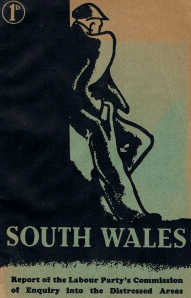
The Brambled Road to 1948: Health, Poverty & Welfare in the South Wales Valleys, 1928-48.

Unemployed miners getting coal, Tredegar patches, the late 1920s.
The Condition of the People of the Valleys:

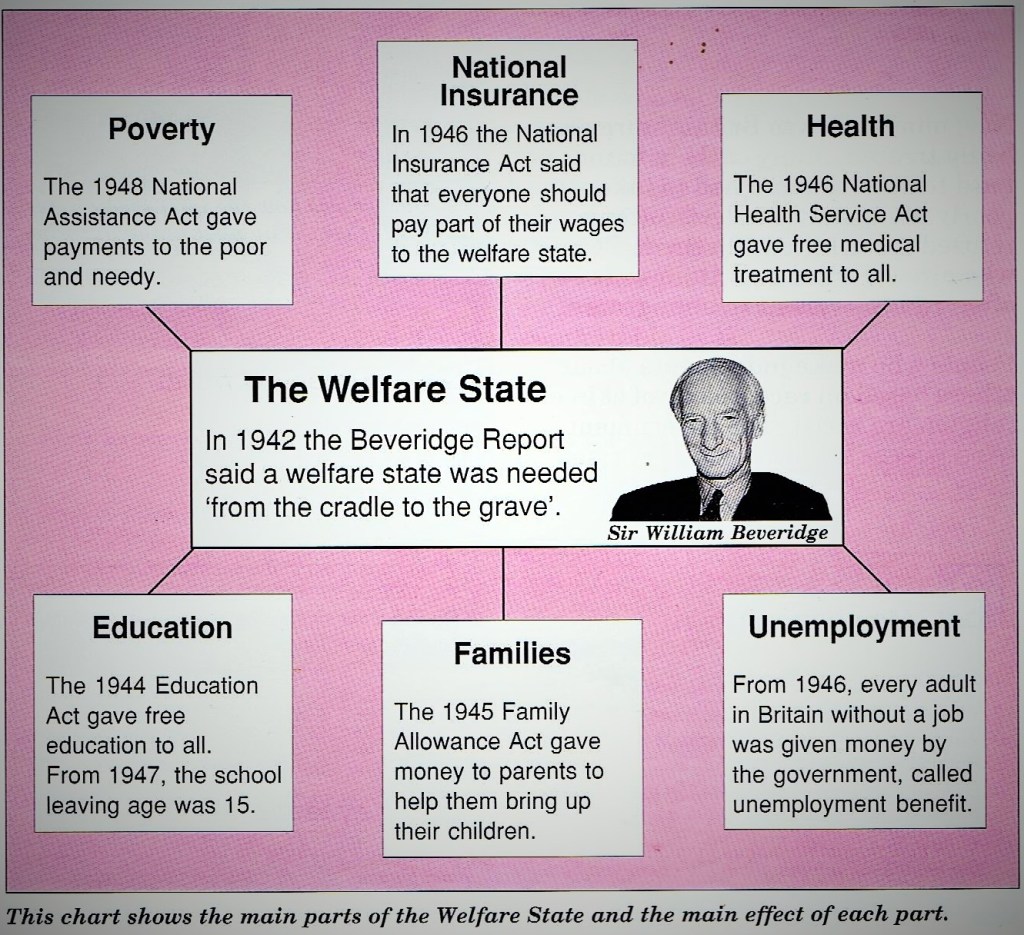
Most reflective articles relating to the National Health Service I have read or heard in this seventy-fifth anniversary year have seemed to concentrate on those years since its foundation, almost as if it suddenly materialised fully formed from Aneurin Bevan’s mind. Apart from limited and brief references to the Tredegar Scheme as the source of inspiration for Bevan’s national scheme in 1948, very little has been written about its long-term motivations in the broader social and demographic changes affecting Great Britain during the inter-war years. Over the decade since the Great War, the population growth accompanying industrialisation had already been slowing significantly. The population of England and Wales had almost doubled, despite relatively high levels of outward migration. The growth rate between the wars was only about a third of that experienced throughout the Victorian era and only half of that about a third of that of the Edwardian period (1901-1914). This deceleration in Britain as a whole increased the drift of the population to the Midlands and South East of England and had it not been for the degree to which South Wales stood out against this trend by maintaining a high rate of natural increase throughout the period, the effect of the scale of out-migration could have been far more catastrophic. Indeed, this was an observation made by those entrusted with planning for the post-war reconstruction of the Welsh economy, the Welsh Reconstruction Advisory Council (WRAC), in their First Interim Report (1944: pp. 13-14).

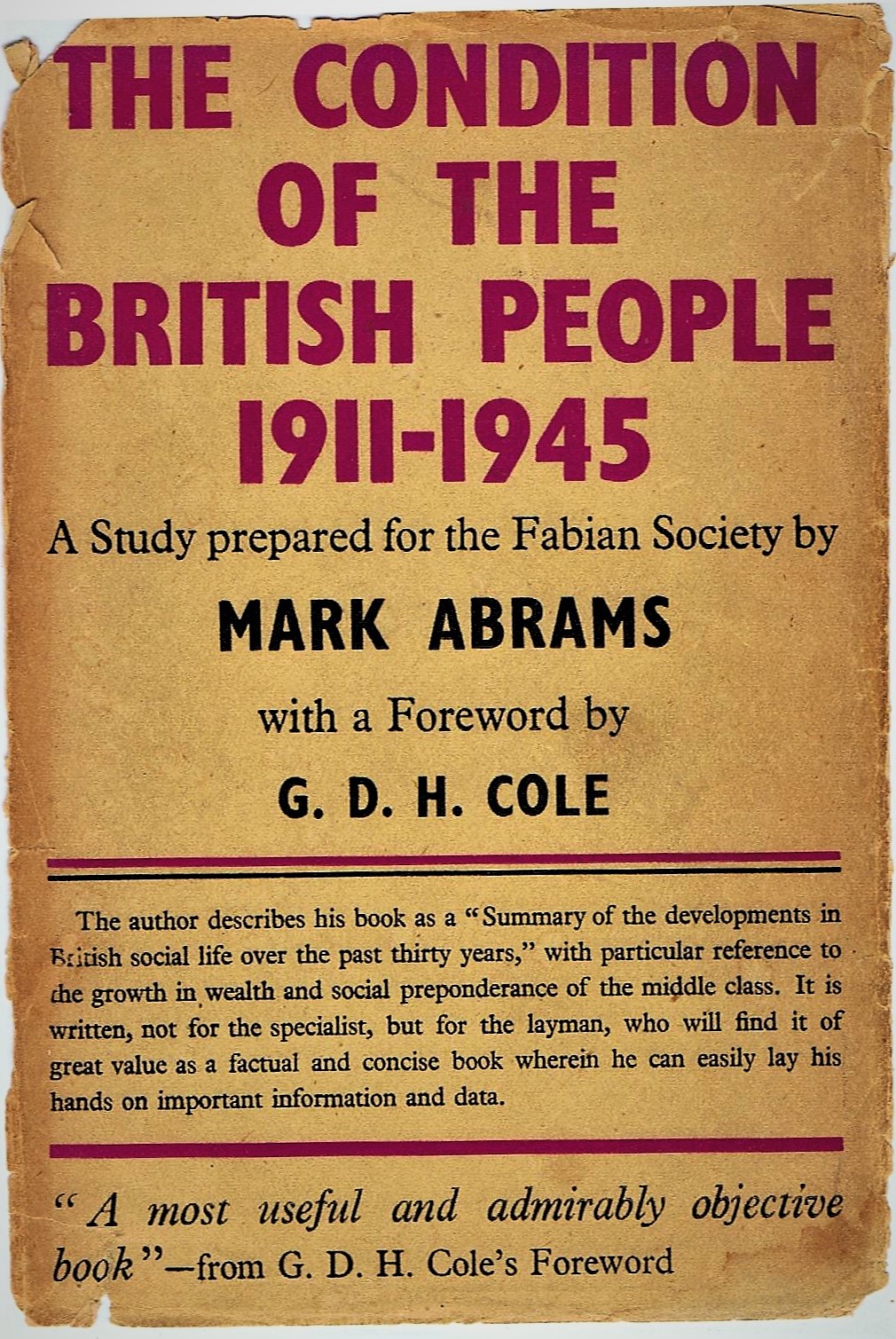
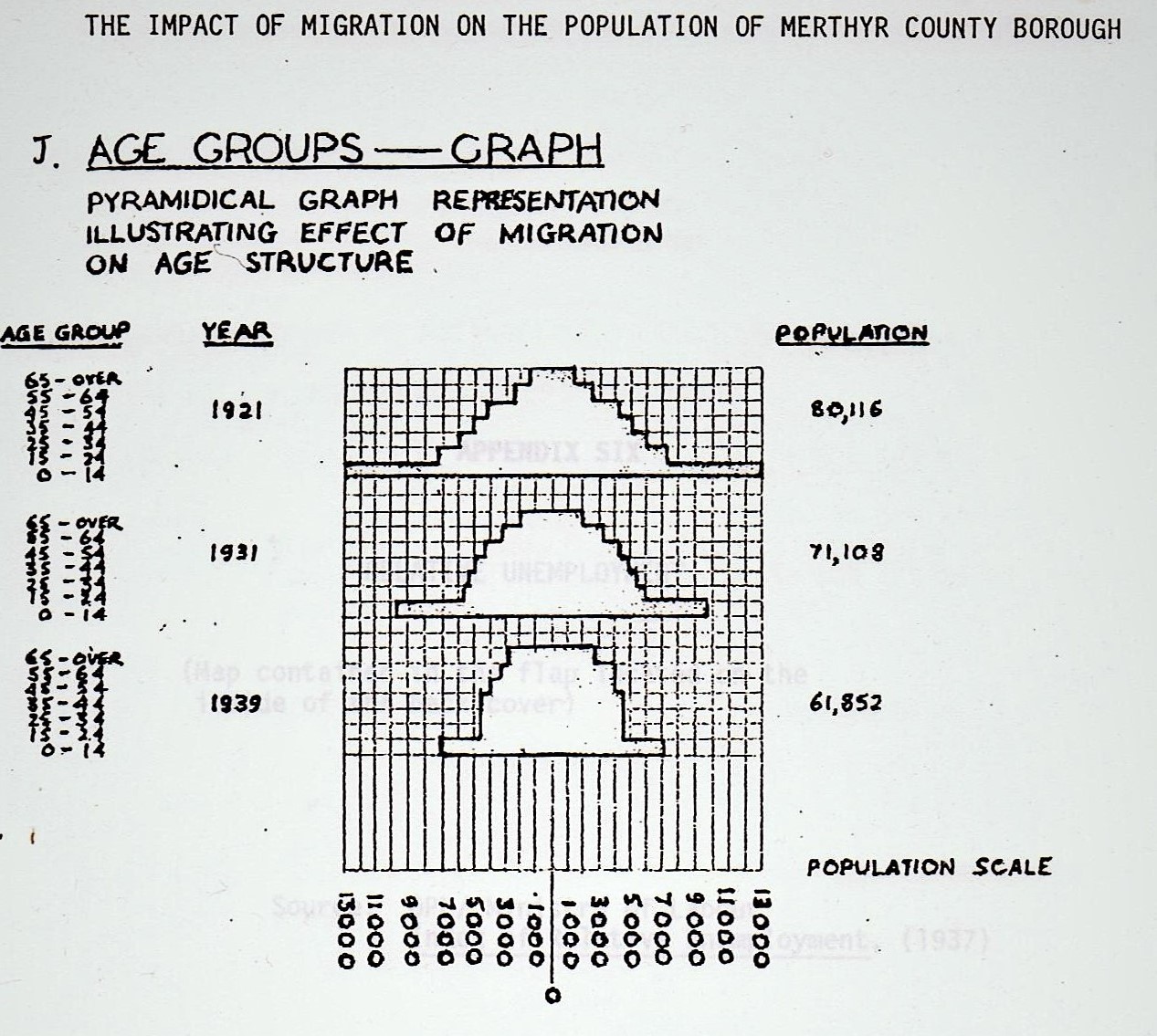
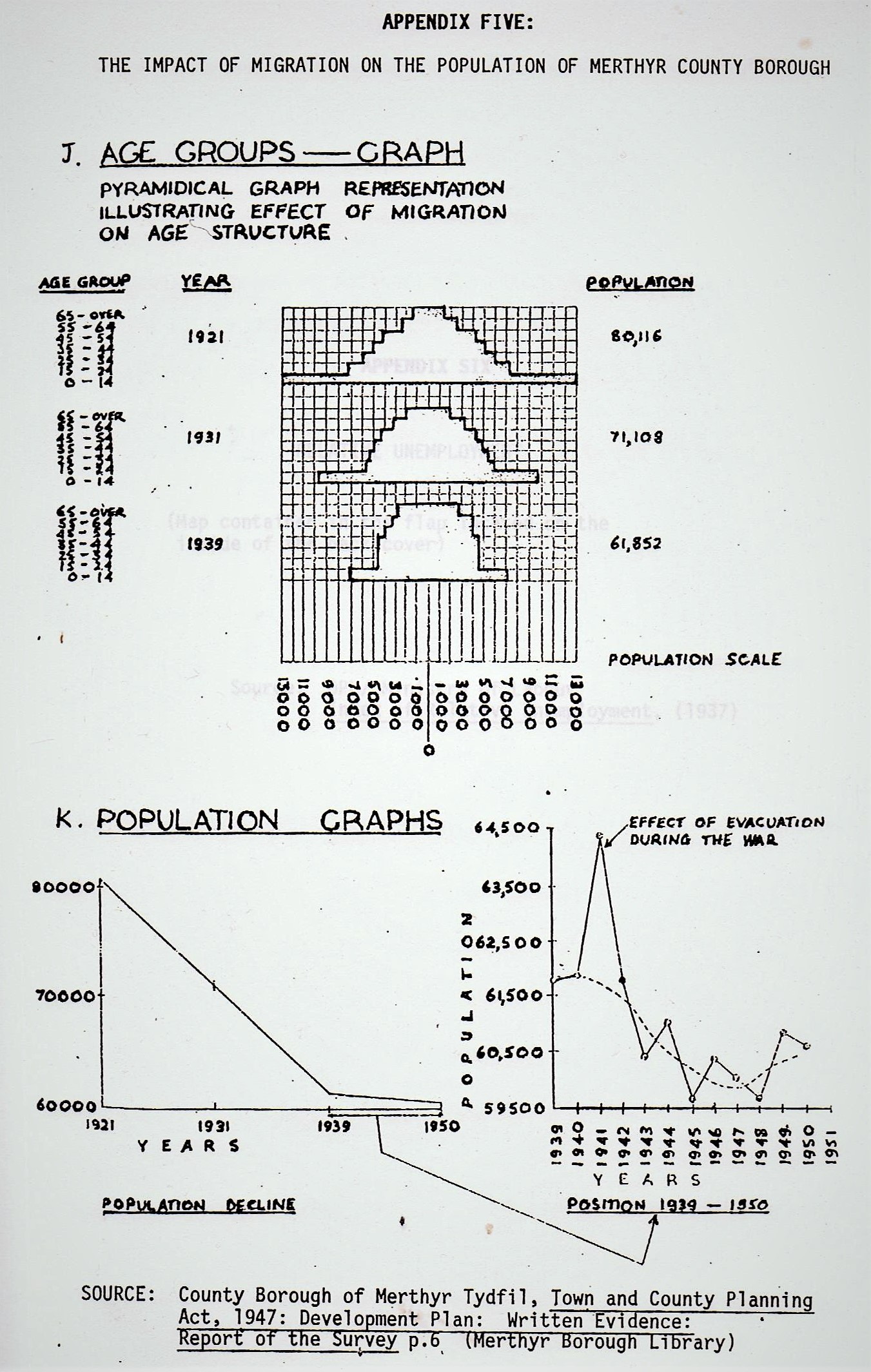
A deeper cause for concern was reflected in the age structure of the population. For the first twenty years of the twentieth century, South Wales possessed the youngest population in Britain. Due to its high birth rate, a third of the 1911 Welsh population was to be found in the 0-14 age range and, largely due to the influx of large numbers of young, economically active people, a further forty-seven per cent was located in the 15-44 age range. By comparison, twenty-eight per cent of the British population was under fifteen in this year, forty-seven per cent was between fifteen and forty-four, and twenty-five per cent was forty-nine and over. The inter-war years saw, throughout the whole of Britain, a steady increase in the older age range and a marked decline in the number of young dependents resulting from the falling birth rate and, as might be expected from the above statistics, continuing proportionate growth of the economically active section of the population. The full extent and impact of this can be judged from that, by the end of the inter-war period there was one additional potentially productive member of the national community for every ten such people in 1871. These population changes meant that, while the country’s capacity for consumption increased by eighteen per cent between 1911 and 1938, its human capacity for production increased by twenty-seven per cent. This led one commentator to the conclusion that…

… at least from the point of view of material well being, the composition of Britain’s population in 1938 was more effective than it was a generation earlier.’

Mark Abrams, The Condition of the British People, 1911-1945: A Study Prepared for the Fabian Society. London: 1945, p. 22.

However, this benefit was not evenly distributed throughout Britain. Between 1921 and 1938 the South and Midlands experienced a loss of 12.5% in the 0-14 age range, a gain of 3% in the 15-24 age range, and a gain of 22% in the 25-44 age range. The respective, comparative figures for Wales showed a loss of 27%, a loss of 20% and no change in the latter group. By 1938 South Wales had been relegated from having the youngest population in Britain to a position where it had fallen behind the national average, and well behind the Midlands and South East in terms of the proportion of its population made up of 15 to 34-year-old males. Clearly, the inheritance of the pre-war years had been quickly lost.

There were five factors involved in the changing age structure of the population and the unevenness of these changes between regions. Here I wish to identify and examine four of these – birth and death rates, infant and maternal mortality. These were all directly though not exclusively connected to the general health of the population, as well as more indirectly to the fifth – migration – which I have dealt with in other articles on this site, based on my original research. Firstly, it is worthy of note that even in the trough of the Depression, in 1931, South Wales, along with Scotland, Northumberland and Durham, still had the highest birthrates in Britain. While their birth rates were declining significantly compared to what they had been in 1911, they were able to sustain their overall population throughout the interwar period and beyond through these comparatively high levels of fertility.

This was also an observation made by contemporaries, such as J. D. Evans of University College, Cardiff, when he reported to the Nuffield College Reconstruction Survey in 1942. In particular, he pointed to the way in which the ‘voluminous outflow of youth from the distressed areas of South Wales was offset by the high fertility of the people.’ In 1934, South Wales still possessed a birthrate per thousand of 16.1 compared with 15.4 in the West Midlands and 13.9 in the South East, at a time when both the English regions were emerging prosperous from the Slump, though the Coalfield was still experiencing high levels of mass unemployment. It was not until the years 1937-39 that the rate of births among women in South Wales fell below those among West Midland women.

Quite clearly, this decline in the birth rate, coupled with the continued migration of nearly half a million people between 1920 and 1940 would have inverted the age structure of South Wales from what it had been at the beginning of the interwar period, had the Second World War not intervened. What is remarkable is that the birth rate continued at such a high level throughout the depression years. These regional disparities cannot be explained in terms of relative economic security. Historians have pointed to the involvement of women in the manufacturing industry of the West Midlands and Lancashire as an important element in spreading effective birth control techniques; the highest birth rates continued to be recorded, throughout the period, in those industrial areas where employment was mostly dominated by men.

During the interwar years, the annual death rate for Britain as a whole remained at around twelve per thousand of the population. However, when corrections are made for the changing age composition of the population, it becomes apparent that the rate had fallen by approximately twenty-five per cent between 1911 and 1939. On the surface of it, this represented a substantial improvement in the health of the country as a whole, but once again a national average figure disguised marked regional differences. Mark Abrams summed these up as follows:

‘In the three years before the outbreak of this war, regional differences were so great that a train journey of less than a hundred miles was sufficient to take one of the areas with something like the lowest death rate in Europe, to areas where the returns were little better than those for Britain as a whole in the first decade of this century’.

Mark Abrams (1945), p. 26.

The crude death rates are insufficient to reveal this disparity. A truer picture can be gained by comparing actual deaths with expected deaths. These calculations demonstrate that deaths were well above average in the comparatively youthful populations in the North of England and South Wales, average in the Midlands and below average in the South East of England. In reality, in the period 1937-39, South Wales had a mortality rate seventeen per cent higher than that for England and Wales as a whole, and thirty-one per cent higher than that in the South East. This difference was almost as great as that between Britain in 1911 and in 1939, giving further evidence of there being ‘two Britains’ not far apart in physical distance but nearly three decades apart in terms of the relative physical health of regional populations.

In 1938, Richard Titmuss published his groundbreaking study, Poverty and Population: A Factoral Study of Contemporary Social Waste, in which he attempted to assess the extent, character and causes of social waste and to relate the findings to the problem of an ageing and diminishing population. Titmuss set out to analyse two factors which he considered to be significant in this process. Firstly, those regions suffering from ‘economic under-privilege’ and most exposed to malnutrition contained by far a higher proportion of children and secondly, it was only higher fertility that prevented a calamitous fall in the size of the population. Titmuss produced statistics showing that in 1936 over a tenth of deaths in South Wales were of children under the age of four, compared with 8.5% in the South East, and that more than half the deaths in South Wales occurred before the age of sixty-five, compared with forty-seven per cent in the South East.

Infant mortality was also much higher in South Wales, at sixty-three per thousand, from which he calculated that there were five thousand excess deaths of infants under the age of one in the North of England and South Wales during 1936, or approximately thirty thousand surplus deaths since the depth of the slump of 1931. Deaths from measles were proportionately twice as high in Wales as for England and Wales as a whole, implying a widespread prevalence of rickets, malnutrition and poverty. In the years 1931 and 1935, whilst the South East showed a considerable improvement in the numbers of infant deaths, in South Wales, there was a continuing deterioration.

Similarly, maternal mortality rates in the region were well over twice those in the South East, and Titmuss felt able to state that if the maternal mortality rates in the region had been the same for Greater London, the lives of 586 mothers would have been saved. Female deaths from tuberculosis in the fifteen to thirty-five age group in South Wales were seventy per cent above the average for England and Wales. Titmuss went on to calculate that the number of avoidable, premature deaths in the North of England and Wales in 1936, a year of relative prosperity, was 54,000 and that the cumulative number over the previous ten years was of the order of half a million. The high levels of infant, child and maternal mortality, taken together, can only be fully appreciated when it is realised that forty per cent of the total child population in England and Wales was situated in the two older industrial regions, whereas the proportion of the adult population located there was little more than a third.

Unemployment & Health:

However, though the regional contrasts are striking, it is difficult to isolate relative poverty from other factors such as climate, housing conditions, and quality of medical and social services. H. W. Singer’s (1937) study for the Pilgrim Trust on Unemployment and Health is helpful in this respect by isolating the effects of the general trade depression, or ‘slump’ of 1929-34, and correlating the unemployment statistics during these years with a range of indices of health for seventy-seven boroughs throughout England and Wales. In this way, the differences between these localities in terms of regional variations in other conditions could be eliminated. Through this process, Singer was able to identify a correlation between rising unemployment and a rise of twenty per cent in both infant mortality and maternal mortality.
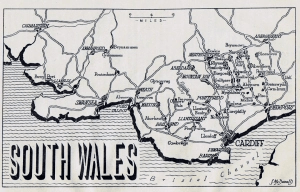
None of the data examined by Singer failed to exhibit some sort of correlation with unemployment, and it was certainly the view of those who visited South Wales and gave anecdotal evidence that there was a direct correlation between the economic distress of its population and their health. Levels of voluntary Health and welfare provision across South Wales were considered greatly inferior to those in other regions, though varying greatly across the region itself. Philip Massey, in his (1937) Portrait of a Mining Town, argued that the majority of the unemployed in Blaina and Nantyglo could be described as having a diet which was inadequate according to the standard set by Medical Officer of Health, Sir John Orr, published in his Food, Health and Income the previous year. Those whose weekly expenditure on food was five to seven shillings per head had a diet which was adequate only in total proteins and total fat; this category also included many families whose ‘head’ was in work. Those in work could afford expenditure of up to nine shillings per head ön food, but perhaps the majority of ‘wage-earning’ families, would have a diet adequate in energy value, protein and fat, but below standard in minerals and vitamins.

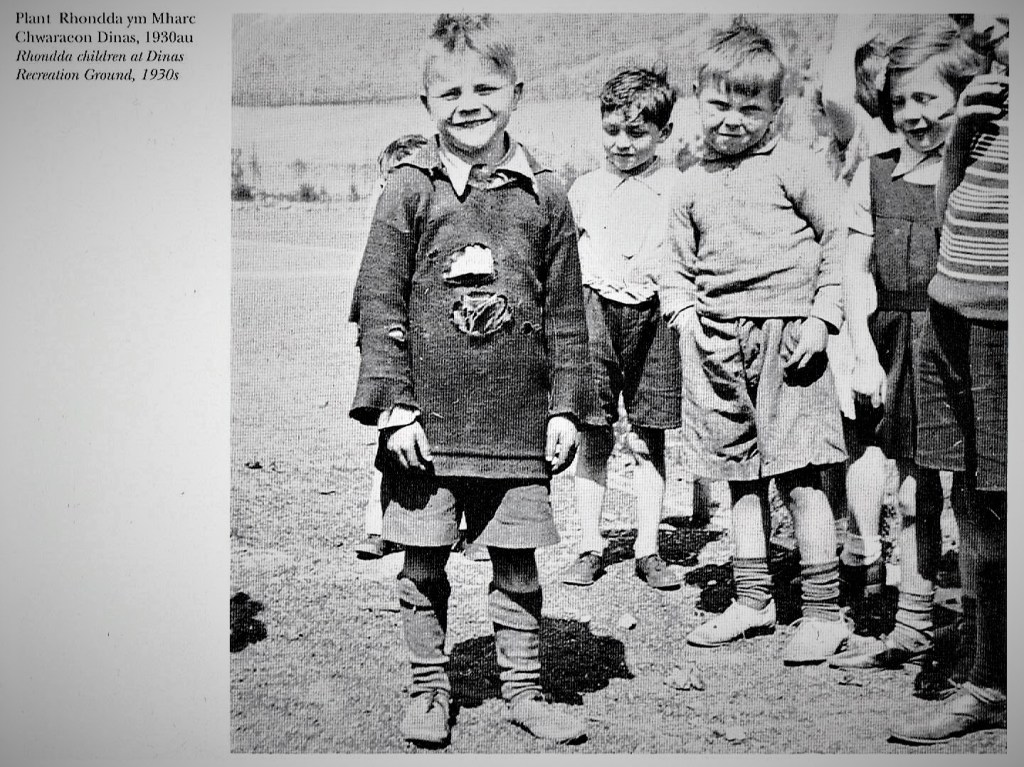
Evidence of the effects of this poverty of diet is found in the information given in the reports of the local Medical Officers and school authorities. In a joint report for the Ministry of Health entitled Distress in Wales, J. Llewellyn Davies, Pethwick-Lawrence and Evans provided stark evidence of the impact of poverty on families in the Monmouthshire valleys. The children of Abertillery in 1928 were said to be suffering from a lack of ‘tone’ and had less ‘grip’ than previously. The average weight of the girls showed a falling off at all ages. Despite the provision of free meals to ‘necessitous children,’ non-attendance had risen from about six per cent in the winter of 1926-7, to about nine per cent in the winter of 1927-8. In nearby Blaina, a medical examination in that same year had found 423 out of 3,245 children to be physically subnormal from lack of nourishment. In the case of 250 of them, or nearly eight per cent, their condition was attributed directly to poor family conditions. It was also reported that 247 school weeks were lost in the last quarter of 1927 due to a lack of boots, stockings, and other clothing, unemployed families having ‘literally no means except private charity’ from which clothing could be obtained. Without this help, the child population of Blaina, Nantyglo and Abertillery would have had no boots and the rest of their clothing would have been ‘worn to shreds.’
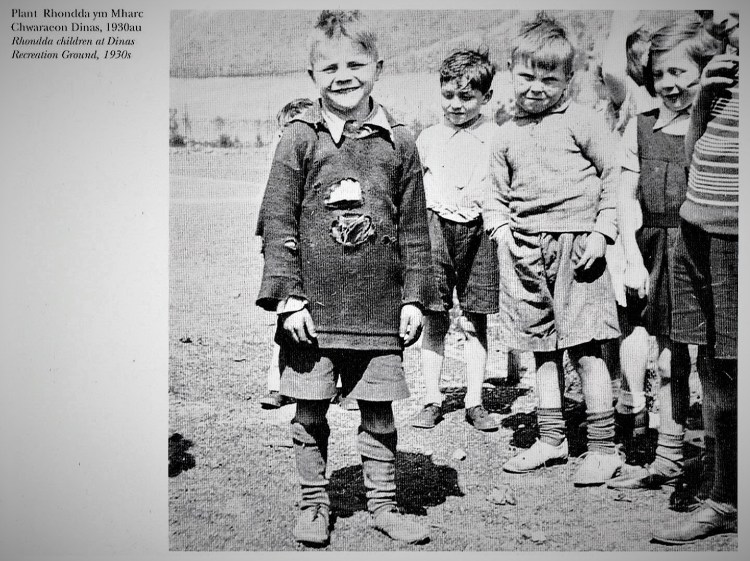
Whilst the provision of basic welfare services on a voluntary basis may have mitigated their effects on some children, they were inadequate in assisting impoverished families as a whole. Indeed, such services as did exist were often under great financial pressure themselves. For instance, in 1928 a small deputation led by George Hall M. P. pressed the case of Blaina Hospital to the Ministry of Health. The hospital’s income was dependent upon contributions paid weekly by miners so the effect of the general closure of pits in the district was disastrous. Its account was overdrawn to the extent of Ł2,000, and, whilst income for the year was estimated at Ł2,500, costs were expected to be of the order of Ł4,000. This was not an isolated case, according to reports. Clearly, the many hospitals in the valleys of South Wales and Monmouthshire funded through voluntary schemes would struggle to survive prolonged stoppages in the coal industry.

The combination of long-term unemployment, the resulting poverty, poor housing and overcrowding experienced by the communities at the heads of the valleys took a heavy toll on the health of their population. In Merthyr in the late 1930s, the number of women suffering from tuberculosis was nearly two-and-a-half times the standardised average for England and Wales as a whole; among men, it was one-and-a-half times. One infant in every five died before the age of five, and malnutrition, rickets, diphtheria and pneumonia were widespread among schoolchildren. Already by 1932, the average age of death in the borough was down to forty-six years.

In 1937, a further official survey on the health of boys at the Blaina Boys’ School, quoted by Philip Massey, revealed that, though the condition of many children was better than in the previous report from the town, there were still serious problems in many families. On the wet day when the inspectors made their visit, forty-three per cent of the boys had damp or wet feet. More than a quarter of the two hundred or so at the school had clothing which was ‘poor’ or ‘bad’ whilst only four had clothing which could be described as ‘good’. Those deemed to have nutrition which was ‘slightly subnormal’ or ‘bad’ amounted to 28%, as compared with the national average which showed only 11.5% in these groups for 1935. The Medical Officer also noted that there were a number of undersized boys.

Massey also confirmed the view of Titmuss, Singer and others, that it was the women in these communities who suffered most from ill health, and in a variety of ways. Whilst the men seemed to look their age, with the exception of those suffering from industrial diseases, the women generally looked older than they were due to the hour-by-hour strain and the lack of holidays or any opportunity to leave the home apart from the weekly shopping trip or the occasional visit to the cinema. Women were often reluctant to admit themselves to the hospital, in cases of childbirth or illness, as they thought that the household would get into a muddle in their absence. Massey also noted that there was no birth control clinic in the district and that many women, fearful of having to rear more children on the dole, would undermine their health by using aperients.

The fact that South Wales maintained a relatively high birth rate and a lower-than-average crude death rate throughout the 1930s, enabling it to end the decade with an age structure roughly comparable to that of England and Wales as a whole, should not blind social historians, as it did some contemporaries, to the fact that, according to R. M. Titmuss, as many as sixty-five thousand of its inhabitants may have died ‘avoidable’ deaths in the period 1926-36. There certainly was a good deal of contemporary complacency, as other ‘surveyors’ of the coalfield testified. Hilary A. Marquand of University College, Cardiff, who was to succeed Nye Bevan as Health Minister, warned against this in his (1936) book, South Wales Needs a Plan, and M. P. Fogarty followed this more optimistic, though measured analysis with his post-war report on Prospects of the Industrial Areas of Great Britain.

Contemporary Images of the Coalfield Communities:

But the quantitative evidence only tells part of the story of the decline in health and well-being of the valley communities. Recent historians of inter-war South Wales (over the past half-century) have had to deal with a variety of optimistic and pessimistic definitions and images provided by contemporary social investigators as well as immediate post-war historians. They have written using the familiar tropes of ‘The Distressed Coalfields’, ‘The Depressed Areas’, ‘The Unemployed’, ‘The Black Spots’ and so on. These frequent ‘turns of phrase’ need to be seen alongside the complex realities of life experienced by the coalfield communities and the families and individuals that composed them, which have become blurred into popular images in print and film.
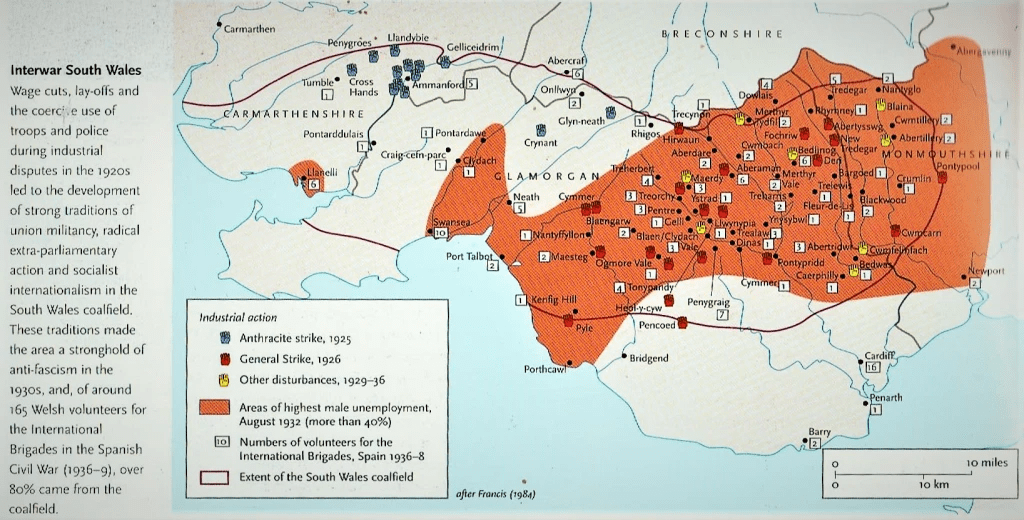
Within a British context, South Wales in the 1930s was viewed as a ‘problem’, a ‘depressed area’ or latterly and more euphemistically, a ‘special area’, following the growing acceptance of the need for ‘Planning’ by leading economists and politicians from the Spring of 1937 onwards with the publication of the journal of the same name by the new forum, Political and Economic Planning. For them, it was a ‘problem’ to be dealt with by national agencies, whether voluntary or state-managed. The ground of the argument was about how to deal with the problem, and most of these agencies arrived in South Wales with a prescription of one type or another, having already made their diagnoses from afar. They then made sure to make that the symptoms fitted these diagnoses. After all, the statistics were now available and formed the bedrock for the formulation of policy.

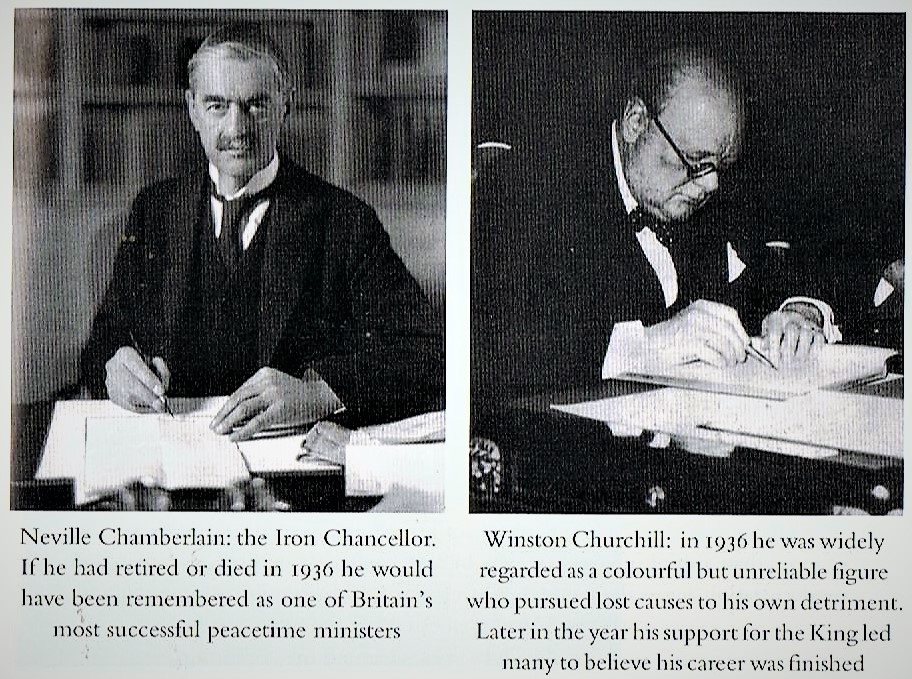
The professional and commercial strata of South Wales society were umbilically attached to a notion of progressive imperialism. The deputation of churchmen who, in July 1937, met Neville Chamberlain, who was steeped in the same Liberal Imperialism that the Birmingham Unitarian dynasty had been for the previous half-century, reflected this:

‘They were there because the community of which they were a part was slowly breaking up… It was a great community and they did not think that the British Empire could afford to see it passing.’

Western Mail, 23 July 1937.
During the 1930s, Hollywood captured the masses in its films, which increasingly appealed to critics and intellectuals. Educated film-goers in Britain were also beginning to appreciate those qualities which the masses had always detected and in particular they were at last spotting that there were forms of ‘social realism’ in American cinema. Peter Stead has written an essay (in Wales, The Imagined Nation: 1986 – see ‘Sources’) about how, together with this realisation, there came a new awareness that it was precisely this quality that was missing in British films. By the late 1930s, there was a crescendo of demand for a fuller sense of Britain in British films. The constant sniping of the critics, the dissatisfaction of directors and the relaxation of censorship all sanctioned the emergence of ‘social cinema’. This was a real turning point in the history of the British film industry, but, hardly surprisingly, it was Hollywood that both inspired and encouraged the change. The dark days of the Great Depression in the United States had taught Hollywood that there were audiences for films that admitted that not all was right with the world.

The British studios duly noted that there were audiences for ‘social problem’ films and that, in any case, the censors were becoming more lenient. Following the 1937 Quota Act, American companies began to establish their own studios around London so that they could make ‘British’ films, and it was under these arrangements that MGM made The Citadel in 1938. Several British critics thought that this was one of the best British films ever made and comments followed about the very apparent American production values, as well as about the emergence of Robert Donat as a Hollywood star. The film also offered an authentic sense of London and South Wales. Hollywood loved middle-brow best-sellers, with libraries and bookshops providing free publicity, and A. J. Cronin was very keen for his story about the ideals of a young doctor to be filmed. He could never have foreseen that the film would be so well made; there were some early location sequences which rooted the film in the South Wales valleys that the documentary directors Ralph Bond, Donald Alexander and John Grierson had already ‘discovered.’ In The Citadel, besides the first-class acting of Donat, Ralph Richardson and Emlyn Williams, who contributed some authentic Welsh dialogue, there was a convincingly detailed denunciation of the evils of private medicine.

Britain was ripe for a socially mature Hollywood film, and the Director, King Vidor, was well known in ‘tinsel town’ for making socially realistic films that reflected his own brand of rural populism: he was very much for the common man and very much against the sharp practices of all corporations and vested interests. The Citadel offered a fuller view of South Wales than any previous feature film, though it made use of the area for the purposes of the narrative, combining Cronin’s melodrama with Vidor’s own philosophy. The film was mainly concerned with the salvation of its hero: the Christian knight, or Anglo-Saxon individualist who had to discover his true self by pointing the masses towards a higher goal. There was, however, no room in the scenario for organised protest or trade unions and so the ‘stupid’ miners are shown to be passive in support of medical progress, held back by the Aberalaw Medical Aid Society, which becomes the metaphor for all the evils associated with any guild or syndicate of workers. At one point, the young doctor’s wife comments, “Did anyone ever try to help the people and the people not object?”

Diagnosing Depression – The ‘Celtic Complex’:

By contrast, the social survey writers frequently set about their task as if they were embarking upon an anthropological expedition. The editor of the journal Fact, prefacing Philip Massey’s Portrait of a Mining Town, asserted the need for ‘an attempt to survey typical corners of Britain as truthfully and painstakingly as if our investigators had been inspecting an African village. ‘ This, apparently, was why a mining ‘town’ was chosen. He stated that, like African villages, mining communities are isolated and relatively easy to study. Clearly, it was this image of geographical isolation which attracted many of these investigators, as it did film directors; it is hardly surprising that their findings, therefore, tended to reflect this image, even though it was not an entirely accurate one in reality. Many of the philanthropists of the 1930s used the image of ‘isolation’ to justify their concept of social service ‘settlements’ in the valleys, as a means by which the outlook of the coalfield communities could be ‘broadened’. They were attempting to infuse a notion of ‘citizenship’ of a wider community extending far beyond the natural boundaries of the valley.

This liberal-nationalist image of the coalfield was essentially that of a society in which industry had distorted nationality and that, to their regret, this had given the South Wales collier a greater affinity to his fellow colliers in Durham and Yorkshire than, for example, to the tin-plate workers of west Wales. This, to them, was to be lamented, and its fundamental cause was seen as the incursion of an alien people bringing with them an alien culture, infecting the very psyche and mentality of the colliers against their better nature. These people, it was claimed, never shared in the inheritance of Welsh culture and Welsh life. They were alien accretions to the population who had gradually stultified the natural development of native culture.

At a time when pseudo-scientific ideas of eugenics dominated political ideas on the continent, the authors of pamphlets and papers on public health and social service in Wales contrasted the Welsh-speaking miners of the anthracite districts of the western coalfield with the recent immigrants in the Eastern Sector who formed a more or less alien population. This, they claimed, accounted for the acceptance by South Wales miners of economic theories and policies which would appear to cut across Welsh tradition. In a similar vein, the ‘old Welsh colliers’ of Welsh-speaking Rhymney were contrasted with those of Blaina by James Evans, General Inspector to the Welsh Board of Health in his paper to the Welsh School of Social Service Conference at Llandrindod Wells in 1928:

‘In this and other districts where the native Welsh culture most strongly persists and the influences of the Methodist revival… are still felt, there is a noticeable difference in the character and outlook of the people as compared with the districts where the industrial revolution submerged the populace and introduced an economic doctrine and a philosophy of life both of which are strange and unsatisfying to the Celtic Complex’.

James Evans, Report on Conditions in South Wales, 24 March, 1928.

The ‘old Welsh collier’ was seen as being ‘independent in spirit’, the last to apply to the Board of Guardians for relief. These ‘liberal-nationalist’ elements within the Ministry of Health were keen to support the work of the Industrial Transference Board, established by the Ministry of Labour in 1928 because they saw in it the means of removing what they viewed as an alien, disruptive element from the coalfield. They, therefore, helped to ensure that the local authorities kept their levels of relief sufficiently low to encourage the acceptance of transference. James Evans, as General Inspector to the Welsh Board of Health, disapproved of the action of the Bedwellty Board of Guardians in Blaina and Nantyglo, in giving out grants of boots, suits of clothes, underclothes, bedclothes and dress material, besides the usual relief in cash and food.

Evans felt that by doing so they were spreading ‘demoralisation’ throughout the district and that there was general agreement among those competent to judge… that the district should, as far as possible, be evacuated. One of the reasons for his support for this proposal was that, in his view, this district was not as Welsh as other areas of the coalfield, where the people were of a ‘better type’. He wrote to H. W. S. Francis, Chamberlain’s Assistant Secretary, urging him to keep to the transference policy and not to give further funds for additional ‘out-relief’. Writing his internal report for the Ministry of Health, Evans was just one among those who believed that the native population of the region had been corrupted by immigrants with an alien culture and ideology. In 1930, The Rev. W. Watkin Davies, the Minister of Edgbaston Congregational Church in Birmingham published his travelogue, A Wayfarer in Wales. In it, he described the coalfield communities as outposts of hell itself with their inhabitants almost to a man, supporters of the left wing of the Labour Party. Nevertheless, he was pleased to find elements of the ‘Celtic Complex’ still finding a ‘congenial home’ in the Rhondda, most notably through the Eisteddfod and in the rendering of Welsh hymn-tunes – and all this despite the ‘admixture of aliens’ in the valleys. He described Merthyr, after a brief visit, as a hideous place, dirty and noisy, and typical of all that is worst about the South Wales Coalfield.
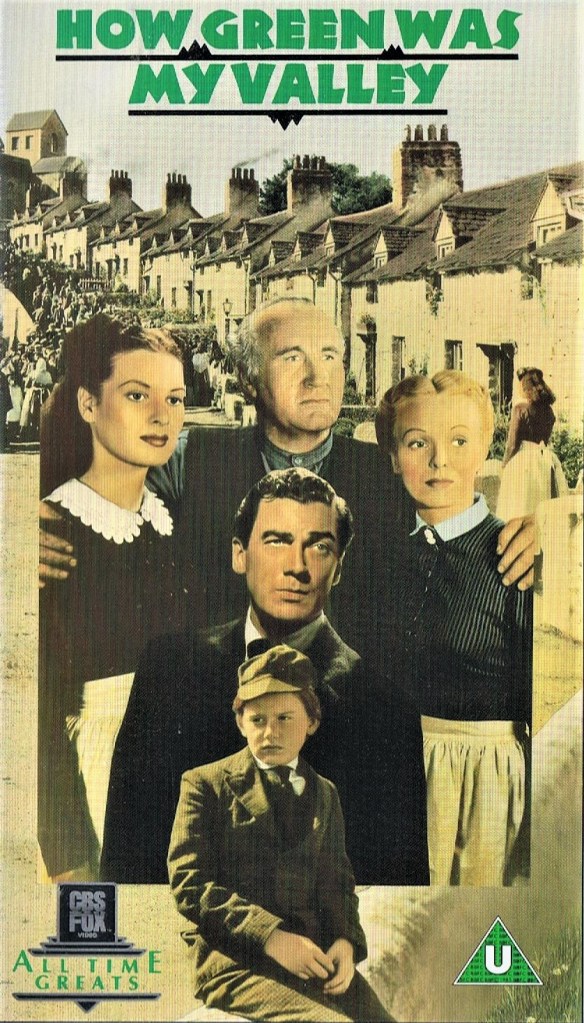
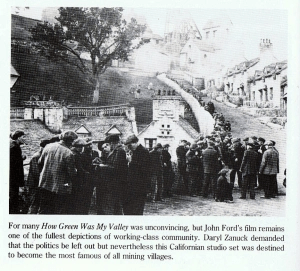
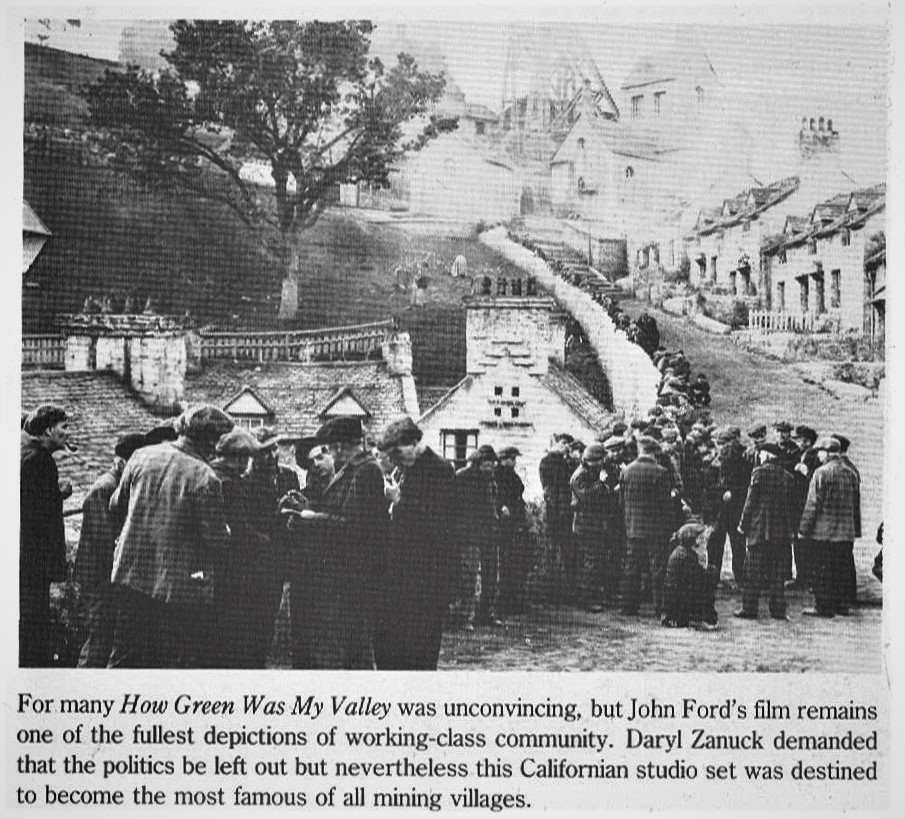
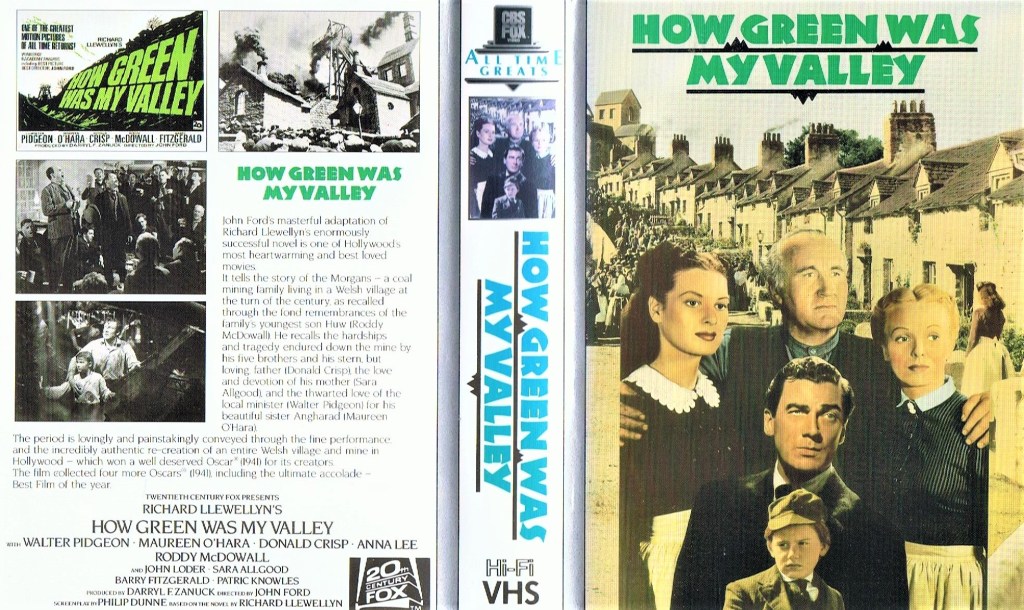
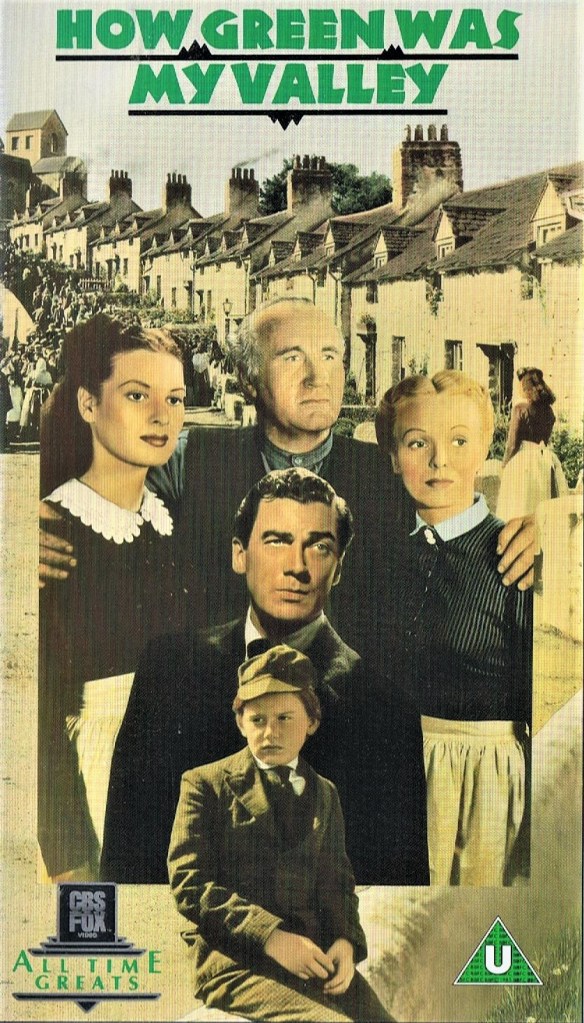
For many of these commentators clinging to the cultural emblems of nonconformist Wales, the coalfield was either a grimy foreign country made up of things which, and people who ‘in no true sense belong to Wales’, as Watkin Davies put it or it was a once noble and pure society which had been desecrated by Mammon and his hosts. Contemporary novelists, especially Richard Llewellyn, saw industrialisation and the resulting immigration into the valleys as a ‘problem’ for the continuity of older Welsh traditions. The central theme of Llewellyn’s (1939) novel, How Green Was My Valley, which was also made into a Hollywood film (1942), is testimony to the widespread acceptance of this explanation of the division between the ‘Coal Complex’ and ‘Celtic Complex’ in the region’s ‘fall from grace’. At the Llanmadoc Conferences held during the war, Welsh ministers were still propagating this image of a coalfield defiled by immigration and industrialisation. Rev. J. Selwyn Roberts of Pontypridd spent only a few lines of his speech dealing with the effect on his community of a decade of large-scale unemployment and emigration, before returning to the theme of the dissolution of the ‘Celtic Complex’ by immigration from the other side of the Severn estuary:

“In addition to those recent losses of its indigenous population by emigration the community life in Wales by emigration, the community life of Wales has also suffered from alien accretions in the past. … The workers who came in from surrounding counties were in the main people who neither brought any definite culture of their own, nor were able to fit into the culture of the Welsh community. This tended to make the bond of community life nothing more than the bond of economic interest, a condition which is fatal to true community life… It is clear that for the last two generations there have been alien factors at work which have almost completely overcome the traditional conscience and spirit of the Welsh people…

Quoted in Pennar Davies et. al., (n. d.), The Welsh Pattern.

Another identifiable set of images was created by a group of ‘propagandists’, and it was these images, in photographs, film and print, which have subsequently been used by historians of the period. Some of them were products of coalfield communities; others were visitors to it. The latter came to the coalfield with a specific purpose in mind, shaped by a belief in a class struggle in which the colliers were in the vanguard. For writers like the avowed Communist Allen Hutt, whose books were intended as propaganda for the times, the South Wales miners were the cream of the working class… the most advanced, most militant, most conscious workers. To add to this neat definition, he gave an equally neat explanation of why they did not rise up against their ‘suffering’:

‘One of the obstacles confronting the revolt of the workers in South Wales is precisely that degradation of which Marx spoke as the accompaniment of the growth of impoverishment under monopoly.’

A. Hutt (1933), The Condition of the Working Class in Britain. London, pp. 44-45.
This image has an empty alt attribute; its file name is 001-1.jpg

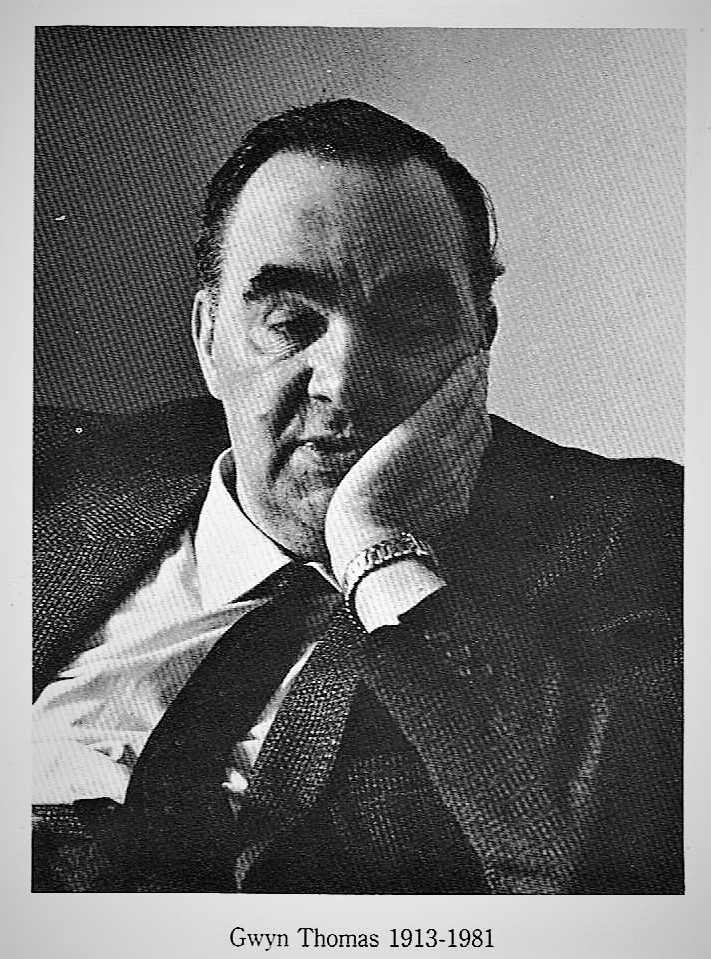
Recent historians have demonstrated how this imagery tended to dominate much of the contemporary discourse, literature, newsreel footage and photography of ‘The Hungry Thirties’ in the coalfield, leaving us to separate the mythology from the real matter of the society itself. The writer Gwyn Thomas, in his (1979) lecture, The Subsidence Factor, described the ‘exodus’ from the Rhondda Valleys, as remembered from his childhood, in a nuanced way, as being like a Black Death on wheels conducted with far less anguish. Historian Dai Smith has written of the socio-economic stereotypes who, black-faced, unemployed or militant, stalk our fictional worlds. In particular, the propagandists’ preconceptions tended to create and perpetuate what may be termed, ‘the myth of the unemployed man’. The stereotyping of ‘the unemployed’ as a uniform group, a ‘standing army’ within British society served the purposes of those who saw the causes of unemployment as correspondingly straightforward. Thus, John Gollan began a chapter on unemployment in his (1937) book, with the following statement:

‘What is unemployment? We would be fools if we thought that unemployment depended merely on the state of trade. Undoubtedly this factor affects the amount of unemployment is absolutely essential for capitalist industry, while under socialism in the USSR it has been abolished completely. Modern capitalist production has established an industrial reserve army – the unemployed; and the existence of this reserve army is essential in order that capital may have a surplus of producers which it can draw upon when needed. Unemployment is the black dog of capitalism …’

J. Gollan (1937), Youth in British Industry: A Survey of Labour Conditions Today. London, p. 155.

Poverty, People and Policy:

By 1929, the number of long-term unemployed was already sizeable in the ‘depressed areas’. In his report to Parliament that February on The Coalfield of South Wales and Monmouth, Neville Chamberlain, then Minister of Health, remarked that many miners had not worked since the 1926 stoppage and that some had not been down a pit since 1921. He commented that even now there are men who regard it as in the natural order of things that they should for all time be provided with the necessities of life without working for them. The intervention of the state in terms of the Unemployment Insurance Act of 1930, which took effect in March under the Labour Government, made it possible for large numbers of workers to survive long periods of unemployment without providing evidence that they were ‘genuinely seeking work’. Its provisions continued in effect until 30 June 1934 when the National Government’s Act establishing the Means Test came into effect.

That this ‘phenomenon’ of long-term unemployment was almost entirely without precedent is shown by Chamberlain’s description of the situation as without parallel in the modern history of this country. He suggested that even ‘the nearest parallel’, that of the Lancashire cotton famine of 1862-64, was ‘not a close one’. Prolonged mass unemployment, distinctly regional in character, was a new social phenomenon which created major problems for ‘Labour’ and ‘Capital’ alike. Given its novelty, it is not surprising that ‘social investigators’ and ‘propagandists’ alike should choose to focus on the long-term unemployed. However, few contemporaries showed any significant awareness of the varying social conditions of unemployed people.

In his (1940) book, Unemployment and the Unemployed, H. W. Singer was scathing about the generalisations in this respect, arguing that there were was no ‘unemployed man’, but only ‘unemployed men’, that there was ‘no uniformity but an intense variety’. He went on to list sixteen independent causes of unemployment and to point out that because work enforced a common routine on the people who took part in it, it was reasonable to expect that when people became unemployed their suppressed individuality would reassert itself. Poverty, the dole queue and the Means Test might all restrict diversity, but that did not mean that the unemployed could be described as:

‘… a uniform mass of caps, grey faces, hand-in-pockets, street-corner men with empty stomachs and on the verge of suicide, and only sustained by the hope of winning the pools…’

H. W. Singer, loc. cit., London, Chapter I, passim.

To begin with, Singer divided Gollan’s ‘reserve army’ into two camps, a ‘stage army’ and a ‘standing army’. Those in the former were the short-term unemployed, out of work for under three months and those in the latter were the long-term unemployed, out of work for twelve months or more. Those in the former category could therefore include workers moving from one form of employment to another, and those ‘laid-off’ or ‘temporarily stopped’ for two or three days a week from the collieries. When temporary unemployment was characterised by the experience of three days’ work and three days’ dole it could be both economically and psychologically more destabilising than being wholly unemployed. One of the few authentic coalface writers, B. L. Coombes commented in his influential (1939) book, These Poor Hands: The Autobiography of a Miner Working in South Wales, that when the Colliery managers called them for a fourth shift, their feelings were not very pleasant, because they knew that had they not been called they would have been able to claim three days’ dole. Despite working all spring and summer, he was not a penny better off than if he had been on the dole. But, he wrote, his case was ‘an average’ one; the older men with big families who had a shilling a day to pay for bus fares were actually losing money by working four days a week.

Men like Coombes who were either young or fit enough to keep working continued to work in the hope that their colliery would soon return to working six shifts, and they would be paid a full-time wage. At the same time, they had to adapt to new methods of coal-cutting by machine. Coombes was a skilled machine operator and well-adapted to the ‘speed-up’ which was happening throughout the coalfield by the mid-thirties. Those who ran a high risk of being relegated to the ranks of the ‘standing army’ of the long-term unemployed were the older colliers who found it harder to get back to the coal face after a temporary stoppage because of their comparative lack of experience using mechanised coal-cutters. The introduction of these did much to destroy the craftsman spirit in the mines and reduced the number of miners required for a specific job, plus it did little to provide higher wages and better conditions for those remaining in the industry. In fact, wages remained depressed throughout most of the period and the ‘speed-up’ that mechanisation entailed led to the repeated claim that conditions were becoming ‘murderous’.

Those among these older colliers who were no longer able to find a ‘place’ underground worked under the constant fear of joining the dole queue on a permanent basis, as did those men advancing towards middle age. Their fear, and the manner in which they tried to hide their poor health as a result, is vividly illustrated by the following passage from Coombes’ book:

‘I sympathise with the older men, and watch their struggle to keep up. I listen to the labour of their dust-clogged chests when they climb the drift to go out. They climb a few steps, pause to regain their breath and watch the younger ones hurry past. Down that coal-drift rushes a current of air that is forced and always ice-cold. This meets the sweating men as they come up and chills them to their insides. It tells on chests that are already weakened by clogging dust and the rush of work.

‘I watch how the few men who are old come to work; how weary they look; how their faces seem almost as grey as their hair; how desperate they are that the officials shall not think they are slower at work than the younger men. I can read the question that is always in their minds:

“How many more times can I obey the call of the hooter? And after I have failed, what then?”

Coombes, loc. cit., p. 222.

For the twenty thousand who were over fifty and were considered to have ‘failed’ and were unlikely to work again, there was a threefold problem. They had lost their sense of purpose as skilled, active workers and bread-winners for their families; relationships with younger, working members of the family became more difficult, particularly if these members were working away from home, and thirdly, they found it impossible to make any kind of provision which would enable them to keep up the home’s standard of living when they reached the old age pension age. The effect of the high level of unionisation in the Coalfield had kept the wage rates much higher than in many other areas of Britain, but the unemployment allowance system on which the long-term unemployed depended, took little account of regional variations.
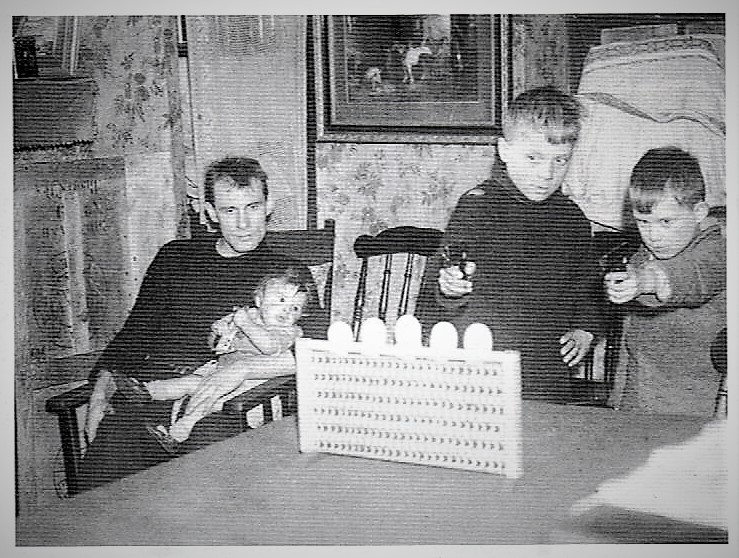
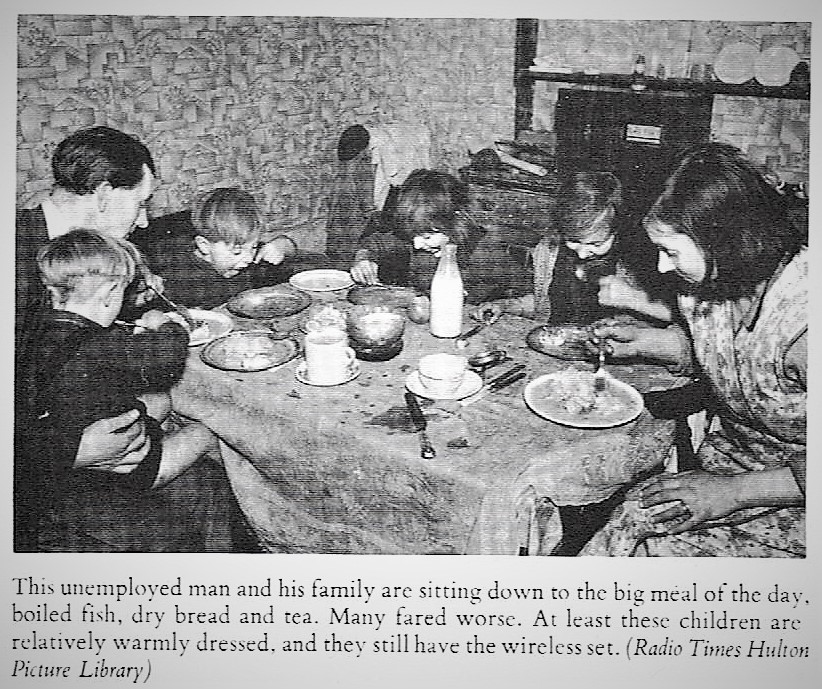
A jobless man with his children at home in Aneurin Bevan’s constituency of Ebbw Vale, 1936.

A skilled collier in prosperous times may have brought home the equivalent of a wage of anything up to eight pounds per week, and when multiple members of the family were earning the economic standard of the family might well have been higher than an ordinary lower middle-class family such as a shopkeeper’s family in coalfield communities. The maintenance system, however, would mean an immediate drop in income of at least a pound a week, even starting from the more precarious levels of pay which existed in the mining industry in the 1930s. The contrast with the older collier’s memory of the relatively prosperous early twenties:

It is just the extent of this drop … which will largely determine an unemployed man’s attitude to unemployment … It is, therefore, the skilled men… that are feeling the edge of their condition of unemployment most keenly, because it is these people that are in fact being penalised by the existing system of ‘welfare’.’

Singer (1940), op. cit., pp. 15, 95-6, 112.
The Break-up of the Coal Complex:

In addition to the problems of the older colliers, youths no longer had the opportunity of learning the craft under skilled colliers, and in many districts, considerable numbers of them were dispensed with some time between their eighteenth and twenty-first birthdays. Moreover, the operation of the Seniority Rule often discriminated against younger men, thus providing them with a strong motive for migration. An array of sources provide evidence that there was a growing antipathy towards coal mining among both young men and their parents.

In his visit to South Wales in June 1929, an official at the Ministry of Labour found that parents were increasingly in favour of their boys migrating rather than working underground, despite the fact that the employment situation had improved to the point where there was a fresh demand for juvenile labour. Another report that year revealed that boys had refused the offer of underground employment in the hope of securing employment in England. In January 1934, the Juvenile Employment Officer for Merthyr reported that of the boys due to leave school at the end of term, less than seventeen per cent expressed a preference for colliery work. A quarter of them stated that they had no particular preference but invariably added that they did not want to work underground. By comparison, a quarter wanted to enter the distributive trades and ten per cent stated a preference for engineering.

This new attitude was shared by parents and offspring alike. In Abertillery, it was reported that most of the boys leaving school in 1932 were anxious to obtain employment other than mining and that their mothers were ’empathetic’ that they should not face the same hardships and unemployment as their fathers… It was the changed nature of the work involved as well as its current insecurity which promoted a preference for migration or transference. The evidence from government enquiries was well supported by impressionistic evidence from social investigators. In his survey of Nantyglo and Blaina, Philip Massey reported that migration was playing its role in the broadening of the minds of the population. He detected the erosion of what he called the coal complex.

A further ‘Investigation’ into the matter by the Ministry of Labour in 1934 found that there were 148 boys unemployed in areas where there were unfilled local vacancies in coal mining. Although only twenty-nine of these boys had stated that they were unwilling to accept mining employment, the report concluded that this antipathy was widespread. The shortage of boys wishing to enter coal mining was most marked in the Ferndale employment exchange area, although managers of all the South Wales exchanges covered by the enquiry reported this changed attitude towards pit work.

Few writers attempted to let ‘the unemployed man’ speak for himself, however, let alone their wives and children. James Hanley did so deliberately in his 1937 work, Grey Children: A Study in Humbug. A number of those interviewed by Hanley also reflected this erosion of the Coal Complex and the concurrent desire of young people in the community to ‘better themselves.’ This desire was often prompted by the extensive reading which lengthy unemployment provided time for. The following quotations from Hanley’s witnesses reveal this connection between migration, a growing disenchantment with coal mining and a broadening industrial consciousness among young men in coalfield communities:

John Jones, forty-six-year-old unemployed miner:

“Lots of them like the open-air life and have come to hate the mine and all it stands for. Many miners refuse to let their boys go below. It’s worrying the owners a lot, I can tell you. There’s a generation that’s grown up now with their eyes wide open, and it looked around and it saw things, and it has seen too the lousy deal that miners have had ever since mines were sunk and they’re having nothing of it… just look at the large-scale emigration from these valleys… most of the young fellows have gone south to England. Just look at Slough and Oxford and London.” It’s not only the absence of work for their fathers and themselves, it’s the… instinctive knowledge that all they’ll get out of it will be the same deal as their fathers had…

“…young fellers … see us who’ve spent a lifetime at it, and they say to themselves, B- it, if that’s what you get out of a lifetime of hard toil under the earth, then to hell with it … the best blood in the land has flowed elsewhere…

A lad who had walked to Oxford and back again, looking for a job at the Morris works, and trying this or that factory or foundry on his way down, but all without successs… : “I’d rather get a job anywhere than in a pit. I wish my family would leeave Wales altogether. It’s so miserable.”

Hanley, loc. cit., pp. 20-21, 131-2, 205-7.

Similarly, the American writer Eli Ginzberg recorded that many of those who left Wales looked forward in a spirit of adventure to settling in communities where coal mining was not the sole occupation. He traced the break-up of the Coal Complex to the summer of 1926, and the freedom from the mines which the stoppage provided. This had prompted many, he argued, to question the advantages of coal mining, a questioning which was intensified by the worsening conditions and reduced pay which followed the return to work at the end of the six-month lock-out. Moreover, the social tensions and divisions which followed the strike, such as in the Garw District, made men more willing to break away and start anew in strange surroundings. Respect for the traditional solidarity of the coalfield communities had been undermined. Migration was therefore not simply a response to unemployment in the coal mining industry, but a rejection of the industry itself. In London, Miles Davies found that the sole factor keeping many immigrants from returning to Wales was their antipathy for colliery work:

Nearly all those who said they would prefer to live in the valleys, made it clear that that they would only return to a job as good, or in the same trade as the one they now hold, and that on no account would they return to work underground. One man in the discussion told how struck he had been on returning to his home village on holiday after several years absence, with the exhaustion of the men he met going home from the pit. He attributed this to the ‘speeding-up processes’ which have been introduced in recent years.

NCVO/NCSS papers; typescript report on Migration to London from South Wales, n.d.
Mothers & the Means Test – its Operation & Opposition:
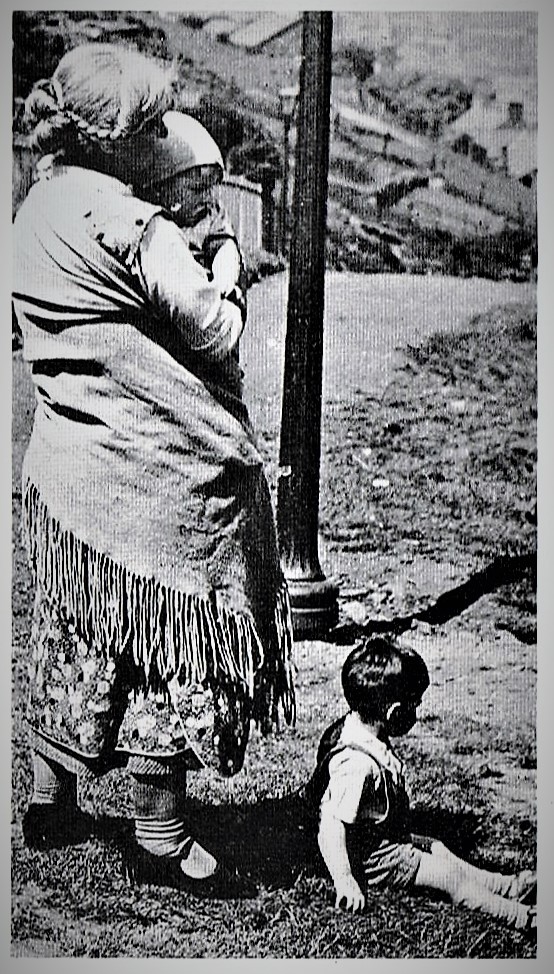
Woman carrying a baby ‘Welsh Fashion, Rhondda c. 1930.

Women became even more antipathetic to the mines as a result of their struggle to manage falling and uncertain wages, and they sought other occupations for their sons. Among those quoted by Hanley was John Williams, who commented on his wife’s mental health:

‘ “My missus is in a mental home. We had a nice little lad, and were not doing so bad until I lost my job, and that and one thing and another, well, I suppose it got to her in that way.” ‘

James Hanley, loc. cit., pp. 9-10.

An unemployed miner’s son also told Hanley of the effect that the introduction of the Means Test had on housewives:

‘ “We’re on the Means Test now. Yesterday I was sitting in the kitchen when the man came in. It made me mad the way he questioned my mother. She got all fluttery and worried, I thought she was going to run into the street. She’s not used to it … Mother is very good in spite of the conditions. It’s wives and mothers who are the real heroines. …” ‘

Hanley, loc. cit., pp. 12-15.
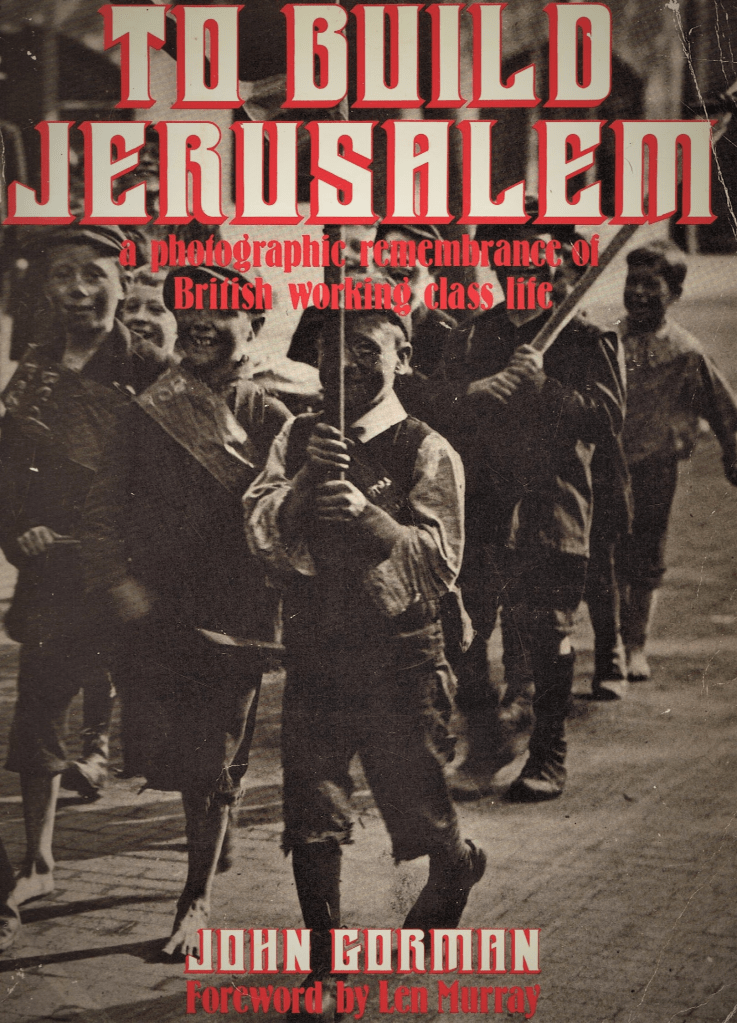
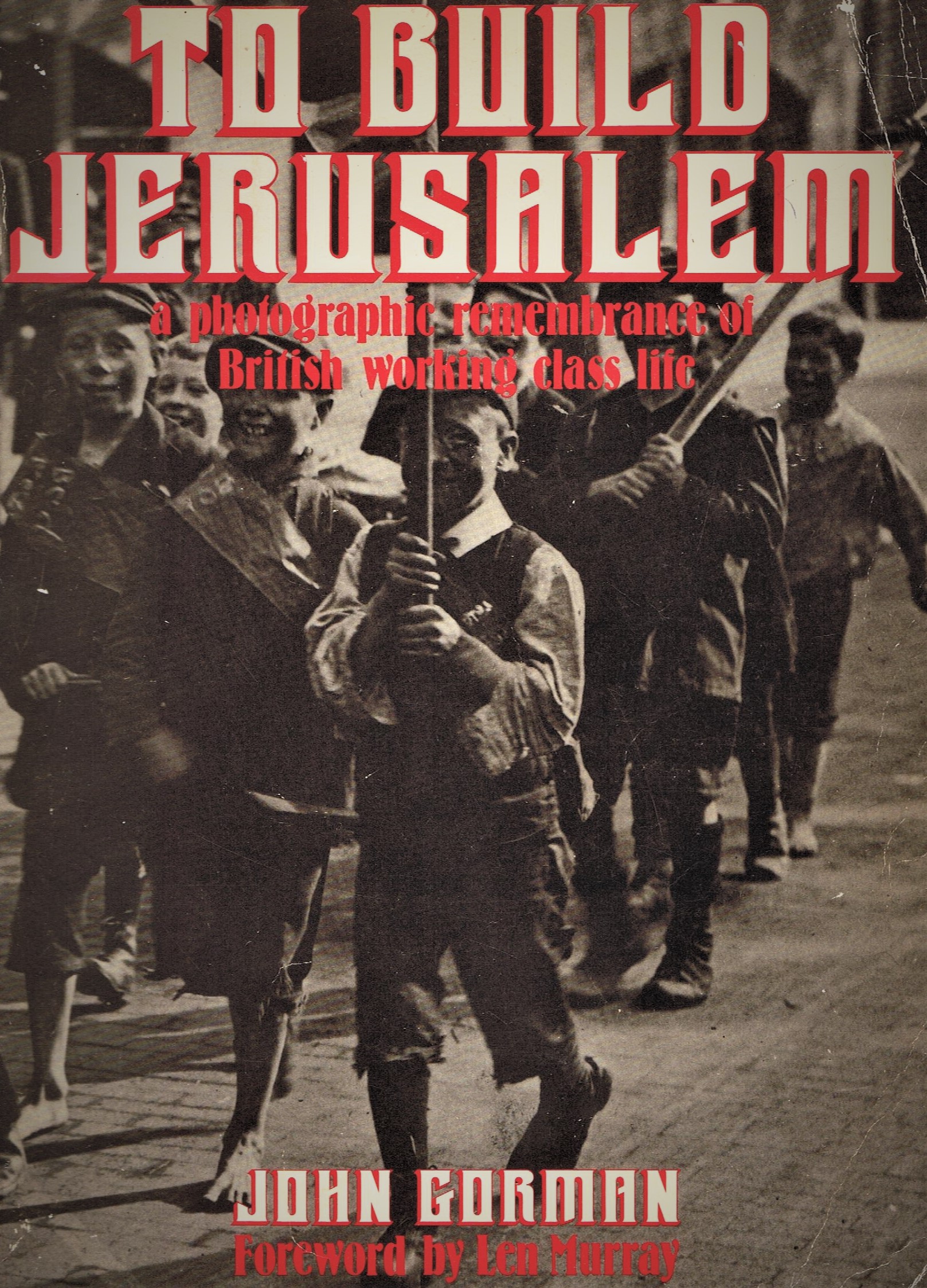
John Gorman wrote in the introduction to his Photographic Remembrance of Working Class Life (1980), that if the means test was synonymous with poverty, then poverty was synonymous with South Wales. In Merthyr in 1936, unemployment was almost sixty per cent nine thousand), and more than seventy per cent of the unemployed were subjected to the means test. Clothes were threadbare, he went on, boots a luxury, soup kitchens a necessity and prosperity a fantasy. Public opinion against the ‘wickedness’ of the principle of means-testing families reached its crescendo in the second half of that year. The iniquitous and petty economies of the National Government that brought acrimony and family division to the tables of the poor were hated across Britain, particularly by those subjected to the bureaucratic inquisition involved. A worker with a newborn child would claim the allowance, only to be asked whether the child was being breastfed. If the answer was yes, the benefit was cut. A fourteen-year-old ‘errand’ boy had his earnings counted and the family benefit was cut accordingly because the son was expected to keep his unemployed father. Mothers deprived themselves of food to feed their children, who went without boots since there was not enough money for food and boots. In the winter months, coal had to be bought for four pennyworths at a time as families struggled to exist without the miner’s allowance and on means-tested benefits.
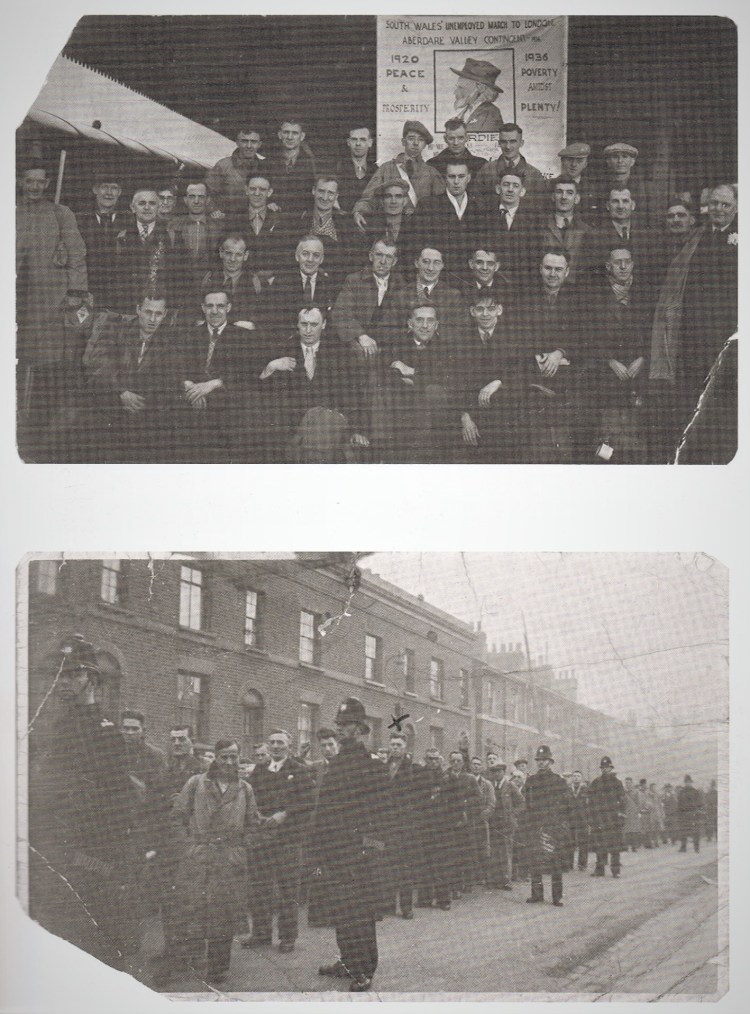
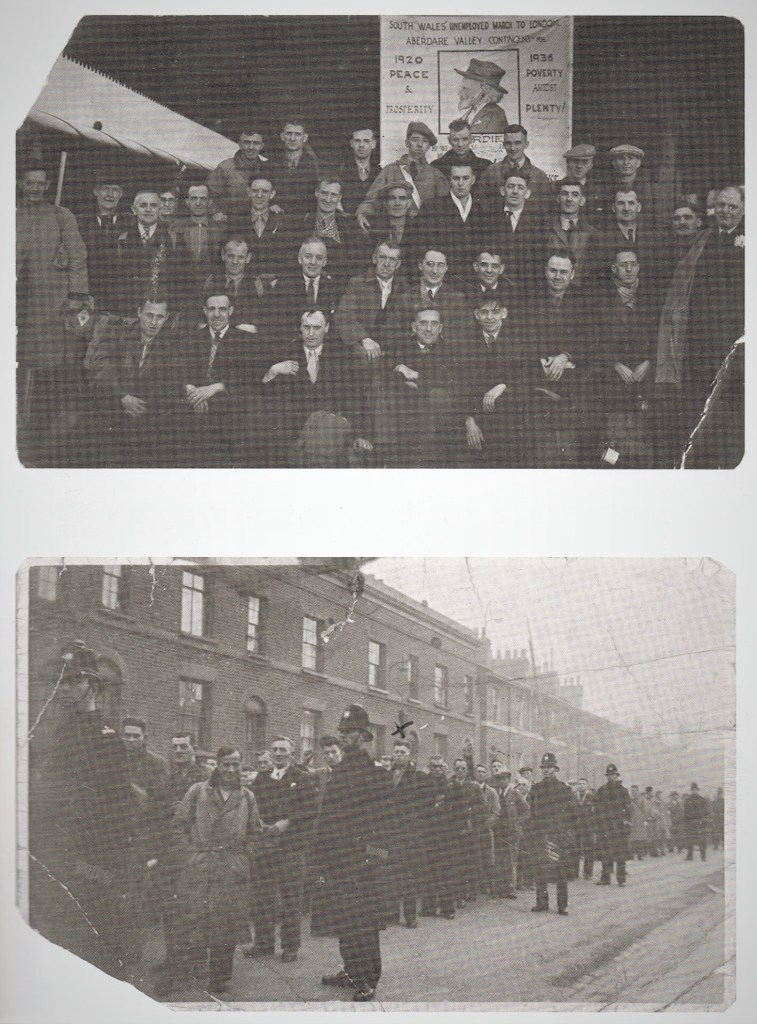
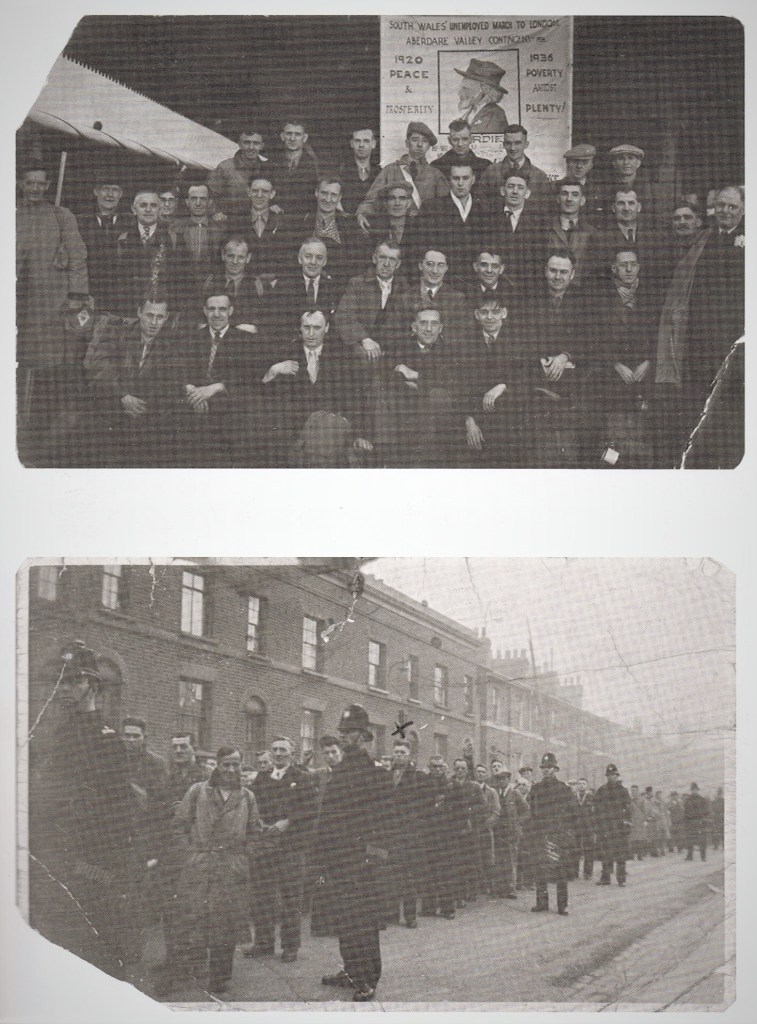
A Welsh contingent of eight hundred took part in the biggest and most united of the hunger marches against the means test in November 1936. Two postcard-sized photographs are shown above. The first appeared in Michael Foot’s biography of Aneurin Bevan (Vol. 1), and was taken by Trevor Roberts, an unemployed miner who marched with the Mountain Ash column and is seen standing next to the banner from the Aberdare Valley with a portrait of Keir Hardie and emblazoned with 1936, Poverty amidst Plenty. This group photograph, taken at Abercynon station on departure to Cardiff for the assembly point, includes officials from the trades councils in the Cynon Valley and Labour councillors. When the South Wales marchers, carrying the Cynon Valley banner reached Slough, they were met by eleven thousand, for by that time Slough had become a ‘little Wales’, peopled by those who had fled the ‘valleys of death’. The marchers joined the quarter of a million at a huge demonstration in Hyde Park. The speakers included Aneurin Bevan who said:

“The hunger marchers have achieved one thing. They have for the first time in the history of the Labour movement achieved a united platform. Communists, ILPers, Socialists, members of the Labour Party and Co-operators for the first time have joined hands and we are not going to unclasp them.”

Quoted in Gorman (1980), p. 28.

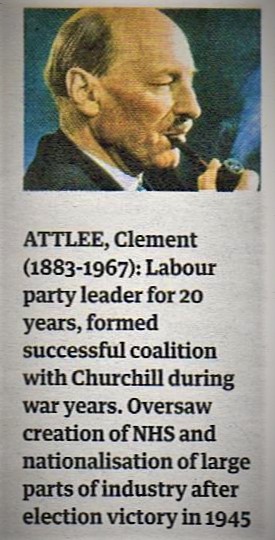
The second photograph (above) shows some of the Welsh marchers lining up at Cater Street School, Camberwell, where they had spent the night prior to the march to the Hyde Park rally. Clement Attlee, newly elected as Labour leader, also spoke at the rally, moving the resolution:

‘The scales (of unemployment benefit) are insufficient to meet the bare physical needs of the unemployed…’

Ibid.

A contingent of women marchers is shown below:
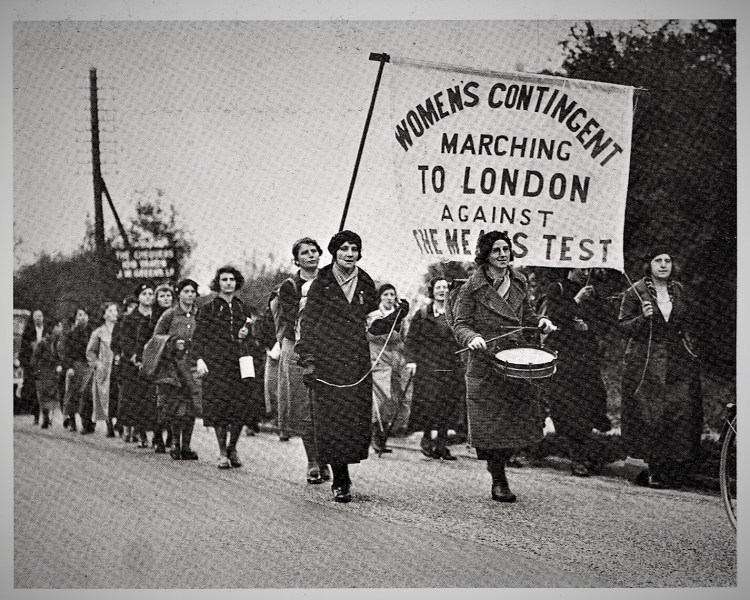
Photograph by Amos Mouls, from the collection of Maud Brown, who took part in the march herself (Gorman, p.154).
The Drivers of Migration & the Obstacles to Transference:

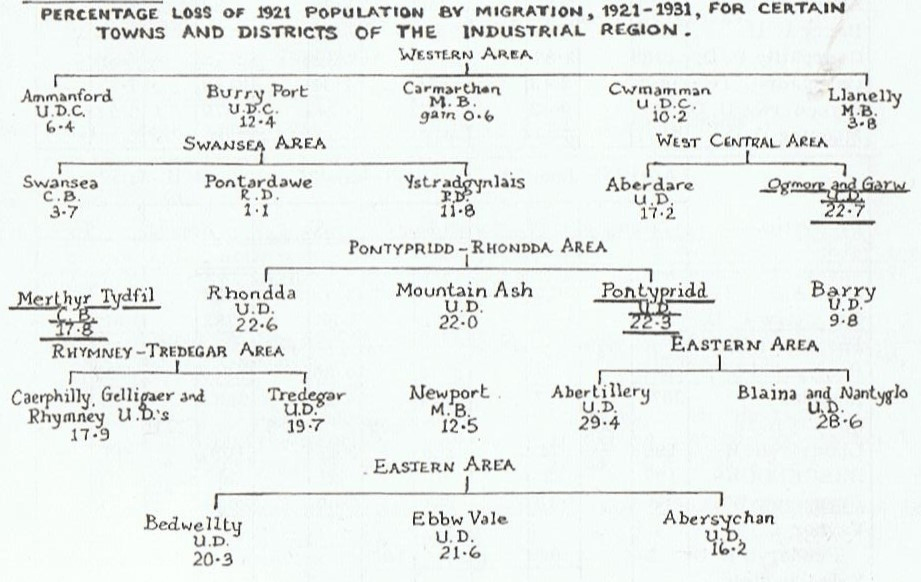
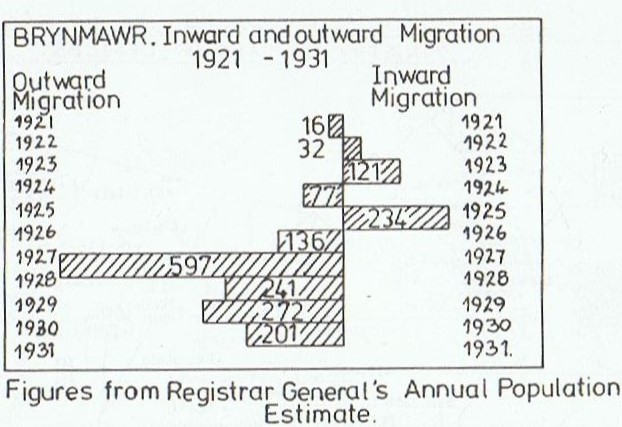
But by the winter of 1936-37, it was no longer simply the appalling conditions accompanying long-term unemployment that drove people out of the valleys to Slough, Oxford and beyond. This author’s own oral interviews in the early 1980s with Welsh exiles in England also bear out the importance of the break-up of the ‘coal complex’ as a major factor in prompting migration. Some individuals who moved did so because they had ‘had enough’ of the mines, whether or not they were unemployed at the time. Despite having members working, some families decided to move to keep younger members from working underground. Young girls were allowed to leave home in larger numbers to go into domestic service, as they had done in Edwardian times because their parents did not want them to marry miners. The post-war shortage in ‘domestics’ led to the advertisement pages of the South Wales press being filled with exaggerated claims about the prospects awaiting young women in English towns as well as in Cardiff and Swansea. Many of the realities failed to these claims, but there is little evidence to suggest that reports of poor conditions or even deaths from tuberculosis restricted the flow of girls from the valleys.

In 1934, 67% of girls about to leave Merthyr’s schools expressed a preference for domestic service. Some would treat this employment as a short-term experience, after which they would go home to play a new role in the family or get married. This tendency was often strengthened by the erosion in the health of their mothers. At the same time, many young men, despite strong pressures to return, would not do so even when the coal industry recovered and jobs became available for them in the collieries. Nevertheless, many others saw their migration as a short-term experience, like that of their sisters. They left home out of a sense of boredom or frustration, often with vague plans. Those who stayed in the new areas often did so having moved on from temporary domestic service or distributive jobs to more lucrative employment in the manufacturing industries.

Despite all the financial incentives for young people to transfer under state supervision, the numbers doing so were very small compared to the volume of those who moved under their own devices and on their own terms, in keeping with the traditions of migration within these communities. To have accepted dependence on the state would, for many, have been an acceptance of their own demoralisation. The purpose of migration was, after all, to escape from what Hanley described as this mass of degradation, and the stink of charity in one’s nostrils everywhere.

In his first Industrial Survey of 1931, Professor Hilary Marquand commented that so large a volume of migration had already taken place, it followed that the surplus which remained consisted mainly of persons whom it was especially difficult to transfer. These included men who needed a long period of ‘reconditioning’ to make them fit for regular work. One of the most significant obstacles to both transference and migration was the widespread ill health bred by poverty and malnutrition. During the first year of the Industrial Transference Scheme, Ministry of Labour officials recognised that, among the men transferred from the depressed areas, there were many who proved unfit for the employment which was found for them and many more who developed sicknesses in their new jobs, due to the fact that long periods of unemployment had sapped their strength.
In the Autumn of 1929, the Ministry interviewed 35,715 workmen in the depressed areas aged between eighteen and forty-five who had been unemployed for at least three months. Of these, 17,262 (48%) were from the South Wales coalfield, and 27% were said to be ‘reconditioning’ prior to transfer, compared with 25% of the workmen in five areas overall. Of the Welsh sample, 85% in this condition were coal miners, compared to 76% in the five areas as a whole and it was evident from these findings that continuous unemployment had pressed even more seriously upon miners than upon other workers in the heavy industries. Moreover, a further sizeable proportion of the unemployed was deemed completely unfit for transfer, though it is impossible to quantify this precisely because the survey grouped these together with those who were ‘unable’ or ‘unwilling’ to transfer.

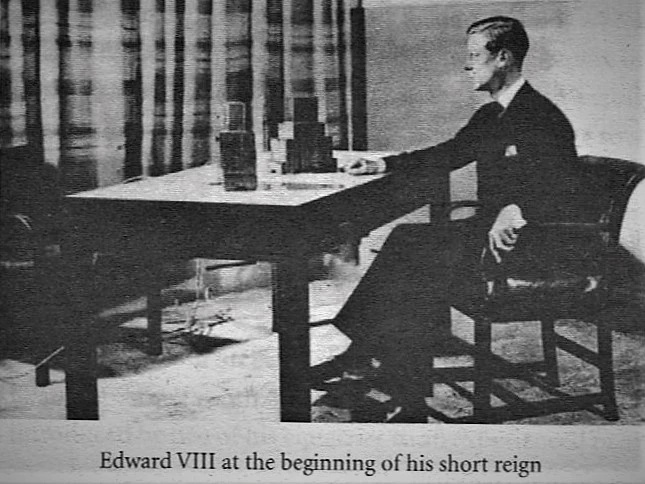
The health problems did not just affect the older segments of the insured population. In 1938 the Merthyr Juvenile Employment Committee (JEC) expressed its concern that out of twelve boys who went for medical examination before being transferred, only one was passed physically fit. Nine others were sent for reconditioning to the Llandough Junior Training Centre, leaving two deemed unfit for transfer. The Junior Transference Centre which was established at Llandough Castle near Cowbridge for boys who had already accepted transference to another area. They remained at the centre for a period of six to twelve weeks, during which time they were they were treated for malnutrition under the direction of the Centre’s own Medical Officer, and their physical training took the form of sporting activity rather than the hard, manual labour that adult transferees were subjected to at the Instructional Centres. King Edward VIII had visited Llandough in November 1936, with the boys on the scheme lining the route, banging the tools of the trades that they were learning: shovels, saws, dustpans and brushes. The centre also trained fourteen-year-old girls to go away into domestic service. This form of transference led to dislocation and loneliness for thousands of juveniles. The Merthyr JEC, however, received a glowing report on the Llandough Centre in its minutes for September 1939:

‘There are rooms for educational activities, metalwork, woodwork, a common room and also a large glass-covered hall which is suitable for light physical training during inclement weather… A small bathing pool has been constructed in the wooded section of the grounds where the boys swim if they so desire… they were very happy and agreed that the conditions and food were very good.’

Merthyr Education Committee Minutes, 19 September 1939.

By contrast, the poverty of diet that had been endured by many young transferees, many of them already forced to live away from their parental home due to the operation of the Means Test, is revealed by Hanley’s less formal enquiries:

It has already been seen that young people who have left Wales and gone elsewhere and have got work and gone into lodgings, have vomited up whatever first wholesome meal they have had served up to them by their landladies. I verified five instances of this.

Hanley, loc. cit., p. 130.

There were thus a number of secondary economic and cultural factors involved in the complex causation of migration, many of them connected with physical and mental health. Deteriorating housing, unhealthy and overcrowded living conditions combined with high rents and rates together with depressed incomes all played an essential part in the decision-making of potential migrants. The following quotation from Hanley’s interview with an unemployed miner, John Jones, is revealing in this respect:

‘ “Now we’re Welsh. We’re a proud people and also have a code of manners that the English quite misunderstand … when I was in work nobody interfered with me … From being just an ordinary working miner I’ve become quite an important person. We’ve all become quite important you might say. Just look at the number of people who and associations who are concerned about us! I draw the dole; well there’s quite an army of officials there, … when my benefit ceases, I go to the public relief offices. … Then there’s my union, my lodge, the welfare centres, the means test officials, the housing inspectors … An unemployed man is just ringed around with all kinds of officials and all kind of people interested in in his welfare … I want work and I want to be left alone.” ‘

Hanley, loc. cit., pp. 91, 162.

There is here a direct refusal to become demoralised, despite the pressure from officials and ‘voluntary’ social workers. In this context, both the miners’ lodges and their institutes played a significant role in upholding morale from the 1926 lock-out to the stay-down strikes against company unionism of the late 1930s. An American visitor to the coalfield, Eli Ginzberg, wrote Grass on the Slag-heaps: The Story of the Welsh Miners (New York, 1942), described how the threat to the miners’ institutes from the new social service centres was, in part, self-induced by the failure of the lodges and ‘the Fed’ failed to come to terms organisationally with the sudden impact of mass, long-term unemployment.

‘Removing’ or ‘Reviving’ the Blackspots:

Many of the communities which experienced the highest levels of long-term unemployment were at the heads of the valleys, like Dowlais, Merthyr, Brynmawr, Nantyglo and Blaina forming, according to Marquand’s second (1937) Survey (Vol. III), a melancholy line of semi-derelict communities along the Merthyr to Abergavenny road. But much of the Survey on Brynmawr, led by the Quaker Hilda Jennings, was coloured by a eulogy of the rural heritage of the Welsh people. J. Kitchener Davies, reporting on the Welsh Nationist Party’s Summer School, held in Brynmawr, contrasted the town with its more urban neighbours:

‘ “Brynmawrsuffers from the advertisement of its poverty which had made us expect distress writ larger over it than over any other mining community. This is not so… (it) has a lovely open country, easily accessible, and this… reflected in the faces of the people, made a contrast with those of more hemmed-in communities.” ‘

The Welsh Nationalist, September 1932, p. 6.
P. B. Mais, a traveller along the Highways and Byways of the Welsh Marches in the late thirties, seemed to go into ‘culture shock’ as he came down from the Brecon Beacons (Bannau Brycheiniog) to discover the town, with these unbelievably narrow, wedged rows and rows of miners’ cottages huddled in a land where there was so much room.

ill-nourished children playing in the over-heated, crowded streets, or in the filthy, offal-laden, tin-strewn streams at the backs of the houses with little strips of backyards that make the Limehouse backyards look like the Garden of Eden.

P. B. Mais (1939), op.cit.

Mais could not believe that Merthyr people could live in such conditions:

Are they not sprung from hillsmen, farmers, men and women who regard air and space to breathe as essentials of life? Why then, do these people go on living here? All of these South Wales mining villages want wiping out of existence, so that the men and women can start again in surroundings that are civilised, and not so ugly as to make one shiver even in memory.

Idem.

Fenner Brockway, who may be described as a contemporary ‘propagandist’, at the opposite pole of public opinion, nevertheless seemed to share this view of the town, as he used the town for his 1932 study, Hungry England (London, pp. 144, 158). His chapter naturally painted the bleakest possible portrait of the poverty and ill health among the borough’s people. Three years later, the Government appointed two commissioners to go to Merthyr, gather evidence and produce a report and recommendations on whether Merthyr should have its county borough status taken away from it. Public Assistance was costing well over half the Corporation’s yearly expenditure and twice its rateable value. The loss of rates from the closing of the Dowlais Steel Works alone amounted to Ł30,000 per annum. Since it received only minimal grants from the central government, it was forced to cut services. John Rowland of the Welsh Board of Health presented the following image of the coalfield society as one of impoverishment and demoralisation within the Borough as minatory to the health of ‘the old Welsh stock’ living there:

The prevailing impression after all my dealings with Merthyr Tydfil is of the real poverty that exists. This poverty is visible everywhere, derelict shops… and deplorable housing conditions. Merthyr is inhabited by many worthy of old Welsh stock, hard-working and religious… it is very hard to see such people gradually losing their faith in the old established order and turning to look for desperate remedies.

Recommendations of the Royal Commission; Report of John Rowland of the Welsh Board of Health.

A very different image of the Borough and its people was given by the local MP, S. O. Davies on behalf of the Trades Council. He articulated the self-image from within the community as one of communal resilience in the face of worsening conditions. This resilience would be undermined by the removal of the Borough’s civic powers. He commented that…

… there is not an institution in this borough today, whether it is a chapel or a church or anything else, that is not with the local authority contributing with a view to mitigating the worst consequences of poverty. … if the authority administering the area is to be removed twenty or thirty miles away, then I say that that … human interest, the whole of what is best in the borough, shown in its children, and those who are most impoverished, will undoubtedly be impaired very considerably…

Royal Commission Minutes of Evidence, Merthyr Library copy p. 38, statement of evidence by S. O. Davies, M. P.

Thomas Jones, the archetypal establishment Welshman, parodied the approach of many of the ‘social investigators’ with whom he came into contact by suggesting that the entire population of South Wales should be transferred out of the region so that the valleys could then be flooded, or used as an industrial museum, or for bombing practice.

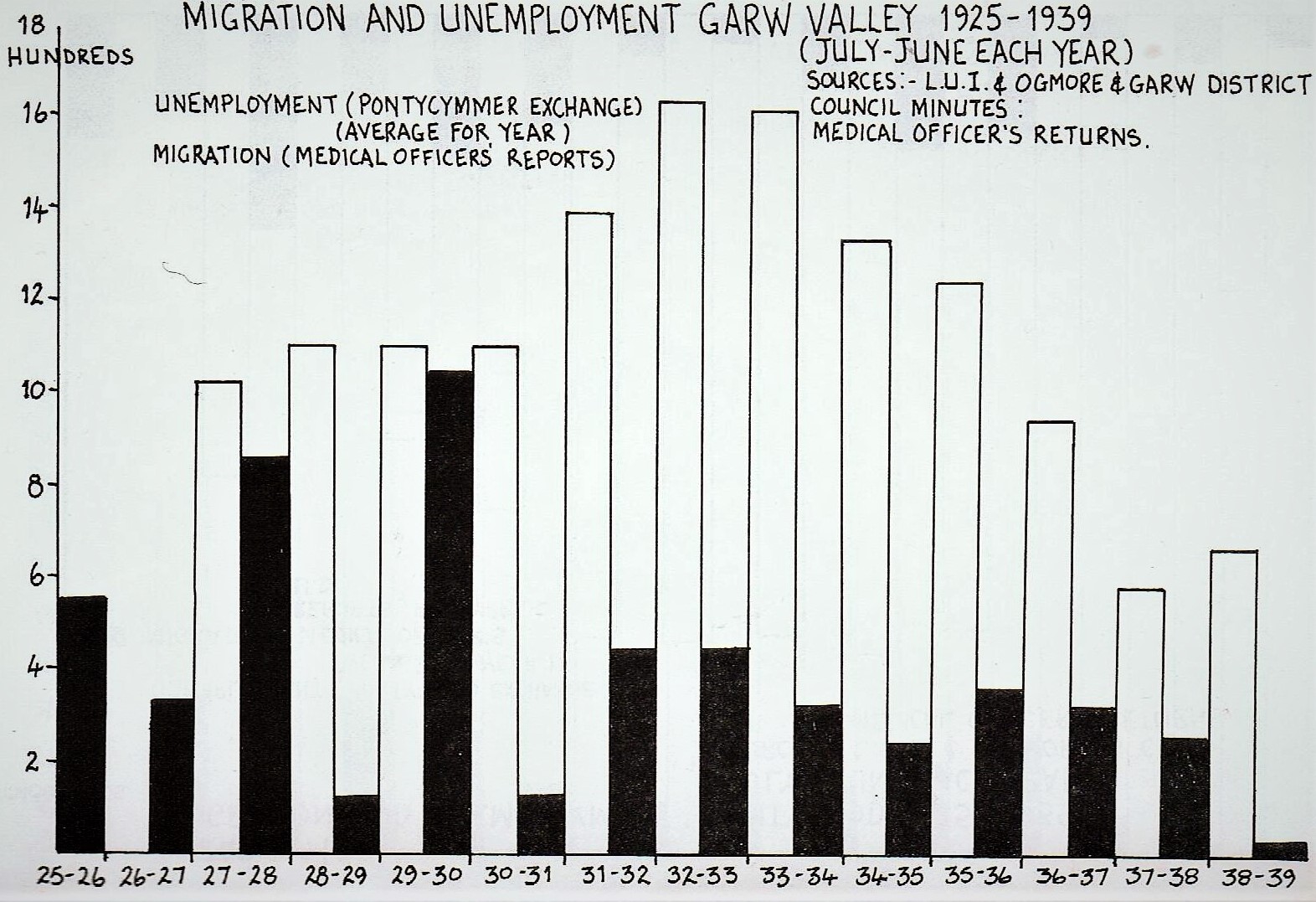
Besides their fixed outgoings for rent and rates, many people throughout the valleys also made regular contributions towards their own health care, continuing to do so in spite of the impact of the depression on their incomes. It may have been that they felt the conditions imposed on them by increasing impoverishment and dilapidating housing even more essential. In his report to the Nuffield College Reconstruction Survey in 1942, mentioned above, J. D. Evans found a widespread feeling that the existing National Health Insurance Scheme provided inadequate cover in times of sickness. Independent Medical Aid Societies and hospital contributory schemes continued to be popular throughout the coalfield. Nowhere was there better evidence of this than in the Garw Valley where there were more than 3,500 insured contributors to the local Medical Society, with a further 2,800 dependants standing to benefit from this.
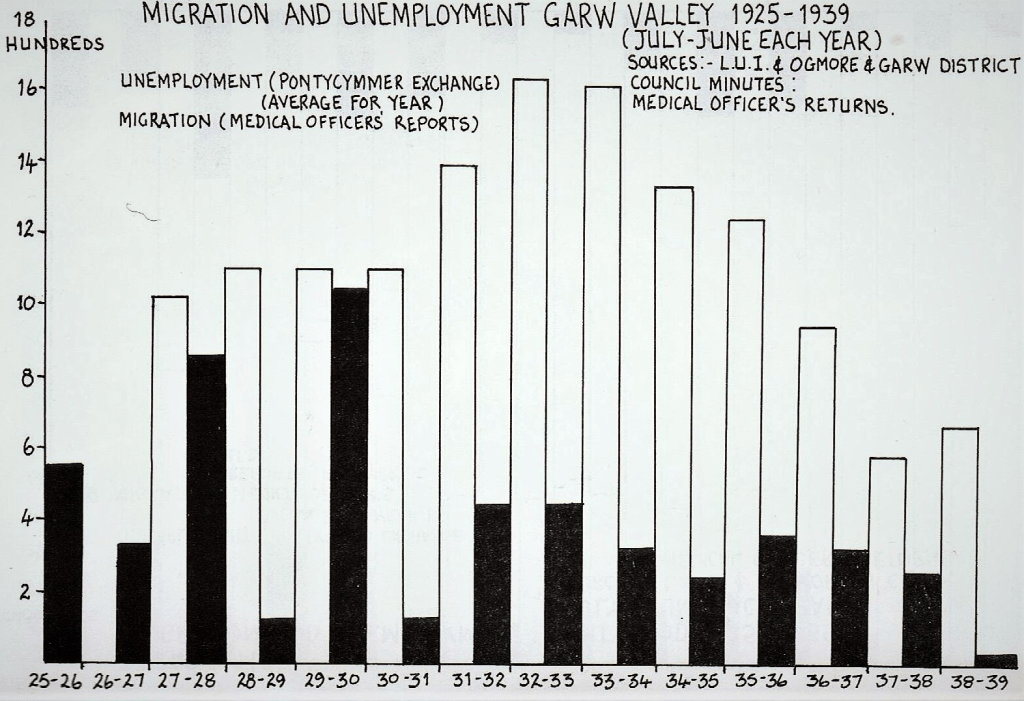
This form of self-help was the valley’s means of survival during the Depression years. Due to being geographically hemmed in, the community felt the need to provide for itself a complete range of health, social and cultural services. This did not mean that it lacked a ‘wider outlook’ but rather that it used its home-grown institutions as a basis on which it could relate to the outside world on its own terms, and as a means by which it could interpret and respond to the gargantuan economic and social forces which had brought it into being and now threatened to crush it. The people of the Garw may have contained fewer members of ‘the old Welsh stock’, much eulogised by liberal nationalists, than the people of Merthyr and the other heads-of-the-valleys communities who could trace their attachments back through four or five generations, but they showed no less commitment to the abundant and vibrant institutions which had been created in the valley by the mid-1920s.

Turning the Screw Too Tight? – Resisting Transference:

Simultaneously, an intensive campaign began to encourage employers in prosperous areas to take on men and boys from depressed areas. Baldwin himself made a direct appeal for them to approach the nearest Labour Exchange, but the results of this were not as great as the Government had hoped, and Chamberlain admitted his disappointment to the South Wales Miners’ Federation (SWMF) delegation which met with both him and the Minister of Labour, Sir Arthur Steel-Maitland, in October 1928. The miners’ leaders were accompanied by seven Labour coalfield MPs. Morrel and Richards, President and General Secretary of ‘the Fed’, argued that the situation in South Wales was becoming ‘dangerous’ and this point caused some nervousness among the ministers and officials present who were sensitive to the possibility of a recurrence of the ‘disorder’ which had occurred during the 1926 Lock-out. In a memorandum on the meeting, one official wrote to the ministers that:

The issue is whether the screw may not have been turned too tight in the South Wales areas, as a result of our attempts… to secure the the administration of relief on sound lines and to induce local authorities their financial coat according to the available cloth… a bad winter would be a serious thing in such a such conditions of worklessness and depression as have so long prevailed in some parts of South Wales. If anything untoward should occur in these places in the winter, … there would be a risk of panic action minatory to the whole of our recent poor law policy.’

HLG 30/63: Deputation from the South Wales Miners’ Federation to the Ministers of Health and Labour, Minutes and Memoranda, 31 October 1928.

This official nervousness was further reflected by the reaction of James Evans when he heard of a proposed visit of the Prince of Wales to the coalfield in the New Year. He urged caution, and Arthur Lowry, later to head the Commission on Merthyr, was dispatched to South Wales to report on the conditions there which were recovering by the time the winter of 1928-29 came due to a recovery in the Coal trade. Both Steel-Maitland and Chamberlain echoed the view of James Evans that the provision of further relief on a long-term basis would result in further ‘demoralisation’. Steel-Maitland made this clear to the Cabinet:

‘… To leave them in their villages … involves steady demoralisation, an apalling waste of manpower and the continuance of a canker, the evil effects of which spread far beyond the locality … Relief works in the depressed areas have long exhausted their usefulness; indeed they are positively harmful in so far as they encourge men to remain where they cannot hope for continued employment.’

CAB 24/198: Industrial Transference Schemes: Report on work done and comments on objections to transference policy; CP 324, Memo by Sir Arthur Steel-Maitland, with appendices, 1 November 1928.

Some government ministers did, however, attempt to bring relief of a different kind to the depressed areas. Winston Churchill was responsible for major sections of the Local Government Act of 1929 which reformed the Poor Law and brought about de-rating and a system of block grants. He clearly saw this as a means of relieving industry in these areas and combating economic depression. In a speech on the Bill in the House of Commons, he argued that it was…

‘…much better to bring industry back to the necessitous areas than to disperse their population, at enormous expense and waste, as if you were removing people from a plague-stricken or malarious region.’

LAB 23/75: Special Areas of South Wales – Burden of local rates.

Clearly, this view was not shared by Chamberlain who saw the Bill as a means for the careful central control of local authorities, rather than as a means of equalising the effects of the low rateable values on these areas. When Lowry submitted his report to Chamberlain in February 1929, the Minister saw in them no cause to call for a change in central policy. Speaking on the report in Parliament later that month, he took up the same theme of the dangers of demoralisation that would result from further relief funding, though he was not as optimistic as the Minister of Labour regarding the length of time required for the policy of transference to achieve results. He estimated that seven years was needed, rather than the three Steel-Maitland had suggested.

There is no evidence to suggest that the Labour Government of 1929-31 tried to abandon the Transference policy. However, they did not consider that its continuance should exclude attempts to attract industries to the depressed areas or to develop public works schemes. However, the widespread nature of unemployment in these years, the lack of imagination and ineptitude of J. M. Thomas as Minister for Employment, the resistance of officials, the innate conservatism of Philip Snowden at the Exchequer and the general economic crises which beset this administration precluded the possibility of a radical response to the problem of mass unemployment.

Between 1931 and 1937 the National Government continued to uphold transference as the solitary cure for long-term unemployment in depressed areas. For most of this period, they also continued to enjoy the support of local authorities in operating the policy. A 1931 memorandum on the Distribution of Juvenile Employment reported that all fourteen of the Juvenile Employment Committees in Wales recommended transference as the only solution to local unemployment and urged the use of public funds to assist with the maintenance and travelling expenses of juveniles.

Serious Welsh opposition to the policy only became significant in May 1936, when The South Wales and Monmouthshire Council of Social Services (SWMCSS) held a special ‘Conference on Transference’ at the YMCA in Barry. The SWMCSS was founded in 1919 as part of the National Council of Social Service. As well as drawing representatives from the proliferating voluntary societies of the time, it also worked very closely with successive governments in the twenties and thirties. Nine Departments were represented, including the ministries of Health and Labour, the Home Office and the Board of Education. Up to this point, the Council had played a major role in the Government’s strategy, with a number of its leading members and workers being involved in both the social administration of the transference scheme at a regional level and the government-sponsored voluntary work in the valleys.

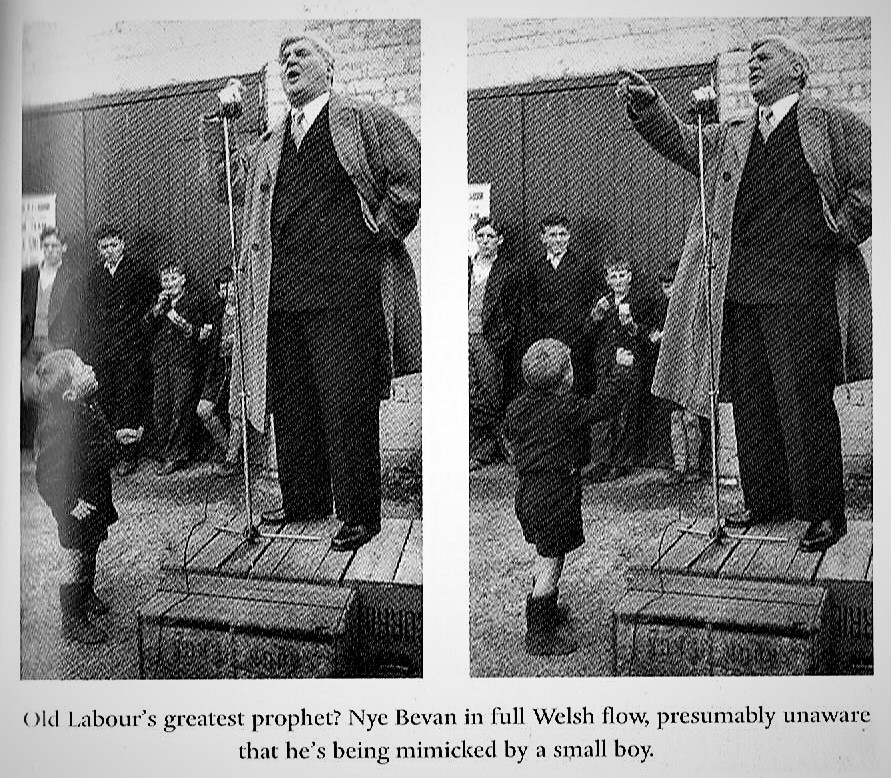
Most of the prominent figures in the Social Service movement across the region attended the Barry Conference. Church leaders and MPs also took part. Rev. T. Alban Davies argued that the ‘national conscience’ was being roused against the break-up of communities which represented the history and traditions of Wales and that unless the Social Service movement came out clearly in opposition to the scheme, its ameliorative involvement could be seen as evidence of its support for it. Aneurin Bevan, MP for Ebbw Vale since entering Parliament in 1929, also called for an end to the policy, and attacked the complacency of those who purported to be the leadership of the ‘Welsh Nation’:

‘… If the problem was still viewed as complacently as it had been, this would involve the breakdown of a social, institutional and communal life peculiar to Wales. The Welsh Nation had adopted a defeatist attitude towards the policy of transference as the main measure for relief of the Distressed Areas in South Wales, but objection should be taken as there was no economic case for continuing to establish industries in the London area rather than the Rhondda.’

LAB 23/102: Report of Conference on Transference, convened by the SWMCSS, 15-16 May 1936.

The reason for this complacency was made apparent by one speaker who replied to Bevan’s remarks by suggesting that East Monmouth had no Welsh Institutions or traditions likely to be damaged by large-scale transference, as most of its people were originally immigrants who had not been absorbed into local life. However, most of those present was that what was taking place was expatriation and not repatriation. Elfan Rees, who as Secretary to the SWMCSS was invited to speak to the third major Welsh conference of the year, developed this theme in his ‘Survey of Social Tendencies in Wales’ which he presented to the Welsh School of Social Service in Llandrindod Wells in August. The ‘School’ had been established by Lleufer Thomas in 1911, in a bid to ‘take back control’ of the valleys from the trades unions and socialists who were seen as ideological aliens, disruptive of the ‘Celtic Complex’. Appealing to the liberal nationalists in his audience, he pointed out that those leaving the coalfield were not the ‘rootless undesirables’ who had moved into it in the previous generation, but the young, the best and the Welsh:

‘… If transference was repatriation it might be a different story, but it is expatriation. It is the people with the roots who are going – the unwillingness to remain idle at home -the essential qualification of the transferee again, are the qualities that mark our own indigenous population. And, if this process of social despoilation goes on, the South Wales of tomorrow will be peopled with a race of poverty-stricken aliens saddled with public services they haven’t the money to maintain and social institutions they haven’t the wit to run. Our soul is being destroyed and the key to our history, literature, culture thrown to the four winds.’

Elfan Rees, ‘A Survey of Social Tendencies in Wales, 1935-36’ in Public Health in Wales, addresses delivered at the the Welsh School of Social Service, Llandrindod Wells, 10-13 August 1936.
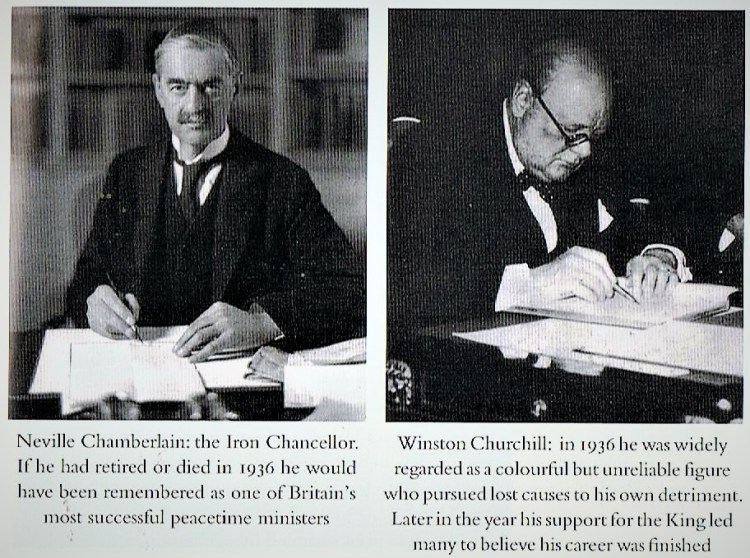
Despite this growing opposition to the policy, the appointment of the Barlow Commission into the Distribution of the British Population and the establishment of the Special Areas Relief Association (SARA), there was no immediate end to the Transference Policy, and certainly no diminution in the numbers migrating voluntarily. In fact, 1937 was the peak year in the operation of the scheme. A deputation from the Welsh Churches, the University of Wales, and the Welsh Parliamentary Party, together with sections of the Social Service movement met Chamberlain, now Prime Minister, towards the end of July. They were clearly impatient about the continuing lack of balance in unemployment policy:

‘Did it require much imagination to realise what this process meant to the life and continuity of a comporatively small community? It was being denuded of its best manhood, its very life blood was being drained, and unless a bold and resolute venture were undertaken South Wales as they had known it would cease to be. For eleven years this plague had ravaged the life of that area…’

Western Mail, 23 July 1937.
However, the editor of the Western Mail rejected such arguments. How, he asked, could the Government refuse young men the opportunity to work elsewhere? With the onset of war, there was a heightened emphasis on the need for industrial planning, not just for the production of armaments and military materiel, but for a better future following the end of the conflict. During the war, the Welsh Reconstruction Advisory Council referred to the determination never again to endure such a wholesale frustration of human desires and ideals and the fear that such conditions will inevitably return unless there is adequate preparation to counter them. The concept of ‘Post-War Planning’ had, as the WRAC report suggested, a special personal significance for the people of Wales (their emphasis).

Tredegarising Medical Services – The Founding of the NHS:
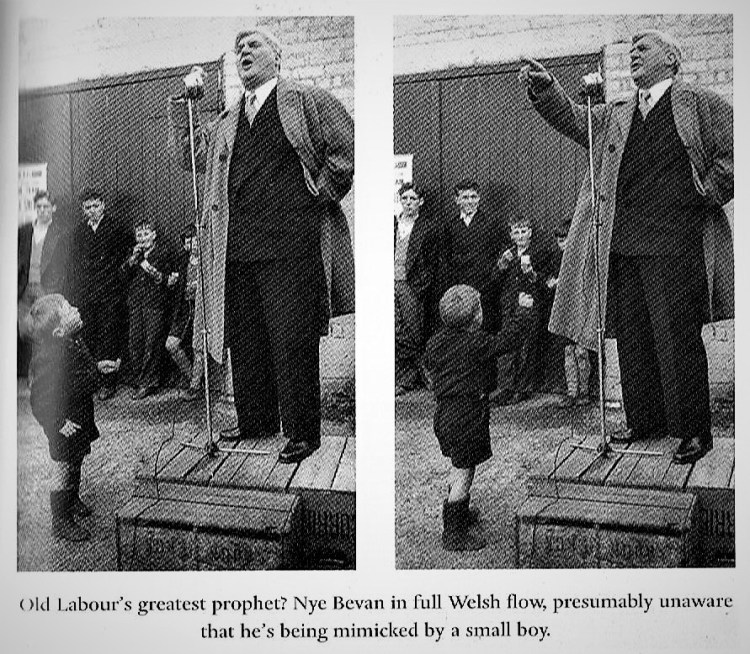
The free National Health Service was paid for directly through public money. Bevan had been inspired by the Tredegar Medical Aid Society in his hometown, where residents would pay a subscription to fund access for all of the town’s inhabitants to have free access to medical services such as nursing or dental care. This system proved so popular that twenty thousand people supported the organisation during the 1930s. In 1947, Bevan stated:

“All I am doing is extending to the entire population of Britain the benefits we had in Tredegar for a generation or more. We are going to Tredegar-ise you.”
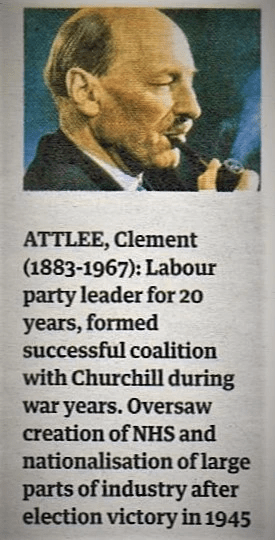
The Attlee Government created the modern welfare state, with comprehensive sickness and unemployment cover introduced by the 1946 National Insurance Act. Attlee brought the creative best out of Aneurin Bevan by appointing him as Minister of Health and Housing. Bevan painstakingly negotiated with the British Medical Association and the National Health Service was introduced in 1948. Income was increased for the welfare state expenditure by a large increase in marginal tax rates for wealthy business owners, as part of what the Labour government largely saw as the redistribution of the wealth created by the working class from the owners of the large-scale industry to the workers.

Having been a member of the Tredegar Cottage Hospital Management Committee around 1928 and serving as chairman in 1929–30, Bevan had received an insight into the management of health services by local authorities, which proved to be the bedrock of his work in founding the National Health Service.

The Welfare State appears as the end-product of a long history, its origins far back in the Edwardian past, but this is a rather technical definition, amounting to little more than the expansion of social services by the state. Bédarida (1979) argued that in post-1945 Britain, the phrase stands as the symbol of the period, and of a society with a mixed economy and full employment, where individualism is tempered by State intervention, where the basic right to work and a basic standard of living are guaranteed, and the working-class movement, now accepted and recognised, find its rightful place in the nation. Labour’s ‘revolution’ must therefore be seen in the context of the ‘evolution’ of the welfare state. The key concept of this evolution was ‘social justice’. The ‘revolution’ found its main inspiration in two Liberals: Beveridge and Keynes. These were the two masterminds whose ideas guided Labour’s actions, though the ideas themselves had their origins in the Nonconformist conscience and Christian Socialism. It was also the child of the Fabians in that it developed legislative, administrative and centralizing methods to the detriment of local workers’ control. The creation of the NHS, which Beveridge had thought was essential to his wider vision, was an example of this.
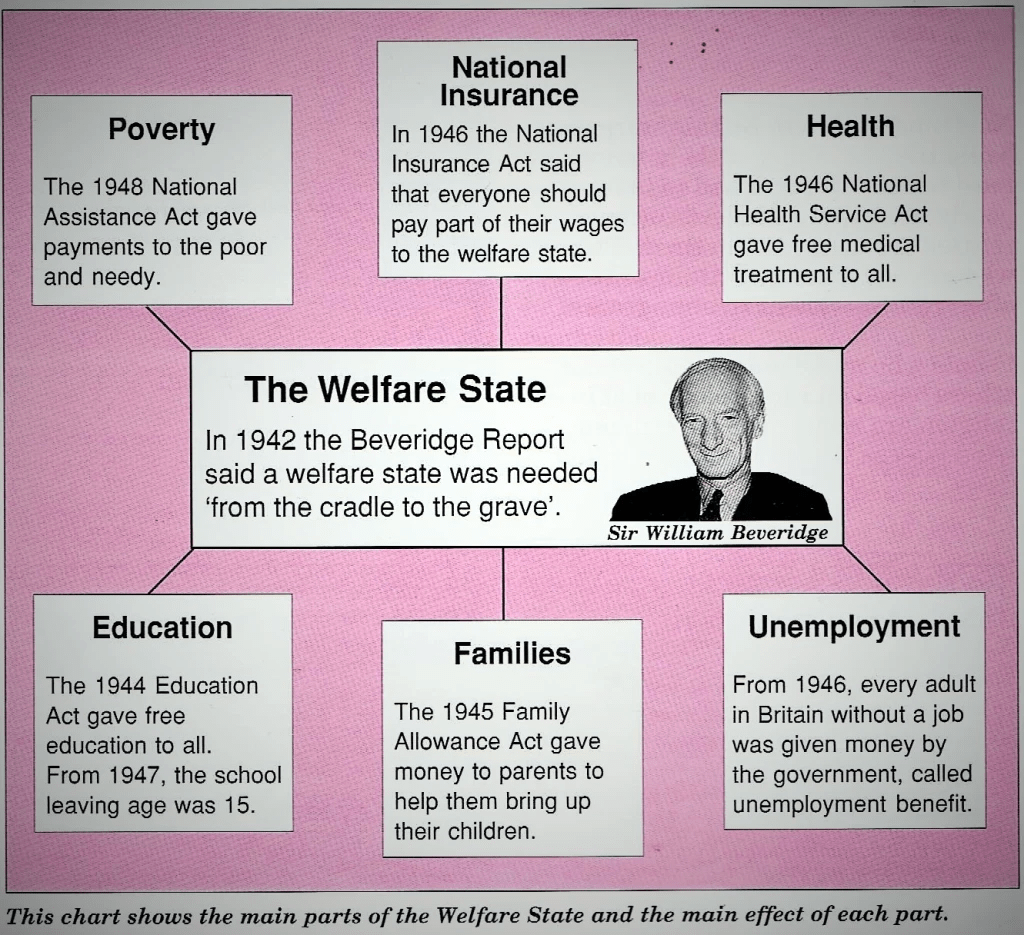
As we have seen in the case of South Wales, Britain had a system of voluntary hospitals, raising their own funds, which varied greatly in size, efficiency and cleanliness. Later, it also had municipal hospitals, many growing out of the original workhouses. Some of these, in growing cities like London, Birmingham and Nottingham were efficient, modern places, whose beds were gradually kept for the poor. Others were squalid. Money for the voluntary hospitals came from investments, gifts, charity events, payments and a hotchpotch of insurance schemes. By the time the Second World War finished, most of Britain’s hospitals had been brought into a single national emergency medical service. The question was what should happen to them in peacetime – should they be nationalised or allowed to return to voluntary control?
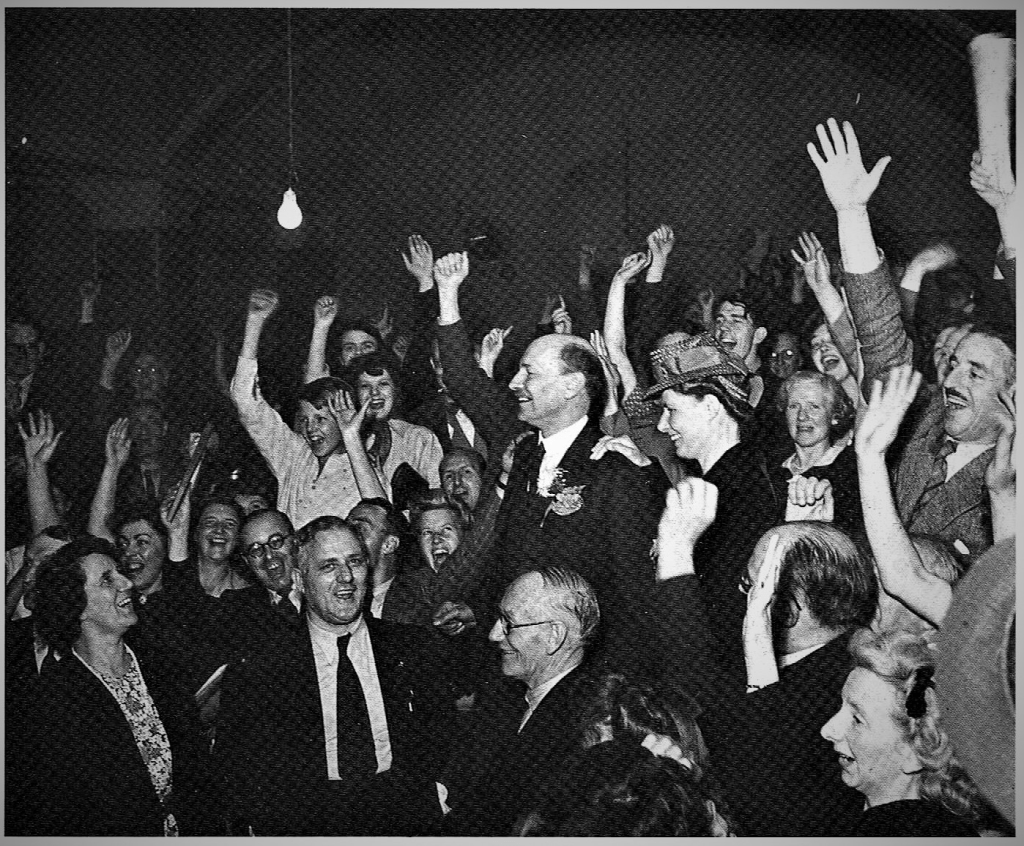
Clement Attlee had calmly awaited the result of the 1945 Election at Transport House.

A similar question hung over family doctors. GPs (General Practitioners) depended on private fees, though most of them also took poor patients through some kind of insurance scheme. When not working from home or surgery, they would often double up by operating in municipal hospitals, where, as non-specialists, they sometimes hacked away incompetently. Also, the local insurance scheme often excluded many elderly people, housewives and children, who were therefore put off visiting the doctor at all, unless they were in the gravest pain or danger. The situation was the same with dentistry and optical services, which were not available to anyone without the money to pay for them. Labour was determined to replace this hotchpot with the first free system of medical care in any Western democracy.

Bevan talking to a patient at Park Hospital, Manchester, the day the NHS came into being.

On the ‘appointed day’, 5 July 1948, Bevan’s National Health Service Act 1946 came into force. On that day, Bevan attended a ceremony at the Park Hospital, Trafford (now Trafford General), at which he symbolically received the keys to the hospital. The scheme was achieved having overcome political opposition from both the Conservative Party and from within his own party. There was a fierce confrontation with the British Medical Association (BMA), led by Charles Hill, who published a letter in the British Medical Journal describing Bevan as “a complete and uncontrolled dictator”. Members of the BMA had dubbed him the “Tito of Tonypandy”. For Bevan, the foundation of a Service which was free at the point of delivery to all was simply the practical expression of a just and equitable society:

The collective principle asserts that … no society can legitimately call itself civilised if a sick person is denied medical aid because of lack of means.

 Aneurin Bevan, In Place of Fear, p. 100

Simplicity was a great weapon, so Nye Bevan’s single greatest decision was to take all the hospitals, the voluntary ones and those run by local councils into a nationalised system. It would have regional boards but it would all come under the control of the Ministry of Health in Whitehall. This was a heroic piece of self-confidence on Bevan’s part but, in taking ultimate personal responsibility for almost every hospital across Britain, he was attacked from within his own party, for stamping on any form of libertarian organisation of society. As Bédarida pointed out, Labour laid itself open to a charge that would weigh heavily on it in the future, namely that of wanting to impose a bureaucratic form of socialism. Herbert Morrison, the great defender of municipal socialism, was against this nationalisation but was brushed aside by Bevan.

Soon after the NHS opened for business, however, there was a flood of people to surgeries, hospitals and chemists. Fifteen months later, Bevan announced that 5.25 million pairs of free spectacles had been supplied as well as 187 free prescriptions. By then, 8.5 million people had already had free dental treatment. At the same time, there was much anecdotal evidence of waste and misuse. The new bureaucracy was cumbersome. It is also possible to overstate the change since, as we have seen, most people, even some of the poorest, had had access to some kind of affordable health care before the NHS, though it was patchy and working-class women had particular difficulty in getting treatment except in near-natal services (I have written about these in Coventry in another article on my website). But the most important overall change was the removal of fear. Before comprehensivisation, millions at the bottom of the pile had suffered untreated hernias, cancers, toothache, ulcers and all kinds of illness rather than face the humiliation and anxiety of being unable to afford treatment. If there was a single domestic good that the British took from the sacrifices and sufferings of the war, it was a health service free at the point of use.
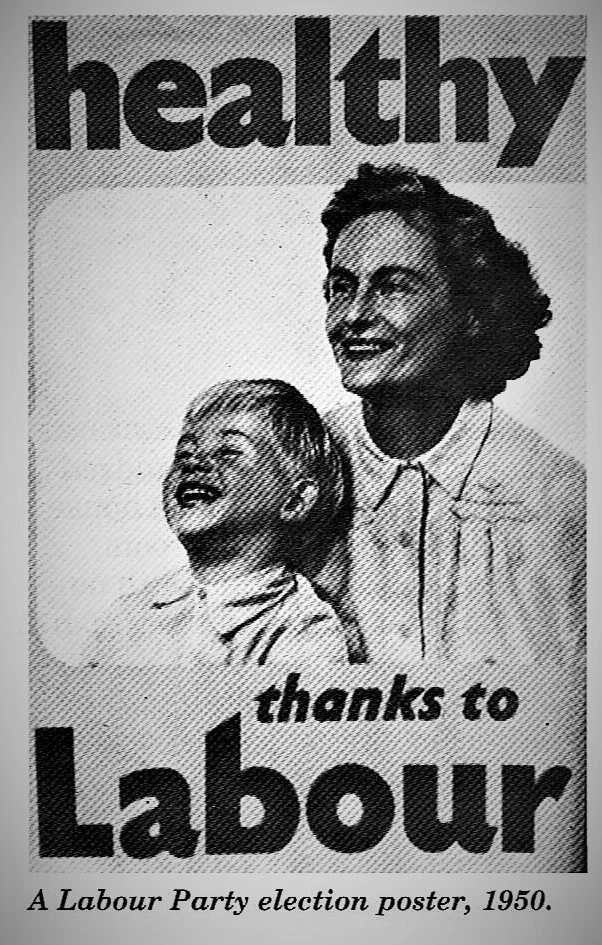
The continuing division in the Labour government over the comprehensive nationalisation of health service and its costs had far-reaching consequences. Bevan’s resignation from the government on 23 April 1951 was the first public symbol of disagreement at the top of the Labour Party on its future direction in the post-war era. Michael Foot’s (1963) two-volume biography of his predecessor as MP for Ebbw Vale is an unashamedly partisan book from which Bevan emerges as a kind of Celtic giant, like something from the Medieval saga of the Mabinogion. But it is far from being a reliable text, especially in the second volume in its portrayal of Gaitskell as a traitor to socialism. However, Foot’s account of Bevan as a socialist tribune in his early years, and especially his pioneering creation of the National Health Service is a magnificent account of his truly heroic achievement.

In his so-called ‘crusade’ to establish the NHS, Bevan received the support of many local figures, not just in the valleys, but also in the major cities to which many of his compatriots had migrated in the late twenties and thirties. William Tegfryn Bowen had worked as a miner in the Rhondda between 1916 and 1926 before moving to Birmingham in 1927, where he became a car worker at the Austin Motor Company, also enrolling in a course in economics, social services and philosophy at Fircroft Adult Education College in Selly Oak. Sacked from the Austin works for his trade union activity, he endured various spells of unemployment before becoming a City Councillor in 1941, and an Alderman in 1945. Between 1946 and 1949 he was both Chairman of the Council Labour Group and Chairman of the City Health Committee. This latter position led to his appointment as a member of the Executive Council of the NHS and a member of the Regional Hospital Board. On becoming Lord Mayor of Birmingham in 1952, Bowen was asked to account for the Labour hold on a city which, under the Chamberlains, had been a Tory stronghold before the Second World War. In his answer, he referred to the large influx of workers from other areas with a different political outlook. The National Health Service of 1948 was therefore built on local institutions which the working classes built for themselves.

The brambles of poverty, though dense and piercing in places, did not grow evenly throughout the Coalfield in the late twenties and thirties. They did not even grow evenly in the same street, on the same terrace, and neither did they ensnare one individual in quite the same way or to the same degree as the next. They wove themselves into patterns which were not always common and were frequently tangled. They grew at different rates in differing places. This diversity had much to do with the variety of the places where they grew. It is, therefore, necessary to examine the intricate cultural and institutional web of coalfield society before judgements can be made about how impoverishment may or may not have led to demoralisation and immiseration.

In order to do so, it is imperative that historians should move away from the stereotypical images of contemporary social investigators and political propagandists, and seek out how coalfield communities were redefining and representing themselves during the period. It was already evident that, during the earlier part of the century, coalfield society had developed its own autonomous culture and institutions alongside the received ones. This sub-culture or counter-culture rejected many of the values which did not coincide with those which stemmed from the community’s own sense of economic and social solidarity. In Workers at Play: A Social and Economic History of Leisure, 1918-1939, S. G. Jones (London, 1986) has provided a useful summary of the historiographical debate on working-class culture, advancing an argument in favour of the concept of a ‘negotiated culture’ as descriptive of the experience of the British working class between the wars. It was this culture that created the Tredegar Medical Aid Society and many societies like it throughout the South Wales Coalfield.

Sources:

John Gorman (1980), To Build Jerusalem: A Photographic Remembrance of British Working Class Life, 1875-1950. London: Scorpion Publications.

Richard Brown & Christopher Daniels (1982), Documents and Debates: Twentieth-Century Britain. Basingstoke: Macmillan Education.

Andy Chandler (1982), ‘The Black Death on Wheels: Unemployment and Migration – The Experience of Inter-War South Wales’ in Tim Williams (ed.), (1982), Papers in Modern Welsh History 1 (The Journal of the Modern Wales Unit, formerly the Research Unit for the History of Industrial South Wales). University College, Cardiff (Department of History).

Dai Smith (1984), Wales! Wales? Hemel Hempstead: Allen & Unwin.

Tony Curtis (ed.) (1986), Wales: The Imagined Nation; Essays in Cultural & National Identity. Bridgend: Poetry Wales Press.

Andrew James Chandler (1988), ‘The Re-Making of a Working Class: Migration from the South Wales Coalfield to the New Industry Areas of the Midlands, c. 1920-1940. Cardiff: Unpublished PhD thesis.

Bill Jones & Beth Thomas (1993), Teyrnas y Glo: Golwg Hanesyddol ar Fywyd ym Meysydd Glo Cymru/ Coal’s Domain: Historical Glimpses of Life in the Coalfields. Amgueddfa Genedlaethol Cymru/ National Museum of Wales: Caerdydd/ Cardiff.

Andrew Marr (2008), A History of Modern Britain. Basingstoke: Pan Macmillan.

Denys Blakeway (2010), The Last Dance – 1936: The Year Our Lives Changed. London: John Murray (Publishers).

Charles Clarke & Toby S. James (eds.) (2015), British Labour Leaders. London: Biteback Publishing Ltd.

Galleries:

The Raven & the White Rose – The Plantagenet Pretender in Buda: Richard de la Pole.

The Growth of the Great Central European Empire:
Portrait of Sigismund, whose fifty-year reign was the longest of any medieval Hungarian ruler, played a major role in European political affairs. The culture of chivalry flourished in Hungary during his reign.

Sigismund of Bohemia, pictured above, became Holy Roman Emperor in 1433, an event which marked the establishment of the great Central European Empire under Habsburg rule, through his daughter’s marriage, until 1918. As Emperor, he acted as an intermediary between Henry V of England and the King of France. From this time onward Anglo-Hungarian relations entered a new phase. The menace of Ottoman expansion loomed large over Europe and the English and Hungarian armies joined again in a common cause. Following Sigismund’s death in 1437, the Austrian-Bohemian-Hungarian alliance collapsed during the rule of his son-in-law. But in the southern borderlands of Hungary, Romania and Bulgaria, a general emerged who stamped his own charismatic personality on the age more effectively than any of the crowned kings and princes of these countries. Although held to be a Transylvanian-Romanian, his family had solid Hungarian origins and he was regarded as Sigismund’s natural son. But it was his deeds which qualified him as the protector and Regent of St. Stephen’s crown lands. From a warrior of low rank, he rose to become the most eminent general of fifteenth-century Europe. At the end of his life, he owned two million hectares of landed estates, the income from which he spent almost exclusively on his campaigns against the Ottomans.

Emperor and King: Sigismund of Luxembourg at the helm of his army. Altarpiece by Tamás Kolozsvári, Garamszentbenedek, 1427.

After the humiliating defeats suffered by the Hungarian-led knights, including some English Hospitallers, at Nicopolis in Bulgaria, and the 1444 defeat at the Battle of Varna (see picture above), János Hunyadi became Regent in 1446 and tried on several occasions to bring the small Balkan territories together to resist the Ottoman expansion. But despite further losses against the Turks, he gradually restored the integrity of the country and consolidated his authority among the nobility. As a result, even Frederick III acknowledged his governorship, which only came to an end in 1452 when the Austrian estates rebelled against Frederick while he was visiting Rome to get himself crowned Emperor. Hunyadi had to relinquish his position, which had made him almost equal to the King when Wladislas V came of age, which coincided with the revival of the Turkish threat. In 1456, three years after he captured Constantinople, Sultan Mohammed II led a formidable army of some hundred thousand men against Belgrade, the key fortress of Hungary’s southern defensive system.

Vajdahunyad Castle in Transylvania was the centre of the Hunyadi family’s estates. János Hunyadi’s father Vajk obtained the former modest castle from the king and the son built up the Gothic fortifications, whose magnificence was unmatched in all of Central-Eastern Europe.

The panic that had been caused by the fall of Constantinople gave rise to rather ineffective countermeasures both from within and outside Hungary. The Christian princes of Europe failed to respond to the call of the Pope for a Crusade. As Mehmet’s well-trained and well-equipped professional army set off to besiege Nándorfehérvár (Belgrade) in early July, the defenders could only expect relief from the soldiers mobilised by Hunyadi from his estates and retinue, and insurrectionists from among the commoners of southern Hungary. Hunyadi’s army for the city’s relief was a mixture of three elements; his mercenaries, the insurgent nobles and the commoners, who responded to his call to arms despite recent rebellions against their landlords. They were recruited, in part, by an impassioned Franciscan friar of strict morals, Giovanni Capistrano who was Hunyadi’s right arm. Combined, these forces equalled less than half of those of the besiegers.

And yet, the ‘Crusader’ army gained a decisive victory in the battle, during which his guards rescued the wounded Sultan half-dead. When he had recovered, he decided to retreat., and although the opportunity for a counter-offensive was missed, this ‘triumph’ halted the Ottoman advance into Europe for several decades. Hunyadi’s immediate achievement was to secure the southern system of defence, the most important legacy of Sigismund: no Turkish attempt of similar dimensions took place until sixty-five years later. Even today, in cities, towns and villages throughout Central Europe, the pealing of bells at noon reminds people of the victory achieved on 22nd July 1456. Pope Callixtus proclaimed a Christian holiday and is said to have issued the decree for the pealing, but according to another version, he had already given instructions for bells to be rung to warn of the impending battle. In any event, the pealing of the bells at noon turned into a permanent event and certainly played an important role in the universal victory celebrations that took place throughout Christendom after the battle. Hunyadi’s exploits against the Turks were reported in contemporary records in English and subsequently influenced Elizabethan literature. Before he died, Hunyadi dispatched a special courier to England with news of his splendid victory at Nándorfehérvár in 1456. The good news was joyfully received in Canterbury, and the students celebrated the victory of the great Hungarian captain-general with the pealing of bells. We also know of three Hungarian knights who went to England during Edward IV’s reign (1461-83) to participate in tournaments.

However, barely a couple of weeks after the battle, the bells rang out again to mark the sudden death of János Hunyadi, struck down, not by the sword, but by the outbreak of plague in the encampment. Later that year, Capistrano also died from it. Hunyadi’s charisma and popular belief in his mission became strengthened his followers, thus paving his son’s path to the throne. But this path was not to be a smooth one; for the time being, Hunyadi’s death signalled an opportunity for his adversaries to weaken his ‘party’ and unleash another round of civil strife. Therefore, the loss of these two great leaders once more plunged the country into anarchy. Two influential families vied for power around the weak king and Cillei was appointed captain-general. He demanded that Hunyadi’s sons abandon the royal castles and revenues. László Hunyadi, the elder of the two, pretended to give in, but his men murdered Cillei as he marched into Nándorfehérvár. Most of Cillei’s supporters, outraged by this treachery, took sides with the king, who invested the new Hunyadi clan leader with the position of captain general, promising him impunity. In reality, however, he was only waiting for an opportunity to retaliate, and this came in March 1457 as both Hunyadi brothers were in Buda, where, in one of the bloodiest ‘episodes’ of this civil war of changing fortunes, Wladislas, aged seventeen but already a debauched, neurotic lout, had László arrested, court-martialled and brutally beheaded. Hunyadi’s widow and brother-in-law, Mihályi Silágyi responded rapidly by rising up in arms. The King then fled, first to Vienna and then to Prague, dragging with him the younger Hunyadi son, Mátyás (Matthias), as a hostage.

Matthias Hunyadi Corvinus – Hungary’s Renaissance Prince:

The golden medallion from the Philostratus Codex (c. 1487-90), shows Matthias Corvinus’ portrait.

Ironically, by the end of the year, however, the plague had also disposed of Wladislas V, who died in Prague, not yet having reached his eighteenth birthday. His successor was the hostage himself, who quickly regained his freedom and acquired such a rekindling of his father’s reputation that he was able to advance his claim to the vacant throne. The mightiest members of the court party, Garai and Újláki soon realised that they had no chance to obtain the throne or rule the country as oligarchs, nor was there any foreign pretender who could put down the powerful Hunyadis and undertake the expensive extensions of the defences against the Ottomans at the same time. Thus they were compelled to make a compromise with the Szilágyis to arrange for the retention of their own influence in return for having Matthias, the only suitable candidate, elected King of Hungary. The lesser Hungarian nobility encamped in Pest and chose Matthias Hunyadi Corvinus (1458-1490) as their king, in a romantic fashion on the ice of the frozen Danube below the castle, though the discussion and debate about this had already happened within its walls and before that among the greater families.

Born in 1443, Matthias received a princely education from his tutors, such as János Vitéz, who introduced him not only to letters and languages but also to the rudiments of new humanist learning. He had already acquired a measure of expertise in statecraft, diplomacy and the art of war from his father and he also had the considerable prestige and economic, political and tary resources of the Hunyadi party at his disposal. If the de facto interregnum of 1444-1452 and the subsequent anarchy of Wladislas V’s reign amidst the Ottoman menace risked the disintegration of the Kingdom of Hungary, the acclamation of the son of the hero of Belgrade as king by the nobility on the frozen Danube near Pest on 24 January 1458, bode well to recover the country from that risk. Hungary had a national king once again, although the Hunyadi family acted as guardians for the fifteen-year-old until he gained his majority. Yet even before he came of age, the young Matthias had proved himself to be worthy of the family’s heraldic symbols, including the raven. The young monarch – who had been released by his Bohemian counterpart, George Podébrady, after the death of Wladislas in return for the promise of Matthias’ marriage to his daughter, Catherine – set to restoring order and central authority with great vigour. Relying mainly on the advice of his tutor, Vitéz, who had become his chancellor too, he thwarted Szilágyi’s hopes of becoming regent and replaced the barons with his own noble supporters as heads of the central law courts, the treasury and the newly-established court tribunal which administered the royal estates. The laws of the diet of June 1458 also benefited the nobility.

The disappointed barons, led by Garai and Újláki, invited and elected emperor Frederick III as king, and he attacked to make good his claim by attacking Hungary in the spring of 1459. Demonstrating skilful diplomacy, however, Matthias divided his enemies and Frederick then suffered a setback when the protracted peace talks resulted in the compromise treaty of 1463. In return for eighty thousand florins, the Holy Crown was surrendered to Matthias, who retained the title of King of Hungary, but Frederick and his successors were entitled to inherit the should Matthias die heirless. The treaty thus became the basis for the later Habsburg succession in Hungary. For the time being, however, it enabled Matthias to be crowned in 1464 and secured his place on the throne for the rest of his reign. Matthias also displayed an indulgent attitude towards the aristocracy; despite a rebellion and a conspiracy in which they were deeply implicated, he did not have any of them executed. But whereas early in his reign, Matthias enlisted the support of the nobility against the barons, later he often played the barons against the nobles or one baronial faction against another, while continually extending his own authority and reducing the circle of those on whom he depended. This is shown, among other things, by decreasing the frequency of new appointments.

Matthias has often been credited with centralising the country’s administration and even with laying the foundations of an absolute monarchy. It is tempting to draw parallels between him and some of the near-contemporary Western European monarchs who consolidated their realms after turbulent times through centralising measures, like Louis XI of France and Henry VII of England. It is also true that, especially in the latter half of his reign, his new style of governing with the pretension that he had ‘absolute power’ and was ‘unbound by the law’, made him highly unpopular and earned him denunciations as a tyrant among his most powerful subjects. However, Matthias’s centralisation undoubtedly arose out of the personal abilities and aspirations of a singularly gifted ruler, rather than from the specific conditions of late fifteenth-century Hungary. The royal council, far from becoming a group of officials trained in the law, remained the same feudal body it had been for centuries. It was in the administration of justice that professionalisation progressed most. The lesser nobles and commoners, a few of them trained at universities, but most of them only through practising the customary and statute law of the realm in everyday business, raised to the central courts after an apprenticeship in the local administration or in the lower courts, constituted the first significant stratum of the secular intelligentsia in Hungary.

Towards the end of the reign, important steps were taken towards the standardisation of the law codes across the country. The comprehensive statute book of 1486, for instance, not only expanded the authority of the palatine as well as the counties but also clarified procedural law. As a result of his judicial reforms, a rudimentary sense of the rule of law and security under the law emerged; for his personal efforts to suppress corruption and overbearing local potentates, the king was rewarded with the byname ‘Matthias the Just’ and became a popular, romantic hero of folk anecdote travelling incognito among his subjects in order to detect and punish evildoers He was…

…’the Just One, who, walking in the land in disguise, condemned fraudulent judges, shamed the greedy rich, and succoured the poor; he made love to full-blooded shepherdesses and ingenious maidens’.

István Lázár (1992), p. 54.

However, these judicial changes were second in significance to the fiscal and military reforms of Matthias’s reign, which in turn served his ambitious foreign policy. On his accession, the revenues of the crown were a rather miserable 250,000 florins per year, hardly enough to cover even the bare necessities of the defence of the country. To remedy this situation, Matthias embarked on a far-reaching reform of financial administration. He levied an ‘extraordinary’ subsidy (usually one florin per porta) over forty times during the thirty-three years of his reign and had it collected with increasing efficiency after he had consolidated his power. Exemptions from the ordinary taxes (e.g. the salt monopoly and the custom) were abolished in 1467, and they were magisterially administered by János Emuszt, a Jewish merchant who had converted to Christianity and a brilliant financial expert who later became Lord Chief Treasurer. The treasury officials were often men of humble origins and therefore owed their positions solely to the king and were therefore scrupulously loyal to the monarch. As a result of these reforms, Matthias more than doubled the revenues of the crown, and in years when the irregular subsidy was applied, if the income from the provinces conquered by him in the second half of his reign were also added, the amount might approach one million florins.

However, some of the historiographical comparisons between Matthias’s fiscal achievement and the incomes of Western countries, France or England, for instance, are based on slightly earlier data from the latter, in which revenues also doubled in the second half of the fifteenth century. Most importantly, the revenue of the Ottoman Empire in 1475 amounted to 1,800,000 florins; at least two, but even three times as much as that of Hungary and far more than any European kingdom at that time. In light of this enormous disparity, it is understandable that nearly all the surplus raised by Matthias was immediately spent on his army. In other words, while he filled out the treasury, he also left it empty at the end of his reign and burdened the country’s economy excessively. While he continued to rely on the royal and baronial banderia, the militia introduced by Sigismund, Matthias was also able to maintain a mercenary army, which he started to build up by hiring ex-Hussites pacified in northern Hungary in 1462. The multi-ethnic ‘Black Army’ consisted of heavy cavalry and Hussite-type war wagons and artillery, and, combined with the banderia and the light cavalry and infantry from the counties and banates, could be successfully employed to apply traditional Hungarian hit-and-run tactics.

Nevertheless, Corvinus maintained a largely defensive attitude against the Ottomans, not trying to push them back as his father had done. Having pillaged Western Serbia, Mehmed II took Jajce, the most important castle in Bosnia after a long siege and they conquered the territory by the end of 1463. But Matthias was successful in taking back northern Bosnia and three Hungarian banates were set up so that the territory was effectively divided between Hungary and the Ottoman Empire. From then onwards Corvinus’ main attention was directed towards the West. The treaties of 1463 with Venice and Frederick III put an end to Matthias’s international isolation. With his standing army, he hoped to gain the crown of Bohemia and become Holy Roman Emperor.

Bohemia remained divided as a result of the Hussite troubles under its Hussite ruler, George of Podébrady, who had been excommunicated and proclaimed a usurper by the Pope in 1466. George’s daughter, Catherine, Matthias’s wife, had died in 1464 and Matthias severed his ties with his former father-in-law. In 1468 obtained Papal support to conduct a crusade against him. This led to the partition of the Bohemian kingdom in which Corvinus obtained Moravia, Silesia and Lusatia as well as the title ‘King of Bohemia’, which he was elected to in May 1469 by the Czech Catholic barons. But he did not gain its territory. He continued to be opposed by the Habsburg emperor, Frederick III (1440-93), the German electors and the Polish Jagiellos. Prince Wladyslaw, son of Casimir IV of Poland, accepted the Bohemian crown offered to him according to the wishes of Podébrady before his death in 1471.

Meanwhile, Matthias faced difficulties at home. Having quelled a revolt of the Transylvanian estates caused by the fiscal measures of 1467, he came under severe criticism from his former confidants János Vitéz and his nephew, the humanist poet and Bishop of Pécs, Janus Pannonius, claiming that the king had neglected Ottoman front and wasted the country’s resources on futile wars in the north. They were also concerned about Matthias’s pretensions to ‘arbitrary rule’ and they plotted to replace him with Casimir, the youngest of the Jagiello princes, but by the time the latter invaded Hungary in 1471, Matthias had stifled the criticisms by returning from Bohemia and appearing among his barons and nobles at the diet. In 1474, the leaders of the Austrian-Czech-Polish coalition missed a golden opportunity to break the ambition of the Hungarian king, surrounded by far superior forces in the Silesian city of Breslau (Wroclaw). In the subsequent Peace of Olmütz in 1478, Matthias once more gained Moravia, Lusatia and Silesia, while Wladyslaw retained only Bohemia. The treaty settled the affairs of the region on a lasting basis.

For most of the rest of Matthias’s reign, there were only minor skirmishes and occasional Turkish raids, such as the one culminating in the Battle of Kenyérmző in southern Transylvania in 1479, in which the Turks were beaten by the legendary commander, Pál Kinizsi. The reorientation of Hungarian foreign policy by Matthias has been an object of controversy among historians. As we have seen, even in his own lifetime he was criticised for neglecting the Turkish threat for the sake of his quest for personal glory in the West. But some historians have suggested that because he received practically no external help against the Turks, he sought to offset the massive superiority of the Ottoman Empire in terms of territory and manpower by uniting the resources of East-Central Europe, where the tradition had already been established of forging confederations of regional states through personal unions. As the archetypal founder of a dynasty, power-hungry as he certainly was, he was indignant at being considered an upstart among the more established dynasties of the region. The success of arms could earn what legitimacy denied him. To some extent, this was also true of his lavish patronage of the arts and learning.

The Original Depiction Hunyadi-Corvinus Coat of Arms.

Matthias’s Renaissance court, whether held at Buda Castle or the palace at Visegrád, became known for its richness and soaring spirit. Many leading Humanists attended the court, and some even settled there. They regarded Matthias as one of the most patrons of the period, alongside the Sforzas of Milan, Federico da Montifeltro of Urbino and even Lorenzo de’ Medici of Florence. Enjoying luxury and culture equally, Matthias was a passionate book collector and customer, and among his purchases were codices, which he also commissioned. His library, the Biblioteca Corviniana, developed into the best collection in Europe, the first among many newly-founded libraries. The name derives from the byname first assigned to Matthias by Italian humanists. It was the name of an ancient Roman family, often associated with the raven (Lat. ‘Corvus’) in the Hunyadi coat-of-arms, but also possibly deriving with the village on the lower Danube, Corvino vico referred to by Bonfini as the home of the Hunyadis.

Towards the end of his life, his library collection reached a thousand titles and was ‘declared protected’, though it was depleted in the Jagiello period that followed. During their occupation of Buda, the Turks guarded what remained for a time, then transferred part of it to Constantinople. Today, about 170 ‘Corvinas’ are known to exist worldwide, only fifty of which are found in Hungary. For the grandson of an immigrant knight from Wallachia, his own erudition – he spoke several languages and not only collected but also read books – and the nearly one hundred thousand florins he spent on artistic patronage were excellent propaganda.

The Royal Renaissance Couple: King Matthias I & Queen Beatrice (Relief by Lombard artist, c. 1485. Matthia married Beatrice, the daughter of the King of Naples, in 1474. She brought many Italian artists and learnéd men with her to join Matthias’s cultivated royal court.

In the early 1480s, Matthias continued the campaign begun by his father against the Turks, who were once more seriously threatening at that time. But he also wished to protect his rear from the West either through alliances or force, by competing for the thrones of both Bohemia and Austria, to found a strong and powerful Danubian empire. Matthias’s marriage in 1476 to Princess Beatrice, daughter of King Ferdinand I of Naples had provided him with influential new allies in Italy. His ultimate aim was the imperial throne and in 1482 he declared war. In the first half of 1485, he captured Vienna and then two years later Wiener Neustadt when he also celebrated his taking complete possession of Lower Austria with this victory by holding a magnificent review of his troops. During these years, he moved about time and time again, holding court in Vienna and almost converting it into a second capital. By 1487, with his forces far superior to those of the emperor, Corvinus occupied most of Lower Austria and Styria, transferring his capital to Vienna and assuming the title Duke of Austria. Although the German electors chose Frederick’s son Maximilian as King of Rome, heir to the imperial throne, Matthias had succeeded in securing a sizeable empire of his own.

King Matthias Hunting at Vajdahunyad (Hunedoara) in Transylvania, which was the residence of the Hunyadi dynasty and seat of the immense family estates.

At the muster of 1487 at Weiner Neustadt, it was estimated that Matthias’s standing army numbered twenty thousand horsemen and eight thousand foot soldiers, with nine thousand war wagons, an impressive figure by the European standards of the time. There were another eight thousand soldiers permanently garrisoned in the fortresses of the superbly organised southern line of defence. Matthias was attempting to secure the succession to the throne for his bastard son, John Corvin, a Viennese commoner. His second wife, Beatrice of Naples, the queen, opposed him in this. In the end, he failed to achieve both of these objectives. He was still struggling to reach the second when he died suddenly and mysteriously in Vienna on 6th April 1490, perhaps by poisoning. His body was transported down the Danube to Buda and was finally interred in Székesfehérvár. Matthias conducted most of his campaigns not against the Turks in the Balkans, but in the north and west, and in particular against the proud bastion of Vienna (which, as a poet sang centuries later) ‘groaned under the onslaught of Matthias’s ferocious army.’ But Matthias lost what he most wanted to achieve, the power of a crescent alignment against Ottoman power. Nevertheless, ‘posterity’ mourned him and elevated him to the level of a folk hero. ‘Dead is Matthias, lost is justice’ is how the sixteenth-century tradition had the common man comment on his passing. ‘Dead is Matthias, books will be cheaper in Europe’ is reputedly how Lorenzo de’ Medici greeted the news of the death of Hungary’s Renaissance prince.

A shield belonging to Matthias Corvinus’s guard in Vienna.

The Ascendancy of the West & the Habsburgs:

With hindsight, the near coincidence of Matthias’s death with the discovery of the Americas could be seen as symbolic of a change in Hungary’s fortunes and those of Central-Eastern Europe as a whole. The period is generally regarded as the beginning of the early modern era when the progress of commerce, finance and industry, of armies and navies, and of centralised and systematic administrations gradually raised Western Europe to the global ascendancy it enjoyed in the eighteenth and nineteenth centuries, marked the beginning of a trend towards relative political weakness and relative social and economic decline in Central Europe. Within a few decades, the estates dismantled the achievements of centralised monarchy, and although the Jagiello brothers seemed to realise Matthias’s dream of a Central European ’empire’ by dividing the region’s thrones between them, their administrations and landed estates came increasingly under the control of the different baronial and noble factions.

The nobility’s power in the region was reinforced by the new European division of labour arising from the geographical discoveries. As the resources of the New World were channelled into Western Europe, it soon became established as the new centre of commerce, industry and finance on the old continent. At the same time, the countries of Central and Eastern Europe were confirmed as suppliers of raw materials and agricultural produce. The ‘price revolution’ resulting from the influx of gold and silver from overseas was primarily a steady and marked increase in the price of foodstuffs.

Among the succession of pretenders to the Hungarian throne who thronged around it eagerly, and made lavish promises, mustering armies to support their claims, were a group of oligarchs, who had gained new power even before the death of Matthias. They sent John Corvin packing, considering the Bohemian king, Wladislas of the House of Jagello, to be more suitable, by which they meant more controllable by them. He docilely disbanded the main support of the throne, the Black Army and with it centralised power. The resulting precariousness of the law, the oppression of the serfs, and feudal anarchy weighed heavily on the country. During the reigns of Wladyslaw, John Albert and their successors in Bohemia, Hungary and Poland with their diets pouring out edicts that tended to bind the peasants to the soil, strengthen the nobility’s legal powers over them and revive the duty of forced labour (corvée). These measures amounted to the imposition of a ‘second serfdom’ as the transformation of the peasant obligations into cash and of the peasants themselves into freeholders was overturned. They were relegated to a position more similar to that of Russian serfs rather than the independent yeoman farmers emerging in the West. The suppression of the resulting peasant unrest further increased the power of the nobility and further undermined centralised authority. Among about three and a half million subjects of the Hungarian crown, one in twenty-five were noblemen, contrasted with France, where the figure was only one in ten. The collapse of Matthias’s state and the reorientation of the world economy consolidated the traditional structures of Hungarian society, reversing trends that might have brought it closer to its Western counterparts.

In England meanwhile, the anarchy of the thirty years of the Wars of the Roses came to an end in 1485, with the Battle of Bosworth Field (Leicestershire), at which the issue of the succession was decided, when the gold crown which had, supposedly, fallen from the head of Richard III, was placed on that of Henry Tudor. As Henry VII, he became the new Welsh master of England’s destiny. This status was confirmed with the final rout of Yorkist forces at Stoke Field in 1487. Two years later, in 1489, ambassadors and diplomats from all parts of Europe were in England and, as one of King Matthias’ biographers tells us, the King of Hungary was among those who sent envoys to Henry’s Court.

Henry VII was supposed to have made peace with the House of York when he married Elizabeth of York, thus enabling the red and white roses to bloom side by side. At least, this was the Tudor mythology, alongside the naming of Henry’s eldest son and heir as Arthur, symbolising the rising again of the Red Dragon of the ancient King of the Britons. But Henry knew he was far from secure as King of England, and it is only with hindsight that 1485 is seen as the key date in the transition from Medieval combat to Early Modern statesmanship. Henry had won the crown by force, not legitimate inheritance, just as had his Lancastrian ancestors. At the time, and at any suitable moment in it, Henry knew that the House of York might again seize the throne they still laid claim to. No regular order of succession had been established, and it was might rather than right which would keep the Tudors in contention to establish a dynasty. During the first years of his reign, he was disturbed by two insurrections led by two ‘pretenders’, one headed by the Earl of Lincoln, with Lambert Simnel as its figurehead, and the other headed by Perkin Warbeck.

The De la Pole Coat of Arms, 1513.

Following the Wars of the Roses and the final defeat of the Yorkist cause at the Battle of Stoke Field in 1487, the last of the Plantagenets claimants to the throne, Richard de la Pole, sought refuge at the Court of Wladislaw II of Hungary (1490-1516). Sometime between 1506 and 1508, the last hope of the Yorkists spent some time in Buda. This pretender to the throne of England was apparently related to Anna, Queen of Hungary and Wladislaw’s second wife. Richard Plantagenet’s story is but one tragic chapter in the final denouement of the dynasty. His grandfather, William de la Pole, had been imprisoned in the Tower of London and then exiled by Henry VI. He was murdered on his ship in the Channel and his body was washed ashore near Dover in 1450. His wife, Alice, brought his body home. No doubt embittered by his treatment, she continued to consolidate the family’s estates, perhaps fatefully, by abandoning their Lancastrian connections and building up their Yorkist ones. John de la Pole was the grandson of William and Alice, and the eldest son of the first Duke of Suffolk, the elder John de la Pole (d. 1491), and Elizabeth Plantagenet of York. He was therefore in direct line to the throne.  Elizabeth’s brother was Edward IV, and it was he who made her son John, Earl of Lincoln. Edward had married Elizabeth Woodville, whose two sons, Edward V and Richard Duke of York were imprisoned in the Tower of London when Richard of Gloucester had the Woodville marriage declared illegal, thus enabling him to usurp the young king whose ’protector’ he had been.

When Richard III lost his only son, the Earl of Lincoln became ’de facto’ the next Yorkist in line to the throne. Although never clearly declaring him as his successor, Richard gave him the revenues of the Duchy of Cornwall, titles reserved for the heir. Lincoln fought for Richard at Bosworth Field, surviving the battle. Following the ’Tudor Takeover’, both Lincoln and his father, Suffolk, at first made peace with Henry VII, who visited them at their manor in Oxfordshire to reassure them of his goodwill towards the family. However, Lincoln was then introduced to Lambert Simnel, and a plot began to form by which he hoped to secure the throne for the Yorkists, and perhaps also for himself. Simnel bore a striking resemblance to the young Edward, Earl of Warwick. Edward was born (in 1475) as Edward Plantagenet, to George, Duke of Clarence and Lady Isabel Neville, elder daughter of the 16th Earl of Warwick. Richard Neville, ’The Kingmaker’, who had eventually been killed in battle in 1471, had no sons, so Richard III had Neville’s grandson created Earl of Warwick in 1478 and knighted at York in 1483. On seizing the Crown on the battlefield at Bosworth in 1485, Henry had re-imprisoned the boy in the Tower, where he had already spent much of his young life, hence the possibility of impersonation.

Lambert Simnel was the son of an Oxford carpenter. Henry’s enemies had proclaimed him as Edward Plantagenet, claiming that he had escaped from the Tower. The Yorkists rallied around him, and when they felt strong enough, they recruited an army to support his claim. However, early in 1487, when he first heard of the plot, all Henry VII had to do was produce the real Earl of Warwick. As the Plantagenet heir, Warwick would have possessed a stronger claim to the throne than both Henry and Lincoln and was only prevented from acceding to the throne by the act of attainder by which Richard of York had usurped it. With Richard deposed, Lincoln knew that Parliament could easily be persuaded to change its mind and reinstate the boy’s claim, or Henry would be forced to disclose that Edward V and Richard Duke of York were no longer alive. Lincoln may have known this himself, especially if they had died on the orders of Richard III since he had been Richard’s heir. To scotch the rumours of Warwick’s escape from the Tower, put about by Lincoln’s supporters, Henry had the real young Earl parade through the streets of London. But Lincoln had already fled before Henry could force him to recognise the real Earl or reveal his treachery. 

Some historians have suggested that this shows that Lincoln was intending to take the throne for himself. He raised an army of German mercenaries in Burgundy, with the help of Margaret of Burgundy, the sister of Edward IV, and landed in Ireland. Margaret then declared Simnel to be her nephew and Lincoln told of how he had personally rescued the boy from the Tower. He was proclaimed Edward VI and crowned in Dublin by its Archbishop, at the end of May 1487. Having acquired Irish troops, led by Sir Thomas Fitzgerald, Lincoln then landed in Lancashire on 4th June and marched his troops to York, covering two hundred miles in five days. However, the city, normally a Yorkist stronghold, refused to yield to him, perhaps because they did not wish to be governed by a king, even a Yorkist, who depended on German and Irish mercenaries. Gathering troops on the way from Coventry to Nottingham, the Tudor king met Lincoln’s forces on their way to Newark. Although the Germans under the command of Martin Schwartz fought with great valour at the Battle of Stoke Field on 16th June 1487, Fitzgerald, Lincoln and Schwartz himself were all killed, together with over four thousand of their men.

Poles, Popes & Jagiellos:

East Central Europe, showing the growth of Jagiello Power, 1440-1526, showing Poland-Lithuania from 1466 & the Personal Union under the Jagiello kings, 1490-1526.

When the Tudors came to the English throne, initially they continued to support England’s Central European allies with money, though not with arms or armies, against the Turks. Nonetheless, Henry VII did send a money gift to Wladislas II to help him in his struggle against the Ottomans. Wladislas returned the gift with a golden cup, which was left by the envoy, Geoffrey Blythe, to his Cambridge College (King’s) in 1502. This may have been a demonstration by the Hungarian King that he had asked for soldiers rather than money. Hungary was a relatively wealthy country at that time, or at least its leadership was. Tamás Bakócz, Bishop of Győr and Eger, and then Archbishop of Esztergom, was a true Renaissance figure. He had first been Matthias’ secretary and became Wladislas’s all-powerful deputy. Bakócz proceeded to Rome to advance his bid for the papacy with wagons fully laden with gold; he waited patiently for the death of Julianus II, a great patron of the Arts in general and Michelangelo in particular. At the conclave to appoint the new pope, Bakócz was narrowly defeated by Giovanni De’Medici, who then mounted the papal throne as Leo X. To compensate Bakócz and to get rid of him from the Vatican, the pope granted him the right to announce a new Crusade against the Turks.

Royal Seat: The view of Buda in Schedel’s World Chronicle, c. 1493.

On the surface, most of Wladislas’s reign was one of tranquillity, both at home and on the frontiers. The confusion that accompanied the succession raised the appetite of the Ottomans, who made unsuccessful attempts to capture important fortresses year after year until a peace treaty was concluded in 1495. This was renewed several times, with a short interval in 1501 when Wladislas joined the coalition of the Pope and Venice; however, his main objective in doing so was to obtain the lucrative subsidy offered by his allies, and he refrained from major battles or sieges. Only the Bosnian Banate of Srebrenik was lost to the Turks, but the balance was still more unfavourable to the Hungarians since the skirmishes and raids that continued without a formal war still devastated the lands and fortresses erected by Matthias, and this cut their supply lines. It was increasingly difficult to defy Ottoman pressure. Meanwhile, the only significant conflict between Hungary and a Christian power was Maximilian’s declaration of war in response to the Hungarian estates that no foreigner ought to be elected king of Hungary, should Wladislas die heirless. The issue was settled by the inheritance treaty of 1506. Maximilian’s grandson Ferdinand was to marry Wladislas’s daughter, and any son born to them would marry Ferdinand’s sister Mary. When the treaty was disclosed, the Hungarian estates compelled the king to recommence the war with the emperor, but as Wladislas’s son Louis was born a few months later, this declaration seemed premature.

At the centre in Hungary, recruitment commenced and the army grew, predominantly with peasants. Swords were scarce but straightened scythes and flails were abundant. While Bakócz aimed at the papacy, the King hoped for a small military success to placate the nobility. But the peasants were driven by resentment against their lords and bitterness about their conditions, not by faith or zeal against the Turks. It was not only the landless, impoverished and defenceless serfs who were bitter but also the more united, well-to-do peasants of the Alföld (the Great Plain) who were held down by nobles who saw them as upstart competitors, no longer content with the production of food and goods, but also engaged in exporting surpluses. The leader of the Christian armies was neither the King nor the Archbishop but a member of the lesser nobility in Transylvania, a Székely lieutenant, György Dózsa. The most zealous recruiters and administrators of his armies were the Franciscan monks who belonged to an order that followed the strictest regulations, the Observants, most of whom were of peasant ‘stock’. In their view, the laws of God did not support the unequal distribution of property. In 1514, the armies mobilised under the Sign of the Cross, but took arms not against ‘the heathens’ but against the nobles, leading to a Peasants’ Revolt which the voivode of Transylvania, John Szapolyai, already a powerful noble in the time of Matthias, brutally suppressed.

Despite the fact that the last direct, surviving legitimate male Plantagenet claimant to the throne, the Earl of Warwick died on the scaffold in 1499, the de la Poles did not give up their claim to the throne. Lincoln had two younger brothers, Edmund and Richard. Both laid claim to the throne and both had a strong following at home and could count on support from abroad.  Suffolk died and was succeeded by his second son Edmund, in 1491. He was demoted to the rank of earl by Henry VII and fled abroad in 1501, prompting the seizure of his estates. He sought to enforce what he saw as his rightful claim with the aid of Emperor Maximilian, making his way to the Tyrol to visit the latter, who at first showed great readiness to support him. Later on, however, Maximilian became reconciled with Henry and concluded a treaty with the Tudor King in which he undertook not to support the pretender in exchange for ten thousand pounds. Meanwhile, Edmund had gone to Aachen, where he was followed by his brother Richard. Financial troubles weighed heavily on the two brothers, despite the considerable sum allowed them by Maximillian to settle their debts. Formally attainted in 1504, after various adventures Edmund was captured by Henry in 1506 and was sent to the Tower.  He was not immediately executed, however, for Henry had given pledges to the King of France for his safety. Although Louis had repeatedly aided Henry’s enemies, he was so powerful that the King of England had to respect his wishes.

Richard De La Pole, the ‘White Rose of Buda’.

Even then, Plantagenet resistance did not come to an end. Richard de la Pole seems to have been made of finer stuff than his brother, though left in poverty at Aachen as surety for his brother’s debts, constantly harassed by Edmund’s creditors following his attainder. Richard, however, managed to secure the protection of Erard de la Marck, Bishop of Liége, who delivered him from his straitened and dangerous circumstances. It was at this point, following his brother’s arrest, that he went to Hungary, where he lived for a time at the Court of Wladislas Jagiello II (1490-1516). This must have been because of his ties of kinship with the Royal Family of Hungary. Wladislas II’s consort and third wife, Anne of Foix-Candale, was related both to the King of France and the de la Pole family.

On 29 September 1502, Anne wed Wladislas at Székesfehérvár and she was crowned Queen of Hungary there that same day. Anne brought some members of the French court as well as French advisors with her to Hungary. These may have included Richard de la Pole and perhaps also his elder brother, Edmund. The relationship was happy at least from the king’s view, and he is reported to have regarded her as a friend, assistant and trusted advisor. She incurred debts in Venice and was said to favour this city all her life. In 1506, her signature was placed on a document alongside that of the king regarding an alliance with the Habsburgs. On July 23, 1503, Anne gave birth to a daughter, known as Anna Jagellonica, and on July 1, 1506, to the long-awaited male heir, the future king Louis II. She enjoyed great popularity, but her pregnancies ruined her health. She died in Buda on July 26, 1506, at the age of twenty-two, a little more than three weeks after the birth of her son, due to complications from the delivery.

Indeed, when the plan of his marriage to Anne was first broached, Wladislas thought she was an English princess. This belief was also held by those who were misled by the Queen of Hungary’s relationship with the de la Poles. Indeed, the English ambassador, Salisbury, had been present at Anna’s coronation at Székesfehérvár. Henry VII must have been worried by the presence of Richard de la Pole, the last pretender, in Buda, as he sent an envoy to Wladislas, asking him to surrender Richard. This Wladislas refused to do, instead lending financial aid to his English guest. Richard appears to have acquired a good military reputation while in Hungary, despite the disintegration of Matthias’s formidable mercenary army under the weak military leadership of Wladislas.

According to a note in the diary of Marino Sanuto, the ‘White Rose’ returned to Buda on 6 October 1506, and we know of a letter dated 14 April 1507 addressed to the Bishop of Liége from Richard. From these two documents, we know that Richard must have been in Hungary for at least six months. However, few details are known of his sojourn. We know that Thomas Killingworth, the loyal steward of the de la Pole family had settled Edmund’s financial matters in the Tyrol and also attended to Richard’s affairs in Buda. It seems that Richard left Buda in 1507, first for Austria and then for France. From there, he became a constant continental thorn in Henry VIII’s side as he had been in his father’s; in 1513 King Louis of France declared Richard to be the rightful King of England; in 1517 Richard was in Milan and Venice, and was rumoured to be launching an invasion from Denmark.

King Louis XII formally recognised Richard as the legitimate King of England, at Lyons, supporting his cause with men and money. In 1519 he sent Richard to Prague to plead on his behalf, in vain, to the young King Louis II of Hungary, and he also made preparations for an invasion of England in 1522-23, during another Anglo-French war. However, the invasion did not happen and Richard never set foot in England again. From 1522 he was back in Paris plotting with King Francis I. While the White Rose, as he was known, was at large, the threat of the House of York and the return of the wars of the Roses was always a very real one for the Tudors. But at the Battle of Pavia on 24th February 1525, Richard died as his ally Francis I was defeated at the hands of the Emperor Charles V. The emperor’s messenger told Henry VIII how ‘The White Rose is killed in battle … I saw him dead with the others’, to which Henry responded in joy ‘All the enemies of England are gone’.  There is a portrait of Richard still preserved in Oxford bearing the inscription Le Duc de Susfoc dit Blanche Rose. 

Only from a current-day perspective can we truly measure how rich the Gothic art of the Angevin period in Hungary was. During the course of the rapid changes in the architectural tastes of the sixteenth century and later over-enthusiastic reconstruction, a whole series of Gothic masterpieces became hidden under the ruins. In the magnificent Renaissance palace of Visegrád, archaeologists have dug up ornamental carvings, broken into small pieces, from the foundations of the fountain structure dating from the reign of Matthias Corvinus; in the Castle of Buda, their spades unearthed a ‘cemetery of statues’ from the Angevin period.

Before the ‘New World Discoveries’ of the late fifteenth century, England was little more than a small island state on the fringes of Europe. At the time of Matthias Corvinus, the populations of England and Hungary were roughly equal. Five centuries later, the population of England was five times that of Hungary. In the sixteenth century, the lines of power in Europe were redrawn by the Discoveries. As Atlantic trade expanded dramatically, the once proud Adriatic declined into an insignificant waterway on the periphery of the Mediterranean. Dalmatian ports like Genoa that had been resplendent city-states began to lose their economic, political and cultural significance. Venice was still experiencing its golden age, but it was about to go into a long period of decline. The Iberian peninsula had already begun to replace Italy as the centre of economic power, and the textile industry in England had already begun the country’s proto-industrial transition. This period has also been called the long sixteenth century, arching from the middle of the 1400s to the 1630s, making wage labourers out of serfs throughout northwestern Europe in new centres where the citizenry, tolerated only in some places under feudalism, had begun to forge weapons for future economic victory. In the wake of overseas discoveries and conquests, a surplus of precious metals suddenly replaced the previous scarcity of these in Europe, while prices and the terms of trade underwent a significant realignment.

In 1512, England was again at war with France. So long as Henry VII lived, Edmund de la Pole was safe, but when Henry VIII succeeded to the throne and his brother Richard attempted, with the aid of France, to raise a rebellion against this second Tudor ‘imposter’, Henry had Edmund executed. When Edmund was beheaded in 1513, Richard took the title of Earl of Suffolk and openly laid claim to the throne of England from that time. In Hungary, meanwhile, the greediness of the Szapolyai-Werbőczi faction, which triumphed over the peasants in 1514, deprived the ‘Fuggers’ of their mining concessions, which in turn “forgot” to pay the miners’ wages. A miners’ uprising, therefore, followed that of the peasants, similarly ending in defeat and vengeance. However, the outcome of these events for the country was that there was no money left to finance the war against the Turks, even though the fortified towns in the south were falling to them one after the other. The warning bells rang in vain; even legendary Nándorfehérvár fell in 1521. Five years later, in 1526, Suleiman the Magnificent decided to wage an all-out military campaign, at a time when the shock of the brutal putting down of the 1514 peasant uprising by János Szapolyai still deeply pervaded the country.

Suleiman the Great. The greatest Ottoman conqueror, the victor of the Battle of Mohács, eventually met his death during a siege of a Hungarian castle.
The Debácle at Mohács:

The son of Wladislas II, King Louis II (1516-1526), then a twenty-year-old, puny-looking youth, was able to dispatch a total of twenty-six thousand men to the south of Hungary; meanwhile, with his own small army of knights, he made a forlorn, heroic stand before the military juggernaut of Suleiman the Great, while waiting in vain for Szapolyai’s army of ten thousand coming from Transylvania. Historians still debate whether or not Szapolyai, who coveted the throne, was intentionally late. The Hungarian army did not attempt to block the strategically sensitive river crossings along the frontier; instead, it waited on an open field at Mohács and allowed the Turkish army with three or four times the number of troops and even greater firepower, to advance. The defeat was disastrous. The archbishops of Kalocsa and Esztergom, five bishops, enormous numbers of nobles and some ten thousand soldiers were killed. As Louis fled the battlefield, his horse stumbled into a swollen brook and rolled on top of the King. According to one version of what happened next, Louis was finished off by his own enraged nobles. His widow, Maria Habsburg, loaded his possessions on a boat and escaped upstream and then fled to the West, becoming an effective governor of the Netherlands before returning to Spain for her last years.

It may have been Wladyslaw II’s decision a few years later to give shelter to Richard de la Pole, the Tudors’ enemy as the last Yorkist claimant to the English throne, which turned the vindictive Henry VIII against the long-standing English alliance with Hungary. On the eve of the fateful Battle of Mohács of 1526, Louis II of Hungary addressed a letter to Henry VIII and Cardinal Wolsey, appealing for armed assistance. That such appeals went unanswered is evidenced by the fact that, for the next 160 years, Hungary lost its independence to Ottoman occupation on the one side of its territories, and Habsburg hegemony on the other. However, it is doubtful that this course of events could have been prevented even by the powerful Henry VIII. After 1526, however, the ‘old Hungarian glory’ grew dimmer in the public consciousness of England and Wales and the Anglo-Welsh monarchs viewed the rump of Hungary as little more than an Austrian province while maintaining links with independent Protestant Transylvania. Yet it seems that Wladislas II’s refusal to hand over Richard Plantagenet in 1506 was undoubtedly a factor in the refusal of the Tudors to lend support to Louis II in his fateful hour of need twenty years later.

Two further thorny White roses remained for the Tudors to deal with. Lady Katherine Gordon was Perkin Warbeck’s impoverished widow and a kinswoman of James IV of Scotland, who had been killed at the Battle of Flodden Field in 1513. Warbeck had pretended to be Edward, Duke of York, and was joined by many malcontents. He even received support from the King of Scotland, his relative, but was captured after a short time by Henry VII. He was imprisoned in the Tower and, when news of a fresh conspiracy reached Henry, he was hanged. Lady Katherine was granted permission to live at one of the confiscated Oxfordshire manors of the Pole family until death, provided that she did not visit Scotland or any other foreign country without a licence. After Warbeck, she married three times more. She was known as The White Rose of York and Scotland and died at the Oxfordshire manor in 1537, where she is buried together with her last husband.

The fact that all these pretenders managed to attract such powerful followings at home and abroad shows how fragile the Tudor royal dynasty really was, at least until 1525. Indeed, Henry VIII’s paranoia of the Plantagenets led him to carry on a vindictive campaign against the Pole family after Cardinal Reginald Pole, the son of the Countess of Salisbury, Margaret Pole, penned a stinging attack against the King’s divorce, from exile in Italy. This resulted in the execution of one of his brothers, William Pole, in 1539, and the suicide of the other. Margaret, the daughter of the Duke of Clarence, was an old woman in 1541, once the governess to Mary Tudor, whose mother’s betrothal to Arthur, Prince of Wales, had caused the execution of her brother, Edward Plantagenet, the rival claimant to the throne. Despite this, she became a loyal Tudor courtier. However, because she was a Neville, she was accused of complicity in the Northern Rebellion and sent to the Tower without trial. From there she was executed in May 1541, after ten or eleven blows of the axe. When Mary became Queen, her son became the last Roman Catholic Archbishop of Canterbury. She herself was beatified by Pope Leo XIII in 1886. The extent of the reconciliation achieved by the end of the turbulent Tudor period is shown by the close friendship between Margaret’s granddaughter and Elizabeth I. However, descendants and relatives of the Poles continued to be implicated in, and executed for, plots against both Elizabeth and James I, the most significant being Robert Arderne, a relative of William Shakespeare, and the Wintour brothers, who were among the leaders of the 1605 ‘Gunpowder Plot’ and Midland Rebellion of the leading Catholic gentry.

Until recently, the conventional wisdom of Hungarian historians held that Mohács was a reversal of Hungarian national fortunes like that of Waterloo and Verdun to the French and Wagram to the Austrians. But in recent times, archaeologists stumbled across several long-looked-for mass graves on the battlefield. In 1526, Louis II first ordered the mobilisation of one-fifth of the serfs, then one-half, and finally all of them. But, perhaps due to the recollection of 1514, all this mobilisation failed to come about. The bulk of the dead identified from the mass graves at Mohács turned out to be foreign mercenaries. Though the ranks of Hungarian commanding officers suffered enormous casualties, the genuinely Hungarian forces remained nearly intact after the battle.

István Lázár (1990), An Ilustrated History of Hungary, Budapest: Corvina Books.

Taken together, the archaeological and documentary evidence calls into question the repeated mythological assertions made about the significance of the battle, such as…

‘Mohács is the burial ground of our national greatness…’

The ‘National disaster’ represented by the triumphant enemy; the Battle of Mohács on a Turkish miniature (Topkapi Museum, Istanbul).

For his part, Suleiman could continue to pillage unimpeded with his army; he reduced tens of thousands to slavery. He even entered Buda Castle, which was left undefended. And what Queen Maria had not carried off, he loaded on boats and expropriated them, including Matthias Corvinus’s library. After that, he evacuated the castle, then the entire country and returned home. Having demonstrated his power to the Hungarians, he appeared willing to accept John Szapolyai as King John I (1526-1564). Almost to the very day of the first anniversary of the battle, Suleiman again pitched his tents on Mohács’s bloody fields and ordered Szapolyai into his presence, where ‘King John’ paid homage, kissing Suleiman’s hand.

King John I (formerly Count János Szapolyai).

In 1529, the Sultan’s army besieged Vienna. This was the high-water mark of their advance. Though they failed to take Vienna, the Turks’ gains confined the Habsburgs to Slovakia, Croatia and a thin strip of Hungarian territory along the Danube. This became a border area and the scene of skirmishes between the Turks and the Habsburgs for centuries to come.

The Habsburg Ascendancy in 1530.

Although the successors of Charles V enjoyed vast resources from their ‘New World’ conquests, they had to fight on two fronts, against the ‘infidel Muslims’ in the East and the ‘heretical Protestants’ in the West.

Sources:

Most of the evidence for this article comes from the original research of Sándor Fest (1883-1944) and his papers published in From Saint Margaret of Scotland to the Bards of Wales: Anglo-Hungarian Historical and Literary Contacts (Universitas Kiadó, 2000). Fest was educated at the Eötvös College of Budapest University and became the first professor of English Studies at Budapest University in 1938. He was a pioneer in the study of Anglo-Hungarian historical and literary contacts and generally promoted the cause of English studies in Hungarian higher education in the inter-war years. In doing so, he was swimming against the pro-German cultural tide which was beginning to swamp Hungary.

Most of the material for this article has been collected from scholarly publications and papers, some of them written in Hungarian and translated into English, which are largely unavailable today. In my recent articles on ‘the Bohemian Connection’, as well as this one, I have also included material from my own research, published online, into the Golafre/ Golliver/ Gulliver family, whose ‘fortunes’ were linked to the Plantagenets from Richard II to the Earl of Lincoln, John de la Pole, the elder brother of Edmund and Richard de la Pole, who was killed in battle at Stoke Field in 1487. According to the DNB, Lincoln’s third wife was a member of the Golafre family, although there is little contemporary information recorded about her. For further information, please see the link below:

Goerge Taylor & J. A. Morris (c. 1938), A Sketch-Map History of Britain and Europe, 1485-1783. London: Harrap.

Simon Hall & John Haywood (ed.) (2001), The Penguin Atlas of British & Irish History. London: Penguin Books.

András Bereznay, et. al. (1998), The Times Atlas of European History. London: Times Books (HarperCollinsPublishers.)

Lásló Kontler (2009), A History of Hungary. Budapest: Atlantisz Publishing House.

István Lázár (1988), One Thousand Years: A Concise History of Hungary. Budapest: Corvina.

István Lázár (1989), An Illustrated History of Hungary. Budapest: Corvina Books.

Eighty Years Ago: The Warsaw Ghetto Uprising, April-May 1943.

Re-blogged to commemorate the end of the Ghetto Uprising in mid-May.

Andrew James Chandler's avatarAndrew James

Introduction – An Ideological Conflict & the Partition of Poland:

With the outbreak of war in September 1939, an ideological conflict of peculiar savagery began with the Nazi-Soviet invasion of Poland. Well before the fighting began Hitler and Himmler indicated that German forces should ignore the usual Geneva ‘convention’ distinguishing between the treatment of civilians and soldiers. Jews were a particular target, but Jews who were also communists were to be given no quarter. In the wake of the advancing armies came four so-called Einsatzgruppen, operated by the SS as hit squads against any alleged political or ‘pre-designated’ racial enemies of the régime. Unknowable thousands of civilians were slaughtered in the first few months of the occupation. This brutality spilt over to the Wehrmacht, whose view of the enemy was shaped by racist propaganda. The victorious Germans adopted a policy of forcing enormous numbers of Jews into ghettos, small…

View original post 3,681 more words

Sudan – Legacies of Empire: The Causes & Consequences of Imperial Conflicts in North & East Africa, circa 1865-1965 – Part Two; 1905-1965.

It’s now just over a month since the paramilitary civil war began in Sudan. In this second retroreflective article, I will be concentrating on the role of the two world wars and the role of imperialism, fascism, nationalism and communism in the conflicts of the twentieth century within the region of North and East Africa, with special reference to Sudan.

In January 1905, determined to capitalise on their new arrangement while the British commitment was still fresh, the French government sent a diplomatic mission to Fez with a view to arranging the consolidation of French control in Morocco. There was nothing particularly new or surprising in this bid, but the French foreign minister decided to give it a markedly anti-German ‘spin’. The Germans were also offended by being offered nothing in return for accepting the French arrangement, unlike the Italians and the Spanish. Berlin was not even informed of the in advance of French intentions, a departure from Foreign Minister Delcassé’s own earlier policy, which had foreseen that German assent would be negotiated in return for territorial compensation in other parts of Africa where she may have ambitions. In opting to freeze the Germans out, Delcassé built an entirely unnecessary element of provocation into his North African policy and exposed himself to the criticism of his French colleagues: even Paul Revoil, Delcassé’s closest collaborator on the Moroccan question, lamented his minister’s intransigence. For him, it was a…

‘… great misfortune (that Delcassé) found it repugnant to have talks with Germany. “The Germans are swindlers”, he says. But, in heaven’s name, I’m not asking for an exchange of rings but for a business discussion!’

Even Eugene Étienne, leader of the French Colonial Party, viewed the minister’s refusal to negotiate with the Germans as ‘the height of imprudence’. The German diplomats, for their part, had been watching French moves in Morocco and were determined not to allow the French to act unilaterally in a manner that would damage German interests in the area. The German viewpoint was legitimate: an international agreement of 1881 had formally recognized Morocco as an area whose status could only be altered multi-laterally, by international treaty. The objective of German policy, however, was not to uphold international law, but rather to test the strength of the Entente. Reports from London had given the Germans reason to suppose that the British government would not feel bound to intervene in a dispute over Morocco between France and a third power.

The Kaiser himself made a surprise visit to Tangier in March 1905 and, in a menacing speech, supported the independence of Morocco in order to safeguard German economic interests there. The population of the city saw the German sovereign as a welcome counter-weight to the French. Wilhelm rode to the German legation, cold-shouldering the secretary of the French legation. In his speech, he asserted that German commercial and economic interests, together with the independence and integrity of Morocco, should be maintained. After two hours in the city, he returned to his ship and sailed off. In the short term, this spectacular exercise in gesture politics was a great success, but the landing prompted outrage in France, though the British showed no interest in intervening and after a phase of mutual threats and brinkmanship, the French government decided to pursue a peaceful resolution. Delcassé was dismissed and his policy of provocation was temporarily discredited. The French proposed bilateral negotiations to settle the future of Morocco, but the Germans demanded that the question be settled at an international conference, as determined by the treaty of 1881. French opposition almost led to war, but they were not ready to fight this themselves. The request was eventually granted, but the German triumph was short-lived.

The conference took place at the Spanish port town of Algeciras in January 1906, where Britain supported France firmly. The independence of Morocco was affirmed, but it was agreed that France should continue to be responsible for keeping internal order. The uselessness of the Triple Alliance was revealed for all to see and the Anglo-French Entente was strengthened by the German challenge in Morocco. The fiscal burdens imposed by African conflicts and the retreat of Ottoman power in that continent were two of the world-historical transitions that led to Germany’s ‘restlessness’ and grandstanding, but these were only perceived within a field of vision that encompassed broader concerns at that time. Christopher Clark claims that the once widely-held view among historians that Germany caused its own isolation through its egregious international behaviour is not borne out by a broader analysis of the processes by which the realignments of the early twentieth century were brought about. The Anglo-French Entente, for example, gradually neutralised the anti-British sentiment that before 1904 had intermittently diluted the Germanophobia of French statesmen.

It is also astounding how aggressively a number of key British policy-makers responded to the German challenge to French penetration of Morocco. This conflict came to a further crisis in 1911 when France landed troops and occupied the capital, Fez, on the grounds of maintaining order. This pretext of suppressing a local uprising and protecting French colonists in Fez was bogus; the rebellion had broken out deep in the Moroccan interior and was not an imminent or serious threat to Europeans. But French troops entered the city and it seemed to Germany that the Shereefian Empire was breaking up, and it was determined to share in the spoils. The French delegation also demanded control over the Moroccan army and police; the Sultan refused. His appeal for assistance from Paris had in fact been formulated by the French consul and was passed to him for signature after Paris had already decided to intervene. It was therefore not the French government as such that generated the action in Morocco, but the hawkish diplomats of the Quai d’Orsay, whose influence over policy was almost predominant by the spring of 1911.

The fluctuations of power across different points in the decision-making structures amplified the complexity and unpredictability of interactions within the European international system, especially in those moments of political crisis when two or more executives interacted with each other in an atmosphere of heightened pressure and threat. This effect can be observed with particular clarity in the quarrel between Germany and France over Morocco that broke out once more in the early summer of 1911. The first German move had failed at Algericas; the second had succeeded; this third move was to end in a dangerous fiasco. But it was Spain that was first to act on this occasion. Alarmed at the prospect of a unilateral French seizure of power in Morocco, the Spanish government deployed troops to occupy parts of north-western Morocco. Germany was also naturally suspicious of French motives and claimed there had been a breach of the treaty signed at Algericas as well as with the Franco-German Accord of 1909. If France was to have the task of reconstructing the Sultanate, Germany must have territorial compensation; its foreign minister said, “If one wants to eat peaches in January, one must pay for them.”

The crisis became more acute when Germany dispatched a gunboat, the Panther to Agadir to protect, it claimed, the German residents there. It dropped anchor off the Moroccan coast on 1 July, but it was not until the end of the month that the French ambassador in Berlin was even instructed to start talks with Berlin, so determined were the powerful permanent officials at the Foreign Ministry to resist such an idea. In the end, Paris agreed to talk to Berlin about how Germany might be compensated for the consolidation of an exclusively French dominion. In return for concessions in Central Africa, Germany would acknowledge France’s protectorate in Morocco.

Backstairs diplomacy had helped the French premier to bypass the Germanophobe hawks in the foreign ministry, but it also brought its own additional risks. In the first week of August, a brief breakdown in communications led to an entirely unnecessary escalation, including threats to dispatch French and British warships to Agadir, even though both French premier Caillaux and his German counterpart were both willing to compromise. There would have been no need for the backstairs dealing but for the fact that the permanent officials at the ministry were conspiring to depose Caillaux as foreign minister and wreck the understanding with Germany. But one German diplomat calmly reported back that…

‘…despite the screaming in the press and the chauvinism in the army, Caillaux’s policy will probably prevail.’

The diplomat’s assessment was initially correct, but Germany’s blundering pursuit of a diplomatic triumph at Agadir was no more provocative than the unilateral measures by which France broke with the Franco-German Accord of 1909. The reality was that the France of 1911 was not the France of 1905, nor even, as now became apparent, that of 1909. M. Caillaux, who had shown signs of temporising with Germany, was swept from power to be replaced by Raymond Poincaré whose administration included Delcassé, who was not inclined to accede to Germany’s demands. But the whole crisis had exposed the inherent weakness of French diplomacy and the resulting incoherence of its foreign policy. Many nationalists thought that Caillaux and his cabinet had conceded too much to the Germans. When details of the premier’s secret diplomacy with Berlin were revealed in the press, he was forced to resign, having been in office for only seven months. When the new premier and foreign minister, Raymond Poincaré read the foreign ministry files in early 1912, he was struck by the alternation between toughness and compromise in policy towards Germany. Poincaré observed…

‘…whenever we have adopted a conciliatory approach to Germany, she has abused it; on the other hand, on each occasion when we have shown firmness, she has yielded.’

He concluded that Germany understood ‘only the language of force.’ The Germanophobes on both sides of the Channel were rarely very specific about their case other than speaking in general terms about the haunting ambition and demeanour of Germany, the unpredictability of the Kaiser and the general threat that growing German military power posed to the European balance of power. There was a tendency to see the long arm of German policy behind every inter-imperial conflict. Thus, the British Germanophobes said, it was the Germans who ‘carefully encouraged’ the European opposition to Britain’s occupation of Egypt. Wherever there was friction between Britain and its imperial rivals, the Germans were supposedly pulling strings in the background. This was mainly because the restructuring of the alliance system required the refocusing of the British anxieties and paranoia about German imperial expansion that were riding high at the time of the Boer War and for much of the decade that followed.

Britain’s involvement in the crisis, too, bore the deep imprint of divisions within the executive structure. The reaction of the New Liberal government in London was initially cautious since it felt that the conflict was at least in part of the French government’s own making, and it was, therefore, their ally who would have to give ground. All through the summer, during the Coronation ceremonies and a bitter dispute over the House of Lords, ministers had the Moroccan crisis on their hands, a crisis that could quickly escalate at any time. Hitherto it had been assumed in Germany that the British Cabinet was not united on this matter, and it was undoubtedly the case that a large section of the Liberal party was averse to any imperial commitments and suspicious of any increase in national defences. However, Sir Edward Grey, as Foreign Secretary, wrote from Paris to suggest that German demands for compensation in the Congo were…

‘… excessive … known by them to be impossible of acceptance and are intended to reconcile the French to the establishment of a German stronghold on the Moroccan coast.’

This was a deliberate misreading of the situation and designed to strike fear into Britain’s Naval commanders, for whom the establishment of a German naval base on the Atlantic would have been completely unacceptable. It was this unrealistic prospect that enabled Grey to secure cabinet approval for a private warning to be given to the German ambassador on 21st July that if Germany meant to land at Agadir, Britain would feel obliged to defend her interests there, by which he meant the deployment of British warships.

Lloyd George (left) as ‘New Liberal’ Chancellor of the Exchequer on Budget Day in 1911, alongside Winston Churchill.

On the same day, the Chancellor of the Exchequer, David Lloyd George, took the unusual step for a finance minister of delivering a speech at the Mansion House in the City of London in which he referred directly, not to economic policy but to foreign affairs. In it, he also issued a very strong warning to Berlin. It was imperative, he said, that Britain should maintain ‘her place and her prestige among the great powers of the world.’ He also declared in his speech that a ‘pacific’ Britain did not mean peace at any price:

“If a situation were to be forced upon us in which peace could only be presrved by the surrender of the great and beneficent position which Britain has won through centuries of heroism and achievement, by allowing Britain to be threatened where her interests are vitally affected, as if she were of no account in the Cabinet of Nations, then I say emphatically that that peace at that price would be a humiliation intolerable for a great country like ours to endure.”

The Mansion House speech was no spontaneous outburst; it was a gambit carefully prepared by Grey, Asquith and Lloyd George. Just as Caillaux bypassed his foreign ministry in order to impose his own dovish agenda on the negotiations with Berlin, so the anti-Germans around Grey bypassed the dovish radicals in the New Liberal cabinet in order to deliver a harsh and potentially provocative message to the Germans. Lloyd George had not cleared the most sensitive parts of his speech with the cabinet, only with the PM and the Foreign Secretary. The speech was all the more significant because it signalled Lloyd George’s defection from the dovish radicals to the ranks of the Liberal imperialists. His words caused consternation in Berlin, where it was felt that the British government was needlessly disrupting the passage of the Franco-German negotiations over Morocco and the Congo. From that moment, the nationalists in Germany dropped all talk of compromise and pursued a policy of naked aggression. Lloyd George’s words also shocked the cabinet members who had not signed up for Grey’s policy. They were appalled to find Britain so aggressively backing France in a dispute in which, it seemed to them, Paris was by no means clear of blame.

But the outcome was that the British government sent a warship to Agadir to lie alongside the Panther and also proclaimed in unmistakable terms its support for France. After the British reaction, Austria-Hungary abandoned the policy of neutrality it had hitherto adopted on the Morocco question and backed Germany. Nevertheless, Britain’s warning to Germany and its strong support of its ally forced Germany to modify its demands and checked its warlike attitude. Kaiser Wilhelm II had remained as sceptical of his administration’s North African policy in 1911 as he had been in 1905. As a consequence, German policy that aimed at keeping the crisis below the threshold of armed confrontation unfolded against a background of thunderous nationalist press agitation that rang alarm bells in Paris and London. Banner headlines in the papers that shrieked ‘West Morocco to Germany!’ were grist to the mills of the hawks in Paris.

They also worried the Kaiser, who was not really that interested in Morocco himself and issued such sharp criticism of his foreign minister that he tendered his resignation in mid-July, and it was only through Chancellor Bethmann’s mediation that Kiderlen was kept in office as foreign minister, and the policy of moderation was salvaged. Clearly, the Kaiser was not yet ready for a World War, especially over Morocco, so Germany abated its pretensions, and the question was settled by various cessions of territory by France in Central Africa. On 4 November 1911, a Franco-German treaty finally defined the terms of the agreement. Morocco became an exclusively French protectorate, German business interests were guaranteed respectful treatment there, and parts of the French Congo were ceded to Germany. This latter term was to come back to haunt the Entente allies in the First World War five years later.

But the treaty of 1911 was widely denounced in Germany too for granting the Germans too little. The glittering prize of a ‘German West Morocco’ had been held out to the public by the ultra-nationalist press. They were bitterly disappointed when it did not materialise. Yet Kiderlen’s Faustian pact with the ‘far right’ media had been reached only because he had no other means of ensuring that the Kaiser would not compromise his control of the policy-making process.

By 1907, Germany had replaced France and Russia as Britain’s ‘bogey man’ among the global powers. But it was still far from clear that these peripheral conflicts would lead to a continental European war. In retrospect, it is perhaps understandable that post-war writers of political memoirs and later historians have tended to see the events of 1904-7 as steps leading to the outbreak of war in 1914. But as late as 1909, Paris underlined its independence within the Entente by signing an accord on Morocco with Germany, a striking example of the crossing of lines between the two alliances. Therefore, there was no ‘road to war’ that inevitably ran out in 1914. The Triple Entente that went to war in August 1914 still lay beyond the mental horizons of most statesmen in the great turning point of 1904-7, or even in the little turning point of 1911. These confusing diplomatic events help to explain the emergence of structures within which world war became possible, but they cannot explain how and why that specific conflict began on the European continent, more specifically on the Balkan peninsula, and then spread to the other continents.

One of those statesmen, Sir Edward Grey, made a speech to the Committee of Imperial Defence meeting in May 1911, prior to the Moroccan crisis, outlining the main factors determining British Foreign Policy in the period leading up to that year:

‘In 1892 the situation then, and for some years previously, had been this: that the two restless Powers in Europe were France and Russia; that is, they were the two Powers from whom trouble to the peace of Europe was expected, if at all. The solid, quiet group at that time was the Triple Alliance of Germany, Austria and Italy. It had been the policy of Lord Salisbury before 1892, and it was the policy of Mr Gladstone’s Government of 1892, not to join the Triple Alliance or come under definite commitment to it, but generally to in diplomacy to side with the Triple Alliance as being the stable power in Europe, and the one which was securing the peace.

‘… We were constantly having… friction about African questions, friction about questions in China, but the situation was not in the least alarming – there was no question of a breach of the peace, or the rupture of economic relations – but there was constant friction. It was not very comfortable, even so far as Germany was concerned; but as regards France and Russia, the situation was very much worse…

‘… After discussions lasting a long time, the result was the Anglo-French Agreement of 1904. This agreement at once removed all risk of a quarrel between the United Kingdom and France, and by removing that, brought the two nations very rapidly to realise there was no reason why they should not be the best of friends. …

‘… Then, since we have been in power, the same policy was pursued with Russia, … so that cause of quarrel disappeared, and, consequently, we and Russia have become very good friends in diplomacy. …

‘… Now that is the situation. … We do not need to pursue any policy of ambition in Europe. There is nothing we want to attain there. If there is trouble in Europe in which we are engaged and in which we have to appeal to the Dominions, it will be solely because, if we do not take part in it, we shall see that the combination against us in Europe may be such that the command of the sea may be lost …

‘… the cause of anxiety now in public opinion here as regards Germany arises entirely from the question of the German naval expenditure, which is very considerable, which may be increased and which. if it is increased, will produce an impression on the world at large that the object of Germany is to build a fleet which shall be bigger than the British fleet, obviously she could not only defeat us at sea, but could be in London in a very short time with her army. …

‘But however much our fleet is superior to the the German fleet, with the army we have we could never commit a serious aggression by ourselves upon German territory.’

Extract from the Minutes of the Committee of Imperial Defence at a meeting of 26th May, 1911. Quoted in G. P. Gooch & H. W. V. Temperley (eds., 1930), Documents on the Origin of the War, 1898-1914 vol. vi. pp. 782-90.

Clearly, the tensions between imperial powers over their African colonies and protectorates were a major factor in the origins of the ‘Great War’ in Europe. But, in the period 1911-14, it was not just a question of frictions between the European alliance system, but also of the role played by anti-colonial and nationalist ‘liberation’ movements within those countries.

East Africa and the Middle East in the First World War.

For example, the development of Neo-Mahdism in Sudan was to some degree a symptom of, and the expression of, strong anti-colonial fervour. Although occupied by Britain as a ‘protectorate’, until 1914 Egypt remained, at the same time, a self-governing province of the Ottoman Empire. However, the Sultan’s power over the whole of North Africa was only nominal, for the European powers had gained de facto control. Britain had exercised controlling influence over Egypt since 1875 when it obtained its majority shares in the Suez Canal. In the early years of the twentieth century, a nationalist movement had grown up; it was strongly opposed to continuing British influence. But while Egypt had an influential secular nationalist movement, in tropical Africa straight political agitation was much slower to develop, chiefly because Africans had hardly yet begun to comprehend what Western European politics and diplomacy were. It was only on the outbreak of the war in Europe that the British refused to recognise any longer the nominal suzerainty of Turkey over Egypt and proclaimed the country its protectorate to the exclusion of all other external powers.

The Impact of the War on the Empires & Colonies:
A contemporary map of German East Africa, with Lake Tanganyika at the extreme left.

The outbreak of World War I in Europe led to the increased popularity of German colonial expansion and a Deutsch-Mittelafrika (‘German Central Africa’) which would parallel a resurgent German Empire in Europe. Mittelafrika effectively involved the annexation of territory, mostly occupied by the Belgian Congo, in order to link the existing German colonies in East, South-west and West Africa.

The territory would dominate central Africa and would make Germany by far the most powerful colonial power on the African continent. Nevertheless, the German colonial military in Africa was weak, poorly equipped and widely dispersed. At the same time, the militaries of the Allied powers were also encountering similar problems of poor equipment and low numbers; most colonial militaries were intended to serve as local paramilitary police to suppress resistance to colonial rule and were neither equipped nor structured to fight against foreign powers. Even so, the largest military concentration in the German colonial empire was in East Africa, and it was there that most of the fighting took place.

Map of Tanganyika Territory

The objective of the German forces in East Africa was to divert Allied forces and supplies from Europe to Africa. By threatening the important British Uganda Railway, the German commanders hoped to force British troops to invade East Africa, where they could fight a defensive campaign. In 1912, the German government had formed a defensive strategy for East Africa in which the military would withdraw to the hinterland and fight a guerilla campaign. The German colony in East Africa was a threat to the neutral Belgian Congo but the Belgian government hoped to continue its neutrality in Africa. The Force Publique was constrained to adopt a defensive strategy until 15 August 1914, when German ships on Lake Tanganyika bombarded the port of Mokolobu and then the Lukuga post a week later. Having been alerted to the presence of the German armed boats on the lake, which bordered German East Africa and therefore had strategic importance, as the German territory was surrounded by land controlled by Britain and Belgium.

Extract from Norman Ferguson (2014), The First World War: A Miscellany. Chichester: Summersdale Publishers (Summersdale.com)

The British naval force consisted of two forty-foot-long (twelve-metre) motor boats, HMS Mimi and HMS Toutou. Their crews were assembled from acquaintances of Lieutenant-Commander Spicer-Simpson, or from the ranks of the Royal Naval Reserve. The boats were loaded aboard SS Llanstephan Castle on 15 June, along with special trailers and cradles to allow them to be transported by rail or overland, and the expedition’s equipment and supplies. Meanwhile, on 8th June, Graf von Götzen was launched on Lake Tanganyika. The first leg of Mimi and Toutou′s ten-thousand-mile journey was completed after seventeen days at sea on their arrival at the Cape. Once they arrived in South Africa, they had to be carried over three thousand miles inland, including the traversing of a 5,900-foot mountain range.

Battle for Lake Tanganyika; Part of the East African Campaign of the First World War; Port of Kigoma, c.1914-1916.

The Battle for Lake Tanganyika was a series of naval engagements that took place between elements of the Royal Navy, Force Publique and the Kaiserliche Marine between December 1915 and July 1916. The intention was to secure control of the strategically important Lake Tanganyika, which had been dominated by German naval units since the beginning of the war. The boats were transported from South Africa by railway, by river, and by being dragged through the African jungle, to the lake. In two short engagements, the small motorboats attacked and defeated two of their German opponents. In the first action, on 26 December 1915, Kingani was damaged and captured, becoming HMS Fifi. In the second, the small flotilla overwhelmed and sank Hedwig von Wissmann. Germany’s third large and heavily armed craft on the lake, Graf von Götzen was attacked indecisively by Belgian aircraft and was subsequently scuttled. Developments in the land-based conflict caused the Germans to withdraw from the lake, and control of the surface of Lake Tanganyika passed to the British and Belgians.

The Kingani on Lake Tanganyika before being captured.
League of Nations mandates in the Middle East and Africa, with no. 11 representing Tanganyika

After the defeat of Germany during World War I, GEA was divided among the victorious powers under the Treaty of Versailles. Apart from Ruanda-Urundi (assigned to Belgium) and the small Kionga Triangle (assigned to Portuguese Mozambique), the territory was transferred to British control. “Tanganyika” was adopted by the British as the name for its part of the former German East Africa. The United Kingdom took control of the colony of Tanganyika as a result of the Treaty of Versailles. They wished it to be a “Black man’s country” similar to Nigeria in terms of its Westernised state structure. And as the policy of colonial rule in Nigeria changed to indirect rule so too did the governance of Tanganyika. The British also pursued an anti-German policy which was led by the British Governor in Tanganyika, Sir Horace Bryatt. He was an unpopular politician, and his policies of expelling Germans halved Tanganyika’s population. Many of the ex-German plantations were sold to European companies and mixed farms were given to new British owners. Much of Tanganyika’s economy was based around cash crops, in particular Coffee.

British rule did have positives for the Asian community living in Tanganyika, as they were protected by Britain as they were no longer attacked as they were during the war. Many of them were employed by the Indian administration to work for the Tanganyikan administration. This led to the Asian population in Tanganyika increasing from 8,698 in 1912 to 25,144 in 1931. One of the major drivers for decolonisation in Tanganyika was TANU which was founded in 1954, led by Julius Nyerere. 

During the War itself, the Ottoman provinces and the German colonies were conquered by one or other of the Entente powers, and the visitors expected to retain their spoils just as conquerors in former wars had done. The peace-makers in 1919, however, were bound by President Wilson’s promises to make a free and impartial adjustment of colonial claims and that they would concern themselves with the interests of the people as well as the claims of the victors. In the Covenant of the League of Nations, established at the Paris Peace Conference, it was laid down that the development of the weaker nations should be regarded as a sacred trust by the more advanced ones. When the two empires with external territories in the Triple Alliance were partitioned their territories were not annexed but were held in trust by certain powers on behalf of the League of Nations. These lands were held ‘in mandate’, the word meaning a legal right granted by a superior authority. The ‘mandataries’ accepted the responsibility of governing the territories, and they agreed to give an account of their stewardship in an annual report to the League.

There were three different kinds of authority granted, as shown on the map above. ‘A’ mandates were granted in respect of former Turkish territories, or ‘provinces’ (like Egypt) in which the people were almost ready for self-government. ‘B’ mandates were chiefly territories in Africa, where the people were unable to govern themselves, according to the League. The mandated powers were agreed to prohibit abuses such as the slave trade, native exploitation and traffic in arms and alcohol. The territories were not to be heavily fortified, and the natives could only be trained for domestic defence. All members of the League were to have equal trading rights. ‘C’ mandates were granted in respect of isolated territories, or very undeveloped territories, such as German south-west Africa, for which it was decided that the mandatory power should assume fuller control for governance as part of their own territory. Since the USA refused to accept any mandates, it was left to Britain and France to share the bulk of the responsibilities.

The Middle East & North Africa in the First World War.

The British mandate in Palestine afforded it further control over the Suez route to the East, and control over Tanganyika (East Africa) completed their ‘all-red’ route from the Cape to Cairo. At the end of the War, nationalist agitation increased in Egypt, and the Wafd Party, led by Zaghul Pasha, demanded complete independence, but the British wished to reserve military control, as they were only interested in the security of the Suez route. By 1922, Egypt looked to have self-government already.

But the British succeeded in slowing it down, and despite the big talk of ‘independence’, Britain still retained what it needed most in 1922, and in 1939 it still retained it: control over the Suez Canal and its trade route to India and the far east. The 1922 ‘Independence’ Declaration had reserved to Britain ultimate control over Egyptian defence, the Canal, Sudan, and the protection of foreign interests: these stipulations made Egypt not very much more independent than it had been under Gladstone. Nationalists resented the reservations, and reacted against them, sometimes bloodily. Yet Britain was able to resist them: first by force, then by accommodation. During the 1920s, Civil Service posts in Sudan were increasingly allocated to Sudanese, generally from northern Sudan, where Islam was dominant.

In 1930, King Faud set up a dictatorship in Egypt, and the Royal Navy was sent to stand off Alexandria as nationalists threatened the whole state and the safety of foreigners. Arthur Henderson, the Labour government’s Foreign Secretary, thought that Britain should give up the administration of the country and pull back its forces to the canal zone. The Egyptians wanted far more than this, including control of Sudan, which had been under British control since 1924. The Foreign Office, however, was determined to keep Sudan under British rule, as a strategically important state.

The Anglo-Egyptian Treaty & the Invasion of Ethiopia, 1935-36:
The French, Italian & British empires in East Africa, 1882-1914

Britain would have preferred a friendlier method of preserving its imperial interests than keeping gunboats off Alexandria and troops on the Suez Canal. This was especially the case when there was a fresh prospect of a real military threat to Britain’s position in that part of Africa from Italy, which was Egypt’s neighbour in Libya, and had been bought off in 1891 by Britain’s recognition of its dubious claims in Abyssinia. Now it was poised to take over Ethiopia, Sudan’s neighbour. Fascist Italy worried the Egyptians too, leading in 1936, after years of fruitless negotiation, to Britain and Egypt managing to agree on a treaty to replace the unilateral arrangement of 1922. The Anglo-Egyptian Treaty removed most of the old reservations on Egypt’s formal independence, except for the British military presence on the Canal and its continuing colonial presence in Sudan. It lasted, from the British perspective adequately, until the Suez Crisis of 1956.

In October 1935, those who remained cynical about the ability of the Anglo-French alliance to resist the threats from the European dictators were justified in that view when Italian soldiers marched into Ethiopia. The invasion had been long expected, for Italian interests in the Horn of Africa had strategic as well as territorial overtones stretching back to the nineteenth century. For the whole of 1935 the Italians, who were governing the colonies of Eritrea and Italian Somaliland, had been fighting a border war with the neighbouring Abyssinians. The Emperor of Abyssinia, Haile Selassie, referred the border dispute to the League of Nations, but the League was undermined by the double-dealing between France and Italy over Abyssinia.

The French, who believed that Germany would eventually move into Austria, asked the Italians for help if and when that happened. The Italians agreed in return for their acquisition of a chunk of Ethiopia. The French agreed to support their cause in Africa and in October, British Foreign Secretary Sir Samuel Hoare told the House of Commons that this was a great test for the League of Nations and that, if it failed this test, ‘the world will be faced with a period of danger and gloom.’ By November the League believed it had an answer: it would impose economic sanctions on Italy. By the end of that month, however, these sanctions were already being broken. By the Spring of 1936, news of the deeds of the dictators dominated the newspapers, radio and newsreels. On 3rd April, The Times reported that the Red Cross had confirmed that it had treated numerous victims of Italian gas attacks in Abyssinia. The newspaper quoted the Emperor, Haile Selassie, who said that…

“… he could not sleep at night for misery at the screaming and groaning of his fighting men and country people who have been burned inside and out by gas.”

The photo below shows the victims of the indiscriminate bombing of the Italian airforce after it attacked hospitals and Red Cross centres.

In the aftermath of the fall of Addis Ababa, when Italian troops marched in on 5th May.
In the picture, Abyssinians lie dead in the street while an Italian soldier stands guard
outside bomb-damaged buildings.

The three types of gas used had been banned under the 1925 Geneva Protocol, of which Italy was a signatory. Water holes and villages were also targeted so that many peasants died in agony from their burns. At the end of seven months of fighting, with nearly half a million soldiers in Abyssinia, Italy annexed the country after troops marched into Addis Ababa on 5th May. Abyssinians had rioted and looted the town before the Italians could march in. On 9th May, Mussolini announced the fall of Addis Ababa to cheering crowds in Rome. The Christian Emperor arrived in Britain, via Palestine, as a refugee less than a month later and was reluctantly granted asylum. He said:

“I do not intend to settle in England … I still dream and hope of returning to Abyssinia. At present, I have not the means.”

Above: The Ethiopian leader, Emperor Haile Selassie in exile in London in 1938, appearing on the balcony of his London apartment with his daughter.

It had cost Mussolini more than thirty-three million pounds to prepare for the war and another 126 million to fight it. However, it was worth it, Il Duce said, since “Italy has at last her Empire – a Fascist Empire.” King Edward VIII, for his part, refused to meet ‘The Negus’ (who claimed his descent from Solomon and the Queen of Sheba) himself, sending the Duke of Gloucester instead. When Edward was advised that meeting with the deposed Emperor would be a popular move, he countered, ‘popular with whom? Certainly not the Italians.’ Nothing should be done, he suggested, to drive Mussolini into Hitler’s arms. The British soon abandoned all pretence of sanctions, and the League of Nations turned its back on Ethiopia. No one, any longer, could pretend that any of the pacts that had been agreed upon around the world could prevent conflict if, like the Italians, a nation saw its best interests served by warfare.

Prime Minister Stanley Baldwin then found himself immersed in a drama surrounding the Franco-Italian arrangement. Britain had kept its distance from this, but it now became involved in a very grubby way. The Foreign Secretary, Sir Samuel Hoare, made an agreement with the French prime minister, Pierre Laval, that Italy would be allowed to keep the best parts of Abyssinia without any objections from France or Britain.

When the secret bilateral plan, which became known as the Hoare-Laval Pact, was leaked to the Press, it was seen as a despicable arrangement that contradicted the League of Nations’ position and excited popular anger against the Italians. Hoare was forced to resign when Anthony Eden, the Minister for League of Nations’ Affairs, could neither politically nor personally stomach the infamous pact. He had been trying to persuade the League of Nations to impose economic sanctions when the Abyssinian Army was soundly defeated. He had told Baldwin that he would resign unless Hoare was reprimanded and the Pact abrogated. Hoare refused to back down, so Baldwin, seeing the damage that was being done to his new government, sacked him, appointing Eden in his place. Baldwin and Eden were clearly right and Hoare was wrong, but the fact that he was so wrong makes it difficult to believe that he was acting on his own initiative in making the agreement with the French PM. If, on such an important issue, he had even tacit approval within the Cabinet or the State, as he almost certainly did, then the whole affair left few in credit and the League of Nations in its death throes.

The fate of Abyssinia at the duplicitous hands of the Western European powers also destroyed any vestige of trust and goodwill that the North African colonies might still harbour for them. Haile Selassie was prevented from returning to his country by the Italian victory, setting up his house in Bath instead. In marked contrast with the King’s attitude, Canon Dick Sheppard, founder of the Peace Pledge Union (pictured below), appealed on the radio for aid to the Abyssinian refugees, criticising fellow Christians for lacking a sense of mission and questioning whether they really believed in their religion. The BBC insisted that he should not preach pacifism over the airwaves.

End of War to End of Empire:
Clement Attlee, PM 1945-51.

Although it is possible to trace the beginning of the British retreat from Africa back to the aftermath of the 1914-18 War, it was not until after the Second World War that Britain began formally relinquishing its political sovereignty over its African colonial possessions. The dissolution of the British Empire was accomplished in two main waves, the first taking place under Attlee’s Labour government in the late 1940s, centred on Asia and the Middle East.

The second phase took place in Africa in the late 1950s and 60s under the direction of the Conservative Party. In fact, however, the push for independence from within the colonies also began in the late 1940s. In addition, Egypt had already gained its formal independence in the 1930s, though the Suez Canal area was still under British occupation until 1956.

After the Second World War, African nationalists like Kwame Nkrumah and Hastings Banda took encouragement from the transition to Indian independence, which was eventually declared in 1947, and from the general tide of world opinion at the time which seemed to be swimming with them. Very early after the war, they bared their teeth. In 1945, two groups in Sudan were demanding rapid constitutional development, the Ummah Party, headed by the grandson of the Mahdi, which stood for immediate independence, and the Ashiqqa (Brothers), allied to the Khatmiyyah sect which favoured constitutional links with Egypt. The Muslim Brotherhood grew rapidly at this time, but entirely in the north. South Sudan, which accounted for a third of the population, was animist or Christian and largely politically unconscious. On 30 January 1946, the first session of the United Nations General Assembly took place. The UN’s agenda was full from the very first day; one of the items on the agenda was the demand of demonstrators in Cairo for unification with Sudan. There was a general strike in Sudan in 1947, and in 1948 Britain Britain accepted the principle of Sudanese autonomy. But by 1950 African nationalism was pushing through in East Africa, as it had been doing over the previous decade on the west coast. The British days in Egypt, keeping troops in the strategically important Suez Canal Zone were numbered.

In November 1950, the King of Egypt, Farouk, demanded that the British withdraw its troops so that Egypt could once again rule Sudan. In 1951 he proclaimed himself the King of Sudan, but after his fall Egypt accepted the Sudan’s right to self-determination. Some in Britain resisted the nationalists because they were against the whole idea of colonial independence. But, even with the Labour Party in power in Britain from 1945 to ’51, those who were not imperialists, or who had reconciled themselves to losing Africa, as they had lost India, it was still to be some years before they would accept the ‘extreme’ nationalists as their proper successors. By 1951, Britain had been in Egypt and Sudan for almost a hundred years. Egypt had become a British protectorate in 1915 and had become independent in 1936, although British forces and interests remained in the country, underpinning Britain’s interest in the Suez Canal. Sudan’s self-government was granted in 1953, despite objections from the south.

A decade after the decolonisation began in Asia, the ‘wind of change’ was sweeping through Africa, and was hastened by the Suez Crisis in 1956. By April 1954, Colonel Gamal Abdel Nasser (1918-70) had appeared, the leader of a revolutionary group of young army officers, and had become prime minister of Egypt. By then the British had retreated to the Suez Canal Zone, which it was determined to protect since it was still the most important in the world. Nasser, however, forced the British to sign an agreement that it would pull out its forces of more than eighty thousand from the Zone by the end of 1956. In some other colonies, they were also forced to do this.

On 19 October 1954, Britain and Egypt signed the withdrawal agreement from Egypt, by which the British were allowed to leave their weapons and equipment in the Zone base in case they had to return quickly to defend the Arab states in the region with which it had defence treaties. Within two years British forces would be back, but on the offensive against Nasser and the Egyptians, an offensive that would be condemned as an ‘imperial adventure’ by Britain’s closest ally, the United States.

Front pages from the British press at the beginning of the Suez invasion.

British paratroopers in the Suez Canal Zone, November 1956.

In 1956, in a late flourish of imperial self-assertion, Britain sent troops to the Suez Canal to safeguard its interests there in the old proprietorial way, with disastrous and humiliating results. I have written extensively about this in a separate article. Here, it has to be remembered that Egypt was no longer a colony at the time of the Suez Crisis, though control of the Canal remained an unresolved nationalist-imperialist issue for both Britain and France, as well as for Egypt.

However, the conflict naturally became part of a desperate scramble by the Conservatives to keep some sort of handhold in North-East Africa, a defensible position, to halt Britain’s fall from its imperial pre-eminence, but in the event, it failed. It may still have been necessary for their peace of mind for the Conservatives to make it. It was not a blind, intransigent resistance which they offered to the nationalist onslaught. The Eden-Macmillan governments were not reactionary, though they had some reactionary supporters. They did not mean to reverse the trend or even to halt it entirely. They professed, at the beginning of their second term in office, an intention to continue the process towards ‘self-government within the Commonwealth’, and they put no great obstacles in the way of this process within those colonies. Full independence for Sudan had been declared unilaterally in 1955, with Ismail al-Azhari becoming the first Sudanese Prime Minister. By then the process in Sudan was already too far advanced for the British to resist politically, and it could not afford to mount a military campaign. Its independence was finally, officially recognised by Britain after the Suez Crisis, in 1956.

In the 1950s, Sudan and the Gold Coast (Ghana) were the only colonies to escape from British rule. In 1958, however, there was a coup in Sudan, and the parliamentary system was replaced by a military dictatorship under General Ibrahim Abboud, who concluded a Nile Waters Agreement in 1959. The policy of Abboud and the Sudanese army in 1958, in the name of national unity, was to encourage, spread and impose Arabic and Islam at the expense of English and Christianity. This led to the expulsion of missionaries from the South which in turn led to further civil strife. In 1962, there was a widespread strike in southern Sudanese schools, and this was followed in 1963 by the emergence of a guerilla movement and of armed rebellion.

In the sixties, elsewhere in Africa, Ghana’s independence set in motion British disengagement from other colonies in West Africa. The rush to independence quite suddenly became a stampede. There was some hard bargaining, but Britain usually lost because (as with India in 1947) it had nothing of substance left to bargain with, except financial aid which it granted fairly liberally at first but more grudgingly later. It could no longer refuse or delay independence. Britain in the 1960s was hustled and harried out of most of its old colonies without too much initial bloodshed. In contrast to the rich and relatively well-developed colonies in the West, the transfer of power in the central and eastern African colonies was complicated by the competing claims of impoverished black populations and entrenched European minority settlements. Yet, despite these difficulties, a combination of African nationalism and the British desire to relinquish costly imperial commitments in the region resulted in independence and black majority rule in most African colonies, with the notable exception of Southern Rhodesia.

Countries ageing independence from Britain, with dates. The red flags show members of the Commonwealth in 1973.
Too rushed a retreat? – a post-imperial return to instability:

Despite the ideological differences within and between the two main political parties on colonial policy, both the Conservatives, under Macmillan, and Labour, now led by Harold Wilson (right), came into government determined to retain Britain’s remaining imperial and military possessions. However, both administrations succumbed to economic, political and international pressures, resulting first in Macmillan’s retreat from Africa, and then in Wilson’s withdrawal from ‘East of Suez’.

The East of Suez policy was precipitated by a combination of escalating defence costs, the devaluation crisis and the impact of the European Economic Community and the USA on British foreign policy, resulting in the scaling down and termination of military commitments in the Middle and Far East.

However, the rapid retreat of imperialism was frequently accompanied, sooner or later, by a return of internal tribalism, leading to ongoing conflict which has led some historians to suggest that the British withdrawal was too rapid and disorderly. What was left when those with an ‘interest’ began leaving the sinking ship was a residue of mainly emotional commitments to the glory of the empire, which were just not strong enough to persuade a realistic government, which was what Harold Macmillan’s was, to resist all the material pressures pushing the other way. Iain Macleod, who became Colonial Secretary in October 1959, always excused his surrender to colonial nationalism by pleading necessity, though he probably also had a genuinely liberal commitment to independence, as the following quote demonstrates:

‘We could not possibly have held by force to our territories in Africa. We could not, with an enormous force engaged, even continue to hold the small island of Cyprus. General de Gaulle could not contain Algeria. The march of men towards their freedom can be guided, but not halted. Of course there were risks in moving quickly. But the risks in moving slowly were far greater.’

Quoted in David Goldsworthy (1971), Colonial Issues in British Politics, 1945-1961. p. 363.

The spread and character of decolonisation were also determined by a mixture of international cold war politics, British imperial interests and local nationalist movements which varied, which varied in intensity from region to region. In Egypt and Kenya, for instance, nationalism took on radical, populist and violent forms, culminating in ‘state of emergency’ declarations by British governments. The withdrawal was also impaired by communal and ethnic tensions. In contrast, the transfer of power was comparatively peaceful in most African colonies. In Sudan, the dictator Abboud’s policies of imposing Arabic in the south of the country and the expulsion of missionaries led to civil strife, however. Abboud resigned in 1964 but disorder continued, with increasing tension between the Sudanese Communist Party and the traditionalist Islamic party, the Ummah. Civil conflict continued until 1971 when Colonel Nemieri negotiated the Addis Ababa agreement with the southern rebels, granting them wide regional autonomy. In the north, however, the continued influence of the Muslim Brotherhood resulted in a further strengthening of Shariah law.

Despite the speed with which the British Empire was brought to an end in the period 1945-65, Britain had no intention of severing all links with its former colonies. On the contrary, the ‘Commonwealth’ was seen as a natural successor to the Empire. Despite the hopes of some Conservatives to the contrary, the formation of the enlarged Commonwealth never allowed Britain to retain any real influence. Although some politicians trumpeted the ideal of a closer association of states as a means of reasserting British spheres of influence in Asia and Africa, Britain’s political leaders soon discovered they were unable to exercise the level of economic and political control that they had hoped to retain. In this context, Sudan’s independence was far more of a harbinger of the end of the empire than the more dramatic crisis in Egypt. However, the continuing political and economic instability in many African states, like Sudan, is, in part at least, the lingering long-term testimony to the legacy of the scramble of the European powers to acquire colonies on the continent, as well as of the equally desperate scramble to leave them when the winds of change began to blow.

Sources:

Simon Hall & John Haywood (eds.) (2001), The Penguin Atlas of British & Irish History. London: Penguin Books.

Herman Kinder & Werner Hingemann (1978, 1988), The Penguin Atlas of World History, Vol. II. Harmondsworth: Penguin Books.

George Taylor (1936), A Sketch-Map History of Europe, 1789-1914. London: George G. Harrap & Co.

Irene Richards, J. A. Morris (1936), A Sketch-Map History of Britain, 1783-1914. London: Harrap.

Irene Richards, J. B. Goodson & J. A. Morris (eds.) (1936), A Sketch-Map History of the Great War & After, 1914-34. London: George G. Harrap & Co.

Simon Schama (2002), A History of Britain: The Fate of Empire, 1776-2000. London: BBC Books.

Bernard Porter (1984), The Lion’s Share: A Short History of British Imperialism. London: Longman.

Christopher Clark (2012/13), The Sleepwalkers: How Europe Went to War in 1914. London: Penguin Books.

Christopher Lee (1999), This Sceptered Isle: Twentieth Century. Harmondsworth: Penguin Books/BBC Books.

R. E. Robinson & J. A. Gallagher (1960), Africa and the Victorians, ch. 8-12.

G. N. Sanderson, England, Europe and the Upper Nile.

W. L. Langer, The Diplomacy of Imperialism, 1890-1902, ch 4, 9, 16.

https://anglomagyarmedia.wordpress.com/wp-admin/post.php?post=15700&action=edit&revision=19598

Sudan – Legacies of Empire: The Causes & Consequences of Imperial Conflicts in North & East Africa, circa 1865-1965. Part One – 1865-1905.

A late Victorian postcard (see below for further detail).
Britain’s Involvement in Sudan & the Expansion of Empire:

The ongoing para-military events in and around Khartoum, and in Sudan more generally, have exercised my mind as to why there are so many British people in the Sudanese capital, and what role the historic links with Britain have played in the origins of the recent and current conflict in the country. Britain’s involvement in Sudan goes back to the beginning of the expansion of its empire into the hinterland of the continent in the mid-nineteenth century, following its exploration by geographers and missionaries.

British Imperial Expansion in Africa, India, the Far East, Australia & New Zealand, 1815-1901.
Africa as the ‘Dark Continent’ – Exploration & European Settlement:

Though part of the ‘Old World’ and the home of one of the earliest civilisations, the Egyptian, Africa was the last of the great continents to be thoroughly explored by Europeans. In particular, its interior was so little known that it was known as the ‘Dark Continent’. The reasons for this lack of exploration were mainly geographical, connected with its shape and geological structure as a ‘high tableland’, and its largely tropical climate. Waterfalls and rapids occur on all the major rivers near their mouths, making penetration up them impossible and railway construction difficult. The areas best suited to European settlement were the Mediterranean coastlands, part of the ancient and medieval world, the southern tip of the continent, first settled by Dutch traders in the early seventeenth century, and parts of the high plateau where altitude moderates the effects of latitude, in parts of East Africa.

Dutch slave traders disembarked their human cargo in the Caribbean and North America in the early seventeenth century.

As early as 1770 James Bruce, a Consul of Algiers, became interested in the source of the Nile and its annual flood. He made the journey shown on the map above and discovered the source of the Blue Nile. Then Richard Burton and J. H. Speke, on behalf of the Royal Geographical Society, set out to discover the source of the White Nile. They discovered Lake Tanganyika in 1854 and when Speke found Victoria Nyanza, the source of the Nile was no longer a mystery. An expedition led by Sir S. Baker made a systematic exploration of the Upper Nile valley and found other sources of the great river in Lake Albert, which he discovered in 1864.

This image has an empty alt attribute; its file name is 012-1.jpg British and slavers, traded up rivers from the coasts in the early nineteenth century.

David Livingstone (1813-1873), the greatest of all African explorers, made his last journey (1866-1873), starting from Lake Tanganyika, he mapped the area of the Upper Congo and East Central Africa. Livingstone was motivated by missionary zeal and was strongly opposed to the Arab slave trade in central Africa. It was a matter of considerable pride to the British that they that their empire was the first to abolish slavery in 1833. Livingstone became a national hero, as other missionaries undertook their own ‘civilising’ tasks. Many worked hard to protect their congregations from white exploitation, their influence was not always beneficial for Africans, especially those who were dispossessed of their lands.

Abduction of natives by African slavers in the interior.

Added to the geographical obstacles, the natural hostility of the native population to ‘white’ incursions and the slave trade led to suspicion of the motives of white traders and missionaries. There was no common language which could be used to overcome such suspicions. Moreover, with the outlawing of the slave trade and the abolition of slavery within the Empire, there was no economic incentive for the exploration of the interior. In any case, the trade had not previously required extensive exploration, since the slave-trading companies bought slaves from native dealers working in the interiors. The demand for tropical products like rubber and coconut oil did not develop until after H. M. Stanley made his name famous through his exploration of the Congo (1874-78) leading to his book, Through Darkest Africa, which disclosed the wealth of raw materials which the Congo basin would yield, and ‘The Scramble for Africa’ of the 1880s followed.

Africa before the colonial partition, c. 1870.

The ‘Accidental’ Empire of Gladstone & Disraeli:

Until the last few decades of the century, the attitudes of British statesmen towards the colonies had been mainly one of indifference. But the Conservative Party tried to identify itself with the empire, and it won an election under the leadership of Benjamin Disraeli in 1874. Disraeli believed that the chief aim of Britain’s foreign policy should be the furtherance of British imperial interests. He thought of Britain as less of a European and more of a world power, and his imagination was kindled by the vision of a vast British Empire in the East. The strengthening of Britain’s power in India was therefore his main concern, including the Suez route; he was anxious to safeguard Britain’s communications with it, also bringing him into conflict with Russia. Many Liberal politicians, including William Gladstone, the alternating prime minister throughout the period, were critical of jingoism and of imperial expansion for its own sake. But Gladstone was not opposed to some intervention, based on individual initiative, as he himself wrote in 1879:

‘The English nation have a strength of individual character among them which enables them to do for themselves by free choice, energy, and judgement, much that in other countries, except for the interference of public authority, would not be done at all.’

William Gladstone, Gleanings from Past Years, Volume V (1879).

In the so-called ‘Scramble for Africa’, Britain responded to the actions of imperial rivals. British absorption of Uganda and Kenya was a response to German intervention in Tanganyika. Britain had no intention of letting either France or Germany dominate East Africa. In 1877, Cecil Rhodes argued:

‘I contend that we are the first race of the world and the more of the world we inhabit the better it is for the human race.’

This image has an empty alt attribute; its file name is 001-1.jpg

Above: Disraeli (left) was interested in Empire, though he did little to formulate a scheme for it,; Gladstone (right) was a ‘reluctant’ imperialist who was only willing to intervene when British lives and interests were under threat. That meant he was often too late to act, however.

First and foremost, however, Disraeli was determined to uphold Britain’s prestige and prominent role in European affairs. When in opposition he attacked Gladstone’s ‘weak’ foreign policy; when in power he placed Britain at the forefront of world politics and revived her prestige by establishing her right to share in the settlement of international disputes. Disraeli made colonial expansion a deliberate policy, thus beginning a new tradition in Britain’s imperial history.

By contrast, Gladstone’s main interests were financial and administrative reform, not foreign affairs. In so far as in his first ministry (1868-74) he had a foreign policy, this was the maintenance of peace by active diplomacy and economic cooperation with other European powers and, after its Civil War, with the emerging USA.

Gladstone considered that peace and isolation from the continent were more beneficial to Great Britain and her prosperity than futile gestures of war. To these principles of his policy of non-intervention, Gladstone added one proviso. This was that, as an idealistic Christian, he believed that it was the duty of every great nation to intervene in the cause of humanity whenever foreign rulers showed inhuman cruelty. He, therefore, disagreed strongly with Disraeli’s policy of maintaining the integrity of the Ottoman Empire.

The map on the right and the chart below help to illustrate the problems which Gladstone’s two governments hoped to solve. During Disraeli’s ministry (1874-1880), Gladstone protested against the Tory leader’s aggressive policies in Afghanistan, Egypt, and South Africa.

Gladstone also objected to Disraeli’s purchase of shares in the Suez Canal in 1875, fearing that it would later involve Britain in a military occupation to protect its financial interests.

Gladstone’s prediction proved correct when in 1881 anti-foreigner riots broke out at the beginning of his second ministry (1880-1885), and he had to despatch an army under Wolseley, defeating the Egyptians at Tel el Kebir in 1882 (see below). However, he also reversed Disraeli’s ‘forward’ policy against Russia and withdrew the British army from Afghanistan. The resulting Russian advance and their defeat of the Afghan army at Penjdeh in 1885 provoked British public opinion. However, Gladstone refused to give way to the clamour for war against Russia. In South Africa, where Gladstone had condemned Disraeli’s annexation of the Transvaal in 1877, he nevertheless delayed the restoration of independence, and in 1881 the Boers attacked and defeated the British at Majuba Hill. Then, instead of dispatching a large army to subdue the Boers, Gladstone gave them their independence. His government also gave way to Bismarck’s claims for German territories in the Pacific and Africa. Overall, Gladstone’s solution to these imperial problems led to hostile criticism, and he was considered ‘weak’ in foreign affairs.

British expansion in North East Africa in the late nineteenth century, with dates of acquisitions.
Chamberlain & Constructive Imperialism:

As the century progressed, British exports became more diversified. Some were the products of industrialised and modernised processes, such as railway supplies, and manufactured iron in all shapes, kinds and sizes. Textile goods were also major exports. Britain was providing perhaps forty per cent of the world’s manufactured goods by the mid-nineteenth century. The spread of steam power, for both railways and shipping, also created a great demand for British coal, the only raw material Britain exported in significant quantities during the century. About half the ships leaving British ports by 1900 carried coal. Coal exports rose from 1.6 million tonnes in 1840 to 44.1 million in 1900. As later events showed, the entire shipping industry became excessively dependent on this single commodity.

British traders also had the resources to import great quantities of goods, which they then broke down into smaller amounts to sell to foreign markets lacking in those resources. This became an increasingly vital source of mercantile wealth, as imports regularly exceeded exports. In terms of imports more widely, manufactured goods were almost totally absent throughout much of the century. What British industry demanded were raw materials in unprecedented large amounts. Cotton supplies from India via the Suez Canal were vital and were supplemented by supplies from Egypt. The British also developed a great demand for tropical and subtropical products such as tea, coffee and sugar. These had been expensive luxuries in the eighteenth century, but they now became cheap and available to all social classes. From the West Coast, cocoa became an important export by the end of the century, as did rubber.

British investments in 1914 are shown in millions of dollars, plus the value of trade in imports (in blue) and exports (in red) from Africa, 1794-1900.

Although, in absolute terms, Britain’s output and trade continued to steadily increase, there was a relative decline in Britain’s market domination in manufactured goods. Imports began to outstrip exports by a formidable margin. This led, by the end of the century, to a rising clamour for governments to abandon free trade and to turn the empire into a closed economic zone to the benefit of Britain and the dominions.

Disraeli did much to arouse interest and pride in the Empire but put forward no constructive schemes for confederation, even on the basis of trade. This was left to the Birmingham businessman, mayor and Liberal Unionist MP, Joseph Chamberlain. The laissez-faire attitude towards the colonies, which had existed from the break-up of the old colonial system began to be replaced by a policy of constructive imperialism. He proposed new political and economic ties to bind the Empire more closely together. Together with the historians Froude and Seeley, Rudyard Kipling and others, Chamberlain realised that cooperation between the members of the imperial family was now possible, and they strove to arouse pride in the Empire among the British people.

Joseph Chamberlain.

As Salisbury’s Colonial Minister (1895-1902), Chamberlain proposed a tariff system of Imperial Preference. This involved giving a lower preferential duty on colonial goods, something that was resoundingly rejected by the British electorate in 1906.

Nevertheless, the introduction of steamships (pictured below) and the opening of the Suez Canal in 1869, built by French and British finance, had, in any case, greatly reduced barriers of time and space between the colonies and the ‘mother country’.

Steam power soon drove sailing ships from the North Atlantic, and the Suez Canal was used exclusively by steamships, from the Far East route as well. By the 1870s, the tonnage of British sailing ships was overtaken by the steamships, though the tonnage of sailing ships continued to grow steadily into the twentieth century as they remained profitable on many coastal routes. Britain maintained its dominant position in shipbuilding until at least the 1890s when the German challenge became significant. Still, in 1914 Britain still produced sixty per cent of the world’s tonnage.

The Suez Route & the Great Powers’ Partition of Africa:

Until the opening of the Suez Canal, France had exercised most influence in Egypt, but the canal made it a vital link in the chain of communications with India, and British statesmen acquired a special interest in the country. In 1875 Disraeli, with great foresight, took advantage of Khedive Ismael’s bankruptcy to purchase his shares in the Suez Canal Company This action committed Great Britain to intervention with France (‘Dual Control’) in Egyptian affairs for the protection of her financial interests. Trade and emigration were stimulated tremendously, especially with India, Australia and the Far East. It also increased the strategic importance of the ‘British’ islands in the Mediterranean, especially Cyprus, added in 1878, and also the newly acquired colonies guarding the route via Suez, including Sudan and Somaliland. Disraeli returned from the Congress of Berlin that year claiming that he had brought ‘peace with honour,’ and that was also the general opinion of the British public. He had successfully frustrated Russia and delayed the collapse of the Turkish Empire.

But the growth of imperial trade also led to increased rivalry between the imperial powers. The triumph of nationalism in Germany and Italy and the humiliation of France in 1871, led the statesmen of these countries to regard overseas colonies as symbols of national greatness. However, they found that Britain had occupied most of the temperate regions of the world, and through the Monroe Doctrine, the USA forbade any attempt to regard South America as an area for colonisation. Consequently, in the last quarter of the nineteenth century, the ‘Great Powers’ entered into a feverish search for new territory, particularly in Africa and Asia. Britain was already well-placed to acquire an important share in the division of the undeveloped world, thus adding to its predominance. To lessen tensions, the German Chancellor Bismarck called the Berlin Conference in 1884. This settled the division of the Congo Basin and laid the basis for future annexation. Rapid expansion began after 1884, with East Africa first penetrated by English and German traders in 1885. After some friction, a settlement was reached in 1890.

In the North, following its purchase of the Suez Canal shares in 1875, Britain was committed to an interest in Egypt. The apparent necessity of preserving order formed the pretext for military occupation. In Egypt, the nationalist movement began the moment the British occupied the country in 1881-82. Gladstone, so often the scourge of the imperialists, revealed himself to be just as partial to gunboat diplomacy and impetuous military expeditions as the vainglorious Beaconsfield. In 1881 there had been an uprising of military officers against the Khedive, whose profligate government, even after the sale of the Suez Canal shares to Britain, had amassed so huge a debt that it had, as Simon Schama has put it, put even a pretence of sovereignty into receivership. Britain and France assumed control over the revenues of Egypt to ensure proper servicing of the debt. In doing so, they were repeating a pattern of intervention to clean up the mess that they had been largely responsible for creating in the first place.

British control of the Suez route to India, 1839-98, with the dates of territorial acquisitions.

The security of the Suez Canal was certainly a vital national interest for Britain, and in 1881 it had been threatened both by internal instability and foreign intervention. The instability was the uprising by overtaxed peasants, fanatical Muslims and out-of-work soldiers led by Arabi Pasha who ousted Tewfik in September. The foreign intervention was France’s. Without France, Britain would very likely not have invaded Egypt but left it to Turkey to march in and reassert her old control. This would be an adequate safeguard for British interests, but France would have none of it. Concerned about the effect an extension of Ottoman power might have on her own nearby Muslim dominions of Tunisia and Algeria, and perhaps more solicitous than Britain for the bond-holders in Egypt, France was, by the end of 1881, all for intervening itself there. If France intervened without Britain, the worst might happen and a strong, sole ‘foreign’ power would be established around the Canal. Consequently, Britain felt it had to keep close to France’s tail. Therefore, when France took action, Britain followed suit. Ironically, however, the only effect was to goad the nationalists into more extreme action, endangering the Canal still further.

The Egyptian revolt, a mix of military and Muslim unrest, put both powers in the position of either ‘cutting their losses’ or ‘going in for the kill’, and for the long term. When, in the event, France opted out of military action when her prime minister was overruled by a parliament far less convinced of Egypt’s value to them, it seemed too late for the British to pull out too. ‘Arabi’ was clearly irreconcilable by this stage, and was clearly in control of Egypt, making things ‘hot’ for the foreigners. Gladstone went in with all guns blazing, to the amazement of all his old friends and supporters. The Royal Navy bombarded Alexandria in July 1882, and an army was sent on a lightning forty-day expedition, under Wolseley, in which it annihilated Arabi’s army at Tel-el-Kebir in September. Gladstone stressed that the expedition had been launched only in the interests of ‘peace and stability’, not to establish a colony in Egypt, but to ensure the restoration of the legitimate rule of the Khedive. The British now found themselves in charge of a new protectorate. No one was more distressed by Gladstone’s imperialist adventure than his old friend, the Quaker John Bright. He wrote that Gladstone was pathetically deluded:

‘He seems to have the power of convincing himself that what to me seems glaringly wrong is evidently right and tho’ he regrets that a crowd of men should be killed, he regards it almost as an occurence which is not to be condemned as it is one of the incidents of a policy out of which he hopes for a better order of things.’

John Bright, quoted in H. C. G. Matthew (1995), Gladstone, 1875-98. Oxford: Clarendon Press.

The fact that it was the ‘anti-imperialist’ Gladstone who had invaded Egypt revealed how compelling the British national interest was there. But what had precipitated such drastic action was rather the interest of the bondholder, and specifically the way his activities had placed a greater burden on an economically unsophisticated régime than it could support, and broke it. The French, in trying to mend the wound, only made matters worse. Gladstone found that he could not get out of Egypt, though he continually said that he wanted to. The difficulty was a simple one: Egypt would first have to be placed in the hands of a popular, liberal, pro-British native government, and the only popular and somewhat liberal, Arabi native leaders available were also fervently anti-British. So a ‘temporary’ occupation began to look more and more permanent.

Egyptian Sudan & the Evacuation of Khartoum:

Not only was it difficult to leave Egypt; but it was also difficult to avoid being dragged further into the conflicts within the region, into Sudan, for example, where the Khedive’s authority was being subverted by a national-religious rebellion under the fanatical ‘Mahdi’. Gladstone had been forced to accept responsibility for maintaining order in Egypt, but he refused to do the same for its dependency, the Egyptian Sudan. This was a territory which the Khedive was desperate to win back, but the British government felt that the Egyptian protectorate could not afford such a project in the country’s current financial state. However, it failed to persuade either the Khedive or British public opinion of this.

So, instead of ‘better order’ in Egypt, Gladstone got the General Gordon disaster at Khartoum. To be fair, this was not of his making, for ‘Chinese’ Gordon, faced with the huge jihadi army of the Mahdi, the ‘Chosen One’, sweeping up from southern Sudan, had been sent, in January 1884, to evacuate the Egyptian forces beleaguered in Khartoum. But Gordon had chosen instead to stay and court martyrdom as a Christian zealot and popular hero. When he got to the city he saw it as his duty to save it from the Mahdi, hence his determination to stay. Furious with Gordon, Gladstone was prepared to grant him his wish, but this was politically unthinkable. Nevertheless, with hindsight, Gladstone could not have handled the whole situation worse than he did. He eventually bowed to public pressure and sent an expedition out to relieve Gordon, but his hesitation meant that it arrived too late.

Lord Wolseley was sent to lead the expedition up the Nile, which arrived at the end of January 1885, just a few days too late to save Gordon, who had been killed (beheaded) and was immediately apotheosised in Britain as a Christian martyr. The news of the fall of Khartoum and the brutal murder of Gordon provoked violent passions against Gladstone, who bore the public odium for having ‘sacrificed’ the great Hero, not least from Queen Victoria herself, who was thereafter reinforced in her aversion for everything about her prime minister. Britain assumed the administration of Egypt but relinquished that of Sudan after the disastrous events in Khartoum of 1884-85. Thereafter, Gladstone managed to stay out of Sudan and Britain managed, for a time, to limit its liabilities in North Africa. The respite was only temporary, however, as the forward movement of British imperial encroachment in those parts of the world where local power structures were too weak to resist was beginning to seem inexorable, and even necessary if certain basic tenets of the requirements of British imperial policy were to be fulfilled. Gladstone’s partial resistance to it and his refusal to sail with the tide of events and the winds of public opinion as far as they seemed to be taking him, was a brave but in the end unsuccessful gesture.

The concept of a ‘protectorate’ allowed Gladstone to believe that he had successfully kept out of the scramble for Africa. ‘Colonies’ were run by a ‘metropolitan’ country which was responsible for them, had to provide for their administrations, and so on. In a ‘protectorate’ the metropolitan country had some responsibilities, but not many. The word implied that some indigenous authority did the actual ruling but with the privilege of being able to call on the metropolitan country’s help and protection if they were needed. Protectorates were generally legitimised by treaties between both parties to this effect. In practice, the ‘protection’ afforded by Britain took a number of guises, and in some cases, it was a legal fiction covering what was in effect a piece of political puppetry. Nevertheless, the intention was always the same: to minimise Britain’s responsibility and ensure that when it felt it had to take a country over in the imperial interest it did not have to rule it imperially, and expensively.

As long as the British were able to trade freely, and British traders were properly protected, there seemed little need actually to conquer more territory. Yet imperial expansion took place, for many reasons. Financial interests in the City, whose investments around the globe might be threatened by local events, could exert influence over the government, arguing that their own interests and the national interests coincided. The nationalist riots in Egypt in 1882, which led to the British occupation of the country, are an example of this. Local colonial officials, whose isolation allowed them considerable autonomy, could also take the initiative. There appears to have been considerable apprehension among such officials about unsettled frontiers; a fear that instability in neighbouring territories might spread into British territories. This could lead to intervention to protect British interests. However, where the presence of the British themselves was destabilising the frontiers, this was a never-ending process. In the so-called ‘Scramble for Africa’, Britain might respond to the actions of imperial rivals. British absorption of Uganda and Kenya was a response to German intervention in Tanganyika. Britain had no intention of allowing Germany to dominate the region.

Gordon & Gladstone – Hero & Villain?:

Gladstone’s imperial self-control did not meet everyone’s approval. In fact, he got a very rough passage, not because his views on colonial affairs were markedly different from those of Salisbury at this time, but because he made more of an issue of it. It is doubtful whether public opinion in the 1880s cared very much about the colonies and empire. But it did care about murdered heroes and defeated redcoats; and it was on emotive circumstances like those around Gordon of Khartoum, that Gladstone made his stand. The result was predictable: on the Gordon affair, despite the General’s initial insubordination, the abuse Gladstone had to suffer, besides being labelled as ‘Gordon’s murderer, was the kind usually reserved for assassins and adulterers. He had besmirched his country’s honour, sent Gordon to his death, and looked on while women ‘were murdered in cold blood and little children were spotted on the Arab spears in pure wantonness’.

How far this unpopularity really went is uncertain, however. A section of the press put it about that it was universal, that Gladstone’s name was ‘held up to the execration this day wherever the English language is spoken‘, and that the country was far ahead of Gladstone in its ‘imperialism’. But the true picture was probably far less crudely jingoistic. The Spectator pointed out, between crises and in the middle of elections, that the ‘provinces’ were far quieter than Westminster, Whitehall and the City:

‘The candiates are talking about the Lords, taxes on corn, the depression in trade, local taxation; anything except the humiliation of the country and the necessity of war. There are no warlike public meetings.’

Even the ordinary war bulletins it was greeted with indifference: ‘Our people hardly watch or listen unless some favourite officer falls dead.’ When Gordon did fall dead, the Spectator tried to get a sense of balance amidst the furore:

British Journalism often gives a really false impression of the true drift of British opinion. … There is no greater chasm than the chasm between the opinions of the sensational newspapers and the judgment of the British Public. The former are often fierce, frothy and fickle; while the latter is slow, calm and steady.’

Spectator, 3 & 24 January, 1885.

Probably public opinion was more volatile than this, and jingoism stronger, but it was intermittent, and soon blew past. It gave no clue as to how the public regarded the broad outlines of Gladstone’s colonial policy or his stand on the issue of ‘imperialism’. ‘Jingoism’ was a neologism, but the phenomenon it described, that of popular xenophobia, was as old as the metropolitan life which spawned it. Its association with imperialism in the 1880s was purely accidental since it fed on wars and heroes, and it just so happened that most of Britannia’s heroes murdered, and then were murdered themselves in the cause of empire and that most of her wars or quarrels were over colonies. It could not yet be said, if it could ever be said, that the British people were ‘constructive’ imperialists, despite their outpourings of patriotic feeling at some of the more spectacular episodes of the empire. In all the anti-Gladstone press comments of the 1880s, the dominant note was that of wounded pride, the sense of national humiliation, and the fear of dire consequences if Britain continued to show pusillanimity to her enemies. ‘The shock of the fall of Khartoum’, said the Statist,

‘… will be felt far beyond the limit of the African desert. Wherever a handful of Englishmen are performing the daily miracle of our Imperial rule, and controlling and administrating a subject Eastern race, with no other force than that of their own character and of their national prestige, there the triumph of the Mahdi will work embarrassment and create difficulty and danger. There is the danger that not only in Africa… but throughout the world, the idea should take root that England is too weak or too indifferent to hold her own.’

The Statist, February 1885.

The Pall Mall Gazette commented more generally:

‘We have brought all this trouble in Egypt on our heads out of the desire to oblige France, which dictated the Joint Note; and still our neighbours are not satisfied… With the cream of our available fighting force locked up in Soudan, what can we do but give in here, give in there, and give in everywhere all round the world until at last we are sharply brought up by some demand to which we cannot give in – and then! How are we prepared for that eventuality, which will come as certain as the summer sun?’

Pall Mall Gazette, 10 February 1885.

Popular imperialism is usually associated with national self-confidence, perhaps over-confidence. In the 1880s it could equally well be associated with national self-doubt. What was happening in the 1870s and 1880s was something more significant than just a few setbacks in its foreign relations. It was a major upheaval in its position in the world. Before these decades, Britain’s world supremacy had been based on a kind of monopoly of wealth, power and influence outside Europe. Now that monopoly was slowly being eroded away, the Pall Mall Gazette spotted this trend most clearly in 1885:

‘Our old position is lost – irrevocably… the conditions under which we lorded it over one-half of the world.’

Ibid., 4 February 1885.
Control of the Nile & Reconquest of Sudan:

The outstanding narrative of this period was the rapid division of Africa between 1880 and 1900 among the European Great Powers. It was also a partition agreed upon without going to war. The relative gains of the powers were that while Britain acquired the richest parts of the continent, France acquired the greatest area, most of which, however, was desert. From its old trading settlements around the mouths of the Rivers Senegal and Congo, the French, suddenly after 1880, developed a big empire. Their explorers penetrated the unknown interior of the Sahara across to Algeria, and along the Sudan grasslands towards the Nile, leading to friction with Britain. The French acquired Somaliland, with the port for Ethiopia, in 1888. It was then occupied by Italy in 1889. At this time, Tripoli was the only part of North Africa left unappropriated until it was ceded to Italy by Turkey in 1912.

It followed that the territories to the south of Egypt were a high priority too, as they would have been considered before 1890, had they ever been seriously threatened by European rivals. The vast territory of Eastern Sudan, and the Great Lakes region further down, impinged on Egypt’s welfare because they straddled the upper Nile, and the Nile fed Egypt. ‘Whatever Power holds the Upper Nile valley must’, wrote Baring in 1889, ‘by the mere force of its geographical situation, dominate Egypt.’ This was because it could cut off the Nile, flood it, or divert it. In 1893, an eminent French hydrographer showed his countrymen how this might be done. It could only be done by scientifically sophisticated people, so it did not matter if the Upper Nile continued to be occupied by dervishes, since no one cleverer was. From then onwards, Salisbury determined to keep the Upper Nile neutral, if it could not be made British. The earliest threats to the Upper Nile came from Italy and Germany, but they were not serious challenges and were easily seen off. Germany’s recognition of Britain’s title over Uganda and the Upper Nile was secured by an agreement in July 1890 which included the cession of Heligoland.

In March of the next year, Italy was bought off in return for recognition of her dubious and short-lived claims in Abyssinia. In May of 1894, the Congo, under the control of King Leopold of Belgium, recognised Britain’s title in southern Sudan and leased part of it by an arrangement by which Britain hoped to stop the French from marching across from the west, for it was they who posed the main threat to British interests at this time. Still smarting from their self-inflicted exclusion from Egypt since 1882, they hoped that by occupying Sudan themselves, they could prise the British out, and they were not put off by all the diplomatic activity around them. In June of 1894, Rosebery’s government tightened its grip on the region by declaring Uganda a British protectorate. But France would not agree that because three other countries recognised Sudan as British, this was now a fait accomplís. Nor would it abide the Congo’s plotting with Britain against her. In August 1894, the French diplomats persuaded Leopold not to occupy most of the territory he had leased, thus leaving the way open for their military to approach the Nile once again.

The problem of granting independence to Egypt was also complicated by the defence of the Suez Canal and the Egyptian’s dependence on British financiers. Moreover, in Sudan, turbulent Arab tribes continued to disturb the protectorate, and the removal of British troops from Egypt would make the defence of Sudan impossible. In 1896, the reconquest of Sudan was undertaken by Salisbury in 1896. The necessity of preserving the headwaters of the Nile led to the reconquest of Sudan in 1898, effected after Kitchener’s victory at Omdurman, in time to prevent French occupation.

It was clear that the French had ambitions in eastern Sudan that were not going to be easily diverted by diplomacy. Britain, therefore, reverted to the threat of the use of force, with the Foreign Under-Secretary, Sir Edward Grey, telling the House of Commons that if rumours of a secret French military expedition to the Nile valley proved correct, Britain would construe it as ‘an unfriendly act’ which, in the familiar diplomatic language of that time, constituted a clear warning. France disregarded it, and when the rumoured expedition failed to make progress, it sent out another via the Congo under Captain Marchand.

At the same time, the British were preparing to invade Sudan from Egypt, and occupy it with a sizeable army under Kitchener, whose ultimate objective was left contingent on circumstances, but which Salisbury saw as the conquest and occupation of Sudan. His view now was that treaties were no substitute for solid possessions. In 1896, Kitchener marched south to subdue the dervishes, slowly and methodically. Marchand started out later but moved much more quickly. What would happen when they met was anyone’s guess.

Their actual meeting took place in September 1898, at the fort of Fashoda, four hundred miles upstream from Khartoum. It was like an encounter between rival male animals when a display of strength between them establishes the dominance of one without the need for a battle. From France’s point of view, it came at the worst possible time when its naval strength was at its lowest ebb and French international influence was much weaker than when Marchand had left, thanks to Salisbury’s clever diplomacy. When Marchand arrived at Fashoda, and while he sat waiting for the British to come, Delcassé in the French foreign ministry was fervently hoping that he had not got there at all, in case the meeting sparked off a war. In the event, he was relieved by the outcome of avoiding this, at least. The two officers met, fraternised, agreed to differ and then sat back and waited for London and Paris to sort it all out. The solution that London and Paris arrived at was in accordance with the realities of the situation in the Nile Valley at that time. Britain, with an army on the spot and a string of military conquests, to confirm its title, stayed there. France, who had got there first, retreated. Delcassé summed up the outcome: ‘We have nothing but arguments, and they have got troops.’

In the event, Sudan was reoccupied, and Kitchener forced the French to leave Fashoda. This gave Britain complete control over the Nile valley and brought nearer the fulfilment of Cecil Rhodes’ dream of an all-British route from ‘Cape to Cairo’. France agreed that the Nile was Britain’s. Salisbury had got the fourth and decisive European signature to his claim, and there the argument, at least in principle, ended. It was a bloodless victory in itself but on his way to it, Kitchener had lost hundreds of his own troops in battles with the Sudanese and killed many thousands of theirs. His relentless progress up the Nile was notorious at the time for the extreme methods it involved, which Kitchener justified on grounds of military necessity. In reality, it was also motivated by a determination to seek vengeance for the murder of General Gordon. In the biggest battle of all, at Omdurman near Khartoum on 2 September 1898, eleven thousand dervishes were killed, many of them as they lay wounded on the ground, which shocked some British Liberals, and even caused Kitchener some misgivings about the “dreadful waste of ammunition”. He then decided to reinforce the ‘lesson’ by exhuming the remains of their Mahdi and scattering them, which shocked British Liberals even more. John Morley wrote that it was supposed to ‘make a deep impression’ on the Sudanese, showing that, in its determination to hold its own on the Nile in the difficult, crisis-filled 1890s, British imperialism was not prepared to give any quarter.

Young Winston & The Battle of Omdurman:

Churchill in the ‘Lancers’ in 1898.

In November 1894, the young Winston Churchill, about to graduate quite creditably from Sandhurst, Winston appeared for the first time as a public tribune. The nineteen-year-old Churchill was smart enough by this time, to be introduced to the Conservative leader, Arthur J. Balfour and the Liberal imperialist, Lord Rosebery. He began to write war reports for the Daily Graphic, confirming his flair for the kind of campfire journalism that sold newspapers, especially of the new kind, which thrived on Our Man Under Fire moments, the ancestor of the on-the-spot television correspondent:

‘We are on our horses, in uniform; our revolvers are loaded. In the dusk and half-light, long files of armed and laden men are shuffling off towards the enemy. He may be very near; perhaps he is waiting for us a mile away. We cannot tell.’

A parade of imperial adventures followed in which he developed an early sense of physical fearlessness, which he never lost and which made him an impetuous soldier and a brilliant war correspondent who intuited that history-making needed both writing and fighting. Instinctively, Churchill went wherever the ‘best’ imperial action was. Details of skirmishes became copy for articles, which then turned into book manuscripts. The publicity opened some doors for him but closed others. Lord Salisbury, his late father’s old nemesis, sent for Winston as the author of The Story of the Malakand Field Force (1898) and gave him his blessing. On the other hand, Major-General Kitchener, conducting operations in Sudan, resisted almost to the last having the young adventurer foisted upon him. Nonetheless, Churchill was there at the battle of Omdurman in 1898, and moreover, in the most epic persona he could contrive, as a dark-blue 21st Lancer in the thick of the last great, massively futile cavalry charge in British military history, colliding with the Dervish army as ‘two living walls crashed together’. The experience provided Churchill with the perfect subject for his word painting, a skill that was becoming even more cinematically gripping, with every adventure:

‘Riderless horses galloped across the plain. Men, clinging to their saddles, lurched helplessly about, covered with blood from perhaps a dozen wounds. Horses, streaming from tremendous gashes, limped and staggered with their riders. In a hundred and twenty seconds, five officers, sixty-six men and 119 horses… had been killed or wounded.’

Even by the time he published The River War: An Historical Account of the Reconquest of Sudan soon after in 1899, Churchill knew that sympathy for the gallant, fallen, dusky, foe was a crucial ingredient for the successful ‘ripping yarn’. Following Gibbon’s famously sympathetic, even heroic portrait of the prophet Muhammad. Churchill too attacked the wicked cast of characters, the ‘greedy trader, the inopportune missionary, the ambitious soldier and the lying speculator’ who had perverted the ideals, especially, of the Anglo-Egyptian government in the Sudan. Muhammad Ahmed appears not as ‘the mad Mullah’ of imperial caricature, but as the austere and puritanical reformer he actually was, whose call to rebellion was entirely understandable. Churchill lamented that:

‘… the warm generous blood of a patriotic religious revolt congealed into the dark clot of a military empire.’

Churchill reported on the Boer War in 1899, this time wearing khaki.

But he still reserved some of his most powerful writing for the mutilated horsemen and foot soldiers of the Dervish army and was genuinely horrified to hear that Kitchener had allowed the Mahdi’s tomb to be desecrated and that the skull of the warrior was being used as a conversation piece for the general’s desk. But while he had his doubts about some of the generals, he had none about the results of their battles.

Anglo-Egyptian Sudan, the Cape to Cairo Route & Imperial Rivalries:
After the Battle of Omdurman, a huge area of the Upper Nile became linked with Egypt. The creation of the euphemistically titled ‘Anglo-Egyptian Sudan’ established a ‘condominium’ which was to be administered by a British Governor-General and British and Egyptian administrative officers. Under this rule the Sudanese economy expanded and mission schools expanded, especially in the south. The condominium in turn made possible a contiguous belt of ‘British Africa’ running Cape-to-Cairo along with the railway. As the map below shows, in the great continental interiors, the railway revolution brought agriculture, industry and population followed. The map indicates some of the most important consequences of railway construction across all the continents.

Churchill accepted the defensive rationalisation that the partition of Africa contained what would otherwise have been unacceptable instability in Egypt, the lifeline to India trebly threatened by the Khedive’s profligacy, French military expansionism and Islamic fundamentalism. This, of course, was the wilful muddling of means and ends that had landed Britain with an immense territorial empire in India a century before. The ‘Indian syndrome’ was repeating itself, with the military and governmental costs of the ‘holding operation’ pushing its custodians into yet more adventures in seeking to secure new raw materials to help it balance the books back home.

In the 1890s, British imperialist politicians could still reap cheap patriotic cheers and votes by telling their audiences that their nation was mightier than ever, but the reality was that it was not. Even Joseph Chamberlain struck a more sobering note in 1898 when he said:

We are the most powerful Empire in the world, but we are not all-powerful.’

Quoted in W. L. Langer, The Diplomacy of Imperialism, p. 509.

It was Chamberlain’s view that Britain had to find an ally if it was not to be constantly plagued by the fear of being set upon, alone, by two or three enemies simultaneously. In the Victorian era, his advice was ignored. Britain survived: but its isolation left its mark on its foreign policy. It had to conserve its military resources, not over-commit itself on too many fronts, or leave any of them dangerously exposed. The development of German imperialism after 1890 brought about a rivalry with Britain which became one of the causes of the ‘Great War’ that followed. The control of Germany’s affairs passed into the hands of Kaiser Wilhelm II, who aroused distrust and alarm by his warlike statements.

The Kaiser had a vision of his empire as the dominant world power. German philosophers taught the superiority of the German nation over all others, and that only war would enable it to gain its rightful ascendancy. This vigorous patriotism also found expression in Germany’s demand for a place in the sun. Colonies were also desired by German merchants who wanted new markets for their goods. To protect the colonies gained in Africa, a great navy was constructed. This policy aroused British fears of competition in world markets and the imperial power it had achieved with the largest and most desirable share of colonial spoils.

Britain had to arrange its priorities and make choices between different national objectives: ‘There are certain things that we can do and certain things that we cannot do,’ said the foreign under-secretary in the spring of 1898, admitting that they had been weak in China; but he promised that they would ‘retrieve ourselves completely in Sudan’. This turned out to be the case, as after 1898 the British went on to solidify their hold by collaborating with the anti-Mahdists and in Uganda, they collaborated with the Ganda aristocracy. When it was a collaboration with a ruling élite, it was called ‘indirect rule’. If they chose their collaborators wisely, three white men could hold half a million ‘savages’. But to the extent that a régime depended on collaboration to sustain it, its freedom of action was stifled.

Colonies dominated by ‘other races’ were not deemed ready for the dominion status given to the ‘so-called’ white dominions in the empire, dominated by white Europeans. Although notions of trusteeship were sometimes aired (the argument that Britain’s imperial mission was to prepare ‘lesser races’ for ‘dominion status’), little was done to achieve this in the nineteenth century. Racialism remained institutionalised throughout the empire. It was firmly and widely believed that Britain had a civilising mission. It was a matter of considerable pride to the British that their empire was the first to abolish slavery. This was seen as proof of Britain’s moral superiority. The empire was popular, particularly among the upper and middle classes in Britain, for whom it provided prestigious military and administrative careers. There also appear to have been concerted efforts by imperialists to instil enthusiasm for empire among Britain’s working class. But much of that class seems to have remained apathetic about imperialism. But for many, the empire remained an emblem of British identity. In 1896, the Earl of Meath launched Empire Day on 24 May, Queen Victoria’s birthday.

The University of Khartoum, originally founded in 1902 as the Gordon Memorial College and the Kitchener School of Medicine, began, as the new century progressed, to produce a generation of students anxious for political independence.

New Imperialism, Anglo-German Rivalry & the Origins of World War:
Alfred Milner, 1st Viscount Milner Source: Wikipedia.

‘Empire’ provided the stimulus for a new concept of exemplary masculinity, focusing on soldier heroes; men such as General Gordon of Khartoum were presented as national icons in a fusion of military prowess, Protestant zeal and moral manhood. Viscount Milner (pictured right), a British statesman and colonial administrator who played a role in the formulation of British foreign policy between the mid-1890s and early 1920s, began to bring forward theories that became known as ‘new imperialism’.

Britain, he stated, needed to prepare for its future by becoming a more militarized, disciplined nation. Though Britain did not compare badly with other nations as an imperial power, there were certainly enough injustices in the empire to raise nationalist hostility. Towards the end of the century, opposition to imperial rule appeared, although it was limited in scope. In 1897, the Egyptian National Party was formed. In the next century, Britain was going to have to find a way of accommodating their demands, if the Empire and Commonwealth were to find a means of survival.

The primary aim of German foreign policy in the Bismarck era had been to prevent the emergence of a hostile coalition of great powers. For as long as it continued, the tension between the world empires made this objective relatively easy to accomplish. French rivalry with Britain intermittently distracted Paris from its hostility towards Germany. As a mainly continental power, Germany could stay out of the great struggles over Africa, Central Asia and China. As long as Britain, France and Russia remained imperial rivals, Berlin would always be able to play the margins between them. This state of affairs enhanced the empire’s security and created a certain wriggle room for the policy-makers in Berlin. But the Bismarck strategy also exacted a cost. It required that Germany always punch below its weight, abstain from the imperial feeding frenzy in Africa and remain on the sidelines when other powers quarrelled over global power shares. It also required that Germany enter into contradictory commitments to those other powers. But the idea of colonial possessions with an endless supply of cheap labour and raw materials for white settlers or native populations to buy Germany’s exports was too much for the German middle classes to resist any longer.

But in 1884-5, when the German government attempted to placate these imperialist appetites by approving the acquisition of a modest suite of colonial possessions in southwest Africa, it met with a dismissive response from Britain. However, the British were distracted by more serious challenges from the French in northern Africa, and eventually gave in and the potential for serious conflict with Germany passed. Yet the episode was a sharp reminder to them, as late arrivals at the imperial table of just how little room was left at it. In the summer of 1891, the Germans learned that their Italian allies were engaged in secret talks with France in the hope of securing French support for future Italian acquisitions in northern Africa. More alarmingly, the deepening intimacy between France and Russia did not seem to pressure Britain into seeking closer relations with Germany but rather prompted British policy-makers to consider appeasing first France and then Russia. This led their German counterparts to expand the Reich’s defensive capacity, passing an army bill in 1893, bringing the army’s strength to over half a million and military expenditure in that year to double what it had been in 1886.

The conclusion of the Franco-Russian Alliance allowed Britain to oscillate between the continental camps and reduced the incentive for it to seek a firm understanding with Berlin. Only at times of crisis on the imperial periphery did London actively seek closer ties, but these did not amount to the offer of a fully-fledged alliance on terms that Berlin could accept. The dispute over the Anglo-Congolese Treaty of 1894, by which Britain had acquired a twenty-five kilometre-wide corridor linking Uganda with Rhodesia was a case in point. This treaty, essentially designed to obstruct French designs on the Upper Nile, also had the effect of abutting German southeast Africa with a cordon of British territory. Only under concerted pressure from Berlin did London eventually back down.

This outcome produced jubilation in the German press, desperate for signs of national self-assertion. It also reinforced the belief that standing up to Britain was the only way to secure German foreign policy interests. This led to the Transvaal crisis of 1894-95, which led to a further worsening in Anglo-German relations which continued throughout the 1890s. A commitment from Britain remained elusive and the German statesmen were extraordinarily slow to see the scale of the problem facing them, mainly because they mistakenly believed that the continuing frictions between the world empires provided a guarantee that they would never combine against them.

In 1901, with British forces tied down in South Africa, Foreign Secretary Lansdowne was keen to secure German support against Russian ambitions in China, but the question that worried the German Secretary of State for Foreign Affairs, Bernhard von Bülow, was: what could the British offer the Germans to offset the enmity from France and Russia that an Anglo-German alliance would undoubtedly bring? By this time, German foreign policy had turned to what became known as Weltpolitik, literally ‘global policy’. The term denoted a foreign policy focused on extending Germany’s influence as a global power, thereby aligning it with the other big players on the world scene. In an important essay from 1897, the historian Hans Delbrück warned:

‘Phenomenal masses of land will be partitioned in all corners of the world in the course of the next decades. … the nationality that remains empty-handed will be excluded for the generation to come from the ranks of those great peoples that define the contours of the human spirit.’

In a popular and influential speech in December 1897, von Bülow articulated the confident new mood, when he announced:

‘The times when the German left the earth to one of his neighbours, the sea to the other, and reserved for himself the the heavens where pure philosophy reigns – these times are over. We don’t want to put anyone in the shadow, but we demand our place in the sun.’

After 1901, when Germany finally rejected British overtures towards a better mutual understanding, Britain drew away from its policy of ‘splendid isolation’ to enter the European system of alliances. But Britain’s decision to enter into an Entente with France and to seek an arrangement with Russia came about primarily as a consequence of pressures on the imperial periphery. A series of crises arose which signalled the impending continental struggle. The first of these ‘incidents’ took place over the Franco-German rivalry in North Africa, especially in Morocco, which was in a very disturbed condition. France undertook to maintain order on the Algerian-Moroccan frontier and after the conclusion of the Entente Cordiále in 1904, Britain recognised the special interest of France in the country in return for French recognition of British primacy in Egypt.

In a letter to von Bülow of April 1904, Kaiser Wilhelm informed the Chancellor that the Entente Cordiále gave him ‘much food for thought’ because the fact that Britain and France no longer had anything to fear from each other meant that their ‘need to take account of or position becomes ever less pressing.’ The German leadership continued to push at the door that seemed to have been shut by the Entente.

To be continued…

Sources:

Simon Hall & John Haywood (eds.) (2001), The Penguin Atlas of British & Irish History. London: Penguin Books.

Herman Kinder & Werner Hingemann (1978, 1988), The Penguin Atlas of World History, Vol. II.Harmondsworth: Penguin Books.

George Taylor (1936), A Sketch-Map History of Europe, 1789-1914. London: George G. Harrap & Co.

Irene Richards, J. A. Morris (1936), A Sketch-Map History of Britain, 1783-1914. London: Harrap.

Irene Richards, J. B. Goodson & J. A. Morris (eds.) (1936), A Sketch-Map History of the Great War & After, 1914-34. London: George G. Harrap & Co.

Simon Schama (2002), A History of Britain: The Fate of Empire, 1776-2000. London: BBC Books.

Bernard Porter (1984), The Lion’s Share: A Short History of British Imperialism. London: Longman.

Christopher Clark (2012/13), The Sleepwalkers: How Europe Went to War in 1914. London: Penguin Books.

Christopher Lee (1999), This Sceptered Isle: Twentieth Century. Harmondsworth: Penguin Books/BBC Books.

R. E. Robinson & J. A. Gallagher (1960), Africa and the Victorians, ch. 8-12.

G. N. Sanderson, England, Europe and the Upper Nile.

W. L. Langer, The Diplomacy of Imperialism, 1890-1902, ch 4, 9, 16.

A Quiet ‘Middletonian’ Revolution, or the ‘Last Hurrah’ of the Windsors? The Royal Wedding of 2011 Twelve Years On.

Another Royal Fairy Tale – William & Kate, 2002-2022:

The sun was coming up over Westminster Abbey on Friday 29th April 2011, and on the Mall, some of the visitors were sleeping on chairs near the road, and others were standing and talking. They came from all over the capital city, as well as from other towns and cities all over Britain, and from other countries too. Later in the morning, Catherine Elizabeth Middleton was getting ready for her very special day. Her parents, sister and brother, were staying in the same hotel – the Goring Hotel in Belgravia. She would soon have to put on her specially designed dress.

At the same time, not far away, Prince William was getting ready too. He and his brother, Prince Harry, were putting on their uniforms – red for him, black for his brother.

Prince William was then second in line to the throne of the United Kingdom, after his father, Prince Charles. William and Kate came from two very different families, the Windsor-Mountbatten royal family, and the Middletons, an upper-middle-class family. Kate’s parents were Michael and Carole Middleton. They met when they worked for British Airways. Kate is their eldest child and she has a sister, Pippa, and a brother, James. When Kate was six, Carole Middleton began a business called Party Pieces and later Michael Middleton worked with her. It made a lot of money for the family.

But although she was from a perfectly respectable, wealthy family, Kate was a ‘commoner’, had no title and was not therefore a member of the aristocracy. Before William’s great-grandmother, Elizabeth Bowes-Lyon married the then Duke of York, the future George VI, marriages like this, between princes and ‘commoners’ could not happen. When his grandmother, as heir to the throne, married Philip Mountbatten in 1947, she was marrying into the Greek royal family. His father had originally married Lady Diana Spencer, who was from a ‘stately home’. But modern princes and princesses from countries around the world do not always, or even usually, marry people from other royal families, or even the aristocracy.

Carole, James, Michael and Pippa Middleton.

Kate was born in January 1982, six months before William, in Reading. The Middletons had lived in the (Home County) Berkshire village of Bradfield Southend since 1986 when they returned from two years in Amman, Jordan. Kate went to primary school in the village before the family moved to a large detached house in Bucklebury in 1995. She then went to Marlborough College in Wiltshire, where she played hockey and tennis for the school teams, and succeeded academically. When she left Marlborough in 2000, she took a gap year during which she went to Florence, Italy and to Chile in the New Year of 2000, arriving there, by coincidence, a few weeks after William had returned from there on his gap year, so they didn’t meet. She worked as a teaching assistant before returning to England to get ready to go to the University of St Andrew’s in Scotland as a student of art history. The University is the oldest in Scotland, first opened in 1413, and the third oldest in the UK after Oxford and Cambridge. It has a student population of over eight thousand. William and Kate lived in the same building, were both students of art history and had some of the same friends.

In March 2002, Kate was in a fashion show at the university, and William and some of his friends went to watch. First, Kate modelled a colourful jumper, and then she walked out in an exciting black dress, catching William’s attention. William and Kate soon became good friends and remained so for over a year before, in the summer of 2003, Kate turned twenty-one (she was six months older than William), and he went to a party at her parents’ house in Berkshire, together with other friends from St. Andrew’s. Later that year, Prince Charles had an ‘African’ party for William’s twenty-first, and Kate was one of the guests. In September 2003, they began their third year and William moved to a house in the country called Balgrove House, not far from the town and the university, but a quiet place, away from photographers and reporters. Then in March 2004, William and Kate were in the news together. They went on a skiing holiday to Klosters in Switzerland with some friends and William’s father. Soon, newspapers from all over the world had a photo of William and Kate. Now everybody wanted to know, Who is Kate Middleton? The newspapers started to write about Will and Kate as a couple.

September 2004 was the beginning of their last year at St. Andrew’s. There were often photos of William at parties and weddings but without Kate. As she was not part of the royal family and its official entourage, she couldn’t go with him, but they were still a courting couple. In 2005, they graduated and Her Majesty, Prince Philip and Prince Charles all came up for the ceremony. Kate’s mother and father were there too, but the two families did not meet.

Soon after graduation, William went to New Zealand for a second time, his first official visit overseas, which lasted eleven days. Then he went on a month’s holiday to Lewa Downs in Kenya, where he was later joined, for a short time, by Kate and some of their mutual friends. William then began to have a very busy time, working in the City of London and learning about banking. He also worked for the Football Association at Chatsworth House in Derbyshire. In December, he spent two weeks with a mountain rescue team and after another skiing holiday together at Klosters in January 2006, William and Kate agreed to ‘separate’ while they both established themselves in work. William went to Sandhurst to train as an army officer, where he stayed for almost the rest of the year, not seeing Kate very often. She was trying to find work, but as the girlfriend of the future monarch, she was plagued by photographers who waited near her house and ran after her in the street. For a lot of the time, she worked in her parents’ business; there she could get away from the newspapers. In November 2006, she began to work with a women’s clothes business called Jigsaw, which had a chain of high-street shops throughout the UK. The next month, William graduated from Sandhurst, and Kate and her parents were invited to the ‘passing out’ ceremony.

But the media’s invasion of Kate’s privacy got worse in 2007 and at twenty-four, William was not ready to get married. He was still very busy in the army in Dorset, and Kate was working in London, a hundred miles away. Sometimes photos appeared in the papers of William with other girls. Couples in the public eye often stop being together in these circumstances, and of the Queen’s four children, three had divorced. Only Edward, her youngest, was still in his first marriage. In April 2007, they decided to announce that they were no longer a couple. Kate probably needed time to decide whether she wanted to be a future queen consort, and went back to her parents’ house, away from London and the cameras. But she did not stay at home for very long, and she was often seen out shopping with her sister, Pippa. Nor did she stay away from William for long, since on 1st July she accepted his invitation to be among his guests at a special concert organised by Harry and himself to honour their mother, Diana, on her birthday. She did not sit next to William but was not far away and seemed happy again. After two months, they were back together again and flew to The Seychelles for a week together.

Kate goes shopping with her sister, Pippa.

William next spent twelve weeks with the RAF, learning to fly, and he then had two months with the Royal Navy, before returning to the RAF to learn how to fly a helicopter, like his father and uncle, in the autumn of 2008. Meanwhile, Kate continued to work for her parents’ business, taking photographs for them, and people took an interest in her clothes. In January 2010, William finished his helicopter training and went to the island of Anglesey in North Wales to train with the RAF in search and rescue work. He lived in a little house on a farm, and Kate visited him there frequently. William’s training ended in September 2010, and soon after that he and Kate went to Kenya for a three-week holiday.

For some of the time they were in Kenya, William and Kate were with friends. But near the end of the holiday, they had some time alone as a couple again. William had taken his mother’s engagement ring with him, gold with a big blue sapphire surrounded with little diamonds. He carried it carefully with him all through the holiday, and on 19th October, he proposed to Kate with it. She agreed to marry him, and the couple returned to the UK, but could not tell the exciting news to their friends, and Kate could not wear the ring. Finally, on 16th November, the couple appeared on TV at St. James’ Palace and announced their engagement to the public. Kate wore a stunning blue dress to match the sapphire in her ring. William had already asked the Queen and Kate’s father for their consent to the marriage. Both of them gave it.

The Royal Wedding of 2011- A Gallery:

At the time of the royal wedding, Britain was not just becoming increasingly divided over immigration and EU membership, but it was also in recession, following the international financial crash of 2010. Some businesses were forced to close and people were losing their jobs, and it was difficult for young people to borrow enough money to buy or rent their first home. The royal wedding cheered everyone up, but the royal family were concerned that it should not be too lavish. The wedding was meant to be very traditional, but simple.

William and Catherine’s wedding day was set for 29th April 2011, in Westminster Abbey. The Queen asked about nineteen hundred people to attend the wedding. Many of these guests were family and friends, but she also invited kings and queens from around the world. A wedding ring was made of Welsh gold, a tradition within the royal family going back to his great-grandmother. William’s brother Harry was to be his best man, and Kate’s sister, Pippa, her chief bridesmaid. Then there were to be four little bridesmaids and two-page boys. On the eve of the big day, thousands of people began to arrive in London, determined to camp near Westminster Abbey and on the Mall. The Duchess of Cornwall and Prince William himself came out to meet them. The day of the Wedding was warm and dry. Hundreds of thousands waited on the streets, and five thousand police officers were deployed around the route. Spread over different parts of the capital, there were more than eight thousand radio and television reporters, ready to tell people around the world about the wedding.

At eight o’clock the news came from Buckingham Palace that William and Kate would be known as the Duke and Duchess of Cambridge. At mid-morning, William and Harry came into the abbey, William wearing an Irish Guards uniform and Harry the uniform of a captain in the Blues and Royals. Minutes later, Kate’s mother arrived and soon after that, the Queen and Prince Philip. Then, just before eleven, people saw Kate leaving the hotel to get into a Rolls-Royce with her father. Unlike previous royal brides, brides, Kate did not arrive at the wedding in a horse-drawn coach. Ten minutes later, she arrived at the Abbey and everyone could see her dress, by British designer Sarah Burton, for the first time. It was made from ivory and white satin, with a V-neck bodice with lace detailing. It had a big skirt and long lace sleeves. The train measured 270cm, 110ins. Kate wore a white veil over her face, held in place by a diamond tiara, lent to her by the Queen. It was originally given by King George V to Queen Elizabeth, the Queen Mother, in 1936. They had given it to the then Princess Elizabeth on her eighteenth birthday. According to reports, a blue ribbon was stitched inside the dress. In her hands, Kate carried small white flowers.

As she walked in with her father, there were hundreds of white and green flowers lining the abbey nave, and eight tall trees. Her sister Pippa walked behind, carefully carrying the long train of the dress. Pippa almost stole the show, wearing a simple white shift dress with buttons down the back. The ceremony took a little more than an hour. Then the new Duke and Duchess walked out of the abbey with the four children, bridesmaids and pages, Prince Harry, Pippa, Prince Charles and the Duchess of Cornwall, and Kate’s parents. The bells of Westminster Abbey were rung for three hours after the wedding.

The Duke & Duchess leaving the Abbey for the ‘breakfast’ party at the Palace.

The bride and groom got into an open-top gold and black coach, the 1902 State Landau, to go to Buckingham Palace, with the other important royal guests and Carole and Michael Middleton in the following carriages. After they arrived at the Palace, thousands of people began to walk up the Mall behind a cordon of police officers. Then everyone in the crowd watched the balcony and waited for the royal couple to appear. A royal bride and groom first did this in 1858, and William’s parents, Charles and Diana famously kissed there in 1981. So when Kate and William came out onto the balcony, the crowd expected them to do the same. The noise created by the crowd’s approval made one of the little bridesmaids put her hands over her ears (see below)!

Then there were the formal photographs inside the palace, with the bride and groom together, with their pages and bridesmaids, and with their families. After that, there was a party for 650 guests in nineteen rooms, and Prince Charles made a speech. There were further speeches at the dinner for three hundred guests, from Prince Harry, Michael Middleton and from Prince William. Two of the couple’s friends also spoke. In the ballroom, the guests talked and danced until 3 a.m., when the bride and groom left and the party ended. The Mayor of London, Boris Johnson, gave the couple a tandem bike as a wedding present.

The big wedding cake was made from seventeen different cakes, but Prince William asked for a chocolate cake as well, to remind him of when he was visiting her from Eton, at Windsor, his grandmother would give him this cake.

Of course, the party at the palace was not the only one in the Kingdom. The day of the wedding was a bank holiday, and there were more than five thousand street parties across the different countries. In Scotland, at St Andrew’s, more than two thousand people came together to watch the ceremony on a giant TV. David Cameron, the Coalition Government‘s PM, also had a party in Downing Street, inviting elderly people and children to join him. His wife, Samantha, made the cakes. In cities and towns throughout the Kingdom, people closed their streets to traffic and came together for the day, watching the wedding together.

There were parties in many other places around the world, from Afghanistan to India to Canada. In a hundred and eighty countries, many millions of people watched the pictures from London with fellow members of the British armed forces, families and friends. In the early morning in Times Square in New York City, three couples got married just after William and Kate. However, there was no immediate honeymoon, and after three days away, they went back to Anglesey as, on the following Tuesday, William had to return to work with the search and rescue team. Ten days after the wedding, they flew to The Seychelles for ten days, away from the prying eyes of press photographers.

After the Wedding – The Working Duke & Duchess:

After their honeymoon, the couple returned to Anglesey, and a new life for Kate in the royal family. Before long they had their first visit as the Duke and Duchess of Cambridge, to Canada, from 30th June to 8th July. Again, thousands of people came out to see them as they attended official ceremonies. William gave speeches in both English and French. On leaving Canada, they went to California for three days, where they attended a big dinner in Los Angeles, meeting Jennifer Lopez, Nicole Kidman and other rich Hollywood celebrities. At these overseas functions, Kate wore dresses specially designed for her, but she usually wore things from British shops. So, when young women saw her wearing a new dress made in Britain of this kind, they went to their nearest high-street fashion store to see if they could get the same dress. Often, the shops sold out of these ‘Kate’ dresses within hours of her appearing on TV in it, so she was good news for the British clothes shops and fashion ‘houses’. But while in California they also spent time at the charitable foundation, Inner-City Arts, where children from poorer families went to have lessons in dance and the arts. The Duke and Duchess watched the dances and made pictures with the children.

Back home, too, many charities asked for ‘patronage’ from them as members of the royal family. The charity Centrepoint was sponsored by his mother, and William gave his time to it as well, including sleeping out on the cold streets of London for a night to learn something, firsthand, about the experience of homeless people. The Duchess also began helping four charitable organisations. One of them is the East Anglia Children’s Hospice, which helps seriously and terminally ill children and their families. Another, building on her background in art history, is the National Portrait Gallery.

When they got engaged, Kate said, “Family is very important to me,” and William said, “We want a family.” By 2022 they had two new royal princes, George (b. 2013) and Louis, and a princess, Charlotte. Had she been born first, Charlotte would have become third in line to the throne following a change in the law of succession to permit the eldest child of the Monarch to become heir to the throne, whether they are male or female. So it seems that British subjects will have two more kings after Charles III, William and George before they have another queen. In the meantime, after overcoming the difficult obstacles placed in their way in their courtship, the new royal couple has been in the news for all the right reasons over the past dozen years, balancing their private family life together with their public work for the Monarchy.

Together, while working in Canada

Prince William was a patron of a mountain rescue organisation and often did work for the Football Association, including joint bids for the British nations to stage the European Championships and World Cup. He also helped with the organisation of the summer 2012 London Olympic Games. It was a very busy time for the whole royal family, who greeted and talked with many famous visitors from around the world and went to the big opening and closing ceremonies.

Sources:

Andrew Marr (2009), A History of Modern Britain. London: Pan Macmillan.

Photos/Graphics:

Igloobooks.com (2013), The History of Britain. Sywell, NN6 OBJ: Igloo Books Ltd.

Christine Lindop (2013), Factfiles: William and Kate. Oxford: OUP (Oxford Bookworms Library):

The book contains a full list of photo acknowledgements

Eighty Years Ago: The Warsaw Ghetto Uprising, April-May 1943.

Introduction – An Ideological Conflict & the Partition of Poland:

With the outbreak of war in September 1939, an ideological conflict of peculiar savagery began with the Nazi-Soviet invasion of Poland. Well before the fighting began Hitler and Himmler indicated that German forces should ignore the usual Geneva ‘convention’ distinguishing between the treatment of civilians and soldiers. Jews were a particular target, but Jews who were also communists were to be given no quarter. In the wake of the advancing armies came four so-called Einsatzgruppen, operated by the SS as hit squads against any alleged political or ‘pre-designated’ racial enemies of the régime. Unknowable thousands of civilians were slaughtered in the first few months of the occupation. This brutality spilt over to the Wehrmacht, whose view of the enemy was shaped by racist propaganda. The victorious Germans adopted a policy of forcing enormous numbers of Jews into ghettos, small urban areas where it was hoped that disease, malnutrition and eventually starvation would destroy them.

This image has an empty alt attribute; its file name is image-103.png

Ghettoisation & ‘Special Treatment’:

The treatment of the Jews, communists and other ‘undesirables’ began with a programme of ghetto-building or internment in urban concentration camps, but in the summer of 1941, this suddenly became more violent. Over one-third of the population of Warsaw, for example (comprising more than a third of a million) was forced into a ghetto which occupied an area comprising only 2.5 per cent of the total area of the city. The penalty for leaving the three hundred ghettos and 437 labour camps of the Reich was death and the Judenräte (Jewish elders’ councils) were made to administer them on behalf of the Nazis, on the (often false) basis that they would ameliorate conditions more than the Germans. By August 1941, five and a half thousand Jews were dying in the Warsaw ghetto every month.

In February 1941 Martin Boorman, the Führer’s secretary, was deputed by Hitler to discuss the practicalities of sending the European Jews to one vast ghetto, either in the Vichy-run island of Madagascar or British-owned Uganda, which would become a German colony after the war. Instead, by early 1941, under Special Action Order 14f13, SS murder squads were sent by Himmler into concentration camps to kill Jews and others whom the Reich considered unworthy of life, an approach which the Gestapo referred to as Sonderbehandlung (‘special treatment’, in other words, ‘extra-judicial killings’).

Concentration Camps in Germany, Bohemia-Moravia & Poland:

During the war, Germany became briefly an imperial state again, exploiting its conquests and pursuing a crude ‘ethnic cleansing’. The Reich’s rule in Europe reached its fullest extent late in 1942 when its forces were still poised to seize Stalingrad on the River Volga. The German empire, or the New Order (Neuordnung) as Nazi leaders called it, was an incoherent political structure held together only by German military power. The organising principles of the New Order emerged in a haphazard way following Germany’s early victories in 1940-41. It was formally announced on 3rd October 1941 by Hitler himself when he returned to Berlin from the front to tell his people that Soviet Russia was on the point of defeat and that the work of rebuilding Europe was about to begin. As events unfurled, the Soviet Union was not defeated in 1941, but the process of reconstructing Europe economically, demographically and governmentally was set in motion under conditions of continuous warfare.

Reorganisation of, & Resistance to the Reich:

This image has an empty alt attribute; its file name is 002-1.jpg

Of all the elements of the New Order, the political organisation of Europe was the most complex. German leaders did not want to rule the whole of Europe directly, lacking both the resources and experiences to do so. In the north and west of the continent, the running of local affairs remained in the hands of local authorities whose work was monitored by German commissioners or by military governors. In the East, however, the occupied countries were destined to be in the core of the German Eurasian empire, so the Reich’s rule was more direct. Austria, Bohemia and much of conquered Poland came directly under Berlin, though Bohemia remained, technically, a Protectorate. The Balkan countries were even more complicated, especially Greece and Yugoslavia. In Ukraine, Alfred Rosenberg, the NSDP’s official ideologue, wanted to turn Ukraine into a new nation-state friendly to Germany. In practice, however, Ukrainians remained in junior administrative positions, but they remained alienated from the German commissariat, nullifying any hope that they might have preferred the German New Order to Stalinist rule.

The third area of New Order activity was racial policy. German conquest made it possible to export the biological politics of the Reich to the rest of Europe. This included the search for, and kidnapping of children with ‘Aryan’ features, to be brought up in the Reich, in order to ‘improve’ the ‘bloodstock’ of the nation. An estimated three hundred thousand children were sent to ‘Lebensborn’ centres from where they were adopted by German families. It also involved the liquidation, through murder or neglect, of psychiatric patients and the mentally and physically disabled. But at the core of the policy was the motivation to ‘solve’ the so-called ‘Jewish question’.

The régime’s anti-Jewish policy went through a number of stages both before and after the outbreak of war. Hitler hoped for some form of deportation of European Jewry, not to Palestine but to the French island of Madagascar, which he felt could be made into a tropical ghetto where the Jews would die of disease and malnutrition. This option was kept open in 1940-41, but meanwhile, the Nazis concentrated on their ghetto-building in Europe itself, with hundreds of thousands of Jews transported across Europe from west to east, to ghettoes where Jewish councils ran their lives in uneasy ‘collaboration’ with the SS.

The SS, Barbarossa & the Pursuit of Genocide:

Hitler’s own SS guard, parading on 9 November 1935.

The invasion of the USSR changed the circumstances again. The conquest of continental Europe provided the circumstances for the sharp change in the direction of German race policy away from discrimination and terror to the active pursuit of genocide. Hitler and the racist radicals in the Nazi movement had no master plan for annihilation in 1939, but their whole conception of the war was one of racial struggle in which the Jewish people above all were the enemy of German imperialism. The orders prepared for Operation Barbarossa deliberately encouraged the murder of Soviet Jews, whom Hitler regarded as ‘Jewish-Bolsheviks’ and therefore doubly unworthy of citizenship in the German New Order. Moreover, millions of Jews in the republics targeted for conquest were suddenly panicked about the racial policy they would soon be subject to if the Germans succeeded in occupying their areas of the Soviet Union. In the Baltic States and Ukraine, native anti-Semitism was whipped up by the German invaders and led to widespread massacres. Ten of thousands of Jews were suddenly rounded up, murdered in broad daylight and thrown into mass graves throughout the Baltic States, Belarus and Ukraine.

Then, when the Nazis suddenly found themselves ruling a very large Jewish population after the conquests in the east, they began to explore more extreme solutions to the ‘Jewish question’. The German New Order was viewed from Berlin in terms of a hierarchy of races: at the apex were the Germanic peoples, followed by subordinate Latin and Slavic populations, and at the foot were races – Jews, Sinti and Roma (‘gypsies’) who were deemed to be unworthy of existence. As early as January 1940, Hitler is reported to have declared to František Chvalkovský (the foreign minister of Bohemia-Moravia):

“The Jews shall be annihilated in our land.”

Following the instigation of Barbarossa, however, this was no longer a vague ‘promise’ lifted from the pages of Mein Kampf. This policy of annihilation was now vigorously and violently applied on a continental basis, especially when four SS Einsatzgruppen (action groups) followed the Wehrmacht into the Soviet Union in order to liquidate those considered ‘undesirable’, primarily Jews, Red Army commissars and anyone thought likely to become partisans behind German lines.

The SS groups killed out of all proportion to their numbers; together they comprised only three thousand, including clerks, interpreters, teletype and radio operators and female secretaries. By the end of July 1941, Himmler had reinforced this number ten-fold when SS Kommandostab brigades, German police battalions and Baltic and Ukrainian pro-Nazi auxiliary units augmented the numbers (by forty thousand) and the role of the Einsatzgruppen in an orgy of killing that accounted for nearly one million deaths in six months, by many different means.

The Formation of the Final Solution – Extermination:

There is strong evidence, not least from the later trial of Adolf Eichmann, that it was in July 1941 that Hitler finally ordered “the physical extermination of the Jews”. Flushed with his successes in the east, and the prospect of ultimate victory over the USSR, Hitler knew that there would soon be no forces left in Europe which could constrain a programme of annihilation. Sometime between mid-July and mid-October 1941, just as the mass murder of Russian Jews was being escalated after Operation Barbarossa, Hitler decided to kill every Jew that his Reich could reach, regardless of the help they could have afforded Germany’s war effort. The exact date is impossible to determine since the Nazis attempted to obliterate evidence of the Holocaust itself, regardless of its organisational genesis. But although the precise dates at which the key decisions in the Jewish question were taken have yet to be established, the evidence points strongly to a date in July, as German forces won startling victories in the USSR and Hitler came to realise that victory would give him the freedom to carry out whatever policy he chose on the race question.

In July, Gőring (pictured above at the Nuremberg trial with Boorman) ordered Heydrich to work out a Final Solution, and Adolf Eichmann, who was in charge of the rail transport of Jews in Europe, later recalled that Himmler told him in July that physical extermination was what Hitler wanted. This can be verified from the other sources already mentioned. By the autumn, therefore, the widescale mass murder of Jews had become commonplace and routine.

Reinhard Heydrich pioneered the use of mobile gas chambers, originally used to kill the mentally ill and disabled, for the SS (Schutzstaffel, or ‘security police’). They were sometimes disguised as furniture removal vans. The subsequent experiments with these ‘killing vans’ convinced Heydrich and the SS hierarchy that a less conspicuous and more rational form of extermination should be set up, based on camps designed like factories to process human beings. Building began in 1941 and the extermination camp at Auschwitz-Birkenau was completed in October.

This coincided with a change in the Jewish emigration policy of the régime. In October 1941, all Jewish emigration from Europe was banned, despite the fact that the Nazis had encouraged approximately half of Germany’s Jews to emigrate between 1933 and 1939, forty-one thousand of them to Palestine under the Ha’avarah Agreement made with Zionist organisations in Palestine. Instead, deportations of the remaining German Jews to concentration camps in the east began in October 1941. The next month, mobile gas vans were used to kill Jews in Lodz in Poland and soon afterwards in Chelmno.

So confident was Hitler of his impending almost total victory in Europe that he was planning to push on through the Caucasians to seize Palestine from the British (mandated authority), with the help of local Arab militias. This is confirmed in a Record of the Conversation between the Führer and the Grand Mufti of Jerusalem on 28 November 1941, which took place in Berlin with Ribbentrop, the Reich Foreign Minister, in attendance. At this meeting, Hitler promised the Arab leader, exiled in Berlin, that as soon as the German armies in the east had gained control of the Caucasians, Germany’s sole objective would be…

‘… the destruction of the Jewish element residing in the Arab sphere under the protection of the British power.’

Documents on German Foreign Policy 1918-45, Series D, Vol. XIII, London, 1964, pp. 881 ff.

On 12 December 1941, the day after declaring war on the USA, Hitler spoke to senior party functionaries. Afterwards, Goebbels recorded that the Führer is determined to make a clean sweep as far as the Jewish question was concerned. Hitler referred back to his 1939 speech in the Reichstag, saying:

‘The world war is here, the extermination of the Jews must be the necessary consequence.’

Six days later, Himmler made a note of a meeting he had had with Hitler, which read:

‘Jewish Question: To be extirpated as partisans.’

Peter Longerich, BBC History, 2/2002, p. 36.

Extermination was placed on a proper organisational foundation with the establishment of a series of camps in occupied Poland under the RSHA (Reichssicherheitshauptamt), where victims were either gassed as soon as they arrived, or worked to death in factories and quarries closeby. The systematic murder of Jews began in late 1941 and was extended to the Sinti and Roma in 1942. During the war, the number of concentration camps for political prisoners expanded enormously, and the total camp population increased from twenty-five to seven hundred thousand by the end of the war. Hundreds of thousands of others died from malnutrition and disease. From March 1942, the SS also set up camps in the east for the mass murder of Jews and gypsies.

‘Operation Reinhard’ – The ‘Liquidationof the Polish Jews:

The policy was to be changed from killing Jews wherever they happened to be, while moving them eastwards and keeping them living in conditions also likely to kill them, to carrying out the Final Solution in specially adapted camps dedicated to the purpose. This included Operation Reinhard, the sole purpose of which was the liquidation of Poland’s Jews at three further camps: Treblinka, Sobibór and Belzec. Solibór Camp was opened near Lublin in May 1942, and work was begun on Treblinka in north-east Poland the next month. Over the next three years, an estimated five to six million Jews, Roma and Shinti were killed in these industrial-scale, human-processing camps, brought there from all over occupied Europe, and from pro-Axis states, such as Croatia.

The Ghetto Uprising, April-May 1943:

It was against this backcloth that, at 6.00 a.m. on Monday 19 April 1943, some eight hundred and fifty soldiers of the Waffen-SS entered the Ghetto, intending first to ‘evacuate’ the remaining Jewish population there, numbering sixty thousand, and then to destroy it, under direct orders from Himmler. But the Jews had been warned by the arrival of Ukrainian, Latvian and Lithuanian auxiliaries of what was about to happen, and the Zydowska Organizacja Bojowa (ZOB, or Jewish combat organisation) took up positions around the Ghetto, ready to make the SS pay as dearly as possible. The Uprising, as it soon became known, came as a surprise to them. On the first day, they lost twelve killed by ZOB grenades and Molotov cocktails, with the Ghetto’s defenders also managing to set a tank alight. It was so serious a reverse that the chief of the SS in Warsaw was replaced, and SS-General Jürgen Stroop took over. He reported back on one attack soon afterwards:

‘The Jews and bandits defended themselves from one defence point to the next, and at the last minute escaped via atticks or underground passages.’

Bartozewski & Polonsky (eds.), Jews in Warsaw, pp. 338 -42.

Vastly outnumbered in terms of fighters and outgunned in equipment, the Jews fought with a furious determination born of utter desperation, as Stroop slowly made his way into the centre of the Ghetto. His reports to Krüger in Kraków continued:

‘One saw constant examples of how, despite the threat of fire, the Jews and bandits preferred to return into the flames than to fall into our hands. … Yelling abuse at Germany and the Führer and cursing German soldiers, Jews hurl themselves from burning windows and balconies.’

Ibid.

They continued to fight a door-to-door, do-or-die battle against three thousand élite troops. The leader of the Uprising, Mordechai Anielewicz and his closest comrades, refused to surrender to the SS, which surrounded them in a bunker at 18 Mila Street; instead, they committed suicide on 8th May. Eight days later the Uprising was finally put down when Stroop blew up the Warsaw Synagogue. By then he had captured or killed 55,065 Jewish resistors and Polish ‘bandits’ who had fought alongside them and were executed on capture. Stroop had lost sixteen men in all, but another eighty-four were wounded. Only approximately fifty Jewish fighters escaped as the Uprising was brutally suppressed.

The Uprising became a symbol of the Jewish resistance in Lviv, Czestochawa, and Bialystock. In August, there were even risings in the Treblinka and Sobibór extermination camps, set up in 1942. With the huge preponderance of arms available to the Germans, little by way of military success could be achieved by these risings, but the resistance shown helped to maintain the morale and pride of the Jewish people in Poland and throughout Nazi-occupied and Axis-controlled central Europe. A second, more general rising occurred in Warsaw as the Red Army approached the Polish capital city on 1st August 1944.

The Soviet Advance & The Warsaw Rising of 1944:

Understandably, the Poles wanted to wrest control of their capital away from the Germans, and with it, they hoped, the sovereignty of their country, before the arrival of the Soviet troops. While the Uprising was aimed militarily against the Germans, it was also aimed politically against the Soviets, something that Stalin well understood. The result was as desperate and tragic for the Warsaw Poles as the Ghetto Uprising had been for the Warsaw Jews in April 1943. The sixty-three-day rising which began in August 1944 led to the deaths of a quarter of a million Poles and the destruction of some eighty-three per cent of the city in the German retaliation, systematically organised by the Waffen SS. The Red Army stood by outside the city’s environs and watched while all this happened. Yet when, in early September, the Red Cross arranged an evacuation, only one in ten of the remaining one million citizens elected to leave.

A Street in Warsaw after the ‘Waffen SS’ destroyed the city in the summer and autumn of 1944.
Harbingers of Death & Destruction:

Speaking at the Sportpalast on 18 February 1943, only days after Field Marshal Paulus’ capitulation at Stalingrad, perhaps Germany’s greatest single defeat of the war, Goebbels railed against the ‘Jewish liquidation squads’ that he claimed were stationed ‘behind the onrushing Russian divisions’. He went on:

“Germany in any case has no intention of bowing to this threat but means to counter it in time and if necessary with the complete and radical extermin-…

“… elimination.”

Friedlander, Years of Extermination, p. 472.

But because Hitler did not spell out his thinking in regard to the relative importance of the Holocaust and victory on the Eastern Front, we can only surmise how he balanced these demands at different points. It is not impossible that the reason that the Holocaust was intensified when defeat seemed likely, rather than halted as logic might imply – albeit to be reinstated after victory was won – goes to the heart of Hitler’s view of his own place in history. Even if Germany lost the war, he believed, he would always be the man responsible for the complete extermination of the Jewish race in Europe. That would be his legacy to the Volk, even if the Allies managed to defeat the Reich. Putting his dream of a Judenfrei (‘Jew-free’) world even before the need for victory was a measure of Hitler’s fanaticism. On 4th October 1943, Himmler told senior SS officers that the murder of the Jews was a glorious page in our history that has never been written and cannot be written. It is therefore pointless to seek a piece of paper with Hitler’s signature authorising the Holocaust, despite the wealth of minuted statements and the wealth of circumstantial evidence that reveals his intentions.

Undoubtedly, the SS played a key role in organising the Final Solution, as well as in running the apparatus of racial hygiene and moving its wretched army of slave labourers from project to project as the Allied armies closed in on Berlin. Therefore, it is hardly surprising that, when captured by British troops at the end of the war, Himmler followed the example of his führer and committed suicide.

The ruins of Berlin in 1945 with the Brandenburg Gate in the distance. The Soviet offensive in April 1945 reduced large stretches of central Berlin (where it was still standing) to rubble. The irony for the West was that the future of democracy was secured through a Communist victory in the East.

But in order for the Nazis to exterminate almost two million Polish Jews in less than two years between early 1942 and late 1943, they needed help. They decided to use units of the Reserve Police Battalion 101, which was alone responsible for the shooting or transporting to their deaths, of eighty-three thousand people. It was made up of respectable, working-class and middle-class citizens of Hamburg, rather than Nazi ideologues. Peer pressure and a sense of obedience to authority, rather than political fervour, seemed to have turned these ordinary citizens into mass murderers. They represented a cross-section of German society, and not one of them was coerced into killing Jews.

Sources:

Richard Overy (1996), The Penguin Historical Atlas of the Third Reich. Harmondsworth: Penguin Books.

Andrew Roberts (2009), The Storm of War: A New History of the Second World War. London: Penguin Books.

Laurence Rees (2008), World War Two: Behind Closed Doors: Stalin, the Nazis & the West. London: BBC Books (Ebury Publishers)/ Random House.

Appendix: The story of the Oyneg Shabes archive.

https://www.bbc.co.uk/programmes/m001l9cn

“Between 1940-43 a group of dedicated writers, led by historian Emanuel Ringeblum, secretly recorded daily Jewish existence for the 500,000 souls trapped in the Warsaw Ghetto. The project became a race against time -history as survival. Anton Lesser narrates this ten-part series of the lives, stories & destruction of the Ghetto.

“In the middle of Europe, in the middle of the 20th Century, a half million Jewish men, women & children were herded into a prison city within a city. Walled off & surrounded by the German occupiers & their collaborators. How do you tell the world about your life and fate? Historian and activist Emanuel Ringelblum devised and directed a clandestine archive – codename Oyneg Shabes (Joy of the Sabbath) to chronicle every aspect of their existence. He recruited over sixty ‘zamlers’ or gatherers to write, collect & compile thousands of pages-diaries, essays, poems, photographs, statistical studies, art, ephemera – a historical treasure that was buried even as the Ghetto was being extinguished so that the world might read and understand.”

For more information on the Oyneg Shabes/Ringeblum archive go to the website of the Jewish Historical Institute https://cbj.jhi.pl/

The Windrush Generation, Seventy-five Years on – 1948-2023: Caribbean Immigrants to Britain; Policy, Music & Culture

This year, 2023, marks the seventy-fifth anniversary of the arrival of the Empire Windrush at Tilbury docks in Essex on 22 June 1948. The ship brought around 500 people from Jamaica and Trinidad to the UK. Many of the new arrivals were employed in state services such as the NHS and public transport filling post-war employment gaps. The Windrush has come to represent the beginning of greater numbers of people from the Caribbean moving and settling in the UK. From 1948 to 1962, there was a virtual open door for immigrants coming into Britain from the remaining colonies and the Commonwealth. The British debate over immigration up to about 1957, the year I was added to the natural increase statistics of Nottinghamshire, had been characterised by contradiction and paradox. On the one hand, overt ‘racialism’ had been discredited by the Nazi persecutions, and Britain’s identity was tied up in its identity as the vanquishing angel of a political culture founded on racial theories and practices.

This meant that the few remaining unapologetic racialists, the anti-Semitic fringe and the pro-apartheid colonialists were considered outcasts from civilised discourse. Official documents from the period describe the handful of MPs who were outspokenly racialist as ‘nutters’. Oswald Mosley, who would have been a likely puppet prime minister had Hitler’s plans for invading Britain succeeded, was let out of prison after the war and allowed to yell at his small band of unrepentant fascist supporters, such was the lack of threat he posed to the King’s peace. The public propaganda of the Empire and Commonwealth instead made much of the concept of a family of races cooperating together under the Union flag.

When Mosley announced his attention to march with members of his new Union Movement from Ridley Road to Tottenham, thousands of ex-servicemen, Jews and Gentiles, gathered in Kingsland High Road to prevent the march. On 22 March 1949, the Home Secretary banned it.

In Whitehall, the Colonial Office strongly supported the right of black Caribbean people to migrate to the Mother Country, fending off the worries of the Ministry of Labour about the effects of unemployment during economic downturns. When the five hundred immigrants had arrived from the West Indies on the converted German troopship, SS Windrush, in 1948, the Home Secretary had declared that:

… ‘though some people feel it would be a bad thing to give the coloured races of the Empire the idea that… they are the equals of the people of this country… we recognise the right of the colonial peoples to be treated as men and brothers of the people of this country.’ 

Successive governments, Labour and Tory, saw Britain as the polar opposite of Nazi Germany, a benign and unprejudiced island which was connected to the modern world. The Jewish migration of the late thirties and forties had brought one of the greatest top-ups of skill and energy that any modern European state had ever seen. In addition, the country already had a population of about seventy-five thousand black and Asian people at the end of the war, and Labour shortages suggested that it needed many more. The segregation of the American Deep South and the development of apartheid policies in South Africa were regarded with high-minded contempt. However, while pre-war British society had never been as brutal about race as France or Spain, never mind Germany, it was still riddled with racialism from top to bottom of the perennial pyramid of class and race.

Within Britain itself, Coventry – despite its reputation as a welcoming city for migrants – was not immune from the sort of racial prejudice and intolerance which was beginning to disfigure Britain nationally, especially the barbs directed at the Caribbean communities. Estate agents in Coventry began to operate a colour bar in October 1954, following the following editorial in the Coventry Standard, the weekly local newspaper:

The presence of so many coloured people in Coventry is becoming a menace. Hundreds of black people are pouring into the larger cities of Britain including Coventry and are lowering the standard of life. They live on public assistance and occupy common lodging houses to the detriment of suburban areas… They frequently are the worse for liquor – many of them addicted to methylated spirits – and live in overcrowded conditions sometimes six to a room. 

These were not the outpourings of a bigoted correspondent, but the major editorial, the like of which had appeared in local ‘conservative’ newspapers before the War, questioning the arrival in the city of the sweepings of the nation, in reference to the destitute Welsh miners who arrived in Coventry in the thirties looking for work. But these new stereotypes, though just as inaccurate, were far more virulent, and could not be so easily counteracted and contradicted by people who appeared so different from, and therefore to, the native Coventrians. The reality, of course, was at variance from this obvious conflation of the Caribbean and Asian minorities.  The West Indian community was an even smaller minority in Coventry than the South Asian community in 1961, amounting to only twelve hundred.

Although the Standard‘s editor may have been conscious of the housing pressures in neighbouring Birmingham, the vision of black people pouring into cities throughout Britain was, again, a clear exaggeration, especially for the early fifties. This can only be explained by the observation that ‘racialism’ seems to have infected a wide spectrum of Coventry society at this time, including the engineering trade unions. The Census of 1961 below showed that immigration from the new Commonwealth over the previous ten years had been a trickle rather than a stream, accounting for only 1.5 per cent of the population. The local population was increasing by approximately four thousand per year between 1951 and 1966,  but the proportion of this attributable to general migration declined dramatically over these fifteen years. Between 1951 and 1961 a Department of the Environment survey estimated that migration accounted for 44.5 per cent of population growth in what it referred to as the Coventry belt (presumably, this included the nearby urbanised towns and villages of north and east Warwickshire).

In many areas of the country in the early fifties, white working-class people hardly ever came across anyone of another colour after the black GIs returned home at the end of the war. Neither were Irish, Polish and Eastern European migrants free from discrimination, although their white skins were more welcome. Marika Sherwood emigrated from Hungary first to Australia as a ten-year-old in 1948 with her parents and grandparents. She quickly learnt English and easily assimilated into school life. She was briefly married to an Australian, but her amorphous yearning for Europe led to her re-migration to London, where she formed a circle of native British friends since she knew almost no Hungarians. Sherwood wrote a chapter on The Hungarian Speech Community in Britain for Edwards’ and Alladina’s 1991 book on Multilingualism in the British Isles. Her concluding remarks are perhaps the most significant in her account, in that they draw attention, not so much to discrimination faced by immigrants among their hosts, but to the lack of attention paid by ‘the British’ to questions of migration, assimilation and integration:

‘The British myopia regarding immigration has prevented researchers recognising that some more general questions regarding the absorption and assimilation of immigrants have to be answered before we can begin to understand reactions to Black immigrants or the responses of Black peoples to such host reactions.

‘We need to know the ramifications of meaning behind the lack of hyphenated Britons. We need to know if there are pressures to lose one’s ‘foreignness’ and how these pressures operate. We need to know what the indicators are of this ‘foreignness’ and how these pressures operateand which indicators the natives find least tolerable – and why.’

‘When we know more we might be able to deal more successfully with some aspects of the racism which greeted and continues to greet Black immigrants.’ 

Safder Alladina & Viv Edwards (1991), Multilingualism in British Isles. Harlow: Longman, pp. 134-35.

Looking for lodgings on Gillett Road, west Birmingham, 1955.

The fact remains that almost as soon as the first ‘Windrush’ migrants had arrived from Jamaica and the other West Indian islands, popular papers were reporting worries about their cleanliness, sexual habits and criminality: ‘No dogs, No blacks, No Irish’ was not a myth, but a perfectly common sign on boarding houses. The hostility and coldness of native British, particularly in the English towns and cities, were quickly reported back by the early migrants. Even Hugh Dalton, a member of the Labour cabinet in 1945-51, talked of the polluting poverty-stricken, diseased nigger communities of the African colonies. Even then, in the mid-fifties, questions of race were obscure and academic for most people, as the country as a whole remained predominantly white. Until at least a decade later, there were only small pockets of ‘coloured’ people in the poorer inner-city areas.

There were debates in the Tory cabinets of Churchill, Eden and Macmillan, but most of them never got anywhere near changing immigration policy. Any legislation to limit migration within the Commonwealth would have also applied to the white people of the old dominions too, or it would have been clearly and unacceptably based on racial discrimination. In the fifties, conservatives and socialists alike regarded themselves as civilized and liberal on race, but still showed a tendency to pick and choose from different parts of the Empire and Commonwealth. For instance, the Colonial Office specifically championed…

… ‘the skilled character and proven industry of the West Indians over the unskilled and largely lazy Indians.’ 

The means and manners by which these people migrated to Britain had a huge impact on the later condition of post-war society and deserve special, detailed analysis. The fact that so many of the first migrants were young men who found themselves living without wives, mothers and children inevitably created a wilder atmosphere than they were accustomed to in their island homes. They were short of entertainment as well as short of the social control of ordinary family living. The chain of generational influence was broken at the same time as the male strut was liberated. Drinking dens and gambling, the use of marijuana, ska and blues clubs were the inevitable results.

West Indians in West London in 1956. 405,000 people from the Caribbean migrated to Britain between 1948 and 1958, mostly single men.

Early black communities in Britain tended to cluster where the first arrivals had settled, which meant in the blighted inner cities. There, street prostitution was more open and rampant in the fifties than it was later so it is hardly surprising that young men away from home for the first time often formed relationships with prostitutes, and that some became pimps themselves. This was what fed the popular press’s hunger for stories to confirm their prejudices about black men stealing ‘our women’. The upbeat, unfamiliar music, illegal drinking and drugs and the sexual appetites of the young immigrants all combined to paint a lurid picture of a new underclass.

Henry Gunter & the colour bar; Charles Parker & The Colony:

The archive collections at the Library of Birmingham hold material which sheds light on the experiences of those newly arrived in the UK between the 1940s and 1970s.

One Of Henry Gunter’s publications on racial inequality, A Man’s A Man, 1954.
(ref MS 2165/1/3)

Henry Gunter was born in Jamaica but moved to the UK in 1950 which was only two years after the Empire Windrush arrived. Gunter, as a campaigner against racism and injustice, was at the forefront of issues black people making a new life in Birmingham were facing. He wrote about the colour bar in housing whereby local people refused to give housing to black people. His campaigning activities involved writing articles to educate as he believed that the problems with local people were mostly due to fear. Gunter became President of a group called the Afro-Caribbean Organisation. He aimed to win influence with the Labour movement and other bodies with the aim of breaking down the colour bar. Although hospitals in Birmingham had welcomed workers from Commonwealth countries, The City Transport department refused to employ black workers. Gunter organised a march through Birmingham City Centre with banners including ‘No Colour Bar to housing and jobs.’ His campaigning eventually led to black people being employed as conductors and eventually to full integration into the transport system. 

The Charles Parker Archive is another collection where the experiences of Commonwealth citizens living in Birmingham are documented. The archive holds material relating to Philip Donnellan’s documentary film The Colony. First broadcast in June 1964, the film consists of interviews with working-class black people living in Birmingham. It is notable that there is no commentary or narration. This allowed the interviewees’ experiences (in their own words) to be the focus of the programme. Charles Parker was responsible for the voice montages.

“… a land which we felt in coming, we were proud to come and we felt that coming here we would be at home.”

He also spoke about his contrasting experiences in dealing with English people in daily interactions and when trying to procure services:

“I must say, the people in the street that you meet, the bus conductors and the working men that you meet in the street are quite friendly, they would do anything for you. The snag is when it comes to the people around where you live.”

He then went on to explain a specific encounter when he was trying to find accommodation:

“There was one house in City Road that advertised accommodation for three or four working men. So I rung them up, and at the end of the line was a woman’s voice. She said “Yes, we have beds for three or four working men”, so to make sure I told her I was a West Indian, she said “Just a minute” and she came back to the ‘phone and she said “Sorry we are filled up”, and it went on like that, went on like that all the while.”

These documentary collections show that alongside the challenge of leaving their countries, making a long journey and building a new life in Birmingham, Caribbean migrants had far greater challenges to face when they arrived. Many of them persevered and some, like Henry Gunter, campaigned to improve conditions. They all contributed to enriching the communities in which they came to live.

Pity the Poor Immigrant:

In learning to come to terms with this prejudice, or fighting back against it, seeds of resentment and rebelliousness were sown in black families which would be partly tamed only when children and spouses began to arrive in large numbers in the sixties. Then, the Pentecostal churches reclaimed at least some of their own, sending out their gospel groups to entertain as well as evangelise among the previously lily-white nonconformist chapels in the early seventies. Housing was another crucial part of the story. For the immigrants of the fifties, accommodation was necessarily privately rented, since access to council homes was based on a long list of existing residents. So the early black immigrants, like the earlier immigrant groups before them, were cooped up in crowded, often condemned Victorian terrace properties in west London, Handsworth in west Birmingham, or the grimy back-streets of Liverpool and Leeds.

A map from a contemporary atlas.

Thuggery and threats generally got rid of the old, often elderly, white tenants, to be replaced by the new black tenants who were desperate for somewhere to live and therefore prepared to pay the higher rents they were charged. The result was the creation of instant ghettos in which three generations of black British would soon be crowded together. It was the effects of Powell’s housing policies of the fifties which led directly to the Brixton, Tottenham, Toxteth and Handsworth riots of the eighties. Yet these were not, of course, the only direct causes of the racial tensions and explosions which were to follow. The others lay in the reactions of the white British. One Caribbean writer claimed, with not a touch of irony, that he had never met a single English person with colour prejudice. Once he had walked the entire length of a street, …

“… and everyone told me that he or she ‘ad no prejudice against coloured people. It was the neighbour who was stupid. If only we could find the “neighbour” we could solve the whole problem. But to find ‘im is the trouble. Neighbours are the worst people to live beside in this country.” 

Numerous testimonies by immigrants and surveys of the time show how hostile people were to the idea of having black or Asian neighbours. The trades unions bristled against blacks coming in to take jobs, possibly at lower rates of pay, just as they had complained about Irish or Welsh migrants a generation earlier. Union leaders regarded as impeccably left-wing lobbied governments to keep out black workers. For a while, it seemed that they would be successful enough by creating employment ghettos as well as housing ones until black workers gained a toe-hold in the car-making and other manufacturing industries where the previous generations of immigrants had already fought battles for acceptance against the old craft unionists and won.

The overseas immigrants had been coming into Birmingham, Coventry and the Black Country in a steady trickle since the end of the war for the same reason that the region had been attracting migrants from all over the British Isles since the mid-thirties: comparatively high wages and full, stable, employment. The trickle became a torrent in the months before the Commonwealth Immigrants’ Bill was enacted in 1962, restricting the influx for the first time. By 1964, the region had one of the biggest concentrations of immigrants in the country. Their integration into the communities of Birmingham and the Black Country had proceeded without the violent reaction which led to the race riots in Nottingham and Notting Hill in 1958. But tensions had been building up in the region as they had in every mixed community in Britain. One of the first open antagonisms took place in Birmingham in 1954 over the employment of coloured migrants as drivers and conductors on the local buses. After that, little was heard of racial pressures until the end of 1963, when events in Smethwick began to make national headlines. The situation there became typical in its effects on traditional allegiances, and in its ripeness for exploitation, of that in every town in England with a mixed community.

The Singing Stewarts:

The first black Gospel group to make an impact in Britain were ‘The Singing Stewarts’. They were originally from Trinidad and Aruba, where the five brothers and three sisters of the Stewart family were born. They migrated to Handsworth in Birmingham in 1961, part of the second major wave of Windrush migrants who came to Britain just before the Commonwealth Immigration Act of 1962 ended the ‘open door’ policy for British overseas nationals. This was the period when many families were settling in Britain, many rejoining ‘menfolk’ who had come on their own some years earlier (see picture below).

In the 1960s, women and children joined their men: 328,000 more West Indians settled in Britain.

Many people moved to Britain before the Act was passed because they thought it would be difficult to get in afterwards. Immigration doubled from fifty-eight thousand in 1960 to over 115,000 in 1961, and to nearly 120,000 in 1962. The Stewarts were all members of the Seventh-day Adventist Church and under the training of their strict and devoted mother began to sing acapella-style spirituals that they mixed with traditional Southern gospel songs written by composers like Vep Ellis and Albert Brumley. To this material, they added a distinctly Trinidadian calypso flavour and by the mid-sixties were performing all around the Midlands. In later years they were joined by a double bass affectionately referred to as ‘Betty’. From childhood growing up in the church, they would refuse all offers to sing ‘secular’ music.

Settling in Handsworth, they quickly made a name for themselves in West Birmingham and what is known today as Sandwell (then as Smethwick and Warley), especially among the nonconformist and Pentecostal churches where most of the Caribbean immigrant families were to be found. They also appeared at a variety of cross-cultural events and at institutions such as hospitals, schools and prisons. They performed on local radio and TV which brought them to the attention of a local radio producer and folk-music enthusiast Charles Parker, who heard in the group’s unlikely musical fusion of jubilee harmonies, Southern gospel songs and a Trinidadian flavour something unique. In 1964 they were the subject of a TV documentary produced by him which brought them to national attention. Parker helped them to cultivate their talent and to become more ‘professional’, opening them up to wider audiences. They took his advice and guidance on board and reaped dividends on the back of their TV appearances and national and European tours that increased their exposure and widened their fan base.

For a while, in the early sixties, they were the only black Gospel group in the UK media spotlight. It was difficult to place them in a single category at the time, as they sang both ‘negro spirituals’ and traditional Gospel songs, which made them a novelty to British and European audiences. The Singing Stewarts were able to undertake a European tour where they played to crowds of white non-churchgoers. Thousands warmed to them, captivated by their natural and effortless harmonies. They demonstrated a remarkable ability, unprecedented and unique at that time, to permeate cultural barriers.

This acted as an antidote to the racial tensions which existed in West Birmingham, Warley and Smethwick in the late sixties and seventies, stirred up by the Wolverhampton MP and Government Minister, Enoch Powell, who made his infamous ‘Rivers of Blood’ speech in Birmingham in 1968, and in local election campaigns in Smethwick run by the National Front. Meanwhile, in the US in 1967, at the height of the Civil Rights movement, a Berkeley-based ensemble called the Northern California State Youth Choir found that a track on their independent album – a soulful arrangement of a Victorian hymn penned by Philip Doddridge – started getting plays on a San Francisco pop station. The choir was renamed the Edwin Hawkins Singers and was quickly signed to Buddah Records and “Oh Happy Day” went on to become a huge international pop hit. In Britain, the British record companies alerted to the commercial potential of US gospel music, looked around for a British-based version of that music and in 1968 The Singing Stewarts were signed to PYE Records. The following year, they were the first British gospel group to be recorded by a major record company when PYE Records released their album Oh Happy Day.

In 1969, they appeared at the Edinburgh Festival, where they were exposed to a wider and more musically diverse public. Their folksy Trinidadian flavour delighted the arts festival-goers. The family went on to make more albums which sold better, but they never wavered from their original Christian message and mission. They continued to sing at a variety of venues, including many churches, performing well into retirement age. Neither did they compromise their style of music, helping to raise awareness of spirituals and gospel songs. They were pioneers of the British Black Gospel Scene and toured all over the world helping to put UK-based black gospel music on the map.

The new Baptist Church building opened in the late summer of 1965.

My own experience of  ‘The Singing Stewarts’ came as a fourteen-year-old at the Baptist Church in Bearwood, Warley, where my father, Rev. Arthur J. Chandler, was the first minister of the newly-built church. We had moved to Birmingham in 1965, and by that time West Birmingham and Sandwell were becoming multi-cultural areas with large numbers of Irish, Welsh, Polish, Indian, Pakistani and Caribbean communities. My grammar school on City Road in Edgbaston was like a microcosm of the United Nations. In the early seventies, it appointed the first black head boy in Birmingham, and was also a community of many faiths, including Anglicans, Nonconformists, Catholics, Greek Orthodox, Pentecostals, Sikhs, Muslims, Jews, Hindus as well as the many followers of ‘Mammon’! Our neighbourhood, which ran along the city boundary between Birmingham and the Black Country in Edgbaston (the ‘border’ was literally at the end of the Manse garden), was similarly mixed, though still mostly white. Birmingham possessed a relatively wealthy working class, due to the car industry, so the distinctions between the working class and middle-class members of our church were already blurred.

But the advent of the Singing Stewarts to our church was unlike any other experience in my Christian upbringing to that date. At the end of the ‘service’, a ‘call’ to commitment was made and I responded. The following Whitsun, in 1971, I was baptised and received into church membership. In 1974, a group of us from Bearwood and south Birmingham, who had formed our own Christian folk-rock group,  attended the first Greenbelt Christian Music Festival, where Andrae Crouch and the Disciples were among the ‘headline acts’. Thus began a love affair with Gospel music of various forms which has endured ever since. We were inspired by this event to write and perform our own musical based on the Book of James, which we toured around the Baptist churches in the west and south of Birmingham. The service led by the Stewart Singers in Bearwood also began, more importantly in retrospect, my own fifty-year ministry of reconciliation in the West Midlands, Wales, Northern Ireland and Central Europe.

I heard at that time, and have since read many stories about the coldness displayed by many ‘white Anglo-Saxon’ churches towards the Windrush migrants, and the failure of all churches to challenge prejudiced behaviour among their fellow Christians. However, I also feel that it is all too easy for current generations to judge the previous ones. It was not that many Christians were prejudiced against people of colour, though some were, or that they were ‘forgetful to entertain strangers’. Many sincerely, though wrongly thought (as we now know from Science) that God had created separate races to live separately from each other. In its extreme forms, this led to the policies of ‘separate development’ of the South African state, underpinned by the heretical theology of the Dutch Reformed Church, and the belief in, and practice of, ‘segregation’, supported by some white Southern evangelicals in the United States.

I remember discussing these issues with my father, who was by no means a white supremacist, but who had fears about the ability of Birmingham and the Black Country, the area he had grown up in, to integrate so many newcomers, even though they were fellow Christians. However, he had also been a jazz-band leader and pianist in the 1930s, before becoming a minister, and was familiar with both Southern Baptist and Caribbean spirituals. So, rather than closing down discussion on the issue, as so many did in the churches at that time, mainly to avoid embarrassment, he sought to open it up among the generations in the congregation, asking me to do a ‘Q&A’ session in a Sunday evening service in 1975, aged eighteen.

There were some very direct questions and comments in the congregation, but we found common ground in believing that whether or not God had originally intended the ‘races’ to develop separately, first slavery and then famine and poverty, resulting from human sinfulness, had caused migration, and it was wrong to blame the migrants themselves for the process they had undergone. Moreover, in the case of the Windrush migrants, they had been invited to come and take jobs that were vital to the welfare and prosperity of our shared community. But as the National Front took to the streets, it soon became obvious that, sadly, these new forms of racism could no longer be defeated with discussion. I soon became involved in the Anti-Nazi League in Birmingham.

In 1977, the Stewarts were signed to the Christian label Word Records, then in the process of dropping their Sacred Records name. The Singing Stewarts’ Word album ‘Here Is A Song’ was produced by Alan Nin and was another mix of old spirituals (“Every time I Feel The Spirit”), country gospel favourites (Albert Brumley’s “I’ll Fly Away”) and hymns (“Amazing Grace”). With accompaniment consisting of little more than a double bass and an acoustic guitar, it was, in truth, a long, long way from the ‘funkier’ gospel sounds that acts like Andrae Crouch were beginning to pioneer. The Singing Stewarts soldiered on for a few more years but clearly their popularity, even with the ‘middle-of-the-road’ white audience, gradually receded. In his book British Black Gospel, author Steve Alexander Smith paid tribute to them as one of the first black gospel groups to make an impact in Britain and the first gospel group to be recorded by a major record company. They clearly played their part in Britain’s gospel music’s continuing development.

In addition, Frank Stewart (one of the brothers, pictured right) became one of the first black DJ’s to play gospel music on a BBC radio station. His death in Birmingham on 2nd April 2012 was the closing chapter in a key part of the development of British gospel music over half a century. Although in later years he was best known for his radio work in which for more than a decade he presented The Frank Stewart Gospel Hour on BBC Radio WM, it was the many years he spent running The Singing Stewarts which was arguably his most significant contribution to UK Christian music history and black music history.

Immigration: The Case of Smethwick in 1964.

In 1964, the well-known Guardian correspondent, Geoffrey Moorhouse (pictured above), ‘ventured’ out of his metropolitan England, caught up in the cobweb of roads and rails around London, into the interior of England to see how the other three-quarters live. The Penguin Special he produced was the first of its kind since J.B. Priestley published his English Journey thirty years beforehand. Looking behind the Cotswold stone and the dereliction of the Black Country … the vaunted development schemes of Birmingham, he attempted to uncover England as it was in the 1960s – beauty, traffic, tradition, negroes, noise, and all.

The Black Country outside Birmingham may have appeared to have been standing still for a century or more, but by looking at its population it was possible to see that an enormous change had come over it in the late fifties and early sixties. The pallid, indigenous people had been joined by more colourful folk from the West Indies, India and Pakistan. The public transport system across Coventry, Birmingham and the Black Country would certainly have ground to a halt had it not been for its immigrant labour supply. On buses, the unions operated a colour bar more or less openly until 1960 when Morris Minta, a Jamaican, became the first coloured busman in Coventry.

The newcomers made an immediate impact on sporting life in Birmingham. Several years before the national press discovered the West Indian cricket supporters at Lord’s in 1963, they were already plainly visible and vocal at Edgbaston Cricket Ground. The cover of ‘Punch’ from May 1957, mirrors the stereotypical image described by Sir Neville Cardus (below right).

In the late seventies and eighties, batsman Viv Richards and fast bowler Andy Roberts were icons of West Indian Cricket both in Britain and Antigua.

With a population of seventy thousand, Smethwick contained an immigrant community variously estimated at between five and seven thousand. It was claimed that this was proportionately greater than in any other county borough in England. The settlement of these people in Smethwick had not been the slow process over a long period that Liverpool, Cardiff and other seaports had experienced and which had allowed time for adjustments to be made gradually. It had happened in a rush, mainly at the end of the fifties and the beginning of the sixties. In such circumstances, the host communities learnt to behave better, but it was always likely that a deeply rooted white population would regard with suspicion the arrival of an itinerant coloured people on its home ground, and that friction would result. In Smethwick, the friction followed a familiar pattern. Most pubs in the town barred coloured people from their lounge bars. Some barbers refused to cut their hair. When a Pakistani family were allocated a new council flat after slum clearance in 1961, sixty-four of their white neighbours staged a rent strike and eventually succeeded in driving them out of the ironically named ‘Christ Street’.

Most of the usual white prejudices were keenly displayed in Smethwick, the reasons offered for hostility to the migrants being that they made too much noise, that they did not tend to their gardens with the customary English care, that they left their children unattended too long, and that their children were delaying the progress of white pupils in the schools. The correspondence columns of the local weekly newspaper, the Smethwick Telephone, provided a platform for the airing of these prejudices, as a letter quoted by a correspondent of The Times on 9 March 1964 shows:

‘With the advent of the pseudo-socialists’ ‘coloured friends’, the incidence of T.B. in the area has risen to become one of the highest in the country. Can it be denied that the foul practice of spitting in public is a contributory factor? Why waste the ratepayers’ money printing notices in five different languages? People who behave worse than animals will not in the least be deterred by them.’

At the time, no one seems to know who originated the slogan: If you want a Nigger for a neighbour, vote Labour, which was circulating in Smethwick before the 1963 municipal elections. The Conservatives were widely reported as using the slogan but Colin Jordan, leader of the neo-Nazi British Movement, claimed that his members had produced the initial slogan as well as spread the poster and sticker campaign; Jordan’s group in the past had also campaigned on other slogans, such as: Don’t vote – a vote for Tory, Labour or Liberal is a vote for more Blacks! Griffiths denied that this slogan was racist, saying:

‘I should think that is a manifestation of the popular feeling. I would not condemn anyone who said that. I would say that is how people see the situation in Smethwick. I fully understand the feelings of the people who say it. I would say it is exasperation, not fascism.’

Quoted in The Times, 9 March 1964. 

Smethwick Town Council

The specific issue that Labour and Conservatives debated across the Smethwick council chamber was how best to integrate immigrant children into the borough’s schools. The Tories wanted to segregate them, but Labour took the view that they should be taught in separate groups for English only and that the level of integration otherwise should be left to the discretion of the individual schools. But the party division soon got far deeper as the housing shortage in Smethwick, as great as anywhere in the Black Country, exacerbated race relations. The Conservatives said that if they controlled the council they would not necessarily re-house a householder on taking over his property for slum clearance unless he had lived in the town for ten years or more. While the local Labour Party deprecated attempts to make immigration a political issue, the Conservatives actively encouraged them. Councillor Peter Griffiths, the local Tory leader had actively supported the Christ Street rent strike.

At the municipal elections in 1963, the Conservatives fared disastrously over the country in general, gaining no more than five seats. Three of these were in Smethwick. In the elections for aldermen of 1964, the Conservatives gained control of the council, their ‘prize’ for having been consistently critical of the immigrant community in the area. The Smethwick constituency had been held by Labour since 1945, for most of that time by Patrick Gordon-Walker, Labour’s Shadow Foreign Secretary. But his majorities at successive general elections had dwindled from 9,727 in 1951 to 6,495 in 1955 to 3,544 in 1959. This declining majority could not, obviously, be solely attributed to Labour’s policy on immigration, either nationally or locally. It reflected a national trend since 1951, a preference for Tory economic management. But the drop in 1959 seemed to be in part, at least, a reaction to local issues. Moorhouse, writing in mid-1964, just before the general election, found few people who would bet on Gordon-Walker being returned to Westminster, however successful Labour might be in the country as a whole. His opponent in the election was Councillor Griffiths, who was so convinced of the outcome by the end of 1963 that he had already fixed himself up with a flat in London. Moorhouse wrote:

If he does become Smethwick’s next MP it will not simply be because he has attracted the floating voter to his cause. It will also be because many people who have regarded themselves as socialist through thick and thin have decided that when socialism demands the application of its principles for the benefit of a coloured migrant population as well as for themselves it is high time to look for another political creed which is personally more convenient.   

Above: The local government structure within North Worcestershire and South Staffordshire – Prior to the West Midlands Order 1965 reorganisation.

There had been resignations from the party, and a former Labour councillor was already running a club which catered only for ‘Europeans’. The Labour Club itself (not directly connected to the constituency party) had not, by the end of 1963, admitted a single coloured member. Smethwick in 1964 was not, he commented, a place of which many of its inhabitants could be proud, regardless of how they voted. That could be extended to any of us, he wrote:

‘We who live in areas where coloured people have not yet settled dare not say that what is happening in Smethwick today could not happen in our slice of England, too. For the issue is not a simple and straightforward one. There must be many men of tender social conscience who complain bitterly about the noise being imposed on them by road and air traffic while sweeping aside as intolerant the claims others about the noise imposed on them by West Indian neighbours, without ever seeing that there is an inconsistency in their attitude. It is not much different from the inconsistency of the English parent who demands the segregation of coloured pupils whose incapacities may indeed be retarding his child’s school progress but who fails to acknowledge the fact that in the same class there are probably a number of white children having a similar effect.

‘One issue put up by Smethwick (and the other places where social problems have already arisen) does, however, seem to be clear. The fact is that these people are here and, to put it at the lowest level of self-interest, we have got to live amicably with them if we do not want a repetition of Notting Hill and Nottingham, if we do not want a coloured ghetto steadily growing in both size and resentment. …

‘Smethwick is our window on the world from which we can look out and see the street sleepers of Calcutta, the shanty towns of Trinidad, the empty bellies of Bombay. And what do we make of it? Somebody at once comes up and sticks a notice in it. ‘If you want a Nigger neighbour, vote Labour.’ ‘

The 1964 general election involved a nationwide swing from the Conservatives to the Labour Party; which resulted in the party gaining a narrow five-seat majority. However, in Smethwick, the Conservative candidate, Griffiths gained the seat and unseated the sitting Labour MP and Foreign Secretary, Patrick Gordon-Walker. Griffiths, however, polled 436 votes less in 1964 than when he stood unsuccessfully for the Smethwick constituency in 1959. He was declared “a parliamentary leper” by Harold Wilson, the newly-elected Labour Prime Minister (below).

Griffiths, in his maiden speech to the Commons, pointed out what he believed were the real problems his constituency faced, including factory closures and over 4,000 families awaiting council accommodation. The election result led to a visit by Malcolm X to Smethwick to show solidarity with the black and Asian communities. Malcolm’s visit to Smethwick was “no accident”; the Conservative-run council attempted to put in place an official policy of racial segregation in Smethwick’s housing allocation, with houses on Marshall Street in Smethwick being let only to white British residents. Malcolm X claimed that Black minorities were being treated like the Jews under Hitler. Later in 1964, a delegation of white residents successfully petitioned the Conservative council to compulsorily purchase vacant houses in order to prevent non-whites from buying the houses. This, however, was prevented by Labour housing minister Richard Crossman, who refused to allow the council to borrow the money in order to enact their policy. Nine days after he visited Marshall Street, Malcolm X was shot dead in New York. 

In 1965, Wilson’s new Home Secretary, Frank Soskice, tightened the quota system, cutting down on the number of dependents allowed in, and giving the Government the power to deport illegal immigrants. At the same time, it offered the first Race Relations Act as a ‘sweetener’. This outlawed the use of the ‘colour bar’ in public places and by potential landlords, and discrimination in public services, also banning incitement to racial hatred like that seen in the Smethwick campaign. At the time, it was largely seen as toothless, yet the combination of restrictions on immigration and the measures to better integrate the migrants already in Britain did form the basis for all subsequent policies. The Labour Party regained the Smethwick seat at the 1966 general election when Andrew Faulds became the new Member of Parliament.

The actions taken in Smethwick in 1964 have been described as ugly Tory racism which killed rational debate about immigration. However, colour bars were then common, preventing non-whites from using facilities. As already noted, The Labour Club in Smethwick effectively operated one, as, more overtly, did the local Sandwell Youth Club, which was run by one of the town’s Labour councillors. Moorhouse pointed out that had the community has been on the economic rocks, it might have been possible to make out a case for controls on immigration. Had there been a high rate of unemployment, where the standard of living was already impoverished, there might have been a case for keeping migrants ‘at bay’ so as to prevent competition for insufficient jobs from becoming greater and the general sense of depression from deepening. But that was not the case in West Birmingham and the Black Country in 1964, and for at least another decade.

Smethwick Baptist Church

For many of the southern English, like Moorhouse, it may have been as ugly as sin to look at, at least in parts, but outside the Golden Circle around London, there was no wealthier area in England and no place more economically stable. When the Birmingham busmen had objected to coloured colleagues a decade earlier, it was not because these would be taking jobs which might otherwise have gone to ‘Brummies’ but because it was feared they might have an effect on wages which a shortage of labour had maintained at an artificial level. These were real fears that had led to prejudice against previous immigrants to the region. At root, this was not a problem about colour per se, though there were cultural tropes and stereotypes at play. It was essentially about wages. This is how Anthony Richmond summarised it in his book, The Colour Problem:

The main objections to the employment of coloured colonials appeared to come from the trade unions, but less on the grounds of colour than because, if the number of drivers and conductors was brought up to full establishment by employing colonials, their opportunities for earning considerable sums as overtime would be reduced.

fearful social sickness?

Smethwick’s problems in 1964 sprang from the same basic economic root, if not over wages, then over rents, with tenants fearing that competition for housing would drive these upwards, and quickly. According to Moorhouse, this was part of a fearful social sickness affecting the Midlands as a whole which seemed to be compounded by a desire to make money fast while the going was good, a willingness to go to any lengths to achieve this. For the first time in the industrial history of the West Midlands, it was possible for the working classes to reach their target of acquiring a surplus through full employment. This left no space or energy for any other considerations. It was an attitude of mind which had been copied from those higher up the social scale in industry and was most in evidence in the car factories. Their workers were earning over twenty pounds and sometimes thirty pounds a week on the production lines, putting them up among the highest-paid manual labourers in Britain.

But Moorhouse presents no evidence to suggest that immigrant workers either hindered – or threatened to hinder – this ‘chase’ for ever- greater affluence among the indigenous population. We do know that in Coventry, the Caribbean and Asian immigrants were excluded from high-paying engineering jobs. The only inroads they made into engineering were in the lowest-paid and dirtiest end of the trade, particularly the foundries, of which there were many in Smethwick and the Black Country. Even there they were confined to the lowliest jobs by a tacit consensus of management and workers. As early as 1951, the management of Sterling Metals in Coventry, under union pressure, stated at the Works Conference that it was their main desire to recruit white labour and they agreed to keep black and white ‘gangs’ segregated on the shop floor.

Therefore, the case of Smethwick in 1964 cannot easily be explained by reference to economic factors, though we know that the social and cultural factors surrounding the issues of housing and education did play significant roles. The main factor underpinning the 1964 Election result in Smethwick would appear to be political, in that it was still acceptable, at that time and among local politicians of both main parties, together with public and trade union officials, for racial discrimination and segregation to be seen as instruments of public policy in response to mass immigration. In this, Smethwick was not that different from other towns and cities throughout the West Midlands, if not from those elsewhere in England. And it would take a long time for such social and industrial hierarchies to be worn down through local and national government intervention which went ahead of, and sometimes cut across the ‘privileged’ grain of indigenous populations. Smethwick represented a turning point in this process; four years later Wolverhampton and Birmingham would become the fulcrum in the fight back against violent, organised racism.

Gang Violence, Organised Racism & Riots:

White gangs of ‘Teddy boys’, like the one depicted above in London, went ‘nigger-hunting’ or ‘black-burying’, chalking Keep Britain White on walls. However, their main motivation stemmed, not from any ideological influence, but from a sense of young male competition and territory marking. They were often the poor white children of the remaining poor white tenants in the same areas being ‘taken over’ by the migrants.  As the black British sociologist, Stuart Hall has written, in the ‘society of affluence’,  which threw up paradoxical signals, it was easy to project the problems which life presented into simple and stereotyped remedies, as was demonstrated by the following response to a BBC radio enquiry of the late fifties:
“It is getting too bad now. They’re too many in the country and they’re over-running it. If they come into this country, they should be made to live to the same standards as we live, and not too many in their house as they always have done, unless someone puts their foot down. They bring in diseases and all sorts of things that spread to different people, and your children have to grow up with them and it’s not right.”  

‘They’ were, of course, West Indian or Asian sub-continental immigrants. A motorcycle lad said of his parents, they just stay awake until I get in at night, and once I’m in they’re happy,… but every time I go out I know they’re on edge. He talked casually about going down to Notting Hill Gate… to punch a few niggers up. All this came to a head at Notting Hill the next year, 1958, with the now infamous riots which took place there, though the anti-immigrant violence actually started in St Ann’s, a poor district of distant Nottingham, and spread to the capital the following day. The scene soon shifted onto a bigger backcloth, and not just from Notting Hill to Nottingham, but the story was the same and one which was to become more and more familiar over the coming decades – one of growing intolerance, if not cultural bigotry, in British society.

Hostility to Commonwealth immigrants was pronounced in some sections of the local white population. One manifestation of this was the establishment of the Birmingham Immigration Control Association, founded in the early 1960s by a group of Tory MPs. At first, however, only a handful of MPs campaigned openly against immigration. Even Enoch Powell, in the mid-sixties, would only raise the issue in private meetings, though he had been keen enough, as health minister, to make use of migrant labour. The anti-immigrant feeling was regarded as not respectable, not something that a decent politician was prepared to talk about. The Westminster élite talked in well-meaning generalities of the immigrants as being fellow subjects of the Crown. Most of the hostility was at the level of the street and popular culture, usually in the form of the disguised discrimination of shunning, through to the humiliation of door-slamming and on to more overtly violent street attacks. In August 1958, as violence against coloured immigrants became a serious problem, The Times reported on the demands for immigration controls being made by Conservative MPs:
‘Seeing the Nottingham fight between coloured and white people on Saturday night a red light warning of further troubles to come, some Conservative M.P.s intend to renew their demand for control to be placed on immigration from the Commonwealth and the colonies when Parliament reassembles in October…

A resolution is on the agenda for the Conservative Party Conference. It has been tabled by Mr Norman Pannell, Conservative M.P. for the Kirkdale division of Liverpool, who obtained the signatures of about thirty Conservative M.P.s for a motion (never debated) during the last session of Parliament. This expressed the growing disquiet over ’the continuing influx of indigent immigrants from the Commonwealth and colonies, thousands of whom have immediately sought National Assistance’. Mr Pannell said yesterday, …

“The Nottingham fighting is a manifestation of the evil results of the present policy and I feel that unless some restriction is imposed we shall create the colour-bar we all wish to avoid…

“The object of my representation is to get some control, not to bar all colonial and Commonwealth immigration, but to see that the immigrants shall not be a charge on public funds, and that they are deported when they are guilty of serious crimes.” ‘

These ‘concerns’ were not new of course, even in the late fifties, and nor were the active forms of prejudice and discrimination which had accompanied them since the middle of the decade in the general population. In addition to dilapidated housing and racial discrimination in employment, and sometimes at the hands of the police, there was the added hazard of racial bigotry in older urban areas. What was new was the way in which this was articulated and amplified from the early sixties onwards by Conservative MPs and parliamentary candidates, leading to the emergence of the National Front as a political force in the early seventies.

A Multicultural Society?

By the end of the 1950s, although the populations of the nations and regions of the British Isles had become more permanently mixed than ever before, and added to by those refugees from central and eastern Europe who had now been exiled by the triumph of Soviet Communism in the establishment of the Warsaw Pact, as yet there had been very little New Commonwealth immigration to Britain. It was only in the sixties and seventies that the country began to be transformed into what came to be known, by the 1980s, as a multicultural society.

Paradoxically, then, just as Britain was retreating from its formal imperial commitments, Commonwealth immigration into Britain, principally from the West Indies and South Asia, was becoming an increasingly important issue in domestic politics. During the 1950s, the number of West Indians entering Britain reached annual rates of thirty thousand. The importance attached to the Commonwealth in the 1950s prevented the imposition of immigration controls. However, by the 1960s, Britain’s retreat from the Commonwealth in favour of Europe and events such as the Notting Hill and Nottingham race riots in 1958 heralded a policy of restriction, which gradually whittled away at the right of British overseas citizens to automatic British naturalisation. Although the 1962 Immigration Act was intended to reduce the inflow of blacks and Asians into Britain, it had the opposite effect: fearful of losing the right of free entry, as many immigrants came to Britain in the eighteen months before restrictions were introduced as had arrived over the previous five years. But in the second half of the 1960s, the rate of immigration into the English West Midlands was reported, in local official statistics, to be slowing down. Community relations were also calming down, as the immigrants of the previous decades integrated and raised families.
The Maverick MP Enoch Powell & The Immigration Acts, 1968-71:

In the Spring of 1968, the Government responded to an emergency in Kenya by introducing a Bill to control the sudden influx of a large number of Kenyan Asians, British overseas subjects, to the UK. At the same time, they sought to enact laws to protect the existing black and Asian immigrants to Britain. Against that background, the Wolverhampton MP and government minister Enoch Powell decided to make an intervention in these issues by alluding to a classical text which many took to be a prophecy of impending racial conflict in Britain:

Enoch Powell, the influential opponent of immigration.

As I look ahead, I am filled with foreboding. Like the Roman, I seem to see ’the river Tiber foaming with much blood’.

But rather than simply opposing the immigration of Kenyan Asians, Powell also echoed various accusations or ‘slurs’ against the established ‘black’ population, reportedly made by his constituents, that they had been persecuted by ‘Negroes’, having excrement posted through their letterboxes and being followed to the shops by children, charming wide-grinning pickaninnies chanting “Racialist.” If Britain did not begin a policy of voluntary repatriation, he stated, it would soon face the kind of race riots that were disfiguring America. Powell claimed that he was merely restating Tory policy, but the inflammatory language used and his own careful preparation of the speech suggests it was both a ‘call to arms’ by a politician who believed he was fighting for white English nationhood and a deliberate provocation aimed at Powell’s enemy, Heath. When a journalist asked whether he considered himself a ‘racialist’, Powell responded:

“We are all racialists. Do I object to one coloured person in this country? No. To a hundred? No. To a million? (A query). To five million? Definitely.

Did most people in 1968 agree with him, as Andrew Marr has suggested? It’s important to point out that, until he made this speech, Powell had been a Tory ‘insider’, though also seen as a maverick and a trusted member of Edward Heath’s shadow cabinet. He also drew sustenance from his constituents, who seemed to be excluded from mainstream politics. He argued that they had had immigration imposed on them without being asked and against their will. He was expelled from the shadow cabinet for his anti-immigration speech, not so much for its racialist content, which was mainly given in ‘reported speech’, but for suggesting that the race relations legislation being introduced was merely throwing a match on gunpowder. Those who knew Powell best claimed that he was not a racialist. The local newspaper editor, Clem Jones, thought Enoch’s anti-immigration stance was not ideologically motivated, but had ‘simply’ been influenced by the anger of white Wolverhampton people who felt crowded out; even in Powell’s own street, Jones said… 

“… of good, solid, Victorian houses, next door went sort of coloured and then another and then another house, and he saw the value of his own house go down.” 

Jones also added that Powell always worked hard as an MP for all his constituents, representing them regardless of colour. His speech became known, infamously, as The Rivers of Blood Speech and formed the backdrop of the legislation. The Immigration Bill had been rushed through in the spring of 1968 and has been described as among the most divisive and controversial decisions ever taken by any British government. Some MPs viewed it as the most shameful piece of legislation ever enacted by Parliament, the ultimate appeasement of racist hysteria. The government responded with a tougher anti-discrimination bill in the same year. For many others, however, the passing of the act was the moment when the political élite, in the shape of Jim Callaghan, Home Secretary, finally woke up and listened to their working-class workers. Polls of the public showed that 72% supported the act. Never again would the idea of free access to Britain be seriously entertained by mainstream politicians.

Edward Heath, leader of the Conservatives from 1965 & Prime Minister, 1970-74.

Although Powell was sacked from the Shadow Cabinet by the Tory leader, Edward Heath, more legislative action followed under the Tories themselves with the 1971 Immigration Act. This effectively restricted citizenship on racial grounds by enacting the Grandfather Clause, by which a Commonwealth citizen who could prove that one of his or her grandparents was born in the UK was entitled to immediate entry clearance. This operated to the disadvantage of Black and Asian applicants, while favouring citizens of the old Commonwealth, descendants of white settlers from Australia, New Zealand, Canada and South Africa. Thus immigration control had moved away from primary immigration to restricting the entry of dependents, or secondary immigration, based largely on ethnic origin. Enoch Powell himself, from the back-benches, likened the distinction between ‘new’ and ‘old’ Commonwealth immigrants to a Nazi race purity law; he wanted a new definition of British citizenship instead. The grandparent rule was defeated by the right and left combining for opposite reasons but was restored two years later. In the meantime, the Kenyan crisis was replayed in another former East African colony, Uganda.

Powell may have helped British society by speaking out on an issue that, until then, had remained taboo. However, the language of his discourse still seems quite inflammatory and provocative even for fifty years ago, so much so that even historians hesitate to quote them. His words also helped to make the extreme-right Nazis of the National Front more acceptable. Furthermore, his core prediction of major civil unrest was not fulfilled, despite riots and street crime linked to disaffected youths from Caribbean immigrant communities in the 1980s. To overcome increasing prejudice and outright racism, immigrants to Birmingham tended to congregate in poorer inner city areas or in the western suburbs along the boundary with Smethwick, Warley, West Bromwich (now Sandwell), and Dudley. Birmingham’s booming postwar economy attracted West Indian settlers from Jamaica, Barbados and St Kitts in the 1950s.

The islands with the end dates of their status as colonies.

By 1971, the South Asian and West Indian populations were equal in size and concentrated in the inner city wards and in north-west Birmingham, especially in Handsworth, Sandwell and Sparkbrook (see the map below). Labour shortages had developed in Birmingham as a result of an overall movement towards more skilled and white-collar employment among the native population, which created vacancies in the poorly paid, less attractive, unskilled and semi-skilled jobs in manufacturing, particularly in metal foundries and factories, and in the transport and health care sectors of the public services. In the 1970s, poor pay and working conditions forced some of these workers to resort to strike action.

But hostility to Caribbean immigrants remained pronounced in some sections of the local white population as it became more prosperous by the mid-1980s, and what became known as ‘white flight’ took place, migration from the inner city areas to the expanding suburbs to the southwest and east of the city. However, it is still unclear to what extent this migration was really due to concerns about immigrants. The majority of British people did not want the arrival of large numbers of Irish, West Indians and South Asians, but neither did they want an end to capital punishment or membership in a federal European Union, or many other things that their political élite decided upon. In the 1980s, the fears and prejudices seemed to be realised in a series of riots by disaffected black youths in London, Liverpool and Birmingham. There were riots in Handsworth in 1981 and again in 1985.

However, Enoch was not right about the growth of the immigrant population by the end of the century, which had been the main point of his 1968 speech. Just before the speech, Powell had suggested that by the end of the century, the number of black and Asian immigrants and their descendants would number between five and seven million, about a tenth of the population. According to the 2001 census, 4.7 million people identified as black or Asian, equivalent to 7.9 per cent of the total population. Immigrants were, of course, far more strongly represented in percentage terms in the English cities, but by the late 1980s, the overall numbers of West Indians were already in decline, and the proportion of the total British population made up of ethnic minorities was less than five per cent, as shown in the table below. Over the last decade of the twentieth century, it remained at that level.

The Final Passage & Back Again:

A new level of linguistic and cultural diversity was introduced by Caribbean and new Commonwealth immigration. This was manifested not just in the various ‘new’ languages that entered Britain, but also in the variety of new dialects of English originating in different parts of the old Empire, especially in the West Indies. Within the British West Indian community, Jamaican English, or the patois – as it is known – has had a special place as a token of identity. While there were complicated social pressures that frowned on Jamaican English in Jamaica, with parents complaining when their children ‘talk local’ too much, in England it became almost obligatory to do so in London. One Jamaican schoolgirl who made the final passage to the Empire’s capital city with her parents in the seventies put it like this:

It’s rather weird ’cos when I was in Jamaica I wasn’t really allowed to speak it (Jamaican creole) in front of my parents. I found it difficult in Britain at first. When I went to school I wanted to be like the others in order not to stand out. So I tried speaking the patois as well… You get sort of a mixed reception. Some people say, ’You sound really nice, quite different.’ Other people say, ’You’re a foreigner, speak English. Don’t try to be like us, ’cos you’re not like us.’

Despite the mixed reception from her British West Indian friends, she persevered with the patois, and, as she put it “after a year I lost my British accent, and was accepted.” However, for many Caribbean visitors to Britain, the patois of Brixton and Notting Hill was a stylised form that was not, as they saw it, truly Jamaican, not least because British West Indians came from all parts of the Caribbean. Another West Indian schoolgirl, born in London and visiting Jamaica for the first time, was teased for her patois. She was told that she didn’t “sound right and that.” The experience convinced her that…

“… in London the Jamaicans have developed their own language in patois, sort of. ’Cos they make up their own words in London, in, like, Brixton. And then it just develops into patois as well.”

Researchers found that there were already white children in predominantly black schools who had begun using the British West Indian patois in order to be accepted by the majority of their friends, who were black:

“I was born in Brixton and I’ve been living here for seventeen years, and so I just picked it up from hanging around with my friends who are mainly Black people. And so I can relate to them by using it, because otherwise I’d feel an outcast… But when I’m with someone else who I don’t know I try to speak as fluent English as possible. It’s like I feel embarrassed about it (the patois), I feel like I’m degrading myself by using it.”

The ‘unconscious racism’ of such comments pointed to the predicament of the Black Britons. Not fully accepted, for all their rhetoric, by the established native population, they felt neither fully Caribbean nor fully British. This was the poignant outcome of what the British Black writer Caryl Phillips called The Final Passage. Phillips, who came to Britain as a baby in the late 1950s, was one of the first of his generation to grapple with the problem of finding a means of literary self-expression that was true to his experience:

“The paradox of my situation is that where most immigrants have to learn a new language, Caribbean immigrants have to learn a new form of the same language. It induces linguistic schizophrenia – you have an identity crisis that mirrors the larger cultural confusion.”

In his novel, The Final Passage, the narrative is in Standard English. But the speech of the characters is a rendering of ‘nation language’:

‘I don’t care what anyone tell you, going to England be good for it going to raise your mind. For a West Indian boy you just being there is an education, for you going see what England do for sheself… It’s a college for the West Indian.’

The lesson of this college is, as Phillips puts it, that symptomatic of the colonial situation, the language has been divided as well. In the British Black community, and in the English-speaking islands of the Caribbean, English – creole or standard – was the only available language.

The poets Mutabaruka and Linton Kwesi Johnson, are part of a new generation who use Jamaican English in a written form far removed from Standard English.

By the end of the seventies, Caribbean and Rastafarian Reggae music, together with ‘dub poetry’ was beginning to have a broad impact on British pop culture. In Birmingham, a group of out-of-work young white men formed the band UB40, named after their benefit claim forms. The multicultural band Steel Pulse also became popular. On the other side of rock ‘politics’, there was an eruption of racist, skinhead rock, and a ‘casual’ but influential interest in the far right from among more established artists. At a concert I attended at the Birmingham Odeon in 1976, Eric Clapton, arriving on stage an hour late either drunk or stoned (or both), enquired as to whether there were any immigrants in the audience. He then said, to the shock and disgust of almost everyone there, Powell is the only bloke whose telling the truth, for the good of the country.

Ska and Soul music also had a real influence in turning street culture decisively against racism. Coventry’s Ska revival band, The Specials captured and expressed this new mood. The seventies produced, in the middle of visions of social breakdown, a musical revival which reflected the reality of a lost generation, whilst in turn reviving their sense of enjoyment of life. As one contemporary cultural critic put it:

A lifestyle – urban, mixed, music-loving, modern and creative – had survived, despite being under threat from the NF.’

My experiences growing up with ‘the Windrush generation’ in the decade 1965-75 have shaped my interests and actions in opposing racism in all its variety of forms over the subsequent decades, and they continue to do so today, half a century later. Multicultural Britain has not been made in a ‘melting pot’ but through the interaction of cultures and identities in mutual respect. That is reconciliation through integration and integration through reconciliation which I still believe Christians and people of other faiths must work towards.

Appendix: The Second Generation – The Murder of Stephen Lawrence & Institutional Racism:
Stephen Lawrence

I’m publishing this article on another important anniversary, that of the murder of the black eighteen-year-old Stephen Lawrence, on 22 April 1993. Stephen was born in Greenwich in 1975 and grew up in Plumstead, southeast London, before being brutally murdered in a racially motivated attack while waiting for a bus in Well Hall Road, Eltham. During his teenage years, Lawrence excelled in running, competing for the local Cambridge Harriers athletics club, and appeared as an extra in Denzel Washington’s film For Queen and Country.

At the time of his murder, he was studying technology and physics at the Blackheath Bluecoat Church of England School and English language and literature at Woolwich College and was hoping to become an architect. His mother, Doreen Lawrence, said:

“I would like Stephen to be remembered as a young man who had a future. He was well loved, and had he been given the chance to survive maybe he would have been the one to bridge the gap between black and white because he didn’t distinguish between black and white. He saw people as people.”

After the initial investigation, six suspects were arrested but not charged; a private prosecution subsequently initiated by Lawrence’s family failed to secure convictions for any of the accused.

After the February 1997 inquest returned a verdict of unlawful killing, the front page of the Daily Mail labelled all five suspects “murderers” and instructed them to sue if the assumption was wrong. Lawrence’s parents and numerous political figures praised the Daily Mail for taking the potential financial risk of this front page.

The fallout from this tragic event included changes in attitudes toward racism in police practice. It also led to the partial revocation of the rule against double jeopardy. Two of the perpetrators were finally convicted of murder on 3 January 2012. It was suggested during the investigation that Lawrence was killed because he was black, and that the handling of the case by the police and Crown Prosecution Service was affected by issues of race. A 1998 public inquiry, headed by Sir William Macpherson, examined the original Metropolitan Police Service investigation and concluded that the investigation was incompetent and that the force was institutionally racist.

The publication in 1999 of the resulting Macpherson Report has been called one of the most important moments in the modern history of criminal justice in Britain. The report found that there had been a failure of leadership by senior ‘Met’ officers and that recommendations of the 1981 Scarman Report, compiled following race-related riots in Brixton and Toxteth, had been ignored. A total of seventy recommendations for reform, covering both policing and criminal law, were made. These proposals included abolishing the double jeopardy rule and criminalising racist statements made in private. Macpherson also called for reform in the British Civil Service, local governments, the National Health Service, schools, and the judicial system, to address issues of institutional racism.

Gary Dobson and David Norris were arrested and charged without publicity on 8 September 2010 and on 23 October 2010 the Director of Public Prosecutions, Keir Starmer QC, applied to the Court of Appeal for Dobson’s original acquittal to be quashed. Dobson was in prison at the time for drug dealing. Norris had not been previously acquitted, so no application was necessary in his case. For legal reasons, to protect the investigation and ensure a fair hearing, reporting restrictions were put in place at the commencement of these proceedings; the arrests and subsequent developments were not publicly reported at the time. Dobson’s acquittal was quashed following a two-day hearing in April 2011, enabling his retrial. On 18 May 2011, the Court of Appeal handed down its judgment and the reporting restrictions were partially lifted. It was announced by the Crown Prosecution Service that the two would face trial for Lawrence’s murder in light of new and substantial evidence.

A jury was selected in November 2011, and the trial, presided over by Mr Justice Treacy, began the next day at the Central Criminal Court. With the prosecution led by Mark Ellison QC, the case centred on the new forensic evidence and whether it demonstrated the defendant’s involvement in the murder, or was the result of later contamination due to police handling. On 3 January 2012, after the jury had deliberated for just over eight hours, Dobson and Norris were found guilty of Lawrence’s murder. The two were sentenced on 4 January 2012 to detention at Her Majesty’s Pleasure, equivalent to a life sentence for an adult, with minimum terms of fifteen years and two months for Dobson and fourteen years and three months for Norris.

Doreen Lawrence was elevated to the peerage as a Baroness on 6 September 2013 and is formally styled Baroness Lawrence of Clarendon, of Clarendon in the Commonwealth Realm of Jamaica; the honour is rare for being designated after a location in a Commonwealth realm outside the United Kingdom. She sits on the Labour benches in the House of Lords as a working peer specialising in race and diversity. On 23 April 2018, at a memorial service to mark the 25th anniversary of his death, Prime Minister Theresa May announced that “Stephen Lawrence Day” would be an annual national commemoration of his death on 22 April every year starting in 2019. Doreen Lawrence made a statement that Stephen Lawrence Day would be:

“… an opportunity for young people to use their voices and should be embedded in our education and wider system regardless of the government of the day”.

A Stephen Lawrence Research Centre was built at De Montfort University, located inside the Hugh Aston building. Lawrence’s mother was appointed as Chancellor of the University in January 2016. The Centre will host a series of special events for the thirtieth anniversary of Stephen’s murder in April 2023.

The accusation of institutional racism stung the Metropolitan Police in 1999 and has continued to haunt the Force ever since, most recently in a report released in early April 2022, which echoed the Macpherson report in claiming that a work culture of racist, misogynistic and homophobic abuse had not been dealt within the organisation and still hampers operational effectiveness in terms of its ability to work with and for all Londoners. The new Commissioner of the Metropolitan Force has vowed to root out all forms of illegal discrimination within the force by sacking officers found guilty of these abuses.

Sources:

Geoffrey Moorhouse (1964), Britain in the Sixties: The Other England. Harmondsworth: Penguin Books.

Bill Lancaster & Tony Mason (1980), Life & Labour in a Twentieth Century City: The Experience of Coventry. Coventry: Cryfield Press, University of Warwick.

Andrew Marr (2007), A History of Modern Britain. Basingstoke: Macmillan.

Barry Cunliffe, Asa Briggs, et.al. (eds.) (2001), The Penguin Atlas of British and Irish History. London: Penguin Books.

McCrum, Cran & MacNeil, (eds.) (1986), The Story of English. Harmondsworth: Penguin Books.

Theo Baker (ed.) (1978) The Long March of Everyman. Harmondsworth: Penguin Books.

Simon Schama (2002), A History of Britain: The Fate of Empire, 1776-2000. London: BBC Worldwide.

Richard Brown & Christopher Daniels (1982), Documents and Debates: Twentieth Century Britain. Basingstoke: Macmillan.
https://en.wikipedia.org/wiki/Murder_of_Stephen_Lawrence

Comparing Coronations, 1953 & 2023

Glittering ceremonial celebrations for the King’s coronation have been unveiled, detailing the procession route, the carriages, and the priceless Crown Jewels have been chosen to play a starring role. The coronation service on May 6 will begin at 11 am. Charles and the Queen (Consort) Camilla will travel in a shorter procession route than the late Elizabeth II and break with tradition by only using the elaborate 260-year-old Gold State Carriage one way – on their return. The monarch and Queen Camilla have personally decided to make the 1.3-mile outward journey – known as the King’s Procession – from Buckingham Palace in the more modern, comfortable Diamond Jubilee State Coach, which has shock absorbers, heating, and air conditioning. They will travel, accompanied by The Sovereign’s Escort of the Household Cavalry, down The Mall via Admiralty Arch, along the south side of Trafalgar Square, along Whitehall and Parliament Street, around the east and south sides of Parliament Square to Broad Sanctuary to arrive at the Abbey.

The Royal Wedding & Queen Elizabeth’s Coronation:

Initially, it had been unclear how the monarchy would fare in post-war Britain. The leading members of the family were popular and Attlee’s ministers were careful never to express any republicanism in public, and there is almost no sign of it in their private diaries and memoirs either. But there were many Labour MPs pressing for a less expensive, stripped down, more contemporary monarchy, along Scandinavian lines. Yet the Windsors triumphed, as they would again, with an exuberant display which cheered up many of their tired, drab subjects.

The wedding of the future Queen Elizabeth to the then Lieutenant Philip Mountbatten in 1947 was planned as a public spectacle, the first of its kind. It was an explosion of pageantry and colour in a Britain that had seen little of either for ten years, a nostalgic return to ‘pomp’ and pageantry. A wedding dress by Norman Hartnell was created out of clinging ivory silk trailed with jasmine, similax, seringa, and rose-like blossoms, encrusted with pearls and crystals. The wedding was a radio broadcast event, still, rather than a television one, though newreels of it packed out cinemas around the world, including in devastated Berlin. In its lavishness and optimism, it was an act of British propaganda and celebration for bleak times, sending out the message that, despite everything, Britain was back! But the wedding also reminded the ‘club’ of European royalty just how few of them had survived as rulers into the post-war world. Faded uniforms and slightly discoloured tiaras worn by the exiles were very much in evidence: Princess Margaret remarked that ‘people who had been starving in little garrets all over Europe suddenly reappeared.’

The Second World War had swept away much that was familiar; not just the buildings brought down by the Blitz, but the sense that the old world had passed. In housing, there were grave shortages, partly caused by the bombing, but in large part by the lamentable state of the pre-war housing stock, while the reintegration of millions of service personnel into the economy had caused severe disruption. There was a yearning for something new, for an escape, a need partly met by the arrival of the ‘New look,’ a fashion trend that tried to make the most of limited means with long, swirling skirts. Conversely, there was a political flight to safety when the Labour government was defeated in the 1951 general election and the familiar though ageing face of Winston Churchill returned to Downing Street. George VI, who had been the nation’s figurehead throughout the war, died on 6th February 1952, leaving his twenty-five-year-old daughter Elizabeth to succeed him. The planning for the new Queen’s Coronation began almost immediately, but the actual ceremony only took place fourteen months later.

The Coronation of Queen Elizabeth II on 2nd June 1953 was, therefore, primarily a moment for the nation to celebrate with lavish ceremony and age-hallowed pageantry. British coronations were always occasions for pomp and display, but Elizabeth II’s took place under the glare of unprecedented publicity. After a bitter behind-the-scenes argument, television cameras were allowed to film the ceremony, leading to the event being watched by over twenty million viewers, at a time when there were only 2.7 million television sets in Britain, many of them bought specifically to watch the Coronation.

The Route to the Abbey & Back:

The three million who lined London’s streets did not see the Queen enter the Abbey preceded by St Edward’s Crown, based on the medieval original, and used since the Coronation of Charles II, nor her gown designed by Norman Hartnell embroidered with emblems from the main Commonwealth countries (a Tudor rose for Great Britain, a maple leaf for Canada, a wattle for Australia and a lotus flower for India). But they did catch a glimpse of the fairy-tale carriage in which she was transported down Whitehall, Piccadilly, Oxford Street and Regent Street along the circuitous five-mile route back from the Abbey to the Palace. The line of the ten thousand servicemen who marched as part of the parade stretched for almost two miles.

The contemporary maps, above and below, illustrate the planning for a day which brought a sense of relief to the people of the United Kingdom after the trials and tribulations of the Second World War and the years of austerity which had followed. The procession through London’s streets, which followed the coronation ceremony itself, snaked through the city’s historic heart, beginning at Westminster Abbey, before arriving back at Buckingham Palace nearly two hours later.

The late Queen rode both ways in the Gold State Carriage for her 1953 coronation, famously describing the bumpy experience in the carriage, suspended on leather straps, as “horrible.” Her outward procession was 1.6 miles long, but her return procession was five miles, taking her down Piccadilly, along Oxford Street and Regent Street and Haymarket. It took two hours to complete, featured sixteen thousand participants, and was designed to allow her to be seen by as many people as possible.

The 260-year-old Gold State Carriage will be used only for the King and Camilla’s return procession (Yui Mok/PA)
The coronation routes in 1953 and 2023 (PA)

The newly crowned Charles and Camilla will travel just the 1.3 miles back in the Gold State Carriage after the ceremony, reversing their outward journey as they wave to the crowds, with the King wearing the Imperial State Crown. The route is understood to have been chosen for practical reasons, being a familiar tried and tested journey for many royal occasions. Apparently, however, the carriage has been refitted with ‘modern’ suspension and air conditioning to make even the shorter journey more comfortable. A Buckingham Palace spokesperson said:

“The carriages chosen reflect the smaller procession to the Abbey and the larger procession back to Buckingham Palace. They were the personal choice of Their Majesties.”

The Gold State Coach features, above each wheel, a massive triton figure in gilded walnut wood (Yui Mok/PA)

The Palace declined to comment on whether the decision to opt for the Diamond Jubilee State Coach at the start has anything to do with the ongoing back pain the King has suffered for many decades. Camilla has also endured back problems over the years.

Elizabeth II, accompanied by Charles and Camilla, in the Diamond Jubilee State Coach in 2019 (Yui Mok/PA)

The black and gold Diamond Jubilee coach, built in Australia and first used by the late Queen at the State Opening of Parliament in 2014, is the newest in the Royal Mews. It features modern technology, with six hydraulic stabilizers to stop it from swaying, and traditional craftsmanship with interior wooden panels made from objects donated by more than a hundred historic sites, including royal residences, the Mary Rose, 10 Downing Street and the Antarctic bases of Captain Scott and Sir Ernest Shackleton. Charles’ Coronation Procession in the Gold State Carriage will feature a cast of hundreds of members of the Armed Forces from the UK, Commonwealth and the British Overseas Territories, as well as the Sovereign’s Bodyguard and Royal Watermen.

Sally Goodsir, curator of decorative arts at the Royal Collection Trust, said:

“The Gold State Coach will be the centrepiece of the much larger procession from Westminster Abbey back to Buckingham Palace on coronation day. It will take longer than his outward journey because the historic gilded carriage, which will be drawn by eight Windsor greys, is so heavy it has to travel at a walking pace…

“It weighs four tonnes and because of that it can only be used at a walking pace which really adds to the majesty and stateliness of this great royal procession.”

The Ceremony as described by an eye-witness:
People began to speak of a new Elizabethan age following the death of George VI and the accession of his daughter in 1952 and in anticipation of the great national event of the Coronation. The Establishment took up their usual positions at Westminster Abbey. Sir Henry Chips Channon occupied almost the same seat as the one he had at the previous Coronation. He wrote the following account in his diary:

“… All was comfortably, smoothly arranged … as a covered bridge had been built from St Stephen’s entrance to the East Door. But there was a slight drizzle and an overcast sky. … Below, empty in the golden light, stood the throne. Opposite, the peeresses’ benches were gradually filling up; the front row of thirteen Duchesses was a splendid sight. … The long wait was enthralling as every few minutes a procession of distinguished guests, relations, minor royalties entered and were escorted to their seats. Finally, the Royal Family. …The Duchess of Kent was fairy-like, as she walked in with her children…

Her Majesty with six of the ‘thirteen Duchesses’

“… Finally came the magic of the Queen’s arrival: she was calm and confident and even charming, and looked touching and quite perfect, while Prince Philip was like a medieval knight – the Service, Anointing, Crowning, Communion were endless, yet the scene was so splendid, so breath-taking in the solemn splendour that it passed in a flash. The homage was impressive… The Great Officers of State swished their robes with dignity… Privy Councillors in their uniforms, men in levee dress, the little Queen at one moment simply dressed in a sort of shift, and then later resplendent: the pretty pages; the supreme movements… the nodding, chatting, gossiping Duchesses; the swan-like movements when they simultaneously placed their coronets on their heads… it was all finer, and better organised than the last time, although the Archbishop’s voice was not as sonorous as that of the wicked old Lang…

“…What a day for England, and the traditional forces of the world. Shall we ever see the like again? I have been present at two Coronations and now shall never see another. Will my Paul be an old man at that of King Charles III?

Sir Henry Channon, Diaries,edited by Robert James (1967), pp. 475-477.

Paul Channon was Sir Henry’s only son (b. 1935), and succeeded his father as MP for Southend West, serving from 1959 to 1997. He became Minister of State at the Civil Service Department when the Conservatives returned to power in 1979 led by Margaret Thatcher. He joined the Privy Council in 1980. After the Civil Service Department was abolished in 1981, he became Minister for the Arts, then Minister of State for Trade at the Department of Trade and Industry following the 1983 general election, finally serving as Secretary of State for Transport from 1987 until 1989. He died in 2007, aged 71, fifteen years before Her Majesty, and so will not be present at the forthcoming Coronation of King Charles III. Clearly, like so many others present that day, ‘Chips’ Channon could not have envisaged the young Queen reigning for another sixty-nine years.

The Ascent of Everest & the Beginning of a New Elizabethan Age:

It seemed truly the beginning of a new Elizabethan age, filled with hope. That news of Tenzing Norgay and Edmund Hillary’s first ascent of Mount Everest reached London on Coronation Day only added to the excitement of the day’s events. Later, Hillary gave his account of the final ascent to the summit which had taken place earlier that morning:

The ridge curved away to the right and we had no idea where the top was. As I cut around the back of one hump, another higher one would spring into view. Time was passing and the ridge seemed never-ending. … I went on step-cutting. I was beginning to tire a little now. I had been cutting steps for two hours, and Tenzing, too, was moving very slowly. As I chipped steps around another corner, I wondered rather dully just how long we could keep it up. Our original zest had now gone and it was turning more into a grim struggle. I then realised that the ridge ahead, instead of still monotonously rising, now dropped sharply away, … I looked upwards to see a narrow snow ridge running up to a snowy summit. A few more whacks of the ice-axe and we stood on top.

‘My initial feelings were of relief – relief that there were no more steps to cut – no more ridges to traverse and no more humps to tantalise us with high hopes of success. I looked at Tenzing and in spite of the balaclava, goggles and oxygen mask all encrusted with long icycles that concealed his face, there was no disguising his infectious grin of pure delight as he looked all around him. We shook hands and then Tenzing threw his arm around my shoulder and we thumped each other on the back until we were almost breathless. It was 11.30 a.m.’

The news of this first successful ascent to the summit, therefore, reached London as the monarch prepared for her coronation. The fact that both New Zealand and Nepal were part of what was still the British Empire and Commonwealth meant that the triumph was considered a truly British achievement. But the ‘mother’ country still had ‘Everests’ to climb. The real future challenges it faced were its continuing near-bankruptcy after the war, the growing demands for independence among ‘the colonies’, and its economic retardation behind both the United States and the resurgent nations of post-war Europe and the Far East.

The Priceless Coronation Regalia:

The priceless array of coronation regalia from the Crown Jewels which will be used during the religious service in the Abbey on 6th May 2023 has also been confirmed. It will include the Sovereign’s Orb, the Golden Spurs, bracelets known as Armills, two maces, five symbolic swords, the Sovereign’s Ring, the Sovereign’s Sceptre with Cross and the Sovereign’s Sceptre with Dove. Camilla will be crowned, as previously announced, with the modified Queen Mary’s Crown, but she will also hold the Queen’s Rod with Dove – despite the controversial rod being made from ivory. The piece is said to symbolize equity and mercy, and the dove, with its folded wings, represents the Holy Ghost.

The Sovereign’s Orb will feature in the ceremony (Royal Collection Trust/HM King Charles III/PA)

Camilla will also hold the Queen’s Sceptre with Cross, which was originally made for the coronation of Mary of Modena, Queen Consort of James II, in 1685 and is inlaid with rock crystals. As part of the proceedings, she will receive the Queen Consort’s Ring – a ruby in a gold setting made for the Coronation of King William IV and Queen Adelaide in 1831, and used by three further Queens Consort – Queen Alexandra, Queen Mary, and Queen Elizabeth the Queen Mother. As previously announced, Charles will be crowned with the 17th-century St Edward’s Crown which has been resized to fit his head. He will switch it for the lighter Imperial State Crown at the end of the ceremony as is the custom.

One addition to the events on the day is that the King and Queen will receive a royal salute in the Buckingham Palace gardens from the military troops on parade. They will take the salute from the West Terrace after the ceremony, and the servicemen and women will give three cheers – a special coronation tribute from the Armed Forces to the couple.

Sources:

Philip Parker (2017), History of Britain in Maps. Glasgow: HarperCollins.

Michael Clark & Peter Tweed (eds.) (1972), Portraits & Documents, Twentieth Century, 1906-1960. London: Hutchinson Educational.

Andrew Marr (2007-9), A History of Modern Britain. Basingstoke: Pan Macmillan.

‘Peacelines’: Britain, Ireland & Europe – The Making & Keeping of the Belfast Good Friday Agreement; 1973-2023.  

Borderlines – Remembering Sojourns in Ireland: 

The recent ‘post-Brexit’ negotiations over the issue of the trading relations between Northern Ireland and the Republic of Ireland have made me reflect on my two ‘professional’ visits to the island as an adult, in 1988 and 1990, a decade before the Belfast talks led to the ‘Good Friday Agreement’. As an eight-year-old, I had been to Dublin with my family in the mid-sixties, but recalled little of that experience, except that it must have been before 1966, as we climbed Nelson’s Monument in the city centre before the IRA blew it up to ‘commemorate’ the fiftieth anniversary of the Easter Rising. I had never visited Northern Ireland, however, though my father (pictured below) had begun his Baptist ministry in Bangor, County Down, after completing his training at Trinity College Dublin after the Second World War.

Dublin City Centre (O’Connell Street) in the early sixties.
Nelson’s ‘column’, with the GPO on the left.
After the IRA bombing
A Journey to Belfast, Londonderry & Corrymeela, June 1988:

The Official IRA laid down their weapons and hid them in 1969, instead forming a political party and standing successfully in elections in the Republic, though with little success in the North. But a Provisional IRA was formed by Republicans determined to continue what they called The Armed Struggle against the British State in the North, carrying out a number of brutal shootings and bombings on both sides of the border over the next decade. In the early eighties, as a historian and political economist, I was one of a number of researchers from Wales who met with a number of former Officials in London for an exchange of our respective findings about the contemporary economic landscapes of both Ireland and Wales. One such conclusion was that, with massive investment by American companies in Irish oil and gas extraction industries, there were now, in economic if not cultural terms, two ‘nations’ in Ireland, so that the older forms of Republicanism were therefore out of touch with the realities of Ireland in the 1980s. We were also told that although the Officials had decommissioned their weapons, they were still keeping them in reserve in case they were attacked by the Provos for their abandonment of traditional nationalist policies.

The Physical Map of the Island of Ireland above shows how little relevance the border has to its Geography.

Later that decade, in June 1988, while working for the Quakers in Selly Oak, Birmingham, I drove a group of students from Westhill College to Corrymeela, a retreat and reconciliation centre in the North. We drove by minibus to Belfast, being stopped by army blockades and visiting the Shankill and the Falls Road, witnessing the murals and the coloured curb stones. Political violence in Belfast had largely been confined to the confrontation lines where working-class unionist districts, such as the Shankill, and working-class nationalist areas, such as the Falls, Ardoyne and New Lodge, border directly on one another as shown on the map below:

After the Provisional IRA assassinated Lord Mountbatten on his boat off the Western coast of Ireland in 1979 (shown on the map below), the mainland bombing campaign went on with attacks on the Chelsea barracks, then the Hyde Park bombings, when eight people were killed and fifty-three injured. With hindsight, the emergence of Sinn Féin, the political wing of the Provisional IRA, as a political party in the early 1980s can be seen as one element in the rethinking of British policies. Yet throughout the 1980s and 1990s, there were still periodic major incidents in various places across the province. After the Provisional IRA’s cease-fire in 1994, these were initiated by dissident Republican splinter groups. However, much of the continuing street violence throughout these decades was concentrated in the areas of Belfast where the population was mainly either predominantly Republican or Unionist, as shown on the map above.

After our tour of Belfast, I then drove along the beautiful, peaceful Antrim Coast to visit Derry/ Londonderry, with its wall proclaiming ‘You are now entering Free Derry’ (pictured below) and with its garrisons protected by barbed wire and soldiers on patrol with automatic rifles. Then we crossed the western border into Donegal, gazing upon its green fields and gentle hills. It reminded me of Phil Coulter’s sorrowful, autobiographical song, The Town I Loved So Well, which I had first heard a decade or more before on a jukebox in a Birmingham pub during breaks in my night shift as a temporary postal worker.

28.01.2007 Derry, Ireland Bloody Sunday 35th year’s commemoration.
At the end of the march, people gather at Free Derry Corner where the names of the victims are recalled;
(Photo credit: Wikipedia)

A page from a ‘reader’ on Ireland for English Language Learners (OUP, 2008)

‘Bloody Sunday’, 30th January 1972, followed the sending in of British troops in 1969 to protect the Catholic minority from Protestant violence and intimidation. To begin with, the majority of Catholics were welcoming towards the soldiers, but the Irish Republican Army was not. It began to shoot soldiers and policemen, and the Army responded by making intrusive house-to-house searches in Republican areas, locking up suspects without trial. This was called internment, and the Army frequently imprisoned the wrong people. Protest marches were organised by the Civil Rights Association, such as the one which led to ‘Bloody Sunday’. Twenty-six unarmed civil rights protesters were shot by British soldiers in the Bogside area of the City.

Catholic (nationalist) demonstrators in Derry after the killing of thirteen civil rights marchers on ‘Bloody Sunday’, 1972.

Thirteen died of their wounds on the day, including seven teenagers and another man died of his later the same year. Five of those wounded were shot in the back. Two other protesters were run down and injured by army trucks. At the time, the soldiers from the First Battalion of the Parachute Regiment claimed that they had been fired upon first and that some of the demonstrators had guns. However, no weapons were ever found at, or near, the site. On Bloody Friday, 21st July 1972, the ‘Provisional IRA’ (PIRA) placed 22 bombs all over Belfast, in shops and cars on the streets, killing nine people and maiming 130. These were ordinary citizens, not policemen or soldiers, who had been targets in the past. The Ulster Defence Association (UDA) also began a campaign of terror with bombs and bullets, killing many innocent people.

The UDA (Ulster Defence Association) marched through Belfast’s city centre in a massive show of strength, in the summer of 1972. (Photo credit: Wikipedia).

‘Bloody Sunday’ is commemorated in U2’s well-known 1983 song, the lyrics of which, while condemning the Army, are not at all supportive of ‘the battle call’ of the IRA:

Broken bottles under children’s feet

Bodies strewn across the dead-end street

But I won’t heed the battle call

Puts my back up

Puts my back up against the wall

And the battle’s just begun

There’s many lost, but tell me who has won?

The trench is dug within our hearts

And mothers, children,

Brothers, sisters torn apart.

The final verse of U2’s song doesn’t pull any punches about the real solution to ‘the Troubles’. They don’t put their faith in ‘Victory for the IRA’ but in the Resurrection Day Victory of Christ:

The real battle’s just begun

To claim the victory Jesus won

On Sunday, Bloody Sunday …

Sunday Bloody Sunday (Photo credit: Wikipedia)

Albeit reluctantly, British Prime Minister Edward Heath introduced internment without trial for suspected terrorists. He authorised the arrest and imprisonment in Long Kesh prison of 337 IRA suspects. In dawn raids, three thousand troops had found three-quarters of the people they were looking for, though even among these were many old or inactive former ‘official’ IRA members. Many of the active ‘Provo’ (Provisional IRA) leaders escaped south of the border. Protests came in from around the world. There was an immediate upsurge of violence, with twenty-one people killed in three days. Bombings and shooting simply increased in intensity. In the first eight weeks of 1972, forty-nine people were killed and more than 250 were seriously injured. Amid this already awful background, Bloody Sunday was an appalling day when Britain’s reputation around the world was damaged almost irrevocably. In Dublin, ministers reacted with fury and the British embassy was burned to the ground.

The tragic event in Londonderry made it easier for the ‘Provos’ to raise funds abroad, especially in the United States. This support emboldened the ‘Provos’, who hit back with a bomb attack on the Parachute Regiment’s Aldershot headquarters, killing seven people, none of them soldiers. The initial escalation of violence in ‘the province’ led to the imposition, by degrees, of direct rule by Whitehall. But all British political and administrative initiatives encountered perennial problems: one side or the other, and sometimes both, was unwilling to accept what was proposed. Ted Heath believed that he needed to persuade Dublin to drop its longstanding constitutional claim to the North, and, simultaneously, to persuade mainstream Unionists to work with moderate Nationalist politicians. His first Secretary of State for Northern Ireland, a new post made necessary by direct rule, William Whitelaw, met the Provisional IRA leaders, including Gerry Adams, for face-to-face talks, a desperate and risky gamble which, however, led nowhere. There was no compromise yet available that would bring about a ceasefire.

So, ignoring the Provos, the Sunningdale Agreement of 1973 proposed a power-sharing executive of six Unionists, four Nationalists (SDLP) and one non-sectarian Alliance Party member. It failed because the majority of Unionists would not accept an Irish dimension in the form of the proposed Council of Ireland, bringing together politicians from both sides of the border with powers over a limited range of issues. This was what nationalists demanded in return for Dublin renouncing its authority over Northern Ireland. Too many Unionists were implacably opposed to the deal, and the moderates were routed at the first 1974 election. While the British government’s approach became subtler with regard to unionist concerns, a formula that was acceptable to both sides remained elusive and was to do so for another quarter of a century. Reflecting on his power-sharing ‘project’, Heath concluded:

‘Ultimately it was the people of Northern Ireland who threw away the best chance of peace in the blood-stained history of the six counties’.

It wasn’t until 2012 that the British government apologised for the killings on the fortieth anniversary of ‘Bloody Sunday’, when the then Prime Minister, David Cameron, made a formal statement in the House of Commons.

My Birmingham colleague on our visit to Londonderry in 1988, Bill Campbell, a Presbyterian minister and the son of a ‘B Special’ police officer came from a small village on the shores of Lough Neagh north of Belfast. So while he visited his family home there, I was deputed to drive the students around Londonderry and the region around it, guided by Jerry Tyrrell from the Ulster Quaker Peace Education Project. He described himself as a ‘full-time Peace worker’ and a ‘part-time navigator’. I had already met him in Birmingham, where I was also running a Peace Education Project for the Quakers in the West Midlands. He was born in London but had come to live in Derry in 1972, just after Bloody Sunday, to work on holiday projects for groups of mixed Catholic and Protestant students at Corrymeela. It provided opportunities for them to meet and learn together during organised holidays, work camps and other activities. He had left this in April 1988 to take up the post of running the Peace Education Project at Magee College.

Edited by Sam Burnside, published by Holiday Projects West, Londonderry, 1988.

Jerry gave me a copy of a slim volume entitled Borderlines: A Collection of New Writing from the North West, containing prose and poems by members of the Writers’ Workshop based at Magee College, including some of his own poetry. The Workshop promoted and encouraged new writing in the North-west, and acted as a forum for a large number of local writers. In his preface, Frank McGuinness wrote of how …

… freedom is full of contradictions, arguments, the joy of diversity, the recognition and celebration of differences.

After reading the collection, I agreed with McGuiness that the collection contained that diversity and that it stood testimony to the writers’ experiences and histories, their fantasies and dreams. Its contributors came from both sides of the Derry-Donegal border we had driven over, and from both sides of the Foyle, a river of considerable beauty which, in its meandering journey from the Sperrins to the Atlantic, assumes on its path through Derry a socio-political importance in symbolising the differences within the City. However, in his introduction to the collection, Sam Burnside, an award-winning poet born in County Antrim, but living in Derry, wrote of how …

… the borders which give definition to the heart of this collection are not geographical, nor are they overtly social or political; while … embedded in time and place, they are concerned to explore emotional and moral states, and the barriers they articulate are … those internal to the individual, and no less detrimental to freedom for that.
If borders indicate actual lines of demarcation between places and … powers, they suggest also the possibility of those barriers being crossed, of change, of development, from one state to another. And a border, while it is the mark which distinguishes and maintains a division, is also the point at which the essence of real or assumed differences are made to reveal themselves; the point at which they may be forced to examine their own natures, for good or ill.

In the short story ‘Blitzed’ by Tessa Johnston, a native of Derry where she worked as a teacher, Kevin has moved, in a fictional future (in 1998), from Derry to Manchester, to escape from the troubles, but the report of a car-bombing by the Provisional IRA in Manchester brings back memories of his encounter with a soldier in Derry as a schoolboy, fifteen years old. On his way from his home in Donegal to the Grammar School in Derry, in the week before Christmas, he had been blinded by the snow so that he didn’t see the soldier on patrol until he collided with him:

Over the years Kevin had grown accustomed to being stopped regularly on his way to and from school; to being stopped, questioned and searched, but never until that day had he experienced real hostility, been aware of such hatred. Spread-eagled against the wall he had been viciously and thoroughly searched. His school-bag had been ripped from his back and its contents strewn on the pavement; then, triumphantly, the soldier held aloft his bible, taunting him:

“So, you’re a Christian, are you? You believe in all that rubbish? You wanna convert me? Wanna convert the heathen, Fenian scum? No?”

On and on he ranted and raved until Kevin wondered how much more of this treatment he could endure. Finally, his anger exhausted, he tossed the offending book into the gutter and in a last act of vandalism stamped heavily upon it with his sturdy Army boots, before turning up Bishop Street to continue his patrol.

With trembling hands Kevin began to gather up his scattered possessions. Then, like one sleep-walking, he continued his journey down Bishop Street. He had only gone a few steps when a shot rang out. Instinctively, he threw himself to the ground. Two more shots followed in quick succession, and then silence.

He struggled to his feet and there, not fifty yards away his tormentor lay spread-eagled in the snow. Rooted to the spot, Kevin viewed the soldier dispassionately. A child’s toy, he thought, that’s what he looks like. Motionless and quiet;

a broken toy …

Then the realisation dawned as he watched the ever-increasing pool of blood stain the new snow.”

What haunted Kevin from that day, however, was not so much this picture of the dead soldier, but the sense that he himself had crossed an internal border. He had been glad when the soldier was shot and died; he had been unable to come to terms with the knowledge that he could feel like that. He had been unable to forgive not just the young soldier, but – perhaps worse – himself. The shadow of that day would never leave him, even after his family moved to Manchester. This had worked for a while, he’d married and had a child, and he had coped. But in the instant of the TV news report all that had been wiped out. The ‘troubles’ had found him again. They knew no borders.

This, of course, was a piece of fiction, though it could quite easily have been a factual, eye-witness account. There were thousands of deaths in Northern Ireland like that of the soldier throughout the troubles and bombings even after the PIRA cease-fire (by the ‘Real IRA’), Thankfully, however, there was no renewal of the bombing campaigns on the mainland of Britain such as that of the 1970s, such as the bombing I had narrowly escaped in Birmingham. In 1974, the IRA had taken their campaign a stage further, by placing bombs in pubs in ‘mainland Britain’, killing many innocent teenagers.

The damaged front of the Tavern in the Town in Birmingham after the attack on November 21 1974.
Photograph: PA

On 21 November, they placed three bombs in the city centre of Birmingham. Two were in city centre pubs, and the third outside a bank along one of the main roads into the city, along which I and my friends travelled every Saturday night on our way to ‘Youthquake’ gatherings at St. Philip’s Cathedral. I remember returning from the city centre, where I had been eating in the burger bar next to ‘The Tavern in the Town’, where a bomb went off in the underground bar, the blast causing horrendous injuries besides the deaths. Getting off the bus at the terminus at the top of the avenue in Edgbaston where we lived, some four miles out of the city, I heard the blast. The bomb which had been placed on our bus route had failed to detonate. After that, almost every Saturday for the next four weeks before Christmas, we were called out for bomb alerts from the city-centre department store where I worked.

The memorial plaque to the 21 victims of the Birmingham pub bombs within the grounds of Saint Philip’s Cathedral

Our next-door neighbours were Irish, and I also remember the backlash they and many others faced in the large Birmingham Irish Community, which led to the wrongful conviction and sixteen-year imprisonment of ‘the Birmingham Six’. The twenty-one victims killed in the two explosions, eleven at ‘the Tavern in the Town’ would now be, like me, middle-aged or recently retired, with grown-up children and perhaps grandchildren of their own. Many of the hundreds who survived the blast suffered horrific, life-shattering injuries.

Maureen Roberts and Thomas Chaytor, both of whom were murdered in the Tavern in the Town bombing.

Yet the real bombers have never been charged, despite the accusation that the then leadership of the IRA, who later became ministers in the Stormont Government in Belfast, knew who they were, as did a Labour MP and journalist who wrote a book about the event. A decade ago, a petition was started by one of the victim’s families to get the case re-opened, so that they can be brought to justice. But by the Good Friday Agreement, they have so far found protection from arrest. But, writing from the perspective of the late eighties, Tessa Johnston’s short story could easily have been the real future for someone in Northern Ireland, and indeed it was that in Omagh in 1998, though not in Manchester, due to the Peace Process of the 1990s and the Good Friday Agreement in the real 1998.

An Easter ‘Pilgrimage’ to Dublin & Belfast, 1990:

My second visit to Ireland was over Easter 1990, shortly after I had moved to live and work in Hungary when I attended two conferences, the IATEFL (International Association of Teachers of English as a Foreign Language) Conference which was being held in Dublin that year, and then on to Belfast to complete an unfinished project for the West Midlands’ Quakers on ‘Conflict and Reconciliation’, a pack of materials we had trialled with Religious Education teachers in schools in Birmingham and Walsall through the Christian Education Movement (CEM). It was due to be published by them and sent to members throughout the UK, but first, we needed to share the ‘community’ materials with Religious Education teachers from both Catholic and State schools in the North and integrate the materials they had trialled with ours.

The cover of the Longman ‘Reader’ I was given at the 1990 Dublin Conference of IATEFL.

My travelling companions on the first part of the journey from Bristol to Dublin were a Quaker teacher-trainer in English Language teaching and two Hungarian primary teachers of English, one of whom worked as a mentor for the teacher-training college where I had already started work in Kecskemét in February 1990. On arriving in Rosslare from Fishguard, we got our passports out, thinking that there would be customs and border checks. My Hungarian colleagues expected to have to present theirs, as they did at every border, since Hungary had only just left the Warsaw Pact and Comecon, and it was to be another fourteen years before the newly-proclaimed republic was able to join the European Union. But we were all just waved through to join the ‘rocky road’ to Dublin.

I don’t remember much of the Conference but I do remember, with great affection, the streets of Dublin, the pubs and theatres and Trinity College, where my father had trained for the Baptist ministry, based at Spurgeon’s College nearby. That was when Eire was still a dominion of the British Commonwealth, so all my father had needed, even during the war when Ireland was neutral, was his National Registration card. He took us there as a family in the early sixties, and wanted to take us for a ride on the Dublin ‘tram’. However, he was disappointed as by that time it had disappeared, to be replaced by distinctive green double-deckers. In 1990, however, I caught a train from the station to Belfast on my own. The green and gold liveried Irish train crossed the border without stopping, the guard checking only our tickets.

Pub grub in Dublin.

Staying at Queen’s University in Belfast, we visited Lisburn (about eight miles west of the city centre) the next day, where we met the Mayor and then saw lessons at the Friends’ School, one of the few ‘integrated’ schools in the province at that time. We were also taken inside the bombed-out shell of Lisburn’s First Presbyterian Church where Rev. Gordon Gray was the minister, and one of the co-sponsors of our programme. It reminded me of the remains of the medieval Coventry Cathedral. His three-hundred-year-old church was bombed twice in the 1980s by the Provisional Irish Republican Army (PIRA). It was in the process of being rebuilt and renovated after the second devastating attack, but the scars left by PIRA were plain to see, and Gordon Gray spoke calmly but passionately about the impact of the recent bombing. He had seen friends die through violence, but spiritual strength had helped him to continue on in his ministry.
After the Blitz: Coventry Cathedral, 14 November 1940. A witness to the ‘Troubles’ in Belfast has compared the destruction with that of the Church bombings of the 1980s in the Province, in a recent BBC Radio interview.

Then it was down to business. Elsewhere in the UK, Peace Education was not particularly welcomed by local authorities, though Birmingham had its own advisor. It was certainly not welcomed by the Thatcher government, who did their best to have it proscribed. Where it existed elsewhere, it was funded by Quaker charities and individual subscriptions, as was the case with my job, or subsumed into ‘World Studies’ or ‘Development Education’. But in Northern Ireland, it was supported by the UK government under the direct rule arrangements which existed before the Good Friday Agreement. It was called ‘Education for Mutual Understanding’ (EMU) and funding was provided for projects like those being run by the group of local teachers and church leaders, in both Catholic and Protestant state schools.

The ‘Peace Wall’ is shown on the left. It is still there, stretching over twenty miles through Belfast.

We had already hosted these teachers in Birmingham, where the Inter-cultural Conflict and Reconciliation Programme (ICCARP) was founded under the auspices of the CEM. They had visited Handsworth and met our community workers, a black social worker, of Caribbean heritage, and one white, a community policeman. Walking with them along the long main road through the district, I recognised their obvious unease as being similar to the way I had felt driving through the middle of Belfast and around the ‘peace line’ two years earlier. I remember asking the teachers about integrated education as a solution to overcoming the sectarian divide in education. The reply came that taking the churches out of secondary schools did not help bridge the divide since before young people could reach out across that divide, they had first to feel confident in their own faith traditions. This provided me with valuable insights which I later applied to my work in Hungary, where the role of religion in schools had been suppressed for so long and RE outlawed. In Handsworth, they visited a Church of England primary school where three-quarters of the children were from Punjabi Sikh families. The parents told us that they had chosen to send their children to that oversubscribed school because of its religious foundation; because they knew that their children would receive religious education and grow up understanding Christian values.

Having concluded our collective editing and proofreading of the respective community case-based materials from the two regions, we broke up, and I returned to Birmingham via the Larne crossing to Stranraer. Again, there were no checks of any kind at the ports, no heavy-handed use of the Prevention of Terrorism Act provisions which my USI (Union of Students of Ireland) student friends had to face in Liverpool on the way to NUS conferences at Blackpool from 1979 to 1980. The CEM released the pack in August 1991, in time for its inclusion in school plans for the new academic year. By that time I had returned to the UK to train RE teachers in Birmingham, and I led a CEM workshop for them to try out some of the cooperative activities. But our case study of Caribbean communities in Handsworth, based on the 1981 riots, was already out of date, so it was replaced with a case study on the stereotyping of South Asian Muslims in Derby.
The Anglo-Irish Agreement, 1985 & the Provos’ Ballot Box & Bullet Strategy:

Another preliminary element in the Peace Process was the belated interest successive Irish governments began to take in Northern Ireland during the same period. The fear that the disturbances in the North might spread south and destabilise their state lay behind the Dublin government’s decision to start talking directly to Downing Street from 1980 onwards. This led to the Anglo-Irish Agreement of 1985, which essentially represented a reiteration of British policy aims in the province, but now with an added all-Ireland dimension, which the Unionists continued to find difficult to accept.

The Anglo-Irish Agreement of 1985 had essentially reiterated British policy aims in the province, but with an added all-Ireland dimension, which the Unionists found very difficult to accept. But on the Republican side, north and south of the border, it led to the emergence of an entirely new strategy, ballot box as well as bullet. This was followed by its realisation that ‘the war’ could not be won by purely paramilitary means which led it to enter secret talks with Dublin and Downing Street in the late eighties and early nineties in pursuit of a way into political participation. The British government’s recognition that if the ‘extremists’ on both sides could be brought into the search for a political solution then the mainstream political parties would follow suit, signified a complete reversal of its previous policy. Once the PIRA had accepted the need for a ceasefire, the remaining difficulty was to persuade mainstream unionists that the ex-paramilitaries could be trusted. Some unionists agreed to give up previous strategies, which in essence had consisted of trying to get back the power they had lost as a result of the Sunningdale Agreement of 1973. Their abandonment of these strategies sprang from their pragmatic realisation that only power-sharing with nationalists would guarantee them a stake in the future of the Province.

It took another ten years after the publication of Borderlines and our visit to Northern Ireland from Birmingham for another Agreement to be reached on Good Friday 1998 which ended the fighting in the Province, hopefully for good, though events in Belfast in the early 2000s showed that the sectarian cultural conflict between Unionists and Republicans was still deeply rooted in many communities, despite all the efforts made in the eighties and nineties in ‘Education for Mutual Education’ and the Christian Education Movement. These efforts were based on the principle that pupils needed to work on their own identities, both as individuals and members of communities, before they could develop the skills to span religious, cultural and ethnic divisions. The pack was published by CEM in 1991, and for a time proved very popular with schools in both Northern Ireland and the Midlands of England. One wonders if, in the province, following the Good Friday Agreement, the politicians took over and the real architects of peace were pushed into the background, depriving a new generation of any sense of ownership over the peace process and forcing them back onto the streets to express their identities in limited symbolism and violence.

The street violence persisted and intensified during the marching season in July when the protestant Orange Order held its traditional but often offensive or provocative parades near or through Catholic areas around Belfast.

The Hand of History, & The Shape of Things to Come:

Rioters, in this case, unionists, pelt police with stones after Orangemen were prevented from marching through nationalist Drumcree, near Portadown, in 1996.

In Northern Ireland in the eighties and nineties, optimism was the only real force behind the peace process, an optimism which found its expression in the stoical work of the ‘peace women’, the churches and voluntary organisations. Too often, perhaps, the peace process has been associated with its end product. This ‘product’ is remembered by one of Blair’s most significant but unprepared soundbites as the talks reached their climax: This is no time for soundbites … I feel the hand of history on my shoulder. Despite the comic nature of this remark, which even his chief negotiator, Jonathan Powell and press officer, Alistair Campbell laughed at in private, it would be churlish not to acknowledge this as one of his greatest achievements. Following the tenacious efforts of John Major to bring Republicans and Unionists to the table, which had resulted in a stalemate, Tony Blair had already decided in Opposition that an Irish peace settlement would be one of his top priorities in government.

He went to the province as his first visit after winning power and focused Number Ten on the negotiations as soon as the IRA announced a further ceasefire, sensing a fresh opportunity. In Mo Mowlem, Blair’s brave new Northern Ireland Secretary, he had someone who was prepared to be tough in negotiations with the Unionists and to encourage Sinn Feiners in order to secure a deal. Not surprisingly, the Ulster Unionist politicians soon found her to be too much of a ‘Green’. So she concentrated her charm and bullying on the Republicans, while a Number Ten team dealt with the Unionists. Blair emphasised his familial links with Unionism in order to win their trust.

There were also direct talks between the Northern Irish political parties, aimed at producing a return of power-sharing in the form of an assembly in which they could all sit. These were chaired by former US Senator George Mitchell and were the toughest part. There were also talks between the Northern Irish parties and the British and Irish governments about the border and the constitutional position of Northern Ireland in the future. Finally, there were direct talks between London and Dublin on the wider constitutional and security settlement. This tripartite process was long and intensely difficult for all concerned, which appeared to have broken down at numerous points and was kept going mainly thanks to Blair himself. He took big personal risks, such as when he invited Gerry Adams and Martin McGuinness of Sinn Fein-IRA to Downing Street.

Some in the Northern Ireland office still believe that Blair gave too much away to the Republicans, particularly over the release of terrorist prisoners and the amnesty which indemnified known terrorists, like those responsible for the Birmingham bombings in 1974, from prosecution. At one point, when talks had broken down again over these issues, Mo Mowlem made the astonishing personal decision to go into the notorious Maze prison herself and talk to both Republican and Loyalist terrorist prisoners. Hiding behind their politicians, the hard men still saw themselves as being in charge of their ‘sides’ in the sectarian conflict. But Blair spent most of his time trying to keep the constitutional Unionists ‘on board’, having moved Labour policy away from its traditional support for Irish unification. In Washington, Blair was seen as being too Unionist.

Given a deadline of Easter 1998, a deal was finally struck, just in time, on Good Friday, hence the alternative name of ‘the Belfast Agreement’. Northern Ireland would stay part of the United Kingdom for as long as the majority in the province wished it so. The Republic of Ireland would give up its territorial claim to the North, amending its constitution to this effect. The parties would combine in a power-sharing executive, based on a newly elected assembly. There would also be a North-South body knitting the two political parts of the island together for various practical purposes and mundane matters. The paramilitary organisations would surrender or destroy their weapons, monitored by an independent body. Prisoners would be released and the policing of Northern Ireland would be made non-sectarian by the setting up of a new police force to replace the Royal Ulster Constabulary (RUC), whose bias towards the Unionist community had long been a sore point for Nationalists.

The deal involved a great deal of pain, particularly for the Unionists. It was only the platform for true peace and would be threatened frequently afterwards, such as when the centre of Omagh was bombed only a few months after its signing by a renegade splinter group of the IRA calling itself ‘the Real IRA’ (see the photo below). It murdered twenty-nine people and injured two hundred, making it the deadliest single incident of the Troubles in Northern Ireland. There was a strong regional and international outcry against ‘dissident’ Republicans and in favour of the Northern Ireland peace process. Prime Minister Tony Blair called the bombing an “appalling act of savagery and evil.” Queen Elizabeth expressed her sympathies to the victims’ families, while the Prince of Wales paid a visit to the town and spoke with the families of some of the victims. Pope John Paul II and President Bill Clinton also expressed their sympathies. Churches across Northern Ireland called for a national day of mourning. Church of Ireland Archbishop of Armagh Robin Eames said on BBC Radio that,

“From the Church’s point of view, all I am concerned about are not political arguments, not political niceties. I am concerned about the torment of ordinary people who don’t deserve this.”

Yet this time the violent extremists were unable to stop the politicians from talking.

The Aftermath of the Omagh Bombing.

Once the agreement had been ratified on both sides of the border, the decommissioning of arms proved a seemingly endless and wearisome game of bluff. Though the two leaders of the moderate parties in Northern Ireland, David Trimble of the Ulster Unionists and John Hume of the moderate Nationalist SDLP, won the Nobel Prize for Peace, both these parties were soon replaced in elections by the harder-line Democratic Unionist Party led by Rev. Dr Ian Paisley, and by Sinn Fein, under Gerry Adams and Martin McGuinness. Initially, this made it harder to set up an effective power-sharing executive at Stormont. The impressive Parliament Buildings in Stormont, shown below, were built in 1921 to house the new Government of Northern Ireland after Partition, and since the Belfast Agreement, they have been the home to the Northern Ireland Assembly and its power-sharing executive.

Stormont, the home of Northern Ireland’s Assembly and Power-sharing Executive.

To almost everyone’s surprise, Paisley and McGuinness sat down together and formed a good working relationship. But the thuggery and crime attendant on years of paramilitary activity took another decade to disappear. Yet because of the Agreement hundreds more people are still alive today who would have died had the ‘troubles’ continued. They are living in relatively peaceful times. Investment has returned and Belfast has been transformed into a busier, more confident city. Large businesses increasingly work on an all-Ireland basis, despite the continued existence of two currencies and a border. Tony Blair can take a sizeable slice of credit for this agreement. As one of his biographers has written:

He was exploring his own ability to take a deep-seated problem and deal with it. It was a life-changing experience for him.

US President Bill Clinton addressed a peace rally in Belfast during his visit in 1995. Clinton played a significant ‘peace broker’ in negotiations.

So, after long negotiations, and with the help of President Bill Clinton and his special envoy, ex-senator George Mitchell, the Good Friday Agreement was signed in 1998. This sought to establish a power-sharing government in Northern Ireland, as well as acknowledge both British and Irish interests in the future of the province.

Devolution & Development in the British Isles within the EU:

Economic change was most dramatic in the Irish Republic, which enjoyed the highest growth rates in Europe in the 1990s. The so-called ‘Celtic Tiger’ economy boomed, aided by an inward investment so that by the end of the decade GDP per capita had surpassed that of the UK. Dublin, which remained if anything more dominant than London as a capital city, flourished as a result of strong growth in the service industries. Growth rates for the new economy industries such as information and communications technology were among the highest in the world. Generous tax arrangements and the city’s growing reputation as a cultural centre meanwhile helped to encourage the development of Dublin’s ‘stockbroker belt’. Even agriculture in the Irish Republic, in decline in the early 1990s, still contributed nine per cent of Ireland’s GDP, three times the European average. In the west of Ireland, it was increasingly supplemented by the growth of tourism.

Nevertheless, while the expansion of Ireland’s prosperity lessened the traditional east-west divide, it did not eliminate it. Low population density and a dispersed pattern of its settlements were felt to make rail developments unsuitable. Consequently, Ireland’s first integrated transport programme, the Operational Programme for Peripherality, concentrated on improving: the routes from the west of Ireland to the ferry port of Rosslare; the routes from Belfast to Cork; Dublin and the southwest; east-west routes across the Republic. Many of these improvements benefited from EU funding. The EU also aided the whole island of Ireland through its ‘peace programme’. In 1993, the EU had already decided to create a combined European transport network. Of the fourteen projects associated with this aim, three were based in Britain and Ireland – a rail link from Cork to Larne in Northern Ireland, the ferry port for Scotland; a road link from the Low Countries across England and Wales to Ireland, and the West Coast mainline railway route in Britain.

If the Good Friday Agreement changed the future relationship of the UK and Ireland, Scottish and Welsh devolution changed the future political shape of Great Britain. By 1997, the relative indifference of the eighteen-year Tory ascendancy to the plight of the industrial areas of Scotland and Wales had transformed the prospects of the nationalist parties in both countries. Through the years of Tory rule, the case for a Scottish parliament had been bubbling under to the north of the border. Margaret Thatcher had been viewed as a conspicuously English figure imposing harsh economic penalties on Scotland, which had always considered itself to be inherently more egalitarian and democratic. The Tories, who had successfully played the Scottish card against centralising Labour in 1951, had themselves become labelled as a centralising and purely English party. They had, however, already reorganised local government in Britain and Northern Ireland in the early 1990s with the introduction of ‘unitary’ authorities.

In September 1997, Scotland voted by three to one for the new Parliament, and by nearly two to one to give it tax-varying powers. The vote for the Welsh Assembly was far closer, with a wafer-thin majority secured by the final constituency to declare, that of Carmarthen. The Edinburgh parliament would have clearly defined authority over a wide range of public services – education, health, welfare, local government, transport and housing – while Westminster kept control over taxation, defence, foreign affairs and some lesser matters. The Welsh Assembly in Cardiff would have fewer powers and no tax-raising powers. The Republic of Ireland was similarly divided between two regional assemblies but unlike the assemblies in the UK, these were not elected.

In 1999, therefore, devolved governments, with varying powers, were introduced in Scotland, Wales and, following the ratification referendum on the Belfast Agreement, in Northern Ireland. After nearly three hundred years, Scotland got its parliament with 129 MSPs, and Wales got its assembly with sixty members. Both were elected by proportional representation, making coalition governments almost inevitable. But despite these unresolved issues, the historic constitutional changes brought about by devolution and the Irish peace process reshaped both Britain and Ireland, producing irrevocable results. In his television series A History of Britain, first broadcast on the BBC in 2000, Simon Schama commented that…

Histories of Modern Britain these days come not to praise it but to bury it, celebrating the denationalization of Britain, urging on the dissolution of ‘Ukania’ into the constituent European nationalities of Scotland, Wales and England (which would probably tell the Ulster Irish either to absorb themselves into a single European Ireland or to find a home somewhere else – say the Isle of Man).

The GFA, he argued, had changed all that, mainly due to the changed attitude of ‘the Ulster Irish’, epitomised in the apparent epiphany of Dr Ian Paisley and his unlikely new-found political relationship with Martin McGuinness. The Peace Process, at all levels, reaffirmed the role of Unionists in building the future of a new Northern Ireland. In Britain, certainly, and especially in England, they were no longer seen as ‘naysayers’.

Although Northern Ireland, like Scotland, voted to stay in the EU in the 2016 Referendum, it was taken out of membership with the rest of the UK, destabilising its trade relations with the Republic, despite a protocol agreed between the UK which kept the province within the European Single Market. Unionists refused to accept this, however, as it also regulates trade within the UK.

The fact that both territories were within the European Union enabled this to happen without friction, though this changed when the UK left the EU in 2020 and the Republic effectively became a ‘foreign country’ to it for the first time since the Norman Conquest. But so far ‘the GFA’ has survived Brexit. Despite recurrent crises and accusations of bad faith, the peace survived more or less intact. But with the unionists rejecting the recent ‘Windsor framework’ between the current UK government and the EU Commission, on the twenty-fifth anniversary of the Agreement, and with the visit of US President Joe Biden, it remains to be seen whether it will develop into a long-term solution for a just and lasting peace.

Ursula Von der Leyen, EU Commission President, has negotiated the ‘Windsor framework’ with Risi Sunak, aimed at overcoming remaining post-Brexit obstacles to EU-UK-NI trade.
Conclusion – Crossing Inner Borders:

The drive from Birmingham or Bristol to Belfast is a long one, whichever route you take, but the inner, cultural journey is not so great. It is a worthwhile one, especially for someone who witnessed the 1974 Birmingham pub bombings at close hand. I could easily have been among those teenagers killed or seriously maimed that night, and the memory of it drives my determination to bring people together across cultural divides and borders. Religious traditions, be they Anglican, Catholic, Presbyterian, Quaker, Baptist, Methodist, Pentecostal, Sikh or Muslim are there for us to reach out from, in faith, not for us to retreat into, in fear. It is worth remembering Sam Burnside’s comment that the most divisive borders are those which we draw within ourselves. Let’s hope that doesn’t happen again after forty years of borders being brought down and/or crossed with ease.

A Quaker Poster in 1999.
Sources:

Andrew Marr (2008), A History of Modern Britain. Basingstoke: Pan Macmillan.

Simon Schama (2000), A History of Britain: The Fate of Empire, 1776-2000. London: BBC Worldwide.

Peter Catterall (et. al.) (2001), The Penguin Atlas of British & Irish History. London: Penguin Books.