Is Hungary’s Appeasement of Putin Justified by its Past Experiences?

Introduction:

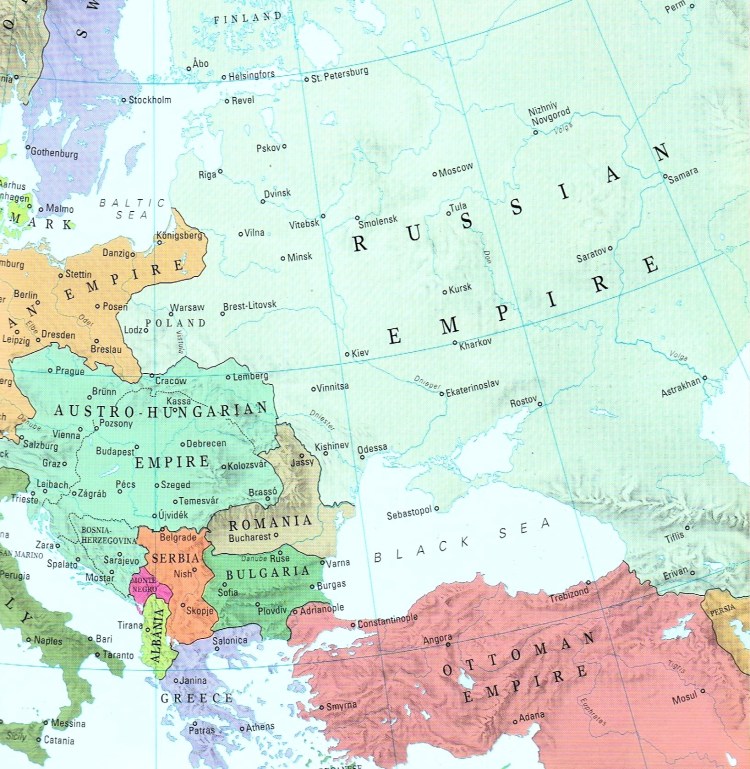
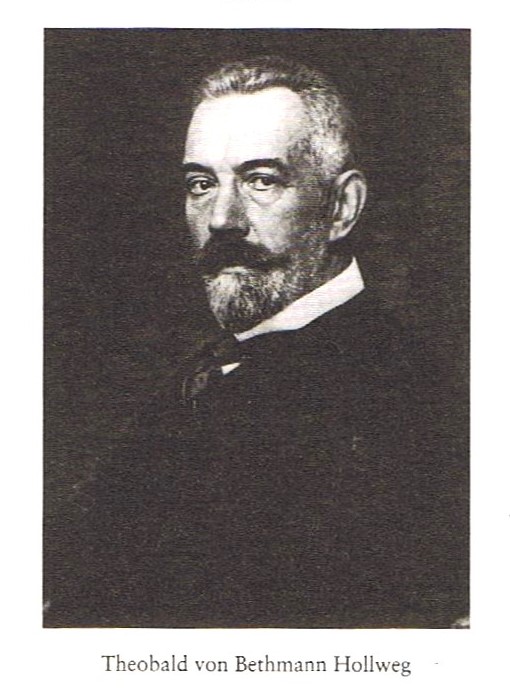
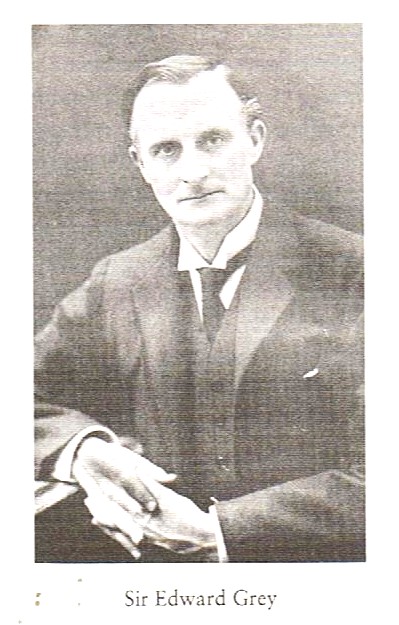
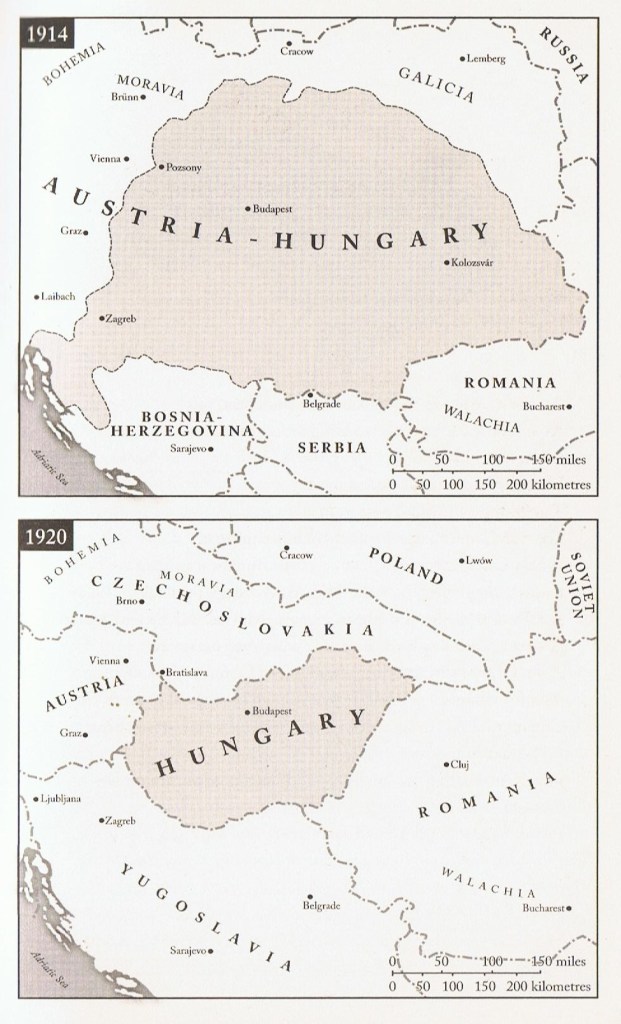
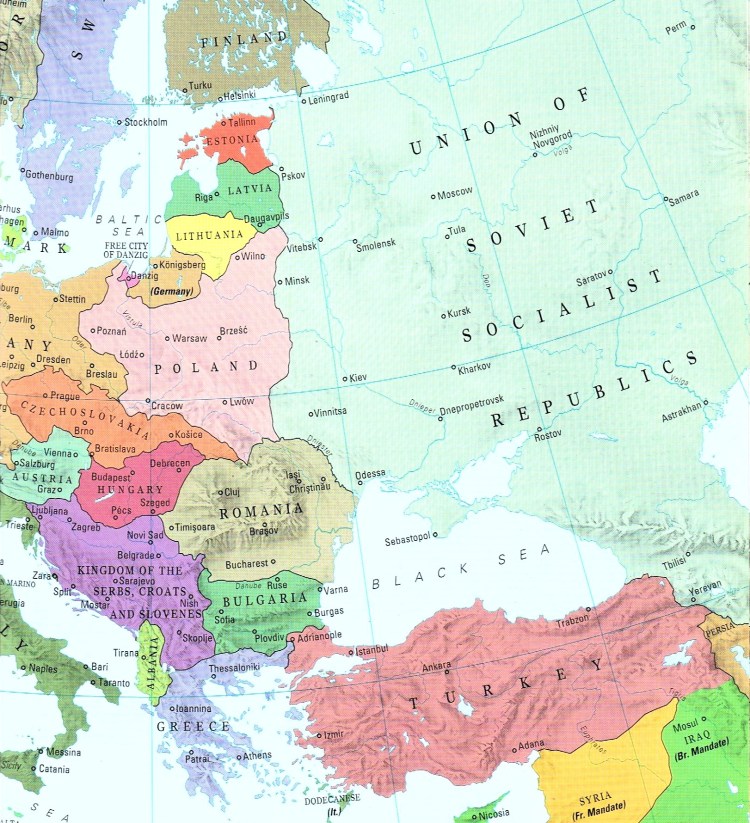
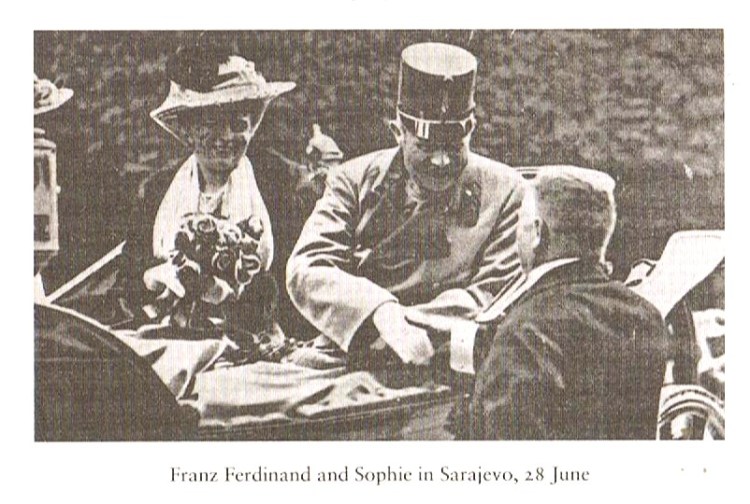
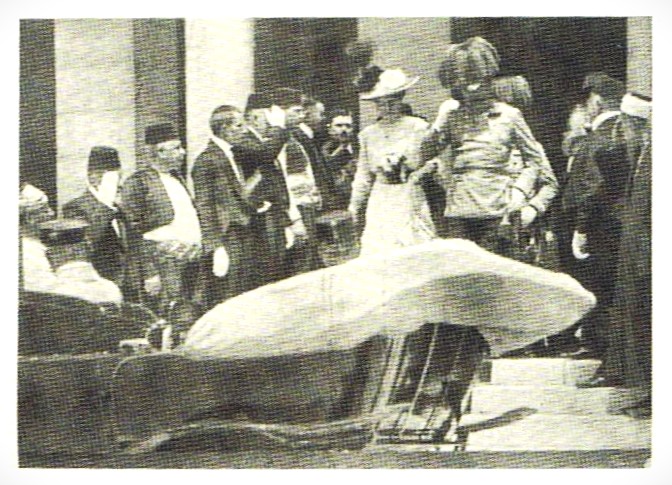
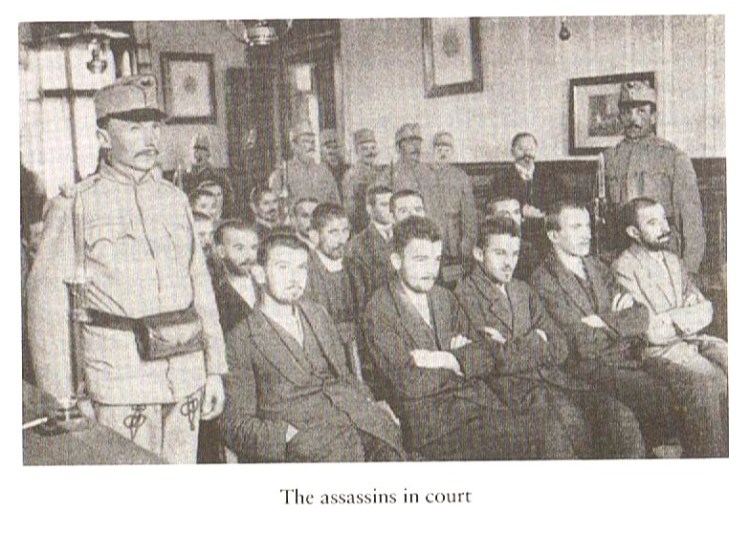
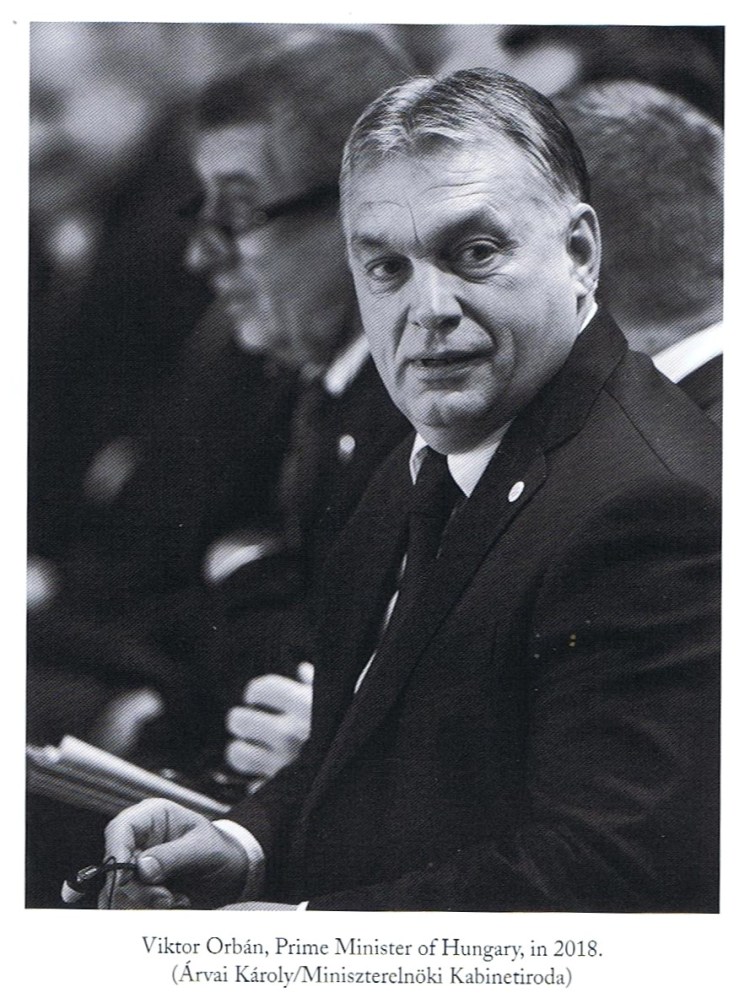
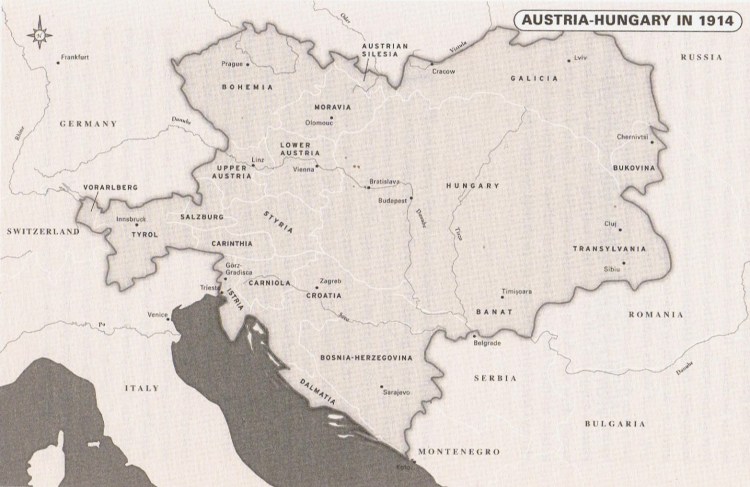
The recent attempted assassination of the Slovak Prime Minister, Robert Fico, reminded many Hungarians, along with other Central Europeans, of the events leading to the outbreak of the First World War which ended with the break-up of the Austro-Hungarian Empire and Hungary’s loss of two-thirds of its 1914 territories (as part of the ‘Dual Monarchy’ of Austria-Hungary) by the terms of the Treaty of Trianon (1920). Hungary’s Prime Minister, Viktor Orbán, wasted little time in blaming this assassination attempt on what he has called ‘the EU’s war strategy’ of supporting Ukraine in its defensive war against Putin’s aggressive invasion of the country. Both Fico and Orbán have consistently opposed NATO sending weapons and armaments to Ukraine, and have prevented those from member countries from transiting through Hungary and Slovakia. Orbán has also consistently resisted the EU’s imposition of economic sanctions on Russia. He has referred to those within Hungary and the rest of Europe who support the EU and NATO in these policies as ‘warmongers’: He has accused European leaders like Macron, Schulz, and Ursula von der Leyen of forming a ‘European War Party’ ahead of the EU elections in June and failing to learn the lessons of ‘the drift to war’ before the two world wars of the last century. My father was born in 1914 and my maternal grandfather in 1900; he was one of only a handful of recruits who survived the 1917 influenza epidemic in camp at Catterick and never made it to Flanders before the war ended. His uncle and elder brother, both named Alfred, joined the Navy. Uncle Alfred died on HMS Vanguard at Scapa Flow in 1916 and Brother Alfred survived, returning to service in the second war, training naval gunners. My wife’s family members survived the Second World War, the Nazi occupation of Hungary and the Holocaust. I was therefore keen to discover more about Hungary’s role in the origins and outbreak of these wars and to make an informed judgment as to whether these events can be described as a ‘drift’ to war and whether the leaders can be accurately described as ‘Sleepwalkers’.

Chapter One: The Dual Monarchy & the Origins of World War I

The Habsburg Empire before & after The Compromise of 1867:

Two military disasters defined the trajectory of the Habsburg Empire in the half-century to its demise. At Solferino in 1859, French and Piedmontese forces prevailed over a hundred thousand imperial troops. Then, at Köningratz on 3rd July 1866, the Prussians destroyed an Austrian army of 240,000 soldiers, ejecting the empire from the ambit of the emergent German nation-state. As a result, Austria became excluded from the German Confederation, which it had hoped to dominate. To the Hungarian premier, Ferenc Deák and his followers this, at first, seemed an undesirable outcome: they had calculated that if Austria had become preoccupied with its ‘Western mission’ again, Hungary would have acquired a better chance to recover its full autonomy within the Monarchy. However, on the other hand, they did not intend to weaken Habsburg power, from which they expected protection against German and Russian expansionism. Without the Austro-Germans, they would find themselves in a rump of the empire in which they were the most numerous ethnic group, but constituting less than half of the whole population. They therefore came to accept the idea that they would be better off in a two-state empire in which the western half would be transformed into a state, like Hungary, under one nation’s leadership. Then the positions of both leading nations in both halves of the empire would be consolidated by lending each other mutual support.

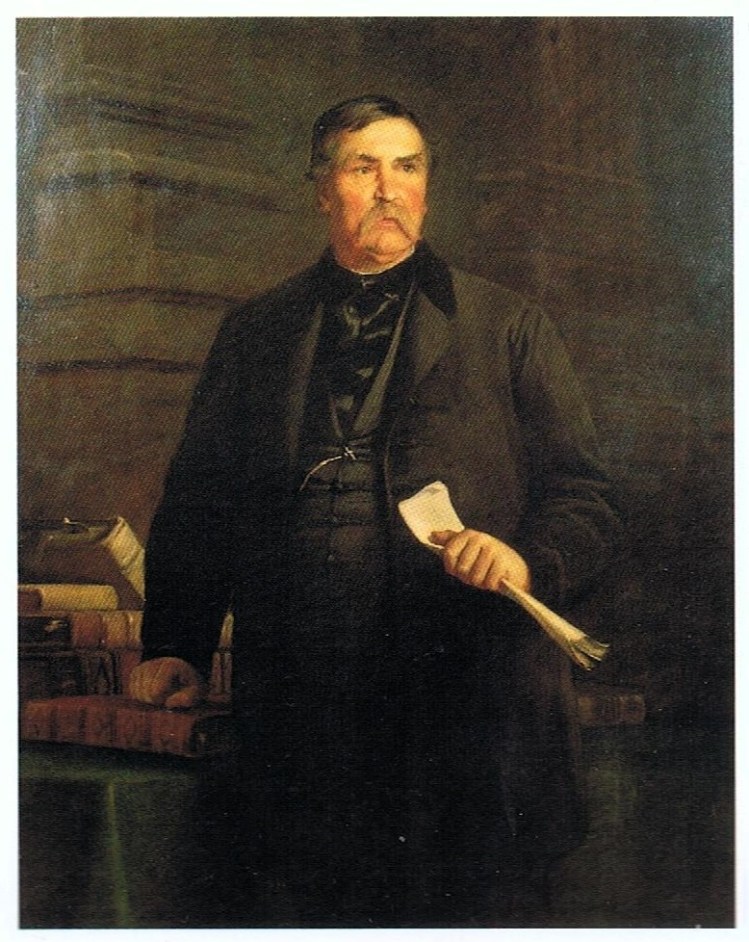
Ferenc Deák – a painting by Bertalan Székely, 1869. Déák (1803-1876) was a descendant of a family of medium estate owners in Transdanubia (Western Hungary) and a law graduate. He was a matchless figure both as a politician. He sought the framework, form, and formula for the compromises he served. Hundreds of anecdotes preserved his moral integrity and character; he was a witty conversationalist and debater. His published writings were on law and public life, but the many volumes represent a small fraction of the tremendous intellectual activity he displayed in his political life.

Gradually, Franz Josef himself started to prefer constitutional dualism to the alternatives of retaining the centralised structure and the federal reorganisation of the empire, as suggested by Slav national leaders and Prime Minister Count Richard Belcredi. In addition to Queen Elisabeth, whose pro-Hungarian sentiments have been subject to romantic exaggerations in Hungarian national legends, but were real enough, it was Baron Ferdinand Buest, Imperial Foreign Minister in 1866 and then Prime Minister (February 1867) who finally convinced the Emperor that the domestic precondition of revanche in Germany was compromise with the Hungarians. Thus, the cumulative effect of the military disasters transformed the inner life of the Austro-Hungarian lands as the absolutist Austrian Empire transformed into the Austro-Hungarian Empire. Under the Compromise hammered out in 1867, power was shared between the two dominant nationalities. As Clark has described it,

‘What emerged was a unique polity, like an egg with two yolks, in which the Kingdom of Hungary and a territory centred on the Austrian lands and often called Cisleithania (meaning ‘the lands on this side of the River Leithe’) lived side by side within the translucent envelope of the Habsburg dual monarchy.’

Clark (2012), p. 65.

But first, Buest needed a Hungarian partner to negotiate with. Deák paved the way to the Compromise and had a party in the Hungarian Parliament to push it through, but was determined to remain an eminence grise at most in the new era. The Hungarian delegation that negotiated the Compromise in January and February 1867 was headed by Count Gyula Andrássy, who enjoyed the complete confidence of Deák and the Hungarian liberals, as well as the royal couple, even though he was on the list of émigrés hanged in effigy in 1849. Having returned to Hungary in 1857, he was an experienced politician with an instinctive skill for brilliant improvisations. Andrássy was appointed Prime Minister on 17th February. Besides him, the most important member of the delegation was Eötvös, who represented continuity with 1848 and became Minister of Education and Ecclesiastical Affairs. Liberal commoners as well as aristocratic magnates were represented in Hungary’s third responsible ministry.

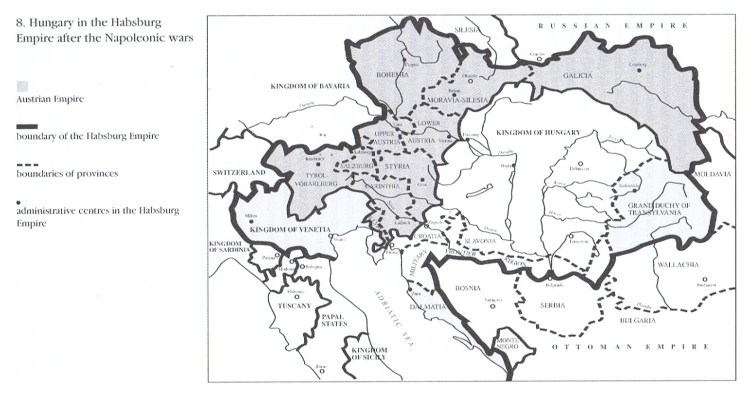
Devised by Ferenc Deák, the Compromise gave Hungary independence while keeping it in the Habsburg Empire; it also gave the kingdom its own government and parliament, with an upper house of dignatories and an elected Lower House, but the emperor as the king of Hungary appointed the government. To satisfy Hungarian demands, Transylvania was also fully absorbed into Hungary, and Hungarian law replaced the Austrian civil code. In June 1867, Franz Josef and Elisabeth were crowned king and queen of Hungary, and she too was invested with the royal sceptre and orb, an honour never before given to a queen of Hungary. That same year, Franz Josef published constitutions for both halves of the empire. From this point onwards, the Habsburg empire comprised two equal parts – a Hungarian part and a part for all the rest, which included the Austrian lands, Bohemia, Polish Galicia, the Adriatic coastline, and so on. The second had no obvious name and was officially known as the Lands and Kingdoms represented in the Imperial Council, and unofficially as ‘this side of Leitha’ (Cisleitha: the River marked Hungary’s western border).

Franz Josef and his family at Gödöllő, A lithograph, 1871. Elisabeth’s first journey to Hungary turned tragic. Her first-born daughter Sophia became ill in Debrecen and died suddenly. But the otherwise very sensitive queen stayed ever more gladly in Buda after the Compromise and coronation in 1867, especially at the palace in Gödöllő, which had been rebuilt as a royal summer residence. Later, as Elisabeth became increasingly estranged from her husband, she preferred to go to the Mediterranean in the summer, especially to the island of Corfu.

Predictably, Lajos Kossúth, the former Protector of Hungary, in exile since 1849, wrote an open letter, known as the Cassandra letter, to Ferenc Deák, his old associate, in which he claimed that the Dual Monarchy represented a sham independence. Kossúth was one of a minority who were unimpressed by the Compromise. In a series of open letters addressed by ‘the hermit of Turin’ to his countrymen, published on 26th May in a Pest journal, he argued that Deák’s policy culminated in abandoning Hungary’s claim to be an independent state, at a time when the 1866 crisis created the most auspicious circumstances to obtain independence. Köningrátz demonstrated that Austria was a dilapidated structure bound together merely by the Habsburg dynasty and doomed to collapse in the age of the nation-state. The Compromise involved a trap. Hungarian self-determination suffered irreparably from involvement in foreign policies that might be contrary to the nation’s interests, and might also throw it into conflict with the two Great Powers against which Deák sought protection and her neighbouring peoples whose friendship was essential for Hungary’s own wellbeing. Hungary lost the ‘mastery over her future’ and it would never be able to take advantage of the ever more frequently arising occasions to gain complete independence.

Kossuth was right in a very profound and prophetic sense, namely that Hungary’s twentieth-century history rather fatefully verified some of his predictions. At the same time, Deák was undoubtedly also right in pointing out that the ‘expected event’ (that is, the ultimate collapse of Austria) might not occur before it was too late ‘for our harrowed nation’ to take advantage of it. Deák never pretended that the Compromise was the best of all solutions, but he was convinced that it was the best of all possible ones. It corresponded to the social and national relations of power in 1867 and laid the foundations of a political establishment that was to last for half a century. On 8th June, Franz Josef I took the coronation oath on a mound constructed at the Pest side of the Chain Bridge from pieces of earth from all over the country, before being crowned on the Buda side in the Mátyás Cathedral, which had once been a Mosque under Ottoman occupation. It had been restored, and Franz Liszt (see the picture below) composed a Mass for the Coronation; the great aristocracy was present, in ornate national costume, and the master of ceremonies was Count Andrássy, trusted both by the Court and and the Habsburg politicians. Together with the Cardinal Archbishop, he was responsible for placing King István’s Crown on Franz Josef’s head. The Emperor sanctioned the sixty-nine Articles of Compromise four days later. A rebellious nation and an autocratic ruler seemed to have been reconciled and its status had been restored.

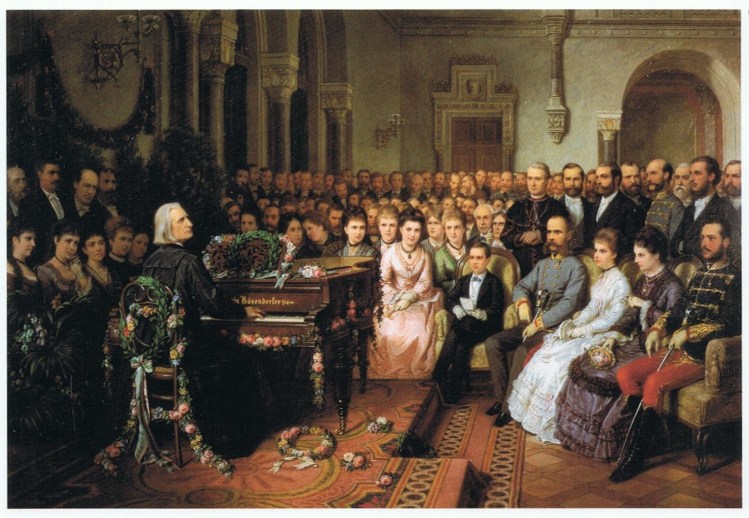
Ferenc Liszt giving a concert before the royal family in Buda Castle. A whole series of Central European artists, mainly musicians, and painters, were often identified as being of Austrian or German identity when they were really of Hungarian nationality and birth. Ferenc (or ‘Franz’) Liszt (1811-86) constantly claimed that he was Hungarian, albeit in broken Magyar. His virtuosity as a pianist made him internationally famous, a friend to Richard Wagner. Many Viennese Hungarian artists, together with Croatians and Czechs, used German as their common language. Liszt’s compositions were both startlingly modernistic and full of traditional Hungarian motifs, his real heir being Béla Bartók.

In one sense, and in retrospect, the coronation might seem like an act of decolonisation, the first of modern times, with all the pageantry of flags and anthems. At the time it was not thought likely to last. Without an army of its own, Kossuth argued, Hungary would be caught up in the interests of Germany. This was true, but if the new Monarchy could be made to work, it would protect Hungary. The existence of a united imperial army, under dynastic insignia and with German as the language of command, evoked resentment, and was only suffered because a separate Honvéd (along with the Austrian Landwehr) was also set up. The other delicate issue between Vienna and Budapest was the ‘economic compromise’: the customs union, commercial agreement, common currency, postal service, transport system, and the share of the two halves of the empire in the expenditure for common affairs, known as ‘the quota’ (30% in 1867; revised to 36.4% in 1907). To be renegotiated every ten years, the economic compromise was the only flexible element in what was otherwise a politically rigid settlement, one which held out the promise of redressing the supposedly unfavourable aspects of 1867 for both partners. The language of command in the armed forces and the quota system were constant causes for grumbling about the ‘constitutional issue’ (the relationship between the emperor and Hungary), which supplied the terms in which the rather shallow patriotism of the parliamentary opposition to the shape, though not the essence of the Compromise, was expressed through most of the fifty-one years of the Dual Monarchy.

Hungary was now the fourth European country, after Romania, Italy, and Germany, to get a form of national unification between 1859 and 1871. This development ended French hegemony as the new countries became, implicitly at first, part of a German one. In the two generations that followed, Hungary flourished. Where the Compromise went wrong was in Austria, which had been saddled with a centralising parliament with a rigged German majority, and all local grievances could be raised there. Bureaucratic rules were drawn up in such detail that only lawyers could handle them. There were seven thousand of them in the Austrian Empire, compared with 162 in late Victorian Britain. Hungary also developed a workable parliament and a programme of national modernisation.

Nevertheless, the two halves of the Austro-Hungarian Monarchy, the new official name of the new state in 1868, remained, ‘inseparable and indivisible’. Foreign policy and the army were regarded as ‘common matters’ and were overseen by ‘common ministries’ of foreign affairs and war, to which was added a third ministry of finance, with responsibility for funding the other two. In all other respects, the two governments were separate, with the prime minister of Hungary regarding his counterpart as a ‘distinguished foreigner’. Since Hungary now had its own government, the name of the empire changed from the Austrian Empire to the Austro-Hungarian Empire (or Austria-Hungary for short). This came about, with symbolic significance, because in trade treaties the term ‘Austro-Hungarian Monarchy’ had to be used. The ‘Austro’ referred to all the Habsburg lands, including Hungary, and all imperial officials bore the title kaiserlich-königlich (‘imperial-royal’), referring to all the ‘kingdoms’, including Bohemia and Croatia, later changed to Kaiserlich und königlich, which recognised the special status of the Kingdom of Hungary.

Above the ministries sat the Crown Council, made up of three common ministers, the prime ministers of Hungary and Cisleithania, and whomever Franz Josef chose to invite. The Crown Council was the emperor’s instrument for keeping control of foreign policy and the army. The new ‘dual monarchy’ had parliaments and Cisleithia also had elected diets, but its governance was not parliamentary. The emperor conducted his own foreign policy and military deployments, with minimal parliamentary oversight. Franz Josef also retained the right to legislate by decree, again with few constraints, which meant that he could bypass or substitute for the parliamentary process. He also had the power to dissolve the Vienna parliament, though not the one in Budapest, and to impose ministries without parliamentary approval. To that extent, absolutism survived.

Queen Elisabeth – A painting by Gyula Benczúr, 1861. She was one of the most beautiful women of her time, and her enigmatic sadness only served to enhance her sex appeal. Her love-marriage could not possibly succeed, at least not for the other party. Her husband was ultra-conservative, and although a dual monarch, petty bourgeois in his outlook on life, pedantic and small-minded, contrasting sharply with the sensitive and freedom-loving nature of the accomplished Elisabeth. In addition, she was somewhat neurotic, a temperament she transmitted to her son Rudolph, the heir to the throne. Although liberal in outlook and open to modernisation, it was her temperament and disposition to suicide that Rudolph inherited, with tragic consequences.

More importantly, the empire survived, but it was not just a matter of finding a constitutional formula to satisfy Hungarian aspirations. Franz Josef was unloved in Hungary, not least for killing the kingdom’s generals, but ‘Sisi’ had the glamour and passion for Hungary that reconciled Hungarians to Habsburg rule. She was their queen, who spoke their language, wore their national dress, and went to hunt in their fields. Back in 1866, she had asked Franz Josef to buy her Gödöllő Palace, to the east of the capital. He had grumpily refused, explaining that ‘in these hard times, we must save mightily.’ The following year, the newly installed Hungarian government led by Count Andrássy bought it for her, as the nation’s gift on her coronation. Andrássy had no doubt of Sisi’s contribution to the 1867 settlement between the monarch and Hungary. However, for the other nationalities of the new Austro-Hungarian Empire, Sisi showed little empathy, being particularly disdainful of Czechs and Italians. However, her inconsistencies and eccentricities should not conceal how her intervention in Hungarian affairs fitted into a larger pattern of queenly conduct. Despite recollections of Maria Theresa and the example of Queen Victoria (1837-1901), there were fewer regnant queens than in previous centuries, and females had been expressly barred from succession in France, Spain, Sweden, and Prussia. Instead, it was as consorts that queens became influential, particularly in rebuilding the monarchy’s image. The closest parallel to Sisi was Queen Alexandra, the consort of Britain’s Edward VII (1901-1910), who was elegant, striking in appearance, and a meddler in politics.

The dualist compromise had many detractors at the time and has had many critics since. In the eyes of ‘hardline’ Magyar nationalists, it was a sell-out that denied Hungarians the full independence they had fought for. At the time, some claimed that Austria was still exploiting Hungary as an agricultural colony. Moreover, Vienna’s refusal to relinquish control over the armed forces and permit the creation of a separate and equal Hungarian army was particularly contentious, with a constitutional crisis over this in 1905 leading to the political paralysis of the Empire. On the other hand, Austrians argued that the Hungarians were freeloading on the more advanced economy of the Austrian lands, and ought to pay a higher share of the empire’s running costs. This conflict was now built into the dual monarchy because the Compromise required the two halves of the imperial system to renegotiate the customs union by which revenues and taxation were shared between them. The Hungarians’ demands increased with every review of the union until there was little left in it to continue to recommend it to the political élites of the other national minorities, who had in effect been placed under the domination of the two ‘master races’. The first post-Compromise prime minister, Gyula Andrássy, captured this aspect of settlement when he commented to his Austrian counterpart, “You look after your Slavs and we’ll look after ours.” (Cited in Alan Sked, The Decline and Fall of the Habsburg Empire, 1815-1914. New York, 1991: p. 190.)

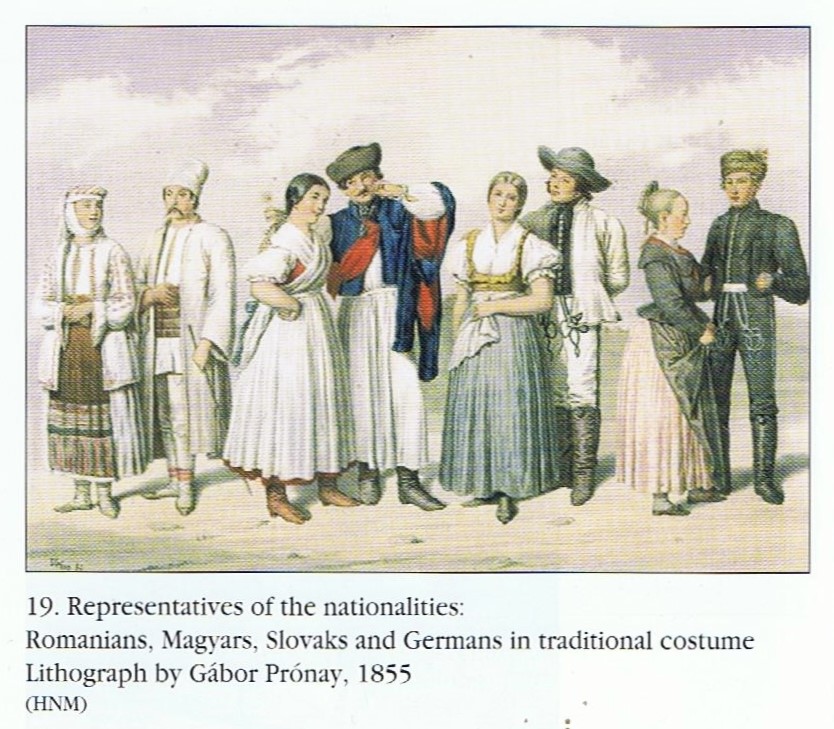
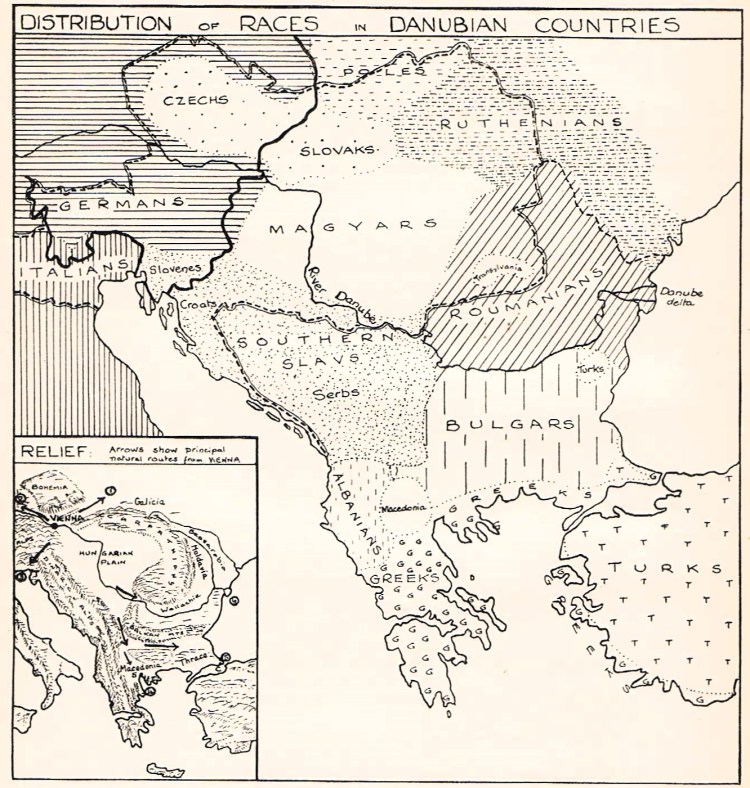
Ethnic Minorities within the Austro-Hungarian Empire of 1868:

The Court wanted revenge against Prussia and looked for alliance with the south German states; a former Prime Minister of Saxony, Friedrich Ferdinand von Beust, who detested Bismarck, was now in charge of foreign affairs. He had pushed for the Compromise because his programme needed taxes and recruits and wanted the Hungarian problem out of the way. The German liberals, thanks to the electoral system, could now dominate a purely Austrian parliament that would not include Hungarian deputies. They were now free to realise their programme, to ignore the Bohemian grandees with their ‘claptrap’ about Bohemian state rights, to put Czech nationalists back in their box, and to cut back the powers of the Church. They meant to create a progressive state, as their counterparts were doing elsewhere, together with the centralising bureaucracy, schools, inheritance taxes, laws, law degrees, and lawyers. The Hungarians, on their side, also wanted wide autonomy so that they could remake the nation in their way, without reference to Austrian centralisers, who were always encouraging the non-Magyar peoples of Hungary to demand rights. Laws were passed from 1867 to 1869 in both parliaments to further establish the new arrangements.

It was well understood in Austria that the Compromise was arguably the only way to preserve the great power status of the Habsburg Monarchy and that in Hungary it not only increased the chances of national survival but also offered a means to partake of that great power status. Though none of the defence ministers, and few in the high command of the armed forces of the Dual Monarchy were Hungarian, thirty percent of the diplomatic corps and four out of ten foreign ministers were subjects of the Hungarian Crown. It is therefore not surprising that, in an age when nationalism was dominant in the attitudes and ambitions of powers great and small, Hungarian nationalists became dazzled by the prospect of governing a demi-empire, whose economic and demographic dynamism might soon shift the intra-imperial balance of power in their favour and even compel the Habsburg dynasty to remove its residence from Vienna to Budapest. On the domestic front, there was certainly a convincing argument in favour of the Compromise that for the two leading nations of the Habsburg monarchy, it did represent a shift from absolutist to liberal representative government, albeit with shortcomings, and for the bulk of the Hungarian liberals some of these made it more attractive than potential alternatives. The strong personal power of the ruler was not one of these, however, and the discretionary powers reserved for Franz Josef maintained his influence in the domestic affairs of both states, whereas his Cabinet and Military bureaus played roles equal to that of the joint ministries in common affairs. Relying on a broad network of unofficial advisors, whose loyalty he could rely on, he exerted a personal influence across a wide range of policy matters.

At the time, Hungary had a population of some thirteen million, mostly either illiterate or literate in a language other than Magyar. There was a country to build, and there was a formula at hand as to how this should be done: it was the ‘Age of Progress’ and classical liberalism, and an accompanying optimism dominated thinking in the 1860s. The British example was plain for travelers to see; Gladstonian liberalism, emphasising the rule of law through parliament was in its heyday and so was the Gold Standard, controlled by an independent central bank. Mass education was important, and the schools of that era were built along Greek and Roman lines. Town planning and public health and hygiene were developing, and doctors were being fully consulted. The ‘limited company’ was becoming increasingly important for commerce, encouraging competition and free trade. Classical liberalism could develop more easily in the framework of nation-states in a decade that started with national unification in Italy and ended with Bismarck’s ceremony at Versailles setting up the German Empire.

At its inception, liberalism in Hungary was the creation of noblemen, largely directed to offset, moderate, or exploit the effects of capitalist development in a predominantly rural society. After the waning of the enthusiasm of the Age of Reform and the Revolution of 1848, the dismantling of feudalism took place. Relations of dependence and hierarchy and the traditional respect for authority were preserved in attitudes. Liberal equality remained a fiction even within the political élite. The Compromise was, after all, a conservative step, checking whatever emancipationalist momentum Hungarian liberalism could still muster. Instead, it became increasingly confined to the espousal of free enterprise, the introduction of modern infrastructure, and, with considerable delay, the secularisation of the public sphere and the regulation of state-church relations. Political remained in the hands of the traditional élite, with which newcomers were assimilated, with roughly eighty percent of MPs permanently drawn from the landowning classes. The franchise, extending to about six percent of the population throughout the period, was acceptable at its beginning, but grossly anachronistic by its end in comparison with much of the rest of Europe. Since most rural districts fell under the patrimony of local magnates and their groups, elections were, as a rule, ‘managed’ and there was large-scale patronage at all levels of administration. Hungary’s political liberalism during the time of Kalman Tisza’s premiership from 1875 to 1890 resembled that of England during Walpole’s ‘whig oligarchy’ of a century and a half earlier. Yet, since the Hungarian parliament was largely independent of the crown, it was ‘more free’ than any other east of the Rhine.

The development of European nation-states required strong national armies, and the example for building these was Prussian. Instead of taking recruits on an indenture of twenty-five years, Prussia had instituted a system of conscription, giving peasant boys three or more years’ training, after which they went into a reserve that could be called up in wartime. This had the great advantage of making the conscripts feel part of the nation. Austria-Hungary introduced conscription in 1868, and Russia in 1874. The Habsburg Empire still counted as a great power with a large and newly reformed army, which also enabled it to cooperate to keep the peace.

It was in these circumstances that the Hungarians took their place within the Habsburg state; Gyula Andrássy became Minister for Foreign Affairs in 1871, and Hungarians had more than their due share of ambassadors and ministers. In 1867 there was an air of euphoria in Budapest as a cabinet of magnates took office. At this time many of the great aristocrats took their national role very seriously, following the example of the British House of Lords, which produced many experts in economics and social reform. In Hungary, Count Lónyay turned out to be an excellent Finance Minister. The English journalist Henry Wickham Steed, who wrote a classic on the Habsburg Monarchy, had reservations about Hungary, but he did notice the rise in intelligence that occurred as the Danube steamer moved from Vienna, with its smug aristocracy, to Budapest.

Gyula Andrássy was the first Prime Minister, and among his first tasks was to make a new capital. The Chain Bridge had linked Buda and Pest, and these two, with Óbuda, were conjoined in 1873 as Budapest, with a powerful mayor, strongly supported by commercial interests. The new Hungary was self-consciously liberal and adopted various arrangements accordingly. Now that there was a proper Hungarian finance ministry, and now that laws and courts guaranteed investment, Austrian capital flowed in. The city’s situation, with the hills of Buda on one side of the Danube, and the plain of Pest on the other, was magnificent, and the roads were laid out sensibly with two concentric rings of boulevards, Andrássy and Rákóczi, cutting across them. The intersection of the great boulevard (Teréz) and Andrássy Avenue was an eight-sided square, the Oktogon, with fashionable cafés, and beyond it the avenue was studded with enormous villas, often occupied by embassies. The opera house was added in 1884, and there were endless theatres, as the city’s cultural life showed much vigour. In the earlier period, the architecture tended to copy the Austrian styles, but after 1890a distinctly Hungarian note was struck as both Budapest and several provincial cities were given ‘Secessionist’ (Art Nouveau) makeovers. By 1900, Budapest was heading to become a million-strong city, and much of it was a building site. As the country’s showcase capital, it was a dramatic triumph.

Ethnic Minorities in Imperial Hungary in the Nineteenth Century:

The particular engine of growth was the railway, which eventually made the fortunes of the estate holders. If they had a station near their lands, they could load agricultural produce, mainly grain, and sell it to the ‘captive’ Austrian markets. Proto-industrialisation meant food processing, particularly flour production, and distilling; then came true industrialisation with the growth of textiles and machinery. Austrian Germans and Czechs made up a quarter of the skilled artisans and railwaymen, while the overwhelming majority of Magyars were peasants. In 1900, five million of them were without land, seven million had some land, a third of whom had less than the seven acres needed for subsistence. The new Hungary was therefore dominated by estate owners, magnates of the Eszterházy-Károlyi class in the Upper House, or gentry with middling-sized estates who occupied most parliamentary seats. This was a gentlemen’s parliament, with clubs where men could meet informally. In the first years, under Andrássy, enlightened laws were passed like those of 1868 concerning the non-Magyar minorities, providing them with schools and law courts, which were rewards for the way they had accepted the Compromise. József Eötvös did much for education, especially teacher training. An attempt was made to curb the power of the counties: now that Austrian interference was no longer to be expected, that autonomy, so often associated with pig-headed provincialism, would just be a nuisance for governments.

Besides the many-sided tensions involved in the settlement of Austro-Hungarian relations, others arose from the limited blessings of constitutionalism and did not satisfy those citizens of Austria and Hungary who did not belong to either of the two leading nations. In the Austrian sphere, ‘dualism’ was unacceptable to the Czechs, who either demanded the federal reorganisation of the empire, or hoped for ‘trialism’, and could not be placated by the mere transfer of the Czech coronation insignia from Vienna to Prague. The less ambitious claim of autonomy voiced by the Poles of Galicia was refused, lest it should provoke Russian resentment. Austro-German hegemony was thus preserved in Austria, just as Hungarian supremacy survived in Hungary.

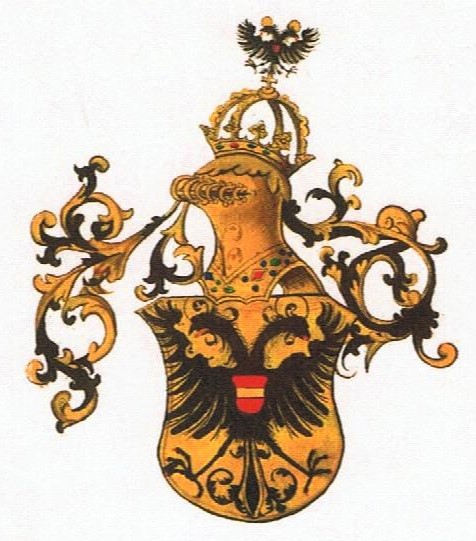
The Royal Habsburg Coat of Arms, from the Biblioteque Nationale de France.

The case of the Croats was unique, similar to that of the Czechs beyond the Leitha on account of the ‘historical legitimacy’ of their claims of self-government. After the Compromise, their status was put on a new footing in the Hungarian-Croat constitutional agreement (Nagodha) of 1868. Like the Austro-Hungarian Compromise, it was a treaty of union, but unlike its counterpart, this was a union of unequal partners. Croatia was acknowledged as a ‘political nation with a separate territory, and an independent legislature and government in its domestic affairs.’ However, the latter were confined to internal administration, the judiciary, and educational and ecclesiastical affairs. As regards the common affairs of the empire as a whole, Croats were represented by six members of the Hungarian delegation. In the common affairs of Hungary and Croatia, the forty-two deputies of the Croatian Sabor in the Hungarian parliament constituted a minority that could be easily outvoted. Also, while the Ban of Croatia was responsible for the state sabor, his appointment by the monarch required the Hungarian government’s approval, thus restricting Croatian autonomy. Although the agreement secured important elements of statehood and a broad range of opportunities to develop national cultural and political institutions, it is little wonder that the Croatian Sabor had to be dissolved repeatedly before a pro-Hungarian majority could be secured to get the Nagodba voted through.

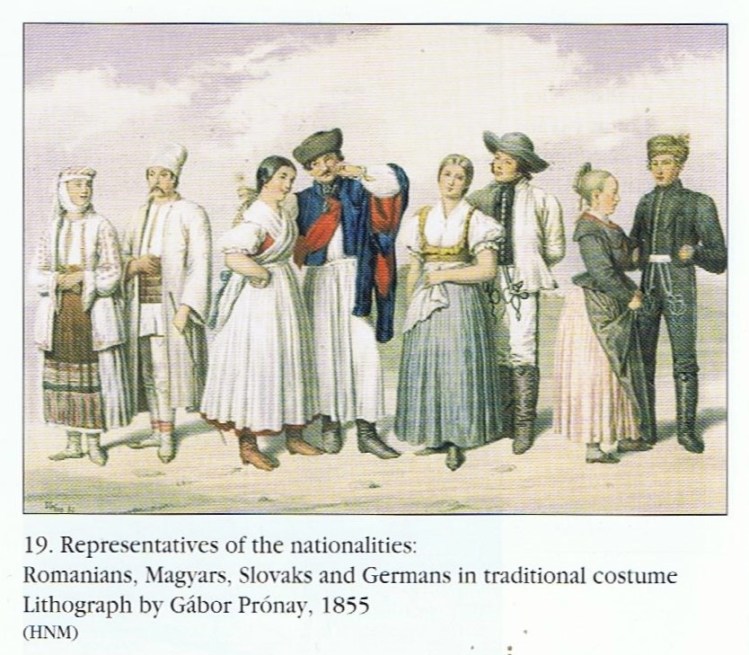
This was still far more than the other nationalities felt they received in what was at that time, ironically, the only comprehensive piece of legislation in Europe apart from Switzerland that addressed the respective status of ethnic groups within the polity, and a remarkably liberal one. Although the endeavour to satisfy the ‘reasonable’ demands of the nationalities was a frequent theme in public discourse on the eve of the Compromise. Law XLIV of 1868 became established on the principle that ‘all Hungarian citizens constitute a nation in the political sense, the one and indivisible Hungarian nation’, that is, on the fiction of a Magyar nation-state on the Western European model. It denied the political existence, and thus the claims to collective rights and political institutions, of the national minorities, for whom the assertion that ‘every citizen of the fatherland … enjoys equal rights, regardless of the national group to which he belongs’ was meager compensation. At the same time, in granting individual rights the law was thoroughly liberal, even surpassing in some respects the demands of the nationalities themselves. It gave extensive opportunities for the use of their native tongues in the administration, at courts, in education, and in religious life; the right of association made it possible to establish cultural, educational, artistic, or economic societies and schools using any language; and the law even required the state to promote primary and secondary schooling in the mother tongue and the participation of the ethnic minorities in public service.

The Repolarisation of Europe, 1887-1907:

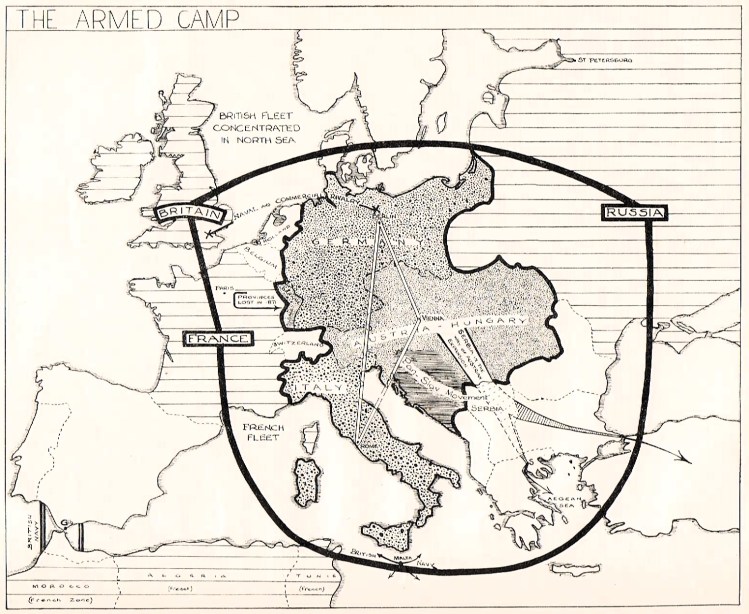
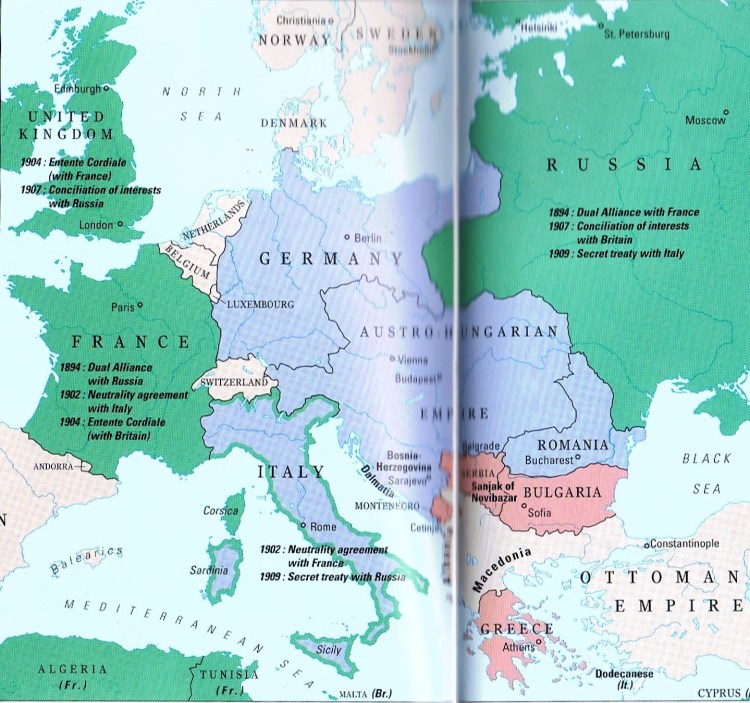
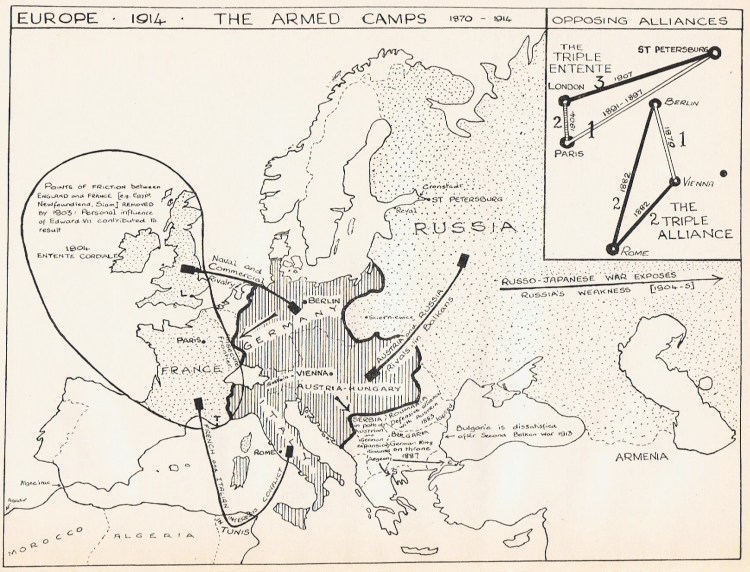
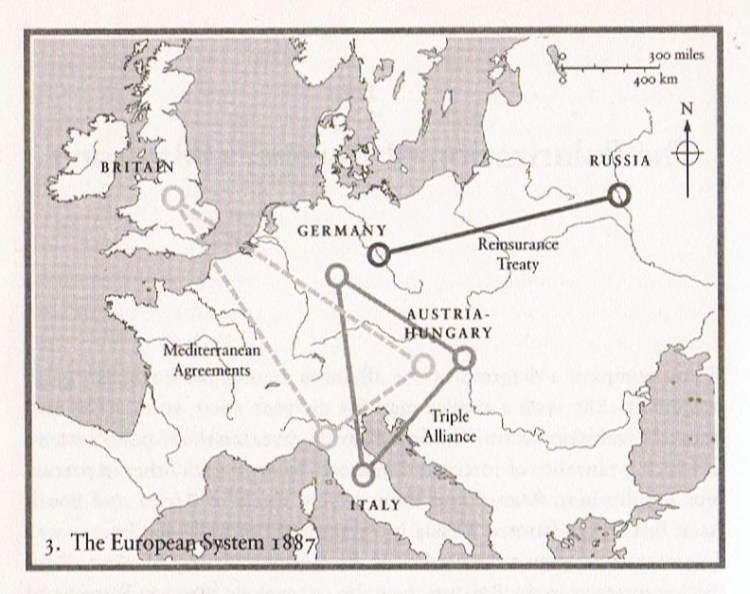
By comparing the diagrammatic maps above and below for 1887 and 1907, the outlines of a transformation can be discerned. The first map shows a multi-polar system, in which a plurality of forces and interests balance each other in a precarious equilibrium. The conflicting interests in the Balkans gave rise to tensions between Russia and Austria-Hungary, Italy and Austria were rivals in the Adriatic and quarreled intermittently over the status of Italophone communities within the Austro-Hungarian Empire. There were also rivalries and tensions between Britain, France, Italy, and Germany over northern Africa. These pressures were held in check by the patchwork of the 1887 System. The Triple Alliance between Germany, Austria-Hungary, and Italy (20th May 1882) prevented the tensions between Rome and Vienna from breaking into open conflict. The (defensive) Reinsurance Treaty between Germany and Russia (18th June 1887) contained articles deterring either power from seeking its fortunes in war with another continental state and insulated the Russo-German relationship against the fallout from Austro-Russian tensions. However, both also agreed that neutrality would not apply if Germany attacked France or Russia attacked Austria-Hungary. The Russo-German link also ensured that France would be unable to build an anti-German coalition with Russia. Britain was loosely tied into the continental system by the Mediterranean Agreement of 1887 with Italy and Austria – an exchange of notes rather than a treaty, whose purpose was to thwart French challenges in the Mediterranean and Russian ones in the Balkans or Turkish Straits.

By 1907, the picture had changed utterly into one of a bipolar Europe organised around two alliance systems. The Triple Alliance was still in place, though Italy’s commitment to it had weakened considerably. France and Russia were conjoined in the Franco-Russian Alliance (drafted in 1892 and ratified in 1894), which stipulated that if any member of the Triple Alliance should mobilise, the two signatories would ‘at the first news of this event and without any previous agreement being necessary,’ mobilise immediately the whole of their forces and deploy them ‘with such speed that Germany shall be forced to fight simultaneously on the East and on the West’. It would be some years before these loose alignments tauten into the coalitions that would fight the First World War in Europe, but the profiles of two armed camps were already visible by 1908.

The polarisation of Europe’s geopolitical system was a crucial pre-condition for the war that broke out in 1914. At the same time, though, it is almost impossible to see how a crisis in Austro-Serbian relations, however grave, could have dragged all the major powers into a continental war. The bifurcation into two alliance blocs did not cause the war; indeed, it did as much to mute as to escalate the conflict in the pre-war years. Yet without the two blocs, the war could not have broken out in the way it did. The bipolar system structured the environment in which crucial decisions were made. To understand how that polarisation took place, it is necessary to answer four interlinked questions: Why did Russia and France form an alliance against Germany in the 1890s? Why did Britain decide to throw in its lot with that alliance? What role did Germany play in bringing about its own encirclement by a hostile condition? To what extent can the structural transformation of the alliance system account for the events that brought war to Europe and the world in 1914?

Looking after the Slavs:

At first, the opponents of the Nationalities’ Law (XLIV) of 1868 criticised its shortcomings, but later they mainly complained because it was increasingly neglected by the Hungarian authorities. Its major drawback was that it contained no guarantees. Contrary to the spirit of Eötvös and Deák, their successors interpreted the concept of the equality of all Hungarian citizens meant that all non-Magyars who assimilated with Magyars would be considered as equal. From the 1880s on, Magyarisation was no longer merely ‘encouraged with all legally permissible means’, but also enforced with some means that evaded or violated the law of 1868. The relationship between the two halves of the empire, the archaisms of the political system, and the nationalities’ question were ‘time bombs’ that the Compromise had placed in the structure of dualist Hungary. Nevertheless, it took a long time, and the effect of international events, for these bombs to explode. Dualism in Hungary is generally reckoned to have been in a crisis during the whole of the second half of the period of the Monarchy, yet the stirrings on the ‘constitutional issue’ were not sufficient to shake it, and the dynamism of economic and cultural progress did much to blunt the edge of the social and the nationality issues from the 1890s through to the 1910s. As a result, the inertia of the peculiarly- modernised Magyar old régime lasted only until its military defeat in the First World War. For these reasons, the tension-ridden era also had an atmosphere of ‘perma-crisis’.

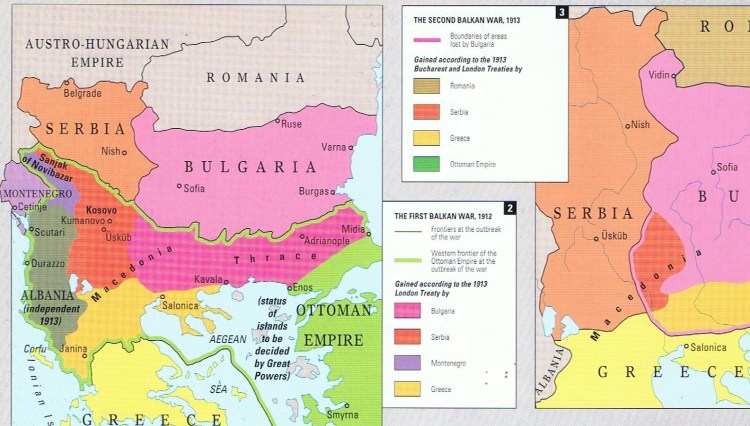
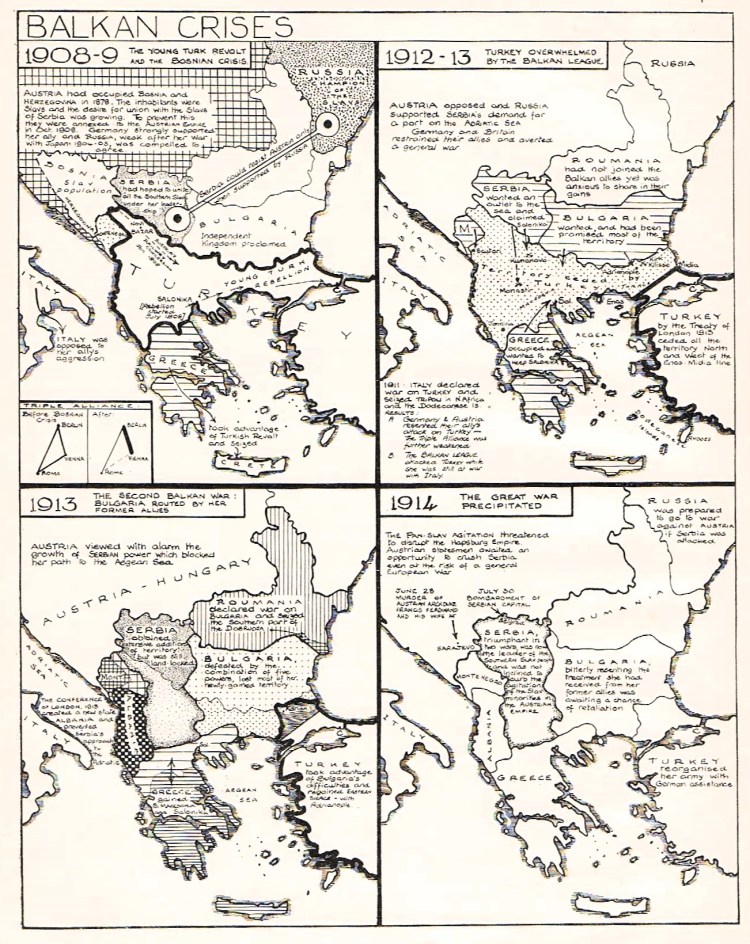
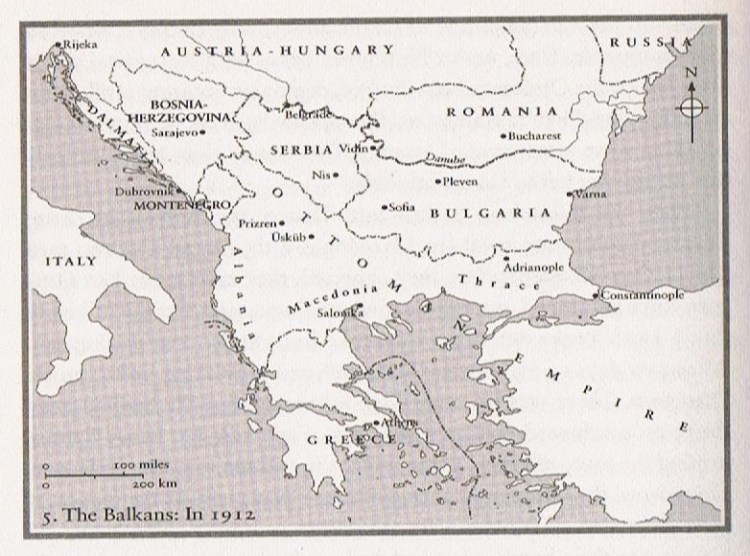
The most significant international events of the period revolved around the independent Balkan states, especially Serbia, and their impact on the Slav nationalities in the southern and eastern parts of the dual monarchy. Debates on internal economic issues in Austria-Hungary took place against a background of seemingly permanent unrest in the Balkans. In 1873, urged by Bismarck who wanted to surmount the diplomatic isolation of Germany resulting from its previous wars, and contrary to the personal intentions of Andrássy who had hoped to use the Habsburg Monarchy to prevent the expansion of Russia, the Three Emperors League was concluded. Not even after the outbreak of an anti-Ottoman uprising in Hercegovina and Bulgaria in 1875 brought the conflicting interests of Russia and Austria-Hungary to the surface. After the defeats of the revolts and the intervention of Serbia and Montenegro in their favour by the Turks, the two powers defined and separated their interests in protracted negotiations, as a result of which Russia could also count on the neutrality of Austria-Hungary in the war it declared on the Ottoman Empire in 1877. However, Russian arms proved too successful, and the Russians were deterred from marching on Constantinople by the appearance of the British fleet. In March 1878 they concluded the Peace of San Stefano, practically ending Ottoman rule in the Balkans and creating Greater Bulgaria, which was unacceptable to any of the Great Powers.

It was on the insistence of Andrássy that the Berlin Congress convened in July 1878 to revise the settlement in the Balkans. Russia was forced to make concessions: Bulgaria’s growth was checked, while the full independence of Romania, Serbia and Montenegro was acknowledged, and Austria-Hungary was entrusted with the occupation and administration of Bosnia-Hercegovina. The diplomatic gain could only be made real on the ground by a three-month campaign with several thousand casualties. This gave rise to intense debate in Austria-Hungary, with some politicians demanding annexation rather than mere occupation and others being concerned about a further increase in the Slav element in the population of the Dual Monarchy. Although in 1881, Austria-Hungary, Germany, and Russia signed a secret agreement guaranteeing the status quo in the Balkans, Russia no longer figured in the diplomatic imperial schemes. The cornerstone of its foreign policy was the Dual Alliance with Germany in 1879, expanded to the Triple Alliance with the inclusion of Italy in 1882. There was also a network of Russian agreements with the Balkan states (Serbia in 1881 and Romania in 1883) that ensured the Monarchy’s hegemony in the peninsula. As for Bosnia-Hercegovina, it was relegated to the status as the province of the Common finance minister and was pacified in the early 1880s when that post was occupied by the Hungarian Béni Kállay, an expert in southern Slav relations. However, through its expansion in the Balkans, the empire got entangled in a web from which it was never to escape. The occupation was immediately and immensely unpopular in Hungary and, in the face of uproar in parliament, PM Kalman Tisza’s cabinet resigned, though Tisza himself was retained in office by the monarch until 1890.

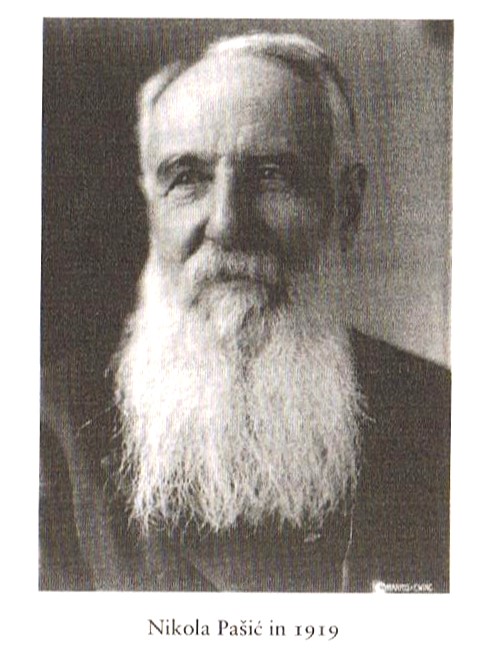
As Christopher Clark has written in his recent book Sleepwalkers (2012), Serbia’s commitment to the redemption of its lands, coupled with the predicaments of its exposed location between two land empires, endowed the foreign policy of the Serbian state with… distinctive features (Sleepwalkers: 24). The first of these was the indeterminacy of geographical focus, by which Cook meant that the principle of commitment to a Greater Serbia did not indicate where exactly the process of redemption should begin. There were various alternatives: Vojvodina, in the Kingdom of Hungary; Ottoman-controlled Kosovo; Bosnia and Hercegovina, never part of Serbia’s empire but containing a large Serbian minority (43 percent of the 1878 population), or Macedonia in the south, also still under Ottoman rule. The mismatch between the vision of ‘unification’ and the meager resources available to the Serbian state meant that Belgrade policy-makers could only respond opportunistically to rapidly changing conditions on the Balkan peninsula. As a result, Serbian foreign policy swung like a compass needle between 1844 and 1914, from one point on the state’s periphery to another.

The logic of these opportunistic oscillations was, as often as not, reactive. In 1848, when the Serbs of Vojvodina rose up against the Magyarising policies of the Hungarian revolutionary government, the Serbian government chose to assist them with volunteer forces. In 1875, all eyes were on Hercegovina, where Serbs had risen against the Ottomans under their military commander and future king Petar Karadjordjevic. After 1903, following an abortive local uprising against the Turks, there began intensified interest in ‘liberating’ the Serbs of Macedonia. In 1908, when the Austrians formally annexed Bosnia and Hercegovina, having occupied them since 1878, these annexed territories became the main priority for Serbian nationalists. Still, by 1912-13, Macedonia once more topped their agenda.

Serbian foreign policy had to struggle with the gap between the visionary nationalism that dominated the country’s political culture and the complex ethnopolitical realities of the Balkans. Kosovo was, and still is, at the centre of Serbian mythology, but it was not, in ethnic terms, a purely or even mainly Serb territory. Muslim Albanian speakers have been in the majority there since at least the eighteenth century, although the exact population of ‘Old Serbia’ (comprising Kosovo, Metohija, Sandzak, and Bujanovac) is unknown. Many of the Serbs whom Vuk Karadzic counted in Dalmatia and Istria were, in fact, Croats, who had no wish to join a greater Serbia. Bosnia and Hercegovina, two provinces under Hungarian occupation, contained a combined majority of Catholic Croats (20%) and Bosnian Muslims (33%). The mismatch between national visions and ethnic realities made it highly likely that realising Serbian objectives would be a violent process. Some statesmen met this challenge by trying to package these within a more generous ‘Serbo-Croat’ political vision encompassing the idea of multi-ethnic collaboration.

The last decades before the outbreak of the Great War were increasingly dominated by the struggle for national rights among the empire’s eleven official nationalities. Besides the Germans, Hungarians, and indigenous Slav minorities, these also included Poles and Italians. How these challenges were met varied between the two halves of the empire. The Hungarians dealt with nationalities’ problems as if they didn’t exist. The result was that the Magyar deputies, although representing just over 48 per cent of the population, controlled over 90 percent of the parliamentary seats. The three million Romanians in Transylvania, the largest of the kingdom’s national minorities, comprising fifteen percent of its population, held only five of its four hundred seats. Furthermore, as already noted, from the late 1870s, the Hungarian government pursued a campaign of aggressive Magyarisation through which education laws imposed the use of the Magyar language on all state and church schools and even kindergartens. Teachers were required to be fluent in Magyar and could be dismissed if they were found to be ‘hostile to the state’. This degradation of language rights was underwritten by harsh measures against ethnic minority activists. As also already noted, Serbs from Vojvodina in the south, Slovaks from the northern counties, and Romanians from Transylvania did occasionally collaborate in pursuit of minority objectives, but with little effect, since they could muster only a few mandates.

In the Austrian lands, by contrast, successive administrations tampered endlessly with the political system to accommodate minority demands. Franchise reforms in 1882 and 1907 (when virtually universal male suffrage was introduced) went some way towards leveling the political playing field. At the same time, however, these democratising measures merely heightened the potential for national conflict, especially over the sensitive question of language use in public institutions such as schools, courts, and administrative bodies. So intense did the nationalities’ conflict become that in 1912-14 multiple parliamentary crises crippled the legislative life of the monarchy. The Bohemian Diet had become so difficult for the Austrians that in 1913 their prime minister, Count Karl Stürgkh, dissolved it, installing an imperial commission to run the province. Czech protests against this brought the imperial (Cisleithanian) diet to its knees in March 1914, so Stürgkh dismissed this too, and it was still suspended when Austria-Hungary declared war on Serbia in July so that Cisleithania’s was in effect being run by an absolutist administration when war broke out. Meanwhile, in Hungary in 1912, following protests in Zagreb and other southern Slav cities against an unpopular governor, the Croatian Diet and constitution were suspended; in Budapest itself, the last pre-war years witnessed the advent of a kind of parliamentary absolutism focused on protecting Magyar hegemony against the challenge posed by minority national opposition and the demand for franchise reform.

Clark has argued, however, that while the apparent chaos in the Austro-Hungarian Empire might appear to support the view that it was a moribund polity, whose disappearance from the political map was merely a matter of time, in reality, the roots of Austro-Hungary’s political turbulence (Clark, 2012: p. 68) were less deep than those appearances suggested. Certainly, there was intermittent inter-ethnic conflict – riots in Ljubliana in 1908 and Czech-German brawls in Prague – but it never came to the levels of violence experienced in the contemporary Russian Empire. And, despite the obvious political turmoil, the Habsburg lands also passed through a last pre-war decade of strong economic growth with a corresponding rise in general prosperity, an important point of contrast with the contemporary Ottoman Empire. Free markets and competition across the empire’s vast customs union stimulated technical progress and the introduction of new products. The scale and diversity of the dual monarchy meant that new industrial plants benefited from sophisticated networks of cooperating industries underpinned by an effective transport infrastructure and a high-quality service and support sector. These economic effects were particularly evident in Hungary. In the 1840s, Hungary had been the ‘larder’ of the empire – 90 percent of its exports to Austria were agricultural products. But by the years 1909-13, Hungarian industrial exports had risen to 44 percent, while the constantly growing demand for cheap foodstuffs from the Austro-Bohemian industrial region ensured that the Hungarian agricultural sector survived in the best of health, protected by the ‘Habsburg common market’ from Romanian, Russian, Ukrainian and American competition.

For the Monarchy as a whole, most economic historians agree that the period 1887-1913 saw an ‘industrial revolution’, or at least a ‘take-off’ into self-sustaining growth, with the usual indices of expansion. In the last years before the world war, Austria-Hungary in general, and Hungary in particular, with an average growth rate of 4.8 percent, was one of the fastest-growing economies in Europe. Even a critical observer like the Times correspondent in Vienna, Henry Wickham Steed, recognised in 1913 that the “race struggle” in Austria was, in essence, a competition for shares within the existing system:

“The essence of the language struggle is that it is a struggle for bureaucratic influence. Similarly, the demands for new Universities or High Schools put forward by Czechs, Ruthenes, Slovenes, and Italians but resisted by the Germans, Poles or other races, … are the demands for the creation of new machines to turn out potential officials whom the political influence of Parliamentary parties may then be trusted to hoist into bureaucratic appointments.”

Henry Wickham Steed, The Hapsburg Monarchy (London, 1919), p. 77.

Each of the two territories had its own parliament, but there was no common prime minister or cabinet. Only foreign affairs and defence were handled by ‘joint ministers’ who were answerable directly to the Emperor. Matters of common interest could not be discussed in a common parliamentary session because that would have implied the inferiority of the Kingdom of Hungary within the ‘dual monarchy’. Instead, an exchange of views took place between ‘delegations’ of thirty deputies from each parliament meeting alternately in Vienna and Budapest.

There was, moreover, slow but discernable progress towards a more equitable policy on nationality rights. The equality of all the subject nationalities and languages in Austria was formally recognised in the Basic Law of 1867. Throughout the last peacetime years of the empire’s existence, the Cisleithian authorities continued to adjust the system in response to national minority demands. The Galician Compromise agreed in the Galician Diet in Lemburg (now Lviv in western Ukraine) in January 1914, for example, ensured a fixed proportion of mandates in an enlarged regional legislature to the under-represented Ruthenes (Ukrainians) and promised the imminent establishment of a Ukrainian university. After that, even the Hungarian administration was showing signs of a change in attitude towards minorities as the international climate worsened. The southern Slavs of Croatia-Slavonia were promised the abolition of extraordinary powers by the Hungarian state and a guarantee of freedom of the press, while a message went out to Transylvania that the government in Budapest intended to grant many of the demands of the Romanian majority in the province.

These case-by-case adjustments to specific demands suggested that the system might eventually produce a comprehensive framework of guaranteed nationality rights. There were signs that the administrations of the dual monarchy were getting better at responding to the material demands of their minorities. Of course, it was the Habsburg state that performed this role, not the beleaguered parliaments. The proliferation of school boards, town councils, county commissions, and mayoral elections ensured that the state intersected with the life of ‘ordinary’ citizens more intimately and consistently than political parties and legislative assemblies. It slowly metamorphosed from a constant instrument of repression into a broker among manifold social, economic, and cultural interests. But most of the empire’s subjects still associated the state primarily as the provider of good government: public education, welfare, sanitation, the rule of law, and the maintenance of a sophisticated infrastructure. This meant that the Habsburg bureaucracy was costly to maintain – expenditure for domestic administration rose by 336 percent during the years 1890-1911. Nevertheless, the memories of this period of civic pride and apparent prosperity lingered long after the empire’s demise and well into the 1920s, when the writer and engineer looked back on the empire in the last peaceful year of its existence as one of …

white, broad, prosperous streets … that stretched like rivers of order, like ribbons of bright military serge, embracing the lands with the paper-white arm of administration.

Robert Musil, Der Mann ohne Eigenschaften. Hamburg, 1978, pp. 32-3.

Finally, Clark points out that most minority activists acknowledged the value of their Habsburg commonwealth as a system of collective security. The bitterness of inter-ethnic conflicts between minority nationalities – Croats and Serbs in Croatia-Slavonia, for example, or Poles and Ruthenians in Galicia, suggested that the creation of separate national entities might cause more problems than it resolved. Moreover, it was difficult to envisage how a patchwork of nation-states would survive without the empire’s protection. In 1848, Czech nationalist historian Palacky had warned that dismantling the Habsburg Empire, far from liberating the Czechs, might provide the basis for ‘Russian universal monarchy’. This argument was echoed in 1891 by Prince Charles Schwarzenberg when he asked a young Czech nationalist:

“If you and yours hate this state, … what will you do with your country, which is too small to stand alone? Will you give it to Germany, or to Russia, for you have no other choice if you abandon the Austrian union.”

Cited in May, Hapsburg Monarchy, loc.cit., p. 199.

Radical Nationalists & Habsburg Patriots:

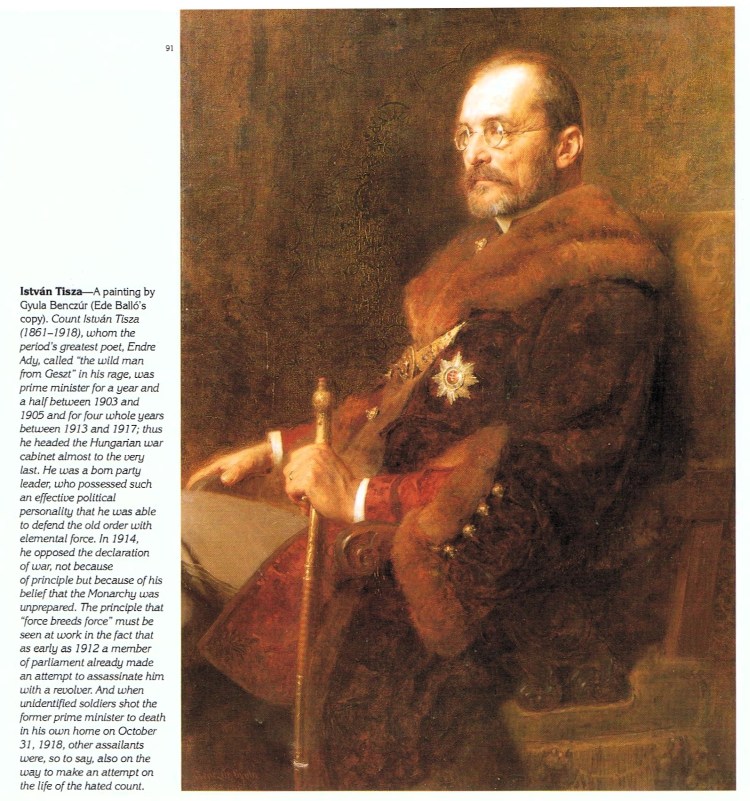
Until 1914, radical nationalists seeking full separation from the empire were few and far between. In many areas, nationalist political groups were counterbalanced by networks of associations – veterans’ clubs, religious and charitable groups, associations of bersaglieri (sharp-shooters) – nurturing various forms of ‘Habsburg patriotism’. The sense of the monarchy’s permanence was personified in the imperturbable, bewhiskered figure of Emperor Franz Josef. But his family had suffered many private tragedies. The Emperor’s son Rudolf had killed himself in a double suicide with his mistress at the family hunting lodge at Mayerling in the Vienna Woods. His wife, Elisabeth (‘Sisi’), much beloved of Hungarians, had been stabbed to death by an Italian anarchist on the shores of Lake Geneva, his brother Maximilian had been executed by Mexican insurgents and his favourite niece had burned to death when her dress caught fire. Throughout all of these, the Emperor remained stoical. He also demonstrated great skill in managing the complex machinery of state, balancing opposing families to maintain an equilibrium of well-tempered dissatisfaction. He involved himself in every phase of constitutional reform, yet by 1914 he had become a force for inertia, backing the Magyar premier, István Tisza, against minority demands for franchise reform. As long as the Kingdom of Hungary continued to deliver the funds and votes Vienna needed, Franz Josef was prepared to accept the hegemony of the Magyar élite in all the lands of its kingdom.

Whatever the concerns about his age (eighty-three) and increasing detachment from the contemporary life of his subjects, the Emperor remained the focus of powerful political and emotional attachments. By 1914, he had been on the throne for longer than most of his subjects had been alive, but it was widely acknowledged that his popularity was anchored outside of his constitutional role in widely shared popular emotions. He even made regular appearances in the dreams of those subjects, especially because his portrait was hung in hundreds of thousands of public buildings, offices, taverns, and railway stations. Prosperous and well-administered, the empire, like its elderly sovereign, exhibited a curious stability amid growing turmoil. Crises had come and gone without threatening the existence of the system as such.

The treatment of the national minorities within Hungary before the First World War could be described as ‘relatively tolerable’, especially compared with contemporary Eastern and South-eastern Europe as a whole. The security of the law was provided to all who were prepared to observe the principle of the ‘unitary Hungarian political nation’. Nevertheless, in the pursuit of grandeur, the impatience of Hungarian nationalism led to the imposition of an even greater number of Hungarian lessons in schools and the vigorous promotion of Magyar in all areas of public life. While about ninety percent of civil servants spoke the language as their first language, only a quarter of the country’s non-Magyar inhabitants could use it. There was also legislation Magyarising the names of localities, and individuals were encouraged to do the same with their own family names. Administrative and juridical action was taken against those leaders of the nationalities who not only protested against the breaches of the 1868 law, but also criticised it for its failure to recognise the rights of non-Magyar peoples, and who campaigned for national recognition and territorial autonomy.

Franz Josef, circa 1885, by Carl Pietzner.

From 1881, a united Hungarian and Transylvanian Romanian National Party demanded a separation of Transylvania from Hungary and a reinstatement of its former autonomous status. In 1892, with the support of the Romanian King Charles I, the Party addressed a Memorandum to Franz Josef listing its grievances and claims. The ruler forwarded the letter, unread, to the Hungarian government, and it was also made public by its authors, providing a pretext for the authorities to raise a lawsuit against them on the basis that they were spreading subversive propaganda, resulting in harsh sentences. Libel suits and police harassment afflicted many activists from the national minorities after the Congress of Nationalities in Budapest in 1895, which also rejected the concept of the Hungarian nation-state and demanded territorial autonomy.

The dimensions of ‘forced Magyarisation’ have often been exaggerated, even though the ratio of Magyars within the population of Hungary (excluding Croatia) climbed from 41% to 54% between 1848 and 1910; and nationalism was as intense among the the non-Magyars as among Hungarians. The difference was that the latter had the state machinery at their disposal to promote the realisation of the Hungarian nation-state. The school law of 1907 known as the ‘Lex Apponyi’ obliged non-Hungarian schools to ensure that by the end of the fourth form (at age ten), their pupils could use Hungarian. In the same year, gendarmes killed twelve Slovak protesters in the village of Csernova in northern Hungary who wanted to prevent their new church from being consecrated by a priest other than their own Slovak speaker. News of the ‘massacre’ spread across the West, doing great damage to Hungary’s reputation. There was also agitation among the Serbian minority: The Serbian PM, Novikovic, claimed in February 1909 that the Serbian nation included the seven million Serbs who lived ‘against their will’ in the Habsburg Monarchy. This was an angry response, shared by Russia, to the Austro-Hungarian annexation of Bosnia-Hercegovina.

The Anomalous Case of Bosnia-Hercegovina:

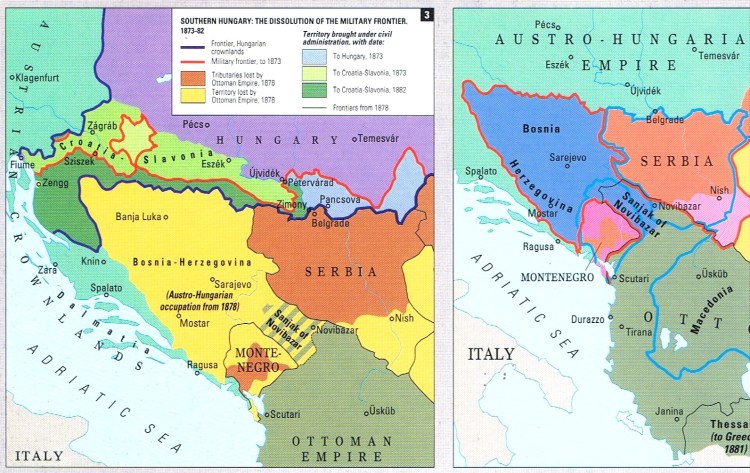
The Western Balkans, 1878-1908.

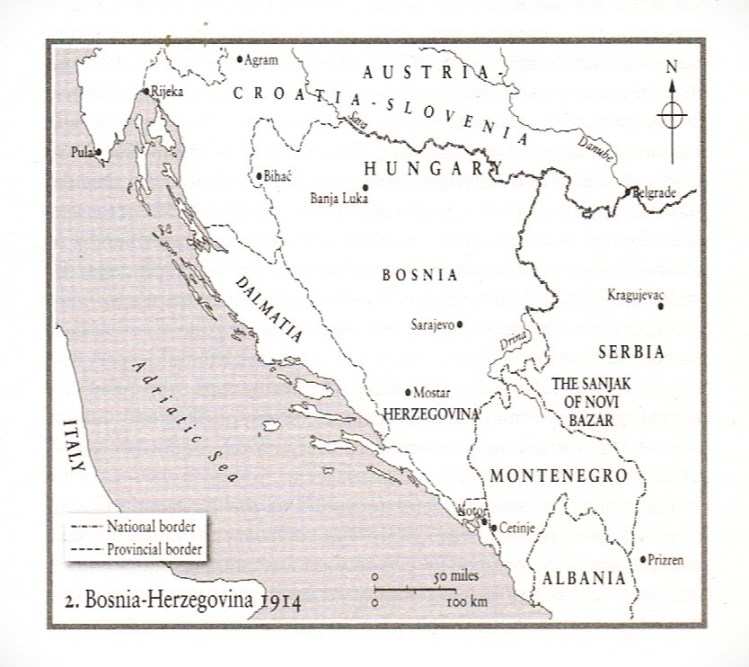
Bosnia-Hercegovina posed a special and anomalous case. Still under Ottoman suzerainty in 1878, the Austrians had occupied it on the authorisation of the Treaty of Berlin and had formally annexed it thirty years later. It was a land of harsh terrain and virtually non-existent infrastructure. The condition of these two Balkan provinces under Habsburg rule had long been the subject of controversy. There the population was made up of ten percent Catholic Croats, fifty percent Orthodox Serbs, and the rest Muslim, a legacy from Ottoman times, though speaking Serbo-Croat. The Bosnian Muslims still looked to Ottoman Turkey but were otherwise content with the status quo. The Austro-Hungarians looked to the Balkans and the ports of the former Ottoman Empire, with railway projects already in mind. These involved Bosnia, but in any case, existing Habsburg rule over the South Slavs also implied expansion into the territory. In 1878 Austria-Hungary occupied it, making it a colony with a military governor.

Thirty years later, Habsburg Foreign Minister Alois Aerenthal, who wanted to rival the power policy of Germany, the Monarchy’s ally, in the only region suited for Austria-Hungary’s purpose, the Balkans, cheated Russia. He had concluded a deal with his Russian counterpart Alexander Ivolsky regarding the annexation in return for supporting Russia’s claim for free access to the Turkish Straits. He had announced the annexation without waiting for Russia to prepare the ground with the other great powers. Despite some Hungarian hopes that, due to medieval precedents of overlordship, Bosnia-Hercegovina would be placed under Hungarian jurisdiction, it became an imperial province.

Serb nationalists still regarded it as Serbia, however, and wanted it to be taken into union with Serbia. In 1908 Franz Josef formally annexed the territory in defiance of the nationalists. Croats also continued to dream of a Greater Croatia or ‘Yugoslavia’ with its capital at Zagreb, and Franz Ferdinand was inclined to agree with this solution. However, he never had the chance to put these plans into action. The young Serb terrorists who traveled to Sarajevo to kill the heir to the Imperial throne in the summer of 1914 defended their actions by referring to the oppression of their brothers in Bosnia and Hercegovina. Historians have sometimes suggested that the Austro-Hungarians themselves were to blame for driving the Bosnian Serbs into the arms of Belgrade by a combination of oppression and maladministration. The Habsburg administration bore down hard on anything that smelled like nationalist mobilisation against the empire, sometimes with a heavy and discriminating hand. In 1913, Oskar Potoriek, military governor of the two provinces, suspended most of the Bosnian constitution of 1910, tightened government controls of the school system, banned the circulation of newspapers from Serbia, and closed down many Bosnian Serb cultural organisations, in response to an escalation in Serbian ultra-nationalist militancy. Another vexing factor was the political frustrations of both Serbs and Croats just across the borders to the west and north in Croatia-Slavonia, and to the east in Vojvodina, both ruled from Budapest under the restrictive Hungarian franchise.

One great question mark remains over why Hungary blocked the creation of a Habsburg Yugoslavia and continued to do so until the end of the Monarchy in 1918. Croats and Serbs had enough in common for it to work and Bosnia was already providing evidence for a Triune Kingdom. However, the Hungarian government did not want a co-partner, and its PM, István Tisza angrily reiterated his opposition to this solution in September 1918 when, in Sarajevo, a South Slav delegation asked for unification. His response was:

“… impertinent … Do they think Hungary will collapse? We might but before that we will still be strong enough to crush her enemies.”

Cited by Gábor Vermes, István Tisza (New York, 1985), pp.436-7.

Finally, at the very end of the Monarchy, when most Croats were still adhering to the idea of Yugoslavia, Catholic loyalists managed to get the Hungarian government to agree to the Triune Kingdom, but by then it was too late to save the empire.

However, this was, all in all, a relatively fair and efficient administration informed by a pragmatic respect for the diverse traditions of the ethnic groups in the provinces. With hindsight, though there were many severe critics of the Habsburg state, these included contemporaries like Steed, who had defended it on the eve of the July Crisis leading to the Great War. He wrote in 1913 that he had been unable in ten years of constant observation and experience to perceive any sufficient reason why the Habsburg monarchy should not retain its rightful place in the European Community. He concluded that its internal crises are often crises of growth rather than crises of decay. It was only during the War that Steed became a propagandist for the dismemberment of the Austro-Hungarian Empire and then an ardent defender of the post-war settlement in Central Europe. In 1927 he wrote that …

“… the name ‘Austria’ (was synonymous with) every device that could kill the soul of a people, corrupt it with a modicum of material wellbeing, deprive it of freedom of conscience and of thought, undermine its sturdiness, sap its steadfastness and turn it from the pursuit of its ideal.”

Tomás G. Masaryk, The Making of a State, Memories and Observations, 1914-18. London, 1927 (Czech and German editions appeared in 1925). Preface.

By contrast, the Hungarian scholar Oszkár Jászi, one of the foremost experts on the Habsburg Empire, was originally highly critical of the dual monarchy. In 1929, he wrote that the World War was not the cause, but only the final liquidation of the deep hatred and distrust of the various nations. Yet twenty years later, after a further world war and a calamitous period of dictatorship and genocide in his home country, and having been in exile in the US since 1919, Jászi struck a different note. He wrote that in the old Habsburg monarchy, …

… the rule of law was tolerably secure; individual liberties were more and more recognised; political rights continuously extended; the principle of national autonomy growingly respected. The free flow of persons and goods extended its benefits to the remotest parts of the monarchy.

Oskár Jászi, Danubia: Old and New; Proceedings of the American Philosophical Society, 93/1. 1949, pp. 1-31.

While the euphoria of national independence encouraged some who had once been loyal Habsburg citizens to impugn the old dual monarchy, others who were vigorous dissenters before 1914 later fell prey to nostalgia. In 1939, reflecting on the collapse of the monarchy, the Hungarian poet Mihály Babits wrote:

“We now regret the loss and weep for the return of what we once hated. We are independent, but instead of feeling joy, we can only tremble.”

Mihály Babits, Kerész életemen. Budapest, 1939.

War, Peace & Justice in Judaism: Epilogue – Three Faiths, Two States & One World.

Hope for a Future without Children Dying:

The prospect of a better future like that in Isaiah’s vision can tempt us to lose sight of the tasks of the present. Hope for a future in which no more children die can be a sin if we meanwhile neglect to do our duty for children dying in the current violent conflict in Israel and Palestine, either from bombing, shelling and gunfire or from being hopelessly undernourished or brutally terrorised in body and/or in mind. A world in which ‘peace’ reigns in each and every conceivable sense of the word, a ruler representing the quintessence of justice is a ‘vision’ which seems anything but ‘radical’, but some consider it simply a product of naive and wishful thinking. This vision has never caused any of the powerful of the world, whose loss of power is (at least) implied here, one sleepless hour. Perhaps this is true, because, as Karl Marx suggested, religion is the opium of the people.

Yet, the Old Testament prophets fought for the enforcement of justice in this world long before Marx and his followers did. But Jews and Christians still await a just society they believe God will create without their active involvement. The effect of religion in the Middle East today seems far from that of an opiate, however. Rather it seems to be used to fuel ethnic discord across the region and into North Africa, so much so that many see it as a large part of the problem rather than contributing to the solution. Are those who wait for a future in which Jews, Christians and Muslims – the people of ‘the book’ – can live together on the same piece of earth, prepared to ‘fight’ for the shared humanitarian conditions that would make this attainable?

The future awaited by the majority of Judaeo-Christians seems to have meant that, for the last fifty years or more, they have been prepared to ‘reconcile’ themselves to the continuation of this present imperfect world. They have not ‘quarrelled’ with that immediate destiny, preferring to simply settle down in the world as it is and await the solution of all its problems on ‘Judgement Day’. But those who think that way are simply turning the hope of the divine into no more than a shabby pacifier. But whether we are Jews, Muslims or Christians, the message of the Kingdom of God should activate not only our hope but all our energies; we are called upon to build the world we inhabit now into the awaited future, toward the promised final condition of mankind and the whole created order. It is in this spirit that, in 1974, Rabbi Hirsch ended his study for the Union of American Hebrew Congregations, with a slightly paraphrased version of the Sam Shalom, the traditional prayer for peace:

Grant us peace, thy most precious gift, O thou eternal source of peace, and enable Israel to be its messenger to the peoples of the earth. Bless our country that it may ever be a stronhold of peace, and its advocate in the council of nations. May contentment reign within its borders, health and happiness within its homes. Strengthen the bonds of friendship and fellowship among the inhabitants of all lands. Plant virtue in every soul, and may the love of thy name hallow every home and every heart. Praised be thou, O Lord, Giver of peace.

R. G. Hirsch (1974), Thy Most Precious Gift: Peace in the Jewish Tradition. New York: UAHC.

Israel, Gaza, and the Christian Communities in Crisis:

Even before the Hamas attacks on Israel on the 7th of October, the massive demonstrations in Israel and the seeming breakdown of national cohesion had captured headlines in Israel and around the world. What began as protests against the Judicial Reform legislation evolved into broader confrontations between religious and secular Israeli Jews as well as a wave of attacks on minority communities. One highly publicized aspect of this crisis had been a wave of attacks on Christians, including churchmen, religious leaders, and foreign pilgrims. The government’s response to these attacks had been ineffective as the attacks continued in several Israeli cities. As this internal drama was unfolding, Hamas took the opportunity to launch its savage terrorist strike inside Israel that has led to mass casualties, both Israeli and later Palestinian. It is worth reminding ourselves, in seeking a resolution to the current conflict – that in religious terms – there are three faiths involved, although it is not in any sense a religious war.

‘Islamism’ is not a religion; it is an ideology based on distorted interpretations of the doctrine of ‘Jihad’. The Israeli Government is fighting a defensive war to protect all its citizens, regardless of their religion. Besides Islam and Judaism, there are also significant minority groups of both Israeli and Palestinian Christians. In addition to the innocent civilian victims of the bombing, missile and mortar fire, mosques, churches, schools and hospitals run by Christian charities operating in Gaza have been destroyed or damaged. Some of this destruction, resulting from IDF’s indiscriminate actions, clearly falls outside what is permissible in the Torah and Talmud, never mind in international humanitarian law. However, that remains to be tested and, if necessary and appropriate, in international courts of law. The charge of genocide against Israel in the sense of a premeditated act of ethnic cleansing does not seem appropriate in this situation, but there are clearly charges of war crimes that will need to be brought, certainly against Hamas and its associated terror groups, and also perhaps against the IDF.

Conclusion – Restoring Religion & Humanity:

Certainly, Hamas’s attack on Israel was completely outside any religion’s teaching on war. It was unjustifiable in any terms, religious or secular. It was nothing more than an act of terrorism, and as such beyond the bounds of any concept of humanity. In response, Israel’s leaders referred to its bestiality and were criticised for doing so. It was the critics who were wrong, however, since no species of animal kills its own by inflicting pain and suffering or seeks to gain pleasure from doing so. The evidence received so far suggests that this was what the Hamas terrorists set out to do. Not satisfied with causing terror, they also tortured and raped their victims before killing them and dismembering their bodies. In particular, the horrific sexual violence against women has gone without condemnation from international women’s rights groups and UN organisations.

No animal known to mankind behaves like this. Israel’s initial response was entirely justifiable and proportionate and was supported by many nations. It was not an act of revenge, but one of an obligatory, defensive war, fought under strict rules of engagement based on the Hebrew scriptures and doctrines as well as on international law. However, the ‘slaughter of the innocents’ which has followed, and especially the indiscriminate aerial bombing and shelling of civilian areas, cannot be justified in these terms. The means are never justified by the ends; they are always inherent in them. The war can only be brought to an end by a comprehensive armistice (not a ‘sustainable ceasefire’) beginning with the release of all the hostages and leading to a diplomatic peace process ensuring the long-term security of the state of Israel and the international recognition of an independent, sovereign state of Palestine.

That said, and having returned to both Muslim and Judaistic juridical texts in detail since 7th October, it can also be said that the Israeli forces have tried, at least in their ground combat, to remain within their ‘rules of engagement’, based on the ethics of the Torah and the Talmud. Israel claims that its Defence Force is just that, a force designed to provide security for its people, not an aggressive force. Its role is, therefore, to fight defensively, not to launch incursions and invasions, like it did in 1956. Neither is it supposed to fight ‘preventative wars’, except in purely defensive situations. It is also claimed to be ‘the most moral force’ in the world since its strategies and tactics are guided by a ‘military rabbinate’ of ‘chaplains’. On the other ‘side’, it is difficult to understand which doctrine of ‘Jihad’ is being applied by Muslim countries and Palestinian Muslims to the current situation in Palestine, and why the ‘mullahs’ and imams are not calling for Hamas to lay down arms and face justice for their crimes against humanity, if not against Islam itself. Instead, Hamas and other Islamist groups seem to be able to conduct themselves as Islamic State did in Syria and Iraq, with impunity.

Neither do I understand why many among my feminist and humanist friends of many years, and even some of my fellow Christians, were so slow to condemn Hamas and so quick to produce ‘apologies’ and justifications for its actions, some erroneously quoting the Bible in applying its texts to the current situation. Their sympathies for the violated Israeli families were synthetic and rang hollow, and they remain so, despite the horrific details we now know about the Hamas attacks of ten weeks ago. With the end of Hannukah, we were told today that there will be no lights in Manger Square this Christmas, and no tree. The Light seems to have gone out of this world: But, as the Carol ‘Little Town of Bethlehem’ suggests, there may yet be enough ‘meek souls’ to rekindle it.

War, Peace & Justice in Judaism: Part Two – ‘Shalom’ & Resistance:

Traditions of Shalom:

Emerging from the Judaistic readings of the Hebrew Bible, which I dealt with in part one of this two-part article, there was a strong biblical tradition, both in the Psalms and among the prophets, from the earliest to the latest times of the kingdoms of Israel, that the Lord is a god who puts an end to war:

From end to end of the earth, he stamps out war:

he breaks the bow, he snaps the spear

and burns the shield in the fire.

Ps. 46: 9

I will break bow and sword and weapon of war

and sweep them off the earth,

so that all living creatures may lie down without fear.

Hos. 2: 18

There is also a strong biblical tradition, especially in the Psalms, that the people of God should rely on him rather than on military power:

Some boast of chariots and some of horses,

but our boast is in the name of the Lord our God.

They totter and fall,

but we rise up and are full of courage.

Ps. 20: 7-8.

A King is not saved by a great army,

nor a warrior delivered by great strength.

A man cannot trust his horse to save him,

nor can it deliver him for all its strength.

The Lord’s eyes are turned towards those who fear him.

Ps. 33: 16-18.

The Lord sets no store by the strength of a horse

and takes no pleasure in a runner’s legs,

his pleasure is in those who fear him,

who wait for his true love

Ps. 147: 10-11.

There is, in fact, among both the prophets and psalmists, a strong commitment to peace, the Hebrew word for which is shalom. It does not just mean an absence of war: Jeremiah fulminates against those who cry ‘Peace! Peace!’ where there is no real peace to be found. The Hebrew word comes from a root meaning ‘wholeness’; it indicates a total condition of well-being. So, for instance, Micah (4: 3) spells out the state where swords shall be beaten into ‘mattocks’. The exaltation of this form of comprehensive, universal peace runs throughout the Hebrew scriptures. The psalmist calls on his people to turn from evil and do good, seek peace and pursue it (Ps. 34: 14). This exhortation for Israel to make peace is repeated in subsequent psalms:

Let me hear the words of the Lord:

are they not words of peace,

peace to his people and his loyal servants

and to all who turn and trust in him?

Deliverance is near to those who worship him,

so that glory may dwell in our land.

Love and fidelity have come together;

Justice and peace join hands.

Psalm 85: 8-10.

Pray for the peace of Jerusalem:

“May those who love you prosper;

peace be within your ramparts

and prosperity in your palaces.”

For the sake of these my brothers and my friends,

I will say “Peace be with you.”

For the sake of the house of the Lord our God

I will pray for your good.

Psalm 122: 6-9.

‘Peace be upon Israel’ is a refrain from some of the later psalms, and there is no more astonishing passage than the messianic vision of Isaiah (9: 6-7). His ‘Prince of Peace’ is almost an oxymoron, a contradiction in terms. Plenty of idealised heroes were ‘God-like’ in battle, but a ‘prince of peace’ was something entirely new. A vision of permanent peace had crept up on a previously warlike, conquering but small developing nation with a primary concern for its territorial integrity and security at a time of increasing power and competition between the various empires of the region.

Allegorical Interpretations of the ‘Old Testament’:

Most modern theologians have been careful not to read their beliefs back into the texts of the Hebrew Bible. But some early Christian writers, from the writers of the gospels, acts and letters in the first century to Origen, writing in the third century CE, thought of the texts of the Old Testament as containing veiled allusions to the sacrifice of Christ. This is just as the Letter to the Hebrews implies: The ‘old covenant’ in its mundane form had ceased to be, but it lived on in the realm of symbol. For these writers, especially Origen, Judaism had ceased to have any independent validity, and Christianity had taken over its texts and read them as foreshadowing the true reality, that of Jesus Christ. That was what most of the ‘Christian Fathers’ believed, and it presents a problem today for Christians who wish to affirm the continuing importance of Judaism, and/or to reject the idea that it has been superseded by Christianity. What Origen calls the ‘spiritual’ reading of the Old Testament, decontextualises it as far as John Barton is concerned. He points particularly to a striking instance of this in Origen’s discussion of Psalm 137:

O daughter Babylon, you devastator,

Happy they shall be who pay you back

what you have done to us!

Happy shall they be who take your little ones

and dash them against the rock!

Psalm 137. 8-9.

Origen sought to interpret this seemingly brutal verbal attack by the psalmist in symbolic terms:

Blessed is the one who seizes … the little ones of Babylon, which are understood to be nothing else but these ‘evil thoughts’ that confound and disturb our heart. For this is what Babylon means. While these thoughts are small and just beginning, they must be seized and dashed against the ‘rock’ who is Christ (1: Corinthians 10: 4), and by his order, they must be slain, so that nothing in us ‘may remain to draw breath’ (Joshua 11: 14).

Origen, Homily on Joshua, 15: 3.

‘Allegorisation’ removes a scandalous aspect of this psalm, its apparent encouragement of killing babies in times of war. Still, the price is that the psalm is lifted out of its ancient Israelite context and brought into the Christian ambit with its concentration on ‘spiritual’ matters. There were those contemporaries of Origen who opposed allegorising readings of the Old Testament and making some passages less offensive to Christian sensibilities. Still, they lost the debate and Origen was able to build on their defeat and undertake a systematically allegorical reading of the Old Testament texts. However, as Barton points out, Rabbinic interpretation of the Psalms is seldom as allegorical as Origen’s, though it rests on the desire to see the whole as containing a religiously acceptable meaning. While killing babies was, and is, clearly unacceptable, the psalm does offer a counter-weight to the metaphors of peace in other later psalms. Despite the promises of Isaiah, the psalmist’s hateful language about Babylon demonstrates that the people of Israel were still weeping bitter tears by its waters, or rising up in Judah.

Peace, Justice & Prophetic Visions:

The call of the Prophets for social justice remained largely unheard in their own times. Political and economic ‘necessities’ prevailed, although they were not to avert catastrophe. Both Jeremiah and Amos pointed out how the nation of Israel would be punished for their sins of commission and omission:

“Their houses shall be turned over to others,

Proclaim to the strongholds in Assyria

and to the strongholds in the land of Egypt, and say,

“Assemble yourselves upon the mountains of Samaria,

and see the great tumults within her,

and the oppressions in her midst.”

“They do not know how to do right,” says the Lord,

“those who store up violence and robbery in their strongholds.”

Therefore thus says the Lord God:

“An adversary shall surround the land,

and bring down your defences from you,

and your strongholds shall be plundered.”

Amos 3: 9-11.

Did God’s purpose for his people fail? Is brotherhood as a standard of relationships among people an unattainable ideal? In the following passages from Psalm 72, the Psalmist looked to a future in which justice and politics would no longer be irreconcilable. He could hope for this future because he trusted God to carry out his intention. But when he prayed for the just king, was this any more than simply a pious wish? Or did he know that God would achieve his purpose through his people:

Give the king thy justice, O God,

and thy righteousness to the royal son!

May he judge thy people with righteousness,

and thy poor with justice!

Let the mountains bear prosperity for the people,

and the hills, in righteousness!

May he defend the cause of the poor of the people,

give deliverance to the needy,

and crush the oppressor! …

May all kings fall down before him,

and all nations serve him!

For he delivers the needy when he calls,

the poor and him who has no helper.

He has pity on the weak and the needy,

and saves the lives of the needy.

From oppression and violence, he redeems their life;

and precious is their blood in his sight. …

May his name endure forever,

and his fame continue as long as the sun!

May men bless themselves by him,

all nations call him blessed!

Psalm 72: 1-4, 11-14, 17.

In the well-known prophetic vision of a ‘new world’ in Isaiah, the God of Israel becomes the guarantor of human hope. The expectation of a better future could fill the suffering with consolation and confidence:

“For behold, I create new heavens and a new earth;

and the former things shall not be remembered or come into mind.

But be glad and rejoice for ever in that which I create. …

No more shall there be in it an infant

that lives but a few days,

or an old man who does not fill out his days,

for the child shall die a hundred years old,

and the sinner a hundred years old shall be accursed.

They shall build houses and inhabit them;

they shall plant vineyards and eat their fruit.

They shall not build and another inhabit;

they shall not plant and another eat;

for like the days of a tree shall the days of my people be,

and my chosen shall long enjoy the work of their hands.

They shall not labour in vain,

or bear children for calamity;

for they shall be the offspring of the blessed of the Lord,

and their children with them.

Before they call I will answer,

while they are yet speaking I will hear.

The wolf and the lamb shall feed together,

the lion shall eat straw like the ox;

and the dust shall be the serpent’s food.

They shall not hurt or destroy in all my holy mountain,

says the Lord.”

Isaiah 65: 17-18, 20-25.

A similar passage earlier in Isaiah (11: 1-9) ends poetically with: for the earth shall be full of the knowledge of the Lord as the waters cover the sea. Isaiah’s vision of peace thus connects closely with God’s reconciliation with the whole of his ‘created order’, his oikoumene in Greek.

Warfare in Ancient Israel:

The first standing army in Israel was established by David. Before this, the different tribes contributed their levy of soldiers when the need arose. In command of the whole army was the Captain of the host, and there were captains each in charge of divisions of a thousand men, and further divisions of hundreds, fifties and tens. The army consisted only of infantry until Solomon introduced chariots. In New Testament times, Roman soldiers were stationed in Palestine as in all other parts of the empire. Four legions, including the famous Tenth Legion, were stationed in the province of Syria, which included Palestine (see the map below). Local men from the provinces might also serve in the Roman army. A Centurion was in command of a ‘century’, or a hundred soldiers, six of whom made a ‘cohort’ or ‘band’ of which there were ten of these in a legion. A Quaternion was a guard of four soldiers.

The Temple Guard was a small force of Levites under the control of the Captain of the Temple. It was effectively a Jewish police force which carried out guard duties at the temple, but could also be used by the Jewish authorities to make arrests (as in the case of Jesus of Nazareth, outside Jerusalem as well as within) and to execute punishments. Weapons included slings, darts and javelins, bronze or iron-tipped spears; short, dagger-like swords with iron blades (sometimes two-edged); bows and arrows, strung with ox-gut and battle-axes, clubs of hard wood studded with iron spikes. Until the Romans, the armour of ordinary soldiers, including coats of mail, helmets and shields was made of leather and wood (senior officers had bronze).

Siege weapons included battering rams, catapults and other artillery. Josephus, the Jewish historian, describes the Romans as catapulting stone missiles weighing half a hundredweight over a distance of four hundred yards. Building a ramp of earth to the height of the walls of fortifications or, as at Masada, Herod the Great’s palace on the rock fortress in the wilderness by the Dead Sea, constructing a wooden tower on which to mount siege engines were two other methods of siege warfare that developed in later centuries. In Masada, Herod’s aqueducts enabled huge underground cisterns to be stored for the hundreds of people living at his palace and later by the Zealot resistance. Fortifications were an important factor in the siting and construction of every city, town and large village. Cities in key positions, like Megiddo, commanding the pass in the Carmel Range, would have extra strong fortifications. Fortified cities often had double walls with projecting bastions and angled entrances. The walls were usually constructed of stone (occasionally brick), while the gates were wooden, though sometimes covered with bronze.

Resistance to Greece & Rome – Model ‘Freedom Fighters’?:

Judas Maccabeus, facing the Greek armies, exhorted his men:

“Do not be afraid of their great of their great numbers or panic when they charge. Remember how our fathers were saved at the Red Sea, when Pharaoh and his army were pursuing them. Let us cry now to Heaven to favour our cause, to remember the covenant made with our fathers, and to crush this army before us today. Then all the Gentiles will know that there is One who saves and liberates Israel.”

1 Macc. 4: 8-11.

The resistance of the Maccabees to Antiochus Epiphanes and their attempt to establish Greek culture and override Jewish religious susceptibilities provides a standard testimony for those who seek examples of the Jewish religion’s involvement in the military forces of that time. While recognising this, observing other aspects of the resistance at the time of Maccabees is also important. Undoubtedly, there was active resistance, but there was also passive resistance by flight. Many went into the wilderness with ‘their sons, and their wives, and their cattle’, not as an act of ‘guerilla warfare’, but as an act of withdrawal; they lived ‘after the manner of wild beasts in the mountains’. The result was a fall-off in tax revenues, the active policy of the government in seeking to bring them back, and eventually an amnesty. Secondly, those who turned to violence became violent. Judas Maccabees actually fell into a civil war against his own people, and, significantly, he is never mentioned in the Talmud. It has been supposed by some that this was due to Roman disapproval of the guerillas. But it may equally have had to do with the rabbinic emphasis on shalom. The festival of Hannukah celebrates the Maccabean deliverance. Today it is sometimes an occasion occasion of nationalistic and militaristic fervour. But the passage for reading on the Sabbath of Hannukah is from Zechariah: ‘Not by might and not by power but my spirit, saith the Lord of Hosts.’

A ‘menorah’.

As Israel fell under Roman power, what kind of future did the Jews hope for? And how did they expect that it would come about? Some thought of a better time to come, and of the means of its achievement, in ordinary, this-worldly terms, while others indulged in hopes of a more supernatural kind. Often the two ways of looking at the future merge and intermingle. The Zealots cherished this-worldly hopes, looking for a time when God alone would rule Israel, and this meant that his holy land must be taken out of the hands of the Romans. Nor were they the only people to hope for the end of Roman rule in Palestine. In one of the Psalms of Solomon, composed in Pharisaic circles after the first conquest of Jerusalem by the Romans in 63 BC, we find the following prayer for the expected messianic king:

‘ And gird him with strength, that he may shatter unrighteous rulers, And that he may purge Jerusalem from nations that trample her down to destruction’

Ps. Sol. 17: 24.

The conquest of Israel’s enemies was a necessary prelude to the betterment of her situation. And high hopes were entertained of her future glory. In another first-century work, the Assumption of Moses, we have this description of Israel after the punishment of the Gentiles:

And God will exalt thee,

And he will cause thee to approach to the

heaven of the stars,

in the place of their habitation.

And thou shalt look from on high and shalt

see thy enemies in Gehenna.

Ass. Moses, 10: 11.

This testifies to Israel having reached ‘the height of national, political and spiritual success’. In addition, it is expected by the author that the Jews of the Dispersion will return to Palestine and that all ‘God’s People’ will be endowed with the gift of the Holy Spirit and purified from evil. How did the Jews suppose that a better future would be brought about? They took it for granted that, fundamentally, it would be God’s doing. There were, however, differing views as to how he would choose to act. The Zealots believed in initiating and precipitating political and military action themselves. But they were also convinced that if they took the initiative in provoking a revolt against Rome, then God would fight with them and for them, and would win them a miraculous victory. Had they not believed this, they would would never have taken up arms at all. Nevertheless, a realistic appraisal of the military situation would have made it obvious to them that a small subject nation such as Israel could not possibly hope to stand up to the organised might of imperial Rome.

In the Psalms of Solomon, however, a human agent of the divine will enters the narrative. He is to be a king chosen and endowed with authority by God, and a descendent of the royal house of David. He is often called the Messiah or ‘the anointed one’, who will secure both the political and spiritual well-being of the nation of Israel. There is an impressive description of such a Messiah in the Psalms of Solomon. It describes him driving the Gentiles from Jerusalem and setting up a great kingdom which would be the centre of the whole world, and all the heathen peoples are to serve him. All this suggests that it will be a kingdom of military might, but yet the Psalm clearly states that he will not put his trust in weapons of war but in God. There is also a suggestion that he asserts his supremacy using moral and spiritual force:

‘For he shall not put his trust

in horse and rider and bow,

nor shall he multiply for himself

gold and silver for war.

… …

The Lord himself is his king, the hope of him

that is mighty through his hope in God.

All nations shall be in fear before him.

For he will smite the earth with

the word of his mouth for ever.

… …

He will rebuke rulers, and remove sinners

by the might of his word’

Ps. Sol. 17: 37-39, 41.

The Messiah, the Psalm claims, will be righteous and holy, ruling justly and caring for his people as a shepherd for his flock. But he will do all this because God has endowed him with the power of his Spirit. The Qumran sect also believed in a Davidic messiah who would conquer the heathen, a military leader of the community in the final war against their enemies. This war, however, had a twofold character. It is certainly a war against earthly foes, the heathen nations, and here the Messiah, also called the prince of the congregation, has his his part to play. But at the same time, it is a war on the supernatural plane, between the prince of light and the angel of darkness. It is the archangel Michael who fights against Belial on behalf of God’s elect and the Messiah himself begins to take on a supernatural personality, as he appears to be closely connected with the angelic hosts. This reveals that there did exist in some Jewish circles, the idea of a transcendent messiah who would appear at the end of time and take part in the judgment, and with whom the blessed elect would dwell eternally. In the book of Enoch, this supernatural being is called ‘the Elect One’ and also ‘the Son of Man’ (1 Enoch 46: 1). He is enthroned in glory and he will judge all the nations and their rulers (1 Enoch 62: 14).

This eschatological discussion of Jewish hopes gives the impression that they were chiefly concerned with their own national misfortunes and obsessed with dreams of future bliss for themselves as God’s elect. But what their best Hebrew theological minds were concerned with was a genuine problem which is also with us two thousand years later: if God is Lord of the whole world, why is the present state of the world so obviously contrary to his will? The fundamental hope was that, in the end times, he would fully establish his authority over his creation and demonstrate his absolute sovereignty. This is what is meant in the New Testament by the coming of the Kingdom of God.

Chronologically, however, in the first and second centuries CE the people of Judaea did indeed rise against Rome. The Jewish scene in the New Testament period was a continually changing one, hardly surprising given the earth-shaking events which took place in the period. In AD 70 the Temple in Jerusalem, the central symbol and focal point of Judaism, was destroyed, with many far-reaching consequences. During the first century, the foundation of a new form of Judaism began with the emergence of the Rabbis, their codification of the religious traditions and their approval of an authorised canon of Jewish Scripture. There was constant conflict with Rome, the occupying imperial power, to the point of savage battles; and there was an increasing conflict with the followers of The Way, or ‘Christianity’ as it later became known, which arose from the heart of Judaism and whose growing success posed a great many urgent questions. The Judaism that emerged from this turbulence was as united as it ever had been.

Politically, the Pharisees were ‘quietists’; they were advocates of non-resistance to Rome. The chief characteristic of the Zealots, who had much in common with the Pharisees, was their approval of violence in defence of their faith. There were probably connections between the Zealot movement and the Maccabees, but its beginning is usually taken to be a revolt against the census of Quirinius in 6AD. Judas, the leader of the revolt, was a Galilean, the son of Eleazar who was executed by Herod; his son led the last stand of the Zealots at Masada. The Zealots refused to pay Roman taxes, but they took their name from their zeal for the temple and the Law, which is amply illustrated in the writings of Josephus. He wrote very disapprovingly of them and labelled them sicaríí (assassins).

Nazareth in the 1960s.

When we come to the story of Jesus of Nazareth contained in the first four books of the Christian New Testament, the Gospels, we encounter a narrative we shall never understand unless we place it firmly against the background of the time in which he lived, in a country occupied by Roman troops whose presence provoked not only a general feeling of resentment and frustration but also the bitter activities of a resistance movement, the Zealots. Jesus was not a rootless individual; he grew up in Galilee where the Resistance Movement was very much alive. Therefore, Jesus likely grew up in a strong atmosphere of resistance. We have learned much in our own last two centuries about resistance movements, from Ireland to Africa and the Middle East. Most recently, this is how ‘Hamas’ sees itself, though many ‘western’ countries regard it as a ‘terrorist’ organisation. We have learned, through painful and often first-hand experience, how they come to dominate and determine the mind and mood of a people under the apparent calm of ordinary life, giving them an indisputable authority over the lives of ordinary people. Their clandestine, violent character only becomes apparent and acute when full-scale fighting breaks out.

It is against such a background that the ministry of Jesus must be seen; his sayings and actions take on new meaning when set against it; the brevity of his ministry and his extra-judicial execution outside Jerusalem become intelligible. His criticism of the common assumptions of his day, arising as they did from his own experience and meditation on the history and scriptures of his people, made him suspect, when his beliefs and attitudes became clear, with the Resistance and the Jewish government alike, as well as with many of his former friends (John 6: 66). Jesus’ ministry falls midway in the three hundred years’ Jewish war for religious and political freedom. It began with the Maccabaean rebellion of 168 BC and ended with Bar Kochba’s revolt in AD 132. Its story Is the theme of Josephus’ The Jewish War, in which we may find,

‘… set down both clearly and accurately the main course of events … the long-drawn agony of the war (AD 66-70) and the happenings which preceded it, with such a wealth of detail that his work is a major contribution to the history of a critical century.’

Quoted in Walton (ed.), p. 266.
Source: The History of Christianity (A Lion Handbook)

The Gospels were church books, written for the guidance of the early Christian communities and concerned with their religious life. These communities, after AD70, were predominantly non-Jewish in their membership; for many Christians, the incidents in Palestine from AD 30 to 70, were mere episodes in a far-off province of the Roman Empire. But the story of what had happened pushes through these religious records. It is the critical context against which the meaningfulness of Jesus’ ‘Good News’ is to be grasped - even his phrase ‘the kingdom of God’ may have been the watchword of the Zealots. What he did and said were meant for men and women there and then; only because this was so could it also have a meaning for all mankind. In the following passage, Josephus tells a story which gives us a feeling of what it was like to live under Roman rule in Palestine in the middle of the first century AD:

As procurator of Judaea, Tiberius sent Pilate, who during the night secretly conveyed to Jerusalem the images of Caesar known as ‘signa’. When day dawned this caused great excitement among the Jews; for those who were near were amazed at the sight, which meant that their laws had been trampled on – they do not permit any graven images to be set up in the City – and the angry city mob were joined by a huge influx of people from the country. They rushed off to Pilate in Caesaria, and begged him to remove the signa from Jerusalem and to respect their ancient customs. When Pilate refused, they fell prone all around his house and remained motionless for five days and nights.

The next day, Pilate took his seat on the tribunal in the Great Stadium and summoned the mob on the pretext that he was ready to give them an answer. Instead he gave a pre-arranged signal to the soldiers to surround the Jews in full armour, and the troops formed a ring three deep … Pilate, declaring that he would cut them to pieces unless they accepted the the images of Caesar, nodded to the soldiers to bare their swords. At this the Jews as though by agreement fell to ground in a body and bent their necks, shouting that they were ready to be killed rather than transgress the Law. Amazed at the intensity of their religious fervour, Pilate ordered the signa to be removed from Jerusalem forthwith.

Josephus; Quoted in Walton (ed.), p. 267.

This story underlines the fierce anger and resentment against the occupying forces which groups like the Zealots were able to exploit. The political divisions within and throughout the nation fed on a social climate of hatred and suspicion. Yet Jesus was not afraid to take risks to demonstrate the inclusivity of his mission and its purpose of reconciliation. Luke’s list of Jesus’ twelve apostles includes Simon Zealotes, ‘the Zealot’ (Luke 6: 15; Acts 1: 13); the parallel passages in Mark (3. 18) and Matthew (10: 4) call him ‘the Cananaean’, which is the Aramaic form of the same word. The presence of a Zealot among Jesus’ followers, coupled with recorded actions of Jesus like the cleansing of the temple and the fact that he was crucified by the Romans on a quasi-political charge has prompted elaborate theories about his connection with the sect. In his book, Portrait of Jesus, Alan T. Dale uses his literary imagination combined with knowledge of the contemporary Jewish context to interpret some of these theories in a parallel narrative to the gospels:

‘Fighters from Childhood:

‘The villages in the Galilean hills seemed … to be quiet sleepy places. But behind the quietness there was a very different story to tell – as we soon have found out if we had joined in the conversation, on a Saturday morning, after worship in the synagogue or sat talking in the evening with some of the villagers. We would have quickly learned that there was trouble afoot – and dangerous trouble at that – in this northern border province. …

‘We soon begin to understand why the name ‘Galilean’ meant, to the people in the south, something like ‘rebel’ or ‘anarchist’, why Galilee was a home of the Zealots or freedom fighters, and why the Galileans were called ‘born fighters’. The war with the Romans broke out thirty years later. The Tenth Legion marked down Japha town – and nearby Jotapata – and destroyed it in some of the bloodiest fight of the war.

Incident in the hills:

‘From early light the streets of the small lakeside fishing port – Capernaum – were crowded with men and loud with gossip and argument. The soldiers at the small Roman outpost in the town were wondering what was afoot. Somebody suddenly noticed a small boat putting out. … The boat was making heavy weather – an onshore wind was blowing.

‘Jesus climbed out. He knew the crowd: farmers from hill villages, fishermen from the lakeside towns. They were the men of the Resistance Movement – ‘Zealots’, nationalists -farmers or fishermen by day, ‘freedom fighters’ whenever the chance came. … a leaderless mob, an army without a general.

‘He went with them into the hills, to a lonely spot out of sight and reach of the Roman garrison. The talk went on and on. They wanted him to be their leader – their ‘king’. Jesus would have no part in their plans. … He got everybody to share a common meal together, a meal in which they promised again to live as God’s people.

‘The men – under command – sat down in sat down in compliance in companies of fifty and a hundred each, rank by rank. He got his friends to go back in the boat and across the Lake. He then said goodbye to the men and got them to go home. He himself, under the darkening sky, climbed the hillside. He wanted to think things out alone in God’s presence – alone.

‘The Issue at Stake:

‘There were almost as many points of view as men arguing about them. But all would agree that their people – the Jewish people – were a special people called by God to take a special part in the history of the world. Jesus would have no quarrel with that. But everything turned on what was meant by the words being used… by the words ‘God’s People’. It wasn’t enough just to use the words, as though it was quite plain what they meant. It wasn’t plain and they didn’t agree. This was what the great debate was about. They were using the same words, but making them mean very different things.

‘Everybody knew, however, that things could not go on as they were. The situation in which the Jewish people found themselves – subjects of a foreign empire – was really intolerable. The only people who thought it wasn’t were members of the aristocratic government in Jerusalem -they owed their very existence to their Roman overlords. The common people and their leaders – and, most of all, the best among them – longed for a great change. They felt that the root of the problem was that they were an occupied country; if only they were free and independent, the ‘good time’ they all longed for would come. It was the presence of unbelieving foreigners – Roman soldiers, Greek citizens, foreign landlords – that made living as ‘God’s People’ impossible.

‘Most people believed in… keeping themselves ‘separate’, having nothing to do, as far as possible, with foreigners. Lots of ordinary people, of course, simply could not avoid meeting foreigners and having to deal with them – using their money with its hated image of the emperor on it, carrying army baggage, working on foreign estates, selling market produce in Greek cities. Religious people, like Pharisees and Zealots, had as little to do with foreigners as possible. They would not enter a house owned by a foreigner and they certainly wouldn’t have a meal with him. The word ‘Pharisee’ was believed to mean ‘separatist’.

Foreigners, however, were not the only trouble. Living as ‘God’s People’, the Pharisees and Zealots believed, meant keeping God’s laws. … Many people believed that it was because they had not kept God’s laws that God had allowed the Romans to occupy their country. … The Zealots wanted to go much further. They believed that things could only be put right by a Holy War, the violent overthrow of the Romans. They could point to many stories in the Bible to prove it. … Something had to be done. Somebody had to take a stand. The leadership of the Jewish people was at stake. Who was to lead them in this crucial moment in their history? The Pharisees? The Zealots? John (the Baptist)? Who?

Freedom Fighters:

‘Galilee was a home to many of the freedom fighters, and Japha, the mother town of Nazareth (hamlet) – only two miles away – was probably a Zealot town. There were many good men among the Zealots, men who were driven by desperation to believe that violence was the was the only way God’s People would win their proper freedom. There were among them, of course, as in any extreme movement, many who were no more than thugs and gangsters, hiding their bloodthirstiness behind the fine language of religion; but most were sincere men.

‘The memory of what had happened in 63 BCE was still vivid and bitter. … But the Zealots looked further back than the sack of Jerusalem by the Romans … The Old Testament itself – their Bible – was full of stories of wars against foreigners. They were described as God’s Wars. This was surely enough to prove that this was God’s way. Was not God called ‘God of the armies of Israel’? The war against Rome was a ‘Holy War’. The ‘Holy Land’ was not the private property of the emperor … ; it was God’s – he alone was king there.

‘The Zealots cared for social justice too. When … they actually captured Jerusalem in AD 66 in the war with Rome, one of the first things they did was to destroy all the legal documents there, abolishing Jewish debts to Rome, breaking up the great landed estates and setting all slaves free. They were ‘thugs’ and ‘murderers’ in the eyes of the Roman authorities and the aristocratic Jewish government in Jerusalem, they were patriots to their own people.

‘But Jesus had come to believe that violence was not God’s way – especially the rough violence of the Zealots. He was bound to be their critic and the critic of all those who sympathised with them. Many of his stories were aimed at them as well as the Pharisees. It needed a brave man to be as outspoken as Jesus, if he was to be true to himself and his convictions. It took some courage to talk like this in an occupied country:

“If a Roman soldier forces you to carry his baggage for a mile along the road, go two miles along the road with him” (Matthew 5: 41)

Dale, pp. 5-8, 11-13, 17-19.

The Resistance Movement was not a bid for mere political freedom. Politics and religion were, for Jews, two sides of the same coin. Hence among the people of the country, many different religious movements made a bid for their allegiance – Pharisees who were popular with the common people, groups such as those in Qumran (in the Jordan Valley), Sadducees (wealthy priestly families) in Jerusalem, and followers of John the Hermit on the west bank of the Jordan. The common people had their own varying, ambiguous and changing attitudes. But it was the political situation that gave all these movements their focus. The Zealot rising which began in AD66, was disastrous, as Jesus of Nazareth prophesied that it would be (Matthew’s Gospel, 24: 1-2), along with other voices. Jesus had predicted that it would result in the destruction of the temple, as it did four years after the Rising began. As he shared a common meal with the Resistance leaders in the Galilean hills, he had made it clear that he could play no part in it, that its ideals and methods had no meeting place with his own. He was already looking beyond the parochialism of his people to the wider world of God’s mission to the Gentiles. The Fourth Gospel tells us that from that point on, ‘many of his disciples withdrew and no longer went about with him’ (Jn. 6: 66).

The nature of Jesus’ entry into Jerusalem (Mt. 21: 1-9) is of some importance to our understanding of how he saw his mission in respect of nonviolence. He quietly accepted his disciples’ recognition of him as the Messiah, but immediately went on to teach about a new way, that of suffering. His triumphal entry into the city was the entry of a king; the clothes spread along the road were a sign of homage; the title ‘Son of David’ is a royal title; the palm branches (Jn. 12, 13) recalled the rising of the Maccabees. Indeed, the attitude of the crowd recalls a passage from The Psalms of Solomon:

‘Behold, O Lord, and raise up their King, the son of David,

at the time thou hast appointed, O God,

to reign over Israel thy servant.

Gird him with strength to shatter wicked rulers.

Cleanse Jerusalem from the Gentiles who trample it and destroy.

‘In wisdom, in justice, may he thrust out sinners from God’s heritage,

crush the arrogance of the sinner like a potter’s crocks,

crush his whole substance with an iron mace;

blot out the lawless Gentiles with a word,

put the Gentiles to flight with his threats.’

The Psalms of Solomon, 17: 23-7.

The relevant Gentiles were the Romans, and possibly the Greeks. But Jesus rejected that part of the scriptural tradition that depicted the Messiah as buckling on his sword and riding out to war on a white charger. He chose that part of the prophecy from Zechariah which depicts the Messiah coming to Jerusalem humbly, mounted on an ass. The next verse runs:

‘He shall banish chariots from Ephraim

and war-horses from Jerusalem;

the warrior’s bow shall be banished,

He shall speak peaceably to every nation,

and his rule shall extend from sea to sea,

from the River to the ends of the earth.’

Zechariah, 9: 9-10.

Jesus was a different kind of Messiah, standing not for war and military victory but for disarmament and peace. Only a handful of them remained loyal, and when he was taken captive by the Chief Priest’s guards, even they took flight and abandoned him. The following passage from the gospel depicts the moment when Jesus fulfilled the choice he had laid before his disciples at Caesarea Philippi:

‘At that moment one of those with Jesus reached for his sword and drew it, and he struck at the High Priest’s servant and cut off his ear. But Jesus said to him, “Put up your sword: All who take the sword die by the sword.” ‘

Matthew 26, 51-2.

At this moment in the Garden of Gethsemane, he could have raised the standard of violent revolt: He did not do so, but chose the way of suffering and of the cross. In the end, he cut a lonely figure and, when he died alone save for two ‘bandits’ (possibly Zealots), it seemed his ‘movement’ had died with him.

There were collaborators as well as guerillas among the resistance groups, including the followers of Jesus of Nazareth, though most of them supported his way of passive resistance. There has been interesting speculation among scholars about the motivations of Judas Iscariot. The meaning of the name ‘Iscariot’ is uncertain, but some have supposed it to be a corruption of the Latin ‘Sicarius’, or ‘dagger-man’, a member of the violent resistance. We have noted that Jesus attracted some members of this group, including Simon the Zealot, who hoped they had found the nationalist leader for whom they had been seeking. The betrayal of Jesus by Judas has always been a puzzle since the sum of thirty silver pieces seems paltry for such an act. Some have speculated that Judas was expecting the revolt to come following the triumphal entry at the Autumn festival of Tabernacles, or perhaps after the Cleansing of the Temple the following spring, just before Passover. When Jesus showed no signs of taking a truly insurrectionary initiative, however, Judas decided to try to force his hand. But Jesus accepted arrest and death rather than embark on a violent crusade which he believed was not God’s will or way. Of course, this is pure speculation, but it does make some sense.

But in this passage, Jesus is making a simple statement of fact that violence provokes counter-violence, and the violence provoked often exceeds the initial violence in scope and scale. In other words, violence tends to escalate uncontrollably. This is neither a justification nor condemnation of those provoked, just a simple statement of historical fact. Nonetheless, these words are not spoken to the aggressor in this situation, but to a loyal follower who misguidedly seeks to defend an innocent man from wrongful arrest and violence. They are a clear warning against all wars, however ‘defensive’ or ‘just’. This was how the early church understood these words of Jesus. Tertullian in his treatise On Patience declared that at this moment Jesus cursed the works of the sword forever after. In another treatise, On Idolatry, he spells out the meaning of this more fully:

‘How shall the Christian wage war, how indeed shall he even be a soldier in peacetime, without the sword which the Lord has taken away? For although soldiers had come to John and received the form of their rule, although even a centurion had believed, the Lord afterwards in disarming Peter unbuckled every soldier.’

Tertullian, On Idolatry.

Here, Tertullian comes close to a statement of Christian Pacifism. In his letter to the Jewish Christians (‘Hebrews’), for whom the suffering of Jesus was a ‘stumbling block’, the writer makes clear that the way of Jesus is the way of love, nonviolence and redemptive suffering. His readers had not yet come to equate the Messiah with the Suffering Servant about whom the prophets had written.

Johanan ben Zakkai is an important figure in the debate between the supporters of violent and nonviolent resistance among the early rabbinic writers. He belongs to the period of the fall of Jerusalem in AD70. One story tells how, in despair at the spirit of contention between different partisan groups, he had himself carried out of the city in a coffin to the Roman camp. Certainly, he became persuaded that violent resistance merely contained the seeds of destruction within it. He was given permission by the Romans to establish a new centre at Jabneh Jamnia for the study of the Torah, together with a court of justice. A council of rabbis, meeting at Jamnia in about AD90 managed to successfully reorganise the chaos with which they were confronted. Their measures led to the eventual elimination of competing forms of Judaism and the predominance of a single version, Rabbinic Judaism, the Judaism of today. Johanan’s genius was to turn the leaders of Judaism from politics and acts of war to scholarship, piety and the things of peace, and to show that in so doing they were fulfilling rather than abandoning the central tenets of the faith. The School of Jabneh came to hold an authority comparable to that held earlier by the Sanhedrin.

Division, ‘Diaspora’ & the Development of Rabbinic Judaism:

Throughout the first century, however, these competitors were very much in evidence, so as well as reckoning with a changing historical situation, it is important to bear in mind that there were variations in Judaism from group to group and place to place. First, a geographical distinction has to be drawn between Palestinian Judaism and the Judaism of the Diaspora (the dispersion of Jews throughout the Roman Empire), with its greater contact with the Hellenistic atmosphere of the Mediterranean world. The distinction is by no means a clear-cut one, however, especially in linguistic terms, for Palestine had also been heavily influenced by the Greek language and culture. But since the diasporic Jews lived at great distances from Jerusalem and the temple, and were able to read the Torah in its Greek translation, the Septuagint and not the original Hebrew, they were able to maintain greater diversity in their religion. Secondly, within the two broad categories, there were more specific groupings. In Palestinian Judaism, as noted already, there were Pharisees, Sadducees, Essenes and Zealots to name but a few of the better-known; and there was the obvious split between the educated, bilingual classes and the illiterate monoglot masses. Divisions existed in Hellenistic Judaism, especially in terms of philosophical influences, but they are more difficult to trace.

So thoroughly did Rabbinic Judaism carry out its work of unification that it is often almost impossible to see the views of the movements it replaced, particularly those with which it did not agree. The Rabbinic writings fall, roughly speaking, into four main groups. The Mishna is a compilation of legal requirements, written down at the end of the second century, in the form of legal opinions; the Gemara is a discussion of the Mishna. The two together form the Talmud, of which there are two versions, Babylonian and Palestinian, completed at the end of the fourth century. The third is the Tosefta, which collects sayings which failed to be included in the Mishna, and the Midrash is a term referring to commentaries on the Scriptures, sometimes legal, sometimes theological. However, these sources are lacking in historical context. They contain early material, handed down orally. Still, since they were compiled into compendia later than the council of Jamnia, their view of the material is selective, often hazy and sometimes partisan. For example, nothing in it can be connected with the Maccabaean revolt or the temple’s destruction. The clues they do offer are in the realm of Jewish religious thought and institutions.

For our knowledge of the history of the period, we depend on the Jewish historian Josephus, who lived between 37 and 100 AD (CE), and his two major works, the History of the Jewish War and the Jewish Antiquities. These present a fuller picture of developments in the first three quarters of the century. These books do, however, have their drawbacks. Josephus was a client of the Flavian emperors and therefore had to be diplomatic in his presentation of Judaism; he also had to come to terms with his own position, which other Jews regarded as treacherous not just to the nation but also to Judaism. We therefore have to allow for some bias. Josephus is also silent about Judaism after the end of the war of AD66 and so leaves us completely in the dark about the developments which led to the council of Jamnia. For much of our knowledge of first-century Judaism, we are dependent on the New Testament texts of Christianity. In addition, our knowledge of Hellenistic Judaism is the result of the fact that the early churches preserved the writings of Josephus and of Philo of Alexandria. Otherwise, they would have remained unknown, as would the Jewish books which go to form the Apocrypha. Christianity also preserved the apocalyptic literature between the testaments, as noted above; the Rabbinic writings are essentially non-eschatological.

Christian sources tell us much about Judaism, and chief among them is the New Testament itself. It is often the sole source offering evidence of the details of Roman administration, though historical authenticity and reliability are sometimes difficult to surmise. In the Gospels, we have to allow for both bias and omission of information. In the letters of Paul, we have evidence of the thinking of a first-century Jew, but we know that he was from the eastern Mediterranean and, according to Luke, spent limited time in Jerusalem, Damascus and Antioch before and during his missions in Asia Minor and Greece. Both Luke and Paul himself report controversies between him and both Jews and Christians in Jerusalem and on his missions.

Finally, Palestinian archaeology provided two spectacular finds: the site of the Qumran community and its literature, and the citadel of Masada. Qumran and the Dead Sea Scrolls have given us an extensive view of the life of a sect previously known only from occasional textual references. Masada illustrates two greatly contrasting times, the luxury of the desert palace at the time of Herod at the beginning of the century and the tragedy of the last stand of the Zealots in AD73; it has also provided the lost original Hebrew text of the book of Ecclesiasticus (previously preserved only in Greek) together with a fragment from the Dead Sea Scrolls. However, we cannot assume any direct connection between these two sites. Due to the difficulties with all these sources, the brief pictures of first-century Jewish society and religion they give us must be regarded as very approximate reconstructions. Nevertheless, these must be attempted if we are to try to understand the background of the extracts that follow. When we speak of Pharisees, Sadducees and scribes, we must remember that the reliable evidence we have about them is, in reality, quite small. The caricatures of them that have developed since their times do not further our understanding of Judaism in New Testament times and have tended to prejudice Christian relations with Jews to this day.

A scribe at work.

The Rabbinic Tradition – Temple, Torah & Talmud:

After the council of Jamnia, Judaism became known as Rabbinic Judaism, as opposed to the Pharisaic Judaism which existed before in the context of the Sanhedrin. The two are closely connected, however, and it is almost impossible to say where one ended and the other began. At the beginning of the first century, ‘Rabbi’ was not a formal title, but a mode of address meaning ‘my master’, used as a mark of respect. It is used several times in this way in the ‘fourth’ gospel, in remarks to Jesus of Nazareth (Jn. 1: 49, 6: 25). By the end of the first century, however, it had taken on a more formal significance, as is indicated by Matt. 23: 7f., a passage which dates from the time of the early church rather than that of Jesus and his immediate disciples. In the second century, it became firmly established, which is how it is used in Rabbinic literature and synagogues. It was this development which shaped the future of Judaism; the heightened prominence of the Law after the fall of the Temple was accompanied by the growing importance of the institution of the local synagogue as a place of worship and learning, which had been increasing for some time before AD70.

The Temple and its priesthood may have been the most strikingly visible symbols of Judaism until the end of the first century but had they they been its exclusive centre, Judaism could not have survived their fall. The way it adjusted to the situation after AD70 shows that there were other strengths; these strengths had as their common basis the Law and the differing interpretations of it which were brought together in the Talmud. Even while the temple still stood, within Judaea there seems to have been an increasing preoccupation with the scriptures and their implications, and this preoccupation will have been even more characteristic of the Jews of the Diaspora. A movement like that found at Qumran is unthinkable without this development, which comes to full effect in Rabbinic Judaism. The beginnings of this trend are to be found in the Babylonian exile and the period after the return. During this period the Pentateuch took final form and was accorded its place in the Torah, the Law; the Prophets had taken a place beside it by the beginning of the second century BC (BCE) and the writings were recognised during the first century AD (CE).

The Hebrew word ‘Torah’ means ‘instruction’ or ‘doctrine’ rather than ‘law’ and the Pentateuch is more than simply a collection of books of ‘Law’, or laws. Nevertheless, that is what it became as it was made the object of evermore intensive study. As well as considering the parties within Judaism in this process, it needs to be remembered that the New Testament ‘Gospels’, Acts and Paul’s letters present only one picture of first-century Judaism. The other side of ‘the Law’ also requires sympathetic treatment in the context of Hebraic texts which were being edited contemporaneously with the Greek texts of the Christian New Testament and interpreted in the writings of the Talmud. Concerning issues of war and peace, for example, ‘Seek peace and pursue it’ became a central tenet of later Judaism. The first verb is often translated as ‘propose’, emphasising the active state of peacemaking. On the other hand, ‘an eye for an eye and a tooth for a tooth’ was not, however, related to war, but to civil disputes between citizens, and though it is featured in the NT, it is not found in Rabbinic literature. Instead, the rabbinic expositions defined peace as part of God’s original purpose for mankind. The Talmud points out how many of the commandments of the Law begin with a conditional ‘if’ or ‘when’. If the situation arises, the believer’s duty is clear, but he need not go out of his way to find the situation. Two of the rabbis wrote:

If the heavenly beings who are free from envy, rivalry and hatred are in need of peace, how much more are the lower beings, who are subject to hatred, rivalry and envy, in need of peace.’

Deut. Rabbah 5, 12. Bar Kapparah

‘Great is peace, because peace is to the earth what yeast is to the dough. If the Holy One, blessed be He, had not given peace to the earth, the sword and wild beasts would desolate the world.’

Baraíta de Perek ha Shalom.

For these rabbis, peace also takes priority over one of the most solemn and basic of all the commandments, condemning idolatry. This is effectively a condemnation of Jehu, who massacred the Baal-worshippers, and of the Maccabees, for rising in violence against Greek idolatry. In general, peace is said to bring together all the blessings that God would heap on Israel. So too the rabbis liked to put a peaceable interpretation upon stories of violence. So, Nebuchadnezzar’s prisoners of war are reinterpreted as scholars (2 Kings 24: 16) and David is remembered as a poet, musician and scholar rather than as a warrior king. Equally of interest is the treatment of the eight-day festival celebrating the rededication of the altar in Jerusalem after the Maccabean victories (1 Macc. 4: 59; 2 Macc. 10: 6). The rabbis say nothing about the military triumph, stressing that it is a Festival of Lights, recording a legend that eight iron spears into an eight-branched candlestick, the Menorah and that the altar was a symbol of reconciliation between God and mankind, and between Israel and its neighbours.

The rabbis also condemned destructive action and praised constructive transformation. Forgiveness is better than revenge. As the Talmud says, ‘He who avenges himself or bears a grudge against acts as one who has one hand cut by a knife, and then sticks it into the other hand for revenge.’ There is an awareness of the solidarity of mankind and its tendency to escalate violence. But if violence escalates so does goodness, kindness and friendliness. Another general principle is that destructive action must be avoided if a less destructive action will suffice for the good end desired:

If one is able to save a victim at the cost of only a limb of the pursuer and does not take the trouble to do so, but saves the victim at the cost of the pursuer’s life by killing him, he is deemed a shedder of blood and he deserves to be put to death. He may not, however, be put to death by the court because his true intention was to save life; he must be punished rather than put to death.

Mishneh Torah: Hilchot Rozeach 1: 13.

That ‘legislation’ is doubly notable in its humanity. All human life is sacred and whoever sheds blood diminishes God’s presence in the world (Gen. Rabbah 34: 14). In Hebrew hymnody there is a famous refrain: Give thanks to the Lord, for it is good, for his mercy endures forever (Ps. 107: 1). The phrase occurs in the account of a muster for battle before King Jehoshaphat (2 Chron. 20: 21), but without the words, for it is good. Why are they omitted? Because the destruction of human beings is not good, because the Holy One, blessed be he, does not rejoice in the downfall of the wicked.

War and the destruction of enemy soldiers are thus regarded by the rabbinical interpreters as in some circumstances a ‘cruel necessity’. But rather than set down a set of rules, the rabbis were concerned to provide an ethical framework for the conduct of war. They distinguished between two kinds of war, milchemet reshut, optional war, and milchemet chovah, obligatory war, also called milchemet mitzvah, religious war. This latter type included the war against the seven tribes of Canaan (Deut. 20: 16-18), the war against Amalek, who had been guilty of unprovoked aggression (Deut. 25: 17-19), and defensive war generally. The seven tribes no longer exist: as Maimonides put it, writing in the second century on the Principles of War, ‘their memory has long perished’, though some were found to argue that this justified military measures in establishing the modern state of Israel. The Amalekites have also disappeared, but all tyrants, dictators and oppressors have been considered to be ‘the seed of Amalek’: ‘The Lord will have war with Amalek from generation to generation’ (Exodus 17: 16), and many Jews later justified action against Hitler on these grounds. But the main grounds for a just war rest in attack from outside, and such a war is obligatory. There was much discussion among the rabbis as to whether preventative war fell into this category. The majority view was that it did not:

Opinion is divided only when they engage their enemies in war because they are afraid that they will attack them, or if it is known that they are preparing to attack. According to Rabbi Judah it is obligatory and according to the sages it is optional.

Sotah, 44b.

Optional wars are much less clear morally, and the rabbis, though justifying those recorded in Scripture, have been far less ready to extend that justification to later wars. Their standard examples are the conquest of Canaan as an obligatory war and the expansion of the whole kingdom by David and his house as an optional war. Maimonides sums up the whole doctrine concisely:

The primary war which the King wages is a ‘religious war’ Which may be denominated as a religious war? It includes the war against the seven tribes, the war against Amalek, and a war to deliver Israel from enemy aggression. Thereafter he may engage in an ‘optional war’, that is, a war against neighbouring nations to extend the borders of Israel and to enhance his greatness and prestige.

Mishneh Torah: Hilchot Melachim 5: 1.

Maimonides’ Principles of War:

Maimonides was born in 1138 (or 1135) in Córdoba, Andalusia, in the Muslim-ruled Almoravid Empire, during what some scholars consider to be the end of the golden age of Jewish culture in the Iberian Peninsula, after the first centuries of the Moorish rule. His father Maimon ben Joseph, was a Spanish dayyan (Jewish judge). Aaron ha-Kohen later wrote that he had traced Maimonides’ descent back to Simeon ben Judah ha-Nasi from the Davidic line. Maimonides studied the Torah under his father, who had in turn studied under Rabbi Joseph ibn Migash, a student of Isaac Alfasi. At an early age, Maimonides developed an interest in sciences and philosophy. He read those Greek philosophers accessible in Arabic translations and was deeply immersed in the sciences and learning of Islamic culture.

Plaque of Maimonides at Rambam Medical Center, Haifa

In early first century (AD/CE) Judaism, while the King could take full responsibility for declaring a religious war, an optional war required the consent of the Sanhedrin. The Rabbinic tradition thus picked out the elements in the Torah which pointed to mercy and stressed these in their laws of war. Maimonides offered a convenient compendium. For example, there was to be no wanton destruction:

‘It is forbidden to cut down fruit-bearing trees outside a city, nor may a water channel be deflected from them so that they wither, as it is said: “Thou shalt not destroy the trees thereof.” (Deut. 20: 19). Whoever cuts down a fruit-bearing tree is flogged. This penalty is imposed not only for cutting it down during a siege; whenever a fruit-yielding tree is cut down with destructive intent, flogging is incurred. … The law forbids only wanton destruction.’

Ibid. 6: 8.

‘Not only one who cuts down trees, but also one who smashes household goods, tears clothes, demolishes a building, stops up a spring, or destroys articles of food with destructive intent, transgresses the command: “Thou shat not destroy.” He is not flogged, but is administered a disciplinary beating imposed by the rabbis.’

Ibid. 6, 10.

So too a woman prisoner is to be treated as a human being. If she has been widowed or bereaved, she is to be allowed a period of mourning, during which she will appear less desirable. Only then may her captor cohabit with her. But if she is converted to Judaism, then she will be ceremonially purified, and entitled to a legal (re)marriage. And if her new husband, her captor, tires of her, he must let her go freely and is not entitled to enslave her or to sell her (ibid. 8: 5-6). Sometimes the Rabbis went beyond the Torah, as shown in an instructive passage in Maimonides:

‘When siege is laid to a city for the purpose of capture, it may not be surrounded on all four sides but only three in order to give an opportunity for escape to those who would flee to save their lives, as it is said: “And they warred against Midian, as the Lord commanded Moses” (Num. 31: 7). It has been learned by tradition that that was the instruction given to Moses.

ibid. 6, 7.

We do not know where the tradition came from, but it is clearly not in the Book of Numbers. Again, whereas the Bible decrees destruction without remission against Amalek and the seven tribes, the Rabbis dare to contradict the clear word of the Torah:

‘No war is declared against any nation before peace offers are made to it. This obtains both in an optional war and a religious war.’

ibid. 6: 1.

The other party to the conflict are given the option of accepting the ‘seven commandments enjoined upon the descendants of Noah’. These were: to avoid idolatry; avoid blasphemy against the name of God; establish courts of justice; avoid murder, adultery, and theft; and not eat flesh cut from a living animal. As in Jewish tradition, the whole human race was descended from Noah, these commandments were regarded as a code of universal morality, and anyone who would not accept them was seen as subhuman. But any people suing for peace, willing to pay tribute, accept a subject status and accept these commandments must be left in peace:

‘Once they make peace and take upon themselves the seven commandments, it is forbidden to deceive them and prove false to the covenant made with them.’

ibid. 6: 3.

Military service was in principle universal and compulsory, and in a religious war, this applied even to newlyweds. But in optional wars, some exemptions were permitted on compassionate grounds and the three principal grounds were biblically based (Deut. 20: 5-8). They were for those who had built a house, but not yet occupied it; who had planted a vineyard but not yet enjoyed its first fruit, and those who were engaged to be married. Judas Maccabaeus re-established these principles (1 Macc. 3: 56) despite the desperate military needs. Maimonides’ compendium also reasserts them, but in such a way that they cannot be trumped-up excuses.

Interestingly, the rabbis added a further compassionate ground, that the death of one member of a family on military service would exempt all other sons and brothers. However, they might be required for non-combatant duties. More radical than all these exemptions, however, is the Deuteronomic precept that the ‘fearful and fainthearted’ should be allowed to return home (20: 8), since fear is infectious. The words, Rach halevav have been interpreted as a ‘tender conscience’, or a hyper-sensitivity to suffering in others, rather than as simply cowardice. Rabbi Jose the Galilean took the whole phrase to refer to those who were fearful because of their own misdeeds: it was better not to have ‘serious offenders’ in the army. But the more usual view was that taken by Rabbi Akiba:

‘Our rabbis taught: If he heard the sound of trumpets and was panic-stricken, or beheld the brandishing of swords and the urine discharged itself upon his knees, he returns home.’

Sotah, 44ab.

This was a more humane concession to human weakness than military discipline had generally allowed in the ancient world. This was extended even to obligatory wars, where the other exemptions were disallowed. Further, some commentators claim that the priest anointed for war (the ‘chaplain’) was there precisely to assert the rights of this group. Sabbath observance was another circumscription of military activity. It was one of the chief reasons why Jews were exempted from military service by the Romans (Josephus, Ant. 14: 10, 11-19). The strict Jews would not bear arms on the Sabbath and in the reign of Antiochus Epiphanes allowed themselves to be massacred rather than profane the Sabbath even in self-defence (1 Macc. 2: 29-38). Once these scruples were known, military commanders opposed to the Jews took advantage of them (2 Macc. 5: 25-6; 15: 1; Jos. Ap. 1, 22: Ant. 13, 12, 4: 18, 9, 2). The Maccabaean guerrillas therefore decided that there was no military future in strict observance of this point and that they would fight defensively on the Sabbath, though they would not initiate battle (1 Macc. 2: 41; 9: 34-49; 2 Macc. 8: 21-8; c.f. Jos. BJ 2, 18, 2). This last remained a severe restriction: for example, the Jewish troops would not destroy siegeworks on the Sabbath, which enabled Pompey to complete his preparations against Jerusalem in BCE 63 (Jos. Ant. 14: 4, 2). Rabbinic tradition did not go much further than prohibiting the declaration of an optional war on the Sabbath.

The title page of The Guide for the Perplexed.

In general, while war was permitted, the rabbis did not allow their disciples to forget that war was justified only if directed to constructive ends, which would be lost if standards of behaviour were allowed to slide. Maimonides put it clearly in his Guide to the Perplexed:

‘It will thus be confirmed in the heart of every one of the Israelites that their camp must be like a sanctuary of the Lord, and it must not be like the camps of the heathen, whose sole object is corruption and sin, and who seek only to cause injury to others and to take their property, whilst our object is to lead mankind to the service of God and to a good sound order.’

Guide to the Perplexed, (3: 41)

One further point in Jewish traditions is that there is a general obligation for the individual to be actively involved on the side of good against evil. He is invited to regard the world as delicately balanced between the two. His action may tip the scale:

‘He who commits a good deed may incline the balance with regard to himself and all mankind towards the side of the good: and he who commits a sin may incline the balance with regard to himself and all mankind towards the side of guilt.’

Tosefta Kiddushin 1: 13.

Therefore, as the Sanhedrin announced, the individual within Judaism has a responsibility to ‘protest’ for peace:

‘Whoever is able to protest against the transgressions of the people of his community and does not do so is punished for the sins of his community. Whoever is able to protest against the transgressions of the entire world and does not do so is punished for the transgressions of the entire world.’

Sanhedrin, 54b.

Judaism thus does not countenance quietism or passivism but fosters active involvement and pacifism:

‘If the man of learning participates in public affairs and serves as judge or arbitrator, he gives stability to the land. But if he sits in his home and says to himself, ‘What have the affairs of society to do with me?… Why should I trouble myself with the people’s voices of protest? Let my soul dwell in peace! – if he does this, he overthrows the world.

Tanhuma Mishpatim.

The Vocation to Suffering:

Across the centuries since the twelfth, when Maimonides was writing, the Jewish people in the diaspora have suffered intensely from persecution. From this has come the idea of a vocation to suffering, of the acceptance of suffering, as a means of changing the world. One great rabbinic dictum was, Be of the persecuted rather than the persecutors (Baba Kamma: 93a). Rabbi Joshua ben Levi said, ‘He who gladly accepts the sufferings of this world brings salvation to the world.’ Judah Ha Levi in al Khuzari (11: 44) in the twelfth century wrote that Israel had a mission of suffering. Israel, the heart of humanity, the suffering servant, bears the ills of all, and by this very fact allows God to reveal himself on earth. Simon ben Yochai said: ‘The best which God gave Israel, he gave through suffering.’ Sholem Asch cried:

‘God be thanked that the nations have not given my people the opportunity to commit against others the crimes which have been committed against it.’

(to be concluded)

Sources (for both parts):

John Barton (2019), A History of the Bible: The Book and Its Faiths. London: Allen Lane.

Alan T Dale (1979), Portrait of Jesus. Oxford: OUP.

Tim Dowley (ed.) (1977), The History of Christianity. Berkhamsted: Lion Publishing.

John Ferguson (1977), War and Peace in The World’s Religions. London: Sheldon Press.

John Ferguson (1973), The Politics of Love: The New Testament and Non-Violent Revolution. Cambridge: James Clarke & Co.

Robert C Walton (ed.) (1970), A Source Book of the Bible for Teachers. London: SCM Press.

War, Peace & Justice in Judaism: Part One – The Hebrew Bible.

Prologue – A Time for Every Purpose:

For everything there is a season,

and a time for every purpose under heaven;

a time to be born, a time to die;

a time to plant, and a time to pluck up what has been planted;

a time to kill, and a time to heal;

a time to break down, and a time to build up;

a time to weep, and a time to laugh;

a time to mourn, and a time to dance;

a time to throw stones, and a time to gather stones together;

a time to embrace and a time to refrain from embracing;

… a time to tear, and a time to sew;

a time to keep silence, and a time to speak;

a time to love, and a time to hate;

a time for war, and a time for peace.

Ecclesiastes 3: 1-9.

This famous passage from one of the ‘Books of Wisdom’ of the Old Testament was popularised in my generation by the American folk-rock group The Byrds in the 1960s, having been earlier turned into a song by Pete Seeger. Before the first Israeli counter-offence began in the week following the Hamas-led pogrom against the kibbutzim and villages of southern Israel on 7th October, the beleaguered Prime Minister of Israel, Benjamin Netanyahu, quoted the passage in a press conference. The bombardment which followed certainly represented Israel’s ‘time for war’, but was criticised for its lack of proportion by some of Israel’s ‘Western’ allies, not to mention its regional Arab neighbours.

Therefore, as Israel continues to conduct its ‘counter-offensive’ against Hamas following the week-long truce which enabled the exchange of Jewish hostages for Palestinian Arab prisoners and the importation of humanitarian aid to the Gaza strip, in this, my fourth article on the religious and historical background to the current conflict, I want to reflect and focus on whether or not there is a Biblical basis for the Israeli strategy to defeat, degrade and dismantle Hamas’ network of terror. Certainly, the ‘secular’ basis for the support of Israel’s ‘right to self-defence’ remains clear, but in what sense can the bombing of Gaza, with its consequent civilian deaths, be justified in Judaistic terms?

John Barton’s recent book, A History of the Bible, has shown how the narratives of the Hebrew Bible (the ‘Old Testament’ to Christians) only occasionally provide direct advice on how people should live moral lives. The Bible does, however, contain material that gives advice or even instructions in a much more unequivocal way. Two of its other genres can be seen to do this: wisdom and law. It has long been traditional to group certain books in the ‘OT’ under the heading ‘wisdom’: Proverbs, Ecclesiastes and Job, as well as those in the Apocrypha like the Wisdom of Solomon. These, like the passage quoted above, contain many short sayings or aphorisms, summing up the Hebrew experience or giving explicit advice on how to behave. Many seem to reflect life in a village community and draw ‘morals’ from its daily activities. But some sayings seem better suited to the royal court than the Israelite village:

Wise warriors are mightier than strong ones,

and those who have knowledge than those who have strength;

for by wise guidance you can wage war,

and in abundance of counsellors there is victory.

Proverbs 24: 5-6.

This has led to a consensus among biblical scholars that the collection of proverbs into books probably occurred at the king’s court in Jerusalem, rather than in rural communities, and the books were most likely the work of scribes who made a living in royal employment. Assuming this context, E. W. Heaton paints a portrait of the person described in Proverbs as an early practitioner of ‘non-violence’:

‘The man of Proverbs is an open, cheerful character, who speaks his mind and does everything in his power to promote neighbourliness in the community at large… The way to deal with enemies, he believes, is not by revenge but by the same sort of generosity a man ought to show to everybody in need. … ‘

Heaton, Solomon’s New Men, pp. 124-6.

Ecclesiastes is even more the product of a kind of Hebrew scepticism than Job, often considered the most typical book of that genre. Overall, the book is concerned with the possibility of finding a profound meaning in life, denying that any can be found. Like Job, the book often quotes proverbs which suggest that there is order and worth in what happens on earth, only to point out the futility of human striving. Because it is attributed to a ‘son of David’ it is often thought to have been authored by Solomon, but this could simply mean that it was written by a king of the Davidic line. Ecclesiastes contains a few short stories to illustrate how human affairs turn out badly and make no ultimate sense:

‘There was a little city with few people in it. A great king came against it and besieged it, building great siege-works against it. Now there was found in it a poor, wise man, and he by his wisdom delivered the city. Yet no one remembered that poor man. So I said, “Wisdom is better than might; yet the poor man’s wisdom is despised, and his words are not heeded.”

Ecclesiastes 9: 14-16.

It seems that some of these tales contain veiled references to events in the history of Israel, but they are anonymized to make them appear typical of the vanity of human wishes. An editor has added an epilogue to the book to wrench its teaching back into line with biblical orthodoxy:

‘The end of the matter: all has been heard. Fear God and keep his commandments; for that is the whole duty of everyone. For God will bring every deed into judgement, including every secret thing, whether good or evil.’

Ecclesiastes 12: 13-14.

Wisdom literature invites the reader into a dialogue about human life and its patterns, rather than ‘laying down the law.’ It tends to be open-ended rather than dogmatic: if it offers insight into the human condition, proposing proverbs and wise sayings to ponder, not rigid diktats to be adhered to. Proverbs 30: 29-31 refers to three things that are stately in their stride, including a king striding before his people. It does not tell us whether it is a good thing for a king to stride ahead of his people, though we may assume that this means that this is better than him standing behind them in battle. But the statement itself is simply an observation to be registered. We do not know who the authors of the books of wisdom were, though the Proverbs may derive from court scribes who collected both folk and professional wise sayings. But the writers of Ecclesiastes seem to be sophisticated individuals, even though we do not know their names. Their social context is tantalizingly obscure to us, but there must have been some setting in which such works could be read and discussed, but there is no evidence of philosophical schools such as existed in ancient Greece. We only have the evidence of the works themselves.

Deliverance – The People of the Lord & their Laws:

John Ferguson, writing in the 1970s as a theologian on the place of Judaism among the world religions on the questions of war and peace, took a historical view of the religion in this respect. He argues that Judaism began with the ‘deliverance’ of the Israelites from Egypt under the leadership of Moses and the subsequent covenant at Mount Sinai. In the Psalms, it is one of the constant praises of the Lord that he brought his people up from Egypt. This was a military deliverance:

The Lord is a warrior: the Lord is his name.

The chariots of Pharaoh and his army

he has cast into the sea;

the flower of his officers

are engulfed in the Red Sea.

The watery abyss has covered them,

they sank in the depths like a stone.

Thy right hand, O Lord, is majestic in strength:

thy right hand, O Lord, shattered the enemy.

Exodus 15: 3-6.

So, too, with the entry into Canaan. Joshua puts an extended historical narrative into the mouth of the Lord. He records the deliverance from Egypt and continues to describe the Israelites’ conquest of Canaan:

“Then I brought you into the land of the Amorites who lived east of the Jordan; they fought against you but I delivered them into your hands: you took possession of their country and I destroyed them for your sake. The King of Moab, Balak son of Zippor, took the field against Israel. He sent for Balaam son of Boor to lay a curse on you, but I would not listen to him. Instead of that he blessed you: and so I saved you from the power of Balak. Then you crossed the Jordan and came to Jericho. The citizens of Jericho fought against you, but I delivered them into your hands. I spread panic before you, and it was this, not your sword or your bow, that drove out the two kings of the Amorites. I gave you land on which you had not laboured, cities which you had never built; you have lived in those cities and you eat the produce of vineyards and olive-groves which you did not plant.”

Josh. 24: 8-13.

The ‘historical’ books of the Hebrew Bible are full of such battles in which the Ark of the Covenant represents the very presence of the Lord in the campaign (1 Samuel 4: 1-11). The Israelites were undoubtedly a military people at that time; they believed in all the mystical powers of The Almighty. If Pharoah’s heart was hardened, God had hardened it: if God had not hardened it, it could not have been hardened. If Israel conquered in battle, it was through the will of the Lord. So he is ‘the Lord mighty in battle’ (Ps. 24: 8). He is the Lord of Hosts. David is sent out to challenge Goliath ‘in the name of the Lord of Hosts, the God of the army of Israel which you have defiled’ (1 Sam. 17: 45). David becomes, in many ways, the heroic soldier-king, despite the corrupting effects of power which led, for example, to the elimination of Uriah so that the king could enjoy his wife. As the culmination of his career, he hoped to ‘build a house as a resting place for the Ark of the Covenant of the Lord which might serve as a footstool for the feet of our God’. He made preparations to build it, but God put an abrupt stop to his plans by telling him:

“You shall not build a house in honour of my name, for you have been a fighting man and you have shed blood.”

1 Chron. 28: 2-3.

The prohibition here arises not from David’s unjust acts, but simply from the fact that he has been a soldier. The far less admirable and attractive Solomon, ruler of a heavily armed state, but not himself on the front line, as other kings beside David had been, is granted the privilege of building the first temple. Clearly, while warfare was regarded as justifiable, if not inevitable, it was not something that could be rewarded or combined with building houses of worship, emphasising that it was not something to be entered into lightly and certainly not wantonly. Even more telling of God’s attitude to ‘massacres’, is the story of Jehu, the renowned chariot-riding warrior king of Israel, who with the apparent support of the prophet Elisha, massacres the apostate house of Ahab and the Baal-worshippers (2 Kings 9-10). The prophet Hosea denounces these same actions as a crime to be punished by God, who tells him:

“Call him Jezreel: for in a little while I will punish the line of Jehu for the blood shed in Jezreel and put an end to the kingdom of Israel.”

Hos. 1: 4.

Elisha, as shown by this story, was not always the most compassionate of God’s servants. The Aramaeans tried to capture him, no doubt to exact revenge for his role in Jehu’s atrocity against the House of Ahab. But they were deluded and led into Samaria. However, when the King of Israel cried out “My father, shall I smite them?”, Elisha told him to let them eat and drink before returning to their master. After that, the raids on Israel ceased. So, alongside the military fervour there developed a rich compassion for the penitent nations. It is notable that at the end of the book of Jonah when Jonah has denounced Nineveh, and proclaimed its destruction, the people repent and the Lord withholds the threatened disaster, for he is…

‘a god compassionate and gracious, long-suffering, ever constant and true, maintaining constancy to thousands, forgiving iniquity, rebellion and sin, and not sweeping the guilty clean away’

Exodus 34: 6.

Jonah is not pleased with this, but the Lord asks him,

“Should not I be sorry for the great city of Nineveh, with its hundred and twenty thousand who cannot tell their right hand from their left, and also much cattle?”

Jonah 4: 11.

The classic example of the Lord’s power is the destruction of Sannacherib’s army (2 Kings 19: 1-36; 2 Chron. 32: 1-23; Isa. 37: 1-38). Hezekiah says of Sennacherib, ‘He has human strength, but we have the Lord our God to help us and to fight our battles’ (2 Chron. 37: 8). Here there was ‘deliverance’, but a very violent one. At the same time, however, most of the references in the historical books are to specific battles and campaigns. They were not part of a general divine plan for the Israelites to drive the native ethnicities of Canaan into the Mediterranean Sea.

Contrary to the popular view of ‘the Ten Commandments’ as given in Exodus 20: 2-17 and Deuteronomy 5: 1-21, there is no reference to collective acts of violence, including warfare, in either version of the Decalogue. In fact, the often mistakenly quoted ‘thou shalt not kill’ as the sixth commandment, should correctly be translated as ‘thou shalt not murder’. Warfare may be justified, as the narrative and prophetic books of the Old Testament amply demonstrate, while murder is never sanctioned by Yahweh. In fact, the murder-adultery-theft section reflects older prophetic texts such as Hosea 4:2 and Jeremiah 7: 9. In the following explanatory text in Exodus 21: 12-14; … if someone wilfully attacks and kills another by treachery, you shall take the killer from my altar for execution. In this passage, there are four characters: the ‘slayer’, the ‘slain’, the ‘lawgiver’, who reveals himself through the reference to ‘my altar’ and the addressee, who is drawn in as a participant via the command, ‘you shall take…’

Some experts have stressed that legal reflection is therefore more like reading and musing on narrative than it is like enforcing a rule. But in the Book of the Law (Deuteronomy 20: 3-4) we do find instructions for what the priest should say before battle:

“Hear, O Israel, this day you are joining battle with the enemy; do not lose heart or give way to panic in the face of them; for the the Lord your God will go with you to fight your enemy for you and give you the victory.”

When Nehemiah restores the walls of Jerusalem, with half the men building and half standing to arms, and himself keeping hold of his sword, he tells his people, ‘Wherever the trumpet sounds, rally to us there and God will fight for us’ (Neh. 4: 16-23). The Israelites differed from the surrounding peoples because, in the first place, they were linked to Yahweh, the Lord, by a covenant. He was not a mere projection of their image onto the infinite but was an independent and all-powerful being. Chemosh was the god of Moab; if Moab ceased to exist, Chemosh ceased to exist (apparently). But the God of Israel was indissolubly linked to the nation. If Israel ceased to exist, Yahweh did not, for his relation to the nation was covenanted, not organic. If Israel was defeated that was due to the Lord’s (temporary) withdrawal of support from his ‘chosen people’; He was not defeated. This further meant that what he was to Israel he could also be to all people. The covenant bore with it the seeds of universalism. Therefore, Amos proclaims the judgement of the Lord on Moab for atrocities committed not against Israel but against Edom (Amos 2: 1-3) and cries:

“Are not you Israelites like Cushites to me? says the Lord.

Did I not bring Israel up from Egypt,

the Philistines from Caphtor, the Aramaeans from Kir?

Amos 9: 7.

Non-Jews in the Old Testament periods often regarded the Jews with suspicion, particularly because they did not revere the same gods, but insisted on their own, single God to the exclusion of all others. This made them singular and peculiar in the eyes of other nations. The reaction of the Jews was to insist that they were the truly universal ones since they acknowledged a set of norms that surpassed all the ideas of other nations, and in these norms, set out in the Torah, true wisdom could be found. This second difference, the association of the covenant with a moral code, simple but exalted, the Ten Commandments, demonstrated how the Lord made moral demands on his people. As the prophets interpreted the word of the Lord to his people, those moral claims became more profound and more demanding. So while the way of warfare existed constantly in relations between ancient Israel and its neighbours, it stood under judgement.

Wisdom and Law in the Hebrew Bible combined thus came nearest to providing the guidance for how to live that many people still turn to. Yet neither of these types of books supplies a timeless code; both are deeply rooted in the institutional life of ancient Israel. Nevertheless, both exemplify moral principles that were shared with other peoples of the Near and Middle East at that time, including those set down in Mesopotamia. These principles can often be seen to inform modern discussions of ethics and can be applied to modern warfare. However, the rootedness of these books in ancient times does make any direct application of biblical teachings difficult and suggests the need for a more nuanced relationship between them and the modern Jewish and Christian faiths in the region as well as further afield.

For example, in the light of the New Testament, Christians understand that ‘God’s people’ of the Old Testament were a model: Israel was not chosen from all the peoples of the earth for its own sake but for the salvation of the world. Being chosen means receiving, and expecting, one’s life solely from God. It is not meant for the individual or the individual nation, in isolation. It is meant for the whole community, and the individual as part of that community. The social character of Israelite law is based on this communal ‘election’. The right to life that God bestows on his people is meant for all, without distinction, not for the privileged few. Where God alone is Lord, people become brothers and sisters of the same ‘Father’. That is the fundamental law of brotherhood, justice and equity that lies behind the following specific statements of ‘law’ from Leviticus 19:

‘When you reap the harvest of your land, you shall not reap your field to its very border, neither shall you gather the gleanings after your harvest. And you shall not strip your vineyard bare, neither shall you gather the fallen grapes of your vineyard; you shall leave them for the poor and for the sojourner: I am the Lord your God. You shall not steal, nor deal falsely, nor lie to one another …’ (vv 9-11)

‘You shall not oppress your neighbour or rob him. The wages of a hired servant shall not remain with you all night until the morning. … You shall do no injustice in judgement; you shall not be partial to the poor or defer to the great, but in righteousness shall judge your neighbour. …’ (vv 13-15)

‘You shall not take vengeance or bear any grudge against the sons of your own people, but you shall love your neighbour as yourself; I am the Lord. …’ (v 18)

The Law told Israel what God’s choice of them must mean in the life of the people, but what was the reality of how this was upheld? For an answer to that question, we need to turn to the prophets, who unanimously complained about serious social abuses: according to the evidence contained in their many books, the rich and powerful oppressed and mercilessly exploited the poor, the ‘meek’ sought their rights in vain before judges who themselves belonged to or were dependent on the propertied classes. Those responsible could assert in response to these reproaches that they were acting under the force of political and economic necessity. Actually, it was not only a moral problem, but also a question of the constantly endangered existence of Israel as a state. The introduction of kingship was an attempt to protect the people more effectively against enemies. But it led to the creation of a military and administrative hierarchy and – with the introduction of a money economy – those conditions against which the prophets protested.

Prophets of Doom, Destruction and Restoration:

My beloved had a vineyard

on a very fertile hill.

He digged it and cleared it of stones,

and planted it with choice vines;

and he looked for it to yield grapes,

but it yielded wild grapes.

And now, O inhabitants of Jerusalem

and men of Judah,

judge, I pray you,

between me and my vineyard.

What more was there to do for my vineyard,

that I have not done in it?

When I looked for it to yield grapes,

why did it yield wild grapes?

And now I will tell you what I will do to my vineyard.

I will remove its hedge, and it shall be devoured;

I will break down its wall,

and it shall be trampled down.

For the vineyard of the Lord of hosts

is the house of Israel,

and the men of Judah

are his pleasant planting;

and he looked for justice,

but behold, bloodshed;

for righteousness,

but behold, a cry!

Isaiah 5: 1-7.

Prophecy as a social phenomenon existed throughout ancient Mesopotamia, and there are many texts about people we would identify as prophets. A prophet is a person (man or woman) who has ‘privileged access’ to the gods because of special psychic powers, and who is consulted by rulers when planning some major undertaking, such as a military campaign, for example. They often took the role of warning or exhorting them either to engage or abstain from warfare. Few, however, went so far as to oppose their king outright, as was the case in Israel and Judah. Prophets in Israel, whom we encounter in the narrative books of Samuel and Kings, match the patterns found in other books from the Middle East, like the texts found at Mari on the Euphrates. Letter Seven from Mari has a prophet opposing the making of a peace treaty by King Zimri-Lim with Eshunna. The Israelite texts, however, differ in two important ways. First, their prophets sometimes talk not of the outcome of one particular battle or campaign, but of the future of the nation or of the ruling dynasty as a whole:

‘Samuel said to him (Saul), “The LORD hath torn the kingdom of Israel from you this very day, and has given it to a neighbour of yours (David), who is better than you”.

1 Samuel 15: 28.

In this way, the text explains the fateful division of Judah and Israel. But more significant still, the Hebrew prophets sometimes step out of their role as political advisers to comment on the morals and general behaviour of the kings of the two kingdoms in a manner unparalleled anywhere else in the ancient Near East. Elijah uses his privileged position as a prophet to denounce and condemn King Ahab and his wife, Jezebel, anoints Jehu as king over Israel and even consecrates another prophet, Elisha, whose task is to help eliminate Ahab’s dynasty (1 Kings 21: 20-24; 1 Kings 19: 15-17). These accounts may be greatly exaggerated: our knowledge of the dynastic struggles in ninth-century BCE Israel and Judah is sketchy. But they have seemed plausible to later readers, implying that such actions were credible where important prophets were concerned. Other prophetic figures, such as the earliest of the Minor Prophets, Amos, in the eighth century BCE were also social critics and foretellers of disaster in the entire nation. He appears to have prophesied just as a period of relative prosperity for Israel was about to end, with the rise of Assyria. Far from being consulted by kings, Amos spoke entirely unbidden, denouncing the king of the northern kingdom of Israel, Jeroboam II, and predicting the downfall of his dynasty, or royal ‘house’:

Then Amaziah, the priest of Bethel, sent to King Jeroboam of Israel, saying, ‘Amos has conspired against you in the very centre of the house of Israel; the land is not able to bear all his words. For thus Amos has said,

“Jeroboam shall die by the sword,

and Israel must go into exile

away from his land.”

Amos 7: 10-11.

Amos also denounces not only a sequence of foreign nations (1: 3 – 2: 3) – a standard prophetic task – but also Israel itself (2: 6-8; 3: 10; 5: 21-4). He presents the social misdeeds in Israel (oppressing the poor by various ‘legal’ ruses) as the moral equivalent of the war crimes committed by surrounding nations, and foretells the complete collapse of Israel (Amos 2: 6-8). A similar message can be found in Amos’ younger contemporaries, Hosea (who also worked in the north), in Micah and Isaiah, prophets in Judah, and from the next century in Jeremiah, Zephaniah and Ezekiel. All criticise the corrupt and debased conduct they see around them and prophesy the fall of the nation under the onslaught of the Assyrians and later, the Babylonians. During and after the sixth century (BCE) exile, we find prophets foretelling restoration and peace for the Jews. This is part of the message of later oracles in Jeremiah and Ezekiel, both of whom lived through the disaster of the destruction of Jerusalem and the deportation of the king and ruling classes. This is at its clearest in Zechariah, who worked around 520 BCE when the first few steps were being taken to rebuild the ruined Temple, and who predicted blessings from God upon the renewed nation:

‘Thus says the LORD, I have returned to Jerusalem with compassion; my house shall be built in it, says the LORD of hosts, and the measuring line shall be stretched out over Jerusalem. Proclaim further: Thus says the LORD of hosts: My cities shall again overflow with prosperity; the Lord will again comfort Zion and again choose Jerusalem.’

Zechariah 1: 16-17.

‘Thus says the LORD of hosts: Old men and old women shall again sit in the streets of Jerusalem, each with staff in hand because of their great age. And the streets of the city shall be full of boys and girls playing in the streets.’

Zechariah 8: 4-5.

Most scholars believe that the early Old Testament prophets were ‘prophets of doom’, especially Amos, Isaiah and Micah, whose message was later lightened by later editors. In a passage from Jeremiah 4: 27 we can see this process very clearly:

‘For thus says the LORD: The whole land shall be a desolation; yet I will not make a full end. (my emphasis).

The tendency of prophets to teach ‘good tidings of great joy’ is, in reality, a post-exilic development, read back into earlier prophecy. This has influenced some modern uses of the words ‘prophet’ and ‘prophetic’ to refer not to prognosticators but to those who provide a critique of the ‘sins of society’ in the present. The great prophets of Israel were probably not so far removed from the normal role of the ancient prophets of Mesopotamia. Rather, they were politically better informed than most of their contemporaries and therefore able to foresee potentially dangerous events ahead and explain these impending ‘troubles’ as the result of national sin. Whether the prophets thought disaster could be averted is a moot point. Amos seems to hold out little hope for any national salvation, while Hosea predicts at least some kind of restoration after disaster even if not before it. Isaiah is so complex a book that it is almost impossible to know which way the prophet’s own teaching went. With Jeremiah, at least, we can feel sure that he spoke in terms of contingent results from the siege of Jerusalem by the Babylonians: if Judah surrendered they would surely escape actual destruction, whereas if they did not, inevitable carnage would ensue – as it did.

The Book of Isaiah is probably the work whose composition spans the longest time among the prophetic texts. There is no reason to doubt that parts of it genuinely go back to the prophet Isaiah, who worked in Jerusalem in the days of the Kings Jotham, Ahaz and Hezekiah, beginning in 742 BCE and continuing until at least 701, when Jerusalem was besieged by the Assyrian King Sennacherib. The siege is described in Isaiah 36-39, and this narrative was also exported into 2 Kings 18-19. There were several political crises in which Isaiah seems to have been involved, doubling as a prophet and a royal counsellor or civil servant. The first crisis was in the 730s when there was an alliance forged between the northern kingdom of Israel and the Aramaeans of Damascus, which Judah was pressured to join. This is the background of Israel, where we find King Ahaz of Judah tempted to appeal to the Assyrians themselves to resist the threats from the north and Isaiah strongly opposing such a move. Apparently, he argued that the coalition would be snuffed out by the Assyrians anyway, without any need for Judah to draw attention to itself through diplomatic interventions. In the event, Ahaz did not listen to the prophet and approached the Assyrians and the alliance was duly defeated. During the first crisis, at the time of the coalition, he is reported as telling Ahaz:

‘Take heed, be quiet, do not fear, and do not let your heart be faint because of these two smouldering stumps of firebrands, because of the fierce anger of Rezin and Aram and the son of Remaliah. Because Aram – with Ephraim and the son of Remaliah – has plotted evil against you, saying “Let us go up against Judah and cut off Jerusalem and conquer it for ourselves and make the son of Tabeel king in it”; therefore thus says the LORD GOD:

“It shall not stand,

and it shall not come to pass …

“If you do not stand firm in faith,

you shall not stand at all.”

Isaiah 7: 3-7, 9b.

From then on, the Assyrians took an interest in Judah. Following the collapse of northern Israel in the 720s, during the years after circa 710, the remaining small states around Judah were enticed into anti-Assyrian politicking, involving the Philistines and the Egyptians. Isaiah advised King Hezekiah against getting drawn into this, telling him Egypt was ‘a broken reed’ and could do its eastern allies no good. But his words fell on deaf ears, and by 701 the Assyrians had invaded and were at the gates of Jerusalem itself. The details of what happened are obscure. On the one hand, Hezekiah had to pay tribute to King Sennacherib and lost a considerable measure of his independence (2 Kings 18: 13-16). On the other hand, Jerusalem was not sacked, and the Assyrian army withdrew. Stories grew up that God had intervened, slaughtering the Assyrian army, a story retold in the poem ‘The Destruction of Sennacherib’ by Lord Byron (1788-1824), beginning with the line, The Assyrian came down like the wolf on the fold:

For the Angel of Death spread his wings on the blast,

And breathed in the face of the foe as he passed,

And the eyes of the sleepers waxed deadly and chill,

And their hearts but once heaved, and for ever grew still!

And the widows of Ashur are loud in their wail,

And the idols are broke in the temples of Baal;

And the might of the Gentile, unsmote by the sword,

Hath melted like snow in the glance of the LORD!

But Isaiah’s part in all this is unclear: did he counsel capitulation and predict disaster if the king did not listen, or did he (rightly) foretell a great deliverance? Was he a prophet of doom, as many Old Testament scholars have believed, or was he a ‘normal’ ancient Middle Eastern prophet of salvation? The answers to these questions depend on their decisions as to which of the sayings attributed to him in the Assyrian crises are his own words, and which are the work of later editors with theories of their own. The text of Isaiah is a muddle. The name he gave to his son, Shear-jashub, meaning ‘a remnant will remain’, often taken to be a positive prophecy, could also be interpreted as an ill omen. If the people of Judah thought that Ahaz’s policy of appeasing Assyria was likely to result in peace and prosperity, then his prophecy could be heard or read as ‘only a remnant of the nation will continue to exist’. In Isaiah 6: 13, we read:

Even if a tenth part remains in it, it will be burned again, like a terebinth or an oak whose stump remains standing when it is felled.

But if there was indeed a general fear and dread, then it is possible that Isaiah was trying to offer a crumb of comfort by prophesying that at least a remnant would survive, though the comfort at its best would still be somewhat cold. Indeed, in Isaiah 10: 20-23, the two possibilities are juxtaposed, firstly expressing Hope and Comfort, and the second adopting a more threatening tone:

On that day the remnant of Israel and the survivors of the house of Jacob will no more lean on the one who struck them, but will lean on the LORD, the Holy One of Israel, in truth. A remnant will return, the remnant of Jacob, to the mighty God.

‘For though your people Israel were like the sand of the sea, only a remnant of them will return. Destruction is decreed, overflowing with righteousness. For the LORD GOD of hosts will make a full end, as decreed, in all the earth.’

Taken all together, there would appear to be real sayings of Isaiah in chapters 1-8 and 28-31. But the book seems to have been largely written by scribes who edited and embellished the book, sometimes by writing continuations of the prophet’s own words; sometimes by adding whole blocks of sayings that are anonymous in origin. The extensions belong to the verses added to give Isaiah’s originally negative message a more positive ‘spin’, as with the other, older prophetic books. For example, in Isaiah (2: 2), there is an ‘oracle’ about the universal salvation of the nations:

‘In days to come

the mountain of the Lord’s house

shall be set over all other mountains,

lifted high above the hills.

All the nations shall come streaming to it.

Further additions take the form of several collections of oracles that amount to more than two-thirds of the book. These are of various kinds, the first of which are oracles against foreign nations, also found among the works of other prophets, for example, in Amos 1-2. But in the book of Isaiah, they stretch beyond Israel’s immediate neighbours to Babylon, which was not a power that emerged as a threat until the late seventh century, many days after the death of the prophet. Babylon was important in later thought, containing the taunt that the king of Babylon is like the god of the morning star (Lucifer), who fell from heaven which, combined with other Old Testament and later material about Satan and various demons, resulted in the Christian idea of fall of the devil. The prediction of the fall of Babylon in chapters 13-14 is thus very unlikely to go back to Isaiah himself. The book is therefore a heterogeneous collection of oracles, most reflecting later circumstances.

Secondly, chapters 24-7 have long been recognised as a collection of passages with an apocalyptic tone, dubbed ‘The Isaiah Apocalypse’. These could be as late as the third century or even the second century BCE: they reflect the sorts of ideas found in the Book of Daniel, with judgement in heaven as well as on earth, and even hints of an afterlife, a late arrival in Israel’s literature:

On that day the LORD will punish…

on earth the kings of the earth…

For the LORD of hosts will reign

on Mount Zion and in Jerusalem,

and before his elders he will manifest his glory.

Your dead shall live, their corpses shall rise…

For your dew is a radiant dew,

and the earth will give birth to those long dead.

Isaiah 24: 21, 23; 26: 19.

The prophecy of a literal resurrection may be a symbolic way of talking about the revival of the nation, but there are parallels to be drawn with Ezekiel’s famous ‘valley of dry bones’ (Ezekiel 37) and Daniel’s prophecy that ‘Many of those who sleep in the dust of the earth will awake’ (12: 2). Later in Isaiah, there is a looking forward to the restoration of Israel:

These are the words of the Lord God the Holy One of Israel;

Come back, keep peace, and you will be safe;

in stillness and in staying quiet, there lies your strength.

Isaiah 30: 15-16.

Thirdly, everything in the Book of Isaiah after chapter 40 makes sense only in the period when the Jews in exile looked to the arrival of Cyrus II, the Persian king, to overcome Babylon and give the Hebrews permission for a resettlement of their own Land. Cyrus is referred to by name in 44: 28, and 45:1, and chapters 46-7 present a lengthy taunt against the Babylonians, deriding their gods as nothing but objects of wood and stone that have to be carried around on ‘weary animals’ and contrasting them with Yahweh who, on the contrary, carries Israel (Isaiah 46: 1-4). ‘Second Isaiah’ is a significant section of the Hebrew Bible for several reasons, one of which is that it speaks almost exclusively of the blessings that will come to Israel, and so represents a new departure after the essentially gloomy message of the pre-exilic prophets up to and including Jeremiah. While it does not play down the prophetic idea that the exile had been a punishment for Israel’s sins, it regards that as now lying in the past:

Rouse yourself, rouse yourself!

Stand up, O Jerusalem,

you who have drunk at the hand of the LORD

the cup of his wrath,

who have drunk the dregs

the bowl of staggering…

These two things have befallen you…

– who will grieve with you? –

devastation and destruction, famine and sword –

who will comfort you?…

Thus says your Sovereign, the LORD,

your God who pleads the cause of his people…

you shall drink no more

from the bowl of my wrath.

Isaiah, 51: 17, 19, 22.

Second Isaiah predicts not only a return of the exiles from Babylonia but a ‘gathering-in’ of Jews from all points of the compass, an influx so great that the walls of Jerusalem cannot contain the new inhabitants. This can be called the first manifestation of Zionism in the Bible:

Enlarge the site of your tent,

and let the curtains of your habitations be stretched out;

do not hold back; lengthen your cords

and strengthen your stakes.

For you will spread out to the right and to the left,

and your descendants will possess the nations

and will settle the desolate towns.

Isaiah 54: 2-3

Critical for later Jewish and Christian theological thinking, Second Isaiah contains the first explicit formulations of Jewish monotheism, the belief that the God of Israel is the one true God and that all other pretended gods are nothing at all: not rivals, not even impotent rivals, but simply non-existent:

Thus says the LORD, the King of Israel

and his Redeemer, the LORD of hosts:

I am the first and I am the last;

besides me there is no god.

Isaiah 44: 6

This was a remarkable claim: Yahweh, who might have been thought to have been defeated by the gods of Babylon, is, in reality, the only God, and actually controls both the Babylonians and Cyrus, their eventual conqueror. It became the bedrock for later thinking about the nature of God in both Judaism and Christianity. All the prophets are implicitly monotheistic, in that they do not reckon with any effective power in the universe other than that of the God of Israel, but Second Isaiah is the first to articulate this so overtly and unambiguously. Third Isaiah is a less unified body of oracles than Second Isaiah and can be divided into several smaller collections. Some of these, for example, 57: 1-13, revert to the older prophetic style of denunciation of the disfiguring of Judaism soon after the resettlement of ‘the Land’ in the 530s BCE. Others, for example, chapters 60-62, continue and even enhance the rapturous tone of the Second Isaiah, speaking of not only exiled Jews but even foreigners streaming into Jerusalem and initiating a new Israelite empire of peace and prosperity for all. This echoes a famous passage from First Isaiah which is probably also from this later period:

In days to come

the mountain of the LORD’s house

shall be established as the highest of the mountains,

and shall be raised above the hills;

all the nations shall stream to it…

He shall judge between the nations,

and shall arbitrate for many peoples;

they shall beat their swords into ploughshares,

and their spears into pruning-hooks;

nation shall not lift up sword against nation.

Isaiah 2: 2-3, 4.

Zion (Jerusalem) as a focus for salvation to the whole world is a particular vision of this early post-exilic period, when hopes were buoyant and the mundane reality of everyday life in a minor province of the Persian empire had not yet asserted itself. Looked at as a whole, the Book of Isaiah is primarily about Judah and Jerusalem in their history, their disasters and triumphs, and only an allegorical interpretation which transforms Jerusalem into the heavenly city of God can remove this impression, for example in Chapter 15. It can be made into either messianic prediction or ethical instruction, but only by doing a kind of violence to the impression it makes on the reader. But the prophecies of the return of the exiles and the ‘gathering-in’ of foreigners do mesh with later ‘Judaeo-Christian’ ideas of the messianic age, even though a singular Messiah is not mentioned. It could also be argued that, as it stands, the Book presents many ethical teachings that are still relevant for later religious readers: from Isaiah’s denunciations of individual and collective sins, corresponding virtues may be derived:

‘Ah, you … who acquit the guilty for a bribe,

and deprive the innocent of their rights!’

Isaiah 5: 23

The prophetic books, like the pieces of which they are composed, are for the most part subversive entities, undercutting the foundations of established religion, especially the state religious cults of the Hebrew kingdoms in pre-exilic times, and the political machinations of the times just before the exile. When the books are read in their entirety, a clear condemnation of what passed for religion in the national communities the prophets addressed emerges. Their predictions of disasters have been mitigated but not cancelled out by the addition of oracles of hope, which speak of how God will ‘comfort his people, in Isaiah 40: 1, but only after divine retribution has fallen on them, but hardly ever suggest that this can be averted. Their condemnations of the collective sin of the nation are never tempered with any sympathetic understanding of what may have led people to behave so badly but remain stark and clear. The prophets were not helpful to the sinning nations: they do not say ‘Peace, peace’ when there is no peace or justice (Jeremiah 6: 14).

Jeremiah received his call to prophesy in 626 BCE, three-quarters of a century after the great Assyrian crisis at the end of Isaiah’s ministry. The book of Jeremiah is formed from large collections of material which reflect the history of the preservation of the people of Judah. Of first importance is the collection of prophecies in chapters 1-25, which contain the most characteristic of the prophet’s oracles, and in chapters 31-33, there is a collection of ‘assurances’ about Israel’s future, which is often called ‘the Book of Consolation’. Most of the remaining chapters contain prophecies against foreign nations. During the long period of political survival as a vassal state of the Assyrian empire, Judah was sustained by a mixture of patriotic pride and religious fervour. In consequence, the belief was encouraged among its people that God could be relied upon to maintain the protection of his temple and of the city in which it stood.

Jeremiah’s first prophecies were warnings that military and political disasters would soon overtake the land. Jerusalem would be besieged and destruction would come at the hands of a mysterious ‘foe from the north.’ But this did not come about and the prophet openly accused God of having deceived him and made him into a laughing-stock. The passing of the Assyrian empire in 612 BCE, with its reputation for brutality and violence, did not go uncelebrated in Judah, but it did not result in any lessening in foreign domination of Judah, as Egypt asserted its overlordship and in 605 BCE control passed to Babylonia. Jeremiah, now debarred from entering the temple, dictated a scroll to be read out by Baruch, his scribe, in which he interpreted his earlier warning of the ‘foe from the north’ as referring to Babylon. In 601 BCE, King Jehoiakim rebelled against the king of Babylon, inviting severe retaliation. This came in 598 when Jerusalem was besieged and forced to capitulate. Jehoiakim died and was replaced by his son, Jehoiachin, who was taken hostage to Babylon, along with several thousand of his leading citizens. Zedekiah, his uncle, was placed on the throne as a puppet ruler.

Jeremiah regarded it as the ‘will of God’ that ‘all the nations’ should serve the king of Babylon (Jer. 27: 1-11). He proclaimed that it was God’s purpose that Nebuchadnezzar should be a ‘world ruler’ and that Judah should submit to him. The alternative was destruction: Serve the king of Babylon and save your lives. Why should this city become a ruin? (Jer. 27: 17). Although it might seem a matter of pragmatic calculation, Jeremiah proclaims it to be religious obedience. In general, we can trace the view put by Zechariah: Not by might, nor by power, but by my spirit, says the Lord of Hosts (Zech. 4: 6). However, the nationalistic prophets raised their voices to encourage further rebellion against Babylon, but Jeremiah received a prophetic message from God that reassured him of the folly of such hopes. (28: 12-17).

Zedekiah paid attention to the prophet’s preaching but then allowed himself to be persuaded into supporting the revolt. In 589 BCE, retribution came and two years later, Jerusalem was besieged and destroyed and Zedekiah was forced to witness the execution of his sons before being blinded and exiled. After the fall of the city, Jeremiah was given the choice of going to Babylon with the exiles or remaining in Judah. He chose the latter and became convinced of the coming restoration of Israel under divine grace which would bring about a new covenant with both kingdoms of Israel and Judah (Jer. 30-31). With the final fall of Jerusalem in 587, the last surviving entity of the old nation of Israel broke up. Many of its people were in exile in Babylon, and some had fled to Egypt and other nations.

A large number of Judaeans remained in the land of Judah to face the pitiful sufferings of the devastated Land and to seek to build up afresh the conditions and means of a stable social and economic life. The appalling conditions are well described in the book of Lamentations, which is not from Jeremiah, but from an anonymous poet, or group of poets, who lived in Judah during the period following Jerusalem’s destruction. Aside from the horror of famine and disease, brought about by the ravages of war, there was the theological problem of finding some divine meaning or explanation for catastrophe. Only by accepting the interpretation given by the great prophets that it was divine punishment for Israel’s sins could sense be made out of the dire situation. But other texts in the Hebrew Bible are more optimistic and encouraging. Later Judaism took to heart the warnings of the prophets, just as Christianity heard their critical messages but saw them as heralds of good tidings, proclaiming a coming new dispensation.

Nevertheless, the prophets in all their original harshness have a distinctive witness to provide, and it does not feed easily into either of the two religions that claim them as part of their Scriptures. Prophecy, as we noted at the beginning of this section, was not unique to the nation of Israel, but no other nation seems ever to have been so deeply indebted to them as Israel. Although many prophets were active during the two centuries stretching from the mid-eighth to the mid-sixth centuries BCE, only a few individuals from them had a lasting influence upon human history. By these few, a significant transformation of the religion of Israel was brought about. They laid great stress on upon their ‘divine call’, and so looked beyond their own intuitions and desires, reflecting on the character and destiny of the society in which they lived. They were not looking for intrinsic laws of cause and effect operating in the affairs of men and states. They were threatening direct divine intervention in judgement of his ‘elect’ people and ascribed their message to divine inspiration, and not to their own thoughts and reflections. It was this awareness of divine authority and commission that enabled them to face rejection, opposition and persecution from their compatriots. It also freed them from any self-interested ‘professionalism’ and from any accountability to the religious and political institutions of Israel.

The prophets stand out for their remarkably detailed knowledge of international affairs and for their awareness of the policies and diplomacy of the Judaean and Samarian courts. They displayed a political interest which assumed from the start that God was deeply concerned about the social and economic realities of life in Israel. They argued that God was exercising a controlling influence upon international affairs and that the two kingdoms of Israel and Judah were being brought face to face with God’s judgments in the form of disaster and defeat. They also prophesied eventual deliverance and victory, but it is the negative aspect of judgment which looms largest in their preaching, making their threats a continued series of rebukes against political pride and military arrogance, and sharply condemning Israel’s complacency. The prophets were convinced that no politics could avert the catastrophe which they had to announce as God’s judgment over his people. They believed that the very conditions necessary to guarantee Israel’s continued existence as a state were indeed the cause of the destruction of the state. Only a people completely dependent upon the God who chose them and obedient to the divine election would still have a chance for survival.

In their descriptions of the coming divine judgments upon Israel, the prophets’ widely used imagery of battle and defeat naturally drew on their knowledge of contemporary military practice. Essentially, however, it was the certainty of judgment, rather than its precise details, that the prophets foretold. Nahum could describe the violent overthrow of Nineveh, although in the event the capture of the city by the Babylonian armies was virtually unopposed in 612 BCE. The moral significance was of far greater importance than the military details of the fulfilment of prophecy so such a situation in no way lessens the religious ‘truth’ of what the prophets said. It was not simply their ability to predict the future, but their power to interpret it, which gave the prophets their greatness. They related past, present and future in a consistent story of God’s concern for his chosen people Israel, and they interpreted this story in keeping with the moral purpose for which Israel was called. They did not therefore exclude other nations from their field of vision. Jeremiah was specifically called to be a ‘prophet to the nations’ (Jer. 1: 5), and this was certainly also true of Amos and Isaiah.

The prophets interpreted Israel’s history from a universal purpose of God for which Israel’s election had meaning. The very notion that Israel should be judged received significance in the context of God’s wider concern for the welfare of all nations, and Israel’s responsibility to be a light and a witness to them. The spiritual fruits of the prophetic interpretation in terms of humility in the face of suffering and a passionate concern for social justice, encourage us to believe that the prophets did preach ‘truth’. This truth is not only applicable to ancient Israel but to a longer chronology and a broader social history. Humanity is continuously concerned with issues of nationalism, social injustice and widespread beliefs in the ‘divinely given’ supremacy of certain nations and ethnicities. By their moral interpretation of the belief in Israel’s national ‘election’, the prophets warned against any selfish or material conception of it. The ‘truth’ of prophecy can speak to us in our own generations, with our national hopes, social needs and problems, and our personal responsibilities to one another. A latter-day ‘prophet’, Martin Luther King, put it like this in his speech when accepting the Nobel Peace Prize:

I believe that what self-centred men have torn down, other-centred can build up. I still believe that one day mankind will bow before the altars of God and be crowned triumphant over war and bloodshed, and nonviolent redemptive goodwill proclaim the rule of the land: “And the lion shall lie down together and every man shall sit under his own vine and fig tree and none shall be afraid.” I still believe that we shall overcome.

Hebrew ‘War Poetry’ & The Psalms:

The ‘historical books’ of the Hebrew Bible are almost entirely in prose, but sometimes the prose narratives contain what seem to be older poems embedded in the story. A famous example is David’s lament over the death of King Saul and his son Jonathan in battle with the Philistines on Mount Gilboa, in 2 Samuel 1: 19-27, with its refrain, How are the might fallen! (this is a statement, an exclamation, for in the previous verse, Samuel has already told us that the king was killed by ‘the bow’):

Your glory, O Israel, lies slain upon your high places!

How the mighty have fallen!

Tell it not in Gath,

proclaim it not in the streets of Ashkelon;

or the daughters of the Philistines will rejoice, …

From the blood of the slain,

from the fat of the mighty,

the bow of Jonathan did not turn back,

nor the sword of Jonathan return empty.

Saul and Jonathan, beloved and lovely!

In life and in death they were not divided;

they were swifter than eagles,

they were stronger than lions. …

How the mighty have fallen

in the midst of the battle!

Jonathan lies slain upon your high places.

I am distressed for you, my brother Jonathan;

greatly beloved were you to me;

your love to me was wonderful,

passing the love of women.

How the mighty have fallen,

and the weapons of war perished!

Besides this being recorded in the book of Jashar (Joshua 10: 13) and in the second book of Samuel, there was also the Book of the Wars of the LORD’ (Numbers 21: 14), a book that no longer exists. In addition, some songs have no name or title assigned to them in the text but are regarded by many as likely to be among the older sections of the Hebrew Bible. The major collections of verse in the Bible include the books of wisdom, especially Job and Proverbs, but the classic examples of Hebrew poetry are, of course, the Psalms.

As poetic pieces generally intoned or chanted in worship, Psalms often reflect ceremonies which they accompanied, and even more, the thoughts and beliefs which filled the minds of worshippers. While the setting of many psalms in festal worship is clear, the exact contexts and sequences remain uncertain. However, the psalms do reveal the main ingredients of the festal experience, especially those relating to the autumnal festival in royal Jerusalem. The chief feature of the poetry is called ‘parallelism’; most verses fall into two parts (sometimes three) which are parallel in thought and expression. The wording of the Hebrew poetry is unpretentious since they are ‘lyrics’ set to a specific ‘metre’ or rhythm. Prominent in the experience of Israelite worshippers was the journey, often long, to the central sanctuary in Jerusalem. Hardship was offset by the fellowship along the way and above all by the anticipation of a festival so rich in meaning. There are several psalms which scholars think may have been sung on the journey. Although their place may have been primarily within the festival, such psalms certainly tell us something about the pilgrimage and arrival in Jerusalem.

Underlying all the joyful songs which were sung in God’s honour at the festival was the thought that he was appearing fresh from a victory. The battle he had waged was a poetic reconstruction, serving to commemorate and renew God’s mighty work of creation and ancient salvation. The poetic drama of the festival imagined that all the forces which would harm life had risen up together to make chaos and misery prevail, but God had routed them. This poetic vision embraced both ‘Nature’ and ‘History’. It presented the battle as the mighty deeds of the Creator against dragon-led chaos and a dark and raging ocean, but also as God’s victory over raging nations. Thus, every year the worshippers dramatically reassert the basis of their hope in all aspects of life – the power and goodness of God, the king of all. The symbolic victory was further celebrated by an uphill procession into the temple like the victory march of a warrior king leading captives and spoil, heralded by messengers, and greeted by dancing and singing women (Ps. 68).

Qualifying adjectives in the original Hebrew form are rare: a genitive form is preferred, as in ‘king of glory’, ‘fountain of life’, ‘oil of gladness’ and ‘beasts of the forest’. Traditional vocabulary is often ‘borrowed’ and repeated, and ‘moral’ terms are common, revolving around the notion of covenants and bonds, e.g. ‘steadfast(ness)’, ‘love’, ‘mercy’, ‘truth’, ‘peace’, ‘righteous(ness)’, ‘upright’, ‘saints’ etc. The various ‘moral’ qualities usually refer to faithfulness to covenantal promises or loyalty to a particular partner. The words for states of happiness and well-being also refer to the harmony arising from a sound covenant relationship. A difficulty in translation is that, in themselves, the verbs are ambiguous in time reference; the choice of past, present or future in English depends on the interpretation of the whole context, and sometimes uncertainty persists.

The biblical Psalms do not form a separate genre, as do wisdom, narrative and prophecy, but are a miscellaneous collection of poems of many sorts. The majority are prayers to God either by an individual or a group (or both) and are often classified as laments, though in some cases ‘petitions’ might be a better term. The prayer in the psalm may be made in the name of an individual or the collective interest of Israel. Consequently, it is usual to speak of ‘individual laments’ and ‘communal laments’. But personal laments sometimes transmuted into communal ones with a focus, for example, on the destruction of Jerusalem:

You will rise up and have compassion on Zion,

for it is time to favour it;

the appointed time has come.

For your servants hold it stones dear,

and have pity on its dust.

The children of your servants shall live secure;

their offspring shall be established in your presence.

Psalm 102: 13-14, 28.

In this and in other psalms we are dealing with a personification of Israel, an identification of the needs of the individual with those of the nation. The speaker in Psalm 102 identifies his own calamity with that of his people, and vice versa, and sees no incongruity in referring first to one and then the other. Thus, some psalms have a strong sense of unity between individual and communal suffering, such as Psalm 130:

Out of the depths I cry to you, O LORD.

Lord, hear my voice!

Let your ears be attentive

to the voice of my supplications!

If you, O LORD, should mark iniquities,

Lord, who could stand?

But there is forgiveness with you,

so that you may be revered.

I wait for the LORD, my soul waits,

and in his word I hope;

my soul waits for the Lord

more than those who watch for the morning …

Oh Israel, hope in the LORD!

For with the LORD there is steadfast love,

and with him there is great power to redeem.

It is he who will redeem Israel

from all its iniquities.

Psalm 130: 1-3, 5-8.

It seems that an individual prayer for forgiveness has here been augmented with two verses addressed to the nation. A similar pattern can be seen in Psalms 125 and 128, where blessings are pronounced on righteous individuals and their families, but both psalms end, ‘Peace be upon Israel!’ (125: 5, 128: 6). This oscillation between a corporate and an individual focus becomes more complex when we consider how the Psalms were used in ancient Israel. For example, a careful reading shows that some psalms combine both lament or petition and thanksgiving, such as in Psalm 20: 1-6, which petitions for victory in a coming battle:

The LORD answer you in the day of trouble! …

May he grant you you your heart’s desire,

and fulfil all your plans.

May we shout for joy over your victory,

and in the name of our God set up our banners.

May the LORD fulfil all your petitions.

Now I know that the LORD will help his anointed;

He will answer him from his holy heaven

With mighty victories by his right hand.

Interpreted liturgically, this psalm might actually be two psalms, and between the two there might have been an oracle or blessing from a priest or prophetic figure, assuring the worshippers of a succesful outcome.

Psalm 89 speaks of the humiliation of the king of Judah, in apparent contravention of Yahweh’s promises to him (verses 38-45). This is traditionally interpreted as a reflection on the experience of the exile, with the king in question being Jehoiachan or conceivably Zedekiah, both exiled in the sixth century when Jerusalem fell to the Babylonians. But it may be that no particular Judaean monarch is referred to, but rather that what is meant is the institution of monarchy itself. They would have been humiliated at every New Year Festival under Babylonian occupation, just as they were in Mesopotamia at the akitu festival.There is no reference to any identifiable enemies in the psalm; nothing in the text provides evidence for a specific dating, so that it cannot be read as a reaction to a specific historical event, but may be a reusable text applied to the king in every year. The liturgical texts in the psalms belong in concrete contexts of worship, and may offer us hints for reconstructing those contexts.

The Psalms deal with a wide range of religious issues that are also found throughout the Old Testament. Many of them reflect on the special relationship between God and Israel, recalling the covenants made through Abraham and Moses and celebrating Israel’s status as God’s ‘chosen’ people. Psalm 74 concludes with a plea for God to remember the covenant and equates Israel’s enemies with the hostile forces he overcame in in the creation:

You divided the sea by your mighty arm;

you broke the heads of the dragons in the waters.

You crushed the heads of Leviathan …

Have regard for your covenant,

for the dark places of the land are full of the haunts of violence.

Do not let the downtrodden be put to shame;

let the poor and needy praise your name …

Do not forget the clamour of your foes,

the uproar of your adversaries that goes up continually.


Psalm 74: 16-17, 20-21, 23.

Psalm 136 records all the great deeds of God on Israel’s behalf, listing the death of the firstborn in Egypt, the exodus, the parting of the Red Sea and the overthrow of Pharaoh and his army, the conquest of Canaanite kings such as Sihon and Og, and the settlement of Israel in the Land. And in Psalm 115 we hear of God will bless Israel and its component parts, such as the house of Aaron (Psalm 115: 12-13). Throughout the Psalter there is an assumption that Israel is the people of God and that its enemies are the enemies of God:

O that you would kill the wicked, O God,

And that the bloodthirsty would depart from me …

Do not I hate those who hate you, O LORD?

And do not I loathe those who rise up against you?

I hate them with a perfect hatred;

I count them my enemies.

Psalm 139: 19, 21-22.

This equation of the speaker’s own enemies with God’s is one of the major problems for modern Jews and some Christians in using the Psalms. It rests on the idea that God has a ‘favourite’ people whom he fosters and protects, but this belief can make God appear indifferent or even hostile towards other nationalities. In both Judaism and Christianity, there have been strains that have accentuated the theme of divine hostility to outsiders, but also others in which the ‘special relationship’ of God with Israel (or, later, with the Christian community) has been seen as a means for extending that relationship to all humanity, in other words, that Israel has been chosen for service, not for privilege. Despite their sometimes vindictive tone towards other nations, this universalist theme is present even in the Psalms. For example, Psalm 148 runs through all the aspects of creation that are called upon to praise God, including:

Kings of the earth and all peoples,

princes and all rulers of the earth!

Psalm 148: 14.

Evidently, there is no sense here that foreigners are excluded from the possibility of praising God. Nevertheless, the psalm still ends:

He has raised up a horn for his people,

praise for all his faithful,

for the people of Israel who are close to him.

Psalm 148: 14.

Although the primary relationship of God in most of the Hebrew Bible is with the people of Israel collectively, many laments and thanksgivings in the Psalter seem to imply a close relationship with the individual even though, as noted above, the ‘I’ in the Psalms can sometimes stand for the group. Psalm 55 (12-13) seems to reflect a situation that can only be that of an individual:

It is not enemies who taunt me –

I could bear that;

it is not adversaries who deal insolently with me –

I could hide from them.

But it is you, my equal,

my companion, my familiar friend.

It might be expected that the individual in distress would link his own suffering to God’s relationship with Israel as a whole, but there is virtually no evidence of this. Except for Psalm 77, the individual laments seldom contain any reflection on what God has done for the nation. The individual is not seen as a subset of the nation but has a relationship with God unconnected to national fortunes. God is therefore not simply concerned with Israel as a collective entity, but but is also concerned for the welfare of individuals. God is pictured as keeping an account of the sufferings of his worshipper, and there is no suggestion that it is part of any larger national ‘ledger’. Many psalms are pleas to be delivered from suffering by a person who believes in his own goodness, just as there are penitential psalms that ask for forgiveness of sins committed. There are traditionally said to be seven penitential psalms, one for each of the seven deadly sins. But Psalm 6 is an individual lament that makes no mention of anything the Psalmist has done wrong and instead asks for deliverance from attacks by enemies. In fact, the Psalms contain relatively little about the sins of the individual who is cast as the one praying, but far more about the iniquity of his ill-natured enemies.

The God of the Psalms is certainly vengeful, but he is also merciful and forgiving to those who pray for forgiveness of sins. Above all, he is thought to be worthy of ceaseless praise, as the many psalms of praise and thanksgiving bear witness. Several psalms offer extended reflections on God’s character, providence and splendour:
Bless the Lord, O my Soul, and do not forget all his benefits –

who forgives all your iniquity, …

who crowns you with steadfast love and mercy …

Psalm 103: 2-4.
The LORD is gracious and merciful,

slow to anger and abounding in steadfast love.

The LORD is good to all,

and his compassion is over all that he has made …

Psalm 145: 8-9.

There is here no distinction between the God of creation and providence, who directs the course of the whole world, giving ‘food to all flesh’ (Psalm 136: 25), the God who chooses and protects Israel and the God who cares for the individual worshipper. These functions are not shared among different Gods, as they might be in a polytheist’s pantheon, but all are aspects of the one and only God. In this way, the Psalms are practically and poetically monotheistic without any need for theoretical discourse or dogma.

Two Psalms – 89 and 132 – are explicitly concerned with God’s promises to David, God’s ‘Warrior King’ and the supposed author of many of them. The first psalm recalls God’s promise to the monarch that he would never forsake his line, but then complains, in verses 38-51, that he appears to have done so. Presumably this reference is to the exile and the loss of the monarchy although, as previously noted, some scholars believe that it is connected to an annual ritual humiliation of the king. Other psalms allude more obliquely to David. Psalms 2 and 110 both played a major role in early Christian writing because their references were thought to be messianic, and the New Testament applies them to Jesus of Nazareth:

The LORD says to my lord,

“Sit at my right hand

until I make your enemies your footstool.’ …

Psalm 110: 1, 4.

Here the king is addressed by God and assured of an exalted, almost semi-divine status. The psalm goes on to refer to Melchizedek, the ancient priest-king of Jerusalem (Genesis 14: 18-20), a reference that is probably meant to signal that the kings of David’s line have inherited all the rights held by the kings of Jerusalem before the Israelites annexed it. The monarch therefore has a high status in the Psalms, and none of them is critical of the institution or those holding the office, in contrast to the books of the Prophets. Closely linked to it is the position of Jerusalem, the ‘city of David’. A number of the psalms glorify it as the citadel of the kingdom, and several refer to the tradition of its impregnability due to God’s permanent protection of it, a belief that is connected to Isaiah’s prophecies. Psalm 48 is the classic exposition of this theme, usually referred to in Old Testament scholarship as the inviolability of Zion:

Then the kings assembled,

they came on together.

As soon as they saw it, they were astounded;

they were in panic, they took to flight.

Psalm 48: 1-2, 4-5.

Psalm 76 refers to Jerusalem more specifically as the place where God broke the flashing arrows, the shield, the sword and the weapons of war (verse 3). We can imagine these psalms being recited just before a battle, or perhaps regularly to reinforce confidence in the royal city. One scholar suggested that there was an annual ‘royal Zion festival’ at which they were sung. The theme of the sacrosanctity and consequent safety of Jerusalem certainly entered the thought of many readers of the Psalms, and this is nowhere more strongly stressed than in Psalm 46, the model for Martin Luther’s famous hymn ‘Ein feste Burg ist unser Gott’; ‘A Safe Stronghold our God is Still’:

God is our refuge and strength,

a very present help in trouble …

God is in the midst of the city; it shall not be moved;

God will help it when morning dawns.

The nations are in an uproar, the kingdoms totter;

he utters his voice, the earth melts.

Psalm 46: 1, 5-6.

These themes cannot be added together as if there were a unified theology of the Psalms, but they overlap a significant number of the themes throughout the Hebrew Bible as a whole. In this respect, we can view the Psalter as the Hebrew Bible in miniature. Christians have tended to read the Psalms, like the other books of what to them is their Old Testament as prophecy, and David, the supposed author of the ‘book’, is often referred to in the New Testament as ‘prophet’. (Acts 2: 25-36; 4: 23-8), and individual verses are singled out as examples of his prophetic powers to foretell the coming of the Messiah in the person of Jesus:

Since (David) was a prophet, he knew that God had sworn with an oath to him that he would put one of his descendants on his throne. Foreseeing this, David spoke of the resurrection of the Messiah saying, ‘He was not abandoned to Hades, nor did his flesh experience corruption’

Acts 2: 30-31 (the quotation is from Psalm 16)

Jews, on the other hand, have tended to assimilate the Psalms to the model of Torah, regarding even verses that address God as essentially divine instruction to Israel. For a modern reader, whether Christian or Jew or neither, the value of the Psalms does not lie obviously in either of these different approaches to their interpretation, but in their coverage of so many biblical themes. They may not be part of a direct divine revelation, but they are deeply revealing about many different aspects of the God of the Bible and of the divine-human relationship, especially concerning the themes of war, justice and peace.

(to be continued…)

British Labour Leaders, Palestine & Israel, 1929-2019.

Keir Starmer. Photograph: Peter Nicholls/Getty Images

Recently, Labour leader Keir Starmer (pictured above) has been urged to quit by people within his own party. The immediate source of the discontent has been the Labour leader’s refusal to back calls for a ceasefire in the war between Israel and Hamas.

What is the problem facing the Labour leader?

The calls for Starmer to stand down when on the brink of power will not be heeded. But the outrage voiced by some, including the leader of Burnley borough council, who announced on Monday 6th November that he had decided to resign from the party, highlights the tricky task Starmer faces in keeping something close to unity among his electoral coalition on a subject on which his party has a complicated history.

As it stands, the Mayor of London, Sadiq Khan, as well as sixteen Labour frontbench MPs and a third of the parliamentary party, have either called for a ceasefire or shared others’ backing for one on social media. Others, including Labour’s leader in Scotland, Anas Sarwar, have suggested that Starmer has shown a lack of empathy for the cause of Palestinians in Gaza.

What has been Labour’s historical position on Israel and Palestine?

In 1917 the Balfour Declaration indicated that the British Coalition government favoured a national homeland in Palestine for the Jewish people. Labour also called for a Jewish state and eleven party conferences voted in support of this policy before the state was established in 1948. At the time of the Declaration, there were already about fifty thousand Jews living in Palestine, alongside a million Arabs. The potential for conflict between Zionists, not one of which would shrink from making Britain keep its promise, and the displaced Arabs was already obvious. The migrating Jews began to buy land from the Arabs or in some cases simply appropriate it and fence it off. Following the war, the new League of Nations made Palestine a ‘mandated territory’ under British control.

Beatrice & Sidney Webb (later Lord Passmore).

Today the Labour Party seeks to draw a line between anti-Zionism and anti-Semitism that few would have understood a hundred years ago. The Radical anti-imperialists like Hobson (see below) had a direct influence on the development of the early Labour Party’s foreign policy. By the mid-twenties, there were those within the Labour Party, like Beatrice Webb, who began to question the aims of the Zionist movement:

… I admire Jews and dislike Arabs. But the Zionist movement seems to me a gross violation of the right of the native to remain where he was born and his father and grandfather were born – if there is such a right. To talk about the return of the Jew to the land of his inheritance after an absence of two thousand years seems to me sheer… hypocritical nonsense. From whom were descended those Russian and Polish Jews?

The principle which is really being asserted is the principle of selecting races for particular territories according to some ‘peculiar needs or particular fitness’. Or it may be some ideal of communal life to be realised by subsidised migration. But this process of artificially creating new communities of immigrants, brought from many parts of the world, is rather hard on the indigenous natives!

Beatrice Webb in Margaret Cole (ed.) (1956), Diaries, 1924-1932, pp. 217-18.

In her further statements, Beatrice Webb was also quite open about her antipathy for Zionism, as was her husband Sidney Webb (1859-1947). When James Ramsay MacDonald (1866-1937) became Premier of a British Labour government, elected at the end of the previous year with its first overall majority, Sidney Webb, now known as Lord Passfield, became Colonial Secretary in the Labour cabinet. The volume of emigration from Europe was increasing because of the rise of nationalism in Russia and, in particular, Germany, where the Nazis were already campaigning against the Jews. In 1929, this enabled the Zionists to sweep away the hurdle to migration; but in the autumn of 1930, MacDonald’s government said that Jewish immigration to Palestine should be all but stopped. He published a new statement of policy, the Passfield White Paper, which urged the restriction of immigration to Palestine and the sale of land to Jews. It was bitterly denounced by Zionist leaders as it appeared to repudiate the Balfour Declaration and to violate the letter and spirit of the League of Nations Mandate. It was viewed as a provocative act and was greeted by a furore of protests from Zionists worldwide, from Conservative imperialists in Britain and from some Labour MPs. The Labour government quailed beneath the storm and gave way. As a result, control of migration was temporarily taken out of Britain’s hands and the Jewish population of Palestine more than doubled in the five years between 1931 and 1936 This was a crucial decision because, although afterwards, pro-Zionist feeling in Britain was never again as strong.

Sidney Webb (Lord Passfield)

In an attempt to calm the furore, MacDonald wrote a letter which he addressed to Chaim Weizmann, the Zionist leader, on 13 February 1931. The MacDonald letter, while not openly repudiating the Passfield report, gave assurances that the terms of the Mandate would be fulfilled. But it was swiftly rejected by the Arab nations as the ‘Black Letter’. It stated that:

‘In order to remove certain misconceptions and misunderstandings which have arisen as to the policy of his Majesty’s Government with regard to Palestine, as set forth in the White Paper of October 1930, and which were the subject of a debate in the House of Commons on Nov. 17, and also to meet certain criticisms put forward by the Jewish Agency, I have pleasure in forwarding you the following statement of our position, which will fall to be read as the authoritative interpretation of the White paper on the matters with which this letter deals. …

..attention is drawn to the fact that, not only does the White Paper of 1930 refer to and endorse the White Paper of 1922, which has been accepted by the Jewish Agency, but it recognises that the undertaking of the mandate is an undertaking to the Jewish people and not only to the Jewish population of Palestine. The White Paper places in the foreground of its statement my speech in the House of Commons on the 3rd April, 1930, in which I announced, in words that could not have been made more plain, that it is the intention of His Majesty’s Government to continue to administer Palestine in accordance with the terms of the mandate as approved by the Council of the League of Nations. ‘

Four Leaders: J. Ramsay MacDonald, Clement Attlee (bottom); Harold Wilson, Tony Blair (top)

Quoting from his April speech, MacDonald claimed that there was no question of the British Government reneging on its international obligations:

‘Under the terms of the mandate His Majesty’s Government are responsible for promoting the establishment of a national home for the Jewish people, it being clearly understood that nothing shall be done which might prejudice the civil and religious rights of existing non-Jewish communities in Palestine or the rights and political status enjoyed by Jews in any other country.

‘… it is the firm resolve of His Majesty’s Government to give effect, in equal measure, to both parts of the declaration and in equal measure, to both parts of the declaration and to do equal justice to all sections of the population of Palestine. That is a duty from which they will not shrink and to discharge of which they will apply all the resources at their command.’

A ‘good deal’ of criticism had been directed at the White Paper because of its inclusion of injurious allegations against the Jewish people and Jewish labour organisations. But MacDonald disavowed any such intention, stating that he recognised that the Jewish Agency had all along given willing cooperation in carrying out the policy of the mandate and that the constructive work of the Jewish people in Palestine had had beneficial effects on the development and well-being of the country as a whole. The British Labour Government also recognised the value of the work done by the labour and trades union organisations in Palestine.

In his letter, MacDonald argued strongly that while the mandate stipulated that the rights and position of other sections of the population, i.e. the non-Jewish community, were ‘not TO BE (his emphasis) prejudiced; that is, not to be impaired or made worse’, and the effect of immigration and settlement on the non-Jewish community could not be ignored, these words were not to be read as implying that existing economic conditions in Palestine should be ‘crystalised’. On the contrary, he wrote, …

‘… the obligation to facilitate Jewish immigration and to encourage close settlement by Jews on the land remains a positive obligation of the mandate and it can be fulfilled without prejudice to the rights and position of other sections of the population of Palestine.’

It had been claimed that the White Paper would place an embargo on immigration and would suspend, if not terminate, the close settlement of Jews on the land, which was a primary purpose of the mandate. Particular stress was placed on the passage in the White Paper which said that ‘it would not be possible to make available for Jewish settlement in view of their actual occupation by Arab cultivators and of the importance of making available suitable land on which to place the Arab cultivators who are now landless.’ MacDonald wrote that it was to these landless Arabs that the Government felt under an obligation but that this in no way detracted from the larger purposes of development… as the most effectual means of furthering the establishment of a national home for the Jews… He believed that this would result in a substantial and lasting benefit to both Jews and Arabs.

On the question of Jewish immigration, the Passfield White Paper misrepresented the Government’s intention as being ‘that no further immigration of Jews’ was to be permitted ‘so long as it might prevent any Arab from obtaining employment.’ MacDonald wrote that this was never their intention and that the Churchill White Paper of 1922 had stated simply that the Jewish immigrants ‘should not be a burden on the people of Palestine as a whole’ and should not deprive ‘any section’ of that ‘present population’ of their employment. From 1920 onward, when the original immigration order came into effect (including the period of the short-lived minority Labour government, led by MacDonald), regulations for the control of immigration were issued from time to time, directed to prevent illicit entry and to define and facilitate authorised entry. This right to regulation had not been challenged until the 1930 White Paper.

In his letter to Weizmann, MacDonald made it clear that his current government was therefore concerned only with the ‘absorptive capacity’ under the prevailing economic conditions in Palestine. There was therefore never any intention on its part to exclude immigrants with prospects of secure employment. If, as a result of the principle of preferential employment of Jewish immigrants by the Jewish Agency, Arab labour was displaced, the ‘mandatory’ would intervene. The British premier concluded his letter with the assurance that the Government had ‘set their hand’ to the mandated tasks and would not withdraw it, and that ‘no solution can be satisfactorily or permanent which is not based on justice, both to the Jewish people and to the non-Jewish communities of Palestine.’ Since the statement of 1922 was issued and up to the publication of the White Paper of May 1939, more than 300,000 Jews had immigrated to Palestine, and the population of the Jewish ‘National Home’ to 450,000, about a third of the entire population of Palestine.

In practice, over that period, the country’s economic absorptive capacity had been treated as the sole limiting factor to immigration, and MacDonald’s February 1931 letter gave this the status of British Government policy. This interpretation was subsequently supported by resolutions of the Permanent Mandates Commission. But in its 1939 White Paper, the Chamberlain Government stated that neither the Statement of 1922 nor the 1931 letter implied that the Mandate required them ‘for all time and in all circumstances’ to facilitate the immigration of Jews into Palestine subject only to consideration of the country’s economic capacity. Nor did they find anything in the Mandate or in the subsequent Statements of Policy to support the view that the establishment of a Jewish National Home in Palestine could only be effected through the indefinite continuation of immigration. If it had a seriously damaging effect on the ‘political position’ of the country, that was an effect that could not be ignored.

Persecution & Emigration of Jews in Europe, 1933-39:

Anti-Semitism intensified following the Nazi Party’s advent to power in 1932. Many Jews were hounded from office or imprisoned in the first wave of lawless anti-Semitism in 1933. In September, at the Nuremberg Party Congress, the anti-Jewish Laws were pronounced. The subsequent Reich Citizenship Law of 14 November 1935 defined who was and was not a Jew. The Law for the Protection of German Blood and Honour published the same day forbade intermarriage and sexual relations between Jews and Germans but also covered relations with blacks, Sinti and Roma. These laws linked the eugenic programme with anti-Semitism. Over the next four years, the Jewish community was gradually excluded from business and the professions, through a programme known as Aryanization, lost citizen status and entitlement to a number of welfare provisions.

The aim of the Nazi régime, at this point, was to encourage Jewish emigration. About half of Germany’s Jews did emigrate between 1933 and 1939, forty-one thousand of them to Palestine under the terms of the Ha’avarah Agreement made with Zionist organisations in Palestine on the transfer of emigrants and their property from Germany. In an unlikely ‘collaboration’ with the SS, training camps were set up in Germany for emigrants to acquire the skills needed in their new life in Palestine. This process slowed down by the late 1930s as the receiver states limited further Jewish immigration. Following the London Conference (1939) on Palestine, the Conservative-led National Government in London published a further White Paper which proposed a limit to Jewish immigration from Europe, restrictions on Jewish land purchases, and a program for creating an independent state to replace the Mandate within ten years.

This was seen by the Zionists as a betrayal of the mandatory terms, especially in light of the increasing persecution of Jews in Europe. In response, Zionists organised Aliyah Bet, a program of illegal immigration into Palestine. Meanwhile, ‘Casual’ anti-Semitism was not restricted to members of the British aristocracy who visited Berlin and Bavaria in the 1930s, neither was it to be found only among Conservatives. It was commonplace across most sections of British society and pre-dated the rise of Fascism across the continent. Many people made casual remarks that today would be deemed quite unacceptable.

By 1937, there was a large influx of refugees from Central Europe, primarily Jewish, into Britain, so large as to be noticed among the crowds on London streets. The number of intellectuals among the refugees was disproportionately large, but it was the ordinary refugees who were unpopular, especially among Mosley’s blackshirts. In addition, there were also echoes of petty anti-Semitism among ordinary Londoners, like a well-known bus conductor on the Swiss Cottage run who expressed his feelings by bawling out ‘Swiss Cottage – Kleine Schweizer-Haus.’ The London intellectual attitude seemed much like that of Duff Cooper when he wrote, although I loathe anti-Semitism, I … dislike Jews. This was also the view of a large section of the British aristocracy at the time.

Respected authors, even radicals such as George Orwell, and highly cultured liberal economists such as John Maynard Keynes, littered their writings with disparaging remarks about the Jews, as did politicians across the spectrum, and even some senior churchmen. There were also continuing strains of these attitudes among the Labour members of the National Government like the anti-Zionist Lord Passfield (Sidney Webb), whose laws restricted Jewish emigration to British-controlled Palestine. Until Kristallnacht in the autumn of 1938, however, these expressions of anti-Semitism were mixed up with anti-German sentiments, which survived among older generations who had directly experienced the 1914-18 war. The children of the Kindertransports of 1938-39, pictured below, generally received a warm British welcome from their foster parents and broader society.

What determined the outcome in Palestine, the creation of the state of Israel on the left bank of the Jordan in 1948, and its subsequent expansion into Arab territory, was the balance of strength on the ground between the two populations, which had changed in favour of the Zionist settlers by 1936. Between the wars, however, Palestine had to remain a mandated territory. The British could not delegate their responsibilities to the Zionist organisation, as many wanted them to do. It remained in the same state as the ‘dependent’ territories within the British Empire, a colony ruled directly from London, like Kenya.

What emerges from these portraits and documents concerning Zionism, imperialism and Palestine in the period 1916-36 is that there was no imperialist conspiracy to create the state of Israel as it existed after 1948. Certainly, there were good relations between leading Zionists and imperialist politicians in Britain, including those in Attlee’s government. Still, it was the confusion of competing claims and rights in Palestine itself, together with the inability to control the flow of migrants and refugees under the terms of the British mandate that led to the development of the country through settlement into the self-governing state of Israel following the handover of the mandate to the United Nations in 1948. It is difficult to imagine how the outcome of these events could have been any different, especially given the refugee crisis created by the Nazi persecution of the Jews, the war and the Holocaust.

After the War – Attlee, Bevin and the Labour Government, 1945-51:

At the end of the War, an Anglo-American Inquiry Committee was appointed in November 1945 to examine the status of the Jews in the former Axis-occupied countries and to find out how many were impelled by their conditions to migrate. Britain, weakened by the war, found itself under growing pressure from Jews and Arabs alike and the newly-elected Labour Government, decided to invite the United States to participate in finding a solution. President Truman welcomed the Report of the Committee and its recommendation that the immigration and land laws of the 1939 White Paper were to be rescinded. On the other hand, Prime Minister Attlee declared that the report would have to be “considered as a whole in all its implications.” Arab reaction was hostile; the Arab League announced that Arabs would not stand by with their arms folded.

The Attlee government’s failure to find any sort of solution to the Palestine question before surrendering the mandate to the United Nations in 1948 can be attributed, at least in part, to Attlee’s personal failure to understand the importance of the issue to President Truman. Attlee refused the President’s request to allow a hundred thousand Jews into Palestine upon taking office in 1945; granting that request would have at least engaged Truman in the political problem at an early stage. Attlee largely left the conduct of foreign affairs to Bevin, though, partly in order to keep him away from Herbert Morrison (Lord President of the Privy Council and Attlee’s deputy), who was dominant on the domestic front. Such was the bitterness of the rivalry between the two senior men that Attlee was worried that it might derail the government as a whole. When he visited Truman for the first time as PM to discuss the Korean War in December 1950, it was only because Bevin was too ill to travel.

According to the Memoirs of the Earl of Kilmuir, published in 1964, Attlee’s Foreign Secretary, Ernest Bevin, stood apart from his cabinet colleagues in ability and sincerity. Certainly, the majority of the members of the Conservative Opposition’s Front Bench had known him well during the war when he had been a loyal, hard-working member of Churchill’s Coalition; they trusted him and had a great personal affection for him. Most of the Parliamentary Labour Party did not have this experience of him. Except when he was out of the country, he and Attlee met on an almost daily basis. According to the premier, Bevin was always hopeful that the international situation would improve, but he also stressed the point that the prevention of war was not enough.

There must always be an accompanying, positive policy of raising living standards and dealing with the ‘under-developed’ regions of the world. This would undermine the conditions in which Soviet Communism could thrive.

However, he was regarded by many Jews in Britain, the United States and Israel as an ‘arch-enemy’ of the Jewish people. Most unfairly, at least in the view of Andrew Marr (2009), he is still traduced as an anti-Semite. He had in fact been numbered among the friends of Zionism during the war, until faced with the impossible contradictions in Britain’s position in the Middle East shortly after its end. As well as its ongoing responsibilities for Palestine under international mandate, Britain had wider links to surrounding Arab countries. British officers ran the Jordanian Arab Legion, one of the instruments of Arab anger against Jewish immigration. Yet, British officials were also in charge of the Jewish homeland which became the State of Israel. There is no doubt that the desperate migrations of Jewish refugees from Europe were badly handled, as Britain tried to limit the settlement to a level that might be acceptable to Palestinian Arabs. The worst example of British mismanagement was the turning round of a refugee-crammed ship, Exodus, as it tried to land 4,500 people at Haifa in 1947, and the eventual return of most of them to a camp in Hamburg, an act which caused Britain to be reviled around the world. This was followed by the kidnap and murder of two British soldiers by the Irgun terrorist group, which ten booby-trapped their bodies.

Bevin was pressed very hard by the United States which continued to demand far larger Jewish immigration to Palestine, but his instinct for a two-state solution later seemed sensible. The British forces there were entirely ill-equipped for the guerilla and terrorist campaign launched against them by extreme Zionist groups; in the local and international circumstances of the later forties, Bevin’s diplomatic position proved entirely impossible. His action on the report of the Anglo-American Commission, and again on the resolution of the United Nations Assembly in 1947, his delay in recognising the State of Israel until February 1949, and some bitter remarks he made during the House of Commons debates on Palestine, appeared to confirm the common Jewish view. Lord Straing, the Permanent Under-Secretary at the Foreign Office during a great part of Bevin’s term, suggested that Bevin’s opposition to the creation of the State of Israel was due to his preoccupation with long-term political, economic and strategic considerations:

‘He was disturbed by fear of active Soviet intervention in Middle East affairs, and foresaw that the persisting Arab-Jewish antagonism would be exploited by Moscow to the detriment of vital Western instruments.’

Norman Bentwich (1962), My Seventy Seven Years pp. 218-19.

Bentwich’s talks with Bevin in Paris and London between 1946 and 1948 supported his judgement about the Foreign Secretary’s fear of the Soviet threat. He believed in ‘liberty’ as essential to the building of a fair society, whether in Greece where he directed British troops against Communist insurgents, or in Palestine. Because of his huge wartime powers, he was a great believer in state-building and the creation of an enlarged ‘welfare state’ in post-war Britain. But he once told an American correspondent that he believed it possible to have both public ownership and liberty:

“I don’t believe the two things are inconsistent… (but) if I believed the development of socialism meant the absolute crushing of liberty, then I should plump for liberty because the advance of human development depends entirely on the right to think, to speak and to use reason, and to allow what I call ‘the upsurge’ to come from the bottom to reach the top.”

Alan Bullock (1985), Ernest Bevin, Foreign Secretary. Oxford: OUP.

The Foreign Secretary was still, therefore, as opposed to Soviet-style socialism as he had been as a trade union leader in the 1930s, and just as opposed to Stalin putting his boot on the Middle East in addition to Eastern Europe. At the same time, he was committed to even-handed diplomacy between the two sides. Bevin was, Bentwich believed,…

“… anxious at the outset to find a solution to the conflict, and confident that he would succeed as he had in many bitter labour disputes. But, at least, when he did recognise the State in 1949, he did his best to foster afresh good relations between Great Britain and Israel; and made a vain attempt to bring Jews and Arabs together.”

Bentwich, loc. cit.

The Ihud (Association) group led by J. L. Magnes and Professor M. Buber, like Bevin, favoured a bi-national solution, equal political rights for Jews and Arabs, and a Federative Union of Palestine and the neighbouring countries. However, they found little support among the Jewish community as a whole. Neither did the proposal find much support on the Arab side of the conflict. Indeed, some of those among the Arab population who expressed sympathy with the idea were assassinated by supporters of the Mufti of Jerusalem, Hitler’s former Arab ally and co-conspirator in the genocide of the Jews in the war. It is worth recalling that, at the time and subsequently, Bevin was reviled as vigorously by Arab opinion as by Jewish views. On the left of the Labour Party in Britain, he has continued to be vilified for his reluctant role in the establishment of the Jewish State. But at that time, there was no rational alternative to the decisions that were made and no other alternative humanitarian solution.

The State of Israel, 1949-2019 – An Artificial Creation?:

Nazareth in the 1960s

To the left, now as then, the state of Israel was an artificial creation, a ‘mistake’ as Ken Livingstone, the former Labour Mayor of London called it, a few years, ago in an interview on Arabic TV. But that did not and does not match the reality of the emerging patterns of the population on the ground in Palestine in the 1930s and 1940s. However, by the time the Attlee government left office in 1951, anti-colonialism, the international rule of law and the rights of young countries were all issues that enthused the Labour Left generally. The United Nations, NATO and the European Convention on Human Rights (ECHR) were still fresh organisations. Five years later, at the time of the Suez Crisis, for the first time in modern British history, large numbers of people came out onto the streets of London to challenge a government going to war. The Suez demonstrations were followed by the great Vietnam clashes of the sixties and the marches against Tony Blair’s decision for Britain to join the Iraq War, but in the fifties, nothing like this had happened before. Suez split Britain down the middle, dividing families and friends. Because of it, a generation of politically aware young people grew up contemptuous of politicians generally, readier to mock and dismiss them. The decline of deference for them would probably have happened anyway, but the events of 1956, 1967 and 1973 in the Middle East hastened that decline.

Nevertheless, a degree of decency towards Israel can be traced through successive Labour leaders to the Blair-Brown governments. Harold Wilson was one of Israel’s strongest supporters when he became Labour prime minister in the 1960s and Michael Foot, the leftwing leader of Labour in the early 1980s, had been an early campaigner for a Jewish home in Palestine. A party that believed in social justice had to protect a people who had been through the Holocaust, it was argued, and in turn, the party’s support of ethnic minority rights made it the natural home for the Jewish vote in Britain for decades.

In recent decades, the Labour Party has needed to accept that the burden of the past century of Middle Eastern history had fallen on its shoulders. Either it continued to support and defend the creation and continued existence of the state of Israel, as Ernest Bevin and Clement Attlee finally did in 1949, or it needed to support the calls for its dismantling, by one means or another, which is what the previous leadership of the Labour Party wanted to do when it was elected in opposition in 2015. The continuing tropes about global capitalist conspiracies between Israel and Jewish individuals/ organisations at the centre of them have been passed down and shared by populist leaders like Jeremy Corbyn and his hard-left supporters, many of whom still remain in the party, despite the ‘defenestration’ of their leader following his defeat in the 2019 General Election.

Imperial theorist J. A. Hobson. Photograph: Elliott & Fry/Getty Images
Corbyn, Anti-Semitism and the Radical Critics of Imperialism:

Jeremy Corbyn was recorded in 2009 describing Hamas and Hezbollah representatives as “friends”. Corbyn spoke later of his regret at that “inclusive” but inappropriate language. On May Day morning 2019 however, another row erupted within the Labour Party over the proximity of its then leader’s ‘world-view’ to those of radical anti-Semites in the party since its beginnings. An article by Danny Finkelstein drew attention to the foreword to a republication of J A Hobson’s influential 1902 ‘Imperialism’, written by Jeremy Corbyn which, apparently, lauded Hobson’s radical critique of imperialism, while failing to acknowledge the problems it raised and continues to raise in respect of the author’s anti-Semitism. Hobson argued in the book that global finance was controlled in Europe by “men of a single and peculiar race, who have behind them many centuries of financial experience”, who were “in a unique position to control the policy”. By contrast with Corbyn’s 2011 preface, books written by historians Bernard Porter (1984) and, more recently, by Niall Ferguson (2003) on imperialism have drawn attention to these problems in the context in which Hobson himself was writing (see the appendix below).

What is the current Labour leader’s position?

There is a suspicion in some parts of Labour that Keir Starmer has been led to his current ‘pro-Israeli’ position by a desire to draw a line between himself and his predecessor. But Starmer’s position, as demonstrated above, is consistent with that of every post-war Labour leader before Corbyn. In addition, he has argued cogently that a ceasefire in the current war would simply freeze the status quo and that Hamas’s murder of 1,400 people on 7 October, and the group’s stated intention to strike again and again, make this untenable. Israel must, his argument goes, be allowed to defend itself. Starmer has therefore followed the White House in calling for humanitarian pauses to allow aid to get into Gaza. It may be an unsatisfactory argument to some but it has a clear logic, consistent with long-held policy going back to at least 1923. Labour backs a two-state solution for Israel and Palestine but the immediate threat to life needs to be dealt with.

Above: Image from a map of the world in 1900, showing the extent of the British Empire

As Niall Ferguson has pointed out in his more recent and specific publications on the issue, the liberal imperialism of the late Victorian period was criticised by radicals who revealed themselves as overtly anti-Semitic. The problem for Labour is that the proponents of these modern-day positions tend to see those of a dissenting view as failing to live up to the party’s purpose of promoting social justice. It is also the case that most of the far left of the party, who made Labour unelectable in the 1980s as well as in more recent years, support a ceasefire, though they cannot say who the second party would be, how it could be brought about in practical terms, and how its relative success might be monitored effectively by a third party. They seem to think it is enough to call for Israel to stop firing immediately and fail to explain how and when the terrorist groups responsible for beginning the war would be disarmed. A further complication is that the Muslim vote is important in a number of Labour constituencies. Starmer’s position is seen by some as an electoral risk but – as yet – it doesn’t seem to be an existential one for the party. Neither is there any sign of a transcendent long-term solution, though this is where Starmer, like Bevin before him, could make a considerable contribution as the next Labour PM.

Protesters during a recent march organised by the Palestine Solidarity Campaign in London
(PA Wire)

As HM’s leader of the Opposition, he has made some missteps, including when he appeared to support the cutting of water and energy to Gaza in an interview with LBC Radio three weeks ago. He later clarified that this was not his position but it has made it all the harder for him to convince the totality of his party that his stance is truly that of a politician who believes in social justice – and that’s the crux of the problem. Even if they wanted to, the opportunism and ideological determinism of the extreme ‘anti-Zionist’ left would not allow them to accept Keir Starmer’s justification of Israel’s defensive action and to jettison their anti-Semitic tropes. The thin veil of legitimacy of the current pro-Palestinian protests in London and elsewhere is beginning to slip to reveal the ugly beast of resurgent anti-Semitism lying beneath it. Until it does fall away fully, or until its fellow travellers learn to see through it, we are likely to have to endure more unnecessary division and divisive protests. A two-state solution cannot be brought about through the destruction of one of those states through terror and hate.

Appendix: Extracts from Niall Ferguson’s (2003), Empire: How Britain Made the Modern World.

So close was Cecil Rhodes’s relationship with the Rothschilds that he even entrusted the execution of his will to Lord Rothschild, specifying that his estate should be used to fund an imperialist equivalent of the Jesuit order – the original intention of the Rhodes Scholarships at Oxford. This would be ‘a society of the elect for the good of the Empire’… Rothschild, in turn, assured;

‘Our first and foremost wish in connection with South African matters is that you should remain at the head of affairs in that Colony and that you should be able to carry out that great Imperial policy which has been the dream of your life’.

Not only was imperialism immoral, argued the critics, but, according to these ‘Radicals’, it was also a rip-off: paid for by British taxpayers, fought for by British soldiers, but benefiting only a tiny elite of fat-cat millionaires, the likes of Rhodes and Rothschild. That was the thrust of J. A. Hobson’s profoundly influential ‘Imperialism: A Study’, published in 1902. ‘Every great political act’ argued Hobson,

‘must receive the sanction and the practical aid of this little group of financial kings… They have the largest definite stake in the business of Imperialism, and the amplest means of forcing their will upon the policy of nations… Finance is the governor of the imperial engine, directing the energy and determining the work.’

H. N. Brailsford, another contemporary radical, took Hobson’s argument further in his ‘The War of Steel and Gold: A Study of the Armed Peace’, (written in 1910, but not published until 1914). ‘In the heroic age,’ Brailsford wrote,

‘Helen’s was the face that launched a thousand ships. In our golden age the face wears more often the shrewd features of some Hebrew financier. To defend the interests of Lord Rothschild and his fellow bondholders, Egypt was first occupied and then practically annexed by Great Britain… The extremest case of all is, perhaps, our own South African War.’

Was it not obvious that the war had been fought to ensure that the gold mines of the Transvaal remained securely in the hands of their capitalist owners? Was not Rhodes merely, in the words of the Radical MP Henry Labouchere, an…

‘… Empire jerry-builder who had always been a mere vulgar promoter masquerading as a patriot, and the figurehead of a gang of astute Hebrew financiers with whom he divides the profits?’

Like those modern conspiracy theories which explain every war in terms of the control of oil reserves, the Radical critique of imperialism was an over-simplification (Hobson and Brailsford little knew what a liability Rhodes had been during the siege of Kimberley). And like those other modern theories that attribute sinister power to certain financial institutions, some anti-imperialism conveyed more than a hint of anti-Semitism. (283-4)

In an article in The Guardian (1 May 2019) another academic historian pointed out how deeply Hobson’s hatred of all forms of imperialism ran, and his book is certainly a compelling read, an essential one for all undergraduates studying the dominant themes and events of the first half of the twentieth century. Taylor, a professor in modern history at the University of York, wrote in his article that:

“He understood the terrible consequences of European conquest overseas like no one before. He described how jingoism and support for empire inveigled its way into popular culture at home via the media and populist politicians. It remains a signature text and influenced Lenin, the philosopher Karl Kautsky, the political economist Joseph Schumpeter and other classics of the anticolonial canon. Hobson himself went on to become an éminence grise within the Labour Party after the first world war, helping draft its economic policy as it entered government for the first time in 1924. He was later tipped for a peerage.

“However, his antisemitism is inseparable from his attack on imperialism. Only alluded to once in the book to which Jeremy Corbyn added his thoughts, Hobson’s virulent assault on Jews is a recurrent theme of another book that first brought him fame and acclaim, 1900’s ‘The War in South Africa’. Sent out to cover the Boer war for this newspaper when it was known as the Manchester Guardian, Hobson let rip his racism. Reporting on his visits to Pretoria and Johannesburg towards the end of 1899, he mocked Judaism, described the control of the gambling and liquor industries by Jews, and their behind-the-scenes influence over the warmongering newspapers. Indeed, “the Jewish factor” received an index entry all of its own in this book. Without ‘The War in South Africa’, and its antisemitism, Hobson would not have shocked his way into the public eye and received the commission for his most famous work of all.”

The Debate Continued: ‘The Jewish News’, 3 May 2019:

‘While a spokesman said this week that Corbyn “completely rejects the antisemitic elements in his analysis”, the veteran MP made no mention of this in his lengthy endorsement. Instead, the Labour leader described Hobson’s book as “a great tome”, and praised the writer’s “brilliant, and very controversial at the time” analysis of the “pressures” behind Western, and in particular British, imperialism at the turn of the 20th century.’

After the Board of Deputies wrote to him to demand an explanation, Corbyn responded yesterday to say he was “deeply saddened” that the…’

…“mischievous representation of my foreward will have caused real stress within the Jewish community” and rounded on the “false accusation that I endorsed the antisemitic content of this 1902 text”.

“While writing the foreword, I reserved praise for some of the broad themes of Hobson’s century-old classic study of imperialism in Africa and Asia. As with many book written in this era, the work contains highly offensive references and observations. I totally deplore the language used in that book to describe Jews and people from colonised countries.

“The accusation is the latest in a series of equally ill-founded accusations of anti-Jewish racism that Labour’s political opponents have made against me. I note that the Hobson story was written by a Conservative Party peer in a newspaper whose editorial policy, and owner, have long been hostile to Labour. At a time when Jewish communities in the UK, and throughout Europe, feel under attack, it is a matter of great regret that the issue of antisemitism is often politicised in this way.”

‘Board of Deputies president Marie van der Zyl wrote to Corbyn, telling him that the …’

… “community is entitled to an apology for this failure to speak out against prejudice against our community when confronted with racism.

“There is ‘an impression that you either do not care whether your actions, inadvertently or deliberately, signal support for racist attitudes or behaviours” …

“Whilst you, quite correctly, explicitly commended Hobson’s criticism of caricatures of African and Asian people, there is a failure to make even a passing reference to the blatant antisemitism in the book that you enthusiastically endorse.”

“In your letter, you claim only to have ‘reserved praise for some of the broad themes’ of Hobson’s book and that you ‘totally deplore’ the antisemitism that was commonplace in ‘this era’.

“However, we note that your lengthy and detailed foreword of over 3500 words, variously describes Hobson’s work as “great”, “remarkable”, “interesting”, “brilliant”, “painstaking”, “very powerful”, “attractive”, “valid”, “correct”, “prescient” and “very prescient”, without any qualification referring to the antisemitism within it.”

‘The Jewish Labour Movement has submitted an official complaint to the party over this week’s revelation and asked the EHRC to include Corbyn’s endorsement of Hobson’s book in any investigation of the party for institutional antisemitism. “A fish rots from the head”, it said in a strongly-worded statement, adding that any other Labour member would have been suspended and calling on Corbyn to consider his position.’

More Tropes & Conspiracy Theories:

Corbyn’s ‘foreword’, written well before he became Labour leader, was not a critical appraisal of Hobson’s work, which would have been scholarly and circumspect, but an uncritical and ahistorical whitewashing of a text which not only criticises the ‘Liberal’ imperialism of the time but also contains anti-Semitic tropes and conspiracy theories which dominated the thinking of many Left-wing theorists within the Labour Party in the early part of the twentieth century. It helped to create a popular intellectual climate which led directly to the persecution of Jews throughout Europe in the years that followed. To this day, Corbyn has failed to acknowledge this and to apologise for his failure to highlight the anti-Semitic tropes in Hobson’s text.

Sources:

Walter Laqueur (ed.) (1976), The Israel-Arab Reader: A Documentary History of The Middle East Conflict. New York: Bantam Books.

Michael Clark & Peter Teed (eds.) (1972), Portraits & Documents: The Twentieth Century, 1906-1960. London: Hitchinson Education.

Charles Clarke & Toby S. James (2015), British Labour Leaders. London: Biteback Publishing.

Andrew Marr (2008, 2009), A History of Modern Britain. Basingstoke & Oxford: Macmillan Pan.

Daniel Boffey, https://www.theguardian.com/politics/2023/nov/06/how-the-israel-hamas-conflict-is-dividing-the-uk-labour-party.

Terror as a Tree Without Roots: The Origins of the Arab-Israeli Conflict – A Short Documentary History, 1941-76.

Berlin, 1941 – Genesis of a Genocide:

Over these past three weeks, there have been many attempts by jihadi propagandists, followed sheepishly by their international apologists and extremists, to excuse or ‘explain’ the pogrom of 7th October by reference to the events of the past seventy-five years of the Arab-Israeli conflict. However, in checking through the documents on both ‘sides’, I can find no justification for any direct link to be drawn.

We may be thoroughly familiar with the litany of wars, massacres and ‘intifada’ that have occurred since the establishment of the state of Israel, but there has been no equivalence, to my historian’s mind, since the actions planned and carried out by the Nazis and their fascist allies against the central European Jews and Gipsies in the Holocaust and ‘Final Solution’ of 1938-1944. Haj Amin al Husaini, the most influential leader of the Palestinian Arabs at that time, lived in Germany during the Second World War. According to the official documents on German Foreign Policy, he met Adolf Hitler, Ribbentrop and other Nazi leaders on various occasions and attempted to coordinate Nazi and Arab policies in the Middle East. In the record of one of these meetings, on 28th November 1941, Husaini – then Grand Mufti of Jerusalem – stated that:

‘The Arab countries were firmly convinced that Germany would win the war and that the Arab cause would then prosper. The Arabs were Germany’s natural friends because they had the same enemies as had Germany, namely the English, the Jews and the Communists. They were therefore prepared to cooperate with Germany with all their hearts and stood ready to participate in the war, not only negatively by the commission of acts of sabotage but and the instigation of revolutions, but also positively by the formation of an Arab Legion. The Arabs could be more useful to Germany as allies than might be apparent atfirst glance, both for geographical reasons and because of the suffering inflicted upon them by the English and the Jews.

Furthermore, they had had close relations with the Moslem nations, of which they could make use in behalf of the common cause. … An appeal by the Mufti to the Arab countries and the prisoners of Arab, Algerian, Tunisian and Moroccan nationality in Germany would produce a great number of volunteers eager to fight. Of Germany’s victory the Arab world was firmly convinced, not only because the Reich possessed a large army, brave soldiers and military leaders of genius, but also because the Almighty could never award victory to an unjust cause. …

‘The Führer replied that Germany’s fundamental attitude on these questions, … was clear. Germany stood for uncompromising war against the Jews. That naturally included active opposition to the Jewish national home in Palestine, which was nothing but a centre, in the form of a state, for the exercise of destructive influence by Jewish interests. Germany was also aware that the assertion that the Jews were carrying out the function of economic pioneers in Palestine was a lie. … Germany was resolved, step by step, to ask one European nation after the other to solve its Jewish problem, and at the proper time direct a similar appeal to non-European nations as well.

‘Germany was at the present time engaged in a life and death struggle with two citadels of Jewish power: Great Britain and Soviet Russia. Theoretically there was a difference between England’s capitalism and Soviet Russia’s communism; actually, however, the Jews in both countries were pursuing a common goal. This was the decisive struggle; on the political plane, it presented itself in the main as a conflict between Germany and England, but ideologically it was a battle between National Socialism and the Jews. It went without saying that Germany would furnish positive and practical aid to the Arabs involved in the same struggle, because platonic promises were useless in a war for survival or destruction in which the Jews were able to mobilise all of England’s power for their ends.

‘Germany was now engaged in very severe battles to force the gateway to the northern Caucasus region. … The Führer then made the following statement to the Mufti, enjoining him to lock it in the uttermost depths of his heart:

1. He (the Führer) would carry on the battle to the total destruction of the Judeo-Communist empire in Europe.

2. At some moment… not distant, the German armies would would would in the course of this struggle reach the southern exit from Caucasia.

3. As soon as this happened, the Führer would… give the Arab world the assurance that its hour of liberation had arrived. Germany’s objective would then be solely the destruction of the Jewish element residing in in the Arab sphere under the protection of British power. In that hour, the Mufti would be the most authoritative spokesman for the Arab world. It would then be his task to set off the Arab operations which he had secretly prepared.

‘Once Germany had forced open the road to Iran and Iraq through Rostov, it would also be the beginning of the end of the British world empire. He… hoped that the coming year would make it possible for Germany to thrust open the Caucasian gate to the Middle East. ‘

Walter Laqueur (1976): The Israel-Arab Reader, pp. 80-81: Berlin, November 30, 1941. Record of the Conversation Between the Führer and the Grand Muft of of Jerusalem on November 28, 1941, in the Presence of Reich Foreign Minister and Minister Grobba in Berlin.

Following the thwarting of Hitler’s plans at Stalingrad and the defeat of Nazi Germany across Europe, an Anglo-American Inquiry was appointed in 1945 to examine the status of the Jews in former Axis-occupied countries and to find out how many were impelled by their conditions to migrate to Palestine. Britain, weakened by the war, found itself under growing pressure from both Jews and Arabs alike. The new Labour Government decided, therefore, to invite the United States to participate in finding a solution. The Report of the Committee on Inquiry was published on 1st May 1946. President Truman welcomed its recommendation that the immigration and land laws of the 1939 White Paper be rescinded. Prime Minister Attlee, on the other hand, declared that the report would have to be “considered as a whole in all its implications”. Arab reaction was hostile; the Arab League announced that Arabs would not stand by with their arms folded. The Ihud (‘Association’) group led by Professor Martin Buber favoured a bi-national solution, equal political rights for Arabs and Jews, and a Federative Union of Palestine and the neighbouring countries. But Ihud found little support among the Jewish community, though it had a few Arab sympathisers. However, after some of them were assassinated by supporters of the Mufti, the others withdrew their support for a bi-national solution.

The Partition of Palestine & The 1948 War:

A war-exhausted British Foreign Secretary, Ernest Bevin, announced on 14th February 1947 that HM’s Government had decided to refer the Palestine problem to the newly-created United Nations. Tensions inside Palestine had risen, illegal Jewish immigration continued, and there was growing restiveness in the Arab countries: Palestine, Bevin said, could not be so divided as to create two viable states, since the Arabs would never agree to it, the Mandate could not be administered in its present form, and Britain was going to ask the United Nations how it could be amended. The UN set up a Special Committee on Palestine (UNSCOP) composed of representatives from eleven member states. Its report and recommendations were published on 31st August 1947. The Jewish Agency accepted the partition plan as the ‘indispensible minimum’, but the Arab governments and the Arab Higher Executive rejected it. On 29th November 1947, the UN General Assembly endorsed the partition plan by a vote of thirty-three to thirteen. The two-thirds majority included the US and USSR, but not the UK.

The United Nations resolution about the partition of Palestine was bitterly resented by the Palestinian Arabs and their supporters in the neighbouring countries who were determined to prevent, with force of arms if necessary, the establishment of a ‘Zionist’ state by the “Jewish usurpers”. The terminology used clearly indicated both an anti-Zionist and an anti-Semitic attitude to the foundation of this state. In reality, the two terms now became almost synonymous. On 14 May 1948, The State of Israel Proclamation of Independence was published by the Provisional State Council, the forerunner of the Knesset, the Israeli parliament. The British Mandate, given by the League of Nations thirty years previously, through which successive British governments had controlled Palestine over the previous thirty years, was terminated the following day and regular armed forces of Transjordan, Egypt, Syria and other Arab countries entered the territory of the former mandate. This attempt failed and Israel, as a result, seized areas beyond those defined in the UN resolution.

Erskine Childers, an Irish journalist had published articles bitterly critical of Israeli policies. The extracts that follow are from an article published in the London weekly, The Spectator (12 May 1961). It provoked a great deal of controversy. Childers, the grandson of a well-known Irish nationalist writer, also worked for the BBC at the time:

‘The Palestine Arab refugees wait, and multiply, and are debated at the United Nations. In thirteen years, their numbers have increased from 650,000 to 1,145,000. Most of them survive only on rations from the UN agency, UNRWA. Their subsistence has already cost ($)110,000,000. Each year, UNRWA has to plead at New York for the funds to carry on, against widespread and especially Western lack of sympathy.

‘These Arabs, in short, are displaced persons in the fullest, most tragic meaning of the term – an economic truth cruelly different from the myth. But there is also the political myth and it too has been soothing our highly pragmatic Western conscience for thirteen years. This is the Israeli charge, solemny made every year and then reproduced around the world, that these refugees are – to quote a character in Leon Uris’s ‘Exodus’ – “kept caged like animals in suffering as a deliberate political weapon.” …

‘Israel claims that the Arabs left left because they were ordered to, and deliberately incited into panic, by their own leaders who wanted the field cleared for the 1948 war. It is also argued that there would today be no refugees if the Arab States had not attacked the new Jewish State on May 15 1948 (though 800,000 had already fled before that date). The Arabs charge that their people were evicted at bayonet-point and by panic deliberately incited by the Zionists. …

‘I decided to turn up the relevant… (October 2) 1948 issue of the ‘Economist’. The passage that has literally gone round the world was certainly there, but I had already noticed one curious word in it. This was a description of the massacre at Deir Yassin as an “incident”. No impartial observer of Palestine in 1948 calls what happened at this avowedly non-belligerant, unarmed Arab village in April 1948, an “incident” – any more than Lidice is called an “incident”. Over 250 old men, women and children were deliberately butchered, stripped and mutilated or thrown into a well, by men of the Zionist ‘Irgun Zvai Leumi’.

Laqueur, p. 143.

Here, it is important to emphasise that this was a massacre undertaken by a Zionist terrorist group, not Israeli government troops. ‘Irgun’ was an organisation like the Stern Gang, and was officially disowned by Ben Gurion and the Haganah, who had carried out the earlier bombing at the King David Hotel. Irgun then called a press conference to announce their deed and paraded other captured Arabs through the Jewish quarters of Jerusalem to be spat upon. They were then released to tell their kin of the experience. Arthur Koestler called the “bloodbath” of Deir Yassin, “the psychologically decisive factor in this spectacular exodus”. Nevertheless, the government continued to spread propaganda, long after the event, that the evictions and evacuations were carried out by the Arab states with the help of Arab radio. In fact, both Arabic and Hebrew official broadcasts were reporting appeals for everyone to stay in their homes and at their jobs. Abba Eban, the Chief Israeli representative to the United Nations, who later became Foreign Minister of Israel, in a speech to the General Assembly on 17 November 1958, made the Israeli position clear:

“The Arab refugee problem was caused by a war of aggression, launched by the Arab States against Israel in 1947 and 1948. Let their be no mistake. If there had been no war against Israel, with its consequent harvest of bloodshed, misery, panic and flight, there would be no problem of Arab refugees today.”

Laqueur, p. 151.

An Israeli Government pamphlet of 1958 stated that the Jews tried, by every means open to them to stop the Arab evacuation. But while Haifa’s Mayor, Shabeitai Levi, with tears streaming down his face, implored the city’s Arabs to stay. But elsewhere in the city, as Arthur Koestler wrote, Haganah loudspeaker vans promised the city’s Arabs would be escorted to “Arab territory”. In Jerusalem, the Arabic warning from the vans was, “The road to Jericho is open! Fly to Jerusalem before you are all killed!” The ‘road to Jericho’ brought the refugees from Jerusalem into the Jordan Valley. Childers, writing in 1961, pointed out that some 85,000 were still there, at that time, in a UN camp under the Mount of Temptation. However, although he claims that official Zionist forces were directly responsible for the expulsion of ‘thousands upon thousands’ of Arabs from their villages, the evidence he presented does not appear conclusive.

The Suez Crisis, 1956:

The armistice of 1949 did not restore peace and a Palestinian Arab refugee problem came into being, along with continuing guerilla attacks and retaliations by Israel. Arab guerillas carried even after the armistice agreements had been signed and Israel retaliated in raids beyond its borders. The neighbouring Arab states refused to recognise even the ‘de facto’ existence of the Jewish state which was, in their view, illegitimate. They boycotted Israeli goods and blocked the Suez Canal and the Gulf of Aqabah. Egypt’s blockage of the Suez Canal led to its war with Britain, France and Israel in 1956. Although this was not directly concerned with Israel’s existence, it temporarily posed a threat to its southern border and worsened its relations with neighbouring states. General Abdel Nasser used this opportunity to make a series of speeches between 1960 and 1963. He had served as an army officer in the 1948 War and saw the ‘liberation’ of Palestine as one of the chief planks in his political programme, though historians have argued about whether there was ever, in this period, a definitive plan for ‘the liberation’. On several occasions, he announced that his army would soon be ready to enter Palestine on “a carpet of blood”. He wrote later that:

‘… when the Palestine crisis loomed on the horizon, I was firmly convinced that the fighting in Palestine was not fighting on foreign territory. Nor was it inspired by sentiment. It was a duty imposed by self-defence.’

Laqueur, loc. cit., pp. 137-38.

In 1963, Nasser helped write a ‘manifesto’ concerning the principles of the new Federal State of the United Arab Republic was published in April 1963. It was prepared in connection with an abortive attempt to establish a federal union in the Arab world and was signed by Gamel Abdel Nasser and the presidents of Iraq and Syria. As a document, it is of interest mainly in view of the reference to Palestine:

‘Unity is a revolution – a revolution because it is popular, a revolution because it is progressive, and a revolution because it is a powerful tide in the current of civilisation… It is profoundly connected with the Palestine cause and with the natural duty to liberate that country. It was the disaster of Palestine that showed the weakness of and backwardness of the economic and social systems that prevailed in the country, released the revolutionary energies of our people and awakened the spirit of revolt against imperialism, injustice, poverty and underdevelopment.’

Walter Laqueur (ed.) (1976), The Israel-Arab Reader, p. 130.
The Six Days’ War, 1967:

After a decade of uneasy truce, there was a new escalation of violence culminating in the Six Days’ War in 1967. On 5th June, Egyptian forces moved against Israel’s western coast and southern territory by air and land. After five days of determined resistance, Israel emerged victorious, according to Nasser himself. When the war ended, Abba Eban made a speech at the Special Assembly of the United Nations on 19th June. He claimed that…

“… in recent weeks, the Middle East has passed through a crisis whose shadows darken the world. … Israel’s right to peace, security, sovereignty, economic development and maritime freedom – indeed its very right to exist – has been forcibly denied and aggressively attacked. This is the true origin of the tension which torments the Middle East. All other elements of the conflict are the consequences of this single cause. … Israel’s existence, sovereignty and vital interests have been and are violently assailed.”

Laqueur, p. 207

The Special GA was principally concerned with the situation against which Israel defended itself on the morning of 5th June. But Eban claimed that these events were not born in a single instant of time. Between the 14th of May and the 5th of June, Arab governments led and directed by President Nasser methodically prepared an assault designed to bring about Israel’s immediate and total destruction. In the following twenty years, there was little if any progress towards a solution to the Arab-Israeli conflict. No substantial efforts were made to mediate between the two sides, and there was a developing danger of ‘superpower’ involvement (i.e. the USSR), resulting in the transformation of a regional conflict into a potential global crisis. Many members of the UN at the GA in March 1957 had hoped and believed that a period of stability would ensue from the arrangements discussed there for non-belligerency, maritime freedom and immunity from terrorist attacks. These assurances were received from the US, France, the UK and Canada among other states from around the world. They induced Israel to give up positions in Gaza, the Straits of Tiran and Sinai. Looking back from 1967, it was obvious to Eban that, all along, the Arab governments had regarded the 1957 arrangements merely as a breathing space enabling them to renew their strength for a later assault.

In August 1967, the Washington correspondent of twenty-five years, I. F. Stone, published an essay in the New York Review of Books, surveying a special issue of Jean Paul-Satre’s Les Temps Modernes on the ‘Arab-Israeli Conflict’ which went to print just as the Six Day War broke out. It was entitled ‘Holy War’, tracing both the ethnic and religious rivalries of both the Jews and Arabs going back to ancient times. In it, he concluded, somewhat prophetically, that:

‘The path to safety and the path to greatness lies in reconciliation. The other route, now that the West Bank and Gaza are under Israeli jurisdiction, leads to two new perils. The Arab population now in the conquered territories make guerilla war possible within Israel’s own boundaries. And externally, if emnity deepens and tension rises between Israel and the Arab states, both sides will by one means or another obtain nuclear weapons for the next round.’

Laqueur, p. 326.

Stone explained that “as a Jew, closely bound emotionally with the birth of Israel,” he felt “honour bound to report the Arab side, especially since the U.S. press was so overwhelmingly pro-Zionist. He concluded his review with a telling, ironic observation:

‘If God as some now say is dead, He no doubt died of trying to find an equitable solution to the Arab-Jewish problem. … no voice on the Arab side preaches a Holy War in which all Israel would be massacred, while no voice on the Israeli side expresses the cheerful cynical view one may hear in private that Israel has no realistic alternative but to hand the Arabs a bloody nose every five or ten years until they accept the loss of Palestine as irreversible.’

Laqueur, p. 327.
Between Two Wars, 1967-73:

Any discussion of the current prospects for a ceasefire in Gaza, and a longer-term peace between Israel and the Arab countries has to begin by revisiting the history of the Middle East between the Six-Day War of June 1967 and the Yom Kippur War of October 1973. Efforts to reach a peace settlement in those seven years were protracted, highly complicated and ultimately futile. All the many plans that were proposed – the Rogers plan, the Jarring plan and nameless others – seem now merely of interest to academic historians. The story of these negotiations is a melancholy one, not least for the question it raises of possible opportunities missed by the various parties to the conflict, especially Israel. Not that Israel ignored any genuine peace overture from the Arabs; there was none. But, as documented here, an interim accommodation might have been reached with Egypt alone, based on a demilitarisation of the Sinai, which might have lessened the likelihood of a new round of fighting.

In the period between the two wars, the role of the Palestinian organisations also became more significant as a means of galvanising Arab unity in support of the Palestinians. The Palestine Liberation Organisation (PLO) had effectively come into being with the drawing up of the National Covenant or manifesto in May 1964, superseding the earlier Draft Constitution. The PLO was the biggest of the Palestinian refugee organisations; its manifesto was modified in several ways and at various times since 1964. The Al Fatah ‘Seven Points’ and the interview with Yaser Arafat, quoted below, were both published in 1969. These offer more recent interpretations of the organisation’s aims. The second of the Seven Points emphasised that:

“Al Fatah, the Palestine National Liberation Movement is not struggling against the Jews as an ethnic and religious community. It is struggling against against Israel as the expression of colonisation based on a theocratic, racist and expansionist system and of Zionism and colonialism.”

Laqueur, p. 372.

In his interview, published in Free Palestine, Yasir Arafat was asked about his movement’s call for the creation of a progressive, democratic state for all, and whether this aim was compatible with the slogan, “Long live Palestine, Arab and Free”. Arafat responded that there was no contradiction between the overall aim for a ‘state for all’ and ‘that state being Arab’. He added that:

“Anyone who has tried to look at the Palestinian problem in its historic perspective would realise that the Zionist State has failed to make itself acceptable because it is an artificially created alien state in the midst of an Arab world.”

Laqueur, p. 373.

He claimed the word ‘Arab’ simply implied a common culture, a common language and a common background, and that therefore the majority of the inhabitants of any future State of Palestine would be Arab since there were 2.5 million Palestinian Arabs of the Muslim and Christian faiths and another and another 1.25 million Arabs of the Jewish faith who lived in what was then the state of Israel. Only a democratic state of Palestine, he said, would guarantee equal rights to all its citizens, regardless of race or religion. To achieve this, the Palestinian organisations wished to ‘liberate the Jews from Zionism’ and to make them realise that the purpose behind the creation of the State of Israel, namely to provide a safe haven for the persecuted Jews, had instead thrown them into a ghetto of their own making.

General Dayan’s speech presented Israeli viewpoints on both the short-term issues involved in the continuing conflict and the longer-term perspectives on it. Moshe Dayan’s address, which he gave to a graduating class at the Israel Army Staff and Command College (reported in the Jerusalem Post on 27 September 1968) focused on what he called ‘the problematics of peace’. After a long survey of the history of Zionism in the 1920s and ’30s, based on the writings of Arthur Ruppin, one of the architects of the Zionist venture, known more generally as “the father of Zionist settlement” in the period 1920-42, Dayan concluded:

“… a year after the war, and despite the fact that we are standing on the Suez Canal and on the River Jordan, in Gaza and in Nablus; despite all our efforts – including a willingness for far-reaching concessions – to bring the Arabs to the peace table – the things which Ruppin said thirty-two years ago still seem sound. It was during the 1936 riots that he wrote:

‘The Arabs do not agree to our venture. If we want to continue our work in Eretz Israel against their desires, there is no alternative but to be in a state of continual warfare with the Arabs. This situation may well be undesirable, but such is the reality.’ ”

Laqueur, pp. 444-445.

The Six-Day War and its aftermath also raised questions for the Arabs and stimulated them to reassess their progress in the conflict. They began to grapple with the question of their objective in the conflict. But there was, as yet, no significant support for a recognition of the state of Israel. This line of thinking was dismissed in the late 1960s as a dangerous delusion by those who claimed to understand Arab political psychology. Such wrestling as took place was primarily concerned with the slogan “Democratic Palestinian State”. Later, it appeared that the terrorist organisations were actually afraid of a more flexible approach, lest it put them out of business. Yasir Arafat, writing in retrospect, commented:

“After the 1967 defeat, Arab opinion, broken and dispirited, was ready to conclude peace at any price. If Israel, after its lightning victory, had proclaimed that it had no expansionist aims and withdrawn its troops from the conquered territories, while continuing to occupy certain strategic points necessary to its security, the affair would have been easily settled.”

Yasir Arafat, quoted in John K. Cooley (1973), Black September (New York), p. 99.

Arafat was, as usual, exaggerating for effect: The affair would not have been easily settled. Still, there was a chance that de-escalation might have worked, and the truth is that those opportunities which did exist were not explored. The reasons for this were manifold. Deep down the Israelis had always inclined toward a ‘worst-case’ analysis of their situation, arising perhaps from an understandable determination (given then-recent Jewish history) not to take any risks with their citizens’ lives. Arab leaders, as already noted, had threatened Israel with extinction for many years, and following two major existential wars in twenty years, these threats could not easily be dismissed as idle. When, in the wake of the Six Days’ War, the Arabs officially opted for a policy of immobility at the Khartoum Conference (“No peace, no recognition, no negotiation”) it was only natural for Israel to react accordingly. Any other course would have been interpreted as evidence of weakness, and it was well-known that Arabs respected strength alone.

From a military and security point of view, the 1967 armistice lines seemed ideal. Before the war, Jordanian territory had extended to within 30km of Tel Aviv, Egyptian territory to within 80km; now the Egyptians were many hundreds of km away, and the Jordanians were beyond the Jordan River. Israeli planes could reach Cairo within a few minutes, so a good case could be made for not withdrawing from these lines. However, no one in Israel expected all the territories taken in the Six Days’ War to be retained, at least not at first. Immediately after the war, Moshe Dayan came out against an Israeli presence on the Suez Canal, Abba Eban warned against “intoxication with victory,” and David Ben-Gurion reiterated that a strong army, although vital, was no substitute for a political solution which in his view should include the return of the West Bank under agreed terms and a mutually satisfactory settlement of the Sinai issue. As time went on, Moshe Dayan, Golda Meir, Israel Galili and other Israeli leaders became increasingly pessimistic about the prospects for a comprehensive peace settlement.

Meanwhile, among the self-appointed leadership of the Palestinians, there was also some reflection and re-thinking. In the weekly supplement of the Beirut newspaper al-Anwar (8 March 1970), a long symposium was published concerning the meaning of the slogan, “The Democratic State,” in which the views of most of the prominent fedayeen organisations were represented. A translation of extracts from this symposium is quoted below:

“Co-existence with this entity (Israel) is impossible, not because of a national aim or… aspiration of the Arabs, but because the presence of this entity will determine this region’s development in connection with world imperialism, which follows from the objective link between it and Zionism. Thus, eradicating imperialist influence in the Middle East means eradicating the Israeli entity. This is something indispensible, not only from the aspect of the Palestinian people’s right of self-determination, and in its homeland, but also from the aspect of protecting the Arab national liberation movement, and this objective can only be achieved by means of armed struggle. …

“The liberation of Palestine will be the way for the Arabs to realise unity, … The unified State will be the alternative to the Zionist entity, and it will be of necessity democratic, as long as we understand beforehand the dialectical connection between unity and Socialism. In the united Arab State all the minorities – denominational and others – will have equal rights…”

Laqueur, pp. 535-6.

The intention, therefore, was not to set up a Palestinian State as an independent unit, but to incorporate it within a united Arab State which would be democratic because it was progressive, and would grant the Israeli Jews minority rights. Others, however, like Shafiq al-Hut, a leader of the PLO and head of its Beirut office, were not at all interested in guaranteeing Jewish minority rights:

“… there is no benefit in expatiating upon the slogan “Democratic Palestinian State.” … As far as it concerns the human situation of the Jews, … we should expose the Zionist movement which brought you to Palestine did not supply a solution to your problem as a Jew; therefore you must return whence you came to seek another way of striving for a solution for what is called “the problem of the persecuted Jew in the world.” As Marx has said, he (the Jew) has no alternative but to be assimilated into his society.

“Let us face matters honestly. When we speak simply of a Democratic Palestinian State, this means that we discard its Arab identity. I say that on this subject we cannot negotiate, even if we possess the political power to authorise this kind of decision, because we thereby disregard an historical truth, namely, that this land and those who dwell upon it belong to a certain environment and a certain region, to which we are linked as one nation, one heritage and one hope . Unity, Freedom and Socialism. …”

Laqueur, pp. 536-7.

The implication that the Israeli Jews would be allowed to stay in the Democratic State raised distinct difficulties concerning its Arab character. For al-Huq, this was simply a strategy to gain international recognition for the PLO and the Palestinian cause:

“If the slogan of the Democratic State was intended only to counter the claim that we wish to throw the Jews into the sea, this is indeed an apt slogan an effective political and propaganda blow. But if we wish to regard it as the ultimate strategy for the of the Palestinian and the Arab liberation movement, then I believe it requires a long pause for reflection, for it bears on our history, just as (on) our present and certainly our future.

Laqueur, p. 537

A representative of the Syrian fedayeen organisation, as-Sa’iqa, was among those who had thought five years earlier that we must slaughter the Jews. But he now thought it impossible to slaughter even one-tenth of them. That being so, he asked, what shall we do with these Jews? He did not have a ready answer:

“It is a problem which every Arab and Palestinian citizen has an obligation to express his opinion about, because it is yet early for a ripe formulation to offer the world and those living in Palestine.

Laqueur, p. 537.

The slogan of the “Democratic State” was offered to the PLO as an escape from the odium that Article 6 of the 1968 Covenant had brought upon it. It seemed that the difficulties in which the idea of the Democratic State was enmeshed, as expressed in the internal controversies of this symposium, explains why the Covenant was not amended, despite the damage to the Palestinian cause. Nevertheless, the slogan was hailed by Arab statesmen as an all-important innovation demonstrating the liberal-humanitarian nature of the Palestinian movement. Yasir Arafat, seeking to strengthen this impression, even said that the President of the new state could be Jewish. However, scrutiny showed that it was not envisaged as a liberal-democratic state sharing Western values.

The objective of setting up a ‘Democratic Palestine’ was, however, enshrined in the resolution of the Eighth Palestinian National Assembly of early March 1971. The resolution was carefully worded to avoid promising that all Israelis would be allowed to stay, but that the state would be based on equality of rights and obligations for all its citizens. This was quite compatible with the quantitative limitations of Article 6 in the 1968 Covenant. Neither was this a new nomenclature, since autocratic régimes had, since 1945, described themselves as ‘democratic’ or ‘people’s republics’. The Congress that set up the “All-Palestine Government” in Gaza and which unanimously elected the former genocidally anti-Jewish Grand Mufti of Jerusalem, Hajj Amin al-Husaini, as its president, had proclaimed on 1st October 1948 ‘the establishment of a free and democratic sovereign state’ in which ‘the citizens will enjoy their liberties and their rights.’ But although the slogan was not widely used among Arabs in the later seventies, it was not discarded, as the alternative would have been to fall back on the previous genocidal position. Nevertheless, there were those, especially among the Lebanese Palestinians, who continued to advocate “the complete eradication of the State of Israel.”

Even if the slogan of the “Democratic State” had been free of inconsistency and insincerity, the Israelis believed that they had no less a right to national self-determination than the Palestinian Arabs. They had no wish to become Palestinians of Jewish faith; they wished to remain Israelis. As long as the Arabs were unwilling to talk, Israel had to stand fast. A growing reluctance was felt even to discuss the possible terms of a settlement. The general attitude became that the Arab-Israeli conflict, like every other conflict in history, had to run its full course. At some time in the future, when the Arabs would be psychologically ready to accept the existence of Israel, it would be possible to find mutually accepted solutions to all the outstanding questions, but for the time being Israel had to stand firm. This policy had much to commend it, but it also had several major flaws. It ignored the fact that the Arab-Israeli conflict was not purely regional in character and that with regard to the two superpowers involved, an asymmetry existed between US support for Israel and Soviet support for the Arabs: America had to consider other interests in the Middle East whereas the Soviet Union could give all-out assistance to its clients. The USA underrated the effective force of the Arab armies built up by the Russians since 1967.

The Yom Kippur War, October 1973:

The early seventies was a period of both rivalry and ‘détente’ in USA-USSR relations, both of which influenced the next ‘chapter’ in the conflict. The Americans also overrated détente and, above all, it did not take into consideration the growing importance of oil as an economic weapon as a means of isolating Israel on the international scene: as far as Western Europe and Japan were concerned, Israel Israel was expendable but Arab oil was not. The international constellation, in brief, was changing, and not in Israel’s favour. A major power might have stood by and watched these changes with some degree of equanimity; a small country did so at its peril. But Bernard Lewis argued in an essay originally written for Foreign Affairs, that the two main axes of the East-West rivalry and the Arab-Israel conflict, while likely to persist, were not necessarily connected. Towards the end of the “fourth round” of the conflict, on 16th October 1973, the Egyptian President, Anwar Sadat made a speech to the People’s Assembly in Cairo in which he dealt with the prehistory of the war and Egypt’s relations with the Soviet Union and the United States and provided the official Egyptian version of the last phase of the war after Israeli troops crossed the Suez Canal:

“I shall not be exaggerating to say that military history will make a long pause to study and examine the operation carried out on 6th October 1973 when the Egyptian armed forces were able to storm the difficult barrier of the Suez Canal which was armed with the fortified Bar Lev Line to establish bridgeheads on the east bank of the Canal after they had… thrown the enemy off balance in six hours.

“The risk was great and the sacrifices were big. However, the results were achieved in the first six hours of battle in our war were huge. The arrogant enemy lost its equilibrium at this moment. The wounded nation restored its honour.”

Sadat’s speech, 16 October, 1973, Laqueur. p. 464.

The Yom Kippur War began with a concerted attack on two fronts. However, the aggressive initiative by Egypt was broken by the strength of Israel’s Defence Force. Both Egypt and Syria were thrown back, portions of their forces were destroyed and the IDF broke through their front lines and went on the offensive. After the Arab attack, it was noted in Israel that the strategic depth offered by the Sinai was in fact a lifesaver; had the attack been launched from the pre-June 1967 lines it would have threatened Israel’s very existence. But this emphasis was based on the assumption that the 1967 borders were the only feasible alternatives to the Bar Lev Line, when in fact a demilitarized Sinai might have functioned as a more effective warning zone than did the Suez Canal. Nor can it be taken for granted that Egypt’s attack in itself was inevitable, since the country was facing a great many problems at home and abroad, and had some sort of interim agreement been reached on the Sinai, the Egyptians might not have felt such an overriding urgency to recover all the lost territories.

Similarly, a settlement might have been reached with Jordan, though not with Syria, but the latter, acting in isolation could not have caused a great deal of damage. The same applies to Al-Fatah and its rival groups, who would have kept up their sporadic attacks from across the border and the hijacking of planes in any case. In due course, however, the Palestinians might have come to see that they could no longer rely on the Arab governments in their struggle and they too might have to come to accept the existence of the state of Israel.

For Sadat, however, the great mistake Israel continued to make was that its leaders thought that ‘the force of terror could guarantee security’. He claimed that the futility of this theory had been proven on the battlefield and the current Israeli command was acting in opposition to history. Peace could not be imposed; the peace of a fait accomplit could not last and could not be established through terror:

“Our enemy has persisted in this arrogance for the past twenty-five years – that is since the Zionist state usurped Palestine.

“We might ask the Israeli leaders today: Where has the theory of Israeli security gone? They have tried to establish this theory once by violence and once by force in twenty-five years. It has been broken and destroyed. Our military power today challenges their military power. They are now in a long protected war. Their hinterland is exposed if they think they can frighten us by threatening the the Arab hinterland. I add, so they may hear in Israel: We are not advocators of annihilation, as they claim.

“The world has realised that we were not the first to attack, but that we immediately responded to the duty of self-defence. We are not against but are for the values and laws of the international community. We are not warmongers but seekers of peace. ”

Idem., Laqueur, pp. 466-469.

In his speech, Sadat set out a five-point peace plan which he addressed specifically to President Nixon:

“(1) We have fought and will fight to liberate our territories which the Israeli occupation seized in 1967 and to find a means to retrieve and secure respect for the legitimate rights of the Palestinian people. …

(2) We are prepared to accept a cease-fire on the basis of the immediate withdrawal of the Israeli forces from all the occupied territories, under international supervision, to the pre-5th June 1967 lines.

(3) We are prepared, as soon as the withdrawal from all these territories has been completed, to attend an international peace conference at the United Nations, … laying down rules and regulations for peace in the area based on the respect of the legitimate rights of all the peoples of the area.

(4) We are ready at this hour … to begin clearing the Suez Canal and to open it for world navigation…

(5) … we are not prepared to accept any ambiguous promises or loose words… What we want now is… clarity of aims… and of means.

Laqueur, p. 470.

On 22 October, the UN Security Council passed Resolution 338 which called upon all parties in the conflict to cease firing and terminate all military activity immediately, no later than twelve hours after the moment of the adoption of this decision, in the positions they now occupy. It also called upon the parties concerned to implement the 1967 cease-fire Resolution 242, which meant a return to Israel’s borders prior to the Six Days’ War, and the giving up by Israel of the occupied West Bank and Gaza Strip. Finally, it called for immediate negotiations to start under appropriate auspices aimed at establishing a just and durable peace in the Middle East.

The next day, Golda Meir made a statement to the Knesset announcing that the Government of Israel had unanimously decided to announce its readiness to agree to a cease-fire according to the UN Security Council’s resolution following the joint USA-USSR proposal. The military forces would therefore hold to their positions at the time that the ceasefire came into effect. This allowed Israel to hold onto lines on the Syrian front which were better than those held on 6th October, giving it a strong northern flank along the Hermon ridge. The Syrian government did not immediately accept the cease-fire resolution, continuing to fight on. Also, although the Egyptians had gained a military achievement in crossing the Suez Canal, the Israel Defence Forces had succeeded in regaining control of part of the Eastern Canal line, as well as a large area west of the Canal, depriving the Egyptian army of its capacity to constitute an offensive threat in the direction of the Sinai and Israel, preventing it from attacking essential installations or areas of Israeli territory.

According to Meir, only a few days had passed after what she called his ‘boastful address’ on the 16th before Sadat agreed to a cease-fire, but not one of the conditions raised by him in his speech (above) was included in the SC resolution. However, his first point was directly referred to, if not as a condition of the cease-fire, in the resolution. Firing on the Egyptian front did not immediately cease, and it wasn’t until 31 October that Egypt’s President gave a press conference in Cairo at which he justified his decision to accept a cease-fire. He said that he had not decided to fight America, but had fought Israel for eleven days. On the Israeli side, following the end of the war, a commission was appointed by the Knesset, to investigate why Israel was taken by surprise on 6th October 1973 and the setbacks suffered during the first days of the war. This commission prepared a detailed report of which only a small portion was published.

Meir also pointed out that since the outbreak of the war on Yom Kippur, the ‘terrorists’ had also resumed activities from Lebanese territory. Up to the morning of her speech, during the period of seventeen days, 116 acts of aggression had been perpetrated, forty-four civilian settlements on the northern border had been attacked and shelled, and some twenty civilians and six soldiers had been killed or wounded by these actions. She commented:

“Our people living in the border settlements may be confident that Israel’s Defence Forces are are fully alert to this situation. Despite the defensive disposition operative on this front, it has been proved once again that defensive action alone is not sufficient to put an ends to acts of terror.”

Laqueur, p. 486.

On both main military fronts, the Israeli forces were holding strong positions beyond the cease-fire lines. However, Meir insisted that Israel wanted a cease-fire and that it would observe the cease-fire on a reciprocal basis, and only on that basis. Israel wanted peace negotiations to start immediately and concurrently with the cease-fire and was willing to support and promote an honourable peace within secure borders. With the end of the 1973 war came a new willingness in Israel to rethink the Arab-Israeli conflict, and to consider new ways of resolving it. A spate of articles and speeches, symptomatic of the confusion caused by war, suggested all kinds of panaceas: a National Security Council, a mutual defence pact with the US, a “charismatic minister of information.”

Searching for Peace in Algiers & Geneva, 1973-75:

Only after an interval of several weeks were serious attempts undertaken to analyse the lessons of the October War in a broader perspective and greater depth. This soul-searching coincided with the electoral campaign in which both parties clarified their policies looking forward. The right-wing Herut claimed that the people of Israel had won a magnificent victory on the battlefield and should not have to pay for the defeat of the Western world in the oilfields of Arabia; but Herut also denied that it was a ‘war party’, asserting that it was much better equipped than the Labor coalition to lead Israel towards peace. The Liberals, Herut’s partners in the Likud coalition, advocated a more moderate line, suggesting Israeli concessions in return for peace; they debated among themselves whether these concessions should be spelt out or not. The Labor alignment had to accommodate conflicting trends in its declared policy, set out in its fourteen points. The preamble to these stated: “Our platform must reflect the lessons of the Yom Kippur War.” Their platform insisted on defensible borders based on a territorial compromise, but they did not support a return to the June 1967 boundaries. A peace agreement with Jordan would be based on the existence of two independent states: Israel, with Jerusalem as its capital, and an Arab state to the east; efforts would be made to continue settling Israelis in the occupied territories, ‘in keeping with cabinet decisions giving priority to national security provisions.’ This represented a concession to the “hawks” in the Labor alignment, but the ‘platform’ as a whole constituted a decisive victory for the “doves.”

Almost simultaneously, the Arabs were making their demands known at the Algiers meeting of the Arab heads of state. They stated that the struggle against the “Zionist invasion” was a long-term, ongoing responsibility which would call for many more trials and sacrifices. A cease-fire was not peace, which would come only when a number of conditions had been met, two among them paramount and unequivocal: first, the evacuation by Israel of all occupied Arab territories and above all Jerusalem; second, the re-establishment of full national rights for the Palestinian people. Yet inasmuch as no objections were voiced to negotiations with Israel, something that the 1967 Khartoum Conference had expressly rejected, it appeared to many observers that the ‘moderate’ line of President Sadat had won out in Algiers. The final communiqué stated that the meeting had been a great success, but since Iraq and Libya boycotted the conference, and Syria subsequently decided not to participate in the Geneva Conference at all, Arab unity could by no means be said to be complete.

Yasir Arafat’s speech at the UN General Assembly on 13 November 1974 restated the PLO’s case for a future State of Palestine. In his speech, Arafat stated: “We include all Jews now living in Palestine who choose to live with us there in peace and without discrimination.” But as the weeks passed, the Algiers resolution was shrilly rejected by Arab extremists. A broadcast emanating from Baghdad on 21st December 1973, the day the Geneva talks opened, announced:

“The masses will not be bound by the régimes of treason and defeatism at the Geneva Conference. “

Radio Tripoli asked:

“Has our Arab nation become so servile in the eyes of those leaders (i.e. Sadat) that they belittle its dignity and injure its pride without fearing its wrath?”

Israel’s ‘khaki election’ took place on the last day of the old year. If public opinion polls published in September 1973 were to be trusted, the results would have been similar even had the war not taken place. The Labor alignment, deeply split and under fire from within not only because of the military handling of the war but for the lack of flexibility shown by Golda Meir’s inner circle in recent years, lost ground. Were it not for the obvious necessity to preserve the unity of the alignment in view of the international situation, it is quite possible that both Mrs Meir and General Dayan would have had to resign under pressure from large sections of their party. But Likud had no reason to be overjoyed by the results of the elections either; if the party of Menahem Begin could not overtake its rivals in such nearly ideal conditions, it never would – unless, of course, the Labor alignment should disintegrate entirely. The campaign was confused and in the absence of a clear choice between the potential leaders, the outcome of the elections was bound to be inconclusive. Therefore, no clear mandate emerged for any one course of action. The absence of a consensus and the sharp polarisation of public opinion made the task of the Israeli negotiators beyond the first stage of the talks extremely difficult. The effect of the vote, the London Economist wrote, was to block any government from making the vital decisions that the Geneva talks demanded.

The Algiers summit conference proclaimed that the war aim of the Arab states was the restoration of the national rights of the Palestinian Arabs, that the PLO was the only legal representative of the Palestinians, and that its interpretation of the ‘national rights’ was binding. That interpretation was, in turn, laid down by the Palestinian National Covenant of July 1968, which claimed that the establishment of Israel was ‘null and void’. The Algiers resolution, in other words, as much as stated that the purpose of any peace conference would be to discuss the liquidation of Israel. In the eyes of some, this meant that it was pointless for Israel to attend the Geneva Conference. However, it opened on 21st December in an atmosphere of cautious optimism. Dr Kissinger, in his opening speech, spoke of a “historic chance for peace”; there were also promising noises from Jerusalem, Moscow and Cairo. All this was based, no doubt, on the undisputed fact that immediately after a war, the prospects almost always seem acceptable after all.

In its first phase, the Conference concentrated on achieving a lasting peace between Egypt and Israel. Troop disengagement was achieved in an agreement on 17th January. The Israel-Egypt ‘problem’ did not, at first, seem insurmountable. If Egyptian sovereignty over Sinai were recognised and Egypt was to accept an effective system of demilitarisation, there would then only be the remaining territorial issues. Neither side was particularly eager to accept responsibility for Gaza, though neither would admit it. Israel, however, would not agree to withdraw from Sinai in return for a mere armistice. Egypt has assured its Arab allies that it would under no circumstances make peace with Israel unless it withdrew from all occupied Arab territories and the national rights of the Palestinians were restored. The official interpretation of this formula would however mean the liquidation of the state of Israel. Nevertheless, there were several other interpretations possible.

For twenty-five years Egypt had borne the brunt of the struggle against Israel, yet pan-Arab feeling was less deeply rooted in Cairo than elsewhere in the Arab world. In its struggle against Israel, Egypt had received a great deal of verbal aid and unsolicited advice, but when it came to making war, as in October 1973, it received little practical support from its Arab ‘friends’. Syria and Iraq harboured strong feelings of resentment against Egypt, seeing themselves as the rightful leaders of the Arab world. Colonel Qaddafi of Libya had also, on many occasions, decried Egypt’s “decadence” and “corruption”. For their part, the Egyptians regarded Syria and Iraq as semi-barbaric lands and had always held a contemptuous view of the Palestinians.

There was thus a strong inclination inside Egypt, after the Yom Kippur War, to put Egyptian interests first. The Six Days’ War had come as a great shock to the country as a whole, and there was universal agreement that the shame of 1967 had to be expiated on the field of battle. But with these aims achieved, Egypt no longer needed to feel an overriding obligation to champion the further struggle against Israel. Hundreds of articles and dozens of books had been published in Egypt all proclaiming the inadmissibility of a Jewish state in the Middle East, but these declarations could not necessarily be taken at face value. The prospect of many more years of hard fighting and severe damage to the country had little appeal. It should have been Israeli policy after 1967, and especially after Nasser’s death in 1970, to concentrate on a separate deal with Egypt, but the country was desperately poor and financially dependent on Saudi Arabia and the Persian Gulf states. These countries had a vested interest in prolonging the struggle with Israel, which was tantamount for them to an insurance policy against the radical forces in the Arab world that threatened their own existence.

Sadat’s position was stronger after the Yom Kippur War, certainly, but an Egyptian-Israeli deal was unlikely to mark even the beginning of the end of the Arab-Israeli conflict, and in the event of a new flare-up, the danger would always exist that Egypt might be drawn into the campaign. Finally, an opening to Egypt on Israel’s part would involve a basic psychological reorientation: since 1948 Egypt had been the enemy of Israel. But in the wake of the October 1973 war, the interests of the two countries were not necessarily incompatible, and normal, if not friendly, relations between them were not to be ruled out as a possible future at that time. It was by no means unthinkable that one day Israel would break out of its isolation and align itself with one or more of the Arab countries against one or more of the others. If a settlement with Egypt entailed grave risks, the other alternatives were even more dangerous. One was to give up nothing, the other was to tackle the problem at its core and strive for a settlement which would satisfy the Palestinian Arabs.

The hard-line Israelis argued that a renewed war would involve a protracted and strenuous struggle, but Israel would eventually win and this time its victory would be decisive. A more sophisticated version of this argument was one that maintained that it would be fatal for Israel to act “reasonably” and “responsibly” in the then-current situation, as it was being urged to do on all sides. On the contrary, Israel should be tough, unpredictable and, to a certain extent, irresponsible. This reasoning could not then be dismissed out of hand, but the chances of such a policy being successful in the real world could not, then or now, be rated very high. It underestimated the extent of Israel’s reliance on the United States and exaggerated the American readiness to help Israel in the future. But even more decisively, it was not a policy that the government of a democratic policy could easily pursue.

Others also argued that any Israel withdrawal would be just the first step in the gradual dismemberment of the country as a whole by its Arab neighbours, it would of course be preferable in every respect to make a stand now, rather than later when the boundaries would be harder to defend. Israel was already isolated, according to this view, and there was no further point in trying to appease world opinion by capitulation. The US, in the last resort, could be counted on to remain steadfast, for its prestige was deeply involved and Israel was already, by then, a cornerstone of its foreign policy. This line of thought, if put into action, would almost certainly bring about a new war in the Middle East, perhaps within a few months, for Sadat remained under considerable domestic pressure either to show results or to renew the fighting.

The alternative of reaching an accommodation with the Palestinians was in every way the most ideal solution. If an agreement could be reached on the basis of the establishment of a Palestinian state on the West Bank, Israeli willingness to take back some refugees and the resettlement elsewhere of those for whom a home could not be found, an end would be put to the conflict once and for all. The fate of the Palestinian Arabs was the heart of the matter; without a solution to this issue, there would be no resolution of the wider conflict. Unfortunately, however, the Palestinian issue was the most intractable of all the issues of contention between Israel and the Arab world. A Palestinian state would be economically unviable and the policy of such a state would be dictated not by the forces for peaceful co-existence, but by radical elements who would use the West Bank as a base for the continuation of the armed struggle against Israel. The main Palestinian organisations, Fatah and the PLO denied the Israelis’ right to national self-determination, and their aim remained the destruction of the “Zionist state.” When they spoke of the democratic secular Palestinian State that would replace Israel, they meant, according to Laqueur, an Arab state in which Jews would have the right to be buried in their own cemeteries.

So the slogan of a ‘democratic Palestine’ could still not be easily reconciled with the demand to preserve the Arab character of the State, especially for the Israelis. In his (1970) article, The Meaning of a Democratic Palestinian State, which he republished in 1974, Y. Harkabi analysed this contradiction on the basis of discussions between leading members of the ‘Palestinian Resistance.’ He claimed that the ‘democratic solution’ was presented as a compromise between two chauvinistic alternatives – a Jewish State, and driving the Jews into the Sea – as if these were two comparable propositions‘. Thus, the Geneva Conference could not bring a comprehensive peace settlement to the Middle East. But if the prospects for an overall peace were still remote, there did exist in 1974 – as in 1967 – an opportunity for defusing the conflict and rendering unlikely the renewal of fighting on a large scale. This was done by Israel, principally and eventually, meeting the basic demands of the Egyptians by withdrawing Israeli settlements from Sinai and recognising Egyptian sovereignty there, in exchange for demilitarisation.

The agreement was concluded by the parties on 18 January 1974 within the provisions of Security Council Resolution 338 of 22 October 1973 and the framework of the Geneva Peace Conference. The maps below show the lines which would mark a buffer zone in which the United Nations Emergency Force would continue to perform its peacekeeping duties, and a demilitarized zone further south.

The Next Half Century:

This made less likely a new outbreak of hostilities and the imposition of a ‘peace’ dictated by the superpowers that would have been even more detrimental to Israel’s interests. In the subsequent years, fraught as they were with danger and requiring constant military preparedness and a high degree of diplomatic flexibility, the general outlook was not all that unpromising. As long as the “Zionist menace” overshadowed all other factors in the Arab political consciousness, a certain degree of unity prevailed in the Arab world. But as Israel assumed a lower profile, all the suppressed dissensions among the poorer Arab nations reasserted themselves.

The fact that some Arab countries were able to earn fabulous riches during these decades while others were not, exacerbated existing divisions. In addition, the oil-producing countries were becoming increasingly unpopular all over the world because of their extortionate oil policies. Given that some sort of détente managed to survive through the Second Cold War, the risk of an all-out Arab attack on Israel remained reduced. But in the final analysis, Israel’s fate continued to depend on its own policies and on its own inner character. It required unity, strong nerves and a readiness to compromise, combined with a firm resolve to repel any new threat to its existence. Somehow, this combination of strengths has helped to ensure its survival over the past fifty years.

Postscript – The Non-Arab Involvement:

Both ‘sides’ have now obtained nuclear weapons, though the situation has become complicated by Iran, not an Arab state, having replaced Egypt as the chief protagonist of the anti-Zionist and anti-Western coalition in the Middle East. So far, the ‘Western alliance’ has proved unable to prevent Iran from developing nuclear weaponry and the state of readiness of its programme is unknown. Iran’s clerical rulers have warned Israel of an escalation if it does not end its ‘offensive’ against the Palestinians. The country has traditionally backed Hamas and supports other militant groups including Hezbollah in Lebanon.

Main Source:

Walter Laqueur (ed.) (1976), The Israel-Arab Reader: A Documentary History of The Middle-East Conflict. New York: Bantam Books.

Crying “Jihad” on the Streets of London – Should it be Legal? The Origins of Islamist Extremism.

The Continuing Cries of the terrorists, one year on:

On Monday, October 23rd 2023, John Ware wrote in Jewish News:

Imagine being the Met Police Commissioner Sir Mark Rowley today as he gets a dressing down from the Home Secretary about why his officers didn’t arrest a member of the extremist group Hizb ut-Tahrir chanting “Jihad, Jihad, Jihad” during Saturday’s pro-Palestinian demonstration. Next to the man was a banner saying ‘Muslim Armies’.”

The Metropolitan Police has said no offence was identified by the chanting, sparking criticism from government ministers. In his article, Ware commented that Rowley could be forgiven for wanting to tell Suella Braverman to get the hell out of his office… and to curse her predecessor Priti Patel on Braverman’s way out. By then, immigration minister Robert Jenrick had been on TV to complain that what Hizb ut-Tahrir (HuT) did needed tackling with the full force of the law. Most decent British people would agree with this. Still, Jenrick’s comment ignored the fact that, two and a half years earlier, in February 2021, at the request of the then Counter Extremism Commissioner’s request, Rowley had co-authored a report which addressed exactly the same point. It was called, Operating with Impunity.

The Social Media giant, Meta has designated Hizb ut-Tahrir a “dangerous organisation”, which means it cannot have a presence or co-ordinate on its platforms, with its Instagram page now removed. The Islamist movement’s TikTok account was also banned for violating community guidelines. An Instagram account for Luqman Muqeem, who spoke at the rally and who featured in a video on the Hizb ut-Tahrir website, has also been removed. Following the Hamas attack in Israel on 7 October, which killed more than 1,400 people, Mr Muqeem hailed Hamas as “heroes”. He said in a video posted on social media:

“This morning the heroes of Raza [Gaza] broke through the enemy lines of the yahood [Jews].”

“They stormed through the stronghold of the enemies and blackened the faces of the cowardly people. The people of Philistine [Palestine], as well as the rest of the entire ummah [Muslim community] woke up to news which made us all very, very happy.”

Downing Street indicated that there were no plans to change the law, despite concern over footage from the demonstration by Hizb ut-Tahrir on Saturday, which was separate from the main, bigger, London rally in support of Palestinian civilians. Footage at the Hizb ut-Tahrir protest showed a speaker addressing the crowd, asking: “What is the solution to liberate people from the concentration camp called Palestine?” to which chants of “jihad, jihad” were heard. Banners calling for “Muslim armies to rescue the people of Palestine” were also seen. However, the Metropolitan Police said they had concluded no offences were committed as the phrase jihad has “a number of meanings”.

The following day, Immigration Minister Robert Jenrick said: “I think a lot of people will find the Metropolitan Police analysis surprising, and that is something we intend to raise with them and discuss this incident with them.

“The legality is ultimately a question for the police, but the bigger question to me is that there should be a consensus that chanting ‘jihad’ is unacceptable.’”

He added:

“In the context that was said yesterday, that is an incitement to terrorist violence.”

“Ultimately it’s a decision for the police and the Crown Prosecution Service, but beyond the legality, there is a question of values, and I would hope there would be a consensus that chanting ‘jihad’ is completely reprehensible.”

In the week after Jenrick made his comment, Rishi Sunak indicated the police were unlikely to be given fresh powers and instead said ministers would work to “clarify the guidance” for officers to tackle people who are “inciting violence and racial hatred”. The Prime Minister told the Commons:

“Calls for jihad on our streets are not only a threat to the Jewish community but to our democratic values and we expect the police to take all necessary action to tackle extremism head on.”

Although, apparently in the opinion of the CPS, acting as advisors to the Met while watching the live feed of the demonstrations, the use of the word ‘Jihad’ was not, in itself, a breach of anti-terror or public order legislation, a cursory review of its use in a public place in the UK would suggest otherwise. It is a term which has entered the international lexicon, in English and other European languages, due to its use by modern Islamist movements in Europe over the past half-century. Ever since the murder of Israeli athletes at the Munich Olympics of 1972, if not earlier, the word has been associated with Islamist terrorism, hijacking, hostage-taking, bombings and other violent activities.

The Two Meanings of ‘Jihad’:

In its primary, theological meaning in Arabic, ‘Jihad’ simply means ‘endeavour’ or ‘struggle’, so its use in traditional Islamic discourse is far from confined to military matters. Its usual translation as ‘Holy War’ may be misleading, since many forms of activity are included under the term. In the classical religious context, the believer may undertake ‘jihad’ by his heart, tongue and hands; and, in the latter case, also by the sword. But the foremost of these is the first. However, it is important to emphasise what the military side of jihad achieved. It offered the tribes around the initial Medina caliphate the choice between free accession to the ummah (‘community’) of Islam and military subjugation. It led to the substantial enlargement of the Dar Al-Islam, the territory under the political control of Islam.

Nevertheless, the classical doctrine of Jihad, as interpreted politically, does imply that Islam will ultimately be triumphant. Following the logic of jihad, the world is divided into two mutually hostile camps: the sphere of Islam (dar-al-Islam) and the sphere of War (dar-al-harb). Enemies will convert, like the polytheists, or submit, like the Christians and Jews. Those who die ‘in the path of Allah’ are instantly translated into paradise, without waiting for the ‘judgement day’ or the ‘day of resurrection’. They are buried where they fall, without the need for purification. But the global triumph of Islam had to be deferred as the conquest was checked and the divinely appointed order came up against the intransigence of historical reality. In due course, the concept of dar-al-Islam was modified. As the divine law was communal rather than territorial in its application, the jurists disputed whether particular lands were dar-al-Islam or dar-al-hab, or in a state of suspended warfare, dar-al-sulh (‘sphere of Truce’).

As a confessional term in Islam, however, ‘Jihad’ is seen as a collective obligation for Muslims, though not one of the five pillars like prayer, fasting and pilgrimage, which are purely personal obligations. As fard kifaya, it can be undertaken by the ruler on behalf of the whole community and thus becomes, over time, an instrument of policy. Thus the classical doctrine of jihad was formulated during the centuries of conquest when the faith sustained an outward momentum unprecedented in human history. The doctrine was both an expression of Islamic triumphalism and an attempt, comparable to the concept of just war in Roman Law, to limit the consequences of war. Adapting the customs of pre-Islamic Bedouin warfare, an element of chivalry was built into the code: women and children, the old and the sick, were to be spared.

Polytheists were given the ‘choice’ of conversion to Islam or execution, rather like the ‘choice’ given to the pagan Germanic tribes by Charlemagne’s armies with the Pope’s blessings and under the terms of his bulls. Similarly, in parts of Africa and Asia, there are still people in animistic cults who were subjected to forcible ‘conversion by the sword’ under Islamic conquest. But Islam did not of itself force those of other monotheistic faiths into the faith, the Christians of Syria and the Near East especially. There were numerous conversions from Christianity to Islam in Syria and Egypt during this period. Still, preaching and persuasion also formed an integral part of the endeavour for Islam, and the Qu’ran opposed the use of violence as a means of conversion.

By contrast with the treatment of some polytheists, the Peoples of the Book – initially Jews and Christians, later extended to Zoroastrians, Hindus and others – were protected from ‘the sword’ by their payment of taxes. In some commentaries, these dhimmis, the protected minorities, were to be deliberately humiliated when paying taxes, though they were also exempt from military duties and the Muslim rules of marriage. The People of the book who accepted Islamic rule were allowed to practise their religion freely, enjoying a limited form of self-government. This was not religious tolerance following the values of post-Enlightenment liberalism, but the Islamic record of tolerance in medieval and early modern times compares very favourably with that of the medieval church and its appointed empires.

The Muslim World – Now and Then:

Nevertheless, in 661, thirty years after the Prophet’s death, the Medina caliphate ended in blood, and the power shifted to the caliphs of Damascus in the following century, a period of the immense enlargement of the dar-al-Islam. The armies of Islam swept in one direction along the North African coast, and across to Sicily and Spain, and were checked from further advances into Europe only by their defeat at Poitiers in 732. The crossing into Europe was explicitly justified as part of the Jihad, but the Muslim rule in Spain was one of tolerance, not of persecution. Jews who had suffered from Christian intolerance, especially from the Church of Rome, found a refreshing contrast in the attitude of the Muslims. Both Jews and Christians who retained their faiths while offering political loyalty to the Muslim régime were known as Mozarabs or ‘near-Arabs’. It was said of the Muslims in Spain that:

‘… it was probably in a great measure their tolerant attitude towards the Christian religion that facilitated their rapid acquisition of the country’.

T. W. Arnold

However, according to a well-known hadith (‘commandment’), the Prophet distinguished between the ‘lesser jihad’ of war against the polytheists (not – we should note in passing – monotheists like Christians and Jews) and the ‘greater jihad’ against evil. Despite the success of the early conquests, once they were halted at Poitiers and in India, it was the ‘greater jihad’ which sustained the expansion of Islam in many parts of the world. The dualism of good versus evil, dar-al-Islam against dar-al-harb thus became less of a collective territorial struggle and more of one conducted through legal observance. Therefore, dar-al-Islam was simply where the law prevailed.

In the same period as the Muslims pushed into Spain, armies under Muhammad ibn Qasim reached northern India and established a bridgehead of power in Sind and the Punjab. Somewhat as the Jews of Spain had welcomed the Muslim armies, so the Buddhists welcomed them to northern India, as a relief from Hindu persecution. Qasim tolerated Hindus and Buddhists alike; both had their sacred scriptures and were, therefore, people of a book, and thereby entitled to protection. He was therefore a characteristic combination of military aggression and religious tolerance. Before the military might of the West came to dominate Muslim consciousness over the last two and a half centuries, that law was synonymous with civilisation itself in that collective consciousness, extending via the trade routes through Africa, the northern subcontinent of India and Southeast Asia.

The ‘Ummah’ – ‘Brotherhood’ of Islam:

In Muslim thought, ‘man’ is always a member of a society, and therefore thought of in relation to the ‘community’. This is especially true of the brotherhood of Islam (ummah) which the Prophet compared to a single hand, like a compact wall whose bricks support each other. But although man is a ‘social animal’, he is not by nature socially righteous. The Qu’ran (20; 121) states that ‘men are the enemies of one another’ and to protect them from each other, society takes the form of the state, with authority vested in the Muslim state in the person of the ‘caliph’ or more locally in the ‘imam’:

‘We uphold that prayer for the welfare of the imams of the Muslims and the confession of the imamate; and we maintain the error of those who approve of uprising against them whenever it appeared that they have abandoned the right; and we believe in the denial of an armed uprising against them and abstinence from fighting in civil war.’

Al-Ash’ari Kitab al-Ibana

So internal violence was strictly forbidden even against tyrannous use of authority. If, in the absence of an imam, someone usurped power, his authority was binding on the community and the duty of all Muslims within it was obedience, no matter how unjust the usurper. The maintenance of Muslim unity was paramount. As already noted, there was some debate about whether the Muslim state was national or universal. Pressures from the actual historical situation compelled Muhammad and his successors to introduce legislation linked to Arab traditions, but there is no real doubt that the essential view of the Qu’ran is of a single worldwide community: one God, one mankind, one law, one ruler.

The Philosophy of Jihad:

The chief instrument for the spreading of Islam and for the establishment of a world state was the Jihad. The word means ‘striving’ and not necessarily war. The Muslim jurists in fact distinguished four different types of jihad, as we also noted above. The first is exercised by the individual in his personal fight against evil; the second and third are largely exercised in support of the right and correction of the wrong. The fourth, that of the sword, means war against unbelievers and enemies of the faith. It is part of the obligation of the faithful to offer their wealth and their lives in this war (Qu’ran 61; 11). Muslim expansion was halted at Tours in the West and at the frontiers of India in the East. The world was not, therefore, established as a single theocratic state, but was divided between the dar-al-Islam, the territory of the Faith, and dar-al-harb, the territory of war. In practice, however, most modern Muslims accept the suspension of the Jihad as ‘normalcy’, and Ibn Khaldun (1332-1406) saw it as the passage from militarism to civilisation.

It is an important aspect of the Jihad that it maintained and encouraged the traditional belligerence of the Arabs, which, Ibn Khaldun argued, was responsible for courage, self-reliance and tribal unity, while ending the internecine strife between the the tribes. Within the ‘brotherhood’ of Islam, war was strictly outlawed. Belligerence was diverted against the unbeliever. The doctrine of jihad was in its own way a definition of a just war, directed against polytheists, apostates and enemies of Islam, and positively towards the establishment of the universal theocratic state. From time to time, attempts were made to establish jihad among the pillars of Islam, and some groups of scholars did include it. They insist that since the Prophet spent most of his life at war, the faithful should follow his example, that the Islamic state should be permanently organised for war, and that heretics should be forcibly converted or put to the sword. In general, however, Jihad is not among the five pillars. It is almost universally agreed among Muslim jurists that jihad is a collective obligation of Islam, fard-al-kaya; it is laid on the community, and on the state, not on the individual. It is also explicitly stated in the Qu’ran that not all believers should actively participate in war (9, 123).

Ibn Khaldun made an important analysis of war. For him, war was not an accidental calamity or a disease; its roots were in the nature of man – selfish, jealous, angry, revengeful. Wars are of four kinds: tribal wars, feuds and raids, and jihad, wars against rebels and dissenters. The first two are wars of disobedience and unjustified, and the second two are wars of obedience and therefore justified. In these, military victory is dependent on two factors, military preparedness and spiritual insight; the latter includes the dedication of the commander, the morale of the army, the use of psychological warfare, and informed and inspired decision-making.

There were therefore certain rules about participation in a Jihad. The participants must be believers (though some jurists disagreed, and Muhammad’s practice seems to have varied), adult, male, sound in mind and body, free, economically independent, acting with parental support, and endowed with good intentions. They must follow the injunction, Obey Allah and the Apostle and those in authority among you. (Qu’ran 4, 62). They must behave honourably and keep their word. They must not retreat except as a last resort. The caliph or imam was responsible for the declaration of war.

The jurists also laid down certain rules of war, and though they offered differing judgements, they all agreed that non-combatants should be spared unless they were indirectly helping the enemy cause. Some jurists held that all the participants in the Jihad could not control should be destroyed; others that inanimate objects and crops should be destroyed, but animals should be spared. Destruction and poisoning of of water supply were permitted. Spoils belonged to participants only, with one-fifth going to the state.

The ‘Mujaddids’:

The process of Islamic expansion in the modern era was organic and self-directing. Since there was no overarching global religious institution like the Catholic or Anglican churches, there was no universal, centrally-directed missionary movement. There was, however, the demonstrable effect of Muslims living literate, orderly and sober lives. The high culture originating from Cairo and Baghdad accompanied a common faith in Allah and his Prophet, a common holy book and common practices. In these ways, the struggle against evil, the ‘greater jihad’, might take a purely moralistic form, but at times of traumatic historical crisis, the ‘lesser jihad’ came back to the fore. The two jihads were, to some extent, interchangeable. The most active movements in the resistance to European imperialism during the nineteenth and early twentieth centuries were led by mujaddids (‘renovators’), most of whom were Sufi Muslims who sought to emulate the Prophet’s example by purifying the religion of their day and waging war on corruption and infidelity. Not all of these movements were directed against resisting Europeans: the Mahdi Mohammad ibn Abdullah in Sudan originally campaigned against the imperial ambitions of the Egyptians or ‘Turks’ he believed had abandoned Islam to foreigners.

Reformists & Modernists:

Once it became clear that Muslim arms were no match for the overwhelming technical and medical superiority of the Europeans or nominally Muslim governments backed by them, the movement for Islamic renewal took an intellectually radical turn. A return to the pristine forms of Islam would not be enough to guarantee its survival as a civilisation and way of life. The renovators were divided very broadly into ‘reformists’ and ‘modernists’. The former group was more concerned with religious renewal from within the tradition, but while using modern techniques of communication, including the printing press, the postal service and the expanding railway network, they tried to have as little as possible to do with the British and the government of the ‘Raj’ in India. Modernists, on the other hand, were from the political élite and intelligentsia which had had the most exposure to European culture. They recognised that to regain political power they would have to adopt Western military techniques, modernise their economies and administrations and introduce modern forms of education. They also argued for a reinterpretation of Islam in the light of modern conditions. Many adopted Western clothes and lifestyles which separated them from the more traditionally-minded classes. It was from these circles that the leaders of early nationalist and feminist movements were drawn.

However, there were no clear dividing lines between the two tendencies, which merged or divided according to external circumstances. Sayyid Ahmed Khan (1817-98), founder of the Muhammadan Anglo-Oriental College of Aligarh in India, and reformers like Muhammad Abduh (d. 1906), the founder of the Salafiyya movement in Egypt, argued that for Islam to be capable of reform it needed an institutional hierarchy comparable to that of the Christian churches through which theological and legal reforms could be achieved. But they had no special authority by which they could impose their views on their colleagues, many of whom remained unreconstructed traditionalists up to the present day.

The End of the Ottoman Caliphate:

Mehmed VI (Vahdettin), the final Ottoman sultan, 1918. Library of Congress. Public Domain.

On 11 November 1914, the Ottoman Sultan and Caliph Mehmet V declared a Lesser Jihad or ‘Holy War’ against Russia, France and Great Britain, announcing that it was an obligation for all Muslims, whether on foot or mounted, young or old, to support the struggle with their goods and money. The proclamation, which took the form of a fatwa or religious decree, was endorsed by religious leaders throughout the Sultan’s dominions. Outside the Empire, however, its effect was minimal. Even the Emperor’s suzerain, Sharif Hussein of Makka, the Guardian of the Holy Places, refused to endorse the fatwa publicly. He had already been approached by the British with a proposal to launch an Arab revolt against the Turks, the success of which ultimately ended with Feisal and Abdullah being given the British-protected thrones of Iraq and Jordan. The would-be rulers of Syria, Mesopotamia, Palestine and the Hejaz (the western region of the Arabian peninsula, including Saudi Arabia) also preferred freedom to ‘Islamic’ rule, even though for many Arabs that freedom would soon result in a new colonialist domination.

Mustafa Kemal Atatürk, first president of the Turkish Republic, wearing a top hat and white tie, 1925. GL Archive/Alamy Stock Photo.

Then, as in more recent times, pan-Islamic solidarity proved an illusion. The collapse of the Ottoman armies in 1917-18 drove that point home and a revitalised Turkish nationalism under Mustafa Kemal led to the removal of Greek and Allied forces from Anatolia, which was seen as a Jihad. On 19 September 1921, Mustafa Kemal (‘Ataturk’) was formally accorded the rank of Ghazi, given only to those who have participated in a jihad. The National Assembly then took the ultimate step of abolishing the caliphate in 1924. This brought the crisis of Islamic legitimacy to a head, provoking a mass agitation by the Muslims of India protesting about the breaking of the final link between an existing Islamic state and the divine polity founded by the Prophet.

Arbitration & Reconciliation:

One important aspect of Muslim law lies in the concept of arbitration, which has its basis in The Qur’an:

‘Oh you who believe! Obey Allah and the Apostle, and those among you invested with authority; if you differ upon any matter, refer it to Allah and the Apostle, if you believe in Allah and in the last day. This is the best and fairest way of settlement.

The Qu’ran, 4: 62.

Arbitration was a method of settling disputes within Islam to avoid the temptation of internecine strife. Still, Muhammad himself had submitted to arbitration a dispute with a Jewish tribe. This precedent led to the principle that arbitration was permitted between Muslim and non-Muslim communities in matters which did not involve the Faith, a good example being agreements to stop fighting. Although pacifism is virtually unknown in Islam, there has always been an inclination to emphasise the spiritual aspect of the teaching of the Jihad. This is especially strong in the Sufi tradition, which claims that its basis is weaning ‘the Self’ from its habitual ways and directing it contrary to its desires. The jihad of ordinary Muslims consists in fulfilling actions like the purifying of ‘the inner Self’. Al-Jilani (d. 1166) cited the Prophet as saying, ‘We have returned from the lesser Jihad to the greater Jihad’: meaning the conquest of the Self is a greater struggle than conquest over external enemies.

So too the Ahmadiyya movement has stressed the the true meaning of ‘the endeavour’. Thus, the spirit of jihad ‘enjoins… every Muslim to sacrifice his all for the protection of the weak and oppressed whether Muslims or not’. The Ahmadiyyas also emphasise the need for active resistance and not just prayer and meditation. The test of jihad lies therefore not in the practice of war but in the willingness to suffer. They totally disown the concept of a lesser jihad directed at the expansion of Islam. While there may be a necessity for armed defence against aggression, the essence of jihad lies in an active concern for the oppressed. One remarkable demonstration of such beliefs took place in 1930 among the Pathans of northern India, a people with traditions of violence. Abdul Ghaffir Khan, known as ‘the Gandhi of the frontier provinces’, a Puritan reformer, persuaded the Pathans of the power of non-violence. Persecution, imprisonment and execution did not shake them: they persisted for years in a courageous commitment to non-violence, demonstrating that the Islamic jihad can turn into an endeavour for peace and reconciliation.

The Quest for a new Caliphate:

From its very beginning, the Khilafat Movement dramatised the fundamental contradiction between pan-Islamic and national aspirations, including those of the Arab peoples. In India, it represented a turning point in the anti-colonialist movement, as Muslims who had previously been appeased by Britain’s Eastern Policy favouring the Ottoman interest, joined Hindu nationalists in opposition to the Raj. But that coalition proved short-lived, and the momentum generated by the Khilafat movement would eventually lead to a separate political destiny for India’s Muslims in the form of Pakistan. The movement, however, evoked no significant response in the Arab world, where it had become identified with Ottoman rule. Nor was it popular at its former centre in Turkey, where it was associated with a discredited political system.

In Egypt, a highly controversial essay published in 1925 claimed that the institution had no basis in Islam. It argued that the fact that the prophet had combined spiritual and political roles was purely coincidental and that the latter-day caliphate did not represent a true consensus of the Muslim world, since it was based on force. Rashid Rishda, Abduh’s more conservative disciple, though once its supporter, accepted its demise as symptomatic of Muslim decline, though he did not support Turkish secularism. The ideal caliph, he said, was an independent interpreter of the Law, a mujtahid, but given the absence of such a figure, the best alternative was for an Islamic state ruled by an enlightened élite in keeping with the Islamic principle of consultation (shura) with the people, able to interpret the Shari’a and legislate as necessary.

The Muslim Brotherhood:

Many of Rashid Rishda’s ideas were taken up by the most influential Sunni reform movement, The Muslim Brotherhood, founded in 1928 by Hasan al-Banna, an Egyptian schoolteacher. The Brotherhood’s original objectives were as much moral as political: it sought to reform Muslim society by encouraging religious observance and opposing Western cultural influences, rather than by attempting to capture the state by direct political action. However, during the mounting political crisis over Palestine in the mid-late 1930s, and after the Second World War, the Brotherhood became increasingly radicalised. In 1948, Prime Minister Nugrashi Pasha was assassinated by a brotherhood member and Hasan al-Basha paid for this with his life in a retaliatory killing by the security services the following year. The Brotherhood played a leading part in the disturbances leading to the overthrow of the Egyptian monarchy in 1952, but after the revolution, it came into conflict with the nationalist forces under the government of Gamal Abdul Nasser. In 1954, after an attempt on his life, the Brotherhood was suppressed, its members exiled or imprisoned, or driven underground.

It was during this period that the Brotherhood became internationalised, with affiliated movements springing up in Jordan, Syria, Sudan, Pakistan, Indonesia and Malaysia. They also found refuge in Saudi Arabia, together with financial support, providing funds for the Egyptian underground and salaried posts for exiled individuals. One of their popular doctrines had a profound impact on Islamic political movements. This was the theory that the struggle for Islam was not about the restoration of an ideal past, but for a principle relevant to the ‘here and now’: the vice-presidency of man under God’s sovereignty. The Jihad was therefore not just a defensive war for the protection of Islamic territory but for the waging of war against governments which prevented the preaching of faithful Islam, for the condition of jahiliya, or the ignorance before the coming of Islam, was still to be found in that ‘here and now’. Just as the Prophet had fought the old jahiliya, a new élite among the Muslim youth would be needed to fight the new one. These ideas set the agenda for Islamic radicals throughout the Sunni Muslim world, such as Abd al-Salaam Farraj, who was executed for the murder of President Anwar Sadat in 1981.

The Impact of the Iranian Revolution:

Although the writings of the Islamic Brotherhood have remained an important influence on radical Islamists from Algeria to Pakistan, in February 1979 a significant boost to the movement came from Iran where Ayatollah Khomeini came to power after the collapse of the Shah’s régime. During the final two decades of the twentieth century, the Iranian Revolution remained the inspiration for Muslim radicals or ‘Islamists’ from Morocco to Indonesia. Despite its universalist appeal, however, the revolution never succeeded in spreading beyond the confines of Shi’ite communities and even among them its capacity to mobilise ordinary Muslims remained limited. During the eight-year war that followed Saddam Hussein’s invasion of Iran in 1980, the Iraqi Shi’ite communities, forming about half of the country’s population, conspicuously failed to come to the aid of their co-religionists in Iran. The Revolution did spread to communities in Lebanon, Saudi Arabia, Bahrein, Afghanistan, and Pakistan, but generally proved unable to cross the sectarian divide. The new Shi’a activism in these countries either stirred up sectarian conflicts or stimulated severe repression by Sunni governments, especially in the case of the Marsh Arabs of Iraq.

Within Iran, the success of the revolution rested on three factors, usually absent from the Sunni world: the mixing of Shi’ite and Marxist ideas among the urbanised and radicalised youth in the 1970s, very evident among expatriate students in the West; the autonomy; the autonomy of the Shi’ite religious establishment which, unlike the Sunni ‘ulama, disposed of a considerable amount of social power as an ‘estate’; and the eschatological expectations of popular Shi’ism surrounding the return of the Twelfth Imam. Significantly, the leading exponent of Islamic revolutionary ideology among the Shi’ites was Ali Shari’ati (d. 1977), a historian and sociologist who had been partly educated in Paris and who established an informal academy in Tehran, from where he influenced large numbers of young people from the traditional classes through his popular lectures. These contained a rich blend of ideas from the Muslim mystics with the insights of Marx, Satre, Camus and Fanon. Shari’ati himself translated some of these latter works into Persian. These revolutionary ideas provided a vital link between the student vanguard and the more conservative forces which brought down the Shah’s régime, mobilised by Sayyid Ruhallah Khomeini. In exile in Iraq, Khomeini developed his theory of government, which broke with tradition by insisting that this should be entrusted directly to the religious establishment, i.e. in a theocracy.

The Appeal of Islamism:

Outside Iran, however, the factors that contributed to the Islamic revolution continue to sustain the Islamist movement, accounting for the continuing popularity of their ideologies. The collapse of communism and the failure of Marxism to overcome the stigma of ‘atheism’ has made Islamism seem an attractive ideological weapon against corrupt and dictatorial régimes. In Muslim countries, the recently urbanised underclasses have been radicalised by the messages of populist preachers. At the same time, since the turn of the century, the Islamist movements have earned respect and gratitude by providing a network of services able to plug the gaps caused by government shortfalls and cuts in international aid. The withdrawal of state agencies from some areas has led to their replacement by Islamic welfare organisations and charitable organisations. In turn, these voluntary organisations have found generous sources of funding in Saudi Arabia and the Gulf states. As the former nationalist rhetoric, whether nationalist or Ba’athist, became discredited, the Islamist groups stepped into the power vacuum to impose their own authority and view of discipleship. Their organisation was not one of popular participation, however, but was based on activists and militants, who patronised the common people as subjects of ethical reform, to be converted to orthodoxy and mobilised in political support.

Veterans of the Afghan War against the Soviet occupation in the 1980s formed the core of armed and trained Islamist groups in Algeria, Yemen and Egypt. At the height of the war, there were said to have been between ten and twelve thousand mujahadin from Arab countries financed by mosques and private contributions from Saudi Arabia and the Gulf states. Many of them, ironically, were reported to have been trained by the CIA. Saudi influence has also continued to operate at religious and ideological levels. Many of the Islamists active from Egypt to Algeria in the 1990s spent time as teachers and exiles in Saudi, where they became converted to the rigid, puritanical version of Islam practised there and tried to impose the jurisprudence of the Hanbali school on their own countries.

Following the Soviet-Afghan War and the collapse of communism in Eastern Europe, Islamism began to dominate the political discourse in Muslim lands in the 1990s. But before the 9/11 attack of 2001, it seemed unlikely to bring about a ‘clash of civilisations’ or even to effect significant external political change. At that point, the practical effects of Islamisation entailed, not a confrontation with the West, but rather a cultural retreat into the mosque and private family space. Because the Shari’a protects the family, the only institution to which it grants real autonomy, the culture of Muslims seemed more likely to become increasingly passive, privatised, and consumer-oriented. Yet new technologies began to invade the previously sacred space of the Muslim home, and the result, ironically, was increasingly one of global radicalisation of young Muslims via the internet.

On the eve of the new century, existing Muslim estates, even including Iran, seemed to be locked into the international system. Despite the turbulence in Algeria and episodes of violence in Egypt, there were fewer violent changes of government in the Middle East in the last three decades of the twentieth century than in the preceding two decades when different versions of Arab nationalism competed for power. At the same time, the political instability in Pakistan and the continuing war in Afghanistan indicated that ‘Islam’ in its then-current political and ideological forms was unable to transcend its own ethnic and sectarian divisions. The territorial nation-state, though never formally sanctified in the Islamic tradition, was proving highly resilient, not least because of the support the Arab states received through the international system. For all the Islamist protests against Operation Desert Storm, in which the Muslim armies of Egypt, Pakistan, Syria and Saudi Arabia took part in the autumn of 1990, alongside the USA and UK, it remained the case that where major economic and political were at stake, the existing international order remained intact. Malise Ruthven, in his (1997) Very Short Introduction to Islam, optimistically concluded that:

For all the protestations to the contrary, the faith will become internalised, becoming private and voluntary. In an era when individuals are ever less bound by ties of kinship and increasingly exposed tourban anomie, Muslim souls are likely to find the inner Sufi path of inner exploitation and voluntary association more rewarding than revolutionary politics. Sadly, more blood can be expected to be split along the way.

Ruthven, p. 142.

Red October and its Ongoing Aftermath:

A Palestinian man walks past a mural depicting a masked fighter of the Qassam Brigades, the armed wing of the Hamas movement, next to a missile with a caption reading in Arabic “Oh Jerusalem, we are coming” and the Dome of the Rock, in a street in Rafah in the southern Gaza Strip in 2019.
(Photo by SAID KHATIB / AFP)

Several Islamic scholars affiliated with Hamas have called for the killing of Israelis and Jews in the aftermath of the terror group’s onslaught in southern Israel on 7th October, in some cases issuing fatwas, or Islamic legal opinions, commanding Muslims to wage armed jihad. Saleh al-Raqab, a professor of religion at Gaza’s Islamic University and a former minister of religious affairs and endowments in the Hamas government, published an article on 8th October, the day after the brutal assault in which 1,400 Israelis were killed, titled Oh Mujahideen in Palestine. Al-Raqab wrote:

O Allah, grant victory to the fighters in Palestine, guide their strikes to the throats of Jews, make their legs steady and let them stab a knife through the hearts [of the Jews], Enable them to kill the soldiers of the Jews, destroy the weapons of the Jews, and capture Jewish soldiers. O Allah, destroy the Jews completely. Paralyze their limbs and freeze the blood in their veins.
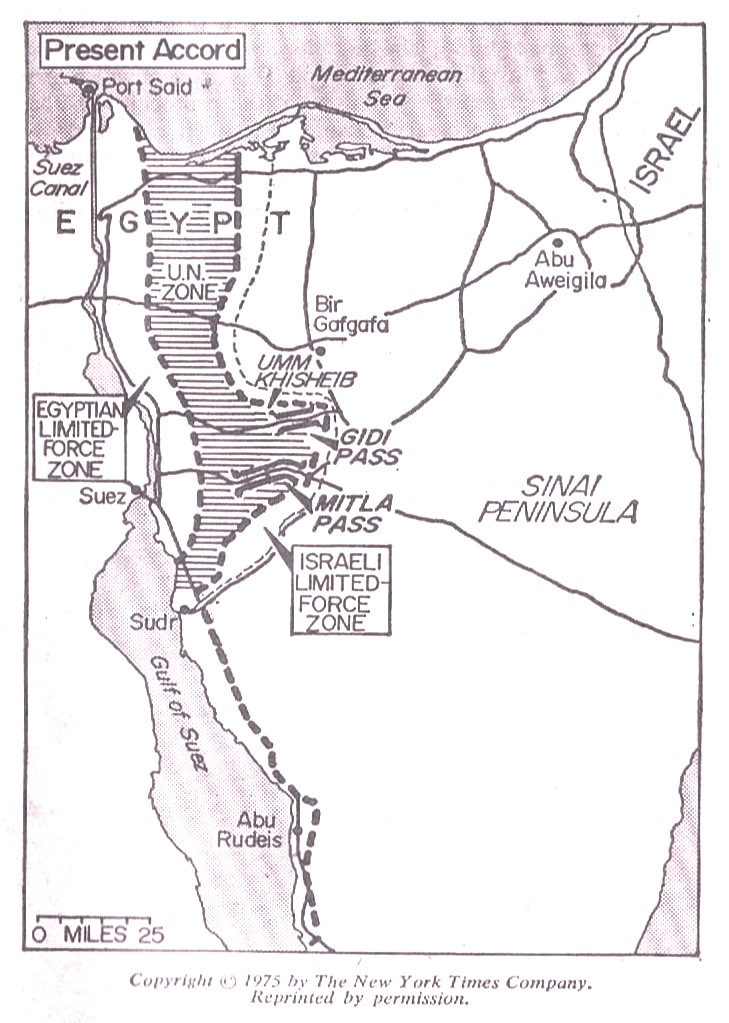
The Palestine Scholars Association in the Diaspora published a fatwa on 21st October permitting ‘jihad’ against the Zionists as one of the main obligations of our religion, with the stated goal being to free the al-Aqsa Mosque and repel Zionists from the Islamic country of Palestine. The fatwa quotes a Qu’ranic verse that says:

You will find that the most bitter enemies of Muslims are the Jews and the polytheists.

The Hamas-affiliated association, which defines itself as an independent body that gathers Palestinian scholars who reside abroad to serve the Palestinian cause and establish an Islamic legal framework for it, was founded in Beirut in 2009 and is today based in Istanbul. The fatwa also described the Palestinian mujahideen (jihad fighters) led by Hamas as the best mujahideen on earth and urged followers to refute claims that their jihad amounts to terrorism.

Hezbollah supporters in Beirut protest against Israel’s attack on Gaza (Photo: Bilal Hussein/AP)

In another fatwa published on 20th October, the association commanded every capable adult Muslim to be ready to fight, while those who can’t are enjoined to support Hamas financially. It lashed out at Muslim countries that have normalized relations with Israel, stipulating that normalization agreements are void and do not entail any obligations. In a legal response published on October 24, a member of the Yemenite branch of the Scholars Association named Aref bin Ahmed al-Sabri wrote that Jews and their property are legitimate targets as long as they fight against Muslims. He further called on Arab countries around Israel to intervene to repel Jews from Palestine, stating that the land belonged exclusively to Muslims, and not an inch of it may be given up.
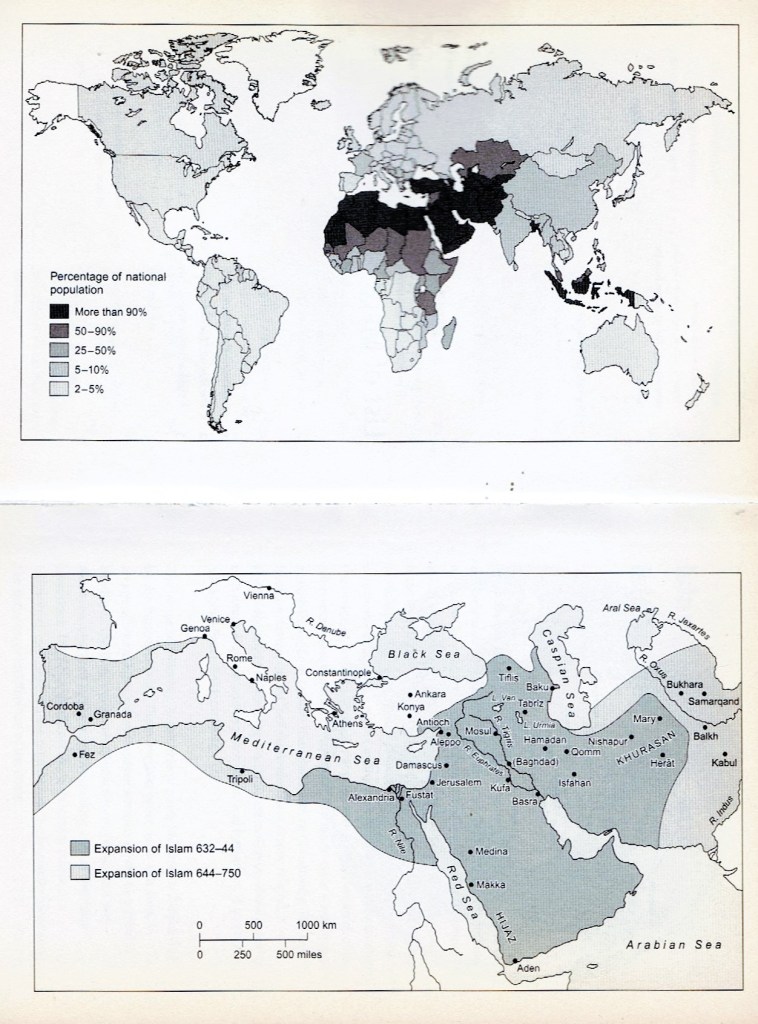
Meanwhile, the UK’s ‘Levelling Up’ Secretary Michael Gove is understood to have ordered officials to draw up a new official definition of extremism in a move to counter antisemitism. The work is understood to have started before violence flared up again in the Middle East. Ministers are reviewing the definition of extremism in a move that could reportedly allow councils and police forces to cut off funding to charities and religious groups found to have aired hateful views. The 2021 report, referred to in the introduction, urged ministers to do more to eradicate extremism, with the official watchdog, the Commission for Countering Extremism, concluding then that gaps within current legislation had left it harder to tackle “hateful extremism”.

On Saturday 28th October, nine people were arrested in central London during a second, mainly peaceful pro-Palestine demonstration, with at least a hundred thousand protesters calling for a ‘ceasefire’ in the Israel-Hamas war. Seven of the arrests were alleged public order offences, a number of which are being treated as hate crimes, while two are for suspected assaults on officers. The Metropolitan Police on X, formerly Twitter, confirmed it was reviewing a potential “hate crime incident” in Trafalgar Square following chanting that referenced the Medieval Battle of Khaybar, referring to a massacre of Jews in the year 628 by Islamic forces. Officers also followed up on reports that a pamphlet was being sold along the route of the march that praised Hamas, the force confirmed on social media. Hamas is a proscribed terror organisation in the UK, with expressions of support for it therefore banned. Separately, The Sunday Telegraph has reported that the Home Office is examining potential changes to terrorism legislation.

Secondary Sources:

Malise Ruthven (2000), Islam: A Very Short Introduction. Oxford: Oxford University Press.

John Ferguson (1997), War and Peace in the World’s Religions. London: Sheldon Press.

The Brambled Road to 1948: Health, Poverty & Welfare in the South Wales Valleys, 1928-48.

Unemployed miners getting coal, Tredegar patches, the late 1920s.
The Condition of the People of the Valleys:

Most reflective articles relating to the National Health Service I have read or heard in this seventy-fifth anniversary year have seemed to concentrate on those years since its foundation, almost as if it suddenly materialised fully formed from Aneurin Bevan’s mind. Apart from limited and brief references to the Tredegar Scheme as the source of inspiration for Bevan’s national scheme in 1948, very little has been written about its long-term motivations in the broader social and demographic changes affecting Great Britain during the inter-war years. Over the decade since the Great War, the population growth accompanying industrialisation had already been slowing significantly. The population of England and Wales had almost doubled, despite relatively high levels of outward migration. The growth rate between the wars was only about a third of that experienced throughout the Victorian era and only half of that about a third of that of the Edwardian period (1901-1914). This deceleration in Britain as a whole increased the drift of the population to the Midlands and South East of England and had it not been for the degree to which South Wales stood out against this trend by maintaining a high rate of natural increase throughout the period, the effect of the scale of out-migration could have been far more catastrophic. Indeed, this was an observation made by those entrusted with planning for the post-war reconstruction of the Welsh economy, the Welsh Reconstruction Advisory Council (WRAC), in their First Interim Report (1944: pp. 13-14).

A deeper cause for concern was reflected in the age structure of the population. For the first twenty years of the twentieth century, South Wales possessed the youngest population in Britain. Due to its high birth rate, a third of the 1911 Welsh population was to be found in the 0-14 age range and, largely due to the influx of large numbers of young, economically active people, a further forty-seven per cent was located in the 15-44 age range. By comparison, twenty-eight per cent of the British population was under fifteen in this year, forty-seven per cent was between fifteen and forty-four, and twenty-five per cent was forty-nine and over. The inter-war years saw, throughout the whole of Britain, a steady increase in the older age range and a marked decline in the number of young dependents resulting from the falling birth rate and, as might be expected from the above statistics, continuing proportionate growth of the economically active section of the population. The full extent and impact of this can be judged from that, by the end of the inter-war period there was one additional potentially productive member of the national community for every ten such people in 1871. These population changes meant that, while the country’s capacity for consumption increased by eighteen per cent between 1911 and 1938, its human capacity for production increased by twenty-seven per cent. This led one commentator to the conclusion that…

… at least from the point of view of material well being, the composition of Britain’s population in 1938 was more effective than it was a generation earlier.’

Mark Abrams, The Condition of the British People, 1911-1945: A Study Prepared for the Fabian Society. London: 1945, p. 22.

However, this benefit was not evenly distributed throughout Britain. Between 1921 and 1938 the South and Midlands experienced a loss of 12.5% in the 0-14 age range, a gain of 3% in the 15-24 age range, and a gain of 22% in the 25-44 age range. The respective, comparative figures for Wales showed a loss of 27%, a loss of 20% and no change in the latter group. By 1938 South Wales had been relegated from having the youngest population in Britain to a position where it had fallen behind the national average, and well behind the Midlands and South East in terms of the proportion of its population made up of 15 to 34-year-old males. Clearly, the inheritance of the pre-war years had been quickly lost.

There were five factors involved in the changing age structure of the population and the unevenness of these changes between regions. Here I wish to identify and examine four of these – birth and death rates, infant and maternal mortality. These were all directly though not exclusively connected to the general health of the population, as well as more indirectly to the fifth – migration – which I have dealt with in other articles on this site, based on my original research. Firstly, it is worthy of note that even in the trough of the Depression, in 1931, South Wales, along with Scotland, Northumberland and Durham, still had the highest birthrates in Britain. While their birth rates were declining significantly compared to what they had been in 1911, they were able to sustain their overall population throughout the interwar period and beyond through these comparatively high levels of fertility.

This was also an observation made by contemporaries, such as J. D. Evans of University College, Cardiff, when he reported to the Nuffield College Reconstruction Survey in 1942. In particular, he pointed to the way in which the ‘voluminous outflow of youth from the distressed areas of South Wales was offset by the high fertility of the people.’ In 1934, South Wales still possessed a birthrate per thousand of 16.1 compared with 15.4 in the West Midlands and 13.9 in the South East, at a time when both the English regions were emerging prosperous from the Slump, though the Coalfield was still experiencing high levels of mass unemployment. It was not until the years 1937-39 that the rate of births among women in South Wales fell below those among West Midland women.

Quite clearly, this decline in the birth rate, coupled with the continued migration of nearly half a million people between 1920 and 1940 would have inverted the age structure of South Wales from what it had been at the beginning of the interwar period, had the Second World War not intervened. What is remarkable is that the birth rate continued at such a high level throughout the depression years. These regional disparities cannot be explained in terms of relative economic security. Historians have pointed to the involvement of women in the manufacturing industry of the West Midlands and Lancashire as an important element in spreading effective birth control techniques; the highest birth rates continued to be recorded, throughout the period, in those industrial areas where employment was mostly dominated by men.

During the interwar years, the annual death rate for Britain as a whole remained at around twelve per thousand of the population. However, when corrections are made for the changing age composition of the population, it becomes apparent that the rate had fallen by approximately twenty-five per cent between 1911 and 1939. On the surface of it, this represented a substantial improvement in the health of the country as a whole, but once again a national average figure disguised marked regional differences. Mark Abrams summed these up as follows:

‘In the three years before the outbreak of this war, regional differences were so great that a train journey of less than a hundred miles was sufficient to take one of the areas with something like the lowest death rate in Europe, to areas where the returns were little better than those for Britain as a whole in the first decade of this century’.

Mark Abrams (1945), p. 26.

The crude death rates are insufficient to reveal this disparity. A truer picture can be gained by comparing actual deaths with expected deaths. These calculations demonstrate that deaths were well above average in the comparatively youthful populations in the North of England and South Wales, average in the Midlands and below average in the South East of England. In reality, in the period 1937-39, South Wales had a mortality rate seventeen per cent higher than that for England and Wales as a whole, and thirty-one per cent higher than that in the South East. This difference was almost as great as that between Britain in 1911 and in 1939, giving further evidence of there being ‘two Britains’ not far apart in physical distance but nearly three decades apart in terms of the relative physical health of regional populations.

In 1938, Richard Titmuss published his groundbreaking study, Poverty and Population: A Factoral Study of Contemporary Social Waste, in which he attempted to assess the extent, character and causes of social waste and to relate the findings to the problem of an ageing and diminishing population. Titmuss set out to analyse two factors which he considered to be significant in this process. Firstly, those regions suffering from ‘economic under-privilege’ and most exposed to malnutrition contained by far a higher proportion of children and secondly, it was only higher fertility that prevented a calamitous fall in the size of the population. Titmuss produced statistics showing that in 1936 over a tenth of deaths in South Wales were of children under the age of four, compared with 8.5% in the South East, and that more than half the deaths in South Wales occurred before the age of sixty-five, compared with forty-seven per cent in the South East.

Infant mortality was also much higher in South Wales, at sixty-three per thousand, from which he calculated that there were five thousand excess deaths of infants under the age of one in the North of England and South Wales during 1936, or approximately thirty thousand surplus deaths since the depth of the slump of 1931. Deaths from measles were proportionately twice as high in Wales as for England and Wales as a whole, implying a widespread prevalence of rickets, malnutrition and poverty. In the years 1931 and 1935, whilst the South East showed a considerable improvement in the numbers of infant deaths, in South Wales, there was a continuing deterioration.

Similarly, maternal mortality rates in the region were well over twice those in the South East, and Titmuss felt able to state that if the maternal mortality rates in the region had been the same for Greater London, the lives of 586 mothers would have been saved. Female deaths from tuberculosis in the fifteen to thirty-five age group in South Wales were seventy per cent above the average for England and Wales. Titmuss went on to calculate that the number of avoidable, premature deaths in the North of England and Wales in 1936, a year of relative prosperity, was 54,000 and that the cumulative number over the previous ten years was of the order of half a million. The high levels of infant, child and maternal mortality, taken together, can only be fully appreciated when it is realised that forty per cent of the total child population in England and Wales was situated in the two older industrial regions, whereas the proportion of the adult population located there was little more than a third.

Unemployment & Health:

However, though the regional contrasts are striking, it is difficult to isolate relative poverty from other factors such as climate, housing conditions, and quality of medical and social services. H. W. Singer’s (1937) study for the Pilgrim Trust on Unemployment and Health is helpful in this respect by isolating the effects of the general trade depression, or ‘slump’ of 1929-34, and correlating the unemployment statistics during these years with a range of indices of health for seventy-seven boroughs throughout England and Wales. In this way, the differences between these localities in terms of regional variations in other conditions could be eliminated. Through this process, Singer was able to identify a correlation between rising unemployment and a rise of twenty per cent in both infant mortality and maternal mortality.

None of the data examined by Singer failed to exhibit some sort of correlation with unemployment, and it was certainly the view of those who visited South Wales and gave anecdotal evidence that there was a direct correlation between the economic distress of its population and their health. Levels of voluntary Health and welfare provision across South Wales were considered greatly inferior to those in other regions, though varying greatly across the region itself. Philip Massey, in his (1937) Portrait of a Mining Town, argued that the majority of the unemployed in Blaina and Nantyglo could be described as having a diet which was inadequate according to the standard set by Medical Officer of Health, Sir John Orr, published in his Food, Health and Income the previous year. Those whose weekly expenditure on food was five to seven shillings per head had a diet which was adequate only in total proteins and total fat; this category also included many families whose ‘head’ was in work. Those in work could afford expenditure of up to nine shillings per head ön food, but perhaps the majority of ‘wage-earning’ families, would have a diet adequate in energy value, protein and fat, but below standard in minerals and vitamins.

Evidence of the effects of this poverty of diet is found in the information given in the reports of the local Medical Officers and school authorities. In a joint report for the Ministry of Health entitled Distress in Wales, J. Llewellyn Davies, Pethwick-Lawrence and Evans provided stark evidence of the impact of poverty on families in the Monmouthshire valleys. The children of Abertillery in 1928 were said to be suffering from a lack of ‘tone’ and had less ‘grip’ than previously. The average weight of the girls showed a falling off at all ages. Despite the provision of free meals to ‘necessitous children,’ non-attendance had risen from about six per cent in the winter of 1926-7, to about nine per cent in the winter of 1927-8. In nearby Blaina, a medical examination in that same year had found 423 out of 3,245 children to be physically subnormal from lack of nourishment. In the case of 250 of them, or nearly eight per cent, their condition was attributed directly to poor family conditions. It was also reported that 247 school weeks were lost in the last quarter of 1927 due to a lack of boots, stockings, and other clothing, unemployed families having ‘literally no means except private charity’ from which clothing could be obtained. Without this help, the child population of Blaina, Nantyglo and Abertillery would have had no boots and the rest of their clothing would have been ‘worn to shreds.’

Whilst the provision of basic welfare services on a voluntary basis may have mitigated their effects on some children, they were inadequate in assisting impoverished families as a whole. Indeed, such services as did exist were often under great financial pressure themselves. For instance, in 1928 a small deputation led by George Hall M. P. pressed the case of Blaina Hospital to the Ministry of Health. The hospital’s income was dependent upon contributions paid weekly by miners so the effect of the general closure of pits in the district was disastrous. Its account was overdrawn to the extent of Ł2,000, and, whilst income for the year was estimated at Ł2,500, costs were expected to be of the order of Ł4,000. This was not an isolated case, according to reports. Clearly, the many hospitals in the valleys of South Wales and Monmouthshire funded through voluntary schemes would struggle to survive prolonged stoppages in the coal industry.

The combination of long-term unemployment, the resulting poverty, poor housing and overcrowding experienced by the communities at the heads of the valleys took a heavy toll on the health of their population. In Merthyr in the late 1930s, the number of women suffering from tuberculosis was nearly two-and-a-half times the standardised average for England and Wales as a whole; among men, it was one-and-a-half times. One infant in every five died before the age of five, and malnutrition, rickets, diphtheria and pneumonia were widespread among schoolchildren. Already by 1932, the average age of death in the borough was down to forty-six years.

In 1937, a further official survey on the health of boys at the Blaina Boys’ School, quoted by Philip Massey, revealed that, though the condition of many children was better than in the previous report from the town, there were still serious problems in many families. On the wet day when the inspectors made their visit, forty-three per cent of the boys had damp or wet feet. More than a quarter of the two hundred or so at the school had clothing which was ‘poor’ or ‘bad’ whilst only four had clothing which could be described as ‘good’. Those deemed to have nutrition which was ‘slightly subnormal’ or ‘bad’ amounted to 28%, as compared with the national average which showed only 11.5% in these groups for 1935. The Medical Officer also noted that there were a number of undersized boys.

Massey also confirmed the view of Titmuss, Singer and others, that it was the women in these communities who suffered most from ill health, and in a variety of ways. Whilst the men seemed to look their age, with the exception of those suffering from industrial diseases, the women generally looked older than they were due to the hour-by-hour strain and the lack of holidays or any opportunity to leave the home apart from the weekly shopping trip or the occasional visit to the cinema. Women were often reluctant to admit themselves to the hospital, in cases of childbirth or illness, as they thought that the household would get into a muddle in their absence. Massey also noted that there was no birth control clinic in the district and that many women, fearful of having to rear more children on the dole, would undermine their health by using aperients.

The fact that South Wales maintained a relatively high birth rate and a lower-than-average crude death rate throughout the 1930s, enabling it to end the decade with an age structure roughly comparable to that of England and Wales as a whole, should not blind social historians, as it did some contemporaries, to the fact that, according to R. M. Titmuss, as many as sixty-five thousand of its inhabitants may have died ‘avoidable’ deaths in the period 1926-36. There certainly was a good deal of contemporary complacency, as other ‘surveyors’ of the coalfield testified. Hilary A. Marquand of University College, Cardiff, who was to succeed Nye Bevan as Health Minister, warned against this in his (1936) book, South Wales Needs a Plan, and M. P. Fogarty followed this more optimistic, though measured analysis with his post-war report on Prospects of the Industrial Areas of Great Britain.

Contemporary Images of the Coalfield Communities:

But the quantitative evidence only tells part of the story of the decline in health and well-being of the valley communities. Recent historians of inter-war South Wales (over the past half-century) have had to deal with a variety of optimistic and pessimistic definitions and images provided by contemporary social investigators as well as immediate post-war historians. They have written using the familiar tropes of ‘The Distressed Coalfields’, ‘The Depressed Areas’, ‘The Unemployed’, ‘The Black Spots’ and so on. These frequent ‘turns of phrase’ need to be seen alongside the complex realities of life experienced by the coalfield communities and the families and individuals that composed them, which have become blurred into popular images in print and film.

Within a British context, South Wales in the 1930s was viewed as a ‘problem’, a ‘depressed area’ or latterly and more euphemistically, a ‘special area’, following the growing acceptance of the need for ‘Planning’ by leading economists and politicians from the Spring of 1937 onwards with the publication of the journal of the same name by the new forum, Political and Economic Planning. For them, it was a ‘problem’ to be dealt with by national agencies, whether voluntary or state-managed. The ground of the argument was about how to deal with the problem, and most of these agencies arrived in South Wales with a prescription of one type or another, having already made their diagnoses from afar. They then made sure to make that the symptoms fitted these diagnoses. After all, the statistics were now available and formed the bedrock for the formulation of policy.

The professional and commercial strata of South Wales society were umbilically attached to a notion of progressive imperialism. The deputation of churchmen who, in July 1937, met Neville Chamberlain, who was steeped in the same Liberal Imperialism that the Birmingham Unitarian dynasty had been for the previous half-century, reflected this:

‘They were there because the community of which they were a part was slowly breaking up… It was a great community and they did not think that the British Empire could afford to see it passing.’

Western Mail, 23 July 1937.

During the 1930s, Hollywood captured the masses in its films, which increasingly appealed to critics and intellectuals. Educated film-goers in Britain were also beginning to appreciate those qualities which the masses had always detected and in particular they were at last spotting that there were forms of ‘social realism’ in American cinema. Peter Stead has written an essay (in Wales, The Imagined Nation: 1986 – see ‘Sources’) about how, together with this realisation, there came a new awareness that it was precisely this quality that was missing in British films. By the late 1930s, there was a crescendo of demand for a fuller sense of Britain in British films. The constant sniping of the critics, the dissatisfaction of directors and the relaxation of censorship all sanctioned the emergence of ‘social cinema’. This was a real turning point in the history of the British film industry, but, hardly surprisingly, it was Hollywood that both inspired and encouraged the change. The dark days of the Great Depression in the United States had taught Hollywood that there were audiences for films that admitted that not all was right with the world.

The British studios duly noted that there were audiences for ‘social problem’ films and that, in any case, the censors were becoming more lenient. Following the 1937 Quota Act, American companies began to establish their own studios around London so that they could make ‘British’ films, and it was under these arrangements that MGM made The Citadel in 1938. Several British critics thought that this was one of the best British films ever made and comments followed about the very apparent American production values, as well as about the emergence of Robert Donat as a Hollywood star. The film also offered an authentic sense of London and South Wales. Hollywood loved middle-brow best-sellers, with libraries and bookshops providing free publicity, and A. J. Cronin was very keen for his story about the ideals of a young doctor to be filmed. He could never have foreseen that the film would be so well made; there were some early location sequences which rooted the film in the South Wales valleys that the documentary directors Ralph Bond, Donald Alexander and John Grierson had already ‘discovered.’ In The Citadel, besides the first-class acting of Donat, Ralph Richardson and Emlyn Williams, who contributed some authentic Welsh dialogue, there was a convincingly detailed denunciation of the evils of private medicine.

Britain was ripe for a socially mature Hollywood film, and the Director, King Vidor, was well known in ‘tinsel town’ for making socially realistic films that reflected his own brand of rural populism: he was very much for the common man and very much against the sharp practices of all corporations and vested interests. The Citadel offered a fuller view of South Wales than any previous feature film, though it made use of the area for the purposes of the narrative, combining Cronin’s melodrama with Vidor’s own philosophy. The film was mainly concerned with the salvation of its hero: the Christian knight, or Anglo-Saxon individualist who had to discover his true self by pointing the masses towards a higher goal. There was, however, no room in the scenario for organised protest or trade unions and so the ‘stupid’ miners are shown to be passive in support of medical progress, held back by the Aberalaw Medical Aid Society, which becomes the metaphor for all the evils associated with any guild or syndicate of workers. At one point, the young doctor’s wife comments, “Did anyone ever try to help the people and the people not object?”

Diagnosing Depression – The ‘Celtic Complex’:

By contrast, the social survey writers frequently set about their task as if they were embarking upon an anthropological expedition. The editor of the journal Fact, prefacing Philip Massey’s Portrait of a Mining Town, asserted the need for ‘an attempt to survey typical corners of Britain as truthfully and painstakingly as if our investigators had been inspecting an African village. ‘ This, apparently, was why a mining ‘town’ was chosen. He stated that, like African villages, mining communities are isolated and relatively easy to study. Clearly, it was this image of geographical isolation which attracted many of these investigators, as it did film directors; it is hardly surprising that their findings, therefore, tended to reflect this image, even though it was not an entirely accurate one in reality. Many of the philanthropists of the 1930s used the image of ‘isolation’ to justify their concept of social service ‘settlements’ in the valleys, as a means by which the outlook of the coalfield communities could be ‘broadened’. They were attempting to infuse a notion of ‘citizenship’ of a wider community extending far beyond the natural boundaries of the valley.

This liberal-nationalist image of the coalfield was essentially that of a society in which industry had distorted nationality and that, to their regret, this had given the South Wales collier a greater affinity to his fellow colliers in Durham and Yorkshire than, for example, to the tin-plate workers of west Wales. This, to them, was to be lamented, and its fundamental cause was seen as the incursion of an alien people bringing with them an alien culture, infecting the very psyche and mentality of the colliers against their better nature. These people, it was claimed, never shared in the inheritance of Welsh culture and Welsh life. They were alien accretions to the population who had gradually stultified the natural development of native culture.

At a time when pseudo-scientific ideas of eugenics dominated political ideas on the continent, the authors of pamphlets and papers on public health and social service in Wales contrasted the Welsh-speaking miners of the anthracite districts of the western coalfield with the recent immigrants in the Eastern Sector who formed a more or less alien population. This, they claimed, accounted for the acceptance by South Wales miners of economic theories and policies which would appear to cut across Welsh tradition. In a similar vein, the ‘old Welsh colliers’ of Welsh-speaking Rhymney were contrasted with those of Blaina by James Evans, General Inspector to the Welsh Board of Health in his paper to the Welsh School of Social Service Conference at Llandrindod Wells in 1928:

‘In this and other districts where the native Welsh culture most strongly persists and the influences of the Methodist revival… are still felt, there is a noticeable difference in the character and outlook of the people as compared with the districts where the industrial revolution submerged the populace and introduced an economic doctrine and a philosophy of life both of which are strange and unsatisfying to the Celtic Complex’.

James Evans, Report on Conditions in South Wales, 24 March, 1928.

The ‘old Welsh collier’ was seen as being ‘independent in spirit’, the last to apply to the Board of Guardians for relief. These ‘liberal-nationalist’ elements within the Ministry of Health were keen to support the work of the Industrial Transference Board, established by the Ministry of Labour in 1928 because they saw in it the means of removing what they viewed as an alien, disruptive element from the coalfield. They, therefore, helped to ensure that the local authorities kept their levels of relief sufficiently low to encourage the acceptance of transference. James Evans, as General Inspector to the Welsh Board of Health, disapproved of the action of the Bedwellty Board of Guardians in Blaina and Nantyglo, in giving out grants of boots, suits of clothes, underclothes, bedclothes and dress material, besides the usual relief in cash and food.

Evans felt that by doing so they were spreading ‘demoralisation’ throughout the district and that there was general agreement among those competent to judge… that the district should, as far as possible, be evacuated. One of the reasons for his support for this proposal was that, in his view, this district was not as Welsh as other areas of the coalfield, where the people were of a ‘better type’. He wrote to H. W. S. Francis, Chamberlain’s Assistant Secretary, urging him to keep to the transference policy and not to give further funds for additional ‘out-relief’. Writing his internal report for the Ministry of Health, Evans was just one among those who believed that the native population of the region had been corrupted by immigrants with an alien culture and ideology. In 1930, The Rev. W. Watkin Davies, the Minister of Edgbaston Congregational Church in Birmingham published his travelogue, A Wayfarer in Wales. In it, he described the coalfield communities as outposts of hell itself with their inhabitants almost to a man, supporters of the left wing of the Labour Party. Nevertheless, he was pleased to find elements of the ‘Celtic Complex’ still finding a ‘congenial home’ in the Rhondda, most notably through the Eisteddfod and in the rendering of Welsh hymn-tunes – and all this despite the ‘admixture of aliens’ in the valleys. He described Merthyr, after a brief visit, as a hideous place, dirty and noisy, and typical of all that is worst about the South Wales Coalfield.

For many of these commentators clinging to the cultural emblems of nonconformist Wales, the coalfield was either a grimy foreign country made up of things which, and people who ‘in no true sense belong to Wales’, as Watkin Davies put it or it was a once noble and pure society which had been desecrated by Mammon and his hosts. Contemporary novelists, especially Richard Llewellyn, saw industrialisation and the resulting immigration into the valleys as a ‘problem’ for the continuity of older Welsh traditions. The central theme of Llewellyn’s (1939) novel, How Green Was My Valley, which was also made into a Hollywood film (1942), is testimony to the widespread acceptance of this explanation of the division between the ‘Coal Complex’ and ‘Celtic Complex’ in the region’s ‘fall from grace’. At the Llanmadoc Conferences held during the war, Welsh ministers were still propagating this image of a coalfield defiled by immigration and industrialisation. Rev. J. Selwyn Roberts of Pontypridd spent only a few lines of his speech dealing with the effect on his community of a decade of large-scale unemployment and emigration, before returning to the theme of the dissolution of the ‘Celtic Complex’ by immigration from the other side of the Severn estuary:

“In addition to those recent losses of its indigenous population by emigration the community life in Wales by emigration, the community life of Wales has also suffered from alien accretions in the past. … The workers who came in from surrounding counties were in the main people who neither brought any definite culture of their own, nor were able to fit into the culture of the Welsh community. This tended to make the bond of community life nothing more than the bond of economic interest, a condition which is fatal to true community life… It is clear that for the last two generations there have been alien factors at work which have almost completely overcome the traditional conscience and spirit of the Welsh people…

Quoted in Pennar Davies et. al., (n. d.), The Welsh Pattern.

Another identifiable set of images was created by a group of ‘propagandists’, and it was these images, in photographs, film and print, which have subsequently been used by historians of the period. Some of them were products of coalfield communities; others were visitors to it. The latter came to the coalfield with a specific purpose in mind, shaped by a belief in a class struggle in which the colliers were in the vanguard. For writers like the avowed Communist Allen Hutt, whose books were intended as propaganda for the times, the South Wales miners were the cream of the working class… the most advanced, most militant, most conscious workers. To add to this neat definition, he gave an equally neat explanation of why they did not rise up against their ‘suffering’:

‘One of the obstacles confronting the revolt of the workers in South Wales is precisely that degradation of which Marx spoke as the accompaniment of the growth of impoverishment under monopoly.’

A. Hutt (1933), The Condition of the Working Class in Britain. London, pp. 44-45.

This image has an empty alt attribute; its file name is 001-1.jpg

Recent historians have demonstrated how this imagery tended to dominate much of the contemporary discourse, literature, newsreel footage and photography of ‘The Hungry Thirties’ in the coalfield, leaving us to separate the mythology from the real matter of the society itself. The writer Gwyn Thomas, in his (1979) lecture, The Subsidence Factor, described the ‘exodus’ from the Rhondda Valleys, as remembered from his childhood, in a nuanced way, as being like a Black Death on wheels conducted with far less anguish. Historian Dai Smith has written of the socio-economic stereotypes who, black-faced, unemployed or militant, stalk our fictional worlds. In particular, the propagandists’ preconceptions tended to create and perpetuate what may be termed, ‘the myth of the unemployed man’. The stereotyping of ‘the unemployed’ as a uniform group, a ‘standing army’ within British society served the purposes of those who saw the causes of unemployment as correspondingly straightforward. Thus, John Gollan began a chapter on unemployment in his (1937) book, with the following statement:

‘What is unemployment? We would be fools if we thought that unemployment depended merely on the state of trade. Undoubtedly this factor affects the amount of unemployment is absolutely essential for capitalist industry, while under socialism in the USSR it has been abolished completely. Modern capitalist production has established an industrial reserve army – the unemployed; and the existence of this reserve army is essential in order that capital may have a surplus of producers which it can draw upon when needed. Unemployment is the black dog of capitalism …’

J. Gollan (1937), Youth in British Industry: A Survey of Labour Conditions Today. London, p. 155.

Poverty, People and Policy:

By 1929, the number of long-term unemployed was already sizeable in the ‘depressed areas’. In his report to Parliament that February on The Coalfield of South Wales and Monmouth, Neville Chamberlain, then Minister of Health, remarked that many miners had not worked since the 1926 stoppage and that some had not been down a pit since 1921. He commented that even now there are men who regard it as in the natural order of things that they should for all time be provided with the necessities of life without working for them. The intervention of the state in terms of the Unemployment Insurance Act of 1930, which took effect in March under the Labour Government, made it possible for large numbers of workers to survive long periods of unemployment without providing evidence that they were ‘genuinely seeking work’. Its provisions continued in effect until 30 June 1934 when the National Government’s Act establishing the Means Test came into effect.

That this ‘phenomenon’ of long-term unemployment was almost entirely without precedent is shown by Chamberlain’s description of the situation as without parallel in the modern history of this country. He suggested that even ‘the nearest parallel’, that of the Lancashire cotton famine of 1862-64, was ‘not a close one’. Prolonged mass unemployment, distinctly regional in character, was a new social phenomenon which created major problems for ‘Labour’ and ‘Capital’ alike. Given its novelty, it is not surprising that ‘social investigators’ and ‘propagandists’ alike should choose to focus on the long-term unemployed. However, few contemporaries showed any significant awareness of the varying social conditions of unemployed people.

In his (1940) book, Unemployment and the Unemployed, H. W. Singer was scathing about the generalisations in this respect, arguing that there were was no ‘unemployed man’, but only ‘unemployed men’, that there was ‘no uniformity but an intense variety’. He went on to list sixteen independent causes of unemployment and to point out that because work enforced a common routine on the people who took part in it, it was reasonable to expect that when people became unemployed their suppressed individuality would reassert itself. Poverty, the dole queue and the Means Test might all restrict diversity, but that did not mean that the unemployed could be described as:

‘… a uniform mass of caps, grey faces, hand-in-pockets, street-corner men with empty stomachs and on the verge of suicide, and only sustained by the hope of winning the pools…’

H. W. Singer, loc. cit., London, Chapter I, passim.

To begin with, Singer divided Gollan’s ‘reserve army’ into two camps, a ‘stage army’ and a ‘standing army’. Those in the former were the short-term unemployed, out of work for under three months and those in the latter were the long-term unemployed, out of work for twelve months or more. Those in the former category could therefore include workers moving from one form of employment to another, and those ‘laid-off’ or ‘temporarily stopped’ for two or three days a week from the collieries. When temporary unemployment was characterised by the experience of three days’ work and three days’ dole it could be both economically and psychologically more destabilising than being wholly unemployed. One of the few authentic coalface writers, B. L. Coombes commented in his influential (1939) book, These Poor Hands: The Autobiography of a Miner Working in South Wales, that when the Colliery managers called them for a fourth shift, their feelings were not very pleasant, because they knew that had they not been called they would have been able to claim three days’ dole. Despite working all spring and summer, he was not a penny better off than if he had been on the dole. But, he wrote, his case was ‘an average’ one; the older men with big families who had a shilling a day to pay for bus fares were actually losing money by working four days a week.

Men like Coombes who were either young or fit enough to keep working continued to work in the hope that their colliery would soon return to working six shifts, and they would be paid a full-time wage. At the same time, they had to adapt to new methods of coal-cutting by machine. Coombes was a skilled machine operator and well-adapted to the ‘speed-up’ which was happening throughout the coalfield by the mid-thirties. Those who ran a high risk of being relegated to the ranks of the ‘standing army’ of the long-term unemployed were the older colliers who found it harder to get back to the coal face after a temporary stoppage because of their comparative lack of experience using mechanised coal-cutters. The introduction of these did much to destroy the craftsman spirit in the mines and reduced the number of miners required for a specific job, plus it did little to provide higher wages and better conditions for those remaining in the industry. In fact, wages remained depressed throughout most of the period and the ‘speed-up’ that mechanisation entailed led to the repeated claim that conditions were becoming ‘murderous’.

Those among these older colliers who were no longer able to find a ‘place’ underground worked under the constant fear of joining the dole queue on a permanent basis, as did those men advancing towards middle age. Their fear, and the manner in which they tried to hide their poor health as a result, is vividly illustrated by the following passage from Coombes’ book:

‘I sympathise with the older men, and watch their struggle to keep up. I listen to the labour of their dust-clogged chests when they climb the drift to go out. They climb a few steps, pause to regain their breath and watch the younger ones hurry past. Down that coal-drift rushes a current of air that is forced and always ice-cold. This meets the sweating men as they come up and chills them to their insides. It tells on chests that are already weakened by clogging dust and the rush of work.

‘I watch how the few men who are old come to work; how weary they look; how their faces seem almost as grey as their hair; how desperate they are that the officials shall not think they are slower at work than the younger men. I can read the question that is always in their minds:

“How many more times can I obey the call of the hooter? And after I have failed, what then?”

Coombes, loc. cit., p. 222.

For the twenty thousand who were over fifty and were considered to have ‘failed’ and were unlikely to work again, there was a threefold problem. They had lost their sense of purpose as skilled, active workers and bread-winners for their families; relationships with younger, working members of the family became more difficult, particularly if these members were working away from home, and thirdly, they found it impossible to make any kind of provision which would enable them to keep up the home’s standard of living when they reached the old age pension age. The effect of the high level of unionisation in the Coalfield had kept the wage rates much higher than in many other areas of Britain, but the unemployment allowance system on which the long-term unemployed depended, took little account of regional variations.

A jobless man with his children at home in Aneurin Bevan’s constituency of Ebbw Vale, 1936.

A skilled collier in prosperous times may have brought home the equivalent of a wage of anything up to eight pounds per week, and when multiple members of the family were earning the economic standard of the family might well have been higher than an ordinary lower middle-class family such as a shopkeeper’s family in coalfield communities. The maintenance system, however, would mean an immediate drop in income of at least a pound a week, even starting from the more precarious levels of pay which existed in the mining industry in the 1930s. The contrast with the older collier’s memory of the relatively prosperous early twenties:

It is just the extent of this drop … which will largely determine an unemployed man’s attitude to unemployment … It is, therefore, the skilled men… that are feeling the edge of their condition of unemployment most keenly, because it is these people that are in fact being penalised by the existing system of ‘welfare’.’

Singer (1940), op. cit., pp. 15, 95-6, 112.
The Break-up of the Coal Complex:

In addition to the problems of the older colliers, youths no longer had the opportunity of learning the craft under skilled colliers, and in many districts, considerable numbers of them were dispensed with some time between their eighteenth and twenty-first birthdays. Moreover, the operation of the Seniority Rule often discriminated against younger men, thus providing them with a strong motive for migration. An array of sources provide evidence that there was a growing antipathy towards coal mining among both young men and their parents.

In his visit to South Wales in June 1929, an official at the Ministry of Labour found that parents were increasingly in favour of their boys migrating rather than working underground, despite the fact that the employment situation had improved to the point where there was a fresh demand for juvenile labour. Another report that year revealed that boys had refused the offer of underground employment in the hope of securing employment in England. In January 1934, the Juvenile Employment Officer for Merthyr reported that of the boys due to leave school at the end of term, less than seventeen per cent expressed a preference for colliery work. A quarter of them stated that they had no particular preference but invariably added that they did not want to work underground. By comparison, a quarter wanted to enter the distributive trades and ten per cent stated a preference for engineering.

This new attitude was shared by parents and offspring alike. In Abertillery, it was reported that most of the boys leaving school in 1932 were anxious to obtain employment other than mining and that their mothers were ’empathetic’ that they should not face the same hardships and unemployment as their fathers… It was the changed nature of the work involved as well as its current insecurity which promoted a preference for migration or transference. The evidence from government enquiries was well supported by impressionistic evidence from social investigators. In his survey of Nantyglo and Blaina, Philip Massey reported that migration was playing its role in the broadening of the minds of the population. He detected the erosion of what he called the coal complex.

A further ‘Investigation’ into the matter by the Ministry of Labour in 1934 found that there were 148 boys unemployed in areas where there were unfilled local vacancies in coal mining. Although only twenty-nine of these boys had stated that they were unwilling to accept mining employment, the report concluded that this antipathy was widespread. The shortage of boys wishing to enter coal mining was most marked in the Ferndale employment exchange area, although managers of all the South Wales exchanges covered by the enquiry reported this changed attitude towards pit work.

Few writers attempted to let ‘the unemployed man’ speak for himself, however, let alone their wives and children. James Hanley did so deliberately in his 1937 work, Grey Children: A Study in Humbug. A number of those interviewed by Hanley also reflected this erosion of the Coal Complex and the concurrent desire of young people in the community to ‘better themselves.’ This desire was often prompted by the extensive reading which lengthy unemployment provided time for. The following quotations from Hanley’s witnesses reveal this connection between migration, a growing disenchantment with coal mining and a broadening industrial consciousness among young men in coalfield communities:

John Jones, forty-six-year-old unemployed miner:

“Lots of them like the open-air life and have come to hate the mine and all it stands for. Many miners refuse to let their boys go below. It’s worrying the owners a lot, I can tell you. There’s a generation that’s grown up now with their eyes wide open, and it looked around and it saw things, and it has seen too the lousy deal that miners have had ever since mines were sunk and they’re having nothing of it… just look at the large-scale emigration from these valleys… most of the young fellows have gone south to England. Just look at Slough and Oxford and London.” It’s not only the absence of work for their fathers and themselves, it’s the… instinctive knowledge that all they’ll get out of it will be the same deal as their fathers had…

“…young fellers … see us who’ve spent a lifetime at it, and they say to themselves, B- it, if that’s what you get out of a lifetime of hard toil under the earth, then to hell with it … the best blood in the land has flowed elsewhere…

A lad who had walked to Oxford and back again, looking for a job at the Morris works, and trying this or that factory or foundry on his way down, but all without successs… : “I’d rather get a job anywhere than in a pit. I wish my family would leeave Wales altogether. It’s so miserable.”

Hanley, loc. cit., pp. 20-21, 131-2, 205-7.

Similarly, the American writer Eli Ginzberg recorded that many of those who left Wales looked forward in a spirit of adventure to settling in communities where coal mining was not the sole occupation. He traced the break-up of the Coal Complex to the summer of 1926, and the freedom from the mines which the stoppage provided. This had prompted many, he argued, to question the advantages of coal mining, a questioning which was intensified by the worsening conditions and reduced pay which followed the return to work at the end of the six-month lock-out. Moreover, the social tensions and divisions which followed the strike, such as in the Garw District, made men more willing to break away and start anew in strange surroundings. Respect for the traditional solidarity of the coalfield communities had been undermined. Migration was therefore not simply a response to unemployment in the coal mining industry, but a rejection of the industry itself. In London, Miles Davies found that the sole factor keeping many immigrants from returning to Wales was their antipathy for colliery work:

Nearly all those who said they would prefer to live in the valleys, made it clear that that they would only return to a job as good, or in the same trade as the one they now hold, and that on no account would they return to work underground. One man in the discussion told how struck he had been on returning to his home village on holiday after several years absence, with the exhaustion of the men he met going home from the pit. He attributed this to the ‘speeding-up processes’ which have been introduced in recent years.

NCVO/NCSS papers; typescript report on Migration to London from South Wales, n.d.
Mothers & the Means Test – its Operation & Opposition:
Woman carrying a baby ‘Welsh Fashion, Rhondda c. 1930.

Women became even more antipathetic to the mines as a result of their struggle to manage falling and uncertain wages, and they sought other occupations for their sons. Among those quoted by Hanley was John Williams, who commented on his wife’s mental health:

‘ “My missus is in a mental home. We had a nice little lad, and were not doing so bad until I lost my job, and that and one thing and another, well, I suppose it got to her in that way.” ‘

James Hanley, loc. cit., pp. 9-10.

An unemployed miner’s son also told Hanley of the effect that the introduction of the Means Test had on housewives:

‘ “We’re on the Means Test now. Yesterday I was sitting in the kitchen when the man came in. It made me mad the way he questioned my mother. She got all fluttery and worried, I thought she was going to run into the street. She’s not used to it … Mother is very good in spite of the conditions. It’s wives and mothers who are the real heroines. …” ‘

Hanley, loc. cit., pp. 12-15.

John Gorman wrote in the introduction to his Photographic Remembrance of Working Class Life (1980), that if the means test was synonymous with poverty, then poverty was synonymous with South Wales. In Merthyr in 1936, unemployment was almost sixty per cent nine thousand), and more than seventy per cent of the unemployed were subjected to the means test. Clothes were threadbare, he went on, boots a luxury, soup kitchens a necessity and prosperity a fantasy. Public opinion against the ‘wickedness’ of the principle of means-testing families reached its crescendo in the second half of that year. The iniquitous and petty economies of the National Government that brought acrimony and family division to the tables of the poor were hated across Britain, particularly by those subjected to the bureaucratic inquisition involved. A worker with a newborn child would claim the allowance, only to be asked whether the child was being breastfed. If the answer was yes, the benefit was cut. A fourteen-year-old ‘errand’ boy had his earnings counted and the family benefit was cut accordingly because the son was expected to keep his unemployed father. Mothers deprived themselves of food to feed their children, who went without boots since there was not enough money for food and boots. In the winter months, coal had to be bought for four pennyworths at a time as families struggled to exist without the miner’s allowance and on means-tested benefits.

A Welsh contingent of eight hundred took part in the biggest and most united of the hunger marches against the means test in November 1936. Two postcard-sized photographs are shown above. The first appeared in Michael Foot’s biography of Aneurin Bevan (Vol. 1), and was taken by Trevor Roberts, an unemployed miner who marched with the Mountain Ash column and is seen standing next to the banner from the Aberdare Valley with a portrait of Keir Hardie and emblazoned with 1936, Poverty amidst Plenty. This group photograph, taken at Abercynon station on departure to Cardiff for the assembly point, includes officials from the trades councils in the Cynon Valley and Labour councillors. When the South Wales marchers, carrying the Cynon Valley banner reached Slough, they were met by eleven thousand, for by that time Slough had become a ‘little Wales’, peopled by those who had fled the ‘valleys of death’. The marchers joined the quarter of a million at a huge demonstration in Hyde Park. The speakers included Aneurin Bevan who said:

“The hunger marchers have achieved one thing. They have for the first time in the history of the Labour movement achieved a united platform. Communists, ILPers, Socialists, members of the Labour Party and Co-operators for the first time have joined hands and we are not going to unclasp them.”

Quoted in Gorman (1980), p. 28.

The second photograph (above) shows some of the Welsh marchers lining up at Cater Street School, Camberwell, where they had spent the night prior to the march to the Hyde Park rally. Clement Attlee, newly elected as Labour leader, also spoke at the rally, moving the resolution:

‘The scales (of unemployment benefit) are insufficient to meet the bare physical needs of the unemployed…’

Ibid.

A contingent of women marchers is shown below:

Photograph by Amos Mouls, from the collection of Maud Brown, who took part in the march herself (Gorman, p.154).
The Drivers of Migration & the Obstacles to Transference:

But by the winter of 1936-37, it was no longer simply the appalling conditions accompanying long-term unemployment that drove people out of the valleys to Slough, Oxford and beyond. This author’s own oral interviews in the early 1980s with Welsh exiles in England also bear out the importance of the break-up of the ‘coal complex’ as a major factor in prompting migration. Some individuals who moved did so because they had ‘had enough’ of the mines, whether or not they were unemployed at the time. Despite having members working, some families decided to move to keep younger members from working underground. Young girls were allowed to leave home in larger numbers to go into domestic service, as they had done in Edwardian times because their parents did not want them to marry miners. The post-war shortage in ‘domestics’ led to the advertisement pages of the South Wales press being filled with exaggerated claims about the prospects awaiting young women in English towns as well as in Cardiff and Swansea. Many of the realities failed to these claims, but there is little evidence to suggest that reports of poor conditions or even deaths from tuberculosis restricted the flow of girls from the valleys.

In 1934, 67% of girls about to leave Merthyr’s schools expressed a preference for domestic service. Some would treat this employment as a short-term experience, after which they would go home to play a new role in the family or get married. This tendency was often strengthened by the erosion in the health of their mothers. At the same time, many young men, despite strong pressures to return, would not do so even when the coal industry recovered and jobs became available for them in the collieries. Nevertheless, many others saw their migration as a short-term experience, like that of their sisters. They left home out of a sense of boredom or frustration, often with vague plans. Those who stayed in the new areas often did so having moved on from temporary domestic service or distributive jobs to more lucrative employment in the manufacturing industries.

Despite all the financial incentives for young people to transfer under state supervision, the numbers doing so were very small compared to the volume of those who moved under their own devices and on their own terms, in keeping with the traditions of migration within these communities. To have accepted dependence on the state would, for many, have been an acceptance of their own demoralisation. The purpose of migration was, after all, to escape from what Hanley described as this mass of degradation, and the stink of charity in one’s nostrils everywhere.

In his first Industrial Survey of 1931, Professor Hilary Marquand commented that so large a volume of migration had already taken place, it followed that the surplus which remained consisted mainly of persons whom it was especially difficult to transfer. These included men who needed a long period of ‘reconditioning’ to make them fit for regular work. One of the most significant obstacles to both transference and migration was the widespread ill health bred by poverty and malnutrition. During the first year of the Industrial Transference Scheme, Ministry of Labour officials recognised that, among the men transferred from the depressed areas, there were many who proved unfit for the employment which was found for them and many more who developed sicknesses in their new jobs, due to the fact that long periods of unemployment had sapped their strength.

In the Autumn of 1929, the Ministry interviewed 35,715 workmen in the depressed areas aged between eighteen and forty-five who had been unemployed for at least three months. Of these, 17,262 (48%) were from the South Wales coalfield, and 27% were said to be ‘reconditioning’ prior to transfer, compared with 25% of the workmen in five areas overall. Of the Welsh sample, 85% in this condition were coal miners, compared to 76% in the five areas as a whole and it was evident from these findings that continuous unemployment had pressed even more seriously upon miners than upon other workers in the heavy industries. Moreover, a further sizeable proportion of the unemployed was deemed completely unfit for transfer, though it is impossible to quantify this precisely because the survey grouped these together with those who were ‘unable’ or ‘unwilling’ to transfer.

The health problems did not just affect the older segments of the insured population. In 1938 the Merthyr Juvenile Employment Committee (JEC) expressed its concern that out of twelve boys who went for medical examination before being transferred, only one was passed physically fit. Nine others were sent for reconditioning to the Llandough Junior Training Centre, leaving two deemed unfit for transfer. The Junior Transference Centre which was established at Llandough Castle near Cowbridge for boys who had already accepted transference to another area. They remained at the centre for a period of six to twelve weeks, during which time they were they were treated for malnutrition under the direction of the Centre’s own Medical Officer, and their physical training took the form of sporting activity rather than the hard, manual labour that adult transferees were subjected to at the Instructional Centres. King Edward VIII had visited Llandough in November 1936, with the boys on the scheme lining the route, banging the tools of the trades that they were learning: shovels, saws, dustpans and brushes. The centre also trained fourteen-year-old girls to go away into domestic service. This form of transference led to dislocation and loneliness for thousands of juveniles. The Merthyr JEC, however, received a glowing report on the Llandough Centre in its minutes for September 1939:

‘There are rooms for educational activities, metalwork, woodwork, a common room and also a large glass-covered hall which is suitable for light physical training during inclement weather… A small bathing pool has been constructed in the wooded section of the grounds where the boys swim if they so desire… they were very happy and agreed that the conditions and food were very good.’

Merthyr Education Committee Minutes, 19 September 1939.

By contrast, the poverty of diet that had been endured by many young transferees, many of them already forced to live away from their parental home due to the operation of the Means Test, is revealed by Hanley’s less formal enquiries:

It has already been seen that young people who have left Wales and gone elsewhere and have got work and gone into lodgings, have vomited up whatever first wholesome meal they have had served up to them by their landladies. I verified five instances of this.

Hanley, loc. cit., p. 130.

There were thus a number of secondary economic and cultural factors involved in the complex causation of migration, many of them connected with physical and mental health. Deteriorating housing, unhealthy and overcrowded living conditions combined with high rents and rates together with depressed incomes all played an essential part in the decision-making of potential migrants. The following quotation from Hanley’s interview with an unemployed miner, John Jones, is revealing in this respect:

‘ “Now we’re Welsh. We’re a proud people and also have a code of manners that the English quite misunderstand … when I was in work nobody interfered with me … From being just an ordinary working miner I’ve become quite an important person. We’ve all become quite important you might say. Just look at the number of people who and associations who are concerned about us! I draw the dole; well there’s quite an army of officials there, … when my benefit ceases, I go to the public relief offices. … Then there’s my union, my lodge, the welfare centres, the means test officials, the housing inspectors … An unemployed man is just ringed around with all kinds of officials and all kind of people interested in in his welfare … I want work and I want to be left alone.” ‘

Hanley, loc. cit., pp. 91, 162.

There is here a direct refusal to become demoralised, despite the pressure from officials and ‘voluntary’ social workers. In this context, both the miners’ lodges and their institutes played a significant role in upholding morale from the 1926 lock-out to the stay-down strikes against company unionism of the late 1930s. An American visitor to the coalfield, Eli Ginzberg, wrote Grass on the Slag-heaps: The Story of the Welsh Miners (New York, 1942), described how the threat to the miners’ institutes from the new social service centres was, in part, self-induced by the failure of the lodges and ‘the Fed’ failed to come to terms organisationally with the sudden impact of mass, long-term unemployment.

‘Removing’ or ‘Reviving’ the Blackspots:

Many of the communities which experienced the highest levels of long-term unemployment were at the heads of the valleys, like Dowlais, Merthyr, Brynmawr, Nantyglo and Blaina forming, according to Marquand’s second (1937) Survey (Vol. III), a melancholy line of semi-derelict communities along the Merthyr to Abergavenny road. But much of the Survey on Brynmawr, led by the Quaker Hilda Jennings, was coloured by a eulogy of the rural heritage of the Welsh people. J. Kitchener Davies, reporting on the Welsh Nationist Party’s Summer School, held in Brynmawr, contrasted the town with its more urban neighbours:

‘ “Brynmawrsuffers from the advertisement of its poverty which had made us expect distress writ larger over it than over any other mining community. This is not so… (it) has a lovely open country, easily accessible, and this… reflected in the faces of the people, made a contrast with those of more hemmed-in communities.” ‘

The Welsh Nationalist, September 1932, p. 6.

P. B. Mais, a traveller along the Highways and Byways of the Welsh Marches in the late thirties, seemed to go into ‘culture shock’ as he came down from the Brecon Beacons (Bannau Brycheiniog) to discover the town, with these unbelievably narrow, wedged rows and rows of miners’ cottages huddled in a land where there was so much room.

ill-nourished children playing in the over-heated, crowded streets, or in the filthy, offal-laden, tin-strewn streams at the backs of the houses with little strips of backyards that make the Limehouse backyards look like the Garden of Eden.

P. B. Mais (1939), op.cit.

Mais could not believe that Merthyr people could live in such conditions:

Are they not sprung from hillsmen, farmers, men and women who regard air and space to breathe as essentials of life? Why then, do these people go on living here? All of these South Wales mining villages want wiping out of existence, so that the men and women can start again in surroundings that are civilised, and not so ugly as to make one shiver even in memory.

Idem.

Fenner Brockway, who may be described as a contemporary ‘propagandist’, at the opposite pole of public opinion, nevertheless seemed to share this view of the town, as he used the town for his 1932 study, Hungry England (London, pp. 144, 158). His chapter naturally painted the bleakest possible portrait of the poverty and ill health among the borough’s people. Three years later, the Government appointed two commissioners to go to Merthyr, gather evidence and produce a report and recommendations on whether Merthyr should have its county borough status taken away from it. Public Assistance was costing well over half the Corporation’s yearly expenditure and twice its rateable value. The loss of rates from the closing of the Dowlais Steel Works alone amounted to Ł30,000 per annum. Since it received only minimal grants from the central government, it was forced to cut services. John Rowland of the Welsh Board of Health presented the following image of the coalfield society as one of impoverishment and demoralisation within the Borough as minatory to the health of ‘the old Welsh stock’ living there:

The prevailing impression after all my dealings with Merthyr Tydfil is of the real poverty that exists. This poverty is visible everywhere, derelict shops… and deplorable housing conditions. Merthyr is inhabited by many worthy of old Welsh stock, hard-working and religious… it is very hard to see such people gradually losing their faith in the old established order and turning to look for desperate remedies.

Recommendations of the Royal Commission; Report of John Rowland of the Welsh Board of Health.

A very different image of the Borough and its people was given by the local MP, S. O. Davies on behalf of the Trades Council. He articulated the self-image from within the community as one of communal resilience in the face of worsening conditions. This resilience would be undermined by the removal of the Borough’s civic powers. He commented that…

… there is not an institution in this borough today, whether it is a chapel or a church or anything else, that is not with the local authority contributing with a view to mitigating the worst consequences of poverty. … if the authority administering the area is to be removed twenty or thirty miles away, then I say that that … human interest, the whole of what is best in the borough, shown in its children, and those who are most impoverished, will undoubtedly be impaired very considerably…

Royal Commission Minutes of Evidence, Merthyr Library copy p. 38, statement of evidence by S. O. Davies, M. P.

Thomas Jones, the archetypal establishment Welshman, parodied the approach of many of the ‘social investigators’ with whom he came into contact by suggesting that the entire population of South Wales should be transferred out of the region so that the valleys could then be flooded, or used as an industrial museum, or for bombing practice.

Besides their fixed outgoings for rent and rates, many people throughout the valleys also made regular contributions towards their own health care, continuing to do so in spite of the impact of the depression on their incomes. It may have been that they felt the conditions imposed on them by increasing impoverishment and dilapidating housing even more essential. In his report to the Nuffield College Reconstruction Survey in 1942, mentioned above, J. D. Evans found a widespread feeling that the existing National Health Insurance Scheme provided inadequate cover in times of sickness. Independent Medical Aid Societies and hospital contributory schemes continued to be popular throughout the coalfield. Nowhere was there better evidence of this than in the Garw Valley where there were more than 3,500 insured contributors to the local Medical Society, with a further 2,800 dependants standing to benefit from this.

This form of self-help was the valley’s means of survival during the Depression years. Due to being geographically hemmed in, the community felt the need to provide for itself a complete range of health, social and cultural services. This did not mean that it lacked a ‘wider outlook’ but rather that it used its home-grown institutions as a basis on which it could relate to the outside world on its own terms, and as a means by which it could interpret and respond to the gargantuan economic and social forces which had brought it into being and now threatened to crush it. The people of the Garw may have contained fewer members of ‘the old Welsh stock’, much eulogised by liberal nationalists, than the people of Merthyr and the other heads-of-the-valleys communities who could trace their attachments back through four or five generations, but they showed no less commitment to the abundant and vibrant institutions which had been created in the valley by the mid-1920s.

Turning the Screw Too Tight? – Resisting Transference:

Simultaneously, an intensive campaign began to encourage employers in prosperous areas to take on men and boys from depressed areas. Baldwin himself made a direct appeal for them to approach the nearest Labour Exchange, but the results of this were not as great as the Government had hoped, and Chamberlain admitted his disappointment to the South Wales Miners’ Federation (SWMF) delegation which met with both him and the Minister of Labour, Sir Arthur Steel-Maitland, in October 1928. The miners’ leaders were accompanied by seven Labour coalfield MPs. Morrel and Richards, President and General Secretary of ‘the Fed’, argued that the situation in South Wales was becoming ‘dangerous’ and this point caused some nervousness among the ministers and officials present who were sensitive to the possibility of a recurrence of the ‘disorder’ which had occurred during the 1926 Lock-out. In a memorandum on the meeting, one official wrote to the ministers that:

The issue is whether the screw may not have been turned too tight in the South Wales areas, as a result of our attempts… to secure the the administration of relief on sound lines and to induce local authorities their financial coat according to the available cloth… a bad winter would be a serious thing in such a such conditions of worklessness and depression as have so long prevailed in some parts of South Wales. If anything untoward should occur in these places in the winter, … there would be a risk of panic action minatory to the whole of our recent poor law policy.’

HLG 30/63: Deputation from the South Wales Miners’ Federation to the Ministers of Health and Labour, Minutes and Memoranda, 31 October 1928.

This official nervousness was further reflected by the reaction of James Evans when he heard of a proposed visit of the Prince of Wales to the coalfield in the New Year. He urged caution, and Arthur Lowry, later to head the Commission on Merthyr, was dispatched to South Wales to report on the conditions there which were recovering by the time the winter of 1928-29 came due to a recovery in the Coal trade. Both Steel-Maitland and Chamberlain echoed the view of James Evans that the provision of further relief on a long-term basis would result in further ‘demoralisation’. Steel-Maitland made this clear to the Cabinet:

‘… To leave them in their villages … involves steady demoralisation, an apalling waste of manpower and the continuance of a canker, the evil effects of which spread far beyond the locality … Relief works in the depressed areas have long exhausted their usefulness; indeed they are positively harmful in so far as they encourge men to remain where they cannot hope for continued employment.’

CAB 24/198: Industrial Transference Schemes: Report on work done and comments on objections to transference policy; CP 324, Memo by Sir Arthur Steel-Maitland, with appendices, 1 November 1928.

Some government ministers did, however, attempt to bring relief of a different kind to the depressed areas. Winston Churchill was responsible for major sections of the Local Government Act of 1929 which reformed the Poor Law and brought about de-rating and a system of block grants. He clearly saw this as a means of relieving industry in these areas and combating economic depression. In a speech on the Bill in the House of Commons, he argued that it was…

‘…much better to bring industry back to the necessitous areas than to disperse their population, at enormous expense and waste, as if you were removing people from a plague-stricken or malarious region.’

LAB 23/75: Special Areas of South Wales – Burden of local rates.

Clearly, this view was not shared by Chamberlain who saw the Bill as a means for the careful central control of local authorities, rather than as a means of equalising the effects of the low rateable values on these areas. When Lowry submitted his report to Chamberlain in February 1929, the Minister saw in them no cause to call for a change in central policy. Speaking on the report in Parliament later that month, he took up the same theme of the dangers of demoralisation that would result from further relief funding, though he was not as optimistic as the Minister of Labour regarding the length of time required for the policy of transference to achieve results. He estimated that seven years was needed, rather than the three Steel-Maitland had suggested.

There is no evidence to suggest that the Labour Government of 1929-31 tried to abandon the Transference policy. However, they did not consider that its continuance should exclude attempts to attract industries to the depressed areas or to develop public works schemes. However, the widespread nature of unemployment in these years, the lack of imagination and ineptitude of J. M. Thomas as Minister for Employment, the resistance of officials, the innate conservatism of Philip Snowden at the Exchequer and the general economic crises which beset this administration precluded the possibility of a radical response to the problem of mass unemployment.

Between 1931 and 1937 the National Government continued to uphold transference as the solitary cure for long-term unemployment in depressed areas. For most of this period, they also continued to enjoy the support of local authorities in operating the policy. A 1931 memorandum on the Distribution of Juvenile Employment reported that all fourteen of the Juvenile Employment Committees in Wales recommended transference as the only solution to local unemployment and urged the use of public funds to assist with the maintenance and travelling expenses of juveniles.

Serious Welsh opposition to the policy only became significant in May 1936, when The South Wales and Monmouthshire Council of Social Services (SWMCSS) held a special ‘Conference on Transference’ at the YMCA in Barry. The SWMCSS was founded in 1919 as part of the National Council of Social Service. As well as drawing representatives from the proliferating voluntary societies of the time, it also worked very closely with successive governments in the twenties and thirties. Nine Departments were represented, including the ministries of Health and Labour, the Home Office and the Board of Education. Up to this point, the Council had played a major role in the Government’s strategy, with a number of its leading members and workers being involved in both the social administration of the transference scheme at a regional level and the government-sponsored voluntary work in the valleys.

Most of the prominent figures in the Social Service movement across the region attended the Barry Conference. Church leaders and MPs also took part. Rev. T. Alban Davies argued that the ‘national conscience’ was being roused against the break-up of communities which represented the history and traditions of Wales and that unless the Social Service movement came out clearly in opposition to the scheme, its ameliorative involvement could be seen as evidence of its support for it. Aneurin Bevan, MP for Ebbw Vale since entering Parliament in 1929, also called for an end to the policy, and attacked the complacency of those who purported to be the leadership of the ‘Welsh Nation’:

‘… If the problem was still viewed as complacently as it had been, this would involve the breakdown of a social, institutional and communal life peculiar to Wales. The Welsh Nation had adopted a defeatist attitude towards the policy of transference as the main measure for relief of the Distressed Areas in South Wales, but objection should be taken as there was no economic case for continuing to establish industries in the London area rather than the Rhondda.’

LAB 23/102: Report of Conference on Transference, convened by the SWMCSS, 15-16 May 1936.

The reason for this complacency was made apparent by one speaker who replied to Bevan’s remarks by suggesting that East Monmouth had no Welsh Institutions or traditions likely to be damaged by large-scale transference, as most of its people were originally immigrants who had not been absorbed into local life. However, most of those present was that what was taking place was expatriation and not repatriation. Elfan Rees, who as Secretary to the SWMCSS was invited to speak to the third major Welsh conference of the year, developed this theme in his ‘Survey of Social Tendencies in Wales’ which he presented to the Welsh School of Social Service in Llandrindod Wells in August. The ‘School’ had been established by Lleufer Thomas in 1911, in a bid to ‘take back control’ of the valleys from the trades unions and socialists who were seen as ideological aliens, disruptive of the ‘Celtic Complex’. Appealing to the liberal nationalists in his audience, he pointed out that those leaving the coalfield were not the ‘rootless undesirables’ who had moved into it in the previous generation, but the young, the best and the Welsh:

‘… If transference was repatriation it might be a different story, but it is expatriation. It is the people with the roots who are going – the unwillingness to remain idle at home -the essential qualification of the transferee again, are the qualities that mark our own indigenous population. And, if this process of social despoilation goes on, the South Wales of tomorrow will be peopled with a race of poverty-stricken aliens saddled with public services they haven’t the money to maintain and social institutions they haven’t the wit to run. Our soul is being destroyed and the key to our history, literature, culture thrown to the four winds.’

Elfan Rees, ‘A Survey of Social Tendencies in Wales, 1935-36’ in Public Health in Wales, addresses delivered at the the Welsh School of Social Service, Llandrindod Wells, 10-13 August 1936.

Despite this growing opposition to the policy, the appointment of the Barlow Commission into the Distribution of the British Population and the establishment of the Special Areas Relief Association (SARA), there was no immediate end to the Transference Policy, and certainly no diminution in the numbers migrating voluntarily. In fact, 1937 was the peak year in the operation of the scheme. A deputation from the Welsh Churches, the University of Wales, and the Welsh Parliamentary Party, together with sections of the Social Service movement met Chamberlain, now Prime Minister, towards the end of July. They were clearly impatient about the continuing lack of balance in unemployment policy:

‘Did it require much imagination to realise what this process meant to the life and continuity of a comporatively small community? It was being denuded of its best manhood, its very life blood was being drained, and unless a bold and resolute venture were undertaken South Wales as they had known it would cease to be. For eleven years this plague had ravaged the life of that area…’

Western Mail, 23 July 1937.

However, the editor of the Western Mail rejected such arguments. How, he asked, could the Government refuse young men the opportunity to work elsewhere? With the onset of war, there was a heightened emphasis on the need for industrial planning, not just for the production of armaments and military materiel, but for a better future following the end of the conflict. During the war, the Welsh Reconstruction Advisory Council referred to the determination never again to endure such a wholesale frustration of human desires and ideals and the fear that such conditions will inevitably return unless there is adequate preparation to counter them. The concept of ‘Post-War Planning’ had, as the WRAC report suggested, a special personal significance for the people of Wales (their emphasis).

Tredegarising Medical Services – The Founding of the NHS:

The free National Health Service was paid for directly through public money. Bevan had been inspired by the Tredegar Medical Aid Society in his hometown, where residents would pay a subscription to fund access for all of the town’s inhabitants to have free access to medical services such as nursing or dental care. This system proved so popular that twenty thousand people supported the organisation during the 1930s. In 1947, Bevan stated:

“All I am doing is extending to the entire population of Britain the benefits we had in Tredegar for a generation or more. We are going to Tredegar-ise you.”

The Attlee Government created the modern welfare state, with comprehensive sickness and unemployment cover introduced by the 1946 National Insurance Act. Attlee brought the creative best out of Aneurin Bevan by appointing him as Minister of Health and Housing. Bevan painstakingly negotiated with the British Medical Association and the National Health Service was introduced in 1948. Income was increased for the welfare state expenditure by a large increase in marginal tax rates for wealthy business owners, as part of what the Labour government largely saw as the redistribution of the wealth created by the working class from the owners of the large-scale industry to the workers.

Having been a member of the Tredegar Cottage Hospital Management Committee around 1928 and serving as chairman in 1929–30, Bevan had received an insight into the management of health services by local authorities, which proved to be the bedrock of his work in founding the National Health Service.

The Welfare State appears as the end-product of a long history, its origins far back in the Edwardian past, but this is a rather technical definition, amounting to little more than the expansion of social services by the state. Bédarida (1979) argued that in post-1945 Britain, the phrase stands as the symbol of the period, and of a society with a mixed economy and full employment, where individualism is tempered by State intervention, where the basic right to work and a basic standard of living are guaranteed, and the working-class movement, now accepted and recognised, find its rightful place in the nation. Labour’s ‘revolution’ must therefore be seen in the context of the ‘evolution’ of the welfare state. The key concept of this evolution was ‘social justice’. The ‘revolution’ found its main inspiration in two Liberals: Beveridge and Keynes. These were the two masterminds whose ideas guided Labour’s actions, though the ideas themselves had their origins in the Nonconformist conscience and Christian Socialism. It was also the child of the Fabians in that it developed legislative, administrative and centralizing methods to the detriment of local workers’ control. The creation of the NHS, which Beveridge had thought was essential to his wider vision, was an example of this.

As we have seen in the case of South Wales, Britain had a system of voluntary hospitals, raising their own funds, which varied greatly in size, efficiency and cleanliness. Later, it also had municipal hospitals, many growing out of the original workhouses. Some of these, in growing cities like London, Birmingham and Nottingham were efficient, modern places, whose beds were gradually kept for the poor. Others were squalid. Money for the voluntary hospitals came from investments, gifts, charity events, payments and a hotchpotch of insurance schemes. By the time the Second World War finished, most of Britain’s hospitals had been brought into a single national emergency medical service. The question was what should happen to them in peacetime – should they be nationalised or allowed to return to voluntary control?

Clement Attlee had calmly awaited the result of the 1945 Election at Transport House.

A similar question hung over family doctors. GPs (General Practitioners) depended on private fees, though most of them also took poor patients through some kind of insurance scheme. When not working from home or surgery, they would often double up by operating in municipal hospitals, where, as non-specialists, they sometimes hacked away incompetently. Also, the local insurance scheme often excluded many elderly people, housewives and children, who were therefore put off visiting the doctor at all, unless they were in the gravest pain or danger. The situation was the same with dentistry and optical services, which were not available to anyone without the money to pay for them. Labour was determined to replace this hotchpot with the first free system of medical care in any Western democracy.

Bevan talking to a patient at Park Hospital, Manchester, the day the NHS came into being.

On the ‘appointed day’, 5 July 1948, Bevan’s National Health Service Act 1946 came into force. On that day, Bevan attended a ceremony at the Park Hospital, Trafford (now Trafford General), at which he symbolically received the keys to the hospital. The scheme was achieved having overcome political opposition from both the Conservative Party and from within his own party. There was a fierce confrontation with the British Medical Association (BMA), led by Charles Hill, who published a letter in the British Medical Journal describing Bevan as “a complete and uncontrolled dictator”. Members of the BMA had dubbed him the “Tito of Tonypandy”. For Bevan, the foundation of a Service which was free at the point of delivery to all was simply the practical expression of a just and equitable society:

The collective principle asserts that … no society can legitimately call itself civilised if a sick person is denied medical aid because of lack of means.

 Aneurin Bevan, In Place of Fear, p. 100

Simplicity was a great weapon, so Nye Bevan’s single greatest decision was to take all the hospitals, the voluntary ones and those run by local councils into a nationalised system. It would have regional boards but it would all come under the control of the Ministry of Health in Whitehall. This was a heroic piece of self-confidence on Bevan’s part but, in taking ultimate personal responsibility for almost every hospital across Britain, he was attacked from within his own party, for stamping on any form of libertarian organisation of society. As Bédarida pointed out, Labour laid itself open to a charge that would weigh heavily on it in the future, namely that of wanting to impose a bureaucratic form of socialism. Herbert Morrison, the great defender of municipal socialism, was against this nationalisation but was brushed aside by Bevan.

Soon after the NHS opened for business, however, there was a flood of people to surgeries, hospitals and chemists. Fifteen months later, Bevan announced that 5.25 million pairs of free spectacles had been supplied as well as 187 free prescriptions. By then, 8.5 million people had already had free dental treatment. At the same time, there was much anecdotal evidence of waste and misuse. The new bureaucracy was cumbersome. It is also possible to overstate the change since, as we have seen, most people, even some of the poorest, had had access to some kind of affordable health care before the NHS, though it was patchy and working-class women had particular difficulty in getting treatment except in near-natal services (I have written about these in Coventry in another article on my website). But the most important overall change was the removal of fear. Before comprehensivisation, millions at the bottom of the pile had suffered untreated hernias, cancers, toothache, ulcers and all kinds of illness rather than face the humiliation and anxiety of being unable to afford treatment. If there was a single domestic good that the British took from the sacrifices and sufferings of the war, it was a health service free at the point of use.

The continuing division in the Labour government over the comprehensive nationalisation of health service and its costs had far-reaching consequences. Bevan’s resignation from the government on 23 April 1951 was the first public symbol of disagreement at the top of the Labour Party on its future direction in the post-war era. Michael Foot’s (1963) two-volume biography of his predecessor as MP for Ebbw Vale is an unashamedly partisan book from which Bevan emerges as a kind of Celtic giant, like something from the Medieval saga of the Mabinogion. But it is far from being a reliable text, especially in the second volume in its portrayal of Gaitskell as a traitor to socialism. However, Foot’s account of Bevan as a socialist tribune in his early years, and especially his pioneering creation of the National Health Service is a magnificent account of his truly heroic achievement.

In his so-called ‘crusade’ to establish the NHS, Bevan received the support of many local figures, not just in the valleys, but also in the major cities to which many of his compatriots had migrated in the late twenties and thirties. William Tegfryn Bowen had worked as a miner in the Rhondda between 1916 and 1926 before moving to Birmingham in 1927, where he became a car worker at the Austin Motor Company, also enrolling in a course in economics, social services and philosophy at Fircroft Adult Education College in Selly Oak. Sacked from the Austin works for his trade union activity, he endured various spells of unemployment before becoming a City Councillor in 1941, and an Alderman in 1945. Between 1946 and 1949 he was both Chairman of the Council Labour Group and Chairman of the City Health Committee. This latter position led to his appointment as a member of the Executive Council of the NHS and a member of the Regional Hospital Board. On becoming Lord Mayor of Birmingham in 1952, Bowen was asked to account for the Labour hold on a city which, under the Chamberlains, had been a Tory stronghold before the Second World War. In his answer, he referred to the large influx of workers from other areas with a different political outlook. The National Health Service of 1948 was therefore built on local institutions which the working classes built for themselves.

The brambles of poverty, though dense and piercing in places, did not grow evenly throughout the Coalfield in the late twenties and thirties. They did not even grow evenly in the same street, on the same terrace, and neither did they ensnare one individual in quite the same way or to the same degree as the next. They wove themselves into patterns which were not always common and were frequently tangled. They grew at different rates in differing places. This diversity had much to do with the variety of the places where they grew. It is, therefore, necessary to examine the intricate cultural and institutional web of coalfield society before judgements can be made about how impoverishment may or may not have led to demoralisation and immiseration.

In order to do so, it is imperative that historians should move away from the stereotypical images of contemporary social investigators and political propagandists, and seek out how coalfield communities were redefining and representing themselves during the period. It was already evident that, during the earlier part of the century, coalfield society had developed its own autonomous culture and institutions alongside the received ones. This sub-culture or counter-culture rejected many of the values which did not coincide with those which stemmed from the community’s own sense of economic and social solidarity. In Workers at Play: A Social and Economic History of Leisure, 1918-1939, S. G. Jones (London, 1986) has provided a useful summary of the historiographical debate on working-class culture, advancing an argument in favour of the concept of a ‘negotiated culture’ as descriptive of the experience of the British working class between the wars. It was this culture that created the Tredegar Medical Aid Society and many societies like it throughout the South Wales Coalfield.

Sources:

John Gorman (1980), To Build Jerusalem: A Photographic Remembrance of British Working Class Life, 1875-1950. London: Scorpion Publications.

Richard Brown & Christopher Daniels (1982), Documents and Debates: Twentieth-Century Britain. Basingstoke: Macmillan Education.

Andy Chandler (1982), ‘The Black Death on Wheels: Unemployment and Migration – The Experience of Inter-War South Wales’ in Tim Williams (ed.), (1982), Papers in Modern Welsh History 1 (The Journal of the Modern Wales Unit, formerly the Research Unit for the History of Industrial South Wales). University College, Cardiff (Department of History).

Dai Smith (1984), Wales! Wales? Hemel Hempstead: Allen & Unwin.

Tony Curtis (ed.) (1986), Wales: The Imagined Nation; Essays in Cultural & National Identity. Bridgend: Poetry Wales Press.

Andrew James Chandler (1988), ‘The Re-Making of a Working Class: Migration from the South Wales Coalfield to the New Industry Areas of the Midlands, c. 1920-1940. Cardiff: Unpublished PhD thesis.

Bill Jones & Beth Thomas (1993), Teyrnas y Glo: Golwg Hanesyddol ar Fywyd ym Meysydd Glo Cymru/ Coal’s Domain: Historical Glimpses of Life in the Coalfields. Amgueddfa Genedlaethol Cymru/ National Museum of Wales: Caerdydd/ Cardiff.

Andrew Marr (2008), A History of Modern Britain. Basingstoke: Pan Macmillan.

Denys Blakeway (2010), The Last Dance – 1936: The Year Our Lives Changed. London: John Murray (Publishers).

Charles Clarke & Toby S. James (eds.) (2015), British Labour Leaders. London: Biteback Publishing Ltd.

Galleries:

The Raven & the White Rose – The Plantagenet Pretender in Buda: Richard de la Pole.

The Growth of the Great Central European Empire:
Portrait of Sigismund, whose fifty-year reign was the longest of any medieval Hungarian ruler, played a major role in European political affairs. The culture of chivalry flourished in Hungary during his reign.

Sigismund of Bohemia, pictured above, became Holy Roman Emperor in 1433, an event which marked the establishment of the great Central European Empire under Habsburg rule, through his daughter’s marriage, until 1918. As Emperor, he acted as an intermediary between Henry V of England and the King of France. From this time onward Anglo-Hungarian relations entered a new phase. The menace of Ottoman expansion loomed large over Europe and the English and Hungarian armies joined again in a common cause. Following Sigismund’s death in 1437, the Austrian-Bohemian-Hungarian alliance collapsed during the rule of his son-in-law. But in the southern borderlands of Hungary, Romania and Bulgaria, a general emerged who stamped his own charismatic personality on the age more effectively than any of the crowned kings and princes of these countries. Although held to be a Transylvanian-Romanian, his family had solid Hungarian origins and he was regarded as Sigismund’s natural son. But it was his deeds which qualified him as the protector and Regent of St. Stephen’s crown lands. From a warrior of low rank, he rose to become the most eminent general of fifteenth-century Europe. At the end of his life, he owned two million hectares of landed estates, the income from which he spent almost exclusively on his campaigns against the Ottomans.

Emperor and King: Sigismund of Luxembourg at the helm of his army. Altarpiece by Tamás Kolozsvári, Garamszentbenedek, 1427.

After the humiliating defeats suffered by the Hungarian-led knights, including some English Hospitallers, at Nicopolis in Bulgaria, and the 1444 defeat at the Battle of Varna (see picture above), János Hunyadi became Regent in 1446 and tried on several occasions to bring the small Balkan territories together to resist the Ottoman expansion. But despite further losses against the Turks, he gradually restored the integrity of the country and consolidated his authority among the nobility. As a result, even Frederick III acknowledged his governorship, which only came to an end in 1452 when the Austrian estates rebelled against Frederick while he was visiting Rome to get himself crowned Emperor. Hunyadi had to relinquish his position, which had made him almost equal to the King when Wladislas V came of age, which coincided with the revival of the Turkish threat. In 1456, three years after he captured Constantinople, Sultan Mohammed II led a formidable army of some hundred thousand men against Belgrade, the key fortress of Hungary’s southern defensive system.

Vajdahunyad Castle in Transylvania was the centre of the Hunyadi family’s estates. János Hunyadi’s father Vajk obtained the former modest castle from the king and the son built up the Gothic fortifications, whose magnificence was unmatched in all of Central-Eastern Europe.

The panic that had been caused by the fall of Constantinople gave rise to rather ineffective countermeasures both from within and outside Hungary. The Christian princes of Europe failed to respond to the call of the Pope for a Crusade. As Mehmet’s well-trained and well-equipped professional army set off to besiege Nándorfehérvár (Belgrade) in early July, the defenders could only expect relief from the soldiers mobilised by Hunyadi from his estates and retinue, and insurrectionists from among the commoners of southern Hungary. Hunyadi’s army for the city’s relief was a mixture of three elements; his mercenaries, the insurgent nobles and the commoners, who responded to his call to arms despite recent rebellions against their landlords. They were recruited, in part, by an impassioned Franciscan friar of strict morals, Giovanni Capistrano who was Hunyadi’s right arm. Combined, these forces equalled less than half of those of the besiegers.

And yet, the ‘Crusader’ army gained a decisive victory in the battle, during which his guards rescued the wounded Sultan half-dead. When he had recovered, he decided to retreat., and although the opportunity for a counter-offensive was missed, this ‘triumph’ halted the Ottoman advance into Europe for several decades. Hunyadi’s immediate achievement was to secure the southern system of defence, the most important legacy of Sigismund: no Turkish attempt of similar dimensions took place until sixty-five years later. Even today, in cities, towns and villages throughout Central Europe, the pealing of bells at noon reminds people of the victory achieved on 22nd July 1456. Pope Callixtus proclaimed a Christian holiday and is said to have issued the decree for the pealing, but according to another version, he had already given instructions for bells to be rung to warn of the impending battle. In any event, the pealing of the bells at noon turned into a permanent event and certainly played an important role in the universal victory celebrations that took place throughout Christendom after the battle. Hunyadi’s exploits against the Turks were reported in contemporary records in English and subsequently influenced Elizabethan literature. Before he died, Hunyadi dispatched a special courier to England with news of his splendid victory at Nándorfehérvár in 1456. The good news was joyfully received in Canterbury, and the students celebrated the victory of the great Hungarian captain-general with the pealing of bells. We also know of three Hungarian knights who went to England during Edward IV’s reign (1461-83) to participate in tournaments.

However, barely a couple of weeks after the battle, the bells rang out again to mark the sudden death of János Hunyadi, struck down, not by the sword, but by the outbreak of plague in the encampment. Later that year, Capistrano also died from it. Hunyadi’s charisma and popular belief in his mission became strengthened his followers, thus paving his son’s path to the throne. But this path was not to be a smooth one; for the time being, Hunyadi’s death signalled an opportunity for his adversaries to weaken his ‘party’ and unleash another round of civil strife. Therefore, the loss of these two great leaders once more plunged the country into anarchy. Two influential families vied for power around the weak king and Cillei was appointed captain-general. He demanded that Hunyadi’s sons abandon the royal castles and revenues. László Hunyadi, the elder of the two, pretended to give in, but his men murdered Cillei as he marched into Nándorfehérvár. Most of Cillei’s supporters, outraged by this treachery, took sides with the king, who invested the new Hunyadi clan leader with the position of captain general, promising him impunity. In reality, however, he was only waiting for an opportunity to retaliate, and this came in March 1457 as both Hunyadi brothers were in Buda, where, in one of the bloodiest ‘episodes’ of this civil war of changing fortunes, Wladislas, aged seventeen but already a debauched, neurotic lout, had László arrested, court-martialled and brutally beheaded. Hunyadi’s widow and brother-in-law, Mihályi Silágyi responded rapidly by rising up in arms. The King then fled, first to Vienna and then to Prague, dragging with him the younger Hunyadi son, Mátyás (Matthias), as a hostage.

Matthias Hunyadi Corvinus – Hungary’s Renaissance Prince:

The golden medallion from the Philostratus Codex (c. 1487-90), shows Matthias Corvinus’ portrait.

Ironically, by the end of the year, however, the plague had also disposed of Wladislas V, who died in Prague, not yet having reached his eighteenth birthday. His successor was the hostage himself, who quickly regained his freedom and acquired such a rekindling of his father’s reputation that he was able to advance his claim to the vacant throne. The mightiest members of the court party, Garai and Újláki soon realised that they had no chance to obtain the throne or rule the country as oligarchs, nor was there any foreign pretender who could put down the powerful Hunyadis and undertake the expensive extensions of the defences against the Ottomans at the same time. Thus they were compelled to make a compromise with the Szilágyis to arrange for the retention of their own influence in return for having Matthias, the only suitable candidate, elected King of Hungary. The lesser Hungarian nobility encamped in Pest and chose Matthias Hunyadi Corvinus (1458-1490) as their king, in a romantic fashion on the ice of the frozen Danube below the castle, though the discussion and debate about this had already happened within its walls and before that among the greater families.

Born in 1443, Matthias received a princely education from his tutors, such as János Vitéz, who introduced him not only to letters and languages but also to the rudiments of new humanist learning. He had already acquired a measure of expertise in statecraft, diplomacy and the art of war from his father and he also had the considerable prestige and economic, political and tary resources of the Hunyadi party at his disposal. If the de facto interregnum of 1444-1452 and the subsequent anarchy of Wladislas V’s reign amidst the Ottoman menace risked the disintegration of the Kingdom of Hungary, the acclamation of the son of the hero of Belgrade as king by the nobility on the frozen Danube near Pest on 24 January 1458, bode well to recover the country from that risk. Hungary had a national king once again, although the Hunyadi family acted as guardians for the fifteen-year-old until he gained his majority. Yet even before he came of age, the young Matthias had proved himself to be worthy of the family’s heraldic symbols, including the raven. The young monarch – who had been released by his Bohemian counterpart, George Podébrady, after the death of Wladislas in return for the promise of Matthias’ marriage to his daughter, Catherine – set to restoring order and central authority with great vigour. Relying mainly on the advice of his tutor, Vitéz, who had become his chancellor too, he thwarted Szilágyi’s hopes of becoming regent and replaced the barons with his own noble supporters as heads of the central law courts, the treasury and the newly-established court tribunal which administered the royal estates. The laws of the diet of June 1458 also benefited the nobility.

The disappointed barons, led by Garai and Újláki, invited and elected emperor Frederick III as king, and he attacked to make good his claim by attacking Hungary in the spring of 1459. Demonstrating skilful diplomacy, however, Matthias divided his enemies and Frederick then suffered a setback when the protracted peace talks resulted in the compromise treaty of 1463. In return for eighty thousand florins, the Holy Crown was surrendered to Matthias, who retained the title of King of Hungary, but Frederick and his successors were entitled to inherit the should Matthias die heirless. The treaty thus became the basis for the later Habsburg succession in Hungary. For the time being, however, it enabled Matthias to be crowned in 1464 and secured his place on the throne for the rest of his reign. Matthias also displayed an indulgent attitude towards the aristocracy; despite a rebellion and a conspiracy in which they were deeply implicated, he did not have any of them executed. But whereas early in his reign, Matthias enlisted the support of the nobility against the barons, later he often played the barons against the nobles or one baronial faction against another, while continually extending his own authority and reducing the circle of those on whom he depended. This is shown, among other things, by decreasing the frequency of new appointments.

Matthias has often been credited with centralising the country’s administration and even with laying the foundations of an absolute monarchy. It is tempting to draw parallels between him and some of the near-contemporary Western European monarchs who consolidated their realms after turbulent times through centralising measures, like Louis XI of France and Henry VII of England. It is also true that, especially in the latter half of his reign, his new style of governing with the pretension that he had ‘absolute power’ and was ‘unbound by the law’, made him highly unpopular and earned him denunciations as a tyrant among his most powerful subjects. However, Matthias’s centralisation undoubtedly arose out of the personal abilities and aspirations of a singularly gifted ruler, rather than from the specific conditions of late fifteenth-century Hungary. The royal council, far from becoming a group of officials trained in the law, remained the same feudal body it had been for centuries. It was in the administration of justice that professionalisation progressed most. The lesser nobles and commoners, a few of them trained at universities, but most of them only through practising the customary and statute law of the realm in everyday business, raised to the central courts after an apprenticeship in the local administration or in the lower courts, constituted the first significant stratum of the secular intelligentsia in Hungary.

Towards the end of the reign, important steps were taken towards the standardisation of the law codes across the country. The comprehensive statute book of 1486, for instance, not only expanded the authority of the palatine as well as the counties but also clarified procedural law. As a result of his judicial reforms, a rudimentary sense of the rule of law and security under the law emerged; for his personal efforts to suppress corruption and overbearing local potentates, the king was rewarded with the byname ‘Matthias the Just’ and became a popular, romantic hero of folk anecdote travelling incognito among his subjects in order to detect and punish evildoers He was…

…’the Just One, who, walking in the land in disguise, condemned fraudulent judges, shamed the greedy rich, and succoured the poor; he made love to full-blooded shepherdesses and ingenious maidens’.

István Lázár (1992), p. 54.

However, these judicial changes were second in significance to the fiscal and military reforms of Matthias’s reign, which in turn served his ambitious foreign policy. On his accession, the revenues of the crown were a rather miserable 250,000 florins per year, hardly enough to cover even the bare necessities of the defence of the country. To remedy this situation, Matthias embarked on a far-reaching reform of financial administration. He levied an ‘extraordinary’ subsidy (usually one florin per porta) over forty times during the thirty-three years of his reign and had it collected with increasing efficiency after he had consolidated his power. Exemptions from the ordinary taxes (e.g. the salt monopoly and the custom) were abolished in 1467, and they were magisterially administered by János Emuszt, a Jewish merchant who had converted to Christianity and a brilliant financial expert who later became Lord Chief Treasurer. The treasury officials were often men of humble origins and therefore owed their positions solely to the king and were therefore scrupulously loyal to the monarch. As a result of these reforms, Matthias more than doubled the revenues of the crown, and in years when the irregular subsidy was applied, if the income from the provinces conquered by him in the second half of his reign were also added, the amount might approach one million florins.

However, some of the historiographical comparisons between Matthias’s fiscal achievement and the incomes of Western countries, France or England, for instance, are based on slightly earlier data from the latter, in which revenues also doubled in the second half of the fifteenth century. Most importantly, the revenue of the Ottoman Empire in 1475 amounted to 1,800,000 florins; at least two, but even three times as much as that of Hungary and far more than any European kingdom at that time. In light of this enormous disparity, it is understandable that nearly all the surplus raised by Matthias was immediately spent on his army. In other words, while he filled out the treasury, he also left it empty at the end of his reign and burdened the country’s economy excessively. While he continued to rely on the royal and baronial banderia, the militia introduced by Sigismund, Matthias was also able to maintain a mercenary army, which he started to build up by hiring ex-Hussites pacified in northern Hungary in 1462. The multi-ethnic ‘Black Army’ consisted of heavy cavalry and Hussite-type war wagons and artillery, and, combined with the banderia and the light cavalry and infantry from the counties and banates, could be successfully employed to apply traditional Hungarian hit-and-run tactics.

Nevertheless, Corvinus maintained a largely defensive attitude against the Ottomans, not trying to push them back as his father had done. Having pillaged Western Serbia, Mehmed II took Jajce, the most important castle in Bosnia after a long siege and they conquered the territory by the end of 1463. But Matthias was successful in taking back northern Bosnia and three Hungarian banates were set up so that the territory was effectively divided between Hungary and the Ottoman Empire. From then onwards Corvinus’ main attention was directed towards the West. The treaties of 1463 with Venice and Frederick III put an end to Matthias’s international isolation. With his standing army, he hoped to gain the crown of Bohemia and become Holy Roman Emperor.

Bohemia remained divided as a result of the Hussite troubles under its Hussite ruler, George of Podébrady, who had been excommunicated and proclaimed a usurper by the Pope in 1466. George’s daughter, Catherine, Matthias’s wife, had died in 1464 and Matthias severed his ties with his former father-in-law. In 1468 obtained Papal support to conduct a crusade against him. This led to the partition of the Bohemian kingdom in which Corvinus obtained Moravia, Silesia and Lusatia as well as the title ‘King of Bohemia’, which he was elected to in May 1469 by the Czech Catholic barons. But he did not gain its territory. He continued to be opposed by the Habsburg emperor, Frederick III (1440-93), the German electors and the Polish Jagiellos. Prince Wladyslaw, son of Casimir IV of Poland, accepted the Bohemian crown offered to him according to the wishes of Podébrady before his death in 1471.

Meanwhile, Matthias faced difficulties at home. Having quelled a revolt of the Transylvanian estates caused by the fiscal measures of 1467, he came under severe criticism from his former confidants János Vitéz and his nephew, the humanist poet and Bishop of Pécs, Janus Pannonius, claiming that the king had neglected Ottoman front and wasted the country’s resources on futile wars in the north. They were also concerned about Matthias’s pretensions to ‘arbitrary rule’ and they plotted to replace him with Casimir, the youngest of the Jagiello princes, but by the time the latter invaded Hungary in 1471, Matthias had stifled the criticisms by returning from Bohemia and appearing among his barons and nobles at the diet. In 1474, the leaders of the Austrian-Czech-Polish coalition missed a golden opportunity to break the ambition of the Hungarian king, surrounded by far superior forces in the Silesian city of Breslau (Wroclaw). In the subsequent Peace of Olmütz in 1478, Matthias once more gained Moravia, Lusatia and Silesia, while Wladyslaw retained only Bohemia. The treaty settled the affairs of the region on a lasting basis.

For most of the rest of Matthias’s reign, there were only minor skirmishes and occasional Turkish raids, such as the one culminating in the Battle of Kenyérmző in southern Transylvania in 1479, in which the Turks were beaten by the legendary commander, Pál Kinizsi. The reorientation of Hungarian foreign policy by Matthias has been an object of controversy among historians. As we have seen, even in his own lifetime he was criticised for neglecting the Turkish threat for the sake of his quest for personal glory in the West. But some historians have suggested that because he received practically no external help against the Turks, he sought to offset the massive superiority of the Ottoman Empire in terms of territory and manpower by uniting the resources of East-Central Europe, where the tradition had already been established of forging confederations of regional states through personal unions. As the archetypal founder of a dynasty, power-hungry as he certainly was, he was indignant at being considered an upstart among the more established dynasties of the region. The success of arms could earn what legitimacy denied him. To some extent, this was also true of his lavish patronage of the arts and learning.

The Original Depiction Hunyadi-Corvinus Coat of Arms.

Matthias’s Renaissance court, whether held at Buda Castle or the palace at Visegrád, became known for its richness and soaring spirit. Many leading Humanists attended the court, and some even settled there. They regarded Matthias as one of the most patrons of the period, alongside the Sforzas of Milan, Federico da Montifeltro of Urbino and even Lorenzo de’ Medici of Florence. Enjoying luxury and culture equally, Matthias was a passionate book collector and customer, and among his purchases were codices, which he also commissioned. His library, the Biblioteca Corviniana, developed into the best collection in Europe, the first among many newly-founded libraries. The name derives from the byname first assigned to Matthias by Italian humanists. It was the name of an ancient Roman family, often associated with the raven (Lat. ‘Corvus’) in the Hunyadi coat-of-arms, but also possibly deriving with the village on the lower Danube, Corvino vico referred to by Bonfini as the home of the Hunyadis.

Towards the end of his life, his library collection reached a thousand titles and was ‘declared protected’, though it was depleted in the Jagiello period that followed. During their occupation of Buda, the Turks guarded what remained for a time, then transferred part of it to Constantinople. Today, about 170 ‘Corvinas’ are known to exist worldwide, only fifty of which are found in Hungary. For the grandson of an immigrant knight from Wallachia, his own erudition – he spoke several languages and not only collected but also read books – and the nearly one hundred thousand florins he spent on artistic patronage were excellent propaganda.

The Royal Renaissance Couple: King Matthias I & Queen Beatrice (Relief by Lombard artist, c. 1485. Matthia married Beatrice, the daughter of the King of Naples, in 1474. She brought many Italian artists and learnéd men with her to join Matthias’s cultivated royal court.

In the early 1480s, Matthias continued the campaign begun by his father against the Turks, who were once more seriously threatening at that time. But he also wished to protect his rear from the West either through alliances or force, by competing for the thrones of both Bohemia and Austria, to found a strong and powerful Danubian empire. Matthias’s marriage in 1476 to Princess Beatrice, daughter of King Ferdinand I of Naples had provided him with influential new allies in Italy. His ultimate aim was the imperial throne and in 1482 he declared war. In the first half of 1485, he captured Vienna and then two years later Wiener Neustadt when he also celebrated his taking complete possession of Lower Austria with this victory by holding a magnificent review of his troops. During these years, he moved about time and time again, holding court in Vienna and almost converting it into a second capital. By 1487, with his forces far superior to those of the emperor, Corvinus occupied most of Lower Austria and Styria, transferring his capital to Vienna and assuming the title Duke of Austria. Although the German electors chose Frederick’s son Maximilian as King of Rome, heir to the imperial throne, Matthias had succeeded in securing a sizeable empire of his own.

King Matthias Hunting at Vajdahunyad (Hunedoara) in Transylvania, which was the residence of the Hunyadi dynasty and seat of the immense family estates.

At the muster of 1487 at Weiner Neustadt, it was estimated that Matthias’s standing army numbered twenty thousand horsemen and eight thousand foot soldiers, with nine thousand war wagons, an impressive figure by the European standards of the time. There were another eight thousand soldiers permanently garrisoned in the fortresses of the superbly organised southern line of defence. Matthias was attempting to secure the succession to the throne for his bastard son, John Corvin, a Viennese commoner. His second wife, Beatrice of Naples, the queen, opposed him in this. In the end, he failed to achieve both of these objectives. He was still struggling to reach the second when he died suddenly and mysteriously in Vienna on 6th April 1490, perhaps by poisoning. His body was transported down the Danube to Buda and was finally interred in Székesfehérvár. Matthias conducted most of his campaigns not against the Turks in the Balkans, but in the north and west, and in particular against the proud bastion of Vienna (which, as a poet sang centuries later) ‘groaned under the onslaught of Matthias’s ferocious army.’ But Matthias lost what he most wanted to achieve, the power of a crescent alignment against Ottoman power. Nevertheless, ‘posterity’ mourned him and elevated him to the level of a folk hero. ‘Dead is Matthias, lost is justice’ is how the sixteenth-century tradition had the common man comment on his passing. ‘Dead is Matthias, books will be cheaper in Europe’ is reputedly how Lorenzo de’ Medici greeted the news of the death of Hungary’s Renaissance prince.

A shield belonging to Matthias Corvinus’s guard in Vienna.

The Ascendancy of the West & the Habsburgs:

With hindsight, the near coincidence of Matthias’s death with the discovery of the Americas could be seen as symbolic of a change in Hungary’s fortunes and those of Central-Eastern Europe as a whole. The period is generally regarded as the beginning of the early modern era when the progress of commerce, finance and industry, of armies and navies, and of centralised and systematic administrations gradually raised Western Europe to the global ascendancy it enjoyed in the eighteenth and nineteenth centuries, marked the beginning of a trend towards relative political weakness and relative social and economic decline in Central Europe. Within a few decades, the estates dismantled the achievements of centralised monarchy, and although the Jagiello brothers seemed to realise Matthias’s dream of a Central European ’empire’ by dividing the region’s thrones between them, their administrations and landed estates came increasingly under the control of the different baronial and noble factions.

The nobility’s power in the region was reinforced by the new European division of labour arising from the geographical discoveries. As the resources of the New World were channelled into Western Europe, it soon became established as the new centre of commerce, industry and finance on the old continent. At the same time, the countries of Central and Eastern Europe were confirmed as suppliers of raw materials and agricultural produce. The ‘price revolution’ resulting from the influx of gold and silver from overseas was primarily a steady and marked increase in the price of foodstuffs.

Among the succession of pretenders to the Hungarian throne who thronged around it eagerly, and made lavish promises, mustering armies to support their claims, were a group of oligarchs, who had gained new power even before the death of Matthias. They sent John Corvin packing, considering the Bohemian king, Wladislas of the House of Jagello, to be more suitable, by which they meant more controllable by them. He docilely disbanded the main support of the throne, the Black Army and with it centralised power. The resulting precariousness of the law, the oppression of the serfs, and feudal anarchy weighed heavily on the country. During the reigns of Wladyslaw, John Albert and their successors in Bohemia, Hungary and Poland with their diets pouring out edicts that tended to bind the peasants to the soil, strengthen the nobility’s legal powers over them and revive the duty of forced labour (corvée). These measures amounted to the imposition of a ‘second serfdom’ as the transformation of the peasant obligations into cash and of the peasants themselves into freeholders was overturned. They were relegated to a position more similar to that of Russian serfs rather than the independent yeoman farmers emerging in the West. The suppression of the resulting peasant unrest further increased the power of the nobility and further undermined centralised authority. Among about three and a half million subjects of the Hungarian crown, one in twenty-five were noblemen, contrasted with France, where the figure was only one in ten. The collapse of Matthias’s state and the reorientation of the world economy consolidated the traditional structures of Hungarian society, reversing trends that might have brought it closer to its Western counterparts.

In England meanwhile, the anarchy of the thirty years of the Wars of the Roses came to an end in 1485, with the Battle of Bosworth Field (Leicestershire), at which the issue of the succession was decided, when the gold crown which had, supposedly, fallen from the head of Richard III, was placed on that of Henry Tudor. As Henry VII, he became the new Welsh master of England’s destiny. This status was confirmed with the final rout of Yorkist forces at Stoke Field in 1487. Two years later, in 1489, ambassadors and diplomats from all parts of Europe were in England and, as one of King Matthias’ biographers tells us, the King of Hungary was among those who sent envoys to Henry’s Court.

Henry VII was supposed to have made peace with the House of York when he married Elizabeth of York, thus enabling the red and white roses to bloom side by side. At least, this was the Tudor mythology, alongside the naming of Henry’s eldest son and heir as Arthur, symbolising the rising again of the Red Dragon of the ancient King of the Britons. But Henry knew he was far from secure as King of England, and it is only with hindsight that 1485 is seen as the key date in the transition from Medieval combat to Early Modern statesmanship. Henry had won the crown by force, not legitimate inheritance, just as had his Lancastrian ancestors. At the time, and at any suitable moment in it, Henry knew that the House of York might again seize the throne they still laid claim to. No regular order of succession had been established, and it was might rather than right which would keep the Tudors in contention to establish a dynasty. During the first years of his reign, he was disturbed by two insurrections led by two ‘pretenders’, one headed by the Earl of Lincoln, with Lambert Simnel as its figurehead, and the other headed by Perkin Warbeck.

The De la Pole Coat of Arms, 1513.

Following the Wars of the Roses and the final defeat of the Yorkist cause at the Battle of Stoke Field in 1487, the last of the Plantagenets claimants to the throne, Richard de la Pole, sought refuge at the Court of Wladislaw II of Hungary (1490-1516). Sometime between 1506 and 1508, the last hope of the Yorkists spent some time in Buda. This pretender to the throne of England was apparently related to Anna, Queen of Hungary and Wladislaw’s second wife. Richard Plantagenet’s story is but one tragic chapter in the final denouement of the dynasty. His grandfather, William de la Pole, had been imprisoned in the Tower of London and then exiled by Henry VI. He was murdered on his ship in the Channel and his body was washed ashore near Dover in 1450. His wife, Alice, brought his body home. No doubt embittered by his treatment, she continued to consolidate the family’s estates, perhaps fatefully, by abandoning their Lancastrian connections and building up their Yorkist ones. John de la Pole was the grandson of William and Alice, and the eldest son of the first Duke of Suffolk, the elder John de la Pole (d. 1491), and Elizabeth Plantagenet of York. He was therefore in direct line to the throne.  Elizabeth’s brother was Edward IV, and it was he who made her son John, Earl of Lincoln. Edward had married Elizabeth Woodville, whose two sons, Edward V and Richard Duke of York were imprisoned in the Tower of London when Richard of Gloucester had the Woodville marriage declared illegal, thus enabling him to usurp the young king whose ’protector’ he had been.

When Richard III lost his only son, the Earl of Lincoln became ’de facto’ the next Yorkist in line to the throne. Although never clearly declaring him as his successor, Richard gave him the revenues of the Duchy of Cornwall, titles reserved for the heir. Lincoln fought for Richard at Bosworth Field, surviving the battle. Following the ’Tudor Takeover’, both Lincoln and his father, Suffolk, at first made peace with Henry VII, who visited them at their manor in Oxfordshire to reassure them of his goodwill towards the family. However, Lincoln was then introduced to Lambert Simnel, and a plot began to form by which he hoped to secure the throne for the Yorkists, and perhaps also for himself. Simnel bore a striking resemblance to the young Edward, Earl of Warwick. Edward was born (in 1475) as Edward Plantagenet, to George, Duke of Clarence and Lady Isabel Neville, elder daughter of the 16th Earl of Warwick. Richard Neville, ’The Kingmaker’, who had eventually been killed in battle in 1471, had no sons, so Richard III had Neville’s grandson created Earl of Warwick in 1478 and knighted at York in 1483. On seizing the Crown on the battlefield at Bosworth in 1485, Henry had re-imprisoned the boy in the Tower, where he had already spent much of his young life, hence the possibility of impersonation.

Lambert Simnel was the son of an Oxford carpenter. Henry’s enemies had proclaimed him as Edward Plantagenet, claiming that he had escaped from the Tower. The Yorkists rallied around him, and when they felt strong enough, they recruited an army to support his claim. However, early in 1487, when he first heard of the plot, all Henry VII had to do was produce the real Earl of Warwick. As the Plantagenet heir, Warwick would have possessed a stronger claim to the throne than both Henry and Lincoln and was only prevented from acceding to the throne by the act of attainder by which Richard of York had usurped it. With Richard deposed, Lincoln knew that Parliament could easily be persuaded to change its mind and reinstate the boy’s claim, or Henry would be forced to disclose that Edward V and Richard Duke of York were no longer alive. Lincoln may have known this himself, especially if they had died on the orders of Richard III since he had been Richard’s heir. To scotch the rumours of Warwick’s escape from the Tower, put about by Lincoln’s supporters, Henry had the real young Earl parade through the streets of London. But Lincoln had already fled before Henry could force him to recognise the real Earl or reveal his treachery. 

Some historians have suggested that this shows that Lincoln was intending to take the throne for himself. He raised an army of German mercenaries in Burgundy, with the help of Margaret of Burgundy, the sister of Edward IV, and landed in Ireland. Margaret then declared Simnel to be her nephew and Lincoln told of how he had personally rescued the boy from the Tower. He was proclaimed Edward VI and crowned in Dublin by its Archbishop, at the end of May 1487. Having acquired Irish troops, led by Sir Thomas Fitzgerald, Lincoln then landed in Lancashire on 4th June and marched his troops to York, covering two hundred miles in five days. However, the city, normally a Yorkist stronghold, refused to yield to him, perhaps because they did not wish to be governed by a king, even a Yorkist, who depended on German and Irish mercenaries. Gathering troops on the way from Coventry to Nottingham, the Tudor king met Lincoln’s forces on their way to Newark. Although the Germans under the command of Martin Schwartz fought with great valour at the Battle of Stoke Field on 16th June 1487, Fitzgerald, Lincoln and Schwartz himself were all killed, together with over four thousand of their men.

Poles, Popes & Jagiellos:

East Central Europe, showing the growth of Jagiello Power, 1440-1526, showing Poland-Lithuania from 1466 & the Personal Union under the Jagiello kings, 1490-1526.

When the Tudors came to the English throne, initially they continued to support England’s Central European allies with money, though not with arms or armies, against the Turks. Nonetheless, Henry VII did send a money gift to Wladislas II to help him in his struggle against the Ottomans. Wladislas returned the gift with a golden cup, which was left by the envoy, Geoffrey Blythe, to his Cambridge College (King’s) in 1502. This may have been a demonstration by the Hungarian King that he had asked for soldiers rather than money. Hungary was a relatively wealthy country at that time, or at least its leadership was. Tamás Bakócz, Bishop of Győr and Eger, and then Archbishop of Esztergom, was a true Renaissance figure. He had first been Matthias’ secretary and became Wladislas’s all-powerful deputy. Bakócz proceeded to Rome to advance his bid for the papacy with wagons fully laden with gold; he waited patiently for the death of Julianus II, a great patron of the Arts in general and Michelangelo in particular. At the conclave to appoint the new pope, Bakócz was narrowly defeated by Giovanni De’Medici, who then mounted the papal throne as Leo X. To compensate Bakócz and to get rid of him from the Vatican, the pope granted him the right to announce a new Crusade against the Turks.

Royal Seat: The view of Buda in Schedel’s World Chronicle, c. 1493.

On the surface, most of Wladislas’s reign was one of tranquillity, both at home and on the frontiers. The confusion that accompanied the succession raised the appetite of the Ottomans, who made unsuccessful attempts to capture important fortresses year after year until a peace treaty was concluded in 1495. This was renewed several times, with a short interval in 1501 when Wladislas joined the coalition of the Pope and Venice; however, his main objective in doing so was to obtain the lucrative subsidy offered by his allies, and he refrained from major battles or sieges. Only the Bosnian Banate of Srebrenik was lost to the Turks, but the balance was still more unfavourable to the Hungarians since the skirmishes and raids that continued without a formal war still devastated the lands and fortresses erected by Matthias, and this cut their supply lines. It was increasingly difficult to defy Ottoman pressure. Meanwhile, the only significant conflict between Hungary and a Christian power was Maximilian’s declaration of war in response to the Hungarian estates that no foreigner ought to be elected king of Hungary, should Wladislas die heirless. The issue was settled by the inheritance treaty of 1506. Maximilian’s grandson Ferdinand was to marry Wladislas’s daughter, and any son born to them would marry Ferdinand’s sister Mary. When the treaty was disclosed, the Hungarian estates compelled the king to recommence the war with the emperor, but as Wladislas’s son Louis was born a few months later, this declaration seemed premature.

At the centre in Hungary, recruitment commenced and the army grew, predominantly with peasants. Swords were scarce but straightened scythes and flails were abundant. While Bakócz aimed at the papacy, the King hoped for a small military success to placate the nobility. But the peasants were driven by resentment against their lords and bitterness about their conditions, not by faith or zeal against the Turks. It was not only the landless, impoverished and defenceless serfs who were bitter but also the more united, well-to-do peasants of the Alföld (the Great Plain) who were held down by nobles who saw them as upstart competitors, no longer content with the production of food and goods, but also engaged in exporting surpluses. The leader of the Christian armies was neither the King nor the Archbishop but a member of the lesser nobility in Transylvania, a Székely lieutenant, György Dózsa. The most zealous recruiters and administrators of his armies were the Franciscan monks who belonged to an order that followed the strictest regulations, the Observants, most of whom were of peasant ‘stock’. In their view, the laws of God did not support the unequal distribution of property. In 1514, the armies mobilised under the Sign of the Cross, but took arms not against ‘the heathens’ but against the nobles, leading to a Peasants’ Revolt which the voivode of Transylvania, John Szapolyai, already a powerful noble in the time of Matthias, brutally suppressed.

Despite the fact that the last direct, surviving legitimate male Plantagenet claimant to the throne, the Earl of Warwick died on the scaffold in 1499, the de la Poles did not give up their claim to the throne. Lincoln had two younger brothers, Edmund and Richard. Both laid claim to the throne and both had a strong following at home and could count on support from abroad.  Suffolk died and was succeeded by his second son Edmund, in 1491. He was demoted to the rank of earl by Henry VII and fled abroad in 1501, prompting the seizure of his estates. He sought to enforce what he saw as his rightful claim with the aid of Emperor Maximilian, making his way to the Tyrol to visit the latter, who at first showed great readiness to support him. Later on, however, Maximilian became reconciled with Henry and concluded a treaty with the Tudor King in which he undertook not to support the pretender in exchange for ten thousand pounds. Meanwhile, Edmund had gone to Aachen, where he was followed by his brother Richard. Financial troubles weighed heavily on the two brothers, despite the considerable sum allowed them by Maximillian to settle their debts. Formally attainted in 1504, after various adventures Edmund was captured by Henry in 1506 and was sent to the Tower.  He was not immediately executed, however, for Henry had given pledges to the King of France for his safety. Although Louis had repeatedly aided Henry’s enemies, he was so powerful that the King of England had to respect his wishes.

Richard De La Pole, the ‘White Rose of Buda’.

Even then, Plantagenet resistance did not come to an end. Richard de la Pole seems to have been made of finer stuff than his brother, though left in poverty at Aachen as surety for his brother’s debts, constantly harassed by Edmund’s creditors following his attainder. Richard, however, managed to secure the protection of Erard de la Marck, Bishop of Liége, who delivered him from his straitened and dangerous circumstances. It was at this point, following his brother’s arrest, that he went to Hungary, where he lived for a time at the Court of Wladislas Jagiello II (1490-1516). This must have been because of his ties of kinship with the Royal Family of Hungary. Wladislas II’s consort and third wife, Anne of Foix-Candale, was related both to the King of France and the de la Pole family.

On 29 September 1502, Anne wed Wladislas at Székesfehérvár and she was crowned Queen of Hungary there that same day. Anne brought some members of the French court as well as French advisors with her to Hungary. These may have included Richard de la Pole and perhaps also his elder brother, Edmund. The relationship was happy at least from the king’s view, and he is reported to have regarded her as a friend, assistant and trusted advisor. She incurred debts in Venice and was said to favour this city all her life. In 1506, her signature was placed on a document alongside that of the king regarding an alliance with the Habsburgs. On July 23, 1503, Anne gave birth to a daughter, known as Anna Jagellonica, and on July 1, 1506, to the long-awaited male heir, the future king Louis II. She enjoyed great popularity, but her pregnancies ruined her health. She died in Buda on July 26, 1506, at the age of twenty-two, a little more than three weeks after the birth of her son, due to complications from the delivery.

Indeed, when the plan of his marriage to Anne was first broached, Wladislas thought she was an English princess. This belief was also held by those who were misled by the Queen of Hungary’s relationship with the de la Poles. Indeed, the English ambassador, Salisbury, had been present at Anna’s coronation at Székesfehérvár. Henry VII must have been worried by the presence of Richard de la Pole, the last pretender, in Buda, as he sent an envoy to Wladislas, asking him to surrender Richard. This Wladislas refused to do, instead lending financial aid to his English guest. Richard appears to have acquired a good military reputation while in Hungary, despite the disintegration of Matthias’s formidable mercenary army under the weak military leadership of Wladislas.

According to a note in the diary of Marino Sanuto, the ‘White Rose’ returned to Buda on 6 October 1506, and we know of a letter dated 14 April 1507 addressed to the Bishop of Liége from Richard. From these two documents, we know that Richard must have been in Hungary for at least six months. However, few details are known of his sojourn. We know that Thomas Killingworth, the loyal steward of the de la Pole family had settled Edmund’s financial matters in the Tyrol and also attended to Richard’s affairs in Buda. It seems that Richard left Buda in 1507, first for Austria and then for France. From there, he became a constant continental thorn in Henry VIII’s side as he had been in his father’s; in 1513 King Louis of France declared Richard to be the rightful King of England; in 1517 Richard was in Milan and Venice, and was rumoured to be launching an invasion from Denmark.

King Louis XII formally recognised Richard as the legitimate King of England, at Lyons, supporting his cause with men and money. In 1519 he sent Richard to Prague to plead on his behalf, in vain, to the young King Louis II of Hungary, and he also made preparations for an invasion of England in 1522-23, during another Anglo-French war. However, the invasion did not happen and Richard never set foot in England again. From 1522 he was back in Paris plotting with King Francis I. While the White Rose, as he was known, was at large, the threat of the House of York and the return of the wars of the Roses was always a very real one for the Tudors. But at the Battle of Pavia on 24th February 1525, Richard died as his ally Francis I was defeated at the hands of the Emperor Charles V. The emperor’s messenger told Henry VIII how ‘The White Rose is killed in battle … I saw him dead with the others’, to which Henry responded in joy ‘All the enemies of England are gone’.  There is a portrait of Richard still preserved in Oxford bearing the inscription Le Duc de Susfoc dit Blanche Rose. 

Only from a current-day perspective can we truly measure how rich the Gothic art of the Angevin period in Hungary was. During the course of the rapid changes in the architectural tastes of the sixteenth century and later over-enthusiastic reconstruction, a whole series of Gothic masterpieces became hidden under the ruins. In the magnificent Renaissance palace of Visegrád, archaeologists have dug up ornamental carvings, broken into small pieces, from the foundations of the fountain structure dating from the reign of Matthias Corvinus; in the Castle of Buda, their spades unearthed a ‘cemetery of statues’ from the Angevin period.

Before the ‘New World Discoveries’ of the late fifteenth century, England was little more than a small island state on the fringes of Europe. At the time of Matthias Corvinus, the populations of England and Hungary were roughly equal. Five centuries later, the population of England was five times that of Hungary. In the sixteenth century, the lines of power in Europe were redrawn by the Discoveries. As Atlantic trade expanded dramatically, the once proud Adriatic declined into an insignificant waterway on the periphery of the Mediterranean. Dalmatian ports like Genoa that had been resplendent city-states began to lose their economic, political and cultural significance. Venice was still experiencing its golden age, but it was about to go into a long period of decline. The Iberian peninsula had already begun to replace Italy as the centre of economic power, and the textile industry in England had already begun the country’s proto-industrial transition. This period has also been called the long sixteenth century, arching from the middle of the 1400s to the 1630s, making wage labourers out of serfs throughout northwestern Europe in new centres where the citizenry, tolerated only in some places under feudalism, had begun to forge weapons for future economic victory. In the wake of overseas discoveries and conquests, a surplus of precious metals suddenly replaced the previous scarcity of these in Europe, while prices and the terms of trade underwent a significant realignment.

In 1512, England was again at war with France. So long as Henry VII lived, Edmund de la Pole was safe, but when Henry VIII succeeded to the throne and his brother Richard attempted, with the aid of France, to raise a rebellion against this second Tudor ‘imposter’, Henry had Edmund executed. When Edmund was beheaded in 1513, Richard took the title of Earl of Suffolk and openly laid claim to the throne of England from that time. In Hungary, meanwhile, the greediness of the Szapolyai-Werbőczi faction, which triumphed over the peasants in 1514, deprived the ‘Fuggers’ of their mining concessions, which in turn “forgot” to pay the miners’ wages. A miners’ uprising, therefore, followed that of the peasants, similarly ending in defeat and vengeance. However, the outcome of these events for the country was that there was no money left to finance the war against the Turks, even though the fortified towns in the south were falling to them one after the other. The warning bells rang in vain; even legendary Nándorfehérvár fell in 1521. Five years later, in 1526, Suleiman the Magnificent decided to wage an all-out military campaign, at a time when the shock of the brutal putting down of the 1514 peasant uprising by János Szapolyai still deeply pervaded the country.

Suleiman the Great. The greatest Ottoman conqueror, the victor of the Battle of Mohács, eventually met his death during a siege of a Hungarian castle.
The Debácle at Mohács:

The son of Wladislas II, King Louis II (1516-1526), then a twenty-year-old, puny-looking youth, was able to dispatch a total of twenty-six thousand men to the south of Hungary; meanwhile, with his own small army of knights, he made a forlorn, heroic stand before the military juggernaut of Suleiman the Great, while waiting in vain for Szapolyai’s army of ten thousand coming from Transylvania. Historians still debate whether or not Szapolyai, who coveted the throne, was intentionally late. The Hungarian army did not attempt to block the strategically sensitive river crossings along the frontier; instead, it waited on an open field at Mohács and allowed the Turkish army with three or four times the number of troops and even greater firepower, to advance. The defeat was disastrous. The archbishops of Kalocsa and Esztergom, five bishops, enormous numbers of nobles and some ten thousand soldiers were killed. As Louis fled the battlefield, his horse stumbled into a swollen brook and rolled on top of the King. According to one version of what happened next, Louis was finished off by his own enraged nobles. His widow, Maria Habsburg, loaded his possessions on a boat and escaped upstream and then fled to the West, becoming an effective governor of the Netherlands before returning to Spain for her last years.

It may have been Wladyslaw II’s decision a few years later to give shelter to Richard de la Pole, the Tudors’ enemy as the last Yorkist claimant to the English throne, which turned the vindictive Henry VIII against the long-standing English alliance with Hungary. On the eve of the fateful Battle of Mohács of 1526, Louis II of Hungary addressed a letter to Henry VIII and Cardinal Wolsey, appealing for armed assistance. That such appeals went unanswered is evidenced by the fact that, for the next 160 years, Hungary lost its independence to Ottoman occupation on the one side of its territories, and Habsburg hegemony on the other. However, it is doubtful that this course of events could have been prevented even by the powerful Henry VIII. After 1526, however, the ‘old Hungarian glory’ grew dimmer in the public consciousness of England and Wales and the Anglo-Welsh monarchs viewed the rump of Hungary as little more than an Austrian province while maintaining links with independent Protestant Transylvania. Yet it seems that Wladislas II’s refusal to hand over Richard Plantagenet in 1506 was undoubtedly a factor in the refusal of the Tudors to lend support to Louis II in his fateful hour of need twenty years later.

Two further thorny White roses remained for the Tudors to deal with. Lady Katherine Gordon was Perkin Warbeck’s impoverished widow and a kinswoman of James IV of Scotland, who had been killed at the Battle of Flodden Field in 1513. Warbeck had pretended to be Edward, Duke of York, and was joined by many malcontents. He even received support from the King of Scotland, his relative, but was captured after a short time by Henry VII. He was imprisoned in the Tower and, when news of a fresh conspiracy reached Henry, he was hanged. Lady Katherine was granted permission to live at one of the confiscated Oxfordshire manors of the Pole family until death, provided that she did not visit Scotland or any other foreign country without a licence. After Warbeck, she married three times more. She was known as The White Rose of York and Scotland and died at the Oxfordshire manor in 1537, where she is buried together with her last husband.

The fact that all these pretenders managed to attract such powerful followings at home and abroad shows how fragile the Tudor royal dynasty really was, at least until 1525. Indeed, Henry VIII’s paranoia of the Plantagenets led him to carry on a vindictive campaign against the Pole family after Cardinal Reginald Pole, the son of the Countess of Salisbury, Margaret Pole, penned a stinging attack against the King’s divorce, from exile in Italy. This resulted in the execution of one of his brothers, William Pole, in 1539, and the suicide of the other. Margaret, the daughter of the Duke of Clarence, was an old woman in 1541, once the governess to Mary Tudor, whose mother’s betrothal to Arthur, Prince of Wales, had caused the execution of her brother, Edward Plantagenet, the rival claimant to the throne. Despite this, she became a loyal Tudor courtier. However, because she was a Neville, she was accused of complicity in the Northern Rebellion and sent to the Tower without trial. From there she was executed in May 1541, after ten or eleven blows of the axe. When Mary became Queen, her son became the last Roman Catholic Archbishop of Canterbury. She herself was beatified by Pope Leo XIII in 1886. The extent of the reconciliation achieved by the end of the turbulent Tudor period is shown by the close friendship between Margaret’s granddaughter and Elizabeth I. However, descendants and relatives of the Poles continued to be implicated in, and executed for, plots against both Elizabeth and James I, the most significant being Robert Arderne, a relative of William Shakespeare, and the Wintour brothers, who were among the leaders of the 1605 ‘Gunpowder Plot’ and Midland Rebellion of the leading Catholic gentry.

Until recently, the conventional wisdom of Hungarian historians held that Mohács was a reversal of Hungarian national fortunes like that of Waterloo and Verdun to the French and Wagram to the Austrians. But in recent times, archaeologists stumbled across several long-looked-for mass graves on the battlefield. In 1526, Louis II first ordered the mobilisation of one-fifth of the serfs, then one-half, and finally all of them. But, perhaps due to the recollection of 1514, all this mobilisation failed to come about. The bulk of the dead identified from the mass graves at Mohács turned out to be foreign mercenaries. Though the ranks of Hungarian commanding officers suffered enormous casualties, the genuinely Hungarian forces remained nearly intact after the battle.

István Lázár (1990), An Ilustrated History of Hungary, Budapest: Corvina Books.

Taken together, the archaeological and documentary evidence calls into question the repeated mythological assertions made about the significance of the battle, such as…

‘Mohács is the burial ground of our national greatness…’

The ‘National disaster’ represented by the triumphant enemy; the Battle of Mohács on a Turkish miniature (Topkapi Museum, Istanbul).

For his part, Suleiman could continue to pillage unimpeded with his army; he reduced tens of thousands to slavery. He even entered Buda Castle, which was left undefended. And what Queen Maria had not carried off, he loaded on boats and expropriated them, including Matthias Corvinus’s library. After that, he evacuated the castle, then the entire country and returned home. Having demonstrated his power to the Hungarians, he appeared willing to accept John Szapolyai as King John I (1526-1564). Almost to the very day of the first anniversary of the battle, Suleiman again pitched his tents on Mohács’s bloody fields and ordered Szapolyai into his presence, where ‘King John’ paid homage, kissing Suleiman’s hand.

King John I (formerly Count János Szapolyai).

In 1529, the Sultan’s army besieged Vienna. This was the high-water mark of their advance. Though they failed to take Vienna, the Turks’ gains confined the Habsburgs to Slovakia, Croatia and a thin strip of Hungarian territory along the Danube. This became a border area and the scene of skirmishes between the Turks and the Habsburgs for centuries to come.

The Habsburg Ascendancy in 1530.

Although the successors of Charles V enjoyed vast resources from their ‘New World’ conquests, they had to fight on two fronts, against the ‘infidel Muslims’ in the East and the ‘heretical Protestants’ in the West.

Sources:

Most of the evidence for this article comes from the original research of Sándor Fest (1883-1944) and his papers published in From Saint Margaret of Scotland to the Bards of Wales: Anglo-Hungarian Historical and Literary Contacts (Universitas Kiadó, 2000). Fest was educated at the Eötvös College of Budapest University and became the first professor of English Studies at Budapest University in 1938. He was a pioneer in the study of Anglo-Hungarian historical and literary contacts and generally promoted the cause of English studies in Hungarian higher education in the inter-war years. In doing so, he was swimming against the pro-German cultural tide which was beginning to swamp Hungary.

Most of the material for this article has been collected from scholarly publications and papers, some of them written in Hungarian and translated into English, which are largely unavailable today. In my recent articles on ‘the Bohemian Connection’, as well as this one, I have also included material from my own research, published online, into the Golafre/ Golliver/ Gulliver family, whose ‘fortunes’ were linked to the Plantagenets from Richard II to the Earl of Lincoln, John de la Pole, the elder brother of Edmund and Richard de la Pole, who was killed in battle at Stoke Field in 1487. According to the DNB, Lincoln’s third wife was a member of the Golafre family, although there is little contemporary information recorded about her. For further information, please see the link below:

Goerge Taylor & J. A. Morris (c. 1938), A Sketch-Map History of Britain and Europe, 1485-1783. London: Harrap.

Simon Hall & John Haywood (ed.) (2001), The Penguin Atlas of British & Irish History. London: Penguin Books.

András Bereznay, et. al. (1998), The Times Atlas of European History. London: Times Books (HarperCollinsPublishers.)

Lásló Kontler (2009), A History of Hungary. Budapest: Atlantisz Publishing House.

István Lázár (1988), One Thousand Years: A Concise History of Hungary. Budapest: Corvina.

István Lázár (1989), An Illustrated History of Hungary. Budapest: Corvina Books.

Eighty Years Ago: The Warsaw Ghetto Uprising, April-May 1943.

Re-blogged to commemorate the end of the Ghetto Uprising in mid-May.

Andrew James Chandler's avatarAndrew James

Introduction – An Ideological Conflict & the Partition of Poland:

With the outbreak of war in September 1939, an ideological conflict of peculiar savagery began with the Nazi-Soviet invasion of Poland. Well before the fighting began Hitler and Himmler indicated that German forces should ignore the usual Geneva ‘convention’ distinguishing between the treatment of civilians and soldiers. Jews were a particular target, but Jews who were also communists were to be given no quarter. In the wake of the advancing armies came four so-called Einsatzgruppen, operated by the SS as hit squads against any alleged political or ‘pre-designated’ racial enemies of the régime. Unknowable thousands of civilians were slaughtered in the first few months of the occupation. This brutality spilt over to the Wehrmacht, whose view of the enemy was shaped by racist propaganda. The victorious Germans adopted a policy of forcing enormous numbers of Jews into ghettos, small…

View original post 3,681 more words