

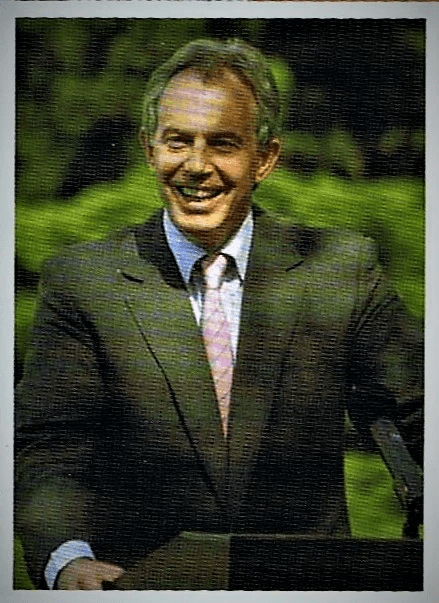
Recently, Labour leader Keir Starmer (pictured above) has been urged to quit by people within his own party. The immediate source of the discontent has been the Labour leader’s refusal to back calls for a ceasefire in the war between Israel and Hamas.
What is the problem facing the Labour leader?
The calls for Starmer to stand down when on the brink of power will not be heeded. But the outrage voiced by some, including the leader of Burnley borough council, who announced on Monday 6th November that he had decided to resign from the party, highlights the tricky task Starmer faces in keeping something close to unity among his electoral coalition on a subject on which his party has a complicated history.
As it stands, the Mayor of London, Sadiq Khan, as well as sixteen Labour frontbench MPs and a third of the parliamentary party, have either called for a ceasefire or shared others’ backing for one on social media. Others, including Labour’s leader in Scotland, Anas Sarwar, have suggested that Starmer has shown a lack of empathy for the cause of Palestinians in Gaza.
What has been Labour’s historical position on Israel and Palestine?
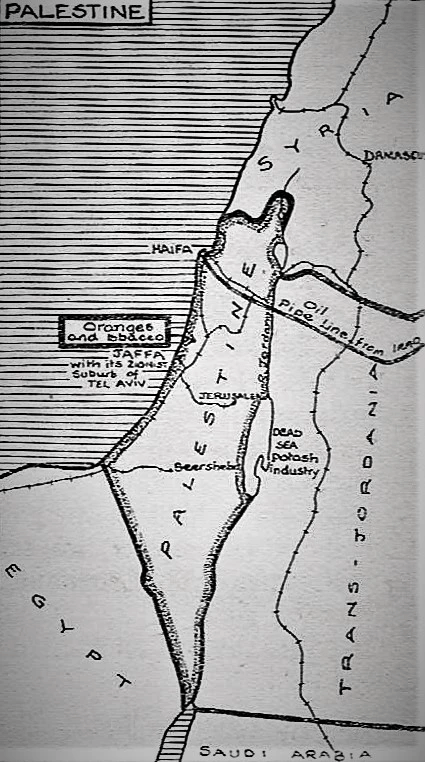
In 1917 the Balfour Declaration indicated that the British Coalition government favoured a national homeland in Palestine for the Jewish people. Labour also called for a Jewish state and eleven party conferences voted in support of this policy before the state was established in 1948. At the time of the Declaration, there were already about fifty thousand Jews living in Palestine, alongside a million Arabs. The potential for conflict between Zionists, not one of which would shrink from making Britain keep its promise, and the displaced Arabs was already obvious. The migrating Jews began to buy land from the Arabs or in some cases simply appropriate it and fence it off. Following the war, the new League of Nations made Palestine a ‘mandated territory’ under British control.
Today the Labour Party seeks to draw a line between anti-Zionism and anti-Semitism that few would have understood a hundred years ago. The Radical anti-imperialists like Hobson (see below) had a direct influence on the development of the early Labour Party’s foreign policy. By the mid-twenties, there were those within the Labour Party, like Beatrice Webb, who began to question the aims of the Zionist movement:
… I admire Jews and dislike Arabs. But the Zionist movement seems to me a gross violation of the right of the native to remain where he was born and his father and grandfather were born – if there is such a right. To talk about the return of the Jew to the land of his inheritance after an absence of two thousand years seems to me sheer… hypocritical nonsense. From whom were descended those Russian and Polish Jews?
The principle which is really being asserted is the principle of selecting races for particular territories according to some ‘peculiar needs or particular fitness’. Or it may be some ideal of communal life to be realised by subsidised migration. But this process of artificially creating new communities of immigrants, brought from many parts of the world, is rather hard on the indigenous natives!
Beatrice Webb in Margaret Cole (ed.) (1956), Diaries, 1924-1932, pp. 217-18.
In her further statements, Beatrice Webb was also quite open about her antipathy for Zionism, as was her husband Sidney Webb (1859-1947). When James Ramsay MacDonald (1866-1937) became Premier of a British Labour government, elected at the end of the previous year with its first overall majority, Sidney Webb, now known as Lord Passfield, became Colonial Secretary in the Labour cabinet. The volume of emigration from Europe was increasing because of the rise of nationalism in Russia and, in particular, Germany, where the Nazis were already campaigning against the Jews. In 1929, this enabled the Zionists to sweep away the hurdle to migration; but in the autumn of 1930, MacDonald’s government said that Jewish immigration to Palestine should be all but stopped. He published a new statement of policy, the Passfield White Paper, which urged the restriction of immigration to Palestine and the sale of land to Jews. It was bitterly denounced by Zionist leaders as it appeared to repudiate the Balfour Declaration and to violate the letter and spirit of the League of Nations Mandate. It was viewed as a provocative act and was greeted by a furore of protests from Zionists worldwide, from Conservative imperialists in Britain and from some Labour MPs. The Labour government quailed beneath the storm and gave way. As a result, control of migration was temporarily taken out of Britain’s hands and the Jewish population of Palestine more than doubled in the five years between 1931 and 1936 This was a crucial decision because, although afterwards, pro-Zionist feeling in Britain was never again as strong.

In an attempt to calm the furore, MacDonald wrote a letter which he addressed to Chaim Weizmann, the Zionist leader, on 13 February 1931. The MacDonald letter, while not openly repudiating the Passfield report, gave assurances that the terms of the Mandate would be fulfilled. But it was swiftly rejected by the Arab nations as the ‘Black Letter’. It stated that:
‘In order to remove certain misconceptions and misunderstandings which have arisen as to the policy of his Majesty’s Government with regard to Palestine, as set forth in the White Paper of October 1930, and which were the subject of a debate in the House of Commons on Nov. 17, and also to meet certain criticisms put forward by the Jewish Agency, I have pleasure in forwarding you the following statement of our position, which will fall to be read as the authoritative interpretation of the White paper on the matters with which this letter deals. …
‘..attention is drawn to the fact that, not only does the White Paper of 1930 refer to and endorse the White Paper of 1922, which has been accepted by the Jewish Agency, but it recognises that the undertaking of the mandate is an undertaking to the Jewish people and not only to the Jewish population of Palestine. The White Paper places in the foreground of its statement my speech in the House of Commons on the 3rd April, 1930, in which I announced, in words that could not have been made more plain, that it is the intention of His Majesty’s Government to continue to administer Palestine in accordance with the terms of the mandate as approved by the Council of the League of Nations. ‘
Quoting from his April speech, MacDonald claimed that there was no question of the British Government reneging on its international obligations:
‘Under the terms of the mandate His Majesty’s Government are responsible for promoting the establishment of a national home for the Jewish people, it being clearly understood that nothing shall be done which might prejudice the civil and religious rights of existing non-Jewish communities in Palestine or the rights and political status enjoyed by Jews in any other country.
‘… it is the firm resolve of His Majesty’s Government to give effect, in equal measure, to both parts of the declaration and in equal measure, to both parts of the declaration and to do equal justice to all sections of the population of Palestine. That is a duty from which they will not shrink and to discharge of which they will apply all the resources at their command.’
A ‘good deal’ of criticism had been directed at the White Paper because of its inclusion of injurious allegations against the Jewish people and Jewish labour organisations. But MacDonald disavowed any such intention, stating that he recognised that the Jewish Agency had all along given willing cooperation in carrying out the policy of the mandate and that the constructive work of the Jewish people in Palestine had had beneficial effects on the development and well-being of the country as a whole. The British Labour Government also recognised the value of the work done by the labour and trades union organisations in Palestine.
In his letter, MacDonald argued strongly that while the mandate stipulated that the rights and position of other sections of the population, i.e. the non-Jewish community, were ‘not TO BE (his emphasis) prejudiced; that is, not to be impaired or made worse’, and the effect of immigration and settlement on the non-Jewish community could not be ignored, these words were not to be read as implying that existing economic conditions in Palestine should be ‘crystalised’. On the contrary, he wrote, …
‘… the obligation to facilitate Jewish immigration and to encourage close settlement by Jews on the land remains a positive obligation of the mandate and it can be fulfilled without prejudice to the rights and position of other sections of the population of Palestine.’
It had been claimed that the White Paper would place an embargo on immigration and would suspend, if not terminate, the close settlement of Jews on the land, which was a primary purpose of the mandate. Particular stress was placed on the passage in the White Paper which said that ‘it would not be possible to make available for Jewish settlement in view of their actual occupation by Arab cultivators and of the importance of making available suitable land on which to place the Arab cultivators who are now landless.’ MacDonald wrote that it was to these landless Arabs that the Government felt under an obligation but that this in no way detracted from the larger purposes of development… as the most effectual means of furthering the establishment of a national home for the Jews… He believed that this would result in a substantial and lasting benefit to both Jews and Arabs.
On the question of Jewish immigration, the Passfield White Paper misrepresented the Government’s intention as being ‘that no further immigration of Jews’ was to be permitted ‘so long as it might prevent any Arab from obtaining employment.’ MacDonald wrote that this was never their intention and that the Churchill White Paper of 1922 had stated simply that the Jewish immigrants ‘should not be a burden on the people of Palestine as a whole’ and should not deprive ‘any section’ of that ‘present population’ of their employment. From 1920 onward, when the original immigration order came into effect (including the period of the short-lived minority Labour government, led by MacDonald), regulations for the control of immigration were issued from time to time, directed to prevent illicit entry and to define and facilitate authorised entry. This right to regulation had not been challenged until the 1930 White Paper.
In his letter to Weizmann, MacDonald made it clear that his current government was therefore concerned only with the ‘absorptive capacity’ under the prevailing economic conditions in Palestine. There was therefore never any intention on its part to exclude immigrants with prospects of secure employment. If, as a result of the principle of preferential employment of Jewish immigrants by the Jewish Agency, Arab labour was displaced, the ‘mandatory’ would intervene. The British premier concluded his letter with the assurance that the Government had ‘set their hand’ to the mandated tasks and would not withdraw it, and that ‘no solution can be satisfactorily or permanent which is not based on justice, both to the Jewish people and to the non-Jewish communities of Palestine.’ Since the statement of 1922 was issued and up to the publication of the White Paper of May 1939, more than 300,000 Jews had immigrated to Palestine, and the population of the Jewish ‘National Home’ to 450,000, about a third of the entire population of Palestine.
In practice, over that period, the country’s economic absorptive capacity had been treated as the sole limiting factor to immigration, and MacDonald’s February 1931 letter gave this the status of British Government policy. This interpretation was subsequently supported by resolutions of the Permanent Mandates Commission. But in its 1939 White Paper, the Chamberlain Government stated that neither the Statement of 1922 nor the 1931 letter implied that the Mandate required them ‘for all time and in all circumstances’ to facilitate the immigration of Jews into Palestine subject only to consideration of the country’s economic capacity. Nor did they find anything in the Mandate or in the subsequent Statements of Policy to support the view that the establishment of a Jewish National Home in Palestine could only be effected through the indefinite continuation of immigration. If it had a seriously damaging effect on the ‘political position’ of the country, that was an effect that could not be ignored.
Persecution & Emigration of Jews in Europe, 1933-39:
Anti-Semitism intensified following the Nazi Party’s advent to power in 1932. Many Jews were hounded from office or imprisoned in the first wave of lawless anti-Semitism in 1933. In September, at the Nuremberg Party Congress, the anti-Jewish Laws were pronounced. The subsequent Reich Citizenship Law of 14 November 1935 defined who was and was not a Jew. The Law for the Protection of German Blood and Honour published the same day forbade intermarriage and sexual relations between Jews and Germans but also covered relations with blacks, Sinti and Roma. These laws linked the eugenic programme with anti-Semitism. Over the next four years, the Jewish community was gradually excluded from business and the professions, through a programme known as Aryanization, lost citizen status and entitlement to a number of welfare provisions.
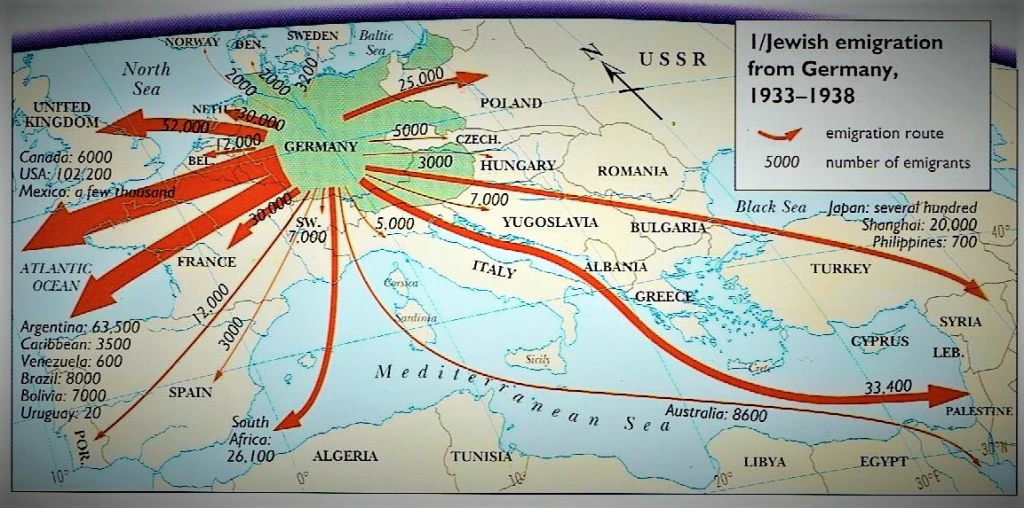
The aim of the Nazi régime, at this point, was to encourage Jewish emigration. About half of Germany’s Jews did emigrate between 1933 and 1939, forty-one thousand of them to Palestine under the terms of the Ha’avarah Agreement made with Zionist organisations in Palestine on the transfer of emigrants and their property from Germany. In an unlikely ‘collaboration’ with the SS, training camps were set up in Germany for emigrants to acquire the skills needed in their new life in Palestine. This process slowed down by the late 1930s as the receiver states limited further Jewish immigration. Following the London Conference (1939) on Palestine, the Conservative-led National Government in London published a further White Paper which proposed a limit to Jewish immigration from Europe, restrictions on Jewish land purchases, and a program for creating an independent state to replace the Mandate within ten years.
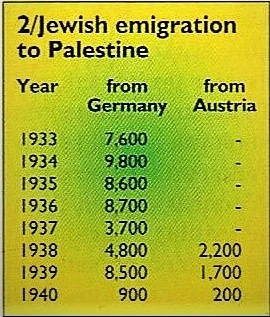
This was seen by the Zionists as a betrayal of the mandatory terms, especially in light of the increasing persecution of Jews in Europe. In response, Zionists organised Aliyah Bet, a program of illegal immigration into Palestine. Meanwhile, ‘Casual’ anti-Semitism was not restricted to members of the British aristocracy who visited Berlin and Bavaria in the 1930s, neither was it to be found only among Conservatives. It was commonplace across most sections of British society and pre-dated the rise of Fascism across the continent. Many people made casual remarks that today would be deemed quite unacceptable.
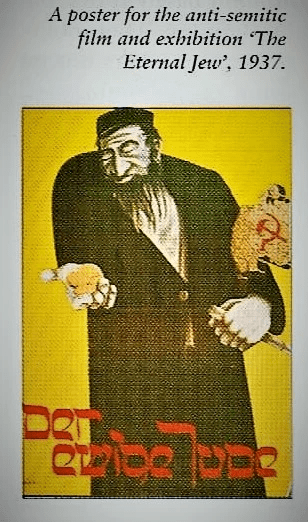
By 1937, there was a large influx of refugees from Central Europe, primarily Jewish, into Britain, so large as to be noticed among the crowds on London streets. The number of intellectuals among the refugees was disproportionately large, but it was the ordinary refugees who were unpopular, especially among Mosley’s blackshirts. In addition, there were also echoes of petty anti-Semitism among ordinary Londoners, like a well-known bus conductor on the Swiss Cottage run who expressed his feelings by bawling out ‘Swiss Cottage – Kleine Schweizer-Haus.’ The London intellectual attitude seemed much like that of Duff Cooper when he wrote, although I loathe anti-Semitism, I … dislike Jews. This was also the view of a large section of the British aristocracy at the time.
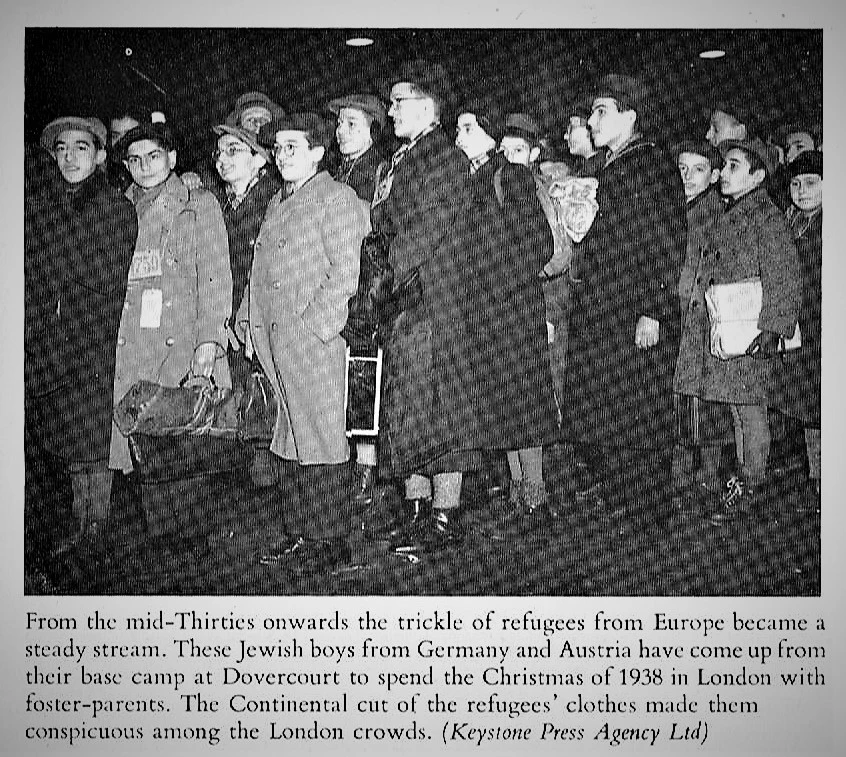
Respected authors, even radicals such as George Orwell, and highly cultured liberal economists such as John Maynard Keynes, littered their writings with disparaging remarks about the Jews, as did politicians across the spectrum, and even some senior churchmen. There were also continuing strains of these attitudes among the Labour members of the National Government like the anti-Zionist Lord Passfield (Sidney Webb), whose laws restricted Jewish emigration to British-controlled Palestine. Until Kristallnacht in the autumn of 1938, however, these expressions of anti-Semitism were mixed up with anti-German sentiments, which survived among older generations who had directly experienced the 1914-18 war. The children of the Kindertransports of 1938-39, pictured below, generally received a warm British welcome from their foster parents and broader society.
What determined the outcome in Palestine, the creation of the state of Israel on the left bank of the Jordan in 1948, and its subsequent expansion into Arab territory, was the balance of strength on the ground between the two populations, which had changed in favour of the Zionist settlers by 1936. Between the wars, however, Palestine had to remain a mandated territory. The British could not delegate their responsibilities to the Zionist organisation, as many wanted them to do. It remained in the same state as the ‘dependent’ territories within the British Empire, a colony ruled directly from London, like Kenya.
What emerges from these portraits and documents concerning Zionism, imperialism and Palestine in the period 1916-36 is that there was no imperialist conspiracy to create the state of Israel as it existed after 1948. Certainly, there were good relations between leading Zionists and imperialist politicians in Britain, including those in Attlee’s government. Still, it was the confusion of competing claims and rights in Palestine itself, together with the inability to control the flow of migrants and refugees under the terms of the British mandate that led to the development of the country through settlement into the self-governing state of Israel following the handover of the mandate to the United Nations in 1948. It is difficult to imagine how the outcome of these events could have been any different, especially given the refugee crisis created by the Nazi persecution of the Jews, the war and the Holocaust.
After the War – Attlee, Bevin and the Labour Government, 1945-51:
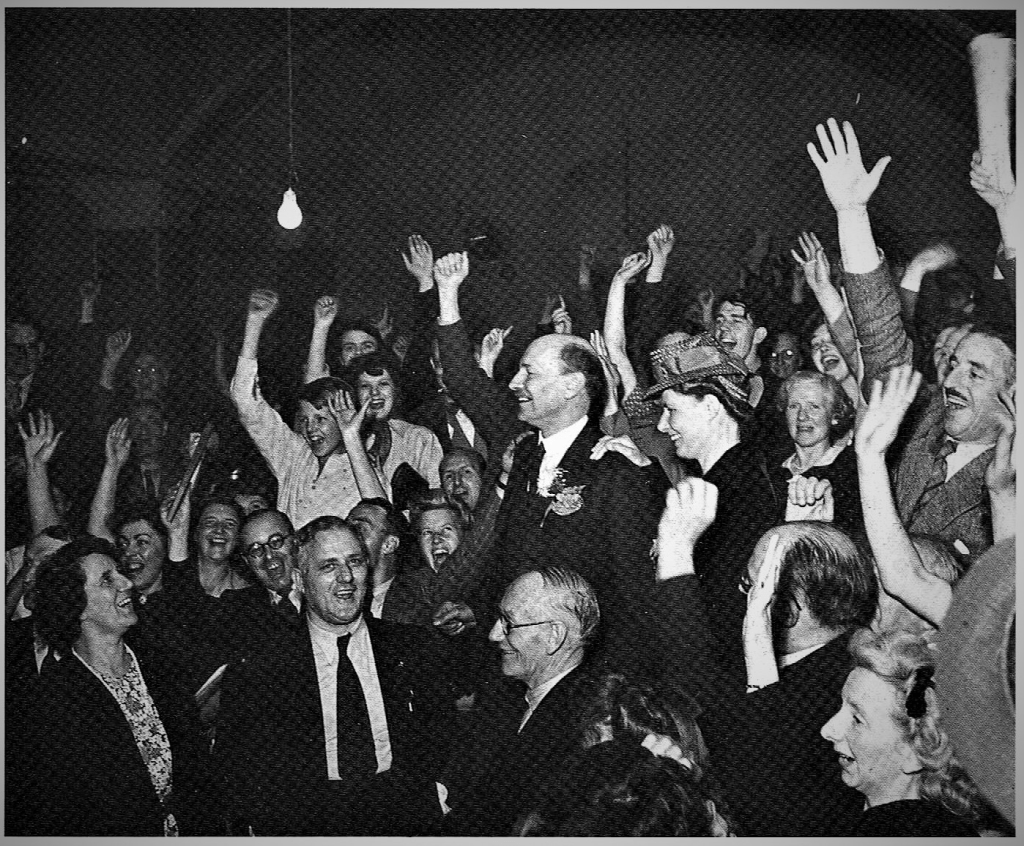
At the end of the War, an Anglo-American Inquiry Committee was appointed in November 1945 to examine the status of the Jews in the former Axis-occupied countries and to find out how many were impelled by their conditions to migrate. Britain, weakened by the war, found itself under growing pressure from Jews and Arabs alike and the newly-elected Labour Government, decided to invite the United States to participate in finding a solution. President Truman welcomed the Report of the Committee and its recommendation that the immigration and land laws of the 1939 White Paper were to be rescinded. On the other hand, Prime Minister Attlee declared that the report would have to be “considered as a whole in all its implications.” Arab reaction was hostile; the Arab League announced that Arabs would not stand by with their arms folded.
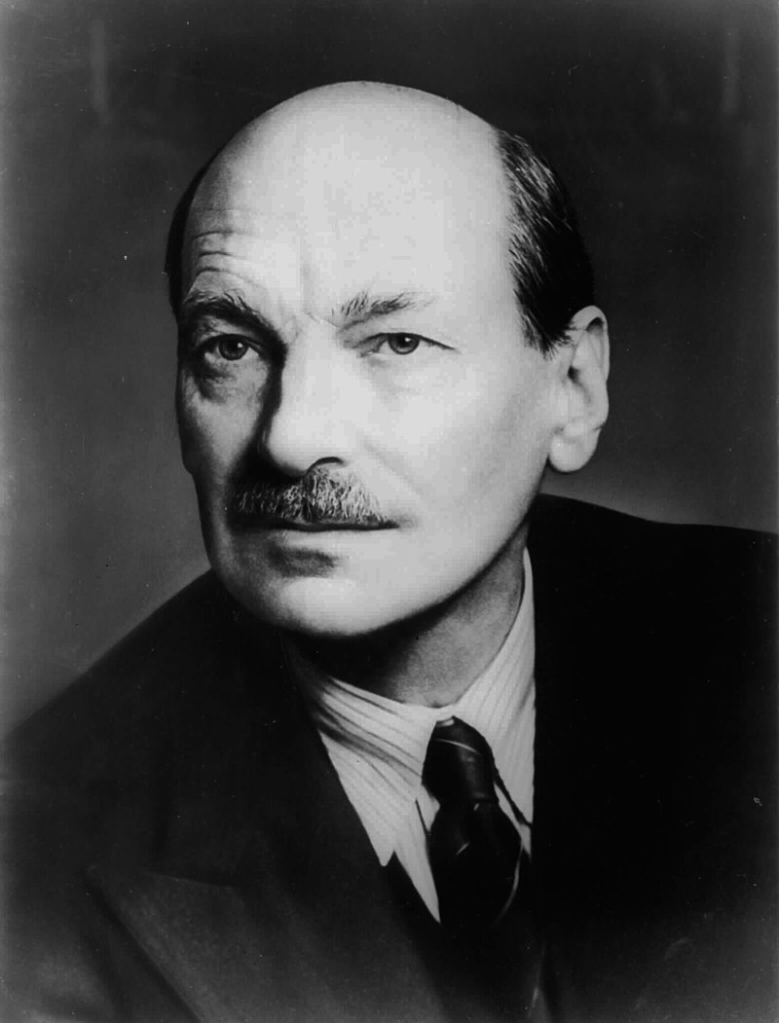
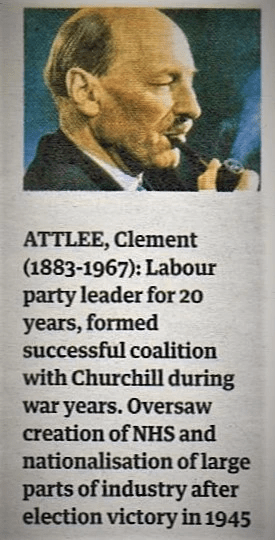
The Attlee government’s failure to find any sort of solution to the Palestine question before surrendering the mandate to the United Nations in 1948 can be attributed, at least in part, to Attlee’s personal failure to understand the importance of the issue to President Truman. Attlee refused the President’s request to allow a hundred thousand Jews into Palestine upon taking office in 1945; granting that request would have at least engaged Truman in the political problem at an early stage. Attlee largely left the conduct of foreign affairs to Bevin, though, partly in order to keep him away from Herbert Morrison (Lord President of the Privy Council and Attlee’s deputy), who was dominant on the domestic front. Such was the bitterness of the rivalry between the two senior men that Attlee was worried that it might derail the government as a whole. When he visited Truman for the first time as PM to discuss the Korean War in December 1950, it was only because Bevin was too ill to travel.
According to the Memoirs of the Earl of Kilmuir, published in 1964, Attlee’s Foreign Secretary, Ernest Bevin, stood apart from his cabinet colleagues in ability and sincerity. Certainly, the majority of the members of the Conservative Opposition’s Front Bench had known him well during the war when he had been a loyal, hard-working member of Churchill’s Coalition; they trusted him and had a great personal affection for him. Most of the Parliamentary Labour Party did not have this experience of him. Except when he was out of the country, he and Attlee met on an almost daily basis. According to the premier, Bevin was always hopeful that the international situation would improve, but he also stressed the point that the prevention of war was not enough.
There must always be an accompanying, positive policy of raising living standards and dealing with the ‘under-developed’ regions of the world. This would undermine the conditions in which Soviet Communism could thrive.
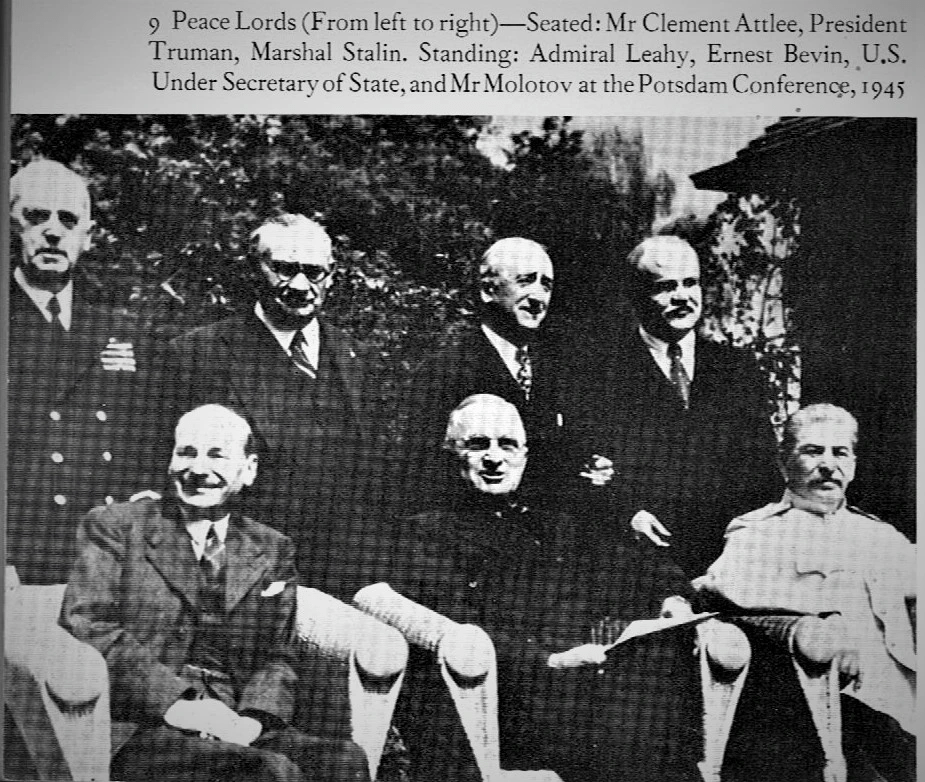
However, he was regarded by many Jews in Britain, the United States and Israel as an ‘arch-enemy’ of the Jewish people. Most unfairly, at least in the view of Andrew Marr (2009), he is still traduced as an anti-Semite. He had in fact been numbered among the friends of Zionism during the war, until faced with the impossible contradictions in Britain’s position in the Middle East shortly after its end. As well as its ongoing responsibilities for Palestine under international mandate, Britain had wider links to surrounding Arab countries. British officers ran the Jordanian Arab Legion, one of the instruments of Arab anger against Jewish immigration. Yet, British officials were also in charge of the Jewish homeland which became the State of Israel. There is no doubt that the desperate migrations of Jewish refugees from Europe were badly handled, as Britain tried to limit the settlement to a level that might be acceptable to Palestinian Arabs. The worst example of British mismanagement was the turning round of a refugee-crammed ship, Exodus, as it tried to land 4,500 people at Haifa in 1947, and the eventual return of most of them to a camp in Hamburg, an act which caused Britain to be reviled around the world. This was followed by the kidnap and murder of two British soldiers by the Irgun terrorist group, which ten booby-trapped their bodies.
Bevin was pressed very hard by the United States which continued to demand far larger Jewish immigration to Palestine, but his instinct for a two-state solution later seemed sensible. The British forces there were entirely ill-equipped for the guerilla and terrorist campaign launched against them by extreme Zionist groups; in the local and international circumstances of the later forties, Bevin’s diplomatic position proved entirely impossible. His action on the report of the Anglo-American Commission, and again on the resolution of the United Nations Assembly in 1947, his delay in recognising the State of Israel until February 1949, and some bitter remarks he made during the House of Commons debates on Palestine, appeared to confirm the common Jewish view. Lord Straing, the Permanent Under-Secretary at the Foreign Office during a great part of Bevin’s term, suggested that Bevin’s opposition to the creation of the State of Israel was due to his preoccupation with long-term political, economic and strategic considerations:
‘He was disturbed by fear of active Soviet intervention in Middle East affairs, and foresaw that the persisting Arab-Jewish antagonism would be exploited by Moscow to the detriment of vital Western instruments.’
Norman Bentwich (1962), My Seventy Seven Years pp. 218-19.
Bentwich’s talks with Bevin in Paris and London between 1946 and 1948 supported his judgement about the Foreign Secretary’s fear of the Soviet threat. He believed in ‘liberty’ as essential to the building of a fair society, whether in Greece where he directed British troops against Communist insurgents, or in Palestine. Because of his huge wartime powers, he was a great believer in state-building and the creation of an enlarged ‘welfare state’ in post-war Britain. But he once told an American correspondent that he believed it possible to have both public ownership and liberty:
“I don’t believe the two things are inconsistent… (but) if I believed the development of socialism meant the absolute crushing of liberty, then I should plump for liberty because the advance of human development depends entirely on the right to think, to speak and to use reason, and to allow what I call ‘the upsurge’ to come from the bottom to reach the top.”
Alan Bullock (1985), Ernest Bevin, Foreign Secretary. Oxford: OUP.
The Foreign Secretary was still, therefore, as opposed to Soviet-style socialism as he had been as a trade union leader in the 1930s, and just as opposed to Stalin putting his boot on the Middle East in addition to Eastern Europe. At the same time, he was committed to even-handed diplomacy between the two sides. Bevin was, Bentwich believed,…
“… anxious at the outset to find a solution to the conflict, and confident that he would succeed as he had in many bitter labour disputes. … But, at least, when he did recognise the State in 1949, he did his best to foster afresh good relations between Great Britain and Israel; and made a vain attempt to bring Jews and Arabs together.”
Bentwich, loc. cit.
The Ihud (Association) group led by J. L. Magnes and Professor M. Buber, like Bevin, favoured a bi-national solution, equal political rights for Jews and Arabs, and a Federative Union of Palestine and the neighbouring countries. However, they found little support among the Jewish community as a whole. Neither did the proposal find much support on the Arab side of the conflict. Indeed, some of those among the Arab population who expressed sympathy with the idea were assassinated by supporters of the Mufti of Jerusalem, Hitler’s former Arab ally and co-conspirator in the genocide of the Jews in the war. It is worth recalling that, at the time and subsequently, Bevin was reviled as vigorously by Arab opinion as by Jewish views. On the left of the Labour Party in Britain, he has continued to be vilified for his reluctant role in the establishment of the Jewish State. But at that time, there was no rational alternative to the decisions that were made and no other alternative humanitarian solution.
The State of Israel, 1949-2019 – An Artificial Creation?:

To the left, now as then, the state of Israel was an artificial creation, a ‘mistake’ as Ken Livingstone, the former Labour Mayor of London called it, a few years, ago in an interview on Arabic TV. But that did not and does not match the reality of the emerging patterns of the population on the ground in Palestine in the 1930s and 1940s. However, by the time the Attlee government left office in 1951, anti-colonialism, the international rule of law and the rights of young countries were all issues that enthused the Labour Left generally. The United Nations, NATO and the European Convention on Human Rights (ECHR) were still fresh organisations. Five years later, at the time of the Suez Crisis, for the first time in modern British history, large numbers of people came out onto the streets of London to challenge a government going to war. The Suez demonstrations were followed by the great Vietnam clashes of the sixties and the marches against Tony Blair’s decision for Britain to join the Iraq War, but in the fifties, nothing like this had happened before. Suez split Britain down the middle, dividing families and friends. Because of it, a generation of politically aware young people grew up contemptuous of politicians generally, readier to mock and dismiss them. The decline of deference for them would probably have happened anyway, but the events of 1956, 1967 and 1973 in the Middle East hastened that decline.
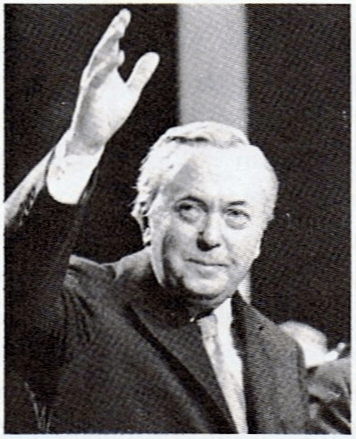
Nevertheless, a degree of decency towards Israel can be traced through successive Labour leaders to the Blair-Brown governments. Harold Wilson was one of Israel’s strongest supporters when he became Labour prime minister in the 1960s and Michael Foot, the leftwing leader of Labour in the early 1980s, had been an early campaigner for a Jewish home in Palestine. A party that believed in social justice had to protect a people who had been through the Holocaust, it was argued, and in turn, the party’s support of ethnic minority rights made it the natural home for the Jewish vote in Britain for decades.
In recent decades, the Labour Party has needed to accept that the burden of the past century of Middle Eastern history had fallen on its shoulders. Either it continued to support and defend the creation and continued existence of the state of Israel, as Ernest Bevin and Clement Attlee finally did in 1949, or it needed to support the calls for its dismantling, by one means or another, which is what the previous leadership of the Labour Party wanted to do when it was elected in opposition in 2015. The continuing tropes about global capitalist conspiracies between Israel and Jewish individuals/ organisations at the centre of them have been passed down and shared by populist leaders like Jeremy Corbyn and his hard-left supporters, many of whom still remain in the party, despite the ‘defenestration’ of their leader following his defeat in the 2019 General Election.
Corbyn, Anti-Semitism and the Radical Critics of Imperialism:
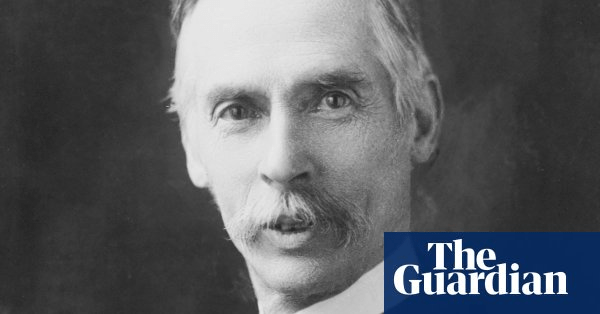
Jeremy Corbyn was recorded in 2009 describing Hamas and Hezbollah representatives as “friends”. Corbyn spoke later of his regret at that “inclusive” but inappropriate language. On May Day morning 2019 however, another row erupted within the Labour Party over the proximity of its then leader’s ‘world-view’ to those of radical anti-Semites in the party since its beginnings. An article by Danny Finkelstein drew attention to the foreword to a republication of J A Hobson’s influential 1902 ‘Imperialism’, written by Jeremy Corbyn which, apparently, lauded Hobson’s radical critique of imperialism, while failing to acknowledge the problems it raised and continues to raise in respect of the author’s anti-Semitism. Hobson argued in the book that global finance was controlled in Europe by “men of a single and peculiar race, who have behind them many centuries of financial experience”, who were “in a unique position to control the policy”. By contrast with Corbyn’s 2011 preface, books written by historians Bernard Porter (1984) and, more recently, by Niall Ferguson (2003) on imperialism have drawn attention to these problems in the context in which Hobson himself was writing (see the appendix below).
What is the current Labour leader’s position?
There is a suspicion in some parts of Labour that Keir Starmer has been led to his current ‘pro-Israeli’ position by a desire to draw a line between himself and his predecessor. But Starmer’s position, as demonstrated above, is consistent with that of every post-war Labour leader before Corbyn. In addition, he has argued cogently that a ceasefire in the current war would simply freeze the status quo and that Hamas’s murder of 1,400 people on 7 October, and the group’s stated intention to strike again and again, make this untenable. Israel must, his argument goes, be allowed to defend itself. Starmer has therefore followed the White House in calling for humanitarian pauses to allow aid to get into Gaza. It may be an unsatisfactory argument to some but it has a clear logic, consistent with long-held policy going back to at least 1923. Labour backs a two-state solution for Israel and Palestine but the immediate threat to life needs to be dealt with.
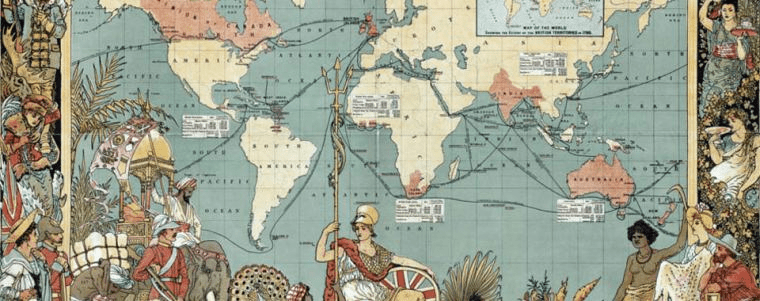
As Niall Ferguson has pointed out in his more recent and specific publications on the issue, the liberal imperialism of the late Victorian period was criticised by radicals who revealed themselves as overtly anti-Semitic. The problem for Labour is that the proponents of these modern-day positions tend to see those of a dissenting view as failing to live up to the party’s purpose of promoting social justice. It is also the case that most of the far left of the party, who made Labour unelectable in the 1980s as well as in more recent years, support a ceasefire, though they cannot say who the second party would be, how it could be brought about in practical terms, and how its relative success might be monitored effectively by a third party. They seem to think it is enough to call for Israel to stop firing immediately and fail to explain how and when the terrorist groups responsible for beginning the war would be disarmed. A further complication is that the Muslim vote is important in a number of Labour constituencies. Starmer’s position is seen by some as an electoral risk but – as yet – it doesn’t seem to be an existential one for the party. Neither is there any sign of a transcendent long-term solution, though this is where Starmer, like Bevin before him, could make a considerable contribution as the next Labour PM.
(PA Wire)
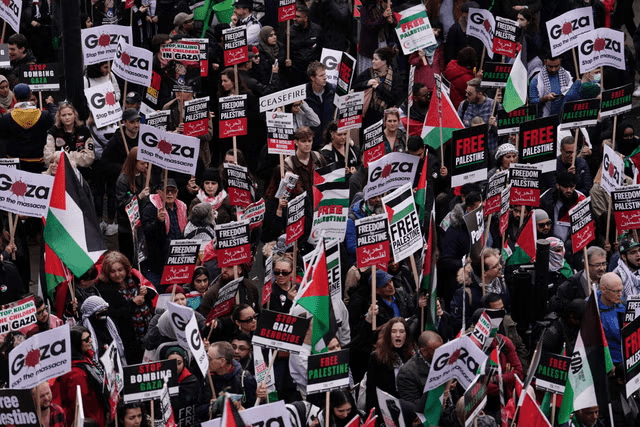
As HM’s leader of the Opposition, he has made some missteps, including when he appeared to support the cutting of water and energy to Gaza in an interview with LBC Radio three weeks ago. He later clarified that this was not his position but it has made it all the harder for him to convince the totality of his party that his stance is truly that of a politician who believes in social justice – and that’s the crux of the problem. Even if they wanted to, the opportunism and ideological determinism of the extreme ‘anti-Zionist’ left would not allow them to accept Keir Starmer’s justification of Israel’s defensive action and to jettison their anti-Semitic tropes. The thin veil of legitimacy of the current pro-Palestinian protests in London and elsewhere is beginning to slip to reveal the ugly beast of resurgent anti-Semitism lying beneath it. Until it does fall away fully, or until its fellow travellers learn to see through it, we are likely to have to endure more unnecessary division and divisive protests. A two-state solution cannot be brought about through the destruction of one of those states through terror and hate.
Appendix: Extracts from Niall Ferguson’s (2003), Empire: How Britain Made the Modern World.
So close was Cecil Rhodes’s relationship with the Rothschilds that he even entrusted the execution of his will to Lord Rothschild, specifying that his estate should be used to fund an imperialist equivalent of the Jesuit order – the original intention of the Rhodes Scholarships at Oxford. This would be ‘a society of the elect for the good of the Empire’… Rothschild, in turn, assured;
‘Our first and foremost wish in connection with South African matters is that you should remain at the head of affairs in that Colony and that you should be able to carry out that great Imperial policy which has been the dream of your life’.
Not only was imperialism immoral, argued the critics, but, according to these ‘Radicals’, it was also a rip-off: paid for by British taxpayers, fought for by British soldiers, but benefiting only a tiny elite of fat-cat millionaires, the likes of Rhodes and Rothschild. That was the thrust of J. A. Hobson’s profoundly influential ‘Imperialism: A Study’, published in 1902. ‘Every great political act’ argued Hobson,
‘must receive the sanction and the practical aid of this little group of financial kings… They have the largest definite stake in the business of Imperialism, and the amplest means of forcing their will upon the policy of nations… Finance is the governor of the imperial engine, directing the energy and determining the work.’
H. N. Brailsford, another contemporary radical, took Hobson’s argument further in his ‘The War of Steel and Gold: A Study of the Armed Peace’, (written in 1910, but not published until 1914). ‘In the heroic age,’ Brailsford wrote,
‘Helen’s was the face that launched a thousand ships. In our golden age the face wears more often the shrewd features of some Hebrew financier. To defend the interests of Lord Rothschild and his fellow bondholders, Egypt was first occupied and then practically annexed by Great Britain… The extremest case of all is, perhaps, our own South African War.’
Was it not obvious that the war had been fought to ensure that the gold mines of the Transvaal remained securely in the hands of their capitalist owners? Was not Rhodes merely, in the words of the Radical MP Henry Labouchere, an…
‘… Empire jerry-builder who had always been a mere vulgar promoter masquerading as a patriot, and the figurehead of a gang of astute Hebrew financiers with whom he divides the profits?’
Like those modern conspiracy theories which explain every war in terms of the control of oil reserves, the Radical critique of imperialism was an over-simplification (Hobson and Brailsford little knew what a liability Rhodes had been during the siege of Kimberley). And like those other modern theories that attribute sinister power to certain financial institutions, some anti-imperialism conveyed more than a hint of anti-Semitism. (283-4)
In an article in The Guardian (1 May 2019) another academic historian pointed out how deeply Hobson’s hatred of all forms of imperialism ran, and his book is certainly a compelling read, an essential one for all undergraduates studying the dominant themes and events of the first half of the twentieth century. Taylor, a professor in modern history at the University of York, wrote in his article that:
“He understood the terrible consequences of European conquest overseas like no one before. He described how jingoism and support for empire inveigled its way into popular culture at home via the media and populist politicians. It remains a signature text and influenced Lenin, the philosopher Karl Kautsky, the political economist Joseph Schumpeter and other classics of the anticolonial canon. Hobson himself went on to become an éminence grise within the Labour Party after the first world war, helping draft its economic policy as it entered government for the first time in 1924. He was later tipped for a peerage.
“However, his antisemitism is inseparable from his attack on imperialism. Only alluded to once in the book to which Jeremy Corbyn added his thoughts, Hobson’s virulent assault on Jews is a recurrent theme of another book that first brought him fame and acclaim, 1900’s ‘The War in South Africa’. Sent out to cover the Boer war for this newspaper when it was known as the Manchester Guardian, Hobson let rip his racism. Reporting on his visits to Pretoria and Johannesburg towards the end of 1899, he mocked Judaism, described the control of the gambling and liquor industries by Jews, and their behind-the-scenes influence over the warmongering newspapers. Indeed, “the Jewish factor” received an index entry all of its own in this book. Without ‘The War in South Africa’, and its antisemitism, Hobson would not have shocked his way into the public eye and received the commission for his most famous work of all.”
The Debate Continued: ‘The Jewish News’, 3 May 2019:
‘While a spokesman said this week that Corbyn “completely rejects the antisemitic elements in his analysis”, the veteran MP made no mention of this in his lengthy endorsement. Instead, the Labour leader described Hobson’s book as “a great tome”, and praised the writer’s “brilliant, and very controversial at the time” analysis of the “pressures” behind Western, and in particular British, imperialism at the turn of the 20th century.’
‘After the Board of Deputies wrote to him to demand an explanation, Corbyn responded yesterday to say he was “deeply saddened” that the…’
…“mischievous representation of my foreward will have caused real stress within the Jewish community” and rounded on the “false accusation that I endorsed the antisemitic content of this 1902 text”.
“While writing the foreword, I reserved praise for some of the broad themes of Hobson’s century-old classic study of imperialism in Africa and Asia. As with many book written in this era, the work contains highly offensive references and observations. I totally deplore the language used in that book to describe Jews and people from colonised countries.
“The accusation is the latest in a series of equally ill-founded accusations of anti-Jewish racism that Labour’s political opponents have made against me. I note that the Hobson story was written by a Conservative Party peer in a newspaper whose editorial policy, and owner, have long been hostile to Labour. At a time when Jewish communities in the UK, and throughout Europe, feel under attack, it is a matter of great regret that the issue of antisemitism is often politicised in this way.”
‘Board of Deputies president Marie van der Zyl wrote to Corbyn, telling him that the …’
… “community is entitled to an apology for this failure to speak out against prejudice against our community when confronted with racism.
“There is ‘an impression that you either do not care whether your actions, inadvertently or deliberately, signal support for racist attitudes or behaviours” …
“Whilst you, quite correctly, explicitly commended Hobson’s criticism of caricatures of African and Asian people, there is a failure to make even a passing reference to the blatant antisemitism in the book that you enthusiastically endorse.”
“In your letter, you claim only to have ‘reserved praise for some of the broad themes’ of Hobson’s book and that you ‘totally deplore’ the antisemitism that was commonplace in ‘this era’.
“However, we note that your lengthy and detailed foreword of over 3500 words, variously describes Hobson’s work as “great”, “remarkable”, “interesting”, “brilliant”, “painstaking”, “very powerful”, “attractive”, “valid”, “correct”, “prescient” and “very prescient”, without any qualification referring to the antisemitism within it.”
‘The Jewish Labour Movement has submitted an official complaint to the party over this week’s revelation and asked the EHRC to include Corbyn’s endorsement of Hobson’s book in any investigation of the party for institutional antisemitism. “A fish rots from the head”, it said in a strongly-worded statement, adding that any other Labour member would have been suspended and calling on Corbyn to consider his position.’
More Tropes & Conspiracy Theories:
Corbyn’s ‘foreword’, written well before he became Labour leader, was not a critical appraisal of Hobson’s work, which would have been scholarly and circumspect, but an uncritical and ahistorical whitewashing of a text which not only criticises the ‘Liberal’ imperialism of the time but also contains anti-Semitic tropes and conspiracy theories which dominated the thinking of many Left-wing theorists within the Labour Party in the early part of the twentieth century. It helped to create a popular intellectual climate which led directly to the persecution of Jews throughout Europe in the years that followed. To this day, Corbyn has failed to acknowledge this and to apologise for his failure to highlight the anti-Semitic tropes in Hobson’s text.
Sources:
Walter Laqueur (ed.) (1976), The Israel-Arab Reader: A Documentary History of The Middle East Conflict. New York: Bantam Books.
Michael Clark & Peter Teed (eds.) (1972), Portraits & Documents: The Twentieth Century, 1906-1960. London: Hitchinson Education.
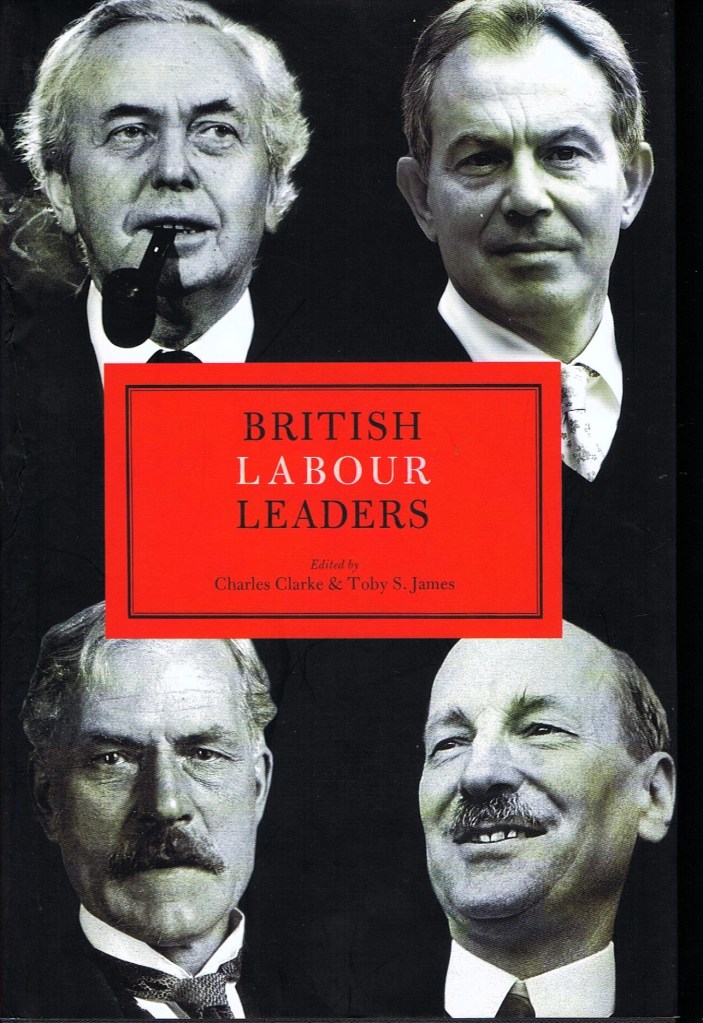
Charles Clarke & Toby S. James (2015), British Labour Leaders. London: Biteback Publishing.
Andrew Marr (2008, 2009), A History of Modern Britain. Basingstoke & Oxford: Macmillan Pan.
Daniel Boffey, https://www.theguardian.com/politics/2023/nov/06/how-the-israel-hamas-conflict-is-dividing-the-uk-labour-party.

