Scenes from Baptist History, 1814-1914: Missionaries, Mechanics & Manufacturers.

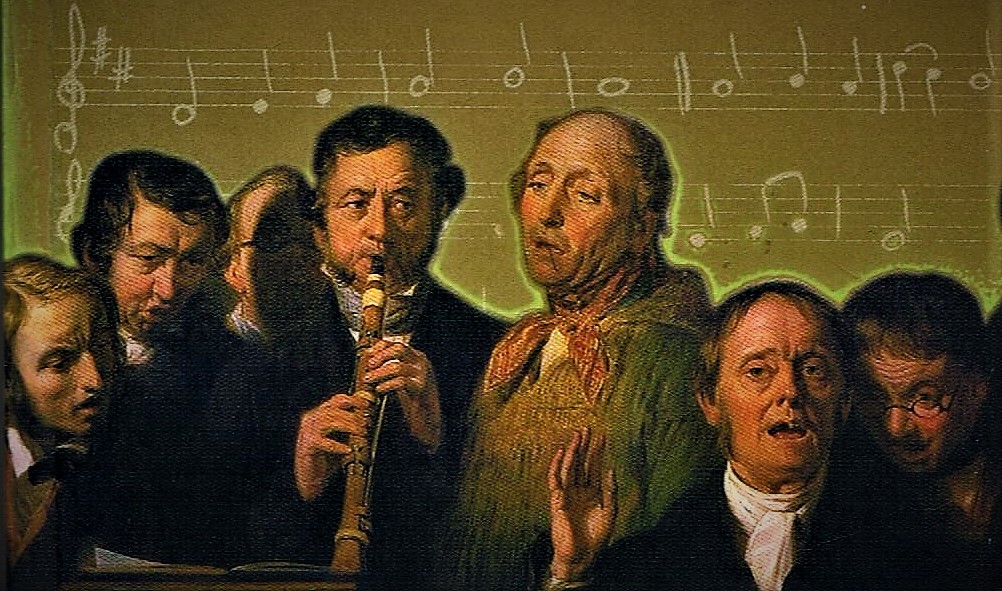
Includes a scene from Regent Street Baptist Church, Smethwick, Birmingham, from November 1897, ‘The Church in Meeting Assembled’ by Rev. A. J. Chandler, Minister of Bearwood Baptist Church, Birmingham, 1965-79.

Revival, ‘Respectability’ & Reform in Britain, 1814-1859:

In 1814, there was an evangelistic revival at Redruth in Cornwall which continued for nine days. An eye-witness described what happened:

Hundreds were crying for mercy at once. Some remained in great distress of soul for one hour, some for two, some six, some nine, twelve and fifteen hours before the Lord spoke peace in their souls – then they would rise, extend their arms and proclaim the wonderful works of God with such energy that bystanders would be struck in a moment and fall to the ground and roar for the disquieture of their souls.

By 1826, a complete change had come over the social habits of Britain, or so many contemporary witnesses have told us in their diaries, journals and letters. In that year, one writer wrote of the courtesy of the people of Petticoat Lane in London. He walked there with his wife without hearing or seeing anything objectionable. Fifteen years earlier he had been blackguarded from one end of the lane to the other. But not everything was not a marker of progress and moral improvement. The cult of respectability among the emerging business classes was not the same as real Christianity, and there was also a great deal of hypocrisy among evangelicals. Most of them observed Sunday strictly, but the Victorian evangelicals were strictest of all. The Lord Day’s Observance Society was founded in 1831. Numerous letters and articles in the evangelical magazine, The Record, protested against Sunday opening of parks, museums and zoological gardens. For six years, the evangelical minister at Cheltenham managed to prevent all passenger trains from stopping there on a Sunday.

Evangelical societies made it their business to supply Anglican evangelical ordinands and endow evangelical parishes where they might serve. The most important patronage trust was that begun by John Thornton and taken over by the Rev. Charles Simeon. When he died, the Simeon Trust had the right to nominate the clergy to twenty-one Anglican positions. These were mainly in large towns such as Bradford and Derby. By 1820, one in twenty of the Anglican clergy were evangelical; by 1830, it was one in eight. But Anglican evangelicals gained high office only slowly. Henry Ryder became Bishop of Gloucester in 1815 and Charles Richard Sumner became Bishop of Winchester in 1827, but the commanding heights of the Church were not ‘taken’ until John Bird Sumner became Archbishop of Canterbury in 1848. These three men presented a new kind of bishop. They were much simpler in their lifestyles than their predecessors. They visited all parts of their dioceses and took more care over confirmations and ordinations. Their example was followed in the fifties by the ‘Palmerston bishops’, who were mostly appointed on the advice of the evangelical, Lord Shaftesbury. The English evangelical social reformer, pictured below, supported numerous causes, including improved factory conditions for the working classes, the regulation of child and female labour and slum schools.
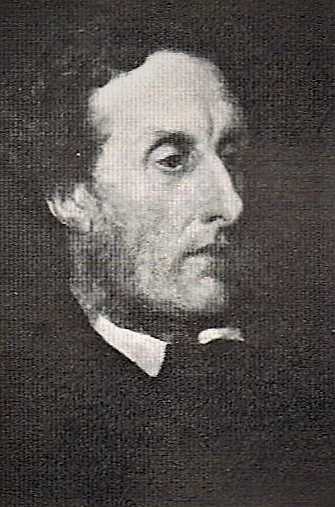
Lord Shaftesbury

1833 not only saw the Abolition of Slavery within the British Empire, but also the first effective Factory Act passed by Parliament. It had often been suggested that Wilberforce and his associates in the Clapham Sect were only concerned with liberating black slaves overseas and not with the ‘white slaves’ of industrial England. This claim, also made ever since by some historians, ignores the fact that Wilberforce had been one of the first few reformers to complain that the ineffective Factory Acts of 1802 and 1818 did not go far enough. The specialists in the industrial problem were, however, the Yorkshire evangelicals, such as Wilberforce’s friend Thomas Gisburne, Richard Oastler of Huddersfield, Michael Sadler MP, their parliamentary spokesman, and John Wood, a Bradford textile manufacturer. Wood put the issue of ‘white slavery’ to Oastler in 1830 in terms of the ongoing campaign against Afro-Caribbean slavery:

You are very enthusiastic against slavery in the West Indies: and I assure you there are cruelties practised in our mills on little children, which, if you knew, I am sure you would strive to prevent.

A few months later, Oastler wrote a famous letter to the Leeds Mercury entitled ‘Yorkshire Slavery’ in which he represented the disappointment of his fellow northern campaigners with the lack of support received from dissenters and the more pietistic of their fellow evangelical Anglicans, who appeared content to leave the plight of the distressed working classes to the operation of so-called ‘natural laws’. Shaftesbury was also often criticised by more heavenly-minded evangelicals for being too concerned with the earthly conditions of the Victorian working classes. He had his own answer for their criticisms which he presented to a Social Service Congress held at Liverpool in 1859:

When people say we should think more of the soul and less of the body, my answer is that the same God who made the soul made the body also … I maintain that God is worshipped not only by the spiritual but the material creation. Our bodies, the temples of the Holy Ghost, ought not to be corrupted by preventable disease, degraded by avoidable filth, and disabled for his service by unnecessary suffering.
Continental Revival and Reaction, 1815-65:

Meanwhile, following the fall of Napoleon and state-sponsored atheism, between 1815 and 1848 a series of popular religious awakenings arose throughout Protestant Europe. The awakening (Réveil) in French-speaking Europe had its origins in Geneva, in the ministry of the Scot, Robert Haldane (1764-1842), who led an early mission to French-speaking Europe in the 1820s and 30s. In 1802, Chateaubriand’s Génie du Christianisme (The Genius of Christianity) was published in France, an immensely popular and powerful argument for Christianity, based on its aesthetic values. In Denmark, Nicolai Grundvig (1783-1872) initiated a pietistic movement by openly opposing liberal theology. The revival in Sweden resulted from the ministry in Stockholm of an English preacher, George Scott. In Norway, the awakening was largely a lay movement, connected with Hans Nielsen Hauge (1771-1824). These revival movements were not closely related to each other and were largely the work of ‘ordinary’ Christians. In 1848, there were outbreaks of revolution in France, Italy, Austria-Hungary and Germany. By December, the five hundred representatives from the German kingdoms, Austria and Bohemia attending an assembly at Frankfurt to create a constitution for Germany, for the whole Empire, produced a Declaration of the Rights of the German People which included a guarantee of religious freedom for dissenters. The ‘Old Lutherans’ who had rejected the Prussian Union of 1817 with the Calvinists, were allowed freedom of conscience. Nonconformists who had appeared in Germany as a result of missionary activity from English-speaking nations also gained toleration. But these gains were, however, short-lived.

Democratic institutions made little further progress in Germany and by 1850 most republican reforms, including those of the Frankfurt Assembly, had lapsed into disuse. In 1862, political reaction and religious autocracy had returned across Europe with Pope Pius IX’s encyclical, Quanta Cura naming political liberalism as one of the chief ‘modern errors’. The Syllabus of Errors also condemned rationalism in all its forms, including liberal theology, freemasonry and religious toleration itself. Even the Bible Societies, which had entered the European continent from Britain after 1815, were ejected. In 1816, Pius VII had rebuked the Societies for distributing the Scriptures without the comments of the church ‘Fathers’. In the 1830s, Pope Gregory XVI further condemned them as daring heralds of infidelity and heresy. So the Syllabus simply consolidated earlier opposition. The pope also issued a strong attack on the separation of church and state, fearing the continued strength of republicanism in France. In response, the French state prohibited the publication of the Syllabus of Errors in 1865.
Evangelical ranks in Britain divided from the 1820s, partly in reaction to developments on the continent. Edward Irving convinced many evangelicals that they were far too optimistic about the conversion of the world; in fact, the day of judgement was at hand. Christ’s second coming would precede the millennium. He believed that the missionary societies were deceiving the elect by talking of the conversion of the world. At the same time the Calvinist, Robert Haldane, won his campaign against Simeon to prevent the Apocrypha from being included in Bibles published by the Bible Society. Haldane’s nephew, Alexander, shared his uncle’s views. When the younger Haldane became the chief owner of the twice-weekly Record in 1828, he propagated these strong ideas. Haldane gave strict Calvinism a foothold again in Anglican Evangelicalism. The Record also adopted Irving’s views on biblical philosophy and the millennium, its policy becoming ultra-conservative in both politics and theology. Its strongest condemnation was for Sabbath-breakers and Roman Catholics, but ‘the Recordites’ also became a strident minority within the Evangelical party. ‘The mainstream party’ continued the tradition of Simeon and the Clapham Sect. Among their leaders were Edward Bickersteth, Henry Venn and J. W. Cunningham. Their journal, which stressed loyalty to the church, was the monthly Christian Observer, which had begun in 1802. In spite of theological differences, however, there was no open rift with ‘the Recordites’.

Missionary Societies, Colonies and Imperial Trade:

William Carey (1761-1834) achieved much in various areas during his time in India, including Bible translation and production, evangelism, church planting, education and medical relief, as well as social reform and linguistic and horticultural research. More specifically, he initiated mission schools, conceived the idea of Serampore College, founded the Agricultural Society of India (1820) to promote agricultural improvements, studied botany (being awarded a fellowship of the Linnaean Society in 1823), and took a leading part in the campaign for the abolition of widow-burning (sati), which succeeded in 1829.

William Carey, the untiring English Baptist pioneer missionary.

Carey’s devotion to India, which he never left, and his practical wisdom in his encouraging Indians to spread the gospel themselves. In this respect, he defined his chief object as follows:

“… the forming of our native bethren to usefulness, fostering every kind of genius, and cherishing every gift and grace in them; in this respect we can scarcely be too lavish in our attention to their improvement. It is only by means of native preachers (that) we can hope for the universal spread of the Gospel through this immense continent.”

The Evangelical Revival had revolutionised preaching and its objectives. Churchmen regarded the parish priest’s task as nurturing all the baptised members of the parochial church and could not easily adjust to the thought of preaching in tribal and nomadic societies. At the same, Calvinists with a rigid doctrine of predestination and ‘the Elect’ saw no reason to concern themselves with the conversion of the heathens. When God wanted to convert them, Carey was told by a fellow Baptist, he would do it without your help or mine! But the evangelical felt a personal responsibility to do this and saw no difference between the ‘baptised heathen’ in Britain and non-Christians overseas. But it was only in the 1820s and 1830s that interest in overseas missions become a regular feature of British church life generally. This was due partly to the success of the Evangelicals in influencing British life. Many of the values of the evangelicals were adopted outside their own circles. In particular, the idea of Britain as a Christian nation with a global mission took root. Bishoprics were established in India, though none had ever been established in colonial America, and the Society for the Propagation of the Gospel enlarged its operations to those of a general missionary society. In Scotland, moderate presbyterian churchmen joined with evangelicals to promote missions, strongly educational in character, under the umbrella of The General Assembly of the Church of Scotland.

The birth of the missionary societies, however, had nothing to do with the protection of British trading interests abroad. The earliest missions were in fact intricately associated with evangelical Baptists and supported by people with known revolutionary instincts and sympathies, such as Robert Haldane, the Genevan-based Scot. It was also the evangelical groups who led the continuing campaign against slavery in the British Empire. This caused some in the Anglican establishment to fear that they were basically subversive. To this was added the fear that in India, missionary preaching would offend Hindus and Muslims, upsetting a volatile colonial relationship and harming British trade. The semi-official Honourable East India Company, through which British administration and trade were exercised, was not initially favourably disposed towards Carey and his colleagues, so much so that the missionaries had to sail in a Danish ship and work from Danish territory. The antithetical attitude of the East India Company changed when in 1813 the Company’s charter came up for renewal, and the Evangelicals of the Clapham Sect denounced some aspects of its policy. Not only did the Company hinder missionary work, they argued, it positively profited by means of a tax on native temples and similar institutions of idolatry. They won a qualified victory through the abandonment of the tax, the appointment of bishops, and the enlargement of the system of government chaplains. Missions were largely unhindered and often favoured, though nineteenth-century evangelicals soon stopped asking for ‘official’ backing for them.
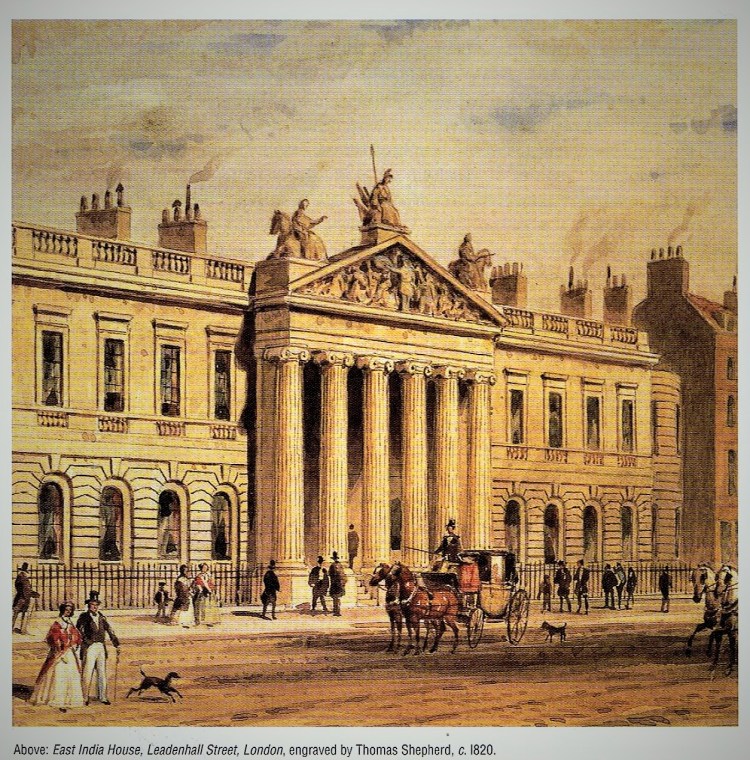
When planning his first missionary enterprise, Carey had asked: what would a trading company do? From this, he proposed the formation of a company of serious laymen and ministers with a committee to collect and sift information, and to find funds and suitable men. The voluntary society, of which the missionary society was one early form, was to transform the nineteenth-century church. It was invented to meet needs rather than simply to propagate doctrines, but in doing so it undermined all the established forms of church government. In the first place, it made possible ecumenical activity. Churchmen and dissenters or seceders cut off from church business could work together for defined purposes. It also altered the power base in the church, by encouraging lay leadership among ordinary members who came to hold key positions in important societies, the best of which made it possible for many people to participate. The enthusiast who collected a penny a week from members of his local missionary society and distributed the missionary magazine was fully involved in the work of the society. It was through the work of such people that missionary candidates came forward. The American missionary, Rufus Anderson, put their achievements in dramatic context when he wrote in 1834:

It was not until the present century that that the evangelical churches of Christendom were ever really organised with a view to the conversion of the world.

Within Wesleyan Methodism, Thomas Coke was anxious to extend Methodist missions on a worldwide scale and tried several times to get the Methodist Conference to approve his plans for an extension. The objections were mainly financial, so Coke worked towards forming local auxiliaries and by 1814 these were recognised by the Conference. In 1818 it brought together the auxiliaries in a Methodist Missionary Society. Eventually, every member of the Methodist Church was automatically enrolled in the Society. In Scotland, the Kirk took direct responsibility for missions in 1824 and appointed its first missionary, Alexander Duff. By that time evangelicals and moderates agreed on the importance of this work, with its emphasis on education, which became the hallmark of successive Scottish missions. When the Kirk was split by the ‘Disruption’ in 1843, the missionaries all joined the Free Church and the Church of Scotland had to begin again recruiting missionaries. The founding fathers of the early British societies clearly did not expect many missionary recruits from among ministers – or the normal sources of supply of ministers. Carey, a self-educated cobbler turned minister, was an exception. Most of the early recruits were craftsmen or tradesmen, who would be unlikely to seek or obtain ordination for the home ministry.

The first few years’ experiences of the London Missionary Society (LMS) showed the importance of the careful preparation of missionaries. Though many of the candidates had little formal education, their training, superintended by David Bogue, was impressive. Much of the early LMS study material on languages and tribes is strikingly scholarly. There was little appetite in the first half of the nineteenth century for the acquisition of new territories and in the 1840s there were pressures and plans to abandon as many as possible of such expensive luxuries. The missionaries also played an important role in the eventual emancipation of the slaves within the British Empire, which did not come about until 1833, after a long campaign led by Fowell Buxton.

Buxton was aided by direct eye-witness accounts from the missionaries as to how slavery continued to dehumanise the lives of Africans, Afro-Caribbeans and Afro-Americans. Even after Abolition, the missionary societies also argued that Britain owed a debt to Africa for slavery and to India for the wealth derived from it. From 1841 to 1856, the Scottish doctor, independent missionary and explorer, David Livingstone, (1813-73) served with the LMS, exposing the horrid facts of the Arab slave trade in central Africa. His strategy was not to exploit but to liberate and in this he contrasted sharply with Cecil Rhodes. Though a missionary for only half of his thirty years in Africa, Livingstone saw all his work in the context of a providential plan in which gospel preaching, the increase of knowledge and the relief of suffering were all closely connected. The Anglican Universities Mission to Central Africa owed its inspiration to this Scots Independent and after his death, the Church of Scotland and the Free Church of Scotland came together to open Central African missions which reflected his ideals and breadth of vision.

The greatest difficulties in recruiting were met by the Church Missionary Society (CMS) since their principles required the use of ordained men and very few came forward. These were eased by transcontinental collaboration with seminaries in Germany elsewhere. Of the first twenty-four CMS missionaries, seventeen were German and only three were ordained Englishmen. This imbalance was eased when the bishops became more involved with the society’s activities, and also as it became more rooted in the parishes. Following the lead of Carey and the Baptists, Indian missions continued to stimulate the British missionary societies, but by the middle of the century, there was an increasing involvement in Africa.

By mid-century, the importance of training ‘native ministers’ was better and more widely recognised, and an increasing number were serving on the staffs of the societies. The CMS Niger Mission, begun in 1857, was staffed entirely by Africans. In the last third of the century, missionary recruitment expanded enormously. This was largely due to the effects of the 1859 Revival, the Baptist Keswick Convention and other movements. The ‘Cambridge Seven’, ex-Cambridge undergraduates who set out for China in 1885, were only the first of hundreds to follow. These decades – the period of high imperialism – not only produced many more missionaries but a different type of missionary. The same influences were at work in producing new forms of society. These maintained the voluntary society principle and were directed towards particular regions, for example, the China Inland Mission (1865) or the Qua Iboe Mission (1887).

Others met particular needs, like the Mission to Lepers (1874). The photograph below shows women suffering from leprosy in a ‘mission compound’ at Champa, India in 1903.
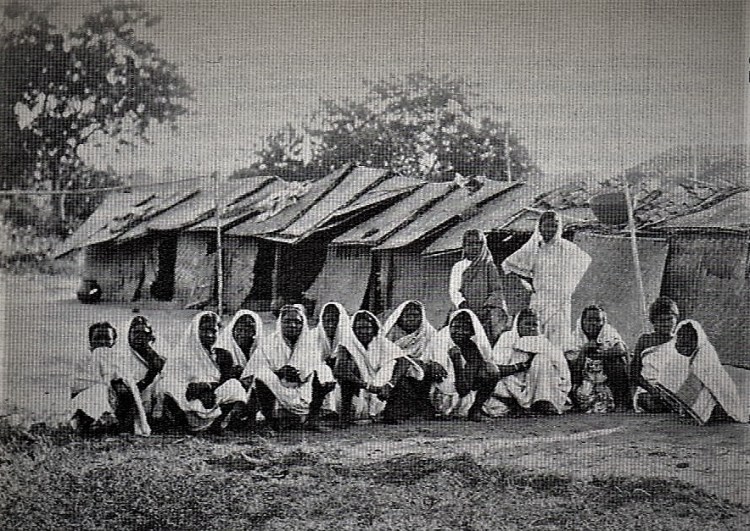
The nineteenth-century missionaries, and the societies which called and directed them, were a major factor in transforming Christianity into a truly global religion. The number of volunteers, together with the technological and political developments of the age, led to the prospect of the evangelisation of the world in this generation. Those hopes of further Christian advancement were dashed by the outbreak of the First World War in 1914 and its ongoing effect on faith. But by the time European manpower was reduced, the great African and Indian native mass movements had begun.

Religious Responses to Industrialisation & Urbanisation in Britain:
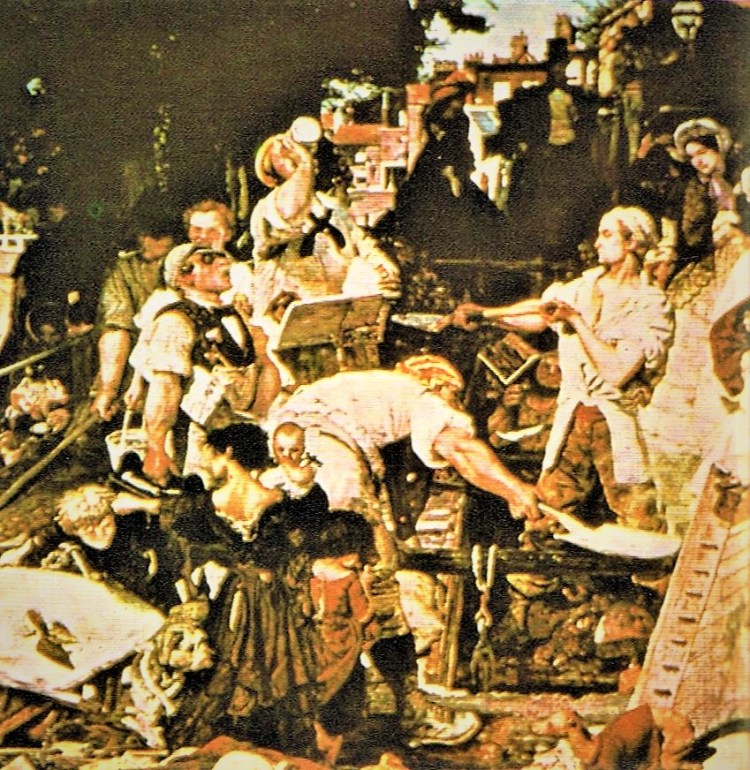
‘Work’, a painting by Ford Madox Brown, the original of which can be viewed in Birmingham City Art Gallery. The artist depicts many of the skills and occupations of the working-class Victorian world, attempting to show both the dignity and degradation of labour in capitalist society.

Industrialism and urbanisation strengthened the factory system which had already begun with the ‘mills’ of the north of England. It was not so much the long hours and low wages that workers objected to. They were used to these in the countryside and urban slums were not much worse than rural hovels, and agriculture depended as much on the work of women and children as the new industries. With the invention of the steam engine, the manufacturer, at last, had a source of power independent from climate and season. This was a change of universal significance and with the development of the canal systems and the railways, the limitations of location were removed from major industries. The real tyrant was the substitution of the rhythm of nature by that of the machine, for the hated threshing machines were only irregular ‘interruptions’ in rural labour. In the new urban areas, machines were a constant accompaniment to everyday life. The Church of England was particularly slow to respond to these developments, finding it difficult to do so. As the state church, it needed an act of Parliament for a new parish to be created, a process that was both time-consuming and costly.

As a consequence, the Church found itself unable, at least until the 1840s, to adapt to the new industrial England and Wales. The new urban masses consequently grew up very often beyond its care: there was often simply no physical room for them in church, and all too often no clergyman to care for their spiritual needs. The parish church, in both rural and urban areas, all too often represented the Tory Party at prayer. In the 1830s, for example, the ‘Chartists’ found little support in the established church. They frequently marched on the parish churches, requesting the vicar to preach on some congenial text, such as: Go to now, ye rich men, weep and howl for your miseries which are coming to you. The rebuff they got from all the churches led them to establish separate Chartist churches in certain areas, and there was even a Chartist hymn book. Many of the Chartist leaders of the thirties and forties were Christians and church members. There is little firm evidence of the extent and class nature of church attenders in Victorian times. England’s one and only census in which church attendance was recorded took place in 1851. The deduction was made that roughly thirty per cent of those who could have attended service on Sunday did not do so. Dissenting churches were found to be approximately as strong as the Anglican churches; in fact, stronger in urban England. Church absenteeism was highest in the new northern towns.
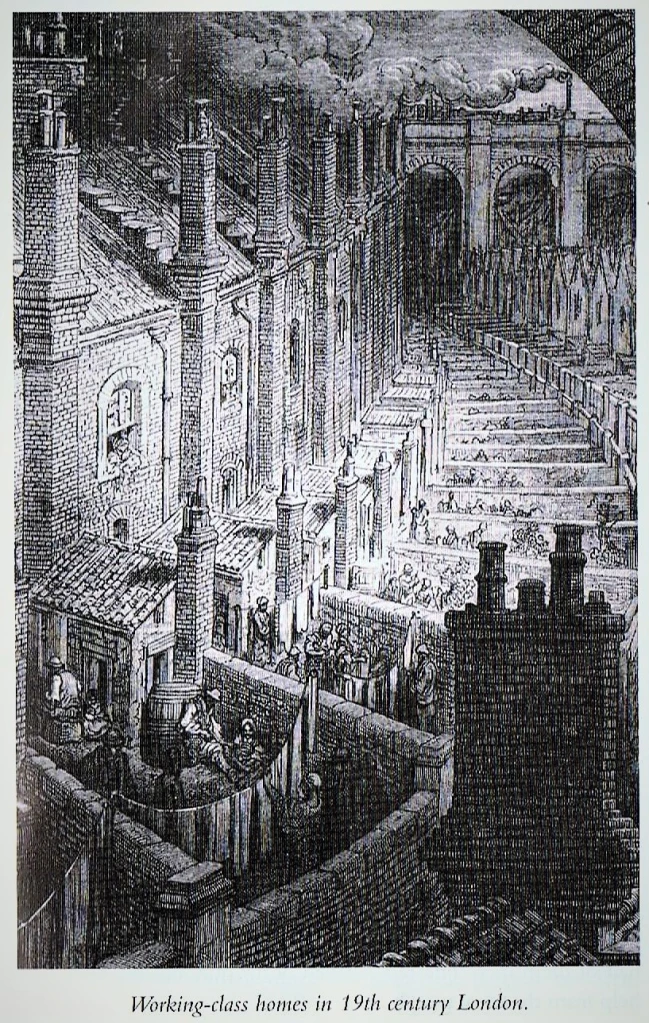
Under the Viaduct’ (1872) by Gustave Doré (1833-83). Over a hundred thousand people were displaced from their homes in London alone as a result of railway building, and many were crowded even closer in the centres of cities because they could not afford to travel to work on the railways that had effectively evicted them.

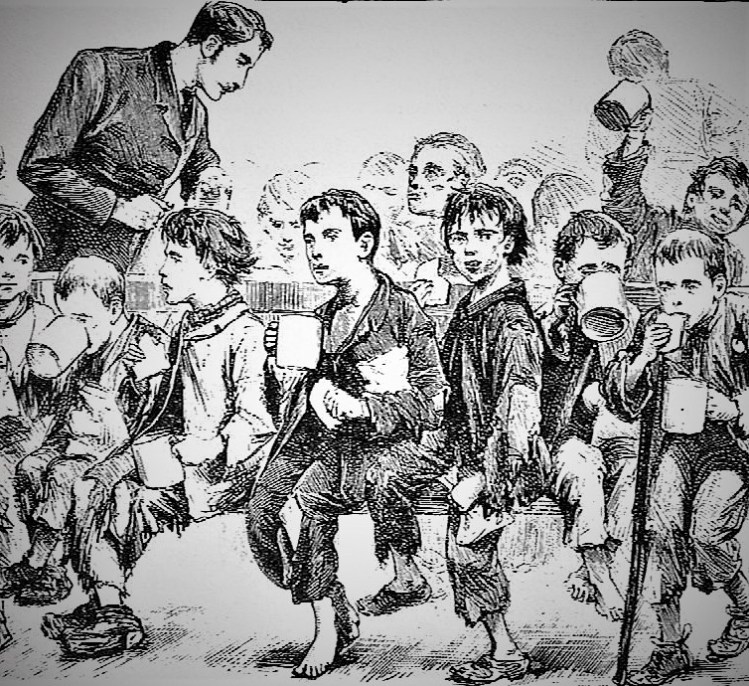
Methodism did not have the same difficulties. With its simple barn-like preaching places, its itinerant ministers, and its local preachers it was admirably designed to go where the established church was unable to go. Other Dissenters, too, expanded into the towns and cities of industrial England and engaged in missionary work there with some success. But there always remained many more people beyond, in the unchurched, unreached, jungle of ‘darkest England’ as General Booth described it. Part of the difficulty was that the churches were dominated by class divisions. Many congregations became middle-class preserves – the Wesleyans and Congregationalists tended to attract a middle-class attendance, while the Baptist ‘Tabernacle’ and the Primitive Methodist ‘Bethel’ were more likely to have a largely working-class congregation. The other small but influential nonconformist group was The Brethren, (or open Brethren). They had a strong emphasis on missionary work, at home and abroad, and their most distinctive characteristic is that the ministry and gifts of the church are distributed to all believers. They had few full-time pastors and their full-time evangelists travelled widely. Local churches governed themselves and were free to apply the teachings of scripture in the light of local and contemporary needs. Their founding fathers were mainly Anglican evangelicals who felt that the Evangelical Movement was not going far enough, but there were also many nonconformists among them who deplored certain features of their original churches. Their best-known social reformer was Thomas Barnado, pictured below helping to feed some of the hungry homeless boys of Victorian London. Barnado (1845-1905) set up a huge institution to care for the homeless children of England.
Figures of two children from George Müller’s orphanage in Bristol. Müller was one of the earliest Brethren, who never made a public appeal for the funds with which to run his orphanage, but his pottery figures, made in Stoke-on-Trent, heéped with this.

Joseph Arch

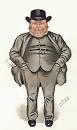
In the countryside, meanwhile, the Primitive Methodist lay-preacher Joseph Arch of Tysoe (depicted in a contemporary cartoon, right) established the Warwickshire Agricultural Labourers’ Union in the early 1870s. This was the first union of unskilled workers, and their local strike found support from the Nonconformist British Quarterly Review, which in 1872 expressed the view that…

… the movement which commenced a few months since in Warwickshire, and which is spreading gradually over the whole agricultural region of south and mid-England, is not unlike the first of those upheavals which occurred five centuries ago. Like that, it is an attempt to escape from… an intolerable and hopeless bondage, with the difference that… the present is an attempt to exact better terms for manual labour. Just as the poor priests of Wycliffe’s training were the agents… by whom communications were made between the various disaffected regions, so on the present occasion the ministers or preachers of those humbler sects, whose religious impulses are energetic, and perhaps sensational, have been found the national leaders of a struggle after social emancipation.

A religious revival has constantly been accompanied by an attempt to better the material conditions of those who are the objects of the impulse… A generation ago the agricultural labourer strove to arrest the operation of changes which oppressed him… by machine breaking and rick burning. Now the agricultural labourer has adopted the machinery of a trade union and a strike and has conducted his agitation in a strictly peaceful and law-abiding manner.
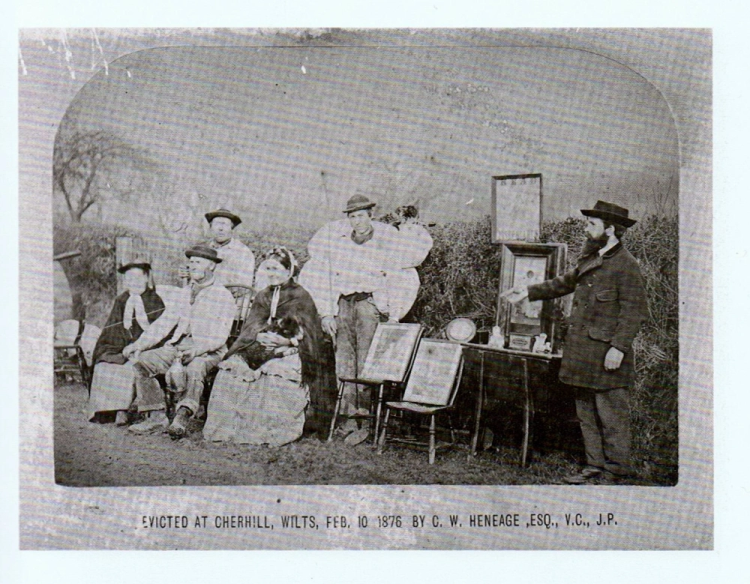
Above: A Family evicted for supporting the National Agricultural Labourers’ Union 

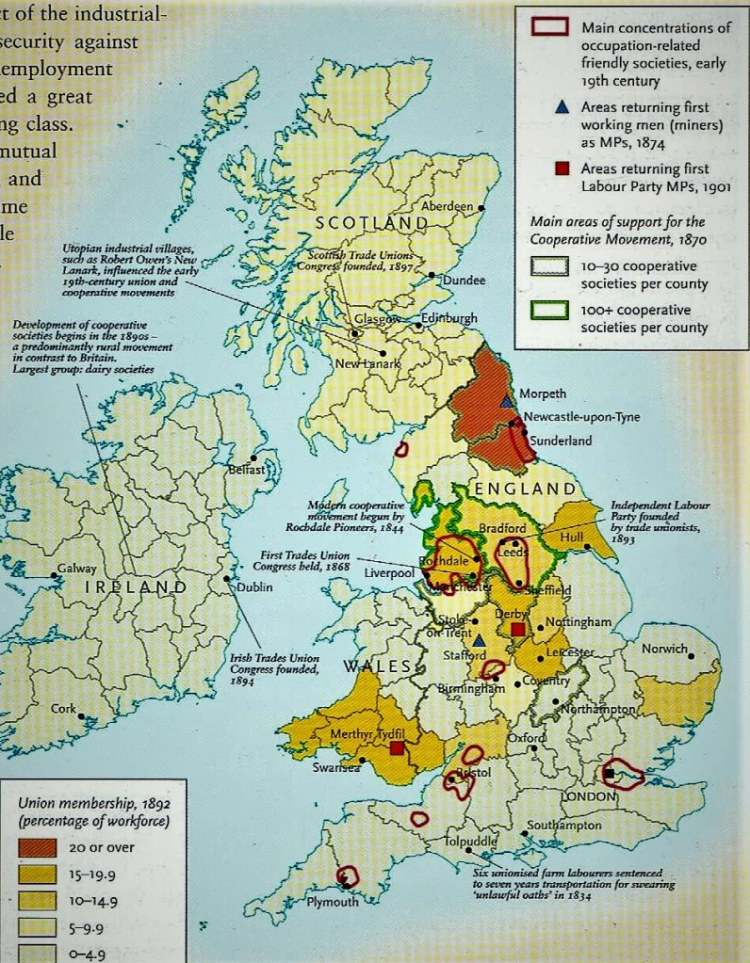
As legal restraints were lifted in the 1870s, it became easier for trade unions to spread to ‘unskilled’ groups, such as the agricultural workers, led by Arch, whose Warwickshire union spread quickly and grew into the National Agricultural Labourers’ Union. The growth of waterfront and related unions in the great seaports helped to change the geography of the trade union movement, although their strength ebbed and flowed with the trade cycle. In 1891, on the crest of the cycle, officially recorded trade union membership had penetrated deepest in Northumberland, Durham, industrial Lancashire, Yorkshire and Derbyshire, and South Wales. It remained at a very low ebb across the Home Counties, southwest England, the rest of Wales and most of East Anglia, despite the rise in agricultural trade unions. The same geographical pattern applied to the development of consumer cooperatives. ‘Coops’ divided profits among their members and were based on the doctrines of the mill owner Robert Owen, whose great discovery that the key to a better society was unrestrained co-operation on the part of all members for every purpose of social life. They attempted to build virtuous alternative societies based on a fair distribution of the rewards of labour, whose superiority to corrupt competitive capitalism would gradually and ultimately prevail. To raise funds for these Owenite communities, shops were established, with the surpluses going towards the next stages of cooperative manufacturing and agriculture. Wherever traditions of self-help and trade union commitment coexisted with hard-working, thrifty Nonconformity, cooperation took root.

Distant Dissenters, Morality & Social Justice:
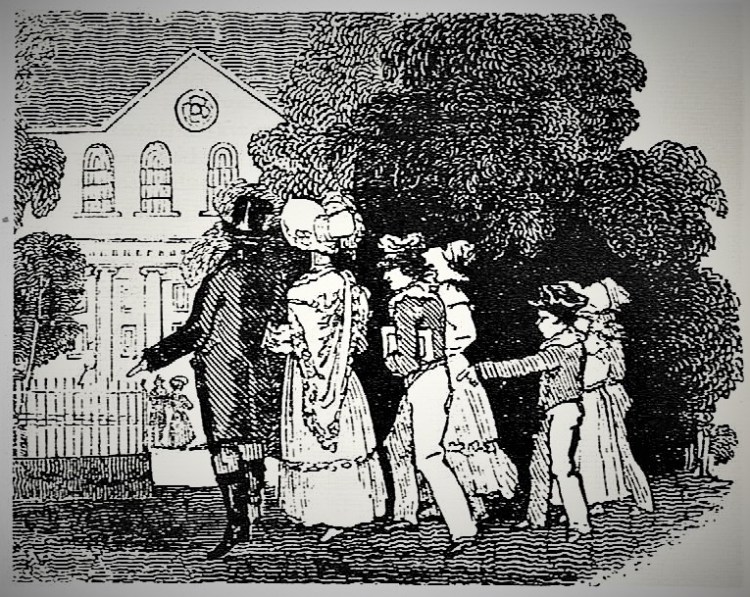
A Victorian family on their way to the chapel. In this period, it became ‘respectable’ for the middle classes to attend chapel.

How to evangelise among the working classes was an ongoing problem, partly because the children of working-class Christians tended to join the middle classes. There was something ‘bourgeois’ about revivalist ethics in practice; gone was the expenditure on drink; new priorities included the family, self-improvement and Sunday school attendance. So there came to be a distinction between ‘chapel working class’ and the ‘brute working class’ of the back alleys. From the 1840s onwards most city churches boasted a cluster of satellite missions in the poorer areas of the cities. These mission halls were often far more than preaching stations and provided their respective areas with a kind of all-purpose relief station, complete with clothing societies, penny banks, tontine clubs, soup kitchens and other agencies. They paralleled the many-sided activities of the institutional church of the suburbs which apparently provided a total ‘chapel culture’ for its adherents. The old Puritan concept of the covenant community gave way to a Christian presence, represented by a range of Christian societies engaged in various aspects of missionary work. In the late nineteenth century, people’s concerns broadened and many agencies of the church became more concerned to offer a social gospel than the old dogmatic one. The Christian minister was becoming a social organiser more than a pastor of the local body of Christ.

Against this ‘backdrop’, the attitudes towards the poor of the more distant and ‘conservative’ Nonconformist leaders, were well illustrated from the pens of those who patronised them, those who preached to them and from those amongst the poor who discovered in the Nonconformist pulpit a means for calling their colleagues to self-realisation. It was significant that Andrew Mearns, William Booth and Charles Booth were all Nonconformists, but Dissenters were also prone to facing accusations of espousing philanthropy divorced from a sense of social justice, and even of outright hypocrisy in their attitudes towards the poor. Sometimes large congregations gathered together in great solid temples of middle-class respectability, possessed neither the common life of the meeting-house nor the urgent need to rescue the lost. Instead, they seemed to perpetuate themselves by some self-justifying principle. Church-building programmes increased in every decade of the century, and many full churches, both in city centres and in the suburbs, were presided over by princes of the Victorian pulpit. They conveyed an impression of progress and advance was often conveyed. In fact, the churches were failing to keep pace with the expanding population.
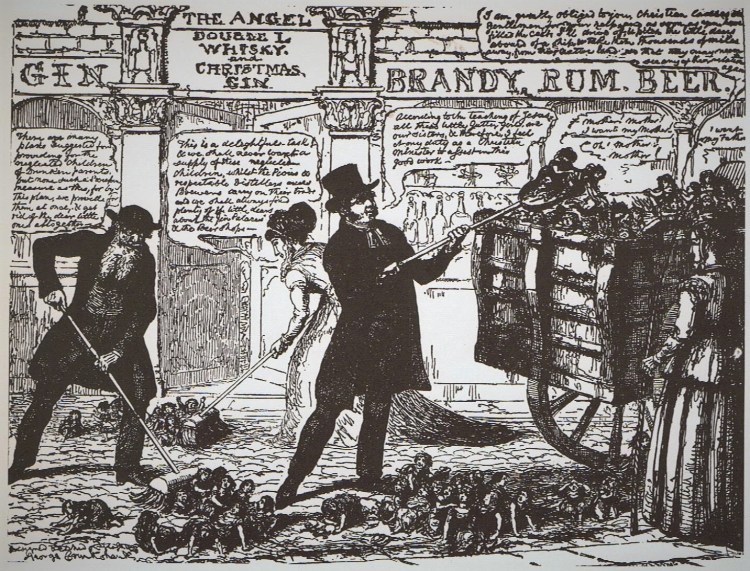
A cartoon by George Cruikshank on Victorian middle-class morality.

By the end of the century, however, the factory system also demanded an emphasis on precision, scrupulous standards, the clock and the bell, and the avoidance of waste. For many of the leaders of nonconformity, especially the many employers among them, the greatest industrial sin was drunkenness, which challenged all the values of the new industrial capitalist system. A new morality was needed and this was provided by the fruits of the evangelical revival. All too easily, as Briggs and Sellers (1973) noted, the phrase ‘the Nonconformist conscience’,

could lapse into an unlovely onslaught from a determined, Puritanical middle-class sectarianism against the drink, gambling and thriftlessness of the classes below and above it to the ignoring of the deeper social problems which afflicted the nation.

That is not to say that Nonconformity’s sympathies rested upon calculation alone. The growing call for the preaching of a ‘social gospel’ was, at least, the ‘child’ of a more positive definition of individualism, standing as a proper, practical and involved corrective to the implicit pietism of the tradition of conscientious separation. Nonconformists also felt the tensions involved in the relationship between church and evangelism. Victorian nonconformity blended Puritan churchmanship and revival evangelism. The revivalist strand was reinforced by the experience of the 1859 Revival, and later by the visits of American revivalists such as Moody and Sankey, and Torrey and Alexander. In his address published in the Congregational Year Book in 1885, Dr Joseph Parker began by envisaging a speech by one of that suffering community of ignorance, misfortunate, misery and shame who had spent a year observing the Unions, Conferences, Assemblies and Convocations held among Nonconformist ‘leaders’:

“We have had a full year among, and we cannot very well make out what you are driving at. We do not know most of the long words you use … We do not know what you are, or what you want to be at. From what we can make out you seem to know that we poor devils are going straight down to a place you call hell. … We read the inky papers which you call your ‘resolutions’ but in them, there is no word for us that is likely to do us real good. They say nothing about our real misery; nothing about our long hours, our poor pay, our wretched lodgings.”

… our evangelism is in danger of devoting itself almost exclusively to what is known as ‘the masses’. I must protest against this contraction, on the ground that it is as unjust to Christianity, as it is blind to the evidence of facts. If the city missionary … is wanted anywhere, he is specially wanted where … conscience is lulled by charity which knows nothing of sacrifice, and where political economy is made the scapegoat for oppression and robbery. …

There is only one class worse than the class known as ‘outcast London’, and that class is composed of those who ‘have lived in pleasure on the earth and been wanton’. The cry is ‘bitterer’ in many tones at the West End than at the East; … the thousand social falsehoods that mimic the airs of Piety … these seem to be distresses without alleviation, and to constitute heathenism which Christ himself might view with despair.

The ‘Prince of Preachers’ and the Paupers:
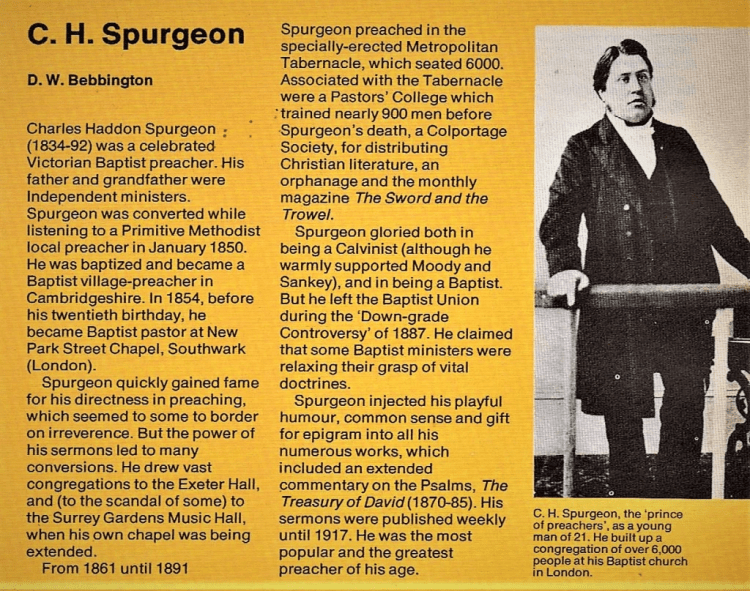
Spurgeon’s sermons drew many thousands to his churches, first at New Park Street Chapel and then at the Metropolitan Tabernacle in London (shown below). When printed, the sermons were also sold in their millions to people in the streets, and have since been distributed in more than two hundred million copies worldwide, giving some indication as to the continuing appeal of his thoroughly Biblical expositions. At the heart of Spurgeon’s desire to preach was a strong desire to develop a pastoral ministry. He did not regard people simply as souls to be saved, but loved them and wanted the best for them. His concern for their welfare extended to those involved in Christian ministry in all its forms, not just to ordained pastors. His book, Lectures to my Students was produced for those training for full-time ministry, but Counsel for Christian Workers was published for other people involved in a variety of Christian work. It contains Spurgeon’s clear-sighted viewpoints, advice and wisdom on the practical issues facing such people in their ministry.
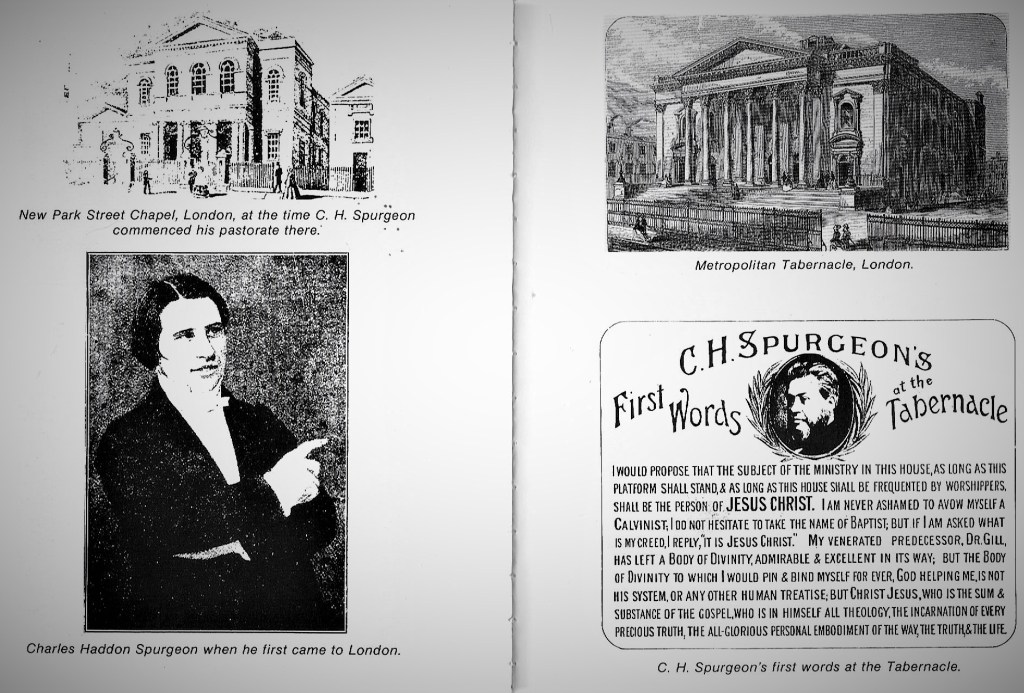
Spurgeon himself had been born into a very modest home at Kelvedon in Essex. As early as 1861, following the opening of the Metropolitan Tabernacle in London, the great Baptist preacher warned against the atmosphere of snobbery which he perceived was increasingly prevalent among his flock:

There is growing up even in our Dissenting churches, an evil which I greatly deplore, a despising of the poor. I frequently hear, in conversation, such remarks as this:

“It is of no use trying in such a place as this: you could never raise a self-supporting cause. There are none but poor living in this neighbourhood.”

… You know that in the city of London itself, there is now scarce a Dissenting place of worship. The reason for giving most of them up and moving them into the suburbs is that all the respectable people live out of town, and of course they are the people to look after. They will not stop in London. They will go out and take villas in the subsurbs where it may be maintained.

“No doubt,” it is said, “the poor ought to be looked after: but we had better leave them to another order, an inferior order. The city missionaries will do for them; send them a few street preachers.”

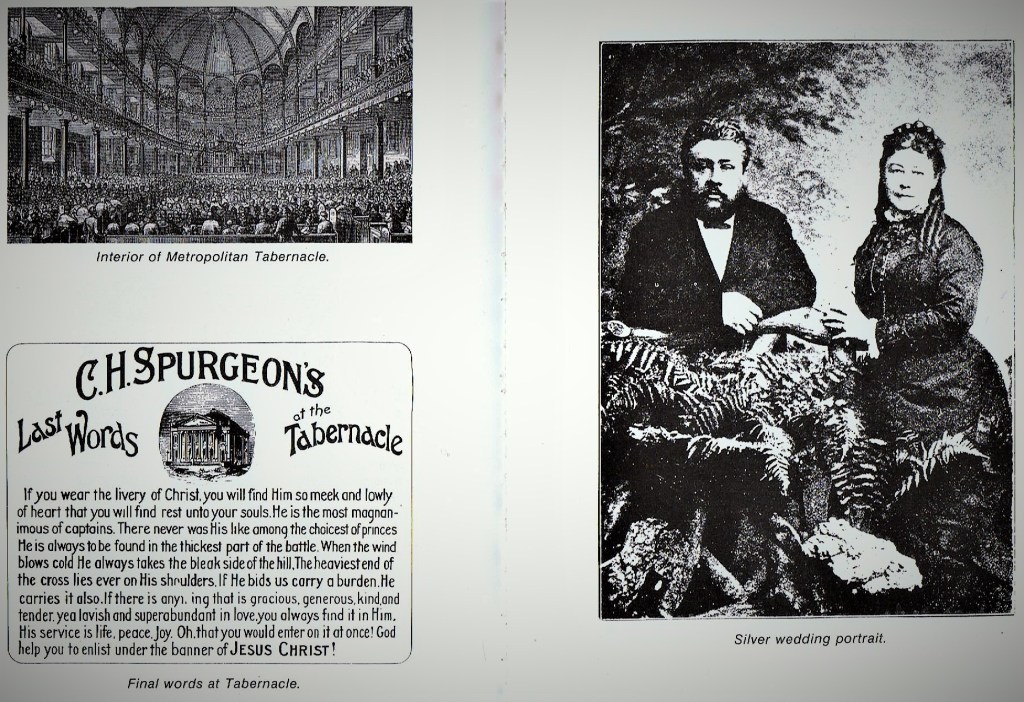
In 1865, in a bid to increase the numbers giving ordained ministry to the poor in the developing towns and cities, Spurgeon inaugurated the Annual Conference of the Pastors’ College. The foundation stone for the College building was laid eight years later. During his lifetime he gave twenty-seven addresses as President at the Conference. Many hundreds of ministers and students would gather each year to hear the ‘Governor’ at his best. He also became directly involved in setting up institutions to combat pauperism. He founded Stockwell Orphanage for Boys in 1867, followed by a Girls’ Orphanage in 1879. In April 1891, he gave his address, The Greatest Fight in the World (taking as his text I Tim. vi: 12 – “Fight the Good Fight of Faith”). While preparing this, he wrote to friends at the Tabernacle, “My soul is on fire with a desire for a special blessing from the Lord…” Little did he know that this would be the last conference he would attend. His address was one of the most powerful he delivered and was rapturously received by the vast assembly. Following the Conference, the transcript was revised and promptly published, later translated into many languages, passing through several editions.
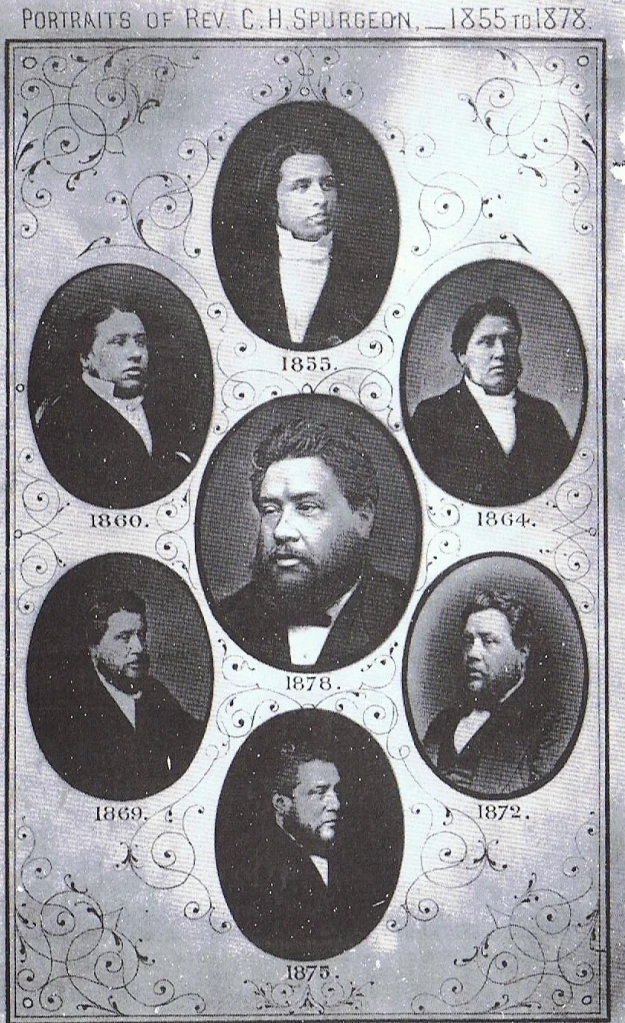
As if he knew that his influence would continue after he had departed, Spurgeon said:

“Those preachers whose voices were clear and mighty for truth during life continue to preach in their graves. Being dead they yet speak; and whether men put their ears to their tombs or not, they cannot but hear them…”
The most noted evangelist of the age, the great American preacher D. L. Moody (1837-99), was inspired by Spurgeon’s preaching. He first heard the Baptist pastor during a visit in 1867, but it was his own tour of Britain in 1873-75, sponsored and encouraged by Spurgeon, that launched his career as a renowned evangelist. It started unpromisingly but by the time he returned to America, he was a preacher of international fame. By then, he had already teamed up with Sankey, and Harry Moorehouse had taught him how to preach. When he left England it was to devote his life to conducting revivalist campaigns. Though never as polished a preacher as Spurgeon, the style and organisation of campaigns were to have an enduring influence on both sides of the Atlantic. In 1892, Moody spoke at Spurgeon’s Jubilee Services, following the great pastor’s death at the end of January in that year:

“Twenty-five years ago, after I was converted, I began to read of a young man preaching in London with great power, and a desire seized me to hear him.

“In 1867 I made my way across the sea. The first place I came to was the Metropolitan Tabernacle. I was told that I could not get in without a ticket, but I made up my mind to get in somehow and succeeded. As Pastor Spurgeon walked down to the platform, … my heart’s desire for years was at last accomplished.

“I have been at the Tabernacle many times since, and when I looked down at those Orphan boys, when I think of the six hundred servants of God who have gone out from the college, of the two thousand sermons from his pulpit that are in print, and of the multitude of books that have come from the Pastor’s pen I would fain enlarge on all these good works…

“I say, ‘Go on brother, and God bless you.’ You are never going to die. John Wesley lives more today than when he was on this earth… Bear in mind, friends, that our dear brother is to live forever. We may never meet again in the flesh, but by the blessing of God I will meet you up yonder.”

D. L. Moody at Spurgeon’s Jubilee Services.
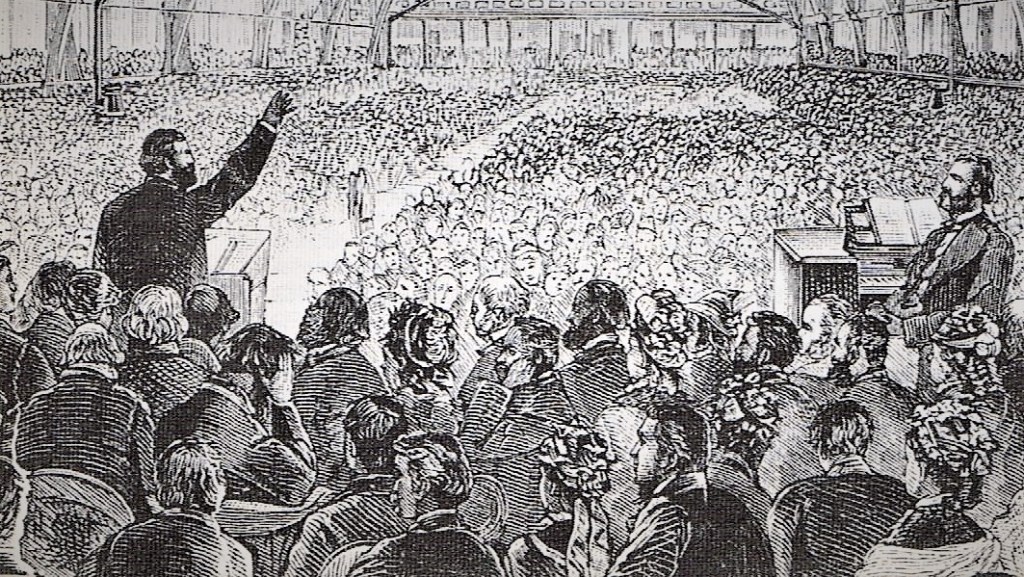
Moody and Sankey conduct a mass rally in Brooklyn, New York. Ira D. Sankey, the hymn-writer and musician, is sitting at the harmonium on the right.

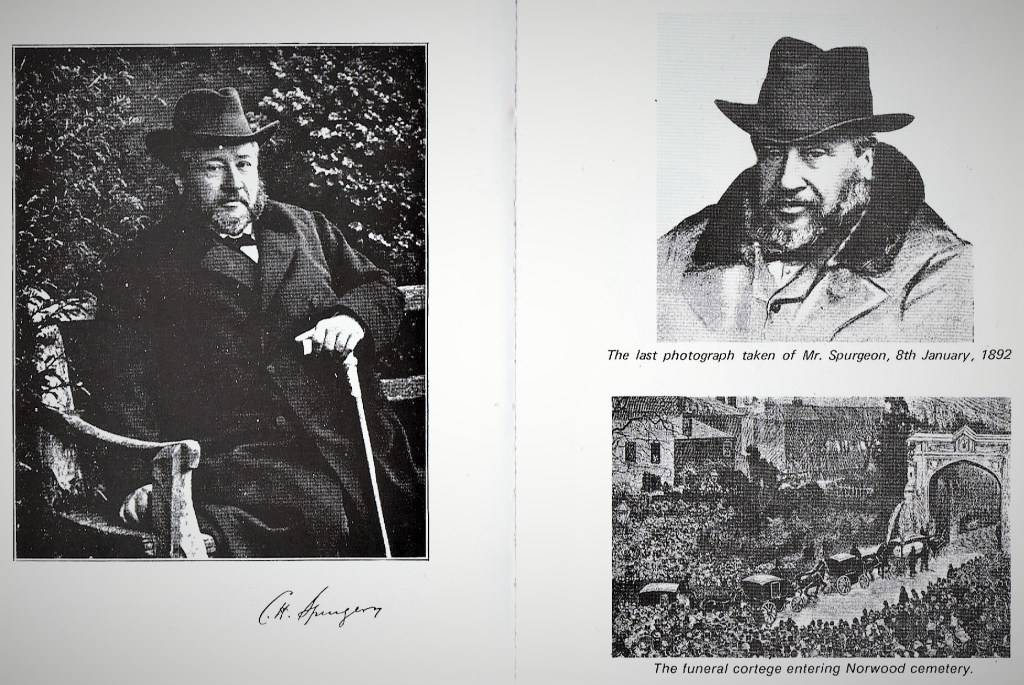
For the burial, Spurgeon’s body was returned to London from the south of France, where he had died. The greatest crowds ever seen in the Tabernacle were on 8 February 1892, when Spurgeon’s body lay ‘in state’. Over sixty thousand people passed before the coffin, and a similar crowd again the next day. On the 10th, the day of the funeral, the building was filled to overflowing. His body was interred at Norwood Cemetery the following day, with thousands lining the streets to pay their respects as the cortege passed by on its route, as pictured below (bottom right).
The Salvation Army and other Home Missions:

One organisation that attempted to keep in touch with the working classes was the Pleasant Sunday Afternoons (PSA) Movement, formed in the 1880s with the motto Brief, Bright and Brotherly. Its meetings were for men only and were held on Sunday afternoons so that men would not feel ashamed to come to the meeting in working clothes. The Sunday afternoon programme was part entertainment, part evangelistic and part political, with some of the early Christian Socialists as frequent guest speakers. The Salvation Army, too, came into being to serve the working classes through urban missions. Catherine Booth claimed We can’t get at the masses in the chapels, so in 1865 she set up a Christian Mission in a tent in Whitechapel, east London, with her husband, William Booth. He had already had a varied career, having preached for the Wesleyans, the Wesleyan Reformers and then the Methodist New Connexion, by whom he was ordained in 1858 after being disciplined in the previous year for his regular itinerant preaching. He stayed with the New Connexion for only three years before again becoming an irregular itinerant. The Salvation Army soon became known for its uniforms and music. The Salvation Army band shown below was from Penzance in Cornwall, photographed in the 1880s. General Booth can be seen in the back row, with his trademark top hat and a long beard.

The Whitechapel Mission grew into the Salvation Army, to the irritation of many churchmen. Even the evangelical reformer, Lord Shaftesbury, in extreme old age, concluded that the Salvation Army was a trick of the devil, who was trying to make Christianity look ridiculous. It also met with violent opposition from a ‘Skeleton Army’ which parodied Booth’s activities and was supported by brewers who were opposed to the Army’s teetotalism as a threat to their trade. Contrary to the popular image of the early Salvationists, they were more concerned about moral and spiritual matters than social conditions among the working classes. In fact, Booth spoke out against attempts to deal with the latter, arguing that they were simply due to a lack of bricks and mortar. The first thing to be done to improve the conditions of the wretched was to get at their hearts. The Salvation Army did not see itself as being engaged in a war against poverty and oppressive political philosophies. Moreover, Booth himself was authoritarian in his attempt to achieve results. He gained control of the Mission in 1877 by what was virtually a military coup. After that, the military emphasis was developed, with uniforms, corps and citadels, and the magazine, The War Cry. But this did not worry the ordinary Salvationist, for, as Booth remarked, the Salvation Army made every soldier in some degree an officer, charged with the responsibility of so many of his townsfolk. It offered them not only a force with which they could identify but also a task to which they were committed. The Salvation Army officers filed regular reports on ‘slum work’ in their towns and districts:

Mrs W. – of Haggerston slum. Heavy drinker, wrecked home, husband a drunkard, place … filthy, terribly poor. Saved now over two years. Home A1, plenty of employment at cane-chair bottoming; husband now saved also.

A. M. in the Dials. Was a great drunkard, did not go to the trouble of seeking work. Was in a slum meeting, heard the Captain speak on ‘Seek ye first the Kingdom of God!’ Called out and said “Do you mean that if I ask God for work, he will give it to me?” Of course she said “yes.” He was converted that night, found work and is now employed in the gas works, Old Kent Road.

Jimmy is a soldier in the Borough slum. Was starving when he got converted through being out of work. Through joining the Army he was turned out of his home. He found work, and now owns a coffee-stall in Billingsgate Market, and is doing well.

A Salvation Army ‘farthing breakfast’. The officers are at the back of the room.

The Army was perhaps the only Christian movement to reach the masses on their own terms in Victorian and Edwardian Britain. They understood the need to use modern means of mass communication and, in particular, the techniques of religious advertisement. To begin with, the Salvation Army continued in the tradition of revivalist evangelism, adding its own military dimension, which fed the appetites of an increasingly imperialist and jingoistic nation. But Booth’s friendships with Congregationalist theologian J. B. Paton, and W. T. Stead, editor of the Pall Mall Gazette, led him to engage with a wider range of social concerns and problems. When he published In Darkest England and the Way Out in 1890, The Methodist Times exclaimed, Here is General Booth turning Socialist. The book, widely believed to be mainly the work of Stead, was designed to show that the submerged tenth of the British people was as much in slavery as certain African tribes. This produced a rift in the ranks of the Army. On the one hand, Frank Smith wrote a column for The War Cry under the unfamiliar heading ‘sociology’, pressing for further social action. On the other hand, more conservative officers feared that the social scheme was a turning aside from the highest to secondary things.

A collage from the front cover of the 1973 book by John Briggs & Ian Sellers, Victorian Nonconformity, designed to illustrate different facets of the movement, part of the Pugh Collection of Staffordshire figures.

The Booths had found themselves unable to reach the masses from a position within mainstream Methodism. In the nineteenth century the Wesleyan Methodists, led by Jabez Bunting, became a staid, respectable denomination. It imposed upon itself in the nineteenth century a ‘no politics’ rule, and until the late 1880s, it was suspicious of open political discussion. But Methodism had within itself its own nonconformity where this restraint was missing. For example, the Staffordshire Primitive Methodists produced several Chartist leaders. Involvement in chapel affairs made them into natural community leaders. They learnt organisation based on local church government and public speaking skills based on preaching and participation in church meetings and congregational worship. The local lay-preacher, like Joseph Arch in Barford, Warwickshire, could step readily from the pulpit to the strike platform. As a result, the Primitive Methodists developed a close connection with the growth of the mass Trade Union movement, both in urban and agricultural areas. John Wilson, the leader of the Durham miners, described his conversion at the age of thirty-one at a Primitive Methodist Class Meeting:

I took my seat, and when the class leader came to where I was sitting and me to tell him how I was getting on (meaning in a spiritual sense), I was speechless. The others, in response to his query, had replied readily but my eloquence was in my tears which I am not ashamed to say flowed freely … All was joy, and not not the least joyous was myself, even while the tears were chasing down my cheeks. This change made, I began seriously to consider how I could be useful in life.

This conversion experience led to a search for education, enrolment as a local preacher, an office within the Miners’ Union, and election to Parliament in 1885, as one of the earliest Labour MPs. Many other ‘Lib-Lab’ and independent Labour leaders, especially in the northeast of England and South Wales, had similar stories to tell.
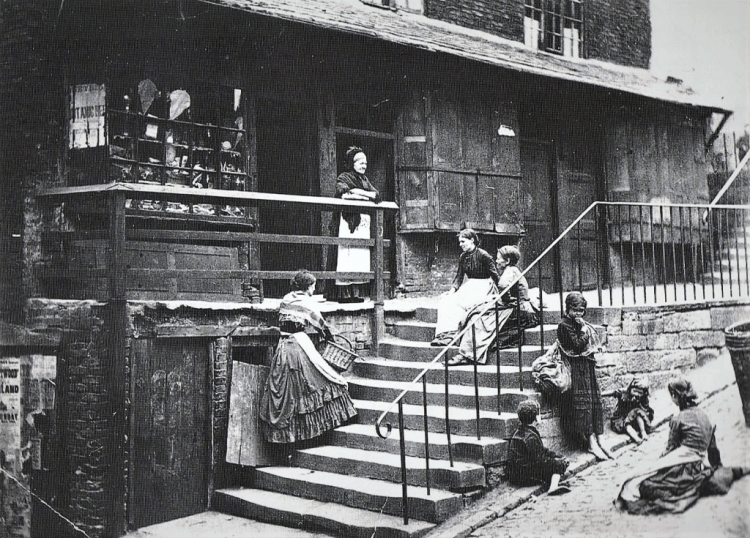
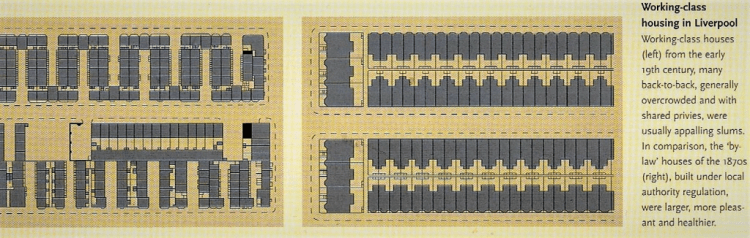
A Sunderland slum, circa 1889. Squalor was all too often the fate of the industrial working class in Victorian times. In the later decades of the nineteenth century, local by-laws were used to regulate new housing, but clearing slums like the one shown here took longer.

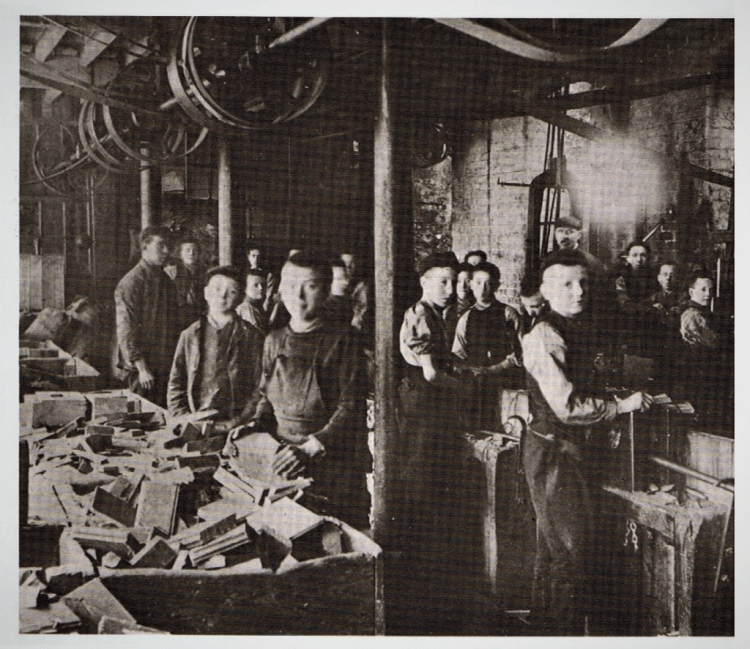
In November 1886, the Revd. Samuel Francis Collier was placed in charge of the new Methodist Central Hall, Manchester, built at the then prodigious cost of forty thousand pounds. Magnificent though the Hall was, the dynamic evangelist, with a social as well as a spiritual conscience, soon launched a programme of practical help for the poor, using the motto ‘Need not creed’ in his daring new ministry. Nobody in need was to be refused help, regardless of belief. In 1891, an old rag factory was established at Ancoats, salvaging the waste of the city, old bottles, jars, empty tins, cotton waste, pails and clothing all being sorted for re-use and sale, destitute men being given a good bed and three square meals a day for their labour. From that venture in social rehabilitation grew the most complete set of social service premises possessed by any church in Britain. By the early 1900s, a Men’s Home, Labour Yard, Women’s Refuge, a Maternity Hospital for unmarried mothers and a Labour Advice Bureau had all been developed together with educational clubs, prison visiting services and holiday funds. The picture below shows the boys in the Labour Yard of the Manchester and Salford Wesleyan Missions. Outcasts of industrial society, they were welcomed by Collier and provided with clothes, food, shelter and hope in exchange for ‘honest toil’.
Church v Chapel – Establishment Schools & Progress for the Poor:

In the early decades of the century, the Home Office had feared leaving education in industrial areas to Methodists, a set of men not only ignorant but of whom I think we have of late too much reason to imagine are inimical to our happy constitution. The 1820s saw the end of the easy eighteenth-century co-existence between church and chapel. The revival of hostility led to a fierce campaign for the repeal of the Test and Corporation Acts, which was successful in 1828. Even after repeal, however, many irritants remained for nonconformists: first, the need for them to secure validity for marriages and funeral rites, then the campaign to repeal church rates, which were finally abolished in 1868. The ancient universities were bastions of Anglican power, and a campaign to open them to nonconformists achieved most of its aims by 1871. Early Victorian nonconformist movements tended to concentrate on the negative campaign of disestablishment. But the free church movement of the 1890s was more missionary-minded. It also reflected certain solid achievements concerning unity among the free churches. In 1856 a number of Methodist groups came together to form the United Methodist Free Church; Presbyterian union was achieved in 1876 and in 1891 the New Connexion of General Baptists was finally united with the Particular Baptists. But at the end of the century, the rift between church and chapel in English and Welsh societies still ran very deep. It was not simply the chapels of the industrial revolution confronting the churches of the rural squirearchy; urban Anglicanism and rural Dissent were equally part of the conflict, and in no area of life more so than the schools.
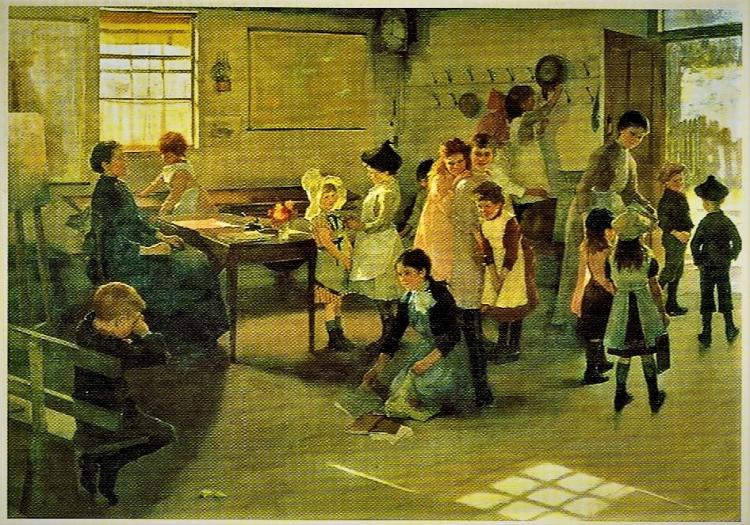
Newlyn School, Cornwall, 1889: Even isolated fishing communities, such as Newlyn, saw growth in educational provision, for girls as well as boys.

The chief providers of elementary education for most of the nineteenth century had been the voluntary bodies, especially the churches, from the 1830s receiving Treasury grants. Some among the middle classes supported universal education for philanthropic reasons, to prevent crime and immorality, or as insurance against social unrest. Some Anglicans were alarmed at the growth of Catholicism and Nonconformity and saw an Anglican education system as a defence against this. There was opposition, however, from those, especially farmers, who feared that educating the working classes would lead to higher taxes and labour costs, if not the spread of radical political ideas. National differences in education and literacy were marked. Levels of literacy were comparatively low in many parts of rural Britain, where school attendance was also low, but especially high in Scotland and Ireland, where favourable attitudes to an educated population were supported by a network of parochial schools. They were also higher among girls than boys in some areas where they were educated at voluntary schools, for example in East Anglia. In 1844, William Locke reported on the English ‘Ragged Schools’:

In many cases, because the children are so destitute that they cannot be taught, we give food – generally soup, occassionally meat, and good wholsome bread, sometimes coffee or cocoa, and bread and cheese. In one school they feed about two hundred twice or thrice a week … The children who come to the schools pay nothing; all the Ragged Schools are quite free, being intended only for the destitute.

Kindness, Christian love to the children and teaching them their duty to their duty to their neighbours and to their God, and making the Bible the theme of all our instruction …

Some of the most compelling photographs of poverty to survive were taken for religious and charitable organisations concerned with saving and helping children. The photograph above is of a ‘Ragged School’ showing not only ragged clothes but thin rickety legs, bare feet and the hollow-eyed accusative stare of children robbed of childhood. Pictures from the Church of England’s Children’s Society, the Methodist Mission and the Salvation Army confirm that the appearance of the children matches the descriptions left us by various contemporary social commentators.

Thirteen years before the first Education Act, when countless children toiled ten or twelve hours a day in a mill or a colliery, Jeremiah James Colman opened Carrow School for the children of his employees at his Stoke and Carrow mustard works in Norwich. He was the grandnephew of the founder of the company, a strong Nonconformist, philanthropist and Member of Parliament. The weekly payment for attendance at the school was a penny for one child, three halfpence for two and twopence for a third from the same family. The first school was over a carpenter’s shop and crammed in fifty-three pupils. In an opening statement, Colman announced:

… the school helps you to educate your children and to train up a set of men who will go into the world qualified for any duties they may be called upon to discharge.

With a workforce of three and a half thousand, Colman’s was, in effect, the local community and it was likely that their duties would be discharged in manufacturing mustard. The school began each morning with a hymn, a prayer and a Bible reading, but while a Colman education included diligent and careful teaching of the scriptures, it also included art and craft subjects in addition to ‘the three r’s’. Not only was Colman far-sighted in his attitude to education, but he was also a firm believer in women being given every opportunity for learning, and from the outset drawing and needlework were included in the subjects taught. Caroline Colman, Jeremiah’s wife, was the force in the direction and development of the school. The Colmans were also committed to technical education, and in 1899 they claimed to be the first to introduce cookery, gardening, laundry work, beekeeping and ironwork into the curriculum. As the school grew, it moved and improved, adding a wide range of technical subjects, but never neglected art and culture.
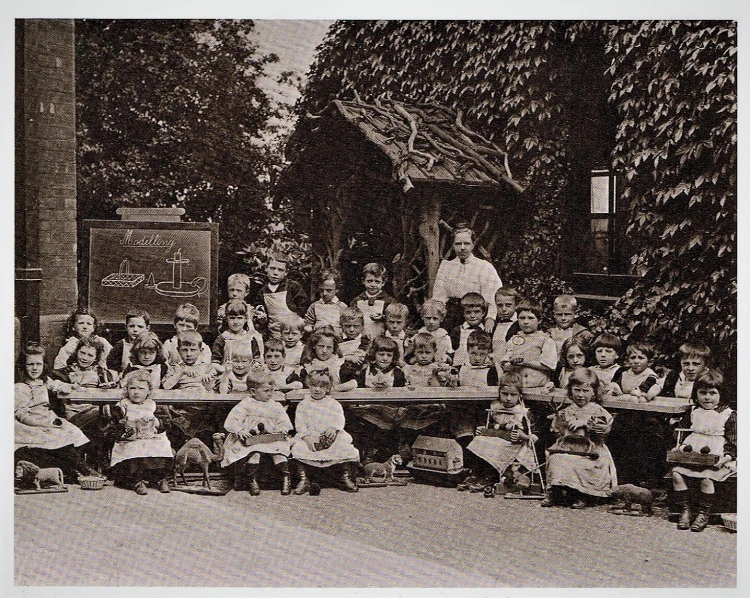
At the time the photograph above was taken in the early 1900s, Caroline Colman was intensely concerned with the physical wellbeing of her pupils, urging mothers to ensure that their daughters wore warm dresses ‘as a caution against measles and other childish ailments’. Although the children have been carefully groomed and prepared for the class photograph, their general condition of wellbeing contrasts sharply with the ‘ragged’ appearance and thin faces of the children in the London photographs. The reminiscences of former pupils were warm and grateful, happy and nostalgic if at times a little pious.

But ‘Church’ meant not only cathedrals, bishops, parishes and the Book of Common Prayer. It also meant continuing control over elementary education, the only form to which working-class nonconformists had access, deference to ‘the Establishment’ in both church and state. ‘Chapel’ stood for two forms of Dissent: the older, more loosely organised, congregational variety, and the newer, more centrally organised evangelical denominationalism of the Wesleyan Methodists and Baptists. Chapel religion had made so much progress that nonconformists were determined to secure equal rights with Anglicans. The campaign for outright disestablishment of the Church of England ceased to concern late Victorian nonconformists, except in Wales, where it was brought about in 1920 (in Ireland in 1869). But the fight for control over primary and elementary schools continued until the outbreak of the First World War in 1914. This battle did little credit to either side but deprived two generations of English children of education. All the labours of the Sunday schools hardly compensated for that. In Wales, the Nonconformist churches, and in Ireland, Catholics opposed state funding of education, fearing Anglican propaganda. The Welsh Calvinistic Methodists and Independents also feared that the established Church sought to extinguish the Welsh language through the provision of monolingual English schooling. This strategy would undermine the Sunday schools provided by the Nonconformist chapels, in which Welsh was the medium of instruction.

The Churches and the Co-operatives – the views of Beatrice Webb:
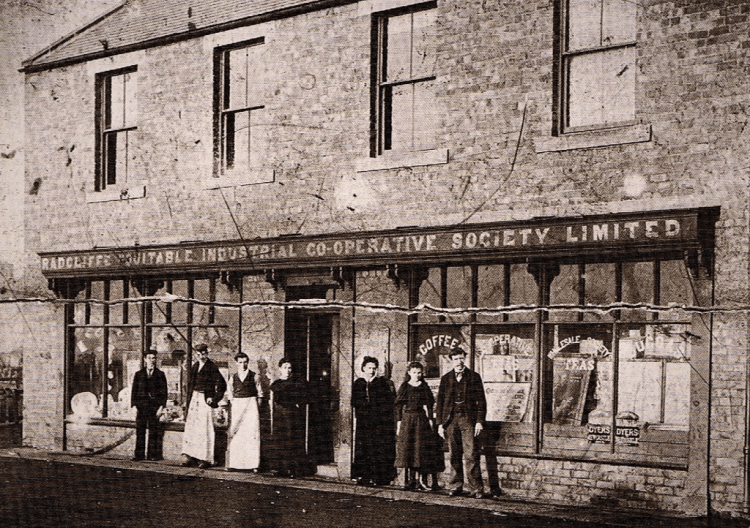
With its satellite towns of Stockport, Salford and Oldham, Manchester was the most impressive example of urban expansion up to the mid-century, and its dependence on factory industry and persistent identification with the ‘gospel’ of the market economy. This also extended among the mill towns of Lancashire and Yorkshire, like Radcliffe (shown above).

Beatrice Potter (later Webb) in 1875.

Beatrice Webb, née Potter, (1858-1943) was born into a Lancashire family who became integrated into the traditional administrative and professional class, and Beatrice found herself related to a good proportion of the academics, senior civil servants and leading lawyers of the capital. On the other hand, she still kept in contact with her Lancashire forebears who had not made the transition. Stimulated by the great Charles Booth, she embarked in 1884 on her own programme of social research into Co-operation and Nonconformity in Bacup, a town in the South Pennines of Lancashire, close to the border with Yorkshire. In a letter to her father, She wrote of her enquiries into the operations of the co-operative societies in the town, entirely owned and managed by working men:

I have spent the day in the chapels and schools. After dinner, a dissenting minister dropped in and I had a long talk with him: he is coming for a cigarette this evening after chapel. He told me that in all the chapels there was a growing desire among the congregation to have political and social subjects treated in the pulpit and that it was very difficult for a minister, now, to please. He also remarked that in the districts where co-operation amongst the workmen (in industrial enterprise) existed, they were a much more independent and free-thinking set.

There is an immense amount of co-operation in the whole of this district; the stores seem to succeed well, both as regards supplying the people with cheap articles and as savings banks paying good interest. Of course, I am just in the centre of the dissenting organisation; and as our host is the chapel keeper and entertains all the ministers who come here, I hear all about the internal management … each chapel is a self-governing community, regulating not only chapel matters but overlooking the private life of its members.
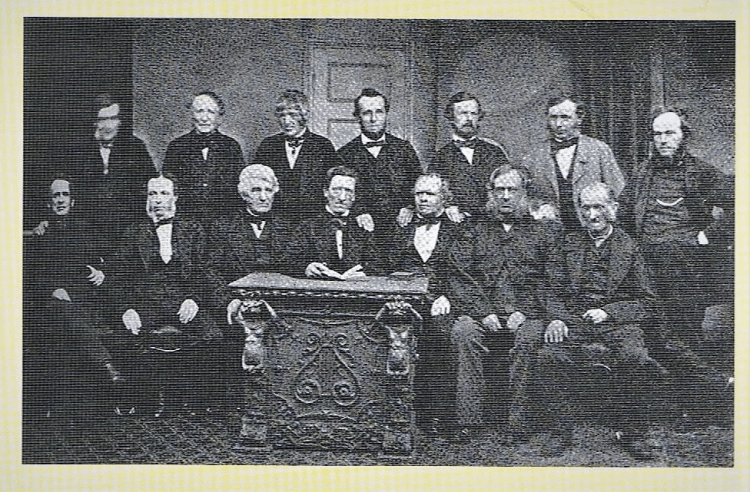
The Rochdale Pioneers founded the first modern cooperative in Rochdale in 1844, with their first shop in Toad Lane. The Pioneers established the principles of consumer cooperation.

Forty years after the Rochdale Pioneers founded the first co-operative society, the young social researcher, not yet a socialist, was clear about the ties which existed between the Nonconformist chapels in Bacup and the local co-operatives. Beatrice wrote in her now well-known diary:

One cannot help feeling what an excellent thing these dissenting organisations have been for educating this class for self-government. I can’t help thinking, too, that one of the best preventives against the socialistic tendency of the coming democracy would lie in local government; which would force the respectable working man to consider political questions as they come up in local administration.

… they are keen enough on any local question which comes within their own experiences and would bring plenty of shrewd sound sense to bear on the actual management of things…

There is an immense amount of spare energy in this class, now that it is educated, which is by no means used up in their mechanical occupation. … It can be employed either in the practical solution of social and economic questions or in the purely intellectual exercise of political discussion about problems considered in the abstract. …

In living amongst mill-hands of East Lancashire … I was impressed with the depth and realism of their religious faith. … Even the social intercourse was based on religious sympathy and common religious sympathy and common religious effort. ..
From Individualism to Collectivism – Clifford and Christian Socialism:

As the Victorian period progressed, there emerged a proliferation of philanthropic activity. Alongside the itinerant societies and the great urban Sunday schools, there developed a nondenominational Christian press and a great battery of Bible, tract and missionary societies. These organisations formed a pattern of Christian progress all the way from ‘Basle to New York’, all seeking to capitalise on the evangelistic opportunities which seemed to be afforded by the turmoil in western societies. This movement, much like the societies which created it out of the social tensions of the first half of the nineteenth century, had seemed to be getting out of control by the middle decades of the century. In consequence, the ‘undenominational evangelism’ of the Evangelical Revival was gradually replaced by the assertion of ‘denominationalism’ by the end of these decades. The earlier decades of philanthropic activity had been based on perilously fragile ‘social theology’. Some Christians argued that the campaign for social righteousness was essential to a proper gospel ministry, whilst others still saw social action as little more than a device for securing a working-class audience for the gospel. In the earlier part of the century, the activities of those calling themselves ‘Christian Socialists’ did not add up to very much. The novelist Charles Kingsley had set out their possibilities in Alton Locke (1850). But the Christian Socialist co-operative workshops were poorly organised, unduly idealistic about the contribution of labour, and only lasted a short while. However, Christian Socialists did good work in securing a better legal framework within which workers’ organisations, including trade unions, could develop, and in fostering workers’ education.

Within the Nonconformist tradition, however, the individualistic emphasis upon personal conversion had always had to be held in tension with a corporate understanding of the church and its role in society: as the normative social philosophy of Victorian Britain changed from individualism to collectivism, this correspondingly this second emphasis, which for much of the century was neglected, came into new prominence. Social Science may well have been a middle-class preoccupation of the mid-century, but when linked with the Kingdom of God theology of the Christian Socialists it provided an important link between the Christian Chartism and ‘Political Dissent’ of the 1830s and ’40s with the ‘Nonconformist Conscience’ or ‘Social Gospel’ of the ’80s and ’90s. The Baptist pastor, John Clifford, was actively involved in campaigning against the ‘living in’ system, as the photograph below shows. Dressed like dukes, treated like slaves, as the slogan went, since shop assistants were expected to dress like aristocrats and to spend their lives in total subjection to their employers. Almost half a million were of them were compelled to ‘live in’ their employers’ premises in conditions that were appalling and institutional. The shopowners created a tyranny as harsh as the yearly bond system of the mine owners or the feudal power of the squirearchy. Stores were open from morning to night for six days a week and working hours of eighty to ninety hours per week were common.

The ‘living in’ system bound the shopworker to the shopowner as tightly as the tied cottage bound the labourer to the farm owner. Much of the accommodation was barrack-like with beds alive with fleas and walls crawling with bugs. Baths were rarely provided and hot water was almost as scarce. The rules of one Knightsbridge store forbade lights after 11 p.m., breaching of which resulted in instant dismissal. Sleeping out required permission and failure to comply with this also resulted in dismissal on the second offence. Assistants were also forbidden to marry without permission and communal living denied them the vote. On their one free day, they were expected to attend church, not chapel. The photograph, taken in May 1901, shows thirteen shop assistants advertising a meeting against the system, with Dr Clifford as the chief speaker. The sandwich boards were hired from the Church Army; third in line is P. C. Hoffman, a pioneer of the Shop Assistants’ Union and a trade union official for forty years. In his Fabian Tract of 1897, Socialism and the Teachings of Christ, Clifford encapsulated the transition from individualist to collectivist thinking among many Nonconformists and Church organisations:

Collectivism, although it does not change human nature, yet takes away the occasion for many of the evils which now afflict society. It reduces the temptations of life in number and in strength. It means work for everyone and the elimination of the idle, and if the work should not be so exacting, responsible, and therefore not so educative for a few individuals, yet it will go far to answer Browning’s prayer:

“O God, make no more giants,

Elevate the race.”

… Individualism adds to the number of the indolent year by year; collectivism sets everybody alike to his share of work, and gives to him his share of the reward. … Collectivism affords a better environment for the teachings of Jesus concerning wealth and the ideals of labour and brotherhood. If a man is … only ‘the expression of his environment’ … then it is an unspeakable gain to bring that environment into line with the teaching of Jesus Christ.

In the Gospels, accumulated wealth appears as a grave peril to the spiritual life, a menace to the spiritual life, a menace to the purest aims and noblest ideals. Christ is entirely undazzled by its fascinations and sees in it a threat against the integrity and progress of his kingdom. ‘Lay not up for yourselves treasures on earth’. …

Now, though Collectivism does not profess to extinguish vice and manufacture saints, it will abolish poverty, reduce the hungry to an imperceptible quantity, and systematically care for the aged poor and for the sick. It will carry forward much of the charitable work left to individual initiative … is not all that in harmony with the spirit and teaching of Him who bids us see Himself in the hungry and sick, the poor and the criminal?

… Collectivism fosters a more Christian conception of industry; one in which every man is a worker, and each worker does not toil for himself exclusively, but for the necessities, comforts and privileges he shares equally with all members of the community. … It is a new ideal of life and labour that is most urgently needed. England’s present ideal is a creation of hard individualism; and therefore is partial, hollow, unreal and disastrous. …

Individualism fosters the caste feelings and caste divisions of society, creates the serfdom of one class and the indolence of another; makes a large body of submissive, silent, unmanly slaves undergoing grinding toil and continuous anxiety, and a smaller company suffering from debasing indolence and continual weariness. … No! the ideal we need and must have is in the unity of English life, in the recognition that man is complete in the State, at once a member of society and of the Government…

Dr John Clifford (1836-1923) was a prominent Baptist minister and President of the Christian Socialist League. This was the successor organisation to the Christian Socialist Society which took over the management of the Christian Socialist magazine from the Chartist Land Reform Union. Clifford was also an early member of the Fabian Society. As a liberal evangelical minister in Paddington from 1858, Clifford set this new ideal of life and labour against what he called the hard individualism of late Victorian society. It was this individualism that he saw as partial, hollow, unreal and disastrous, fostering the serfdom of one class and the indolence of another. It had created, on the one hand, a large class of submissive, silent… slaves undergoing grinding toil and continuous anxiety, and on the other a smaller class suffering debasing indolence. It spawned hatred and ill-will on the one hand and scorn and contempt on the other. This was at odds with the common ideal in both the soul of Collectivism and the revelation of the brotherhood of man in Christ Jesus.

The ideas of F. D. Maurice, a principal Christian Socialist thinker, were also to have a tremendous impact on Anglican thought about the secular world in the following century and to bring the movement to its climax in the work of William Temple, Archbishop of Canterbury (1942-44). This was partly due to the work of the Christian Social Union, founded in 1889 with Brooke Fosse Weston, the Cambridge New Testament scholar and later Bishop of Durham, as its first president. Evidence for the early role of Christian Socialists in the move towards independent politics can be found in that, as early as March 1895, a ‘Christian Socialist’ candidate fighting alone against the Liberal candidate for East Bristol lost the parliamentary election by only 183 votes in a total poll of over seven thousand. The Welsh Religious Revival of 1904-5 also helped promote the rise of working-class collectivist politics, first in the Liberal Party, but then in the development of a separate Labour Party.

Joseph Chamberlain, Birmingham Nonconformity & Social Reform:
In the Industrial Revolution, Birmingham had played a major role in the technological breakthroughs of the early part of the century with the improved form of the steam engine produced at the Boulton and Watt factory in the city. Birmingham had become known as the ‘city of many trades’ and maintained its position as a centre for smaller manufacturers alongside the expanding larger-scale factory industry. Indeed, its diverse industrial base made it a serious rival to Manchester as Britain’s second city in the second half of the nineteenth century. From the Nonconformist point of view, R. W. Dale (1829-95) delivered a Lecture to the New Electors, addressing the citizens of Birmingham who had acquired the vote as a result of the 1867 Reform Act. This had enfranchised the majority of working-class men, but not the ‘slum-dwellers’ whom Dale saw as a threat to social order in the urban areas:

You have a great practical concern in whatever measures are likely to make the criminal classes disappear, and I trust that such measures will have your hearty support. … There is another class from which we have almost as much to fear … one million persons receiving relief.

… And in this million you have first the permanent paupers, and then a vast mass of people who are on the parish on and off again every few months, but who when they go off are sure to leave successors … We have hereditary paupers, as well as hereditary criminals, and I maintain that this is intolerable.

You will feel very distinctly the sharp pressure that comes upon the community for the support of the ‘armies of the homeless and unfed’, and will be the more eager to discover how the pauperism of the country can be effectively diminished.

In Birmingham, as Dale knew well, the city’s municipal administration was notably lax with regards to public works, and many urban dwellers lived in conditions of great poverty. As a Congregational minister, Dale chastised his fellow nonconformists over their lack of action:

We are living in a new world and evangelicals do not seem to have discovered it. The immense development of the manufacturing industries, the wider separation of classes in great towns … the new relations that have grown up between the employers and the employed, the spread of popular education, the growth of a vast popular literature, the increased political power of the masses of the people, the gradual decay of the old aristocratic organisation of society, and the advance in many forms of the spirit of democracy, have urgently demanded fresh applications of the eternal ideas of the Christian faith to conduct.

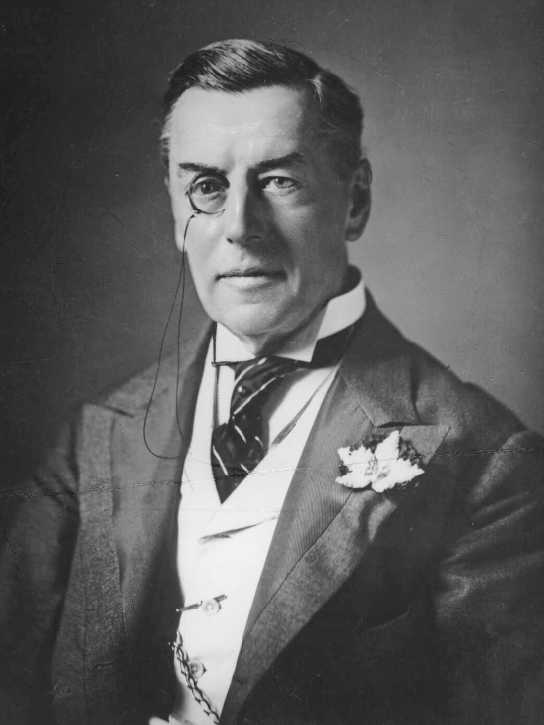
The Unitarian Joseph Chamberlain made his career in Birmingham, first as a manufacturer of screws and then as a notable mayor of the city. He became involved in Liberal politics, influenced by the strong radical and liberal traditions among Birmingham shoemakers and the long tradition of social action in Chamberlain’s Unitarian church. Chamberlain was a radical Liberal Party member and a fierce opponent of subsidising Church of England and Roman Catholic schools with local ratepayers’ money. As a self-made businessman, he had never attended university and had contempt for the aristocratic leadership of the Tory Party, both locally and nationally. In November 1873, the Liberal Party swept the municipal elections and Chamberlain was elected Mayor of Birmingham. The Conservatives had denounced his Radicalism and called him a “monopoliser and a dictator” whilst the Liberals had campaigned against their High Church Tory opponents with the slogan “The People above the Priests”. As Mayor, Chamberlain promoted many civic improvements, promising the city would be “parked, paved, assized, marketed, gas & watered and ‘improved'”. In February 1874, he wrote to Henry Allen, Editor of the Nonconformist Review, reflecting on the election results and the need for a campaign to further a closer union between nonconformists as such and the working classes.

The only chance of the Government lay in a declaration of policy calculated to arouse the hearty enthusiasm of the non-conformists and the working classes. Instead of this Gladstone issued the meanest manifesto that ever proceeded from a great Minister. … At the same time, the returns show that the present political position of the Dissenters is not satisfactory. They are very hazy as to the principles of the Education question, and have, in many cases, been carried over to the enemy by the ‘Bible’ cry.

In the latter assertion, it can be assumed that Chamberlain is referring to the provision of the 1870 act in respect of Religious Education, which placed Biblical knowledge at the centre of the curriculum, alongside numeracy and literacy. By ‘the enemy’, Chamberlain was referring to ‘the Anglican Establishment’, as he went on to explain:

Worse still, they have ceased to combine cordially with the working classes, without whose active assistance further advances in the direction of Religious Equality are impossible. But both in the case of the agricultural labourers, and in reference to the demands of the Trades Unions for the repeal of what I do not hesitate to stigmatize as class legislation of the worst kind, the Dissenters have largely held aloof, and their organs in the Press … have been unsympathetic and even hostile.

In his references to the agricultural workers and the trades unions, Chamberlain was no doubt referring to the National Agricultural Labourers’ Union, which grew out of the local union founded in Warwickshire in the early 1870s, referred to above. Led by the Wesleyan lay-preacher Joseph Arch and supported by thousands of Nonconformist workers, many Baptists and Methodists among them, it had fought wage cuts and evictions imposed by local squires simply for their tenants joining the union. Their children had been excluded from parish schools in some areas. Arch later supported Chamberlain’s ‘Liberal Imperialism’ as a means of aiding and ‘protecting’ Britain’s home industries against the ravages of ‘free trade’ in the 1880s and 90s. He organised emigration schemes for impoverished agricultural workers and their families to the ‘Dominions’, especially New Zealand. The failure of some nonconformist church leaders to support their poorer members led Chamberlain to argue that:

Unless this is altered in the future such questions as Disestablishment and Disendowment will be indefinitely postponed, as the Artisan voter can see little difference between Caesar and Pompey, and looking like the whole affair is a mere squabble between Church and Chapel, will take no interest in the matter.

Chamberlain pointed out that the only districts in which Liberalism had come out of the recent elections were the Midland Counties, where they gained one seat and the Northern Counties, where the balance was still in favour of the Liberals. There, he wrote, the local parties appealed directly to the mass of the working-class population, with the Dissenters aiding very largely with their purses and influence, and cordially recognising the justice of the labourers’ claims. Chamberlain contrasted the enduring support of the local Liberal Press in Birmingham and Newcastle, in particular, with …

… this narrowness on the part of many of the rank and file of Dissent, will be fatal to the success of our special aims unless we can induce and make a more generous recognition of the claims of the masses.
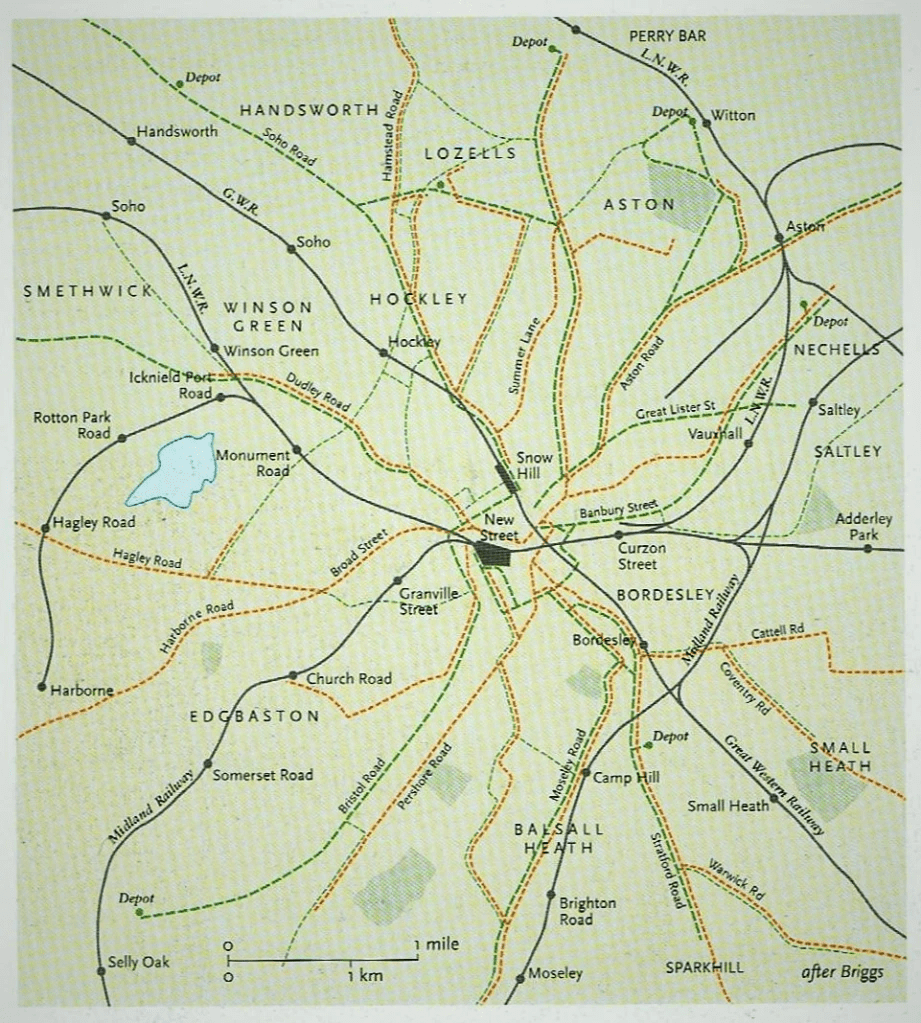
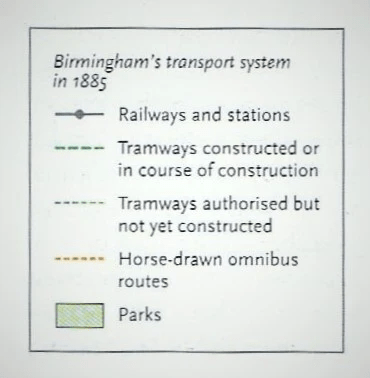
Together with the west Midland industrial towns, which also became strongholds of radical religious Dissent, Birmingham was becoming overtly political with the rise to municipal power of Chamberlain’s Liberal reformers. They set about their reforming projects and programmes with a zeal reminiscent of the evangelical campaigns of the earlier part of the century. The city rapidly gained a reputation for municipal enterprise for its public works, including one of the country’s most extensive urban tramway systems (see the map above). Cheap and efficient public transport systems, based on horse-drawn omnibuses and trams, proved to be an effective way of dispersing the industrial working class from overcrowded and disease-ridden city-centre slums. The now radicalised diarist, Beatrice Webb, commented on her conversations with him on these social themes in her diary, in entries made during their four-year relationship which had begun in 1882 when he had become a minister in Gladstone’s second government:

The same quality of one-idea-ness is present in the Birmingham Radical set, earnestness and simplicity of motive being strikingly present. Political conviction takes the place here of religious faith. … Heine said some fifty years ago, “Talk to an Englishman on religion and he is fanatic; talk to him on politics and he is a man of the world.”

It would seem to me from my slight experience of Bacup and Birmingham, that that part of the Englishman’s nature which has found gratification in religion is now drifting into political life. When I suggested this to Mr Chamberlain he answered. “I quite agree with you, and I rejoice in it. I have always had a grudge against religion for absorbing the passion in man’s nature.”

It is only natural then that, this being his view, he should find in the uncomprising belief of his own set a more sympathetic atmosphere wherein to recruit his forces to battle with powers of evil, than in the somewhat cynical… political opinions of London Society.

(MS diary, 16 March 1884).

In March 1886, Chamberlain launched a ferocious campaign against Gladstone’s Irish proposals. His motivations combined imperial, domestic, and personal themes. Imperial, because they threatened to weaken Parliament’s control over the United kingdom. Chamberlain’s immediate chances of attaining the leadership of the Liberal Party had declined dramatically and in early May, the National Liberal Federation declared its loyalty to Gladstone. On 9 April, Chamberlain spoke against the Irish Home Rule Bill in its first reading before attending a meeting of Liberal Unionists on 14 May. From this meeting arose the Liberal Unionist Association, originally an ad hoc alliance to demonstrate the unity of anti-Home Rulers. During the second reading on 8 June, the Home Rule Bill was defeated by thirty votes, by the combined opposition of Conservatives, Chamberlainite radicals and Whigs. In all ninety-three Liberals, including Chamberlain, voted against Gladstone. Parliament was dissolved, and in the ensuing 1886 general election, the Conservatives and Liberal Unionists agreed to an alliance. With the general election dominated by Home Rule, Chamberlain’s campaign was both Radical and intensely patriotic. The Conservatives and Liberal Unionists took 393 seats in the House of Commons and a comfortable majority. Chamberlain did not enter the Unionist government, aware that the hostility to him in the Conservative ranks meant that an agreement with them could extend merely to Ireland and not wishing to alienate his Radical support base. The Liberal mainstream cast Chamberlain as a villain, shouting “Judas!” and “Traitor!” as he entered the House of Commons chamber. 

The Liberal Association in Birmingham could no longer be relied upon to provide loyal support, so Chamberlain created the Liberal Unionist Association in 1888, associated with the National Radical Union, having extracted his supporters from the old Liberal organisation. In the 1892 general election, the Liberal Unionists did well in Birmingham and made gains in neighbouring towns in the Black Country. By now, Chamberlain’s son, Austen, had also entered the House of Commons unopposed for East Worcestershire. However, the national returns showed the limits of the Liberal Unionist Party’s strategy. In an age of increasingly well-organised, mass politics it was reduced to only forty-seven seats. Chamberlain’s standing was accordingly weakened. Gladstone returned to power and did not want Chamberlain back. The Liberal Unionists realized that they needed a closer relationship with the Conservatives. Chamberlain worried about the threat of socialism, even though the new Independent Labour Party (formed in 1893) had only one MP, elected in 1892 for West Ham. Keir Hardie (photo below), was himself a dissenter, a former miner and a preacher in the Evangelical Union Church in Hamilton, Scotland, the same church that nurtured the young David Livingstone. Chamberlain warned of the dangers of socialism in his unpublished 1895 play The Game of Politics, characterising its proponents as the instigators of class conflict. The Liberal Unionists were concerned that in the near future the ILP would take away the new working-class voters they depended on. In response to the socialist challenge, he sought to divert the energy of collectivism for the good of Unionism and continued to propose reforms to the Conservatives. In his ‘Memorandum of a Programme for Social Reform’ sent to Salisbury in 1893, Chamberlain made a number of suggestions, including old-age pensions, the provision of loans to the working class for the purchase of houses, an amendment to the Artisans’ Dwellings Act to encourage street improvements, compensation for industrial accidents, cheaper train fares for workers, tighter border controls and shorter working hours.

Having agreed to this set of policies, the Conservatives and Liberal Unionists formed a government on 24 June 1895. Salisbury offered four Cabinet posts to Liberal Unionists. Chamberlain had adjusted his political strategy after losing a dispute over a seat at Leamington Spa, agreeing to enter the cabinet in a subordinate role and putting his programme of social reform on the back burner. Unexpectedly, he used the Colonial Office to become one of the dominant figures in politics. Chamberlain had once been an outspoken anti-imperialist but by now he had reversed course. In 1887 he declared that “I should think our patriotism was warped and stunted indeed if it did not embrace the Greater Britain beyond the seas”. Much had been proposed with regard to an imperial federation, a more coherent system of imperial defence and preferential tariffs, yet by 1895 when Chamberlain arrived at the Colonial Office, little had been achieved. Chamberlain had not abandoned his dedication to social reforms designed to help the working man. He was instrumental in adapting Bismarck’s German model to set up a system of compensation for injuries on the job. His Workmen’s Compensation Act 1897 was a key domestic achievement of the Unionists at the end of the century. It cost the Treasury nothing since compensation was paid for by insurance that employers were required to take out, a system that operated from 1897 to 1946. Chamberlain also tried to design an old-age pension programme, but it was too expensive to meet with Conservative approval. He came to realize that a new source of revenue, such as tariffs on imports, would be required. Further opposition came from friendly societies, which were funded by their own pension program for their members.

Tariff Reform League poster

The end of the Boer War allowed Salisbury, in declining health, to finally retire. The Prime Minister was keen that Balfour, his nephew should succeed him, but he also realised that Chamberlain’s followers felt that the Colonial Secretary had a legitimate claim to the premiership. Chamberlain was the most popular figure in the government, but despite this and his organisational skills, many Conservatives still mistrusted his Radicalism, and Chamberlain was aware of the difficulties that would be presented by being part of a Liberal Unionist minority leading a Conservative majority. Both Balfour and Chamberlain were aware that the Unionist government’s survival depended on their cooperation. Balfour’s 1902 Education Bill was intended to promote National Efficiency, a cause which Chamberlain thought worthy. However, the Education Bill abolished the 2,568 school boards established under W. E. Forster’s 1870 Act, bodies that were popular with Nonconformists and Radicals, replacing them with local education authorities that would administer a state-centred system of primary, secondary and technical schools.

The Bill would also give ratepayer’s money to voluntary, Church of England and Roman Catholic schools. Chamberlain was aware that Bill’s proposals would estrange Nonconformists, Radicals and many Liberal Unionists from the government, but could not oppose it as he owed his position as Colonial Secretary to Conservative support. In response to Chamberlain’s warning about a feared exodus of Nonconformist voters and his suggestion that voluntary schools receive funds from central rather than local government, he secured a major concession – local authorities would be given the discretion over the issue of rate aid to voluntary schools. Yet even this was renounced before the guillotining of the Bill and its passage through Parliament in December 1902. Thus, Chamberlain had to make the best of a hopeless situation, writing fatalistically that ‘I consider the Unionist cause is hopeless at the next election, and we shall certainly lose the majority of the Liberal Unionists once and for all.’ Chamberlain already regarded tariff reform as an issue that could revitalise support for Unionism. The National Union of Conservative and Unionist Associations also declared majority support for tariff reform, which meant an end to free trade. With firm support from provincial Unionism and most of the press, Chamberlain addressed vast crowds and extolled the virtues of Empire and Imperial Preference, campaigning with the slogan “Tariff Reform Means Work for All.” Chamberlain explained at Greenock how Free Trade threatened British industry, declaring that…

… “sugar is gone; silk has gone; iron is threatened; wool is threatened; cotton will go! How long are you going to stand it? At the present moment these industries…are like sheep in a field.”

Intending to enlist the support of the working class, Chamberlain assured his audience that tariff reform ensured low unemployment. When the Liberal-supporting Daily News used official import prices to demonstrate that a loaf of bread under tariff reform would be smaller than a free trade loaf of bread, Chamberlain arranged for two loaves to be baked based upon free trade and tariff reform prices. On 4 November 1903, Chamberlain spoke at Bingley Hall, Birmingham and put the loaves on display, raising them aloft. “Is it not a sporting question … as to which is the larger?” he asked the rapturous audience. Now approaching seventy years of age, Chamberlain continued to campaign for tariff reform with zeal and energy. Reconciliation appeared imminent when Balfour agreed to a general election after the 1906 Colonial Conference, in which tariff reform would be discussed. However, threatened by backbench opposition, Balfour rescinded the agreement and demanded party unity. Chamberlain ignored this and intensified his campaign in November 1905, resulting directly in Balfour’s resignation on 4th December. With the Unionists divided and out of favour with many of their former supporters, the Liberal Party won the 1906 general election by a landslide, with the Unionists reduced to just 157 seats in the House of Commons. Although Balfour lost his seat in East Manchester, Chamberlain and his followers increased their majorities in the West Midlands. Chamberlain even became acting Leader of the Opposition in the absence of Balfour. 

On 8th July 1906, Chamberlain celebrated his seventieth birthday and Birmingham was enlivened for a number of days by official luncheons, public addresses, parades, bands and an influx of thousands of congratulatory telegrams. Tens of thousands of people crowded into the city when Chamberlain made a passionate speech on 10th July, promoting the virtues of Radicalism and imperialism. But then Chamberlain suddenly collapsed with a stroke on 13th July while dressing for dinner in the bathroom of his house at Prince’s Gardens. Though he had lost all hope of recovering his health and returning to active politics, Chamberlain followed his son Austen’s career with interest and encouraged the tariff reform movement. He opposed Liberal proposals to remove the House of Lords’ veto and gave his blessing to the Unionists to fight to oppose Home Rule for Ireland. In the two general elections of 1910, he was allowed to return unopposed in his West Birmingham constituency. In January 1914, Chamberlain decided to not seek re-election. On 2nd July, six days before his 78th birthday, he suffered a heart attack and, surrounded by his family, he died in his wife’s arms. The family refused an offer of an official burial at Westminster Abbey and a Unitarian ceremony was held in Birmingham. He was laid to rest at Key Hill Cemetery, Hockley, in the same grave as his first two wives, and close to that of his parents. On 31 March 1916, the Chamberlain Memorial, a bust created by sculptor Mark Tweed, was unveiled at Westminster Abbey. Among the dignitaries present were former Prime Minister Arthur Balfour, Bonar Law, Chamberlain’s sons Austen and Neville (by then Lord Mayor of Birmingham), and other members of the Chamberlain, Hutton and Martineau families.
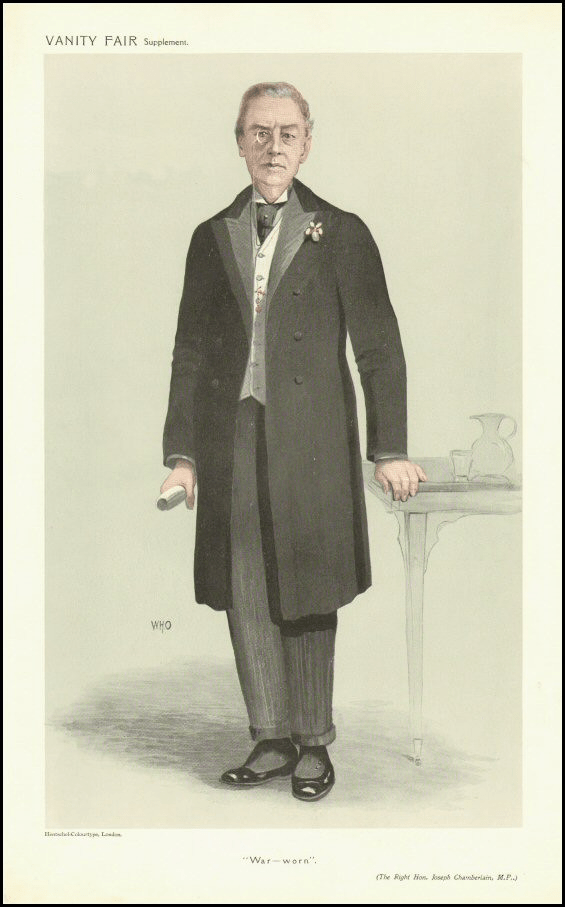
An ageing Chamberlain caricatured by “WHO” for Vanity Fair, 1908. Although his family attempted to conceal his disability, Chamberlain was barely capable of standing unaided by this time and was no longer an active member of the House of Commons. By “WHO” (unidentified Vanity Fair artist) – Published in Vanity Fair, 29 January 1908, as “Men of the Day” Number 1103.Downloaded from vanityfairprints.com, Public Domain, https://commons.wikimedia.org/w/index.php?curid=12524042

For the two decades before the Boer War, Chamberlain was never a blind supporter of free trade as a goal in itself. Instead, his goal was to both tighten the bonds of the Empire and, simultaneously, solve Britain’s domestic economic and political problems. He therefore merged political and economic nationalism in coming up with a formula for imperial preference in trade and tariffs. Historian Dennis Judd has said of him:

There is something so elemental and, in a way, timeless about the meteoric rise of Chamberlain: from his modest London Unitarian background, via his brilliant industrial and commercial career in Birmingham, to a position of almost supreme political power, where he could (and did) make and break the two major parties of late-Victorian and Edwardian England, destroy the immediate prospect of Irish Home Rule, reshape the British Empire, press for a restructuring of British economic policies and bestride the international stage as significantly as Rhodes or Bismarck.

Another view of him is that he was always a radical in home affairs. For instance, after leaving the Liberals, he remained a proponent of workmen’s compensation and old-age pensions. Though he became a ‘constructive’ imperialist in foreign affairs, these dual stances, apparently contradictory to many historians, were not, in reality, in great conflict with each other – with both, like many fellow radical dissenters, he rejected “laissez-faire capitalism”.

A Further Scene from Baptist History, from an unpublished play-script written by Revd. Arthur J Chandler, Minister of Bearwood Baptist Church, Birmingham, 1965-1979:
Regent Street Baptist Chapel, Smethwick, nr. Birmingham. There has been a Baptist Congregation worshipping in Regent Street, Smethwick since 1877. The current building has stood in Regent Street since 1893 and from its outward appearance is a typical Victorian chapel.

Setting: Regent Street… the Church in Meeting assembled with the pastor, Revd. Hugh Singleton, in the chair. Time: November 1897.

Hugh Singleton: The motion has now been proposed, seconded. All those in favour… Ah, carried unanimously! …

And now, brethren and sisters, may I share with you a project near to my heart, a matter which has been uppermost in my mind for some time.

When I came from Workington and settled here in August 1894, we had well-equipped chapel premises. We were then, I suppose, small in number and there was a crippling debt of four hundred pounds. Under God’s blessing, our numbers have grown and our debts paid.

For some time the need for School buildings has been urgent and I am still overwhelmed by the generous promises you made at our last Church Meeting – of gifts totalling four hundred pounds.

But Dr Shakespeare, our Baptist Union Secretary, will expect Regent Street to respond equally generously to the Twentieth Century Fund for Baptist Extension in the British Isles, and Bearwood, now, as many of you living there well know, is a growing district, for which I feel we are particularly responsible. It needs a Baptist Church.

For these reasons, my friends, I am going to be very bold and recommend to you the suspension of our scheme for new ancillary buildings – desperate though we are for additional accommodation for our School. We have premises in which to gather our children: Bearwood has none. I ask you to give me every assistance you can in my resolve to establish a Baptist witness there. We will resume our effort for a new Schoolroom when the proposed work at Bearwood is put on a sound footing. Are you with us?

William (a member): May I say something here, Mr Singleton?

Singleton: Certainly, William. You would not ask permission to address the Church unless you were under the Spirit’s constraint. Speak, brother.

William: I just wanted to say that I share to the full your pastoral concern for Bearwood and I promise here and now to give my fullest support to any enterprise the Baptists of Smethwick and neighbouring churches may feel led to initiate there. But some of us – indeed I am sure that I speak for most of us – are anxious about you and feel that we must do something practical to safeguard your physical well-being.

You came to us after twelve and a half very exacting years at Workington. You went there straight from Rawdon College in response to a call from the Lancashire and Cheshire Association – of which at the time your own pastor at Cannon Street, Accrington, the great Charles Williams was Secretary – for there was as yet no Church at in Workington to invite you, and you spent your first three weeks seeking out what few Baptists there were in that Cumberland town of twenty thousand inhabitants. …

… You found the place and the prejudice against the Baptists to be great handicaps. And when you left – I mention this for the benefit of our younger members – you left behind you a flourishing, self-supporting Church, with Chapel and School all free from debt. Many churches – some large and influential – sought your oversight without success. You came to us, believing it was God’s call.

Several: Bless the Lord. Amen. The Lord’s Name be praised.

William: You have given yourself without stint to the work here and we are grateful. In addition, you have been elected to the School Board, you have taken an interest in all the institutions of the Borough, not to mention the Nursing Institution, the Cripple’s Union and the Aid Society.

Sir, when we called you we solemnly undertook to take care of you. And take care of you we will. Too many of the Lord’s servants these days are being lowered into an early grave, much to the delight of our great Adversary, the Devil.

Sir, we beg of you, consider it possible that it may be unwise to make further demands upon your energies. Bearwood is a needy area. But Regent Street – your own church and people – need you, too.

There! I have said what it was in my heart and on my mind to say. And I think that others will feel as I do.

Deacon: (rising) I can assure brother William that the Deacons share his affectionate concern and our Pastor knows full well what is our view. Again and again, in the Deacons’ Court, we are constantly requesting Mr Singleton to ease up and to conserve his energies. Please God, he has a long and fruitful ministry to sustain among us. Couldn’t one of the other Ministers be asked to take the lead?

A sister, Emily: (rising) Mr Singleton, in some churches women have to remain silent. But churches of our faith and order have always ‘suffered’ a woman to speak! And sometimes, in consequence, they really have suffered! Or so the men will say. Seriously, though, we wives spend our lives looking after our men – nudging them when they are too slow, checking them when they are too hasty. I understand the point brother William has so effectively made. I share his view.

But I warn you – put shackles on this man (she points to Mr S), this prophet of God and true Seer, this evangelist, this soul-winner, if ever a man was … muzzle if you must the mouth of a man who cannot but speak the things he has seen and heard… and you will spend eternity regretting it.

This is the way God made Hugh Singleton. He cannot hug this wonderful salvation to himself, safeguard it as his own private possession, he believes that Christ Jesus tasted death for every man, and every man must know; he cannot be held within the narrow limits of one local Church; like John Wesley, having a whole Christ for his salvation, a whole Bible for his staff, a whole church for his fellowship, he must have a whole world for his parish. Out-reach is the breath of his nostrils; Evangelism is his life-blood. Take this opportunity from him, tie him up in some straight-jacket, keep him occupied making the machinery of Regent Street tick over – and this man, a giant among us, will become just an ‘ordinary’ minister – a tragedy fit to make the angels weep! If Bearwood has made a Macedonian call, and Hugh Singleton has heard it, then loose him and let him go! And let us also go with him.

Singleton: (emotionally) Sister Emily, I thank you. As you were speaking a text from the Psalms came to my mind: The Lord gave the Word; great was the company of women that published it abroad. You have been God’s messenger to us all. If this is, as with all my heart I believe it to be, a Heavenly Vision, then we must not be disobedient. Are you with me, brothers and sisters? Need I put it to the vote?

Member: No Sir, we will be upstanding as a sign that we are with you. God bless Bearwood. Our scheme shall stand suspended for the present.

Hugh Singleton: I thank you, my friends. (Boyishly) Now I may tell you that so sure was I of the leading of God’s Spirit that in anticipation of your approval I have already booked a classroom in the Bearwood Road School for a series of meetings, and I propose to conduct the first Service there in the New Year, 1898, on 30th January to be precise, and then I shall preach on every evening of the following week. May the Lord bless his work with signs following. Amen.

And now may I close in prayer:

O Lord, who didst command us all to go into all the world and preach the Gospel to every creature, in nearby Judea and Samaria as well as the uttermost parts of the earth, in all our rightful concern for the heathen abroad, may we ever be mindful of the needs of those who are our neighbours. Grant us thy blessing as we go forth bearing precious seed, so that we – or those who will come after and reap where we have sown – may, at last, come with rejoicing, bringing our sheaves with us. Amen.

(He concludes with the Benediction)

Background notes:

Bearwood was until the end of the 19th century simply a crossroads, Bearwood Road leading from Smethwick to Harborne, crossed the main Hagley Road and also the road from Birmingham to Rowley (the present Sandon Road). Inns stood at each of these crossroads and a few cottages around the junctions. In the 1890’s the rapid expansion of both Smethwick and Birmingham arrived in Bearwood and within a period of about 15 years the area was fully developed with good quality houses in relatively wide streets, it became a popular place with people working in both Birmingham and Smethwick. Regent Street Baptist church in Smethwick felt led to establish their work in the area and in 1898 began holding services in the newly built Bearwood Road school. The church rapidly established itself and within a short time, a site was bought on the corner of Bearwood Road and Rawlings Road. A church and schoolroom were planned and the Schoolroom was built and opened in 1903. Services and other activities were held there until a new church could be added. In 1915 Bearwood Baptist Church became independent of Regent Street, having been successfully nurtured by the Smethwick Baptists.

https://www.bearwoodbaptist.org.uk/historyofbbc.htm

Socialism as a Matter of ‘Faith’ – Methodist or Marxist?:

By the end of the nineteenth century, ‘Secular’ British Socialists possessed a ‘faith’ in the righteousness and ultimate victory of their cause which acted as a powerful driving force. This faith owed as much to Methodism as to Marxism, being based both on Christian principles and the ‘scientific’ analysis of contemporary society first presented by Karl Marx and Friedrich Engels. Much of this analysis was modified, however, by Henry Hyndman and the Fabians, by William Morris and Robert Blatchford, though it still had a comprehensive reality for those who accepted it. To its working-class adherents, it gave a sense of purpose and pride in class consciousness; to middle-class philanthropists, it afforded the consolation that they were working in solidarity with a range of tendencies of social change and progress. It was this intellectual, religious and political milieu that poverty began to attract more attention once again primarily due to men and women of public conscience, notably the nonconformist shipowner Charles Booth and a member of the Quaker chocolate manufacturing family, Seebohm Rowntree, who began to investigate it, to quantify it and to reveal its extent in irrefutable detail for the first time. Thirty per cent of London’s population at the beginning of the 1890s fell on or below Charles Booth’s poverty line and in certain parts of London the percentages were far higher, sixty-eight per cent in Southwark, for instance, and sixty-five in Greenwich. Rowntree’s figure for York in 1899 was hardly any lower so that cases of real want could no longer be characterised as unrepresentative.

As Pelling concluded in his seminal work, The Origins of the Labour Party, the history of the world had often shown the dynamic qualities of a faith devoutly held, like that of the early Christians, the Calvinist reformers and the millenarian sects of the seventeenth century. Faith may feed on illusions, but it is capable of conquering reality. In a tract published by the Fabians, Socialism and the Teaching of Christ (1897), Clifford wrote of the Collectivist Gospel as having at least four distinguishing merits, in that…

  • while it does not change human nature, It destroys many of the evils of modern society because it sets everybody alike to his share of the work, and gives to him his share of reward;
  • it ennobles the struggle of life, leaving man free for the finer toils of intellect and heart: free ’to seek first the kingdom of God and his justice’, since that kingdom is made real ’not for the sake of life, but of a good life’… in keeping with ’the mind of Christ’;
  • it offers a better environment for the development of the teaching of Jesus concerning wealth and the ideals of labour and brotherhood,..
  • it fosters a higher ideal of human and social worth and well-being through a more Christian conception of industry; one in which every man is a worker, and each worker does not toil for himself exclusively, but for all the necessities, comforts and privileges he shares with all members of the community.

But despite the revelations of Booth and Rowntree that poverty was still alive and ‘well’ in the richest country in the world, there was an overall rise in living standards for the majority of British people over the Victorian and Edwardian periods. The growing urbanisation of the country which many people thought aggravated the problems of the poor also made it easier to deal with the worst social injustices. Towns provided an increasing range of free services, as local government expenditure almost doubled between 1900 and 1913. It was in towns that free school meals and school medical inspection began. Better medical attention was becoming available, too, in hospitals, which catered mainly for working-class patients. Paradoxically, the changing composition of the ruling classes gave the emergent working classes the opportunity to fight for a share in the spoils of progress and power. Initially, working-class activity had taken the form of semi-legal organisations and actions, mainly aimed at restricting production and/or trade. But once the working classes had established more ‘mature’ craft-based trade unions, and economic and political organisations, the manufacturing and professional middle classes were not slow to entangle them in their political intrigues and religious conflicts.

On the other hand, by 1913, the revolutionary syndicalist ideas which had preoccupied many industrial workers in the previous decades throughout Europe, including the British Isles, and across America, were in decline. It had become obvious that the respectable ‘Edwardian’ working classes as a whole had no use for the concept of violent revolution. Any leader who failed to recognise this could not expect to win widespread support. Economic grievances could temporarily arouse bitter discontent as they had done in the early years of the industrial revolution. But dislocations of this type were for the most part transitory: a permanent political organisation of the working class needed to disavow the use of violence. Only those who recognised this could effectively set in motion the movement to form a Labour Party. At the time Keir Hardie retired from the chairmanship of the ILP in 1900, it had captured trade-union support, with the ultimate objective of tapping trade union funds for the attainment of political power. But before the war, it was the Liberal Party, with the support of Labour after 1910, that offered the best prospect of a national programme of social reform.

Sources:

Tim Dowley (ed., et. al.) (1977), The History of Christianity. Berkhamsted: Lion Publishing.

John Briggs & Ian Sellers (1973), Victorian Nonconformity: Documents of Modern History. London: Edward Arnold.

Henry Pelling (1965), Origins of the Labour Party. Oxford: OUP.

John Gorman (1980), To Build Jerusalem. London: Scorpion Publications.

Asa Briggs (ed) (2001), The Penguin Atlas of British & Irish History. London: Penguin Books.

C. H. Spurgeon (1891, 1982), The Greatest Fight in the World. Belfast: Ambassador Publications.

C. H. Spurgeon (2001 ed.), Counsel for Christian Workers. Fearn (Ross-shire): Christian Focus Publications.
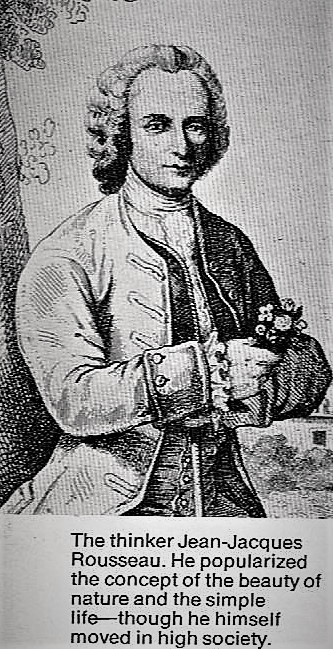
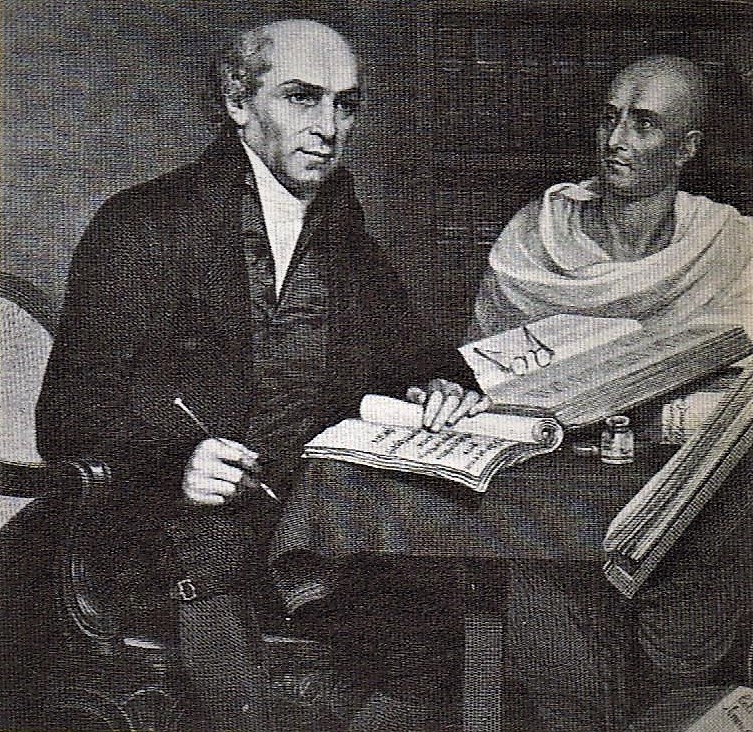
https://en.wikipedia.org/wiki/Joseph_Chamberlain

The Enlightenment & Eighteenth-Century Rationalist Critics of the Bible: A Supplementary Summary.

For Calvinists at the time, as for many other conservative theologians since Spinoza, his role has been seen as purely destructive, as that of one who undermined the authority and inspiration of the biblical text and laid the foundation for Enlightenment scepticism about the Bible – the scepticism of the French philosophers, Voltaire (1694-1778) Rousseau (1712-1778) and Diderot (1713-84) as well as that of British ‘Deist’, David Hulme (1711-1776). It is even possible to view his endorsement of the central teaching of Scripture as no more than a cynical way of trying to avoid censure for his views – an aim, which if it was indeed his aim, he certainly failed. But John Barton (2019) concludes that Spinoza’s motivation in questioning the authorship of biblical books was ultimately political. He quotes Nadler’s view in A Book Forged in Hell: Spinoza’s Scandalous Treatise and the Birth of the Secular Age:

By showing that the Bible is not, in fact, the work of a supernatural God, “a message for mankind sent down by God from heaven”, as Spinoza mockingly puts it, but a perfectly natural human document; … naturalising the Torah and the other books of the Bible and reducing them to ordinary (though morally valuable) works of literature, Spinoza hopes to undercut ecclesiastic influence in politics … and weaken the sectarian dangers facing his beloved Republic.

At the same time, as John Barton also argues, it is possible to see him as both a pioneer of biblical criticism and as one who kept a firm hold on the essentials of biblical faith, while stripping away the whole scaffolding of interpretative subtlety that had tried to bring every last word of the Bible into an orthodox structure and, in the process, had lost the heart of the matter. In the eighteenth century, it was the negative side of Spinoza’s work seemed to come to the fore. Especially in Great Britain, rationalism generally prevailed, and the biblical text was much depreciated as crude and bloody, with the nobler sentiments of some of the New Testament seen as overlaid with inconsistency and falsehood: these denunciations reached a peak in Thomas Paine’s The Age of Reason (1794), but they can also be found in the works of many writers of the earlier part of the century such as David Hume and Edward Gibbon (1737-94).

An extreme example was Thomas Woolston’s six Discourses on the Miracles of our Saviour (between 1727 and 1729), in which he argued that we need to allegorise the miracle stories in the Gospels since, taken as literal history, they are so incredible that no sane reader would believe them. Yet he made such outrageous claims about the stories, including those of the resurrection appearances, that even by today’s liberal ‘standards’ that it is hard to accept his overall claim to be an orthodox Christian. Few rationalist writers went as far as Woolston, but his extreme case does still highlight a certain prevalent school of thought. He became something of a martyr for his beliefs. He was tried for blasphemy, sentenced to a year’s imprisonment and a fine of a hundred pounds. Unable to pay, he spent the rest of his days in prison. But there were less savage ways of replying to Deism. Thomas Sherlock, a bishop and best-selling Christian author, took his cue from Woolston’s trial and wrote a book called The Trial and Witnesses of the Resurrection in 1729 in which he put the resurrection witnesses into the dock. It went on to be reprinted into the nineteenth century. Another opponent of Deism was Bishop Joseph Butler whose Analogy of Religion (1736) argued that the evidence of nature and the testimony of Christian faith both pointed in the direction of supernatural religion. Among the rationalists, however, there were many staunch defenders of biblical orthodoxies, such as William Whiston and Anthony Collins. But the deist Matthew Tindal (1657-1733) saw the essential circularity of many defences of the authority of Scripture, as we still do today when he wrote:

It’s an odd jumble, to prove the Truth of a Book by the Truth of the Doctrines it contains, and at the same Time conclude those Doctrines to be true because contained in that Book.

In 1678, Richard Simon, a French Oratorian priest (1638-1712) published his Critical History History of the Old Testament, followed in the next few years by works on the text of the New Testament. By showing, like Spinoza had done eight years previously, that the biblical books had not been written by their supposed authors, Simon argued that Protestants were in error in thinking that they could rely on the Bible alone as the foundation of the Christian faith. The Bible was unreliable, and so the Church’s traditional and magisterial authority were needed if faith was to be securely grounded. Cardinal Richelieu, however, saw that this dangerously demoted the Bible below what was tolerable, resulting in Simon being suspended from his Oratory. Nevertheless, Simon’s arguments were, in themselves, sound enough, and his position alongside Spinoza as one of the founders of modern biblical criticism is a reminder that this was not, in origin, a purely Protestant movement, even though it would be Protestants, especially in Germany, who subsequently developed the rational study of the Bible to become a major industry.

The methods employed in such studies were, however, essentially the same as those used in secular criticism, which led many to believe that they were part of an anti-religious agenda. Major eighteenth-century contributions to textual criticism were made by J. A. Bengel (1687-1752), who published a critical edition of the New Testament in 1734, and J. J. Wettstein (1693-1754), whose two-volume edition of the New Testament appeared in Amsterdam in 1751-52. One of the first writers to try to rebut the accusation of blasphemy against those who claimed that Moses did not write the Pentateuch was Salamo Semler (1725-91), whose Free Research on the Canon, published in four volumes (between 1771 and ’76) sought to distinguish the essential supernatural message of the Bible from the detail of biblical exegesis, which belonged to the sphere of normal secular literary enquiry and on which no issue of faith turned. Semler argued that this distinction could be traced back to Luther. What was essential to faith, as Luther had asserted, was the assurance to believers that God accepted them by his free grace; who wrote this or that book was a matter of, at best, secondary importance, on which faith had nothing to say. This was challenging for many orthodox Christians, but it laid the basis of biblical enquiry in Germany for the next two centuries.

Yet Semler’s position about separating faith from criticism is arguably overly optimistic, and for many ‘fundamentalists’, then as now, the suggestion of even the smallest discrepancy in the Bible was and is, the ‘thin end of a wedge,’ because the very possibility of it calls into question the foundation of their faith. This may be an exaggeration, but there is an underlying point to it. It is doubtful whether Semler’s approach is compatible with the Reformed tradition after Luther, and it clearly clashes with the modern conservative evangelical stance on the centrality of Biblical authority to faith. Despite Luther’s relatively ‘relaxed’ attitude to biblical criticism, most ordinary Protestants reacted as though these issues were being brought forward for the first time. H. S. Reimarus (1694-1768) is remembered as the father of the ‘quest of the historical Jesus’ and was the first to show that Jesus’ message was thoroughly eschatological, inaugurating the ‘last days.’ But he also went beyond this to claim, like Spinoza and Thomas Woolston, in claiming that the biblical narratives were susceptible of a naturalistic explanation. Reimarus was a deist, and could not believe that God had intervened in the world following its creation. In the case of the resurrection, he argued that the disciples had stolen Jesus’ body to make it appear that he had risen. Then the later evangelists invented his predictions of the resurrection:

Having stolen the body they then proclaimed that this had indeed happened, as he had foretold. They reinforced their claims by twisting some Old Testament texts into supporting the case, giving it bite by adding that the world would shortly end and that anyone who had not accepted their message would burn in hell.

Robert Morgan with John Barton (1988), Biblical Interpretation. The Oxford Bible Series (OUP), p 55.

Rationalism and empiricism were not the only intellectual movements of the period. In its own day, Deism was proked a great deal of discussion. Like both of the former movements, Deism became increasingly hostile to the Christian faith in the eighteenth century. But the original Deism of the previous century in England was an attempt to demonstrate the rationality of belief in a divine creator without appealing to the special revelation of God in Christ. Matthew Tindal’s (1730) work Christianity as Old as the Creation argued that Christianity was really the religion of nature. Of course, the Christian faith holds certain central beliefs that go far beyond natural religion, such as the incarnation, but these were explained away as the work of superstitious priestcraft. The deists also attacked the arguments based on fulfilled prophecy and miracles. Like Reimarus, Anthony Collins claimed that the Old Testament prophecies did not really fit Jesus, and Thomas Woolston attacked the resurrection stories as, at best, myth and at worst as a fraud perpetrated by the disciples who had in fact stolen the body of Jesus.

But the natural theologians neglected the teaching of the Bible so much that in time some came to argue that its distinctive doctrines were either superfluous or false. They claimed that the parts of the Bible that agree with natural theology are simply unnecessary; the parts that contradict natural theology – the myths, miracles and priestly prattling – are simply untrue. The Christian religion consists solely of what nature and reason teach unaided: the belief in and worship of God, the repentance of sin, the practice of virtue, and the expectation of punishment and rewards after death. The number of deists greatly increased both in England and continental Europe during the first half of the eighteenth century, and the two branches of the movement had some common roots. For example, John Toland, the author of Christianity Not Mysterious (1696), was patronised by the German nobility. The work of the English deists was also known and discussed in Germany, where the effect was a demand for an enlightened re-evaluation of the church and its teaching, and of culture and philosophy. One of the leading ‘enlightened’ thinkers was the dramatist and amateur theologian, G. E. Lessing (1729-81). In his plays, Lessing shifted from the themes of classical tragedy and tales of kings and nobles to the dilemmas of middle-class life. Parts of Reimarus’ writing on Jesus were published posthumously by Lessing, thus lengthening and broadening their impact. He took up the deists’ view of Jesus, claiming that the resurrection was a fraud invented by the disciples, who merely wanted to continue their ‘easy’ way of life.

Orthodox Christians responded to the deists in various ways. Many continued with ever more detailed elaborations of natural theology, particularly in using the argument concerning ‘design’. In England, John Ray’s (1691) publication, Wisdom of God Manifested in the Works of Creation passed through numerous editions. Other Christians chose to defend the Bible by showing that its authors were reliable and honest. They then used the evidence of miracles and prophecies to show that orthodox beliefs were reasonable. The classic literature on ‘Christian evidence’ grew and remained popular until the mid-nineteenth century The deists were best combated by writers who questioned and reinterpreted the role of ‘Reason’. In The Case of Reason (1731), William Law showed that it was false to suppose that God always behaves according to strictly human rationality. George Berkeley, in Alciphron (1732), argued that God’s ideas are what really exists, not matter. Therefore, all beliefs that separate the human reality from the divine are faulty. In fact, the sceptical philosopher David Hume had a limited effect on his own century, His Dialogues Concerning Natural Religion appeared only posthumously, in 1777, influencing more the following century. Writers of natural theology continued to follow the laws laid down in the deistic controversy. Their work culminated in the most popular apologetic texts ever written: William Paley’s (1794) View of the Evidences of Christianity and Natural Theology (1802).

Sources:

John Barton (2019), A History of the Bible: The Book and its Faiths. London: Allen Lane (Penguin Books).

Tim Dowley (ed.), et. al. (1977), The History of Christianity. Berkhamsted: Lion Publishing

Scenes from Baptist History: Persecution of the Puritans, Evangelical Revival & William Carey, 1662-1812.

Persecution of All ‘Nonconformists’, 1662-87:

An ejected minister meets with his family under cover of darkness.

It was not until 1687 that the dissenting or ‘nonconformist’ churches felt able to look back upon ye Times of our late Troubles since the Act of Uniformity in 1662 had taken away the relative toleration they had experienced in the Interregnum. The Presbyterian minister Richard Baxter (1615-91) had taken very little notice of the Conventicle Act of 1663 but was preaching in his own house to his family and ‘friends’, first in London and then at Acton. Before long, many people from his own former parish and neighbouring ones were coming to hear him. He was careful not to preach to them during times of worship in church, and since his house was close by, he would often preach before the service and then take his congregation over to hear the new Vicar, who was – at first – pleased to have such large congregations. But he soon became jealous because he knew that the people had come, first and foremost, to hear Baxter, so he told the King that the latter was breaking the Act and two magistrates were sent to threaten the minister with prison if he did not stop preaching. He refused to do so and was sent to Clerkenwell gaol where he was allowed to have a room of his own where his wife could join him. The prisons became full once more crowded with Quakers, Dissenters and Presbyterian ministers ejected from parish churches. Baxter himself soon needed the comfort that his faith always brought him, as the poem he wrote shows:

Must I be driven from my book,

From house and goods and dearest friends?

My Lord hath taught me how to want

A place wherein to put my head.

No walls or bars can keep Thee out

None can confine a holy soul,

The Streets of Heaven it walks about

None can its liberty control.

In the winter, these prisons were bitterly cold and damp, and in summer they smelt atrocious and were full of flies and rats, spreading disease so that many people died in them. Baxter himself became ill, even in Clerkenwell, and might have died had not his friends managed to get him set free before his sentence was over. When he came out, he could not return to Acton due to the Five Mile Act of 1665, which prevented ministers from coming within five miles of any important town or of any place at all where they had once been ministers. In practical terms, this meant that not only had they no means of livelihood but also that they could get no bread from their home parish. Some went abroad and others hid near their old homes, visiting their wives and children secretly, at night. Many others, like Baxter, thought that it was better to go on preaching and teaching openly, even if they were sent to prison than to starve, or worse still, see their children starve. Baxter had to spend the winter in very cold and uncomfortable lodgings in Totteridge near Barnet, still unable to preach, but at least able to continue to write. He stayed there but was very busy in his one poor, smoky room as all sorts of sad people, rich and poor, learnéd and simple, wrote to him or came to see him, asking him for help. Some of them were ministers who, like himself, were excluded from their homes and livings due to the Restoration laws. One wrote that his wife and six children had lived ever since his ejection on black rye-bread and water, and another that he had to spin all day and half the night to make a living. Baxter and his wife Margaret did their best to help them all.

King Charles certainly wanted to protect Catholics from persecution, and would probably – if left to his own devices – have allowed freedom of worship to both Catholics and Nonconformists. Many moderate magistrates understood that he did not want severe punishments for those who refused to conform and therefore allowed services and preaching to continue to be held in private houses. In 1672, the King went further in issuing a Declaration of Indulgence which did away with some of the fierce laws against nonconformists and said that licences for preaching would be granted to certain ministers, including Baxter. He returned to London and settled in Bloomsbury, recommending his preaching in a big room over the market-house at St James which almost collapsed with the weight of the congregation he attracted. Margaret Baxter prevented this by quick thinking, and then bought some land nearby and built a chapel on it. But the King was forced by Parliament to put an end to his ‘Indulgence’ and Baxter was threatened with being imprisoned once more if he used the chapel.

William Penn

Baxter was then invited to Rickmansworth in Hertfordshire, where he met the famous Quaker, William Penn (1644-1718), who later founded Pennsylvania as a colony that attracted many Protestant nonconformists who had been persecuted in Europe, as a state where they were able to worship and serve freely. He and Baxter held a meeting, a disputation, in which they argued before an audience over seven hours, without even breaking for lunch. Both Baxter and Penn respected one another, though their viewpoints were at opposite ends of the nonconformist spectrum, so they did not agree on many points. But the fact that they were both in constant danger of persecution and prison yet went on preaching and discussing shows the constant courage of leaders across the range of dissenting movements.

Jordans, Buckinghamshire, The Quaker meetinghouse, 1688. is associated with William Penn, founder of Pennsylvania, buried in the graveyard outside.

A Scene from the Trial of Richard Baxter before Judge Jeffreys,1685:

The site of Baxter’s trial in front of Judge Jeffreys.

Richard Baxter was eventually brought to trial in 1685 in front of Lord Chief Justice of England, Judge Jeffreys who, at the Bloody Assizes later that same year, sent many West Country nonconformists to the gallows following the Monmouth Rebellion. James II had become King in February 1685 and he especially hated nonconformists because so many of them had opposed him. He thought that the best way of punishing them was to bring him to a public trial, but it was unclear what the charge could be since he had recently retired from preaching due to ill-health. But he was still writing books and had recently finished a Commentary on the New Testament. Jeffreys claimed that this contained thinly-veiled attacks on both the King, the bishops and the 1662 Prayer Book. Baxter was brought to trial at the Guildhall in the City of London on 30 May 1685. Fortunately, we have a full, if anonymous, account of the court proceedings, signed only with the initials I.C. by which the author identified himself to an ‘old friend’ who was also a friend of Baxter. It was not sent until five years later after James II had fled from England. But I.C. wrote his account immediately after getting home from the Guildhall. It reveals the vitriol with which Jeffreys tried Baxter on behalf of the Crown and the Anglo-Catholic ‘establishment’:

“This is an old rogue and hath poisoned the world with his Kidderminster ‘doctrine’ … an old ‘schismatical’ knave, a hypocritical villain: but what ailed the ailed the stock owl that he could not conform – was he better or wiser than any other man? He hath been ever since the spring of the faction. I am sure that he hath poisoned the world with his… doctrine … he was a conceited, stubborn, fanatical dog, that did not conform when he might have been made a bishop; hang him! … This one man hath cast more reproach on the Constitution of our Church than will be wiped out this hundred years; but I will handle him for it, for by God! – he deserves to be whipped through the city! …

Baxter’s lawyer replied to his ‘charge’ that it was not his business to explain why Baxter’s conscience would not let him become a bishop but to answer the charge against his commentary. At this, Jeffreys, in a rage, called upon Baxter to answer the charge directly himself. Baxter did so, calmly:

One day, all these things will surely be understood and it will be seen what a sad and foolish thing it is that one set of Protestant Christians are made to persecute another set. I am not concerned to answer such stuff (as I am accused of) but am ready to produce my writings, and my life and conversation is known to many in this nation.”

When Baxter tried to speak again, the Judge stopped him and continued himself, apparently more softly, and more sinisterly:

“Richard, Richard, … dost thou think we’ll hear thee poison the Court? Richard, thou art an old fellow, an old knave; thou hast written books enough to load a cart, every one full of sedition, I might say treason, as an egg is full of meat, Hadst thou been whipped out of thy writing trade forty years ago, it had been happy. Thou pretended to be a preacher of a Gospel of Peace, and thou hast one foot in the grave … but I leave thee to thyself and I see thou wilt go on as thou has begun; but by the Grace of God, I’ll look after thee.”

I.C. ended his story bitterly and sarcastically:

Mr Baxter is now in prison at Southwark, where he lies for the fine of five hundred marks. We have fine judges and juries in England you see! This viper, I am told, proposed a whipping through the city, but I hear that some of his brethren abhorred the notion and stamped on it. So amonst them out of their great clemency, they have set the above fine.

If Jeffreys had had his way and Richard Baxter had been whipped through the streets of London, he would certainly have died, but even Jeffreys could not enforce this punishment against the other judges. Baxter refused to pay the fine which had been wrongfully imposed on him, so he remained in prison for a year and a half. As for Jeffreys, when, during the Glorious Revolution of 1688, he tried to escape from London, disguised as a sailor, he was recognised by some of his victims just as he was going down the steps at Wapping to board a ship. He was nearly torn to pieces by the crowd but was rescued and sent to the Tower, where he soon died from his injuries.

Scenes from the failed Monmouth Rebellion, supported by the nonconformists of Dorset, Devon and Somerset and commemorated on playing cards.

Toleration, Theological Liberalism & Hyper-Calvinism:

The accession of William and Mary brought a return of only limited toleration, but all active persecution of the nonconformists finally stopped. The oppressive laws remained, though Protestant dissenters of Trinitarian beliefs who subscribed to the main points of the Thirty-Nine Articles were exempted from penalty. Baxter persuaded many of his friends and followers to agree to the less severe tests, writing a book to help them see the wisdom of doing this, and that they would not be acting against their consciences. Having made this last attempt at moderation and peacemaking, Baxter died in 1691, with England finally at peace. With the Toleration Act of 1689, new chapels sprang up all over the country.

Nowhere was the Nonconformist movement stronger than in East Anglia. The simple but elegant places of worship they built are continuing proof of their devotion, vigour and wealth. Bury, Ipswich and Framlingham all have fine Unitarian, originally Presbyterian, chapels, and there are old Congregational chapels at Needham Market and Walpole. When Daniel Defoe visited Southwold, he attend divine service at the parish church with twenty-seven others. When he walked past the dissenting chapel afterwards, he found it full to the doors. But also with toleration came a wider range of theological views, and there were still many divisions and doctrinal quarrels. Dissenters and Anglicans both suffered a decline in religious vitality as a result. On the one hand, the General Baptists, like the Presbyterians, fell prey to the spread of ‘Arianism’, which denied the divinity of Christ. The Particular Baptists, on the other hand, over-reacted against theological liberalism. They tended to stress the sovereignty of God to such an extent that both individual moral action and evangelism were inhibited by what became known as ‘hyper-Calvinism’.

In response to the Liberal and Rationalist attacks, a ‘natural theology’ was developed to defend the Christian faith in the course of the eighteenth century. At no time previously had it seemed more important to use ‘apologetics’ to make Christianity appear ‘reasonable’. On the continent, first Descartes and then Rousseau, Voltaire and Leibniz had exalted reason and doubt in building their influential philosophies. Spinoza and historians such as Simon and Bayle had had also stimulated scepticism by criticising the Bible. But in England, Isaac Newton in his (1687) Principia Mathematica had set out laws for which for the first time revealed that the universe was divinely ordered. This encouraged the belief that human enquiries into nature unaided by Scripture could demonstrate the power of the Creator. But above all, the century of appalling religious conflicts – the Thirty Years’ War in Germany, the persecution of Jansenists and Huguenots in France, the Puritan Revolution, the British Civil Wars, the Monmouth Rebellion and the ‘Glorious’ Revolution of 1688 had all combined to create a thirst for tolerance and a desire to find doctrines on which most Christians, at least, could agree.

Philosophical Scepticism in Britain:

The Reasonableness of Christianity, the title of John Locke’s revolutionary book, published in 1695, became the main theme of theology for more than a century. The fundamental truths of the Christian religion were claimed to be few and simple, intelligible to the plainest of people. The immense size of the universe, the stability of its bodies and the simplicity of its laws; the position of the earth, the usefulness of its resources and the variety of its inhabitants; and the detail, order and symmetry of every form of life, all witnessed clearly to God’s existence, his wisdom and goodness, his purposes, providence and power. They witnessed, in other words, to a God of whom it was probable that a special revelation had been given. That revelation, given in the Bible, confirmed that Christianity was basically reasonable. In 1691, Robert Boyle, a chemist and natural theologian, founded a lectureship for proving the Christian Religion, against notorious infidels, viz. Atheists, Theists, Pagans, Jews and Mahometans, not descending lower to any Controversies, that are among Christians themselves. The Boyle Lectures continued for many years.

A more general philosophical scepticism began in Britain with David Hume. In his lifetime he was perhaps best known for his History of England, but today he is most remembered for the scepticism which Bertrand Russell claimed showed the bankruptcy of the eighteenth-century reasonableness. Hume’s sceptical thought was embodied in such works as Treatise of Human Nature (1739-40), Philosophical Essays Human Understanding (1748) and Dialogue Concerning Natural Religion (1752). Hume’s scepticism extended to the whole range of human knowledge. He claimed that it was impossible to demonstrate the existence of the soul or self, for whenever we look into ourselves we see only some feeling of pleasure or pain, but never the soul as such. Hume questioned the logic of speaking about cause and effect. He insisted that all we can see is one event following another. We do not see the cause as such, but only the sequence of events. In religion, therefore, he cast doubt on the old proofs for the existence of God, pronouncing the idea of a first cause to be useless. Miracles violate the laws of nature and are therefore improbable. For, since a firm and unalterable experience has established the laws of nature, the proof against miracles is as complete as any proof can be. Hume influenced many thinkers, from Kant in the eighteenth century to the logical positivists in the twentieth. But it is worthwhile pausing to ask how valid Hume’s arguments really were.

There is a sense in which what Hume says about the self is true. It cannot be seen directly, like an arm or a leg, or even a brain. But this is not the same as getting rid of the self altogether, for when we try to look into ourselves the self is active as the organising subject of the action. In other words, in order to refute the self as an object, Hume has to make use of the self as a subject. What the argument shows is something of the peculiar nature of the self. Similarly, Hume did not dispose of the idea of causation. The whole of our everyday experience of things and the whole fabric of modern science rest upon the principle that, when certain things always follow other things under given conditions, then it is proper to say that one causes the other. The idea of a law of science depends upon the fact that things do not just happen at random, but that some things are causes and other things are effects. This was the very same law that Hume depended on for his rejection of miracles.

Some of Hume’s criticisms of the arguments for the existence of God were entirely justified. A cause cannot be wholly known from its effect, and the original cause is hidden from us by myriads of other causes. Moreover, if we have an argument for God’s existence from causation and another from design, we need another argument to show that God in each case is one and the same. And we need a further argument to show that this God is the same as the God of the Christian faith. But to say all this is simply to spotlight certain ways in which the existence of God has been argued. It does not settle once and for all the question as to whether God exists, still less does it settle the question of who God is. Hume’s critique of miracles made some telling points, but when he writes about a firm and unalterable experience, he did not ask or answer the question, whose experience? If we take a sample of experience only from those who have no experience of miracles, then we are bound to conclude, as he did, that miracles have not been experienced. But if we include cases of experiences to the contrary, we cannot say that miracles are automatically ruled out, and have never happened. They may be unusual and contrary to common experience, but we cannot rule them out on the basis that they are at variance with all human experience.

The Unitarian Movement in Europe & Britain:

The Unitarian movement also emerged in England in the turbulence of the Civil War period, but it first began on the continent in the early sixteenth century when Renaissance ideas combined with some of the teachings of the ‘Radical Reformation’ to produce Unitarian ideas in the minds of many individuals. As the name suggests, Unitarianism rejects the idea of the Trinity, questioning the belief in the divinity of Christ and in the Holy Spirit in favour of the oneness of God. It was a ‘heresy’ that had been present in the early church, and notable early adherents included Martin Cellarius, Michael Servetus and Bernard Occhino. The ‘new’ teaching alarmed both Catholics and Protestants. Servetus was put to death by Calvin in 1553. Two prominent centres of early Unitarianism were Poland, where the ‘Polish Brethren’ as they were known, were formally organised in 1565, and Hungary. After 1574, when Faustus Socinus became their leader, the movement spread rapidly in Poland, but in the reign of the Catholic King Sigismund III (1587-1632) a reaction set in and the Unitarian community at Rackow was suppressed in 1638.

In 1658, the Polish Unitarians were given the chance of conforming or going into exile. Many chose exile and emigrated to Holland, Hungary and England. Giorgio Blandrata had also been active in Poland between 1558 and 1563, then moving to Hungary to become the court physician, where he had a strong influence on Ferenc Dávid (1510-79) who, in 1564, became the bishop of the Reformed Church in Transylvania, the eastern part of the old kingdom. In the same year, he also became court chaplain to the king, Jan Sigismund (1540-71). At the Diet of Torda (1568), the king ordered Unitarianism to be tolerated. In 1571, it was recognised as a ‘recognised religion’ along with Catholicism, Lutheranism and Calvinism. But when Jan Sigismund died in the same year, persecution began and by the later eighteenth century Unitarianism in Hungary had been almost completely suppressed. It only revived in the early nineteenth century when contacts were resumed with English and American Unitarians. Unitarian theology in Hungary was always compromising and conservative. It did not want to invite persecution by appearing aggressively heretical.

John Biddle (1615-62) is regarded as the founder of English Unitarianism, which remained individualistic at first, but in the rationalistic atmosphere of the eighteenth century, very many English Presbyterian and General Baptist churches began to be affected. They adopted first Arian and then Sabellian, Socinian or full-blown Unitarian ideas. Both became largely Unitarian denominations by the second half of the eighteenth century. The liberal Anglican Theophilus Lindsey left the Church of England in 1773 and opened the first self-styled Unitarian church, Essex Chapel, in London.

Meanwhile, there were theological changes in Unitarianism. Joseph Priestley (above) and his successor, Thomas Belsham, found their source of authority in Scripture. They interpreted the Bible in a rationalistic and optimistic way, to get around those verses which Christians had previously used to support the doctrine of the Trinity and the belief that man has a fallen nature. In Ireland, Thomas Emlyn was prosecuted at Dublin in 1703 for denying the deity of Christ. A Unitarian ‘Non-Subscribing Presbytery of Antrim’ arose out of a group of liberal Presbyterian congregations in 1726. After the American Revolution, Unitarianism spread rapidly, encouraged by Priestley, who fled there from England in 1794.

All ages are ages of transition, and most of them contain extremes. The period between 1650 and 1789 was no exception. It opened with the end of the Civil Wars in Britain and ended with the beginning of the French Revolution. Protestantism was already well established when the period began, but there was a further philosophical quest for truth and rationality. In religion, there were also quests for greater doctrinal clarity and deeper personal knowledge of God.

The Great Awakening in America & Britain:

By the second half of the eighteenth century, in the English-speaking churches, the age of reason became the age of renewal. The tide of rationalism was stemmed and deadening formality was replaced by enthusiasm, a fresh wind of the Spirit. This rebirth took place in the 1730s and ’40s. Its roots lay partly in the Pietist movement on the European continent partly in the revival of Puritanism in Britain and colonial America. The movement was known as the Evangelical Revival or the Great Awakening, which was also its name on the American continent. It began there in Northampton, Massachusetts, under Jonathan Edwards (pictured above), in 1734. This preceded the conversions of both George Whitfield and brothers John and Charles Wesley, and can therefore be regarded as feeding into the Evangelical Revival in Britain. The movement came to fruition in colonial New England between 1740 and 1743, the time of George Whitfield’s whirlwind visit.

George Whitefield

In 1690 the total population of the colonies of about a quarter of a million was almost exclusively British or Irish. European Protestants had begun to arrive; mainly Huguenots, Mennonites and Dutch Calvinists. The American Baptists trace their ancestry to a congregation at Providence, Rhode Island, where they were first gathered by Roger Williams, a separatist from London who had been ejected from the Puritan colony of Massachusetts. Most of those making up the first congregations were English or Welsh Baptists who already shared Williams’ beliefs and grew slowly until The Great Awakening. In the meantime, there had also been large-scale immigration of German Protestants belonging chiefly to the Lutheran Church, fleeing religious persecution in the Palatinate. When William Penn invited them to his colony, Pennsylvania, they crossed the Atlantic in their thousands and by the mid-eighteenth century, there were seventy thousand Germans in that one colony alone and almost three times that number in North America as a whole. Among them were also Moravians, Dunkers and Schwenkfelders. These German settlers introduced a different element into American society, which had previously been dominated by the Calvinist tradition. The German groups had already been touched by the Pietist movement which also lit the fires of Methodist Revival in England and Wales.

George Whitefield was the son of a Gloucester innkeeper, born in 1714. He had once wanted to become an actor but instead used his oratorical skills to become an outstanding preacher during the Revival. He was educated at Pembroke College, Oxford, and there became associated with the Wesleys and others in the ‘Holy Club’. Converted in 1735, he was ordained deacon in the Church of England in 1736 and set sail for Georgia the following year. In America, he engaged in a variety of charitable and church work. He returned to England briefly between 1738 and 1739 in order to be ordained as a priest and to collect money for his new orphanages and schools. It was during this year back home that he first discovered his talent for open-air evangelism. He returned to Georgia in 1740, for a second visit to America, setting off on a six-week tour of New England which resulted in the most general awakening that the American colonies had yet experienced.

In Boston, the crowds were so huge that they could not be accommodated in any of the churches, and Whitefield took to the open air, as he had previously done in England. He preached his farewell sermon to a congregation estimated at twenty thousand. Before leaving he invited Gilbert Tennent to Boston in order to blow up the divine fire lately kindled there. The revival continued in Boston with equal success for a period of eighteen months. Thirty religious societies were formed and churches were packed. Services were regularly held in homes. It was said that even the very face of Boston seemed to be strangely altered. A similar tale was told as Whitefield continued his triumphal journey. In the next three years, more than one hundred and fifty churches were affected by the Awakening, not only in New England but also in New York, New Jersey, Pennsylvania, Maryland and Virginia. In the latter colony, this paved the way for the outstanding preaching of Samuel Davies and the building up of the Presbyterian church there. The Baptists also began to expand, through evangelists like Daniel Marshall and Shubal Stearns. They soon began rejuvenating the revival itself. Devereux Jarrett attempted to revive the established Anglican church, but it proved largely unresponsive. One effect of Whitefield’s visit was to rouse the established ministers, for – as he explained:

“The reason why congregations have been so dead is because dead men preach to them.”

During the Awakening, ‘dead men’ came alive and were themselves used to revive and add to their own congregations. Spiritual liberation paved the way for political liberation and contributed indirectly to the American revolution. Christianity acquired such a firm hold that it expanded with the western frontier and ensured that the independent nation would rest on a firm foundation.
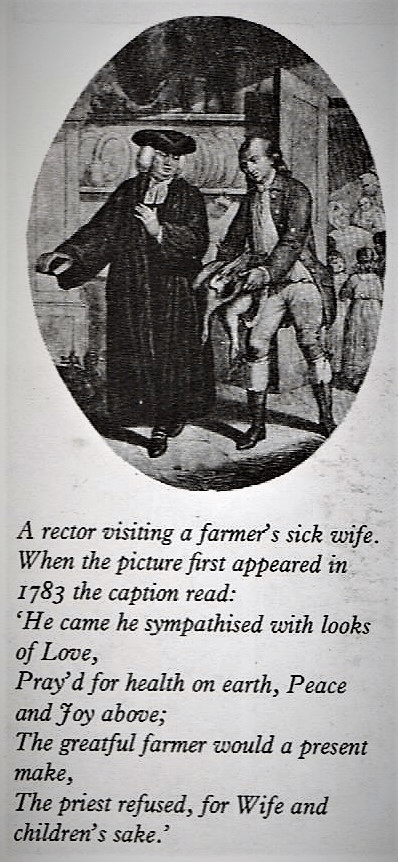
Calvinistic Methodism in Wales, England & Scotland:

Returning to England once more in 1741, Whitefield embarked on a round of missionary tours which took him what were then enormous distances and were to continue almost to the end of his life. He made early contact with Hywel (Howell) Harris and the Welsh revival. Harris, pictured below, was Whitefield’s exact contemporary. While it is usual to regard the Revival as running from 1738 to 1742 (as it did in England), the first signs of it in Britain had, in fact, appeared earlier, and almost simultaneously, at Talgarth (near Brecon) and Llangeitho (near Tregaron, Ceredigion) in Wales in the summer of 1735. Griffith Jones had been preaching the evangelical message in Llandowror for the past twenty years, so he well deserves his title morning star of the Methodist Revival. Harris, a schoolmaster at Talgarth, was converted at a communion service on Whit Sunday in 1735 after reading books published by the Society for Promoting Christian Knowledge, with which Griffith Jones was closely associated. Harris said that his heart was filled with the fire of the love of God. He witnessed to his newfound experience and soon gathered a little society of fellow believers. They were the beginnings of the Welsh Calvinistic Methodist Church. Although unordained, Harris began to preach in private houses. People were transformed, as was the district, and further societies were started. The Welsh Revival had begun, three years before The Awakening began in England and a year before Whitefield’s first visit to America.

Daniel Rowland of Llangeitho had been spiritually awakened through a sermon by Griffith Jones and his preaching in turn brought about an awakening in his own parish. Harris and Rowland met and from that point worked together for the spiritual welfare of Wales. But Harris could be awkward and dictatorial and though he was an impressive figure with a powerful voice and magnetic personality, he was no theologian. Nevertheless, his enthusiasm won many to Christ, and there were signs of the blessings of the Holy Spirit wherever he preached. George Whitefield became closely associated with the Welsh Calvinistic Methodists and toured south Wales several times with Hywel Harris, preaching in English followed by Harris preaching in Welsh. Whitefield preached in many chapels owned by Selina, Countess of Huntingdon, who was the patroness of the Revival. Horace Walpole nicknamed her ‘St Teresa of the Methodists’. When evangelical preachers were banned from Anglican pulpits she found them a place in her domestic chapels and drawing-rooms. She made possible the proclamation of the Gospel to the aristocracy. In 1768 she founded the preachers’ (theological) college at Trevecca (Trefeca) near Talgarth, run by Harris. In 1779, the Countess was compelled by law to register her chapels as ‘nonconformist meeting houses’; they became known as ‘the Countess of Huntingdon’s Connexion’.

Besides his tours of Wales, Whitefield paid fourteen visits to Scotland, where, on the second, he helped during the famous Cambuslang revival, which began the Scottish awakening. Its impact on the national church there was even more marked than in England and Wales. It is no exaggeration to say that the history of Scottish Presbyterianism was radically altered. The eighteenth century was once described as the dark age of the Scottish Church. A debate about patrons had drained its energies and left it incapable of facing the more damaging challenge of theological scepticism. John Simson, Professor of Divinity at Glasgow University, was accused of teaching heretical views about the person of Christ, similar to those voiced in England by the deists. One of his students, Francis Hutchinson, set out to put a new face upon theology in Scotland. In his ideas, known as ‘Moderatism’, the gospel was reduced to a system of morality that offered only a flimsy hope to those who wanted assurance about eternity. Ministers were more concerned about culture than conversions and dismissed their heritage, which included persecuted Covenanters, with derision. A group of objectors set up an independent presbytery and were forced to leave the national ‘kirk’ in 1740. They themselves insisted that they were only withdrawing from the ‘prevailing party”, not from the Kirk. The ‘Seceders’ gained some support, and their breakaway might have spread, but revival broke out in the parish of Cambuslang in 1742.

There had already been stirrings of revival in Easter Ross and Sutherland in the north of Scotland. John Balfour emerged as the leader of the moment in the northern Highlands which reached its peak in 1739. All this happened even before Whitefield set foot across the border, though he is often referred to as the bringer of revival to Scotland. As in America, he sowed the seed on well-prepared soil. He was first invited to Scotland in 1741 by the Seceders, but when he refused to confine his activities to their churches, they disowned him. Immediately, however, he found an opportunity to work within the Church of Scotland. In 1742 William McCulloch was ‘used’ to spread the revival known as the ‘Cambuslang Wark’ which was well underway when Whitefield visited the parish of Cambuslang during his second Scottish tour. He shared in two memorable, open-air communion services. Commenting on the second of these, McCulloch described…

“… the spiritual glory of this solemnity … the gracious and sensible presence of God“.

Revival quickly spread to the surrounding area, with another ‘outbreak’ occurring at Kilsyth. James Robe had preached there for over thirty years without obvious effect. In 1740 he began a series of sermons on the new birth and two years later was able to report that:

while pressing all the unregenerate to seek to have Christ formed within them, an extraordinary power of the divine Spirit accompanied the word preached.”

Similar scenes were repeated for eighteen months or more. Cambuslang and Kilsyth were the highlights of the Scottish Revival. The excitement subsided but the benefits remained. The Evangelical party, mocked as ‘Zealots’ or ‘High-flyers’ by their opponents, took over from the moderates and shaped the outlook of the church. Whitefield was certainly the pioneer of Calvinistic Methodism in England. His converts in London and Bristol were the first of The Great Awakening in the country. He was the first to start field preaching, to recruit lay preachers and to travel to and fro as one of God’s runabouts, as he described himself. He was also the first to make contact with the American awakening, visiting America seven times in all and dying there in 1770.

This building was erected at Moorfields, just outside the City of London, to accommodate Whitefield’s congregation.

Whitefield’s legacy is generally thought to be that of a fervent persuaded, who helped and then left others to build churches out of his converts. Certainly, his letters to Wesley and his entrusting the care of the English societies to Harris in 1749, underline his lack of interest in the administrative task of raising and caring for infant churches. But he founded the English Calvinistic Methodist Connexion, whose first conference met in 1743. This boasted important London chapels, such as Moorfields (above) and the Tabernacle, Tottenham Court Road. These churches, also part of the Countess of Huntingdon’s Connexion, which was strong in the south and west of England. These kept up a distinct existence until they were absorbed into Congregationalism in the nineteenth century. Whitefield’s theology was centred on the old Puritan themes of original sin, justification by faith and regeneration. Sometimes he was militantly Calvinist, but he preached with a rare passion for winning souls for Christ. After 1740, his Calvinistic form of Methodism came into sharp conflict with the Wesleys’ Arminianism, thus opening up a breach that was never healed. His preaching style was dynamic and compelling; he spoke with fervour, yet in a style that was plain, unadorned and often colloquial. His physical bearing commanded attention and the range of his voice was astonishing. Anglican pulpits were often barred to him, his open-air services were often interrupted, and he was a favourite target for anti-Methodist disrupters and propagandists. In many ways, his work complements that of Wesleyan Methodism. In some respects, he was the forerunner of the Wesleys: for example, in his choice of Bristol as a base for evangelism, in daring to preach the open-air, publishing a magazine, founding a school and summoning a conference of preachers.

Pietism, the Moravians and the Wesleys:

The Great Awakening in England was focused largely on the established church and the groups which eventually broke away from it. On the continent of Europe its source in the Pietist movement, which had been cradled in the Dutch Reformed Church in the early seventeenth century. The Pietist revival across the continent re-emphasised the importance of regeneration, personal faith and the warmth of Christian fellowship as a spur to effective missions. Pietism revived the vitality of the Lutheran Church in Germany. One of the more obvious links between German Pietism and the Evangelical Revival lies in the fact that many of the new hymns inspired by the Pietists were translated by the Wesleys and became widely used in England and Wales. Pietism also stimulated missionary concern, which became a prominent feature of the revival in both Britain and America. Through Count von Zinzendorf, Pietism made its impact on the ‘Moravian’ community, who were the spiritual descendants of Jan Hus. Driven from their homeland during the Thirty Years’ War, they were scattered throughout Europe, losing many members. In 1722 a small company of them settled on von Zinzendorf’s estate at Herrnhut in Saxony, which then became a haven for radical Protestant refugees from all parts of Germany as well as from Moravia and Bohemia. Besides the United Brethren, Lutherans, Separatists, Anabaptists and Schwekfelders were also represented. In May 1727, this assortment of traditions came together to accept an apostolic rule of forty-two statutes, so raising again … out of its ashes that ancient Unity of the Moravian Brethren who thereby became the vital leaven of European Protestantism.
Count von Zinzendorf, the founder of the Moravian Church.
He laid great stress on the importance of emotions in religious expression and wrote many hymns.

There are clear links between the renewed Moravian community and the Evangelical Revival in England. Most famously, it was a Moravian leader who steered John Wesley towards his dynamic conversion in 1738. The Wesley brothers first met a group of Moravian missionaries on a voyage to Georgia a year earlier, in 1737, on a mission for the Society for the Propagation of the Gospel. They were greatly impressed by the spirituality of the Moravian Brethren. Charles acted as secretary to the governor of the colony, but they were both dissatisfied with the result of their mission and returned to England in 1738. It was another Moravian, Peter Böhler, who was eventually responsible for counselling John Wesley in London as he searched for the assurance of saving faith in Christ. Within three days of each other, each of the brothers had a vital Christian experience, Charles on Whitsunday, and John on 24 May, when his heart was strangely warmed during a meeting at Aldersgate Street when a passage from Luther’s Preface to the Romans was being read. It was an event that has been characterised as the turning point of the Evangelical Revival if not in contemporary English History: What happened in that little room was of more importance to England than all the victories of Pitt by land or sea. And when John wanted to consider the implications of his revolutionary experience, it was to Herrnhut that he went. Many of the features of the Moravian community were taken up by the Wesleyan Methodist societies – for example, the love feast, the watch night and the class meeting. Wesley and Whitefield were both mightily used in the Revival, but much of its inspiration can be traced to the Moravian missionaries. John Wesley was soon to part company with the London Moravians and take a line of his own, but he owed them an incalculable debt. He said of Böhler:

“Oh what a work hath God begun since his coming to England! Such an one as shall never come to an end, till heaven and earth shall pass away!”

A caricature of the state of the eighteenth-century Church of England.
William Hogarth illustrates the lifelessness of a sermon.

Anglicanism & Wesleyan Methodism:

The Anglican church of the eighteenth century, though not as lifeless as William Hogarth’s contemporary pen and ink drawings reveal it to be, certainly stood in urgent need of revitalisation. The seeds of decline had been sown in the previous century which had left those in the established church with an understandable fear of extremes, whether Roman Catholic or Puritan. This resulted in a form of moderation that frowned on passionate convictions of any variety. Most sermons tended to be no more than moral essays at best, or crass homilies at worst. Added to this, the collapse of personal faith led to a slide in moral standards: Permissiveness was the order of the day. The orthodox theologians eventually emerged victorious in their long battle with Deism, but it was sadly ironical that though they had effectively defended the central doctrines of the Christian faith, the new life in Christ these were intended to encourage was nowhere in evidence. A new dynamic was needed, and it was this that the Evangelical Revival supplied, reminding the Church of its own spiritual resources. John Wesley himself spoke candidly about the irreligion of his time: What is the present characteristic of the English nation? he inquired rhetorically, answering, it is ungodliness … our universal, our constant, our peculiar character. The hymn-writer, Isaac Watts, regretted what he called… the decay of vital religion in the hearts and lives of man.

… and its impact on attending parishioners.

John and Charles were born at the rectory at Epworth in Lincolnshire, in 1703 and 1707 respectively. Charles was the eighteenth child in the family. Their father, Samuel Wesley, was a staunch high churchman but their grandparents were nonconformists. Susanna Wesley, their mother, was a remarkable woman whose influence on her sons was exceptionally strong. After attending different schools, Charles at Westminster School, each went up to Oxford, Charles entering Christ Church in 1726, just after John had completed his course there and had been elected a fellow at Lincoln College. It was Charles who started the Holy Club while his elder brother was away from Oxford, serving as his father’s curate. On his return, John took over as leader, though it was Charles who guided the devotional reading of George Whitefield before his conversion. Charles became a tutor at Christ Church in 1729, the same year that what Charles described as the harmless nickname of Methodist was originally applied to the Holy Club. This was because the group aimed to provide a disciplined method of spiritual improvement. Members pledged themselves to have regular private devotions and to meet each evening to read the Bible and pray together. Several labels were invented for them by jeering undergraduates – Enthusiasts, Bible Moths, Sacramentarians – but ‘Methodist’ was the one that stuck.

John Wesley later traced ‘the first rise’ of Methodism to these years. Charles was ordained in 1735 and joined his brother who was evangelising in the colony of Georgia. The second stage, John explained, began in 1736 when ‘the rudiments of a Methodist society’ emerged in Georgia, but by then Charles had returned to England, where he came under the influence of the Moravian missionary, Peter Böhler, and underwent a conversion to the ‘vital religion’ of evangelicalism. He then became an itinerant preacher for most of the rest of his life. Meanwhile, John Wesley helped to reframe the rules for an Anglican society that met in Fetter Lane, London. This came before his revolutionising conversion, just three days after that of his brother. The culmination of these preparative stages, the strange ‘warming’ of John Wesley’s heart on 24 May 1738, undoubtedly provided the most vital stimulus to the movement in England. The Oxford scholar was transformed by the grace of God into ‘the apostle of England’. The Revival had found its true genius. On 1 January 1739, a remarkable ‘Love Feast’ was held at Fetter Lane in London. There the leaders of the Revival were welded into a fellowship of the Spirit in a way similar to what had happened at Herrnhut in 1727. The Wesleys were present, along with Whitefield and Benjamin Ingham, who was to become an outstanding evangelist among the Moravians. John Wesley recorded in his Journal:

About three in the morning, as we were continuing instant in prayer, the power of God came mightily upon us insomuch that many cried out for exceeding joy and many fell to the ground. As soon as we were recovered a little from that awe and amazement at the presence of His majesty, we broke out with one voice, “We praise Thee, O God, we acknowledge Thee to be the Lord.” ‘

This Pentecost on New Year’s Day confirmed that the Awakening had come and launched the campaign of extensive evangelisation which sprang from it. Wesley explained what happened next by stating that it was…

… just at this time … that two or three clergymen of the Church of England began vehemently to “call sinners to repentance”. In two or three years they had sounded the alarm to the utmost borders of the land. Many thousands gathered to hear them, and in every place they came, many began to show such a concern for religion as they had never done before.

It is important to understand that the eighteenth-century revival in England was a work of the Holy Spirit that developed through various channels. There were the Moravian, Calvinistic and Wesleyan missions, which produced the societies which were eventually to evolve into the Methodist Church. In addition to these three strands, there was also a movement within the Church of England which became known as Anglican Evangelicalism. At first, all who were caught up in the spiritual renewal were called either ‘Methodists’ or ‘Evangelicals’, irrespective of which denomination they belonged to. But gradually the Evangelicals became recognised as a formal grouping within the Church of England who were seeking to achieve their aims within its existing framework. Cornwall was the cradle of Anglican Evangelicalism, where Samuel Walker of Truro emerged as the leader of the movement until his death in 1763, but it quickly spread to the rest of the West, to the Midlands, the North, London and East Anglia. The Anglican Evangelicals witnessed particularly effectively at the universities of Oxford and Cambridge.

John Newton (1725-1807), the one-time slave trader turned preacher and hymn-writer was curate of Olney in Buckinghamshire. He was one of the most remarkable figures of the Evangelical Revival, perhaps even its unsung hero. Sent to sea at the age of eleven, after just two years of schooling, at the age of twenty-two he began the captain of a slave ship trading between Britain, the West African coast and the West Indies. Three years later he underwent a dramatic conversion on a voyage across the Atlantic. A violent storm blew up, and Newton spent nine hours manning the pumps and a further seventeen hours at the ship’s wheels as the waves crashed around him. Several times he found himself crying aloud to God for salvation. The storm eventually abated, and Newton later traced the first stirrings of the ‘great change’ that was to turn him towards evangelical religion to his sense of deliverance after his terrible experience. Forsaking the slave trade and his seafaring life, he became friendly with John Wesley and George Whitefield and spent nine years training for the Anglican ministry. In 1764 he was ordained and became curate at Olney, where he remained for sixteen years, then going to London as rector of St Mary Woolnoth, where he remained until his death. ‘Amazing Grace’ first appeared in Olney Hymns in 1779. It reflects Newton’s own intense conversion experience and his profound sense that it was only the overwhelming grace of God that had saved one as wretched as himself from eternal damnation.

An artist’s impression of the ironworks at Colebrookdale in Shropshire, England.

The Wesleys were convinced that at all costs all the people of Britain must hear the good news of salvation. While other clergy confined themselves to their parishes, the brothers believed that their call was to travel from place to place. They preached in churches whenever pulpits were made available to them, but more often, as opposition grew, the only possibility they had was to go out into the marketplace or onto the common, so that the crowds might hear. The result was that the working classes were drawn to Christianity as the Industrial Revolution got underway. It was in the Midlands that the Industrial Revolution made its first impact. Quakers like the ironmaster Abraham Darby at Ironbridge in Coalbrookdale and the potter Josiah Wedgewood sought a lifestyle for their workers which had much in common with the seriousness of life often attributed to Evangelicalism. In fact, it was more a product of the revival of older forms of Puritanism, though it had much in common with the social witness praised by the Evangelical Revival. John Wesley, in particular, began a revolution in morals and behaviour among the working classes which spread to other classes by the beginning of the nineteenth century. The Evangelical Revival witnessed not just a revival of evangelistic activity but also a renewal of concern for Christian morality. The nineteenth-century historian, W. E. H. Lecky credited it with bringing about…

… a great moral revolution in England: it planted a fervid and enduring religious sentiment in the midst of the of the most neglected portions of the population, and whatever may have been its vices or its defects it undoubtedly emancipated great numbers from the fear of death and imparted a warmer tone to the devotion, and a greater energy to the philanthropy of every denomination both in England and the colonies.

Lecky went on to suggest that a major reason why Britain was saved from the ravages of a revolution similar to that in France was this new religious commitment. This idea was taken up by the French historian Elie Halévy who explained the extraordinary stability which English society was destined to enjoy throughout a period of revolutions and crises by reference to the Evangelical Revival. He described this as what we may truly term the miracle of England, … practical and businesslike, but religious, and even pietist. What Halévy saw as providential, Marxist historians have tended to label as a conservative sop for the economically oppressive urban society which emerged early in south Wales, the English midlands and the north of England. But it took the best part of a century for towns like Charles Dickens’ fictional ‘Coketown’ to emerge alongside William Blake’s dark Satanic mills and other historians have suggested that evangelical strength in England was too small at the turn of the eighteenth century either to prevent revolution or to act as a widespread ‘opiate’. Some have also argued that the evangelical emphasis on the ‘evils’ of capitalism can be traced back to John Wesley’s morality:

I fear, wherever riches have increased, the essence of religion has decreased in the same proportion. Therefore I do not see how it is possible, in the nature of things, for any renewal of true religion to continue long. For religion must necessarily produce both industry and frugality, and these cannot but produce riches. But as riches increase, so will pride, anger and the love of the world in all its branches.

Hymns & Spiritual Songs:

In the seventeenth century, hymns were taken or adapted from the work of poets, such as George Herbert and John Milton, and writers such as Richard Baxter and John Bunyan. Late in the century, hymns began to be freely written. Dissenters began to use them in congregational worship, the Baptists being the pioneers. Isaac Watts gave a great boost to the movement for using ‘man-made’ hymns, as distinct from the ‘inspired’ psalms in Scripture. His best-selling Hymns and Spiritual Songs was published in 1707. He followed this in 1715 with Divine Songs for children and in 1719 with The Psalms of David. In this book, he made ‘David speak like a Christian.’ For example, he transformed Psalm 72 into the missionary fervour of ‘Jesus shall reign where’er the sun.’ In over six hundred hymns, many still sung, Watts expressed wonder, praise and adoration covering the range of Christian experience. Another dissenter, Philip Doddridge, composed about 370 hymns, including ‘Hark the glad sound, the Saviour comes.’ The staunch Calvinist, Augustus Toplady, wrote ‘Rock of Ages,’ based on his experience sheltering from a storm in Somerset, lines that have been sung by Christians of all persuasions. This hymn first appeared in a magazine article calculating the ‘National Debt’ in terms of sin. Overshadowing all other eighteenth-century hymn-writers were the Wesley brothers. The Collection of Psalms and Hymns (1737), compiled by John Wesley, was the first successful hymn book compiled for use in the Church of England. John later edited collections for the Methodists, most notably for the definitive Collection (1780). This book contained many of his brother’s compositions and his own paraphrases from German writers such as Zinzendorf. Methodism, like Lutheranism, was ‘born in song.’
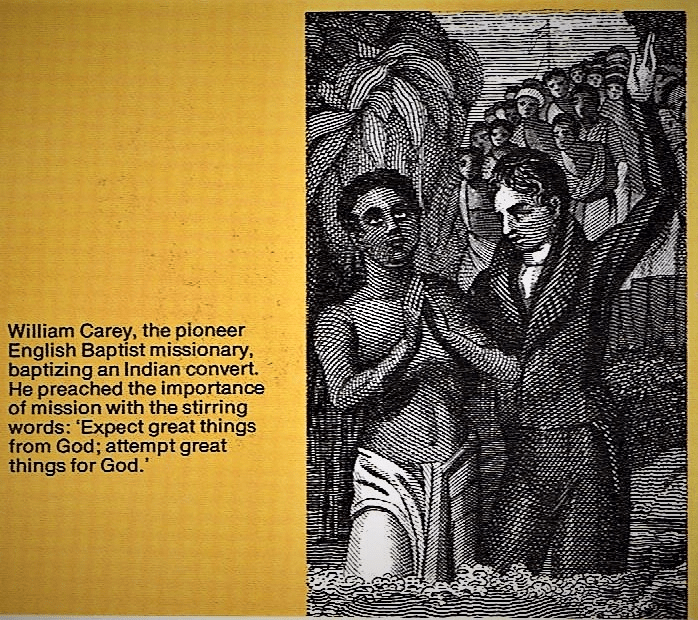
This famous hymn first appeared in 1747 but was altered by John for inclusion in his Methodist Hymn Book of 1780

In 1749 Charles Wesley married Sarah (Sally) Gwynne, the daughter of a Welsh magistrate, and made his home in Bristol. For twenty years he supervised the Methodist society which met at the New Room there. He moved to London in 1771 and shared the preaching at City Road Chapel. He has been described as the most gifted and untiring hymn writer that England has ever known. He crafted over six thousand hymns and sacred songs out of a total of nine thousand poems, so it is remarkable that so many reached such a high standard. All of them were written after his conversion to vital religion in 1738. His first hymn was And Can It Be That I Should Gain, composed just hours after he had made ‘the great change’. It was first published in his brother’s Psalms and Hymns of the same year and there is a strong probability that John sang the hymn on the evening of his own conversion, three days after his brother’s. Charles Wesley’s ‘Love Divine (right), All Loves Excelling’ expresses his doctrine of perfectionism. It suggests that Christ can transform us into children of God and that in this life it is possible to be cleansed completely from sin and made pure. Many Christians, including his brother John, have baulked at this idea and toned down the words to suggest a slightly less sweeping doctrine of sanctification.

In his hymnbook, John Wesley altered the third line of the fourth verse to ‘Pure and spotless let us be’ to avoid suggesting that Christians could achieve sinless perfection in this world. He also omitted the second verse of the hymn. All subsequent hymnbooks have followed these changes and some have also altered the second line of the third verse to ‘Let us all thy grace receive’. Hymn singing made an enormous contribution to the Evangelical Revival. The songs had at least as great an effect as the sermons. They not only expressed the joys of the Christian experience but also taught the truths of Scripture. Charles Wesley has been rightly described as the prince of English hymn-writers. His hymns are marked by a constant note of praise, for example, O for a thousand tongue to sing and Rejoice, the Lord is King. He praised God because he was amazed at his love, as in Jesu, Lover of my soul. Watts and Doddridge freely paraphrased Scripture. In addition, Charles Wesley paraphrased the Prayer Book and verified Christian doctrine and experience. In 1779, the fiery, converted slave-trader John Newton and the gentle, retiring melancholic poet, William Cowper, produced the Olney Hymns. Newton wrote Glorious things of thee are spoken and Amazing Grace! How sweet the sound. John Wesley called the Methodist Hymn Book of 1780 a little body of experimental and practical divinity.
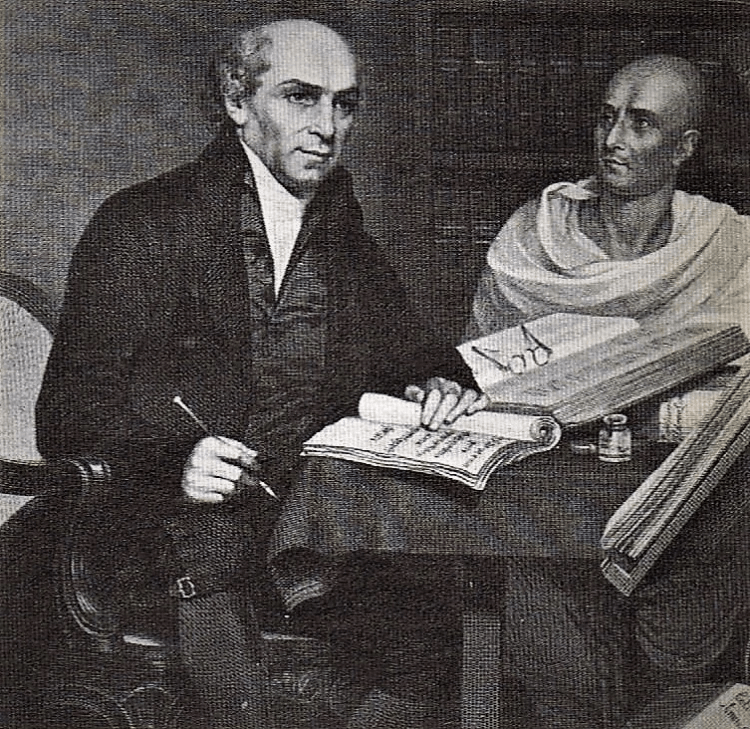
However, in the Church of England hymn-singing was long considered to be incompatible with Prayer Book worship which, in conjunction with choral music (shown below), continued to be the dominant form for another forty years. As late as 1819, Thomas Cotterill, a Sheffield vicar, was charged by a church court for using a hymn-book in services. The test case which followed led to hymn-singing being more or less legally accepted in the Church of England.

Above and Below: The Village Choir by Thomas Webster (1800-1886). The Art Archive/ Victoria & Albert Musem/ Sally Chappell.

The Apostle to the Nation:

When, as a result of his conversion, John Wesley became an apostle to the nation, he was soon faced with the problem of caring for the converts. To meet their needs, a Methodist organisation was called into being. John Wesley found societies already operating in Bristol, but in London, he was pressed to devise one of his own for those who had listened to his outdoor preaching at Moorfields. When numbers increased to about a hundred, Wesley noted their names and addresses, intending to visit each of them in their homes. He wrote in his ‘Journal’:

Thus, without any previous plan or design, began the Methodist society in England – a company of people associating together to help each other work out their own salvation.

The early successes of the Methodist preachers are often explained both by the carelessness of the many Anglican churchmen and the fact that the Church of England had very little strength in the newly urbanised parts of the country. Methodism began, not as a church or a sect, but as societies. It was born and was expected to remain, within the Church of England. From the start, John Wesley assumed that the Methodists would attend Anglican services and sacraments. He himself had no desire to break away from the established church and consistently urged his followers to stand by it, despite the opposition he met from within the societies, especially in the early years of his ministry. The title ‘United Society’ was probably borrowed from the Moravians. It indicated that even though societies multiplied throughout the country, they were regarded as parts of one national association. By 1743 Wesley was referring to the ‘United Societies’ in the plural; they were soon organised into a ‘Connexion’. Only after his death did the Methodist ‘Church’ emerge.

The parent Methodist society in London was gathered late in 1739 and met in a disused cannon-foundry. This was the headquarters of Methodism until the opening of City Road Chapel in 1778. The society included ‘voluntary bands’, select groups of up to ten Methodists supervised by a leader. In one aspect, the foundry society was unique. The sole condition for prospective members was a desire to flee from the wrath to come, to be saved from their sins. The existing religious societies were restricted to those already attached to the Anglican church, or in full communion with it, such as the Moravians. Wesley refused to impose any such ecclesiastical test and opened his new society to nonconformists too. This openness was a mark of Methodism from its origins. In 1742 the ‘class meeting’ system was introduced, which turned out to be of unspeakable usefulness, as Wesley recognised. The name was simply from the Latin word classis, meaning ‘division’ (in a specific sense), and had no connotations either of school or, at that time, social divisions. The classes were rather larger than the bands and involved every member of the society. Their original purpose was to encourage Christian stewardship since each member gave a penny a week to the funds. Then Wesley realised that the leaders were the persons who may not only receive the contributions but also watch over the souls of their brethren. The class system thus played an important role in securing discipline as well as providing fellowship and pastoral care.

In the following year, 1743, Wesley took another step by drawing a common set of rules for all his societies, for Methodism was by then a nationwide organisation in Britain as a whole. In 1744, the first Conference was held to consider the best method of carrying on the work of God throughout the lands. The Connexion was organised in a series of circuits, or peachers’ rounds. The earliest printed list of circuits, published in 1746, included seven: London, Bristol, Cornwall, Evesham, Yorkshire (covering seven counties), Newcastle and Wales. The circuits were placed under the control of ‘Assistants’ to Wesley, who were recruited from the more experienced itinerant preachers. They were responsible in the absence of the parish ‘Minister’ to feed and guide, to teach and govern the flock, and to lead the team of preachers in each circuit. From the beginning, the oversight of Methodism was entrusted to these Assistants, later called Superintendents, although their authority was always subject to that of Wesley and the Conference. The Assistants were sometimes backed up by a limited number of Anglican clergymen who were prepared to devote some part of their time to itinerate preaching for the Methodists.

In addition to the travelling preachers, both clergy and lay, others who were ‘on the spot’ shared in proclaiming the Word as local lay preachers, including some women. Of these the most notable was Mary Bosanquet Fletcher (1739 – 1815), one of the first female Methodist preachers, credited with persuading John Wesley, to allow women to preach in public. She was born into an affluent family, but after converting to Methodism, rejected its luxurious life. She was involved in charity work throughout her life, operating a school and orphanage until her marriage. She and a friend, Sarah Crosby, began preaching and leading meetings at her orphanage and they became the most popular female preachers of their time. Bosanquet was known as a “Mother in Israel”, a Methodist term of honour, for her work in spreading the denomination across England. Her husband was John William Fletcher (1729-85), a fellow Methodist who was Vicar of Madeley, in Shropshire. The couple had a joint ministry in the parish in the eighteenth century.

Preachers and members alike were committed to what John Wesley referred to as ‘our doctrines’. The basic theological conviction of the Methodists was that justification by faith is the doctrine of the church as well as the Bible. To this was added a specific emphasis that salvation is for all, and stress on the assurance of the Holy Spirit and scriptural holiness. Whitefield disagreed with Wesley’s belief in universal grace, founding the Calvinistic Methodist Connexion, as detailed above. But the two men kept in communication and helped each other from time to time. Methodism continued to spread rapidly throughout England over the next decade and Ireland, first visited by Wesley in 1747, also became a stronghold of Wesleyan Methodism. In Wales, Calvinistic Methodism prevailed, especially in the Welsh-speaking areas. Only in Scotland did Methodism fail to make much ground, though there the Evangelical Revival made its mark on the Presbyterian Church of Scotland.

The major figure in the founding of American Methodism was Francis Asbury, who came from Handsworth near Birmingham and had been apprenticed to an iron smelter before joining the ranks of Wesley’s itinerant preachers. In 1771 he responded to the call to assist in America, and he urged his colleagues there to press to the frontiers in their evangelism. Many of Wesley’s transatlantic preachers returned to England during the War of Independence, but Asbury remained and, in 1784, became one of Wesley’s superintendents there. When the Methodists adopted the title, Methodist Episcopal Church, Asbury became a bishop. This amounted to a declaration of independence. Meanwhile, in England and Wales, 1784, Methodist preaching places became licensed under the Toleration Act of 1787 and following John Wesley’s death in 1791, in 1795 the Methodist Conference took the decision to secede from the Church of England. By the end of the century, the Methodist Church was in a position to spread across the world.

Three groups emerged from the Evangelical Revival in the eighteenth century: the Methodists, separated from the Church of England after John Wesley’s death; the Calvinists, successors to George Whitefield and the Countess of Huntingdon; and the Evangelical Anglicans, of whom the key figures were Samuel Walker of Truro, Henry Venn of Huddersfield and John Newton of Olney. The Methodists believed that Christ died for all men, some of whom might attain Christian perfection in this life. The Calvinists, led by Thomas Haweis, believed that Christ died only for the Elect, and stressed that human nature was fallen in every aspect, ‘total depravity.’ The Anglican Evangelicals believed that Christ died for the whole world; they also believed in ‘total depravity,’ and shared with both the other groups the assurance that their sins were forgiven. They also held that, through Christian missions, the whole of humanity would eventually come to faith in Christ. At that time Christ would return and the millennium would begin. These were the beliefs of the group of influential evangelicals who became known as the Clapham Sect, who also became founder members of the Church Missionary Society, the British and Foreign Bible Society and The Religious Tract Society. They drew away from the Calvinists and nearer to the Methodists, as they emphasised universal grace. On the other hand, they rejected the Wesleys’ doctrine of Christian perfection. They also supported the parish system and objected to the tendency of the Methodists to establish their own churches in evangelical parishes.

The Evangelical Passion for Social Justice:

The overall effects of the eighteenth-century ‘Awakening’ are difficult to quantify or evaluate. Nominal members of the church who ‘had the form of godliness without the power’ were turned into evangelical Christians. Many thousands who before had made no claim to be Christians were swept into the kingdom of heaven through evangelism which sprang from the Revival. The clergy were reformed and re-energised and set a new, high standard of pastoral care. The ‘Awakening’ also led to the creation of agencies aimed at promoting Christian work; these are detailed below. Perhaps most importantly, in a period of rapid changes in economic and social conditions, the Revival encouraged a passion for social justice. Wesley advocated prison reform and encouraged John Howard in his crusade for this. He had a practical concern for the poor and contributed personally to their relief as well as raising funds. He saw to it that through his societies clothing was distributed and food provided for the needy. Dispensaries were set up to treat the sick. In London, one Methodist meeting room was turned into a workshop for carding and spinning cotton. Other jobs were created for the unemployed. A lending bank was opened by Christians in 1746 and legal advice and aid were also made available. Widows and orphans were housed. The Christian concern for the underprivileged led to the birth of the Benevolent or Strangers’ Friend Societies in 1787. They quickly established themselves as agencies of poor relief and bridged the gap until finally, the state took over. The Evangelical Revival made England aware of its social obligations.

The campaign to banish slavery from British colonies was led by men of evangelical convictions. In 1767, Grenville Sharp fought a case in the law courts to ensure that a slave should be freed whenever he set foot on English territory. William Wilberforce was educated at St John’s College, Cambridge and became MP for his home town of Hull in 1780 and then MP for Yorkshire in 1784, a seat which held until 1812. During a continental tour in 1784-85, he underwent a spiritual crisis which he emerged from as a believer in ‘real Christianity’ centred on Christ’s redeeming work. His conversion, while on the tour with Isaac Milner, ‘the Evangelical Dr Johnson,’ who became President of Queens College, Cambridge, gave Wilberforce the dynamism to lead the campaign against the slave trade, for which he is best known. He had abominated this since the age of fourteen but was encouraged by John Wesley, among other evangelicals, to make its abolition his mission. Wesley had expressed his humanitarian motives in his Thoughts upon Slavery (1775) in which he wrote that…
Liberty is the right of every human creature, as soon as he breathes vital air and no human law can deprive him of that right, which he derives from the law of nature.

By this time, people had also begun to question the assumption that the plantation colonies were essential to Britain’s prosperity. Here, for example, the British economist Adam Smith points out how expensive it was for Britain to defend these colonies:

The expense of the ordinary peace establishment of the colonies amounted … to the pay of twenty regiments of foot, … to the expense of a very considerable naval force which was constantly kept up, in order to guard, from the smuggling vessels of other nations, the immense coast of North America, and that of our West Indian islands. The whole expense of this peace establishment was a charge upon the revenue of Great Britain, and was, at the same time, the smallest part of what the colonies has cost the mother country. …

The Wealth of Nations (1776)

However, for many of the individual plantation owners, their profits were worth protecting, so the overall economic cost of the colonies was a price worth paying. Therefore, despite the claims of recent historians, macro-economic motives were not enough to end the Slave Trade. Religious and humanitarian motives played a significant role in ending it in a campaign lasting more than two decades and in sustaining the subsequent campaign for the Abolition of Slavery in the British Empire which occurred a quarter of a century later, in 1833, in the teeth of the fierce resistance of the sugar planters and merchants.

Thomas Clarkson had submitted a prize-winning essay on slavery in 1785, while still at St John’s College, Cambridge, Wilberforce’s alma mater, where Clarkson himself had been influenced by evangelicals. It was he who first persuaded Wilberforce to take up the issue of slavery in Parliament. From 1789 on, Wilberforce frequently moved parliamentary resolutions against the British slave trade. Only four days before his death in 1791, John Wesley penned a now-famous letter to Wilberforce, urging him to…

“… go on, in the name of God, and in the power of his might, till even American slavery (the vilest that ever saw the sun) shall vanish away before it.”

A mark of Wilberforce’s personal commitment and determination is that even after the eventual formal abolition of the British slave trade in 1807, Wilberforce continued to press for the enforcement of the ban and for European agreement to prohibit the trade.

A Revolution in Morals:

In Britain, the Wesleyans helped to bring brought about a revolution in morals and behaviour among the labouring classes. This revolution spread to other classes at the beginning of the nineteenth century through the writings of William Wilberforce (1759-1833) and his friend, Hannah More. She wrote simple moral tales, in colloquial English, and her tracts were delivered door-to-door by salesmen, very cheaply. They circulated in huge numbers and many were read at court and by the upper classes. For England’s privileged classes, meanwhile, William Wilberforce wrote his (1797) book, A Practical View of the Prevailing Religious System of Professed Christians in the Higher and Middle Classes in this Country contrasted with Real Christianity. In it, he commented on the increase in prosperity and luxury of the age, the growth of new cities, and the decline of religion, manners and morals. He reminded the rich of their duties to the poor and claimed that the only remedy for their greed and selfishness was to turn from their nominal Christianity to the real Christianity to be found in personal commitment. Several thousand copies were sold in the first six months following publication, and few books of its kind have been more influential. The new wealthy classes became more conscious of their responsibilities and some of the coarseness and cruelty which had marred social life in the eighteenth century disappeared in favour of a cult of ‘respectability’. ‘Victorian values’ arrived among the English middle classes twenty years before Victoria came to the throne. Of course, this was not the same as Wilberforce’s ‘real Christianity’ and hypocrisy soon replaced corruption as the typical sin of the age.

William Hogarth’s sketch of a woman at worship in the Anglican Church.

Early evangelicals believed neither in democracy nor trade unions, however. The French Revolution had frightened them away from such radical ideas. They were determined to do what they could for the poor, but in a paternalistic manner that would not allow the working classes to claim liberty for themselves. ‘The mainstream party’ continued the tradition of the Clapham Sect. Henry Venn was among their leaders, and their journal, which stressed loyalty to the established church, was the monthly Christian Observer, started in 1802. But in spite of theological differences in such a broad movement, there was no open rift but a continuing commitment to accommodate every kind of evangelical society and every kind of evangelical. As the leader of the Clapham Sect in Parliament, Wilberforce also helped to open India to missionaries and to protect popular travelling evangelists in Britain from government interference. He had supported repressive statutes between 1795 and 1812 in his concern to preserve constitutional order, but he was in favour of moderate parliamentary reform and relief for boy chimney-sweeps. Like Wesley, Wilberforce also advocated prison reform. Wilberforce influenced prominent politicians quietly but persuasively, particularly his friend William Pitt, who became Prime Minister, using charm, tact and eloquence in a political life to which he was sure he had been called by God.

The Impact of the Evangelical Revival on the Baptists:

The English Baptists were in no position to benefit immediately from the new lease of life represented by the Great Awakening. But several distinct movements did redirect its impact onto the Baptists. First, a group of working people in Leicestershire who had been evangelised by one of the Countess of Huntingdon’s servants came, independently, to Baptist convictions in 1755. Dan Taylor, a Yorkshire miner, converted among the Methodists, similarly came to Baptist convictions by his own study of the subject of believer’s baptism. He sought out the General Baptists of Lincolnshire to be baptised. Eventually, the Leicestershire group and Dan Taylor’s church joined together with a few General Baptist churches that remained orthodox formed the New Connexion of General Baptists in 1770. These churches prospered in the emerging industrial communities of central England, the textile communities of Lancashire and Yorkshire, and the hosiery and lace-making areas of the East Midlands. New life came to the Particular Baptists when, in 1785, Andrew Fuller of Kettering published The Gospel Worthy of all Acceptation. He proved that Calvinism itself, as distinct from the “false Calvinism” that was common in the eighteenth century, was essentially a missionary theology. This expressed systematically the doubts that a number of ministers had about the prevailing hyper-Calvinism. The Baptists, as a whole, went through their own form of rebirth in the eighteenth century. Their life from that time represents a debate between Puritanism and Evangelicalism. The General Baptists who opposed Dan Taylor’s ‘enthusiasm’ lapsed into Unitarianism; the Particular Baptists who rejected the correcting force of the Evangelical Revival and allowed only their own members to the communion table became the ‘Strict Baptists’.

William Carey’s Call to Mission:

By the 1780s, many Christians in all Protestant denominations were feeling that the signs of revival in Protestant countries foreshadowed an extension of gospel preaching to the whole world. It was the Baptists from the English Midlands who first formed an effective organization, as The Particular Baptist Society for the Propagation of the Gospel, which later became The Baptist Missionary Society. Fuller completed his book in 1781 but hesitated four years before publishing it. In 1784 he was able to apply the thought of the American theologian, Jonathan Edwards, to the English religious scene. The message of The Gospel Worthy of All Acceptation not only revived the churches at home but also gave British evangelicals a worldwide vision. Others too were influenced by the Awakening. Fuller’s colleague, John Sutcliff, issued a Call to Prayer to the Northamptonshire Baptists:

“Let the whole interest of the Redeemer be affectionately remembered and the spread of the Gospel to the most distant parts of the habitable globe be the object of your most fervent requests.”

William Carey (1761-1834) was the archetypal untiring pioneer missionary whose many-sided work in India included Bible translation and production, evangelism, church planting, education, and medical relief, as well as social reform, and linguistic and horticultural research. By the 1790s, Baptists, Arminian Methodists, impeccable Anglican churchmen, and ardent dissenters and seceders in England and Scotland were seeking to use means for the conversion of heathens as Carey himself put it. But with the rarest exceptions, such interests reached only those Protestant denominations touched by the Evangelical Revival. For the first two or three decades of the missionary movement, interest in missions was restricted to the Evangelicals. The Revival revolutionized preaching and its objectives. The clergyman’s task was viewed in traditional terms as that of nurturing the seed of faith planted at baptism in virtually all members of his parish. This concept could not easily transfer and adjust to preaching the gospel in a tribal society. Added to this, people who inherited a rigid hyper-Calvinist doctrine of predestination in which God made up his elect, saw no reason to concern themselves with why there seemed to be no elect in India or China. But the evangelicals saw preaching as calling sinners to God through faith and felt a personal responsibility to do this. They saw no difference in principle between ‘baptized heathen’ in Britain and in non-Christian peoples overseas.

As a direct consequence of this message, and out of the general renewal of Baptist life came the founding of the Baptist Missionary Society in October 1792. It was the first foreign missionary society created by the Evangelical Revival. William Carey and John Thomas became the Society’s first representatives abroad, while Andrew Fuller, with John Ryland of Bristol, John Sutcliff of Olney, and Samuel Pearce of Birmingham, supported them at home. Carey was born at Paulerspury in Northamptonshire, the son of a parish clerk and schoolmaster. In 1779 he was converted through a fellow apprentice shoemaker, becoming a dissenter, and was baptized as a believer in 1783. After some local preaching, Carey became pastor of Moulton Baptist Chapel in 1786, supporting himself through teaching and shoemaking. In 1789 he became pastor at the important but divided Baptist church at Harvey Lane, Leicester. In 1792, Carey published An Enquiry into the Obligation of Christians to use Means for the Conversion of the Heathen. In it, he argued that Christ’s great commission was to preach the gospel to every creature still applied to all Christians. In the same year, in a sermon in Nottingham, he preached the importance of mission with the stirring words:

“Expect great things from God: attempt great things for God.”

Foremost among the first fruits of the Evangelical Revival were the missionary organisations which multiplied at the end of the century. The Baptist Missionary Society was just the first of these, in 1792. Carey and his family sailed to India in the following year, 1793, devoting the rest of his life to taking the gospel to the country. He became foreman of an Indigo factory in Bengal (1794-99), a post that occupied him only three months of the year, leaving him free to study oriental languages intensively for the rest of the year. In 1799 he was joined by two fellow Baptists, Joshua Marsham and William Ward. For the next quarter-century, the three men worked together to form a growing network of mission stations in and beyond Bengal. Carey translated the New Testament into Bengali and was given a tutorship in languages at Fort William College in 1801. In the years up to his death in 1824, Carey supervised six complete and twenty-four partial translations of the Bible as well as publishing several grammars, dictionaries, and translations of eastern books. Although some of his early translations were hurried and stilted, his work was an immense achievement for a largely self-educated pioneer.

William Carey, untiring English Baptist pioneer missionary. Baptist Missionary Society.

Two scenes from an unpublished typescript by Rev. Arthur J. Chandler (Birmingham, c. 1965).
Scene One: – The Founding of the BMS (Baptist Missionary Society).

The parlour of Widow Wallis’s Home, Kettering, October 2nd, 1792:

John Timms: Do come through, Mr Fuller and brethren. Mrs Wallis has asked me to do the honours tonight. She is far from well. I am afraid the loss of her husband is still keenly felt. She bids me make you welcome and to say how pleased she is to put her home at your disposal for your Minister’s Meeting tonight.

Fuller: For twenty years now, brethren, this house has afforded gracious hospitality to the Lord’s servants. Little wonder it should have come to be known among us as ‘Gospel Inn’.

Carey: What a lovely and heart-warming welcome – and on such a night! The wind is in the east and there is a nip in the air. It’s been a sombre day, a bad day, with the sky all sables. But our meetings today have set our spirits aglow. Thank you, brother Timms.

(Timms leaves)

Fuller: A good brother. Already he is proving a fine substitute on our Diaconate for our brother, Beeby Wallis. A younger man, but quite promising. …

(They finally seat themselves)

… Brother Ryland, if I may make so bold, may I say how grateful your brethren are for your sermon this morning. You had a grand text: “I will work and who shall hinder it?” (Isaiah. 43: 15). It seems to me, and to many of us, that you have run your flag to the masthead. May I and Carey take it that you have committed yourself to the contemplated venture?

Ryland: I gladly confess, my dear Andrew, that since brother Carey’s magnificent utterance in Friar Lane, Nottingham, this May – together with your logical reasoning since I find myself with no other attitude. “Get up,” he said. “Find larger canvas, stouter and taller poles, stronger tent pegs. Dare bolder programmes. Dwell in an ampler world. Thy Maker is thy Husband. He is Lord of the whole earth”. Brethren, my rigid theory of Predestination has further been thawed by the fire of love which Samuel Pearce has this day cast in all our hearts. Bristol trained you well, Samuel.

Sutcliff: Two things impress me as I look around our group. As a Bristol man, I rejoice in the presence with us of other sons of the College: Samuel Pearce, of Cannon Street, Birmingham; Thomas Blundel, of Arnsby; and young Staughton there is just finishing his course at Bristol. And you, Doctor John, just about to consent to be its Principal. Bristol is in good evidence this night.

Ryland: And the second thing, brother Sutcliff?

Sutcliff: That is that it is young men, as Joel said it would be, who have caught the vision. I am forty; Ryland thirty-nine, Fuller thirty-eight; Carey, thirty-one; Pearce, twenty-six. The young men are not ‘sitting down.’

Fuller: And, as the world judges, there is little or no respectability amongst us … not so much as a squire to take the chair! But I move that we ask John Ryland to keep us in order!

All: Agreed!

Ryland: Thank you, brethren. But first, prayer:

‘O God, who hast promised to give Thy Son the heathen for His inheritance, and the uttermost parts of the earth for His possession, guide our thoughts and strengthen our wills to do Thine own.

Behold at Thy Commanding Word,

We stretch the curtain and the cord!

Amen.

I take it, Andrew, that our chief business now is to consider the shaping of The Plan, according to the Nottingham instruction? As I look around this circle it occurs to me that not half of you were present at Nottingham. You did not hear Carey’s sermon, or our brother Fuller’s ‘twelfth hour’ prevailing appeal. So I will ask Fuller to read the Nottingham ‘Instruction’, which he then proposed and which we passed before we dispersed that Thursday noon.

Fuller: (unfolds and reads). ‘Resolved that a plan be prepared against the next Minsters’ Meeting at Kettering, for forming a Baptist Society for propagating the Gospel among the Heathens’.

Ryland: How far has the Plan been shared? And can we here bring the project to life?

Pearce: We must, Dr Ryland, we must. One of my deacons, Thomas Potts, a wealthy manufacturer of Livery Street, Birmingham, has just returned from a visit to America, that country of unimaginable vastness to which he exports goods. (You will remember Potts as the man who financed the publishing of Carey’s ‘Enquiry’). Thomas has given us moving accounts of the need for the Red Indians and Negroes there. These are our brethren, for whom Christ died – whatever the colour of their skin. They must know the love of God in Jesus Christ our Lord. And Carey is more expert than any of us on the appalling degradation of the vast continent of India. I am sure the necessary financial support would be forthcoming. Potts will be generous.

Joshua Burton: I wish I could pledge some financial support from Foxton. But neither there nor at Roads, where brother Heighton ministers, do our members number twenty-five. And at Thrapston – as Reynold Hogg will tell you – we are too few for a far formation of a Church. Ours are little flocks. Are we not too inland and isolated to direct such an overseas effort? Ought not the greater centres and churches to take the initiative and shoulder the burden?

Reynold Hogg: Little flocks we may be. Indeed, the one flock is a little flock, but we have not forgotten the words of the Great Shepherd: ‘Fear not, little flock, it is your Father’s good pleasure to give you the Kingdom.’ Brethren, cannot the Lord save by the few as well as by the many? Since when was the battle to the strong? It is the lame who take the prey. God still chooses the weak things and the things that are not to pull down the strongholds of Satan. We are looking at God through our difficulties, whereas we should be looking at our difficulties through God. Humble pastors! Gathered in a lean-to parlour we may be, but may not our line go out through all the earth, and our influence to the end of the world?

Fuller: Thank you, Reynold. Brethren – Must Carey tug at my sleeve again this night and ask: ‘Is nothing again to be done, sir?’ God forbid!

Ryland: Brother Carey, Nottingham transformed your spirit of heaviness into a robe of praise. I hope you still wear it?

Carey: I believe that God ordains the end, but I also believe, with equal intensity that He ordains the means for achieving that end. I am certain that he has chosen this group to bring into existence a Baptist Society for the propagation of the Gospel among the Heathen. Ere tomorrow dawns, our fears will disperse like morning due before the rising sun. I know Whom I have believed. The good work He has begun in all our hearts will not be left unfinished. Courage, timid souls!

(He holds out his copy of the latest issue of the Periodical Accounts).

See what the Moravians are daring, and some of them, British like ourselves, and many only artisans and poor. Cannot we Baptists at least ATTEMPT something in fealty to the same Lord?

(A deadly hush, broken only at long last by the voice of Ryland).

Ryland: Brother Andrew, you have prepared a resolution. I believe that under the urge of Carey’s challenge we have all of us hushed our fears. If I discern aright, we are all constrained to commit ourselves. Will you read the resolution?

Fuller: ‘Humbly desirous of making an effort for the propagation of the Gospel among the heathen, according to the recommendations of Carey’s ‘Enquiry’ we unanimously resolve to act in Society together for this purpose; and, as in the divided state of Christendom each domination, by exerting itself separately, seems likeliest to accomplish the great end, we name this The Particular Baptist Society for the Propagation of the Gospel among the heathen.

Ryland: Do you so unanimously resolve?

All: We do so unanimously resolve. Aye. We will, God helping us, … (etc.)

Ryland: ‘And the Lord hearkened and heard, and a Book of Remembrance was written before him.’

Our next step is to choose an executive. Will you give me some names?

All: Andrew Fuller … John Ryland … William Carey … John Sutcliff … Reynold Hogg.

Ryland: I am sure that each of us is willing to serve?

(They all nod in assent)

Ryland: Can you elect these men?

(All show hands)

Ryland: And now, a Secretary and a Treasurer.

Pearce: I am just the visiting preacher for the day, but I know I voice the desire of all in nominating our brother Andrew Fuller as Secretary.

All: Agreed.

John Ayres: And I echo what is in all our hearts in proposing that we ask Reynold Hogg to be the Treasurer – in recognition of his whole-souled missionary zeal.

All: Agreed.

Abraham Greenwood: None of us is rich. I am in grave anxiety at Oakham. But I move that we take up from among ourselves an Offering. If we do not have not the cash in our pockets then we will write out our promises on paper.

Ryland: Timms! Can you come, please?

Timms: Sir, you called?

Ryland: Will you provide us with a receptacle for the first gifts to Modern Missions.
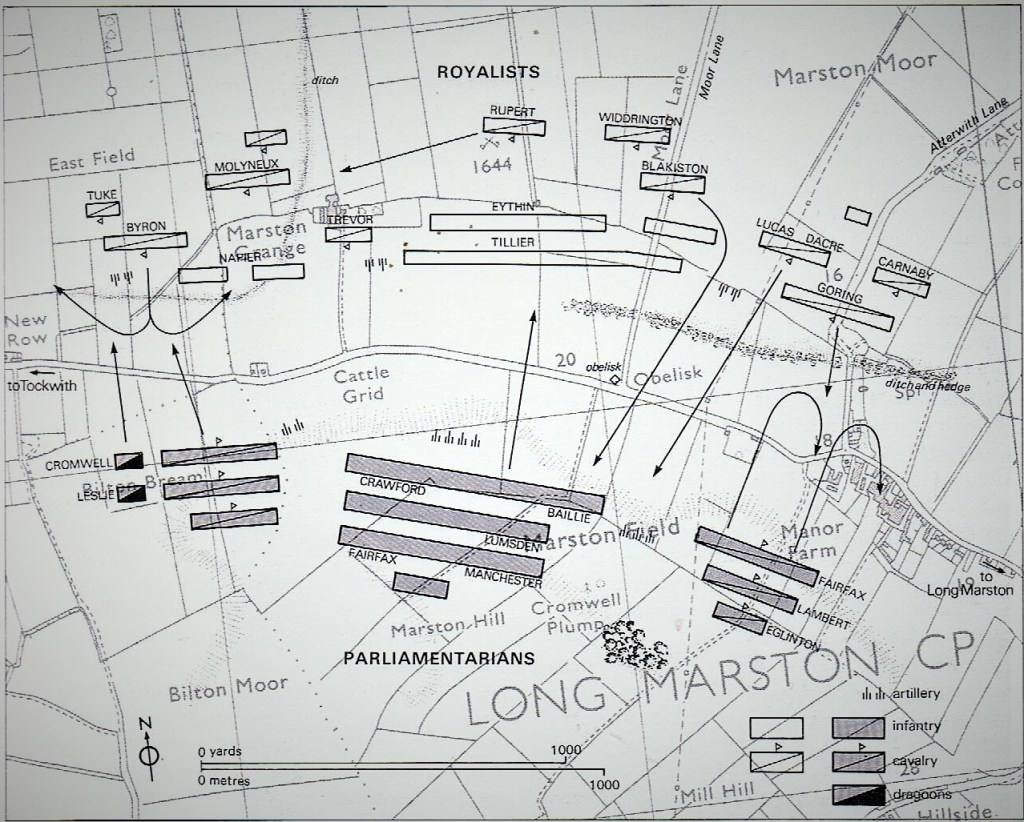
Timms: I will go and get something, Master Ryland if you will excuse me a moment.

Fuller: Stay, John! We will use my snuff box. A queer offering plate you may think, yet it has a fitness and odour of sanctity of its own. Impressed upon its lid is a representation of St Paul’s conversion – a miniature replica of the very scene in the pediment of St Paul’s Cathedral. We will pass it around quietly thanking God for the Great Apostle to the Gentiles, the man who brought the Gospel to Europe.

(Round it goes)

Ryland: It is good you remained, John. A deacon shall count the offering and tell us the amount given or promised.

(All remain silent and still as John quickly tots up. His face aglow, his voice trembling with emotion. John Timms speaks…)

Timms: Thirteen pounds, two shillings, and sixpence.

Ryland: Kettering has immortalised itself this night!

Scene Two: The Founding of the Baptist Union, 25th June 1812.

07:45 a.m. Outside Carter Lane Chapel, London.

Tom: Quarter to eight in the morning … I wonder what that group of men is doing outside Dr Rippon’s Church. … Black your shoes, your honour? They don’t want their shoes blacking. Look how worn and patched they are. How carefully they are avoiding the big muddy puddle! Bad for trade – very bad …

Hello! this is a very fine carriage drawing up at the door. Somebody’s getting out. I know him – cleaned his boots many a time. He always says “Thank you” and in such a kind way, too, as if he’s been done an honour! And he really believes the labourer is worthy of his hire!

He is greeting the other men. From what I can hear they have come from all parts of the country. Now they are moving into the chapel. … more of them are coming along the street. Ah! Here comes Dr Rippon’s coachman.

Coachman: ‘Op off! It’s no good you hanging about. Their boots won’t be any dirtier when they come out.

Tom: What are they all doing in there? Singing hymns?

Coachman: No. There won’t be any hymns this morning – they might finish up with one – but it will be mostly speeches. Funny, coming from all over England to listen to speeches. They go on for hours!

Tom: Seems a dull affair to me. Who are they? What are they talking about?

Coachman: They’re all Baptist ministers, and they’ve come to London for a special meeting. You saw some of them waiting here … you should have seen them arrive. They’ve been travelling all night on the tops of stagecoaches. … Looked like proper country bumpkins, I can tell you, but they couldn’t afford to travel any better.

Tom: But are all Baptist ministers poor? Dr Rippon isn’t. He’s got plenty of money, hasn’t he?

Coachman: O, he’s the richest baptist minister in London, but he’s earned it writing books. Gives heaps away. He’s paying for breakfast for the whole sixty of them this morning.

Tom: Makes me feel hungry. Any idea what they will have?

Coachman: Oh, Pidgeon pie, mutton chops, pig’s trotters for the Northerners, and all the trimmings. … he’s taken over this meeting. My wife’s his cook, and she says there’s been such comings and goings … he’s written hundreds of letters here; they are everywhere, arranging for them to come, finding places for them to stay. He says he’s going to do it every year. He must be keen about his ‘idea’.

Tom: What idea?

Coachman: You’ll grow into the shape of a question mark if you ask any more questions. Leave a fellow alone for a bit, can’t yer?
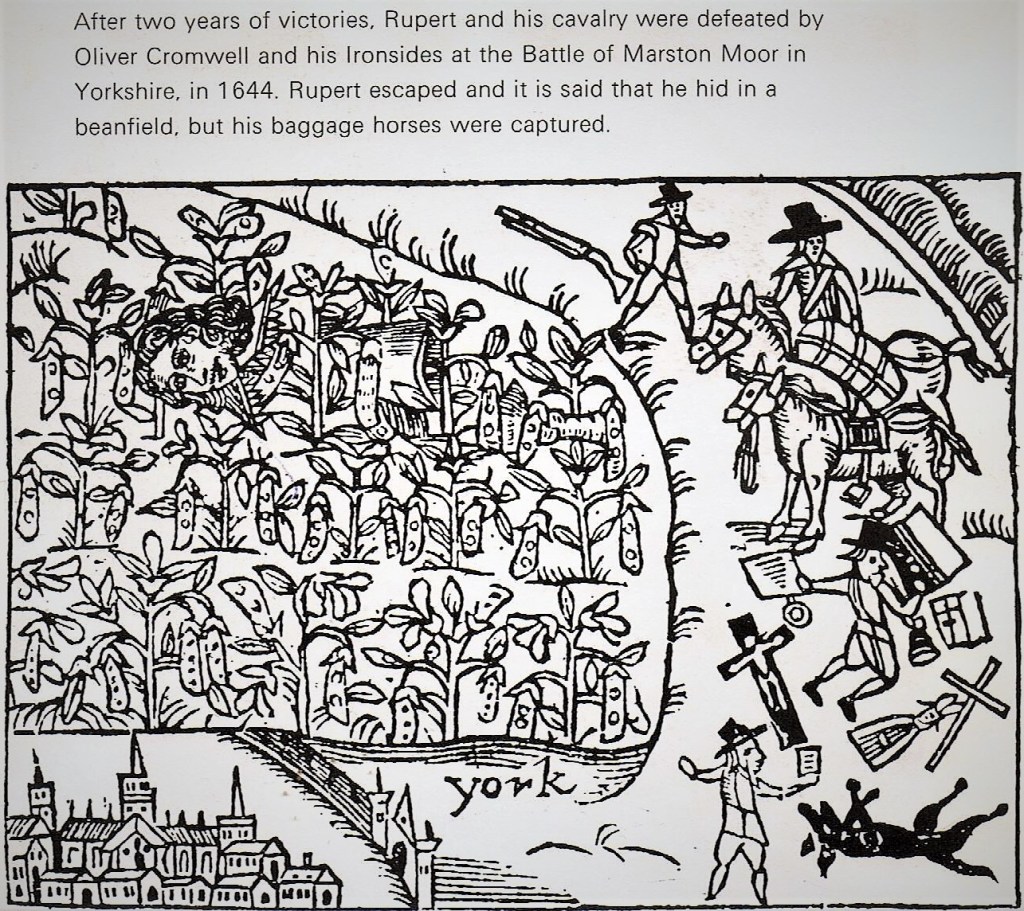
Tom: (Aside) No good asking him anymore … I’ll climb up to that window and see what’s going on.

(Tom does so)

Lights on Assembly inside the Chapel.

Button: The wave of sympathy which has spread throughout the country, since we had news of the fire at Serampore, shows no sign of diminishing. I hear that large sums are still arriving and that some have come from members of other communions.
First Minister: The rebuilding of the Press won’t give back the Manuscripts which Carey has lost. The work of years destroyed in a few hours.

Second Minister: Here he is!

Iviney: Who?

Second Minister: Dr Rippon.

Iviney: Here comes brother Rippon. Let us compose ourselves for the Meeting.

Ryland: Brethren, Dr Rippon has asked me to offer a prayer:

(All rise and stand with bowed heads)

“Almighty God, who didst brood over the separate and conflicting atoms of creation and hush them into silence, bring order out of chaos and for wild confusion give peace, who didst in fellowship so much as to create Man in thine own image; who didst give him a help-meet, since it is not good for man to dwell alone; we pray Thee to brood by Thy Spirit over the churches of our faith and order in this beloved land and welt them ever closer together in love and purpose. Grant us Thy blessing in our deliberations and if it pleases Thee, may the outcome of today’s assembly means that we shall henceforth no longer be isolated units, but a communion of saints, dwelling in brotherly concord. Then Thou wilt accord the blessing. May it be so. For thy glory.”

All: Amen.

(Ministers resume seats)

Iviney: Brethren, I understand that by common consent you desire to call Dr Rippon to the chair.

All: Aye, we do.

Rippon: Thank you, brethren. Our duty at this hour is to look forward, but I take one glimpse back and begin by thanking our brothers Fuller and Ryland for the eloquent missionary sermons of yesterday. I rejoice with you all that at that meeting three hundred and twenty pounds was subscribed.

Several: A goodly sum.

Rippon: Now to the business in hand. I need hardly remind you that we are living in a period of Societies, formed for a definite purpose. Partnerships in commerce have grown into common-law Companies with hundreds of members. In France, the non-privileged classes have developed political clubs to aim at reform.

Austin: Hear, hear! May the Lord prosper their efforts!

Rippon: While not desirous of damping our brother’s enthusiasm, I think I should point out that James Butterworth of Bromsgrove and others of our men have rendered themselves obnoxious to the ‘Church and King Party’ by uttering honest convictions about the French Revolution. I am merely reciting facts and using illustrations – I have no desire to arouse your passions!

(Thus having delivered this mild rebuke, he goes on…)

I sometimes feel… As it is, we cannot speak with a united voice to other religious Societies…

Minister: Are you suggesting, Dr Rippon, that we should become one only in order that we may, later on, become part of some super Church?

Rippon: No. Not that. Not that at all. That is not my understanding of our Lord’s words, That they may be one, but I would not try to limit the truth of God to my poor Baptist reach of mind!

Member: We quite understand your own position, Dr Rippon, and some of us stand with you, but unless we make ourselves crystal clear we run the risk of being misunderstood by our people. And you know how suspicious of London the rest of the country is – especially our members in Lancashire and Yorkshire, who would not easily give up the Independence of the local congregation.

Rippon: Let me be specific … Let me enumerate the advantages of a Union:

“The production of reports from the Churches; Support for the academies and the students; Support for our ministers and a proper scheme for their settlement; Education for the children of deceased ministers; Village preaching; The maintenance of Sunday Schools; Literature; New Church Buildings… “

These are but a few of the objects which should press themselves on our consideration, brethren.

Minister: Mr Chairman, I have here, on the fly-leaf of my Bible – so highly do I prize it – a cutting from an 1811 Baptist magazine. The writer puts my desires so well, that I have pasted it here. May I read it, sir?

Rippon: I think I know the article to which you refer. If I guess accurately, the author of it – present with us now – will, I know, not object to your giving his wise words wider publicity.

Minister: “We are anxious to see such a Union prevail in our denomination as well most effectually combine all our efforts in the Cause of Truth and Righteousness at home, and give ten-fold vigour to our exertions on behalf of our efforts abroad.”

All: Amen.

Rippon: I would say ‘Amen’ a thousand times if that would do it. I say ‘So be it’ indeed, But it will take more than pious ejaculations to bring it about – valuable as these are. But it can be done if you sixty are ready to join with me in turning this dream into fact.

Thomas Thomas: Mr Chairman: Our brother has quoted from the Baptist Magazine. May I (he takes out a cutting) read from a newspaper I have received? It certainly contains a full account of the Meeting of our North Welsh Association which advocated such a Union to be desired, they thought, and to which the Association pledged its support. I wish to call your attention to the following:

“That a closer Union and connexion among Baptists throughout England and Wales, Ireland and America, would be a glorious thing.”

Brethren, I emphasise the word ‘AMERICA’. Can it be that a Union here would presage a Union yet to be when Baptists of other lands shall be united with us?

Rippon: In my more optimistic moods I have myself spoken of some kind of world association of Baptists, including those of America – and the Mennonites of Holland – but before that dream can be realised we have far to go. For today, let us confine ourselves to a possible Union of the home churches. That done, who knows how soon we may expect a wider Union?

Minister: Dr Rippon, will you now accept a Proposition? For I feel the time has come for us to act!

Rippon: I will. Brother Iveny, will you prepare yourself to make a careful note of this Proposition?

Iviney: I am ready, sir.

Rippon: Put your Proposition, brother.

Minister: More accurately, sir, it is a series of Propositions: Perhaps you would prefer to take them singly?

Rippon: Then put the first.

Minister: “That this Meeting of Sixty Ministers, held this day, 25th June 1812, in Carter Lane Chapel, London, solemnly resolves that a Union of Baptist Churches in the United Kingdom is very desirable and is hereby formed… We further resolve…”

(voice trails off … lights go out…)

FURTHER NOTES:

https://christianhistoryinstitute.org/it-happened-today/12/17

JOHN RIPPON was an extraordinary faith-filled young man. In 1771, when he was just twenty, Carter Lane Baptist Church, Tooley Street, London, invited him to try out for their pulpit. Rippon had been a Christian just four years. He trembled at the offer because famed theologian John Gill had been the church’s pastor. It would be hard for one so young to follow so eminent a preacher. Nonetheless, he accepted the challenge and the majority of the congregation voted to call him. Forty members withdrew, however, saying he was too young to be their pastor.

The young Baptist proved to be an extraordinary leader, filled with grace.

The Carter Lane Baptist Church represented much wealth and Rippon encouraged its members to support Baptist world missions. After several years in which illness robbed him of usefulness, he died on 17 December 1836, having preached at Carter Lane (and its successor location at New Park Street) for over sixty years and edited the Baptist Annual for twelve. His pulpit would later be occupied by another famous Baptist—the youthful Charles Spurgeon (whose church would become Metropolitan Tabernacle).

Conclusion – Missions at home and abroad:

Among British Baptists in 1812, therefore, it had been agreed that a more general union of Particular Baptists was desirable, particularly, though not exclusively, to support the work of ‘the Baptist Mission’. The Union was formally founded the next year, in 1813, by the sixty Particular Baptist churches. In 1832, it was restructured to allow for membership of General Baptist churches. The other nonconformist denominations soon followed the example set by the Baptists. In 1786, the Wesleyan Conference, though not yet independent from the Church of England, had already approved the plan of Thomas Coke to take the gospel to India, thereby taking on the task of overseas expansion. The London Missionary Society, an interdenominational venture was formed in 1795 and the Church Missionary Society in 1799. But it was not only the overseas missionary societies that owed their inspiration to the Revival. Both the Religious Tract Society (1799) and The British and Foreign Bible Society (1804) also sprang from the Revival. Christian education gained a new dimension with the introduction of Sunday schools. They were started in 1769 by a Methodist, Hannah Ball, and then developed and popularised by Robert Raikes, an Anglican layman. The Church of England Sunday School was founded in 1786 by William Richardson, an evangelical vicar in York, and the Sunday School Union was founded in 1803. The Sunday school movement in Britain marked an important step towards free education for all. In this way, the Evangelical Revival gave birth to missions, at home and abroad, and missions led to denominational reorganisation.

Sources:

Tim Dowley (ed.), et. al., (1977) The History of Christianity. Berkhamsted: Lion Publishing.

John Barton (2019), A History of the Bible. London: Allen House (Penguin Random House).

Three Scenes from Baptist History – The First Fifty Years, 1612-1662: The Puritan Revolution & The Civil Wars.

Two more scenes from Rev. Arthur J Chandler’s unpublished plays on Baptist History, featuring Thomas Helwys and Col. John Hutchinson, plus a scene from David Starsmeare’s play, ‘Diggers: The Story of a Commune’, featuring Gerrard Winstanley.

Background – The First English Puritans & Exile in the Netherlands:

The Elizabethan puritans wanted to reform the church from within, to make it more like Jean Calvin‘s church in Geneva, as part of a ‘Corpus Christianum’, a Christian state. They simply wanted to purify the national church from all the ceremonial remnants, vestiges and vestments of Roman Catholicism. They also questioned whether there was any biblical basis for the authority of bishops over the Church. Some wanted to replace them with a system of elders and synods, with stricter discipline. This became known as Presbyterianism. Elizabeth I resisted these changes and James I hated Puritans, threatening to ‘harry them out of the land’ if they would not ‘conform’. While many compromised uneasily within the state Church, they were marginalised and very much on the defensive. Others eventually left of their own accord and small groups of ‘separatists’ grew up alongside the main Puritan group. They had formed their own independent congregation at Norwich in 1581, withdrawing completely from the Anglican Church, which they believed to be so polluted it could not be cleansed from within. They were led by Robert Browne (1550-1633), who became their pastor, so they became known as ‘Brownists’. Robert Harrison (d. 1585) was the ‘teacher’ within the church. The government of their chapel was based on a ‘covenant’, marking the beginning of the English Independent or ‘Congregationalist’ movement.

The ‘Pilgrims’ setting sail from Dartmouth: one group set out from Leiden in the Netherlands on the ‘Speedwell’.

They were persecuted by the authorities, the English government and the bishops, and driven abroad to the Netherlands. The Dutch were tolerant of religious nonconformity and allowed refugee status and freedom of worship to the English independents. In this way, the Netherlands played an important part in the life of English dissenters, who were often forced to find refuge abroad. Browne and Harrison took their small church to Middelburg, in Zeeland, where it survived for a few years. It survived for a few years but Brown later returned to England, where he eventually renounced his separation and resumed a ministry in the Church of England. Other leaders took over in the separatist movement, including John Robinson (c. 1576-1625) who, after living in Leiden, eventually emigrated to New England among the ‘Pilgrim Fathers’ via Plymouth, in 1621.

Scene One – Thomas Helwys in Amsterdam, 1612:

Another group, in Amsterdam, was led by John Smyth, who had been a fellow of Christ’s College, Cambridge. In 1608, he became convinced that no surviving church possessed the true ordinances, and baptised first himself and then the rest of his congregation. As a separatist group, they then fled from the harsh rule of James I and went into exile in Amsterdam rather than face the harsh penalties that threatened them at home in England. After his death in 1612, one of his associates, Thomas Helwys, led back to England a group that had split from Smyth’s former congregation.

Scene from an untitled typescript play by Rev. Arthur J Chandler (c. 1965), pastor of Bearwood Baptist Church, Smethwick, West Birmingham:

Mr and Mrs Thomas Helwys’ Living Room in Amsterdam, 1612. Doors right and left to the rear of the stage. Chairs have been arranged in rows facing left to accommodate nine or ten people. Mrs Helwys, duster in hand, is putting finishing touches to the room. There is a small table to the left, with a chair behind it. Enter, right, a man arriving early.

First Man: Good evening, Mistress Helwys.

Mrs Helwys: Good even’ to you.

First man: I see we make you busy with our meeting here tonight.

Mrs Helwys (Pleasantly): That’s nothing. I was but setting the chairs.

(Enter, right, Helwys. He passes through the room with MS in hand, obviously preoccupied. Mrs H. watches him, puzzled and affectionately concerned. He exits left. The man also watches, and then lays his coat and hat down.)

First Man (Chattily): I hear there is important business to discuss tonight. ‘Twas only by the providence of God I was able to be back in Amsterdam.

Mrs H: Yes, I shall be glad when he has got it off his mind (still with her eyes on the door through which Helwys has passed).

First Man: Who? Master Helwys?

Mrs H: He has been restless for days, sleeping little and eating scarcely at all. All day long he works in his study and sometimes far into the night.

First Man: It will be his writing that he works at so feverishly. He was ever so when inspiration was upon him.

Mrs H (doubtfully): Maybe. But there is something more…

First Man: Is there something troubling him, think you?

Mrs Helwys: Most assuredly there is.

First Man: Then tonight he means to share it with us, and that will lessen his burden.

Mrs Helwys (deliberately): No, I think he has made up his mind: I don’t know what about. Today he has been calmer. Only… he walks around with his mind far away. save sometimes when he has looked at me… as though he would tell me something but cannot.

First Man: That is strange, for with you he has shared all his thoughts. What can it be?

Mrs Helwys: I know not. I only fear. (Enter JOHN MURTON, right)

Murton: Good evening, Mrs Helwys. I hoped to come earlier but was detained. May I go to Master Helwys?

Mrs Helwys: Yes, go in. He will be glad to see you.

(Voices outside, right, as of others arriving. Mrs Helwys, after a hurried survey of the room, goes out, to return later with wearing a bonnet and mittens for the meeting. She sits at the rear, facing the audience. Church members arrive in twos and threes and greet one another. There are several women among them. Men remove hats and coats. Women sit demurely. After a few moments, Murton and Helwys enter together. Murton is tense and solemn. They appear to discuss how they shall proceed. Helwys takes the floor. There is silence. Several members bow slightly forward, expecting prayer. Mrs Helwys is tense, nerving herself for what is coming.)

Thomas Helwys: Before we pray, I want you to know all that is in my mind, that we may pray for in fuller fellowship. Some of you know that for a long time I have been concerned about our witness here. I have wondered if it had not been better for us to have remained in England, for when has God decreed that men should fly from persecutions? I, at any rate, must go back, my friends.

All: Go back?!

Helwys: Aye – go back. Our time in this land has not been wasted, for we have here come to a fuller understanding of our Master’s will. And we have been richly blessed in the water of Believer’s Baptism. But the word has now come for us to return. There is much need for faithful witnesses in our own land. To us have been revealed new truths about our Christian faith and worship, and we cannot – dare not – keep them to ourselves. We must witness to them before our own people. If need be, we must suffer for them too. Murton is of like mind and will come with me.

First Man: But you are a marked man. They will throw you into prison.

Helwys: What if they do and it is God’s will? (turning to his wife) There, too, I may witness to my faith. My wife has done so before me, and I pray that I may not be afraid if my time should come. (At the mention of his wife several heads nod gravely and there are murmurs of admiration.)

Second Man (in dismayed tones): But your writings! What of those? Given though we have been few in number here, your writings have reached many in England.

Helwys (He shows MS): What good are my writings if I am not faithful I’m my living? That which I have recently written – it is finished – I must take it myself and present it to King James.

All: To the King?!

Helwys: Yes, it is a plea for religious liberty for all peaceable citizens among his subjects – whether they be Papists or Separatists, or of whatever connection. (They bow their heads, Mrs Helwys bows her head in prayer, her face grimly set to keep back her tears.)

In TEMPORAL matters the King’s power is supreme. We acknowledge it and confess ourselves his faithful subjects. (murmurs of assent). But in SPIRITUAL matters no man is our master save God alone. (louder murmurs of assent). Oh, that I could move the King! Let us pray…

CURTAIN”.

Spitalfields, London:

NARRATIVE:

“They came back, greatly daring, into certain trouble and persecution. They settled as the First Baptist Church in Spitalfields, London, Thomas Helwys’s latest treatise having set forth their Declaration of Faith to the world. Helwys was soon thrown into prison and there he died some years later. John Murton carried on the gallant fight. He addressed to Parliament a passionate plan for religious toleration for all. He was in Newgate Prison at the time, yet he contrived to write it, and to smuggle it out of prison.”

The First English Baptists:

Helwys’ group founded the first openly ‘Baptist’ church in England, the General or Arminian Baptist Congregation at Spitalfields in London, in 1612. Arminianism was a rejection of Calvinist ideas of predestination and ‘God’s Elect’, and an affirmation of the belief that God’s grace is available to all. Henry Bullinger, a mid-sixteenth-century divine popular with puritans wrote that:

The simpler sort are greatly tempted and exceedingly troubled with the question of election. For the devil goeth about to throw into their minds the hate of God, as though he envied us our salvation, and had appointed and ordained us to death.

H. Bullinger, (in Parker Soc., 1849-52), Decades, p. 187.

Thomas Helwys himself had agreed in 1611 that the doctrine of predestination…

… makes some despair, as thinking there is no grace for them and that God hath decreed their destruction. And it makes others deeply careless, holding that if God have decreed they shall be saved then they shall be saved, and if God hath decreed they shall be damned they shall be damned.

Quoted by A. C. Underwood (1947), A History of the English Baptists, p. 144.

In the background, there is a depiction of his execution.

Baptists practised believers’ baptism as a sign of their belief in universal grace and the exercise of free will. From their earliest days, they viewed ‘dipping’ (total immersion) as an outward symbol of an inward grace. By rejecting infant baptism, they directly challenged the right of the Church of England to control the lives of all their parishioners from the cradle to the grave. Until the 1630s, when Charles I and Archbishop Laud formed their fateful partnership, however, mainstream puritans felt no need to consider leaving England, for they felt tolerably at home in its established church. By 1638, there were also Calvinists in London who practised believers’ baptism, and these became known as ‘Particular Baptists‘. They had grown out of the first independent congregations in the capital, and their understanding of the church as a gathered community led to their profession that only the baptism of believers fitted such a view. It is not known exactly when they adopted full Baptist views. What we do know is that they were among the first of the ‘sects’ to oppose tithes and ‘Hireling preachers’. The extent to which the early Baptists were influenced by the European ideas and the theology of the Radical Reformation and the beliefs of the Anabaptists is still hotly contested. Helwys’ group had been much influenced by the Dutch Mennonites, but both the General and Particular Baptist churches developed out of a conscientious search for the true pattern of the apostolic church of the New Testament and the first century, forming the only pattern of church organisation for all successive generations. Unlike the Anabaptists and Mennonites, however, and like the Quakers at the time of the Civil Wars, the English and Welsh Baptists were not pacifists in the sense of rejecting participation in all warfare.

These youthful Baptist churches were hurled into the debate, current in the seventeenth century, on the relationship between church and state. They championed their own particular answers to that controversy at great personal cost. They also soon became involved, to varying degrees, in the millenarian speculations of the mid-seventeenth century. Like many others, the Baptists eagerly thumbed through the eschatological passages of the books of Daniel and Revelation, seeking the signs of the times and looking for guidance about proper Christian obedience. In his seminal (1972) work, The World Turned Upside Down, Christopher Hill gives a ‘worm’s eye view’ of the English Civil War, in which he ‘visited’ the various religious sects of the time, of which the Baptists and Quakers, as we know, with the benefit of hindsight, would survive and become dissenting denominations. As a consequence, we tend to impose outlines that are far too well defined on the early history of English sects and to read back later beliefs into the 1640s and ’50s. Hill is, perhaps, somewhat guilty of this himself.

The conflict between Parliament and the King was complemented by a conflict between ‘Presbyterians’ and ‘Independents’ on the side of Parliament. Political ‘Independents’ were those who thought, like Oliver Cromwell, that there was no point in fighting unless you were determined to win. The ‘Presbyterian’ grandees, however, who were strong in the House of Lords and among the gentry and ruling oligarchies in London and other trading towns, were anxious to reach a compromise with the King, if he would only accept their terms. But Charles’s obduracy gradually strengthened the hand of the win-the-war party whose support came from ‘the middling sort’, the lesser gentry, yeomen and artisans. Cromwell’s policy of promoting by merit among the troops under his command those who, though not gentlemen, had ‘the root of the matter in them’, and were therefore motivated by their faith eventually led to the creation of the New Model Army, officered by men who were competent military leaders with a determination to win. Religious toleration was the natural accompaniment of this approach to men outside the ruling landowning hierarchies.

Before 1640 nearly all Englishmen and Welshmen other than ‘recusant’ Catholics were, at least on the surface, members of the Church of England, having been baptised as infants. They were liable to be punished in its ‘spiritual’ courts for a wide variety of ‘sins’, including working on one of the innumerable saints’ days that divided up the agricultural calendar. They had to pay tithes, ten per cent of their income, to maintain the parson of their parish, in whose selection they had no say, and were punished (before 1650) for not attending Sunday services in their local parish church. The clergy were expected to read government circulars from the pulpit and were told which subjects not to preach on. For King Charles, control over the Church was therefore as important as control over the armed forces. Many men and women bitterly resented this apparatus and atmosphere of coercion in matters of conscience, but if they stayed away from the church and met in their own houses for worship and discussion, this was also punishable in the church courts. Apart from the many thousands who emigrated to the Netherlands and New England, many others, especially poorer dissenters, met in underground separatist congregations, which, as the political crisis deepened, became revolutionary cells. Religion and politics thus became inextricably intertwined.

Then, in 1640, the church hierarchy effectively collapsed during the meeting of the Long Parliament. Separatist congregations came up from underground and met openly, electing or ‘calling’ their own ministers, rejecting the state church and its parochial clergy. Toleration, therefore, became a social and political issue as well as a religious one. If men and women of the ‘meaner sort’ were to meet together in their own congregations, unsupervised by university-educated clergymen, for religious discourse, this would inevitably lead to the discussion of political subjects as well. Moreover, if lay people were to be permitted to preach, it was unlikely that their audiences would want to go on paying tithes to maintain parish ministers they did not want to hear. Eventually, there would be no state church to tell people what to think, and no livings for its clergy. So, for the Anglican establishment, behind ‘Toleration’ lurked the abolition of the traditional means of social control and an attack on property. Yet Oliver Cromwell and the ‘Independents’ supported it, many at least on genuinely conscientious grounds. Their need for a wide mass basis of support in order to defeat the King enabled their views to triumph.

Oliver Cromwell, Lord Protector, from a miniature.

In the decade from 1643 to 1653, Hill suggested, there was a great overturning, questioning, revaluing, of everything in England, in which old institutions, old beliefs, old values came into question. The following scene demonstrates how this radical mood affected every level of society, from the gentry downwards.

Scene Two: Colonel John & Lucy Hutchinson in Nottingham, 1643.

Col. John Hutchinson

In a scene from Rev. Arthur J. Chandler’s play, Vignettes of Colonel Hutchinson, John and Lucy Hutchinson (see my separate, previous article on them) are reading books and pamphlets confiscated from a Baptist group that has been meeting at the Cannoniers’ room at Nottingham Castle, where Colonel Hutchinson was Governor in 1643.

They are waiting to discuss the baptism of their fourth child with a Presbyterian Minister:

“Lucy: I don’t know whether Mr Foxcraft will have anything more to say, but I really feel that these Baptists are right on the question of Baptism.

John Hutchinson: I agree. Having read these books and papers I found in the cannoniers room, I find it most difficult to controvert the arguments they have brought forward. I am especially impressed by this book by Tombes, one of their divines. If they’re right and we accept their views, one thing is clear.

Lucy: You mean about the baby?

JH: Yes. If we are convinced that the baptism of infants is not in accordance with the teaching of Christ and His apostles, we should not have him baptised.

Lucy: That is true.

(Foxcraft, a Presbyterian Minister is shown in by Thomas)

Oh, come in Mr Foxcraft, we have been expecting you.

Fox.: Thank you, Mrs Hutchinson, thank you, Colonel. Do you wish to discuss the matter of baptism with me a little further?

JH: We do, Mr Foxcraft. You know what we have begun to feel in the matter.

Fox.: Yes, Colonel Hutchinson. You seem convinced that this writer, John Tombes is right, though as a Minister of the Presbyterian order, I find it difficult to agree.

JH: The arguments seem very sound to me, Mr Foxcraft. As I told you I found this book and other literature being used by the soldiers who met in the cannonier’s room. We have studied it carefully and are aware of the opinion that Tombes is right.

Lucy: I’ve spent hours comparing these writings with the Scriptures and feel sure the author is right. We should not baptise an infant child.

Fox.: And pray when should a child be baptised then, Mistress Hutchinson?

Lucy: When he has freely made his decision to follow our Lord, Mr Foxcraft, then, contends Tombes, the sacrament becomes effective. If this teaching is true we should not have our newborn infant baptised. Yet, on the other hand, it is right that we should hear what learnéd and godly Ministers who think otherwise have to say.

JH: I am said to have a little more learning than is becoming a gentleman. Peterhouse taught me a great deal. I attended their Chapel constantly, though their stretching of superstition to idolatry did not escape my notice. Lincoln’s Inn further trained my mind to think logically. I have brought what ability I have to my study the subject since these books came into my possession. We have discussed this subject with other clergymen, Mr Foxcraft. Now, pray, what is your opinion? Should this youngest of our children be baptised as the rest of our children were?

Fox.: Most certainly, he should, Colonel Hutchinson. A gentleman in your position should set a public example in these matters.

JH: And how would you defend this practice, Mr Foxcraft, in view of what we have read in the Scriptures?

Fox.: It has been the practice of the Church to baptise infants from the earliest days, Colonel Hutchinson. As early as the second century, Iranaeus, among the Church fathers, refers to it. It is the Church’s buckler of federal holiness. You should in no wise let it go.

Lucy: But, reverend sir, is it not true that even in the fourth century, infant baptism was the exception rather than the rule? And, may we not also go back earlier even than the second century and examine the practices of the Church in the first century recorded in the writings of the Apostles? It is not at all clear to me that an infant should be baptised. Indeed, it is obscure and mysterious.

Fox.: Mistress Hutchinson, however dark and mysterious it may seem to you, I counsel you to conform to the general practice of other Christians and let the baptism take place.

JH: Would you counsel a man to perform an act against what he believes in his heart to be right? (Foxcraft is silent for a time)

Lucy: Before you answer, Mr Foxcraft, may I add another word? You were present a few days ago when all the Ministers from the town dined with us and we discussed this matter with them. The Colonel explained his doubts and you heard their answers.

JH: They also said that the baptism of infants had been the practice of the Church since primitive times and that I should hesitate before setting aside that position with respect to the children of believing parents to which, it may be, the Holy Spirit has led the Church, and that I should conform to it. Now if I consider that this argument is overthrown, what do you advise me to do?

(Foxcraft is silent again, then turns around again.)

Fox.: Colonel Hutchinson, Mistress Hutchinson, I can say only this. If you are not convinced of the warrant of the practice of infant baptism from the Word, you are committing a sin if you proceed with it. You, as I, must do what you believe to be right.

JH: Then this child shall not be baptised until he seeks this sacrament of his own accord. But hear me further, Mr Foxcraft, we shall not retract one iota of our public benevolence and civilities among those who do not hold these views, nor shall we stay away from public worship within the Castle and City.

Fox.: May He who is our Guide lead you into all righteousness and truth.

… (Exit Lucy)...

Baptists, Independents & Levellers in the New Model Army and the Commonwealth:

Streeter’s plan of the Battle of Naseby, 1645. Col. Pickering’s Regiment was at the front and centre of the Parliamentarian Infantry lines (bottom).

The victorious New Model Army of Fairfax and Cromwell, formed by parliamentary order in 1645, held religious opinions which largely differed from those of the Presbyterian-dominated Parliament. Independents, including Congregationalists and Baptists, were dominant both in the leadership of the army and especially among the rank and file. For example, Daniel Axtell had been a Lieutenant in Essex’s army and joined Col. John Pickering’s Regiment as the first captain in March 1644. He was one of a number of Baptists, including, including John Lilburne and Richard Overton, the Leveller leaders, of humble and obscure origins who rose to positions of influence in and through the New Model Army. By the end of the first civil war in 1646, toleration existed in fact, if not in theory, guaranteed by the Army, which was in no mood to stand any ‘nonsense’ from the ‘Presbyterian’ majority in the House of Commons. Puritan preachers had called on soldiers to fight against the Antichrist, a vague symbol of all that was oppressive and tyrannical in the old order. Millennarian hopes for a reconstruction of society to benefit the poor and lowly were in the air. As early as 1644, rank-and-file Parliamentarian soldiers had asked a horrified royalist divine about ‘the Whore of Babylon’:

What do you know but that this is the time of her ruin, and that we are the men that must help to pull her down?

E. Symmons (1644), Scripture Vindicated.

By the Antichrist or ‘the Whore of Babylon’ the Puritan preachers were referring to the Pope or bishops: others were subsequently to apply the terms to the royalists more generally, then to the Presbyterians and finally to Oliver Cromwell himself; it was a widely extendable phrase. In 1647, Parliament ordered the Army to disband, without even providing for full payment of arrears of wages due and without producing any of the social and political reforms which the troops had expected. The rank-and-file revolted and, after a period of hesitation, most of their officers supported them. An Army Council was set up in which officers and elected representatives of the ordinary soldiery – ‘Agitators’ – sat side-by-side. It was ‘Major’ Axtell and two other ‘agitators’ who prepared a statement of the grievances of what by then had become Hewson’s regiment. The Lieutenant-Colonel, John Jubbes, another religious radical, represented the regiment at what became known as ‘the Putney Debates’ in the late autumn of 1647. Twenty officers and ordinary soldiers from the regiment also signed a letter setting out the political agenda of the Levellers. Colonel John Hewson was himself of humble origins, a sometime honest shoemaker in Westminster, who had joined the Earl of Essex’s regiment as a Captain at the start of the Civil War. He was known as an arch-radical and religious zealot but held a very different view of the Levellers than many of his officers and men. In February 1648, following a soldier petition to Fairfax, Hewson expressed a typically disciplinarian view when he commented:

“We have had trial enough of Civil courts, we can hang twenty before they will hang one.”

D Wolfe (1944), Leveller Manifestoes of the Puritan Revolution.

In his view, Hewson was very close to Cromwell’s justifications of his forceful putting down of the Leveller Rising at Burford a year later. Perhaps dismayed by his Colonel’s remarks, John Jubbes left the regiment shortly afterwards to join a group of radical pacifists in London. He was replaced as Lieutenant Colonel by Daniel Axtell, who then commanded the guard at King Charles I’s execution. Although as an MP, John Hewson signed the King’s death warrant, as a member of the Council of State, he later opposed Cromwell’s usurpation, continuing to do so from within the Protectorate after others had resigned. He also remained tolerant of religious radicals like the ex-Quartermaster and Quaker, James Nayler, when he appeared before parliament on a charge of blasphemy in 1656.

As an unrepentant regicide and republican, Daniel Axtell subsequently threw in his lot with General Lambert, in one last desperate attempt to reimpose the rule of the Major Generals, but in April 1660, Lambert’s forces were routed by Axtell’s former regiment at Daventry in Northants. Axtell himself escaped the battlefield, but was later captured and eventually executed as a regicide. Other Baptists had long since left the Army to plant churches in different parts of England and Wales. Thomas Collier, a former army chaplain, established a Baptist congregation in the Taunton area. Thomas Edwards, the presbyterian author and publisher, commented that:

“Truly ’tis a sad thing that that in all the towns and cities (for the most part) taken by the parliament’s forces, this should be the fruit of it, that errors and heresies should abound there, and that sectaries of all sorts get places of profit and power.”

Edwards, Gangrena, (1646).

In this struggle for positions of influence, the New Model Army, as a professional standing army that was difficult to disband, had been ‘on the spot’: Parliament and the Presbyterian clergy were far away. It was in vain that Herbert Palmer in 1646 urged the House of Commons to fill the deserted pulpits in the North, saying that Churches… will be your strongest castles if you furnish them with ministers. He also pointed out that larger maintenance payments were necessary to persuade such ‘spiritual commanders’ to fight the Lord’s battle in the North. One of Mercurius Politicus‘s correspondents was still saying in November 1650 that, in the North, a mission of presbyterian ministers would do as much good service to the state as a regiment of soldiers in a shire.

Under the Commonwealth and Protectorate, an established church was permitted to continue, but allowed Presbyterians, Independents and Baptists to act as ministers in it, according to the choices of the individual parishes. When a parish living became vacant, an eclectic body of ‘triers’ was formed in order to appoint a new minister, comprising laymen as well as clergy and Presbyterians, Independents and Baptists fairly equally represented. The triers were not empowered to impose any doctrinal test, but to satisfy themselves of three things: that the ‘presentee’ was well-grounded in the essentials of the Christian faith, that he was competent to preach and that his moral life was above reproach. Those dissenters who wanted to continue to worship apart from the national church were permitted to do so, as long as they didn’t disturb the peace. Some Baptists accepted office in the state church, but the majority chose to continue independently.

Samuel Fisher & Baptists Beliefs:

If ministers were dependent on the voluntary contributions of their congregations, as was made explicit by the church covenant in Independent churches, they would also have to reflect the theological and political outlook of these congregations, and so the church as an instrument for imposing and maintaining a consistent outlook would cease to exist. In the even more democratic churches of Baptists and other sectaries, the distinction between clergy and laity ceased to exist. The fundamental Baptist principle of believer’s baptism meant that each individual must choose or be chosen by a congregation after he had reached ‘the years of discretion’: it too disrupted the idea of a national church. As Samuel Fisher wrote in his Baptist days:

“Once give over Christening the whole parish infancy, and then farewell that parish posture which the Pope set up in all Christendom some six hundred years ago, yea then down falls the parochial-church-steeple-house, priesthood, pay and all. Amen, so be it.”

S. Fisher, Christianismus Redivivus, Christendom Both unchrist’ned and new-christ’ned (1655), p. 201.

Samuel Fisher was the son of a hatter from Northampton, educated at Trinity College and the puritan New Inn Hall, Oxford. Although a lecturer in Kent in the 1630s, where he underwent Presbyterian ordination in 1643, he resigned his living when he became a Baptist. A pastor to the congregation in Ashford, he maintained himself by farming, before becoming a Quaker in 1654. He died of the plague in 1665. In his Baptist period, Fisher published a lengthy defence of ‘dipping’ as against ‘sprinkling’ in which he wrote in a distinct style, using alliterative abbreviations, e.g. PPP for Pope, Prelates, Presbyters (or sometimes Priests) and called on the latter to depart from that papistical posture of parish churches and pastoral relation to such as are not sheep.

Apart from his advocacy of believer’s baptism, what is most interesting about Fisher’s doctrines is his application of them to Biblical criticism. Protestants, both in Britain and on the Continent, thought that all would be unity itself among them once they turned from the traditions of the Church to the text of the Bible: but among the reformed clergy, the Bible increased rather than diminished conflict. Fisher claimed that dark minds diving into the scriptures, divine lies enough out of it to set whole countries on fire. … till men turn to the light and Word within, there would be no peace. This thinking was very similar to that developed by Baruch (later Benedict de) Spinoza, who was born in what is now the Netherlands, in 1632, of Portuguese Jewish (Sephardic) descent. He lived much of his life in Amsterdam, where he was eventually expelled from the synagogue for his unorthodox beliefs. Notoriously, he suggested that the Pentateuch was written not by Moses but by Ezra. He is generally thought of as one of the first rationalists of the period, and thus a founding father of the European Enlightenment. Where the study of the Bible was concerned, he was a crucial figure in casting doubt on the biblical miracles, which he thought were either fictitious or descriptions of natural processes. He argued that nothing could ever happen contrary to the laws of nature, which were mechanistic in nature, and that God does not intervene in natural events. In this, he was an antecedent of the British deists of the later seventeenth and eighteenth centuries, ‘Deism’ being the belief that, though there is a God, his activity is confined to the creation of the universe, after which he took no part in its running. People had doubted the truth of the biblical miracles before, but Spinoza combined a belief in God’s existence with a conviction that he did not do anything to change the natural order of events. He also thought that biblical stories of miraculous events might simply be records of visions and dreams.

Cromwell’s Bible (which he took on campaigns).

Among many possible approaches to the Bible, two stand out among the slightly earlier and roughly contemporary English radicals. One was to use its stories as myths, to which each could give his own sense, a sense that need not consider the original meaning of the text. Thomas Edwards’ twenty-ninth Error was:

“We did look for great matters from one crucified at Jerusalem sixteen hundred years ago, but that does us no good; it must be a Christ formed in us. ”

Edwards (1646), op.cit.

The distinction between ‘the history’ and ‘the mystery’ was also made by the radical Welsh Baptist ‘Arise’ (Rhys) Evans, who held a dialogue with Oliver Cromwell as Protector. Another approach denied the infallibility of the Bible or subjected it to intense textual criticism. But in general, there remained a consensus among reformed theologians that the books of both testaments were by the people they had been traditionally attributed to, and no one approached the questions of authorship and authenticity as completely open ones, as Spinoza did with the Hebrew texts. Although he paid no attention to the Greek texts of the New Testament, the Roman Catholic Church still placed his works in its Index of Prohibited Books. At a less scholarly level, we see the process of textual criticism at work in the Records of the Churches of Christ gathered at Fenstanton, Warboys and Hexham. There we hear men and women rejecting the Bible, or parts of it they did not like, in the name of a spirit within them. They were applying John Milton’s theory that the Bible must be subordinated to ‘human convenience’. He was glad to find that the ideas he arrived at by searching in his own conscience could be found in the Bible, but they had greater authority for him because they were already in his conscience than because they were in the Bible. But in applying Milton’s test of the convenience of men in society, ordinary members of the congregation could always be out-quoted, if not convinced, by the Baptist organisers and ordained ministers.

The scholarly underpinning of this position on the primacy of the human conscience was done more effectively by Samuel Fisher. Holding that the spirit is far more important than the letter of the Bible, Fisher asks how reliable the text really is. It was silly, he suggested, to call it ‘the Word of God’, claiming that there is no evidence of divine authority for the present canon of the New Testament. He makes an interesting comparison with attitudes towards the Qu’ran:

“Nor will it do to say that the universal reception of the present canon guarantees divine inspiration: what about the Koran, ‘the public possession of many generations and in actual authority among men as a standard throughout the whole word of Mahometanism’?”

John Bunyan had similar doubts. A translation of the Qu’ran had been published in 1649, which explains the sudden awareness of its importance. For Fisher, the Christian Bible was…

“… a bulk of heterogeneous writings, compiled by men taking what they could find of the several sorts of writings that are therein, and … crowding them into a canon, or standard for the trial of all spirits, doctrines, truths; and by them alone”.

Fisher’s writings are a remarkable work of popular Biblical criticism, based on real scholarship. Its effect is to demote the Bible from its central position in the protestant scheme of things, to make it a book like any other. After a century of sacrifice to bring the Scriptures to the ordinary laymen, Fisher says that there are enough Bibles for anyone who can read them and has money to buy them. For him, the Bible is read too much and heard too often. The martyrs of the previous century would have been shocked to see that Protestantism had come to that. Fisher’s book brought to an end the epoch of protestant bibliolatry. The diversity of sects, each with its own interpretation of the Bible, had dissolved protestant unity. It was the end of the authority of the Book: but by no means a return to the authority of tradition. It was the beginning of the authority of conscience, both individual and congregational, the doctrine of the ‘inner light’ which could replace the absolute centrality of the Bible of the Puritan divines without shattering the foundations of the Protestant faith. In this way, Fisher deserves greater recognition as a precursor of the English enlightenment than he has received since his own day. His personal transition from Presbyterian to Baptist to Quaker was guided by his developing doctrine of scripture.

The ‘questioning’ of established political institutions became more intense from the Sping of 1649, when radical Independents and sectaries, understandably, began to see a better future for themselves under the Commonwealth, for all its imperfections, than under the Presbyterian-dominated Long Parliament. But there were limits to their intervention: on 2 April, William Kiffin headed a deputation of Baptist ministers which presented a petition to the Rump, dissociating themselves from William Walwyn’s Leveller ‘manifesto’, The Second Part of England’s New Chains and disavowing any intent to intermeddle with the ordering or altering civil government. The Leveller organisation had been so strongly linked to the General Baptists that the latter’s withdrawal of support seriously weakened the movement. Kiffin later joined other Independent ministers, including the pastor of the congregation which included John Lilburne (the Leveller leader) in putting his name to a pamphlet attacking Walwyn’s Wiles, which unjustly accused him of immorality, irreligion and seeking to make all things common. This latter accusation may, in part, be a reference to the group of True Levellers, or ‘Diggers’ who emerged out of the general movement on 1 April 1649 to establish an early ‘commune’ on St George’s Hill, near Kingston in Surrey. Their leader was a Baptist from Wigan in Lancashire, Gerrard Winstanley, who may have known of various earlier anabaptist experiments of an economic nature on the Continent.

Winstanley had supported Parliament in the first civil war, but in 1648 he rejected both the ‘Presbyterians’ and ‘Independents’ no less than he had the royalists. God’s sincere-hearted ones, scattered abroad in the kingdom, he believed, shall stand and look on whilst the Royalists, Presbyterians and Independents sheathe their swords in one another’s bowels’. Nevertheless, this wrath, bitterness and discontent that appears generally in men’s spirits in England, seemed to Winstanley to suggest that liberty is not far off and that the British Isles might be the tenth part of the city of Babylon that shall fall off first. Winstanley hoped to help God in this great work. He tells us that he was, for a long time a good Puritan church-goer, believing as the learnéd clergy believed. But he came to see that such a life was one of confusion, ignorance and bondage. He went through the ordinance of dipping, but he did not long remain a conventional Baptist. In the early months of 1648, he published three theological tracts which wrestle with the subjects of poverty, evil and selfishness, foreseeing a glorious future in which God will reveal himself to the despised, the unlearned, the poor, the nothings of this world. Already Winstanley had broken with the traditional theological framework which most of his contemporaries accepted: he suggested that, in the end, everyone will be saved. One of his main concerns was already to insist on freedom for the poor. It was wrong that:

… sharp punishing laws were made to prevent fishermen, shepherds, husbandmen and tradesmen from ever preaching of God any more.

For Winstanley, God was to be found within every human being:

He that looks for a God without himself and worships God at a distance, he worships he knows not what, but is led away and deceived by the imaginations of his own heart. … he that looks for a God within himself … is made subject to and hath community with the spirit that made all flesh, that dwells in all flesh and in every creature within the globe.

This God is Reason – a social Reason which says:

Do as thou wouldst be done unto … For Reason tells him, Is thy neighbour hungry and naked today, do thou feed him and clothe him, it may be thy case tomorrow, and then he will be ready to help thee.

Winstanley had got thus far in his thought by July 1648, trying to understand the poverty and humiliation which had overtaken him and so many others caught up in the national situation. Dozens of other mechanic preachers were using the newly-won liberty of the press to grapple with the problems of the revolutionary epoch: most of them hoped that the national crisis marked the beginning of God’s Kingdom on earth. We have some clues to Winstanley’s use of the Biblical idiom which he shared with almost all his contemporaries, for example, his use of God to mean Reason, and of Babylon to stand for the old order which has to be overthrown. The clergy, Winstanley declares, have no special claims to respect as interpreters of the Scriptures, for the very text of the Bible depends on tradition. The clergy themselves are time-servers in a privileged state church that must be abolished, and all men and women must be given liberty to worship as they please. The months between October 1648 and January 1649 were crucial to the English Revolution. In them, the army seized power, purged Parliament, negotiated with the Levellers a modified Agreement of the People, and brought the King to trial. It was a time when ideas developed rapidly. When Winstanley asked himself why…

most people are so ignorant of their freedom, and so few fit to be chosen commonwealth’s officers,

… his answer was that…

the old kingly clergy … are continually distilling their blind principles into the people, and do thereby nurse up ignorance in them.

The economic and political situation in the early months of 1649 was particularly explosive. Many in London were starving. Levellers and Army radicals felt that they had been deceived in the negotiations which led to the trial and execution of the King: the republic that Independent Grandees had set up fell far short of the reformed democratic society they had hoped to see. They demanded the reappointment of the Agitators and recall of the General Council of the Army. In April mutinies broke out when soldiers who refused to serve in Ireland were demobilised without payment of arrears. On 27 April Trooper Robert Lockyer was shot; his funeral two days later was a vast demonstration of support for the Leveller movement in London. Many more serious revolts broke out among the troops and on 14 May, Cromwell and Fairfax cornered and broke up the mutinous regiments at Burford in the Cotswolds. The ‘Digger’ movement appeared at the height of the unrest when on 1st April a group of poor men collected on St George’s Hill in the parish of Walton-on-Thames and began to dig the wasteland there, then sowing it with corn, parsnips, carrots and beans. Their numbers soon rose to twenty or thirty: an observer noted:

“They invite all to come in and help them and promise them meat, drink and clothes … They give out, they will be four or five thousand within ten days … It is feared they have some design in hand.”

In the following scene from David Starsmeare’s educational play, we imagine a church service from the previous week. The dialogue reveals the intertwining of religious, economic and social motivations of the Diggers and Gerrard Winstanley.

Scene Three – Demonstration in Walton Church, 1649:

From a play by David Starsmeare (1978), Diggers: The Story of a Commune. London: Blackie.

“(The parish church of Walton-on-Thames in Surrey. Among the congregation are FRANCIS DRAKE (the Magistrate), and his wife, ELIZABETH, Mistress Martha and Miss Henrietta, their daughters, forming one group, on the right. On the left are SUSAN, GERRARD, TOM STARR & NED BICKERSTAFFE. They all sit as the hymn comes to an end. The MINISTER enters the pulpit and begins to preach.)

MINISTER: In the twenty-eighth chapter of Ezekiel is it is written: “Though hast been in Eden, the garden of God… Thine heart was lifted up because of thy beauty. Thou hast corrupted thy wisdom because of thy brightness. I will cast thee to the ground and I will destroy thee.”

Dear brothers and sisters in Jesus Christ, Ezekiel spoke of the Prince of Tyrus, but there are Herods and Caesars in each generation. We told Charles Stuart we would have no bishops, he forced us to have bishops. We told him we would not pay his taxes, he forced us to pay taxes. We told him we would be ruled by Parliament, he dissolved Parliament for eleven years. For this did we slay him at Whitehall but a few weeks ago.

Oh my dear brothers and sisters, let us render thanks to the Lord that this war is over. Let us shout Alleluia!

ALL: Alleluia!

MINISTER: Let us pray now that the soldier will return to the plough, that trade may flourish and the wheels of industry may turn. Let each man pay a tax to a just government and his tithe to a just church.

(WILL, ROB & MEG lead a group of protesters before the pulpit. The MINISTER is at first unaware of their presence.)

WILL: Tithes? That’s ten per cent of all we earn.

ROB: Two shillings in every twenty, brothers, one pound in every ten.

MINISTER: O Lord… look down we pray upon the Councillors of State who rule this land. May they build for us a new Jerusalem. …

WILL: It sounds like the old Jerusalem if we must pay tithes. …

ROB: Come down from the pulpit, Vicar, quickly now.

MINISTER: Do not call me Vicar.

WILL: Come down! Or would you have us pull you down?

(The MINISTER leaves the pulpit.)

ELIZABETH: You are a magistrate, Thomas, stop this nonsense.

ROB: Stay in your place, Mr Drake, we mean business here.

MINISTER: Who are you people? What do you mean by invading my church?

WILL: Brothers and sisters, do you see this Bible? It was given to the people by old King James. Have you read it? Have you considered it deeply? Fairy stories! Nothing but tales to keep children in order!

ROB: When the world was empty and we waited for Jesus, the Bible gave us consolation. But now Jesus has come. He is born in our hearts.

WILL: Down with the Bible. It has served its turn.

(WILL throws the Bible to the floor. The MINISTER retrieves it on his knees.)

MINISTER: You will burn in hell for this!

MEG: My people, do not be alarmed. We bring peace such as you have never dreamed of.

ROB: The peace that dwells in the hearts of the saints.

WILL: Jesus has come again.

MINISTER: Do you call yourself Messiah?

ROB: When the axe removed King Charles’ head, each man took charge of his own destiny.

MEG: I proclaim the sovereignty of the people!

WILL: When the axe removed the Archbishop’s head each man became the priest of his own salvation.

MEG: I proclaim the sovereignty of the people.

WILL: Alleluia!

MEG: People of this parish, depose your minister and pay not one penny of his tithe.

WILL: What have tithes to do with the coming of the Kingdom?

ROB: People of Walton, depose your magistrates, those fat-bellied landowners who bleed the poor.

MEG: Christ is the magistrate in your heart. You need no other. He has come in glory. He has set up His Kingdom and we are in paradise.

WILL: Who now needs the kings and magistrates, ministers or Sabbath days? Every man is a walking Jesus. Every day is holy.

MINISTER: You speak profane nonsense.

ROB: You give thanks for the death of a king and accuse us of being profane? It is you who are profane for you rule this parish more harshly than Charles ever ruled England.

WILL: Yes, more wickedly than Israel was ruled by Babylon. Ezekial said unto Israel: I will be glorified in the midst of thee and there shall be no more pricking briar or a grieving thorn.

ROB: Bring the thorns, brothers.

(Two men come forward with a bundle of gorse and briar)

WILL: We place these thorns on your pulpit, Vicar. May you never preach there again.

(The pulpit is filled with thorns.)

MEG: Dear children of God, take this word and preach it through Walton. The sabbath is ended.

ROB: Tithes are ended.

WILL: Kings, magistrates and ministers, all are ended.

MEG: We proclaim that Christ has come again. His spirit walks with the saints.

WILL: The day of glory is at hand.

ROB: No more shall there be pauper or beggar.

MINSTER: Now I know you are mad. Who will feed the pauper? Who will give alms to the beggar?

WILL: In the fullness of time shall all be provided.

MINISTER: Depose me and many shall starve. I feed many mouths with the bread of charity. And where do I find this charity? Among the poor? NO, it comes from the rich, from the landowners and magistrates of this county.

ROB: You give bread and demand obedience.

MINISTER: Can you feed the poor? Can the invisible Christ feed them without help from the wealthy? Who but the minister and the magistrate can cure the miseries of the time?

WINSTANLEY steps forward.

GERRARD: I can, minister, I can do it very easily. … I can feed the poor of the parish.

MINISTER: Gerrard Winstanley, sit down, please. Their madness has touched your wits. …

GERRARD: I will say what I must, and then I’ll be gone. I can feed all the common people of England!

MINISTER: Oh, you are rich, are you?

GERRARD: No, I am a poor man.

MINISTER: Then where is your fortune to begin this work?

GERRARD: I have a very great fortune, sir, which has been held from me and my kind for six hundred years. I mean the common land, the hills, the royal parks and forests. Why two-thirds of England has never felt spade or plough. Folk like Ned and Tom here shouldn’t need charity. They are farmers.

WILL: We shall level all fences. Down with enclosure. The people are sovereign, let them possess all.

GERRARD: No, Esau, for that would be a new tyranny. Let the rich stay within their enclosures.

ELIZABETH: We thank you for that.

GERRARD: But let the poor dig up the common land.

ELIZABETH: But it is we who control the commons, Mr Winstanley.

GERRARD: Ay, but by what right?… Do you know, Mr Drake? Elizabeth? (pauses) Then, I will tell you. You hold these rights from the Crown. But how did the Crown possess these rights? Common land should be for all common folk. … The Crown possessed these rights by the conquest of the people. … I don’t mean King Charles, I mean the Conqueror. Before the Normans came, each man could use the commons as he wished – to graze his cattle, to raise his crops. The forest gave timber for his dwelling, fuel for his fire. But the Norman king set landlords over us and Englishmen became slaves to property. (1.)

WILL: As Babylon ruled Israel so did the Normans rule England.

ROB & MEG: Alleluia! Alleluia!

GERRARD: And then did the Norman power exact its due in rent and tithe. The common lands were fenced with laws and no man could dwell upon them.

MINISTER: The commons are protected by ancient law.

GERRARD: Norman law.

MINISTER: You may walk upon them, you may pick up sticks for your fire, you may even graze cattle upon them. But you may not raise a dwelling or dig the earth.

GERRARD: You speak like a conqueror. You begged us to give thanks that the King was dead but you have given no thought to what must follow. His sovereign power has passed to us.

WILL: The sovereignty of the people!

GERRARD: You keep shouting that, but have you considered what it means? It means the common land is ours again.

WILL: No more shall there be pauper or beggar.

ROB: Come with us, Jacob; you shall be our leader.

MINISTER: Go with these blasphemers and I shall ban you forever from my church.

GERRARD: I shan’t mind that. I shall build a new temple for the Lord. I have been chosen. I see now that I have reached my hour. Let all who wish to know more of me gather next Sunday upon George’s Hill. … But if you come, come not in your best attire. Our prayers will be the spade in the turf, and our psalms the ringing of axes. (2.)

(He walks out of the Church with SUSAN… the protesters leave the church, chanting):

WILL, ROB & MEG: The priesthood of all believers! The Sovereignty of the people! The Sabbath is ended. Tithes are ended. Kings, magistrates and ministers, all are ended. We proclaim that Christ has come again. His spirit walks with the saints. No more shall there be pauper or beggar.

(TOM and NED leave their places and follow the procession out. Unable to enter his pulpit, the MINISTER speaks from its steps. As the chanting fades, he regains his composure.)

MINISTER: I do not believe in tyranny. For that crime did we kill the King. But there must be order. There must be magistrates, there must be ministers. The Sabbath must be kept holy, the Bible is the word of God, and you must pay me your tithe. All these things are enshrined by law. I trust, that as Magistrate, you will make a full report of these events…

(MARTHA leaves as the lights fade.)

FURTHER NOTES ON THE TEXT:

(1.) The notion that England was ‘a paradise’ before the Norman Conquest was known as ‘the Norman Yoke’ and was shared by many religious radicals and ‘levellers’. Although it is largely a ‘myth’, powerful at that time, which does not square with the facts (especially Domesday), historians do believe that some aspects of rural discontent were due to vestiges of feudalism, some of which were revived under Stuart rule.

(2.) Winstanley follows the Puritan practice of dropping the title ‘Saint’ from people ‘canonised’ by the Roman Catholic Church. Puritans used the term ‘saint’ to mean anyone who had found faith in God through Jesus Christ and had made a public profession of it their faith.

FURTHER NARRATIVE:

Sir Thomas Fairfax, Lord General of the Army in 1649.

Local property-owners called on the Council of State to intervene with military assistance. Thinking that great conflux of people may be beginning whence things of greater and more dangerous consequence may grow, the Council of State alerted the Surrey JPs and General Fairfax. The latter sent a couple of troopers down to see what was happening. From the report of Captain Gladman to Fairfax, it is clear that he thought the Council was being unduly alarmist. On 20th April, two of the Digger leaders, Everard and Winstanley, were brought before the Commander-in-Chief. They kept their hats on in Fairfax’s presence, the traditional symbolic rejection of social and political authority by dissenters. Their intention, they told the general, was to cultivate the wastelands as a communal group. They hoped that, before long, the poor everywhere would follow their example, and that property-owners would voluntarily surrender their estates and join in with the communal production. On the same day, they published a manifesto, The True Levellers’ Standard Advanced was sent to the printer. It appeared on 26th April. Fairfax refused to take the incident seriously but visited the colony himself at the end of May and had an amicable exchange with Winstanley, who repeated his assurance that the Diggers would not use force. However, the colony was raided more than once, crops and huts were destroyed, individuals were beaten up and horses killed. An action for trespass was brought against the Diggers in court at Kingston which resulted in heavy fines and distraint of property.

Places referred to in the play and supporting texts.

Some time in or before August 1649 the colony abandoned ‘George’s Hill’ and transferred to Cobham Heath, a mile or two away. But they were not left in peace there either. After a meeting at the Red Lion Inn in Cobham, a boycott of the Diggers was organised. Then Francis Drake, lord of the manor of St George’s Hill, together with Parson Platt, the lord of the manor at Cobham, had Winstanley arrested and fined again for trespass. In November, the troops were called in again, and although they themselves showed some sympathy towards the True Levellers, their presence emboldened the local yeomen and freeholders. The soldiers stood by while houses were pulled down, tools and implements destroyed, the corn trampled and men beaten and arrested. Winstanley was convinced that the poorer tenants were forced to participate under the threat of eviction, though ‘in their hearts they are Diggers’. But the Diggers continued to be treated with brutality and by the winter of 1649-50 the colony was in dire financial straits. It lasted almost exactly a year, through to the following spring. At their peak, they were cultivating almost eleven acres. But although their economic and social experience was an obvious failure, Winstanley’s writings have provided them with a lasting legacy that has given them a significance far beyond their numbers and agricultural production.

Winstanley’s Writings on Religion & The Church:

Winstanley was aware of the enormous influence of the Church on the illiterate mass of the population and regarded the clergy as propagandists in the service of the existing property system. He saw the danger of appealing to an uneducated democracy, and could not find in contemporary conditions of society the social force which could put through the changes necessary to make the common people aware of what might be done. Initially, God seemed the only answer:

‘The whole world we see is corrupt, and it cannot be purged by the hand of creatures, for all creatures lie under the curse and groan to be delivered, and the more they strive the more they entangle themselves in the mud, because it must be the hand of the Lord alone that must do it. … I do not speak that any particular man shall go and take their neighbour’s goods by violence or robbery (I abhor it) as the condition of the men of the nations are ready to do in this fleshly-settled government of the world. But everyone is to wait till the Lord Christ do spread himself in multiplicities of bodies.”

Winstanley, like almost all of his fellow Baptists, was not an absolute pacifist. Although he abjured violence for the Diggers, he had supported Parliament in the civil war; in 1648 he had looked to the civil power for defence against what he regarded as the tyranny of the greatest enemy, ecclesiastical tyranny. In 1650 he urged men to take the Engagement to support the Commonwealth. He believed that Biblical threatenings against the rich shall be materially fulfilled, for they shall be turned out of all. He advocated extreme forms of non-violent resistance. In January 1649, he called upon those that labour the earth and work for others that live at ease … the hand of the Lord shall break out upon every such hireling labourer and you shall perish with the covetous rich men. One of his most powerful passions is his hatred of parsons and the state church, a virulent anti-clericalism which he shared with John Milton. Their reasons were similar: parsons were paid to do a job that no one should be paid for; they used their privileged positions to impose standards of conduct on others.

Anti-clericalism had a long tradition in the English radical movement. Wycliffe’s Lollards of the late fourteenth century had rejected a separate clerical caste, William Tyndale attacked priests who acted not for the love of your souls (which they care for as the fox doeth for the geese). In the 1640s, the Leveller William Walwyn was one of the most forceful exponents of anti-clericalism. The clergy, he wrote, pray, preach and do all for money. Ministers should have no power of jurisdiction but should be limited to preaching, and no one should be compelled to come and hear them. Heresy-hunting was due to the clergy’s fear for their power and emoluments. The anonymous author of Tyranipocrit Discovered (1649) denounced scholarly parsons who have no experience in that honest simple life of tilling the land, nor keeping of sheep. Such critics wanted to get rid of a trained university clergy, appointed from above and paid by tithes, and to leave the field open to mechanick preachers, craftsmen who would maintain themselves by labouring six days a week and so would not need tithes to support them.

This image has an empty alt attribute; its file name is 002-2.jpg
Ploughing with Oxen.

For Winstanley, the English state church was anti-Christian, a cheat by means of which vested interests and the covetous sought to defend themselves against the searching light of truth. Against it, he appealed with confidence to the poor and the humble, to the oppressed, and to the power of human reason, to education and science. As far as he was concerned, kingly power, clergy, lawyers, buying and selling, were all intricately linked. The myth of the ‘Norman Yoke’ included the idea that the role of lawyers was to protect property and that of the clergy was primarily to keep people quiet by telling them of a heaven and hell, after death, which neither they nor we know what will be. In return, they got tithes for their pains. They were also there to maintain the institution of marriage as, essentially, one of protecting property relations: A man must not take a wife but the priest must give her him, and the same was true of christenings, burials, education. And what is the end of all this but to get money? If a man labours the earth to get his bread, the priests must have the tenths of his increase, or else some oppressing impropriator. Tithes were crucial to the existence of the state church and linked the clergy to the propertied orders of society. The sheep of Christ, as he put it, shall never fare well so long as the wolf or the red dragon pays the shepherd their wages. He saw the professional clergy as at best superfluous, at worst the paid propagandists of a wicked social order. Ploughmen, he thought, may do better than they that take tithes to tell a story. As far as the priesthood was concerned, he condemned it in the strongest terms:

Priests lay claim to heaven after they are dead, and yet they require their heaven in this world too, and grumble mightily against the people that will not give them a large temporal maintenance. And yet they tell the poor people that they must be content with their poverty, and they shall have our heaven here (that is, a comfortable livelihood in the earth) and heaven hereafter too, as well as you?

Winstanley’s moral indignation flashes out against the whole profession in words similar to those of Voltaire’s criticism of the Roman Catholic Church in the following century. His concept of ‘Reason’ has been taken to be an anticipation of another French philosopher, Rousseau’s General Will, though it is not confined to one community. The ‘light of Reason’, according to Winstanley, is in all mankind but does not completely dominate the thinking of any single individual all the time: some may calculate that it is to their advantage to compete with and destroy one another. But this would change as Reason itself knits every creature together into a oneness, making every creature to be an upholder of his fellow and so everyone is an assistant to preserve the whole. Winstanley saw an intimate connection between the divided society of his day and the Eternal Decrees which condemned the mass of humanity to an eternity of suffering. For both Calvinist and Anglican theologians, the Fall of Man led to covetousness, private property and the divisions of society, and to the state which protects property. Laws are necessary safeguards against the sinfulness of fallen nature. The Thirty-Nine Articles of the Church of England rely heavily on the doctrine of ‘original sin’ to justify property and the authority of magistrates, against ‘Anabaptist’ heresies. The rebel Puritan MP John Pym agreed in 1641 that laws were necessary to put ‘a difference betwixt good and evil’. Winstanley reversed the order: covetousness and private property are the causes, not the consequences, of the Fall:

When self-love began to arise in the earth, then man began to fall. … When mankind began to began to quarrel about the earth, and some would have shut out others, forcing them to be servants: this was man’s fall.

Exploitation, not labour, is the curse. Buying and selling, the laws regulating the market and property itself were all part of the Fall. So for Winstanley and other Diggers, like the poet Robert Coster, it originated in murder, theft and covetousness (‘individualism’), necessitating the state. That is why and how Winstanley could fuse the myths of the Fall and the Norman Yoke: he took neither of them too seriously as historical fact, nor the former as fundamental to his theology. His main quarrel with the clergy of the ‘traditional’ churches was not a theological one, but that they claimed a monopoly of interpreting the Bible, and suppressed the free spirit in the uneducated. The spirit in men in his day was above the Gospel, he asserted, and he argued that the Bible should be used to illustrate truths of which the individual is already convinced. As we have seen, he shared this view with Milton and other radical independents, both religious and political. Unlike some of them, including Cromwell, he advocated complete religious toleration for anyone to worship, read and teach as they saw fit, and not just the Christian God. This would include Papists, Jews and Muslims. In his ideal state, there would be no religious test for office-holders. Winstanley severely criticised those who based their belief merely on the letter of the Bible. ‘There are good rules in the Scripture,’ he wrote condescendingly, ‘if they were obeyed and practised.’ But he would not make the Bible his main source for a code of conduct.

Winstanley held what was then the highly unorthodox view, even among ‘General’ Baptists, that all mankind shall be saved at last, since it does not make sense to believe in an omnipotent and beneficent God who will torment his creatures to all eternity. He denied the existence of a three-decker universe, with heaven and hell, a personal devil or a bodily resurrection. Heaven, he equated with mankind, and God with ‘Reason’ within men and women, which would eventually redeem them from the only true hell, that which they have created for each other on earth. Winstanley left open the question of any other hell: he merely wrote that nobody knows or can know anything about it, least of all the preachers who emphasised it so much. Hell exists in men because of the evil organisation of society and the concept is then perpetuated into eternity by those who benefit from it. Winstanley, who among all the radicals, came nearest to building up materialism that which was neither totally static nor susceptible to of only cyclical transformation. For him, the abolition of private property would cause a fundamental revolution, and science and invention would continue to keep society in motion. It would have been more difficult for sin and hell to survive in Winstanley’s commonwealth. His concept of God and ‘Reason’ as being synonymous is of the ‘lifeforce’ that pervades the whole universe and dwells in every creature, but supremely in man. He wrote that:

If you subject your flesh to this mighty governor, the spirit of righteousness within yourselves, he will bring you into community with the whole globe. … O ye hearsay preachers, deceive not the people any longer by telling them that this glory shall not be known and seen till the body is laid in the dust. I tell you, this great mystery is begun to appear and it must be seen by the material eye of the flesh. And those five senses that is in man shall partake of his glory.

An engraving from a Levellers’ broadsheet of 1649, designed by Germano Facetti.

In certain parts of his thought, Winstanley’s scepticism was explicit, e.g. his reference to people like ‘wise-hearted Thomas’, who believe nothing but what they see the reasoning for. He rejected the God of the traditional churches, ‘the God of this world’ from whom landlords claim title to the land and priests a right to tithes. He seems to have believed in the Trinity as a metaphorical term since he referred to the spirit within mankind as both Jesus Christ and ‘the Holy Ghost’. Prayer, for him, is the sum of ‘the reasonings of the heart’, and Holy Communion is not a specific sacrament restricted to ‘church’ but ‘the breaking of bread’ (i.e. eating and drinking) in any believer’s house in love and communion with one another, as the Diggers celebrated it on George’s Hill. But despite his unorthodox, perhaps heretical views on such matters, in The Law of Freedom, Winstanley develops his advocacy of rational science while at the same time seeming to draw on the theology of Calvin and the ‘divine’ poetry of Milton. When we read passages such as to know the secrets of nature is to know the works of God, we could be forgiven for thinking that we are reading Calvin’s Commentary on Genesis. Yet we can believe him when he claimed to be self-educated and not to have got his main ideas from anybody else. Winstanley wanted universities to cease to turn out clergymen, their main function in seventeenth-century England. Why, he asked, do university scholars try to suppress free preaching by laymen? It is, he replied, because…

the Light of Truth that springs up out of the earth, which the scholars tread under feet, will shine so clear, as it will put out the candle of those wicked, learnéd deceivers.Those that are called preachers … seek for knowledge abroad in universities and buy it for money, and then deliver it out again for money, for a hundred or two hundred pounds a year. … The upshot of all your universities and public preachers … is only to hinder Christ from rising…

University ‘Divinity’ was ‘a cloak of policy’ to cheat the poor of ‘the freedom of the earth’. Before a true reformation would be possible, Winstanley argued, the clergy’s ‘mouths must be stopped,’ though not, he was careful to add, ‘by the hand of tyrannical human power’, as they themselves have stopped the mouths of others. So through his theology, Winstanley reached conclusions that scientists were arriving at by other means in the seventeenth century: that new ideas drawn from contemporary experience were better than traditional truths, untested in the milieu of the revolutionary middle decades of that century. Winstanley claimed that it was the work of the devil to tell a man that he must believe what others have writ or spoke, and must not trust his own experience.

The Rule of the Saints & The Protectorate:

The Rump had few mourners among the dissenting churches, but the ‘Saintly’ Barebones Parliament which replaced it in 1653 had even fewer, certainly not outside the ranks of the Fifth Monarchy men. The ‘question’ now was how many of the radical independents in the ‘gathered churches’ would align with the Fifth Monarchists in opposing the drift towards the authoritarian government of the ‘Protectorate’ and how, in particular, the large number of Baptist congregations would react. ‘Anabaptist’ was still used as a generic label for extremist sectaries in the religious and political vocabulary of the mid-1650s. But though some prominent Baptists such as Hanserd Knollys and Henry Jessey remained suspicious of the Protectorate, others of reputation, including Kiffin, John Spilsbury and Joseph Fansom published a circular letter to the Baptist churches in January 1654, urging them not to engage against it, because the Barebone’s Parliament had brought ‘magistracy’ into disrepute. Cromwell remained tolerant and indulgent towards the many Baptist officers in the army in Ireland who opposed the Proclamation of the Protectorate there, unwilling to make martyrs of old comrades and showing that he could tolerate a few dissidents unless or until they engaged in open disobedience. He also knew that the vast majority of the army was strongly supportive of the Protectoral régime.

As Hill pointed out, however, among the locally gathered dissenters, God had been democratised, especially by the Baptists and Quakers. He was no longer the greatest feudal overlord, a kind of ‘high king’. He was in all his saints, but he is almighty and gives them of his power. In the Baptist churches of the interregnum, forms of democratic discussion became institutionalised. Mrs Attaway used to call for objections after her sermons, for it was their custom to give liberty in that kind. The former army chaplain and Leveller Henry Denne had a similar practice. At the Bell Alley Baptist church, public debates were held at which all might voice their opinions. It was a rule among the General Baptists that it shall be lawful for any person to improve their gifts in the presence of the congregation. Away from Westminster and the London Independent churches, men moved easily from one critical group to another, and a Quaker in the 1650s had far more in common with a Baptist of his own day than with a modern member of The Society of Friends. in 1653, a Fenstanton farmer was afraid that his landlord would turn him out if he joined the Baptists. The Baptist preacher, Henry Denne, told him to trust God and he would be a better landlord than Mr Bendwich. The Quaker Margaret Fell urged her husband in the same year.

Be not afraid of man. Greater is he that is in you than he that is in the world.

Isobel Ross (1949), Margaret Fell, p. 119.
Women Sectaries and the Sexual Revolution:

Margaret Fell’s role in the birth and growth of the Quaker movement has been well-documented, as has the role of women in early worship among Friends, including in a number of contemporary depictions, like the one below. Women had played a prominent role in the heretical sects of the Middle Ages, and this tradition came to the surface again in revolutionary England and Wales. Sects allowed women to participate in church government, and sometimes to preach. The Particular Baptists extended the functions of the laity to include women among their preachers. Women had voted in Hugh Peter’s Congregational church in Rotterdam in the 1630s. Female preachers abound in the pages of Thomas Edwards’ Gangrena in which, horrified, he cried out:

“If a toleration were granted, they should never have peace in their families more, or ever after have command of their wives, children, servants.”

Women did far more than preach, bad as that was for Edwards, though other divines like Samuel Torshell, writing in 1645, asserted that there was no difference between men and women in the state of grace. For Edwards and others, women threatened to subvert the marriage bond. Unequal marriages were anti-Christian yokes, they claimed: a wife might forsake an anti-Christian husband, just as a husband might an anti-Christian wife. The preacher, Mrs Attaway did just that, in the company of William Jenny. In 1641, Mrs Chidley argued that a husband had no more right to control his wife’s conscience than the magistrate had to control his. Quakers, following the example of some Baptists, practised marriage by declaration before the congregation, with no other civil or religious ceremony.

In addition, the liberating effect of the breakdown of church courts and the sexual lives of ordinary people helped to bring about something of a sexual revolution in revolutionary England and Wales. Social historians have estimated that at least one in every three brides in seventeenth-century England was pregnant when she was married and that bastardy was commoner in the country than in France. It also seems that adultery and sex outside marriage was more prevalent than both before and after the period. John Bunyan tells us that he himself heard a man in Oliver’s days advise a girl whom he was seducing, or tempting to uncleanliness with him to say, when you come before the judge, that you are with child by the Holy Spirit. Hostile opponents of the sectaries naturally made more of such tales than perhaps they warranted. Gerrard Winstanley wrote a pamphlet, The Saints Paradise, to dissociate and warn the Diggers from the Ranters’ excessive community of women, but he was also careful to say that no one should suppress that ranting power by their punishing hand, for it is the work of the righteous and rational spirit within … that must suppress it. He added that if thou wilt needs be punishing, then see thou be without sin thyself. In his Baptist days, Lawrence Clarkson was accused by a county committee of ‘lying in the water with a sister, whom he was dipping at night’. Clarkson replied to the accusation with the statement that…

“… Surely your experience teaches you to the contrary, that nature hath small desire of copulation in water – at which they laughed.”

Winstanley seems to have had some trouble in the Digger colony with Ranters who joined the community and ’caused scandal’. They attached too much importance to ‘meat, drink, pleasure and women’. Sexual promiscuity broke the peace in families and led to idleness. It also led to venereal disease, the incidence of which in England had presumably increased in the wake of armies and their camp followers. It may have been his experience with Ranters that convinced Winstanley of the need to have laws and rules in his ideal community, and punishments to deal with the idle and ignorant, the unruly and the ‘self-ended spirits’. Although he was no ascetic, Winstanley made a valid point against the Ranters’ advocacy of ‘free love’:

The mother and child begotten in this manner is like to have the worst of it, for the man will be gone and leave them, and regard them no more than other women … after he hath had his pleasure. Therefore you women beware, for this ranting practice is not the restoring of but the destroying power of the creation. … By seeking their own freedom they embondage others.

Winstanley (1649/50), A Vindication of those … called Diggers.

A decade late, the Baptist turned Ranter leader, Lawrence Clarkson, accepted this point, having originally hoped that his ethic would free both men and women from tormenting themselves for imaginary sins. Sexual freedom, in fact, tended to be freedom for men only, so long as there was no effective birth control. This was the practical moral basis for the Puritan emphasis on monogamy. Sexual liberty was a ‘hit-and-run’ affair among the poor. Many putative fathers must have taken to the road, leaving the mother and the parish authorities to carry the baby. We can see here perhaps yet another attraction of the itinerant life for a Ranter like Clarkson. He gave a thin religious veneer to practices that had long been common among vagabonds, squatter-cottars and migrant craftsmen. It was said in 1654 that Vagabonds be generally given to horrible uncleanliness, they have not particular wives, but consort together as beasts. Contemporaries explained the ‘whoredoms of the Welsh’ by the mountain air: the modern historian more wisely sees them as the product of a society that refused to accept English protestant marriage laws. Rejection of church marriage not just by Ranters, but also by Baptists and Quakers, was in one sense a traditional attitude of the lower orders of society, looking back to Lollard and Familist practice.

Winstanley’s pamphlet of 1650, calling on common people to support the Commonwealth in the hope of further advance in a radical direction, also attacked the Ranters, whose sexual libertinism was disrupting the Diggers’ attempts at disciplined communal cultivation of the wastes. Their sexual practices, he suggested, merely stood traditional values on their head; it was not the transvaluation of values which, in their different ways, both the protestant ethic and Digger ‘communism’ strived for. He was just as fiercely opposed to the Ranters to the ‘clergy power’ which restrains the liberty of the inward men, not suffering him to act in the liberty of himself. The economically significant consequence of Puritan emphasis on sin was the compulsion to labour, to save, to accumulate, which contributed so much to make possible the Industrial Revolution in Britain. Only Winstanley put forward an alternative. Exploitation, not labour, was the curse of fallen, covetous man: Abolish exploitation with the wage relationship and labour in itself, to contribute to the beauty of the commonwealth, would become a pleasure. Unfortunately, this was never to be more than a dream.

The ‘Shattering’ of the Baptists and Independents:

The Baptists achieved an early peak of numerical strength and national influence during the interregnum, but even before the Restoration their influence their position was seriously compromised by the loss of members to more radical sects such as the Quakers and the Fifth Monarchists in many places. Vavasour Powell, a committed Fifth Monarchist in Wales, saw two stark alternatives. He asked his congregation whether God would rather have Oliver Cromwell or Jesus Christ reign over us? A Bristol (Broadmead) Baptist in 1654, when he heard that two Frenchmen had been imprisoned for foretelling the end of the world in 1656, was worried because he was not prepared for that event.

When these Baptist congregations claimed the local independence they were seeking, however, they were not claiming total competence for the local congregation. The need for mutual assistance from congregation to congregation led very early to the setting up of a General Assembly amongst the General Baptists, and of regional ‘associations’ amongst the Particular Baptists. From the early 1650s, there was a rapid expansion of Particular Baptists in Wales, who initially filled the spiritual gap, though in some parts they were then superseded by Quakers. Hill suggested that the Fifth Monarchists and early Quakers must have had a great deal to do with the ‘shattering’ of Baptist and Independent churches from which ultimately the Quakers were to benefit. In 1650, it was, apparently, by listening to the errors of Diggers, Levellers and Ranters that Baptist churches in Huntingdonshire… were ‘shaken’ and ‘broken up’.

This image has an empty alt attribute; its file name is 009-2-1.jpg

Nevertheless, both General and Particular Baptist structures survived to become important tools for expanding the work. They also became forums for discussing theological and disciplinary queries, and so for establishing a ‘Baptist viewpoint’. Particular Baptist association meetings discussed such issues as…

“the gathering of churches, believer’s baptism, communion with the unbaptised, the ordination of ministers, the maintenance of the ministry, the place of the magistrate, missionary activity, liturgical usages – such as vocal ministry, breaking bread, psalm-singing, foot-washing, anointing the sick – ecclesiastical discipline, the grounds and manner of exclusion, domestic duties and relationships.”

Who, then, supported the Baptists’ itinerant preachers? They had to live, and there were so many of them, often operating in competition with each other, both among the Baptists and the other sects. Some level of rational organisation was essential. The organisers of the sects used the Bible against what they called the ‘fancies’ of those whom the spirit was still moving in ways that were becoming unpopular; the ‘rebels’ rejected the Bible’s authority over them, even though they could not produce scholarly reasons for doing so that could compete with the learning of Henry Denne. But the organisers of the sects faced a dual problem. In the Records of the Churches of Christ gathered at Fenstanton, Warboys and Hexham, the participants discussed the pressure of landlords, driving their tenants to attend the parish churches. We can see that the tenants knew that as long as they conformed outwardly to the state church they had a chance of being left to their own devices. But the Baptist organisers did not leave them alone, perhaps making too many demands on normal frail humanity.

Restoration, Repression and Respectability:

So long as the end of days seemed imminent, psychological tension could be maintained, and intense moral pressure was tolerable, but not for the everyday world. And when in the restoration period fierce persecution came, it drove all but the most dedicated believers back to the state church. This increasingly meant that the membership of the sects became restricted to a self-selected élite of financially ‘independent’ men and that it was not a realistic option for ordinary tenant farmers and labourers. All this suggests that the seventeenth-century sects, as they established themselves, lost a large section of their earlier memberships after the old church was restored. Nevertheless, it has been estimated that by 1660 there were roughly three hundred General and Particular Baptist churches. Many of these played an important role not just as places of worship, but as social services, giving their members some protection in the tough mercantilist world. The Fenstanton Baptists distributed poor relief, even if partly as an institute of social control. A woman who went back to her local parish church – forced to do so for the maintenance of herself and her children – got seven shillings to satisfy her necessities as soon as she had repented.

The Restoration brought a quarter of a century of intermittent persecution by the Stuart state. As the world ‘righted’ itself, it also closed in on the sects, and their organisation tightened in response. Local evidence, such as The Broadmead Records for Bristol, gives graphic details of the price of dissent in these years. When Charles II was restored, it was claimed, then Satan stirred up adversaries against us, and our Trouble or Persecution began. Already in 1655, however, the Fenstanton Church had resolved that no member of the congregation shall travel from place to place without the advice and consent of the congregation to whom he belongeth, such consent to be in writing. In other words, in the years before the Restoration, dissenting churches were already self-regulating as far as the poor, itinerant preachers among them were concerned. In the 1670s John Bunyan’s church in Bedford showed great severity against members who did not pay their debts, and Bunyan himself advised deacons to use poor relief to encourage industry and discourage idleness. This is another reason why in the latter part of the century the nonconformist churches ceased to proselytise among the urban poor: they had enough to do to avoid and survive persecution by the state and to look after their own villagers. It was yet another argument against doing anything that would cause more prosperous, ‘respectable’ members to leave.

The restoration enabled the universities to survive, almost untouched by the scientific ideas which had invaded them during the Revolution. But continuing unchanged throughout it meant that their social role was transformed. They retained an intimate association with the Anglican church even though the latter had now lost its monopoly position. So Oxford and Cambridge became isolated from the mainstream of national and international intellectual life, a backwater, just as nonconformists, excluded from the universities, evolved in dissenting academies a culture that was as one-sided on the other side – utilitarian, provincial, sectarian. The split which Winstanley had hoped to bridge, between useless specialised scholars and ill-educated practical men, remained.

The radicals no longer hoped to turn the world upside down: they continued to compete with each other, even more desperately, as they adapted themselves to it. Baptists excommunicated ‘Ranters’ and ‘Quakers’, Quakers attacked Baptists and Ranters as being anti-Christian. To judge by the surviving local chapel books, ex-communication was one of the main activities among the ‘old dissenters.’ The maintenance of internal purity disrupted unity: without internal purity, survival was impossible. After Cromwell’s death in 1658, a period of desperate confusion ensued, in which radical groupings and opinions revived. There was still a broad agreement between the sects on political aims – opposition to the state church and tithes – but on theological issues, they split. As late as 1659, a series of pamphlets by a self-declared ‘gentleman’, William Covell, proposed to settle all wastelands and commons on the poor forever, to establish cooperative communities with no buying and selling among their members, to tax the rich in order to pay for the aged and to abolish the state church. But also in the same year, the disunity on doctrinal matters prevented the concerted effort which alone might have saved the Good Old Cause; in 1660, the consequences of these divisions were revealed in all their political ugliness. All sects were anxious to disavow those they considered to be more radical than themselves, to show how moderate and reasonable they alone really were. The schisms were used to bring about the restoration of the monarchy. The crucial question was asked by another pamphleteer in 1660:

Can you at once suppress the sectaries and keep out the King?

Most moderate Puritans and supporters of Parliament had by that time decided that they could not. During the revolutionary decades of the 1640s and ’50s, ordinary people were freer from the authority of the state church than they had ever been before, and were not to be again for centuries afterwards. Due to this temporary freedom, in particular the lack of censorship, we have a pretty full record of what they discussed. They had speculated about the end of the world and the coming of the millennium; about the justice of God in condemning the mass of humanity to eternal torment for the original sin of Adam; some of them became sceptical of the existence of physical hell. They contemplated the possibility that God might intend to save everybody and that there might be something of God within each of us. They founded new sects to express these new ideas. They attacked the monopoly on ‘divinity’ held by the privileged profession of the Anglican clergy. They criticised the existing educational structure, especially the universities, and proposed a vast expansion of educational opportunities. They discussed relations of the sexes and questioned parts of the protestant work ethic. Above all, these fresh human experiences could be used against both the dead weight of tradition within the Church and to balance the authority of the bible. The radical Baptist army chaplain, Thomas Collier, preaching to the Army at Putney in 1647, offered to confirm one of his points from Scripture, although he added:

I trust I shall declare nothing unto you but experimental truth.

Quoted in Woodhouse (1938), Puritanism and Liberty, p. 390.

One consequence of the stress on continuous revelation and on experienced truths was that the idea of novelty, of originality, ceased to be shocking and even became widely desirable among dissenters. Winstanley emphasised that the Law of Righteousness, about which he wrote extensively, was New. He told the clergy that this question should not be answered by texts from Scripture but that the answer is to be given in the light of itself, which is the law of righteousness … which dwells in man’s heart. He agreed with other dissenting voices that it was the devil himself who persuaded men that novel ideas, drawn from experience, were a sign of error. For Winstanley, as we have seen, God and Reason were one and the same, so that the Christ within his heart preached secularism. This meant that in a time of defeat when the tide of revolution was ebbing, this inner voice became quietist, pacifist. All the pressures were in the direction of accepting modes of expression not too shocking for the society in which men had to live and earn their living.

This image has an empty alt attribute; its file name is 002-3.jpg

The radicals were so effectively silenced that, apart from those well-known for other reasons, like John Milton, whose hatred of priests, an established church, forms, ceremonies and tithes was as fierce as that of any of the radicals, we know little of what happened to them. Milton continued to reject the distinction between clergy and laity and thought that the meanest artificer might exercise the gift of preaching. But for most, opponents and supporters alike, the time of experimentation was over. ‘Inspiration’ said Sir William Davenant, was a dangerous word which many have of late successfully used. The doctrine of ‘the inner light’, then, was no longer for the sectaries mere absolute individualism, if it ever had been. It was to be balanced by ‘the sense of the meeting’ and ‘common sense.’ But John Bunyan’s question remained to ‘haunt’ the former radicals:

“Were you doers or talkers only? What canst thou say?”

John Bunyan by Thomas Sadler 1684.jpg
John Bunyan

If Milton had intellectual affinities with the radicals but was set apart from them by his patrician status and assumptions, Bunyan shared the social and political attitudes of the radicals, but not their theology. Bunyan enlisted in the Parliamentary army when an edict demanded 225 recruits from the town of Bedford. There are few details available about his military service, which took place during the first stage of the English Civil War. A muster roll for the garrison of Newport Pagnell shows him as private “John Bunnian”. In Grace Abounding, he recounted an incident from this time, as evidence of the grace of God:

“When I was a souldier, I, with others, were drawn out to go to such a place to besiege it; But when I was just ready to go, one of the company desired to go in my room, to which, when I had consented, he took my place; and coming to the siege, as he stood sentinel, he was shot into the head with a musket bullet and died.”

File:Birth place of Bunyan.jpg
The birthplace: Steel engraved print with hand colour,
published in The Youth’s Magazine, 1848. Harrowden, Bedfordshire

Bunyan’s army service provided him with a military vocabulary which he then used in his book The Holy War, and it also exposed him to the ideas of the various religious sects and radical groups he came across in Newport Pagnell. The garrison town also gave him opportunities to indulge in the sort of behaviour he would later confess to in Grace Abounding: So that until I came to the state of Marriage, I was the very ringleader of all the Youth that kept me company, in all manner of vice and ungodliness. Bunyan spent nearly three years in the army, leaving in 1647 to return to Elstow and his trade as a tinker. He was baptised as a believer into a local nonconformist fellowship in Bedford and began to make known to others the Saviour whom he had found, finding great success as a lay preacher for them from 1653. His first writings were against George Fox and the Quakers; his theology developed in controversy with them, as well as with the ‘Ranters’. Between the years 1655 and 1660 he often preached in the neighbourhood of Bedford, but in 1660 he was put into Bedford County Gaol for preaching without a license; ‘lay preaching’, by people other than ‘ordained’ clergymen was made illegal after the Restoration of Charles II in 1660. One object of that restoration had been to put tinkers back into their callings. Bunyan’s parents had been cottagers and his second wife described him in 1661 as a tinker and a poor man, therefore he is despised and cannot have justice. But Bunyan recalled a lot from the revolutionary decades when he came to write The Pilgrim’s Progress in gaol, commenting on the ease with which, after the restoration, puritans became propertied and respectable. In 1658 he had written that …

more servants than masters, more tenants than landlords, will inherit the kingdom of heaven.

This image has an empty alt attribute; its file name is 006-1.jpg
John Bunyan, from an eighteenth-century engraving. He is dreaming of the beginning of Pilgrim’s Progress, with Christian fleeing the City of Destruction.

‘God’s own,’ he wrote in the same year, are most commonly of the poorer sort. We call Bunyan a Calvinist, but if so, he was a Calvinist with a difference. His questions above show that he shared Winstanley’s activism and that he believed that heaven had to be striven for; it was not a reward of inheritance as many of the hyper-Calvinistic Baptists came to believe in the restoration and later Stuart period. Bunyan’s theology represented the outlook of mobile small craftsmen, itinerants like himself. The hero of The Pilgrim’s Progress is one of the people: the law and its courts, he knows, will not give him justice. Salvation must be the arbitrary gift of God’s grace from outside because the essence of the Fall had been a breach of God’s arbitrary, irrational prohibition. We can see Pilgrim’s Progress as the greatest literary product of the poorer sort, the epic of the itinerant: As I walked through the wilderness of this world, Bunyan laid himself down to sleep in a den which he lighted on: Pilgrim’s Progress was the dream he dreamed. The first of the two books was first published in 1678, following release from his imprisonment, during which he wrote the first draft. The later two-part volume became the most important and popular book after the Bible itself, and often the only volume accompanying it in the labourer’s cottage.

This image has an empty alt attribute; its file name is 013-2.jpg
The cover of the 1916 edition, published by The Religious Tract Society (London): ‘Evangelist’ points the way to Christian.

At first, following the Restoration, it seemed that a national compromise in the state church could be achieved between Puritans and episcopalians. Richard Baxter, a former army chaplain (to Cromwell’s troopers and later to the Lord Protector himself) and a leading Puritan ‘divine’, became a chaplain to Charles II, though he refused an offer to become the Bishop of Hereford, preferring instead to return to his old church at Kidderminster. But when it became clear that he could not go back there, he settled down to preach once a week first at St Dunstan’s in the West end of Fleet Street and then at St Bride’s Church at the other end. He hoped to bring about a reconciliation between the restored bishops and the Puritans, but the bishops were bent on getting back all the churches and parishes from those they saw as ‘usurpers’. They also believed, in any case, that the people had been wrongly taught by preachers who often lacked their level of university education.

They persuaded the King to agree to ‘The Act of Uniformity,’ which tried to make everyone return to the state church to worship in a uniform way. It also dictated that all the Puritan ministers were to promise to use the new (1662) Prayer Book and to obey the bishops and that, if they did not do this by St Bartholemew’s Day, 24th August 1662, they were to be turned out of their churches. Baxter was one of the many ‘good and true’ ministers who felt they could not promise this. Though he was not opposed to the use of the Prayer Book, he did think it wrong to force people to do so if it was against their conscience. Being turned out of their churches also meant being turned out of their homes, so that, according to Baxter, hundreds of good ministers with their wives and children had neither home nor bread. Many of their parishioners tried to help them and followed them out of the churches, listening to their preaching and teaching in private houses. So a year later another law was passed, ‘The Conventicle Act’, to stop all such meetings and to send everyone caught attending them to prison. Baxter himself had to change his home nine times in three years because spies were regularly set on him. On one occasion, two magistrates tried to arrest him while he was visiting the sick and praying with them, which would have constituted a breach of the law. Another time, he was preaching in a private home when a bullet was fired through the window at him, narrowly missing him.

Those arrested included many who were already attending independent worship, among them many Quakers, Baptists and Independents, of whom John Bunyan was the best known outside the capital. All of these groups now went by the name ‘nonconformist’ since they all refused to conform to the litany of the new Prayer Book. The Baptists were effectively back in the same situation they had been fifty years earlier, without any freedom to worship in their own ways, according to their own ordinances and in their own chapels.

Sources:

Tim Dowley (ed.) et. al. (1977), The History of Christianity. Berkhamsted: Lion Publishing.

Christopher Hill (1975), The World Turned Upside Down: Radical Ideas During the English Revolution. Harmondsworth: Pelican Books.

Christopher Hill (ed.) (1973), Winstanley: The Law of Freedom and Other Writings. Harmondsworth: Pelican Books.

David Starsmeare (1978), Diggers: The Story of a Commune. Glasgow: Blackie & Son.

John Barton (2019), A History of the Bible: The Book and Its Faiths. London: Allen Lane (Penguin Books, Random House).

Austin Woolrych (2002), Britain in Revolution, 1625-1660. Oxford: Oxford University Press.

Six Scenes from the English Civil War: Vignettes of Colonel John Hutchinson – Roundhead, Radical & Regicide.

Scenes from an unpublished play, ‘Vignettes of Colonel Hutchinson’ written (in typescript) in the early 1960s by Rev Arthur James Chandler, then Pastor of Daybrook Baptist Church in Nottingham, edited with added historical notes by Dr Andrew James Chandler.

The Civil Wars in England, 1642-51, showing battles, sieges & garrisons.

Background: The Outbreak of the First Civil War in England:

On 4 January 1642, Charles I did something that no monarch had done before him. He entered the House of Commons accompanied by armed guards to arrest the five MPs he regarded as being ringleaders of the movement against him. The move failed as the MPs had been forewarned. Noting their absence, the King curtly commented, It seems the birds have flown. But before long, he too was forced to flee the capital. By now parliament had approved the Militia Ordinance establishing local Trained Bands which did not answer to the Crown. Charles began to muster his own supporters in Wales, ‘the Marches’ and the North.

Map of the Start of the English Civil War, by Wenceslaus Hollar, 1642.

When the king set out from York for Nottingham in August 1642, after issuing a proclamation on 12th for troops to rally to his standard ten days later, he himself commanded only about eight hundred cavalrymen and even fewer infantrymen. On 20th May Charles had formed a personal guard at York of two hundred gentlemen volunteers, all from Yorkshire and many of them Catholics, but though he caused his drums to be repeatedly beaten during the three months to his entry into Nottingham, very few volunteers came forward. He had made forays into Lincolnshire, Leicestershire and Nottinghamshire, but while groups of the local gentry in these counties were willing to raise troops and even regiments of horse, using their influence over among their substantial tenants and their yeomen neighbours, at the lower social levels from which infantrymen were drawn the response was miserable.

This was not simply ‘apathy’ or passivity. There was a very widespread reluctance, throughout England and Wales, to accept the war as ‘inevitable’ and there were many pro-active local attempts at pacts of neutrality. It has been argued that that the increasing pressure and self-assertion of the ‘middling sort’, right down to artisans and apprentices, transformed the political confrontation of 1640-41 into a social revolution by 1642 and that, in consequence of this, ‘the royalists’ or ‘the cavaliers’ came into being as a ‘party of order’. But this is to overstate the political initiative and consistency of purpose among the ‘rebelling classes’ and to represent the London area as far too typical. It also oversimplifies the motives of most royalists, but it does help to explain how, by October, the king was able to field an army on equal terms to the parliamentarians in the first major battle of the War. By the time the royalist army assembled at Edgehill in Warwickshire, its prospects had been transformed. Charles’ forces were now more than twenty thousand strong, of whom about fourteen thousand mustered on the ridge in the early morning of 23rd October.

Charles had at first moved swiftly past Nottingham to Coventry, where Warwickshire’s magazine was kept. The Puritan citizens of the walled city kept the King outside the gates, and on the 24th of August, they welcomed the Roundhead recruits and Brooke’s men who had seen off Northampton’s forces in a skirmish near Southam the previous day. Charles chose Nottingham as the place to raise his standard because the city and its castle had been the royal residence in the north since early medieval times. Seventeen-year-old Edward III staged a successful coup d’état at Nottingham Castle (19 October 1330) against his mother Isabella of France, and her lover, Roger Mortimer, 1st Earl of March. He then used the castle as a residence and held parliaments there. Edward IV proclaimed himself king in Nottingham, and in 1476 he ordered the construction of a new tower and Royal Apartments. During the reign of Henry VII, the castle remained a royal fortress but Henry VIII ordered new tapestries from Cornelius van der Strete for the castle before he visited Nottingham in August 1511. By 1536 Henry had the castle reinforced and its garrison increased from a few dozen men to a few hundred. However, the castle had ceased to be a royal residence by 1600 and was rendered largely obsolete in the seventeenth century by artillery. A short time following the outbreak of the English Civil War, the castle was already in a semi-ruined state after a number of skirmishes occurred on the site. So although at the start of the Civil War, in August 1642, Charles I chose Nottingham as the rallying point for his armies, soon after he departed, the castle rock was made properly defensible and thereafter held by the Parliamentarians.

Unknown primary source

Despite these early clashes, when Charles decided to raise his standard over Nottingham on the 22nd of August, the war looked far from inevitable to most with an interest in national events. As yet, he was in no position to do more than wage a symbolic, heraldic war, rather than the real thing. Far fewer counties had produced men, money and plate for him than for parliament. The navy had come out for parliament, and the king had suffered the indignity of being locked out from Hull by its governor, Sir John Hotham. An attempt by Lord Strange to seize an arms depot in the, then, little Lancashire town of Manchester had ended with his troop of cavalry being chased out of town by indignant, armed fustian weavers. But the king had been promised troops and horse in thousands from Wales and Shrewsbury, and he evidently felt confident that the quality of his officers and the rapid training that his professional soldiers, not least the young Prince Rupert, were giving the cavalry would prevail over the superior numbers of the parliamentary army. So the standard was to go up, the Rubicon (or rather the Trent) was to be crossed, and the man to whom this honour was to be given was the fifty-two-year-old Sir Edmund Verney (below).

This image has an empty alt attribute; its file name is 002-1.jpg

It was a ‘heavy’ duty, quite literally, for the thing needed twenty men to get it upright in the field just outside Nottingham Castle. Much of the fashion of the City streamers used at the Lord Mayor’s Show, one antiquarian remembered, several flags were mounted on a huge pole, the top one being the king’s personal arms, with a hand pointing towards the Crown and beneath it, the imperious, optimistic motto, Give Caesar His Due. The flag was paraded around by three troops of horse and six hundred ‘foot’. Just as the trumpets were about to sound and the herald to read the royal proclamation. Charles suddenly asked for paper, a quill and, still on horseback, started to make some last-minute revisions. When he was done and the herald nervously attempted to read the document, corrections and all, the flag went up, along with the army’s hats, high into the air. It was a cheerless and muted ceremony, at which Charles’ melancholy looks betrayed his disappointment. So few came to witness it that he didn’t even have enough foot-soldiers to furnish a round-the-clock guard. The standard was then carried back to the castle and hoisted to be seen for miles about. But that night a powerful storm got up and the flag was blown down. It was two days before the winds and rain abated enough for it to be raised once more. Those (and there were plenty) who were in the habit of searching for omens were not encouraged. For Sir Edmund Verney, though, the die was cast. His charge read…

that by the grace of God they that would wrest the standard from his hand must first wrest his soul from his body.

Charles’ melancholy looks, on a miniature by Van Dyck.

The skirmishes and clashes between the two sides continued across the west and south Midlands until the end of October, when the two armies finally met at Edgehill, near the road from Warwick to Banbury, on the 23rd, for the first ‘staged’ battle of the Civil War.

The battlefield of Edgehill today. The distant Radway tower marks the spot where Sir Edmund Verney raised the royal standard.

At the Battle, …

SCENE II:

Owthorpe House, Nottinghamshire on 22 August 1642:

Lucy Hutchinson is present, (the wife of Colonel John Harrison, future Parliamentarian army officer and regicide…) Thomas, a servant is also present:

“Lucy (incredulously): You say that King Charles came to Nottingham today, Thomas.

Thomas (speaking in Nottingham dialect): Yes, ma’am, everybody said it was the king. There were hundreds of soldiers marching with him, and he was in the middle riding on a horse and lots of gentlemen with him too all riding on horses, eight hundred of them they say, I saw them with my own eyes, ma’am.

Lucy: But where did they come from, Thomas, and in which direction did they go?

Thos: I don’t rightly know where they came from, ma’am except they came in along the road from Mansfield and rode right into the Market Place. If I hadn’t had to call at the saddler’s and one or two other places with messages from the master, I’d have stayed round about to see what was up.

Lucy: Well, Thomas, Mr Hutchinson is in Nottingham today and should be back any time now: he’ll know what it’s all about. I do hope it doesn’t mean trouble of any kind. Nowadays we don’t know what’s going to happen from one day to another.

Thos: True, ma’am, and there has been news of fighting in Yorkshire. I hope it doesn’t spread round here (clip-clop of horses’ hooves is heard outside). I hear the master’s horse in the courtyard ma’am. I will go and let him in. (Exit)

(Clip-clop again as the horse is led away to the stable)

Enter John Hutchinson (flings his cape and riding crop down onto a chair or settee and advances to greet Lucy).

Lucy: John! I am glad to see you back safe and sound.

JH: Did you think my horse might have thrown me, Lucy?

Lucy: I’d like to see the horse that could throw you, John. No, Thomas has been telling me about things he saw earlier today in Nottingham.

JH: About the king riding into the City with a regiment of soldiers?

Lucy: Yes, John, what is it all about? I hope he comes peaceably.

JH: Peaceably? No, Lucy, he does not come peaceably. The king arrived in Nottingham this morning from York and called for the Mayor to consult with him. The Mayor wasn’t very anxious to go but he had no choice. He went expecting to receive a rebuff. The King, however, accepted the Mace from the Mayor, but it was noticed that he did not give him his hand to kiss. At six o’clock this evening, Charles erected his standard on the hill just inside the castle gates. He denounced Parliament, branding its members and soldiers ‘traitors’ and called upon all ‘good men and true’ to rally to his colours. It wasn’t a very impressive occasion. It was raining and apart from the men he had brought with him and several hundred infantry from the county trained bands, summoned to the by the sheriff, nobody was very enthusiastic. Some of the crowd threw their hats in the air, gave a whoop and cried, ‘God save King Charles and hang up the Roundheads’. Then the Standard was taken back to the castle where it flies from the topmost tower.

Lucy: Oh John, what does it mean?

JH: War I’m afraid, Lucy, it means War! There have been some skirmishes in Yorkshire, mainly around Hull, but this action of the King’s is going to mean war between friends and neighbours; civil war, that most bitter of all wars. War – as bloody as that flag which demands that we give Caesar his due, as red as the pole from which it was flown!

Lucy: God forbid, John. Perhaps it won’t come to that. Have many people joined him?

JH: Not in Nottingham as far as I can judge, and I don’t think many will. The Mayor will get himself out of his agreement with Charles as soon as the King takes himself away with his soldiers. I don’t think any of the Aldermen will rally to the Crown except, perhaps Alderman Toplady: he’s always been a Royalist. With a few exceptions, the burgesses are solidly behind Parliament. But it’s going to mean war, Lucy, I can’t see anything else for it. Things have gone too far and the differences are too deep for it to be prevented.

Lucy: But the county, John? If war comes, what side will the county take?

JH: The tenants and labourers will follow their landlords, of course, though perhaps not always enthusiastically. Many of the gentry are for the King, though by no means all. The substantial freeholders and the middle sorts generally are for Parliament. The Sheriff, John Digby, is a Royalist, so is the Earl of Chesterfield, likewise Lord Newark. Our neighbour Kingston of Holme Pierrepoint, wavers, I don’t know which side he will take. Sir John Gell of Hopton, surprisingly enough, is for Parliament.

Lucy: Sir John Gell? Why on earth should that man fight for Parliament? He has neither understanding enough to judge the equity of the cause nor piety nor holiness to choose for religion’s sake. Why does he choose Parliament?

JH: No one knows why. Those who fight for Parliament will have some strange bedfellows.

Lucy: And you John, what are you going to do?

JH: A decision must be made, Lucy, but these are desperate and dangerous days. To choose the losing side will mean ruin, death maybe. To choose the winning side hardly more. To choose neither side would save us only for a time, and both sides would consider us traitors. What ought we to do?

Lucy: I have no doubt what you will do, John. Your politics are well known; your religious principles are as well known in London as they are here. John, there’s not a man in the country but knows which side you will choose. Tell me, isn’t that so?

JH: It is so, Lucy. If it has really come to a trial of strength between king and parliament, there can be only one choice for us. The issue at stake is whether the will of the king or the will of parliament is to have final sway in England and we can do no other than support parliament. But the choice isn’t easy. Few of our neighbours will be with us. Parliament itself is far from perfect. Some of its members I trust, some I suspect. There are good and bad among them, honest men and hypocrites. But if Charles has really flung down the gauntlet, then our choice must be for parliament with all its faults. But it’s risky business, Lucy, a risky business and I can only see in it suffering and loss for us. Still, the situation must be faced and may God be with us as we step into a turbulent future.

(John puts a comforting arm around Lucy; they slowly walk out of the room).

CURTAIN.”

An early nineteenth-century view of Owthorpe Hall.

NOTES for Scene II:

A large manor house, Owthorpe Hall was located near the ‘Domesday’ village of the same name on the ‘wolds’ to the southeast of Nottingham until it burned to the ground in a fire in the late 1820s. It was the seat of the Hutchinson family, one famous member of which was John Hutchinson. Owthorpe Hall came into the possession of the Hutchinsons by purchase. Sir Thomas Hutchinson, who was High Sheriff of Notts in the time of James I became the owner of the entire Manor. John and Lucy Hutchinson moved there from London in 1641 with their two children, and a third child was born there soon after. The Hall was situated on rising ground in the Vale of Belvoir, near the Roman road, the Fosseway, at a distance of two miles from Langar, and seven miles from Belvoir Castle. The Rev. Julius Hutchinson, a descendant of the great Parliamentarian, visited the ancestral home about 1775 at the time of its sale by the family. He described it as standing to the east of the village and its church. The house was…

” … large, handsome, lofty, and convenient, possessing all the grace that size and symmetry could give it. The entrance was by a flight of handsome steps into a large hall, occupying entirely the centre of the house, lighted at the entrance by two large windows, but at the further end by one much larger, in the expanse of which was carried up a staircase that seemed to be perfectly in the air. On one side of the hall was a long table, on the other a large fireplace: both suited to ancient hospitality. On the right-hand side of the hall were three handsome rooms for the entertainment of guests. The sides of the staircase and gallery were hung with pictures, and both served as an orchestra either to the hall or to a large room over part of it, which was a ballroom. To the left of the hall were the rooms commonly occupied by the family. All parts were built so substantially, and so well secured, that neither fire nor thieves could penetrate from room to room, nor from one flight of stairs to another, if ever so little resisted.”

The outlook and grounds surrounding the house were described as follows:

“The western side of the house was covered by the offices, a small village, and a church, interspersed with many trees. The south, which was the front of the entrance, looked over a large extent of grass grounds which were the demesne and were bounded by hills covered with woods which Colonel Hutchinson had planted. On the eastern side, the entertaining rooms opened on to a terrace, which encircled a very large bowling-green or level lawn; next to this had been a flower garden, and next to that a shrubbery, now become a wood, through which vistas were cut to let in a view of Langar, the seat of Lord Howe, at two miles, and of Belvoir Castle, at seven miles distance. At the further end of this small wood was a spot (of about ten acres), which appeared to have been a morass, and through which ran a rivulet. This spot Colonel Hutchinson had dug into a great number of canals, and planted the ground between them, leaving room for walks, so that the whole formed at once a wilderness or bower, reservoirs for fish, and a decoy for wildfowl. To the north, at some hundreds yards distance, was a lake of water, which, filling the space between the two-quarters of woodland, appeared, as viewed from the large window of the hall, like a moderate river, and beyond this, the eye rested on the wolds or high wilds which accompany the fosse-way towards Newark.”

Col. Hutchinson’s fishponds

The house, the descendant wrote, had been deserted for near forty years but had resisted the ravages of time so well as to discover the masterly hand by which it had been planned and executed. The family vault under the nave of the church is now sealed off, but when the floor gave way in 1859 it was found to contain seventeen coffins. None of the buildings survives, but there remain a series of fishponds off Swab’s Lane, originally dug by Col. Hutchinson.

The interior of St Margaret’s Church. Source: Wikipedia

Lucy Hutchinson, née Apsley (1620–1681), was a biographer and poet, and the first person to translate the complete text of Lucretius’s De Rerum Natura (On the Nature of Things) into English. She also wrote Order and Disorder, arguably the first epic poem written by a woman in the English language, a verse paraphrase of the Book of Genesis, offering parallels to John Milton’s Paradise Lost

This image has an empty alt attribute; its file name is Lucy_Hutchinson_%281620%E2%80%931681%29.jpg
Lucy Hutchinson 1620-81

Lucy was born on 29 January 1620 in the Tower of London, where her father, Sir Allen Apsley, was Lieutenant. She was named after her mother, Lady Lucy St John, and was the second of ten children. At the age of eighteen, she was married on 3 July 1638 in St. Andrew Holborn to John Hutchinson, aged twenty-three. She claimed, in her biography of him, that he was in part attracted to her intellectual and poetic accomplishments. At first, they lived in London where they had twin sons and then moved to Owthorpe at the beginning of the Civil War in 1641 where a third son was born. 

An ardent Puritan, Lucy Hutchinson held fast to her Calvinist convictions to the end of her life in 1681. She has a place in literary history mainly for her biography of her husband, Memoirs of the Life of Colonel Hutchinson, her works in poetry and translation are also remarkable. In addition, her biography also provides an important historical source since it throws light upon the characteristics and conditions of the life of Puritan families before and during the English Civil War. Intended for her family only, the manuscript was printed by a descendant in 1806, and became a popular and influential account of that period, being republished in 1846. Lucy Hutchinson’s biography of her husband was recently reprinted in 2010. In it, she also revealed her own radical puritan views on marriage when she commented that Edward the Confessor was sainted for his ungodly chastity. Referring to her biography and writings of other contemporary ‘Puritans’, the historian Christopher Hill wrote in his (1972) book, The World Turned Upside Down: Radical Ideas During the English Revolution;

Then, as now, sin meant sex for Puritans. The sexual revolution which was an important part of the introduction of the protestant ethic meant replacing property marriage (with love outside marriage) by a monogamous partnership, ostensibly based on mutual love, and a business partnership in the affairs of the family. The wife was subordinate to the husband, but no slave. The abolition of monasteries and nunneries symbolized the replacement of the celibate ideal (‘stinking chastity’…) by the concept of chastity in marriage. The dual standard of sexual conduct in marriage was replaced, at least as an ideal, by a single standard applied to both sexes. … By and large the popular theatre for which Shakespeare wrote was in favour of monogamous wedded love.

John and Lucy Hutchinson’s marriage certainly appeared to be a ‘model’ monogamous puritan one. They had nine children in all. Their son John Hutchinson was born in 1650 at Owthorpe. Of their daughters most is known of Barbara, who married Andrew Orgill. After John’s death at Sandown Castle in 1664, Lucy and her children were able to remain at Owthorpe until her declining income forced her to sell the estate in 1671. Lucy sold the house to John’s brother Charles and returned to London, but she was buried in the nearby Church in the Hutchinson tomb next to her husband a decade later, in 1681. In the first scene of the play, set in 1669, two of his children, John and Barbara, now grown up, find their mother’s manuscript and begin reading about their father:

“He possessed a most amiable countenance which carried with it something of magnanimity and majesty. He had a skill in fencing, such as became a gentleman. He had a great love of music and often directed himself to the viol on which he played masterly.As soon as he had improved his natural understanding with the acquisition of learning, the first knowledge he laboured for was a knowledge of God… Never had a man greater passion for a woman, nor more honourable esteem for a wife. So constant was his love that when she ceased to be young and lovely, he began to show more fondness. He was as free from avarice as from pride and ambition.”

Writing about the reign of James I, Lucy contrasted her husband’s puritan values with those of the Jacobean court:

“Then began murder, incest, adultery, drunkenness, swearing, fornication and all kinds of ribaldry not to be concealed, but (openly) countenanced vices because they held such (to be) conformity with the court example … if any grieved at the dishonour of the kingdom, or the griping of the poor, or unjust oppression… by a thousand ways invented to maintain the riots of the courtier… if any showed any favour to any godly honest persons, kept them company, relieved them in want or protected them against unjust oppression, he was a Puritan. If any gentleman in his country maintained the good laws of the land… or stood for good order and government, he was a Puritan… and if Puritans, enemies to the king and his government,… hypocrites, disturbed of the public peace, and finally the pest of the kingdom. “

At the end of this first scene, they ask their mother if she thought often of the days when their father was Governor of Nottingham and a leading parliamentary officer. She replies:

“Those days! What days! Dangerous and perplexing days. Civil war, into which King Charles had plunged the country, raging across the land and our fellow countrymen compelled to choose either to fight for the King or for Parliament. John had a great cause. For we risked everything we had – and lost much of it. But were we, or they, wholly in the right?”

Colonel John Hutchinson, 1615-64, from a family painting
PD-US, https://en.wikipedia.org/w/index.php?curid=5677224 (copyright expired).

Unlike his Royalist father, Sir Thomas Hutchinson, who represented Nottinghamshire in the Long Parliament, John Hutchinson took the parliamentary side when Charles I raised his standard at Nottingham Castle in 1642. He accepted a commission as lieutenant-colonel in the regiment raised by Colonel Francis Pierrepont and became one of the first members of the parliamentary committee for Nottinghamshire. John first distinguished himself in action by preventing Lord Newark, the lord-lieutenant of the County, from seizing the county powder magazine for the king’s service. His defiant stand in preventing the King’s men from seizing the county’s store of gunpowder eventually secured him the Governorship of Nottingham Castle the following year.

Victorian reconstruction of the likely appearance of the castle in the late medieval period
James Mackenzie (1830-1900) – Mackenzie, James D. (1896) The Castles of England: Their Story and Structure, Vol II. New York: Macmillan.
Public Domain
File: Nottingham castle reconstruction.jpg
Created: 1 January 1896

“SCENE III: A room in Nottingham Castle. It is autumn (November) 1643: War has been in progress for more than a year; John Hutchinson is now a Colonel and Governor of Nottingham Castle. The general atmosphere is that of a fortress.

Present: Captain Palmer and Captain-Lieutenant Poulter. The latter is a nephew of Sir Thomas Hutchinson and therefore a relation of John Hutchinson. He is ‘a stout young gentleman who has seen some service abroad’. Capt. Lieut. is, I imagine what we should now call Lieut-Colonel and Lieut-General. … Captain Palmer is a somewhat bigoted ‘Independent’. … He was the pastor of an independent church in Nottingham and was, I think, the founder of the congregation which is now Castlegate Congregational Church … His people asked him to take the rank of Captain, which he was very ready to do, though against Colonel Hutchinson’s advice. Both are … officers in the Parliamentary Army.

Poulter: Events have moved quickly, Captain, since August last year when the king raised his standard within the grounds of this very castle.

Palmer: They have indeed, Mr Poulter. His ‘ungracious’ Majesty didn’t stay long in Nottingham, I’m glad to say, he and his good-for-nothing courtiers. They scampered off within three weeks and good riddance! I never laughed so much as when his standard blew down. (laughs heartily and rather raucously).

Poulter: Yes, it was amusing – and within a day or two of its being set up. Let’s hope it is a portent for the course of the war.

Palmer: Portent! Of course, it is. When the winds of the Almighty get blowing around His precious Majesty, he’ll fall as quickly as his standard did.

Many important towns, including Newark, York, Bristol, Oxford, Chester, Hereford, Carlisle and Colchester were besieged during the Civil War.
They built bastions, high fortified mounds topped with thick stone walls.

Poulter: I’m not so sure about that, Captain Palmer. He’s strongly entrenched in Oxford and he has garrisons all over the country. You’ve only to look at Newark – swarming with royalist soldiers and Newark Castle is practically impregnable. I’ve seen service abroad, Captain, and I know a fortified town when I see one. He’s fortifying many of the country mansions too.

Palmer: Not all of them, Poulter, not all of them. We have Broxtowe Hall in this district and Wollaton, too, and if Owthorpe’s fortified at all it’s for Parliament, the Colonel will have seen to that.

Poulter: The Colonel’s been too busy fortifying this place – castle and town – to do too much about his own house, what with defence works at the Trent bridges and Sneinton, the cannon mounted and powder and match made for the cannon. Do you know if the Colonel’s lady – Mrs Hutchinson, is still at Owthorpe.

Palmer: She was last time I heard of her but she won’t be for long if the rumours I’ve heard are true. She’ll be in Newark Castle kicking her heels in a dungeon and a mighty useful hostage for the Royalists.

Poulter: (springing up in alarm). Why, what have you heard? Enemy troops abroad?

Palmer: Plenty of them. Mi’lord Chesterfield has several parties ravaging the Vale of Belvoir. They’ve sacked two or three great houses this week and taken everything they could lay their hands on. Once they get wind that Lucy Hutchinson is still at Owthorpe, and unguarded, she won’t stay there another day.

Poulter: But doesn’t the Colonel know? Why doesn’t he get her here into Nottingham Castle? She’d be safe here – at least as safe as anyone can be in Nottingham.

Palmer: I don’t know whether the Colonel knows or not. It’s not my business to enlighten him. It’s his job as Governor of this castle to find out.

Poulter: But it is your business to enlighten him, Captain. You’re an officer under his command. Have you something against the Colonel that you won’t pass on information that comes your way? – especially when it means his wife is in danger?

Palmer: Not really. He’s a good enough soldier, I suppose, though he’s not proved it yet. Poulter, do you consider he’s as reliable as people think?

Poulter: In my opinion, Captain Palmer, for what it’s worth, Colonel Hutchinson is one of the most reliable and efficient officers Parliament has been fortunate enough to find. He’s simply idolised in his own country. I was out there last week with a training squad, we stopped for refreshment at an inn and I heard what they had to say about him, people from his own estate.

Palmer: Oh yes, I know. I daresay he’s treated them well enough…

Poulter: And you know the Colonel’s orders, Captain – whenever we stop with for refreshment the bill’s to be paid. He hands over the cash to the officer-in-charge – and it comes out of his pocket; he gets no allowance for it from the funds.

Palmer: Oh yes, it pays him to keep on the right side of these folks; you never know what the next year or two may bring. Anyway, you’re a relation of his, it’s natural that you should support the Colonel.

Poulter: Captain Palmer, you surprise me. Aren’t you an officer? Aren’t you loyal to Parliament? Weren’t you a minister among the independents before you took up arms? Aren’t you fighting against the enemies of freedom?

Palmer: Yes, I’m all that, Mr Poulter. But what I don’t like about Colonel Hutchinson is that he’s too squeamish over the prisoners. – looks after them as if they were our own men. It’s what makes me wonder if he’s reliable a parliamentary man as he ought to be – seems to be as though he’s keeping well in with both sides. As for the prisoners, let ’em rot in the dungeon. That’s what I say. An eye for an eye, that’s me. Besides, he didn’t want me as one of his captains, neither did his lady. You know my people wanted me to take a commission as their leader, but Hutchinson said ‘No’. He didn’t think a minister of religion ought to take up arms at all. “You join up as chaplain,” he said, “let someone else be company captain”. Why, Poulter? What’s he got against me?

Poulter: Nothing, Captain Palmer, nothing I am sure. I’m one of the Lord’s people as you are – at least I hope I am – and I sway towards the Independents and I consider Colonel Hutchinson one of the finest Christian gentlemen it has ever been my privilege to meet.

Palmer: You haven’t got a holy hatred for the enemies of God, Lieutenant… I shall consider it my duty to instil into you some of these worthy sentiments.”

(Enter Colonel Hutchinson, Governor to Nottingham Castle. Both officers rise briskly and salute – Lieut. Poulter a little more briskly than Palmer. The Colonel returns their salutes.)

JH: Lieutenant, I’ve an important task for you.

Poulter: Yes, sir.

JH: And it must be done tonight without fail.

Poulter: Yes, sir. What are my duties?

JH: At ten o’clock tonight, sharp, you will leave the castle with a troop of horses: a dozen men with a sergeant will be enough. Make your way directly through the City towards the river: make sure nobody is about before you cross the bridge, then go by the quietest routes you know to Owthorpe Hall and bring back my wife with what servant or servants she chooses to bring, and our two children.

Poulter: Yes sir. The best way will be through Gamston and Clipstone?

JH: Perhaps so, I leave the route to you. The moon rises at two. You must be back at the Castle at all costs by then.

Poulter: Yes sir.

JH: You know the reason for this mission?

Poulter: I think so, sir.

JH: The Earl of Chesterfield is abroad with a party of horsemen. He will raid Owthorpe at any time. I can’t spare the men to make an open sally by day, we are too weak. You must go tonight.

Poulter: I will notify the men at once, sir.

( JH nods in agreement, then turns to leave)

Palmer: One moment, sir?

JH: Yes, captain?

Palmer: Why am I not sent on this mission, Colonel?

JH: It’s a lieutenant’s job, Captain. Only a dozen men are to be involved. Besides, Mr Poulter knows the countryside well. He practically grew up on the estate.

Palmer: (ungraciously): Very well, sir, but I thought this mission might have been entrusted to me.

JH: You are likely to have as many important missions entrusted to you as you can carry before this war is ended, Captain Palmer, and you will carry them out worthily, I trust.

Palmer: I hope so.

JH: You are on duty tonight Captain Palmer?

Palmer: I am, Colonel.

JH: Very well, I bid you goodnight.

Palmer: Good night, Colonel. (Exit Col. Hutchinson)

(Palmer settles himself to sleep on a bench. Poulter enters suddenly, dressed and armed for his mission.)

Poulter (in a loud voice): Good night, Captain! (he exits at once; Palmer jumps up at once, startled)

Palmer: Er… Good night… pleasant journey. (muttering) What’s he mean by that, disturbing an officer when he’s on the watch? Hope he doesn’t take too long; he’s supposed to be on duty here, tonight, too.

(settles himself down to sleep again. Lights dim. Sounds of shouting and fighting outside. Palmer sits up, rubs his eyes, seizes his sword and cloak and goes out. Lights dim and then brighten again to show the passage of time.)

A Parliamentarian ‘trooper’.

(Lieutenant Poulter enters with Lucy Hutchinson and Thomas, dressed as they have fled from Owthorpe)

Poulter: Well, here you are, madam, safe and sound, and your children already having supper in the maid’s room by now, I guess. The Colonel will be delighted to hear that our mission has been successfully accomplished.

Lucy: I am grateful to you and your brave men, Mr Poulter. I knew it was getting more dangerous to remain at the Hall. I was sure the Colonel knew about it and would take what action he could. I didn’t know you were coming but I wasn’t surprised to see you.

Poulter: I am delighted to have been of service to the gracious lady of Owthorpe Hall and I am grateful to God that you have been brought here in safety. But I must let the Colonel know you have arrived.

Lucy: Please do. I am longing to see him, but don’t wake him if he is asleep. I am sure he needs all the sleep he can get.

(Enter JH: Lucy rushes over to greet him)

John! I am so glad to be with you again!

JH: Lucy, thank God you have arrived safely. Well done, Mr Poulter. I congratulate you on your efficiency.

Poulter: The mission went without a hitch sir. Your lady was ready in a matter of moments and we encountered not a soul until we reached Nottingham.

JH: Excellent. And our children, Lucy? They are here?

Lucy: Having a meal! They were taken over by one of the women as we came in.

JH: Now, did meet any trouble in Nottingham itself, Mr Poulter?

Poulter (surprised): No, why? Has there been any trouble here?

JH: Nothing much, but there’s been something. A slight skirmish. I suspect Toplady was behind it. He’s behind most royalist ventures in Nottingham.

Poulter: It’s a pity we can’t arrest him, sir.

JH: It most certainly is. I have suspicions but no proof and my authority does not extend over the City at present. Palmer’s out; he went out when it began and I think he’s taken some prisoners in charge.

Poulter: It’s a mercy we didn’t run into the fighting on our way.

(Noises off. Palmer coming in with some prisoners; door clangs; noises of swords and muskets knocking on armour and Palmer’s voice ordering them about roughly)

Palmer: Get along there you royalist dogs. You there! Move quickly or you’ll feel my sword point on your dirty papist heels.

(Poulter goes out to see what is happening – Palmer continues)

Palmer: Morning, Poulter; Colonel there? Ask him if I’m to bring the prisoners in. (Enter Poulter)

Poulter: It’s Captain Palmer, Colonel, with some prisoners: he asks if he’s to bring them in.

JH: Yes, I ought to see them at once. You don’t mind Lucy?

Lucy: No, not at all, John. My presence here must not be allowed to interfere with your duties.

JH: It won’t, ma’am. Now, Captain Palmer, bring your prisoners in.

(Palmer marches in two to three prisoners. They are wounded and very crudely bandaged with blood-stained rags. Palmer treats them roughly, barking orders and prodding them with his sword. There are occasional groans from all the prisoners)

JH: Now men, where are you from? Which garrison are you from? Out with it quickly! (silence) Is it Newark?

Palmer: Their equipment suggests so, sir.

JH: Alright. We take it you are from Newark. How did you get into Nottingham? Speak up! How did you get into Nottingham? (one of the prisoners collapses in pain, groaning).

Lucy: They’re injured, Colonel. I don’t think they are fit to answer questions tonight. Let them rest until morning and then you may get more information out of them.

JH: You’re right, Lucy. They are flesh and blood after all even if they are, for the time being, enemies. Right, Captain, keep them secure but let them rest tonight.

Palmer: Right. Up, there, you beasts, Satan’s dupes, foul exhalations from the nethermost pit! I’ll find you a place where you can lie and bring forth fruit meet for repentance. Out of that door, quick!

JH: Where are you taking them, Captain?

Palmer: To the ‘Lion’s Den’ of course, Colonel. Where else?

JH: Ah, yes, the dungeon. but see they have bedding, sacking or something to lie on and coverings of some kind – and give them something to eat.

Palmer: Something to eat, by heaven, I’d let these enemies of righteousness starve if I had my way.

JH: You heard what I said, Captain. You will see that my orders are carried out. (Another prisoner collapses)

Lucy: They’re badly wounded, Colonel. They must have immediate attention. See, Thomas, I brought my medicine chest with me from Owthorpe. Bring it, I will attend to them myself. Mr Palmer, stay with me and keep some of your men handy in case I need them.

(She goes over to the prisoners and commences unwinding the dirty bandages. Thomas brings the medicine chest)

Palmer: Colonel, my soul abhors to see these favours done to the enemies of God. It goes against my godly principles to see them treated like… like the soldiers of the Lord. Forbid your lady to waste her time on them, sir, and let me drive them to the dungeons.

JH: While I am in command at Nottingham, Captain Palmer, enemy wounded will receive what attention we can give them, just as if they were our own men. They may be fighting on the wrong side, Captain; they may be sorely misled; we may have to inflict wounds; we may have to take life, but wounded prisoners will be treated humanely. My wife is skilled in medicine, as her mother, and these soldiers shall have the benefit of that skill. Now take them off to the ‘Den’ and do as I have said.

Palmer (reluctantly): Very well. sir.

(Prisoners now taken off by Palmer, followed by Colonel and Mrs Hutchinson; Palmer returns after a few moments)

Palmer: There you are, Mr Poulter, what did I say?

Poulter: What did you say, Mr Palmer?

Palmer: Squeamish over prisoners? They’re positively sentimental, both of ’em; “wounded prisoners will be treated humanely”. Did you hear that, Poulter?

Poulter: It means nothing, Captain Palmer. I admit they’re a bit more concerned about the health of the prisoners than I would be myself but it means nothing.

Palmer: Means nothing does it? Then tell me why both the Colonel and Mrs Hutchinson have gone along with them? What are they going to talk about when she’s supposed to be dressing their wounds? Latest news from the king’s camp! Latest news! And it’s going to be valuable – to Colonel Hutchinson if not to Parliament.

Poulter (doubtfully): But you’ve no real grounds for your suspicions.

Palmer: We shall see, Mr Poulter, we shall see!

CURTAIN”

NOTES on Scene III:

The Castle Gate House shows the medieval architecture of the bridge and lower towers against the Victorian renovation of the upper towers and gatehouse. low angle shot from the former moat now grassed overlooking up at twin stone towers with an arched bridge accessing entrance to the right

On 29 June 1643, at the order of the committee and of Sir John Meldrum, Colonel Hutchinson undertook the command of Nottingham Castle and was finally appointed by Parliament as governor of both town and castle the following autumn; he received a commission to raise a foot regiment from Lord Fairfax the following November. The town was unfortified, the garrison weak and ill-supplied, with the committee torn by political and personal feuds. Soon after becoming Governor moved his family there for their safety. Commanded by John Hutchinson, the garrison repulsed several Royalist attacks, and the parliamentary forces held the castle until its decommissioning at the end of the wars in 1651.

The war in the north of England began in earnest towards the end of 1642 and was prosecuted for the King by the 1st Earl of Newcastle, and for Parliament by Ferdinando, 2nd Baron Fairfax, who relied on the military talents of his eldest son, Thomas. The strength of Parliament lay in the West Riding of Yorkshire and the fortress of Hull. Lord Fairfax over-reached his resources, however, and was obliged to fall back after a brief engagement at Tadcaster, after which Newcastle was able to garrison the town, along with Pontefract Castle and Newark, thereby splitting the areas controlled by Parliament into two pockets, threatening Nottinghamshire and Lincolnshire, and securing a line of communication with the south. Sir Thomas Fairfax succeeded in securing Leeds in January 1643, but a Parliamentarian attack on Newark was driven off in February.

013
The Course of The First Civil War: Royalist support was strongest in the poorer, more peripheral north and west. The Scots initially remained neutral, then took the field against the king in 1644. Ireland had divided three ways between the royalist towns, Scottish Ulster and the rebel Catholic countryside. The Three separate struggles became one as a result of Charles I’s strategy of using forces after his 1643 truce with the Kilkenny Confederation and Montrose’s royalist Scots to try to revive his fortunes across the north of England. Covenanter intervention led to his defeat.

The Parliamentarian position to the south continued to deteriorate throughout 1643. Fairfax suffered further defeats and a further Parliamentarian attempt on Newark had to be abandoned in May. Bradford and Leeds fell to the superior royalist forces, and Fairfax was obliged to take refuge in Hull. Newcastle marched south, taking Gainsborough and Lincoln before laying siege to the port. Parliament’s conduct of the war had reached a critical stage. Devon, Somerset and Dorset (with the exception of garrisons in Plymouth and Lyme) had been lost, Bristol had fallen and Gloucester was under siege. At the end of the campaigns of 1643 in late September, Parliament concluded an agreement with the Scottish Presbyterians for an incursion in the north in return for it adopting the Solemn League and Covenant i.e. a system of Presbyterian Church government.

“SCENE IV: The Same Room in Nottingham Castle in Autumn 1643. Present: John and Lucy Hutchinson. JH looks rather burdened and depressed. Things are not going so well for the parliamentary armies. The King has gained control over a larger part of the North and West. The royalist garrison at Newark is controlled by the King.

After a time of silence, Lucy speaks.

Lucy: You are depressed tonight, John. Is it the news?

John: Perhaps I am, Lucy. Things are not going too well with the parliamentary forces.

Lucy: You mean the King’s victories in the North?

John: And in the West, too, and all around us. He controls more than half the country. Lincoln, Gainsborough, Sleaford are all gone and with Lord Newcastle’s royalist army in Derbyshire, Nottingham is almost surrounded. Lucy, we are in the front line of battle and the least we can expect is a siege. I’ve called in the detachments from Broxtowe and Wollaton but they are not enough. I wish Nottingham could be more strongly defended. And to think one of the enemy regiments facing us is commanded by my old friend Dacre. Oh, how this war divides a friend from friend, a brother from brother, a father from son. Colonel Dacre has asked for a safe-conduct through our lines to come and visit me.

Lucy: And have you granted it?

JH: Yes I have. He may have something interesting to say.

Lucy: You’ve worked wonders, John, in raising troops and fortifying the City and castle. We have faced more than one determined attack by the Cavaliers and have repulsed it. With God’s help, we will face more to come. Besides, parliament is strong, too; she controls London and the main ports and many of the manufacturing districts. All told, Parliament controls the wealth of the country.

JH: Parliament is potentially strong, Lucy, but weak if she doesn’t use her strength wisely.

Lucy: In what way do you think she may be unwise?

JH: Dissensions, Lucy, dissensions. I myself am suspected by some people because religiously I do not conform to the ways of the Presbyterians any more than I conformed to the ways of the Episcopalians. There are too many these days who would press all men into their own mould. They risk the success of our cause.

Lucy: I know it too well, John, and it may be that God will not give to either side final and complete victory for that reason. We are not to be trusted with it.

JH: True, Lucy, we are not to be trusted with it. Yet we must fight for the right as we see it, come what may. But I wish all who say they are for Parliament and purity in religion were sincere and trustworthy. There are traitors among us, Lucy. I don’t mean like Alderman Toplady who is openly for the King, but men who pretend they are for Parliament and the reformed faith yet who would go over to King Charles the moment he looks like winning. They serve themselves, not God, nor the cause of liberty. We’d do better without them, but we can’t touch them.

(Enter Thomas)

JH: Ah, Thomas, what do you want? Is there some message for me?

Thos: Yes sir. A soldier has presented himself, sir, at the gate of the castle with Colonel Dacre, Commander of the enemy regiment at Wilden Ferry and he says that the Colonel comes under a safe-conduct from yourself and desires to be admitted.

JH: Colonel Dacre comes by special permission of myself. Show him in.

(Thomas goes to the door and returns a moment or two later with Colonel Dacre, a typical cavalier officer. Exit Thomas)

JH: Dacre, my dear friend. I wish I could say I am glad to see you. How bitterly I regret that this war finds us in opposite camps.

Dacre: I too, friend Hutchinson. I greet you and your lady in the remembrance of our old friendship, and now that the King is likely to win this war I would wish even more that you were on our side.

JH: Whatever may be the outcome of this struggle, Colonel Dacre, I could never take my stand beside Charles Stuart and I am by no means certain that he is going to win as you would appear to be. We who fight for Parliament are determined men.

Dacre: Well, Colonel, be that as it may, I am not here to discuss in theory the outcome of this war. I have come with a purpose.

JH: As I had supposed, friend Dacre. Let me hear what you have to say. May I take it that you have no objection to Mistress Hutchinson remaining with us?

Dacre: None at all. In fact, this concerns your wife at least as much as it does you.

JH: Then proceed.

Dacre: Nottingham is an important town. At this juncture, Nottingham is the key to the country. If the King should take Nottingham his final victory is certain. And his Majesty is determined that Nottingham shall be taken.

JH: Indeed?

Dacre: Now, Hutchinson, my good friend, I would spare you and yours the loss of your estate, perhaps even the loss of your lives. I have a proposal to make.

JH: Speak on.

Dacre (looking around suspiciously): It’s for your ears only, Colonel, and those of you lady. Is it quite certain that no one else is within earshot? (crosses over quickly to the door and opens it to see if anyone is listening at the key-hole)

JH: Quite certain. Now, what is your proposal?

Dacre (in a stage whisper): It’s from the King himself; a princely offer. Surrender the castle, my lord Governor, and you shall have it back as yours – your very own – for you and your heirs in perpetuity – confirmed in the King’s name. And in addition, the sum of ten thousand pounds – and a title – the best in the County. What do you think of that, milord Hutchinson? And your brother, too, the Lieut. Colonel – let him withdraw his forces from the Trent bridges, quietly, secretly of course – and three thousand pounds for him and any command in the King’s army he cares to ask.

JH: It’s a tempting offer. That I am compelled to say, coming at this stage, especially.

Dacre: It is indeed, Colonel. Let me speak. Hitherto forces have been fairly evenly matched, but now things are moving in the King’s favour. It’s only a matter of time before he wins, and with Nottingham garrisoned for the King. …

JH: Ten thousand pounds! And a knighthood!

Dacre: Knighthood, Colonel?! Nonsense, nothing less than a barony.

JH (to Lucy): And Lucy, Lady Hutchinson! How would you like that?

Lucy: Lady Hutchinson of Owthorpe Hall, Nottinghamshire!

(Enter Thomas with a letter)

JH: Yes, Thomas?

Thos.: A letter, sir, from the Committee, left by their messenger.

Dacre: If you will excuse me, Colonel, I will go now, and with your permission, I will return again for your reply – in due course.

JH (a little absent-mindedly, anxious to open his letter): Oh – ah yes, Colonel Dacre.

Dacre: Good day, sir.

JH: Good day

(Exit Dacre; JH opens the letter, reads it)

JH: What a distasteful duty to perform.

Lucy: Another order from the Committee?

JH: Yes, another unnecessary order from an interfering Committee.

Lucy: Soon you will be able to find release from this problem, and from the other problems of Governorship.

JH: I fear Dacre spoke the truth. It can hardly be long before this protracted civil war comes to an end, though the problems of peace will be no less serious than the problem of war.

Lucy: But you spoke of distasteful duty. What is it?

JH: Breaking up a religious meeting.

Lucy: The members of the Committee are religious men themselves.

JH: They are, or some of them are, but they are resolved to make everybody Presbyterian. They dislike me because I disagree with that policy.

Lucy: I know. But what meeting is it you have to disturb?

JH: That of a group of Baptists meeting in the cannonier’s room.

Lucy: How foolish! I understand half the army are Baptists.

JH: Not quite, my dear, though very large numbers in the army are Independents of one kind or another. This particular group has been meeting for some time and I’ve done nothing to prevent it. It seems I shall have to do so today.

CURTAIN”

NOTES to Scene IV:

The neighbouring royalist commanders, Hutchinson’s cousin (Sir Richard Byron), and William, Marquess of Newcastle, attempted to corrupt Hutchinson. Newcastle’s agent offered him £10,000, and promised that he should be made “the best lord in Nottinghamshire”, but Hutchinson indignantly refused to entertain such proposals (see Scene V below).

The Puritans did not all share the same beliefs. Some were Anglicans, though not Episcopalians. Their aim was to replace the episcopalian structure with a system of presbyteries, something like local church committees. Their brand of Protestantism was derived from the teaching of Jean Calvin, the French-Swiss reformer. Presbyterianism was very strong inside the House of Commons and its adherents hoped to use Parliament to enforce its doctrine upon the Church of England and the whole population. Opposed both to the Episcopalians and the Presbyterians were the Independents. They had strong views about ‘liberty of conscience’ and certainly did not believe that the ‘state’ and its ‘magistrates’ should dictate how they should worship. They were ‘Congregationalists’, believing that local congregations should decide local forms of worship, and Baptists, practising believers’ baptism rather than infant baptism.

The most illustrious ‘member’ of this grouping of religious ‘independents’ was Oliver Cromwell, one of many leading officers in the army who were motivated by independent beliefs. To state it simply: Royalists tended to be Episcopalians, Parliament was increasingly Presbyterian, the Parliamentary Army was Independent. But there were Puritans who supported the King, and there were Episcopalians who opposed him, mainly for political reasons. Much depended on which social ‘class’ they came from; the aristocracy (the biggest landowners), the ‘gentry’ (gentlemen farmers like Cromwell and Hutchinson), merchants from the City of London and other major ports like Hull, small tradesmen, tenant farmers or ‘yeomen’, and landless labourers and servants.

The ‘youthful’ Baptist churches (the first of them founded just thirty years before the outbreak of the Civil War) were at the centre of the debate about the relationship between church and state, or, as they put it then, ‘the magistrate’.  They sought guidance from the scriptures about proper Christian obedience. At the same time, the Presbyterians within the Church of England were growing in strength and becoming more vocal in their opposition to Charles I’s reactionary changes in church worship. They also found their political voice in Parliament, Charles’ dissolution of which and his attempts to impose his new Prayer Book on the Presbyterian Scots, was what had led ultimately, in part, to the Civil War. But they were equally opposed to what they saw as heretical views among the radical ‘dissenting’ sects. However, many of the officers in the Parliamentarian army were drawn from Independent and Baptist congregations, as were the increasingly professional rank and file. As ‘separatists’, they were determined not to have any system of church government forced upon them by the state.

SCENE V: The same room at the Castle. some days later. Present: JH and Lucy, who have been “reading books and pamphlets taken from the Baptist group and discussing them with “a Presbyterian Minister … Mr Foxcraft.

“… (Enter Thomas)

Thos: Sir, the royalist officer, Colonel Dacre, is at the gate again with a safe conduct from you, sir. He says you will admit him immediately.

JH: Back again, Thomas? I will go and speak with him. Pardon me Mr Foxcraft.

(Exit Lucy; enter Palmer and Poulter)

Palmer: Now are you convinced, Mr Poulter. Colonel Dacre is at the gate again and Colonel Hutchinson has just gone off to meet him. There’s something going on, I tell you.

Poulter: It surprises me, Captain Palmer. The Colonel is the last person in the world I would have suspected of having anything to do with the enemy in this way.

Palmer: It’s been clear all along. First, he makes up to royalist prisoners – obviously wants to keep in with the other side as well; they escape and report back to the enemy that he’s only half-hearted as a parliamentarian; he does everything he can to stop me taking a commission with my troops – me, mind you, whom not even the Pope himself would suspect of being a papist. I, who hate the very sight of these enemies of the gospel, these sons of Belial, and now he has truck with that cacodemon, Dacre, from… Oh, Mr Foxcraft, I beg your pardon, I didn’t see you.

Foxcraft: That’s alright, Captain Palmer, you obviously didn’t, nor did I catch the drift of your remarks.

Palmer: Mr Poulter, acquaint Mr Foxcraft with our suspicions.

Poulter: I find it very difficult, Mr Foxcraft: Colonel Hutchinson is a respected relative of mine. But to come at once to the point, Mr Palmer feels we have reason to suspect the Colonel’s loyalty.

Foxcraft: Never, Mr Poulter. Colonel Hutchinson, of all people, and at this stage of the war. I simply don’t believe it ….. and yet …

Poulter: Yet what, Mr Foxcraft?

Foxcraft: It is in the interest of the King that seeds of discord be sown and that dissensions should arise in the parliamentary forces ……

Poulter: Yes.

Foxcraft: If that be true, then the Colonel now stands even less wholeheartedly with the Committee than ever. And he never did stand altogether with us. He has become a Baptist … Can it mean that the King is sowing dissension…?

(Enter JH, Lucy with Dacre)

Dacre: Yes, Colonel Hutchinson, the offer still holds, and I have come back for your decision (starts at seeing the room occupied). Oh, I didn’t know you weren’t alone.

JH: That’s quite alright, Colonel Dacre. Will you kindly repeat your offer in front of these gentlemen?

Dacre: You are quite sure, Colonel?

JH: Quite sure. They are all my friends.

Dacre: His majesty the King invites you to surrender to him the City and the Castle of Nottingham, in return for which he will receive you into royal favour, will create you the first lord in the County, will bestow the castle upon you and your heirs forever, and in addition will present you with the sum of ten thousand pounds.

(Foxcraft, Palmer and Poulter hear in shocked silence)

Poulter: Colonel Hutchinson!

Palmer: I told you so!

JH (turning to Dacre): Colonel Dacre, you have not the slightest hope of persuading me to betray my trust.

Dacre: I implore you, think again. Do you believe that His Majesty looks on Squire John Hutchinson of Owthorpe Hall with a kindly eye! What do you suppose is going to happen to John Hutchinson and his estates when the King is returned to power. Mistress Hutchinson, you are convinced; show your husband where his interests lie.

(Lucy turns away disdainfully)

To be received back into royal favour is reward enough to ask for a man with your record – but to be enriched and ennobled as well …

JH: Ennobled, Colonel Dacre! Where did you learn that treachery ennobled a man?

Dacre: If you have any doubt about it whatever, I have it here in writing.

(Pulls a letter and pushes it under JH’s nose)

The offer is genuine, Colonel Hutchinson.

JH: That I can believe. But it had been an employment more becoming of you to have come with ten thousand men to assault our well-defended walls than with so many pieces of contaminated gold to lay your siege against an honest heart.

Dacre: You mean my mission is unsuccessful?

JH: Totally unsuccessful.

(Pause)

Dacre: I’ve known John Hutchinson a good many years, first as a friend, and now, sad to say, as an enemy. I have carried out my instructions and made my offer. Now I may speak freely. There is no man in the whole of this kingdom…

JH: Kingdom! Colonel Dacre?

Dacre (smiling): Yes, ‘kingdom’ to me, Colonel, ‘Country’ perhaps to you. There is no man in the whole of this realm who would have been more surprised had you accepted this offer than Colonel Dacre in the service of His Majesty, King Charles. I bid you a good day, sir.

JH: Good day, Colonel. We shall meet again, please God, in happier times.

CURTAIN”

FURTHER NOTES, Covering 1644-63:

On 19 January 1644 a Scottish army of eighteen thousand foot soldiers, three thousand cavalry and five hundred dragoons crossed the River Tweed into England. The royalists were now faced with a war on two fronts. While hurrying north to meet the Scots in Northumberland and Durham, the Earl of Newcastle had still to retain his hold on Yorkshire against Parliamentary forces who could only be encouraged by this latest development. To aid him the Marquess of Montrose, the King’s Lieutenant-General for Scotland, launched a small counter-invasion, and the Royalists strove to form a northern army under Lord Byron. With reinforcements from Ireland, Byron made some progress in Cheshire but was soundly beaten by Fairfax at Nantwich on 25th January. Prince Rupert was sent north to restore the situation and he began by relieving Newark in a hard-fought battle on 21st March.

The Battlefield of Marston Moor, showing the deployment of the rival armies.

Newcastle held back the Scottish advance, but in the middle of April had to fall back to York which was threatened by Fairfax. The Scots joined forces with the latter and laid siege to York on 22nd April. Rupert set out from Shrewsbury to relieve York, increasing his army to fourteen thousand by collecting recruits from Lancashire on the way. Newcastle had about seven thousand troops in York, but the Allied army besieging the city totalled approaching thirty thousand, though these troops were of varying quality. However, the army of the Eastern Association commanded by the Earl of Manchester had marched north with four thousand infantry and an equal number of cavalry under Oliver Cromwell, the pick of the Parliamentarian troops. On the 2nd of July, the various armies met on Marston Moor.

In the region of six thousand men were killed or mortally wounded during the battle and pursuit. The loss of life was particularly important for the Royalists since the death toll included a high proportion of their most experienced officers and soldiers. Newcastle’s veteran infantry was finished as a fighting force and the Royalist grip on the north had been broken. York quickly surrendered and the Royalist threat was limited to a scattering of beleaguered garrisons.

The Siege of Newark (1645), Col. Hutchinson and the Storming of Shelford House:

Richard Clampe’s Plan of the Siege of Newark, 1645.

In her Memoirs of him, Lucy records that John Hutchinson had many notable victories in the Civil War, including that at Shelford Manor on 4th November 1645 when he took the garrison of Shelford after heavy fighting. The storming of Shelford House was a confrontation that took place from the 1st to the 4th of November 1645, beginning the Siege of Newark. A dense line of earthworks, fortifications and redoubts encircled the town, as shown on the plan of the siege by parliamentary forces (above). Newark was one of the last Royalist strongholds and its fall, choked by the steady tightening of the siege, marking the beginning of the end of Charles I’s hopes of keeping his throne. The Plan was drawn up by Richard Clampe, an engineer working for parliament, towards the end of the siege. With the keen eye of a military draughtsman, he sketched out the ‘Line of Circumvallation’, a system of earthworks punctuated by strongpoints that had steadily encircled the town, and the star-shaped redoubts that the besieging forces constructed: to the west, at the bottom edge of the map, was ‘London’, where parliament’s troops (seven-thousand strong) under Colonel-General Poyntz were based; and to the east ‘Edinburgh’, the headquarters, soon to be occupied, of the Scottish contingent led by the Earl of Leven.

The siege of November 1645 was the third that the Nottinghamshire town had endured in as many years. The trials which its inhabitants suffered – around a third of whom died before the war was over – were the result of their loyalty to Charles I which left Newark exposed when the tide of war turned against him after the Battle of Naseby. Although the war had been going well for him in 1643, the intervention of the Scots in 1644 and the reorganisation of the parliamentary forces into the New Model Army the following year tipped the balance against the royalists, so that they steadily lost ground until they were confined to a narrow band of territory between Oxford and Newark.

Following his heavy defeat at the Battle of Naseby in June 1645, King Charles retreated to Newark in October with 2,400 cavalry, which he then billeted in the surrounding area. Shelford House was given the Queen’s Regiment of Horse, a regiment originally made up of French and Walloon Catholics that had escorted the Queen to England in February 1643. By the time of its arrival at Shelford, the regiment had been severely depleted through action, having gained an ugly reputation for vicious crimes and attacks during events such as the sack of Leicester earlier that summer, which took place before the Battle of Naseby. Combined with their ‘foreign’ Catholicism, the regiment was well known and heavily disliked by the Parliamentarians. Royalist raids from Newark into the parliament-held Midlands, including nearby Nottingham, in the late summer of 1645, proved too much of a nuisance for parliament, and they despatched a contingent to capture the town once and for all. On 24 September 1645, Poyntz’s Parliamentarian army defeated a Royalist army at the Battle of Rowton Heath in Cheshire, after which the remainder of the royalist army sought refuge in Newark.

Hearing of the approach of the parliamentarians, the town’s governor, Lord Belasyse ordered the digging of further earthworks, but by the beginning of November Poyntz’s men had arrived and the trap began to close. The Parliamentarian forces commanded by Colonel John Hutchinson first attacked the Royalist outpost of Shelford House, which was one of a group of strongholds defending the strategically important town. The house was owned by Philip Stanhope, 1st Earl of Chesterfield and controlled by his fifth son Sir Philip Stanhope. Its garrison was made up of mostly Catholic soldiers, and was overwhelmed by the Parliamentarian forces after calls for submission were turned down by Stanhope. Shelford is situated nine miles east of Newark. Newark’s location at the crossroads between the Fosse Way and Great North Road meant it was known as the “Key to the North”, and this strategically important location had been quickly secured by the Royalists in December 1642 when Sir John Henderson was sent to fortify the town. As part of his plans for fortifications, Henderson set up a series of mutually supportive defensive locations that would act as a buffer between Newark and Parliamentarian attacks. Shelford House was chosen as one of these strongholds, along with Belvoir Castle, Wiverton Hall, and Thurgarton House. The four stately homes now made up the first line of Royalist defence against attacks from the Parliamentarian towns of Nottingham, Derby, and Leicester.

Wary of the Royalist forces now congregated around Newark, Poyntz’s force of three thousand cavalry and five hundred infantry was reinforced by a brigade of a thousand cavalry from London. The regional Parliamentarian commanders in the area supplied him with a further 4,500 infantrymen. As part of this Hutchinson provided a group of four hundred men from Nottingham to join Poyntz, but the force was still not of sufficient size to compete with the main Royalist formations. Ordered to get closer to Charles to ensure he could not escape before larger Parliamentarian armies reached Newark and in need of action to fend off a possible mutiny from his underpaid and underfed soldiers, Poyntz went on the offensive. Shelford House, with its large garrison of cavalry, would be a dangerous thorn in an army’s side if left alone to attack the supply lines of the advancing Parliamentarians, and so Hutchinson urged Poyntz to choose it as his first target. After waiting to receive some more reinforcements from Lincolnshire under Colonel Edward Rossiter, the Parliamentarians arrived at Shelford on 1 November with an initial force of two thousand.

Hutchinson was a cousin of Stanhope, and he received permission to attempt to talk him into submission. Despite their connection, Stanhope replied to Hutchinson’s mission in a scornful manner, mocking Hutchinson and declaring that he would “lay Nottingham Castle as flat as a pancake”. Stanhope had himself commanded a particularly brutal raid on a fort guarding the bridges to Nottingham over the River Trent in April, and his callous response to the request for a peaceful surrender caused great resentment among the Parliamentarians who were urged to look for revenge for Stanhope’s previous attack. This combined with a hatred for the Catholic troops that were known to be part of Shelford’s garrison, because of their notoriously violent conduct. With this high level of tension throughout the Parliamentarian force, Poyntz began the initial stages of his assault on the house.

Colonel-General Sydnam Poyntz was an army officer who fought in the Thirty Years’ War and the English Civil War. Cornelius Brown – History of Newark-on-Trent; being the life story of an ancient town, Newark: Whiles, p. 99

Poyntz first sent Hutchinson to capture the nearby village of Shelford, where Stanhope had a group of men garrisoning the church tower. The men had drawn the ladder in the tower up but were eventually smoked out by a fire set beneath them and captured; one boy was recognised as a turncoat from Nottingham’s garrison. In fear for his life, the boy revealed all he knew about Shelford House’s improved defences and disclosed where the palisades were weakest, which had previously been only vaguely known to the Parliamentarians. With this knowledge now available, Poyntz made a final formal offer for Stanhope to surrender on 3 November. Poyntz emphasised that if his offer was refused, his men would be allowed free rein in the attack per the rules of war at the time that agreed that a garrison that refused to surrender peacefully gave up its right to be protected after the assault was complete. Despite receiving this warning, Stanhope declined the offer, saying:

“Sir, I keepe this garrison for the King, and in defence of it I will live and die, and your number is not so great, nor you so much master of the field, but that I am confident soon to lessen your number and see you abroad; and for relief, we need none. Therefore I desire you to be satisfied with this answer from Your Servant, Phil. Stanhope.”

View of Shelford village, showing the church tower garrisoned by some of Stanhope’s men.
Shelford by Richard Croft, CC BY-SA 2.0, https://commons.wikimedia.org

Fearing any further delay at Shelford would allow the Newark and Belvoir garrisons to come to the house’s aid, Poyntz launched his assault at 4 p.m. on the same day, with Hutchinson given direct command of the attacking party. The attack took the form of two prongs, with one assaulting the east ramparts and the other the western ramparts. The men threw faggots of wood into the moat so that they could climb over it, and then raised their scaling ladders against Shelford’s walls. However, the ladders were found to be too short and the defending Royalists were able to throw logs down on the climbing Parliamentarians, making the climb up almost impossible. A force of Londoners had been tasked with attacking the west ramparts but it was beaten back at first, allowing Stanhope to send more troops to defend the east. The defence of the east ramparts was stout, with the Parliamentarian Colonel Richard Sandys later conceding that they were “defended galiantly [sic]”, but after half an hour of bitter close-quarters fighting, the attackers, under Hutchinson, succeeded in taking the east ramparts from their defenders, though taking heavy casualties themselves in doing so.

Hutchinson led his Nottingham men over the taken position and into the ground below, only to find that the Queen’s Regiment, fighting dismounted, had retreated into their half-moon earthworks. The Parliamentarians took the house’s stable block but were attacked by musket fire from Shelford House and from more reinforcements sent from the western ramparts. Hutchinson was trapped inside Shelford’s walls; Sandys and Hutchinson’s brother George, also a colonel, made a concerted effort to force the house’s gates open to relieve him. Finally, a group of dismounted cavalry under the command of Major Christopher Ennis succeeded in breaking into Shelford’s gatehouse, opening the drawbridge over the moat and allowing Poyntz to reinforce Hutchinson’s beleaguered men inside. While it was already expected that no quarter would be given to Stanhope and his men, Poyntz now faced the added possibility of a Royalist relief force arriving while his soldiers were still fighting inside Shelford House, which would have left them cornered. He, therefore, whipped his men into a frenzy and coerced them into fighting more savagely, which quickly and violently ended the resistance of the defenders of the house and earthworks. The majority of the defenders were killed in the resulting sack by the Parliamentarians. Lucy Hutchinson’s authentic account of these events at Shelford suggests that she may have even witnessed her husband’s initial attack with her own eyes, especially as their estate of Owthorpe was only a few miles away. However, as far as we know, she remained mainly resident at Nottingham Castle throughout 1645.

Around a hundred and sixty of the defenders, or eighty per cent of Stanhope’s original force, were killed in the ensuing attack before Poyntz halted his men; most of the dead were from the Queen’s Regiment who had received little mercy. The Parliamentarians had lost around sixty men killed. They buried their casualties at Shelford by rolling them into large mass graves and then sent the wounded back to Nottingham to be tended to. Lord Chesterfield claimed in 1647 that during the attack the Parliamentarians had killed a number of children, slashed women with knives and mutilated the dead afterwards. However, there is no corroborating evidence for this. Sir Philip Stanhope himself had survived the battle but had been badly wounded towards the end of it. Unable to move, he was looted by Parliamentarian troops and possibly then thrown on a dung heap. He was discovered in this state by Sandys and/or George Hutchinson and was taken to his bedroom in the house. Here the Hutchinson brothers stayed with their cousin until he died of his wounds, despite the efforts of a surgeon. Clifton of the Queen’s Regiment was also among the dead. The surviving forty or so Royalists were taken as prisoners of war and in the night the house was burned down after being comprehensively looted. The Parliamentarians completed the destruction by pulling down the charred remains with grappling hooks and ropes.

Despite the clear victory at Shelford, Parliamentarian writers did not emphasise it because they wished to avoid drawing comparisons to the Royalist massacres of foreign forces that had also taken place, which would have damaged their image of being morally better than their opponents. Chesterfield had pamphlets made to highlight the barbarous nature of the attack on his house, but these were not very successful. However, although Hutchinson made the original assault on the house, breaching its defences, the order for the ‘massacre’ (as it has been recently described) came from Poyntz and there is no evidence to suggest that Hutchinson, his brother and their Nottingham men were directly involved in it. Otherwise, the support he later received from royalist commanders and local gentry in getting him ‘spared’ for his role as a regicide would be difficult to explain, as would his election to the Convention Parliament in 1660 to represent the county once more.

The reality was that when the Stuart Restoration occurred in 1660, the story of Stanhope and his contemporaries was forgotten in the haste to memorialise the ‘martyrdom’ of Charles I. The Storming of Shelford House has been researched more in recent years, with the historian David J. Appleby arguing that it should be held on the same footing of violence as the royalist siege of Leicester earlier in 1645. Certainly, whatever the rights and wrongs of this particular action as compared with others during the wars which continued throughout the British Isles, it played a significant role in the final defeat of Charles Stuart in the first civil war. The Scots, under David Leslie, Lord Leven, reached Newark three weeks later, having destroyed the Scottish royalist at Philiphaugh, near Selkirk, in mid-September. Although the siegeworks around Newark were complete the following March, Belasyse refused to yield the town. Poyntz even tried to dam the River Trent to silence the royalist corn-mills and starve out the town. In the end, however, Newark was betrayed by the king himself, undertaking secret negotiations with the Scots. On 27 April, as the New Model Army drew close to Oxford, the king fled to the Scots camp at Newark (shown on the right of the contemporary plan). There he surrendered to Lieutenant-General Leslie. Part of the price for his safe conduct was the giving of the order for Newark’s surrender. When Belasyse received it, he is said to have wept, but he had no choice but to obey, and on 6 May 1646 he marched out of the ruined town with his surviving troops.

Relations between Charles and his captors, the Scottish Covenanters, soon became fraught and in January 1647 they handed over the King to Parliament in a deal involving a hefty payment to them. Even in captivity, Charles continued plotting, engineering a new alliance with the Scots in December 1647 by which he agreed to the establishment of a Presbyterian system in England. But this was brought to an abrupt halt in August 1648, when the invading Scots royalist army was defeated at Preston. The Royalist commander Marmaduke Langdale, fleeing after his defeat in the Battle of Preston, was captured and held in Nottingham Castle, but he managed to escape and make his way to Europe. Still deluded that he could somehow argue or command his way out of trouble, the King was tried by a parliamentary commission that included Colonel John Hutchinson. Charles’ last hope, though, had died long before that, in that cheerless, desolate fight around Newark.

The Trial and Execution of the King & The Reluctant Regicide:

By 1649 the battles and sieges were over and Colonel Hutchinson sat in the House of Commons of England from 1648 to 1653. As an MP, he was called upon to witness the trial of Charles Stuart, ‘that man of blood.’ His was the thirteenth signature on the King’s death warrant (see below). In her Memoirs of him, Lucy wrote of her husband’s agonising over his decision:

.… As for Mr Hutchinson, although he was very much confirmed in his judgment concerning the cause, yet herein being called toextraordinary action, whereof many were of several minds, he addressed himself to God by prayer; … and in finding no check, but a confirmation in his conscience that it was his duty to act as he did, he, upon serious debate, both privately and in his addresses to God, and in conferences with conscientious, upright unbiased persons, proceeded to sign the sentence against the King… and therefore he cast himself upon God’s protection.

This image has an empty alt attribute; its file name is 006.jpg
The Death Warrant of Charles I. John Hutchinson’s signature is the thirteenth, the third in the third column.
Top: The Death Warrant called for Charles to be ‘put to death by severing the of his head from his body.’
Below: The inset shows Charles, ‘wearing the uniform of melancholy’ at his trial.
The main painting is An Eyewitness Representation of the Execution of King Charles I by Dick Weesop, c. 1649.

John Hutchinson must have been in the House of Commons soon after the execution of Charles I when Henry Marten declared:

“Whatever our forefathers were, or whatever they did or suffered, or were enforced to yield unto, we are the men of the present age and ought to be absolutely free from all kinds of exorbitancies, molestation or Arbitrary Power.”

All over the country in the early months of 1649, acts of obliteration, big and little, got underway. In the weeks following the king’s execution, the remnant of the purged parliament lopped off its own head by abolishing the House of Lords as useless and dangerous. The monarchy as an institution followed the peerage onto the scrap heap, denounced as unnecessary, burdensome, and dangerous to the liberty, safety and public interest of the people. The Great Seal, which gave acts of parliament the force of law and which bore the likeness of the monarch, was defaced and replaced by the stamp of the House of Commons, bearing the optimistic inscription, In the First Year of Freedom by God’s blessing restored 1648 (which due to a later calendar change became in part, retrospectively and historically, 1649). Writs, which had formerly required acts to be carried out in the name of the king, were now issued in the name of the Keepers of the Liberty of England. Thus, there was now a ‘Commonwealth’, but this only covered up a general confusion and uncertainty as to where sovereignty now lay. There was no shortage of possible solutions being offered to these problems, as Lucy Hutchinson commented:

” … every man almost was fancying forms of government.”

The problem was who was to judge the merits and demerits of the various proposals. To look for arbitration was to stare into a void, and to many among the traditional governing classes, even those who had fought under the standard of parliament, the purged single-chamber assembly of 1649, known derisively as ‘the Rump’, bore no resemblance at all to the representative institution that had taken to the field in defence of the nation’s liberties in 1642. Those who had been ‘excluded’ in 1648 for their known opposition to the trial of the king never regarded the Rump and its executive Council of State as anything more than an illegitimate usurping power.

Oliver Cromwell, by an unknown artist, c. 1650.

Having come thus far with his General, Colonel Hutchinson agreed to serve on the Council of State which, without Sir Thomas Fairfax, soon became Oliver Cromwell’s government. For many radical puritans like himself, however, now free to speak their minds in the void left by a bishopless England and Wales, the only proper successor to King Charles was King Jesus. Prophecies abounded that a ‘new millennium’ was at hand and that the destruction of the ‘Antichrist’ and the coming of ‘the Last Days’ was imminent. To those gripped by this ecstatic fervour, the execution of the king had not just been a political necessity but a sign from God that he had chosen England as his appointed instrument for universal redemption. The freshly sanctified country would look like no other realm, for its mighty would be laid low and its humble raised up. Under the rule of the saints no creature comfort, no outward blessing would be denied to the faithful. Since it was the ‘New Model’ which effectively won the War for Parliament, the views of these religious radicals had to be taken into account in the shaping of church and state without the King and ‘Supreme Governor.’

The Great Seal of the Commonwealth of 1651 was distinctly Republican in design, depicting the House of Commons on one side.

But, for the time being, England remained an armed camp, due to the threats posed by Royalists in Ireland and Scotland. Hutchinson continued to serve until 1651 when he resigned in protest against the assumption of supreme power by Cromwell. That same year, a further Scottish royalist invasion led to Parliament itself ordering the razing of Nottingham Castle to prevent it from being used again, so Colonel Hutchinson and Lucy were free to retire to Owthorpe Hall with their growing family.

SCENE VI: Back at Owthorpe. 1663. Friday night, October.

Present: John & Lucy Hutchinson (about twenty years later)

Lucy: I have just been remembering John, that it’s now twenty years since the night you sent a detachment of soldiers to carry me to Nottingham Castle.

JH: Twenty years! Let me see (calculates), 1643. Yes Lucy, twenty years, years of warfare, a dozen years of happy peaceful life here at Owthorpe and now, since the Restoration of the King three years ago, troublous times again.

Lucy: But surely now after your monarchy arraignment at Westminster and your acquittal we shall be allowed to live here in peace.

JH: I wish I could think so, Lucy. I am too well known as a parliamentarian both in war and in the years of peace for them to leave me alone for long. With this hand, I signed the warrant for the execution of Charles the First, and though I have been acquitted on that score, I have many enemies, Lucy… many enemies… (goes on musing). I don’t know whether we were right to execute the King, Lucy, the Lord’s anointed to so many, yet I know how we all felt at the time… he had led the country into war, yet when it was over he might have lived and reigned, not as he reigned before, exerting full power, but subject to parliamentary law. We thought for a time that he would… but the duplicity of the man! The duplicity of the man! It seemed that there would never be peace in England while he remained. Yet, were we right? Were we right? I wish I could answer that question.

Lucy: Oh why cannot the happenings of twenty years past, done under the stress of war, be forgotten? Why cannot we live together in peace, with tolerance to all men?

JH: That can’t be, Lucy, that can’t be.

(Enter Thomas, also twenty years older)

JH: Yes, Thomas?

Thos.: Master, George the ostler is just back and he brings news that a Sergeant is in the village with a squad of soldiers and they are talking and behaving very arrogantly.

JH: There’s little we can do about it, Thomas. If they come here, as no doubt they will see they have entertainment for the night and breakfast before they move on in the morning.

Thos.: Yes sir. I ought to say also sir that there are rumours that they’ve come about that plot against the King in Yorkshire that came to light last month.

JH: Thank you, Thomas, you do right to keep me in touch with these rumours though the movements of soldiers no longer have much practical interest for me.

Thos.: Thank you, sir. (withdraws)

Lucy: What is this Yorkshire Plot? I’ve only heard the vaguest rumours about it.

JH: I know no more than you; some supposed plot against our present rule, which was discovered before it got very far.

Lucy: Well I hope they don’t think anybody at Owthorpe has had anything to do with it.

JH: No reason why they should. Now, what were we saying when Thomas burst in?

Lucy: We were living former days, John.

JH: Yes, after Charles we had Cromwell, more tolerant than most of them, though speaking for myself I never really liked him. In the end, we both came to distrust each other deeply.

Lucy: And now another Charles Stuart with a government that is likely to leave none of us in peace. Ugh, what a cold, wet night it is! I wish the Hall were a warmer place to live in.

(Loud knocks off stage)

JH: It will be warmer when the repairs are finished. It takes a long time for us to recover from the financial losses of the war and to repair the damage to the house. (Noises off) What on earth is that noise?

(Enter Thomas backwards, trying to prevent a squad of soldiers from entering the room. Soldiers push their way in led by Sergeant)

Thos.: Keep out! I tell you, keep out! How dare you force your way into a gentleman’s house like this?

Serg.: Out of my way, man, don’t impede an officer engaged on the King’s business or it will be the worse for you. Now get out! (Pushes Thomas rudely aside; the HUtchinsons stand up in amazement)

JH: What’s the meaning of this, sergeant? How dare you intrude into my house in this unseemly way? What is your business?

Serg. (a little more politely): Begging your pardon, sir, but I am on the business of His Majesty King Charles. You are Mr John Hutchinson?

JH: I am.

Serg.: I have orders to arrest you and to take you to Newark this night without fail.

JH: To Newark! What’s the meaning of this? I accompany you to Newark: I shall do no such thing and I must ask you to kindly remove yourself and your man from this house at once – or, should it be you are at a distance from your quarters you may shelter for the night in one of the stables.

Serg.: Be careful what you say, sir.

JH: Careful what I say! Are you drunk, man? I advise you to guard your lips or I shall withdraw my offer of shelter for the night.

Serg. (drawing a large paper from his pocket with a flourish): Mister Hutchinson, please read this and know my authority for ordering you to accompany me to Newark tonight.

(Lucy draws near and they both read the paper. Both look surprised and grim. JH flings the paper, in anger, back to the Sergeant).

Lucy: But what is this about? It’s signed by Francis Leke. Who is he?

JH: The Deputy-Lieutenant for the County.

Lucy: Of course, but why….?

JH: Why should he summon me to Newark in this peremptory way? Sergeant, I have been unwell of late, the night is stormy, my coachman is away and the coach horses turned out. I will provide you with lodgings for the night and come with you to Newark in the morning.

Serg.: Ho, so you will come in the morning, will you, Mr Hutchinson? My orders are to have the house searched and to bring you to Newark as soon as I have finished.

JH: On what grounds, may I ask?

Serg.: On what grounds, do you say?! (course laugh) On what grounds?! You know on what grounds you are being arrested?

JH: I have not the faintest idea of any reason why I should be arrested. I must ask you to state without any further delay the reason why you have come here tonight.

Serg.: Ho ho, Mr Innocent. You have not the faintest idea why you should be arrested, have you not? You’ll be saying next you know nothing of the Yorkshire Conspiracy.

JH (aghast): The Yorkshire Conspiracy! I certainly know nothing whatever about that alleged plot against the King.

Serg.: You’ll have to explain that to my Lord Buckingham, that is, when he deigns to see you.

JH: Lucy, it is evident I must go with this man. Don’t let this trouble you, my dear, I have no doubt I shall be able to prove that I have been falsely arrested. Mr Leke will probably accept my word and I shall be back at Owthorpe tomorrow. I could wish it were a better night.

(sound of rushing wind)

Serg.: You won’t find it easy to convince my Lord Buckingham, Mr Hutchinson. I can tell you that before you try.

JH: Alright, Sergeant, I’m coming with you. Now kindly step outside into the hall while I make ready.

Serg.: I shall wait in no hall, Mr Hutchinson, I wait here until I see you ready to come.

JH: You are in a gentleman’s house, sergeant, and I request you kindly to step outside into the hall until I am ready. You need not be afraid that I shall attempt to get away. I shall do no such thing. This charge against me is patently false and I shall have no difficulty in proving it so; I have therefore no need to attempt to flee. Now, sir, outside at once!

(Sergeant hesitates for a moment and then mutters something unintelligible under his breath and steps outside with his trooper).

Thos.: Mr Hutchinson, sir, if I’d been as I was twenty years ago that ruffian would not have pushed his way in like that, sir. I’m sorry I didn’t keep him out, sir.

JH: You had no choice, Thomas, and I have no choice either. Now, will you please have a horse saddled for me – the grey mare is still in the stable – and pack my bag for a night’s lodging. The sooner we get the unpleasant business finished with the better.

Thos.: Very good, sir (exits).

Lucy: Oh, John, what will be the outcome?

JH: Just an uncomfortable journey to Newark, Lucy. then a few words of explanation and I shall be back tomorrow night – or within a day or two at the latest. I’ve had nothing to do with the Yorkshire Conspiracy, or any other attempt to interfere with the government by force. No, I’ll be back tomorrow night, God willing, all safe and sound.

Lucy: I do hope so, John. I do hope you’re right. You were a parliamentarian and you have many enemies among our rulers.

JH: Yes, but the worst is over. I have already faced one trial and have been acquitted.

Lucy: But that is what makes me so fearful. Your enemies are determined on your downfall. One charge has failed… you were acquitted…

JH: Largely owing to your efforts on my behalf, my dear Lucy.

Lucy: And now another charge is brought against you, unjustly, and untrue. Forgive me, John, for speaking in this way. Perhaps I am wrong, I trust I am wrong, but I do not want you to go.

JH: Do not fear, Lucy, I have powerful enemies, but I also have powerful friends and, most powerful of all, the truth is on my side.

(Enter Thomas with JH’s cloak)

Thos.: The horses are ready, sir, and the bag is packed.

JH (putting on the cloak): Thank you, Thomas. Now, good night, Lucy, and may God be with you.

Lucy: Goodbye, John, good night. May God protect you.

(Clasp hands: exit JH. Lucy sinks into a chair, head in arms on the table quietly weeping).

(Lights darken)

… CURTAIN”

NOTES for Scene VI – Restoration, Repentance & Retribution:

When John Hutchinson retired to a quiet life in Nottinghamshire with Lucy, the old manor house at Owthorpe had been almost destroyed by the Royalists during the war and had to be completely rebuilt. The new house was in the field close to the church. As Julius Hutchinson later described it, large stone steps took you into a spacious entrance hall. The staircase and upstairs rooms are described by Julius in his account quoted above. The family quarters were on the left of the Hall while the three entertainment rooms for guests were situated on the right. These rooms opened to an outside terrace and bowling green type lawn with flower borders and shrubbery.  Trees had been cut to allow views across the countryside towards Langar and Belvoir Castle.

After the Restoration of the monarchy in 1660, John Hutchinson retained sufficient local popularity to be returned to the Convention Parliament in the election of that year as one of the members for Nottingham but was then expelled from it on 9 June of the same year as a regicide. On the same day, he was made incapable of bearing any office or place of public trust in the kingdom, but it was agreed that he should not be excepted from the Act of Indemnity either for life or estate. He was arrested for his part in the regicide and imprisoned but was not tried. Lucy went before the House of Lords to gain his release. In his petitions, he confessed himself “involved in so horrid a crime as merits no indulgence”, but pleaded his early, real, and constant repentance, arising from “a thorough conviction” of his “former misled judgment and conscience”, not from a regard for his own safety. Thanks to this submission, to the influence of his kinsmen, Lord Byron and Sir Allen Apsley, to the fact that he was not considered dangerous, and that he had personally, to a certain extent, forwarded the Restoration, Hutchinson escaped the fate of most of the other regicides. Yet, as his wife Lucy owned, …

“… he was not very well satisfied in himself for accepting the deliverance. … While he saw others suffer, he suffered with them in his mind, and, had not his wife persuaded him, had offered himself a voluntary sacrifice”.

However, his outright enemies were not prepared to let matters rest there. In 1663, he was implicated in the Farnley Wood Plot, a conspiracy in Yorkshire in October 1663. Intended as a major rising to overturn the return to monarchy in 1660, it was undermined by informers and came to nothing. The major plotters were Joshua Greathead, a local squire in Gildersome who had fought in the Parliamentary army and had led his own squadron, and Captain Thomas Oates of Morley, operating primarily in Farnley, West Yorkshire, but also with links to Leeds. A Particular Baptist preacher, Captain Paul Hobson who was involved in the planning of a more general northern rebellion was arrested on 20 August. He had served in the parliamentary army and was one of the signatories to the Baptist Confession of 1644, who later adopted Fifth Monarchy ideas. He was later accused of having turned informer. The aim of the plot was to capture and overthrow the Royalist strongholds of Leeds city centre. On the morning of 12 October 1663, a poor turn-out of only twenty-six men had convened, mostly Presbyterian local farmers and businessmen, who were not prepared to fight in battle. The plot was therefore disbanded; the meeting broke up and all returned to their villages. However, Greathead had turned informer after being overruled in favour of the plans made by Oates and had alerted the authorities, who set in motion the arrest of the twenty-six people. The men were arrested, imprisoned and executed as traitors, with at least some being hung, drawn and quartered.

The authorities also rounded up Parliamentarian sympathisers throughout the country including John Hutchinson. Though most of these ‘suspects’ were released due to a lack of evidence, the government appears to have been eager to seize the opportunity of imprisoning Colonel Hutchinson. He was incarcerated at Sandown Castle in Kent. Imprisonment restored Hutchinson’s peace of mind. He regarded it as freeing him from his former obligations to the government and refused to purchase his release by fresh engagements. The final scene in the play is a continuation of the first, set in 1669, with Lucy in conversation with two of her grown-up children, John and Barbara, in the same room at Owthorpe Hall. Lucy tells them:

“And so he left this room, that night. Fear and sorrow gripped me and I felt in my heart he would never return. He did not return, except for a day on the way to London. He was imprisoned in the Tower of London in the same room in which the two young princes were said to have been murdered… After that, he was transferred to Sandown Castle where he lived a few months longer in a damp, cold, unhealthy room not proof against the weather. His confinement there was an act of murder; the place killed him!

No charge was ever formulated against the retired Colonel, John Hutchinson, and he was therefore never brought to trial or given the opportunity to clear himself of any association with the Yorkshire Plot. The restored Royalists were concerned only to wreak their vengeance on him. Lucy took lodgings at the inn in Sandown and brought daily such comforts and necessities as she could. He died in prison the following year, 1664, with Lucy and Barbara with him. On their last visit, he told his daughter to dry her tears, saying “Fie Bab, do you mourn for me as one without hope? There is hope!” Lucy obtained permission to bury his body in St Margaret’s Church, Owthorpe (below). In the play, Lucy’s last speech is directed towards her son, John, urging him not to see his father’s death as ‘the end’, but to continue his ‘righteous’ struggle:

The things he fought for, liberty, the rule of parliament, the right to worship God as conscience bids, are yet to be won in England. He fought for these ends and fell by the way. The struggle still continues and the tide of battle ebbs and flows, but the right is sure to win…”

The Inscribed memorial in St Margaret’s. was ordered by Lucy Hutchinson
St Margaret’s Church, Owthorpe

Secondary Sources:

Simon Schama (2001), A History of Britain: The British Wars, 1603-1776. London: BBC Worldwide.

Austin Woolrych (2002), Britain in Revolution, 1625-1660. Oxford: Oxford University Press.

David Smurthwaite (1984), The Ordnance Survey Complete Guide to the Battlefields of Britain. Exeter: Webb & Bower.

More on Poetry & History: The Middle Marches of Wales, the Welsh Bards & the Love Poems of Dafydd ap Gwilym.

The Conquest of ‘the Middle March’ & The Mortimers, 1240-1330:

Searching for the history behind the legend of the ‘Massacre of the Five Hundred Bards’ entails a more detailed understanding of the nature and events surrounding ‘royal Montgomery’ and what became known as ‘the Middle March’, including the lands held (often temporarily) by the Mortimer family in the thirteenth and early fourteenth century, especially at the time of ‘the Welsh rebellions’. Although the Mortimers were first settled at Wigmore in Herefordshire during the reign of William the Conqueror, it was not until the third quarter of the thirteenth century, when Roger Mortimer (III) emerged as one of the principal beneficiaries of the barons’ wars and the conquest of Wales, that they established themselves as a leading family in the Welsh March, and only in the fourteenth century, when Roger (IV) emerged as one of the foremost families in the national politics of the Kingdom of England. The ‘high tide’ of Mortimer power came in 1326, when Roger IV helped his lover, Queen Isabella, to depose and murder her husband, King Edward II. Two years later he became the first Earl of the March, and until November 1330, he and Isabella were the ‘de facto’ rulers of England. In that same month, the tide turned on the family’s fortunes as he was tried and executed for treason.

This image has an empty alt attribute; its file name is 0088.jpg
Montgomery & The Marcher Lordships in 1282.

Two developments at the start of the thirteenth century had a long-term impact on the Marcher lordships. The first was the loss of all the Crown’s lands in France during the reign of King John meant that the British Isles became the focus of royal attention. The second was the rise to power of a remarkably charismatic and effective prince of Gwynedd who extended his power across the whole of the Welsh lands. The central Welsh territory of Maelienydd (see the map above) had once been part of the kingdom of Powys but, after the collapse of Gruffudd ap Llywelyn’s ’empire’ when he was killed in 1063, it seems to have been ruled independently by local chieftains. It was an upland region with little scope for economic exploitation by its new lords. During the first decade of the thirteenth century, the descendants of Cadwallon had continued to pursue their claim to the lordship of Maelienydd, although in the courts rather than on the battlefield, with Hywel ap Cadwallon and his nephew Madog ap Maelgwyn filing for their claim to hold Maelienydd from Roger Mortimer to be heard in court. However, when the court decided against them, they were captured in 1212 and hanged at Bridgnorth on the king’s orders, together along with another relative. At the same time, Roger Mortimer (II) benefited from his service to King John, gaining the resources and wealth that enabled him to secure his control over Maelienydd by commissioning the building of an ‘extremely ambitious’ church at the spiritual heart of the area, Abbey Cwmhir. However, the Mortimer hold over Maelienydd again proved to be short-lived.

by Charles Hopkinson & Martin Speight (2011). Published by Logaston Press, Herefordshire.
The cover illustration shows Roger Mortimer (IV) greeting Isabella, wife of Edward II, in front of Hereford in 1326 with the younger Despenser being led off for execution by the gateway into the city after his and Edward II’s capture at Neath, from a British Library MS.

Changing circumstances in both England and Wales led to another swing of the pendulum. Although it did not have a direct impact on the issue of Maelienydd, the growing conflict between William de Braose and King John, which escalated into armed conflict and the downfall of the de Braose family, created the opportunity of Iorwerth of Gwynedd (who was in the process of extending his power over the whole of the Welsh territories) to exert his authority in the region. The Welsh took advantage of the death of Roger Mortimer in 1214 and the succession of his son Hugh. Llywelyn seized and demolished Cymaron Castle in 1215, effectively securing control over Maelienydd and thus ending Mortimer control for another twenty-five years. Having been an independent territory for over two hundred years, it was now under the protection of Gwynedd. Llywelyn’s conquest was formally acknowledged in 1218 by the new regency government of Henry III. With Llywelyn Fawr dominant across much of Wales, it was now the turn of Hugh Mortimer to resort to the courts to pursue his claims to Maelienydd. The courts must have ruled in favour of Hugh, as in 1220 Llywelyn wrote to the regency government refusing to surrender the district to the king as he had already done homage for them. A week later the sheriff of Shropshire was ordered to transfer Maelienydd back to Hugh Mortimer, but when Llywelyn replied that if Hugh attempted to regain his lordship by force, he would be met by force, the issue was dropped. Local disputes over towns such as Knighton and Norton continued and were only resolved when Ralph Mortimer married Gwladys Ddu, Llywelyn’s daughter, in a strategic alliance which was perhaps a tacit recognition of the weakness of the English Crown.

Although the 1230s saw continued fighting in Elfael and Radnor, Maelienydd remained firmly under Llywelyn’s control, as confirmed by two truces in 1234. Interestingly, they confirmed Llewelyn’s possession by conquest and not by right, leaving the door open for the Mortimers to regain control after Llywelyn’s death. When the ‘Great’ Welsh Prince died in April 1240, the king (Henry III) refused to recognise the rights of his only legitimate heir, Dafydd, to his father’s conquests. Llywelyn’s wife and Dafydd’s mother, Joan, was herself the illegitimate daughter of King John. Welsh custom also recognised the rights of the elder illegitimate son, Gruffudd. Soon after his accession, Dafydd agreed to legal arbitration of the disputed lands by the Treaty of Gloucester, but Henry appears to have pre-empted this by ordering the sheriff of Herefordshire to transfer possession of Maelienydd to Ralph Mortimer (II), giving rise to a failed military campaign by Dafydd. This encouraged the marcher lords to recover ‘their’ lost lands and during the following summer of 1241, Ralph recovered the lordship by force and agreed to a truce with the local Welsh lords. The native rulers of Gwerthrynion and Cwmwd Deuddwr acknowledged his control in 1241, soon followed by those of Maelienydd. By this relatively unrewarding conquest, Ralph had made clear his determination that the Mortimers were not to be left out of the border barons’ race to carve out for themselves territories and spheres of influence in Powys. Crucially, in the light of the events which were to follow twenty years later, the young Llewelyn ap Gruffudd sealed a charter in which he gave an assurance, for himself and his heirs in perpetuity, that he would surrender all claims upon Gwerthrynion and Maelienydd. With control again secure, in 1242 Ralph deputed his eleven-year-old son Roger to fortify the castles of Maelienydd at Cefnllys and Knucklas. The former replaced the demolished castle of Cymaron as the chief castle of Maelienydd.

Even though Maelienydd was the central lordship in Wales for the Mortimers, their control was to remain precarious with it reverting to Welsh rule on many occasions before the final collapse of the fight for Welsh independence in the last quarter of the thirteenth century. In 1246, when Llywelyn ap Gruffudd came to power in Gwynedd, Roger Mortimer (III) also succeeded his father. The bitter feud now acquired a family dimension, as the two men were first cousins, both being grandsons of Llywelyn ab Iorwerth. Llywelyn first needed to establish his control over Gwynedd, but as he did so he became aware of the oppressive rule of the English in other parts of Wales. This simmering discontent came to the boil in 1254 when Henry III gave all his lands in Wales to his son and heir, the Lord Edward, whose officers pursued a policy of raising the rents of the people. When it became clear that the officials had the full support and direction of the Lord Edward for their rack-renting, the people of Perfeddwlad in northeast Wales appealed to Llewelyn. In 1256, together with his brother Dafydd, Llywelyn answered their appeal, crossing the River Conwy with an army into the territory, before sweeping down to south Wales, seizing territories, including Gwerthrynion. Roger Mortimer raised an army in response, but there is no evidence of any engagements in the central Marches. Like his grandfather, Llywelyn ap Gruffudd was able to take advantage of the growing political crisis in England as the relationship between the king and the barons deteriorated once more. A truce was agreed, but within two years this had broken down. Meanwhile, although appointed to the Council of Fifteen in 1258, Roger (III) was sufficiently distrusted by Henry III to be omitted from the list of tenants-in-chief whom the king summoned to London in April 1260, and it was not until the following winter that he began to move into the royalist camp. His principal reason for doing so was probably because he realised that without the king’s support he was liable to lose much of what he and his ancestors had fought to seize from the Welsh over the previous century and a half.

In 1260, with Roger (III) absent from home, Llewelyn attacked the royal castle at Builth Wells which was in the charge of Mortimer, while other Welsh forces from Ceri and Cadewain attacked Knighton on the edge of Maelienydd. The fall of the castle at Builth prompted the Welsh lords of Elfael Uwch Mynydd, also held by Roger Mortimer, to switch their allegiance to Llywelyn. Despite these setbacks, Mortimer and the Marcher lords were instructed to agree another truce with Llywelyn, which they did, but again it only lasted two years. The Mortimer chronicle, almost certainly written at Wigmore abbey starts with the story of the Norman Conquest, but the text, as we now have it, was undoubtedly written at the turn of the fourteenth and fifteenth centuries. However, there is strong evidence to suggest that it is composed of at least three sections written at separate times over a period of about a century and a half, from about 1262 to c. 1413. In November 1262, the Welsh of Maelienydd seized Cefnllys castle at night, called upon the officials of Llywelyn for help, and destroyed it. Roger Mortimer quickly raised troops, but, soon after his arrival at Cefnllys, Llywelyn arrived with a large army forcing Mortimer to take refuge in the ruins of the castle. The Welsh troops were then free to rampage around the countryside, destroying castles until Mortimer was forced to accept safe passage back to Wigmore, thus ceding Maelienydd to Llewelyn. In occupying Maelienydd, Llywelyn, of course, had acted in direct contravention of the charter he had agreed twenty years earlier, adding to Roger’s fury. But although he gained some revenge when he led an army against Llywelyn near Abergavenny, he was unable to make inroads into his former territory. It may well be that it was the fall of Cefnllys and this loss of Maelienydd that prompted the writing of the first part of the Mortimer chronicle, which would explain the importance placed on the Mortimer claim to it.

The second part of the Mortimer chronicle begins with Roger II (d. 1214) and then tells the story of the family through to the early fifteenth century and the Glyndwr Rising. The physical layout of the chronicle, consisting of roundels with explanatory passages attached, made it easier to add pieces of information later. This second chronicle reflects the Mortimers’ changed circumstances and newfound priorities. Great importance, for example, is given to the Welsh ancestry which Gwladys Ddu, the daughter of Llywelyn Fawr, had brought to the Mortimers through marrying Ralph (II) and giving birth to Roger III. A great visual show was made of her ancestry in the manuscript, with a great floriated initial and a genealogy ascending through the great Welsh kings of the Dark Ages, some of them legendary, like King Arthur, and others mythical.

The aim of the chronicle was clearly to set out Mortimer claims of descent from Welsh royalty, confirmed in the text by references to stories of the descendants that were reminiscent of those of their British ancestors, especially the ‘Arthurian’ legends. For example, there is the story of Roger III’s ‘Round Table’ at Kenilworth in 1279, a form of pageantry that had never been seen before. It lasted three days and was attended by King Edward I, who personally knighted Roger’s three sons. It ended with Roger himself being declared the victor and bearing a golden lion in triumph to Warwick. This story tells us that the chronicle was designed to tell the Mortimer story in such a way as to turn them into fictional heroes of romance, fitting progenitors of so great a family. Thus the chronicle itself had a powerful propaganda value. The story of Roger providing an ‘extremely fast horse’ to aid the Lord Edward’s escape from Hereford castle in 1265 before the Battle of Evesham was also told in a romanticised style, serving the same purpose, as well as emphasising Mortimer loyalty to the Crown, contrasted with Llewelyn ap Gruffudd’s ‘treacherous’ support for de Montford.

Following the Battle of Lewes (1264), with the king under his control, Simon de Montfort and Henry III agreed to the Treaty of Pipton with Llywelyn in June 1265, granting him full recognition of his title as Prince of Wales and ceding him his conquests throughout Wales. However, after the Battle of Evesham in August of the same year, the treaty was rapidly repudiated, but the Marcher lords were unable to take effective action against Llywelyn, which was implicitly acknowledged by the Treaty of Montgomery of 1267 that broadly confirmed the terms agreed at Pipton. The new treaty, however, contained some ambiguous aspects, particularly in relation to Maelienydd, that were to provoke continuing conflict:

In the land of Maelienydd, the nobleman Roger Mortimer shall be allowed to erect or to build a castle as he wishes; let restitution of that castle and that land be made to Llywelyn if he claims a night therein and if it is adjudged to him.

In England, Henry III had died in November 1272, and when Edward returned from the crusade in 1274 to assume power as Edward I, relationships with Llywelyn began to deteriorate. Llywelyn had already stopped paying the crowns the amounts agreed at Montgomery, and refused to attend Edward’s coronation. The same year, following Llywelyn’s discovery that his brother Dafydd and Gruffudd ap Gwenwynwyn of Powys were conspiring to murder him, the two conspirators took refuge in England, where Edward I gave them asylum and a free hand to raid the borders. As Edward was determined to assert his authority, Llywelyn was summoned to do homage. Understandably, he refused until the fugitives were returned to his justice. The impasse continued, and five times Llewelyn refused the summons until the king finally decided on war to resolve the situation. Although some of his kingly predecessors had been powerful war leaders, the difference now was that Edward’s realm was entirely limited to the British Isles. When combined with a strong Welsh prince capable of uniting the whole of Wales, the conquest had finally become a necessity. Three armies were assembled to strike into the north, central and southern Wales, with Roger Montgomery as one of the commanders of the central army, aimed at Llywelyn’s newly built castle at Dolforwyn.

The marcher lords were at the forefront of Edward I’s first war against Llywelyn in 1277, whom he had recognised as overlord of the whole of princely Wales just five years earlier. Roger Mortimer III was one of the magnates who, with meeting with the King at Westminster in November 1276, had considered Llewelyn’s offer to do homage under certain conditions, among them that Roger would be one of the guarantors of his safety. Llywelyn’s offer was rejected, he was declared a rebel and war broke out almost at once. The Marcher lords were eager to turn the tables on the Welsh and Roger was appointed captain of the king’s army in Shropshire, Staffordshire and Herefordshire, with his base at the royal castle of Montgomery. He was responsible for the central sector of the Anglo-Welsh front and for the state and security of the roads to be used by the advancing English armies, restoring fortifications along the way and enlisting Welsh ‘friendlies’ by agreement with local Welsh lords. During the summer of 1277, March men from Maelienydd, Gwerthrynion and elsewhere were sent to reinforce the English army in north Wales. As commander of the ‘middle March’, Roger Mortimer (III) had been the first military leader to provide service during the conflict, resisting raids by Llewelyn along the upper Severn before the end of 1276. Roger’s forces, together with those of the Earl of Lincoln, advanced from Montgomery into central Wales, annexing the cantrefi of Ceri and Cadewain, and recovering the lordships of Builth and Gwerthrynion. Together, Mortimer and Lincoln were successful, as David Simpkin (2020) in clearing Llywelyn and his supporters out of the middle March, only strengthening Edward’s already strong trust in his friend. They laid siege to Dolforwyn Castle, which surrendered after ten days, due to the failure of its water supply. For his services, Mortimer was also granted a royal charter to hold weekly markets and an annual fair at Llanfair, which became the ‘New Town in Cedewain’, eclipsing the prince’s borough at Dolforwyn which was soon abandoned in what must have seemed to the Welsh to be like an early act of economic ethnic cleansing, since Newtown was largely populated by English immigrants.

Published in Hereford (2020). See the articles by Philip Hume, The Mortimers and Radnorshire (1), the Conquest of Maelienydd; David Simpkin, The Mortimer Retinue for War, 1277-1421 and Chris Given-Wilson, Chronicles of the Mortimer Family, c. 1250-1450.

The Welsh Wars of Independence & The ‘High Summer’ of the Mortimers, 1277 – 1283:

In 1277, Roger (III) took part in the blockade of Llywelyn’s mountain fortress of Eryri (Snowdonia) in Gwynedd. In July, when Edward I himself took the field, Llywelyn had been constricted to the mountainous north-west and in November he submitted conditionally to the king, who had no desire to prolong an expensive campaign into the winter. With such overwhelming force of arms, the English army swiftly regained the territories gained by Llewelyn, forcing him to accept the terms of the Treaty of Aberconwy in November 1277. The Treaty, humiliating for the north Welsh, meant that the English were again lords of most of Wales and, although allowing him to keep his title as ‘prince of Wales’, confined Llewelyn’s authority and mobility to the west of Conwy. This time, the Mortimers did gain final control of Maelienydd, a task that had taken them two hundred years to complete and during which time they had managed control in approximately only eighty of those years. Roger Mortimer was rewarded for his role in the campaign with the newly created Marcher lordships of Ceri and Cedewain to the north of Maelienydd. When added to the lordships of Radnor, Presteigne and Narberth that came with his marriage to Maud de Braose at the start of his career, the Mortimer domination of the March was almost complete. Roger III was even able to withdraw Wigmore from the jurisdiction of the sheriff of Herefordshire so that he could exercise the power of Marcher lord there too.

The years between the two Welsh wars, 1277-82, were the ‘high summer’ of Roger Mortimer’s career. For thirty-five years his fortunes had ebbed and flowed but all had now come right for him: he had regained his lands and had acquired new ones; he had held high offices, and as a result, his influence and status in the kingdom had increased immeasurably. When a military man of action was required, he was one of the king’s first choices. In 1279, he was granted the lands he had conquered in central Wales by the English Crown. His long experience of fighting and negotiating with the Welsh meant that his advice on Anglo-Welsh matters carried great weight in council, hawkish though it might be. Roger Mortimer III was the first of his family about whom a judgement of character can be made with any confidence. He was certainly successful, which in the secular society of the times called for an appetite for power, toughness unscrupulousness (including, on occasions, controlled thuggery) and an ability to recognise and use what opportunities came his way. He clearly possessed all these faculties in abundance. At least one chronicler recorded that his major character defect was avarice, shown especially in his rapacity for land. In the view of another contemporary, he was the most famous man and most powerful knight known through the ages. He was certainly capable of ruthlessly suppressing the rebellion, but there is no evidence that he conducted mass executions among his Welsh tenants, including those newly acquired.

The rebellion that broke out in Wales in March 1282 took the English Crown by surprise, but King Edward responded quickly and forcefully. He again appointed three commanders to form a front along the borders and, trusting Roger’s tried fidelity, circumspection and industry, gave him responsibility for the central section. Roger proceeded to garrison his castles at his own expense, and with money from the exchequer raised troops for the campaign and for the defence of Montgomery Castle. Roger crushed Welsh opposition in his section, but it was not eliminated, and after his death that October, it was reported that no revenue could be collected from his Welsh tenants because of the unsettled state of the country. His tenants were said to be in a fickle and haughty mood due to the absence of their lord. This may be an indication of the level of defiance which led to the legend of the massacre of the bards. In addition, of the eighteen members of the immediate Mortimer retinue, Simpkin calculates that the local men were amplified by the addition of several English knights and ‘outsiders’ placed under Mortimer’s command at short notice to strengthen the security of the region, perhaps only for the duration of the two campaigns. Perhaps the majority of his fighting men had no particular personal loyalty to him. Simpkin concludes that any retinue-level unity that might have been forthcoming in the aftermath of the campaign was undermined by the apparent pacification of Wales as well as the death of Sir Roger…

This means that it is difficult to make out the simplistic assertions about the early Mortimer retinue for war: a combination of evidence-based problems, sporadic campaigning, the death of the head of the family amid the wars, and the extraordinary nature of the Mortimers’ command on the middle March means that all that can be said is that it was something of a hybrid nature, relatively large for its time during the wars of 1277 and 1282-83 but with some degree of stability. Maelienydd had not been directly affected by the latter campaign, though the final events in the life of Llywelyn ap Gruffudd happened on its western edges. Hard-pressed in Gwynedd, Llywelyn marched south taking homage from the men of Rhaeadr and sojourning at Abbey Cwmhir. The following day, Llywelyn was travelling with a small bodyguard when he was ambushed, killed and beheaded. Therefore, any short-term war ‘atrocities’ against the local Welsh population (and/or its leadership) could only have been carried out in this campaign, in the course of the Edward’s army’s search for the Llywelyn’s fugitive brother Dafydd, David ap Gruffudd, in the spring and early summer of 1283 which ended with his capture in June.

Both of Roger III’s sons were in the field when Llywelyn ap Gruffydd broke out of his mountain strongholds in Gwynedd to campaign in central Wales. They followed the tendency of Roger (III) to serve gratuitously, without crown wages; or, when payments were made they were done so in large cash sums which did not give any precise of the size or composition of the retinue being covered. The circumstances of his presence in the area of Builth and his death there in December remains the subject of much speculation among historians. It has been claimed that the Welsh prince was the victim of English treachery, that the two Mortimer brothers decoyed him into a trap by feigning disloyalty to the king; there was also talk of actual disaffection among certain marcher lords. Whether or not he had been duped, Llywelyn had, no doubt, come from Gwynedd towards the March to see if he could profit from the disorder following the death of Roger (III), perhaps by opening up another front to ease the English army’s grip on north Wales. In the event, the Welsh were defeated to the west of the River Irfon, near Builth, and Llywelyn was killed. The accusation that the Mortimer brothers had enticed him into the area, with their mother Maud also involved in setting the trap, has never been proved, but it remains a strong possibility, especially since one chronicler related that he became separated, with only one retainer, from the mass of his army. David Stephenson (2017), however, has shown the extensive involvement also of Welshmen of the central Marches who had become disillusioned with Llywelyn’s rule of their territories.

It was early in 1283 that King Edward himself took to the offensive, and this may mark the beginning of the events on which Ossian’s poetic references to the treatment of The Welsh Bards were based, though the setting may also be an earlier one, perhaps the First War of Independence in 1277. Anticipating a summer campaign, Edward ordered reinforcements to muster at Montgomery Castle in May under Edmund Mortimer. The king had already written to his brother Roger (of Chirk), encouraging him to so conduct himself against the king’s Welsh enemies where his father was captain of the king’s garrisons that the king… may seem to recover to some extent in the son what he has lost in the father. However, on 25th April, the last centre of Welsh resistance, the castle of Bere, seven miles west of Dolgellau, had surrendered. The king’s army no longer faced an organised opposition and instead set about hunting down Dafydd ap Gruffudd, who had taken to the hills. Edmund was one of the barons summoned to Shrewsbury for the trial who condemned Dafydd to be hung, drawn and quartered. The war was over and Edward I had achieved the military subjugation of Wales, a project in which all his predecessors had failed.

Wales & The March after the Conquest, 1287-1327:

There were two further Welsh rebellions and campaigns; in 1287, against Rhys ap Maredudd, and in 1294-5, to put down the rising of Madoc ap Llewelyn, but there is little evidence of large-scale warfare or of acts of atrocity. The years between the war of 1282-3 and that of 1294-5 were formative ones for the next generation of Mortimers, who seem to almost to have acted as a complementary team in their attempts to fill their father’s boots. Due to his role in the demise of Llewelyn at Irfon Bridge, Roger Mortimer of Chirk was distrained to receive knighthood earlier than his elder brother Edmund, who did not join the royal household, doubtless because as the elder brother he would have needed to be present on the family estates on the Welsh March more constantly. But Edmund’s seniority was recognised in the military status of the brothers after they worked closely together in dealing with the rebellion of Rhys ap Maredudd. Roger was summoned to obey the Earl of Hereford as well as his sibling Edmund.

Whilst the king acknowledged that his writ did not run in the March, in the last resort he reserved his authority over the Lords Marcher as tenants-in-chief, especially in the case of disputed titles to lordships. In 1290, Gilbert de Clare, Earl of Gloucester and Lord of Glamorgan, and Humphrey de Bohun, Earl of Hereford and Lord of Brecon were at loggerheads, mainly over a disputed debt. In 1291 the two earls were summoned in their capacities as lords of the March and arraigned before the king and council at Abergavenny, and the following January before parliament at Westminster. Gilbert de Clare was found guilty of waging war after the king’s injunction and Humphrey de Bohun of defying the king by claiming that he was entitled to act in the March of Wales in a way he could not do in England. The two lords were sentenced to imprisonment and forfeiture of their marcher lordships during their lifetimes; but the king soon relented and commuted their sentences to fines, which they seem never to have paid. King Edward’s masterful management of this affair and the severe penalties meted out to two prominent marcher lords must have had a traumatic effect on their peers. What the lords had considered as being their prerogatives, the king and his council now considered to be privileges awarded at royal behest, and the extent to which the king could interfere constitutionally in the affairs of the March was to prove a running sore between strong and ambitious kings and the marchers. The cherished symbol of their status, the right to wage war, had been abolished by a royal proclamation. Edward I’s intervention of 1291-92 constituted a precedent and a turning point in the standing of the marcher lords, especially as he had demonstrated that he had even been prepared to humiliate the two lords. In the same year, 1292, he persuaded the marcher lords to pay a tax on their lands in Wales as a contribution towards a subsidy granted to him by parliament two years previously.

Nevertheless, the forty or so marcher lordships, comprising the other half of the country, were left intact and remained in existence until 1536. Throughout the fourteenth century, strong undercurrents of discontent needed only the emergence of a strong leader to unite Wales in rebellion. That leader ‘materialised’, almost by accident, at the very turn of the century in the shape of Owain Glyndwr. Exactly how the marcher lords acquired and were able to hold on to their special constitutional status in Wales has been the subject of continual debate. It is argued on the one hand that they simply acquired the regal powers of the Welsh princes they dispossessed. The basic units of Welsh territory and administration within the gwlad (the territory of a single prince) were the cantrefi consisting of two or more cymydau which can be loosely equated to the English Hundreds. By annexing a relatively small cantref or cymyd, with its llys or administrative court, an invading lord stepped into the shoes of the local Welsh prince or lord, just as if one Welsh prince had defeated another and annexed his territory. On the other hand, the lords’ powers were openly or tacitly granted by the king as rewards for carrying out their conquests on the Crown’s behalf. The March of Wales was not, however, a homogeneous region, subject to a uniform style of conquest and administration. It was through a diversity of circumstances that the lords of the March won the prerogatives which were later collected into a set of privileges recognised by thirteenth-century lawyers.

The position was further complicated by the fact that the marcher lords also held lands in England by normal feudal tenure; by the end of Edward’s reign in 1307, seven out of ten of them. A specific instance of the marchers’ autonomy related to castle-building; the earls of Hereford would have had, at least in theory, to obtain a licence to build a castle in Herefordshire, but in their marcher lordship of Brecon, they could have built one without reference to the Crown. The marcher lordships were to exist for more than another two centuries but their constitutional status would never again be as secure as it had been before the reign of Edward I. Furthermore, the conquest of Gwynedd and the de facto unification of England and Wales had rendered obsolete the justification for the very existence of the marcher lordships, namely the suppression of any threat to England. Although the marchers were conspicuously involved in the civil strife of Edward II’s reign, during the rest of the fourteenth century they were, by and large, left to their own devices at home.  A particular cause of Welsh resentment, however, was the status and privileges of the boroughs ‘planted’ in Wales, which often extended miles beyond the town’s actual boundaries. Newtown was a case in point, established by Roger Mortimer (III) in the 1270s, which, with its commercial advantages from which he would benefit, supplanted a nearby Welsh town. At White Castle, a township never developed at all, while at Grosmont the beginnings of a town are clear. Monmouth is a township that grew into a market town, while Oswestry grew into an important sub-regional centre in the middle March.

For two centuries, the priorities of the English Crown lay across the Channel and in England itself. Conquest of Wales would be too expensive and time-consuming when control through feudal overlordship gave the crown as much as it needed. While at times the Crown was content for the Marcher lords to acquire what they could, on their own they did not have the resources to sustain conquests, particularly in the mountainous areas, and were therefore always venerable to Welsh revival. For the Mortimers, as Philip Hume has put it, this was the cauldron that shaped their destiny. They were one of the few families that had ‘come over with the Conqueror’, participated in the initial Norman expeditions into Wales and survived into the fourteenth century, remaining politically and militarily active. They continued to grow in wealth, status and influence. Apart from being a personal, bitter and familial feud, also at stake were the regal-like powers and influence of a Marcher lord. It was noted by A. C. Reeves (1983) that for the Mortimers to have survived for over three centuries as Marcher Lords was a political and biological feat.

The Mortimer chronicler continued to make the case for the lands which the Mortimers claimed or held. An emphasis, for example, was placed upon the grant of Ceri and Cedewain to the Mortimers, and much was also made of the injustice whereby the lordship of Chirk was transferred to the Arundels following the death of Roger Mortimer of Chirk in the Tower in 1326. Roger Mortimer of Chirk, the younger brother of Edmund Mortimer I, was (according to the Lansdowne MS in the British Library), wickedly and unjustly detained in the king’s prison within the Tower of London for four years and a half, and died there. It was also important, given the prolonged minorities of the fourteenth century and the political instability following the catastrophe of 1330, for the Mortimer chronicle to emphasise the continuity of tenure enjoyed by the Mortimers. The career of Roger (IV) is narrated in considerable detail, showing him as the leader of the opposition to Hugh Despenser in 1321. The ‘revolution’ of 1326 is then covered briefly, following which Roger was made Earl of March in 1328 and held a great tournament at Ludlow and Wigmore. He spent a great deal of money on this, but Edward III did not repay him in the proper manner. However, his disgrace, execution and the forfeiture of the earldom in 1330 are completely omitted from the chronicle, which reports only that he was buried with honour at Shrewsbury.

The Wigmore Annal, a chronicle held in the John Rylands Library in Manchester, is a much less complex text, comprising eight folios of straightforward reporting covering the history of the abbey of Wigmore and the Mortimer family from the Conquest onwards. Particular attention is given to Anglo-Welsh affairs, from an unequivocally Anglo-Norman standpoint. The text refers to the grant of Ceri, Cedewain and Dolforwyn castle to Roger III in 1277, and the death of Llywelyn at Builth ‘at the hands’ Edmund (I) in 1282. The Wigmore Annal confirms that it was during the second half of the thirteenth century that the deeds and concerns of the Mortimers first induced those whom they patronised to set down the history of the family and its chief seat of power; but that it was still primarily in a local context, that of the Welsh March, that they were perceived as acting. Both these manuscripts and others dealt with by Chris Given-Wilson (2020), draw on the Fundamentorum Historia of the original chronicle, composed in 1262, but not copied into some of them until 1399-1401 when the second part was added. This should not be considered as a vehicle for the propagation of the Mortimers’ royal claims. As Griffin has pointed out, its use of Arthurian and other British legends illustrates the prophetic significance attached to such material, and may even have been designed to make a larger point, that a Mortimer might one day re-assemble the Empire of Britain, and thus prove himself an Arthur or Cadwalader returned to unite the kingdom. Appropriation of legendary ancestors was far from uncommon, of course. But of the great families of medieval Britain, only the Beauchamp earls of Warwick can rival the Mortimers in either the quantity or quality of the surviving propaganda written on their behalf. The Fundamentorum Historia is also a text which has affinities with and is clearly influenced by many different kinds of literary production. Parts of it are closer to being closer to the style of classical romance than to that of history, perhaps even closer to the Welsh bardic traditions.

The Greatest Bard of all? – Dafydd ap Gwilym:

Welsh classical poetry started with the love poems of Dafydd ap Gwilym in the middle years of the fourteenth century. It is usual to see the influence of the Provencal troubadours (however indirectly) as the originating impulse behind Welsh love poetry. As I wrote in my previous article, this started in the middle of the twelfth century with the work of Gwalchmai, Hywel ab Owain and Cynddelw. The troubadours in the South of France in the late eleventh and early twelfth century, though Latin love lyrics have been found, albeit scantily, pre-dating those of the troubadours. Conran has suggested that love songs on troubadour lines were sung in Welsh not merely as soon, but before, they were sung in the Parisian French of the trouvéres, who were a product of the last third of the twelfth century. Certainly, by the mid-fourteenth century, Dafydd ap Gwilym was happy to take hints from the literature of the continental languages. There were two main sources of Welsh love poetry, both of them indigenous, however, and arising out of the specialised role of the bard in Celtic society. The first was tied up with his relocations with the womenfolk of the tribal chieftain or king. A house-poet, such as Cynddelw was in his youth, would be required to sing songs to the lady of the house in her chamber. As a poet, he had sometimes to eulogise the noble ladies of the court, and to write elegies for them when they died. A separate technique was devised for this purpose, with its own vocabulary and conventions. Among the latter is the idea that the poet was in love with the women he praised. This is certainly very like one explanation of the Amor Purus of Provence.

The second source of Welsh love poetry was important due to its future development. This was the ‘Boasting Poem’, first found in Gwalchmau and Hywel ab Owain, where the poet praises himself, says what a fine warrior he is, how pretty the scenery is all around him and how loyal he is to his king. Naturally, women played an important part in this. Gwalchmai tells us of all the girls who have fallen in love with him. Critics of Dafydd ap Gwilym’s poetry have tended to compartmentalise it, however, pigeon-holing his poems into ‘nature’, ‘comic adventures’, ‘high-minded’ poems to Dyddgu and many baser ‘invitations’ to Morfudd, etc. Conran claims that this tendency ignores the salient fact about most of them, which is that they form one of the most artfully constructed self-portraits in the history of poetry. The girls who mock him at Llanbadarn are as much part of his self-portraiture as his agonised reflections on them. One thing he does not reveal very often is his tenderness. It was the self-portrait that fascinated, enchanted and exasperated Dafydd’s contemporaries. Gruffydd Gryg remarked on the glibness with which Dafydd threatened to die for any girl he sang to, adding that it was a wonder the poor man hadn’t died already, twenty times over.

Dafydd was one of the greatest of the Welsh poets and one of the great poets of Europe. He was born at Bro Gynin near Aberystwyth, at some time between 1320 and 1340 and died c. 1370-80. He was buried by the Cistercian monks in the graveyard of Strata Florida abbey in Ystrad fflur (Valley of the Flowers) near Tregaron in Cardiganshire (Ceredigion). In his Preface to Nigel Heseltine’s translations, Frank O’Connor, who had originally published them through the Cuala Press in Dublin in 1944, claimed that the oddities of Celtic metrics make a literal translation from Welsh and Irish impossible. As a poet himself, Heseltine translated Dafydd ap Gwilym into a loose, ‘poetic’ prose form which helps to explain his themes rather than mimicking his Welsh forms in English. O’Connor claims that, unlike his bardic predecessors, Dafydd revealed himself less as a Welsh courtly bard and more as a fourteenth-century European troubadour. He shows us the late medieval world in all the bright colours of a contemporary manuscript, like the one shown above: the abbeys, the convents, the preaching friars, the inns. O’Connor continues:

The crack is there, for we see the friars at work, eliminating the humanists who will form the next synthesis, but the medieval synthesis is still intact for when the joke is over Dafydd will recommend himself to the ‘Holy mother of all happiness robed in purple who lives between Mynyw and the sea.’ Poetry is still one of the public arts.

Morfudd, who is anything from a married woman to a nun, lives wherever the poet happens to be performing at a particular moment. His best poems are little ‘turns’ and have the formal perfection of something that has to be performed. The Welsh element of his work is strongest when, in the middle of a joke, he suddenly loses himself in a storm of images and when he throws upon a conceit and suddenly proceeds to emotionalise it until…

like a sunlit landscape behind a cloud of rain, it becomes full of mystery. That strange iridescent Celtic quality is best seen in poems like the exquisite one on his own burial where the conceit dies away into a sob or in that magnificent poem “Morfudd’s Pilgrimage” where it mounts into a tremendous invocation to the waters of Wales and then is hushed in the beauty… (of Morfudd).

Cover of Nigel Heseltine’s translation of Dafydd’s poetry (1968) pamphlet, The Piers Press, Banbury, Oxon.

The poetry of Dafydd ap Gwilym marks a clean break with the patriotic poetry of the Gogynfeirdd, emblematic as that was of the national resurgence of the Welsh under the leadership of the House of Gwynedd in the thirteenth century. Now, suddenly, Wales had a man with a keen, appreciatively eye for every aspect of nature. He sang of stars and sunshine, trees and birds, summer and winter, with the same zest as he narrated his adventures with girls. Dafydd was pre-emptively the first and best master of the cywydd, the metrical composition in general not running to more than sixty or seventy lines, whose unit is a rhymed couplet each of whose lines consists of seven syllables, one line ending with a feminine or unstressed, the other with a masculine or stressed syllable, and each line normally employing the rhythmic devices of the cynghanedd. Though the awdl (ode) would continue in use, the new metre, sinewy, masculine and handsomely controlled, would dominate the formal compositions of Welsh poets for the next three hundred years and would engage the skills of many fine poets into the eighteenth century. It was natural enough that the landed nobility who came to the fore in Welsh society after the destruction of the princes and the sequestration of their territories would look for different qualities in poets no longer resident at courts but itinerant between those houses where they might seek hospitality and reward in return for entertainment. Even so, poetry remained a social art, not much concerned with the inner wrestling of a poets’ soul, but instead looking outward to a known audience and its declared requirements. Since the composition and recitation of poetry in the homes of the nobility became a business, a livelihood, a craft, as well as an art, it was only right that the late medieval bard should perfect himself in it and receive instruction from his betters both as to the form and content of the poetry. He learned history as well as ‘ancient story’, heraldry and genealogy. In addition, he was trained in metrics and grammar, sometimes through written works, but more often through oral instruction. These were carefully trained bards whose works bear witness to their mastery of the poetic craft, and more popular entertainers who addressed themselves to humbler and less sophisticated hearers. The ‘higher’ poets, many of them members of the upper class they composed for, were jealous of their status and met periodically to debate the regulation of their order and the practice of their craft. Their poetry remains of profound interest: not simply because high culture is rather rare, but also because it exemplifies what is possibly the lowest limit of natural endowment that high civilization can have, and yet come to flower.

The first thing that we can note about this poetry is that it does not fit any of the earlier literary categories. It is neither tribal nor feudal in origin; it is not narrative, dramatic or argumentative. It may contain elements of all three, but none of them is essential and all are likely to be absent in any given poem. The Welsh lived in a poverty-stricken country, having no capital city and only one town – Oswestry – that had any kind of means to support them. The homes of the noble families, the uchelwyr or ‘high men’, together with a few Cistercian Abbeys, like Strata Florida or Valle Crucis near Llangollen, which were Welsh in sympathy, were the only possible basis for a civilised existence. The hospitality that the poets continually praised was not a polite diversion from the real business of living: it was a brute necessity if Wales was to survive as a cultural entity for all. The main function of the poet remained the praise of his lord, to which he dedicated his art and his life. Besides the lord himself as the master of his home, the poet was also concerned with the house, where culture and gracious living could be found and hospitality dispensed; the feast, the secular ‘sacrament’ for the whole community; the lord’s lineage, the main link between him and his people, the werin; the journey from one house to another, the continual circulation of poets and minstrels across the country, a peculiarly Celtic institution, the cylch or gorsedd of bards, revived by Iolo Morgannwg and others in the eighteenth century together with the National Eisteddfod.

Corresponding to these images in Dafydd ap Gwilym’s poetry, particularly in his love poetry, are the ‘anti-images’. Opposing the lord was the outlaw, the thief, the outcast; opposed to the house was the glade in the birchwoods, or more explicitly, the shed where the poet hopes to tryst with his love; instead of hospitality and feasting in the great house there were the rituals of the birds and the love-feasts; in place of the lord’s lineage, the roots going down into the rich soil. And then there was Dafydd ap Gwilym’s freedom as a lover like the wantonness of the wind that bloweth where it listeth, and instead of the bardic circuits was the lover’s exile from his beloved, and his sending a llatai or love-messenger, usually a bird or animal, to plead his case from afar. This poetic device was not unknown to earlier poets, but Dafydd ap Gwilym made it very much his own by right of poetic conquest. He established it as a cywydd-kind that outlived the poets of the nobility. The llatai-cywydd is normally much less concerned with the lady in the case, or the poet’s devotion than with the creature entrusted with the delivery of his message. Practically anything natural could be a llatai – bird, fish, sun, wind or wave. What resulted was a ‘nature poem’ set in the context of a not very personal love poem. It allowed the poet to describe by analogy (dyfalu) a closely observed creature, as in The Seagull, or a natural phenomenon, as in The Wind. It challenged him to a set-piece; it demanded that he show off his poetic skills. The results, as Gwyn Jones attested, are ‘at their best dazzlingly fine’. Yet it is his Satire, as well as his love-themes, which impress most because these poems are rich in anti-images: the town tavern, where Dafydd ap Gwilym had such a series of unfortunate experiences, represents these best:

I came to a choice town with my handsome young servant: all seemed clean and lively and a likely place for a good supper which I enjoy like any other Welshman. I took a room in the common inn… not a bad lodging… and called for wine.

Then what should I see but a pretty young slender girl in the house … aha my pretty one! … such a bonny appearance, like the rising sun even, drew my attention.

“I’ll buy her a feast,” I thought, “And some wine will give us both courage;” It’s a good game for young people inviting a girl, however shy, to sit down beside you on the bench.

My luck was good, the whispered invitation put away her shyness and we sat down to a feast, and if it had been a wedding feast, they could scarcely have done us more honour. And now I went more boldly with my whispering; … whatever was said though, no one heard a word.

Love was not idle and it was arranged that I should come to the pretty creature when the company were all in bed. When I considered, (what an idiot I was!) that all were asleep except the girl and me, I went with my expert cleverness to find the girl’s bed. (She had dark hair, dark eyes and black were the brows she’d on her). But then the trouble started!

I came upon a damned obstruction in the shape of three Englishmen in one stinking bed, pedlars with their three packs lying around. … Hicken and Shockin or Shack or some such names. And then one of the scummy-mouthed louts started up in a monstrous rage and muttered to the other two,

“There’s a Welshman creeping about in the dark on some trickery or other: he’ll rob us if we let him, watch out for yourselves!”

It’s easy to be clumsy when you’re in danger and I was not exactly nimble; as soon as I made a sound I brought down a fine lot of trouble on myself and hurt my leg and struck my shin against the edge of a stool, (O the ostler that left that in the way!) The stool made a loud noise when my leg hit it. In my wretched haste, I struck this and that and could find no clear course among the obstacles. … I crashed my forehead against a table, down it fell and everything on it, down fell the trestles and all the other furniture, and then there was a cauldron that crashed down like a loud sounding gong. The noise that I made… could be heard through the whole house; at the clang of the cauldron they set up a shout that there was some rogue here and all the dogs began to bark after me. The ostler roused the whole household… what a miserable tale… and they scowled around me in a circle searching and seeking for me while I, the poet, haggard now and wild, kept silent in the dark.

In hiding as I was, and a very frightened man. I prayed then with a bold prayer, and by the great charity and grace of Jesus I was delivered from my unlucky scrape and I got myself back from my unlucky scrape… to my poor old bed. By the goodness of the Saints, I escaped and may the Lord most High forgive me!

(‘Trouble at a Tavern’, transl. Nigel Heseltine/ Anthony Conran)

Trouble at a Tavern, at first sight, looks like a straightforward medieval rough-and-tumble in the fabliau tradition. Few people will fail to be amused by the story of a conceited young man about town making a date with a girl at an inn, and failing to keep it because he bumps into furniture on the way to her room and wakes the whole house. It is a glorious farce, but if you read it merely as a romp you are in danger of ignoring the poet’s background. Dafydd came from a family known to have befriended the Anglo-Norman cause. The towns in Wales, like nearby Newtown, founded by the Mortimer family, were largely Anglo-Norman preserves in the fourteenth century so that Dafydd’s playing at being a fine young noble at a tavern in a town was, therefore, an Anglo-Norman kind of behaviour; and his irony is self-directed for playing the Englishman, right from the start. This explains his use of the term ‘may Welshmen love me!’ as a sort of swearword when he knocks his shin on the (English) ostler’s stool. And at the very peak of his misadventure, with all hell let loose around him, he stumbles on the three Englishmen in one ‘foul bed’. It is surely a judgement on him that the first thing they splutter is ‘it’s a Welshman!’ and therefore a thief after their belongings. Returning to his henwal, literally his ‘old lair’ by the wall, content (at least for one night) to be poor and Welsh, because that, at least, was safe.

Earlier in this article, we identified the town tavern as an ‘anti-image’, contrasting with the central ‘image’ of the house of a Welsh nobleman: the phrase ‘without treasure’ refers mainly to the girl Dafydd has tried to seduce; but at a Welsh house, Dafydd would have had his ‘treasure’, or payment, as a bard. The unheroic self-mockery of this poem would have been unthinkable in the poetry of the Cynfeirdd or Gogynfeirdd. No lover in any language, and certainly no poet, has confessed to missing the mark more often than Dafydd ap Gwilym. Uncooperative husbands, quick-triggered alarms, crones and walls, strong locks, floods and fogs and bogs and dogs are for ever interposing themselves between him and golden-haired Morfudd, black-browed Dyddgu, or Gwen the infinitely fair. But he was a great trier, even during Sunday Matins in Llanbadarn Church. For half a century after Dafydd’s poems were written, when it came to writing a love poem, poet after poet tried to follow Dafydd’s craft, with varying degrees of success. Their work was often confused with that of Dafydd in the manuscripts and was only when it was weeded out by Thomas Parry’s mid-twentieth-century edition of his works, that it became possible to properly evaluate his uniqueness.

Literary Sources:

Anthony Conran (1967), The Penguin Book of Welsh Verse. Harmondsworth: Penguin Books.

Gwyn Jones (1977), The Oxford Book of Welsh Verse in English. Oxford: Oxford University Press.

Nigel Heseltine (1968), Twenty-Five Poems: Dafydd ap Gwilym (see the insert above).

Welsh Bards & Hungarian Balladeers: Imagining the Past – Poetry & History.

Wars of Independence:

005
 Revolutionary leaders of the ‘Ides of March’ 1848, including the ‘national poet’, Sándor Petöfi (centre, arm raised) & Lajos Kossúth (right).

In 1857, the legendary martyrdom of the courtly poets of Wales by Edward I was used by the nineteenth-century Hungarian poet János Arany to serve as a parable of resistance to another Empire after the ‘heroic’ uprising and war of independence of 1848-49 in his native country. Arany’s poem, Walesi bardok (The Bards of Wales) is learnt and recited today by every elementary school child in Hungary. It is also available in modern English and Welsh translations. Arany apparently based his original poem on a translation into Old English of an even older poem in Old Welsh, using these medieval incidents to write an allegorical and parabolic poem about the Plantagenet King Edward’s crushing of Welsh Independence in 1282-83) and his legendary massacre of the country’s bards. In it, Edward arrives in Montgomery to survey his new territories but fails to find a warm greeting among the lords. He demands a bard to praise his deeds at the banquet, but is only sung to in the following terms:

“the brave were killed, just as you willed,

or languish in your gaols;

to hail your name or sing your fame,

you’ll find no bard in Wales”

After having this bard put to death, Edward sends out to find a bard who will sing to propose ‘the loyal toast’ on pain of being sent to a similar fate at the stake. Altogether, five hundred are burnt;

but none would sing to cheer the king,

the loyal toast to raise.

So Edward returns to London, only to find himself haunted by the singing of those he has martyred:

But over drums and piercing fifes, 

beyond the soldiers’ hails,

They swell the song, five hundred strong,

those martyred bards of Wales.

This image has an empty alt attribute; its file name is Arany.gif
The Hungarian poet János Arany, as a young man.

János Arany is, of course, writing for a Hungarian audience, following the brutal suppression by the Austrian Hapsburgs of the 1848-49 Uprising against their rule, in which many Hungarian ‘bards’ or ‘balladeers’, and latter-day ‘men of letters’ were involved and many were killed or imprisoned. They are remembered on a national holiday in the middle (‘Ides’) of March. Despite the large amount of data found in Arany’s letters, we are not familiar with his works that draw on British sources with complete accuracy. Research has shown that the poet derived many of the motifs used in his ballads from English language poetry, some of it translations from original poems of the medieval Welsh bards, but due to the lack of proper philological evidence, this connection is often brought into question. His claims about an original Old English/Welsh poem may have been part of his ‘cover’ story for the private circulation of the poem in 1857 and its eventual publication in 1863, lest it fell foul of the Austrian censors. In the second section of this article, I will use twentieth-century literary studies to answer the age-old question: Where did Arany encounter these certain elements of the story and its telling, and where are they drawn from? To do this, we first need to place these legendary elements of Arany’s best-known poem into the context of the medieval history of Wales and our knowledge of the Welsh bardic tradition.

When was Wales?:

In the period before the Norman Conquest of England, the Welsh ‘kingdoms’ and territories had become prey on both sides to both Viking and Saxon incursions. The British dynasties had retreated into the hills and mountains of the north and west, their strongholds, and the ‘Welsh’, as they were known by the Saxons, cherished their laws and customs and preserved their language, expressing themselves in poetry and song. The old bards were always welcomed at the feasts of the chieftains, and they acclaimed the greatness of their ancestors in their battles against the Saxons and the glory of Arthur and his ‘Knights’. In the late eighth century, the King of Mercia, Offa, had constructed a dyke, or ditch and bank, along the unofficial boundary between his Kingdom and the Welsh territories, which roughly marks much of the Welsh-English border to this day. The early decades of the eleventh century were troubled times when usurpers like Llywelyn ap Seisyll (1018-1023) seized power. With his son Gruffudd ap Llywelyn, the whole of Wales came under a single ruling family for the first time. But on the eve of the Norman conquest, Harold Godwinson defeated Gruffudd ap Llewelyn, the king of Gwynedd. With Gruffudd’s death in 1063, Wales was disunited once more, but Harold, on succeeding Edward the Confessor on the English throne, was unable to take advantage of this weakness, as he had to put all his efforts into the defence of his own crown against the claims of William of Normandy.

‘Smash & Grab’ – The Normans in Wales:

The Norman ‘Conquest’ of Wales, unlike that of England, was piecemeal before 1282, but that served only to expose and intensify Welsh disunity. The initial ‘invasions’ were not conducted by the newly crowned King William as a religious crusade, like his march through the south-east of England to Westminster and Winchester, but as a piece of private enterprise on the part of the Norman barons, with the King’s agreement. William found it necessary to give his barons large estates along the indistinct border so that they could protect the frontier of his kingdom. They advanced by the easier valley routes and using the old Roman roads, conducting ‘smash and grab’ campaigns from their newly acquired estates in those borderlands, which they later gave the French name ‘March’. A little further east William established three great strategic centres, from which the Normans could advance into this area. From Hereford, important in Offa’s time, but re-established in 1066 and based on the cathedral settlement, went William FitzOsbern, establishing border castles at Wigmore, Clifford and Ewyas Harold, at Chepstow and later at Caerleon. From Shrewsbury, dating from the time of Aethelfleda, the early tenth-century ‘Queen’ of Mercia and re-established in 1071, Roger de Montgomery proved a constant threat to the Welsh in the middle border of Powys. From William’s third strategic centre at Chester, rebuilt in 1071 on the site of the Roman Deva, Hugh d’Avranches opened a route into North Wales, enabling Robert of Rhuddlan to press forward to gain lands of his own and establish his castle at Rhuddlan. These nobles became known as Lords Marcher, and they attacked and conquered the lands of the Welsh princes. They built castles and enforced law and order in the surrounding countryside. But as they advanced into the valleys of South Wales, the Welsh retained their freedom in the northwest (Gwynedd), for it was difficult for even well-equipped armies to penetrate the mountainous region of Eryri (Snowdonia).

For many years prior to the Conquest of England, Anglo-Saxon kings had claimed lordship over Wales and this loose relationship had been reluctantly accepted by the Welsh princes, at least ‘de facto’; Earl Harold’s devastating campaign of 1063 had forcibly reminded the Welsh of the military strength of their English neighbours. As king of England, William I inherited this claim to Wales but, faced with problems in both England and Normandy for some years after his victory at Hastings, he had little inclination to involve himself directly in Wales. As a result, and as can be seen on the map below, except for the three incursions from Hereford, Shrewsbury and Chester and their establishment of nascent lordships by the Norman barons, the division and control of the Welsh territories between the four ‘kingdoms’ remained essentially the same in 1086 as it had been in 1066. Certainly, the three earls rapidly and individually moved aggressively against the eastern districts of Wales, with Earl Roger Mortimer also launching raids deep into the interior. He became the major figure in the central sector of the Anglo-Welsh borderlands, one of King William’s trusted lieutenants and created Earl of Shrewsbury by 1074. Ralph Mortimer was also his ‘vassal’, having come to England with the Conqueror. By 1086, Ralph was firmly established as a tenant-in-chief, possibly through his association with William FitzOsbern as Earl of Hereford. The Wigmore chronicler records that Mortimer distinguished himself in suppressing the rebellion of the Saxon magnate, Edric the Wild, who had taken up arms against the Normans in Herefordshire and Shropshire, having allied himself with two Welsh princes. The rebels had threatened Hereford and burned Shrewsbury as the revolt spread into Staffordshire and Cheshire. The significance of this rebellion can be judged from King William’s decision to temporarily abandon personal control of his campaign in the north of England to deal with the rising, doing so with the same ruthlessness with which he then ‘harried’ Yorkshire. It is likely that Ralph had come to the king’s notice during this short campaign and by 1086 he held estates that once belonged to Edric. He had also been one of the lords who had put down the rebellion of FitzOsbern’s son, Roger, in 1075. Ralph received a number of the estates that Roger forfeited. As the Earl of Shrewsbury’s kinsman and steward or seneschal, he was allied to one of the most powerful barons in the kingdom and was his right-hand man, holding his Shropshire lands through this service.

The Domesday Book of 1086 records that Roger Mortimer held lands and property in twelve English counties, mainly in Herefordshire and Shropshire, with several manors waste in the Welsh March.

012
Based on the Domesday Book of that year.

After the successful conquest of England by William of Normandy, his barons then extended their control up the river valleys so that, by the beginning of the twelfth century, they controlled much of the Welsh lands, albeit indirectly, building castles as they went and mixing and marrying with the Welsh to establish themselves as Norman-Welsh overlords, speaking mainly Norman-French and gradually Welsh, but little or no English. From a crude beginning, the Norman lordships of the March grew into a complex and multi-ethnic society and a power in their own right. The lords succeeded the Welsh princes in owing little beyond allegiance to the English Crown; they were often decisive in the politics of both England and Normandy. The three earls were given wide powers within their earldoms, untrammelled by the king, but what, if any, instructions they were given with regard to military adventures in the rest of the country is not known; it seems likely, however, that they were advised that they could annex lands on their own account, but must not involve King William, whose primary interests lay elsewhere. They were, nevertheless, primarily vassals of the Anglo-Norman kings. In his When Was Wales? (1985), Gwyn Williams explained how the relationship between invaders and invaded, a simple one at first, soon became more complex …

… Very rapidly they became hopelessly enmeshed with the Welsh in marriage, lifestyle, temporary alliance. A new and hybrid culture grew up in the March with quite astonishing speed. Plenty of marchers over time were cymricized … several became more Welsh than the Welsh. … The formation of so peculiar and potent a society was the direct result of Welsh survival and recovery.

It was from their lands in the March of Wales that the Mortimers exercised their power and influence in England. Holding lands in Wales as marcher lords they were members of a select group of barons owing allegiance as tenants-in-chief to the king but ruling their lordships with a degree of independence unobtainable by the Anglo-Norman aristocracy in England. Nevertheless, King William had made arrangements for the defence of the frontier, indeterminate as it was, and for the introduction of Norman administration into the English borderlands, a remote area where his representatives would have to have more freedom of action than elsewhere in the kingdom which would remain under the rule of the Welsh princes.

During the last decade of the eleventh century, Welsh independence grew more and more precarious due to a much more aggressive attitude towards the kingdoms on the part of the Norman lords with lands in the Borders. A Welsh chronicler related with some exaggeration that the French seized all the lands of the Britons,  but Earl Roger did push far into Ceredigion and then into Dyfed to set up what would become the lordship of Pembroke. Meanwhile, there was a free-for-all along the Anglo-Welsh frontier; the Welsh cantref (‘hundred’) of Maelienydd, adjoining the Mortimer estates of Herefordshire and Shropshire, offering a natural target for Ralph Mortimer to annex more territory for himself, probably in the early 1090s when other border lords were acquiring Brycheiniog (Brecon), Buellt (Builth) and Elfael. It is likely that Ralph built the castle at Cymaron (below) to secure control of his new lands; this castle, on the site of the cantref’s old Welsh llys (court), became the major fortress of the lordship until it was replaced in the thirteenth century by Cefnllys; it did, however, remain the centre of Maelienydd’s judicature.

018
009

The Norman system of castle, manor and borough was dominant in the lowland areas where the Norman advance had been most effective. Weekly markets and yearly or twice-yearly fairs were now a feature of life where country folk could trade. The areas administered in this way constituted ‘the Englishries’. In contrast, in ‘the Welshries’, the more hilly areas, the Welsh by and large retained their own way of life, based on the Law of Hywel Dda, King of the Deheubarth (880-948), but paid tribute to the Norman lord. Many of the castles that had been built up and down the March became fortified centres of government, each lordship having one main castle and usually other castles the centres of sub-lordships. At first, the castles were of the simple motte and bailey type; but, under increased Welsh attacks, were soon strengthened. On each lordship, the lord developed certain lands paying in money or kind for their homestead and share of the plots. During the Conqueror’s reign, the Normans had made significant inroads into southern and northern Wales, but in central Wales, the raids mounted by Earl Roger of Shrewsbury had not been followed up by more permanent occupation, probably because considerable military resources were needed to deal with a resurgent Powys under Gruffudd ap Cynan. No doubt, Ralph Mortimer was involved in these earlier raids. Unlike the Saxons or the Vikings, the Norman method was not simply to raid and destroy Welsh houses; they marched to a point well inside Welsh territory and built a fortress, from which they proceeded to reduce the surrounding countryside to submission, including any local lords who might object.

A widespread uprising broke out in 1094 and in many districts, including Maelienydd, the Welsh regained temporary control of their lands. The lords were unable to cope with the crisis and the king had to come to their rescue, a pattern which would be repeated on a number of occasions over the following centuries. By the end of the eleventh century, the Welsh Border had undergone an unprecedented political change. The Normans of the March who had gained their lands by private conquest ruled virtually autonomously. In these lands, the king had little right to interfere. The origins of this constitutional anomaly lay in the Conqueror’s arrangements for the settlement and defence of the Anglo-Welsh frontier, but Gwyn Williams (1985) has added colour to this chronicle:

The shattered dynasties … with their backs to an Irish wall, using their own weapons and stealing the Normans’, fought back. They beat the bandits out of the west, only to bring the power of the English king down on their heads. Henry I rolled his power into Wales over Welsh kings and Norman lords alike.

In the early twelfth century Henry I, in what is probably an example of the kind of licence that King William granted explicitly or implicitly to his border earls, had authorised one of his barons to conquer part of Wales:

King Henry sent a messenger to Gilbert FitzRichard, who was a mighty, powerful man and a friend of the king, and eminent in his deeds. And he came forthwith to the king. And the king said to him: “Thou wert always asking me a portion of Wales. Now I will give thee the land of Cadwgan ap Bleddyn. Go and take possession of it.” And he accepted it gladly from the king. And he gathered a host and came to Ceredigion and took possession of it and made two castles in it.

Thus began the piecemeal, entrepreneurial ‘internal colonization’ of Wales. The king’s solution to the problem of the Welsh frontier worked whilst his appointees were men with whom he had a personal bond and affinity; but when the earldoms with all their prerogatives passed to their successors by inheritance, there would be distinct dangers for the Crown, as was made evident in Roger FitzOsbern’s rebellion. Wales was very different from England in politics as well as in geography. Although its inhabitants acknowledged a common Welsh identity, it was a country of many sovereign states with mountainous terrain governing their borders and hindering relationships with their neighbours. These petty principalities, perhaps as many as eighteen in number in the eleventh century, were often at each other’s throats, as the Cambro-Norman bishop, Giraldus Cambrensis, Gerallt Cymro, described:

This nation is, above all others, addicted to the digging up of boundary ditches, removing the limits, transgressing landmarks, and extending their territory by every possible means. So great is their disposition towards this common violence … hence arise suits and contentions, murders and conflagrations, and frequent fratricides.

Another source of perennial political weakness in the principalities were the rules of inheritance, or gavelkind, by which land was divided equally between all the sons, which militated against any constitutional centralization. A politically fractured Wales made it much easier for the marcher lords to conquer the country piece by piece and conduct a policy of divide and rule; on the other hand, the usual lack of a Welsh national leader made it more difficult to conduct diplomatic negotiations. To what extent individual conquests in Wales were actually licensed is not clear, but many were probably not expressly authorised by the king.

Welsh Princes & Marcher Lords:

From time to time during the Middle Ages, however, a Welsh prince was able to win control over other principalities, form alliances, and exert capable leadership over large tracts of Wales; the Welsh would then prove formidable adversaries to the marcher lords. If ‘independent Wales’ was politically fragmented, so in one sense was the March. The lords may have, on the surface, presented a coherent power bloc, but the pattern of lordship and power in ‘the March’, with the marchers’ individual political agendas and rivalries, would often change. Death and the lack of a direct male heir, or line of heirs, marriage, wardship, and the creation of new lordships by the king, as well as forfeiture of them to him, all influenced the development of the March.

Ralph Mortimer had kept his distance from the rebellion of Robert, the third Earl of Shrewsbury and other barons in 1102, which was an unsuccessful conspiracy to replace King Henry with Duke Robert on the English throne. King Henry confiscated Shrewsbury and took the Montgomery lands in the west, making Carmarthen the first royal lordship in Wales. He imported Flemings and planted them in southern Dyfed where they transformed its agrarian economy, making it ‘the Little-England-Beyond-Wales’ that it is known as today, pushing the Welsh north of a line known as the landsker which still remains a visible physical and cultural boundary, dividing the English-speaking south from the Welsh-speakers to the north. It demonstrates how, by the early twelfth century, the Normans had re-established control over Wales as a whole, other than the remoter parts of the north-west,  even if their hold was to remain tenuous until the end of the next century. Ralph Mortimer remained a key figure in this consolidation, benefiting from the Earl of Shrewsbury’s disgrace, since the king’s decision not to appoint a successor to the powerful magnate had removed one of the contestants for power along the Welsh border and into central Wales. But in the following early decades of the twelfth century, his attention and resources were increasingly drawn away from his lands on the Anglo-Welsh Border to events in Normandy and the quarrels between the kings of England on the one hand and the dukes of Normandy on the other. For some time, Normandy remained as important as England or Wales to the Norman aristocracy, but the descendants of the first generation of barons in these countries were to become increasingly ambivalent in their attitude to the Duchy until in 1204 they were forced to choose between their lands at home and those acquired by conquest across the Channel. Most chose to stay, mainly because of the generations of intermarriage with the Welsh nobility that had taken place by then, as shown in the Mortimer family tree below:

011

Although the Mortimers’ affairs both in Normandy and in England, as loyal supporters of Henry I, would have been expected to prosper, there is no evidence of this in the court rolls or chronicles during the twenty-five years from 1115 to 1140, perhaps suggesting that, on the contrary, they fell foul of King Henry and that the Mortimer lands were confiscated by the Crown. The only record is of a marriage alliance between Ralph’s daughter and William the Conqueror’s nephew Stephen, who had been implicated in the 1095 revolt as a possible replacement for William II and had also been involved in unsuccessful baronial revolts in Normandy which had been supported by Louis VI of France. Another record suggests that Ralph died in c. 1115 and that his son Hugh eventually received his inheritance of the Mortimer lands in Normandy, England and Wales. By the 1130s, they had added Maelienydd to their Welsh lands. But in 1135 Henry I died without a male heir and England descended into civil war between the supporters of Stephen of Blois and Matilda, Henry’s daughter. Once more the attention of the marcher lords was drawn away from Wales, and the Welsh princes seized their chance.

The recovery of Gwynedd under Gruffudd ap Cynan and his son Owain Gwynedd is the central fact about Wales in the first half of the twelfth century. They rebuilt Gwynedd into a power, driving it across north Wales to the Dee. Gruffudd was half-Viking himself and lived during his early life in Dublin. He tried to recover his Welsh heritage several times before he actually did so; and the tradition is that he brought with him Irish minstrels and that he tried to revise and revive Welsh bardic customs, almost in the same way as Hywel Dda is reported to have done with Welsh laws. Certainly, there was a great flowering of poetry during the last part of his reign, and the reign of his son, Owain Gwynedd. Unlike most of the earlier poetry which is anonymous, this was by named authors, who often had a very personal style and who assumed that they themselves were important to the people: they had a status in society, a position to keep up. They were members of what might be called a bardic order, professional men with work to do. The school of court-poetry which they founded lasted more or less intact until the Edwardian conquest of Wales in 1282; then in slightly altered form well into the fourteenth century. Owain also thrust south into Ceredigion. Powys, in full revival and trying to recreate its ancient principality, was confronted with a new and permanent menace. In Deheubarth, the prince’s sons fought the Normans and each other for their inheritance, and Rhys ap Gruffydd began to establish himself. When there were leaders such as him in the twelfth century, an uneasy modus vivendi between the Welsh and the English would be established after military successes had enabled the Welsh to recover some, and on occasion almost all, of their lands.

What followed was a period of temporary truce rather than permanent peace, and in the face of Welsh resistance and counter-attack, the marcher lords’ conquests were far from secure; their lands increased and decreased in the area. By 1200, however, much of eastern, southern and south-western Wales had been consolidated under Norman control. Also, as the twelfth century progressed, there was a continuing and accelerated opening up of the land along the border, with many of the great woodland areas being cleared to make way for agriculture, and to provide timber for housing, fuel and ships. In addition, the final decades of the century saw the growth of townships around the Norman castles. Llewelyn the Great, Prince of Gwynedd, then united all the Welsh princes under his control. His triumphs and those of two further princes, Llywelyn ap Iorwerth and Llywelyn Fawr‘s grandson, Llewelyn ap Gruffudd in the thirteenth century, led to a great outburst of poetry that did much to keep alive the desire for independence. But Welsh unity was fleeting; it did not long survive the departure of a national leader and the principalities soon reverted to their customary political isolation and division.

The Normans had taken only five years to conquer England; it took them over two centuries more to subdue and subjugate Wales. For the first hundred and fifty years, the smaller of the two countries was subjected to periodic attack and colonisation by the marcher lords. But it was beyond the military capacity of the Anglo-Normans, so often preoccupied as they were, with events elsewhere, to mount a full-scale conquest of the interior. In 1154, the English civil war came to an end with the accession of Henry II, son of the Empress Matilda’s match with Geoffrey Plantagenet, Count of Anjou. Henry II established the Angevin Empire, and in two big land-and-sea campaigns brought the Welsh resurgence to a halt. Owain Gwynedd pulled back to the west of the River Conwy, while Rhys was hemmed-in, in his traditional base of Dinefwr (Dynevor). From here, he was able to launch raids against the marcher lords, and these transformed into an all-out war when Gwynedd joined in. Clearly, the native Welsh, neither princes nor people, had yet accepted the Normans as their masters. In 1163, during his first big military expedition into south Wales, one old Welshman of Pencader (Carmarthenshire) was asked by Henry II what he thought of his chances of victory, and whether his countrymen could resist his military might. He was, after all, ruler of the European empire of the Angevins as well as the King of England. The old man had joined the king’s army against his own people because of their evil way of life, but his reply still amounted to a declaration of independence:

This nation, O King, may often be weakened and in great part destroyed by the power of yourself and of others, but many a time, as it deserves, it will rise triumphant. But never will it be destroyed by the wrath of man, unless the wrath of God be added. Whatever else may come to pass, I do not think that on the Day of Direst Judgement any race other than the Welsh, or any other language, will give answer to the Supreme Judge of all for this small corner of the earth.  

These words were spoken within the tradition of the bards speaking truth to princes and potentates, be they Welsh or Norman, without fear or favour.

The Tradition of the Bards in Welsh Courtly Life: The Cynfeirdd & Gogynfeirdd.

The works of the early medieval poets, the Cynfeirdd – ‘the poets who came first’ – form the first period of the poetic history of Wales, to circa 1100. Much of the poetry from the tenth century and before has not survived, but the output of the Cynfeirdd was probably more varied than it appears, including many poems that were more personal, informal and unconcerned to prove anything save the permanence of human affection. A high proportion of the early poetry was obviously produced by men of professional standards and on the whole, it was finished work that won widespread regard and survived. But the professionalising of the poetic art becomes much more marked when we reach the Poets of the Princes in c. 1100. The work of the Cynfeirdd had already exhibited a notable characteristic of Welsh poetry throughout the ages: the ‘bard’ is accountable to wider society, and is its spokesman and, as revealed above, its critic. He was recorder, instructor and celebrant: Beirdd byd barnant wyr o galon said the poet of the Gododdin (‘the bards of the world pass judgement on men of valour’). As Gwyn Jones wrote in his (1977) introduction to The Oxford Book of Welsh Verse in English:

The bard, we might say, is the poet as public figure. It is his business to maintain a leader’s fame, retail tribal triumphs and disasters, persuade and foretell, convey to his hearers that accepted lore and precept relating to animals, weather, crops, human nature and behaviour which involves man in the visible and palpable world, and to set forth repeatedly and unequivocally in the compressed verse-forms, bare syntax and severely stylized diction common to his kind the cherished beliefs of a hierarchical and war-waging society: valour, loyalty, service, reward.

The Cynfeirdd were followed by the Gogynfeirdd, from circa 1100 to circa 1350. Their work is also known as Court Poetry, but this ‘school’ was a definite movement, with all its ‘members’ sharing the same general idea of what great poetry was supposed to do. They certainly regarded themselves as inheriting this tradition from older models, and particularly from Taliesin, but in certain important respects, they differ from any older poetry that we know of. For one thing, their diction is characteristically archaic, their syntax elliptical in the extreme. Earlier poetry is difficult to comprehend because many of the words used have either disappeared from the Welsh language or changed their meaning over thirteen hundred years or more. By the same token, Chaucer’s Middle English is difficult for modern non-experts. But the Gogynfeirdd must have been difficult even at the time they wrote. The amount of difficulty varied from poet to poet, but there is no denying that it exists and that the greatest among these poems are frequently the hardest to make sense of. These poems also differ in form from their predecessors. The earliest Welsh court-poetry had been written in mono-rhymed sections of usually under a dozen lines apiece, enormously increasing the length of these sections: Gruffudd ab yr Ynad Coch’s great Lament for Llywelyn the Last, quoted in translation below, has only one rhyme from the beginning to end of its hundred-plus lines. This is exceptional, but sections of between twenty and fifty lines are by no means uncommon.

It is not really possible to say what was ‘normal’ in court poetry, and variations were also present in the saga-style poetry of the previous period, though little of it survives besides that of Aneurin and Taliesin, the greatest masters of form in the Welsh language. It was to their revered Taliesin in particular that the poets of the newly self-confident twelfth-century Wales turned when they needed an earlier form to imitate. Not that they copied his form exactly, since the issues of their century were very different from those of the sixth. The poems of the Gogynfeirdd, as much as those of the Mabinogion, represent a synthesis and a refining attitude in the culture of their time. Cynddelw, widely regarded as the greatest of these poets, wrote a completely original and masterly poem, his Elegy for Madog ap Maredudd with a sweep and intellectual power behind it that only he was capable of:

Door of a fort he was, companion shield,

Buckler on battlefield, and in brave deeds;

A tumult like flame blazing through heather,

Router of enemies, his shield stopped their way;

Lord sung by a myriad, hope of minstrels,

Crimson, irresistible, unswerving companion.

Madog ap Maredudd had been the chief patron of the poet as a young man and almost certainly a personal friend. He was the ‘hope of minstrels’, for they loved him, but they also their ‘hope’ because he stood for what they stood for, and his victories in battle were made theirs by the singing of them. The last line begins, in the Welsh, with three adjectives descriptive of his leadership in war; but the noun they qualify is ‘cymdymdaith’ for one who goes on a journey with you, a companion or comrade. This is one of the keywords of the whole poem, repeated throughout as a rhyme-word, from the first lines, and making the connexion between poetry, leadership in war and companionship.

Henry II’s Expeditions against all Welshmen:

The weak king of England, Stephen died in 1154, and Henry II was crowned as his successor, bringing the Plantagenets and the House of Anjou to the throne. In 1157, and again in 1165, the English armies marched into parts of North Wales controlled by both Powys and Gwynedd; and though Owain Gwynedd survived both invasions, he had to pay homage and put a check on his territorial ambitions. Henry II, previously distracted by the Becket controversy, eventually responded to the challenge from Gwynedd by mobilising a massive expedition in 1165 to destroy all Welshmen. But his attempt at genocide collapsed humiliatingly in the Berwyn Mountains in the face of bad weather, bad logistics and good guerilla tactics by the Welsh. Owain Gwynedd again cut loose to the Dee while Rhys took Ceredigion, Ystrad Tywi and much of Dyfed. Powys, threatened with renewed extinction, rallied to the English crown. Henry offered a settlement, formally confirming Rhys in his lordships and making him Justiciar of South Wales. The Lord of Powys died in 1160, and his lands, according to the Welsh custom of ‘gavelkind’ were divided among his sons, forever dividing the ancient ‘kingdom’. At a time when that kingdom’s very continuity depended on its ability to maintain strong dynastic, Welsh tribal law made it almost impossible for a son to succeed a father without incurring the bitterness of fratricide and civil war. All Welsh rulers took oaths of fealty and homage to the Plantagenet king. Centralisation was the only hope of securing relative autonomy for the Welsh princes from the English king as their sovereign liege. They succeeded in maintaining this for over a century, but theirs was a precarious state, with English troops able to appear at will anywhere in their territories. Owain Gwynedd died in 1170 and Hywel, his poet son, was killed by his half-brothers, who then split up the territories between them. Welsh expansionism also had to reckon with England’s reviving strength as a limiting factor: the princes, first the Lord Rhys in the south and then the two Llywelyns in Gwynedd, could no longer see themselves as sovereigns, but rather as feudal vassals of the English Crown. By the end of the twelfth century, the frontier which had emerged over two generations or more had been settled.

This image has an empty alt attribute; its file name is 003.jpg

The old kingdom of Morgannwg-Gwent was replaced by the shires of Glamorgan and Monmouth, two of the strongest bastions of Norman power in Wales. In the end, Powys was split into two, Powys Wenwynwyn in the south usually supporting the English crown, while the northern Powys Fadog tended to side with Gwynedd. A core of the old principality of Deheubarth had been re-established, but it was ringed by marcher lordships with a strong base at Pembroke and royal estates around Carmarthen. Much of the south and east seemed by the mid-thirteenth century to be under almost permanent Norman control. Only Gwynedd had ultimately emerged as fully independent. Under Owain’s ultimate successors it grew into a major force, the strongest power in ‘Welsh Wales’ at the time. It was able to combine its natural mountain barrier and its Anglesey granary with its newly learned modes of feudal warfare. Its laws were based on those of Hywel Dda. The Deheubarth had a temporary overlord, ‘The Lord Rhys of Dinefwr’, Yr Arglwydd Rhys, but Gwynedd had its ‘prince’, a term which, because it was imprecise, could be charged with constitutional significance. Owain and his successors deliberately did so.

This image has an empty alt attribute; its file name is 001-7.jpg

The Arms of Gwynedd

Nevertheless, at the beginning of the thirteenth century, Wales consisted of two political zones: the marcher lordships established in the century before by the Norman nobility, and the native principalities of Gwynedd, Deheubarth and Powys, whose constant jostling for power had become a cause for increasing concern for the English monarchy and aristocracy. It was during this period that the parts of Wales under Norman control came to be known as marchia Wallie, the March of Wales, whilst ‘independent Wales’, with a growing sense of national identity, continued to be governed by its native rulers whose ‘principalities’ were increasingly known collectively as Wallia, or Pura Wallia. With the ebb and flow of conquest and the periodic recovery of lands by the Welsh, the boundaries of the March were constantly changing; the medieval ‘March’ as a geographical term, therefore, had a very different meaning from the early modern ‘March’ which Tudor government used to describe the Anglo-Welsh border counties it created.

014

Llywelyn Fawr (‘the Great’) to Llywelyn ‘the Last’:

Within a few years of the beginning of the thirteenth century, Llywelyn ap Iorwerth (‘the Great’), Prince of Gwynedd, had united all the Welsh princes under his overlordship and was also supported by the English barons against King John. With the help of his allies, he had recovered much of the March for the Welsh, including the Mortimer lordships of Maelienydd and Gwerthrynion. In 1234, the ‘Treaty of the Middle’ brought about an uneasy peace between Henry III, the marcher lords and Llywelyn. The triumphs of Llewelyn the Great and later those of his grandson, Llywelyn ap Gruffudd, further inspired the renaissance of Welsh poetry, which did much to keep alive the desire for independence. Early in 1241, the Welsh princes and lords again met Henry III at Worcester, formally submitting to his kingship. In return, he had endorsed their right to resume hostilities with Ralph Mortimer after their truce had expired. In other words, for Henry III, it was not the king’s business to involve himself in disputes between the Welsh lords and the marcher lords.

008
Above: The Lordships of the Mortimers in Wales in 1282

Thus, by the second half of the thirteenth century, the only Welsh who were relatively free from Norman rule lived in Gwynedd, the wild, mountainous area around ‘Eryri’ (Snowdonia). They were led by the ambitious Llewelyn ap Gruffudd, who succeeded his uncle in 1246, tried to become independent of the Plantagenet kings. To the south and east, taking in most of the best land and expropriating much of its wealth, there was an arc of marcher lordships owned by the Montgomery, Mortimer, Bohun, and Clare families (see the map above showing the Mortimer Lordships above and the map below showing Wales in 1267). Their lands stretched deep into mid-Wales and along the rich and open south coast. As Gwyn Williams commented, …

There was a permanently disputed shadow zone and endless border raiding, but there was also a fine mesh of intermarriage and fluctuating tactical alliances. The beautiful Princess Nest of Deheubarth could play the role of a Helen of Troy, precipitating wars over her person.

At the same time, King Henry III became little more than a puppet ruler of England, and the real power behind the throne after the first meeting of an English Parliament in 1265 was Simon de Montfort. Yet the threat of invasion from France and the rebellion in the Welsh marches threatened the longevity of his rule. His son, Prince Edward’s escape from his baronial guards at Hereford in May 1265 provided the opposition to de Montford’s rule with both a royal leader and a developing soldier of outstanding ability. With Simon remaining at Hereford, Edward mustered his forces at Worcester before moving to capture Gloucester and the last available crossing over the River Severn. Simon marched to Pipton in the March, near Hay-on-Wye, where he met Llewelyn ap Gruffudd and concluded an agreement whereby the latter would supply five thousand infantry for de Montfort’s army. Moving to Newport to outstrip the Royalist pursuit, Simon attempted to take passage across the Severn but his transports were sunk by Edward’s warships from Gloucester and he was then forced to undertake a long and hungry march back to Hereford. Prince Edward then turned his attention to the de Montfort stronghold at Kenilworth, where the young Simon was planning to come to his father’s aid. The Prince moved on the stronghold from Worcester, swooping on the castle in the early hours of 1 August and catching most of its baronial force asleep. Young Simon escaped the subsequent slaughter by taking shelter in the castle, but his army no longer provided a force capable of intervening in the campaign. While Edward was absent from Worcester, the older Simon led his army away from Hereford to cross the Severn at Kempsey en route to Kenilworth via Pershore. By 3 August, he had reached Evesham and Prince Edward was determined to intercept him before he reached Kenilworth.

This image has an empty alt attribute; its file name is 002-4.jpg
OS Map showing the site of the Battle of Evesham, 1265.

A night march from Worcester brought Edward’s army to the banks of the Avon at Cleeve Prior. He detached a cavalry column under the marcher lord, Roger Mortimer, to seal de Montfort’s escape route over Bengeworth Bridge, by deploying his own and Gloucester’s troops on Green Hill to the north of Evesham. Simon’s only chance was to attempt to fight his way out of the trap, even though he could muster only some six thousand men to the eight thousand royalist troops. Nevertheless, Simon’s forces included Llewelyn’s spearmen, supplied after the Welsh prince became the ally of de Montfort and brought his army across the border. Simon deployed his army as a single column with mailed horsemen in the van and the Welsh spearmen in the rear. He aimed this column at the junction between Gloucester’s and Edward’s troops and launched it forward at the charge as heavy rain began. It was a desperate strategy devised by a veteran soldier and it might have succeeded had the cavalry wings of the royal army not swung in on de Montfort’s flanks. Many of the Welsh spearmen, recognising that Llywelyn’s ‘incursion’ into England had failed disastrously, had already slipped away by this point leaving Simon’s remaining troops to be submerged in an avalanche of attacking royalists. Although the baronial army continued to resist for some hours, both Simon and his son Henry were cut down with nearly four thousand of their soldiers. King Henry had been taken onto the battlefield anonymously by de Montfort, but in the melée was rescued by someone in the royalist army.

004

The Fate of Princely Wales & Plantagenet Hegemony:

Twelve years after Evesham, King Edward I, as he had by then become, decided to intervene decisively in the March, determined to demonstrate, unlike his predecessor, that affairs there were his business and that he was the overlord of the marcher lords. Llywelyn ap Gruffudd, despite his alliance with the English rebel Simon de Montfort, had been recognised as Prince of Wales by Henry III (that is, overlord of the native princedoms beyond the March) in 1267. In return, Llywelyn had sworn his allegiance to Henry. However, he had thrice refused to pay homage to Edward I, partly because Edward had taken his intended de Montfort bride captive on her arrival in England from France.

This image has an empty alt attribute; its file name is 001-5.jpg
Edward I, in Parliament in 1272, flanked by Alexander III of Scotland & Prince Llywelyn ap Gruffudd of Wales.

Llywelyn le Dernier.jpg
Llywelyn ap Gruffydd
Prince of Wales
Prince of Aberffraw and Lord of Snowdon

Contemporary depiction of Llywelyn ‘the Last’

Edward came to the throne in 1272, and in the Statute of Westminster of 1275, he declared that he would do right by the March, and anywhere else where his writ did not run, seeking fairness and justice for all complainants. But Llewelyn proved reluctant to fulfil his side of the bargain he had made with King Henry and to accept, in turn, the feudal overlordship of the Plantagenets over the whole of England and Wales. Despite the debácle at Evesham, he remained overconfident, having expanded his territories at the expense of both rival Welsh princes and the marcher barons. In 1277, the English King determined to subdue him and bring him to heel once and for all.

Edward proceeded by land via Chester, Flint and Rhuddlan, and sent a fleet to cut off food supplies from Anglesey so that the Welsh prince was forced to accept a negotiated peace. The terms of The Treaty of Aberconwy (see the map below) were harsh for the Welsh prince: he was forced to surrender the area known as ‘the four cantrefs’ between Chester and the River Conwy, which Edward then used to create a new series of powerful marcher lordships. Edward also imposed a potentially crippling war indemnity of fifty thousand pounds. It is hard to see how Gwynedd could ever have raised such a sum, but the waiving of the demand was a means by which Edward demonstrated the control he now had over Llywelyn.

The division of Gwynedd following the Treaty of Aberconwy in 1277. Llywelyn continued to rule west of the River Conwy (indicated in green). The Perfeddwlad, east of the Conwy, was divided between Dafydd ap Gruffydd (shown in gold) and areas ceded forever to the English Crown (shown in red).

This image has an empty alt attribute; its file name is 002-1.jpg

It is tempting for historians, with hindsight, to interpret Edward’s incursions into Wales as part of a grand strategy to establish a Plantagenet empire within the British Isles with sovereignty over the whole of Britain and Ireland, especially after the loss of many of his family’s continental lands during the previous centuries. In fact, however, Edward’s interventions in Wales and Scotland were purely opportunistic, at least in their beginnings, and ran alongside but did not replace, the revival of English claims in France. He did not begin his reign with a ‘grand plan’ for a ‘Union’ of three or four countries, as suggested on the map above. Nevertheless, his single-minded concentration of the kingdom’s resources and his shrewd use of his armies and his navy (to supply them) brought Welsh independence to an end in 1284 after a second rebellion was suppressed. This had begun in 1282 when Llewelyn’s brother Dafydd launched a revolt against the English from his lands in Gwynedd. Ironically, Llywelyn had re-established himself as an ally of the English crown by that point but felt aggrieved at the lack of reward for his former services by Edward. Dafydd’s rebellion forced Llewelyn’s hand; instead of crushing the rebellion, he joined his brother. Edward’s response was to launch a full-scale war of conquest. Proceeding along the north Wales coast as he had done five years before, but now through what was a friendly territory, his forces took Anglesey and pushed Llywelyn back into the fastnesses of Snowdonia. Llywelyn then attempted to move south, but was ambushed at Irfon Bridge near Builth, and killed, as depicted below.

The Death of Llywelyn.
This image is available from the National Library of Wales. You can view this image in its original context on the NLW Catalogue, Public Domain, https://commons.wikimedia.org/w/index.php?curid=84629434

His brother Dafydd was eventually captured by Edward’s forces, possibly through treachery, in June 1283, and hideously executed at Shrewsbury. All of Dafydd and Llywelyn’s lands in Gwynedd were confiscated by the English Crown. Independent Gwynedd was obliterated along with all insignia and other symbols which might be used to revive the cause. Gwyn Williams wrote of how, with the fall of the House of Aberffraw, the epoch of the Welsh Princes came to a sudden and brutal end:

The Welsh passed under the nakedly colonial rule of an even more arrogant, and self-consciously alien, imperialism. Many historians, aware that the feudal principalities and princes have elsewhere made nations, have largely accepted the verdict of nineteenth-century Welsh nationalism and identified the House of Aberffraw as the lost and legitimate dynasty of Wales. Llywelyn ap Gruffydd has become Llywelyn the Last. In fact, Wales of the Princes had to die before the Welsh nation could be born. That Welsh nation made itself out of the very tissue of contradictions which was the colonialism that choked it.

The statue of Llywelyn ap Gruffudd in Cardiff City Hall.

The Plantagenet hold on Wales, now extending over the north and west of the country, was accompanied by a second great phase of castle building. Edward rebuilt the castles at Caernarfon, Flint and Rhuddlan and built new concentric ones at Harlech, Conwy, Beaumaris and Criccieth, to overawe the Welsh, standing both as bastions and as symbols of Plantagenet rule. Important market towns grew up around the new castles. But the military occupation of the northwest was also followed up by a constitutional settlement, imposed and established by the 1284 Statute of Rhuddlan. By this, the former principality was placed under the direct jurisdiction of the English crown and Anglo-Norman law. Both Gwynedd and the Deheubarth were divided into shires, like in England, and English courts of justice were introduced. Further revolts, in 1287 and 1294 were ruthlessly suppressed, and in 1295 the Earl of Warwick defeated the North Welsh rebel leader, Madog ap Llewelyn, at Maes Madog, in an engagement which presaged the tactical use of ‘mixed formations’ of archers and dismounted men-at-arms in the Hundred Years War.

This image has an empty alt attribute; its file name is 004.jpg
The Edwardian Conquest of Wales, 1277-1283: Two wars, in 1277 (marked with red arrows) and 1282-3 (blue arrows), brought the whole of Wales under direct English rule. Castles were built by Edward after the 1277 Campaign (in green) and the 1282-3 Campaign, besides those captured by him in the second war (in mauve).

The king then undertook a great circular progress through Wales to reinforce his authority. Although there was no drastic change in the customs of the people, and the tribal and clan groupings still existed, these slowly broke down over the following centuries. In 1301 Edward granted all the English Crown lands in Wales to his eldest son, ‘Edward of Caernarvon’, titled as ‘the Prince of Wales’ in what some have presented as an attempt to appease the Welsh people. In reality, however, it was a powerful reminder that the days of the native princes were over. Half of Wales became a unified Principality, to be ruled directly through statute by the English king. Gradually, too, there was a resulting decline in the power of the Marcher lordships. The king, concerned at their level of autonomy, had now acquired his own Welsh lands.

Harlech Castle, Gwynedd. Rebuilt by Edward I after 1283 for the then enormous sum of eight thousand pounds. Harlech, which featured the latest concentric defences, was one of a series of castles built by Edward to isolate Gwynedd from the rest of Wales.

Renaissance Learning & National Reassertion:

Within Wales, the twelfth and thirteenth centuries were a time of national reassertion, if also one of constant struggle, bitter warfare, internecine as well as external, that ended in national humiliation and the loss of independence. By then, however, a succession of famed princes had left a deep mark on the national consciousness, and on poetry. During this period, the native Welsh were admitted to much of the rapidly developing ‘renaissance’ of learning across Europe. This was not limited to the writing of poetry; there were also works on medicine and science in the Welsh language. In a revival arising directly from the struggle for independence, the bardic order was reorganised. Bardic schools were arduous and apprenticeships in the strict metres were long. Gruffydd ap Cynan, King of Gwynedd (1081-1137) was credited with the initial impetus, and he was, possibly, the first to systematise the eisteddfodau under the Maiestawd Dehau (‘the Majesty of the South’); The Lord Rhys, Justiciar of the King, who exercised some shadowy, theoretical authority over every lord in Wales, whether Welsh or Norman, yet nevertheless endowed the Welsh language and its poetry with prestige. This was the age of the gogynfeirdd, the court poets, when every court and many a sub-court had its official pencerdd, the master-poet who sat next to the prince’s heir in the hall, and its bardd teulu, the household poet.

Certain of the works of the court poets still communicate instantly and fully today. The poetry of Hywel ab Owain Gwynedd (d. 1170), for example, brought a lightness and elegance, together with a new note of gallantry, into court poetry with his threefold hymning of the splendour of battle, the beauty of his homeland, and the sexual attractiveness of women. The poets had official functions and were the remembrancers to dynasties and their people. They evolved a complex, difficult and powerful tradition which, in the thirteenth century, involved a renaissance influence; princes like Owain Cyfeiliog were themselves poets. All were patrons of poets, not only for the poets’ sake but also for their own. Gwyn Jones (1977) eloquently summarised this ‘symbiotic’ relationship:

The poet had his place, including his place at court, and his place in the Order of Bards; and he had his duties. There were events, deeds, intentions to be recorded, persons like a patron and his wife to be extolled in this world and lamented on their departure for the next; poets themselves must die, and what was the Lord of Heaven but another patron to be praised and placated? And all these things had to be done in the right way, in set form and rule. Poetic structure became regularised, the ‘awdl’ (ode) dominated, with its end-rhymes, sections, connections, repetitions, vocabulary, figures and tropes, alliteration and internal rhymes, woven into rhetorical or musical patterns of song, sonorous, powerful and directed very much at the ear. A poet might be born: he had also to be made. There was a craft to be learned, and without mastery of this craft, whatever else you might be, you would not be a court poet.

This interdependence was well expressed by the greatest of those poets of the twelfth century: “Thou without me”, cried Cynddelw (c. 1155-1200) to the Lord Rhys, “thou hadst no voice; I without thee, no voice have I”. Cynddelw was already, in his own day, styled as the Great Poet, a bard of unfailing technique and power, and mastery of every genre: eulogy, celebration, marwnad (mourning) for a lost lord, a petition for reconciliation with an offended patron, a troubadour-like love song, and a poem composed for his own death-bed. Anthony Conran (1967) gave the following evaluation of Cynddelw’s poetry:

The odes of Cynddelw are not merely greater than the sum of their parts, they are much, much greater. Every detail in them, every turn of phrase, every metaphor, may be hackneyed and second-hand; but the whole is magnificent. They reflect a way of life in which human relationships formed a complicated pattern, extending outwards through the family circle. For some purposes, in twelfth-century Wales to know who your third or fourth cousins were might indeed make the difference between life and death. Duties to your family, to your local lord, to your king, to your church, and your claims upon them in turn – these were far and away more complex in tribal Wales than they ever were under feudalism. … This is not to say that the individual phrase, any more than the individual person, had necessarily to be ordinary and of no account. … For the principles behind Cynddelw’s craftsmanship, like those behind the tribal organization of society, could bestow importance upon such individuals, phrases or persons, where otherwise there would be mediocrity and lack of purpose.

The great, experimental period of the Gogynfeirdd seems to have begun in Gwynedd around 1135, the year that the ‘anarchy’ of the reign of Stephen began in the Kingdom of England and two years before Owain Gwynedd succeeded his father, Gruffudd II (ap Cynon) to the princedom in North Wales. The first poem that can be dated, and is wholly in this style, was Meilyr’s Elegy for Gruffudd ap Cynon, though it was not the first poem that Meilyr had written to that prince as his chief bard. From 1137 to the end of that century, there was a continuous stream of poems preserved in the manuscripts. These are not only official poems, eulogies and elegies for princes. Meilyr’s other surviving poem of importance is the Poem on his Deathbed, a meditation on his life as a poet containing a poignant request to be buried on Bardsey Island, the graveyard of the saints. According to Anthony Conran, it is a beautiful piece of work, justly famous and imitated several times by later poets. Meilyr’s son, Gwalchmai was even more experimental, expressing with a confident freedom the excitement and sweetness of being a warrior and a lover of girls in the time of Owain Gwynedd. These two bards were succeeded by Hywel, Owain’s illegitimate son, who also played an important role in Welsh courtly life until his assassination by his half-brothers near Pentraeth (Anglesey) in 1170.

For the first time, in Hywel’s romantic poetry, foreshadowing that of Dafydd ap Gwilym a century and a half later, there was a genuine lyricism informing whole poems in which feeling shapes the form, instead of merely being its servant. From the metrical point of view, there was little difference between the three twelfth-century bards, but Hywel’s lyricism is essentially organic in the way it grows, with its ‘bounding line’ and personal commitment to the way his heart was leading his mind. One of his most famous poems belongs to the genre known to his contemporaries as Gorhoffedd, meaning ‘Boast’, ‘Vaunt’, ‘Exultant Utterance’, ‘Celebration’. What was boasted about or celebrated was the poet’s valour in war, the beauty of his beloved homeland, and his delight and success with his countrywomen. Another poem celebrates his romantic assignations with eight ladies during sojourns from Chester to the coast of South Wales.

The increasingly patriotic feelings found in these early Gogynfeirdd was not limited to Gwynedd. In Powys (mid-Wales), in the poetry of Cynddelw and Prince Owain of Cyfeiliog, the new movement was also gathering momentum. Even in the Deheubarth, the other major Welsh territory (in the southwest), it was politically and culturally expansive by the end of the twelfth century. The poetry of Powys differs slightly in sentiment from that of Gwynedd: as befits the border country between Wales and England, it was more involved with the past, less taken with the joys of the present. Even so, until 1160 and the death of Madog ap Maredudd, Cynddelw seems to have been content to stay as Madog’s house-poet, celebrating (among other things) the beauty of the princess Efa and his own reception by her maidens. But after that date, the mood seems to change, and very little innovative poetry appeared. After the excitement and freedom of the earlier Gogynfeirdd, most of the later bards, like the great Cynddelw himself, saw themselves as being in the service of an inherited ‘national’ mission, rather than simply the servants of a particular prince. His greatest poems, with their historical preoccupations, date from the 1160s, but are really a reversion to an earlier phase in his writing, though also an extension of it. His eulogy, In Praise of Owain Gwynedd, demonstrates these preoccupations:

In arms against Angles in Tegeingl’s lands,

Blood spilling in streams, blood pouring forth.

Dragons encountered, rulers of Rome,

A prince’s heir, red their precious wine.

In strife with the Dragon of the East,

Fair Western Dragon, the best was his.

Ardent the lord, sword bright above sheath,

Spear in strife and outpouring from sword,

Sword-blade in hand and hand hewing heads,

Hand on sword and sword on Norman troops, …

At Aberteifi they cut through falling spears

As at Badon Fawr, valiant war-cry,

I saw war-stags and stiff red corpses,

It was left to the wolves, their burial;

I saw them routed, without their hands,

Beneath birds’ claws, men mighty in war;

I saw their ruin, three hundred dead,

I saw, battle done, bowels on thorns;

I saw strife cause a dreadful uproar,

Troops contending, a rout collapsing.

I saw struggle, men falling from sea-cliffs,

I saw their fortress, enemy slain,

I saw soldiers’ spears around a stone wall,

I saw for Saxons sorry corpses,

Long day at an end, princes’ reaping. …

(Dragon of the East = Henry II of England; Tegeingel = Flintshire; Aberteifi = Cardigan; Badon Fawr = Mount Badon, the unknown site of the legendary Arthur’s victory over the Saxons in 516).

The Welsh in Search of Nationhood – the ‘Battle’ of the Bards:

In early Welsh poetry, there is very little sense of Wales as a nation, a united people of a whole geographical country, before the thirteenth century. As Conran has put it,

Wales, to use an etymological metaphor, is a back-formation from the Welsh. It is the people, the ‘Cymry’, who are important: their country is essentially the Island of Britain as a whole and the fact they now occupy only that fraction of it called Wales is no more than an unfortunate historical accident. This fact is very important at all periods of Welsh history: even Owain Glyndwr was … not always content to limit his ambitions to the territorial bounds of Wales.

That was certainly the case with Llywelyn ap Gruffudd’s incursions into England beyond the March, which resulted in Edward I’s decision and determination to end Welsh independence. Hywel’s romantic lyricism about Gwynedd, or North Wales, seems quite distinct from Gwalchmai’s loyalty to Owain, as Gwynedd’s ‘king’, but it is also quite distinct from the intense preoccupation of some of their contemporary ‘North Walians’ with Y Fro, the ‘home district’ or ‘heartland’, which is also crucial in the overall historical identity of ‘the Welsh’. Perhaps we can locate this change in tone of the poetry of the 1160s, in the growing mood of anxiety which resulted from events across the border, events that would have a more direct and immediate impact on Powys than on the other principalities, especially Gwynedd. Sometime after the first English incursion of 1157, the bard Gwalchmai fell from favour with Owain Gwynedd and his sons. This may have been a sign of the tension between the tribe and the feudal ambitions of its chief. The bards were committed to the tribe, of course, and besides, from a purely professional point of view, they could ill afford a situation in which a single prince would have a monopoly of the patronage of their order. If a feudal state had materialised in Wales at this point, their status would have been reduced to that of minstrels, as in other emerging European feudal states. Also, while Irish minstrels were often openly cynical in bestowing bardic favours, Welsh poets, on the whole, seemed to have maintained their integrity and avoided scandal, even at the cost of political expediency. After the death of Owain Gwynedd, however, the clouds seemed to gather. While some of the poets were convinced by Llywelyn Fawr‘s attempt to found a Welsh feudal state in the thirteenth century, others were dubious and some even downright hostile. What is more, even when they tried to advocate a united country, their verse-forms remained obstinately tribal.

The change to a feudal worldview would have resulted in a completely new kind of poetry, geared to different rhythms and based on an altered view of the bard’s function in society. As it was, although the craft remained the same the poetry of the thirteenth century did not fulfil the promise of the twelfth. When the storm finally broke in 1282, with Edward I’s invasion and the tragic (almost accidental) death of Llywelyn ap Gruffudd, there is a sense of some kind of release, almost as if this was the tragic moment the poets had been awaiting. Certainly, it produced a poetic masterpiece when Gruffudd ab yr Ynad Coch (‘son of the Red Judge’) transcended the bounds of formal elegy in his outcry for his dead lord, Prince Llywelyn. Soon after the events of the Conquest, Gruffudd wrote a courtly Lament for Llywelyn ap Gruffudd (the Last) which begins with an imagined return visit to Aberffraw on Anglesey, the royal seat of the rulers of Gwynedd:

Heart Cold in the breast with terror, grieving

For a king, oak door, of Aberffraw.

Bright gold was bestowed by his hand,

A gold chaplet befitted him.

I grieve for a prince, hawk free of reproach,

I grieve for the ill that befell him,

I grieve for the loss, I grieve for the lot,

I grieve to hear how he was wounded.

Mine, rage at the Saxon who robbed me,

Mine, before death, the need to lament.

Mine, with good reason, to rave against God

Who has left me without him,

Mine to praise him, unstinting, instilled,

Mine to be ever mindful of him,

Mine all my lifetime sorrowing for him.

A lord like a lion leading his land,

A lord chafing for devastation,

A lord who prospered, till he left Emrais

No Saxon would venture to strike him,

A lord, stone in his roof, Welshmen’s monarch,

Of the right line to rule Aberffraw.

Many a home black in the firebrand’s track,

And many a place pillage lays waste,

Many a wretched cry as at Camlan*,

Many a tear rolling down a cheek,

With my prop cut down, gold-handed prince,

With Llywelyn’s death, gone is my mind.

Ah God, that the sea should cover the land!

What is left us that we should linger?

No place to flee from terror’s prison,

No place to live; wretched is living!

All counties, all towns are now troubled,

All households, all clans are collapsing.

All the weak, all the strong he kept safe:

All the children now cry in their cradles.

King right royal of Aberffraw,

May heaven’s fair land be his home.

(*Camlan was Arthur’s disastrous last battle, its site still unknown.)

This was, according to Conran, the greatest poem, probably, in the Welsh language, a ‘tour de force’ of controlled anguish and dismay that rises to visionary heights. Step by step, the poet leads us through all the mazes of conventional lamentation … into a world that is lost forever, the deep eschatological darkness of the end of all hopes.

After his death, Llewelyn’s head was struck off and exhibited on a stake in London. His death was disastrous for Welsh hopes of national independence and called forth many elegies, of which this apocalyptic outburst is the most remarkable. Its last section plays forcibly on the two meanings of pen in Welsh, as in English, for ‘chief’ or ‘chieftain’ and ‘head’. In his collection of Welsh poetry in translation, Gwyn Jones (1977) reproduces the last eighteen lines of Gruffudd’s poem in the original Welsh, which illustrate its rhetorical effects and sound patterns, and the problems attendant on the translation of bardic Court Poetry. Below are the first ten lines of the eighteen.

Pen pan las, ni bu gas gymraw;

Pen pan las, oedd lesach peidiaw,

Pen milwr, pen moliant rhag llaw,

Pen dragon, pen draig oedd arnaw.

Pen Llywelyn deg, dygn o fraw – i’r byd

Bod pawl haearn trwyddaw.

Pen f’arglwydd, open dyngwydd a’m daw;

Pen f’enaid heb fanag arnaw.

Pen a fu berchen ar barch naw – canwlad,

A naw canwledd iddaw.

Later, the author of the Llansteffan manuscript 144 (dealing with the acts and deeds of the gentry and their ancestors/ kinsmen) wrote of the close relationship between Court Poetry and dynastic histories, underlining the role of the bard in Welsh society:

Our histories were not written by schoolmasters that travelled no further for his knowledge than a child’s journey from his breakfast to his lesson, nor by any monk that journeyed no further than from mass to meat, nor by any prentice that had no other education but that from shop to market, nor by any base person of birth, condition or calling. But by noble bards, nobly descended barons and fellows to lords and princes.

These bards were therefore men of high status at the heart of affairs, not humble ‘eaters of broken meats’ at the outward end of the prince’s table.

This image has an empty alt attribute; its file name is 001-6.jpg
Kidwelly Castle, Dyfed, south-west Wales. The defences of major castles could be updated several times during their lifetimes: Kidwelly began as a walled enclosure in the 12th century, to which round towers and an outer wall were added in the thirteenth and finally, a large gatehouse after 1300. Kidwelly (‘Cydweli’) was one of the areas jurisdictional answerable to Carmarthenshire, part of the ‘Crown lands’ after 1284 (see map below).

Despite the partisan nature of much of this eulogising of the Welsh princes, the Norman lords of the March had also succumbed to the charms of the court poets, harpists and singers. The Cambro-Norman Archdeacon of Brecon, Giraldus Cambrensis (1146-1223) had made a special note of the harmonies he heard:

… when a choir gathers to sing, which happens often in this country, you will hear as many different parts and voices as there are performers, all joining together, in the end, to produce a single organic harmony and melody in the soft sweetness of the B-flat…

What happened next, after the Conquest was, in some senses, distinctly odd. Wales was an occupied country, divided up into royal shires and Marcher lordships, with the Welsh in the former principalities literally ‘walled out’ in their own country. Edward I built, at enormous expense, those great castles at Conwy, Caernarfon and Beaumaris that so dominate the visitor’s view of North Wales. Of course, they were originally intended to dominate the ‘view’ of the rural population of Gwynedd, defending the approaches to the mountain hide-outs of Eryri. He also rebuilt the castles at Harlech, Criccieth and Bere to control ‘escape’ exits and entrances to the south. Each of the castles protected its ‘borough’, where English settlers were encouraged to live and do trade, and where the Welsh were expressly forbidden to go.

The Welsh princely houses, on whom Welsh culture and aspirations were founded, were practically eradicated as a force in the land. This is what must have given rise to the bardic myth of Edward’s massacre of the bards. Wales was deprived of any overt national life and was also impoverished, too poor to support her conqueror’s defence programme. The concept of the ‘Principality’ had, initially, gone some way towards offering a national ideal. Llywelyn the Last had been recognised as ‘Prince of Wales’ by Henry II in 1267 and by Edward I five years later. Edward did not see fit to let the title lapse but conferred it upon his eldest son, Edward of Caernarvon, who, according to the legend, was held up by his father over the castle’s battlements for popular adoration. The Principality of Wales was not integrated into England, however, but became a quite separate possession of the English Crown, ruled by statute and not by acts of Parliament. During the Glyndwr Rising of 1400-15, Owain deliberately had himself proclaimed Prince of Wales in an act of denial that the title could be owned by a royal son of the English Crown. In terms of a lawful aristocracy, it was the Norman Marcher Lords, their ranks swelled by a further supply of English lords, not the ‘Pura Wallia’, who kept their feudal independence as tenants-in-chief until their lands were finally integrated into the Welsh counties by the Acts of Union of 1535 and 1542. Only in ‘loyal’ Powys did the Welsh lords continue in place.

002
Areas marked in brown are the lordships created by Edward I, granted to English nobles, and the brown line shows the limit of the marcher lordships.

After his conquest of Wales and the partition of the country into Crown lands and the March, Edward, with his passion for law and order, would have considered the divided administration of the country, the relative independence of the rulers of much of it and its fragmented judicial system as anathema; but the Marchers with their jealously guarded immunities were difficult to dislodge, and although Edward flexed his muscles towards them, he seems to have accepted the political reality of the March, provided his authority as monarch was recognised. On one occasion, the king confiscated Wigmore Castle (a reconstruction of which is shown below) when Edmund Mortimer executed an inhabitant of the royal lordship of Montgomery, thereby encroaching on the king’s rights, and Edmund was only able to recover it after payment of a fine of a hundred marks and providing a straw effigy of the man to be hung on the gallows in the town of Montgomery. In 1297, the men of the nearby Mortimer lordship of Maelienydd submitted a list of grievances to Edward I, who seems to have induced Edmund to grant the men of the lordship charters of their liberties, a further example of his preparedness to intervene in the administration of the March.

005

The March of Wales and the borderlands were still viewed with suspicion by the Plantagenet Crown and its Anglo-Norman nobility; they remained territories in which it was difficult to exercise royal supervision and for the Crown to intervene militarily. Throughout the Middle Ages, the marcher lordships were a refuge for rebellious barons, criminals and anyone else who wanted to ‘disappear’. Today the Borderlands contain a fascinating variety of towns, while a number of the motte and bailey castles are now no more than mounds, like Nantcribbau near Montgomery, which had been captured by Gruffydd ap Gwenwynwyn on the instructions of Llywelyn ap Gruffudd in 1263.

Yet again, the change in national fortunes led to new developments in the nation’s poetry in the fourteenth century. The failures of the two Llewelyns to establish a feudal principality before that had created a powerful cultural stalemate in thirteenth-century Wales. The National inspiration and desire were continually aroused, only to be frustrated by the pressure of events. Then the full-scale invasion of Wales and the loss of Welsh independence so brutally underlined by the killing of Llywellyn, ‘our last prince’ in 1282 and his brother Dafydd the following year, helped to make the old, long-established, serious-minded, rigidly formalised court poetry obsolete. The Conquest released this pent-up energy but did not solve the fundamental political problem; it simply anaesthetised it.

Sculpture of Dafydd ap Gwilym by W Wheatley Wagstaff at City Hall, Cardiff
Sculpture of Dafydd ap Gwilym by W Wheatley Wagstaff at City Hall, Cardiff

The change in form and subject may not have been as sudden or as complete as it looks to be, but as so often and in so many kinds of literature, a poet of genius appeared to divide one age of poetry from another. That was Dafydd ap Gwilym, one of the most consummate metrists the British Isles have known. Dafydd (c. 1315/1320 – c. 1350/1370) is regarded as one of the leading Welsh (and Welsh language) poets of any century, and amongst the great poets of Europe in the Middle Ages. For Cynddelw, the best flowers of the thorn brake had been the scarlet entrails of the enemy dead, whereas Dafydd’s professed ambition was less to stand firm in battle with his lord than dally under the birch-bough with his sweetheart of the hour. Over the three centuries that followed the fall of princely Wales, and into the ‘modern’ era, a long line of gifted poets, backed by their sustaining patrons, with a strikingly effective verse form in the ascendant, and an attuned and receptive audience, maintained the most brilliant epoch of Welsh literature and its dream of a unified, independent Wales, but in a markedly different way than the bards of the previous three centuries.

Bardic Traditions and the Romantic Era in European Poetry:

‘The Bard’

From the second half of the eighteenth century, this still unbroken and revived bardic tradition of the ‘Celtic’ nations of the British Isles began to have a profound influence on the Romantic poets across Europe, though mostly through translations into English. János Arany (1817—1882) was one of them, already in his own day and country a well-known Hungarian poet, writer, translator and journalist. He is often said to be the ‘Shakespeare of ballads’ because he wrote over a hundred ballads that have been translated into over fifty languages. Vilmos Tolnai has proved that many of János Arany’s ‘English’ books are from the Tauchnitz Edition, which started in the 1840s. According to Tolnai, Arany bought Dickens’ A Child’s History of England when it was published by Tauchnitz in 1845 and claimed that this is how he would have read the short story of the Welsh bards for the first time. However, Dickens’ book first appeared in serial form in Household Words, running from 25 January 1851 to 10 December 1853. Dickens also published the work in book form in three volumes: from 1851 to 1853. Volume II of this was titled, England from the Reign of Henry the Third to the Reign of Richard the Third (1853). It was in this second volume that Dickens wrote about the Edwardian conquest of Wales, in Chapter XVI, England under Edward the First, called Longshanks. He ended this with the following comment about the legend of the massacre of the bards:

There is a legend that to prevent the people from being incited to rebellion by the songs of their bards and harpers, Edward had them all put to death. Some of them may have fallen among other men who held out against the King; but this general slaughter is, I think, a fancy of the harpers themselves, who, I dare say, made a song about it many years afterwards, and sang it by the Welsh firesides until it came to be believed.”

Dickens dedicated the book to “My own dear children, whom I hope it may help, bye and bye, to read with interest larger and better books on the same subject”. The history covered the period between 50 BC and 1689, ending with a chapter summarising events from then until the accession of Queen Victoria. A Child’s History of England” is more than just a chronicle of facts. It is a collection of narratives all woven into the fabric of England’s story, as well as that of Wales. The edition shown above dates from 1905; the most recent was publishe in 2018 (click on the link below):
https://amzn.to/3S7Vtgl

Despite the apparent error in his dating, there is no doubt that Tolnai’s theory has some truth to it, but we must also mention two other books alongside Dickens’, in which the poet had most likely read the same story. Dickens himself gives no clue that he was aware of these earlier sources when he recorded the ‘legend’. Oisean (Gaelic) was the narrator and purported author of a cycle of epic poems published by the Scottish poet James Macpherson, originally as Fingal (1761) and Temora (1763), later combined under the title The Poems of Ossian. Macpherson claimed to have collected word-of-mouth material in Scottish Gaelic, said to be from ancient sources, and that the work was his translation of that material. By 1800 Ossian had been translated into Spanish and Russian, with Dutch following in 1805, and Polish, Czech and Hungarian in 1827–33. The poems were as much admired in Hungary as in France and Germany. Arany wrote Homer and Ossian in response, and several other Hungarian writers – Sándor Petőfi, Baróti Szabó, Csokonai, Sándor Kisfaludy, Kazinczy, Kölcsey, Ferenc Toldy, and Ágost Greguss, were also influenced by it (Oszkár Elek (1933), “Ossian-kultusz Magyarországon”, in Egyetemes Philologiai Közlöny (LVII): 66–76). In 1847, Tauchnitz published Ossian’s poems, translated by James Macpherson. The earlier Scottish author Hugh Blair in his (1763) A Critical Dissertation on the Poems of Ossian had already upheld the work’s authenticity against Samuel Johnson’s scathing criticism, and from 1765 his claim was included in every edition of Ossian to lend the work credibility. In his dissertation, Blair wrote the following:

“When Edward I conquered Wales, he ordered the execution of all the Welsh bards. This merciless policy clearly displays how much influence the bard’s music had on public opinion and how much the king feared this influence.”

Notwithstanding the matter-of-fact nature of Blair’s statement, the ‘executions’ were more likely, as Dickens suggested, to be legend rather than historical fact, for there is no trace of them in either Welsh or English medieval sources, but they were also, as we have seen, part of significant mythology that sought to explain the temporary fracture in the ‘Celtic’ Bardic tradition resulting from the Edwardian Conquest.

“The National Poet”, Sándor Petőfi (1 January 1823 – most likely 31 July 1849).

Hungarian national poet Sándor Petőfi also wrote a poem entitled Homer and Ossian, comparing the two authors, of which the first verse reads:

Oh, where are you Hellenes and Celts?
Already you have vanished, like
Two cities drowning
In the waters of the deep.
Only the tips of towers stand out from the water,
Two tips of towers: Homer, Ossian.

‘The Bard’

Despite its doubtful authenticity, the Ossian cycle popularized Scottish and Celtic mythology across Europe and became one of the earliest and most popular texts that inspired romantic nationalist movements over the following century. European historians agree that Ossian’s poems and their vision of mythical Scotland spurred the emergence of enlightened patriotism on the continent and played a foundational role in the making of modern European nationalism. As already noted in the introduction, the circulation of Walesi Bardok (circa 1857) coincided with the visit of the Hapsburg Emperor Franz Joseph to Hungary, at a time when there was a sense of deep resentment at Austrian oppression and suppression of dissent experienced by many Hungarians. Arany wrote his own preface to the poem:

“The historians doubt it, but it strongly stands in the legend that Edward I of England sent five hundred Welsh bards to the stake after his victory over the Welsh (1277) to prevent them from arousing the country and destroying English rule by telling of the glorious past of their nation.”

However, whether we refer to this event as having taken place in 1277 or 1282-3, there is no surviving evidence in Welsh or English to verify it. What is evident, however, is that between 1849 and 1867 in Hungary, it was not safe for poets to write openly of their hatred of the Austrian Empire, so Arany used his knowledge of British history and literature to compose a masterly yet thinly-veiled attack on the Hapsburg monarchy, leaving his Hungarian readers in little doubt as to whom his scorn was directed. Arany, who was fully familiar with Ossian’s poetry, had the chance of reading Blair’s dissertation too since it was bundled in with most Ossian editions. The poet could also have known the story from Thomas Percy’s dissertation, An Essay on the Ancient Minstrels: Reliques of Ancient English Poetry. In essence, Percy’s telling doesn’t differ much. From 1867 the Austrian Empire was transformed into Austria-Hungary with Hungarians as a ‘partner’ nation instead of a subject people. After World War I, The Bards of Wales became widely known in the independent state of Hungary, which had lost two-thirds of its territory with the break-up of the empire. The map below shows Hungary in its historic form of Arany’s day, with his birthplace (Nagyszalonta) in the then Bihár County, present-day Romania. Nagykőrös, where he wrote the poem, was – and is – in Pest County, south of the capital. He died in Budapest.

Hungary in the period 1848-1918.

The Life and Works of János Arany:

Arany’s fame as a narrative poet is based not only on his prodigious output but also on his thoroughly Hungarian way of thinking and expression, derived from a profound national consciousness. From 1833 he attended the Reformed Church College of Debrecen where he studied German and French, though he quickly became tired of scholarly life, and temporarily joined an acting troupe. Later on, he worked in Nagyszalonta, Debrecen, and Budapest as a teacher, newspaper editor, and in various clerical positions. In 1840 he married Júlianna Ercsey (1816–1885). They had two children, Júlianna, whose early death from pneumonia devastated the poet, and Lászlo who also became a renowned poet in his own right and a collector of Hungarian folklore. In 1845, János Arany won the competition of the Kisfaludy Társaság (a literary society founded that year) with his writing, “Az elveszett alkotmány” (The Lost Constitution). This was a satire dealing with the excesses of Hungarian country life. Two years later, he won this prize again with Toldi, a folk epic recounting the search of a valiant but impoverished nobleman for fame and fortune. He immediately worked out “Toldi estéje” (Toldi’s Evening), which eventually formed the last part of the Toldi Trilogy, the middle part of which he completed much later. After Toldi, which became one of his most famous works, was published, he and Sándor Petőfi became close friends (see their letters: To János Arany by Petőfi and Reply to Petőfi by Arany). He also became friends with Vörösmarty and Tompa.

During the Hungarian Revolution of 1848-9, Arany wrote patriotic poetry and joined in editing a popular newspaper. When Petőfi went to join the Polish General Bem’s forces, he left his wife and young son first with Vörösmarty and then with Arany. With the crushing of the Revolution by Austria and Russia in 1849, Arany lost his job as a junior civil servant, his property and his best friend, Petőfi. Petőfi’s death in the War of Independence that followed the Revolution had a great impact on him. Like all Hungarian patriots, he was completely overwhelmed by the events of 1849. He worked for a while as a tutor to the aristocratic Tisza family, and in 1851 was invited to teach at the Protestant High School in Nagykőrös, south-east of Budapest, where the local museum and other public buildings are named after him. It was during this time that he published Toldi’s Evening and many of his ballads. In 1858 he was elected a member of the Hungarian Academy of Sciences (which like the Academie Francaise, had been established to promote both the sciences and the arts and became the supreme arbiter of Hungarian grammar). He moved to Buda where he was also editing two literary journals, The Fictional Observer and Garland, and was elected director of the Kisfaludy Society in 1860, which by then had become the greatest literary association in Hungary. In 1864, Arany published his epic, “Buda halála” (Death of Buda) and became the secretary-general of the Academy of Sciences in 1865. With that appointment, his financial future was secured, but the early death of his daughter Júlianna in the same year overshadowed everything and marked the beginning of Arany’s hiatus as a poet. For almost a decade, he published nothing and was constantly in ill health. He did not write any original pieces until the summer of 1877 when he resigned from the Academy and plunged himself feverishly into writing. As its secretary and through the position with the Kisfaludy Society, Arany helped to promote the work of other writers. Most notably, the publication of Imre Madach’s Tragedy of Man (“Az ember Tragédia”), which has been compared to Dante’s Inferno for the breadth of its scope and philosophical insight, was made possible by Arany’s recommendation.

The poet in ‘old’ age.

Arany then began working on his poetic cycle entitled Őszikék. This work is substantially different from his previous works, concerning themes like elderliness, or the imminence of death. It has been said that only Thomas Hardy can be compared with Arany for such a spurt of literary achievement at so advanced an age. Besides finishing “Toldi szerelme” (Toldi’s Love), to complete the trilogy, he translated three dramas of Shakespeare into Hungarian, considered to be some of the greatest translations into Hungarian in history; he also helped other Hungarian translators with his comments. He revealed a great preference for the cultures and literature of Britain. The stimulating effect of translating Shakespeare roused a vivid echo in Arány, and he succeeded in transplanting the dramas of the bard into a Hungarian worthy of him. His translations of Shakespeare’s sonnets and tragedies are still considered the best and most literary among the Hungarian renditions of the bard’s works. Fundamentally, however, the epic poetry of János Arany represents the legendary and historical past of his nation. The Death of Buda (1864), the first part of a projected Hun trilogy is one of the best narrative poems in Hungarian literature. The other parts of the trilogy (Ildikó, and Prince Csaba) are unfinished. Arany died in Budapest on October 22, 1882, just one week after attending the unveiling of Petőfi’s statue on the banks of the Danube. The first selection of his works was published in eight volumes between 1883 and 1885. His prose and correspondence were edited by his son and published in four additional volumes.

Arany, by Barabas.

János Arany recalled national heroes and revived ancient legends when national consciousness and pride were paralysed by the crushing of the 1848 Uprising. This was a heartfelt patriotic service for that generation. Not only his epics but also his many lesser narrative poems have become classics in the hundred and forty years since his death. His historical narratives have lent inspired details and breadth to real events. His most famous poem, A Walesi Bárdok (The Bards of Wales) is an exception that supposedly describes Edward I’s visit to the newly conquered territories in Wales where he ordered the execution of five hundred Welsh bards, lest their songs incite the people against their conqueror. Here are some further extracts, in a translation by Peter Zollman (1997), from A Walesi Bárdok (The Bards of Wales (1857)), beginning with a verse in the original Hungarian, followed by its translation by Peter Zollman (1997) and further verses in English:

Edward király, angol király,

Léptet fakó lován:

Hadd látom, úgymond, mennyit ér

A velszi tartomány.

King Edward scales the hills of Wales

Upon his stallion.

“Hear my decree! I want to see,

My new dominion.

“Show me the yield of every field,

The grain, the grass, the wood!

Is all the land now moist and rich

With red rebellious blood?

And are the Welsh, the wretched Welsh,

A peaceful, happy folk?

I want them pleased, just like the beast

They harness in the yoke.”

“Sire, this jewel in the crown,

Your Wales is fair and good:

Rich is the yield of every

Grassland and the wood.

“And Sire, the Welsh, God’s gift, the Welsh,

So pleased they all behave!

Dark every hut, fearfully shut

And silent as the grave.”

King Edward scales the hills of Wales

Upon his stallion.

And where he rides dead silence hides

In his dominion.

He comes to high Montgomery

To banquet and to rest;

It falls on Lord Montgomery

To entertain the guest:

“Well then, you sirs, you filthy curs,

Who will now toast the king?

I want a bard to praise my deeds,

A bard of Wales to sing!”

They look askance with a furtive glance,

The noblemen of Wales,

Their cheeks turn white in deadly fright,

As crimson anger pales.

Deep silence falls upon the halls,

And lo, before their eyes,

They see an old man, white as snow,

An ancient bard to rise.

“I shall recite your glorious deeds

Just as you bid me, Sire,”

And death rattles in grim battles

As he touches the lyre.

“Our dead are plenty as the corn

When harvest is begun,

And as we reap and glean, we weep:

You did this, guilty one!”

“Off to the stake!” The King commands,

“This was churlishly hard.

Sing us, you there, a softer air,

You, young and courtly bard!”

“Maiden, don’t bear a slave! Mother,

Your babe must not be nursed!…”

A royal nod. He reached the stake

Together with the first.

But boldly and without a call

A third one takes the floor;

Without salute, he strikes the lute,

His song begins to soar:

“The brave were killed, just as you willed,

Or languish in your gaols:

To hail your name or sing your fame

You’ll find no bard in Wales.

He may be gone, but his songs live on – 

The toast is: King beware!

You bear the curse and even worse

Of Welsh bards everywhere.”

“I’ll see to that! – Thunders the king –

You spiteful Welsh peasants!

The stake will toast you, every bard,

Who spurns my ordinance!”

Five hundred went singing to die,

Five hundred in the blaze,

But none would sing to cheer the king,

The loyal toast to raise. –

But over drums and piercing fifes,

Beyond the soldiers’ hails,

They swell the song, five hundred strong,

Those martyred bards of Wales.

William Blake, an illustration for The poetry of Thomas Gray, ‘The Bard’.

Continuing Cultural Links:

János Arany is today considered as one of the greatest Hungarian poets alongside Sándor Petőfi, Endre Ady, Miklós Radnoti and József Attila. His poems are among the most widely read works in Hungary, with schoolchildren required to memorise and recite A Walesi Bardok as part of the National Curriculum. His lyric poetry is also justly famous for its humour, though overshadowed by his epic poems and ballads. In 2011, fittingly, one of Wales’ leading contemporary cultural figures transformed the work for a modern Hungarian audience. Composer Karl Jenkins’ symphony, based on the poem, received its world premiere in Budapest’s Palace of Arts that summer with the MÁV Symphony Orchestra. The composer, who conducted his own work, said:

“I knew nothing about this poem twelve months ago. It’s written in Hungarian and all children in Hungary have to learn it at school. It’s very political, and is about King Edward’s invasion of Wales, crushing the Welsh rebels. They see it as analogous with their own suffering as part of the Ottoman and Austro-Hungarian empires. I’ve been commissioned to set this in three languages – it is an English piece but there will be Welsh and Hungarian versions. The idea is to do a double premiere – one in Budapest and one probably in the Llangollen Eisteddfod this year. It came as a great surprise to me because I, like many people in Wales, never knew that this poem existed.”

Karl Jenkins’ work represents an important re-imagining of Arany’s poetry and its connection to both the past of Hungary and to the Welsh past. Historical sources are important in this process, but so is imagination in making the past relevant to the present and future. On the latter, in 2021 I became fully aware of the growing links between the two nations through this revival of interest in Arany’s poem. In particular, cultural and educational exchanges have taken place between Nagykőrös, the town in Hungary where he taught in the 1850s when he wrote the ballad and the town of Montgomery near the Welsh border with England which is featured in the poem. As an alumnus of the University of Wales, currently working for the Reformed Church University in Hungary, the continuation of the bardic tradition is, for me, essential to the future of European civilisation.

Literary Sources:

Anthony Conran (1967), The Penguin Book of Welsh Verse: Translated (with an introduction) by Conran in association with J. E. Caerwyn Williams. Harmondsworth: Penguin Books.

Gwyn Jones (1977), The Oxford Book of Welsh Verse in English. Oxford: University Press.

George Szirtes et. al. (eds.) (1997), The Lost Rider: A bilingual anthology: The Corvina Book of Hungarian Verse. Budapest: Corvina.

Erika Papp Faber (ed.) (2012), A Sampler of Hungarian Poetry. Budapest: Romanika Kiadó.

Sándor Fest (1918), “Arany János Balladáihoz”, in Lórant Czigány & János H. Korompay (eds.) (2000), Fest Sándor: Skóciai Szent Margittól a Walesi Bárdokig: Magyar-angol történeti és irodalmi kapcsolatok (Anglo-Hungarian Historical and Literary Contacts). Budapest: Universitas Kiadó.

https://archive.org/details/achildshistoryof00699gut

(https://amzn.to/3S7Vtgl)

http://en.wikipedia.org/wiki/Janos_Arany

https://www.walesonline.co.uk/news/wales-news/tale-welsh-bards-massacre-taught-1839294

Bristol, Colston and Colonial Trade, 1580-1780

Reblogged following the verdict on the damaging of the Colston statue at Bristol Crown Court on 5 January 2022. One of the acquitted defendants claimed that they had been ‘rectifying history’ and that the jury was ‘on the right side of history.’

Andrew James Chandler's avatarAndrew James

Foreground: The ‘Drowning’ of Edward Colston, 2020

Above: Edward Colston’s statue towards Bristol harbour. Photograph from The Guardian Weekly, 12 June 2020, by Giulia Spadafora, Getty.

The heart-breaking, public and blatant murder of George Floyd by a white police officer in Minneapolis on 25 May 2020 has fuelled a storm of protests across the world. ‘Black Lives Matter’ protests have broken out across Britain and other European countries, where the reckoning has reopened questions about the legacies of empire, including the nature of the enslavement, brutalisation, and exploitation of African people. In many of these protests, statues in public squares have acted as focal points for public outrage. The most iconic moment in the British protests thus far has been the pulling down of the statue of Edward Colston in Bristol, a prominent slave-trader who died in 1721. To understand the true historical contexts of the Colston statue which was erected in…

View original post 18,432 more words

Living and Loving Faithfully

A Response to the Church of England’s Document and Discourse on Sexuality, Marriage and Gender.

From Nanette Newman’s God Bless Love: A collection of children’s sayings. London: Collins, 1972.

New Testament Marriage, Blessings & Covenants:

This year, in England and Wales at least, the ‘Gay Marriage‘ controversy has been hitting the headlines again, especially in recent weeks, with the Church in Wales performing its first service of blessing for a same-sex couple at St. Asaph’s Cathedral, the bishop himself presiding. When the government proposal to make secular same-sex marriage legal was being discussed in the UK Parliament in 2013, I received many unsolicited social media posts on the issue, many hurling abuse at the Christian churches, most of which showed a lack of understanding of the Christian view of marriage and the way in which it is framed within the law in the United Kingdom, as a result of centuries of conflict and compromise between church and state. I became deeply concerned by the strength of the language used by both advocates and opponents of this proposal. I’ve been drawn into using some of this myself, I have to admit, and repent of some of the comments I made back then and more recently. Back then, I promised some of those I engaged with that I would publish ‘a blog’ on these matters, and after taking part in The Church of England’s study programme, Living in Love and Faith this autumn, together with my Anglican church group in Budapest, I have decided to revisit and update what I wrote then as a more formal submission to the current discussions on these issues. The range of digital resources, including a four-hundred-and-fifty-page book, films, podcasts and an online library, are available at:

www.churchofengland.org/LLF

From ‘God Bless Love’, see the top.

These issues are not as simple as we may at first think in Britain, mainly because of its complicated history of the entanglements of church and state. For American episcopal friends, there is a clear separation between church and state, and I have often found it difficult to explain to them why the Church of England cannot simply act as it wishes, not just because the Archbishop of Canterbury is ‘Head’ of the worldwide Anglican Communion. The law as it now stands in England precludes the Church of England from conducting same-sex marriage services so that a further Act of Parliament would be needed if the Church decided that it wanted to permit these. There would, no doubt, have to be widespread exemptions for priests whose consciences would not allow them to comply with such a change, creating further complexities and inequalities. Perhaps the time has come to disentangle the Christian marriage service from the secular registration of marriages and civil partnerships, but I know this would be bitterly opposed in England, at least, and, in the meantime, there are many homosexual Christians who do not seem to feel sufficiently welcomed in the churches through the affirmation of their relationships, either formally or informally. As someone who has grappled with these issues of sexuality and the Christian faith over more than forty years now, has been challenged by the differences in marriage laws in the UK and Hungary in arranging our own ceremonies as a heterosexual couple, and has, as a wedding ‘Master of Ceremonies’, had to carefully choreograph the intertwining of the diverse religious and humanist traditions which are part of the lives of many friends, I am concerned that the needs of Gay Christian couples, and those of other faiths, are being drowned out by the chorus of church-bashing which appears to be part of a rising tide of aggressive atheism. Less than a year ago, after becoming party leader, one of Britain’s politicians felt it necessary to apologise to party members for visiting a Covid-19 testing centre at an independent church that had simply decided against permitting same-sex marriage services, as is its right under the law.

From ‘God Bless Love’

Until the change in the law, my own ‘national church’, the Religious Society of Friends, had long been ‘permitted’ to marry heterosexual couples, without any formal litany, at its meeting houses, under UK law. It had also come to a new view of sexuality in 1963, publishing Towards a Quaker View of Sex four years before male homosexual relations were decriminalised in law in England and Wales. I found this little booklet extremely helpful as an evangelical Baptist and university student in 1975-6 when I became increasingly confused about issues of sexuality. I began to attend meetings for worship, though I didn’t become a member of the Society until 1989, when I was working for Quakers in the West Midlands, before moving to Hungary. Meanwhile, I continued to worship as an Anglican in Wales and the North of England, where I taught in a Church of England High School. In 2009, following an internal ‘discernments’ culminating in a minute at London Yearly Meeting, the Society published We are but Witnesses which put forward a case for a departure from the traditional view of Christian marriage and argued for a change in the law to permit same-sex marriages to be ‘solemnised’ in places of worship throughout Britain. I found myself unable to support this for three reasons:

1. Marriage is a religious matter, not a legal one, and whilst governments, which come and go, may wish to support it, we do not seek privilege from it as Christians, but regard it as a solemn duty. The gospel calls us to support equality in society and for that reason, many of us have supported the move towards equity in legal matters which the introduction of ‘civil partnerships’ has enabled. These have now been made available to heterosexual couples, and, if there are remaining inequalities between marriages and civil partnerships, these are surely matters requiring the attention of the state, not the churches. Whilst the Church has social responsibilities as part of its witness, its role is to hold to the eternal truths of Christ’s kingdom on earth, which is separate from secular society.

by Pál Fux, for the bilingual Hungarian/ English version of Shakespeare’s Sonnets, Noran Libro Kiadó, 2009.

2. The Bible, and, more particularly the New Testament and, even more particularly, the words of Jesus Christ, our founder, are quite clear both in defining marriage and in stating that homosexual men are excluded from the obligation to marry (Matthew 19: 11-12). Nothing is said about lesbian relationships, not because they did not exist in the ancient world, but because they were not seen as preventing women from marrying men. We need to look no further than Jesus’ words for guidance since they fulfil the teachings of the Torah, and the apostles were writing at a time when they believed that the ‘third dispensation’, the second coming of Christ, would pre-date many of their deaths. Therefore, marriage was only seen as a way of controlling sexual relations on a temporary basis. I have not found any outright condemnation of homosexuality, or homosexual relations in the New Testament, merely condemnation of promiscuity. Some may have differing interpretations, and there are certainly well-known ‘prohibitions’ in the Old Testament, though these date from a period when the Jews were struggling to survive as a distinct ‘people’ and homosexuality was viewed as undermining marriage and procreation.

by Pál Fux, as detailed above.

3. Marriage, as a public declaration of a heterosexual relationship where two people become one family, is fundamentally different from the formalisation of a ‘partnership’, and I would characterise this as a two into one union as contrasted with a one plus one relationship. As Christians, we celebrate diversity in human relations; we don’t insist on everyone doing things the same way. Being equal is not being the same. If we didn’t believe this, we would still have one undivided, catholic church. Rather than insisting on everyone being ‘married’, we should be finding ways of ensuring that commitments and ‘covenants’ between all loving couples can be affirmed and recognised in a variety of acts of public worship. This is what I have tried to show below.

From ‘God Bless Love’, as detailed above

Towards Equity in Litanies hallowing Unions and Partnerships in Church:

In addition to the scriptures, a survey of the marriage litanies of the main Christian denominations reveals what I believe to be two fundamental, universal truths:

1. That Christian marriage, as an institution, cannot be extended to same-sex unions, if the Church is to remain true to the teachings and actions of Christ in defining the nature of that ‘institution’ throughout the centuries.

2. That the current ‘equity’ (‘equality’ is not a precise enough term) given to same-sex relations through the change in the law allowing ‘civil partnerships’ does not prevent local congregations and church governments from listening to what same-sex Christian couples would themselves like and making very simple adjustments to existing sentences in the litanies in order to include blessings and covenants for these brothers and sisters in Christ.

As a ‘model’, churches in England could follow the litany devised for this purpose within the Church in Wales. In making these simple changes, no judgement of same-sex relationships, in general, is required and the special nature of Christian marriage need not be compromised, neither would the liberty of conscience of the ministers who would be asked to conduct such services. They, and their congregations, would simply be witnesses to the covenant made between two people, and would therefore be able to bless it as a gathered church community. In practical terms, the Blessing of a Civil Partnership would take place only after a civil ceremony has already taken place in the Registry Office, or another place authorised by the Registrar. The Minister would not perform this ceremony until s/he has seen the Certificate of Registration of the Civil Partnership.

by Pál Fux, as detailed above.

In Christian terms then, ‘The hallowing of the union between two persons is …

‘… so that, the natural instincts and affections being directed aright, they should live in purity and honour …

‘… to honour the companionship, help, and comfort which partners ought to have for each other …

‘… for the welfare of human society, which can be strong and happy only where its bonds are held in honour.’

The third of these terms would also include the role of marriage in procreation and family life, without the need to be prescriptive about the exact nature of these. The Orders and Prayers for Church Worship make it clear that while we base everything we believe as Christians on the immutable Word of God, the nature of the sacraments and liturgy of worship have evolved over the centuries and are part of a continuing ‘conversation’ between God and men, which is two-way. We don’t need to wait for God to speak first, we can have something to say to Him, based on the changing needs of human society in the twenty-first century. But neither do the churches themselves need to ‘keep up with’ the changing values and mores of secular society. We have been called to continue a dialogue with God and a discourse with each other on these issues, and especially with Gay Christians.

by Pál Fux

Further observations on issues of Gender, Celibacy, Parenting and Faithfulness:

Much of the book, Living in Love and Faith, is concerned with definitions of ‘Gender identity’ as well as ‘sexuality’. Whilst recent political and societal discussions have been concerned with the former as well as the latter, there is no obviously stated reason as to why the Church should be primarily concerned with both questions, certainly not at the same time. Whilst the recognition of the existence of a diverse spectrum of sexuality is something which Christians can more easily recognise as evident in both society and the Church, the concept of ‘Gender’ as something non-binary is comparatively recent in societal, and especially scientific discourse. Most recently, the eminent geneticist, Lord Robert Winston, has stated publicly that, whatever our individual preferences and identities, genetic ‘sex’ is fundamentally binary, affecting every cell in the body. We may choose to change our ‘identity’, but that choice cannot alter our sex at birth. That said, there are, of course, a small number of people who are born ‘intersexual’, and there are those who grow up feeling that they were born into the ‘wrong sex’. However, the text of Living in Love and Faith itself warns against the counselling of children to seek to change their original biological sex:

The administration of puberty suppressants and sex hormones to children who are diagnosed with gender dysphoria is proving to be very controversial. The National Health Service has recently announced an independent review ‘to make evidence-based recommendations about the future use of these drugs’.

The Evangelical Alliance produced a report, Transsexuality, in 2000, and the House of Bishops drew on this and other materials in Some Issues in Human Sexuality in 2003, although the bishops did not come to conclusions on ‘trans’ questions. It suggested two questions of importance in ongoing reflection. Firstly, whether obedience to Christ for trans Christians meant ‘learning to accept and live with their given biological identity because this is the identity which God has given them’ or ‘seeking a new post-operative identity on the grounds that it is this which will enable them to more fully express the person God intends them to be’. Yet, how do they, or we, know that God intends them to become a different sex from the one they were ‘given’ at birth? This also raises the wider question of ‘conversion therapy’, already illegal in terms of ‘physical treatments’. Psychological approaches can also cross a line into abuse, and current considerations for changes to the law in the UK would also outlaw Church-based courses with the intention of ‘converting’ participants from stated sexual and gender identities. Such legal protections may be needed, especially to protect vulnerable young people. But is it justifiable to ‘ban’ any form of ‘counselling’ within a religious context, even when requested by the individual concerned, given that it may exclude the possibility of any form of church-based ‘conversation’ initiated by that individual? I think not.

One pattern of discipline that many Christians have pursued is celibacy. That is, Christians have found themselves called to various forms of discipleship – and some of those forms have required sexual abstinence, even within marriage. They have valued celibacy because it enables intensive dedication to prayer and to the work of Christ’s kingdom. This, in my view, is a matter of deliberate choice and is not to be confused with ‘singleness’, which may be the result of circumstances. It is not just an obligation to be placed, as at present, upon the priesthood in the Catholic Church, an association that may be both outdated and unhelpful to the wider church and society.

As Christians, we should not simply be concerned with how sexual matters are dealt with in the Church, however. In relation to societal concerns, we must also be willing to witness to the potential moral issues of widening the availability of IVF treatment to gay and lesbian couples on tax-funded health services, on the expansion of surrogacy, with all the complications entailed, and especially on gene-editing and potential development in genetic engineering. As the parent of a child born with a genetic disability, this latter issue concerns me greatly given that, in a globalised economy, many countries lack the basic controls on these developments which currently exist in the UK.

This image has an empty alt attribute; its file name is 012.jpg
by Pál Fux, for Shakespeare’s Sonnets.

Above all, surely what matters most to Christians in their relationships, whether heterosexual or homosexual, is faithfulness, just as it does in their relationships with God. It is, after all, one of the gifts of the Spirit. I was recently heartened to hear that when a website migrated across the Atlantic encouraging married individuals to cheat on their partners there was an outcry and many church members joined a counter-site called ‘Faithfulness Matters’ which drove the affair-arranging site offline in the UK in a matter of weeks. The Bard of Stratford captured the importance of simple faithfulness in Sonnet CLII:

In loving thee thou know’st I am forsworn,

But thou art twice forsworn, to me love swearing;

In act thy bed-vow broke, and new faith torn,

But why of two oaths’ breach do I accuse thee

When I break twenty? I am perjur’d most;

For all my vows are oaths but to misuse thee,

And all my honest faith in thee is lost:

For I have sworn deep oaths of thy deep kindness,

Oaths of thy love, thy truth, thy constancy

All of us are warned against committing adultery and commanded in the gospels and the letters to remain faithful to our partners.

From ‘God Bless Love’, as detailed at the top.

Andrew James Chandler, PhD. (Wales), M.Ed. (Exon), December 2021.