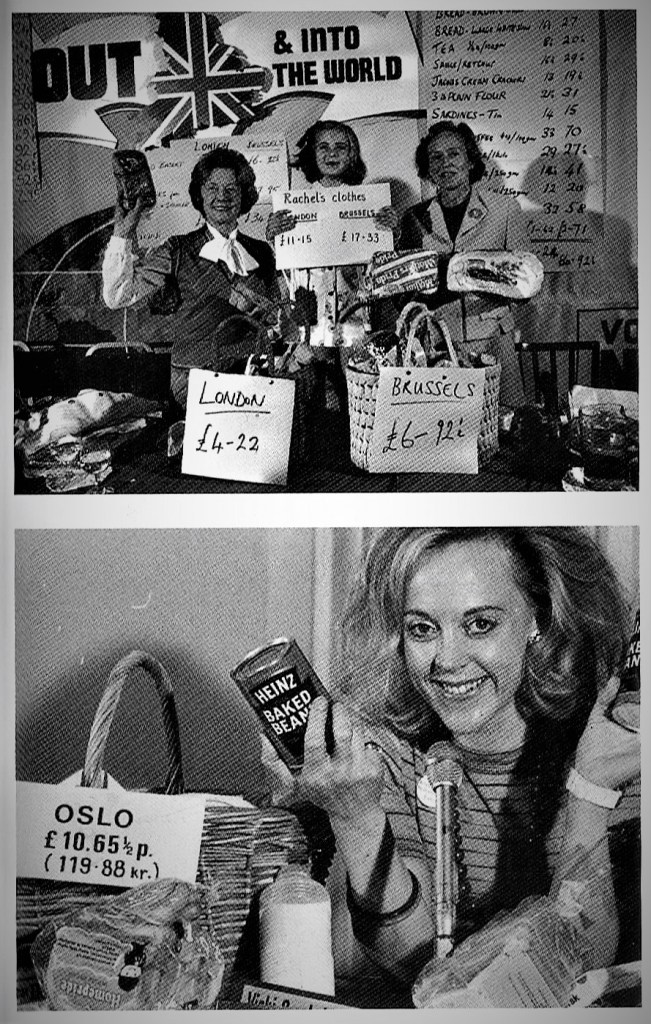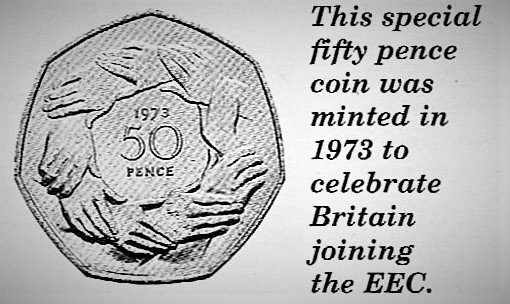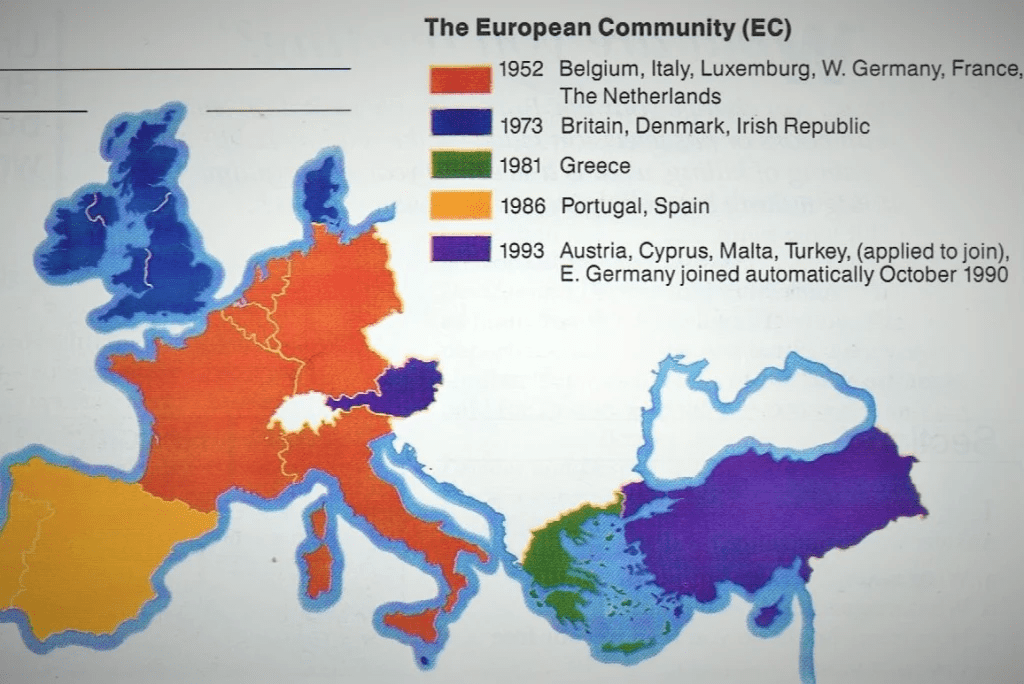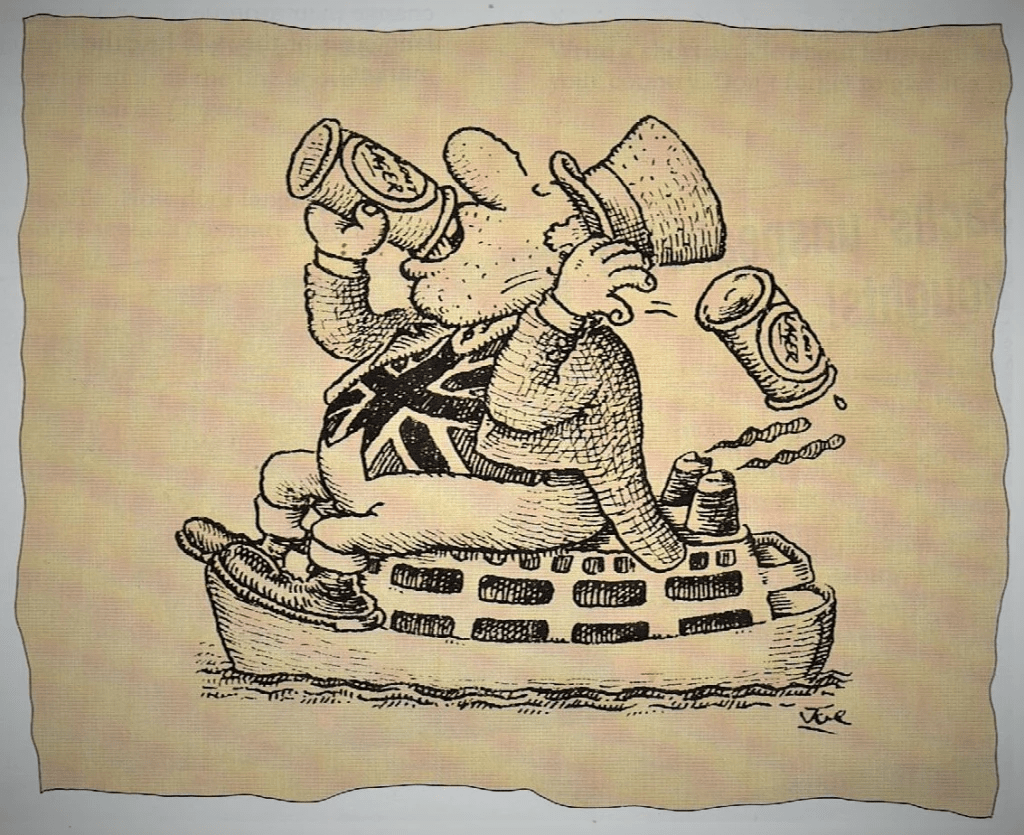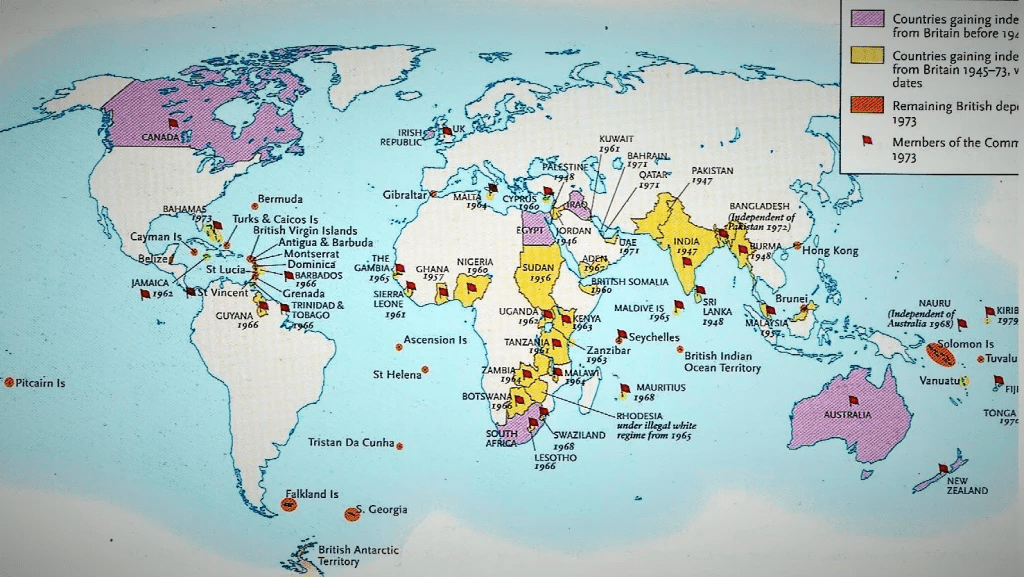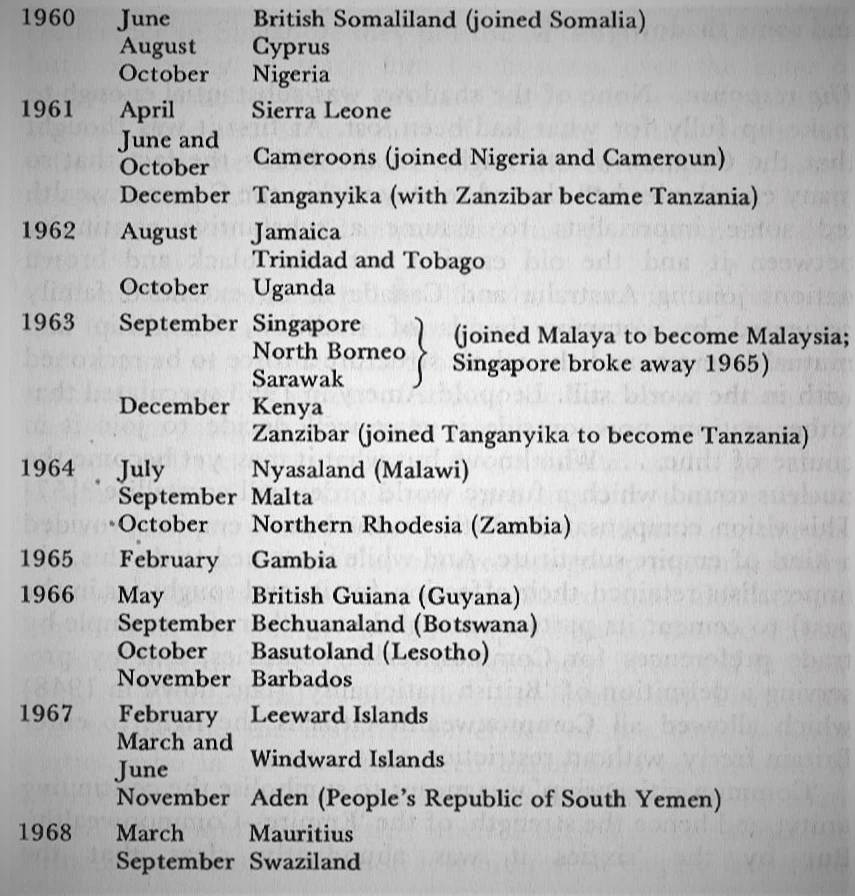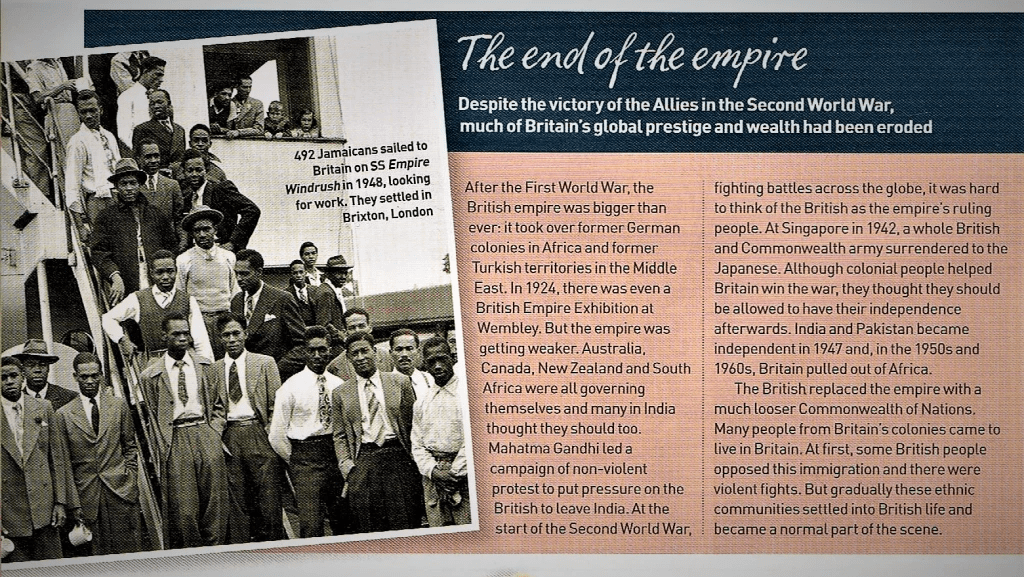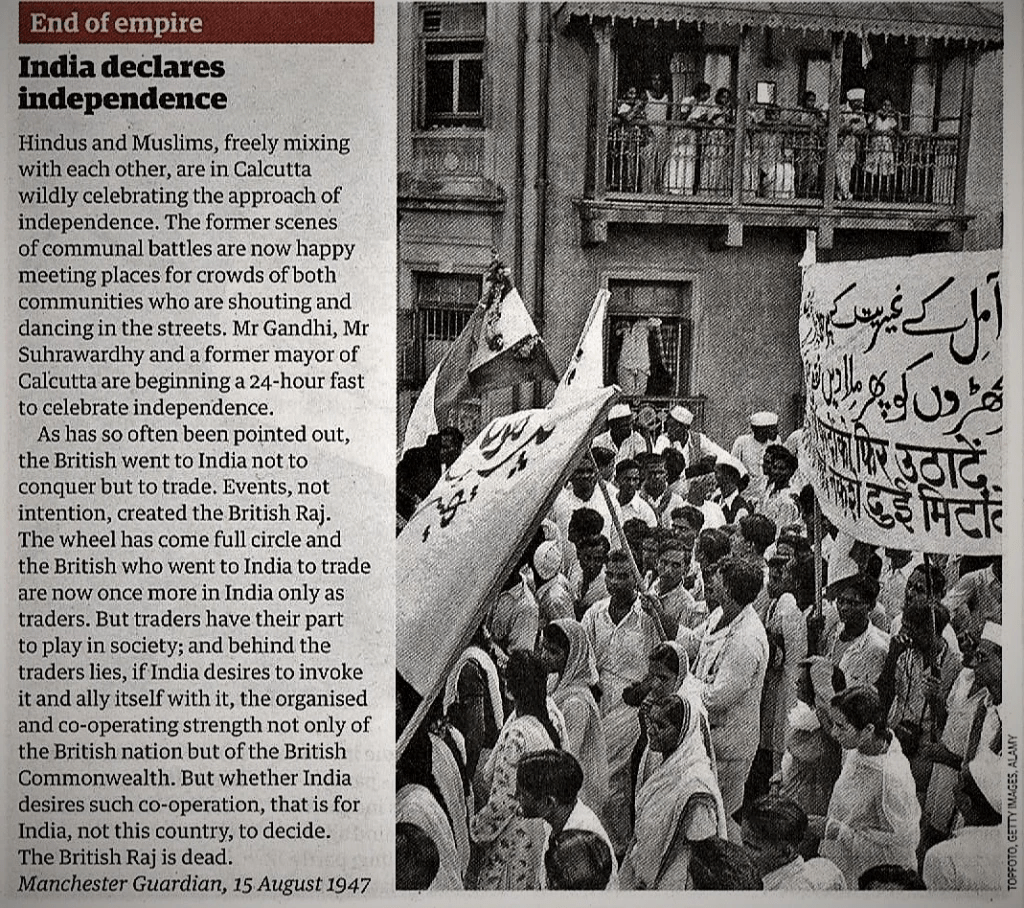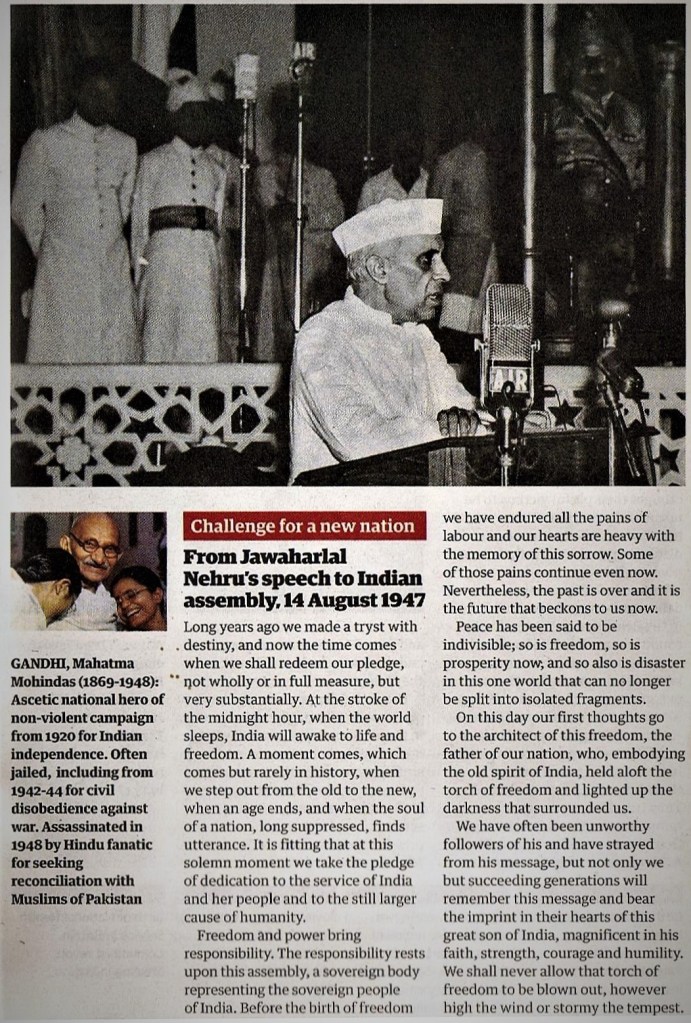
Britain had retreated from most of its empire by 1970. The only remaining colony was Rhodesia, which had been ruled by a white minority government, illegally, since 1967 and through the seventies. Britain resumed control in 1980 and the country became independent as Zimbabwe later that year. Various smaller island colonies in the Caribbean and the Pacific were granted independence in the seventies and eighties. The European Union, the Cold war and the NATO Alliance were Britain’s main concerns until 1990, while Ireland pursued a policy of neutrality. With the end of the Cold War, Britain took a more active role in Iraq, Bosnia and Kosovo. Hong Kong and its adjacent New Territories became an autonomous region of China in 1997 upon the expiry of the hundred-year lease. The removal of that colony, with its large population, enabled the British government to offer citizenship to the remaining small colonies that formed the British Overseas Territories.
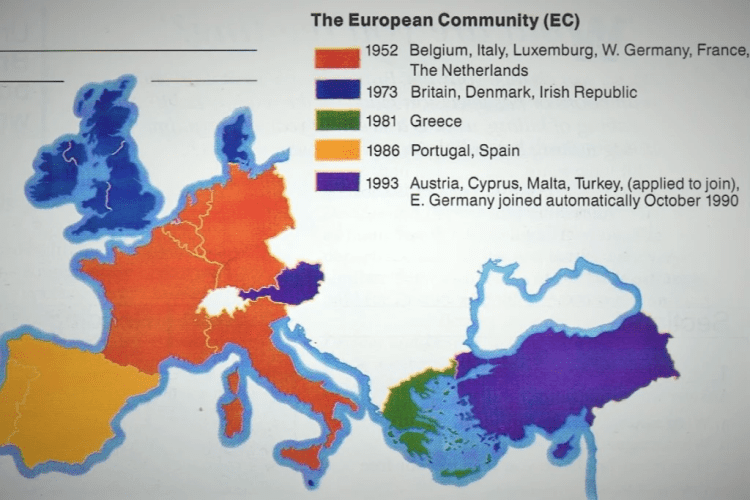
A European solution, through membership of the EEC, twice vetoed by de Gaulle in the sixties, had finally been found in the early seventies under Heath and Wilson. Simultaneously, the third way, initiated in 1970 by free-enterprise, anti-collectivist Tories like Anthony Barber, Edward du Cann and Keith Joseph at the Selsdon Park conference, prepared the way for Margaret Thatcher’s attempt in the 1980s to liquidate what was left of the welfare state. Billed as a return to Victorian values, Thatcher’s Revolution was not, in fact, a return to Gladstonian liberalism, but a reversion to the hard-faced reactionary conservatism of the 1920s, leaving industries alone to survive and thrive or to go to the wall. As in the twenties, resistance to brutal rationalisation through closures and sell-offs of uneconomic nationalised enterprises, or through wage or job cuts, was met with determined opposition, which came to a head in the long-running coal dispute of 1984-85.
Britain continued to operate as a dominant centre of world finance, but even this advantage turned into a liability when the defence of the sterling forced successive governments, especially the second Wilson government, into accepting humiliating conditions, either from the United States or from the International Monetary Fund, involving deep spending cuts. The shrinkage of sovereignty accelerated, with increasing battles over the slice sizes of the ever-diminishing economic pie, fought out between unions and government. But successive governments seemed determined to keep Britain as a substantial military power with a fully funded welfare state. All the alternative models of post-imperial power applied between the sixties and the eighties ran into trouble. Relying exclusively on the United States for its nuclear defence was ruled out as anathema by both Labour and Conservatives. This was seen as an abdication, not just of great power but any power status, seeming to be a recolonisation in reverse.
The Assassination of Lord Mountbatten by the IRA, August 1979:
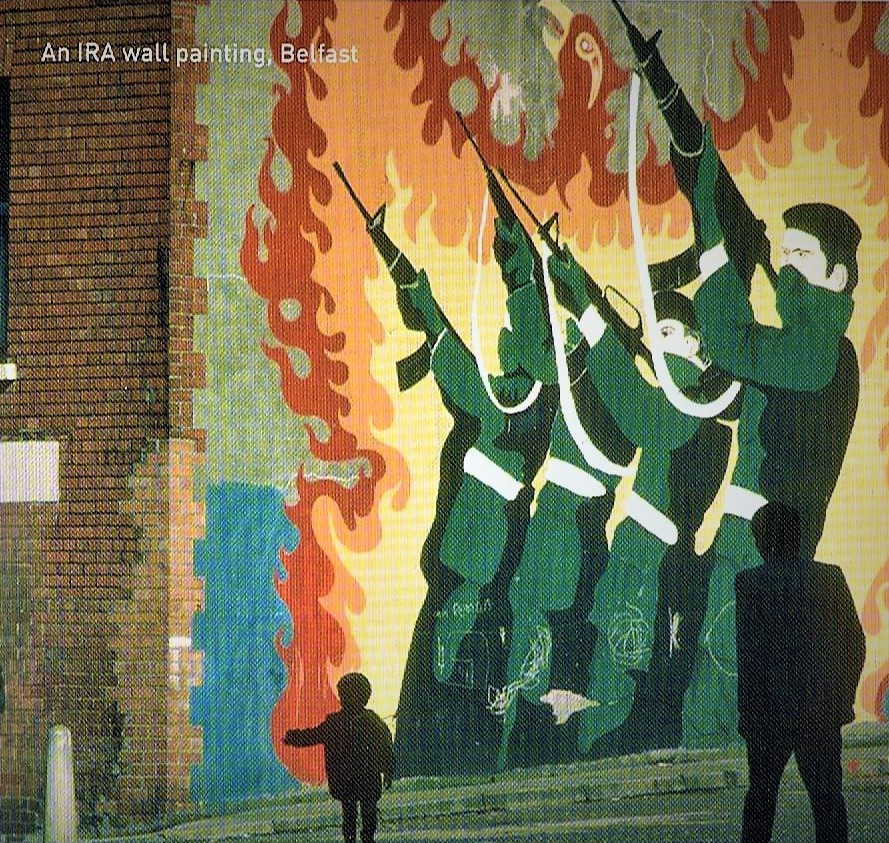
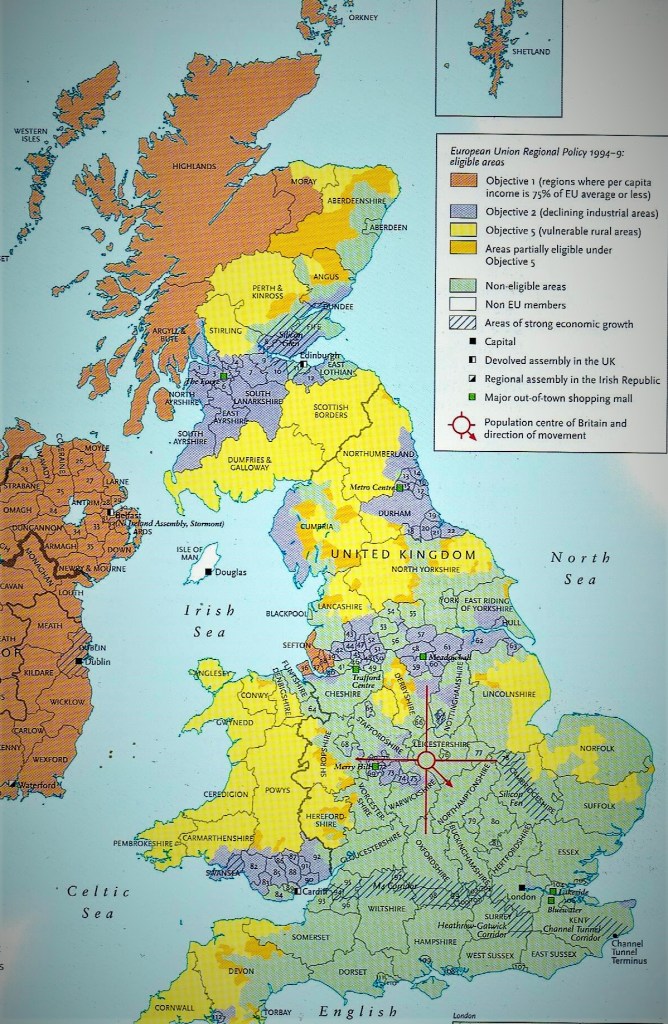
Of all the areas of the United Kingdom, it was Northern Ireland that continued to suffer the highest levels of unemployment in the eighties. This was mainly because the continuing sectarian violence discouraged inward investment in the six counties of the Province.
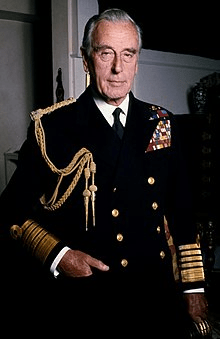
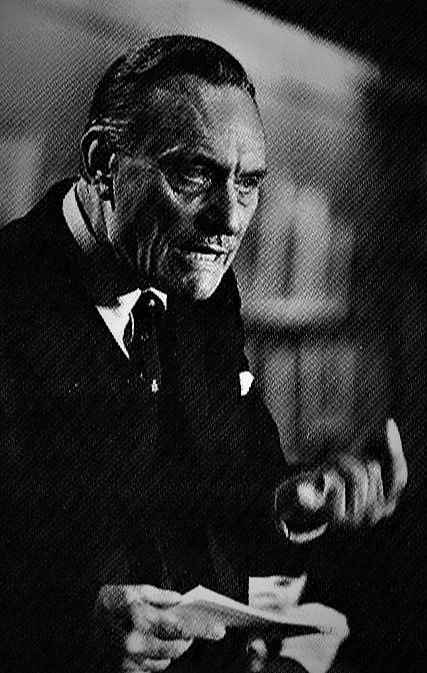
Lord Mountbatten of Burma
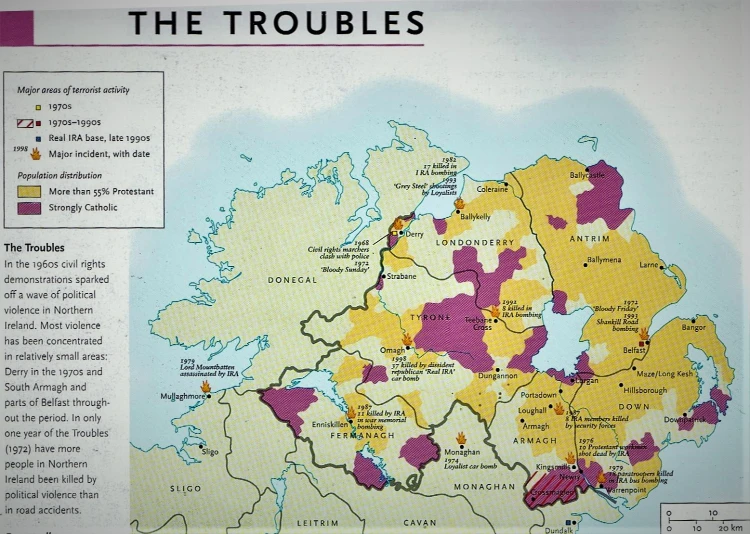
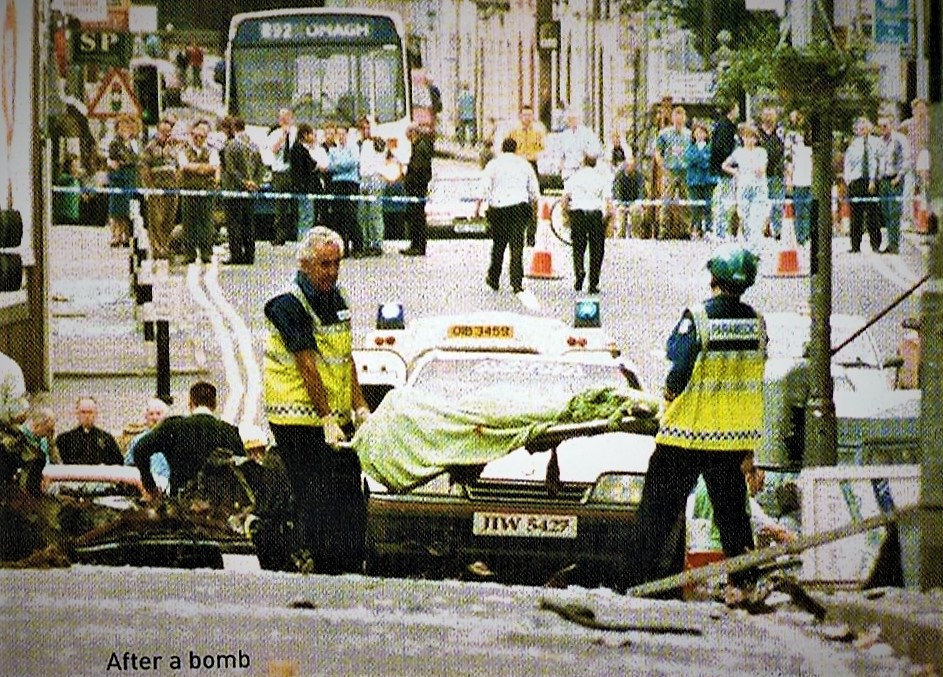
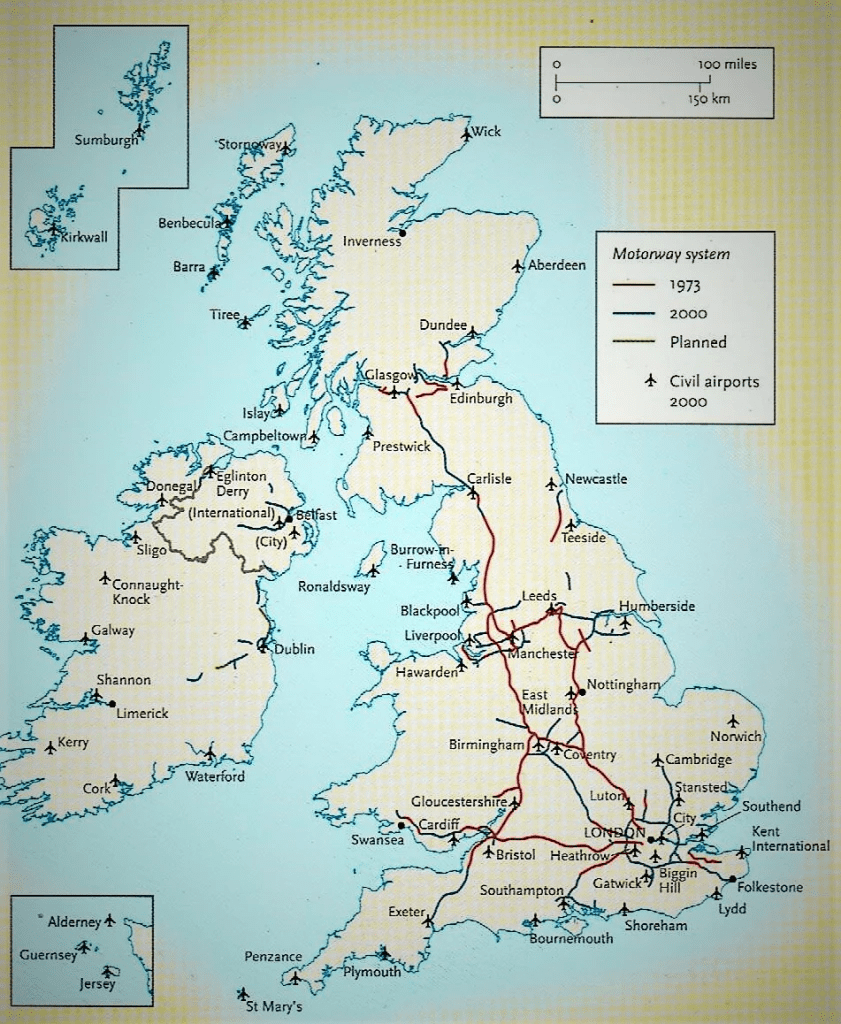
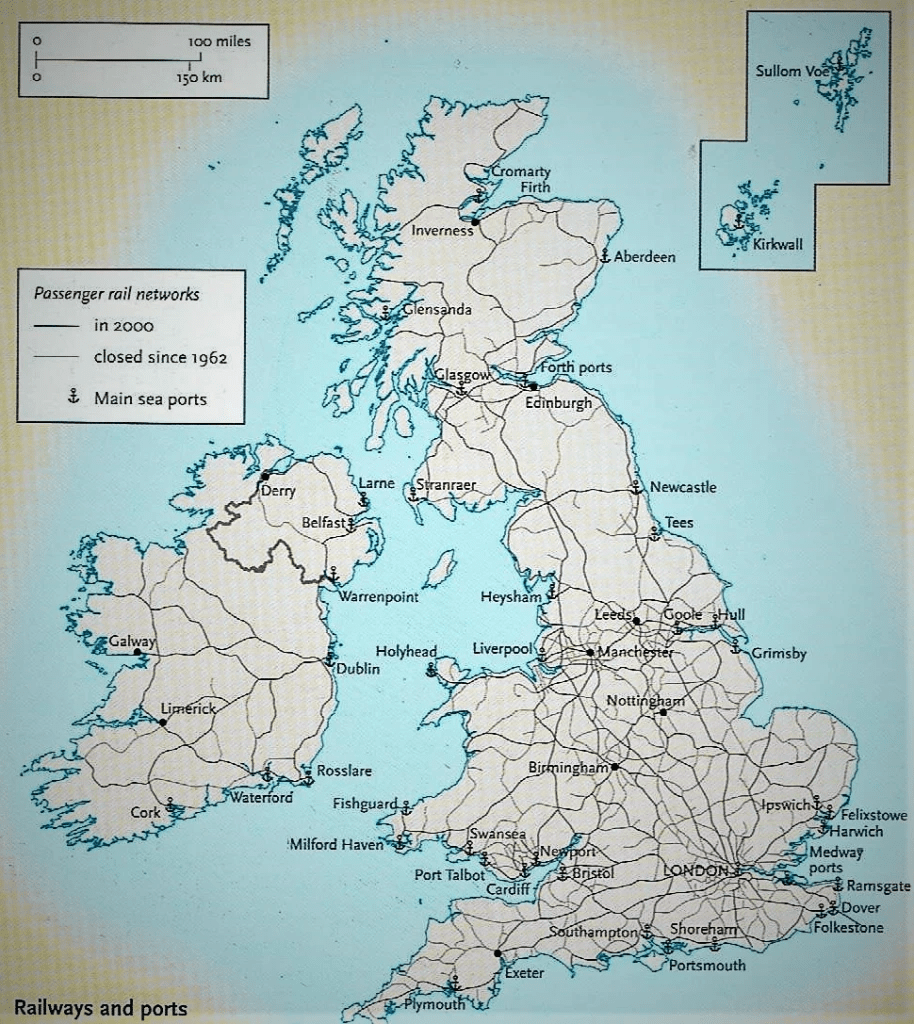
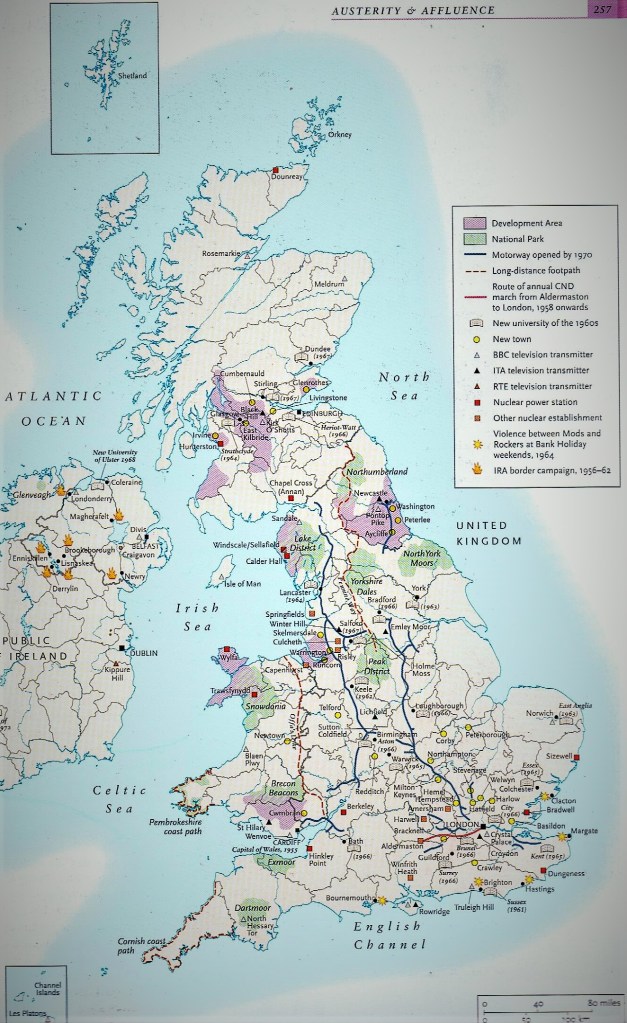
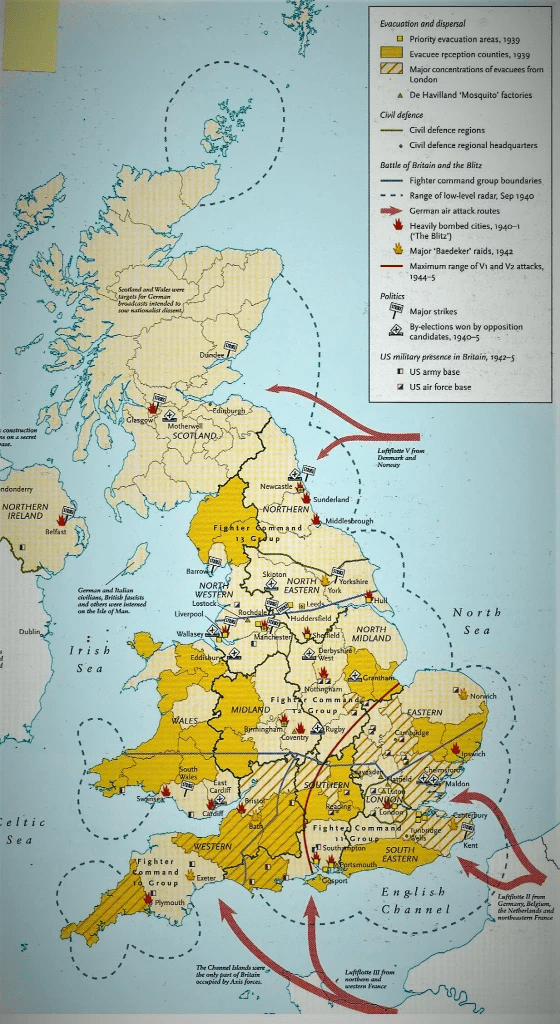
On August 27, 1979, in Mullaghmore, County Sligo, on the western coast of the Republic of Ireland (see the map above), a massive 50lb remote-controlled bomb exploded on board the fishing boat Shadow V, killing Lord Louis Mountbatten, his grandson and two others while they were boating on holiday off the coast. Lord Mountbatten was HM Queen Elizabeth’s second cousin and Prince Philip’s uncle. He was also, at that time, HRH Prince Charles’ great uncle, godfather and mentor. This was the height of the Provisional IRA’s bombing campaign across the British Isles.
Charles later described Lord Louis Mountbatten as the grandfather I never had. Mountbatten was a strong influence in the upbringing of his grand-nephew, and from time to time strongly upbraided the Prince for showing tendencies towards the idle pleasure-seeking dilettantism of his predecessor as Prince of Wales, King Edward VIII, whom Mountbatten had known well in their youth. Yet he also encouraged the Prince to enjoy the bachelor life while he could, and then to marry a young and inexperienced girl so as to ensure a stable married life.
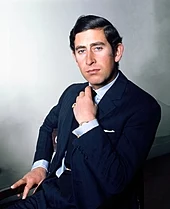
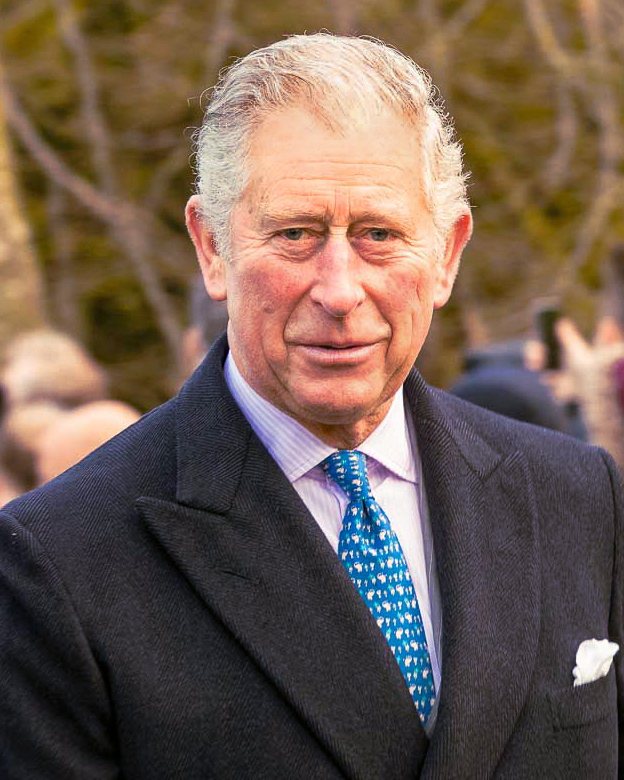
Prince Charles in the late 1970s: the eligible Bachelor.
Mountbatten’s qualification for offering advice to this particular heir to the throne was unique; it was he who had arranged the visit of King George VI and Queen Elizabeth to Dartmouth Royal Naval College on 22 July 1939, taking care to include the young Princesses Elizabeth and Margaret in the invitation, but assigning his nephew, Cadet Prince Philip of Greece, to keep them amused while their parents toured the facility. This was the first recorded meeting of Charles’s future parents. But a few months later, Mountbatten’s efforts nearly came to nought when he received a letter from his sister Alice in Athens informing him that Philip was visiting her and had agreed to repatriate permanently to Greece. Within days, Philip received a command from his cousin and sovereign, King George II of Greece, to resume his naval career in Britain which, though given without explanation, the young prince obeyed.
In 1974, Mountbatten began corresponding with Charles about a potential marriage to his granddaughter, Amanda Knatchbull. It was about this time he also recommended that the 25-year-old prince get on with “sowing some wild oats”. Charles dutifully wrote to Amanda’s mother (who was also his godmother), Lady Brabourne, about his interest. Her answer was supportive but advised him that she thought her daughter was still rather young to be courted. Four years later, Mountbatten secured an invitation for himself and Amanda to accompany Charles on his planned 1980 tour of India. Their fathers promptly objected. Prince Philip also thought that the Indian public’s reception would more likely reflect a response to the uncle, the last Viceroy, than to the nephew. Lord Brabourne counselled that the intense scrutiny of the press would be more likely to drive Mountbatten’s godson and granddaughter apart than together. Charles was rescheduled to tour India alone, but Mountbatten did not live to the planned date of departure.
Mountbatten usually holidayed at his summer home, Classiebawn Castle, on the Mullaghmore Peninsula in County Sligo, in the northwest of Ireland. The village was only twelve miles from the border with County Fermanagh in Northern Ireland and near an area known to be used as a cross-border refuge by IRA members. In 1978, the IRA had allegedly attempted to shoot Mountbatten as he was aboard his boat, but poor weather had prevented the sniper from taking his shot. On 27th August 1979, Mountbatten went lobster potting and tuna fishing in his thirty-foot wooden boat, Shadow V, which had been moored in the harbour at Mullaghmore. IRA member Thomas McMahon had slipped onto the unguarded boat the previous night and attached a radio-controlled bomb weighing fifty pounds. When Mountbatten and his party had taken the boat just a few hundred yards from the shore, the bomb was detonated. The boat was destroyed by the force of the blast and Mountbatten’s legs were almost blown off. Mountbatten, then aged seventy-nine, was pulled alive from the water by nearby fishermen but died from his injuries before being brought to shore.
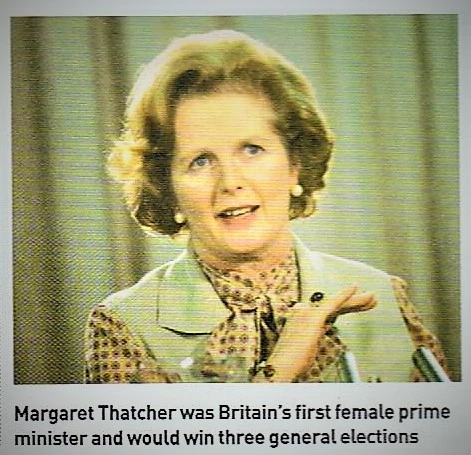
Also aboard the boat were Amanda Knatchbull’s elder sister Patricia, Lady Brabourne; her husband Lord Brabourne; their twin sons Nicholas and Timothy Knatchbull; Lord Brabourne’s mother Doreen, Dowager Lady Brabourne; and Paul Maxwell, a young crew member from Enniskillen in County Fermanagh. Nicholas (aged fourteen) and Paul (fifteen) were killed by the blast and the others were seriously injured. Doreen, Dowager Lady Brabourne (eighty-three), died from her injuries the following day. The attack triggered outrage and condemnation around the world. The Queen received messages of condolence from leaders including US President Jimmy Carter and Pope John Paul II. Prime Minister Margaret Thatcher said:
‘His death leaves a gap that can never be filled. The British people give thanks for his life and grieve at his passing.‘
On the day of the bombing, the IRA also ambushed and killed eighteen British soldiers at the gates of Narrow Water Castle, just outside Warrenpoint, in County Down in Northern Ireland, sixteen of them from the Parachute Regiment, in what became known as the Warrenpoint ambush. It was the deadliest attack on the British Army during the Troubles. Six weeks later, Sinn Féin vice-president Gerry Adams said of Mountbatten’s death:
“The IRA gave clear reasons for the execution. I think it is unfortunate that anyone has to be killed, but the furor created by Mountbatten’s death showed up the hypocritical attitude of the media establishment. As a member of the House of Lords, Mountbatten was an emotional figure in both British and Irish politics. What the IRA did to him is what Mountbatten had been doing all his life to other people; and with his war record I don’t think he could have objected to dying in what was clearly a war situation. He knew the danger involved in coming to this country. In my opinion, the IRA achieved its objective: people started paying attention to what was happening in Ireland.”
When Charles finally proposed marriage to Amanda later in 1979, the circumstances had changed and she refused him.
The Winter of Discontent:
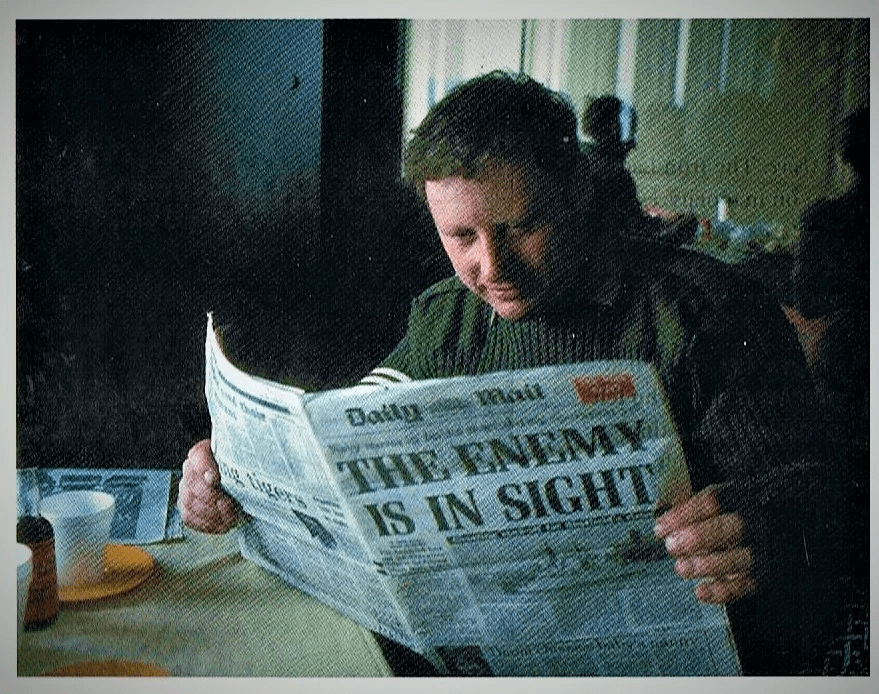
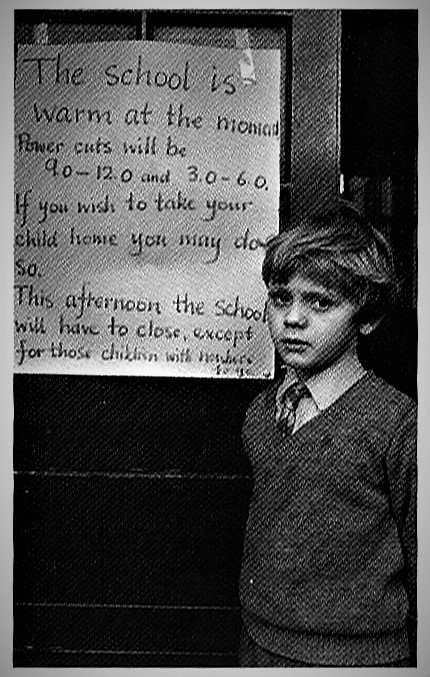
The winter of our discontent, a phrase from Shakespeare’s play Richard III, was used by James Callaghan, Labour Prime Minister from 1976, to describe the industrial and social chaos of 1978-79. It has stuck in people’s memories, as few economic or political events had done before or have done since. In the two years, 1977 and ’78 there was an explosion of resentment, largely by poorly paid public employees, against a minority Labour government incomes policy they felt was discriminatory. It began earlier in 1978 but got far worse with a series of strikes going into winter, resulting in rubbish being left piled up and rotting in the streets throughout the country. Added to this, the schools closed, the ports were blockaded and the dead went unburied. Left-wing union leaders and activists whipped up the disputes; individual union branches and shop stewards were reckless and heartless. Right-wing newspapers, desperate to see the end of Labour, exaggerated the effects and rammed home the picture of a nation no longer governable. The scenes on Britain’s streets provided convincing propaganda for the conservatives in the subsequent election in May 1979.
Callaghan had opposed the legal restrictions on union power pleaded for by Wilson and Castle and then fought for vainly by Heath. Healey, acting in good faith, had imposed a more drastic squeeze on public spending and thus on the poorest families than had been economically necessary. They had also tried to impose an unreasonably tough new income policy on the country. Finally, by dithering about the date of the general election, he destroyed whatever fragile calm he had managed to establish and enjoy since he had taken over from Wilson. Most observers and members of the cabinet assumed that Callaghan would call an autumn election in 1978. The economic news was still good and Labour was ahead in the polls. Two dates in October had already been pencilled in, but musing on his Sussex farm during the summer, Callaghan decided that he did not trust the polls. He decided to wait until the following spring. But when he invited a dozen trade union leaders to his farm to discuss the decision, they left still thinking he was going in the autumn. But then, at the beginning of autumn, at the TUC conference, he confused the issue even more with a bizarre rendition of an old music hall concert, leaving his audience to interpret its meaning. When he finally came clean with the cabinet, they were shocked.
This might not have mattered so much had Callaghan also not promised a new five per cent pay limit to bring down inflation further. As a result of the 1974-75 cash limit on pay rises at a time of high inflation, take-home pay for most people had been falling ever since. Public sector workers, in particular, had been having a hard time, and there were stories of fat cat directors and bosses awarding themselves high settlements. The union leaders and many ministers thought that a further period of pay limits would be impossible for them to sell to their members, while a five per cent limit, was widely considered to be ludicrously tough. Had Callaghan gone to the country in October, Labour’s popularity among the general electorate might have been boosted by the pay restraint policy. But by postponing the election until the spring, Callaghan ensured that the five per cent limit would be tested in Britain’s increasingly impatient and dangerous industrial relations environment. The first challenge came from the fifty-seven thousand car workers employed by the US giant Ford. The TGWU called for a thirty per cent pay rise, on the back of high profits and an eighty per cent rise for its chairman and directors. Callaghan was severely embarrassed and when, after five weeks of lost production, Ford eventually settled for seventeen per cent, he became convinced that he would lose the coming election.
Oil tanker drivers, also TGWU members, came out for forty per cent, followed by haulage drivers, British Leyland workers, and then sewerage workers. BBC electricians threatened a blackout of Christmas TV. The docks were picketed and closed down with Hull, virtually cut off, becoming known as the second Stalingrad. The effects of this were being felt by government ministers as well as the rest of the country. Bill Rodgers, the transport minister, whose mother was dying of cancer, found that vital chemotherapy chemicals were not being allowed out of Hull. In the middle of all this, Callaghan went to an international summit in the Caribbean, from where the pictures of him swimming and sunning himself did not improve the mood back home. When he returned to Heathrow, confronted by news reporters asking about the industrial crisis, he replied blandly, “I don’t think other people in the world will share the view that there is mounting chaos.” This was famously translated into the Daily Mail’s headline, ‘Crisis? What Crisis?’
Above: Rubbish is left piled up in London’s Leicester Square in February 1979
In the centre of London and other major cities, huge piles of rotting rubbish piled up, overrun with rats and becoming a serious health hazard. Most of those striking among the public sector workers were badly paid and living in relative poverty, also having no history of industrial militancy. Nor was the crisis quite as bad as the media portrayed it. There were no deaths in hospitals as a result of union action, there was no shortage of food in the shops and there was no violence. Troops were never used. This was chaos and a direct threat to the authority of the government, but it was not a revolutionary situation, or even an attempt to overthrow a particular government. Yet that was the effect it had, and it led to what was to become Thatcherism, not socialism. A ‘St Valentine’s Day Concordat’ was eventually reached between the government and the TUC, which agreed on annual assessments and guidance, targeting long-term inflation and virtually admitting that the five per cent pay limit had been a mistake. By March most of the action had ended and various large settlements and inquiries had been set up. But by then irreparable damage had already been done to the Labour Government’s reputation as a manager of industrial disputes.
The St David’s Day Devolution Debácle & General Election of 1979:
When the matter of devolution was put to the Welsh electorate in a referendum on St. David’s Day, 1979, it voted overwhelmingly against the planned assembly, by 956,000 votes to 243,000. Every one of the relatively new Welsh counties voted ‘No’. The supporters were strongest in the north-west (Gwynedd), at twenty-two per cent of those voting and weakest in Glamorgan and Gwent at seven to eight per cent, but everywhere there was a crushing rejection of the Labour government’s proposal; only some twelve per cent voted in favour overall. The narrow failure of the Scottish referendum due to the forty per cent clause meant that under previously agreed rules, the Devolution Act setting up a Scottish Assembly had to be repealed. In the Commons, the government was running out of allies. There was therefore no longer any reason for the SNP to continue supporting the Labour government. Plaid Cymru, unlike the SNP, did not call on its MPs to vote to bring about the end of the government. As dying MPs were carried through the lobbies to keep the sinking Labour ship afloat. Michael Foot and the Labour whips continued to try to find any kind of majority, appealing to renegade Scots, Ulster Unionists and Irish nationalists simultaneously but Callaghan, by now, was in a calmly fatalistic mood. He did not want to struggle on through another summer and autumn in the hope that something would turn up.
Finally, on 28th March, the government was defeated by a single vote, and Callaghan became the first Prime Minister since Ramsay MacDonald in 1924 to have to go to Buckingham Palace and ask for a dissolution of parliament because he had lost a vote in the Commons. The election campaign began after the IRA’s assassination of Mrs Thatcher’s leadership campaign manager, Airey Neave, murdered by a Provisional IRA car bomb on his way to the Commons. Thatcher took on Callaghan, who was still more popular than his party and who now emphasised stable prices and his new deal with the unions. Thatcher showed a fresh, authentic face in the media, working with television news teams and taking the advice of advertising gurus, like the Saatchi brothers. Using the slogan Labour isn’t working, which appeared on huge hoardings showing long dole queues, the Tories came back to power with a clear and substantial majority with 339 seats. In the General Election, the Conservatives took sixty-one seats directly from Labour and gained nearly forty-three per cent of the vote.
At a time of heavy swings to the Tories everywhere, the heaviest swings of all, outside London, was in Wales, and in every part of Wales. More Tory MPs were returned in Wales than at any previous twentieth-century election, eleven in all. Nevertheless, Labour remained a massive presence, with twenty-one seats out of thirty-six and forty-seven per cent of the vote compared with thirty-two per cent for the Conservatives. In June, in the heartland of Labourism, there was also a heavy vote against the European Common Market. In the General Election of May, Wales located itself firmly in the political South of Britain, rather than its traditional role as a Northern Labour stronghold. What had happened was that a third challenger had bypassed the old debates and left Labour and Plaid Cymru gasping. The latter’s President, Gwynfor Evans, came third behind the Tory in Carmarthen, and a Sussex solicitor ‘parachuted’ onto Anglesey, Mother of Wales, to win the seat ahead of both Labour and Nationalist parties with a swing of twelve per cent. The Tories also ended generations of Liberal predominance in Montgomeryshire. Even in Labour’s industrial heartlands of the southern valleys, the swing to the Conservatives was the second strongest in Britain.
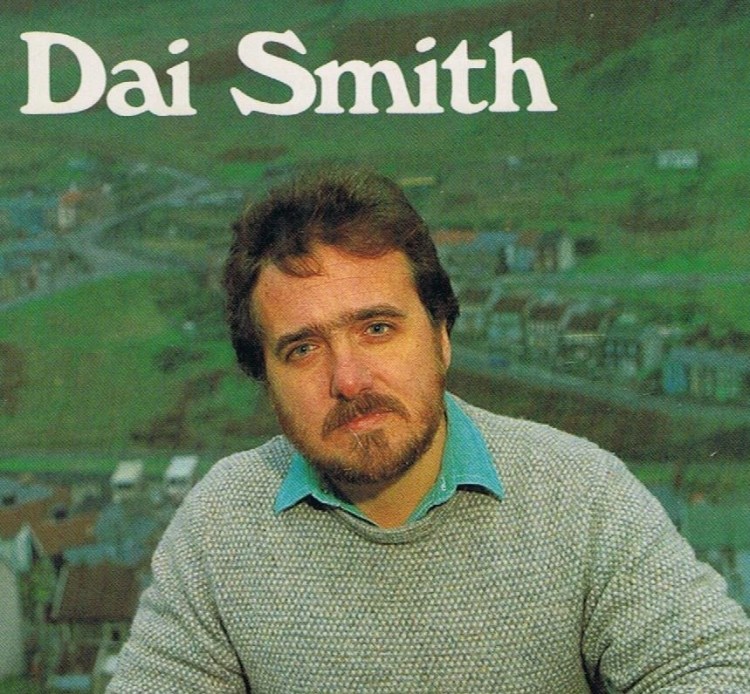
One effect of this abrupt reversal of a hundred years of history was to equally abruptly cut off an intelligentsia from its people. The ‘professional’ Welsh, blinded by their own desires, had misread Wales very badly in the 1970s. In the 1980s, historians Gwyn Williams (right) and Dai Smith (below) argued that the reasons for this were as much sociological as ideological. The decline of the Welsh coalfields entailed a withering of major political and cultural energies. History had been wilfully redefined so that it stood only as a commentary on what might, or should, have been.
Both Smith and Williams recognised that a more pragmatic, economic nationalism was on offer from the ‘National Left’ of Plaid Cymru, which took a libertarian socialist stance and tried to establish links with ecological, peace and feminist groups. Nevertheless, the broad understanding behind the resurgence of political, cultural and linguistic nationalism remained the same, implicitly, as it had been, explicitly in the 1920s and 30s: The prevailing theory endured from that original period that the anglicisation of Wales was an avoidable disaster because the industrialisation of Wales had replaced the pure ‘old Welsh collier’ population with a conglomeration of ‘half-people,’ the Cymry di-Gymraeg (‘the Welsh without Welsh’).
Of course, by the mid-1970s, Plaid Cymru was no longer advocating, with the cold logic of Saunders Lewis, the deindustrialisation of Wales. In any case, this was something that was to be largely accomplished by the Thatcher government after 1979, though for very different reasons. In the twenty years previous to 1979, what had been stressed by cultural and political nationalists was the extent to which the modern experience of Wales had been a ‘fall from grace.’ Even in the eighties, many traditional nationalists did still believe that Wales could only be saved through the restoration of the old ‘Welsh’ values, delivered by the vehicle of the ancient Welsh language, albeit in ‘living’ form. But by then, the votes of 1979 had already dramatically registered the end of an epoch in Wales in which intellectuals – liberal, nationalist and labourist – had articulated the consciousness of various social groups and classes in Welsh society.
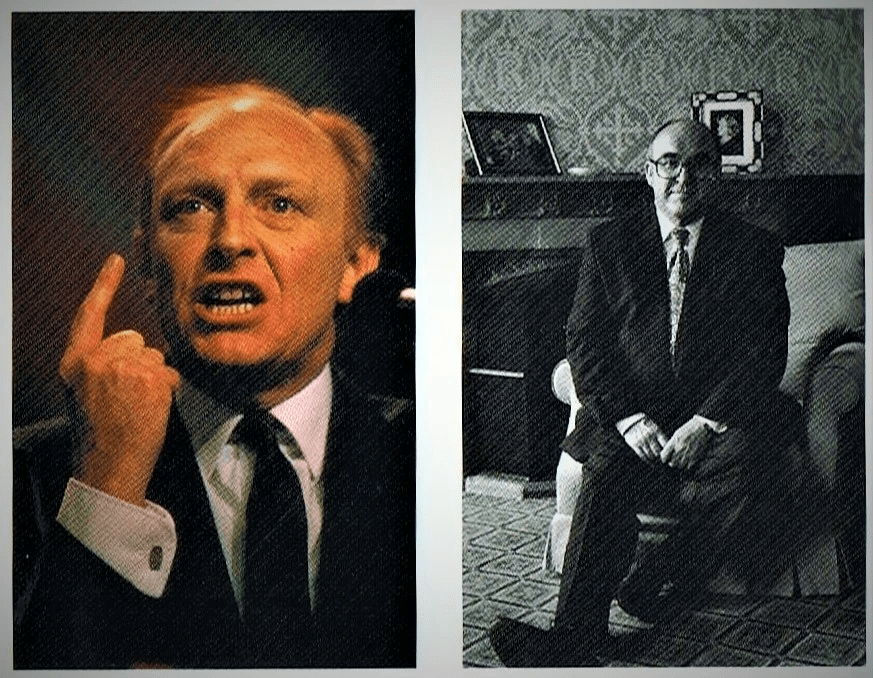
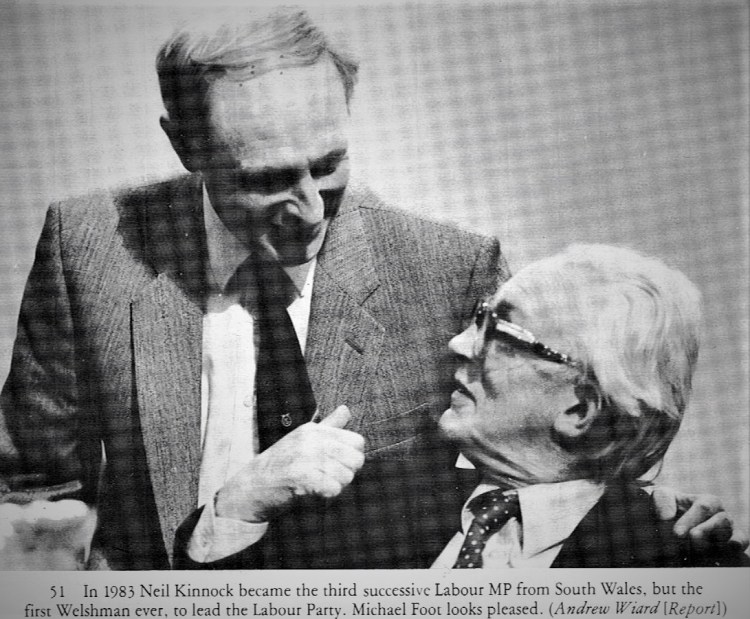
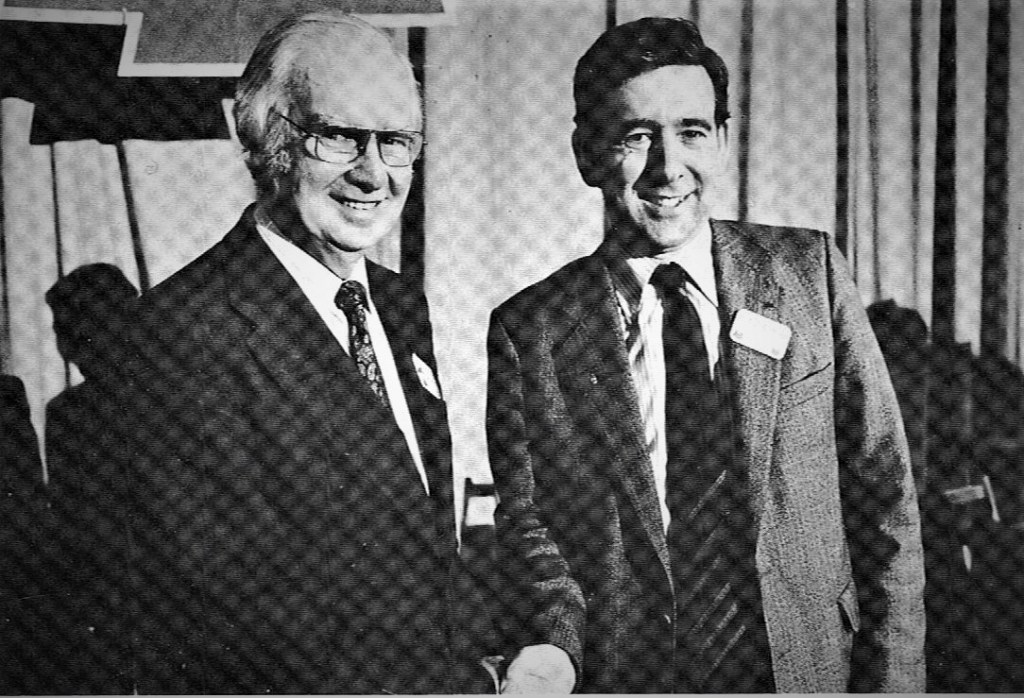
After the Spring of 1979, managerial and administrative groups in Wales became increasingly integrated into broader, technocratic European contexts, without any specifically Welsh content. The most visible and creative formers of educated opinion among the Welsh were rejected by their people and viewed as irrelevant. Old Labourism in Wales, along with Gwynfor Evans’sNationalism and Lloyd George’s Liberalism were all effectively dead. Michael Foot and Neil Kinnock (above) tried hard to resurrect the Bevanite tradition across Wales and England, supported by the Tribune Left in the early eighties, but they ultimately failed to provide an Alternative Economic Strategy to that of Thatcherism in the three successive general elections. Mrs Thatcher herself had an acronym for her monetarist policies, TINA (There is no alternative). Dai Smith summed up the extent to which the cultural battlefield had already shifted, writing in 1984:
Wales in the 1980s has become its own industry. … The production of history in Wales is now a battleground on which rival armies contend to dispel the confusion. … What we are witnessing is the invoking of the Welsh past in the disputed name of the Welsh future. … Social history that dips a toe in national waters is invariably accused of polluting intent. The purity of emotion is defiled. … for the Wales that is projected to the outside world is not a Wales most of the Welsh know or recognise as anything of their own.Perhaps our ambivalent condition is exemplary after all. We are already a long way down the road which England… has just begun to contemplate. After all, England, too, is a country of the mind.
Dai Smith (1984), Wales! Wales?Hemel Hempstead: George Allen & Unwin, pp. 165-68.
The Breaking of Consensus, Blitz on Jobs & Wales in the Wilderness:
Meanwhile, the players in the last act of Old British Labour and the broken post-war Consensus stumbled on. Callaghan continued as Labour leader until retiring in October 1980. Michael Foot took over as Labour leader after a contest with Denis Healey, who then fought a desperate struggle against Tony Benn and the Left to become Deputy leader, as his party did its best to commit suicide in public. Numerous moderates formed the breakaway SDP. The Scottish Nationalists, derided by Callaghan for voting him down as “turkeys voting for Christmas” lost eleven of their thirteen MPs. The unions lost almost half their members and any real political influence they briefly held.
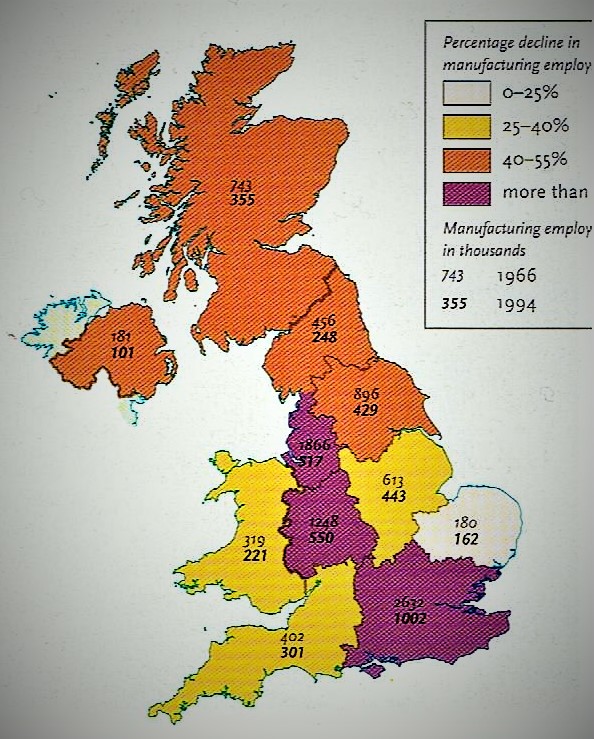
More important than all that, mass unemployment would return to Britain. It was the one economic medicine so bitter that no minister in the seventies, Labour or Tory, had dared to uncork it, until those of the Thatcher government. In the election campaign, Margaret Thatcher promised a return to the values which had made Victorian Britain great. However, what the British people got was more of a return to the hard-nosed Toryism of the interwar years as the Thatcher government set about the task of deliberately lengthening those dole queues. As wage rises were believed to be the main source of inflation and heavy unemployment, it was often openly argued, would weaken trade union bargaining power, and was a price worth paying. At the same time, an economic squeeze was introduced, involving heavy tax increases and a reduction in public borrowing to deflate the economy, thus reducing both demand and employment. In the 1980s, two million manufacturing jobs disappeared, most of them by 1982.
When Thatcher took on the moderate ‘wets’ in her cabinet, including Jim Prior (bottom of the cartoon), she could rely on the support of much of the press.
Almost immediately after the general election, Wales was fully exposed to the Conservative crusade and the radical restructuring of increasingly multinational capitalism in Britain. The Welsh working population reached a peak in 1979 when just over a million people were at work, fifty-five per cent of them in the service sector and forty-two per cent of them women in the core industries. The run-down of the coal industry continued and was followed by a sharp reduction in steel. A Guardian columnist wrote that, in economic terms, every time England catches a cold, Wales gets influenza. Between June 1980 and June 1982, the official working population fell by no fewer than 106,000. The most catastrophic losses were in steel which lost half its workers and plummeted to 38,000. In addition, there were heavy losses in chemicals, textiles, engineering, construction and general manufacturing. The distributive trades, transport and communications also shed thousands of jobs. Public administration lost proportionately fewer, while a whole range of services in insurance, banking, entertainment, leisure, education and medical services gained four thousand workers.
By June 1983 the official working population of Wales was at 882,000, its lowest level in modern times. There was a high level of unemployment, particularly among a whole generation of young people. In the Thatcher years Wales, like Scotland, was dominated by the politics of resistance to Conservatism, but the Wales TUC was weakened by losing numbers and funds, seemingly incapable of adequate adjustment and response. Overall, the organised trade union movement seemed encased in a perception of a Welsh working class which had become a myth. There was a People’s March for Jobs, but it was a pale imitation not just of previous mass demonstrations in the valleys, but even of the contemporary ones in England. The exceptions were, again, the successful strikes and campaigns against closures by the South Wales Miners (South Wales Area, NUM) in 1981-82, but even there, the question was being asked at public meetings, Have the Miners Really Won? The answer came in 1984, by which time they were gaining support, and preparing to fight a struggle as hard and as dedicated as any in their history.
Meanwhile, much radical energy went into CND mass meetings and protests, which acquired much more weight across south Wales and the valleys, from Monmouthshire to Carmarthenshire. The protest camp at the Greenham Common missile base was started by a march of women from Cardiff. Around the language issue, the clamour and turmoil revived and continued in the campaign for the Welsh-medium television channel, S4C. Among Welsh nationalist students, support for constitutional nationalism plummeted after the Referendum result and calls for more radical direct action multiplied for the first time since the Investiture Crisis of 1969 and the botched bombing of Caernarfon Castle. This action was largely limited to student members of Cymdeithas yr Iaith (Welsh Language Society) climbing transmitter masts and smashing old television sets at the National Eisteddfod. The frictionbetween Welsh-speaking and English-speaking students led to a division in the student unions in both Bangor and Aberystwyth, allowing right-wing English conservatives to take control. Using Gandhian tactics, Gwynfor Evans, having stood down as President of the Plaid Cymru, began a lengthy hunger strike to secure the Fourth Channel in Welsh, which was eventually launched, by Superted, the cartoon character, in the late summer of 1982.
In 1981, after a successful campaign to establish a fourth television channel in Welsh, Gwynfor Evans (left) stood down as Plaid Cymru President after thirty-six years, to be replaced by Dafydd Wigley, MP for Caernarfon (right).
There was also a no far more sinister campaign led by the shadowy organisations, Meibion Glyndwr (Sons of Glyndwr) and The Workers’ Army of the Welsh Republic (the Welsh initials spelling ‘Dawn’), which apparently acquired weapons from the former Official IRA. A major campaign of arson began in 1980, against holiday homes throughout western Wales, where passive support from local people went under the humourous slogan Strike a Light for Wales above a picture of an ‘England’s Glory’ matchbox. A major police action was launched by Gwynedd and Dyfed-Powys police forces, Operation Tán (Fire), producing a chorus of complaints over violations of civil rights, telephone tapping and the use of agents provocateurs. Several police officers were accused of fabricating evidence and confessions and of trying to falsely implicate the Meirionydd MP Dafydd Elis Thomas in a bombing campaign against military, government and Conservative Party offices.
The Iron Lady on manoeuvres with a tank, union flag and Prince of Wales’s feathers. By 1983, she had well and truly parked her tank on the green, green grass of Wales, and was at the peak of her powers throughout the United Kingdom.
Sacrificing the Young – the Case of Coventry in the Recession:
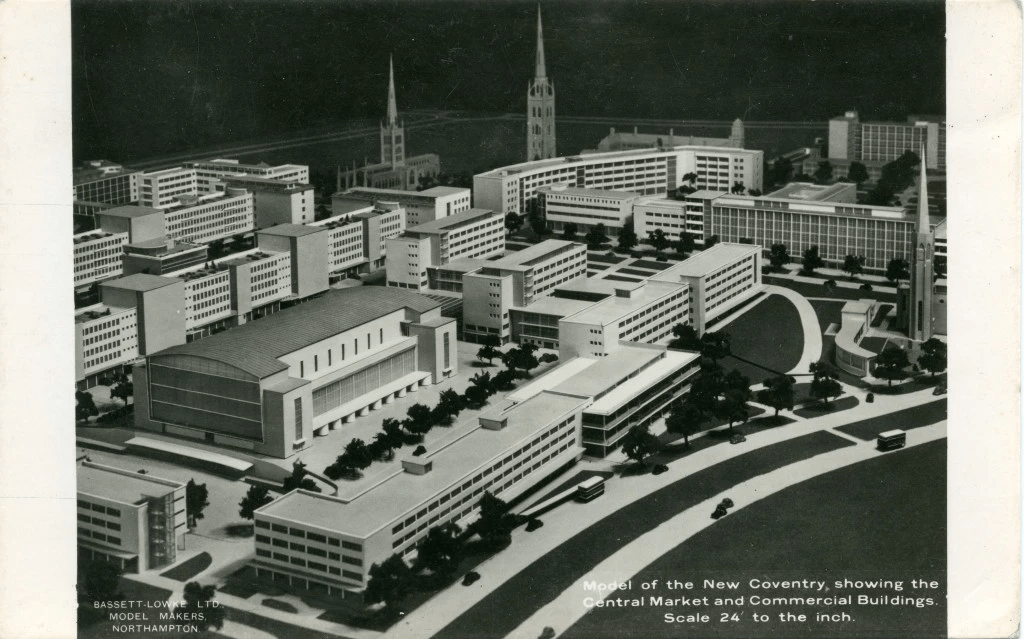
In Coventry, nearly sixty thousand jobs were lost in this period of recession from 1979 to 1983. The Conservative policy of high-interest rates tended to overvalue the pound, particularly in the USA, the major market for Coventry’s specialist cars, leading to a rapid decline in demand. Also, the Leyland management embarked on a new rationalisation plan. The company’s production was to be concentrated at its Cowley and Longbridge plants. Triumph production was transferred to Cowley, and Rover models were to be produced at the new Solihull plant. The Coventry engine plant at Courthouse Green was closed and Alvis, Climax and Jaguar were sold off to private buyers. In the first three years of the Thatcher government, the number of Leyland employees in the city fell from twenty-seven thousand to eight thousand. One writer summarised the effects of Conservative policy on Coventry in these years as turning a process of gentle decline into a quickening collapse. Overall the city’s top manufacturing firms shed thirty-one thousand workers between 1979 and 1982. Well-known pillars of Coventry’s economic base such as Herbert’s, Triumph Motors and Renold’s all disappeared. Unemployment had stood at just five per cent in 1979, the same level as in 1971. By 1982 it had risen to sixteen per cent.
None of this had been expected locally when the Thatcher government came to power. After all, Coventry had prospered reasonably well during the previous Tory administrations. The last real boom in the local economy had been stimulated by the policies of Ted Heath’s Chancellor, Anthony Barber. However, the brakes were applied rather than released by the new government. Monetarist policies were quick to bite into the local industry. Redundancy lists and closure notices in the local press became as depressingly regular as the obituary column. The biggest surprise was the lack of resistance from the local Labour movement, given Coventry’s still formidable trade union movement. There was an atmosphere of bewilderment and an element of resignation characterised in the responses of many trades-union officials. It was as if the decades of anti-union editorials in the Coventry Evening Telegraph were finally being realised.
There were signs of resistance at Longbridge, but the British Leyland boss, Michael Edwardes, had introduced a tough new industrial relations programme which had seen the removal from the plant of the union convenor, Red Robbo (Derek Robinson), Britain’s strongest motor factory trade union leader. Edwardes had also closed the Speke factory on Merseyside, demonstrating that he could and would close plants in the face of trade union opposition. Coventry’s car workers and their union leaders had plenty of experience in local wage bargaining in boom times but lacked strategies to resist factory closures during the recession. Factory occupation, imitating its successful use on the continent, had been tried at the Meriden Triumph Motorcycle factory, but with disastrous results. The opposition from workers was undoubtedly diminished by redundancy payments which in many cases promised to cushion families for a year or two from the still unrealised effects of the recession.
Above: Employment levels in Coventryto 1981, showing a sharp decline after 1979.
As experienced in Wales, young people were the real victims of these redundancies, as there were now no places or apprenticeships for them to fill. The most depressing feature of Coventry’s unemployment was that the most severely affected were the teenagers leaving the city’s newly-completed network of Community Comprehensives. As the recession hit the city, many of them joined the job market only to find that expected opportunities in the numerous factories had evaporated. By June 1980, forty-six per cent of the city’s sixteen to eighteen-year-olds were seeking employment and over half of the fourteen thousand who had left school the previous year were still unemployed. Much prized craft apprenticeships all but vanished and only ninety-five apprentices commenced training in 1981. In 1981-2, the Local Authority found posts for some 5,270 youths on training courses, work experience and community projects, but with limited long-term effects.
The early 1980s were barren years for Coventry youngsters, despite the emergence of their own sca group, The Specials, and their own theme song, Ghost Town, which also gave vent to what was becoming a national phenomenon. The lyric’s sombre comparison of boom time and bust was felt much more sharply in Coventry than elsewhere. Coventry paid a very heavy price in the 1980s for its over-commitment to the car industry, suffering more than nearby Midland towns such as Leicester and Nottingham, both of which had broader-based economies. Its peculiar dependence on manufacturing and its historically weak tertiary sector meant that it was a poor location for the so-called sunrise industries. These were high-tech enterprises, based largely along the axial belt running from London to Slough, Reading and Swindon, so they had an insignificant initial impact on unemployment in Coventry and other Midland and Northern industrial centres. The growth in service industries was also, initially at least, mainly to the benefit of the traditional administrative centres, such as Birmingham, rather than to its West Midland neighbours.
While little development work took place in local factories, Nissan recruited hundreds of foremen from Coventry for its new plant in Sunderland, announced before the Thatcher government, and Talbot removed its Whitley research and development facility to Paris in 1983, along with its French-speaking Coventrians. Only at Leyland’s Canley site did research provide a service for plants outside the city. For the first time in a hundred years, Coventry had become a net exporter of labour. By the time of the 1981 Census, the city had already lost 7.5 per cent of its 1971 population. The main losses were among the young skilled and technical management sectors, people who any town or city can ill afford to lose. Summing up the city’s position at this time, Lancaster and Mason (see source list) emphasised the dramatic transition in its fortunes from boomtown, a magnet for labour from the depressed areas, to a depressed district itself:
Coventry in the mid 1980s displays more of the confidence in the future that was so apparent in the immediate post-war years. The city, which for four decades was the natural habitat of the affluent industrial worker is finding it difficult to adjust to a situation where the local authority and university rank amongst the largest employers. Coventry’s self-image of progressiveness and modernity has all but vanished. The citizens now largely identify themselves and their environment as part of depressed Britain.
The Falklands Factor – War in the South Atlantic:
One of the many ironies of the Thatcher story is that she was rescued from the political consequences of her monetarism by the blunders of her hated Foreign Policy. In the great economic storms of 1979-81, and on the European budget battle, she had simply charged ahead, ignoring all the flapping around her in pursuit of a single goal. In the South Atlantic, she would do exactly the same and with her good luck, she was vindicated. Militarily, it could so easily have all gone wrong, and the Falklands War could have been a terrible disaster, confirming the Argentinian dictatorship in power in the South Atlantic and ending Margaret Thatcher’s career after just one term as Prime Minister. Of all the gambles in modern British politics, the sending of a task force of ships from the shrunken and underfunded Royal Navy eight thousand miles away to take a group of islands by force was one of the most extreme.
On both sides, the conflict derived from colonial quarrels, dating back to 1833, before the reign of Queen Victoria began, when the scattering of islands had been declared a British colony. In Buenos Aires, a newly installed ‘junta’ under General Leopoldo Galtieri was heavily dependent on the Argentine navy, itself passionately keen on taking over the islands, known in Argentina as the Malvinas. The following year would see the 150th anniversary of ‘British ownership’ which the Argentines feared would be used to reassert the Falklands’ British future. The junta misread Whitehall’s lack of policy for lack of interest and concluded that an invasion would be easy, popular and impossible to reverse. In March an Argentine ship tested the waters by landing on South Georgia, a small dependency south of the Falklands, disembarking scrap-metal dealers. Then on 1 April, the main invasion began, a landing by Argentine troops which had been carefully prepared for by local representatives of the national airline. In three hours it was all over, and the eighty British marines surrendered, having killed five Argentine troops and injured seventeen with no losses of their own.
In London, there was mayhem. Thatcher had had a few hours’ warning of what was happening from the Defence Secretary, John Nott. Calling a hurried meeting in her Commons office, Sir John Leach gave her clarity and hope, when her ministers were as confused as she was. He told her he could assemble a task force of destroyers, frigates and landing craft, led by Britain’s two remaining aircraft carriers. It could be ready to sail within forty-eight hours and the islands could be retaken by force. She told him to go ahead. Soon after, the Foreign Secretary, Peter Carrington, tended his resignation, accepting responsibility for the Foreign Office’s failings. But Margaret Thatcher was confronted by a moral question which she could not duck, which was that many healthy young men were likely to die or be horribly injured in order to defend the ‘sovereignty’ of the Falkland Islanders. In the end, almost a thousand died, one for every two islanders and many others were maimed and psychologically wrecked.
In the cabinet and the Commons, Thatcher argued that the whole structure of national identity and international law was at stake. Michael Foot, who had been bellicose in parliament at first, harking back to the appeasement of fascism in the thirties, urged her to find a diplomatic answer. Later she insisted that she was vividly aware of the blood price that was waiting and not all consumed by lust for conflict. Thatcher had believed from the start that caving in would finish her. The press, like the Conservative Party itself, was seething about the original diplomatic blunders. As it happened, the Argentine junta, even more belligerent, ensured that a serious deal was never properly put. They simply insisted that the British Task Force be withdrawn from the entire area and that Argentine representatives should take part in any interim administration and that if talks failed Britain would simply lose sovereignty. The reality, though, was that their political position was even weaker than hers. She established a small war cabinet and the Task Force, now up to twenty vessels strong was steadily reinforced. Eventually, it comprised more than a hundred ships and twenty-five thousand men. The world was both transfixed and bemused.
The Empire struck back, and by the end of the month South Georgia was recaptured and a large number of Argentine prisoners taken: Thatcher urged questioning journalists outside Number Ten simply to ‘rejoice, rejoice!’ Then came one of the most controversial episodes in the short war. A British submarine, The Conqueror, was following the ageing but heavily armed cruiser, the Belgrano. The British task force was exposed and feared a pincer movement, although the Belgrano was later found to have been outside an exclusion zone announced in London, and streaming away from the fleet. With her military commanders at Chequers, Thatcher authorised the submarine attack. The Belgrano was sunk, with the loss of 321 sailors. The Sun newspaper carried the headline ‘Gotcha!’ Soon afterwards, a British destroyer was hit by an Argentine Exocet missile and later sunk. Forty died.
On 18 May 1982, the war cabinet agreed that landings on the Falklands should go ahead, despite the lack of full air cover and worsening weather. By landing at the unexpected bay of San Carlos in low clouds, British troops got ashore in large numbers. Heavy Argentine air attacks, however, took a serious toll. Two frigates were badly damaged, another was sunk, then another, then a destroyer, then a container ship with vital supplies. Nevertheless, three thousand British troops secured a beachhead and began to fight their way inland. Over the next few weeks, they captured the settlements of Goose Green and Darwin, killing 250 Argentine soldiers and capturing 1,400 for the loss of twenty British lives. Colonel ‘H’ Jones became the first celebrated hero of the conflict when he died leading ‘2 Para’ against heavy Argentine fire.
The Royal Marines ‘yomp’ towards Port Stanley during the Falklands War, June 1982
The battle then moved to the tiny capital, Port Stanley, or rather to the circle of hills around it where the Argentine army was dug in. Before the final assault on 8 June, two British landing ships, Sir Tristram and Sir Galahad were hit by missiles and the Welsh Guards suffered dreadful losses, many of the survivors being badly burned. Simon Weston was one of them. Out of his platoon of thirty men, twenty-two were killed. The Welsh Guards lost a total of forty-eight men killed and ninety-seven wounded aboard the Sir Galahad. Weston survived with forty-six per cent burns, following which his face was barely recognisable. He recalled:
Simon Weston in 2008
“My first encounter with a really low point was when they wheeled me into the transit hospital at RAF Lyneham and I passed my mother in the corridor and she said to my gran, “Oh mam, look at that poor boy” and I cried out “Mam, it’s me!” As she recognised my voice her face turned to stone.”
Simon Weston later became a well-known spokesman and charity worker for his fellow injured and disabled veterans. The Queen’s second son, Prince Andrew, Duke of York, also saw active service in the Falklands War, as a helicopter pilot. For millions around the world, however, the War seemed a complete anachronism, a Victorian gunboat war in a nuclear age. But for millions in Britain, it served as a wholly unexpected and almost mythic symbol of rebirth. Margaret Thatcher herself lost no time in telling the whole country what she thought the war meant. It was more than simply a triumph of freedom and democracy over the Argentinian dictatorship. Speaking at Cheltenham racecourse in early July, she said:
We have ceased to be a nation in retreat. We have instead a newfound confidence, born in the economic battles at home and found true eight thousand miles away … Printing money is no more. Rightly this government has abjured it. Increasingly the nation won’t have it … That too is part of the ‘Falklands factor.’ … Britain found herself again in the South Atlantic and will not look back from the victory she has won.
A 1982 cartoon: Britain was at war with Argentina over the Falkland Islands. The inhabitants of the islands, a dependent territory of the United Kingdom, wanted to remain under British rule, but Argentina invaded.
Of course, the Falklands War fitted into Margaret Thatcher’s personal narrative and merged into a wider sense that confrontation was required in public life and the country’s politics. Thatcher was victorious, but it was a costly war for the British. Across Wales, for example, where the atmosphere was already becoming unpleasant in many respects, the impact was direct, especially relating to the disaster which befell the Welsh Guards at Bluff Cove, but also in anxieties over the Welsh communities in Patagonia in Argentina, who, like the Falklanders, had formed their colonies there in the nineteenth century. Despite opposition to the War from Plaid Cymru, a traditional pacifist party, there is little doubt that the War gave the same impetus to British patriotism, and chauvinism, and to the Conservatives, as it did in other parts of Britain. The Tories had looked destined for defeat in the 1983 General Election, but following the Falklands War, the Iron Lady, also variously characterised as Boadicea (Boudicca) and Britannia, swept back to power on a tidal wave of revived jingoistic imperialism. Even in Labour heartlands, such as south Wales, the Tories made more major gains.
The Demise of the Heartlands & Death of ‘Old King Coal’, 1983-87:
As the general election loomed, with Labour in visible disarray, and with the appreciably calamitous effects of the Tory policies on the Welsh economy, it was on the left wing of the national movement that awareness of the bankruptcy of traditional political attitudes seem to have registered. However, in the Wales of 1983, these could only be marginal movements. The great majority of the Welsh electorate remained locked within what was now essentially an unholy trinity of parties. The General Election of 1983 exposed the myth that the South Welsh valleys were still some kind of ‘heartland’ of Labour; it registered even more visibly than 1979 had done, Wales’s presence within the South of Britain in terms of political geography. In Wales as a whole, the Labour vote fell by nearly ten per cent, a fall exceeded only in East Anglia and the South East; it ran level with London again. The Conservative vote fell by only twenty-four thousand (1.7 per cent), whereas the Labour vote fell by over 178,000. The great beneficiaries were the Liberal-SDP alliance, whose vote rocketed by over two hundred thousand.
The Conservatives took the Cardiff West seat of George Thomas, the former Speaker, and the marginal seat of Bridgend, swept most of Cardiff and again pressed very hard throughout the rural west, ending up with thirteen seats out of thirty-eight. Plaid Cymru held its two seats in the northwest and moved into second place on Anglesey. It also registered significant votes in Carmarthen, Caerphilly, Ceredigion, Llanelli and the Rhondda. The success of the Liberal-SDP Alliance was spectacular. It more than doubled the former Liberal poll, reaching twenty-three per cent of the Welsh electorate, won two seats and came second in nineteen out of thirty-eight. Labour’s defeat came close to becoming a rout, but the party managed to retain a score of seats despite dropping nearly ten per cent in the poll. It was now a minority party again, at its lowest level since 1918. It held on by the skin of its teeth in Carmarthen and to Wrexham, a former stronghold. Even in the coalfield valleys, where it held all but one of its seats, six became three-way marginals without an overall majority. The Alliance came second in ten, and in the Rhondda won eight thousand votes without even campaigning. Only seven seats remained with overall Labour majorities, and only three of the old twenty-thousand majorities were left: Rhondda, Merthyr Tydfil and Ebbw Vale (Blaenau Gwent). Looking ahead (from c 1984), Gwyn A. Williams wrote that Wales was becoming…
… a country which largely lives by the British State, whose input into it is ten per cent of its gross product, faces a major reconstruction of the public sector; … faces the prospect of a new depression or a recovery, either of which will intensify the process… faces the prospect of a large and growing population which will be considered redundant in a state which is already considering a major reduction in the financial burden of welfare.
Small wonder that some, looking ahead, see nothing but a nightmare vision of a depersonalised Wales which has shrivelled up into a Costa Bureaucratic in the south and a Costa Geriatrica in the north; in between, sheep, holiday homes burning merrily away and fifty folk museums where there used to be communities … the majority of the inhabitants are choosing a British identity which seems to require the elimination of a Welsh one.
Striking Yorkshire miners barrack moderate union leaders in Sheffield.
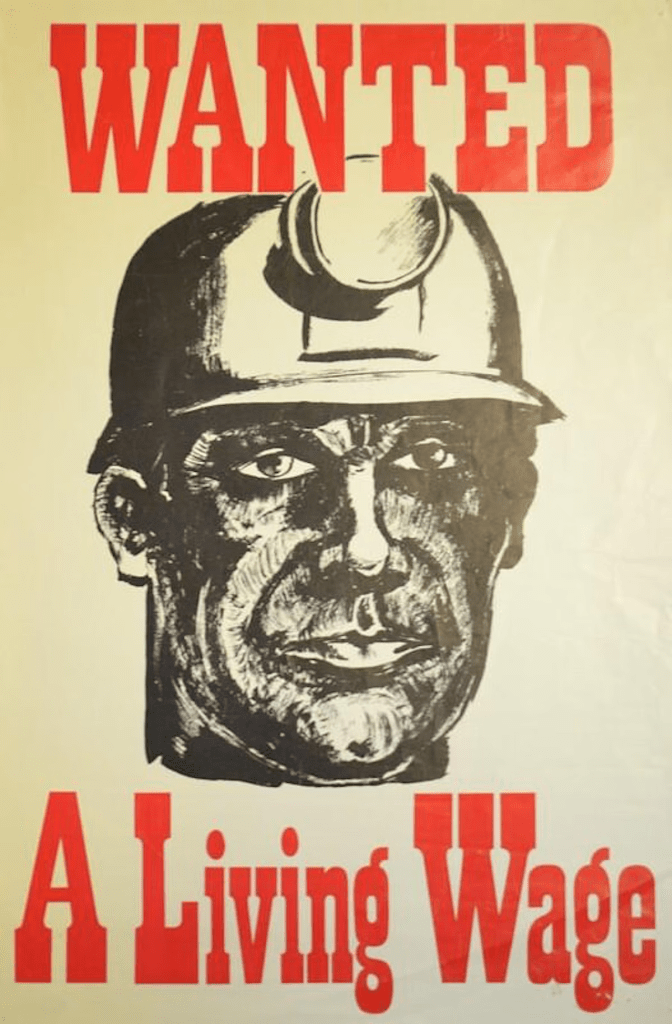
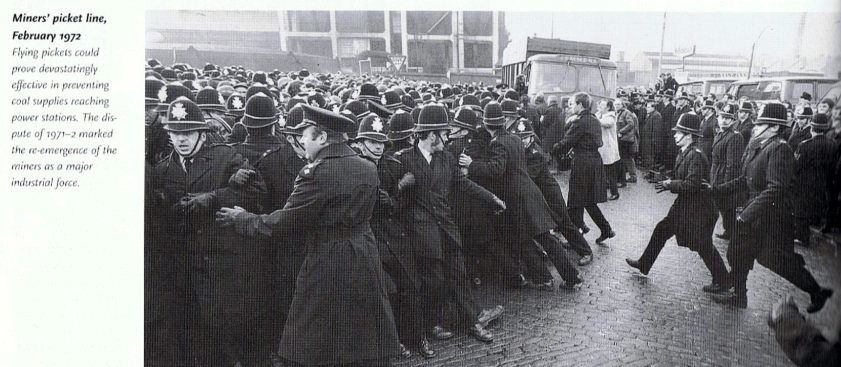
The government then took a more confrontational approach at home. As in the 1920s, resistance to brutal rationalisation through the closure or selling off of uneconomic enterprises, or by wage or job reductions, was met by determined opposition, never tougher than in the confrontation of 1984-85 with the National Union of Mineworkers, led by Arthur Scargill. The National Coal Board, supported by the government, put forward a massive programme of pit closures. The bitter, year-long miners’ strike which followed was roundly defeated, amid scenes of mass picketing and some violence from both miners and the police. The miners’ strike was long and bitter, a fight for the survival of coalfield communities. For example, during the late nineteenth and for most of the twentieth century, Armthorpe in South Yorkshire became known for its coal mining and a deep seam colliery was sunk; the pit was named Markham Main. In 1984, an Armthorpe dress shop sales assistant was quoted as saying:
“If this pit closed down, the whole village would close down because of the number of men working there. This shop and a lot of other shops would have to close down.”
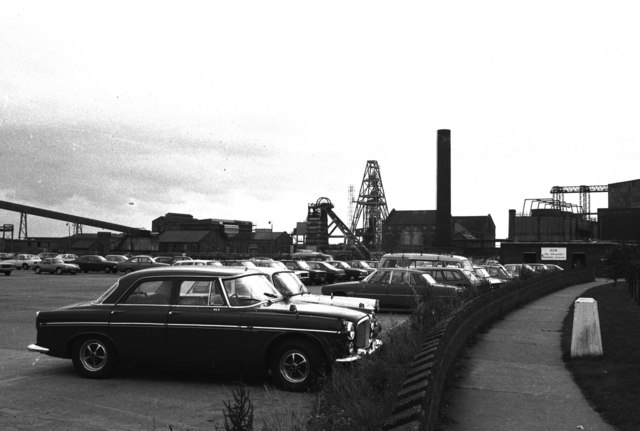
Markham Main Colliery: After the closure of the mine in 1996 the area went through a deep depression. The old colliery site is now a large housing estate, with a thriving community and parks and tracks for walking and cycling to the local wood. Today, Armthorpe remains one of the more affluent areas of Doncaster, with an IKEA warehouse providing local employment. Photo (circa 1980?) by Chris Allen, CC BY-SA 2.0, https://commons.wikimedia.org.
But ultimately the government proved equally determined and had, crucially, built up the resources to resist their anticipated demands for it to back down. In 1983, a team of researchers in south Wales published a pamphlet, Who Profits from Coal? revealing that not only had the NCB been importing stocks of South African coal for some years, but that it was also investing in its production, even raiding the miners’ pension fund to do so. There were also major divisions within the NUM itself, with the Nottinghamshire area breaking away to form the UDM (Union of Democratic Mineworkers) and the South Wales area calling for an orderly return to work when it became apparent that the NUM could not win. However, the national executive, led by its president, Arthur Scargill, refused to call a country-wide ballot on this proposal, prolonging the struggle and suffering unnecessarily.
Miners’ leader, Arthur Scargill.
The strike and the colliery closures left a legacy of bitterness and division in British which was only too apparent at the time of Margaret Thatcher’s recent state funeral and is the subject or background for many recent films, some of which have distorted or trivialised our recollection of the reality. Among the better representations of it is Billy Elliott. Under the thirty years rule, the government documents from 1984 have only just become available, so we can now look forward to the more rounded perspectives of historians on these events. Already, politicians have called for government apologies to be given to the miners and their families.
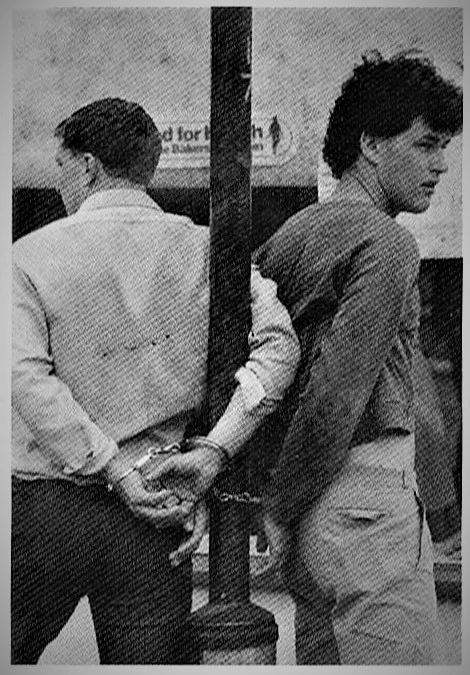
Picketing miners were caught and hand-cuffed to lamp posts by police in 1986.
In the Durham Coalfield, pits were often the only real source of employment in local communities, so the economic and social impact of closures could be devastating. The 1984-5 Strike was an attempt to force a reversal of the decline. The pit closures went ahead and the severe contraction of the mining industry continued: it vanished altogether in Kent, while in Durham two-thirds of the pits were closed. The government had little interest in ensuring the survival of the industry, determined to break its militant and well-organised union. There was further resistance, as pictured above, but by 1987, the initial programme of closures was complete. The social cost of the closures, especially in places in which mining was the single major employer, as in many of the pit villages of South Yorkshire, Durham and the valleys of south Wales, was devastating. The entire local economy was crippled. On Tyneside and Merseyside, more general deindustrialisation occurred. Whole sections of industry, including coal, steel and shipbuilding, simply vanished from their traditional areas.
The closer that social historians get to their own times, the harder it is for them to be sure they have hold of what is essential about the period in question: the more difficult it is to separate the rich tapestry of social life which appears on the surface of the woven fabric from its underlying patterns. This is the problem of perspective that historians have to try to overcome in their craft. The period from 1963 to 1978 was one of rapid social change and one in which the pace and direction of social change itself became a matter of concern in social discourse. The discussion in the sixties was about whether the surface evidence of change really added up to a social revolution for ordinary people. What happened to the standards of living of ordinary Britons in the seventies threw into question the depth of the changes. That argument is still unresolved: more than sixty years later we are still living out its contradictory legacy. Many witnesses to the period are still alive, and each with their own differing memories, impressions and interpretations of the period.
The Caernarfon Investiture of 1969 & the botched bombings:
The ‘Investiture Crisis’ as it was known to contemporaries in Wales referred to an undercurrent of violence in Welsh nationalism and republicanism that had been getting stronger since the drowning of the village of Tryweryn to supply Liverpool with water earlier in 1957. This was done by an Act of Parliament, despite almost all Welsh MPs voting against it. As the Welsh historian John Davies wrote in his 1990 History of Wales:
Liverpool’s ability to ignore the virtually unanimous opinion of the representatives of the Welsh people, confirmed one of the central tenets of Plaid Cymru – that the national Welsh community, under the existing order, was wholly powerless.
J.Davies (1990): Allen Lane.
Attacks on the Tryweryn reservoir followed and the Free Wales Army was founded in 1963. Violent (against property) Welsh Nationalism was, thankfully, almost as unpopular and badly organised as violent Scottish nationalism. But the sabotage of reservoirs yielded to a bombing campaign during the run-up to the Investiture in which two bombers blew themselves up in trying to blow up the Royal train, and a little child was mutilated in an accident with explosives near the walls of Caernarfon Castle, where the ceremony was due to take place. Mudiad Amddiffyn Cymru (Welsh Defence Movement) was behind the bombings, in league with the Free Wales Army.
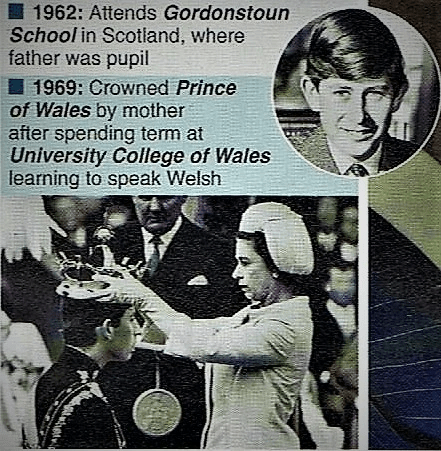
In preparation for his Investiture in 1969, Charles spent some time at the University College of Wales, Aberystwyth, learning Welsh and studying the history and culture(s) of Wales under the tutelage of Professor Teddy Millward. The initial purpose of this was so that he would know enough of the ancient language to be able to make the oath at the Investiture Ceremony and, subsequently, to read speeches out loud with intelligible pronunciation. When a delegation of student leaders met him at Lampeter in 1980, he admitted to them that his conversation was limited and that although he had retained much of the vocabulary Millward had taught him, he had not had many opportunities to use it. Part of his problem was that the formal, classical register in written form was very different to the Cymraeg Byw (Living Welsh) needed for everyday communication and simple conversation. Nevertheless, on his first visit to Cardiff as Charles III, following his mother’s death, he delivered a speech in Welsh with considerable accuracy and fluency. As Nelson Mandela once said, if you talk to people in a common language they know, you will speak to their minds. You will speak to their hearts if you talk to them in their native language. Charles seems to have understood and to have sought to apply the ‘Mandela principle.’
Tynged yr Iaith – the Fate of the Language:
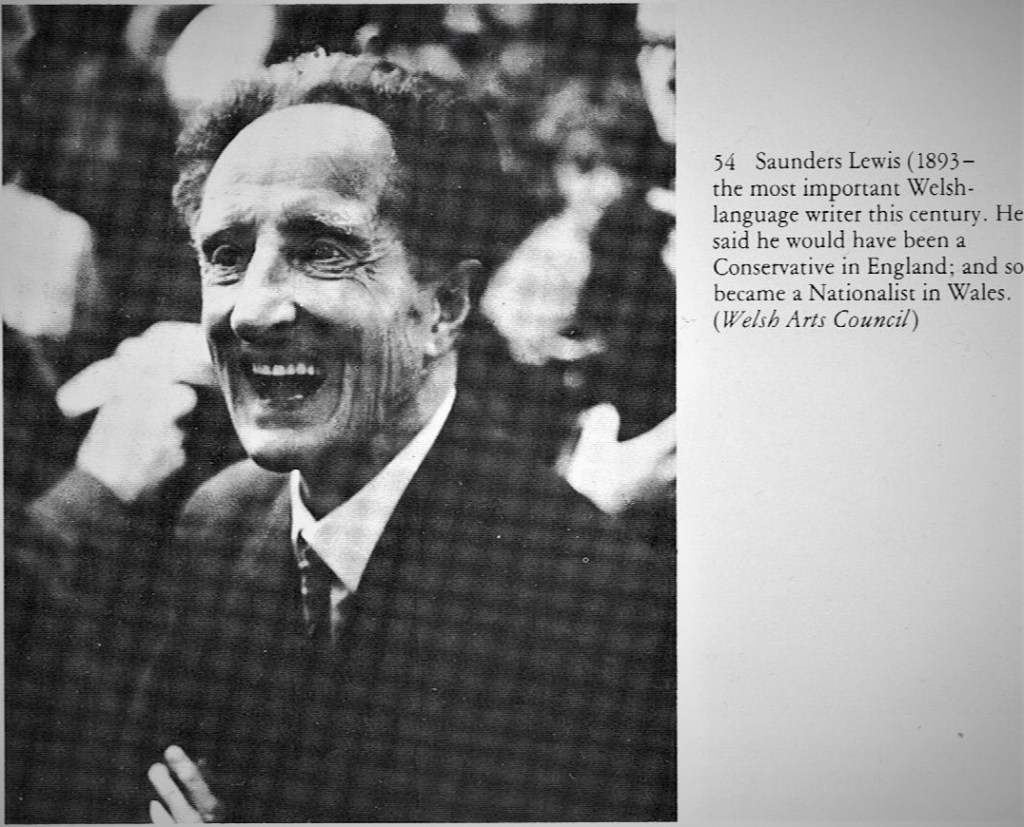
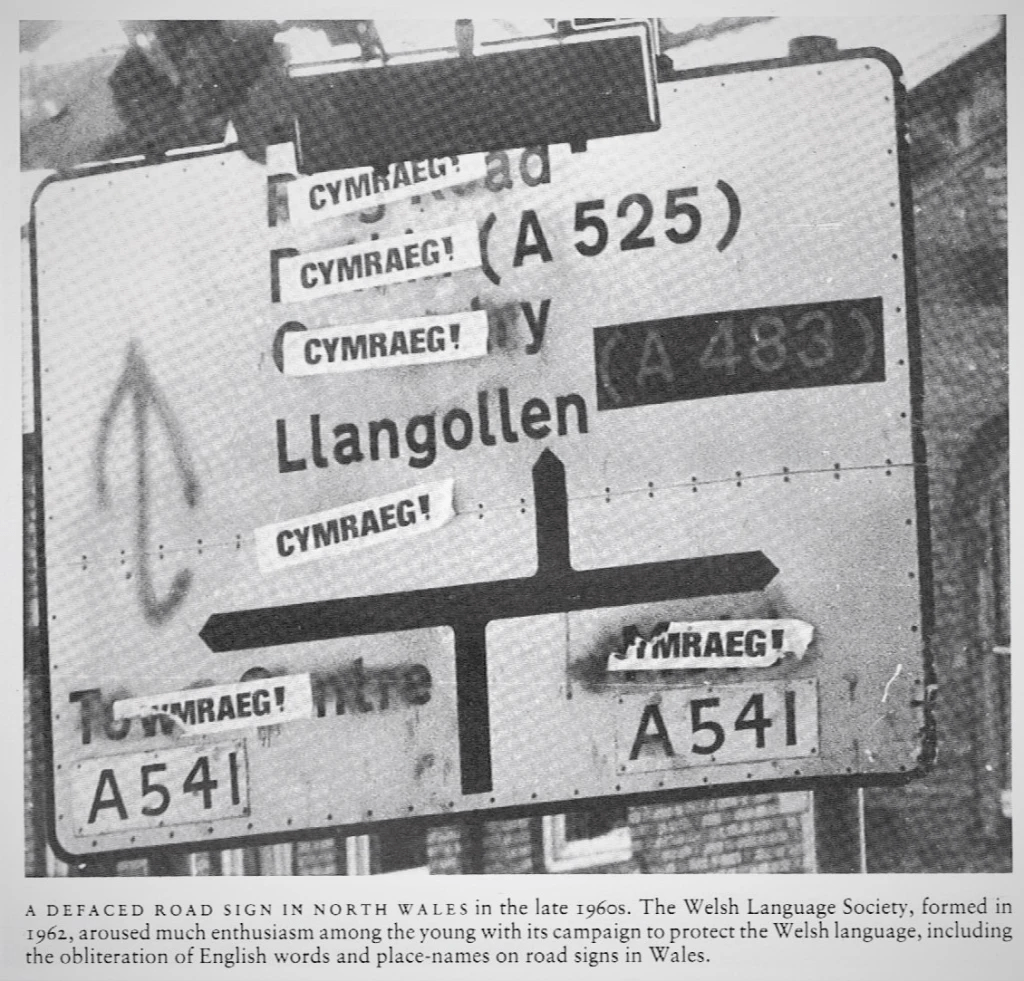
By 1961, Welsh speakers made up only twenty-five per cent of the population, and by 1971 they were barely twenty per cent. The crisis appeared terminal, so in 1962 the writer and founder member of the Welsh Nationalist Party, Saunders Lewis (pictured below) returned to public affairs determined to prevent the death of the ancient language. In the BBC Wales Annual Radio Lecture that year, Tynged yr Iaith (The Fate of the Language), he called upon the Welsh people to make the salvation of the language their central priority and to be prepared to use revolutionary means to achieve it. The response was remarkable. After the formation of Cymdeithas yr Iaith Gymraeg, the Welsh Language Society, its young activists stormed all over Wales, opening twenty years of direct action campaigning against offices, roadsigns, staging sit-ins, wrecking TV masts, generally making life hell for any kind of official and the police. While Plaid Cymru remained somewhat aloof, there was much human overlap, and the heavy colonisation of Welsh institutions, particularly in the media, by Welsh-speaking professional people (‘sons of ministers‘) proved to be of powerful assistance.
Around this campaign, which assumed the character of a crusade, all sorts of movements developed: a major drive to establish Welsh-medium nurseries, primary and secondary schools, Welsh-speaking University College hostels, special posts for the teaching of Welsh, demands for an all Welsh-medium College, or Coleg Cymraeg, and for positive discrimination in favour of the use of Welsh. There were crash immersive programmes, or ‘wlpan’ for learners, dysgwyr, based on the invention of a modern form of the language, Cymraeg Byw, (Living Welsh), and the grouping of learners into an organisation at local and national levels. The new Welsh Arts Council directed subsidies towards an ailing Welsh Language publishing world. Step by step a Labour government, followed by a Conservative one, was forced to yield; a Secretary of State for Wales in 1964, a major Language Act in 1967, and a whole series of autonomy measures. Within, around and distinct from this drive a whole world of Welsh language publishing, film production, radio and television broadcasting and infinite varieties of pop, rock, folk and urban music mushroomed.
Many of these initiatives, like the Welsh-medium Channel 4, S4C, did not come to full fruition until the early 1980s, but most originated in the mid to late sixties. These were the most visibly Welsh signals of the onset of outright revolt in the late sixties. The major factor in this uprising was disillusionment with the Welsh Labour establishment. The abrupt reversal of Labour government policy in 1966, after the high hopes of 1964, seemed a culminating disappointment after long years of diminishing relevance in the Party’s policies, internal debate and inner life. The Labour hegemony in Wales had hardened into an oligarchy. On the other hand, the long and dismal history of elitist and contemptuous attitudes towards Anglo-Welsh people had been a disturbing feature of Welsh nationalism and much language-focused Welsh national feeling since the days of its founders.
Young people in Wales and Scotland generated a tide of nationalist protest, the scale of which had until then only been experienced in the Basque regions of Spain or in French Quebec. Neither Wales nor Scotland had enjoyed the economic growth of the south and midlands of England in the fifties, despite the ‘Development Areas’ legislation and programmes introduced by Labour governments before 1951. Their national aspirations were hardly fulfilled by the formal institutions as the offices of Westminster-appointed Secretaries of State. In the case of Wales, this appointment was only made for the first time in centuries by the Wilson government in 1964. Scottish nationalists complained, with some justification, that the very title Elizabeth II was a misnomer in their country since Elizabeth I had not been Queen of Scots.
Caernarfon Castle was set up for the Investiture of Prince Charles on 30th June 1969
As far as many of the Welsh were concerned, the title of ‘Prince of Wales’ (Tywysog Cymry), as bestowed by the monarch by ‘right of conquest’ on the eldest son and heir to the English throne since the reign of Edward I, was also a misnomer. In Wales, there was the added theme of an ancient language and culture threatened with extinction in an unequal battle against anglicising mass culture and media. A narrow victory for a Welsh Nationalist, Gwynfor Evans, in a parliamentary by-election in Carmarthen in 1966, was followed by a renewed civil disobedience campaign in support of the defence and propagation of the Welsh language. Under Evans’ leadership, a new Plaid Cymru (Party of Wales) began to emerge. In 1969, elaborate ceremonies greeted the formal Investiture of Prince Charles as Prince of Wales, to paraphrase Gwyn Williams, in a tumult of public acclaim, largely in English, and a tumult of public mockery, largely in Welsh.
The Anglo-Welsh historian Dai Smith, more than a decade later drew a comparison between the Investiture of Edward Prince of Wales (later Edward VIII) in 1911 and the more recent ceremony at Caernarfon:
Here was stage-managed the investiture of Edward, Prince of Wales, in a rich ceremony of dedication and loyalty. This patriotic event could be seen, like that of Charles in 1969, as a plot to dupe the ‘masses’. In this scenario, thechief Welsh politicians of ‘deliver up’ the nation to English/ British domination and, in due course, are suitably rewarded with titular baubles – Lloyd George becomes the Earl of Dwyfor and George Thomas becomes Viscount Tonypandy. … Neither event defused radical politics in Wales – after 1969 Plaid Cymru grew in influence and the miners’ unions began their five-year campaign…
Dai Smith (1984), Wales! Wales? Hemel Hempstead: George Allen & Unwin.
The Investiture Ceremony
Celtic Languages & Dialects in the British Isles:
After many decades of decline, most notably (and dangerously) in the number of ‘monoglot’ native speakers, by 1981 there was currently a stable proportion of between one-fifth and one-quarter of Welsh residents, over half a million, describing themselves as Welsh speakers. The Celtic nations of the British Isles also protected their own Celtic-influenced or Scots-influenced dialects or varieties of ‘English’, each of which can be subdivided further into localised varieties. For example, Welsh English, or Anglo-Welsh, has differing northern and southern varieties, with parts of the south, specifically south Pembrokeshire and the Gower Peninsula, having had English and Flemish colonies since the twelfth century. A uniform spoken English across the British Isles is an unlikely prospect. In Wales, the same is true of spoken Welsh, with varieties in accent and vocabulary, if not in grammar.
As far as constitutional Welsh nationalism was concerned, Gwynfor Evans lost his Carmarthen seat in the 1970 general election but two more striking Plaid Cymru by-election performances Rhondda West and Caerffili (Caerphilly) in 1967 and 1968 suggested that the Carmarthen victory had been was no flash in the pan. At last, the complacent Welsh Labour Party was being challenged, and in the 1974 election, Plaid Cymru won two northern Welsh seats, Caernarfon and Meirionydd, taking a third in the second general election that year. Welsh Labour was divided in its response. Michael Foot, MP for Aneurin Bevan’s old seat of Ebbw Vale, thought the nationalists should be ‘bought off’ through reform measures, including devolution, but Neil Kinnock, who declared that road-sign bilingualism (like that shown below) was a waste of funds, believed they should be fought. Either way, they held their seats, continuing to pose an electoral threat in Labour’s traditional heartlands in the southern valleys and refusing to ‘go away.’ Neither did the bilingual road signs.
A road sign in Powys.
The equality accorded to English and Welsh on road signs symbolised a victory for Welsh language activists. They had campaigned long and hard to gain official recognition of their native language and to ensure its survival. By 1974, both Cornish and Manx no longer had any native speakers and attempts to revive them led to only a very small number of learners of both Celtic languages. Although the official figure for users of Irish Gaelic was subsequently recorded as 1.4 million in the Republic, equivalent to forty per cent of the population. But this reflected the status of the language in Irish schools, whereas the habitual use of Irish in daily life in the Gaeltacht, the Irish-speaking communities, was estimated at 0.25 per cent of the population. In Scotland, the Scottish Gaelic community accounted for about one per cent of the population there. According to the 1981 Census, only 473 children spoke Gaelic according to the 1981 Census.
Broadford Primary School, Isle of Skye, where children are taught in Gaelic.
Skye was once thought of as the centre of the Gaeltachd, the land of the Gaels. The only large concentration of Gaelic speakers still left on the island is on the northeast tip, the Staffin peninsula. The parish is one of the last redoubts of the northern Gaels. All the children in Staffin in the 1980s knew Gaelic but seldom used it after transfer to secondary school in Portree, where the other children teased them, calling them teuchtars or bumpkins (uneducated people of the land). They also thought that the language wouldn’t get them anywhere. As Gaelic speakers, they would just stay on their croft and stay poor. It would be better for them to develop their English and head south.
A Gaelic-speaking child at Broadford Primary School.
Wales, the Cymry & the Anglo-Welsh in the late seventies:
Meanwhile, around the Welsh language, the clamour and turmoil continued into the eighties, as did the many initiatives to arrest its decline in the previous decades. According to the 1981 Census returns, these seemed to have worked. Although the overall proportion of Welsh speakers had slipped further since 1971, to 18.9 per cent, there had been a dramatic slowing in the rate of decline over the decade, and it seemed almost to be coming to a halt. However, while there were marginal increases in Anglo-Welsh areas such as Gwent and Glamorgan, there was still a serious decline in the heartlands of the language, most notably in the southwest, where the fall was six per cent. There had been some ‘retrenchment’ in Ceredigion and parts of Gwynedd, and there were unmistakable signs that all the campaigning had begun to take effect among the younger age groups. Overall, out of a population of almost 2.8 million, over 550,000 identified as Welsh speakers. Nonetheless, the continuing threat to the bro or Welsh-speaking heartland had led to the growth of a new movement in the seventies, Adfer (‘restore’), with a swathe of intellectual zealots, dedicated to building a monoglot Welsh gaeltachd in the west and to the construction of an ethnically pure and self-sufficient economy and society there. This organisation viewed the true Cymry as the Welsh speakers and adopted a chauvinistic attitude towards the remainder of the people of Wales.
Yet Welsh-speaking figures from the industrial south, like Dai Francis, the leader of the South Wales NUM (see part one), who became a Bard in the Order of the Gorsedd of the National Eisteddfod, became leading Welsh-speaking figures. Francis was nominated by Undeb Cenedlaethol Myfyrwyr Cymru (NUS Wales) as an alternative candidate to Prince Charles for the role of Chancellor of the University of Wales in 1977/78. He lost the contest (the exact result of the vote was never declared), but only after the campaign had caused considerable embarrassment to the Welsh establishment in the University Court, one of the few all-Wales bodies at this time. Most importantly, it enabled UCMC to raise support among Welsh academics for the official recognition of the language in education on a nationwide basis in subsequent years.
A cogent and effective proposal for an elected Welsh assembly had been formulated and presented by the MP and cabinet minister Cledwyn Hughes in the 1960s, but it got nowhere. The proposal which emerged in the mid-seventies was partly an afterthought to the response to the growing strength of the nationalist challenge in Scotland. It was, though, an ineffective compromise for Wales, which won no real enthusiasm, even among its supporters among the constitutionalist nationalists in Wales. After endless parliamentary agonies, it was to be submitted to a referendum on St David’s Day, 1st March 1979. However, it was already dead in the water by the end of 1978, due to an amendment at Westminster requiring forty per cent of both the Scottish and Welsh electorates to vote ‘yes.’
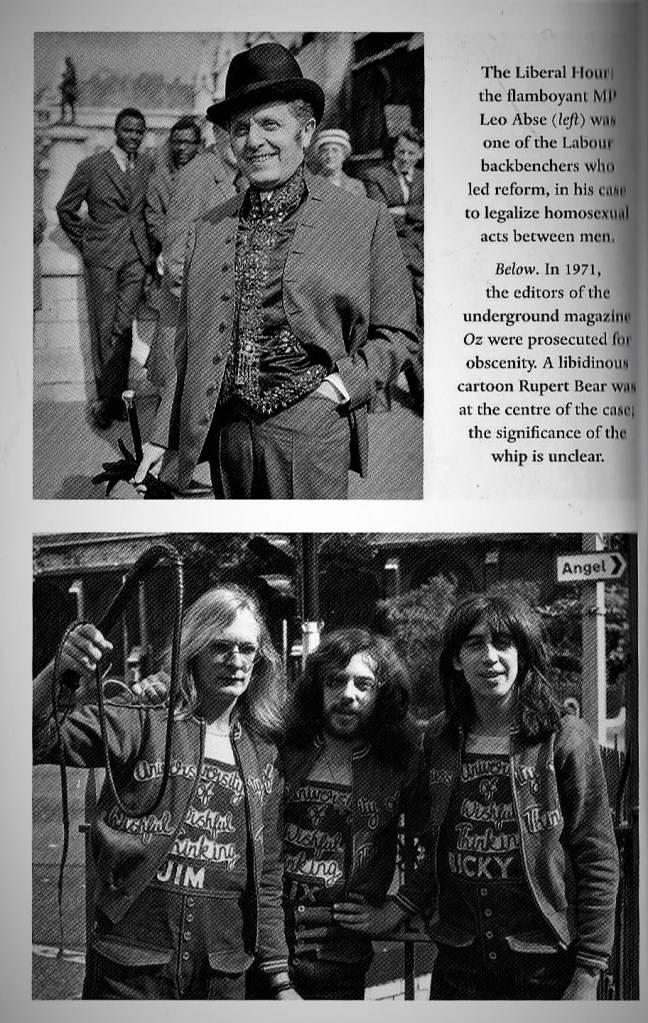
It was resisted by a huge bloc of opinion ranging from the representatives of multinational corporations and their British subsidiaries to the populist press and on to the Adferites in the north. It was also fiercely opposed by a bloc of South Wales Labour MPs led by Neil Kinnock and Leo Abse, who played on fears of their Anglo-Welsh constituents of being taken over and dominated by a Welsh-speaking, mainly northern, ‘crach’ (élite). There were also those on the left who were suspicious of what they had increasingly viewed as a corrupt Welsh-British establishment. Nationalist supporters also found themselves in a difficult situation, especially in Caernarfon and Meirionydd, where their voters, not just the supporters of Adfer, were not keen on being ruled from Cardiff. Not surprisingly, faced with all these obstacles, the campaign lacked conviction. As Gwyn Williams commented:
… it was an unreal war over an unreal proposal. One major reality, however, was a wholesale political revolt against the kind of Wales being presented and created through the medium of the Welsh language campaigns. It was a revulsion wholly negative in content and style.
Gwyn A. Williams (1985), When Was Wales? Pelican (Penguin) Books.
Professor Gwyn Williams, Photograph by HTV Wales.
However, Williams also pointed out that far more than a Welsh-language Wales was being rejected. Opinion polls showed the Conservatives running at a level of support they hadn’t enjoyed for a century. After the economic crisis of 1976 and its unnecessary surrender to the IMF (see below), the Labour government adopted the policies which the radical new leadership of the Conservatives had been developing. In the seventies, Labour ceased to be either socialist or social-democratic. Wales was plagued by economic difficulties, and its working population was being transformed at a pace too swift for its traditional institutions to handle. It is, in retrospect, that it was not interested in public discourse mainly among its intellectuals that focused largely and widely on language and culture.
The reality was that, by 1978, the client economy of Wales was in very deep trouble. Yet despite the success of Plaid Cymru in local elections during the final years of ‘old Labour’ rule, they did not seem to pose quite the same threat as the SNP. Of course, Welsh water was far less valuable and cheaper to extract than Scottish oil, which was fundamentally why the proposed Welsh assembly was to have fewer powers than the Scottish one. It was to oversee a large chunk of public expenditure, but it would not have law-making powers. The proposal was therefore unlikely to make anyone’s blood pound.
‘Black Gold’ – North Sea Gas & Oil Fields:
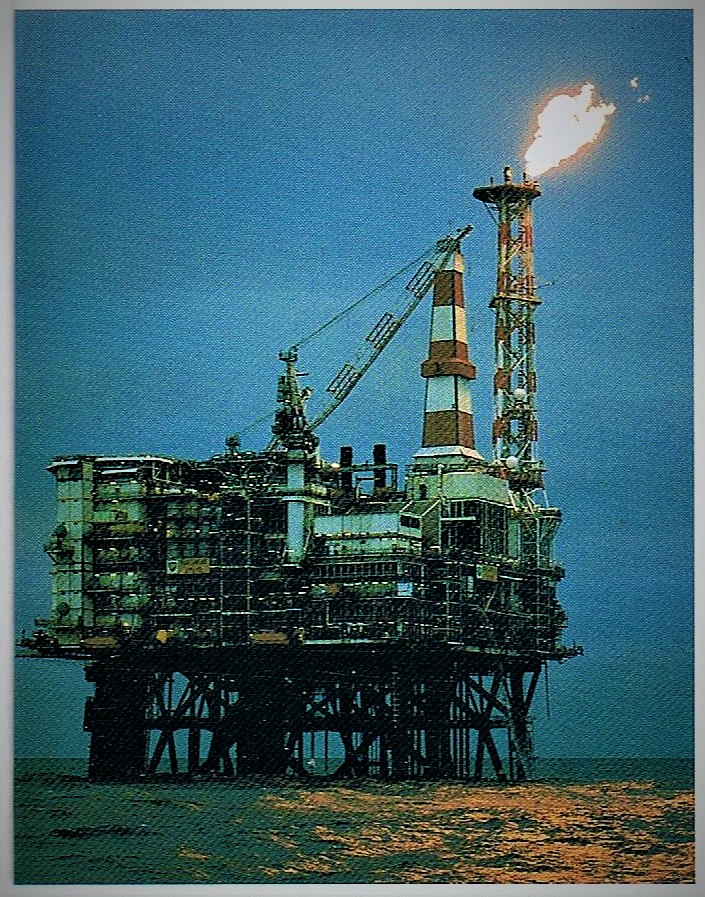
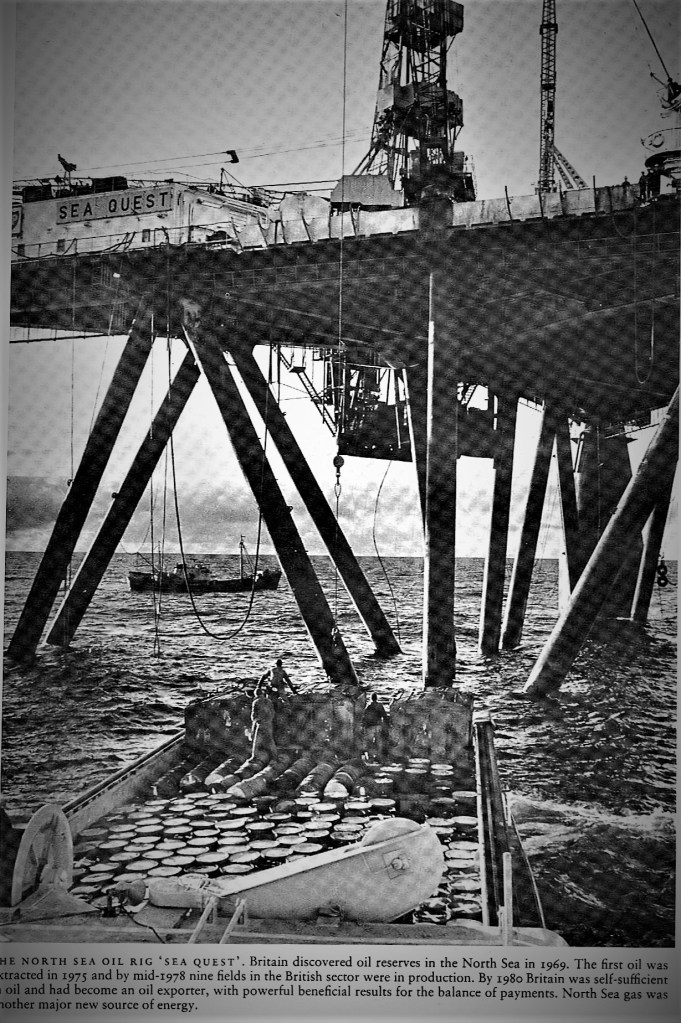
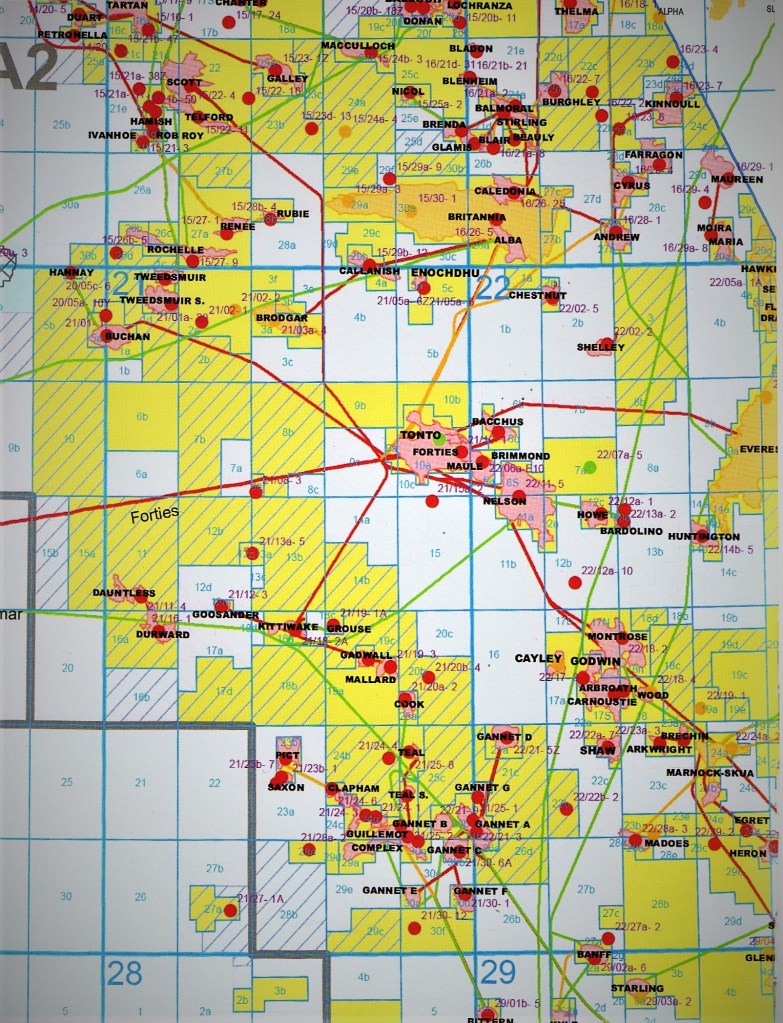
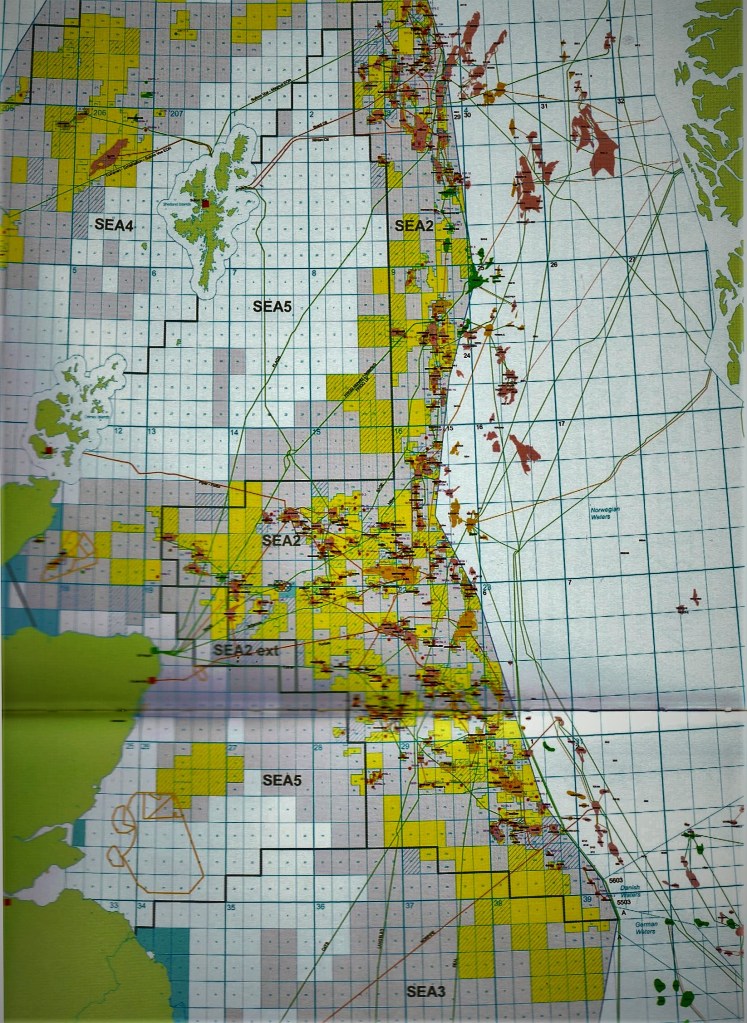
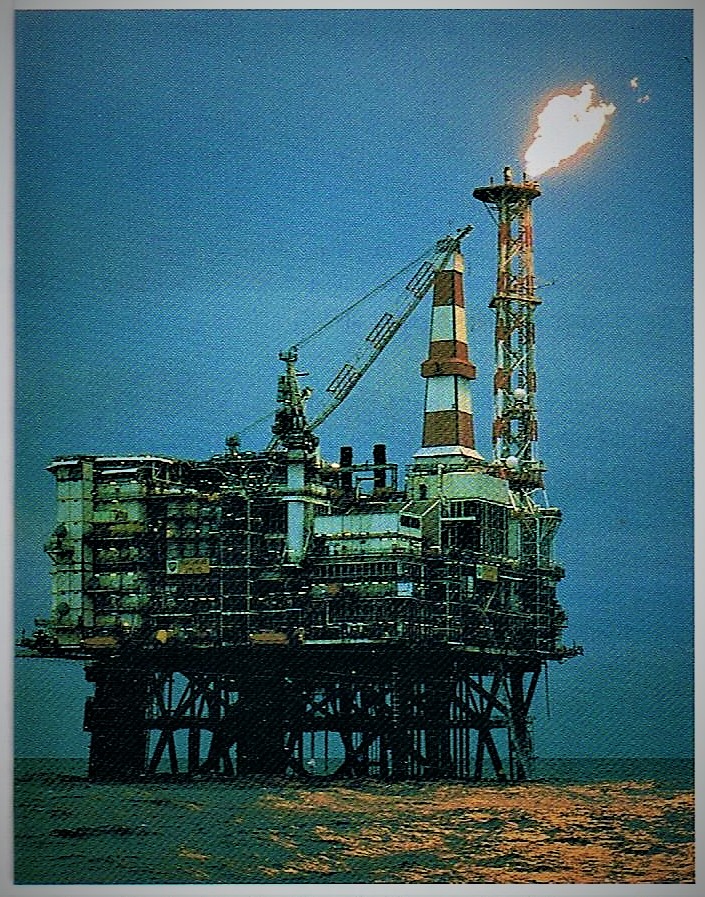
Certainly, living standards continued to rise, aided by the discovery in the North Sea of natural gas in 1965 and oil in 1969. The complex mosaic of yellow blocks in the 2016 map of the North Sea (below) illustrates the development of the UK oil industry which provided an economic boon to seventies Britain. The Forties field, shown on the map, was the biggest of the North Sea oil fields whose royalties made the country an unexpected hydrocarbon superpower for a limited period. In 1959, following a single find of natural gas in Gröningen in the Netherlands, it became apparent the geological structure of the North Sea meant that further discoveries were likely, although the prohibitive cost of drilling in offshore waters impeded initial exploration.
Section of the map below which gives a close-up of the Forties field& pipelinesin Sea 2.
The first large find was also of gas, struck in the West Sole field, off the Yorkshire coast, by British Petroleum’s Sea Gem platform in September 1965, though celebrations were soon dampened when the rig sank three months later, with the loss of thirteen lives, in the North Sea’s first major disaster. By 1969 oil had been struck in the Montrose field east of Aberdeen, followed soon after by the giant Forties field in 1970 and the Brent field a year later. The system of licensing fees for exploration and royalties payable on gas and oil production provided an economic shot in the arm for a country which was struggling to restructure its traditional industries and facing increased competition from emerging industrial giants such as Japan. Production became even more profitable after the 1973 oil shock when the principal Middle Eastern oil-producing countries imposed oil embargoes in response to Western countries’ policies which they said favoured Israel in its struggle with the Palestinian Arabs. As oil importers sought alternative sources of supply, global prices rose and North Sea oil found new customers.
Large-scale map, showing the full extent of the North Sea oil fields.
By the time of the Queen’s Silver Jubilee, in 1977, North Sea Oil was coming ashore to the tune of more than half a million barrels a day, meeting a third of the country’s needs. Britain would be self-sufficient in oil by 1980 and already was in gas. Oil and gas were not the only new sources of power to be exploited in the sixties. A lonely stretch of coast near Leiston in Suffolk became the site of Britain’s second nuclear power station, built in the early 1960s. In 1966 power began surging out from the grey, cuboid plant into the national grid. By the mid-seventies, Sizewell’s five hundred and eighty thousand kilowatts were going a long way towards meeting the electricity needs of eastern England.
Sizewell Nuclear Power Station (2014)
Devaluation & Deindustrialisation:
But there were also disquieting signs that Britain was approaching an as yet undefined cultural and financial crisis. British economic growth rates did not match those of competitor states, and it was partly for this reason that Britain applied to join the European Economic Community, in 1961 and 1967, entry both times being vetoed by France.
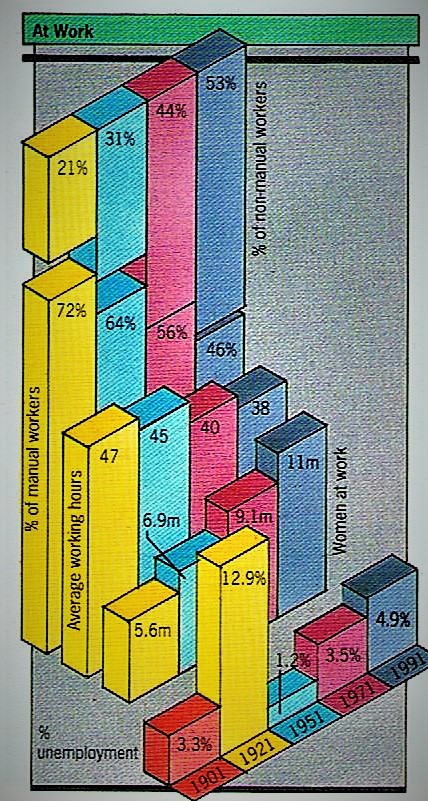
New kinds of industry, based largely on the revolution in electronics, came into being alongside the old, without displacing them. There was a shift in the patterns of skills, and of work, and the composition of the labour force, with more workers involved in clerical, highly skilled or service occupations. At the same time, more workers were pushed down into the unskilled ranks of mass production. They became more mobile again, pulled to where the jobs were. The pattern of regional decline in the older industrial areas and rapid, unorganised growth in the new areas began to re-emerge. In some areas and industries, the long-term pattern of continuity from one generation to the next persisted, while in other, newer areas, this continuity was broken.
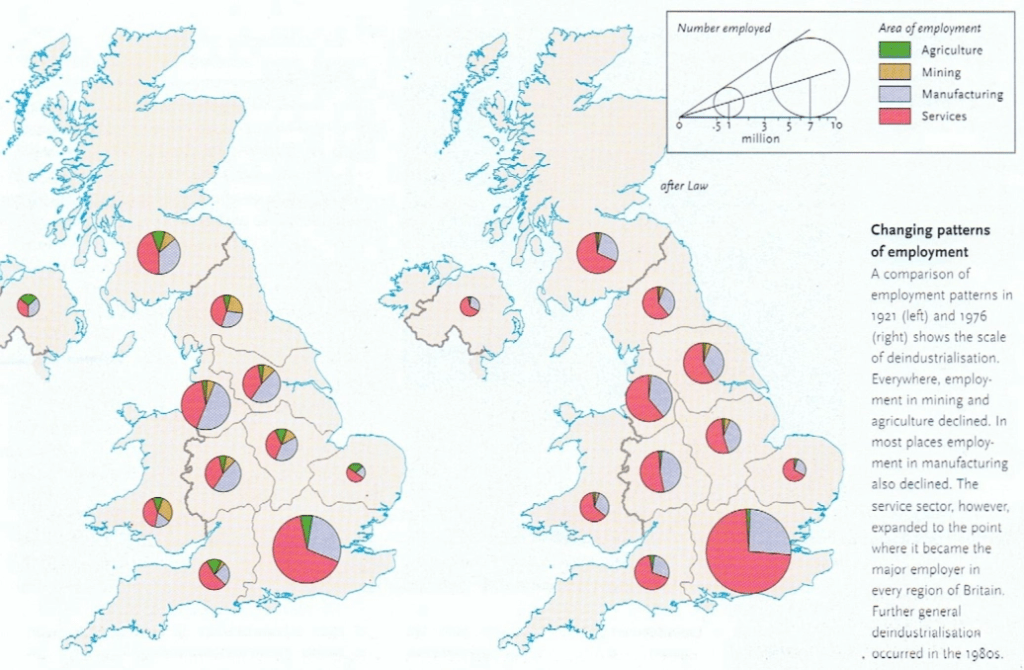
Long-termchanges patterns of employment, 1921-76.
Hitherto the social fabric across Britain had been kept intact, at least in part, because of high and advancing living standards for the population as a whole. But clear evidence mounted up in the late 1960s that increasing economic pressures were adding to new social tensions. Britain lurched from one financial expedient to another, with the frequent balance of payments crises and many runs on the pound sterling. Devaluation in 1967 did not produce any lasting remedy. Economically, the real problems of the decade arose from both the devaluation of the currency in November 1967 and the deterioration in industrial relations. Employment in manufacturing nationally declined, until it accounted for less than a third of the workforce by 1973. The income policy declared by the Wilson Government was hard to swallow for engineering workers who had long enjoyed the benefits of free collective bargaining and wage differentials. By way of contrast, employment in the service sector rose, so that by 1973, over half of all workers in the UK were employed in providing services. The map below shows both the long-term and regional character of the decline of the British manufacturing industries. The resulting mass unemployment hurt the old industries of the Northwest badly, but the job losses were proportionately as high in the Southeast and Midlands, where there were newer manufacturers.
The Second Wilson Labour administration that followed faced a huge balance-of-payments crisis and the tumbling value of the pound and they soon found themselves under the control of the IMF (International Monetary Fund), which insisted on severe spending cuts. The contraction of manufacturing began to accelerate and inflation was also increasing alarmingly, reaching twenty-four per cent by 1975. It came to be seen as a more urgent problem than unemployment and there was a national and international move to the right and against high-taxing and high-spending governments. Demands were made that they should stop propping up lame-duck industries with public money or taking them, however temporarily, into public ownership.
By the mid-seventies, the dock area at Felixstowe covered hundreds of acres, many reclaimed, made up of spacious wharves, warehouses and storage areas equipped with the latest cargo handling machinery. The transformation had begun in 1956 as the direct result of foresight and careful planning. The Company launched a three-million pound project to create a new deep-water berth geared to the latest bulk transportation technique – containerisation. It calculated that changing trading patterns and Felixstowe’s proximity to Rotterdam and Antwerp provided exciting prospects for an efficient, well-equipped port. Having accomplished that, it set aside another eight million for an oil jetty and bulk liquid storage facilities. In addition, a passenger terminal was opened in 1975. The dock soon acquired a reputation for fast, efficient handling of all types of cargo, and consignments could easily reach the major industrial centres through faster road and rail networks.
There were many reasons for this unprecedented growth. which brought Suffolk a prosperity unknown since the expansion of the cloth trade in the mid-fourteenth century. As back then, Suffolk’s depression gave a boost to new development. Most of the county was within eighty miles of London and served by improving road and rail connections. Ports like Felixstowe were no further from the capital than those of Kent and they were a great deal closer to the industrial Midlands and the North.
An old milestone in the centre of Woodbridge, Suffolk
Some of Suffolk’s most beautiful countryside was no further from the metropolis than the stockbroker belt of the Home Counties, and yet land and property prices in Suffolk were less than half of what they were there. People were becoming more mobile and light industries were less tied to traditional centres. Companies escaping from high overheads found that they could find both the facilities and labour they needed in Ipswich, Bury, Sudbury and Haverhill. Executives also discovered that they could live in areas of great natural beauty and yet be within commuting distance of their City desks. Moreover, the shift in international trade focused attention once more on the east coast ports. As the Empire was being disbanded and Britain was drawn increasingly towards trade with the European Common Market, producers were looking for the shortest routes to the continent. More and more lorries took to the roads through Suffolk.
Meanwhile, the rate of migration into Coventry had undoubtedly slowed down by the mid-sixties. Between 1961 and 1971 the population rose by nearly six per cent compared with a rise of nineteen per cent between 1951 and 1961. The failure of Coventry’s manufacturing industry to maintain immediate post-war growth rates was providing fewer opportunities for migrant manual workers, while the completion of the city centre redevelopment programme and the large housing schemes reduced the number of itinerant building workers. Between 1951 and 1966 the local population increased by approximately four thousand every year, but in the following five years the net annual increase fell to about a thousand per annum. Moreover, the proportion of this increase attributable to migration had dramatically declined. Between 1951 and 1961, a Department of the Environment survey estimated that whereas migration accounted for about forty-five per cent of population growth in the Coventry belt, in the following five years it made up only eighteen per cent. In the following three years to 1969, the survey noted that the same belt had begun, marginally, to lose population through out-migration.
Between the census of 1961 and the mini-census of 1966, some major shifts in the pattern of migration into Coventry took place. There was a substantial increase in immigration from Commonwealth countries, colonies and protectorates during these five years. The total number of those born in these territories stood at 11,340. The expansion needs to be kept in perspective, however. Nearly two-thirds of the local population was born in the West Midlands, and there were still nearly twice as many migrants from Ireland as from the Commonwealth and Colonies. Indeed, in 1966 only 3.5 per cent of Coventry’s population had been born outside the British Isles, compared with the national figure of five per cent. The Welsh stream had slowed down, increasing by only eight per cent in the previous fifteen years, and similar small increases were registered among migrants from Northern England. There were significant increases from Scotland, London and the South East, but only a very small increase from continental Europe.
By the mid-seventies, Coventry was faced with a new challenge posed by changes in the age structure of its population. The city was having to care for its increasing numbers of elderly citizens, a cost which soon became difficult to bear, given its declining economy. By 1974, it was estimated that the local population was rising by two thousand per year, twice the rate of the late 1960s. By 1976, however, the youthfulness of the city’s population was being lost as the proportion of over sixty-five-year-olds rose above the national average. With its large migrant element, it began to lose population rapidly during this decline, from 335,238 to 310,216 between 1971 and 1981, a fall of 7.5 per cent. Nearly sixty thousand jobs were lost during the recession, and given the shallowness of the family structure of many Coventrians, this resulted in a sizeable proportion of its citizens being all too willing to seek their fortunes elsewhere. For many others, given the widespread nature of the decline in manufacturing in the rest of the UK, there was simply nowhere to go.
Migration, Immigration and Racialism – Rivers of Blood:
Elsewhere, however, the number of ‘New Commonwealth’ immigrants was proving a cause for concern, mainly, as it seems in retrospect, to the skin colour of these immigrants, and partly, in the case of south Asians, due to religious and cultural differences with the host country. These ‘concerns’ were not new, and nor were the active forms of prejudice and discrimination which had accompanied them since the mid-fifties in the general population. In addition to dilapidated housing and racial discrimination in employment, and sometimes at the hands of the police, there was the added hazard of racial bigotry in older urban areas. What was new was the way in which this was articulated and amplified from the early sixties onwards by Conservative MPs and parliamentary candidates, leading to the emergence of the National Front as a political force in the early seventies.
Harold Wilson was always a sincere anti-racist, but he did not try to repeal the Conservatives’ 1962 Act with its controversial quota system. One of the new migrations that arrived to beat the 1963 quota system just before Wilson came to power came from a rural area of Pakistan threatened with flooding by a huge dam project. The poor farming villages from the Muslim north, particularly around Kashmir, were not an entrepreneurial environment. They began sending their men to earn money in the labour-starved textile mills of Bradford and the surrounding towns. Unlike the West Indians, the Pakistanis and Indians were more likely to send for their families soon after arrival in Britain. Soon there would be large, distinct Muslim communities clustered in areas of Bradford, Leicester and other older manufacturing towns.
Unlike the West Indians, the Pakistanis and Indians were more likely to send for their families soon after arrival in Britain. Soon there would be large, distinct Muslim communities clustered in areas of Bradford, Leicester and other older manufacturing towns. The photo above shows a south Asian immigrant in a Bradford textile factory. But the decline of the textile industries in the 1970s led to high long-term unemployment in south Asian communities.
Unlike the Caribbean immigrants, who were largely Christian by background, these new streams of migration were bringing people who were religiously separated from the white ‘Christians’ around them and cut off from the main forms of working-class entertainment, many of which involved the consumption of alcohol, from which they abstained. Muslim women were expected to remain in the domestic environment and ancient traditions of arranged marriages carried over from the subcontinent meant that there was almost no intermarriage with the native population. To many of the ‘natives’, the ‘Pakis’, as they were then casually called, even to their faces, were less threatening than young Caribbean men, but they were also more culturally alien.
Wilson had felt strongly enough about the ‘racialist’ behaviour in the Tory campaign at Smethwick, to the west of Birmingham, in 1964, to publicly denounce its victor Peter Griffiths as a ‘parliamentary leper’. Smethwick had attracted a significant number of immigrants from Commonwealth countries, the largest ethnic group being Sikhs from Punjab in India, and there were also many Windrush Caribbeans settled in the area. There was also a background of factory closures and a growing waiting list for local council housing. Griffiths ran a campaign critical of both the opposition’s and the government’s immigration policies. The Conservatives were widely reported as using the slogan “if you want a nigger for a neighbour, vote Labour” but the neo-Nazi British Movement later claimed that its members had produced the initial slogan as well as led the poster and sticker campaign. However, Griffiths did not condemn the phrase and was quoted as saying:
“I should think that is a manifestation of popular feeling. I would not condemn anyone who said that.”
The 1964 general election involved a nationwide swing from the Conservatives to the Labour Party which resulted in the party gaining a narrow five-seat majority. However, in Smethwick, as Conservative candidate, Peter Griffiths gained the seat and unseated the sitting Labour MP, Patrick Gordon-Walker, who had served as Shadow Foreign Secretary for the eighteen months prior to the election. In these circumstances, the Smethwick campaign, already attracting national media coverage, and the result itself stood out as clearly the result of racialism.
Griffiths, in his maiden speech to the Commons, pointed out what he believed were the real problems his constituency faced, including factory closures and over four thousand families awaiting council accommodation. But in 1965, Wilson’s new Home Secretary, Frank Soskice, tightened the quota system, cutting down on the number of dependents allowed in, and giving the Government the power to deport illegal immigrants. At the same time, it offered the first Race Relations Act as a ‘sweetener’. This outlawed the use of the ‘colour bar’ in public places and by potential landlords, and discrimination in public services, also banning incitement to racial hatred like that seen in the Smethwick campaign. At the time, it was largely seen as toothless, yet the combination of restrictions on immigration and the measures to better integrate the migrants already in Britain did form the basis for all subsequent policies.
Birmingham’s booming postwar economy had not only attracted its ‘West Indian’ settlers from 1948 onwards, but had also ‘welcomed’ south Asians from Gujarat and Punjab in India, and East Pakistan (Bangladesh) both after the war and the partition of India and in increasing numbers from the early 1960s. The South Asian and West Indian populations were equal in size and concentrated in the inner city wards of the city and in west Birmingham, particularly Sparkbrook and Handsworth, as well as in Sandwell (see map above; then known as Smethwick and Warley). Labour shortages had developed in Birmingham as a result of an overall movement towards skilled and white-collar employment among the native population, which created vacancies in less attractive, poorly paid, unskilled and semi-skilled jobs in manufacturing, particularly in metal foundries and factories, and in the transport and healthcare sectors of the public services. These jobs were filled by newcomers from the Commonwealth.
Whatever the eventual problems thrown up by the mutual sense of alienation between natives and immigrants, Britain’s fragile new consensus and ‘truce’ on race relations of 1964-65 were about to be broken by another form of racial discrimination, this time executed by Africans, mainly the Kikuyu people of Kenya. After the decisive terror and counter-terror of the Mau Mau campaign, Kenya won its independence under the leadership of Jomo Kenyatta in 1963 and initially thrived as a relatively tolerant market economy. Alongside the majority of Africans, however, and the forty thousand whites who stayed after independence, there were some 185,000 Asians in Kenya.
They had mostly arrived during British rule, were mostly better off than the local Kikuyu, and were well-established as doctors, civil servants, traders, business people and police. They also had full British passports and therefore an absolute right of entry to Britain, which had been confirmed by meetings of Tory ministers before independence. When Kenyatta gave them the choice of surrendering their British passports and gaining full Kenyan nationality or becoming foreigners, dependent on work permits, most of them chose to keep their British nationality. In the generally unfriendly and sometimes menacing atmosphere of Kenya in the mid-sixties, this seemed the sensible option. Certainly, there was no indication from London that their rights to entry would be taken away.
The 1968 Immigration Act was specifically targeted at restricting Kenyan Asians with British passports. As conditions grew worse for them in Kenya, many of them decided to seek refuge in the mother country of the Empire which had settled them in the first place. Throughout 1967 they were coming in by plane at the rate of about a thousand per month. The newspapers began to depict the influx on their front pages and the television news, by now watched in most homes, showed great queues waiting for British passports and flights. It was at this point that Enoch Powell, Conservative MP for Wolverhampton and shadow minister, in an early warning shot, said that half a million East African Asians could eventually enter which was ‘quite monstrous’. He called for an end to work permits and a complete ban on dependants coming to Britain. Other prominent Tories, like Ian Macleod, argued that the Kenyan Asians could not be left stateless and that the British Government had to keep its promise to them. The Labour government was also split on the issue, with the liberals, led by Roy Jenkins, believing that only Kenyatta could halt the migration by being persuaded to offer better treatment. The new Home Secretary, Jim Callaghan, on the other hand, was determined to respond to the concerns of Labour voters about the unchecked migration.
By the end of 1967, the numbers arriving per month had doubled to two thousand. In February 1968, Callaghan decided to act. The Commonwealth Immigrants Act effectively slammed the door while leaving a ‘cat flap’ open for a very small annual quota, leaving some twenty thousand people ‘stranded’ and stateless in a country which no longer wanted them. The bill was rushed through in the spring of 1968 and has been described as among the most divisive and controversial decisions ever taken by any British government. Some MPs viewed it as the most shameful piece of legislation ever enacted by Parliament, the ultimate appeasement of racist hysteria. The government responded with a tougher anti-discrimination bill in the same year. For many others, however, the passing of the act was the moment when the political élite, in the shape of Jim Callaghan, finally woke up and listened to their working-class workers. Polls of the public showed that 72% supported the act. Never again would the idea of free access to Britain be seriously entertained by mainstream politicians.
This was the backcloth to the notorious Rivers of Blood speech made in Birmingham by Enoch Powell, in which he prophesied violent racial war if immigration continued. Powell had argued that the passport guarantee was never valid in the first place. Despite his unorthodox views, Powell was still a member of Edward Heath’s shadow cabinet which had just agreed to back Labour’s Race Relations Bill. But Powell had gone uncharacteristically quiet, apparently telling a local friend,
I’m going to make a speech at the weekend and it’s going to go up “fizz” like a rocket, but whereas all rockets fall to earth, this one is going to stay up.
The ‘friend’, Clem Jones, the editor of Powell’s local newspaper, The Wolverhampton Express and Star, had advised him to time the speech for the early evening television bulletins, and not to distribute it generally beforehand. He came to regret the advice. In a small room at the Midland Hotel in Birmingham on 20th April 1968, three weeks after the act had been passed and the planes carrying would-be Kenyan Asian immigrants had been turned around, Powell quoted a Wolverhampton constituent, a middle-aged working man, who told him that if he had the money, he would leave the country because, in fifteen or twenty years time, the black man will have the whip hand over the white man. Powell continued by asking rhetorically how he dared say such a horrible thing, stirring up trouble and inflaming feelings. He answered himself:
“The answer is I do not have the right not to do so. Here is a decent, ordinary fellow-Englishman, who in broad daylight in my own town says to me, his Member of Parliament, that this country will not be worth living in for his children. I simply do not have the right to shrug my shoulders and think about something else. What he is saying, thousands and hundreds of thousands are saying and thinking… ‘Those whom the Gods wish to destroy, they first make mad.’ We must be mad, literally mad, as a nation to be permitting the annual flow of some fifty thousand dependants, who are for the most part the material growth of the immigrant-descended population. It is like watching a nation busily engaged in heaping its own its own funeral pyre.”
He then used a classical illusion to make a controversial prophecy:
As I look ahead, I am filled with foreboding. Like the Roman, I seem to see ‘the river Tiber foaming with much blood.’
Enoch Powell, the influential opponent of immigration.
In the context of his speech to this point and his earlier pronouncements as a maverick right-winger, most people considered this a prophecy of a violent inter-racial war if black immigration continued. His inflammatory rhetoric was taken as a prediction that rivers of blood would flow similar to those seen in the recent race riots in the United States. The speech therefore quickly became known as The Rivers of Blood Speech and formed the backdrop of the legislation. He also made various accusations, made by other constituents, that they had been persecuted by ‘Negroes’, having excrement posted through their letterboxes and being followed to the shops by children, charming wide-grinning pickaninnies chanting “Racialist.” If Britain did not begin a policy of voluntary repatriation, it would soon face the kind of race riots that were disfiguring America. Powell claimed that he was merely restating Tory policy. But the language used and his own careful preparation suggests it was both a call to arms by a politician who believed he was fighting for white English nationhood and a deliberate provocation aimed at Powell’s enemy, Heath.
After horrified consultations when he and other leading Tories had seen extracts of the speech on the television news, Heath promptly ordered Powell to phone him, and summarily sacked him. Heath announced that he found the speech racialist in tone and liable to exacerbate racial tensions. As Parliament returned three days after the speech, a thousand London dockers marched to Westminster in Powell’s support, carrying ‘Enoch is right’ placards; by the following day, he had received twenty thousand letters, almost all in support of his speech, with tens of thousands still to come. Smithfield meat porters and Heathrow airport workers also demonstrated in support of him. Powell received death threats and needed full-time police protection for a while; numerous marches were held against him and he found it difficult to make speeches at or near university campuses. Asked whether he was a racialist by the Daily Mail, he replied:
‘We are all racialists. Do I object to one coloured person in this country? No. To a hundred? No. To a million? (A query). To five million? Definitely.’
Did most people in 1968 agree with him, as Andrew Marr has suggested? It’s important to point out that, until he made this speech, Powell had been a Tory ‘insider’, though also seen as a maverick and a trusted member of Edward Heath’s shadow cabinet. He had rejected the consumer society growing around him in favour of what he saw as a ‘higher vision’. This was a romantic dream of an older, tougher, swashbuckling Britain, freed of continental and imperial (now ‘commonwealth’) entanglements, populated by ingenious, hard-working white people rather like himself. For this to become a reality, Britain would need to become a self-sufficient island, which ran entirely against the great forces of the time. His view was fundamentally nostalgic, harking back to the energetic Victorians and Edwardians. He drew sustenance from the people around him, who seemed to be excluded from mainstream politics. He argued that his Wolverhampton constituents had had immigration imposed on them without being asked and against their will.
But viewed from Fleet Street or the pulpits of broadcasting, he was seen as an irrelevance, marching off into the wilderness. In reality, although immigration was changing small patches of the country, mostly in west London, west Birmingham and the Black Country, it had, by 1968, barely impinged as an issue in people’s lives. That was why, at that time, it was relatively easy for the press and media to marginalize Powell and his acolytes in the Tory Party. He was expelled from the shadow cabinet for his anti-immigration speech, not so much for its racialist content, which was mainly given in reported speech, but for suggesting that the race relations legislation was merely throwing a match on gunpowder. This statement was a clear breach of shadow cabinet collective responsibility. Besides, the legislation controlling immigration and regulating race relations had already been passed, so it is difficult to see what Powell had hoped to gain from the speech, apart from embarrassing his nemesis, Ted Heath.
Edward Heath, leader of the Conservatives from 1965 &Prime Minister, 1970-74.
Ted’s Grandfather Clause & the Ugandan Refugees:
Despite the dramatic increase in wealth, coupled with the emergence of distinctive subcultures, technological advances and dramatic shifts in popular culture, there was a general feeling of disillusionment with Labour’s policies nationally. In the 1970 General Election, the Conservative Party, under its new leader Edward Heath, was returned to power. Although Enoch Powell had been sacked from the shadow cabinet by Heath, more legislative action followed with the 1971 Immigration Act, which effectively restricted citizenship on racial grounds by enacting the Grandfather Clause, by which a Commonwealth citizen who could prove that one of his or her grandparents was born in the UK was entitled to immediate entry clearance. This operated to the disadvantage of Black and Asian applicants while favouring citizens of the old Commonwealth, descendants of white settlers from Australia, New Zealand, Canada and South Africa. Thus immigration control had moved away from primary immigration to restricting the entry of dependants, or secondary immigration.
Enoch Powell himself, from the back-benches, likened the distinction between ‘new’ and ‘old’ Commonwealth immigrants to a Nazi race purity law; he wanted a new definition of British citizenship instead. The grandparent rule was defeated by the right and left combining for opposite reasons but was restored two years later. In the meantime, the Kenyan crisis was replayed in another former East African colony, Uganda. Here, the swaggering, Sandhurst-educated Idi Amin had come to power in a coup. He announced that he had been told in a dream he must expel the country’s Asians, just as the Kenyans had theirs. Though Powell argued angrily that Britain had no obligation to allow the trapped Ugandan Asians into its cities, Heath acted decisively to bring them in. Airlifts were arranged, with a resettlement board to help them, and twenty-eight thousand arrived within a few weeks in 1971, eventually settling in the same areas as other East Africans, even though Leicester had published adverts in Ugandan newspapers pleading with them not to come there.
Those who knew Powell best claimed that he was not a racialist. The local newspaper editor, Clem Jones, thought that Enoch’s anti-immigration stance was not ideologically-motivated, but had simply been influenced by the anger of white Wolverhampton people who felt they were being crowded out; even in Powell’s own street of good, solid, Victorian houses, next door went sort of coloured and then another and then another house, and he saw the value of his own house go down. But, Jones added, Powell always worked hard as an MP for all his constituents, mixing with them regardless of colour:
We quite often used to go out for a meal, as a family, to a couple of Indian restaurants, and he was on extremely amiable terms with everybody there, ‘cos having been in India and his wife brought up in India, they liked that kind of food.
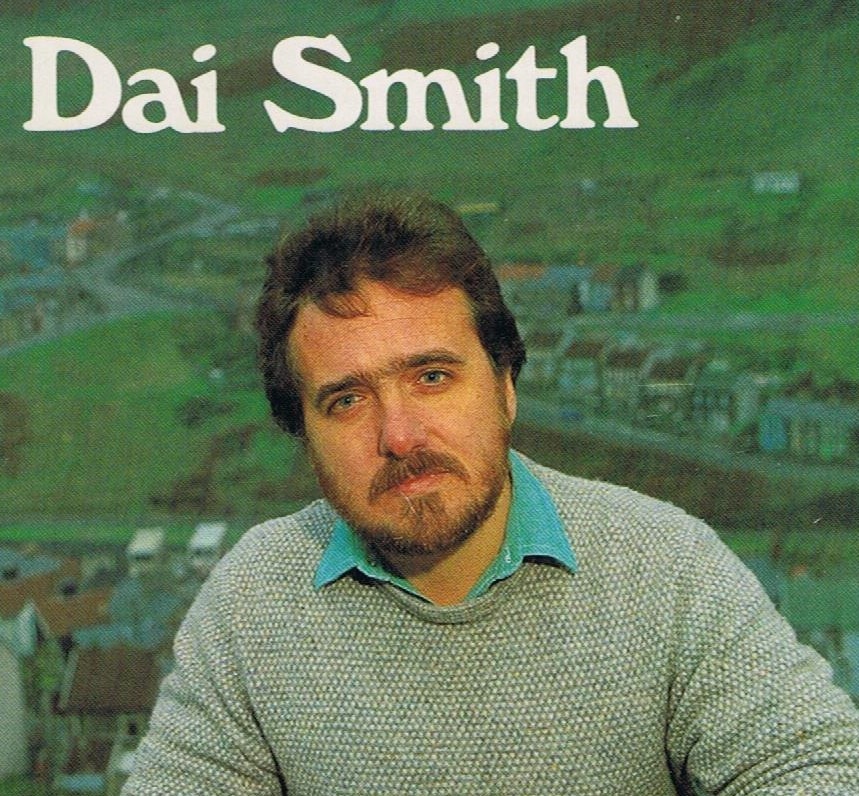
On the numbers migrating to Britain, however, Powell’s predicted figures were not totally inaccurate. Just before his 1968 speech, he had suggested that by the end of the century, the number of black and Asian immigrants and their descendants would number between five and seven million, about a tenth of the population. According to the 2001 census, 4.7 million people identified as black or Asian, equivalent to 7.9 per cent of the total population. Immigrants were, of course, far more strongly represented in percentage terms in English cities. Powell may have helped British society by speaking out on an issue that, until then, had remained taboo. However, the language of his discourse still seems quite inflammatory and provocative, even fifty years later, so much so that even historians hesitate to quote them. His words also helped to make the extreme-right Nazis of the National Front more acceptable. Furthermore, his core prediction of major civil unrest was not fulfilled, despite riots and street crime linked to disaffected youths from Caribbean immigrant communities in the 1980s. So, in the end, Enoch was not right, though he may have had a point.
Immigrants to Birmingham also tended to congregate in the western suburbs along the boundary with Smethwick, Warley, West Bromwich (now Sandwell), and Dudley, where many of them also settled. By 1971, the South Asian and West Indian populations were equal in size and concentrated in the inner city wards and in north-west Birmingham, especially in Handsworth, Sandwell and Sparkbrook. Labour shortages had developed in Birmingham as a result of an overall movement towards more skilled and white-collar employment among the native population, which created vacancies in the poorly paid, less attractive, poorly paid, unskilled and semi-skilled jobs in manufacturing, particularly in metal foundries and factories, and in the transport and health care sectors of the public services. These jobs were filled by newcomers from the new Commonwealth. In the 1970s, poor pay and working conditions forced some of these workers to resort to strike action. Hostility to Commonwealth immigrants was pronounced in some sections of the local white population and what became known as white flight, migration from the inner city areas to the expanding suburbs to the southwest and east of the city, though it is still unclear to what extent this migration was really due to concerns about immigrants.
In nearby Coventry, despite these emerging signs of a stall in population growth by the end of the sixties, the authorities continued to view the city and its surroundings as a major area of demographic expansion. In October 1970 a Ministry of Housing representative predicted that the city’s population would rise by a third over the next twenty years. Immigration had changed Britain more than almost any other single social factor in post-war Britain, more significant than the increase in life expectancy, birth control, the death of deference or the spread of suburban housing. The only change that eclipses it is the triumph of the car. It was not a change that was asked for by the indigenous British cultures, though the terms and circumstances of fifty million people choosing suddenly to ask and answer such a question, possibly in a referendum, are impossible to imagine.
The majority of British people did not want the arrival of large numbers of Irish, West Indians and south Asians, but neither did they want an end to capital punishment or membership in a federal European Union, or many other things that their political élite decided upon. Yet, at no stage was there a measured, rational and frank debate about immigration between party leaders in front of the electorate. And while allowing this change to take effect piecemeal and by default, the main parties did very little to ensure the successful integration of immigrants from the Caribbean or the Indian subcontinent. When help was given, in the case of the East African Asian refugees, integration was more successful. But even with these sudden influxes, there was no real attempt to nurture mixed communities, avoiding mini-ghettoes such as those that developed in the East Midlands and South Yorkshire. Race relations legislation did come, but only as a counter-balance to further restrictions.
Primary children celebrate Diwali, the Hindu festival of lights, wearing their traditional dress.
As New Commonwealth immigrants began to become established in postwar Birmingham, community infrastructures, including places of worship, ethnic groceries, halal butchers and, most significantly, restaurants, began to develop. Birmingham became synonymous with the phenomenal rise of the ubiquitous curry house, and Sparkbrook in particular developed unrivalled Balti restaurants. These materially changed the city’s social life patterns among the native population. In addition to these obvious cultural contributions, the multilingual setting in which English exists today became more diverse in the sixties and seventies, especially due to immigration from the Indian subcontinent and the Caribbean. The largest of the community languages was Punjabi, with over half a million speakers by the late seventies. Still, there were also substantial communities of Gujarati speakers, as many as a third of a million, and up to a hundred thousand Bengali speakers. In some areas, such as East London, public notices recognised this.
A Bengali road sign in East London.
A new level of linguistic and cultural diversity was introduced by Commonwealth immigration. This manifested itself not just in the various ‘new’ languages that entered Britain, but also in the development of new dialects of English originating in different parts of the old Empire, especially in the West Indies.
Inter-cultural Diversity, Music & Integration:
Within the British West Indian community, Jamaican English, or the patois – as it is known – has had a special place as a token of identity. While there were complicated social pressures that frowned on Jamaican English in Jamaica, with parents complaining when their children ‘talk local’ too much, in England, it became almost obligatory to do so in London. One Jamaican schoolgirl who made the final passage to the Empire’s capital city with her parents in the seventies put it like this:
It’s rather weird ’cos when I was in Jamaica I wasn’t really allowed to speak it (Jamaican creole) in front of my parents. I found it difficult in Britain at first. When I went to school I wanted to be like the others in order not to stand out. So I tried speaking the patois as well… You get sort of a mixed reception. Some people say, ’You sound really nice, quite different.’ Other people say, ’You’re a foreigner, speak English. Don’t try to be like us, ’cos you’re not like us.’
Despite the mixed reception from her British West Indian friends, she persevered with the patois, and, as she put it after a year I lost my British accent, and was accepted. However, for many Caribbean visitors to Britain, the patois of Brixton and Notting Hill was a stylised form that was not, as they saw it, truly Jamaican, not least because British West Indians came from all parts of the Caribbean. Another West Indian schoolgirl, born in London and visiting Jamaica for the first time, was teased for her patois. She was told that she didn’t sound right and that. The experience convinced her that…
… in London the Jamaicans have developed their own language in patois, sort of. ’Cos they make up their own words in London, in, like, Brixton. And then it just develops into patois as well.
Researchers found that there were already white children in predominantly black schools who had begun using the British West Indian patois in order to be accepted by the majority of their friends, who were black:
I was born in Brixton and I’ve been living here for seventeen years, and so I just picked it up from hanging around with my friends who are mainly Black people. And so I can relate to them by using it, because otherwise I’d feel an outcast… But when I’m with someone else who I don’t know I try to speak as fluent English as possible. It’s like I feel embarrassed about it (the patois), I feel like I’m degrading myself by using it.
The unconscious racism of such comments pointed to the predicament of Black Britons. Not fully accepted, for all their rhetoric, by the established native population, they felt neither fully Caribbean nor fully British. This was the poignant outcome of what the British Black writer Caryl Phillips called The Final Passage. Phillips, who came to Britain as a baby in the late 1950s, was one of the first of his generation to grapple with the problem of finding a means of literary self-expression that was true to his experience:
The paradox of my situation is that where most immigrants have to learn a new language, Caribbean immigrants have to learn a new form of the same language. It induces linguistic schizophrenia – you have an identity crisis that mirrors the larger cultural confusion.
In his novel, The Final Passage, the narrative is in Standard English. But the speech of the characters is a rendering of nation language:
I don’t care what anyone tell you, going to England be good for it going to raise your mind. For a West Indian boy you just being there is an education, for you going see what England do for sheself… It’s a college for the West Indian.
The lesson of this college is, as Phillips puts it, that symptomatic of the colonial situation, the language has been divided as well. English – creole or standard – was the only available language in the British Black community and in the English-speaking islands of the Caribbean.
By the end of the seventies, Caribbean and Rastafarian Reggae music were beginning to have a broad impact on British pop culture. In Birmingham, a group of out-of-work young white men formed the band UB40, named after their benefit claim forms. The multicultural band Steel Pulse also became popular. On the other side of rock ‘politics’, there was an eruption of racist, skinhead rock, and a ‘casual’ but influential interest in the far right from among more established artists. At a concert at the Birmingham Odeon, in 1976, Eric Clapton, arriving on stage an hour late either drunk or stoned (or both), enquired as to whether there were any immigrants in the audience. He then said, to the shock and disgust of almost everyone there, Powell is the only bloke whose telling the truth, for the good of the country. David Bowie was also heard to flirt with far-right ideas and Sid Vicious of the punk band, The Sex Pistols, contributed the following dubious lyrics to contemporary political thought:
‘Belsen was a gas/ I read the other day/ About the open graves/ Where the Jews all lay …’
Punk gets cheeky: Vivienne Westwood (centre), Chrissie Hynde (left) and Jordan advertise Westwood’s King’s Road punk shop, Sex, in 1976.
Reacting to the surrounding mood, as well as to concerns about these deliberately outrageous statements and actions (McLaren and Westwood produced clothing with swastikas and other Nazi emblems), Rock Against Racism was formed in August 1976, organising a series of charity concerts throughout Britain and helping to create the wider Anti-Nazi League a year later. Punk bands were at the forefront of the RAR movement, above all The Clash whose lead singer Joe Strummer became more influential than Johnny Rotten and the rest of the Sex Pistols. Ska and Soul music also had a real influence in turning street culture decisively against racism. Coventry’s Ska revival band, The Specials captured and expressed this new mood. The seventies produced, in the middle of visions of social breakdown, a musical revival which reflected the reality of a lost generation, whilst in turn reviving their sense of enjoyment of life. As one contemporary cultural critic put it:
‘A lifestyle – urban, mixed, music-loving, modern and creative – had survived, despite being under threat from the NF.’
Dave Haslam (2005), Not Abba, Fourth Estate.
Punk rock was in part a reaction against growing youth unemployment and also came to symbolise a rejection of commercialism. Ironically, as with earlier youth sub-cultures, it soon became highly commercialised.
Punk rockers
The streets might be dirty and living standards falling, but by the end of the seventies, the streets were also getting safer from racist thugs and, contrary to some stereotypes, the quality of life was improving. The integration of diverse cultures and sub-cultures was working at a ‘local’ street level and in parish schools, not directed from the top down.
The arrival of Islam, Sikhism and Hinduism transformed the celebration of religious faith, including Christianity, in many schools. In 1970 there were about 300,000 Muslims in Britain. By 1990 this number had grown to one million. There were more than three hundred mosques, the largest of which was in Central London. There were also Sikh and Hindu communities, each numbering around 300,000 members. For many Christians at Advent, the school Nativity play and carol service remained the main traditions, but many schools were developing new customs and practices to ensure that pupils from a range of backgrounds and faiths were included. It was increasingly recognised that a lack of thought or sensitivity on the part of schools at this time of year could negate much of the rest of the year to improve community relations. Parents seemed to be satisfied with the diverse menu on offer. They turned up in their thousands to see their children perform in celebrations which were primarily a source of fun for all.
Above: Christmas celebrations in the Scottish Highlands and inner-city comprehensive in London. Top: at Islington Green Secondary School, pupils of all ethnicities give traditional performances and learn each other’s national dances. Bottom: Christmas decorations at Kirkton Primary School.
Economic Decline & Deindustrialisation:
A great variety of explanations for the decline in British industrial competitiveness were put forward, and have continued to be debated since. None of these explanations has proved wholly satisfactory, however. One explanation suggests that there is a cultural obstacle, that the British have been conditioned to despise industry. This might be a relevant argument to apply to a new England, with an industrial heritage going back only two or three generations, and to the old England, the traditional rural areas, although even in these areas it would be something of a stereotype, it would be difficult to apply to industrial Britain, with its generations of coal miners, shipbuilders, foundry and factory workers.
During the depression years of the 1930s many of these workers, finding themselves unemployed, had, like the father of Norman Tebbitt (Margaret Thatcher’s Party Chairman in the late seventies) got on their bikes, or walked long distances, in their hundreds of thousands to find work in the new manufacturing areas. With no jobs to find anywhere in the seventies, these were pretty pointless words of advice. Pointless or not, Tebbitt’s speech was picked up by the popular Tory press and appeared in the banner On Your Bike headlines which have since become so emblematic of the Thatcher era. Unfortunately, the same press used them to put forward a related argument that the British were not sufficiently materialistic to work hard for the rewards associated with improved productivity. Complacency from generations of national success has also been blamed, as has the Welfare State’s cosseting of both the workforce and those out of work.
Keynes’ argument had been that keeping workers in employment multiplied the effect through the economy as they spent part of their incomes on goods and services was shown to operate in the opposite direction through the effects of rising unemployment. However, the majority of people of working and voting age had no adult memory of their own of the 1930s, and radical politicians were able to exploit these demographics to their advantage to argue the case for monetarism with tight controls on public spending. In these circumstances, voters felt that spending public money on ailing industries was wasteful and inappropriate, especially as it raised their tax burden.
The story of 1970s Britain, whether viewed from an economic, social or cultural perspective can be summed up by one word, albeit a long one – deindustrialisation. As with the processes of industrialisation two centuries before, Britain led the way in what was to become a common experience of all the mature industrial nations. The so-called maturity thesis suggested that, as industries developed and became more technologically sophisticated, they required less labour. At the same time, rising living standards meant that more wealth was available, beyond what would normally be spent on basic necessities and consumer goods, giving rise to a growing demand for services such as travel, tourism and entertainment. By 1976, services had become the largest area of employment in all the regions of Britain.
Another problem faced by the manufacturing sector was the long-standing British taste for imported goods. Many observers noted that not only was the country failing to compete internationally, but British industry was also losing its cutting edge when competing with foreign imports in the domestic market. The problem of deindustrialisation, therefore, became entwined with the debate over Britain’s long decline as a trading nation, going back over a century. It was seen not only as an economic decline but as a national failure, ownership of which in speeches and election propaganda, even in education, struck deep within the collective British cultural psyche. By 1977, if not before, its role as the world’s first and leading industrial nation was finally over, just as its time as an imperial power had effectively ended fifteen years earlier, as Dean Acheson had commented. It was another question as to whether the British people and politicians were prepared to accept these salient facts and move on.
British industry’s share of world trade fell dramatically during these years, and by 1975 it was only half what it had been in the 1950s, falling to just ten per cent. Nor could it maintain its hold on the domestic market. A particularly extreme example of this was the car industry: in 1965, with Austin minis selling like hotcakes, only one car in twenty was imported, but by 1978 nearly half were. In addition, many of the staple industries of the nineteenth century, such as coal and shipbuilding, continued to decline as employers, surviving only, if at all, through nationalisation. In addition, many of the new industries of the 1930s, including the car industry, were seemingly in terminal decline by the 1970s, as we have seen in the case of Coventry. Therefore, deindustrialisation was no longer simply a problem for an old Britain, it was also one for a new England. It was even a problem for East Anglia because although it was not so dependent on manufacturing, and services were growing, agriculture had also declined considerably.
Alternatively, the government’s failure adequately to support research and development has been blamed for Britain’s manufacturing decline, together with the exclusive cultural and educational backgrounds of Westminster politicians and government ministers, and Whitehall civil servants. This exclusivity, it is argued, left them ignorant of, and indifferent to, the needs of industry. Employment in manufacturing reached a peak of nine million in 1966. After that, it fell rapidly, to four million by 1994. Much of this loss was sustained in the older industries of Northwest England, but the bulk of it was spread across the newer industrial areas of the Midlands and Southeast.
Between 1973 and 1975 there was the first of three severe recessions. When Wilson returned to number ten in February 1974, he faced a huge balance-of-payments crisis and the tumbling value of the pound. He was trying to govern without an overall majority at a time when the economy was still recovering from the effect of the oil price shock, with inflation raging and unemployment rising. Inflation reached twenty-four per cent by 1975, and it came to be seen as a far more urgent problem than unemployment. Furthermore, the fragile and implausible Social Contract now had to be tested. Almost the first thing Labour did was to settle with the miners for double what Heath had thought possible. The new Chancellor, Denis Healey, introduced an emergency Budget soon after the election, followed by another in the autumn, raising income tax to eighty-three per cent at the top rate, and ninety-eight per cent for unearned income, a level so eyewateringly high it has been used against Labour ever since. Healey also increased help for the poorest, with higher pensions and subsidies on housing and food. He was trying to deliver for the unions by upholding his side of the social contract, as was Wilson when he abolished the Tories’ employment legislation.
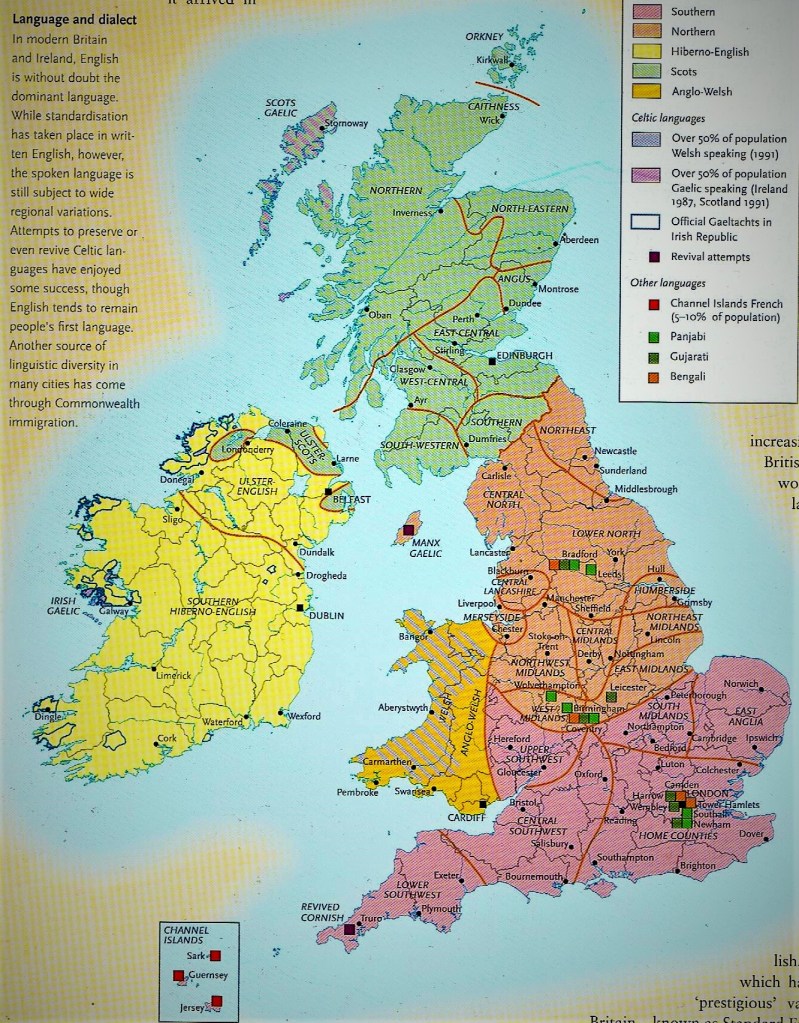
In October 1974, a second general election gave Labour eighteen more seats and a workable overall majority of three. Much of Healey’s energy, continuing as Chancellor, was thrown into dealing with the unstable world economy, with floating currencies and inflation-shocked governments. He continued to devalue the pound against the dollar and to tax and cut as much as he dared, but his only real hope of controlling inflation was to control wages. Wilson insisted that his income policy must be voluntary, with no return or recourse to the legal restraints of the Heath government. The unions became increasingly worried that rampant inflation might bring back the Tories. So, for a while, the Social Contract did deliver fewer strikes, which halved and halved again the following year. Contrary to popular myth, the seventies were not all about mass meetings and walk-outs. The real trouble did not begin again until the winter of 1978-79.
But the other side of the social contract was not delivered. By the early months of 1975, the going rate for increases was already thirty per cent, a third higher than inflation. By June inflation was up to twenty-three per cent, and wage settlements were even further ahead. The government then introduced an element of compulsion, but this applied to employers who offered too much, rather than to trade unions. Nevertheless, Healey reckoned that two-thirds of his time was taken up in managing the inflationary effects of free collective bargaining. In his memoirs, he reflected:
‘Adopting a pay policy is rather like jumping out of a second-floor window: no one in his senses would do it unless the stairs were on fire. But in postwar Britain the stairs have always been on fire.’
Denis Healey (1989), The Time of My Life. Michael Joseph.
Healey did, however, manage to squeeze inflation downwards. He also reflected that, had the unions kept their promises, it would have been down to single figures by the autumn of 1975. At the same time, Healey continued to tax higher earners more, concentrating tax cuts on the worse off. Though notorious (somewhat unfairly) for promising that he would make the rich howl with anguish and that he would squeeze them until the pips squeak, Healey argued that it was the only way of making the country fairer. He never accepted the Tory tenet that higher taxes stopped people from working harder and instead blamed Britain’s poor industrial performance on low investment, and poor training and management, as others have done since.
What we now know is that Wilson wasn’t planning to stay long in his second premiership. There are many separate records of his private comments about retiring at sixty, after two more years in power. If he had not privately decided that he would go in 1976, he certainly acted as if he had. The question of who would succeed him, Jenkins or Callaghan, Healey or even Benn, had become one about the direction of the Labour government, rather than a personal threat to Wilson himself, so there was less rancour around the cabinet table. He seems likely to have known about his early stages of Alzheimer’s, which would wreak a devastating time on him in retirement. He had already begun to forget facts, confuse issues and repeat himself. For a man whose memory and sharp wit had been so important, this must have taken a huge toll. It was Jim Callaghan who finally replaced Wilson at number ten after a series of votes by Labour MPs. But for three turbulent years, he ran a government with no overall majority in Parliament, kept going by a series of deals and pacts, and in an atmosphere of constant crisis.
Callaghan was the third and last of the consensus-seeking centrist PMs after Wilson and Heath, and the first postwar occupant of the office not to have gone to ‘Oxbridge.’ In fact, he had not been to university at all. The son of a Royal Navy chief petty officer who had died young and a devout Baptist mother from Portsmouth, he had known real poverty and had clawed his way up as a young clerk working for the Inland Revenue, and then as a union official, before wartime naval service. Like Healey, he was one of the 1945 generation of MPs, a young rebel who had drifted rightwards while always keeping his strong trade union instincts. He was a social conservative, uneasy about divorce, homosexuality and vehemently pro-police, pro-monarchy and pro-military. He was also anti-hanging and strongly anti-racialist. As Home Secretary, he had announced that the permissive society had gone too far. On the economy, he became steadily more impressed by monetarists like the Tory MP Keith Joseph. He told the 1976 Labour Conference, used to Keynesian doctrines about governments spending their way out of recession, …
‘… that option no longer exists and that insofar as it ever did exist, it worked by injecting inflation into the economy … Higher inflation, followed by higher unemployment. That is the history of the last twenty years.’
Yet Callaghan is forever associated with failure in the national memory. This was due to the Labour government’s cap-in-hand begging for help from the International Monetary Fund (IMF). Healey had negotiated a six-pound pay limit with the unions that would eventually feed through into lower wage increases and thereby lower inflation. Cash limits brought in under Wilson would also radically cut public expenditure. But in the spring of 1976 inflation was still rampant and unemployment was rising fast. Healey told Callaghan that because of the billions spent by the Bank of England supporting sterling in the first months of the year, a loan from the IMF looked essential. In June, standby credits were arranged with the IMF and countries including the United States, Germany, Japan and Switzerland.
Healey had imposed tough cuts in the summer but by its end, the pound was under intense pressure again. On 27th September, he was meant to fly out to a Commonwealth finance ministers’ conference in Hong Kong with the Governor of the Bank of England, but so great was the crisis and so panicked were the markets that he decided he could not afford to be in the air and out of contact for so long. In full view of the television cameras, he turned around at Heathrow and headed for Treasury, where he decided to apply to the IMF for a conditional loan, one which gave authority to the international banking officials above Britain’s elected leaders. Almost simultaneously, the Ford workers went on strike. Close to a nervous breakdown, and against Callaghan’s advice, Healey decided to dash to the Labour conference in Blackpool and make his case to an angry and anguished party. Many on the left were making a strong case for a siege economy; telling the IMF to ‘get lost,’ cutting imports and nationalising swathes of industry. Given just five minutes to speak from the floor, the Chancellor warned his party that this would risk a trade war, mass unemployment and the return of a Tory government. He shouted against a rising hubbub that he would negotiate with the IMF, which would mean…
“… things we do not like as well as things we do like … it means sticking to the very painful cuts in public expenditure … it means sticking to the pay policy.“
Denis Healey, Chancellor of the Exchequer during the economic storm, made a characteristic point (or two) to his opponents at the Labour conference.
So, with the cabinet watching on nervously, the negotiations started with the IMF, which insisted on severe funding cuts. Callaghan and Healey naturally wanted to limit these as far as they could, but the IMF, with the US Treasury standing behind them, was under pressure to squeeze even harder. The British were in a horribly weak position, not least because the government was riven by arguments and threats of resignation, including from Healey. The cabinet was split over what levels of cuts were acceptable and whether there was any real alternative in the form of a leftist siege economy. Callaghan and the lead IMF negotiator held private talks in which the PM warned that British democracy itself would be imperilled by mass unemployment. But the IMF was still calling for an extra billion pounds worth of cuts and it was only when Healey, without telling Callaghan, threatened the international bankers with yet another Who runs Britain? election, that they gave way. The final package of cuts was announced in Healey’s budget, severe but not as grim as some had feared, but still greeted with headlines about Britain’s shame.
As it turned out, however, the whole package was unnecessary from the start. The cash limits Healey had already imposed on Whitehall would cut spending far more effectively than anyone realised. More startling still, the public spending statistics, on which the cuts were based, and especially the estimates for borrowing, were wildly wrong. The public finances were stronger than they appeared. The IMF-directed cuts were therefore more savage than they needed to be. Britain’s balance of payment came back into balance long before the cuts could take effect and Healey reflected later that had he been given accurate forecasts in 1976, he would never have needed to go to the IMF at all. In the end, only half the loan was used, all of which was repaid before Labour left office.
Factory workers strike and picket over low pay and closures in 1977.
Following the IMF affair, the pound recovered strongly, the markets recovered, inflation fell, eventually to single figures, and unemployment fell too. But the contraction of manufacturing began to accelerate and there was a national and international swing to the right as a reaction against perceived high-taxing and high-spending governments. Demands were being made that governments cease propping up ‘lame duck’ industries with public money. Attacks on trade union power continued, coming to a head in the ‘Winter of Discontent’ of 1978-79, when there was an explosion of resentment, largely by poorly paid public employees, against a government income policy they felt was discriminatory.
Rubbish piled up in London during the ‘Winter of Discontent’ of 1978/79.
Appendix II: HRHs Prince Charles & Princess Anne – Vision & Work:
Following his Investiture as Prince of Wales, Charles was sent around the world as the heir to the throne and the House of Windsor-Mountbatten’s new star. Returning to Cambridge the following year, he finished his studies and took his bachelor’s degree.
He then went to the Royal Naval College in Dartmouth, where his mother and father had first met and where Prince Philip had trained as an officer in the Royal Navy before the Second World War. Charles also trained at the Royal Air Force College, becoming a helicopter pilot. From 1971 to 1976 he took a tour of duty in the Royal Navy. As Prince of Wales, Charles wanted to make a difference. He possessed a personal vision of harmony between human society and the natural world. He was outspoken in talking about the environment which was then viewed as being a niche interest and a marginal issue, and he was therefore seen by many as being quite eccentric. But he continued to develop his interests in gardening, sustainability and conservation, in addition to architecture, spirituality and social reform. He shared many of these interests with his father. On leaving the Navy in 1976, he founded The Prince of Wales’s Institute for Architecture and was involved with urban regeneration and development projects. He also set up The Prince’s Trust to help young people get into work and the Business in the Community scheme. In addition, he oversaw the management of the Duchy of Cornwall.
Throughout the 1970s, pressure grew on Charles to marry. He loved sports, especially playing polo, and was seen as one of the world’s most eligible bachelors, appearing on covers of magazines and tabloid newspapers, and with beautiful society women, including Camilla Shand, who later married and then divorced Andrew Parker-Bowles.
The Royal Family Tree, 1894-1990:
Princess Anne, also known as Princess Royal, is the Queen’s only daughter. She was given this title by the Queen in 1987. She is a keen and capable horsewoman and won the European Championships in 1971. For this, she was also voted BBC Sports Personality of the Year by millions of television viewers. She represented Great Britain and Northern Ireland in the 1976 Olympics in Montreal. In 1970 she became President of the Save the Children Fund, gaining great admiration for her tireless work for her charity around the world, as seen in the photo below (the princess is in the centre, wearing a saffron top).
Sources:
Andrew Marr (2007, ’08, ’09), A History of Modern Britain. Basingstoke: Pan Macmillan.
Philip Parker (2017), History of Britain in Maps. Glasgow: HarperCollins.
John Hayward & Simon Hall (eds.) (2001), The Penguin Atlas of British &Irish History. London: Penguin Books.
Gwyn A. Williams (1985), When Was Wales? Harmondsworth: Penguin Books.
The 1960s were dramatic years in Britain. Demographic trends, especially the increase in the proportion of teenagers in the population, coincided with economic affluence and ideological experimentation to reconfigure social mores to a revolutionary extent. In 1964, under Harold Wilson, the Labour Party came into power, promising economic and social modernisation. Economically, the main problems of the decade arose from the devaluation of the currency in 1967 and the increase in industrial action. This was the result of deeper issues in the economy, such as the decline of the manufacturing industry to less than one-third of the workforce. By contrast, employment in the service sector rose to over half of all workers.
Young people were most affected by the changes of the 1960s. Overall, the period from the early 1950s to the mid-1970s was a long period of economic expansion and demographic growth which helped to fuel educational development in England. Education gained new prominence in government circles and student numbers soared. By 1966, seven new universities had opened: Sussex (pictured below), East Anglia, Warwick, Essex, York, Lancaster and Kent.
From a pamphlet on the History of Architecture.
By 1972 there were forty-five universities, compared with just seventeen in 1945. By 1966, seven new universities had opened, including the University of East Anglia and the University of Warwick at Canley near Coventry. More importantly, perhaps, students throughout the country were becoming increasingly radicalised as a response to growing hostility towards what they perceived as the political and social complacency of the older generation. They staged protests on a range of issues, from dictatorial university decision-making to apartheid in South Africa, and the continuance of the Vietnam War. But not all members of the ‘older generation’ were ‘complacent’ and many joined in the protests.
Above: A Quaker ‘advertisement’ in the Times, February 1968.
The Vietnam War not only angered the young of Britain but also placed immense strain on relations between the US and British governments. Although the protests against the Vietnam War were less violent than those in the United States, partly because of more moderate policing in Britain, there were major demonstrations all over the country; the one which took place in London’s Grosvenor Square, home to the US Embassy, in 1968, involved a hundred thousand protesters. Like the world of pop, ‘protest’ was essentially an American import. When counter-cultural poets put on an evening of readings at the Albert Hall in 1965, alongside a British contingent which included Adrian Mitchell and Christopher Logue, the ‘show’ was dominated by the Greenwich Village guru, Allen Ginsberg.
It was perhaps not surprising that the American influence was strongest in the anti-war movement. When the Vietnam Solidarity Committee organised three demonstrations outside the US embassy in London’s Grosvenor Square, the second of them particularly violent, they were copying the cause and the tactics used to much greater effect in the United States. The student sit-ins and occupations at Hornsey and Guildford Art Colleges and Warwick University were pale imitations of the serious unrest on US and French campuses. Hundreds of British students went over to Paris to join what they hoped would be a revolution in 1968, until de Gaulle, with the backing of an election victory, crushed it. This was on a scale like nothing seen in Britain, with nearly six hundred students arrested in fights with the police on a single day and ten million workers on strike across France.
Modernising Britain, 1963-68:
Andrew Marr has commented that the term ‘Modern Britain’ does not simply refer to the look and shape of the country – the motorways and mass car economy, the concrete, sometimes ‘brutalist’ architecture, the rock music and the high street chains. It also refers to the widespread belief in planning and management. It was a time of practical men, educated in grammar schools, sure of their intelligence. They rolled up their sleeves and took no-nonsense. They were determined to scrap the old and the fusty, whether that meant the huge Victorian railway network, the Edwardian, old Etonian establishment in Whitehall, terraced housing, censorship, prohibitions on homosexual behaviour and abortion.
The map (below) unveiled by British Transport Commission Chairman Sir Richard Beeching in March 1963 marked the symbolic end of the great railway age. Taking an axe, as he had, to great swathes of rural lines, Beeching tried to fend off the challenge posed by the growth of road transportation and left large areas of the countryside with no train services at all. The spider’s web of the track as shown in his report, The Reshaping of the British Railways, with black indicating those routes which were to be closed and red the lines that had been selected for survival (though not all with stopping services), was Beeching’s way of solving a problem which had been apparent for some time: the railways were simply not profitable. Ticket revenues and freight charges were hopelessly inadequate to defray the expenses of running a comprehensive network, particularly as successive governments had taken the way of political least resistance by acceding to demands for higher wages in the rail industry, while at the same time keeping a ceiling on fare increases.
There had been some rationalisation already. Around 1,300 miles had been closed by 1939 and after the nationalisation of the railways in 1948, the new British Transport Commission had pared down another 3,300 miles by 1962. But the salami-slicing of selected lines could not stem the losses, which had reached just over a hundred million in the same year. Many feared that the unspoken policy of combining unstoppable costs with an unmovably large network would lead to the death of the railways. Beeching, on secondment from ICI, at the time Britain’s largest manufacturer, stepped in with a solution that was as unpalatable as it was logical. His report provided a stark analysis that fifty per cent of Britain’s rail routes provided only two per cent of its revenues and that half of the 4,300 stations had annual receipts of less than ten thousand pounds. Some lines covered barely ten per cent of their running costs. To save the arterial rail routes, Beeching proposed ripping out the veins, ruthlessly shutting down railway tracks where there was no prospect of a profitable service, or where routes were duplicated. He earmarked for closure half of those stations still operating in 1962 and five thousand miles of track, about a third of the total remaining.
There were howls of protest and a few lines in Scotland, Wales and the southwest of England were reprieved. Some stretches were saved and turned into heritage railways, but most remained neglected and grassed over. The losses that Beeching had hoped to stem continued. It was estimated that the savings were only thirty million per year, compared with continuing costs of a hundred million p.a. by 1968. In the same year, a new Transport Act accepted that the railways would need to receive a subsidy for a further three years. But the British government, subsequently, never did rid itself of the need to subsidise the country’s rail system. Yet the rail system avoided complete collapse, and in terms of passenger numbers, prospered, so that journeys, which had declined from 965 million a year in 1962 to 835 million in 1965. The railways were also made more efficient with the closure of almost six thousand miles of track and two thousand stations after the Beeching report of 1963. Thereafter, they concentrated on fast intercity services and bulk-freight transportation. Beeching’s axe may have wounded the railways, but the blood-letting ultimately allowed them to survive, and even, in many areas, to thrive.
The Troubles in Ireland & Terrorism in Britain, 1964-1974:
In 1963 Terence O’Neill had become Prime Minister of Northern Ireland. His government’s policies of economic modernisation coincided with and encouraged a growing self-confidence among the Catholic middle classes, who were willing to accept the continuing participation of Ireland provided that they were given equal status within Northern Ireland. This confidence found expression in the civil rights of the mid-sixties, which campaigned in particular on issues of discrimination against the Catholic minority in housing and electoral gerrymandering. O’Neill’s Catholic-friendly rhetoric began to alienate the more conservative fringes of unionism, but it was the emergence of the radical People’s Democracy movement and its socialist anti-state wing that made the prime minister’s standing within his own party increasingly difficult.
The stump of Nelson’s Pillar, on Sackville Street (Now O’Connell Street).
When Nelson’s Pillar in the centre of Dublin was blown up by the Official IRA on 8th March 1966, the biggest controversy about it was why it had taken 157 years for the demolition to happen. Constructed circa 1808, the Protestant Ascendency class who had erected it had then celebrated. For many, the resentment had run deep. Almost fifty years after the Easter 1916 Rising in Dublin had blazed the trail towards Irish Independence and the establishment of the Republic, an English colonialist still towered over every other notable in Ireland’s capital city, they groused. The reason it had taken fifty years to remove the pillar was to be found within the capital itself, but the reason for it happening in 1966 had much to do with what had been taking place in Ireland’s partitioned northern city, Belfast. There, and in other towns in the North, Nationalist politics had moved onto the streets, where demonstrations and counter-demonstrations frequently led to riots.
For Nationalists in Ireland, both North and South, Northern Ireland was an artificial state kept in being by the control of the Protestant majority from 1922 onwards. By 1962 it was in disarray. A powerful civil rights movement arose on behalf of the nationalist (and usually Roman Catholic) minority. But, in practice, attempts to maintain inter-religious and intercultural harmony broke down.
The radicals may only have wanted a fully democratic society, but the majority of the province’s population increasingly saw this as a return to the age-old struggle for power between unionists and nationalists. While the last unionist government at Stormont from 1969 to 1972 were trying to create a consensus by granting most of the civil rights demands, the revival of the latent violent sectarianism made the province ungovernable.
The Westminster government deployed troops in the province in 1969 and moved into Belfast and Londonderry to preserve order. An alarming spate of bombing attacks on English cities signified that the Provisional IRA and Sinn Fein were taking the almost century-long struggle into a new and sinister phase. Then, in 1972, the most violent year of the Troubles, Westminster and Whitehall took over the government of Northern Ireland through Direct Rule. In that year, over four hundred people in the province lost their lives as a result of political violence.
A rioter throws a petrol bomb at British soldiers and police in Belfast in 1972.
The British government had only reluctantly become involved. Its subsequent policies were aimed at finding a political solution by creating a middle ground where the liberal wings of nationalism and unionism could find a consensus that would eventually make the militants of both sides redundant. This strategy proved unsuccessful, not least because of the nature and internal logic of direct rule. Because they were denied direct access to power, both sides could attack British policies as inappropriate and for failing to deliver their respective demands. At the same time, paramilitaries of both sides could drive the point home by violence that was, at least in part, justifiable in the eyes of their respective communities.
On the afternoon of May Day in 1971 John Evans, manager of the hugely popular Kensington boutique Biba, walked nervously downstairs into the store’s basement. There had been a series of outlandish phone calls warning about some kind of bomb, which to start with had simply been ignored by the assistant on the till. However, five hundred women and children had been evacuated by the time Evans pushed open the door of the stock room. There was an almighty bang, a flash and a flame and a billow of smoke. The Angry Brigade, mainland Britain’s own terror group, had struck again. They had chosen Biba, they said in their statement, because they saw boutiques as modern slave houses, for both their staff and customers. What they did not seem to realise was that Biba’s customers found it liberating, not oppressive. In some ways, the Biba bombing was the event that marked the end of the sixties dream. Two of the main forces behind the youth culture were at war with each other, the fantasy of the Angry Young People and that of the benign hippies as part of the consumer culture of cool clothes. The two subcultures, Biba and the Angries were two sides of the same coin of sixties youth culture.
The small group of university dropouts who made up the Angry Brigade would go to prison for ten years after a hundred and twenty-three attacks, but they are little remembered now. But they were the nearest Britain came to an anarchist threat, both anti-Communist and anti-Capitalist. That also made them anti-liberal. Western democracy, Stalinism, the media, the drug-taking hippy culture, modern architecture and even tourism were all targets for attack. More broadly and seriously, in the later sixties and early seventies, with significant minorities on the march from Brixton to Belfast, the liberal consensus in the United Kingdom seemed to be breaking down just as it had almost done in 1910-14. Beneath the veneer of public contentment, there were, in reality, divisive forces deeply entrenched in British society in the sixties. In the period of Harold Wilson’s first premiership (1964-70), a wide range of radical groups were exploding into revolt. The Angries were an extreme, violent manifestation of this revolt, but many young Britons were finding the values of consumerism and conformity unappealing in a world whose ecology was being disturbed and whose very existence was threatened by weapons of unimaginable horror.
Clearly, then, in the early seventies violence, even in the form of anti-State terrorism, had become a common theme on both sides of the Irish Sea. If there was one moment when the ‘troubles’ became unstoppable it was 30th January 1972, ‘Bloody Sunday’, when troops from the Parachute Regiment killed thirteen unarmed civilians in Londonderry. Albeit reluctantly, Edward Heath introduced internment without trial for suspected terrorists. He authorised the arrest and imprisonment in Long Kesh prison of 337 IRA suspects. In dawn raids, three thousand troops had found three-quarters of the people they were looking for, though even among these were many old or inactive former ‘official’ IRA members. Many of the active ‘Provo’ (Provisional IRA) leaders escaped south of the border. Protests came in from around the world. There was an immediate upsurge of violence, with twenty-one people killed in three days. Bombings and shooting simply increased in intensity. In the first eight weeks of 1972, forty-nine people were killed and more than 250 were seriously injured. Amid this already awful background, Bloody Sunday was an appalling day when Britain’s reputation around the world was damaged almost irrevocably. In Dublin, ministers reacted with fury and the British embassy was burned to the ground.
The tragic event in Londonderry made it easier for the ‘Provos’ to raise funds abroad, especially in the United States. This support emboldened the ‘Provos’, who hit back with a bomb attack on the Parachute Regiment’s Aldershot headquarters, killing seven people, none of them soldiers. The initial escalation of violence in ‘the province’ led to the imposition, by degrees, of direct rule by Whitehall. But all British political and administrative initiatives encountered perennial problems: one side or the other, and sometimes both, was unwilling to accept what was proposed. Ted Heath believed that he needed to persuade Dublin to drop its longstanding constitutional claim to the North, and, simultaneously, to persuade mainstream Unionists to work with moderate Nationalist politicians. His first Secretary of State for Northern Ireland, a new post made necessary by direct rule, William Whitelaw, met the Provisional IRA leaders, including Gerry Adams, for face-to-face talks, a desperate and risky gamble which, however, led nowhere. There was no compromise yet available that would bring about a ceasefire.
So, ignoring the Provos, the Sunningdale Agreement of 1973 proposed a power-sharing executive of six Unionists, four Nationalists (SDLP) and one non-sectarian Alliance Party member. It failed because the majority of Unionists would not accept an Irish dimension in the form of the proposed Council of Ireland, bringing together politicians from both sides of the border with powers over a limited range of issues. This was what nationalists demanded in return for Dublin renouncing its authority over Northern Ireland. Too many Unionists were implacably opposed to the deal, and the moderates were routed at the first 1974 election. While the British government’s approach became subtler with regard to unionist concerns, a formula that was acceptable to both sides remained elusive and was to do so for another quarter of a century. At the time, Heath concluded:
‘Ultimately it was the people of Northern Ireland who threwaway the best chance of peace in the blood-stained history of the six counties’.
Nonetheless, the level of political violence subsided after 1972 within Northern Ireland itself. With hindsight, ‘Bloody Sunday’ had been an exceptional, tragic event that no one had anticipated, despite the presence of British troops on the streets of Belfast and Londonderry. In most subsequent years considerably more people died in road accidents. In July 1973, however, without warning, twenty bombs went off in Belfast, killing eleven people. Mainland Britain then became the key Provo target. In October 1974, five people were killed and sixty injured in attacks on Guildford pubs and in December, twenty-one (mostly young) people were killed in Birmingham by bombs placed in two pubs in the city centre.
The South Wales Coalfield Tragedy of Aberfan, October 1966:
Aberfan in the days immediately after the disaster, showing the extent of the spoil slip.
Later in the same year as the blowing up of Nelson’s Pillar in Dublin, on 21st October, the people of the British Isles were devastated by the tragedy that befell the Welsh mining village of Aberfan in the valley below the town of Merthyr Tydfil. Twenty adults and a hundred and sixty-six children were lost when a colliery slag tip, soaked by heavy rain, slipped down the hillside above the village junior school, Pantglas, smothering classes of eight and nine-year-olds and their teachers who were just beginning their lessons for the day. Funds were raised in churches and schools across Britain and Ireland for the relief effort being led by local miners. Still, though government ministers rushed to the scene, the Queen and Royal Family were advised to stay away. At the same time, bodies were still being recovered, and it was thought that her entourage might get in the way of the search and recovery operation.
The rescue of a young girl from the school; no survivors were found after 11:00 am
She delayed her visit until nine days after the disaster, a delay that was misinterpreted by some as being callous. However, when she did visit, she was visibly moved to tears and overcome with grief, so much so that she was welcomed into a miner’s house to recover her composure. Many still remember their emotions at this time, as children and parents, especially those who were the same age as the lost children of Aberfan – almost a whole year group had been wiped out. Those visiting the Welsh coalfield today can catch sight of the 194 crosses in the memorial garden from across the Taff valley.
As Prince of Wales, Charles revisited Aberfan on the fiftieth anniversary of the disaster in 2016.
In May 1997, the Queen and the Duke of Edinburgh planted a tree at the Aberfan Memorial Garden. In February 2007, the Welsh Government announced a donation of £1.5 million to the Aberfan Memorial Charity and £500,000 to the Aberfan Education Charity, which represented an inflation-adjusted amount of the money taken to pay to secure the tip. The money for the memorial charity was used for the upkeep of the memorials to the disaster. In October 2016, on the fiftieth anniversary of the disaster, commemorative events took place in the garden and at the cemetery; the Prince of Wales represented the Queen, and government ministers were present to pay tribute. At the time of the anniversary Huw Edwards, the BBC News journalist and presenter, described the need to continue learning lessons from Aberfan:
“What we can do, however—in this week of the fiftieth anniversary—is try to focus the attention of many in Britain and beyond on the lessons of Aberfan, lessons which are still of profound relevance today. They touch on issues of public accountability, responsibility, competence and transparency.”
The dedication plaque at the Aberfan Memorial Garden
In January 2022, there was a call to find a permanent home for the artefacts salvaged from the disaster. These include a clock that had stopped when the tragedy occurred.
Harold’s Bright Young Things & The Technological Revolution:
According to Marr (2007-09), the country seemed to be suddenly full of bright men and women from lower-middle-class or upper-working-class families who were rising fast through business, universities and the professions. They were inspired by Harold Wilson’s talk of a scientific and technological revolution that would transform Britain. In October 1963 Wilson, then Labour leader of the opposition, predicted that Britain would be forged in the white heat of the technological revolution. In his speech at Labour’s 1963 conference, the most famous he ever made, Wilson pointed out that such a revolution would require wholesale social change:
‘The Britain that is going to be forged in the white heat of this revolution will be no place for restrictive practices or for outdated methods … those charged with the control of our affairs must be ready to think and speak in the language of our scientific age. … the formidable Soviet challenge in the education of scientists and technologists in Soviet industry (necessitates that) … we must use all the resources of democratic planning, all the latent and underdeveloped energies and skills of our people to ensure Britain’s standing in the world.’
Above: Grammar School Boy, Harold Wilson, Labour leader and PM
Dedicated Followers of Fashion:
In some ways, however, the new, swinging Wilsonian Britain was already out of date by the mid-sixties. In any case, his vision, though sounding ‘modern’ was essentially that of an old-fashioned civil servant. By 1965, Britain was already becoming a more feminised, sexualised, rebellious and consumer-based society. The political classes were cut off from much of this cultural undercurrent by their age and consequent social conservatism. They looked and sounded exactly what they were, people from a more formal, former time.
Barbara Hulanicki’s Kensington shop.
By 1971, sixty-four per cent of households had acquired a washing machine. This, in addition to the rapid and real growth in earnings of young manual workers, sustained over the past decade, had, by the mid-sixties, created a generation who had money to spend on leisure and luxury. The average British teenager was spending eight pounds a week on clothes, cosmetics, records and cigarettes. In London, their attitude was summed up by the fashion designer Mary Quant, whose shop, Bazaar, on King’s Road, provided clothes that allowed people to run, to jump, to leap, to retain their precious freedom.
Beatlemania had swept the British Isles in the early sixties, and by the middle of the decade the group had become a global phenomenon, playing all over Europe, as well as Australia, Japan and, of course, the USA. By 1967, returning from a trip to India, they recorded their influential album Sgt. Pepper’s Lonely Hearts Club Band, with its famous art cover. Before breaking up in the early 1970s, they gave up touring and concentrated on recording a string of albums at their Abbey Road studio in London, including Abbey Road, The Double White Album and Let it Be.
Meanwhile, a more working-class sub-culture emerged, particularly in London and the South-East, as rival gangs, successors to the Teddy Boys of the late fifties, of Mods and Rockers followed hard rock bands like The Who and The Rolling Stones. In the summer of 1964, they rode their mopeds and motorbikes from the London suburbs down to Brighton, where they met up on the beach and staged fights with each other. Pete Townsend and Roger Daltry documented the social history of the earlier period in their early seventies rock album and film, Quadrophenia.
‘The Who’ began life as a ‘Mod’ band in the mid-sixties.
By the early 1970s, their hairstyles, clothes and music had changed dramatically.
Over 250,000 went to the Rolling Stones’ open-air concertin the early seventies.
Education – The Binary Divide & Comprehensivisation:
By 1965, the post-war division of children, effectively, into potential intellectuals, technical workers and ‘drones’ – gold, silver and lead – was thoroughly discredited. The fee-paying independent and ‘public’ schools still thrived, with around five per cent of the country’s children ‘creamed off’ through their exclusive portals. For the other ninety-five per cent, ever since 1944, state schooling was meant to be divided into three types of schools. In practice, however, this became a binary divide between grammar schools, taking roughly a quarter, offering traditional academic teaching, and the secondary modern schools, taking the remaining three-quarters of state-educated children, offering a technical and/or vocational curriculum. The grandest of the grammar schools were the 179 ‘direct grant’ schools, such as those in the King Edward’s Foundation in Birmingham, which J.R.R. Tolkien had attended, and the Manchester Grammar School. They were controlled independently of both central and local government, and their brighter children would be expected to go to the ‘better’ universities, including Oxford and Cambridge, from where they would enter the professions.
Alongside the direct grant schools, also traditionalist in ethos but ‘maintained’ by the local authorities, were some 1,500 ordinary grammar schools. The division was made on the basis of the selective state examination known as the ‘eleven plus’ after the age of the children who sat it. The children who ‘failed’ this examination were effectively condemned as ‘failures’ to attend what were effectively second-rate schools, often in buildings which reflected their lower status. As one writer observed in 1965, ‘modern’ had become a curious euphemism for ‘less clever.’ Some of these schools were truly dreadful, sparsely staffed, crowded into unsuitable buildings and submitting no pupils for outside examinations before most were released for work at fifteen. At A Level, in 1964, the secondary moderns, with around seventy-two per cent of Britain’s children, had 318 candidates. The public schools, with five per cent, had 9,838. Many of those who were rejected at the eleven plus and sent to secondary moderns never got over the sense of rejection. The IQ tests were shown not to be nearly as reliable as first thought. Substantial minorities, up to sixty thousand children a year, were at the ‘wrong’ school and many were being transferred later, up or down.
In addition, the selective system was divisive of friendships, families and communities. Different education authorities had widely different proportions of grammar school and secondary modern places; division by geography, not even by examination. A big expansion of teachers and buildings was needed to deal with the post-war baby boom children who were now reaching secondary school. Desperately looking for money, education authorities snatched at the savings a simpler comprehensive system, such as that pioneered and developed in Coventry in the fifties, might produce. Socialists who had wanted greater equality, among whom Education Secretary Tony Crosland had long been prominent, were against the eleven-plus on ideological grounds. But many articulate middle-class parents who would never have called themselves socialists were equally against it because their children had failed to get grammar school places.
With all these pressures, education authorities had begun to move towards a one-school-for-all or comprehensive system during the Conservative years, Tory Councils as well as Labour ones. In 1964 the head of Whitley Abbey School in Coventry concluded that the city council now needed to choose between returning to the grammar and secondary modern school system or going fully comprehensive. Therefore, in the early 1960s at least, grammar schools and selection were still at the heart of Coventry’s so-called comprehensive revolution. There were also comprehensives elsewhere on the Swedish model, and they were much admired for their huge scale, airy architecture and apparent modernity. Crosland hastened the demise of the grammar schools by requesting local authorities to go comprehensive. He did not say how many comprehensives must be opened nor how many grammar schools should be closed, but by making government money for new school buildings conditional on going comprehensive, the change was greatly accelerated.
An early comprehensive school for 11-18-year-olds of differing abilities, taught together.
High-rise homes, Class & Communities:
New housing schemes, including estates and high-rise blocks of flats, plus the new town experiments, undermined the traditional urban working-class environments, robbing them of their intrinsic collective identities. The extended kinship network of the traditional prewar working-class neighbourhoods and communities was replaced by the nuclear family life on the new estates. Rehousing, property speculation, the rise of the consumer society, market forces, urban planning and legislation, all play their role in the further regeneration of working-class culture. In 1972, Phil Cohen, a University of Birmingham sociologist, described these processes in a Working Paper:
The first effect of the high density, high-rise schemes was to destroy the function of the street, the local pub, the corner shop… Instead there was only the privatised space of the family unit, stacked one on top of another, in total isolation, juxtaposed with the totally public space which surrounded it, and which lacked any of the informal social controls generated by the neighbourhood.
The streets which serviced the new estates became thoroughfares, their users ’pedestrians’, and by analogy so many bits of human traffic… The people who had to live in them weren’t fooled. As one put it – they might have hot running water and central heating, but to him they were still prisons in the sky… The isolated family unit could no longer call on the resources of wider kinship networks, or the neighbourhood, and the family itself became the sole focus of solidarity…
The working class family was… not only isolated from the outside but undermined from within. There is no better example of what we are talking about than the so-called ’household mother’. The street or turning was no longer available as a safe play space, under neighbourly supervision. Mum, or Auntie, was no longer just round the corner to look after the kids for the odd morning. Instead, the task of keeping an eye on the kids fell exclusively to the young wife, and the only safe play space was the ’safety of the home’.
However, away from the high-rise blocks, the stubborn continuities of working-class life and culture survived. Nevertheless, the theme of the community became a matter of widespread and fundamental concern in the period. The question emerged as to whether, as the conditions and patterns of social life for working people changed, and as what surplus money there about began to pour into the new consumer goods on offer, people might not only be uprooted from a life they knew, and had made themselves, to another made partly for them by others. This might also involve a shift from the working-class values of solidarity, neighbourliness and collectivism, to those of individualism, competition and privatisation.
Adding Colour to Real Life – From the World Cup on TV to Roads:
The BBC archive material from the period records how television played a role in this transition to more middle-class attitudes:
Nowadays, there’s a tremendous change, an amazing change, in fact, in just a few years. People have got television. They stay at home to watch it – husbands and wives. If they do come in at the weekend they’re playing bingo. They’ve now got a big queue for the one-armed bandit as well. They do have a lot more money, but what they’re losing is togetherness.
But TV did at least bring families together to watch major events and light entertainment. Many still remember the World Cup of 1966 as the most colourful event of the era, but although a colour cine film recording of the match was made and released later, people watched it live on TV in black and white. Only the hundred thousand at Wembley that day saw the red shirts of the England team raise the Jules Rimet trophy after the match.
For many in Britain, not just England, the event which marked the high point in popular culture was Alf Ramsey’s team’s victory over West Germany. The tournament was held in England for the first time, and the team, built around Bobby Charlton, the key Manchester United midfielder who, along with Nobby Stiles, had survived the Munich air crash earlier in the decade, and Bobby Moore, the captain, from West Ham United, who also had two skilful forwards in the team in Martin Peters and striker Geoff Hurst. Most people remember (in colour, of course) Geoff Hurst’s two extra-time goals and Kenneth Wolstenholme’s commentary because they have watched them replayed so many times since. After the match, however, people dressed up in a bizarre, impromptu mixture of colourful sixties fashion and patriotic bunting and came out to celebrate with family, friends and neighbours just as if it were the end of the war again. The 1970 World Cup, from Mexico, was in colour on TV.
By the mid-sixties, there were also far more brightly coloured cars on the roads, most notably the Austin Mini, but much of the traffic was still the boxy black, cream or toffee-coloured traffic of the fifties. By 1967 motorways totalled 525 miles in length, at a cost of considerable damage to the environment. Bridges were built over the Forth and Severn between 1964 and 1966. The development of new industries and the growth of the east coast ports necessitated a considerable programme of trunk road improvement. This continued into the mid-seventies at a time when economic stringency was forcing the curtailment of other road-building schemes. East Anglia’s new roads were being given priority treatment for the first time. Most of the A12, the London-Ipswich road, was made into a dual carriageway. The A45, the artery linking Ipswich and Felixstowe with the Midlands and the major motorways, had been considerably improved. Stowmarket, Bury St Edmunds and Newmarket had been bypassed. By the end of the decade, the A11/M11 London-Norwich road was completed, bringing to an end the isolation of northern and central Suffolk. Plans to triple the 660 miles of motorway in use by 1970 were also frustrated by a combination of the resulting economic recession, leading to cutbacks in public expenditure, and environmental protest.
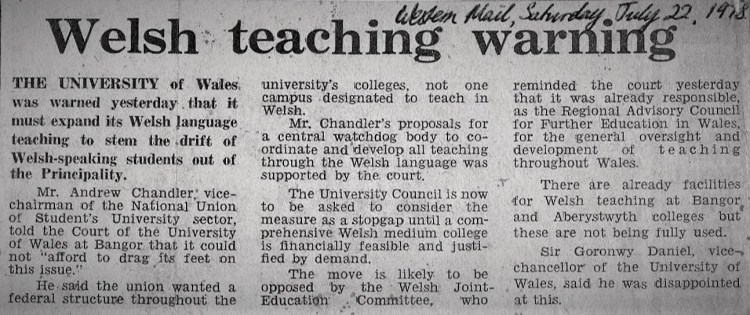
The continuing working-class prosperity of the Midlands was based on the last fat years of the manufacture of cars, as well as other goods. But until the mid-fifties, Coventry’s industrial over-specialisation had gone relatively unnoticed, except by a few economists writing in The Times and The Financial Times. This in turn was compounded by the fact that within the British motor industry as a whole Coventry was steadily becoming of less importance as a source of output and coupled with relatively low profits and investment levels, the economy’s stock was slowly ossifying and becoming increasingly inflexible. Yet other car centres, notably Birmingham, Cowley, Dagenham and Luton were subjected to similar pressures but retained the bulk of their manufacturing capacity to the end of the seventies. It is no coincidence that most of what remained of the British motor industry was centred in towns which were dominated by one single large manufacturing plant.
The problem peculiar to Coventry was not only that the local economy became overdependent on the motor industry but that virtually all the automotive firms were, by the 1960s, ill-suited because of their size to survive the increasing competitiveness of the international market. A major reason for Coventry’s long boom was the multiplicity of firms in the motor industry, but in the seventies, this became the major cause of its decline. The only viable motor car establishment to survive this deep recession was Jaguar. The incentives to embark on a vast restructuring of industry, whether national or local, were simply not there, especially since the policy of successive governments was to divert industry away from the new industrial areas of the interwar period in favour of Britain’s depressed areas, or development areas, as they had been redesignated in the immediate postwar period.
Britain as the Sick Man of Europe – The Economy and EEC Membership:
Edward Heath campaigning, unsuccessfully, in 1966.
In the early 1970s, inflation began to rise significantly, especially after Edward Heath’s Conservative government recklessly expanded the money supply, a misguided version of Keynesianism. All the predictions of Keynesian economists were overturned as rising inflation was accompanied by rising unemployment. At first, this was once again confined to the older industrial areas of the northeast, Scotland and South Wales. The rise of more militant nationalisms in the two Celtic nations was now as much concerned with the closure of collieries and factories, and the laying off of labour, as with cultural issues. By 1973, it was clear that the economic problems of Britain were having far more general consequences. The nation’s capacity to generate wealth, along with its share of world trade and productivity, were all in serious, if not terminal, decline. Britain was seen as ‘the sick man of Europe.’
By 1970, after a decade during which Britain had grown much more slowly than the six original members of the Common Market, Heath was in some ways in a weaker position than Macmillan had been. On the other hand, he also had some advantages. He was trusted as a serious negotiator. Britain’s very weakness persuaded Paris that this time, les rosbifs were genuinely determined to join. Pompidou also thought the time was right and he wanted to get out of De Gaulle’s shadow. But France, like the rest of the Community, had for years been struggling to understand what Britain really wanted. This had been particularly difficult in the first seven Wilson years when the British left had been riven by the issue. Heath had only promised to negotiate, however, not to join. But his enthusiasm was in stark contrast to Wilson’s blowing hot and cold. Yet opinion polls suggested that Heath’s grand vision was alien to most British people.
With Heath in power, after over eighteen months of haggling in London, Paris and Brussels, a deal was thrashed out. It infuriated Britain’s fishermen, who would lose control over most of their traditional grounds to open European competition, particularly from French and Spanish trawlers. It was the second-best deal on the budget, later reopened by Margaret Thatcher. Above all, it left intact the original Common Market designed for the convenience of French farmers and Brussels-based bureaucrats, not for Britain. Vast slews of European law had to be swallowed whole, much of it objectionable to the British negotiators. There were some marginal concessions for Commonwealth farmers and producers, but these were granted in return for the bad deal on the budget. The reality was that the negotiators were directed to get a deal at almost any price. At a press conference at the Élysée Palace in 1971, Heath and Pompidou, after a long private session of talks between the two of them, revealed to general surprise that so far as France was concerned, Britain could now join the Community. Heath was particularly delighted to have triumphed over the press, who had expected another ‘Non.’
A national debate and vote in Parliament followed about the terms of entry, but although he had publicly supported British entry before negotiations began, Wilson now began sniping at Heath’s deal. Jim Callaghan, his potential successor, was already openly campaigning against the deal, partly on the grounds that the EEC threatened the language of Chaucer, Shakespeare and Dickens. The Labour left, too, was in full cry: a special Labour Conference in July 1971 voted by a majority of five to one against membership, and Labour MPs were also hostile by a majority of two to one. Wilson announced that he was now opposed to membership on the Heath terms. After the long and tortuous journey to reach this point, the pro-Europeans were disgusted: they defied the party whip in the Commons and voted with the Conservatives. They were led by Roy Jenkins. The left, led by Barbara Castle, Michael Foot and Tony Benn were livid with the sixty-nine rebels. For both sides, this was a matter of principle that would continue to divide the party until the present day. On the night of the vote in the Commons, there were screaming matches in the lobbies between the pro- and anti-marketeers among Labour MPs. After winning his Commons vote on British membership of the Community, Heath returned to Downing Street to play Bach on the piano in a mood of restrained triumphalism.
Tony Benn began to argue that on a decision of such importance the people should vote in a referendum, since a democratic country that denied its people the right to choose its future would lose all respect. To begin with, Benn had little support for this radical thought, since most on the Left despised referenda as fascist devices, subject to manipulation in a parliamentary democracy. Pro-Europeans also feared that this was a ploy to commit Labour to pull out. Harold Wilson had committed himself publicly against a referendum, but he came to realise that opposing Heath’s deal but promising to renegotiate, offering a referendum, could be the way out. The promise would also give him some political high ground. He would trust the people even if the people were, according to the polls, already fairly bored and hostile. When Pompidou suddenly announced that France would hold its own referendum on British entry, Wilson snatched at the Benn plan. It was an important moment because a referendum would make the attitude of the whole country clear, at least for a generation. Referenda also became devices used again by politicians faced with difficult constitutional choices.
Wilson’s Renegotiation & Referendum, 1974-75:
After winning the two elections of 1974, Wilson carried out his promised renegotiation of Britain’s terms of entry to the EEC and then put the result to in the Benn-inspired referendum of 1975. The renegotiation was largely a sham, but the referendum was a rare political triumph for Wilson after the elections and before his retirement in 1976. On the continent, the renegotiation was understood to be more for Wilson’s benefit than anything else. Helmut Schmidt, the new German Chancellor, who travelled to London to help charm and calm the Labour conference, regarded it as a successful cosmetic operation. Wilson needed to persuade people he was putting a different deal to the country than the one Heath had negotiated. He was able to do this, but when the referendum campaign actually began, Wilson’s old evasiveness returned and he mumbled vaguely his support, rather than actively or enthusiastically making the European case. To preserve longer-term party unity, he allowed anti-Brussels cabinet ministers to speak from the ‘No’ platform and Barbara Castle, Tony Benn, Peter Shore and Michael Foot were among those who took up this offer.
The ‘No’ campaign was all about prices, not about ‘sovereignty’. Top: Barbara Castle leading one of many cunning ‘stunts’.
They were joined on the platform by Enoch Powell, Rev. Ian Paisley of the Democratic Unionist Party(DUP), the Scottish Nationalists and others. But the ‘Yes’ campaign included most of the Labour cabinet, with Roy Jenkins leading the way, plus most of the Heath team and the popular Liberal leader Jeremy Thorpe. It seemed to many people a fight between wild-eyed ranters on the one hand and sound chaps on the other. More important, perhaps, was the bias of business and the press. A Confederation of British Industry(CBI) survey of company chairmen found that out of 419 interviewed, just four were in favour of leaving the Community. Almost all the newspapers were in favour of staying in, including the Daily Mail, Daily Telegraph, and Daily Express. So was every Anglican bishop. The Yes campaign, led by Britain in Europe outspent the No camp by more than ten to one. In this grossly unequal struggle, both sides used scare stories. Yes warned of huge job losses if the country left the Community. The No camp warned of huge rises in food prices.
There were meetings with several thousand participants, night after night around the country, and the spectacle of politicians who usually attacked each other sitting down together and agreeing on something was a tonic to audiences. Television arguments were good, especially those between Jenkins and Benn. On the Labour side, there were awkward moments when the rhetoric got too fierce, and Wilson had to intervene to rebuke warring ministers. In the end, in answer to the simple question, Do you think that the United Kingdom should stay in the European Economic Community (The Common Market)? Just over sixty-eight per cent, around seventeen million people voted Yes and nearly thirty-three per cent (8.5 million) voted No. Only Shetland and the Western Isles of Scotland voted No.
Decimalisation was seen as a huge change to daily life, unwelcome to many older people. Though the original decision had been taken by the first Wilson government in 1965, the disappearance in 1971 of a coinage going back to ‘Anglo-Saxon’ times was widely blamed on Heath as part of the move into Europe. Away flew the beloved florins and half-crowns, ha’pennies, farthings, threepenny and sixpenny bits and out went, to the relief of many schoolchildren, the intricate triple-column maths of pounds, shillings and pence. In came the more rational decimal currency. But ‘imperial’ measures remained for milk and beer, and miles were retained in preference to kilometres. By the 1970s, the behaviour of the cliques who ran the country had been replaced as the chief motivation for political cynicism by a more general sense of alienation from ‘the State’ and ‘the Establishment.’ For many older Britons, these were years when change spun out of control. Much of the loathing of Heath on the right of politics came from British membership of the Common Market after 1973, which seemed to many to be the emblem of the ‘rage’ for new, bigger systems to replace the traditional ones. Writing in his diary in 1975, Tony Benn recorded his reaction to the possibility of a Europe-wide passport, revealing how much the left’s instincts could chime with those of the right-wing opponents of European change:
‘That really hit me in the guts … Like metrication and decimalisation, this really strikes at our national identity.’
Reading it in retrospect, the comment seems almost ironic, but at the time these symbols were emblematic of their ‘sovereignty’ for many Britons, whether they were on the left or right wing. More than forty years later, when Britain was considering leaving what by then had become the European Union, the biggest question both about Heath’s triumph in engineering Britain’s entry and then about Labour’s referendum is whether the British were told the full story about what this would mean and whether they truly understood the supranational organisation they were signing up to. Ever since that first referendum, many of those among the 8.5 million who voted against, and younger people who share their views, have suggested that Heath and Jenkins and the rest lied to the country, at least by omission. Had it been properly explained that Europe’s law and institutions would sit above the Westminster Parliament, it was argued, they would never have agreed. The Britain in Europe campaigners can point to speeches and leaflets which directly mention the loss of sovereignty. One of the latter read:
‘Forty million people died in two European wars this century. Better lose a little national sovereignty than a son or daughter.’
Expanding the membership of the EC, 1952-93.
Yet both in Parliament and in the referendum campaign, the full consequences for national independence were mumbled, and not spoken clearly enough. Geoffrey Howe, as he then was, who drafted Heath’s European Communities Bill, later admitted that it could have been more explicit about lost sovereignty. Heath talked directly about the ever-closer union of the peoples of Europe but was never precise about the effect on British law, as compared to Lord Denning who said the European treaty could be compared to…
‘… an incoming tide. It flows into the estuaries and and rivers. It cannot be held back.’
Hugo Young, the journalist and historian who studied the campaign in great detail wrote:
I traced no major document or speech that said in plain terms that national sovereignty would be lost, still less one that categorically promoted the European Community for its single most striking characteristic: that it was an institution positively designed to curb the full independence of the nation-state.
There were, of course, explicit warnings given by the No campaigners among the more populist arguments about food prices. They came, above all, from Enoch Powell, Michael Foot and Toy Benn. Foot wrote in The Times that the British parliamentary system had been made farcical and unworkable. Future historians, he said, would be amazed…
… that the British people were urged at such a time to tamper irreparably with their most most precious institution; to see it circumscribed and contorted and elbowed off the centre of the stage.
So it was not true that people were not told. The truth revealed by opinion polls is that sovereignty as an issue did not concern the public nearly as much as jobs and food prices. By later standards, the position of Parliament was not taken terribly seriously in public debates. As Andrew Marr put it in his 2009 book, A History of Modern Britain:
It may be that sovereignty is always of absorbing interest to a minority – the more history-minded, politically-aware – and of less interest to the rest, except when a loss of sovereignty directly affects daily life and produces resented laws. In the seventies, Britain’s political class was not highly respected, and Europe seemed to offer a glossier, richer future. Though the pro-Community majority in business and politics did not strive to ram home the huge implications of membership, they did not deceitfully hide the political nature of what was happening, either. It was just that, when the referendum was held, people cared less. The argument would return, screaming … to be heard.
Andrew Marr (2007-9), op.cit., p.351.
‘The Booze Cruise’: A popular home-grown cartoon view of the British attitude to Europe in the late seventies & eighties.
The ‘Barber Boom,’ Inflation & Industrial Relations, 1971-73:
If Heath is associated with a single action, it is British entry into ‘Europe,’ but throughout his time in office, it was the economy which remained the biggest issue facing his government. The country was spending too much on new consumer goods and not nearly enough on modernised and more efficient factories and businesses. British productivity was still pathetically low compared with the United States or Europe, never mind Japan. Prices were rising by seven per cent and wage earnings by double that. The short-lived economic boom under the Conservative Heath government and Anthony Barber’s Chancellorship, greatly benefited the local motor industry, temporarily reversing the stall in population growth in manufacturing areas. But Britain’s falling competitiveness was making it difficult, in the early seventies, for governments to maintain high employment by intervening in the economy.
This was still the old, post-1945 world of fixed exchange rates which meant that the Heath government, just like those of Attlee and Wilson, faced a sterling crisis and perhaps another devaluation. Since 1945 successive governments had followed the tenets of Keynesian economics, borrowing in order to create jobs if unemployment approached a figure deemed as unacceptable (in the 1970s this was about six hundred thousand). During the decade, this became increasingly difficult to do as Edward Heath’s government (1970-74) struggled to follow such policies in the face of a global recession associated with the tripling of oil prices in 1973, by OPEC (the international cartel of oil producers). This caused an immediate recession and fuelled international inflation. Faced with declining living standards, the unions replied with collective industrial power. Strikes mounted up, most acutely in the coalfields.
The unions, identified by Heath as his first challenge, had just seen off Wilson and Barbara Castle. Heath had decided he would need to face down at least one major public sector strike, as well as remove some of the benefits that he thought encouraged strikes. Britain not only had heavy levels of unionisation through all the key industries but also, by modern standards, an incredible number of different unions, more than six hundred altogether. Added to this, leaders of large unions had only a wobbly hold on what actually happened on the ‘shop floor’ in factories. It was a time of politicised militancy there, well caught by the folk-rock band the Strawbs, who reached number two in the singles chart with their mock-anthem Part of the Union. Its lyrics included:
“Oh, you don’t get me I’m part of the union, till the day I die…
“As a union man I’m wise to the lies of the company spies…
“With a hell of a shout, it’s ‘out brothers, out!’ …
” And I always get my way, if I strike for higher pay…
“So, though I’m a working man, I can ruin the government’s plan … ”
Almost immediately after becoming PM, Heath faced a dock strike, followed by a big pay settlement for local authority dustmen, then a power workers’ go-slow which led to power cuts. Then the postal workers struck. Douglas Hurd, then Heath’s political secretary, recorded in his diary his increasing frustration:
‘A bad day. It is clear that all the weeks of planning in the civil service have totally failed to cope with what is happening in the electricity dispute: and all the pressures are to surrender’.
Later, Hurd confronted Heath in his dressing gown to warn him that the government response was moving too slowly, far behind events. At that stage, things in the car industry were so bad that Henry Ford III warned Heath that his company was thinking of pulling out of Britain altogether. Yet Heath’s Industrial Relations Bill of 1971 was meant to be balanced, giving new rights to trade unionists while at the same time trying to make deals with employers legally binding and enforceable through a new system of industrial courts. This was similar to the package offered by the Wilson government. There were also tax reforms, meant to increase investment, a deal with ‘business’ on keeping price increases to five per cent and even some limited privatisation, with the travel agents Thomas Cook, then state-owned, being sold off along with some breweries.
But the Tory messages and measures were confusing. Cuts in some personal taxes encouraged spending and therefore inflation. With European membership looming, Anthony Barber, Heath’s Chancellor, was dashing for growth, which meant further tax cuts and higher government spending and borrowing. Lending limits were removed for high street banks, resulting in a growth in lending from twelve per cent per year in 1971 to forty-three per cent per year in 1973. This obviously further fuelled inflation, particularly in the housing market. This led to a huge expansion of credit and capital sunk into bricks and mortar that became a feature of modern Britain.
At the same time, one of the historic constraints on successive post-war British governments was removed by President Nixon in the summer of 1971 when he suspended the convertibility of the dollar for gold and allowed exchange rates to ‘float.’ He was faced with the continuing high costs of the war in Vietnam, combined with rising commodity prices. The effect on Britain was that the government and the Bank of England no longer had to be quite so careful about maintaining sterling reserves. But it opened up fresh questions, such as how far down sterling could go and how industrialists could expect to plan ahead. Heath’s instincts on state control were also tested when the most valuable parts of Rolls-Royce faced bankruptcy over the cost of developing new aircraft engines. He quickly nationalised the company, saving eighty thousand jobs and allowing it to regroup and survive, to the relief of the defence industry. Rolls-Royce did revive, returning to the private sector, providing one example of how nationalisation could work in future.
A campaign poster during the 1972 miners’ dispute.
In 1972, in their first strike for a generation, the miners fought a dramatic battle, putting the country on a three-day week and unhinging the Heath government. This time we’ll win, they said. No one in South Wales needed to ask what last time they had in mind, especially those who still remembered the dark days of the twenties. The National Union of Mineworkers (NUM) submitted a demand for a forty-five per cent wage increase to the National Coal Board (NCB). When it was rejected, a national miners’ strike was called in February 1972. The Heath government experienced the full extent of the miners’ ability to disrupt national production and energy supplies, despite the contraction of the industry since the 1950s. The government was wholly unprepared, with modest coal stocks, and was surprised by the striking miners’ discipline and aggression.
Arthur Scargill, then a young, unknown militant and former Communist, organised fifteen thousand of his comrades from across South Yorkshire in a mass picket of the Saltley coke depot, on which Birmingham depended for much of its fuel. Scargill (below centre), a rousing speaker and highly ambitious union activist, later described the confrontation with West Midlands police as “the greatest day of my life.” However, the events of his greatest day represented, for the PM:
‘… the most vivid, direct and terrifying challenge to the rule of law that I could ever recall emerging from within our own country. … We were facing civil disorder on a massive scale.’
The Welsh miners picketed outside the Houses of Parliament during the 1972 Strike, led by their General Secretary Dai Francis (with spectacles).
Heath blamed the police for being too soft. It was clear to him that the intention was to bring down the elected government but he decided that he could not counter-attack immediately. Confronted with the prospect of the country becoming ungovernable or having to use the armed forces to restore order which public opinion would never have tolerated, Heath turned to a judge Lord Wilberforce, for an independent inquiry into miners’ wages. Wilberforce reported that they should get at least twenty per cent, which was fifty per cent more than the average increase. The NUM settled for that, plus extra benefits, in one of the most clear-cut and overwhelming victories over a government of any British trade union to date. Their strategy and tactics were wholly successful. Scargill was quickly promoted to agent, then president of the Yorkshire miners.
A boy stands outside his school, which closed because of a lack of fuel during the miners’ strike of 1972.
The Oil Price Bust, the Coal Dispute & the Three-Day Week, 1973-74:
Obstructionist trade unions were a favourite target of many, particularly after the coal dispute, which had led to a series of power cuts throughout the country and a three-day working week. Attacks on trade union power were becoming more popular owing to a growing perception that the miners in particular had become too powerful and disruptive, holding the country for ransom. Heath and his ministers knew that they would have to go directly to the country with an appeal about who was running it, but before that, they tried a final round of negotiation to reach a compromise. Triggered by the prospect of unemployment reaching a million, there now followed the famous U-turn which so marred Heath’s reputation. It went by the name of ‘tripartism’, a three-way national agreement on wages and prices, investments and benefits, between the government, the Confederation of British Industry (CBI) and the Trades Union Congress (TUC). The Industry Act of 1972 gave the government unprecedented powers of intervention, which Tony Benn called ‘spadework for socialism’. Heath had leaned so far to try to win the unions over that he was behaving like a Wilsonian socialist.
The unions, having defeated Wilson and Castle, were more self-confident than ever before or since. Many industrial workers, living in still-bleak towns far away from the fashionable big cities, did seem underpaid and left behind. The miners, certainly, were badly paid in these areas in particular. Heath argued that he was forced to accept and apply consensual policies because in the seventies any alternative set of policies, the squeeze of mass unemployment which arrived in the Thatcher era, would simply not have been accepted by the country as a whole. Besides, the economic problems the government and the country at large faced were not primarily the result of high wage claims. Management incompetence or short-termism, leading to an abdication of responsibility and the failure to restructure factories and industries, was seen as a primary cause of economic stagnation. This, as seen in the case of manufacturing in Coventry, was an argument which had some local evidence to support it, although unions at a local, shop-floor level were sometimes equally short-sighted in some instances.
What finally finished off the Heath government was the short war between Israel and Egypt in October 1973, the Yom Kippur War. Israel’s swift and decisive victory was a humiliation for the Arab world and it struck back, using oil as its weapon. OPEC, the organisation of oil-producing countries dominated by the Saudis, had seen the price of oil rising on world markets for some time. They decided to cut oil supplies to the West each month until Israel handed back its territorial gains and allowed the Palestinians their own state. There would be a total embargo on Israel’s most passionate supporters, the United States and the Netherlands. And those countries that were allowed oil would be made to pay more for it. In fact, prices rose fourfold. It was a global economic shock, pumping further inflation into the industrialised world, but in Britain, it arrived with added force. The miners put in yet another huge pay claim, which would have added twice as much again to many pay packets. Despite an appeal from the moderate NUM President, Joe Gormley, the NUM Executive rejected a thirteen per cent pay increase and voted to ballot for another national strike.
The country could survive high oil prices, even shortages, for a time, but these were the days before Brent Crude from the North Sea was being produced commercially. The same was true of natural gas. But Britain could not manage both the oil shock and a national coal strike at the same time. Barber, the Chancellor, called this the greatest economic crisis since the war. It certainly compared to that of 1947. Again, coal stocks had not been built up in preparation, so a whole series of panic measures had to be introduced. Plans were made for petrol rationing and coupons were printed and distributed. The national speed limit was cut by twenty miles per hour to fifty mph. Then in January 1974 came the announcement of a three-day working week. Ministers solemnly urged citizens to share baths and brush their teeth in the dark. Television broadcasting ended at 10.30 p.m. each evening. It was an embarrassing time in many ways, with people having to find other things to do in the dark or by candlelight, yet it also gave millions an enjoyable frisson, the feeling of taking a holiday from everyday routines. The writer Robert Elms recalled:
…this proud nation had been reduced to a shabby shambles, somewhere between a strife-torn South American dictatorship and a gloomy Soviet satellite… a banana republic with a banana shortage … The reality of course is that almost everybody loved it. They took to the three-day week with glee. They took terrific liberties.
This time Heath and his ministers struggled to find a solution to the miners’ demands, though the climate was hardly helped when Mick McGahey, the legendary Communist NUM leader, asked by Heath what he really wanted, answered ‘to bring down the government.’ When the miners voted, eighty-one per cent were for striking, including those in some of the traditionally most moderate coalfield areas. In February 1974, Heath asked the Queen to dissolve Parliament and went to the country on the election platform he had prepared two years earlier: ‘Who governs?’ The country’s answer, perhaps taking the question more literally than Heath had hoped was ‘Not you, mate!’ Meanwhile, Harold Wilson had expected the Tories to win again. A year earlier he had prepared the Opposition’s answer to the questions of union power and inflation which became known as the Social Contract. Observers saw it as a recipe for inflation which also offered the TUC a privileged place at the table in return for very little.
However, Wilson was somehow able to emerge as the calm bringer of reason and order in the election campaign, whereas Heath was hit by a slew of bad economic figures. Then Enoch Powell, Heath’s old nemesis, stepped back into the limelight to announce that he was leaving the Conservatives over their failure to offer the electorate a referendum on Europe. He, therefore, called on voters to vote Labour. This helped to produce a late surge for Wilson, as well as for the Liberals, led by the popular Jeremy Thorpe. Though Labour won the most seats by the slenderest of margins, 301 to the Tories’ 297 (the Liberals had fourteen MPs), no party had an overall majority, so Heath hung on, hoping to do a deal with Thorpe. But he eventually had to concede defeat, and Harold returned to the Palace to kiss hands with Queen Elizabeth for the third time. As Andrew Marr put it:
SoMick McGahey and friends had brought down the Heath government, with a little help from the oil-toting Saudi Royal Family, the Liberals and Enoch Powell. A more bizarre coalition of interests is difficult to imagine.
Andrew Marr (2007), A History of Modern Britain,p. 342.
Other significant changes happened on Ted Heath’s watch. The school leaving age was raised to sixteen. To cope with international currency mayhem caused by the Nixon decision to suspend convertibility, the old imperial sterling area finally went in 1972. The Pill was made freely available on the NHS. Local government was radically reorganised, with no fewer than eight hundred English councils disappearing and huge new authorities, much disliked, being created in their place. Heath defended this on the basis that the old Victorian system could cope with ‘the growth of car ownership and of suburbia, which was undermining the distinction between town and country.’ Many saw it as bigger-is-better dogma. There was more of that when responsibility for NHS hospitals was taken away from hundreds of local boards and passed to new regional and area health authorities, at the suggestion of a new cult that was then just emerging – management consultancy. In the seventies, the familiar and the local seemed everywhere in retreat.
(to be continued; for sources, see part two)
Appendix One – The Queen & Tolkien:
In 1972 – Queen Elizabeth II appointed JRR Tolkien Commander of the Order of the British Empire “for services to English Literature.” Outside Buckingham Palace with his daughter Priscilla.
After the death of his wife, Edith, in 1971, Tolkien’s happiness was added to by the honours that were conferred on him. He received several invitations to visit American universities and receive doctorates, but he couldn’t face the long journey. There were also many tributes within his homeland. He was profoundly moved when, in the spring of 1972, he was invited to Buckingham Palace to be presented with a C.B.E. by the Queen. She had been eleven when The Hobbit was published, and The Lord of the Rings had hit bookstores two years into her reign. Tolkien wrote to his publisher Rayner Unwin about the day,
“… I was very deeply moved by my brief meeting with the Queen, & our few words together. Quite unlike anything that I had expected.”
Humphrey Carpenter (ed.) (1981), Letters of J. R. R. Tolkien. London: George Allen & Unwin, Letter 334.
After everything he had lived through and all the fairy stories he had written, meeting the Queen was a special moment for him. But perhaps the most gratifying of all was the award in June 1972 of an honorary Doctorate of Letters from his own University of Oxford; not, as was made clear, for The Lord of the Rings, but for his contribution to philology.
The following year, on 2nd September, J.R.R. Tolkien died, aged eighty-one. His requiem mass was held in Oxford four days after his death, in the plain modern church in Headington, which he had attended so often since his retirement. Born in South Africa during the reign of Queen Victoria and growing up in Birmingham during the reign of Edward VII, Tolkien researched, taught and wrote in England during the reigns of all four Windsor monarchs (before Charles III), over six decades, from George V to Elizabeth.
From 1962 to 1966, HRH Prince Charles attended Gordonstoun School in Scotland, where his father was a pupil.
The long and broad view of the British Economy:
The economic historian, P. Calvocoressi, writing in 1978, provided a long view of the British economy from 1945 to 1975. He saw the failure of successive governments to manage it successfully as the result of their unwillingness to dismantle the ‘mixed’ economy model of private and public sectors. The role of government in the direction and management of the economy had become paramount by the 1950s, even though many Conservatives deplored or sought to evade this development. He pointed out that every government acted within the established system. None tried radically to change it. All governments accepted an obligation to contribute positively to the prosperity of both sectors. Both parties, Calvocoressi concluded, failed to restore the British economy by expanding industry and exports. As a result, the long-term economic decline of Britain they inherited accelerated. Whatever their causes, failures led to political divisions and criticism not only of the policies of the governments but also of the role of government in the mixed economy. He concluded:
Still less had they questioned the existence of the mixed economy. But the failures of this economy … led to questions about the viability of such an economy.
P. Calvocoressi (1978), The British Experience, 1945-1975. Penguin, pp. 105-12.
Because Calvocoressi takes a longer perspective of Britain than other economists and economic historians, his view may not be as valuable in examining the thirteen years of Conservative rule. In particular, he seems to imply that it was not the Conservative governments, nor even the role of government that failed the economy, but capitalism itself. His critique of western social-democratic capitalism seems rather dated, even for the late 1970s. However, his criticism of the failure of successive governments to challenge orthodox economic views certainly accords with the position adopted by Vernon Bognador and Robert Skidelsky, who saw ‘consensus’ as the basis of government policy between 1951 and 1964. The uncritical acceptance by both major political parties of this concept meant that new perspectives for examining old problems could not be forthcoming. The result of this was the creation of an illusion of continuing affluence, as Bogdanor and Skidelsky wrote in 1970:
Ten years ago it was possible, and indeed usual, to lookback to the 1950s as an age of prosperity and achievement. This was certainly the the verdict of the electorate which in 1959 returned a Conservative government to power with a handsome majority, for the third time running.Today we are more likely to remember the whole period as an age of illusion, of missed opportunities, with Macmillan as the magician whose wonderful act kept us too long distracted from reality. … what has altered the verdict on the 1950s has been the experience of the troubles of the 1960s, which stem at least in part from the neglect of the earlier decade.
Already by 1964, the appeal of the slogan ‘Thirteen Wasted Years’ was strong enough to give Labour a tiny majority; in the years following it has been confirmed almost as the conventional wisdom. … Perhaps the period of Conservative rule will be looked upon as the last period of quiet before the storm, rather like the Edwardian age which in many respects it resembles. In that case its tranquility will come to be valued more highly than its omissions.
V. Bogdanor and R. Skidelsky, The Age of Affluence, 1951-64. pp 7-11.
But, in reality, from 1955, the British economy was entangled in a series of sterling crises which gradually forced the Conservative Government to pay attention to problems it wished to avoid. Both the Eden and Macmillan governments were distracted by a second illusion, that of their party’s obsession with Britain’s abiding role in the world. In 1962, Dean Acheson, the US Secretary of State made his famous statement Britain has lost an empire; she has not yet found a role. Bogdanor and Skidelsky pointed out that the failure to rethink Britain’s world role was as evident in its economic policies as in its diplomacy. Macmillan foresaw and expedited the final liquidation of the Empire, but he had few ideas about what to put in its place.
Finally, A. Sked and C. Cook looked at the question from a broader viewpoint. Politics may have remained the same but, they argued, society did not. New values, new beliefs and new attitudes began to show themselves in this period. In this way, the idea of consensus came into question, and the illusion of affluence was made apparent. As far as the fiscal and economic policies were concerned, they argued:
… the Tories did very little in their years in power. Cushioned by the turn in the terms of trade they abolished rationing, reduced taxes and manipulated budgets but they gave little impression of knowing how the economy really worked. Little attention was paid to Britain’s sluggish economic growth or the long-term challenge posed by Germany and Japan.
Industrial relations were treated with a ‘we/they’ attitude and no thought was given, until late in the day, to the problems created by Britain’s prosperity. Instead, the Government sat back and did nothing in their belief that there was nothing to do, and for most of the time their energy was devoted to maintaining Britain as a world power whatever the cost to the economy. …
Moreover, Tory economic complacency ensured that the necessary economic growth would never be generated. Not enough money was channelled into key industries; stop-go policies undermined the confidence of industry to invest in the long term; too much money was spent on defence. …
With the economic crises of the early 1960s … it began to be apparent that Tory affluence would soon come to an end. The scandals of the Macmillan era merely served to reinforce the impression that a watershed had been reached in the country’s history, and foreign affairs seemed to teach a similar lesson. …
After 1963-64 then, things were never the same again. But in another sense they were never really different.
A. Sked & C. Cook (1979), Post-War Britain – a Political History. Penguin, pp. 221-5.
Macmillan the Magician to the Rescue of the Empire:
According to the Earl of Kilmuir, in his 1964 Memoirs, Eden’s successor as Prime Minister, Harold Macmillan, led his country and his party out of the bitter-black aftermath of Suez. In particular, he began the scramble to dismantle what was left of the post-imperial presence as Britain came to terms with its loss of status, assets and, in an intangible way, national swagger. The country became ever more dependent on the United States not just financially but also for its defence and security. After the Korean War, the US Air Force was allowed eight airfields in Britain. In 1957, after the Suez fiasco, there were sixty US Thor missiles in East Anglia. Indeed, in 1960 the US was allowed to build a Polaris nuclear submarine base at Holy Loch in Scotland.
Cyprus fell soon after Suez. It had been intended as an important base from which Britain could guard the Canal. But during the Suez war itself, it had proved less than useful, because it had no deep-water harbour; after Suez, there was little left in that part of the Mediterranean for it to guard anyway. In 1957 the British government started negotiating with the Cypriot nationalists, and the search continued for other handholds. Kilmuir wrote of the case of Cyprus as a case in point of Macmillan’s command of the House of Commons:
Cyprus was a classic example of this tactical genius. The final settlement of this tactical genius. The final settlement of this distressing episode early in 1959 was a diplomatic triumph for Macmillan, but it must be admitted that it followed the broad lines which had been urged on the Government by Gaitskell and Bevan for a long time. Nevertheless, after both (Macmillan and Gaitskell) had snapped at each other across the Dispatch Box in a crammed House of Commons, it was Gaitskell who gave the appearance of little-mindedness…
The Earl of Kilmuir, Memoirs (1964) pp. 290-91.
In respect of other territories and colonies, they planned the same kind of progress, but in a slow and ‘orderly’ manner. Where their residual imperialism showed through, the evidence that their change of heart was less than complete, was in their continued belief that Britain still had a world role to maintain, and the right to keep hold of certain foreign territories in order to retain it; and in their conception of self-government, which frequently fell short of those of the nationalists. In East and Central Africa, for instance, it stopped far short of majority rule while there were still settlers there, and elsewhere where it stopped short of economic self-government while there were still British firms and shares to safeguard. From the wreck of the old empire, they tried to salvage what was essential: a role in the world, their new white dominions in central Africa and their means to continue exploiting countries they no longer ruled.
Imperialist ambitions for east-central Africa remained lively right through the 1950s, and long after Suez had undermined them elsewhere. When Cyprus began to crumble the first place they thought of replacing it with as their main military base for the Middle East was Kenya. In east-central Africa their allies, the nucleus around which they intended to consolidate their hold, and maintain a British presence in the continent, where the settlers, a small minority everywhere, but one in which many of the colonies already had taken many of the functions and responsibilities of government. None of the colonies except Southern Rhodesia had enough of them to make a transfer of power to them possible, and in Britain as well as elsewhere in Africa liberal opinion made this option impolitic anyway. On the other hand, there was widespread concern in Britain, which the government shared and could work on, that established settler interests should not be entirely abandoned to unpractised African politicians without safeguards.
The British government’s support for the settler cause in Kenya had to contend with what turned out to be the most ferocious of all the nationalist movements that confronted her in Africa, mainly amongst dispossessed and desperate Kikuyu, whose violent methods, involving atrocities and pagan rituals, were used to justify repressive counter-measures. During the ‘Mau Mau’ crisis, ten thousand were killed altogether: 9,600 Africans (mostly by other Africans) and seventy Europeans. In the Kenyan context, ‘multi-racialism’ meant communal elections against a background of very restricted African political activity, and a constitution carefully designed to ensure ‘parity,’ by permitting fifty thousand Europeans the same number of elected representatives as five million Africans.
Empire into New Commonwealth:
The Conservative imperialists’ inability to take in the full extent of their loss was reflected in the conception they had of the new ‘multi-racial’ Commonwealth just beginning to form from the pieces of the old empire. Some of them, like Leo Amery, saw it as a way of preserving Britain’s interests in her former colonies, and her status in the new world of the Cold War. In a way what they hankered after was the older, more ‘informal’ imperialism of the mid-nineteenth century, with all of the rights and none of the responsibilities. But a return to that form of purely economic imperialism was impossible because it required an even stronger base of power in global relations, one that now only the USA possessed. But the effort was made, nonetheless. In the 1950s, on the fronts it had decided to fight on, the Conservative government fought hard to keep some colonies and to give others to ‘the right people,’ most notably in Malaya and British Guiana.
In the late 1950s, despite all the reverses, there was still a sizeable empire left for Britain to save, if it wanted to. As well as a great slice of Africa, there was a score of smaller colonies all over the world which it was thought could never be viable on their own, and therefore would always be content to let Britain rule them, rather than have Russia or China grab them, as was the most likely outcome for a small, isolated state. There were also larger colonies, especially in west Africa, Malaya and the West Indies, whose progress towards independence could not be prevented now, but which might be ‘guided’ towards continuing membership of the Commonwealth and the strength that might still be drawn from imperial preferences and defence co-operation. And, even after Cyprus, there were still strategic British colonies in the world – Malta, Aden, Singapore – to keep a secure framework for British world influence to be maintained, especially with the nuclear deterrent to back it up.
Nevertheless, it was in this global context, that the second phase of Britain’s withdrawal from its empire took place across Africa in the late 1950s and early ’60s, under the direction of the Conservative governments. On the other side of the imperial account, there were ever-increasing costs to meet, not just in money, but in lives too, as well as in moral credit. The current did seem to be running against Britain in all these regards. In east-central Africa, the effort to hang on had recently resulted in a series of overtly oppressive measures, and several atrocities (or incidents which could be presented as such) that were widely felt to have been uncharacteristic and shaming: the Hola camp incident in Kenya in 1959, in which eleven Mau Mau detainees were beaten to death by camp guards; a state of emergency throughout the Central African Federation that was likened to a ‘police state’ and fifty African rioters shot in Nyasaland. Of the ‘collaboration’ which had helped sustain British colonial rule in the past, there was very little now left in Africa: Britain was having to impose its will by an open display of force, which by this time it was not able to do as easily as in the past.
Realists as well as radicals were now turning away from the empire. The men of industry and finance, who by necessity were the hardest realists of all, had for some time been aware of the trend and had begun to make their own arrangements with the trendsetters, the empire’s successor states, to protect and further their interests in the best ways they could. They might have regretted the loss of their imperial padding but they came to terms with it. They made treaties with whoever was in command: in South Africa, while they still had control it was the white supremacists, but in tropical Africa, it was the new black nationalists.
Britain’s trading position as a whole was altering, backing away from the empire and ex-empire, and towards Europe. For more and more people in Britain, their real economic destiny now appeared to lie in closer association with the European continent, which was already organising itself into a great ‘Common Market,’ which could make its own terms with the politically independent ‘third world’ outside. The empire, which meant the old type of colonial control over satellite economies, was not necessary anymore, or worth fighting for.
What was left when those with an ‘interest’ began leaving the sinking ship was a residue of mainly emotional commitments to the glory of the empire, which were just not strong enough to persuade a realistic government, which was what Harold Macmillan’s was, to resist all the material pressures pushing the other way. Iain Macleod, who became Colonial Secretary in October 1959, always excused his surrender to colonial nationalism by pleading necessity, though he probably also had a genuinely liberal commitment to independence, as the following quote demonstrates:
‘We could not possibly have held by force to our territories in Africa. We could not, with an enormous force engaged, even continue to hold the small island of Cyprus. General de Gaulle could not contain Algeria. The march of men towards their freedom can be guided, but not halted. Of course there were risks in moving quickly. But the risks in moving slowly were far greater.’
Quoted in David Goldsworthy (1971), Colonial Issues in British Politics, 1945-1961. p. 363.
The Wind of Change:
Macmillan was of the same mind. In his famous speech in Cape Town in February 1960 he told of the ‘shrinking impression’ a tour of tropical Africa had given him of the strength of this national consciousness. It was against this background that Macmillan made his historic comments:
“The wind of change is blowing through this continent and whether we like it or not, this growth of national consciousness is a political fact.”
Harold Macmillan’s speech in Cape Town, South Africa, 1960.
A decade after the decolonisation process was initiated in Asia, the wind of change began to sweep through Africa, hastened by the Suez Crisis. The Gold Coast was the first African colony to gain independence, under the new name, Ghana. This set in motion British disengagement from other colonies in West Africa. In contrast to the rich and relatively well-developed colonies in the west, the transfer of power in the eastern and central African colonies was complicated by the competing claims of impoverished black populations and privileged, entrenched European minority settler communities. Yet, despite these difficulties, a combination of African nationalism and the British desire to relinquish costly imperial commitments in the region resulted in independence and black majority rule in most African colonies, with the notable exception of Southern Rhodesia (later Zimbabwe).
Britain in the early 1960s was hustled and harried out of most of her old colonies, and without too much bloodshed. The roll call was an impressive one. In the 1950s the Sudan, the Gold Coast (Ghana) and Malaya had been the only ones to ‘escape.’ In the 1960s, it quite suddenly became a stampede, as the following list shows:
None of the shadows cast by the legacy of the empire was long enough to substitute fully for what had been lost. At first, it was thought that the Commonwealth might. In the 1950s the fact that so many ex-colonies had elected to stay within the Commonwealth led some imperialists to assume a substantive continuity between it and the old empire. The ‘black’ and ‘brown’ nations joined Australia, New Zealand and Canada in an extended family cemented by common bonds of tradition, friendship and mutual interest. Leopold Amery in 1953 speculated that:
‘… other nations now outside it may well decide to join it in course of time. … Who knows but that it may yet become the nucleus round which in the near future a future world order will crystalize?’
LeopoldAmery, My Political Life, i, 16.
Queen Elizabeth and Prince Philip visited the Gambia in 1961. Despite the apparent loyalty to the Crown, the country became independent in 1965.
This vision compensated a little for the loss of empire, and while it seemed to do this, old imperialists retained their affection for it and sought (as in the past) to cement its parts more tightly together; for example by trade preferences for Commonwealth countries, and by preserving a definition of ‘British nationality’ (laid down in 1948) which allowed all Commonwealth citizens the right to enter Britain freely, without restriction. But by the sixties, it was becoming clear that the Commonwealth was turning out to be something less than had been hoped. Its members did not have common interests, not even among the ‘white’ dominions, which were too far apart both geographically and in respective perspectives. For the black and brown nations, membership was not an expression of filial gratitude and loyalty. Rather it provided merely a convenient platform on the world stage, from which they could air their grievances and entitlement to a share of what British aid there was going.
There were some ideological differences between the two main political parties on colonial policy, but both Harold Macmillan and Harold Wilson entered number ten determined to retain Britain’s remaining imperial and military possessions. However, both leaders succumbed to economic, political and international pressures, resulting first in Macmillan’s retreat from Africa and then in Wilson’s withdrawal from ‘East of Suez’. The spread, speed and character of decolonisation were not determined by them, but by a mixture of international cold war politics, British imperial interests and local nationalist movements, which varied from region to region. In Egypt, Kenya and Malaya, for example, nationalism took on radical, populist and violent forms, culminating in state-of-emergency declarations by the British governments. Withdrawals were also impaired by communal and ethnic tensions. In contrast, the power transfer was comparatively peaceful in the Gold Coast and the Caribbean.
In fact, the Commonwealth was never united at all. Its new members fought each other, and broke off diplomatic relations with each other and with the ‘mother country.’ In 1961, they banished South Africa, one of its oldest members, from the family, causing considerable indignation among the ‘white’ dominions. As a substitute for the empire, it was a disappointment; the emperor’s new clothes were a sham. But there were some in British public life who continued to value the new Commonwealth but as something rather different from the old empire. It was a means of scaling the barriers of racism and chauvinism going up all over the world, a corrective to the contemporary consolidation of the world into continental blocs and perhaps a kind of moral pressure group within world affairs and a debating society for widely divergent cultures.
The Sad End of Empire:
There were some Britons, from idealistic old liberal imperialists to Fabian anti-imperialists who were generally interested in questions of international cooperation and overseas aid. But the political leaders from both main parliamentary parties soon lost interest in imperial free trade, always a euphemism for imperial protectionism. Instead, they turned to European free trade from 1962 when the first serious overtures to the EEC were made. In the same year, the UK parliament abandoned its noble commitment to ‘common citizenship’ by restricting coloured immigration from the Commonwealth. These two moves revealed a sudden loss of interest in the Commonwealth the minute it ceased to be useful to Britain. For idealistic imperialists, this was a sad end for the empire.
Despite the speed with which the British Empire was brought to an end in the period 1945-65, Britain had no intention of severing all links with its former colonies. On the contrary, the ‘Commonwealth’ was seen as a natural successor to the Empire. Despite the hopes of some Conservatives to the contrary, the formation of the enlarged Commonwealth never allowed Britain to retain any real influence. Although some politicians trumpeted the ideal of a closer association of states as a means of reasserting British spheres of influence in Asia and Africa, Britain’s political leaders soon discovered they were unable to exercise the level of economic and political control that they had hoped to retain.
The Return of British Cultural Self-Confidence & Political Satire:
Britain was a country open to foreign influences, but they were as strong from Italy or Scandinavia as from America – coffee bars, Danish design, scooters and something promoted as ‘Italian Welsh rarebit’ (later known as pizza) were all in evidence. The awesome power of American culture was growing all the time over the horizon. But for a few years, at least, the idea of a powerful, self-confident Britain independent of American culture seemed not only possible but likely. Per capita, after all, Britain was still the second-richest country in the world.
Political satire, which had been exuberantly popular in Georgian times, now returned in full force, from savage cartoons in the newspapers, staged lampoons and the fortnightly mockery of the magazine Private Eye. Among the two million listeners to The Goon Show in the mid-fifties were key members of the next generation of comics, who would sting more, men such as Jonathan Miller and Peter Cook. The latter is considered Spike Milligan’s only rival as the outstanding comic genius of the age. As a schoolboy at Radley in Oxfordshire, he sent a script to the BBC good enough for Milligan to invite him to London for lunch. The bullying that Cook endured at his private ‘public’ school led him to develop mimicry and mockery to deflect bullies. Cook would make them laugh in order that they would not hit him. He was not politically radical, being from a privileged élite in which his father had been a colonial civil servant in Nigeria and Gibraltar. From Radley, he went on to Cambridge, from where there was a direct line from student reviews to the West End. Peter Cook’s generation at Cambridge in 1957 included a number of future cabinet ministers, as well as numerous actors. He once said:
‘One reason that Oxbridge has traditionally produced so many political satirists is that its undergraduates come face to face with their future political leaders at an early age, and realise then quite how many of them are social retards who join debating societies in order to find friends.’
Cook found his voice as a schoolboy and essentially never lost it; the same deadpan philosophical drone spread to Edinburgh’s Beyond the Fringe review, to London and New York. The day when the traditional establishment had to acknowledge the comedy establishment was 28th February 1962, when the Queen visited Beyond the Fringe in London’s Fortune Theatre to see the vicious caricature of her prime minister by Peter Cook. Cook had done his Macmillan at Cambridge and at the Edinburgh Festival Fringe already. In London, he had been playing to packed houses since the previous May. There had been protests and walkouts by people outraged at seeing the Queen’s first minister lampooned in public, but the Queen herself roared with laughter. After this, Macmillan was determined to show what a good sport he was, and that he could take a joke, so he decided to go along too. But when the prime minister arrived, Cook spotted him in the audience and deviated from his script. In an Edwardian drawl, he imitated Macmillan:
“When I’ve a spare evening, there’s nothing I like better than to wander over to a theatre and sit there listening to a group of sappy, urgent, vibrant young satirists, with a stupid great grin all over my silly old face.”
The New Commonwealth & Immigration to Britain:
In Britain, postwar reconstruction, declining birthrates and labour shortages resulted in the introduction of government schemes to encourage the migration of Commonwealth workers, particularly from the West Indies, to seek employment in Britain. Jamaicans and Trinidadians were recruited directly by agents to fill vacancies in the British transport network and the newly created National Health Service. Private companies also recruited labour in India and Pakistan for textile factories and steel foundries in Britain.
Just as Britain was retreating from its formal imperial commitments, Commonwealth immigration into Britain, principally from the West Indies and South Asia, was becoming an increasingly salient issue in British domestic politics. During the 1950s, the number of West Indians entering Britain reached annual rates of thirty thousand. Immigration from the Indian subcontinent began to escalate in the 1960s. The Census of 1951 recorded seventy-four thousand New Commonwealth immigrants; a decade later the figure had increased to 336,000. This immigration was driven by a combination of ‘push’ and ‘pull’ factors. Partition of the Indian subcontinent and the construction of the Mangla Dam in Pakistan continued to displace large numbers of people, many of whom had close links with Britain through colonial connections and later through familial ones.
West Indians in London in 1956.
The 1948 Nationality Act reaffirmed the right of British nationality and free entry to the United Kingdom to all Commonwealth subjects of the Crown, without restrictions. About 125,000 people from the Caribbean came to live in Britain between 1948 and 1958. They were looking to escape the poverty of their own countries. Immigrants also came from other parts of the Commonwealth, including India, Pakistan and East Africa, some arriving as refugees fleeing wars and discrimination. But as growing numbers of Caribbeans and South Asians took up this right of abode, the British authorities became increasingly alarmed.
As more Caribbeans and South Asians settled in Britain, patterns of chain migration developed in which pioneer migrants, usually single men, aided family and friends to settle. The picture below shows female family members and young boys arriving to join their menfolk. Despite the influx of workers from Ireland and the Commonwealth, emigration continued to outstrip immigration.
Birmingham’s booming postwar economy attracted West Indian settlers from Jamaica, Barbados and St Kitts in the 1950s, followed by South Asians from Gujurat and the Punjab in India, as well as from both West and East Pakistan (Bangladesh) from the 1960s. Hostility to Commonwealth immigrants was pronounced in some sections of the local white population. One manifestation of this was the establishment of the Birmingham Immigration Control Association, founded in the early 1960s by a group of Tory MPs.
A Jamaican immigrant seeking work and lodgings in Birmingham in 1955.
Many West Indian immigrants encountered considerable obstacles, including racial prejudice when seeking accommodation, as the photo from 1958 below shows.
The importance assigned to the Commonwealth in the fifties prevented the imposition of the tighter immigration controls that many began to call for. However, by the sixties, Britain’s retreat from the Commonwealth in favour of pursuing links with Europe and events such as the Notting Hill race riots of 1958 heralded a policy of restriction, which gradually whittled away the right of New Commonwealth citizens to automatic British citizenship. Although the Immigration Act of 1962 that followed was intended to reduce the inflow of blacks and Asians into Britain, it had the opposite effect at first: fearful of losing the right to free entry, immigrants came to Britain in larger numbers.
In the eighteen months of 1961-62 before the restrictions were introduced, the volume of newcomers equalled the total for the previous five years, peaking at almost 120,000 in 1962. They remained comparatively high in 1963-64, declining only slowly thereafter.
A South Asian immigrant employed in a Bradford textile industry.
South Asian immigrants first settled in Bradford in the 1950s and ’60s, taking up employment in the textile factories. It was often unskilled work and poorly paid.
Working-class Britain – A North-South Divide?
Working-class Britain may have been getting wealthier but it was still housed in dreadful old homes, excluded from the expansion of higher education and deprived of jobs except for manual, monotonous ones. On 15 August 1962, the Guardian published a long article on its leader page by the chief education officer for Leeds, George Taylor. It was called ‘The Gulf Between North and South,’ the first ‘ranging shot in an engagement that still continues,’ according to Geoffrey Moorhouse in his 1964 book, Britain in the Sixties: The Other England. Moorhouse pointed out that in the two years that had passed since the article was published, many others followed it, both in the Guardian and in other national newspapers, that many hours had been spent on it by television and radio, and that many speeches had been made on it by politicians. Moorhouse remarked:
The idea that over the past few years two Englands have taken shape, one in the North and the other in the South, unequal socially and economically, has become our major domestic preoccupation. … The consciousness of a socio-geographic division in this country is, of course, by no means a new thing. … At least one side of the present debate, the problem of the population drift to the South-east, was foreseen in 1937 in the Barlow Report. But it is doubtful whether there has ever before been such a national fixation with the supposed division of England into North and South on almost every count.
GeoffreyMoorhouse (1964), Britain in the Sixties: The Other England. Harmondsworth: Penguin Books. p. 13.
The basic argument of Moorhouse’s book was that such demarcation in the sixties was ‘vague and misleading,’ and that while two Englands did undoubtedly exist in 1964, they could be more precisely defined. George Taylor’s argument started from the observed facts that the nine county boroughs with the highest mortality rates in England were in the industrial North and the ten county boroughs with the lowest mortality rates were South of a line drawn from the Severn to the Thames. As a chief education officer, he suggested that frequent absences from school and lack of vitality in the classroom were caused by overcrowding, poor living conditions and a polluted atmosphere. In addition, the high death rate itself left a number a number of families with only one parent, a well-known reason for children finishing their education as soon as it was legally possible to do so. He went on:
… it is fairly safe to assert that the Northern child will receive his education in and old, insanitary building planned on lines wholly inappropriate for contemporary teaching. His teachers will be too few in number, probably inexperienced, possibly unqualified and, and constantly changing. His modern school will not develop courses to attract him to remain at school until sixteen… because it cannot be sure of of teachers to staff them and lacks amenities to attract them. If he attends a grammar school, its children will be, like him, drawn entirely from the local working-class community… which sees little point in encouraging its children to remain at school until the age of eighteen.
George Taylor, The Guardian, 15 August 1962, quoted by Moorhouse, p.13
Taylor briefly indicated the wider problems of the industrial North, pointing out that one of its more intractable difficulties was a lack of money at reasonable rates of interest, and concluded that without such financial aid, ‘it will not take a generation to complete the establishment of two nations or, in contemporary language, two cultures, divided by a line from the Humber to the Wirral.’ Moorhouse agreed that no one who lived in the North-east, Yorkshire or Lancashire during the late fifties and early sixties could fail to be aware of how much their locations were falling behind the national averages in tolerable housing conditions, mortality, investment and employment. But in the late summer of 1962, there was little sign that the whole country recognised this situation. As far as the Government was concerned it seemed that it was being allowed to drift along on the assumption that something would turn up. The debate stimulated by Taylor’s Guardian article represented a significant turning point. It was followed up by other newspapers, television and radio, and it was not long after all this sudden publicity that the Government took action. Moorhouse thought that Taylor’s comments on the educational frustrations of the Northern child were invaluable, but at the same time, they contained two stereotypes of the North.
Moorhouse’s Map shows his preferred geographical division of England into North and South, and the places mentioned in his book.
Firstly, there was the implication that those attending grammar schools were invariably located in mining areas. Anyone looking at a map of the North of England, wrote Moorhouse, would see that there were a lot of coalfields in the North, but that they were dispersed and certainly not found in areas with the densest population, like Leeds. Secondly, the map reader would have difficulty in deciding where to draw the line between ‘North’ and ‘South’. Was it a line from the Severn to the Thames, or from the Wirral to the Humber? Or sometimes, it would be defined as the seventh-century boundary between the Severn and the Wash. But because commentators, and the nation as a whole, have got into the habit of thinking of a generallypoor North and a generally rich South, based on inadequate geographical definitions, two damaging stereotypes followed, painting the North blacker than it was and the South whiter. Scarcely less unfortunate in its side effects was the assumption that all was well in the latter, a land flowing with milk and honey from end to end. This image would not be recognisable, Moorhouse suggested, by the 5,640 homeless people in the care of London County Council in May 1964. He concluded:
Clearly the North-South division depends upon such enormous generalisations shot through with so many qualifications that it is thoroughly unrealistic to use it as a basis for national thinking. … I would suggest that one of our Englands today is a circle whose perimeter is approximately one hour’s travel by fast peak-hour travel the main London termini; the other is the whole of the country outside that circle.
Moorhouse, pp. 18-19.
Popular Culture – Angry Young Men, Sex & Rock ‘n’ Roll:
‘Teddy Boys’, in North Kensington in 1956, with their extravagant dress and aggressive manner.
English society, both Northern and Southern, was beginning to become more violent with an increase in violent crime and riots by ‘Teddy Boys’ in the mid-1950s, so-called because of their return to Edwardian styles of dress, especially long jackets. They also wore tight trousers and pointed shoes. They brought together rock ‘n’ roll dance music, and a reputation for extravagance, insolence and violence that shocked a nation still wedded to prewar values. They were the first representatives of modern youth culture and were followed by the ‘Mods’ and ‘Rockers’ in the early 1960s, their alienation perhaps being fuelled by a new vogue for high-rise blocks of flats. The 1950s also saw the Angry Young Men (and, of course, young women) associated, together with an older generation of pacifists and dissenters, with the Campaign for Nuclear Disarmament (CND) and the beginning of protests against the Vietnam War in Britain, as in the USA and elsewhere in Europe.
Meanwhile, the poet Philip Larkin and other writers were more interested in sex. He wrote that ‘Sexual intercourse began in 1963.’ In the 1950s, teenage girls were not supposed to know what it was. While they were supposed to be watching ‘telly’ with their brothers, their ‘mam’ was, according to Alan Sillitoe, in his 1959 autobiographical novel, The Loneliness of the Long-distance Runner, having a good time ‘with some fancy-man upstairs on the new bed she’d ordered.’ Like Moorhouse, Sillitoe was from Nottingham. His book won the coveted Hawthornden Prize for the best work of imagination in prose of 1960.
The 1960s were dramatic years in Britain: demographic trends, especially the increase in the proportion of teenagers in the population, coincided with economic affluence and ideological experimentation to reconfigure social mores to a revolutionary extent. Anti-establishment values spread much wider than the student population. The cultural revolution had a profound effect on sexual behaviour in general, and on women in particular. Sex before marriage became slightly less taboo, and there was a general feeling of ‘sexual freedom’ in some circles. An unexpurgated edition of Lady Chatterley’s Lover, by D H Lawrence, banned as pornography since it was first published in the 1920s, was not released in the United Kingdom until 1960 when it was the subject of a watershed obscenity trial against the publisher, Penguin Books. Penguin won the controversial case and the book quickly sold three million copies.
Shelagh Delaney’s 1958 play, A Taste of Honey, was a breakthrough play for working-class drama, set in Salford and written when she was just nineteen.
The family also underwent important changes. From the 1950s, the household had begun to be transformed, affected by smaller family sizes, helped by the wider availability of abortion and effective contraception, and increased domestic technology. In 1956, only seven per cent of households had refrigerators and sixty-four per cent of households also possessed a washing machine. In addition, the real earnings of young manual workers had grown rapidly, creating a generation that had money to spend on leisure and luxury. By 1960, the average British teenager was spending eight pounds a week on clothes, cosmetics, records and cigarettes. In London, King’s Road, and then Carnaby Street, became the haunt of this generation. Their attitude is summed up by the designer Mary Quant, whose shop, Bazaar, onthe King’s Road, provided clothes that allowed people to run, jump, and leap, to retain their precious freedom. Clothes became the symbol of the ‘Chelsea set.’
Stephen Ward (left) was the man at the centre of the greatest scandal of the early sixties, together with Christine Keeler (to his left).
As the sixties progressed, prophets of doom believed that Britain had passed from austerity to affluence and straight on to decadence. The ‘Profumo affair’ was, perhaps, a fitting epitaph to the ‘back-end’ of the affluent era. It was, as Wayland Young remarked, ‘scandal and crisis together.’ It ‘exercised some of the purgative and disruptive functions of a revolution.’ (Wayland Young (1963), The Profumo Affair). The opening sentence of an article about the Profumo affair contained an anecdote that Geoffrey Moorhouse didn’t doubt was being repeated up and down the country, ‘rather more concisely’:
‘ Just upstream from the terrace of the House of Commons is the outlet of a main sewer, and at certain hours of the day, Members leaning on the balustrade can find amusement and occupation in counting the contraceptives floating down to the sea. …’
Geoffrey Moorhouse, op.cit., p. 23.
Moorhouse commented that this had…
… the genuine metropolitan brand of faintly bored, very knowing authorship by one who has spent some time pondering the sewer and its effluent and is something of an expert on Parliamentary topography.
Ibid.
He suggested that this may have been the effect of metropolitan assumptions and attitudes on those with commercial and political power in the capital. As The Times suggested in a leading article in February 1964, …
…The World of Westminster, Whitehall, the West End clubs and even Fleet Street seems curiously remote from what goes on in the rest of the country.
Quoted in Moorhouse, op. cit, p. 26.
Another symbol of the society of the sixties was music. Nowhere was further away from the world of Westminster, Whitehall and the West End clubs than Liverpool and its Cavern Club from where the ‘Merseybeat’ emerged. In 1964, Geoffrey Moorhouse wrote:
… there have been few social phenomena more intriguing or more extensively plotted than the development of pop-music groups in Liverpool in the last couple of years.
Moorhouse, p. 137.
The ‘Fab Four’ as they became known, (left to right) George Harrison, Paul McCartney, John Lennon and Ringo Starr.
No band was more important in this development than The Beatles. They expressed both youth deviance and commercialism and provided British teenagers with an identity that cut across the barriers of class, accent and region. The Beatles (or the Quarrymen as they were first known) were formed in July 1957 and in October 1962 Love Me Do only got to number seventeen in the charts, but in April 1963 From Me to You became their first number-one hit single. By 1964, they had become so established that the music critic of The Times devoted a whole column to analysing their work. He was much taken with its chains of pandiatonic clusters and its submediant switches from C major into A flat major. He even detected in it an affinity with Mahler. Not that this comparison immediately came to Moorhouse’s mind as he penetrated the Cavern Club, the origin of all this euphony. It was a converted subterranean warehouse on Matthew Street, a couple of blocks from Lime Street:
Every night it is open you pick up its spoor by following the line of lounging adolescents in the alleyways around. They are the ones who can’t get in. The bouncer on the door disapproves of unexpected visitors. “This place,” he observes, is becoming a bloody shrine.” And so it is. There are CND symbols and other daubs of paint crudely applied around the entrance. Half-way down the steep wooden staircase you find yourself stumbling into an atmosphere which is thick, sweet, almost tasty.
In the Cavern something like a couple of hundred youngsters are compressed together under three barrel-vaulted ceilings separated by stubby, arched walls. The light is dim and orange except at the far end where three lads are thumping out a number and a girl is singing rustily under glaring arc lamps. The walls are running with condensation. No one seems to notice the extreme discomfort of being there. A handful are drinking Cokes and Pepsis at an improvised bar.
But most of the people in the cellar are just moving spasmodically to the beat of the music, either in couples or individually. Only one couple were snogging quietly in a dimmer corner than the rest. At the end of the number there is a great amount of cheering and clapping but nothing that you’d call hysteria. After a couple of these the visitor, if he is wise, makes for the stairway again because it requires a special Merseyside constitution to withstand more than a short spell in that foetid ill-ventilated hole without passing out.
Moorhouse, op. cit., pp 137-138.
Why, then, did Liverpool become the original centre of popular music in Britain, not Birmingham or Bristol or Cardiff or even London? Most of the groups that first established themselves in Liverpool had some connexion with the seamen on the New York and Hamburg runs. If a member of a group had not himself been to sea, a brother or mate would have been and they would have brought back records from these places, which were both in the front of the jazz evolution.
Bill Haley & his Comets.
In the late fifties, following the rock ‘n’ roll craze that started in Britain with the 1957 tour of Bill Haley and his Comets, all over England, the guitar became the instrument of pop music. In Liverpool, musicians were stimulated by this inflow of recorded material, experimenting with their variations on it, and superimposing their own distinctive styles and sounds on it. Many of them, The Beatles included, went to Hamburg to play there, where there was a market for young musicians who could knock up a good rock tune; the trip to Germany was little more than a pierhead jump for any young Scouse with a few pounds in his pocket. By the time the Beatles came back, their German records had found their way onto English turntables. And, after that, they never looked back.
The cover sleeve for an ‘extended play’ record that was released in 1958.
All this had deep social implications on Merseyside which were first documented by a Liverpool undergraduate, Colin Fletcher, in New Society (20 February 1964). According to Fletcher, the pop groups sprang from and gradually took over the function of the street gangs:
The gang, between the period 1954 and 1958, was not only a microcosm of society; it was relatively speaking, the only society the adolescent knew and felt sure of. This was the situation when rock and roll arrived on Merseyside.
Quoted in Moorhouse, op.cit., p. 139.
There were riots in the cinema showing the Haley film, Rock Around the Clock. Soon, boys who had bought guitars began to try the music for themselves. As they were invariably members of groups their music became the main means of gang expression. As such, it usurped the roles of older habits, such as gang violence, though there was no apparent decrease in levels of violence overall. An additional attraction, especially as they got older, was the effect of their music on girls. They seemed to be “solid gone”… not only over the sound but also those who made it. The pattern of leisure for these adolescents changed from one of group warfare and outbursts of vandalism or worse to one in which the gangs spent most of their time acting as helpmates (‘groupies’) and cheerers-on of those members who could make music. The toughest of them who had always been disposed to crime more than the rest tended also to be the ones with the least taste or aptitude for music.
Beatlemania & the BBC:
Live at the BBC
But Moorhouse claimed that the Mersey Sound had certainly tapped the belligerent instincts of many adolescents. From 1960 to 1964, more than three hundred beat groups had been formed in Liverpool. In 1963, although the overall crime figures rose by nearly ten per cent, juvenile crime was down by two per cent. Moorhouse made an interesting final comment on the futures of the Mersey Beat boys:
The remarkable thing about the young menwho havemade so much from the Mersey Sound – The Beatles and a dozen other combinations – is that although by now they can probably afford to choose pretty well where they want to spend the rest of their days, none of them, it is said by those close to them, has much desire to leave Liverpool for good.
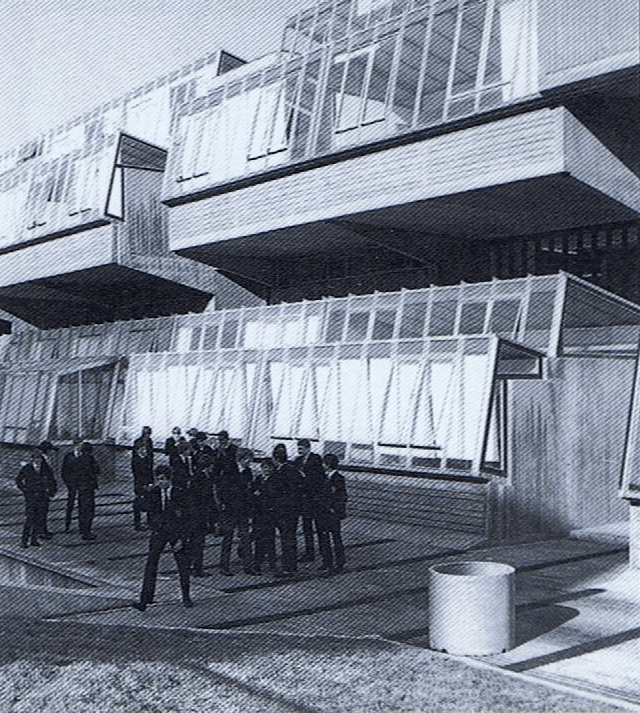
Moorhouse, op.cit., p.140
But many people in the recording and broadcasting establishment regarded popular music with disdain. The BBC held a monopoly over the radio waves, and, in a deal with the Musicians’ Union and record manufacturers, ensured that popular music was not given airtime. Anyone wanting to listen to popular musicians had to tune into Radio Luxembourg, from which reception was often very poor. At Easter 1964, however, the first illegal ‘pirate’ radio station, Radio Caroline, began broadcasting from a ship just off the Sussex coast. Within months, millions of young people were listening to the station. Radio London and other pirate stations sprang up. Not only did they broadcast popular music, but they also reminded their listeners that any attempt to silence them would constitute a direct attack on youth.
Pop music could be heard everywhere on portable transistor radios and stereo record players. Brian Epstein’s application for an audition of The Beatles by the Variety Department of the BBC.
However, the BBC was not wholly negative in its response to ‘pop’ music, or at least the Mersey Beat. Between March 1962 and June 1965, no fewer than 275 unique musical performances by The Beatles were broadcast by the BBC in the UK. The group played eighty-eight songs on national radio. Some were recorded many times; others were played just once. Many of them were covers of early rock ‘n’ roll classics by Chuck Berry and others. In his introduction to the 2013 release of these, On Air-Live at the BBC, Paul McCartney wrote:
‘Raisedon the BBC radio programmes, one of the big things in our week was ‘Saturday Club.’ We would wake up to this great show playing the kind of music we loved. That was something we really aspired to. Eventually we got to go to that show and be a part of it… out of came ‘Pop go the Beatles.’ We knew we would have to compromise to som extent, but when it came to playing the numbers, we could do them the way we wanted. Then there would be the talk with the rather plummy BBC announcer, who was not from our world at all. We couldn’t imagine what world he was from. …
‘With our manager Brian Epstein having a record shop – NEMS – we did have the opportunity to look around a bit more than the casual buyer. … We discovered ‘Twist and Shout’ by the Isley Brothers, which was a little bit hip to know about. I remember coming down to London and somebody saying, “Wow, you’ve heard of the Isleys!” It gave us this little edge over other bands, who perhaps weren’t scouring the racks quite as avidly as we were.
‘Ringo would get stuff from sailors. … he happened to have a few mates who’d been abroad to New Orleans or New York and had picked up some nice blues or country and western. … We made it our full-time job to research all these things; to go for the road less travelled. …’
Paul McCartney (2013), Introduction to ‘On Air – Live at the BBC’, Vol. 2. Apple/ BBC.
A Social Revolution?
The mid-1950s to the mid-1960s was a period of rapid social change in Britain. It was also a period in which the pace and direction of social change itself became a topic of concern and public debate. The argument then was about whether the many indications of change really added up to a social revolution for ordinary Britons. Its conclusions still remain provisional, and tentative, sixty years later. In that period almost everything changed, at least a little. No segment of society, no corner of the nation, no aspect of life remained untouched. One part of the story is the story of change, emergent patterns, new relationships and conditions for ordinary men and women, and a sense of discontinuity with the past.
In the ‘society of affluence,’ which threw up such paradoxical symbols, it was easy to project the problems that life presented into simple and stereotyped remedies. This was an economic change, certainly, but was it a social revolution? We need another term for a period of massive social upheaval which, nevertheless, left so much exactly where it was; it was a revolution which preserved its fundamental elements even as it seemed to transform them. Ordinary men and women in the fifties and early sixties were caught somewhere inside that double process, trying to make sense of it. They were in a revolving wheel which kept coming full circle.
The Mini & the Great Car Economy:
Perhaps the best symbol of this paradoxical period of the late fifties and early sixties was the Mini. Ten years or so after designing the Morris Minor, in the year of Macmillan’s election success, 1959, Alec Issigonis produced his sketched design, pictured below, for an even more radical car for the developing motoring market. It fitted well with the chic Macmillan era, though the aristocratic prime minister himself would never have bought anything so small and vulgar. Issigonis himself can lay claim to being one of the more influential figures in the history of the car in Britain as well as being about the only industrial designer most people have heard of. The son of a Greek engineer living in Turkey who had taken British citizenship, and a German brewer’s daughter, he had lived his early years on the site of his father’s marine engineering business, watching him transform his drawings into engines.
Issigonis’s original, sketched design for the 1959 Mini.
Issigonis is as good an early example as any of the benefits that immigration brought to Britain. He was a wartime refugee from Smyrna, the port area which had been taken back by Turkey from Greece after the First World War. Issigonis’s father died on the road to exile, but he arrived with his mother in Britain in 1922, virtually penniless. He studied engineering and technical drawing in London before getting work, first for Humber and then for Morris Motors. His Mini-Minor was commissioned in the immediate aftermath of the Suez Crisis when petrol shortages had focussed attention on the case for cheap, economical cars. The country was already latching onto the bubble cars being imported from the continent and soon being made at a factory in Brighton. Issigonis’s brief was to produce something for the British Motor Corporation that could compete with these products, but that was also a proper car, not a motorbike sidecar with its own motor. He not only made it look good, but by turning round the engine and placing it over the wheels, he found a way of making more space for passengers than in any other small car. Issigonis’s design was so radical it needed a complete set of new machine tools to produce; he designed them, too.
The Mini would become an icon of British ‘cool,’ a chirpy, cheeky little car that represented the national character at its classless best. But some of the earliest minis were shoddily built, with a series of mechanical problems and poor trim; more importantly they leaked so badly that people joked that every car should be sold with a free pair of Wellington boots. In fact, for a while, the car looked as if it would be a disaster for Issigonis and BMC. The costings behind it were also questionable. The basic model sold at Ł350, much cheaper than rival British-made small cars like the Triumph Herald (Ł495), the Ford Anglia (Ł380) and even the Morris Minor (Ł416). But the average retail price of the car was Ł500, which probably better reflected the production costs of the Austin and Morris factories that manufactured it en masse.
Yet the Mini had been very expensive to develop and make. Ford, one of its main competitors, tore one apart and concluded that it would cost them more to build than BMC was selling it for. It seems unlikely that to begin with at least, they made any profit, but they eventually sold more than five million. But its success and longevity only really came about due to celebrity endorsement, and even ‘spin.’ Issigonis gave one to Princess Margaret and Lord Snowden as a wedding present, so that they could be photographed whizzing around London in it. The Queen tried one out, and soon Steve McQueen, Twiggy, The Beatles, Marianne Faithfull, and Mick Jagger’s girlfriend, were seen in them too. In this way, became and remained a fashion icon, taking part with the Spice Girls in the opening ceremony of the Olympics in 2012.
BMW’s New Mini (Matchbox version), built to Issigonis’s initial design, but without the faults.
This was completely the opposite image of the original BMC idea of a cheap, no-frills car for the working-classes. The mechanical problems, lack of good teamwork and risky pricing strategy show that there was a shaky side to the Mini story from the start. Issigonis’s biographer concluded that ‘far from being a business triumph for the shaky British Motor Corporation, the Mini was the first nail in their coffin.’ Still, as yet, with fast economic growth and an insatiable appetite for affordable cars, the domestic industry continued to do well. Despite competition from continental and American companies, other British producers were marketing long-lived and successful models, from sleek Jaguars to solid and stately Rover Eights and Fifties. Industrial action was growing, and there was a particularly bad strike at BMC in 1958. Ministers, still largely drawn from public school and aristocratic backgrounds rather than manufacturing or business ones were trying to bring employment to run-down parts of Scotland and the North of England. They were finally responding to the concerns about the growing North-South divide. They persuaded BMC to create a cumbersome and expensive empire of new factories which it did not have the experience to manage properly.
The white heat of the technological revolution.
Little of this was obvious to the ordinary observer back then, in the early stages of popular motoring mania. It was hardly surprising that few bright British engineering students went to work in the British motor industry compared with the best of the Germans and Americans going into their equivalents. Instead, there was ominous talk of the ‘stagnant society.’ But in October 1963, Harold Wilson, then leader of the Labour Opposition and Prime Minister from 1964 and throughout the remainder of the sixties, predicted that Britain would be re-forged in the white heat of the technological revolution.
Successive Conservative governments had failed to understand the structural changes that had occurred in both domestic and international economies. They adopted a policy of complacency. Affluence and consensus were key concepts of the fifties and sixties, but both were based on illusion. In 1964 the Labour Party, under Harold Wilson, came into power, promising economic and social modernisation. In an attempt to tackle the problem of poverty, public expenditure on social services was expanded considerably, resulting in a small degree of redistribution of income. Living standards continued to rise and consumer goods became more available to all.
In the late 1950s new kinds of computers were built, using small transistors instead of electric valves. These still took up huge amounts of space, used up a lot of electricity and often became overheated, causing them to break down. It wasn’t until the 1960s that computers became cheaper and faster. The silicon chip was invented so that computers used less electricity and were able to hold thousands of transistors in a small space. This enabled the development of the micro-computer, changing almost every aspect of British life since.
As the 1960s progressed, alternative sources of energy were discovered, including large reserves of oil and gas. North Sea natural gas and oil came to the aid of the British economy. The EEC did not, however, not until the early 1970s.
Above: An oil rig in the North Sea.
Many ‘foreigners’ in politics and business began increasingly to talk of the ‘British disease’, economic stagnation. So, too, did the British themselves, seeing joining the ‘Common Market’ as a means to boost British exports following the loss of empire.
Sources for the Epilogue:
Geoffrey Moorhouse (1964), Britain in the Sixties: The Other England. Harmondsworth: Penguin Books.
Michael Clark & Peter Teed (eds.) (1972), Portraits & Documents: The Twentieth Century. London: Hutchinson Educational.
Theo Baker (ed.) (1978), The Long March of Everyman, 1750-1960. Harmondsworth: Penguin Books (in association with André Deutsch & the BBC).
Richard Brown & Christopher Daniels (1982), Documents & Debates: Twentieth Century Britain. Basingstoke: Macmillan Education.
Simon Hall & John Haywood (eds.) (2001), The Penguin Atlas of British & Irish History. London: Penguin Books.
Norman Rose (2005), Harold Nicolson. London: Pimlico.
Andrew Marr (2008), A History of Modern Britain. Basingstoke: Pan Macmillan.
Philip Parker (2017), History of Britain in Maps. Glasgow: HarperCollins.
The Map below commemorates a day which brought a sense of relief to the people of the United Kingdom after the trials and tribulations of the Second World War and the years of austerity which had followed it. The Coronation of Queen Elizabeth II on 2nd June 1953 was a moment for the nation to celebrate with lavish ceremony and age-hallowed pageantry. The procession through London’s streets, which followed the coronation ceremony itself, snaked through the city’s historic heart, beginning at Westminster Abbey, before arriving back at Buckingham Palace nearly two hours later.
The Second World War had swept away much that was familiar; not just the buildings brought down by the Blitz, but the sense that the old world had passed. In housing, there were grave shortages, partly caused by the bombing, but in large part by the lamentable state of the pre-war housing stock, while the reintegration of millions of service personnel into the economy had caused severe disruption. There was a yearning for something new, for an escape, a need partly met by the arrival of the ‘New look,’ a fashion trend that tried to make the most of limited means with long, swirling skirts. Conversely, there was a political flight to safety when the Labour government was defeated in the 1951 general election and the ageing, yet the familiar face of Winston Churchill returned to Downing Street.
George VI, who had been the nation’s figurehead throughout the war, died on 6th February 1952, leaving his twenty-five-year-old daughter Elizabeth to succeed him. The planning for the new Queen’s Coronation began almost immediately, but the actual ceremony only took place fourteen months later. British coronations were always occasions for pomp and display, but Elizabeth II’s took place under the glare of unprecedented publicity. After a bitter behind-the-scenes argument, television cameras were allowed to film the ceremony, leading to the event being watched by over twenty million viewers, at a time when there were only 2.7 million television sets in Britain, many of them bought specifically to watch the Coronation.
The three million who lined London’s streets did not see the Queen enter the Abbey preceded by St Edward’s Crown, based on the medieval original, and used since the Coronation of Charles II, nor her gown designed by Norman Hartnell embroidered with emblems from the main Commonwealth countries (a Tudor rose for Great Britain, a maple leaf for Canada, a wattle for Australia and a lotus flower for India), but they did catch a glimpse of the fairy-tale carriage in which she was carried down Whitehall, Piccadilly, Oxford Street and Regent Street along the circuitous five-mile route back from the Abbey to the Palace. The line of the ten thousand servicemen who marched as part of the parade stretched for almost two miles.
People began to speak of a new Elizabethan age following the death of George VI and the accession of his daughter in 1952 and in anticipation of the great national event of the Coronation. The Establishment took up their usual positions at Westminster Abbey. Sir Henry Chips Channon occupied almost the same seat as the one he had at the previous Coronation. He wrote the following account in his diary:
… All was comfortably, smoothly arranged … as a covered bridge had been built from St Stephen’s entrance to the East Door. But there was a slight drizzle and an overcast sky. … Below, empty in the golden light, stood the throne. Opposite, the peeresses benches were gradually filling up; the front row of thirteen Duchesses was a splendid sight. … The long wait was enthralling as every few minutes a procession of distinguished guests, relations, minor royalties entered and were escorted to their seats. Finally, the Royal Family. …The Duchess of Kent was fairy-like, as she walked in with her children…
… Finally came the magic of the Queen’s arrival: she was calm and confident and even charming, and looked touching and quite perfect, while Prince Philip was like a medieval knight – the Service, Anointing, Crowning, Communion were endless, yet the scene was so splendid, so breath-taking in the solemn splendour that it passed in a flash. The homage was impressive… The Great Officers of State swished their robes with dignity… Privy Councillors in their uniforms, men in levee dress, the little Queen at one moment simply dressed in a sort of shift, and then later resplendent: the pretty pages; the supreme movements… the nodding, chatting, gossiping Duchesses; the swan-like movements when they simultaneously placed their coronets on their heads… it was all finer, and better organised than the last time, although the Archbishop’s voice was not as sonorous as that of the wicked old Lang..
What a day for England, and the traditional forces of the world. Shall we ever see the like again? I have been present at two Coronations and now shall never see another. Will my Paul be an old man at that of King Charles III?
Sir Henry Channon (1967), Diaries, edited by Robert James, pp 475-477.
Paul Channon was Sir Henry’s only son (b. 1935), and succeeded his father as MP for Southend West, serving from 1959 to 1997. He became Minister of State at the Civil Service Department when the Conservatives returned to power in 1979 led by Margaret Thatcher. He joined the Privy Council in 1980. After the Civil Service Department was abolished in 1981, he became Minister for the Arts, then Minister of State for Trade at the Department of Trade and Industry following the 1983 general election, finally serving as Secretary of State for Transport from 1987 until 1989. He died in 2007, aged 71, fifteen years before Her Majesty, so will not be present at the forthcoming Coronation of King Charles III. Clearly, like so many others present that day, ‘Chips’ Channon could not envisage the young Queen reigning for another sixty-nine years.
It seemed truly the beginning of a new Elizabethan age, filled with hope. That news of Tenzing Norgay and Edmund Hillary’s first ascent of Mount Everest reached London on Coronation Day only added to the excitement. Later, Hillary gave his account of the final ascent to the summit which had taken place earlier that morning:
‘… The ridge curved away to the right and we had no idea where the top was. As I cut around the back of one hump, another higher one would spring into view. Time was passing and the ridge seemed never-ending. … I went on step-cutting. I was beginning to tire a little now. I had been cutting steps for two hours, and Tenzing, too, was moving very slowly. As I chipped steps around anothe corner, I wondered rather dully just how long we could keep it up. Our original zest had now gone and it was turning more into a grim struggle. I then realised that the ridge ahead, instead of still monotonously rising, now dropped sharply away, … I looked upwards to see a narrow snow ridge running up to a snowy summit. A few more whacks of the ice-axe and we stood on top.
‘My initial feelings were of relief – relief that there were no more steps to cut – no more ridges to traverse and no more humps to tantalise us with high hopes of success. I looked at Tenzing and in spite of the balaclava, goggles and oxygen mask all encrusted with long icycles that concealed his face, there was no disguising his infectious grin of pure delight as he looked all around him. We shook hands and then Tenzing threw his arm around my shoulder and we thumped each other on the back until we were almost breathless. It was 11.30 a.m.’
But the country still had ‘Everests’ to climb. The real future challenges it faced were its continuing near-bankruptcy after the war, the growing demands for independence among the colonies, and its economic retardation behind both the United States and the resurgent nations of Europe and the Far East.
An Era of Lost Content:
Between the fall of Clement Attlee’s Labour government and the return of Labour under Harold Wilson in 1964, Britain went through a time that some contemporary commentators and historians described as a gold-tinted era of lost content. For others, however, the period was grey and conformist, thirteen wasted years of Tory misrule. Andrew Marr (2009) argues that either way, in this part of Britain’s past, the country was truly a different country from that of the 1930s and ’40s as well as from that of the later 1960s onwards. The British imagination was still gripped by the Second World War. National Service had been introduced in 1947 to replace wartime conscription and began properly two years later, lasting until 1963. More than two million young British men entered the forces, most of them in the Army. It brought all classes together at a young and vulnerable age, subjecting them to strict discipline, a certain amount of practical education, often to privation and sometimes to real danger.
Teenagers were introduced to drill, cropped haircuts, heavy boots and endless polishing, creasing and blanching of their kit. In due course, some would fight for Britain in the Far East, Palestine, Egypt and East Africa. Most would spend a year or two in huge military camps in Germany and Britain, going quietly mad with boredom. An estimated 395 conscripts were killed in action in the fifty-plus engagements overseas during National Service. A generation of British manhood was disciplined, helping to set the tone of the times. The civilian habits of polishing, dressing smartly and conforming to authority in millions of homes originated in National Service, keeping the atmosphere of the forties alive for a decade longer than might have been expected. There was also an urge for domestic tranquillity with women at home while men worked well-ordered and limited hours, a response to the suffering and uncertainty of 1940-45 and the continuing fears of nuclear war. To be at home was a kind of quiet liberation. The return of Winston Churchill in 1951 added to the middle-class impressions that Britain was returning to social order and political hierarchy after the post-war period of radical change.
Nevertheless, successive Conservative governments in the 1950s and 1960s, including Churchill’s from 1951 to 1955, and from 1957 to 1963 that of his old disciple Harold Macmillan, decided against reversing most of the essential institutions of Labour’s new Britain: the NHS created by Bevan; the public ownership of railways, steelworks and mines; and especially the commitment to building publicly owned council housing for renting. Macmillan, a radical critic of the Conservative-led National Government in the thirties, had spoken of British miners as ‘the salt of the earth,’ and in 1938, he had published a little book, The Middle Way, advocating, among other things, the abolition of the Stock Exchange.
Developing Britain’s Transport System & Infrastructure, 1952 – 1963:
1.) Roads & Airports:
At the beginning of the twentieth century, Britain’s inland transport was dominated by the railways. But increasingly cheap and flexible motor transport took an ever-greater share of passengers and freight. As the car replaced the railway as Britain’s preferred form of transport in the second half of the twentieth century, it became progressively difficult for the road system to cope with the increase in traffic. A motorway system became imperative. But between 1939 and 1952 there had been practically no major road improvement or new road construction. Road transport recovered slowly from vehicle and fuel shortages during and after World War II. Road haulage was assisted by a succession of regulations, including, in Britain, the lifting of the twenty-five limit on road freight consignments. By the 1960s, British road transport had eclipsed railways as the dominant carrier of freight.
Motorways were meant to ease congestion on the roads; the planners never envisaged that car ownership would reach twenty million by 1990.
In December 1958 Macmillan opened the Preston bypass, the first eight miles of dedicated, high-speed, limited-access motorway in Britain, and the following month the M1 was opened. Motorways were meant to ease congestion on the main roads. By the early 1960s, traffic flow had been eased by a total of a hundred miles of motorway. Between 1953 and 1963, vehicle numbers more than doubled: motorways allowed fast, convenient commercial and social travel, household incomes were rising, and the real cost of personal motoring was falling. Workplace, retail and residential decentralisation encouraged the desertion of trains and car dependency.
The M1 at Luton Spur opened in November 1959.
The first jet aeroplane to carry passengers was called the Comet, which began regular passenger services in 1952. But it was very small compared with modern ‘jumbo jets’ and could not carry many people, only a small fraction of the five hundred that can be carried by a jumbo seventy years later. In the late fifties and early sixties, people began to spend more of their growing income on foreign holidays. They no longer wanted to spend holidays in Britain, due to the unpredictable weather. Package holidays became popular and airports like Gatwick (below), opened as an aerodrome in the late 1920s; it has been in use for commercial flights since 1933 but was used by the RAF during the war. It was redeveloped and re-opened in May 1958 for commercial fights from two terminals. This gradually made package holidays cheaper and easier for families.
2.) Railways & Ports:
Reinvesting in exhausted railways was not a priority after World War Two. Railway nationalisation was followed by railway rationalisation (closures) as the railways were made more efficient. In 1952, the railways’ share of total passenger miles was still at a level of twenty per cent, and rail passenger mileage was stable for most of the second half of the century. Yet by 1953, nearly twelve hundred miles of railway had been closed to passenger traffic in Britain. This was largely the result of the industrial changes that brought the loss of staple coal and textile traffic. Britain’s compact industrial geography also diminished any long-haul advantages that railways had over modern road transport. Comparatively low-cost rural bus services damaged the railways still further.
The start of Britain’s largest-ever road-building programme in the 1960s coincided with an increase in the tempo of the railway closures. Roughly half of Britain’s branch-line railways and stations had become uneconomic. The closure of almost six thousand miles of track and two thousand stations resulted from the notorious Beeching Report in 1963. However, the least utilised third of the track had previously carried little more than one per cent of passengers and freight; henceforth, the railways were to concentrate on fast inter-city services. In 1966, the first electrified Intercity train was used, which could travel much faster than steam or diesel engines.
The docks also began to be modernised, with the development of container ports like Tilbury and Felixstowe hastening the decline of ports like London, which could not handle containerised freight. Airports also increased in number to meet an ever-growing demand.
3.) From Coal to Nuclear Power:
A coal mine in South Wales in the 1950s.
Until the early 1960s, most of Britain’s energy came from coal. It heated homes, offices and schools, and was also used in power stations and to power steam trains. The coal mines were finally nationalised by the Labour government in 1947, and the Conservatives kept them under public control by the National Coal Board. In 1955, there were still nine hundred coal mines throughout Britain. Gradually, cutting machines were introduced, putting many colliers out of work. But when new sources of energy were introduced and developed, especially oil and gas, many collieries were closed. By 1965, the number left was about half that of ten years earlier. The unemployment and hardship of the 1930s returned to the coalfield communities, especially those in South Wales, once one of the largest coal-mining areas in Britain, where the coal industry was still the major employer. In October 1956 Calder Hall became Britain’s first nuclear power station. Despite a major fire in 1957 at the nuclear waste processing plant, Windscale (renamed Sellafield), which produced widespread contamination, a series of Magnox power stations were built throughout the country.
The Affluent Society – Reality or Illusion?:
Real wages grew, on average, by fifty per cent between 1951 and 1964, and the Financial Times index of industrial shares rose from 103 in 1952 to 366 in 1961. By 1963, three out of every four households had a vacuum cleaner, one in three had a fridge and one in five had a washing machine. Perhaps most significant of all, four out of five had a television set. BBC TV, begun in 1936 and appealing to the small minority who could afford sets, went from strength to strength. Commercial television began in 1955, and by 1959 new transmitters allowed ninety per cent of the population to receive pictures, by which time three-quarters of the population already had a set. In 1964, BBC2 started to provide more ‘high-brow’ programming.
Watching television quickly became the most popular leisure activity in the country, while cinema attendance fell from 26.8 million in 1950 to 37 million by 1970. For the mass of viewers, programmes like ‘Cathy Come Home’ made the public aware of the poverty that remained in the midst of Britain’s affluence. But in his famous speech in July 1957, Harold Macmillan claimed that most people were better off after six years of Tory rule:
“Let’s be frank about it: most of our people have never had it so good. Go around the country, go to the industrial areas, go to the farms, and you will see a state of prosperity such as we have never had in my lifetime.”
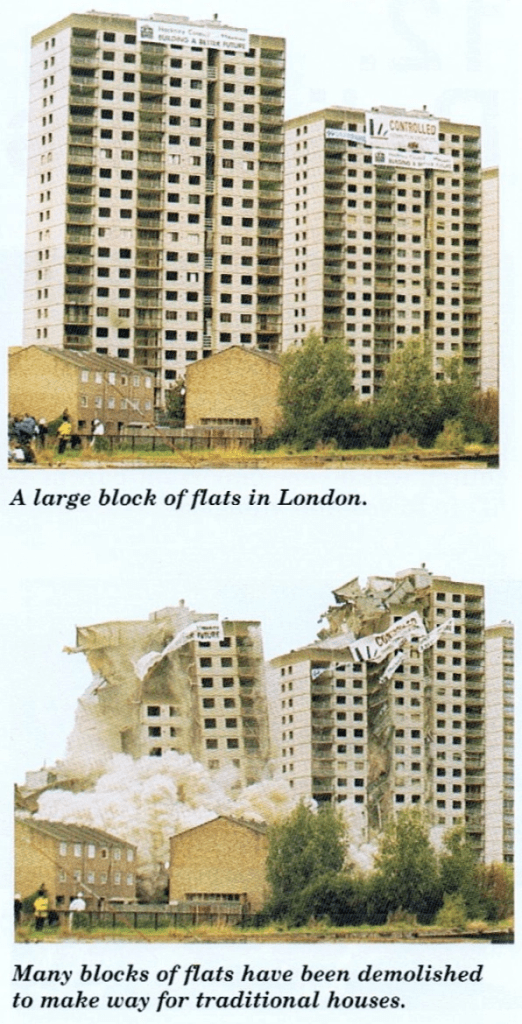
Harold Macmillan’s Speech, 20 July 1957.
But six years after Macmillan’s speech, British economic growth rates did not match those of competitor states, and it was partly for this reason that in 1961 Britain applied to join the European Economic Community (EEC), formed by the Treaty of Rome in 1957. However, its entry was vetoed by France under President De Gaulle, who was concerned about the implications of Britain’s economic dependence on the USA.
J. K. Galbraith’s book on the affluent society, published in 1958, was seen by many as symbolising attitudes in the late fifties. Though primarily concerned with the United States, his work was hailed in Britain as a masterpiece which truly reflected the nature of British society. His work fitted the mood of Britons at the time. Austerity, with its characteristic lack of consumer goods, was replaced by affluence with the plethora of consumer products which still characterised the country in the 1980s. But how did Galbraith define an affluent society? He seems to suggest that it is one where…
… the ordinary individual has access to amenities – foods, entertainment, personal transportation and plumbing – in which not even the rich rejoiced a century ago. So great has been the change that many of the desires of the individual are no longer evident to him. They become so only as they are synthesised, elaborated, and nurtured by advertising and salesmanship, and these, in turn, have become among our most important and talented professions. Few people at the beginning of the nineteenth century needed an ad-man to tell them what they wanted. … The affluent country which conducts its affairs in accordance with rules of another and poorer age also forgoes opportunities. And in misunderstanding itself it will, in any time of difficulty, implacably prescribe for itself the wrong remedies.
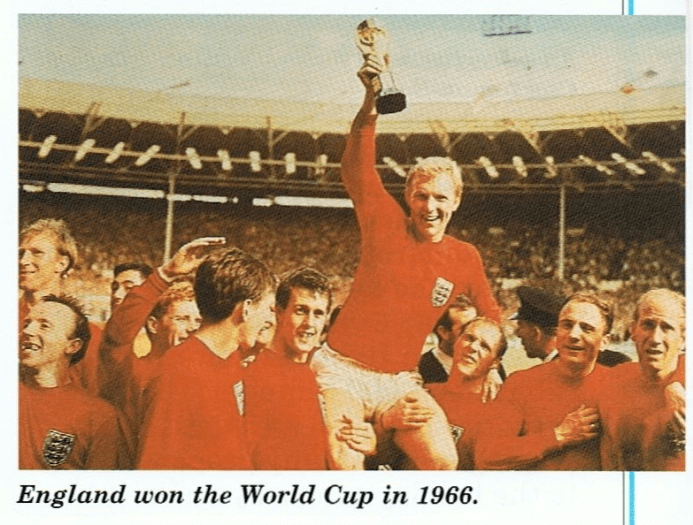
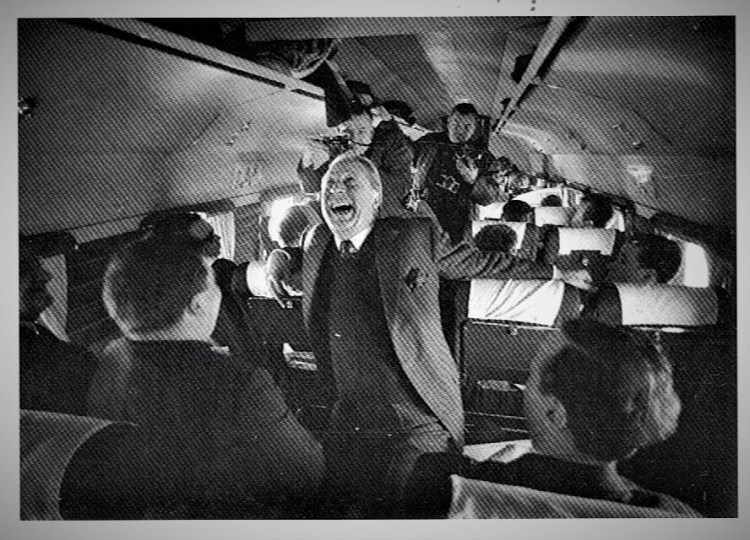
However, not everyone fell under the Galbraith spell. M. Shanks’ work on the stagnant society, published in 1961, showed another side to the economy and government policy. He saw Conservative policy as leading to inflation based on consumer demand and thought that there was a failure to deal with the problems facing the economy. He argued that since the 1940s there had been no lack of new ideas, techniques or machines, and in the same way there was no lack of knowledge as to how the economic system worked. He pointed out:
We are no longer powerless to avert depressions or to prevent massive unemployment. We are no longer compelled to look on powerless at the catastrophic fluctuations of the trade cycle, unpredictable as a force of nature. If we cannot tame this monster now, it is due to incompetence and not ignorance. …
And yet it works much less smoothly. Why is this? Three main reasons stand out, all interconnected. The first is that the measures required to contain inflation, unlike those required to stimulate demand, are unpleasant and painful. It is much easier psychologically and to encourage people to do things they would like to do but are afraid to … than to stop them doing what they would normally want to do. …
The second reason is rather more complicated. Inflation manifests itself in a tendency for production costs and prices to rise sharply and progressively. … a country like Britain which depends on international trade cannot let its costs and prices get out of line with the rest of the world because of the danger to its balance of payments. …
The third reason for the difficulty of imposing an effective anti-inflationary policy is that one is making a real choice between evils. … In 1955, when, as a result of a government-assisted boom in industrial investment, demand began to run ahead of capacity and the economy became overstrained. … The cost of living was deliberately pushed up by raising purchase tax on a wide range of goods, and at the same time a number of measures were taken to discourage capital investment. Mr Butler’s policy was followed by his two successors at the Treasury. … It was only reversed at the onset of the recession in 1958. …
It did eventually succeed in slowing down the pace of wage increases, which was one of the main factors behind the 1955 inflation. But it took three years to do so, at the cost of a virtually complete industrial standstill and a number of financial crises and major industrial disputes. … One particularly unfortunate aspect of this period was the government’s attempts to restrict investment in the public sector – an attempt which was largely unsuccessful because of the long-term nature of most of the projects involved, which made it quite impossible to turn them on and off like a tap to meet the short-term fluctuations in the economy.
M. Shanks (1961), The Stagnant Society, pp. 30, 33-9, 40-42.
From Cost of Living to Quality of Life:
Outside work, leisure and home, the public was ordered and monitored by self-confident officialdom, hospital consultants and terrifying matrons, bishops and park-keepers, bus conductors and police officers. Ten National Parks had been designated between 1951 and 1957, protecting these areas from many forms of industrial and commercial development. There was also a continuing expansion of education. Higher education saw particular expansion. In 1938, there had been just twenty thousand students, a figure that rose nearly six-fold to 118,000 in 1962. But the real explosion in numbers came thereafter, as new ‘plateglass’ universities were formed and former colleges were given university status. Hanging, corporal punishment of young offenders, and strong laws against abortion and homosexual behaviour among men, all framed a system of control that was muttered against and often subverted but never directly or significantly challenged throughout the early fifties. The country was mostly orderly, and the people were more or less obedient subjects. Patriotism was publicly proclaimed, loudly and unselfconsciously, in a way that was later difficult to imagine.
In keeping up a public front of self-confidence after the Coronation in 1953, there was much continuing talk of the New Elizabethan Age, a reborn nation served by great composers, artists and scientists. In retrospect, not all of this was false or exaggerated. In Ralph Vaughan Williams, Benjamin Britten and Michael Tippett, Britain did have some world-class musical talents. W. H. Auden and T. S. Eliot were among the greatest poets of the age. Many contemporaries also saw the sculptor Henry Moore and the painter Graham Sutherland as world-class figures. In popular culture, the steady rise of television brought, at first, a traditionalist upper-class view of the world to millions of homes. This was the age of ‘Watch with Mother’, of Joyce Grenfell and Noel Coward. It was also the time of Roger Bannister’s four-minute mile. In 1955, Bannister wrote his own account of his record-breaking run. Here he describes the final two hundred yards:
I felt at that moment that it was my chance to do one thing supremely well. I drove on, impelled by a combination of fear and pride. The air I breathed filled me with the spirit of the track where I had run my first race. The noise in my ears was that of the faithful Oxford crowd. … I had now turned the bend and there were only fifty yards more. The faint line of the finishing tape stood ahead as a haven of peace, after the struggle … I leapt at the tape like a man taking his last spring to save himself from the cavern that threatens to engulf him. … The announcent came – ‘Result of one mile … time, three minutes…’ — the rest lost in the roar of excitement*
Roger Bannister (1955), The First Four Minutes. pp. 163-5. *The time was 3 min. 59.4 secs.
It was also a time of great British achievements in yachting and football. Billy Wright, England’s captain in their 6-3 defeat by Ferenc Puskás’s Hungary in 1953, led his club side Wolverhampton Wanderers out onto their Molineux turf to face Puskás’s Honved Budapest (Army) team in December 1954.
Billy Wright (left) & Ferenc Puskás (right) lead out their teams at Molineux on 13 December 1954.
Wolverhampton Wanderers were unofficially crowned as champions of the world after their 3-2 victory over the ‘Mighty Magyars’ in the season after the Hungarian national team, containing many of the same players, had been the first continental team to beat England on home soil, at Wembley Stadium, in what was the centenary season of the English Football Association. ‘Wolves’ therefore gave English football a much-needed boost. The morale of National Servicemen throughout the country also received a boost, as the following recollection from the Wolves’ archivist Graham Hughes shows:
‘In 1954, I was serving with the Royal Corps of Signals, stationed at Sherford Camp near Taunton. On the day of the Wolves game with Honved our orders were to more chairs into the NAAFI so the servicemen could watch the BBC broadcast of the game. Myself and my two friends, Taffy Townsend and Les Cockin, being from Wolverhampton, were guests of honour and given front-row seats; it was great! When Wolves scored the winner everybody jumped up, shouting and cheering: Scousers, Cockneys, Geordies, the lot; even the officers. In fact, the officers were so pleased they ordered the NAAFI to stay open so we could celebrate Wolves win properly. Fantastic!’
John Shipley (2003), Wolves Against The World: European Nights 1953-1980. Stroud:Tempus Publishing. pp. 44-46.
These scenes were repeated in many NAAFIs (Servicemen’s clubs) throughout the country. The Hungarian Uprising of 1956 proved to be the end of this great ‘golden team’ led by Ferenc Puskás, which was touring at the time of the Soviet invasion of Hungary. Many of the players, including Puskás, decided against returning to their homeland, preferring instead to ply their skills in the free world.
But there is also a lesser-recalled sequel to this story. On Tuesday 11th December 1956, Wolves welcomed another Hungarian team to their Molineux ground, ‘Red Banner’ (MTK), another team from Budapest who, like Honved, was packed with internationals, including Palotás and Hidegkúti, who had played in the humiliating victories over England three years earlier. Wolves had agreed to host the benefit match against MTK, as they preferred to be known, with the proceeds donated to the Hungarian Relief Fund. The attendance at the match was 43,540 and it finished in a 1-1 draw with both goalkeepers making a string of acrobatic saves. The solemnity of the occasion, set against the backdrop of the Soviet occupation and crushing of the uprising, perhaps produced a match which didn’t live up to the encounter with Honved two years earlier.
At the pre-match banquet, the Hungarian team had pledged to play the very best football they could in honour of their gracious hosts and they certainly tried hard on the pitch. Responding, the Wolves Chairman James Baker told his guests that the motto of both the town and its famous football club was Out of darkness cometh light and that he hoped that very soon that would be the way in their native land. The day after the match, the Hungarians were on their way to Vienna, from where their future movements would be dictated by the course of events in their stricken country. The match had raised two thousand three hundred pounds for their compatriots who were fleeing in the opposite direction in hundreds of thousands, many of them eventually finding refuge in Britain.
Beginning of the End of Empire – The Suez Crisis, War & its Aftermath:
Britain’s disengagement from its empire was not entirely voluntary. The dissolution of the British Empire was accomplished in two main waves. The first, presided over the Labour governments of the 1940s, centred in Asia, which incorporated India, Pakistan, Ceylon (Sri Lanka), Burma and Palestine. Britain’s comparative international weakness in the two decades after the end of World War II required that it grant independence to territories in Asia that were rapidly becoming ungovernable. By October 1951, when Labour left office, nationalist demands in the empire were already beginning to run on far ahead of Britain’s willingness to concede them, and colonial policy was taking on the appearance of a power struggle between government and nationalists. Further retreats were forced on the Conservative governments by Britain’s inability to sustain a world role.
The next eight or nine years, from October 1951, were the most difficult of all for the post-war empire, as nationalist demands became bolder and their methods more drastic, and as the new government came to terms only very slowly and painfully with the full reality of the situation and all its implications. Conflict sometimes erupted violently. There were colonial wars in Malaya (1948-58), Kenya (1952-56) and Cyprus (1954-59), and lesser ‘skirmishes’ elsewhere. In the mid-fifties, however, Britain was still a worldwide player, connected and modern. Her major companies were global leaders in the production of oil, tobacco, shipping and finance. The Empire was not yet quite gone, even if both name and organisation it had been, for some decades, transforming itself into ‘the Commonwealth’. Royal visits overseas featured heavily in news broadcasts and weekly magazines. Australia, New Zealand and South Africa were promoted as places for holiday cruises or emigration; sunlit, rich and empty.
Then, in 1956, in a late flourish of imperial self-assertion, Britain sent troops to the Suez Canal to safeguard its strategic and economic interests in the old proprietorial way, with humiliating results. The Conservatives reacted every time Britain was faced with an inconvenient nationalist who threatened to repatriate imperial assets like the Suez Canal. The Suez Crisis was described soon after as the last dying convulsion of British Imperialism (Nutting, 1967). All this was in a desperate scramble to find some sort of handhold, a defensible position, to halt the fall from imperial pre-eminence which had started with Indian independence in 1947. The attempt failed, yet it may still have been necessary for the Conservatives’ peace of mind to make it.
‘Suez’ is often portrayed as a very short era of bad judgement. However, it was a crisis which resulted from Britain’s colonial heritage. It may have begun as something intensely personal, a duel between an English politician of the old school and an Arab nationalist leader of the new post-war world. If Eden was the model of an aristocratic kind of Englishness, Colonel Gamel Abdul Nasser was the original anti-colonialist autocrat who would become familiar over the decades to come – charismatic, patriotic, ruthless and opportunistic. Driving the British from Egypt was the cause that had burned in him from his teenage years and, not surprisingly, although nominally independent under its own king, Egypt had been regarded as virtually British until the end of the Second World War. Before the war, Egypt had been forced to sign a treaty making it clear that the country was under Britain’s thumb. The Suez Canal was the conduit through which a quarter of British imports and two-thirds of Europe’s oil arrived.
In the early fifties, Nasser was soon at the centre of a group of radical army officers, Egypt’s Free Officers Movement, discussing how to get the British out and how to build a new Arab state, socialist rather than essentially Islamic. A quietly determined man who naturally attracted followers, when King Farouk was eventually ousted by the Free Officers, it took Nasser just two years to seize control of the country. After the war Arab nationalism made things much tougher for Britain in the Middle East. Its oil interests were challenged and visiting British ministers suddenly found themselves being stoned by Arab crowds. Almost as suddenly, The Anglo-Iranian Oil Company was nationalised in 1951. In Iraq, a British-sponsored king and prime minister were holding on to power by their fingertips and were later murdered by mobs. In Jordan, the young King Hussein decided to replace the British soldier, John Glubb, the commander of the Arab League since 1939, with an Arab. But it was Egypt where the decisive confrontation between the colonial power and Arab nationalism was bound to take place.
Britain’s military base at Suez, guarding its interest in the canal, was more like a small country than a barracks, with a vast border that was expensive and difficult to defend. It depended for its survival on supplies from the surrounding towns and villages. But as tensions rose, it was boycotted by the nationalists. Off-duty British servicemen were shot, and after one act of bloody retaliation, involving the killing of a poorly armed Arab policeman holed up in a building by British soldiers, the Cairo crowds turned on foreign-owned clubs, hotels, shops and bars and set them alight. Britain was facing a guerilla war. London began to negotiate a British withdrawal in favour of using bases in Cyprus and Jordan. Eden, then Foreign Secretary, came to think that withdrawal was inevitable. He reached an agreement with Nasser in which Britain would keep its rights over the canal, a deal soon to be broken by Nasser. Yet he would have remained a local irritant had it not been for a catastrophic blunder by Washington.
Nasser’s great ambition was the creation of the so-called High Dam at Aswan. Three miles wide, it would be used to create a three-hundred-mile-long lake which would increase the electricity supply eightfold and give the Egyptians a third more fertile land. Nasser talked of it being seventeen times taller than the greatest pyramid. With Aswan, there was a new Pharoah bringing a new age to Egypt after centuries of humiliation by the imperial powers. The problem was that such a dam was also far beyond the resources of Nasser’s Egypt. Loans had been discussed for years and in 1956 Nasser had every reason to think that the Americans, followed by the British, were about to sign the cheques. Nasser’s ambassador then claimed that they could get help from the Russians and Chinese if the US terms were not favourable enough. In July, the US Secretary of State, John Foster Dulles abruptly cancelled their cheque, followed within a few days by the British government doing likewise. For Nasser, the Aswan Dam was a symbol of the rebuilding of Egypt and Arab nationalism, and the withdrawal of Western aid in this peremptory manner was a stinging personnel rebuff. According to Kilmuir, …
‘The British decision was reached almost entirely for economic reasons; the immense political implications of the step do not seem to have been apparent to the Americans or to the Foreign Office. I, certainly have recollection of this crucial aspect of the situation being brought home to Ministers. And thus the decision was taken which was to plunge the world into a desperate crisis.’
Earl of Kilmuir (1964), Memoirs, p. 267.
Nasser was livid and abruptly retaliated by seizing control of the Suez Canal, triggering the coup with the code words given to a mass public rally.
The man who split Britain over Suez, Anthony Eden.
On 25th July 1956, Harold Nicolson was a guest at a party given by Bob Boothby, then a leading Conservative backbencher. Political gossip dominated the conversation, particularly about the new Conservative PM, Anthony Eden, who had succeeded Churchill in April 1955. Eden, the gossipers had decided, was a ‘dud,’ with no leadership qualities. Aneurin Bevan, the former Labour minister, was also present and said that “the decay of the present government is due entirely to Eden who is incompetent and tricky.” Boothby joined in the discussion with the remark, “Eden is loathed by his colleagues and bullies them.” Writing retrospectively, in 1965, Reginald Bevins gave this more considered and sympathetic, but equally candid critique of the former premier and Foreign Secretary:
Eden showed a curious mixture of strength and weakness. In my view, and I say this with sorrow, he ought never have been Prime Minister. His performance prior to Suez had been feeble. He forever temporised and chopped and changed his mind. He busied himself absurdly with detail. He was no judge of men; no favourite of Eden’s ever did any good. While he had a natural charm he was also nervy, jumpy and bad-tempered.
Reginald Bevins (1965), The Greasy Pole. p. 37
Eden’s handling of the ensuing crisis, highlighted by his incompetence and trickery, would lead eventually to his downfall. He had already convinced himself that Europe was reliving the 1930s and saw in Egypt’s president a Levantine Mussolini, whose violation of treaty agreements and ‘grab’ of the Canal must at all costs be resisted if the torch of freedom were not to go out in the Middle East. Hugh Thomas thought that Eden saw Egypt through a forest of Flanders poppies and gleaming jackboots. Nasser’s sudden nationalisation of the Canal in July provoked a petulant and enraged reaction from the British government. The débacle which followed led to an agonised and bitter conflict in British public opinion, which was as divided as it had been in 1938, the disapproval of nearly every other nation in the world, including much of the Commonwealth, the active opposition of the United States, the nadir of Anglo-American relations and the downfall of Eden himself.
A day after Boothby’s party, Egypt’s President, Colonel Gamal Abdel Nasser nationalised the Suez Canal. He spoke quite clearly about what he was doing and why he was doing it:
‘This is… a battle against imperialism, and a battle against Israel, the vanguard of imperialism, which was created… in an effort to annhilate our nationalism in the same way as it annihilated Palestine. … Britain left Egypt, believing… that she could have no place there. This was because the people of Egypt were awakaned; because <they> had pledged themselves to achieve for Egypt freedom of life.
‘… As I told you, Arab Nationalism feels its existence, its structure and strength. It also believes in its right to life. These are the battles which we are entering. … The Suez Canal was dug by the efforts of the sons of Egypt – 120,000 Egyptians died in the process. The Suez Canal Company, sitting in Paris, is a usurping company. It usurped our concessions. … The Suez Canal was one of the facades of oppression, extortion, and humiliation. … Today … we declare that our property has been returned to us.’
Speech by Colonel Nasser, 26 July 1956, in D. C. Watt (ed.) (1957), Documents on the Suez Crisis, 26 July to 6 November 1956. pp. 85-6.
At first, public opinion was unanimous in condemning Nasser’s move. Harold’s first reaction – that is a pretty resounding slap in our face – was entirely predictable, and wholly representative of contemporary political opinion. He was kept fully conversant with events in parliament and government through his son Nigel, MP for Bournemouth East, and Hugh Thomas, then a young Foreign Office civil servant, who became a distinguished historian and wrote a dispassionate account of The Suez Affair. Nicolson feared a fearful loss of prestige for Britain and increased tension in Anglo-American relations. Apart from Eden’s bumbling, his Foreign Secretary, Selwyn Lloyd, inspired little confidence; his pretentious sabre-rattling at the Foreign Affairs Committee was anathema to Harold’s diplomatic style. Should Britain use force or even threaten it? He was not ‘absolutely sure.’ One thing was self-evident: ‘The Government have shown their accustomed irresolution and confusion of purpose,’ he wrote in his diary.
Initially, though, Eden’s tough line with Nasser was hugely popular. The Conservative Party was roaring its support. The Labour Opposition followed suit, under Hugh Gaitskell, who sounded more bellicose than any opposition leader before or since. With a couple of exceptions – the Manchester Guardian and the Observer – the press, commentators and cartoonists were all on-side and demanding swift punishment. The new science of opinion polling, and individual messages of support pouring into Downing Street, showed that public opinion agreed.
Under American pressure, there followed weeks of diplomatic manoeuvring during which Eden and his passionately anti-Nasser Chancellor of the Exchequer, Harold Macmillan, began to lose the initiative. There were international conferences, promised compromise deals and intensive negotiations at United Nations. Britain kept hinting that it might yet come to war, but Eisenhower and Dulles insisted that a peaceful solution should be found. Nonetheless, by openly declaring that the USA would have no part in trying to shoot our way through to the Canal and by referring to the general problem of colonialism, they encouraged Nasser to resist all outside initiatives.
President Dwight Eisenhower, however, was running for re-election to the White House on a platform of peace and prosperity, was not willing to back the use of force, and his Secretary of State, John Foster Dulles, was similarly cautious. Initial efforts to get Nasser to ‘disgorge’ what he had seized, via diplomacy backed by coded threats, were unsuccessful. Both men might have been willing to turn a blind eye to a spot of old-fashioned colonial atavism if the British and French had simply got on with it and launched an attack. Yet British Prime Minister Anthony Eden had a reputation to protect as an internationalist and a man of peace. To the frustration of his French allies, there was delay after delay as he looked for a pretext for action that would allow him to destroy Nasser and satisfy world opinion.
The answer was a covert plan which, to the increasingly desperate occupant of Downing Street, looked ingenious, but which was in reality deeply flawed. The notorious Sèvres Protocol, signed by Britain, France and Israel, committed the three powers to collusion with one another. Israel would attack the Sinai Peninsula, creating the excuse for Anglo-French intervention, to be undertaken ostensibly because the UN would not be able to act quickly enough to restore peace. Few people outside Britain were fooled – certainly not the Americans, who were deeply angered by the attempt to deceive them.
As the crisis moved through its well-documented stages, from the London Conference of the eighteen most-interested nations to the Suez Canal Users Association, which Hugh Thomas claimed was provocative and likely to lead to war, to the final Anglo-French-Israeli attack on Egypt, Harold Nicolson’s position hardened against government policy, and in particular against Eden. All efforts to achieve a negotiated settlement petered out in deadlock. Harold knew why: France ‘clearly wants a showdown with Nasser because of Algeria,’ and was dragging Britain along. On 29th October, Israel, in a three-pronged strike, swept into the Gaza strip and Sinai, driving swiftly towards the Canal and Sharm el-Sheikh. Harold’s first, instinctive reaction was to see this as part of a ‘preventative war’ to protect Israel from Fadayun attacks on its territory. The following day Britain and France quickly issued an ultimatum to both sides to stop fighting. On the 31st, Halloween, Harold Nicolson wrote to his wife, Vita Sackville-West:
‘… The news broke only at 4 p.m. How theycan have done such a thing with the whole of world opinion against us passes my comprehension. We shall now be accused of exploiting the crime of the Jews in invading Sinai in order to resume control of the Canal. To do this we have sacrificed our principles and practically destroyed UNO and the Charter. We are in danger of being denounced as aggressors. Of course, if the occupation of Port Said, Ismaila and Suez proceeds without a hitch or much loss of life, and if we can maintain ourselves on the Canal against the united armies of Arabia, then the Tories will acclaim it as an act of great resolution and courage. But to risk a war with more than half the country against you, with America and UNO opposed, and even the Dominions voting against us, is an act of insane recklessness and an example of lack of all principle.’
Harold Nicolson (1968), Diaries and Letters 1945-62, p. 312.
Thus the two powers would be able to claim that, as stated in their ultimatum, they were upholding the freedomof navigation through the Suez Canal on which the economic life of many nations depends. They would then be able to justify their lack of consultation with both the United States and the United Nations on the basis that they were acting on behalf of the international community. They were separating the combatants and extinguishing a dangerous fire, while actually seizing control of the entire waterway and its terminal ports. This would not only restore the running of the Canal to Anglo-French management but also enable these two powers to supervise all shipping movements through the Canal and thereby break the Egyptian blockade of Israel. On 30th October, an Anglo-French ultimatum was issued to Cairo and Jerusalem to stop the fighting between them, withdraw their troops behind a ten-mile strip along the Canal, and for the Egyptians to allow allied forces to occupy, temporarily, key points along the waterway. Non-compliance, they threatened, would lead to intervention. “Eden is mad! Eden is mad!” Hugh Thomas exclaimed, representing informed opinion in the Foreign Office.
Nicolson, among others, now suspected ‘a conspiracy … a very nasty plot,’ with the French masterminding it: ‘It is truly one of the most disgraceful transactions in the whole of our history.’ Eden had acted dishonestly and put Britain in breach of international law. Controversy continued long afterwards about the extent to which Britain and France were in collusion with Israel in their war with Egypt. According to Anthony Nutting (1967), who was working in the Foreign Ofice at the time as Minister of State for Foreign Affairs since 1954, there was a French-Israeli plan that Israel should first attack across the Sinai Peninsula and that France and Britain should then order both sides to withdraw their forces from the Suez Canal, in order to permit an Anglo-French force to intervene and occupy the canal on the pretext of saving it from being damaged by the fighting. Nutting’s resignation, Nicolson wrote, was…
‘… extremely important, since it deprives back-bench Members of the excuse, “The Government must know best”. Nutting knew everything, and has decided that it is evil. The central fact remains that Eden has deliberately ignored a recommendation passed by the overwhelming majority of the United Nations Assembly . This is a breach of law. I am not surprised that the House, at their special meeting yesterday, should have burst into disorder.’
Harold Nicolson (1968), Diaries and Letters 1945-62, p. 315.
It later became clear that the French had made at least preliminary soundings with the Israeli government, which they then shared with the British Foreign Office. Doing his best to conceal his excitement at the French plans, Eden replied to their approach by saying that he would give them very careful consideration. In fact, the PM had already made up his mind to go along with the French plans, however strongly his Foreign Office advisers might have warned against the venture. In the Commons, on 31st October, the Foreign Secretary, Selwyn Lloyd, was asked about collusion with the Israelis, since the previous day’s demands were made at a time when the Egyptian army was still engaging the Israelis at distances of more than seventy-five miles to the east of the Canal. Lloyd replied:
“… Every time any incident has happened on the frontiers of Israel and the Arab States, we have been accused of being in collusion with the Israelis about it. That allegation has been broadcast from Radio Cairo every time. It is quite wrong to state that Israel was incited… by Her Majesty’s Government. There was no prior agreement between us about it. It is, of course, true that the Israeli mobilisation gave some advance warning and we urged restraint upon the Israeli Government and in particular drew attention to to the serious consequences of any attack upon Jordan.”
A. Nutting (1967), No End of a Lesson. Constable, pp. 93-95, 116, 126.
According to Kilmuir (1964), the scenes in the Commons were the worst since the bitter clashes between Liberals and Unionists in 1911. A storm of booing would break out as soon as Eden entered the House and…
‘… would rise to a crescendo of hysteria when he actually rose to speak. At one point the chances of fighting actually breaking out between Members was very real, so intense was were the passions on each side. On November 1st, ‘Shakes’ Morrison, with consummate timing, adjourned the House for half an hour to let tempers cool, and things were never quite so bad afterwards.
I was told that Anthony made the speech of his life after the House reassembled, and when he sat down the Opposition could hardly raise a single boo, which was little short of astonishing. The courage with which Anthony faced this daily tumult won the admiration of his colleagues, supporters, and even of some members of the Opposition.
If the proceedings of the Commons had been televised, the effect on public opinion of the screaming mass of Labour Members would have been traumatic. As it was, the Press reports of the calculated howling down of the Prime Minister resulted in a great revulsion of public opinion.’
The Earl of Kilmuir (1964), Memoirs, pp. 273-4.
There was no compliance with the terms of the ultimatum by the Egyptians and, on 5 November, Anglo-French forces invaded Egypt in order to ‘separate the combatants’. The operation was a military success – and a catastrophic political failure. For Nicolson, the destruction of the Egyptian airforce left him unimpressed: ‘success does not render a dirty trick any less dirty.’ Britain and France’s actions had been based on a lie and a pretty see-through one at that. The real motivation was to overthrow Egypt’s President Nasser who, in Paris and London, was seen as a threat to Western Europe’s oil supply and to international order more generally.
Nikolai Bulganin, the Soviet Prime Minister, certainly took a hard line against the ‘triumvirate’. Notes of the most menacing nature had been issued to the ‘aggressor’ nations – Britain, France and Israel – threatening the use of ‘every kind of destructive weapon’ unless they withdrew. This was, in part at least, a cover-up for the Soviet Union’s invasion of Hungary and its crushing of the people’s rebellion there. Throughout the autumn, there had been an intense worry in Washington about the menacing noises from Moscow about Imre Nagy’s reform communist government emerging in Hungary and its liberalisation of society there following the Uprising of 23rd October. At the beginning of November, a substantial Soviet Army occupied Budapest and other major towns and cities. Allied action in Egypt deprived the British and French governments of any moral right to indict the Soviet Union for its aggression. Nicolson commented:
‘The Russians have sent seven divisions into Hungary and are closing in on Budapest. But we have no right to speak a word of criticism.’
Harold Nicolson’s Diaries, 4 Nov 1956, 315.
It wasn’t just Nicolson who thought that, at this moment, the world seemed to be going mad. The Israeli-British-French triumvirate’s dead-of-night intervention in Egypt to prevent Nasser’s nationalisation of the Suez Canal made the outcome of the Hungarian Revolution dependent on superpower bargaining. Neither the USSR nor the USA was interested in military confrontation, but both were concerned to defend their strategic interests; the Soviets were willing to remain passive in the Middle East if they received assurances that there would be no Western intervention in Hungary. This was also agreed upon by the end of Tuesday 30 October.
This tacit agreement meant that the promise which had been expressly given by Radio Free Europe on Eisenhower’s behalf, which played no small role in the resolve of the Hungarian insurgents, was thus broken, while the Soviet leaders sought and obtained the agreement of Tito to their planned alternative of intervention. Alex von Tunzelmann believes that, in return, the situation in Hungary helped to push an already volatile situation between the superpowers closer to the brink. Khrushchev had to think very carefully about Suez when he was dealing with Hungary, just as Eisenhower had to think carefully about Hungary when he was dealing with Suez:
Both crises were referred to the UN, which was awkward because normally Britain would have stood by the US and condemned Soviet aggression – but since it was doing exactly the same thing, the UN was hamstrung. The US went against Britain and France at the UN for the first time, so this was the real danger to that alliance.
The turning point for the Soviets came on 31st October with the news that the British and French governments had issued their ultimatum threatening to attack Egypt. The Israelis, in a secret agreement with the British and French, had launched an invasion of Egypt across the Sinai desert. The Suez Crisis proved a disastrous venture for the prestige of Britain and France more broadly across the Middle East. The military intervention was universally denounced and seen as the dying act of the imperialist powers. The US government was furious; it had not been consulted on the military operation and was opposed to it. With the presidential elections only a week away, Washington was now presented with two international crises simultaneously. This was, potentially, an even more disastrous situation for Hungary. Tom Leimdorfer, then a fourteen-year-old in Budapest, who soon after became a refugee in Britain, remembers the flurry of worried phone conversations at the end of October:
‘Everyone agreed that this was the worst possible news. The UN and the West would be preoccupied with Suez and leave Hungary to its fate. Still it seemed that the streets which were not the scenes of the worst battles were returning to some semblance of normality. Some trams and buses started to run, the railways were running, many people walked or cycled to their places of work, but still no school of course. … At the same time there were daily political bulletins with mixed news. The most sinister of these were reports of increasing Soviet troop movements.’
Tom Leimdorfer’s personal family memoir, unpublished.
The Suez affair did indeed distract attention from events in Hungary, just as they entered their most critical phase, with PM Imre Nagy having restored order and set to consolidate the revolutionary gains of the previous eight days. It split the western camp and offered Moscow, with all eyes temporarily on Suez, a perfect cover for moving back into Budapest at the beginning of November. At first, however, it had the opposite effect, delaying Moscow’s intervention in Hungary, for Khrushchev himself did not want to be compared to the “imperialist aggressors” in Egypt. After all, he had withdrawn Soviet troops from Poland when confronted by Gomulka; perhaps now he would rely on the Hungarian Prime Minister to keep Hungary in line.
The US attitude also encouraged Moscow, which led the diplomatic charge against Britain and France. Throughout the episode, and despite the concurrent crisis caused by the USSR’s crushing of the Hungarians, Washington and Moscow stood shoulder-to-shoulder against London and Paris. Suez had become the most decisive issue in British politics since Munich. With Hugh Gaitskell now appealing to the Tory dissidents to vote against the government, and unprecedented mass demonstrations in Trafalgar Square calling for its resignation, Eden’s administration was tottering on a political precipice. Suez split Britain down the middle, dividing families and friends. It brought the Prime Minister into angry conflict with establishment grandees. Lord Mountbatten is said to have warned the young Queen that her government were “behaving like lunatics” and a former Royal aide believed that Her Majesty thought her premier had gone mad. Even the military was affected. The call-up for Suez provoked widescale desertions and minor mutinies across Britain. Some twenty thousand reservists were called back and many declined to come, some scrawling ‘bollocks’ across their papers. In Southampton, Royal Engineers pelted a general with stones. In Kent, there were similar scenes among reservists:
More or less to a man they refused to polish boots or press uniforms or even do guard duty. They spent most of their time abusing the career soldiers for being idiots. The army could do nothing…
Tom Hickman (2004), The Call-Up: A History of National Service. Headline.
In the House of Commons, Eden and Selwyn Lloyd made ‘revoltingly unctuous statements’ about Hungary. For Harold Nicolson, this was rank hypocrisy. He indulged in a telling comparison between these statements and British imperial policy in Cyprus. In Hungary ‘when people rise against foreign repression, they are hailed as patriots and heroes’ but in Cyprus ‘the Greeks whom we are shooting and hanging are dismissed as terrorists. What cant!’ Whether or not the Soviets were bluffing, more cogent considerations persuaded the British government to back down. The public mood in Britain was also changing. Anti-Colonialism, the rule of law and the rights of young countries were all issues which enthused Labour and the left more generally. The United Nations, NATO and the European Convention on Human Rights were all established as part of the architecture of the post-war world. As US hostility to military action became clearer, some MPs and commentators began to have second thoughts. Eden claimed that left-wing intellectuals were stirring up opposition to him, while…
…“the BBC is exasperating me by leaning over backwards to be what they call neutral and to present both sides of the case.”
Eden made threatening noises about taking the BBC under direct government control. The reality was that the government was becoming increasingly isolated in the international arena and that Eden had misinterpreted the signals coming out of Washington and was on the verge of virtually destroying Anglo-American relations. Eisenhower, up for re-election on 6th November, would not countenance lending any support to what would be seen by the US voters as a foreign, imperial adventure.
In Malta, Grenadier Guards marched through their camp, angry about conditions as much as by politics, earning a stiff lecture from their commanding officer about the dire consequences of mutiny. Shortly afterwards, the Reservists of the 37th Heavy Anti-Aircraft Regiment of the Royal Artillery marched through the Maltese camp to protest, shouting down their regimental sergeant-major. These incidents were minor, but the headlines in the press about army mutinies and protest marches sent shockwaves through the forces.
From Eden’s point of view, the US was preventing any real pressure against Nasser while talking grandly about international law. He thought he had given enough broad hints for the White House to realise that he and the French prime minister were ready to use force. At different times Eisenhower’s administration gave the impression that they accepted force might be necessary. So while Britain could not tip off the Americans about their dangerous and illegal agreement with Israel, or give military details once the operation was underway, there was a general belief that the Americans would understand. This was an error.
On 5th-6th November, Anglo-French paratroop forces landed at Port Said and Port Faud. A huge British convoy which had been steaming for nine days from Malta arrived with tanks and artillery and the drive south to secure the Suez Canal began. So far, only thirty-two British and French commandos had been killed, against two thousand Egyptian dead. In a military sense, things had gone smoothly, but the politics were a different matter. When the invasion happened, Eisenhower and Dulles exploded with anger. According to the White House correspondents, the air at the Oval Office turned blue in a way that had not happened for a century. The US found itself in an extraordinarily difficult position, as Alex von Tunzelmann has recently reiterated in her book, Blood and Sand: Suez, Hungary and the Crisis that Shook the World:
… they were trapped between a lot of competing alliances. Britain and France had lied to them, and were continuing to lie, when it was perfectly obvious what was going on. It was also complicated because, although the US and Israel didn’t have quite as solid a relationship as they do now, it was still a pretty solid relationship.
It had therefore been widely expected in Britain, France and Israel that the US would not go against Israel in public, but in fact they did – extremely strongly. This was all happening in the week leading up to Dwight D Eisenhower’s second presidential election, too, and it was assumed that he wouldn’t stamp down on Israel because he would lose the election if he lost Jewish votes in the US. But actually Eisenhower was very clear that he didn’t mind about losing the election, he just wanted to do the right thing.
Above: British paratroopers in the Suez Canal Zone, November 1956.
Dulles appeared seriously to compare the Anglo-French action to that of the Soviets in Budapest. Meanwhile, Nasser had done the very thing Eden’s plan had been designed to prevent; he had blockaded the Canal by filling forty-seven ships with concrete. For the first and last time, the USA made a common cause with the USSR at the UN to demand a stop to the invasion. The motion for a ceasefire was passed by a crushing sixty-four votes to five. The Soviet Union threatened to send fifty thousand ‘volunteers’ to the Middle East. A day later, as the British troops were moving south towards Cairo, having taken Port Said, they were suddenly ordered to stop. The operation was halted and an immediate ceasefire was declared by London, to be followed by a swift pull-out. Harold recorded:
‘It is about the worst fiasco in history. Nasser regarded as a hero and a martyr … our reputation is tarnished … at the first serious threat from Bulganin, we have had to climb down.’
Harold Nicolson’s letter to Vita Sackville-West, 7 Nov., 1956.
On the ground, the French were prepared to keep going, clear-sighted about their national interest and uninterested in American anger. By then, the Egyptian air force had been destroyed and 13,500 British troops, with 8,500 French troops had landed at Port Said and were making their way south towards the Canal. Rather embarrassingly, the Israelis, led by Ariel Sharon, future PM, had long ago reached their destination and stopped, so there was no need for the Anglo-French forces to ‘separate’ anyone. From Eisenhower’s perspective, his old allies had dropped him in the dirt at the worst time possible, during a presidential election and when the Soviets were brutally crushing the Hungarian revolution with four thousand tanks. News of the Suez invasion, coinciding with American elections, helped bring home the hopelessness of Hungary’s situation to the citizens of Budapest. The West continued to be preoccupied; Hungary did not matter so much. Moreover, Britain and France had given the Soviets the perfect excuse for re-occupying the country in order to ensure that it stayed within the Soviet sphere of influence.
The US administration had failed to pick up on worrying reports from CIA agents in Paris and London about the Suez Crisis, just as they had failed to understand the consequences of cancelling their financing of the Aswan dam. The USA in the mid-fifties was a young superpower, and this time it had been fooled by both sides. In any event, President Eisenhower was so aghast at this independently planned Anglo-French campaign that the US led the call for a UN resolution issuing an ultimatum for the British and French to withdraw from Suez. To many, it seemed as if NATO itself was on the verge of breaking apart. In the end, American financial pressure was enough to force a humiliating British withdrawal and climb down. The crunch appears to have come when the US refused help for the critically ailing pound unless a truce was signed. Harold Macmillan had turned to the USA and the International Monetary Fund (IMF) for help. The US Treasury Secretary told the UK’s ambassador to Washington:
“You’ll not get a dime from the US government if I can stop it, until you’ve gotten out of Suez. You are like burglars who have broken into somebody else’s house. So get out! When you do, and not until then, you’ll get help!”
With the country divided from Buckingham Palace to the barrack room, Eden’s health and nerves gave way. After a brutally direct phone call from Eisenhower, ordering him to announce a ceasefire, Eden called his French opposite number, Guy Mollet, who begged him to hang on. According to French sources, Eden told him:
“I am cornered. I can’t hang on. I’m being deserted by everybody. My loyal associate Nutting has resigned as minister of state. I can’t even rely on unanimity among the Conservatives. The Archbishop of Canterbury, the Church, the businessmen, everybody is against me! The Commonwealth threatens to break up … I cannot be the gravedigger of the Crown. And then I want you to understand, really understand, Eisenhower phoned me. I can’t go it alone without the United States. It would be the first time in the history of England … No, it is not possible.”
Jean-Raymond Tourneaux (1960), Secrets d’Étát: Paris. Quoted in Herman Finer (1964), Dulles over Suez: Heinemann.
Macmillan, the only strong man left in the cabinet, once hot for military action, now blew cold, informing his colleagues that he could no longer be responsible for ‘Her Majesty’s Exchequer’ unless there was a ceasefire. The cabinet duly agreed to sign a truce, in what was a vivid lesson for every British politician in the general relationship between power and freedom, and in the realities of where global power lay at that time. The ceasefire and the withdrawal that followed were a disaster for Britain, which left Nasser stronger than ever. It finished Eden, though not before he lied to the Commons about the Anglo-French-Israeli plot at Sévres, outside Paris. In December, Eden also claimed in the House that there was no foreknowledge that Israel would attack Egypt. This can be compared with the French copy of the Sévres protocol agreed upon six weeks earlier which begins by stating quite bluntly:
‘Les forces Israeliennes lancent le 23 Oct 1956 dans la soirée une operation d’envergure contre les Forces Egyptiennes… ‘
In the face of global condemnation, and more importantly a severe run on the pound, the British had quickly called a ceasefire and U-turn. Eden hung on for a few more weeks in office but was not in power. He eventually resigned on 9th January 1957 on grounds of ill health. Suez was a humiliation not just for him but for the British nation as a whole. At the time, MPs and commentators remained suspicious of what took place between Britain, France and Israel at their meeting at Sévres, especially in the context of earlier secret agreements in the twentieth century, most notably the Treaty of London (1915), the Sykes-Picot agreement (1916) and the Hoare-Laval Pact (1935). In 1957, D. C. Watt also concluded that the Anglo-French actions were prevented from winning any degree of international support by…
‘ … the immediate acceptance by considerable sections of opinion of allegations that the British and French governments either had definite foreknowledge of the Israeli attack on Egypt, or that their ultimatum and intervention were concerted with the Israeli government.’
D. C. Watt (ed.) (1957), Documents on the Suez Crisis, 26 July to 6 November 1956.
In her recent interview for the BBC History Magazine, historian Alex von Tunzelmann was asked why she thought the Tripartite Aggression against Egypt was so badly bungled. She pointed out that the military plans from the time show that they were full of gaps and that the Joint Chiefs of Staff were clearly opposed to the whole operation. Indeed, they themselves had advised the British Prime Minister that the consequences of the action could be terrible, but he had chosen to ignore their advice. They were proved right, but partly because the weight of world opinion was so heavily against them, by the time the British and French forces got a third of the way down the canal, they had to stop. Israel achieved its objective of taking Sinai but soon lost it again. Neither Britain nor France achieved their objectives, and all that they succeeded in doing was strengthening Nasser’s control in the Middle East while his ally, the Soviet Union, reasserted its control over its satellite states. In addition, people no longer talked about Britain as a significant world power. From this point on, there were just two ‘superpowers’, the United States and the Soviet Union. In the following years and decades, Britain was reduced to playing the junior partner in its ‘special relationship’ with the USA.
It has long been argued that the 1st November declaration of neutrality by the Nagy government was the trigger which set off the Soviet invasion of Hungary three days later. From the Soviet perspective, this may well have been the case but, as we now know from the Kremlin Archives, the decision to invade had already been taken in there the day before, 31st October, the same day that the ‘liberal’ Soviet declaration of the 30th was published by Pravda. Also on the 30th, the Anglo-French Ultimatum to the Governments of Egypt and Israel had been laid in the Library of the House of Commons. Notes taken at the Soviet Party Presidium on 31st October indicate that the about-turn was initiated by Khrushchev himself, on the grounds of international prestige and against the backdrop of the Suez Crisis. No doubt under pressure from hard-liners in the politburo, he had exchanged his early view of occupying higher moral ground for a conviction that, as he is quoted as saying:
‘If we depart from Hungary, it will give a great boost to the Americans, English and French – the imperialists. They will perceive it as weakness on our part…’
Eisenhower was not, in fact, in favour of an immediate withdrawal of British, French and Israeli troops until the US ambassador to the United Nations, Henry Cabot Lodge Jnr., pushed for it. Eden’s predecessor Sir Winston Churchill commented on 22 November, “I cannot understand why our troops were halted. To go so far and not go on was madness.” Churchill further added that while he might not have dared to begin the military operation, nevertheless once having ordered it he would certainly not have dared to stop it before it had achieved its objective.
UNEF soldiers from the Yugoslav People’s Army in Sinai, January 1957
Without a further guarantee, the Anglo-French Task Force had to finish withdrawing by 22 December 1956, to be replaced by Danish and Colombian units of the UNEF(United Nations Emergency Force). Britain and France agreed to withdraw from Egypt within a week; Israel did not. A rare example of support for the Anglo-French actions against Egypt came from West Germany; though the Cabinet was divided, Chancellor Konrad Adenauer was furious with the United States for its “chumminess with the Russians” as Adenauer called the U.S. refusal to intervene in Hungary and voting with the Soviet Union at the UN Security Council, and the traditionally Francophile Adenauer drew closer to Paris as a result.
F/L Lynn Garrison crew with UNEF DHC-3 Otter, Sinai, 1962
Reading the newspaper accounts of the Autumn of 1956, von Tunzelmann was struck by the speed of the events both in the Middle East and Eastern Europe, and the way in which both sets seemed simultaneously to be upsetting the existing order of the world. In the climate of world opinion against Britain and France, the Soviet Union was able to avoid large-scale diplomatic repercussions from its violent suppression of the rebellion in Hungary, and even to present an image at the United Nations as a defender of small nations against imperialism. In addition, the Soviet Union made major gains with regard to influence in the Middle East. The American historian John Lewis Gaddis wrote about the aftermath of the crisis:
When the British-French-Israeli invasion forced them to choose, Eisenhower and Dulles came down, with instant decisiveness, on the side of the Egyptians. They preferred alignment with Arab nationalism, even if it meant alienating pro-Israeli constituencies on the eve of a presidential election in the United States, even if it meant throwing the NATO alliance into its most divisive crisis yet, even if it meant risking whatever was left of the Anglo-American ‘special relationship’, even if it meant voting with the Soviet Union in the United Nations Security Council at a time when the Russians, themselves, were invading Hungary and crushing—far more brutally than anything that happened in Egypt—a rebellion against their own authority there.
The fact that the Eisenhower administration itself applied crushing economic pressure to the British and French to disengage from Suez, and that it subsequently forced an Israeli pull-back from the Sinai as well—all of this, one might have thought, would win the United States the lasting gratitude of Nasser, the Egyptians and the Arab world. Instead, the Americans lost influence in the Middle East as a result of Suez, while the Russians gained it.
By 22nd December, the evacuation of Anglo-French troops from Egyptian territory was complete. Hugh Thomas commented that it was tragic to see great imperial countries ending their pretensions in comic style. Harold Nicolson placed the blame for this fiasco squarely on Eden’s shoulders. The utterly disgraceful tale of collusion between France of Israel, to which Britain was a party, flew in the face of everything he had held dear as a diplomat and politician. He coldly listed Eden’s failings:
‘breaking electionpledges; lying; bringing about international isolation; endangering relations with US; blocking the Canal and disrupting oil supplies; and robbing Israel of fruits of its victory’.
Harold Nicolson’s Diaries, 9 November 1956.
Eden, he concluded, had done more ‘to dishonour his country than anyone since Lord North.’ Suez soon became a four-letter word for the moment when Britain realised its new place in the world. It was left stripped of moral authority and rebuked by Washington. The Canal was eventually reopened and reparations were agreed upon, though the issue of oil security then assumed fresh importance. Other consequences were less predictable. It provoked the arrival of the mini car in Britain, designed in the wake of the petrol price shock caused by the seizure of the Canal. It even accelerated the decline of the shipyards of Clydeside and Tyneside, whose small oil tankers were soon replaced by supertankers built at larger yards overseas. These, it was discovered, could sail around the Cape and deliver their cargo just as cheaply as smaller ships using the Canal.
From the perspective of more recent Arab-Israeli wars, conflicts and crises, the Suez War has long receded in significance, but it does show how difficult it was for politicians to learn definite lessons from their countries’ pasts. The perspectives of the late twentieth and early twenty-first centuries enable us to see the impossibility of Britain and France withstanding the forces of nationalism and expansionism when their own nationalism and imperialism had been so readily deployed in Europe, Africa and the Middle East in the late nineteenth and early twentieth centuries.
Although Suez has often been a defining moment at the End of Empire, historians now tend to emphasize the continuities rather than seeing 1956 as a sharp break. At the time, however, the Conservatives did not offer a blind, intransigent resistance to the nationalist onslaught. Eden’s government was not reactionary, though it had some reactionary supporters. They did not mean to reverse the trend, or even to halt it entirely. They had professed, at the beginning of their term, an intention to continue the process towards self-government within the Commonwealth, and they put no great obstacles in the way of this process in the colonies – like the West African colonies, the Sudan and the West Indies where it was already too far advanced. It has to be remembered that Egypt was no longer a colony at the time of the Suez Crisis, though control of the Canal was a Nationalist-Imperialist issue for both Britain and France.
Within Whitehall, politicians and officials continued to seek an ongoing global British leadership role. It took fifteen years for the subsequent ‘turn to Europe’ to take shape and bear fruit, due to resistance from France. Moreover, the Conservative Party – although not Eden himself – quickly bounced back. This was partly possible because it took over ten years for the full facts about the collusion to become known – even though it had been immediately suspected at the time. As late as 1960, a Central Office of Information film claimed that the Anglo-French action had been beneficial for the UN and the world.
Above:British propaganda poster, ‘On to Japan!’, 1945 (The Bridgeman Art Library).
Fighting Back in Malaya & Singapore:
The State Opening of Parliament, which took place on 15th August 1945, saw a return to the pomp of pre-war years, with thousands of people lining the streets of London as the King and Queen travelled to parliament in the royal coach. There was an extra cause for ‘celebration’: earlier that day, following the USA’s dropping of atomic bombs on Hiroshima and Nagasaki, Emperor Hirohito of Japan announced his country’s surrender (pictured below). The second world war was finally over. But in the Far East, the Japanese advance had swept aside the British armies in Malaya and Burma in 1941-42. On 9 February 1942, Sir Alexander Cadogan, Under Secretary of State to the Foreign Office had written in his diary about the situation in Singapore:
‘Very gloomy. Japs have penetrated five miles into Singapore island. Our generals are no use, and do our men fight? As PM says, what will happen if the Germans get a footing here? I shudder to think. Our army is the mockery of the whole world.’
British troops were outflanked and forced into a series of retreats. They attempted to make a stand in central Malaya, around Kampar, but the area was overrun on 2nd January, just before reinforcements arrived from Singapore. When these troops finally arrived, they added to the scale of the disaster: the attempts to hold onto Singapore proved hopeless since there were no landward defences worthy of the name. British forces in Malaya finally surrendered to a much smaller Japanese force that had suffered trivial casualties, after a campaign of just fifty-five days.
Above: Drawing by illustrator and Molesworth creator Ronald Searle, imprisoned by the Japanese after the fall of Singapore in 1942.
The Road to Mandalay:
It was in Burma, from which they had been ejected after a gruelling fighting retreat from January to May 1942, that British and empire forces could hope to regain the initiative. First, however, they had to regain their badly shaken confidence, receive realistic training and be supplied with adequate resources. This was slowly achieved, largely under the direction of Lieutenant-General William Slim who was appointed to command the British troops in Burma on 19th March. He wrote:
A limited offensive in Arakan in December 1942 was unsuccessful, but operations by ‘Chindit’ forces behind Japanese lines from February to April 1943 showed at least that Allied forces could master jungle fighting as effectively as their enemies. When Japanese forces, at last, launched a major offensive against Kohima and Imphal from April to June 1944, intending to create a defensive position in the Naga Hills on the Assam border, British and Indian forces were able to reply with a crippling counter-attack. After hard fighting, the offensive brought the recapture of Mandalay in March 1945 and Rangoon in May and the ambushing of three Japanese armies as they tried to escape into Siam.
The recapture of Burma saw savage fighting, but with adequate resources, the British proved a match for the Japanese in jungle warfare.
British troops advance towards Mandalay in March 1945.
Victory over Japan, August 1945:
The British high command had intended to recapture Malaya by sea, but the Japanese surrender in August 1945 robbed them of their chance to avenge the events of 1941-42. While Churchill was eager to contribute towards the final assault on Japan, the Americans, confident in their ability to defeat Japan alone, had no intention of allowing Britain a say in the future of what was seen as the USA’s preserve; British naval forces were given only a minor role in the war’s final campaigns.
Britain’s Coming of Age:
In 1940, an American journalist at the New York Herald Tribune commented that in his attempt to bomb Britain into surrendering, ‘Hitler is doing what centuries of… history have not accomplished – he is breaking down the class structure…’ In his English History, 1914-45, the historian A. J. P. Taylor saw the Second World War as the period when the British people came of age. … a brief period when the British people felt they belonged to a truly democratic community. Another historian, Arthur Marwick, agreed that this was true in the sense that at the end of the war…
… the majority had a clearer idea than ever before of what it was they expected of a modern, civilised, industrial society: decent living standards, income and health security, a taste of the modern luxuriesof life:once the idea was defined it became itself an agent of further change. In addition to this the war hastened the scientific, technological and economic processes which… were transforming… society. The ‘wireless’ had become a national property during the war… ; mass television was on the way. A National Health Service with new drugs at its disposal would be twice as effective in stamping out the diseases that had been a special affliction of the lower classes…
A. Marwick (1968), Britain in the Century of Total War. Oxford: Bodley Head (Penguin, 1970), pp 322-3.
Long before victory was in sight all sections of society began thinking about the post-war world, dreaming of a new order quite different from the old. In fact, these dreams had begun back in the late thirties, partly due to the massive internal migrations which had taken place in Britain over the previous decade since the General Strike and the fall of ‘old King Coal’ as the major employer in favour of the lighter engineering industries. Rearmament accelerated the influx of workers into the manufacturing centres of the Midlands and especially to cities like Coventry. When the local ‘shopocracy’ lost control of the city council in 1937, Coventry became the first major midland manufacturing town to fall to Labour.
The defeated Conservative-Liberal alliance claimed that they had been beaten by ‘the sweepings of the nation’, the immigrants from the depressed areas who had voted for Labour. This was only partly true, as many of the newcomers struggled to find places to live and were not yet on the electoral register. Coventry had one of the highest rates of owner-occupation for a town of its size and these Coventrian owners increasingly voted Labour in the 1930s. Later in 1937, the city elected two Labour MPs for the first time. Certainly, it must have helped the Labour cause that the first point in the local party’s manifesto in 1937 was a promise to accelerate the building of council housing. Education and health provision also presented huge challenges. In the late 1930s, it was the Labour Party that had the forward-looking ideas which were eventually grouped together as ‘municipal socialism’ and these were already spreading in cities like Birmingham and Oxford before the onset of the war.
But it was out of total war and all its horrors, enormous hope was born, and the idea of a New Jerusalem wasconceived. From 1945 to 1951, the Labour Governments attempted to implement a number of radical reforms, often (but not always) opposed by the Conservatives. The new optimism can be traced back to the publication of the Beveridge Report in November 1942, which coincided with the ‘turning of the tide’ in the war at El Alamein. The first symbolised the idealism of social reconstruction, while the latter was seen as the beginning of the road to total victory. There was unanimous agreement about two things. First, there should be no repeat of the fiasco which followed the previous war – a nightmare of slump, unemployment and distress. Secondly, a set of very basic requirements was laid down: work for all, social security, a right to a decent standard of living, and genuine international cooperation. Famously, Beveridge wrote in his report:
‘Poverty is only one of the five giants on the road to reconstruction. The others are Disease, Ignorance, Squalor and Idleness.’
It was not just Labour, but Liberal and even Tory supporters who were behind this desire for change and reform. It is significant that the pillar of the Establishment, the Archbishop of Canterbury, William Temple, was the originator of the term ‘Welfare State.’ High-minded Christian Socialism, as articulated by Temple, had become the order of the day for many at home, and as the carnage continued overseas, an almost Utopian determination to build a more Christian country took root. Temple called for ‘extreme inequalities of wealth to be abolished.’ Going rather further, his Council for Clergy and Ministers for Common Ownership declared private ownership of industry ‘contrary to Divine Justice.’
A strong sense among ordinary voters that it was time for a fresh beginning had been reflected in a series of by-election defeats of Tory candidates when vacancies were caused by the deaths of sitting members. Twenty-two MPs were killed in action, all but one of them Conservatives. At Maldon in Essex, the left-wing journalist Tom Driberg had won, standing as an independent. As the war went on, there had been a strong movement towards the Labour Party which could be detected in both by-elections and opinion polls. In April 1945 in Tory Chelmsford, Wing Commander Ernest Millington, a pre-war pacifist and socialist who had ten joined the RAF and took part in the bombing of Germany, defeated the Conservative candidate. Standing for the socialist Common Wealth movement and supported by local vicars, Millington had fought a campaign whose tone can be summed up by a banner he put up in the middle of the market town which read, ‘This is a fight between Christ and Churchill.’ Yet The Times found ‘nothing remarkable’ in the Conservatives losing Chelmsford or Motherwell in the same month.
The General Election Campaign of 1945:
The Labour Conference that kick-started the election campaign was held in Blackpool that summer. Among the youthful delegates were future leaders like Denis Healey and Roy Jenkins, both in army uniform (see the photo below). Jenkins had helped crack the German codes at Bletchley Park. Healey was preaching socialist revolution at that time. Across Europe, he railed, the upper classes were ‘selfish, depraved, dissolute and decadent.’ Most Labour leaders, especially those who like Attlee remembered the inter-war years of Conservative dominance, continued to assume that at the general election, the first in a decade, Churchill would be returned.
Clement Attlee, Labour leader 1935-55 & Prime Minister, 1945-51.
Both the Labour and Conservative parties put forward manifestos promising major reforms along the outlines set out by Beveridge. The ‘Education Act’ had already been piloted through Parliament by R. A. ‘Rab’ Butler, a Tory minister, in 1944. The Tories concluded their manifesto commitment to education by declaring:
… Our object is to provide education which will not produce a standardised or utility child, useful only as a cog in a nationalised and bureaucratic machine, but will enable the child to develop his or her responsible place, first in the world of school, and then as a citizen. …
In recent generations, enormous material progress has been made. That progress must be extended and accelerated not by subordinating the individual to to the authority of the State, but by providing the conditions in which no one shall be procluded by poverty, ignorance, insecurity, or the selfishness of others from making the best of the gifts which Providence has endowed him.
Ourprogramme is not based upon unproved theories or fine phrases, but upon principles that have been tested anew in the fires of war and not found wanting. …
F. W. S. Craig (ed.)(1975), British General Election Manifestos 1900-1974. London: MacMillan, pp. 117-19, 122-3.
The Conservative campaign was based largely on Churchill’s war leadership, as the last paragraph above and their poster Let us Go Forward Together, shown below, clearly reveal. This time, however, unlike with Lloyd George, the personality cult of the man who won the war was not sufficient to win over a more mature electorate. Partly because of the political consensus between the main parties, most observers expected the Conservatives to win the General Election of 1945. Nevertheless, most well-informed City experts, in-touch trade unionist bosses, the self-assured press and the diplomatic observers passing back the latest intelligence back to Washington or Moscow, all were sure that Churchill, the great war leader, would be returned to power with a substantial majority.
Above: Let us Go Forward Together. The Conservative Party Election poster in 1945.
On Education and Recreation, the Labour Party Manifesto, Let us Face the Future while recognising that the passing of the Education Act was an important step forward, promised that it would put it into more practical effect by raising the school leaving age from fourteen to sixteen. Added to this, it would also provide free secondary and tertiary education for all. However, importantly, it warned the electorate against trusting the Tories, in bad times, not to cut these social provisions on the plea that the nation could not meet the cost. That was the line, they pointed out, the Tories had adopted on at least three occasions between the wars. Their manifesto concluded with the bold statement:
There is no good reason why Britain should not afford such programmes, but she will need full employment and the highest possible industrial efficiency in order to do so. …
… the effective choice of the people in this Election will be between the Conservative Party, standing for protection of the ‘rights’ of private economic interest, and the Labour Party, allied with the great Trade Union and Co-operative Movements, standing for wise organisation and the use of the economic assets of the nation for the public good. …
Craig, op. cit. pp. 128-30, 131.
Labour’s manifesto, well written and designed, would be distributed to nearly two million people, backed by powerful posters, twelve million leaflets and huge numbers of party volunteers. Its most popular passages relied on the blueprint for a fairer, more planned country which had been worked out by the coalition government before the war ended. Labour had the support of only a minority of the national press. Apart from the Daily Mirror and the in-house Daily Herald, the big circulation papers were all pro-Tory and the two left-leaning upmarket newspapers, the Manchester Guardian and the News Chronicle, both backed the lost-cause Liberals.
Different parts of the country found very different audiences for Labour’s meetings. Attlee was rushing about in his little Standard car, rapping out an average of eight speeches of a terse twenty minutes apiece each day. He thought his reception was excellent. In some towns, the election seemed quiet. In others, huge and attentive crowds turned up to listen and argue back. In Birmingham, Roy Jenkins recalled…
‘… seas of faces looking up in the twilight, a mixture of exhaustion, hope, some kind of doubt. …’
Churchill, meanwhile, was fighting one of his ‘flawed’ campaigns, this time a political rather than a military one. His theme was that there was a sinister socialist conspiracy behind the Labour campaign. In an ill-judged radio broadcast kicking off his campaign, he let his florid wartime language loose and struck entirely the wrong note. He said that no socialist system could be established without a political police, a British Gestapo. Mixed with this, he offered a vision of bucolic good cheer which seemed to belong to a bygone era:
“Let us make sure that the cottage home to which the warrior will return is blessed with modest but solid prosperity, well-fenced and guarded against misfortune …”
Attlee countered with gentle irony. The Gestapo association was grossly offensive, but the Labour leader disarmingly replied that it was no doubt Churchill’s way of demonstrating the gulf between his qualities as a great war leader and those of a mere party leader and that the attack had probably been devised by the press baron Lord Beaverbrook. In fact, it was all Churchill’s own work. His wife Clemmie had warned him against it and his party’s chief whip had commented that ‘it is not my idea of how to win an election.’ The second line of Tory attack was that Attlee was the mere frontman for extremists.
The Labour chairman, Harold Laski, was portrayed by Conservative candidates as hell-bent on revolution. Laski did use some extreme language and was on the left of the party, but his father had once campaigned for Churchill and had recently suggested that a public fund should be raised to show Churchill the nation’s gratitude for his war leadership. The PM had said that better than a monument, a public park for the children of London on the south bank of the Thames ‘where they suffered so grimly from the Hun.’ This was never taken up, however, though the Labour government left office after ensuring that the Festival of Britain took place on the South Bank when Battersea Park was transformed into the Festival Gardens. The National Film Theatre was also opened there in 1952, joining the newly-built Royal Festival Hall.
Before the election results were declared, Churchill and Attlee (then Deputy Prime Minister in the coalition government) had been together at Potsdam in Germany negotiating the future of post-war Europe with Marshal Josef Stalin and President Harry Truman. At the Potsdam Conference, Stalin told Churchill that his intelligence sources indicated a Tory majority of eighty. Returning to London for the results, Churchill had not even bothered to say goodbye to either the Soviet dictator or the US President, or even to pack properly. By then, Attlee was somewhat more optimistic than he had been at the beginning, or at any stage of the campaign. He thought that the result would be close. He was wrong. There was a long delay for the votes to be brought back from around the world where the troops were still serving if not actively engaged in battle.
The Democratic Bombshell and the Labour Landslide:
When the final tally was made on the 25th of July, it was as if a ‘democratic bombshell’ had been dropped. Labour won with an absolute majority of 154. In every area of the country, Labour swept to victory and the size of the national swing towards it was twelve per cent. In 1935 Labour had won only 213 seats compared with 585 won by the mainly Conservative National Government. Now Labour had won more votes than the Tories for the first time ever and it was the Tories had just 213 seats as compared with the 393 won by Labour.
Above: Clement Attlee accepting victory at Transport House. Arthur Deakin, acting General-Secretary of the TGWU is in front of him, facing the camera.
When Churchill was abruptly replaced on 26th July by his successor Clement Attlee, after the results of the British election were announced, and Attlee returned to Potsdam without Churchill, Molotov was incredulous. He suspiciously questioned the Labour leader about why he had not known the result in advance. Such democratic sloppiness would not have been tolerated in elections further east. Stalin soon found that he had a new British PM with whom, from now on, and for almost all his remaining years, he would have to deal. The results of the General Election totally confounded Stalin and almost all observers at home and abroad.
In his (1948) autobiography, The Gathering Storm, Churchill, referring back to the beginning of his premiership in 1940, described the sudden downturn in his electoral fortunes in dramatic terms:
Thus … I acquired the chief power of the State, which … I wielded in ever-growing measure for five years and three months of world war, at the end of which time, all our enemies having surrendered unconditionally or being about to do so, I was immediately dismissed by the British electorate from all further conduct of their affairs.
He also recorded that, on the morning of the 26th of July, he had woken up, with a ‘sharp stab of almost physical pain,’ to a feeling of certainty that he and the Conservatives had lost the general election. Churchill was at the very pinnacle of personal triumph, outshining both the King and the Royal Family when he appeared on the balcony of the Palace on VE Day. Never in British history has military success been so personally associated with a civilian leader, not even with David Lloyd George. Churchill would have liked the wartime coalition to go on longer, at least until Japan had been defeated. It had been Labour that insisted on an election. No one knew what was coming; the scattered nature of the electorate meant that accurate polling was impossible. The new electoral role was inaccurate, too, having been based on ration book records.
Yet, there were intimations of what was about to happen. In the forces, compulsory discussions about Britain after the war had been led by the Army Bureau of Current Affairs (ABCA), organised by W. E. Williams, a left-leaning educationalist. Conservative-minded officers complained about the tone of the pamphlets sent around the army and that Williams had ‘smothered the troops in seditious literature.’ One general burned ten thousand of the ‘wretched pamphlets’ in front of his men and warned that they were ‘rank treason’. Many Conservatives believed that socialist propaganda foisted on the troops was to blame for their defeat in 1945. In fact, though, the numbers do not add up; the minimum voting age was twenty-one, which cut out many of the more malleable troops and in any case, there were fewer than two million service votes cast in a total electorate of thirty-three million.
Despite the warning signs, the ‘brutal’ rejection of Churchill for Attlee caused amazement around the world. Brooding at home, Churchill found it a terrible personal shock. But he eventually found comfort in the thought that Labour would be better left to cope with the disappointments to come. Rediscovering the generosity of spirit that had gone absent without leave during his election campaigning, he rebuked one of his aides with the words:
“This is democracy. This is what we have been fighting for.”
Churchill tried to be realistic about the difficulties ahead, in a tone which, over the years ahead, would begin to grate:
‘The problems and pressures of the post-war world threaten our security and and progress as surely as – though less dramatically than – the Germans threatened them in 1940. We need the spirit of Dunkirk and of the Blitz sustained over a period of years.’
What had Labour been fighting for? The party’s new MPs arriving in London to take up their seats by train, bus and car were a mixed bunch. Most were inexperienced in the ways of Parliament, as they would soon show by the singing of the ‘Red Flag’ in the temporary chamber of the House of Commons, the permanent one having been badly damaged by the Luftwaffe. There were Fabian intellectuals, wartime rebels, trade unionists and civil servants such as Harold Wilson, soldiers and teachers, cautious moderates and, so the Communist Party believed, at least nine of their ‘infiltrators.’ Some of the new Labour MPs believed they had been elected to overturn the class system, while others simply that they had a list of domestic reforms to get through. Hugh Dalton recalled the euphoric atmosphere among Labour colleagues:
‘There was a new society to be built; and we had the power to build it. There was exhilaration among us, joy and hope, determination and confidence. We felt exalted, dedicated, walking on air, walking with destiny.’
All of them had stood on the manifesto written by Herbert Morrison. As they introduced themselves to each other for the first time, a sizeable minority already thought that they should try to get rid of the conventional Attlee and elect a proper Labour leader. Herbert Morrison, a popular minister who had organised London’s defence against the Blitz, had warned Attlee that he would stand against him in a leadership contest. The plot gathered force in the corridors of Westminster Central Hall, while Attlee, Morrison, Bevin and the party secretary met at Transport House, the party HQ a few hundred yards away. As Morrison nipped out to make a call to one of his supporters, Bevin gave Attlee the best advice of his life: “Clem, you go to the Palace straight away.” Clem followed the advice, met his wife and family at Paddington, hopped into their little car and drove to the Palace where the King, taken aback by the turn of events, duly made Attlee PM. Morrison and the other Labour plotters had underestimated Attlee, as many others had.
Labour in Power – Building the New Jerusalem:
So, the general election of 1945 produced a landslide victory for the Labour Party. As the brutality of warfare gave way to visions of a fairer society, the electorate turned its back on Churchill, and on foreign adventures and imperial glory. Better housing and a welfare state topped the new agenda. Many believed that Labour would be in power for a generation. Instead, Clement Attlee’s ministers had only six years to build their New Jerusalem. During that time his government set up a welfare system which could benefit everyone. It gave women more rights, especially those widowed.
In this context, the content of the speech written for the King to deliver to Parliament that August was one of the most dramatic in decades. The Labour Government returned in the election of the previous month had a mandate for a programme of sweeping social, economic and political change that would transform the face of Britain. Among the major reforms to which the new administration was committed were the nationalisation of the mines, the railways, the Bank of England and the gas and electricity companies, as well as the reform of the welfare and education systems and the creation of the National Health Service (NHS). The King declared:
‘It will be aim of my ministers to see that national resources in labour and material are employed with the fullest efficiency in the interests of all.’
A natural conservative, the King was concerned at the potential impact of some of his new government’s more radical measures. He was also saddened by the defeat of Churchill, with whom he had formed a close bond during the war. Yet whatever his misgivings, he was a constitutional monarch and had no alternative but to accept his new government. On a personal level, he developed good relations with Clement Attlee, as well as several of the new Labour ministers. He had some of a natural affinity with the Minister of Health, Aneurin Bevan, even though he was on the Labour left. Bevan, too, had long suffered with a stammer and told the King during his first audience of his admiration for the way he had overcome his speech defect.
‘Nye’ Bevan was rebellious, radical and, above all, Welsh. He was also flamboyant and divisive as a minister. Born into a mining family in Tredegar in the Monmouthshire valleys, he was largely self-taught. Like Ernest Bevin, he had been a trade union organiser at the time of the 1926 General Strike. After entering Parliament a few years later, Bevan became one of the few truly great orators of his time, rare in being a worthy opponent of Churchill, who Bevan described as ‘suffering from petrified adolescence.’ Unlike Attlee, Cripps, Bevin or Dalton, he had been outside the wartime coalition government and on many issues had seemed like a one-man opposition to it. Partly because of this, he had a far fiercer attitude to the Tories than his colleagues and a clearer determination that Labour must build a completely new world. His aim was the nationalisation of public control of almost the whole economy.
Nye Bevan spoke for the grassroots of the Labour Party, the people who expected a genuine socialist future for Britain. He did not believe in compromise where capitalism was concerned. In his 1952 In Place of Fear, he wrote that the House of Commons was:
… an elaborate conspiracy to to prevent the real clash of opinion which exists outside from finding an appropriate echo within its walls. It is a social shock absorber placed between privilege and the pressure of popular discontent.
Unlike most of the other leading Labour figures, Bevan was, at least in theory, dangerous to the established order, even if in office he would turn out to be more shrewd and subtle than his rhetorical public performances suggested. People prejudiced against him often came away from a first meeting seduced and bewitched. Like Bevin, he showed how a trade unionist could become a successful national leader, but he also had a vision of what Britain might become which went way beyond better pay and free spectacles. Beautifully dressed, witty, satirical and poetic, Bevan represented everything that the old upper classes feared the most after the 1945 election.
As Minister of Health, Bevan also faced a good deal of opposition from within the health services. Many richer doctors, both general, especially specialists and hospital consultants but also some general practitioners (GPs) did not want to join the NHS because to do so would limit their potential earnings. To solve the problem, Bevan allowed them to treat private patients as well as NHS ones. The National Health Service was founded in 1948, providing free health care for all. People no longer had to pay for treatment by doctors and dentists, prescription medicines or for spectacles. Hospitals were brought under the control of the Ministry of Health.
In the photo above, Bevan is shown visiting a hospital on the first day of the new ‘NHS’.
In 1946 the first family allowances were paid whereby mothers could collect five shillings a week for each child except the eldest. In 1948, a new National Insurance scheme started to cover workers for periods of sickness and unemployment. The very poor could also claim an extra payment called National Assistance. For Labour, there had been no conflict between the inspiring story of an old nation rallied against Hitler, and the rational organisation of a future society; they were one and the same thing. As Orwell had written in 1941, in his famous essay describing ‘England’ as a family with the wrong members in control, …
This war, unless we are defeated, will wipe out most of the existing class privileges. There are every day fewer people who wish them to continue. … The Stock Exchange will be pulled down, the horse plough will give way to the tractor, the country houses will be turned into children’s holiday camps, the Eton and Harrow match will be forgotten, but England will still be England, an everlasting animal.
George Orwell (1941), ‘England Your England,’ from Inside the Whale and Other Essays, Victor Gollancz, reprinted by Penguin, 1962.
George Orwell
Of course, the Stock Exchange, the Eton match and the country houses (mostly) survived. But his dream of a third way, building on British parliamentary traditions, plus a national instinct for reserve and fair play to make a new kind of socialist society, unknown in Russia or elsewhere, was widely shared among Labour supporters. A vision of Britain as an unregulated place whose people got on with their lives had also survived but in 1945 it was buried if not yet dead under a plethora of identity cards, ration books, regulations and high taxation. The mood, at least initially, was for big government intervention in people’s lives in order to improve them.
Confronting the realities:
Although the war had ended, life remained tough for ordinary Britons; the economy had been dealt a serious blow from which it would take many years to recover. Britain had larger debts by the end of the war than any other nation in history and was precariously dependent on American aid, and these two factors ultimately crippled the new government.
Above: Bread queue, Streatham, July 1946
Shortages persisted after the war and the British soon wearied of ‘austerity.’ Rationing, far from being ended, actually became stricter: bread, which had been freely on sale during the war, was rationed from 1946 until 1948; this was deeply unpopular and very damaging to the new Labour government. Potato rationing was introduced for the first time in 1947. It was not until 1954 that rationing was finally abolished, with meat and bacon the last items to go. The photograph below shows children enjoying the end of sweet rationing in April 1949. Sweets had been rationed since 1940, along with many goods that remained in short supply long after the war had ended. Coal and other heating fuel were scarce, causing much hardship, especially during the bitterly cold winter of 1946-7 (see below).
The end of sweet rationing, April 1940.
In 1949, clothes, boots and shoes were taken ‘off ration’ following the lifting of restrictions the previous year on bread, potatoes and preserves. Remaining on ration were milk, tea, sugar, meat, bacon, butter, fats and soap, the fresh meat allocation being a microscopic eight pennyworth a week. Austerity was a word reiterated remorselessly by the anti-government press, and bombed sites and derelict buildings remained as dusty and ugly reminders that post-war reconstruction was still at the beginning.
Above: Bombsite in London dug up for planting, 1950.
The immediate postwar years were undoubtedly a drab time for Britain. Nonetheless, Labour’s achievements were substantial. Over a million new houses were built, and surveys suggested that, by 1951, poverty had been all but eliminated. In addition, Labour nationalised a number of industries and services, including coal, railways, road haulage, gas and electricity. The postwar years also saw full employment, although unemployment again (temporarily) touched 2.5 million in 1947. Overall industrial production increased by a third between 1946 and 1951, and special ‘development areas’ were established to avoid a return of the depressed areas of the 1930s. Half the new buildings of the late 1940s were sited in these areas. A dozen new towns were created, designed to draw the population away from overcrowded cities like London and Glasgow and create more planned, balanced urban communities.
Above: On the line in Cowley, in 1946:
The photo gives a glance at the boom in production that was already underway by 1950. In 1945, only approximately seventeen thousand cars were manufactured in Britain; by 1950 the figure had reached a record 522,515.
Yet under Attlee’s governance, Britain remained a country of private clubs and cliques, ancient privileges, traditions, rituals and hierarchies. In the City, venerable, commanding merchant bankers with famous names continued to be treated like little gods, and the uniforms of medieval livery companies were still to be seen against the grey background of post-Blitz London. Lessons in speaking ‘the King’s English’ were given to aspiring actors and broadcasters; at the Oxford colleges, full academic dress and formal dinners were compulsory, and tenured professors hobbled around their quads as if little had changed since Edwardian times. All of this was considered somehow the essence of Britain, or at least of England.
The Last Grand Monarchy of Europe – the essence of Britain?
So too was the last grand monarchy of Europe, the only remnant of the extended family of German princes and princesses that had, only half a century before, held court from Siberia to Scotland. George VI had established a reassuringly pedestrian image of the Windsor family. In private, he expressed ultra-conservative views, falling into rages or ‘gnashes’ at the pronouncements of socialist ministers. In public, though, he was a diffident patriarch, much loved for his tongue-tied stoicism during the Blitz. There had been cautious signs of Royal modernisation, with Princess Elizabeth making patriotic radio broadcasts and joining the ATS towards the end of the war, photographed in uniform and mingling anonymously with the crowds on VE Day. The King and Queen, though, ran what was essentially an Edwardian court into the early fifties. Royal presentations of aristocratic debutantes, dating back to 1780, continued throughout King George’s reign until they were eventually ended by Queen Elizabeth in 1958.
Initially, it was unclear how well the monarchy itself would fare in postwar Britain. The leading members of the family were popular and Labour ministers were careful never to express any republicanism in public. Indeed, there is almost no sign of it in their private diaries either, but there were many Labour MPs pressing for a less expensive, stripped down, more contemporary monarchy, along Scandinavian or Dutch lines. Difficult negotiations took place over the amount of money provided by cash-strapped taxpayers through the civil list to the Royal Family. Yet the Windsors cheered up the drab lives of many of their subjects with an exuberant display of pageantry for the wedding of Princess Elizabeth and the then Lieutenant Philip Mountbatten in 1947. Philip was the son of Prince Andrew of Greece and Denmark and the British-born Prince Alice of Battenburg. He and Elizabeth had met for the first time in 1939 when Philip was eighteen and the future Queen was just thirteen. The King had travelled on the Royal Yacht to visit the Royal Naval College in Dartmouth.
The photo above appears to have been taken in the late thirties, around the time of the visit to Dartmouth.
Lord Mountbatten, the King’s ambitious aide-de-camp, made sure that of all the young men present, it was his nephew Philip, a tall, strikingly good-looking man who had just graduated as the top cadet in his course, who was given the task of escorting Elizabeth and her nine-year-old sister Margaret. Philip was their third cousin through Queen Victoria and second cousin through Christian IX of Denmark. Princess Elizabeth was smitten. ‘Lilibet never took her eyes off him’ observed Marion Crawford, her governess, in her memoirs. Philip and Elizabeth soon began to exchange letters. What appeared to have started as a crush on Princess Elizabeth’s part soon turned into a full-blown romance, encouraged at every stage by Mountbatten, who was keen to see his family linked with the House of Windsor. Besides writing to each other, they even managed to see each other when Philip was on leave, but so long as the war continued, there was little chance of their relationship going any further. That changed when peace came.
King George had mixed feelings about the romance, especially considering his daughter’s age. He was concerned that she had fallen for the first young man she had ever met. Philip was also seen by many at ‘court’ as far from ideal as a future consort to a future monarch, not least because of his mother’s German family; the Queen was said to refer to him privately as ‘the Hun’. Hoping their daughter might find a more suitable match, the King and Queen organised a series of balls packed with eligible men, to which Philip, to his great annoyance, was not invited. Yet Elizabeth remained devoted to her prince charming. Eventually, in 1946, Philip asked the King for his daughter’s hand in marriage. George agreed but insisted that any formal announcement be postponed until after Elizabeth’s twenty-first birthday the following April. By the month before this, at Mountbatten’s suggestion, Philip had renounced his Greek and Danish titles, as well as his allegiance to the Greek crown, and had become a member of the Church of England. He also became a naturalised British citizen, adopting the name Mountbatten, an Anglicised version of Battenburg, from his mother’s family.
Amid the gloom of the immediate postwar years, the Royal wedding was the one glimmer of light. This was the first time that a Royal wedding had been planned as a public event. It was to be an explosion of colour not seen since George VI’s Coronation ten years previously. There had also been interesting arguments before the wedding about patriotism, complaints about the silk having come from Chinese worms, and a rather over-effusive insistence on Philip’s essential Britishness. The nephew of Lord Mountbatten was ‘sold’ to the public as ‘thoroughly English by upbringing’ despite being an exiled Greek prince, a member of the Greek Orthodox Church, and having many German relatives. In the event, Philip’s three surviving sisters, all married to German aristocrats with Nazi connections, were not invited to the wedding.
Philip showed himself wryly prepared to accept all this, though he was reported to have annoyed the King by curtseying to him when he saw him customarily wearing a kilt at Balmoral. The couple married on 20th November 1947 at Westminster Abbey in a ceremony attended by representatives of various surviving royal families. On the morning of the wedding, Philip was made Duke of Edinburgh, Earl of Merioneth and Baron Greenwich; he had already had the title His Royal Highness bestowed upon him by the King. The wedding was a radio event still, rather than a television one, though the newsreel films of it packed out cinemas around the world, including in devastated Berlin. In its lavishness and optimism, it was an act of British propaganda and celebration for bleak times, sending out that despite everything Britain was back. The wedding and the later Coronation reminded the club of European royalty just how few of them had survived as rulers into the post-war world. Princess Margaret remarked that ‘people who had been starving in little garrets all over Europe suddenly reappeared.’
End of Empire; Continuity of Commonwealth:
The government’s imperial and commonwealth achievements were initially successful. As soon as Attlee’s government took power, it organised talks on British withdrawal from India. Anti-imperialism had been a genuine strand in Labour thinking since the party’s formation, but now there were other motives behind the determination to pull out of the sub-continent. There was gratitude for Indian support throughout the war, especially in North Africa and Iraq. Attlee thought that a rapid handover to ensure a united, independent India with both Muslims and Hindus sharing power in one vast state connected by trade and military alliance with Britain. This would also act as a major anti-Communist bulwark in Asia, to stem both Russian and Chinese expansionism. He passed the job of overseeing the transition to Lord Louis Mountbatten, who had been supreme commander in south-east Asia, and as such had organised the reconquest of Burma.
The partitioning of the sub-continent had become almost inevitable by 1947. Muslims would not accept overall Hindu domination, and yet across most of India, the Hindus or Sikhs were in the majority. British India was duly split into Muslim-dominated Pakistan and Hindu India. The border line was drawn up by a British lawyer, Sir Cyril Radcliffe, and kept secret until after the handover of power. Mountbatten then announced, to widespread shock, that independence would take place ten months earlier than planned, on 15 August 1947. Churchill was so appalled by this that his former Foreign Secretary, Anthony Eden, had to keep him away from the chamber of the Commons. While the speed of the British was a political necessity, the consequences were appalling. According to some counts, a million people died as Muslims and Hindus caught on the wrong side of the border fled their homes. Sikhs rose up against Muslims in Punjab, and Muslims drove out Hindus, as it became apparent that central authority had simply held older religious and ethnic rivalries at bay. Some 55,000 British civilians returned home, as their political masters’ scheme to hand over to an independent state as a strong military ally, fell apart in chaos and killing.
In reality, Mountbatten came down on the side of the Hindu-dominated Congress by bringing forward the transfer of power. Perhaps one factor in this was Lady Mountbatten’s rumoured affair with Jawaharlal Nehru. In particular, Mountbatten put pressure on the supposedly neutral Boundary Commissioner, Sir Cyril Radcliffe to make critical adjustments in India’s favour when drawing the frontier through Punjab. Nevertheless, the last Viceroy’s achievement was only surpassed by those of Gandhi and Nehru, to whom he paid tribute in his address to the India Constituent Assembly in New Delhi on what the India Independence Act referred to as the appointed day:
‘The tasks before you are heavy. The war ended two years ago. In fact it was on this very day two years ago that I was with that great friend of India, Mr Attlee in the Cabinet Room when the news came through that Japan had surrendered. That was a moment for thankfulness and rejoicing, for it marked the end of six bitter years of destruction and slaughter. But in India we have achieved something greater – what has been well described as ‘A Treaty of Peace without a War.’ India, which played such a valiant part… has also had to pay her price in the dislocation of her economy and the casualties to her gallant fighting men… Preoccupations with the political problem retarded recovery. It is for you to ensure the happiness and ever-increasing prosperity of the people, to provide against future scarcities of food, cloth and essential commodities and to build up a balanced economy…
Above: Cover of Gandhi’s Autobiography, edited by Bharatan Kumarappa (1952). Ahmedabad.
‘At this historic moment, let us not forget all that India owes to Mahatma Gandhi – the architect of her freedom through non-violence…
‘In your first Prime Minister, Pandit Jawaharlal Nehru, you have a world-renowned leader of courage and vision. His trust and friendship have helped me beyond measure in my task. Under his able guidance, assisted by the colleagues whom he has selected… India will now attain a position of strength and influence and take her rightful place in the community of nations.’
It would have been an ideal arrangement if Mountbatten had been able to continue as Governor-General of both Dominions. But even as Governor-General of India, he could still be of immense service. It was his personality that had helped to bring about some measure of common action and had prevented a bad situation from getting worse. His presence would be of great help in solving the problem of the Indian States. It would also have a reassuring effect on serving British officers, particularly in the Armed Forces, where their retention for at least some time was indispensable. The communal rioting and the two-way exodus of refugees provided the Government of India with a task which was as stupendous as any nation ever had to face. If in its initial stages the situation had not been controlled with determination and vigour, the consequences would have brought down the Government itself.
Next, the state of Israel was established in 1948, ending the British mandate over Palestine given to it by the League of Nations thirty years earlier. Foreign Secretary Ernest Bevin negotiated Marshall Aid for Britain from the USA in 1949 and in the same year helped to organise NATO (the North Atlantic Treaty Organisation). But the price of such security was high, as was the maintenance of Britain’s place at the top table of international diplomacy. Not only were American B-29 bombers stationed in East Anglia from 1948 (with a nuclear capacity from 1950), but in 1951 Britain followed the USA into the Korean War. The added spending on defence led to cuts in welfare spending and a balance of payments crisis.
Austerity into Affluence – Revolution or Evolution?:
Between 1945 and 1951, the Labour Governments undertook a programme of massive social and industrial reform. Faced with the aftermath of six years of war it had embarked on its ambitious programme. The scale of these reforms led it to be characterised as the quiet revolution or the peaceful revolution. The confidence and the determination of Labour to act after their electoral success can be seen in the phrase, ‘we are the masters now!’ shouted by Harvey Shawcross, the Labour MP and Attorney General during a debate in 1946. He added the words, soon forgotten, ‘… and for some time to come.’
The extent to which the reforms were revolutionary, or rather evolutionary, is still a debatable issue. But the debate in the manifestos was not about whether a Welfare State was needed, however, but about the means by which it would be achieved in practice. The issues of individualism versus collectivism, central versus local control, competition versus cooperation, and reality versus illusion can all be identified in those documents. The degree of success that historians see in these reforms depends on what they define the Welfare State to be from the perspective of long-term views of postwar Britain. But if life was austere, it was better for the majority of Britons than it had been in the years before the war and Britain’s industry was expanding.
Alec Issigonis, an immigrant from Turkey, was the design genius of the postwar British car-making industry. His first huge success, the 1948 Morris Minor, was condemned by his company boss, Lord Nuffield (William Morris) as ‘that damned poached egg designed by that damned foreigner.’
One conclusion that historians have agreed is that a period of unprecedented affluence followed the achievements of Attlee’s first government, especially its economic policies. With the development of new universities, television, motorways, nuclear power stations and national parks, Britain seemed to be entering a new age of wealth and prosperity, social and technological progress in the 1950s, as shown on the map below.
Logue’s Practice, the King’s Health & the Deep Freeze of 1947:
Meanwhile, George VI’s speech therapist for the past twenty years, Lionel Logue, having lost his wife Myrtle as the result of a heart attack in June 1945, continued with his practice. In a letter to his brother-in-law, he wrote,
‘Life goes on and I am working very hard, harder than I should have to at my age, 66, but work is the only thing that lets me forget.’
Above: Lionel Logue
Of Logue’s various cases, a particularly poignant one was that of Jack Fennell, a thirty-year-old stammerer from Merthyr Tydfil, who in September 1947 had written to the King pleading for his assistance. Unemployed, penniless and with a child to feed, Fennell was despondent and suffered from an inferiority complex brought on by years of discrimination over his stammer. Tommy Lascelles, at the Palace, forwarded Fennell’s letter to Logue on 24th September, asking him to take a look at him and give an opinion on his condition. Logue reckoned he might need as much as a year of treatment, which Fennell couldn’t afford. After trying in vain to get help from various welfare bodies, Fennell eventually found a sponsor in Viscount Kemsley, the newspaper baron who owned the Daily Sketch and The Sunday Times. With lodging in an army hostel in Westminster and the offer of a job at the Kemsley newspaper press in London, Fennell began his treatment in January 1948.
By April of the following year, Logue was able to report back positively to Kemsley of the progress his patient had made: Fennell had grown in confidence and passed ‘with flying colours’ an interview to work at the Atomic Energy Research Establishment at Harwell. Logue continued to see him for another year, although their appointments were reduced to one per month. By August 1949, things were going so well at work that Fennell had moved to a house in Wantage; in January the following year he enrolled at the Oxford College of Technology and by May was offered a permanent job at Harwell.
With Myrtle gone and his sons now grown, Logue sold his house on Sydenham Hill in April 1947. It was not just that it was far too big for him now; as he wrote to the King that December in his annual birthday greetings, it held too many memories of his married life. He moved into a ‘comfortable little flat’ in Knightsbridge, just opposite Harrods. The King wrote to him at Christmas 1947, noting how pleased he was with the speech he had made at his father’s memorial, but he expressed concern that his Christmas message that year would not be easy because everything is so gloomy. Logue was still finding it difficult to come to terms with Myrtle’s death. They had been married for forty years, during which she had been the dominant influence on him, and her death left a massive hole in his life. Although otherwise a rational man, he became attracted to spiritualism in the hope of making contact with her on the ‘other side.’ His sons, however, were appalled when he used to tell them that he was going off to get in touch with his late wife.
The King’s public speaking was getting better and better, but his health was taking a turn for the worse. He was still only forty-nine when the war ended, but he was in poor physical shape: the strain he suffered during the war is often given as a prime reason, yet it is difficult to see how this strain was any greater than that suffered by the millions of men who served on the front line or indeed by the civilian population left behind. Another factor was his chain-smoking: in July 1941 Time magazine reported that, in order to share the hardship of his people, he was cutting down from twenty or twenty-five cigarettes a day to fifteen. After the war, however, he increased his smoking again.
Despite his poor health, the King set off in February 1947 on a ten-week tour of South Africa. He had already been to Australia, New Zealand and Canada, but had never visited South Africa and was keen to see it. The itinerary was a gruelling one and the King tired easily; a warm reception from the Afrikaners, especially those old enough to remember the Boer War, was by no means guaranteed. There was also an added psychological strain: Britain was in the grip of one of the bitterest winters for decades, if not a century, and the King suffered pangs of guilt at not sharing his subjects’ suffering. At one point he even suggested cutting short his trip, although Attlee strongly advised against this, warning that this would only add to the sense of crisis.
The heavy snows of January formed drifts, cutting off many roads and railway tracks. There was a shortage of coal and many power stations were shut down. The cold weather continued into February with no sign of a thaw. Temperatures were at their lowest for a century and there were fears of a food shortage, as many vegetables were frozen in the ground. Even when the snow began to melt, the ground underneath was still frozen so that the melt-water ran directly into the rivers causing them to flood.
The floods that came with the thaw in March wrought further destruction on the nation’s agriculture. The popular mood sank even lower and the winter of January-February 1947 remained scarred in the popular memory acute for half a century following. On her twenty-first birthday on 21st April 1947, Princess Elizabeth made a radio broadcast to the United Kingdom, the Commonwealth and Empire in which she tried to raise the nation’s mood. In her clear, firm tones, she spoke the now famous lines:
‘I declare to you all that my whole life whether it be long or short shall be devoted to your service.’
Meanwhile, within two months of his return from South Africa, in April, her father the King was beginning to suffer from cramps in his legs, complaining in a letter to Logue of ‘feeling tired and strained.’ By October 1948 these had become painful and permanent: his left foot was numb all day and the pain kept him awake at night; later, the problem seemed to shift to the right. He was examined the next month by James Learmonth, a vascular expert, who diagnosed early arteriosclerosis. At one stage it was feared that the King’s leg might have to be amputated due to the possibility of gangrene. A few weeks later, on 24th November, Logue wrote to him:
‘As one who… had a glimpse of the enormous amount of work you did, and saw the the strain that was constantly made on your vitality, it is very evident that you have driven yourself too hard and and at last have had to call a halt…’
The King appeared to have recovered by December, but the doctors remained cautious and ordered continued rest. A trip to Australia and New Zealand planned for early the next year had to be abandoned. Lionel Logue, fifteen years senior to the King, was also having a bad year health-wise and was confined to his eighth-floor flat for some of this time. At Christmas, the King decided on a new type of broadcast… from a more personal angle for which he did not need Logue’s help in the preparation, although he asked Lionel to call him afterwards to give his opinion. The King delivered the message from Sandringham, returning to London only at the end of February 1949, resuming a limited programme of audiences. In March, however, it was decided that his recovery had not been as complete as everyone had thought; Learmonth advised a right lumbar sympathectomy, a surgical procedure designed to enhance the flow of blood to his leg. The operation, carried out at the Palace, went well but the King was under no illusions that he would be completely restored to health. He did continue to improve throughout 1949 and the Christmas broadcast brought another message to the nation, the Commonwealth and the Empire. He wrote to Logue:
‘How difficult it is to find anything new to say these days. Words of encouragement to do better in the New Year is the only thing to go on. I am longing to get it over. It still ruins my Christmas.’
Things Fall Apart for Labour:
In the early 1950s, under pressure from the Truman administration in Washington, the Labour government had to accept inflated defence estimates that not only produced cuts in welfare spending, and the resignation of Aneurin Bevan but also helped fuel a balance of payments crisis. In this context, Attlee set the date of the general election as 23rd February 1950, and the Labour Party fought the election on the manifesto Let us win through together, an endorsement of Cripps’ economic policy. Despite polling a record 13.2 million votes, the Labour majority was cut to six and the future was set for the development of consumer capitalism first with Gaitskell as Chancellor and then under the Conservatives.
Nevertheless, although the General Election in February 1950 resulted in Labour’s majority being cut significantly, to single figures, this was largely due to the recovery in the Conservative vote. The extraordinary thing was that, within a period of five years, Attlee’s ‘peacetime revolution’ had lost nearly all the momentum it had begun with. The optimism shrivelled under economic and physical storms, and though much of the Attlee legacy survived for decades, it was nothing like the social transformation Labour socialists hoped for.
Despite the understandable triumphalism of the poster above, a 1951 report from Rowntree and Lavers followed up on Rowntree’s famous 1936 survey of York, Poverty and Progress, showing how much more there was to do in transforming the lives of working-class women through the Welfare State:
On the whole, the practice of women going out to work has, except in time of war, traditionally been restricted to widows, spinsters and wives living apart from their husbands. …
… Since 1936 however, the situation has changed in three respects. First there is now virtually no unemployment. Second, large increases in the prices of clothing and household sundries have in many cases been accompanied by a considerable decline in quality so that housekeeping has become very expensive. Third, the fact that, on the whole, the working class is more prosperous than it has ever been, has created a desire in many families for goods that would formerly have been rejected without consideration, as being entirely beyond their means. All these factors have combined to induce many women to go out to work even though their husbands are in full-time employment.
B. S. Rowntree & G. R. Lavers (1951), Poverty and the Welfare State. p. 54.
British women of all classes were hectored constantly by the government to make do and mend rather than buy new clothes. In the next decade, their daughters would revolt against the effects of this drabness. Warfare had also changed marital relationships and many women found themselves feeling estranged from their returning husbands, as revealed in the following personal account:
As Chancellor of the Exchequer in the second Labour government, elected in 1950, Hugh Gaitskell cut back investment in order to maintain and increase consumption. In 1951 he introduced a budget deliberately designed to ‘soak up’ excess purchasing power by allowing prices to rise. In taking action to curb excessive demand, the government was acting contrary to people’s natural desires. As a result, it encountered all kinds of friction. The inflation produced by the budget led to the sweeping away of the edifice of wage constraint built up under Gaitskell’s predecessor, Sir Stafford Cripps and to the bringing about of a massive round of wage claims.
How Far did Labour Succeed in Transforming Britain?
No one would doubt that the achievements of the Labour government of 1945-50 were considerable. They undertook the massive task of social reconstruction and transformation with vigour and attempted to establish a new social order. Yet their success in this area must be viewed against their economic failures and inept foreign policy. The creation of the Welfare State did not, really, involve a transformation of society. It was, to a considerable degree, a substitute for it. In 1979, the historian F. Bérarida argued that there were various possible meanings for the enigmatic concept of the Welfare State, each providing a different assessment of the success of the Labour governments of 1945-51:
They had started with boundless ambition. They had envisaged a total transformation of society, but they were only able to fulfil a fraction of their programme, namely the achievement of what came to be known as the Wefare State, i.e. a new social set-up that guaranteed a minimum of security and benefit to all. The expression soon acquired official status, appearing in the Oxford English Dictionary as early as 1955 as ‘a policy so organised that every member of the community is assured of his due maintenance with the most advantageous conditions possible for all’. …
… But this is a narrow, rather technical definition … amounting to little more than an enlargement of the social services. The phrase may be allowed a rather wider sense. In this it stands as the symbol of postwar Britain – a society with a mixed economy and full employment, where individualism is tempered by State intervention, where the right to work and a basic standard of living are guaranteed, and the working-class movement, now accepted and recognised, finds its rightful place in the nation.
By its own admission Labour’s ‘revolution’ must be seen in the perspective of ‘evolution’. The key word is ‘social justice’. Without in the least denying the collectivist principles inscribed on Labour’s tablets, the revolution found its main ispiration in two Liberals: first Beveridge, then Keynes. These were the two masterminds whose ideas guided Labour’s actions. …
In seeking to determine the significance of the Welfare State one must bear three points in mind. Firstly, to use the word ‘revolution’ is to devalue its meaning. … In the second place, the arrival of the Welfare State was situated in the mainstream of the history of democratic freedom, linking… the militants of the Independent Labour Party, … with the Fabians, the Nonconformist conscience with Christian Socialism. …
But in stamping on any frail aspiration towards a libertarian organisation of society, Labour laid itself open to a charge of that would weigh heavily on it in the future, namely that of wanting to impose a bureaucratic form of socialism. …
F. Bédarida (1979), A Social History of England, 1851-1975. Methuen. pp. 191-2, 195-6.
The Lion Roars Back:
The Conservatives came back to power in the 1951 General Election largely because the electorate was disillusioned by Labour. In the election campaign, the exigencies of continuing ‘Austerity’ were remembered more clearly than the benefits of the Welfare State. Attlee’s Labour Party had seen its landslide majority of 1945 eroded to a handful in the 1950 election and struggled to stay in office in the year following. The general election in October 1951 brought a change of government and the return of the seventy-four-year-old Winston Churchill as PM of his first peacetime administration.
The promise of the removal of the symbols of austerity, especially rationing, and the housing programme masterminded by Harold Macmillan had been key promises in the Tory victory. By sacrificing a certain degree of quality, the Tory government was able to build 300,000 new houses a year. The programme of creating new towns also continued, though market forces were allowed to override the previous government’s regional policy. Most of the country’s electrical power was produced by coal-fired stations, though hydroelectric schemes were increasingly important in Scotland. It was Attlee who took the decision to build Britain’s independent nuclear deterrent, which was successfully tested in 1952, leading to the setting up of a reactor at Windscale in Cumbria to produce the necessary plutonium.
The boom of the early fifties presaged well for the Conservatives. Broadly speaking, they continued the policies of the Labour governments, building on their achievements. Substantial economic growth continued, with industrial production rising by a third in the decade after 1951. It took the Conservatives longer to remove rationing than they had hoped, but even so, the years from 1951 are seen as a period of affluence. Real wages grew by fifty per cent between 1951 and 1964. Many British people were at last able to experience the affluence they felt was their due after the shortages of the war and the period of austerity. Sked & Cook, writing in 1979, characterised this popular view as follows:
Superficially, the thirteen years of Conservative rule … appear to have been fairly successful ones. … at home people experienced ‘the affluent society’… After years of austerity they could afford to relax, and if they spent their money on bingo or beer, who could blame them? Had they not risen to the most supreme of challenges in the World War and had they not, therefore, earned the right to take things easy for a while and to take advantage of the opportunities which Macmillan’s hire purchase scheme offered them? … Everyone from the middle-aged mum with her domestic appliances to teenagers with their transistor radios agreed on that; besides, was there anything with adopting the lifestyle of the television set or movie screen? The public evidently thought not. …
A. Sked & C. Cook (1979), Post-War Britain – a PoliticalHistory. Harmondsworth: Penguin, pp. 221-25.
The Tories were aided in this by the continuing internecine struggles within the Labour Party between Hugh Gaitskell and Aneurin Bevan over the succession to Attlee. For Labour, the next thirteen years became known as ‘wasted’ ones, but by 1970, Vernon Bogdanor and Robert Skidelsky challenged these near-contemporary political views, which they claimed were based on faulty economic ones:
The illusion with the most profound consequences was the economic one. In his book ‘The Affluent Society'(1958), J. K. Galbraith intended to sketch an outline of a developed society which had in large part solved the problem of production, and could concentrate its energies on other things. The class struggle was obsolete; so also were the ideologies which sought to justify it. Politics would no longer involve large general choices but disagreement over more limited and piecemeal issues.
Uncritical transference of Galbraith’s thesis into the British context helped obscure the fact that Britain… had not solved its economic problems. The optimism of the early 1950s is, however, perfectly understandable. … But this miracle was built on temporary and fortuitous circumstances. … It is now possible to see that Britain the years 1951-64 were neither a period of continuous and uninterrupted expansion as the Conservatives would have us believe, nor the ‘Thirteen Wasted Years’ of Labour mythology. …
V. Bogdanor & R. Skidelsky (1970), The Age of Affluence 1951-64. Macmillan, pp. 7-11, 15.
Tonics to the Nation – the new Royal Family & the Festival of Britain:
As early as 1943, the Royal Society of Arts suggested privately to the Wartime Coalition Government that an international exhibition should be held to commemorate the centenary of the Great Exhibition of 1851. The suggestion was based on the hope that 1951 would have seen not only the end of the war but also a country well on the way to recovery. The early Executive meetings were held at the Royal Society of Arts, where the first public announcement of the 1851 Exhibition had been made in the presence of Prince Albert. It was also there that the Festival Council met for the first time on 31st May 1948, when it was addressed by the Society’s President, HRH Princess Elizabeth. Towards the end of her speech, she said:
“I hope that in emphasising our achievements of the past and present you will stress no less sharply our responsibilities to the future. Then the Festival of Britain, 1951, may prove to be not aimply an end in itself but a beginning of many good things; and it may be an event which by its excellence permanently raises the regard in which British artists, scientists, cratsmen and technicians are held.”
HMSO (1952), The Story of the Festival of Britain, pp. 2-3.
With these words, some of her first in a public speech, the Princess launched the Festival of Britain. Clearly, Elizabeth was preparing herself for her role as monarch. But having just married the previous autumn, she cannot have expected this responsibility to fall on her shoulders quite as soon as it did.
Less than six months after making this speech, the Princess gave birth to the newly-married royal couple’s first son on 14th November 1948. An enthusiastic crowd gathered outside Buckingham Palace waiting for the announcement of the birth of the second-in-line heir to the throne. Two years later, his sister, Princess Anne was born (see the photo below). After Elizabeth succeeded to the throne, two more boys, Prince Andrew (b. 1960) and Edward (b. 1964) were added to the new Royal family.
Prince Charles, aged two, with newly-arrived sister, Princess Anne (1950).
On 3rd May 1951, Harold Nicolson and Vita Sackville-West were among the first visitors to the Festival of Britain. Harold recorded the following comments, with a note of irony, in his diary the next day:
‘Vita and I go to the South Bank Exhibition. We are entranced from the first moment. It is rather a nuisance that we keep on running into the King and Queen, but nonetheless we enjoy it uproariously. It is the most intelligent exhibition I have ever visited. I have nevere seen people so cheered up, or amused, in spite of a fine drizzle.’
Harold Nicolson (1968), Diaries and Letters 1945-62. p. 206.
This exhibition of modern inventions, buildings and designs, plus a funfair, was held on London’s South Bank as “a tonic to the nation”. Donald Gibson, Coventry’s town architect, appointed in 1937, exhibited his plans for the rebuilding of the city centre. Many of these were drawn up and exhibited before and during the war, but they were not completed until 1951. The proprietor of the ‘establishment’ Coventry Evening Telegraph became a keen advocate of the Gibson scheme and financed the building of a large model for a touring exhibition. It was first exhibited at the Festival and was featured in the Pathe newsreel made about it. Coventry was presented as a snapshot of life in post-austerity Britain. Droves of Coventrians were among those who visited the model exhibition at the Festival. During the still dark days of postwar austerity, there was great enthusiasm for the bountiful retail outlets of the new precinct shopping centre from among a predominantly working-class population that had recently suffered so much. The newsreel commentary accompanying the viewing of Gibson’s model posed the postwar planner’s propaganda:
‘Coventry is going to be a place to live in where people can believe how pleasant human life can be … It must be not every man for himself, but every man for the good and happiness of all people living … Every man must believe in the good and happiness that is to be shared … to be shared equally.’
The King had been well enough to open the Festival, riding with the Queen in an open carriage through the streets of London, escorted by the Household Cavalry. ‘This is no time for despondency,’ he announced from the steps of St Paul’s Cathedral. ‘I see this festival as a symbol of Britain’s abiding courage and vitality.’ But many who saw their monarch at close quarters during the service remarked to each other on how ill he looked, and that same evening he took to his bed with influenza.
Labour may have lost the 1951 General Election in part because its achievements in the postwar years had been accompanied by continued, and in some ways, intensified austerity, for Britain’s people, but the Festival of Britain celebrations were at least one sign that the drabness of the period was coming to an end. Commentators, including Winston Churchill, newly returned as PM, soon began to talk of a ‘new Elizabethan age.’
The King’s Slow Recovery & Sudden Decline:
The King was slow to recover from his bought of influenza which followed his opening of the Festival of Britain in 1951. He also suffered from a persistent cough; he was initially diagnosed with catarrhal inflammation of the left lung and treated with penicillin. The symptoms persisted, but it was not until 15th September that he was found to have a malignant growth. Three days later, Clement Price Thomas, a surgeon who specialised in such problems, told the King the lung should be removed as soon as possible, although, as was the practice of the day, he did not reveal to his patient that he was suffering from cancer. The operation carried out on 23rd September, went well. It had been feared that the King might lose certain nerves in his larynx, which could mean he would be unable to speak in more than a whisper. The fear proved unfounded and by October he was writing to his mother expressing the relief that he had not suffered complications.
He was, nevertheless, still a very sick man. During the State Opening of Parliament that November, his speech was read for him by the Lord Chamberlain. There were suggestions, too, that he step aside for the Christmas broadcast, in favour of his daughter Princess Elizabeth. This would certainly have spared the King considerable discomfort, but he refused. ‘My daughter may have her opportunity next Christmas,’ he told them, ‘I want to speak to my people myself.’ The King’s determination to deliver his message in person, although he had always dreaded doing so, showed the extent to which, during the course of his reign, those ten minutes on the afternoon of the 25th of December, had been turned into one of the most important events in the national calendar.
To the millions of people in Britain, the Commonwealth and the Empire who gathered around their radios on Christmas Day 1951, the voice they heard was both familiar and worryingly different. George VI was delivering his traditional Christmas message, but he sounded uncomfortably husky and hoarse as if he were suffering from a particularly heavy cold. At times, his voice dropped to almost a whisper. He also seemed to be speaking slightly faster than usual. Yet few of those listening could have failed to be moved by what their monarch had to say. After beginning by describing Christmas as a time when everyone should count their blessings, the King struck a deeply personal tone:
‘I myselfhave every cause for deep thankfulness, not only – by the grace of God and through the faithful skill of my doctors, surgeons and nurses – have I come through my illness, but I have learned once again that it is in bad times that we value most highly the support and sympathy of our friends. From my peoples in these islands and in the British Commonwealth and Empire as well as from many other countries this support and sympathy has reached me and I thank you now from my heart. I trust that you yourselves realise how greatly your prayers and good wishes have helped and are helping me in my recovery.’
The King’s five doctors telephoned their congratulations, but the newspapers both in Britain and beyond were shocked by what they heard. Although commentators and leader writers were relieved to hear the King speak for the first time since his major operation three months earlier, the wavering tone of his voice brought home to them quite how ill he was. The Daily Mirror commented two days later:
Millions of people all over the world, listening to the King’s Christmas Day broadcast, noticed with concern the huskiness in his voice. The question at many Christmas firesides was: Is the King just suffering from a chill, or is the huskiness a sequel to the lung operation he had three months ago?
For the first time since he had delivered his first Christmas message in 1937, the King’s words were not being spoken live, as Sir John Reith had always insisted they should be during his long tenure as director-general of the BBC. It had been pre-recorded, and the explanation for this innovation lay in the further worsening of the King’s health. After the various medical crises he suffered in the late 1940s, the King had been ordered by his doctors to rest and relax as much as possible. The doctors warned that a live broadcast could prove too much of a strain, so a compromise was found: the King recorded the message in sections, sentence by sentence, repeating some over and over again until he was satisfied. The result was barely six minutes long, but recording it took the best part of two days. It was far from perfect: what seemed to listeners an uncharacteristically fast delivery appears to have been one of the side effects of the editing process. As far as the King was concerned, it was far better than any of the alternatives. He told the sound engineer and a senior BBC official, ‘the nation will hear my message, although it might have been better.’
The King stayed on at Sandringham into the New Year with the Queen, as was customary. The note of hope and confidence in his Christmas speech appeared to be justified. He was well enough to begin shooting again, and when he was examined by his doctors on 29th January, they pronounced themselves satisfied with his recovery. Two days later, Princess Elizabeth and the Duke of Edinburgh set off for their tour of East Africa, Australia and New Zealand. As the New Year progressed, further strain on the King’s health came from the continuing unstable economic and political situation.
But on 5th February, a cold, but dry and sunny day, the King enjoyed a day of shooting. He was, according to Wheeler-Bennett, his official biographer, as carefree and happy as those about him had ever known him. After a relaxed dinner, he retired to his room and, about midnight, went to bed. At 7.30 the following morning, a servant found him dead in his bed. The cause of death was not cancer, but rather a coronary thrombosis, a fatal blood clot to the heart, that he had suffered soon after falling asleep.
Queen Elizabeth’s Return from Africa & the Late King’s Funeral:
By this time, Elizabeth and Philip had reached the Kenyan stage of their trip: they had just returned from Sagana Lodge, a hundred miles north of Nairobi after a night spent at Treetops Hotel when word arrived of the King’s death; it fell to Philip to break the news to his wife. She was proclaimed Queen and the Royal couple quickly returned to Britain. On 26th February, Lionel Logue wrote to the King’s widow who, at the age of fifty-one, had just begun what was to be more than half a century as Queen Mother. He paid tribute to both their Majesties:
‘Since 1926 he honoured me, by allowing me to help him with his speech & no man ever worked as hard as he did, & achieved such a grand result. During all those years you were a tower of strength to him & he has often told me how much he has owed to you, and the excellent result could never have been achieved if it had not been for your help. …’
In her reply two days later, the Queen Mother was equally fulsome in her praise of Logue, not only for his help with the late King’s speech but through that his whole life and outlook on life. She added:
‘I did so hope that he might have been allowed a few years of comparative peace after the many anguished years he has had to battle through so bravely. But it was not to be.’
Above: King George VI’s Coffin
From 9 February George VI’s coffin rested in St Mary Magdalene Church, Sandringham, before lying in state at Westminster Hall on 11th February. After the King’s death and ahead of his funeral on the 15th, the newspapers gave a dramatic spin to the story, not then widely known, of his relationship with the King:
The King’s funeral took place at St George’s Chapel, Windsor Castle, on the 15th. He was interred initially in the Royal Vault there until he was transferred to the King George VI Memorial Chapel inside St George’s on 26 March 1969.
The New Elizabethan Age:
Later that December, the Queen gave her first Christmas message from Sandringham. She began:
‘Each Christmas, at this time, my beloved father broadcast a message to his people in all parts of the world. As he used to do, I am speaking to you from my own home, where I am spending Christmas with my family. … My father and my grandfather before him, worked hard all their lives to unite our peoples ever more closely, and to maintain its ideals which were so near to their hearts. I shall strive to carry on their work.’
The Death & Legacy of Lionel Logue:
In May 1952, his daughter, now Queen Elizabeth II, mindful of how close Lionel Logue had been to her father, sent him a small gold snuff box that had belonged to the King. Shortly after New Year 1953, when he was looking forward to attending the Coronation in June, Lionel was taken ill for the last time. He remained bedridden for more than three months and a live-in nurse was employed to look after him, but he eventually fell into a coma. He died on 12th April 1953 of kidney failure, aged seventy-three. Among his effects were two invitations to the Queen’s Coronation, to be held that June. Logue’s funeral was held on 17th April at Holy Trinity Church, Brompton. Both the Queen and the Queen Mother sent representatives, as did the Australian High Commissioner. While Logue’s work with the King had brought him prominence and honours, it had not made him a wealthy man. He left a modest sum of about nine thousand pounds in his will.
Establishing exactly how Logue succeeded with the King still remains something of a challenge. The King seems to have believed that the various breathing exercises were important. Logue himself placed great emphasis on the effort he and the King put into going through the texts of the various speeches that had been written for him, editing words and phrases in order to avoid stumbling blocks in them. This was also important in helping to build Bertie’s confidence. The crucial factor, though, appears to be the way he managed to persuade Bertie that he had no deep-seated mental affliction, but rather an almost mechanical problem that could be overcome by hard work and determination, a feature of the relationship that developed between the two men, helped by Logue’s no-nonsense approach. Logue’s daughter-in-law Anne was a Consultant in Child Psychiatry at Middlesex Hospital. When asked about her father-in-law’s success, she was unable to give a definitive answer but thought it was largely due to the rapport that Logue had developed with the future King when his patient was still a young man, rather than to any particular treatment. She said:
“Anyone can do tongue-twisters and breathing exercises, but he was a first class psycotherapist. He was a super good daddy where George V had been a ghastly one. … (He) would never talk about what he did. But when you took a look at what happened and what he was dealing with, that can be the only answer. The King had heaps of other people who had been no use to him. Why else did he stay with him for such a long time?”
The People’s King:
Writing in 1954, Clement Attlee pointed to George VI’s sense of duty as being at the core of how he conducted himself as monarch. Like his grandfather, Edward VII, but unlike his father George and brother David, Albert was not brought up with the prospect of succeeding to the Throne always before him. His sense of duty was therefore rooted in a broader experience of what that term meant to a wider cross-section of ordinary society, rather than that of the upper echelons that, customarily, an Heir Apparent moved in. He was able to lead a freer life and mix more widely with ‘the people.’ For example, serving in the Navy in both peace and war, he lived the life of his fellow officers, sharing the same risks and enjoying the same comradeship. The Labour leader continued with an obvious interest in the King’s charitable work, no doubt born of his own work among the London poor before the First World War. (The volunteer work Attlee himself carried out in London’s East End exposed him to poverty, and his political views shifted leftwards thereafter). Bertie’s voluntary work had begun as Duke of York in the 1920s:
He took great interest in social questions, especially in the welfare of industrial workers. He grew to have a wide knowledge of social and industrial problems. He was never happier than when in the camps for boys of all classes which he organised, and when he joined in their games.
C. R. Attlee (1954), As it Happened. pp. 210-11.
While still Duke of York, Bertie made a happy marriage and family life, but in the throes of the Abdication crisis, he was called upon to take up the burden of kingship. Attlee commented that he responded to that call with that high sense of duty which was, I think, his outstanding characteristic. … As his wife and Queen Consort, as well as mother to his children, Elizabeth won a firm place in the hearts of the people. Attlee concluded his remarks about King George by returning to the monarch’s sense of duty:
He was a very hard worker. Few people realise how much time and care he gave to public affairs, but visitors from overseas were often astonished at his close familiarity with all kinds of questions. With this close study went a good judgement, and a sure instinct for what was really vital. …
Ibid.
Four years after Attlee’s tribute, J. Wheeler-Bennett wrote a biography of the King in which he drew the following conclusions about his life and character:
… From first to last, he was ‘The People’s King’. His concept of monarchy was two-fold; the mystical aloofness of the monarch combined with close identification of the Sovereign with the interests and problems and welfare of his peoples. This principle of royalty he had evolved and established for himself, as Duke of York, in his work for Industrial Welfare and it had been one of the basic ideas behind his annual Camp. … He carried it with him into his kinghood and thereby ensured for himself an unchallengeable position in the hearts of his subjects.
… King George was possessed not only of an inquiring intellect, which penetrated into unexpected recesses of a subject and retained every detail of what it discovered, but also of a most agile mind which, with the hovering volubility of a humming-bird, would dart from subject to subject, often with bewildering rapidity. …
But it was the King’seagle eye which caused awe and sometimes fear to those about him. No sartorial irregularity, no unusual detail of dress escaped him, and he never failed to comment. On the occasion of the Gillie’s Ball at Balmoral the King had scarcely entered when he sent for the pipe-major and asked him if he saw anything amiss with the kilt of one of the pipers. The answer was in the negative. “Why, the pleats are pressed the wrong way round; I noticed it as soon as I came into the ballroom,” said the King.
J. Wheeler-Bennett (1958), King George VI. pp. 733, 735.
Sources for the Series:
Mark Logue & Peter Conradi (2010), The King’s Speech; How One Man Saved the Monarchy (based on the recently discovered diaries of Lionel Logue). London: Quercus.
Michael Clark & Peter Teed (eds.) (1972), Portraits and Documents: The Twentieth Century, 1906-1960). London: Hutchinson Educational.
Andrew Marr (2009), A History of Modern Britain. Basingstoke and Oxford: Pan Macmillan.
Andrew Roberts (2009), The Storm of War; A New History of the Second World War. London: Penguin Books.
Denys Blakeway (2011), 1936: The Year Our Lives Changed. London: John Murray.
Christopher Clark (2012), The Sleepwalkers: How Europe Went to War in 1914. London: Penguin Books.
Richard Brown & Christopher Daniels (1982), Documents and Debates: Twentieth Century Britain. Basingstoke: Macmillan.
Simon Schama (2002), A History of Britain: The Fate of Empire, 1776-2000. London: BBC Worldwide.
David Smurthwaite (1984), The Ordnance Survey Complete Guide to the Battlefields of Britain. Exeter: Webb & Bower.
Keith Robbins (1997), Appeasement (Second Edition). Oxford: Blackwell Publishers.
Laurence Rees (2008), World War Two Behind Closed Doors; Stalin, The Nazis & The West. London: BBC Books (www.randomhouse.co.uk).
Bill Lancaster & Tony Mason (eds.) (c. 1984), Life and Labour in a Twentieth Century City: The Experience of Coventry. Coventry: University of Warwick Cryfield Press.
Norman Rose (2005), Harold Nicolson. London: Pimlico (Random House).
Richard Overy (1996), The Penguin Historical Atlas of the Third Reich. Harmondsworth: Penguin Books.
Philip Parker (2017), History of Britain in Maps. Glasgow: HarperCollins.
Briggs, Cunliffe, Morrill (eds. et al.) (2001), The Penguin Atlas of British & Irish History. London: Penguin Books.
John Gorman (1980), To Build Jerusalem: A Photographic Remembrance of British Working Class Life, 1875-1950. London: Scorpion Publications.
René Cutforth (1976), Later Than We Thought: A Portrait of the Thirties. Newton Abbot: David & Charles.
The Guardian/ The Observer: archive.guardian.co.uk/ First World War/ The Second World War.
John Buchan (1935 first ed.), The King’s Grace, 1910-1935. London: Hodder & Stoughton.
Irene Richards & J. A. Morris (1937), A Sketch-Map History of Britain, 1783-1914. London: Harrap.
Irene Richards et al. (1938), A Sketch-Map History of the Great War and After, 1914-35. London: Harrap.
Author unknown (c. 1938), These Tremendous Years, 1919-1938: A History in photographs of life and events, big and little, in Britain and the world since the war. Printed by Clarke & Sherwell Ltd., London & Northampton.
After the defeat of Poland, Hitler wanted to wage a winter campaign in the west, but bad weather prevented it, and both sides sat through a winter of ‘phoney war.’ For this reason and with some justice, the Second World War has been called ‘Ribbentrop’s war.’ Although the German Foreign Minister’s name is primarily associated with the Nazi-Soviet Pact, Ribbentrop was more concerned with the defeat of the Western powers. The German armed forces began their assault on 10th May, and on 21st June, an armistice was signed, signifying the fall of France. Hitler was unsure about how to proceed once the historic enemy was defeated, making a half-hearted offer of peace to Britain on German terms in a Reichstag speech on 19th July, but he got no response. But even before the ‘peace offer’, he had ordered preparations for the invasion of Britain. Ribbentrop and Hitler’s shared objective remained the same as it had been in 1937: the restoration of the reign of Edward VIII to lead a pro-Nazi puppet régime in Britain. As with the conquests in central Europe, they hoped to achieve this without firing a shot, but when Churchill succeeded Chamberlain in May 1940, Hitler soon realised that they would need to prepare for a full-scale invasion by air and sea.
Films like this helped to warn the British people of what might happen under German occupation. It was a 1943 British propaganda film based on the destruction by the Nazi occupiers of the Czech village Lidice, which was filmed here, with fictionalised ‘what if’ scenes like the one above.https://en.wikipedia.org/wiki/The_Silent_Village
Churchill’s Return from the Wilderness & Ascent to Power:
On the day that war was declared, Chamberlain, still in charge of a wholly Conservative government, bowed to public opinion, and a campaign led by the anti-appeasement newspapers, in particular the staunchly Tory Daily Telegraph, by offering the post of First Lord of the AdmiraltytoChurchill. Famously, the Admiralty then signalled the fleet, ‘Winston is back!’ His first instinct, formulated almost immediately, was to blockade Norwegian territorial waters and deprive the Germans of the Swedish magnetite iron ore that they needed for their munitions programmes. He didn’t seem to care that this would violate Swedish and Norwegian neutrality. Had the operation worked, that fact might have been overlooked, but nothing did work as planned.
Instead of holding the Germans at bay, the operation launched in April 1940, after many delays, gave Hitler the excuse for the pre-emptive strike he had already planned. As the mining of Norwegian waters had been fatally held up by one of Churchill’s flying trips to Paris to persuade the French to embrace the plan, a modest German force was enabled to establish itself by 7th April, and then, embarrassingly, to frustrate British attempts at a landing. When Allied troops eventually landed in Norway in an attempt to defend the country, it was too late. By the end of the month, the southern areas were in German hands. The phoney war had come to a sudden and dramatic end. Churchill had also seriously underestimated the exposure of battlecruisers to attack from the air. The whole operation turned into a wretched mess and by June the only substantial British bridgehead, at Narvik, had to be abandoned. The Allies had been forced to evacuate the north and on the ninth Norwegian forces laid down their arms.
As First Lord of the Admiralty, Churchill might have been expected to take the lion’s share of the blame, yet somehow, amazingly, he escaped this. This may have been, in part, because Churchill had begun to broadcast on the radio and thereby, had begun to establish the ‘persona’ that was to boost public morale so powerfully. He was already seen as honest, resolute and intensely engaged. However, he was still not popular with most of the Tory MPs in the Commons, and even less popular with Labour members, many of whom had memories stretching back to the General Strike and even to the Tonypandy ‘riots’. Some of his speeches in the House seemed, even to allies like Harold Nicolson, stilted and bumbling, taking refuge in oratory when what was needed was clear information. In the country, however, the contrast between Churchill and Chamberlain was becoming sharper, not least because Chamberlain, having been forced to declare war, was becoming ill, and never seemed to rouse himself from the personal defeat inflicted on him. Churchill, on the other hand, who had argued for armed resistance to the Third Reich since 1936, now felt vindicated and determined. He later summed up the public and parliamentary mood at that time:
‘The stroke of catastrophe and the spur of peril were needed to were needed to call forth the dormant might of the British nation. … The many disappointments and disasters of the brief campaign in Norway caused profound perturbation at home, and the currents of passion mounted even in the breats of those who had been most slothful and purblind in the years before the war.
By the time the Norway fiasco was debated in the House of Commons on 7th May, the Labour opposition was completely disaffected with Chamberlain’s ‘leadership’. The Nazis’ successes in Scandinavia brought the long-running pressure on him to a head. When the Opposition asked for a debate on the Norway situation, its leader, Clement Attlee said:
“It is not just Norway. … Norway comes as the culmination of many discontents. People are asking why those mainly responsible for the conduct of affairs are men who have had an almost uninterrupted career of failure.”
Suddenly a slightly sticky parliamentary statement, which Chamberlain had thought unnecessary in the first place, developed into a court martial of the government for dereliction of duty. Churchill described the scene:
… One speaker after another from both sides of the House attacked the Government, and especially its chief, with unusual bitterness and vehemence. …
W. S. Churchill (1948), The Gathering Storm, Cassell (Penguin edn. 1960), pp 572-3.
Churchill himself remained steadfastly loyal to the government, but his ‘old gang’ were ready to move. Leo Amery, normally one of the quieter anti-appeasers, concluded his speech, in which he said that ‘we are fighting today for our liberty… we cannot go on being led as we are,’ by invoking Oliver Cromwell’s famous dismissal of the Rump of the Long Parliament when he said:
You have sat here too long for any good you have been doing. Depart, I say, and let us have done with you! In the name of God, go!
The Labour front bench decided to divide the House, simply on a motion to adjourn. Forty-one Tories abstained and when the roll was called, it was discovered that the government’s majority had dropped to eighty-one. Shouts of ‘Go! Go! Go!’ hounded Chamberlain as he left the House. One Tory MP began singing ‘Rule Britannia’ very loudly. A growing number of Tories (though still a minority) made an approach to see if Labour would be receptive to the idea of a national wartime coalition. The Labour leadership then made it clear that the condition of it serving in a national war coalition was that it would not be led by Chamberlain.
On 10th May, Sir Henry ‘Chips’ Channon, wrote in his diary that the day had been perhaps the darkest day in English history. His private telephone had rung while he was still asleep, with the news that Holland and Belgium had been invaded, that bombs were falling on Brussels and parachutists on The Hague. Channon wrote that it was:
‘Another of Hitler’s brilliantly conceived coups, and of course he seized on the psycological moment when England is politically divided, and the ruling caste riddled with with dissension and anger. He surely heard of Wednesday’s debate and the fatal division yesterday, and at once acted upon them. …‘Now the drama begins; the Chamberlains returned to No. 10 and… a message came from the Labour people that they would join a Government, but refused to serve under Chamberlain. …’
Sir Henry Channon (1967), Diaries, edited by Robert James, pp. 244-50.
Only two serious candidates were possible, Halifax and Churchill, but Labour did not specify a preference. In his (1948) book, The Gathering Storm, Churchill recalled the course of the following events of that day:
‘At eleven o’clock I was … summoned to Downing Street by the Prime Minister. There I found Lord Halifax. (Chamberlain) … told us … that it was beyond his power to form a National Government. The response from the … Labour leaders left him in no doubt of this. The question was therefore whom he should advise the King to send for…’
There was a very long pause before Halifax said that his peerage would make it impossible for him to take the post. He meant that it would be difficult for him to control his party from the House of Lords, or to run the government as a peer. But a solution could have easily been found to that particular problem. It would have been possible for him to find a seat in the House of Commons as soon as one became available, through a by-election. In reality, he had no stomach for facing the firing line of discontented Tory and Labour MPs on the back benches. Also, with western Europe on the point of being overrun, he felt that to accept the premiership would be tantamount to political suicide.
So when Chamberlain went to the Palace later that day and George VI asked him whom he should send for, the King may have been surprised to hear that it was not the ‘good egg’, the sound Lord Halifax whom both he and the Queen liked and who had been a shooting regular at Balmoral. Churchill’s narrative continues:
‘Presently a message arrived summoning me to the Palace at six o’clock. …
‘His Majesty received me and most graciously … He looked at me searchingly and quizzically for some moments, and then said “I suppose you know why I have sent for you?” Adopting his mood, I replied “Sir, I simply couln’t imagine why.” He laughed and said, “I want you to form a Government.” I said I would certainly do so. …
‘Thus… at the outset of this mighty battle, I acquired the chief powers of the State, which… I wielded in ever-growing measure for five years and three months of world war, …
At last I had the authority to give directions over the whole scene. I felt as if I were walking with destiny, and that all my past life had been but a preparation for this hour and this trial. … My warnings over the last six years had been so numerous, so detailed, and were now so terribly vindicated, that no one could gainsay me. …
W. S. Churchill (1948), The Gathering Storm, Cassell (Penguin edn. 1960), pp 582-5, 587-9.
So it was Churchill who kissed the King’s hands on the afternoon of the 10th of May. The premiership could not have come to him at a more testing time, since the Germans had invaded Belgium, the Netherlands and Luxembourg. The Nazis soon tightened their grip. On Whit Monday, 13th May, at five o’clock in the morning, King George was woken to take a call from Queen Wilhelmina of the Netherlands asking for help and, if necessary, asylum in Britain for her government-in-exile. She urgently begged him to send more aircraft to defend her beleaguered country. It was too late; a few hours afterwards the Queen’s daughter Princess Juliana, her German-born husband and their two young daughters arrived in England. Later that day, Wilhelmina was on the phone with the King again, this time from Harwich, to which she had travelled on a British destroyer after fleeing German attempts to capture her and take her hostage. Her aim was initially to go back and join Dutch forces in Zeeland who were still resisting, but the military situation had deteriorated so rapidly that everyone thought a return was impossible. On 15 May her army capitulated in the face of the German Blitzkrieg. Wilhelmina remained in Buckingham Palace, from where she attempted to rally Dutch resistance at a distance.
Meanwhile, Churchill went to the Commons to deliver a short speech, shocking in its quiet, truthful sobriety, its absolute moral clarity and its defiant optimism:
“I would say to the House, as I have said to those who have joined the Government: ‘I have nothing to offer but blood, toil, tears and sweat. We have before us an ordeal of the most grievous kind. We have before us many, many long months of struggle and suffering.’ You ask, what is our policy? I can say: It is to wage war, by sea, land and air, with all our might and with all the strength that God can give to us: to wage war against a monstrous tyranny, never surpassed in the dark, lamentable catalogue of human crime. That is our policy. You ask, what is our aim? I can answer with one word: It is victory, victory at all costs, victory in spite of all terror, victory, however long and hard the road may be; for without victory, there is no survival.”
The cheers for this famous speech came overwhelmingly from the Labour benches, who now regarded Churchill as their prime minister. Chamberlain had been damaged by his failure to win the trust of the trade unions, no longer an issue since Ernest Bevin was now at the Ministry of Labour and Herbert Morrison was also in the small war cabinet together with Greenwood and Attlee. Churchill’s Commons speech was repeated on radio and, together with his broadcast of 19th May steeling the public for a battle ahead ‘for all that Britain is, and all that Britain means,’ irreversibly changed the way the country felt about him. Many years later, Clement Attlee wrote that, if someone asked him, “What exactly did Winstondo to win the war?” he would reply, “talk about it.”
Guarding the Country’s Moat:
Not least, Churchill and his government gave the British people something to do after the long period of seven months of the ‘Phoney War.’ As early as October 1939 he had suggested that a Home Guard of half a million men ought to be formed, to release the armed services from their routine sentry and patrol work. The day after the blood, toil, tears and sweat speech on 14th May, Anthony Eden announced the formation of a Local Defence Volunteer Force (LDV) for men between the ages of fifteen and sixty-five. Within twenty-four hours, a quarter of a million had come forward and by mid-1943 there were some 1.75 million men in the Home Guard, organised in 1100 battalions. In 1940 they had drilled in bowler hats and cheese-cutter cloth caps, carrying an old fowling gun or a Lee-Enfield left over from the Indian mutiny; three years later they were more or less uniformed and equipped with usable if not bang up-to-date weapons.
It was also Churchill’s ‘monumental impatience’, especially after George VI had appointed him prime minister when he invented the post of minister of defence for himself immediately afterwards, that was exactly what the country needed. He attached red ‘Action This Day’ labels to documents he considered urgent, and he got what he wanted. Now he was about to wield ‘power more durable than that of a great king.’ But, as Hitler’s Blitzkrieg on the West unfolded, would it be enough to stop it? Even what Andrew Roberts (2009), one of his many biographers, describes as Churchill’s preternatural eloquence and world-historical sense, as well as a self-belief that bordered on the messianic, might not prove enough from the perspective of many members of his newly-constructed war cabinet. With the gift of a skilled historian’s hindsight, Roberts is able to show how events had brought to the fore in Britain a leader who could frame the global struggle in profoundly moving, almost metaphysical terms, but most of Churchill’s ministers did not know him well, nor did they have his optimism and vision. Violet Bonham-Carter did know him well, hence the title of her 1965 book, Winston Churchill As I Knew Him:
He was intellectually quite uninhibited and unselfconscious. Nothing to him was trite. The whole world of thought was virgin soil. He did not seem to be the least ashamed of uttering truths so simple and eternal that on another’s lips they would be truisms. This was a precious gift he never lost. Nor was he afraid of using splendid language. Even as I listened glowing and vibrating to his words, I knew that many … friends could label them as ‘bombastic’ – ‘rhetoric’ – ‘heroics’. But I also knew with certainty that if they did they would be wrong. There was nothing false, inflated, artificial in his eloquence. It was his natural idiom. His world was built and fashioned in heroic lines. He spoke its language.
Violet Bonham-Carter (1965), p. 18.
Churchill, with his dog Rufus, in the grounds of Chartwell, looking towards the Weald of Kent; photograph by C. Philippe Halsman, c. 1930
The King’s Empire Day Speech:
At nine o’clock in the evening on Friday 24th May, cinemas across Britain shut down their programmes; crowds of people began to gather outside radio shops and a hush fell over clubs and hotel lounges. Millions more were gathered around their radios at home as the King prepared to make his first broadcast to the nation since his Christmas message from Sandringham. Lasting twelve and a half minutes, it was also to be his longest, and a major test of all the hours he had spent with Lionel Logue, his speech therapist for the past twelve years. The occasion was Empire Day, which during wartime gained additional resonance from the huge contribution being made by many thousands of people across the Empire to the war against Hitler in Europe. Appropriately, the King’s words were to be heard at the end of a programme called Brothers in Arms. Featuring men and women born and brought up overseas, the programme, the BBC claimed, would demonstrate in no uncertain fashion the unity and strength of which Empire Day is the symbol. At that point in the war, Britain needed all the help it could get from the Empire.
It was therefore against the backdrop of the dramatic setbacks in western Europe that Logue was called at 11 a.m. on 21st May by Alec Hardinge and asked to go and see the King at 4 p.m. He arrived a quarter of an hour early to find the King’s private secretary worrying over yet more bad news from the Continent. Continuing their Blitzkrieg across France, the German Army had entered Abbeville, which meant they were at the mouth of the Somme and only fifteen miles from the Channel, cutting the Allied armies in two. The future of the British Expeditionary Force, which had been deployed mainly along the Franco-Belgian border since it had been sent out at the beginning of the war, was looking bleak. Despite the gravity of the situation, the King was in a cheerful mood when Logue was called up to see him. He was standing on the balcony, wearing his military uniform. But his hair was greying around the temples, a sign that the strain of war was beginning to take its toll.
Logue was impressed by the text of the Empire Day speech, which he thought was outstanding and beautifully written, but they nevertheless went through it together, making some alterations. As they were doing so a second time, the Queen entered, dressed in powder grey. While the King was writing out the alterations, he talked to Logue about the wonderful efforts the Royal Air Force was making, and “how proud one should be of the boys from Australia, Canada and New Zealand.” On Empire Day, Logue went to the Palace after dinner and, together with the BBC’s Wood and Ogilvie, made sure the room had been properly equipped for the broadcast. In case of air raids, they had run a cable down into the dugout so that the broadcast could still go on. The King and Logue went to the broadcasting room which, to Logue’s relief, was pleasantly cool: he had left instructions that the windows should be left open to prevent a repeat of the previous day’s disaster when the unfortunate Queen Wilhelmina made a lunchtime broadcast to the Dutch colonies and the room had been hot and stuffy.
A minute before he was due to begin speaking, the King stared out of the open window into the failing light. It was a beautiful spring evening and perfectly peaceful. Logue thought it ‘hard to believe that within a hundred miles of us, men were killing each other.’ Then the red studio light flashed four times and the King began:
‘On Empire Day last year I spoke to you, the peoples of the Empire, from Winnipeg, in the heart of Canada. We were at peace. … I spoke of the ideals of freedom, justice and peace upon which our Commonwealth of Free Peoples is founded. The clouds were gathering, but I held fast to the hope that those ideals might yet achieve a fuller and richer development without suffering the grievous onslaught of war. But it was not to be … It is now no mere territorial conquest that our enemies are seeking; it is the overthrow, complete and final, of this Empire and everything for which it stands and, after that, the conquest of the world…’
There was nothing for Logue to do but just stand and listen, marvelling at the King’s voice. When he had spoken his last words, Logue just gripped his hands; both men knew it had been a superb effort. The King was relieved that, despite the fluidity of the military situation, he had not been obliged to make major last-minute changes to the text. That evening, he wrote in his diary:
‘I was fearful that something might happen to make me have to alter it. … I was pleased with the way I delivered it, & it was easily my best effort. How I hate broadcasting.’
Wheeler-Bennett, op.cit. p. 449.
The next morning, The Daily Telegraph called the speech a vigorous and inspiring broadcast, adding that reports last night indicated that every word was heard with perfect clarity throughout the United States and in distant parts of the Empire. The reaction to his message from the Empire and beyond had also been enthusiastic. But it would take more than speeches, however fine, either from King George or Churchill, to turn the tide of a war that was rushing into the Allied forces on the Continent.
The Road to Dunkirk & Operation Dynamo:
German soldiers close in on the defeated Allied armies around Dunkirk. Delays in the attack allowed 340,000 British and French troops to reach England.
Belgium was now on the point of surrendering. King Léopold III, who was commander-in-chief of his country’s forces, had hoped to fight on, in support of the Allied cause, emulating the heroic example of his father, King Albert, during the First World War. But the situation this time was very different, and on 25th May, convinced that further resistance was hopeless, Léopold surrendered. Controversially, he chose to stay with his people rather than accompany his ministers to France where they attempted to continue to operate as a government-in-exile. His apparent capitulation led to his vilification in the British press, perhaps unfairly, divisions in his own country and his eventual abdication after the war. The British fury at Léopold’s capitulation was due in large part to the damaging effect it had on the Allied forces, whose left flank was now entirely exposed and who now had to fall back to the Channel coast in France.
The British Foreign Minister, Lord Halifax, cast his mind back to his talks with Ribbentrop in 1937. Then, the offer had come from Berlin to leave Britain and its empire, both of them apparently so admired by Hitler, alone in return for a ‘free hand’ in the east. Suppose now, thought Halifax, that the offer, or something like it, was still on the table, this time in return for accepting the status quo in western Europe and whatever it was that the Germans wanted to do in those faraway countries? Revisionist historians have also wondered, given Britain’s dependence on the United States after 1940, whether, since Churchill claimed so vehemently that he wanted to save the Empire, he should not have taken whatever deal he could have got in May 1940.
But co-existence with Hitler would not have saved the Empire, which was already falling apart for its own internal reasons. The subsequent experience of Vichy France and other occupied countries hardly suggests that the limited autonomy granted to vassal states would have been respected, especially when it came to matters of handing over the Jews, the great point of it all for Hitler. This, too, Churchill felt in his marrow. On 27th May, under increasing pressure, Churchill did waver just a little, to the point of not ruling out any German offer on the basis of accepting the status quo in eastern Europe in return for some kind of German withdrawal from occupied countries in the west. But the following day the capitulation of Belgium had put the British force in France in an even more perilous position. At the full Cabinet meeting on 28th May, Halifax’s suggestion of using Italy or the USA to make a ‘grovelling appeal’ was roundly rejected.
This all took place, at the end of May 1940, against the backdrop of British troops in France retreating rapidly towards Dunkirk, or trapped on the beaches and jetties there already. The only solution was to mount a rescue in what was to be one of the most dramatic episodes of the war. In his official report, later published in a Supplement to the London Gazette in July 1947, Vice-Admiral Ramsay of Dover Command described how on Sunday 26th May, he was informed by the Admiralty that:
‘The military situation had deteriorated so rapidly that… it was imperative for Dynamo to be implemented with the greatest vigour, with a view to lifting forty-five thousand of the BEF within two days, at the end of which it was probable that evacuation would be terminated by enemy action…’
The Admiralty then ordered the ‘Operation Dynamo’ to commence at 18:57. On 27th May the first of a flotilla of around seven to eight hundred merchant marine boats, fishing boats (both shrimpers and smacks), pleasure craft, Royal National Lifeboats, ferries and tugs began to evacuate British and French troops from the beaches at Dunkirk. In addition, scores of pulling boats, merchant ship lifeboats, Naval cutters and whalers were sent off in tow. Only a minority of these made it to the Flanders Coast to take an active part in the evacuation. Nevertheless, these small craft, in conjunction with the pulling and power boats of HM ships off the coast were responsible for lifting more than a thousand Allied troops off a stretch of open beach in shoal waters. Ramsay continued to describe how throughoutthe evacuation:
‘… all these craft of the inshore flotillas were subjected at one time or another to intense attack from the air, both by bombing and machine guns, and a large proportion also to sporadic bombardment by German artillery. Under this fire, no case occurred of boats ceasing to work as long as troops were in sight on shore, and movements of boats westward away from the fire zone only occurred as dictated by the military situation ashore. …’
The following Sunday, 2nd June, at 23:30 ‘SNO Dunkirk,’ reported that the evacuation had been completed.
By the ninth day, a total of 338,226 soldiers, both British and French, had been rescued. On 4th June, immediately following the evacuation, Churchill made one of the most memorable speeches of the war. He told the House of Commons:
“Even though large tracts of Europe and many old and famous States have fallen or may fall into the grip of the Gestapo and all the odious apparatus of Nazi rule, we shall not flag or fail, …”
The Withdrawal from Dunkirk, June 1940, by Charles Cundall, 1940.
‘Dunkirk Spirit’ & The Fall of France:
He went on, famously, to vow, on behalf of the nation, that Britons would fight the Nazis on the beaches. For many ordinary people, what became known as the Dunkirk Spirit perfectly described the will of the British people to pull together at times of national emergencies and adversity. Yet, however great the heroism and however remarkable some of the escapes, there was no disguising the fact that this was no victory. In private, Churchill told his ministers that Dunkirk was ‘the greatest British military defeat for many centuries.’ In fact, most of the five great speeches of 1940 had little good to report except the raw fact of survival, and when, as in the speech made after Dunkirk, there seemed to be something to feel relatively happy about, Churchill was quick to guard against premature self-congratulation.
He also said, on 4th June, ‘wars are not won by evacuations,’ and was careful to enumerate just how many men had been lost in France – thirty thousand – and how much equipment had been left behind. But it was true that after Dunkirk and the great ‘we shall never surrender’ speech to the nation, there was no longer any prospect of a British Vichy. And the bonus was that instead of the fifty thousand men the government thought might survive Dunkirk, nearly two hundred thousand British soldiers had been rescued along with nearly a hundred and forty thousand French troops. For some reason (perhaps out of generosity), even in his memoirs, Churchill preferred to conceal what had actually happened in the war cabinet and the behaviour of Chamberlain and Halifax, preferring instead to write of a ‘white glow, overpowering, sublime, which ran through our Island from end to end.’
Throughout the summer, the bad news kept on coming. On 14th June, Paris was occupied by the German Wehrmacht and then, three days later, Marshal Philippe Pétain (Head of State with extraordinary powers) announced that France would ask Germany for an armistice on 21st June. At Hitler’s insistence, it was signed in the railway car at Compiégne where Germany had sued for peace in 1918. Myrtle Logue heard the news of Pétain’s capitulation from a disgusted London bus driver who proclaimed to the entire world what he would do to the entire French nation. She commented in her war diary:
Surely now, there is nobody left who can rat on us. We are all really alone, and if our government gives up there will be a revolution, and I am in it.
For all its lack of logic, this view that fighting on without Continental allies was almost a relief was widely held in Britain in the summer and autumn of 1940. The journalist, playwright and writer of English Journey, published in Leipzig in 1933, remembered it as a mood of ‘We’re by ourselves now and really we can get on with this war.’ The King himself shared this view, telling his mother at the end of June:
‘Personally I feel happier now that we have no allies to be polite to and to pamper.’
Sarah Bradford (1989), King George VI, p. 320.
What Harold Nicolson described as Ribbentrop’s ‘champagne-like influence’ on the Duke and Duchess of Windsor appeared to come to the fore once again when France collapsed from May to June 1940. On active service with the British army, though demoted from Field Marshal to Major-General, Edward fled to the south of France after the debácle and from there to Spain and then on to Lisbon. By then, and following his well-publicised visit to the Berghof in October 1937, his views were well-known. Like some in Whitehall, he too favoured a negotiated peace with Nazi Germany. The Nazis were also well aware of this. They plotted to keep him in Europe, with Ribbentrop at the German Foreign Ministry’s centre of manoeuvrings. Victim to their own fantasies, they most likely hoped to reinstate him as King once they had conquered Britain. However far-fetched a prospect this might seem to us now, Churchill refused to allow the Duke back into England, dispatching himself instead to the Bahamas as Governor, where he remained, out of harm’s way, until 1945.
Operation Sea Lion & The Battle for Britain:
The Threat from Across the Channel: Section of the Operation Sealion Map, showing occupied Northern France.
Hitler believed that with the defeat of France, Britain would also seek an armistice. However, Hitler had already ordered plans for the German invasion of the country. When Churchill expressed the nation’s determination to fight on, the Führer decided to launch Operation Seewölle (Sea Lion), the seaborn invasion of Britain. On 16 July, he issued Führer Directive 16 declaring that:
‘As England, in spite of her hopeless military situation, still shows no signs of willingness to come to terms, I have decided to prepare, and if necessary to carry out, a landing operation against her. The aim of this operation is to eliminate the English Motherland as a base from which the war against Germany can be continued.’
For Hitler’s aim to be achieved, control of the English Channel had to be achieved by sweeping away the mines and keeping the Royal Navy fleets in the Mediterranean and the North Sea from intervening. These two objectives might prove relatively easy to achieve, but the High Command of the German Army and Navy regarded the operation with considerable misgivings. The plan had few supporters inside the German military hierarchy, and on 13th August General Jodl, the army’s Chief of Operations Staff had written it was an assault that could only be launched out of desperation. Although Reichsmarchall Hermann Göring appeared more enthusiastic, the Air Minister and Commander-in-Chief of the Luftwaffe viewed the campaign as almost impossible. The destruction of the RAF was a vital prerequisite for a successful invasion, and Göring was eager to prove that the Luftwaffe, unaided, could bring Britain to its knees. The Luftwaffe was, however, a short-range airforce designed primarily for tactical operations in support of the army, and it was ill-prepared for long strategic battles in enemy skies. Göring’s chance, therefore, lay in a sharp, decisive onslaught which would overwhelm the RAF’s defences and destroy its airfields and support services.
In July 1940, Göring assembled over 2,800 aircraft organised in three Luftflotten (air fleets), each of which was a self-contained airforce allocated to a specific area of operations, based in north-eastern France and the Low Countries, the remainder of occupied France, and Norway. Such dispersion of force required finely tuned cooperation for an effective campaign against the RAF. Although German bombers mounted night raids against land targets in Britain from the end of the first week in June, the Battle of Britain only began officially on 10th July with the commencement of daylight raids against south-coast ports and merchant shipping. Winston Churchill marked the beginning of the Battle with the following words:
‘… the Battle of France is over. I expect that the Battle of Britain is about to begin. Upon this battle depends the survival of Christian civilisation. Upon it depends our our own British life, and the long continuity of our institutions and our Empire. The whole fury and might of the enemy must very soon be turned on us. Hitler knows that he will have to break us in this island or lose the war. If we can stand up to him, all Europe may be free and the life of the world may move forward into broad, sunlit uplands. But if we fail, then the whole world… including all that we have known and cared for, will sink into the abyss of a new Dark Age made more sinister, and perhaps more protracted, by the lights of perverted science. Let us therefore brace ourselves to our duties, and so bear ourselves that, if the British Empire and its Commonwealth last for a thousand years, men will still say, “This was their finest hour.”…’
W. S. Churchill, (1941) Into Battle. Cassell, p. 234.
Altogether, 217 German aircraft were lost between 10th July and 10th August, as against 96 by the RAF. The coastal attacks were merely the forerunner to the decisive battle for air superiority over Britain which the Luftwaffe had to fight and win if Operation Sea Lion was to succeed.
The Original Map of the ‘Operation Sea Lion’ invasion plan.
The invasion plan was set to go into action on 25th August as long as British airpower could be neutralised. An aerial assault was ordered on England in preparation. The Alderangriff (‘Eagle Offensive’) was launched with Adlertag (‘Eagle Day’) attacks on RAF stations throughout the southeast of England on 13th August when 1,485 sorties were flown; repeated on 15th August with 1,786 sorties; then continued in desperation into September.
Last Hope Island – The Battle of Britain:
The German planners had allowed four days for the destruction of Fighter Command’s resources in southern England, and four weeks for the defeat of the entire RAF. Yet four weeks after Adlertag the RAF’s fighters were still rising to meet the Luftwaffe’s major raids. Despite the fact that the Luftwaffe was putting over a thousand planes into the air every day, Fighter Command was losing aircraft at a rate which, with the number of new planes being produced, it could maintain for some time. Where it was dangerously weakened was in the number of pilots available for operations. Between 8 and 18 August, 154 fighter pilots were lost, and only 63 replacements arrived from the training schools. Yet neither this initial aerial assault – in which the Luftwaffe lost about forty-seven aircraft – nor subsequent attacks succeeded in destroying the RAF, which used a chain of recently constructed radar stations to gain warning of approaching Luftwaffe squadrons and so deploy its response more effectively.
To meet the German onslaught the RAF possessed 591 serviceable aircraft and 1200 pilots at the start of July 1940. The available squadrons were deployed in four groups, shown on the map above: No 10 (southwest England), No 11 (southeast England), No 12 (eastern counties and Midlands), No 13 (Northern England, Scotland and Northern Ireland). No 11 Group was divided into seven sectors, each of which directed its squadrons onto enemy formations once the aircraft had been ‘scrambled’ by the Group. The average fighter complement of each squadron was twelve aircraft & nineteen pilots.
By the time the air assault was diverted to the strategic bombing of cities such as London, beginning the Blitz, on 10th October, the Germans had lost over 1,600 aircraft and had never come close to achieving command of the air. The loss of this air war, the Battle of Britain, was a fatal blow to Sea Lion. The final stage of the plan was that two armies of a hundred thousand men would land on the coasts of southern England and drive to London. It was difficult enough that the plans called for an initial landing of the first wave of 67,000 troops and a second wave of 71,000 within two days, and that the lack of specialist landing craft had meant the commandeering of around 2,400 river barges from throughout occupied Europe. To transport the Armies across the Channel under close air attack would invite a massacre. The plans were gradually pared down from a broad front attack on the area between Ramsgate and the Isle of Wight to a much tighter front focusing on the coast from Eastbourne to Folkestone, with an airborne attack intended to seize Dover, as shown on the map below.
Operation Seelöwe (Sea Lion): A map of the invasion that never came. The German military map from the summer of 1940 marks the landing sites for the three successive waves of troops that were to capture a broad swathe of the Sussex and Kent coasts before pushing inland to threaten London.
The Luftwaffe had suffered heavy losses in the initial attacks and, in an attempt to achieve a final breakthrough, the Luftwaffe turned its attention to London. By attacking the British capital the Germans hoped to draw Fighter Command into a final battle of annihilation, while at the same time breaking civilian morale and paralysing the machinery of government. The bombing of London was also in revenge for RAF Bomber Command’s raids on Berlin, an attack that Göring had said could never occur.
Hurricanes (foreground) and Spitfires in close formation. Both aircraft were powered by liquid-cooled Rolls-Royce Merlin engines of 1030 hp, whereas the Hurricane had a maximum speed of 328 mph (525 kph) at twenty thousand feet, the Spitfire could reach 362 mph (579 kph) at nineteen thousand feet.
In the late afternoon of 7th September, nine hundred German aircraft crossed the English coast headed for London. The fighter defences, expecting the customary raids on the sector stations, were unprepared for this change of target and the German bombers were able to deliver their load of high explosives and incendiaries against little opposition. That night a further 250 bombers arrived over the capital and Londoners experienced their first taste of the terror which was to become known as ‘the Blitz.’ During the day Britain’s anti-invasion forces had been ordered to Alert 1: ‘invasion imminent, and probable within twelve hours,’ and as London burned through the night the code-word ‘Cromwell’ was flashed to the Home Forces bringing them to immediate readiness. At sea, the Royal Navy waited to intercept the invasion fleet while the Bomber Command attacked the French and Belgian ports from which that fleet might sail.
The destruction of a Messerschmidt Bf 110, which was flown by the élite of the Luftwaffe’s pilots, was fast (maximum speed 349 mph at 22,960 feet) and its nose armament packed a powerful punch. Its wide turning circle limited its effectiveness as a pure fighter aircraft, but it was to achieve considerable success as a fighter/ bomber.
Over the next few days the Luftwaffe launched repeated raids on London, but Fighter Command was waiting and its aircraft harried and its aircraft harried the German bombers to and from their targets. Only at night was the Luftwaffe able to achieve significant results. On 15th September, nearly a thousand aircraft were dispatched against London, in a day of combat which was to prove the climax of the Battle of Britain. Churchill noted, like the battle of Waterloo, it fell on a Sunday.
It started with a large raid on London of a hundred bombers and four hundred fighters but ended with fifty-six German planes shot down at the cost of twenty-six RAF (some accounts have sixty-one to twenty-nine). Squadron after squadron of British fighters was sent into the air to meet this attack and when Churchill, who was visiting 11 Group’s Operation Room at Uxbridge, asked for details of reserves, he was told ‘there are none.’ However, the battle went decisively in the RAF’s favour.
One pilot, Richard Hillary, writing in 1952, described his battle in a squadron of eight machines, heading south-east at about twelve thousand feet when they encountered a squadron of Messerschmidts:
… we came up through the clouds: I looked down and saw them spread out below me like layers of whipped cream. The sun was brilliant and made it difficult to see even the next plane when turning. I was peering anxiously ahead, for the controller had given us a warning of at least fifty enemy approaching very high. When we did first sight them, nobody shouted, as I think we all saw them at the same moment. They must have been 500 or 1,000 feet above us and coming straight on like a swarm of locusts. I remember cursing and going automatically into line astern: the next moment we were in among them and it was each man for himself. As soon as they saw us they spread out and dived, and the next ten minutes was a blur of twisting machines and tracer bullets.
One Messerschmidt went down in a sheet of flame on my right, and a Spitfire hurtled past in a half-roll; I was weaving and turning in a desperate attempt to gain height, with the machine practically hanging on the airscrew. The, just below me and to my left, I saw what I had been praying for – a Messerschmidt climbing away from the sun. I closed in to two hundred yards, and from slightly to one side gave him a two-second burst: fabric ripped off the wing and black smoke from the engine, but he did not go down. Like a fool, I did not break away, but put in another three-second burst. Red flames shot upwards and he spiralled out of sight.’
Richard Hillary, The Last Enemy (1952), p. 2.
Although the numbers were minute by comparison with later air battles, in 1940 they were unsustainably large for the Luftwaffe. During the entire Battle of Britain, Fighter Command lost over five hundred airmen killed, from fourteen nationalities, and five hundred wounded, but for the total loss of 915 aircraft, they destroyed 1733 German planes.
After the 15th of September, now remembered as Battle of Britain Day, morale in the Luftwaffe plummeted with their planes. Colonel Adolf Galland complained of the mismanagement of the situation by the Command and its unjustified accusations, which had a demoralising effect on its fighter pilots: ‘We saw one comrade after the other, old and tested brothers in combat, vanish from our ranks.’ When the much decorated ‘ace’, who had just shot down his fortieth plane over the Thames estuary on 24th was asked by Göring what he needed for the battle, he answered, “an outfit of Spitfires for my group.” The Reichsmarshcall ‘stamped off, growling as he went.’ Among all the praise given to the Allied pilots who preserved Britain and the free world from Nazi conquest, there has been no more eloquent tribute than the one paid by Winston Churchill:
‘Never in the field of human conflict was so much owed by so many to so few.’
Colonel Galland also readily admitted that the bravery of the British pilots had ‘undoubtedly saved their country at this crucial hour.’ Another aspect in which Britain did not stand alone in 1940-41 was the vital help afforded it by foreign pilots. Of the nearly three thousand pilots who fought with Fighter Command during the battle of Britain, one-fifth were from occupied European and Commonwealth countries. Statistically, the most successful unit in the battle was the 303 Squadron, composed of Polish fighters. Together with the Czechs, they were particularly ruthless pilots, their fanaticism fuelled by what their countries were suffering under German occupation and what faced them if Britain, which they dubbed ‘the island of last hope’ in Polish, were to be invaded.
In fact, however, the ‘few’ were not all that few at all. In mid-August, when the battle of Britain began to be intense, the RAF actually had a little over a thousand fighter planes, more than matching the number available to the Luftwaffe. Even by the end of the first week in September, when the Germans thought they had disposed of all but a hundred or so fighters and were therefore close to fulfilling the first ‘Sea Lion’ objective, the RAF actually had 736 available with another 256 waiting to be made operational. The Germans also suffered from other disadvantages. Aircraft for aircraft, there was nothing in the Luftwaffe that could beat the eight-gun British Spitfire for speed, manoeuvrability and firepower, at least at twenty thousand feet and below. By having to protect bombers, German fighters lost the tactical flexibility they would have had if they had been allowed to roam freely, and their distance from the base meant their operational time was severely limited.
With ‘Sea Lion’ scheduled for 15th September, on the 14th a planning meeting put back the seaborne invasion still further until 21st September. Hitler told the Führer-conference on the 14th that a ‘successful landing followed by occupation would end the war in short order. Britain would starve to death.’ But for even the date of the 21st to be feasible the RAF had to be eliminated by the 11th. When this hadn’t happened, on the 17th Hitler ordered that the invasion fleet be dispersed as it was suffering unacceptable losses. ‘Sea Lion’ had been postponed indefinitely. On 18th September, an RAF attack on Dunkirk destroyed twenty-six barges. By 12th October, Hitler had ordered that the troops originally earmarked for Operation Sea Lion be released for other fronts. Sea Lion was now effectively dead, though Hitler only finally ordered a stop to further planning on 23rd September 1941.
Britain would not be divided into six military-economic zones, as the political annexe to Sea Lion had called for, with a German military government at Blenheim Palace (a deliberate snub to Winston Churchill, whose birthplace and ancestral home it was). Nor would the Gestapo sweep in and arrest any of the 2,820 people (politicians, trade unionists and army officers) deemed most dangerous to the occupation. Above all, there would be no installation of a Quisling régime headed by a compliant fascist like Oswald Mosley under a reinstated King Edward VIII. That such plans had existed, however, was sobering enough, and that they had failed was in large part due to the staunch resistance offered by ‘the few’ RAF pilots.
The Blitz, September 1940 – May 1941:
But the Luftwaffe’s attack continued with day and night raids on London and other important cities. The Blitz continued until May 1941 and nearly ninety thousand civilians were killed or injured by the Luftwaffe. In the two months between 7th September and 13th November, there was only one night on which London escaped the bombing, and each raid consisted of up to three hundred aircraft. The fourth phase of the battle thus began in the late afternoon of Saturday 7th November, with a massive raid on London’s docklands (see the picture above). Three hundred tons of bombs were dropped by 350 bombers, protected by 350 fighters. One fireman told his central command station:
“Send all the pumps you’ve got. The whole bloody world’s on fire.”
Because it was at high tide, the Thames was low and water correspondingly hard to pump, and burning petrol, sugar and rum from destroyed warehouses set the river alight. It was the first and the worst attack of the eight-month Blitz on London, and it has been estimated that the inferno of that single day caused more damage than the Great Fire of London of 1666. That night, from about 8.30 p.m. to 4 a.m., the Luftwaffe returned with a further 247 aircraft, to drop 352 tons of high explosive and 440 incendiary canisters. The valour of the fireman was ably recaptured by the Humphrey Jennings movie Fires Were Started (1943), and the heroism of the bomb-disposal units also inspires awe. The raid was so heavy that the Home Guard convinced itself that the invasion was underway and sent the codeword ‘Cromwell’ to mobilise all troops and ring the church bells as a warning tocsin. Air Chief Marshal Dowding’s personal assistant, Flight Lieutenant Robert Wright, later recalled:
‘The Germans launched the heaviest raid we had ever known, but the attack didn’t go to the airfields, it went to London. So we were able to pull ourselves together, repair things, and, most important of the lot, it gave the the pilots more of a chance for a little rest.’
Bomb craters were filled in on runways, planes were prepared in hangars not now under immediate threat of bombing, and control and communication lines that had been damaged over the previous fortnight were put back into operation. In a short period, the hitherto heavily pressed RAF was fully restored on almost all its most important bases and received more planes from the factories than it could fill with pilots. The RAF had more fighters operational at the end of the battle of Britain – despite the high attrition rates – than at the beginning.
Mid-September 1940 saw bombs fall on Downing Street, Buckingham Palace, the House of Lords, the Law Courts and eight Wren churches. Whereas Hitler never visited an air base or bomb site at any point in the war, probably fearful of being publicly connected to failure, Churchill, King George VI and Queen Elizabeth regularly did so and were often cheered there, although Churchill was at least once booed by those whom the local authorities had failed to re-house quickly enough. The same thing happened to the king and queen when they visited Stepney (see the photo of bomb damage below) for the first time, according to Harold Nicolson. That was precisely why, after Buckingham Palace had taken its first hit on 14th September, it meant so much for Queen Elizabeth to be able to “look the East Enders in the face.”
Buckingham Palace was also hit several times that September during a daring daylight raid when both the King and Queen were working there. The bombs caused considerable damage to the Royal Chapel and the inner quadrangle, prompting the Queen to declare, “I’m glad we’ve been bombed…” Lionel Logue wrote to the King to express his ‘thankfulness and gratitude to the Most High’ for their narrow escape from what he called ‘a dastardly attempt on your life.’ He added:
‘It did not seem possible that even the Germans would descend to such depths of infamy.’
The Royal Christmas Card for 1940 contains a photograph of the King and Queen viewing the bomb damage at Buckingham Palace on 15th September.
Tommy Lascelles wrote back to Logue four days later to thank him for his expression of concern, which the King and Queen had greatly appreciated, telling him that Their Majesties were ‘none the worse for their experience,’ and adding that he hoped the Logue family was managing ‘to get some sleep now and again.’ The City of London had suffered heavily, and Threadneedle Street was roped off because of a ‘giant crater’ in front of the Bank of England. More severe, however, was the damage to Whitechapel and Docklands. The American military attaché in London, General Raymond Lee described what happened to the houses in the East End:
‘When a bomb hits one of those dismal brick houses, it goes on into the ground, blows a big hole and all the dreary fragments of the house fall into it. … no one was complaining.’
Leutze (ed.), London Observer, p. 51.
Bomb damage, Stepney. Popperfoto.
One workman told General Lee:
“All we want to know is whether we are bombing Berlin. If they are getting all or more than we are, we can stick it.”
Ibid.
On the 14th of September, the bombing moved to the industrial area of the River Clyde, far away from the intended landing sites. In all, between 7 September and the end of the first period of the Blitz on 16 May 1941, there were nine more attacks on London (i.e. attacks dropping more than a hundred tons of HE – high explosives), eight each on Liverpool, Birmingham and Plymouth, six on Bristol (see the photo below), five on Glasgow, four on Southampton, three on Portsmouth, two on Coventry (the most notorious being on 14-15th November) and at least one on a further seven cities. ‘The Blitz’ was therefore different from, though overlapping with the Battle of Britain. The initiation of the London Blitz during the battle of Britain allowed the RAF to achieve victory in the air battle over the coasts, although the Blitz continued long after that victory was won. In total 18,291 tons of HE were dropped in London during these months and more than a thousand tons each in Liverpool, Birmingham, Plymouth and Glasgow, as well as between 919 and 578 tons in other British cities.
Although Britain had twelve hundred heavy anti-aircraft guns and nearly four thousand searchlights in July 1940, they were of limited use except for forcing German planes to higher altitudes than were ideal for accurate bombing. During the night-time Blitz, more German bombers were lost to flying accidents than to anti-aircraft fire or night fighters. ‘Ack-Ack’, as it was colloquially known, nonetheless gave civilians sheltering below the morale-boosting sense that Britain was fighting back. Hitler’s intentions were clear from a monologue he gave to his architect-in-chief, Albert Speer at a supper in the Reich Chancellory in the summer of 1940:
“Have you ever looked at a map of London? It is so closely built up that one source of fire alone would suffice to destroy the whole city, as happened once before, two hundred <sic>years ago. Göring wants to use innumerable incendiary bombs of an altogether new type to create sources of fire in all parts of London. Fires everywhere. Thousands of them. Then they’ll unite in one gigantic conflagration. Göring has the right idea. Explosive bombs don’t work but it can be done with incendiary bombs – total destruction of London. What use will their fire department be once that really starts!”
Speer, Inside the Third Reich, p. 284.
Although this sounds like the ranting of a pathological pyromaniac, the concentration on incendiary rather than HE bombs did have a logic behind it, and it was used to terrible effect in Coventry, giving the neologism ‘Coventration’ to the English and German dictionaries. The destruction of the city became emblematic of the Blitz for many Britons after it was attacked by five hundred German bombers on the night of 14-15 November. Nearly six hundred people were killed and 865 were injured. These numbers may seem relatively small in comparison with the bombing of German cities like Hamburg in 1943 and Dresden in 1945, but the fact that it came so early on in the conflict made it a powerful symbol both of Hitler’s ruthlessness and of the growing spirit of resistance and solidarity among the British people. The wooden-framed medieval buildings of the city centre were turned into a sea of flames.
In The Blitz on Coventry on the night of 14th-15th November 1940, 568 people were killed and 863 were seriously injured. 449 Bombers raided the city for almost eleven hours, attacking in waves.More than 500 tons of high explosives and incendiaries were dropped on the city. Two-thirds of the medieval city centre was destroyed or badly damaged, including the fourteenth-century cathedral.
Two-thirds of the 180 principal factories sustained damage. The bombing also burst water mains, as shown in the photo above, taken on the morning of the 15th. Electricity, gas, telephone, and transport services were severely disrupted. About twelve per cent of the city’s houses were either destroyed or rendered uninhabitable. King George visited on the 15th, the day after the bombing. The cathedral was almost completely destroyed because its beamed roof had been set on fire. The King spent hours tramping through the rubble. The effect of his visit on the morale of Coventrians was huge, although George VI himself was overwhelmed by the sheer scale of the destruction and was later frank with Logue about the strength of his feelings and how they made him emotionally mute:
“What could I say to these poor people who had lost everything, sometimes their families? Words were inadequate.”
M. Logue & P. Conradi, op. cit., p. 181
Coventry Cathedral in ruins on the morning of 15th November 1940, looking towards the East Window.
The King’s visit was followed by those of Sir John Reith, Herbert Morrison (for the government), Wendell Wilkie, and Robert Menzies.Winston Churchill did not visit, however, which later led to false claims that he had failed to provide the city with sufficient warning to mitigate the effects of the ‘Moonlight Sonata’ raid, as it was code-named by the Germans (referring to the full moon and the three waves of attack), as cracked at Bletchley Park.
The X-beam dispositions for the bombing of Coventry on 14/15 November 1940. Also shown are two Knickebein beams focused on Derby, for the night of 21/22 June 1940.
The rumours about Churchill’s failure to act developed into a conspiracy theory in the 1970s, following the publication of a series of accounts of how Allied cryptographers had, early in the war, broken many of the German military codes at the Bletchley Park Enigma Programme. This theory is that the city could have been warned earlier, but the Government did not want to reveal to the Germans that Enigma had cracked their codes. In reality, however, the warning could not have been given before 3 p.m., when the X-beam dispositions became known, just two hours or so before the raid began. Ian McLaine (1979), in his Ministry of Morale, wrote of how Churchill agreed to release more information on blitzed towns when it became clear that the unauthorised release of news about the November raid on Coventry had given Britain ‘a propaganda coup in America and even in Germany itself.’ But although a propaganda film, ‘The Story of Coventry’ was made for the Ministry of Information by British Paramount News at a cost of seven hundred pounds and designed for overseas distribution only, it was objected to by the Air Ministry and the censors, and never distributed at all (PRO. Inf. 6/441).
The immediate survivors had the most urgent job of trying to make sense of it. Tom Harrisson (1976) wrote in Living Through the Blitz that it did not take the people of Coventry long to find their bearings:
Out of the rubble began to grow local pride … no one had ever suffered more. It was a wonder to have endured at all.
One important prop to recovery was the fact that Coventry was a relatively small city, so the destruction of its centre was all the more ‘impressive.’ Moreover, the destruction of the Cathedral became a very important symbol which, via some adroit government propaganda, gripped the imagination of the world, both throughout the war, in the fight against fascism, and after, when it became a symbol of rebirth, reconstruction and international reconciliation. For the four days after the blitz, as the Mayor told the City Council on 3rd December:
‘… most of us were cut off from the ordinary sources of news and hence we did not realise how famous Coventry had suddenly become. It was, I think, on Mondaythat telegrams and messages from all over the country, and indeed, the world, began to pour in, and we learned what a deep impression had been produced by the manner in which Coventry had stood up to its ordeal.’
But the city’s recovery was interrupted by eighteen more raids, of which two were particularly serious and approached the destruction of November 1940. They took place within forty-eight hours of each other in April 1941. On the night of 8/9 April, 281 people were killed and 570 seriously injured, while on the following night 170 more were killed and 153 injured. The first raid lasted for over five hours and the second for four and a half. These raids also saw the destruction of the main hospital, Guildhall and King Henry VIII’s School, with direct hits on the Council House, Central Police Station and LMS Railway Goods Office. Forty-two factories were also damaged, four of them seriously. Additionally, thirty thousand houses were damaged and public services were again seriously curtailed.
Henry Pelling reflected from 1970 that in the hectic days of 1940, it was quite common for people to suppose that the war was bringing about a social revolution in Britain. Many of the wealthy thought so and lamented that they had lived to go through such an experience. Undoubtedly, he wrote, the war brought into existence, at least for a time, a stronger sense of community throughout the country:
… Dunkirk, the Battle of Britain and the Blitz produceda ‘backs-to-the-wall’solidarity that transcended class barriers and brought together all sorts of people in the Home Guard, Civil Defence, the air raid shelters and… to some extent the factories. … The increased mobility of the population… tended to to break down parochialism.
H. Pelling (1970), Britain and the Second World War. London: Collins/Fontana, pp. 297-99, 303-4, 320-22.
In the year that followed Dunkirk, there was overwhelming evidence of this new-found cohesiveness and mutual loyalty. The complete isolation of Britain, fighting on alone, which Hitler not unreasonably assumed would make it a soft target, had precisely the reverse effect. Churchill turned on the ‘island nation’ rhetoric and the British people across all classes, with very few exceptions, echoed him. This did not, of course, mean that there was no bitterness and alienation among those who lost any one of the sixty thousand civilians killed in the war or the millions who had been made homeless by the destruction of the Blitz.
A little bit of Harry in the night: Churchill referenced Shakespeare’s Henry V through his energetic visits to ‘blitzed’ areas, like Battersea in south London.
Nor did all social divisions dissolve into a new brew of patriotic cheerfulness. With all these reservations, however, what is still striking is the extent to which Britain, which had been such a divided society between the wars, managed to pull together when it mattered most. The collaborative push made a critical difference to the production of munitions in general and of warplanes in particular, which in turn made the difference between winning and losing the Battle of Britain. Misled by overestimates of their numerical and technological superiority, Göring’s Luftwaffe kept on, prematurely, writing the RAF’s obituary. Like pheonixes, the Spitfires and Hurricanes continued to rise from the ashes to mock Hitler’s hubris.
The Widening War, 1941-43:
Logue was again invited to Windsor on Christmas Eve, 1940 and on Christmas Day to help with the broadcast. As in the previous year, there was no question but that the King would address the Empire. After a Christmas dinner of boar’s head and prunes, Logue followed the King to his study and they got down to work. Logue did not like the speech; as far as he was concerned, there was nothing for the King to get his teeth into, but there was little he could do about the content. In it, the King warned his people that the future would be hard ‘but our feet are planted on the path of victory and, with the help of God, we shall make our way to justice and to peace.’ On 22nd June 1941, Germany, along with other European Axis members and Finland, invaded the USSR in Operation Barbarossa. In the months that followed, Hitler and his allies made significant gains in Ukraine and the Baltic States, as well as laying siege to Leningrad and coming close to Moscow. On 5th December, the Russians began a counter-attack.
Two days later the Japanese attacked the American fleet at Pearl Harbour, bringing the might of the United States to the Allied side. Further humiliations and disasters followed in quick order. There was an ominous sign in December 1941 when the capital ships, Repulse and Prince of Wales, were sunk by Japanese aircraft off the Malayan coast. Some weeks later, the German battleships, Scharnhorst and Gneisenau, triumphantly ran the British gauntlet, ‘sailing past our front door’ through the English Channel. On New Year’s Eve, Harold Nicolson entitled his new diary: 1942 – A Year, I hope, of Recovery. After the ignominious reverses of 1941, he was clearly buoyed up by Soviet successes in repelling the German advance before Moscow, though his first thought had been that the Soviets would be ‘bowled over by a touch.’ He was also encouraged by the entry of the United States into the war: ‘The Americans,‘ he maintained, ‘will not rest until they have avenged it <Pearl Harbour>’.
However, this initial optimism soon faded. By March 1942, the British Empire in the Far East had collapsed: Singapore had surrendered, its garrison yielding to a force less than half its number; Hong Kong had fallen; Japanese armies, having occupied Malaya and Burma, had advanced to threaten India. In North Africa, Rommel, his army reinforced, struck eastwards, driving British forces out of Cyrenaica. That June, Tobruk capitulated, and thirty-three thousand troops again surrendered to a numerically inferior enemy force. Axis armies, now deployed on the borders of Egypt, menaced the Suez Canal and British possessions in the Middle East. These were military disasters of the first magnitude. A mortified Churchill recalled: ‘Defeat is one thing; disgrace is another.’ For his part, Harold Nicolson wondered why…
‘… our troops had not fought well in Malaya… the blackest mark in the whole history of the British army. Why? Why?’
Harold Nicolson to Vita Sackville-West, 24 Feb. 1942.
The Axis powers continued to advance throughout 1942: Japanese forces swept through Asia, conquering Burma, Malaya, the Dutch East Indies and the Philippines. The Germans, meanwhile, ravaged Allied shipping in the Atlantic and in June launched a summer offensive to seize the oilfields of the Caucasus and occupy the Kuban steppe. The Soviets made their stand at Stalingrad. Then came the turning point in Africa and, it could be argued, the world war. The British forces counter-attacked, repulsing Rommel. The Germans dug in, however, and a stalemate ensued, during which Lieutenant-General Bernard Montgomery was appointed commander of the Eighth Army. On 23rd October, the Allies attacked again, with Montgomery’s two hundred thousand men and eleven hundred tanks ranged against the Axis’ 115,000 and 559 tanks.
Logue was one of the first to hear of Montgomery’s victory at El Alamein. On the afternoon of 4th November, he was at the Palace with the King, going through a speech he was due to give at the State Opening of Parliament, set for the twelfth. Then the telephone rang and the King walked over and picked it up. He became excited when he was told, the enemy is in full retreat. That evening, he wrote in his diary: ‘A victory at last, how good it is for the nerves.’
Harold Nicolson, MP for West Leicester, setting up his lathe ready for an evening’s work helping in war production.
With this great news, by the end of 1942, Harold Nicolson’s mood had improved. Invited to Downing Street for lunch, he was greeted by a radiant Churchill, clad in his boiler suit of air force blue, who waved before the company a letter from the King saying how much he and the Queen were thinking of him in ‘these glorious days.’ Winston muttered, ‘and every word in his own hand.’ He had called the gathering to celebrate the victory of El Alamein, which Churchill wanted to be called the Battle of Egypt. As the guests were about to scatter, Churchill promised them ‘more jam to come, much more jam, and in places where some of you least expect.’ Three days later, on 9 November, Harold heard of the Anglo-American invasion of French North-West Africa. Allied forces landed in Morocco and Algeria, both nominally in the hands of the Vichy régime. Operation Torch, intended to open a second front in North Africa, was underway.
Amid this drama, yet another Christmas address was looming. A couple of days before, Logue rehearsed it with the King. The speech required a little surgery; Logue wasn’t keen on passages Churchill had written into the text as they just didn’t seem right coming out of HM’s mouth. Logue wrote in his diary:
‘It was typical Churchill and could have been recognised by anyone. With the King’s help, we cut out adjectives and the Prime Minister.’
At 3 p.m. on Christmas Day, the King began his broadcast:
‘It is at Christmas, more than any other time, that we are conscious of the dark shadow of war. Our Christmas festival today must lack many of the happy, familiar features that it has had from our childhood… But though its outward observances may be limited, the message of Christmas remains eternal and unchanged. It is a message of thankfulness and hope – of thankfulness to the Almighty for His great mercies, of hope for the return to this earth of peace and good will.’
During the speech, the King spoke of the great contribution being made to the war effort by the other members of the Empire, and also by the United States. He ended with a story once told by Abraham Lincoln about a boy who was carrying a smaller child up a hill: ‘Asked whether the heavy burden was not too much for him, the boy answered, “It’s not a burden, it’s my brother.” ‘
The newspapers were full of praise for the royal performance. The Glasgow Herald commented:
Both in manner and in matter, the King’s broadcast yesterday was the most mature and inspiriting that he has yet made. It worthily maintained the tradition of Christmas Day broadcasts.
Churchill, the greatest orator of them all, rang to congratulate him on how well he had done. On Boxing Day, Logue received a short handwritten letter of thanks from the King and replied, writing full of enthusiasm about how all manner of people have been ringing with their congratulations.
Turning the Tide & The Home Front, 1943-44:
By the summer of 1943, after two years of unremitting bad news, the war was beginning to go the Allies’ way. The battle for North Africa had ended in triumph. Then, on 10th July, the British Eighth Army, under General Bernard Montgomery, and the US Seventh Army, under General George Patton, began their combined assault on Sicily, which was to serve as the springboard for an invasion of the Italian mainland. A fortnight later Mussolini was deposed and on 3rd September the new Italian government agreed to unconditional surrender; the following month, Italy declared war on Germany. The Germans put up fierce resistance both in Italy and on the Russian front, and Churchill told the King he thought the Germans might well be beaten before the end of 1944, but feared it might take until 1946 to achieve victory in the Far East.
King George was keen to visit his victorious armies in the field and congratulate them on their achievements. He had made a similar trip before, in December 1939, when he visited the BEF in France, but the situation had deteriorated so badly in the meantime that there had been no thought of repetition. In June 1943, however, travelling incognito as ‘General Lyon’ for security reasons, he set off on a far more ambitious two-week tour of North Africa, inspecting British and American forces in Algeria and Libya. Everywhere, he was given an enthusiastic reception.
The Home Front, 1939-45
World War II had a far greater impact on the day-to-day life of Britain’s civilian population than World War I. Apart from the enormous effort of mobilising an entire economy for war production, civilians in many parts of the country faced the prospect of devastating air attacks. The distressing mass evacuations of the early part of the war soon gave way to more measured government efforts to maintain civilian morale. A widespread business-as-usual attitude ensured that neither politics nor industrial action was entirely set aside. Profound social changes were set in motion, though not only by the mobilisation of women into the workforce but also by the exposure of the British people to the wealthier, alien culture of US service personnel.
On Thursday 1 June 1944, Logue received a call from Lascelles, who had been promoted to the King’s private secretary, asking him to go to Windsor for lunch the next day. When he arrived, he found Lascelles in a very serious mood, telling him:
Sorry I cannot tell you much about the broadcast. It is, as a matter of fact, a matter of fact, a call to prayer, and takes about five minutes, and strange as it might seem, I cannot tell you when it is, as you have probably guessed that it is to be given on the night of D-Day, at nine o’clock.’
Lascelles had not had to explain what he meant by D-Day. The military terminology for the day chosen for the Allied assault on Nazi-occupied Europe had long since passed into common parlance. But when and where that assault would take place remained a closely guarded secret. The element of surprise was essential if the Allies were to succeed, and they had gone to extraordinary and ingenious lengths to feed disinformation to the Germans.
Planning for D-Day:
It had been at the Casablanca Conference in January 1943, that Roosevelt and Churchill had agreed on a full-scale invasion using a combination of British, Canadian and US forces. Churchill, who was keen to avoid a repetition of the costly frontal assaults of the First World War, had proposed invading the Balkans, with the aim of linking up with Soviet forces and then possibly bringing in Turkey on the side of the Allies. The Americans preferred an invasion of Western Europe, however, and their view prevailed. The decision was confirmed at the Quebec conference of August 1943. The operation was named Operation Overlord, and by the winter the choice of landing point had been narrowed down to either Pas-de-Calais or Normandy. On Christmas Eve, General Eisenhower was appointed Supreme Commander of the Allied Expeditionary Force (SCAEF).
Nothing could detract from the mockery involved in Operations Fortitude North and Fortitude South in the months before D-day, which led to Hitler stationing hundreds of thousands of troops in Norway, Holland, Belgium and the Pas de Calais, rather than on the Normandy beaches where the blow was always going to come, ever since its first inception in the spring of 1942. The two Fortitude operations constitute the most successful deception plan in the history of warfare. These elaborate operations had been put in place by the Allies years earlier. Twice as many reconnaissance flights, interdiction raids and bombing missions took place over the Pas de Calais as over Normandy. The First US Army Group (FUSAG), commanded by General Patton and visited by King George VI, was simply invented and stationed across the Channel from Calais. It came complete with dummy tanks (made from rubber by Shepperton Film Studios), false headquarters, fabricated landing craft, camp stoves, that smoked and even concealed lighting on the airfields. The Germans could not believe that a commander of Patton’s eminence would have been wasted by the Allies on a ruse, and neither could Patton himself.
By May 1944, the Abwehr was convinced that there were seventy-nine divisions stationed in Britain when the true figure was forty-seven. False wireless traffic was sent out in East Anglia. An armada of dummy landing craft and tanks was assembled in the Thames Estuary. An actor was sent to Gibraltar prior to the Normandy landings to pose as Montgomery. These many, varied, sometimes convoluted yet often brilliant schemes saved tens of thousands of lives.
Operations Overlord & Neptune:
Plans for the real Operation Overlord were outlined by Eisenhower and his commanders at a meeting held on 15th May in a classroom at St Paul’s School. The unusual venue was chosen because Montgomery, commander of the 21st Army Group, had been educated there. In the days that followed, more and more forces were concentrated in southern England; the invasion was imminent. D-Day was initially set for 5th June, but the weather that weekend was poor: it was cold and wet and there was a gale blowing from the west, making high seas, all of which would make it impossible to launch landing craft from larger ships at sea. Low cloud, meanwhile, would prevent Allied aircraft from finding their targets. The operation required a day close to the full moon due the following Monday. Delaying for another month and sending the troops back to their embarkation camps would be a huge and difficult operation and so, advised by the chief meteorologist of a brief clear improvement in the weather the next day, Eisenhower took the momentous decision to go on the 6th of June.
Hours later, Operation Neptune, the name given to the first assault phase of Operation Overlord, began: shortly after midnight, twenty-four thousand British, Canadian, Free French and US airborne troops landed. Then, starting at 6.30 a.m., the first Allied infantry and armoured divisions embarked along a fifty-mile stretch of the Normandy coast. By the end of the day, more than 165,000 troops had come ashore; over five thousand ships were involved. It was the largest amphibious invasion of all time.
Pride, Prayer & Progress in Normandy:
That evening, at six o’clock, Logue arrived, as arranged, at the Palace: he was shown in to see the King fifteen minutes later. The speech was scheduled for nine o’clock and the atmosphere was tense. After running through the speech once, they went downstairs to the air-raid shelter. Robert Wood of the BBC was also there, and they ran through the text. The speech ran to five and a half minutes, and they made two alterations. After they had finished, they went straight back to the King’s room, and that evening, as Britons gathered around their radio sets, he spoke:
‘Four years ago our nation and Empire stood alone against an overwhelming enemy with our backs to the wall, tested as never before in our history, and we survived that test. The spirit of the people, resolute and dedicated, burned like a bright flame, surely, from those unseen fires which nothing can quench.
‘Once more the supreme test has to be faced. This time the challenge is not to fight to survive, but to fight to win the final victory for the good cause. Once again, what is demanded from us all is something more than courage, more than endurance.’
The King went on to call for a ‘revival of the spirit, a new unconquerable reserve’ and to ‘renew that crusading impulse on which we entered the war andmet its darkest hour.’ He concluded by quoting verse 11 from Psalm 29: ‘The Lord will give strength unto his people: the Lord will bless his people with peace.’ The speech fitted perfectly with the national mood. While the front pages of the newspapers the following morning carried graphic accounts of the landings, the leader writers reacted with pride at what was seen as a chance for Britain to finally reverse the indignity it had suffered four years earlier at Dunkirk. The King received a number of letters of gratitude, including one from his mother, Queen Mary. He wrote in reply that ‘it was a great opportunity to call everybody to prayer. I have wanted to do it for a long time.’
There was great national pride in D-Day when it finally came, and in the heroic Normandy campaigns that followed. Operation Overlord was a success and the Battle of Normandy continued for more than two months. On 21st August, after a battle that raged for more than a week, the so-called ‘Falaise Pocket’ was closed, trapping fifty thousand German troops inside. Days later, Paris was liberated, and the German garrison occupying the city surrendered on the 25th. By the thirtieth, the last German troops had retreated across the River Seine. Brussels was liberated on 3rd September and by October, German forces had been driven, almost completely, from France and Belgium and from the southern part of the Netherlands. On 16th December, Hitler made a last desperate attempt to turn the tide, with the German Army launching a massive counter-offensive in the Ardennes with the aim of splitting the Western Allies, encircling large sections of troops and capturing Antwerp, the primary port from which they were supplied.
The Return of Terror from the Skies – V1s & V2s:
For those on the Home Front, there was a sudden return of terror from the skies as unmanned V1 flying bombs, then V2 rockets hit the southeast from the summer of 1944 until 1945, killing nearly nine thousand people and injuring many more. Hitler’s first secret weapon, the V1 pilotless plane, was filled with high explosives that rained down on London and other cities day and night for much of the nine months after D-Day. The effect on morale was severe, and is summed up in the words Queen Elizabeth wrote to Queen Mary:
‘There is something very inhuman about death-dealing missiles being launched in such an indiscriminate manner.’
Wheeler-Bennett, op. cit. p. 620.
There was worse to come that September, as the V-1s were followed by the even more terrifying V-2s, ballistic missiles launched from installations in the Netherlands and the Pas de Calais, which fell with no warning on London and the southeast. The first one was in Chiswick, in the west of the capital, on 8th September. But the deployment of these weapons also helped to close the social rifts which had opened up for a while in 1942-44 and made Churchill’s standing as a war leader suddenly important again.
On the evening of Sunday 3rd December, the King was due to make a speech on the radio to mark the disbanding of the Home Guard, the two-million-strong defence force formed of men either too old or not fit enough to join the army. The force had been created in July 1940 to help defend Britain against a Nazi invasion, which then appeared imminent. Now, in a reflection of how much the tide of war was running in the Allies’ favour, it was being disbanded. Logue worked with the King on the text of the speech and went to Windsor to hear him speak. That Christmas, there was another message to the nation and on 23rd December Logue returned to Windsor to go over the wording. Its tone was optimistic, expressing the hope that before the following Christmas the nightmare of tyranny and conflict would be over. The text read:
‘If we look back to those early days of the war, we can surely say that the darkness daily grows less and less. The lamps which the Germans put out all over Europe, first in 1914 and then in 1939 are slowly being rekindled. Already we can see some of them beginning to shine through the fog of war that still surrounds so many lands. Anxiety is giving way to confidence and let us hope that before next Christmas Day, the story of liberation and triumph will be complete.’
As they sat in the study, with the fire burning, the King suddenly said: ‘Logue, I think the time has finally come when I can do a broadcast by myself, and you can have Christmas dinner with your family.’ Logue had been expecting this moment for some time, especially since the Home Guard speech. So, instead of Logue, it was decided that, for the first time, Queen Elizabeth and the princesses would sit beside the King at the microphone as he delivered his message. But afterwards, he telephoned the King, who told him that his work was not over since it was the preliminary work that counted, which was where Logue was indispensable. The King reiterated this in a letter on 8th January, in which he expressed his gratitude to Lionel for making it possible for him ‘to carry out this vital part of my job,’ to which Logue responded four days later:
‘When a fresh patient comes to me the usual query is: “Will I be able to speak like the King?” and my reply is: “Yes, if you will work like he does.” I will cure anyone of intelligence if they will only work like you did – for you are now reaping the benefit of this tremendously hard work you did at the beginning.’
Crossing the Rhine & Victory in Europe, 1945:
By January 1945 the Germans had been repulsed from the Ardennes without achieving any of their strategic objectives. Churchill had always had a thirst for action and even at the age of seventy, he was only dissuaded by King George VI from landing on the Normandy beaches a few days after D-Day. Instead, he joined the troops in their crossing of the Rhine (pictured above). The Western Allies crossed the Rhine both north and south of the Ruhr in March, and the following month pushed forward into Italy and swept across western Germany, linking up with the Soviets at the River Elbe on 25th April.
When on 8th May, Victory in Europe (VE) Day, Churchill stood on the balcony of Buckingham Palace, with the King and Queen and the two princesses, he could take satisfaction in the realisation that he had indeed accomplished a task given to very few. He had saved not only his own country but, arguably, the existence of European democracy, which had it not been for British resistance in 1940 would indeed have been overwhelmed by tyranny. George VI had proved himself as ‘the People’s King’ with the help of his ministers and, of course, his people at home and abroad.
Princess Elizabeth in her ATS uniform (left), George VI in his Royal Navy uniform, appearing on the balcony of the Palace with the Queen, Churchill and Princess Margaret.
It was one of the greatest, and certainly, the most joyous, street parties London had ever seen. Tens of thousands of singing and dancing people gathered in the Mall in front of Buckingham Palace. At 3 p.m., Churchill broadcast from the War Cabinet Office, the same room in which Neville Chamberlain had announced that the country was at war six years earlier. Shortly afterwards, the King, as much a symbol of national resistance as Churchill, stepped out onto the balcony of Buckingham Palace to acknowledge the cheers of the ecstatic crowd below. For the first time in public, he was accompanied not just by the but also by the two princesses. At 5.30 p.m., the doors opened again, and the royal family stepped out onto the balcony once more, this time together with Churchill. They made a total of eight appearances that day. Later that evening, the King followed his prime minister in addressing the nation. He declared:
“Today we give thanks… for a great deliverance. Speaking from our Empire’s oldest capital city, war-battered but never for one moment daunted or dismayed, speaking from London, I ask you to join with me in that act of thanksgiving.
“Germany, the enemy who drove all Europe into war, has been finally overcome. …at this hour when the dreadful shadow of war has passed far from our hearths and homes in these islands, we may at last make one pause for thanksgivingand then turn our thoughts to the task all over the world which peace in Europe brings with it.”
The King was exhausted, and he stumbled more than had become usual over his words; but on this occasion, it didn’t matter. Noel Coward, who was among the crowd, recalled that it roared itself hoarse on what was, he supposed ‘the greatest day in our history.’
Churchill was cheered by the crowds in Whitehall on his way to the Commons on VE Day.
As the celebrations continued, the two princesses asked for permission to be allowed out into the throng. The King agreed: ‘Poor darlings, they have never had any fun yet,’ he wrote in his diary. And so, at 10.30 p.m., accompanied by a discreet escort of Guards officers, Elizabeth and Margaret Windsor, slipped out of the Palace incognito. No one seemed to recognise the two teenage princesses, aged nineteen and fourteen, as they joined the conga line into one door of the Ritz and out of the other.
The Royal Family’s Christmas card for 1945.
A Footnote on the Führer:
If different counsels had prevailed at Führer-conferences, such as Brauchitsch’s at Dunkirk or Galland’s during the battle of Britain, the Reich would have been in a better position to prosecute the war. But Hitler, a soldier of sorts himself in World War One, was not prepared to leave soldiering to the soldiers. A Führer had to be a superman, equal to any call or challenge. For such a spectacular know-it-all as Hitler, with views on everything and a love of the minutiae of military history, the prospect of taking a back seat in a world war, like King George VI and Victor Emmanuel III, was a psychological impossibility. With Soviet troops only a few hundred yards away, Hitler shot himself in his bunker and the capture of the Reichstag signalled the defeat of the Third Reich.
(to be continued…)
Berlin in 1945 with the Brandenburg Gate in the distance. The city was hit by twenty-four major bomb attacks which destroyed one-third of all housing and reduced the population from 4.3 million to 2.6 million. The Soviet offensive in April 1945 reduced large stretches of central Berlin to rubble.
On 12th December 1936,the new King, George VI, was on his way to the Accession Council.
The Deep Despair of the Duke & Duchess:
The Duke of York, Albert, and his family had been in Scotland during the days preceding the Abdication Crisis. When the British press broke their self-imposed silence about King Edward’s affair with Mrs Simpson on 3rd December 1936, the Yorks were on their way back to London from Scotland on the night train. Alighting from the night train at Euston on the morning of 3 December, they were confronted with newspaper placards with the words, The King’s Marriage. Both the Duke and the Duchess were deeply shocked by what this might mean for them. When the Duke spoke to his younger brother, the Duke of Gloucester, he found him in a great state of excitement. The King himself had not yet decided what to do, saying he would ask the people what they wanted him to do and then go abroad for a while. The same day the Duke of York telephoned the King, who was at his retreat at Windsor Great Park, Fort Belvedere. ‘Bertie’ wanted to make an appointment to see his brother ‘David’ in person, but this was declined. He kept trying over the next few days without success, as the King refused to see him on the grounds that he had still not made up his mind as to his course of action. Despite the huge impact that his decision would have on his brother’s life, Edward refused to confide in him. He must have known that Bertie had no desire to become King. The Duke’s sense of foreboding was growing, and, according to Princess Olga (sister of the Duchess of Kent), he became…
… mute and broken… in an awful state of worry as David won’t see him or telephone.
On the evening of 6th December, the Duke rang the Fort to be told his brother was in conference and would call him back later, but the call never came. Finally, the next day, the King made contact and invited Bertie to come to the Fort after dinner. Pacing up and down the room, Edward told his brother that he had decided to abdicate. The Duke wrote his own account of this meeting:
The awful and ghastly suspense of waiting was over… I found him pacing up and down the room, and he told me his decision that he would go.
When he got home that evening, he found his wife had been struck down with flu. Elizabeth took to her bed, where she remained for the next few days as the dramatic events unfolded around her. From her sick bed, she wrote to her sister:
Bertie & I are feeling very despairing, and the strain is terrific. Every day lasts a week & the only hope we have is in the affection & support of our family & friends.
At dinner on the eighth, attended by several men, including the Dukes of York, Gloucester and Kent, and the prime minister, the King made it clear he had already made up his mind. He would go. At 10 a.m. on the 10th, the King signed his brief Instrument of Abdication. The next evening, he made his farewell broadcast to the nation from Windsor Castle. After returning from the Royal Lodge to say his familial goodbyes, he was driven to Portsmouth, where HMS Fury was waiting to take him across the Channel to exile.
On 12th December, at his Accession Council, the Duke of York, now King George VI, made his oath. The newspapers greeted the resolution of the crisis and the arrival of the new king with enthusiasm. Bertie may not have had the charm or charisma of his elder brother and still suffered from a speech impediment, as was evident in the long pauses in his accession speech, but he was solid and reliable. He also had the benefit of a popular, beautiful wife and two young daughters whose every move had been followed by the press since their birth. The whole world worships them today, wrote the Daily Mirror in a feature about the Princesses, whom it called the great little sisters. Some foreign observers were more cynical. Time commented:
‘Neither King George nor Queen Elizabeth has lived a life in which any event could be called of public interest in the United Kingdom press and this last week was exactly as most of their subjects wished. In effect a Calvin Coolidge entered Buckingham Palace with Shirley Temple for a daughter.’
The Virtuous Sovereign & the York Family:
It was now the reign of ‘Albert the Good’, George VI, earnest, dignified, embodying sound family values. Harold Nicolson was encouraged by the outcome. ‘What a solid people we are under all our sentimentality!’ he wrote in his diary. He had long come to the conclusion that the Windsors, as they had now become, had ruled themselves ‘out of court.’ The Duke of Windsor was little more than an obstinate, self-centred, silly little man who had almost destroyed the institution of the monarchy for the sake of a manipulative, self-serving, lying American. To relieve the general gloom, Vita (his wife) passed on the latest ‘silly joke’ circulating about Mrs Simpson: ‘she is writing a book called “The Unimportance of Being Ernest”. ‘
Later that same morning, George was proclaimed King by the Heralds. At his Accession Council, the new King declared his adherence to the strict principles of constitutional government and… resolve to work before all else for the welfare of the British Commonwealth of Nations. His voice was low and clear, though punctuated with hesitations. His accession showed that cherished family values were replaced on their pedestal. His own family, it was said by many, became the first happy family to have its home in Buckingham Palace since it was built. The Victorian sage of the British constitution, Walter Bagehot, had written:
We have come to believe that it is natural to have a virtuous sovereign.
Edward’s belief that the public role of the monarch should be separated from his private life had been rejected. The monarch and the man were once more fused together, if not identical. This has remained the case for the last eighty years of the Windsor dynasty, beginning with the fifteen-year reign of George VI under the steady guidance of Queen Elizabeth, later the Queen Mother which continued into the reign of HM Elizabeth II. Edward’s experiments with modernity were at an end, and, in future, the monarchy would be more concerned with providing continuity of tradition, with only incremental, evolutionary change. This wholesale return to Victorian virtues, if not values, was part of a deliberate attempt by Baldwin and Chamberlain to reverse what they saw as a decline in moral standards that was afflicting the nation as a whole. It was part of a cultural counter-revolution in which a ‘very British coup’ had become an absolute necessity. How else could their steely determination to see Edward depart be explained?
Modernity, Tradition & Reaction – the Greater Good:
Baldwin had twice sacrificed veracity for what he saw as ‘the greater good.’ He had deliberately misled the King both about the need for an act of Parliament to achieve a morganatic marriage and about the position of the governments of the Dominions over the matter. Looking at this from the perspective of the time, however, Baldwin’s handling of the whole transition between monarchs appeared, and still appears, masterful, and it certainly preserved him in office for a time of his own choosing, after the Coronation, now to be that of George VI. Other key ‘establishment’ figures did not reveal the same statesmanlike abilities. On 13th December, the Archbishop of Canterbury, Cosmo Lang, broadcast a sanctimonious homily in which he compared Edward to James II, fleeing into exile in darkness and attacking him for putting his craving for personal happiness before duty and condemning his morals. He went on to state that it was…
…even more strange that he should have sought his happiness in a manner inconsistent with the Christian principles of marriage, and within a social circle whose standards and ways of life are alien to all the best instincts and traditions of his people. Let those who belong to this circle know that today they stand rebuked by the judgement of the nation which had loved King Edward.
The directness of the Archbishop’s comments distressed the Duke of Windsor, who listened to them from the Rothschild’s castle in Austria. It produced an angry response from several people who wrote to the newspapers. Letters were published in the Daily Telegraph condemning Lang’s words as needlessly unkind. The Bishop of Durham criticised the broadcast and caused a perfect storm of protest. Lang had offended the British sense of fair play by kicking a man when he was down. H. G. Wells called the sermon a libellous outburst,and lampooned the primate in a memorable verse:
My Lord Archbishop, what a scold you are!
And when your man is down, how bold you are!
Of Christian duty how scant you are!
And, auld Lang swine, how full of cant you are!
Lang had revealed his hatred for Edward and the modernity he stood for. He had done nothing to reassure doubters that he had not abused his high office to force his Supreme Governor to abandon his role on the grounds of his outdated morality. He had also tactlessly referred to King George VI’s long battle to overcome his speech defect. His speech therapist, Lionel Logue, was among the first to send his congratulations to ‘Albert’ on 14 December:
May I be permitted to offer my very humble but most heartfelt good wishes on your accession to the throne. It is another of my dreams come true and a very pleasant one. May I be permitted to write to your Majesty in the New Year and offer my services.
Lionel Logue at his desk in Harley Street.
As Logue complained, drawing attention to the King’s speech impediment at this stage could only worsen matters. Rather than leaving his comment on the new King by referring to the obvious fact that in manner and speech, he was quieter and more reserved than his brother, Lang chose a parenthesis that he hoped would not be unhelpful. He reminded the nation, unnecessarily, of the Duke’s stammering which had been so much worse in the previous decade and which he and Logue had succeeded in controlling where many others had failed:
When his people listen to him they will note an occasional and momentary hesitation in his speech. But he has brought it into full control and to those who hear, it need cause no embarrassment, for it causes none to him who speaks.
Archbishop Cosmo Lang
The Archbishop clearly thought his words were for the best. In a speech the following day in the House of Lords, he praised the new King’s ‘sterling qualities’; his “straightforwardness, his simplicity, his assiduous devotion to public duty”, which, even though he did not say so directly, were clearly in direct contrast to the brother whom he had succeeded. As one prominent ‘courtier’ Henson observed about Lang’s broadcast ‘homily’, there was an assumption of patronising familiarity with the new King and his family, which was also offensive. On Christmas Eve, Lang sent out an urgent clerical circular imposing a period of silence. I think enough has been said on this painful matter, and the time has come for reticence, he told his colleagues, fearing that they might use their Christmas sermons for further attacks. He had received a telephone call from the Palace the previous night in which Lord Wigram had told him that the King was ‘put out’ and urged ‘reticence’ on the ‘leaders of religion’.
Lang’s comments were picked up by the American press, and Time magazine asked all three hundred Privy Councillors if the king still stuttered. On 21 December, it reported that none could be found willing to be quoted as saying that His Majesty does not still stutter. Although the British press refrained from discussing such matters, Lang’s comments helped fuel a whispering campaign of gossip against the new King and his fitness to rule. This grew in intensity after he announced in February that he was postponing a Coronation Durbar in India, which his brother had planned for the following winter, blaming the postponement on the weight of duties and responsibilities he had faced since his unexpected accession to the throne. For some, though, it was taken as a sign of weakness and frailty; several among the Duke of Windsor’s dwindling band of allies suggested Bertie might not be able to survive the ordeal of the Coronation, let alone the strains of being King.
For their part, the British newspapers ensured a smooth transition and did not comment on the King’s speech impediment. However, as Lloyd George commented from his isolated rest in Jamaica, this second king was…
…just the sort of King which suits them, (one who) will not pry into any inconvenient questions: he will always sign on the dotted line and he will always do exactly what he is told’.
Inadvertently, Lang’s comments helped fuel a whispering campaign of gossip against the new king and his fitness to rule. Several among the Duke of Windsor’s dwindling band of allies suggested ‘Bertie’ might be too weak and frail to survive the ordeal of the Coronation, let alone the strains of being king. They also made sure that the idea took hold that there had been an establishment plot to remove King Edward. Certainly, all the evidence we now have, suggests that just because Edward himself may have believed it to the point of paranoia, that did not mean that there were not those in the Establishment who were ‘out to get him,’ Baldwin, Chamberlain and Lang among them. Vera Brittain expressed the view of many liberal intellectuals that the whole Simpson affair had been…
…a convenient excuse for removing a monarch whose informality, dislike of ancient tradition, and determination to see things for himself had affronted the “old gang” from the beginning.
‘Baldwinian’ Public Opinion & Mass Observation:
Certainly, whatever tributes Baldwin may have paid the retiring monarch from the floor of the Commons, he showed in private how relieved he was that Edward had been persuaded to depart. There was little, if any, sign of regret. Both Nicolson and Bernays recorded similar gleeful reactions from him in their exchanges with him on the corridors of the House. No quiet reflection, certainly no remorse or guilt. Most tellingly, Baldwin told Bernays that a crisis was bound to come and that it might have come on a more difficult issue. In this remark, at the time it was made, he can only be referring to one issue – that of unemployment and the distressed areas. The timing of ‘the crisis’ and the nervousness of ministers and civil servants before, during and after his visit to South Wales is a clear sign that his intervention in social policy was what precipitated his downfall.
Though there was undoubtedly a sizeable body of opinion supporting Edward when they eventually heard of the crisis, which was unable to find its own voice, free from the machinations of politicians, there was also a strong feeling of disappointment in him, even a sense that he himself had betrayed them, or at least let them down at a time of great need. Nevertheless, the sense of exclusion from the process leading to the Abdication, and of the ‘democratic deficit’ it demonstrated led one young man in Lancashire to set up an organisation to gauge public opinion. Tom Harrison set up Mass Observation in December 1936 to find out and publish ordinary people’s views on social and foreign policy issues.
George V had started Christmas Day broadcasts from Sandringham four years earlier, and as the festive season approached, there was some speculation as to whether George VI would keep up the tradition. In the event, Alec Hardinge, acting on the advice of Lionel Logue, decided against it. The King was nervous about it, partly due to the Archbishop’s recent tactless remarks, which had made him even more self-conscious and the public even more aware of his impediment. There was also a feeling at court that a period of silence from a monarchy still in disgrace would be appropriate. So, the royal family continued to enjoy a quiet family holiday together.
Back in Australia, Bertie’s accession to the throne had led the newspapers to refocus attention on the role of one of their own in helping cure his speech impediment. However, a rare note of dissent was struck in the letters column of the Sydney Morning Herald on 16th December 1936 by the honorary secretary of the Stammerers’ Club of New South Wales, H. L. Hullick, who took exception to Logue’s diagnosis of the King’s speech disorder as physical in nature. Hullick’s letter provoked a spirited response from several other correspondents, including that of Esther Moses and Eileen M. Foley of Bondi, whose letter was published on 24th December:
During a visit to London and in 1935 and 1936, we were the privileged guests of Mr and Mrs Logue in their private home at Sydenham Hill, and are therefore in the position to prove to your correspondent that without doubt the Mr Logue did cure his majesty of his stammering, after all other specialists had failed.
In vindication of this statement we have read letters, personally written by his Majesty, to Mr Logue, in which he gratefully thanked him for the success of his treatment. This was effected just prior to the Royal visit to Australia of the Duke and Duchess of York in May 1927, and greatly contributed to the success of their tour.
Much credit is given to her Majesty Queen Elizabeth, who during the entire trip, untiringly carried out instructions, personally given to her by Mr Logue.
Back in Britain, the brouhaha died down after Christmas, but for some time, there remained a lingering sense of dissatisfaction that the views of the people themselves about the abdication had not been taken properly into account, and there had been a democratic deficit in the press and in Parliament. Without the evidence of polling, the range of feeling over an issue that split the nation will never be fully known. Baldwin, always convinced he had his finger on the popular pulse, was certain that public opinion had been expressed through the views of MPs in Parliament. But this confidence was challenged by the many letters of support that Edward VIII had received. Edward did indeed seem to have a measure of public support that the ‘Establishment’ was unable or unwilling to measure. One supporter wrote directly to him:
‘There is a vast body of the English Public inarticulate … who were unable to have any influence on the outcome of the crisis.’
Another complained to Churchill that:
‘… no means existed for ascertaining the the guidance and extent of the “public opinion” to which the newspapers so glibly referred’.
Nonetheless, it seems that the majority supported Baldwin and backed King Edward’s abdication. There was undoubtedly a widespread sense of disappointment in Edward and a feeling that a much-loved monarch had betrayed his people. He was popular because, as one working-class Briton told his son, Edward was someone who identified with the people, so there was a feeling of being let down, that he had feet of clay.
Many of the moneyed upper class preferred to spend Christmas in the Alps. Geoffrey Dawson headed with his family to Kitzbuhel in Austrian Tyrol. Before leaving, he learnt that the former King, who was in Austria staying with the Rothschilds, had taken a house in the resort for some skiing during the break. The thought of bumping into him on the slopes was a ghastly prospect for Dawson, who had already been forced to defend himself against attacks from Churchill for the ‘cruelty’ with which he had treated Edward during the crisis. Fortunately for him, however, the Duke of Windsor remained near Vienna. Dawson did bump into the Duchess of Saxe-Coburg, like her husband, a fervent pro-Nazi, who told him that the Duke “moved in the worst rich Jew set in the Austrian capital”.
As 1936 drew to its close, a pivotal year in which much changed, optimism swung to pessimism, with conflict emerging abroad and the hopes of pacifism being dashed at home. Rearmament, rather than social and economic reform, became the priority. As the British people continued to long for peace, they began to prepare for war once more. Neville Chamberlain’s policy of appeasement grew directly out of a sense that in the coming of another European war, all would be lost. Wilson Harris, the editor of The Spectator, expressed the fear that many felt as the prospect of a second Armageddon overshadowed the country:
‘Life goes on; trade slowly but consistently expands; stock exchange values mount; unemployment diminishes, slums are cleared and houses built. But through it all pnetrates ceaselessly the recurrent thought that all our building is for destruction … all the wise expenditure of the nation on the education and health of its children and the support of the unemployed, its sick and aged will be checked or disastrously contracted by the need for laying on ourselves and future generations insupportable burdens in preparation for a new war.’
However, there was one glimmer of hope through the gathering gloom. Over the next four years, rearmament would finally bring an end to the suffering of the depressed areas. But then, the dreams of many were to come to an abrupt end, just as Harris foretold. It would not be until after the war that the hopes born in 1936 out of the dignified protests of the Jarrow Marchers and the miners and steelworkers of south Wales and the work of economists such as Keynes and social surveyors such as Orwell could be given full expression. And if the attempts of Edward VIII to modernise and challenge the values of the post-Victorian generation failed that year, something of his more informal style and more tolerant values were to prevail in the British monarchy and establishment after the Second World War.
Though unsuccessful in realising its immediate objectives, the Jarrow Crusade entered the folk memory of post-warreformingmovements.
New Year’s Eve was a quieter affair than the previous year, with no half-naked bacchanals at the Craven Lodge ball. The royal family rested in retreat at Sandringham as the new King came to terms with his unwanted destiny. From his fairy-tale Schloss, the Duke of Windsor fretted on the phone to Wallis, who suspected him of infidelity with Baroness Rothschild. Winston Churchill told a friend that he had no regrets about the year just gone:
“As you know, in politics I always prefer to accept the guidance of my heart to calculations of public feeling.”
However, the lack of exact knowledge of popular feeling about the abdication of Edward VIII revealed a glaring omission in the British political system. As Churchill’s correspondent put it, it was a triumph for dictatorship. This democratic deficit so incensed Tom Harrison, a ‘Lancashire lad,’ that he set up an organisation to gauge public opinion on a range of ‘burning’ issues. He called it Mass Observation, through which he sought to find out and publish the views of ordinary people on such issues. Within a month, in January 1937, ‘MO’ had enlisted five hundred volunteers, who kept diaries and filled in questionnaires. The Mass Observers also went to shops, clubs, churches and sporting events, asking questions and even eavesdropping on conversations in the pubs. In this way, they got the feel of the popular mood. The début subject, appropriately, was the Coronation of King George VI, due to take place on 12th May 1937.
Coronation Spring Chickens:
On 15 April 1937, Lionel Logue received a call asking him to go to Windsor Castle four days later. He was not told the purpose of the visit, but it was not too difficult to guess. The King greeted him warmly as he walked into the room and told him that he could be ‘of great help.’ The reason for the invitation soon became clear; the Coronation was less than a month away, and Bertie required Logue’s help with it. It was to be a massive event, dwarfing in scale George V’s jubilee in 1935 and even his coronation a quarter of a century earlier. Every town already had decorations in its streets, while shops in London competed to produce the most impressive window displays of loyalty to the monarch. Huge crowds of people were expected to converge on the capital.
For the King, the main cause for concern was the ceremony itself, particularly the responses he would have to make in the Abbey. Would he be able to speak the solemn words without stumbling over them? Just as daunting was the live broadcast he was due to make to the Empire on the following evening. As the occasion approached, the King became increasingly nervous. The Archbishop suggested using a voice coach, but Dawson, the royal physician, said he had full confidence in Logue. The King agreed. Alec Hardinge, who had been King Edward’s private secretary and was now fulfilling the same role for his successor, suggested that it might help to have a glass of whisky before speaking, but this was also rejected. At their first session, the King and Logue went through the text of the speech the King was to deliver in the evening, making considerable alterations. Although a bit stiff around the jaw, the King was in excellent health and anxious to do his best.
Any concerns began to fade after 23rd April when the King went, with members of the royal family and Lang, to unveil a memorial monument to his father, making his first speech as monarch since the one he made at the Accession Council. Logue was pleasantly surprised to hear how many people openly expressed astonishment as to how well the King spoke. The following week the King went downriver to Greenwich to open a new hall. He was given a wonderful reception and spoke well, although Logue noticed that he had some difficulty with the word ‘falling.’ The main challenge began on 4th May, at 5.45 p.m., when Logue met Sir John Reith to check that the microphone was properly installed for his broadcast. It fitted to a desk to enable the King to broadcast, as he preferred while standing up. He tried it out, speaking some of the words from the text of the planned broadcast speech, which the princesses were excited to hear from a nearby room, rushing in to congratulate him. He had also attended a rehearsal at the Abbey earlier that day and had been amused by the fact that everyone except the bishops seemed to know their role.
The King continued to practise over the next few days but with mixed results. On the 6th, with the Queen listening, things went badly he became almost hysterical, although she managed to calm him down. Logue wrote of the King, ‘He is a good fellow and only needs careful handling.’ The next day, with Reith and the BBC sound engineer in attendance, they recorded a version of the speech. It was too slow, and the King was disgusted with it. On the third attempt, he was quite pleased, and Logue wrote, He always speaks well in front of the Queen. On the seventh, Reith wrote to Logue suggesting that a composite gramophone record be made from all the records made that morning in case anything went wrong. Writing back, Logue insisted that the final decision was up to Hardinge but added that the third one should make an excellent record. While there would be no microphone in the Abbey, the King would have to make his speech into one in the evening. Logue wrote in his diary:
‘In an ordinary speech, he is ever nigh perfect, he makes a good speech, and enjoys it, but loathes the microphone.’
On the same day, Logue received a call from his friend John Gordon, editor of the Sunday Express. The Coronation itself and speculation about how well the King would speak his lines were inevitably reviving the newspaper’s interest in his speech impediment and in the assistance Logue had given him in fighting it. Gordon read him an article about the King which, Logue was pleased to note, did not mention him by name. But an hour later, Gordon called him again to say that a reporter on the Daily Telegraph – Mr Miller – had sent in an article to the Sunday Express another article about the King that began:
‘A black-eyed grey-hairedman, aged sixty, an Australian, is in constant attendance on the King and is his greatest friend. They ring each other up every day, etc. etc.’
It was, Logue considered,
‘… all wrong. Very scurrilous and would do a tremendous lot of harm. … John sent for him and said that the article… could cause a lot of harm. He put the fear of hell into Mr Miller and said that if he sent it to anyone, he would never have another article published. Mr Miller left the article with John… Thank heavens!’
On the morning of the 10th, with two days to go before the Coronation, Logue went to the Palace. The tension was clearly getting to the King, who was not sleeping well and appeared very nervy to Logue. That evening, at eight o’clock, he received a telephone call telling him he was being recognised in the Coronation Honours List for his services to the King. Clearly thrilled, Logue ended his diary for that day: ‘Everything Splendid. “MVO” – Member of the Victorian Order.’ When Logue saw the King the following afternoon, he thanked him for the great honour. The King grinned and said, ‘Not at all. You have helped me. I am going to reward those who help me.’ He then took the order out of his drawer, showed it to Logue and told him to wear it at the Abbey. While he was there, Logue and the King listened through their recording of his speech. It was good enough to broadcast, but Logue hoped it wouldn’t be necessary to use it. He wrote in his diary:
‘HM improves every day, getting good control of his nerves and his voice is getting some wonderful tones into it. Hope he does not get too emotional tomorrow. HM offered up a prayer tonight. He is such a good chap – and I do want him to be a marvellous King.’
George VI’s Coronation on 12 May 1937: Inside Westminster Abbey.
Both the Coronation itself and the speech to the Empire that evening had been a triumph for the King – as the next morning’s newspapers noted. ‘Slow, deliberate and clear, his voice betrayed no sign of fatigue,’ the Daily Telegraph commented. A clergyman from Manchester wrote to the Daily Mail to express delight at ‘the sound of the King’s voice and the purity of his diction.’ He continued:
‘With all the depth of his father’s voice, there is an additional softness which makes it it even more impressive for the listener. I think it was the nearest approach to perfect “standard English” I have ever heard. There was no trace of anything which could be called accent.’
Those listening from around the ‘anglophone’ world were also pleasantly surprised by the fluency of the supposedly tongue-tied monarch. The Detroit Free Press‘s radio notes compiler was baffled by what he heard coming loud and clear over the ether from London. He wrote:
‘Now that the Coronation is over, listeners are wondering what became of the speech impediment the King was supposed to have. It wasn’t apparent throughout the entire ceremony, after hearing the new King deliver his address, many persons are classifying him with President Roosevelt as possessing a perfect radio voice.’
The Honeymoon Months for Albert and David:
With the Coronation behind him, the King was able to relax a little more. He was still not completely ‘cured’ of his speech impediment, but with Logue’s assistance, he was gradually getting the better of it. Logue, meanwhile, suffering from what Time described as nervous exhaustion, was reported to have left London for a long rest. On his return, he helped the King to prepare for the various speeches that were now becoming routine. Although such speeches passed off fairly successfully, the King’s staff were concerned about the effect his continuing speaking problems were having on him and were forever on the lookout for ways of treating them.
On 22nd May, Sir Alan ‘Tommy’ Lascelles, the King’s assistant private secretary, wrote to Logue referring to a letter he had received relating to correspondence in The Times about how forcing left-handed children to act as if they were right-handed could cause speech impediments such as stammering. In his reply, four days later, Logue notes how such practice can lead to a disorder which may disappear if the patient is changed back to his natural hand. He stressed that it was too late for the King, however. It became increasingly difficult to change the patient back again, and he had rarely heard of a successful case in middle life. Logue concluded:
‘… unfortunately in the matter of Speech Defects, when so much depends on the temperament and individuality, a case can always be produced that can prove you are wrong. That is why I won’t write a book.’
During a meeting on 28 July, Hardinge said the King was talking well but was overtired. Logue agreed, saying it was a shame he did get more time to himself as he was overloaded. This impression was confirmed when he saw the King later that day: he seemed very drained, and they had a long talk about his weak stomach and how it affected his speech. Logue wrote in his diary the same day:
‘They certainly don’t understand the King. I, who know him so well, know just how much work he can stand up to and talk splendidly – give him too much work and make him too tired and it impacts the on his weakest part – his speech. They are very foolish to overwork him. He will crash and they will only have themselves to blame.’
The fear of a crash in the King’s speech: the State Opening of Parliament was only a few months away and, though not nearly so much of an ordeal as the Coronation, it would still pose a considerable challenge of a different nature. It required the Monarch to visit Parliament and read out the programme of Neville Chamberlain’s government. Chamberlain had just become Prime Minister on the resignation of Stanley Baldwin in May (see below). It was an unavoidable part of his duties as monarch, but that did not prevent him from worrying about it. He was preoccupied with how well George V had spoken on such occasions and feared he might fall short. As Logue noted in his diary after they met in early October to run through the text,
‘He is still worrying over the fact that his Father did this sort of thing so well. As I explained, it took his Father many years before he got in the excellent state he did.’
The King had already made good progress with the text itself, which ran to 980 words and took him ten to twelve minutes to get through. But there was the further challenge of having to do so while wearing a heavy crown. When Logue arrived for practice on the eve of the ceremony, he was surprised to see the King sitting on his chair, running through the speech with the crown perched on his head. He had put it on so that he could bend to the left or the right without it falling. Logue wrote, retrospectively, in his diary on the 25th that, in fact, the crown fitted so perfectly that there was no need to worry in the slightest. After two successful run-throughs, Bertie put the crown away. The speech to parliament passed off successfully, with that weekend’s edition of the Sunday Express describing it as a triumph. It reported:
‘He spoke slowly, but there was no hesitation or stammer. Indeed it took on a dignity and actual beauty from the tempo that he had wisely imposed on himself. … One does not need to be clairvoyant to understand what was passing through the Queen’s mind. When the King had finished she could not keep from her eyes the pride of a woman in her husband.’
Eating with the Lions:
Meanwhile, the recently married Duke and Duchess of Windsor, exiled in Austria, caused further controversy and embarrassment for George VI when they met the German Führer in the Bavarian Alps…
This ill-advised visit, where they were met by Hitler and other Nazi leaders, could by no means be described as frittering away their time, as Tommy Lascelles, George VI’s private secretary, had predicted they would. Its political connotations were clear, even if discounted by the Duke. It left Harold Nicolson considerably on edge. He refused to travel through Germany himself ‘because of Nazi rule,’ telling Chips Channon:
‘We stand for tolerance, truth, liberty and good humour. They stand for violence, oppression, untruthfulness and bitterness.’
For Harold, these were distinguishing traits that obviously had eluded the notice of the Windsors. It must have confirmed for him what many suspected: that the Windsors had fallen heavily for the ‘champagne-like influence of Ribbentrop.’ Joachim von Ribbentrop, the former German ambassador in London and, in October 1937, the Nazi Party’s foreign affairs spokesman in Berlin, was probably the instigator of this meeting. In February 1938, he replaced the non-party figure Neurath as Hitler’s Foreign Minister. Ribbentrop had helped secure the Anglo-German Naval Agreement in 1935 and was sent as Hitler’s special representative to London to try to secure a wider British alliance. His aims, first as special commissioner and then from August 1936 as German ambassador to London, were frustrated by his own diplomatic ineptitude but more seriously by the Baldwin government’s unwillingness to make any substantial concession to the German position.
Rumour in London had it that Ribbentrop ‘had used Mrs Simpson’, and even Channon had admitted that King Edward was ‘going the dictator’s way, and is pro-German, against Russia and against too much slip-shod democracy.’ It has been persuasively argued that Edward differed in many aspects from the British government’s foreign policy and foolishly allowed his tongue to wag in an ‘unconstitutional fashion.’ However, Harold Nicolson concluded that Edward believed more than he should have, both in German integrity and in his ability to influence the course of events. Of course, he was by no means alone among the members of the ‘young’ western European élite in suffering under the first of these delusions. Ribbentrop’s ‘charm offensive’ on the British establishment had shown, for a time, signs of making inroads. He once told Thomas Jones, Baldwin’s cabinet secretary, that the Führer was really just like Mr Baldwin, a shy and modest man, a gentle artist. Rather than bursting out laughing, Jones felt that Ribbentrop was probably right in his assessment. Hitler himself was the object more of fascination, even infatuation, than repugnance.
A constant stream of approving visitors to Berlin or Berchtesgaden came back to Britain glowing with enthusiasm for the miracles he had wrought in Germany. David Lloyd George declared him the greatest living German and an Anglophile who wished nothing but the best for the British Empire. The former PM’s only regret was that Britain had no leaders of his calibre. For the historian Arnold Toynbee, Hitler was indistinguishable from Mahatma Gandhi, both being teetotal and vegetarian men of peace. Lord Rothermere, the newspaper magnate, swore that he was a ‘perfect gentleman.’ These apparent expressions of admiration helped to persuade Hitler that an understanding could be reached between the British government and the Third Reich. Their fundamental strategic interests seemed to be in accord. Ribbentrop told Lord Halifax that Germany simply wanted a ‘freer hand’ in eastern Europe while allowing Britain to protect and promote its empire in Asia and Africa. In London, Ribbentrop played this tune like a virtuoso, exploiting issues where he thought the British had a tender conscience, as Simon Schama has put it.
Well before the annexation of Austria in 1938, Ribbentrop – by then back in Berlin – like many in the German government and Nazi party, were deploring France’s alliances with small eastern European states and saw the ‘reorganisation’ of eastern Europe under the leadership of the German Reich as both inevitable and innocuous. A strong German presence in the east would be a cost-free buffer against the Bolshevik menace that was the real threat to peace and freedom.
For Britain in the 1930s, German strategic plans in the east, whatever they might be, were certainly not worth risking another pan-European war for. In this, Baldwin’s and Chamberlain’s governments were indeed in tune with the opinion of the vast majority of Britons right through 1939. Memories of the last war were still raw and traumatic for many families. But the passionate desire for peace was the monopoly of neither the right nor the left. This was what Ribbentrop failed to understand about the views of ordinary Britons whose opinions, in a democracy, had to be taken into account by their leaders. At the time of the Abdication Crisis in November-December 1936, Ribbentrop had completely misread British public opinion with calamitous consequences. From the very beginning of the crisis, he had asserted confidently, ‘the whole affair will go up in smoke.’ By ‘affair’, he clearly meant the crisis, not the King’s relationship with Mrs Simpson, as is evident from what he also told his staff:
“You’ll see, the King will marry Wally, and the two will tell Baldwin and his whole gang to go to the devil.”
Quoted in Fritz Hesse (1954), Hitler and the English, p. 31. London: Allen Wingate.
He went on to pronounce that, far from being Baldwin’s triumph, the abdication was his nemesis. Of course, Baldwin himself described the abdication, in the House of Commons, as a ‘failure’ on his part. He had simply wanted the King not to marry Mrs Simpson and, if possible, to give her up. And, in any case, he retired as PM soon after the Coronation, as he had intended to do a year earlier. But for Ribbentrop, ‘this was the end of Baldwin,’ as he told a startled lunch guest, predicting:
“… there would be shooting in the streets, and the King’s Party would eventually restore Edward VIII to the throne.”
The situation was so grave, he believed, that he was extremely nervous about walking in the streets of London. His misreading would have been laughable had its effects not been so grave. The hapless diplomat had built up the King as a man of destiny, capable of forging a new alliance with Germany. He had convinced Hitler that the monarch held the key to Germany’s future in Europe. But by abdicating, Edward had sacrificed everything for love, a humiliating blow to Ribbentrop’s strategy, making him look a fool in the eyes of his Führer. Instead of accepting that he had made a serious error of judgement, however, he presented the Abdication to Hitler as an anti-German conspiracy of Jews, freemasons and plutocrats. Hitler readily accepted his Ambassador’s explanation. Ribbentrop’s mission to London, which had begun with high hopes on all sides, was now heading for disaster for all sides.
Von Ribbentrop became ever more ill-tempered, laughed at behind his back, insulted to his face and lampooned in the newspapers. The diplomatic dance was over. His feelings of affection and admiration for Britain turned to detestation. From being an anglophile in 1936, he had become an Anglophobe just a year later. In his final dispatch from London, he briefed Hitler that the departure of the well-disposed King had ended forever the hopes of an alliance between the two countries. He warned the Führer that Britain and her Empire must henceforth be regarded as Germany’s most dangerous enemy. After that, he spent little further time in London, preferring to advance his Anglophobic cause in Berlin.
Once in charge of Nazi foreign policy, following his return to Berlin in 1937, Ribbentrop did everything he could to isolate Britain, especially its new King and Prime Minister. Instead, he forged a global alliance with Germany’s fellow dictatorships in Italy and Japan. He began by wooing Mussolini, using Italy’s isolation since the Ethiopian War and the tensions with the western states from the summer of 1936 over Italian intervention in the Spanish Civil War. This pushed Mussolini towards an alliance with Hitler, and the Führer rewarded Ribbentrop by appointing him Foreign Minister in February 1938. By May of that year, he had persuaded Hitler that Britain and France were decadent and isolationist. But Chamberlain did not think of himself as an isolationist; rather as someone who would engage actively with Hitler and make him see reason by promoting the peaceful ‘rearrangement’ of Europe. Halifax, his new Foreign Minister, had already been to Germany at the end of 1937, and was heartened in the belief it had given him, already indicated by Ribbentrop, that a deal by which Germany was left to do what it wanted in Europe and Britain left alone in the empire, could indeed be struck.
George VI’s Radio Broadcasts:
On 25 December 1932, George V had begun what was to become a national tradition of the annual radio broadcast to the British nation and Commonwealth. Seated at a desk under the stairs at Sandringham, he had read out words written for him by Rudyard Kipling, the great imperial poet and author of the Jungle Book:
“I speak now from my home and from my heart to you all, to my peoples throughout the Empire, to men and women so cut off by the snows, the desert or the sea that only voices of the air can reach them, men and women of every race and colour who look to the Crown as the symbol of their union.”
George V made broadcasts on the following Christmas Days until 1935, when he reflected not only on his Silver Jubilee but on the two other major royal events of the year: the marriage of his son Prince Henry, Duke of Gloucester, and the death of his sister, Princess Victoria. The broadcasts, which were mildly religious in tone, were intended to cast the monarch in the role of a great family spanning not just the United Kingdom but also the whole Empire. However, neither George VI nor those around him saw the broadcast like that. For him, the Christmas message was not a national tradition but simply something his father had chosen to do, and Bertie did not want to emulate him. The previous Christmas, with his brother’s abdication only two weeks old, there had been no expectation that he should speak. By December 1937, at the end of the Coronation year, though, the situation was completely different, and there was a clamour from the Empire, in particular, for the new King to speak.
Nevertheless, Albert George was still reluctant, partly due to the trepidation he always felt about public speaking engagements, especially those requiring him to speak alone into a microphone to tens, maybe hundreds of millions of people. He also felt that he would encroach on his father’s territory and memory by making such a speech. At a meeting on 15th February, at which Logue was present, Hardinge proposed a solution whereby the King would read a lesson in Church on Christmas morning. However, the idea was dropped for fear that it might alienate other denominations. The Palace was coming around to the idea that the King might read a short message to the Empire, and after a meeting on 4 November, when Logue worked with the King on a few routine speeches, Hardinge showed him a rough draft which he proclaimed to be ‘quite good.’
Logue, meanwhile, had another concern. There were false but persistent rumours that Princess Margaret Rose, now aged seven, suffered from the same speech impediment as her father. Logue suggested that the next time she was in a newsreel, she should make her a point of saying a few words, something like “come on, Mummy!” or “Where is Georgie?” to prove that she could talk clearly and easily without stammering. On Remembrance Day, the service was interrupted by an ex-serviceman, who had escaped from a mental asylum interrupted the two-minute silence with a shout, ‘All this hypocrisy.’ When Logue met the King on 23rd November, Bertie revealed that he still hadn’t decided whether or not to go ahead with his first Christmas radio broadcast. Even if he made a speech, he was certain it would not be seen as reinstating an annual tradition. It was decided to make a final decision the following week at Sandringham. Logue wrote that he thought it would be a good thing to do a small broadcast that Xmas but certainly not every year. At dinner, the King was in a good mood, reading Logue a rhyme about his brother and Mrs Simpson, chuckling when he reached the line, ‘looked after State in the day time and Mrs Wally at night.’
Logue was invited to join the King at Sandringham for Christmas Day 1937. He recalled that nothing could have been more homely or sweeter than the welcome they gave me. There were about twenty guests gathered in the reception room, gloriously carved in light oak with thirty-foot ceilings and a musician’s gallery at one end. Just as they were about to go in for lunch, a woman dressed in light blue moved up to his elbow and held out her hand. As he recorded in his diary, he had ‘had the privilege of at last meeting one of the most wonderful women I have ever seen – Queen Mary. Logue sat between the Queen and the Duchess of Kent. The King was directly opposite. After lunch, he joined the King in his study, the same room from which King George V had broadcast between 1932 and 1935. The two men discussed the text of the 1937 broadcast and went through the procedure to ensure that everything was in place. They then went down the main hall, through the reception room to the broadcasting room. In the centre of the room was a large desk with two microphones and a red light in the centre. Since his Coronation broadcast, Logue had found that the King was much easier and less constrained in his speech when he could walk about. He began to speak in a beautifully modulated voice:
“Many of you will remember the Christmas broadcasts of former years, when my father spoke to his peoples, at home and overseas, as the revered head of a great family… His words brought happiness into the homes and into the hearts of listeners all over the world… I cannot aspire to take his place, nor do I think that you would wish me to carry on, unvaried, a tradition so personal to him. …”
Three minutes later, it was all over. Logue was the first to congratulate him on his first Christmas Broadcast: ‘Just a shade too long on two words through trying to get too much of an emphasis,’ he recorded later in his diary. They went back into the reception room, where the royal family and the other guests crowded around, adding their congratulations. Queen Mary, aged seventy, went into the Broadcast room with the King and Queen Consort to wait to hear the broadcast played back from London, and she was as interested as a schoolgirl in all the paraphernalia. Then they heard the speech back again, and Queen Mary thanked the engineers, asking them:
“Was all this done when my late husband broadcasted and were all you gentlemen here?… And I knew nothing about it.”
As they passed through the microphone room, Queen Elizabeth stopped Lionel, and putting her hand on his shoulder, she told him:
“Mr Logue, I do not think that Bertie and I can ever thank you enough for what you have done for him. Just look at him now. I do not think I have ever known him so light-hearted and happy.”
The Royal Family in Coronation robes. King George VI and Queen Elizabeth with their daughters Princess Elizabeth and Princess Margaret. The King gave this framed portrait to Lionel Logue as a gift.
After an hour-long conversation, in which they talked about the many things that had happened since the Coronation, the King took Logue into the library and took from his desk a picture of himself, Queen Elizabeth and the two little princesses in their coronation robes, which the couple had autographed, which he gave to Logue as well as a beautiful replica of a silver tobacco box, and a pair of gold sleeve links in black enamel with the royal arms and Crown. The King had given the Queen a sapphire coronet, but Logue was struck by the whole simplicity of the party and the other presents, especially those given to the children. Then they all played ‘Ring a Ring o’ Roses’ with the two princesses and the other royal children. Lionel described his Christmas Day to his own family and guests at Sydenham later that night as ‘one of the most wonderful days I have ever had in my life.’
Myrtle Logue was not at home, however, since she had gone to Australia at the beginning of November to recover from a gallbladder operation. She arrived by ship in Freemantle on 5th December, spent four weeks in Perth and then continued eastwards to across the country. It was the first time Myrtle had been home since she and Lionel had left for England more than a decade earlier. She was the guest of the Governor of Victoria, Lord Huntingfield and his wife at Government House. Journalists flocked to interview the woman described as the ‘wife of King George’s voice specialist.’ While Lionel had always exercised careful discretion when it came to talking about his work, his wife was far less reticent in talking about the King. She told one interviewer that he was ‘the hardest worker in the world,’ a man of ‘enormous vitality and strength’ that enabled him to cope with his equally enormous workload. She spoke warmly of his ‘particularly happy smile’ and his ‘wonderful sense of humour.’ She told another interviewer:
“His majesty frequently comes to our house – he is most charming. So are the Princesses, who are completely unspoilt, although Margaret Rose is the most joyous – Elizabeth has rather more sense of responsibility. They both speak beautifully and are simple and unassuming. My husband goes to the Palace almost every night now, and always the little Princesses come in to say “Goodnight, Daddy”
The Sun, 18 January 1938.
Appeasement & ‘Bloodless’ Conquests, 1938-39:
While Myrtle was making her triumphal progress through Australia (she was due home in April), Europe was moving inexorably towards war. In September, Chamberlain met Hitler at his lair in Berchtesgaden, where the Duke and Duchess of Windsor had visited him in October 1937. In the early spring of 1938 came the Anschluss with Austria.
Above and below: The final two pages of These Tremendous Years, 1919-38, published in 1938.
But as tension rose between Berlin and Prague during the summer of 1938, Britain and France sought to intervene in the conflict over the Sudetenland.
Czechoslovakia came next on the Nazi target list, with its substantial ethnic German population, which formed a majority in some regions of the Sudetenland. At Berchtesgaden, Chamberlain agreed that Germany could annexe the Sudetenland, provided a majority of its population voted in favour in a plebiscite. But when Chamberlain flew back to see the Nazi leader in Bad Godesberg, near Bonn, on 22nd September, Hitler brushed aside the previous agreement, by which he had guaranteed the independence of the ‘rump’ of Czechoslovakia. Chamberlain flew home again, and now, at last, it seemed like he was going to stand firm, promise support for the Czechs and persuade the French to honour their treaty obligations. The British Fleet was mobilised on 28th September, and when Parliament assembled the same day, Chamberlain made a speech the whole drift of which seemed to be pointing to war. But before he reached the climax, there was a dramatic interruption. Harold Nicolson noted that a sheet of Foreign Office paper was being rapidly passed along the Government bench to the Prime Minister:
‘He adjusted his pince-nez and read the document that had been handed to him. His whole face, his whole body, seemed to change. He raised his face so that the light from the ceiling fell full upon it. All the lines of anxiety and weariness seemed suddenly to have been smoothed out; “Herr Hitler,” he said, “has just agreed to postpone his mobilisation for twenty-four hours and to meet me in conference with Signor Mussolini and Seignour Deladier at Munich”.
‘That, I think, was one of the most dramatic moments I have ever witnessed. For a second, the House was hushed in absolute silence. And then the whole House burst into a roar of cheering, since they knew that this might mean peace. That was the end of the Prime Minster’s speech, and when he sat down the whole House rose as a man to pay tribute to his achievement.’
Harold Nicolson (1967), Diaries and Letters, 1930-1939. pp. 370-71.
Chamberlain was still in Germany when Logue met the King the next day. The reason for their meeting was a speech the King had to make for the launch of the new liner, Queen Elizabeth. He was understandably preoccupied with the worsening international situation and wanted to know from Logue what ordinary people thought about the prospect of war. Like so many of his generation, the King had been so appalled by the slaughter of the First World War that he seemed to consider anything, even the appeasement of the Nazi leader, preferable to another all-out conflict. He told Lionel:
“You would be astonished… at the number of people who wish to plunge this country into war, without counting the cost.”
Although his brother might have thought otherwise during his brief but controversial reign, King George VI knew there was little he could do directly about the situation. In reality, as the Abdication Crisis had shown, the influence of the monarch had declined considerably during the reigns of his father and grandfather. In foreign policy, Edward VII had been actively involved in paving the way for the Entente Cordiale with France in 1904. Some held, even at the time, that this had so alienated his nephew, the Kaiser, that it set the course for Germany’s declaration of war on France and Britain’s subsequent involvement. By contrast, George VI had little scope for changing the policies of Baldwin and Chamberlain, even had he wished to do so. In any case, while they pursued a policy of non-intervention and appeasement, he had no reason to do so.
Hitler (centre left) leads Chamberlain past the guard of honour as he arrives in Munich on 30 September 1938. Ribbentrop is on the right, and Sir Neville Henderson, the British Ambassador to Berlin, walks a pace behind. The swastika and the union flags wave together for the last time (Radio Times Hulton Picture Library)
And so, in the early hours of 30th September, Chamberlain and his French counterpart, Edouard Daladier, together with Hitler and Mussolini, signed what became known as the Munich Agreement,allowing Germany to annexe the Sudetenland. Chamberlain and Hitler also signed a separate document declaring that their countries would never go to war with each other. On his return to London, Chamberlain waved a copy of this agreement to jubilant crowds at Heston airport in west London, stating his conviction that it meant ‘peace for our time.’ Many believed him, but the BBC’s Illusions of Reality programme in the 1970s questioned how the newsreel companies had built up a ‘cinematographic image’ of Neville Chamberlain to bolster his popularity and the apparent trust he inspired in the hearts of ordinary people. Without this, it argued, the Munich Crisis of September-October 1938 would hardly have taken the turn it did. When Chamberlain left Heston airport, everything depended on whether he could get and keep the public’s support for what was, in fact, an unprecedented personal deal with a foreign dictator.
Neville Chamberlain (left) with Joachim Von Ribbentrop (right) during the Czech Crisis, October1938.
The Munich Crisis was the first major international crisis covered by the newsreels. They used the image of the PM they had built up to justify their giving him unqualified support before the negotiations had even begun, let alone succeeded. Years of hard work by Chamberlain forging close links with the newsreels and mastering the technique of creating cinematic images of him as the champion of the ordinary person’s viewpoint finally paid off. British newsreel companies collaborated with the German Ministry of Propaganda to provide massive coverage of Chamberlain’s three visits to Hitler. This provided the cinema audience with a diet of mounting excitement. The famous newsreel of Chamberlain’s return from Munich is both the climax of the media campaign and historical evidence of its result. The Gaumont-British newsreel of October 1938 reported:
“There was no sign of British reserve as the crowds fought to get near the Premier’s car. As we travelled back with Mr Chamberlain from Heston were drove through serried masses of happy people, happy in the knowledge that there was no war with Germany.
“The premier drove straight to Buckingham Palace; here he was received by the King while London waited. And history was made again when their Majesties came out on to that famous balcony with the Prime Minister.
“Posterity will thank God, as we do now, that in the time of desperate need our safety was guided by such a man: Neville Chamberlain.”
Illusions of Reality: 2, Men of the Hour, BBC Continuing Education TV written by Nicholas Pronay, produced by Howard Smith.
The newsreels were clearly unabashed in using the image of the balcony scene of the King and Queen with Chamberlain, to the tune of ‘Land of Hope and Glory,’ as Royal confirmation of their Prime Minister’s ‘great triumph.’ In Chamberlain’s own account of his return from Munich, he was similarly far from reticent in comparing himself with a previous, ‘great’ Conservative PM who returned from Germany having achieved ‘peace with honour’:
‘Even the descriptions in the papers give no idea of the scenes in the streets as I drove from Heston to the Palace. They were lined from one end to the other with people of every class, shouting themselves hoarse, leaping on the running board, banging on the windows and thrusting their hands into the car to be shaken. The scenes culminated in Downing Street, when I spoke to the multitude below the same window, I believe, as that from which ‘Dizzy’ (Benjamin Disraeli) announced peace with honour sixty years ago’.
Quoted in René Cutforth (1976), Later Than We Thought: A Portrait of the Thirties, p. 121.
The Prime Minister at Heston Aiport on his return from Munich.
At the same time, however, Chamberlain did not abate the rearmament programme, which has, ever since, provoked speculation that he was simply buying time to prepare for a war that he saw, in reality, as almost inevitable by the time of the Munich Agreement. It’s not clear that Chamberlain really believed in the ‘hero of peace’ image he created of himself. Meanwhile, Hitler had his own image of the PM and the agreement, as the following satirical comment of his reveals:
The contemporary newsreel footage of the return of Chamberlain from Munich has dominated our historical view of the event itself and his peacemaking efforts over three visits to Germany. As one historian commented in the 1970s:
A piece of film is not some unadulterated reflection of historical truth captured by the camera, which does not require the interpretation of the historian.
J. A. S. Grenville.
The euphoria of relief. Chamberlain received a tremendous ovation, and huge crowds followed his entourage to Buckingham Palace, where he appeared on the balcony with the King and Queen. The large smiling face behind him to the right is that of Leslie Hore-Belisha, Minister of War.
Nicholas Pronay, one of the writers of the BBC programme, pointed out how the newsreels laid stress on the points of similarity, identity and interest between the world of the government and the people, symbolised by the monarch. By doing so, they stressed the points of consensus rather than the points of conflict and debate about the Munich Agreement. Effectively, either wittingly or unwittingly, the ‘participants’ and producers of the newsreels presented a national viewpoint on the role of Britain in Europe that was difficult to challenge at the time because it was on screen for all to see. However, Munich did not prevent war; it merely postponed it.
The Trans-Atlantic Trip – The Royal Visit to Canada & the USA, 1939:
In the months that followed, Logue continued to meet the King, becoming a frequent visitor to Buckingham Palace. The first major challenge the King faced was the speech he had to make for the State Opening of Parliament, set for 8th November. He was also preparing for a visit to Canada, starting in early May 1939, the first by a reigning British monarch. If anything, it was more important than his voyage to Australia and New Zealand more than a decade earlier as Duke of York. While in Canada, the King was to accept an invitation from President F. D. Roosevelt to make a short private visit across the border to the USA. The visits to Canada and the USA were not just about strengthening Britain’s bonds with those North American powers but also a deliberate attempt to shore up sympathy there ahead of the looming pan-continental conflict. Logue was asked to go to the Palace on 3rd November to run through the speech with the King. He arrived early and dropped in on Alec Hardinge, who showed him the text. As he read it, Logue was pleased to see the King would be accepting Roosevelt’s invitation. He wrote in his diary:
‘I consider it the greatestgesture for world peace that has ever been made. Of course a lot of US citizens will argue and say it is a political dodge but they read either politics or money into everything’.
The speech was written in the usual political language, though, and so needed two further appointments to practice it. Logue commented that ‘the redundancy of words is dreadful’. In the event, there were four hesitations in the King’s Speech, which took thirteen minutes to deliver, two minutes longer than when rehearsed. To the relief of both the King and Logue, it was decided that there would be no Christmas Broadcast that year; the previous one had been a one-off for the Coronation year, and during the North American tour, the King would have to make a number of speeches.
In February 1939, a general distribution of air-raid shelters began. Here the inhabitants of a street in North London turn out to welcome their steel Anderson shelters, which they dug into their small back gardens. (Radio Times Hulton Picture Library)
The most important would be in Winnipeg on 24th May, Empire Day. First marked in 1902 on the birthday of Queen Victoria, who had died the previous year, the day was intended to teach children ‘what it meant to be sons and daughters of a glorious Empire.’ At a time of unprecedented international tension, it also provided an opportunity for a display of solidarity on the part of the members of the Empire with the mother country and each other. The number of speeches to be rehearsed also required a similar number of sessions for Logue with the King.
The King and Queen were due to leave on 5th May for Canada on the Canadian Pacific liner RMS Empress of Australia on what would be a twelve-day voyage across the north Atlantic. On this occasion, there was no question of Logue being included in the Royal party, nor did he want to be. Neither did he think it necessary or desirable for the King to have him in attendance, despite all the speeches to be made. The journey was not without incident: the ice field had come much further south than usual during the winter, and there was a thick fog, just as there had been in 1912 when the Titanic came to grief. On this occasion, the ship only narrowly avoided an iceberg. The King and Queen landed safely in Quebec on 17th May, albeit a few days later than expected, and embarked on a tight schedule that took them across the country. They received such an enthusiastic welcome that one Provincial premier told Tommy Lascelles:
“You can go home and tell the Old Country that any talk about Canada being isolationist is just nonsense.”
Wheeler-Bennett, op. cit., p. 379.
A week later came the Empire Day Broadcast, heard back in Britain at 8 p.m. Logue listened to it and afterwards sent a telegram to Lascelles, then aboard the royal train to Winnipeg:
‘Empire Broadcast tremendous success, voice beautiful, resonant speed, eighty minimum atmospheres. Please convey congratulations to His Majesty. Regards Logue.’
The USA leg of their journey, which began on 9th June, was more important for the King and members of the Royal family than the Canadian one. If the latter had been intended to underline Commonwealth solidarity, the King’s presence south of the 49th parallel would provide powerful proof of the strength of the friendship between the UK and the US. Although family members had visited the United States before, this was the first time a reigning British monarch had set foot in the country. As the royal train pulled in, a red carpet was spread on the station platform at Niagara Falls in New York State. President Roosevelt was keenly aware of the symbolism when he issued the invitation but had sent his secretary of state and his wife. Nevertheless, the reaction to the royal couple on the streets of Washington was extraordinary. An estimated 600,000 people walked the royal route from Union Station, past the Capitol, down Pennsylvania Avenue to the White House. Eleanor Roosevelt wrote in her diary:
In the course of a long life I have seen many important events in Washington, but never have I seen a crowd such as lined the route… They have a way of making friends, these young people.
Wheeler-Bennett, op. cit., p. 383.
For the King, the high point of the visit was the twenty-four hours that they spent at Hyde Park, Roosevelt’s country house on the bank of the Hudson River in Dutchess County. Although the Royal Standard was flown from the portico, the two men put all protocol aside and spoke frankly about the worsening international situation and its impact on their respective countries. The two couples quickly developed a familial rapport. Wheeler-Bennett, the King’s official biographer, later speculated that Roosevelt, confined to a wheelchair by polio and the King, with his speech impediment, had been brought closer together by ‘that unspoken bond which unites those who have triumphed over physical disability.’ Queen Elizabeth wrote to Queen Mary that the Roosevelts were:
‘… such a charming & united family, and living so like English people when they come to their country house.’
The King and Queen set off for home from Halifax, Nova Scotia, on board the liner Empress of Britain on 15th June. The Press on both sides of the Atlantic hailed the tour as having made an important contribution to the relationship between Britain and North America. Four days later, Time noted how far the King had come since his ascent to the throne:
‘The trip nowhere had more influence than on George VI himself. Two years ago he took on his job at a few hours’ notice, having expected to play a quiet younger brother role to brother Edward all his life. Pressmen who followed him around the long loop from Quebec to Halifax were struck by the added poise and self-confidence that George drew from the ordeal.’
Wheeler-Bennett later commented that the trip had taken the King out of himself and ‘opened up for him wider horizons and introduced him to new ideas.’ He further noted that:
‘Itmarked the end of his apprenticeship as a monarch, and gave him self-confidence and assurance.’
The King’s British subjects had a chance to appreciate his newfound self-confident manner at a lunch at the Guildhall on 23rd June, the day after the Royal couple returned to London to a tumultuous welcome. Speaking with great emotion, the King described how the visit had underlined the strength of the links between Britain and Canada:
“I saw everywhere not only the mere symbol of the British Crown: I saw also, flourishing as strongly as they do here, the institutions which have developed, century after century, beneath the aegis of that Crown.”
The verdict of both his seven-hundred-strong audience and the press was very positive. William Hickey of the Daily Express described it as ‘an admirable, shapely speech’ with personal touches that gave the impression the King had composed it himself. It was well delivered, too. The newspaper also noted that:
‘… the King has improved so enormously in this respect since the early days of his reign that one is not now conscious of any impediment.’
The newspaper also praised his development as an orator, as did many former and current associates. Within little more than two months, he was to need all these hard-acquired skills to face a situation in Europe that he, his government ministers and his subjects had hoped could be avoided.
From ‘Phoney Peace’ to ‘Phoney War’, 1939:
In the euphoria of his post-Munich moment, it seems that Neville Chamberlain really believed that he had plucked the safely from the nettle danger, as he put it, quoting Shakespeare. Yet there were signs, even then, that he was looking to the future. He had persuaded Hitler to put his name to a document in which it was agreed that consultation would be the method adopted to deal with any other questions that might arise concerning the two countries. He had risked his entire career to achieve the Munich Agreement. He hoped that it would endure and inaugurate a lasting peace in Europe, but it would not be prudent to assume this would be so. Hitler had been given the benefit of the doubt, and his word was now on trial. The German dictator does not seem to have been unduly concerned. He had raised the stakes, and the British PM had come flying.
Munich has always been seen as an apotheosis of appeasement in action. Ultimately, Chamberlain’s behaviour during these dramatic weeks in September 1938 gave the entire strategy a bad name. Whatever his initial intentions, it has generally been thought that the PM’s zeal for an agreement was ultimately humiliating for him, his King and his country. He allowed himself to be outplayed by Hitler at almost every point. That has been the prominent verdict of posterity. At the time, whether or not the policy could be justified hinged upon what actually happened next. Europe showed no signs of settling down in the early months of 1939 as rumours of further German action abounded. However, six months after the Munich conference, Czechoslovakia again occupied the headlines. German troops entered Prague and established a Protectorate of Bohemia and Moravia. Hungary annexed Sub-Carpathian Ruthenia, and Slovakia became nominally independent under German ‘protection’.
After the Prague debácle, Hitler’s aims could no longer be seen to be restricted to the inclusion of all Germans in one German state. Secondly, he could no longer be considered a man of his word. The hopes that Chamberlain had entertained came crashing to the ground. His only consolation was that Chamberlain was able to demonstrate to the important non-European opinion that he had gone to the limits of reasonableness and been rebuffed. Following the King’s visit to Canada, the detachment displayed by most of the Dominions six months earlier began to shift. After Prague, the British government felt more confident in offering a guarantee of independence to the Polish government. But in reality, there was very little that Britain could do in the event of a German attack. The guarantee was designed to warn Hitler that Britain intended to make a stand, but the Führer still believed that Britain would back down when it came to a crisis.
Soviet Foreign Minister Molotov (seated), Von Ribbentrop (standing, left), and Stalin when the Nazi-Soviet Non-Aggression Pact was signed in the Kremlin in August 1939. Stalin and Ribbentrop were obviously at ease with each other.
Von Ribbentrop had urged Hitler to strike against Britain at the earliest opportunity and had done everything he could to obstruct Chamberlain’s overtures in the autumn of 1938. So great was his hostility to the western powers by this time that he pulled off a master-stroke, a pact with the Nazi’s long-declared arch-enemy, the Russian Bolsheviks, completing the encirclement of the British Empire and making war almost inevitable. In August 1939, Hitler sent Ribbentrop to Moscow to negotiate a deal with Stalin in order to complete Poland’s isolation.
The diplomatic coup convinced Hitler that the West would not intervene, and on 1st September, Germany invaded Poland. Yet even when the German blitzkrieg on Poland began, there was still some suspicion on the part of Hitler that Britain and France would refrain from declaring war. Chamberlain continued to negotiate directly with Hitler, even turning down the King’s offer to write a personal letter to the Nazi leader. On Sunday, 3rd September, Sir Neville Henderson, the British ambassador to Berlin, delivered the fateful, final note to the German government stating that unless the country withdrew its troops from Poland by eleven o’clock that day, Britain would declare war. No such undertaking was given, and at 11.15, Neville Chamberlain went on the radio to announce, in sorrowful and heartfelt tones, that Britain was now at war with Germany. France followed suit a few hours later.
On 3 September 1939, Chamberlain made his famous broadcast to tell the British people that it was at war with Germany. A Royal Proclamation was issued calling up Reserves, and Churchill was finally back into the cabinet as First Lord of the Admiralty. (Radio Times Hulton Picture Library)
Chamberlain had been forced to declare the war he had always wanted to avoid. Even after its outbreak, there was no enthusiasm for a protracted conflict nor an expectation of one. But with his declaration of 3rd September, the people of Britain at least knew where they stood. Logue wrote of ‘a marvellous relief after all our tension… The universal desire is to kill the Austrian house painter.’ The King expressed similar sentiments in his own diary, which he kept dutifully for the next seven and a half years. He wrote:
‘As eleven o’clock struck that fateful morning I had the a certain feeling of relief that those ten anxious days of intensive negotiations with Germany over Poland, which at moments looked favourable, with Mussolini working for peace as well, were over.’
A few minutes after Chamberlain had finished speaking, the unfamiliar wail of air-raid sirens could be heard across London. In Buckingham Palace, the King and Queen were also surprised to hear the ghastly wailing. The two of them looked at each other and said, ‘it can’t be.’ They went downstairs to the air-raid shelter in their basement. There, in the Queen’s words, they felt ‘stunned and horrified, and sat waiting for bombs to fall.’ There were no bombs that particular night, and about half an hour later, the ‘all-clear’ went up. Like the others fortunate to have access to a shelter, the royal couple returned to their homes. It was to be the first of many such false alarms as the much-feared air raids on London were not to start in earnest until the Blitz almost exactly a year later. Poland was subjected to Blitzkrieg from Germany and Soviet occupation in the East, leading to its complete surrender and partition by 6th October. In the West, meanwhile, Chamberlain’s ‘Phoney Peace’ was over and the ‘Phoney War’ had begun.
The King’s Speech & Christmas Broadcast, 1939:
Now that the war had been declared, Logue knew he would have an important role at the King’s side. At midday on 3rd September came the call he had been dreading. Eric Mieville, who had been the assistant private secretary to the King since 1937, rang to say that the King would broadcast to the nation at 6 p.m. The King received Logue in his private study rather than the room they normally used, which was being prepared for the post-broadcast photograph. He was dressed in his admiral’s uniform, with all his ribbons, and they ran through the speech. Its message, according to his biographer, was…
… ‘a declaration of simple faith in simple beliefs… which gave encouragement, as perhaps nothing else could, to the British peoples in the face of the struggle which lay ahead, and united them in their determination to achieve victory.’
Wheeler-Bennett, op. cit, p. 406.
Logue went through the text, marking pauses between words to make it easier for the King to read out. He also changed a few words; ‘government’ was replaced with ‘ourselves’; later in the speech, ‘call’ took the place of ‘summon’. Logue was struck by the sadness in the King’s voice as he read and did his best to cheer him up, reminding him of how he and the King and Queen had sat in that same room for an hour on coronation night before the broadcast he had made then, which he had approached with equal trepidation. They laughed and reflected on how much had happened in the thirty months since. At that moment, the door at the other end of the room opened, and the Queen came in, looking, as an infatuated Logue put it, ‘Royal and lovely’. The broadcasting room had just been redecorated and was bright and cheerful, but the mood was sombre. The King knew how much was riding on this speech, which would be heard by millions of people across the Empire. As the clock in the Quadrangle struck six, he began to speak:
When it was over and the red light had faded, Logue extended his hand to the King. “Congratulations on your first wartime speech,” he said. The King, his latest and most crucial ordeal over, simply stated, “I expect I will have to do a lot more.” While the King went to have his photograph taken, Logue stayed with the Queen in the passage. She told him:
“Bertie hardly slept at all last night, he was so worried, but now we have taken the decisive step he is much more cheerful.”
It was a sign of the importance attached to the next day’s newspapers reported that the King had ‘consented’ to have fifteen million copies of the text printed, with a facsimile of his signature, which would then be sent to every household in the country. This massive mail shot never happened, however: officials estimated that the exercise would require 250 tonnes of paper, which was already in short supply, while the Post Office was alarmed at the extra burden it would impose on its already depleted staff. The newspapers had already printed the speech in full, accompanied by a photograph of the King dressed in his admiral’s uniform.
The State Opening of Parliament was due to take place that November, so the King looked to Logue to help him make sure that the speech he had to make went smoothly. The ceremonial robes and ornate costumes that were traditionally such an important part of the occasion were abandoned. The King and Queen arrived at the Palace of Westminster by car rather than by royal coach and with a minimum of retinue; the King wore his naval uniform; the Queen was in velvet and furs. For commentators, the quiet solemnity of the occasion was in sharp contrast to the vulgar fanfare accompanying Hitler’s public appearances. The speech itself, which in peacetime would have set out the government’s proposed legislative programme, was short and to the point:
“The prosecution of the war demands the energies of all my subjects. (Members would be asked to make) further financial provision for the conduct of the war.”
The year also brought one last major speech – the Christmas Broadcast. With the nation at war, everyone knew there could be no question but that he would address his subjects at home and overseas. It was therefore decided that, as his father had done, he would deliver his personal message at the end of the BBC’s annual Round the Empire programme on the afternoon of 25th December. Striking the right tone was a challenge: although the conflict was now well into its fourth month, nothing much had actually happened, apart from isolated raids by scouting parties and aircraft. All had so far remained quiet on the ‘Western Front’, and, despite the occasional false alarm, the much-feared air raids had not happened. Many of the children who had hurriedly evacuated to the countryside had since returned home. The only real action was at sea, and it was not going well for Britain: on 13th October, a skilful U-boat commander had managed to penetrate the defences at Scapa Flow, off the coast of Scotland, and sank the battleship HMS Royal Oak while she was at anchor, with the loss of more than 830 lives. British merchant convoys across the Atlantic were being harassed by the German navy. A rare success was the sinking of the German battleship, the Graf Spee, during the Battle of the River Plate, off the coast of Uruguay.
The War at Sea: Grey lines show the extent of Allied air cover; red lines show the main convoy routes; Allied merchant ship losses are marked in red; U-boat losses are marked in green.
The mood at the end of 1939 was generally one of anti-climax; apathy and complacency were rife, something the King was eager to counter. He spoke of what he had seen at close hand: of the Royal Navy, ‘upon which, throughout the last four months, had burst the storm of ruthless and unceasing war’; of the Air Force, ‘who were daily adding laurels to those that their fathers had won’; and of the British Expeditionary Force in France: ‘Their task is hard. They are waiting, and waiting is a trial of nerve and discipline.’ He completed his speech by saying:
“A new year is at hand. We cannot tell what it will bring. If it brings peace, how thankful we shall all be. If it brings continued struggle we shall remain undaunted. In the meantime, I feel that we may all find a message of encouragement in the lines which, in my closing words, I would like to say to you. …”
At that point, apparently on his own initiative, the King quoted some lines from a hitherto unknown poem he had just been sent. It was written by Minnie Louise Haskins, who taught at the London School of Economics, and had been privately published in 1908. The poem she had titled ‘God Knows’ became hugely popular and widely published under the title…
The Gate of the Year:
“And I said to the man who stood at the gate of the year:
‘Give me a light that I may tread safely into the unknown.’ And he replied:
‘Go out into the darkness and put your hand into the Hand of God.’
That shall be to you better than light and safer than a known way.’ “
Minnie Louise Haskins (1908)
The King finished with the words, “May that Almighty hand guide and uphold us all.” The Haskins poem deeply impacted the Queen, who had it engraved on a brass plaque fixed to the gates of the King George VI Memorial Chapel at Windsor Castle, where the King was interred twelve years later. The King had dreaded delivering this Christmas message, like almost every other speech before it. He wrote in his diary that night, ‘this is always an ordeal for me & I don’t begin to enjoy Christmas until after it is over.’ Yet there is no doubt about its hugely positive impact on popular morale.
New Year’s Eve, 1935 – From Sandringham to Bryanston Court:
As his father lay on his deathbed at Sandringham at Christmas 1935, David (as he was known to the family) was preoccupied with his adoration for Wallis Simpson, a slender, dark-haired 39-year-old American who was married to a London businessman. She had been married before, in 1916, to an American Naval Officer Lieut. Earl W Spencer, but had divorced him eleven years later and married Ernest Simpson in 1928. Soon after their wedding, the Simpsons moved to London, taking a flat in Bryanston Square.
George V had rescued the monarchy from its darkest days of unpopularity due to its German descent and name at the beginning of the Great War. He had just celebrated his Silver Jubilee in 1935 as the Emperor of nearly half a billion subjects. He was clearly loved by his people but not by all his sons, and he barely spoke with the Prince of Wales. Before his death, the King had prophesied to Baldwin, his Prime Minister, that Edward would pull the whole throne and the Empire down about his ears before the year was out. The Prince, for his part, wrote to Wallis that it was ‘terrible here…so much the worst Xmas I’ve ever had to spend with the family.’ David (Edward) left Sandringham as soon as he could get away to spend New Year’s Eve with Wallis, whose husband was, conveniently, away on business in Canada. They attended the Craven Lodge ball together (see above).
The Promise of the Prince:
The Prince of Wales detested the moral codes of the late Victorian/Edwardian generation he had grown up with and the hypocrisy with which the upper classes sought to uphold them while still having their fun. Everyone knew that the ‘High Society’ sisters, Diana and Unity Mitford, were having theirs with Oswald Mosley, the British Fascist leader, and Adolf Hitler, but to speak openly in public about these dangerous liaisons would have been considered a serious breach of etiquette at that time. At a supper party at the Savoy Grill on 13th January, Harold Nicolson, the career diplomat who had first met the Prince in 1921, found ‘HRH’ talkative and charming as before but commented that he was not his usual ‘sort of pal’ since he was ‘in a mess’. Harold was so alarmed by his ‘really very right-wing’ views that he preferred to avoid all ‘social intimacy’ with him, an option he would find difficult to achieve over the coming months due to his standing in London society and his presence at the most fashionable dinner-tables. In 1926, A. G. Gardiner had written an insightful piece on the Prince:
“We do not ask for a brilliant King, and we should not tolerate an ambitious King, but we need a King whose character we can respect, whose loyalty to his office is above suspicion, and whose capacity is adequate. We have such a King today, and it is because we hope the country will have such a King in the future that we scrutinise a little closely the promise of the Prince.
“He has now passed through that phase in which it was sufficient to regard him as the Prince Charming of romance, a sort of visitor out of a fairy tale, whose engaging ways won all hearts, and from whom nothing was asked except that he should appear and acclaimed. … He is now a man of thirty-two. He has served his apprenticeship, and has reached an age when the character is formed and when responsibilities must be assumed. He has undergone an education as free and liberal as that of his grandfather was harsh and despotic. He has moved freely among all classes, and has been given the run of the estate. He is probably the most widely travelled man of his time, and has certainly seen more of the kingdoms of the earth than any previous heir to the throne.
“Nature has equipped him… almost too abundantly with many of the qualities of democratic kingship. His presence and his address are both attractive. … His spirits are high, his smile instant and responsive, and his manner boyish and impulsive and entirely free from any calculated restraints. He is hail-fellow-well-met to anyone who has crossed his path and is indifferent to the niceties of formal etiquette. His courage amounts to bravado… which only ended when the matter had become a subject of such serious political concern that the Government were asked to intervene.”
A. G. Gardiner (1926), Certain People of Importance, pp. 61-62.
However, a decade later, he still seemed, especially to those of an older generation, to be playing the role of Peter Pan in J. M. Barrie’s famous fairy tale. At Christmas 1935, the King did not speak openly of his son’s passion for Wallis Simpson, though his anxiety about this, obsessed as he was by attention to public duty, was undoubtedly contributing to his depression and deteriorating physical condition, diagnosed as a narrowing of the arteries. His friend and exact contemporary, Rudyard Kipling, the bard of the Empire, was also known to be close to death. Since the Great War, when Kipling had lost his son, for which he blamed himself, he had become a reclusive reactionary at Bateman’s, his home in Sussex. His wife Carrie decided that he needed they needed to escape the English winter for the south of France. En route, in London, his stomach ulcer decided otherwise. It burst, and a week later, he died in the Middlesex Hospital on the same day that the King’s illness was announced. ‘Chips’ Channon, the rich American-born socialite and Conservative MP, wrote in his diary for that day: ‘The Year has, indeed, begun in gloom. The King ill – and Kipling dead.’
When the Prince arrived in London that afternoon to brief the PM on his father’s condition, having first called at his lover’s flat, Baldwin was wearing a black armband out of respect for Kipling (right), his cousin. The Prince made no remark on this, so Baldwin had felt obliged to ask if he knew ‘that another great Englishman, a contemporary of your father’s, died yesterday.’ Baldwin excused the Prince’s obvious ignorance of current affairs and informed him of the Nobel Prize winner’s death, ‘But, of course, sir, you have a great deal on your mind. I should not have expected you to know.’
The passing of these two great establishment figures within two days of each other seemed to herald a new era. Stanley Baldwin, on the Sunday before the King’s death, had told ‘Tom’ Jones, his Welsh friend and former Cabinet Secretary, that he was ‘distinctively nervous’ about the Prince of Wales becoming King, not least because he had seen at first hand his drinking and womanising on a tour of Canada nine years earlier. He also commented that he had never thought, as a boy in Worcestershire reading history books, that he would have to put the knowledge gained to practice in interfering “between a King and his mistress.” Nevertheless, Baldwin felt that his previous friendship with Edward gave him a unique role in resolving the impending crisis that everyone in the court and cabinet, though not yet in the country, was fearing. However, Baldwin was tired of being in office and was not up to the twin challenges of a constitutional crisis and a resurgent, aggressive Germany. As the year progressed, the Chancellor, Neville Chamberlain, probably the hardest-working minister of the last century, took on much of the PM’s paperwork.
The Abdication Narratives – Preludes:
The story of the abdication – often told and found in my sources as listed below – is always compelling reading. The elements of love, jealousy, family betrayal, and, above all, the human fallibility behind the mask of royalty have overtones of a Shakespearean tragedy. But it is also no exaggeration to say that the abdication of Edward VIII played its part in the hastening of the onset of war. With the recent release of documents and the publication of previously unseen diaries and letters, such as those of Lionel Logue, it is possible to take a broader view of a crisis that reflected the strains of a changing society, from the very top to the bottom. King Edward’s attempts to modernise the monarchy reflected that changing country but were unacceptable to traditionalists in its establishment. In rejecting Edward, the old guard might have succeeded in arresting his attempts at modernisation, but a change was coming whether they liked it or not.
With the development of the radio and the birth of television, all British subjects could follow the news from the Empire and the rise of the dictators in Europe, but the way others lived at home was often a great unknown. People from different backgrounds lived in parallel worlds. This mutual ignorance was heightened by the isolation of areas of extreme poverty, such as south Wales, the north of England and parts of Scotland. The year saw a number of initiatives, some led by the King himself, to end the country’s lack of awareness of much that was taking place in its own backyard and, in particular, to publicise the life of the working classes and the plight of the unemployed. George Orwell, a former imperial policeman from Suffolk, went to Wigan to report on the poverty of the northern industrial areas. Edward VIII, on the eve of his abdication, returned to south Wales to see for himself the coalfield areas he had visited on two previous occasions as Prince of Wales. All these issues were to form part of the abdication story.
Following his father’s death, Edward immediately broke with royal tradition by having the clocks at Sandringham reset. His father and grandfather had always kept them half an hour slow in order to allow more daylight time for shooting. King Edward seemed determined to break with these traditions from the very beginning of his reign, a determination which set him against many in the British establishment, including the Archbishop of Canterbury, Dr Cosmo Gordon Lang (pictured right).
Lang had become ‘Primate of All England’ in December 1928 after his predecessor, Dr Randall Thomas Davidson, who had been Archbishop of Canterbury for twenty-five years, retired from office, the first Primate to do so. The previous year, Davidson had received a severe blow when his moves to revise the Prayer Book were defeated. Scotsman, bachelor, seventh son of a seventh son, he was described by one bishop as a ‘first-class orator’ but a ‘second-class preacher.’ He was also an arch-traditionalist in both religious and social matters.
On the morning after his father’s death, Edward flew to Hendon in his own aeroplane to attend his Accession Council and prepare for the lying-in-state funeral. He arrived hatless at the aerodrome, yet another departure from his father’s ‘standards’. Popular poet John Betjeman saw this moment as marking the final putting to sleep of the Victorian age, evoking the mood of the people:
‘Old men who have never cheated, never doubted,
Communicated monthly, sit and stare
At the new suburb stretched beyond the run-way
Where a young man lands hatless from the air.’
The Accession Ceremonies & Funeral Procession – Two Omens:
Whereas King George had represented a sense of continuity with Victorian and Edwardian Britain, from his accession onwards, King Edward seemed intent on representing change and modernity. He seemed casual and a little common to traditionalists like ‘Chips’ Channon. However, while the upper classes in London and the Home Counties were fully aware of the King’s great affair, very few outside these social and political circles knew anything of it. To the general public, Edward was very popular, perhaps even the first royal global celebrity, admired both for his looks and style and his concern for the unemployed and ex-servicemen. He had charisma, sex appeal, and an outward charm enhanced by a sense of inner melancholy and looked far younger than his forty-one years. At the Accession Council, more than a hundred privy councillors were assembled to swear an oath of allegiance to the new King. He made a brief speech in which he said:
“When my father stood here twenty-six years ago he declared that one of the objects of his life would be to uphold constitutional government. In this I am determined to follow in my father’s footsteps.”
He also promised to work, as he did, …for the happiness and welfare of all classes of my subjects. Both Neville and Austen Chamberlain, half-brothers and ministers, powerful members of a powerful political dynasty, watched the new monarch carefully. Neville remarked,
‘His speech was not remarkable in any way, and I thought he looked as uncomfortable as ever, though Austen says he did not fidget as much as usual. I do hope he ‘pulls up his socks’ and behaves himself now he has such heavy responsibilities for unless he does he will soon pull down the throne.’
The heralds proclaimed the accession to the throne of King Edward VIII. The Norroy King of Arms, Major A. H. Howard, read the Proclamation at the Temple Bar on 22nd January. The new king was caught on newsreel camera, sitting with a shadowy Mrs Simpson and her friends in a room overlooking the courtyard below. The monarch was not usually seen at the proclamation ceremony, and some viewed this latest breach of tradition as a bad omen for his reign. What was worse was that the group could be seen laughing while the solemn event was taking place. However, the newsreel footage was censured and never shown in the cinemas. Writing to her friends about the event, Wallis Simpson made fun of it, enjoying the situation like a huge game. However, she was soon to realise just how serious Edward was about making her his wife.
Worse was to follow for the traditionalists. After being taken in procession from Sandringham to Wolverton station on 23rd and transferred by royal train to King’s Cross, another gun carriage was used to take the coffin to the Abbey. The Royal Standard was draped over it, and the Imperial Crown, brought from the Tower, was perched on top. During the slow but jolting march, the Maltese cross, encrusted with diamonds and sapphires, fell from the top of the crown, rolling towards the gutter, where it was rescued and pocketed in one movement by a Grenadier Guard Major. Edward was heard to mutter, ‘Christ, what will happen next?!’ One MP remarked that ‘it was a fitting motto for the coming reign!’ As news of the disastrous incident spread, Harold Nicolson, far from superstitious himself, wrote in his diary that it was indeed seen as a most terrible omen, the second in as many days.
The Courts of Edward & Mrs Simpson:
Towards the end of March, Edward bought his beloved Wallis a ruby and diamond bracelet from Paris for sixteen thousand pounds, worth six hundred thousand pounds at today’s prices, engraved ‘Hold tight, 27. iii. 36’. He showered her with jewellery and also gave her cash, spending millions in today’s money. At the same time, he cut back on spending on the royal household, which, he claimed, his father had allowed to run out of control. This was, he said, out of step with the austerity that many of his subjects were still facing in the depressed areas of the country following the slump of the early thirties. However, his household staff had to face reduced salaries, discontinued allowances and penny-pinching economies. Under these conditions, they became alienated and disaffected by his opulent treatment of his mistress.
In his eyes, Wallis could do no wrong. Those who urged caution were banished from court; those who flattered her were advanced. It was obvious to many that the King’s great love was purely, or impurely, sexual. There was gossip about the sexual practices she had learned while living in a brothel in Shanghai, which had made the King her slave, and that he was willing to become so because a childhood deprived of affection had made him crave female domination. Her masculine look made her attractive to lesbians, and her power over Edward was sometimes acted out in public displays of humiliation.
Harold Nicolson’s invitations to various social gatherings later in the Spring gave him the opportunity to observe the unfolding drama of the King and Mrs Simpson at close quarters. It was already an open secret in these circles that the new king held the strongest hopes of marrying his beloved Wallis and making her his Queen. Her estranged second husband, Ernest Simpson, had filed for divorce, the hearing for which was to be held in Ipswich in October. This set a timetable like a ticking bomb for the late autumn. Harold was invited to meet the King at Mrs Simpson’s apartment at Bryanston Court, and over a port, the bisexual diplomat again found Edward charming. However, he was also saddened by the King’s infatuation. Although a perfectly harmless type of American, he found the whole setting…slightly second-rate. Although from very ‘humble’ beginnings, Ramsay MacDonald, now Lord President of the Council, also enjoyed the attention of society hostesses and told Harold that ‘the people do not mind fornication, but they loathe adultery.’ Harold became exasperated by the conduct of the King, becoming convinced that ‘this silly little man’ would ‘destroy a great monarchy by giggling into a flirtation with a third-rate American.’
It was already apparent to many in court circles that not only was this liaison dangerous for the monarchy but that the new King had little patience for more tedious duties, was shallow in his thinking, erratic in his judgement and casual in his attitude to state papers. Traditionalists, including Nicolson, found this conduct, or lack of it, scandalous. Conversely, he developed considerable sympathy for the now ‘miserable’ Wallis, believing her when she told Lady Sibyl Colefax that neither she nor the King had ever suggested marriage to each other. Years later, she admitted lying about this.
Appeasing Mussolini:
Meanwhile, news of the deeds of the dictators dominated the radio and the newsreels. On 3rd April, The Times reported that the Red Cross had confirmed that it had treated numerous victims of Italian gas attacks in Abyssinia. The newspaper quoted the Emperor, Haile Selassie, who said that…
“… he could not sleep at night for misery at the screaming and groaning of his fighting men and country people who have been burned inside and out by gas.”
In the aftermath of the fall of Adis Ababa, when Italian troops marched in on 5th May. In the picture, Abyssinians lie dead in the street while an Italian soldier stands guard.
They were victims of the indiscriminate bombing of the Italian airforce, attacking hospitals and Red Cross centres. The three types of gas used had been banned under the 1925 Geneva Protocol, of which Italy was a signatory. Water holes and villages were also targeted so that many peasants died in agony from their burns. At the end of seven months of fighting, with nearly half a million soldiers in Abyssinia, Italy annexed the country after troops marched into Addis Ababa on 5th May. Abyssinians had rioted and looted the town before the Italians could march in. On 9th May, Mussolini announced the fall of Addis Ababa to cheering crowds in Rome. Emperor Haile Selassie arrived in Britain, via Palestine, as a refugee less than a month later and was reluctantly granted asylum. He said:
“I do not intend to settle in England … I still dream and hope of returning to Abyssinia. At present, I have not the means.”
‘The Negus’, Emperor Haile Selassie, on the balcony of his London apartment with his daughter, Princess Tsahai, in June 1936.
It had cost Mussolini more than thirty-three million pounds to prepare for the war and another 126 million to fight it. However, it was worth it, Il Duce said, since “Italy has at last her Empire – a Fascist Empire.” King Edward, for his part, refused to meet ‘The Negus’ (who claimed his descent from Solomon and the Queen of Sheba) himself, sending the Duke of Gloucester instead. When Edward was advised that meeting with the deposed Emperor would be a popular move, he countered, ‘popular with whom? Certainly not the Italians.’ Nothing should be done, he suggested, to drive Mussolini into Hitler’s arms.
This followed the infamous secret bilateral plan between Samuel Hoare, British Foreign Secretary and his French counterpart Pierre Laval to cede most of Abyssinia to the Italians. Hoare had been forced to resign when the plan was leaked to the Press and was succeeded by Anthony Eden, who had been trying to persuade the League of Nations to impose economic sanctions when the Abyssinian Army was soundly defeated. Haile Selassie was, therefore, prevented from returning to his country, setting up his house in Bath instead. By contrast with the King’s attitude, Canon Dick Sheppard, founder of the Peace Pledge Union, appealed on the radio for aid to the Abyssinian refugees, criticising fellow Christians for lacking a sense of mission and questioning whether they really believed in their religion. The BBC insisted that he should not preach pacifism over the airwaves.
Voyages of the Queen Mary:
More positively, the maiden voyage of the Queen Mary began on 27th May from Southampton, under the command of Sir Edgar Britten. “We are not out to beat the record, but we may do it,” he said. Though they failed, a grand welcome awaited when the liner reached New York (below). Thousands of New Yorkers paid four shillings a time to look around her. In August, the ship made two record-breaking trips and won back from France’s Normandie, the Blue Riband of the Atlantic. The Queen Mary crossed from New York in three minutes under four days. On 28th October, however, tragedy struck when, just before she was set to sail, Sir Edgar had a seizure and died soon after.
The Court, the Presentation of the Colours & the King’s Peace:
The official six months of court mourning for King George ended in July, and the King and Mrs Simpson began to be seen together at society parties. On 16th July, she attended the Presentation of the Colours to three regiments of the Brigade of Guards. Two viewing stands had been erected, one for the Royal family and another for the King’s friends. One of those whom Edward invited was ‘Chips’ Channon, one of his most loyal supporters. On arrival, he sat with what he called ‘the new Court’, typified by Emerald Cunard, the pro-Nazi American hostess, who was sitting beside Wallis Simpson. In the next stand, he could see the Royal party, including Elizabeth, Duchess of York, sitting with formidable poise, the epitome of Royal decorum. As usual, the Princesses Elizabeth and Margaret were dressed identically in hats, short coats and skirts, with sensible shoes. The Yorks were the ideal, modern nuclear family, as Marguerite Patten remembered:
‘They were a picture book family, with the two enchanting little girls, they were the lovely sort of family that everyone would like.’
The Duchess of York with Princesses Elizabeth (left) and Margaret (right).
The two girls were taking a keen interest in events under the watchful eye of their nanny, Marion Crawford, unaware of the tension among the adults around them. The Duchess had recently written a pointed letter to the court doctor, Lord Dawson, thanking him and bemoaning the change in atmosphere at court:
‘Though outwardly one’s life goes on the same, yet everything is different – especially spiritually and mentally. I don’t know if it’s the result of being ill, but I mind things that I don’t like more than before.’
As the battalions of Guards marched into the park, Channon’s eyes turned to the ceremonial, a more unifying spectacle for all:
‘It was London at its very best, London well-dressed, London in high summer, the grey sky, the green of the trees, and then the sun coming out at the right royal moment, the bayonets glistening, and the horses…the Waterloo-ness of it all.’
The royal brothers, the King and the Duke of York, took the salute on horseback before dismounting to present the new Colours and make short speeches. As usual, the Duke’s speech was agony for all concerned. Silently, everyone prayed that he would get through it without too much stammering. Edward’s speech, written by Winston Churchill, acknowledged the horror of war. “Humanity cries out for peace!” he declared. However, the King’s ‘peace’ was soon interrupted when he was returning along Constitution Hill to Buckingham Palace at the head of the six battalions of the Guards to which he had just presented new colours in Hyde Park. George McMahon, a deranged Irish journalist, broke through the police cordon and pointed a loaded revolver at the King, throwing it on the road as a special constable grabbed his arm. It fell under the King’s horse as he passed. Edward remained outwardly calm and rode straight on with only a glance at the scene, though he later admitted to feeling a split-second of terror when he had seen the pointed pistol;
“… for one moment, I braced myself for the blast that never came. … I don’t know what that thing was, but if it had gone off, it would have made a nasty mess of us.”
In the picture, the King remains calm and rides on with only a glance at the scene of McMahon (circled) being seized by police.
McMahon was set upon by the crowd and had to be rescued by police, who seized him and manhandled him above their shoulders to the park railings on the other side of the road, where he continued to struggle with them. A police officer dismounted and picked up the revolver. The incident only served to further enhance the King’s popularity, as even his sternest critics at court had to admit that he had shown a strength of character such that they could no longer suggest that he might be a coward. McMahon appeared in court before Justice Greaves-Lord at the Old Bailey in September. After retiring for ten minutes, the jury returned a verdict that McMahon was guilty of a charge of producing a revolver with intent to alarm the King. He was sentenced to twelve months of hard labour.
McMahon struggles with police near the St John Ambulance vehicle by Hyde Park railings, while on the right, a dismounted officer picks up the revolver.
Whatever good the incident had done for Edward’s standing at court was undone five days later, when six hundred débutantes were due to be presented to him at two garden receptions at the Palace. The large number involved was due to the backlog created by the period of mourning for King George. This was, again, a departure from the splendid evening court balls during which these presentations normally took place. As the endless line of young women went through the seemingly endless ritual of carefully practised curtseys in front of the royal dais, Edward appeared increasingly fidgety with boredom. Halfway through the proceedings, it began to rain, and Edward called a halt to the ceremony, returning hastily to the shelter of the palace, leaving his guests to run for cover under the trees. The contingency plan of continuing the ceremony in the State Ball Room was also abandoned.
Though it was a court tradition which Edward could clearly do without, the way in which it was cancelled, as with so many of his changes, made him more enemies just at a time when he needed as many friends as he could muster among the established classes. Towards the end of July, Channon wrote in his diary:
‘The Simpson scandal is growing and she, poor Wallis, looks unhappy. The world is closing in around her, the flatterers, the sycophants, and the malicious. It is a curious social juxtaposition that casts me in the role of Defender of the King. But I do, and very strongly in society.’
The Nahlin Cruise & the Duke of Lancaster:
The yacht was specially fitted out for the King, with the library converted into a stateroom so that he and Wallis would have a place in which to attend to official business and relax in private. A dance floor had been laid in the lounge, where a powerful wireless set doubled as a communications hub for the King’s daily despatches and, in the evening, a means of tuning into the BBC’s dance orchestra broadcasts. On the 10th, Edward boarded the Nahlin at the small Yugoslav village of Sibenik. The yacht was escorted by two Royal Navy destroyers from the Mediterranean fleet. Apart from the obvious security matters, the ships were responsible for collecting and delivering the red dispatch boxes containing the business to which he was meant to attend in his private stateroom. They needn’t have bothered since the King had little interest in interrupting his merry-making with friends to spend time on the affairs of state. He had more contact with the ships during his exercise hours, which he spent rowing skiffs around them, joking with the sailors that he was ‘reviewing the fleet!’
The presence of the two ships meant that there was little prospect of ‘the Duke of Lancaster’ remaining anonymous. Whenever the royal party disembarked, crowds gathered. At Dubrovnik, the mayor issued a proclamation forbidding the townsfolk to stare. It only encouraged them more, but Edward was used to crowds. However, among them were numerous American journalists and photographers, providing lurid stories of his relationship with Wallis for the US press, while the British press was keeping to its self-denying agreement, or just about. In its August editions, Cavalcade carried numerous photographs of the Duke of Lancaster with his friend, ‘Mrs Ernest Simpson’. On the cover of the magazine, she could be seen placing a steadying hand on the King’s forearm as he climbed out of a motorboat. The caption read, The motorboat arrived at Paradise Island. As the yacht moored in Corfu, the British Ambassador to Greece wondered, in his dispatch to London, …
‘… whether this union, however queer and generally unsuitable to the State, may not, in the long run, turn out to be more in harmony with the spirit of the new age than anything that wisdom could have contrived’.
The touch that said it all: Edward VIII and Wallis Simpson during their Mediterranean cruise.
The luxurious Nahlin, which would be worth eleven million pounds in today’s money, docked in Istanbul at the end of the cruise. The King and Mrs Simpson travelled back overland together, staying at the Hotel Bristol in Vienna, which had a large steam room. Here, the King stripped down and walked around naked with his fully clothed chauffeur and six detectives in attendance. In doing so, he was only following local customs, but even this action was the subject of further criticism back at his court. Amazingly, the royal love story had remained largely unnoticed by the general British public. Though during the next few months, pictures of the cruise were published in the American press, causing public comment, they were not published in the popular press in Britain. However, on his return from holiday, Edward saw to it that Wallis Simpson’s name was twice printed on the Court Circular, once at a dinner party attended by the Baldwins and the other on her arrival with other guests at Balmoral, during the royal family’s annual retreat.
Top: Stanley Baldwin, Prime Minster. Below: Cosmo Lang, Archbishop of Canterbury.
Birkhall & ‘Balmorality’:
At the beginning of October, the Archbishop of Canterbury, Cosmo Lang (above), received an invitation to Birkhall, the holiday home of the Duke and Duchess of York on the Balmoral Estate, about six miles from the Castle itself, where the King, Edward VIII, and Mrs Simpson were entertaining their society guests. The Yorks told their guest, who had been a regular visitor to the castle in the days of the old King, that they were keen that ‘the links with Balmoral may not wholly be broken’. Lang described in his diary how the Yorks’ children, Elizabeth and Margaret Rose, came down from the nursery after tea:
“They sang some action-songs most charmingly. It was strange to think of the destiny which may be awaiting little Elizabeth, at present Second from the Throne! She and her lively little sister are certainly most entrancing children.”
Within weeks, Elizabeth would become first in line to the throne, and there was already growing recognition of this at court and in Parliament. The King was annoyed by his brother’s entertaining ex-courtiers under his snubbed nose. He sent Prince Albert to open the newly completed Royal Infirmary in Aberdeen so that he could drive to the station to meet Wallis. When he was spotted, badly disguised in driving goggles, he caused great offence among ‘the Scotch and British bourgeoisie’, as Harold Nicolson noted in his diary, adding that ‘there is seething criticism which may develop into actual discontent’.
During the Balmoral holiday, the King invited the Yorks to dinner. In a clear breach of protocol, Wallis met them at the porch instead of the King himself. Striding past her, nose in the air, the Duchess announced, ‘I have come to dine with the King’. This was a defining moment in the conflict between the ‘Balmorality’ of Elizabeth and the modernity of the King’s mistress. When they returned to London in mid-October, the Yorks were reliably informed that PM Stanley Baldwin and the Cabinet would not accept Mrs Simpson as Queen. Edward would face a stark choice: give up his planned marriage or abdicate. There was little doubt that he would choose the latter. Prince Albert was appalled but did not step back from the prospect of becoming King. The messenger, the King’s private secretary, Alec Hardinge, then went to Baldwin to inform him that he had taken the first steps in removing the King, should this prove necessary.
On his own initiative, Stanley Baldwin went to see King Edward at Fort Belvedere on 20th October to tell him of his growing alarm at rumours, which would, he thought, damage the Crown. The King’s relationship with Mrs Simpson was causing great embarrassment abroad, where it was the subject of scandalous reports in the popular press. The King was not only a monarch in Britain but also of the overseas Dominions. There the monarchy was already in danger. Although much of the ‘mother’ country had not yet heard of the King’s affair since the British press had kept silent in order to spare the King’s blushes. His behaviour offended people of all backgrounds and classes when it became known. During the Jarrow Crusade that October, Ellen Wilkinson had gossiped about the King and Mrs Simpson in front of the men with Ritchie Calder. Calder later recalled that when they stopped for lunch:
‘We saw mutiny in the ranks and finally a deputation. “What’s all this about the King and that woman?” We tried to pass it off lightly but they were furious with us for repeating the story, and then furious with him… the people of Jarrow had nothing other than the family, and this symbolically came as a threat to the family.’
Regarding the divorce case, Baldwin asked Edward, at their meeting, if the proceedings, which named him as a co-respondent, had to go ahead. The King replied that he could not, as a monarch, interfere in the lives of private individuals. After an hour, the Prime Minister begged the King to ‘think the matter over.’ Neither man discussed the possibility of the King’s marriage to Wallis Simpson following the divorce. Hardinge, Chamberlain, Lang and Dawson, editor of The Times, formed a cabal to force Baldwin to confront the approaching issue more pro-actively.
During the next two months, only a few photographs of the King and Mrs Simpson on the Nahlin Cruise were published in Britain, but in other countries, particularly America, the pictures caused public comment. Twice after his return from the cruise, King Edward saw to it that Mrs Simpson’s name was printed in the Court Circular; once at a dinner party that Mr and Mrs Baldwin attended, the other on the arrival of Mrs Simpson with some guests at Balmoral. On 20th October, Baldwin had gone to see the King on his own initiative to tell him of the growing alarm at rumours which would, he thought, damage the Crown. It was not just a matter of the King’s affection for a woman who already had one divorced husband living and was in the process of divorcing her second. There were also constitutional issues, not least about the King’s role as Supreme Governor of the Church of England. These rumours had spread to the general British public, despite the fact that the British press had still not published either text or photographs.
‘Miss Buttercup’ & The Simpsons’ Divorce:
On 27th October, a decree nisi was granted to the Simpsons at Ipswich Assizes, but only small photographs appeared in the British Press reporting the event. The Times gave the story twelve lines, and the Morning Post and Daily Telegraph followed suit. Although Wallis Simpson had been granted her decree nisi following a twenty-minute appearance in court on the 27 October, she and the King were not yet free to marry. Under the divorce law of the time, the decree could not be made absolute for six months, which meant that Wallis would be under the ‘surveillance’ of an official known as the King’s Proctor until 27 April 1937. If during that period, she was found in compromising circumstances with any man, she could be hauled back into court, and if the decision went against her, she would be forever unable to divorce her husband in an English court.
Although there had seemed little doubt that it was Wallis’ adultery with Edward that precipitated the breakup of her second marriage, her husband Ernest had agreed to save her ‘blushes’ by being caught in flagrante by staff at the Hotel de Paris near Maidenhead in July, with a Miss ‘Buttercup’ Kennedy. In reality, obtaining the decree absolute was a mere formality, and the couple showed no reserve in the conduct of their relationship over the next six months.
Wallis would be free to marry Edward as soon as the decree was made absolute the following April. That same evening, Alec Hardinge dined with the Duke of York, no doubt advising him that his cabal was ready to pass the crown to him should his brother announce his engagement to Mrs Simpson. Perhaps almost simultaneously, the King was presenting Mrs Simpson with a magnificent engagement ring from Cartier, a Mogul emerald set in platinum, engraved on the back, ‘WE (Wallis joined with Edward) are ours now.’ Harold Nicolson heard rumours about their engagement, together with the suggestion that Wallis would be made Duchess of Edinburgh. The American press was already announcing the engagement, but Edward still controlled the British press, and it remained silent on the matter. The couple also kept the engagement secret, with Wallis telling lies about their intentions as late as 18th November. It was this deliberate deception which turned moderates like Nicolson against them. He also judged that public opinion would soon do the same.
Edward was alerted to the extent of constitutional opposition to his marriage by a letter from Hardinge, urging him to send Wallis abroad. This had been written by the cabal, as Susan Williams has recently shown. Chamberlain viewed the letter as a means, not just of forcing Edward VIII’s abdication but also of Baldwin’s retirement in his favour. Baldwin had suggested that he continue until after the Coronation, planned for the following May. Together with the letter, Chamberlain had drafted a Memorandum of Censure, which he wanted to send after Hardinge’s letter. This was an ultimatum requiring the King to end his relationship with Mrs Simpson or abdicate. It also threatened that, if he did neither, the press silence would cease: Dawson had already drafted his leading article.
Meanwhile, Chamberlain had induced the PM to call a few colleagues together to discuss the situation, having prepared everything in advance. However, Baldwin was also well-briefed and rejected the plan, which he later told Tom Jones would have risked disaster at that stage, with the King refusing point-blank. Worse still, it would force the government’s resignation and a general election on the issue. If, as seemed likely, the product was a hung parliament, the King might decide to form his own government of those loyal to his rule, in effect, a dictatorship.
This argument forced Chamberlain’s allies back into line, and Baldwin regained control over the developing crisis. On Friday, 13th November, he gave instructions that Alec Hardinge’s letter should be sent to the King. The letter warned that the silence of the British press could not be maintained indefinitely and that, when the story broke, it might well force the government’s resignation over the issue, resulting in Your Majesty having to find someone capable of forming a government that would have the support of the House of Commons. Given the current feeling in the House, there was little chance of this. Hardinge told the King that the only alternative was for Mrs Simpson to go abroad without further delay.
The King returned to Fort Belvedere at Windsor from a successful two-day visit to the Home Fleet, anchored off Portland, which had made him more popular than ever in the armed forces. Hardinge’s letter was waiting for him, and he was not pleased with what he read. He immediately ceased to use Hardinge as a trusted channel with the PM. Having discussed the situation with Wallis over the weekend, Edward summoned Baldwin to the Fort for a second meeting. So, on 16th November, Edward saw Baldwin again and told the PM: “I am going to marry Mrs Simpson and I am prepared to go.” Baldwin replied that he needed time to consult with his Cabinet colleagues. But the King did have some prominent supporters in taking this stance, among them Winston Churchill, who was shouted down by the House of Commons when he spoke out in favour of Edward. Churchill later demanded:
What crime has the King committed?Have we not sworn allegiance to him? Are we not bound by that oath?
At the time of the King’s meeting with Baldwin, however, Churchill may have thought, with some justification, that Edward’s relationship with Mrs Simpson would fizzle out, just as his earlier liaisons had done, and before either the Coronation or the wedding could take place in the spring. Back at the Commons that night, a relieved PM told Ramsay MacDonald the news before breaking it to the King’s one ally in the Cabinet, Duff Cooper. He added that Prince Albert was better suited to the job and would do it just like his father. The King joined his mother, Queen Mary, for dinner, after which he told her of his intention to marry Wallis and, if necessary, to abdicate.
“Something will be done”:
Following his meeting with the Prime Minister, the next day, the King boarded a train for Paddington, from where he travelled by Royal Train to South Wales for a tour of the distressed areas, including the Rhondda, Merthyr Tydfil and the Monmouthshire valleys. There was a detectable change of tone in Commissioner Malcolm Stewart’s third report of November 1936, which contained an acknowledgement of the negative effects of transference upon the Special Areas and promised inducements to attract new industries. Nevertheless, the establishment of new industries and recovery in the coal mines would still leave a residual unemployment problem among older men. The proportion of older men among the unemployed was greater in communities like Dowlais, in Merthyr Tydfil, where nearly 67% were over thirty-four in 1936 and 46% over forty-five. Against this backdrop, Edward VIII’s visit to South Wales was announced in October 1936.
The growing nervousness in government circles prompted by the Jarrow Crusade (above) and the impending constitutional crisis, in turn, led Captain Ellis of the National Council of Social Service to warn against the visit, planned for mid-November. This was when the revised code of regulations for men on transitional benefits, who had exhausted their right to unemployment benefits, was to come into effect. Ellis penned the following letter to Godfrey Thomas at Buckingham Palace on 12th October:
I feel bound to say first that I think the date is ill-chosen. The new UAB (Unemployment Assistance Board) regulations come into force on (November) 16th. On the whole they tend to affect South Wales more than most places, and it is extremely likely that between the 16th and 19th, which is the first day, there will be a great deal of demonstration against them. It seems to me that if that time is chosen for a visit of the King, the agitators will say that his visit is intended to distract attention from the regulations, and to mark by Royal approval what is being done by the Ministry of Labour and other bodies. His visit will then be given for the first time a political significance…When Tom Jones saw the announcement of the date in the paper, he asked me to tell you that he felt very strongly that the King should not be taken to South Wales during that week.
Tom Jones was not only Baldwin’s former Cabinet Secretary and close advisor but also now the Secretary of the Pilgrim Trust, the American philanthropic foundation that was funding much of the relief work among the unemployed, together with the National Council of Social Service (NCSS), the voluntary organisation that King Edward had been the patron of since 1928, as Prince of Wales. These ‘establishment’ Welshmen were key figures who tried to keep control over events in the distressed area by loosening the purse strings and providing charitable funds for ameliorative projects for the unemployed. There was some basis in evidence for their apprehensions. In August, the Merthyr Unemployed Lodge of the South Wales Miners’ Federation (SWMF) had demanded a one-day strike, a march on London and a ‘monster’ petition of the whole of South Wales in the campaign against the new regulations. Later the same month, the Dowlais Unemployed Lodge decided to join the boycott of the Coronation celebrations.
Refusing to heed the warnings of Tom Jones, Edward had chosen to go ahead with his visit. Its purpose was to show the King’s continuing commitment to the plight of the unemployed, first expressed during his visit in 1928 when he was still Prince of Wales. The Palace and senior civil servants had expressed similar concerns on that occasion. On this occasion, in addition, the King commanded that Malcolm Stewart be present on the first evening of his visit to the valleys in his dining car so that he could get a more comprehensive picture of the problem. Stewart had just resigned due to the government’s failure to give him the resources to do his job of attracting new industries to the area; his third report contained greater criticism of current measures to tackle unemployment, including transference than his first two had done. Edward was entering an area of his kingdom that was generating acute political sensitivity, both within the coalfield and among the metropolitan establishment, and at a time that was also acutely sensitive for the monarchy.
Travelling overnight, the King’s train pulled into Llantwit Major before dawn on 18th November. After breakfast, the King set off by car on his tour of the Vale of Glamorgan and the valleys. On the first day, he visited training centres in the Vale where young men and women from the valleys were being trained before being transferred into domestic service and other trades in England. Then he toured some of the valleys and pit villages where the collieries stood idle, as did their miners. Almost every conversation ended with a polite request for him to tell Whitehall to do something to bring jobs back to the valleys. His black bowler hat made him look like a mines’ inspector, a point picked up by The South Wales Echo in one of its cartoons lampooning the inaction of Baldwin, Chamberlain and Brown, the Minister for Labour, hated for his role in the introduction of the Means Test and Transitional Benefits.
It was in Dowlais, during a tour of the derelict steelworks, shut down six years earlier, that he made his remark, terrible, terrible, something will be done about this! This was also how the newsreels reported it at the time, showing the marvellous reception of his long-suffering subjects in the depressed area. The King had brought hope to replace despair. Nine thousand men had worked making steel; now, there was nothing but the wreckage of the old works and no other industry to take them on. In 1936, three-quarters of the working-age men in Dowlais were unemployed. The demonstration that met him was largely spontaneous and supportive, and as he looked over the derelict site, some of the men began singing Crugybar, the Welsh Hymn. Then, he made his impromptu speech, often misquoted, as ‘something must be done.’ As in the Jarrow Crusade and in Orwell’s Road to Wigan Pier, these four words were frequently on the lips of advocates of the distressed areas and had been used elsewhere on this visit by the King, responding to pleas from the people. However, this time what he said was different markedly different in tense and tone, context and subtext.
It may well have been that this was an attempt by the King to head off the kind of criticism that Ellis had suggested might accompany his visit rather than an attempt to embarrass the government. His use of “will” rather than must, the manner in which he directed the remarks to the politicians alongside him, and his insistence that the steelworkers must stay here, working. In 1980, John Gorman wrote that Edward added the words ‘…to find them work’ to his statement, reflecting his determination to see to it that his government would change its policy from one of sole reliance on transferring the unemployed to other areas to that of attracting new industries, as advocated by Malcolm Stewart and many others, including in the NCSS. This was seen as a direct challenge to both Brown, Minister of Labour, and through him, to Chamberlain and Baldwin. It was fighting talk, not the resigned remark of a monarch who was about to give up the throne. Whatever the case, the King’s visit did indeed acquire a political significance, though opposite in nature to that which Ellis was expecting. He had seemed more concerned about the criticism from the Left, like that from Aneurin Bevan, the young MP for Ebbw Vale. The King’s visit incensed Bevan, who refused to meet the King at Rhymney, railing that it was an outrage…
“…to organise an expedition to Wales as if it were an unknown, barbarous and distant land, much in the same way as you might go to the Congo… I cannot associate myself with a visit that would appear to support the notion that private charity has made, or can ever make, a contribution of any value to the problem of South Wales.”
But neither did his words and visit endear him to a Cabinet that was now beginning to discuss the constitutional crisis and the distinct possibility that he would be forced to abdicate. The coalfield communities turned the whole event into another mass demonstration. The publicity it received and Edward VIII’s remarks, in particular, undoubtedly had an important impact in quickening the process of industrial redevelopment. Something was eventually done, but not at the dictat of the King and only after his abdication when, eventually, rearmament brought work back to the industrial region. For the time being, though, his visit re-energised him, and he began to think that he might put up a fight for the throne, the woman he loved, and his people against the politicians who seemed to wish that all of them would simply go away, rather than trying to find unorthodox solutions for unusual circumstances. Even those who knew that he didn’t have the power to change the hard hearts of politicians were nonetheless grateful that he had taken the trouble to survey the depressed valleys with his own eyes.
Playing the Good King:
On his return from South Wales on November 20th, the King felt buoyed by his popularity and his ability to demonstrate empathy with the sufferings of his people. Ramsay MacDonald, Lord President, who knew South Wales well as Labour MP for Aberavon from 1922 to 1929, commented that:
… these escapades should be limited… They are an invasion into the field of politics and should be watched constitutionally.
Geoffrey Dawson called the King’s comments at Dowlais:
… monstrous…a constitutionally dangerous proceeding that would threaten, if continued, to entangle the Throne in politics.
The Beaverbrook press, by contrast, allying itself with Churchill, was keen to make political capital out of the visit, contrasting his care for the plight of the unemployed with the indifference of the government under the headline, ‘The King Edward Touch’. It continued to trumpet its praise:
‘Never has the magic of personal leadership been better shown than by the King’s visit to south Wales. As few ministers have done, the Sovereign examined their plight and drew from them the tale of their trouble.’
The King later called his words as being the minimum humanitarian response that he could have made to the suffering he had seen, though he also added that the monarch should be able to play the role of the Good King, free to move unhindered among his subjects, and speak what is in his mind. On the evening of his return from South Wales, Edward telephoned his brother, the Duke of Kent, and told him of his intention to marry Wallis and make her Queen, Empress of India, “the whole bag of tricks!” This renewed self-confidence also sprang from his finding a new ally behind the scenes in the ample shape of Winston Churchill. His motives for supporting the King were a mixture of personal ambition and political acumen, only slightly edged with romantic sentimentalism.
Churchill’s Cause & Compromise:
Churchill felt that Baldwin was slow to rearm because he was putting the interests of his party before those of the country. This was also why the PM would rather have the King abdicate than risk losing his popular mandate, gained in 1935, in an early election. On the other hand, Churchill realised that he needed a more popular cause than rearmament to revive his flagging fortunes. Backing the King would add to Baldwin’s discomfort and might lead to a new Conservative administration with Churchill at the heart of it. He was also a romantic half-American who held the monarchy greatly revered. In addition, he respected the King for his twenty-five years of service as Prince of Wales before becoming monarch, almost as long as the time since Winston himself had first become a minister. Moreover, civil law allowed re-marriage in England and Wales. Why should the King, who had never married, not be able to marry the woman he loved, even if she had been married twice before? The answer to this, of course, lay in the attitude of the Archbishop of Canterbury, who was not keen on anointing an adulterer in any case. He would far rather crown his far more virtuous brother. Churchill had little time for, as he saw it, such stuffiness.
While Edward was in South Wales, Churchill put the case for a morganatic marriage. This would deny Wallis the title of Queen Consort and preclude Edward’s heirs from taking the throne, the crown eventually passing to Princess Elizabeth. Rather than putting the proposal directly to the King, he used Lord Rothermere’s son, Esmond Harmsworth. Lord Harmsworth took Wallis to lunch at Claridge’s and told her that if she became the King’s consort but not his Queen, she might become ‘the Duchess of Cornwall’ on marriage. She liked the idea and telephoned the King on his special train in South Wales. On the following day, November 20th, Edward briefly discussed by telephone with Baldwin the possibility of Parliament passing a special Bill that would allow him to marry Mrs Simpson without her becoming Queen. He told the PM that this was Wallis’ own idea, following Winston Churchill’s advice not to credit him with it. He also told Baldwin to submit the proposal, as his Prime Minister, to the British Cabinet as well as to all the Cabinets in the Dominions.
The Politics of the Abdication:
Up until this point, the matter of the King’s relationship with Mrs Simpson had not been discussed even in the British Cabinet, though the politicians in the Dominions were already far more aware of the details of the ‘affair’ through their press, which was not fettered in its reporting. Baldwin had kept everything he could from most of his Cabinet colleagues but had already used the freedom of the North American press to his advantage in the Hardinge letter, which the King had received just a week beforehand, and which contained the confected reference to the negative reaction of Canadians. In fact, North American reaction was, by all accounts of the time, quite positive towards the marriage, with many people looking forward to an American becoming Queen. Wallis must have been aware of this, even if she accepted that there was also some adverse reaction among a minority of fellow (North) Americans. The Hardinge letter should at least have alerted the King to the danger of trusting Baldwin to consider the morganatic proposal fairly and honestly, but apparently, it did not. For his part, Edward had discussed the plan over the course of his weekend with Wallis at the Fort.
The following Monday, he sent Harmsworth to Downing Street to discuss the details of the plan with Baldwin. This was a major tactical error. Baldwin was ready for the proposal, having had the weekend to find a legitimate reason to oppose it and force the abdication. Baldwin had discussed it with Chamberlain over the weekend, and both men knew of (and were suspicious of) Churchill’s motives in proposing the scheme. Perhaps most significantly, both men were from strong, middle-class Victorian church and chapel traditions in a country where church attendance had declined dramatically since the Great War. Baldwin rejected the plan at once and told Harmsworth that MPs would never pass the required act of Parliament. The young Lord, the epitome of aristocratic decadence to Baldwin, impetuously retorted that he thought they would, apparently failing to challenge Baldwin’s basic assumption that a special Bill was necessary. In his brief discussion with Harmsworth, Baldwin also added what he believed to be the truth, for good measure, that the British people would never accept Wallis Simpson as the King’s wife, whatever her constitutional position.
The truth was, as Edward himself said in his final broadcast, there was never any constitutional difference between himself and Parliament. Perhaps referring to his exchange with Baldwin on the 13th, he added that he should never have allowed any such issue to arise by accepting that he might have to confront theHobson’s choice, which Baldwin was offering him. Churchill himself never proposed that either Parliament or the Cabinet needed to be involved in agreeing to the morganatic marriage. On the contrary, he repeatedly argued that the King should be accorded the same basic human right to marry as any of his subjects. It was the prospect of Churchill forming a ‘King’s Party’ to push for ‘the Cornwall Plan’ which forced Baldwin’s arm. He himself would rather be forced to resign in favour of Chamberlain than allow Churchill to become PM with an entirely new cabinet. He, therefore, decided to confront ‘the big beast’ in person while securing broader support in Parliament with which to scotch the morganatic plan.
On 24th November, he summoned Churchill, together with Clement Attlee, the Labour leader, and Sinclair, the Liberal leader, telling them the government would resign if Edward pressed on with his plans to marry Mrs Simpson. He demanded a pledge that they would not try to form an alternative government. Both Attlee and Sinclair agreed, but Churchill reserved his position. In reality, Baldwin and Chamberlain had already decided upon the smooth transition from one monarch to another, which the King had reluctantly, and conditionally agreed upon in his audience with Baldwin on 16th November. Since then, the King’s ‘remarks’ in south Wales, coupled with Churchill’s intervention, had made Baldwin and Chamberlain even more determined that Edward should abdicate in favour of his brother, Prince Albert, Duke of York. There was, for them, no going back. ‘Chips’ Channon, however, wrote of the Conservative Party divided, the country divided and schism in the Royal Family. Although Churchill had been trumped by Baldwin, he still had cards to play.
On 25th November, Baldwin was commanded by the King to attend an audience at Buckingham Palace. Edward put the proposal of a morganatic marriage to him directly and in person. Baldwin told him that he didn’t think Parliament would support this but that he would consult the Cabinet and the Prime Ministers of the Dominions. The King’s only other options were to invite Churchill to form a new government or to rule alone by royal prerogative (in effect, as a dictator). Both were unrealistic: the only realistic option was to abdicate in favour of the Duke of York. Baldwin, at last, called a Cabinet meeting to discuss the ‘morganatic’ issue and dispatched telegrams to the Prime Ministers of Australia, Canada, New Zealand, South Africa and Ireland. On 27th, the King’s proposed marriage was discussed in full, open Cabinet for the first time. There was no support for the morganatic proposal, with Duff Cooper the only minister suggesting a delay in a decision about the marriage until after the Coronation, a view that Churchill also put forward in Parliament.
When Lord Beaverbrook’s ship Bremen docked in Southampton the next day, the King’s biggest supporter drove straight to the Fort. On hearing first-hand the account of his second, fateful meeting with Baldwin, the newspaper magnate realised that the game was already up because the King had already placed his head on the block. All that remained was for the PM to swing the axe. He concluded that while Edward had friends among the Welsh miners, who, it was rumoured, were ready to march on London, he did not have them where it now mattered, i.e. in the Cabinet. The King was well out of his depth as far as politics were concerned and in danger of drowning.
After the Fire – The Symbolic Fall of the People’s Palace:
The destruction of the immense glass palace, built to Joseph Paxton’s design to house the Great Exhibition of 1851 on 30th November, seemed to symbolise a breach in continuity with the Victorian Age. John Logie Baird’s new television laboratory was also destroyed, but this did not affect the BBC’s new TV broadcasts. Some saw the fire as a divine judgement on the King’s rejection of traditional values. Queen Mary was deeply affected by the sudden fall of the People’s Palace she had re-opened with George V as the first home of the Imperial War Museum in 1924 before it moved to Lambeth. She watched the smoke rising in the distance from the windows of Marlborough House, visiting the burnt-out site three days later, still dressed in black, surveying the mass of bent and twisted metal. The sense of melancholy that the scene conveyed must have matched her mood at the end of an annus horribilis, with the monarchy on the verge of collapse, just as her late husband had predicted at its beginning. Like that of Queen Mary, the public mood was deeply pessimistic, symbolised by the tangle of steel and glass she stood before. It looked like a bomb site and reminded some journalists of the recent bombing of Madrid.
On 2nd December, Baldwin went again to the Palace and informed the King that he thought that the lady he married should automatically become the Queen and that, although inquiries in the Commonwealth were not yet complete, neither Britain nor its Dominions would tolerate a morganatic marriage. In fact, this was not true. We now know that only the Australian Prime Minister’s response was entirely against the morganatic marriage, but both the New Zealand and Canadian responses were far more sympathetic to the idea. But they were either changed or not put formally to the Cabinet and were withheld from the King. However unbelievable it may seem from the perspective of the multi-media society of the twenty-first century, most of the country had still not heard of Wallis Simpson until December 2nd, when the Yorkshire Post reported a fairly innocent comment made by the Bishop of Bradford, the aptly named Dr Blunt, who also had never heard of Mrs Simpson, at a Diocesan Conference the previous day:
The King’s personal views are his own but it is still an essential part of the idea of kingship… that the King needs the grace of God for his office.
Alfred Blunt, Bishop of Bradford.
The Bishop said that he wished that the King would show more positive evidence of the need for Divine Guidance. All he meant was that the King ought to go to Church more often, but a local journalist in the audience wrongly took the Bishop’s remark as a none-too-veiled reference to the King’s rumoured affair. When the journalist’s report was carried by the Press Association, the national news agency, the newspapers interpreted Blunt’s words as the signal they had all been waiting for: an official breaking of the silence by the Church and, therefore, the Establishment over the Simpson affair. The national press soon circulated the story, breaking their self-imposed silence about the monarch’s love life.
The whole story of the King’s affair was now filling the pages of the newspapers. Over the previous few months, only a relatively small number of establishment Britons knew what was happening. Now the newspapers quickly made up the time lost, filling their pages with stories of crisis meetings at the Palace, pictures of Mrs Simpson and interviews with men and women in the street, asking their opinions. Feature articles included biographies of Wallis Simpson, photographs of her previous husbands, reports of the Nahlin cruise, pictures of the couple together and columns of comment. While Dawson of The Times attacked the King, with Baldwin’s collusion, The Daily Mail, The Daily Express and The Daily Mirror backed him, reflecting their owners’ views. They have much in common, began a profile of the royal couple in the Daily Mirror on 4th December:
They both love the sea. They both love swimming. They both love golf and gardening. And soon, they discovered that each loved the other.
The Liberal-nonconformist Daily Chronicle also came out in favour of a morganatic marriage. While only eighty thousand read the broadsheets, the combined circulation of those supporting the marriage was nine million. The same day, 3rd December, Baldwin addressed the House, simply reporting that no constitutional crisis had yet arisen. Harold Nicolson MP went to Islington, where he gave a long-standing engagement public lecture. Out of an audience of four hundred, only ten joined in the singing of ‘God Save the King’ at the beginning of the meeting. He wrote that evening that he didn’t think that people were especially angry with Mrs Simpson but…
‘that there was a deep and enraged fury at the King himself. In eight months, Edward had destroyed the great structure of popularity that he himself had raised.’
Apparently, for Nicolson, not even the King’s popularity with the armed forces, the ex-servicemen and the unemployed miners, so recently demonstrated, would be enough to break this fall from grace.
Retreat to Fort Belvedere:
The King retreated to Fort Belvedere, his private apartments on the Windsor estate, clinging to his morganatic dream, which Baldwin demolished in a public statement:
There is no such thing as what is called a morganatic marriage known to our law…the lady whom he marries, by the fact of her marriage to the King, necessarily becomes Queen…The only way in which this result could be avoided would be by legislation dealing with a particular case. His Majesty’s Government are not prepared to introduce such legislation.
Wallis Simpson had not been not entirely as disinterested as she later made out, even if she was more capable than Edward of being dispassionate in public. She had encouraged him to take up Churchill’s morganatic marriage idea and now urged him to appeal to his people over the heads of the politicians by means of a radio broadcast. Her plan was for him to fly to Switzerland and wait to see what the impact of public opinion on the government would be. Edward went along with this and again summoned Baldwin to the Palace on the evening of 3rd December. The PM told the Cabinet that he had driven to the Palace and had been taken in by a back entrance to avoid the photographers camped out at the front. The King had read a proposed draft of his radio broadcast to Baldwin, who had responded by saying that, although he was willing to put the idea to the Cabinet, he thought they would regard it as thoroughly unconstitutional.
At this, the King had lost his temper with Baldwin, demanding to know what more the PM would have him do. Baldwin had replied, so he said, that what he wanted was what the King had told him he had wanted: to go with dignity, not dividing the country, and making things as smooth as possible for your successor. Trying to calm the situation and step back from the abyss that he must have sensed opening between them as they sat together on the sofa, Baldwin is said to have raised his whisky-and-soda and said: Well, Sir, whatever happens, my Mrs and I wish you happiness from the depths of our souls, at which the King burst into tears, and Baldwin followed suit. What a strange conversation piece, observed Harold Nicolson when he heard of this from Liberal MP Robert Bernays; those two blubbering together on a sofa!
As Baldwin predicted, the entire Cabinet was once more united behind him the next morning and against the whole idea of a royal broadcast. Chamberlain again urged the PM to bring the King sharply up to the point and get him to abdicate the same day. The politicians now began to panic because they feared that if he were to broadcast, public opinion would move irrevocably in his favour, especially as Chamberlain confirmed, from the whips, that Churchill and Beaverbrook were working on the King’s speech together. The terrible prospect of Churchill being asked to form a government and then demanding a General Election was too dreadful to contemplate. Baldwin calmed the situation, agreeing to make a statement in the House ruling out any possibility of the King making his broadcast.
But Wallis told Edward, ‘You must speak!’, perhaps confusing his powers with those of an American President. As she was now nearing a nervous breakdown herself, she had agreed to go to France to stay at the villa of friends in Cannes. When Churchill went to meet the King the next morning, 4th December, he found him ill and isolated. He persuaded Baldwin to delay the Cabinet’s ultimatum and the following day accused the King’s ministers of acting unconstitutionally in demanding his abdication and in reaching secret deals with His Majesty’s ‘Loyal Opposition’ to confront him with the ultimatum. In his press release, he also made an implicit appeal to the Dominions, perhaps sensing that Baldwin had not been entirely truthful in his representation of their views. Forty Conservative MPs were ready to back Churchill, who had already selected much of his Cabinet, and was planning his first actions on replacing Baldwin as PM. Crowds formed outside Buckingham Palace and Downing Street, cheering for the King, holding placards which read Cheer Your King at the Palace: After South Wales, You Can’t Let Him Down.
Liberal opinion was also behind the King: John Maynard Keynes wanted to know, on simple utilitarian grounds, why the King could not have his morganatic marriage. However, many liberals were nervous about joining forces with the reactionary Beaverbrook and Rothermere press to support the monarchy. There were demonstrations against Baldwin and the Archbishop of Canterbury, but as the MPs toured their constituencies that weekend, they also found a widespread sense of betrayal felt by many who, like the Jarrow marchers, had seen the royal family as a model of family life, symbolising the most important values of their subjects. Perhaps this helps to explain why there was no great spontaneous uprising in support of a previously immensely popular member of that family. Apart from the welcome support from Churchill and Duff Cooper in parliament and government, most of the vocal and visible support was unwelcome, coming from the pro-fascist Right and, more sinisterly, Mosley’s blackshirts who, not yet proscribed from wearing their uniforms, marched up and down Whitehall with a picture of the King, shouting: One, two, three, four, five, we want Baldwin dead or alive! But, in any case, it was largely uncoordinated, useless and simply too late.
By the end of the following weekend of 5th-6th December, if not at its beginning, Edward had decided to give up his fight and hand the Crown to his brother. Yet Albert had none of his brother’s charisma and was ill-prepared for the role he was being handed by him. He also had come close to a nervous breakdown during the four days since his return from Scotland, during which his brother had declined to see him. On Sunday 6th, the Duke again rang the Fort to be told that the King was in a conference and would call him back later. The call never came. Edward had summoned his lawyer, Sir Walter Monckton, to his room at Fort Belvedere and told him of his decision. The next day, Churchill, unaware that the decision had been made, was shouted down in the Commons when he tried to argue that no pistol should be held at the King’s head.
Meanwhile, events began to move more swiftly at Windsor. At a dinner at Fort Belvedere on Tuesday 8th, attended by several men, including the King’s brothers, Albert Duke of York and George Duke of Kent and the prime minister, Edward made it clear he had already made up his mind. Baldwin had arrived with a suitcase, ready for lengthy negotiations. For a moment, the King was horrified at the prospect of his PM staying the night. According to Baldwin’s account, before they sat down, the King merely walked up and down the room saying, “This is the most wonderful woman in the world.”
The Duke of York’s account reported his astonishment as his brother, the life and soul of the party, told Baldwin things he was sure he had never heard before about unemployment in south Wales. Edward may have felt that this was, at least, some small way in which he could honour his Dowlais declaration before departing. Apparently, the Duke turned to Walter Monckton and whispered, this is the man we are going to lose. Monckton later wrote that his lawyer’s acumen probably prevented him from retorting, ‘and this is exactly why we are going to lose him… because he makes the politicians feel uncomfortable.‘ The Duke was in a sombre mood and wrote that it was a dinner ‘that I am never likely to forget.’ On each of the following days, crowds gathered in Whitehall, waiting for news (see below).
Wallis in Wonderland & Peter Pan:
The contemporary journalist and commentator René Cutforth wrote forty years later that his remark, “something must be done” (as it was wrongly reported) to an unemployed steel worker in Dowlais, had indeed been made to the umbrage of the politicians, who wanted none of that sort of talk. To that one sentence, he owed most of his reputation among them as ‘irresponsible’. But while the remark may have sealed his fate as far as Chamberlain and others in the cabinet were concerned, the King had left Baldwin in no doubt about his determination to marry Wallis Simpson. Cutforth made an interesting comment on this:
Millions of words have been written in explanation of this world-shaking affair, and American friends of mine cling to this day to the theory that only some shared sexual deviation could explain Edward’s insistence on a world well lost for love. In the Thirties we thought Freud could explain everything… It was, in fact, a simple case of delayed adolescent romantic love… Ernest Simpson… knew this well enough: he used to refer to the Prince of Wales as ‘Peter Pan’. Years later Wallis wrote of Edward:
“Over and above the charm of his personality and the warmth of his manner, he was the open sesame to a new and glittering world that excited me as nothing in my life had done before… All I can say that it was like being Wallis in Wonderland.”
Writing one of the earliest biographies of Edward VIII in 1937, Hector Bolitho also emphasised the adolescent ‘flaws’ in the Prince of Wales’ personality as the fundamental cause of the insoluble problems which led to his abdication. He wrote:
Frequent chastening made the Prince of Wales secretive, stubborn and more self-willed than ever. Still in tune with his generation, he came to look upon his father, the Archbishop and some of the older Ministers as a critical and unsympathetic company, designed to frustrate his natural eagerness. He therefore made his own life as he wished. It took him into three worlds. One was in the circle of friends which he gathered around him, often to the distress of his father, who suspected their influence. …
For some sad reason their eldest son was not equipped with this power to judge, and early in his life he was inclined to gather about him those people whose familiar manner made it easy to talk with them, rather than those whose loyalty and respect made their manner seem reserved. This incongruity first showed itself during his American and Dominion tours … when his official duties were ended he often sought his pleasure in society which was unsuited to the needs of the heir to the throne. It was as if the burden was so heavy for him that when he needed relaxation he needed relaxation he ran to the extreme of gay and casual people whose objects in life were different from his own.
Hector Bolitho (1937), King Edward VIII, pp. 210, 225.
While the King was making and announcing his decision to his brothers and the prime minister, Wallis had remained in the relative safety of Cannes, from where she issued a statement that she would be willing, if such action would resolve the problem, to withdraw forthwith from a situation that has been rendered unhappy and untenable. However, Wallis knew that Edward would never give her up and was adamant in his intention to marry her. Everybody who knew the couple knew that Edward was so besotted with her that he would follow her, not just to Cannes, but to the ends of the earth, as he told her later. She may have tried to persuade him during the several hours each day they spent in telephone conversations while the King remained besieged at Fort Belvedere. Clearly, she did not succeed, despite the Daily Mail trumpeting her announcement as marking the End of the Crisis.
Although Baldwin sent Theodore Goddard to Cannes, and he returned with a signed statement confirming that she was indeed willing to renounce her hold on Edward, few believed her to be sincere. Baldwin sent a telegram to the governments of the Dominions dismissing it as no more than an attempt to swing public opinion in her favour and thereby give her less reason to be uneasy as to her personal safety. While the King had received many letters of support, she had received just as many hate messages, some containing threats, and a brick had been thrown through her window. In any event, when Wallis telephoned Edward on Wednesday, 9th December, to tell him of her decision herself, he replied:
“it’s too late…the Abdication documents are being drawn up – You can go where you want – to China, Labrador, or the South Seas. But wherever you go, I will follow you.”
The Last Rites of Edward’s Reign:
The King sat up late that night at Fort Belvedere, thinking over his decision. He could keep the throne – and give up Mrs Simpson; he could ignore Baldwin’s advice, ask for the Premier’s resignation, and rule with (or without) a new Cabinet, or he could abdicate.
At ten o’clock the following morning, 10th December, King Edward VIII signed the Instrument of Abdication, renouncing all claims to the throne forever for himself and his descendants. His three brothers were witnesses, the Dukes of York, Gloucester and Kent, the eldest of which, Albert, then succeeded him as George VI. The established fact, however, that he lied about his personal wealth to exact a huge pay-off, making him one of the richest men in Europe, led to a bitter family split which was never healed in his lifetime, as well as a damaging quarrel with his great ally, Winston Churchill.
Although sympathetic to her son’s emotional state, Queen Mary was horrified by his action. She told him later that she could not understand how, when more than a million men of the British Empire had done their duty and given their lives in the Great War, he could not have made a lesser sacrifice and given up a woman so unsuited to be the King’s wife. She felt even greater sympathy for ‘poor Bertie’, the nervous, shy, retiring brother who burst into tears when his fate was confirmed. The Queen told Baldwin that her eldest son had brought disgrace on the family by not carrying out the duties and responsibilities of the Sovereign of our great Empire.
That afternoon, Baldwin stood up in the Commons, nervously holding some papers, a message from His Majesty the King, signed by His Majesty’s own hand, he told the packed House. He then handed the papers to Capt Fitzroy, Speaker of the House, who read out the Instrument of Abdication in a quavering voice. When he had finished, Baldwin again rose, this time to be greeted by cheers, and now told his fellow MPs the whole story, speaking for a whole hour, referring only briefly to his notes. He ended with the following:
“… My last words on that subject are that I am convinced that where I have failed no one could have succeeded. His mind was made up, and those who know His Majesty best will know what that means. …”
Parliamentary Debates, House of Commons (fifth series), vol 318 cols 2186-95 (1936).
He was heard in dead silence, the silence of Gettysburg as Harold Nicolson described it. Baldwin told the National Labour MP afterwards that Edward…
… “could see nothing but that woman… He lacks religion… I told his mother so… I love that man. But he must go.”
Nicolson then went to see Ramsay MacDonald, who talked to him ‘in deep sorrow’ about the King:
‘ “That man,” he says “has done more harm to this country than any man in history.” It seems that the Cabinet are determined that he shall abdicate. So are the Privy Council. But he imagines that the country, the great warm heart of the people, are with him. I do not think so. The upper classes mind her being an American more than they mind her being divorced. The lower classes do not mind her being an American, but loathe the idea that she has had two husbands already.’
Harold Nicolson (1967), Diaries and Letters, 1930-39. p.280.
The ‘King’s Abdication Bill’ was passed the next morning because the King wishes it, and so, as Nicolson recorded in his diary, ‘thus ends the reign of King Edward VIII after just 327 days and without a coronation.’ His reign was the shortest in the history of England and Wales since the disputed reign of Lady Jane Grey four centuries earlier and the shortest in the history of the United Kingdom. After a goodbye lunch with Winston Churchill at the Fort and a farewell dinner with his family at the Royal Lodge, Edward went to the Castle. Here, on 11th December, introduced by Sir John Reith as “His Royal Highness the Prince Edward,” he finally got to deliver his broadcast to the nation in the voice of an angry man at the end of his tether, declaring:
“I have found it impossible to carry on the heavy burden of responsibility and to discharge the duties of king as I would wish to do without the help and support of the woman I love. … I want you to know that the decision I have made has been mine and mine alone … There has never been any constitutional difference between me … and Parliament … I should never have allowed any such issue to arise.”
His last words were, ‘God save the King!’ In Merthyr Tydfil, the effect of his abdication speech was shattering. The people had lost someone they thought would do something for them at last, so the mood was slightly different from the national response, as John Meredith commented. After the broadcast and a final, warm farewell to his family at the Royal Lodge, Edward left Windsor just after midnight and was driven to Portsmouth (above), from where he left Britain as the Duke of Windsor in the Royal Navy destroyer HMS Fury. From France, he was to make his way to Austria, where he would stay with Baron Eugene de Rothschild until Wallis’ divorce was made absolute at the end of April. After Fury slipped its moorings and headed out to sea in the early hours of 12 December, he spent the rest of the night drinking heavily, pacing up and down the officers’ mess in a state of high agitation as the enormity of what he had done began to dawn on him.
His brother, formerly Duke of York, had been proclaimed by Heralds at the Temple Bar, and later on the 12th, the new King, George VI, left his home at 145 Piccadilly (pictured below) to hold his Accession Council, where he declared his strict adherence to principles of constitutional government and announced that the former King would henceforth be known as the Duke of Windsor.
So, 1936 became known as the year when three kings reigned in Britain. In addition, although the Depression was well past its peak and the unemployment figures were improving, the political and diplomatic sky over Europe was growing darker. The Spanish Civil War had broken out in July, and it was obvious to the Foreign Office that, despite their attempts to appease Mussolini, he and Hitler were drawing closer together, and it rightly believed that Hitler, having goose-stepped back into the Rhineland virtually unopposed, now had his eye on Austria.
The betrothal of 24-year-old Princess Mary to Viscount Lascelles, 39-year-old millionaire son of the Earl of Harewood, was officially announced at Buckingham Palace on 22 November 1921:
On the last day of February 1922, the marriage was held at Westminster Abbey. The Abbey was thrown open to the public after the ceremony, and a mile-long queue was formed by those waiting to go inside.
Soon after his younger sister’s wedding, The Duke of York rose even further in his father’s estimation following his courtship with the society beauty Elizabeth Bowes-Lyon. Although she had led an even more sheltered life than he had, she was a commoner – albeit a high-born one. Bertie and Elizabeth had met at a ball in the early summer of 1920. The youngest daughter of the Earl and Countess of Strathmore, Elizabeth was twenty and had just arrived in London society to universal acclaim. A large number of suitors were keen to propose, but she was in no hurry to say ‘yes’ to any of them, including the Duke. It was not only that she was averse to becoming a member of the royal family, with all the constraints that this imposed. Also, the Duke did not seem that much of a catch: although kind, charming and good-looking, he was shy and inarticulate, partly due to his stutter.
The Duke fell in love with Elizabeth, but his early attempts to woo her were not successful: part of the problem, as he confided to J. C. C. Davidson, a young Conservative politician, in July 1922, was that he could not propose since, as the King’s son, he could not place himself in a position in which he might be refused. For that reason, he had already sent an emissary to Elizabeth to ask on his behalf for her hand in marriage, and she had responded negatively to this approach. Davidson had simple advice for him: no high-spirited girl was going to accept a second-hand proposal, and so, if the Duke was really as much in love with her as he claimed, then he should propose in person. Three decades later, after she was widowed, the then Queen Elizabeth, the Queen Mother, wrote to Davidson to ‘thank you for the advice you gave the King in 1922.’ As Duke of York, he had to get his father’s consent, the then King, under the Royal Marriage Act of 1772, to marry a commoner. George V did not hesitate in giving it. Society had changed, making it acceptable for his children to marry commoners, provided that they came from the three highest tiers of the British nobility.
The new Duchess started a vogue for lace. Her bridal gown, designed from an Italian painting, was of chiffon moire, its colour being the ivory shade of old lace. The corsage, with severe lines, was embroidered in silver and pearl, and for her veil, white tulle was chosen with a light wreath of orange blossom. In the train, lent by the Queen, there was more lace.
This was the wedding in the Abbey. Just above the bride can be seen, in dark uniform, the boyish-looking Prince George (later Duke of Kent), beside Queen Mary and King George V. The then Prince of Wales is standing just behind the altar rail, with the Duke of Gloucester behind him.
Their wedding on 26th April 1923 in Westminster Abbey, being used for the first time for the nuptials of a son of the King, was a joyous occasion. The bride wore a dress of cream chiffon moiré, a long train of silk net and a point de Flandres lace veil, both of which had been lent to her by Queen Mary. The Duke was in his Royal Airforce uniform. There were 1,780 places in the Abbey, and, as the Morning Post reported the next day, there was a large and brilliant congregation which included many of the leading personages and the Empire. The King wrote to his son:
You are indeed a lucky man. I miss you … you have always been so sensible and easy to work with (very different to dear David) … I am quite certain that Elizabeth will be a splendid partner in your work.’
The Duke of York & the King on the balcony at Buckingham Palace after the wedding.
After the wedding, crowds gathered outside Buckingham Palace, looking up to the familiar balcony and cheering when Queen Alexandra, Queen Mary, the Duchess of York (soon to be known as ‘the smiling Duchess’, the Duke of York and King George V came out through the central French windows. King George was already a grandfather, for Princess Mary (married the year before) had given birth to a son in February. Yet amid the joy, there was also a reminder that the Duke’s marriage was something of a sideshow compared to the occasion when his elder brother would eventually follow suit. In a special supplement, published on the day before the wedding, a writer in The Times had expressed satisfaction at the Duke’s choice of a bride who was so truly British to the core. Yet, he concluded, like so many did at the time, by contrasting Bertie with his brilliant elder brother, adding:
There is but one wedding to which the people look forward with still deeper interest – the wedding that will give a wife to the Heir to the Throne and, in the course of nature, a future Queen of England to the British peoples.
1922-23 – Civil War in Ireland:
Meanwhile, there remained one dark cloud over the western horizon from 1922-23; that of Ireland. The Anglo-Irish Treaty was ratified by a small majority by the Dail Eireann, the Dublin Parliament, but de Valera and his supporters in it were not prepared to accept the oath of allegiance, and a majority in the IRA rejected Partition. In June 1922, the country was plunged into a year-long, bloody civil war. This began with an attack by Free State forces on the headquarters of the die-hard republicans in the Four Courts and other strongholds in Dublin that they had occupied. As in 1916, the rebels had no strategic plan behind the occupation of these buildings; their decision to make a stand was based on a calculation of its propaganda value in an appeal to the memory of the Easter Rising.
Contrary to popular impressions, however, the Irish Civil War was, in fact, less bloody than the Anglo-Irish War that had preceded it. Total deaths numbered 1,872 between January 1920 and the truce of 11 July 1921, with a further 470 killed in the truce period to June 1922, whereas 927 were killed in the ensuing civil war.
Michael Collins: A veteran of the Easter Rising, Collins took command of the National Army in the Civil War, fighting against old comrades in the IRA. In reprisal, they murdered him in his home county of Cork.
Nevertheless, it cost the lives of Arthur Griffith and Michael Collins, Commander-in-chief, among many others on both sides, with the Southwest and Dublin City the worst affected areas, as shown on the map above.
Eamon de Valera, the Republican leader, inspects a unit of the IRA during the Civil War.
The war was finally won by the Free State Government. In April 1923, the republicans proclaimed a unilateral cease-fire and dumped their arms, but not their opposition to the new State, which they continued to regard as a puppet régime of the British. The Free State victory had been achieved with substantial material support from the British Government and the backing of most institutions in Ireland. Among the tactical reasons for the government’s success was the execution of seventy-seven republican prisoners, in some cases illegally. Together with other unofficial killings, these executions sapped the will of much of the republican opposition to the Free State. Even their leader, Eamon de Valera, eventually accepted the constitutional framework and went on, following Fianna Fáil’s victory in the general election of 1932, to steer it towards full independence. In 1949, George VI gave royal assent to The Republic of Ireland Act which recognised:
… thatthe part of Ireland heretofore known as Eire, ceased… to be part of His Majesty’s dominions… Northern Ireland remains part of His Majesty’s dominions and of the United Kingdom…
1924-26 – The King, the Comrades & the Constitution:
Winston Churchill, writing in Great Contemporaries (1941), commented that George V’s relations with Ramsay MacDonald and the Socialists form an important chapter in his Kingship. The Constitution and the workings of parliamentary democracy were his guides and instruments. He was determined, from the outset, to show absolute impartiality in the Constitution to all parties, irrespective of policies and ideologies, who could secure a majority in the House of Commons. Churchill continued:
Indeed, if the balance were to be swayed at all, it must be on the side of newcomers, and they must be given help by the Crown. … Never did he fear, never did he need fear, … British democracy. He reconciled the new forces of Labour and Socialism to the Constitution and the Monarchy. This enormous process of assimilating and rallying the spokesmen of left-out millions will be intently studied by historians of the future. To the astonishment of foreign countries and of our American kinsmen, the spectacle was seen of the King and Emperor working in the utmost ease and unaffected cordiality with politicians whose theories at any rate seemed to menace all existing institutions, and with leaders fresh from organising a General Strike.
W. S. Churchill, Great Contemporaries (1941), pp. 325-6.
The General Strike, in support of the coal miners, took place between the 4th and 12th of May, 1926. On the 5th, Hyde Park was closed to the public and became the centre for London’s milk supplies. The following night, Britain’s trains, trams and buses came to a stop. But the Government was just as well organised as the trades union, if not better. Troops organised food supplies, nearly half a million men enrolled as special constables, and men and women everywhere volunteered for vital services. The Government published an official paper, The British Gazette, in the absence of the Fleet Street press and as an antidote (it claimed) to the wild rumour. The trades unions regarded it as a Government ‘propaganda sheet’, edited by Churchill, who argued that the strike was unconstitutional. On 8th May, a two-mile convoy of lorries, escorted by armoured cars, took food from the docks to Hyde Park; on 10th May, 3,677 trains were being run by volunteers, and on 12th May, the Trades Union Congress (TUC) gave the “Back to Work!” order. The miners stayed locked out for six months and went back in the end, defeated and victimised.
Labour leaders then concentrated on winning back power by constitutional means, forming a second administration in 1929.
1925-26 – A Death, a Birth & a ‘Fiasco’:
Meanwhile, the Prince of Wales had been building bridges to distant parts of the Empire…
Marriage was a turning point in the Duke of York’s life: he became far happier and more at ease with himself and with the King. His father’s devotion to Elizabeth also helped: although a stickler for punctuality, he would forgive his daughter-in-law for her chronic lateness. Initially, they lived at White Lodge, in the middle of Richmond Park, a large property built by King George II for himself in the 1720s. The birth of their first daughter, Elizabeth, the future Queen, on 21 April 1926 brought the family even closer together.
The Royal Princess was christened Elizabeth Alexandra Mary at Buckingham Palace the following month. The official bulletin read:
Her Royal Highness and the infant Princess are making very satisfactory progress.
The phrase ‘infant Princess’ was a reminder of Queen Victoria’s advice to the official who had referred to the birth of a royal baby. “Royal ladies”, he was told, “do not have babies; they have princes or princesses.” The first child to be born to the then Duke and Duchess of York, Princess Elizabeth was third in line to the throne, after the Prince of Wales and her father.
The group photograph, taken at the christening, includes (from left to right): the Duke of Connaught, Queen Mary, King George V, Duchess of York (with Princess Elizabeth), Duke of York, Countess of Strathmore, Earl of Strathmore and Princess Mary.
In 1927, the young family moved to Number 145 Piccadilly, a comfortable, stone-built house close to Hyde Park Corner, facing south with a view over Green Park to Buckingham Palace. The Duke was continuing with his factory visits and seemed happy in such work. More formal occasions, especially those involving speechmaking, he always dreaded. Her husband’s speech impediment and the effect that it had on him was affecting the Duchess, too; according to one contemporary account, whenever he rose from the table to respond to a toast, she would grip the edge of the table until her knuckles were white for fear he would be unable to get a word out. This further contributed to his nervousness which, in turn, led to outbursts of temper that only his wife could calm.
The Empire Exhibition, 1924-25
The full extent of the Duke’s speech problems became painfully obvious for all to see in May 1925, when he was due to succeed his elder brother as president of the Empire Exhibition at Wembley. Two hundred thousand people, eleven Cabinet ministers and nearly fifty members of British and foreign Royalty attended the opening of the exhibition by King George on 23rd April 1924. Then, the golden-haired figure of the Prince of Wales formally asked his father for permission to open the exhibition. The King had spoken briefly in response, and, for the first time, his words were broadcast by the British Broadcasting Company, later Corporation. The King had recorded in his diary that everything went off most successfully.
The twelve-million-pound exhibition finally closed down in October 1925 after being viewed by twenty-eight million people. The total loss was two million pounds, but all Dominions and Colonies reported: “it has been more than justified from our particular point of view.”
On the 10th May 1925, it was Bertie’s turn to give a short speech which he had practised feverishly. But his dread of public speaking was making him increasingly nervous and was added to by the fact that he would be speaking in front of his father for the first time. The Duke’s speech was broadcast not just in Britain but around the world, and it ended in humiliation. Although he managed to struggle through to the end of it, his performance was marked by some embarrassing moments when no sound came out of his mouth. The King tried to put a positive gloss on it, writing to Prince George, Bertie’s young brother, the next day that ‘Bertie got through his speech all right, but there were some long pauses.’
But for Bertie and his family, this ‘fiasco’ of a speech had a dramatic psychological effect and presented a significant problem for the monarchy. Such speeches were considered to be part of the daily routine of kings and princes, and Prince Albert was second-in-line to the throne, yet he had conspicuously failed to rise to the challenge in this respect. The consequences for his future and that of the monarchy looked serious. As one contemporary biographer put it:
…it was becoming increasingly manifest that very drastic steps would have to be taken if he were not to develop into the shy retiring nervous individual which is the common fate of all those suffering from speech defects.
By coincidence, one of the members of the crowd at Wembley listening to the King’s speech was Lionel Logue, a self-taught and virtually unknown Australian speech therapist. Based on his recently discovered diaries, in 2010, his grandson Mark Logue published The King’s Speech: How One Man Saved the British Monarchy, the previously untold story of the remarkable relationship between Logue and the future King George VI. He took a professional interest in what he heard that day at Wembley. He told his son Laurie, who accompanied him:
He’s too old for me to manage a complete cure. But I could very nearly do it. I am sure of that.
1926-27 – From Harley Street to South Australia:
Whoever was responsible for the initial introduction, the first meeting between the Duke and Logue almost didn’t happen. Although the Duchess was keen he should seek professional advice, Bertie was becoming increasingly frustrated with the failure of the various cures he had been persuaded to try, especially those that assumed his stammering had its root in a nervous condition, which seemed to make matters worse rather than better. The Duchess was determined he give Logue a try, however, and he eventually agreed to an appointment. The outcome of this meeting in Harley Street is now well known through the recent film, The King’s Speech.
The appointment card on which Lionel Logue noted his initial observations of the Duke after their first meeting in October 1926.
After the initial interview in 1926, the Duke had a total of eighty-two appointments between 20th October and 22nd December 1927. Ironically, it was an invitation from the Governor General of Australia to attend the State Opening of the new Commonwealth Parliament House in the new Australian capital of Canberra on 9th May 1927, which became the main focus of these sessions. The following January, the ‘Yorks’ were to embark on a six-month world tour aboard the battle-cruiser Renown. Stanley Bruce, the Australian prime minister, had asked George V to send one of his sons to perform the opening ceremony. It was a highly symbolic occasion. The Daily Telegraph claimed the Duke’s speech there would be as historic as Queen Victoria’s proclamation as Empress of India in 1877. With all eyes and ears pointing in his direction, Bertie could not risk a repetition of the Wembley ‘fiasco’.
The British Empire in Africa, Asia and Australasia & The League of Nations Mandates: ‘B’ Mandates were chiefly in Africa, territories which ‘could not govern themselves.’ ‘C’ Mandates were isolated territories, such as the Pacific Islands. Australia invaded New Guinea in 1914.
The origins of the trip went back just over a quarter of a century to the transformation of the then Australian colonies into states, federated together under one Dominion government. This government, and the parliament to which it was responsible, were initially located in Melbourne, in the State of Victoria, but this was only a temporary solution. While the people of Victoria would have liked their capital to have become the federal one, Sydney, the capital of New South Wales, also wanted the honour. A decade later, a compromise was finally decided upon: the government acquired an area of nine hundred square miles was acquired from New South Wales to be designated as federal territory. It was to serve as the new Australian capital, Canberra. Building work was finally begun in 1923, and 1927 was chosen as the year for the transfer of power to Canberra and the convening of the new federal parliament.
Stages in the formation of the Federation of the Six Colonies & Commonwealth of Australia to 1901.
The Prince of Wales had toured Australia in 1920 to lavish acclaim, and the King felt it was time for his younger son to carry out an important imperial mission. But he was not entirely convinced that Bertie was up to it, and neither was Bruce. He had heard the Duke speak several times during the Imperial Conference of 1926 and had not been impressed. Bertie was equally doubtful about his ability to get through the gruelling programme of speeches that would be required. Embarking on such a long trip would also mean leaving behind their baby, Princess Elizabeth. It was against this background that the Duke had his first session with Logue three months later, and it gave him a considerable psychological boost. According to the Duke’s biographer, Taylor Derbyshire:
The one great advantage of that first consultation was that it had given the Duke assurance that he could be cured. … Disillusioned so often before, the change in outlook caused by the discovery that his trouble was physical and not as he had already feared mental, re-established his confidence and renewed his determination.
Taylor Darbyshire (1929), The Duke of York: an intimate and authoratative life-story of the second son of their majesties, the King and Queen by one who has had special facilities, and published with the approval of his Royal Highness. London: Hutchinson & Co, p. 22.
In the seven months leading up to the trip, the Duke met Logue for an hour, either on Harley Street or at his home in Bolton Gardens. By the end of the year, the improvement was noticeable in the London press and society. However, the challenges he would face on the tour were wholly different from the events he had spoken at in London. He would have liked to have taken his tutor with him, but Logue declined, pointing out that self-reliance was an important part of the cure, and for him to accompany the Duke would be a ‘psychological error.’ The day before he left, the Prince wrote a letter to Logue (below), thanking him for his work and stating that he was now full of confidence for this trip anyhow.
The Duke and Duchess sailed from Portsmouth on 6 January 1927. The King and Queen had seen them off at Victoria station; there was a peculiar sadness about their departure as they had to say farewell to their baby daughter Elizabeth. The Duchess wrote later to the Queen:
‘I felt very much leaving on Thursday, and the baby was so sweet playing with the buttons on Bertie’s uniform that it quite broke me up.’
Frequent letters from home reporting on their daughter’s progress went only a little way to comforting them in their absence. Bertie was also weighed down by the gravity of the formal responsibilities that lay ahead of him. He wrote to his father:
‘This is the first time you have sent me on a mission concerning the Empire & I can assure you that I will do my very best to make it the success we all hope for.’
Their visit to New Zealand was a great success, despite being separated by the Duchess being struck down with tonsillitis, forcing her to return to Wellington to convalesce at Government House. When Bertie rendezvoused with her on board the Renown on 22nd March, he could look back on what he had achieved without her at his side with a degree of satisfaction. But the real challenge came with the Australian leg of their tour. The following two months, during which they travelled from state to state, were packed with engagements and speeches. One of the most emotional was the one he had to make in Melbourne on Anzac Day, commemorating the twelfth anniversary of the Gallipoli landings. He carried it off with success.
Then, on 9th May came the tour’s main event: the opening of the new parliament building. He made a brief address to the crowds outside, entirely HRH’s own idea, and then opened the great doors of the building with a golden key. Dame Nellie Melba sang the national anthem; troops paraded, and aeroplanes droned overhead, one of them crashing from four hundred feet about a mile from the reviewing stand, killing the pilot. Although some twenty thousand people were present (and an estimated two million listened at home on the radio), the Duke won the battle with his nerves. Despite the intense heat made worse by the lights for the photographers and cameramen whose footage was to be distributed by Pathé news to viewers back in Britain. The Duke pressed on, putting in what all considered an impressive performance. In his letter home to his father, in which he paid tribute to the assistance he had received from Logue:
‘I was not verynervous when I made the speech, because the one I made outside went off without a hitch & I did not hesitate once. I was relieved as making speeches still frightens me, though Logue’s teaching has really done wonders for me as I know how to prevent & get over any difficulty. I have so much more confidence in myself now, which I am sure comes from being able to speak properly at last.’
On 23rd May, the Duke and Duchess finally set off for home, congratulations still ringing in their ears. Sir Tom Bridges, the Governor of South Australia, wrote to the King:
‘His Royal Highness has touched people profoundly by his youth, his simplicitly and natural bearing, while the Duchess has had a tremendous ovation and leaves us with the rsponsibility of having a continent in love with her. This visit has done untold good and has certainly put back the clock of disunion and disloyalty twenty-five years as far as this State is concerned.’
The Duke and Duchess arrived back in Portsmouth on 27th June, making a speech in response to the Mayor’s welcome address. Basil Brooke, the Duke’s comptroller, who was among those present, wrote to Logue to say how ‘really amazed’ he had been by what he had heard:
There was practically no hesitation and I thought it was perfectly wonderful.
The Duke’s three brothers met him at Portsmouth, and the King and Queen met him at Victoria station. During their six months away, the royal couple had travelled thirty thousand miles by sea and several thousand by land. The warmth of the reception demonstrated the high regard in which the monarchy was still held in both Australia and New Zealand, and there was little doubt that, by their presence, they had further strengthened such devotion to the Crown and Empire. As importantly for all the Windsors, Bertie had renewed confidence in his abilities. He was acutely aware of the way his performance had improved his standing in the eyes of the King. At the end of the summer, he wrote to Logue from Balmoral:
… I haven’t had a bad day since I have been in Scotland. Up here I have been talking a lot with the King & I have had no trouble at all. Also I can make him listen & I don’t have to repeat everything over again.
But however great the progress he had made in Australia, Bertie realized that he still had to work on his stammer and on his public speaking. So, a few days after returning to London, he resumed his regular visits to Harley Street. In the sessions that followed, the Duke worked on the tongue twisters Logue prescribed for him. Logue told Darbyshire, the Duke’s biographer:
‘The outstanding feature of the two years he has spent with me is the enormous capacity for work his Royal Highness possesses. When he first began to improve, he visualised what perfect speech was and nothing short of that ideal is going to satisfy him. For two years, he has never missed an appointment with me, a record of which he can be justly proud. He realized that the will to be cured was not enough but that it called for grit, hard work and self-sacrifice, all of which he gave ungrudgingly. Now he is “come to his kingdom” of content and confidence in diction.’
In November 1927, King George V approved the designs by George Kruger Gray for a new set of silver coins. For the first time since 1902, a new ‘crown’ was to be issued from the Royal Mint. Once again, the Rose, the Thistle and the Shamrock appeared in the coinage. They had been absent since Queen Victoria’s reign.
1928 – Haig’s Funeral & King George’s Illness:
Sir Douglas Haig at the Peace Procession in 1919
The Funeral Procession was more than a mile long.
In January 1928, Lord Haig, the Commander of the British Forces in France during the Great War, died in London at the age of sixty-six. His funeral procession, more than a mile long, went to Westminster Abbey, then to Waterloo Station, where the coffin was ‘entrained’ for Scotland for the burial at Bemersyde, the late Earl’s home. Pallbearers included Marchal Foch and seven British Field Marshals; the Prince of Wales, Duke of York, and Prince Henry followed the cortége.
Once, when on five days’ leave in England, Haig spent the whole time quietly at home with his wife and declined an invitation to see the King at Buckingham Palace. The following year, after a visit to the troops in France, King George wrote to Haig:
“It is especially pleasing to me to find that the absolute confidence I have in you is shared throughout your command.”
The Prince of Wales emulated his brother in taking an interest in industrial questions when he became the Patron of the National Council of Social Service in 1928, a charitable organisation involved with the problems of the unemployed. That year, he made an extensive tour of the ‘distressed areas’ as they were then known, in South Wales, Tyneside, Clydeside and Lancashire, meeting men who had been unemployed for years.
The Prince of Wales shakes hands with a worker at Middleton in Lancashire in 1928
He seemed sincerely and visibly shaken and is reported to have said:
“Someof the things I see in these gloomy, poverty-stricken areas made me almost ashamed to be an Englishman. … isn’t it awful that I can do nothing for them than make them smile.”
Quoted in John Gorman (1980), To Build Jerusalem. London: Scorpion Publications.
In December, King George V was seriously ill with lung trouble. A month before, on a rainy, chilly day, he attended the Cenotaph Armistice Day Service and a few days later, he had gone to bed suffering from a cold ‘with slight fever.’ However, it was a severe chill, and when neglected, it turned into acute septicemia. It became clear that he would be incapacitated for some time, and on 2nd December, six Councillors of State were appointed to transact public business in the meantime; the Prince of Wales, the Duke of York and the Queen were three of these. But David was away on a tour of East Africa, and despite warnings of the severity of his father’s condition, he did not immediately set off for home, to the horror of his aides. Eventually convinced of the seriousness of the situation, he hurried back. During the journey, he received a letter from the Duke, which suggested that despite the gravity of the King’s illness, neither brother had lost his sense of humour. The Duke wrote:
‘There is a lovely story going about which emanated from the East End that the reason for your rushing home is that in the event of anything happening to Papa I am going to bag the Throne in your absence!!! Just like the Middle Ages…’
Edward was clearly so amused by the letter that he kept it and used it in his memoirs. The King was operated upon, and although his life remained in danger for some time, he began gradually to recover in the new year.
It was not until the following June that he was strong enough to participate in public ceremonies again. The Duke had been put under strain both by worry about his father and by the extra duties he had to perform, but he took it all in his stride, as he revealed in a letter he sent to Lionel Logue on 15 December 1928, thanking him for the book Logue sent him for his birthday:
‘I don’t know whether you sent it with a gentle reminder for me to come and see you more often or not, but I liked yor kind thought in sending it. As you can imagine just lately my mind is full of other things, and as a matter of fact through all the mental strain my speech has not been affected one atom. So that is all to the good.’
The second Labour Government succeeded the Conservatives quite smoothly as a result of the normal wax-and-wane party popularity with the electors. It had been five years since Labour had been tainted with the ‘Bolshie’ tag, and Ramsay MacDonald, the new Prime Minister, introduced the members of his Cabinet as chosen for very hard work and because I believe the nation fully believes they are perfectly competent to perform it. In the event, they proved as incompetent as anyone else to stem the already swelling tide of unemployment. J. H. Thomas, the Minister responsible, admitted that he had no clue as to how to resolve the situation and joked that he was breaking all records in unemployment.
The Locarno Treaty had been the ‘high-water mark’ of the attempt to reach a guarantee of collective security in Europe between the wars. The map below suggests how the Paris Peace Settlement failed completely to satisfy the needs of Europe. By 1935, not only had the defeated state of Germany openly repudiated the restrictive clauses of the Treaty, but the victor states, recognising that the collective security of the League Covenant was uncertain, reverted to pre-War methods of forming alliances and piling up armaments. Two countries, Italy and Japan, had already undertaken military conquests in defiance of solemn treaty promises. The main causes of these developments were the rise of Nazi Germany and the growth of militant Fascism under Mussolini in Italy. In addition to Hitler’s repudiation of the Treaty of Versailles, one principal development was that Anglo-German Rivalry had reappeared in the German demand for colonial territory.
Source: Richards et al., A Sketch-Map History of the Great War and After, 1914-35.
The 1930s proved to be the most tumultuous decade of the twentieth. The Wall Street Crash of October 1929 had brought the ‘Roaring Twenties’ to a shuddering halt, ushering in the Great Depression and leading to untold economic misery worldwide. International trade dropped by almost half during the next four years, with Britain’s exporting industries slumping still further. The demand for raw materials such as rubber and cotton fell away, so every kind of national economy was affected. But for the Windsors, and especially the Yorks, the first six years of the decade, at least, were a time of peace, calm and celebration. The Duke’s official biographer wrote that it was…
… almost the last span of peace that he was to know and one in which a felicitous balance seemed to have been struck between his arduous duties as a servant of the State and his happy existence as a husband and father.
Wheeler-Bennett, p. 251, quoted in Logue, p. 93.
Gradually, the Duke was required to play an increasing role in the day-to-day functioning of the Crown. As well as serving as a Counsellor of State during his father’s illness, he had represented him at a number of royal funerals and weddings during his recovery and had been appointed Lord High Commissioner to the General Assembly of the Church of Scotland. Other duties, and inevitably more speechmaking, were to follow. There were changes, too, on the domestic front: on 21st August 1930, the Duchess gave birth to their second daughter, Margaret Rose. That September, the Duke wrote to Logue from Glamis Castle, responding to his letter of congratulation on the birth of Princess Margaret:
‘We had a long time to wait but everything went off successfully. My youngest daughter is going on very well and she has got a good pair of lungs. My wife is wonderfully well, so I have no worry on that side. My speech has been quite all right and the worry did not affect it at all.’
In September of the following year, the King gave the ‘York family’ the Royal Lodge in Windsor Great Park as their country home. As they grew up, the two princesses were rapidly turning into media stars. Newspapers and magazines on both sides of the Atlantic were keen to publish stories and photographs of them – and did so, quite often, with the encouragement of the royal family themselves, who realised their publicity value.
Extraordinarily, ‘Lilibet’, as Princess Elizabeth was known in the family, was already considered important enough to earn her a place on the cover of Time magazine on her third birthday, 21st April 1929, even though her father was not then the heir to the throne.
An industrial town in Britain in 1930, one of many badly hit by the depression.
By the end of 1930, unemployment in Britain had more than doubled from one million to 2.5 million, equivalent to one in five of the workforce. It continued rising to three million by 1932 and then never dropped much below the two million mark until the rearmament programme at the end of the decade. For many people, especially in the heavy industry towns of the North of England, Scotland and Wales, unemployment became a permanent way of life, sometimes for whole communities like Jarrow and Merthyr (see the table below). Even the royal family felt the need to make sacrifices and to be seen to do so. These were largely symbolic, however.
The Salt March (see text below)
The Statute of Westminster, which became Law in 1931, removed every shackle from a Dominion’s sovereign power, with a few small exceptions. It left the Crown as the sole legal link holding together the alliance of these states, which included Australia, New Zealand and Canada. It also provided the basis for the modern Commonwealth of Nations, which eventually replaced the Empire. A debate continued about what the exact rights of the Dominions should be, but one thing that emerged was the tremendous meaning of the Crown. After the war, it acquired far deeper and more intimate meaning for ‘Britons’ overseas. John Buchan wrote (in the year before the death of King George and the abdication crisis of Edward VIII) that:
The journeys of the Prince of Wales, and his powers of charming every class, have brought the royal life into the kindliest contact with their own. When on Christmas Day in recent years the the King has spoken to all his people, his wave-length has been subtly attuned to their hearts. He is not Sovereign nor symbol, but the Head of the Family, who summons his household round the hearth, and commends it to “the Father of Whom every family in heaven or on earth is named”.
Economic & Political Crisis – A Kingly Intervention:
Between Churchill’s return to the Gold Standard in 1925 and the Silver Jubilee celebrations of 1935, the last decade of King George’s life and reign, Britain faced difficult economic, social and political circumstances at home. Unemployment grew, especially during the world economic slump of 1929-33, and it became clear that Britain’s traditional heavy industries had fallen to a level from which they could never recover. In these years, the country sorely needed some other heartening than the obligatory optimism of statesmen.
The worst year in ‘the slump’ for the entire country was 1931 (though for the ‘depressed areas,’ it was 1933, see below). Early in that year, the whole European credit system sustained a near-fatal jolt when the Austrian bank, Kredit Anstalt, failed and had to be shored up with a loan from, among others, the Bank of England. There had been a steady drain of gold from the bank ever since the American loans had ceased to flow into Central Europe. A British Government report had just been published which showed that it was overspending by a hundred and twenty million pounds a year, so when the Bank of England asked New York bankers for a loan, they refused until Britain had taken steps to balance its budget. Without the loan, the Bank would have to default on its obligations, resulting in Britain going off the gold standard. A programme of drastic cuts in Government expenditure was the only alternative, and some senior members of the Cabinet made a plan to reduce the pay of the armed services, civil servants and teachers and to cut unemployment benefits by ten per cent.
This last measure was opposed by more than half the Cabinet. They argued that not only had they failed in carrying out their promise to cut unemployment, but it had increased from one million to almost three million, and it was the least they could do as a Labour Government to continue to go on paying the ‘dole,’ the merest margin between life and starvation. So the Labour Cabinet dug its heels in, and on 24th August, with the entire British economy in crisis, including the Bank of England, MacDonald and the entire Labour Cabinet resigned. But when he went to Buckingham Palace to tender his resignation, the King would not accept it, at least not initially. He had, unusually, a proposal of his own to put to his Prime Minister.
Meanwhile, on 21st August, the King arrived at Balmoral for his annual Scottish holiday; the next day, on hearing that the Government might fall, he returned to London. It was not for him to have any economic policy or preference between those of different parties. The common procedure would have been for MacDonald to resign and give way to the Conservatives. But, as the ‘trustee’ of the nation, the King felt that a national emergency should be faced with a united front. His view was accepted by some of the leading cabinet ministers, and the King invited the Prime Minister, Ramsay MacDonald, to form an emergency National Government comprised of all main parties. This was the first and only time in peacetime Britain that a coalition of all main parties governed, bringing to the task all Britain’s constitutional resources, including those of the monarchy. The day after his journey to the Palace, MacDonald returned to Downing Street to proclaim to his colleagues that he was still PM.
In an emergency budget presented to Parliament on 11th September, the cuts were duly brought in by the Chancellor, Philip Snowden, who had followed MacDonald into the National Government. Income tax was increased by sixpence (2.5%), ten per cent was added to the surtax, a penny was added to the cost of a pint of beer, teachers’ pay was cut by fifteen per cent, and Police and Armed Services’ pay by various drastic cuts. The dole was reduced from seventeen shillings to fifteen and threepence. The King also took action in his own ‘household’ by taking a fifty thousand pound reduction in the Civil List so long as the emergency lasted. For his part, the Duke of York gave up hunting and his stable. He wrote to Ronald Tree, master of the Pytchley Hounds in Northamptonshire, where he had been hunting for the previous two seasons while renting Naseby House:
‘It has come as a great shock to me that with the economy cuts I have had to make, my hunting should have been one of the things I must do without. And I must sell my horses too. This is the worst part of it all, and the parting with them will be terrible.’
On 14th September, matters worsened drastically for the National Government when Atlantic Fleet exercises were cancelled owing to unrest among the sailors because of the cuts to their pay. At Invergordon, the ratings of the warship Valiant and two other ships refused to obey the order to put to sea. It was the politest mutiny ever staged, the men refusing even to admit that it was one: according to them, it was a strike. Nobody was hurt or manhąndled.But for two tense days, the Fleet lay at anchor at Invergordon, men carrying out all ordinary duties but refusing to put to sea. Otherwise, respect for officers was fully maintained. The few ratings who sang ‘The Red Flag’ were considered out of order and behaving in bad taste. Instead, the whole enterprise was carried out to the tune of The more we are together, the merrier we shall be, a popular drinking song and the ratings themselves instituted a ritual of saluting the White Ensign. Their manifesto, a representation of their case to the Admiralty, read:
We, the loyal subjects of His Majesty the King, do hereby present to our Lords the Commissioners of the Admiraltyour representation and implore themto amend the drastic cuts in pay which have been inflicted on the lowest-paid men of the lower deck. It is evident to all concerned that these cuts are a fore-runner of tragedy, misery and immorality among the families of the lower deck, and unless a guaranteed written agreement is received from the Admiralty, confirmed by Parliament, stating that our pay will be revised, we are still to remain as one unit, refusing to serve under the new rates of pay. The men are quite agreeable to accept a cut which they consider with reason.
Austen Chamberlain, First Lord of the Admiralty.
Administrative blundering, the responsibility for which lay with Austen Chamberlain, First Lord of the Admiralty, had brought about this mutiny; sailors had not been told of these cuts or the need for them, and the first news came when some of them went ashore to buy evening newspapers. As one of the ratings told a reporter,
‘We are fighting for our wives and children. The cuts cannot hit us on board ship. We’ve cut out the luxurieslong ago. Our wives, after the rent is paid, have no more than a pound. How can they stand a cut of seven and sixpence?’
The Invergordon mutiny caused no great scandal in Britain for the simple reason that it was barely mentioned by the British Press and then only vaguely as some sort of trouble in the Navy. The Admiralty tried to hush up the whole affair, and the result was that only garbled versions and rumours escaped to the foreign press, where they were blown up ten times life-size to suggest an ugly and bloody insurrection. But the Admiralty was sensitive to reaction at home, suggesting that if the British Navy was disaffected, Britain was on the road to ruin. This resulted in another spectacular run on the Bank of England’s gold. No doubt, it was this consideration which prompted the Government to deal so quickly, sensibly and mildly with the mutiny. The ships were ordered to their various home stations, and shortly after, certain cuts were adjusted and/or reduced, restoring the status quo almost at once. Twenty-four ratings were dismissed from the service, but not until some time later.
However, the run on the Bank had been so exhausting for the Cabinet ministers that the Government was now forced to give up the Gold Standard after all. It did not have enough gold to back up its banknotes, and on 20th September, Britain came off the Gold Standard. But the pound, instead of crashing through the floor as had been feared, fell to about seventy-five per cent of its former value, actually improving the foreign trade situation and bringing down unemployment, at least temporarily. But the British bankers’ policy of granting huge loans for foreign investment was one of the causes of the financial crisis; so when German, Austrian and other central European banks collapsed, British investors were unable to get their money back.
‘All friends together’: MacDonald, Baldwin and Thomas, the latter giving his PM some white heather for good luck.
The result of the ensuing general election on 27th October showed that the formation of a National Government was also the ‘will of the people.’ Fourteen million people voted for the National Government, and seven million voted to keep a Labour Government. This gave MacDonald the biggest parliamentary majority since the passing of the 1832 Reform Bill, with 554 seats against the rump of 52 for the Labour Opposition and 16 Liberals. The electorate seemed convinced that the Socialists had brought the pound to the verge of disaster. In the Labour Party, there was an uproar against MacDonald, who remained Prime Minister, and the new Cabinet contained four Labour representatives, four conservatives and two Liberals. MacDonald was accused of ‘betraying his class’ and was ostracised by his own party for the rest of his career. But his loyalty to ‘the Nation’ was quite unequivocal. Stanley Baldwin was Lord President of the Council, and after Snowden’s resignation over trade tariffs, Neville Chamberlain became Chancellor of the Exchequer. But not even this cabinet of talented politicians could control the continuing drain on the Bank of England.
The Clydebank shipyard in Glasgow in 1931, building the Cunard liner, the Queen Mary.
As in the war, the King did much by his constant visits to the troubled areas of his kingdom, which now became known as ‘depressed areas.’ His words were always of hope, reminders that Britain had passed through dark days and places before and yet had emerged into the sunlight. Yet the economic crisis of 1931 led directly in December 1931 to a stoppage of work on the five million pound Cunard liner ‘534’, now the ‘Queen Mary’ (pictured above). Designed as the finest, fastest and safest ship ever built, she was to have been launched three months later to make her maiden voyage in 1933. Banks refused to finance construction, and notices were posted in the Clydebank shipyard, where five thousand men suddenly found themselves unemployed. When visiting Glasgow to open a new dock on the Clyde, the King told the assembled people:
“What chiefly encourages me is your presentcourage and enterprise. At a moment of industrial depression you are steadfastly preparing for the long-hoped-for trade revival. I believe that those who have faith in the future of our nation will not be disapointed, and will reap the full reward of their foresight.
“Two centuries ago Glasgow was the pioneer in the development of trade with North America. … She has been the window from which Scotland especially has looked out upon the world. She has been the port from which Scotsmen have gone forth to colonise and develop new lands. For a century her ships have sailed every ocean, and there are few corners in the world, however remote, where you cannot find a Glasgow engineer.
“It is a great record, but I am convinced that it is not yet ended. There are still new worlds for Glasgow to conquer. … The motto of this great city is ‘Let Glasgow flourish’. When Scotsmen aspire earnestly to a purpose, the purpose is already half accomplished. We shall watch… the fulfilment of that hope.”
But despite these hopeful and sympathetic words, for the unemployed, who had now passed the two million figure, there was a bare subsistence on reduced benefits, tragic idleness, a steady loss of their technical skill, and dulling of mind. Yet, in the very tragedy, there were elements of hope. Symbolic recognition that everyone in Britain belonged, somehow, in the same boat seemed to Orwell not enough. The biggest symbolic gesture of all was made by the King in sending the Prince of Wales back to the mining valleys to express once more his concern at the distress, a public relations move that worked like a charm. But he did not stop there. A problem of such magnitude required a solution using both the energies of the State and the commitment of philanthropic individuals and their charitable trusts. This was partly due to the Prince of Wales’s work, as he stimulated clearer thinking as to how to remake and transform Britain’s whole industrial economy.
The new Government imposed the Means Test. Of all the blows which fell upon the poor and unemployed in the Thirties, this measure was the best calculated to divide the nation and the most bitterly resented. It meant that an unemployed man who had come to the end of his insurance stamps was now at the mercy of a Public Assistance Committee, empowered to enquire into every halfpenny that found its way into his home.
That night, they marched on Parliament with a petition containing a million signatures protesting against the means test. Thousands of onlookers gathered at Westminster, Whitehall and Charing Cross. Fireworks were thrown into the crowds, and a man with an iron bar tried to hit a mounted police officer, pictured below. Parked cars were overturned, windows broken, and fifteen people were injured. The railings of Hyde Park were torn up and found lying on the pavement the next morning. The hunger marchers cost London dearly; apart from police maintenance during their stay and the vandalism caused, the genuine unemployed among them went home by rail at a special rate of three miles a penny.
Yet the mass of the people, whether middle-class or working-class, especially those who had fought in the war, lined up solidly behind the pageantry of the monarchy. George V commanded massive popularity. He was gruff, solid and sensible. Of a member of MacDonald’s Labour Government with whom he became friendly, he was reported to have said:
“If I’d had that man’s childhood I should feel exactly the same as he does.”
In the Thirties, most families were grouped around a ‘wireless’ set in the evenings; it was stimulating, and Sir John Reith made sure that the diet, though somewhat austere and puritanical, was of a highly polished, professional quality. This was especially the case when the King broadcast to the Empire on Christmas Day. These occasions began in 1932 and consisted of a round-up of messages of cheer and goodwill from all over the Empire, known professionally as the round-the-world hook-up, which preceded the King’s talk. The way he spoke directly and with great simplicity to his people made him a father figure. This fatherly image of the king-emperor entered a new dimension altogether with this first radio broadcast, which he delivered with baritone aplomb, as Simon Schama has described it. His image was greatly enhanced by the fact that his Hanoverian origins had given him a classless accent. In another brilliantly conceived gesture, George V made a point of talking directly to the children of Britain:
“Now, children, it is your KING who is talking to you.”
That made them sit up and pay attention!
Another Royal Wedding:
Princess Marina became engaged to George V’s youngest son, Prince George of Kent, while he was on holiday in Greece. Granddaughter of King George of Greece, who was the brother of Queen Alexandra, Princess Marina came to England in September; during the next few months, the most popular hats sold were copies of hats worn by the princess. One of her favourites was a perky pill-box with a little upstanding feather at the side, which she wears in this picture.
The BBC had also made great strides in the techniques of outside broadcasting, from the Oxford and Cambridge Boat Race in early spring to the end of the cricket season in September. London was, self-consciously, an Imperial city, and the BBC, therefore, became a masterly impresario of great state occasions, the first of which was the wedding in 1934 of Prince George, Duke of Kent, to Princess Marina of Greece, who became a leader of British fashion during the Thirties: she gave her name to a hairstyle which became a craze, and her hats were instantly copied for shops in the High Street.
Buchan ended his biographical book, The King’s Grace 1910-1935, with an Epilogue in which he made the observation that Majesty and Grace are in the royal office. There were various forms of monarchy in Europe in the 1930s. Some were elective and temporary or, as in dictatorships, enforced and undefined in length. By comparison, a hereditary monarchy is not only more enduring than such types, but it also has a special quality which they can never win. A monarch who reigns not by election or by a sudden popular impulse but by right has a sanction which no transient dictator or president can claim. A sovereign’s authority is interwoven with their subjects’ life, traditions and views. This should preserve them from the wastefulness of revolution or reaction. The Throne’s occupant must be recognised by their subjects as of similar nature to themselves, exalted, but with the same outlook on life, customs and tastes, staunch and familiar virtues, and shared values. Above all, he or she should be a plain man or woman.
The office in itself is a great thing, but it may be made more potent by the personality of the monarch who holds it. They may add a graciousness that springs from their own character to the Crown’s duties. They possess a high seriousness, and the note of faith and piety which they have often struck is not the mere convention of their office. They have walked securely in more difficult circumstances than their immediate predecessors and courageously faced crises that imperilled their people and Throne. In addition to all this, they have diffused a spirit of simplicity and charity, which has profoundly affected the national mood. When nerve was breaking, their steadfastness restored it, and when strife was fermenting, they have spoken a healing word. Buchan concludes his ‘Epilogue’ with these final memorable words:
The power of the Throne lies in what it is: but the authority of the King lies in what he is, and in what he has done. With the Queen and his family to aid him, he has made Britain not only a nation, but a household.
Leadership does not consist only in a strong man imposing his will upon others. In that sense it has no meaning for a British Sovereign. But in a far profounder sense the King has shown himself a leader, since the true task of leadership is not to put greatness into humanity, but to elicit it, since the greatness is already there. That truth is the basis of all religion, it is the only justification for democracy, it is the chart and compass of our mortal life. The King has led his people, for he has evoked what is best in them.
The Silver Jubilee of George V:
In 1935, King George V had been on the throne for twenty-five years. He was, by then, a genuine father figure: people felt that they and he had weathered some terrible storms together, so, in 1935, it was decided to make a fuss of King George. The Silver Jubilee was orchestrated in much the same spirit of democratic monarchism as the ceremonials of the previous twenty-five years. On the day of the Silver Jubilee itself, Their Majesties drove in procession to St Paul’s for a thanksgiving service and received loyal addresses from the Houses of Parliament. London was floodlit, something quite new; there were flags and banners everywhere, and the King later wrote in his diary that it was…
… the greatest number of people in the streets that I have ever seen in my life.
The people on the streets of London…
On the way to St Paul’s, at Temple Bar, the boundary of the City of London, the Royal Carriage of State was held up at the point of a sword in accordance with ancient custom. In 1642, Charles I violated parliamentary liberties by entering the House of Commons to seize five members to stand trial for treason. They took refuge in the City, and when Charles II came to the throne at the Restoration in 1660, it was laid down that the Sovereign should never cross the boundaries except by permission of the Lord Mayor. The picture below shows the Lord Mayor, then Sir Stephen Killick, whose face is partly reflected in the side of the carriage, handing the hilt of the sword to the King, who then honours it by grasping it before handing it back so that the procession is able to continue into the city to St Paul’s Cathedral.
After the service, the royal couple toured the East End boroughs of London in an open motor Landau, where they received, to the King’s great surprise, an overwhelmingly affectionate and enthusiastic welcome. He is reported to have said:
“I am beginning to think they must like me for myself”.
Still stunned at the adulation of the public, George continued to wonder out loud why he was so popular since he was just an ordinary fellow. This, as an equerry was quick to assure him, was precisely the point.
The Jubilee celebrations were marked by a genuine warmth of feeling, which surprised the King himself. Above, vast crowds cheer the procession as it returns to Buckingham Palace.
The celebrations were sincere and heartfelt, and most of Their Majesties’ subjects would have been very willing to return to the earlier, simpler Britain of which the Royal Family reminded them. George was loved by his people as a man of simple tastes, fond of the sea and pre-eminent in the annual slaughter of pheasants and partridges on his Sandringham Estate in Norfolk. Gruff and sensible, he was very much more to the taste of the British people than any man of ideas or imagination could have been in this position, and in some ways, he was seen as a bulwark against such people. He fitted exactly into the myth of the good old squire who would look after his people, and his Christmas broadcasts had clinched that impression.
If George V was unmistakably royal, Queen Mary was regal. Tall and impressive and very dignified, she had the royal attribute of appearing to be the one fixed point in a reeling universe. Her skirts had remained ankle-length, and she wore a splendid kind of hat called a ‘toque’ which was neither fashionable nor unfashionable but simply outside of all such considerations. The Queen was a woman of considerable taste, and her personal raids on the art and antique shops were famous. Both the monarch and his Queen Consort were supremely good at their jobs.
With just a few more months to live, the normally gruff and taciturn monarch continued to talk and talk as well as make more formal speeches. Most notable among the latter was the one written for him by G. M. Trevelyan, which represented the empire as one great ‘family’, the ultimate progeny of the great and glorious, unwritten and immemorial British Constitution.
Sad Stories of the Death of the King:
Ever since George V’s illness in 1928, there had been concerns about his health: a renewal of his bronchial trouble in February 1935 necessitated a period of recuperation at Eastbourne. The King had recovered sufficiently to take a full part in his Silver Jubilee in May when he appeared to have been genuinely surprised at the enthusiastic welcome he was given by the crowds. When he appeared at Spithead that July to review the Fleet, many onlookers were convinced that he would go on to reign for several more years. But his improvement was relative and temporary. He had just celebrated his seventieth birthday, was ailing, and after he returned from Balmoral that autumn, those closest to him noticed a serious deterioration in his health. The death of his younger sister, Princess Victoria, early in the morning of 3 December came as a tremendous blow, and for once, his overwhelming sense of public duty faltered when he cancelled the State Opening of Parliament. He went to Sandringham that Christmas for the usual celebrations and made his broadcast to the Empire, but listeners could detect the deterioration in his voice.
On the evening of 15 January 1936, the King once more took to his bedroom at Sandringham, complaining of a cold; he would never leave the room alive again. He became gradually weaker, drifting in and out of consciousness. ‘I feel rotten,’ he wrote in his diary, his last recorded entry. On the evening of the 20th (see above), his doctors, led by Lord Dawson of Penn, issued a bulletin with the words that were to become famous: ‘The King’s life is moving peacefully towards its close.’ This statement was broadcast to the country and the empire at 9:25 by the BBC’s chief announcer, Stuart Hibberd’s golden voice, so that the people could be well prepared for his death, which was then hastened along by Dawson, who admitted in his medical notes, made public over half a century later, that he had administered a lethal injection of cocaine and morphine.
It seems this was done to prevent further suffering for the patient and strain on the family but also to ensure that the death could be announced in the morning edition of The Times rather than ‘the less appropriate evening journals.’ The newspaper was advised to hold its edition by Dawson’s wife in London, whom the doctor had tipped off by telephone. It duly obliged and was rewarded when A Peaceful Ending at Midnight was rolled off as its headline the next morning. At five minutes to midnight, King George died. Queen Mary turned from his bedside to kiss the hand of the new Sovereign, her son David, now to be known as Edward VIII.
David, now Edward VIII, and his brother, George Albert, the Duke of York, were grief-stricken, especially Bertie, who had grown closer to his father as David had grown apart from him. The consequences for both of their lives were dramatic. Although he was already carrying out his fair share of royal duties, Bertie had hitherto remained in the background. With his elder brother’s accession to the throne, since David had no children, he was elevated to become the heir presumptive, which meant that he had to take over many of the activities Edward had hitherto carried out as Prince of Wales. Marion ‘Crawfie’ Crawford, nanny to his children, Princesses Elizabeth and Margaret, commented:
‘All we at 145 Piccadilly knew in the schoolroom was that all of a sudden we saw much less of handsome golden-headed David. There were fewer occasions when he dropped by for a romp with his nieces.’
In the House of Commons, Clement Attlee, the new Labour leader (since 1935), gave tribute to the late King:
“History affords many examples of rulers who failed, of thrones which were overturned because their occupants stubbornly set themselves against the march of events. King George succeeded where others failed because he was a democrat. He was a supreme exponent of the art of constitutional Kingship. He knew and understood his people and the age in which they lived, and progressed with them. … The right to vote has been given to practically every man and woman of full age. The franchise now depends on citizenship and not on the ownership of property. The power of the Upper House has been diminished. King George accepted it as a necessary and just consequence of modern conditions.
C. R. Attlee, Labour leader, 1935-55 & PM, 1945-51.
“The duties of Kingship have had to be reinterpreted with the passing years. King George showed an incomparable understanding of what is required of a King in the modern world. … just when scientific invention has enabled, for the first time, so many citizens of the Commonwealth to hear for themselves the voice of the King, we… have had on the the throne a man who set before the nation ideals of peace, justice and service. We have seen the end of a noble life, a life devoted to the service of humanity. In the long roll of British Sovereigns none will, I think, take a higher place than King George.”
Source: C. R. Attlee (1954), As It Happened, pp. 83-5.
The Official Biographer – Harold Nicolson’s Postscript:
Harold Nicolson (1886-1968), George V’s official biographer, was a renowned politician, historian, diarist, journalist and broadcaster. Having lost the Croydon by-election (above), he was considering giving up on politics and was, therefore, looking for a fresh writing or publishing venture. On 3 June 1948, Nicolson was given an opportunity to generate a substantial income when he was invited to write the official biography of George V. In doubt as to whether he would be given a free hand, especially since Queen Mary was still alive, he held back for a few days and then telephoned the Palace. Sir Alan ‘Tommy’ Lascelles, George VI’s private secretary and a close friend of Harold’s, humoured him:
‘I should not be expected to write one word that isn’t true. I should not be expected to praise or exaggurate. But I must omit things and incidents which were discreditable. I could say this in the Preface if it would ease my mind’.
Quoted in Norman Rose (2005), p. 279
After a few more days of indecision, Nicolson accepted. George V occupied Harold for the next three years, during which time he wrote little about foreign affairs, including the Korean War, the pivotal international event of the 1950s until the Suez Crisis. He was granted full access to the King’s papers in the Royal Archives at Windsor Castle. He worked there from April 1949 to August 1951. The contemporary nature of the book caused him to alter his methodology. As a rule, he would prepare his notes in chronological order and, once satisfied, would begin writing. Now, anxious to interview the surviving witnesses, including Queen Mary (who died in 1952), he began virtually at the end of the King’s reign, with the 1931 Crisis that led to the formation of the National Government.
On re-reading what he had already written, he resolved to slide more from my early chirrupy overture into a wider and more solemn note. His ‘gift,’ he thought, ‘is to explain things at length and convey atmosphere.’ But his wife, Vita Sackville-West, one of the most famous writers of the day, thought that ‘the austerity with which you have imposed upon yourself is slightly overdone.’ She advised him to stitch in a ‘few bright flowers here and there.’ The final draft of George V was ready on 19 September 1951. George VI approved, as did Queen Mary, who said, ‘They have done it so beautifully, so dignified.’ Harold remarked that he had enjoyed it immensely and that It had been a most congenial task, though, for Eddy Sackville-West’s benefit, he drew a less favourable pen portrait of George V:
Of course, he was a Philistine in many ways, and in many ways a harsh Naval Officer.
Clearly, Harold did not find the late King intellectually stimulating and remarked that he found his writing no better than that of a railway porter, while his diaries, a major source for Harold, were pure pastiche. Addicted to shooting and philately, as Duke of York, he did nothing but kill animals and stick in stamps. Other aspects of George’s lifestyle were far removed from Harold’s. York Cottage on the Sandringham estate was George’s preferred residence, but Harold saw it as ‘a glum little villa indistinguishable from those of any Surbiton or Upper Norwood home.’
Harold with son Nigel & grandson Adam at Sissinghurst in 1962.
Harold claimed unreservedly not to harbour any mystical feelings about the Monarchy and to regard it simply as a useful institution. But this was not completely true. Hugh Trevor-Roper, Regius Professor of History at Oxford University, told his son Nigel (pictured above) that he hadn’t read the book and, perhaps sensing its tone, added that I don’t waste my time reading Royal hagiography. At the time, Nigel thought that response was ‘pretty Bad’, but in later correspondence with ‘Tommy’ Lascelles, and after he had just finished editing three volumes of his father’s diaries, he wrote:
‘People reading his diaries will be astonished to find that the hagiography, which is an accepted part of royal biography, should have mesmerised his mind.’
Evidently, Harold identified with the institution of monarchy, taking it for granted as God-given if not pre-ordained. In his biography of George V, he set out to answer two questions: How does a monarchy function in a modern state?; and towhat extent were the powers of the Monarchy diminished or increased during the twenty-five years of King George’s reign? The first question he answered satisfactorily through his powerful narrative content and style. On the second question, Nicolson was more non-committal, allowing the readers to make up their own minds. He does, however, conclude that the King did not breach constitutional precedents or principles when dealing with the three great political crises of his reign: the constitutional crisis in parliament of 1910-11; the replacement of Bonar Law with Baldwin in 1923; the events leading to the formation of the National Government in 1931.
The biography was published on 14 August 1952 to huge acclaim. Widely praised for its scholarship and style, it sold ten thousand copies within a fortnight and nearly twenty-five thousand by June 1953. ‘My life’s work is finished,’ he asserted, ‘never have I witnessed such a chorus of praise.’ He expected ‘the counter-attack to begin shortly,’ but it never did. Nancy Mitford, the novelist, called it ‘the very best biography of any English King’, and G. M. Trevelyan thought it Harold’s ‘best book and to me his most interesting.’ Harold didn’t agree – he placed it third. As a reward for George V’s success, however, he was dubbed a Knight Commander of the Victorian Order (KVCO).