
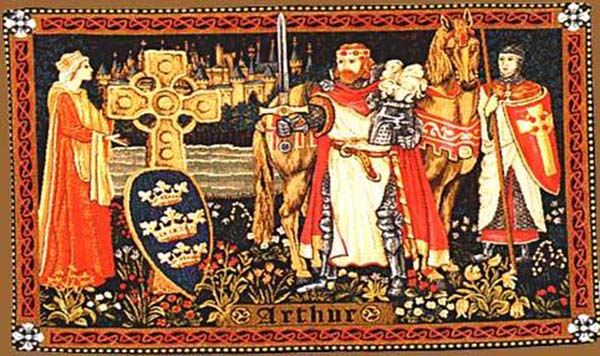
Glastonbury in Somerset has long been associated with the legendary Arthur and Guinevere, and it came to be identified as the Isle of Avalon (Ynys yr Afal in Welsh, ‘the Isle of the Apple’) to which Arthur was borne by three black-robed queens after his last battle with Mordred, according to the romantic literature of the late twelfth and thirteenth centuries. This association of Glastonbury with Arthur may have been why the last king of Wessex, Eadmund Ironside, was buried there, not at Winchester, in 1016, although there is no contemporary record to this effect. It later received a great boost in 1191 when a monk of the abbey, inspired by a vision, claimed to have discovered the coffin of the legendary king and queen. The coffin was said to have been inscribed with the words: Here lies the famous King Arthur, buried in the island of Avalon. When it was opened, it was found to contain the skeletons of the royal couple. The blonde tresses of Guinevere’s hair were said to be intact and still shining golden, though they crumbled to dust in the hand of the monk. This was clearly an invented story, not least because Arthur, the Welsh guerrilla leader, had not gained widespread fame by the early sixth century, when he was supposed to have lived and died. It was not until the middle of the twelfth century, with the writing of Geoffrey of Monmouth, based on the earlier Welsh ‘legendarium’ of ‘The Mabinogion‘ and the earlier ‘chronicles’ of Gildas and Nennius, that the mythological and literary figure of Arthur became ‘famous’.
The media historian, Dan Snow, has given a full summary and a dramatic reading of Gildas’s Ruin of Britain, written in the sixth century, chronicling the century before, in his recent ‘History Hit’ podcast on ‘The Real King Arthur’. Gildas identified an early Romano-British leader or chieftain as ‘Ambrosius Aurielanus’. Ambrosius is referred to as the victor of several battles against the Saxon invaders, including a final victory at ‘Badon Hill’. Gildas also refers to Arthur’s parents as wearing ‘the purple’, implying that they were wealthy Romans, perhaps even members of the imperial family. However, Gildas made no reference to Glastonbury as the place of his royal hero’s burial. Nor does Gildas ever refer to Ambrosius as ‘Arthur’. The use of that name in connection with the restoration of order in Britain had to wait until the chronicle of the Welsh monk Nennius, known as the Historia Brittonum. Nennius identified Ambrosius with Artorius, or Arthur, whom he introduces as a Dux Bellorum, a warlord. Like Gildas, he refers to several victorious battles fought by Arthur, the last of which was at Badon Hill (Mons Badonis).
Nevertheless, we have to wait until after the Norman Conquest, in 1136, for a more detailed account of Arthur’s deeds by another ‘Welsh’ monk, Geoffrey of Monmouth. He added the ancient Welsh stories of Arthur, some of them found in the Mabinogion, and others in the oral traditions of the broader legendarium . According to these stories, Arthur begins his campaigns against the Saxons from his base in Somerset, where he fought a gigantic battle with them. Before this, Geoffrey records Arthur as giving a rousing speech promising his soldiers absolution for their sins if they die ‘doing God’s work’. In this, Geoffrey seems to have been influenced by the crusading spirit of his age. Geoffrey describes Arthur as wearing a leather jerkin, ‘worthy of so great a king’, and putting on a golden helmet with a crest carved in the shape of a dragon. He also carries a circular shield called ‘Prydwen’, on which there is painted a likeness of the Virgin Mary. His sword was named ‘Caliban’, (in later literature ‘Excalibur’), which was forged on the Isle of Avalon.
The television historian, Michael Wood, in his series on Heroes and Myths, began his search for the magical sword, Excalibur, not on the Isle of Avalon, but on a canalside in an industrial suburb of Oxford, amid the ruins of a twelfth-century Abbey on another island, to the south of the city. It was there, in 1129, that Geoffrey created, or reshaped, the myth of Arthur, the once and future king. There, Geoffrey fashioned all the essential elements of the myth, including Excalibur. In the Bronze Age, from about a thousand BC, and on into the early medieval period, swords were cast in bronze in a stone mould, no doubt the origin of the sword in the stone element in Arthurian mythology.
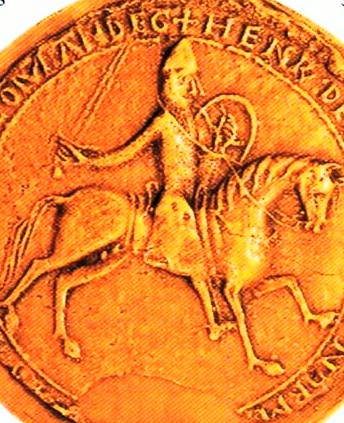
According to Geoffrey of Monmouth, Arthur’s last resting place was the Isle of Avalon, which the Saxons later named Glastonbury. In the late twelfth century, the first Plantagenet king of England, Henry II, heir to an extensive European ‘Angevin’ empire, decided to prove that Arthur was dead and could never again provide a rallying cry for the rebellious Welsh. He ordered a ‘dig’ at Glastonbury, which discovered, at a depth of sixteen feet, the hollowed oak coffin supposedly containing the remains of Arthur and Guinevere, bearing an inscription in Latin declaring them to be the remains of the famous King Arthur and his queen.
Of course, Arthur only became ‘famous’ in the twelfth century, as a result of the legends about him. Given a fine new tomb in Glastonbury, Arthur became a huge new ‘draw’ for pilgrims. Henry II’s French wife, Eleanor of Aquitaine, hired courtly poets to write new tales about Arthur and Guinevere, and their knights, giving rise to the chivalric elements in the romantic literature, including the Round Table and the Holy Grail, the latter already connected to Glastonbury through the legends of Joseph of Arimathea. In turn, these stories renewed the spiritual values of the Glastonbury mythology.
It was in Angevin Brittany and France that romantic writers made the tales of Arthur into a focus for these spiritual values of the age of chivalry. To help them find this focus, they invented the purely mythological elements of the Grail and the Round Table. The first was an invention of Chrétien de Troyes, and developed by the poets who followed him, a symbol of a virtue which can never be possessed, but for which the faithful must still strive, a symbol of the human ‘quest’ itself. At Winchester, thought to be Arthur’s Camelot in the Middle Ages, there is a Round Table, the ultimate symbol of equality among men of power. It was made for Edward I in 1290, after he’d conquered Wales and reburied the bones of Arthur and Guinevere in a marble tomb in Glastonbury. It was repainted by Henry Tudor (VIII) two hundred years later, in 1516, to impress the Holy Roman Emperor, Charles V, on a visit to Britain. Henry wanted to succeed the Habsburg monarch as emperor, so Arthur was repainted at the centre of the table with the King’s likeness.
So, Geoffrey of Monmouth’s prophecy had come true. The Tudors were a Welsh family, originally from Pembroke and Gwynedd, and had therefore restored the old monarchy of Britain. The myth of Arthur became a parable of Britain, a dream of what the country had been and of what it could become once more. Thomas Malory recorded these beliefs in his poem Morte d’Arthur. But when Henry fell out with the Pope and the emperor twenty years later over his divorce from Catherine of Aragon, he ordered the demolition of England’s European ‘Roman Catholic’ culture. Henry and his chancellor, Thomas Cromwell, dissolved and destroyed the monasteries, including that of Glastonbury. The supposed bones of Arthur and Guinevere were removed from their black marble tomb forever.
However, the Arthurian myth did not disappear. The British still needed their myths of identity and of state. In the nineteenth century, the Arthur story was revived once again with Pugin’s Gothic creation of the Houses of Parliament, and Queen Victoria and her Windsor successors traced their ancestry to Cymbeline and the ancient kings of Britain, whose lives had been chronicled by Geoffrey of Monmouth. As late as 1953, in preparing for the coronation of the young Queen Elizabeth II, the monarchy brushed off complaints from the Papacy about these claims. However, in any case, few of these tales had any foundation in authenticated historical events.
Dan Snow has argued that Arthur is the repeating national myth of the British. As it did in the twelfth century, it is a trope or legendarium that transcends the narrow confines of British, Welsh, Breton and English identities, both ancient and modern. Created by the geography of the Western Isles, the recurring island myth is one of how a leader emerges to fight against the invasion of massed continental forces, sometimes winning, sometimes not, as seen in the battles against the Danish and Norman conquerors. So Arthur is Caradoc, Boudicca, Ambrosius, Cerdic, Alfred the Great, Eadmund Ironside, Elizabeth Tudor, Winston Churchill… These heroes all share characteristics which are particular to the British as island people. And Arthur is not dead but sleeping on the Isle of Avalon, Glastonbury, waiting to return. Metaphorically, that may also be true. The British island story is therefore not finished, and, in a chaotic and seemingly hopeless world, it may yet produce a heroic force of resistance to the tyrannical external forces threatening conquest and subjugation. In that sense, the Glastonbury myths represent a trope of British resistance to tyrannical power, one which is continually revived throughout the histories of the peoples of the islands.

