Preface – Nineteen Eighty-Four & the ‘House of Terror’:
On my second visit to Hungary in July 1989, I visited Lake Balaton with my then fiancée (now my wife of thirty-six years) and a Catholic priest. He asked me if I had read George Orwell’s Nineteen Eighty-Four. I replied that I had first read it as a teenager in the 1970s, and that afterwards I was always concerned to think that Orwell’s predictions might come true. By the time I was thirty-two in 1989, I was relieved that they hadn’t and that, somehow, the world I grew up in had survived the Cold War with its constant threat of nuclear war hanging over us. Having been born in 1957, I had no memory of the 1956 Uprising in Hungary, though I had some recollections of the Prague Spring of 1968 and had studied both events, somewhat sketchily, during my undergraduate years in Wales in the late 1970s. Most of what I knew of Hungary then, however, had come from my father, who hailed from the Black Country, and had told me about the great floodlit football matches between his team, Wolverhampton Wanderers, and the ‘Mighty Magyars’ of Budapest Honved in the mid-1950s.
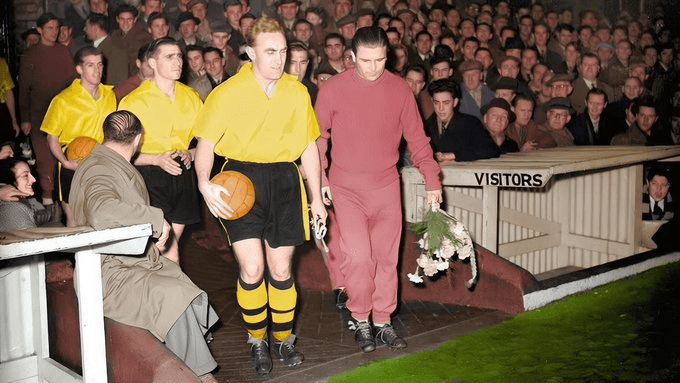
That was why, in October 1988, I had been keen to visit the land of Puskás on my first trip ‘behind the Iron Curtain’ rather than one of the then ‘hard-line’ communist countries like Czechoslovakia or East Germany (the DDR). Friends and colleagues had told me of their experiences on visits to those places, of being followed through the streets of East Berlin and Prague by the secret police, and I was genuinely scared of venturing into such unknown places. On my second visit, on a beautiful summer’s day at Lake Balaton, I felt secure in the company of Hungarians who were more travelled than I was on both sides of the barbed-wire curtain. Stefi, who married me in March of the following year, was eight years my junior, but had already visited the US, and our priestly guide had sojourned in both East and West since his student days in the fifties. Speaking about 1984, he commented that he had only recently been able to read a copy, in English, and that it had reminded him of his student days in 1956. In fact, he said, Orwell’s descriptions could easily have been of Hungary in that era. He said, emphatically, that Orwell’s 1984 was 1956 in Hungary. Of course, the date in the title was not really intended to set Winston Smith’s story in an unreal future, but simply to be an inversion of 1948, the date of its initial publication, though I didn’t know this when I first read the book.
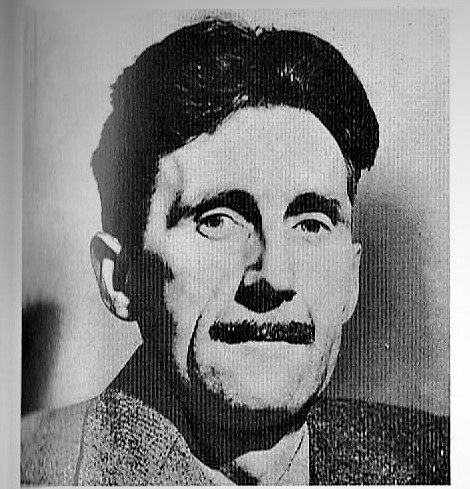
One of the best-known quotes from Orwell’s ‘dystopian’ novel is Who controls the past controls the future. This is the Party slogan that Winston Smith is made to repeat in the novel. The following phrase of the slogan is equally thought-provoking: Who controls the present controls the past. The House of Terror museum in Budapest is a relatively recent attempt of the present Fidesz régime to control the historical narrative of Hungary in order to control its future. Inside, over several storeys, the walls are covered with images of the victims of both the fascist and communist ‘reigns of terror’ of the 1940s and ’50s. In the ‘Hall of Double Occupation’, one of the walls is painted red, the other black. On the black wall are screens showing film footage from the 1939-44 period, including the takeover by Hungarian Nazis, known as the Arrow Cross. On the red wall, screens show footage of Soviet military operations in the Second World War and images of the country’s destruction. The two sets of images and sound effects provide a striking impression of ‘the dual occupation’ by the opposing forces of totalitarian powers, establishing the basic concept for the entire museum as one of equivalence between the two forces of occupation, with Hungarians as the victims of both.
At the end of a series of basement cells, displaying instruments of torture, accompanied by the moans and rattles of victims, is a shrine-like space called ‘the Hall of Tears’ and in the ‘Farewell room’, visitors find themselves in 1989, at the reburial ceremony for Imre Nagy, the martyred Prime Minister of the 1956 Uprising. The film shows Viktor Orbán giving a speech calling for the withdrawal of Soviet troops. The final scene shows the last Soviet soldier leaving Hungary in 1991.
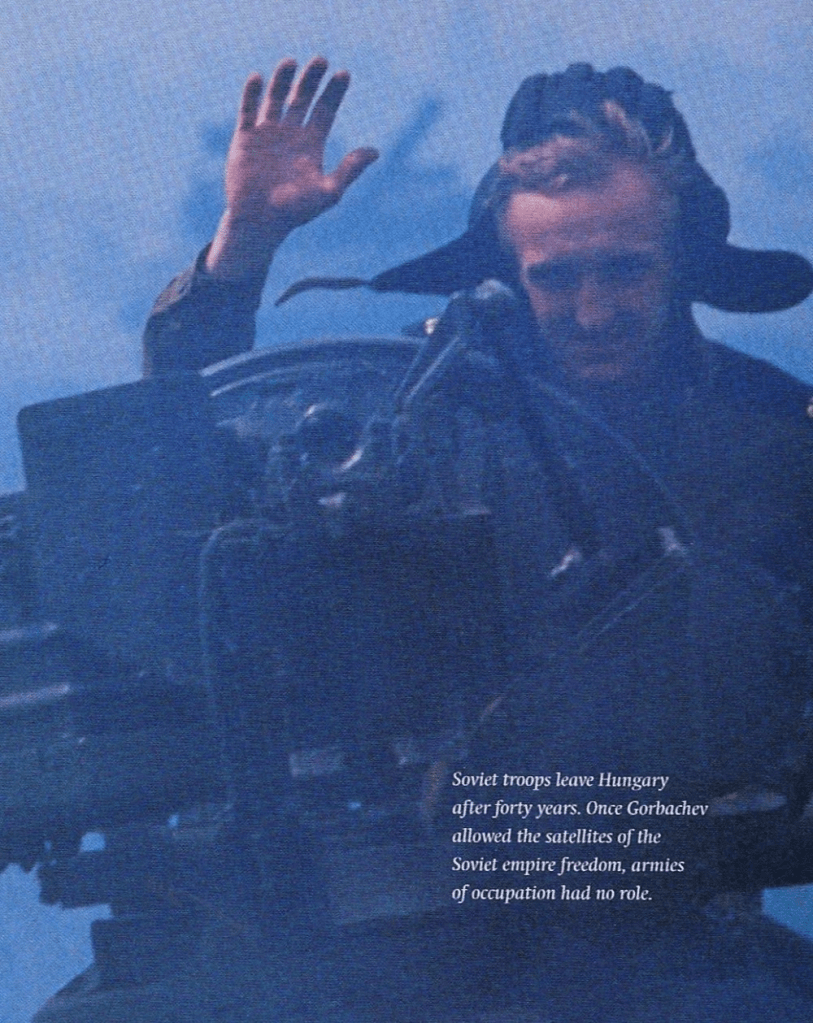
The message of the exhibition is simple and clear: the dictatorships are historically comparable and were contiguous, so they must be presented as such, giving equal weight to the crimes of fascism and communism. The exhibition also presents victims and perpetrators in opposition to each other. However, as one Hungarian historian wrote in criticising this message:
There is no family in Hungary that was not affected by the Nazi or communist dictatorships one way or another. The greater part of society experienced the two as both victim and perpetrator.
Krisztian Ungváry, ‘The House of Chaos’ (Hungarian), in Magyar Narancs, 7 March 2002.
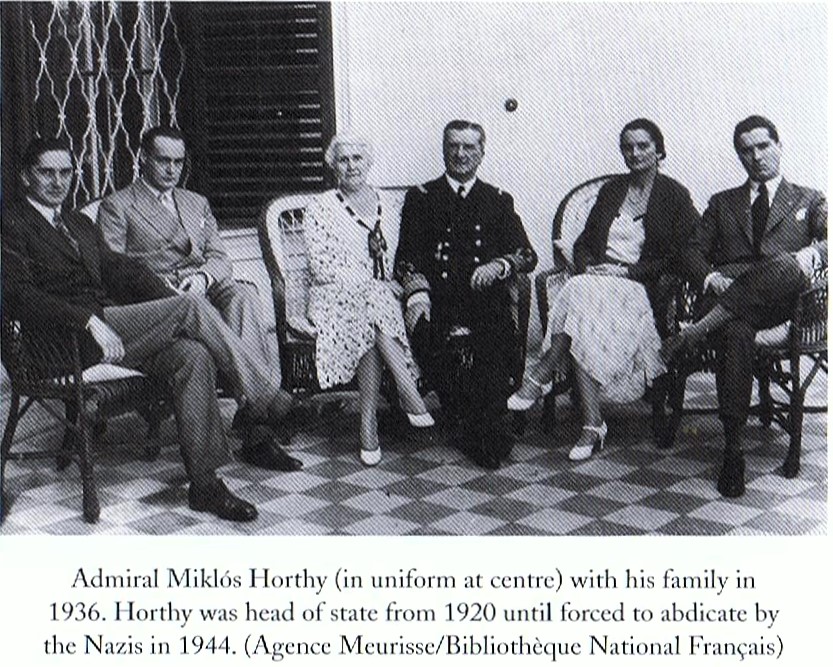
But the founders of the House of Terror were not concerned about presenting a nuanced portrayal of history. Their aim was to advance an interpretation of history based on Orbán’s trope of Hungary as the victim of the greater powers of the twentieth century. The museum was opened in 2002 at the end of the first Orbán government, and its narrative of the interwar period was that the Horthy régime had been essentially democratic, but that the country lost its independence in 1944 due to the uninvited German occupation. It was robbed of its economic base by the Nazis, who were also solely responsible for the deportation of 440,000 Hungarian Jews. It was then occupied by the Soviet communists and only regained its sovereignty in 1989 with the change of régime.
Turn of the Millennium & First Turn to the Right, 1998-2002:
Writing six months before the elections of 2002, the historian László Kontler wrote of the ‘social mood’ in Hungary at the turn of the millennium as having had its ‘ups and downs’. Although in the nineties, it still had a reputation as a welcoming country, particularly for the Western teachers who helped it to transition from teaching Russian as the first foreign language to teaching either German or English, intolerance towards ‘otherness’ (Jews, Roma, homosexuals, refugees, etc.) was sometimes clearly visible in the ‘pubic square’. Labels intended as condemnation, like ‘liberal-Bolshevik’, ‘plutocratic’, ‘alienhearted’, frequently heard in the effusions of the ultra-nationalist Right, had the unmistakable connotation of ‘Jewish’ in Hungarian, and a full documentary volume from the printed and electronic press on ‘anti-Semitic discourse in Hungary’ could be collected just for the year 2000. But this did not endanger political stability at that time, and the Fidesz Party was able to stay in place until its mandate was over.
The system was characterised as one of ‘limited parliamentarism’ in which, due to the determination of the legislators of 1989-90 to avoid an all-powerful executive, the government’s scope for action was limited. Successive prime ministers had been trying to break through or evade these limitations with a variety of strategies, Viktor Orbán being by far the most successful in his efforts to increase the powers of his Office by reducing the frequency of parliamentary sessions. However, Hungarian democracy was still dominated by the representative principle, despite the institution of referenda, and the unicameral legislature was elected every four years by a combination of majoritarian and proportional systems. After more than a decade of intensive movement across the ideological spectrum, the party political tendency reflected an overall gravitation towards the centre from both left and right, but with minorities persisting on both extremes, and an undercurrent of the old rural-urban divide sometimes surfacing in the form of ‘patriotic’ versus ‘cosmopolitan’ tensions.
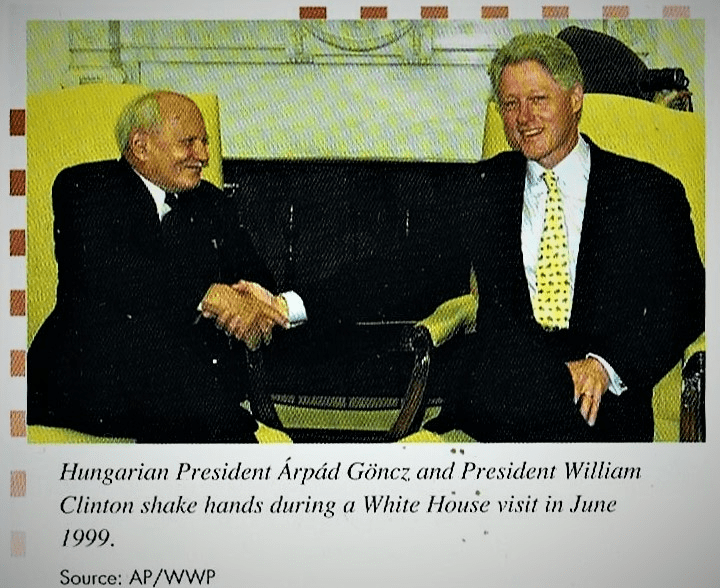
Árpád Göncz had been elected in 1990 as the President of the Republic, and was re-elected for a second term in 1995. However, he was succeeded in 2000 by Ferenc Mádl, who was a far more willing partner of the 1998-2002 national-conservative government, led by Orbán. Under these changed circumstances, the earlier collaboration between the SzDSz and Fidesz evaporated as their differences became increasingly visible. Of the party’s three distinguishing features – anti-communism, activism rooted in youth culture, and polical liberalism – only the first was preserved, while the second was swiftly abandoned and the third was gradually replaced by an emphasis on Christian values, tradition and a belief in strong, even authoritarian government. Already, by 1994, it was redefining itself as a party of the centre-right, with an ambition to control that part of the political spectrum.
This was signified by the change in its official name, by the addition of the letters MPP, standing for Hungarian Civic Party, and its abandonment of the Liberal International at the EU for membership of the European People’s Party in 1999, the conservative-Christian Democrat grouping in the European Parliament. In the 1998 elections, Fidesz-MPP had won by a relatively narrow margin, at the end of a campaign in which it pushed for ‘government change’ rather than ‘régime change’, a vision of a ‘civic Hungary’ in which the post-communist heritage would be completely and forever buried, and the state would act to support the growth of a broad middle class following nationalist traditions and Christian values. To secure a safe government majority, Orbán launched his programme not only with the MDF, but with the increasingly ‘hard-right’ Smallholder Party, anti-élitist and populist, and was also increasingly supported by the radical nationalist party, MIÉP, advocating ‘real régime change’, in its language ‘anti-globalist’, the new guise of anti-Semitism.
The Rehabilitation of the Horthy Régime:
Against this changing political back-drop, the choice of 1944 as a dividing point in the timeline of Hungarian history absolved pro-Fidesz historians of the need to deal with the failures of the right-wing political élite in power throughout the 1930s and early 1940s, which had led the country into the catastrophe of the Second World War and its ultimate collapse into dictatorship. In particular, the House of Terror museum deliberately glossed over the complicity of the Horthy régime in the Holocaust in Hungary. Orbán and those around him began to regard the authoritarian pre-war régime as a historical prototype, and to consider themselves as natural heirs to the Horthy régime. The exhibition’s designers, therefore, carefully shifted responsibility for the national failures of the 1920-45 period onto the foreign powers and occupiers, especially the Soviets. The German occupation following October 1944 was even written into their new constitution, or Basic Law, passed in 2011. The text begins with what is called a National Avowal, including the words:
We date the restoration of our country’s self-determination, lost on the nineteenth day of March 1944, from the second day of May 1990, when the first freely elected organ of popular representation was formed.
kormany.hu/en/doc/the-hungarian-state/the-fundamental-law.
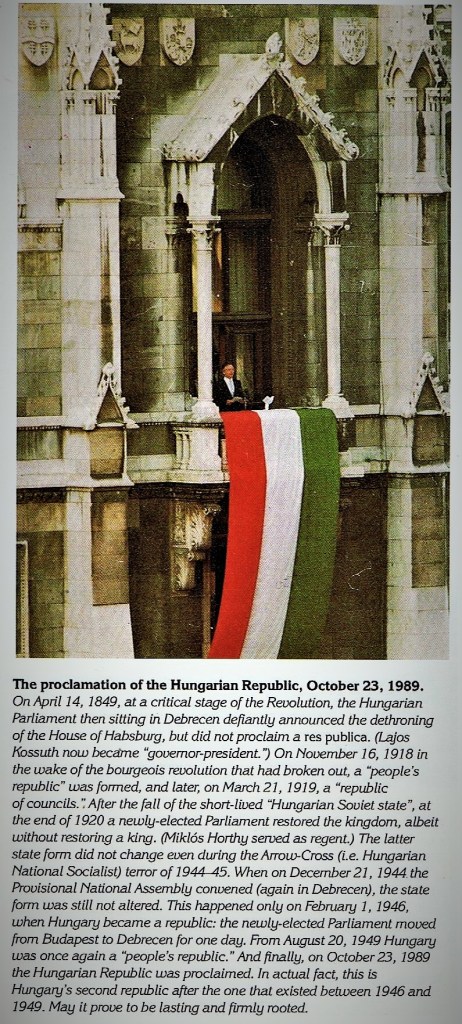
This selection of dates provided a simplified, pro-Fidesz interpretation of historical memory. In fact, the first free ‘Republic of Hungary’ had been declared on 23rd October 1989. The new date provided a key underpinning for Orbán’s nationalist-populist régime. The next stage in affirming February 1944 came on the seventieth anniversary of the German occupation, when the government erected a memorial to the ‘victims of the occupation’. The work aroused heated resistance in Budapest as soon as the plans became public. Its bizarre depiction of a struggle between the Archangel Gabriel and the German imperial Eagle gave rise to the obvious interpretation that Hungary was Gabriel, merely enduring the crimes of war, as if they were carried out solely by the occupying Germans. Hungarian critics of the sculpture claimed that this message denied the already well-established historical facts that the apparatus of Horthy’s Hungarian state provided great assistance in the deportation of Hungarian Jews. Without the willing participation of the pro-German political élite, at least half a million lives could have been saved.
The aim of the House of Terror museum and the memorial to the ‘victims of the occupation’ was to establish a new historical narrative. The general opinion on the right wing was that in the previously accepted Hungarian historical narrative, the memory of the Holocaust was disproportionately strong compared with the traumas of the Trianon Treaty of 1920 and the Soviet occupation. The new narrative claimed to create a balance between the memory of these events. However, for many Hungarians, the new memorials seemed to be attempting to tell an alternative history of twentieth-century Hungary. The simplicity of the symbolism and the obvious myth-making stirred up long-standing prejudices and increased polarisation in society, particularly in schools, which were expected to change their syllabi and organise visits to the museum.
The quest for security and prosperity through joining the existing Euro-Atlantic organisations and a leading role in regional co-operation, and the protection of the interests of the Hungarian minorities abroad, became the focal points of foreign policy after 1990. Nationalist sentiment had not been uncommon among some segments of the population, though hopes of a revision of the Trianon borders did not translate into a clear, viable policy for the political parties, except for the extreme right MIÉP. In his first interview as Prime Minister, József Antall had made the statement that in spirit, he felt himself to be the Premier of fifteen million Hungarians. Of course, this was rhetoric, but it met with much disapproval in Hungary itself and across the borders. Since 1990, successive Hungarian governments have sought to assist the legal organisations of the Hungarian minorities in their efforts to secure social and cultural rights. Between 1993 and 1996, treaties were signed between Hungary and Ukraine, Romania and Slovakia, to ensure the inviolability of the borders and the rights of minorities. However, the Orbán government regarded these treaties as lacking proper guarantees and being prompted by the country’s need to gain accession to the EU in 2002. Therefore, it began supplying the Hungarian-speakers in neighbouring countries with a ‘Hungarian identity card’, investing them with a special citizenship status in Hungary. This resulted in strained relations with Romania, Slovakia and, especially after the Russian incursions of 2014, with Ukraine.

Despite the protests of Russia against the proposed accession to NATO of Hungary, Poland and the Czech Republic, as a threat against Russia’s security, already in 1994, the creation of a NATO air force base in Southern Hungary was authorised, and a Hungarian engineering corps took part in the post-war reconstruction of the IFOR/SFOR in Bosnia. I remember the US tanks and armoured vehicles driving through Pécs, where I was based, on their way to the border with Croatia. The agreement on the membership of the three Central European states was finally signed on 12 March, 1999. Two weeks later, NATO embarked on its first-ever war, against the criminal régime of Slobodan Milosevic in Yugoslavia, using the Hungarian air bases in the bombing of Belgrade. Hungary’s involvement helped to facilitate both its accession to NATO and to the EU: in an atmosphere of growing anxiety for global security after 9th September 2001, neither the requirements concerning border protection, nor other developments, caused any further postponements of the accession processes. Hungary took its place in the Euro-Atlantic alliances.
In 2014, following the Russian incursions into Crimea and Eastern Ukraine, many Hungarian historians voiced their misgivings about the distortion of past events through mendacious memorialisation, and considerable protests ensued. Civic organisations erected what they called a ‘Stage of Freedom’, where public discussions were held in the evenings, a practice that continued for years. Talks were given by prominent historians and artists, and an entire oral tradition collection was compiled from the memoirs of Holocaust survivors and their descendants. In a manner typical of the Orbán régime, the controversial sculpture was neither officially unveiled nor dismantled. The work still stands where it was first erected, next to a counter-exhibition, which recounts in pictures and documents what actually happened in Hungary in the spring and summer of 1944. For tourists who have some familiarity with true Holocaust history, few spots in the country demonstrate just how fake and absurd the Orbán version of the tragic events of that year is.
1956 and All That – Primary Sources and Initial Interpretations:
In her 2022 book, Tainted Democracy, Zsuzsanna Szelényi quotes the diary of her grandmother, kept when she was living in the southern university town of Pécs during the heady days of the 1956 Uprising against the Soviet Occupation of Hungary:
‘Russians go home!’ ‘Down with the red star!’ ‘Free elections!’ chanted the vast crowd in ’48 Square, in front of the university of Pécs. People were waving flags from which the communist crest in the middle had been cut out. Almost the entire student body and most of the lecturers were there. The town workers arrived in lorries. From there, they marched on Széchenyi Square, the heart of the town.
György Majttényi, Zsuzsanna Mikó & Csaba Szabó, eds., (2016) Revolution! Twenty-four found stories, Budapest, Libri Publishers, Hungarian Historical Archives, p. 84. Quoted in Szelényi (2022), loc. cit., p. 309.
Half of Karola Péterfia’s family was at the demonstration; the younger children stayed at home with her husband, Zoltán, and listened to Radio Free Europe to learn what was happening in Budapest. In the main square, the leaders of the demonstration gave speeches received with thunderous applause. They announced that a revolutionary committee had been formed in Pécs. After the demonstration, Karola volunteered as a translator for the committee. Szelényi continues her family’s story:
Apart from a few hours of elation, she and my grandfather were extremely tense and hardly slept for weeks. Yet they still hoped the revolution would succeed when on 4 November Soviet troops entered Hungary and Imre Nagy’s government fled to the Yugoslav Embassy. In spite of the obvious risks, in October 1956 my family thought it self-evident that they should take part in revolutionary activity. They were swept away by the hope that communist Hungary might change. One of my uncles took part in organising the student resistance; later he was detained for months…
Szelényi, loc.cit., p. 310.
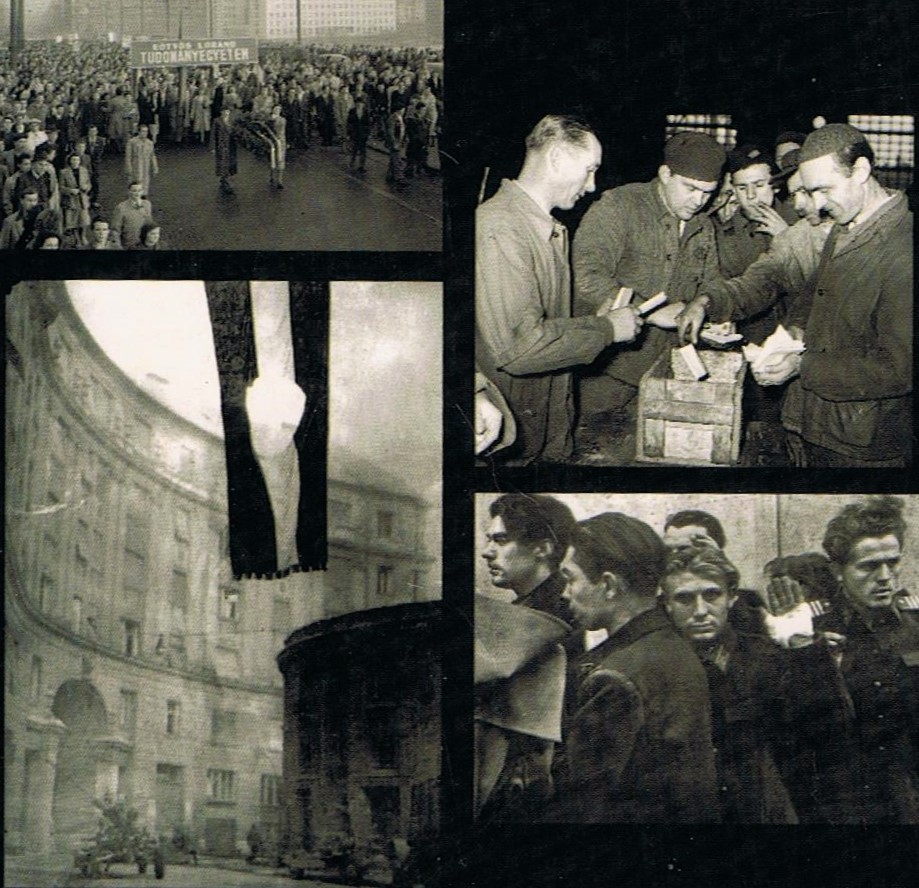
The 1956 revolution was that rare historical moment when different social classes – intellectuals, students and workers – were able to unify their aims in the face of the oppressive Stalinist régime. The aims of the revolution, though eclectic, clearly showed what the Hungarian nation wanted. The national tricolour flag with a whole cut in it, where the Soviet emblem had been removed, became the main symbol of the revolution, proclaiming the independence of the country from the Soviet oppressor. The demands for a multi-party system, free elections, a free press and freedom of association were aimed at restoring its pre-1948 institutions of democracy. These were the foundations on which the people of Hungary could unite and accept the reform-communist Imre Nagy as leader of the revolution and his coalition government.
However, the international community did not support Hungary in its struggle for independence. Assisting Hungary’s request for neutrality carried greater risks than rewards, given the delicate balance of the Cold War, together with the distraction of the Suez Crisis. In December 1956, resistance groups were still fighting in Budapest, and the question of Hungary was finally being debated at the UN. Hungary’s democratic progress was once more halted by the West.
Interestingly, it was a British political scientist who helped put the Hungarian workers’ councils of 1956 back on the agenda of historical discourse. Bill Lomax’s Hungary 1956, published in London in 1976, paving the way for the re-examinination of the role of the councils. Previously, there had been some recognition in academic circles about their significance, based on the works of Hannah Arendt, and there was also attention paid to them in non-Leninist political circles. What tended to be lacking in these sources was the extensive knowledge from Hungarian sources before 1988. Earlier in the 1980s, there was some interest among members of Hungary’s semi-underground Democratic Opposition in the workers’ councils of 1956. Indeed, some of the leading survivors of the councils participated prominently in a noted, packed conference about 1956 which took place on 5th-6th December 1986 in Budapest. Thereafter, the role of the councils and the issue which they raised – whether there could be a system of social ownership democratically managed from below – was not at the centre of public discourse; nor was it during the multi-party elections of 1990, even though, at that time, many pronouncements were being made pronouncements were being made about ‘finally achieving the goals of 1956’. The idea of the 1956 Uprising becoming the primary national myth of modern, democratic Hungary was suggested in 1990 by József Antall, the centre-right prime minister of the first freely elected government, when he spoke on 23rd October in the Hungarian Parliament:
‘I think that remembering 23 October implies the need to reformulate an era of our national mythology, … In the absence of mythology, there would be no spiritual fellowship, no spiritual community.’
József Antall Fundation, antalljozsef.igytortent.hu.
Historical research into the revolution started immediately in the newly founded 1956 Institute, founded after the announcement in October 1988 that the communist government was dropping the official designation of the ‘Uprising’ as a ‘Counter-Revolution’. Soon after, however, struggles began over who the real heirs of 1956 were. The successor to the communist party was burdened by its own past, and many years of falsifying the historical record meant that it was unable to present a credible narrative with which to interpret the events of the second half of the twentieth century. Kádár’s long period in power had begun precisely by quashing the 1956 Uprising with bloody retaliation.
The liberal-leaning Alliance of Free Democrats (SzDSz) was the direct continuation of the democratic movement of the 1980s, and by publishing the memoirs and analyses of the intellectual leaders of the revolution, it sustained the memory of the 1956 revolution. For right-wing parties, the focus was on the Catholic circles that became active in 1956. For Fidesz, the memory of 1956 was very important because the revolution was triggered by university students. In the speech he gave at the reburial of Imre Nagy in 1989, Viktor Orbán had pointed to this historical legacy. Thus, multiple readings of the complex reality of 1956 were made possible. In 1992, President Árpád Göncz, who had been an activist in 1956 and subsequently spent time in prison, made a speech on the 36th anniversary of the events containing the following perceptive remarks:
“The multi-party, parliamentary system of western Europe hardly tolerates the type of direct democracy which made our revolution victorious via the directly elected workers’ and revolutionary councils controlled by workplace and residential communities.”
Quoted by Dent, loc. cit., p. 382.
The speech, due to be delivered from the steps of parliament on 23rd October, was interrupted by a noisy, right-wing demonstration in the crowd. The content of the speech was subsequently published in a collection by Európa, receiving widespread publicity, in part due to the interruption. This may have been why, two years later, on the thirty-eighth anniversary of the execution of Imre Nagy, he made a plea for pluralism in the interpretation of the Uprising:
“Everyone has a right to interpret 1956. But no one has the right to expropriate 1956. Only the knowledge of the undistorted truth can mellow the one-time confrontation into peace.”
During his presidency, Göncz repeatedly highlighted the role of the workers’ councils, and after he left office, he continued to return to the theme. In a question and answer session at the Budapest University of Economics in November 2001, Göncz pointed out that in the period after 4th November, when the Russians invaded, the workers, through their councils, had “played a decisive role”. He also added that, while in 1956, they had achieved their demand for workers’ ownership, in the contemporary world of increasing globalisation and the strengthening of international capital, it was a demand which was no longer realisable. However, three years later, in an interview published by Népszava on 22nd October, Göncz continued to argue that the formation of the workers’ councils represented one of the most important steps of the revolution. By 2006, the fiftieth anniversary of the Uprising, Bob Dent, a British writer, researcher and editor who had lived in Budapest since 1986, published a seminal book in English, Budapest 1956: Locations of a Drama, a guide to the sites in the capital connected to the events of the Revolution. Dent also provides an appreciation of differing accounts of what happened in 1956 in his book, which is therefore also about history itself, often indicating…
… contradictory records of events with a view not to telling a ‘final’ story, but illustrating a story, which has been told in different ways
(Dent, 2006, p.15).
Fifty Years Later – Divergent Definitions of a Drama:
Already, in 2006, there were several meanings and interpretations attributed to what 1956 in Hungary was all about, and even what individual events signified. Before the régime change of 1988-89, ‘revolution’ and ‘counter-revolution’ had been the two most commonly used and contradictory general terms. Yet there were already, by 2006, a series of other terms, phrases and adjectives which had been applied to the ’56 experience – a people’s uprising, an anti-communist but an anti-Stalinist revolt, a national uprising against foreign oppression, a civil war, a classic workers’ revolution of a non-Bolshevik type, an anti-Semitic pogrom, initiated and manipulated by Western interests, and an uprising secretly promoted by Moscow in order to have a pretext for intervening with overt force and quenching all opposition with blood. For almost twenty years, the Budapest-based Institute for the Documentation and Research of the 1956 Hungarian Revolution, thereafter known as the 1956 Institute, had been researching and analysing, on a scholarly basis, information about the 1956 events. Dent based his 2006 book on this published information.
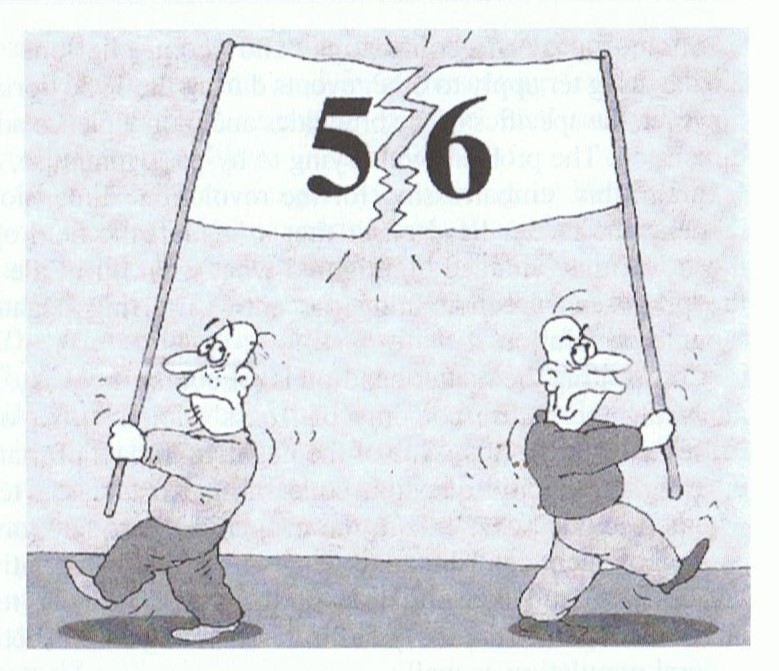
In 2008, Dent published another book which, in addition to more general as well as personal essays on contemporary Hungary, included a chapter entitled My Very Own 1956. This began with an explanation of why and how he came to write his book on Budapest in 1956. On its publication, he faced challenges from people who had been eyewitnesses to the ‘Bloody Thursday’ massacre in Kossúth tér on 25th October, when shots were fired into the crowd in front of parliament, and nearly a hundred people were killed. The tragic event remains one of the most mysterious of 1956, since it is still unclear whether it was the ÁVH, the Hungarian political police, who fired from the roof of the Ministry of Agriculture, or from the Soviet tanks sent to the square. Some claimed that the shooting came from both sources. Bob Dent had heard many conflicting eyewitness accounts. Some of these were clearly confused, referring to Imre Nagy’s appearance on the balcony of Parliament in front of the crowd in the square below. However, we know that Nagy was not present in Parliament in the square on Thursday, though he had famously appeared on the balcony two days before the shooting, on the evening of the 23rd. Dent concluded:
I am a great fan of oral history and ‘people’s history’ in general. The history I was taught at school and much of the history I have read since is based on official documents and the letters and records that participants have left behind. Inevitably, that means a concentration on the activities of the powerful and the rich. People without power and the poor leave behind few such documents. Our history is therefore skewed in what might be called an undemocratic way.
Bob Dent (2008), Inside Hungary from Outside, Budapest: Európa Könyvkiadó, p. 216.
That began to change from the end of the nineteenth century with the introduction of first photographic and then film and sound-recording equipment that altered the production of history. It enabled ordinary people to enter the historical stage, or, perhaps more correctly, the reconstructed past. They were always there, but could now be seen and heard. In that sense, the use of oral history enabled the memories of people who left few written documents, but were actually present during events, to become a useful public counterweight to orthodox approaches and interpretations. Studying history ‘from below’, from ‘the worm’s eye view’, enables researchers not just to ‘mine’ alternative sources of information, but to ‘dig into’ the detail of individual responses to mass events like the 1956 Uprising. However, Dent also recognised that it was necessary to be as careful in these approaches as with any other type of source. The many memoirs which already existed in published form helped to provide a useful means of recalling the details and atmospherics of what actually happened day-to-day. He observed that:
In a rapidly evolving situation like that of 1956, with events driven to a large extent from below, and spanning a relatively short period of time, oral history and memoirs of grass-roots participants take on a greater weight than usual.
Ibid., p. 217.
In my own interviews and conversations with participants in provincial towns and cities, I have certainly found that to be the case. However, it is also the case, as Dent argued, that it is not so easy to determine ‘the facts’ of what actually happened either in the various places in the capital or in other towns and cities throughout Hungary. When the bullets began to fly somewhere, there was usually an element of panic and chaos, which resulted in contradictory accounts of what actually happened there. Where it seemed that neither one nor another of these accounts could be confirmed, Dent offered both versions to his readers, and more than two on some occasions. In this way, his book became a work about the study and writing of history itself and how the past might be used for different purposes. As he researched the different accounts of 1956, Dent had a recurring phrase in his mind:
‘… we all like to remember the things we want to remember and we prefer to forget the things we would rather not remember.’
Ibid., p. 218
The official view of 1956 during the Kádár era was a negative one in Hungary itself, not just because of central control and censorship, but also due to the atrocities and violent incidents which took place during the events from late October to mid-December. In particular, the lynchings and shootings in cold blood following the siege of the Communist Party’s headquarters in Köztársaság tér on 30th October led to a tendency to identify the entire uprising with those terrible events, and to argue that the true face of 1956 emerged during them. It suited the ideological party position very well, and was constantly emphasised in books and essays, as well as at rallies held in the square and in the monuments erected there.
After 1989, when the view of 1956 became a positive one, the atrocities were downplayed and, in many cases, simply forgotten. They didn’t fit the new image espoused by the Reform Communists and the emerging opposition parties and groupings of the régime change. That situation didn’t change until 2006, when the publication of Lászlo Eörsi’s work Köztársaság tér by the 1956 Institute provided a more informed and balanced view of the events of 30th October. Earlier versions of these revolved around the mistaken belief, held by many, that there were secret chambers and cells below the Party headquarters where the ÁVH was holding many political prisoners. George Mikes, the Hungarian emigré writer who had worked for the BBC before the Second World War, reported for it from Hungary during the revolution, and the broadcaster’s international reputation for accuracy and objectivity led many to treat his accounts with reverence. In his book on The Hungarian Revolution, published in Britain in 1957, he alleged, without reference to sources, that when freedom fighters invaded the Party headquarters, they:
‘… freed a large number of prisoners from the cellars and then went up to the third floor, where … high-ranking AVO (ÁVH) officers were having a dinner party. … Altogether there were about a hundred and twenty people round the table.’
Ibid., p. 220
Mikes went on to state that a sharp battle ensued in which about forty ÁVO officers were killed. Another sixty were captured and taken downstairs, where they were all hanged on trees and lamp-posts around the square. The researchers from the 1956 Institute later reckoned that twenty-three defenders of the building, in total, lost their lives. Others give similar double-digit figures. Mikes then wrote that the besiegers heard voices coming from the underground cellars, and that they found a hundred and fifty-four prisoners, together with their ÁVO guard, all of whom had perished before they could be freed. However, according to the historian and first director of the 1956 Institute, György Litván, the existence of underground cells in Köztársaság tér was just one of several enduring legends about 1956. In 2000, he published an article in Hungarian detailing these ‘Myths and Legends about 1956’ (Mítoszok és legendák 1956-ról) in the Institute’s ‘Yearbook’, an important work for anyone trying to research the misconceptions about the events of October-December 1956, which is also on the website, http://www.rev.hu.
However, the problem with trying to verify the specifics of the brutalities and mob violence is that it has left the field open for all those, in Russia and elsewhere, who still wish to highlight what went on for the purposes of condemning the entire uprising as a ‘counter-revolution’. Confronting the matter head-on is not easy, however, because it involves analysing the nature and context of ‘mass’ violence, raising the issue of the role of visceral hatred in the uprising as contrasted with that of the nonviolent revolutionaries. Certainly, the events in Köztársaság tér led to a rapid consolidation of the Kádár government, not only within the Communist Party, but among broad sections of the general Hungarian public.
East-West in the Eighties – ‘second Cold War’ & ‘Dominoes’:
By 1979, the relaxation of Hungary’s relations with the West had been underway for several years and had gone ahead even under the ‘second Cold War’, which had supposedly started by then. There was a constant flow of visitors to Budapest, of students on exchange programmes to Pécs, and Kádár had become a respected elder statesman among the ‘satellite states’. The Soviets allowed this to happen because even the Hungarian Central Committee’s economic commission accepted that the economy was ‘clinically dead’ and Moscow knew that it could not afford to pick up the bill. Hungary had built up a considerable debt, rising from $8,000 million in 1984 to $20,000 million in 1989, the highest per capita in the Soviet bloc, and just paying the interest on this (150% of exports) was a considerable strain.
By 1985, the ‘leadership’ was simply ignoring the debt crisis, but ordinary Hungarians could not. The economy was growing at a torpid 0.3%. The days of ‘Goulash Communism’ were at an end, and the country was far from being ‘the happiest barracks in the camp’ any longer. Both the German and the British governments were keen to exchange visits with Kádár, the latter sending one of their most astute diplomats, Bryan Cartledge, who had been Margaret Thatcher’s principal adviser on foreign affairs, as ambassador. Budapest became a place where, beneath all the tensions of the Cold War, deals could be done. Cartledge later wrote an excellent history of Hungary, including his own memoirs of this period, entitled The Will to Survive (London, 2011).
In his (2019) Short History of Hungary, the ‘outstanding’ British historian (and one-time resident in Budapest), Norman Stone, wrote of how another ‘factor’ of vast importance from the mid-eighties was American philanthropism. Even before Gorbachev’s emergence, George Soros was negotiating with the Hungarians for an opening. An expatriate Jewish Hungarian, he had survived the German Occupation, the Arrow Cross Terror and the siege of Budapest with false papers before escaping to London and then moving on to New York, where he made a fortune on Wall Street. His Open Society Foundation was recognised by the Hungarian government in 1984, providing scholarships to the West. Among the students to go to Oxford were Zsolt Németh and Viktor Orbán. A new Hungary was taking shape, and George Soros’s almighty dollars were beguiling for budding and ambitious lawyers, politicians and diplomats, even if they don’t care to talk about it today.
In 1985, after the first (embryonic) real election, when opposition figures met at Monor, a large village near Budapest, they included many Reform communists, even some of Imre Nagy’s old associates, who discussed the social and economic crisis that they could all feel. Calling for ‘human face socialism’, they had always had something of a presence, but the latest and brightest party members, including Imre Pozsgay, could sense, if not see, the exit. Pozsgay, who had no illusions about what was going wrong, were present at another important meeting in 1987, this time at Lakitelek, a small village on the River Tisza. He took centre-stage in the discussions with non-Communists, forming alliances far beyond the ranks of his own party, which were to matter in the future. He was clearly bidding for the leadership of both the party and the country, but for the time being, Grósz was in charge.
Naturally, the leaders of the Hungarian Socialist Workers’ Party (MSzMP), the communist state party, were acting, in part, under pressure from the increasingly strong democratic opposition parties (MDF, SzDSz), in which Fidesz also played a minor role, with its smart direct action campaigns, but – whether they were prepared to admit it then or now – historically, the main driving force was the reform communist government, led by Miklós Németh, Gyúla Horn and Imre Pozsgay. They were determined to deliver a nonviolent transition of power to the opposition. By the end of the 1990s, and certainly by a decade later, such an admission was incompatible with Fidesz’s primitive anti-communist campaigning, as it shifted dramatically to the right. The true narrative of the transition period remains a fly in the ointment of the Orbán régime’s selective memory and certainly has little to do with the real historical record of the nineties.
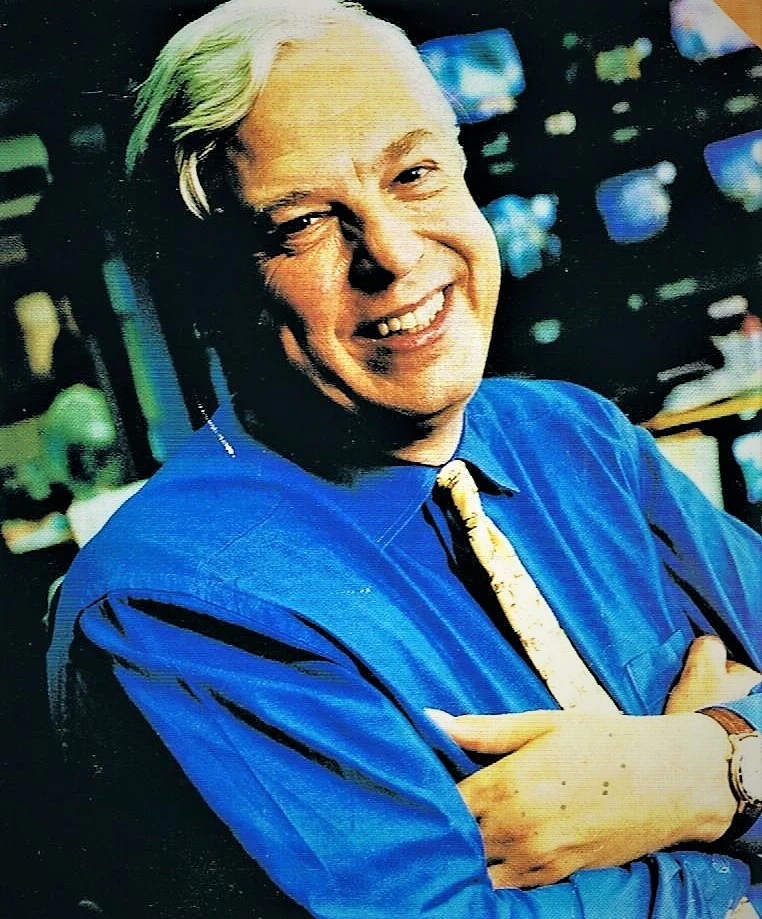
One such record, Despatches from the Barricades, published in 1990, was written by the BBC journalist, John Simpson, an eyewitness to all the ‘revolutions’ of 1989, from Peking to Moscow, including those in Berlin, Prague, Bucharest, and Budapest. He first met Imre Pozsgay, who became the dominant figure in the HSWP in 1983:
“He talked like an Austrian socialist. On one occasion, Kádár referred to him as ‘impertinent’. … an intellectual by instinct and training, he worked his way up through the system, until in May 1988 he and those who thought like him in the Party were strong enough to call a special congress and vote Kádár out of power.”
John Simpson (1990), Despatches from the Barricades: An Eye-Witness Account of the Revolutions that Shook the World, 1989-90. London: Hutchinson.
In June 1988, at the 19th Party Congress, Gorbachev formally renounced the ‘Brezhnev doctrine’, which had enabled the Soviet Union to intervene in ‘satellite’ countries and later announced that he was withdrawing ten thousand troops from Hungary. This was a sign that no one in Europe could ignore. Moscow also allowed Kádár’s place as General Secretary to be taken by Károly Grósz, and Pozsgay became a member of the Politburo. But it was Pozsgay rather than Grósz who soon became the dominant figure in the leadership, and already a post-Communist proto-government was beginning to form. The Lakitelek meeting in September 1987 had set up the Hungarian Democratic Forum (MDF), with a hundred and fifty intellectuals present in the same room as Pozsgay. This became the first opposition party, led by József Antall and his son-in-law Géza Jeszensky, who later became Prime Minister and Foreign Minister respectively. Antall’s father had been the civil servant dealing with refugees during the war, and he had been notably humane as regards the Poles, including Polish Jews who had fled to Hungary from Hitler’s invasion of Poland in 1939, many of whom later joined the British armed forces. József Antall became an archivist and director of the Medical History Museum in Vadász utca in Budapest, where the Swiss diplomat Carl Lutz had protected hundreds of Jews during the German occupation. Like his son-in-law, Antall had excellent languages and could ‘talk European’.
Helter-Skelter Economic & Political Changes, 1988-89:
Changes began to happen fast; helter-skelter came political change and economic reforms. Prices and wages were freed from control, a stock exchange was established, and by January 1989, the greatest price increase since 1946 was underway. The cost of medicines increased by 80%, water by 200%, milk by 40% and two million people, a fifth of the population, lived on or below the poverty line. On the plus side of the cost of living, occupants of low-rent state flats could now buy them very cheaply. Most importantly, state enterprises were allowed to become private companies. However, this led to the (perhaps) unintended consequence of the unregulated sale of state assets, which went for absurdly low sums in a closed circle of Communist Party members. But political life was now free, and censorship came to an end. In March 1988, Fidesz emerged as a new party of youth, with its star speaker, Viktor Orbán. The Network of Free Initiatives was set up, aiming to incorporate all opposition parties and groups under one umbrella organisation. When this didn’t work, they set up their own Free Democratic Alliance (SzDSz). These were the ‘dissidents’ as known to Western journalists, who were fluent in English, well read, talking the language of the free market, human rights and democracy. But, at the end of 1988, the Communist Party was still dominant, with huge assets and 800,000 members. But Grósz was soon outmanoeuvred by Pozsgay, who outbid him for the nationalist vote.
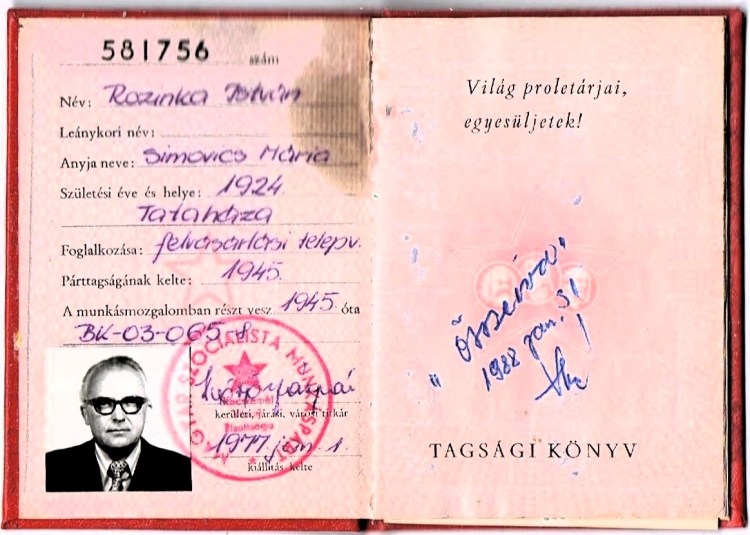
Pozsgay, acting on his own initiative, announced in February 1989 that the events of 1956 had been a legitimate, popular uprising rather than a counter-revolution, thus disavowing decades of propaganda. It was still the most delicate issue in Hungarian politics as well as historiography. The Party Central Committee could not be induced to go as far as Pozsgay, but Grósz gave his permission for the exhumation and reburial of the executed leaders of the Uprising. In March, an independent lawyers’ forum came up with the notion of an opposition round table, bringing together all the opposition groups to initiate negotiations with the government as to fundamental change. This had already happened in Poland, and the mass support for it in Hungary was obvious. On 15th March, the day commemorating the 1848 Uprising, a hundred thousand had demonstrated on the side of the opposition, with demands that echoed 1956. In April, Pozsgay delivered a temporising speech in Kecskemét and thereby left the leadership of the opposition to those who wanted a clean break with Communism. Grósz relinquished the government to a technocratic economist, Miklós Németh, and concentrated on continuing to lead the Party through its disarray, with thousands of its members ripping up their party cards or ending their membership. Kádár was removed as Party chairman and deprived of his membership of the Central Committee. He arrived unexpectedly, clearly ill, in the Congress Hall and insisted on making a speech, which was incoherent, but contained confessions of historic misdeeds in 1956. Meanwhile, the Party reformists met in Szeged in May, with Pozsgay, although there was still no formal breakaway.
The Party lost its right to veto non-party appointments and handed over its militia to the Ministry of Defence. The new PM, Miklós Németh, personally abolished the informer-ridden Office of Church Affairs and set in motion the reburial of Imre Nagy. Also in the spring of 1989, the régime suffered another defeat after environmental protests against a new dual power plant on the Danube being built in collaboration with Czechoslovakia. In response to the ongoing demonstrations, which had begun in September of the previous year, Németh ordered a halt to the construction. On 13th June, negotiations had started at the ’round table’, which was, in fact, triangular, with the third side taken by the ‘organisations’, including those of women and veterans, with an overall determination that there should be no violence. There were, however, keen arguments about property and the forthcoming free elections, which led both the SzDSz and Fidesz to refuse to sign the final accord. But the alliance between the MDF and Pozsgay held, and therefore a deal could be done. When, on 16th June, as Nagy’s body lay in state in Heroes’ Square, it seemed that Hungary had come to terms with its past and was determined to secure its own future through an independent Central Committee, which would introduce a multi-party system.
Point of no return – Heroes’ Square, 16th June 1989:
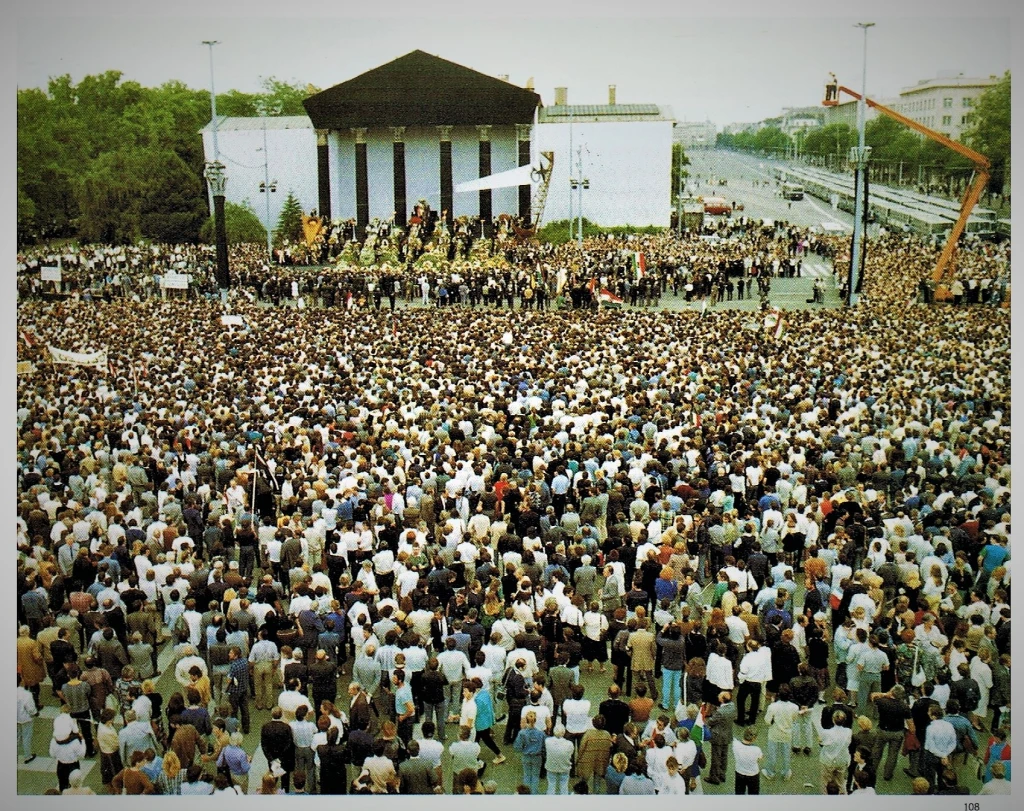
There were five coffins in all, five for Nagy and his fellow victims, and a sixth representing all the others killed in 1956. The honouring of Nagy and his colleagues, among them Pál Maleter (Minister of Defence in 1956), confirmed the revolutionary (as opposed to counter-revolutionary) nature of the 1956 events better than any mere legal rehabilitation could have done. Two hundred and fifty thousand people came to listen to speeches contemptuous of Communism, the most memorable of which was that delivered by Viktor Orbán. He made the salient point that, after the reburial of Rajk, the Party had promised never to repeat judicial murder, but had then gone on to execute hundreds more. He declared:
“We are not satisfied with the promises of Communist politicians that commit them to nothing. We must see to it that the ruling party can never use force against us again.”
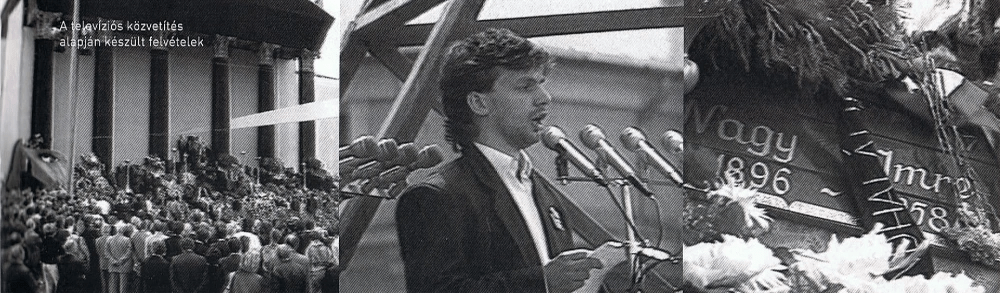
Source: Norbert Lobenwein, 89-09: a rendszervaltás pillanatai (‘Moments of the Régime Change’), Volt: Budapest, 2009.
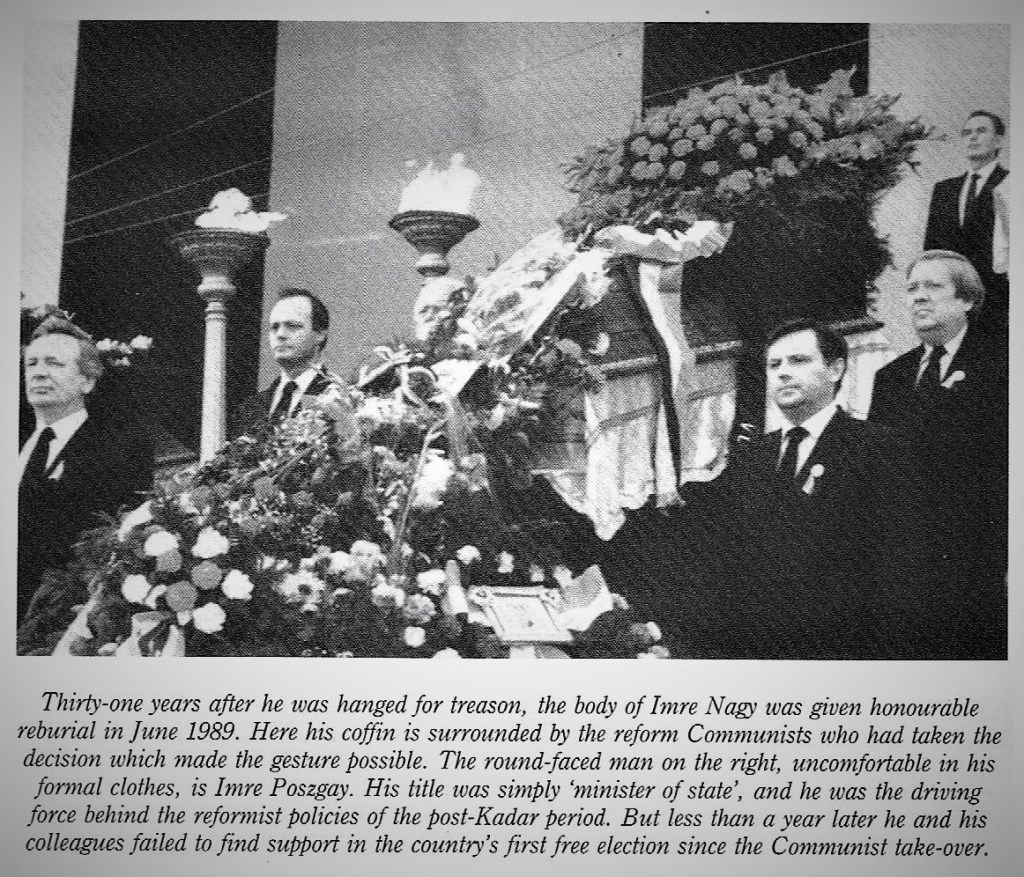
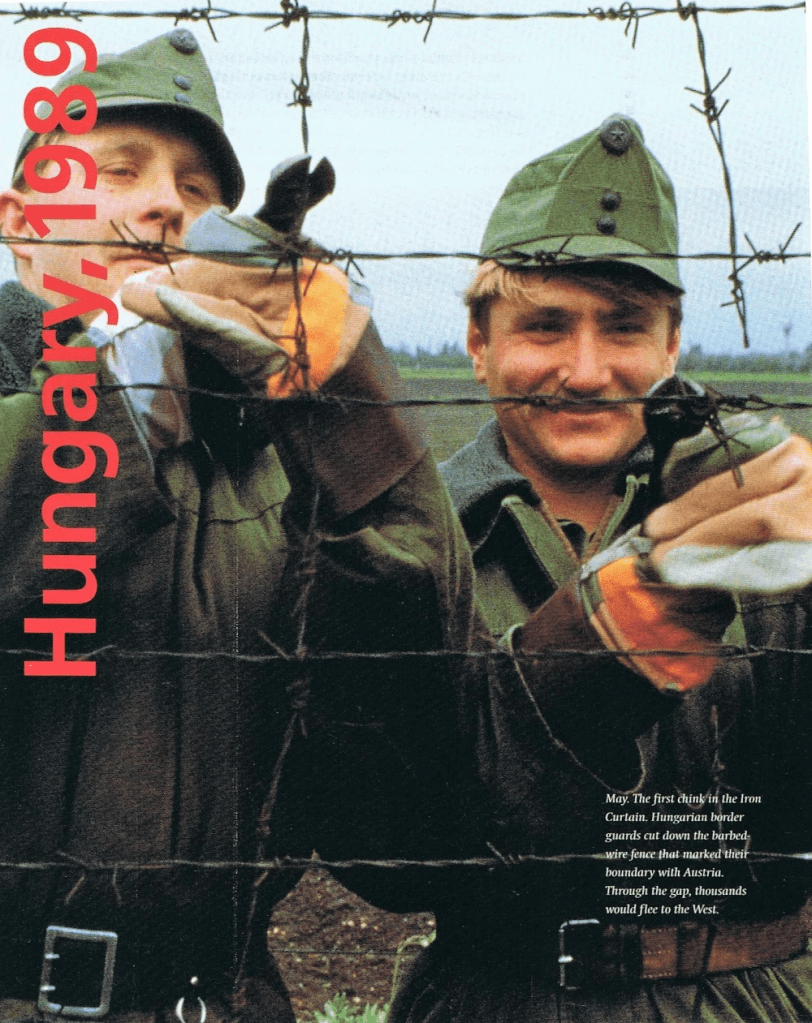
Two weeks later that summer, there was an ‘earthquake’ at Lake Balaton. The Hungarian section of the Iron Curtain was 243 kilometres long, and still looked formidable, with its two rows of barbed wire and three landmined metres and five more rows of wire overlooked by watch-towers equipped with alarm systems. By the 1980s, it had become rusted and dilapidated, and there were many false alarms. In February 1989, the Politburo had resolved to dismantle it, and it became common knowledge in the DDR that by taking their customary holiday at Balaton and western Hungary in July, East Germans might find the border open during ‘repairs’. At Pozsgay’s instigation, a pre-planned ‘pan-European picnic’ was advertised widely within the area, to be held in the Hungarian-speaking Burgenland, for which both sets of border guards would open the border gates. Until May, East Germans trying to escape through Hungary were sent back, 1,088 in 1988 alone. One of them was even shot.
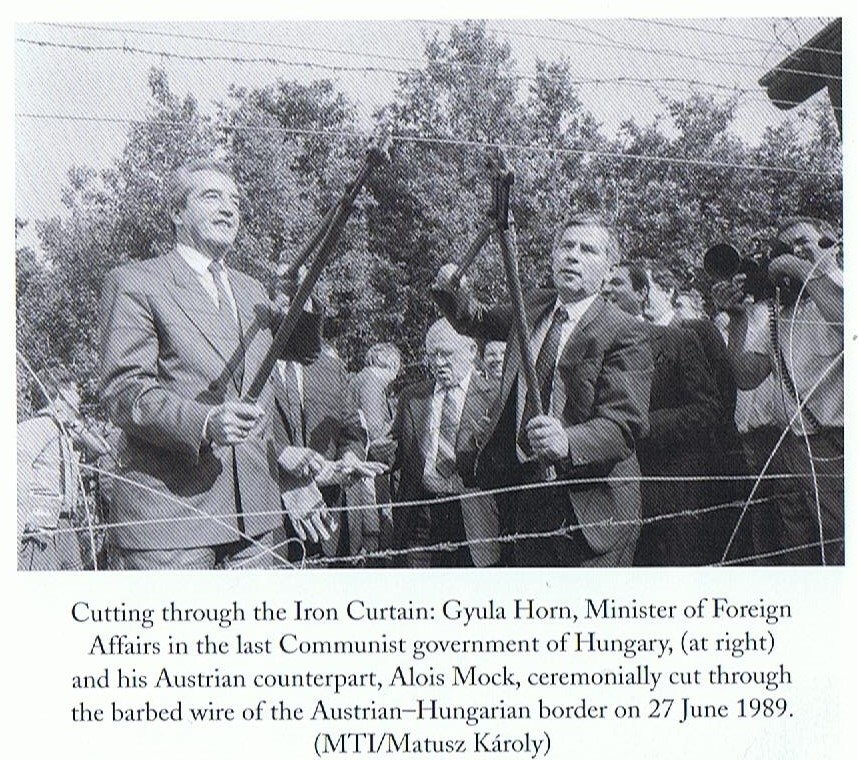
On 27th June, there was a great symbolic moment when the border fence with Austria was ‘dismantled’ in a little ceremony in which Alois Mock, the Austrian Foreign Minister, and Gyula Horn, his Hungarian counterpart. The two men solemnly snipped a chunk of rusty wire. A friend of mine who had left Hungary with his mother in 1956, aged fourteen, by cutting his way through the bottom of the fence, was invited to take part in the wire-cutting ceremony and was allowed to take a piece of the fence back to Britain with him as a souvenir. On 19th August, the planned ‘pan-European picnic’ near Sopron allowed hundreds of East Germans to simply walk into the West. This ‘trickle’ soon became a flood, and thousands laid siege to the West German embassy in Budapest, and thousands more waited at Lake Balaton and throughout Western Hungary. Gyula Horn asked for advice from the Kremlin only to be told that it was his choice. He then negotiated an agreement with Helmut Kohl and the German Foreign Minister to allow these East Germans to proceed across the border by car via Hegyeshálom. On 10th September, all East Germans who wanted to proceed to Austria and on to West Germany were allowed to go West. By mid-September, 23,000 had done so. On 23rd October, back in Budapest, the régime change was formally announced from the Parliament building with the proclamation of the Hungarian Republic.
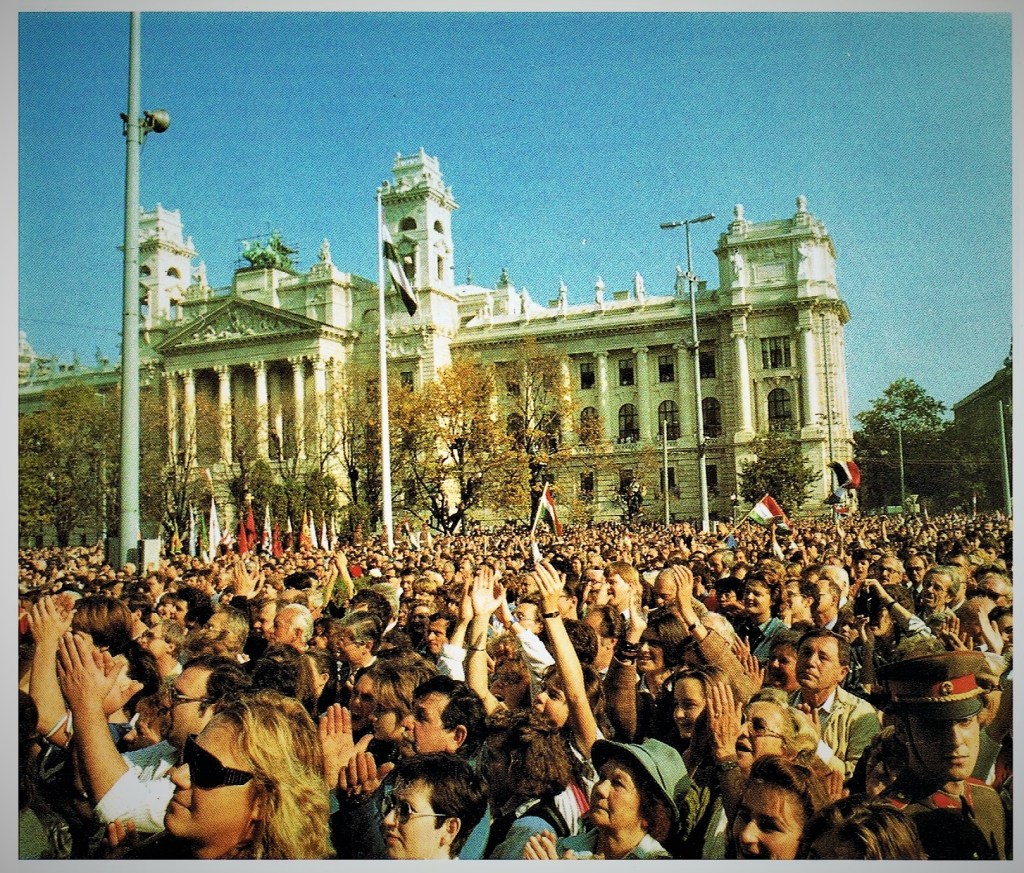
I was visiting Pécs with my Hungarian fiancée on the day of the proclamation. A week later, I returned to the UK and my family, joking that I had entered one country and left another, but had only crossed one border! Amidst the genuine and general euphoria, the Hungarians knew there were still lessons to be learnt, or rather relearnt, not least about the almost totally forgotten rules of democracy, how to survive the economic depression and how to create a new economic order. The full vulnerability of the old order was only just being revealed to them, including the need to decrease consumer spending, despite expectations to the contrary. Already, the past, including the earlier Kádár period, was being viewed with nostalgia. Like me, many Western visitors to Hungary at the beginning of the 1990s found social conditions better than their old expectations of life behind the Iron Curtain had suggested. To us, the country seemed more affluent and its people more resourceful than many Hungarian citizens saw it, who often faced the future with anxiety, if not outright fear. As István Lázár put it:
“This is the new Hungarian Paradox: almost every outside observer values the dynamism of the country highly, but the inhabitants, who bear the burden of most of the changes, are cautious and pessimistic. Who is, and will be, more correct?”
Lázár (1990), p.127.
After the Régime Change – What next for Hungarians?
Over the next six years, during my first sojourn in the country, I struggled to answer this question before returning to the UK, and after a subsequent thirty years of reflection and research spent in both countries, I am still struggling to find a definitive answer. With hindsight, Lázár’s own view now seems a presentable perspective, if a pessimistic one:
“Western capital, although in the long run… hopes for strong revival from the Hungarian economy, is procrastinating over possible investment. Rampant inflation and unemployment threaten. In a financially polarising society, with the rich getting richer and the poor getting poorer, Hungarian citizens are already gloomy when they look around themselves. If they contemplate, beyond our borders, a crisis-ridden Eastern Europe beset by national and nationality problems and compelled to starve before the much-promised economic upturn, they are more gloomy yet.”
Lázár, p.127.
What is certain is that Hungary took state, national and political risks with these decisions in 1989 in the context of a very uncertain and unstable domestic and international situation.
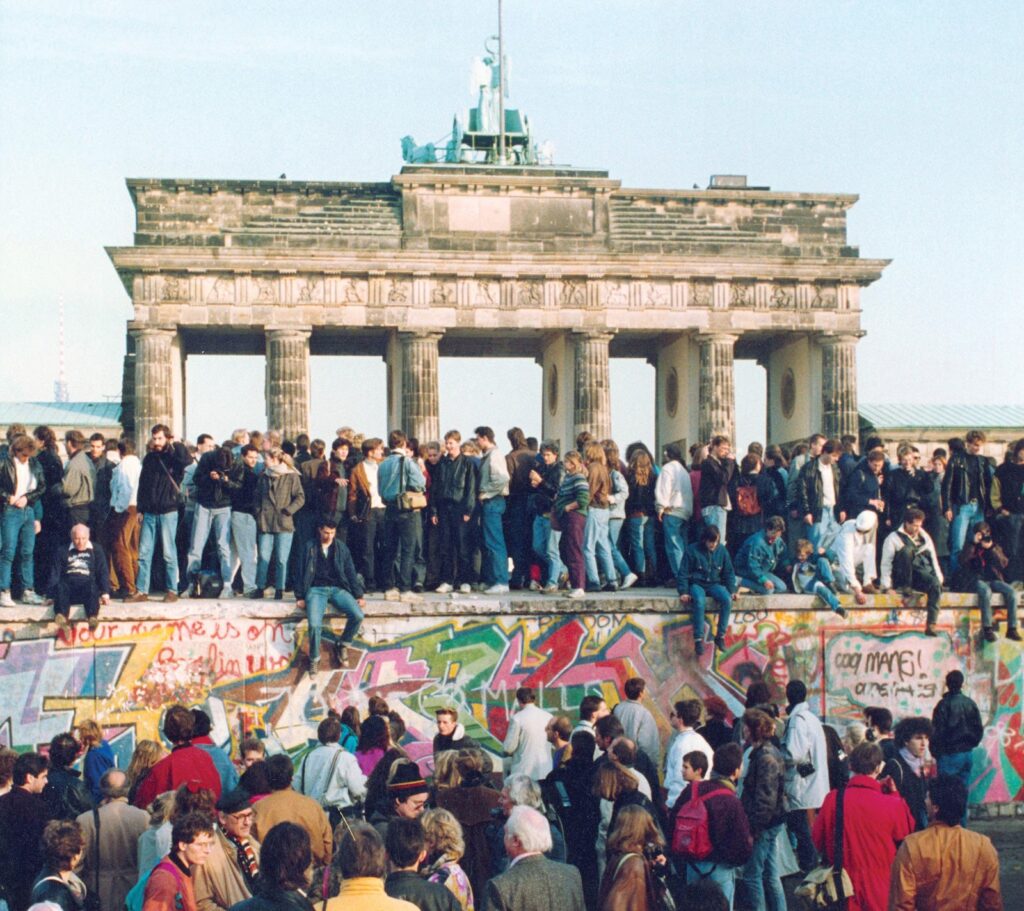
Meanwhile, crowds of East Germans camped out in the embassy grounds in Prague and Warsaw. By November 1989, the situation in the DDR had become so desperate that its government could think of nothing better than to allow its citizens to move freely from East to West Berlin. Liberalisation in Hungary had led directly to the breaching of the Berlin Wall, and there was no turning back. These steps led directly to the dissolution of the East German state, which had just ‘celebrated’ its fortieth birthday and the unexpected reunion of the two Germanys a year later, developments which had been unimaginable, even at the end of October 1989. Naturally, all this should be seen in the context of Mikhail Gorbachev in the Soviet Union, though the historical questions of cause and effect have still not been entirely settled.
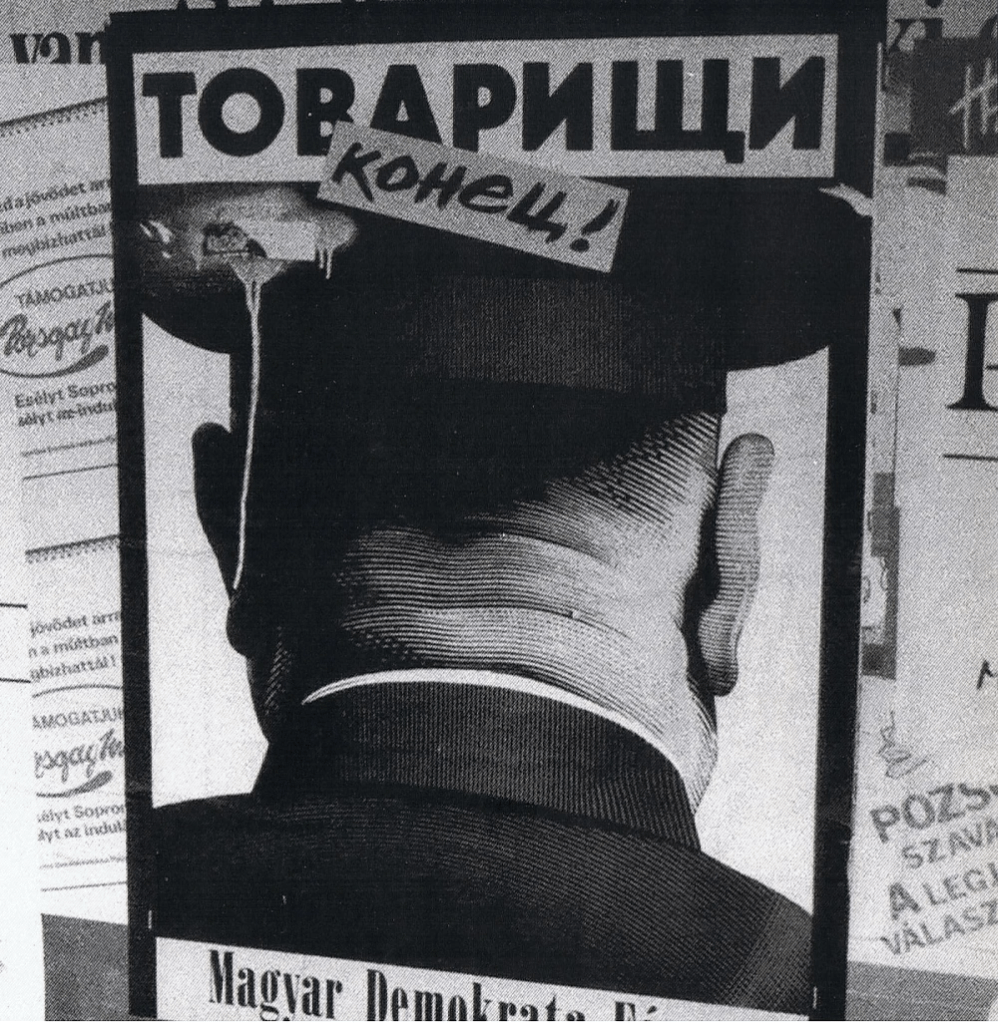
There was not much room left for the ruling Hungarian Party as 1989 came to an end, but they had not yet been squeezed out of power. Grósz, still the Party leader, agreed to hold a Party conference to negotiate with the opposition ’round table’. He may have calculated that the opposition would fall apart, allowing him to lead the country into and even after the elections of 1990. The reinternment of Nagy in the Rákoskeresztúr cemetery was a huge demonstration of how wrong both Grósz and Németh were about the prospects of their political survival. As if symbolically, on 6th July, just as the martyrs of 1956-58 were being reburied, Kádár had died. The parallel with Rajk and the martyrs escaped no one. Kádár’s principal victims were given pride of place, and Rajk’s son presided over the huge ceremony. Pozsgay’s own position often seemed closer to that of the opposition Hungarian Democratic Forum (MDF) than to his own party. Ahead of the elections, the Party’s posters (below) showed the thick back of a Russian general’s neck and head with the accompanying words, tovarishchi konets in Cyrillic Russian, ‘Comrades, it’s over’.
The truth was, and still is, that by the time George Bush visited Budapest in July 1989, Hungary had already ceased to be either a Communist country or a Soviet satellite. Senior politicians of all parties were talking seriously of joining the European Community (as it was then), and even NATO. John Simpson stood on the balcony of a flat overlooking the square in the city centre, where the US President was due to make a speech. The man accompanying him was an ‘Anglophile’ in his mid-forties. From his balcony, he looked down at the enthusiastic crowds starting to gather and commented:
“These little communists of ours are acting like real politicians… they’re giving people what they want, instead of what they ought to want. The trouble is, they can never give us so much that we can forget they are Communists.”
Simpson, loc. cit., p. 18.
Simpson wrote that his host was right about the unpopularity of the Party. A few days later, when he went to see Pozsgay again, he asked him whether he and his colleagues would really be the beneficiaries of the changes they were introducing. He answered:
“Who can say? I hope so. That’s why we’re doing these things. But to be honest with you, there’s nothing else we can do. Even if others win the elections, there’s no serious alternative to doing what we have done.”
Ibid., p. 19.
But to paraphrase Fidel Castro, History did not absolve them. The transition was nonviolent and seemed relaxed, at least to those who visited the country at this time. In July 1989, I led a delegation of teachers from Coventry to its twin county town, Kecskemét, in Bács-Kiskun County. When we met the town’s Communist mayor, I asked him if he felt he was living through ‘interesting times’, as referenced by the ancient Chinese ‘blessing’ (or ‘curse’, depending on your position and point of view). His ‘jokey’ response was that “sometimes the times are too interesting!” Hungary’s economy and environment had been horribly damaged by thirty-three years of Marxism-Leninism. Still, now, at least, it had finally shown the way to escape to the rest of Central and Eastern Europe. For Simpson, Pozsgay was one of the more important figures in the domino effect begun in 1988-89.
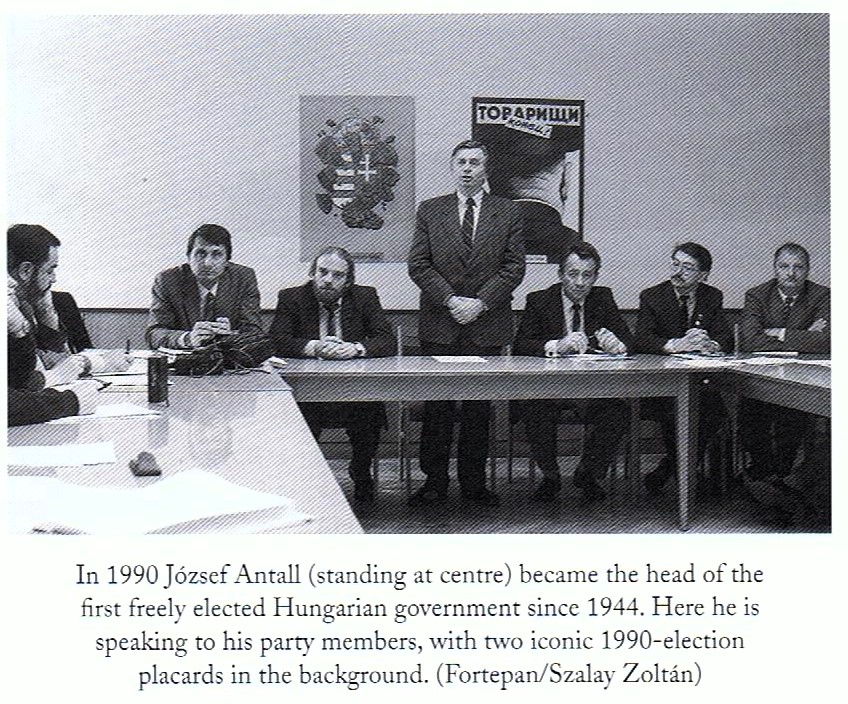
On 6th October, the Communists rebranded themselves as the Hungarian Socialist Party (MSzP). Pozsgay harboured hopes of becoming President, but the SzDSz and Fidesz blocked this in a referendum on the results of the ’round table’ (had there been an early Presidential election, he probably would have won). A new constitution was adopted by the old parliament, and a new ‘Hungarian Republic’ was proclaimed on 23rd October outside parliament and declared, the second democratic republic after the one that existed briefly between 1946 and 1949. Pozsgay may have felt cheated out of the presidency, but the new President, chosen by the new parliament after the elections of 25th March, was Árpád Göncz, associated with the SzDSz, who had been imprisoned for six years after 1956. He had used his time in prison to develop his English to the extent that he was able to translate Tolkien’s The Lord of the Rings. Twenty-eight parties emerged, some re-formed from pre-communist days, and the centre-right MDF won a large majority, despite ‘western’ help to the SzDSz. József Antall was an imposing figure, much respected internationally, and he did a deal with the liberal SzDSz, dominated by former dissidents, which gave him the two-thirds majority with which, if necessary, he could change the constitution.
The Stone of Atonement & Divisions in the Nineties:
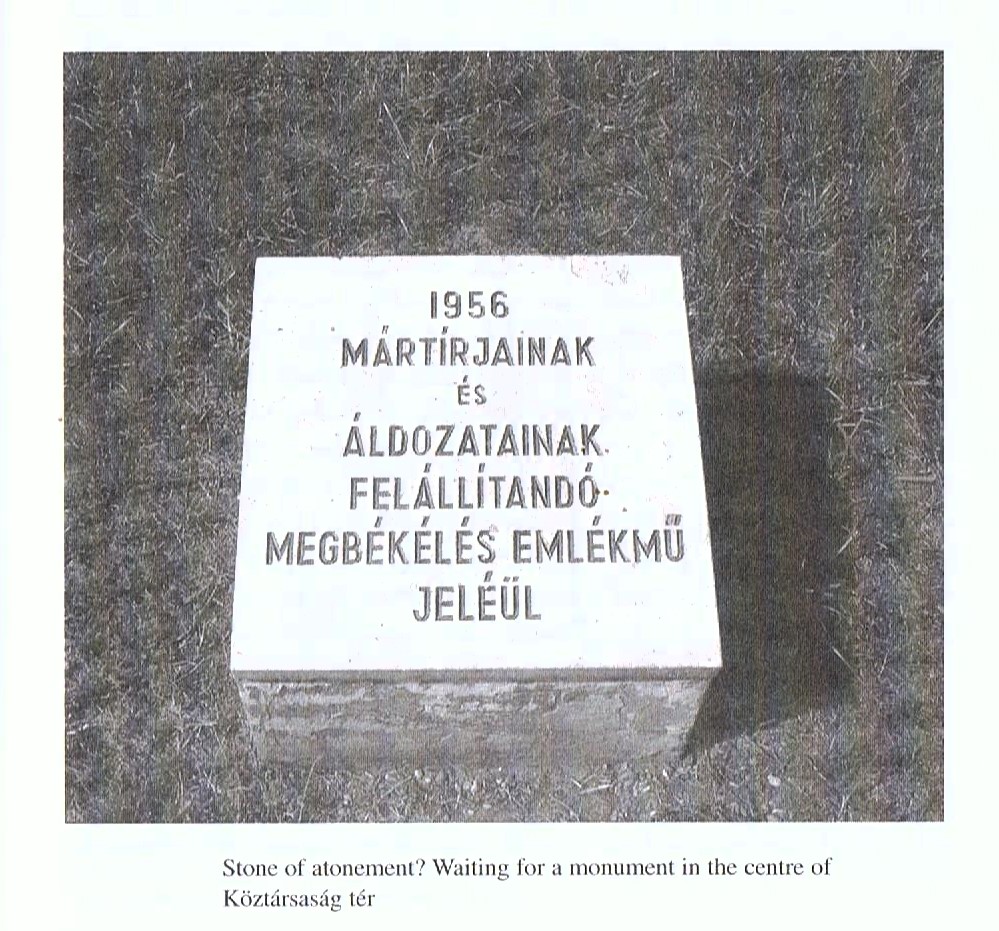
In 1991, a symbolic foundation stone for a ‘monument of atonement’ was placed on Köztársaság tér, its inscription referring to both the martyrs and victims of 1956. But, as Dent commented, if any kind of monument of atonement or reconciliation is ever to mean anything, the difficult issues of 1956 need to be addressed first. One of the most surprising discoveries Dent made was that of a public opinion survey about attitudes to 1956, published in 2003. Sixteen per cent of respondents indicated their view that 1956 was a counter-revolution, the official view during the Kádár era. Although not a large proportion, neither is it insignificant, particularly considering it was recorded fourteen years after 1989, when the notion had been officially dropped, and had been repeatedly discredited ever since. Clearly, the national psyche had not been fully purged of the view, and public divisions still remained.
It wasn’t the case that the other 84% were all of the same opinion, however. Those who were happy with the term ‘revolution’ amounted to 53%, while the others preferred alternative terms, including ‘people’s uprising’ (14%) and ‘freedom struggle’ (13%). In his final chapter, Dent attempted to explain why so many regarded the events as a counter-revolution. He understood, as an ‘outsider’, that, during the Kádár era, the ‘orthodox’ communist view was that the events of 1956 constituted a counter-revolution for multiple reasons. These included the destruction of communist symbols and attacks on party buildings, the ‘fascist’ atrocities that took place, and the belief that the underlying orientation of the events was towards a restoration of capitalist relations of production. In Dent’s view, none of these could be substantiated clearly enough to justify the label ‘counter-revolution’ being applied.
True, red stars and other Soviet-style symbols were torn from buildings, including the Stalinist crest, cut from the national flag. Yet, at the same time, many Party members participated in the events, including in the street-fighting bands and the workers’ councils, which resisted the longest. They also included Imre Nagy and the political leadership in the government and among the ‘reform communists’. The attacks on Party buildings and assets were attacks on its monopoly of power, not on the ideology of socialism or on workers’ power. Certainly, there were many nationalists and reactionaries who grouped around Cardinal Mindszenty and other church leaders, but it is difficult to find evidence that the overall orientation was towards capitalist restoration or fascism. The leader of the revived Smallholder Party, Béla Kovács, Nagy’s minister of agriculture, told his supporters that “no one should dream of going back to the world of aristocrats, bankers or capitalists – that world is definitely gone!” His words were echoed in countless proclamations issued at the time, most notably by the many workers’ councils. ‘The factory is ours and should remain so under workers’ control’ was their mantra.
After Antall’s death in 1994, there were elections, which the MSzP won with over half the vote. Gyula Horn, with his long experience in government and his closeness to the Germans, used the remaining resources of the Communist Party to good effect, developing a network of media allies. Becoming Prime Minister, he did a deal with the SzDSz and faced little opposition to the left. However, Fidesz managed to clear the electoral hurdle, and Viktór Orbán matured quickly as its leader. Miklós Németh found his role at the European Bank of Reconstruction and Development. The European technical bureaucrats found more common ground with men like Németh than with the anti-Communists. These years became associated with a perceived Western capitalist takeover of Budapest and its classical cityscapes. There were well-founded allegations of corruption, with the British taking an interest in the property market or (in the case of Tesco), buying up land, in the hope of building up a vertical production-to-sale structure. The French and the Germans also moved in with new chain-stores.
In the countryside, the Roma (‘Gypsies’) took over the emptying villages on the Great Plain and in eastern and southern Hungary, accounting for twenty per cent of the population, which stimulated some vicious reactions. In Communist times, they had taken over much of the property in the Old Palace Quarter of Budapest as well, and since middle-class parents did not want their children educated in the same schools, property prices remained astonishingly low. ‘Foreigners’ arrived, including many ’56-veteran exiles, who stood out because their Hungarian was often semi-forgotten. In the 1998 election, the Socialists took 35% of the votes, but their associates in the SzDSz collapsed, some of its leading members finding a refuge in the Central European University, opened by George Soros at around this time. A government of the right followed, dominated by Fidesz. Viktor Orbán had moved the party to the right and now spoke for Christian nationalism and the family in a style far removed from the rhetoric he had used a decade earlier, when he had been irreverent and his relations with the MDF frosty. But Orbán reckoned that the MDF had lost because Antall did not play politics properly, did not cultivate business links and did not have a friendly newspaper.
In 1999, István Bart published his Hungary & The Hungarians: The Keywords – a concise Dictionary of Facts and Beliefs, Customs, Usage & Myths. This included a definition of the 1956 revolution, forradalom (in Hungarian), as…
‘the bitter, desperate uprising against the Soviet Empire… one of the few events in the history of Hungary that was also of importance to the history of the world as a whole; the euphoric experience of the precious few days of freedom that followed the rapid, overnight collapse of an oppressive régime could never be forgotten, despite the forty-six-year-long, strict taboo against any mention of it; its defeat left an equally deep mark on the nation’s consciousness, as did the painful realisation that Hungary’s fate was decided by the Great Powers, and not the bloody fighting on the streets of Budapest; none the less, the events that led to the change in régime (‘rendszerváltás’) became irreversable… when it was openly declared that what had happened in Hungary in 1956 was a revolution and not a “counter-revolution” (‘ellenforradalom’).’
Bart, 1999, pp. 58-59. Budapest: Corvina Books.
Bart also defined the term ‘rendszerváltás’ (‘régime change’) as it referred to the changes of 1988-1990 in Hungary. He began this by suggesting that these would not have happened without the ten-year-long preparation for it by the intelligentsia and the opposition, who later split into various camps, not to mention the political and personal daring with which they defied the weakened Kádár régime, whose economy was in its death throes by the 1980s. By then, it was a ‘soft’ dictatorship, but an unpredictable one, and the intelligentsia were rehearsing its fall in hundreds of discussions and articles that went largely uncensored. Without this background, he claimed, the Hungarian people would not have been psychologically prepared for the change that they knew, instinctively, was coming and would not have known what to do when it finally happened.
As a result, it was not simply a spontaneous explosion of ‘people power’ like those that happened in East Germany, Czechoslovakia and Romania, but a return to parliamentary democracy, ushered in by a clear and complete national consensus, which even the subsequent infighting between opposition factions could not alter or ultimately undermine. The régime change was not brought about by a small oppositional élite, but through the embodiment of popular political culture. It was this change of perspective that had changed during the second half of the eighties, and the pressure from homo kadarikus, the little man of the Kádár era, who kept his distance from the élite and entertained a healthy scepticism of politicians in general, which brought about the monumental change which became known as the rendszerváltás or, in the active voice, the rendszerváltoztatás.
By the time Bart was compiling his dictionary a decade later, a neologism had entered it, vállalkozó, a Hungarian interpretation of ‘entrepreneur’ (for which no English equivalent has ever been found either, hence its use in the original French), the symbol of the the new, self-conscious bourgeoisie who emerged in Hungary in the nineties as a result of the régime change. It began its life as a badge, or motto of sorts, but soon began to take on perjorative connotations, until, by the time of the Fidesz-dominated government of 1998-2002, it had acquired a decidedly derogatory connotation. Ordinary Hungarians and the urban intellegentsia were soon put off by the “get rich quick” mentality which accompanied the régime change, and, resulting from well-publicised corruption cases, they became suspicious of the new ‘profession’, so that the word became synonymous with ‘mafioso’ which had originally appeared in Hungarian in the late 1960s at the time of Kádár’s economic reforms. The Fidesz free market policies soon fell prey to this popular antipathy and, with few allies among the alienated intelligentsia, Orbán narrowly lost the election in 2002, after a campaign of media contempt he never forgave. When he returned to power in 2010, he was determined that this would not happen again.
A New Millennium – Bringing Past & Present together:
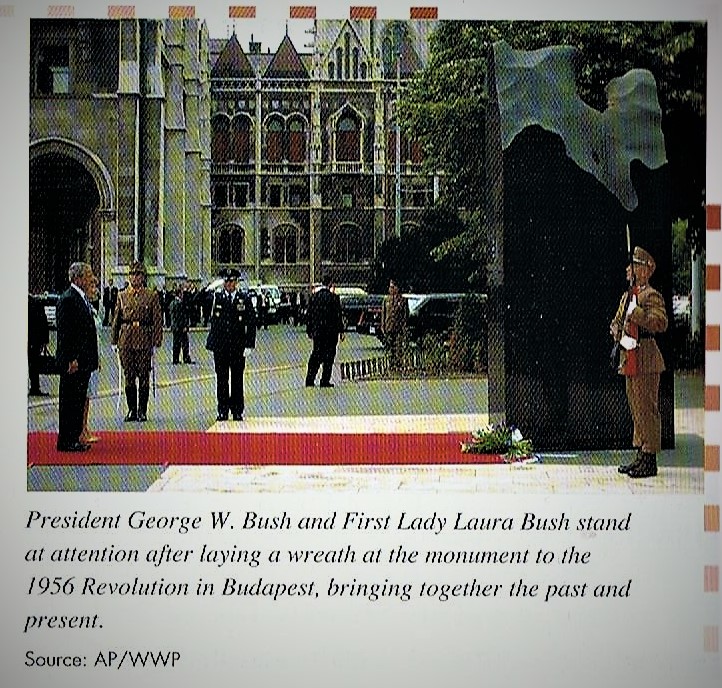
Meanwhile, in 2006, US President George W Bush visited Hungary on the fiftieth anniversary of the events of 1956, by then generally referred to, nationally and internationally, as a ‘revolution’ (forradalom).
Two years later, the British writer Bob Dent published his second book, Inside Hungary from Outside in, which included a final chapter reflecting on the writing of his 2006 book on Budapest in 1956. In it, he admitted that he had never been happy with the term ‘revolution’ as applied to the events of 1956. A revolution meant, for him, a radical change in the structure of power, not simply an outbreak of violence or a change of rulers if the nature of rule itself was maintained. The events of 1956 were too short to bring about a real change in power relations, though there may have been a revolutionary element in those events. That element was best represented by the many village and town councils that gained a measure of power, and by the widespread emergence of workers’ councils in the cities, including Budapest. To a large extent, however, the workers’ councils have remained ‘hidden from history’. Their existence in opposition to Kádár at the start of his rule exposed the flaw in the classical Leninist proposition – that the Party necessarily represents the interests of the working class. According to Gati, there were four main actors on the stage of Hungary’s 1956 history – Imre Nagy and his government, including the allies of the reform communists, the armed insurgents on the streets of Budapest (and elsewhere?), the US government and ‘Radio Free Europe’, and the rulers in the Kremlin.
Hannah Arendt’s Reflections on the Hungarian Revolution in her renowned The Origins of Totalitarianism (New York, 1976) is often quoted and referred to as a positive appreciation of the 1956 events, but those who have done so have rarely focused on her comments about the direct democracies of the councils as being what was most significant in their emergence. She described how these councils, whenever they have appeared in history, were met with utmost hostility from the party bureaucracies and their leaders from right to left, and with the unanimous neglect of political theorists and political scientists. The role of such councils was absent in the 1988-90 régime change, which was, instead, far more concerned with fulfilling the desire to accelerate privatisation and to further the development of a free-market economy, following the concept of Glasnost in the Soviet Union. Demands for such changes had been virtually nonexistent in 1956.
In 1994, when Árpád Göncz made his speech on the 38th anniversary of the execution of Imre Nagy, on the theme of national reconciliation, his words, quoted above, carried considerable weight and significance. But since then, it seems that they have lost their ability to sink into the Hungarian political conscience and consciousness. Attempts to expropriate 1956 and its significance have continued unabated over recent decades, as exemplified by the different political parties and veterans’ organisations holding separate, parallel commemorative ceremonies on every 23rd October since the fiftieth anniversary in 2006. One of the most interesting books written for that anniversary was Charles Gati’s Failed Illusions: Moscow, Washington, Budapest and the 1956 Revolt, quoted above.
Gati, however, had nothing to say about the role of workers’ councils. This may have been because, for many in the West, including those – like Gati – with Hungarian origins, workers’ councils did not fit neatly into any ‘acceptable’ category. Insofar as they were anti-Soviet, or anti-communist, or perceived as such, that was acceptable. But not if they were ‘anti-capitalist’ and ‘pro-socialist’ or even ‘pro-revolutionary’ in the sense that they were firmly in favour of maintaining the social ownership of property and putting it under workers’ control. The councils have been described as ‘anti-Soviet soviets’, but for many, that apparent oxymoron has been difficult to apply in post-1989 Hungary. Historians and other writers have tended to avoid the issue by using the term ‘uprising’ to describe the events of 1956. The term seemed more neutral, not having the definitive sense of ‘revolution’. The 1989 Communist Party’s announcement that the events amounted to a ‘people’s uprising’ politicised the term too much for some commentators.
It was perhaps predictable that politicians in particular would selectively use the ‘collective memory’ of 1956 to bolster their positions. One idea which emerged involved the notion that the rendszerváltás (régime change) of 1988-90 was a full realisation of the ideals of 1956. There were many overlaps between the goals of 1956 and those of 1988-90: the idea of national independence, the demand for pluralism and a multi-party system, a free press and the end of all forms of dictatorship. But 1988-90 was also quite different in that it involved elements that were not present in 1956, and omitted elements that were. In terms of omissions, the factory-based workers’ councils and locality-based revolutionary committees which sprang up all over the country in 1956 were significant components of the revolution itself. The first workers’ council to appear did so in Diósgyőr, in the industrial north-east, on 22nd October, the day before the famous events in the capital. These bodies represented a form of direct democracy somewhat different from the forms of a multi-party parliamentary system and from the classical Soviet-style one-party system.
The Horn government of the nineties had pursued privatisation, encountering allegations of corruption, and its successor, in power from 2002 to 2010, also discredited itself, with one corruption scandal after another, as ‘clever’ former Communists helped each other, using ‘Europe’ as an excuse. The Prime Minister, Ferenc Gyurcsány, had grown up in poverty, the child of a single mother who had emerged in the Kádárite era as a youth leader. He had married, for a third time, into a rich Communist dynasty and moved into an imposing villa in the smart part of Buda. He had an idea that he could become Hungary’s Tony Blair, modernising the party to free it from dependence on welfarism and trade unionism.
The return to populist-nationalism under Orbán:
After the 2010 elections, Fidesz returned to power, with Orbán still demonstrably in charge, perhaps the best-known European leader beyond the Franco-German axis. But the heart of the Hungarian return to populist-nationalism under Orbán was the result of the failure of the Left. The task of reviving it this time was beyond Gyurcsány, because, as Stone put it in 2019, the old Communist bulwarks were still there, preventing the deep structural reforms that post-Communism needed. In 2006, at a ‘private’ Party meeting at Lake Balaton, he was covertly recorded as candidly telling the faithful that the government had done nothing except that:
“… we have been lying morning, noon and night.”
When mass protests followed, orchestrated by self-righteous Fidesz supporters, Gyurcsány permitted the police to behave brutally. On the fiftieth anniversary of 1956, there was, in the populist’s terms, a Communist prime minister and blood on the streets of Budapest once more. Then, the financial crisis of 2008 found Hungary very badly exposed, and in 2009, with a budget deficit of ten per cent of GDP, and with support from the IMF amounting to three times as much as all the privatisation had brought in, Gyurcsány resigned. The following year, Viktor Orbán was back in office with a majority large enough to draft a completely new constitution, with a clear mandate to put an end to Communism in all its forms. Norman Stone described this moment as:
All in all… a moment of hope, not a normal feature of Hungarian history, and it is symbolised by the re-emergence of Budapest as a sparkling European metropolis, the great architectural monuments being restored.
Norman Stone (2019), p. 245.
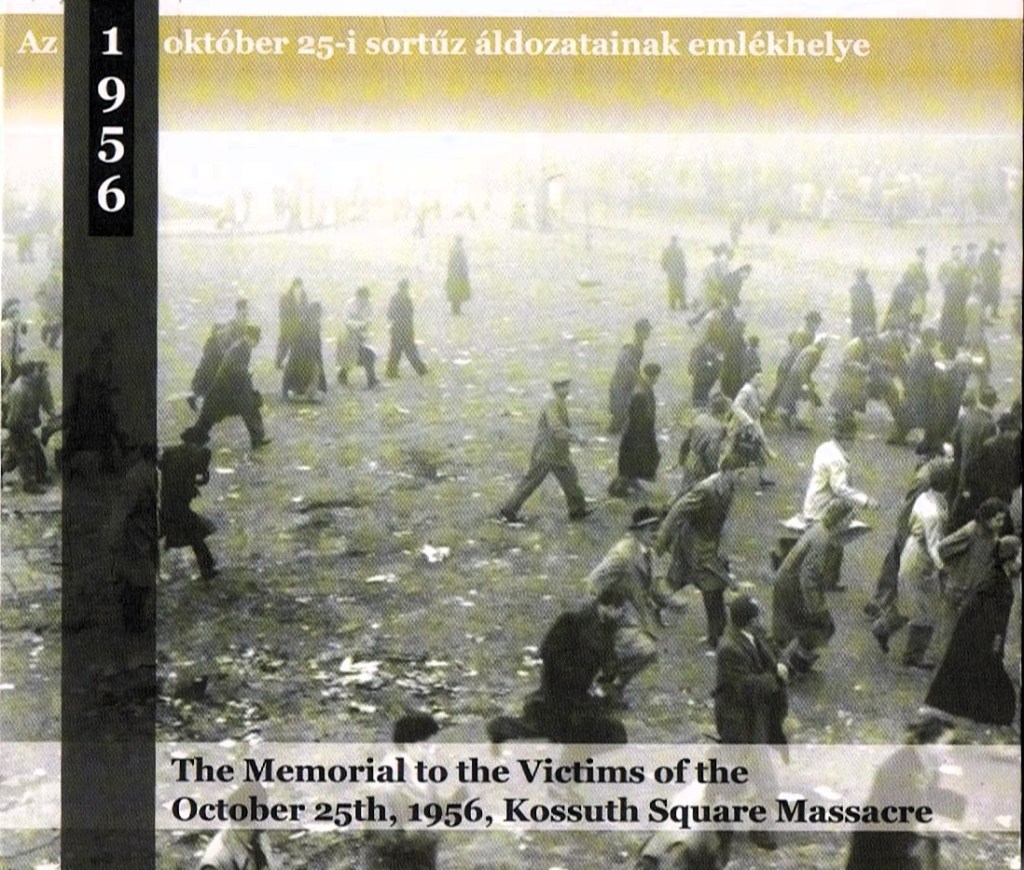
On October 25th, 2014, an exhibition opened, alongside a permanent memorial, to the victims of “Bloody Thursday”, 25th October 1956, in one of the Parliament building’s ventilation shafts under Kossuth Square. By then, the day had entered the Hungarian national consciousness as the bloodiest massacre of what had become known as ‘The 1956 Revolution and War of Independence’. A film was produced by the Directorate of Cultural Affairs of the Office of the Hungarian National Assembly. Its sleeve-notes included the statement:
“On this day, due to still unknown circumstances, Soviet soldiers and Hungarian state forces opened fire on the peaceful protestors gathered in Kossuth Square.”
Posters proclaiming, ‘Enough is enough!’ were plastered over the sides of buildings in Budapest in autumn 2016, depicting armed revolutionaries of 1956, the legendary lads of Pest: youngsters in berets, holding machine guns or Molotov cocktails ready to throw at Soviet tanks. The poster campaign was the beginning of a year-long series of celebrations organised by the government for the sixtieth anniversary of 1956. Orbán asked Mária Schmidt, director of the House of Terror, to develop the concept of the anniversary. She decided not on a consensual, national commemoration attempting to interpret the past, but on an image of 1956 that served Fidesz’s own sectarian purposes. To achieve this, she was given a budget of 13.5 billion HUF, her own workshop of scholars and intellectuals, and countless media and propaganda outlets controlled by the governing party.
The Shaping of Collective Memory, 2016-19:
Orbán and Mária Schmidt knew by then that collective memory could be shaped and was thus an important political tool. They also knew that history is not the same as collective memory, which emerges out of history as a result of an arduous process in the public sphere. To understand history, it is necessary to develop an awareness of the complexity of primary and secondary sources of evidence, of bias and objectivity, and of competing interpretations and narratives. The web of causation and motivation needs to be analysed carefully. Collective historical memory, on the other hand, is created through a selective process, subject to bias and prejudice, and usually observes past events from a single perspective, producing a narrative of archetypal ‘goodies’ and ‘baddies’, just as in a fairy tale. For the 2016 anniversary, the ‘official’ narrative of the 1956 Uprising was built precisely on this model. It captured an easily digestible moment for posterity in the image of heroic youngsters throwing petrol bombs at Soviet tanks. The ‘lads of Pest’ was one of the strongest tropes that became fixed about the 1956 revolution. Orbán had long identified himself and his party with them.
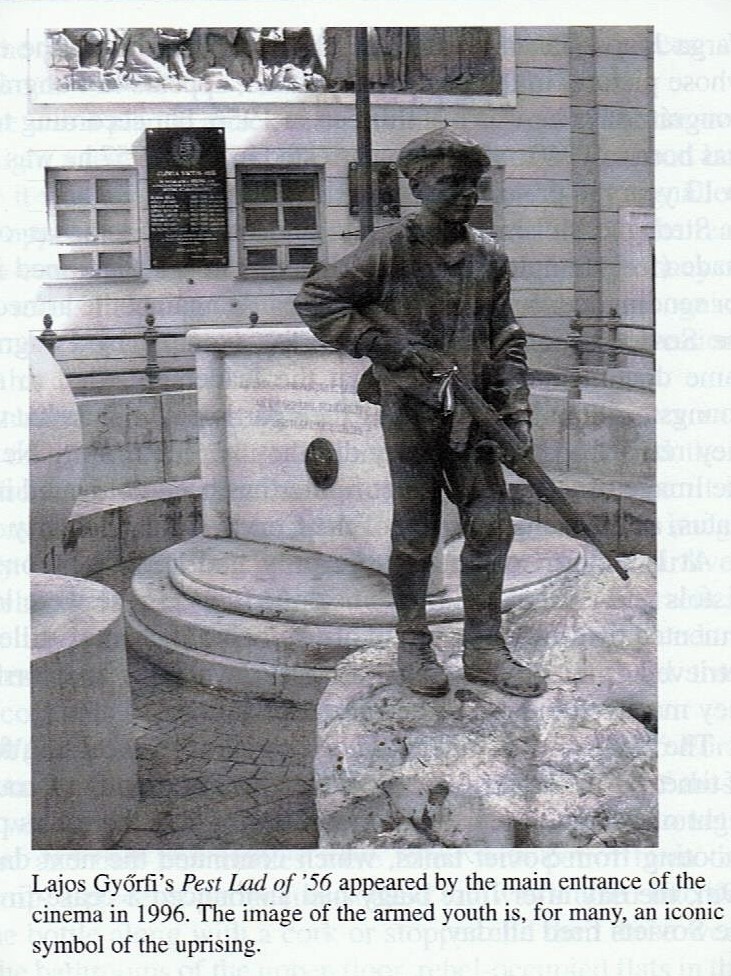
The other trope of 1956 was that of the reform communist Imre Nagy, who, after the fall of the revolution, said in his famous speech in court: ‘I do not ask for mercy!’ But since his speech at the reinternment of the heroic prime minister of 1956, the martyred PM has been deleted from Orbán’s pantheon of the revolution. Quite simply, Nagy did not fit into Orbán’s rewriting of Hungarian history. By erasing reform communists from the official historical record, Orbán has enhanced his own personal role by demonstrating his dubious anti-communist credentials. He has since used this myth also to reinforce the foundation of his régime on sovereignty, which is always under threat, and must be protected at all costs. Orbán dealt with this theme in his commemorative speech of 2016:
“We Hungarians have a natural capacity for freedom. … Freedom is always, everywhere, a simple question: do we decide about our own lives, or does someone else decide for us?”
Viktor Orbán’s speech on 23rd October 2016, Prime Minister’s Office (ministerelnok.hu).
Orbán’s 1956 campaign followed an old memory mantra, present for centuries in Hungarian collective thinking, which followed this model:
- “A country still mourning its former glory experiences a foreign threat;
- Overcoming their mourning, Hungarians enthusiastically confront the foreign threat and take up arms against the oppressors;
- They fight to the end, even when there is no longer hope, and their only consolation can be glorious failure;
- Yet they are sustained by the illusory hope, projected into the future, that there will come another glorious moment to rise up.”
Ferenc Pataki, ‘Collective memory and memory policy’ (Hungarian), Magyar Tudomány, vol. 171, no. 7, 2010.
The 1956 commemoration anniversary was built on this populist ‘fairy tale’. This can clearly be seen in the 1956 ceremonial speech by László Köver, chair of Parliament:
“The power of the Hungarian revolution brought it to victory, even though it was overcome by the enemy’s superior force, and deserted by the outside world, and this power lay in the people, in the Hungarian populace … The 1956 revolution was not one of the élites, of reformist communist party staff members, of various groups of intellectuals, but a revolution of the people, of simple folk.”
László Kövér’s speech at the ceremonial session of Parliament on 23rd October, 2016. (www.parliament.hu).
Orbán’s ceremonial speech reinforced this ‘simple’ narrative. On 23rd October 2016, he proclaimed to the ten thousand people celebrating outside parliament, decorated with the flag without the Soviet crest:
“Nobody knows where Hungarian find the strength and skill; every hundred years, attacking out of nothing, like David with his sling, they are capable of miracles.”
‘Russian military action reminds Orbán of 1956’ (Hungarian), Index,14th August 2008.
Orbán’s new narrative for 1956 was as false as it was transparent. Like all revolutions,1956 was both complex and contradictory, in causation, course and outcomes. The truly heroic aspect of it was precisely what Fidesz have been trying to erase over the past sixteen years. In the brief two weeks of the Uprising, Hungarian society, ground down by Stalinism, proved itself capable of rapid organisation and cooperation; Hungarians were able to overcome their prejudices and work together to achieve a higher goal. However, the true narrative does not serve Orbán’s political interests, which instead are built on a simplified mythology of good versus evil. Civic organisation and pluralistic democracy are not valued in his world. For Orbán, there are only two levels: the level of the individual and that of the ‘nation’. Between them, there is neither civic society nor institutions. In his speech given at the sixtieth anniversary, he stated: “If our homeland is not free, neither can we be free.”
At the concluding conference of the commemorative year, Mária Schmidt expressed her perspective on the lessons of 1956:
Hopefully, we have all learned from the example of 1956 that we can count only on ourselves, and we have to fight for everything for ourselves; the safest thing is if we take control of our fate with our own hands.
Mária Schmidt’s speech at the closing conference of the 1956-2016 commemorative year, 16th June 2017. http://www.magyarforradolom1956.hu.
But, in studying the posters of the commemoration and reading the speeches, we notice that the ‘Russians’ who were the oppressors in 1956 are nowhere to be seen. It seemed as though the Hungarian freedom fighters had fought against some generalised, gigantic ’empire’ belonging to various eras. But the Fidesz government’s propaganda programmes and the phrases drummed in ad finitum made it clear against which ‘foreign powers’ Hungary must conduct its freedom fight today: the multinational companies, banks, the International Monetary Fund (IMF), the powers behind the hordes of foreign refugees and, most of all, the European Union, or ‘Brussels’ in the preferred nomenclature. In 2016, the ‘lads of Pest’, as reinterpreted by Fidesz theorists, were fighting the twenty-first century ‘enemies’ of Hungary. For them, the key issue was how to protect Europeans from a global conspiracy of liberals in Europe that sought to turn the European into a ‘modern-era empire’. After the transformation of 1956, only one historical event remained for Orbán to complete the remaking of Hungarian history: 1988-1990, the régime change (rendszerváltás) itself.
In 2019, on the thirtieth anniversary of the end of the Cold War, all over Europe, there were commemorations of the fall of the Berlin Wall. Large events were held in Berlin, Prague, Leipzig and Timisoara (Temesvár in Hungarian) to celebrate freedom, the reunification of Germany and the tearing down of the Iron Curtain, but in Hungary, hardly anything happened, even though large historical commemorations had a great tradition and significance during the early years of the Orbán régime. In 2009, I had bought a copy of a commemorative photo album in Hungarian, ’89-’09, a rendserváltás pillanatai, depicting and describing the first decade of the party, published in memory of photographer Tamás Lobenwein, with contributions from Mária Schmidt, Viktor Orbán and other Fidesz leaders. It had a foreword written by Imre Pozsgay, the driving force behind the reform communist policies of the immediate post-Kádár period. In April 1990, when the first free elections took place, the reformed communists, now calling themselves ‘socialists’ (MSzP), had won only eight per cent of the vote, and Pozsgay and his colleagues were out of office, replaced by a centre-right government. Fidesz’s silence in 2019 was deafening because its leaders had decided to count the change of régime not from 1989, but from 1990. In light of this, it might now be difficult to grasp just how important 1989 was in the history of both Hungary and Fidesz. Back then, in January 1989, the nascent party was still an unknown opposition youth group; by December, it had grown into an independent, nationwide party and was sufficiently well-known to stand in the elections the following Spring.
After it lost power in 2002, Orbán’s ‘liberal party’ targeted the then vacant space on the political right; it became important for Fidesz, in attempting to gain conservative votes, to reinforce the historical narratives about the ‘Christian middle classes’ being oppressed by socialism, including narratives that were initially embraced only by ultra-conservatives, including anti-Semites. In the right-wing discourse of the 1920s, and again in the late 1930s and 1940s, during the hardening of the anti-Jewish laws, the term was used by them to differentiate the ‘Christian middle classes’ from ‘the Jewish bourgeoisie’. Initially, it was the rehabilitation of the interwar period and the reinterpretation of the Horthy régime’s role in the Second World War and the Holocaust that legitimised Fidesz for the traditional right-wing voters in the countryside. This was underpinned by anti-communism and anti-Semitism, though the latter was always denied whenever it was alleged by their opponents, as during the 2018 election poster campaign attacking George Soros and accusing him of being the chief architect of the migration crisis.
In the changing ‘collective memory’, October 1989 could therefore no longer be celebrated as the greatest moment of régime change since in 1989, since the communists, albeit of the reformed persuasion, had still been in power. Moreover, by 2009, they had twice returned to power as the MSzP (socialists), albeit in coalition with mainstream liberal democrats. In 1989-90, the reform communists participated in a negotiated transition of power and conducted negotiations with Mikhail Gorbachev, Soviet general secretary, over the withdrawal of Soviet troops from Hungary. It was they who had the reburial of Nagy and the other martyrs of 1956, which had started Orbán’s own career, and they who had facilitated the exodus of East Germans on holiday at Lake Balaton, cutting the wires of the Iron Curtain on the Hungarian-Austrian border. When the Berlin Wall fell in the autumn of 1989, institutional régime change in Poland and Hungary was well underway, soon followed by Czechoslovakia.
In 2019, the Orbán government held an extremely restrained commemoration for the thirtieth anniversary of 1989. The main attraction was a short film called Annus Mirabilis (Year of Miracles), intended to be shown at summer youth events and music festivals to remind the ‘younger generation’ in a patronising way of the historical era that had made their freedom possible. But the millennial generation did not fall for the propaganda, especially since, in the film, there was only a single Hungarian ‘hero’ of 1989: the young Viktor Orbán, demanding the withdrawal of Soviet troops. The film was immediately pilloried in the free press, or what was left of it by then, since the year was not about Orbán, though he was there, having been invited to make a speech on 16th June, which was widely acclaimed at the time. But the reburial of the heroes of 1956 was not organised by Fidesz, which barely existed as a party at that time, and the barbed wire of the Iron Curtain was not cut by Orbán. Neither was he a key protagonist in the round table negotiations which led up to the régime change, but was one of several dozen who participated in them. In addition, thousands of people were active in the opposition organisations, and hundreds of thousands took part in the anti-régime demonstrations. Many of the actors in the democratic transition of 1988-90 continue to live, write and make documentaries, which is why Fidesz has not (yet) managed to rewrite its narrative. For example, the Annus Mirablis film was, due to the protests about its bias, removed from the programme of the summer festivals, and no longer screened.
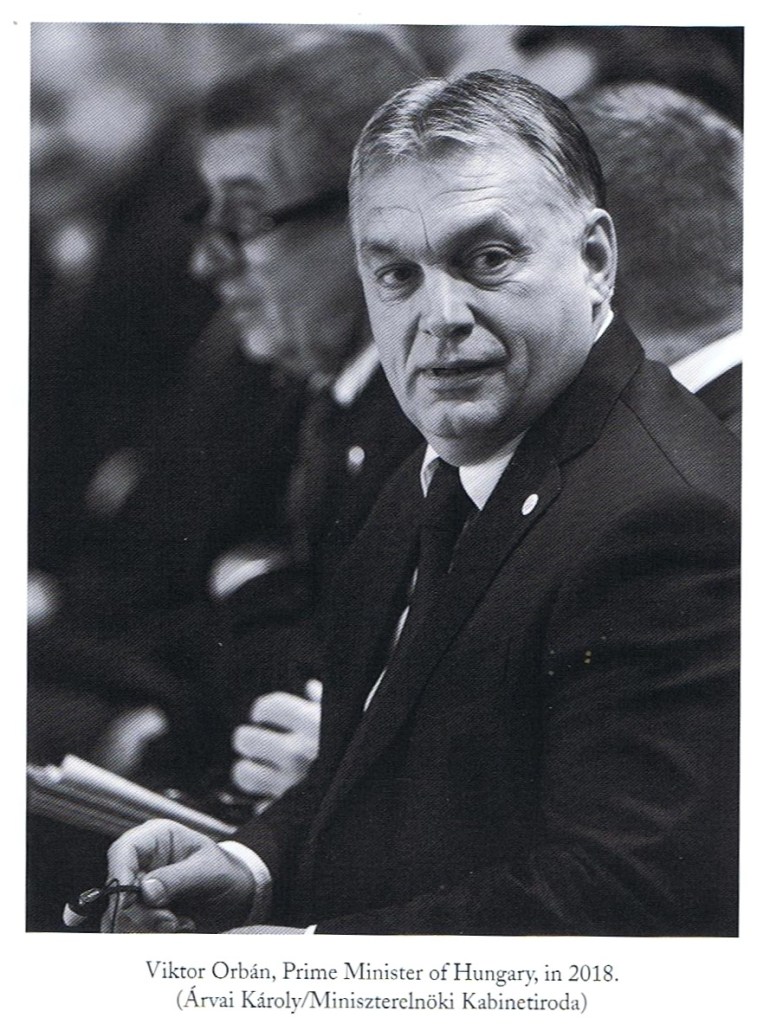
The Triumph of Hungarian Exceptionalism, 2019-22:
But Orbán did not give up on trying to rewrite the history of the régime change, because he still needed to present himself as the sole guardian of the Hungarian struggle for independence. According to him, ‘true Hungarians’ (his followers) are the true inheritors of the national traditions of freedom. On 23rd October 2019, he said:
“Hungarians are forever a freedom-loving people. … In the Western world, we seem to appear as the land of dictatorships, and somehow we need to explain, to ourselves and to the world, that this is a misunderstanding. … In Hungary, no anti-freedom political force has ever gained a majority without external military help.”
‘This homeland is not a free gift to us’ (Hungarian), Infostart, 23 October 2019.
Rather than being part of an internationalist rejection of Soviet imperialism, a result of Gorbachev’s ‘glasnost’ and ‘perestroika’, Hungary’s régime change was reinterpreted as an example of ‘Hungarian exceptionalism’. Almost every Hungarian family contained grandparents, born in the 1930s and 1940s, who had been confronted with difficult dilemmas. But other peoples in Central Europe had also suffered greatly throughout the twentieth century. But in Hungary, Orbán and his team simplified these human dilemmas and their complicated historical legacy, or they simply erased it. Using the myth of the ‘special Hungarian people’, Orbán had formed his own élite political community. He presented a positive narrative of Hungarian history, one of survival under victimisation. On the centenary of the Treaty of Trianon, in June 2020, he gave a commemorative speech in which he said:
“For Hungarians, the horizon of history lies at the millennial height. From this height you can look around, from this height you can see far… Back to the beginning of time. … We see that we Hungarians have neither disappeared nor perished, but have established our homeland in the ring of Latin, Germanic and Slavic peoples, preserving our unique quality. … There is not a single nation in the world that could have endured such a century. … Only one that walks his own Calvary can become a great nation. … Hungarians can never afford the luxury of weakness again. We can only have what we can protect. This is the law and this is our destiny. …”
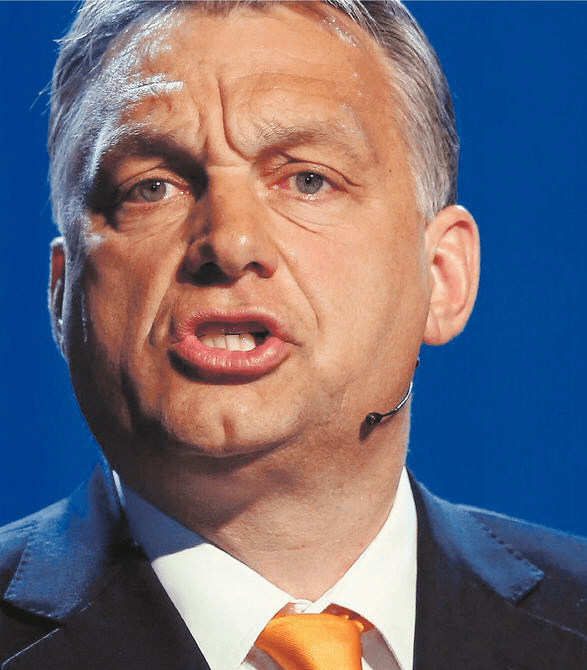
This speech is a perfect example of a populist fairy tale, to which he ascribes not only historical greatness, exceptionalism and superiority, but also strength and victory. The projection of the origin of the Magyars as far back as possible is a central idea in all ethno-nationalisms. Leaders of small Eastern European nations, which during the course of history repeatedly lost their independence, where the borders of the country moved backwards and forwards, and which, still today, are held spellbound by a nineteenth-century ideal of the nation-state, remain stubbornly partial to the rekindling of mythical historical precedents to legitimise themselves. Ultimately, he believes, a great prime minister cannot lead a defeated people, and to appear a victor, he has to rise up against greater ‘powers’: first and foremost, the European Union. Through his provocative anti-EU campaigns, Orbán seeks to demonstrate to his followers that he is capable of leading the Hungarians from the side of the losers to that of the victors. He seeks to build the belief that Hungary is greater than it truly is and that, despite being a ‘small country’, it is destined to accomplish great deeds, as a people created and chosen to lead in Europe.
In Fidesz propaganda, Hungary was always a victim, and though the crimes were committed by others, the nation’s suffering confirmed its self-image as heroic. The consequence of this, however, was to paint its history as a series of traumas, without the need for Hungarians to have a guilty conscience or to face up to any past failings. To project these ‘new’ historical narratives, Fidesz not only founded its own research centres, but also incapacitated several independent institutions that might suggest more self-critical and less comforting alternative narratives. Over the past sixteen years of Fidesz rule, a whole series of academic departments and institutions were closed down or integrated into a new system of government-controlled organisations, closely monitoring the historical research and writing in most of the universities and the institutional network of the Hungarian Academy of Sciences. In opposition to the independent academic research institutions, the mission of Orbán’s history research workshops is to establish an alternative historical memory and make it the collective memory of the Hungarian public.
Certainly, as Norman Stone concluded in 2019, there was, by then, not much doubt that the democratic transition had been mismanaged, not just within Hungary but also in the Euro-Atlantic political hemisphere. Antall’s dream of reaching the Austrian level within a decade was not realised, as I discovered personally in crossing the old Burgenland border into Hungary on returning from across Europe in 2011.
Returning to the quotation from Orwell’s 1984, with which I began this extended essay, in her 2022 book, Tainted Democracy, Zsuzsanna Szelényi asked whether those who falsify their own nation’s complex history are suited to create a successful vision for the future. Orbán’s ‘collective memory politics’ and mythology of ‘Hungarian exceptionalism’ over the past four years, in contrast to previous decades, have concentrated more intensively on fairy tales, imaginary primitive enemies and suppression, calling this very much into question. Rather than helping to create a consensual public memory, Orbán has created a new ‘fake’ version of the past. Without a shared discourse about the past, resulting in a shared vision of the future, Hungarians will continue to face great difficulties in navigating their way within the EU, the wider continent and the North Atlantic Alliance. However, this is unlikely to result simply from a change in government; it will require a further, fundamental change in régime.
Published Sources:
Zsuzsanna Szelényi (2022), Tainted Democracy: Viktor Orbán and the Subversion of Hungary. London: Hurst & Company.
Norman Stone (2019), Hungary: A Short History. London: Profile Books.
István Kontler (2009), A History of Hungary. Budapest: Atlantisz.
Norbert Lobenwein (2009), 89–09: A rendszerváltás pillantai. Budapest: Volt Produkció.
Bob Dent (2008), Inside Hungary from Outside. Budapest: Európa.
Bob Dent (2006), Budapest, 1956: Locations of Drama. Budapest: Európa.
István Bart (1999), Hungary and the Hungarians. Budapest: Corvina.
John Simpson (1990), Dispatches from the Barricades: An Eye-Witness Account of the Revolutions that Shook the World, 1989-90. London: Hutchinson.
István Lázár (1990), An Illustrated History of Hungary. Hungary: Corvina.
Gallery:
 Andrew James