

Episode Two: Conquest, Flight and Resistance, 1066-70
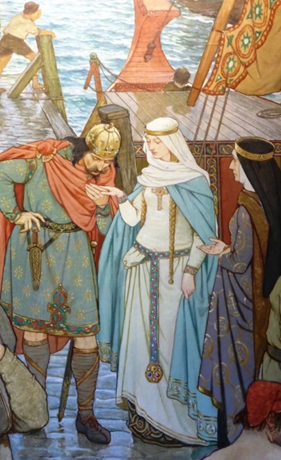
Scene Twenty; 1066 – The Norman Invasion:
After Hardrada’s defeat at Stamford Bridge, Harold was holding a celebratory feast at York, when news arrived of the Norman landing on the beach at Pevensey, 270 miles away. Harold’s army made the journey in under a fortnight, while Harold, on horseback accompanied by his guard of mounted knights, galloped ahead and paused in London for six days. The infantry bypassed London and headed directly to Pevensey in advance of the cavalry.
The Norman invasion of England was essentially different from the incursions of the Danes, Angles and Saxons before them. It was more like the Roman invasions, especially that of Claudius in AD 43, in that the invaders established themselves through a careful strategy, a well-organised expedition and a decisive battle. Once William had taken London and claimed the Crown, William then had to fight hard to retain and subdue his new kingdom and its territories. By the time of his death in 1087, the English, both Dane and Saxon, had been subdued and under Norman rule. Perhaps it was because of dramatic developments that followed, that the slender nature of the victory on that day in October 1066 tends to be overlooked.
Harold’s force at Hastings was classically Anglo-Danish in composition, comprising housecarls, professional men-at-arms, a permanent royal bodyguard founded by Cnut, an élite among the soldiers of Europe and those of the Saxon fyrds who had been able to answer the king’s summons. The housecarls were a mobile force that usually rode to the field of battle before dismounting to fight on foot. Although essentially infantry, therefore, they were well-equipped to challenge the apparent superiority of the mounted knight. At Hastings, it took over eight hours for the Norman knights to overcome the English defence. The housecarls’ most distinctive weapon was the long-handled, double-bladed war axe which was capable of bringing down both horse and rider with a single blow. Others would have been armed with javelins and swords, and all were armoured with knee-length tunics of mail, the hauberk, a conical helmet with nasal bar and a circular or kite-shaped shield.
Beyond fifty yards, the Danish short bow, the chosen weapon of Norman knights, was virtually ineffective against these defences and provided the housecarls could maintain a solid formation they were a potent deterrent to cavalry. The mounted Bretons fled when faced by the housecarls at Hastings, and only the weight of numbers appears to have overcome the surviving housecarls as darkness fell. That the horsemen could compete at all with heavy infantry was due to the introduction of the stirrup to Europe in the eighth century. But to the Normans it was never axiomatic that heavy cavalry should always fight mounted. Therefore, Hastings cannot be taken as demonstrating the innate superiority of either cavalry over infantry or the pre-conquest Norman military system over the Anglo-Danish.
William’s European army of about seven thousand fighting men was comprised of Normans, Bretons, Frenchmen from other provinces, Flemings, Italians and Sicilians. The uncertainties of the coming campaign dictated the need for a safe, large anchorage such as that at Hastings. He therefore moved his ships and troops along the coast to the port, ordered the construction of new defences, and proceeded to lay waste tot he surrounding countryside. It was vital for William’s plans that Harold should attack at the earliest opportunity. His strategy was based on a single conclusive victory in battle, and therefore involved destructive provocation and pillaging from as soon as he had arrived on the south coast, making Harold come to him, so his offer to English king to let him keep the earldom of Wessex was a ploy, as it had been fifty years earlier when made by Cnut to Eadmund Ironside.
Twenty-one; Senlac Hill, October – November 1066:
Harold hastened to give battle, therefore, since he heard that his lands near the Norman camp were being laid waste. He also hoped to catch William unawares, but the night-time attack William had been expecting never came. Instead, Harold’s army gradually reformed at an ancient landmark called the Grey Apple Tree on a long ridge of open land named Senlac. It was there that the Norman army chose to attack in plain sight on the morning of 14th October. Harold was therefore forced to give battle before all his forces had been amassed and arrayed.
His army of approximately 7,500 men was composed of two thousand housecarls, deployed on foot to stiffen the fyrd, each one of them charged with holding their position. As long as they did so, they would be very difficult to dislodge. Having seized the hilltop, the English arrayed themselves in their favoured formation, dismounting and forming a shield wall. Harold took his place in the centre of the line, planting the white dragon standard of Wessex on the summit of the hill. It was ultimately the death of Harold, earl of Wessex, which brought about the fall of that standard and the defeat of the English army.
Harold may have been hit by an arrow, possibly in the eye as the Bayeux tapestry seems to show and every English schoolboy now seems to know, but the many contemporary written accounts which are used to support this conclusion were Norman in origin and tried to play down the brutality of the final assault on Harold’s guard. William Malet, a pre-Conquest Anglo-Norman, witnessed this and reported it to Edith (Swan-neck), Harold’s first wife, after the battle. She had to identify Harold’s body, since it had been so badly maimed and mutilated that only someone who knew it intimately could do so, by certain marks.
The portrayal of Harold being killed by an injury to his eye is both legendary and mythological, a deliberate reference to Harold’s treachery in the Norman narrative. As already referenced, the common punishment for traitors in early medieval Europe was blinding, so that this legendary element, added for the tapestry, was therefore heavily symbolic. For many Saxons, in addition his Norman detractors like William of Poitiers, Harold was an untrustworthy king. In reality, the final phase of the battle came late in the evening when the Norman knights, under high-angle cover of fire from their newly re-equipped archers, broke through, by sheer weight of numbers, the position which had been held for eight hours, now severely reduced. When William observed Harold and his brothers being cut down by the swords of his knights, he ordered his mounted guard to ride to Harold’s position to deliver the coup de gráce. Those who recorded his slaying also describe him fighting to the last, wielding his sword. No doubt he had sustained many wounds, but it is difficult to envisage that he could have continued this kind of hand-to-hand combat with an arrow in his eye!
The defenders on the ridge were overwhelmed and although a body of housecarls rallied to fight a rearguard action at a feature behind the ridge named Malfosse, the battle was lost and the fyrd left the field, having witnessed the slaying of their king, and were pursued until long after nightfall by the Normans.
On the eve of the battle, William of Poitiers had recorded his description of Harold as a man soiled with lasciviousness, a cruel murderer, and an enemy of God and the Just. These words may help to explain the brutal nature of Harold’s death. Copying from this account, the Anglo-Norman scribe, Orderic Vitalis, changed the description of the Saxon king to a brave and valiant man, strong and handsome, pleasant in speech and a good friend to his followers. However, Orderic does not pass judgement on whether Harold was willing to break his oaths and murder those, like Edward the Exile, who stood in his way.
After witnessing Harold’s killing, but before the bloody conclusion of the battle, Morcar and Edwin left the field for London, presumably to secure Harold’s successor, Eadgar Aetheling. Harold had kept Eadgar away from the field. On reaching Westminster, they immediately sent their sister, Harold’s Saxon wife Ealdgyth and now widowed queen, out of harm’s way to Chester. With Harold dead, the two earls now promised to fight for Eadgar, who was elected by the Witangamot and proclaimed King by Stigand, Archbishop of Canterbury, supported by Ealdred, Archbishop of York.
Meanwhile, on the battlefield, Harold’s mother, Gytha, appeared among the carnage to plead for the return of her son’s body, which had been taken to Waltham Abbey to be identified by Edith Swan-neck, his Danish first wife. But Gytha’s request was refused by an angry William, who argued that it would be inappropriate for Harold to be interred while so many others were left unburied, having lost their lives because of him. It seems likely that the body was removed to Waltham some days later when William had left Hastings.
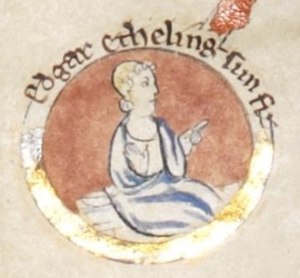
William was waiting there to see if there would be a formal surrender. But by proclaiming Eadgar king, the English signalled that they may have lost a close-fought battle but they had not yet given up the war to maintain their independence. Edwin and Morcar still thought that they could rally their earldoms, Wessex and East Anglia, around the Aetheling, and continue the resistance to the attempted Conquest. When no surrender came after a fortnight, the Duke of Normandy proceeded to ravage the south-east, including Romney, Dover (for a week) and Canterbury, punishing the people for not accepting him as king by victory in battle. Then, when he heard of the election of Eadgar, he ordered a siege of the city of London.
The Normans torched all the houses on the south bank of the Thames. However, they failed to cross the river to capture the city and so William led his troops along the Thames westwards, eventually crossing the river at Wallingford. The English chroniclers tell us that, on the way, William harried that part of England through which he advanced. John of Worcester wrote that the Normans laid waste to Kent, Sussex, Hampshire, Middlesex and Hertfordshire.
Following Harold’s death at Hastings, Edwin and Morcar had concurred in the election of Eadgar but, disappointed of their hope of a second battle with William under his banner, soon left the city with their remaining forces and returned tot he north, believing that the Conqueror would not advance so far. They had proposed that the Witan should elect one of them king, but failed to take effective steps to stem the Norman invasion and therefore left themselves no alternative but to submit to Duke William.
Twenty-Two; Dec. 1066 – The Berkhamsted Submission:
Wallingford was the first crossing up river from London Bridge which could safely be used by an invading army still in the thousands. There, Stigand became the first Saxon magnate to submit to William and to renounce his earlier proclamation of Eadgar as successor to Harold. By then, Ealdred had, in any case, already emerged as the spiritual leader of the English resistance throughout the country. But as William continued to harry the home counties, and as winter set in, Eadgar showed no desire to continue to resist William at the expense of the English population. In order, no doubt, to end the retribution, Eadgar was eventually persuaded to submit and pay homage to William at Berkhamsted in early December 1066, and to give up his claim to the crown.
The settlement was recorded as Burbium in the Domesday Book, and was probably chosen by William as a meeting place because it was already a burgh before the Conquest, with a large fortified enclosure suitable for the defence of his army and their maintenance within a sizeable encampment. No doubt he added some wooden buildings for administration, but he would not have had time to build a large motte and bailey castle within it by the time of the submission. In return for his submission, William agreed to treat Eadgar with respect and to allow him to continue to live at court with his family.
The northern earls, Edwin and Morcar, were also present with him, and made their submissions, which William accepted, receiving gifts and hostages from them, leading to their reinstatement to their titles and earldoms. Edwin and Morcar were then given leave to return to their lands. Even so, they must have felt humiliated; William of Malmesbury described them, whether unfairly or astutely, as two brothers of great ambition. Greater humiliation was to follow however, as William made vague promises to Edwin of a new role in the new state and a marriage to one of his daughters. Neither of these promises ever materialised.
The leading clerics and officers of the City of London then stepped forward. William was handed the Crown by Archbishop Ealdred, who would also be present to crown him at Westminster Abbey that Christmas.
Twenty-three; The Coronation, Westminster, 25th Dec. 1066:
William was now de facto king, having defeated Harold in battle and received the homage of Eadgar, the northern earls and other leading magnates, both spiritual and temporal. He had also promised to rule as a gracious lord. Eadgar’s short reign, which had begun with his proclamation on 15th October, was now effectively over without a crowning. However, as England was an elective monarchy at this time, it was his election by the Witan which added to his birthright and made him king until he died or abdicated in favour of William, which he had done at Berkhamsted.
This principle was tested by the monks of Peterborough who, after the death of their Abbot at Hastings, had sent his nominated successor to Eadgar for confirmation, following the custom and practice of the English church. This further annoyed William, who saw it as confering legitimacy on Eadgar as rightful king, especially as he had gladly consented to the monks’ request. William misunderstood the roles of election, proclamation and coronation, however. For the English, coronation was simply confirmation. Of itself, it conferred God’s blessing, but it did not create a king, unlike in continental ceremonies of the time.
For the Normans, kingship was conferred by God in the act of coronation. For them, since Eadgar had not been consecrated and crowned, he could not be regarded as a king. This left William’s status in a state of constitutional hiatus, so both the capitulating English magnates and his accompanying Norman barons urged him to take the crown quickly, hence the proximity of Eadgar’s submission and William’s coronation. His barons were more concerned about having to wait to receive their lands and honours in return for their fealty. As a result, William was set to be crowned on Christmas Day.
Even then, the newly crowned king hesitated. At this point, only the southeastern part of the kingdom was truly subdued, despite the aristocratic submissions from Mercia and Northumberland. Also, his wife and future queen was still in Normandy, and he naturally wished for her to be crowned alongside him as Queen Consort. On the first point, however, he was eventually persuaded that once he had begun to rule with full legitimacy, any actual or potential rebels could be quickly made to submit. The Archbishops and Bishops were no doubt relieved, if saddened, by the deposition of Eadgar and his replacement by a foreign ruler. But Eadgar himself was present at the ceremony, as were Earls Morcar and Edwin. Even Archbishop Ealdred eventually gave up the cause of Royal Wessex and was among those who crowned William I at the Abbey.
The audience comprised both Normans and English, but the majority of London’s citizens must have remained at home. No doubt those who did attend were relieved to help put an end to the bloodshed, as even those who were not present at the battle had witnessed the steady stream of walking wounded who found refuge in the city in the days which followed it. Some mounted cavalry remained outside the abbey, as a precaution against ambush. The ceremony followed a conventional form, adhering to long-standing English traditions. The service was conducted by Ealdred, Archbishop of York, rather than Stigand. William swore to govern the people well and justly, and to establish and maintain the law, totally forbidding rapine and unjust judgements.
But the Normans had harried everywhere they went, and continued to do so, as if they were still at war. The coronation itself was almost a disaster as Norman soldiers outside the Abbey, hearing shouts of acclamation for the new king in both English and French, mistook them for the start of an uprising and responded by setting fire to the nearby houses, causing the church to fill with smoke and many of those attending to flee in panic. Contemporaries observed that this was not an auspicious beginning for the newly crowned king.
William responded by continuing to point out that he, as the lawful successor to the Confessor, would guarantee the rights of his new subjects. However, in the immediate years after 1066, there was a keen sweep of the upper echelons of Anglo-Danish society in England: the leading Anglo-Saxon thanes had either been killed at Hastings, had compromised with the conqueror, or were in exile in Flanders or further afield. Both the lay aristocracy and the upper levels of the Church saw a considerable change of personnel, beginning with the replacement of Stigand by Lanfranc as Archbishop of Canterbury.
Just before William left for Normandy, he decided to move his household to Berkhamsted as soon as the castle was completed. Edwin and Morcar visited him there on returning from their earldoms. They were keen to recover some of the lands they had had confiscated as a result of their initial support for Eadgar. William treated them with honour, but fined them heavily in exchange for returning their lands. He also commanded the monks of Bury St Edmunds to produce a ledger of the lands of all those among the fallen Saxons at Hastings so that he could confiscate their lands.
Soon after, he travelled to Pevensey where he had commanded a large number of high-ranking Englishmen to meet him, including Eadgar, Morcar and Edwin. They were charged to sail with him to Normandy as his hostages, though they were treated as members of his retinue while in Normandy. Before he set sail, William had committed the government of England to Odo and William fitz Osbern, based respectively at Dover and Winchester. When he returned, William kept Edwin and Morcar as hostages at his court at Westminster.
Twenty-Four; Exeter, 1067-68 – The Norman Yoke:
After the short period of peace which followed William’s coronation and his departure for St Valery, there was renewed Anglo-Danish resistance and brutal retaliation by Norman barons, now unrestrained by William in Normandy, including the seizure of Saxon estates, and it was not long before full-scale rebellions broke out. Although the Norman chroniclers asserted that the two men dealt justly with their fellow Christian subjects, Orderic Vitalis again replaced what he saw as their propagandised comments with a passage which made no bones as to what the Saxon subjects suffered at the hands of their new Norman masters:
Meanwhile, the English were groaning under the Norman Yoke and suffering oppressions from the proud lords who ignored the King’s injunctions; the petty lords who guarded the castles oppressed all native inhabitants of high and low degree and heaped shameful burdens on them. …
For Bishop Odo and William Fitz Osbern, the King’s Vice-Jurants were so swollen with pride that they would not deign to hear the reasonable plea of the English or give them impartial judgement. When their men-at-arms were guilty of plunder and rape, they protected them by force, and wreaked their wrath all the more violently on those who complained of the cruel wrongs they suffered.
Moreover, the Norman expropriation of Anglo-Danish estates, frequently violent, was considered by the thanes to be a breach of William’s solemn promise at Berkhamsted as well as those he had made at his coronation. William had received news of an insurrection while still in Normandy. This was centred on Exeter, but was part of a more general conspiracy which had, as its core, the remnant of the Godwin family, coordinated by Gytha, the mother of Harold Godwinson and his three brothers, all of whom had been killed either at Stamford Bridge or at Hastings. His sons by his first wife, Edith Swan-neck, who, together with Gytha, had fled to Exeter.
Soon after arriving back in London, William mustered his troops and marched west through Wessex, Godwin territory, to the city. He besieged it, but when the Godwin faction left, it was surrendered by its citizens. But the Conqueror did not keep to the terms they had agreed, and sacked the city. Raids by Harold’s sons from the north Wessex (Somerset) coast and into the Bristol Channel were defeated, and William led his army on into Cornwall, putting down every disturbance that came to his attention, and then putting command of the far west in the hands of a Breton follower. He then disbanded his Anglo-Norman army and returned to Winchester in time to celebrate Easter.
Twenty-Five: 1067-9, York, Durham – Northern Risings; The Flight to Scotland:
It was probably on their return to England from Normandy in 1067 that Eadgar broke from William and fled to Northumbria, probably by ship and with his family. With the remainder of the Godwin clan in exile, their lands were now forfeit, and the Conqueror had more lands with which to reward his loyal followers. One of these, a long-time friend, Roger de Montgomery, was a principal beneficiary. He had been co-regent with William’s wife Matilda in Normandy, and now returned to England with William, being first charged with the keep of the castles of Chichester and Arundel. He was then made Earl of Shrewsbury when Shropshire was carved out of Edwin’s Mercian lands to create one of the new marcher lordships.
Another of the new king’s friends, William de Warenne, became the castellan of Lewes, so that with all the quickest routes to Normandy guarded, his chief tenants on the south coast could also keep an eye out for any further trouble brewing in what had only recently been the Godwin heartland further west.
The Norman king then turned his attentions to the North, after receiving a visit from Gospatrick of Bamburgh, who came south in the hope of securing the Earldom of Northumbria he had held before the initial conquest of the south. Despite having murdered William’s preferred candidate, William agreed to sell him the earldom for what Simeon of Durham declared to be a great sum.
For Morcar, the grant of the northern half of his earldom to Gospatrick must have come as a severe blow to his prestige, but in Yorkshire too, he may have exercised little power. After their defeat at Fulford, Harold had handed control of the shire to Maerlsweyn, the sheriff of Lincolnshire, and he was still in charge there two years later, in 1068. The earldom as a title had always been an overlordship in Saxon times, divided into two regions under the control of two lesser lords.
In 1068, the harsh Norman régime had led to further spontaneous native uprisings in the North, especially among the supporters of Eadgar Aetheling, who was now in Scotland with his family at the court of King Malcolm. According to William of Poitiers, William still counted the Aetheling among his dearest friends, on account of his kinship to Edward the Confessor and had tried to compensate him for the loss of the crown with gifts of land. However, it seems probable that Eadgar had not appreciated William taking him as a hostage to Normandy and that his resolve to support those in rebellion was strengthened by his mother and sisters having been freed from the same danger of being held hostage while at court in London.
They had taken ship from the Thames, obstensibly intending to return to Hungary via Hamburg, but more likely to the Humber and then, separately from Eadgar, to Scotland, but on the second stage of their journey they were blown off course and shipwrecked on Orkney at what later became known as St Margaret’s Hope. They subsequently dropped anchor in the Firth of Forth. It was claimed that King Andrew’s illegitimate son, George, who had accompanied the Wessex exiles to England and protected them during the previous ten years, played a major role in saving the three women from the shipwreck, for which he was later rewarded with lands on which to settle.
There they met and sought sanctuary with the King of Scotland, Malcolm III, whom Margaret had met ten years previously at King Edward’s court and who now escorted them to his court at Dunfermline. Having arrived in Scotland, they could no longer be held, effectively, as hostages by William in the wake of Eadgar revoking his allegiance to him and going over to the rebels. By joining them, he gave them a legitimate cause and figurehead. Orderic reported that they prepared to defend themselves in woods, marshes and cities. Also, The Anglo-Saxon Chronicle recorded that the king was informed that in the North, the people had gathered together and intended to make a stance against him, if he came north. William’s response to the rebellion was resolute. He did go north, intending to recapture York and to subdue the rebels. Along the route through Mercia and south Yorkshire, he allowed his men to harry wherever they went as a warning of what York might expect. As soon as he had planted his first new castle at Warwick, Edwin and Morcar, effectively the leaders of the rebellion, surrendered. When Nottingham fell, and another new castle arose, the citizens of York dispatched hostages together with the keys to the city gates. William arrived there soon afterwards and planted a third new castle, known as Clifford’s Tower.
At this point, the remaining rebels in Northumbria also gave up the fight. Some, like the Bishop of Durham, approached the king and sought his pardon. Others, including Maerlsweyn, Gospatrick and Eadgar Aetheling, sought refuge in Scotland. King Malcolm had supported the rebels from the start, and was preparing to send forces to their aid, but when he saw how quickly the rising had collapsed and envoys from William arrived demanding his submission, he sent back representatives to swear fealty and obedience on his behalf. William then left York, and built further castles on his way back to London, at Lincoln, Huntingdon and Cambridge.
But William remained anxious about the security of northern England, and with good reason. Although King Malcolm had personally submitted to William’s overlordship, he had not yet surrendered any of the English rebels at his court. Maerlsweyn, Gospatrick and Eadgar remained at large.
At the beginning of the New Year of 1069, therefore, the Norman king decided to tighten his grip on the North by appointing another new earl, this time a complete outsider. Robert Cumyn was probably from the Flemish town of Comyn, and came to England with a band of Flemish mercenaries, numbering between five hundred and nine hundred men. His remit was to govern the region to the north of the Tyne.
He allowed his men to ravage the countryside by looting and killing, which they carried on when they entered the city of Durham. At first light, the Northumbrians rushed through all the gates, killing the earl’s companions. The Flemish put up some resistance at the bishop’s house where Cumyn was quartered, but the insurgents simply burnt down the building and continued cutting down the rest of his Flemings. The massacre at Durham on 31st January acted as a trigger for a new general rising. A short time later, the governor of the new castle at York was slaughtered with many of his men. The Northumbrians gained confidence in resisting the Normans, whom they saw as oppressors of their friends and allies.
The leaders of the resistance returned from their exile north of the Forth. They joined forces with the rebels and led them in an attack on York, where the Norman sheriff and his men were still holding out. He managed to get a message out to William, who had recently returned from a second visit to Normandy. The Conqueror arrived at the city with a swiftness which surprised the Northumbrians, and shocked them with an overwhelming display of arms. Orderic reported that:
Many were taken captive, and more were killed, and others were put to flight.
The whole city was ravaged and Yorkminster was made an object of scorn by the Norman soldiery. The leaders of the rebellion managed to escape from the city, but Eadgar returned to Scotland alone this time. William gave the custody of the city to William fitz Osbern before himself returning to Winchester for Easter on 13th April.
Feeling increasingly secure, William sent messages to his wife, inviting her to join him at court. She came immediately, with her full retinue and a few weeks later, at Whitsun, she was crowned at Westminster. The witness list included Ealdred and Stigand, Leofric of Exeter and Odo of Bayeux, Roger of Montgomery and William fitz Osbern, Edwin and Morcar. However, behind the scenes, there was mounting anger at the ongoing redistribution of land. Edwin and Morcar were especially upset about their lost lands and as well as their enforced visit to Normandy the previous year. They offended William by leaving court immediately following the ceremony and once more returning to their estates to lead the local resistance which formed around them. However, their opposition collapsed at the first sign of favour from the king, and they were welcomed back to court. But despite their repeated acts of submission, they remained shunned and disaffected throughout the entire course of the Conquest.
The Anglo-Saxon Chronicle (E version) summed up the experience of the six months of 1068 since William’s return and the resentment of the earls and thanes in a single sentence:
When he came back, he gave away every man’s land.
Orderic Vitalis also identified the loss of patrimonies of the main cause of discontent from 1068 onwards. Even those whom the King had tried to appease were losing patience with him. The brothers Edwin and Morcar may have harboured resentment over their compulsory tour of Normandy as the king’s honoured guests but what must have rankled more was not just the loss of lands and wealth, but the steady erosion of their authority in England that went with it. Much of Morcar’s earldom had been granted to Normans, leading to the Great Northern Rising of 1069 and the devastation of Yorkshire the following winter.
Edwin may have been even more disillusioned with William’s rule than his brother, given the gulf between what he had been promised in return for his submission in 1066 and what he had actually received by the end of 1068. Orderic, himself a Mercian, reported:
When William had made peace with Edwin, he had granted him authority over his brother and almost a third of England, and had promised to give him his daughter in marriage.
This may not have been a promise William intended to keep, but it was taken seriously by Edwin, and for him the proposed marriage was not simply a transactional matter. He had been courting the lady in question for the past two years, and Orderic commented that William now…
… withheld the maiden from the noble youth, who had greatly desired her and had long waited for her.
Apart from the apparent heartbreak this caused him, Edwin also had his authority undermined. Along the border between England and Wales, the Norman king established Marcher lordships to control the borderlands. These were to be independent fiefdoms in the charge of William’s most trusted chief tenants, based on the three towns of Chester, Shrewsbury and Hereford.
The earldom of Hereford included Worcester, which had been a major concern for Edwin as a cathedral city, a major centre of the English Church, previously held by Ealdred before he became Archbishop of York. As for Shrewsbury, the powerbase of the new north Mercian earldom, it had always, through Saxon times, been the county town of Shropshire, a constituent part of the Kingdom of Mercia until the conquest of Cnut fifty years earlier when Eadmund Ironside had received King Offa’s bloodied sword from his brother Aethelstan. Now Shropshire was suddenly taken away from Edwin and given by William to a newly arrived Frenchman, Roger de Montgomery. In doing this, the Conqueror had driven a symbolic wedge between himself and the greatest surviving English earl.
Later in 1068, the brothers withdrew from court once more, returned to their earldoms and rebelled against William, attempting this time to raise a major rebellion in Mercia. Orderic described the cataclysmic nature of their action:
Edwin and Morcar rose in rebellion, and many others with them.
One of these involved in the rising was not even a true subject of the new Norman king, but a king in his own right. King Bleddyn of Wales was among the first magnates to come out in support of Edwin, no doubt enraged by the land-grabbing Norman barons who had established themselves, with William’s approval, along his borders. They were supported by many thousands of both English and Welsh; the clergy, monks and the poor were strongly on their side, and messages were sent to every part of the kingdom to stir up resistance.
Morcar’s activity may be inferred from the prominent role in the rebellion by York. The most significant supporter of the two earls was Eadgar Aetheling, who was now completely alienated from William, having left his court together with his family to join the Northumbrian rebels at the court of King Malcolm. He was again the figurehead for a fresh rebellion, having released himself and his family from William’s vice-like grip, and was especially upheld by the Bernician district under the control of Gospatrick. In addition, despite their recent divisions over William’s slicing up of Northumbria, Morcar received the support of Gospatrick, Maerlsweyn, Archbishop Ealdred of York (who nevertheless tried to calm the citizens of York) and the Bishop of Durham.
But both Morcar and Edwin were not inclined to risk too much; they advanced to Warwick and there made another submission to William, were pardoned and kept at court with an appearance of favour. On their defection, the rebellion came to nothing. As far as we know, the two brothers had played no part in the risings of 1068-70, either in the Midlands or the North after the Warwick submission. However, the two brothers had received the King’s forgiveness in 1068 in outward appearance only, and, in reality, they were prisoners at court.
Twenty-Six – Wearmouth, 1069-70; The Danish Invasion and the Harrying of the North.
Having left her island hide-away in the Bristol Channel, Gytha, after a short stay in Flanders, had sailed to Denmark in the summer of 1069 in the hope of attracting Danish support for the Godwin cause. Almost from the day after William’s coronation, Anglo-Danish thanes had been sending messages across the North Sea to solicit aid from the Danish king, Sweyn Estrikssohn. Up until this point, Sweyn had shown little enthusiasm for adventures along the English East coast, but since the Norman victory at Hastings, he had begun to display a keener interest and wished, in particular, to avenge the deaths of the Danish troops he had sent to Harold Godwinson’s aid.
But by 1069, the factor influencing him was doubtless the obvious unpopularity of Norman rule, especially in the North and the Danelaw, where there were still many familial ties to Scandinavia. In addition, a major rebellion flared up in Northumbria led by Earl Waltheof and Prince Eadgar, who had returned to northern England and joined with the other rebel leaders in Northumbria.
The English envoys now had little difficulty in persuading Sweyn that, if he intervened or invaded, he would be met by a huge groundswell of Anglo-Danish support among the English population. So, in the summer of 1069, Sweyn began to assemble a huge invasion force. Orderic stated that…
…he strained all the resources of his kingdom, as well as amassing troops from neighbouring regions that were friendly towards him; Poland, Fresia and Saxony all helped.
It was late in the summer when the Danish fleet finally sailed. It arrived on the Northumbrian coast at some point between 15th August and 8th September. With the arrival of Sweyn’s army, King Malcolm decided to take his army into Cumbria and across the Pennines via Teesdale before occupying Wearmouth. There Malcolm met Eadgar, who was invited to return to Scotland with him, but initially he declined the offer, prefering to remain in Northumberland until later in the year, when he then rejoined his family at Malcolm’s court.
In the meantime, the Danes raided their way up the eastern coasts of England until they reached the Humber estuary, where they were met by Eadgar, Gospatrick and Maerlsweyn. How exactly the aspirations of the three English magnates were going to be reconciled with those of the Danish king is unclear in the chronicles, but Sweyn returned to Denmark and was not there in person to take part in what was supposed to be his own invasion, so there seemed no urgent need for a solution to this issue. The English rebel leaders were overjoyed; it seemed to them that the them that the days of Norman rule in England were numbered. Archbishop Ealdred, however, was so distressed to hear of another Danish invasion that he took to his bed and died on 11th September. He was said to have died of a broken heart due to what may have seemed to him to be the impending defeat of the English cause in the North.
Eadgar and the other Northumbrian rebels joined the Danish army from the fleet, and there was a wave of fresh uprisings in various parts of England. News of the arrival of the Danish fleet in the Humber stirred the rebels in Wessex and Mercia into action. William was hunting in the Forest of Dean when he heard the news of the arrival of the Danish fleet. He sent messages to York, warning his men to be prepared, but they answered that they could hold out for a year or more.
York’s Norman garrison seem to have become even more anxious, and on 19th September, in an act of desperation at the approach of the Danish force, they began setting fire to the houses adjacent to the castle, fearing that their timbers could be used to bridge the defensive ditch. Predictably, the blaze ran out of control and soon the whole city was engulfed in flames, including the Minster.
Two days later, with the fire still burning, the Anglo-Danish army arrived. The Norman garrison sallied out to engage them, but was quickly overwhelmed. John of Worcester reported that more than three thousand Normans were killed, and only a few, including the sheriff of York and his family, were spared. The Danes and Northumbrian rebel forces then went on to take control of the earldom as a whole.
When William received the news three days later, he mobilised an army and marched on York, only to find that the Danes had returned to their ships and crossed to the other side of the Humber, where they were camping on the Isle of Axeholm in Lincolnshire, among the marshes, with no intention of meeting the Conqueror in open battle.
The king set about flushing his enemies out from their hiding places, but news arrived of rebellions in other parts of the kingdom, including in Somerset and Exeter (again). Shrewsbury was subjected to a combined attack from the Welsh, the local population and the men of Chester. This was led by Eadric the Wild and other untamable Englishmen. All William’s enemies were seizing the chance to shake off his lordship, his yoke. William sent Fitz Osbern and others to suppress this revolt in West Mercia. But the rebels set fire to Shrewsbury and scattered, only to reassemble once the Normans had moved on to Exeter.
The Conqueror himself then went to deal with the Mercian rebels, eventually defeating a large force at Stafford. Moving across the Midlands to Lincolnshire, he then turned his attentions back to York, where, in mid-November, the Danes had returned.
But William found that the bridge across the River Aire at Pontefract had been broken by the Anglo-Danish insurgents, blocking the way to York and giving the town its name (meaning broken bridge in Latin). There he was confronted by a river he couldn’t cross, without bridges he could use and a current that was too fast to ford. He was delayed there for three weeks until his scouts discovered a ford further up-river which he was able to cross, using a ballista bombardment to cover his advance and causing the Danes to retreat.
Late in the year, William fought his way into Northumbria, but it was not until December that William’s army was able to reoccupy York, only to find that the Danes had, once again, returned to their fleet in the Humber, where William could not get at it. William offered the Danish commander a large sum of money, and gave permission for his men to forage along the coasts, on the condition that he would leave, without fighting, at the end of the winter. The Danish leader accepted, and having bought off his main opponent, William left York and divided his army into smaller contingents. Eadgar’s small seaborne raid into Lindsey (Lincolnshire) ended in disaster and he escaped with only a handful of supporters to rejoin the main Anglo-Danish forces.
William’s response was to turn to terror tactics once more. Orderic explained that the Norman contingents spread out over a hundred miles of moorland and forest territory, slaying many men and destroying the homes and hiding places of others. William also commanded that all crops, herds, chattels and food of every kind should be brought together and burned, so that no future Anglo-Danish army would be able to sustain itself by raiding across Northumbria. William’s scorched earth policy was brutally effective, as he spent the winter of 1069-70 laying waste all before him, until all resistance was ended.
The resulting famine was reported by Orderic to have caused the starvation of a hundred thousand Northumbrians. The Harrying of the North as it became known, put paid to the immediate threat of a popular and widespread Anglo-Danish uprising. Orderic, albeit born five years later, concluded:
My narrative has frequently had occasion to praise William, but for this act, which condemned the guilty and innocent alike to die by slow starvation, I cannot commend him. For when I think of helpless children, young men in the prime of life and hoary greybeards perishing alike of hunger, I am so moved to pity that I would rather lament the grief and sufferings of the wretched people than make a vain attempt to flatter the perpetrator of such infamy. Moreover, I declare that, assuredly, such brutal slaughter cannot remain unpunished.
As 1069 drew to a close, and with the countryside all around him still smouldering, William left his army in camp and went to York for Christmas. But York Minster, according to the Anglo-Saxon Chronicle, was completely… burnt down.
Soon after Christmas, William learned of the location of some of the rebel leaders and set out to confront them. Eadgar and his small band of followers had taken refuge in a marshy area north of the Humber estuary, perhaps Holderness. William moved against them and put them to flight. He then pursued them across North Yorkshire and caught some of them at the Tees, where Gospatrick swore fealty. But Maerlsweyn and Eadgar fled through Northumbria, back into Scotland. The Norman army followed them, spreading all over the moorland and forested area between the Tees and the Tyne, but failed to find them.
Twenty-Seven: Queen Margaret at King Malcolm’s Court, 1070.
Eadgar’s family was now settled in Scotland and, after a period of courting, Margaret became Malcolm’s Queen Consort in 1070. According to the contemporary evidence of Simeon of Durham, she civilised her adoptive country as well as Malcolm himself. When Malcolm married Margaret, he agreed to support Eadgar in his attempt to regain the English throne for the House of Wessex. According to Simeon, Agatha (Margaret and Eadgar’s mother) left Scotland at some point soon after 1070, probably returning to Bavaria by ship via Hamburg or Bremen. Before leaving, she gave her Black Cross (a section is shown below) to her daughter Margaret as an inheritance.

The name Margaret, margarita in Latin, was derived from the Greek word for a pearl, which is why Margaret became known as the precious pearl in Hungary and later the pearl of Scotland. The ultimate origin is believed to be Persian for child of light, based upon a myth about how is pearls were formed by dewdrops and moonbeams. The name first appeared in Scotland in the late eleventh century, having penetrated into central-eastern Europe through the veneration of St Margaret of Antioch, a third-century martyr. The name also became popular in medieval England and was shortened to Madge and Meg, while in Scotland the pet forms Maisie and Maggie also became common and Greta became popular in German and Swedish.
Of the three children of Edward the Exile, Margaret is the best remembered in history and tradition. Her importance lies not only in the fact that it was she who began the religious and administrative reforms of Scotland during the reign of her husband, Malcolm III, but that through her gentle influence, she ennobled the still austere morals and customs of the kingdom. That is why contemporary chroniclers claimed that she civilised Scotland.
Turgot, Bishop of St Andrews, wrote an obituary of Margaret, Queen of Scotland, which he addressed to Matilda, Queen of the English, wife of Henry I and Margaret’s daughter, who was christened Eadyth but crowned as Matilda, who had commanded him to narrate… the particulars of the life of her mother so that she could have it continually before her eyes. When Margaret died, Eadyth was at Wilton Abbey, and though her father visited her there, Turgot’s record of her life suggests that she had not seen much of her mother during her years in England:
… although you were but little familiar with her face, you might at least have a perfect acquaintance with her virtues… But far be it from my grey hairs to mingle falsehood with the virtues of such a woman as she was, in unfolding which I profess… that I add nothing to the truth.
Having known the late Queen of Scotland since her arrival in Scotland as a young princess (aged twenty-one) following the Conquest of England and the deposition of her brother, Turgot added:
… whilst Margaret was yet in the first flower of youth, she began to lead a very strict life, to love God above all things, to employ herself in the study of Divine writings, and therein with joy to exercise her mind. Her understanding was keen to comprehend any matter, whatever it might be; to this was joined a great tenacity of memory, enabling her to store it up, along with a graceful flow of language to express it. …
… even amidst the distractions of lawsuits, amidst the countless cares of state,… she used to ask profound questions from the learned men who were sitting near her. But just as no one among them possessed a deeper intellect than herself, so none had the power of clearer expression. Thus it often happened that these doctors went from her much wiser men than when they came. …
Her support for her husband and influence on him, according to the bishop, was significant:
… This prudent queen directed all such things as it was fitting for her to regulate; the laws of the realm were administered by her counsel; by her care the influence of religion was extended, and the people rejoiced in the prosperity of their affairs. … nothing was more enduring than her patience, graver than her advice, or more pleasant than her conversation. …
… When she spoke, her conversation was seasoned with the salt of wisdom …
… in regard to King Malcolm, by the help of God she made him most attentive to the works of justice, mercy, almsgiving, and other virtues; … she instructed him by her exhortation and example how to pray… There was in him a sort of dread of offending one whose life was so vulnerable. … nay, more, he readily obeyed her wishes and prudent counsels in all things. … Hence it was that, although he could not read, he would turn over and examine books which she used either for her devotions or her study. … She also arranged that persons of a higher position should be appointed for the king’s service … to accompany him in state whenever he walked or rode abroad. … wherever they came, none of them was suffered to take anything from anyone, nor did they dare to oppress or injure country people or the poor.
At the same time, Margaret was aware that it was part of her duty as Queen to maintain a certain degree of kingly dignity and decorum at the royal palace, but without creating a show of worldly splendour:
Further, she introduced so much state into the royal palace, that not only was it brightened by the many colours of the apparel worn in it, but the whole dwelling blazed with gold and silver… in her exalted dignity she was always watchful to preserve humility. It was easy for her to repress all vain glory… since her soul never forgot how transitory is this frail life.
She was also very careful about the upbringing of her children:
… She took all heed that they should be well brought up, and especially that they should be trained in virtue. …
Turgot, Bishop of St Andrews, Obituary of Margaret, Queen of Scotland: Edited by William Forbes-Leith (3rd edn., 1896).
Twenty-Eight: Easter, Spring 1070 – Mercia and Wessex
Towards the end of January 1070, William decided to end the hunt for the Northern rebel leaders and returned to York. There he spent some time rebuilding the city before setting off to deal with the remaining rebels in Mercia. Their siege of Shrewsbury was raised, and more new castles were built at Chester and Stafford. By March, after more than two years of fighting, the general revolt had been defeated. But although a few rebels such as Gospatrick had submitted and had their estates restored, many more had been killed or were in exile, which had also produced a new round of confiscations. Those who lost their lands at this point probably included Eadgar and certainly his fellow exile, Maerlsweyn, whose estates were transferred directly to a Norman baron.
At Easter 1070, William had himself crowned for a second time, at Winchester, in a ceremony which was designed to provide an emphatic statement of the Conqueror’s legitimacy in the ancient capital of Wessex. A papal legation of two cardinals and a bishop solemnly recrowned William. They also renewed the penitential ordinances that had first been issued after the Battle of Hastings so that they could cover the spilling of blood that had followed during the previous three years of quelling rebellions.
More importantly, they visited the various diocese to correct and reform the lax state, as they found it from their Roman view, of the English Church. This began with the deposition of Stigand, who had already been excommunicated for simony, holding two posts at the same time, Winchester and Canterbury.
Even before the risings, William had given his brother, Odo of Bayeux, the earldom of Kent and a castle at Dover, from which to defend the Channel, while in the Anglo-Welsh marches he created the earldom of Hereford, giving its stewardship to William Fitz Osbern, who also held Norwich for him in case of another Danish attack. William also created new earldom of Chester and Shrewsbury to protect against further rebellions like that led by Eadric the Wild, supported by the Welsh between 1067 and 1070, and to secure the border with Gwynedd, through the building and garrisoning of a new castle at Rhuddlan.
William’s followers thought it necessary to impress the conquered natives with their military might. They therefore erected castles throughout England; these were simple constructions at first, and from their wooden towers they sallied out to subdue the peasantry, though in Suffolk, for example, the Normans had little trouble from them; the freemen and serfs alike resigned themselves without a struggle to the exchange of a Danish thane for a Norman baron. The English knew how strong the new fortresses were since they had been pressed into building them themselves, under the watchful eyes of Norman overseers.
The Conqueror gave Richard Fitz Gilbert control over 170 castles in Essex and Suffolk, and the tenant-in-chief built his own castle at Clare on the conjunction of the Stour and Chilton. He reused the massive hundred-foot-high Saxon earthwork, surmounting it with two baileys, each fenced and moated. Another moat and curtain wall encircled the base of the motte making it a supremely strong, defensive fortification.
Twenty-Nine; The Attack on Peterborough, Summer 1070:
At the end of May 1070, despite the deal struck between William and the leader of Sweyn’s invasion force, Osbjorn, the Danish fleet had not sailed home. Their plan all along had been to establish and maintain a permanent base in northeast England from which Sweyn could lead an outright conquest. Sweyn had finally arrived, joining his brother at the mouth of the Humber. His reception was rapturous, and although the English leaders had fled Northumbria at the beginning of 1070, the local people came out in support of the Danish king, assuming that he would now go on to defeat the Normans in battle. But Sweyn appears to have remained close to the Humber, while Osbjern and a force of Danish housecarls immediately moved south into East Anglia, attacking first Peterborough and then Ely. Here, too, there was, reportedly, a great surge of goodwill among the people of the Fenlands, and considerable optimism. The Anglo-Saxon Chronicle (E) commented:
Englishmen from all over the Fenlands came to meet them, thinking that they were going to conquer the whole land.
Meanwhile, during and after the northern rebellions, the northern thanes (those from north of the Thames) continued to resist the Norman land-grab. They were led in the East by Hereward Asketilson, an Anglo-Danish thane once outlawed and exiled by King Edward, who now rose in open rebellion. Hereward was desribed as a man of gentle or noble birth who was one of the leading men of the Fen district and a vir strenuissmus, a most active and energetic man, an action man, one with a fearsome back-story. He had returned to England from Flanders in 1068 to find that his father, Asketil, and grandfather, Toki (a merchant of Lincoln), had died in fighting, in addition to his brother, Toli.
Those left in charge when William returned to Normandy in 1067 had done nothing to control their men. Hereward’s estates had been seized, so he decided to join those Englishmen whom the Normans called the wildmen of the woods, who were resisting the continuing conquest.
By the time Hereward returned to the Fens, the rebels had taken refuge in the woods, marshes and river valleys. He first visited his uncle, Brand the Monk, who had succeeded Leofric as Abbot of Peterborough. Brand had angered William in the autumn of 1066 by going to Eadgar for recognition as Abbot because William had not yet been crowned king. William had fined him forty gold marks, a considerable, debilitating sum. Hereward had held some of his lands as a steward of Peterborough, and now renewed his promise to protect the abbey, but he also found out that all of his lands, and the lands of his father and grandfather, in more than seven shires, had been appropriated by the Normans.
Hereward was alleged to have driven out the Norman occupants of one of his manors, slaying several of them. He may well have returned from the continent to his inheritance, his patrimony, and discovering that it had been confiscated, slew the occupants and moved quickly against the Norman king, to whom he had not yet sworn allegiance.
This probably took place in 1067, after William had returned to Normandy, leaving his brother, Odo of Bayeux and William FitzOsbern to govern the realm for most of that year and the next. Neither of them did much to restrain the barons and the Norman soldiery. At first, there was little resistance in the southern shires, which were still reeling from the trail of terror William had left from Hampshire to Hertfordshire. Orderic Vitalis reported that this was a period of constant plotting and of rumours of plots among native Anglo-Danish leaders.
Basing himself in the rebel hideout in the Fens and given help by the Abbot of Ely, Thurstan, Hereward began harassing the Normans, killing and robbing them. William himself was forced to offer him a truce after he almost caught and killed one of the leading barons, William de Warenne, who was later made Earl of Surrey. He had already been appointed Sheriff of Lincolnshire and was one of the Norman lords who had shared out Hereward’s lands. Hereward then returned to Flanders to collect his wife, Turfrida, the attractive Flemish daughter of the Castellan of St Omer, and to recruit some of the mercenaries soldiers who had fought with him in Scaldermariland.
While in Flanders, Abbot Thurstan sent Hereward a message telling him that his uncle, Brand, Abbot of Peterborough, was dead and that the sons of Sweyn Estridssohn, had arrived in the Fens with a raiding army and might be persuaded to support a rising against the Normans. He was also told that William had appointed a Norman, Turold of Malmesbury, previously of Fécamp in Normandy, as Abbot of Peterborough, and that he was on his way to the abbey with an army to defeat the rebels. Hereward pulled his army together hurriedly and returned to England. He held a meeting with the Danes and talked them into helping him upset William’s plan by seizing the wealth and treasures of the abbey to prevent them falling into Norman hands.
Gathering together his combined forces of English, Danish and Flemish mercenaries, he then advanced to Peterborough, crossing the fens in large, flat-bottomed boats. At first they were resisted by the townsfolk, but then they set fire to the South gate of the abbey. Once inside, they collected all the movable precious objects they could lay their hands on. But then the Danes hung on to the greater part of the plunder and refused to help in further resistance to the Normans.
At some point after the attack on Peterborough on 2nd June 1070, William offered terms, which the Danish king accepted. His fleet sailed around the east coast, probably to collect his housecarls from East Anglia. They then put into the Thames estuary for two nights before sailing back to Denmark. By mid-summer, Sweyn and his troops were gone, leaving the English resistance on its own again. The Danes at Peterborough were ordered by King Sweyn to return to Denmark. He had done a deal with William in return for a large bribe, so the English rebels were left to face William’s wrath alone.
Sweyn must have quickly realised that even the great fleet he had sent with its army on board were inadequate to mount a full-scale conquest of the whole kingdom of England. With the benefit of hindsight, his subsequent decision to send Osbjern into East Anglia looks less like the start of a major military campaign, and more like a conventional Viking incursion or raid intended to recoup the costs involved in building the fleet and assembling the invasion force. However, even this more modest objective was also lost, as on their journey home, the Danes ran into a storm and most of their ships were wrecked, together with many men and much treasure. This was a disastrous turn of events for the Anglo-Danish resistance to the Norman power-grab.
(to be continued…)
 Andrew James